𝗙𝗨𝗟𝗟 𝗦𝗧𝗢𝗥𝗬 The Last Command I Never Thought My Old K9 Would Remember
𝗙𝗨𝗟𝗟 𝗦𝗧𝗢𝗥𝗬
I smiled.
“Yeah.”
I looked at Diesel.
“Family protection.”
He lifted his ears at the sound of my voice.
And I remember thinking there wasn’t anything in the world I wouldn’t trust that dog with.
Not my career.
Not my house.
Not even my life.
That last part wasn’t just sentiment.
Diesel had already proved it.
The first time he saved me, we’d been partners for less than two years.
It happened during a search for a missing hunter in late November.
The man had become separated from his friends in the mountains north of town.
He was diabetic.
Temperatures were falling.
And a winter storm was moving across the region.
We had limited daylight.
Diesel and I joined a search team shortly after noon.
The terrain was difficult.
Rocky slopes.
Dense trees.
Narrow deer trails covered with wet leaves.
By late afternoon, we’d found no sign of the missing man.
Most of the searchers were exhausted.
One team began returning toward the access road to regroup.
Diesel suddenly stopped near a cluster of fallen pines.
He lifted his nose.
Turned sharply.
Then pulled toward a narrow ravine.
I called to the nearest deputy.
“He’s got something.”
The deputy looked at the slope.
“You sure?”
I studied Diesel.
His ears were forward.
His breathing had changed.
I knew that look.
“Pretty sure.”
We followed him downhill.
About a hundred yards later, Diesel gave his alert.
The missing hunter was lying beneath a rocky ledge.
He was conscious but disoriented.
One ankle was badly injured.
His blood sugar was dangerously low.
I radioed for medical assistance.
Then I began climbing down toward him.
The ground looked stable.
It wasn’t.
My right boot landed on a loose shelf of shale.
The rock shifted.
I lost my footing.
And suddenly I was sliding down the hillside.
I remember grabbing at branches.
Feeling them snap.
Trying to stop myself.
Then I struck a fallen tree and tumbled over the far side.
The impact knocked the air from my lungs.
Pain exploded through my shoulder.
For several seconds, I couldn’t move.
I was lying near the edge of another steep drop.
Below me was a narrow creek lined with exposed rocks.
One more roll and I might have gone over.
I heard shouting above.
Then barking.
“Diesel!”
He appeared at the top of the slope.
I saw him look down at me.
His entire body tightened.
“Stay!”
He ignored me.
He scrambled down through the loose dirt and stopped just above my position.
I tried to sit up.
Pain shot through my shoulder.
My right leg slipped toward the edge.
Before I could recover, Diesel lunged forward, caught the reinforced shoulder strap of my tactical vest, and pulled backward.
The movement was violent.
It hurt.
But it stopped me from sliding.
I grabbed a tree root.
Diesel kept his teeth locked around the strap, bracing all four paws against the slope.
For several seconds, neither of us moved.
Then another deputy reached us with a rope.
He secured me.
Together, they hauled me onto safer ground.
Only after I was stable did Diesel release the strap.
I rolled onto my back.
He stood over me, panting.
I stared at him.
Then I started laughing.
Not because anything was funny.
Because I was alive.
And sometimes relief comes out sounding like madness.
“You stubborn idiot.”
Diesel wagged his tail.
I reached up and touched his face.
“You weren’t supposed to do that.”
He licked my chin.
I wrapped my good arm around his neck.
“Thank you, partner.”
The missing hunter survived.
So did I.
The department later recognized Diesel for his actions.
But what I remembered most wasn’t the ceremony.
It was the way he refused to leave my side while the paramedics checked my injuries.
Every time someone tried to move him away, he returned.
Finally, Marcus knelt beside him and said, “He’s okay, Diesel.”
My dog looked at me.
Then he lay down.
He stayed until they loaded me into the ambulance.
Afterward, I developed a habit.
Whenever a search ended safely, I put my hand against Diesel’s chest and told him the same thing.
“Everybody’s home, partner.”
He would relax immediately.
It became our private way of ending a difficult day.
When he was young, Diesel never seemed to need that reassurance.
But as the years passed and our assignments became more dangerous, I noticed how intensely he watched me after close calls.
He needed to know I was all right.
And perhaps I needed the same thing from him.
By the time he retired at twelve, he was one of the most experienced K9s in our region.
His muzzle was beginning to turn gray.
He had developed arthritis in his hips.
His recovery after strenuous work took longer.
But his mind was still sharp.
At his retirement ceremony, Marcus handed me Diesel’s old working badge.
I clipped it to his collar one last time.
Then I knelt beside him.
“Good work, partner.”
Diesel pressed his forehead against mine.
The room erupted in applause.
I heard officers laughing and crying.
I heard cameras clicking.
But all I could think about was the dog standing in front of me.
For eleven years, he’d given everything he had.
Now it was my turn to give him something back.
A quiet home.
Soft beds.
Short walks.
And as many ordinary days as time would allow.
For a while, retirement was wonderful.
Diesel followed me around the house.
He slept beside Ellen’s recliner.
He barked at delivery trucks.
He demanded breakfast with the enthusiasm of a dog who had never eaten a meal in his life.
Every morning, he waited beside the front door while I put on my shoes.
We walked to the end of our street and back.
Later, when his hips became stiff, we only walked around the yard.
That was enough.
He didn’t need to chase anyone.
He didn’t need to search dangerous buildings.
He only needed to be with us.
Then Ellen died.
It happened unexpectedly, during a spring when everything else seemed to be returning to life.
A brain aneurysm.
One moment, she was standing in the kitchen asking whether I wanted more coffee.
The next, she collapsed.
I called 911.
I performed CPR.
I kept talking to her while the paramedics worked.
But she never woke up.
For weeks afterward, the house felt unbearable.
Her slippers remained beside the bed.
Her favorite mug sat in the cupboard.
Her gardening gloves hung near the back door.
I couldn’t bring myself to move anything.
Diesel stopped sleeping in his usual spot.
Instead, he lay beside me wherever I sat.
If I moved to the couch, he followed.
If I sat on the porch, he settled at my feet.
Sometimes I woke in the middle of the night and found him standing in the bedroom doorway, staring at Ellen’s empty side of the bed.
I wondered whether he understood.
Whether he was waiting for her.
Whether he knew she wasn’t coming back.
One night, several weeks after the funeral, I sat on the kitchen floor holding her photograph.
I cried harder than I ever had in my life.
Diesel came into the room.
He approached slowly.
Then he lowered himself beside me and placed his head against my chest.
I wrapped both arms around him.
“We’re all that’s left, buddy.”
His tail moved once.
I buried my face in his fur.
“You and me.”
And for the next two years, that was how we lived.
Two old partners trying to find their way through a house that no longer sounded the same.
The first sign that something was wrong with Diesel appeared so gradually that I almost missed it.
He began waking at night.
At first, he’d wander into the hallway and stand there, staring at the wall.
I’d call his name.
He’d turn toward me.
Eventually, he’d return to his bed.
I assumed he needed to go outside.
Then he began standing at the wrong side of doors.
He would walk toward the back porch, stop beside the hinges, and wait as though he expected the door to open there.
Sometimes he’d become trapped behind a chair.
Not physically trapped.
There was plenty of room to walk around it.
But he’d stand facing the corner, whining quietly, unable to work out how to turn back.
I started rearranging the furniture.
I moved anything that might confuse him.
I installed night-lights in the hallway.
I kept his water bowl in the same place.
Still, the confusion increased.
One afternoon, I found him standing in Ellen’s old sewing room.
He was facing the closed closet door.
His head hung low.
“Diesel?”
He didn’t respond.
I approached.
“Come on, buddy.”
He continued staring.
I touched his shoulder.
He startled so violently that I stepped backward.
Then he turned and looked at me with frightened eyes.
I had never seen that expression on his face before.
Diesel had faced armed suspects without retreating.
He’d searched dark basements filled with unfamiliar noises.
He’d climbed through broken buildings and flooded trenches.
But now he was frightened by a familiar room in his own house.
I called our veterinarian the next morning.
Dr. Laura Mitchell had treated Diesel for years.
She knew his old injuries, his stubborn personality, and his hatred of the examination table.
She listened as I described the changes.
The nighttime pacing.
The confusion.
The loss of familiar routines.
The sudden fear.
Then she examined him.
She checked his vision and hearing.
She evaluated his movement, reflexes, and general health.
She ordered tests to rule out other conditions that could cause similar symptoms.
When the results came back, she asked me to sit.
I didn’t like the look on her face.
“Tom, I believe Diesel has canine cognitive dysfunction.”
I frowned.
“What’s that?”
She pulled a chair closer.
“It’s a condition that affects some aging dogs. It involves changes in the brain that can interfere with memory, learning, awareness, and sleep.”
I stared at her.
“Like dementia?”
She nodded carefully.
“Similar in some ways to dementia in humans.”
I looked down at Diesel.
He was lying beside my chair, breathing softly.
His eyes were closed.
“Can you fix it?”
Dr. Mitchell hesitated.
“There are treatments and environmental changes that may help manage symptoms or slow certain aspects of decline. But we can’t reverse the underlying changes.”
I swallowed.
“Will he forget things?”
“Possibly.”
“Commands?”
“Yes.”
“Places?”
She nodded.
“Sometimes.”
I stared at my dog.
Then I asked the question I was most afraid to hear answered.
“Will he forget me?”
Dr. Mitchell’s expression softened.
“Tom, dogs don’t experience memory exactly the way people do. He may have moments when he doesn’t recognize familiar people or situations. But that doesn’t mean every part of his connection with you disappears.”
I looked toward the window.
It was raining.
I remembered all the times Diesel had recognized my voice from across a crowded training field.
I remembered his ears lifting whenever I walked into the station.
I remembered the way he always knew when I was approaching the house, even before the truck turned into the driveway.
Now the doctor was telling me that one day he might look at me and see nobody he knew.
I rubbed my face.
“How long?”
She sighed.
“It’s difficult to predict. Some dogs decline slowly. Others worsen more quickly.”
I looked down.
Diesel opened one eye.
He touched my shoe with his nose.
I leaned forward and scratched his ear.
“Hey, partner.”
His tail moved.
I tried to smile.
“We’ll figure it out.”
And for a while, I believed we would.
At first, I treated Diesel’s illness like a problem I could solve through patience and training.
That was my first mistake.
For eleven years, I’d helped him learn new commands, overcome distractions, and work through difficult situations.
If he misunderstood something, we practiced.
If he became uncertain, we returned to the basics.
If a task was too difficult, I broke it into smaller steps until he succeeded.
But dementia wasn’t a training problem.
It was a disease.
And no amount of patience could make the damaged parts of his brain work the way they once had.
I learned that slowly.
Painfully.
One disappointment at a time.
I began keeping a notebook on the kitchen table.
I wrote down when Diesel ate, slept, paced, or became confused.
I noted which activities seemed to soothe him.
He still liked sitting outside in the morning sunlight.
He still relaxed when I brushed the fur behind his ears.
He seemed calmer when I spoke softly, even when he didn’t respond to individual words.
And he still enjoyed lying near the old fireplace, where Ellen used to read while he slept at her feet.
Those moments became precious.
I stopped worrying about whether he could follow every command.
Instead, I focused on making his world predictable.
We established a routine.
Breakfast at seven.
A short supervised walk around the yard.
Rest.
Another trip outside at noon.
Dinner at five.
Quiet evenings with soft lights and familiar sounds.
When he couldn’t remember where his water bowl was, I guided him toward it.
When he became lost in the hallway, I walked beside him until he found his bed.
When he woke frightened at night, I sat on the floor and waited for him to settle.
Sometimes he recognized me.
Sometimes he didn’t.
The uncertainty was the hardest part.
On good mornings, he’d lift his head when I entered the room.
His tail would move.
He’d press his nose against my hand.
For a few beautiful seconds, I would feel like the illness had loosened its grip.
Then an hour later, he’d become confused by the sound of the washing machine or stand beside the back door as though he’d never seen it before.
I began living for those little moments of recognition.
I watched his eyes constantly.
Searching.
Hoping.
Waiting for some sign that the dog I’d known was still there.
Rachel noticed before I realized what I was doing.
She came by every Sunday with her son, Benjamin.
Ben was nine and had grown up believing Diesel was the greatest dog who ever lived.
He owned a framed photograph of Diesel wearing his police harness.
For years, he’d told his classmates that his grandfather’s dog had arrested more criminals than most human police officers.
I never corrected him.
One Sunday afternoon, Ben knelt beside Diesel’s bed.
“Hey, Diesel.”
My dog lifted his head.
Ben smiled.
“Want to play?”
He held up an old tennis ball.
Diesel looked at it.
Then turned away.
Ben frowned.
“Grandpa?”
I was sitting across the room.
“Yeah, buddy?”
“Why doesn’t he want his ball?”
I looked toward Diesel.
His ears were relaxed.
His eyes were distant.
“He’s tired.”
Ben considered that.
Then he rolled the ball gently across the carpet.
It stopped near Diesel’s paws.
The old dog stared at it for several seconds.
Then he stood and wandered toward the hallway.
Ben watched him leave.
“He used to love that ball.”
I nodded.
“I know.”
“Doesn’t he remember?”
Rachel looked at me.
I could see the question in her eyes.
How much should we tell him?
I set down my coffee.
“Come here, Ben.”
He sat beside me.
I explained that Diesel’s brain was getting older and having trouble remembering things.
I told him it wasn’t something Diesel could control.
And I made sure he understood that the dog wasn’t choosing to ignore him.
Ben listened quietly.
Then he asked, “Does he still know I’m his friend?”
I looked toward the hallway.
Diesel was standing beside the bathroom door, confused.
I swallowed.
“I think he feels safe with you sometimes. But he may not always remember things the way he used to.”
Ben’s eyes filled.
“That’s sad.”
“Yeah, buddy.”
I put an arm around him.
“It is.”
He watched Diesel for a moment.
Then he stood.
“Can I help him?”
I smiled.
“Sure.”
Ben walked into the hallway.
He didn’t call loudly or reach suddenly for Diesel.
He simply crouched several feet away and waited.
Eventually, Diesel turned toward him.
Ben held out his hand.
The dog approached slowly.
Sniffed his fingers.
Then leaned against his knee.
Ben looked over his shoulder at me.
“Grandpa.”
His voice was filled with wonder.
“He still likes me.”
I nodded.
“He sure does.”
Ben stroked Diesel’s neck.
Then he said something I have remembered ever since.
“It’s okay if he forgets my name.”
He looked down at the old dog.
“I can just tell him again.”
I turned away before my grandson could see me crying.
Children sometimes understand love more clearly than adults.
I had spent months mourning everything Diesel was losing.
Ben simply loved the dog who was still standing in front of him.
That afternoon changed the way I cared for my old partner.
Not completely.
I still grieved.
I still caught myself whispering commands he no longer understood.
But I stopped measuring every good day against the dog he’d once been.
I learned to meet him where he was.
If he wanted to walk three steps and rest, we walked three steps.
If he didn’t understand that I was inviting him onto the porch, I sat beside him inside.
If he forgot how to find his bed, I brought the bed closer.
He had spent eleven years adapting to the things I needed.
Now I would adapt to him.
By late summer, his condition had worsened.
He began sleeping during the day and pacing for hours at night.
Some evenings, he wandered from room to room with an anxious expression.
He’d stop in front of familiar furniture as though he’d never seen it before.
Once, I found him standing with his head pressed against the wall.
Another time, he’d walked behind the dining room table and seemed unable to figure out how to come back.
I moved chairs.
Removed clutter.
Installed additional night-lights.
Placed nonslip mats along the hallway.
I stopped leaving him alone for long periods.
Eventually, Rachel convinced me to hire a neighbor to sit with him when I had appointments.
My own life grew smaller alongside his.
I didn’t mind.
Not at first.
I had spent enough time away from home during my career.
I owed Diesel the quiet years he’d earned.
But there were nights when exhaustion made me less patient than I wanted to be.
One night, he woke at 2:14 a.m.
I know because I looked at the clock when I heard him scratching at the hallway door.
I got out of bed.
My knees cracked.
“Diesel?”
He was standing in the dark, panting.
I turned on the light.
“Come on, buddy.”
He walked past me.
Then stopped.
Turned.
Walked back.
I guided him toward his water bowl.
He didn’t drink.
I took him outside.
He wandered through the yard, sniffing nothing in particular.
When I brought him inside, he began pacing again.
For nearly two hours, I followed him around the house.
At 4:06, he knocked over a small lamp.
The sound startled him.
He stumbled backward into a chair.
I caught him by the harness.
“Diesel, stop!”
The words came out too sharply.
He froze.
His ears lowered.
He looked at me with frightened eyes.
And I saw it.
The same expression he’d worn that morning in the kitchen.
He didn’t understand who I was.
He only knew that someone had shouted.
I released the harness immediately.
“Oh, buddy.”
He backed away.
I sank into the chair.
“I’m sorry.”
He stood several feet from me, trembling.
I felt ashamed.
This dog had endured gunfire, dangerous terrain, and years of exhausting work without ever deliberately failing me.
And I had lost my temper because he couldn’t remember where he was.
I lowered myself onto the floor.
“I’m sorry, Diesel.”
He watched me.
I kept my voice quiet.
“You didn’t do anything wrong.”
For a long time, he didn’t approach.
Then he took one cautious step.
Another.
He sniffed my hand.
I stayed perfectly still.
Finally, he lowered his head against my knee.
I began crying.
“I’m sorry, partner.”
He didn’t know what I was apologizing for.
But he stayed beside me.
And I promised myself that no matter how difficult the nights became, I would remember that his confusion was not disobedience.
He was lost.
And my job was to help him feel safe.
A few weeks later, Marcus Hale came to visit.
He had retired from the department several years before me and moved about forty minutes away.
We still spoke occasionally.
But he’d never seen Diesel in his current condition.
When I opened the door, Marcus smiled.
“Where’s my favorite troublemaker?”
I stepped aside.
“Living room.”
Marcus walked in carrying a bag of treats.
Then he stopped.
Diesel was standing near the fireplace.
His gray muzzle hung low.
One hind leg trembled.
He stared toward the hallway, seemingly unaware that anyone had entered.
Marcus approached carefully.
“Hey, Diesel.”
No reaction.
He crouched.
“Come on, big guy.”
Diesel turned his head.
Looked at him.
Then wandered away.
Marcus remained crouched for a moment.
I saw his expression change.
“Tom.”
I nodded.
“Yeah.”
He stood slowly.
“How long has he been like this?”
“Months.”
Marcus looked toward the hallway.
“Damn.”
We sat at the kitchen table.
I made coffee.
Marcus barely touched his.
He kept looking toward the doorway.
Finally, he said, “I remember when that dog could track a scent across running water.”
I smiled faintly.
“Me too.”
“He once found a kid hiding beneath a pile of old tires behind that scrapyard.”
“Remember the owner screaming because Diesel knocked over his trash cans?”
Marcus laughed.
“He tried to charge us for damages.”
I shook my head.
“Those were good days.”
Marcus looked down.
“Yeah.”
Then he asked, “Does he recognize you?”
I stared into my coffee.
“Sometimes.”
Marcus waited.
“Not often anymore.”
He nodded slowly.
I tried to explain.
“Some mornings, he looks at me and I can tell he knows.”
I swallowed.
“Then an hour later, I might as well be a stranger.”
Marcus rubbed his face.
“That’s hard.”
I laughed bitterly.
“Hard doesn’t begin to cover it.”
He looked toward me.
I continued.
“You know what the worst part is?”
He shook his head.
“It’s that I keep expecting him to remember.”
My voice trembled.
“I know what the vet said. I know what’s happening. But every time I walk into a room, some stupid part of me expects him to lift his ears like he used to.”
I stared at my hands.
“And when he doesn’t…”
I couldn’t finish.
Marcus leaned forward.
“Tom.”
I looked up.
“He spent eleven years reading you.”
I nodded.
“Now you’re reading him.”
I swallowed.
“Doesn’t feel like enough.”
“It is.”
Marcus placed a hand over mine.
“You don’t have to make him remember every single day. You just have to make sure he knows he’s safe.”
I looked toward the living room.
Diesel was lying beside the couch.
His eyes were closed.
Marcus followed my gaze.
“That dog trusted you with his life.”
He paused.
“Now he’s trusting you with the part he can’t control.”
Those words stayed with me.
After coffee, Marcus asked whether I still had Diesel’s old harness.
I brought it from the closet.
The black material was faded.
One buckle had been replaced years earlier.
His K9 identification patch still clung to the side.
Marcus held it carefully.
“Remember what happened at the Westbridge plant?”
I looked at him.
“Don’t start.”
He smiled sadly.
“Never thought I’d see that dog do what he did that night.”
I glanced toward Diesel.
The memory returned so clearly that for a moment, I could smell the smoke.
It had been a freezing February night nearly eight years earlier.
A fire had broken out at an abandoned chemical-processing facility on the edge of town.
The main building had been empty for years, but teenagers sometimes entered through broken windows.
When firefighters arrived, they heard reports that two people might still be inside.
The fire department requested assistance from our K9 unit to help locate anyone trapped in the areas that had been assessed as safe enough to search.
Diesel and I responded with Marcus and a small team.
We entered through a side access corridor.
Smoke drifted through openings in the ceiling.
Water ran across the concrete floor.
The building groaned as firefighters worked to contain the blaze.
Diesel moved beside me, alert and focused.
We cleared two rooms.
Then he suddenly stopped.
His nose lifted.
He turned toward a narrow passage leading to an old storage section.
I followed.
“He’s showing interest.”
Marcus radioed our location.
We moved carefully through the passage.
Near the far wall, Diesel gave his alert.
I shone my flashlight through the darkness.
A teenage girl was trapped behind a fallen metal storage rack.
She was conscious.
Terrified.
Her ankle was pinned beneath a steel support.
We called for firefighters with extraction equipment.
Then the building shifted.
A deep metallic crack echoed overhead.
Marcus shouted.
“OUT! NOW!”
I grabbed Diesel’s harness.
The ceiling above the passage began collapsing.
I pushed the dog toward Marcus.
“Take him!”
Marcus caught the leash.
I turned back toward the trapped girl.
I couldn’t leave her where she was.
I crouched beside the rack.
“What’s your name?”
“Emily.”
“Okay, Emily. I’m Tom.”
She was crying.
“Please don’t leave me.”
“I’m not leaving.”
I tried to move the rack.
It wouldn’t budge.
Then another violent crack shook the room.
A section of the ceiling came down behind me.
The impact threw dust and debris across the floor.
Something struck my shoulder.
I fell.
When I looked up, the passage was blocked.
Marcus and Diesel were on the other side.
I could hear voices through the debris.
“Tom!”
“I’m here!”
“Are you hurt?”
I checked myself quickly.
“My shoulder. I can move.”
The girl was still trapped.
Smoke began thickening near the ceiling.
I tried my radio.
Static.
Then Marcus shouted through the broken passage.
“We’re getting the rescue crew!”
I looked toward the trapped girl.
She was shaking.
“Am I going to die?”
I swallowed.
“No.”
I hoped I wasn’t lying.
I crouched beside her.
“Listen to my voice. We’re going to get you out.”
Outside the blocked passage, I could hear Diesel barking.
Sharp.
Insistent.
He wanted to reach me.
I shouted, “Marcus! Keep him back!”
But the barking continued.
The emergency lights flickered.
Water dripped through cracks in the ceiling.
I could feel heat increasing near the far wall.
I knew we didn’t have much time.
Then I heard Marcus’s voice.
Not speaking to me.
Speaking to Diesel.
“Find your partner!”
Those three words were a special command we’d developed years earlier.
They weren’t part of Diesel’s ordinary search routine.
During certain exercises, another handler would use that command to direct Diesel to locate me after we’d been separated.
We had trained it extensively when he was young.
It combined scent discrimination with a task that required him to focus specifically on finding his handler.
We’d used it in controlled exercises.
A handful of real searches.
But almost never in situations like that burning building.
I heard Diesel moving through the debris.
Scratching.
Sniffing.
Then his bark sounded farther away.
Marcus was following him.
I didn’t know it at the time, but Diesel had located a narrow maintenance opening that led around the collapsed corridor.
It was partly blocked by fallen ductwork.
The opening was too small for a fully equipped firefighter to enter easily, but Diesel managed to squeeze through.
He emerged behind me.
Covered in dust.
Panting hard.
I stared at him.
“Diesel?”
He ran toward me.
Pressed his nose against my chest.
Then spun around toward the opening.
He barked.
Once.
Twice.
Again.
Guiding the rescuers toward the alternate route.
Within minutes, firefighters found a safer way into the storage section.
They brought lifting equipment.
Freed Emily.
And helped me out through the maintenance corridor.
Diesel stayed beside me the entire time.
When we reached the ambulance staging area, I crouched and wrapped my arms around him.
“Good work, partner.”
His tail wagged furiously.
I pressed my forehead against his.
“Everybody’s home.”
That night, Emily survived.
So did I.
But the command Marcus had used became part of our history in a way I’d never anticipated.
“Find your partner.”
Three simple words.
The last time anyone spoke them during an actual assignment was that night.
After Diesel retired, there was no reason to use them.
I never asked him to track me.
Never pretended to be missing.
Never turned our home into a training field.
He had earned his rest.
So the command disappeared into the past, along with our old patrol car, our department radio, and the black harness hanging in my closet.
Now Marcus stood in my living room holding that same harness.
He looked toward Diesel.
“Hard to believe that was the same dog.”
I nodded.
“Yeah.”
Marcus folded the harness carefully.
Then he said, “But it is the same dog, Tom.”
I looked at him.
He continued.
“Under all of this, it’s still him.”
I wanted to believe that.
God, I wanted to.
But later that afternoon, after Marcus left, Diesel wandered into the kitchen and stood beside the refrigerator.
I called his name.
He didn’t respond.
I crouched.
“Hey, partner.”
His eyes moved over my face.
Then past me.
As though I wasn’t there.
And the hope Marcus had given me slipped away.
By October, Diesel could no longer manage even our short walks around the yard without help.
His arthritis had worsened.
He sometimes forgot to eat unless I guided him to his bowl.
He became restless after sunset.
Some nights, he slept only an hour at a time.
Other nights, he wandered until exhaustion finally forced him to lie down.
Dr. Mitchell adjusted his care plan.
We tried medication and environmental changes intended to reduce anxiety and improve his sleep.
Some helped briefly.
None stopped the decline.
Rachel began visiting more often.
She helped with appointments.
She brought groceries.
And sometimes she stayed overnight so I could sleep.
I resisted at first.
“I’m perfectly capable of taking care of my dog.”
She looked at me.
“Dad, you’ve slept about six hours in three days.”
I frowned.
“That’s an exaggeration.”
She raised an eyebrow.
I looked away.
“Maybe seven.”
She didn’t laugh.
“Dad.”
I sighed.
“I know.”
She sat beside me.
“You don’t have to do everything yourself.”
I stared at Diesel.
He was lying near the fireplace.
His eyes were open.
His front paws moved occasionally as though he were dreaming.
“He took care of me for so long.”
Rachel followed my gaze.
“I know.”
“I can’t leave him when he needs me.”
She took my hand.
“Nobody’s asking you to.”
Then she said something that stayed with me.
“Let us take care of both of you.”
So I did.
For the first time in years, I allowed someone to help.
Rachel stayed two nights a week.
Ben visited after school.
Marcus came by whenever he could.
And slowly, our house became a place where people gathered again.
There was laughter.
Coffee.
The smell of dinner cooking.
Ben doing homework at the kitchen table.
Rachel folding blankets on the couch.
I hadn’t realized how quiet the house had become after Ellen died.
Diesel’s illness brought people back into it.
I sometimes wondered whether that was the last gift he would give me.
Then came the afternoon I found him trapped behind the bathroom door.
It was a Thursday.
I had stepped outside to collect the mail.
I was gone less than five minutes.
When I returned, I heard a strange scratching sound from the hallway.
I followed it.
Diesel had walked into the bathroom and somehow positioned himself behind the open door.
There was plenty of room to turn around.
But he couldn’t understand how.
He stood with his nose pressed against the wall, trembling.
His nails scraped against the tile.
“Diesel?”
He whined.
I approached carefully.
“Easy, buddy.”
I moved the door and cleared a path.
He didn’t understand.
He kept pressing forward into the wall.
I placed one hand against his shoulder.
He startled.
Lost his balance.
And fell.
The sound of his body striking the floor made my stomach turn.
I dropped to my knees.
“Diesel!”
He tried to stand.
Couldn’t.
His back legs slipped across the tile.
He began panting.
I slid a towel beneath his chest and supported him carefully.
“Come on, buddy.”
He struggled.
His eyes were wide with panic.
I felt him trembling against my arms.
And then he did something I’d never seen him do before.
He wet himself.
Not because he was being disobedient.
Not because he was careless.
Because he was frightened, confused, and unable to control what was happening.
I held him while he shook.
“It’s okay.”
His breathing came in short bursts.
“You’re okay, Diesel.”
I lifted him onto a nonslip mat and helped him settle.
Then I sat on the bathroom floor beside him.
My trousers were wet.
My knees hurt.
My back ached.
But none of that mattered.
I watched my old partner staring at the wall.
And I remembered him standing proudly beside me at his retirement ceremony.
The applause.
The photographs.
The gleaming badge on his harness.
The way his ears had lifted when I called his name.
Now he couldn’t find his way out of a bathroom.
I began crying.
Quietly at first.
Then harder.
“Why, buddy?”
Diesel didn’t look at me.
I wiped my face.
“Why does it have to happen like this?”
I thought of every dangerous assignment we’d survived.
Every time I’d worried a bullet, a fall, or a collapsing building might take him from me.
Never once had I imagined that I’d lose him slowly, while he was still breathing beside me.
I had prepared myself for the day his body gave out.
I hadn’t prepared for the day his memory did.
That evening, I called Dr. Mitchell.
I told her everything.
The fall.
The panic.
The increasing confusion.
The nights without sleep.
She listened.
Then she asked me a question I didn’t want to answer.
“Tom, do you think Diesel is still having more comfortable moments than distressed ones?”
I looked toward the living room.
He was sleeping beside the fireplace.
His breathing was steady.
I wanted to say yes.
I wanted to tell her about the way he’d enjoyed sitting in the sunlight the previous morning.
About the moment he’d wagged his tail when Ben scratched his ears.
About the way he sometimes relaxed when I stroked his head.
But I couldn’t ignore the other moments.
The fear.
The falls.
The pacing.
The nights when he wandered through his own home as though he were lost in unfamiliar territory.
“I don’t know,” I whispered.
Dr. Mitchell was quiet.
Then she said, “I think we need to have a conversation about his quality of life.”
I closed my eyes.
“No.”
“Tom—”
“Not yet.”
She paused.
“I’m not telling you what to decide tonight. But I am asking you to consider what he’s experiencing.”
I stared at the ceiling.
“I promised I’d take care of him.”
“And you have.”
“He deserves more time.”
“He deserves comfort.”
Those words hurt.
Because I knew they were true.
I thanked her and ended the call.
Then I sat in the dark living room beside Diesel’s bed.
For a long time, I watched him sleep.
I thought about the difference between keeping someone alive and allowing them to live well.
I’d seen that difference during my career.
I’d watched families struggle with impossible decisions.
I’d stood beside hospital beds and listened as doctors explained that more treatment didn’t always mean more kindness.
But knowing those things in theory was different from looking at the dog who had saved your life and realizing that love might require you to let him go.
I leaned forward.
“Hey, partner.”
Diesel didn’t wake.
I rested my hand against his shoulder.
“I don’t know how to do this.”
He breathed softly.
“I don’t know how to say goodbye to you.”
The next morning, I called Rachel.
I asked her to come over.
When she arrived, I told her what Dr. Mitchell had said.
Rachel sat beside me.
She listened without interrupting.
When I finished, she took my hand.
“Dad, what do you think?”
I looked toward Diesel.
He was standing beside the window, staring outside.
“I think he’s tired.”
Rachel nodded.
“I think he’s scared a lot of the time.”
Her eyes filled.
“And I think I keep asking him to stay because I’m scared of what this house will feel like when he’s gone.”
I swallowed.
Rachel put her arms around me.
“Oh, Dad.”
I began crying.
“I already lost your mother.”
“I know.”
“I can’t lose him too.”
She held me tighter.
“I know.”
I pressed my face into her shoulder.
For a long time, I couldn’t speak.
Then she whispered, “You don’t have to stop loving him to let him rest.”
I closed my eyes.
Those were the words I needed to hear.
Not because they made the decision easy.
Nothing could.
But because they reminded me that keeping Diesel comfortable was more important than protecting myself from grief.
I called Dr. Mitchell that afternoon.
We arranged another examination.
She came to the house so Diesel wouldn’t have to endure the confusion of a car ride and veterinary clinic.
She spent nearly an hour assessing him.
She watched him walk.
Checked his pain response.
Observed how he reacted to familiar sounds.
Discussed his sleep, appetite, anxiety, and ability to navigate the house.
At the end, she sat beside me.
“Tom, I think we’ve reached the point where continuing like this may mean more suffering than comfort.”
I stared at Diesel.
He was lying on his bed.
His eyes were open.
But he didn’t seem aware of the conversation.
I swallowed.
“Is there anything else we can try?”
“We can continue supportive measures, but I don’t think we can restore the quality of life he used to have. His cognitive decline is advanced, and his physical condition is becoming more painful.”
I looked down.
She continued gently.
“Helping him pass peacefully before another severe episode is a compassionate option.”
I nodded slowly.
My throat felt tight.
“Can we do it here?”
“Yes.”
“In the living room?”
“Of course.”
“On his bed?”
She nodded.
“Wherever he’s most comfortable.”
I looked toward the fireplace.
The old recliner.
The window where Ellen used to sit.
The rug Diesel had slept on for years.
I took a long breath.
“Okay.”
The word felt impossibly small.
Such an ordinary sound for a decision that would change the rest of my life.
We scheduled his final appointment for Monday afternoon.
Four days away.
I wanted time to prepare.
Time for Rachel and Ben to say goodbye.
Time to give Diesel a few more peaceful mornings if his condition allowed.
And time for me to find the courage to do what love required.
I didn’t know that during those four days, Diesel would give me one final memory more powerful than anything we’d shared in uniform.
On Saturday morning, Ben arrived carrying a small blue notebook.
He sat beside Diesel’s bed and began reading aloud.
It was a story he’d written for school.
A story about a police dog who could find anybody in the world.
The dog was brave.
Strong.
And so clever that even the police chief asked him for advice.
I smiled as Ben read.
Diesel lay quietly, his eyes half-closed.
When Ben finished, he leaned forward.
“Did you like it, Diesel?”
No response.
Ben looked at me.
“Do you think he heard?”
I nodded.
“I think he heard your voice.”
Ben stroked the old dog’s ear.
“Good.”
Then he whispered, “You don’t have to remember the story. I’ll remember it for you.”
I looked away.
On Sunday, Marcus came to say goodbye.
He brought an old photograph from the training academy.
Diesel was young in the picture, standing proudly beside me with his ears raised and his eyes shining.
Marcus placed it on the table.
“Thought you should have this.”
I studied the photograph.
“Thanks.”
Marcus knelt beside Diesel.
“Hey, old troublemaker.”
Diesel opened his eyes.
Marcus stroked his head.
“You gave us a hell of a run.”
He smiled sadly.
“Best dog I ever worked with.”
Diesel’s tail moved faintly.
Marcus swallowed.
Then he leaned closer.
“Rest easy, partner.”
When he stood, his eyes were wet.
He embraced me.
Neither of us spoke.
There was nothing left to say.
Monday arrived with clear skies and warm afternoon sunlight.
It was one of those late-autumn days when the world seems determined to look beautiful, even while something terrible is happening inside a house.
The maple tree outside our living room had turned gold.
Leaves drifted slowly across the lawn.
A light breeze moved through the curtains.
Diesel had slept most of the morning.
He refused breakfast.
He drank a little water with help.
When I guided him outside, he stood in the sunlight for several minutes, then began trembling and leaning against my leg.
I carried part of his weight as we returned indoors.
He settled onto his bed beside the fireplace.
I sat next to him.
For almost an hour, we remained there together.
I stroked his fur.
Watched the sunlight moving across the floor.
Listened to the old clock ticking above the mantel.
At one point, Diesel lifted his head.
He looked toward the kitchen.
Then toward the hallway.
His eyes moved across the room, uncertain.
I touched his shoulder.
“Hey, buddy.”
He glanced at me.
There was no recognition.
I swallowed.
“That’s okay.”
I kept stroking him.
“You don’t have to know who I am.”
His eyes closed briefly.
“I know who you are.”
Rachel arrived at one-thirty.
Ben stayed with his father that afternoon. He had said goodbye the evening before, and I didn’t want him to feel obligated to witness Diesel’s death.
Rachel brought flowers from her garden.
She placed them beside Ellen’s photograph.
Then she sat on the floor near Diesel.
“Hi, handsome.”
He opened his eyes.
She smiled through tears.
“You’ve been taking care of my dad for a long time.”
Diesel breathed softly.
“Thank you.”
She stroked his back.
“Thank you for bringing him home all those times.”
I closed my eyes.
At two-fifteen, Dr. Mitchell arrived.
She carried a small medical bag.
Her voice was gentle.
She explained everything once more.
There would be medication to help Diesel relax and fall into a deep sleep.
Then, when he was peaceful and we were ready, she would administer the final medication.
We could take as much time as we needed.
I nodded.
My hands trembled as I straightened Diesel’s blanket.
Rachel sat beside me.
Dr. Mitchell prepared quietly.
I looked down at my old partner.
His breathing was slow.
His gray muzzle rested on the edge of the mattress.
He looked tired.
So terribly tired.
I leaned closer.
“Hey, Diesel.”
His eyes opened.
For the last time, I hoped.
Hoped that he’d lift his ears.
Hoped that his tail would begin wagging.
Hoped that somewhere behind those clouded eyes, he would recognize the man who’d spent eleven years walking beside him.
But he only stared.
Past me.
Toward the window.
My chest tightened.
I realized I was running out of time.
In a few minutes, my dog would be gone.
And I hadn’t seen that familiar spark in his eyes for weeks.
I wanted one more moment.
Not a miracle.
Not another year.
Not even another day.
Just one moment when Diesel knew I was his partner.
I reached toward the old harness lying on the table.
Rachel handed it to me.
I ran my fingers across the worn K9 patch.
Then I remembered Marcus.
The burning warehouse.
The blocked corridor.
The sound of Diesel searching through smoke and debris because someone had spoken three words he understood.
Three words we hadn’t used in years.
I looked at Dr. Mitchell.
“Could I try something?”
She nodded.
“Of course.”
I turned toward Diesel.
I placed the old harness beside his bed.
Then I moved a few feet away.
Not far.
Only to the other side of the coffee table.
I lowered myself carefully onto one knee.
Rachel watched me.
“Dad?”
I raised one hand.
“Just a second.”
Diesel remained lying on his mattress.
His eyes followed a drifting patch of sunlight.
I swallowed.
Then, in the same quiet, deliberate tone I’d used during our working years, I spoke.
“Diesel.”
No response.
My heart sank.
I took a breath.
And gave the command.
“Find your partner.”
Nothing happened.
For several seconds, he didn’t move.
I watched him.
Waiting.
The clock ticked.
A car passed somewhere outside.
My eyes filled.
Of course.
What had I expected?
His illness had taken so much.
Why would one old command be any different?
I lowered my head.
“I’m sorry, buddy.”
Then I heard a sound.
The soft scrape of claws against the floor.
I looked up.
Diesel had lifted his head.
His ears were trembling.
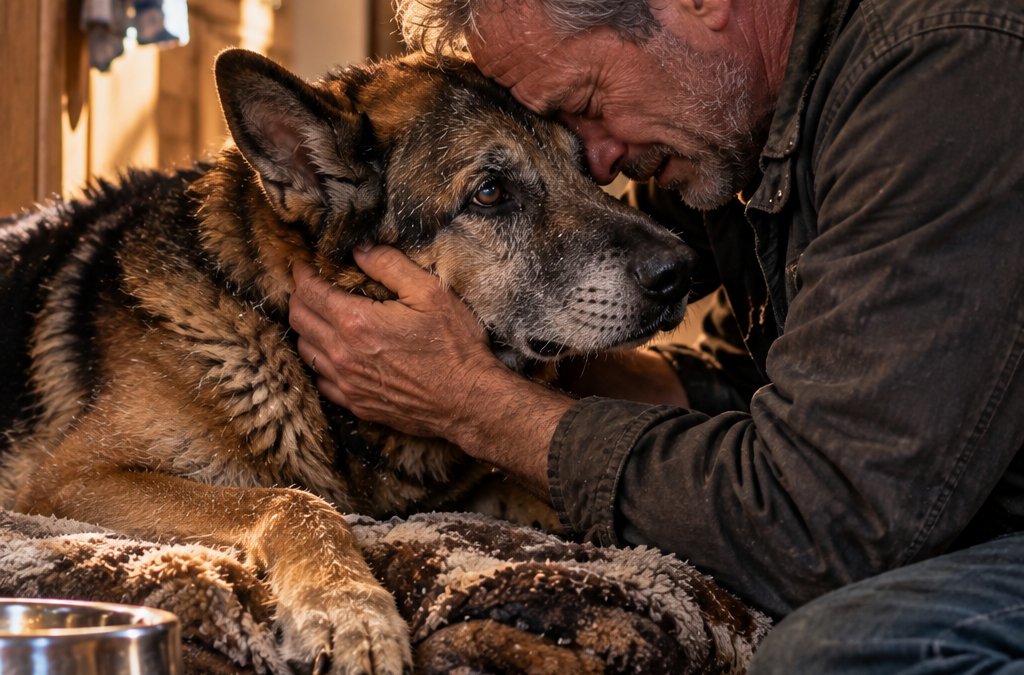
But they were raised.
Both of them.
He was looking directly at me.
I stopped breathing.
“Diesel?”
His nose moved.
He sniffed the air.
Then he turned toward the sound of my voice.
His eyes narrowed with concentration.
He shifted his front paws beneath him.
Rachel gasped softly.
“Dad…”
Diesel pushed himself upright.
His hind legs trembled violently.
I began moving toward him.
But he took a step.
Then another.
Slowly.
Painfully.
He walked around the coffee table.
Not toward Rachel.
Not toward the front door.
Toward me.
I stayed perfectly still.
Tears streamed down my face.
Diesel reached me.
He stopped.
Lifted his head.
And pressed his nose against my chest.
Exactly where he’d pressed it after successful searches for more than a decade.
I covered my mouth.
“Oh, buddy.”
He looked up.
And there it was.
That expression.
Focused.
Familiar.
The slight lift of his left ear.
The steady gaze.
The quiet determination.
For the first time in weeks, he looked at me as though he knew precisely who I was.
I reached toward his face.
“Hey, partner.”
His tail moved.
Once.
Twice.
Then he leaned his whole body against me.
I caught him gently.
“Oh, Diesel.”
My voice broke.
“You found me.”
He pressed closer.
I buried my face in his fur.
“You found me, buddy.”
Rachel was crying behind us.
Dr. Mitchell stood quietly near the fireplace.
Diesel lifted one trembling paw and placed it against my knee.
The same gesture he’d made during countless searches.
The same way he’d asked for another assignment when he was young.
I took his paw in my hand.
Then I said the words I’d been waiting five months to say.
“Good work, partner.”
His tail moved faintly.
I stroked his head.
“Everybody’s home.”
Diesel breathed against my chest.
I held him.
For a few precious seconds, the years seemed to disappear.
We weren’t an old man and a dying dog.
We were partners again.
Standing together after a long search.
Safe.
Together.
Home.
Then his legs began trembling more violently.
I supported him.
“Easy, buddy.”
He lowered his head.
The brightness in his eyes softened.
His attention drifted toward the floor.
And I understood.
The moment was passing.
I helped him settle onto his bed.
He looked toward the wall again.
Confused.
Exhausted.
The recognition was gone.
But I had seen it.
I knew what had happened.
Perhaps the command had awakened some deeply learned response that his illness hadn’t completely erased.
Perhaps the combination of my voice, the old harness, and years of training had briefly reached a part of him that familiar daily words no longer could.
I couldn’t know whether he truly remembered me the way I desperately wanted to believe.
But he had come when I called.
He had found his partner.
And for those few seconds, I had felt the connection that illness had hidden from us.
That was enough.
I returned to my place beside him.
Dr. Mitchell approached.
“Are you ready, Tom?”
I looked at Diesel.
His head rested on the blanket.
His breathing was labored again.
I stroked his ear.
For months, I’d been trying to bring back the dog he used to be.
Now, finally, I understood what he needed from me.
He didn’t need another command.
He didn’t need another assignment.
He needed permission to stop.
I nodded.
“Yes.”
Dr. Mitchell gave him the medication that allowed him to relax into a deep sleep.
I kept my hand against his chest.
Rachel knelt beside us.
She placed her fingers gently against his shoulder.
I leaned toward his ear.
“Listen to me, partner.”
His eyes were growing heavy.
“You saved my life.”
My voice trembled.
“More times than anybody knows.”
I swallowed.
“You gave me eleven years of courage.”
A tear fell onto his blanket.
“And three more years of home.”
I touched the old scar beside his ear.
“I was so afraid you’d forgotten me.”
My voice collapsed.
“But I never forgot you.”
I pressed my forehead against his.
“And I never will.”
Diesel’s breathing became peaceful.
The trembling stopped.
I stroked his face.
Then I whispered the words he had heard at the end of so many successful searches.
“Everybody’s home, partner.”
I paused.
“Your work is done.”
Dr. Mitchell waited.
I nodded through my tears.
She administered the final medication.
I kept my hand on Diesel’s chest.
Felt one slow breath.
Then another.
A quiet exhale.
And my partner was gone.
For a long time, I couldn’t move.
My hand remained against his fur.
I kept waiting for the familiar rise of his chest.
For the soft movement of his ears.
For the sound of his breathing.
But the room was silent.
Rachel wrapped her arms around me.
I leaned into her.
And for the first time since Ellen died, I allowed myself to cry without trying to stop.
I cried for the young dog who’d once dragged me across a training yard.
For the brave K9 who’d pulled me away from a dangerous ledge.
For the partner who’d found a way through a burning building.
For the old friend who’d slept beside me after my wife died.
And for the confused, frightened dog who had trusted me during the final months of his life, even when he no longer understood why the world around him kept changing.
Diesel had lost his memory.
But he’d never lost his worth.
And I realized something I wished I’d understood sooner.
I hadn’t been caring for him because he could remember me.
I had been caring for him because I remembered him.
Every rescue.
Every scar.
Every quiet evening.
Every moment of trust.
He had spent his strongest years protecting me.
I had spent his weakest months protecting him.
That was what partnership meant.
Not remembering everything forever.
Not being strong every day.
But staying.
Especially when staying became difficult.
We buried Diesel beneath the old maple tree behind the house.
It was the same tree where Ellen used to hang bird feeders.
The same place where Diesel had spent summer afternoons sleeping in the shade.
Marcus came.
Rachel and Ben stood beside me.
Several retired officers attended.
Dr. Mitchell sent flowers.
We placed Diesel’s working harness beside his collar, then laid both in a small wooden keepsake box that would remain in my house.
His old K9 badge was mounted on a plaque.
Beneath his name, I had engraved four words.
Forever my faithful partner.
After everyone left, I stayed beneath the tree.
The wind moved gently through the branches.
Golden leaves drifted around my boots.
I looked toward the house.
For a moment, I expected Diesel to appear at the back door.
Ears raised.
Tail wagging.
Ready for another walk.
He didn’t.
I knew he never would.
But the ache in my chest was different now.
I was still grieving.
I would grieve for a long time.
Yet I was no longer afraid that his illness had erased everything we’d shared.
The dog who had forgotten his name had still known how to come to me one last time.
And even if he hadn’t, those years would have mattered just as much.
I knelt beside the tree.
“Good work, Diesel.”
The wind rustled through the leaves.
I smiled through tears.
“Everybody’s home, partner.”
Then I stood, turned toward the house, and walked inside.
For the first time in fifteen years, no dog followed me.
But I carried him with me.
In every memory.
In every scar.
In the old harness hanging beside my coat.
And in the three words I would never speak to another dog.
Find your partner.
Because Diesel had already found me.
And after everything we’d survived together, I knew that some bonds don’t disappear when memory fails.
They simply become the part of love we carry for both of us.