𝗙𝗨𝗟𝗟 𝗦𝗧𝗢𝗥𝗬 The HOA Woman Called 911 to Have My Dog Removed, Certain No One Would Question Why He Kept Staring at Her Shed
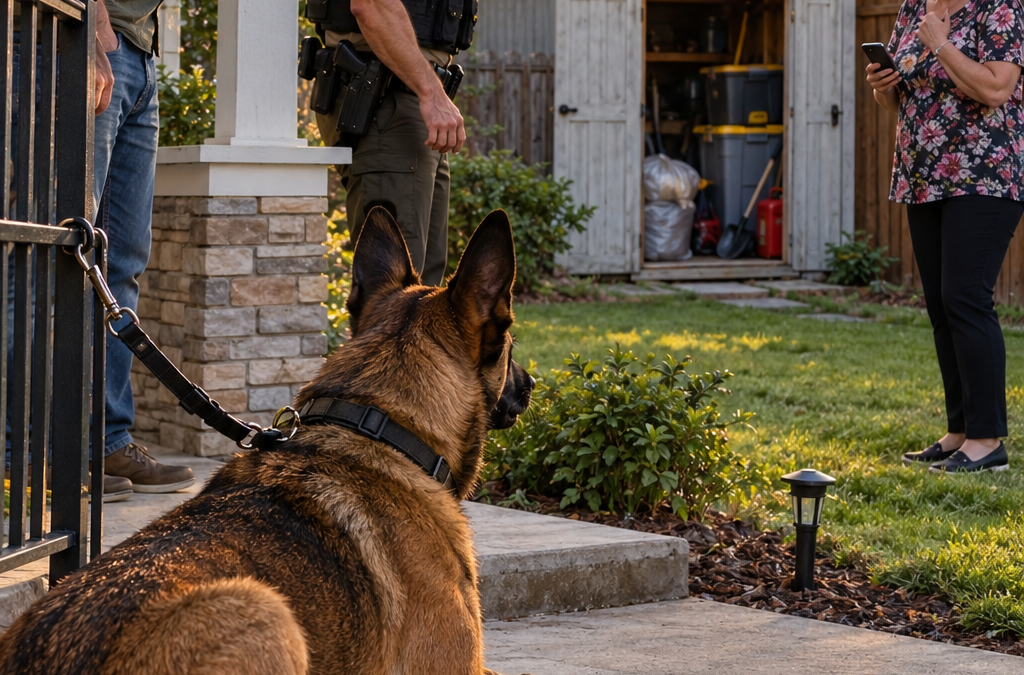
𝗙𝗨𝗟𝗟 𝗦𝗧𝗢𝗥𝗬
I never corrected her.
Across the street lived the Martinezes with two kids.
Farther down were the Rhodes family, the Parkers, an older couple named Sam and Jean Cooper.
Normal people.
Normal neighborhood.
Then there was Sandra Hale.
Sandra was in her mid-fifties.
Always wore a visor when she walked, even in weather that didn’t remotely justify one.
She carried a clipboard often enough that people started associating it with her before they associated her with her own name.
Sandra called herself the HOA compliance coordinator.
She also described herself as neighborhood watch captain.
I later learned neither title was as formal as she made them sound, but at the time nobody paid much attention.
She attended every HOA meeting.
Submitted complaints.
Photographed trash bins.
Wrote down license plates of unfamiliar vehicles.
If somebody left a basketball hoop near the curb, Sandra knew.
If a contractor arrived before approved work hours, Sandra knew.
If a teenager parked on the wrong side of the street overnight, Sandra knew.
Some people found her useful.
Others found her exhausting.
I tried to remain neutral.
Then she saw Rex.
It happened about six months after I moved in.
I was in the front yard pulling weeds from the flower bed.
Rex had been lying on the porch.
At some point, he stood, walked down the steps, and came to me.
My front yard had a decorative fence and gate.
Not tall.
Maybe four feet.
But completely enclosed.
Rex stayed beside me while I worked.
Sandra was walking along the sidewalk.
She stopped.
Not slowed.
Stopped.
Rex noticed her.
His ears lifted.
Then he looked back at me.
Sandra stared.
“Is that your dog?”
I stood.
“This is Rex.”
“What breed?”
“Belgian Malinois.”
She took one step backward.
Rex didn’t move.
“Those are police dogs.”
“Some are.”
“Is he trained?”
“Extensively.”
That was the wrong answer.
I saw it immediately.
Her fear didn’t decrease because I told her he was trained.
It increased.
“What does extensively mean?”
“He worked for the sheriff’s department.”
Sandra looked at Rex again.
He sat beside my leg.
“Attack dog?”
“No.”
“Those dogs are trained to bite.”
“Some law-enforcement training can include apprehension work. Rex’s primary work was detection and search.”
“Has he ever bitten anyone?”
“Not since I’ve owned him.”
“That’s not what I asked.”
I felt irritation rise.
“Sandra, he’s under control.”
“He isn’t leashed.”
“He’s inside my fenced yard.”
“That doesn’t necessarily make people feel safe.”
I looked around.
Nobody else was on the street.
“He’s sitting.”
“Animals are unpredictable.”
“So are people.”
She didn’t appreciate that.
Her mouth tightened.
“You should consider a leash whenever he’s outside.”
“I’ll consider it.”
That should have ended the conversation.
Sandra walked away.
Rex watched her for another second.
Then returned to the flower bed and sniffed dirt.
Two weeks later, I received the first HOA notice.
ANIMAL SAFETY CONCERN
According to the document, a “large working-breed dog” had been observed outside without a leash.
The notice cited community safety rules.
I read the actual bylaws.
Then read them again.
Dogs in common areas had to be leashed.
Dogs on private enclosed property did not.
There was no violation.
I wrote a polite response.
I included a photograph of my fence.
The relevant bylaw section.
Rex’s vaccination records.
Proof of county registration.
That should have ended it.
Instead, Sandra escalated.
The second complaint claimed excessive barking.
That one confused me.
Rex rarely barked.
He would sometimes alert if someone came to the door.
One or two sharp barks.
Then quiet.
I had owned dogs that barked because leaves fell.
Rex considered pointless noise beneath him.
I asked Carol if she had heard him.
“Rex?”
“Yeah.”
“Bark?”
“Once when the delivery man dropped a package.”
“Anything else?”
She shook her head.
“That dog is quieter than you.”
“Thank you, Carol.”
“That wasn’t a compliment.”
The third complaint said Rex’s “intimidating visual presence” discouraged residents from safely walking past my property.
I called the HOA office.
A board member named Henry Lawson answered.
“Daniel.”
“Henry, what exactly is an intimidating visual presence?”
He sighed.
“I’ve been expecting your call.”
“Good.”
“We received a complaint.”
“From Sandra?”
“I can’t identify complainants.”
“Henry.”
Another sigh.
“Yes.”
“Can I be fined because she doesn’t like looking at my dog?”
“No.”
“Then why did I get a notice?”
“Procedure requires us to acknowledge safety complaints.”
“Does procedure require you to send me threatening-looking paper every time Sandra sees Rex?”
“No.”
“Then can we stop?”
“I’ll speak with her.”
He did.
It did not help.
Over the next four months, I received eleven separate complaints.
Eleven.
Rex was too loud.
Rex stood too close to the front gate.
Rex allegedly “tracked pedestrians visually.”
That one was my favorite.
Yes.
My dog looked at people.
Another complaint said he “displayed predatory focus” toward Sandra during her morning walk.
I had security footage.
Rex was sitting beside me while I washed my truck.
Sandra walked past.
Rex looked at her.
That was the entire incident.
Then came the growling allegation.
Sandra submitted a written statement claiming Rex had growled at her friend Diane Mercer near the community mailboxes.
The date was August eighteenth.
I remember because Rex wasn’t in Brookfield Glen that day.
He was at a veterinary clinic twenty-seven miles away getting dental work.
I sent the invoice.
Timestamped intake paperwork.
Discharge record.
Even a photograph the technician had taken of him recovering from anesthesia with his tongue hanging sideways.
Henry called me personally.
“We’re dismissing the complaint.”
“I would hope so.”
“Daniel, I’m trying to keep this from becoming a bigger issue.”
“Then tell Sandra to stop filing false reports.”
“We can’t forbid residents from raising concerns.”
“You can address knowingly false ones.”
He became quiet.
“I’ll bring it to the board.”
That sentence became familiar.
I’ll bring it to the board.
Everything went to the board.
Nothing seemed to come back.
Then the petition arrived.
Fourteen signatures.
REQUEST FOR REMOVAL OF DANGEROUS ANIMAL FROM BROOKFIELD GLEN
I stood in my kitchen reading the names.
Some didn’t surprise me.
Sandra.
Two of her close friends.
A man who complained about everything.
But three signatures bothered me.
People who had met Rex.
People who had touched him.
One was Ellen Rhodes.
Two weeks earlier, she had stopped while I was trimming the hedge.
Rex was lying near the porch.
“Is he friendly?”
“Very.”
She came through the gate.
Rex sniffed her hand.
She rubbed his ears.
“What a beautiful dog.”
Now her name was on a petition describing him as a threat to neighborhood safety.
I walked to her house.
She opened the door and looked immediately uncomfortable.
“Daniel.”
“Can I ask you something?”
She saw the paper in my hand.
“Oh.”
“Did you sign this?”
She folded her arms.
“Sandra said it’s not actually about removing him.”
I stared.
“That’s literally the title.”
“She said it’s about making sure the HOA reviews the situation.”
“Ellen, it says permanent removal.”
Her face changed.
“She said you weren’t following safety requirements.”
“Which ones?”
“I don’t know.”
“You’ve met Rex.”
“I know.”
“You were in my yard.”
“I know.”
“Did he threaten you?”
“No.”
“Bark?”
“No.”
“Growl?”
“No.”
“Bite?”
“Of course not.”
“Then why put your name on this?”
She looked down.
“Sandra said there had already been incidents.”
I held the petition between us.
“There haven’t.”
“I’m sorry.”
I believed her.
That didn’t make it hurt less.
Fear spreads more efficiently than fact.
Sandra understood that.
The word police dog had become attack dog.
Then dangerous dog.
Then neighborhood threat.
I stopped trying to manage it myself.
I hired an attorney who handled animal-law and homeowners-association disputes.
Her name was Melissa Grant.
She read the complaint history.
Then looked at Rex, who was sleeping beneath her conference table.
“That’s the terrorist?”
“Apparently.”
Rex opened one eye.
Melissa smiled.
“He seems overwhelmed by guilt.”
“I want this stopped.”
“Then we make the record boring.”
“What does that mean?”
“It means no emotional arguments. Documentation.”
We hired two independent canine behavior evaluators.
Not friends.
Not former sheriff’s employees.
Professionals.
One specialized in working breeds.
The other evaluated dogs for insurance and legal cases.
Both spent significant time with Rex.
Handling.
Startle responses.
Stranger interaction.
Food behavior.
Leash control.
Fence behavior.
Response to other dogs.
No aggression issue.
No dangerous-animal indicators.
No uncontrolled reactivity.
One report described him as:
Exceptionally responsive to handler direction, environmentally stable, socially neutral, and behaviorally appropriate for a retired working dog.
I liked that.
Socially neutral.
It described Rex better than friendly did.
He liked people.
But he didn’t need everybody to love him.
I submitted the evaluations to the HOA.
Melissa sent a formal letter requesting that unsupported harassment stop.
The board acknowledged receipt.
For almost three weeks, nothing happened.
I thought we might finally be done.
Then came Tuesday morning.
October.
Cool enough that I needed a sweatshirt.
I had coffee on the porch.
Rex was lying beside my chair.
A leash connected his collar to a heavy ring mounted in the porch post.
I rarely needed it.
That morning I used it deliberately because Melissa had advised me to remove every possible argument.
Rex was watching a squirrel on the oak tree.
The squirrel was making reckless decisions.
Rex tracked it with the kind of expression normally reserved for incompetence in senior management.
I took a sip of coffee.
Then Sandra came down the sidewalk.
Visor.
Clipboard under one arm.
Phone pressed to her ear.
She looked at me.
Then at Rex.
Then slowed.
I heard her clearly.
“Yes, I’d like to report a dangerous dog.”
I lowered the mug.
Rex’s ear moved.
Sandra continued walking.
“He’s loose in the front yard and threatening residents right now.”
I looked down.
The leash ran visibly from Rex’s collar to the porch post.
Rex had not moved.
Sandra looked directly at me while speaking.
That was the part that stayed with me.
She knew I could hear.
She wanted me to hear.
“Large Belgian Malinois,” she said. “Former police dog. There have been repeated aggression concerns.”
I stood.
“Sandra.”
She held up one finger.
“No, I’m reporting an active threat.”
“He’s tied to the porch.”
She turned slightly away.
“Yes, the owner is here. He’s confrontational.”
I almost laughed.
Instead, I sat back down.
Melissa’s voice was in my head.
Make the record boring.
So I pulled out my phone.
Started recording.
Sandra remained on the sidewalk until the call ended.
Then she stood across from my house.
Waiting.
“For what?” I asked.
“Animal control.”
“You called 911.”
“I called for public safety.”
“He’s lying down.”
“He has a documented history.”
“No, he has a documented history of you complaining.”
“You don’t get to decide whether people feel unsafe.”
“True.”
I looked at Rex.
“But you don’t get to invent what he’s doing.”
She smiled.
“We’ll let the officer decide.”
Fifteen minutes later, a sheriff’s patrol vehicle turned onto the street.
That mattered because Brookfield Glen fell within county jurisdiction.
The deputy parked near my driveway.
Tall man.
Mid-forties.
Short brown hair.
He stepped out.
Sandra walked toward him immediately.
“Officer, I’m the complainant.”
He held up a hand.
“One moment.”
Then he looked toward the porch.
His eyes landed on Rex.
He stopped.
Actually stopped walking.
Rex lifted his head.
The deputy stared.
Then something changed in his face.
He walked closer.
“Sir, is that a Belgian Malinois?”
“Yes.”
“What’s his name?”
“Rex.”
The deputy stopped again.
“Rex?”
I stood.
“Yeah.”
“County K9 unit Rex?”
My pulse changed.
“His handler was Jim Briggs.”
The deputy’s entire expression opened.
“No way.”
He stepped toward the porch.
“Rex.”
Rex stood.
Not aggressively.
Alert.
The deputy crouched slightly.
“Buddy.”
Rex’s tail moved once.
Then twice.
The deputy laughed.
I hadn’t heard Rex react to many people like that.
“You know him?” I asked.
The deputy looked at me.
“I’m Carver.”
Then back at Rex.
“I trained with him for almost two years.”
He held out his hand.
Rex stepped forward until the leash reached its normal slack limit.
Sniffed.
Then pressed his muzzle briefly against Carver’s wrist.
Carver smiled like he’d found an old colleague.
“Look at you.”
Sandra stood behind him.
Confused.
Carver looked at me.
“Jim retired him?”
“About three years ago.”
“I heard he’d been placed, but I didn’t know where.”
“He lives here.”
Carver scratched Rex lightly under the collar.
“This dog found that kid off Route 17.”
I knew the story.
Most people at the sheriff’s department knew it.
A seven-year-old boy named Eli Carter wandered from his grandmother’s house in 2019.
Search teams had been out for hours.
Rex and Jim located him injured in a drainage ditch hidden behind dense brush.
Hypothermic.
Scared.
Alive.
Carver stood.
“He’s a department legend.”
Sandra’s face was red.
“That doesn’t mean he’s safe now.”
Carver turned.
“I’m sorry?”
“I called because this dog is dangerous.”
Carver looked toward Rex.
Rex had returned to sitting beside me.
The leash remained attached.
“What’s the active threat?”
Sandra pointed.
“Him.”
“What did he do today?”
“He’s outside.”
“Did he charge you?”
“No.”
“Bark?”
“Not today.”
“Growl?”
“Not today.”
“Approach you?”
“No.”
Carver looked at the leash.
“Was he off leash?”
Sandra hesitated.
“He’s in the front yard.”
“That’s not what I asked.”
I said nothing.
Carver repeated, “Was he off leash?”
Sandra looked toward the porch post.
“I may not have seen the lead from the sidewalk.”
Carver nodded once.
“So the dog is on private property, restrained, and has not barked, growled, charged, or approached you.”
“There have been previous incidents.”
“Today, ma’am.”
Sandra’s mouth tightened.
“His presence is intimidating.”
Carver looked toward me.
Then back at her.
“That’s not an emergency.”
“I have a petition.”
“This isn’t an HOA hearing.”
“He needs to be removed.”
Carver’s expression became colder.
“Based on what I’m seeing right now, there’s no dangerous-dog incident here.”
Sandra folded her arms.
“So you’re ignoring me because you know him?”
“No. I’m telling you your description of an active threat doesn’t match what I see.”
She pointed toward Rex again.
“Then why does he keep sniffing around my property?”
Something in her voice changed the air.
It was small.
Maybe nobody else would have noticed.
But I did.
So did Carver.
“What?” he asked.
Sandra seemed to realize she’d moved into a different conversation.
“Every time Daniel walks him past my house, that dog pulls toward my fence.”
I looked at her.
She continued.
“He stops near my shed. He sniffs. He stares. It’s disturbing.”
Everything in my memory rearranged itself.
She was right.
Rex did that.
Not every walk.
Often enough that I had noticed.
Sandra’s property was three houses down.
White fence.
Large detached shed in the back corner.
Whenever we passed, Rex’s pace changed.
Sometimes his nose lifted.
Sometimes he slowed.
Twice he had stopped completely near the fence.
I assumed wildlife.
Raccoon.
Possum.
Compost.
A neighborhood cat.
Dogs smell things humans don’t.
I had never given it much thought.
But Rex wasn’t merely a pet with an interesting nose.
He had years of structured scent work behind him.
Carver looked at me.
“Does he?”
I nodded slowly.
“He has shown interest near that side of her property.”
Sandra immediately said, “See?”
But Carver wasn’t looking at her.
He was looking at Rex.
“What kind of interest?”
“Stops.”
“Pulling?”
“Sometimes.”
“Any trained indication?”
“I don’t know.”
Rex had been retired before coming to me.
I maintained obedience and enrichment.
I wasn’t a certified K9 handler.
There were parts of his working behavior I understood only generally.
Carver thought for a second.
Then asked, “Can you walk him down the public sidewalk?”
Sandra’s face changed.
“No.”
Carver turned.
“Ma’am?”
“You are not bringing that dog near my house.”
“It’s a public sidewalk.”
“You know what you’re doing.”
“I’m responding to information you just provided.”
“I didn’t consent to a search.”
Carver’s expression became very controlled.
“I’m not entering your property. I’m not opening your fence. I’m not entering your shed.”
“I know my rights.”
“Good.”
He looked at me.
“Bring him.”
I clipped Rex to a handheld lead.
Sandra stepped backward.
“This is retaliation.”
Carver said, “You called us here.”
That silenced her.
We walked down the sidewalk.
Carver beside me.
Sandra behind us, talking rapidly into her phone.
Neighbors had started appearing.
Carol stood on her porch.
Mike Rhodes came out across the street.
A patrol car always attracts curtains.
A patrol car walking beside a retired police dog and an angry HOA woman attracts entire households.
As we approached Sandra’s property, Rex changed.
Subtle at first.
Head higher.
Nose working.
His pace slowed.
Carver watched closely.
“Don’t cue him.”
“I’m not.”
“I know.”
We continued along the public sidewalk.
The white fence ran parallel to us.
Sandra’s shed sat forty feet back.
Large structure.
No windows on the street-facing side.
Double doors facing her driveway.
I had always thought it was oversized.
Rex stopped.
Hard.
Not hesitation.
Not distraction.
A clean stop.
He turned his head toward the property.
Then sat.
Carver went still.
Rex looked toward him.
That was the part that made my stomach tighten.
Carver said nothing for several seconds.
Then asked, “Did Jim keep his passive final response?”
“I don’t know.”
“That’s it.”
“What?”
“That sit.”
Sandra had caught up.
“This is ridiculous.”
Carver ignored her.
He took out his radio.
“Dispatch, Carver. I need another unit.”
Sandra stepped closer.
“For what?”
Carver looked at her.
“Ma’am, go back to your residence.”
“No.”
“Then stay on the sidewalk.”
“You have no warrant.”
“I haven’t entered your property.”
“You are using an animal to investigate me.”
Carver’s jaw tightened.
“At this point I’m documenting observations and calling a supervisor.”
Rex remained seated.
He did not bark.
Did not pull.
Just stared past the fence.
I looked at the shed.
For the first time, I felt uneasy.
Not triumphant.
Uneasy.
Because if Rex’s behavior meant nothing, we were about to look ridiculous.
If it meant something, Sandra’s desperation suddenly made more sense.
A second deputy arrived.
Then a supervisor.
Carver spoke with them away from Sandra.
I couldn’t hear everything.
They contacted dispatch.
Checked recent reports.
Asked questions about the property.
One officer spoke to Carol.
Another to Mike.
Sandra returned to her house and came back with a folder, loudly insisting nobody had permission to enter.
Nobody did.
Not then.
The officers didn’t kick down her gate.
They didn’t march into the shed because Rex sat on a sidewalk.
They began building information.
That distinction mattered.
Carver later told me the department already had open reports involving property thefts in Brookfield Glen and nearby streets.
Bicycles.
Small equipment.
Tools.
A generator.
Items from a community-center burglary six months earlier.
Nothing by itself had pointed toward Sandra.
Then she had called 911.
Mentioned Rex repeatedly showing interest near her shed.
And reacted strongly when Carver suggested simply walking past.
That did not prove a crime.
It gave them a reason to look more carefully at existing information.
Things moved fast after that.
Faster than I understood at the time.
Another unit arrived.
An investigator spoke to several neighbors.
Someone remembered seeing a utility trailer near Sandra’s house late one evening after the community-center burglary.
Someone else remembered Sandra claiming she’d bought a nearly new pressure washer at an estate sale.
Carol mentioned something I had forgotten.
Her garden tools.
Six months earlier, Carol had discovered that a custom set of gardening tools was missing from her locked side storage.
Pruning shears.
Hand trowels.
A narrow spade.
Nothing enormously valuable in market terms.
But the handles had been engraved.
CAROL — GROW SOMETHING BEAUTIFUL. WALTER
Her husband had given them to her for their thirty-fifth anniversary.
When they disappeared, Carol cried.
Not because she couldn’t afford new tools.
Because you cannot buy another gift from a dead man.
The theft had been reported.
Never solved.
Carver asked for the report number.
Carol had it.
Of course she did.
By late afternoon, investigators had enough information to take the next legal steps.
I wasn’t inside those conversations.
I won’t pretend I was.
What I knew was that additional officers arrived.
Then an investigator.
Then, after the appropriate authorization was obtained, they searched Sandra’s shed.
I stood on my porch with Rex.
I did not go closer.
Neither did Carol.
She was beside me.
“What do you think is happening?” she asked.
“I don’t know.”
“Do you think she stole things?”
“I don’t know.”
“Daniel.”
“I really don’t.”
Rex lay at my feet.
Completely calm.
About forty minutes later, an officer carried a bicycle from Sandra’s yard.
Then another.
Then a third.
Carol gripped my arm.
“Oh my God.”
More items appeared.
A lawnmower.
Another lawnmower.
A generator.
Pressure washer.
Golf clubs.
Toolboxes.
Electronics.
A child’s electric scooter.
By then, half the street was outside.
Nobody spoke much.
The sight of familiar possessions changes a crowd.
It stops being rumor.
Mike Rhodes suddenly said, “That’s my bike.”
He crossed the street.
Carver stopped him.
“Stay back.”
“My bike was stolen last summer.”
“We’ll inventory everything.”
“That’s my bike.”
His voice broke.
Another bicycle belonged to a teenager two streets over.
The scooter belonged to the Martinez family.
Their son Lucas had gotten it for Christmas.
It disappeared from their garage after someone left the side door open for less than an hour.
Then Carver came toward Carol.
He wasn’t carrying anything.
“Ms. Bennett?”
She stood.
“Yes?”
“We found something I’d like you to identify.”
Her face drained.
“What?”
He didn’t answer directly.
He led her toward the edge of the property but not inside the active search area.
Another officer came forward carrying a clear evidence bag.
Inside were garden tools.
Wooden handles.
Metal worn from use.
Engraving visible even from several feet away.
Carol covered her mouth.
“No.”
Carver said gently, “Do you recognize these?”
She started crying.
I had seen Carol cry once before.
At a memorial event for Walter.
This was different.
She reached toward the bag, then stopped herself.
“Those are mine.”
“You’re sure?”
She nodded rapidly.
“My husband gave them to me.”
Carver turned the bag enough for her to see the handles.
She read the engraving.
Then bent forward like the words had struck her physically.
I put one arm around her shoulders.
She whispered, “She had them.”
I didn’t know what to say.
Sandra had spent months calling my dog dangerous.
She had photographed my property.
Filed complaints.
Collected signatures.
Demanded Rex be removed.
And twenty yards behind her house, inside the shed Rex kept noticing, were things stolen from the same neighbors she claimed to be protecting.
The search continued for hours.
Eleven bicycles.
Two lawnmowers.
Generator.
Pressure washer.
Golf clubs.
Scooter.
Tools.
Electronics.
Property traced to the community-center burglary.
Items from several residential theft reports.
Some objects hadn’t even been reported because owners assumed they’d misplaced them.
Sandra was arrested that evening.
Not because Rex magically convicted her.
Not because a dog sitting beside a fence proved anything by itself.
Because his behavior, combined with her own statements, existing theft reports, witness information, and what investigators subsequently uncovered led the case somewhere nobody had expected.
The sheriff’s deputies walked Sandra toward a patrol car just before sunset.
Her visor was gone.
No clipboard.
Hands restrained behind her.
She looked smaller.
Not physically.
Authority does strange things to scale.
For months, Sandra had seemed to occupy more space than everyone else.
Her notices.
Her complaints.
Her inspections.
Her voice at meetings.
Now she was simply one woman walking between two deputies.
She stopped when she saw me.
Then she looked down.
Rex sat beside my leg.
Our eyes met for maybe two seconds.
Sandra didn’t say anything.
Neither did I.
Rex looked at her.
Then at Carver.
Then back at me.
Calm.
Almost bored.
I scratched behind his ear.
“Good boy.”
His tail touched the ground once.
Car door shut.
That was it.
The next few days were chaos.
Investigators contacted homeowners.
Property had to be identified.
Serial numbers checked.
Reports matched.
Some items had been stolen outside Brookfield Glen.
That surprised everyone.
The theory investigators developed was simple and ugly.
Sandra’s neighborhood activity had given her information.
She walked constantly.
Knew who worked daytime shifts.
Knew when families vacationed.
Knew which garages were usually open.
Knew who had expensive equipment.
Knew who lived alone.
Knew which residents trusted her enough to let her near their homes.
Her HOA obsession wasn’t necessarily created for theft.
Maybe it started with control.
But eventually it gave her access to something thieves value more than strength.
Patterns.
She knew when people were gone.
She knew what they owned.
She knew which doors were hidden from the street.
She had spent years making everybody accustomed to seeing her where she did not belong.
That was the part that disturbed me most.
If another stranger walked slowly past your garage three times, you noticed.
If Sandra did it with a clipboard, you assumed she was checking weeds.
If another person photographed your driveway, you challenged them.
Sandra called it compliance documentation.
Authority had made her invisible in plain sight.
Or the appearance of authority had.
The board held an emergency meeting three nights after the arrest.
The clubhouse had never been so crowded.
I brought Rex.
Not inside.
He stayed with Jim Briggs, who drove over when he heard what happened.
Jim hadn’t seen Rex in nearly two years.
When they reunited, Rex became a different animal for thirty seconds.
Tail moving.
Small vocal sound in his throat.
Pressing against Jim’s legs.
Jim knelt and put both hands around his neck.
“You old criminal catcher.”
Rex licked his cheek once.
Jim laughed.
“Still inappropriate.”
Carver attended the meeting off duty.
He stood near the back.
Henry Lawson opened.
His voice shook slightly.
“As most of you know, Sandra Hale has been arrested as part of an ongoing investigation involving stolen property recovered from her residence.”
Nobody moved.
“We also need to address how association practices may have contributed to her ability to operate without sufficient oversight.”
A man in the front row said, “May have?”
Henry nodded.
“You’re right.”
He looked down at his notes.
“We gave Sandra too much informal authority.”
Someone said, “You let her terrorize people.”
Another voice:
“You let her file fake dog complaints.”
Another:
“She fined my daughter.”
The meeting became loud.
Henry didn’t hide behind the microphone.
He listened.
That helped.
When things settled, Ellen Rhodes stood.
The woman who had signed the petition against Rex.
She turned toward me.
“I’m sorry.”
Every face turned.
I hated being the center of it.
She continued.
“Sandra told me there were bite reports.”
“There weren’t.”
“I know that now.”
“She told me the sheriff had been contacted before.”
“They hadn’t.”
“I know.”
She looked near tears.
“I signed without asking you.”
I nodded.
“I know.”
“I petted Rex.”
“I remember.”
“I’m ashamed.”
That was harder to hear than anger would have been.
“Don’t be.”
“I should be.”
“No.”
I looked around the room.
“Sandra knew exactly what she was doing.”
Ellen sat.
Then Carol stood.
She held a photograph of the recovered tools.
The actual tools were still evidence at the time.
“My husband gave me these.”
Her voice broke.
“I thought they were gone forever.”
Nobody interrupted.
“Sandra came to my house the day after they disappeared.”
That shocked me.
Carol continued.
“She told me crime was getting worse because residents weren’t supporting neighborhood watch.”
Several people reacted aloud.
“She stood in my kitchen while I cried.”
Carol’s hands trembled.
“And my tools were in her shed.”
Silence.
Then she said, “I don’t want a neighborhood watch captain ever again if that’s what we’re watching.”
The vote to dissolve the HOA didn’t happen that night.
That required procedure.
Notice.
Ballots.
Legal review.
But the process started.
A month later, homeowners voted overwhelmingly to dissolve the association and transfer the limited common maintenance obligations to a much smaller neighborhood maintenance agreement.
No compliance coordinator.
No neighborhood enforcement officer.
No clipboard patrol.
The entrance landscaping still got maintained.
The small park remained.
Garbage still got collected.
Civilization somehow survived without Sandra measuring anybody’s trash cans.
The criminal case against her took longer.
Multiple theft and burglary counts.
Receiving stolen property.
Additional allegations as investigators traced specific items.
I did not attend every hearing.
I didn’t need to.
The neighborhood already felt lighter.
People walked differently.
That sounds absurd, but it’s true.
Sandra had made everybody slightly self-conscious.
Cars slowed when they passed her house.
Residents looked over their shoulders while doing yard work.
You wondered whether a letter would arrive because a hose was visible or music could be heard from the sidewalk.
Once she was gone, people stopped performing for an imaginary inspector.
Carol planted three large ceramic pots in front of her garage.
Technically they would have violated Sandra’s interpretation of the old rules.
Nobody cared.
Mike left his trash cans visible until lunchtime one Saturday.
Nobody died.
The Martinezes put up a basketball hoop.
Children played until dusk.
Normal life returned quickly once people stopped being afraid of notices.
The stolen property returned more slowly.
Some items were easy to identify.
Serial numbers.
Engravings.
Receipts.
Photographs.
Other things remained in evidence until the investigation allowed release.
When Carol finally got Walter’s garden tools back, she carried them to my house.
Not in a bag.
In her arms.
Rex was outside with me.
She walked through the gate.
Rex stood.
Carol crouched.
“You found these.”
He sniffed the tools.
Then her hands.
She started crying.
Again.
“Your stupid nose found these.”
I said, “Carol, he probably wasn’t identifying the tools specifically.”
She looked at me.
“Don’t ruin this.”
“Okay.”
She hugged Rex around the neck.
He tolerated it with the patience of a saint.
Then she held the small engraved trowel out to me.
The handle read:
CAROL — GROW SOMETHING BEAUTIFUL. WALTER
“I thought I’d lost the last thing he gave me.”
“You didn’t.”
“No.”
She wiped her face.
“Because of Rex.”
I didn’t correct her again.
The Martinez boy, Lucas, got his scooter back a week before his birthday.
His father rolled it over to show me after the police released it.
Lucas rode circles in my driveway.
Rex watched from the porch.
“He should get a reward,” Lucas said.
“He gets plenty.”
“No, like steak.”
Rex’s ears lifted at the word.
I looked at him.
“See what you’ve done?”
Lucas grinned.
I bought steak.
The sheriff’s department eventually did something I didn’t expect.
They wrote a feature about Rex.
The local newspaper picked it up.
The headline was more dramatic than I liked:
RETIRED K9 HELPS UNRAVEL BROOKFIELD THEFT CASE
They used Rex’s old department photograph.
Younger.
Harness on.
Ears upright.
Looking directly into the camera.
Very serious.
Very handsome.
Jim called me.
“You framed it yet?”
“No.”
“Liar.”
I had.
It’s in the garage.
Carver stopped by one Saturday.
No uniform.
He brought Rex a department tennis ball.
Rex destroyed it in eleven minutes.
“Still got it,” Carver said.
“He destroys every expensive toy I buy.”
“He used to murder training balls too.”
We sat on the porch.
For a while neither of us talked about Sandra.
Then I asked, “Do you really think he recognized something at that shed?”
Carver thought about the wording.
“I think he recognized odor patterns that mattered to him.”
“From stolen property?”
“Not like he thought, Those are stolen bicycles.”
“I know.”
“Rex had years of scent work. Search dogs develop strong patterns around environments, objects, residual odor, people. Maybe something there was familiar from prior exposure. Maybe there was another odor associated with something in the shed. Maybe he simply found that location consistently interesting.”
“So we don’t know.”
“No.”
I nodded.
He continued.
“But here’s what mattered.”
“What?”
“Sandra told us he kept doing it.”
I looked toward her old house.
It was empty by then.
“She volunteered the detail.”
“Exactly.”
“Why?”
“People under pressure say things.”
He leaned back.
“She was so focused on making Rex sound threatening that she didn’t realize she was describing repeated behavior around her own shed.”
I looked at Rex.
He was asleep near the steps.
“She called 911 to get him removed.”
“Yeah.”
“And instead—”
Carver smiled.
“She got us interested in why he kept stopping at her property.”
There was a strange justice in that.
Not supernatural.
Not magical.
Just human arrogance creating an opening.
Sandra believed everything Rex did could be interpreted as dangerous.
She complained about his attention.
His focus.
His nose.
The same qualities that had once made him useful to law enforcement.
In trying to weaponize them against him, she made an experienced deputy pay attention to them.
I thought about that for a long time.
Fear had been at the center of everything.
Sandra was afraid of Rex.
Maybe genuinely.
I don’t think her original discomfort was fake.
A Belgian Malinois can be intimidating.
Rex looked powerful.
Focused.
Different from the golden retrievers and Labradors most people around Brookfield owned.
If Sandra had simply said, “Daniel, I’m nervous around him,” I would have worked with her.
I would have crossed the street during walks.
Used a shorter leash near her house.
Kept Rex away from her fence.
Fear itself doesn’t make someone bad.
What Sandra did with fear did.
She transformed discomfort into accusation.
Accusation into authority.
Authority into a campaign.
She needed Rex defined as dangerous because once she assigned him that label, anything he did became proof.
He looked at her?
Intimidation.
He sniffed near her fence?
Threatening behavior.
He stood in his own yard?
Public safety concern.
He existed?
Problem.
That’s how labels work when people want them badly enough.
Evidence stops mattering.
Everything gets bent to fit.
Sandra even had veterinary proof that one alleged incident was impossible.
Didn’t matter.
She filed another complaint.
Two professional evaluations said Rex wasn’t dangerous.
Didn’t matter.
Petition.
Then 911.
She kept escalating because reality refused to cooperate with the story she had already decided was true.
Or maybe she needed him gone for another reason.
I wondered about that too.
Did she understand that Rex’s interest in her property might eventually attract attention?
Was that why the campaign became so intense?
Maybe.
Investigators never told me that was proven.
I won’t pretend certainty where there isn’t any.
But I know this.
Sandra noticed Rex watching her shed.
She told Deputy Carver herself.
And the moment she saw his reaction, she became terrified of him walking past it.
That was enough to make me wonder.
The neighborhood changed its relationship with Rex afterward.
Too much, actually.
For months, people treated him like a celebrity.
Children asked to pet him.
Adults brought treats.
One man I’d never met stopped his truck and shouted, “Good boy, Rex!”
Rex stared at him with complete indifference.
He had always considered public praise unnecessary.
I kept some distance.
Retired working dogs still need boundaries.
I didn’t want the neighborhood turning him into a mascot.
He was older.
His hips had started getting stiff.
He slept more.
The famous K9 everyone suddenly wanted a photograph with was also the dog who sometimes needed help getting into my truck.
That’s the part photographs never show.
Retirement.
Age.
The slow transformation from working animal into simply family.
One winter morning, about a year after Sandra’s arrest, Rex struggled on the porch steps.
I pretended not to notice until he looked at me.
Then I supported his back end.
“Don’t tell anyone.”
He sneezed.
“Your reputation would be destroyed.”
He leaned against my leg.
For years, people had talked about what Rex could do.
Search.
Detect.
Track.
Alert.
Work.
What mattered to me by then was much smaller.
He stayed.
That was his greatest skill.
He stayed through quiet mornings.
Through retirement.
Through my own adjustment to a life without a job dictating every hour.
He was there when the house felt unfamiliar.
There when Brookfield began feeling like home.
There when Sandra turned the neighborhood against him.
There after her patrol car disappeared around the corner.
Loyalty is less dramatic than law enforcement training.
It is also more important.
Carol once asked me whether I thought Rex knew he had exposed Sandra.
“No.”
“Really?”
“He knows he did something and got steak.”
She laughed.
“Maybe that’s enough.”
“Probably.”
I think she was right.
The old HOA records were eventually boxed up and stored with the neighborhood maintenance committee.
The dangerous-animal petition technically remained in an archive until Melissa, my attorney, insisted it be formally voided.
I wanted that.
Not because Rex cared.
Because records outlive explanations.
I didn’t want some future buyer, insurance company, or county employee finding a file describing him as dangerous without the resolution attached.
The committee issued a written statement.
All allegations concerning Rex were withdrawn as unsupported.
The petition was invalidated.
No dangerous-animal finding had ever been entered.
Melissa sent me the letter.
“Frame that too.”
“I already have one Rex article framed.”
“You’re becoming that parent.”
“What parent?”
“The one with an achievement wall.”
“He earned it.”
“I rest my case.”
Sandra eventually pleaded to several charges as part of the criminal case.
Other charges and restitution issues were resolved through the court process.
I followed enough to know multiple residents received compensation or property back.
I didn’t follow every hearing.
My life wasn’t supposed to become permanently organized around Sandra.
That mattered.
Accountability is necessary.
Obsession isn’t.
Her house sold.
A family with twin girls moved in.
They tore down the old white fence.
The shed remained for several months.
Then they demolished it.
I happened to be walking Rex when the contractor started.
The first wall came down with a crack.
Rex stopped.
Looked.
Then kept walking.
I smiled.
“That’s all you’ve got?”
He ignored me.
The place that had obsessed him for months was now just lumber.
Good.
I wanted that for both of us.
A couple of years after the incident, Jim Briggs came by for dinner.
Rex was older by then.
Gray around the muzzle.
Still alert.
Still himself.
Jim sat on the floor beside him.
“Remember me?”
Rex placed one paw on his leg.
Jim’s face changed.
“Yeah.”
We drank coffee after dinner.
Jim told stories from Rex’s working years.
Some funny.
Some not.
The missing child case.
A warehouse search where Rex located narcotics hidden inside machinery.
An elderly dementia patient found after wandering into thick woods.
“He saved time,” Jim said.
“That’s what good dogs do.”
Then he looked at me.
“People always talk about K9s like they’re machines.”
I nodded.
“They’re not.”
“No.”
“Rex was good because he trusted the work. Trusted me.”
Jim rubbed the dog’s shoulder.
“And because we listened to him.”
That line stayed with me.
We listened to him.
For months, I hadn’t.
Not really.
Rex repeatedly reacted near Sandra’s shed.
I assumed raccoon.
Compost.
Wildlife.
Anything ordinary.
There was nothing unreasonable about that.
But after everything happened, I became more aware of how often animals communicate through patterns.
Not magic.
Not human thoughts.
Patterns.
A change in pace.
A sit.
Focus.
Avoidance.
People communicate that way too.
Carol’s shaking hands.
Ellen’s embarrassment.
Sandra’s insistence.
Carver going suddenly still when she mentioned the shed.
The entire story was built out of people revealing things before they intended to.
I missed some.
Not all.
I’ve thought often about the morning Sandra called 911.
If Carver had been another deputy, maybe the initial outcome would have been simple.
Dog restrained.
No active threat.
Complaint closed.
Sandra frustrated.
Everyone goes home.
Maybe Rex’s interest in the shed would have remained a neighborhood oddity.
Maybe investigators would eventually find Sandra through some other evidence.
Maybe not.
Instead, the officer knew Rex.
Knew his training.
Knew his history.
And when Sandra complained that this particular dog repeatedly focused on one particular location, Carver heard something different from what she intended.
She meant:
Look how threatening he is.
Carver heard:
Why does a trained former K9 keep showing interest there?
That difference changed everything.
Not because Rex was some magical detective.
Because context matters.
Expertise matters.
A behavior means different things depending on who understands it.
Sandra saw danger because that was the story she wanted.
Carver saw information.
One of those interpretations survived contact with reality.
The other didn’t.
Brookfield Glen is quieter now.
The HOA is gone.
We have a small maintenance association that handles the entrance landscaping and common park.
No enforcement patrol.
No neighborhood-watch captain.
No clipboard.
People still keep lawns reasonably neat.
Trash gets picked up.
Property values somehow survived without somebody photographing garden hoses.
Carol’s roses are still growing through my fence.
I told her I expect compensation.
She brings cookies.
Fair arrangement.
Lucas Martinez is a teenager now.
The scooter is long gone.
Probably outgrown.
He still says hello to Rex when he visits his parents.
Rex doesn’t always hear him.
Age.
That’s life.
One afternoon, Carol came over with a small wooden box.
“What is this?”
“Open it.”
Inside was a brass plaque.
I read it.
REX
K9 — RETIRED
GOOD NEIGHBOR
BETTER JUDGE OF CHARACTER
I laughed.
“No.”
“Yes.”
“I’m not mounting this.”
“You are.”
“That’s ridiculous.”
“Correct.”
We put it beside the porch.
Rex sniffed it once.
Then lay down.
Unimpressed.
The plaque stayed.
I still have the first complaint Sandra ever filed.
Sometimes I come across it in the property folder.
DOG OBSERVED UNLEASHED IN FRONT YARD.
Technically true.
He wasn’t wearing a leash.
He was inside a fence.
Sitting beside me.
It’s strange how something can be factually narrow and completely dishonest at the same time.
That was Sandra’s specialty.
She knew how to select details that made her fear sound objective.
Police dog.
Large breed.
Unleashed.
Watching residents.
Sniffing property.
Every phrase could be made to sound sinister if you removed enough context.
The truth required more words.
Retired law-enforcement K9.
Professionally trained.
Controlled.
Fenced yard.
Documented behavior evaluations.
No aggression history in the neighborhood.
Sometimes lies aren’t invented.
They’re edited.
I learned that from Sandra.
I also learned something about confidence.
People assume the loudest person in a dispute must know more than everyone else.
Sandra spoke with certainty.
Residents signed because of certainty.
The HOA entertained complaints because of certainty.
She called 911 with certainty.
Then Deputy Carver arrived.
And certainty finally met knowledge.
There is a difference.
Carver didn’t need to shout.
Didn’t need to humiliate her.
He asked questions.
What did the dog do?
Did he approach?
Did he bark?
Was he restrained?
Specific questions destroy vague accusations.
That’s true outside dog disputes too.
Sandra said Rex was dangerous.
Carver asked what danger had occurred.
Nothing.
She said he behaved suspiciously near her property.
Carver asked where.
The shed.
She gave him the detail herself.
That is the irony I remember most.
Sandra spent months trying to use Rex’s training against him.
The former police dog.
The intimidating working breed.
The animal that made her feel unsafe.
She wanted everybody frightened by what he had been trained to do.
Then the one day someone who actually understood that training showed up, Sandra accidentally made his training relevant.
She called the sheriff.
She pointed to Rex.
She complained about his nose.
Then she complained about the one place his nose kept taking him.
After that, the truth did the rest.
I never celebrated Sandra’s arrest.
That surprises people.
There were neighbors who did.
I understand why.
She stole from them.
Lied to them.
Used their trust.
Stood in Carol’s kitchen while Carol mourned missing gifts that were hidden in Sandra’s own shed.
There is cruelty in that I still struggle to understand.
But watching someone lose their life to consequences isn’t entertainment to me.
I wanted the thefts stopped.
I wanted the property returned.
I wanted Rex left alone.
That happened.
Enough.
The most satisfying day wasn’t the arrest.
It was months later.
Warm afternoon.
I sat on the porch.
Rex beside me.
Carol was gardening next door with Walter’s tools.
I could hear the small metal trowel hitting soil.
Lucas rode past on a bicycle.
Kids played basketball near the Martinez driveway.
Nobody had a clipboard.
Nobody was afraid of being reported.
Rex lifted his head when someone walked past.
Looked.
Then lowered it again.
Normal.
The exact behavior Sandra had spent months turning into something dangerous.
I reached down and rested my hand on his shoulder.
“Retirement suits you.”
His tail moved once.
He was never interested in proving anything.
That was a human problem.
Rex knew who he was.
Working dog.
Then retired dog.
Then simply my dog.
Maybe that’s why Sandra could never really hurt him.
Her accusations mattered to boards and neighbors.
They did not matter to Rex.
He woke up.
Ate breakfast.
Walked.
Slept.
Followed scent.
Trusted me.
His world remained uncomplicated.
Mine took longer.
For months after Sandra was gone, I felt angry whenever I remembered the petition.
Fourteen names.
People who knew him.
People who hadn’t asked me a single question.
Eventually, I let that go too.
Most apologized.
Fear had done what fear does.
Sandra gave it direction.
That doesn’t excuse them.
It explains them.
I had no interest in living permanently offended by people who had already admitted they were wrong.
The neighborhood had spent enough time divided.
So we moved on.
Not forgetting.
Moving.
There’s a difference.
Rex is older now than any police department would ever keep a working dog active.
He sleeps more than he watches.
His hearing isn’t what it was.
His rear legs sometimes shake after long walks.
I shortened our route.
We still pass Sandra’s old property.
New fence.
No shed.
The twin girls who live there sometimes draw chalk flowers on the sidewalk.
Rex never stops anymore.
The first time we walked past after the shed came down, I waited.
Maybe part of me expected him to sit.
He didn’t.
He glanced toward the yard.
Kept walking.
I laughed quietly.
“Case closed?”
He continued forward.
Good enough.
I sometimes think of the title the newspaper gave him.
RETIRED K9 HELPS UNRAVEL BROOKFIELD THEFT CASE
That’s accurate.
But incomplete.
What Rex really exposed wasn’t only stolen property.
He exposed how easily a person can hide behind community authority if everyone assumes surveillance equals protection.
Sandra knew everyone’s schedules because people thought she was keeping them safe.
She photographed homes because people thought she was enforcing rules.
She walked streets at odd hours because she was “neighborhood watch.”
She asked questions about vacations.
Deliveries.
Contractors.
Work schedules.
Nobody asked why she needed so much information.
She wore authority like camouflage.
Rex didn’t care about camouflage.
He cared about scent.
That is almost too perfect.
Humans saw the clipboard.
The visor.
The HOA title.
The concerned-neighbor performance.
Rex saw whatever was actually there.
Maybe that’s why I trust dogs.
They can be mistaken.
Of course.
They aren’t moral judges.
They aren’t supernatural.
But they don’t care about job titles.
They don’t care who speaks confidently.
They don’t care who controls the neighborhood newsletter.
Rex didn’t know Sandra was important.
He knew something near that shed repeatedly caught his attention.
That was enough.
The morning she called 911, Sandra believed she was finally going to prove Rex didn’t belong in Brookfield Glen.
She stood on that sidewalk waiting for an officer to validate everything she had been saying.
Dangerous.
Aggressive.
Threatening.
Remove him.
Instead, Deputy Carver stepped from his patrol car and recognized an old colleague.
I can still see Sandra’s face when Carver said Rex’s name.
Not fear exactly.
Uncertainty.
For the first time, she was no longer the person in the conversation who knew the most about my dog.
Her version lost control.
Then she started explaining too much.
That was her mistake.
Rex keeps sniffing my property.
Rex keeps going toward my shed.
Rex makes me uncomfortable when he goes near that fence.
She believed those details strengthened her complaint.
They didn’t.
They opened the door to questions.
And once the right questions started, Sandra’s life of little secrets could not survive them.
People still ask me what I would have done differently.
Would I have confronted Sandra sooner?
Sued the HOA?
Recorded meetings?
Gone door to door and defended Rex?
Maybe.
But I’m not sure any of it would have changed the final outcome.
Sandra had become convinced that rules were weapons.
She used complaints because complaints worked.
She used fear because fear worked.
She used the HOA because people responded to it.
Every successful manipulation made her more confident.
Eventually, she became confident enough to call 911 while lying about a dog lying quietly on a porch.
That confidence brought Carver to the neighborhood.
Carver recognized Rex.
Sandra started talking.
Rex walked past the fence.
Then everything Sandra had hidden behind the image of a concerned community guardian began coming apart.
All because she needed one more complaint.
One more escalation.
One more attempt to force the neighborhood to obey her fear.
That is what I remember whenever I look at Rex now.
Not the bicycles.
Not the police cars.
Not even Carol’s tools.
I remember him lying beside my chair that morning, staring at a squirrel, completely unaware that someone three houses away was calling emergency services to have him labeled dangerous.
He wasn’t angry.
Wasn’t nervous.
Didn’t need to defend himself.
He simply waited.
Then someone who knew him arrived.
The truth caught up.
Rex had spent eight years being trained to search patiently until what was hidden became visible.
In retirement, without any of us planning it, he did it one last time.
And the woman who wanted him removed was the person who gave him the opportunity.








