𝗙𝗨𝗟𝗟 𝗦𝗧𝗢𝗥𝗬 The HOA Shut Off the Power to My Medical Equipment, Never Realizing Why They Had Targeted My Garage in the First Place
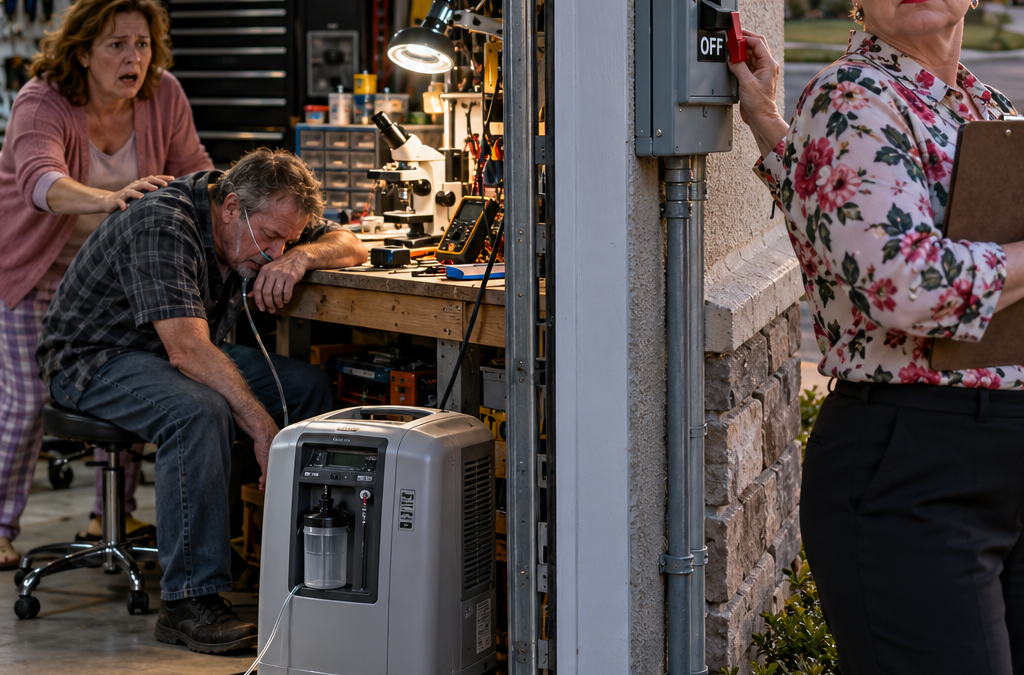
𝗙𝗨𝗟𝗟 𝗦𝗧𝗢𝗥𝗬
That was worse.
Then Diane walked into our three-car garage one Saturday and found me disassembling an old dissolved-oxygen meter I had purchased online.
“What are you doing?”
“Fixing it.”
“Why?”
“It was cheap.”
“Marcus.”
“What?”
“You have been retired for four months, and you have turned half my parking space into a laboratory.”
“Technically, it’s not a laboratory.”
She looked around.
There was an oscilloscope.
Two microscopes.
A centrifuge.
Three bins of sensors.
A soldering station.
Glassware.
A small environmental chamber I had built myself.
She raised an eyebrow.
“What’s missing?”
“A permit?”
I smiled.
She did not.
“Finish the garage properly.”
That was how the home lab began.
Not because I wanted to run a secret business.
Not because I was conducting dangerous experiments.
I needed somewhere for my mind to keep moving even when my lungs could not.
I insulated the garage.
Installed proper ventilation.
Added fire-rated wall sections where necessary.
Upgraded electrical service.
Installed dedicated circuits.
Had the city inspect everything.
I converted one bay into bench space.
Another into equipment storage.
The third remained partly open for Diane’s car, although she still complained I was gradually invading it with labeled plastic bins.
The lab became what she called “the most organized chaos on Earth.”
She was not wrong.
Shelves lined every wall.
A used mass spectrometer occupied one corner.
A coffee maker sat six feet away because Diane refused to let me put it closer to chemicals.
A workstation held three monitors.
I built a remote environmental monitoring system.
Temperature.
Humidity.
Particulates.
Power usage.
Air exchange.
Everything logged.
Then there was the oxygen concentrator.
That machine was different from everything else in the room.
It was not an experiment.
It was not a hobby.
It was not optional.
My pulmonologist prescribed supplemental oxygen for six to eight hours per day depending on activity and blood oxygen levels.
At home, I used a stationary concentrator.
It pulled room air through molecular sieve material that removed nitrogen and delivered oxygen-enriched flow through tubing.
The machine ran from a dedicated electrical circuit.
I integrated it into my workspace because that was where I spent much of the day.
I could work at the bench.
Monitor my saturation.
Use oxygen.
Pause when needed.
The arrangement gave me some version of the life I thought I had lost.
I was no longer the engineer designing equipment for other people.
But I was still an engineer.
That mattered more than I can explain.
Sycamore Ridge had forty-two houses.
We had moved there almost nine years earlier.
It was not a dramatic neighborhood.
Brick and siding homes.
Mature sycamores.
Curved streets.
A modest clubhouse.
A community pool.
Lawns maintained well enough that nobody’s property values were collapsing but not so perfectly that you felt afraid to leave a garden hose outside.
At least that was how it had been when we moved in.
Then Linda Marsh became HOA president.
Eleven consecutive years.
That should tell you something.
No one openly elected themselves president for life.
People simply stopped running against Linda because nobody wanted the argument.
She was sixty, maybe sixty-two.
Always immaculate.
Always holding some binder, folder, clipboard, or tablet.
She had a calm voice that made almost every disagreement sound like the other person was creating unnecessary drama.
Linda treated the HOA declaration the way a constitutional scholar might treat founding documents.
Except she also interpreted it.
Expanded it.
Clarified it.
Reinterpreted it.
Created procedures around it.
She was famous for letters.
Trash can visible from street.
Letter.
Holiday lights still hanging after January 15.
Letter.
Basketball hoop too close to sidewalk.
Letter.
Tree removed without landscaping review.
Letter.
A neighbor once received a warning because fallen leaves remained in his driveway for five days.
In autumn.
Diane kept that one pinned to our refrigerator because she found it funny.
I mostly ignored Linda.
I paid our dues.
Maintained the house.
Filed architectural forms when required.
We rarely interacted.
Then my lab attracted attention.
Not bad attention at first.
Neighbors were curious.
A teenager from two houses down became interested in engineering and asked if he could see the lab.
I showed him how gas sensors worked.
Another neighbor brought me a broken pulse oximeter.
I repaired it.
Word spread.
Then a local reporter heard about the garage from someone at the city inspection office.
She asked if she could do a small human-interest story.
I almost declined.
Diane convinced me otherwise.
“You complain nobody understands engineering,” she said. “Someone wants to write about engineering.”
“That’s different.”
“How?”
“They’ll call me eccentric.”
“You are eccentric.”
The story ran eight months before the HOA problem began.
RETIRED ENGINEER BUILDS MEDICAL-GRADE HOME LAB AFTER HEALTH SETBACK.
The article included photographs.
Me standing beside a bench.
The ventilation setup.
My monitoring system.
The oxygen concentrator was visible.
The reporter described how I had adapted my environment around a chronic medical limitation rather than giving up technical work.
The response was unexpectedly positive.
People sent emails.
Other engineers.
Retired scientists.
One man with COPD asked about backup power.
A teacher wanted permission to use photographs in a classroom lesson.
I forgot about the article after a few weeks.
Linda did not.
I learned that later.
The first HOA letter arrived on a Tuesday.
I was carrying coffee back from the mailbox.
Embossed letterhead.
SYCMORE RIDGE HOMEOWNERS ASSOCIATION.
FORMAL NOTICE.
The association had received concerns regarding “unusually high and potentially disruptive electrical consumption originating from my property.”
I stopped reading.
Then started again.
What did disruptive electrical consumption mean?
Electricity does not become rude because you use more of it.
The letter said the HOA had authority to investigate uses that could burden shared infrastructure or create risks to neighborhood systems.
Continued excessive consumption could result in fines of up to $500 per week.
I read it twice.
Then checked our governing documents.
I knew there was no shared residential electrical system.
Every home had its own utility account.
Our HOA did not own a transformer.
Did not provide electricity.
Did not meter anything.
I called my electrician, Tom Bradley.
Tom had done the garage upgrade.
“Got a strange question.”
“You always have strange questions.”
“Can my lab’s power usage burden HOA infrastructure?”
“Your what?”
I read the letter.
Tom laughed.
Not maliciously.
Genuinely.
“Marcus, the HOA doesn’t supply your power.”
“I know.”
“And the concentrator uses what, six hundred watts depending on load?”
“Roughly.”
“Your whole lab at ordinary use probably draws less than a house with two HVAC systems and three teenagers.”
“That’s what I thought.”
“You have neighbors running electric ovens, dryers, pool pumps, refrigerators, televisions, computers, hair dryers, space heaters—”
“Okay.”
“Air fryers.”
“You’ve made the point.”
“Tell them I said your oxygen machine is less dangerous than an air fryer.”
“I’m not writing that.”
“You should.”
Instead, I wrote a polite response.
I explained the garage had been inspected.
Attached the city’s final electrical certificate.
Attached the ventilation approval.
Then I explained the medical equipment.
I included a letter from Dr. Hayward, my pulmonologist, confirming the oxygen concentrator was prescribed medical equipment necessary for management of my respiratory condition.
I expected that to end it.
Linda replied four days later.
One paragraph.
“The Association appreciates the additional information; however, Sycamore Ridge does not make exceptions to community standards based upon personal projects conducted from residential property.”
Personal projects.
I read those words several times.
Diane was standing across the kitchen.
“What?”
I handed her the letter.
She read it.
Then looked up.
“She didn’t read your doctor’s note.”
“She read it.”
“Then she ignored it.”
I felt something hard settle inside me.
That bothered me more.
I wrote again.
“The oxygen concentrator is not a personal project. It is prescribed medical equipment.”
No response.
The next HOA meeting was two weeks later.
I attended.
I had never spoken at a board meeting before.
The clubhouse smelled faintly of pool chlorine and burned coffee.
About twenty homeowners were there.
Linda sat at the center of a long table with five other board members.
I signed up for homeowner comment.
When my name was called, I walked to the small podium.
Linda smiled.
“Mr. Webb.”
“Good evening.”
I had brought documents.
City permits.
Doctor’s letter.
Electrical specifications.
I did not raise my voice.
“My concern is simple. The board sent me a violation notice regarding power consumption associated in part with medically prescribed equipment.”
Linda folded her hands.
“We’re aware of the correspondence.”
“I provided documentation.”
“Yes.”
“My oxygen concentrator is medical equipment.”
“We understand.”
“Then I don’t understand why your response called it a personal project.”
One board member looked toward Linda.
She smiled.
“The concern involves the operation of the garage space as a whole.”
“Then identify the specific rule.”
“We have community standards related to nonresidential activity.”
“I’m not operating a commercial business.”
“We’re not necessarily alleging a business.”
“Then what are you alleging?”
A few homeowners turned toward the board.
Linda’s smile became thinner.
“We’re reviewing whether the level of equipment activity is appropriate for a residential setting.”
“The city has inspected it.”
“The HOA and city have different responsibilities.”
“Does the HOA regulate my medical device?”
She hesitated.
“That is not the question before us.”
“It is the question I am asking.”
Silence.
Then I said:
“I have a documented disability-related need for this equipment. Housing associations are not free to ignore requests for disability-related accommodations simply because the equipment looks unusual.”
That quieted the room.
I did not turn the meeting into a legal lecture.
The Fair Housing Act and other disability protections can require housing providers and associations to make reasonable accommodations in rules, policies, practices, or services when necessary for a person with a disability to use and enjoy a dwelling.
That was enough for one evening.
Linda looked at me.
“We’ll take the matter under advisement.”
I knew from her tone exactly how much consideration that meant.
Diane was waiting when I got home.
“How’d it go?”
“She’ll take it under advisement.”
Diane groaned.
“So badly.”
“Pretty much.”
Three weeks passed.
No new letter.
No fine.
I began to think someone on the board had spoken to counsel and told Linda to stop.
Then came the morning everything changed.
I woke around five-thirty after a difficult night.
I had slept poorly.
My chest felt tight.
My saturation had dipped a few times overnight.
Nothing I had not experienced before, but enough that I planned to use the concentrator early before my eight o’clock telehealth appointment.
Diane was still asleep when I went downstairs.
I made coffee.
Walked into the garage.
Pressed the concentrator switch.
Nothing.
No compressor.
No indicator light.
No alarm.
Dead.
I checked the outlet.
No power.
I checked the bench lights on another circuit.
Working.
Computer.
Working.
Main garage circuit.
Working.
Only the dedicated medical circuit was dead.
That immediately felt wrong.
I opened the interior electrical panel.
Breaker was on.
I reset it anyway.
Nothing.
The circuit ran through an exterior disconnect installed near the utility side of the property.
That disconnect existed because the dedicated garage upgrade crossed a service section accessible through a narrow easement zone.
I went outside.
The air was cold.
I walked around the side of the house.
Opened the protective cover.
The disconnect was OFF.
I stood there.
For several seconds, I simply looked at it.
Mechanical failure does not flip a lever neatly into the OFF position.
Someone had touched it.
I turned it back on.
Then walked inside.
The concentrator started.
That should have solved the immediate problem.
Except by then I was feeling worse.
My hands were trembling.
Breathing shallow.
My oxygen saturation was lower than I liked.
I sat at the workbench.
Put on the cannula.
Tried to concentrate on slow breathing.
The room seemed oddly far away.
I remember thinking I should call Diane.
Then I remember nothing clearly.
Diane later told me she came downstairs around six-forty because she had not heard the coffee grinder again and knew something was off.
She found me leaning over the bench.
Pale.
Sweating.
Barely responsive.
She called 911.
Paramedics arrived in seven minutes.
One of them was Rosa Chin.
I remember her voice before I remember her face.
“Marcus, can you hear me?”
I nodded.
“Look at me.”
I tried.
“How long were you without prescribed oxygen?”
“I don’t know.”
Diane answered for me.
“He uses it every morning.”
Rosa looked at the concentrator.
“Equipment failure?”
I shook my head.
“Power was cut.”
“What?”
“External disconnect.”
She asked Diane to show her.
They went outside.
When Rosa came back, her expression had changed.
“Someone shut it off?”
“Looks like it.”
“Do you know who?”
“No.”
She wrote something.
I was treated at the house and later evaluated further on medical advice.
By afternoon, I was stable.
Physically, the episode passed.
Emotionally, something did not.
I sat in our bedroom that evening listening to Diane move around the house.
I kept thinking about that lever.
Someone’s hand had closed around it.
Someone had decided power to my medical circuit should stop.
Maybe they did not understand the consequences.
Maybe they did.
That distinction mattered legally.
It mattered less emotionally.
Diane sat beside me.
“What are you thinking?”
“That I should install a lock.”
“Marcus.”
“I will.”
“That’s not what I meant.”
I looked at her.
She was angry.
Not loud.
Diane’s anger gets quieter the more serious it becomes.
“Someone could have killed you.”
“I’m okay.”
“Don’t.”
“What?”
“Don’t do that engineer thing where you downgrade the problem because the system recovered.”
I almost smiled.
She did not.
“This isn’t a failed sensor.”
“I know.”
“You told them.”
“I know.”
“You gave them a doctor’s letter.”
“I know.”
“You stood in front of Linda and explained it.”
“I know.”
Her eyes filled.
“And then someone shut it off anyway.”
That was when I understood how frightened she had been.
I took her hand.
“We’ll find out who.”
We did.
But not the way I expected.
Rosa’s paramedic report became important almost immediately.
In her official narrative, she wrote that the patient’s prescribed home oxygen equipment had been nonoperational following an external electrical interruption.
She documented the disconnect.
The timing.
The medical consequence.
She flagged the incident because interfering with medically necessary home equipment raised safety concerns beyond an ordinary neighborhood dispute.
That report reached county health compliance.
An inquiry opened.
Meanwhile, Diane started reading.
I was still focused on wiring.
Cameras.
Locks.
Backup systems.
Failure analysis.
Diane was focused on Linda.
“Why now?” she asked me.
“What?”
“Why did Linda suddenly care about your garage after years of not caring?”
“Article?”
“Maybe.”
“The HOA probably got a complaint.”
“From whom?”
“I don’t know.”
“Exactly.”
She requested HOA meeting minutes.
Budget records.
Committee minutes.
Anything members were entitled to inspect.
She read two years.
I came into the dining room one night and found papers covering the table.
I smiled.
“You’re becoming me.”
“No.”
“That’s definitely a binder.”
“Sit down.”
I sat.
She slid one page toward me.
An agenda item from the previous year.
EAST-END PROPERTY USE OPTIONS.
“What am I looking at?”
“Linda has been pushing rezoning or use changes for three houses at the east end.”
“So?”
Diane handed me another page.
Then property records.
“She owns them.”
I frowned.
“What?”
“Not directly.”
She showed me LLC filings.
Marsh Residential Holdings.
Registered mailing address tied to Linda.
Three Sycamore Ridge properties.
All at the eastern end.
“Why would Linda own three houses through an LLC?”
“Keep reading.”
The minutes discussed allowing limited short-term rental use.
Vacation rentals.
Corporate stays.
Executive leasing.
Linda argued the change would increase property flexibility without harming neighborhood character.
Several board members objected.
One concern centered on whether Sycamore Ridge remained clearly residential or had begun showing enough unconventional property use to justify broader exceptions.
Then Diane placed the newspaper article about my lab on the table.
I stared at it.
“No.”
“Think.”
“You’re saying Linda targeted me because of her rental proposal?”
“I’m saying timing matters.”
She pointed to later minutes.
After the article ran, residents had begun talking positively about home-based technical use.
A real estate agent had even cited my property in marketing nearby homes as an example of high-quality, professionally improved flexible space.
Our appraisal rose.
More importantly, city inspectors publicly confirmed the lab remained residential and code-compliant.
That made Linda’s argument awkward.
She wanted to say the neighborhood character was already evolving enough to justify short-term commercial-like occupancy.
But my lab did not prove that.
It proved the opposite.
A highly unusual use could still remain lawful residential use when properly permitted and noncommercial.
“What would shutting me down accomplish?” I asked.
Diane’s answer came immediately.
“It gives her an example of the HOA controlling unconventional residential activity.”
I stared at her.
“That’s insane.”
“Maybe.”
“That’s not evidence.”
“No.”
“So what do we do with it?”
“We give it to a lawyer.”
His name was Paul Okafor.
Paul specialized in disability-related housing disputes.
He was not dramatic.
That disappointed Diane slightly because she had hoped for someone who would pound a desk.
Paul preferred documents.
I liked him immediately.
He read the HOA letters.
Doctor’s documentation.
Meeting transcript.
Paramedic report.
Electrical photographs.
County inquiry notice.
Then Diane’s packet about Linda’s properties.
He looked up.
“First, let’s separate what we know from what we suspect.”
“Good,” I said.
Diane frowned at both of us.
Paul continued.
“We know the association was notified that medical equipment was involved.”
“Yes.”
“We know they continued treating the issue as discretionary residential activity.”
“Yes.”
“We know a dedicated circuit serving that equipment was manually shut off from an exterior disconnect.”
“Yes.”
“Do we know who flipped it?”
“No.”
“Then we do not accuse Linda personally of flipping it unless evidence supports that.”
Diane nodded reluctantly.
“We know you had a medical event afterward.”
“Yes.”
“And we know the HOA had been actively scrutinizing your garage.”
“Yes.”
“That is enough to take very seriously.”
He explained the legal route carefully.
The Fair Housing Act was central because this involved disability-related use and enjoyment of a home and an association’s handling of medical accommodation issues.
Depending on how shared facilities and services operated, other disability laws could become relevant too, but Paul refused to oversimplify jurisdiction.
That made me trust him more.
He drafted a federal complaint and related claims focusing on the documented pattern:
Medical need disclosed.
Medical documentation supplied.
Accommodation issue raised.
HOA dismissed the equipment as a personal project.
Power to the dedicated circuit was later interrupted.
Medical harm followed.
The county investigation ran in parallel.
Then everything widened.
County inspectors did not limit themselves to my garage.
Once questions arose about electrical use, residential compliance, HOA enforcement, and the association’s claims about neighborhood safety standards, they began reviewing relevant properties and records.
Linda’s properties appeared.
One inspector noticed something wrong with the electrical permit history at her own house.
That led to a basement inspection.
What they found changed the entire case.
Linda had converted her basement into a short-term rental unit.
Separate sleeping area.
Kitchenette.
Independent entrance.
Additional electrical loads.
Appliances.
HVAC equipment.
The unit had not been properly registered for the use being made of it.
Parts of the renovation had not received the inspections required for that occupancy.
Electrical demand from the added equipment exceeded anything my oxygen concentrator drew.
Worse, the rental violated multiple Sycamore Ridge rules.
Rules Linda had personally helped write.
No transient residential occupancy.
No unapproved secondary dwelling use.
No exterior-access modification without review.
No commercial or quasi-commercial residential operation prohibited by the declaration.
For years, Linda had signed violation letters against residents for minor issues while quietly operating a rental from her own house.
When Paul called me, he sounded almost amused.
“Marcus.”
“Yeah?”
“Remember when I said not to speculate?”
“Yes.”
“You were right to listen.”
“What happened?”
“The county found Linda’s basement.”
“What about it?”
“She’s running a short-term rental.”
I sat down.
“You’re joking.”
“No.”
“Legal?”
“Not in the way she’s operating it.”
I laughed.
Then stopped.
“She fined people over leaves.”
“So I’ve heard.”
“And she’s running an illegal rental under her own house?”
“Apparently.”
Diane was standing nearby.
I put the call on speaker.
Paul continued.
“There’s more.”
“Of course there is.”
“Power consumption records show the added basement load is substantial.”
Diane covered her mouth.
I stared at the table.
The HOA had written to me about excessive electrical consumption.
My prescribed oxygen concentrator.
Meanwhile, Linda’s own property was pulling far more additional load through an unapproved rental use.
I wish I could say I felt triumphant.
Mostly, I felt insulted.
Because by then the pattern was obvious.
This had never been about electricity.
Electricity was language.
A convenient complaint.
Something technical enough to sound serious.
My oxygen machine was collateral damage.
The story broke locally.
Then spread.
At first the headline focused on disability accommodation.
Then Linda’s rental became public.
Then national outlets picked up the contradiction.
HOA TARGETED MEDICAL EQUIPMENT WHILE PRESIDENT OPERATED UNAPPROVED RENTAL.
That was when Sycamore Ridge stopped being a private neighborhood fight.
Cameras appeared at the entrance.
Reporters called.
Diane unplugged our landline.
Paul held one press briefing in our driveway because he wanted to control the basic facts.
I hated every second of it.
I wore a jacket because Diane insisted.
Paul spoke first.
He described the case carefully.
No exaggeration.
No accusation beyond evidence.
Then a reporter asked me why I pursued it.
I looked at the cameras.
I had prepared something longer.
A statement about medical access.
Housing discrimination.
Board accountability.
Then I thought about the morning the concentrator went silent.
About Diane finding me.
About Rosa kneeling beside the workbench.
About Linda calling the machine a personal project.
So I said:
“I just wanted to breathe.”
The reporters went quiet.
I continued.
“Turns out a lot of people in this neighborhood wanted room to breathe too.”
That line followed me for months.
I did not plan it.
The board called an emergency meeting.
Linda resigned before they could vote to remove her.
Her letter said ongoing media attention had made effective leadership impossible.
It did not mention the basement.
It did not mention me.
It did not mention the medical equipment.
Four of the six other directors announced they would not seek another term.
Residents demanded structural changes.
Not cosmetic ones.
They wanted to know how one president had remained in power eleven years.
Who approved enforcement letters.
Whether counsel reviewed medical accommodation disputes.
Why board decisions lacked independent oversight.
Why there was no conflict-of-interest policy strong enough to catch Linda advocating zoning changes that could benefit properties she controlled.
Diane attended the meeting.
I did not.
My oxygen levels had been unstable that week, and Paul strongly advised against walking into a room full of angry neighbors.
When Diane returned, she put her purse down and said:
“You missed chaos.”
“Good chaos?”
“No chaos is good.”
“What happened?”
“They want to dissolve the current charter structure.”
“Can they?”
“Apparently enough of it can be amended or replaced to change governance.”
She sat beside me.
“People are furious.”
“At Linda?”
“At themselves too.”
“Why?”
“Because everyone complained privately for years and nobody wanted to run against her.”
That interested me.
It would have been easy to make Linda the entire story.
She was responsible for her choices.
But systems do not usually become unhealthy because of one person alone.
They become unhealthy because other people stop participating.
Stop reading.
Stop questioning.
Stop voting.
Stop serving.
Convenience becomes permission.
Permission becomes habit.
Habit becomes power.
Sycamore Ridge rewrote its governance rules.
New elections.
Term limits.
Conflict disclosures.
Independent review for major enforcement.
Medical accommodation requests routed through counsel or trained review rather than whatever opinion the president happened to have.
Resident access to records improved.
The old fine-heavy enforcement process was suspended.
Three of the five newly elected board members had themselves received warning letters from Linda over the years.
The first new president was a retired middle-school principal named Evelyn Grant.
I met her when she came to my house.
She did not bring a binder.
That already felt promising.
Diane let her in.
We sat in the living room.
Evelyn looked at me.
“I owe you an apology.”
“You didn’t do anything.”
“I’m speaking for the association.”
I waited.
“What happened to you should not have happened.”
I looked down.
There are apologies you imagine will feel satisfying.
Sometimes when they arrive, all they do is remind you how frightened you were.
“Thank you.”
“We’re changing the process.”
“I heard.”
“We also want to inspect the exterior utility access points around the community.”
“Why?”
“Because no homeowner’s medical equipment should be vulnerable to casual external interference.”
That was smart.
“Good.”
She hesitated.
“Would you be willing to advise us?”
I almost laughed.
“On the HOA?”
“On technical safety.”
“That’s different.”
“It is.”
“I’ll help with that.”
I did.
Not because I wanted power.
Because systems should fail safely.
That principle applies whether the system is a ventilator or a neighborhood.
The federal case continued another six months.
Most of it was painfully uninteresting.
Document requests.
Depositions.
Insurance questions.
Settlement conferences.
Experts.
Emails.
Paul never promised a dramatic trial.
He told me repeatedly that cases involving health, housing, and governance are complicated, especially when you cannot prove exactly which individual physically touched a switch.
But the total pattern mattered.
The association’s written treatment of medical documentation.
The meeting response.
The timing.
The circuit interruption.
The paramedic report.
The broader enforcement inconsistencies.
Linda’s conflict issues.
Eventually, the case settled.
The financial terms were confidential.
I will keep them that way.
Paul later said publicly only that the resolution was unusually favorable in his experience with disability-related housing matters.
Money was part of it.
Policy reform mattered more to me.
Written accommodation procedures.
No interference with medically necessary equipment.
Improved utility access security.
Training for future board members.
Reimbursement of substantial legal costs.
Clear recognition that medically required home equipment could not be treated as a decorative or hobby issue simply because the person using it happened to be an engineer with an unusual garage.
I used part of the settlement to rebuild my lab again.
Not because it needed to be prettier.
Because I wanted redundancy.
Engineers who nearly die from a single point of failure become passionate about redundancy.
I installed a dedicated backup battery system.
Automatic transfer.
Independent alarms.
Remote monitoring.
Locked disconnect protection.
A backup portable unit approved for my needs.
Power loss notifications to both my phone and Diane’s.
If utility power failed, the medical circuit would transfer automatically.
If the primary concentrator faulted, I had backup options.
If someone somehow reached the exterior service equipment again, they could not silently eliminate my oxygen support.
Tom, my electrician, stood beside the new battery cabinet after installation.
“Little excessive.”
“I’m an engineer.”
“I know.”
“You were the one who said air fryers were the real danger.”
“They are.”
He closed the cabinet.
“No HOA president gets through this.”
“That’s the idea.”
The lab changed too.
Better ventilation.
Cleaner layout.
More open space around the medical station.
Diane made me move the coffee maker another three feet away.
“Safety.”
“Authoritarianism.”
“You survived one dictator. Don’t test another.”
I obeyed.
Every morning around six, the concentrator starts.
The sound is not loud.
A low mechanical hum.
Before the incident, I hardly noticed it.
Afterward, I listened.
For weeks, I would wake before the timer.
Walk downstairs.
Stand in the garage.
Wait.
Six o’clock.
Click.
Fan.
Compressor.
Hum.
Only then would I relax.
Trauma does strange things to technical people.
You can know statistically that a system is reliable and still need to hear it yourself.
Diane noticed.
One morning she stood in the doorway.
“You check it every day.”
“Not every day.”
“Marcus.”
“Most days.”
“You trust the backup system?”
“Yes.”
“You designed half of it.”
“That’s why I don’t trust it.”
She smiled.
Then came closer.
“You know you’re safe now.”
“I know.”
“But?”
I looked at the machine.
“But I remember silence.”
She understood.
Sycamore Ridge became quieter too.
Not perfect.
No neighborhood is.
People still argued about pool hours.
One homeowner wanted chickens.
Someone else hated chickens.
A debate over street parking consumed three meetings.
That actually comforted me.
Normal problems.
Normal disagreement.
No one threatening somebody’s house over leaves.
No president accumulating power by exhausting everyone else.
The new board eliminated automatic punitive fines for most first-time disputes.
They replaced them with notice, conversation, mediation, and escalation only where necessary.
Some people thought that was too soft.
I didn’t.
Rules should solve problems.
Not manufacture obedience.
Linda moved out about a year after everything ended.
I only saw her once after her resignation.
It happened at a grocery store.
I was standing near produce.
Diane was somewhere looking for tea.
I turned and saw Linda.
She saw me too.
For a second, we both considered pretending not to.
Then she walked over.
“Marcus.”
“Linda.”
She looked different.
No clipboard.
No HOA badge.
No audience.
Just a woman holding a basket.
“I heard you’re doing better.”
“I am.”
She nodded.
“Good.”
I waited.
She looked toward the floor.
Then said, “I never intended for you to be hurt.”
That was not an apology.
Not really.
But I wanted to understand.
“Did you order someone to shut off the circuit?”
Her head came up.
“No.”
“Did you know anyone was going to?”
“No.”
I studied her face.
I still do not know whether she was telling the truth.
The legal case never conclusively established who physically moved that disconnect.
There are things we know.
There are things we strongly suspect.
Then there are things evidence never resolves.
I learned to live with that.
“What did you intend?” I asked.
Linda’s expression tightened.
“Your garage had become an issue.”
“For whom?”
“Residents had concerns.”
“Names?”
“I don’t remember.”
“You called medical equipment a personal project after receiving my doctor’s letter.”
“I was referring to the broader lab.”
“Why?”
“Because you were creating attention around unconventional use.”
There it was.
Not the whole truth.
But closer.
“Because of your rental proposal?”
She froze.
Just slightly.
I continued.
“Diane found the minutes.”
Linda looked away.
“That situation was more complicated than people made it sound.”
“I’m sure.”
“My properties were investments.”
“I know.”
“I was trying to protect my financial future.”
“So was everyone else.”
“You don’t understand.”
“I understand enough.”
She looked at me sharply.
I said:
“You wanted rules flexible when they benefited you and absolute when they controlled someone else.”
She did not answer.
I could have said more.
About the ambulance.
About Diane’s face.
About waking every morning listening for a compressor because someone had taught me silence could be dangerous.
Instead, I said:
“I hope wherever you live next, nobody treats something you need to survive like an inconvenience.”
Her eyes shifted toward me.
For the first time, she looked hurt.
Maybe that was unfair.
Maybe not.
Diane appeared at the end of the aisle.
Linda nodded once.
Then walked away.
I never spoke to her again.
There is one part of this story people misunderstand when they hear it.
They think the victory was exposing Linda.
It wasn’t.
The rental scandal was satisfying in the way hypocrisy always feels satisfying when revealed.
But that was not the important part.
The important part was what happened after.
Neighbors started reading documents.
People who had been silent began serving.
Homeowners stopped treating the board like some external government and remembered it was supposed to be an organization made up of them.
The association changed because residents changed their relationship to it.
One evening, months after the settlement, Evelyn invited me to speak briefly at a community meeting.
I almost declined.
Then Diane said:
“Go.”
“Why?”
“Because last time you spoke there, Linda told you they’d take your oxygen under advisement.”
“That’s not exactly what she said.”
“You know what I mean.”
So I went.
The room was full.
Not three hundred people.
We only had forty-two homes.
But almost every household was represented.
Evelyn introduced me.
I walked to the same podium.
I looked at the room.
For a second, I remembered Linda sitting at the center table.
Then I saw new faces.
Different arrangement.
No throne.
I had not written a speech.
I said:
“I spent my career designing and studying systems. One thing you learn is that systems don’t usually fail because one component is evil.”
A few people smiled.
“They fail because safeguards are missing, ignored, bypassed, or allowed to depend on one person.”
The room was quiet.
“That applies to medical equipment. It applies to power systems. And apparently it applies to HOAs.”
That got a laugh.
I continued.
“What happened to me was frightening. But the part that matters now is making sure nobody here has to fight that hard to be heard again.”
I stepped away.
That was all.
No grand speech.
No demand.
I had already said what I needed.
Afterward, a woman named Monica approached me.
I knew her only slightly.
She lived near the pool.
“Marcus.”
“Hi.”
She held an old envelope.
“I brought this.”
“What is it?”
“Linda fined me six hundred dollars because my mother stayed with us for seven weeks while recovering from surgery.”
I frowned.
“For what?”
“She claimed it violated guest-duration rules.”
“Did you challenge it?”
“No.”
“Why?”
Monica looked embarrassed.
“I didn’t want the fight.”
That sentence hit me harder than I expected.
I thought about how many systems become abusive because people calculate that surrender is cheaper than resistance.
“Did the new board refund it?”
“Yes.”
“Good.”
She looked toward the meeting room.
“I should have spoken up then.”
“You were taking care of your mother.”
“I know.”
“That’s enough.”
Another neighbor told me Linda had threatened fines over his wheelchair ramp design before eventually approving it.
Another had been warned about visible home dialysis supply deliveries for a family member.
Nothing as severe as what happened to me.
But enough to show a pattern.
People with unusual needs had been treated as administrative inconveniences.
That made me understand my own case differently.
I had thought the HOA targeted an engineer with a strange garage.
In reality, the deeper failure was cultural.
Anything outside Linda’s idea of normal became something to regulate first and understand later.
A lab.
A ramp.
Medical deliveries.
Long-term family caregiving.
Difference itself became suspicious.
That is dangerous in housing.
Homes are where life happens.
Illness happens.
Aging happens.
Disability happens.
Family crises happen.
People do not become neat simply because a neighborhood has matching mailboxes.
My lab still looks strange to outsiders.
That’s fine.
The mass spectrometer is still beside the coffee maker, although farther away now.
The shelves remain labeled.
I still repair instruments for fun.
I advise a small nonprofit that develops low-cost environmental sensors.
Occasionally I help university students remotely.
Some days I spend six hours in the lab.
Some days my lungs tell me one hour is enough.
I listen now.
That was another lesson.
My life became smaller physically.
I used to travel constantly.
Labs.
Conferences.
Manufacturing sites.
Hospitals.
Now most of my world fits between the house, garage, doctors’ offices, and occasional trips.
But smaller is not the same as empty.
I learned that slowly.
The morning my oxygen circuit went silent, I thought the HOA had taken something from me.
Safety.
Confidence.
Control.
For months, I was angry about that.
Eventually I realized they had also forced me to build something stronger.
Not just the electrical system.
My understanding of home.
Before, I thought home was property.
Walls.
Title.
Privacy.
A place where outside authority stopped.
Now I think home is the place where your vulnerabilities should not be used against you.
Where needing help does not reduce your rights.
Where medical equipment is not treated as clutter.
Where a person should not have to explain why breathing matters.
The new HOA keeps my accommodation documentation on file.
Not because I need permission.
Because the association wanted a formal emergency protocol.
If contractors ever work near the shared utility easement, my circuit is identified as medically critical.
No one touches that disconnect without notice except in a genuine safety emergency.
There is a lock.
A label.
Written procedure.
Redundant power.
What used to depend on somebody having common sense now has a system.
That makes the engineer in me happy.
Rosa Chin visited once.
The paramedic.
A year after the incident, Sycamore Ridge held a small emergency-preparedness event.
Fire department.
EMS.
Generator safety.
Medical information forms.
Evelyn invited Rosa because of her role in my case.
I recognized her immediately.
“You’re the one who wrote the report.”
She smiled.
“I’m the one who told you to look at me while you kept trying to explain your circuit panel.”
“That sounds like me.”
“It does.”
I thanked her.
“For what?”
“You wrote down that the medical equipment lost external power.”
“That was relevant.”
“Most people might have written respiratory distress and moved on.”
She shrugged.
“It mattered.”
It did.
That single sentence became one of the first independent records showing that this was not simply a disagreement over a garage.
It connected physical interference with a medical event.
Rosa had not taken sides.
She documented reality.
People underestimate how powerful that is.
Paul taught me the same thing.
Throughout the case, whenever I wanted to make a conclusion, he asked:
“What can we prove?”
I would say:
“Obviously Linda wanted—”
“What can we prove?”
“The board knew—”
“What can we prove?”
“Someone deliberately—”
“What can we prove?”
At first it irritated me.
Then I understood.
Anger wants a story.
Law wants evidence.
Engineering does too.
That is probably why Paul and I worked well together.
The most important facts were enough.
I had a documented medical condition.
I had prescribed equipment.
The HOA received medical documentation.
The board declined to treat the issue appropriately.
A manually controlled external power point was shut off.
A medical event followed.
County investigation uncovered serious enforcement hypocrisy and conflicts.
The governance system collapsed under scrutiny.
We did not need to invent anything beyond that.
Linda supplied enough herself.
Years later, my original HOA warning letter sits in a folder in the lab.
I kept it.
EXCESSIVE ELECTRICAL CONSUMPTION.
Potential fines.
Five hundred dollars per week.
Sometimes I read it and almost admire the confidence.
The association had no meaningful basis to regulate my private utility consumption the way the letter implied.
But the language sounded official.
That’s often enough to frighten people.
Official letterhead.
Bold heading.
Citation number.
Deadline.
Fine amount.
Authority is partly theater.
Healthy institutions use formality to communicate responsibility.
Unhealthy ones use it to make questions feel dangerous.
Linda was good at that.
She made ordinary people feel that challenging her interpretation of a rule was the same as challenging order itself.
The new board is less polished.
Meetings sometimes run too long.
People interrupt.
Evelyn occasionally loses the agenda.
Someone forgot to reserve the clubhouse once and the meeting happened beside the pool.
I prefer it.
Messy participation is healthier than efficient obedience.
My relationship with oxygen has changed too.
I used to resent the concentrator.
The tubing.
The noise.
The way it reminded me of what my lungs could not do.
Now that hum feels different.
Dependence used to feel like weakness.
Then someone interfered with what I depended on, and I understood dependence is simply a fact.
Everybody depends on systems.
Electricity.
Water.
Medication.
Roads.
Family.
Other people.
The difference is that some dependencies are visible.
Mine makes noise at six in the morning.
One winter morning, our neighborhood lost power during an ice storm.
Years earlier, that would have terrified me.
This time, the house lights blinked.
The lab went dark for less than a second.
Then the backup system transferred.
The concentrator kept humming.
Diane stood in the doorway wrapped in a sweater.
“Power’s out.”
“I know.”
“Medical circuit?”
“Battery.”
“How long?”
“Plenty.”
She smiled.
“Good.”
Outside, the entire street was dark.
Inside the garage, one green indicator glowed on the backup cabinet.
I sat beside the concentrator.
For the first time since the HOA incident, silence had tried to come back.
This time it didn’t.
That mattered more than the settlement.
More than the headlines.
More than Linda resigning.
A system I controlled had done exactly what it was designed to do.
Diane brought me coffee.
We sat there listening to the machine.
“Do you ever think about what would have happened if I hadn’t found you?” she asked.
“Sometimes.”
“I do.”
“I know.”
She looked at the concentrator.
“Still hate that thing?”
“Less.”
“Progress.”
I smiled.
Then she said:
“You know what the strangest part is?”
“What?”
“Linda probably thought shutting down your lab would make you quieter.”
I looked at her.
“Assuming she ordered it.”
“You and Paul.”
“Evidence.”
She rolled her eyes.
Then smiled.
“Fine. Whoever thought threatening the lab would make you quieter.”
“What about them?”
“They clearly never met an engineer with documentation.”
That made me laugh.
She was right about one thing.
I had spent my career studying failure.
What failed at Sycamore Ridge was bigger than one electrical circuit.
A board failed to distinguish power from responsibility.
Residents failed to challenge it soon enough.
Policies failed to account for disability.
Oversight failed to identify conflicts.
Then an actual power switch moved.
And suddenly every quiet failure became visible.
The repair took longer than fixing the circuit.
New board.
New rules.
New procedures.
New trust.
Systems are like that.
The component that breaks is not always the root cause.
Sometimes the break only reveals what was already wrong.
Today, Sycamore Ridge still has manicured lawns.
The pool still smells like chlorine.
We still have a newsletter every month.
But the tone is different.
The first page lists contact information for mediation.
Accommodation requests.
Board records.
Meeting attendance.
Emergency resources.
Not fines.
The leaves still fall in driveways.
Nobody writes letters about them.
My garage door stays open some afternoons.
Neighbors walk past.
Kids ask questions.
A high school student named Aaron spent a summer helping me build a low-cost air-quality monitor.
He asked once why there were two separate power systems feeding one machine.
“Redundancy.”
“Because your lungs need it?”
“Because everything important should have a backup when possible.”
He nodded.
Then pointed toward the battery cabinet.
“Did you always have that?”
“No.”
“What happened?”
I thought about how much to tell him.
“Someone taught me why single points of failure are dangerous.”
He accepted that.
Maybe someday he will hear the full story.
Maybe not.
I don’t need the story to become legend.
I don’t need to be the man who defeated an HOA.
That’s too simple anyway.
I got sick.
I built a lab because I missed being myself.
Someone decided that lab was inconvenient.
An organization ignored medical documentation.
A circuit went silent.
My wife found me.
A paramedic wrote down what she saw.
A lawyer asked the right questions.
A county inspector looked where nobody expected.
Neighbors finally participated.
The system changed.
That is the story.
Not revenge.
Correction.
I still wake before six sometimes.
The garage is dark.
The house quiet.
I walk downstairs.
Sit at the workbench.
Wait.
At exactly six, the timer relay closes.
The concentrator starts.
A low hum fills the room.
Air moves through the machine.
Oxygen begins flowing through the line.
There was a time when I heard that sound and thought only about illness.
Now I hear something else.
Reliability.
Choice.
A boundary nobody else gets to cross without consequence.
Linda Marsh once called my medical equipment a personal project.
She was wrong.
The lab was personal.
My experiments were personal.
My tools were personal.
But the right to safely use medically necessary equipment in my own home was never just a hobby for a board to approve or reject.
The morning that machine stopped, I almost paid the price for somebody else’s belief that authority mattered more than understanding.
They tried to make my home quieter.
Instead, the entire neighborhood finally started asking questions.
And every morning when the concentrator hums to life, steady and uninterrupted, I remember the one thing Sycamore Ridge took eleven years to learn.
No rule is more important than the people it is supposed to serve.
𝗧𝗛𝗘 𝗘𝗡𝗗
The HOA Shut Off the Power to My Medical Equipment, Never Realizing Why They Had Targeted My Garage in the First Place
At six in the morning, I walked into my garage expecting the steady hum of the oxygen concentrator my doctor had prescribed and heard nothing.
Forty minutes later, my wife found me slumped over a workbench barely able to answer her, while somewhere outside our house, the switch that fed my medical circuit was still sitting in the OFF position.
My name is Marcus Webb.
I was forty-three years old when I learned there is a difference between a machine failing and someone deciding you should not be allowed to use it.
Machines fail honestly.
Bearings wear out.
Sensors drift.
Power supplies burn.
Software crashes.
A compressor reaches the end of its useful life.
I understand those things.
I spent most of my adult career as a biomedical engineer.
For almost twenty years, I worked around diagnostic equipment, patient-monitoring systems, respiratory devices, laboratory instruments, and the endless invisible infrastructure that sits between a sick human being and the technology keeping that person alive.
When a machine stops working, there is usually a reason.
And if you are trained correctly, you do not begin with anger.
You begin with the system.
Power.
Input.
Output.
Signal.
Control.
Failure point.
That way of thinking probably saved me more than once.
It also helped destroy the version of Sycamore Ridge that Linda Marsh had controlled for eleven years.
But on the morning my oxygen concentrator stopped, I wasn’t thinking about HOA politics.
I was trying to breathe.
Three years earlier, my life had looked very different.
I was still working full-time at a medical technology company outside Richmond.
The job was demanding, but I loved it.
I had never been someone who separated curiosity from work.
If I encountered an instrument that behaved strangely, I wanted to know why.
If a test produced a result that did not fit expectations, I stayed.
Sometimes long after everyone else had gone home.
Diane used to joke that if the building caught fire, firefighters would have to drag me out because I would be standing beside a spectrometer saying, “Give me five more minutes.”
Diane had been my wife for sixteen years.
She was the opposite of me in almost every useful way.
I could stare at a problem until midnight.
She knew when dinner needed to happen.
I could design a system with four redundancies and forget to buy milk.
She remembered birthdays, insurance renewals, dentist appointments, and the names of every neighbor’s children.
Where I tended to trust systems, Diane trusted patterns in people.
That mattered later.
At forty, I began getting short of breath.
Not dramatically.
That would have been easier.
At first it was one flight of stairs.
Then two.
I blamed stress.
Then age.
Then the fact that I spent too much time inside laboratories and not enough exercising.
One afternoon I carried a twenty-pound instrument case across a parking lot and had to stop halfway.
That frightened me.
Tests followed.
Then more tests.
Then specialists.
My pulmonologist eventually explained that I had a progressive lung condition that reduced my oxygen exchange enough to make prolonged exertion increasingly difficult.
I could still function.
Still think.
Still work.
But not the way I had.
I tried for almost a year.
Reduced schedule.
Remote work.
More breaks.
Portable oxygen.
Eventually there came a day when I was standing in a laboratory watching younger engineers do work I had once done without thinking, and I realized I was spending more energy pretending I was fine than actually being useful.
I took early retirement.
I hated that phrase.
Early retirement sounded like golf.
Travel.
A reward.
Mine felt like something had been taken.
For several months, I did almost nothing productive.
That was worse.
Then Diane walked into our three-car garage one Saturday and found me disassembling an old dissolved-oxygen meter I had purchased online.
“What are you doing?”
“Fixing it.”
“Why?”
“It was cheap.”
“Marcus.”
“What?”
“You have been retired for four months, and you have turned half my parking space into a laboratory.”
“Technically, it’s not a laboratory.”
She looked around.
There was an oscilloscope.
Two microscopes.
A centrifuge.
Three bins of sensors.
A soldering station.
Glassware.
A small environmental chamber I had built myself.
She raised an eyebrow.
“What’s missing?”
“A permit?”
I smiled.
She did not.
“Finish the garage properly.”
That was how the home lab began.
Not because I wanted to run a secret business.
Not because I was conducting dangerous experiments.
I needed somewhere for my mind to keep moving even when my lungs could not.
I insulated the garage.
Installed proper ventilation.
Added fire-rated wall sections where necessary.
Upgraded electrical service.
Installed dedicated circuits.
Had the city inspect everything.
I converted one bay into bench space.
Another into equipment storage.
The third remained partly open for Diane’s car, although she still complained I was gradually invading it with labeled plastic bins.
The lab became what she called “the most organized chaos on Earth.”
She was not wrong.
Shelves lined every wall.
A used mass spectrometer occupied one corner.
A coffee maker sat six feet away because Diane refused to let me put it closer to chemicals.
A workstation held three monitors.
I built a remote environmental monitoring system.
Temperature.
Humidity.
Particulates.
Power usage.
Air exchange.
Everything logged.
Then there was the oxygen concentrator.
That machine was different from everything else in the room.
It was not an experiment.
It was not a hobby.
It was not optional.
My pulmonologist prescribed supplemental oxygen for six to eight hours per day depending on activity and blood oxygen levels.
At home, I used a stationary concentrator.
It pulled room air through molecular sieve material that removed nitrogen and delivered oxygen-enriched flow through tubing.
The machine ran from a dedicated electrical circuit.
I integrated it into my workspace because that was where I spent much of the day.
I could work at the bench.
Monitor my saturation.
Use oxygen.
Pause when needed.
The arrangement gave me some version of the life I thought I had lost.
I was no longer the engineer designing equipment for other people.
But I was still an engineer.
That mattered more than I can explain.
Sycamore Ridge had forty-two houses.
We had moved there almost nine years earlier.
It was not a dramatic neighborhood.
Brick and siding homes.
Mature sycamores.
Curved streets.
A modest clubhouse.
A community pool.
Lawns maintained well enough that nobody’s property values were collapsing but not so perfectly that you felt afraid to leave a garden hose outside.
At least that was how it had been when we moved in.
Then Linda Marsh became HOA president.
Eleven consecutive years.
That should tell you something.
No one openly elected themselves president for life.
People simply stopped running against Linda because nobody wanted the argument.
She was sixty, maybe sixty-two.
Always immaculate.
Always holding some binder, folder, clipboard, or tablet.
She had a calm voice that made almost every disagreement sound like the other person was creating unnecessary drama.
Linda treated the HOA declaration the way a constitutional scholar might treat founding documents.
Except she also interpreted it.
Expanded it.
Clarified it.
Reinterpreted it.
Created procedures around it.
She was famous for letters.
Trash can visible from street.
Letter.
Holiday lights still hanging after January 15.
Letter.
Basketball hoop too close to sidewalk.
Letter.
Tree removed without landscaping review.
Letter.
A neighbor once received a warning because fallen leaves remained in his driveway for five days.
In autumn.
Diane kept that one pinned to our refrigerator because she found it funny.
I mostly ignored Linda.
I paid our dues.
Maintained the house.
Filed architectural forms when required.
We rarely interacted.
Then my lab attracted attention.
Not bad attention at first.
Neighbors were curious.
A teenager from two houses down became interested in engineering and asked if he could see the lab.
I showed him how gas sensors worked.
Another neighbor brought me a broken pulse oximeter.
I repaired it.
Word spread.
Then a local reporter heard about the garage from someone at the city inspection office.
She asked if she could do a small human-interest story.
I almost declined.
Diane convinced me otherwise.
“You complain nobody understands engineering,” she said. “Someone wants to write about engineering.”
“That’s different.”
“How?”
“They’ll call me eccentric.”
“You are eccentric.”
The story ran eight months before the HOA problem began.
RETIRED ENGINEER BUILDS MEDICAL-GRADE HOME LAB AFTER HEALTH SETBACK.
The article included photographs.
Me standing beside a bench.
The ventilation setup.
My monitoring system.
The oxygen concentrator was visible.
The reporter described how I had adapted my environment around a chronic medical limitation rather than giving up technical work.
The response was unexpectedly positive.
People sent emails.
Other engineers.
Retired scientists.
One man with COPD asked about backup power.
A teacher wanted permission to use photographs in a classroom lesson.
I forgot about the article after a few weeks.
Linda did not.
I learned that later.
The first HOA letter arrived on a Tuesday.
I was carrying coffee back from the mailbox.
Embossed letterhead.
SYCMORE RIDGE HOMEOWNERS ASSOCIATION.
FORMAL NOTICE.
The association had received concerns regarding “unusually high and potentially disruptive electrical consumption originating from my property.”
I stopped reading.
Then started again.
What did disruptive electrical consumption mean?
Electricity does not become rude because you use more of it.
The letter said the HOA had authority to investigate uses that could burden shared infrastructure or create risks to neighborhood systems.
Continued excessive consumption could result in fines of up to $500 per week.
I read it twice.
Then checked our governing documents.
I knew there was no shared residential electrical system.
Every home had its own utility account.
Our HOA did not own a transformer.
Did not provide electricity.
Did not meter anything.
I called my electrician, Tom Bradley.
Tom had done the garage upgrade.
“Got a strange question.”
“You always have strange questions.”
“Can my lab’s power usage burden HOA infrastructure?”
“Your what?”
I read the letter.
Tom laughed.
Not maliciously.
Genuinely.
“Marcus, the HOA doesn’t supply your power.”
“I know.”
“And the concentrator uses what, six hundred watts depending on load?”
“Roughly.”
“Your whole lab at ordinary use probably draws less than a house with two HVAC systems and three teenagers.”
“That’s what I thought.”
“You have neighbors running electric ovens, dryers, pool pumps, refrigerators, televisions, computers, hair dryers, space heaters—”
“Okay.”
“Air fryers.”
“You’ve made the point.”
“Tell them I said your oxygen machine is less dangerous than an air fryer.”
“I’m not writing that.”
“You should.”
Instead, I wrote a polite response.
I explained the garage had been inspected.
Attached the city’s final electrical certificate.
Attached the ventilation approval.
Then I explained the medical equipment.
I included a letter from Dr. Hayward, my pulmonologist, confirming the oxygen concentrator was prescribed medical equipment necessary for management of my respiratory condition.
I expected that to end it.
Linda replied four days later.
One paragraph.
“The Association appreciates the additional information; however, Sycamore Ridge does not make exceptions to community standards based upon personal projects conducted from residential property.”
Personal projects.
I read those words several times.
Diane was standing across the kitchen.
“What?”
I handed her the letter.
She read it.
Then looked up.
“She didn’t read your doctor’s note.”
“She read it.”
“Then she ignored it.”
I felt something hard settle inside me.
That bothered me more.
I wrote again.
“The oxygen concentrator is not a personal project. It is prescribed medical equipment.”
No response.
The next HOA meeting was two weeks later.
I attended.
I had never spoken at a board meeting before.
The clubhouse smelled faintly of pool chlorine and burned coffee.
About twenty homeowners were there.
Linda sat at the center of a long table with five other board members.
I signed up for homeowner comment.
When my name was called, I walked to the small podium.
Linda smiled.
“Mr. Webb.”
“Good evening.”
I had brought documents.
City permits.
Doctor’s letter.
Electrical specifications.
I did not raise my voice.
“My concern is simple. The board sent me a violation notice regarding power consumption associated in part with medically prescribed equipment.”
Linda folded her hands.
“We’re aware of the correspondence.”
“I provided documentation.”
“Yes.”
“My oxygen concentrator is medical equipment.”
“We understand.”
“Then I don’t understand why your response called it a personal project.”
One board member looked toward Linda.
She smiled.
“The concern involves the operation of the garage space as a whole.”
“Then identify the specific rule.”
“We have community standards related to nonresidential activity.”
“I’m not operating a commercial business.”
“We’re not necessarily alleging a business.”
“Then what are you alleging?”
A few homeowners turned toward the board.
Linda’s smile became thinner.
“We’re reviewing whether the level of equipment activity is appropriate for a residential setting.”
“The city has inspected it.”
“The HOA and city have different responsibilities.”
“Does the HOA regulate my medical device?”
She hesitated.
“That is not the question before us.”
“It is the question I am asking.”
Silence.
Then I said:
“I have a documented disability-related need for this equipment. Housing associations are not free to ignore requests for disability-related accommodations simply because the equipment looks unusual.”
That quieted the room.
I did not turn the meeting into a legal lecture.
The Fair Housing Act and other disability protections can require housing providers and associations to make reasonable accommodations in rules, policies, practices, or services when necessary for a person with a disability to use and enjoy a dwelling.
That was enough for one evening.
Linda looked at me.
“We’ll take the matter under advisement.”
I knew from her tone exactly how much consideration that meant.
Diane was waiting when I got home.
“How’d it go?”
“She’ll take it under advisement.”
Diane groaned.
“So badly.”
“Pretty much.”
Three weeks passed.
No new letter.
No fine.
I began to think someone on the board had spoken to counsel and told Linda to stop.
Then came the morning everything changed.
I woke around five-thirty after a difficult night.
I had slept poorly.
My chest felt tight.
My saturation had dipped a few times overnight.
Nothing I had not experienced before, but enough that I planned to use the concentrator early before my eight o’clock telehealth appointment.
Diane was still asleep when I went downstairs.
I made coffee.
Walked into the garage.
Pressed the concentrator switch.
Nothing.
No compressor.
No indicator light.
No alarm.
Dead.
I checked the outlet.
No power.
I checked the bench lights on another circuit.
Working.
Computer.
Working.
Main garage circuit.
Working.
Only the dedicated medical circuit was dead.
That immediately felt wrong.
I opened the interior electrical panel.
Breaker was on.
I reset it anyway.
Nothing.
The circuit ran through an exterior disconnect installed near the utility side of the property.
That disconnect existed because the dedicated garage upgrade crossed a service section accessible through a narrow easement zone.
I went outside.
The air was cold.
I walked around the side of the house.
Opened the protective cover.
The disconnect was OFF.
I stood there.
For several seconds, I simply looked at it.
Mechanical failure does not flip a lever neatly into the OFF position.
Someone had touched it.
I turned it back on.
Then walked inside.
The concentrator started.
That should have solved the immediate problem.
Except by then I was feeling worse.
My hands were trembling.
Breathing shallow.
My oxygen saturation was lower than I liked.
I sat at the workbench.
Put on the cannula.
Tried to concentrate on slow breathing.
The room seemed oddly far away.
I remember thinking I should call Diane.
Then I remember nothing clearly.
Diane later told me she came downstairs around six-forty because she had not heard the coffee grinder again and knew something was off.
She found me leaning over the bench.
Pale.
Sweating.
Barely responsive.
She called 911.
Paramedics arrived in seven minutes.
One of them was Rosa Chin.
I remember her voice before I remember her face.
“Marcus, can you hear me?”
I nodded.
“Look at me.”
I tried.
“How long were you without prescribed oxygen?”
“I don’t know.”
Diane answered for me.
“He uses it every morning.”
Rosa looked at the concentrator.
“Equipment failure?”
I shook my head.
“Power was cut.”
“What?”
“External disconnect.”
She asked Diane to show her.
They went outside.
When Rosa came back, her expression had changed.
“Someone shut it off?”
“Looks like it.”
“Do you know who?”
“No.”
She wrote something.
I was treated at the house and later evaluated further on medical advice.
By afternoon, I was stable.
Physically, the episode passed.
Emotionally, something did not.
I sat in our bedroom that evening listening to Diane move around the house.
I kept thinking about that lever.
Someone’s hand had closed around it.
Someone had decided power to my medical circuit should stop.
Maybe they did not understand the consequences.
Maybe they did.
That distinction mattered legally.
It mattered less emotionally.
Diane sat beside me.
“What are you thinking?”
“That I should install a lock.”
“Marcus.”
“I will.”
“That’s not what I meant.”
I looked at her.
She was angry.
Not loud.
Diane’s anger gets quieter the more serious it becomes.
“Someone could have killed you.”
“I’m okay.”
“Don’t.”
“What?”
“Don’t do that engineer thing where you downgrade the problem because the system recovered.”
I almost smiled.
She did not.
“This isn’t a failed sensor.”
“I know.”
“You told them.”
“I know.”
“You gave them a doctor’s letter.”
“I know.”
“You stood in front of Linda and explained it.”
“I know.”
Her eyes filled.
“And then someone shut it off anyway.”
That was when I understood how frightened she had been.
I took her hand.
“We’ll find out who.”
We did.
But not the way I expected.
Rosa’s paramedic report became important almost immediately.
In her official narrative, she wrote that the patient’s prescribed home oxygen equipment had been nonoperational following an external electrical interruption.
She documented the disconnect.
The timing.
The medical consequence.
She flagged the incident because interfering with medically necessary home equipment raised safety concerns beyond an ordinary neighborhood dispute.
That report reached county health compliance.
An inquiry opened.
Meanwhile, Diane started reading.
I was still focused on wiring.
Cameras.
Locks.
Backup systems.
Failure analysis.
Diane was focused on Linda.
“Why now?” she asked me.
“What?”
“Why did Linda suddenly care about your garage after years of not caring?”
“Article?”
“Maybe.”
“The HOA probably got a complaint.”
“From whom?”
“I don’t know.”
“Exactly.”
She requested HOA meeting minutes.
Budget records.
Committee minutes.
Anything members were entitled to inspect.
She read two years.
I came into the dining room one night and found papers covering the table.
I smiled.
“You’re becoming me.”
“No.”
“That’s definitely a binder.”
“Sit down.”
I sat.
She slid one page toward me.
An agenda item from the previous year.
EAST-END PROPERTY USE OPTIONS.
“What am I looking at?”
“Linda has been pushing rezoning or use changes for three houses at the east end.”
“So?”
Diane handed me another page.
Then property records.
“She owns them.”
I frowned.
“What?”
“Not directly.”
She showed me LLC filings.
Marsh Residential Holdings.
Registered mailing address tied to Linda.
Three Sycamore Ridge properties.
All at the eastern end.
“Why would Linda own three houses through an LLC?”
“Keep reading.”
The minutes discussed allowing limited short-term rental use.
Vacation rentals.
Corporate stays.
Executive leasing.
Linda argued the change would increase property flexibility without harming neighborhood character.
Several board members objected.
One concern centered on whether Sycamore Ridge remained clearly residential or had begun showing enough unconventional property use to justify broader exceptions.
Then Diane placed the newspaper article about my lab on the table.
I stared at it.
“No.”
“Think.”
“You’re saying Linda targeted me because of her rental proposal?”
“I’m saying timing matters.”
She pointed to later minutes.
After the article ran, residents had begun talking positively about home-based technical use.
A real estate agent had even cited my property in marketing nearby homes as an example of high-quality, professionally improved flexible space.
Our appraisal rose.
More importantly, city inspectors publicly confirmed the lab remained residential and code-compliant.
That made Linda’s argument awkward.
She wanted to say the neighborhood character was already evolving enough to justify short-term commercial-like occupancy.
But my lab did not prove that.
It proved the opposite.
A highly unusual use could still remain lawful residential use when properly permitted and noncommercial.
“What would shutting me down accomplish?” I asked.
Diane’s answer came immediately.
“It gives her an example of the HOA controlling unconventional residential activity.”
I stared at her.
“That’s insane.”
“Maybe.”
“That’s not evidence.”
“No.”
“So what do we do with it?”
“We give it to a lawyer.”
His name was Paul Okafor.
Paul specialized in disability-related housing disputes.
He was not dramatic.
That disappointed Diane slightly because she had hoped for someone who would pound a desk.
Paul preferred documents.
I liked him immediately.
He read the HOA letters.
Doctor’s documentation.
Meeting transcript.
Paramedic report.
Electrical photographs.
County inquiry notice.
Then Diane’s packet about Linda’s properties.
He looked up.
“First, let’s separate what we know from what we suspect.”
“Good,” I said.
Diane frowned at both of us.
Paul continued.
“We know the association was notified that medical equipment was involved.”
“Yes.”
“We know they continued treating the issue as discretionary residential activity.”
“Yes.”
“We know a dedicated circuit serving that equipment was manually shut off from an exterior disconnect.”
“Yes.”
“Do we know who flipped it?”
“No.”
“Then we do not accuse Linda personally of flipping it unless evidence supports that.”
Diane nodded reluctantly.
“We know you had a medical event afterward.”
“Yes.”
“And we know the HOA had been actively scrutinizing your garage.”
“Yes.”
“That is enough to take very seriously.”
He explained the legal route carefully.
The Fair Housing Act was central because this involved disability-related use and enjoyment of a home and an association’s handling of medical accommodation issues.
Depending on how shared facilities and services operated, other disability laws could become relevant too, but Paul refused to oversimplify jurisdiction.
That made me trust him more.
He drafted a federal complaint and related claims focusing on the documented pattern:
Medical need disclosed.
Medical documentation supplied.
Accommodation issue raised.
HOA dismissed the equipment as a personal project.
Power to the dedicated circuit was later interrupted.
Medical harm followed.
The county investigation ran in parallel.
Then everything widened.
County inspectors did not limit themselves to my garage.
Once questions arose about electrical use, residential compliance, HOA enforcement, and the association’s claims about neighborhood safety standards, they began reviewing relevant properties and records.
Linda’s properties appeared.
One inspector noticed something wrong with the electrical permit history at her own house.
That led to a basement inspection.
What they found changed the entire case.
Linda had converted her basement into a short-term rental unit.
Separate sleeping area.
Kitchenette.
Independent entrance.
Additional electrical loads.
Appliances.
HVAC equipment.
The unit had not been properly registered for the use being made of it.
Parts of the renovation had not received the inspections required for that occupancy.
Electrical demand from the added equipment exceeded anything my oxygen concentrator drew.
Worse, the rental violated multiple Sycamore Ridge rules.
Rules Linda had personally helped write.
No transient residential occupancy.
No unapproved secondary dwelling use.
No exterior-access modification without review.
No commercial or quasi-commercial residential operation prohibited by the declaration.
For years, Linda had signed violation letters against residents for minor issues while quietly operating a rental from her own house.
When Paul called me, he sounded almost amused.
“Marcus.”
“Yeah?”
“Remember when I said not to speculate?”
“Yes.”
“You were right to listen.”
“What happened?”
“The county found Linda’s basement.”
“What about it?”
“She’s running a short-term rental.”
I sat down.
“You’re joking.”
“No.”
“Legal?”
“Not in the way she’s operating it.”
I laughed.
Then stopped.
“She fined people over leaves.”
“So I’ve heard.”
“And she’s running an illegal rental under her own house?”
“Apparently.”
Diane was standing nearby.
I put the call on speaker.
Paul continued.
“There’s more.”
“Of course there is.”
“Power consumption records show the added basement load is substantial.”
Diane covered her mouth.
I stared at the table.
The HOA had written to me about excessive electrical consumption.
My prescribed oxygen concentrator.
Meanwhile, Linda’s own property was pulling far more additional load through an unapproved rental use.
I wish I could say I felt triumphant.
Mostly, I felt insulted.
Because by then the pattern was obvious.
This had never been about electricity.
Electricity was language.
A convenient complaint.
Something technical enough to sound serious.
My oxygen machine was collateral damage.
The story broke locally.
Then spread.
At first the headline focused on disability accommodation.
Then Linda’s rental became public.
Then national outlets picked up the contradiction.
HOA TARGETED MEDICAL EQUIPMENT WHILE PRESIDENT OPERATED UNAPPROVED RENTAL.
That was when Sycamore Ridge stopped being a private neighborhood fight.
Cameras appeared at the entrance.
Reporters called.
Diane unplugged our landline.
Paul held one press briefing in our driveway because he wanted to control the basic facts.
I hated every second of it.
I wore a jacket because Diane insisted.
Paul spoke first.
He described the case carefully.
No exaggeration.
No accusation beyond evidence.
Then a reporter asked me why I pursued it.
I looked at the cameras.
I had prepared something longer.
A statement about medical access.
Housing discrimination.
Board accountability.
Then I thought about the morning the concentrator went silent.
About Diane finding me.
About Rosa kneeling beside the workbench.
About Linda calling the machine a personal project.
So I said:
“I just wanted to breathe.”
The reporters went quiet.
I continued.
“Turns out a lot of people in this neighborhood wanted room to breathe too.”
That line followed me for months.
I did not plan it.
The board called an emergency meeting.
Linda resigned before they could vote to remove her.
Her letter said ongoing media attention had made effective leadership impossible.
It did not mention the basement.
It did not mention me.
It did not mention the medical equipment.
Four of the six other directors announced they would not seek another term.
Residents demanded structural changes.
Not cosmetic ones.
They wanted to know how one president had remained in power eleven years.
Who approved enforcement letters.
Whether counsel reviewed medical accommodation disputes.
Why board decisions lacked independent oversight.
Why there was no conflict-of-interest policy strong enough to catch Linda advocating zoning changes that could benefit properties she controlled.
Diane attended the meeting.
I did not.
My oxygen levels had been unstable that week, and Paul strongly advised against walking into a room full of angry neighbors.
When Diane returned, she put her purse down and said:
“You missed chaos.”
“Good chaos?”
“No chaos is good.”
“What happened?”
“They want to dissolve the current charter structure.”
“Can they?”
“Apparently enough of it can be amended or replaced to change governance.”
She sat beside me.
“People are furious.”
“At Linda?”
“At themselves too.”
“Why?”
“Because everyone complained privately for years and nobody wanted to run against her.”
That interested me.
It would have been easy to make Linda the entire story.
She was responsible for her choices.
But systems do not usually become unhealthy because of one person alone.
They become unhealthy because other people stop participating.
Stop reading.
Stop questioning.
Stop voting.
Stop serving.
Convenience becomes permission.
Permission becomes habit.
Habit becomes power.
Sycamore Ridge rewrote its governance rules.
New elections.
Term limits.
Conflict disclosures.
Independent review for major enforcement.
Medical accommodation requests routed through counsel or trained review rather than whatever opinion the president happened to have.
Resident access to records improved.
The old fine-heavy enforcement process was suspended.
Three of the five newly elected board members had themselves received warning letters from Linda over the years.
The first new president was a retired middle-school principal named Evelyn Grant.
I met her when she came to my house.
She did not bring a binder.
That already felt promising.
Diane let her in.
We sat in the living room.
Evelyn looked at me.
“I owe you an apology.”
“You didn’t do anything.”
“I’m speaking for the association.”
I waited.
“What happened to you should not have happened.”
I looked down.
There are apologies you imagine will feel satisfying.
Sometimes when they arrive, all they do is remind you how frightened you were.
“Thank you.”
“We’re changing the process.”
“I heard.”
“We also want to inspect the exterior utility access points around the community.”
“Why?”
“Because no homeowner’s medical equipment should be vulnerable to casual external interference.”
That was smart.
“Good.”
She hesitated.
“Would you be willing to advise us?”
I almost laughed.
“On the HOA?”
“On technical safety.”
“That’s different.”
“It is.”
“I’ll help with that.”
I did.
Not because I wanted power.
Because systems should fail safely.
That principle applies whether the system is a ventilator or a neighborhood.
The federal case continued another six months.
Most of it was painfully uninteresting.
Document requests.
Depositions.
Insurance questions.
Settlement conferences.
Experts.
Emails.
Paul never promised a dramatic trial.
He told me repeatedly that cases involving health, housing, and governance are complicated, especially when you cannot prove exactly which individual physically touched a switch.
But the total pattern mattered.
The association’s written treatment of medical documentation.
The meeting response.
The timing.
The circuit interruption.
The paramedic report.
The broader enforcement inconsistencies.
Linda’s conflict issues.
Eventually, the case settled.
The financial terms were confidential.
I will keep them that way.
Paul later said publicly only that the resolution was unusually favorable in his experience with disability-related housing matters.
Money was part of it.
Policy reform mattered more to me.
Written accommodation procedures.
No interference with medically necessary equipment.
Improved utility access security.
Training for future board members.
Reimbursement of substantial legal costs.
Clear recognition that medically required home equipment could not be treated as a decorative or hobby issue simply because the person using it happened to be an engineer with an unusual garage.
I used part of the settlement to rebuild my lab again.
Not because it needed to be prettier.
Because I wanted redundancy.
Engineers who nearly die from a single point of failure become passionate about redundancy.
I installed a dedicated backup battery system.
Automatic transfer.
Independent alarms.
Remote monitoring.
Locked disconnect protection.
A backup portable unit approved for my needs.
Power loss notifications to both my phone and Diane’s.
If utility power failed, the medical circuit would transfer automatically.
If the primary concentrator faulted, I had backup options.
If someone somehow reached the exterior service equipment again, they could not silently eliminate my oxygen support.
Tom, my electrician, stood beside the new battery cabinet after installation.
“Little excessive.”
“I’m an engineer.”
“I know.”
“You were the one who said air fryers were the real danger.”
“They are.”
He closed the cabinet.
“No HOA president gets through this.”
“That’s the idea.”
The lab changed too.
Better ventilation.
Cleaner layout.
More open space around the medical station.
Diane made me move the coffee maker another three feet away.
“Safety.”
“Authoritarianism.”
“You survived one dictator. Don’t test another.”
I obeyed.
Every morning around six, the concentrator starts.
The sound is not loud.
A low mechanical hum.
Before the incident, I hardly noticed it.
Afterward, I listened.
For weeks, I would wake before the timer.
Walk downstairs.
Stand in the garage.
Wait.
Six o’clock.
Click.
Fan.
Compressor.
Hum.
Only then would I relax.
Trauma does strange things to technical people.
You can know statistically that a system is reliable and still need to hear it yourself.
Diane noticed.
One morning she stood in the doorway.
“You check it every day.”
“Not every day.”
“Marcus.”
“Most days.”
“You trust the backup system?”
“Yes.”
“You designed half of it.”
“That’s why I don’t trust it.”
She smiled.
Then came closer.
“You know you’re safe now.”
“I know.”
“But?”
I looked at the machine.
“But I remember silence.”
She understood.
Sycamore Ridge became quieter too.
Not perfect.
No neighborhood is.
People still argued about pool hours.
One homeowner wanted chickens.
Someone else hated chickens.
A debate over street parking consumed three meetings.
That actually comforted me.
Normal problems.
Normal disagreement.
No one threatening somebody’s house over leaves.
No president accumulating power by exhausting everyone else.
The new board eliminated automatic punitive fines for most first-time disputes.
They replaced them with notice, conversation, mediation, and escalation only where necessary.
Some people thought that was too soft.
I didn’t.
Rules should solve problems.
Not manufacture obedience.
Linda moved out about a year after everything ended.
I only saw her once after her resignation.
It happened at a grocery store.
I was standing near produce.
Diane was somewhere looking for tea.
I turned and saw Linda.
She saw me too.
For a second, we both considered pretending not to.
Then she walked over.
“Marcus.”
“Linda.”
She looked different.
No clipboard.
No HOA badge.
No audience.
Just a woman holding a basket.
“I heard you’re doing better.”
“I am.”
She nodded.
“Good.”
I waited.
She looked toward the floor.
Then said, “I never intended for you to be hurt.”
That was not an apology.
Not really.
But I wanted to understand.
“Did you order someone to shut off the circuit?”
Her head came up.
“No.”
“Did you know anyone was going to?”
“No.”
I studied her face.
I still do not know whether she was telling the truth.
The legal case never conclusively established who physically moved that disconnect.
There are things we know.
There are things we strongly suspect.
Then there are things evidence never resolves.
I learned to live with that.
“What did you intend?” I asked.
Linda’s expression tightened.
“Your garage had become an issue.”
“For whom?”
“Residents had concerns.”
“Names?”
“I don’t remember.”
“You called medical equipment a personal project after receiving my doctor’s letter.”
“I was referring to the broader lab.”
“Why?”
“Because you were creating attention around unconventional use.”
There it was.
Not the whole truth.
But closer.
“Because of your rental proposal?”
She froze.
Just slightly.
I continued.
“Diane found the minutes.”
Linda looked away.
“That situation was more complicated than people made it sound.”
“I’m sure.”
“My properties were investments.”
“I know.”
“I was trying to protect my financial future.”
“So was everyone else.”
“You don’t understand.”
“I understand enough.”
She looked at me sharply.
I said:
“You wanted rules flexible when they benefited you and absolute when they controlled someone else.”
She did not answer.
I could have said more.
About the ambulance.
About Diane’s face.
About waking every morning listening for a compressor because someone had taught me silence could be dangerous.
Instead, I said:
“I hope wherever you live next, nobody treats something you need to survive like an inconvenience.”
Her eyes shifted toward me.
For the first time, she looked hurt.
Maybe that was unfair.
Maybe not.
Diane appeared at the end of the aisle.
Linda nodded once.
Then walked away.
I never spoke to her again.
There is one part of this story people misunderstand when they hear it.
They think the victory was exposing Linda.
It wasn’t.
The rental scandal was satisfying in the way hypocrisy always feels satisfying when revealed.
But that was not the important part.
The important part was what happened after.
Neighbors started reading documents.
People who had been silent began serving.
Homeowners stopped treating the board like some external government and remembered it was supposed to be an organization made up of them.
The association changed because residents changed their relationship to it.
One evening, months after the settlement, Evelyn invited me to speak briefly at a community meeting.
I almost declined.
Then Diane said:
“Go.”
“Why?”
“Because last time you spoke there, Linda told you they’d take your oxygen under advisement.”
“That’s not exactly what she said.”
“You know what I mean.”
So I went.
The room was full.
Not three hundred people.
We only had forty-two homes.
But almost every household was represented.
Evelyn introduced me.
I walked to the same podium.
I looked at the room.
For a second, I remembered Linda sitting at the center table.
Then I saw new faces.
Different arrangement.
No throne.
I had not written a speech.
I said:
“I spent my career designing and studying systems. One thing you learn is that systems don’t usually fail because one component is evil.”
A few people smiled.
“They fail because safeguards are missing, ignored, bypassed, or allowed to depend on one person.”
The room was quiet.
“That applies to medical equipment. It applies to power systems. And apparently it applies to HOAs.”
That got a laugh.
I continued.
“What happened to me was frightening. But the part that matters now is making sure nobody here has to fight that hard to be heard again.”
I stepped away.
That was all.
No grand speech.
No demand.
I had already said what I needed.
Afterward, a woman named Monica approached me.
I knew her only slightly.
She lived near the pool.
“Marcus.”
“Hi.”
She held an old envelope.
“I brought this.”
“What is it?”
“Linda fined me six hundred dollars because my mother stayed with us for seven weeks while recovering from surgery.”
I frowned.
“For what?”
“She claimed it violated guest-duration rules.”
“Did you challenge it?”
“No.”
“Why?”
Monica looked embarrassed.
“I didn’t want the fight.”
That sentence hit me harder than I expected.
I thought about how many systems become abusive because people calculate that surrender is cheaper than resistance.
“Did the new board refund it?”
“Yes.”
“Good.”
She looked toward the meeting room.
“I should have spoken up then.”
“You were taking care of your mother.”
“I know.”
“That’s enough.”
Another neighbor told me Linda had threatened fines over his wheelchair ramp design before eventually approving it.
Another had been warned about visible home dialysis supply deliveries for a family member.
Nothing as severe as what happened to me.
But enough to show a pattern.
People with unusual needs had been treated as administrative inconveniences.
That made me understand my own case differently.
I had thought the HOA targeted an engineer with a strange garage.
In reality, the deeper failure was cultural.
Anything outside Linda’s idea of normal became something to regulate first and understand later.
A lab.
A ramp.
Medical deliveries.
Long-term family caregiving.
Difference itself became suspicious.
That is dangerous in housing.
Homes are where life happens.
Illness happens.
Aging happens.
Disability happens.
Family crises happen.
People do not become neat simply because a neighborhood has matching mailboxes.
My lab still looks strange to outsiders.
That’s fine.
The mass spectrometer is still beside the coffee maker, although farther away now.
The shelves remain labeled.
I still repair instruments for fun.
I advise a small nonprofit that develops low-cost environmental sensors.
Occasionally I help university students remotely.
Some days I spend six hours in the lab.
Some days my lungs tell me one hour is enough.
I listen now.
That was another lesson.
My life became smaller physically.
I used to travel constantly.
Labs.
Conferences.
Manufacturing sites.
Hospitals.
Now most of my world fits between the house, garage, doctors’ offices, and occasional trips.
But smaller is not the same as empty.
I learned that slowly.
The morning my oxygen circuit went silent, I thought the HOA had taken something from me.
Safety.
Confidence.
Control.
For months, I was angry about that.
Eventually I realized they had also forced me to build something stronger.
Not just the electrical system.
My understanding of home.
Before, I thought home was property.
Walls.
Title.
Privacy.
A place where outside authority stopped.
Now I think home is the place where your vulnerabilities should not be used against you.
Where needing help does not reduce your rights.
Where medical equipment is not treated as clutter.
Where a person should not have to explain why breathing matters.
The new HOA keeps my accommodation documentation on file.
Not because I need permission.
Because the association wanted a formal emergency protocol.
If contractors ever work near the shared utility easement, my circuit is identified as medically critical.
No one touches that disconnect without notice except in a genuine safety emergency.
There is a lock.
A label.
Written procedure.
Redundant power.
What used to depend on somebody having common sense now has a system.
That makes the engineer in me happy.
Rosa Chin visited once.
The paramedic.
A year after the incident, Sycamore Ridge held a small emergency-preparedness event.
Fire department.
EMS.
Generator safety.
Medical information forms.
Evelyn invited Rosa because of her role in my case.
I recognized her immediately.
“You’re the one who wrote the report.”
She smiled.
“I’m the one who told you to look at me while you kept trying to explain your circuit panel.”
“That sounds like me.”
“It does.”
I thanked her.
“For what?”
“You wrote down that the medical equipment lost external power.”
“That was relevant.”
“Most people might have written respiratory distress and moved on.”
She shrugged.
“It mattered.”
It did.
That single sentence became one of the first independent records showing that this was not simply a disagreement over a garage.
It connected physical interference with a medical event.
Rosa had not taken sides.
She documented reality.
People underestimate how powerful that is.
Paul taught me the same thing.
Throughout the case, whenever I wanted to make a conclusion, he asked:
“What can we prove?”
I would say:
“Obviously Linda wanted—”
“What can we prove?”
“The board knew—”
“What can we prove?”
“Someone deliberately—”
“What can we prove?”
At first it irritated me.
Then I understood.
Anger wants a story.
Law wants evidence.
Engineering does too.
That is probably why Paul and I worked well together.
The most important facts were enough.
I had a documented medical condition.
I had prescribed equipment.
The HOA received medical documentation.
The board declined to treat the issue appropriately.
A manually controlled external power point was shut off.
A medical event followed.
County investigation uncovered serious enforcement hypocrisy and conflicts.
The governance system collapsed under scrutiny.
We did not need to invent anything beyond that.
Linda supplied enough herself.
Years later, my original HOA warning letter sits in a folder in the lab.
I kept it.
EXCESSIVE ELECTRICAL CONSUMPTION.
Potential fines.
Five hundred dollars per week.
Sometimes I read it and almost admire the confidence.
The association had no meaningful basis to regulate my private utility consumption the way the letter implied.
But the language sounded official.
That’s often enough to frighten people.
Official letterhead.
Bold heading.
Citation number.
Deadline.
Fine amount.
Authority is partly theater.
Healthy institutions use formality to communicate responsibility.
Unhealthy ones use it to make questions feel dangerous.
Linda was good at that.
She made ordinary people feel that challenging her interpretation of a rule was the same as challenging order itself.
The new board is less polished.
Meetings sometimes run too long.
People interrupt.
Evelyn occasionally loses the agenda.
Someone forgot to reserve the clubhouse once and the meeting happened beside the pool.
I prefer it.
Messy participation is healthier than efficient obedience.
My relationship with oxygen has changed too.
I used to resent the concentrator.
The tubing.
The noise.
The way it reminded me of what my lungs could not do.
Now that hum feels different.
Dependence used to feel like weakness.
Then someone interfered with what I depended on, and I understood dependence is simply a fact.
Everybody depends on systems.
Electricity.
Water.
Medication.
Roads.
Family.
Other people.
The difference is that some dependencies are visible.
Mine makes noise at six in the morning.
One winter morning, our neighborhood lost power during an ice storm.
Years earlier, that would have terrified me.
This time, the house lights blinked.
The lab went dark for less than a second.
Then the backup system transferred.
The concentrator kept humming.
Diane stood in the doorway wrapped in a sweater.
“Power’s out.”
“I know.”
“Medical circuit?”
“Battery.”
“How long?”
“Plenty.”
She smiled.
“Good.”
Outside, the entire street was dark.
Inside the garage, one green indicator glowed on the backup cabinet.
I sat beside the concentrator.
For the first time since the HOA incident, silence had tried to come back.
This time it didn’t.
That mattered more than the settlement.
More than the headlines.
More than Linda resigning.
A system I controlled had done exactly what it was designed to do.
Diane brought me coffee.
We sat there listening to the machine.
“Do you ever think about what would have happened if I hadn’t found you?” she asked.
“Sometimes.”
“I do.”
“I know.”
She looked at the concentrator.
“Still hate that thing?”
“Less.”
“Progress.”
I smiled.
Then she said:
“You know what the strangest part is?”
“What?”
“Linda probably thought shutting down your lab would make you quieter.”
I looked at her.
“Assuming she ordered it.”
“You and Paul.”
“Evidence.”
She rolled her eyes.
Then smiled.
“Fine. Whoever thought threatening the lab would make you quieter.”
“What about them?”
“They clearly never met an engineer with documentation.”
That made me laugh.
She was right about one thing.
I had spent my career studying failure.
What failed at Sycamore Ridge was bigger than one electrical circuit.
A board failed to distinguish power from responsibility.
Residents failed to challenge it soon enough.
Policies failed to account for disability.
Oversight failed to identify conflicts.
Then an actual power switch moved.
And suddenly every quiet failure became visible.
The repair took longer than fixing the circuit.
New board.
New rules.
New procedures.
New trust.
Systems are like that.
The component that breaks is not always the root cause.
Sometimes the break only reveals what was already wrong.
Today, Sycamore Ridge still has manicured lawns.
The pool still smells like chlorine.
We still have a newsletter every month.
But the tone is different.
The first page lists contact information for mediation.
Accommodation requests.
Board records.
Meeting attendance.
Emergency resources.
Not fines.
The leaves still fall in driveways.
Nobody writes letters about them.
My garage door stays open some afternoons.
Neighbors walk past.
Kids ask questions.
A high school student named Aaron spent a summer helping me build a low-cost air-quality monitor.
He asked once why there were two separate power systems feeding one machine.
“Redundancy.”
“Because your lungs need it?”
“Because everything important should have a backup when possible.”
He nodded.
Then pointed toward the battery cabinet.
“Did you always have that?”
“No.”
“What happened?”
I thought about how much to tell him.
“Someone taught me why single points of failure are dangerous.”
He accepted that.
Maybe someday he will hear the full story.
Maybe not.
I don’t need the story to become legend.
I don’t need to be the man who defeated an HOA.
That’s too simple anyway.
I got sick.
I built a lab because I missed being myself.
Someone decided that lab was inconvenient.
An organization ignored medical documentation.
A circuit went silent.
My wife found me.
A paramedic wrote down what she saw.
A lawyer asked the right questions.
A county inspector looked where nobody expected.
Neighbors finally participated.
The system changed.
That is the story.
Not revenge.
Correction.
I still wake before six sometimes.
The garage is dark.
The house quiet.
I walk downstairs.
Sit at the workbench.
Wait.
At exactly six, the timer relay closes.
The concentrator starts.
A low hum fills the room.
Air moves through the machine.
Oxygen begins flowing through the line.
There was a time when I heard that sound and thought only about illness.
Now I hear something else.
Reliability.
Choice.
A boundary nobody else gets to cross without consequence.
Linda Marsh once called my medical equipment a personal project.
She was wrong.
The lab was personal.
My experiments were personal.
My tools were personal.
But the right to safely use medically necessary equipment in my own home was never just a hobby for a board to approve or reject.
The morning that machine stopped, I almost paid the price for somebody else’s belief that authority mattered more than understanding.
They tried to make my home quieter.
Instead, the entire neighborhood finally started asking questions.
And every morning when the concentrator hums to life, steady and uninterrupted, I remember the one thing Sycamore Ridge took eleven years to learn.
No rule is more important than the people it is supposed to serve.








