𝗙𝗨𝗟𝗟 𝗦𝗧𝗢𝗥𝗬 The HOA Sent Lawyers and Surveyors to Claim My 12 Acres Under a Rule That Was Never Supposed to Exist
𝗙𝗨𝗟𝗟 𝗦𝗧𝗢𝗥𝗬
She handed me the keys.
And at sixty-three years old, I became the owner of the kind of place I had spent years telling myself I would buy someday.
The first three weeks were exactly what I had hoped.
I slept out there twice before the farmhouse was even ready.
I brought a cot, a cooler, a thermos, and my old dog, Cooper, who spent the first night wandering through the weeds like he had inherited an empire.
During the day, I worked.
Not because I had to.
Because for the first time in decades, I got to build without a client waiting behind me.
I cleared brush around the farmhouse.
I hauled broken fence wire.
I pulled rotted boards from the collapsed barn.
I marked out where I wanted the workshop.
Thirty by forty.
Simple steel roof.
Two bays.
Enough room for my tools, welding table, old drill press and the collection of things contractors refuse to throw away because we are convinced every bent bracket will someday become useful.
The guest cabin would be smaller.
Maybe six hundred square feet.
Nothing fancy.
Bedroom.
Bathroom.
Small kitchen.
Porch facing west.
I spent evenings sitting on an overturned bucket, drinking coffee and watching the light move across the pasture.
Nobody bothered me.
No one even seemed to know I was there.
Then the letter arrived.
It came in a cream envelope thick enough to suggest importance before I even opened it.
The upper left corner carried an embossed seal.
PINEREST ESTATES HOMEOWNERS ASSOCIATION.
COMMUNITY STANDARDS DIVISION.
I remember standing at my kitchen counter in my old house with the envelope in one hand and thinking somebody had mailed it to the wrong address.
Then I saw my name.
Garrett Callaway.
My mailing address.
And beneath that, the parcel number for the twelve acres.
I opened it.
The first sentence made me read the page twice.
According to the Pinerest Estates Homeowners Association, my property fell within something called an “Extended Community Jurisdiction Overlay,” adopted in 2019.
The letter informed me that because my property was undeveloped land located within a one-mile radius of the association, it was subject to certain Pinerest standards.
Unauthorized land use.
Unauthorized structural planning.
Failure to register ownership.
Failure to submit anticipated improvements for architectural review.
I leaned against the counter.
“What?”
Cooper looked up from the floor.
I read it again.
At the bottom was a contact name.
Marlene Voss.
President, Pinerest Estates Homeowners Association.
The letter was not written like a request.
It was written like a verdict.
It gave me thirty days to register the property with the association.
The registration packet required a four-thousand-dollar “jurisdiction activation fee.”
I was also instructed to submit plans for my workshop and guest cabin before performing additional site work.
I sat down.
For a few minutes, I wondered whether the title company had somehow missed something enormous.
That bothered me more than the money.
I had trusted the paperwork.
I had checked the boundary.
I had checked the recorded documents.
Had the county created some planning district I didn’t know about?
Could an HOA actually regulate land outside its subdivision through some strange county arrangement?
I didn’t think so.
But “I don’t think so” is not the same as knowing.
So I picked up the phone.
The HOA management office answered on the third ring.
“Pinerest Estates Management.”
“Hi. My name is Garrett Callaway. I received a notice regarding parcel 417-B.”
A pause.
Then typing.
“Yes, Mr. Callaway. I see it.”
“Good. Then maybe you can explain why you’re sending me HOA violations when my property isn’t in the HOA.”
The woman remained polite.
“Your property falls within the extended overlay.”
“I read that. What exactly is it?”
“The county approved a one-mile extended jurisdiction area in 2019 covering undeveloped parcels surrounding Pinerest.”
I frowned.
“An HOA jurisdiction area?”
“Yes.”
“Created by the county?”
“Yes, sir.”
“Recorded where?”
Silence.
I waited.
“I don’t have that information in front of me.”
“Could you send me the county ordinance or resolution?”
“I can make a note.”
“Please do.”
“Absolutely.”
“What meeting adopted it?”
Another pause.
“I would have to look into that.”
“That’s fine.”
I gave her my email address.
“Send me whatever the county approved.”
“I’ll ask our office.”
“Thank you.”
She never called.
No email arrived.
Three days later, I called again.
Different person.
Same answer.
The overlay had county approval.
Documentation would be sent.
Nothing came.
A week after that, I drove to the Pinerest management office myself.
The building sat beside the subdivision clubhouse, surrounded by perfect shrubs cut into geometric shapes.
I walked inside wearing work boots and an old denim jacket.
A receptionist looked up.
“Can I help you?”
“Garrett Callaway. I’ve been asking for documentation regarding the extended jurisdiction overlay.”
Her expression shifted slightly.
Not much.
Just enough.
“Are you the ranch parcel?”
“I own twelve acres west of County Road Seven.”
She picked up the phone.
“Ms. Voss is here.”
“I’d be happy to speak with her.”
A few minutes later, Marlene Voss walked into the lobby.
She was probably in her late fifties.
Perfect hair.
White blouse.
Dark slacks.
Thin gold watch.
She carried a leather folder tucked under her arm.
Everything about her looked controlled.
She held out her hand.
“Mr. Callaway.”
I shook it.
“Marlene?”
“President Voss.”
That told me quite a bit.
“All right.”
She gestured toward a small conference room.
“Let’s sit.”
We did.
I placed the HOA letter on the table.
“I’ve asked twice for the county documentation supporting this.”
She barely looked at the page.
“The extended jurisdiction has been in effect since 2019.”
“That isn’t documentation.”
Her smile disappeared slightly.
“We have authority over undeveloped property within one mile.”
“Authority granted by whom?”
“The county.”
“What document?”
She folded her hands.
“Mr. Callaway, I’m not sure what you’re trying to accomplish.”
“I own land your HOA says it controls. I’m asking you to show me the legal basis.”
“The overlay was established years before you purchased.”
“Then it should be easy to produce.”
She leaned back.
“Most property owners understand that Pinerest protects values throughout the surrounding area.”
“That wasn’t my question.”
Her eyes hardened.
“You bought property adjacent to an established community.”
“No, I bought property three-quarters of a mile away.”
“You’re within the overlay.”
“So show me the overlay.”
For the first time, I saw irritation break through the polished surface.
“You’ve been given the registration materials.”
“I won’t be paying four thousand dollars until someone proves I owe it.”
“That fee isn’t optional.”
“Neither is legal authority.”
She stared at me.
Then she closed the folder.
“You spent your career in construction, correct?”
That caught my attention.
“How do you know that?”
“Public information.”
“Why are you researching me?”
“We review owners who fall under our jurisdiction.”
I almost smiled.
“My land doesn’t fall under your jurisdiction.”
Marlene stood.
“That isn’t your determination to make.”
I stood too.
“Actually, ownership records make that determination.”
She opened the conference-room door.
“If you refuse to comply, the matter will be referred to counsel.”
“Fine.”
She looked at me.
“You may find that considerably more expensive than registration.”
There it was.
Not advice.
A threat dressed as advice.
I walked out without answering.
I wish I could say I immediately understood what was happening.
I didn’t.
Part of me still believed there had to be some bureaucratic explanation.
Maybe the county had approved some unusual zoning mechanism.
Maybe the HOA was acting under a nuisance agreement.
Maybe the title company had missed a document that wasn’t indexed normally.
I was willing to believe incompetence before dishonesty.
That willingness lasted another two weeks.
The certified letter came from a law firm downtown.
Merritt, Cole & Haskins.
I recognized the kind of language immediately.
FORMAL DEMAND.
CEASE AND DESIST.
FAILURE TO COMPLY.
LIEN RIGHTS.
LEGAL FEES.
The letter demanded that I stop all site work.
It demanded the four-thousand-dollar registration fee.
It demanded an HOA inspection within fifteen business days.
And it warned that continued refusal could result in enforcement charges and a lien against my property.
I read that paragraph three times.
A lien.
On land they didn’t own.
Under authority they still had not shown me.
That was the moment my irritation became something else.
I had spent my career dealing with agencies that actually had power.
Building departments could shut down a job.
Fire marshals could refuse occupancy.
Zoning offices could stop a project before the first shovel entered the ground.
Real authority comes with paperwork.
Ordinances.
Statutes.
Recorded restrictions.
Administrative rules.
Permit conditions.
People with legitimate authority can usually tell you exactly where it comes from.
They don’t get offended when you ask.
They point.
Chapter.
Section.
Paragraph.
The more Marlene refused to show me anything, the more certain she acted.
That combination bothered me.
So I stopped calling Pinerest.
I started researching.
My first stop was the county records office.
I knew the building well.
I had spent more hours there during my career than I wanted to remember.
The clerk at the counter was a woman named Denise who had worked there almost as long as I had been building.
She recognized me.
“Garrett Callaway.”
“Denise.”
“I thought you retired.”
“I did.”
“Then why are you here?”
“Apparently retirement comes with homework.”
I showed her the HOA letter.
She put on her glasses.
“Extended jurisdiction overlay?”
“Ever heard of it?”
“No.”
“Pinerest says the county approved it in 2019.”
She turned toward her computer.
“Let’s see.”
The first search turned up nothing.
Neither did the second.
We searched county resolutions.
Ordinances.
Planning commission decisions.
Recorded plats.
Annexations.
Special districts.
Nothing called an Extended Community Jurisdiction Overlay appeared anywhere.
Denise looked at me.
“You sure they said county-approved?”
I handed her the letter.
She read the line.
“That’s what it says.”
“Then somebody should have a resolution number.”
“That’s what I thought.”
I came back the next morning.
And the morning after that.
Eventually, I found a reference buried in planning commission minutes from 2019.
Pinerest Estates HOA had submitted a proposal.
There it was.
A request to establish an “extended community influence overlay” covering undeveloped property within one mile of the subdivision.
The language was almost identical to Marlene’s letter.
I remember sitting at the records terminal and feeling my pulse increase.
For one second, I thought she had been right.
Then I kept reading.
The commission had discussed the proposal.
Several county staff members had questioned whether a private association could be granted that kind of regulatory authority.
One commissioner asked about notice to surrounding landowners.
Another requested legal review.
The item was tabled pending public comment.
I scrolled farther.
No final vote.
I searched the following month’s minutes.
Nothing.
Then the next.
Nothing.
I widened the search.
There was no adoption.
No resolution.
No ordinance.
No signed agreement.
The proposal had died in committee.
Pinerest had asked the county for authority.
The county had never given it.
But for six years, the HOA had written letters as though the proposal had become law.
I printed everything.
The original proposal.
Staff notes.
Meeting minutes.
The motion to table.
The absence of any adoption afterward.
Denise watched the printer spit out page after page.
“So?”
I looked at her.
“They made it up.”
She frowned.
“The HOA?”
“The county never approved this.”
She took the minutes from me and scanned them.
“Looks tabled.”
“It was.”
“Maybe they brought it back later.”
“I checked.”
Denise sat quietly.
“How long have they been using it?”
“Their letter says since 2019.”
She looked toward the printer.
“Garrett.”
“Yeah.”
“You might want a lawyer.”
“I know.”
But I wasn’t ready to call one yet.
Because something about the situation kept bothering me.
If Pinerest had been collecting four thousand dollars from every undeveloped parcel within a mile for six years, how many people had paid?
And why had nobody challenged it?
I started searching property transfers around the subdivision.
Several parcels had changed hands.
A few had been developed.
I found references in public permit files to Pinerest “registration clearance.”
That phrase made my stomach tighten.
This wasn’t a single mistaken letter sent to me by an overzealous president.
It looked systematic.
Marlene had inherited—or helped build—a process that treated a failed proposal as actual authority.
I went home and spread my documents across the dining table.
Cooper lay under the chair while I read.
At some point after midnight, I pulled out my title binder.
The title company had provided the ownership chain.
I had reviewed the current deed carefully before closing.
Now I went back farther.
The property had once been part of a much larger ranch owned by Earl Dubose.
Most of that ranch had been subdivided decades later.
I read the 1974 deed slowly.
Old deeds have a particular rhythm.
Formal.
Repetitive.
Dense enough that the important sentence can disappear inside ten lines of language nobody thinks matters anymore.
Then I saw it.
I read it once.
Then again.
I sat back.
The covenant was explicit.
The parcel, and any future division derived from it, could not be incorporated into, annexed by, subjected to, or governed under any homeowners association, residential community association, planned development association, or substantially similar private governance body.
Then came the word that mattered most.
In perpetuity.
I whispered it aloud.
“In perpetuity.”
The covenant ran with the land.
It wasn’t a personal agreement between two people.
It attached to the property.
Earl Dubose had written protection against exactly what Pinerest was trying to do decades before Pinerest even existed.
I kept reading.
The language was unusually strong.
No future conveyance would extinguish it.
No private association could claim authority absent a legally recorded release executed according to the covenant’s terms.
I searched for a release.
There wasn’t one.
I checked every subsequent transfer.
Each deed referenced prior restrictions and covenants.
The protection had survived.
The irony was almost unbelievable.
Pinerest wasn’t merely trying to apply an overlay that had never become law.
Even if the county had somehow approved some form of external authority, my parcel had a recorded covenant specifically designed to prevent private HOA governance.
Marlene had picked one of the worst possible properties to threaten.
I finally called an attorney.
Her name was Rebecca Sloan.
Real estate litigation.
Land-use disputes.
Title issues.
I had crossed paths with her years earlier on a commercial job where a boundary disagreement delayed a project.
She was precise, impatient with nonsense, and not easily impressed.
Exactly what I needed.
“Garrett,” she said when she answered. “You’re supposed to be retired.”
“So everyone keeps telling me.”
“What happened?”
I gave her the short version.
She didn’t interrupt.
When I finished, she said, “Send me everything.”
“How much?”
“Everything.”
I scanned the documents that afternoon.
HOA letter.
Law-firm demand.
2019 proposal.
County minutes.
Title chain.
1974 deed.
Survey.
Current deed.
Registration packet.
My emails requesting proof.
Notes from my meeting with Marlene.
Rebecca called the next morning.
No greeting.
No small talk.
“Garrett, they handed you a sword.”
I leaned back in my chair.
“That good?”
“For you?”
“Yes.”
“For them?”
“No.”
She started with the failed overlay.
“The county never adopted it.”
“I know.”
“No, I mean there’s no ambiguity here. They submitted a proposal. It was tabled. Nothing in this record turns it into law.”
“That’s what I found.”
“If they’re representing to owners that the county approved it, that’s a problem.”
Then she got to the deed.
“And this covenant…”
She paused.
“What?”
“Whoever Earl Dubose was, he did not like homeowners associations.”
I laughed despite myself.
“Apparently not.”
“This language is aggressive.”
“Does it still hold?”
“Based on what you’ve sent me, yes.”
“Could Pinerest challenge it?”
“Anyone can challenge anything.”
“That isn’t what I asked.”
She laughed.
“You haven’t changed.”
“Rebecca.”
“Garrett, I would be extremely comfortable defending this parcel against HOA jurisdiction.”
“Good.”
“I’m less comfortable with what the HOA may have been doing to everybody else.”
That was the part that mattered.
We agreed on the first step.
Rebecca would send a formal response to Merritt, Cole & Haskins.
Not emotional.
Not threatening.
Just devastatingly specific.
She laid out the recorded boundary.
The absence of HOA membership.
The failed 2019 proposal.
The meeting minutes showing it had been tabled.
The lack of any county enactment.
The 1974 covenant.
The explicit prohibition against HOA governance.
Then she demanded immediate withdrawal of every notice, fee, inspection demand and lien threat directed at my property.
The letter also instructed Pinerest and its management company to preserve all records related to the supposed overlay, including correspondence with property owners and registration fees collected under it.
I asked Rebecca why she included that last part.
She looked at me across her office desk.
“Because I think they know exactly what they’ve been doing.”
“You think it’s fraud?”
“I think we don’t use that word casually before evidence supports intent.”
“Fair.”
“But if an organization tells people for six years that the county granted it power the county never granted, and then collects money based on that claim, I want the records preserved before anybody decides an old computer needs cleaning.”
That was Rebecca.
She never needed to raise her voice.
We also filed a complaint with the county attorney’s office.
The complaint alleged misrepresentation of governmental authority and requested investigation into Pinerest’s use of the unadopted overlay proposal.
Then Rebecca filed a civil claim on my behalf.
Harassment.
Wrongful threats of lien enforcement.
Abuse of process.
Declaratory relief establishing that Pinerest had no authority over my property.
I had spent my life believing most disputes could be solved before a lawsuit.
I still believe that.
But a threat only works while the person making it thinks the other side is afraid of escalation.
Marlene had been escalating from the beginning.
Letter.
Fee.
Inspection.
Attorney.
Lien threat.
She had counted on me stopping first.
I didn’t.
The response came quickly.
The law firm that had given me fifteen business days suddenly wanted additional time to “review historical documentation.”
Rebecca forwarded the email.
I called her.
“Historical documentation?”
“That’s lawyer language for somebody found out the client didn’t tell them something.”
“Do you think the attorneys knew?”
“Don’t assume that.”
“I’m asking what you think.”
“I think their first letter treated the overlay like established authority. Our response showed them primary county records saying otherwise. Now they’re reviewing.”
Three days later, the firm withdrew the immediate demand for inspection.
Then the lien threat was suspended.
Marlene emailed me directly.
That surprised me.
The subject line was RESOLUTION OPPORTUNITY.
Rebecca told me not to answer before forwarding it.
The email was three paragraphs of polished arrogance.
Marlene said there appeared to be “historical confusion” regarding the county’s implementation of the overlay.
She maintained that Pinerest had acted “in good faith” to protect community standards.
She offered to waive my four-thousand-dollar registration fee if I voluntarily submitted future building plans to the HOA for “courtesy review.”
I read it twice.
Then I called Rebecca.
“She still wants control.”
“Yes.”
“After all this.”
“Yes.”
“What’s wrong with her?”
“That’s outside my billing category.”
I laughed.
Then I stopped.
“She still hasn’t admitted they have no authority.”
“No.”
“What do we do?”
“Nothing.”
“Nothing?”
“She offered to waive money you never owed in exchange for authority she doesn’t possess.”
“That sounds about right.”
“Do not dignify it.”
Rebecca sent a two-sentence response.
Our client declines.
Please direct all further communication through counsel.
That should have ended direct contact.
It didn’t.
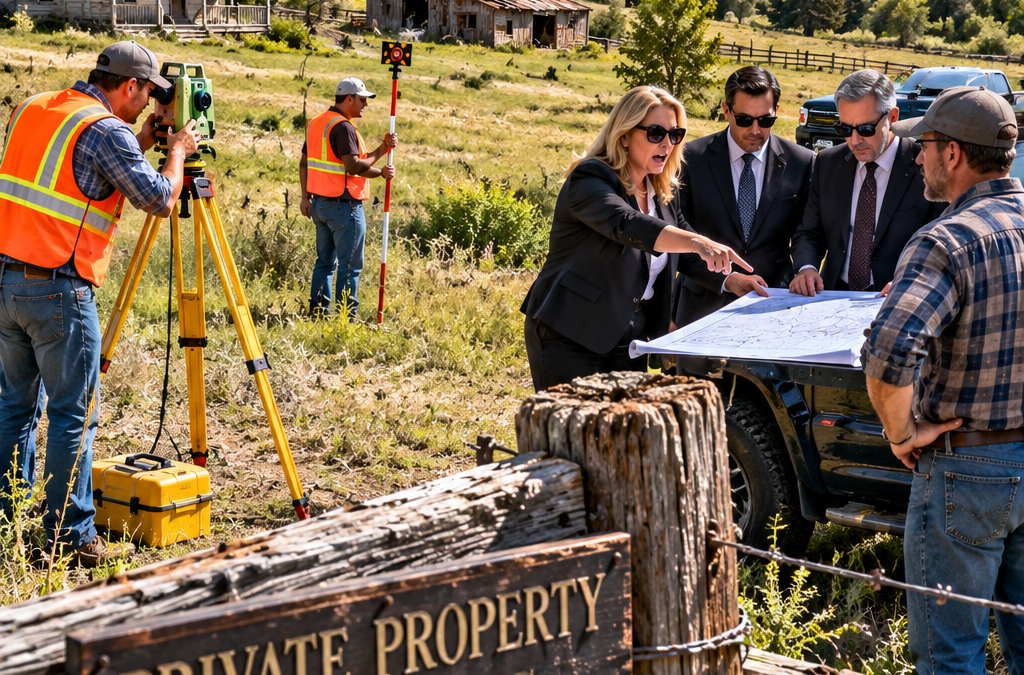
The following Monday, I was at the ranch removing rotten boards from the old barn when two pickup trucks came up the county road.
One turned onto my drive.
Then the other.
Three men got out.
One wore a reflective survey vest.
Another carried equipment.
The third wore khakis and held a leather portfolio.
I set my pry bar down.
“Can I help you?”
The man in khakis approached.
“Garrett Callaway?”
“Yes.”
“We’re conducting a boundary verification for Pinerest Estates.”
I stared at him.
“On whose property?”
He gestured toward mine.
“This parcel.”
“No.”
He blinked.
“Excuse me?”
“You’re not surveying my property for Pinerest.”
“We’ve been retained to evaluate jurisdiction boundaries.”
“From the county road.”
“We may need to establish points inside the parcel.”
“You won’t.”
He looked toward the surveyor.
Then back at me.
“Mr. Callaway, the association has requested—”
“The association doesn’t own this land.”
“We understand there’s a dispute.”
“Then you understand you don’t enter disputed private property without permission.”
His expression tightened.
“We’re not here to argue.”
“Neither am I.”
I pointed toward the road.
“You can survey anything you’re legally entitled to from public ground. Nobody crosses my gate.”
The surveyor shifted his equipment.
The man with the portfolio exhaled.
“Pinerest’s counsel believes—”
“My counsel believes you’ve been told to cease contact.”
“We’re not counsel.”
“Exactly.”
I took out my phone.
“Give me the name of the company.”
He hesitated.
I raised the phone.
“I’ll photograph your truck instead.”
He gave me the name.
I wrote everything down.
Then I watched them leave.
Ten minutes later, I called Rebecca.
“They sent surveyors.”
Silence.
“Onto the property?”
“They tried.”
“Did anyone cross?”
“No.”
“Good.”
“I thought their lawyer was reviewing everything.”
“So did I.”
“You sound pleased.”
“I am not pleased.”
“You sound pleased.”
“I enjoy when opposing parties create exhibits.”
She sent a preservation notice to the surveying company before lunch.
By then, the tone of the dispute had changed completely.
Marlene was no longer dealing with a retired contractor she thought she could pressure.
She was dealing with records.
County records.
Title records.
Survey records.
Emails.
Legal filings.
Every time Pinerest acted, Rebecca documented it.
Every time they made another claim, she asked for the authority.
And every time, the answer got weaker.
Then something happened I hadn’t expected.
A man named Thomas Greer called me.
He owned twenty-three acres northwest of Pinerest.
He had gotten my number from somebody at the county office.
“I heard you’re fighting that overlay.”
“I wouldn’t call it fighting.”
“What would you call it?”
“Reading.”
He laughed.
“Wish I’d done that.”
There was bitterness in his voice.
“What happened?”
“I paid.”
“How much?”
“Four thousand.”
“When?”
“2021.”
“Why?”
“They told me I couldn’t get my building plans cleared otherwise.”
“Did the county require HOA clearance?”
“I thought they did.”
“Did you ask?”
“No.”
His voice dropped.
“My wife had just died. I was trying to build a small place and get out of the house we’d lived in. They sent a lawyer letter. I didn’t have the energy.”
The words hit me exactly the way they should have.
Marlene’s system didn’t target stupid people.
It targeted tired people.
Busy people.
Grieving people.
People who looked at four thousand dollars and compared it against months of legal trouble.
People who had lives.
The association had made surrender cheaper than resistance.
I asked Thomas whether he still had his paperwork.
“Every page.”
“Call the county attorney.”
“Already did.”
He wasn’t the last.
Another landowner had paid in 2020.
A woman named Sheila Barnes had paid after Pinerest threatened to interfere with a septic permit.
A retired couple had paid because they were told their property would otherwise become “noncompliant.”
The county investigator started calling people.
Rebecca heard that the inquiry had widened.
Nobody would give us details, and she warned me not to speculate.
So I didn’t.
I just kept working on the ranch.
That became important to me.
Marlene had tried to turn my land into the battlefield.
I refused to let her own that much of it.
I repaired the farmhouse porch.
I cleared the old barn.
I filed my workshop plans with the county.
Not Pinerest.
The county.
The legitimate authority.
The building official reviewed them.
I paid the actual permit fee.
Permit approved.
I framed the workshop.
Every morning, I drove past the entrance to Pinerest Estates without turning my head.
Then, two weeks after our filing, the management company running Pinerest sent notice that it was terminating its contract with the association.
The stated reason was an inability to continue under the existing governance structure during an active regulatory review.
I read the notice at Rebecca’s office.
“What does that mean?”
“It means the management company doesn’t want to be standing there when the music stops.”
“Do they have liability?”
“Maybe. We don’t know enough yet.”
“What happens to Pinerest?”
“They hire somebody else or self-manage.”
“Marlene?”
Rebecca looked at me.
“Still president.”
That changed soon enough.
The HOA board held a special meeting.
I did not attend.
I wasn’t a member.
For once, that fact felt wonderful.
Thomas did attend as an observer because his complaint related to the overlay.
He called me afterward.
“You should have seen it.”
“I’ve seen enough HOA meetings in my life.”
“Marlene tried to blame the management company.”
“Of course.”
“Said they misunderstood the 2019 proposal.”
“Did they?”
“No idea.”
“What did the board say?”
“One guy asked her for the county approval.”
I smiled.
“And?”
“She couldn’t produce it.”
There was that question again.
Show me the document.
Everything came back to that.
According to Thomas, several Pinerest homeowners had begun asking their own questions.
Why had the HOA represented the overlay as county-approved?
Who authorized collection of registration fees?
Where had the money gone?
Did the association have legal opinions supporting the program?
Why had surrounding property owners been threatened with liens?
Marlene apparently answered by saying the program had existed for years and was therefore “established practice.”
When Thomas told me that, I laughed for the first time in days.
“What?”
“Nothing.”
“Come on.”
“I’m just imagining telling a building inspector something is legal because I’ve been doing it illegally for six years.”
He laughed too.
“Think that works?”
“Never worked for my subcontractors.”
Marlene’s direct attacks stopped.
No more letters.
No surveyors.
No inspections.
No cream envelopes.
That silence felt different from peace.
It felt like an organization realizing every new move could become evidence.
A month after the county investigation began, Rebecca received written confirmation from Pinerest’s law firm.
The association withdrew all claims of jurisdiction over my property.
Not suspended.
Not waived.
Withdrawn.
The four-thousand-dollar registration fee was canceled.
All inspection demands were withdrawn.
The association disclaimed any lien right arising from the supposed overlay.
Most importantly, the letter acknowledged that my parcel was not subject to Pinerest Estates HOA governance.
I read that sentence slowly.
Then I read it again.
Rebecca watched me.
“Happy?”
“I’ll be happy when they stop doing this to everybody.”
She nodded.
“Fair.”
Our civil case continued.
The county inquiry continued.
Eventually, investigators identified eleven landowners who had paid the four-thousand-dollar registration fee under the claimed overlay.
Eleven.
Forty-four thousand dollars in principal alone.
I thought about that number.
Not because it was enormous.
Because each four-thousand-dollar payment represented a moment when someone had been made to believe resistance was dangerous.
Those owners became entitled to refunds with interest.
The county’s findings also confirmed what the 2019 records had already shown us.
The proposed overlay had never been formally adopted.
The public-comment process had never been completed.
No county ordinance had granted Pinerest the jurisdiction it claimed.
The authority existed on Pinerest stationery.
Not in law.
That distinction had cost people money for six years.
Marlene resigned not long after the investigation became public within the community.
Her resignation did not admit wrongdoing.
People like Marlene rarely write letters that say, I was wrong.
She described the situation as “a prolonged dispute over historical governance interpretations.”
That phrase almost impressed me.
Historical governance interpretations.
A beautiful way of saying they had been enforcing something that didn’t exist.
She wrote that she was stepping down to protect the community from “further division.”
I read it once.
Then put it away.
By then, I didn’t care why she said she resigned.
She was no longer my problem.
The workshop frame went up in early summer.
Standing the first wall gave me more satisfaction than any legal letter.
A few friends came out to help.
Old contractors.
Men whose knees made noises when they climbed ladders now.
We complained about lumber prices, argued about bracing, drank coffee and built the wall exactly the way we had built walls thirty years earlier.
No architectural committee reviewed it.
No Pinerest inspector arrived.
No one asked whether the siding matched homes three-quarters of a mile away.
The county inspector came once.
He checked the anchors.
Looked at my permit.
Signed the card.
“Looks good.”
“That’s it?”
He laughed.
“You miss bureaucracy?”
“Not even slightly.”
The guest cabin foundation was poured a month later.
I chose the location near the cottonwoods.
From the future porch, you could see the hills without seeing a single roof from Pinerest.
That felt appropriate.
One evening, after the concrete cured, I sat on the farmhouse porch with Cooper lying beside my chair.
The sun was dropping behind the field.
I had the old 1974 deed on my lap.
Not the original, of course.
A certified copy.
Earl Dubose’s covenant was still there.
Same language.
Same protection.
Nearly fifty years before I bought the property, he had placed a restriction on his own land to keep it outside private association control forever.
I knew almost nothing about him.
Maybe he had hated neighborhood committees.
Maybe he’d had a dispute of his own.
Maybe he simply believed people who bought rural land should be left alone.
Whatever his reason, that single decision had survived decades.
Owners changed.
Roads changed.
The nearby subdivision appeared.
Boards came and went.
Marlene became president.
Lawyers sent letters.
Surveyors arrived.
Yet the sentence remained.
Paper outlived all of them.
That thought stayed with me.
My entire career had taught me that people underestimate documents because paper looks weak.
You can tear paper.
Lose it.
Fold it.
Put it in a drawer and forget it exists.
A letterhead looks more impressive than an old deed.
A lawyer’s threat looks more powerful than county minutes from a meeting nobody remembers.
A woman saying, “We have jurisdiction,” sounds authoritative when she sits behind a conference table and speaks like disagreement is ignorance.
But authority is not a tone of voice.
It is not an embossed seal.
It is not an attorney’s signature at the bottom of a demand.
It is not the number of years somebody has gotten away with making the same claim.
Authority has a source.
That was the lesson Pinerest seemed to have forgotten.
Marlene believed repetition created legitimacy.
The HOA had claimed the overlay existed for six years.
People paid.
Lawyers wrote letters.
Management staff repeated the explanation.
The process became familiar.
And familiarity began masquerading as law.
Nobody stopped to return to the moment in 2019 when the county had actually said, Not yet.
Then never said yes.
The most disturbing part was how close the system came to working on me.
I had checked everything before buying.
I had title insurance.
I had a survey.
I had decades of experience dealing with permits and land records.
And when that first cream-colored letter arrived, even I felt a moment of doubt.
That’s what official-looking paper can do.
For a few minutes, I wondered whether they knew something I didn’t.
For a few minutes, the embossed seal mattered more in my mind than the deed I already owned.
Imagine what that feels like to somebody who has never stepped inside a county records office.
Imagine receiving a lawyer letter threatening your land.
Most people don’t hear “we may file a lien” and think, Please provide statutory authority.
They hear, I could lose my property.
Marlene understood that.
Whether she admitted it or not, her entire enforcement system depended on fear arriving before verification.
I thought about Thomas.
His wife had died.
He wanted a new beginning.
Pinerest sent him a demand.
He paid because grief had consumed the energy he would have needed to fight.
I thought about Sheila, who believed her septic permit was in danger.
I thought about the retired couple who paid because they feared their land would become impossible to sell.
Eleven people.
Eleven different lives.
Same letterhead.
Same invented authority.
That was why I never thought of what happened as some great victory.
I got what I wanted.
The HOA disappeared from my property.
My title remained clean.
My workshop went up.
The guest cabin began taking shape.
But winning did not erase the fact that people had paid money they never owed.
It did not erase the threats.
It did not erase the years Pinerest spent behaving as though a proposal was law because apparently nobody expected anyone to walk into the county office and read the minutes.
Rebecca and I settled my civil claim after the association formally disclaimed jurisdiction and the county investigation established the underlying facts.
I won’t dress that part up.
There was no courtroom showdown.
No judge slammed a gavel.
No dramatic confession.
Most civil cases don’t end that way.
Documents moved between offices.
Attorneys negotiated.
Insurers reviewed.
The association agreed to terms.
My legal expenses and damages were addressed.
The important point, at least to me, was written plainly into the settlement and the association’s records.
Pinerest had no authority over my land.
Period.
The overlay could not be used against the parcel.
Period.
The 1974 covenant remained intact.
Period.
That was all I had wanted them to admit from the beginning.
Sometimes I still think about my first conversation with Marlene.
“You’re within the overlay.”
Show me.
“That isn’t your determination.”
Show me.
“The county approved it.”
Show me.
“You’ll find our lawyers expensive.”
Show me.
Every threat eventually ran into the same wall.
Documentation.
Months after everything settled, I saw Marlene once.
I was at a hardware store buying electrical boxes for the workshop.
She was near the paint counter.
I noticed her before she noticed me.
For a second, I considered turning down another aisle.
Not because I was afraid of her.
Because I didn’t want to carry that story into a place where I was choosing outlet covers.
Then she looked over.
Our eyes met.
She froze.
I nodded once.
“Ms. Voss.”
“Mr. Callaway.”
No President Voss anymore.
I noticed that.
She looked at the wire in my cart.
“Building the workshop?”
“Electrical rough-in.”
She gave a short nod.
“I heard.”
Of course she had.
Pinerest might not govern my land, but apparently it still had gossip.
She looked uncomfortable.
I could have said a hundred things.
I could have asked how retirement from HOA politics was treating her.
I could have reminded her of the lien threat.
I could have told her that eleven people were getting money back because of the program she defended.
Instead, I said nothing.
That seemed to bother her more.
Finally, she spoke.
“You created a lot of trouble.”
There it was.
Not I’m sorry.
Not We were wrong.
Not The association shouldn’t have threatened you.
You created trouble.
I looked at her.
“No.”
Her eyes narrowed.
“I bought land.”
She said nothing.
“I asked you to show me your authority.”
“Things were handled badly.”
“That isn’t the same sentence.”
She looked away.
“What do you want me to say?”
“Nothing.”
That surprised her.
I pushed my cart forward.
“That’s the good part. You don’t have to tell me anything anymore.”
I walked away.
By fall, the workshop was finished.
Thirty by forty.
Two bays.
Steel roof.
Insulated walls.
Workbench along the west side.
My father’s old vise mounted near the door.
A row of tools I had spent decades collecting hung exactly where I wanted them.
No customer would ever walk in and tell me the bench should be moved six inches.
No project manager would ask whether we could finish “just a little sooner.”
It was mine.
The guest cabin took longer.
I built most of it myself, which meant I stopped whenever I wanted.
Some days I framed.
Some days I sat on the porch and did absolutely nothing.
Retirement, I discovered, is partly learning that unfinished work is allowed to remain unfinished overnight.
One afternoon, Thomas came by.
He had received his refund.
Four thousand dollars plus interest.
He stood in the workshop holding the check.
“I almost framed it.”
“You should cash it.”
“My daughter said the same thing.”
He looked around.
“This is nice.”
“Thanks.”
“So this is what started all the trouble?”
I shook my head.
“This didn’t start anything.”
“What did?”
I thought about it.
“The letter.”
He laughed.
“No, before that.”
I looked out through the open bay door toward the pasture.
“I think it started when enough people paid without asking for proof that the HOA forgot proof mattered.”
Thomas nodded slowly.
“That’s probably right.”
He put the check back in his pocket.
“You know what’s funny?”
“What?”
“If they’d asked for two hundred dollars instead of four thousand, I probably would’ve paid without even mentioning it.”
“That isn’t funny.”
“No.”
He looked down.
“I guess not.”
He left before sunset.
I stood outside after his truck disappeared down the county road.
Pinerest Estates was barely visible in the distance.
A few roofs.
Nothing more.
Three-quarters of a mile had never looked so wide.
The original listing had described the property as “secluded acreage near established residential community.”
I had skipped over that phrase when I bought it.
Now it made me laugh.
Near.
Not inside.
Not governed by.
Not annexed to.
Near.
One word mattered.
So did another.
Perpetuity.
I kept a framed copy of the relevant paragraph from Earl Dubose’s deed in the workshop office.
Not because I was sentimental.
Because it reminded me of something.
Before construction begins, you find the load-bearing structure.
Every building has one.
Remove the wrong wall and everything above it starts to fail.
Pinerest’s entire claim rested on a load-bearing assumption.
They assumed nobody would check whether the 2019 overlay had actually passed.
Once that assumption came out, the structure collapsed.
The lawyer letter couldn’t hold it up.
The surveyors couldn’t.
Marlene’s certainty couldn’t.
Six years of habit couldn’t.
Underneath all of it was a proposal the county had never approved.
And behind that was an even older document protecting my parcel before Pinerest Estates had ever been imagined.
The irony still makes me smile.
They came at me with modern stationery, modern lawyers, modern management companies and a modern theory of extended community control.
I answered with a county clerk, dusty meeting minutes and language written in 1974.
That was enough.
People like Marlene tend to believe power belongs to whoever speaks with the greatest certainty.
Contracting taught me otherwise.
On a job site, certainty means nothing when the measurements are wrong.
You can argue with a level all afternoon.
The bubble doesn’t care.
You can insist a wall is square.
Measure the diagonals.
If they don’t match, it isn’t square.
You can say a footing is deep enough.
Drop a tape into the hole.
Either it is or it isn’t.
Land records are much the same.
Marlene said the county had granted jurisdiction.
The minutes said otherwise.
She said my parcel belonged under HOA governance.
The deed said otherwise.
She said I owed four thousand dollars.
The law said otherwise.
Once the facts are measurable, confidence becomes irrelevant.
I wish more people knew that before they received letters designed to frighten them.
Not everyone needs to become a legal expert.
I certainly wasn’t one.
That’s why I hired Rebecca.
But there is one question almost anybody can ask when an organization claims power over them.
Where is it written?
That question does not make you difficult.
It does not make you confrontational.
It does not mean you hate rules.
Legitimate rules can survive being read.
Legitimate authority can survive being questioned.
When someone reacts to that question with intimidation, delay or anger, pay attention.
That was the warning I missed with Marlene.
She never answered the question.
She only raised the stakes.
First the letter.
Then the fee.
Then the lawyer.
Then the lien threat.
Then surveyors.
At every stage, she tried to make the consequences of questioning her larger than the original demand.
That wasn’t governance.
It was pressure.
The difference mattered.
A year after I bought the property, I stood on the guest cabin porch for the first time after finishing the rail.
Cooper had gone gray around the muzzle.
The farmhouse looked less abandoned.
The barn ruins were gone.
The workshop stood solid against the field.
A gravel path connected everything.
I had planted two young trees beside the cabin even though I probably wouldn’t live long enough to see them become enormous.
That was all right.
Some things are worth doing for whoever comes next.
Maybe Earl Dubose had thought the same thing.
Maybe he had stood somewhere on those same twelve acres half a century earlier and imagined people he would never meet.
Maybe that was why he used the words he did.
In perpetuity.
Forever is a strange thing to put into a property document.
Most of us don’t think fifty years ahead.
We think about next season.
Next payment.
Next project.
Earl thought far enough ahead that a retired contractor he would never know could sit on a porch in peace because of a sentence he had signed decades earlier.
I lifted my coffee and looked across the field.
No HOA vehicle.
No surveyors.
No certified letters.
No one waiting at the gate with a leather folder.
Just twelve acres.
Legally mine.
Permanently outside Pinerest governance.
And finally as quiet as I had hoped the day I first saw the listing.
I used to think the most valuable part of owning land was the land itself.
The acreage.
The house.
The workshop.
The view.
I don’t anymore.
Ownership means very little if somebody can convince you that their paperwork matters more than yours.
The most valuable thing I owned that year wasn’t the farmhouse.
It wasn’t the workshop.
It wasn’t even the twelve acres.
It was the ability to prove what was true.
A survey.
A title chain.
County minutes.
One forgotten covenant.
Documentation doesn’t shout.
It doesn’t threaten.
It doesn’t drive up in a truck carrying survey equipment.
It simply waits.
And when somebody finally opens the right page, every confident lie built on top of it has to answer to what was there all along.
𝗧𝗛𝗘 𝗘𝗡𝗗
The HOA Sent Lawyers and Surveyors to Claim My 12 Acres Under a Rule That Was Never Supposed to Exist
The woman running Pinerest Estates looked me straight in the eye and told me I had fifteen days to surrender control of land I had legally bought, or her attorneys would make sure I regretted refusing. What she did not know was that fifty years earlier, another landowner had anticipated someone exactly like her and buried a sentence in my deed that nobody at the HOA had bothered to read.
I bought the twelve acres because I wanted silence.
That was really all it was.
After thirty-four years working as a contractor, I had spent enough of my life surrounded by nail guns, concrete saws, subcontractors shouting over diesel engines, inspectors showing up late, clients changing their minds halfway through a project, and county clerks telling me some form I had filed correctly on Monday suddenly needed a different signature on Thursday.
I had built houses for other people.
I had remodeled kitchens that cost more than my first home.
I had poured foundations in August heat and repaired roofs in freezing rain.
By the time I retired, I was tired of fixing everybody else’s dreams.
I wanted a piece of ground where nobody needed anything from me.
No homeowners association.
No architectural committee.
No neighbor three feet from my bedroom window.
No one measuring the height of my fence or deciding whether my workshop door was the right shade of brown.
Just dirt, trees, open sky, and enough distance between me and the nearest person that silence could actually sound like silence.
So when I saw the listing for twelve abandoned acres outside Pinerest County, I almost assumed something had to be wrong with it.
Sixty-two thousand dollars.
Twelve acres.
An old farmhouse.
Collapsed barn.
Well.
Road access.
No active agricultural lease.
No known encumbrances beyond ordinary utility easements.
The listing photographs were ugly enough to scare off anybody who wanted something turnkey.
That was part of what attracted me.
The farmhouse looked like it had been forgotten by time.
Its porch sagged at one corner. Two windows were boarded. The siding had gone gray. Weeds had swallowed the walk. A rusted stock trough sat near the fence line, cracked down the middle, and the barn behind the house had partially collapsed after years of wind and neglect.
I loved it immediately.
Where somebody else saw decay, I saw framing.
I saw a porch that could be jacked level.
I saw salvageable rafters.
I saw a shop where the old barn had stood.
I saw a small guest cabin tucked near the cottonwoods on the western edge.
Most importantly, I saw land that was not part of anything.
Pinerest Estates was nearby, but not that nearby.
The development sat roughly three-quarters of a mile east.
A county road ran between the subdivision and my parcel.
There were other undeveloped tracts in between.
The first time I drove out there with the real estate agent, I pointed toward the roofs of Pinerest in the distance.
“That’s not connected to this, right?”
She shook her head.
“No HOA.”
“Nothing?”
“Nothing.”
I had spent too many years watching customers discover unpleasant restrictions after buying property to accept a verbal answer.
So I did what I had always done before committing money to land.
I checked.
Then I checked again.
I hired a title company.
I ordered the full title history.
I paid for a fresh boundary survey.
I checked zoning.
I checked access.
I checked building setbacks.
I checked whether Pinerest Estates had any recorded easements across the property.
It didn’t.
I checked whether the parcel appeared anywhere in the HOA’s recorded declaration.
It didn’t.
The title officer actually laughed when I asked her to confirm it one more time.
“Mr. Callaway, this parcel isn’t in Pinerest Estates.”
“I know.”
“Then what are you worried about?”
“I spent thirty years building things for people who didn’t read before signing.”
She smiled.
“Fair enough.”
A week later, the survey came back.
Clean.
Twelve acres.
Entirely separate.
The county road was exactly where the plat said it was.
Pinerest HOA had no boundary overlapping mine.
No shared common property.
No annexation.
No association assessment.
Nothing.
On a Thursday afternoon in March, I signed the closing papers.
When the title officer slid the deed across the desk, I read it before signing.
Not every page of the chain.
Just the current transfer and the key exceptions listed in the title commitment.
Nothing concerned me.
I handed over the money.
She handed me the keys.
And at sixty-three years old, I became the owner of the kind of place I had spent years telling myself I would buy someday.
The first three weeks were exactly what I had hoped.
I slept out there twice before the farmhouse was even ready.
I brought a cot, a cooler, a thermos, and my old dog, Cooper, who spent the first night wandering through the weeds like he had inherited an empire.
During the day, I worked.
Not because I had to.
Because for the first time in decades, I got to build without a client waiting behind me.
I cleared brush around the farmhouse.
I hauled broken fence wire.
I pulled rotted boards from the collapsed barn.
I marked out where I wanted the workshop.
Thirty by forty.
Simple steel roof.
Two bays.
Enough room for my tools, welding table, old drill press and the collection of things contractors refuse to throw away because we are convinced every bent bracket will someday become useful.
The guest cabin would be smaller.
Maybe six hundred square feet.
Nothing fancy.
Bedroom.
Bathroom.
Small kitchen.
Porch facing west.
I spent evenings sitting on an overturned bucket, drinking coffee and watching the light move across the pasture.
Nobody bothered me.
No one even seemed to know I was there.
Then the letter arrived.
It came in a cream envelope thick enough to suggest importance before I even opened it.
The upper left corner carried an embossed seal.
PINEREST ESTATES HOMEOWNERS ASSOCIATION.
COMMUNITY STANDARDS DIVISION.
I remember standing at my kitchen counter in my old house with the envelope in one hand and thinking somebody had mailed it to the wrong address.
Then I saw my name.
Garrett Callaway.
My mailing address.
And beneath that, the parcel number for the twelve acres.
I opened it.
The first sentence made me read the page twice.
According to the Pinerest Estates Homeowners Association, my property fell within something called an “Extended Community Jurisdiction Overlay,” adopted in 2019.
The letter informed me that because my property was undeveloped land located within a one-mile radius of the association, it was subject to certain Pinerest standards.
Unauthorized land use.
Unauthorized structural planning.
Failure to register ownership.
Failure to submit anticipated improvements for architectural review.
I leaned against the counter.
“What?”
Cooper looked up from the floor.
I read it again.
At the bottom was a contact name.
Marlene Voss.
President, Pinerest Estates Homeowners Association.
The letter was not written like a request.
It was written like a verdict.
It gave me thirty days to register the property with the association.
The registration packet required a four-thousand-dollar “jurisdiction activation fee.”
I was also instructed to submit plans for my workshop and guest cabin before performing additional site work.
I sat down.
For a few minutes, I wondered whether the title company had somehow missed something enormous.
That bothered me more than the money.
I had trusted the paperwork.
I had checked the boundary.
I had checked the recorded documents.
Had the county created some planning district I didn’t know about?
Could an HOA actually regulate land outside its subdivision through some strange county arrangement?
I didn’t think so.
But “I don’t think so” is not the same as knowing.
So I picked up the phone.
The HOA management office answered on the third ring.
“Pinerest Estates Management.”
“Hi. My name is Garrett Callaway. I received a notice regarding parcel 417-B.”
A pause.
Then typing.
“Yes, Mr. Callaway. I see it.”
“Good. Then maybe you can explain why you’re sending me HOA violations when my property isn’t in the HOA.”
The woman remained polite.
“Your property falls within the extended overlay.”
“I read that. What exactly is it?”
“The county approved a one-mile extended jurisdiction area in 2019 covering undeveloped parcels surrounding Pinerest.”
I frowned.
“An HOA jurisdiction area?”
“Yes.”
“Created by the county?”
“Yes, sir.”
“Recorded where?”
Silence.
I waited.
“I don’t have that information in front of me.”
“Could you send me the county ordinance or resolution?”
“I can make a note.”
“Please do.”
“Absolutely.”
“What meeting adopted it?”
Another pause.
“I would have to look into that.”
“That’s fine.”
I gave her my email address.
“Send me whatever the county approved.”
“I’ll ask our office.”
“Thank you.”
She never called.
No email arrived.
Three days later, I called again.
Different person.
Same answer.
The overlay had county approval.
Documentation would be sent.
Nothing came.
A week after that, I drove to the Pinerest management office myself.
The building sat beside the subdivision clubhouse, surrounded by perfect shrubs cut into geometric shapes.
I walked inside wearing work boots and an old denim jacket.
A receptionist looked up.
“Can I help you?”
“Garrett Callaway. I’ve been asking for documentation regarding the extended jurisdiction overlay.”
Her expression shifted slightly.
Not much.
Just enough.
“Are you the ranch parcel?”
“I own twelve acres west of County Road Seven.”
She picked up the phone.
“Ms. Voss is here.”
“I’d be happy to speak with her.”
A few minutes later, Marlene Voss walked into the lobby.
She was probably in her late fifties.
Perfect hair.
White blouse.
Dark slacks.
Thin gold watch.
She carried a leather folder tucked under her arm.
Everything about her looked controlled.
She held out her hand.
“Mr. Callaway.”
I shook it.
“Marlene?”
“President Voss.”
That told me quite a bit.
“All right.”
She gestured toward a small conference room.
“Let’s sit.”
We did.
I placed the HOA letter on the table.
“I’ve asked twice for the county documentation supporting this.”
She barely looked at the page.
“The extended jurisdiction has been in effect since 2019.”
“That isn’t documentation.”
Her smile disappeared slightly.
“We have authority over undeveloped property within one mile.”
“Authority granted by whom?”
“The county.”
“What document?”
She folded her hands.
“Mr. Callaway, I’m not sure what you’re trying to accomplish.”
“I own land your HOA says it controls. I’m asking you to show me the legal basis.”
“The overlay was established years before you purchased.”
“Then it should be easy to produce.”
She leaned back.
“Most property owners understand that Pinerest protects values throughout the surrounding area.”
“That wasn’t my question.”
Her eyes hardened.
“You bought property adjacent to an established community.”
“No, I bought property three-quarters of a mile away.”
“You’re within the overlay.”
“So show me the overlay.”
For the first time, I saw irritation break through the polished surface.
“You’ve been given the registration materials.”
“I won’t be paying four thousand dollars until someone proves I owe it.”
“That fee isn’t optional.”
“Neither is legal authority.”
She stared at me.
Then she closed the folder.
“You spent your career in construction, correct?”
That caught my attention.
“How do you know that?”
“Public information.”
“Why are you researching me?”
“We review owners who fall under our jurisdiction.”
I almost smiled.
“My land doesn’t fall under your jurisdiction.”
Marlene stood.
“That isn’t your determination to make.”
I stood too.
“Actually, ownership records make that determination.”
She opened the conference-room door.
“If you refuse to comply, the matter will be referred to counsel.”
“Fine.”
She looked at me.
“You may find that considerably more expensive than registration.”
There it was.
Not advice.
A threat dressed as advice.
I walked out without answering.
I wish I could say I immediately understood what was happening.
I didn’t.
Part of me still believed there had to be some bureaucratic explanation.
Maybe the county had approved some unusual zoning mechanism.
Maybe the HOA was acting under a nuisance agreement.
Maybe the title company had missed a document that wasn’t indexed normally.
I was willing to believe incompetence before dishonesty.
That willingness lasted another two weeks.
The certified letter came from a law firm downtown.
Merritt, Cole & Haskins.
I recognized the kind of language immediately.
FORMAL DEMAND.
CEASE AND DESIST.
FAILURE TO COMPLY.
LIEN RIGHTS.
LEGAL FEES.
The letter demanded that I stop all site work.
It demanded the four-thousand-dollar registration fee.
It demanded an HOA inspection within fifteen business days.
And it warned that continued refusal could result in enforcement charges and a lien against my property.
I read that paragraph three times.
A lien.
On land they didn’t own.
Under authority they still had not shown me.
That was the moment my irritation became something else.
I had spent my career dealing with agencies that actually had power.
Building departments could shut down a job.
Fire marshals could refuse occupancy.
Zoning offices could stop a project before the first shovel entered the ground.
Real authority comes with paperwork.
Ordinances.
Statutes.
Recorded restrictions.
Administrative rules.
Permit conditions.
People with legitimate authority can usually tell you exactly where it comes from.
They don’t get offended when you ask.
They point.
Chapter.
Section.
Paragraph.
The more Marlene refused to show me anything, the more certain she acted.
That combination bothered me.
So I stopped calling Pinerest.
I started researching.
My first stop was the county records office.
I knew the building well.
I had spent more hours there during my career than I wanted to remember.
The clerk at the counter was a woman named Denise who had worked there almost as long as I had been building.
She recognized me.
“Garrett Callaway.”
“Denise.”
“I thought you retired.”
“I did.”
“Then why are you here?”
“Apparently retirement comes with homework.”
I showed her the HOA letter.
She put on her glasses.
“Extended jurisdiction overlay?”
“Ever heard of it?”
“No.”
“Pinerest says the county approved it in 2019.”
She turned toward her computer.
“Let’s see.”
The first search turned up nothing.
Neither did the second.
We searched county resolutions.
Ordinances.
Planning commission decisions.
Recorded plats.
Annexations.
Special districts.
Nothing called an Extended Community Jurisdiction Overlay appeared anywhere.
Denise looked at me.
“You sure they said county-approved?”
I handed her the letter.
She read the line.
“That’s what it says.”
“Then somebody should have a resolution number.”
“That’s what I thought.”
I came back the next morning.
And the morning after that.
Eventually, I found a reference buried in planning commission minutes from 2019.
Pinerest Estates HOA had submitted a proposal.
There it was.
A request to establish an “extended community influence overlay” covering undeveloped property within one mile of the subdivision.
The language was almost identical to Marlene’s letter.
I remember sitting at the records terminal and feeling my pulse increase.
For one second, I thought she had been right.
Then I kept reading.
The commission had discussed the proposal.
Several county staff members had questioned whether a private association could be granted that kind of regulatory authority.
One commissioner asked about notice to surrounding landowners.
Another requested legal review.
The item was tabled pending public comment.
I scrolled farther.
No final vote.
I searched the following month’s minutes.
Nothing.
Then the next.
Nothing.
I widened the search.
There was no adoption.
No resolution.
No ordinance.
No signed agreement.
The proposal had died in committee.
Pinerest had asked the county for authority.
The county had never given it.
But for six years, the HOA had written letters as though the proposal had become law.
I printed everything.
The original proposal.
Staff notes.
Meeting minutes.
The motion to table.
The absence of any adoption afterward.
Denise watched the printer spit out page after page.
“So?”
I looked at her.
“They made it up.”
She frowned.
“The HOA?”
“The county never approved this.”
She took the minutes from me and scanned them.
“Looks tabled.”
“It was.”
“Maybe they brought it back later.”
“I checked.”
Denise sat quietly.
“How long have they been using it?”
“Their letter says since 2019.”
She looked toward the printer.
“Garrett.”
“Yeah.”
“You might want a lawyer.”
“I know.”
But I wasn’t ready to call one yet.
Because something about the situation kept bothering me.
If Pinerest had been collecting four thousand dollars from every undeveloped parcel within a mile for six years, how many people had paid?
And why had nobody challenged it?
I started searching property transfers around the subdivision.
Several parcels had changed hands.
A few had been developed.
I found references in public permit files to Pinerest “registration clearance.”
That phrase made my stomach tighten.
This wasn’t a single mistaken letter sent to me by an overzealous president.
It looked systematic.
Marlene had inherited—or helped build—a process that treated a failed proposal as actual authority.
I went home and spread my documents across the dining table.
Cooper lay under the chair while I read.
At some point after midnight, I pulled out my title binder.
The title company had provided the ownership chain.
I had reviewed the current deed carefully before closing.
Now I went back farther.
The property had once been part of a much larger ranch owned by Earl Dubose.
Most of that ranch had been subdivided decades later.
I read the 1974 deed slowly.
Old deeds have a particular rhythm.
Formal.
Repetitive.
Dense enough that the important sentence can disappear inside ten lines of language nobody thinks matters anymore.
Then I saw it.
I read it once.
Then again.
I sat back.
The covenant was explicit.
The parcel, and any future division derived from it, could not be incorporated into, annexed by, subjected to, or governed under any homeowners association, residential community association, planned development association, or substantially similar private governance body.
Then came the word that mattered most.
In perpetuity.
I whispered it aloud.
“In perpetuity.”
The covenant ran with the land.
It wasn’t a personal agreement between two people.
It attached to the property.
Earl Dubose had written protection against exactly what Pinerest was trying to do decades before Pinerest even existed.
I kept reading.
The language was unusually strong.
No future conveyance would extinguish it.
No private association could claim authority absent a legally recorded release executed according to the covenant’s terms.
I searched for a release.
There wasn’t one.
I checked every subsequent transfer.
Each deed referenced prior restrictions and covenants.
The protection had survived.
The irony was almost unbelievable.
Pinerest wasn’t merely trying to apply an overlay that had never become law.
Even if the county had somehow approved some form of external authority, my parcel had a recorded covenant specifically designed to prevent private HOA governance.
Marlene had picked one of the worst possible properties to threaten.
I finally called an attorney.
Her name was Rebecca Sloan.
Real estate litigation.
Land-use disputes.
Title issues.
I had crossed paths with her years earlier on a commercial job where a boundary disagreement delayed a project.
She was precise, impatient with nonsense, and not easily impressed.
Exactly what I needed.
“Garrett,” she said when she answered. “You’re supposed to be retired.”
“So everyone keeps telling me.”
“What happened?”
I gave her the short version.
She didn’t interrupt.
When I finished, she said, “Send me everything.”
“How much?”
“Everything.”
I scanned the documents that afternoon.
HOA letter.
Law-firm demand.
2019 proposal.
County minutes.
Title chain.
1974 deed.
Survey.
Current deed.
Registration packet.
My emails requesting proof.
Notes from my meeting with Marlene.
Rebecca called the next morning.
No greeting.
No small talk.
“Garrett, they handed you a sword.”
I leaned back in my chair.
“That good?”
“For you?”
“Yes.”
“For them?”
“No.”
She started with the failed overlay.
“The county never adopted it.”
“I know.”
“No, I mean there’s no ambiguity here. They submitted a proposal. It was tabled. Nothing in this record turns it into law.”
“That’s what I found.”
“If they’re representing to owners that the county approved it, that’s a problem.”
Then she got to the deed.
“And this covenant…”
She paused.
“What?”
“Whoever Earl Dubose was, he did not like homeowners associations.”
I laughed despite myself.
“Apparently not.”
“This language is aggressive.”
“Does it still hold?”
“Based on what you’ve sent me, yes.”
“Could Pinerest challenge it?”
“Anyone can challenge anything.”
“That isn’t what I asked.”
She laughed.
“You haven’t changed.”
“Rebecca.”
“Garrett, I would be extremely comfortable defending this parcel against HOA jurisdiction.”
“Good.”
“I’m less comfortable with what the HOA may have been doing to everybody else.”
That was the part that mattered.
We agreed on the first step.
Rebecca would send a formal response to Merritt, Cole & Haskins.
Not emotional.
Not threatening.
Just devastatingly specific.
She laid out the recorded boundary.
The absence of HOA membership.
The failed 2019 proposal.
The meeting minutes showing it had been tabled.
The lack of any county enactment.
The 1974 covenant.
The explicit prohibition against HOA governance.
Then she demanded immediate withdrawal of every notice, fee, inspection demand and lien threat directed at my property.
The letter also instructed Pinerest and its management company to preserve all records related to the supposed overlay, including correspondence with property owners and registration fees collected under it.
I asked Rebecca why she included that last part.
She looked at me across her office desk.
“Because I think they know exactly what they’ve been doing.”
“You think it’s fraud?”
“I think we don’t use that word casually before evidence supports intent.”
“Fair.”
“But if an organization tells people for six years that the county granted it power the county never granted, and then collects money based on that claim, I want the records preserved before anybody decides an old computer needs cleaning.”
That was Rebecca.
She never needed to raise her voice.
We also filed a complaint with the county attorney’s office.
The complaint alleged misrepresentation of governmental authority and requested investigation into Pinerest’s use of the unadopted overlay proposal.
Then Rebecca filed a civil claim on my behalf.
Harassment.
Wrongful threats of lien enforcement.
Abuse of process.
Declaratory relief establishing that Pinerest had no authority over my property.
I had spent my life believing most disputes could be solved before a lawsuit.
I still believe that.
But a threat only works while the person making it thinks the other side is afraid of escalation.
Marlene had been escalating from the beginning.
Letter.
Fee.
Inspection.
Attorney.
Lien threat.
She had counted on me stopping first.
I didn’t.
The response came quickly.
The law firm that had given me fifteen business days suddenly wanted additional time to “review historical documentation.”
Rebecca forwarded the email.
I called her.
“Historical documentation?”
“That’s lawyer language for somebody found out the client didn’t tell them something.”
“Do you think the attorneys knew?”
“Don’t assume that.”
“I’m asking what you think.”
“I think their first letter treated the overlay like established authority. Our response showed them primary county records saying otherwise. Now they’re reviewing.”
Three days later, the firm withdrew the immediate demand for inspection.
Then the lien threat was suspended.
Marlene emailed me directly.
That surprised me.
The subject line was RESOLUTION OPPORTUNITY.
Rebecca told me not to answer before forwarding it.
The email was three paragraphs of polished arrogance.
Marlene said there appeared to be “historical confusion” regarding the county’s implementation of the overlay.
She maintained that Pinerest had acted “in good faith” to protect community standards.
She offered to waive my four-thousand-dollar registration fee if I voluntarily submitted future building plans to the HOA for “courtesy review.”
I read it twice.
Then I called Rebecca.
“She still wants control.”
“Yes.”
“After all this.”
“Yes.”
“What’s wrong with her?”
“That’s outside my billing category.”
I laughed.
Then I stopped.
“She still hasn’t admitted they have no authority.”
“No.”
“What do we do?”
“Nothing.”
“Nothing?”
“She offered to waive money you never owed in exchange for authority she doesn’t possess.”
“That sounds about right.”
“Do not dignify it.”
Rebecca sent a two-sentence response.
Our client declines.
Please direct all further communication through counsel.
That should have ended direct contact.
It didn’t.
The following Monday, I was at the ranch removing rotten boards from the old barn when two pickup trucks came up the county road.
One turned onto my drive.
Then the other.
Three men got out.
One wore a reflective survey vest.
Another carried equipment.
The third wore khakis and held a leather portfolio.
I set my pry bar down.
“Can I help you?”
The man in khakis approached.
“Garrett Callaway?”
“Yes.”
“We’re conducting a boundary verification for Pinerest Estates.”
I stared at him.
“On whose property?”
He gestured toward mine.
“This parcel.”
“No.”
He blinked.
“Excuse me?”
“You’re not surveying my property for Pinerest.”
“We’ve been retained to evaluate jurisdiction boundaries.”
“From the county road.”
“We may need to establish points inside the parcel.”
“You won’t.”
He looked toward the surveyor.
Then back at me.
“Mr. Callaway, the association has requested—”
“The association doesn’t own this land.”
“We understand there’s a dispute.”
“Then you understand you don’t enter disputed private property without permission.”
His expression tightened.
“We’re not here to argue.”
“Neither am I.”
I pointed toward the road.
“You can survey anything you’re legally entitled to from public ground. Nobody crosses my gate.”
The surveyor shifted his equipment.
The man with the portfolio exhaled.
“Pinerest’s counsel believes—”
“My counsel believes you’ve been told to cease contact.”
“We’re not counsel.”
“Exactly.”
I took out my phone.
“Give me the name of the company.”
He hesitated.
I raised the phone.
“I’ll photograph your truck instead.”
He gave me the name.
I wrote everything down.
Then I watched them leave.
Ten minutes later, I called Rebecca.
“They sent surveyors.”
Silence.
“Onto the property?”
“They tried.”
“Did anyone cross?”
“No.”
“Good.”
“I thought their lawyer was reviewing everything.”
“So did I.”
“You sound pleased.”
“I am not pleased.”
“You sound pleased.”
“I enjoy when opposing parties create exhibits.”
She sent a preservation notice to the surveying company before lunch.
By then, the tone of the dispute had changed completely.
Marlene was no longer dealing with a retired contractor she thought she could pressure.
She was dealing with records.
County records.
Title records.
Survey records.
Emails.
Legal filings.
Every time Pinerest acted, Rebecca documented it.
Every time they made another claim, she asked for the authority.
And every time, the answer got weaker.
Then something happened I hadn’t expected.
A man named Thomas Greer called me.
He owned twenty-three acres northwest of Pinerest.
He had gotten my number from somebody at the county office.
“I heard you’re fighting that overlay.”
“I wouldn’t call it fighting.”
“What would you call it?”
“Reading.”
He laughed.
“Wish I’d done that.”
There was bitterness in his voice.
“What happened?”
“I paid.”
“How much?”
“Four thousand.”
“When?”
“2021.”
“Why?”
“They told me I couldn’t get my building plans cleared otherwise.”
“Did the county require HOA clearance?”
“I thought they did.”
“Did you ask?”
“No.”
His voice dropped.
“My wife had just died. I was trying to build a small place and get out of the house we’d lived in. They sent a lawyer letter. I didn’t have the energy.”
The words hit me exactly the way they should have.
Marlene’s system didn’t target stupid people.
It targeted tired people.
Busy people.
Grieving people.
People who looked at four thousand dollars and compared it against months of legal trouble.
People who had lives.
The association had made surrender cheaper than resistance.
I asked Thomas whether he still had his paperwork.
“Every page.”
“Call the county attorney.”
“Already did.”
He wasn’t the last.
Another landowner had paid in 2020.
A woman named Sheila Barnes had paid after Pinerest threatened to interfere with a septic permit.
A retired couple had paid because they were told their property would otherwise become “noncompliant.”
The county investigator started calling people.
Rebecca heard that the inquiry had widened.
Nobody would give us details, and she warned me not to speculate.
So I didn’t.
I just kept working on the ranch.
That became important to me.
Marlene had tried to turn my land into the battlefield.
I refused to let her own that much of it.
I repaired the farmhouse porch.
I cleared the old barn.
I filed my workshop plans with the county.
Not Pinerest.
The county.
The legitimate authority.
The building official reviewed them.
I paid the actual permit fee.
Permit approved.
I framed the workshop.
Every morning, I drove past the entrance to Pinerest Estates without turning my head.
Then, two weeks after our filing, the management company running Pinerest sent notice that it was terminating its contract with the association.
The stated reason was an inability to continue under the existing governance structure during an active regulatory review.
I read the notice at Rebecca’s office.
“What does that mean?”
“It means the management company doesn’t want to be standing there when the music stops.”
“Do they have liability?”
“Maybe. We don’t know enough yet.”
“What happens to Pinerest?”
“They hire somebody else or self-manage.”
“Marlene?”
Rebecca looked at me.
“Still president.”
That changed soon enough.
The HOA board held a special meeting.
I did not attend.
I wasn’t a member.
For once, that fact felt wonderful.
Thomas did attend as an observer because his complaint related to the overlay.
He called me afterward.
“You should have seen it.”
“I’ve seen enough HOA meetings in my life.”
“Marlene tried to blame the management company.”
“Of course.”
“Said they misunderstood the 2019 proposal.”
“Did they?”
“No idea.”
“What did the board say?”
“One guy asked her for the county approval.”
I smiled.
“And?”
“She couldn’t produce it.”
There was that question again.
Show me the document.
Everything came back to that.
According to Thomas, several Pinerest homeowners had begun asking their own questions.
Why had the HOA represented the overlay as county-approved?
Who authorized collection of registration fees?
Where had the money gone?
Did the association have legal opinions supporting the program?
Why had surrounding property owners been threatened with liens?
Marlene apparently answered by saying the program had existed for years and was therefore “established practice.”
When Thomas told me that, I laughed for the first time in days.
“What?”
“Nothing.”
“Come on.”
“I’m just imagining telling a building inspector something is legal because I’ve been doing it illegally for six years.”
He laughed too.
“Think that works?”
“Never worked for my subcontractors.”
Marlene’s direct attacks stopped.
No more letters.
No surveyors.
No inspections.
No cream envelopes.
That silence felt different from peace.
It felt like an organization realizing every new move could become evidence.
A month after the county investigation began, Rebecca received written confirmation from Pinerest’s law firm.
The association withdrew all claims of jurisdiction over my property.
Not suspended.
Not waived.
Withdrawn.
The four-thousand-dollar registration fee was canceled.
All inspection demands were withdrawn.
The association disclaimed any lien right arising from the supposed overlay.
Most importantly, the letter acknowledged that my parcel was not subject to Pinerest Estates HOA governance.
I read that sentence slowly.
Then I read it again.
Rebecca watched me.
“Happy?”
“I’ll be happy when they stop doing this to everybody.”
She nodded.
“Fair.”
Our civil case continued.
The county inquiry continued.
Eventually, investigators identified eleven landowners who had paid the four-thousand-dollar registration fee under the claimed overlay.
Eleven.
Forty-four thousand dollars in principal alone.
I thought about that number.
Not because it was enormous.
Because each four-thousand-dollar payment represented a moment when someone had been made to believe resistance was dangerous.
Those owners became entitled to refunds with interest.
The county’s findings also confirmed what the 2019 records had already shown us.
The proposed overlay had never been formally adopted.
The public-comment process had never been completed.
No county ordinance had granted Pinerest the jurisdiction it claimed.
The authority existed on Pinerest stationery.
Not in law.
That distinction had cost people money for six years.
Marlene resigned not long after the investigation became public within the community.
Her resignation did not admit wrongdoing.
People like Marlene rarely write letters that say, I was wrong.
She described the situation as “a prolonged dispute over historical governance interpretations.”
That phrase almost impressed me.
Historical governance interpretations.
A beautiful way of saying they had been enforcing something that didn’t exist.
She wrote that she was stepping down to protect the community from “further division.”
I read it once.
Then put it away.
By then, I didn’t care why she said she resigned.
She was no longer my problem.
The workshop frame went up in early summer.
Standing the first wall gave me more satisfaction than any legal letter.
A few friends came out to help.
Old contractors.
Men whose knees made noises when they climbed ladders now.
We complained about lumber prices, argued about bracing, drank coffee and built the wall exactly the way we had built walls thirty years earlier.
No architectural committee reviewed it.
No Pinerest inspector arrived.
No one asked whether the siding matched homes three-quarters of a mile away.
The county inspector came once.
He checked the anchors.
Looked at my permit.
Signed the card.
“Looks good.”
“That’s it?”
He laughed.
“You miss bureaucracy?”
“Not even slightly.”
The guest cabin foundation was poured a month later.
I chose the location near the cottonwoods.
From the future porch, you could see the hills without seeing a single roof from Pinerest.
That felt appropriate.
One evening, after the concrete cured, I sat on the farmhouse porch with Cooper lying beside my chair.
The sun was dropping behind the field.
I had the old 1974 deed on my lap.
Not the original, of course.
A certified copy.
Earl Dubose’s covenant was still there.
Same language.
Same protection.
Nearly fifty years before I bought the property, he had placed a restriction on his own land to keep it outside private association control forever.
I knew almost nothing about him.
Maybe he had hated neighborhood committees.
Maybe he’d had a dispute of his own.
Maybe he simply believed people who bought rural land should be left alone.
Whatever his reason, that single decision had survived decades.
Owners changed.
Roads changed.
The nearby subdivision appeared.
Boards came and went.
Marlene became president.
Lawyers sent letters.
Surveyors arrived.
Yet the sentence remained.
Paper outlived all of them.
That thought stayed with me.
My entire career had taught me that people underestimate documents because paper looks weak.
You can tear paper.
Lose it.
Fold it.
Put it in a drawer and forget it exists.
A letterhead looks more impressive than an old deed.
A lawyer’s threat looks more powerful than county minutes from a meeting nobody remembers.
A woman saying, “We have jurisdiction,” sounds authoritative when she sits behind a conference table and speaks like disagreement is ignorance.
But authority is not a tone of voice.
It is not an embossed seal.
It is not an attorney’s signature at the bottom of a demand.
It is not the number of years somebody has gotten away with making the same claim.
Authority has a source.
That was the lesson Pinerest seemed to have forgotten.
Marlene believed repetition created legitimacy.
The HOA had claimed the overlay existed for six years.
People paid.
Lawyers wrote letters.
Management staff repeated the explanation.
The process became familiar.
And familiarity began masquerading as law.
Nobody stopped to return to the moment in 2019 when the county had actually said, Not yet.
Then never said yes.
The most disturbing part was how close the system came to working on me.
I had checked everything before buying.
I had title insurance.
I had a survey.
I had decades of experience dealing with permits and land records.
And when that first cream-colored letter arrived, even I felt a moment of doubt.
That’s what official-looking paper can do.
For a few minutes, I wondered whether they knew something I didn’t.
For a few minutes, the embossed seal mattered more in my mind than the deed I already owned.
Imagine what that feels like to somebody who has never stepped inside a county records office.
Imagine receiving a lawyer letter threatening your land.
Most people don’t hear “we may file a lien” and think, Please provide statutory authority.
They hear, I could lose my property.
Marlene understood that.
Whether she admitted it or not, her entire enforcement system depended on fear arriving before verification.
I thought about Thomas.
His wife had died.
He wanted a new beginning.
Pinerest sent him a demand.
He paid because grief had consumed the energy he would have needed to fight.
I thought about Sheila, who believed her septic permit was in danger.
I thought about the retired couple who paid because they feared their land would become impossible to sell.
Eleven people.
Eleven different lives.
Same letterhead.
Same invented authority.
That was why I never thought of what happened as some great victory.
I got what I wanted.
The HOA disappeared from my property.
My title remained clean.
My workshop went up.
The guest cabin began taking shape.
But winning did not erase the fact that people had paid money they never owed.
It did not erase the threats.
It did not erase the years Pinerest spent behaving as though a proposal was law because apparently nobody expected anyone to walk into the county office and read the minutes.
Rebecca and I settled my civil claim after the association formally disclaimed jurisdiction and the county investigation established the underlying facts.
I won’t dress that part up.
There was no courtroom showdown.
No judge slammed a gavel.
No dramatic confession.
Most civil cases don’t end that way.
Documents moved between offices.
Attorneys negotiated.
Insurers reviewed.
The association agreed to terms.
My legal expenses and damages were addressed.
The important point, at least to me, was written plainly into the settlement and the association’s records.
Pinerest had no authority over my land.
Period.
The overlay could not be used against the parcel.
Period.
The 1974 covenant remained intact.
Period.
That was all I had wanted them to admit from the beginning.
Sometimes I still think about my first conversation with Marlene.
“You’re within the overlay.”
Show me.
“That isn’t your determination.”
Show me.
“The county approved it.”
Show me.
“You’ll find our lawyers expensive.”
Show me.
Every threat eventually ran into the same wall.
Documentation.
Months after everything settled, I saw Marlene once.
I was at a hardware store buying electrical boxes for the workshop.
She was near the paint counter.
I noticed her before she noticed me.
For a second, I considered turning down another aisle.
Not because I was afraid of her.
Because I didn’t want to carry that story into a place where I was choosing outlet covers.
Then she looked over.
Our eyes met.
She froze.
I nodded once.
“Ms. Voss.”
“Mr. Callaway.”
No President Voss anymore.
I noticed that.
She looked at the wire in my cart.
“Building the workshop?”
“Electrical rough-in.”
She gave a short nod.
“I heard.”
Of course she had.
Pinerest might not govern my land, but apparently it still had gossip.
She looked uncomfortable.
I could have said a hundred things.
I could have asked how retirement from HOA politics was treating her.
I could have reminded her of the lien threat.
I could have told her that eleven people were getting money back because of the program she defended.
Instead, I said nothing.
That seemed to bother her more.
Finally, she spoke.
“You created a lot of trouble.”
There it was.
Not I’m sorry.
Not We were wrong.
Not The association shouldn’t have threatened you.
You created trouble.
I looked at her.
“No.”
Her eyes narrowed.
“I bought land.”
She said nothing.
“I asked you to show me your authority.”
“Things were handled badly.”
“That isn’t the same sentence.”
She looked away.
“What do you want me to say?”
“Nothing.”
That surprised her.
I pushed my cart forward.
“That’s the good part. You don’t have to tell me anything anymore.”
I walked away.
By fall, the workshop was finished.
Thirty by forty.
Two bays.
Steel roof.
Insulated walls.
Workbench along the west side.
My father’s old vise mounted near the door.
A row of tools I had spent decades collecting hung exactly where I wanted them.
No customer would ever walk in and tell me the bench should be moved six inches.
No project manager would ask whether we could finish “just a little sooner.”
It was mine.
The guest cabin took longer.
I built most of it myself, which meant I stopped whenever I wanted.
Some days I framed.
Some days I sat on the porch and did absolutely nothing.
Retirement, I discovered, is partly learning that unfinished work is allowed to remain unfinished overnight.
One afternoon, Thomas came by.
He had received his refund.
Four thousand dollars plus interest.
He stood in the workshop holding the check.
“I almost framed it.”
“You should cash it.”
“My daughter said the same thing.”
He looked around.
“This is nice.”
“Thanks.”
“So this is what started all the trouble?”
I shook my head.
“This didn’t start anything.”
“What did?”
I thought about it.
“The letter.”
He laughed.
“No, before that.”
I looked out through the open bay door toward the pasture.
“I think it started when enough people paid without asking for proof that the HOA forgot proof mattered.”
Thomas nodded slowly.
“That’s probably right.”
He put the check back in his pocket.
“You know what’s funny?”
“What?”
“If they’d asked for two hundred dollars instead of four thousand, I probably would’ve paid without even mentioning it.”
“That isn’t funny.”
“No.”
He looked down.
“I guess not.”
He left before sunset.
I stood outside after his truck disappeared down the county road.
Pinerest Estates was barely visible in the distance.
A few roofs.
Nothing more.
Three-quarters of a mile had never looked so wide.
The original listing had described the property as “secluded acreage near established residential community.”
I had skipped over that phrase when I bought it.
Now it made me laugh.
Near.
Not inside.
Not governed by.
Not annexed to.
Near.
One word mattered.
So did another.
Perpetuity.
I kept a framed copy of the relevant paragraph from Earl Dubose’s deed in the workshop office.
Not because I was sentimental.
Because it reminded me of something.
Before construction begins, you find the load-bearing structure.
Every building has one.
Remove the wrong wall and everything above it starts to fail.
Pinerest’s entire claim rested on a load-bearing assumption.
They assumed nobody would check whether the 2019 overlay had actually passed.
Once that assumption came out, the structure collapsed.
The lawyer letter couldn’t hold it up.
The surveyors couldn’t.
Marlene’s certainty couldn’t.
Six years of habit couldn’t.
Underneath all of it was a proposal the county had never approved.
And behind that was an even older document protecting my parcel before Pinerest Estates had ever been imagined.
The irony still makes me smile.
They came at me with modern stationery, modern lawyers, modern management companies and a modern theory of extended community control.
I answered with a county clerk, dusty meeting minutes and language written in 1974.
That was enough.
People like Marlene tend to believe power belongs to whoever speaks with the greatest certainty.
Contracting taught me otherwise.
On a job site, certainty means nothing when the measurements are wrong.
You can argue with a level all afternoon.
The bubble doesn’t care.
You can insist a wall is square.
Measure the diagonals.
If they don’t match, it isn’t square.
You can say a footing is deep enough.
Drop a tape into the hole.
Either it is or it isn’t.
Land records are much the same.
Marlene said the county had granted jurisdiction.
The minutes said otherwise.
She said my parcel belonged under HOA governance.
The deed said otherwise.
She said I owed four thousand dollars.
The law said otherwise.
Once the facts are measurable, confidence becomes irrelevant.
I wish more people knew that before they received letters designed to frighten them.
Not everyone needs to become a legal expert.
I certainly wasn’t one.
That’s why I hired Rebecca.
But there is one question almost anybody can ask when an organization claims power over them.
Where is it written?
That question does not make you difficult.
It does not make you confrontational.
It does not mean you hate rules.
Legitimate rules can survive being read.
Legitimate authority can survive being questioned.
When someone reacts to that question with intimidation, delay or anger, pay attention.
That was the warning I missed with Marlene.
She never answered the question.
She only raised the stakes.
First the letter.
Then the fee.
Then the lawyer.
Then the lien threat.
Then surveyors.
At every stage, she tried to make the consequences of questioning her larger than the original demand.
That wasn’t governance.
It was pressure.
The difference mattered.
A year after I bought the property, I stood on the guest cabin porch for the first time after finishing the rail.
Cooper had gone gray around the muzzle.
The farmhouse looked less abandoned.
The barn ruins were gone.
The workshop stood solid against the field.
A gravel path connected everything.
I had planted two young trees beside the cabin even though I probably wouldn’t live long enough to see them become enormous.
That was all right.
Some things are worth doing for whoever comes next.
Maybe Earl Dubose had thought the same thing.
Maybe he had stood somewhere on those same twelve acres half a century earlier and imagined people he would never meet.
Maybe that was why he used the words he did.
In perpetuity.
Forever is a strange thing to put into a property document.
Most of us don’t think fifty years ahead.
We think about next season.
Next payment.
Next project.
Earl thought far enough ahead that a retired contractor he would never know could sit on a porch in peace because of a sentence he had signed decades earlier.
I lifted my coffee and looked across the field.
No HOA vehicle.
No surveyors.
No certified letters.
No one waiting at the gate with a leather folder.
Just twelve acres.
Legally mine.
Permanently outside Pinerest governance.
And finally as quiet as I had hoped the day I first saw the listing.
I used to think the most valuable part of owning land was the land itself.
The acreage.
The house.
The workshop.
The view.
I don’t anymore.
Ownership means very little if somebody can convince you that their paperwork matters more than yours.
The most valuable thing I owned that year wasn’t the farmhouse.
It wasn’t the workshop.
It wasn’t even the twelve acres.
It was the ability to prove what was true.
A survey.
A title chain.
County minutes.
One forgotten covenant.
Documentation doesn’t shout.
It doesn’t threaten.
It doesn’t drive up in a truck carrying survey equipment.
It simply waits.
And when somebody finally opens the right page, every confident lie built on top of it has to answer to what was there all along.







