𝗙𝗨𝗟𝗟 𝗦𝗧𝗢𝗥𝗬 The HOA President’s Obsession With My Private Parking Lot Made No Sense Until I Read the Rule She Wrote Herself
𝗙𝗨𝗟𝗟 𝗦𝗧𝗢𝗥𝗬
I told him.
He stuck out his hand.
“Deal.”
Simple.
That was how I thought the whole thing would work.
Own property.
Maintain property.
Rent property.
Collect rent.
Pay taxes.
Nobody gets hurt.
Two weeks later, someone pounded on our front door.
Not knocked.
Pounded.
I opened it.
A woman stood on the porch wearing what looked almost like a uniform.
Black slacks.
Black button-up shirt.
Gold embroidered patch over the chest.
SUNSET PALMS HOA.
Short gray hair.
Clipboard.
Hard eyes.
She looked at me for maybe half a second before saying, “Dylan Brooks?”
“Yes.”
“Lorraine Hartwell.”
She paused as if the name itself should explain why she was there.
When I didn’t respond, she added, “HOA president.”
“Okay.”
She turned slightly and pointed toward the rear of the property.
“You’re operating an unauthorized commercial parking facility.”
I thought I had misheard her.
“I’m sorry?”
“The paved lot.”
“What about it?”
“It violates Sunset Palms community-use restrictions.”
“No, it doesn’t.”
Her eyebrows rose.
“Excuse me?”
“The lot isn’t part of Sunset Palms.”
She looked almost offended.
“It sits directly behind Sunset Palms.”
“That doesn’t make it part of Sunset Palms.”
“There are commercial vehicles being stored there.”
“Not yet.”
“You intend to store them.”
“Yes.”
“Then you’re converting residential property to commercial use.”
“It isn’t residential property.”
She glanced at her clipboard.
“The paving itself is unapproved.”
“The paving was there before I bought it.”
“That does not make it compliant.”
I had known this woman maybe ninety seconds.
Already I understood that ordinary conversation was not going to be easy.
I asked, “Which HOA rule am I violating?”
Lorraine looked at me.
“My rule.”
For a moment, I thought she was joking.
She wasn’t.
She tore a sheet from the clipboard and handed it to me.
$250 fine.
Unauthorized commercial paving.
Unapproved fence.
Unapproved gate.
Neighborhood aesthetic impact.
I stared at the paper.
“You’re fining me for a parking lot that isn’t in the HOA?”
“The board has jurisdiction.”
“Based on what document?”
“You may request a hearing.”
“Good. I am.”
She smiled.
It wasn’t warm.
“You’ll get your hearing.”
“Excellent.”
“And you’ll lose.”
Then she turned, walked down my driveway, and climbed into a golf cart parked by the curb.
I stood on the porch holding the fine.
Megan came up behind me.
“Who was that?”
“Apparently the president of a small country.”
She took the paper.
“Two hundred fifty dollars?”
“For owning pavement.”
She read it.
“Are we going to pay it?”
“No.”
That answer turned out to be more important than I knew.
The hearing was held at the Sunset Palms clubhouse.
Low beige building.
Old carpet.
Coffee that looked strong enough to dissolve paint.
Five board members sat behind a folding table.
Lorraine sat in the center with a wooden gavel.
A gavel.
For a neighborhood meeting.
Megan saw it and leaned toward me.
“You were right.”
“About what?”
“Small country.”
Lorraine called my name as if reading a criminal charge.
“Mr. Dylan Brooks, unauthorized commercial use and unapproved exterior property modifications.”
I stood.
“I’d like to start by seeing the rule that gives this board jurisdiction over parcel 1187-B.”
Lorraine stared at me.
“This is not a courtroom, Mr. Brooks.”
“I didn’t say it was.”
“You are not here to interrogate the board.”
“You fined me.”
“And you’re here to respond.”
“I am responding. Show me the rule.”
One board member looked down at his papers.
Another looked toward Lorraine.
She tapped the gavel once.
“The lot creates visual and commercial impacts on the community.”
“That’s not jurisdiction.”
“Your house is in Sunset Palms.”
“Yes.”
“The lot is attached to your property.”
“No.”
Her expression sharpened.
“It is behind your home.”
“It is a separate legal parcel.”
Lorraine raised the gavel.
“I am not going to argue technicalities.”
That sentence stayed with me.
Technicalities.
Property ownership was apparently a technicality.
The board upheld the fine.
Three votes to two.
I walked out angry but not yet frightened.
An older man approached me in the parking area.
White mustache.
Thin cardigan despite the warm evening.
Kind eyes.
Cane.
“Dylan?”
“Yes.”
“My name is Walt Harris.”
“I’ve seen you around.”
“Thirty years in Sunset Palms.”
He nodded toward the clubhouse.
“You really own that lot?”
“Yes.”
“Separate deed?”
“Yes.”
Walt studied me.
“Then ask yourself something.”
“What?”
“Who was parking there before you bought it?”
I frowned.
“What do you mean?”
He tapped his cane lightly against the pavement.
“Lorraine didn’t suddenly become interested because you paved anything. That lot has looked exactly like that for years.”
“So why now?”
Walt smiled sadly.
“That’s what you should find out.”
Then he walked away.
That night, I barely slept.
His question kept circling in my head.
Who had been using the lot?
I had visited the house twice before closing.
I remembered cars behind the fence.
Not many.
I assumed they belonged to the previous owner.
Had the HOA been using it?
If so, why had nobody mentioned it during the sale?
I opened our closing folder.
House deed.
HOA declaration.
Community map.
Parking lot deed.
County parcel sheet.
The lot was clearly separate.
I expected that discovery to end the dispute.
It didn’t.
Another violation came.
Then another.
Two fines became five.
Five became ten.
Lorraine began assessing $250 per day.
Every notice carried increasingly frightening language.
LIEN.
COLLECTION.
LEGAL ACTION.
POTENTIAL FORECLOSURE REMEDIES.
Megan stopped joking.
One night, she sat at the kitchen table with three notices spread in front of her.
“Dylan.”
“I know.”
“What if they actually put a lien on the house?”
“They can’t fine the house for another parcel they don’t control.”
“You keep saying can’t.”
“Because they can’t.”
“But they’re doing it.”
That was the first time I understood the real advantage Lorraine had.
Not law.
Fear.
A person can send a letter saying almost anything.
The cost begins when you have to prove why the letter is wrong.
“What if this ruins us?” Megan asked quietly.
I reached across the table.
“It won’t.”
“You don’t know that.”
No.
I didn’t.
I was confident.
Confidence and certainty are not the same thing.
Then I remembered something Lorraine had said.
I am not going to argue technicalities.
And something Walt had asked.
Who was parking there before you bought it?
I looked at Megan.
“Someone this loud usually wants you looking at the threat instead of the reason.”
She stared at me.
“You think she’s hiding something.”
“I think I’m going to the county.”
The next morning, I took the day off work.
The county recorder’s office occupied the first floor of an old government building downtown.
Fluorescent lights.
Gray counters.
People carrying folders.
Behind one desk sat a records examiner named Tom Whitley.
Quiet man.
Reading glasses.
I handed him both parcel numbers.
House.
Parking lot.
He typed.
Clicked.
Scrolled.
Then frowned.
“Mr. Brooks?”
“Yes?”
“Why are you checking this?”
“HOA says the lot is theirs to regulate.”
Tom looked at the monitor again.
“Which HOA?”
“Sunset Palms.”
More typing.
Then he turned the screen slightly.
“Are you sure they told you this parcel is part of the association?”
“They’re fining me two hundred fifty dollars a day.”
Tom removed his glasses.
“That doesn’t answer my question.”
“Yes. They’re claiming jurisdiction.”
He printed three pages.
Placed them in front of me.
“This parcel was never annexed into Sunset Palms.”
I stared at him.
“Never?”
“No.”
“Not under some amendment?”
“No.”
“Shared covenant?”
“No.”
“Architectural control?”
“No.”
He pointed to the legal description.
“The Sunset Palms declaration stops here.”
Then to my parcel.
“This is separate.”
“Completely?”
“As far as the county record shows, yes.”
“Can the HOA regulate what I do there?”
Tom looked at me.
“I’m not giving legal advice.”
“Understood.”
“But they don’t own it, and it isn’t part of their recorded declaration.”
I felt the tension leave my chest.
For about ten seconds.
Then Walt’s question returned.
If the HOA had no authority over the lot, why was Lorraine willing to threaten liens and foreclosure to control it?
I ordered certified copies.
Boundary map.
Deed.
Parcel history.
HOA declaration.
I walked outside feeling ten feet tall and deeply suspicious at the same time.
At home, I read every page of the Sunset Palms rules.
Not skimmed.
Read.
Forty-seven pages.
Architectural standards.
Pool rules.
Trash cans.
Commercial vehicles.
Visitor parking.
Tow procedures.
Then page forty-one.
Section 14.2.
I read it twice.
Then started laughing.
Megan came into the room.
“What?”
“Listen.”
I read aloud:
“No vehicle may be parked upon any private lot without the express written authorization of the property owner. Unauthorized vehicles may be removed or towed at the owner’s expense.”
Megan stared at me.
“Lorraine wrote that?”
“According to the revision history, she chaired the parking committee.”
Megan sat down.
“So her own rule says nobody can park on your lot without permission.”
“My lot.”
“Which the HOA has been using.”
“Apparently.”
There was a knock.
Walt stood outside holding a manila envelope.
“You went to the county?”
“How did you know?”
“You came home smiling.”
Fair.
He stepped inside.
“I think you’re ready for this.”
He handed me the envelope.
Inside were photographs.
Old festival flyers.
A few HOA newsletters.
A handwritten note.
Walt said, “Every Saturday, board members park back there.”
“How long?”
“Years.”
“Clubhouse staff too.”
“Did the previous owner allow it?”
“Not that I know.”
He pointed to an old newsletter.
SUNSET PALMS OVERFLOW PARKING AVAILABLE.
Location:
Rear lot behind Palm Drive.
My lot.
Another flyer advertised paid monthly overflow permits.
I looked at Walt.
“They charged people?”
“Yes.”
“How much?”
“Fifty a month.”
“For parking on property they didn’t own?”
“That’s what I tried telling Craig.”
“Craig?”
“Treasurer.”
“What did he say?”
“He thought the HOA had an agreement.”
“Was there one?”
Walt shook his head.
“I’ve never seen it.”
“Where did the money go?”
He shrugged.
“That’s the question.”
I didn’t call Lorraine.
Not yet.
Instead, I wrote a formal letter.
One page.
Calm.
No insults.
No accusations.
The letter stated that parcel 1187-B was privately owned, separately deeded, and outside the recorded Sunset Palms HOA boundary.
I included certified county records.
I demanded all fines be withdrawn within seven days.
I also asked the board to provide any document it believed gave the HOA legal authority over the parcel.
I sent it certified mail.
Return receipt requested.
Then I waited.
A week later, an envelope came back.
Inside was my own letter.
Torn in half.
Across the first page, written in red marker:
DENIED.
No legal explanation.
No document.
No board response.
One word.
Megan stared at it.
“Can she do that?”
“She just did.”
“What now?”
I looked at Section 14.2.
Then at the torn certified letter.
“We follow the rules.”
“Her rules?”
“Exactly.”
She studied me.
“You’re about to become extremely annoying.”
“Legally annoying.”
That Saturday, I drove to the hardware store.
Heavy chain.
Hardened padlock.
New gate latch.
Two large signs.
PRIVATE PROPERTY.
AUTHORIZED PERMIT PARKING ONLY.
NO TRESPASSING.
UNAUTHORIZED VEHICLES MAY BE TOWED AT OWNER’S EXPENSE.
I used wording almost identical to Section 14.2.
Megan held the ladder while I mounted the first sign.
Walt held the second one steady.
Several neighbors watched from the sidewalk.
One asked, “You closing the lot?”
“I am ending free HOA access.”
“Why?”
“Because I own it.”
The neighbor nodded slowly.
No argument.
Sunday afternoon, I closed the gate.
The chain made a heavy metallic sound when I pulled it through the latch.
I remember that sound.
Not because it was dramatic.
Because it made the boundary physical.
For months, Lorraine had treated paper ownership as irrelevant.
Now there was steel.
I wrote another letter.
Effective Friday at 8:00 a.m., all informal permission for Sunset Palms HOA board members, employees, residents, guests, and contractors to use parcel 1187-B for parking is revoked.
Future parking may be arranged through the property owner under written permit at market rate.
No exceptions.
I delivered it to the clubhouse mailbox.
Later, Walt told me what happened.
Lorraine read the letter at a board meeting.
Then laughed.
“He can’t ban us.”
Other board members laughed nervously.
Lorraine said:
“We have the Spring Festival Saturday. Three hundred people. Where does he think they’re going to park?”
When Walt repeated that sentence, Megan and I looked at each other.
Neither of us said anything.
Lorraine had finally asked the right question.
Friday morning, I reached the lot at 7:52.
Coffee in hand.
Gate open.
A few HOA staff vehicles still inside.
I had given written notice.
I had posted signs.
Everyone had eight minutes.
At 7:59, the last employee drove out.
At 8:00 exactly, I closed the gate.
Locked it.
Photographed the lock.
Photographed the signs.
Photographed my watch.
Megan laughed.
“You’ve been waiting to do that.”
“A little.”
Friday passed quietly.
Saturday did not.
The Sunset Palms Spring Festival started at ten.
Bounce houses.
Food trucks.
Live band.
Kids’ games.
Raffle tables.
More than three hundred expected guests.
For years, apparently, the HOA had directed visitors to my lot.
The festival announcement still did.
By 9:30, the first cars arrived.
Drivers turned toward my gate.
Stopped.
Read the signs.
Backed up.
Another car arrived.
Then another.
Within twenty minutes, a line formed.
People rolled down windows.
“Is the lot closed?”
“Yes.”
“The HOA said parking was here.”
“Not anymore.”
“Where do we park?”
“You’ll need to ask the HOA.”
Some were angry.
Most were confused.
Families climbed out holding folding chairs.
Parents carried coolers.
One man waved a printed festival flyer.
“It says free overflow parking.”
I looked at the address.
My parcel.
“That flyer is wrong.”
“What do you mean?”
“This is private property.”
He looked toward the clubhouse.
“The HOA charges me fifty dollars a month for access.”
That sentence sharpened everything.
“Do you have a receipt?”
He nodded.
“Keep it.”
“Why?”
“You may need it.”
Megan and I stood near the gate drinking lemonade.
Not celebrating.
Watching.
I didn’t enjoy making families walk farther.
The festival guests were not the problem.
But I needed the HOA to confront the consequence of what it had been doing.
Then I heard tires squeal.
Lorraine came around the corner in a golf cart so fast she nearly clipped the curb.
She jumped out.
Black HOA shirt.
Gold patch.
Clipboard gone.
Face red.
She marched straight toward me.
“Open that gate.”
“Good morning.”
“I said open it.”
“No.”
“We have hundreds of people arriving.”
“I know.”
“This is designated HOA overflow parking.”
“No.”
“You cannot obstruct community access.”
I pointed at the sign.
“Section 14.2.”
She froze.
“What?”
“No vehicle may park on a private lot without written authorization from the owner.”
Her face changed.
I continued.
“I’m the owner.”
“You are twisting association rules.”
“I’m quoting them.”
“This lot has always been used by Sunset Palms.”
“That doesn’t make it yours.”
“You are creating a safety hazard.”
“I gave written notice.”
“You think you’re clever?”
“No.”
I held up the county map.
“I think I own parcel 1187-B.”
People had started gathering.
Phones appeared.
Lorraine noticed.
Then she reached for hers.
“I am calling the police.”
Megan looked at me.
“Here we go.”
Ten minutes later, a police SUV pulled up.
Then another.
Officer Daniels stepped out of the first.
Tall.
Sunglasses.
Calm voice.
Officer Ramos was younger and more observant, eyes moving between the crowd, signs, gate, and Lorraine.
Lorraine reached them first.
“He is blocking public parking.”
Daniels looked toward me.
“He is harassing the community and interfering with an HOA event.”
“Okay.”
“He needs to open the gate immediately.”
Daniels raised one hand.
“Let’s slow down.”
Lorraine pointed at me.
“He has been in violation for months.”
Daniels turned.
“Sir?”
“Dylan Brooks.”
“Is this your property?”
“Yes.”
“Do you have documentation?”
I smiled.
“Absolutely.”
I pulled the folder from my jacket.
Certified deed.
County parcel map.
Sunset Palms recorded boundary.
Officer Daniels read the deed slowly.
Then the map.
Then the HOA declaration boundary page.
Ramos leaned over.
Daniels looked at me.
“This parcel number matches the lot?”
“Yes.”
He looked at Lorraine.
“Ma’am, according to these documents, this parcel is privately owned by Mr. Brooks and is not inside the recorded Sunset Palms HOA boundary.”
Lorraine’s expression changed so quickly it was almost hard to follow.
Confidence.
Confusion.
Anger.
“That’s impossible.”
Daniels handed the papers back.
“Do you have documentation showing otherwise?”
“We have always used this lot.”
Ramos asked, “Written easement?”
“No.”
“Lease?”
“No.”
“Parking agreement with the owner?”
“We have community precedent.”
Daniels said, “I’m asking about legal permission.”
Lorraine opened her mouth.
Nothing.
Ramos pointed toward the posted sign.
“This says permit parking only.”
“Yes,” I said.
“Did you revoke permission?”
“Yes. Written notice delivered before today.”
I showed them the copy and delivery record.
Daniels nodded.
Then Lorraine made the mistake I still cannot believe she made.
She stepped toward the gate.
Grabbed the chain.
“Fine. I’ll remove it myself.”
Officer Daniels moved immediately.
“Ma’am, let go.”
She stared at him.
“This is HOA property.”
“Let go of the lock.”
“But—”
“Now.”
She released it.
Daniels stepped between her and the gate.
“If these documents are accurate, damaging that lock or entering this property after permission has been revoked could expose you to trespass and property-damage charges.”
Lorraine stared at him.
The entire crowd had gone silent.
Then someone behind us shouted:
“Is this the lot you’ve been charging us for?”
Lorraine turned.
Another voice:
“Fifty dollars every month!”
Then another:
“I’ve paid that fee for two years!”
People began talking over one another.
“Where did the money go?”
“You told us the HOA owned it!”
“My permit says Sunset Palms overflow parking!”
“Are you saying he owns it?”
Lorraine’s face went white.
Officer Daniels looked at her.
“Ma’am, I’m going to issue a formal trespass warning based on the owner’s request and the documentation presented.”
Her voice dropped.
“You’re siding with him?”
“I’m documenting notice.”
He handed her the paper.
“You are not authorized to enter this parcel or interfere with the gate without legal authority or the owner’s permission.”
Lorraine took it.
Her fingers trembled.
The crowd saw.
That mattered.
For months, she had acted as though authority flowed from her personally.
Now an officer was standing on the sidewalk telling her the exact opposite.
The festival descended into chaos.
Cars backed up onto the street.
Guests circled for parking.
Volunteers tried directing traffic.
At one point, a fire truck approaching the clubhouse had to slow because vehicles were stopped along the curb.
Lorraine stormed inside.
The clubhouse door slammed.
Within an hour, an emergency board meeting had been called.
I wasn’t invited.
Walt went.
He came to our house that evening.
He looked exhausted.
“What happened?”
He sat at our kitchen table.
“Craig asked about the money.”
“Craig Bellamy?”
“Treasurer.”
Megan poured coffee.
“What money?”
Walt looked at me.
“The overflow fees.”
My stomach tightened.
He continued.
“The room was already angry after the police left.”
“Lorraine said the fees were for community improvements.”
“What improvements?”
“That’s exactly what Craig asked.”
Walt described it slowly.
Craig had opened the HOA financial records.
Parking revenue should have appeared somewhere.
It didn’t.
Residents had paid fees.
Some monthly.
Some seasonally.
Dozens of receipts existed.
There were hundreds of transactions over several years.
But the association’s regular bank account did not show corresponding deposits.
Craig began tracing payment instructions.
Then he found a second account.
Not an HOA account.
An account associated with Lorraine.
Walt’s voice dropped.
“Sixty-two thousand dollars.”
Megan stopped moving.
“What?”
“Roughly sixty-two thousand over about three years.”
I stared at him.
“For parking on my land.”
Walt nodded.
“Residents thought they were paying the HOA.”
“Who else knew?”
“Craig says he didn’t.”
“The other board members?”
“Most looked like they’d been hit with a chair.”
He slid a folder across the table.
Inside were receipts.
Some handwritten.
Some printed.
$50.
Overflow parking.
Signed.
Lorraine Hartwell.
Megan whispered, “Oh my God.”
I looked at Walt.
“Where did you get these?”
“Residents gave them to me after the meeting.”
“Why you?”
“Because old people collect things.”
He smiled slightly.
Then became serious.
“Use them.”
That Monday, Megan and I met with an attorney named Priya.
Property law.
HOA disputes.
Civil fraud.
She read everything.
The deed.
County boundary.
Fine notices.
The torn certified letter with DENIED written across it.
Section 14.2.
My revocation notice.
Police incident information.
Resident parking receipts.
Priya took off her glasses.
“This is no longer a disagreement about parking.”
“I figured.”
“Your ownership question is straightforward from these records.”
“And the money?”
She looked at the receipts.
“That needs investigation.”
“Fraud?”
“Potentially.”
Megan asked, “What happens now?”
Priya stacked the documents.
“Now we stop communicating informally.”
That afternoon, she sent a formal demand to the HOA.
Every fine against me canceled.
Written acknowledgment that the private lot was outside HOA jurisdiction.
Accounting of every parking fee collected.
Preservation of financial records.
Copies of all parking permits.
Board communications.
Bank records.
And a formal apology.
She also sent information to the district attorney’s office for review.
Lorraine’s clipboard had become evidence.
Three days later, Sunset Palms called a special meeting.
This time, nobody had to ask residents to attend.
The clubhouse was packed.
People stood along the walls.
Lorraine entered wearing the same black HOA uniform.
Same gold patch.
Same stiff posture.
But when she saw Detective Alvarez sitting in the front row, she stopped.
Just for a second.
Then kept walking.
Craig Bellamy stood near the board table with his laptop.
He looked sick.
The meeting opened without Lorraine’s usual speech.
Craig spoke first.
He presented the parking records.
Resident payments.
Receipts.
Permit lists.
Then bank records.
Money collected as “Sunset Palms Overflow Parking.”
Money that should have gone to the association.
Transfers and deposits connected instead to another account.
Lorraine interrupted.
“This is being mischaracterized.”
Craig’s voice shook.
“Then explain it.”
“I used those funds for community purposes.”
“Where?”
“Various expenses.”
“Show me.”
Lorraine turned toward the board.
“This is an internal financial matter.”
A woman in the crowd stood.
“No.”
Her voice cracked.
“I paid you fifty dollars every month.”
Another resident held up receipts.
“So did I.”
Another.
“And me.”
Walt stood slowly.
He didn’t raise his voice.
“We trusted you, Lorraine.”
That sentence did more damage than the shouting.
Lorraine looked at him.
For the first time, she seemed older.
Detective Alvarez finally stood.
“Ms. Hartwell.”
The room quieted.
“I need to speak with you privately regarding the parking account and related financial records.”
Lorraine’s face fell.
Not dramatically.
No screaming.
No collapse.
Just the look of someone realizing the room no longer belonged to her.
She resigned that night.
The official board record stated she had stepped down effective immediately.
By the next morning, every fine issued against me had been voided.
All of them.
The HOA sent written confirmation that parcel 1187-B was not subject to Sunset Palms enforcement.
My legal expenses were reimbursed through the association’s insurance and settlement process.
A formal apology arrived two weeks later.
Short.
Dry.
Still satisfying.
Residents began receiving refund checks as the parking accounts were reconstructed.
The financial investigation continued separately.
Priya told me not to speculate about the outcome beyond what was documented.
So I didn’t.
I didn’t need to.
What mattered to me was simple.
The HOA stopped claiming my property.
The lot stayed mine.
The fines disappeared.
The gate stayed locked unless I opened it.
And people who had paid for years finally learned what they had actually been paying for.
Lorraine’s name disappeared from the office door.
The black uniform stopped appearing around the neighborhood.
For the first time since we moved in, Sunset Palms felt quieter.
Not because there were fewer rules.
Because the rules had returned to their proper size.
A new board was elected.
Craig stayed as treasurer for a while, mostly because nobody trusted the books enough to let him leave.
The board adopted stronger financial controls.
No cash payments without receipts and dual accounting.
No new fee without a recorded vote.
No claim over property unless management could identify the recorded legal authority.
Those changes sounded obvious.
Most important protections do after someone proves why they’re necessary.
My parking lot finally became what I had planned from the beginning.
Eddie moved his three plumbing vans in.
A food-truck owner rented two spots.
A roofing contractor took four.
I installed better lighting.
Repainted the space numbers.
Repaired part of the fence.
The income helped with the mortgage exactly as Megan and I had hoped.
But I changed one thing.
Weekends.
I put a small green sign at the gate.
SUNSET PALMS RESIDENTS – FREE WEEKEND PERMIT PARKING WHEN AVAILABLE.
Megan saw it first.
“You’re giving them free parking?”
“Weekends.”
“After everything?”
“The residents didn’t steal the lot.”
She looked at me.
“Lorraine did.”
“Lorraine abused it.”
I corrected her automatically.
She smiled.
“Attorney language.”
“I’ve spent too much time with Priya.”
Walt got permit number one.
He acted offended.
“Why one?”
“Because you’re first.”
“I should have a reserved space.”
“You’re pushing it.”
He grinned.
Every Saturday, if the contractor spaces were open, residents could use them.
Free.
Written permission.
Exactly as Section 14.2 required.
I enjoyed the irony.
Not because I wanted to mock Lorraine.
Because permission was the whole point.
Nobody had been entitled to the lot.
But I could choose to share it.
Ownership doesn’t mean saying no to everyone.
It means the yes belongs to you.
Months after Lorraine resigned, Megan and I sat on our back patio overlooking the fence.
A few work vans were parked under the lights.
Eddie was locking one.
Beyond him, Walt’s old sedan occupied the first space near the gate.
Megan said, “You know what scares me?”
“What?”
“How close we came to paying.”
I knew what she meant.
The early fines.
$250.
Then $500.
Then more.
I had considered paying simply to make the letters stop.
If I had done that, maybe Lorraine would’ve interpreted payment as recognition.
Maybe the HOA would have pushed harder.
Maybe I would have spent years trying to undo the idea that they had jurisdiction.
Maybe nobody would’ve asked about the parking fees.
I looked toward the lot.
“One day at the county office changed everything.”
“No.”
Megan shook her head.
“What?”
“One question did.”
“Which one?”
“Why does she care so much?”
I thought about Walt.
Who was parking there before you bought it?
He had been right.
Lorraine’s mistake wasn’t merely overreach.
It was desperation.
She had something to lose.
My deed threatened a system she had quietly built around property that was never hers.
When I bought the lot, I didn’t just become a new owner.
I accidentally interrupted her income.
The fines weren’t really about paving.
Or the fence.
Or the gate.
They were pressure.
If she convinced me the HOA controlled the parcel, then maybe she could keep using it.
If I got frightened enough by liens and foreclosure language, perhaps I would submit.
Maybe I would sign some agreement.
Maybe I would let her call the lot “community overflow parking” because fighting seemed harder.
She underestimated one thing.
Paper.
The deed.
The county map.
The certified letter.
Her own Section 14.2.
Receipts.
Bank records.
None of them shouted.
None wore a black uniform.
None carried a gavel.
They simply existed.
That was enough.
One afternoon, Tom Whitley from the county recorder’s office happened to stop by the lot.
He had recognized my name from a local article about the HOA dispute.
I was replacing a broken gate hinge.
“You were right,” I said.
“About what?”
“Separate parcel.”
He smiled.
“The computer was right.”
“You printed it.”
“I press buttons.”
“You saved me a lot of money.”
“No.”
He looked toward the lot.
“You owned it before you met me.”
That sentence stayed with me.
I owned it before I knew enough to defend it.
Rights don’t appear when you discover them.
You simply become aware of what was already there.
I think that’s why these kinds of conflicts can become so intimidating.
The other side acts certain.
They have forms.
Logos.
Titles.
Meeting rooms.
Threatening language.
You begin thinking perhaps they know something you don’t.
Sometimes they do.
Sometimes you’re wrong.
But asking for the document is never unreasonable.
Where does your authority come from?
What map?
What deed?
What covenant?
What vote?
What agreement?
Lorraine hated those questions.
At the first hearing, she told me it wasn’t a courtroom.
She was right.
It wasn’t.
But that didn’t mean facts became optional.
I later requested copies of my HOA violation file.
It was thick.
Photos.
Fine notices.
Internal notes.
Several described me as “combative.”
That made me laugh.
Most of my communications were one-page letters asking for documentation.
Apparently asking someone to prove their authority can feel combative when they don’t have proof.
There was one note from Lorraine that bothered me more.
OWNER CONTINUES TO CHALLENGE BOARD CONTROL OF REAR PARKING AREA.
Board control.
Not community safety.
Not aesthetics.
Control.
There it was.
The real argument.
She wanted control because control produced money.
My deed made both impossible.
Megan framed the torn DENIED letter.
That surprised me.
“You framed this?”
“You framed stranger things.”
“Why?”
“Because she sent your best evidence back to you.”
Priya had said the same thing.
The certified letter proved Lorraine had received the deed information before the festival.
She couldn’t later claim ignorance.
She knew the lot was disputed.
She knew I claimed ownership.
She saw the county records.
Then she showed up anyway.
Tried to force the gate.
That torn letter became one of the clearest pieces showing notice.
Lorraine had tried to dismiss me.
Instead, she documented herself.
Walt thought that was hilarious.
“Never destroy a man’s letter after signing for it.”
“I don’t think that’s an old saying.”
“It is now.”
He became one of our closest neighbors.
Not because of the lawsuit.
Because people reveal themselves during conflict.
Walt could have stayed quiet.
He was retired.
Comfortable.
Lorraine wasn’t targeting him.
He had no financial reason to help me.
But he had watched something wrong for years.
When someone finally asked the right question, he answered.
That’s courage too.
Not dramatic courage.
The ordinary kind.
The kind that brings a manila folder to someone’s door.
Craig apologized to me later.
He had served as HOA treasurer while the parking fees were being collected, and that fact ate at him.
“I should’ve seen it.”
“You weren’t receiving the money.”
“I should’ve asked why there was a parking program not appearing in our revenue.”
“Probably.”
He looked surprised by my answer.
I wasn’t going to tell him there was no failure.
There had been.
Boards are supposed to watch one another.
People became too comfortable letting Lorraine handle things.
That comfort created space.
She used it.
Craig took responsibility.
That mattered.
The new Sunset Palms board was less efficient.
Meetings took longer.
People questioned every fee.
Sometimes painfully.
I preferred it.
Efficient authority is wonderful when it’s trustworthy.
When it’s not, efficiency just means nobody interrupts.
A year later, the Spring Festival returned.
The board contacted me three months in advance.
Not three days.
They asked whether they could rent twenty-five parking spaces for Saturday.
Written contract.
Insurance.
Cleanup responsibility.
Fair price.
I agreed.
Then I waived the fee.
The new president called.
“Dylan, you don’t have to do that.”
“I know.”
“After what happened last year—”
“This year you’re asking.”
Silence.
Then:
“Thank you.”
The festival went smoothly.
Cars entered through the gate.
A volunteer checked permits.
No confusion.
No police.
No screaming.
No one claimed the lot belonged to the HOA.
At noon, Megan and I walked over.
Walt sat beneath a tent eating something fried that his doctor probably didn’t approve of.
He waved.
“Look at this.”
“What?”
“All these people on your land.”
“With permission.”
He smiled.
“That’s the magic word.”
Exactly.
Permission.
One word.
The difference between access and trespass.
Between sharing and taking.
Between community and entitlement.
Lorraine had treated years of informal use as ownership.
It wasn’t.
If Henry Lawson, the previous owner, had allowed the neighborhood to use the lot occasionally, that did not automatically make the HOA owner.
If residents paid Lorraine, that did not give them title either.
They had been victims too.
That was why I never blamed them.
Some were embarrassed when they learned the truth.
One woman apologized to me because she had complained loudly at the festival gate.
“You didn’t know,” I told her.
“But I yelled at you.”
“You thought you’d paid for access.”
“I had.”
“To the wrong person.”
She smiled weakly.
“That’s one way to put it.”
I refunded nothing.
I had never collected the fees.
The HOA and legal process handled that.
But I gave residents weekend permits because I wanted the lot to stop being a symbol of division.
Lorraine had used it to extract money.
I wanted it to be useful.
That felt better.
Megan sometimes jokes that I became obsessed with deeds after the experience.
She’s right.
When friends buy homes, I tell them to read the legal description.
When someone mentions an easement, I ask whether it’s recorded.
When contractors talk about property lines, I tell them to verify the survey.
At dinner parties, Megan will sometimes put a hand on my arm.
“Please do not discuss parcel numbers tonight.”
“People need to know.”
“No one asked.”
“They might someday.”
She rolls her eyes.
But our deed folder is better organized now.
House.
Lot.
Survey.
Insurance.
Permits.
Taxes.
Everything.
Separate copies stored digitally.
I hope I never need most of it.
That is the ideal outcome for good documentation.
You keep it so you can forget about it.
The parking lot is profitable now.
Not wildly.
Enough.
Eddie still rents three spaces.
A catering company rents four.
Two food trucks use the back row.
A landscaper stores trailers near the fence.
I keep several spaces open for residents on weekends.
Walt’s permit remains number one.
He reminds everyone.
Once, I accidentally printed his new annual permit as number seven.
He returned it.
“This is unacceptable.”
“Walt.”
“Historical rights.”
“You don’t have historical rights.”
“I have documentation.”
He held up the old permit.
I laughed so hard I gave him number one.
Fair.
The old HOA fines are stored in a box.
I kept them.
At first because Priya told me to.
Later because I wanted to remember how official nonsense can look.
Every page had the Sunset Palms logo.
Fine amount.
Legal-sounding language.
Deadlines.
Threats.
If you saw one by itself, you might assume somebody had checked the law.
Nobody had.
Or worse, somebody knew and didn’t care.
That is the dangerous part.
A document can look official and still be wrong.
A title can sound powerful and still have boundaries.
An HOA president can hold a gavel without being a judge.
A board can vote without owning the thing it votes about.
Those distinctions seem obvious after the fact.
They don’t feel obvious when the letters are arriving every day.
I remember Megan sitting at the kitchen table whispering:
What if they take the house?
That fear was real.
Even if Lorraine’s threats lacked legal foundation, we didn’t know enough yet to dismiss them emotionally.
That’s what intimidation does.
It gets ahead of knowledge.
The answer was not to become fearless.
I never did.
The answer was to replace fear with information one document at a time.
County map.
Deed.
HOA boundary.
Rulebook.
Receipts.
Bank records.
By the end, there wasn’t much room left for fear because there wasn’t much ambiguity left.
Lorraine had relied on ambiguity.
When that disappeared, so did her power.
I saw her once after she resigned.
Months later.
Grocery store.
Different part of town.
She was standing near the produce section.
No black uniform.
No gold patch.
Just a woman holding a shopping basket.
Our eyes met.
She looked away.
I kept walking.
I had imagined that moment before.
Thought I might say something.
Nothing came to mind.
There was nothing left I needed from her.
No apology.
No admission.
No final line.
Everything important had already been written down.
The lot was mine.
The fines were void.
The fees were being repaid.
Residents knew.
The board knew.
Police knew.
The county knew.
Truth did not need another conversation in a grocery store.
That realization was strangely peaceful.
Justice, at least the kind I cared about, was not Lorraine feeling humiliated.
It was me unlocking my own gate on a Saturday morning without wondering whether someone else believed they owned the key.
It was Eddie parking three vans.
It was Megan helping me repaint the entrance.
It was Walt pulling into space number one.
It was the HOA asking instead of ordering.
That’s what winning looked like.
Normal life with boundaries restored.
I sometimes stand by the gate early in the morning before the contractors arrive.
The lot is quiet.
Forty spaces.
Painted lines.
Chain-link fence.
Nothing impressive.
If you didn’t know the story, you would never guess that this ordinary patch of pavement exposed years of deception inside a homeowners association.
That’s probably fitting.
Big problems often hide behind boring things.
Invoices.
Parking permits.
Access roads.
Meeting minutes.
Receipts.
Nobody pays attention until one small inconsistency becomes impossible to ignore.
Mine was a $250 fine.
Unauthorized commercial paving violation.
I almost laughed.
Then the fine became ten.
Then daily penalties.
Then threats.
Lorraine wanted me focused on defending myself.
What exposed her was asking why she needed control so badly in the first place.
That question led to Walt.
Walt led to the parking program.
The parking program led to receipts.
The receipts led to the account.
And the account led far beyond any argument over a fence and gate.
If Lorraine had left me alone, I might never have looked.
That’s the irony.
She already had years of informal access.
Residents already believed the lot belonged to the HOA.
Nobody was challenging her.
Then I bought the parcel.
She could have approached me honestly.
Asked to lease spaces.
Negotiated festival parking.
Offered a monthly arrangement.
I probably would have said yes.
I wanted tenants.
The HOA could have been one.
Instead, Lorraine chose authority she did not have because asking would have required admitting the lot was mine.
That admission threatened the story she had been selling.
So she fined me.
Then fined me again.
Then threatened my home.
Then tore up my letter.
Then showed up at my gate demanding access in front of three hundred people.
Every escalation made sense to her because backing down would expose the first lie.
That’s how bad decisions grow.
Not always because someone plans the final disaster from the beginning.
Sometimes because each new bad choice exists to protect the one before it.
By the time Lorraine grabbed my chain in front of Officer Daniels, she was no longer protecting parking access.
She was protecting an entire invented reality.
The officer didn’t know any of that.
He didn’t need to.
He looked at the deed.
Looked at the map.
Asked for her written agreement.
There wasn’t one.
Everything else followed.
That is why I still keep a copy of Section 14.2 beside the lot deed.
The rule Lorraine helped write.
No vehicle may park on any private lot without written authorization from the owner.
She probably intended it to help the HOA control parking.
Instead, it reminded everyone of something more basic.
Private property has an owner.
And that owner wasn’t her.
Today, Sunset Palms is still a nice neighborhood.
Palm trees.
Perfect lawns.
Children on bikes.
Dogs in the evening.
The HOA still exists.
I still pay dues on the house.
The new board sends newsletters.
Sometimes they annoy me.
That’s normal.
I don’t hate HOAs.
I hate unaccountable authority.
There’s a difference.
Shared communities need rules.
Road maintenance.
Pools.
Common landscaping.
Noise.
Safety.
Money has to be collected and spent.
Someone has to manage it.
But every legitimate power has a line around it.
The line might be written in a deed.
A declaration.
A statute.
A contract.
In my case, it was a parcel boundary sitting quietly in county records while Lorraine behaved as if it didn’t exist.
Once I found that line, everything changed.
The parking lot sits behind my home exactly where it always did.
The fence is cleaner now.
The gate has a better lock.
The lights are brighter.
On weekends, the green resident sign hangs beside the entrance.
Sometimes I watch a Sunset Palms neighbor pull in, place a free permit on the dashboard, and walk toward the community center.
Nobody thinks twice about it anymore.
That’s what I wanted.
Permission so ordinary that nobody notices.
A few years ago, that same car would have been there because Lorraine claimed the HOA had a right.
Now it’s there because I said yes.
Small difference in appearance.
Huge difference in principle.
Megan understands that better than anyone.
One night, not long after the refunds began, she stood with me at the gate.
“You know what this whole thing was about?”
“Money?”
“No.”
“Control?”
“Partly.”
“What then?”
She looked toward the clubhouse.
“Consent.”
I stared at her.
She smiled.
“Someone had been using something that belonged to another person for so long they forgot permission mattered.”
That was it.
Not the pavement.
Not the $250 fines.
Not even the $62,000.
Permission.
Lorraine believed years of getting away with something had converted it into a right.
They hadn’t.
All it took to remind her was a deed, a padlock, and enough patience to make everyone look at the same facts.
The morning after the investigation became public, I stood alone in the lot before work.
I unlocked the gate.
The chain fell against the metal post with the same sound it had made the day I first locked it.
But everything felt different.
No crowd.
No police.
No Lorraine.
Just me.
I looked at the forty painted spaces.
Then at the county parcel map inside my folder.
For months, Lorraine had tried to make me feel as though I was the outsider.
The troublemaker.
The man disrupting the community.
But standing there, I finally understood how backwards that story had been.
I had never taken anything from Sunset Palms.
I had simply stopped them from taking something from me.
And once that difference became clear, the rest of Lorraine’s story had nowhere left to stand.
𝗧𝗛𝗘 𝗘𝗡𝗗
The HOA President’s Obsession With My Private Parking Lot Made No Sense Until I Read the Rule She Wrote Herself
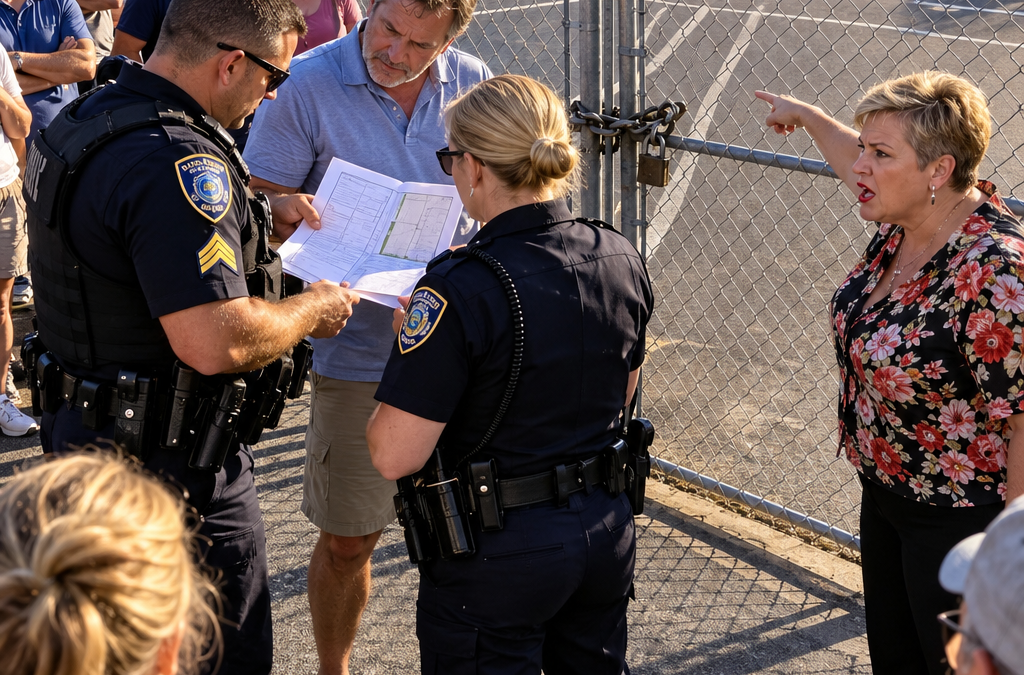
Lorraine Hartwell stood behind two police officers at the entrance to my parking lot, pointing at me like she was waiting for them to put me in handcuffs because I refused to open a gate on property she insisted belonged to the HOA.
What she did not know was that the deed in my jacket said otherwise, and the moment the officers asked her to prove her authority, the parking dispute she had spent months manufacturing began opening into something much larger.
My name is Dylan Brooks.
Six months before I ever stood beside that locked gate with two police officers and three hundred angry festival guests watching, I thought I had finally found the kind of place where my wife and I could live quietly.
That was all Megan and I wanted.
We were not looking for status.
We didn’t need a giant house.
We didn’t care about a golf course or a private clubhouse.
We wanted something comfortable.
Something we could afford without spending the rest of our lives calculating whether we could replace the air conditioner and still buy groceries that month.
Sunset Palms looked almost too neat when we first drove through it.
Palm trees lining the entrance.
Low stucco walls.
Perfect lawns.
Mailboxes shaped like miniature houses.
Children riding bicycles in the evenings.
Retirees walking dogs before the afternoon heat settled over the sidewalks.
Our house had three bedrooms, a small backyard, a two-car garage, and enough room for Megan to finally turn one spare bedroom into the home office she had wanted for years.
The price was fair.
The inspection was clean.
The HOA dues were not outrageous.
We signed.
For the first month, I thought our biggest disagreement would be over what color to paint the garage interior.
There was one unusual feature behind our street.
A large paved lot sat beyond a strip of trees and a chain-link fence.
Forty spaces.
Old painted lines.
A rusting metal gate.
A small utility light on one corner.
The lot had once belonged to an automobile dealer named Henry Lawson, whose family had used it to store overflow vehicles decades before Sunset Palms expanded around it.
Henry had died.
His children did not want the parcel.
The lot was separate from the house we were buying.
Different parcel number.
Different deed.
Different sale.
That distinction had been explained clearly during closing.
The house belonged inside Sunset Palms.
The parking parcel did not.
The lot happened to sit behind the development, but legally it was its own piece of property.
I saw opportunity.
Nothing grand.
The neighborhood around Sunset Palms had changed.
Contractors needed places to store vans overnight.
Food-truck owners needed secured parking.
A couple of small businesses nearby had more vehicles than space.
I figured I could rent ten or fifteen spots, keep the lot maintained, pay the taxes, and put the rest toward our mortgage.
Megan liked the idea.
“Passive income,” she said.
“You’ve been watching finance videos again.”
“It’s still passive income.”
“Nothing involving forty parking spaces is passive.”
“Less active than your job.”
That was true.
We even had our first customer lined up before we finished unpacking.
Eddie Morales ran a plumbing company.
Three work vans.
He had been paying too much to store them across town.
I showed him the lot.
He looked at the fence, the lighting, and the wide entrance.
“How much?”
I told him.
He stuck out his hand.
“Deal.”
Simple.
That was how I thought the whole thing would work.
Own property.
Maintain property.
Rent property.
Collect rent.
Pay taxes.
Nobody gets hurt.
Two weeks later, someone pounded on our front door.
Not knocked.
Pounded.
I opened it.
A woman stood on the porch wearing what looked almost like a uniform.
Black slacks.
Black button-up shirt.
Gold embroidered patch over the chest.
SUNSET PALMS HOA.
Short gray hair.
Clipboard.
Hard eyes.
She looked at me for maybe half a second before saying, “Dylan Brooks?”
“Yes.”
“Lorraine Hartwell.”
She paused as if the name itself should explain why she was there.
When I didn’t respond, she added, “HOA president.”
“Okay.”
She turned slightly and pointed toward the rear of the property.
“You’re operating an unauthorized commercial parking facility.”
I thought I had misheard her.
“I’m sorry?”
“The paved lot.”
“What about it?”
“It violates Sunset Palms community-use restrictions.”
“No, it doesn’t.”
Her eyebrows rose.
“Excuse me?”
“The lot isn’t part of Sunset Palms.”
She looked almost offended.
“It sits directly behind Sunset Palms.”
“That doesn’t make it part of Sunset Palms.”
“There are commercial vehicles being stored there.”
“Not yet.”
“You intend to store them.”
“Yes.”
“Then you’re converting residential property to commercial use.”
“It isn’t residential property.”
She glanced at her clipboard.
“The paving itself is unapproved.”
“The paving was there before I bought it.”
“That does not make it compliant.”
I had known this woman maybe ninety seconds.
Already I understood that ordinary conversation was not going to be easy.
I asked, “Which HOA rule am I violating?”
Lorraine looked at me.
“My rule.”
For a moment, I thought she was joking.
She wasn’t.
She tore a sheet from the clipboard and handed it to me.
$250 fine.
Unauthorized commercial paving.
Unapproved fence.
Unapproved gate.
Neighborhood aesthetic impact.
I stared at the paper.
“You’re fining me for a parking lot that isn’t in the HOA?”
“The board has jurisdiction.”
“Based on what document?”
“You may request a hearing.”
“Good. I am.”
She smiled.
It wasn’t warm.
“You’ll get your hearing.”
“Excellent.”
“And you’ll lose.”
Then she turned, walked down my driveway, and climbed into a golf cart parked by the curb.
I stood on the porch holding the fine.
Megan came up behind me.
“Who was that?”
“Apparently the president of a small country.”
She took the paper.
“Two hundred fifty dollars?”
“For owning pavement.”
She read it.
“Are we going to pay it?”
“No.”
That answer turned out to be more important than I knew.
The hearing was held at the Sunset Palms clubhouse.
Low beige building.
Old carpet.
Coffee that looked strong enough to dissolve paint.
Five board members sat behind a folding table.
Lorraine sat in the center with a wooden gavel.
A gavel.
For a neighborhood meeting.
Megan saw it and leaned toward me.
“You were right.”
“About what?”
“Small country.”
Lorraine called my name as if reading a criminal charge.
“Mr. Dylan Brooks, unauthorized commercial use and unapproved exterior property modifications.”
I stood.
“I’d like to start by seeing the rule that gives this board jurisdiction over parcel 1187-B.”
Lorraine stared at me.
“This is not a courtroom, Mr. Brooks.”
“I didn’t say it was.”
“You are not here to interrogate the board.”
“You fined me.”
“And you’re here to respond.”
“I am responding. Show me the rule.”
One board member looked down at his papers.
Another looked toward Lorraine.
She tapped the gavel once.
“The lot creates visual and commercial impacts on the community.”
“That’s not jurisdiction.”
“Your house is in Sunset Palms.”
“Yes.”
“The lot is attached to your property.”
“No.”
Her expression sharpened.
“It is behind your home.”
“It is a separate legal parcel.”
Lorraine raised the gavel.
“I am not going to argue technicalities.”
That sentence stayed with me.
Technicalities.
Property ownership was apparently a technicality.
The board upheld the fine.
Three votes to two.
I walked out angry but not yet frightened.
An older man approached me in the parking area.
White mustache.
Thin cardigan despite the warm evening.
Kind eyes.
Cane.
“Dylan?”
“Yes.”
“My name is Walt Harris.”
“I’ve seen you around.”
“Thirty years in Sunset Palms.”
He nodded toward the clubhouse.
“You really own that lot?”
“Yes.”
“Separate deed?”
“Yes.”
Walt studied me.
“Then ask yourself something.”
“What?”
“Who was parking there before you bought it?”
I frowned.
“What do you mean?”
He tapped his cane lightly against the pavement.
“Lorraine didn’t suddenly become interested because you paved anything. That lot has looked exactly like that for years.”
“So why now?”
Walt smiled sadly.
“That’s what you should find out.”
Then he walked away.
That night, I barely slept.
His question kept circling in my head.
Who had been using the lot?
I had visited the house twice before closing.
I remembered cars behind the fence.
Not many.
I assumed they belonged to the previous owner.
Had the HOA been using it?
If so, why had nobody mentioned it during the sale?
I opened our closing folder.
House deed.
HOA declaration.
Community map.
Parking lot deed.
County parcel sheet.
The lot was clearly separate.
I expected that discovery to end the dispute.
It didn’t.
Another violation came.
Then another.
Two fines became five.
Five became ten.
Lorraine began assessing $250 per day.
Every notice carried increasingly frightening language.
LIEN.
COLLECTION.
LEGAL ACTION.
POTENTIAL FORECLOSURE REMEDIES.
Megan stopped joking.
One night, she sat at the kitchen table with three notices spread in front of her.
“Dylan.”
“I know.”
“What if they actually put a lien on the house?”
“They can’t fine the house for another parcel they don’t control.”
“You keep saying can’t.”
“Because they can’t.”
“But they’re doing it.”
That was the first time I understood the real advantage Lorraine had.
Not law.
Fear.
A person can send a letter saying almost anything.
The cost begins when you have to prove why the letter is wrong.
“What if this ruins us?” Megan asked quietly.
I reached across the table.
“It won’t.”
“You don’t know that.”
No.
I didn’t.
I was confident.
Confidence and certainty are not the same thing.
Then I remembered something Lorraine had said.
I am not going to argue technicalities.
And something Walt had asked.
Who was parking there before you bought it?
I looked at Megan.
“Someone this loud usually wants you looking at the threat instead of the reason.”
She stared at me.
“You think she’s hiding something.”
“I think I’m going to the county.”
The next morning, I took the day off work.
The county recorder’s office occupied the first floor of an old government building downtown.
Fluorescent lights.
Gray counters.
People carrying folders.
Behind one desk sat a records examiner named Tom Whitley.
Quiet man.
Reading glasses.
I handed him both parcel numbers.
House.
Parking lot.
He typed.
Clicked.
Scrolled.
Then frowned.
“Mr. Brooks?”
“Yes?”
“Why are you checking this?”
“HOA says the lot is theirs to regulate.”
Tom looked at the monitor again.
“Which HOA?”
“Sunset Palms.”
More typing.
Then he turned the screen slightly.
“Are you sure they told you this parcel is part of the association?”
“They’re fining me two hundred fifty dollars a day.”
Tom removed his glasses.
“That doesn’t answer my question.”
“Yes. They’re claiming jurisdiction.”
He printed three pages.
Placed them in front of me.
“This parcel was never annexed into Sunset Palms.”
I stared at him.
“Never?”
“No.”
“Not under some amendment?”
“No.”
“Shared covenant?”
“No.”
“Architectural control?”
“No.”
He pointed to the legal description.
“The Sunset Palms declaration stops here.”
Then to my parcel.
“This is separate.”
“Completely?”
“As far as the county record shows, yes.”
“Can the HOA regulate what I do there?”
Tom looked at me.
“I’m not giving legal advice.”
“Understood.”
“But they don’t own it, and it isn’t part of their recorded declaration.”
I felt the tension leave my chest.
For about ten seconds.
Then Walt’s question returned.
If the HOA had no authority over the lot, why was Lorraine willing to threaten liens and foreclosure to control it?
I ordered certified copies.
Boundary map.
Deed.
Parcel history.
HOA declaration.
I walked outside feeling ten feet tall and deeply suspicious at the same time.
At home, I read every page of the Sunset Palms rules.
Not skimmed.
Read.
Forty-seven pages.
Architectural standards.
Pool rules.
Trash cans.
Commercial vehicles.
Visitor parking.
Tow procedures.
Then page forty-one.
Section 14.2.
I read it twice.
Then started laughing.
Megan came into the room.
“What?”
“Listen.”
I read aloud:
“No vehicle may be parked upon any private lot without the express written authorization of the property owner. Unauthorized vehicles may be removed or towed at the owner’s expense.”
Megan stared at me.
“Lorraine wrote that?”
“According to the revision history, she chaired the parking committee.”
Megan sat down.
“So her own rule says nobody can park on your lot without permission.”
“My lot.”
“Which the HOA has been using.”
“Apparently.”
There was a knock.
Walt stood outside holding a manila envelope.
“You went to the county?”
“How did you know?”
“You came home smiling.”
Fair.
He stepped inside.
“I think you’re ready for this.”
He handed me the envelope.
Inside were photographs.
Old festival flyers.
A few HOA newsletters.
A handwritten note.
Walt said, “Every Saturday, board members park back there.”
“How long?”
“Years.”
“Clubhouse staff too.”
“Did the previous owner allow it?”
“Not that I know.”
He pointed to an old newsletter.
SUNSET PALMS OVERFLOW PARKING AVAILABLE.
Location:
Rear lot behind Palm Drive.
My lot.
Another flyer advertised paid monthly overflow permits.
I looked at Walt.
“They charged people?”
“Yes.”
“How much?”
“Fifty a month.”
“For parking on property they didn’t own?”
“That’s what I tried telling Craig.”
“Craig?”
“Treasurer.”
“What did he say?”
“He thought the HOA had an agreement.”
“Was there one?”
Walt shook his head.
“I’ve never seen it.”
“Where did the money go?”
He shrugged.
“That’s the question.”
I didn’t call Lorraine.
Not yet.
Instead, I wrote a formal letter.
One page.
Calm.
No insults.
No accusations.
The letter stated that parcel 1187-B was privately owned, separately deeded, and outside the recorded Sunset Palms HOA boundary.
I included certified county records.
I demanded all fines be withdrawn within seven days.
I also asked the board to provide any document it believed gave the HOA legal authority over the parcel.
I sent it certified mail.
Return receipt requested.
Then I waited.
A week later, an envelope came back.
Inside was my own letter.
Torn in half.
Across the first page, written in red marker:
DENIED.
No legal explanation.
No document.
No board response.
One word.
Megan stared at it.
“Can she do that?”
“She just did.”
“What now?”
I looked at Section 14.2.
Then at the torn certified letter.
“We follow the rules.”
“Her rules?”
“Exactly.”
She studied me.
“You’re about to become extremely annoying.”
“Legally annoying.”
That Saturday, I drove to the hardware store.
Heavy chain.
Hardened padlock.
New gate latch.
Two large signs.
PRIVATE PROPERTY.
AUTHORIZED PERMIT PARKING ONLY.
NO TRESPASSING.
UNAUTHORIZED VEHICLES MAY BE TOWED AT OWNER’S EXPENSE.
I used wording almost identical to Section 14.2.
Megan held the ladder while I mounted the first sign.
Walt held the second one steady.
Several neighbors watched from the sidewalk.
One asked, “You closing the lot?”
“I am ending free HOA access.”
“Why?”
“Because I own it.”
The neighbor nodded slowly.
No argument.
Sunday afternoon, I closed the gate.
The chain made a heavy metallic sound when I pulled it through the latch.
I remember that sound.
Not because it was dramatic.
Because it made the boundary physical.
For months, Lorraine had treated paper ownership as irrelevant.
Now there was steel.
I wrote another letter.
Effective Friday at 8:00 a.m., all informal permission for Sunset Palms HOA board members, employees, residents, guests, and contractors to use parcel 1187-B for parking is revoked.
Future parking may be arranged through the property owner under written permit at market rate.
No exceptions.
I delivered it to the clubhouse mailbox.
Later, Walt told me what happened.
Lorraine read the letter at a board meeting.
Then laughed.
“He can’t ban us.”
Other board members laughed nervously.
Lorraine said:
“We have the Spring Festival Saturday. Three hundred people. Where does he think they’re going to park?”
When Walt repeated that sentence, Megan and I looked at each other.
Neither of us said anything.
Lorraine had finally asked the right question.
Friday morning, I reached the lot at 7:52.
Coffee in hand.
Gate open.
A few HOA staff vehicles still inside.
I had given written notice.
I had posted signs.
Everyone had eight minutes.
At 7:59, the last employee drove out.
At 8:00 exactly, I closed the gate.
Locked it.
Photographed the lock.
Photographed the signs.
Photographed my watch.
Megan laughed.
“You’ve been waiting to do that.”
“A little.”
Friday passed quietly.
Saturday did not.
The Sunset Palms Spring Festival started at ten.
Bounce houses.
Food trucks.
Live band.
Kids’ games.
Raffle tables.
More than three hundred expected guests.
For years, apparently, the HOA had directed visitors to my lot.
The festival announcement still did.
By 9:30, the first cars arrived.
Drivers turned toward my gate.
Stopped.
Read the signs.
Backed up.
Another car arrived.
Then another.
Within twenty minutes, a line formed.
People rolled down windows.
“Is the lot closed?”
“Yes.”
“The HOA said parking was here.”
“Not anymore.”
“Where do we park?”
“You’ll need to ask the HOA.”
Some were angry.
Most were confused.
Families climbed out holding folding chairs.
Parents carried coolers.
One man waved a printed festival flyer.
“It says free overflow parking.”
I looked at the address.
My parcel.
“That flyer is wrong.”
“What do you mean?”
“This is private property.”
He looked toward the clubhouse.
“The HOA charges me fifty dollars a month for access.”
That sentence sharpened everything.
“Do you have a receipt?”
He nodded.
“Keep it.”
“Why?”
“You may need it.”
Megan and I stood near the gate drinking lemonade.
Not celebrating.
Watching.
I didn’t enjoy making families walk farther.
The festival guests were not the problem.
But I needed the HOA to confront the consequence of what it had been doing.
Then I heard tires squeal.
Lorraine came around the corner in a golf cart so fast she nearly clipped the curb.
She jumped out.
Black HOA shirt.
Gold patch.
Clipboard gone.
Face red.
She marched straight toward me.
“Open that gate.”
“Good morning.”
“I said open it.”
“No.”
“We have hundreds of people arriving.”
“I know.”
“This is designated HOA overflow parking.”
“No.”
“You cannot obstruct community access.”
I pointed at the sign.
“Section 14.2.”
She froze.
“What?”
“No vehicle may park on a private lot without written authorization from the owner.”
Her face changed.
I continued.
“I’m the owner.”
“You are twisting association rules.”
“I’m quoting them.”
“This lot has always been used by Sunset Palms.”
“That doesn’t make it yours.”
“You are creating a safety hazard.”
“I gave written notice.”
“You think you’re clever?”
“No.”
I held up the county map.
“I think I own parcel 1187-B.”
People had started gathering.
Phones appeared.
Lorraine noticed.
Then she reached for hers.
“I am calling the police.”
Megan looked at me.
“Here we go.”
Ten minutes later, a police SUV pulled up.
Then another.
Officer Daniels stepped out of the first.
Tall.
Sunglasses.
Calm voice.
Officer Ramos was younger and more observant, eyes moving between the crowd, signs, gate, and Lorraine.
Lorraine reached them first.
“He is blocking public parking.”
Daniels looked toward me.
“He is harassing the community and interfering with an HOA event.”
“Okay.”
“He needs to open the gate immediately.”
Daniels raised one hand.
“Let’s slow down.”
Lorraine pointed at me.
“He has been in violation for months.”
Daniels turned.
“Sir?”
“Dylan Brooks.”
“Is this your property?”
“Yes.”
“Do you have documentation?”
I smiled.
“Absolutely.”
I pulled the folder from my jacket.
Certified deed.
County parcel map.
Sunset Palms recorded boundary.
Officer Daniels read the deed slowly.
Then the map.
Then the HOA declaration boundary page.
Ramos leaned over.
Daniels looked at me.
“This parcel number matches the lot?”
“Yes.”
He looked at Lorraine.
“Ma’am, according to these documents, this parcel is privately owned by Mr. Brooks and is not inside the recorded Sunset Palms HOA boundary.”
Lorraine’s expression changed so quickly it was almost hard to follow.
Confidence.
Confusion.
Anger.
“That’s impossible.”
Daniels handed the papers back.
“Do you have documentation showing otherwise?”
“We have always used this lot.”
Ramos asked, “Written easement?”
“No.”
“Lease?”
“No.”
“Parking agreement with the owner?”
“We have community precedent.”
Daniels said, “I’m asking about legal permission.”
Lorraine opened her mouth.
Nothing.
Ramos pointed toward the posted sign.
“This says permit parking only.”
“Yes,” I said.
“Did you revoke permission?”
“Yes. Written notice delivered before today.”
I showed them the copy and delivery record.
Daniels nodded.
Then Lorraine made the mistake I still cannot believe she made.
She stepped toward the gate.
Grabbed the chain.
“Fine. I’ll remove it myself.”
Officer Daniels moved immediately.
“Ma’am, let go.”
She stared at him.
“This is HOA property.”
“Let go of the lock.”
“But—”
“Now.”
She released it.
Daniels stepped between her and the gate.
“If these documents are accurate, damaging that lock or entering this property after permission has been revoked could expose you to trespass and property-damage charges.”
Lorraine stared at him.
The entire crowd had gone silent.
Then someone behind us shouted:
“Is this the lot you’ve been charging us for?”
Lorraine turned.
Another voice:
“Fifty dollars every month!”
Then another:
“I’ve paid that fee for two years!”
People began talking over one another.
“Where did the money go?”
“You told us the HOA owned it!”
“My permit says Sunset Palms overflow parking!”
“Are you saying he owns it?”
Lorraine’s face went white.
Officer Daniels looked at her.
“Ma’am, I’m going to issue a formal trespass warning based on the owner’s request and the documentation presented.”
Her voice dropped.
“You’re siding with him?”
“I’m documenting notice.”
He handed her the paper.
“You are not authorized to enter this parcel or interfere with the gate without legal authority or the owner’s permission.”
Lorraine took it.
Her fingers trembled.
The crowd saw.
That mattered.
For months, she had acted as though authority flowed from her personally.
Now an officer was standing on the sidewalk telling her the exact opposite.
The festival descended into chaos.
Cars backed up onto the street.
Guests circled for parking.
Volunteers tried directing traffic.
At one point, a fire truck approaching the clubhouse had to slow because vehicles were stopped along the curb.
Lorraine stormed inside.
The clubhouse door slammed.
Within an hour, an emergency board meeting had been called.
I wasn’t invited.
Walt went.
He came to our house that evening.
He looked exhausted.
“What happened?”
He sat at our kitchen table.
“Craig asked about the money.”
“Craig Bellamy?”
“Treasurer.”
Megan poured coffee.
“What money?”
Walt looked at me.
“The overflow fees.”
My stomach tightened.
He continued.
“The room was already angry after the police left.”
“Lorraine said the fees were for community improvements.”
“What improvements?”
“That’s exactly what Craig asked.”
Walt described it slowly.
Craig had opened the HOA financial records.
Parking revenue should have appeared somewhere.
It didn’t.
Residents had paid fees.
Some monthly.
Some seasonally.
Dozens of receipts existed.
There were hundreds of transactions over several years.
But the association’s regular bank account did not show corresponding deposits.
Craig began tracing payment instructions.
Then he found a second account.
Not an HOA account.
An account associated with Lorraine.
Walt’s voice dropped.
“Sixty-two thousand dollars.”
Megan stopped moving.
“What?”
“Roughly sixty-two thousand over about three years.”
I stared at him.
“For parking on my land.”
Walt nodded.
“Residents thought they were paying the HOA.”
“Who else knew?”
“Craig says he didn’t.”
“The other board members?”
“Most looked like they’d been hit with a chair.”
He slid a folder across the table.
Inside were receipts.
Some handwritten.
Some printed.
$50.
Overflow parking.
Signed.
Lorraine Hartwell.
Megan whispered, “Oh my God.”
I looked at Walt.
“Where did you get these?”
“Residents gave them to me after the meeting.”
“Why you?”
“Because old people collect things.”
He smiled slightly.
Then became serious.
“Use them.”
That Monday, Megan and I met with an attorney named Priya.
Property law.
HOA disputes.
Civil fraud.
She read everything.
The deed.
County boundary.
Fine notices.
The torn certified letter with DENIED written across it.
Section 14.2.
My revocation notice.
Police incident information.
Resident parking receipts.
Priya took off her glasses.
“This is no longer a disagreement about parking.”
“I figured.”
“Your ownership question is straightforward from these records.”
“And the money?”
She looked at the receipts.
“That needs investigation.”
“Fraud?”
“Potentially.”
Megan asked, “What happens now?”
Priya stacked the documents.
“Now we stop communicating informally.”
That afternoon, she sent a formal demand to the HOA.
Every fine against me canceled.
Written acknowledgment that the private lot was outside HOA jurisdiction.
Accounting of every parking fee collected.
Preservation of financial records.
Copies of all parking permits.
Board communications.
Bank records.
And a formal apology.
She also sent information to the district attorney’s office for review.
Lorraine’s clipboard had become evidence.
Three days later, Sunset Palms called a special meeting.
This time, nobody had to ask residents to attend.
The clubhouse was packed.
People stood along the walls.
Lorraine entered wearing the same black HOA uniform.
Same gold patch.
Same stiff posture.
But when she saw Detective Alvarez sitting in the front row, she stopped.
Just for a second.
Then kept walking.
Craig Bellamy stood near the board table with his laptop.
He looked sick.
The meeting opened without Lorraine’s usual speech.
Craig spoke first.
He presented the parking records.
Resident payments.
Receipts.
Permit lists.
Then bank records.
Money collected as “Sunset Palms Overflow Parking.”
Money that should have gone to the association.
Transfers and deposits connected instead to another account.
Lorraine interrupted.
“This is being mischaracterized.”
Craig’s voice shook.
“Then explain it.”
“I used those funds for community purposes.”
“Where?”
“Various expenses.”
“Show me.”
Lorraine turned toward the board.
“This is an internal financial matter.”
A woman in the crowd stood.
“No.”
Her voice cracked.
“I paid you fifty dollars every month.”
Another resident held up receipts.
“So did I.”
Another.
“And me.”
Walt stood slowly.
He didn’t raise his voice.
“We trusted you, Lorraine.”
That sentence did more damage than the shouting.
Lorraine looked at him.
For the first time, she seemed older.
Detective Alvarez finally stood.
“Ms. Hartwell.”
The room quieted.
“I need to speak with you privately regarding the parking account and related financial records.”
Lorraine’s face fell.
Not dramatically.
No screaming.
No collapse.
Just the look of someone realizing the room no longer belonged to her.
She resigned that night.
The official board record stated she had stepped down effective immediately.
By the next morning, every fine issued against me had been voided.
All of them.
The HOA sent written confirmation that parcel 1187-B was not subject to Sunset Palms enforcement.
My legal expenses were reimbursed through the association’s insurance and settlement process.
A formal apology arrived two weeks later.
Short.
Dry.
Still satisfying.
Residents began receiving refund checks as the parking accounts were reconstructed.
The financial investigation continued separately.
Priya told me not to speculate about the outcome beyond what was documented.
So I didn’t.
I didn’t need to.
What mattered to me was simple.
The HOA stopped claiming my property.
The lot stayed mine.
The fines disappeared.
The gate stayed locked unless I opened it.
And people who had paid for years finally learned what they had actually been paying for.
Lorraine’s name disappeared from the office door.
The black uniform stopped appearing around the neighborhood.
For the first time since we moved in, Sunset Palms felt quieter.
Not because there were fewer rules.
Because the rules had returned to their proper size.
A new board was elected.
Craig stayed as treasurer for a while, mostly because nobody trusted the books enough to let him leave.
The board adopted stronger financial controls.
No cash payments without receipts and dual accounting.
No new fee without a recorded vote.
No claim over property unless management could identify the recorded legal authority.
Those changes sounded obvious.
Most important protections do after someone proves why they’re necessary.
My parking lot finally became what I had planned from the beginning.
Eddie moved his three plumbing vans in.
A food-truck owner rented two spots.
A roofing contractor took four.
I installed better lighting.
Repainted the space numbers.
Repaired part of the fence.
The income helped with the mortgage exactly as Megan and I had hoped.
But I changed one thing.
Weekends.
I put a small green sign at the gate.
SUNSET PALMS RESIDENTS – FREE WEEKEND PERMIT PARKING WHEN AVAILABLE.
Megan saw it first.
“You’re giving them free parking?”
“Weekends.”
“After everything?”
“The residents didn’t steal the lot.”
She looked at me.
“Lorraine did.”
“Lorraine abused it.”
I corrected her automatically.
She smiled.
“Attorney language.”
“I’ve spent too much time with Priya.”
Walt got permit number one.
He acted offended.
“Why one?”
“Because you’re first.”
“I should have a reserved space.”
“You’re pushing it.”
He grinned.
Every Saturday, if the contractor spaces were open, residents could use them.
Free.
Written permission.
Exactly as Section 14.2 required.
I enjoyed the irony.
Not because I wanted to mock Lorraine.
Because permission was the whole point.
Nobody had been entitled to the lot.
But I could choose to share it.
Ownership doesn’t mean saying no to everyone.
It means the yes belongs to you.
Months after Lorraine resigned, Megan and I sat on our back patio overlooking the fence.
A few work vans were parked under the lights.
Eddie was locking one.
Beyond him, Walt’s old sedan occupied the first space near the gate.
Megan said, “You know what scares me?”
“What?”
“How close we came to paying.”
I knew what she meant.
The early fines.
$250.
Then $500.
Then more.
I had considered paying simply to make the letters stop.
If I had done that, maybe Lorraine would’ve interpreted payment as recognition.
Maybe the HOA would have pushed harder.
Maybe I would have spent years trying to undo the idea that they had jurisdiction.
Maybe nobody would’ve asked about the parking fees.
I looked toward the lot.
“One day at the county office changed everything.”
“No.”
Megan shook her head.
“What?”
“One question did.”
“Which one?”
“Why does she care so much?”
I thought about Walt.
Who was parking there before you bought it?
He had been right.
Lorraine’s mistake wasn’t merely overreach.
It was desperation.
She had something to lose.
My deed threatened a system she had quietly built around property that was never hers.
When I bought the lot, I didn’t just become a new owner.
I accidentally interrupted her income.
The fines weren’t really about paving.
Or the fence.
Or the gate.
They were pressure.
If she convinced me the HOA controlled the parcel, then maybe she could keep using it.
If I got frightened enough by liens and foreclosure language, perhaps I would submit.
Maybe I would sign some agreement.
Maybe I would let her call the lot “community overflow parking” because fighting seemed harder.
She underestimated one thing.
Paper.
The deed.
The county map.
The certified letter.
Her own Section 14.2.
Receipts.
Bank records.
None of them shouted.
None wore a black uniform.
None carried a gavel.
They simply existed.
That was enough.
One afternoon, Tom Whitley from the county recorder’s office happened to stop by the lot.
He had recognized my name from a local article about the HOA dispute.
I was replacing a broken gate hinge.
“You were right,” I said.
“About what?”
“Separate parcel.”
He smiled.
“The computer was right.”
“You printed it.”
“I press buttons.”
“You saved me a lot of money.”
“No.”
He looked toward the lot.
“You owned it before you met me.”
That sentence stayed with me.
I owned it before I knew enough to defend it.
Rights don’t appear when you discover them.
You simply become aware of what was already there.
I think that’s why these kinds of conflicts can become so intimidating.
The other side acts certain.
They have forms.
Logos.
Titles.
Meeting rooms.
Threatening language.
You begin thinking perhaps they know something you don’t.
Sometimes they do.
Sometimes you’re wrong.
But asking for the document is never unreasonable.
Where does your authority come from?
What map?
What deed?
What covenant?
What vote?
What agreement?
Lorraine hated those questions.
At the first hearing, she told me it wasn’t a courtroom.
She was right.
It wasn’t.
But that didn’t mean facts became optional.
I later requested copies of my HOA violation file.
It was thick.
Photos.
Fine notices.
Internal notes.
Several described me as “combative.”
That made me laugh.
Most of my communications were one-page letters asking for documentation.
Apparently asking someone to prove their authority can feel combative when they don’t have proof.
There was one note from Lorraine that bothered me more.
OWNER CONTINUES TO CHALLENGE BOARD CONTROL OF REAR PARKING AREA.
Board control.
Not community safety.
Not aesthetics.
Control.
There it was.
The real argument.
She wanted control because control produced money.
My deed made both impossible.
Megan framed the torn DENIED letter.
That surprised me.
“You framed this?”
“You framed stranger things.”
“Why?”
“Because she sent your best evidence back to you.”
Priya had said the same thing.
The certified letter proved Lorraine had received the deed information before the festival.
She couldn’t later claim ignorance.
She knew the lot was disputed.
She knew I claimed ownership.
She saw the county records.
Then she showed up anyway.
Tried to force the gate.
That torn letter became one of the clearest pieces showing notice.
Lorraine had tried to dismiss me.
Instead, she documented herself.
Walt thought that was hilarious.
“Never destroy a man’s letter after signing for it.”
“I don’t think that’s an old saying.”
“It is now.”
He became one of our closest neighbors.
Not because of the lawsuit.
Because people reveal themselves during conflict.
Walt could have stayed quiet.
He was retired.
Comfortable.
Lorraine wasn’t targeting him.
He had no financial reason to help me.
But he had watched something wrong for years.
When someone finally asked the right question, he answered.
That’s courage too.
Not dramatic courage.
The ordinary kind.
The kind that brings a manila folder to someone’s door.
Craig apologized to me later.
He had served as HOA treasurer while the parking fees were being collected, and that fact ate at him.
“I should’ve seen it.”
“You weren’t receiving the money.”
“I should’ve asked why there was a parking program not appearing in our revenue.”
“Probably.”
He looked surprised by my answer.
I wasn’t going to tell him there was no failure.
There had been.
Boards are supposed to watch one another.
People became too comfortable letting Lorraine handle things.
That comfort created space.
She used it.
Craig took responsibility.
That mattered.
The new Sunset Palms board was less efficient.
Meetings took longer.
People questioned every fee.
Sometimes painfully.
I preferred it.
Efficient authority is wonderful when it’s trustworthy.
When it’s not, efficiency just means nobody interrupts.
A year later, the Spring Festival returned.
The board contacted me three months in advance.
Not three days.
They asked whether they could rent twenty-five parking spaces for Saturday.
Written contract.
Insurance.
Cleanup responsibility.
Fair price.
I agreed.
Then I waived the fee.
The new president called.
“Dylan, you don’t have to do that.”
“I know.”
“After what happened last year—”
“This year you’re asking.”
Silence.
Then:
“Thank you.”
The festival went smoothly.
Cars entered through the gate.
A volunteer checked permits.
No confusion.
No police.
No screaming.
No one claimed the lot belonged to the HOA.
At noon, Megan and I walked over.
Walt sat beneath a tent eating something fried that his doctor probably didn’t approve of.
He waved.
“Look at this.”
“What?”
“All these people on your land.”
“With permission.”
He smiled.
“That’s the magic word.”
Exactly.
Permission.
One word.
The difference between access and trespass.
Between sharing and taking.
Between community and entitlement.
Lorraine had treated years of informal use as ownership.
It wasn’t.
If Henry Lawson, the previous owner, had allowed the neighborhood to use the lot occasionally, that did not automatically make the HOA owner.
If residents paid Lorraine, that did not give them title either.
They had been victims too.
That was why I never blamed them.
Some were embarrassed when they learned the truth.
One woman apologized to me because she had complained loudly at the festival gate.
“You didn’t know,” I told her.
“But I yelled at you.”
“You thought you’d paid for access.”
“I had.”
“To the wrong person.”
She smiled weakly.
“That’s one way to put it.”
I refunded nothing.
I had never collected the fees.
The HOA and legal process handled that.
But I gave residents weekend permits because I wanted the lot to stop being a symbol of division.
Lorraine had used it to extract money.
I wanted it to be useful.
That felt better.
Megan sometimes jokes that I became obsessed with deeds after the experience.
She’s right.
When friends buy homes, I tell them to read the legal description.
When someone mentions an easement, I ask whether it’s recorded.
When contractors talk about property lines, I tell them to verify the survey.
At dinner parties, Megan will sometimes put a hand on my arm.
“Please do not discuss parcel numbers tonight.”
“People need to know.”
“No one asked.”
“They might someday.”
She rolls her eyes.
But our deed folder is better organized now.
House.
Lot.
Survey.
Insurance.
Permits.
Taxes.
Everything.
Separate copies stored digitally.
I hope I never need most of it.
That is the ideal outcome for good documentation.
You keep it so you can forget about it.
The parking lot is profitable now.
Not wildly.
Enough.
Eddie still rents three spaces.
A catering company rents four.
Two food trucks use the back row.
A landscaper stores trailers near the fence.
I keep several spaces open for residents on weekends.
Walt’s permit remains number one.
He reminds everyone.
Once, I accidentally printed his new annual permit as number seven.
He returned it.
“This is unacceptable.”
“Walt.”
“Historical rights.”
“You don’t have historical rights.”
“I have documentation.”
He held up the old permit.
I laughed so hard I gave him number one.
Fair.
The old HOA fines are stored in a box.
I kept them.
At first because Priya told me to.
Later because I wanted to remember how official nonsense can look.
Every page had the Sunset Palms logo.
Fine amount.
Legal-sounding language.
Deadlines.
Threats.
If you saw one by itself, you might assume somebody had checked the law.
Nobody had.
Or worse, somebody knew and didn’t care.
That is the dangerous part.
A document can look official and still be wrong.
A title can sound powerful and still have boundaries.
An HOA president can hold a gavel without being a judge.
A board can vote without owning the thing it votes about.
Those distinctions seem obvious after the fact.
They don’t feel obvious when the letters are arriving every day.
I remember Megan sitting at the kitchen table whispering:
What if they take the house?
That fear was real.
Even if Lorraine’s threats lacked legal foundation, we didn’t know enough yet to dismiss them emotionally.
That’s what intimidation does.
It gets ahead of knowledge.
The answer was not to become fearless.
I never did.
The answer was to replace fear with information one document at a time.
County map.
Deed.
HOA boundary.
Rulebook.
Receipts.
Bank records.
By the end, there wasn’t much room left for fear because there wasn’t much ambiguity left.
Lorraine had relied on ambiguity.
When that disappeared, so did her power.
I saw her once after she resigned.
Months later.
Grocery store.
Different part of town.
She was standing near the produce section.
No black uniform.
No gold patch.
Just a woman holding a shopping basket.
Our eyes met.
She looked away.
I kept walking.
I had imagined that moment before.
Thought I might say something.
Nothing came to mind.
There was nothing left I needed from her.
No apology.
No admission.
No final line.
Everything important had already been written down.
The lot was mine.
The fines were void.
The fees were being repaid.
Residents knew.
The board knew.
Police knew.
The county knew.
Truth did not need another conversation in a grocery store.
That realization was strangely peaceful.
Justice, at least the kind I cared about, was not Lorraine feeling humiliated.
It was me unlocking my own gate on a Saturday morning without wondering whether someone else believed they owned the key.
It was Eddie parking three vans.
It was Megan helping me repaint the entrance.
It was Walt pulling into space number one.
It was the HOA asking instead of ordering.
That’s what winning looked like.
Normal life with boundaries restored.
I sometimes stand by the gate early in the morning before the contractors arrive.
The lot is quiet.
Forty spaces.
Painted lines.
Chain-link fence.
Nothing impressive.
If you didn’t know the story, you would never guess that this ordinary patch of pavement exposed years of deception inside a homeowners association.
That’s probably fitting.
Big problems often hide behind boring things.
Invoices.
Parking permits.
Access roads.
Meeting minutes.
Receipts.
Nobody pays attention until one small inconsistency becomes impossible to ignore.
Mine was a $250 fine.
Unauthorized commercial paving violation.
I almost laughed.
Then the fine became ten.
Then daily penalties.
Then threats.
Lorraine wanted me focused on defending myself.
What exposed her was asking why she needed control so badly in the first place.
That question led to Walt.
Walt led to the parking program.
The parking program led to receipts.
The receipts led to the account.
And the account led far beyond any argument over a fence and gate.
If Lorraine had left me alone, I might never have looked.
That’s the irony.
She already had years of informal access.
Residents already believed the lot belonged to the HOA.
Nobody was challenging her.
Then I bought the parcel.
She could have approached me honestly.
Asked to lease spaces.
Negotiated festival parking.
Offered a monthly arrangement.
I probably would have said yes.
I wanted tenants.
The HOA could have been one.
Instead, Lorraine chose authority she did not have because asking would have required admitting the lot was mine.
That admission threatened the story she had been selling.
So she fined me.
Then fined me again.
Then threatened my home.
Then tore up my letter.
Then showed up at my gate demanding access in front of three hundred people.
Every escalation made sense to her because backing down would expose the first lie.
That’s how bad decisions grow.
Not always because someone plans the final disaster from the beginning.
Sometimes because each new bad choice exists to protect the one before it.
By the time Lorraine grabbed my chain in front of Officer Daniels, she was no longer protecting parking access.
She was protecting an entire invented reality.
The officer didn’t know any of that.
He didn’t need to.
He looked at the deed.
Looked at the map.
Asked for her written agreement.
There wasn’t one.
Everything else followed.
That is why I still keep a copy of Section 14.2 beside the lot deed.
The rule Lorraine helped write.
No vehicle may park on any private lot without written authorization from the owner.
She probably intended it to help the HOA control parking.
Instead, it reminded everyone of something more basic.
Private property has an owner.
And that owner wasn’t her.
Today, Sunset Palms is still a nice neighborhood.
Palm trees.
Perfect lawns.
Children on bikes.
Dogs in the evening.
The HOA still exists.
I still pay dues on the house.
The new board sends newsletters.
Sometimes they annoy me.
That’s normal.
I don’t hate HOAs.
I hate unaccountable authority.
There’s a difference.
Shared communities need rules.
Road maintenance.
Pools.
Common landscaping.
Noise.
Safety.
Money has to be collected and spent.
Someone has to manage it.
But every legitimate power has a line around it.
The line might be written in a deed.
A declaration.
A statute.
A contract.
In my case, it was a parcel boundary sitting quietly in county records while Lorraine behaved as if it didn’t exist.
Once I found that line, everything changed.
The parking lot sits behind my home exactly where it always did.
The fence is cleaner now.
The gate has a better lock.
The lights are brighter.
On weekends, the green resident sign hangs beside the entrance.
Sometimes I watch a Sunset Palms neighbor pull in, place a free permit on the dashboard, and walk toward the community center.
Nobody thinks twice about it anymore.
That’s what I wanted.
Permission so ordinary that nobody notices.
A few years ago, that same car would have been there because Lorraine claimed the HOA had a right.
Now it’s there because I said yes.
Small difference in appearance.
Huge difference in principle.
Megan understands that better than anyone.
One night, not long after the refunds began, she stood with me at the gate.
“You know what this whole thing was about?”
“Money?”
“No.”
“Control?”
“Partly.”
“What then?”
She looked toward the clubhouse.
“Consent.”
I stared at her.
She smiled.
“Someone had been using something that belonged to another person for so long they forgot permission mattered.”
That was it.
Not the pavement.
Not the $250 fines.
Not even the $62,000.
Permission.
Lorraine believed years of getting away with something had converted it into a right.
They hadn’t.
All it took to remind her was a deed, a padlock, and enough patience to make everyone look at the same facts.
The morning after the investigation became public, I stood alone in the lot before work.
I unlocked the gate.
The chain fell against the metal post with the same sound it had made the day I first locked it.
But everything felt different.
No crowd.
No police.
No Lorraine.
Just me.
I looked at the forty painted spaces.
Then at the county parcel map inside my folder.
For months, Lorraine had tried to make me feel as though I was the outsider.
The troublemaker.
The man disrupting the community.
But standing there, I finally understood how backwards that story had been.
I had never taken anything from Sunset Palms.
I had simply stopped them from taking something from me.
And once that difference became clear, the rest of Lorraine’s story had nowhere left to stand.








