𝗙𝗨𝗟𝗟 𝗦𝗧𝗢𝗥𝗬 The HOA President Was Living Behind a Locked Gate on 140 Acres My Grandfather Never Sold
𝗙𝗨𝗟𝗟 𝗦𝗧𝗢𝗥𝗬
The kind that rattled tools out of your truck bed.
Now there was asphalt.
Fresh asphalt.
Perfect edges.
Drainage grooves.
I stopped.
Checked the map.
Looked ahead.
The road continued exactly where Grandpa’s trail had been.
I drove another quarter mile.
Then I hit the gate.
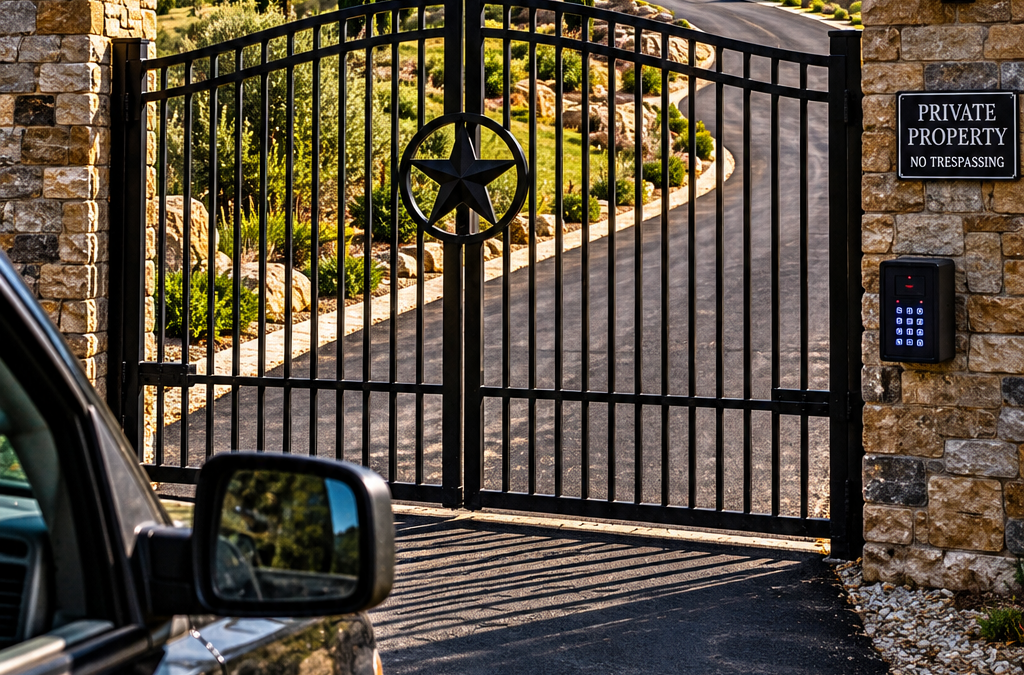
Black iron.
Stone pillars.
Electronic keypad.
Security camera.
Private property sign.
I stared at it through the windshield.
For a moment, I actually laughed.
Not because it was funny.
Because my brain didn’t know what else to do.
I pulled over.
Got out.
The gate looked new.
Maybe two or three years old.
Professionally installed.
The stone pillars had decorative lights.
There was even landscaping around them.
Somebody had planted ornamental grasses along my grandfather’s fence line.
Beyond the gate, the paved drive curved through the trees.
And about three hundred yards back sat a house.
Not a ranch house.
Not a hunting cabin.
Not some temporary structure somebody might have built by mistake.
A full luxury residence.
Two stories.
Wraparound porch.
Stone chimney.
Large picture windows.
Three-car detached garage.
Landscaped front lawn.
I could see irrigation heads spraying arcs of water in the afternoon sun.
I stood there for a long time.
The first emotion was confusion.
The second was anger.
Then came something worse.
Violation.
I know that sounds dramatic when we’re talking about land.
But if you’ve inherited a place that holds your family’s history, you understand.
Someone hadn’t simply crossed a boundary.
They had erased one.
I walked to the keypad.
There was an intercom button.
I pressed it.
Nothing.
Pressed again.
Static cracked through the speaker.
Then a woman’s voice.
“Yes?”
Calm.
Controlled.
I leaned closer.
“My name is Cole Croft.”
Silence.
“This is Croft Hollow.”
Still nothing.
“I’m standing at a gate built on my property, and I’d like to know who you are and what you’re doing here.”
There was a pause.
Then the lock clicked.
The gate opened.
That surprised me more than anything.
I expected an argument through the speaker.
Instead, she invited me in.
Or maybe she thought she was allowing me in.
I walked up the driveway.
Every step made me angrier.
There were flower beds beside the porch.
A stone walkway.
Outdoor lighting.
A fountain near one corner of the house.
This wasn’t recent trespassing.
This was occupation.
The front door opened before I reached the porch.
Dorothy Langwell stepped outside.
I recognized her name later.
At that moment, she was simply a stranger standing in front of a house built on land I had inherited from my grandfather.
She was probably in her early sixties.
Silver hair pinned back neatly.
Cream blouse.
Dark slacks.
Small gold earrings.
She looked like someone who expected to be listened to.
That was my first impression.
My second was that she wasn’t nervous.
Not even slightly.
She looked at me the way someone might look at a delivery driver standing at the wrong address.
“I know who you are,” she said.
No hello.
No introduction.
That stopped me.
“You do?”
“Yes.”
Then she raised one hand.
“And I’m going to stop you before you say something embarrassing.”
I almost laughed again.
“Embarrassing?”
“This parcel no longer belongs to the Croft estate.”
She said it flatly.
Confidently.
Like a fact nobody could dispute.
I looked around at the porch.
Then back at her.
“Really?”
“Yes.”
“When did that happen?”
“The parcel was acquired through Clearwater Pines HOA under a lawful land purchase agreement approximately two years before your grandfather died.”
My heartbeat slowed.
That happens when I get angry.
Not faster.
Slower.
“What parcel?”
“The northwest parcel.”
“How many acres?”
“Approximately one hundred forty.”
She knew the number.
That bothered me.
“What did the HOA pay?”
Her eyes narrowed slightly.
“That’s not information I’m required to discuss with you.”
“You’re standing in a house built on land my grandfather owned.”
“Previously owned.”
“Show me the deed.”
“You don’t get to arrive here after years away and demand records from me.”
I stared at her.
“I’m the legal heir.”
“That doesn’t matter if the property was transferred before the estate existed.”
“My grandfather sold you one hundred forty acres?”
“Correct.”
“He signed?”
“Yes.”
“In person?”
“I wasn’t present for the signing.”
“Who was?”
“Our attorney handled the transaction.”
“Which attorney?”
Her patience disappeared.
“Have your attorney contact the Clearwater Pines HOA counsel.”
I looked past her through the front window.
Expensive furniture.
Stone fireplace.
A framed landscape painting.
This woman wasn’t bluffing like someone caught squatting in an abandoned structure.
She believed she had insulated herself.
That was different.
“I’d like a copy of the transfer document.”
She smiled.
Not kindly.
“You’ll get whatever you are legally entitled to receive through proper channels.”
“This is proper enough for me.”
“It isn’t for me.”
She stepped backward.
“Good day, Mr. Croft.”
“Dorothy, right?”
Her expression changed.
“How do you know my name?”
“There’s a plaque beside your door.”
She looked toward it.
DOROTHY LANGWELL.
I nodded.
“Nice house.”
Her mouth tightened.
“Have your attorney call ours.”
Then she closed the door.
I stood on the porch another few seconds.
I could have knocked again.
Could have shouted.
Could have called the sheriff immediately.
Instead, I walked back to the truck.
Grandpa used to say anger was useful only until it started making decisions for you.
So I let the anger sit beside me while I drove.
I went straight to his house.
The ranch house smelled closed up.
Dust.
Wood.
Old coffee.
The kitchen chair where he used to sit was still pushed back from the table.
His boots were gone.
His coat was gone.
Those had been donated.
But the grooves in the floor where the chair legs had scratched the wood were still there.
I stood in the kitchen too long.
Then I went to his office.
Grandpa trusted paper.
Not because he hated technology.
Because paper couldn’t forget a password.
He kept every land document in a steel filing cabinet beside his desk.
Tax receipts going back decades.
Fence agreements.
Water rights.
Recorded plats.
Boundary surveys.
Mineral correspondence.
Easements.
Leases.
Canceled checks.
If he signed something, he kept it.
If somebody else signed something affecting the ranch, he kept that too.
I started with the most recent files.
Nothing.
Went back three years.
Nothing.
Five.
Nothing.
I pulled the deed history.
Northwest parcel still part of Croft Hollow.
I checked county assessment copies.
Same.
I found survey maps.
No subdivision.
No sale.
No transfer.
No lease.
I searched until after midnight.
Then I searched again.
By one in the morning, the dining table was covered in documents.
My grandfather had not sold that land.
I knew it before any attorney confirmed it.
Not just because the paperwork wasn’t there.
Because I knew him.
Grandpa Elias would have sold his truck before he sold that ridge without telling me.
Especially 140 acres.
Especially that section.
The northwest parcel included access to a spring-fed creek, timber, and the highest elevation on the ranch.
There was no world in which he quietly transferred it to an HOA.
I slept two hours.
At seven thirty the next morning, I called Marcus Webb.
I got his name from the estate attorney.
Thirty years in property law.
County boundary disputes.
Agricultural holdings.
Easements.
Title litigation.
When I explained the situation, Marcus didn’t interrupt.
Not once.
When I finished, he asked one question.
“Do you have your grandfather’s complete deed package?”
“Yes.”
“Send it.”
“That’s it?”
“That’s enough for now.”
“When will you know?”
“Thursday.”
It was Monday.
Thursday felt far away.
I stayed at the ranch.
I didn’t go near Dorothy’s house.
Instead, I walked boundaries.
Photographed the gate.
Photographed the paved road.
Recorded GPS coordinates.
Marked utility connections.
The more I looked, the worse it became.
A power line had been extended into the parcel.
Underground water infrastructure had been installed.
Drainage culverts had been added.
Somebody had spent serious money turning ranch land into a private estate.
On Wednesday afternoon, I found something else.
A maintenance vehicle drove through Dorothy’s gate.
White pickup.
Clearwater Pines HOA logo on the door.
That stayed with me.
Thursday morning, Marcus called.
“Cole.”
“Yeah?”
“Your deed is clean.”
I sat up.
“What does that mean exactly?”
“It means what you think it means. I found no valid transfer out of the Croft chain of title.”
“So the land is mine.”
“Based on every county record I’ve reviewed, yes.”
“And Dorothy?”
“No legal ownership interest that I can find.”
I stood and walked toward the window.
“So we remove her.”
“Eventually.”
I stopped.
“Eventually?”
“There’s something else.”
His voice had changed.
Flat.
Careful.
That made me more nervous than excitement would have.
“What?”
“I started pulling Clearwater Pines records because I wanted to understand their claimed acquisition.”
“Okay.”
“I found financial filings.”
“And?”
“Come to my office.”
“Why?”
“Because this is not a telephone conversation.”
Marcus’s office was in a converted brick building downtown.
Old courthouse district.
He had documents spread across the conference table when I arrived.
Stacks.
Colored tabs.
Printed spreadsheets.
Vendor invoices.
Property records.
Annual HOA disclosures.
He pointed to a chair.
“Sit.”
I did.
He slid one page toward me.
“Clearwater Pines has three hundred forty homes.”
“I know.”
“Dorothy Langwell became president in 2018.”
I nodded.
“In 2019, the HOA began issuing special infrastructure assessments.”
He handed me another sheet.
Road maintenance.
Storm drainage.
Landscaping.
Common area rehabilitation.
Reserve stabilization.
The charges varied.
Some years eight hundred per household.
Some years more than two thousand.
I looked up.
“So?”
Marcus pulled over another stack.
“I wanted to know why an HOA that size needed so much infrastructure spending.”
He tapped the documents.
“So I looked at vendor payments.”
He showed me landscaping invoices.
Then irrigation.
Then exterior painting.
Then pavement.
Then construction.
At first, I didn’t understand.
Then I saw the service address.
Croft Hollow.
Northwest parcel.
Dorothy’s house.
I read the line twice.
“No.”
Marcus said nothing.
I grabbed another invoice.
Same location.
Different vendor.
Another.
Same.
“What am I looking at?”
“You’re looking at HOA funds being used for work performed at Dorothy Langwell’s residence.”
“That’s impossible.”
“I agree it should be.”
I kept reading.
Irrigation installation.
Landscape maintenance.
Driveway resurfacing.
Drainage.
Stonework.
Outdoor lighting.
Exterior painting.
Fence repair.
Security system servicing.
Then one invoice stopped me.
Outdoor kitchen package.
$38,000.
I looked at Marcus.
“She billed this to homeowners?”
“Yes.”
“As infrastructure?”
“Yes.”
“For her house?”
“Based on service location, yes.”
I pushed back from the table.
“How much?”
Marcus didn’t answer immediately.
That was worse.
“How much, Marcus?”
He turned one spreadsheet around.
The total at the bottom was highlighted.
$4,800,000.
My throat went dry.
“Four point eight million?”
“Over six years.”
I stared at the number.
“From HOA members?”
“Directly and indirectly. Special assessments. Reserve expenditures. Vendor reimbursements.”
“Does the board know?”
“That’s one of the questions investigators will ask.”
“You said investigators.”
“We’re past a private boundary dispute.”
I stood.
Walked to the window.
Three hundred forty families.
That number was suddenly more important than 1,500 acres.
I thought about people writing checks.
Maybe complaining at dinner.
Maybe cutting something from the monthly budget because HOA fees went up again.
Car repair delayed.
Vacation canceled.
Medical bill put on a card.
All while Dorothy sat behind a private gate watering a lawn she had installed on stolen land.
I turned.
“How does somebody steal 140 acres?”
Marcus leaned back.
“Usually, they don’t.”
“Then what happened?”
“I don’t know yet.”
“You found no deed?”
“No valid deed.”
“Was anything filed?”
He nodded slowly.
“There is a document.”
My stomach tightened.
“What document?”
“A purported transfer memorandum.”
“Signed by Grandpa?”
“Purportedly.”
“Purportedly?”
“I’m not a handwriting expert.”
“Let me see.”
He handed me the copy.
I looked at the signature.
ELIAS CROFT.
I knew immediately.
“That’s not his.”
Marcus raised a hand.
“I need an expert before we say that formally.”
“It’s not his.”
“How do you know?”
“Because he signed Croft like this.”
I grabbed a legal pad and wrote my grandfather’s name from memory.
Grandpa’s C always hooked low.
The signature on the transfer didn’t.
“And Elias?”
“He never connected the E and l like that.”
Marcus looked at my example.
“Good. We’ll get an examiner.”
I felt sick.
Someone hadn’t simply occupied the land.
Someone had created paperwork to justify it.
“How was this not caught in probate?”
“The memorandum wasn’t recorded in a way that altered title.”
“Meaning?”
“Meaning it may have been designed to look official internally without surviving serious title review.”
“To fool who?”
“Maybe the HOA board. Maybe vendors. Maybe lenders. Maybe nobody but you if you ever came asking.”
That made me angry in a new way.
“You think she assumed I’d never come back.”
Marcus folded his arms.
“I think she assumed something.”
I looked again at the $4.8 million total.
“What do we do?”
“We document everything.”
“I’ve photographed the property.”
“Good.”
“I have GPS coordinates.”
“Better.”
“There’s an HOA maintenance truck going in.”
“Photograph that too if you can do it from your property.”
“I already did.”
Marcus nodded.
“Your grandfather taught you well.”
That hurt.
I looked down.
“Yeah.”
Marcus drafted the first letter that afternoon.
It wasn’t emotional.
That frustrated me at first.
I wanted words like theft.
Fraud.
Trespass.
Forgery.
Marcus used none of them.
He wrote like a surgeon.
Parcel description.
Chain of title.
No recorded transfer.
Demand for documentation.
Notice of ownership dispute.
Preservation of records.
Demand that no property be altered.
Demand that no evidence be destroyed.
Separate copies went to Dorothy.
The HOA board.
The HOA attorney.
The county recorder.
And counsel representing the estate.
The evidence package included the deed history, survey map, probate transfer, and county records.
We sent everything certified.
Dorothy received hers on Friday.
On Monday morning, I heard a vehicle at the northwest gate.
By then, Marcus had advised me to secure the property systems lawfully wherever ownership was undisputed.
One strange detail had helped us.
The gate Dorothy installed was physically inside the Croft parcel.
Its camera system had been tied to a rural internet account that used infrastructure billed through Croft Hollow.
Once ownership was documented, the service account was transferred.
So the camera she installed to keep people like me out was now recording to my account.
I was in Grandpa’s kitchen when my phone alerted me to motion.
I opened the feed.
Dorothy’s SUV stopped at the gate.
She got out.
No one else was with her.
She looked directly into the camera.
For a second, I thought she was going to cover it.
Instead, she stepped closer.
“You think this scares me?”
I didn’t move.
She couldn’t see me.
She pointed at the camera.
“You don’t have the nerve to follow through with this.”
Then she smiled.
Not nervous.
Not uncertain.
Contemptuous.
She got back into the SUV and drove away.
I sent the clip to Marcus.
He called five minutes later.
“Do not contact her.”
“I wasn’t planning to.”
“Do not respond.”
“I heard you.”
“That recording matters.”
“It’s just a threat.”
“It’s more than that.”
“How?”
“Because she just acknowledged receiving the dispute and chose to confront you at the property.”
“She didn’t admit fraud.”
“No.”
Marcus paused.
“But people under investigation should avoid creating evidence of intent, intimidation, or consciousness of wrongdoing.”
I looked at the frozen image of Dorothy’s face on my phone.
“She really thinks I won’t do it.”
Marcus sounded tired.
“People who’ve gone unchallenged for years often confuse lack of resistance with invulnerability.”
The sheriff’s department became involved through the civil process.
That distinction mattered.
I couldn’t just call and say someone was in my house because Dorothy had established possession and claimed contractual rights.
So Marcus moved through the court.
Emergency hearing.
Title evidence.
Probate records.
Survey.
Photographs.
The purported transfer memorandum.
The judge didn’t decide every issue immediately.
But the court found enough evidence to issue a removal order while the property claim moved forward.
Within a week, sheriff’s deputies arrived at the northwest parcel.
I stayed back.
Marcus told me to.
Dorothy came out onto the porch while deputies spoke with her.
Even from a distance, I could see her arguing.
Hands moving.
Pointing toward the house.
Pointing toward the road.
At one point, she held up a folder.
Probably the same documentation she’d told me was perfectly legal.
One deputy stood with his hands folded in front of him while she talked.
Then movers arrived.
That surprised me.
Later I learned Dorothy had hired them herself after her attorney told her the order would stand unless overturned.
But she never stopped fighting.
She appealed internally to the HOA board.
She claimed the land had been gifted.
Then purchased.
Then exchanged for infrastructure improvements.
The story shifted.
The documents didn’t.
Meanwhile, Marcus sent the financial package to the state attorney general’s office.
I thought that would take months.
It didn’t.
Four point eight million dollars attracts attention.
Especially when records are organized.
The financial crimes unit contacted us within days.
Then subpoenas started moving.
Vendors.
Banks.
Board records.
HOA accounts.
Corporate filings.
Three HOA board members retained attorneys almost immediately.
That told Marcus more than any public statement could.
“They’re negotiating,” he said one afternoon.
“How do you know?”
“They’re answering questions before they’re asked.”
Eventually, three board members agreed to cooperate.
I didn’t know the details at first.
Later, through filings, I learned that each had co-signed vendor approvals tied to Dorothy’s residence.
Some claimed Dorothy told them the work related to common property expansion.
One said he believed the northwest parcel had been legally acquired by the HOA and would eventually become an amenity center.
Another admitted he never inspected service locations.
The third knew more.
He admitted Dorothy repeatedly pushed invoices through meetings with incomplete descriptions.
In return for cooperation, prosecutors considered reduced charges.
The neighborhood exploded.
Clearwater Pines had always looked peaceful from the outside.
Stone entrance.
Fountain.
Landscaped medians.
Matching mailboxes.
People walking dogs at sunset.
Inside, families were furious.
They started comparing assessment histories.
One homeowner posted six years of invoices at a community meeting.
Another built a spreadsheet.
A retired accountant found duplicate vendor charges.
A teacher calculated how much her family had paid in special assessments since 2019.
A widow brought every payment receipt in a shoebox.
The numbers became personal.
That was when the class action began.
Hundreds of homeowners joined.
Dorothy was named personally.
The HOA was named.
Certain board members were named.
Vendors were examined.
The insurance carrier opened a separate recovery investigation.
The same HOA that had once treated Dorothy as unquestionable authority suddenly wanted distance from her.
That happens quickly when liability arrives.
She had been president for years.
Then almost overnight, meeting minutes started describing decisions as hers alone.
Board members who once voted beside her claimed they had been misled.
Emails became evidence.
Texts became evidence.
Invoices became evidence.
And underneath all of it was my grandfather’s land.
The place she should never have occupied in the first place.
I kept thinking about that.
If Grandpa hadn’t died, maybe none of this would have surfaced.
Or maybe he would have caught it earlier.
I asked myself whether he knew.
Whether he had noticed construction.
The northwest parcel was remote.
Grandpa had been sick during the period the house went up.
His mobility had declined.
He might have gone months without reaching that section.
That realization hurt more than I expected.
While he was getting weaker, someone may have been building a luxury home behind a gate on the land he spent fifty-two years protecting.
I imagined him finding out.
That anger stayed with me.
Then came Tuesday morning.
I was at the main ranch house when Marcus called.
“They’re executing an arrest warrant.”
I stood.
“For Dorothy?”
“Yes.”
“When?”
“Now.”
I didn’t ask why that day.
The investigation had reached whatever threshold prosecutors needed.
I drove toward the northwest parcel but stopped well outside the active area.
Movers were already there.
Box truck.
Two workers carrying furniture.
Dorothy had apparently been preparing to leave.
A state vehicle arrived.
Then another.
Sheriff’s units followed.
She came out wearing dark pants and a gray sweater.
Even from far away, I recognized the same posture.
Straight back.
Chin high.
She spoke with investigators on the porch.
At first calmly.
Then less calmly.
One officer stepped behind her.
Her hands moved behind her back.
I looked away.
I had imagined that moment.
I thought I would feel something enormous.
Justice.
Satisfaction.
Vindication.
Instead, I thought about Grandpa fixing fence posts.
That was it.
A memory.
He was seventy-something.
I was maybe sixteen.
We were replacing a corner brace after a storm.
I complained because the old post was buried too deep.
Grandpa said, “Anything put in wrong takes twice as much work to pull out.”
At the time, he meant fence work.
Watching Dorothy being placed into a vehicle, I understood it differently.
She had put herself into Croft Hollow wrong.
Then into Clearwater Pines finances.
Then into contracts.
Then into people’s trust.
Pulling all of it out was going to take years.
The arrest didn’t end things.
Real life rarely gives you a clean ending at the dramatic moment.
There were hearings.
Motions.
Discovery.
Insurance disputes.
Property claims.
Forensic accounting.
Appraisals.
Vendor interviews.
Dorothy’s attorneys attacked the evidence.
They claimed the financial records were being misinterpreted.
They argued some improvements served broader infrastructure purposes.
They challenged the land dispute separately.
They questioned intent.
That was their job.
But facts accumulated.
The handwriting expert concluded Grandpa’s purported signature on the transfer memorandum was inconsistent with verified samples.
The county confirmed no legitimate deed transferring the northwest parcel had ever been recorded.
Construction records showed Dorothy personally approved major work at the house.
Vendor invoices tied HOA funds to private improvements.
Banking records connected payments.
Internal emails connected Dorothy to approval decisions.
The case became larger than anything I had expected when I drove up to that gate.
I kept asking Marcus the same question.
“How did nobody notice?”
His answer changed slightly each time.
Eventually he said, “Because every individual piece looked too small to justify a war.”
That stayed with me.
One assessment.
One invoice.
One board vote.
One road contract.
One landscaping payment.
One signature.
Separately, none looked impossible.
Together, they formed the truth.
The homeowners understood that too.
They stopped treating financial reports as boring formalities.
Meetings filled up.
People asked questions.
Detailed ones.
Who owns the vendor?
Where was work performed?
Who inspected completion?
Why is this invoice higher than last year?
Where is the bid comparison?
Why was this approved in executive session?
The new board hated it at first.
Then they adapted.
Transparency is uncomfortable when people aren’t used to it.
Eventually, it becomes ordinary.
The class action moved forward.
The insurance carrier sought recovery.
Several vendors settled claims.
Some argued they had simply performed work at addresses provided by HOA management.
Investigators separated negligence from intent.
That part mattered to me.
I didn’t want everyone near Dorothy destroyed simply because they had failed to ask enough questions.
There’s a difference between being careless and being corrupt.
The law would sort that out.
My concern was Croft Hollow.
The court confirmed my ownership.
The northwest parcel returned fully to the estate chain and then to me.
Dorothy’s house became the next problem.
Technically, it was an improvement built on land she didn’t own.
Some people told me to keep it.
A luxury house.
Three-car garage.
Landscaping.
Outdoor kitchen.
I could have sold it.
Rented it.
Used it.
The structure was worth serious money.
Marcus asked what I wanted to do.
I drove out there alone before answering.
The house was empty.
The first time I had been inside.
It was beautiful.
I’ll admit that.
Wide-plank floors.
Tall ceilings.
Custom cabinets.
Huge stone fireplace.
Windows framing the ridge.
The outdoor kitchen alone looked more expensive than Grandpa’s entire original ranch house.
I walked from room to room.
And hated all of it.
Not because it was ugly.
Because it didn’t belong there.
Grandpa had kept that ridge open for a reason.
From the northwest rise, you could see almost the entire valley.
Elk crossed below the timberline in winter.
Deer used the creek.
Cattle moved through seasonally.
The house broke the land in half.
The driveway cut across drainage.
The irrigation altered runoff.
Lights changed the night.
It wasn’t home.
It was an intrusion with granite countertops.
Marcus met me on the porch.
“What are you thinking?”
“Take it down.”
He looked at me carefully.
“You understand what this is worth.”
“Yes.”
“You could recover some of your losses.”
“It isn’t about losses.”
“Cole.”
I looked across the lawn.
“I don’t want to inherit her house.”
He said nothing.
“I inherited my grandfather’s ranch.”
Marcus nodded.
“Then we demolish it.”
That process took months.
Utilities had to be disconnected.
Permits filed.
Materials removed.
Hazardous components handled correctly.
Some parts were salvaged.
Cabinets.
Fixtures.
Lumber.
Appliances.
I didn’t care where they went.
I only wanted the land back.
The day demolition started, I stood at the tree line.
The excavator bucket went through the garage first.
Metal twisted.
Wood cracked.
Dust lifted.
It wasn’t satisfying.
Destruction rarely is.
But each day, the ridge looked more like itself.
The garage disappeared.
Then the main structure.
Then the porch.
Concrete was broken and hauled away.
The private driveway was torn up in sections.
I kept part of the old asphalt only where it overlapped Grandpa’s original access route.
The security gate came down last.
I watched the iron sections lifted onto a trailer.
The keypad hung loose by its wires.
I walked over before the workers hauled it away.
That little camera was still mounted on top.
The same one Dorothy had looked into when she told me I didn’t have the nerve to follow through.
I stared at it.
The foreman asked, “You want to keep that?”
“No.”
“You sure?”
“Very.”
He tossed it into the scrap pile.
We reseeded the disturbed ground.
Rebuilt fencing.
Restored drainage.
Removed ornamental plants.
The irrigation system came out.
I planted native grass where the front lawn had been.
Some people said demolishing the house was wasteful.
Maybe.
But land has value beyond what you can build on it.
Grandpa understood that.
I finally did too.
By the following spring, the northwest ridge was open again.
Not perfectly.
Land heals slower than people imagine.
The scars from construction were visible.
But they were fading.
One morning, I drove the old ranch truck up there before sunrise.
No locked gate.
No camera.
No fountain.
No three-car garage.
Just red dirt.
Grass.
Trees.
Creek water somewhere below.
I parked where Dorothy’s porch used to stand.
Turned off the engine.
The silence returned.
That was what hit me hardest.
Silence.
The same deep quiet I remembered from being a kid.
The kind that makes you suddenly aware of your own breathing.
I got out.
Walked to the edge of the ridge.
From there, I could see Croft Hollow spreading south.
Pasture.
Fence lines.
The barn roof.
Creek.
The old house.
Grandpa had stood there countless times.
Maybe not in that exact spot.
But close.
I could picture him.
Hands in his coat pockets.
Old hat pulled low.
Watching weather move in.
He never trusted people who needed to own what wasn’t theirs in order to feel important.
He used to say that people who grabbed too much eventually lost track of what actually belonged to them.
I didn’t understand that either when I was younger.
Dorothy had a respectable position.
HOA president.
A nice home.
Influence.
People listened when she spoke.
That wasn’t enough.
She needed the ridge.
Then she needed homeowners to pay for it.
Then she needed board members to approve it.
Then she needed documents to justify it.
Then she needed everyone around her to keep believing she had the right.
Each step created the need for another.
That was the part that fascinated me afterward.
Fraud doesn’t just steal money.
It creates maintenance.
You have to keep explaining.
Keep hiding.
Keep pressuring.
Keep controlling information.
Keep making sure nobody asks the wrong question.
Grandpa’s death was probably supposed to make everything easier for her.
An old rancher dies.
Grandson lives hours away.
Remote parcel.
Complicated records.
Nobody looking.
Then I came home with a thermos, a laminated map, and enough memory to know that gate had never belonged there.
That was all it took.
Not brilliance.
Not power.
Just noticing something that didn’t fit.
I stayed at Croft Hollow.
That surprised everyone, including me.
At first I planned to clean up the estate and decide whether to sell.
I couldn’t.
The more time I spent there, the more I realized how much of myself I had left behind.
I started repairing fences.
Then the barn roof.
Then the water system.
I hired two local ranch hands.
Leased pasture to a neighboring cattle operation.
Reopened the northern trail.
Most mornings, I was outside before sunrise.
Exactly the way Grandpa used to be.
One day, I found his old thermos in a cabinet.
Dented green metal.
I filled it with coffee and took it to the northwest ridge.
The coffee tasted terrible.
Too strong.
I laughed.
“Happy now?” I said out loud.
No answer.
Just wind.
The Clearwater Pines case continued.
I followed it from a distance.
I didn’t need every detail.
The homeowners had their attorneys.
The state had investigators.
The insurance companies had teams.
Dorothy had counsel.
The system was doing what systems do when finally forced to look closely.
Some of the money was recovered.
Some wasn’t.
Claims were settled.
Restitution became part of the legal process.
Board governance changed.
Clearwater Pines created new financial controls.
Multiple signatures.
Independent annual audits.
Vendor disclosure requirements.
Conflict-of-interest policies.
No president could approve major spending alone.
Homeowners gained easier access to records.
The irony wasn’t lost on me.
Dorothy had spent years pretending she was protecting property values.
In the end, her actions forced the community to learn how little protection they had actually possessed.
Marcus came to the ranch one afternoon near the end of summer.
He drove up in a sedan completely unsuited to red dirt.
I met him outside.
“You’re going to destroy that suspension.”
“I bill hourly.”
“That doesn’t help your car.”
He handed me a folder.
“What’s this?”
“Final property order.”
I opened it.
Formal confirmation.
Northwest parcel.
No adverse interest.
Title quieted.
Ownership vested in me.
Legal language for something Grandpa had already known.
The land was ours.
Marcus looked toward the ridge.
“Feels anticlimactic?”
“A little.”
“That’s law.”
“Months of paperwork for one sentence.”
“That’s a generous description of my profession.”
I closed the folder.
“Thanks.”
He nodded.
Then he looked toward the barn.
“You know, first day you came into my office, I thought this would be a straightforward trespass case.”
“So did I.”
“I’ve never had a property dispute become a multimillion-dollar HOA fraud investigation before.”
“First time for everything.”
He smiled.
“Your grandfather left good records.”
“He left everything.”
Marcus looked at me.
“That’s not what I meant.”
I knew.
We walked toward the northwest section.
I showed him where the house had been.
By then, native grass had started filling the bare soil.
You could still see the rectangular discoloration where the foundation had sat.
Marcus stood there with his hands in his pockets.
“You could’ve kept it.”
“I know.”
“Most clients would have.”
“I’m not most clients.”
“No.”
He looked around.
“I’m beginning to understand that.”
We stood quietly.
Then he asked, “Do you regret not confronting her harder that first day?”
I thought about it.
Dorothy standing on the porch.
Telling me not to embarrass myself.
“I wanted to.”
“But?”
“Grandpa used to tell me never to start swinging until you know what you’re hitting.”
Marcus laughed.
“Smart man.”
“He would have hated you.”
“Why?”
“Lawyer.”
“Fair.”
A few weeks later, I found an old photograph while cleaning Grandpa’s office.
Me at eleven.
Grandpa beside me.
We were standing near the northwest creek.
I was holding a fish.
He wasn’t smiling.
Grandpa almost never smiled in photographs.
But one hand rested on my shoulder.
Behind us, there were no houses.
No gate.
No road.
Just trees.
I turned the photo over.
His handwriting was on the back.
COLE. NW CREEK. AGE 11.
Underneath that, one sentence.
TAKE CARE OF WHAT TAKES CARE OF YOU.
I sat at his desk for a long time.
That was the closest I came to crying after everything ended.
Not during the property fight.
Not when Dorothy was arrested.
Not when the house came down.
That photograph did it.
Because suddenly the whole thing felt smaller.
Four point eight million dollars sounded enormous.
Fraud investigation.
Class action.
Police.
Court orders.
Luxury house.
All dramatic.
All complicated.
But underneath everything was a simple fact.
Grandpa had trusted me with something.
And when I finally came home, someone else had decided his absence meant his wishes no longer mattered.
That was what I couldn’t accept.
Not the money.
Not the arrogance.
The erasure.
Dorothy behaved as if ownership could be created by confidence.
Build the gate.
Build the house.
Write the checks.
Repeat the story.
Eventually everyone will assume it must be true.
For a while, it worked.
That may be the most dangerous part of authority.
Not the rules.
The appearance of rules.
A gate looks official.
A letterhead looks official.
An HOA president sounds official.
A document with a signature looks official.
Most people don’t have the time, money, or experience to challenge every confident statement made to them.
Dorothy depended on that.
Grandpa didn’t.
He read everything.
He kept everything.
He questioned everything.
And eventually, those dusty folders in a steel cabinet carried more weight than Dorothy’s gate, her title, her attorneys, and six years of pretending.
By fall, the red dirt road through the northwest section was open again.
I never repaved it.
I restored Grandpa’s gravel track.
Rough.
Dusty.
Uncomfortable.
Exactly right.
Sometimes I drive up there late in the evening.
I park where the iron gate used to stand.
There are two small indentations in the earth where the stone pillars were removed.
Grass is slowly covering them.
Farther up, you can barely tell a house was ever there.
The first time I saw deer crossing the old lawn area, I sat in the truck and watched until they disappeared into the trees.
That felt better than any court order.
Better than hearing about charges.
Better than reading financial recovery numbers.
Because the land didn’t care about Dorothy.
That sounds strange.
But I think Grandpa would understand.
People spend enormous energy trying to make themselves permanent.
Big houses.
Stone gates.
Titles.
Positions.
Names on documents.
Then grass grows through the cracks.
Weather removes the edges.
Someone takes down the fence.
And eventually the land keeps going.
Croft Hollow had survived droughts.
Floods.
Market crashes.
My grandfather’s death.
It survived Dorothy too.
One morning, almost a year after I first found the gate, I drove to the northwest ridge with Grandpa’s laminated survey map lying on the passenger seat.
The plastic edges were peeling.
His handwritten notes were faded.
I didn’t need the map anymore.
I knew the property now.
Not as a legal description.
As land.
I knew where water pooled after storms.
Where the creek jumped its bank.
Where coyotes crossed.
Where the old fence needed replacing.
Where Grandpa had once planted three cottonwoods that never grew straight.
I parked at the ridge.
Took the map with me.
The sun was just beginning to rise.
Gold light moved across the pasture.
For a second, everything looked exactly the way it had when I was a kid.
I unfolded the map.
Grandpa had marked the northwest parcel with a small blue circle.
Beside it, in his handwriting, was a note I had never noticed before.
KEEP OPEN.
Two words.
That was all.
I laughed quietly.
Of course.
I folded the map and looked across the ridge.
“Got it.”
Wind moved through the grass.
The ranch was quiet.
No intercom.
No woman telling me to call her attorney.
No security camera watching from an iron gate.
No sprinklers watering a lawn that should never have existed.
Just Croft Hollow.
Fifteen hundred acres.
The same creek beds.
The same timberline.
The same red dirt.
And for the first time since Grandpa died, I didn’t feel like I had inherited something from him.
I felt like I was continuing it.
That mattered more.
Dorothy Langwell had spent years taking things that didn’t belong to her.
Land.
Money.
Trust.
Authority.
She had convinced herself that possession meant permission and silence meant consent.
For a while, everyone around her let that illusion survive.
Then one person came home.
One gate looked wrong.
One address on an invoice didn’t belong.
One signature didn’t match.
That was all it took for the story she built around herself to start collapsing.
Grandpa once told me that ground remembers who takes care of it.
I used to think that was just an old rancher saying something poetic because he didn’t know how to talk about feelings.
Maybe it was.
But standing on that ridge, looking across land that had finally been returned to what he intended, I understood what he meant.
The land remembered him in the fence lines.
In the trails.
In the trees he planted.
In the creek crossings he reinforced.
In the barn he repaired a hundred times instead of replacing once.
And now it remembered me too.
Not because my name was on the deed.
Because I came back.
I stayed.
And when someone tried to convince me that my grandfather had given away a piece of the life he spent fifty-two years building, I didn’t accept confidence as proof.
I opened the filing cabinet.
I read the documents.
And I followed the truth all the way to the end.
Then I put the map under my arm and walked back toward the truck.
Behind me, the northwest ridge remained open.
Exactly the way Elias Croft had left it.
Exactly the way he had wanted it.
And this time, there was nobody standing at a gate pretending otherwise.
𝗧𝗛𝗘 𝗘𝗡𝗗
The HOA President Was Living Behind a Locked Gate on 140 Acres My Grandfather Never Sold
I inherited 1,500 acres from my grandfather and drove four hours expecting to find the ranch exactly where he had left it—quiet, weathered, and untouched. Instead, I found a locked iron gate, a luxury house, and an HOA president living on 140 acres of my land as if my family had never existed.
My grandfather, Elias Croft, spent fifty-two years building Croft Hollow from dirt, debt, and stubbornness.
He never called himself a rancher in the romantic way people in expensive boots sometimes do. He didn’t pose beside horses for photographs or tell dramatic stories about the land.
He just worked it.
Every day.
Rain, heat, snow, drought, illness.
It didn’t matter.
By the time I was old enough to understand what ownership meant, Croft Hollow had grown into 1,500 acres of pasture, creek beds, timberline, cattle fencing, and red dirt roads that ran through the hills like old scars.
There was nothing polished about it.
That was why I loved it.
As a kid, I spent summers there with Grandpa Elias.
He would wake me before sunrise, put a mug of hot chocolate in my hands while he drank coffee strong enough to strip paint, and tell me what needed doing.
Fence line.
Water trough.
Feed shed.
Creek crossing.
There was always something.
He believed a person could learn almost everything worth knowing by fixing something that didn’t want to be fixed.
A broken fence taught patience.
A stuck tractor taught humility.
A sick calf taught responsibility.
And land, he told me, taught memory.
“Ground remembers who takes care of it,” he used to say.
I would laugh.
“Ground doesn’t remember anything.”
He’d glance at me from under that old brown hat.
“You’ll see.”
I didn’t understand then.
I did later.
Life pulled me away from Croft Hollow.
College first.
Then work.
Then a relationship that lasted longer than it should have.
Then bills, commitments, and all the ordinary reasons people give themselves for not going home.
I visited when I could.
Then less often.
Then Grandpa got sick.
Not suddenly.
That might have been easier.
It happened slowly.
First he stopped riding the northern fence line himself.
Then he hired help for the heavy work.
Then he started sitting more.
He hated that.
The last time I saw him standing on the northwest ridge, he leaned against the hood of his truck and looked across the property for a long time.
“That part matters,” he said.
He pointed toward the trees.
“The northwest parcel?”
“All of it matters.”
“I know.”
“No, you don’t.”
He said it without cruelty.
Just certainty.
“You will.”
Three years later, he was gone.
Probate took months.
Lawyers requested documents.
The county wanted forms.
There were tax questions, boundary confirmations, livestock dispositions, equipment inventories.
By the time the estate finally cleared, grief had become administrative.
That happens more often than people admit.
You stop mourning because somebody needs your signature.
Then one morning, you realize the person is still gone and the paperwork is finished.
That was when I decided to drive out.
I packed one duffel bag.
A thermos of coffee.
Grandpa’s old laminated survey map.
Nothing else.
The drive took four hours.
The last forty miles were the same two-lane road I remembered from childhood.
Small gas station.
Feed store.
Abandoned church.
Then the turn toward Croft Hollow.
The eastern side of the property looked exactly the way I remembered.
Open pasture rolled toward the tree line.
Fence posts leaned at familiar angles.
The creek was low but moving.
A pair of hawks circled over the north field.
I slowed the truck and opened the window.
The air smelled like dry grass and pine.
And for the first time since Grandpa died, I felt something in my chest loosen.
This was still here.
Not him.
But something he had touched.
Something he had spent his life protecting.
I drove past the old barn and followed the internal ranch road toward the northwest section.
That was where things changed.
At first, I thought I had taken the wrong turn.
Grandpa’s access trail had always been gravel.
Rough gravel.
The kind that rattled tools out of your truck bed.
Now there was asphalt.
Fresh asphalt.
Perfect edges.
Drainage grooves.
I stopped.
Checked the map.
Looked ahead.
The road continued exactly where Grandpa’s trail had been.
I drove another quarter mile.
Then I hit the gate.
Black iron.
Stone pillars.
Electronic keypad.
Security camera.
Private property sign.
I stared at it through the windshield.
For a moment, I actually laughed.
Not because it was funny.
Because my brain didn’t know what else to do.
I pulled over.
Got out.
The gate looked new.
Maybe two or three years old.
Professionally installed.
The stone pillars had decorative lights.
There was even landscaping around them.
Somebody had planted ornamental grasses along my grandfather’s fence line.
Beyond the gate, the paved drive curved through the trees.
And about three hundred yards back sat a house.
Not a ranch house.
Not a hunting cabin.
Not some temporary structure somebody might have built by mistake.
A full luxury residence.
Two stories.
Wraparound porch.
Stone chimney.
Large picture windows.
Three-car detached garage.
Landscaped front lawn.
I could see irrigation heads spraying arcs of water in the afternoon sun.
I stood there for a long time.
The first emotion was confusion.
The second was anger.
Then came something worse.
Violation.
I know that sounds dramatic when we’re talking about land.
But if you’ve inherited a place that holds your family’s history, you understand.
Someone hadn’t simply crossed a boundary.
They had erased one.
I walked to the keypad.
There was an intercom button.
I pressed it.
Nothing.
Pressed again.
Static cracked through the speaker.
Then a woman’s voice.
“Yes?”
Calm.
Controlled.
I leaned closer.
“My name is Cole Croft.”
Silence.
“This is Croft Hollow.”
Still nothing.
“I’m standing at a gate built on my property, and I’d like to know who you are and what you’re doing here.”
There was a pause.
Then the lock clicked.
The gate opened.
That surprised me more than anything.
I expected an argument through the speaker.
Instead, she invited me in.
Or maybe she thought she was allowing me in.
I walked up the driveway.
Every step made me angrier.
There were flower beds beside the porch.
A stone walkway.
Outdoor lighting.
A fountain near one corner of the house.
This wasn’t recent trespassing.
This was occupation.
The front door opened before I reached the porch.
Dorothy Langwell stepped outside.
I recognized her name later.
At that moment, she was simply a stranger standing in front of a house built on land I had inherited from my grandfather.
She was probably in her early sixties.
Silver hair pinned back neatly.
Cream blouse.
Dark slacks.
Small gold earrings.
She looked like someone who expected to be listened to.
That was my first impression.
My second was that she wasn’t nervous.
Not even slightly.
She looked at me the way someone might look at a delivery driver standing at the wrong address.
“I know who you are,” she said.
No hello.
No introduction.
That stopped me.
“You do?”
“Yes.”
Then she raised one hand.
“And I’m going to stop you before you say something embarrassing.”
I almost laughed again.
“Embarrassing?”
“This parcel no longer belongs to the Croft estate.”
She said it flatly.
Confidently.
Like a fact nobody could dispute.
I looked around at the porch.
Then back at her.
“Really?”
“Yes.”
“When did that happen?”
“The parcel was acquired through Clearwater Pines HOA under a lawful land purchase agreement approximately two years before your grandfather died.”
My heartbeat slowed.
That happens when I get angry.
Not faster.
Slower.
“What parcel?”
“The northwest parcel.”
“How many acres?”
“Approximately one hundred forty.”
She knew the number.
That bothered me.
“What did the HOA pay?”
Her eyes narrowed slightly.
“That’s not information I’m required to discuss with you.”
“You’re standing in a house built on land my grandfather owned.”
“Previously owned.”
“Show me the deed.”
“You don’t get to arrive here after years away and demand records from me.”
I stared at her.
“I’m the legal heir.”
“That doesn’t matter if the property was transferred before the estate existed.”
“My grandfather sold you one hundred forty acres?”
“Correct.”
“He signed?”
“Yes.”
“In person?”
“I wasn’t present for the signing.”
“Who was?”
“Our attorney handled the transaction.”
“Which attorney?”
Her patience disappeared.
“Have your attorney contact the Clearwater Pines HOA counsel.”
I looked past her through the front window.
Expensive furniture.
Stone fireplace.
A framed landscape painting.
This woman wasn’t bluffing like someone caught squatting in an abandoned structure.
She believed she had insulated herself.
That was different.
“I’d like a copy of the transfer document.”
She smiled.
Not kindly.
“You’ll get whatever you are legally entitled to receive through proper channels.”
“This is proper enough for me.”
“It isn’t for me.”
She stepped backward.
“Good day, Mr. Croft.”
“Dorothy, right?”
Her expression changed.
“How do you know my name?”
“There’s a plaque beside your door.”
She looked toward it.
DOROTHY LANGWELL.
I nodded.
“Nice house.”
Her mouth tightened.
“Have your attorney call ours.”
Then she closed the door.
I stood on the porch another few seconds.
I could have knocked again.
Could have shouted.
Could have called the sheriff immediately.
Instead, I walked back to the truck.
Grandpa used to say anger was useful only until it started making decisions for you.
So I let the anger sit beside me while I drove.
I went straight to his house.
The ranch house smelled closed up.
Dust.
Wood.
Old coffee.
The kitchen chair where he used to sit was still pushed back from the table.
His boots were gone.
His coat was gone.
Those had been donated.
But the grooves in the floor where the chair legs had scratched the wood were still there.
I stood in the kitchen too long.
Then I went to his office.
Grandpa trusted paper.
Not because he hated technology.
Because paper couldn’t forget a password.
He kept every land document in a steel filing cabinet beside his desk.
Tax receipts going back decades.
Fence agreements.
Water rights.
Recorded plats.
Boundary surveys.
Mineral correspondence.
Easements.
Leases.
Canceled checks.
If he signed something, he kept it.
If somebody else signed something affecting the ranch, he kept that too.
I started with the most recent files.
Nothing.
Went back three years.
Nothing.
Five.
Nothing.
I pulled the deed history.
Northwest parcel still part of Croft Hollow.
I checked county assessment copies.
Same.
I found survey maps.
No subdivision.
No sale.
No transfer.
No lease.
I searched until after midnight.
Then I searched again.
By one in the morning, the dining table was covered in documents.
My grandfather had not sold that land.
I knew it before any attorney confirmed it.
Not just because the paperwork wasn’t there.
Because I knew him.
Grandpa Elias would have sold his truck before he sold that ridge without telling me.
Especially 140 acres.
Especially that section.
The northwest parcel included access to a spring-fed creek, timber, and the highest elevation on the ranch.
There was no world in which he quietly transferred it to an HOA.
I slept two hours.
At seven thirty the next morning, I called Marcus Webb.
I got his name from the estate attorney.
Thirty years in property law.
County boundary disputes.
Agricultural holdings.
Easements.
Title litigation.
When I explained the situation, Marcus didn’t interrupt.
Not once.
When I finished, he asked one question.
“Do you have your grandfather’s complete deed package?”
“Yes.”
“Send it.”
“That’s it?”
“That’s enough for now.”
“When will you know?”
“Thursday.”
It was Monday.
Thursday felt far away.
I stayed at the ranch.
I didn’t go near Dorothy’s house.
Instead, I walked boundaries.
Photographed the gate.
Photographed the paved road.
Recorded GPS coordinates.
Marked utility connections.
The more I looked, the worse it became.
A power line had been extended into the parcel.
Underground water infrastructure had been installed.
Drainage culverts had been added.
Somebody had spent serious money turning ranch land into a private estate.
On Wednesday afternoon, I found something else.
A maintenance vehicle drove through Dorothy’s gate.
White pickup.
Clearwater Pines HOA logo on the door.
That stayed with me.
Thursday morning, Marcus called.
“Cole.”
“Yeah?”
“Your deed is clean.”
I sat up.
“What does that mean exactly?”
“It means what you think it means. I found no valid transfer out of the Croft chain of title.”
“So the land is mine.”
“Based on every county record I’ve reviewed, yes.”
“And Dorothy?”
“No legal ownership interest that I can find.”
I stood and walked toward the window.
“So we remove her.”
“Eventually.”
I stopped.
“Eventually?”
“There’s something else.”
His voice had changed.
Flat.
Careful.
That made me more nervous than excitement would have.
“What?”
“I started pulling Clearwater Pines records because I wanted to understand their claimed acquisition.”
“Okay.”
“I found financial filings.”
“And?”
“Come to my office.”
“Why?”
“Because this is not a telephone conversation.”
Marcus’s office was in a converted brick building downtown.
Old courthouse district.
He had documents spread across the conference table when I arrived.
Stacks.
Colored tabs.
Printed spreadsheets.
Vendor invoices.
Property records.
Annual HOA disclosures.
He pointed to a chair.
“Sit.”
I did.
He slid one page toward me.
“Clearwater Pines has three hundred forty homes.”
“I know.”
“Dorothy Langwell became president in 2018.”
I nodded.
“In 2019, the HOA began issuing special infrastructure assessments.”
He handed me another sheet.
Road maintenance.
Storm drainage.
Landscaping.
Common area rehabilitation.
Reserve stabilization.
The charges varied.
Some years eight hundred per household.
Some years more than two thousand.
I looked up.
“So?”
Marcus pulled over another stack.
“I wanted to know why an HOA that size needed so much infrastructure spending.”
He tapped the documents.
“So I looked at vendor payments.”
He showed me landscaping invoices.
Then irrigation.
Then exterior painting.
Then pavement.
Then construction.
At first, I didn’t understand.
Then I saw the service address.
Croft Hollow.
Northwest parcel.
Dorothy’s house.
I read the line twice.
“No.”
Marcus said nothing.
I grabbed another invoice.
Same location.
Different vendor.
Another.
Same.
“What am I looking at?”
“You’re looking at HOA funds being used for work performed at Dorothy Langwell’s residence.”
“That’s impossible.”
“I agree it should be.”
I kept reading.
Irrigation installation.
Landscape maintenance.
Driveway resurfacing.
Drainage.
Stonework.
Outdoor lighting.
Exterior painting.
Fence repair.
Security system servicing.
Then one invoice stopped me.
Outdoor kitchen package.
$38,000.
I looked at Marcus.
“She billed this to homeowners?”
“Yes.”
“As infrastructure?”
“Yes.”
“For her house?”
“Based on service location, yes.”
I pushed back from the table.
“How much?”
Marcus didn’t answer immediately.
That was worse.
“How much, Marcus?”
He turned one spreadsheet around.
The total at the bottom was highlighted.
$4,800,000.
My throat went dry.
“Four point eight million?”
“Over six years.”
I stared at the number.
“From HOA members?”
“Directly and indirectly. Special assessments. Reserve expenditures. Vendor reimbursements.”
“Does the board know?”
“That’s one of the questions investigators will ask.”
“You said investigators.”
“We’re past a private boundary dispute.”
I stood.
Walked to the window.
Three hundred forty families.
That number was suddenly more important than 1,500 acres.
I thought about people writing checks.
Maybe complaining at dinner.
Maybe cutting something from the monthly budget because HOA fees went up again.
Car repair delayed.
Vacation canceled.
Medical bill put on a card.
All while Dorothy sat behind a private gate watering a lawn she had installed on stolen land.
I turned.
“How does somebody steal 140 acres?”
Marcus leaned back.
“Usually, they don’t.”
“Then what happened?”
“I don’t know yet.”
“You found no deed?”
“No valid deed.”
“Was anything filed?”
He nodded slowly.
“There is a document.”
My stomach tightened.
“What document?”
“A purported transfer memorandum.”
“Signed by Grandpa?”
“Purportedly.”
“Purportedly?”
“I’m not a handwriting expert.”
“Let me see.”
He handed me the copy.
I looked at the signature.
ELIAS CROFT.
I knew immediately.
“That’s not his.”
Marcus raised a hand.
“I need an expert before we say that formally.”
“It’s not his.”
“How do you know?”
“Because he signed Croft like this.”
I grabbed a legal pad and wrote my grandfather’s name from memory.
Grandpa’s C always hooked low.
The signature on the transfer didn’t.
“And Elias?”
“He never connected the E and l like that.”
Marcus looked at my example.
“Good. We’ll get an examiner.”
I felt sick.
Someone hadn’t simply occupied the land.
Someone had created paperwork to justify it.
“How was this not caught in probate?”
“The memorandum wasn’t recorded in a way that altered title.”
“Meaning?”
“Meaning it may have been designed to look official internally without surviving serious title review.”
“To fool who?”
“Maybe the HOA board. Maybe vendors. Maybe lenders. Maybe nobody but you if you ever came asking.”
That made me angry in a new way.
“You think she assumed I’d never come back.”
Marcus folded his arms.
“I think she assumed something.”
I looked again at the $4.8 million total.
“What do we do?”
“We document everything.”
“I’ve photographed the property.”
“Good.”
“I have GPS coordinates.”
“Better.”
“There’s an HOA maintenance truck going in.”
“Photograph that too if you can do it from your property.”
“I already did.”
Marcus nodded.
“Your grandfather taught you well.”
That hurt.
I looked down.
“Yeah.”
Marcus drafted the first letter that afternoon.
It wasn’t emotional.
That frustrated me at first.
I wanted words like theft.
Fraud.
Trespass.
Forgery.
Marcus used none of them.
He wrote like a surgeon.
Parcel description.
Chain of title.
No recorded transfer.
Demand for documentation.
Notice of ownership dispute.
Preservation of records.
Demand that no property be altered.
Demand that no evidence be destroyed.
Separate copies went to Dorothy.
The HOA board.
The HOA attorney.
The county recorder.
And counsel representing the estate.
The evidence package included the deed history, survey map, probate transfer, and county records.
We sent everything certified.
Dorothy received hers on Friday.
On Monday morning, I heard a vehicle at the northwest gate.
By then, Marcus had advised me to secure the property systems lawfully wherever ownership was undisputed.
One strange detail had helped us.
The gate Dorothy installed was physically inside the Croft parcel.
Its camera system had been tied to a rural internet account that used infrastructure billed through Croft Hollow.
Once ownership was documented, the service account was transferred.
So the camera she installed to keep people like me out was now recording to my account.
I was in Grandpa’s kitchen when my phone alerted me to motion.
I opened the feed.
Dorothy’s SUV stopped at the gate.
She got out.
No one else was with her.
She looked directly into the camera.
For a second, I thought she was going to cover it.
Instead, she stepped closer.
“You think this scares me?”
I didn’t move.
She couldn’t see me.
She pointed at the camera.
“You don’t have the nerve to follow through with this.”
Then she smiled.
Not nervous.
Not uncertain.
Contemptuous.
She got back into the SUV and drove away.
I sent the clip to Marcus.
He called five minutes later.
“Do not contact her.”
“I wasn’t planning to.”
“Do not respond.”
“I heard you.”
“That recording matters.”
“It’s just a threat.”
“It’s more than that.”
“How?”
“Because she just acknowledged receiving the dispute and chose to confront you at the property.”
“She didn’t admit fraud.”
“No.”
Marcus paused.
“But people under investigation should avoid creating evidence of intent, intimidation, or consciousness of wrongdoing.”
I looked at the frozen image of Dorothy’s face on my phone.
“She really thinks I won’t do it.”
Marcus sounded tired.
“People who’ve gone unchallenged for years often confuse lack of resistance with invulnerability.”
The sheriff’s department became involved through the civil process.
That distinction mattered.
I couldn’t just call and say someone was in my house because Dorothy had established possession and claimed contractual rights.
So Marcus moved through the court.
Emergency hearing.
Title evidence.
Probate records.
Survey.
Photographs.
The purported transfer memorandum.
The judge didn’t decide every issue immediately.
But the court found enough evidence to issue a removal order while the property claim moved forward.
Within a week, sheriff’s deputies arrived at the northwest parcel.
I stayed back.
Marcus told me to.
Dorothy came out onto the porch while deputies spoke with her.
Even from a distance, I could see her arguing.
Hands moving.
Pointing toward the house.
Pointing toward the road.
At one point, she held up a folder.
Probably the same documentation she’d told me was perfectly legal.
One deputy stood with his hands folded in front of him while she talked.
Then movers arrived.
That surprised me.
Later I learned Dorothy had hired them herself after her attorney told her the order would stand unless overturned.
But she never stopped fighting.
She appealed internally to the HOA board.
She claimed the land had been gifted.
Then purchased.
Then exchanged for infrastructure improvements.
The story shifted.
The documents didn’t.
Meanwhile, Marcus sent the financial package to the state attorney general’s office.
I thought that would take months.
It didn’t.
Four point eight million dollars attracts attention.
Especially when records are organized.
The financial crimes unit contacted us within days.
Then subpoenas started moving.
Vendors.
Banks.
Board records.
HOA accounts.
Corporate filings.
Three HOA board members retained attorneys almost immediately.
That told Marcus more than any public statement could.
“They’re negotiating,” he said one afternoon.
“How do you know?”
“They’re answering questions before they’re asked.”
Eventually, three board members agreed to cooperate.
I didn’t know the details at first.
Later, through filings, I learned that each had co-signed vendor approvals tied to Dorothy’s residence.
Some claimed Dorothy told them the work related to common property expansion.
One said he believed the northwest parcel had been legally acquired by the HOA and would eventually become an amenity center.
Another admitted he never inspected service locations.
The third knew more.
He admitted Dorothy repeatedly pushed invoices through meetings with incomplete descriptions.
In return for cooperation, prosecutors considered reduced charges.
The neighborhood exploded.
Clearwater Pines had always looked peaceful from the outside.
Stone entrance.
Fountain.
Landscaped medians.
Matching mailboxes.
People walking dogs at sunset.
Inside, families were furious.
They started comparing assessment histories.
One homeowner posted six years of invoices at a community meeting.
Another built a spreadsheet.
A retired accountant found duplicate vendor charges.
A teacher calculated how much her family had paid in special assessments since 2019.
A widow brought every payment receipt in a shoebox.
The numbers became personal.
That was when the class action began.
Hundreds of homeowners joined.
Dorothy was named personally.
The HOA was named.
Certain board members were named.
Vendors were examined.
The insurance carrier opened a separate recovery investigation.
The same HOA that had once treated Dorothy as unquestionable authority suddenly wanted distance from her.
That happens quickly when liability arrives.
She had been president for years.
Then almost overnight, meeting minutes started describing decisions as hers alone.
Board members who once voted beside her claimed they had been misled.
Emails became evidence.
Texts became evidence.
Invoices became evidence.
And underneath all of it was my grandfather’s land.
The place she should never have occupied in the first place.
I kept thinking about that.
If Grandpa hadn’t died, maybe none of this would have surfaced.
Or maybe he would have caught it earlier.
I asked myself whether he knew.
Whether he had noticed construction.
The northwest parcel was remote.
Grandpa had been sick during the period the house went up.
His mobility had declined.
He might have gone months without reaching that section.
That realization hurt more than I expected.
While he was getting weaker, someone may have been building a luxury home behind a gate on the land he spent fifty-two years protecting.
I imagined him finding out.
That anger stayed with me.
Then came Tuesday morning.
I was at the main ranch house when Marcus called.
“They’re executing an arrest warrant.”
I stood.
“For Dorothy?”
“Yes.”
“When?”
“Now.”
I didn’t ask why that day.
The investigation had reached whatever threshold prosecutors needed.
I drove toward the northwest parcel but stopped well outside the active area.
Movers were already there.
Box truck.
Two workers carrying furniture.
Dorothy had apparently been preparing to leave.
A state vehicle arrived.
Then another.
Sheriff’s units followed.
She came out wearing dark pants and a gray sweater.
Even from far away, I recognized the same posture.
Straight back.
Chin high.
She spoke with investigators on the porch.
At first calmly.
Then less calmly.
One officer stepped behind her.
Her hands moved behind her back.
I looked away.
I had imagined that moment.
I thought I would feel something enormous.
Justice.
Satisfaction.
Vindication.
Instead, I thought about Grandpa fixing fence posts.
That was it.
A memory.
He was seventy-something.
I was maybe sixteen.
We were replacing a corner brace after a storm.
I complained because the old post was buried too deep.
Grandpa said, “Anything put in wrong takes twice as much work to pull out.”
At the time, he meant fence work.
Watching Dorothy being placed into a vehicle, I understood it differently.
She had put herself into Croft Hollow wrong.
Then into Clearwater Pines finances.
Then into contracts.
Then into people’s trust.
Pulling all of it out was going to take years.
The arrest didn’t end things.
Real life rarely gives you a clean ending at the dramatic moment.
There were hearings.
Motions.
Discovery.
Insurance disputes.
Property claims.
Forensic accounting.
Appraisals.
Vendor interviews.
Dorothy’s attorneys attacked the evidence.
They claimed the financial records were being misinterpreted.
They argued some improvements served broader infrastructure purposes.
They challenged the land dispute separately.
They questioned intent.
That was their job.
But facts accumulated.
The handwriting expert concluded Grandpa’s purported signature on the transfer memorandum was inconsistent with verified samples.
The county confirmed no legitimate deed transferring the northwest parcel had ever been recorded.
Construction records showed Dorothy personally approved major work at the house.
Vendor invoices tied HOA funds to private improvements.
Banking records connected payments.
Internal emails connected Dorothy to approval decisions.
The case became larger than anything I had expected when I drove up to that gate.
I kept asking Marcus the same question.
“How did nobody notice?”
His answer changed slightly each time.
Eventually he said, “Because every individual piece looked too small to justify a war.”
That stayed with me.
One assessment.
One invoice.
One board vote.
One road contract.
One landscaping payment.
One signature.
Separately, none looked impossible.
Together, they formed the truth.
The homeowners understood that too.
They stopped treating financial reports as boring formalities.
Meetings filled up.
People asked questions.
Detailed ones.
Who owns the vendor?
Where was work performed?
Who inspected completion?
Why is this invoice higher than last year?
Where is the bid comparison?
Why was this approved in executive session?
The new board hated it at first.
Then they adapted.
Transparency is uncomfortable when people aren’t used to it.
Eventually, it becomes ordinary.
The class action moved forward.
The insurance carrier sought recovery.
Several vendors settled claims.
Some argued they had simply performed work at addresses provided by HOA management.
Investigators separated negligence from intent.
That part mattered to me.
I didn’t want everyone near Dorothy destroyed simply because they had failed to ask enough questions.
There’s a difference between being careless and being corrupt.
The law would sort that out.
My concern was Croft Hollow.
The court confirmed my ownership.
The northwest parcel returned fully to the estate chain and then to me.
Dorothy’s house became the next problem.
Technically, it was an improvement built on land she didn’t own.
Some people told me to keep it.
A luxury house.
Three-car garage.
Landscaping.
Outdoor kitchen.
I could have sold it.
Rented it.
Used it.
The structure was worth serious money.
Marcus asked what I wanted to do.
I drove out there alone before answering.
The house was empty.
The first time I had been inside.
It was beautiful.
I’ll admit that.
Wide-plank floors.
Tall ceilings.
Custom cabinets.
Huge stone fireplace.
Windows framing the ridge.
The outdoor kitchen alone looked more expensive than Grandpa’s entire original ranch house.
I walked from room to room.
And hated all of it.
Not because it was ugly.
Because it didn’t belong there.
Grandpa had kept that ridge open for a reason.
From the northwest rise, you could see almost the entire valley.
Elk crossed below the timberline in winter.
Deer used the creek.
Cattle moved through seasonally.
The house broke the land in half.
The driveway cut across drainage.
The irrigation altered runoff.
Lights changed the night.
It wasn’t home.
It was an intrusion with granite countertops.
Marcus met me on the porch.
“What are you thinking?”
“Take it down.”
He looked at me carefully.
“You understand what this is worth.”
“Yes.”
“You could recover some of your losses.”
“It isn’t about losses.”
“Cole.”
I looked across the lawn.
“I don’t want to inherit her house.”
He said nothing.
“I inherited my grandfather’s ranch.”
Marcus nodded.
“Then we demolish it.”
That process took months.
Utilities had to be disconnected.
Permits filed.
Materials removed.
Hazardous components handled correctly.
Some parts were salvaged.
Cabinets.
Fixtures.
Lumber.
Appliances.
I didn’t care where they went.
I only wanted the land back.
The day demolition started, I stood at the tree line.
The excavator bucket went through the garage first.
Metal twisted.
Wood cracked.
Dust lifted.
It wasn’t satisfying.
Destruction rarely is.
But each day, the ridge looked more like itself.
The garage disappeared.
Then the main structure.
Then the porch.
Concrete was broken and hauled away.
The private driveway was torn up in sections.
I kept part of the old asphalt only where it overlapped Grandpa’s original access route.
The security gate came down last.
I watched the iron sections lifted onto a trailer.
The keypad hung loose by its wires.
I walked over before the workers hauled it away.
That little camera was still mounted on top.
The same one Dorothy had looked into when she told me I didn’t have the nerve to follow through.
I stared at it.
The foreman asked, “You want to keep that?”
“No.”
“You sure?”
“Very.”
He tossed it into the scrap pile.
We reseeded the disturbed ground.
Rebuilt fencing.
Restored drainage.
Removed ornamental plants.
The irrigation system came out.
I planted native grass where the front lawn had been.
Some people said demolishing the house was wasteful.
Maybe.
But land has value beyond what you can build on it.
Grandpa understood that.
I finally did too.
By the following spring, the northwest ridge was open again.
Not perfectly.
Land heals slower than people imagine.
The scars from construction were visible.
But they were fading.
One morning, I drove the old ranch truck up there before sunrise.
No locked gate.
No camera.
No fountain.
No three-car garage.
Just red dirt.
Grass.
Trees.
Creek water somewhere below.
I parked where Dorothy’s porch used to stand.
Turned off the engine.
The silence returned.
That was what hit me hardest.
Silence.
The same deep quiet I remembered from being a kid.
The kind that makes you suddenly aware of your own breathing.
I got out.
Walked to the edge of the ridge.
From there, I could see Croft Hollow spreading south.
Pasture.
Fence lines.
The barn roof.
Creek.
The old house.
Grandpa had stood there countless times.
Maybe not in that exact spot.
But close.
I could picture him.
Hands in his coat pockets.
Old hat pulled low.
Watching weather move in.
He never trusted people who needed to own what wasn’t theirs in order to feel important.
He used to say that people who grabbed too much eventually lost track of what actually belonged to them.
I didn’t understand that either when I was younger.
Dorothy had a respectable position.
HOA president.
A nice home.
Influence.
People listened when she spoke.
That wasn’t enough.
She needed the ridge.
Then she needed homeowners to pay for it.
Then she needed board members to approve it.
Then she needed documents to justify it.
Then she needed everyone around her to keep believing she had the right.
Each step created the need for another.
That was the part that fascinated me afterward.
Fraud doesn’t just steal money.
It creates maintenance.
You have to keep explaining.
Keep hiding.
Keep pressuring.
Keep controlling information.
Keep making sure nobody asks the wrong question.
Grandpa’s death was probably supposed to make everything easier for her.
An old rancher dies.
Grandson lives hours away.
Remote parcel.
Complicated records.
Nobody looking.
Then I came home with a thermos, a laminated map, and enough memory to know that gate had never belonged there.
That was all it took.
Not brilliance.
Not power.
Just noticing something that didn’t fit.
I stayed at Croft Hollow.
That surprised everyone, including me.
At first I planned to clean up the estate and decide whether to sell.
I couldn’t.
The more time I spent there, the more I realized how much of myself I had left behind.
I started repairing fences.
Then the barn roof.
Then the water system.
I hired two local ranch hands.
Leased pasture to a neighboring cattle operation.
Reopened the northern trail.
Most mornings, I was outside before sunrise.
Exactly the way Grandpa used to be.
One day, I found his old thermos in a cabinet.
Dented green metal.
I filled it with coffee and took it to the northwest ridge.
The coffee tasted terrible.
Too strong.
I laughed.
“Happy now?” I said out loud.
No answer.
Just wind.
The Clearwater Pines case continued.
I followed it from a distance.
I didn’t need every detail.
The homeowners had their attorneys.
The state had investigators.
The insurance companies had teams.
Dorothy had counsel.
The system was doing what systems do when finally forced to look closely.
Some of the money was recovered.
Some wasn’t.
Claims were settled.
Restitution became part of the legal process.
Board governance changed.
Clearwater Pines created new financial controls.
Multiple signatures.
Independent annual audits.
Vendor disclosure requirements.
Conflict-of-interest policies.
No president could approve major spending alone.
Homeowners gained easier access to records.
The irony wasn’t lost on me.
Dorothy had spent years pretending she was protecting property values.
In the end, her actions forced the community to learn how little protection they had actually possessed.
Marcus came to the ranch one afternoon near the end of summer.
He drove up in a sedan completely unsuited to red dirt.
I met him outside.
“You’re going to destroy that suspension.”
“I bill hourly.”
“That doesn’t help your car.”
He handed me a folder.
“What’s this?”
“Final property order.”
I opened it.
Formal confirmation.
Northwest parcel.
No adverse interest.
Title quieted.
Ownership vested in me.
Legal language for something Grandpa had already known.
The land was ours.
Marcus looked toward the ridge.
“Feels anticlimactic?”
“A little.”
“That’s law.”
“Months of paperwork for one sentence.”
“That’s a generous description of my profession.”
I closed the folder.
“Thanks.”
He nodded.
Then he looked toward the barn.
“You know, first day you came into my office, I thought this would be a straightforward trespass case.”
“So did I.”
“I’ve never had a property dispute become a multimillion-dollar HOA fraud investigation before.”
“First time for everything.”
He smiled.
“Your grandfather left good records.”
“He left everything.”
Marcus looked at me.
“That’s not what I meant.”
I knew.
We walked toward the northwest section.
I showed him where the house had been.
By then, native grass had started filling the bare soil.
You could still see the rectangular discoloration where the foundation had sat.
Marcus stood there with his hands in his pockets.
“You could’ve kept it.”
“I know.”
“Most clients would have.”
“I’m not most clients.”
“No.”
He looked around.
“I’m beginning to understand that.”
We stood quietly.
Then he asked, “Do you regret not confronting her harder that first day?”
I thought about it.
Dorothy standing on the porch.
Telling me not to embarrass myself.
“I wanted to.”
“But?”
“Grandpa used to tell me never to start swinging until you know what you’re hitting.”
Marcus laughed.
“Smart man.”
“He would have hated you.”
“Why?”
“Lawyer.”
“Fair.”
A few weeks later, I found an old photograph while cleaning Grandpa’s office.
Me at eleven.
Grandpa beside me.
We were standing near the northwest creek.
I was holding a fish.
He wasn’t smiling.
Grandpa almost never smiled in photographs.
But one hand rested on my shoulder.
Behind us, there were no houses.
No gate.
No road.
Just trees.
I turned the photo over.
His handwriting was on the back.
COLE. NW CREEK. AGE 11.
Underneath that, one sentence.
TAKE CARE OF WHAT TAKES CARE OF YOU.
I sat at his desk for a long time.
That was the closest I came to crying after everything ended.
Not during the property fight.
Not when Dorothy was arrested.
Not when the house came down.
That photograph did it.
Because suddenly the whole thing felt smaller.
Four point eight million dollars sounded enormous.
Fraud investigation.
Class action.
Police.
Court orders.
Luxury house.
All dramatic.
All complicated.
But underneath everything was a simple fact.
Grandpa had trusted me with something.
And when I finally came home, someone else had decided his absence meant his wishes no longer mattered.
That was what I couldn’t accept.
Not the money.
Not the arrogance.
The erasure.
Dorothy behaved as if ownership could be created by confidence.
Build the gate.
Build the house.
Write the checks.
Repeat the story.
Eventually everyone will assume it must be true.
For a while, it worked.
That may be the most dangerous part of authority.
Not the rules.
The appearance of rules.
A gate looks official.
A letterhead looks official.
An HOA president sounds official.
A document with a signature looks official.
Most people don’t have the time, money, or experience to challenge every confident statement made to them.
Dorothy depended on that.
Grandpa didn’t.
He read everything.
He kept everything.
He questioned everything.
And eventually, those dusty folders in a steel cabinet carried more weight than Dorothy’s gate, her title, her attorneys, and six years of pretending.
By fall, the red dirt road through the northwest section was open again.
I never repaved it.
I restored Grandpa’s gravel track.
Rough.
Dusty.
Uncomfortable.
Exactly right.
Sometimes I drive up there late in the evening.
I park where the iron gate used to stand.
There are two small indentations in the earth where the stone pillars were removed.
Grass is slowly covering them.
Farther up, you can barely tell a house was ever there.
The first time I saw deer crossing the old lawn area, I sat in the truck and watched until they disappeared into the trees.
That felt better than any court order.
Better than hearing about charges.
Better than reading financial recovery numbers.
Because the land didn’t care about Dorothy.
That sounds strange.
But I think Grandpa would understand.
People spend enormous energy trying to make themselves permanent.
Big houses.
Stone gates.
Titles.
Positions.
Names on documents.
Then grass grows through the cracks.
Weather removes the edges.
Someone takes down the fence.
And eventually the land keeps going.
Croft Hollow had survived droughts.
Floods.
Market crashes.
My grandfather’s death.
It survived Dorothy too.
One morning, almost a year after I first found the gate, I drove to the northwest ridge with Grandpa’s laminated survey map lying on the passenger seat.
The plastic edges were peeling.
His handwritten notes were faded.
I didn’t need the map anymore.
I knew the property now.
Not as a legal description.
As land.
I knew where water pooled after storms.
Where the creek jumped its bank.
Where coyotes crossed.
Where the old fence needed replacing.
Where Grandpa had once planted three cottonwoods that never grew straight.
I parked at the ridge.
Took the map with me.
The sun was just beginning to rise.
Gold light moved across the pasture.
For a second, everything looked exactly the way it had when I was a kid.
I unfolded the map.
Grandpa had marked the northwest parcel with a small blue circle.
Beside it, in his handwriting, was a note I had never noticed before.
KEEP OPEN.
Two words.
That was all.
I laughed quietly.
Of course.
I folded the map and looked across the ridge.
“Got it.”
Wind moved through the grass.
The ranch was quiet.
No intercom.
No woman telling me to call her attorney.
No security camera watching from an iron gate.
No sprinklers watering a lawn that should never have existed.
Just Croft Hollow.
Fifteen hundred acres.
The same creek beds.
The same timberline.
The same red dirt.
And for the first time since Grandpa died, I didn’t feel like I had inherited something from him.
I felt like I was continuing it.
That mattered more.
Dorothy Langwell had spent years taking things that didn’t belong to her.
Land.
Money.
Trust.
Authority.
She had convinced herself that possession meant permission and silence meant consent.
For a while, everyone around her let that illusion survive.
Then one person came home.
One gate looked wrong.
One address on an invoice didn’t belong.
One signature didn’t match.
That was all it took for the story she built around herself to start collapsing.
Grandpa once told me that ground remembers who takes care of it.
I used to think that was just an old rancher saying something poetic because he didn’t know how to talk about feelings.
Maybe it was.
But standing on that ridge, looking across land that had finally been returned to what he intended, I understood what he meant.
The land remembered him in the fence lines.
In the trails.
In the trees he planted.
In the creek crossings he reinforced.
In the barn he repaired a hundred times instead of replacing once.
And now it remembered me too.
Not because my name was on the deed.
Because I came back.
I stayed.
And when someone tried to convince me that my grandfather had given away a piece of the life he spent fifty-two years building, I didn’t accept confidence as proof.
I opened the filing cabinet.
I read the documents.
And I followed the truth all the way to the end.
Then I put the map under my arm and walked back toward the truck.
Behind me, the northwest ridge remained open.
Exactly the way Elias Croft had left it.
Exactly the way he had wanted it.
And this time, there was nobody standing at a gate pretending otherwise.







