𝗙𝗨𝗟𝗟 𝗦𝗧𝗢𝗥𝗬 The HOA President Walked Onto My 12 Acres With a Clipboard and a Fake Map, Certain She Had Already Made My Land Hers
𝗙𝗨𝗟𝗟 𝗦𝗧𝗢𝗥𝗬
Set beams with rented equipment and more patience than I knew I possessed.
Every floorboard passed through my hands.
Every piece of exterior siding.
Every stone around the fireplace.
Some nights I worked until my headlamp battery died.
Other days I accomplished almost nothing because one measurement was wrong and correcting it took six hours.
It was exhausting.
It was also the most satisfying thing I had ever done.
There is a particular feeling that comes from standing inside a room you once saw only as lines on paper.
A wall exists because you placed it there.
A window frames a view because you calculated exactly where it should go.
When wind hits the roof during a storm and the structure doesn’t move, you understand the load path all the way into the foundation because you designed it.
By the time I moved in permanently, I knew every inch of that building.
I didn’t owe a bank for it.
Didn’t owe a landlord.
Didn’t owe an HOA.
That mattered more than I can explain.
For two years, life was exactly what I wanted.
Cedarwood Estates might as well have been another county.
I occasionally saw residents walking near the road.
Sometimes kids rode bicycles close to my fence.
A few neighbors waved.
I waved back.
No problems.
Then Linda Marsh became HOA president.
I didn’t know her name at first.
I only noticed Cedarwood changing.
New signs appeared.
ARCHITECTURAL COMPLIANCE BEGINS WITH YOU.
The monthly newsletter began showing up in the mailboxes of actual Cedarwood residents, and my neighbor Tom, who lived inside the development, once brought one over because he thought it was funny.
“Read this.”
He handed me eight pages.
“What am I looking at?”
“New HOA newsletter.”
“This is eight pages.”
“It used to be two.”
I read the first page.
New fine schedule.
Updated exterior maintenance requirements.
Mailbox alignment guidelines.
Approved seasonal decoration windows.
“What is a mailbox alignment violation?”
Tom shrugged.
“Apparently mine leaned three degrees.”
“Three degrees?”
“She made me straighten it.”
“Who?”
“Linda Marsh.”
“HOA president?”
“Queen of Cedarwood.”
He laughed.
At the time, so did I.
The next month’s newsletter was eleven pages.
Linda began issuing violations for garden hoses that didn’t match an approved neutral palette.
A homeowner was warned about a portable basketball hoop.
Someone else received a notice because mulch color varied from the neighborhood standard.
Petty.
Ridiculous.
But not my problem.
I lived outside the boundary.
That confidence lasted until the first letter arrived.
It was Thursday.
I found the envelope in my mailbox after work.
Heavy paper.
Cedarwood Estates logo.
HOA seal.
My full name and property address.
I assumed they had sent something to the wrong parcel.
Then I opened it.
NOTICE OF ARCHITECTURAL NONCOMPLIANCE
My cabin’s exterior color allegedly violated Cedarwood’s approved palette.
I had thirty days to repaint or face daily fines.
I read it twice.
Then looked toward my cabin.
Dark green siding.
Natural cedar trim.
I had chosen the color specifically because it disappeared into the trees.
The county didn’t care.
My deed didn’t care.
And Cedarwood definitely had no authority to care.
I laughed.
One actual laugh.
Then I threw the letter into the recycling bin.
That should have been the end.
A second notice arrived fourteen days later.
This one was less polite.
SECOND AND FINAL WARNING
It threatened a $250 administrative penalty if I failed to submit a compliance plan.
I put that letter in a drawer.
Not because I thought it mattered.
Because engineering taught me to keep documents once somebody started making strange claims.
Then came the third.
Five hundred dollars.
Exterior noncompliance.
There was also a warning that further refusal could trigger an “escalated property enforcement process.”
That phrase irritated me enough that I called Cedarwood’s management office.
A woman answered.
“Cedarwood Estates, this is Marlene.”
“My name is Marcus Hale. I’m receiving HOA violation notices.”
She asked for my address.
I gave it.
Keyboard sounds.
Then silence.
“Mr. Hale?”
“Yes.”
“I’m not finding a lot number.”
“You won’t.”
“Are you a Cedarwood resident?”
“No.”
Another pause.
“Then why are you receiving enforcement notices?”
“That’s the reason I’m calling.”
She typed again.
“These appear to have been submitted directly by the board president.”
“Linda Marsh?”
“Yes.”
“Does your system show my parcel outside the development?”
“I would need to verify.”
“Please do.”
She sounded uncomfortable.
“Mr. Hale, I can’t make a boundary determination over the phone.”
“I can.”
“Excuse me?”
“I have a filed survey and county plat.”
“I understand.”
“Then stop mailing me violations.”
“I’ll forward this to the board.”
“Good.”
I assumed somebody reasonable would correct Linda.
Nobody did.
The next Tuesday morning, I was home because a project meeting had been canceled.
I had coffee on the porch and was reviewing drawings on my laptop when I saw movement near the front gate.
A woman in a blue jacket stood outside.
Clipboard.
Lanyard around her neck.
She opened the gate.
Not knocked.
Not called.
Opened it.
Then she started walking up my gravel drive.
I watched for several seconds because I couldn’t believe how casual she was.
She stopped near the front yard.
Took out her phone.
Photographed the cabin.
Then the porch.
Then the side wall.
I stood.
“Can I help you?”
She looked up.
No surprise.
No apology.
“You must be Marcus.”
“And you must be trespassing.”
Her expression tightened.
“I’m Linda Marsh, Cedarwood HOA president.”
“I know who you are.”
“I’m conducting a community compliance inspection.”
I stepped off the porch.
“This isn’t community property.”
“Your parcel is adjacent.”
“Correct.”
“Under the revised jurisdiction map, this parcel falls within Cedarwood’s enforcement area.”
I stopped walking.
“Revised what?”
“Community map.”
“There is no revised county map.”
She smiled.
It was the kind of smile people use when they believe the person speaking is too uninformed to understand what’s happening.
“We recently completed a boundary review.”
“With the county?”
“Through the association.”
“Associations don’t relocate recorded boundaries.”
“That is a matter for our counsel.”
“No.”
I pointed toward the gate.
“That’s a matter for you to leave.”
Her smile disappeared.
“Hostility won’t help.”
“Neither will trespassing.”
“I’m authorized to inspect property subject to association standards.”
“You’re standing on twelve acres that have never been subject to your association.”
“We disagree.”
“I don’t.”
She lifted her phone again.
I stepped between her and the cabin.
“Do not take another photograph from my property.”
She lowered the phone.
“You’re making this unnecessarily adversarial.”
“Linda, you opened my gate and walked onto land you don’t own after your organization sent me fines it has no authority to issue.”
“I’m enforcing standards.”
“Not here.”
Her eyes hardened.
“You’ll be hearing from us formally.”
Then she turned.
Walked back toward the gate.
I didn’t follow.
That was deliberate.
I wanted the camera system to capture the entire exit.
Six months earlier, I had installed perimeter cameras after a hiker crossed the property and damaged part of a fence trying to reach a trail that didn’t actually run through my land.
Nothing elaborate.
Six exterior cameras.
Front gate.
Driveway.
Cabin.
Rear acreage.
Side approaches.
Cloud storage.
Motion detection.
Linda had walked through the best-covered section of the property.
Every step recorded.
I went inside.
Poured another coffee.
Downloaded the clip.
Saved it locally.
Then created a folder on my computer.
CEDARWOOD HOA
Inside:
Notice 1.
Notice 2.
Notice 3.
Camera footage.
County survey.
Recorded plat.
Deed.
I wasn’t angry anymore.
I was working.
That’s how my mind functions when something becomes serious.
Emotion moves aside.
Sequence matters.
Dates.
Documents.
Evidence.
Four days later, the formal notice arrived.
Certified mail.
I signed for it.
Opened the envelope at my kitchen table.
Two fines.
Five hundred dollars for exterior noncompliance.
Two hundred fifty dollars for “unauthorized land use within HOA boundaries.”
I stared at that phrase.
Unauthorized land use.
On my own property.
Then I saw the attachment.
A map.
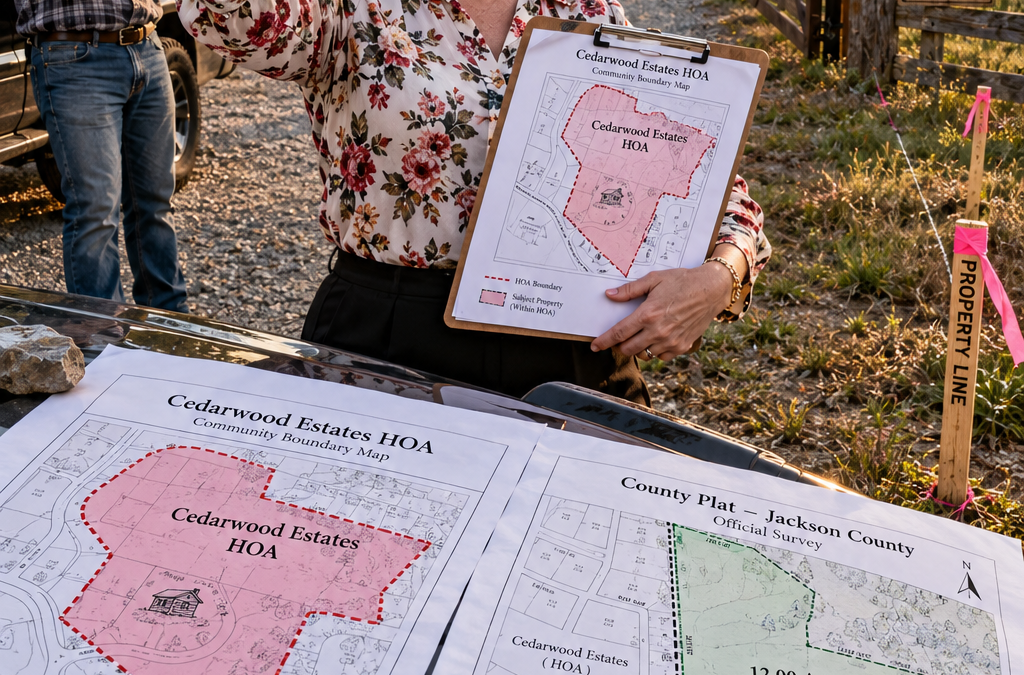
Professionally printed.
Color coded.
Cedarwood Estates shaded pale blue.
Roads labeled.
Common areas marked.
And my twelve acres shaded the same color.
I stopped breathing normally.
Not because I believed the map.
Because I knew the original.
I walked to my office.
Opened the survey drawer.
Pulled the recorded Cedarwood plat I had obtained before closing.
Placed it beside Linda’s map.
Different.
Not ambiguous.
Different.
On the official county plat, Cedarwood’s boundary stopped well before my western line.
On Linda’s version, the boundary had been extended.
Not merely drawn inaccurately.
Extended around my entire parcel.
Someone had taken an official-looking development map and altered the boundary so my land appeared absorbed into the HOA.
I checked the legend.
Same style.
Same road labels.
Same lot numbering.
But no recording stamp.
No county document number.
No amendment reference.
Nothing.
My hands were cold.
People assume anger is the strongest feeling when someone tries to take something from you.
It isn’t.
Recognition is stronger.
The instant when you stop wondering if there has been a misunderstanding.
I knew then.
This wasn’t confusion.
Someone had created a document designed to make a false claim look official.
I called my cousin Derek.
Derek Shaw was a real estate attorney.
Technically my mother’s sister’s son.
Emotionally the family member most likely to become excited when somebody did something legally stupid.
He answered with, “If you’re calling during business hours, someone either died or owns land.”
“Land.”
“Excellent.”
“That reaction is disturbing.”
“What happened?”
I explained the letters.
Linda’s visit.
The map.
He interrupted twice.
Then stopped interrupting when I described the altered boundary.
“Send it.”
“I already scanned it.”
“Send original county plat too.”
I emailed both.
Silence for about two minutes.
Then:
“Oh.”
“Good oh or bad oh?”
“Very bad for her.”
“So you see it.”
“I see somebody extended a recorded subdivision boundary on a document being represented as authoritative.”
“Fraud?”
“Slow down.”
“Why?”
“Because ‘fraud’ is a legal conclusion. We establish who created it, who used it, what they represented, and why.”
“She mailed it with fines.”
“I know.”
“How much more do you need?”
“Enough that she can’t explain it away.”
I leaned back.
“What do you recommend?”
“Do not pay anything.”
“Wasn’t planning to.”
“Do not destroy anything.”
“I won’t.”
“Do not confront her unless necessary.”
“Already did.”
“I mean again.”
“Okay.”
“Save original camera files with metadata.”
“Done.”
“Request certified copies of your survey and Cedarwood’s recorded plat.”
“Can do.”
“And Marcus?”
“Yeah?”
“Let her keep writing.”
I understood immediately.
Linda did.
Every week.
New notices.
New deadlines.
New threats.
She claimed I owed $1,400.
Then $2,150.
Then over $3,000 after “administrative escalation.”
I ignored every demand.
But I saved all of them.
Then county code enforcement arrived.
First for my septic system.
Anonymous complaint.
Inspector checked records.
Inspected the system.
Passed.
Three days later, county environmental services contacted me regarding a complaint about my well.
Inspected.
Passed.
Next came driveway grade.
A complaint claimed runoff from my driveway endangered Cedarwood property.
County engineer visited.
Measured slope.
Looked at drainage.
Passed.
Then an accusation that my woodstove chimney lacked final inspection.
I produced the signed inspection from three years earlier.
Passed.
The fourth inspector finally asked me, “You making someone angry?”
“I believe so.”
“Same person?”
“I can’t prove who filed the anonymous complaints.”
He looked toward Cedarwood.
“Right.”
I gave Derek every inspection result.
He added them to the file.
Linda began telling Cedarwood residents I was a squatter.
I learned that from Tom.
He came over one Saturday looking uncomfortable.
“Can I ask you something?”
“Sure.”
“Do you actually own all this?”
I stared at him.
“Why?”
“Linda says there’s a title dispute.”
“There isn’t.”
“She told people part of your cabin may be built on HOA common land.”
I laughed.
Then realized he was serious.
“Tom.”
“Yeah?”
“I paid cash.”
“I figured.”
“I have a recorded deed.”
“I know.”
“I have a county survey.”
“I know.”
“My cabin was permitted by the county.”
“I know.”
“Then why are you asking?”
He looked embarrassed.
“Because she keeps saying things.”
“What things?”
“That you refuse to cooperate because your ownership is questionable.”
I walked inside.
Returned with a copy of the county map.
Gave it to him.
“Here.”
He studied it.
Then looked toward Cedarwood.
“This isn’t what she showed at the last meeting.”
“I know.”
His expression changed.
“What did she show?”
“Your land shaded inside the HOA.”
“Exactly.”
Tom went silent.
Then said, “That’s not good.”
“No.”
“You coming to the next meeting?”
“I wasn’t planning to.”
“You should.”
Derek had already suggested the same thing.
The Cedarwood board meeting was held every third Thursday.
Seven p.m.
Open to residents and property owners with related business.
Derek called two days before.
“I have someone coming with us.”
“Who?”
“Carol Simmons.”
I knew the name.
Deputy county recorder.
She handled recorded property disputes and document verification.
“How did you convince her?”
“I asked.”
“That’s it?”
“Public officials occasionally enjoy correcting fake maps.”
“Is she testifying?”
“She’ll confirm county records.”
I looked at my folder.
By then it was nearly three inches thick.
“Do we tell Linda we’re coming?”
“No.”
“Good.”
Thursday arrived cold and rainy.
I wore a white button-down shirt.
Dark jeans.
Nothing dramatic.
I packed:
Certified deed.
Filed survey.
County plat.
Linda’s altered map.
All HOA letters.
Code enforcement records.
Camera footage.
Photographs of property markers.
Email correspondence.
Derek carried his own binder.
Carol brought certified recorder documents.
Cedarwood’s clubhouse parking lot was almost full when we arrived.
Tom had apparently told enough neighbors that something was coming.
The meeting room held around fifty people.
Board table at the front.
Linda sat in the middle.
Clipboard.
Lanyard.
Dark green blazer.
She was speaking with another board member when we walked in.
Then she saw me.
Her face changed.
Barely.
Then she saw Derek.
Then Carol.
That change was larger.
Derek leaned toward me.
“She knows Carol.”
“Good.”
“Maybe.”
We sat in the second row.
The chairman that year was a man named Howard Pierce.
Linda was technically president, but Howard chaired formal meetings because of an old procedural structure the HOA had never updated.
He called the meeting to order.
Treasurer report.
Landscaping budget.
Pool maintenance.
A discussion about speed bumps.
I waited.
I had spent fifteen years attending professional meetings.
Nothing teaches patience like listening to six people debate pavement specifications.
Then Howard opened homeowner comments.
Linda leaned toward him.
“Before public comments, I have an enforcement item.”
Of course she did.
She lifted a folder.
“Adjacent Parcel 17-B continues to refuse compliance despite repeated notification.”
Derek glanced at me.
“She’s going to do it for us.”
Linda continued.
“The property owner has ignored fines, denied inspection access, and disputed the association’s jurisdiction despite updated mapping.”
People turned toward me.
I remained seated.
Linda said, “I recommend authorizing legal action to enforce boundary compliance.”
Howard frowned.
“Has counsel reviewed this?”
Linda said, “Preliminary review supports our position.”
Derek whispered, “Interesting.”
I whispered back, “Does it?”
“No.”
Howard looked into the audience.
“Is the owner present?”
I stood.
“Yes.”
Linda’s eyes stayed on me.
Howard nodded.
“Mr…?”
“Marcus Hale.”
“Would you like to respond?”
“Yes.”
I picked up the leather folder.
Walked to the front.
Derek came with me.
Carol remained seated for the moment.
I placed the folder on the table.
“Before we talk about fines, I’d like to establish where my property actually is.”
Linda interrupted.
“That’s already been established.”
I looked at Howard.
“May I finish?”
Howard nodded.
“Please.”
I pulled out the certified county plat.
“This is the recorded Cedarwood Estates subdivision map.”
I handed copies to the board.
“County document number is at the upper right. Recording stamp is here. Original development boundary is marked in red.”
Board members leaned closer.
I continued.
“My twelve-acre parcel is west of that line.”
Then I placed Linda’s map beside it.
“This is the map mailed to me four weeks ago.”
I let them compare.
Howard frowned.
Another board member, Rebecca Lane, looked at Linda.
“Where did this map come from?”
Linda said, “It’s the updated community jurisdiction plan.”
Rebecca looked back at the document.
“Updated by who?”
“The association.”
“Was it recorded?”
Linda’s mouth tightened.
“HOA jurisdiction doesn’t always depend solely on county recording.”
Carol spoke from behind me.
“Actually, property boundaries do.”
The room went quiet.
Linda looked toward her.
Carol stood.
“I’m Carol Simmons, deputy recorder for Clover County.”
A murmur moved through the room.
She walked forward with a thin file.
“For clarification, I reviewed the Cedarwood Estates records this morning.”
She placed certified documents on the table.
“No amendment has ever been recorded adding Mr. Hale’s parcel to Cedarwood Estates.”
Linda interrupted.
“The association has maintained a community influence zone—”
Carol looked at her.
“A community influence zone is not title.”
“I didn’t say it was.”
“You issued fines stating the property was within HOA boundaries.”
Linda looked toward Howard.
“This is becoming unnecessarily technical.”
Carol almost smiled.
“Property boundaries are technical.”
I liked her immediately.
She continued.
“The county record is unambiguous. Mr. Hale’s parcel is not inside Cedarwood Estates.”
Howard turned toward Linda.
“Then what is this map?”
Linda crossed her arms.
“It’s an internal planning document.”
Derek spoke for the first time.
“An internal planning document used to demand money from someone outside your jurisdiction.”
Linda looked at him.
“And you are?”
“Derek Shaw. Counsel for Mr. Hale.”
Her expression changed again.
Derek placed copies of the fine notices on the table.
“Your letters repeatedly represent that his parcel is within HOA boundaries. They cite this altered map.”
Linda said, “Altered is inflammatory.”
“Then let’s say modified.”
“I don’t know who prepared the graphic.”
“Did you approve sending it?”
Silence.
“Ms. Marsh?”
“I approved the enforcement package.”
Derek nodded.
“Thank you.”
Howard looked uncomfortable.
“Maybe we should pause.”
“No,” Rebecca said.
Everyone looked at her.
She pointed toward the map.
“I want to know why we have a document showing land we don’t own as HOA property.”
Linda’s face hardened.
“It’s not shown as HOA-owned property. It’s within an enforcement area.”
I finally spoke.
“Your notice fined me $250 for unauthorized land use within HOA boundaries.”
I slid the letter toward Rebecca.
She read it.
Then looked at Linda.
“Linda.”
Linda said, “The language may have been imprecise.”
“Three thousand dollars of imprecise?”
Someone in the audience laughed.
Howard called for order.
I opened my laptop.
“There’s more.”
Linda looked at me.
“You’ve already made your point.”
“No.”
I met her eyes.
“I haven’t.”
I connected the laptop to the wall monitor.
First video.
Tuesday morning.
Timestamp visible.
Linda approaching my gate.
Opening it.
Walking onto the property.
Photographing the cabin.
I let the video play.
No commentary.
Linda watched herself.
Howard said, “You entered his land?”
Linda replied, “For inspection.”
“You just heard the recorder say it’s outside our jurisdiction.”
“At the time, I believed—”
I switched clips.
Second recording.
Four days later.
11:18 a.m.
I had been at a job site.
Linda appeared again.
This time she opened the gate.
Walked farther.
Circled the side of the cabin.
Photographed the rear wall.
Measured something near my driveway.
I had not known about the second visit until reviewing archived footage after the first one.
The room went silent.
I paused the video with Linda standing beside my porch.
“You came back.”
She stared at the screen.
“I was documenting conditions.”
“While I wasn’t home.”
“I had association business.”
“No.”
My voice stayed calm.
“You had a clipboard.”
Several people murmured.
I shut off the screen.
Then I began laying out the rest.
Septic complaint.
Passed.
Well complaint.
Passed.
Driveway complaint.
Passed.
Chimney complaint.
Passed.
Anonymous complaints filed after I rejected Linda’s jurisdiction.
“I cannot prove Ms. Marsh personally submitted every county complaint,” I said. “So I am not claiming that.”
Derek glanced at me approvingly.
“But the timing is documented.”
I placed the inspection reports in front of the board.
“Each complaint alleged unsafe or unlawful conditions. Every county inspection found the property compliant.”
Tom raised his hand from the audience.
Howard recognized him.
“She told us he was a squatter.”
The room shifted.
Linda turned.
“I never used that exact word.”
Tom stared at her.
“You said his title status was unresolved.”
“That is not the same thing.”
“You told us part of his cabin might be on common land.”
“I said there were boundary concerns.”
Carol said, “There were no county boundary concerns.”
Linda’s face reddened.
Another resident stood.
“You showed that map at the September meeting.”
Linda looked toward her.
“It was informational.”
“You told us Cedarwood was considering enforcement against the western parcel.”
Another voice:
“You said the owner refused to cooperate.”
Another:
“You told us lawyers had confirmed jurisdiction.”
Howard hit the gavel.
“One at a time.”
But the room had changed.
For months, Linda had controlled information.
Now people were comparing versions.
That is one of the most dangerous moments for someone who governs by isolation.
Howard looked toward Derek.
“Are you alleging criminal fraud?”
Derek answered carefully.
“We are not asking this board to make a criminal determination tonight.”
Linda relaxed slightly.
Then Derek continued.
“We are stating that official-looking documents were used to assert a knowingly disputed property boundary, demand money, and interfere with Mr. Hale’s rights. Civil remedies are being evaluated.”
Her relaxation disappeared.
Rebecca leaned forward.
“Linda, did the board ever vote to annex or enforce against Marcus’s land?”
“No annexation was necessary.”
“Did we vote?”
Silence.
“Linda.”
“No.”
“Did we authorize these fines?”
“The president has enforcement discretion.”
Howard shook his head.
“Not over property outside Cedarwood.”
“That’s disputed.”
Carol said, “Not by the county.”
Linda snapped, “The county recorder is not our attorney.”
Carol stayed calm.
“No. I’m the person telling you what land is actually recorded inside your subdivision.”
Someone laughed again.
Linda stood.
“This meeting is turning into an ambush.”
I looked at her.
“You walked onto my land twice.”
She pointed toward me.
“Because you refused every attempt at reasonable cooperation.”
“Cooperation with what?”
“Community standards.”
“I’m not in your community.”
“You affect our property values.”
“So do weather patterns.”
“This is exactly your attitude.”
I almost smiled.
“My attitude?”
“You moved next to an established development and then decided you could ignore how your property affects everyone else.”
I stared at her.
“I bought land outside your development.”
“Technically.”
That word did it.
Not because I became angry.
Because everyone heard it.
Technically.
As though ownership were a loophole.
As though county boundaries were a bureaucratic inconvenience standing between Linda and the authority she believed she deserved.
I said, “Linda, there is nothing technical about twelve acres recorded in my name.”
The room became quiet again.
“I paid for it.”
I pointed toward the map.
“I surveyed it.”
Toward the camera still displayed on my laptop.
“I built on it.”
Toward the county documents.
“I recorded every boundary correctly.”
Then back at her.
“You don’t get to redraw my land because my cabin color bothers you.”
She said nothing.
Rebecca made a motion.
“Effective immediately, I move that Linda Marsh be suspended from all HOA presidential authority pending independent review.”
Someone in the audience whispered, “Finally.”
Linda spun toward Rebecca.
“You can’t do that.”
“I just did.”
Howard looked at the bylaws.
Another board member, Michael Trent, said, “I second.”
Linda’s face went pale.
“You people have no idea what you’re doing.”
Howard read the relevant section.
Emergency board authority.
Majority vote.
The motion was valid.
Before they voted, a board member named Samuel Price stood.
He looked devastated.
“I’m resigning.”
Howard stared.
“Sam.”
“I approved two of those notices.”
The room quieted.
“I trusted Linda when she said counsel had confirmed the boundary.”
Linda said, “They had.”
Derek asked, “Which counsel?”
She ignored him.
Samuel removed his board badge.
“I should have checked.”
He placed it on the table.
“I’m done.”
Then another board member resigned.
Then a third.
Not because they admitted conspiring.
Because they realized they had put their names behind documents they had never verified.
Three resignations.
In less than ten minutes.
That left enough members for limited action under the governing rules, though replacement procedures would be necessary.
The vote on Linda proceeded.
Five eligible votes.
Four in favor of removal.
One abstention.
Linda was removed as president effective immediately.
She sat very still.
Her clipboard remained on her lap.
The lanyard around her neck carried a plastic badge:
LINDA MARSH
HOA PRESIDENT
For months, that badge had functioned like armor.
Now it looked ridiculous.
Howard said, “Linda, please provide all HOA records, passwords, compliance files, and correspondence to the acting board by tomorrow.”
She stood.
“This association will regret this.”
Nobody responded.
She gathered her papers.
Then looked at me.
“This isn’t over.”
Derek answered before I could.
“That’s correct.”
She left.
The room remained silent until the door closed.
Then people started talking at once.
I stayed another forty minutes.
Residents apologized.
Some asked questions.
A few defended Linda, saying she had only become extreme because she cared about standards.
One man told me I should consider repainting anyway to preserve neighborhood harmony.
Derek stepped between us before I answered.
Probably wise.
Carol left after making sure the board had copies of certified records.
I thanked her outside.
“You didn’t have to come.”
She shrugged.
“Fake boundary maps irritate recorder offices.”
“Occupational hazard?”
“Personal insult.”
I laughed.
Then she became serious.
“Keep every original.”
“I will.”
“And have your attorney send a preservation notice immediately.”
“He already drafted one.”
She nodded.
“Good.”
Derek filed the civil suit the following Monday.
Trespass.
Harassment.
Intentional interference with property rights.
Fraudulent or misleading document use.
Improper attempts to impose financial obligations.
We named the HOA because Linda had acted under its letterhead and systems.
We named Linda personally for her direct conduct.
I had mixed feelings about that.
The new board contacted me within forty-eight hours.
Howard called.
“We want to resolve this.”
“So do I.”
“Can we talk without lawyers?”
“No.”
He was quiet.
“Fair.”
I wasn’t trying to punish Cedarwood residents.
Most of them had done nothing.
Some had been victims of Linda themselves.
But I had spent months receiving threats because nobody inside the association stopped one person from inventing authority over property they never owned.
That required a formal answer.
The discovery process revealed more than I expected.
Linda had created the altered boundary map using an old developer planning file.
She had apparently convinced herself that an early conceptual expansion area gave Cedarwood some kind of continuing jurisdiction over adjacent land.
It didn’t.
The concept had never been recorded.
Never annexed.
Never purchased.
Never incorporated into the final development.
My parcel remained separate.
Linda knew county records didn’t match her map because the management company had warned her about it.
That email mattered.
Marlene, the coordinator I had spoken to months earlier, had sent Linda a message after my phone call.
County GIS and recorded plat do not show Hale parcel within association. Recommend legal review before further enforcement.
Linda replied:
Proceed. Boundary is under administrative interpretation.
Derek stared at that email for a long time.
“She was warned.”
“Yes.”
“Before the fines?”
“Yes.”
“Good.”
“It doesn’t feel good.”
“No.”
He closed the file.
“But legally, it’s useful.”
Another email showed Linda asking whether Cedarwood could seek “constructive jurisdiction” based on visual impact.
The management company’s attorney had answered:
No. Adjacent properties are not subject to covenants absent recorded legal basis.
Linda continued anyway.
That ended any argument that she had innocently misunderstood.
She had been told.
More than once.
The code enforcement complaints were harder to prove.
Two were anonymous.
One originated from an email account investigators connected to Linda.
Another came from a resident who admitted Linda had encouraged him to file.
The pattern was enough for the civil claim.
I didn’t need every mystery solved.
I needed the pressure stopped.
Settlement discussions began four months later.
By then Cedarwood had elected a new board.
Rebecca became president.
The management company had revised every enforcement process.
Linda no longer attended meetings.
Her attorney argued that she had acted in good faith to protect neighborhood values.
Derek’s response was six words.
“Good faith doesn’t move county boundaries.”
Six months after the meeting, the case settled.
Thirty-four thousand dollars.
The amount covered legal costs, security upgrades, time lost dealing with inspections, and damages related to trespass and interference.
More important than the money was the written agreement.
Cedarwood Estates formally acknowledged that my twelve-acre parcel was entirely outside HOA jurisdiction.
That acknowledgment had to be added to the association’s official governance records.
Any future board would see it.
No fines.
No inspections.
No architectural authority.
No claim of common property.
No “influence zone.”
Nothing.
The HOA also issued a written apology.
It was more direct than I expected.
The board acknowledged that improper enforcement actions had been taken against a nonmember property owner and that those actions should never have occurred.
I framed it.
Not because I needed an apology on the wall.
Because engineers appreciate final documentation.
Derek laughed when he saw it in my office.
“You’re displaying a settlement apology?”
“Closure.”
“You’re strange.”
“Bill me.”
“I already did.”
Linda never held another position in a homeowners association.
At least not that I could find.
I didn’t monitor her life.
Didn’t need to.
Cedarwood residents told me she sold her house about a year later.
I felt nothing when I heard.
By then the conflict had stopped being emotionally useful.
I had my land.
My cabin.
My boundary.
The rest belonged to her.
With part of the settlement money, I built a workshop.
I had wanted one anyway.
Twenty-four by thirty-six feet.
Timber frame.
Insulated.
Enough space for woodworking, welding equipment, and a small drafting area.
I designed it in two weekends.
Permitting took longer than the design.
Construction took most of the summer.
When the siding order came up, the supplier asked which color I wanted.
I opened the cabin specification.
Same dark green.
Exactly.
Not because I wanted to provoke anyone.
Well.
Maybe five percent because I wanted to provoke someone.
But mostly because it looked right.
Tom came over while I was painting trim.
“You know this is going to be visible from Cedarwood.”
“I hope so.”
He laughed.
“You’ve changed.”
“No.”
I stepped back to look at the wall.
“I just have documented jurisdiction now.”
He shook his head.
“Engineer.”
“Homeowner.”
“Same disease.”
Things became quiet again.
That’s what I wanted from the beginning.
No victory parade.
No signs.
No online campaign.
Just quiet.
Rebecca’s board operated differently.
I occasionally heard Cedarwood residents complain that the HOA had become too cautious.
Fine with me.
A little caution is healthy after your former president tries to redraw the neighborhood.
My cameras stayed.
The front gate remained locked more often.
I added a simple sign:
PRIVATE PROPERTY
NO HOA JURISDICTION
NO ENTRY WITHOUT PERMISSION
Derek called it excessive.
I called it efficient communication.
For months after the settlement, I kept replaying the first morning Linda walked through that gate.
Not because I was angry.
Because I wanted to understand her.
Why would someone ignore a filed survey?
Why fabricate a map?
Why keep escalating after professionals told her she lacked authority?
The answer turned out to be less complicated than I wanted.
She believed she knew better.
That’s it.
Linda had spent years inside Cedarwood where people reacted when she sent letters.
She issued fines.
Residents complied.
She cited rules.
People changed behavior.
Over time, she stopped distinguishing between the authority granted by the covenants and authority as a personal quality she possessed.
That distinction is easy to lose if nobody forces you to examine it.
Inside Cedarwood, Linda had power because homeowners had signed contracts agreeing to specific restrictions.
Outside Cedarwood, she had a clipboard.
She mistook the two.
Then there was my cabin.
Dark green.
Hand-built.
Visible from the edge of the development.
No architectural approval.
No Cedarwood inspection.
No HOA fee.
I think its existence irritated her.
Not because it harmed anything.
Because it demonstrated a limit to her control.
Every time she looked west, there was a house she could see but couldn’t regulate.
A boundary.
Some people respect boundaries.
Others experience them as challenges.
Linda chose challenge.
She started with letters because letters had always worked.
When I ignored them, she increased pressure.
When that failed, she invented paperwork.
When I still refused, she involved county inspectors.
Every refusal probably felt like proof that I was unreasonable.
That’s how power can distort judgment.
Resistance stops looking like information.
It becomes insolence.
I saw the same thing professionally.
A junior engineer points out a design flaw.
A bad manager doesn’t hear “there may be a problem.”
He hears “you are questioning my competence.”
Then he defends the bad design harder.
The issue stops being structural.
It becomes personal.
Linda made my property personal.
I did not.
That’s one reason I won.
I never needed to prove she was a bad person.
Didn’t need to call her names.
Didn’t need to outshout her at meetings.
I only needed to answer specific questions.
Where was the recorded boundary?
County plat.
Who owned the parcel?
My deed.
Was I in the HOA?
No.
Did Linda enter without permission?
Camera footage.
Did the county ever amend Cedarwood’s boundary?
No.
Did she use an altered map?
Yes.
Did inspectors find code violations?
No.
Did professionals warn her?
Yes.
Facts are brutally efficient once you collect enough of them.
Linda had confidence.
I had documentation.
Confidence looks stronger right up until the documents reach the same room.
That was the lesson I kept.
People sometimes ask why I didn’t confront her harder the first time.
Why not call the sheriff immediately?
Why let the letters continue?
Why not post the footage?
The answer is simple.
I wasn’t interested in winning a single argument.
I wanted the behavior to stop permanently.
If I had shouted at Linda at the gate, she would have called me hostile.
If I had posted online, she would have claimed harassment.
If I had threatened her, the focus might have shifted to my reaction.
Instead, I let her show exactly what she was willing to do.
I saved it.
Dates.
Times.
Documents.
Every envelope became evidence.
Every complaint became chronology.
Every additional step made her position weaker.
People mistake patience for weakness because patience is quiet.
Weakness avoids confrontation because it is afraid.
Patience delays confrontation because timing matters.
Those are not the same thing.
My career taught me that.
If you discover a structural crack, you don’t immediately start smashing concrete.
You investigate.
Measure.
Determine load.
Identify cause.
Then you act where the failure actually is.
Linda was the visible crack.
The deeper failure was an HOA structure that allowed one person to send enforcement letters without enough verification.
That’s why the settlement acknowledgment mattered as much as removing her.
A new president could have become another Linda.
The record made that harder.
A year after everything ended, Rebecca invited me to one Cedarwood meeting.
I almost declined.
She said they were updating boundary procedures and wanted the county map presented publicly.
So I went.
No Derek.
No Carol.
Just me.
The room looked smaller without conflict.
Rebecca stood at the front.
She projected the recorded subdivision map.
“This is Cedarwood Estates.”
Then she pointed west.
“And this is Marcus Hale’s parcel.”
Someone laughed.
Rebecca smiled.
“It is not Cedarwood.”
More laughter.
I was sitting near the back.
She continued.
“Adjacent property is not subject to our architectural standards, enforcement process, fines, inspections, or governance.”
A man asked, “Even if what they do affects property values?”
Rebecca answered, “Then we use county law like everyone else.”
That was probably the healthiest sentence ever spoken in an HOA meeting.
Afterward, an older man approached me.
I recognized him as one of the people who had defended Linda during the original meeting.
“Marcus.”
“Yes.”
“I owe you an apology.”
“You don’t.”
“I believed her.”
“So did a lot of people.”
“I thought you were being difficult.”
“I probably was.”
He smiled.
“No. You were right.”
I looked toward the county map still projected on the wall.
“It’s easier to be right when the lines are already recorded.”
He laughed.
Then became serious.
“She really told us your ownership was questionable.”
“I know.”
“I repeated that to people.”
“I know.”
“I’m sorry.”
“Apology accepted.”
That was enough.
I don’t need people to suffer indefinitely because they believed bad information.
The responsibility belongs most heavily to the person who knowingly supplied it.
My workshop was finished the following fall.
I installed a long drafting table along the north wall.
Tool cabinets.
Welding bench.
Wood storage.
A heavy worktable in the center.
The first project I built there was a new front gate.
Not because the old one was broken.
Because I wanted something stronger.
Steel frame.
Cedar panels.
Mechanical latch.
I fabricated most of it myself.
When I installed it, I made sure the hinge posts sat precisely inside the surveyed boundary.
Of course I did.
Derek came out for the weekend.
He looked at the gate.
“How close is this to the property line?”
“Fourteen inches inside.”
“Naturally.”
“I’m not giving the next HOA president a reason to measure.”
“You know normal people don’t think like this.”
“Normal people pay attorneys to think like this.”
“True.”
We sat on the porch afterward with beer.
The cabin was behind us.
Workshop visible through the trees.
Same green siding.
Derek looked around.
“You built all this.”
“Most of it.”
“Still worth the fight?”
I thought about the question.
“Wasn’t fighting for the buildings.”
“What were you fighting for?”
I looked toward the front gate.
“The meaning of the line.”
He nodded slowly.
That was exactly it.
The survey markers themselves weren’t emotional.
Steel pins in soil.
Coordinates.
Bearings.
Distances.
But boundaries represent agreement.
This side is mine.
That side is yours.
You can dislike what I do here.
I can dislike what you do there.
We can complain.
Negotiate.
Call the county if actual law is being violated.
But neither person gets to move the line because the other side becomes inconvenient.
Civil society depends on those distinctions more than people realize.
Property boundaries.
Jurisdiction.
Contracts.
Authority.
Consent.
All lines.
Linda’s real offense wasn’t disliking my cabin color.
She was entitled to hate it.
She could have stood on Cedarwood property every morning and complained about dark green siding until retirement.
Her mistake was deciding dislike created jurisdiction.
Then rewriting a map to make reality match her preference.
That is a dangerous habit anywhere.
Not just HOAs.
I sometimes use the story when younger engineers ask me about professional judgment.
Not the whole story.
I tell them about the map.
I say, “If a drawing doesn’t match the recorded condition, never ask which one is more convenient. Ask which one is true.”
They assume I’m talking about engineering.
I am.
Mostly.
A document can look official and still be wrong.
A person can sound certain and still be wrong.
A board can vote and still be outside its authority.
A title can impress people and still mean nothing beyond a specific boundary.
Reality is stubborn.
Measurements help.
I kept Linda’s altered map.
It’s in a flat file drawer under the original county plat.
Sometimes I pull both out when I’m cleaning the office.
Same roads.
Same subdivision.
Same labels.
One honest line.
One false one.
The difference is only ink.
On paper, that false line attempted to take twelve acres.
That’s why details matter.
A quarter inch drawn on a map can become hundreds of feet in the real world.
Engineers understand that instinctively.
Linda treated the map like rhetoric.
She thought if the paper looked convincing, the land would follow.
Land doesn’t follow paper because somebody makes it attractive.
Paper follows land when properly recorded.
That distinction cost Cedarwood $34,000.
It cost Linda her presidency.
More importantly, it ended her ability to use their association against people outside it.
Sometimes I wonder whether she ever understood.
Not whether she regretted it.
People regret consequences all the time.
Understanding is different.
Did she ever sit somewhere after everything collapsed and realize that the first correct move had been the easiest?
One phone call.
County recorder.
“Is Marcus Hale’s parcel inside Cedarwood Estates?”
No.
Done.
No altered map.
No fines.
No trespassing.
No attorney.
No meeting.
No settlement.
She could have saved everyone months of conflict by accepting one answer she didn’t like.
That’s the tragedy of people who confuse authority with infallibility.
Being wrong becomes threatening.
So they would rather expand the lie than narrow the claim.
Linda did that until the lie became larger than she could manage.
My life is quiet again.
Exactly the way I designed it.
I wake before sunrise most mornings.
Coffee.
Porch.
Sometimes deer cross the lower field.
In winter, I can see Cedarwood’s rooftops through bare trees.
They look peaceful from here.
I have no problem with the neighborhood.
Never did.
Children sometimes bicycle along the county road.
Tom still visits.
Rebecca waves if she’s driving past.
Nobody measures my paint.
Nobody sends notices.
The gate stays closed unless I’m expecting someone.
The cameras record.
Mostly deer.
Occasional delivery drivers.
One fox that seems convinced the workshop belongs to him.
No HOA presidents.
That’s improvement.
The dark green siding has weathered slightly.
I will repaint it eventually.
Same color.
Not because of Linda.
Because I like it.
That distinction matters.
One autumn morning, I stood outside the workshop with a paint chip in my hand.
Same manufacturer.
Same code.
Same dark green.
I remembered the first letter.
Exterior color violates community aesthetic guidelines.
I smiled.
Then started painting.
No application.
No committee.
No vote.
Just a brush moving across wood I owned.
That simple act felt better than the settlement check.
Money closes cases.
Freedom shows up in ordinary choices.
Which color.
Which tree.
Which structure.
When to build.
When to leave something alone.
I built this place because I wanted responsibility for those choices.
Responsibility is the other side of freedom.
If my septic fails, it’s my problem.
If my roof leaks, I fix it.
If my driveway washes out, I pay.
If my cabin hurts someone because I built it badly, that belongs to me too.
I never wanted freedom from consequences.
I wanted freedom from invented authority.
Linda could never understand the difference.
To her, no regulation meant disorder.
If Cedarwood did not control my property, she imagined nobody did.
But there was county code.
State law.
Building permits.
Environmental rules.
Property law.
Real authority.
The difference was that those systems had defined jurisdiction and due process.
Linda wanted immediate obedience.
That’s not governance.
That’s control.
The workshop stands about sixty yards behind the cabin now.
Same paint.
Same cedar trim.
At sunset, the two buildings disappear into the trees exactly the way I intended.
Sometimes I sit between them and think about the three years I spent building the first one.
Every beam.
Every floorboard.
Every stone.
The cabin wasn’t valuable because it was expensive.
It wasn’t.
I saved money by doing most of the labor.
It was valuable because it represented a decision.
I had spent fifteen years helping other people create structures.
That cabin was the first place I built entirely around my own life.
Then Linda walked through the gate and treated it like a file in her office.
Maybe that was why I became so methodical.
I wasn’t defending paint.
I was defending authorship.
My home existed because I designed it.
My land existed in my name because I bought it.
My boundaries existed because they were surveyed and recorded.
No one gets to write themselves into that story with a marker and an HOA seal.
Not without my consent.
Not without law.
And certainly not because they dislike green siding.
The last time I spoke with Linda was several months after settlement.
I was at the county hardware store.
She was in the paint aisle.
Of all places.
I almost turned around.
Then she saw me.
“Marcus.”
“Linda.”
She looked toward the paint samples in my cart.
Dark green.
Her mouth tightened.
“Still making a point?”
“No.”
I lifted the sample.
“I actually like the color.”
She gave a small, bitter laugh.
“You always thought this was funny.”
“I never thought trespassing was funny.”
“You enjoyed humiliating me.”
“I didn’t create the map.”
Her expression hardened.
“You could have come to me privately.”
“I did.”
“When?”
“The morning you entered my property.”
She looked away.
“You were hostile.”
“I told you I wasn’t in your HOA.”
“You could have handled it differently.”
“So could you.”
She was quiet.
Then she said, “I was trying to protect Cedarwood.”
“From what?”
No answer.
“My cabin?”
She looked at the shelf.
“From losing standards.”
“Cedarwood still has standards.”
“Not like before.”
“I know.”
“You don’t understand what happens when people stop enforcing rules.”
I considered arguing.
Then decided not to.
Instead I said, “Linda, do you know what my favorite part of the settlement was?”
She looked at me.
“The money?”
“No.”
“The apology?”
“No.”
“What?”
“The sentence acknowledging that my land is outside Cedarwood.”
She stared.
“That’s what this was always about.”
I continued.
“The line.”
She said nothing.
“You had authority inside it.”
I pointed toward an imaginary boundary between us.
“Your problem was never that you had no authority.”
I moved my hand slightly.
“Your problem was that you couldn’t accept where it ended.”
For once, Linda didn’t answer.
I picked up my paint.
“Take care.”
Then I walked away.
I don’t know whether she learned anything.
I stopped needing her to.
That’s another kind of freedom.
You don’t need the person who wronged you to understand before you move on.
The record understands.
The boundary understands.
The next board understands.
That’s enough.
The county survey marker at my northwest corner is a metal pin flush with the ground.
You can barely see it unless you know where to look.
Once a year, I clear vegetation around it.
Not necessary.
I just like seeing it.
A small piece of metal.
No logo.
No lanyard.
No letterhead.
No dramatic authority.
Yet that pin carried more legal truth than every document Linda mailed me.
I find that satisfying.
The strongest things in life are often quiet.
Evidence.
Boundaries.
Patience.
A camera that keeps recording while someone assumes nobody is watching.
A survey filed years before anyone thinks it will matter.
A county official who simply says, “No amendment exists.”
A homeowner who doesn’t panic.
I didn’t defeat Linda with some brilliant trick.
I didn’t need one.
I owned the land.
She didn’t.
Everything else was just the process of forcing her to accept a fact that had been true before she ever opened my gate.
I still think about that first morning sometimes.
The coffee.
My laptop.
The sound of gravel under her shoes.
Linda walking toward my cabin with a clipboard, completely certain that authority traveled wherever she carried it.
If I could speak to the version of myself sitting on that porch, I wouldn’t tell him to shout.
Wouldn’t tell him to threaten.
Wouldn’t tell him to panic.
I would tell him exactly what I did.
Record it.
Save the letter.
Pull the plat.
Call the attorney.
Let her keep talking.
Because people who invent authority usually expose themselves if you give them enough room.
Linda did.
One letter at a time.
One fake fine.
One trespass.
One altered map.
By the night of the board meeting, I barely had to accuse her of anything.
I simply placed her version of reality beside the real one.
That was enough.
Today, if you stand at my front gate and look through the trees, you can see two dark green buildings.
The cabin I built before Linda Marsh ever learned my name.
And the workshop I built with part of the money her HOA paid after she tried to claim the first one.
Both on twelve acres.
Both outside Cedarwood Estates.
Both exactly where the county survey says they are.
Nothing about the land moved.
Nothing ever had.
Only Linda’s map did.
And in the end, that was the difference that brought everything she had built around her authority crashing down.








