𝗙𝗨𝗟𝗟 𝗦𝗧𝗢𝗥𝗬 The HOA President Walked Into My House During a Federal Court Session and Asked Me if I Knew Who She Was
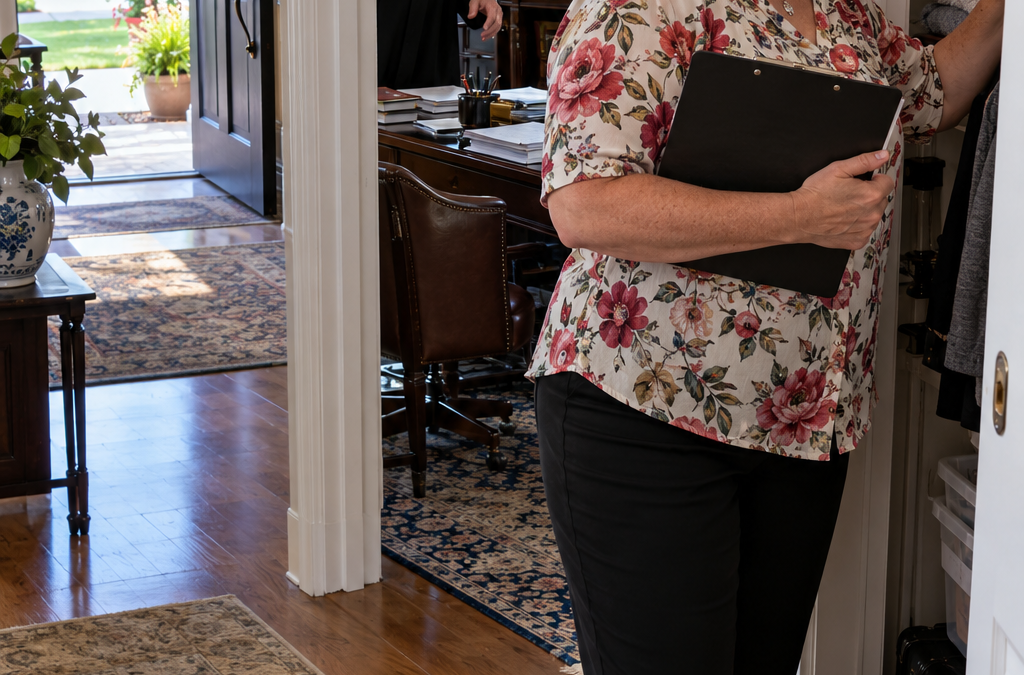
𝗙𝗨𝗟𝗟 𝗦𝗧𝗢𝗥𝗬
The letter said our burgundy front mat violated the approved exterior color palette.
I read it twice.
Then looked at the mat.
BURGUNDY.
Plain.
No slogan.
No picture.
No offensive language.
Just a rectangle of weather-resistant fabric.
I searched the architectural standards.
Buried near the back was a list of recommended exterior accent colors.
Recommended.
Not mandatory.
Burgundy was not listed.
I called the number on the letter.
A woman answered immediately.
“Maplewood Estates Association, Brenda Caldwell speaking.”
“Good morning. My name is Jonathan Mercer. We recently moved into 118 Hawthorn Court.”
“I know exactly which property.”
There was something about that answer I did not like.
“Then you probably know why I’m calling.”
“Your mat.”
“Yes.”
“The color is inconsistent with established community standards.”
“I have the guidelines in front of me.”
“Good.”
“They describe the palette as recommended.”
“The board has historically treated it as binding.”
“Then perhaps the document should say that.”
A short pause.
“Mr. Mercer, standards exist for a reason.”
“I’m sure they do.”
“Our responsibility is to preserve visual consistency.”
“Does a thirty-dollar welcome mat materially affect that responsibility?”
Her voice cooled.
“If every homeowner decided individually which rules deserved compliance, the neighborhood would become unmanageable.”
“That’s not what I asked.”
“I’m explaining the principle.”
“I understand principles. I’m asking about the written rule.”
That pause lasted longer.
Then Brenda said:
“If you didn’t want to live under community standards, you should have purchased somewhere else.”
I sat back in my chair.
There it was.
Not enforcement.
Dominance.
“I appreciate your time,” I said.
Then hung up.
Elaine was standing in the doorway.
“How bad?”
“She’s not interested in the mat.”
“What is she interested in?”
“Being obeyed.”
Elaine picked up the burgundy mat.
“Want me to replace it?”
I looked at her.
“Yes.”
She seemed disappointed.
“Really?”
“We just moved here. I don’t intend to spend our retirement arguing about fabric.”
That decision would later bother me.
Not because moving the mat was wrong.
It was sensible.
Peace has value.
But people like Brenda notice surrender.
Not consciously perhaps.
They simply learn where resistance is absent.
The letters accelerated.
Fence spacing.
One-quarter inch too wide according to Brenda’s measurement.
Two ceramic flower pots Elaine placed beside the front steps.
“An eyesore inconsistent with community aesthetic values.”
A trash bin visible for forty minutes after the permitted retrieval period.
A wind chime.
A small solar path light.
Eleven notices in two months.
Eleven.
None involved dangerous conditions.
None involved unpaid dues.
None involved damage.
The pattern became impossible to ignore.
Then came the drive-bys.
White Cadillac.
Always slow.
Brenda would come down our cul-de-sac at eight in the morning or five in the afternoon, reduce speed in front of our house, and look.
Sometimes she stopped.
Clipboard on the passenger seat.
Once I watched her photograph our side fence from inside the car.
Elaine wanted confrontation.
“Go ask her what she wants.”
“No.”
“Jonathan, she’s taking pictures.”
“I see that.”
“You are a federal judge.”
“Which is exactly why I’m not going to stand in the road shouting at an HOA president.”
“I didn’t say shout.”
“You were thinking it.”
“I was thinking something louder.”
I smiled.
Then became serious.
“Document it.”
“What?”
“Every letter.”
“We have them.”
“Scan them.”
“Why?”
“Every photograph she takes. Every time she drives past. Every email. Every message.”
Elaine crossed her arms.
“You think this is going somewhere?”
“I think people who rely on intimidation usually become careless when intimidation works.”
“And?”
“And paper remembers better than people.”
That was a lesson the bench had taught me repeatedly.
People rewrite conversations in their minds.
Emails do not.
People forget dates.
Certified mail does not.
People later insist they never said something.
Recorded minutes can be inconvenient witnesses.
So we built a file.
We did not know yet how important it would become.
Brenda’s next move happened online.
Maplewood had a private neighborhood Facebook group.
I rarely used it.
Elaine did.
One evening she came into my office holding her tablet.
“You need to see this.”
Brenda had posted a long message about “declining compliance among recent arrivals.”
She did not use our names.
She did not need to.
She described a property on Hawthorn Court.
Ours was the only recent sale on Hawthorn.
She wrote that repeated violations were threatening Maplewood’s visual consistency and potentially undermining home values.
A resident commented:
“Is this really about a garden hose?”
Brenda replied:
“Multiple official notices have been ignored.”
That was false.
We had responded to every single notice.
Often within twenty-four hours.
Elaine looked at me.
“Official notices.”
“I see it.”
“She is talking about flower pots as if we are running an illegal landfill.”
“Screenshot everything.”
“You are infuriatingly calm.”
“I am not calm.”
“You look calm.”
“Twenty years in court teaches you not to show people what they have accomplished.”
She took screenshots.
Then Brenda escalated beyond aesthetics.
An envelope arrived on Tuesday afternoon.
INTERIOR COMPLIANCE INSPECTION NOTICE.
I stood in the kitchen reading it.
The HOA asserted that continuing exterior violations created “reasonable concern regarding unapproved alterations potentially affecting structural and architectural compliance.”
Therefore, a representative would conduct an interior inspection Thursday at 2:00 p.m.
Elaine read it over my shoulder.
“No.”
“I agree.”
“They’re not coming into this house.”
“No.”
“Can an HOA even do that?”
“Not under these documents.”
Some associations possess limited inspection rights under very specific circumstances.
Common utility lines.
Emergency entry.
Exterior inspections.
Occasionally access to verify an alteration if governing documents and law clearly support it.
But Maplewood’s declaration granted no general authority to enter the interior of an occupied private home simply because the president wanted to “inspect compliance.”
I checked carefully.
Nothing.
I called my attorney, Robert Hale.
Robert had once clerked for me early in his career.
Years later he had built a successful civil practice of his own.
I avoided using former clerks casually because I never wanted professional loyalty confused with entitlement.
But Robert was excellent.
He read the notice.
Then called.
“They can’t do this.”
“My conclusion too.”
“Have they alleged an emergency?”
“No.”
“Common utility?”
“No.”
“Known structural modification?”
“No.”
“Anything?”
“Flower pots.”
Silence.
Then Robert said:
“I’m assuming that’s sarcasm.”
“Mostly.”
“What do you want to do?”
“Respond.”
“Firmly?”
“Very.”
We drafted the letter together.
It stated that no HOA representative had consent to enter our home.
It cited the relevant declaration provisions and applicable property law.
It noted that entry without consent could constitute trespass.
It demanded any claimed legal basis be produced in writing.
And it explicitly stated:
NO HOA REPRESENTATIVE, BOARD MEMBER, CONTRACTOR, OR AGENT IS AUTHORIZED TO ENTER THE INTERIOR OF THE PROPERTY WITHOUT EXPRESS WRITTEN CONSENT OR LAWFUL PROCESS.
I signed it.
Jonathan E. Mercer.
My full legal name.
The name appearing on decades of published opinions.
Federal court biographies.
Judicial conference materials.
News reports.
If Brenda had typed it into a search engine, the first page would have answered every question.
She did not.
We sent the response by email.
Certified mail.
And hand delivery to the management office.
Delivery was confirmed Wednesday morning.
The scheduled inspection remained Thursday at two.
Robert asked if I wanted him at the house.
“No.”
“You sure?”
“I’ll be working.”
“What’s your schedule?”
“Remote federal hearing.”
He laughed.
“Please tell me you’ll wear the robe.”
“I usually do when court is in session.”
“This has the potential to become very funny.”
“Nothing is going to happen.”
That sentence did not age well.
Thursday afternoon, Elaine left shortly before two to pick up a prescription.
I moved into my home office at one-thirty.
Door closed.
Secure court connection active.
Files arranged.
Robe on.
The proceeding that afternoon was a federal hearing involving a matter I had been handling for some time.
Court reporter online.
Counsel appearing remotely.
Clerk connected.
Everyone properly recorded.
Nothing unusual.
At approximately 2:04, I heard the front door open.
At first, I assumed Elaine had returned.
Then I heard a woman’s voice.
Not Elaine.
“Hello?”
I stopped listening to counsel for half a second.
Then footsteps.
Heels on hardwood.
A drawer opened.
I looked toward the office door.
The attorney on screen continued speaking.
Then I heard:
“I’m inside now.”
Brenda.
I knew the voice.
She was on the phone.
“The place is actually quite nice, which makes the violations even more inexcusable.”
For one moment, I genuinely wondered whether my ears had misunderstood.
Then I heard a closet door open.
The lawyer on screen finished his argument.
I leaned toward the microphone.
“Counsel, thank you. The court will take a brief recess.”
The clerk looked confused.
“Your Honor?”
“Five minutes.”
I muted the connection.
Stood.
Adjusted my robe.
And walked into the hallway.
Brenda was near the coat closet.
Clipboard in one hand.
Phone in the other.
She had already opened the closet door.
She turned.
For the first time in our relationship, Brenda Caldwell had nothing to say.
Her eyes moved from my face to the black judicial robe.
Then back.
The clipboard slipped maybe three inches before she caught it.
I stopped ten feet away.
My voice was very quiet.
“You are inside my home without my consent.”
She blinked.
“I—”
“Do not move farther into the house.”
Her expression changed from shock to defensiveness almost instantly.
“We sent you an inspection notice.”
“And I denied consent in writing.”
“The board has inspection authority.”
“No.”
“Mr. Mercer—”
“Did you receive my certified response?”
She hesitated.
“Yes.”
“Then you knowingly entered after being told not to.”
She raised the clipboard slightly as though it were identification.
“I am the Maplewood Estates Community Standards Officer.”
“That is not a law enforcement position.”
“I never said it was.”
“Then why are you inside my home?”
“Because you have repeatedly obstructed official inspections.”
“There has never been an official interior inspection before today.”
“That isn’t relevant.”
“It is extremely relevant.”
Brenda stared at the robe.
“What exactly are you doing?”
“Working.”
“Like that?”
I almost laughed.
Instead I said:
“I am currently presiding over a federal court proceeding in the room behind me.”
Her face emptied.
Not completely.
Just enough.
Then pride rescued her.
People sometimes make their worst decisions in the seconds after embarrassment.
They can retreat.
Or they can double down.
Brenda doubled down.
“Well, I sent notice.”
“Notice does not create consent.”
“This is private HOA business.”
“No. You are inside a private residence after express written refusal.”
She reached for something on her clipboard.
I held up one hand.
“Before you say anything else, I strongly suggest you leave and call the association’s attorney.”
She actually laughed.
A short, incredulous sound.
“My attorney?”
“Yes.”
“Do you know who I am?”
That was the moment the entire situation became surreal.
I looked at her for several seconds.
Then asked:
“Do you know who I am?”
She did not.
I could see that.
The robe confused her.
The question irritated her.
But she had no idea.
She tightened her grip on the clipboard.
“I know you’re a homeowner subject to Maplewood’s covenants.”
“Leave my house.”
“You cannot threaten me.”
“I have not threatened you.”
“Your tone is threatening.”
“I am telling a trespasser to leave.”
Her eyes widened.
“You’d better be careful using that word.”
“I am exceptionally comfortable with words.”
For once, the line came naturally.
“Leave.”
She finally did.
Not quietly.
She walked toward the door, turned once, and said:
“This is not over.”
“No,” I said. “I suspect it isn’t.”
Then she left.
I locked the door.
Returned to my office.
Sat down.
Looked at the screen.
My clerk was waiting.
“Everything all right, Your Honor?”
I took a breath.
“Someone entered the residence without permission.”
Every attorney on the screen became completely still.
I continued:
“The matter is being handled separately. We will resume.”
And we did.
Because court does not stop merely because an HOA president wanders into the judge’s hallway.
Elaine returned fifteen minutes later.
I told her what happened.
At first, she thought I was joking.
Then she saw my face.
“She walked in?”
“Yes.”
“After our letter?”
“Yes.”
“Opened the closet?”
“Yes.”
“While you were in court?”
“Yes.”
Elaine set down the pharmacy bag.
“Where is she?”
“Elaine.”
“Where is she?”
“Probably calling someone.”
“Good. I have someone she can call.”
“Who?”
“The police.”
We made a report.
I did not demand that officers arrest Brenda.
That was not my role.
I described what happened.
Provided the certified letter.
Preserved our exterior doorbell footage.
Documented the time.
Then I called Robert.
He was silent after I finished.
Finally:
“She entered anyway.”
“Yes.”
“After receiving the letter.”
“Yes.”
“While you were conducting court.”
“Yes.”
Robert exhaled.
“I apologize.”
“For what?”
“I told you this had the potential to be funny.”
“Your instincts failed.”
“Completely.”
He became serious.
“Do not communicate directly with her anymore.”
“Agreed.”
“Everything goes through me.”
“Agreed.”
I expected the HOA attorney to call Robert the next morning.
An apology.
An acknowledgment.
Maybe an agreement that Brenda would stop contacting us directly.
Instead, Brenda filed a city complaint claiming I had threatened her during an authorized HOA inspection.
I read it.
Then read it again.
She described my judicial robe as “black formal clothing.”
Elaine laughed so hard she had to sit down.
“Black formal clothing?”
“Apparently.”
“Did she think you were conducting a séance?”
“I have no idea.”
The complaint alleged intimidation.
Aggressive conduct.
Interference with HOA duties.
Then a letter arrived from counsel.
Mitchell Carr.
I recognized the name instantly.
Mitchell had appeared before me three times in federal matters over the previous decade.
Competent attorney.
Professional.
Not someone I considered reckless.
The letter threatened civil action if I continued interfering with the HOA’s lawful inspection rights or harassing its president.
I stared at the signature.
Elaine noticed.
“What?”
“I know him.”
“Brenda’s lawyer?”
“He’s appeared before me.”
Her eyebrows rose.
“Does he know it’s you?”
“Apparently not.”
“How is that possible?”
“Someone probably gave him a file that says J. Mercer.”
“Your full name is on the letter.”
“I know.”
“Lawyers don’t Google?”
“Good lawyers verify. Busy lawyers sometimes rely on clients.”
I called Robert.
“You’re going to enjoy this.”
“What?”
“Mitchell Carr represents Brenda.”
Silence.
Then:
“Mitchell Carr?”
“Yes.”
“The Mitchell Carr?”
“Yes.”
“Oh dear.”
“Do not enjoy this too much.”
“I’m trying.”
Robert contacted Mitchell.
He did not begin by saying, “You’ve threatened a federal judge.”
He simply identified himself as my counsel and requested a call.
Mitchell apparently opened the correspondence file properly for the first time while they were speaking.
Then searched my name.
Robert later described the pause as “profound.”
Mitchell said:
“Jonathan Mercer?”
Robert answered:
“Yes.”
Another pause.
“Judge Mercer?”
“Yes.”
A much longer pause.
Then:
“Give me one hour.”
Mitchell called Brenda.
I was not present.
I never heard the conversation.
Robert later learned enough from Mitchell to understand it had been extremely direct.
The phrase “catastrophic mistake” was reportedly used more than once.
Mitchell withdrew the threat letter that afternoon.
He also advised the association to preserve all records.
By then, preservation was becoming important because we had discovered Brenda’s conduct was not limited to us.
Elaine began speaking quietly with neighbors.
Not campaigning.
Listening.
A retired teacher named Susan had received nine letters in one year over landscaping.
A widower had been fined because his daughter’s car remained overnight in his driveway too many consecutive days while she cared for him after surgery.
A young couple had been threatened over a wheelchair ramp built temporarily for an injured parent.
Several people had simply paid because challenging the HOA sounded exhausting.
One neighbor told Elaine:
“You learn to give Brenda what she wants because otherwise she doesn’t stop.”
That sentence changed how I saw the entire situation.
I had treated our dispute as harassment directed at newcomers.
It was larger.
Brenda had created a culture where the cost of resistance exceeded the cost of compliance.
Thirty dollars.
Fifty dollars.
A hundred dollars.
Move the mailbox.
Hide the hose.
Replace the flowers.
Most people had jobs.
Children.
Medical issues.
They did not have time to argue about one sentence in a covenant.
So Brenda accumulated authority through exhaustion.
Not law.
Exhaustion.
Then we obtained board records.
Brenda was not merely president.
She had gradually combined roles.
President.
Treasurer.
Community Standards Officer.
Some duties were technically delegated.
Others she had simply begun performing.
She controlled notices.
Fine recommendations.
Compliance inspections.
Much of the association’s day-to-day communication.
Several board members barely understood how much authority they had allowed her to concentrate.
Robert shook his head while reviewing minutes.
“This governance structure is terrible.”
“Calling it a structure is generous.”
Then we found financial irregularities.
Nothing initially suggesting theft.
But reimbursements lacked clear approval.
Compliance-related expenses were paid from general funds with vague descriptions.
Legal consultations appeared without board votes.
A private investigator had even been used once to document a homeowner’s alleged rental violation.
Elaine stared at that invoice.
“She hired someone to watch a neighbor?”
“Apparently.”
“For an Airbnb?”
“Apparently.”
“And she thought our welcome mat was excessive?”
I said nothing.
The Facebook posts became another issue.
Brenda had publicly implied we ignored official notices.
Suggested our home reduced property values.
Later, after the entry incident, she posted that a homeowner had “physically intimidated an HOA representative performing lawful duties.”
Again, no name.
Again, everyone knew.
That was when Robert recommended litigation.
I resisted.
Not because I doubted the claims.
Because of who I was.
Judges should not weaponize their office in private disputes.
That principle mattered deeply to me.
My job could not become leverage in a fight over a welcome mat.
I told Robert:
“I don’t want one pleading that sounds like ‘Do you know who my client is?'”
“It won’t.”
“I mean it.”
“Jonathan, she entered your home after written refusal. Your job is incidental.”
“Except everyone will make it the headline.”
“Probably.”
“I hate that.”
“Then decide whether you hate publicity more than you hate allowing her to do it again.”
That was harsh.
Also correct.
We filed claims through ordinary channels.
Unlawful entry.
Harassment.
Defamation-related claims tied to false public statements, as supported by the facts.
We sought declaratory relief regarding the HOA’s supposed interior inspection authority.
Robert handled everything.
I recused myself from any judicial role that could even appear connected to the dispute.
That point mattered.
The lawsuit did not come before me.
It could not ethically come before me.
Brenda’s civil threats did not get assigned to my courtroom.
I never ruled on my own dispute.
But Mitchell’s recognition of me still changed the case because it forced him to look closely at facts his client had apparently minimized.
He requested a meeting with Robert.
Then with the HOA’s insurance carrier.
Then with independent counsel for the board.
Within two weeks, the board began investigating Brenda.
She was furious.
She accused members of disloyalty.
One director resigned immediately.
Another turned over years of emails.
That email archive was devastating.
Brenda repeatedly described residents as problems to be “conditioned.”
One message read:
“If we let one owner refuse inspection, others will think they can challenge enforcement.”
Another said:
“Most people comply once they understand we will not go away.”
There it was.
The strategy.
Exhaustion as governance.
The insurance carrier became deeply concerned.
Intentional unauthorized entry could create coverage problems.
Defamation allegations were complicated.
The association itself faced exposure because Brenda had acted under claimed board authority and had been allowed to accumulate roles for years.
The insurer pushed for settlement.
Brenda refused.
According to one board member, she said:
“If we settle, everyone will think I did something wrong.”
That sentence ended her presidency.
Because by then, even people who had defended her understood the problem.
She was no longer protecting Maplewood.
She was protecting the idea that Brenda Caldwell could not be wrong.
An emergency neighborhood meeting was scheduled.
Elaine and I attended.
The clubhouse was packed.
Thirty-three households were represented in person or by proxy.
I sat in the third row.
No robe.
No title.
Just Jonathan Mercer, homeowner.
Brenda sat at the front.
For the first time, she looked nervous.
The vice president, Thomas Bell, chaired the meeting because the agenda concerned her conduct.
He read the allegations.
Unauthorized entry.
Failure to respect written homeowner boundaries.
Misrepresentation of inspection authority.
Concentration of board roles.
Public communications exposing the association to liability.
Potential misuse of enforcement procedures.
Then homeowners spoke.
Susan stood first.
She held a stack of letters.
“These are from eighteen months.”
She placed them on a table.
“Fourteen notices.”
Brenda interrupted.
“Every one involved documented violations.”
Thomas said:
“Brenda, you will have an opportunity to respond.”
Susan continued.
“One was because my garbage bin remained visible while I was at the hospital with my husband.”
The room shifted.
Another neighbor spoke about the wheelchair ramp.
Another about the investigator.
Then Elaine stood.
I looked at her.
She had not told me she planned to speak.
She walked to the microphone.
“My husband spent his career listening to people argue.”
A few people laughed nervously.
Elaine continued.
“So I’m going to speak for myself.”
She looked directly at Brenda.
“When we moved here, we wanted peace.”
Brenda stared back.
“We moved the mailbox.”
“We hid the hose.”
“We replaced the mat.”
“I removed flower pots I loved because I didn’t want another letter.”
Her voice tightened.
“I told myself none of those things mattered enough to fight over.”
The room was completely quiet.
“And maybe individually they didn’t.”
She paused.
“But every time we gave in, you learned that you could ask for more.”
Brenda opened her mouth.
Thomas stopped her.
Elaine continued.
“Then you walked into my home.”
Not my husband’s home.
My home.
There was anger in that distinction.
“You did it after we told you in writing not to.”
“You opened our closets.”
“You spoke on the phone about our possessions.”
“And when my husband told you to leave, you accused him of threatening you.”
Brenda said:
“I was conducting a scheduled inspection.”
Elaine turned toward her.
“A scheduled trespass is still a trespass when the homeowner says no.”
Several people clapped.
Thomas had to restore order.
Then Brenda finally spoke.
She did not apologize.
That was her last mistake.
She defended the letters.
Defended the inspections.
Defended the enforcement philosophy.
She said homeowners had become increasingly unwilling to accept basic responsibilities.
She warned that weakening compliance would reduce property values.
Then she looked toward me.
“Some people believe their professional status places them above community rules.”
A wave of murmuring moved through the room.
I did not respond.
Thomas did.
“This meeting is not about Judge Mercer’s professional status.”
Brenda said:
“It became about that the moment everyone started treating him differently.”
I stood.
Thomas looked at me.
I asked:
“May I answer that one point?”
He nodded.
I walked to the microphone.
“I never asked this board to treat me differently because I am a judge.”
I looked at Brenda.
“I asked you to treat me like a homeowner whose front door was not yours to open.”
Silence.
“Nothing about my profession created that right.”
I paused.
“And nothing about your title created yours.”
Then I sat down.
The vote came twenty minutes later.
Remove Brenda Caldwell as president and from all delegated enforcement authority.
Thirty-one in favor.
Two opposed.
Her sister voted against removal.
So did a man named Gerald Price.
To this day, nobody has ever given me a coherent explanation for Gerald.
He was not related to Brenda.
He had also received two violation letters from her.
Perhaps every community needs one mystery.
The motion passed.
Brenda did not cry.
Did not shout.
She gathered her papers.
Then Thomas asked for the association property in her possession.
Keys.
Records.
Financial access credentials.
And the badge.
That badge had become famous.
Laminated plastic.
MAPLEWOOD ESTATES HOA.
COMMUNITY STANDARDS OFFICER.
Her photograph.
Brenda stared at Thomas.
“You cannot be serious.”
“It’s association property.”
“I paid for this.”
“With HOA reimbursement.”
Someone behind me coughed to hide a laugh.
Brenda unclipped the badge.
Placed it on the table.
The ceremony lasted perhaps four seconds.
Elaine later called it the most satisfying administrative event she had ever witnessed.
The lawsuit settled six weeks afterward.
I will not pretend the result was some enormous financial windfall.
That was never the point.
The insurer paid our legal expenses and compensation under confidential terms.
The association acknowledged that its governing documents did not grant general authority to enter homeowners’ interiors without consent or lawful emergency circumstances.
The false public accusations were removed.
A written correction was sent to residents.
More importantly, Maplewood changed its governance.
No board member could simultaneously serve as president and treasurer.
Enforcement authority was divided.
No single officer could independently impose significant fines.
Inspection procedures were written clearly.
Interior entry required express consent, specific recorded authority, genuine emergency conditions, or lawful process.
Homeowners received meaningful appeal rights.
Board records became easier to inspect.
Term limits were adopted.
The phrase Community Standards Officer disappeared entirely.
Elaine celebrated that one.
The first new president was Susan Harrow, the retired teacher with fourteen violation letters.
She came to our house one Saturday after the election.
She stood on the porch.
Looked down.
Then smiled.
“You still have the beige mat.”
“We do.”
“That’s unacceptable.”
Elaine appeared behind me.
“Careful.”
Susan laughed.
“I’m here to tell you something.”
“What?”
“The board repealed the exterior mat palette.”
Elaine looked at me.
“Jonathan.”
“No.”
“Jonathan.”
“We gave that mat away.”
“I know exactly where I’m going.”
She drove to a home store that afternoon.
Returned with a burgundy welcome mat.
Larger than the original.
She placed it directly in front of the door.
Then stood back.
“Beautiful.”
“Defiant.”
“Beautifully defiant.”
The following spring, she went further.
Burgundy flowers.
Everywhere.
Planters beside the steps.
Beds beneath the front windows.
Deep red begonias.
Burgundy coleus.
Dark dahlias.
All visible from the street.
I stood in the driveway while she planted.
“You understand the HOA never prohibited burgundy flowers.”
“Don’t ruin this for me.”
“I’m simply noting the distinction.”
“Go be a judge somewhere else.”
I obeyed.
Maplewood became a different neighborhood.
Not lawless.
That was Brenda’s favorite prediction.
It did not happen.
Property values did not collapse.
Trash piled nowhere.
Nobody painted a house fluorescent green.
Residents did not abandon all standards.
In fact, compliance improved in some areas because people stopped treating HOA communication as inherently hostile.
When a genuine issue appeared, neighbors were more willing to respond.
A damaged fence.
An abandoned vehicle.
Standing water.
Dangerous tree.
Actual problems.
The board learned something courts learn too.
Legitimacy matters.
People are more willing to follow rules they believe are applied fairly.
Fear produces compliance.
Fairness produces cooperation.
Those are not the same thing.
I stayed out of HOA leadership.
People asked me to run.
Absolutely not.
I had enough governance in my professional life.
But I occasionally helped review procedural language when asked.
Never deciding disputes.
Never interpreting covenants for individual residents.
Just basic process.
Notice.
Opportunity to respond.
Conflict rules.
Record preservation.
Written authority.
Boring things.
The things that prevent drama.
Robert told me once:
“You’ve turned your HOA into administrative law.”
“I reject that characterization.”
“You wrote them an appeal procedure.”
“They needed one.”
“You added document retention.”
“They absolutely needed that.”
“And recusal standards.”
“Conflict matters.”
He laughed.
“You’re hopeless.”
Maybe.
But I had learned long ago that power works best when constrained before anyone needs the constraint.
Brenda remained in Maplewood for another year.
That surprised me.
I assumed she would leave immediately.
Instead, she stayed.
We saw her occasionally.
At the mailbox.
Driving her Cadillac.
Walking.
She never acknowledged us.
We did not provoke her.
Elaine wanted to wave enthusiastically every time Brenda passed.
I discouraged that.
“Why?”
“Because victory should improve your behavior, not worsen it.”
“That’s very judicial.”
“It’s very marriage-preserving.”
She still waved once.
Brenda ignored her.
Eventually, a FOR SALE sign appeared.
The house sold.
Brenda moved.
I thought that would close the story.
Then several months later, I received an envelope.
No return address I recognized.
Inside was one sheet.
No greeting.
No signature.
Just two typed paragraphs.
The writer said that Maplewood had become “undisciplined” since Brenda’s removal.
That residents would eventually understand what had been lost.
That standards were easy to mock until property values fell.
I read it.
Handed it to Elaine.
“Her?”
“Probably.”
“Are you keeping it?”
“Of course.”
She stared at me.
“Jonathan, she doesn’t live here anymore.”
“Paper trail.”
Elaine laughed and threw a dish towel at me.
I still have it.
Not because it matters legally.
Because it reminds me of something.
Brenda never understood why she lost.
In her mind, the problem was not walking into our house.
Not the false Facebook statements.
Not the eleven notices.
Not the invented inspection authority.
The problem was that people stopped accepting her definition of order.
That distinction is important.
People who abuse small amounts of power rarely think of themselves as abusive.
They think they are responsible.
Necessary.
The adult in the room.
The person willing to enforce standards everyone else is too weak to protect.
Brenda believed Maplewood would collapse without her.
It didn’t.
It improved.
That fact probably bothered her more than losing the vote.
Years on the bench taught me something similar.
The most dangerous misuse of authority does not always come from obviously corrupt people.
Sometimes it comes from ordinary people who become convinced that their good intentions excuse procedure.
They are protecting the company.
Protecting the neighborhood.
Protecting public order.
Protecting family reputation.
Protecting standards.
Then one day, the rules that were supposed to limit their power become obstacles.
So they step around them.
Just this once.
Then again.
Eventually, they no longer recognize a boundary at all.
Brenda did not wake up Thursday morning thinking:
I am going to illegally enter someone’s home.
I suspect she thought:
I scheduled an inspection.
I sent notice.
I am HOA president.
He is being difficult.
Therefore I am entitled to proceed.
Each thought probably felt reasonable to her.
The result was still the same.
She walked through a door after being expressly told she did not have permission.
People sometimes ask whether she would have behaved differently if she had known I was a federal judge.
Of course she would have.
That is precisely why her not knowing mattered.
Respect that depends on the other person’s title is not respect.
It is calculation.
I did not deserve more privacy because I wore a robe.
The retired teacher deserved the same.
The widower deserved the same.
The young family with the wheelchair ramp deserved the same.
Every homeowner Brenda pressured deserved the same thing we eventually demanded.
Boundaries.
Process.
Proportionality.
Dignity.
My professional background gave me tools other people may not have had.
I knew how to read governing documents.
I knew the importance of preserving evidence.
I was not frightened by legal language.
I knew attorneys.
I had financial resources to fight.
That placed me in a fortunate position.
Many people do not have those advantages.
That is why systems need safeguards before someone powerful happens to object.
Rights that exist only for people wealthy enough, knowledgeable enough, or stubborn enough to enforce them are fragile rights.
Maplewood’s reforms mattered because the next homeowner should not need to be a judge.
That was the point.
Not punishing Brenda.
Not telling a funny story about her clipboard.
Not watching her surrender a laminated badge.
The point was making resistance less necessary.
Elaine understood that before I did.
About a year after Brenda moved, we were sitting on the porch.
The burgundy flowers were blooming aggressively.
A new family had purchased a house around the corner.
Their children were riding bicycles in the cul-de-sac.
Susan walked past with her dog.
She waved.
Elaine said:
“Remember when we thought about moving?”
I had forgotten.
After the break-in, for maybe two weeks, we had discussed it.
Sell.
Leave.
Find another neighborhood.
I said:
“Yes.”
“I’m glad we didn’t.”
“So am I.”
She looked at the house.
“You know what made me angriest?”
“Brenda entering?”
“No.”
I turned.
“What?”
“That before she entered, I had already started changing how I lived because I didn’t want another letter.”
I listened.
“I stopped putting the flower pots out.”
“I know.”
“I told you not to leave the hose where she could see it.”
“I remember.”
“I checked the driveway every time her Cadillac came around the corner.”
She shook her head.
“She made our own house feel like something we were borrowing from her.”
I had never heard Elaine phrase it that way.
It hurt because it was accurate.
“That’s what I hated.”
She looked at the burgundy flowers.
“So those aren’t about a color.”
“No.”
“They’re about me not checking whether she approves anymore.”
I smiled.
“That sounds healthier than revenge.”
“Good. Because I planted forty-eight.”
“Forty-eight?”
“Yes.”
“That seems aggressive.”
“It is.”
We sat there laughing.
A car passed.
Nobody slowed to photograph the house.
No clipboard.
No letter.
Just a normal afternoon.
I still conduct some judicial work from home.
Less now.
The years have accumulated.
My docket is lighter.
But the back office remains set up for secure proceedings.
The hallway Brenda walked through is unchanged.
Same hardwood.
Same coat closet.
Sometimes, when I step out of the office wearing the robe, I remember her standing there.
Clipboard suspended.
Eyes wide.
That image makes the story funny when told quickly.
But what I remember most is not her expression.
It is the sound before I saw her.
The front door opening.
Footsteps inside.
A stranger’s voice evaluating my home.
There is something deeply intimate about unwanted entry.
A home is where people allow themselves not to be on guard.
I had spent decades in secured federal buildings.
Metal detectors.
Marshals.
Controlled access.
Locked chambers.
Courtrooms with procedures governing every movement.
Then I came home and assumed an unlocked door meant ordinary safety.
Brenda mistook an unlocked door for permission.
Those are different things.
That may be the simplest version of the entire story.
Access is not consent.
Notice is not consent.
Authority in one area does not create authority everywhere.
A title does not turn private boundaries into suggestions.
Several years have passed.
Maplewood still sends letters occasionally.
Annual dues.
Pool schedule.
Tree-trimming notices.
Normal things.
I open them without feeling my blood pressure rise.
The current board has changed twice since Susan’s term.
That is healthy.
Leadership should change.
No one has served eleven consecutive years.
No one wants to.
The laminated badge never returned.
At least not officially.
Gerald once joked at a cookout that he had considered making himself one.
Elaine told him:
“Thirty-one to two.”
He immediately reconsidered.
Gerald is still Gerald.
Some mysteries remain unsolved.
The Facebook group is less dramatic now.
Someone complains about dogs.
Someone else complains about speed.
Every December, there is an argument about holiday lights.
I read none of it.
That is also healthy.
Sometimes new neighbors hear the story.
Versions of it have grown over time.
In one, Brenda kicked down the door.
She did not.
In another, federal marshals arrested her in our living room.
They did not.
One version claims she interrupted a Supreme Court hearing.
Definitely not.
Reality is less cinematic and more revealing.
The door was unlocked.
She opened it.
Walked in.
A judge told her to leave.
She refused to understand why she was wrong until lawyers, neighbors, insurers, and eventually her own board forced the issue.
That is enough.
There is no need to improve it.
The truth is already absurd.
One young couple moved in last year.
At a neighborhood picnic, the husband approached me.
“Are you Judge Mercer?”
“I am.”
He smiled.
“My realtor told us about the HOA break-in.”
“I wish that weren’t a selling feature.”
He laughed.
“Can I ask something?”
“Sure.”
“Were you scared?”
That surprised me.
People usually ask if I was angry.
Not scared.
I thought before answering.
“Not physically.”
“Because you knew who she was?”
“No.”
I looked toward our house.
“I was disturbed by how certain she was.”
He waited.
“Certainty can be dangerous when people haven’t checked whether they’re right.”
That answer stayed with me afterward.
I have seen defendants convinced the law did not apply to them.
Executives convinced rules were for subordinates.
Officials convinced authority excused shortcuts.
Brenda belonged to the same family of error, just on a smaller scale.
The stakes were not national.
No corporation collapsed.
No massive fraud.
Just one neighborhood.
One front door.
One woman with a laminated badge.
But power does not become harmless merely because the jurisdiction is small.
Sometimes small power is exercised more aggressively because nobody expects scrutiny.
The HOA president thinks:
Who’s going to stop me?
The manager thinks:
Nobody will hire a lawyer over fifty dollars.
The board thinks:
They’ll eventually comply.
Most of the time, they’re right.
People choose their time.
Their money.
Their peace.
Then one day, they choose the wrong person.
Not because that person is stronger.
Because that person decides the inconvenience of resistance is finally less expensive than the cost of submission.
That was what happened to me.
Brenda thought my professional position was the twist.
It wasn’t.
If I had been an accountant, teacher, plumber, mechanic, retired soldier, or nobody she recognized, her entry would still have been wrong.
My robe merely made the contradiction impossible for her to ignore.
She entered expecting authority.
She found someone whose entire career had been built around determining where authority ends.
That was unfortunate for her.
Useful for Maplewood.
And clarifying for me.
I had thought retirement meant stepping away from conflict.
It doesn’t.
Life does not offer that bargain.
What retirement gave me was the freedom to decide which conflicts mattered.
A mailbox four inches off?
Not enough.
Garden hose?
No.
Welcome mat?
Still no.
Eleven letters?
Maybe.
Public lies?
Closer.
Walking into my home after I explicitly said no?
That was the line.
Everyone has one.
The mistake Brenda made was assuming that because I had moved the mailbox, hidden the hose, and replaced the mat, I had no line at all.
She was wrong.
The following spring, Elaine ordered a new welcome mat.
Not burgundy.
This one was dark red with simple white lettering.
HOME.
That was all it said.
She placed it at the front door.
I looked down.
“Approved palette?”
She stared at me.
“Say another word.”
I smiled.
“I wouldn’t dare.”
She walked inside.
I remained on the porch for another minute.
The sycamores moved in the breeze.
Burgundy flowers lined the front.
A garden hose sat coiled beside the garage, clearly visible from the street.
The mailbox remained exactly where I had moved it years earlier.
Four inches closer to the curb.
I never moved it back.
Some compromises are worth keeping.
Others are worth remembering.
The important thing is knowing the difference.
Brenda taught our neighborhood that difference accidentally.
She spent eleven years convincing people that good neighbors were people who never challenged her.
In the end, Maplewood learned something healthier.
Good communities do not require silence.
They require limits.
Written rules.
Fair procedures.
Leaders willing to hear no.
And homeowners who understand that peace bought by surrendering every boundary eventually stops feeling like peace.
I came to Maplewood because I wanted a quieter life.
For a while, Brenda made that impossible.
Then she walked through the wrong door at exactly the wrong time.
She expected to find one more homeowner she could intimidate.
Instead, she found me standing in the hallway in a federal judge’s robe, asking her the only question she should have answered before she ever touched the handle.
What gave you the right to come inside?
She never had a good answer.
And after that afternoon, neither did the HOA.
𝗧𝗛𝗘 𝗘𝗡𝗗
The HOA President Walked Into My House During a Federal Court Session and Asked Me if I Knew Who She Was
At 2:04 on a Thursday afternoon, while I was sitting in judicial robes presiding over a federal hearing from my home office, I heard a stranger open my front door and begin walking through my house with a clipboard.
When I stepped into the hallway and found the HOA president opening one of my closets, she looked directly at me and insisted she had every right to be there.
I had spent more than twenty years on the federal bench by the time Brenda Caldwell walked into my house.
Fraud did not surprise me.
Corruption did not surprise me.
Perjury certainly did not surprise me.
I had watched executives lie with perfect posture, defendants blame everyone but themselves, attorneys stretch language until it almost snapped, and people ruin their own cases simply because they could not resist saying one more unnecessary thing.
Human audacity had become familiar to me.
That was part of the job.
What I had not expected was to retire from city life, move into a quiet neighborhood with my wife, and discover that one of the most astonishing examples of unchecked entitlement I had ever encountered would arrive wearing white shoes, carrying a clipboard, and calling herself the Community Standards Officer.
My name is Jonathan Mercer.
My wife, Elaine, and I moved to Maplewood Estates because we wanted less noise.
That was the entire idea.
For years, our lives had revolved around schedules.
My court calendar.
Her work.
Traffic.
Security procedures.
Late dinners.
Early mornings.
Phones ringing when we were supposed to be sleeping.
We had raised two children, watched both leave home, and reached the stage where our conversations slowly changed from school tuition and orthodontists to retirement accounts and where we wanted to grow old.
Elaine wanted trees.
I wanted a home office.
We both wanted quiet.
Maplewood Estates appeared to offer all three.
The neighborhood sat about forty minutes outside the city.
Mature maples lined the streets.
Most homes had been built in the late 1990s and early 2000s.
The lots were large enough to give people breathing room without requiring anyone to own a tractor.
The house we bought stood near the end of a cul-de-sac.
Brick front.
Deep porch.
A backyard shaded by two old sycamores.
There was a small room at the back of the first floor that made an ideal office.
The first time we toured the house, Elaine stood in the kitchen and looked toward the yard.
“This feels normal.”
I understood exactly what she meant.
Normal sounded wonderful.
We knew there was an HOA.
I had no philosophical objection to that.
Homeowners associations can serve legitimate purposes when governed sensibly.
Shared landscaping.
Private roads.
Common-area maintenance.
Pools.
Basic restrictions designed to preserve reasonable residential character.
I had spent too many years looking at actual disputes to believe every rule was oppression.
If forty families share a pool, somebody has to pay for the pump.
If a subdivision owns private drainage infrastructure, somebody has to maintain it.
Rules are not the problem.
Power without proportion is.
We learned that distinction two weeks after moving in.
The first envelope arrived on a Monday.
Maplewood Estates Homeowners Association.
NOTICE OF NONCOMPLIANCE.
Elaine opened it at breakfast.
“What did we do?”
I looked over the newspaper.
“Apparently something serious enough for embossed stationery.”
She read.
Then stared at me.
“Our mailbox is wrong.”
“Wrong how?”
“Four inches.”
I lowered the paper.
“Four inches what?”
“Too far from the curb.”
I took the letter.
The HOA claimed the mailbox post sat approximately four inches beyond the approved setback measured from the curb line.
There was a diagram.
Somebody had actually measured it.
I went outside with a tape.
They were right.
Four inches.
Then I retrieved the HOA handbook from our closing materials.
I measured again.
Still four inches.
Elaine stood on the porch.
“Please tell me you’re not planning to litigate the mailbox.”
“I am considering immediate appeal to the Supreme Court.”
“Jonathan.”
“I’ll move it.”
It took twenty minutes.
I reset the post.
Sent the HOA a photograph.
Done.
Or so I believed.
A week later, another letter arrived.
Our garden hose was visible from the street.
Violation.
Elaine looked at the green hose coiled beside the garage.
“We live in a neighborhood with gardens.”
“Apparently watering them must be clandestine.”
She laughed.
We bought a hose reel.
Then came the welcome mat.
That was the first moment the situation stopped being amusing.
The letter said our burgundy front mat violated the approved exterior color palette.
I read it twice.
Then looked at the mat.
BURGUNDY.
Plain.
No slogan.
No picture.
No offensive language.
Just a rectangle of weather-resistant fabric.
I searched the architectural standards.
Buried near the back was a list of recommended exterior accent colors.
Recommended.
Not mandatory.
Burgundy was not listed.
I called the number on the letter.
A woman answered immediately.
“Maplewood Estates Association, Brenda Caldwell speaking.”
“Good morning. My name is Jonathan Mercer. We recently moved into 118 Hawthorn Court.”
“I know exactly which property.”
There was something about that answer I did not like.
“Then you probably know why I’m calling.”
“Your mat.”
“Yes.”
“The color is inconsistent with established community standards.”
“I have the guidelines in front of me.”
“Good.”
“They describe the palette as recommended.”
“The board has historically treated it as binding.”
“Then perhaps the document should say that.”
A short pause.
“Mr. Mercer, standards exist for a reason.”
“I’m sure they do.”
“Our responsibility is to preserve visual consistency.”
“Does a thirty-dollar welcome mat materially affect that responsibility?”
Her voice cooled.
“If every homeowner decided individually which rules deserved compliance, the neighborhood would become unmanageable.”
“That’s not what I asked.”
“I’m explaining the principle.”
“I understand principles. I’m asking about the written rule.”
That pause lasted longer.
Then Brenda said:
“If you didn’t want to live under community standards, you should have purchased somewhere else.”
I sat back in my chair.
There it was.
Not enforcement.
Dominance.
“I appreciate your time,” I said.
Then hung up.
Elaine was standing in the doorway.
“How bad?”
“She’s not interested in the mat.”
“What is she interested in?”
“Being obeyed.”
Elaine picked up the burgundy mat.
“Want me to replace it?”
I looked at her.
“Yes.”
She seemed disappointed.
“Really?”
“We just moved here. I don’t intend to spend our retirement arguing about fabric.”
That decision would later bother me.
Not because moving the mat was wrong.
It was sensible.
Peace has value.
But people like Brenda notice surrender.
Not consciously perhaps.
They simply learn where resistance is absent.
The letters accelerated.
Fence spacing.
One-quarter inch too wide according to Brenda’s measurement.
Two ceramic flower pots Elaine placed beside the front steps.
“An eyesore inconsistent with community aesthetic values.”
A trash bin visible for forty minutes after the permitted retrieval period.
A wind chime.
A small solar path light.
Eleven notices in two months.
Eleven.
None involved dangerous conditions.
None involved unpaid dues.
None involved damage.
The pattern became impossible to ignore.
Then came the drive-bys.
White Cadillac.
Always slow.
Brenda would come down our cul-de-sac at eight in the morning or five in the afternoon, reduce speed in front of our house, and look.
Sometimes she stopped.
Clipboard on the passenger seat.
Once I watched her photograph our side fence from inside the car.
Elaine wanted confrontation.
“Go ask her what she wants.”
“No.”
“Jonathan, she’s taking pictures.”
“I see that.”
“You are a federal judge.”
“Which is exactly why I’m not going to stand in the road shouting at an HOA president.”
“I didn’t say shout.”
“You were thinking it.”
“I was thinking something louder.”
I smiled.
Then became serious.
“Document it.”
“What?”
“Every letter.”
“We have them.”
“Scan them.”
“Why?”
“Every photograph she takes. Every time she drives past. Every email. Every message.”
Elaine crossed her arms.
“You think this is going somewhere?”
“I think people who rely on intimidation usually become careless when intimidation works.”
“And?”
“And paper remembers better than people.”
That was a lesson the bench had taught me repeatedly.
People rewrite conversations in their minds.
Emails do not.
People forget dates.
Certified mail does not.
People later insist they never said something.
Recorded minutes can be inconvenient witnesses.
So we built a file.
We did not know yet how important it would become.
Brenda’s next move happened online.
Maplewood had a private neighborhood Facebook group.
I rarely used it.
Elaine did.
One evening she came into my office holding her tablet.
“You need to see this.”
Brenda had posted a long message about “declining compliance among recent arrivals.”
She did not use our names.
She did not need to.
She described a property on Hawthorn Court.
Ours was the only recent sale on Hawthorn.
She wrote that repeated violations were threatening Maplewood’s visual consistency and potentially undermining home values.
A resident commented:
“Is this really about a garden hose?”
Brenda replied:
“Multiple official notices have been ignored.”
That was false.
We had responded to every single notice.
Often within twenty-four hours.
Elaine looked at me.
“Official notices.”
“I see it.”
“She is talking about flower pots as if we are running an illegal landfill.”
“Screenshot everything.”
“You are infuriatingly calm.”
“I am not calm.”
“You look calm.”
“Twenty years in court teaches you not to show people what they have accomplished.”
She took screenshots.
Then Brenda escalated beyond aesthetics.
An envelope arrived on Tuesday afternoon.
INTERIOR COMPLIANCE INSPECTION NOTICE.
I stood in the kitchen reading it.
The HOA asserted that continuing exterior violations created “reasonable concern regarding unapproved alterations potentially affecting structural and architectural compliance.”
Therefore, a representative would conduct an interior inspection Thursday at 2:00 p.m.
Elaine read it over my shoulder.
“No.”
“I agree.”
“They’re not coming into this house.”
“No.”
“Can an HOA even do that?”
“Not under these documents.”
Some associations possess limited inspection rights under very specific circumstances.
Common utility lines.
Emergency entry.
Exterior inspections.
Occasionally access to verify an alteration if governing documents and law clearly support it.
But Maplewood’s declaration granted no general authority to enter the interior of an occupied private home simply because the president wanted to “inspect compliance.”
I checked carefully.
Nothing.
I called my attorney, Robert Hale.
Robert had once clerked for me early in his career.
Years later he had built a successful civil practice of his own.
I avoided using former clerks casually because I never wanted professional loyalty confused with entitlement.
But Robert was excellent.
He read the notice.
Then called.
“They can’t do this.”
“My conclusion too.”
“Have they alleged an emergency?”
“No.”
“Common utility?”
“No.”
“Known structural modification?”
“No.”
“Anything?”
“Flower pots.”
Silence.
Then Robert said:
“I’m assuming that’s sarcasm.”
“Mostly.”
“What do you want to do?”
“Respond.”
“Firmly?”
“Very.”
We drafted the letter together.
It stated that no HOA representative had consent to enter our home.
It cited the relevant declaration provisions and applicable property law.
It noted that entry without consent could constitute trespass.
It demanded any claimed legal basis be produced in writing.
And it explicitly stated:
NO HOA REPRESENTATIVE, BOARD MEMBER, CONTRACTOR, OR AGENT IS AUTHORIZED TO ENTER THE INTERIOR OF THE PROPERTY WITHOUT EXPRESS WRITTEN CONSENT OR LAWFUL PROCESS.
I signed it.
Jonathan E. Mercer.
My full legal name.
The name appearing on decades of published opinions.
Federal court biographies.
Judicial conference materials.
News reports.
If Brenda had typed it into a search engine, the first page would have answered every question.
She did not.
We sent the response by email.
Certified mail.
And hand delivery to the management office.
Delivery was confirmed Wednesday morning.
The scheduled inspection remained Thursday at two.
Robert asked if I wanted him at the house.
“No.”
“You sure?”
“I’ll be working.”
“What’s your schedule?”
“Remote federal hearing.”
He laughed.
“Please tell me you’ll wear the robe.”
“I usually do when court is in session.”
“This has the potential to become very funny.”
“Nothing is going to happen.”
That sentence did not age well.
Thursday afternoon, Elaine left shortly before two to pick up a prescription.
I moved into my home office at one-thirty.
Door closed.
Secure court connection active.
Files arranged.
Robe on.
The proceeding that afternoon was a federal hearing involving a matter I had been handling for some time.
Court reporter online.
Counsel appearing remotely.
Clerk connected.
Everyone properly recorded.
Nothing unusual.
At approximately 2:04, I heard the front door open.
At first, I assumed Elaine had returned.
Then I heard a woman’s voice.
Not Elaine.
“Hello?”
I stopped listening to counsel for half a second.
Then footsteps.
Heels on hardwood.
A drawer opened.
I looked toward the office door.
The attorney on screen continued speaking.
Then I heard:
“I’m inside now.”
Brenda.
I knew the voice.
She was on the phone.
“The place is actually quite nice, which makes the violations even more inexcusable.”
For one moment, I genuinely wondered whether my ears had misunderstood.
Then I heard a closet door open.
The lawyer on screen finished his argument.
I leaned toward the microphone.
“Counsel, thank you. The court will take a brief recess.”
The clerk looked confused.
“Your Honor?”
“Five minutes.”
I muted the connection.
Stood.
Adjusted my robe.
And walked into the hallway.
Brenda was near the coat closet.
Clipboard in one hand.
Phone in the other.
She had already opened the closet door.
She turned.
For the first time in our relationship, Brenda Caldwell had nothing to say.
Her eyes moved from my face to the black judicial robe.
Then back.
The clipboard slipped maybe three inches before she caught it.
I stopped ten feet away.
My voice was very quiet.
“You are inside my home without my consent.”
She blinked.
“I—”
“Do not move farther into the house.”
Her expression changed from shock to defensiveness almost instantly.
“We sent you an inspection notice.”
“And I denied consent in writing.”
“The board has inspection authority.”
“No.”
“Mr. Mercer—”
“Did you receive my certified response?”
She hesitated.
“Yes.”
“Then you knowingly entered after being told not to.”
She raised the clipboard slightly as though it were identification.
“I am the Maplewood Estates Community Standards Officer.”
“That is not a law enforcement position.”
“I never said it was.”
“Then why are you inside my home?”
“Because you have repeatedly obstructed official inspections.”
“There has never been an official interior inspection before today.”
“That isn’t relevant.”
“It is extremely relevant.”
Brenda stared at the robe.
“What exactly are you doing?”
“Working.”
“Like that?”
I almost laughed.
Instead I said:
“I am currently presiding over a federal court proceeding in the room behind me.”
Her face emptied.
Not completely.
Just enough.
Then pride rescued her.
People sometimes make their worst decisions in the seconds after embarrassment.
They can retreat.
Or they can double down.
Brenda doubled down.
“Well, I sent notice.”
“Notice does not create consent.”
“This is private HOA business.”
“No. You are inside a private residence after express written refusal.”
She reached for something on her clipboard.
I held up one hand.
“Before you say anything else, I strongly suggest you leave and call the association’s attorney.”
She actually laughed.
A short, incredulous sound.
“My attorney?”
“Yes.”
“Do you know who I am?”
That was the moment the entire situation became surreal.
I looked at her for several seconds.
Then asked:
“Do you know who I am?”
She did not.
I could see that.
The robe confused her.
The question irritated her.
But she had no idea.
She tightened her grip on the clipboard.
“I know you’re a homeowner subject to Maplewood’s covenants.”
“Leave my house.”
“You cannot threaten me.”
“I have not threatened you.”
“Your tone is threatening.”
“I am telling a trespasser to leave.”
Her eyes widened.
“You’d better be careful using that word.”
“I am exceptionally comfortable with words.”
For once, the line came naturally.
“Leave.”
She finally did.
Not quietly.
She walked toward the door, turned once, and said:
“This is not over.”
“No,” I said. “I suspect it isn’t.”
Then she left.
I locked the door.
Returned to my office.
Sat down.
Looked at the screen.
My clerk was waiting.
“Everything all right, Your Honor?”
I took a breath.
“Someone entered the residence without permission.”
Every attorney on the screen became completely still.
I continued:
“The matter is being handled separately. We will resume.”
And we did.
Because court does not stop merely because an HOA president wanders into the judge’s hallway.
Elaine returned fifteen minutes later.
I told her what happened.
At first, she thought I was joking.
Then she saw my face.
“She walked in?”
“Yes.”
“After our letter?”
“Yes.”
“Opened the closet?”
“Yes.”
“While you were in court?”
“Yes.”
Elaine set down the pharmacy bag.
“Where is she?”
“Elaine.”
“Where is she?”
“Probably calling someone.”
“Good. I have someone she can call.”
“Who?”
“The police.”
We made a report.
I did not demand that officers arrest Brenda.
That was not my role.
I described what happened.
Provided the certified letter.
Preserved our exterior doorbell footage.
Documented the time.
Then I called Robert.
He was silent after I finished.
Finally:
“She entered anyway.”
“Yes.”
“After receiving the letter.”
“Yes.”
“While you were conducting court.”
“Yes.”
Robert exhaled.
“I apologize.”
“For what?”
“I told you this had the potential to be funny.”
“Your instincts failed.”
“Completely.”
He became serious.
“Do not communicate directly with her anymore.”
“Agreed.”
“Everything goes through me.”
“Agreed.”
I expected the HOA attorney to call Robert the next morning.
An apology.
An acknowledgment.
Maybe an agreement that Brenda would stop contacting us directly.
Instead, Brenda filed a city complaint claiming I had threatened her during an authorized HOA inspection.
I read it.
Then read it again.
She described my judicial robe as “black formal clothing.”
Elaine laughed so hard she had to sit down.
“Black formal clothing?”
“Apparently.”
“Did she think you were conducting a séance?”
“I have no idea.”
The complaint alleged intimidation.
Aggressive conduct.
Interference with HOA duties.
Then a letter arrived from counsel.
Mitchell Carr.
I recognized the name instantly.
Mitchell had appeared before me three times in federal matters over the previous decade.
Competent attorney.
Professional.
Not someone I considered reckless.
The letter threatened civil action if I continued interfering with the HOA’s lawful inspection rights or harassing its president.
I stared at the signature.
Elaine noticed.
“What?”
“I know him.”
“Brenda’s lawyer?”
“He’s appeared before me.”
Her eyebrows rose.
“Does he know it’s you?”
“Apparently not.”
“How is that possible?”
“Someone probably gave him a file that says J. Mercer.”
“Your full name is on the letter.”
“I know.”
“Lawyers don’t Google?”
“Good lawyers verify. Busy lawyers sometimes rely on clients.”
I called Robert.
“You’re going to enjoy this.”
“What?”
“Mitchell Carr represents Brenda.”
Silence.
Then:
“Mitchell Carr?”
“Yes.”
“The Mitchell Carr?”
“Yes.”
“Oh dear.”
“Do not enjoy this too much.”
“I’m trying.”
Robert contacted Mitchell.
He did not begin by saying, “You’ve threatened a federal judge.”
He simply identified himself as my counsel and requested a call.
Mitchell apparently opened the correspondence file properly for the first time while they were speaking.
Then searched my name.
Robert later described the pause as “profound.”
Mitchell said:
“Jonathan Mercer?”
Robert answered:
“Yes.”
Another pause.
“Judge Mercer?”
“Yes.”
A much longer pause.
Then:
“Give me one hour.”
Mitchell called Brenda.
I was not present.
I never heard the conversation.
Robert later learned enough from Mitchell to understand it had been extremely direct.
The phrase “catastrophic mistake” was reportedly used more than once.
Mitchell withdrew the threat letter that afternoon.
He also advised the association to preserve all records.
By then, preservation was becoming important because we had discovered Brenda’s conduct was not limited to us.
Elaine began speaking quietly with neighbors.
Not campaigning.
Listening.
A retired teacher named Susan had received nine letters in one year over landscaping.
A widower had been fined because his daughter’s car remained overnight in his driveway too many consecutive days while she cared for him after surgery.
A young couple had been threatened over a wheelchair ramp built temporarily for an injured parent.
Several people had simply paid because challenging the HOA sounded exhausting.
One neighbor told Elaine:
“You learn to give Brenda what she wants because otherwise she doesn’t stop.”
That sentence changed how I saw the entire situation.
I had treated our dispute as harassment directed at newcomers.
It was larger.
Brenda had created a culture where the cost of resistance exceeded the cost of compliance.
Thirty dollars.
Fifty dollars.
A hundred dollars.
Move the mailbox.
Hide the hose.
Replace the flowers.
Most people had jobs.
Children.
Medical issues.
They did not have time to argue about one sentence in a covenant.
So Brenda accumulated authority through exhaustion.
Not law.
Exhaustion.
Then we obtained board records.
Brenda was not merely president.
She had gradually combined roles.
President.
Treasurer.
Community Standards Officer.
Some duties were technically delegated.
Others she had simply begun performing.
She controlled notices.
Fine recommendations.
Compliance inspections.
Much of the association’s day-to-day communication.
Several board members barely understood how much authority they had allowed her to concentrate.
Robert shook his head while reviewing minutes.
“This governance structure is terrible.”
“Calling it a structure is generous.”
Then we found financial irregularities.
Nothing initially suggesting theft.
But reimbursements lacked clear approval.
Compliance-related expenses were paid from general funds with vague descriptions.
Legal consultations appeared without board votes.
A private investigator had even been used once to document a homeowner’s alleged rental violation.
Elaine stared at that invoice.
“She hired someone to watch a neighbor?”
“Apparently.”
“For an Airbnb?”
“Apparently.”
“And she thought our welcome mat was excessive?”
I said nothing.
The Facebook posts became another issue.
Brenda had publicly implied we ignored official notices.
Suggested our home reduced property values.
Later, after the entry incident, she posted that a homeowner had “physically intimidated an HOA representative performing lawful duties.”
Again, no name.
Again, everyone knew.
That was when Robert recommended litigation.
I resisted.
Not because I doubted the claims.
Because of who I was.
Judges should not weaponize their office in private disputes.
That principle mattered deeply to me.
My job could not become leverage in a fight over a welcome mat.
I told Robert:
“I don’t want one pleading that sounds like ‘Do you know who my client is?'”
“It won’t.”
“I mean it.”
“Jonathan, she entered your home after written refusal. Your job is incidental.”
“Except everyone will make it the headline.”
“Probably.”
“I hate that.”
“Then decide whether you hate publicity more than you hate allowing her to do it again.”
That was harsh.
Also correct.
We filed claims through ordinary channels.
Unlawful entry.
Harassment.
Defamation-related claims tied to false public statements, as supported by the facts.
We sought declaratory relief regarding the HOA’s supposed interior inspection authority.
Robert handled everything.
I recused myself from any judicial role that could even appear connected to the dispute.
That point mattered.
The lawsuit did not come before me.
It could not ethically come before me.
Brenda’s civil threats did not get assigned to my courtroom.
I never ruled on my own dispute.
But Mitchell’s recognition of me still changed the case because it forced him to look closely at facts his client had apparently minimized.
He requested a meeting with Robert.
Then with the HOA’s insurance carrier.
Then with independent counsel for the board.
Within two weeks, the board began investigating Brenda.
She was furious.
She accused members of disloyalty.
One director resigned immediately.
Another turned over years of emails.
That email archive was devastating.
Brenda repeatedly described residents as problems to be “conditioned.”
One message read:
“If we let one owner refuse inspection, others will think they can challenge enforcement.”
Another said:
“Most people comply once they understand we will not go away.”
There it was.
The strategy.
Exhaustion as governance.
The insurance carrier became deeply concerned.
Intentional unauthorized entry could create coverage problems.
Defamation allegations were complicated.
The association itself faced exposure because Brenda had acted under claimed board authority and had been allowed to accumulate roles for years.
The insurer pushed for settlement.
Brenda refused.
According to one board member, she said:
“If we settle, everyone will think I did something wrong.”
That sentence ended her presidency.
Because by then, even people who had defended her understood the problem.
She was no longer protecting Maplewood.
She was protecting the idea that Brenda Caldwell could not be wrong.
An emergency neighborhood meeting was scheduled.
Elaine and I attended.
The clubhouse was packed.
Thirty-three households were represented in person or by proxy.
I sat in the third row.
No robe.
No title.
Just Jonathan Mercer, homeowner.
Brenda sat at the front.
For the first time, she looked nervous.
The vice president, Thomas Bell, chaired the meeting because the agenda concerned her conduct.
He read the allegations.
Unauthorized entry.
Failure to respect written homeowner boundaries.
Misrepresentation of inspection authority.
Concentration of board roles.
Public communications exposing the association to liability.
Potential misuse of enforcement procedures.
Then homeowners spoke.
Susan stood first.
She held a stack of letters.
“These are from eighteen months.”
She placed them on a table.
“Fourteen notices.”
Brenda interrupted.
“Every one involved documented violations.”
Thomas said:
“Brenda, you will have an opportunity to respond.”
Susan continued.
“One was because my garbage bin remained visible while I was at the hospital with my husband.”
The room shifted.
Another neighbor spoke about the wheelchair ramp.
Another about the investigator.
Then Elaine stood.
I looked at her.
She had not told me she planned to speak.
She walked to the microphone.
“My husband spent his career listening to people argue.”
A few people laughed nervously.
Elaine continued.
“So I’m going to speak for myself.”
She looked directly at Brenda.
“When we moved here, we wanted peace.”
Brenda stared back.
“We moved the mailbox.”
“We hid the hose.”
“We replaced the mat.”
“I removed flower pots I loved because I didn’t want another letter.”
Her voice tightened.
“I told myself none of those things mattered enough to fight over.”
The room was completely quiet.
“And maybe individually they didn’t.”
She paused.
“But every time we gave in, you learned that you could ask for more.”
Brenda opened her mouth.
Thomas stopped her.
Elaine continued.
“Then you walked into my home.”
Not my husband’s home.
My home.
There was anger in that distinction.
“You did it after we told you in writing not to.”
“You opened our closets.”
“You spoke on the phone about our possessions.”
“And when my husband told you to leave, you accused him of threatening you.”
Brenda said:
“I was conducting a scheduled inspection.”
Elaine turned toward her.
“A scheduled trespass is still a trespass when the homeowner says no.”
Several people clapped.
Thomas had to restore order.
Then Brenda finally spoke.
She did not apologize.
That was her last mistake.
She defended the letters.
Defended the inspections.
Defended the enforcement philosophy.
She said homeowners had become increasingly unwilling to accept basic responsibilities.
She warned that weakening compliance would reduce property values.
Then she looked toward me.
“Some people believe their professional status places them above community rules.”
A wave of murmuring moved through the room.
I did not respond.
Thomas did.
“This meeting is not about Judge Mercer’s professional status.”
Brenda said:
“It became about that the moment everyone started treating him differently.”
I stood.
Thomas looked at me.
I asked:
“May I answer that one point?”
He nodded.
I walked to the microphone.
“I never asked this board to treat me differently because I am a judge.”
I looked at Brenda.
“I asked you to treat me like a homeowner whose front door was not yours to open.”
Silence.
“Nothing about my profession created that right.”
I paused.
“And nothing about your title created yours.”
Then I sat down.
The vote came twenty minutes later.
Remove Brenda Caldwell as president and from all delegated enforcement authority.
Thirty-one in favor.
Two opposed.
Her sister voted against removal.
So did a man named Gerald Price.
To this day, nobody has ever given me a coherent explanation for Gerald.
He was not related to Brenda.
He had also received two violation letters from her.
Perhaps every community needs one mystery.
The motion passed.
Brenda did not cry.
Did not shout.
She gathered her papers.
Then Thomas asked for the association property in her possession.
Keys.
Records.
Financial access credentials.
And the badge.
That badge had become famous.
Laminated plastic.
MAPLEWOOD ESTATES HOA.
COMMUNITY STANDARDS OFFICER.
Her photograph.
Brenda stared at Thomas.
“You cannot be serious.”
“It’s association property.”
“I paid for this.”
“With HOA reimbursement.”
Someone behind me coughed to hide a laugh.
Brenda unclipped the badge.
Placed it on the table.
The ceremony lasted perhaps four seconds.
Elaine later called it the most satisfying administrative event she had ever witnessed.
The lawsuit settled six weeks afterward.
I will not pretend the result was some enormous financial windfall.
That was never the point.
The insurer paid our legal expenses and compensation under confidential terms.
The association acknowledged that its governing documents did not grant general authority to enter homeowners’ interiors without consent or lawful emergency circumstances.
The false public accusations were removed.
A written correction was sent to residents.
More importantly, Maplewood changed its governance.
No board member could simultaneously serve as president and treasurer.
Enforcement authority was divided.
No single officer could independently impose significant fines.
Inspection procedures were written clearly.
Interior entry required express consent, specific recorded authority, genuine emergency conditions, or lawful process.
Homeowners received meaningful appeal rights.
Board records became easier to inspect.
Term limits were adopted.
The phrase Community Standards Officer disappeared entirely.
Elaine celebrated that one.
The first new president was Susan Harrow, the retired teacher with fourteen violation letters.
She came to our house one Saturday after the election.
She stood on the porch.
Looked down.
Then smiled.
“You still have the beige mat.”
“We do.”
“That’s unacceptable.”
Elaine appeared behind me.
“Careful.”
Susan laughed.
“I’m here to tell you something.”
“What?”
“The board repealed the exterior mat palette.”
Elaine looked at me.
“Jonathan.”
“No.”
“Jonathan.”
“We gave that mat away.”
“I know exactly where I’m going.”
She drove to a home store that afternoon.
Returned with a burgundy welcome mat.
Larger than the original.
She placed it directly in front of the door.
Then stood back.
“Beautiful.”
“Defiant.”
“Beautifully defiant.”
The following spring, she went further.
Burgundy flowers.
Everywhere.
Planters beside the steps.
Beds beneath the front windows.
Deep red begonias.
Burgundy coleus.
Dark dahlias.
All visible from the street.
I stood in the driveway while she planted.
“You understand the HOA never prohibited burgundy flowers.”
“Don’t ruin this for me.”
“I’m simply noting the distinction.”
“Go be a judge somewhere else.”
I obeyed.
Maplewood became a different neighborhood.
Not lawless.
That was Brenda’s favorite prediction.
It did not happen.
Property values did not collapse.
Trash piled nowhere.
Nobody painted a house fluorescent green.
Residents did not abandon all standards.
In fact, compliance improved in some areas because people stopped treating HOA communication as inherently hostile.
When a genuine issue appeared, neighbors were more willing to respond.
A damaged fence.
An abandoned vehicle.
Standing water.
Dangerous tree.
Actual problems.
The board learned something courts learn too.
Legitimacy matters.
People are more willing to follow rules they believe are applied fairly.
Fear produces compliance.
Fairness produces cooperation.
Those are not the same thing.
I stayed out of HOA leadership.
People asked me to run.
Absolutely not.
I had enough governance in my professional life.
But I occasionally helped review procedural language when asked.
Never deciding disputes.
Never interpreting covenants for individual residents.
Just basic process.
Notice.
Opportunity to respond.
Conflict rules.
Record preservation.
Written authority.
Boring things.
The things that prevent drama.
Robert told me once:
“You’ve turned your HOA into administrative law.”
“I reject that characterization.”
“You wrote them an appeal procedure.”
“They needed one.”
“You added document retention.”
“They absolutely needed that.”
“And recusal standards.”
“Conflict matters.”
He laughed.
“You’re hopeless.”
Maybe.
But I had learned long ago that power works best when constrained before anyone needs the constraint.
Brenda remained in Maplewood for another year.
That surprised me.
I assumed she would leave immediately.
Instead, she stayed.
We saw her occasionally.
At the mailbox.
Driving her Cadillac.
Walking.
She never acknowledged us.
We did not provoke her.
Elaine wanted to wave enthusiastically every time Brenda passed.
I discouraged that.
“Why?”
“Because victory should improve your behavior, not worsen it.”
“That’s very judicial.”
“It’s very marriage-preserving.”
She still waved once.
Brenda ignored her.
Eventually, a FOR SALE sign appeared.
The house sold.
Brenda moved.
I thought that would close the story.
Then several months later, I received an envelope.
No return address I recognized.
Inside was one sheet.
No greeting.
No signature.
Just two typed paragraphs.
The writer said that Maplewood had become “undisciplined” since Brenda’s removal.
That residents would eventually understand what had been lost.
That standards were easy to mock until property values fell.
I read it.
Handed it to Elaine.
“Her?”
“Probably.”
“Are you keeping it?”
“Of course.”
She stared at me.
“Jonathan, she doesn’t live here anymore.”
“Paper trail.”
Elaine laughed and threw a dish towel at me.
I still have it.
Not because it matters legally.
Because it reminds me of something.
Brenda never understood why she lost.
In her mind, the problem was not walking into our house.
Not the false Facebook statements.
Not the eleven notices.
Not the invented inspection authority.
The problem was that people stopped accepting her definition of order.
That distinction is important.
People who abuse small amounts of power rarely think of themselves as abusive.
They think they are responsible.
Necessary.
The adult in the room.
The person willing to enforce standards everyone else is too weak to protect.
Brenda believed Maplewood would collapse without her.
It didn’t.
It improved.
That fact probably bothered her more than losing the vote.
Years on the bench taught me something similar.
The most dangerous misuse of authority does not always come from obviously corrupt people.
Sometimes it comes from ordinary people who become convinced that their good intentions excuse procedure.
They are protecting the company.
Protecting the neighborhood.
Protecting public order.
Protecting family reputation.
Protecting standards.
Then one day, the rules that were supposed to limit their power become obstacles.
So they step around them.
Just this once.
Then again.
Eventually, they no longer recognize a boundary at all.
Brenda did not wake up Thursday morning thinking:
I am going to illegally enter someone’s home.
I suspect she thought:
I scheduled an inspection.
I sent notice.
I am HOA president.
He is being difficult.
Therefore I am entitled to proceed.
Each thought probably felt reasonable to her.
The result was still the same.
She walked through a door after being expressly told she did not have permission.
People sometimes ask whether she would have behaved differently if she had known I was a federal judge.
Of course she would have.
That is precisely why her not knowing mattered.
Respect that depends on the other person’s title is not respect.
It is calculation.
I did not deserve more privacy because I wore a robe.
The retired teacher deserved the same.
The widower deserved the same.
The young family with the wheelchair ramp deserved the same.
Every homeowner Brenda pressured deserved the same thing we eventually demanded.
Boundaries.
Process.
Proportionality.
Dignity.
My professional background gave me tools other people may not have had.
I knew how to read governing documents.
I knew the importance of preserving evidence.
I was not frightened by legal language.
I knew attorneys.
I had financial resources to fight.
That placed me in a fortunate position.
Many people do not have those advantages.
That is why systems need safeguards before someone powerful happens to object.
Rights that exist only for people wealthy enough, knowledgeable enough, or stubborn enough to enforce them are fragile rights.
Maplewood’s reforms mattered because the next homeowner should not need to be a judge.
That was the point.
Not punishing Brenda.
Not telling a funny story about her clipboard.
Not watching her surrender a laminated badge.
The point was making resistance less necessary.
Elaine understood that before I did.
About a year after Brenda moved, we were sitting on the porch.
The burgundy flowers were blooming aggressively.
A new family had purchased a house around the corner.
Their children were riding bicycles in the cul-de-sac.
Susan walked past with her dog.
She waved.
Elaine said:
“Remember when we thought about moving?”
I had forgotten.
After the break-in, for maybe two weeks, we had discussed it.
Sell.
Leave.
Find another neighborhood.
I said:
“Yes.”
“I’m glad we didn’t.”
“So am I.”
She looked at the house.
“You know what made me angriest?”
“Brenda entering?”
“No.”
I turned.
“What?”
“That before she entered, I had already started changing how I lived because I didn’t want another letter.”
I listened.
“I stopped putting the flower pots out.”
“I know.”
“I told you not to leave the hose where she could see it.”
“I remember.”
“I checked the driveway every time her Cadillac came around the corner.”
She shook her head.
“She made our own house feel like something we were borrowing from her.”
I had never heard Elaine phrase it that way.
It hurt because it was accurate.
“That’s what I hated.”
She looked at the burgundy flowers.
“So those aren’t about a color.”
“No.”
“They’re about me not checking whether she approves anymore.”
I smiled.
“That sounds healthier than revenge.”
“Good. Because I planted forty-eight.”
“Forty-eight?”
“Yes.”
“That seems aggressive.”
“It is.”
We sat there laughing.
A car passed.
Nobody slowed to photograph the house.
No clipboard.
No letter.
Just a normal afternoon.
I still conduct some judicial work from home.
Less now.
The years have accumulated.
My docket is lighter.
But the back office remains set up for secure proceedings.
The hallway Brenda walked through is unchanged.
Same hardwood.
Same coat closet.
Sometimes, when I step out of the office wearing the robe, I remember her standing there.
Clipboard suspended.
Eyes wide.
That image makes the story funny when told quickly.
But what I remember most is not her expression.
It is the sound before I saw her.
The front door opening.
Footsteps inside.
A stranger’s voice evaluating my home.
There is something deeply intimate about unwanted entry.
A home is where people allow themselves not to be on guard.
I had spent decades in secured federal buildings.
Metal detectors.
Marshals.
Controlled access.
Locked chambers.
Courtrooms with procedures governing every movement.
Then I came home and assumed an unlocked door meant ordinary safety.
Brenda mistook an unlocked door for permission.
Those are different things.
That may be the simplest version of the entire story.
Access is not consent.
Notice is not consent.
Authority in one area does not create authority everywhere.
A title does not turn private boundaries into suggestions.
Several years have passed.
Maplewood still sends letters occasionally.
Annual dues.
Pool schedule.
Tree-trimming notices.
Normal things.
I open them without feeling my blood pressure rise.
The current board has changed twice since Susan’s term.
That is healthy.
Leadership should change.
No one has served eleven consecutive years.
No one wants to.
The laminated badge never returned.
At least not officially.
Gerald once joked at a cookout that he had considered making himself one.
Elaine told him:
“Thirty-one to two.”
He immediately reconsidered.
Gerald is still Gerald.
Some mysteries remain unsolved.
The Facebook group is less dramatic now.
Someone complains about dogs.
Someone else complains about speed.
Every December, there is an argument about holiday lights.
I read none of it.
That is also healthy.
Sometimes new neighbors hear the story.
Versions of it have grown over time.
In one, Brenda kicked down the door.
She did not.
In another, federal marshals arrested her in our living room.
They did not.
One version claims she interrupted a Supreme Court hearing.
Definitely not.
Reality is less cinematic and more revealing.
The door was unlocked.
She opened it.
Walked in.
A judge told her to leave.
She refused to understand why she was wrong until lawyers, neighbors, insurers, and eventually her own board forced the issue.
That is enough.
There is no need to improve it.
The truth is already absurd.
One young couple moved in last year.
At a neighborhood picnic, the husband approached me.
“Are you Judge Mercer?”
“I am.”
He smiled.
“My realtor told us about the HOA break-in.”
“I wish that weren’t a selling feature.”
He laughed.
“Can I ask something?”
“Sure.”
“Were you scared?”
That surprised me.
People usually ask if I was angry.
Not scared.
I thought before answering.
“Not physically.”
“Because you knew who she was?”
“No.”
I looked toward our house.
“I was disturbed by how certain she was.”
He waited.
“Certainty can be dangerous when people haven’t checked whether they’re right.”
That answer stayed with me afterward.
I have seen defendants convinced the law did not apply to them.
Executives convinced rules were for subordinates.
Officials convinced authority excused shortcuts.
Brenda belonged to the same family of error, just on a smaller scale.
The stakes were not national.
No corporation collapsed.
No massive fraud.
Just one neighborhood.
One front door.
One woman with a laminated badge.
But power does not become harmless merely because the jurisdiction is small.
Sometimes small power is exercised more aggressively because nobody expects scrutiny.
The HOA president thinks:
Who’s going to stop me?
The manager thinks:
Nobody will hire a lawyer over fifty dollars.
The board thinks:
They’ll eventually comply.
Most of the time, they’re right.
People choose their time.
Their money.
Their peace.
Then one day, they choose the wrong person.
Not because that person is stronger.
Because that person decides the inconvenience of resistance is finally less expensive than the cost of submission.
That was what happened to me.
Brenda thought my professional position was the twist.
It wasn’t.
If I had been an accountant, teacher, plumber, mechanic, retired soldier, or nobody she recognized, her entry would still have been wrong.
My robe merely made the contradiction impossible for her to ignore.
She entered expecting authority.
She found someone whose entire career had been built around determining where authority ends.
That was unfortunate for her.
Useful for Maplewood.
And clarifying for me.
I had thought retirement meant stepping away from conflict.
It doesn’t.
Life does not offer that bargain.
What retirement gave me was the freedom to decide which conflicts mattered.
A mailbox four inches off?
Not enough.
Garden hose?
No.
Welcome mat?
Still no.
Eleven letters?
Maybe.
Public lies?
Closer.
Walking into my home after I explicitly said no?
That was the line.
Everyone has one.
The mistake Brenda made was assuming that because I had moved the mailbox, hidden the hose, and replaced the mat, I had no line at all.
She was wrong.
The following spring, Elaine ordered a new welcome mat.
Not burgundy.
This one was dark red with simple white lettering.
HOME.
That was all it said.
She placed it at the front door.
I looked down.
“Approved palette?”
She stared at me.
“Say another word.”
I smiled.
“I wouldn’t dare.”
She walked inside.
I remained on the porch for another minute.
The sycamores moved in the breeze.
Burgundy flowers lined the front.
A garden hose sat coiled beside the garage, clearly visible from the street.
The mailbox remained exactly where I had moved it years earlier.
Four inches closer to the curb.
I never moved it back.
Some compromises are worth keeping.
Others are worth remembering.
The important thing is knowing the difference.
Brenda taught our neighborhood that difference accidentally.
She spent eleven years convincing people that good neighbors were people who never challenged her.
In the end, Maplewood learned something healthier.
Good communities do not require silence.
They require limits.
Written rules.
Fair procedures.
Leaders willing to hear no.
And homeowners who understand that peace bought by surrendering every boundary eventually stops feeling like peace.
I came to Maplewood because I wanted a quieter life.
For a while, Brenda made that impossible.
Then she walked through the wrong door at exactly the wrong time.
She expected to find one more homeowner she could intimidate.
Instead, she found me standing in the hallway in a federal judge’s robe, asking her the only question she should have answered before she ever touched the handle.
What gave you the right to come inside?
She never had a good answer.
And after that afternoon, neither did the HOA.








