𝗙𝗨𝗟𝗟 𝗦𝗧𝗢𝗥𝗬 The HOA president stood on the shoreline pointing at my three children like they were trespassers while she told a 911 dispatcher there was an emergency at the lake. What she did not know was that less than forty-eight hours later, one document buried in the county records would force everyone in Maplewood Glen to ask a question Renee Callaway had spent years making sure nobody asked.
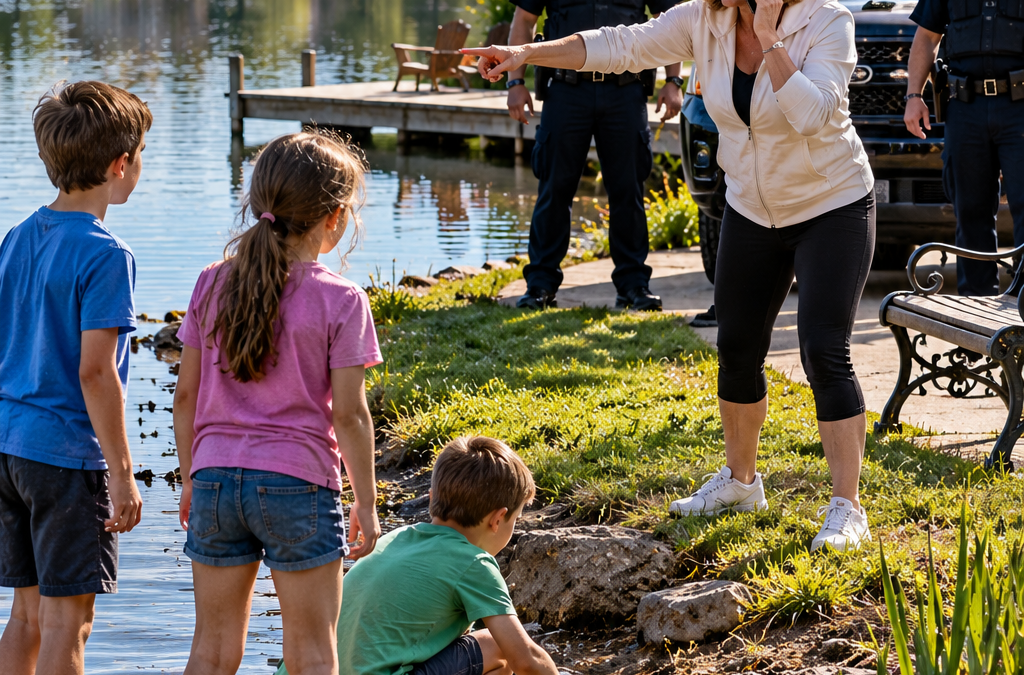
𝗙𝗨𝗟𝗟 𝗦𝗧𝗢𝗥𝗬
I could hear recognition immediately.
“I received a notice about my kids.”
“Then you understand the concern.”
“What exactly is an HOA-approved life vest?”
“It must be Coast Guard compliant and suitable for the child’s weight.”
“That makes sense. Why call it HOA-approved?”
“Because the board adopted the safety standard.”
“Did my kids not have life jackets?”
“Your oldest did not.”
Darius was eleven and a strong swimmer.
He had been standing waist-deep when Renee saw him.
Still, I was not interested in fighting over basic safety.
“Okay. We’ll make sure they have them.”
“I appreciate your cooperation.”
That should have been the end.
It wasn’t.
Three weeks later, another notice arrived.
EXCESSIVE NOISE IN COMMON RECREATIONAL AREA.
I stared at the paper.
The incident time was 3:42 p.m. on a Saturday.
I knew exactly what had happened because I had been sitting twenty feet away.
Priya had been playing in the water with two friends.
Three nine-year-old girls.
They were laughing.
That was the violation.
I called Renee again.
“What constitutes excessive noise?”
“Noise disruptive to peaceful enjoyment.”
“At three forty-two in the afternoon?”
“Time is not the sole consideration.”
“They’re children.”
“I understand that.”
“They were laughing.”
“They were shrieking.”
“They were playing.”
“Mr. Mercer, other homeowners have rights.”
I looked at Priya through the kitchen doorway.
She was coloring at the table.
“Who complained?”
“We don’t identify complainants.”
“Was it you?”
A pause.
“That isn’t relevant.”
That told me enough.
“Are children allowed to laugh at the lake?”
“Please don’t be dramatic.”
I almost laughed.
“You sent me a written violation because my daughter laughed too loudly.”
“You are oversimplifying.”
“No, I think I’m reading.”
Her voice cooled.
“If your family continues treating community standards as optional, the board may need to consider further action.”
That sentence irritated me.
Not enough to fight.
Not yet.
I hung up.
By July, we had received four complaints.
Four.
In roughly three months.
One for life jackets.
One for noise.
One because Darius left a kayak beside the water for forty minutes while he came home for lunch.
One because Marcus and another boy had been throwing small stones from the shoreline.
Renee described that as “potential damage to aquatic habitat.”
The kids started noticing.
That was what bothered me.
At first, Renee had been an adult problem.
Then one evening Darius asked, “Does that lady hate us?”
I was rinsing dishes.
I stopped.
“No.”
“She always watches us.”
“She watches everybody.”
“Not like us.”
That made me turn around.
“What do you mean?”
He shrugged.
“When other kids are there, she talks to their parents. When we’re there, she tells us we’re breaking rules.”
Priya looked up from the table.
“She takes pictures.”
“What?”
“The lake lady.”
Renee.
“She takes pictures of us?”
Priya nodded.
“When we’re swimming.”
My stomach tightened.
“Did she ever come close to you?”
“No.”
“Did she say why?”
“She says it’s for HOA records.”
I called the association the next morning.
Renee answered.
“I don’t want photographs taken of my children.”
“If a violation occurs, documentation may be required.”
“Then document the violation without photographing my children.”
“Your children are participating in the violation.”
“They’re minors.”
“Mr. Mercer, nobody is misusing photographs.”
“That isn’t what I said.”
Silence.
Then she gave me that same phrase.
“Community standards apply to everyone.”
I ended the call.
My wife wanted me to confront the board.
I did not.
At the time, I believed people like Renee fed on confrontation.
I figured the smartest thing was to follow reasonable rules and ignore unreasonable personalities.
That approach worked until Tuesday, August 18.
I remember the date because it changed everything.
I was working from home.
My office was upstairs at the back of the house, and from the window I could see part of the lake between two neighboring roofs.
It was hot.
Mid-eighties.
Clear sky.
The kind of afternoon when every kid in America should be near water if they’re lucky enough to have some.
Darius, Priya, and Marcus had gone down around two.
I checked on them once.
They had life jackets.
Darius had a whistle clipped to his.
They knew the rules I actually cared about.
Stay together.
No roughhousing near deep water.
No going past the buoy line.
Come get me if anyone gets hurt.
About thirty minutes later, I heard shouting.
At first, I assumed it was children.
Then I recognized the voice.
Renee.
I walked to the window.
She was marching down the trail toward the shoreline.
Fast.
Phone already in her hand.
My children were in the shallow section.
Marcus was sitting in the water.
Priya was splashing him.
Darius stood beside them.
Renee stopped at the edge and shouted something.
I could not hear every word through the glass.
But I saw Darius raise his hands.
Confused.
Then I saw Renee point toward our house.
My stomach tightened.
I headed downstairs.
By the time I stepped outside, I could hear her clearly.
“Out of the water! Now!”
Darius said, “Why?”
“Because you’re violating safety policy.”
“We have our vests.”
“That is not the issue.”
“What issue?”
“You are unsupervised minors.”
Darius looked around.
“Dad’s home.”
“Your father is not here.”
“He’s right there.”
That was when Renee saw me.
For half a second, she seemed annoyed that I had appeared.
Then she lifted the phone to her ear.
“Renee,” I called.
She turned away.
I walked faster.
When I reached the lake, Priya and Marcus were climbing out.
Priya looked embarrassed.
Marcus looked scared.
“What happened?”
Marcus whispered, “She’s calling police.”
I looked at Renee.
Sure enough, she was speaking to someone.
“Yes,” she said. “Three unsupervised minors in the water. They’ve refused instructions to leave.”
I stopped.
“You called the police?”
She held up one finger, telling me to wait.
That gesture almost made me lose my temper.
Then I heard her say the words.
“Yes, this is an emergency.”
I stared at her.
She had called 911.
Not the sheriff’s non-emergency number.
Not HOA security.
Not me.
For three children swimming in a two-acre neighborhood lake on a Tuesday afternoon.
“Renee, hang up.”
She turned her shoulder toward me.
“No, they’re not injured yet, but there is a clear safety threat.”
Yet.
I looked at Darius.
His face had changed.
He was old enough to understand what police meant.
“Dad, are we in trouble?”
“No.”
Renee ended the call.
I stepped closer.
“You called 911 on my children?”
“I called because you repeatedly refuse to comply with community safety policy.”
“They were swimming.”
“Without direct adult supervision.”
“I was fifty yards away.”
“You were inside your home.”
“Yes.”
“That is not direct supervision.”
“Where is that rule?”
“It is within the association’s authority to protect residents.”
“Show me the rule.”
“You’ll receive the documentation.”
“No. Show it to me now.”
She crossed her arms.
“You are becoming confrontational.”
I actually laughed.
“You called emergency services on three kids and I’m confrontational?”
“Your children have been repeatedly noncompliant.”
“They’re eleven, nine, and seven.”
“Which makes this more serious.”
By then, neighbors had started gathering.
Nobody admits they enjoy neighborhood drama.
Yet somehow, whenever an HOA president calls 911, half the block discovers an urgent need to walk the dog.
I saw Mr. Langley from across the lake.
The Petersons.
Two women from Willow Lane.
A teenager filming on his phone.
Renee seemed energized by the audience.
She stood straighter.
“This is exactly why we need stronger enforcement.”
I said quietly, “You should hope that deputy agrees with you.”
She smiled.
“Oh, he will.”
Five minutes later, a sheriff’s cruiser rolled around the corner.
Marcus grabbed my hand.
That broke something in me.
My seven-year-old son had done nothing except swim near his own home, and now he was holding my hand because a police car made him think he was in trouble.
I knelt.
“You didn’t do anything wrong.”
“Are they arresting us?”
“No.”
“Why did she call them?”
I looked at Renee.
“I don’t know.”
The cruiser stopped.
The driver’s door opened.
A tall deputy stepped out.
Then I recognized him.
Sergeant Derek Okafor.
For the first time that afternoon, I almost smiled.
Derek had been with the county sheriff’s department for fourteen years.
More importantly, his older brother, Kevin, had been my college roommate.
Kevin and I had stayed friends.
Which meant Derek and I had crossed paths at cookouts, birthday parties, graduations, and holiday gatherings for more than a decade.
He knew my wife.
He knew my children.
Darius had played basketball with Derek’s nephew.
Derek walked toward us.
He saw Renee first.
Then the kids.
Then me.
His eyebrows lifted.
“Daniel?”
Renee’s head turned toward me.
I said, “Hey, Derek.”
He looked at Marcus holding my hand.
Then at Darius in his life jacket.
Then at Priya with wet hair hanging over her face.
His expression became very professional.
“What happened?”
Renee immediately stepped forward.
“Officer, I’m Renee Callaway, president of the Maplewood Glen Homeowners Association.”
“Sergeant Okafor.”
“Yes. Sergeant. I called.”
“I figured.”
“We have three unsupervised minors repeatedly violating lake safety regulations.”
Derek looked at me.
I said nothing.
He returned his attention to Renee.
“What’s the emergency?”
“The emergency is that these children were in the water without proper adult supervision despite prior warnings.”
“Is anyone hurt?”
“No.”
“Missing?”
“No.”
“In distress?”
“No, but—”
“Was anyone drowning?”
“No.”
“Was there a fight?”
“No.”
“Any weapons?”
Renee looked offended.
“Of course not.”
Derek nodded slowly.
“So you called 911 because children were swimming.”
Her mouth tightened.
“That is an oversimplification. They were violating HOA policy.”
“Ma’am, I’m asking about the emergency.”
“The potential for injury is obvious.”
“Potential injury exists around every body of water.”
She pointed at my children.
“They have repeatedly ignored board instructions.”
Derek glanced at them.
“Those three?”
“Yes.”
Marcus moved closer to me.
Derek’s voice changed slightly when he saw that.
Still calm.
Less patient.
“Ma’am, 911 is for emergencies requiring immediate police, fire, or medical response.”
“This was a safety issue.”
“Then you can contact the non-emergency line if you believe law enforcement needs to address it.”
“But I needed an officer immediately.”
“Why?”
“Because they wouldn’t leave.”
Derek looked at me.
“Daniel, are these your kids?”
“Yes.”
“Were you home?”
“Yes.”
“How far?”
I pointed.
“Our house is right there.”
He followed my finger.
Maybe sixty yards.
“Any reason they aren’t allowed to swim?”
“Not that I’m aware of.”
Renee interrupted.
“The HOA has authority over recreational use.”
Derek turned.
“That’s a civil issue.”
“It’s a rule violation.”
“Still a civil issue.”
Her cheeks reddened.
“I don’t think you understand. I’m responsible for community safety.”
“I understand exactly what you’re telling me.”
His voice remained calm.
That made it worse for her.
“If someone were actually having an emergency while resources were tied up responding here, that would be a serious issue.”
Renee blinked.
“I acted in good faith.”
“I’m not questioning your feelings about the rule. I’m explaining proper use of emergency services.”
She opened her mouth.
He raised one hand.
“I’m giving you a verbal warning today. Do not use 911 to resolve HOA disputes unless there is an actual emergency.”
The silence around the lake was beautiful.
Absolutely beautiful.
Renee looked as though someone had removed the ground beneath her.
She had expected law enforcement to validate her.
Instead, in front of neighbors, she had been warned for calling them.
Then Derek turned toward me.
“How are you?”
“Better than ten minutes ago.”
He smiled.
“How’s Kevin?”
“Still claiming he can beat me at golf.”
“He can’t.”
“I know.”
Darius finally relaxed.
Derek crouched a little.
“You guys okay?”
Priya nodded.
Marcus asked, “Are we in trouble?”
Derek shook his head.
“No, buddy.”
Marcus looked at Renee.
“Is she?”
I coughed to hide a laugh.
Derek stood.
“Everybody just needs to use the right phone number for the right problem.”
Renee looked furious.
Not embarrassed.
Furious.
That distinction mattered.
She did not walk away thinking she had overreacted.
She walked away thinking she had been undermined.
And Renee Callaway did not handle being undermined well.
Forty-eight hours later, every homeowner in Maplewood Glen received an email.
EMERGENCY BOARD PROPOSAL: LAKE SAFETY AND MINOR ACCESS.
Three pages.
Renee described “a recent incident involving unsupervised juveniles.”
My children’s names were not included.
But everyone knew.
She proposed banning all unsupervised minors from the lake.
Not just swimming.
The lake.
No fishing.
No kayaking.
No shoreline play.
No walking near the water without an adult.
Anyone under eighteen would need direct supervision by someone twenty-one or older.
There would also be escalating fines against the household responsible.
First violation: $100.
Second: $250.
Third: $500 and temporary suspension of common-area privileges.
I read the email twice.
My wife stood behind me.
“She cannot be serious.”
“She called 911 on a seven-year-old.”
“Fair point.”
At the bottom was an emergency HOA meeting scheduled for Thursday.
Renee had moved quickly.
She told neighbors she had spoken with counsel.
She started circulating statements about liability.
One parent told me Renee said the sheriff’s department had “declined to intervene due to procedural limitations.”
That was a creative description of being told not to call 911 over swimming children.
I could have gone straight into battle.
Instead, something bothered me.
One phrase.
Common-area privileges.
I had heard Renee use it constantly.
The lake was a common area.
The trail was a common area.
The shore was a common area.
Everything around the water supposedly fell under HOA control.
But I had never actually read the documents establishing that.
That night, I could not sleep.
Around eleven thirty, I came downstairs.
The house was quiet.
My wife had gone to bed.
The kids were asleep.
I made coffee even though it was ridiculous at that hour and opened my laptop at the kitchen table.
I started with the HOA governing documents.
Declaration.
Bylaws.
Rules.
Architectural guidelines.
The lake appeared repeatedly.
“Lake-use policies.”
“Recreational lake rules.”
“Lake maintenance.”
“Lake safety.”
But something was missing.
I could not find a legal description assigning the lake parcel to the HOA.
That alone did not prove anything.
So I opened county property records.
Maplewood Glen had been platted in 1987.
The original developer subdivided dozens of residential lots.
Roadways were dedicated.
Common green spaces were identified.
The walking trail appeared.
Then I found the lake.
Separate parcel.
I leaned closer.
Parcel 17-B.
Not included in the HOA conveyance.
I assumed I was reading it wrong.
I opened the plat.
Again.
The water and immediate shoreline were clearly drawn as a separate parcel.
I followed the chain.
Original developer.
Then private transfer in the 1990s.
Another transfer years later.
Then 2019.
The buyer’s name appeared.
At first, I just stared.
MERIDIAN HOLDINGS LLC.
I knew that company.
I knew it because I owned it.
Years earlier, before purchasing our home, I had created Meridian Holdings for small real estate investments.
Nothing glamorous.
One rental duplex.
A vacant parcel I later sold.
A couple of small transactions.
When we bought the Maplewood Glen house, the seller had also been disposing of miscellaneous undeveloped land.
My closing package had included several attached parcel interests sold to the LLC.
I remembered signing stacks of papers.
I did not remember a lake.
I searched my files.
There it was.
A package conveyance.
Our house was not the only asset Meridian acquired.
Three tiny undeveloped remnants had been bundled into the sale.
One of them was parcel 17-B.
I checked the county map again.
My mouth went dry.
Parcel 17-B was the lake.
Not access rights.
Not a percentage.
The parcel.
The water.
The shoreline.
The ground beneath it.
I sat alone at my kitchen table at almost one in the morning staring at the screen.
Then I started laughing.
Quietly at first.
Then I covered my face because I knew if I woke my wife laughing over property records at one in the morning, she would assume I had finally lost my mind.
For three years, Renee had sent us notices about how my children were using a lake that, according to the deed in front of me, belonged to my company.
I was not ready to celebrate.
A county website is not a legal opinion.
So first thing the next morning, I called my attorney.
Her name was Claire Donovan.
She had handled Meridian’s earlier transactions.
“Claire, I need you to check something.”
“Morning to you too.”
“Do I own a lake?”
Silence.
“What?”
“A lake.”
“Are you asking philosophically?”
“No.”
“That’s disappointing.”
I gave her the parcel number.
She pulled records.
Then she became quiet.
“Where did you get this?”
“County records.”
“You bought this in 2019.”
“I know.”
“No, Daniel. You bought the parcel.”
“That’s what I think.”
“Why didn’t you know?”
“Because apparently I sign too much paperwork.”
She laughed.
“Let me do a proper chain search.”
“How long?”
“I’ll call.”
She called before nine.
“Congratulations.”
“On what?”
“You own a lake.”
I leaned back.
“Completely?”
“Subject to whatever valid easements or recorded rights attach, yes. Meridian Holdings holds fee title to parcel 17-B.”
“And the HOA?”
“I found no conveyance transferring ownership to them.”
“Can they make rules for it?”
“Possibly only to the extent they have contractual rights, easements, or authority over their members independent of ownership. But they cannot simply treat the parcel as HOA property if it isn’t.”
“Do they have an easement?”
“There is a trail-maintenance easement.”
“What does that cover?”
“The perimeter trail. Some drainage access. Limited maintenance rights.”
“The water?”
“No.”
“Swimming?”
“No.”
“Fishing?”
“No.”
“Children being there?”
“Not from anything I’ve seen.”
I stood up.
“Claire.”
“Yes?”
“The HOA president called 911 on my kids yesterday for swimming there.”
Another silence.
Then:
“You’re joking.”
“I wish.”
“And now?”
“She wants the HOA to ban children from the lake.”
Claire started laughing.
Actually laughing.
“That meeting should be interesting.”
I printed everything.
Certified deed.
Parcel map.
Chain of title.
Original plat.
Easement language.
Claire also wrote a short letter confirming Meridian’s ownership and offering to speak with HOA counsel directly.
I put it all in a folder.
Then I waited.
Thursday evening, the clubhouse parking lot was full.
Renee had arranged the room like a courtroom.
Printed agendas sat on every chair.
A projector displayed:
PROPOSED LAKE SAFETY AMENDMENT.
Renee stood at the front.
Dark blazer.
Hair perfectly set.
Binder open.
She looked entirely in control.
My wife sat beside me.
Darius had asked to come.
I said no.
This was an adult problem.
He had already been dragged into enough of it.
Renee called the meeting to order.
She talked for nearly twenty minutes.
Liability.
Risk.
Insurance.
Unsupervised minors.
Potential drowning.
Board responsibility.
Community standards.
Then, without naming me, she referred to “recent resistance from one household.”
My wife squeezed my arm.
I whispered, “Wait.”
Renee moved to the proposed rule.
“All minors under eighteen must be accompanied by a responsible adult age twenty-one or older when accessing the lake parcel or immediate shoreline.”
Lake parcel.
Interesting choice of words.
She asked whether board members had questions.
Two did.
Both were procedural.
Then she asked for homeowner comments.
I raised my hand.
Renee saw me.
Her expression changed slightly.
She could have ignored me.
Too many people were watching.
“Mr. Mercer.”
I stood.
“I have something I’d like to share before the board votes.”
“If it concerns the law-enforcement incident, that matter has already been addressed.”
“It doesn’t.”
“What is it?”
“Ownership.”
The room shifted.
Renee stared at me.
“Ownership of what?”
“The lake.”
She gave a small, irritated smile.
“The lake is a community amenity.”
“I know how it’s used.”
“Then I’m not sure what your point is.”
I picked up the folder.
“May I?”
She hesitated.
Then nodded.
I walked to the front.
Renee did not move away from the table.
Good.
I wanted her close enough to read.
I opened the folder.
Placed the certified deed on the table.
Then the plat.
Then the current county parcel record.
“Before anybody votes on whether this HOA can ban children from the lake, I think every homeowner here deserves to know something.”
Silence.
“The lake does not belong to Maplewood Glen Homeowners Association.”
Renee’s face tightened.
“That is incorrect.”
I looked at her.
“No. It isn’t.”
“The association has controlled the lake since the development was established.”
“Controlled is not the same as owned.”
Her eyes dropped toward the papers.
I continued.
“When Maplewood Glen was platted in 1987, the developer transferred roads and certain common areas. The lake parcel was not included.”
A man in the second row leaned forward.
I pointed to the map.
“Parcel 17-B remained separately titled.”
Renee said, “That doesn’t mean the HOA lacks authority.”
“I’m not finished.”
That annoyed her.
Good.
“The parcel changed private ownership twice. In 2019, it was sold again.”
I paused.
Then tapped the deed.
“To Meridian Holdings LLC.”
Someone asked, “Who’s that?”
I looked toward the room.
“Me.”
For about three seconds, nobody made a sound.
My wife had heard everything already, but she still smiled.
Renee stared at me.
I said it clearly.
“My company owns the lake.”
The room erupted.
Not screaming.
Questions.
Lots of them.
“What?”
“Seriously?”
“How?”
“Since when?”
Renee grabbed the deed.
I let her.
She scanned it.
“This cannot be right.”
“It is.”
“The HOA maintains the lake.”
“You maintain the trail.”
“We’ve maintained the water for decades.”
“That doesn’t make you the owner.”
She flipped to the map.
“This is ridiculous.”
I pulled Claire’s letter from the folder.
“My attorney confirmed the chain of title yesterday. If your attorney disagrees, she is available.”
I placed her business card on the table.
Renee’s face was changing.
Not dramatically.
She was too controlled for that.
But I could see it.
Color rising in her cheeks.
Her breathing becoming shallower.
The confidence slipping.
A homeowner named Linda stood.
“Renee, did the board know this?”
“No.”
“How could you not?”
“The association has exercised authority over the lake for decades.”
“That wasn’t my question.”
Another man said, “Are our dues paying for maintenance on property we don’t own?”
Renee looked toward the board.
One board member suddenly looked extremely uncomfortable.
“We have legal access and maintenance rights.”
I said, “Limited trail maintenance rights.”
She turned toward me.
“Please stop interrupting.”
“I was answering his question.”
“This is my meeting.”
I almost smiled.
There it was.
My meeting.
Linda asked, “What about all the lake permits?”
Renee said, “Those are community rules.”
“Rules for somebody else’s property?”
A few people murmured.
Another homeowner stood.
“You fined my son last year for fishing after eight.”
Renee looked defensive.
“We have always enforced lake hours.”
“Under what authority?”
The questions multiplied.
Swimming permits.
Kayak stickers.
Fishing limits.
Cooler restrictions.
Guest rules.
Noise citations.
Temporary suspensions.
For years, everyone had assumed Renee’s authority came from ownership.
Now that assumption was collapsing in real time.
Renee tried to regain control.
“The fact that a private entity may hold technical title does not eliminate the HOA’s authority over residents.”
I looked at her.
“Then show the covenant granting you regulatory control over parcel 17-B.”
She stared at me.
“I don’t have every document memorized.”
“I brought the recorded declaration.”
I pulled out another copy.
“I couldn’t find it.”
One woman in the back clapped once.
Just once.
Then stopped.
Renee glared toward the sound.
That was the moment the room turned.
Not because everybody suddenly liked me.
Because people realized Renee might have been enforcing rules for years without ever proving she had the authority she claimed.
A board member named Carl Whitmore cleared his throat.
“I think we should postpone the vote.”
Renee turned.
“No.”
Carl blinked.
“We need counsel to review this.”
“The safety issue remains.”
“We can’t vote on regulating property we may not control.”
“We do control it.”
“Then let’s verify that.”
Renee’s voice sharpened.
“The president has authority to maintain order pending legal clarification.”
Carl looked at her.
“Does the president have authority to override a deed?”
Nobody laughed loudly.
But I heard several people choke back reactions.
Renee closed her binder.
“This meeting is becoming disorderly.”
Linda said, “Because we found out Daniel owns the lake.”
“You found out he claims to.”
I held up Claire’s letter.
“Again, your lawyer is welcome to call mine.”
Someone asked me, “Are you going to close it?”
That changed the tone instantly.
Fear returned.
I looked around the room.
“No.”
People quieted.
“I did not discover this because I wanted to take the lake away from anyone. I discovered it because the HOA president called 911 on my children for swimming there and then proposed banning children from property she apparently never checked to see if the HOA owned.”
Renee snapped, “This is personal retaliation.”
“No.”
“It obviously is.”
“No, Renee. Calling 911 on three children was personal. Looking up a deed was research.”
A few people nodded.
I continued.
“My kids have played there for three years. So have yours. I’m not closing the lake.”
A woman asked, “What happens now?”
“First, the HOA stops pretending it owns something it doesn’t.”
Renee shook her head.
“You cannot dictate HOA governance.”
“I can dictate what happens on my property within the law.”
That landed.
Hard.
For years, Renee had used that exact kind of language against everyone else.
Property standards.
Association authority.
Compliance.
Now the property belonged to someone standing directly in front of her.
Carl moved to postpone the proposed minor-access rule pending legal review.
Another board member seconded.
Renee tried to argue.
The board voted anyway.
The motion passed.
Her lake ban was dead for the night.
But the meeting kept going.
It became something much larger.
Residents wanted records.
They wanted to know what else the HOA did not own.
They wanted copies of the trail easement.
They wanted a legal review of old fines.
They wanted to know whether HOA money had been spent improving private property without authorization.
One man asked whether people who had paid lake-related fines could get refunds.
Renee said no.
Carl said, “We don’t know that yet.”
She turned toward him.
It was the look of a president realizing her own board was no longer afraid of her.
I almost felt sorry for her.
Almost.
The meeting lasted another hour.
By the end, Renee was barely speaking.
My folder sat open on the table.
Everyone who wanted to see the deed saw it.
I did not hide anything.
That mattered.
Because Renee had built power through mystery.
Rules nobody checked.
Authority nobody questioned.
Documents nobody requested.
I wanted the opposite.
Look at the deed.
Read the easement.
Call the county.
Call my attorney.
Verify everything.
Truth does not become weaker when people inspect it.
Three days later, Maplewood Glen’s attorney called Claire.
His conclusion was essentially the same.
The HOA did not own parcel 17-B.
Its recorded rights were limited.
Some general HOA covenants might still affect member behavior depending on circumstances, but Renee’s assumption that the board possessed unrestricted authority to regulate the lake itself was unsupported.
Monday morning, an email went out.
Renee Callaway had resigned as president.
One sentence.
“Effective immediately, I am resigning my position as president of the Maplewood Glen Homeowners Association.”
Nothing else.
No explanation.
No apology.
No farewell.
Carl became interim president.
His first action was suspending all lake-specific enforcement pending review.
His second was asking Claire and the HOA attorney to sit down together.
That conversation was far more productive than anything Renee had ever done.
The HOA still had legitimate interests.
The trail needed maintenance.
Liability had to be addressed.
Drainage structures connected to common areas.
Residents needed predictable access.
I had no interest in turning a neighborhood lake into a private backyard.
So we created an agreement.
The HOA could maintain the perimeter trail under its existing easement.
Residents received a clearly documented recreational license to use the lake under reasonable safety rules.
Real safety rules.
Not rules invented because one child laughed too loudly.
Children under a certain age needed supervision.
Life jackets were required for specific boating activities.
No glass containers.
No swimming after designated evening hours.
No motorized boats.
Basic things.
The difference was transparency.
And proportionality.
Nobody was calling 911 because a nine-year-old laughed.
Nobody was photographing children for an HOA violation file.
Nobody needed three days’ permission to bring a cooler.
My favorite part came during the first meeting where we drafted the new rules.
Carl asked whether I wanted exclusive use days as owner.
I said no.
“Why would I?”
He shrugged.
“Technically it’s your lake.”
I looked around the room.
“I bought my house because my kids could play there. It would be pretty stupid to become the person who ruins that for everybody else.”
Linda laughed.
“That sounds pointed.”
“It probably is.”
We also reviewed old fines.
Where the HOA could not establish proper authority for purely lake-based violations, the board voted to refund or credit residents.
Our family received credits too.
Priya asked what that meant.
“It means some of the letters Ms. Callaway sent us should never have been sent.”
“Because you own the lake?”
“Because she didn’t have the authority she claimed.”
Darius looked at me.
“So can we do anything we want now?”
“No.”
“Why?”
“Because owning something doesn’t mean acting like an idiot.”
He smiled.
“That sounds like something Mom says.”
“She stole it from me.”
My wife yelled from the other room, “No, I didn’t.”
The children returned to the water that Wednesday.
I went with them.
Not because Renee had scared me into constant supervision.
Because I wanted to be there.
Marcus ran in first.
Priya followed.
Darius launched the kayak.
For about twenty minutes, nothing extraordinary happened.
Which was exactly what I wanted.
No HOA president.
No clipboard.
No police cruiser.
No neighbors watching from the trail.
Just kids.
Marcus shouted, “Dad!”
“What?”
“Watch this!”
He attempted what he clearly believed was an Olympic-quality jump into water barely deep enough to reach his chest.
The splash hit Priya.
She screamed.
Then laughed.
Loudly.
Really loudly.
For one second, I instinctively looked toward the trail.
No Renee.
I laughed at myself.
Priya noticed.
“What?”
“Nothing.”
“What?”
“Laugh as loud as you want.”
So she did.
For months afterward, people kept asking how I could have owned the lake without knowing.
The answer was disappointingly simple.
Paperwork.
When I bought the house, the previous owner was also liquidating several small parcels held through an investment structure.
My LLC acquired them as part of a bundled transaction.
The lake was described by parcel number and legal description, not as:
CONGRATULATIONS, HERE IS YOUR LAKE.
I signed.
My lawyer reviewed title.
The deal closed.
Because the lake was already being maintained and used by the neighborhood, nothing happened that forced me to investigate it.
The HOA assumed ownership.
I assumed HOA ownership.
Everyone assumed.
Until Renee pushed hard enough to make me check.
That irony was not lost on anyone.
Especially Derek.
About a month after everything settled, we were at Kevin’s barbecue.
Derek handed me a soda.
“So you’re a lake baron now?”
“Apparently.”
“How did you not know?”
“Do you read every legal description you sign?”
“Yes.”
“You’re a cop.”
“Exactly.”
I shook my head.
He laughed.
“Still can’t believe she called 911.”
“Marcus thought he was getting arrested.”
Derek stopped smiling.
“That bothered me.”
“Me too.”
“She ever apologize?”
“No.”
“Figures.”
“What would you have done if you didn’t know me?”
He looked at me.
“The same thing.”
I nodded.
I believed him.
Knowing me had made the scene stranger.
It did not change the facts.
No emergency existed.
That mattered.
Renee eventually sold her house.
Not immediately.
About nine months later.
The For Sale sign appeared one morning.
Neighbors noticed within an hour.
By afternoon, it had become the primary topic on three different text chains.
I did not celebrate.
I had won nothing from Renee leaving.
She had been difficult.
Overbearing.
At times cruel in the casual way people become cruel when they convince themselves rules excuse everything.
But Maplewood Glen did not need revenge.
It needed better governance.
Carl served until the next election.
Then, for the first time in years, three people ran for president.
Residents actually attended.
Candidate statements were distributed.
Financial records were reviewed.
People asked questions.
The new board adopted a policy requiring every enforcement rule to cite its specific governing authority.
That sounds boring.
It is boring.
Good governance usually is.
Drama comes from people inventing power.
Competence comes from documents.
The lake changed too.
Not physically.
Socially.
Parents stopped acting like Renee might emerge from the willow trees with a violation slip.
Birthday picnics returned.
Kids fished.
People brought kayaks.
Someone built a little rack near the trail after asking my permission.
I approved it.
No three-page application.
Just a conversation.
One Saturday, I saw an older man sitting by the water with three folding chairs.
I recognized him.
The grandfather Renee had once told that folding chairs counted as unapproved temporary furnishings.
I walked over.
“Sir.”
He looked up cautiously.
“Yes?”
I pointed at the chairs.
“You got a permit for all that furniture?”
He stared at me.
Then recognized the joke.
His laugh carried halfway across the lake.
“Don’t start.”
I sat beside him.
He handed me a fishing rod.
We stayed there for an hour.
That was Maplewood Glen after Renee.
Not lawless.
Not chaotic.
Just normal.
It taught me something I should have understood earlier.
Most unreasonable authority survives because reasonable people do not want the inconvenience of challenging it.
One warning letter?
Easier to comply.
A silly fine?
Pay it.
A ridiculous rule?
Ignore it quietly.
A rude president?
Avoid her.
Every individual decision makes sense.
But eventually the person enforcing those rules begins to believe silence equals consent.
Renee had six years of silence.
She mistook it for power.
She believed if nobody stopped her from regulating the lake, that meant she had the right to regulate it.
She believed if everyone accepted her notices, they were valid.
She believed if people obeyed when she shouted, she was in charge.
Then she called 911.
That was the mistake.
Not because Derek embarrassed her.
The warning itself lasted maybe two minutes.
Her real mistake was making me curious.
I went home asking a question I had never asked before.
What authority does she actually have?
That question destroyed more of Renee’s power than any argument I could have started at the shoreline.
Because once I looked, I discovered something astonishing.
The answer was much less than she believed.
The lake had never been transferred to the HOA.
Not in 1987.
Not later.
The trail had.
Certain maintenance responsibilities had.
The water had not.
𝗧𝗛𝗘 𝗘𝗡𝗗
The HOA president stood on the shoreline pointing at my three children like they were trespassers while she told a 911 dispatcher there was an emergency at the lake. What she did not know was that less than forty-eight hours later, one document buried in the county records would force everyone in Maplewood Glen to ask a question Renee Callaway had spent years making sure nobody asked.
We had lived in Maplewood Glen for three years before I ever thought seriously about who owned the lake.
That sounds ridiculous now.
At the time, it seemed completely normal.
Maplewood Glen was the kind of neighborhood people drove through slowly when they were thinking about buying a house. Brick mailboxes stood at the edge of every driveway. Lawns were clipped short enough to look artificial. Small American flags appeared on porches around every holiday, and the houses were far enough apart to feel comfortable without being isolated.
At the center of everything sat a small lake.
Maybe two acres.
Nothing spectacular.
No marina.
No boats larger than a kayak.
Just a calm stretch of water surrounded by a walking path, a few benches, patches of cattails, and several old willow trees whose branches almost touched the surface.
It was the reason my wife and I bought our house.
The first afternoon we toured Maplewood Glen, my three kids barely looked at the bedrooms.
Darius was eleven then.
Priya was nine.
Marcus had just turned seven.
We were walking with the realtor when Darius spotted the water between two houses.
“Dad, is that a lake?”
The realtor smiled.
“Community lake.”
That was all my children needed to hear.
They ran toward it.
I remember watching them from the path.
Marcus found a stick and immediately started poking at mud.
Priya crouched beside the shoreline looking for frogs.
Darius skipped rocks.
My wife stood next to me and said quietly, “They could actually grow up here.”
That sentence stayed with me.
I had grown up in apartments.
Parking lots had been my playground.
My mother used to shout down from the second-floor balcony when dinner was ready.
Nothing wrong with that childhood.
But I had always wanted something different for my kids.
I wanted them to remember summers outside.
Wet towels drying over porch rails.
Mud on their shoes.
Bikes abandoned in the driveway.
Fishing line tangled around tree branches.
The kinds of ordinary memories you do not realize are important until adulthood makes everything complicated.
So we bought the house.
For the first year, the lake delivered exactly what we hoped.
Darius learned how to paddle a kayak.
Priya became obsessed with catching tadpoles.
Marcus spent half his life throwing stones into the water and asking whether turtles could recognize people.
On Sunday mornings, I sometimes carried a folding chair down with coffee and watched them play.
Other neighborhood children joined them.
Parents brought coolers.
Older men fished.
Couples walked the trail.
Nobody seemed to think much about it.
Then I met Renee Callaway.
Every neighborhood has one person who mistakes responsibility for authority.
Renee had perfected the transformation.
Officially, she was president of the Maplewood Glen Homeowners Association.
Unofficially, she behaved like the subdivision had been issued to her personally.
She had served six consecutive years as president.
Nobody I spoke to could explain exactly how.
Some people said nobody else wanted the job.
Others said Renee controlled enough proxy votes that challenging her was pointless.
Whatever the reason, she treated the HOA presidency as a permanent office.
She monitored landscaping.
Trash cans.
Parking.
Holiday decorations.
Garage doors.
Fence stains.
Basketball hoops.
But the lake was special.
The lake was Renee’s kingdom.
She walked it nearly every evening.
Phone in one hand.
Clipboard sometimes tucked beneath her arm.
She would stop residents and ask whether they had permission for things I had never imagined required permission.
Coolers.
Kayaks.
Fishing chairs.
Birthday balloons.
Once, I watched her tell a grandfather he could not bring three folding chairs near the water because “temporary outdoor furnishings” had not been approved.
The man stared at her.
“I’m going fishing.”
Renee pointed at his chairs.
“Those are furnishings.”
He looked at me.
I shrugged because I had no idea how to respond to something that absurd.
The neighbors called her Karen behind her back.
I never loved that nickname.
Her name was Renee.
And honestly, Renee was more than capable of being unreasonable without needing another name attached to it.
Our first issue with her happened in May.
I came home one afternoon and found a white envelope pushed under our front door.
Not mailed.
Delivered personally.
At the top:
MAPLEWOOD GLEN HOMEOWNERS ASSOCIATION
NOTICE OF NONCOMPLIANCE
I assumed it was landscaping.
Our hedge had gotten a little tall.
Instead, the letter stated that “minor residents associated with the property” had been observed swimming without HOA-approved flotation equipment.
Minor residents.
My children had names.
Apparently, Renee preferred legal-sounding phrases.
I called the office.
She answered.
“Maplewood Glen Homeowners Association. Renee speaking.”
“This is Daniel Mercer from Hawthorne Court.”
“Yes.”
I could hear recognition immediately.
“I received a notice about my kids.”
“Then you understand the concern.”
“What exactly is an HOA-approved life vest?”
“It must be Coast Guard compliant and suitable for the child’s weight.”
“That makes sense. Why call it HOA-approved?”
“Because the board adopted the safety standard.”
“Did my kids not have life jackets?”
“Your oldest did not.”
Darius was eleven and a strong swimmer.
He had been standing waist-deep when Renee saw him.
Still, I was not interested in fighting over basic safety.
“Okay. We’ll make sure they have them.”
“I appreciate your cooperation.”
That should have been the end.
It wasn’t.
Three weeks later, another notice arrived.
EXCESSIVE NOISE IN COMMON RECREATIONAL AREA.
I stared at the paper.
The incident time was 3:42 p.m. on a Saturday.
I knew exactly what had happened because I had been sitting twenty feet away.
Priya had been playing in the water with two friends.
Three nine-year-old girls.
They were laughing.
That was the violation.
I called Renee again.
“What constitutes excessive noise?”
“Noise disruptive to peaceful enjoyment.”
“At three forty-two in the afternoon?”
“Time is not the sole consideration.”
“They’re children.”
“I understand that.”
“They were laughing.”
“They were shrieking.”
“They were playing.”
“Mr. Mercer, other homeowners have rights.”
I looked at Priya through the kitchen doorway.
She was coloring at the table.
“Who complained?”
“We don’t identify complainants.”
“Was it you?”
A pause.
“That isn’t relevant.”
That told me enough.
“Are children allowed to laugh at the lake?”
“Please don’t be dramatic.”
I almost laughed.
“You sent me a written violation because my daughter laughed too loudly.”
“You are oversimplifying.”
“No, I think I’m reading.”
Her voice cooled.
“If your family continues treating community standards as optional, the board may need to consider further action.”
That sentence irritated me.
Not enough to fight.
Not yet.
I hung up.
By July, we had received four complaints.
Four.
In roughly three months.
One for life jackets.
One for noise.
One because Darius left a kayak beside the water for forty minutes while he came home for lunch.
One because Marcus and another boy had been throwing small stones from the shoreline.
Renee described that as “potential damage to aquatic habitat.”
The kids started noticing.
That was what bothered me.
At first, Renee had been an adult problem.
Then one evening Darius asked, “Does that lady hate us?”
I was rinsing dishes.
I stopped.
“No.”
“She always watches us.”
“She watches everybody.”
“Not like us.”
That made me turn around.
“What do you mean?”
He shrugged.
“When other kids are there, she talks to their parents. When we’re there, she tells us we’re breaking rules.”
Priya looked up from the table.
“She takes pictures.”
“What?”
“The lake lady.”
Renee.
“She takes pictures of us?”
Priya nodded.
“When we’re swimming.”
My stomach tightened.
“Did she ever come close to you?”
“No.”
“Did she say why?”
“She says it’s for HOA records.”
I called the association the next morning.
Renee answered.
“I don’t want photographs taken of my children.”
“If a violation occurs, documentation may be required.”
“Then document the violation without photographing my children.”
“Your children are participating in the violation.”
“They’re minors.”
“Mr. Mercer, nobody is misusing photographs.”
“That isn’t what I said.”
Silence.
Then she gave me that same phrase.
“Community standards apply to everyone.”
I ended the call.
My wife wanted me to confront the board.
I did not.
At the time, I believed people like Renee fed on confrontation.
I figured the smartest thing was to follow reasonable rules and ignore unreasonable personalities.
That approach worked until Tuesday, August 18.
I remember the date because it changed everything.
I was working from home.
My office was upstairs at the back of the house, and from the window I could see part of the lake between two neighboring roofs.
It was hot.
Mid-eighties.
Clear sky.
The kind of afternoon when every kid in America should be near water if they’re lucky enough to have some.
Darius, Priya, and Marcus had gone down around two.
I checked on them once.
They had life jackets.
Darius had a whistle clipped to his.
They knew the rules I actually cared about.
Stay together.
No roughhousing near deep water.
No going past the buoy line.
Come get me if anyone gets hurt.
About thirty minutes later, I heard shouting.
At first, I assumed it was children.
Then I recognized the voice.
Renee.
I walked to the window.
She was marching down the trail toward the shoreline.
Fast.
Phone already in her hand.
My children were in the shallow section.
Marcus was sitting in the water.
Priya was splashing him.
Darius stood beside them.
Renee stopped at the edge and shouted something.
I could not hear every word through the glass.
But I saw Darius raise his hands.
Confused.
Then I saw Renee point toward our house.
My stomach tightened.
I headed downstairs.
By the time I stepped outside, I could hear her clearly.
“Out of the water! Now!”
Darius said, “Why?”
“Because you’re violating safety policy.”
“We have our vests.”
“That is not the issue.”
“What issue?”
“You are unsupervised minors.”
Darius looked around.
“Dad’s home.”
“Your father is not here.”
“He’s right there.”
That was when Renee saw me.
For half a second, she seemed annoyed that I had appeared.
Then she lifted the phone to her ear.
“Renee,” I called.
She turned away.
I walked faster.
When I reached the lake, Priya and Marcus were climbing out.
Priya looked embarrassed.
Marcus looked scared.
“What happened?”
Marcus whispered, “She’s calling police.”
I looked at Renee.
Sure enough, she was speaking to someone.
“Yes,” she said. “Three unsupervised minors in the water. They’ve refused instructions to leave.”
I stopped.
“You called the police?”
She held up one finger, telling me to wait.
That gesture almost made me lose my temper.
Then I heard her say the words.
“Yes, this is an emergency.”
I stared at her.
She had called 911.
Not the sheriff’s non-emergency number.
Not HOA security.
Not me.
For three children swimming in a two-acre neighborhood lake on a Tuesday afternoon.
“Renee, hang up.”
She turned her shoulder toward me.
“No, they’re not injured yet, but there is a clear safety threat.”
Yet.
I looked at Darius.
His face had changed.
He was old enough to understand what police meant.
“Dad, are we in trouble?”
“No.”
Renee ended the call.
I stepped closer.
“You called 911 on my children?”
“I called because you repeatedly refuse to comply with community safety policy.”
“They were swimming.”
“Without direct adult supervision.”
“I was fifty yards away.”
“You were inside your home.”
“Yes.”
“That is not direct supervision.”
“Where is that rule?”
“It is within the association’s authority to protect residents.”
“Show me the rule.”
“You’ll receive the documentation.”
“No. Show it to me now.”
She crossed her arms.
“You are becoming confrontational.”
I actually laughed.
“You called emergency services on three kids and I’m confrontational?”
“Your children have been repeatedly noncompliant.”
“They’re eleven, nine, and seven.”
“Which makes this more serious.”
By then, neighbors had started gathering.
Nobody admits they enjoy neighborhood drama.
Yet somehow, whenever an HOA president calls 911, half the block discovers an urgent need to walk the dog.
I saw Mr. Langley from across the lake.
The Petersons.
Two women from Willow Lane.
A teenager filming on his phone.
Renee seemed energized by the audience.
She stood straighter.
“This is exactly why we need stronger enforcement.”
I said quietly, “You should hope that deputy agrees with you.”
She smiled.
“Oh, he will.”
Five minutes later, a sheriff’s cruiser rolled around the corner.
Marcus grabbed my hand.
That broke something in me.
My seven-year-old son had done nothing except swim near his own home, and now he was holding my hand because a police car made him think he was in trouble.
I knelt.
“You didn’t do anything wrong.”
“Are they arresting us?”
“No.”
“Why did she call them?”
I looked at Renee.
“I don’t know.”
The cruiser stopped.
The driver’s door opened.
A tall deputy stepped out.
Then I recognized him.
Sergeant Derek Okafor.
For the first time that afternoon, I almost smiled.
Derek had been with the county sheriff’s department for fourteen years.
More importantly, his older brother, Kevin, had been my college roommate.
Kevin and I had stayed friends.
Which meant Derek and I had crossed paths at cookouts, birthday parties, graduations, and holiday gatherings for more than a decade.
He knew my wife.
He knew my children.
Darius had played basketball with Derek’s nephew.
Derek walked toward us.
He saw Renee first.
Then the kids.
Then me.
His eyebrows lifted.
“Daniel?”
Renee’s head turned toward me.
I said, “Hey, Derek.”
He looked at Marcus holding my hand.
Then at Darius in his life jacket.
Then at Priya with wet hair hanging over her face.
His expression became very professional.
“What happened?”
Renee immediately stepped forward.
“Officer, I’m Renee Callaway, president of the Maplewood Glen Homeowners Association.”
“Sergeant Okafor.”
“Yes. Sergeant. I called.”
“I figured.”
“We have three unsupervised minors repeatedly violating lake safety regulations.”
Derek looked at me.
I said nothing.
He returned his attention to Renee.
“What’s the emergency?”
“The emergency is that these children were in the water without proper adult supervision despite prior warnings.”
“Is anyone hurt?”
“No.”
“Missing?”
“No.”
“In distress?”
“No, but—”
“Was anyone drowning?”
“No.”
“Was there a fight?”
“No.”
“Any weapons?”
Renee looked offended.
“Of course not.”
Derek nodded slowly.
“So you called 911 because children were swimming.”
Her mouth tightened.
“That is an oversimplification. They were violating HOA policy.”
“Ma’am, I’m asking about the emergency.”
“The potential for injury is obvious.”
“Potential injury exists around every body of water.”
She pointed at my children.
“They have repeatedly ignored board instructions.”
Derek glanced at them.
“Those three?”
“Yes.”
Marcus moved closer to me.
Derek’s voice changed slightly when he saw that.
Still calm.
Less patient.
“Ma’am, 911 is for emergencies requiring immediate police, fire, or medical response.”
“This was a safety issue.”
“Then you can contact the non-emergency line if you believe law enforcement needs to address it.”
“But I needed an officer immediately.”
“Why?”
“Because they wouldn’t leave.”
Derek looked at me.
“Daniel, are these your kids?”
“Yes.”
“Were you home?”
“Yes.”
“How far?”
I pointed.
“Our house is right there.”
He followed my finger.
Maybe sixty yards.
“Any reason they aren’t allowed to swim?”
“Not that I’m aware of.”
Renee interrupted.
“The HOA has authority over recreational use.”
Derek turned.
“That’s a civil issue.”
“It’s a rule violation.”
“Still a civil issue.”
Her cheeks reddened.
“I don’t think you understand. I’m responsible for community safety.”
“I understand exactly what you’re telling me.”
His voice remained calm.
That made it worse for her.
“If someone were actually having an emergency while resources were tied up responding here, that would be a serious issue.”
Renee blinked.
“I acted in good faith.”
“I’m not questioning your feelings about the rule. I’m explaining proper use of emergency services.”
She opened her mouth.
He raised one hand.
“I’m giving you a verbal warning today. Do not use 911 to resolve HOA disputes unless there is an actual emergency.”
The silence around the lake was beautiful.
Absolutely beautiful.
Renee looked as though someone had removed the ground beneath her.
She had expected law enforcement to validate her.
Instead, in front of neighbors, she had been warned for calling them.
Then Derek turned toward me.
“How are you?”
“Better than ten minutes ago.”
He smiled.
“How’s Kevin?”
“Still claiming he can beat me at golf.”
“He can’t.”
“I know.”
Darius finally relaxed.
Derek crouched a little.
“You guys okay?”
Priya nodded.
Marcus asked, “Are we in trouble?”
Derek shook his head.
“No, buddy.”
Marcus looked at Renee.
“Is she?”
I coughed to hide a laugh.
Derek stood.
“Everybody just needs to use the right phone number for the right problem.”
Renee looked furious.
Not embarrassed.
Furious.
That distinction mattered.
She did not walk away thinking she had overreacted.
She walked away thinking she had been undermined.
And Renee Callaway did not handle being undermined well.
Forty-eight hours later, every homeowner in Maplewood Glen received an email.
EMERGENCY BOARD PROPOSAL: LAKE SAFETY AND MINOR ACCESS.
Three pages.
Renee described “a recent incident involving unsupervised juveniles.”
My children’s names were not included.
But everyone knew.
She proposed banning all unsupervised minors from the lake.
Not just swimming.
The lake.
No fishing.
No kayaking.
No shoreline play.
No walking near the water without an adult.
Anyone under eighteen would need direct supervision by someone twenty-one or older.
There would also be escalating fines against the household responsible.
First violation: $100.
Second: $250.
Third: $500 and temporary suspension of common-area privileges.
I read the email twice.
My wife stood behind me.
“She cannot be serious.”
“She called 911 on a seven-year-old.”
“Fair point.”
At the bottom was an emergency HOA meeting scheduled for Thursday.
Renee had moved quickly.
She told neighbors she had spoken with counsel.
She started circulating statements about liability.
One parent told me Renee said the sheriff’s department had “declined to intervene due to procedural limitations.”
That was a creative description of being told not to call 911 over swimming children.
I could have gone straight into battle.
Instead, something bothered me.
One phrase.
Common-area privileges.
I had heard Renee use it constantly.
The lake was a common area.
The trail was a common area.
The shore was a common area.
Everything around the water supposedly fell under HOA control.
But I had never actually read the documents establishing that.
That night, I could not sleep.
Around eleven thirty, I came downstairs.
The house was quiet.
My wife had gone to bed.
The kids were asleep.
I made coffee even though it was ridiculous at that hour and opened my laptop at the kitchen table.
I started with the HOA governing documents.
Declaration.
Bylaws.
Rules.
Architectural guidelines.
The lake appeared repeatedly.
“Lake-use policies.”
“Recreational lake rules.”
“Lake maintenance.”
“Lake safety.”
But something was missing.
I could not find a legal description assigning the lake parcel to the HOA.
That alone did not prove anything.
So I opened county property records.
Maplewood Glen had been platted in 1987.
The original developer subdivided dozens of residential lots.
Roadways were dedicated.
Common green spaces were identified.
The walking trail appeared.
Then I found the lake.
Separate parcel.
I leaned closer.
Parcel 17-B.
Not included in the HOA conveyance.
I assumed I was reading it wrong.
I opened the plat.
Again.
The water and immediate shoreline were clearly drawn as a separate parcel.
I followed the chain.
Original developer.
Then private transfer in the 1990s.
Another transfer years later.
Then 2019.
The buyer’s name appeared.
At first, I just stared.
MERIDIAN HOLDINGS LLC.
I knew that company.
I knew it because I owned it.
Years earlier, before purchasing our home, I had created Meridian Holdings for small real estate investments.
Nothing glamorous.
One rental duplex.
A vacant parcel I later sold.
A couple of small transactions.
When we bought the Maplewood Glen house, the seller had also been disposing of miscellaneous undeveloped land.
My closing package had included several attached parcel interests sold to the LLC.
I remembered signing stacks of papers.
I did not remember a lake.
I searched my files.
There it was.
A package conveyance.
Our house was not the only asset Meridian acquired.
Three tiny undeveloped remnants had been bundled into the sale.
One of them was parcel 17-B.
I checked the county map again.
My mouth went dry.
Parcel 17-B was the lake.
Not access rights.
Not a percentage.
The parcel.
The water.
The shoreline.
The ground beneath it.
I sat alone at my kitchen table at almost one in the morning staring at the screen.
Then I started laughing.
Quietly at first.
Then I covered my face because I knew if I woke my wife laughing over property records at one in the morning, she would assume I had finally lost my mind.
For three years, Renee had sent us notices about how my children were using a lake that, according to the deed in front of me, belonged to my company.
I was not ready to celebrate.
A county website is not a legal opinion.
So first thing the next morning, I called my attorney.
Her name was Claire Donovan.
She had handled Meridian’s earlier transactions.
“Claire, I need you to check something.”
“Morning to you too.”
“Do I own a lake?”
Silence.
“What?”
“A lake.”
“Are you asking philosophically?”
“No.”
“That’s disappointing.”
I gave her the parcel number.
She pulled records.
Then she became quiet.
“Where did you get this?”
“County records.”
“You bought this in 2019.”
“I know.”
“No, Daniel. You bought the parcel.”
“That’s what I think.”
“Why didn’t you know?”
“Because apparently I sign too much paperwork.”
She laughed.
“Let me do a proper chain search.”
“How long?”
“I’ll call.”
She called before nine.
“Congratulations.”
“On what?”
“You own a lake.”
I leaned back.
“Completely?”
“Subject to whatever valid easements or recorded rights attach, yes. Meridian Holdings holds fee title to parcel 17-B.”
“And the HOA?”
“I found no conveyance transferring ownership to them.”
“Can they make rules for it?”
“Possibly only to the extent they have contractual rights, easements, or authority over their members independent of ownership. But they cannot simply treat the parcel as HOA property if it isn’t.”
“Do they have an easement?”
“There is a trail-maintenance easement.”
“What does that cover?”
“The perimeter trail. Some drainage access. Limited maintenance rights.”
“The water?”
“No.”
“Swimming?”
“No.”
“Fishing?”
“No.”
“Children being there?”
“Not from anything I’ve seen.”
I stood up.
“Claire.”
“Yes?”
“The HOA president called 911 on my kids yesterday for swimming there.”
Another silence.
Then:
“You’re joking.”
“I wish.”
“And now?”
“She wants the HOA to ban children from the lake.”
Claire started laughing.
Actually laughing.
“That meeting should be interesting.”
I printed everything.
Certified deed.
Parcel map.
Chain of title.
Original plat.
Easement language.
Claire also wrote a short letter confirming Meridian’s ownership and offering to speak with HOA counsel directly.
I put it all in a folder.
Then I waited.
Thursday evening, the clubhouse parking lot was full.
Renee had arranged the room like a courtroom.
Printed agendas sat on every chair.
A projector displayed:
PROPOSED LAKE SAFETY AMENDMENT.
Renee stood at the front.
Dark blazer.
Hair perfectly set.
Binder open.
She looked entirely in control.
My wife sat beside me.
Darius had asked to come.
I said no.
This was an adult problem.
He had already been dragged into enough of it.
Renee called the meeting to order.
She talked for nearly twenty minutes.
Liability.
Risk.
Insurance.
Unsupervised minors.
Potential drowning.
Board responsibility.
Community standards.
Then, without naming me, she referred to “recent resistance from one household.”
My wife squeezed my arm.
I whispered, “Wait.”
Renee moved to the proposed rule.
“All minors under eighteen must be accompanied by a responsible adult age twenty-one or older when accessing the lake parcel or immediate shoreline.”
Lake parcel.
Interesting choice of words.
She asked whether board members had questions.
Two did.
Both were procedural.
Then she asked for homeowner comments.
I raised my hand.
Renee saw me.
Her expression changed slightly.
She could have ignored me.
Too many people were watching.
“Mr. Mercer.”
I stood.
“I have something I’d like to share before the board votes.”
“If it concerns the law-enforcement incident, that matter has already been addressed.”
“It doesn’t.”
“What is it?”
“Ownership.”
The room shifted.
Renee stared at me.
“Ownership of what?”
“The lake.”
She gave a small, irritated smile.
“The lake is a community amenity.”
“I know how it’s used.”
“Then I’m not sure what your point is.”
I picked up the folder.
“May I?”
She hesitated.
Then nodded.
I walked to the front.
Renee did not move away from the table.
Good.
I wanted her close enough to read.
I opened the folder.
Placed the certified deed on the table.
Then the plat.
Then the current county parcel record.
“Before anybody votes on whether this HOA can ban children from the lake, I think every homeowner here deserves to know something.”
Silence.
“The lake does not belong to Maplewood Glen Homeowners Association.”
Renee’s face tightened.
“That is incorrect.”
I looked at her.
“No. It isn’t.”
“The association has controlled the lake since the development was established.”
“Controlled is not the same as owned.”
Her eyes dropped toward the papers.
I continued.
“When Maplewood Glen was platted in 1987, the developer transferred roads and certain common areas. The lake parcel was not included.”
A man in the second row leaned forward.
I pointed to the map.
“Parcel 17-B remained separately titled.”
Renee said, “That doesn’t mean the HOA lacks authority.”
“I’m not finished.”
That annoyed her.
Good.
“The parcel changed private ownership twice. In 2019, it was sold again.”
I paused.
Then tapped the deed.
“To Meridian Holdings LLC.”
Someone asked, “Who’s that?”
I looked toward the room.
“Me.”
For about three seconds, nobody made a sound.
My wife had heard everything already, but she still smiled.
Renee stared at me.
I said it clearly.
“My company owns the lake.”
The room erupted.
Not screaming.
Questions.
Lots of them.
“What?”
“Seriously?”
“How?”
“Since when?”
Renee grabbed the deed.
I let her.
She scanned it.
“This cannot be right.”
“It is.”
“The HOA maintains the lake.”
“You maintain the trail.”
“We’ve maintained the water for decades.”
“That doesn’t make you the owner.”
She flipped to the map.
“This is ridiculous.”
I pulled Claire’s letter from the folder.
“My attorney confirmed the chain of title yesterday. If your attorney disagrees, she is available.”
I placed her business card on the table.
Renee’s face was changing.
Not dramatically.
She was too controlled for that.
But I could see it.
Color rising in her cheeks.
Her breathing becoming shallower.
The confidence slipping.
A homeowner named Linda stood.
“Renee, did the board know this?”
“No.”
“How could you not?”
“The association has exercised authority over the lake for decades.”
“That wasn’t my question.”
Another man said, “Are our dues paying for maintenance on property we don’t own?”
Renee looked toward the board.
One board member suddenly looked extremely uncomfortable.
“We have legal access and maintenance rights.”
I said, “Limited trail maintenance rights.”
She turned toward me.
“Please stop interrupting.”
“I was answering his question.”
“This is my meeting.”
I almost smiled.
There it was.
My meeting.
Linda asked, “What about all the lake permits?”
Renee said, “Those are community rules.”
“Rules for somebody else’s property?”
A few people murmured.
Another homeowner stood.
“You fined my son last year for fishing after eight.”
Renee looked defensive.
“We have always enforced lake hours.”
“Under what authority?”
The questions multiplied.
Swimming permits.
Kayak stickers.
Fishing limits.
Cooler restrictions.
Guest rules.
Noise citations.
Temporary suspensions.
For years, everyone had assumed Renee’s authority came from ownership.
Now that assumption was collapsing in real time.
Renee tried to regain control.
“The fact that a private entity may hold technical title does not eliminate the HOA’s authority over residents.”
I looked at her.
“Then show the covenant granting you regulatory control over parcel 17-B.”
She stared at me.
“I don’t have every document memorized.”
“I brought the recorded declaration.”
I pulled out another copy.
“I couldn’t find it.”
One woman in the back clapped once.
Just once.
Then stopped.
Renee glared toward the sound.
That was the moment the room turned.
Not because everybody suddenly liked me.
Because people realized Renee might have been enforcing rules for years without ever proving she had the authority she claimed.
A board member named Carl Whitmore cleared his throat.
“I think we should postpone the vote.”
Renee turned.
“No.”
Carl blinked.
“We need counsel to review this.”
“The safety issue remains.”
“We can’t vote on regulating property we may not control.”
“We do control it.”
“Then let’s verify that.”
Renee’s voice sharpened.
“The president has authority to maintain order pending legal clarification.”
Carl looked at her.
“Does the president have authority to override a deed?”
Nobody laughed loudly.
But I heard several people choke back reactions.
Renee closed her binder.
“This meeting is becoming disorderly.”
Linda said, “Because we found out Daniel owns the lake.”
“You found out he claims to.”
I held up Claire’s letter.
“Again, your lawyer is welcome to call mine.”
Someone asked me, “Are you going to close it?”
That changed the tone instantly.
Fear returned.
I looked around the room.
“No.”
People quieted.
“I did not discover this because I wanted to take the lake away from anyone. I discovered it because the HOA president called 911 on my children for swimming there and then proposed banning children from property she apparently never checked to see if the HOA owned.”
Renee snapped, “This is personal retaliation.”
“No.”
“It obviously is.”
“No, Renee. Calling 911 on three children was personal. Looking up a deed was research.”
A few people nodded.
I continued.
“My kids have played there for three years. So have yours. I’m not closing the lake.”
A woman asked, “What happens now?”
“First, the HOA stops pretending it owns something it doesn’t.”
Renee shook her head.
“You cannot dictate HOA governance.”
“I can dictate what happens on my property within the law.”
That landed.
Hard.
For years, Renee had used that exact kind of language against everyone else.
Property standards.
Association authority.
Compliance.
Now the property belonged to someone standing directly in front of her.
Carl moved to postpone the proposed minor-access rule pending legal review.
Another board member seconded.
Renee tried to argue.
The board voted anyway.
The motion passed.
Her lake ban was dead for the night.
But the meeting kept going.
It became something much larger.
Residents wanted records.
They wanted to know what else the HOA did not own.
They wanted copies of the trail easement.
They wanted a legal review of old fines.
They wanted to know whether HOA money had been spent improving private property without authorization.
One man asked whether people who had paid lake-related fines could get refunds.
Renee said no.
Carl said, “We don’t know that yet.”
She turned toward him.
It was the look of a president realizing her own board was no longer afraid of her.
I almost felt sorry for her.
Almost.
The meeting lasted another hour.
By the end, Renee was barely speaking.
My folder sat open on the table.
Everyone who wanted to see the deed saw it.
I did not hide anything.
That mattered.
Because Renee had built power through mystery.
Rules nobody checked.
Authority nobody questioned.
Documents nobody requested.
I wanted the opposite.
Look at the deed.
Read the easement.
Call the county.
Call my attorney.
Verify everything.
Truth does not become weaker when people inspect it.
Three days later, Maplewood Glen’s attorney called Claire.
His conclusion was essentially the same.
The HOA did not own parcel 17-B.
Its recorded rights were limited.
Some general HOA covenants might still affect member behavior depending on circumstances, but Renee’s assumption that the board possessed unrestricted authority to regulate the lake itself was unsupported.
Monday morning, an email went out.
Renee Callaway had resigned as president.
One sentence.
“Effective immediately, I am resigning my position as president of the Maplewood Glen Homeowners Association.”
Nothing else.
No explanation.
No apology.
No farewell.
Carl became interim president.
His first action was suspending all lake-specific enforcement pending review.
His second was asking Claire and the HOA attorney to sit down together.
That conversation was far more productive than anything Renee had ever done.
The HOA still had legitimate interests.
The trail needed maintenance.
Liability had to be addressed.
Drainage structures connected to common areas.
Residents needed predictable access.
I had no interest in turning a neighborhood lake into a private backyard.
So we created an agreement.
The HOA could maintain the perimeter trail under its existing easement.
Residents received a clearly documented recreational license to use the lake under reasonable safety rules.
Real safety rules.
Not rules invented because one child laughed too loudly.
Children under a certain age needed supervision.
Life jackets were required for specific boating activities.
No glass containers.
No swimming after designated evening hours.
No motorized boats.
Basic things.
The difference was transparency.
And proportionality.
Nobody was calling 911 because a nine-year-old laughed.
Nobody was photographing children for an HOA violation file.
Nobody needed three days’ permission to bring a cooler.
My favorite part came during the first meeting where we drafted the new rules.
Carl asked whether I wanted exclusive use days as owner.
I said no.
“Why would I?”
He shrugged.
“Technically it’s your lake.”
I looked around the room.
“I bought my house because my kids could play there. It would be pretty stupid to become the person who ruins that for everybody else.”
Linda laughed.
“That sounds pointed.”
“It probably is.”
We also reviewed old fines.
Where the HOA could not establish proper authority for purely lake-based violations, the board voted to refund or credit residents.
Our family received credits too.
Priya asked what that meant.
“It means some of the letters Ms. Callaway sent us should never have been sent.”
“Because you own the lake?”
“Because she didn’t have the authority she claimed.”
Darius looked at me.
“So can we do anything we want now?”
“No.”
“Why?”
“Because owning something doesn’t mean acting like an idiot.”
He smiled.
“That sounds like something Mom says.”
“She stole it from me.”
My wife yelled from the other room, “No, I didn’t.”
The children returned to the water that Wednesday.
I went with them.
Not because Renee had scared me into constant supervision.
Because I wanted to be there.
Marcus ran in first.
Priya followed.
Darius launched the kayak.
For about twenty minutes, nothing extraordinary happened.
Which was exactly what I wanted.
No HOA president.
No clipboard.
No police cruiser.
No neighbors watching from the trail.
Just kids.
Marcus shouted, “Dad!”
“What?”
“Watch this!”
He attempted what he clearly believed was an Olympic-quality jump into water barely deep enough to reach his chest.
The splash hit Priya.
She screamed.
Then laughed.
Loudly.
Really loudly.
For one second, I instinctively looked toward the trail.
No Renee.
I laughed at myself.
Priya noticed.
“What?”
“Nothing.”
“What?”
“Laugh as loud as you want.”
So she did.
For months afterward, people kept asking how I could have owned the lake without knowing.
The answer was disappointingly simple.
Paperwork.
When I bought the house, the previous owner was also liquidating several small parcels held through an investment structure.
My LLC acquired them as part of a bundled transaction.
The lake was described by parcel number and legal description, not as:
CONGRATULATIONS, HERE IS YOUR LAKE.
I signed.
My lawyer reviewed title.
The deal closed.
Because the lake was already being maintained and used by the neighborhood, nothing happened that forced me to investigate it.
The HOA assumed ownership.
I assumed HOA ownership.
Everyone assumed.
Until Renee pushed hard enough to make me check.
That irony was not lost on anyone.
Especially Derek.
About a month after everything settled, we were at Kevin’s barbecue.
Derek handed me a soda.
“So you’re a lake baron now?”
“Apparently.”
“How did you not know?”
“Do you read every legal description you sign?”
“Yes.”
“You’re a cop.”
“Exactly.”
I shook my head.
He laughed.
“Still can’t believe she called 911.”
“Marcus thought he was getting arrested.”
Derek stopped smiling.
“That bothered me.”
“Me too.”
“She ever apologize?”
“No.”
“Figures.”
“What would you have done if you didn’t know me?”
He looked at me.
“The same thing.”
I nodded.
I believed him.
Knowing me had made the scene stranger.
It did not change the facts.
No emergency existed.
That mattered.
Renee eventually sold her house.
Not immediately.
About nine months later.
The For Sale sign appeared one morning.
Neighbors noticed within an hour.
By afternoon, it had become the primary topic on three different text chains.
I did not celebrate.
I had won nothing from Renee leaving.
She had been difficult.
Overbearing.
At times cruel in the casual way people become cruel when they convince themselves rules excuse everything.
But Maplewood Glen did not need revenge.
It needed better governance.
Carl served until the next election.
Then, for the first time in years, three people ran for president.
Residents actually attended.
Candidate statements were distributed.
Financial records were reviewed.
People asked questions.
The new board adopted a policy requiring every enforcement rule to cite its specific governing authority.
That sounds boring.
It is boring.
Good governance usually is.
Drama comes from people inventing power.
Competence comes from documents.
The lake changed too.
Not physically.
Socially.
Parents stopped acting like Renee might emerge from the willow trees with a violation slip.
Birthday picnics returned.
Kids fished.
People brought kayaks.
Someone built a little rack near the trail after asking my permission.
I approved it.
No three-page application.
Just a conversation.
One Saturday, I saw an older man sitting by the water with three folding chairs.
I recognized him.
The grandfather Renee had once told that folding chairs counted as unapproved temporary furnishings.
I walked over.
“Sir.”
He looked up cautiously.
“Yes?”
I pointed at the chairs.
“You got a permit for all that furniture?”
He stared at me.
Then recognized the joke.
His laugh carried halfway across the lake.
“Don’t start.”
I sat beside him.
He handed me a fishing rod.
We stayed there for an hour.
That was Maplewood Glen after Renee.
Not lawless.
Not chaotic.
Just normal.
It taught me something I should have understood earlier.
Most unreasonable authority survives because reasonable people do not want the inconvenience of challenging it.
One warning letter?
Easier to comply.
A silly fine?
Pay it.
A ridiculous rule?
Ignore it quietly.
A rude president?
Avoid her.
Every individual decision makes sense.
But eventually the person enforcing those rules begins to believe silence equals consent.
Renee had six years of silence.
She mistook it for power.
She believed if nobody stopped her from regulating the lake, that meant she had the right to regulate it.
She believed if everyone accepted her notices, they were valid.
She believed if people obeyed when she shouted, she was in charge.
Then she called 911.
That was the mistake.
Not because Derek embarrassed her.
The warning itself lasted maybe two minutes.
Her real mistake was making me curious.
I went home asking a question I had never asked before.
What authority does she actually have?
That question destroyed more of Renee’s power than any argument I could have started at the shoreline.
Because once I looked, I discovered something astonishing.
The answer was much less than she believed.
The lake had never been transferred to the HOA.
Not in 1987.
Not later.
The trail had.
Certain maintenance responsibilities had.
The water had not.







