𝗙𝗨𝗟𝗟 𝗦𝗧𝗢𝗥𝗬 The HOA president spent $140,000 building a luxury swimming pool forty feet inside my cattle pasture, ignored two written warnings, and laughed when I gave her thirty days to remove it. What she never bothered to learn was that on a four-generation working ranch, anything permanently attached to the land can become part of the operation if the deed says it does.
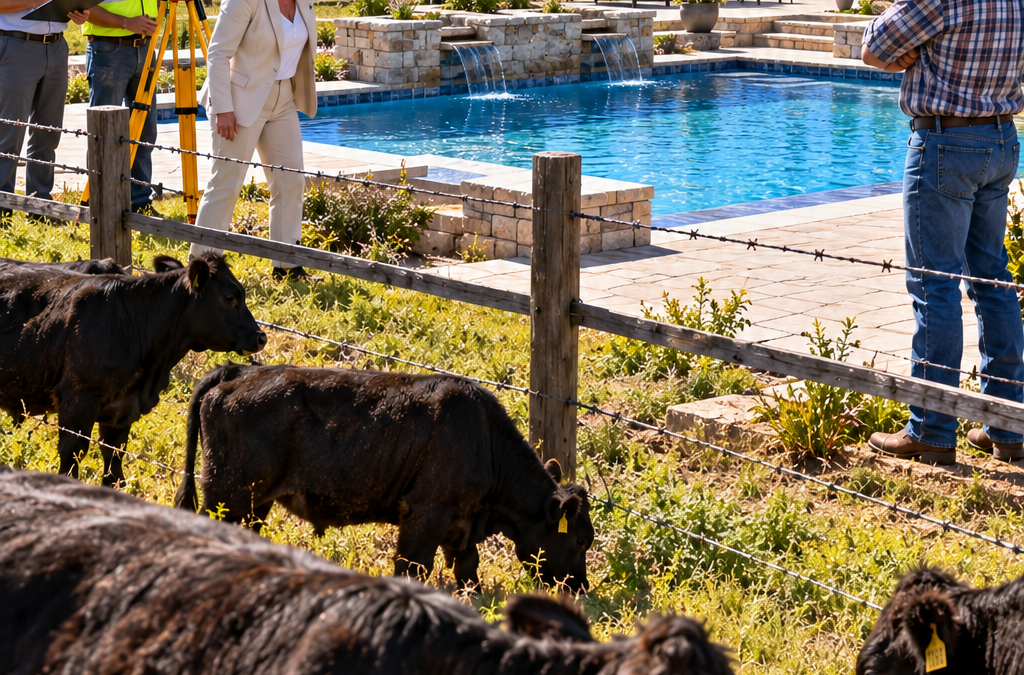
𝗙𝗨𝗟𝗟 𝗦𝗧𝗢𝗥𝗬
I waited.
I genuinely didn’t know what response she expected.
Finally I said, “Cattle usually are.”
Her face tightened.
“I’m Renata Hale. President of the Cedar Ridge HOA.”
“Garrett.”
“I know who you are.”
That should have told me something.
She pointed toward the fence.
“We’re reviewing the visual corridor along the walking trail.”
“The what?”
“The visual corridor.”
She said it like those words existed in nature.
“Our residents purchased homes based partly on aesthetics.”
I looked behind me.
Pasture.
Cattle.
Cottonwoods.
Low hills beyond.
“You’ve got four hundred acres of aesthetics right there.”
“I’m referring to the fencing.”
I looked at the barbed wire.
It was standard five-strand ranch fence.
Straight.
Maintained.
Functional.
“What about it?”
“It’s industrial-looking.”
“No. Industrial fencing is chain-link, steel panel, or security fencing. That’s livestock fence.”
“It presents poorly from the trail.”
I almost laughed.
“That’s unfortunate.”
“We’d like you to consider installing decorative panels.”
“Where?”
“Along the shared boundary.”
“That’s nearly a mile.”
She smiled as though we’d reached a reasonable discussion.
“Correct.”
“You’re asking me to replace a mile of working livestock fence because your residents don’t like seeing livestock fence beside livestock.”
“It’s about community standards.”
“I’m not in your community.”
The smile disappeared.
“You border us.”
“That’s geography, not membership.”
Renata put her sunglasses back on.
“I’ll send you something formally.”
“Don’t bother.”
She sent it anyway.
Three days later, an envelope arrived.
CEDAR RIDGE ESTATES HOMEOWNERS ASSOCIATION.
Official request for aesthetic mitigation.
My lawyer, Dominic Shaw, later framed it because he thought it was funny.
At the time, I tossed it onto the desk and went back to work.
That should have been the end.
It wasn’t.
Over the following months, Renata developed opinions about nearly every visible part of my ranch.
The cattle were too close to the trail.
The manure smell affected outdoor enjoyment.
My hay bales were visually disruptive.
The stock trailer parked near the equipment shed looked “commercial.”
The floodlights at the calving barn created “rural glare.”
That one was my favorite.
Rural glare.
She once emailed requesting that I restrict equipment operation before eight in the morning because residents valued peaceful sunrise hours.
I replied with one sentence.
Cattle do not observe HOA quiet hours.
Dominic told me I shouldn’t antagonize her.
I told Dominic I hadn’t.
He said, “You wrote it in bold.”
“That was Outlook.”
He sighed.
Mostly, though, I ignored her.
There is a discipline in ranching that suburban conflict doesn’t understand.
If something doesn’t affect cattle, water, fencing, money, legal title, or family, it probably isn’t worth losing daylight over.
Renata was annoying.
Annoying is survivable.
Then she crossed the fence.
The first construction equipment appeared in late May.
I noticed an excavator from half a mile away.
That wasn’t automatically unusual.
Several Cedar Ridge residents were putting in landscaping.
One house near the eastern edge had been under construction for months.
From the access road, the machine looked like it was working just beyond my fence line near a shallow drainage swale.
I didn’t think much about it.
Two days later, I saw dump trucks.
Then a skid steer.
Then concrete forms stacked nearby.
Something felt wrong.
The eastern pasture was part of our summer rotation, but the cattle were in the north section that week, so I hadn’t driven the fence closely.
Tuesday afternoon, after checking water, I headed east.
The closer I got, the less sense the scene made.
The excavator wasn’t on Renata’s property.
It wasn’t even near the line.
It was inside my pasture.
I stopped the truck.
For several seconds I simply sat there.
You know those moments when your eyes understand something before your brain agrees to it?
That was me.
There were orange flags.
Survey stakes.
Layout string.
A rectangular excavation large enough for a resort-style swimming pool.
And every bit of it was on my side of the fence.
I got out.
The contractor had temporarily removed a section of livestock wire.
Not cut it completely, but pulled it back and secured it around two posts to create equipment access.
That alone was enough to raise my blood pressure.
I walked toward the excavation.
A man in a yellow vest held up one hand.
“Sir, hard hat area.”
“This is my pasture.”
He looked confused.
“Excuse me?”
“You’re standing on my ranch.”
He glanced toward the subdivision.
“We’re on Lot 14.”
“No, Lot 14 is over there.”
I pointed beyond the fence.
“This side is mine.”
He looked down at a rolled set of plans.
Then back at me.
“Mrs. Hale’s project?”
“I don’t care whose project it is.”
I stepped closer to the excavation.
“Stop digging.”
The excavator operator killed the machine.
That got everyone’s attention.
A foreman came over.
“We have permits.”
“Good.”
I pointed toward the county road.
“Use them somewhere you own.”
He frowned.
“Sir, we’ve got a site plan.”
“Show me.”
He did.
Beautiful drawings.
Luxury pool.
Stone decking.
Outdoor kitchen.
Small pergola.
Sun shelf.
Integrated hot tub.
Even landscaping zones.
The property line on the drawing placed the pool just inside Renata’s rear boundary.
I looked from the paper to the fence.
“Who gave you this boundary?”
“Owner’s survey packet.”
“Which surveyor?”
He flipped pages.
“I’d have to call the office.”
“You do that.”
“Sir, we’re already mobilized.”
“I don’t care.”
“We can’t just shut down.”
“You absolutely can.”
I took out my phone.
The foreman sighed.
“Are you calling law enforcement?”
“My attorney.”
That changed his expression more than police would have.
Dominic answered on the third ring.
“What’s broken?”
“Nothing yet.”
“That’s encouraging.”
“I’ve got a swimming pool being dug forty feet inside my east pasture.”
Silence.
Then:
“You have what?”
I explained.
Dominic stopped joking.
“Do not touch their equipment.”
“I wasn’t going to.”
“Do not threaten anybody.”
“I haven’t.”
“Take photographs. Video. Include landmarks. Get contractor information. Tell them the land ownership is disputed and that continued work is at their risk.”
I looked at the foreman.
“You hear that?”
He nodded reluctantly.
Dominic continued.
“I’m sending a surveyor.”
“How fast?”
“Let me work.”
“What about today?”
“Tell them formally to stop. I’ll send written notice before close of business.”
I did.
The foreman made calls.
After twenty minutes, the crew packed up.
For that afternoon.
I should have known Renata wouldn’t leave it there.
At five seventeen, she called me.
I almost didn’t answer.
“Garrett.”
“Renata.”
“I understand you interfered with my contractors.”
“They were digging on my land.”
“No, they weren’t.”
“Yes, they were.”
“I have an approved site plan.”
“You have a site plan showing a line that doesn’t match the county record.”
“You aren’t a surveyor.”
“Neither are you.”
Her tone hardened.
“Construction is permitted.”
“A building permit doesn’t grant ownership.”
“The county approved the project.”
“The county approved construction based on information somebody gave them. That doesn’t move my boundary.”
She gave a little laugh.
Not because anything was funny.
It was dismissive.
“You’re being difficult.”
That phrase irritated me more than yelling would have.
“I’m being difficult because I’m objecting to a swimming pool in my pasture?”
“The rear property configuration has always been unclear.”
“No, it hasn’t.”
“That’s your opinion.”
“My grandfather’s recorded survey isn’t an opinion.”
“Those documents are decades old.”
“So is the land.”
She exhaled loudly.
“Garrett, this pool is going to improve the appearance of the entire corridor.”
I actually pulled the phone away and stared at it.
“The appearance?”
“Yes.”
“It’s on a cattle ranch.”
“It’s adjacent to my residence.”
“No. Your residence is adjacent to my ranch.”
“You’re splitting hairs.”
“That’s called a property line.”
She went silent.
I continued.
“Don’t send your contractors back.”
“I won’t be bullied.”
“Nobody is bullying you.”
“You threatened my workers.”
“I told them they were trespassing.”
“You stopped permitted construction.”
“On my land.”
“You keep saying that.”
“Because it keeps being true.”
Renata’s voice dropped.
“We’ll see.”
Then she hung up.
Dominic sent the cease-and-desist the next morning.
Certified.
Email.
Courier.
He didn’t believe in ambiguity.
The letter identified the parcel, cited the deed, referenced the recorded survey, stated that ownership and boundary rights had not been transferred, and demanded immediate cessation of all construction pending an independent survey.
Renata received it Thursday morning.
Thursday afternoon, the excavator was running again.
I watched from my truck.
That was the moment I stopped viewing her as merely arrogant.
Arrogant people make bad decisions because they think they’re right.
Renata had been put on formal notice that ownership was disputed.
She had a lawyer’s letter.
She knew an independent survey was being ordered.
She knew the ranch boundary predated her house by decades.
And she told the contractor to continue anyway.
That wasn’t misunderstanding.
That was calculated pressure.
She believed that if enough money went into the ground, removing it would become too expensive.
If the pool reached completion before the survey came back, she could argue equity.
Good faith.
Waste.
Compromise.
She was trying to manufacture leverage with concrete.
I filmed everything.
Timestamp visible.
Equipment.
Excavation.
Fence opening.
Workers.
Delivery trucks.
The foreman saw me.
He came over.
“Mrs. Hale says we’re authorized.”
“Mrs. Hale doesn’t own this ground.”
“She says the boundary dispute is being handled.”
“It is.”
I held up my phone.
“You’re watching it be handled.”
He looked uncomfortable.
“I don’t want trouble.”
“Then stop.”
“I answer to my company.”
“Your company received legal notice.”
He looked away.
“I’m just doing my job.”
I had heard that phrase enough in my life to know it usually meant somebody understood the situation was wrong but wanted responsibility to belong to someone else.
“Then document that I told you again.”
He nodded.
They kept working.
By Friday, plumbing trenches were in.
The following week, steel reinforcement went down.
I didn’t interfere.
That surprised Dominic.
“You sure?”
“No.”
“That’s honest.”
“I want to stop it.”
“But?”
“But you told me not to give her something she can use.”
“Correct.”
“So we document.”
“Correct.”
I hated it.
Patience feels noble after a conflict is over.
During one, it feels like letting somebody steal from you slowly.
I drove past that excavation every day.
Every day it got larger.
Every day workers installed something else.
Renata told neighbors I was harassing her.
Aaron called me one evening.
“She’s telling the HOA board the land is disputed.”
“It’s not.”
“That’s what I figured.”
“She show you a survey?”
“No.”
“Ask her.”
He paused.
“She says you’re holding out because you want money.”
That made me laugh.
“Money for what?”
“An easement, I guess.”
“I haven’t asked for anything.”
“I know.”
Then his voice changed.
“Garrett, can I tell you something?”
“Go ahead.”
“She’s saying this pool is an HOA asset.”
I sat up.
“What?”
“Not technically community property. But she’s selling it to people as an amenity that improves the trail corridor.”
“Her private pool?”
“I don’t understand it either.”
Of course she was.
Renata wanted everyone emotionally invested.
If enough residents believed the pool added value to Cedar Ridge, then my objection wouldn’t be framed as a property dispute.
I’d be the unreasonable rancher attacking a neighborhood improvement.
The next morning, Dominic called.
“I’ve got the surveyor booked.”
“When?”
“Monday fieldwork. Final by Wednesday.”
“Good.”
“Until then, do nothing.”
“I hate when you say that.”
“That’s why you pay me.”
The surveyor was a woman named Claire Benton.
She had been doing boundary work in the county for twenty-six years.
She arrived Monday before eight with two crew members and zero interest in HOA politics.
I gave her my grandfather’s survey.
She handled it carefully.
“Original?”
“Copy of the field survey. Original recording’s with the county.”
She smiled.
“Your grandfather kept good records.”
“He was obsessive.”
“Good trait in landowners.”
She located the old monuments.
Cross-checked county coordinates.
Ran measurements.
Found two iron pins buried under years of soil.
Matched the descriptions.
By Tuesday afternoon, she already looked certain.
I refused to ask.
I wanted the signed result.
Wednesday morning, Dominic brought the survey to my kitchen.
He laid it flat.
Claire’s certified boundary line was clear.
I stared at it.
Then at the aerial overlay.
Then back at him.
“How bad?”
Dominic pointed.
“Pool excavation begins approximately thirty-eight feet inside your parcel here.”
His finger moved.
“Forty-two here.”
“And the decking?”
“Entirely inside.”
“Equipment pad?”
“Inside.”
“Plumbing?”
“Inside.”
“Any part of it on her property?”
“No.”
I leaned back.
All the frustration I had felt suddenly became something colder.
Certainty.
Renata hadn’t built close to my boundary.
She had built on my ranch.
Every piece of the project.
Pool.
Deck.
Equipment.
Landscaping footprint.
Everything.
Dominic looked at me.
“You were right.”
“My grandfather was right.”
“That too.”
“What happens now?”
“We file.”
He did that afternoon.
Formal notice with the county.
Trespass documentation.
Boundary confirmation.
Demand for removal.
Preservation of evidence.
Thirty-day cure period.
We sent copies to Renata, her attorney, the contractor, the HOA, and the county department that had issued the permit.
The county responded almost immediately.
Their permit approval had relied on the site plan submitted by Renata.
Permitting did not verify private title.
Once ownership was disputed and surveyed, their position changed quickly.
Work should stop.
It didn’t.
Renata hired Fletcher Kane.
Fletcher wore sport coats that looked too expensive for the room and spoke as if silence might weaken his case.
Our first meeting happened at Dominic’s office.
Renata arrived ten minutes late.
White blouse.
Gold bracelet.
No apology.
Fletcher carried three binders.
Dominic had one yellow legal pad.
I liked our chances.
Fletcher began.
“Everyone agrees the circumstances are unfortunate.”
Dominic looked at me.
I looked at him.
Neither of us agreed to that characterization.
Fletcher continued.
“My client proceeded in good faith under county-issued permits and professional plans.”
Dominic said, “After receiving written notice that the land belonged to Mr. Garrett.”
“The precise location was disputed.”
“It wasn’t.”
“At the time, from our perspective—”
“Your perspective doesn’t relocate a recorded boundary.”
Fletcher adjusted his jacket.
“Demolition of a completed or nearly completed pool would be economically wasteful.”
I leaned forward.
“Then she shouldn’t have built it.”
Renata looked at me for the first time.
“We’ve offered compensation.”
“You haven’t offered anything.”
“We’re prepared to.”
“I don’t want your money.”
She frowned, genuinely surprised.
“Everyone has a number.”
“No.”
“That’s not realistic.”
“Neither is putting a swimming pool forty feet into somebody else’s cattle pasture.”
Fletcher stepped in.
“What we’re proposing is a retroactive easement or lot-line adjustment. Mrs. Hale would compensate you at a premium for the affected acreage.”
“How much acreage?”
“We can calculate.”
“Doesn’t matter.”
Renata crossed her arms.
“You’re being emotional.”
Dominic’s pen stopped.
He knew that word would not help her.
I said, “I use that ground.”
“For cattle?”
“Yes.”
She looked toward the window.
“It’s a tiny section.”
“To you.”
“You’re talking about a few thousand square feet on four hundred acres.”
“Which means you thought I wouldn’t notice?”
“That’s not what I said.”
“But that’s what happened.”
Fletcher raised a hand.
“Let’s avoid accusations.”
I looked at him.
“Your client kept building after receiving a cease-and-desist.”
“Because she believed—”
“She believed concrete would improve her negotiating position.”
Renata leaned forward.
“You don’t know what I believed.”
“No.”
I met her eyes.
“But I know what you did.”
The meeting went nowhere.
At the end, Fletcher said something about proportional remedies.
Dominic told him he’d review the deed before making that argument again.
I didn’t understand what he meant until later.
We were sitting in Dominic’s office after they left.
He had my title documents open.
“Your grandfather was even more obsessive than you said.”
“That’s becoming a compliment.”
“It is.”
He turned several pages.
“Look at this.”
The language dated to 1967.
An agricultural-use covenant attached to the ranch deed.
The wording was old-fashioned, dense, and clearly written by a lawyer who charged by the syllable.
But the core provision was simple.
Permanent improvements placed upon the agricultural parcel without a separate recorded ownership interest could, at the landowner’s election, be incorporated into active agricultural use, provided that use complied with applicable law.
I read it again.
“You’re telling me the pool is mine.”
“I’m telling you we need to be precise.”
“Dominic.”
He smiled.
“Yes. Potentially.”
“Potentially?”
“Property law hates simple sentences.”
“Can I use it?”
“Possibly.”
“For cattle?”
His smile disappeared.
He looked back at the covenant.
Then at me.
“What exactly are you thinking?”
I told him.
For ten seconds he said nothing.
Then he leaned back.
“That’s absurd.”
“So is the pool.”
“I’m your attorney. I’m supposed to discourage this.”
“Is it legal?”
“I don’t know yet.”
“Find out.”
He did.
Three days later, he called.
“You’re going to be unbearable.”
“That’s a yes.”
“It’s a qualified yes.”
“Best kind.”
“If the pool is deemed a permanent improvement to your parcel and you formally elect integration under the agricultural covenant, you can use the water infrastructure for agricultural operations.”
I stood in my kitchen.
“Livestock watering.”
“Yes.”
“What permits?”
“Plumbing modification. Agricultural water distribution. Electrical isolation. Safety barrier modifications.”
“All doable?”
“Yes.”
“Then do it.”
“Garrett.”
“What?”
“This will escalate the dispute.”
“She’s already spent a hundred and forty thousand dollars building a pool on my ranch after two warnings.”
“Fair.”
“Anything else?”
“Don’t drown a cow.”
“That’s always been the plan.”
Dominic drafted the election notice.
Fletcher’s response came within hours.
Outrage.
Threats.
Claims that the agricultural covenant was obsolete.
Claims that Renata retained ownership of the pool structure.
Claims of unjust enrichment.
Dominic answered each one.
Then he included the survey.
The deed.
The certified notices.
Proof of continued construction after notice.
The agricultural covenant.
And the county’s written acknowledgment that the project had been permitted based on applicant-supplied property information.
Fletcher got quieter after that.
Renata did not.
She came to my ranch gate one evening.
I was fixing a water valve.
Her SUV stopped outside.
She got out and walked toward me.
“Thirty days?”
I straightened.
“What?”
“Your lawyer says I have thirty days to remove my pool.”
“Correct.”
“You know that’s impossible.”
“No, it isn’t.”
“It’s concrete.”
“They make machines for concrete.”
Her face flushed.
“I spent a hundred and forty thousand dollars.”
“I warned you before you poured it.”
“I had permits.”
“You didn’t have land.”
“You could take the settlement.”
“No.”
“Why?”
That question was sincere.
For the first time, she seemed unable to understand me.
“Because I don’t want to sell it.”
“It’s a sliver of pasture.”
“It’s my sliver.”
“God, you ranch people are impossible.”
I smiled.
“You moved next to a ranch.”
“I’m offering you more than the dirt is worth.”
“To you.”
“To anyone.”
I wiped my hands on a rag.
“You don’t get to decide the value of something after taking it.”
“I didn’t take anything.”
“You built a pool there.”
“The boundary information was wrong.”
“Then why did you keep building after the cease-and-desist?”
She went quiet.
I waited.
She looked toward the pasture.
“You were trying to sabotage the project.”
“No.”
“You have had an issue with Cedar Ridge from the beginning.”
“I’ve ignored Cedar Ridge from the beginning.”
“You refused every reasonable request.”
“Decorative cattle fencing isn’t reasonable.”
“Your property affects ours.”
“And yours now apparently affects mine.”
She looked at me sharply.
“You think you’re clever.”
“No.”
I pointed toward the pool.
“I think you had a survey problem.”
Her mouth hardened.
“I’m not removing it.”
“Then don’t.”
That stopped her.
“What?”
“You heard me.”
“You just said—”
“I said you have thirty days to remove it.”
“And if I don’t?”
I folded the rag.
“Then we’ll follow the deed.”
She laughed.
Actually laughed.
Long enough that I remember it clearly.
“You cannot seriously think you own my pool.”
“I think you built a permanent improvement on deeded ranch land.”
“I paid for it.”
“You also paid contractors to trespass after receiving legal notice.”
“This is insane.”
“Maybe.”
She stepped closer.
“I will bury you in litigation.”
I looked at her.
“Then you should start saving.”
She got back into her SUV.
That was the last time I warned her personally.
The thirty days expired.
The pool was complete.
It was, I admit, beautiful.
Dark stone coping.
Blue tile.
Integrated spa.
Underwater lights.
A tanning ledge.
An outdoor shower.
A small cabana frame.
The sort of pool you’d expect at a boutique hotel.
Except it sat in the middle of an active cattle pasture.
That contrast never stopped being ridiculous.
Friday afternoon, a licensed plumbing contractor arrived.
So did an electrician.
So did a county agricultural inspector.
Everything had been approved in advance.
Dominic insisted on that.
“No shortcuts,” he told me.
“If we do this, you are going to be more compliant than anybody has ever been in the history of water.”
We isolated the recreational plumbing.
Disconnected components that weren’t useful.
Modified the circulation system.
Installed a protected agricultural outlet.
Ran a permitted waterline to our existing livestock distribution network.
Added backflow protection.
Installed fencing to keep cattle off the stone deck itself while allowing the system to fill two large stock troughs.
I had briefly joked about letting the cattle drink directly from the pool.
Dominic had stared at me until I stopped.
So technically the cattle did not stand around the pool drinking chlorinated luxury water.
The pool became storage infrastructure feeding a properly designed livestock watering system.
Still, the result was better.
Three hundred head of Angus crosses now had access to the cleanest supplemental water source on the ranch.
Saturday morning, the first trough filled.
I stood beside it watching water flow.
Clear.
Cold.
Strong pressure.
My father drove up.
He was seventy-one and retired in the same way ranchers retire, meaning he worked six days a week instead of seven.
He looked at the new line.
Then at the pool.
Then back at me.
“You using that woman’s swimming pool to water cattle?”
“Yes.”
He nodded slowly.
“Your grandfather would be proud.”
I smiled.
“Of the legal strategy?”
“No.”
He pointed toward the water.
“Of not wasting a good tank.”
That was my father.
By nine, word reached Cedar Ridge.
By nine fifteen, two HOA board members were standing near the boundary.
By nine thirty, Renata arrived.
She didn’t walk this time.
She marched.
I was checking the trough float when I heard her.
“You cannot do this!”
I turned.
She was wearing white pants and a bright blue blouse.
Her face was red enough to make the blouse look calm.
“Morning.”
“You connected livestock plumbing to my pool.”
“Correct.”
“My pool.”
“Permanent improvement.”
“This is theft.”
I looked toward the equipment pad.
“No. Theft generally requires taking somebody else’s property.”
She pointed at the pool.
“That is mine.”
Dominic, who had come out specifically because he expected this reaction, stepped forward.
“Mrs. Hale, you’ve received written notice of Mr. Garrett’s election under the deed covenant.”
She spun toward him.
“This clause is sixty years old.”
“Still recorded.”
“This is outrageous.”
“The survey is also recorded.”
“I have an attorney.”
“Good. He has my number.”
The HOA treasurer stepped forward.
“We need access to inspect.”
Dominic shook his head.
“No.”
“This affects community property values.”
“It is not community property.”
Renata looked at the cattle.
One of the steers was drinking from the newly filled trough.
I watched the reality settle over her.
For months, she had acted as if the ranch were an inconvenience surrounding the neighborhood.
Now her luxury project had literally become ranch infrastructure.
“This isn’t over.”
Dominic said, “Nobody said it was.”
It almost was.
The HOA sent a violation letter two days later.
That was impressive considering I didn’t belong to the HOA.
The letter claimed the livestock water system created an unauthorized visual nuisance affecting Cedar Ridge.
Dominic answered.
The second letter claimed the pool’s agricultural conversion interfered with the neighborhood’s architectural plan.
Dominic answered that one too.
His response was two pages longer.
I suspect he enjoyed himself.
Meanwhile, residents started asking questions.
Why had the HOA architectural committee approved construction beyond a member’s parcel?
Why hadn’t anyone verified the survey?
Why had the HOA president continued construction after a legal notice?
Why was HOA letterhead being used to pressure a nonmember ranch owner?
Why had Renata described the pool as a community visual asset when it was privately funded?
Several board members began distancing themselves.
Aaron stopped by one afternoon.
“She’s blaming the contractor.”
“Of course.”
“Contractor’s blaming her site plan.”
“Also expected.”
“Board’s blaming the architectural committee.”
“Everybody having fun?”
He smiled.
“Not really.”
Then he looked toward the pool.
“I have to admit.”
“What?”
“That is the nicest cattle water system I’ve ever seen.”
I laughed.
“About a hundred and forty thousand dollars.”
“Those cows better appreciate it.”
“They don’t.”
Cattle are terrible at respecting irony.
Renata put her house on the market eleven days after we activated the water system.
I found out because the listing sign appeared near Cedar Ridge’s entrance.
I didn’t celebrate.
By then I was mostly tired.
People imagine property disputes as satisfying once you win.
They aren’t.
You lose time.
Sleep.
Money.
Attention.
For weeks, every morning I had opened my email expecting another letter from an attorney.
Every time machinery appeared near the east pasture, I looked twice.
I had started carrying copies of the survey in both trucks.
The ranch hadn’t changed.
But my relationship to the boundary had.
Before Renata, I viewed that fence as ordinary infrastructure.
Afterward, I saw it as a line somebody had tested.
That’s harder to forget.
Her house sold months later.
She moved before closing on some of the remaining disputes.
Fletcher negotiated resolution with Dominic.
The HOA formally acknowledged that the ranch was outside its jurisdiction.
The architectural committee adopted a requirement for certified boundary verification before approving permanent improvements within a defined distance of external parcels.
That policy would have saved everyone a fortune if they had thought of it before building a swimming pool in a cattle pasture.
The pool stayed.
So did the livestock system.
We fenced the surrounding area into a small paddock arrangement that fit our rotation plan.
The pool itself remained secured behind agricultural fencing.
It wasn’t used for swimming.
There is something deeply strange about walking past stone coping and decorative tile while checking cattle.
The first summer after the dispute, drought intensified.
Water became our biggest challenge.
Our old back-pasture source dropped.
One well pump failed.
For nearly two weeks, the converted pool system reduced how much water I had to haul manually.
That was the first time the whole absurd situation stopped feeling like revenge and started feeling genuinely useful.
I was standing near the trough one afternoon while cattle drank.
Heat shimmered over the field.
The grass had gone pale.
Dust clung to their legs.
I thought about the day I first saw the excavator.
About the anger.
About Renata laughing when I told her the structure was on my land.
Then I thought about my grandfather.
His folded survey.
The old deed.
The strange agricultural covenant that nobody had mentioned in decades because nobody had needed it.
That is the thing about documentation.
Good paperwork can sit untouched for fifty years and still matter on the one day somebody decides your rights are negotiable.
My grandfather hadn’t known Renata.
Hadn’t known Cedar Ridge would exist.
Hadn’t known luxury homes would eventually sit along his fence.
He couldn’t possibly have imagined a pool with underwater lighting being built in his pasture.
What he understood was simpler.
Land attracts assumptions.
People see unused space and decide it is available.
They see old documents and decide they are irrelevant.
They see one owner with hundreds of acres and decide a few thousand square feet won’t matter.
But ownership is not measured by whether somebody else believes you need the land.
That became the heart of the dispute for me.
Renata never understood why I wouldn’t simply accept money.
She saw acreage as divisible.
Replaceable.
Tradable.
Forty feet here.
A check there.
Everybody walks away.
I saw a boundary.
Once I let somebody decide my line moved because her project was expensive, the line wasn’t really a line anymore.
It was a negotiation.
That couldn’t happen.
My father understood.
One evening we were repairing fence not far from the pool.
He drove a staple into a post and said, “Your granddad had a problem like this once.”
I stopped.
“What kind?”
“Neighbor moved a fence.”
“How far?”
“Maybe twelve feet.”
“What did Grandpa do?”
“Made him move it back.”
“Twelve feet on what, three hundred acres?”
“Something like that.”
“Did anybody offer to buy the strip?”
“Yep.”
“And?”
Dad smiled.
“You knew your grandfather.”
I did.
“Why didn’t anyone ever tell me?”
“Because until now, it was a boring story about a fence.”
That made me laugh.
“Everything becomes interesting when it happens to you.”
“Pretty much.”
He looked toward the pool.
“Although this one’s better.”
“Because of the cattle?”
“Because your granddad would’ve hated that tile.”
The tile was admittedly dramatic.
Dark blue with a gold accent pattern.
Renata had expensive taste.
Months went by.
The tension faded.
Cedar Ridge elected a different HOA president.
The new woman, Melissa, came to the ranch gate one Saturday.
I expected trouble.
Instead she handed me an envelope.
“I wanted to give you this personally.”
“What is it?”
“Written confirmation that Cedar Ridge claims no jurisdiction over your parcel.”
I opened it.
Clear language.
Board vote attached.
Boundary survey referenced.
I looked at her.
“You didn’t have to drive out here.”
“I thought we should start over.”
That mattered more than she probably knew.
I folded the letter.
“Thank you.”
She glanced toward the pasture.
“Can I ask something?”
“Sure.”
“Is that actually the pool?”
I looked behind me.
“Yep.”
She started laughing.
“I’m sorry.”
“Don’t be.”
“We have people in the neighborhood who still don’t believe it.”
“They’re welcome to believe whatever makes them happy.”
“Renata told everybody you destroyed it out of spite.”
“I didn’t destroy anything.”
“So I heard.”
“The pump’s running right now.”
Melissa looked impressed.
“You really turned it into agricultural water storage.”
“Part of it.”
“Legally.”
“Very.”
She shook her head.
“I don’t think we’ll be building anything near your fence.”
“That’s probably best.”
After she left, I put the HOA confirmation with the survey.
Not because I expected another conflict.
Because my grandfather had taught our family what memory cannot.
People change.
Boards change.
Neighbors move.
Verbal promises disappear.
Paper stays.
A year later, I was going through the ranch office and found the first aesthetic complaint Renata had sent.
Decorative fence panels.
I had forgotten about it.
I read the line about improving the community visual corridor and laughed.
Then I drove out to check water.
The eastern pasture looked almost exactly as it always had.
Cattle.
Wire fence.
Cottonwoods.
Low hills.
The only unusual feature was an absurdly expensive swimming pool sitting behind agricultural fencing with plumbing running toward two stock tanks.
One steer stood near the fence chewing cud.
He looked completely indifferent to the architectural conflict around him.
I envy cattle sometimes.
They care about shade, water, grass, and whether you are holding feed.
No ego.
No committees.
No red tape.
No desire to redesign a neighboring ranch because the fence isn’t pretty.
I checked the float valve.
Perfect.
The water surface inside the pool was still blue.
We kept it maintained enough to preserve the infrastructure.
No lounge chairs.
No umbrellas.
No swim-up bar.
Just a very expensive reservoir.
The story spread around the county.
Not because I told it.
Ranch communities are terrible at keeping strange stories private.
People would run into me at the feed store.
“You’re the pool guy.”
“I own cattle.”
“Yeah, but you’re the pool guy.”
One rancher asked whether I charged the cattle HOA dues.
Another wanted to know if the steers had pool hours.
My favorite came from an old man named Charlie who looked at me across the counter at the co-op and said, “That’s the first infinity pool I’ve ever heard of with a mineral block.”
I couldn’t argue.
Eventually the jokes became the easiest part.
The harder part stayed quieter.
For a while, Mara—my sister—asked why I had let construction continue after the first warning.
She couldn’t understand it.
“You knew it was yours.”
“Yes.”
“So why not physically stop them?”
“Because Dominic told me not to.”
“Since when do you listen that well?”
“Rare event.”
“I’m serious.”
I thought about it.
“Because I wanted to be right in a way nobody could undo later.”
That was the truth.
I could have parked a tractor across the site.
Could have cut access.
Could have screamed.
Could have called deputies every morning.
Maybe those things would have worked.
Maybe they would have complicated everything.
Instead, Renata kept making choices.
Every day after receiving notice became her choice.
Every truckload.
Every pour.
Every piece of stone.
Every dollar spent after she knew there was a boundary dispute strengthened the evidence that she had accepted the risk.
Patience didn’t mean weakness.
It meant I let her create her own record.
That’s a lesson ranching teaches too.
You don’t always force an animal where you want it immediately.
Sometimes pressure makes things worse.
You open the right gate.
Close the wrong one.
Wait.
Let the situation narrow until there is only one reasonable direction left.
Renata believed I was doing nothing.
I wasn’t.
I was building a file.
The survey built the boundary.
The cease-and-desist built notice.
Her continued construction built bad faith.
The deed built the remedy.
By the time she laughed at me, most of the outcome already existed on paper.
She simply hadn’t read the right papers.
Two summers after the pool dispute, we had another dry year.
Worse than the first.
Several stock ponds shrank.
We restricted grazing in the south pasture.
The expensive pool system became even more useful.
I stood there one morning watching cattle cycle through water.
The sunrise reflected on the pool surface.
Gold.
Orange.
Blue tile underneath.
For a second, it was genuinely beautiful.
I wondered whether Renata had imagined herself sitting there with a glass of wine.
Maybe friends around the deck.
Music.
Lights after dark.
I didn’t feel satisfaction at the thought that she never got it.
That surprised me.
Time had taken most of the anger.
What remained was a kind of disbelief.
How did a person get that far without stopping?
She had so many opportunities.
When I first confronted the contractor.
When Dominic sent notice.
When the survey was ordered.
When the county questioned the boundary.
When Fletcher suggested settlement.
Even after the pool was nearly complete, she could have negotiated removal and restoration.
Instead she kept escalating because stopping would have required admitting she had been wrong.
Pride can make expensive decisions.
Her $140,000 pool became one of them.
I walked over to the fence and rested my arms on the top wire.
My grandfather’s survey was back in the ranch office.
Safely stored now.
I don’t carry it in my shirt pocket the way he did.
But I understand why he did.
It wasn’t obsession with land for the sake of owning land.
It was memory.
He had lived through a time when handshake agreements became arguments after somebody died.
When landmarks moved.
When roads changed.
When people remembered boundaries differently depending on what benefited them.
So he recorded everything.
People sometimes hear property-rights stories and think the issue is greed.
Mine.
Yours.
Don’t cross the line.
But boundaries also prevent conflict.
Clear lines let neighbors remain neighbors.
You know what is yours.
I know what is mine.
Neither of us has to guess.
The trouble starts when somebody decides their desire is more important than the line.
Renata wanted a pool.
Nothing wrong with that.
She had land.
She had money.
She had contractors.
What she didn’t have was forty feet of my pasture.
That should have ended the matter.
Instead she treated my ownership like an obstacle she could overpower.
The strange thing is that if she had approached me before construction and asked whether I would sell a small piece, I still would have said no.
But I would have respected the question.
Consent matters.
She never asked.
She assumed.
And when assumption collided with documentation, documentation won.
It didn’t win because I was smarter than she was.
It didn’t win because ranchers are tougher than HOA presidents.
It won because the line had been legally established long before either of us arrived.
The county record didn’t care who wore nicer clothes.
The survey didn’t care which project cost more.
The deed didn’t care that demolishing a luxury pool seemed wasteful.
The law couldn’t erase my ownership simply because Renata had spent enough money to make respecting it inconvenient.
That was the principle Dominic kept repeating whenever I became angry.
“Expense does not create title.”
Four words.
I still remember them.
Expense does not create title.
If you build a mansion on somebody else’s land, you don’t automatically own the dirt under it because the mansion was expensive.
If you pour concrete over somebody else’s property after being warned, the cost of the concrete doesn’t become the landowner’s obligation.
Renata tried to turn her own spending into leverage.
Instead, it became exposure.
The following spring, Dad and I installed a plaque near the equipment shed.
Not at the pool.
That would have been too much.
The plaque was for Grandpa.
His name.
Birth and death dates.
And one line underneath:
HE KNEW WHERE THE LINE WAS.
Dad read it.
“Bit dramatic.”
“You cried.”
“I had dust in my eye.”
“There was no dust.”
“Wind.”
“No wind either.”
He walked away before I could keep going.
The old survey now hangs framed in the ranch office.
A preservation copy.
The actual original stays protected.
Every new employee who helps with fencing eventually asks about it.
I tell them the same thing.
“My grandfather believed lines mattered.”
Sometimes they hear the pool story afterward.
Then the sentence makes sense.
The ranch is still 412 acres.
Not 411-point-something.
Not 412 minus a luxury patio.
All of it.
Every corner.
Every stake.
Every recorded boundary.
Cedar Ridge is still east of us.
Most of the residents are decent people.
Kids ride bikes on the trail.
People wave.
The cattle remain visible.
The fence remains completely undecorative.
No one has requested aesthetic panels in a very long time.
And every morning when I check the eastern pasture, I pass the strangest piece of ranch infrastructure in the county.
A luxury pool with stone coping, blue tile, and plumbing that feeds livestock water.
Sometimes sunlight catches it before the cattle arrive.
For a few minutes, it still looks like somebody’s private resort.
Then three hundred Angus crosses begin moving through the pasture.
Dust rises.
Hooves hit dry ground.
The trough valves open.
Water starts flowing.
And the place remembers what it actually is.
A ranch.
My family’s ranch.
Exactly where the old survey always said it was.
𝗧𝗛𝗘 𝗘𝗡𝗗
The HOA president spent $140,000 building a luxury swimming pool forty feet inside my cattle pasture, ignored two written warnings, and laughed when I gave her thirty days to remove it. What she never bothered to learn was that on a four-generation working ranch, anything permanently attached to the land can become part of the operation if the deed says it does.
My name is Garrett, and before this goes any further, you need to understand that I am not a suburban homeowner arguing about a mailbox, a hedge, or where somebody parked overnight.
I run cattle.
My family has run cattle on the same land for four generations.
Four hundred and twelve acres of pasture, drainage, fencing corridors, water lines, calving areas, hay ground, and access roads that look empty to people who don’t understand ranching but are working every hour of every day whether somebody is standing on them or not.
Land like ours doesn’t have decorative space.
Every acre has a purpose.
My great-grandfather bought the original tract when the county road was still gravel and the nearest grocery store was twenty miles away. My grandfather expanded it. My father kept it alive through two recessions and a drought bad enough that neighboring ranchers sold herds they’d spent thirty years building.
Then it came to me.
The oldest document we own is a folded survey my grandfather carried in his shirt pocket so often that the creases became soft as cloth.
I still have it.
The ink has faded at the edges.
The paper smells like dust and old wood cabinets.
Every corner is marked.
Every boundary is described.
Every bearing was later incorporated into the county record.
My grandfather believed in fences, but he trusted paper more.
He used to say, “A fence tells a man where you think the line is. A survey tells a judge.”
When I was a kid, I thought that was just one of the hundred things old men say because they enjoy sounding wiser than children.
I understand it now.
We run mostly Angus crosses, around three hundred head depending on the year, weather, calves, and market.
That number means something different when you’ve been responsible for feeding them through August.
A person driving past sees black cattle against green pasture and thinks ranching is mostly land and animals.
It isn’t.
It’s systems.
Water pressure.
Gate placement.
Rotational grazing.
Mineral.
Shade.
Fence condition.
Stocking rates.
Drainage.
A pasture can look perfectly healthy and still be overused.
A water trough can look full at sunrise and be nearly dry by afternoon if heat pushes consumption high enough.
One failed line in July can turn into a serious animal welfare problem before dinner.
That year had been especially dry.
Not disaster-level drought, but close enough that I had started hauling supplemental water to the back pasture three times a week.
That mattered later.
At the time, it was simply another job.
Then developers bought the parcel east of us.
I knew development was coming eventually.
You can watch a county change one subdivision at a time.
First the survey stakes.
Then equipment.
Then roads.
Then model homes.
Then signs promising luxury country living on land where cattle stood eighteen months earlier.
I didn’t resent it.
People need houses.
Land changes hands.
That’s life.
What bothered me was the strange expectation that sometimes came with those developments—the idea that rural land should keep looking rural while stopping all the activities that make it rural.
People wanted the view.
They just didn’t want to smell manure.
They wanted open pasture.
They didn’t want to see working fences.
They loved the sound of cattle until a calf bawled at two in the morning.
Cedar Ridge Estates went in along our eastern boundary.
Large homes.
Stone entry columns.
Walking trails.
Community landscaping.
Clubhouse.
Pool plans, although the community pool itself had been delayed over budget problems.
Most of the residents were fine.
A few waved when I drove the fence line.
Some brought their kids to look at calves through the fence.
One man named Aaron even called me when he noticed a section of wire sagging after a storm.
Then Renata Hale moved in.
Six weeks later, she was HOA president.
I never understood exactly how she managed that.
When I asked one neighbor, he said, “She volunteered when nobody else did.”
Another said, “She steamrolled the election.”
A third just shook his head and said, “Nobody wanted to argue with her.”
That turned out to explain most things about Renata.
She was a woman who mistook exhaustion for agreement.
If everyone stopped pushing back, she considered herself correct.
If somebody questioned her, she became louder.
If facts didn’t help her, she moved past them.
My first interaction with her happened beside my eastern fence.
I was replacing a broken post when a white SUV stopped on the subdivision side.
A woman wearing large sunglasses got out.
She didn’t introduce herself.
She looked at the cattle first.
Then the fence.
Then me.
“Are these yours?”
I leaned on the post driver.
“The cattle?”
“Yes.”
“Most of them.”
She frowned.
“Most?”
“Some belong to my father. We run them together.”
She looked back toward the trail.
“They’re extremely visible.”
I waited.
I genuinely didn’t know what response she expected.
Finally I said, “Cattle usually are.”
Her face tightened.
“I’m Renata Hale. President of the Cedar Ridge HOA.”
“Garrett.”
“I know who you are.”
That should have told me something.
She pointed toward the fence.
“We’re reviewing the visual corridor along the walking trail.”
“The what?”
“The visual corridor.”
She said it like those words existed in nature.
“Our residents purchased homes based partly on aesthetics.”
I looked behind me.
Pasture.
Cattle.
Cottonwoods.
Low hills beyond.
“You’ve got four hundred acres of aesthetics right there.”
“I’m referring to the fencing.”
I looked at the barbed wire.
It was standard five-strand ranch fence.
Straight.
Maintained.
Functional.
“What about it?”
“It’s industrial-looking.”
“No. Industrial fencing is chain-link, steel panel, or security fencing. That’s livestock fence.”
“It presents poorly from the trail.”
I almost laughed.
“That’s unfortunate.”
“We’d like you to consider installing decorative panels.”
“Where?”
“Along the shared boundary.”
“That’s nearly a mile.”
She smiled as though we’d reached a reasonable discussion.
“Correct.”
“You’re asking me to replace a mile of working livestock fence because your residents don’t like seeing livestock fence beside livestock.”
“It’s about community standards.”
“I’m not in your community.”
The smile disappeared.
“You border us.”
“That’s geography, not membership.”
Renata put her sunglasses back on.
“I’ll send you something formally.”
“Don’t bother.”
She sent it anyway.
Three days later, an envelope arrived.
CEDAR RIDGE ESTATES HOMEOWNERS ASSOCIATION.
Official request for aesthetic mitigation.
My lawyer, Dominic Shaw, later framed it because he thought it was funny.
At the time, I tossed it onto the desk and went back to work.
That should have been the end.
It wasn’t.
Over the following months, Renata developed opinions about nearly every visible part of my ranch.
The cattle were too close to the trail.
The manure smell affected outdoor enjoyment.
My hay bales were visually disruptive.
The stock trailer parked near the equipment shed looked “commercial.”
The floodlights at the calving barn created “rural glare.”
That one was my favorite.
Rural glare.
She once emailed requesting that I restrict equipment operation before eight in the morning because residents valued peaceful sunrise hours.
I replied with one sentence.
Cattle do not observe HOA quiet hours.
Dominic told me I shouldn’t antagonize her.
I told Dominic I hadn’t.
He said, “You wrote it in bold.”
“That was Outlook.”
He sighed.
Mostly, though, I ignored her.
There is a discipline in ranching that suburban conflict doesn’t understand.
If something doesn’t affect cattle, water, fencing, money, legal title, or family, it probably isn’t worth losing daylight over.
Renata was annoying.
Annoying is survivable.
Then she crossed the fence.
The first construction equipment appeared in late May.
I noticed an excavator from half a mile away.
That wasn’t automatically unusual.
Several Cedar Ridge residents were putting in landscaping.
One house near the eastern edge had been under construction for months.
From the access road, the machine looked like it was working just beyond my fence line near a shallow drainage swale.
I didn’t think much about it.
Two days later, I saw dump trucks.
Then a skid steer.
Then concrete forms stacked nearby.
Something felt wrong.
The eastern pasture was part of our summer rotation, but the cattle were in the north section that week, so I hadn’t driven the fence closely.
Tuesday afternoon, after checking water, I headed east.
The closer I got, the less sense the scene made.
The excavator wasn’t on Renata’s property.
It wasn’t even near the line.
It was inside my pasture.
I stopped the truck.
For several seconds I simply sat there.
You know those moments when your eyes understand something before your brain agrees to it?
That was me.
There were orange flags.
Survey stakes.
Layout string.
A rectangular excavation large enough for a resort-style swimming pool.
And every bit of it was on my side of the fence.
I got out.
The contractor had temporarily removed a section of livestock wire.
Not cut it completely, but pulled it back and secured it around two posts to create equipment access.
That alone was enough to raise my blood pressure.
I walked toward the excavation.
A man in a yellow vest held up one hand.
“Sir, hard hat area.”
“This is my pasture.”
He looked confused.
“Excuse me?”
“You’re standing on my ranch.”
He glanced toward the subdivision.
“We’re on Lot 14.”
“No, Lot 14 is over there.”
I pointed beyond the fence.
“This side is mine.”
He looked down at a rolled set of plans.
Then back at me.
“Mrs. Hale’s project?”
“I don’t care whose project it is.”
I stepped closer to the excavation.
“Stop digging.”
The excavator operator killed the machine.
That got everyone’s attention.
A foreman came over.
“We have permits.”
“Good.”
I pointed toward the county road.
“Use them somewhere you own.”
He frowned.
“Sir, we’ve got a site plan.”
“Show me.”
He did.
Beautiful drawings.
Luxury pool.
Stone decking.
Outdoor kitchen.
Small pergola.
Sun shelf.
Integrated hot tub.
Even landscaping zones.
The property line on the drawing placed the pool just inside Renata’s rear boundary.
I looked from the paper to the fence.
“Who gave you this boundary?”
“Owner’s survey packet.”
“Which surveyor?”
He flipped pages.
“I’d have to call the office.”
“You do that.”
“Sir, we’re already mobilized.”
“I don’t care.”
“We can’t just shut down.”
“You absolutely can.”
I took out my phone.
The foreman sighed.
“Are you calling law enforcement?”
“My attorney.”
That changed his expression more than police would have.
Dominic answered on the third ring.
“What’s broken?”
“Nothing yet.”
“That’s encouraging.”
“I’ve got a swimming pool being dug forty feet inside my east pasture.”
Silence.
Then:
“You have what?”
I explained.
Dominic stopped joking.
“Do not touch their equipment.”
“I wasn’t going to.”
“Do not threaten anybody.”
“I haven’t.”
“Take photographs. Video. Include landmarks. Get contractor information. Tell them the land ownership is disputed and that continued work is at their risk.”
I looked at the foreman.
“You hear that?”
He nodded reluctantly.
Dominic continued.
“I’m sending a surveyor.”
“How fast?”
“Let me work.”
“What about today?”
“Tell them formally to stop. I’ll send written notice before close of business.”
I did.
The foreman made calls.
After twenty minutes, the crew packed up.
For that afternoon.
I should have known Renata wouldn’t leave it there.
At five seventeen, she called me.
I almost didn’t answer.
“Garrett.”
“Renata.”
“I understand you interfered with my contractors.”
“They were digging on my land.”
“No, they weren’t.”
“Yes, they were.”
“I have an approved site plan.”
“You have a site plan showing a line that doesn’t match the county record.”
“You aren’t a surveyor.”
“Neither are you.”
Her tone hardened.
“Construction is permitted.”
“A building permit doesn’t grant ownership.”
“The county approved the project.”
“The county approved construction based on information somebody gave them. That doesn’t move my boundary.”
She gave a little laugh.
Not because anything was funny.
It was dismissive.
“You’re being difficult.”
That phrase irritated me more than yelling would have.
“I’m being difficult because I’m objecting to a swimming pool in my pasture?”
“The rear property configuration has always been unclear.”
“No, it hasn’t.”
“That’s your opinion.”
“My grandfather’s recorded survey isn’t an opinion.”
“Those documents are decades old.”
“So is the land.”
She exhaled loudly.
“Garrett, this pool is going to improve the appearance of the entire corridor.”
I actually pulled the phone away and stared at it.
“The appearance?”
“Yes.”
“It’s on a cattle ranch.”
“It’s adjacent to my residence.”
“No. Your residence is adjacent to my ranch.”
“You’re splitting hairs.”
“That’s called a property line.”
She went silent.
I continued.
“Don’t send your contractors back.”
“I won’t be bullied.”
“Nobody is bullying you.”
“You threatened my workers.”
“I told them they were trespassing.”
“You stopped permitted construction.”
“On my land.”
“You keep saying that.”
“Because it keeps being true.”
Renata’s voice dropped.
“We’ll see.”
Then she hung up.
Dominic sent the cease-and-desist the next morning.
Certified.
Email.
Courier.
He didn’t believe in ambiguity.
The letter identified the parcel, cited the deed, referenced the recorded survey, stated that ownership and boundary rights had not been transferred, and demanded immediate cessation of all construction pending an independent survey.
Renata received it Thursday morning.
Thursday afternoon, the excavator was running again.
I watched from my truck.
That was the moment I stopped viewing her as merely arrogant.
Arrogant people make bad decisions because they think they’re right.
Renata had been put on formal notice that ownership was disputed.
She had a lawyer’s letter.
She knew an independent survey was being ordered.
She knew the ranch boundary predated her house by decades.
And she told the contractor to continue anyway.
That wasn’t misunderstanding.
That was calculated pressure.
She believed that if enough money went into the ground, removing it would become too expensive.
If the pool reached completion before the survey came back, she could argue equity.
Good faith.
Waste.
Compromise.
She was trying to manufacture leverage with concrete.
I filmed everything.
Timestamp visible.
Equipment.
Excavation.
Fence opening.
Workers.
Delivery trucks.
The foreman saw me.
He came over.
“Mrs. Hale says we’re authorized.”
“Mrs. Hale doesn’t own this ground.”
“She says the boundary dispute is being handled.”
“It is.”
I held up my phone.
“You’re watching it be handled.”
He looked uncomfortable.
“I don’t want trouble.”
“Then stop.”
“I answer to my company.”
“Your company received legal notice.”
He looked away.
“I’m just doing my job.”
I had heard that phrase enough in my life to know it usually meant somebody understood the situation was wrong but wanted responsibility to belong to someone else.
“Then document that I told you again.”
He nodded.
They kept working.
By Friday, plumbing trenches were in.
The following week, steel reinforcement went down.
I didn’t interfere.
That surprised Dominic.
“You sure?”
“No.”
“That’s honest.”
“I want to stop it.”
“But?”
“But you told me not to give her something she can use.”
“Correct.”
“So we document.”
“Correct.”
I hated it.
Patience feels noble after a conflict is over.
During one, it feels like letting somebody steal from you slowly.
I drove past that excavation every day.
Every day it got larger.
Every day workers installed something else.
Renata told neighbors I was harassing her.
Aaron called me one evening.
“She’s telling the HOA board the land is disputed.”
“It’s not.”
“That’s what I figured.”
“She show you a survey?”
“No.”
“Ask her.”
He paused.
“She says you’re holding out because you want money.”
That made me laugh.
“Money for what?”
“An easement, I guess.”
“I haven’t asked for anything.”
“I know.”
Then his voice changed.
“Garrett, can I tell you something?”
“Go ahead.”
“She’s saying this pool is an HOA asset.”
I sat up.
“What?”
“Not technically community property. But she’s selling it to people as an amenity that improves the trail corridor.”
“Her private pool?”
“I don’t understand it either.”
Of course she was.
Renata wanted everyone emotionally invested.
If enough residents believed the pool added value to Cedar Ridge, then my objection wouldn’t be framed as a property dispute.
I’d be the unreasonable rancher attacking a neighborhood improvement.
The next morning, Dominic called.
“I’ve got the surveyor booked.”
“When?”
“Monday fieldwork. Final by Wednesday.”
“Good.”
“Until then, do nothing.”
“I hate when you say that.”
“That’s why you pay me.”
The surveyor was a woman named Claire Benton.
She had been doing boundary work in the county for twenty-six years.
She arrived Monday before eight with two crew members and zero interest in HOA politics.
I gave her my grandfather’s survey.
She handled it carefully.
“Original?”
“Copy of the field survey. Original recording’s with the county.”
She smiled.
“Your grandfather kept good records.”
“He was obsessive.”
“Good trait in landowners.”
She located the old monuments.
Cross-checked county coordinates.
Ran measurements.
Found two iron pins buried under years of soil.
Matched the descriptions.
By Tuesday afternoon, she already looked certain.
I refused to ask.
I wanted the signed result.
Wednesday morning, Dominic brought the survey to my kitchen.
He laid it flat.
Claire’s certified boundary line was clear.
I stared at it.
Then at the aerial overlay.
Then back at him.
“How bad?”
Dominic pointed.
“Pool excavation begins approximately thirty-eight feet inside your parcel here.”
His finger moved.
“Forty-two here.”
“And the decking?”
“Entirely inside.”
“Equipment pad?”
“Inside.”
“Plumbing?”
“Inside.”
“Any part of it on her property?”
“No.”
I leaned back.
All the frustration I had felt suddenly became something colder.
Certainty.
Renata hadn’t built close to my boundary.
She had built on my ranch.
Every piece of the project.
Pool.
Deck.
Equipment.
Landscaping footprint.
Everything.
Dominic looked at me.
“You were right.”
“My grandfather was right.”
“That too.”
“What happens now?”
“We file.”
He did that afternoon.
Formal notice with the county.
Trespass documentation.
Boundary confirmation.
Demand for removal.
Preservation of evidence.
Thirty-day cure period.
We sent copies to Renata, her attorney, the contractor, the HOA, and the county department that had issued the permit.
The county responded almost immediately.
Their permit approval had relied on the site plan submitted by Renata.
Permitting did not verify private title.
Once ownership was disputed and surveyed, their position changed quickly.
Work should stop.
It didn’t.
Renata hired Fletcher Kane.
Fletcher wore sport coats that looked too expensive for the room and spoke as if silence might weaken his case.
Our first meeting happened at Dominic’s office.
Renata arrived ten minutes late.
White blouse.
Gold bracelet.
No apology.
Fletcher carried three binders.
Dominic had one yellow legal pad.
I liked our chances.
Fletcher began.
“Everyone agrees the circumstances are unfortunate.”
Dominic looked at me.
I looked at him.
Neither of us agreed to that characterization.
Fletcher continued.
“My client proceeded in good faith under county-issued permits and professional plans.”
Dominic said, “After receiving written notice that the land belonged to Mr. Garrett.”
“The precise location was disputed.”
“It wasn’t.”
“At the time, from our perspective—”
“Your perspective doesn’t relocate a recorded boundary.”
Fletcher adjusted his jacket.
“Demolition of a completed or nearly completed pool would be economically wasteful.”
I leaned forward.
“Then she shouldn’t have built it.”
Renata looked at me for the first time.
“We’ve offered compensation.”
“You haven’t offered anything.”
“We’re prepared to.”
“I don’t want your money.”
She frowned, genuinely surprised.
“Everyone has a number.”
“No.”
“That’s not realistic.”
“Neither is putting a swimming pool forty feet into somebody else’s cattle pasture.”
Fletcher stepped in.
“What we’re proposing is a retroactive easement or lot-line adjustment. Mrs. Hale would compensate you at a premium for the affected acreage.”
“How much acreage?”
“We can calculate.”
“Doesn’t matter.”
Renata crossed her arms.
“You’re being emotional.”
Dominic’s pen stopped.
He knew that word would not help her.
I said, “I use that ground.”
“For cattle?”
“Yes.”
She looked toward the window.
“It’s a tiny section.”
“To you.”
“You’re talking about a few thousand square feet on four hundred acres.”
“Which means you thought I wouldn’t notice?”
“That’s not what I said.”
“But that’s what happened.”
Fletcher raised a hand.
“Let’s avoid accusations.”
I looked at him.
“Your client kept building after receiving a cease-and-desist.”
“Because she believed—”
“She believed concrete would improve her negotiating position.”
Renata leaned forward.
“You don’t know what I believed.”
“No.”
I met her eyes.
“But I know what you did.”
The meeting went nowhere.
At the end, Fletcher said something about proportional remedies.
Dominic told him he’d review the deed before making that argument again.
I didn’t understand what he meant until later.
We were sitting in Dominic’s office after they left.
He had my title documents open.
“Your grandfather was even more obsessive than you said.”
“That’s becoming a compliment.”
“It is.”
He turned several pages.
“Look at this.”
The language dated to 1967.
An agricultural-use covenant attached to the ranch deed.
The wording was old-fashioned, dense, and clearly written by a lawyer who charged by the syllable.
But the core provision was simple.
Permanent improvements placed upon the agricultural parcel without a separate recorded ownership interest could, at the landowner’s election, be incorporated into active agricultural use, provided that use complied with applicable law.
I read it again.
“You’re telling me the pool is mine.”
“I’m telling you we need to be precise.”
“Dominic.”
He smiled.
“Yes. Potentially.”
“Potentially?”
“Property law hates simple sentences.”
“Can I use it?”
“Possibly.”
“For cattle?”
His smile disappeared.
He looked back at the covenant.
Then at me.
“What exactly are you thinking?”
I told him.
For ten seconds he said nothing.
Then he leaned back.
“That’s absurd.”
“So is the pool.”
“I’m your attorney. I’m supposed to discourage this.”
“Is it legal?”
“I don’t know yet.”
“Find out.”
He did.
Three days later, he called.
“You’re going to be unbearable.”
“That’s a yes.”
“It’s a qualified yes.”
“Best kind.”
“If the pool is deemed a permanent improvement to your parcel and you formally elect integration under the agricultural covenant, you can use the water infrastructure for agricultural operations.”
I stood in my kitchen.
“Livestock watering.”
“Yes.”
“What permits?”
“Plumbing modification. Agricultural water distribution. Electrical isolation. Safety barrier modifications.”
“All doable?”
“Yes.”
“Then do it.”
“Garrett.”
“What?”
“This will escalate the dispute.”
“She’s already spent a hundred and forty thousand dollars building a pool on my ranch after two warnings.”
“Fair.”
“Anything else?”
“Don’t drown a cow.”
“That’s always been the plan.”
Dominic drafted the election notice.
Fletcher’s response came within hours.
Outrage.
Threats.
Claims that the agricultural covenant was obsolete.
Claims that Renata retained ownership of the pool structure.
Claims of unjust enrichment.
Dominic answered each one.
Then he included the survey.
The deed.
The certified notices.
Proof of continued construction after notice.
The agricultural covenant.
And the county’s written acknowledgment that the project had been permitted based on applicant-supplied property information.
Fletcher got quieter after that.
Renata did not.
She came to my ranch gate one evening.
I was fixing a water valve.
Her SUV stopped outside.
She got out and walked toward me.
“Thirty days?”
I straightened.
“What?”
“Your lawyer says I have thirty days to remove my pool.”
“Correct.”
“You know that’s impossible.”
“No, it isn’t.”
“It’s concrete.”
“They make machines for concrete.”
Her face flushed.
“I spent a hundred and forty thousand dollars.”
“I warned you before you poured it.”
“I had permits.”
“You didn’t have land.”
“You could take the settlement.”
“No.”
“Why?”
That question was sincere.
For the first time, she seemed unable to understand me.
“Because I don’t want to sell it.”
“It’s a sliver of pasture.”
“It’s my sliver.”
“God, you ranch people are impossible.”
I smiled.
“You moved next to a ranch.”
“I’m offering you more than the dirt is worth.”
“To you.”
“To anyone.”
I wiped my hands on a rag.
“You don’t get to decide the value of something after taking it.”
“I didn’t take anything.”
“You built a pool there.”
“The boundary information was wrong.”
“Then why did you keep building after the cease-and-desist?”
She went quiet.
I waited.
She looked toward the pasture.
“You were trying to sabotage the project.”
“No.”
“You have had an issue with Cedar Ridge from the beginning.”
“I’ve ignored Cedar Ridge from the beginning.”
“You refused every reasonable request.”
“Decorative cattle fencing isn’t reasonable.”
“Your property affects ours.”
“And yours now apparently affects mine.”
She looked at me sharply.
“You think you’re clever.”
“No.”
I pointed toward the pool.
“I think you had a survey problem.”
Her mouth hardened.
“I’m not removing it.”
“Then don’t.”
That stopped her.
“What?”
“You heard me.”
“You just said—”
“I said you have thirty days to remove it.”
“And if I don’t?”
I folded the rag.
“Then we’ll follow the deed.”
She laughed.
Actually laughed.
Long enough that I remember it clearly.
“You cannot seriously think you own my pool.”
“I think you built a permanent improvement on deeded ranch land.”
“I paid for it.”
“You also paid contractors to trespass after receiving legal notice.”
“This is insane.”
“Maybe.”
She stepped closer.
“I will bury you in litigation.”
I looked at her.
“Then you should start saving.”
She got back into her SUV.
That was the last time I warned her personally.
The thirty days expired.
The pool was complete.
It was, I admit, beautiful.
Dark stone coping.
Blue tile.
Integrated spa.
Underwater lights.
A tanning ledge.
An outdoor shower.
A small cabana frame.
The sort of pool you’d expect at a boutique hotel.
Except it sat in the middle of an active cattle pasture.
That contrast never stopped being ridiculous.
Friday afternoon, a licensed plumbing contractor arrived.
So did an electrician.
So did a county agricultural inspector.
Everything had been approved in advance.
Dominic insisted on that.
“No shortcuts,” he told me.
“If we do this, you are going to be more compliant than anybody has ever been in the history of water.”
We isolated the recreational plumbing.
Disconnected components that weren’t useful.
Modified the circulation system.
Installed a protected agricultural outlet.
Ran a permitted waterline to our existing livestock distribution network.
Added backflow protection.
Installed fencing to keep cattle off the stone deck itself while allowing the system to fill two large stock troughs.
I had briefly joked about letting the cattle drink directly from the pool.
Dominic had stared at me until I stopped.
So technically the cattle did not stand around the pool drinking chlorinated luxury water.
The pool became storage infrastructure feeding a properly designed livestock watering system.
Still, the result was better.
Three hundred head of Angus crosses now had access to the cleanest supplemental water source on the ranch.
Saturday morning, the first trough filled.
I stood beside it watching water flow.
Clear.
Cold.
Strong pressure.
My father drove up.
He was seventy-one and retired in the same way ranchers retire, meaning he worked six days a week instead of seven.
He looked at the new line.
Then at the pool.
Then back at me.
“You using that woman’s swimming pool to water cattle?”
“Yes.”
He nodded slowly.
“Your grandfather would be proud.”
I smiled.
“Of the legal strategy?”
“No.”
He pointed toward the water.
“Of not wasting a good tank.”
That was my father.
By nine, word reached Cedar Ridge.
By nine fifteen, two HOA board members were standing near the boundary.
By nine thirty, Renata arrived.
She didn’t walk this time.
She marched.
I was checking the trough float when I heard her.
“You cannot do this!”
I turned.
She was wearing white pants and a bright blue blouse.
Her face was red enough to make the blouse look calm.
“Morning.”
“You connected livestock plumbing to my pool.”
“Correct.”
“My pool.”
“Permanent improvement.”
“This is theft.”
I looked toward the equipment pad.
“No. Theft generally requires taking somebody else’s property.”
She pointed at the pool.
“That is mine.”
Dominic, who had come out specifically because he expected this reaction, stepped forward.
“Mrs. Hale, you’ve received written notice of Mr. Garrett’s election under the deed covenant.”
She spun toward him.
“This clause is sixty years old.”
“Still recorded.”
“This is outrageous.”
“The survey is also recorded.”
“I have an attorney.”
“Good. He has my number.”
The HOA treasurer stepped forward.
“We need access to inspect.”
Dominic shook his head.
“No.”
“This affects community property values.”
“It is not community property.”
Renata looked at the cattle.
One of the steers was drinking from the newly filled trough.
I watched the reality settle over her.
For months, she had acted as if the ranch were an inconvenience surrounding the neighborhood.
Now her luxury project had literally become ranch infrastructure.
“This isn’t over.”
Dominic said, “Nobody said it was.”
It almost was.
The HOA sent a violation letter two days later.
That was impressive considering I didn’t belong to the HOA.
The letter claimed the livestock water system created an unauthorized visual nuisance affecting Cedar Ridge.
Dominic answered.
The second letter claimed the pool’s agricultural conversion interfered with the neighborhood’s architectural plan.
Dominic answered that one too.
His response was two pages longer.
I suspect he enjoyed himself.
Meanwhile, residents started asking questions.
Why had the HOA architectural committee approved construction beyond a member’s parcel?
Why hadn’t anyone verified the survey?
Why had the HOA president continued construction after a legal notice?
Why was HOA letterhead being used to pressure a nonmember ranch owner?
Why had Renata described the pool as a community visual asset when it was privately funded?
Several board members began distancing themselves.
Aaron stopped by one afternoon.
“She’s blaming the contractor.”
“Of course.”
“Contractor’s blaming her site plan.”
“Also expected.”
“Board’s blaming the architectural committee.”
“Everybody having fun?”
He smiled.
“Not really.”
Then he looked toward the pool.
“I have to admit.”
“What?”
“That is the nicest cattle water system I’ve ever seen.”
I laughed.
“About a hundred and forty thousand dollars.”
“Those cows better appreciate it.”
“They don’t.”
Cattle are terrible at respecting irony.
Renata put her house on the market eleven days after we activated the water system.
I found out because the listing sign appeared near Cedar Ridge’s entrance.
I didn’t celebrate.
By then I was mostly tired.
People imagine property disputes as satisfying once you win.
They aren’t.
You lose time.
Sleep.
Money.
Attention.
For weeks, every morning I had opened my email expecting another letter from an attorney.
Every time machinery appeared near the east pasture, I looked twice.
I had started carrying copies of the survey in both trucks.
The ranch hadn’t changed.
But my relationship to the boundary had.
Before Renata, I viewed that fence as ordinary infrastructure.
Afterward, I saw it as a line somebody had tested.
That’s harder to forget.
Her house sold months later.
She moved before closing on some of the remaining disputes.
Fletcher negotiated resolution with Dominic.
The HOA formally acknowledged that the ranch was outside its jurisdiction.
The architectural committee adopted a requirement for certified boundary verification before approving permanent improvements within a defined distance of external parcels.
That policy would have saved everyone a fortune if they had thought of it before building a swimming pool in a cattle pasture.
The pool stayed.
So did the livestock system.
We fenced the surrounding area into a small paddock arrangement that fit our rotation plan.
The pool itself remained secured behind agricultural fencing.
It wasn’t used for swimming.
There is something deeply strange about walking past stone coping and decorative tile while checking cattle.
The first summer after the dispute, drought intensified.
Water became our biggest challenge.
Our old back-pasture source dropped.
One well pump failed.
For nearly two weeks, the converted pool system reduced how much water I had to haul manually.
That was the first time the whole absurd situation stopped feeling like revenge and started feeling genuinely useful.
I was standing near the trough one afternoon while cattle drank.
Heat shimmered over the field.
The grass had gone pale.
Dust clung to their legs.
I thought about the day I first saw the excavator.
About the anger.
About Renata laughing when I told her the structure was on my land.
Then I thought about my grandfather.
His folded survey.
The old deed.
The strange agricultural covenant that nobody had mentioned in decades because nobody had needed it.
That is the thing about documentation.
Good paperwork can sit untouched for fifty years and still matter on the one day somebody decides your rights are negotiable.
My grandfather hadn’t known Renata.
Hadn’t known Cedar Ridge would exist.
Hadn’t known luxury homes would eventually sit along his fence.
He couldn’t possibly have imagined a pool with underwater lighting being built in his pasture.
What he understood was simpler.
Land attracts assumptions.
People see unused space and decide it is available.
They see old documents and decide they are irrelevant.
They see one owner with hundreds of acres and decide a few thousand square feet won’t matter.
But ownership is not measured by whether somebody else believes you need the land.
That became the heart of the dispute for me.
Renata never understood why I wouldn’t simply accept money.
She saw acreage as divisible.
Replaceable.
Tradable.
Forty feet here.
A check there.
Everybody walks away.
I saw a boundary.
Once I let somebody decide my line moved because her project was expensive, the line wasn’t really a line anymore.
It was a negotiation.
That couldn’t happen.
My father understood.
One evening we were repairing fence not far from the pool.
He drove a staple into a post and said, “Your granddad had a problem like this once.”
I stopped.
“What kind?”
“Neighbor moved a fence.”
“How far?”
“Maybe twelve feet.”
“What did Grandpa do?”
“Made him move it back.”
“Twelve feet on what, three hundred acres?”
“Something like that.”
“Did anybody offer to buy the strip?”
“Yep.”
“And?”
Dad smiled.
“You knew your grandfather.”
I did.
“Why didn’t anyone ever tell me?”
“Because until now, it was a boring story about a fence.”
That made me laugh.
“Everything becomes interesting when it happens to you.”
“Pretty much.”
He looked toward the pool.
“Although this one’s better.”
“Because of the cattle?”
“Because your granddad would’ve hated that tile.”
The tile was admittedly dramatic.
Dark blue with a gold accent pattern.
Renata had expensive taste.
Months went by.
The tension faded.
Cedar Ridge elected a different HOA president.
The new woman, Melissa, came to the ranch gate one Saturday.
I expected trouble.
Instead she handed me an envelope.
“I wanted to give you this personally.”
“What is it?”
“Written confirmation that Cedar Ridge claims no jurisdiction over your parcel.”
I opened it.
Clear language.
Board vote attached.
Boundary survey referenced.
I looked at her.
“You didn’t have to drive out here.”
“I thought we should start over.”
That mattered more than she probably knew.
I folded the letter.
“Thank you.”
She glanced toward the pasture.
“Can I ask something?”
“Sure.”
“Is that actually the pool?”
I looked behind me.
“Yep.”
She started laughing.
“I’m sorry.”
“Don’t be.”
“We have people in the neighborhood who still don’t believe it.”
“They’re welcome to believe whatever makes them happy.”
“Renata told everybody you destroyed it out of spite.”
“I didn’t destroy anything.”
“So I heard.”
“The pump’s running right now.”
Melissa looked impressed.
“You really turned it into agricultural water storage.”
“Part of it.”
“Legally.”
“Very.”
She shook her head.
“I don’t think we’ll be building anything near your fence.”
“That’s probably best.”
After she left, I put the HOA confirmation with the survey.
Not because I expected another conflict.
Because my grandfather had taught our family what memory cannot.
People change.
Boards change.
Neighbors move.
Verbal promises disappear.
Paper stays.
A year later, I was going through the ranch office and found the first aesthetic complaint Renata had sent.
Decorative fence panels.
I had forgotten about it.
I read the line about improving the community visual corridor and laughed.
Then I drove out to check water.
The eastern pasture looked almost exactly as it always had.
Cattle.
Wire fence.
Cottonwoods.
Low hills.
The only unusual feature was an absurdly expensive swimming pool sitting behind agricultural fencing with plumbing running toward two stock tanks.
One steer stood near the fence chewing cud.
He looked completely indifferent to the architectural conflict around him.
I envy cattle sometimes.
They care about shade, water, grass, and whether you are holding feed.
No ego.
No committees.
No red tape.
No desire to redesign a neighboring ranch because the fence isn’t pretty.
I checked the float valve.
Perfect.
The water surface inside the pool was still blue.
We kept it maintained enough to preserve the infrastructure.
No lounge chairs.
No umbrellas.
No swim-up bar.
Just a very expensive reservoir.
The story spread around the county.
Not because I told it.
Ranch communities are terrible at keeping strange stories private.
People would run into me at the feed store.
“You’re the pool guy.”
“I own cattle.”
“Yeah, but you’re the pool guy.”
One rancher asked whether I charged the cattle HOA dues.
Another wanted to know if the steers had pool hours.
My favorite came from an old man named Charlie who looked at me across the counter at the co-op and said, “That’s the first infinity pool I’ve ever heard of with a mineral block.”
I couldn’t argue.
Eventually the jokes became the easiest part.
The harder part stayed quieter.
For a while, Mara—my sister—asked why I had let construction continue after the first warning.
She couldn’t understand it.
“You knew it was yours.”
“Yes.”
“So why not physically stop them?”
“Because Dominic told me not to.”
“Since when do you listen that well?”
“Rare event.”
“I’m serious.”
I thought about it.
“Because I wanted to be right in a way nobody could undo later.”
That was the truth.
I could have parked a tractor across the site.
Could have cut access.
Could have screamed.
Could have called deputies every morning.
Maybe those things would have worked.
Maybe they would have complicated everything.
Instead, Renata kept making choices.
Every day after receiving notice became her choice.
Every truckload.
Every pour.
Every piece of stone.
Every dollar spent after she knew there was a boundary dispute strengthened the evidence that she had accepted the risk.
Patience didn’t mean weakness.
It meant I let her create her own record.
That’s a lesson ranching teaches too.
You don’t always force an animal where you want it immediately.
Sometimes pressure makes things worse.
You open the right gate.
Close the wrong one.
Wait.
Let the situation narrow until there is only one reasonable direction left.
Renata believed I was doing nothing.
I wasn’t.
I was building a file.
The survey built the boundary.
The cease-and-desist built notice.
Her continued construction built bad faith.
The deed built the remedy.
By the time she laughed at me, most of the outcome already existed on paper.
She simply hadn’t read the right papers.
Two summers after the pool dispute, we had another dry year.
Worse than the first.
Several stock ponds shrank.
We restricted grazing in the south pasture.
The expensive pool system became even more useful.
I stood there one morning watching cattle cycle through water.
The sunrise reflected on the pool surface.
Gold.
Orange.
Blue tile underneath.
For a second, it was genuinely beautiful.
I wondered whether Renata had imagined herself sitting there with a glass of wine.
Maybe friends around the deck.
Music.
Lights after dark.
I didn’t feel satisfaction at the thought that she never got it.
That surprised me.
Time had taken most of the anger.
What remained was a kind of disbelief.
How did a person get that far without stopping?
She had so many opportunities.
When I first confronted the contractor.
When Dominic sent notice.
When the survey was ordered.
When the county questioned the boundary.
When Fletcher suggested settlement.
Even after the pool was nearly complete, she could have negotiated removal and restoration.
Instead she kept escalating because stopping would have required admitting she had been wrong.
Pride can make expensive decisions.
Her $140,000 pool became one of them.
I walked over to the fence and rested my arms on the top wire.
My grandfather’s survey was back in the ranch office.
Safely stored now.
I don’t carry it in my shirt pocket the way he did.
But I understand why he did.
It wasn’t obsession with land for the sake of owning land.
It was memory.
He had lived through a time when handshake agreements became arguments after somebody died.
When landmarks moved.
When roads changed.
When people remembered boundaries differently depending on what benefited them.
So he recorded everything.
People sometimes hear property-rights stories and think the issue is greed.
Mine.
Yours.
Don’t cross the line.
But boundaries also prevent conflict.
Clear lines let neighbors remain neighbors.
You know what is yours.
I know what is mine.
Neither of us has to guess.
The trouble starts when somebody decides their desire is more important than the line.
Renata wanted a pool.
Nothing wrong with that.
She had land.
She had money.
She had contractors.
What she didn’t have was forty feet of my pasture.
That should have ended the matter.
Instead she treated my ownership like an obstacle she could overpower.
The strange thing is that if she had approached me before construction and asked whether I would sell a small piece, I still would have said no.
But I would have respected the question.
Consent matters.
She never asked.
She assumed.
And when assumption collided with documentation, documentation won.
It didn’t win because I was smarter than she was.
It didn’t win because ranchers are tougher than HOA presidents.
It won because the line had been legally established long before either of us arrived.
The county record didn’t care who wore nicer clothes.
The survey didn’t care which project cost more.
The deed didn’t care that demolishing a luxury pool seemed wasteful.
The law couldn’t erase my ownership simply because Renata had spent enough money to make respecting it inconvenient.
That was the principle Dominic kept repeating whenever I became angry.
“Expense does not create title.”
Four words.
I still remember them.
Expense does not create title.
If you build a mansion on somebody else’s land, you don’t automatically own the dirt under it because the mansion was expensive.
If you pour concrete over somebody else’s property after being warned, the cost of the concrete doesn’t become the landowner’s obligation.
Renata tried to turn her own spending into leverage.
Instead, it became exposure.
The following spring, Dad and I installed a plaque near the equipment shed.
Not at the pool.
That would have been too much.
The plaque was for Grandpa.
His name.
Birth and death dates.
And one line underneath:
HE KNEW WHERE THE LINE WAS.
Dad read it.
“Bit dramatic.”
“You cried.”
“I had dust in my eye.”
“There was no dust.”
“Wind.”
“No wind either.”
He walked away before I could keep going.
The old survey now hangs framed in the ranch office.
A preservation copy.
The actual original stays protected.
Every new employee who helps with fencing eventually asks about it.
I tell them the same thing.
“My grandfather believed lines mattered.”
Sometimes they hear the pool story afterward.
Then the sentence makes sense.
The ranch is still 412 acres.
Not 411-point-something.
Not 412 minus a luxury patio.
All of it.
Every corner.
Every stake.
Every recorded boundary.
Cedar Ridge is still east of us.
Most of the residents are decent people.
Kids ride bikes on the trail.
People wave.
The cattle remain visible.
The fence remains completely undecorative.
No one has requested aesthetic panels in a very long time.
And every morning when I check the eastern pasture, I pass the strangest piece of ranch infrastructure in the county.
A luxury pool with stone coping, blue tile, and plumbing that feeds livestock water.
Sometimes sunlight catches it before the cattle arrive.
For a few minutes, it still looks like somebody’s private resort.
Then three hundred Angus crosses begin moving through the pasture.
Dust rises.
Hooves hit dry ground.
The trough valves open.
Water starts flowing.
And the place remembers what it actually is.
A ranch.
My family’s ranch.
Exactly where the old survey always said it was.







