𝗙𝗨𝗟𝗟 𝗦𝗧𝗢𝗥𝗬 The HOA President Served My 8-Year-Old Daughter a Cease-and-Desist Over a 50-Cent Lemonade Stand
𝗙𝗨𝗟𝗟 𝗦𝗧𝗢𝗥𝗬
There was absolute confidence in her voice.
At eight, the world still made sense like that.
People would help because the reason was good.
I wish I could have kept that certainty intact forever.
Saturday morning, she woke us before seven.
I found her already dressed in shorts and a yellow T-shirt, standing beside three bags of lemons she had convinced Roberto to buy the night before.
“We have to start squeezing.”
“Maya, it’s seven in the morning.”
“People get thirsty early.”
I looked at my husband.
“This is your entrepreneur.”
He pointed at me.
“She gets this from your side.”
By eight-thirty, the kitchen smelled like lemons and sugar.
Maya squeezed until her hands hurt.
I finished what she couldn’t.
Roberto found our folding card table in the garage and carried it to the sidewalk.
He ran an extension cord from the house for a little fan because the forecast called for temperatures in the high eighties.
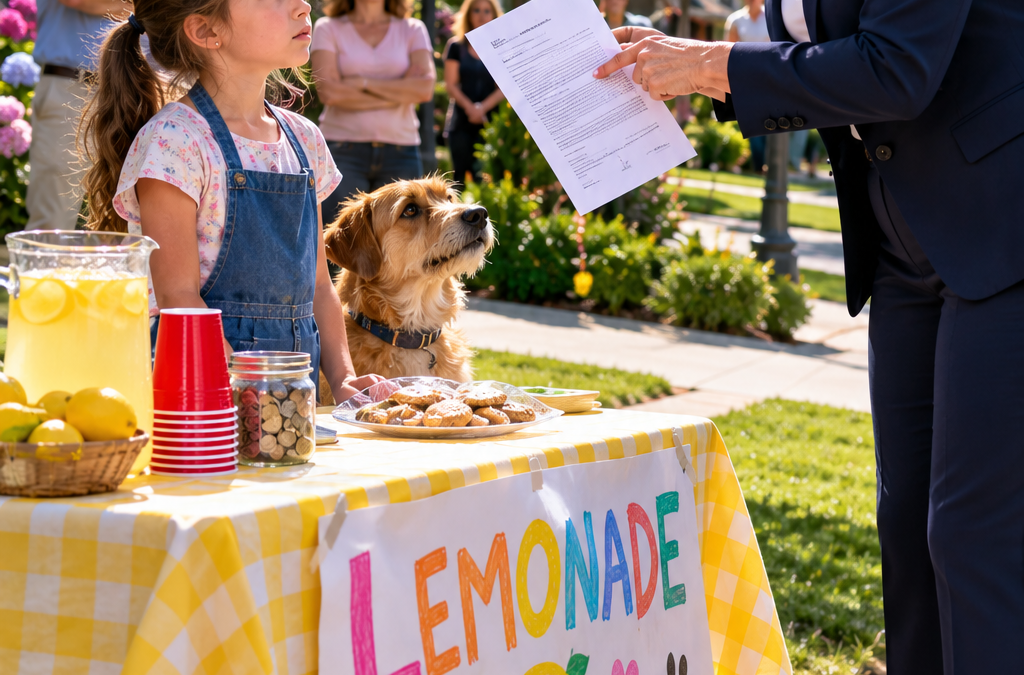
Maya taped her hand-painted sign to the front of the table.
Then she placed a glass jar beside it with a handwritten label:
BISCUIT FUND.
I took a picture.
I still have it.
Maya standing behind that table with both hands on her hips, looking like she owned a lemonade corporation.
There were maybe twenty cups stacked beside her.
A pitcher of lemonade.
A bowl of lemon slices she insisted made everything “more professional.”
She looked at me.
“Do I say something when people come?”
“You say hello.”
“Then what?”
“Ask if they want lemonade.”
“What if they say no?”
“Then you smile and say have a nice day.”
She considered that.
“Okay.”
Our first customer was Mr. Jensen from across the street.
He walked over holding a dollar.
“One lemonade, please.”
Maya immediately poured him a cup.
“Fifty cents.”
He handed her the dollar.
“You keep the change.”
Her eyes widened.
“Really?”
“Really.”
She put the bill in the jar.
Then she turned toward me after he walked away.
“He gave me double.”
“I saw.”
“Why?”
“Because he wants you to get Biscuit.”
That was all it took.
For the next two hours, Maya treated every approaching pedestrian like a major investor.
A woman walking her baby bought a cup.
Two teenagers on bicycles stopped.
The mailman bought two and drank one while standing beside his truck.
A jogger slowed down, read Maya’s sign, then pulled out his phone.
“Can I take your picture?”
Maya looked at me first.
I nodded.
He posted it in the Maplewood Terrace neighborhood Facebook group.
The caption said:
Best lemonade in town. Somebody help this kid get her dog.
That post changed everything.
People started arriving who hadn’t even been walking past.
Neighbors from the other side of Maplewood drove over.
Parents brought their kids.
One man handed Maya five dollars and refused the lemonade.
She chased him halfway down the sidewalk.
“You forgot your cups!”
He laughed.
“Put them toward Biscuit.”
By lunchtime, the money jar was almost full.
I helped Maya count it inside.
Twenty-seven dollars.
She screamed.
“Mom!”
“I know.”
“I’m almost there!”
By three o’clock, she had passed forty.
Roberto suggested she close up.
Maya refused.
“What if Biscuit needs a bed?”
That was how forty dollars became fifty.
Then fifty became sixty.
When we finally carried the table inside that evening, Maya sat cross-legged on the living room carpet and counted every dollar and coin twice.
Sixty-three dollars.
She looked stunned.
“I can get Biscuit.”
“Yes.”
“And a leash.”
“Probably.”
“And food.”
“We’ll handle the food.”
She looked down at the money.
Then she said, completely serious, “Maybe I can save for another dog.”
Roberto nearly choked on his coffee.
“One dog at a time, businesswoman.”
That night, Maya put the money in an envelope and wrote BISCUIT across the front.
She placed it under Captain, her stuffed bear, because apparently Captain was now security.
I went to bed thinking it had been one of those rare perfect parenting days.
Maya had worked.
The neighborhood had been kind.
She had reached her goal.
No one had been hurt.
No property damaged.
No traffic blocked.
No noise beyond a child saying, “Lemonade, fifty cents.”
It should have ended there.
Then Gerald Whitmore saw the Facebook post.
Gerald had been president of the Maplewood Terrace HOA board for six years.
Technically, he was a volunteer.
You would never have known that from the way he behaved.
Gerald was somewhere in his late fifties and wore collared polo shirts almost every day, usually tucked into khaki pants with a belt even when he was walking around the neighborhood on a Saturday.
He carried a clipboard.
He owned a tape measure that I had personally seen him use to check grass height.
Once, he sent a formal warning to the Carsons because their garden gnome was two inches taller than the dimensions listed in the decorative lawn ornament guidelines.
I wish I were exaggerating.
Two inches.
Nobody ran against Gerald for HOA president because nobody wanted to spend their evenings arguing about drainage easements and mailbox colors.
Gerald interpreted the absence of opposition differently.
He seemed to think repeated reelection meant the neighborhood had granted him a mandate.
Over time, his enforcement became more aggressive.
Garbage cans out too early.
Holiday lights left up three days too long.
A basketball hoop six inches outside its approved position.
A potted plant on the wrong portion of a front step.
Most people complained privately and paid whatever fine came with the notice because fighting Gerald meant attending meetings, writing letters, and listening to him explain “community standards” for twenty minutes.
I had never had a major issue with him.
Until Monday morning.
I opened our front door around seven-thirty and found a large white envelope wedged between the screen and the frame.
Maplewood Terrace Homeowners Association.
Official correspondence.
I assumed it was a meeting notice.
Then I read the first line.
CEASE AND DESIST NOTICE.
I stood there in my robe and slippers.
For a few seconds, I genuinely thought it had been delivered to the wrong house.
Then I saw our address.
I read farther.
The association had determined that an unauthorized commercial enterprise had been conducted from our residential property in violation of Section 4.7B of the Maplewood Terrace community guidelines.
Commercial enterprise.
I read those words twice.
The notice ordered us to immediately cease all future business activity from the property unless prior written approval was obtained from the board.
It warned that additional violations could result in fines.
At the bottom was Gerald Whitmore’s signature.
I heard Roberto in the kitchen.
“Diane?”
I didn’t answer.
He came into the hallway.
“What?”
I handed him the letter.
He read it.
Then he looked at me.
“What commercial enterprise?”
I didn’t say anything.
His eyes widened.
“No.”
I pointed toward the page.
He read it again.
“You have got to be kidding me.”
“I think he means the lemonade stand.”
“Our daughter’s lemonade stand?”
“Yes.”
“The eight-year-old?”
“Apparently.”
Roberto walked into the kitchen and read the notice a third time.
I followed him.
He put it on the counter.
“There has to be more to this.”
“There isn’t.”
“One afternoon?”
“Yes.”
“Fifty cents?”
“Yes.”
“She was raising money for a shelter dog.”
“I know.”
He rubbed both hands across his face.
“This man is insane.”
I was angry.
But anger was not the first thing I felt.
The first thing I felt was embarrassment.
Not for Maya.
For us.
For the adults.
Something about seeing official letterhead attached to a child’s lemonade stand made the entire neighborhood suddenly feel smaller.
Meaner.
Maya came down the stairs while Roberto and I were still standing in the kitchen.
She had Captain tucked under one arm.
“Can we go see Biscuit today?”
I folded the letter before she could read it.
“Maybe later.”
She noticed our faces.
“What happened?”
“Nothing.”
Kids always know when adults lie badly.
She looked at Roberto.
“Dad?”
He glanced at me.
I shook my head slightly.
There was no reason to put an HOA dispute on an eight-year-old before breakfast.
“Just grown-up stuff,” he said.
Maya sat down.
“Is Biscuit okay?”
“Yes.”
That was what she cared about.
Not the letter.
Not Section 4.7B.
Not Gerald.
Biscuit.
After she left for a friend’s house, I unfolded the notice again.
This time, the embarrassment was gone.
The anger stayed.
I took a picture of the letter.
Then I opened the neighborhood Facebook group.
I didn’t write a paragraph.
I didn’t insult Gerald.
I didn’t call anyone names.
I posted the photograph with one sentence.
The HOA sent a cease-and-desist to shut down our eight-year-old daughter’s lemonade stand. She was raising money to adopt a rescue dog.
Then I put my phone down.
Ten minutes later, it buzzed.
Then again.
Then continuously.
By the time I picked it up, there were more than forty comments.
An hour later, there were over a hundred.
By lunch, more than three hundred.
I expected people to laugh.
They didn’t.
They were furious.
Mrs. Nolan from the next cul-de-sac wrote that Gerald had fined her sixty dollars for putting her garbage cans outside two hours early before leaving town for her sister’s funeral.
Someone else said Gerald threatened to report a potted plant to county code enforcement.
Another neighbor posted a photograph of a warning he had received because his daughter’s bicycle had been visible from the street overnight.
People started coming to our house.
Not for lemonade.
The table was folded in the garage.
They came because the notice had apparently broken something open.
Mrs. Nolan stood in our yard with her arms crossed.
“This has gone too far.”
Roberto nodded.
“I think it went too far a while ago.”
“People keep paying him because nobody wants trouble.”
That sentence stayed with me.
Nobody wants trouble.
It was exactly how Gerald had survived six years.
Then someone posted a photograph in the Facebook comments.
At first I didn’t understand why.
It showed a white pickup parked three houses down from us.
Large black vinyl letters covered the side.
KYLE’S PRESSURE WASHING.
CALL FOR RATES.
The person who posted it wrote:
If Maya’s lemonade stand is a commercial business, what about this?
I knew the truck.
Everyone did.
Kyle had been running his pressure-washing business from his home for at least two years.
Customers called him.
He stored equipment in his garage.
The truck advertised the business.
Invoices listed his Maplewood Terrace address.
None of that had ever bothered me.
Why would it?
He wasn’t hurting anybody.
Then somebody added another comment.
Kyle is Gerald’s nephew.
I sat at the kitchen table staring at those words.
Roberto leaned over my shoulder.
“No way.”
“I knew they had the same last name.”
“I didn’t realize that was the Kyle.”
Neither had I.
The anger changed again.
A ridiculous rule applied equally is still ridiculous.
A ridiculous rule applied selectively becomes something else.
I opened the Maplewood Terrace website.
Board minutes were posted publicly.
I started reading.
Eighteen months.
Meeting after meeting.
Violations.
Architectural approvals.
Parking complaints.
Landscaping disputes.
Not once did Kyle’s business appear.
Not once.
I searched his name.
Nothing.
I searched “pressure washing.”
Nothing.
“Commercial enterprise.”
There were references to two residents who had been warned about home-based businesses.
Still nothing about Kyle.
I took screenshots.
Then I searched the state business registry.
Kyle’s pressure-washing company was registered.
Operating address:
His Maplewood Terrace home.
I printed it.
By the time Roberto came into the dining room that night, the table was covered with papers.
He looked at me.
“I know that look.”
“What look?”
“The one you get when somebody has annoyed you past the point of being reasonable.”
“I am being extremely reasonable.”
“That is the dangerous version.”
I held up Gerald’s notice.
“He wants to use Section 4.7B?”
Roberto sat across from me.
“Okay.”
“Then he gets Section 4.7B.”
I wasn’t trying to destroy Gerald.
I wasn’t even thinking about removing him from the board.
At that point, I wanted one thing.
Fairness.
If our daughter could be threatened over a lemonade stand, Gerald didn’t get to ignore a permanent business being run by his own nephew.
The next morning, I filed a complaint with the state body overseeing HOA regulatory matters.
I attached everything.
Gerald’s notice.
The Facebook photograph.
Kyle’s state business registration.
The HOA meeting minutes.
I described the issue as selective enforcement.
Then I called Channel 7.
I almost hung up before anyone answered.
I am not somebody who normally calls television reporters.
But I kept seeing Maya at that table.
Eight years old.
Counting quarters.
Trying to adopt a dog.
And I kept seeing Gerald’s signature under the words CEASE AND DESIST.
A reporter named Hannah Lee called me back.
“Mrs. Castillano?”
“Yes.”
“Did the HOA really send a cease-and-desist over lemonade?”
“I have the letter.”
“Can I see it?”
I emailed it.
She called back six minutes later.
“Can we come tomorrow?”
That was when I hesitated.
Media attention is permanent in a way neighborhood arguments aren’t.
I talked to Roberto.
Then we talked to Maya.
We explained that a reporter wanted to talk about her lemonade stand.
Maya looked worried.
“Am I in trouble?”
My chest tightened.
“No.”
“Because of the lemonade?”
“No, sweetheart.”
“Then why did that man send the letter?”
I didn’t know how to answer without giving an eight-year-old a lesson in petty authority.
So I told her the simplest truth.
“Sometimes adults make rules feel bigger than they are.”
She thought about that.
“Can I still get Biscuit?”
“Yes.”
Her entire face changed.
“Then okay.”
The Channel 7 crew arrived the next afternoon.
Maya wore a yellow sundress because she insisted Biscuit would “like yellow.”
We set the table up again.
Not to sell.
For the camera.
Her hand-painted sign leaned against the front.
The reporter crouched beside her.
“Why did you start the lemonade stand?”
Maya looked directly at her.
“For Biscuit.”
“Who’s Biscuit?”
“A dog at the shelter.”
“Why do you want him?”
Maya’s expression became very serious.
“Because he looks lonely.”
That sentence went on television.
I watched the segment from our couch that evening.
They showed Maya.
The sign.
The HOA letter.
The words CEASE AND DESIST enlarged on screen.
Then they showed the pressure-washing truck.
The reporter explained that the business belonged to Gerald Whitmore’s nephew and that public HOA records did not appear to show similar enforcement against him.
Gerald declined an on-camera interview.
By midnight, the segment had been shared tens of thousands of times.
Forty thousand was the number Hannah later gave me.
The next morning, I looked through the front window and thought something had happened.
Cars lined both sides of the street.
Roberto came up behind me.
“What is that?”
I looked at my phone.
Messages.
People asking whether Maya was selling lemonade.
“Oh, no.”
“What?”
“They’re here for her.”
Maya heard us.
“For me?”
Within an hour, the folding table was back on the sidewalk.
This time there was a line.
People had driven from neighboring towns.
One woman came from almost an hour away.
A grocery store manager arrived with three cases of lemons.
“We heard you might need supplies.”
Maya stared at the boxes.
“All of those?”
“All yours.”
“That’s a lot of lemonade.”
He laughed.
“Sounds like you’re busy.”
The first day had been sweet.
This was overwhelming.
People handed Maya five-dollar bills.
Ten-dollar bills.
Twenty.
A woman gave her an envelope and told her not to open it until later.
Inside was a fifty-dollar check.
The note said:
Buy Biscuit. Give the rest to the shelter.
By the end of the week, Maya had raised more than two thousand dollars.
She had trouble understanding the number.
“Is that enough for Biscuit?”
“Yes.”
“How many Biscuits?”
Roberto laughed.
“We are not measuring money in dogs.”
“But how many?”
“A lot.”
Her eyes widened.
“Can we help the shelter?”
That was Maya.
Gerald was dealing with regulatory complaints and television cameras.
My daughter was worrying whether the other dogs had enough blankets.
Then the HOA email arrived.
Gerald had written it.
He called the Channel 7 segment “misleading.”
He accused the media of sensationalizing a routine enforcement matter.
He insisted Maplewood Terrace applied its standards equally to all residents.
He said no child had been targeted.
I read that line several times.
No child had been targeted.
His signature was on the notice sent because of my child’s table.
But apparently if he described the target as “property activity,” it stopped being a little girl.
Gerald’s statement might have ended the story if he had simply apologized.
Instead, it made people angrier.
And anger made them curious.
That was Gerald’s real mistake.
Before the lemonade stand, most residents treated HOA paperwork like background noise.
After Gerald publicly claimed that the board enforced everything equally, people decided to check.
Not just the violation rules.
Everything.
Meeting minutes.
Budgets.
Vendor agreements.
Invoices.
Reserve balances.
Financial disclosures.
For years, Gerald had relied on residents being too busy to look closely.
Now dozens of them were looking.
Three neighbors who worked in accounting began reviewing the financial reports.
One evening, Mrs. Patel knocked on our door carrying a binder.
“You need to see something.”
I invited her in.
She spread several pages across our kitchen table.
“Do you know Bright Green Landscape Services?”
I shook my head.
“They have a contract with the HOA.”
“How much?”
“A little over eight thousand dollars annually.”
“That doesn’t sound huge.”
“It isn’t.”
She tapped the page.
“But I can’t verify the company.”
She had searched for a website.
Nothing.
State registration.
Nothing obvious matching the business details in the contract.
Business address.
None listed.
The phone number went directly to voicemail.
She showed me the payment records.
“There are also inconsistencies.”
“What kind?”
“The amounts leaving the HOA accounts don’t line up neatly with the landscaping expenses disclosed in the annual reports.”
“How far back?”
“At least four years.”
My stomach dropped.
“Are you saying Gerald stole money?”
She immediately shook her head.
“I’m saying the numbers don’t reconcile.”
That distinction mattered.
I respected her for making it.
“What now?”
“An audit.”
The accounting group submitted a formal request to the state.
Within seventy-two hours, a forensic audit was approved.
I remember sitting at our kitchen table after hearing the news.
Roberto looked at me.
“All because of lemonade.”
“No.”
He raised an eyebrow.
“No?”
“The lemonade made people look.”
There was a difference.
Maya hadn’t caused whatever was hiding in the financial records.
Gerald had.
The lemonade stand merely turned on the light.
Gerald reacted the way he reacted to everything.
By escalating.
He called an emergency board meeting.
The stated purpose was to censure me.
Me.
Not the questionable finances.
Not the selective enforcement complaint.
Not the shell-looking landscaping company.
Me.
According to the agenda, I had engaged in “targeted harassment of HOA leadership” and caused reputational damage to the association.
When I read that language, I felt my hands start shaking.
Not from fear.
From disbelief.
He had threatened my daughter’s lemonade stand.
Ignored his nephew’s business.
Defended himself on television.
Residents had independently discovered financial discrepancies.
And now I was the problem.
Roberto took the agenda from me.
“You don’t have to go.”
“Yes, I do.”
“Diane.”
“If I don’t go, he gets to describe me however he wants without me sitting there.”
“You think he’ll listen?”
“No.”
“Then why?”
“Because everyone else will.”
The community room could hold maybe seventy people comfortably.
When we arrived, every chair was occupied.
People stood along the back wall.
More filled the hallway.
Gerald sat behind the board table in a navy polo shirt.
His face was tight.
His papers were arranged in perfect stacks.
The gavel sat beside his right hand.
He looked at the crowd, and for the first time since I had known him, he seemed uncertain.
I found a seat near the front.
Then Mrs. Patel leaned toward me.
“Back row.”
“What?”
She nodded subtly.
A woman in a dark jacket sat against the wall holding a notepad.
“State investigator.”
My heartbeat changed.
Gerald tapped the gavel.
“I’d like to call this emergency meeting—”
“Point of order.”
The voice came from Patricia Bell.
Patricia had served on the board for three years.
Quietly.
I had probably heard her speak fewer than ten times.
Gerald frowned.
“I haven’t called the meeting to order yet.”
Patricia stood.
“Then call it to order.”
People shifted.
Gerald’s face reddened.
He struck the gavel once.
“This meeting is now called to order.”
Patricia immediately raised her hand.
“I move that the pending financial audit and discrepancies identified in vendor expenditures be added as the first item of business.”
Gerald stared at her.
“That is not on tonight’s agenda.”
“I am moving to amend the agenda.”
“This meeting was called for a disciplinary matter.”
A second board member spoke.
“I second Patricia’s motion.”
Gerald hadn’t even finished objecting.
The room erupted in murmurs.
Gerald hit the gavel.
“Order.”
Patricia remained standing.
“We have a state-approved forensic audit concerning association funds. That takes precedence over censuring a homeowner for talking to the media.”
Applause broke out.
Gerald struck the gavel harder.
“If people cannot maintain decorum, I will clear the room.”
Someone behind me said, loudly enough for everyone to hear, “Try it.”
More laughter.
Gerald looked toward the back.
That was when he noticed the investigator.
I saw the exact second it happened.
His eyes stopped.
His mouth tightened.
He looked back down at the agenda.
“The chair objects to the amendment.”
Patricia’s voice remained calm.
“Then call the vote.”
The motion passed.
Gerald lost control of the meeting before the censure discussion even began.
Mrs. Patel presented the accounting discrepancies.
She did not accuse anyone of theft.
She didn’t need to.
She showed the numbers.
Contract amount.
Payments.
Reported expenditures.
Missing supporting records.
Questions.
Gerald interrupted repeatedly.
“That invoice is probably archived.”
“That isn’t evidence of wrongdoing.”
“The management company handled payments.”
“This discussion is premature.”
Patricia finally said, “Gerald, nobody said the word wrongdoing except you.”
The room went silent.
He looked at her.
She continued.
“We’re asking for records.”
That sentence reminded me of the lemonade notice.
The rule.
The minutes.
The nephew’s business.
Everything changed when somebody stopped accepting Gerald’s answer and asked to see the record.
Another board member asked whether Gerald had participated in approving the landscaping vendor.
“Yes,” he said.
“Did you verify the company?”
“The board doesn’t personally investigate every contractor.”
“Who recommended them?”
Gerald hesitated.
“I don’t recall.”
Mrs. Patel spoke from the audience.
“The original approval form has your initials beside the recommendation.”
Gerald turned toward her.
“This is exactly the harassment I’m talking about.”
She didn’t flinch.
“It’s your initial.”
He looked toward the board.
“I will not allow residents to conduct a witch hunt.”
Patricia stared at him.
“Then give the auditor everything and let the audit clear it up.”
That should have been easy.
Instead, Gerald grew angrier.
He accused residents of trying to destroy the association.
He accused me of manipulating the media.
He said Maya’s lemonade stand had been used as a “prop.”
That was the moment Roberto stood.
I grabbed his arm.
He looked down at me.
“Don’t.”
“He doesn’t get to say that.”
“Let him.”
Gerald had already done more damage to himself than anything Roberto could say.
The board recessed for twenty minutes.
When they returned, Patricia made another motion.
Gerald’s removal as board president and director.
His face changed.
“You cannot be serious.”
“I am.”
“For what cause?”
“Loss of confidence, selective enforcement concerns, refusal to cooperate transparently with financial review, and conduct damaging to the association.”
Gerald leaned back.
“This is retaliation.”
Patricia shook her head.
“No, Gerald. This is governance.”
The vote was seven to one.
Seven to remove him.
One to keep him.
His own.
I expected to feel triumphant.
I didn’t.
Mostly I felt exhausted.
Gerald sat there after the vote staring down at the table.
For six years, nobody had challenged him seriously.
He had mistaken avoidance for loyalty.
Silence for approval.
No competition for a mandate.
Now seven people he had worked beside had voted him out.
He gathered his papers.
Nobody clapped.
I was glad.
It would have made the moment feel cruel.
We didn’t need cruelty.
We needed him gone.
The forensic audit took three more weeks.
Those weeks were strangely quiet.
Maya had no idea what most of it meant.
She asked about Biscuit every morning.
“Can we get him yet?”
The shelter had agreed to hold him once they heard the story, though Maya didn’t know that.
I wanted her adoption day to feel like hers.
Not Gerald’s.
Not the HOA’s.
Hers.
Then the audit findings came.
More than twenty-two thousand dollars in HOA dues had been misappropriated across four years.
Payments were traced through the same landscaping company residents had questioned.
The company had functioned as a shell.
The full legal consequences went beyond anything I had imagined when I posted that first photograph.
Gerald had already been removed from the board.
Before formal charges were filed, he submitted his resignation anyway, as though putting the word resignation on paper could create distance between himself and what the audit had uncovered.
It did not help much.
Lawyers became involved.
Investigators took over.
And I stopped following every detail.
At some point, I realized Gerald had occupied enough space in our lives.
Maya deserved the ending she had wanted before any of us knew his name would become part of the story.
The following Saturday, we drove to the Maplewood Animal Shelter.
Maya wore the same yellow sundress she had worn for Channel 7.
In one hand, she carried Captain.
In the other, she carried an envelope.
Across the front she had written:
I SAVED UP.
The shelter director recognized us immediately.
“Maya?”
Maya nodded.
“I’m here for Biscuit.”
The woman smiled.
“I think Biscuit has been waiting for you.”
They brought him out on a blue leash.
The second he saw Maya, his entire body started moving.
Not just his tail.
His whole body.
He pulled the volunteer across the floor.
Maya dropped to her knees.
Biscuit jumped into her arms.
She laughed so hard she started crying.
Then I started crying.
Roberto pretended he had something in his eye.
“I knew he remembered me,” Maya said.
Biscuit licked her face.
“I knew it.”
She handed the shelter director her adoption money.
Then she handed her another envelope.
“What is this?”
“For the other dogs.”
The woman opened it.
Six hundred dollars.
Her eyes widened.
“Maya, sweetheart, this is a lot of money.”
“I know.”
“You don’t have to give us this much.”
Maya looked around at the kennels.
“I only need one dog.”
That did it.
The shelter director cried.
I cried again.
Even Roberto stopped pretending.
Maya kept enough money for Biscuit’s supplies.
The rest of what she had raised was handled carefully with us, because two thousand dollars is a lot of money for a child who still believes quarters are treasure.
But the six hundred dollars was her decision.
She wanted Biscuit’s good day to help the dogs who weren’t leaving yet.
On the drive home, Biscuit sat beside Maya in the back seat.
His head rested on her lap.
She kept one hand on his back the entire way.
At one point, she looked toward the front.
“Mom?”
“Yeah?”
“Was the lemonade stand bad?”
I looked at Roberto.
Then at her in the mirror.
“No.”
“Then why did Mr. Whitmore want me to stop?”
There are moments as a parent when you know your answer will become part of how your child understands the world.
I didn’t want to tell her adults were corrupt.
I didn’t want to tell her rules were meaningless.
Neither was true.
So I chose carefully.
“Rules can be important,” I said. “But people have to use them fairly.”
She stroked Biscuit’s ear.
“He wasn’t fair?”
“No.”
She thought about that.
“Is that why he isn’t president anymore?”
“Partly.”
“Because of me?”
My heart tightened.
“No.”
I turned in my seat.
“Listen to me, Maya. You didn’t make anybody do anything wrong.”
She watched me.
“You sold lemonade.”
“That’s all?”
“That’s all.”
She looked relieved.
Then she smiled.
“And I got Biscuit.”
“Yes.”
That was the part of the story I wanted her to keep.
The new Maplewood Terrace board held its first official meeting not long afterward.
I almost didn’t attend.
I was tired of meetings.
Tired of agendas.
Tired of hearing Section 4.7B discussed like it belonged in constitutional law.
But Patricia called me personally.
“Come for the first ten minutes.”
“Why?”
“You’ll see.”
So Roberto, Maya, Biscuit, and I walked over.
Yes, Biscuit came too.
No one objected.
The room looked different without Gerald at the center.
Not physically.
Same table.
Same chairs.
Same ugly fluorescent lights.
But Patricia didn’t sit like she owned the place.
That mattered.
She opened the meeting.
The first motion was not about landscaping.
Not about budgets.
Not about violations.
It was a proposal to designate a small section of the community common area near the playground as Maplewood Kids Corner.
Children in the neighborhood could set up lemonade stands, sell handmade artwork, cookies, bracelets, or other small kid-run projects on Saturdays.
No HOA permit.
No commercial enterprise citation.
No application fee.
No board approval.
Just a few basic safety rules and parental supervision.
Patricia looked toward Maya.
“All in favor?”
Every hand went up.
Maya whispered to me.
“Can I sell lemonade there?”
I smiled.
“If you want.”
“For what?”
I looked at Biscuit lying under her chair.
“I think that’s your decision.”
She thought for a second.
“Maybe for the shelter.”
Of course.
Months passed.
Life in Maplewood Terrace slowly became ordinary again.
That might have been the best outcome of all.
Garbage cans went out.
Kids left bicycles in driveways.
People argued occasionally about parking.
The new board enforced actual rules when necessary.
Nobody carried a tape measure looking for conflict.
Kyle eventually moved his pressure-washing operation to a small commercial space.
As far as I know, he was never blamed for Gerald’s decisions.
He shouldn’t have been.
Whatever favoritism existed had been Gerald’s responsibility.
The landscaping contracts were replaced.
Financial reporting became more transparent.
Residents started attending meetings.
For the first time, people asked questions before problems became crises.
That change mattered more than anything dramatic.
Gerald’s real advantage had never been his title.
It was everyone’s exhaustion.
People had jobs.
Children.
Mortgages.
Parents to care for.
Dinners to make.
They didn’t want to spend Tuesday nights challenging a sixty-dollar trash-can fine.
So they paid.
They complained privately.
They moved on.
Every time they did, Gerald learned the same lesson.
Push hard enough and people give up.
Then he applied that lesson to the wrong person.
Not me.
Maya.
That was what he never understood.
Adults will tolerate a surprising amount of nonsense directed at themselves.
We negotiate.
We rationalize.
We tell ourselves fighting isn’t worth it.
But put official letterhead on an eight-year-old girl’s lemonade stand because she is trying to rescue a dog, and suddenly everyone sees the absurdity clearly.
Gerald believed he was enforcing one more rule.
The neighborhood saw a grown man using institutional power against a child who had earned sixty-three dollars fifty cents at a time.
Once people saw that, they started asking what else they had been accepting without looking.
That question uncovered Kyle’s exemption.
Kyle’s exemption raised questions about selective enforcement.
Selective enforcement made people read the records.
Reading the records exposed the landscaping contract.
The contract exposed the missing money.
None of that was part of a plan.
I didn’t wake up Monday morning intending to remove an HOA president.
Maya certainly didn’t.
She woke up Saturday intending to buy a dog.
Sometimes I think that is what bothered Gerald most.
He could understand opposition.
He could fight another board candidate.
He could argue with an angry homeowner.
He knew how to use procedure against people who challenged him directly.
What he did not know how to handle was innocence.
Maya had no political agenda.
No grievance.
No interest in HOA power.
She didn’t know what a cease-and-desist was.
She didn’t know what selective enforcement meant.
She barely understood why adults were suddenly standing in our yard angry on her behalf.
She just wanted Biscuit.
That made Gerald’s behavior impossible to dress up.
Years later, I suspect that is the image people will remember.
Not the audit.
Not the seven-to-one vote.
Not the twenty-two thousand dollars.
A yellow dress.
A folding table.
A glass pitcher.
A hand-painted orange sign.
A little girl asking fifty cents for lemonade because somewhere a scruffy terrier was waiting behind a kennel door.
For a long time, I kept Gerald’s cease-and-desist notice in a folder with our house papers.
I don’t know why.
Maybe I wanted proof it had actually happened.
One afternoon, Maya found it.
She was sitting at the kitchen table doing homework when she opened the folder.
“Mom?”
“Yeah?”
“What does cease and desist mean?”
I looked over.
She was holding Gerald’s letter.
I sat beside her.
“It means somebody is formally telling you to stop doing something.”
She studied the page.
“This was about my lemonade?”
“Yes.”
She laughed.
Not bitterly.
Genuinely laughed.
“That’s silly.”
I smiled.
“Yes.”
Then she handed me the paper and went back to her math homework.
That moment stayed with me.
Adults had spent months turning that letter into evidence, arguments, regulatory complaints, news segments, board motions, and investigations.
Maya saw it for what it had always been.
Silly.
A grown man had looked at a child’s lemonade stand and decided he needed to exert authority over it.
Everything that came afterward grew from his inability to leave something harmless alone.
That is the part I still think about.
Gerald was not exposed because somebody launched an investigation into him.
He exposed himself because power had become such a habit that he no longer recognized when using it made no sense.
He could have ignored the lemonade stand.
He could have smiled at Maya.
He could have bought a cup.
He could have given her a dollar and told her to keep the change.
He could have gone home and forgotten about it.
Instead, he reached for official letterhead.
He cited a rule.
He signed his name.
And because of that, people finally looked at everything else carrying his signature.
Maya never understood how close Gerald came to getting exactly what he wanted.
If I had quietly folded the table away, nothing else might have happened.
If I had thrown the notice into a drawer, Kyle’s business might never have been discussed.
If the Facebook post had received ten comments instead of three hundred, Channel 7 might never have called.
If Gerald had apologized when the story aired, maybe residents would have moved on.
At every step, he had an opportunity to make the problem smaller.
At every step, he made himself bigger instead.
That was his undoing.
Not Maya.
Not me.
Not Patricia.
Not the reporter.
Gerald.
A person can survive one bad decision.
Sometimes several.
What becomes dangerous is the belief that you cannot be wrong.
Because once someone believes that, every challenge becomes an enemy.
Every question becomes harassment.
Every request for accountability becomes disrespect.
That was how an eight-year-old selling lemonade became, in Gerald’s mind, a commercial violation.
That was how a mother asking why his nephew’s business received different treatment became harassment.
That was how residents asking where their dues went became a threat to leadership.
By the time Gerald lost his board seat, he was not protecting Maplewood Terrace.
He was protecting himself from Maplewood Terrace.
There is a difference.
Biscuit is asleep beside my feet as I think about it now.
He grew into a slightly larger scruffy dog but never became particularly graceful.
One ear still stands up.
The other still doesn’t.
He follows Maya everywhere.
For the first month, he slept outside her bedroom door even though she kept trying to convince us he needed to sleep in her bed.
Eventually, we lost that argument.
On summer Saturdays, Maya still occasionally sets up a table at Maplewood Kids Corner.
Sometimes lemonade.
Sometimes friendship bracelets.
Once she sold painted rocks, though I remain convinced most customers were paying because they remembered the story.
She still gives part of what she earns to the shelter.
Not because anybody tells her to.
Because when she thinks about Biscuit, she remembers the dogs who stayed behind.
That is the legacy I prefer.
Not Gerald losing his position.
Not the investigation.
Not even the money being uncovered.
A little girl learned that her neighborhood would show up for her.
She learned that asking for fairness matters.
She learned that rules are not automatically right simply because an adult prints them on official paper.
Most importantly, she learned that the original reason she set up that table still mattered after all the noise was gone.
Biscuit needed a home.
She gave him one.
And whenever I pass the common area and see another child sitting behind a folding table with cupcakes or drawings or homemade bracelets spread in front of them, I think about how close Gerald came to turning Maplewood Terrace into the kind of neighborhood where children learned that asking permission was more important than trying something good.
Instead, he accidentally created the opposite.
The new sign near the playground is small.
MAPLEWOOD KIDS CORNER.
There are no legal citations underneath.
No permit instructions.
No warning language.
Just a place for children to try.
Sometimes that is how communities change.
Not through enormous acts.
Through one moment that makes everybody finally ask whether the thing they have been tolerating deserves to continue.
For us, it was fifty-cent lemonade.
For Maya, it was always Biscuit.
And for Gerald Whitmore, it was the smallest rule he ever tried to enforce that finally made everyone look at the much bigger things he had hoped they would never notice.
𝗧𝗛𝗘 𝗘𝗡𝗗
The HOA President Served My 8-Year-Old Daughter a Cease-and-Desist Over a 50-Cent Lemonade Stand
My eight-year-old daughter spent a sunny Saturday selling fifty-cent cups of lemonade because she wanted to rescue a dog nobody else had chosen. Forty-eight hours later, the president of our HOA put a legal notice on our front door and treated her folding table like a threat to the entire neighborhood.
My name is Diane Castillano, and before that summer, I genuinely believed Maplewood Terrace was a good place to raise a child.
It looked like one.
That was part of the problem.
Maplewood Terrace was the kind of neighborhood real estate agents photographed in late afternoon when every lawn looked greener than it really was. The streets curved gently around cul-de-sacs. Most of the mailboxes matched. There were basketball hoops over driveways, bicycles lying in yards, sprinklers clicking across trimmed grass, and enough children running around after dinner that you could still hear someone yell, “Come home before it gets dark,” from three houses away.
It wasn’t luxurious.
It was comfortable.
Predictable.
Safe.
My husband, Roberto, and I had bought our house there because we wanted our daughter Maya to grow up somewhere she could ride her bike without us watching every second.
Maya was eight years old that summer.
Third grade.
Gap-toothed smile.
Dark hair she hated keeping tied back.
A stuffed bear named Captain she’d owned since she was three and absolutely refused to admit she had outgrown.
She had the kind of heart that made ordinary errands take twice as long because she needed to stop for every injured bird, lost cat poster, and dog tied outside a coffee shop.
If an ant was in the kitchen, Maya didn’t want it killed.
She wanted it “relocated.”
If a spider appeared in the bathtub, she would stand guard over it until Roberto carried it outside in a glass.
So I probably should not have been surprised when she fell in love with Biscuit.
Biscuit was a scruffy terrier mix at the Maplewood Animal Shelter.
Brown and white.
One ear stood straight up.
The other folded halfway over like it had changed its mind.
We met him during a shelter open house in June.
Maya had begged me for months to let her get a dog.
Roberto and I weren’t opposed.
We just wanted her to understand that wanting a dog and being responsible for one were different things.
So we had made a list.
Feed him.
Walk him.
Help clean up after him.
Save some money toward his adoption.
The last part had been Roberto’s idea.
Not because we needed Maya to pay.
We didn’t.
He wanted her to understand that taking responsibility for something you love usually costs something—time, work, patience, money.
The shelter’s adoption fee for Biscuit was forty dollars.
To an adult, forty dollars is a tank of gas or dinner for two people if you’re careful.
To an eight-year-old, forty dollars might as well be a mortgage.
Maya stood in front of Biscuit’s kennel with both hands wrapped around the chain-link door.
“He likes me.”
Biscuit was sitting with his nose pushed through the opening.
“I think he does,” I said.
“What if somebody adopts him before me?”
That question nearly broke me.
I crouched beside her.
“Then that means Biscuit found a home.”
“But I want to be his home.”
I looked at Roberto.
He looked away because he knew exactly what I was thinking.
We could have paid forty dollars right then.
We could have taken Biscuit home that afternoon.
But Maya had been so proud of the idea that she would contribute.
We didn’t want to take that away from her.
“How much have you saved?” Roberto asked.
Maya dug into the little purple wallet she carried everywhere.
She counted carefully.
“Seven dollars and thirty-five cents.”
Roberto nodded like she had announced a business acquisition.
“So you need a plan.”
She thought about it all the way home.
That night, she came into the kitchen carrying a sheet of construction paper.
In giant orange letters, she had written:
MAYA’S LEMONADE
50 CENTS A CUP
HELP ME ADOPT BISCUIT
There was a badly drawn dog underneath the words.
I stared at it.
She stared at me.
“Can I?”
“You want to sell lemonade?”
“Yes.”
“In front of the house?”
“Yes.”
“How much lemonade?”
She spread her hands.
“A lot.”
Roberto was sitting at the kitchen table.
He lowered the newspaper.
“I respect the business plan.”
She turned toward him.
“Dad.”
“What?”
“I’m serious.”
“So am I.”
He looked at me.
I tried not to laugh.
“When?” I asked.
“Saturday.”
“What if nobody buys any?”
Maya looked genuinely confused by the possibility.
“They’ll buy it because it’s for Biscuit.”
There was absolute confidence in her voice.
At eight, the world still made sense like that.
People would help because the reason was good.
I wish I could have kept that certainty intact forever.
Saturday morning, she woke us before seven.
I found her already dressed in shorts and a yellow T-shirt, standing beside three bags of lemons she had convinced Roberto to buy the night before.
“We have to start squeezing.”
“Maya, it’s seven in the morning.”
“People get thirsty early.”
I looked at my husband.
“This is your entrepreneur.”
He pointed at me.
“She gets this from your side.”
By eight-thirty, the kitchen smelled like lemons and sugar.
Maya squeezed until her hands hurt.
I finished what she couldn’t.
Roberto found our folding card table in the garage and carried it to the sidewalk.
He ran an extension cord from the house for a little fan because the forecast called for temperatures in the high eighties.
Maya taped her hand-painted sign to the front of the table.
Then she placed a glass jar beside it with a handwritten label:
BISCUIT FUND.
I took a picture.
I still have it.
Maya standing behind that table with both hands on her hips, looking like she owned a lemonade corporation.
There were maybe twenty cups stacked beside her.
A pitcher of lemonade.
A bowl of lemon slices she insisted made everything “more professional.”
She looked at me.
“Do I say something when people come?”
“You say hello.”
“Then what?”
“Ask if they want lemonade.”
“What if they say no?”
“Then you smile and say have a nice day.”
She considered that.
“Okay.”
Our first customer was Mr. Jensen from across the street.
He walked over holding a dollar.
“One lemonade, please.”
Maya immediately poured him a cup.
“Fifty cents.”
He handed her the dollar.
“You keep the change.”
Her eyes widened.
“Really?”
“Really.”
She put the bill in the jar.
Then she turned toward me after he walked away.
“He gave me double.”
“I saw.”
“Why?”
“Because he wants you to get Biscuit.”
That was all it took.
For the next two hours, Maya treated every approaching pedestrian like a major investor.
A woman walking her baby bought a cup.
Two teenagers on bicycles stopped.
The mailman bought two and drank one while standing beside his truck.
A jogger slowed down, read Maya’s sign, then pulled out his phone.
“Can I take your picture?”
Maya looked at me first.
I nodded.
He posted it in the Maplewood Terrace neighborhood Facebook group.
The caption said:
Best lemonade in town. Somebody help this kid get her dog.
That post changed everything.
People started arriving who hadn’t even been walking past.
Neighbors from the other side of Maplewood drove over.
Parents brought their kids.
One man handed Maya five dollars and refused the lemonade.
She chased him halfway down the sidewalk.
“You forgot your cups!”
He laughed.
“Put them toward Biscuit.”
By lunchtime, the money jar was almost full.
I helped Maya count it inside.
Twenty-seven dollars.
She screamed.
“Mom!”
“I know.”
“I’m almost there!”
By three o’clock, she had passed forty.
Roberto suggested she close up.
Maya refused.
“What if Biscuit needs a bed?”
That was how forty dollars became fifty.
Then fifty became sixty.
When we finally carried the table inside that evening, Maya sat cross-legged on the living room carpet and counted every dollar and coin twice.
Sixty-three dollars.
She looked stunned.
“I can get Biscuit.”
“Yes.”
“And a leash.”
“Probably.”
“And food.”
“We’ll handle the food.”
She looked down at the money.
Then she said, completely serious, “Maybe I can save for another dog.”
Roberto nearly choked on his coffee.
“One dog at a time, businesswoman.”
That night, Maya put the money in an envelope and wrote BISCUIT across the front.
She placed it under Captain, her stuffed bear, because apparently Captain was now security.
I went to bed thinking it had been one of those rare perfect parenting days.
Maya had worked.
The neighborhood had been kind.
She had reached her goal.
No one had been hurt.
No property damaged.
No traffic blocked.
No noise beyond a child saying, “Lemonade, fifty cents.”
It should have ended there.
Then Gerald Whitmore saw the Facebook post.
Gerald had been president of the Maplewood Terrace HOA board for six years.
Technically, he was a volunteer.
You would never have known that from the way he behaved.
Gerald was somewhere in his late fifties and wore collared polo shirts almost every day, usually tucked into khaki pants with a belt even when he was walking around the neighborhood on a Saturday.
He carried a clipboard.
He owned a tape measure that I had personally seen him use to check grass height.
Once, he sent a formal warning to the Carsons because their garden gnome was two inches taller than the dimensions listed in the decorative lawn ornament guidelines.
I wish I were exaggerating.
Two inches.
Nobody ran against Gerald for HOA president because nobody wanted to spend their evenings arguing about drainage easements and mailbox colors.
Gerald interpreted the absence of opposition differently.
He seemed to think repeated reelection meant the neighborhood had granted him a mandate.
Over time, his enforcement became more aggressive.
Garbage cans out too early.
Holiday lights left up three days too long.
A basketball hoop six inches outside its approved position.
A potted plant on the wrong portion of a front step.
Most people complained privately and paid whatever fine came with the notice because fighting Gerald meant attending meetings, writing letters, and listening to him explain “community standards” for twenty minutes.
I had never had a major issue with him.
Until Monday morning.
I opened our front door around seven-thirty and found a large white envelope wedged between the screen and the frame.
Maplewood Terrace Homeowners Association.
Official correspondence.
I assumed it was a meeting notice.
Then I read the first line.
CEASE AND DESIST NOTICE.
I stood there in my robe and slippers.
For a few seconds, I genuinely thought it had been delivered to the wrong house.
Then I saw our address.
I read farther.
The association had determined that an unauthorized commercial enterprise had been conducted from our residential property in violation of Section 4.7B of the Maplewood Terrace community guidelines.
Commercial enterprise.
I read those words twice.
The notice ordered us to immediately cease all future business activity from the property unless prior written approval was obtained from the board.
It warned that additional violations could result in fines.
At the bottom was Gerald Whitmore’s signature.
I heard Roberto in the kitchen.
“Diane?”
I didn’t answer.
He came into the hallway.
“What?”
I handed him the letter.
He read it.
Then he looked at me.
“What commercial enterprise?”
I didn’t say anything.
His eyes widened.
“No.”
I pointed toward the page.
He read it again.
“You have got to be kidding me.”
“I think he means the lemonade stand.”
“Our daughter’s lemonade stand?”
“Yes.”
“The eight-year-old?”
“Apparently.”
Roberto walked into the kitchen and read the notice a third time.
I followed him.
He put it on the counter.
“There has to be more to this.”
“There isn’t.”
“One afternoon?”
“Yes.”
“Fifty cents?”
“Yes.”
“She was raising money for a shelter dog.”
“I know.”
He rubbed both hands across his face.
“This man is insane.”
I was angry.
But anger was not the first thing I felt.
The first thing I felt was embarrassment.
Not for Maya.
For us.
For the adults.
Something about seeing official letterhead attached to a child’s lemonade stand made the entire neighborhood suddenly feel smaller.
Meaner.
Maya came down the stairs while Roberto and I were still standing in the kitchen.
She had Captain tucked under one arm.
“Can we go see Biscuit today?”
I folded the letter before she could read it.
“Maybe later.”
She noticed our faces.
“What happened?”
“Nothing.”
Kids always know when adults lie badly.
She looked at Roberto.
“Dad?”
He glanced at me.
I shook my head slightly.
There was no reason to put an HOA dispute on an eight-year-old before breakfast.
“Just grown-up stuff,” he said.
Maya sat down.
“Is Biscuit okay?”
“Yes.”
That was what she cared about.
Not the letter.
Not Section 4.7B.
Not Gerald.
Biscuit.
After she left for a friend’s house, I unfolded the notice again.
This time, the embarrassment was gone.
The anger stayed.
I took a picture of the letter.
Then I opened the neighborhood Facebook group.
I didn’t write a paragraph.
I didn’t insult Gerald.
I didn’t call anyone names.
I posted the photograph with one sentence.
The HOA sent a cease-and-desist to shut down our eight-year-old daughter’s lemonade stand. She was raising money to adopt a rescue dog.
Then I put my phone down.
Ten minutes later, it buzzed.
Then again.
Then continuously.
By the time I picked it up, there were more than forty comments.
An hour later, there were over a hundred.
By lunch, more than three hundred.
I expected people to laugh.
They didn’t.
They were furious.
Mrs. Nolan from the next cul-de-sac wrote that Gerald had fined her sixty dollars for putting her garbage cans outside two hours early before leaving town for her sister’s funeral.
Someone else said Gerald threatened to report a potted plant to county code enforcement.
Another neighbor posted a photograph of a warning he had received because his daughter’s bicycle had been visible from the street overnight.
People started coming to our house.
Not for lemonade.
The table was folded in the garage.
They came because the notice had apparently broken something open.
Mrs. Nolan stood in our yard with her arms crossed.
“This has gone too far.”
Roberto nodded.
“I think it went too far a while ago.”
“People keep paying him because nobody wants trouble.”
That sentence stayed with me.
Nobody wants trouble.
It was exactly how Gerald had survived six years.
Then someone posted a photograph in the Facebook comments.
At first I didn’t understand why.
It showed a white pickup parked three houses down from us.
Large black vinyl letters covered the side.
KYLE’S PRESSURE WASHING.
CALL FOR RATES.
The person who posted it wrote:
If Maya’s lemonade stand is a commercial business, what about this?
I knew the truck.
Everyone did.
Kyle had been running his pressure-washing business from his home for at least two years.
Customers called him.
He stored equipment in his garage.
The truck advertised the business.
Invoices listed his Maplewood Terrace address.
None of that had ever bothered me.
Why would it?
He wasn’t hurting anybody.
Then somebody added another comment.
Kyle is Gerald’s nephew.
I sat at the kitchen table staring at those words.
Roberto leaned over my shoulder.
“No way.”
“I knew they had the same last name.”
“I didn’t realize that was the Kyle.”
Neither had I.
The anger changed again.
A ridiculous rule applied equally is still ridiculous.
A ridiculous rule applied selectively becomes something else.
I opened the Maplewood Terrace website.
Board minutes were posted publicly.
I started reading.
Eighteen months.
Meeting after meeting.
Violations.
Architectural approvals.
Parking complaints.
Landscaping disputes.
Not once did Kyle’s business appear.
Not once.
I searched his name.
Nothing.
I searched “pressure washing.”
Nothing.
“Commercial enterprise.”
There were references to two residents who had been warned about home-based businesses.
Still nothing about Kyle.
I took screenshots.
Then I searched the state business registry.
Kyle’s pressure-washing company was registered.
Operating address:
His Maplewood Terrace home.
I printed it.
By the time Roberto came into the dining room that night, the table was covered with papers.
He looked at me.
“I know that look.”
“What look?”
“The one you get when somebody has annoyed you past the point of being reasonable.”
“I am being extremely reasonable.”
“That is the dangerous version.”
I held up Gerald’s notice.
“He wants to use Section 4.7B?”
Roberto sat across from me.
“Okay.”
“Then he gets Section 4.7B.”
I wasn’t trying to destroy Gerald.
I wasn’t even thinking about removing him from the board.
At that point, I wanted one thing.
Fairness.
If our daughter could be threatened over a lemonade stand, Gerald didn’t get to ignore a permanent business being run by his own nephew.
The next morning, I filed a complaint with the state body overseeing HOA regulatory matters.
I attached everything.
Gerald’s notice.
The Facebook photograph.
Kyle’s state business registration.
The HOA meeting minutes.
I described the issue as selective enforcement.
Then I called Channel 7.
I almost hung up before anyone answered.
I am not somebody who normally calls television reporters.
But I kept seeing Maya at that table.
Eight years old.
Counting quarters.
Trying to adopt a dog.
And I kept seeing Gerald’s signature under the words CEASE AND DESIST.
A reporter named Hannah Lee called me back.
“Mrs. Castillano?”
“Yes.”
“Did the HOA really send a cease-and-desist over lemonade?”
“I have the letter.”
“Can I see it?”
I emailed it.
She called back six minutes later.
“Can we come tomorrow?”
That was when I hesitated.
Media attention is permanent in a way neighborhood arguments aren’t.
I talked to Roberto.
Then we talked to Maya.
We explained that a reporter wanted to talk about her lemonade stand.
Maya looked worried.
“Am I in trouble?”
My chest tightened.
“No.”
“Because of the lemonade?”
“No, sweetheart.”
“Then why did that man send the letter?”
I didn’t know how to answer without giving an eight-year-old a lesson in petty authority.
So I told her the simplest truth.
“Sometimes adults make rules feel bigger than they are.”
She thought about that.
“Can I still get Biscuit?”
“Yes.”
Her entire face changed.
“Then okay.”
The Channel 7 crew arrived the next afternoon.
Maya wore a yellow sundress because she insisted Biscuit would “like yellow.”
We set the table up again.
Not to sell.
For the camera.
Her hand-painted sign leaned against the front.
The reporter crouched beside her.
“Why did you start the lemonade stand?”
Maya looked directly at her.
“For Biscuit.”
“Who’s Biscuit?”
“A dog at the shelter.”
“Why do you want him?”
Maya’s expression became very serious.
“Because he looks lonely.”
That sentence went on television.
I watched the segment from our couch that evening.
They showed Maya.
The sign.
The HOA letter.
The words CEASE AND DESIST enlarged on screen.
Then they showed the pressure-washing truck.
The reporter explained that the business belonged to Gerald Whitmore’s nephew and that public HOA records did not appear to show similar enforcement against him.
Gerald declined an on-camera interview.
By midnight, the segment had been shared tens of thousands of times.
Forty thousand was the number Hannah later gave me.
The next morning, I looked through the front window and thought something had happened.
Cars lined both sides of the street.
Roberto came up behind me.
“What is that?”
I looked at my phone.
Messages.
People asking whether Maya was selling lemonade.
“Oh, no.”
“What?”
“They’re here for her.”
Maya heard us.
“For me?”
Within an hour, the folding table was back on the sidewalk.
This time there was a line.
People had driven from neighboring towns.
One woman came from almost an hour away.
A grocery store manager arrived with three cases of lemons.
“We heard you might need supplies.”
Maya stared at the boxes.
“All of those?”
“All yours.”
“That’s a lot of lemonade.”
He laughed.
“Sounds like you’re busy.”
The first day had been sweet.
This was overwhelming.
People handed Maya five-dollar bills.
Ten-dollar bills.
Twenty.
A woman gave her an envelope and told her not to open it until later.
Inside was a fifty-dollar check.
The note said:
Buy Biscuit. Give the rest to the shelter.
By the end of the week, Maya had raised more than two thousand dollars.
She had trouble understanding the number.
“Is that enough for Biscuit?”
“Yes.”
“How many Biscuits?”
Roberto laughed.
“We are not measuring money in dogs.”
“But how many?”
“A lot.”
Her eyes widened.
“Can we help the shelter?”
That was Maya.
Gerald was dealing with regulatory complaints and television cameras.
My daughter was worrying whether the other dogs had enough blankets.
Then the HOA email arrived.
Gerald had written it.
He called the Channel 7 segment “misleading.”
He accused the media of sensationalizing a routine enforcement matter.
He insisted Maplewood Terrace applied its standards equally to all residents.
He said no child had been targeted.
I read that line several times.
No child had been targeted.
His signature was on the notice sent because of my child’s table.
But apparently if he described the target as “property activity,” it stopped being a little girl.
Gerald’s statement might have ended the story if he had simply apologized.
Instead, it made people angrier.
And anger made them curious.
That was Gerald’s real mistake.
Before the lemonade stand, most residents treated HOA paperwork like background noise.
After Gerald publicly claimed that the board enforced everything equally, people decided to check.
Not just the violation rules.
Everything.
Meeting minutes.
Budgets.
Vendor agreements.
Invoices.
Reserve balances.
Financial disclosures.
For years, Gerald had relied on residents being too busy to look closely.
Now dozens of them were looking.
Three neighbors who worked in accounting began reviewing the financial reports.
One evening, Mrs. Patel knocked on our door carrying a binder.
“You need to see something.”
I invited her in.
She spread several pages across our kitchen table.
“Do you know Bright Green Landscape Services?”
I shook my head.
“They have a contract with the HOA.”
“How much?”
“A little over eight thousand dollars annually.”
“That doesn’t sound huge.”
“It isn’t.”
She tapped the page.
“But I can’t verify the company.”
She had searched for a website.
Nothing.
State registration.
Nothing obvious matching the business details in the contract.
Business address.
None listed.
The phone number went directly to voicemail.
She showed me the payment records.
“There are also inconsistencies.”
“What kind?”
“The amounts leaving the HOA accounts don’t line up neatly with the landscaping expenses disclosed in the annual reports.”
“How far back?”
“At least four years.”
My stomach dropped.
“Are you saying Gerald stole money?”
She immediately shook her head.
“I’m saying the numbers don’t reconcile.”
That distinction mattered.
I respected her for making it.
“What now?”
“An audit.”
The accounting group submitted a formal request to the state.
Within seventy-two hours, a forensic audit was approved.
I remember sitting at our kitchen table after hearing the news.
Roberto looked at me.
“All because of lemonade.”
“No.”
He raised an eyebrow.
“No?”
“The lemonade made people look.”
There was a difference.
Maya hadn’t caused whatever was hiding in the financial records.
Gerald had.
The lemonade stand merely turned on the light.
Gerald reacted the way he reacted to everything.
By escalating.
He called an emergency board meeting.
The stated purpose was to censure me.
Me.
Not the questionable finances.
Not the selective enforcement complaint.
Not the shell-looking landscaping company.
Me.
According to the agenda, I had engaged in “targeted harassment of HOA leadership” and caused reputational damage to the association.
When I read that language, I felt my hands start shaking.
Not from fear.
From disbelief.
He had threatened my daughter’s lemonade stand.
Ignored his nephew’s business.
Defended himself on television.
Residents had independently discovered financial discrepancies.
And now I was the problem.
Roberto took the agenda from me.
“You don’t have to go.”
“Yes, I do.”
“Diane.”
“If I don’t go, he gets to describe me however he wants without me sitting there.”
“You think he’ll listen?”
“No.”
“Then why?”
“Because everyone else will.”
The community room could hold maybe seventy people comfortably.
When we arrived, every chair was occupied.
People stood along the back wall.
More filled the hallway.
Gerald sat behind the board table in a navy polo shirt.
His face was tight.
His papers were arranged in perfect stacks.
The gavel sat beside his right hand.
He looked at the crowd, and for the first time since I had known him, he seemed uncertain.
I found a seat near the front.
Then Mrs. Patel leaned toward me.
“Back row.”
“What?”
She nodded subtly.
A woman in a dark jacket sat against the wall holding a notepad.
“State investigator.”
My heartbeat changed.
Gerald tapped the gavel.
“I’d like to call this emergency meeting—”
“Point of order.”
The voice came from Patricia Bell.
Patricia had served on the board for three years.
Quietly.
I had probably heard her speak fewer than ten times.
Gerald frowned.
“I haven’t called the meeting to order yet.”
Patricia stood.
“Then call it to order.”
People shifted.
Gerald’s face reddened.
He struck the gavel once.
“This meeting is now called to order.”
Patricia immediately raised her hand.
“I move that the pending financial audit and discrepancies identified in vendor expenditures be added as the first item of business.”
Gerald stared at her.
“That is not on tonight’s agenda.”
“I am moving to amend the agenda.”
“This meeting was called for a disciplinary matter.”
A second board member spoke.
“I second Patricia’s motion.”
Gerald hadn’t even finished objecting.
The room erupted in murmurs.
Gerald hit the gavel.
“Order.”
Patricia remained standing.
“We have a state-approved forensic audit concerning association funds. That takes precedence over censuring a homeowner for talking to the media.”
Applause broke out.
Gerald struck the gavel harder.
“If people cannot maintain decorum, I will clear the room.”
Someone behind me said, loudly enough for everyone to hear, “Try it.”
More laughter.
Gerald looked toward the back.
That was when he noticed the investigator.
I saw the exact second it happened.
His eyes stopped.
His mouth tightened.
He looked back down at the agenda.
“The chair objects to the amendment.”
Patricia’s voice remained calm.
“Then call the vote.”
The motion passed.
Gerald lost control of the meeting before the censure discussion even began.
Mrs. Patel presented the accounting discrepancies.
She did not accuse anyone of theft.
She didn’t need to.
She showed the numbers.
Contract amount.
Payments.
Reported expenditures.
Missing supporting records.
Questions.
Gerald interrupted repeatedly.
“That invoice is probably archived.”
“That isn’t evidence of wrongdoing.”
“The management company handled payments.”
“This discussion is premature.”
Patricia finally said, “Gerald, nobody said the word wrongdoing except you.”
The room went silent.
He looked at her.
She continued.
“We’re asking for records.”
That sentence reminded me of the lemonade notice.
The rule.
The minutes.
The nephew’s business.
Everything changed when somebody stopped accepting Gerald’s answer and asked to see the record.
Another board member asked whether Gerald had participated in approving the landscaping vendor.
“Yes,” he said.
“Did you verify the company?”
“The board doesn’t personally investigate every contractor.”
“Who recommended them?”
Gerald hesitated.
“I don’t recall.”
Mrs. Patel spoke from the audience.
“The original approval form has your initials beside the recommendation.”
Gerald turned toward her.
“This is exactly the harassment I’m talking about.”
She didn’t flinch.
“It’s your initial.”
He looked toward the board.
“I will not allow residents to conduct a witch hunt.”
Patricia stared at him.
“Then give the auditor everything and let the audit clear it up.”
That should have been easy.
Instead, Gerald grew angrier.
He accused residents of trying to destroy the association.
He accused me of manipulating the media.
He said Maya’s lemonade stand had been used as a “prop.”
That was the moment Roberto stood.
I grabbed his arm.
He looked down at me.
“Don’t.”
“He doesn’t get to say that.”
“Let him.”
Gerald had already done more damage to himself than anything Roberto could say.
The board recessed for twenty minutes.
When they returned, Patricia made another motion.
Gerald’s removal as board president and director.
His face changed.
“You cannot be serious.”
“I am.”
“For what cause?”
“Loss of confidence, selective enforcement concerns, refusal to cooperate transparently with financial review, and conduct damaging to the association.”
Gerald leaned back.
“This is retaliation.”
Patricia shook her head.
“No, Gerald. This is governance.”
The vote was seven to one.
Seven to remove him.
One to keep him.
His own.
I expected to feel triumphant.
I didn’t.
Mostly I felt exhausted.
Gerald sat there after the vote staring down at the table.
For six years, nobody had challenged him seriously.
He had mistaken avoidance for loyalty.
Silence for approval.
No competition for a mandate.
Now seven people he had worked beside had voted him out.
He gathered his papers.
Nobody clapped.
I was glad.
It would have made the moment feel cruel.
We didn’t need cruelty.
We needed him gone.
The forensic audit took three more weeks.
Those weeks were strangely quiet.
Maya had no idea what most of it meant.
She asked about Biscuit every morning.
“Can we get him yet?”
The shelter had agreed to hold him once they heard the story, though Maya didn’t know that.
I wanted her adoption day to feel like hers.
Not Gerald’s.
Not the HOA’s.
Hers.
Then the audit findings came.
More than twenty-two thousand dollars in HOA dues had been misappropriated across four years.
Payments were traced through the same landscaping company residents had questioned.
The company had functioned as a shell.
The full legal consequences went beyond anything I had imagined when I posted that first photograph.
Gerald had already been removed from the board.
Before formal charges were filed, he submitted his resignation anyway, as though putting the word resignation on paper could create distance between himself and what the audit had uncovered.
It did not help much.
Lawyers became involved.
Investigators took over.
And I stopped following every detail.
At some point, I realized Gerald had occupied enough space in our lives.
Maya deserved the ending she had wanted before any of us knew his name would become part of the story.
The following Saturday, we drove to the Maplewood Animal Shelter.
Maya wore the same yellow sundress she had worn for Channel 7.
In one hand, she carried Captain.
In the other, she carried an envelope.
Across the front she had written:
I SAVED UP.
The shelter director recognized us immediately.
“Maya?”
Maya nodded.
“I’m here for Biscuit.”
The woman smiled.
“I think Biscuit has been waiting for you.”
They brought him out on a blue leash.
The second he saw Maya, his entire body started moving.
Not just his tail.
His whole body.
He pulled the volunteer across the floor.
Maya dropped to her knees.
Biscuit jumped into her arms.
She laughed so hard she started crying.
Then I started crying.
Roberto pretended he had something in his eye.
“I knew he remembered me,” Maya said.
Biscuit licked her face.
“I knew it.”
She handed the shelter director her adoption money.
Then she handed her another envelope.
“What is this?”
“For the other dogs.”
The woman opened it.
Six hundred dollars.
Her eyes widened.
“Maya, sweetheart, this is a lot of money.”
“I know.”
“You don’t have to give us this much.”
Maya looked around at the kennels.
“I only need one dog.”
That did it.
The shelter director cried.
I cried again.
Even Roberto stopped pretending.
Maya kept enough money for Biscuit’s supplies.
The rest of what she had raised was handled carefully with us, because two thousand dollars is a lot of money for a child who still believes quarters are treasure.
But the six hundred dollars was her decision.
She wanted Biscuit’s good day to help the dogs who weren’t leaving yet.
On the drive home, Biscuit sat beside Maya in the back seat.
His head rested on her lap.
She kept one hand on his back the entire way.
At one point, she looked toward the front.
“Mom?”
“Yeah?”
“Was the lemonade stand bad?”
I looked at Roberto.
Then at her in the mirror.
“No.”
“Then why did Mr. Whitmore want me to stop?”
There are moments as a parent when you know your answer will become part of how your child understands the world.
I didn’t want to tell her adults were corrupt.
I didn’t want to tell her rules were meaningless.
Neither was true.
So I chose carefully.
“Rules can be important,” I said. “But people have to use them fairly.”
She stroked Biscuit’s ear.
“He wasn’t fair?”
“No.”
She thought about that.
“Is that why he isn’t president anymore?”
“Partly.”
“Because of me?”
My heart tightened.
“No.”
I turned in my seat.
“Listen to me, Maya. You didn’t make anybody do anything wrong.”
She watched me.
“You sold lemonade.”
“That’s all?”
“That’s all.”
She looked relieved.
Then she smiled.
“And I got Biscuit.”
“Yes.”
That was the part of the story I wanted her to keep.
The new Maplewood Terrace board held its first official meeting not long afterward.
I almost didn’t attend.
I was tired of meetings.
Tired of agendas.
Tired of hearing Section 4.7B discussed like it belonged in constitutional law.
But Patricia called me personally.
“Come for the first ten minutes.”
“Why?”
“You’ll see.”
So Roberto, Maya, Biscuit, and I walked over.
Yes, Biscuit came too.
No one objected.
The room looked different without Gerald at the center.
Not physically.
Same table.
Same chairs.
Same ugly fluorescent lights.
But Patricia didn’t sit like she owned the place.
That mattered.
She opened the meeting.
The first motion was not about landscaping.
Not about budgets.
Not about violations.
It was a proposal to designate a small section of the community common area near the playground as Maplewood Kids Corner.
Children in the neighborhood could set up lemonade stands, sell handmade artwork, cookies, bracelets, or other small kid-run projects on Saturdays.
No HOA permit.
No commercial enterprise citation.
No application fee.
No board approval.
Just a few basic safety rules and parental supervision.
Patricia looked toward Maya.
“All in favor?”
Every hand went up.
Maya whispered to me.
“Can I sell lemonade there?”
I smiled.
“If you want.”
“For what?”
I looked at Biscuit lying under her chair.
“I think that’s your decision.”
She thought for a second.
“Maybe for the shelter.”
Of course.
Months passed.
Life in Maplewood Terrace slowly became ordinary again.
That might have been the best outcome of all.
Garbage cans went out.
Kids left bicycles in driveways.
People argued occasionally about parking.
The new board enforced actual rules when necessary.
Nobody carried a tape measure looking for conflict.
Kyle eventually moved his pressure-washing operation to a small commercial space.
As far as I know, he was never blamed for Gerald’s decisions.
He shouldn’t have been.
Whatever favoritism existed had been Gerald’s responsibility.
The landscaping contracts were replaced.
Financial reporting became more transparent.
Residents started attending meetings.
For the first time, people asked questions before problems became crises.
That change mattered more than anything dramatic.
Gerald’s real advantage had never been his title.
It was everyone’s exhaustion.
People had jobs.
Children.
Mortgages.
Parents to care for.
Dinners to make.
They didn’t want to spend Tuesday nights challenging a sixty-dollar trash-can fine.
So they paid.
They complained privately.
They moved on.
Every time they did, Gerald learned the same lesson.
Push hard enough and people give up.
Then he applied that lesson to the wrong person.
Not me.
Maya.
That was what he never understood.
Adults will tolerate a surprising amount of nonsense directed at themselves.
We negotiate.
We rationalize.
We tell ourselves fighting isn’t worth it.
But put official letterhead on an eight-year-old girl’s lemonade stand because she is trying to rescue a dog, and suddenly everyone sees the absurdity clearly.
Gerald believed he was enforcing one more rule.
The neighborhood saw a grown man using institutional power against a child who had earned sixty-three dollars fifty cents at a time.
Once people saw that, they started asking what else they had been accepting without looking.
That question uncovered Kyle’s exemption.
Kyle’s exemption raised questions about selective enforcement.
Selective enforcement made people read the records.
Reading the records exposed the landscaping contract.
The contract exposed the missing money.
None of that was part of a plan.
I didn’t wake up Monday morning intending to remove an HOA president.
Maya certainly didn’t.
She woke up Saturday intending to buy a dog.
Sometimes I think that is what bothered Gerald most.
He could understand opposition.
He could fight another board candidate.
He could argue with an angry homeowner.
He knew how to use procedure against people who challenged him directly.
What he did not know how to handle was innocence.
Maya had no political agenda.
No grievance.
No interest in HOA power.
She didn’t know what a cease-and-desist was.
She didn’t know what selective enforcement meant.
She barely understood why adults were suddenly standing in our yard angry on her behalf.
She just wanted Biscuit.
That made Gerald’s behavior impossible to dress up.
Years later, I suspect that is the image people will remember.
Not the audit.
Not the seven-to-one vote.
Not the twenty-two thousand dollars.
A yellow dress.
A folding table.
A glass pitcher.
A hand-painted orange sign.
A little girl asking fifty cents for lemonade because somewhere a scruffy terrier was waiting behind a kennel door.
For a long time, I kept Gerald’s cease-and-desist notice in a folder with our house papers.
I don’t know why.
Maybe I wanted proof it had actually happened.
One afternoon, Maya found it.
She was sitting at the kitchen table doing homework when she opened the folder.
“Mom?”
“Yeah?”
“What does cease and desist mean?”
I looked over.
She was holding Gerald’s letter.
I sat beside her.
“It means somebody is formally telling you to stop doing something.”
She studied the page.
“This was about my lemonade?”
“Yes.”
She laughed.
Not bitterly.
Genuinely laughed.
“That’s silly.”
I smiled.
“Yes.”
Then she handed me the paper and went back to her math homework.
That moment stayed with me.
Adults had spent months turning that letter into evidence, arguments, regulatory complaints, news segments, board motions, and investigations.
Maya saw it for what it had always been.
Silly.
A grown man had looked at a child’s lemonade stand and decided he needed to exert authority over it.
Everything that came afterward grew from his inability to leave something harmless alone.
That is the part I still think about.
Gerald was not exposed because somebody launched an investigation into him.
He exposed himself because power had become such a habit that he no longer recognized when using it made no sense.
He could have ignored the lemonade stand.
He could have smiled at Maya.
He could have bought a cup.
He could have given her a dollar and told her to keep the change.
He could have gone home and forgotten about it.
Instead, he reached for official letterhead.
He cited a rule.
He signed his name.
And because of that, people finally looked at everything else carrying his signature.
Maya never understood how close Gerald came to getting exactly what he wanted.
If I had quietly folded the table away, nothing else might have happened.
If I had thrown the notice into a drawer, Kyle’s business might never have been discussed.
If the Facebook post had received ten comments instead of three hundred, Channel 7 might never have called.
If Gerald had apologized when the story aired, maybe residents would have moved on.
At every step, he had an opportunity to make the problem smaller.
At every step, he made himself bigger instead.
That was his undoing.
Not Maya.
Not me.
Not Patricia.
Not the reporter.
Gerald.
A person can survive one bad decision.
Sometimes several.
What becomes dangerous is the belief that you cannot be wrong.
Because once someone believes that, every challenge becomes an enemy.
Every question becomes harassment.
Every request for accountability becomes disrespect.
That was how an eight-year-old selling lemonade became, in Gerald’s mind, a commercial violation.
That was how a mother asking why his nephew’s business received different treatment became harassment.
That was how residents asking where their dues went became a threat to leadership.
By the time Gerald lost his board seat, he was not protecting Maplewood Terrace.
He was protecting himself from Maplewood Terrace.
There is a difference.
Biscuit is asleep beside my feet as I think about it now.
He grew into a slightly larger scruffy dog but never became particularly graceful.
One ear still stands up.
The other still doesn’t.
He follows Maya everywhere.
For the first month, he slept outside her bedroom door even though she kept trying to convince us he needed to sleep in her bed.
Eventually, we lost that argument.
On summer Saturdays, Maya still occasionally sets up a table at Maplewood Kids Corner.
Sometimes lemonade.
Sometimes friendship bracelets.
Once she sold painted rocks, though I remain convinced most customers were paying because they remembered the story.
She still gives part of what she earns to the shelter.
Not because anybody tells her to.
Because when she thinks about Biscuit, she remembers the dogs who stayed behind.
That is the legacy I prefer.
Not Gerald losing his position.
Not the investigation.
Not even the money being uncovered.
A little girl learned that her neighborhood would show up for her.
She learned that asking for fairness matters.
She learned that rules are not automatically right simply because an adult prints them on official paper.
Most importantly, she learned that the original reason she set up that table still mattered after all the noise was gone.
Biscuit needed a home.
She gave him one.
And whenever I pass the common area and see another child sitting behind a folding table with cupcakes or drawings or homemade bracelets spread in front of them, I think about how close Gerald came to turning Maplewood Terrace into the kind of neighborhood where children learned that asking permission was more important than trying something good.
Instead, he accidentally created the opposite.
The new sign near the playground is small.
MAPLEWOOD KIDS CORNER.
There are no legal citations underneath.
No permit instructions.
No warning language.
Just a place for children to try.
Sometimes that is how communities change.
Not through enormous acts.
Through one moment that makes everybody finally ask whether the thing they have been tolerating deserves to continue.
For us, it was fifty-cent lemonade.
For Maya, it was always Biscuit.
And for Gerald Whitmore, it was the smallest rule he ever tried to enforce that finally made everyone look at the much bigger things he had hoped they would never notice.







