𝗙𝗨𝗟𝗟 𝗦𝗧𝗢𝗥𝗬 The HOA President Sent a Crew to Cut My Power at Dawn, Certain His Work Order Gave Him the Right to Cross My Property
𝗙𝗨𝗟𝗟 𝗦𝗧𝗢𝗥𝗬
Gerald smiled again.
It wasn’t friendly this time.
“We’ll talk.”
“We just did.”
He left.
Two weeks later, the first letter arrived.
RIDGEREST RESIDENTIAL HOLDINGS
NOTICE OF UTILITY NONCOMPLIANCE
According to Section 11C of the Ridgerest Residential Charter, all properties situated within the service boundary were required to connect to the community-managed utility grid.
I sent it to Deborah.
She called thirty minutes later.
“This is nonsense.”
“I thought you’d enjoy it.”
“Do you want me to answer?”
“Please.”
She sent four paragraphs.
The letter explained that Section 11C did not bind my property, that my utility rights had been established before the HOA existed, and that the association was on notice not to interfere with licensed infrastructure.
I assumed that would end it.
Two weeks later, Gerald sent another letter.
Same demand.
Different wording.
Deborah answered again.
Gerald sent a third.
Then a fourth.
What followed lasted nine months.
At first, I found it annoying.
Then fascinating.
Eventually exhausting.
Gerald seemed incapable of accepting that authority had edges.
When the utility letters failed, county complaints started.
The first claimed my electrical installation violated current code.
The county inspector arrived.
I showed him the permits.
He inspected everything anyway.
At the end, he closed his tablet.
“Looks cleaner than half the new installs I see.”
“Can I get that in writing?”
“You’ll get the inspection report.”
Passed.
No violations.
Three weeks later came a complaint regarding my backup generator.
Excessive noise.
The generator had run twice in six months.
The county sent another inspector.
He measured sound from the property line during a test cycle.
Well below the ordinance.
Complaint closed.
Then my insurance broker called.
“Marcus, did something happen with your electrical service?”
“No.”
“We received a communication suggesting there’s an unapproved fire hazard.”
“From whom?”
He hesitated.
“Ridgerest Residential Holdings.”
I closed my eyes.
“Gerald Puit?”
“That’s the name.”
“What exactly did he claim?”
“That you maintain an outdated private utility system with elevated fire risk.”
My hand tightened around the phone.
“It’s inspected every two years.”
“I know. We have the documentation.”
“Then why are we talking?”
“Because once someone makes a formal allegation, we have to review it.”
That review also went nowhere.
My insurance remained unchanged.
I sent Deborah everything.
She sent the HOA a formal notice demanding that Gerald stop making unsupported representations to third parties about my property.
Gerald responded by accusing me of “creating an adversarial environment.”
That was Gerald’s favorite trick.
He started something.
You objected.
Then your objection became aggression.
I had seen that personality type in business.
They didn’t consider pressure hostile when they applied it.
Only resistance counted.
Around month eight, my patience began to wear thin.
One evening, Deborah called.
“How attached are you to peace?”
“What kind of question is that?”
“The kind I ask before filing something.”
I leaned against the kitchen counter.
“What are you thinking?”
“I can seek a declaratory order affirming the exemption, but we already have strong written documentation. Until he causes actual interference, a court may view this as a neighborhood governance dispute that doesn’t require immediate judicial intervention.”
“So we wait.”
“We document.”
“Same thing.”
“No.”
Deborah’s tone sharpened slightly.
“Waiting is passive. Documentation is preparation.”
That was why I kept her.
So I documented.
Every letter.
Every inspection.
Every county complaint.
Every insurance communication.
Every email.
Every time Gerald appeared along the road taking photographs.
I built a file.
Then came the survey flags.
I returned home one afternoon and saw bright orange markers along the eastern side of my property.
Not on the Ridgerest side.
Inside my fence.
I parked, walked over, and pulled one from the ground.
The plastic flag had a handwritten notation.
UTILITY REALIGNMENT.
I photographed it.
Then another.
Then the whole line.
There were nineteen.
I called Deborah.
“This isn’t hypothetical anymore.”
“No.”
“You think Gerald did this?”
“I think whoever did it entered my property.”
“Do you have cameras?”
“Workshop camera should have the eastern access road.”
I checked.
There he was.
Gerald.
Two men in reflective vests.
All three walking inside my fence.
One of the men placed the flags.
Gerald pointed toward my junction box.
Deborah watched the footage remotely.
When it ended, she said, “Don’t call him.”
“I wasn’t planning to.”
“Good.”
“What are we doing?”
“Filing.”
She obtained a temporary injunction preventing the HOA and its agents from entering my land or modifying utility infrastructure pending resolution of the dispute.
The order was very clear.
No entry.
No alteration.
No disconnection.
No interference.
A copy went to Ridgerest’s attorney.
A copy went to Gerald.
A copy went to the HOA’s management company.
I thought that would finally make him stop.
That was my mistake.
Gerald apparently read an injunction not as a boundary but as an insult.
Two weeks later, on March 4, I woke before sunrise.
I remember the date because everything after that morning would revolve around it.
The house was quiet.
I made coffee.
Then stepped onto the back porch.
Cold air.
Clear sky.
A thin orange line forming behind the trees.
It was one of those mornings that makes owning land feel worth every problem attached to it.
Then I heard diesel engines.
At first, I assumed county road maintenance.
The sound got louder.
Two trucks turned onto my access drive.
One was a utility service vehicle with equipment compartments running down both sides.
The other was a flatbed carrying poles, cable, and tools.
I put my coffee down.
The trucks stopped near the eastern junction.
Six men climbed out.
Hard hats.
Reflective vests.
Gloves.
Cutters.
Testing equipment.
Then I saw Gerald.
He hadn’t ridden with the crew.
He had arrived separately.
His SUV was parked along the road.
He stood near the end of my driveway wearing a navy fleece vest and holding a stainless-steel coffee cup.
He looked relaxed.
Almost cheerful.
I walked toward them.
Not quickly.
That’s something I learned years ago.
When you’re angry, slow down.
Anger wants speed because speed creates mistakes.
I reached the junction just as one worker opened a side compartment.
“Morning.”
The foreman turned.
He looked to be in his forties.
Weathered face.
Name patch read DALE.
“Morning, sir.”
“What are you doing?”
He checked a clipboard.
“Service termination and realignment.”
“On whose authority?”
Dale looked past me toward Gerald.
Then back down.
“Work order under Ridgerest Residential.”
“I want to see it.”
He hesitated.
“Sir—”
“This is my property.”
Gerald called from behind us.
“He’s been notified.”
I ignored him.
“Dale, I’m asking you before anyone touches equipment. Show me the order.”
Something in my tone must have convinced him.
He handed me the clipboard.
The top page identified my service point.
Work description:
DISCONNECT NONCONFORMING PRIVATE FEED. PREPARE CONNECTION FOR RIDGEREST COMMUNITY UTILITY INTEGRATION.
Authorized account:
RIDGEREST HOA.
Requester:
Gerald Puit.
Contractor:
Caldwell Regional Energy Services.
I stopped breathing for half a second.
Then read the company name again.
Caldwell Regional Energy Services.
I almost laughed.
Not because anything was funny.
Because the situation had crossed from outrageous into absurd.
I looked at Gerald.
He smiled.
“Problem?”
“Gerald.”
“Marcus.”
“You might want to make a phone call before these men touch anything.”
He took a sip of coffee.
“I already made plenty.”
“Dale.”
Gerald raised his voice slightly.
“You have authorization. Proceed.”
Dale didn’t move.
Good foreman.
He understood immediately that something was wrong.
I handed back the clipboard.
Gerald walked closer.
“Mr. Hale, this has gone on long enough.”
“There’s a court order prohibiting interference with this equipment.”
“Our counsel disagrees with your interpretation.”
“The injunction is one page.”
“You can’t hide behind paperwork forever.”
I stared at him.
That sentence was almost beautiful considering what was about to happen.
“Gerald, last chance.”
He laughed.
Actually laughed.
Not nervous laughter.
Confident laughter.
He turned toward the crew.
“Proceed.”
I took out my phone.
Gerald smirked.
“Calling your lawyer?”
“No.”
“The sheriff?”
“No.”
I found a contact.
RENATA COLLINS.
My executive assistant at Caldwell Regional.
I called.
She answered before the second ring.
“Marcus?”
“Morning.”
“You’re calling before seven. That’s never good.”
“I need you to open Ridgerest Residential Holdings’ service account.”
A pause.
“Give me thirty seconds.”
Gerald’s expression changed slightly.
Not enough.
Renata’s keyboard clicked through the phone.
“Found it.”
“Are there active field orders this morning tied to my property?”
More clicking.
“Yes. Two-vehicle dispatch. Service separation.”
“Who authorized internally?”
“Regional operations processed it from customer documentation.”
“Freeze it.”
“All work?”
“Everything under the Ridgerest account touching my parcel. Immediate stand-down pending corporate review.”
“Reason?”
“Active injunction and disputed authorization.”
“Understood.”
“Also flag the account for compliance review.”
“Done.”
I ended the call.
Gerald stared.
“What was that supposed to accomplish?”
I didn’t answer.
Thirty seconds later, Dale’s radio crackled.
He lifted it.
“Unit fourteen.”
A voice came through.
Even from where I stood, I could hear enough.
“Stand down immediately. Repeat, no work. Corporate hold.”
Dale frowned.
“Confirm suspension?”
“Confirmed. All Ridgerest work order activity at Hale parcel suspended.”
Dale looked at me.
Then Gerald.
“We’ve been told to stand down.”
Gerald’s coffee cup stopped halfway to his mouth.
“By who?”
“Regional office.”
“That’s impossible.”
Dale shrugged.
“That’s what dispatch says.”
Gerald stepped forward.
“I submitted this through regional operations.”
“I know,” I said.
He looked at me.
I let the silence sit for a moment.
Then:
“The regional office answers to a corporate board.”
Gerald’s face remained blank.
“I have a seat on that board.”
Still nothing.
“And I control the largest individual voting block in Caldwell Regional.”
He blinked.
“You work for them?”
“No.”
I shook my head.
“They work for a company I own thirty-four percent of.”
Dale slowly lowered the clipboard.
One worker behind him muttered something I couldn’t hear.
Gerald stared at me like I’d switched languages.
Eight years earlier, I’d purchased a major stake in Caldwell Regional during a restructuring.
It wasn’t glamorous.
I didn’t put the company’s logo on my house.
I didn’t introduce myself as an energy investor.
But Caldwell had turned into one of the strongest holdings in my portfolio.
Thirty-four percent didn’t mean I personally ran utility crews.
It did mean I had substantial governance rights.
A board seat.
Access to executive review.
And, more importantly that morning, enough authority to ensure no field crew performed disputed work on land subject to an active injunction.
Gerald’s mouth opened.
Then closed.
Finally:
“You’re bluffing.”
I almost felt sorry for him.
Almost.
“Dale?”
The foreman looked at me.
“Yes, sir?”
“Call regional operations yourself. Confirm my name.”
Gerald interrupted.
“This is ridiculous.”
Dale held up one hand.
“Mr. Puit, I’ve been ordered to stand down. Nobody’s cutting anything.”
Gerald’s face reddened.
“You were contracted to perform work.”
“We were contracted through Caldwell.”
“I’ll speak to your supervisor.”
“Please do.”
Gerald looked at me.
“This doesn’t change your obligation to connect to the community grid.”
“There is no obligation.”
“We’ll see.”
“We’ve been seeing for fourteen months.”
His eyes narrowed.
“This isn’t over.”
He turned toward his SUV.
Then Renata called me back.
“Marcus.”
Something in her voice stopped me.
“What?”
“Don’t let the crew leave yet.”
I looked at Dale.
He was gathering his men.
“Why?”
“We pulled the full service history on the Ridgerest account because you requested compliance review.”
“Okay.”
“There’s an anomaly on the eastern feeder.”
“What kind?”
“Secondary tap.”
I turned toward the junction box.
“Mine?”
“Adjacent to your metered service.”
“Installed when?”
“Approximately twenty-three months ago.”
“Authorized by who?”
“That’s the problem.”
Renata paused.
“I can’t find authorization.”
Dale noticed my expression.
“What?”
I raised one finger.
“Hold on.”
Renata continued.
“The monitoring data shows a low-level continuous draw downstream of the tap.”
“Destination?”
“We’re tracing.”
I walked toward the steel enclosure.
“Dale, before your crew packs up, I need someone qualified to visually inspect the exterior connections.”
He frowned.
“We can document without altering anything.”
“That’s all I want.”
Gerald had stopped halfway to his SUV.
He turned around.
Renata spoke again.
“Found the destination property.”
“Where?”
“Neighboring parcel east of you.”
I looked toward the tree line.
A large detached structure sat behind the adjoining Ridgerest lot.
It looked like a workshop.
“Registered owner?”
Keyboard.
Then silence.
“Marcus.”
“Who?”
“Company called GP Logistics Properties LLC.”
My stomach tightened.
I already knew.
“Registered agent?”
“Gerald Puit.”
I looked across the driveway.
Gerald had gone completely still.
I put Renata on speaker.
“Say that again.”
“GP Logistics Properties LLC owns the structure receiving the secondary utility draw. Registered agent and managing member: Gerald Puit.”
Nobody spoke.
Dale looked slowly from the phone to Gerald.
Gerald’s face lost color.
Not red anymore.
Gray.
Dale turned toward the junction.
“Guys, stop packing.”
Gerald walked toward us.
“That’s wrong.”
I looked at him.
“What is?”
“Whatever she’s saying.”
Renata answered before I could.
“I’m reading the account data, sir.”
Gerald stared at the phone.
“Who are you?”
“Renata Collins, corporate executive office, Caldwell Regional Energy Services.”
“There’s no unauthorized service.”
Renata replied calmly.
“Then the inspection should confirm that.”
Gerald stepped closer.
“You people need to leave.”
I almost couldn’t believe him.
“This is my land.”
“The line serves community infrastructure.”
“No.”
I pointed toward the steel cabinet.
“This is my licensed junction.”
Dale spoke.
“Mr. Puit, we’re going to document what we can see and send it to compliance.”
“You don’t have authority.”
Dale looked at me.
Then Gerald.
“Corporate just told me to do it.”
That ended that argument.
The crew opened the exterior inspection panel.
Nobody cut anything.
Nobody disconnected anything.
They photographed.
Tested.
Recorded serial numbers.
Traced the physical connection.
Fifteen minutes later, Dale looked at me.
“There’s definitely a secondary connection.”
“Legal?”
He shook his head.
“Not from anything I’m seeing.”
Gerald started talking fast.
“That’s probably legacy infrastructure.”
Dale ignored him.
“Connection looks newer than the original service.”
“It’s been there two years,” I said.
Gerald snapped.
“You don’t know that.”
Renata’s voice came through my phone.
“Monitoring history indicates the draw began twenty-three months and approximately two weeks ago.”
Silence again.
Gerald rubbed one hand over his mouth.
Then switched tactics.
“I wasn’t involved in any installation.”
I looked at him.
“No one accused you yet.”
He realized what he’d done.
Dale realized too.
So did every worker close enough to hear him.
Gerald turned away.
That morning changed everything.
Not instantly.
Real investigations don’t work like television.
Nobody handcuffed Gerald beside my driveway.
No dramatic squad car arrived.
The crew completed documentation and left.
Gerald drove away ten minutes later without another word.
But before noon, Caldwell Regional’s compliance department had opened a formal internal case.
By evening, Deborah had the photographs.
The work order.
The injunction violation.
The account records.
The suspected unauthorized tap.
Her response was one sentence.
He finally made a mistake large enough to matter.
Seventy-two hours later, Caldwell filed a formal notice with the county utilities board.
An independent technical audit was ordered.
Engineers inspected the junction.
They traced the unauthorized tap.
They confirmed it fed Gerald’s LLC-owned workshop.
The connection had bypassed proper metering structure in a way that shifted the consumption into infrastructure billed through Ridgerest.
Not massive power theft.
That was what made it difficult to detect.
The draw was small.
Steady.
Enough to run climate control, lighting, equipment chargers, and several workshop circuits.
The sort of usage that disappears inside a larger commercial account unless someone specifically looks.
Over nearly two years, it added up.
Just under nineteen thousand dollars.
Billed indirectly through the Ridgerest account.
Which meant, in practical terms, Gerald had apparently been allowing HOA-associated utility infrastructure to absorb costs serving his private LLC property.
When the audit report circulated, Gerald offered three explanations in six days.
First:
Misconfiguration.
Then:
Contractor error.
Then:
He had no knowledge the tap existed.
His attorney eventually released a short statement saying the matter was undergoing internal review and warning people not to draw conclusions before all facts were established.
The county investigators did exactly what they should have done.
They ignored the public statements and followed the records.
Work orders.
Installation history.
Invoices.
Access logs.
Property ownership.
Billing.
Gerald’s problem was that paperwork existed for almost everything except a valid authorization for the tap itself.
Meanwhile, the HOA finally began asking questions.
Not about me.
About him.
Gerald had spent fourteen months telling Ridgerest residents that I was the problem.
The stubborn landowner.
The man refusing modernization.
The outsider who wouldn’t follow community standards.
Now residents wanted to know why their president’s private company had apparently benefited from utility consumption carried on an HOA-linked account.
The first emergency meeting happened five days after the audit began.
I didn’t attend.
I didn’t need to.
A neighbor named Paul called afterward.
“You would’ve enjoyed it.”
“I doubt that.”
“Gerald tried to explain the tap.”
“How?”
“Apparently utility infrastructure is complicated.”
“Profound.”
“He said people shouldn’t rush to judgment.”
“I agree with that.”
Paul paused.
“You’re serious?”
“Yes.”
Investigations should be accurate.
Even when you’re fairly certain of the answer.
Especially then.
I had spent too much time in business watching people become the thing they claimed to oppose.
I didn’t want rumors.
I wanted findings.
The findings came.
Caldwell’s engineers confirmed the unauthorized connection.
The county utilities board confirmed no permit had been issued.
Billing analysis calculated the usage.
And the private structure being served belonged to Gerald’s company.
Deborah filed to enforce the injunction and sought damages related to the attempted disconnection.
She also sent preservation notices regarding every HOA communication concerning my utility system.
Gerald’s attorney suddenly had a lot more work.
Three weeks after the morning on my driveway, I attended Caldwell Regional’s quarterly board meeting.
Not because I wanted revenge.
Because Ridgerest’s commercial account was already scheduled for contract review, and the compliance issue now made that review mandatory.
The boardroom was thirty miles away.
Glass walls.
Long walnut table.
Coffee that cost too much and tasted like nothing.
Our general counsel summarized the facts.
Existing customer account.
Field work ordered against infrastructure subject to active litigation.
Work order authorization weaknesses.
Unauthorized secondary tap under investigation.
Billing exposure.
Governance concerns.
Then came recommendations.
Ridgerest’s service priority tier was reduced.
Not cut.
Reduced.
Their commercial terms were repriced to reflect the compliance risk.
Future field orders involving disputed private property would require enhanced documentation.
And any work order touching my parcel during ongoing litigation would require dual internal authorization.
I abstained from portions directly affecting my personal dispute where counsel advised it.
That mattered to me.
Gerald had spent over a year treating institutional authority like a private weapon.
I wasn’t going to answer by doing the same thing.
But when it came to fixing Caldwell’s own procedures?
I voted.
Unanimously, the board adopted stricter authorization controls.
No HOA president would ever again be able to submit a controversial disconnection order against disputed private infrastructure and get a crew dispatched at dawn without legal review.
That was bigger than Gerald.
Good policies usually are.
Eleven days later, Gerald resigned.
No dramatic announcement.
No apology.
No final speech.
One morning his name was removed from the Ridgerest board page.
That was it.
A man who had spent years making sure everyone knew he was president disappeared from the role with a few administrative edits.
His replacement was Patricia O’Neal.
Retired civil engineer.
I had met her twice.
Quiet.
Precise.
The exact opposite of Gerald.
A week after she took office, I received a letter.
One page.
No threats.
No citations.
No dramatic language.
Dear Mr. Hale,
Following review of the relevant property records, legal correspondence, and preexisting utility approvals, Ridgerest Residential Holdings acknowledges your property’s exemption from the community utility connection requirement.
Your existing independent service status will be respected in full.
The association considers the matter closed.
Sincerely,
Patricia O’Neal
Board Chair
I stood in my kitchen reading it twice.
Fourteen months.
County complaints.
Insurance interference.
Survey flags.
Court orders.
A crew at six in the morning.
And all it took to end the dispute was one competent person reading the records and writing three clear paragraphs.
I framed the letter.
It hangs beside my breaker panel.
Not because I need to remind myself that I won.
Because I like the contrast.
Gerald sent dozens of pages trying to invent authority.
Patricia used one page to recognize a boundary that had been there the entire time.
The criminal referral connected to the suspected utility theft moved much more slowly.
As criminal matters should.
Gerald’s attorney filed continuances.
Challenged portions of the audit.
Raised questions about contractor access.
Disputed intent.
Deborah tracked every filing.
Whenever I called and asked whether anything had changed, her answer was almost always the same.
“The documentation is still the documentation.”
Months passed.
My power stayed on.
No one from Ridgerest touched my property.
No more anonymous code complaints arrived.
No insurance letters.
No orange flags.
The neighborhood became quiet again.
But I didn’t.
Not internally.
For a long time after that morning, I found myself waking before dawn whenever I heard a diesel engine.
I’d stand at the bedroom window.
Listen.
Wait.
That’s the part people underestimate about prolonged harassment.
Even when you know you’re legally protected, the constant escalation changes your relationship with your own property.
Every letter becomes a warning.
Every unfamiliar truck becomes a question.
Every knock at the door carries weight.
Gerald had failed to take my electricity.
But for months, he’d managed to take something else.
Ease.
I resented him most for that.
My home had always been the one place where nobody else got to set the terms.
After my wife, Hannah, died, that mattered even more.
She had loved the twelve acres.
The orchard was hers.
Six apple trees.
Two pears.
One stubborn peach tree she insisted would survive our winters.
It did.
Barely.
When she was sick, we’d sit beneath those trees in the evening.
Sometimes she asked what I’d do with the place after she was gone.
I always got angry.
Not at her.
At the question.
“We’re not doing this.”
“We should.”
“No.”
“Marcus.”
“I’m not selling.”
She smiled.
“I didn’t ask whether you were selling.”
“Good.”
“I asked whether you’ll stay.”
“Yes.”
“Then don’t turn into a hermit.”
“I make no promises.”
She laughed.
That was Hannah.
She could make dying sound like another logistical issue we needed to solve.
After she was gone, I stayed.
The land became part memory, part refuge.
I kept her orchard alive badly.
Pruned too late.
Overwatered one tree.
Nearly killed the peach with fertilizer.
But it survived.
I suppose we both did.
That was another reason Gerald’s obsession bothered me more than he understood.
When he looked at the eastern junction box, he saw an infrastructure problem.
When he looked at my property, he saw a map anomaly.
Something inside Ridgerest’s colored boundary that refused to behave like every other lot.
I saw the house Hannah and I chose together.
The workshop where she painted furniture on weekends.
The orchard she’d planted.
The place where she had spent her last good summer.
Gerald didn’t have to understand any of that.
He only had to respect that it wasn’t his.
That should have been easy.
For him, it wasn’t.
Months after his resignation, Patricia stopped by.
She called first.
That alone distinguished her from Gerald.
We sat on the porch.
She brought copies of the revised Ridgerest utility procedures.
“I thought you’d want these.”
“I appreciate it.”
She looked toward the orchard.
“Nice property.”
“Thanks.”
“I’ve lived next to it nine years and never actually been up here.”
“Gerald made me sound dangerous.”
Patricia smiled.
“He made several things sound dangerous.”
She became serious.
“I owe you an apology.”
“You weren’t president.”
“I was on the board.”
I looked at her.
She nodded.
“Not when most of this started. But for the last six months of it.”
“Okay.”
“I knew Gerald was pushing too hard.”
“Did you know about the work order?”
“No.”
She answered immediately.
“If I had, I would have stopped it.”
I believed her.
“But I knew the dispute wasn’t being handled properly.”
“Why didn’t you say something?”
She looked toward the road.
“Because Gerald was exhausting.”
That surprised me.
She continued.
“Every disagreement became a three-hour meeting. Every objection became a personal challenge. Every question became an accusation that you weren’t supporting the community.”
I knew exactly what she meant.
“So people stopped objecting.”
“Yes.”
“And that gave him more room.”
“Yes.”
Patricia looked at me.
“I spent thirty years as an engineer. I’ve sat in rooms where people argued about bridge loads, structural failures, multimillion-dollar design mistakes. Those conversations were easier than telling Gerald he was overstepping.”
“Why?”
“Because engineers usually accept that physics doesn’t care about ego.”
I laughed.
“HOA presidents?”
“Apparently not.”
She handed me the policy.
“What happened to you forced the board to look at how much authority we’d allowed one person to exercise without meaningful review.”
“That wasn’t my goal.”
“I know.”
“Did it help?”
“Yes.”
She stood to leave.
Then paused.
“For what it’s worth, I’m sorry it took someone nearly cutting your electricity for us to take it seriously.”
I looked toward the junction.
“So am I.”
After she left, I read the new rules.
They were boring.
Beautifully boring.
Written authorization thresholds.
Legal review.
Property-status verification.
Dual approvals.
Documentation retention.
Appeal process.
No president could unilaterally direct contractors to enter disputed private property.
No one could order utility alterations without verification of legal authority.
The rules looked almost obvious.
Most good safeguards do after something bad happens.
People ask:
Why wasn’t that required already?
Usually because everyone assumed nobody would go that far.
Gerald went that far.
That’s the danger of designing systems around reasonable people.
Eventually, someone unreasonable discovers the gaps.
One afternoon, Dale returned to my property.
Not with a crew.
Just his pickup.
He parked by the workshop.
I walked out.
“Everything okay?”
“Yeah.”
He looked uncomfortable.
“I wanted to talk to you.”
“About what?”
“That morning.”
I leaned against the workbench.
“Okay.”
He took off his baseball cap.
“We should’ve verified more.”
“You had a work order.”
“Yeah.”
“And you stopped when corporate told you.”
“We shouldn’t have been there to begin with.”
I didn’t answer.
Dale looked toward the junction.
“Field guys get an order. We assume office cleared it.”
“That’s how it’s supposed to work.”
“But I remember Mr. Puit telling us before you came out that you’d been warned repeatedly and were refusing lawful conversion.”
I nodded.
“Sounds like him.”
“He made it sound like you were some guy stealing power.”
That almost made me laugh.
“I was the one apparently having power stolen.”
Dale grimaced.
“Yeah.”
He put his cap back on.
“I just wanted you to know the crew talked about it afterward.”
“Why?”
“Because we came within minutes of disconnecting a legal service under a bad order.”
He paused.
“That bothers people who take the job seriously.”
I respected that.
“It should.”
“We changed some internal practices.”
“I know.”
“Right.”
He looked at me.
“Board member.”
“Unfortunately.”
That made him smile.
Before leaving, Dale walked over to the orchard.
“Apple trees?”
“My wife’s.”
“They look good.”
“Don’t tell anyone I almost killed them.”
He laughed.
Then drove away.
That conversation mattered more to me than I expected.
Not because I blamed the crew.
I didn’t.
They had been handed documentation that looked official.
They did what workers in large systems do.
They trusted the process ahead of them.
That’s how abuse of authority travels.
Rarely through one person doing everything personally.
More often through ordinary people assuming someone upstream verified the right to give the order.
Gerald understood that instinct.
He put his title on paper.
The office processed it.
The order became a dispatch.
The dispatch became two trucks.
The trucks became six men with wire cutters standing on my land before sunrise.
That is how arrogance scales.
Paper.
Procedure.
Assumption.
Until someone stops and asks:
Who actually has the right to do this?
That morning, I happened to be there.
I also happened to know exactly who to call.
Most people wouldn’t.
That bothered me.
So during the next Caldwell board session, I pushed for something beyond the Ridgerest policy.
A field challenge procedure.
If a property owner presented credible evidence that a work order was legally disputed, field crews could suspend nonemergency service modifications while operations verified authority.
No penalty to the crew.
No requirement that the resident know a board member.
No need for some corporate connection.
The company adopted it.
That may be the only part of the entire story I feel proud of.
Everything else was defense.
That was prevention.
I couldn’t change what Gerald tried to do.
I could make it harder for the next Gerald to do it to someone else.
About nine months after the attempted disconnection, the county held another hearing connected to the utility investigation.
Gerald attended with counsel.
So did I.
Deborah sat beside me.
Gerald looked different.
Not physically older.
Smaller somehow.
I think power changes how people occupy rooms.
When he was HOA president, Gerald entered meetings assuming everyone needed to notice him.
Now he sat behind his attorney with a legal pad.
No fleece vest.
No Ridgerest logo.
No coffee cup held like a prop.
At one point, our eyes met.
He looked away first.
I didn’t feel satisfaction.
That surprised me.
For fourteen months I’d imagined what accountability would feel like.
I expected heat.
Triumph.
Maybe anger.
Instead, I felt tired.
Gerald had become paperwork.
Case numbers.
Audit findings.
Continuances.
Invoices.
Affidavits.
His personality no longer mattered much.
The system had finally reduced everything to evidence.
That was appropriate.
After the hearing, Deborah and I walked toward the parking lot.
“You look disappointed,” she said.
“I’m not.”
“You look something.”
“I thought seeing him answer for it would feel better.”
Deborah stopped.
“Marcus, consequences aren’t entertainment.”
“I know.”
“That’s good.”
She adjusted the strap of her briefcase.
“People imagine justice feels like fireworks. Usually it feels like administration.”
I looked back toward the courthouse.
“That’s bleak.”
“It’s why lawyers drink expensive coffee.”
We kept walking.
Then she added:
“You kept your electricity.”
I smiled.
“There is that.”
By the following spring, Hannah’s peach tree bloomed harder than it had in years.
Pink flowers covered nearly every branch.
I stood beneath it one morning before sunrise.
Same hour Gerald’s trucks had arrived the year before.
The property was quiet.
No engines.
No workers.
No white hard hats moving against the trees.
Just birds.
Wind.
A transformer humming faintly in the distance.
I walked to the eastern junction.
The unauthorized tap had been removed months earlier.
New seals were in place.
Fresh inspection labels.
The original line continued exactly as it had for eleven years.
Legal.
Permitted.
Mine.
I rested one hand against the metal enclosure.
People sometimes ask why I didn’t use my position at Caldwell earlier.
Why tolerate fourteen months of Gerald’s letters?
Why allow the county complaints?
Why wait until he sent a crew?
The answer is simple.
Because owning a major stake in a contractor didn’t give me the right to use the company as my personal weapon.
Gerald believed titles existed to serve personal objectives.
I didn’t want to become him.
Until Caldwell became directly involved through an improper work order, my corporate position wasn’t relevant.
My dispute was with the HOA.
Deborah handled it legally.
When Gerald dragged Caldwell into the fight, he connected the two worlds himself.
He submitted the order.
He hired the contractor.
He selected the company.
He sent Caldwell employees onto my land.
I didn’t set the trap.
Gerald walked into a room he hadn’t bothered to inspect.
That was the pattern of his entire downfall.
He never checked.
He never checked whether my exemption was valid because he assumed HOA authority mattered more.
He never checked whether the injunction should stop him because he assumed his attorney could clean up whatever happened afterward.
He never checked who controlled Caldwell because why would he?
To him, I was just the difficult homeowner at the edge of Ridgerest.
And apparently, he never expected anyone to inspect the junction deeply enough to notice the unauthorized tap.
People like Gerald often confuse ignorance with safety.
If nobody has caught them, they assume nobody can.
Every successful overreach confirms their belief that the next one will succeed too.
First letter.
No consequence.
Second letter.
No consequence.
False complaints.
No personal consequence.
Trespass with survey flags.
Still no consequence he respected.
Then dawn crew.
That was supposed to be the final act.
He wanted me to step outside, see utility workers holding cutters, and understand that his authority had become physical.
No more letters.
No more legal debate.
He wanted to show me that he could reach the wire feeding my house.
That’s why he came personally.
He didn’t need to be there.
A normal HOA president would let the contractor work.
Gerald wanted to watch.
I thought about that for a long time.
The coffee cup.
The fleece vest.
The smile.
He came because he wanted to see surrender.
Instead, he watched his contractor stop.
Then he watched the company he had hired answer to me.
Then he stood there while a corporate compliance review uncovered electricity flowing from disputed infrastructure toward his own private property.
If I had written the story myself, it would’ve felt too neat.
Life rarely offers irony that complete.
But irony wasn’t what ended Gerald.
Evidence did.
That distinction matters.
The photograph of him on my driveway was satisfying.
The work order mattered.
The corporate records mattered.
The audit mattered.
The meter history mattered.
The ownership records for GP Logistics mattered.
The missing permit mattered.
The injunction mattered.
Each document took something Gerald had dismissed as a technicality and turned it into a boundary he could no longer talk his way around.
That’s the thing about men who rely on confidence.
Confidence works best in rooms where nobody checks the file.
The moment the file opens, personality becomes much less impressive.
I still live on the twelve acres.
Ridgerest is still next door.
Most of the residents are good people.
Patricia remains board chair.
The HOA still sends newsletters.
Most are about landscaping, road maintenance, or pool hours.
Exactly the kind of boring subjects an HOA should spend its time on.
Once a year, Patricia sends me a courtesy copy of the utility policy.
No demand.
No bill.
No assertion of control.
Just documentation.
I appreciate that.
The Caldwell letter acknowledging the work-order failure sits in my office.
Patricia’s exemption letter remains framed beside the breaker panel.
People think that’s strange.
Maybe it is.
But every time I reset a circuit or check the system, I see the sentence:
Your property’s exemption status will be respected in full.
Simple words.
They shouldn’t have required fourteen months, an injunction, two utility trucks, an internal compliance investigation, a county audit, and the resignation of an HOA president.
But some people don’t understand a boundary when it’s written politely.
They only recognize it when crossing it finally costs them something.
I don’t know exactly what will happen to Gerald’s criminal referral.
That belongs to the county.
Not me.
Not Caldwell’s board.
Not the HOA.
Deborah still follows the case.
Whenever I ask what she thinks will happen, she gives me the same answer.
“We’ll see what the evidence supports.”
I’ve learned to accept that.
I don’t need Gerald destroyed.
I don’t need him humiliated.
I don’t need some dramatic sentence from a judge.
I needed him off my property.
I needed the HOA to respect the exemption.
I needed the unauthorized line removed.
I needed safeguards so another homeowner wouldn’t wake to cutters outside because someone with a title decided rules were optional for him.
I got those things.
That is enough.
Sometimes, very early in the morning, I take coffee outside and stand where Gerald stood.
Near the driveway.
From there I can see the eastern junction.
The workshop.
The orchard.
The roof of my house through the trees.
I try to imagine what he saw that morning.
Probably a problem he believed he was finally solving.
A stubborn man he expected to overpower.
An electrical line he thought he had authority to cut.
What he didn’t see was eleven years of permits.
Inspection reports.
Recorded rights.
Deborah’s letters.
The injunction.
My history with Caldwell.
The data sitting inside the company’s monitoring system.
His own unauthorized tap.
All of it existed before his trucks arrived.
He just didn’t bother to look.
That was Gerald’s real failure.
Not that he underestimated me.
People say that because it makes a better story.
He underestimated limits.
He believed every barrier could be pushed aside if he pushed hard enough.
A lawyer’s letter?
Ignore it.
County inspection?
File another complaint.
Injunction?
Interpret it differently.
Private property?
Send a crew.
Eventually, reality gave him a boundary he could not negotiate with.
And the irony was that it came through the very company he chose to enforce his will.
The last time I saw Gerald in person was months later at a hardware store.
I was buying pruning blades.
He was near the electrical aisle.
For a second, both of us stopped.
I expected hostility.
He looked away.
Then walked down another aisle.
That was it.
No confrontation.
No speech.
No apology.
I bought the blades and went home.
I spent the afternoon pruning Hannah’s apple trees.
There was something satisfying about that.
Not because Gerald avoided me.
Because my life had returned to ordinary things.
Branches.
Weather.
Coffee.
Invoices.
Work.
The hum of electricity nobody was trying to take.
That’s what people who abuse power misunderstand most.
They think the person resisting them wants a war.
Most of us don’t.
We want normal life back.
Gerald wanted obedience.
I wanted to be left alone.
In the end, leaving me alone would have cost him nothing.
Instead, he spent fourteen months escalating until the only future he destroyed was his own position.
And every time I walk past that breaker panel and see Patricia’s letter, I remember the morning he stood at my driveway smiling while men prepared to cut my lines.
He thought the trucks were proof that he had finally reached the end of my resistance.
He had it backward.
They were proof that he had finally reached the end of his authority.
𝗧𝗛𝗘 𝗘𝗡𝗗
The HOA President Sent a Crew to Cut My Power at Dawn, Certain His Work Order Gave Him the Right to Cross My Property
At six in the morning, six utility workers stepped onto my land with cutters in their hands while the HOA president stood at the edge of my driveway drinking coffee like he had finally beaten me. What Gerald Puit did not know was that the contractor he had hired answered to a corporate board I sat on—and before that morning was over, his attempt to cut my power would expose something far worse than an illegal work order.
My name is Marcus Hale, and for eleven years I lived on twelve acres in Cartwell County without anyone caring how electricity reached my house.
That was exactly how I liked it.
My property sat at the end of an old county road where asphalt gave way to gravel and most delivery drivers started questioning whether their GPS had made a mistake.
There was a house.
A workshop.
Two equipment sheds.
A deep well.
A small orchard my wife had planted before she died.
And along the eastern edge of the property, behind a locked steel enclosure, was the electrical junction that fed everything.
It wasn’t some homemade collection of wires nailed to a tree.
My system was licensed.
Permitted.
Inspected.
Documented.
Eleven years earlier, when I bought the land, extending ordinary residential service from the nearest public grid would have required trenching across almost a mile of difficult ground.
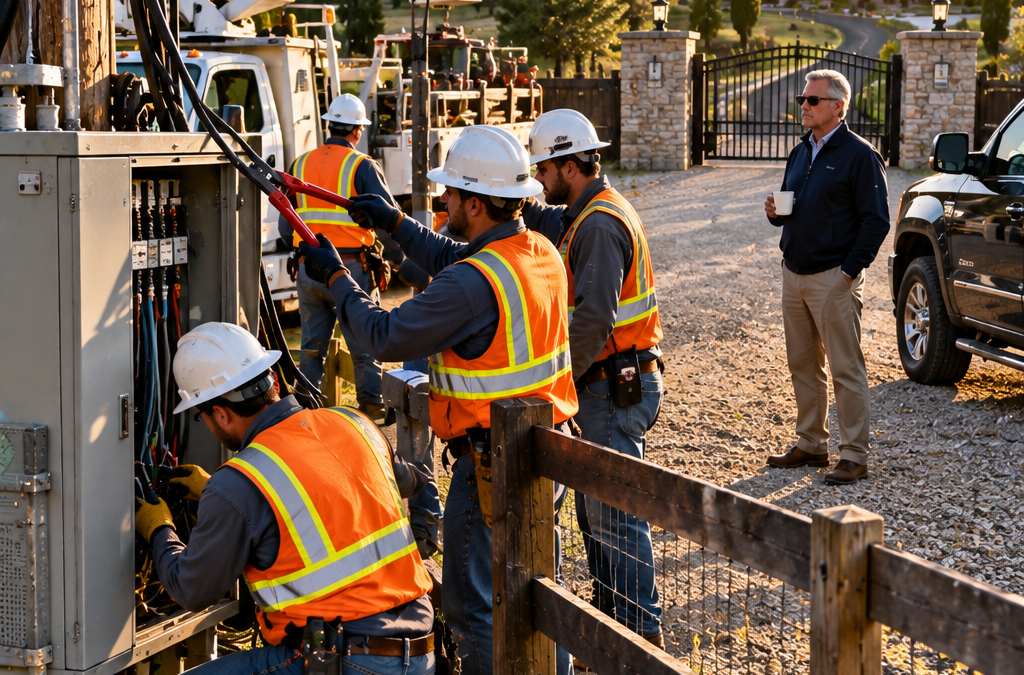
I didn’t want that.
So I worked with engineers and the county utilities office to establish an independent commercial-grade service arrangement using an existing regional feeder.
It cost more up front.
It required its own metering equipment.
It required inspections every two years.
But it was legal.
More importantly, it existed before Ridgerest Residential Holdings existed anywhere except probably inside some developer’s presentation deck.
For the first few years, the land around me was mostly scrub and old pasture.
Then developers arrived.
They bought hundreds of acres.
Trees disappeared.
Roads appeared.
Survey stakes became foundations.
Foundations became houses.
Within four years, my quiet property was bordered on two sides by Ridgerest Estates, a polished residential community with stone entrance columns, ornamental ponds, sidewalks that somehow remained spotless, and an HOA that seemed determined to turn ordinary suburban life into a branch of municipal government.
My twelve acres fell inside one of the broad planning maps used during development.
That caused confusion.
The developer tried to treat my property as part of the new association.
My attorney stopped that before it started.
Her name was Deborah Finch.
Deborah was the kind of lawyer people described as intimidating when what they really meant was prepared.
She didn’t raise her voice.
She didn’t bluff.
She didn’t write ten pages when four paragraphs would do.
And she had one habit I had always admired.
She never argued from emotion when paper could do the job faster.
When Ridgerest first tried to assess me dues, Deborah pulled every deed, easement, utility agreement, county approval, and development filing connected to my land.
Her conclusion was simple.
My property predated the association.
The utility service predated the subdivision.
The developer had no contractual basis to force me into Ridgerest’s community utility arrangement.
Certain limited county zoning changes applied to me because zoning applies regardless of neighborhood politics.
HOA covenants did not.
My independent service remained protected.
Deborah sent Ridgerest a letter.
Then another after the developer’s attorney asked questions.
Then a third when the HOA formally organized.
Each letter said essentially the same thing.
Marcus Hale’s property possessed preexisting independent utility rights.
Those rights were legally established before Ridgerest.
Do not interfere with them.
For years, nobody did.
Then Gerald Puit became HOA president.
Some people become difficult after receiving authority.
Gerald seemed to have spent his entire life preparing for it.
He was a retired logistics manager in his early sixties with broad shoulders, silver hair, and the permanent confidence of a man who had once supervised enough people to believe every room required his supervision forever.
Gerald talked loudly.
He shook hands too hard.
He called every woman under fifty “young lady.”
He wore fleece vests embroidered with the Ridgerest logo even when it was eighty degrees outside.
And he carried himself as though the title HOA president had been issued by the governor.
The first time we met, he drove onto my property without calling.
I was replacing a weather seal on my workshop door.
A black SUV rolled up.
Gerald climbed out.
“Marcus Hale?”
I put down the drill.
“Depends who’s asking.”
He smiled.
“Gerald Puit. Ridgerest HOA president.”
“Okay.”
He waited.
I wasn’t sure what response he’d expected.
Maybe congratulations.
He walked toward me.
“I wanted to introduce myself personally.”
“Consider yourself introduced.”
His smile tightened.
“We’re doing a comprehensive compliance review.”
“Have fun.”
“This property is included in the review.”
“No, it isn’t.”
That stopped him.
He laughed once.
“I think there’s some confusion.”
“There isn’t.”
“Your parcel is within the Ridgerest planning boundary.”
“I’m aware.”
“Which means it falls under association management.”
“It doesn’t.”
He frowned.
“You seem very certain.”
“My attorney is.”
Gerald tucked both hands into his vest pockets.
“Lawyers complicate simple things.”
“Sometimes simple things become complicated because people ignore lawyers.”
He studied me.
Then looked toward my eastern junction.
“That your utility connection?”
“Yes.”
“Ridgerest has a centralized service arrangement.”
“I know.”
“All properties should transition.”
“No.”
Gerald smiled again.
It wasn’t friendly this time.
“We’ll talk.”
“We just did.”
He left.
Two weeks later, the first letter arrived.
RIDGEREST RESIDENTIAL HOLDINGS
NOTICE OF UTILITY NONCOMPLIANCE
According to Section 11C of the Ridgerest Residential Charter, all properties situated within the service boundary were required to connect to the community-managed utility grid.
I sent it to Deborah.
She called thirty minutes later.
“This is nonsense.”
“I thought you’d enjoy it.”
“Do you want me to answer?”
“Please.”
She sent four paragraphs.
The letter explained that Section 11C did not bind my property, that my utility rights had been established before the HOA existed, and that the association was on notice not to interfere with licensed infrastructure.
I assumed that would end it.
Two weeks later, Gerald sent another letter.
Same demand.
Different wording.
Deborah answered again.
Gerald sent a third.
Then a fourth.
What followed lasted nine months.
At first, I found it annoying.
Then fascinating.
Eventually exhausting.
Gerald seemed incapable of accepting that authority had edges.
When the utility letters failed, county complaints started.
The first claimed my electrical installation violated current code.
The county inspector arrived.
I showed him the permits.
He inspected everything anyway.
At the end, he closed his tablet.
“Looks cleaner than half the new installs I see.”
“Can I get that in writing?”
“You’ll get the inspection report.”
Passed.
No violations.
Three weeks later came a complaint regarding my backup generator.
Excessive noise.
The generator had run twice in six months.
The county sent another inspector.
He measured sound from the property line during a test cycle.
Well below the ordinance.
Complaint closed.
Then my insurance broker called.
“Marcus, did something happen with your electrical service?”
“No.”
“We received a communication suggesting there’s an unapproved fire hazard.”
“From whom?”
He hesitated.
“Ridgerest Residential Holdings.”
I closed my eyes.
“Gerald Puit?”
“That’s the name.”
“What exactly did he claim?”
“That you maintain an outdated private utility system with elevated fire risk.”
My hand tightened around the phone.
“It’s inspected every two years.”
“I know. We have the documentation.”
“Then why are we talking?”
“Because once someone makes a formal allegation, we have to review it.”
That review also went nowhere.
My insurance remained unchanged.
I sent Deborah everything.
She sent the HOA a formal notice demanding that Gerald stop making unsupported representations to third parties about my property.
Gerald responded by accusing me of “creating an adversarial environment.”
That was Gerald’s favorite trick.
He started something.
You objected.
Then your objection became aggression.
I had seen that personality type in business.
They didn’t consider pressure hostile when they applied it.
Only resistance counted.
Around month eight, my patience began to wear thin.
One evening, Deborah called.
“How attached are you to peace?”
“What kind of question is that?”
“The kind I ask before filing something.”
I leaned against the kitchen counter.
“What are you thinking?”
“I can seek a declaratory order affirming the exemption, but we already have strong written documentation. Until he causes actual interference, a court may view this as a neighborhood governance dispute that doesn’t require immediate judicial intervention.”
“So we wait.”
“We document.”
“Same thing.”
“No.”
Deborah’s tone sharpened slightly.
“Waiting is passive. Documentation is preparation.”
That was why I kept her.
So I documented.
Every letter.
Every inspection.
Every county complaint.
Every insurance communication.
Every email.
Every time Gerald appeared along the road taking photographs.
I built a file.
Then came the survey flags.
I returned home one afternoon and saw bright orange markers along the eastern side of my property.
Not on the Ridgerest side.
Inside my fence.
I parked, walked over, and pulled one from the ground.
The plastic flag had a handwritten notation.
UTILITY REALIGNMENT.
I photographed it.
Then another.
Then the whole line.
There were nineteen.
I called Deborah.
“This isn’t hypothetical anymore.”
“No.”
“You think Gerald did this?”
“I think whoever did it entered my property.”
“Do you have cameras?”
“Workshop camera should have the eastern access road.”
I checked.
There he was.
Gerald.
Two men in reflective vests.
All three walking inside my fence.
One of the men placed the flags.
Gerald pointed toward my junction box.
Deborah watched the footage remotely.
When it ended, she said, “Don’t call him.”
“I wasn’t planning to.”
“Good.”
“What are we doing?”
“Filing.”
She obtained a temporary injunction preventing the HOA and its agents from entering my land or modifying utility infrastructure pending resolution of the dispute.
The order was very clear.
No entry.
No alteration.
No disconnection.
No interference.
A copy went to Ridgerest’s attorney.
A copy went to Gerald.
A copy went to the HOA’s management company.
I thought that would finally make him stop.
That was my mistake.
Gerald apparently read an injunction not as a boundary but as an insult.
Two weeks later, on March 4, I woke before sunrise.
I remember the date because everything after that morning would revolve around it.
The house was quiet.
I made coffee.
Then stepped onto the back porch.
Cold air.
Clear sky.
A thin orange line forming behind the trees.
It was one of those mornings that makes owning land feel worth every problem attached to it.
Then I heard diesel engines.
At first, I assumed county road maintenance.
The sound got louder.
Two trucks turned onto my access drive.
One was a utility service vehicle with equipment compartments running down both sides.
The other was a flatbed carrying poles, cable, and tools.
I put my coffee down.
The trucks stopped near the eastern junction.
Six men climbed out.
Hard hats.
Reflective vests.
Gloves.
Cutters.
Testing equipment.
Then I saw Gerald.
He hadn’t ridden with the crew.
He had arrived separately.
His SUV was parked along the road.
He stood near the end of my driveway wearing a navy fleece vest and holding a stainless-steel coffee cup.
He looked relaxed.
Almost cheerful.
I walked toward them.
Not quickly.
That’s something I learned years ago.
When you’re angry, slow down.
Anger wants speed because speed creates mistakes.
I reached the junction just as one worker opened a side compartment.
“Morning.”
The foreman turned.
He looked to be in his forties.
Weathered face.
Name patch read DALE.
“Morning, sir.”
“What are you doing?”
He checked a clipboard.
“Service termination and realignment.”
“On whose authority?”
Dale looked past me toward Gerald.
Then back down.
“Work order under Ridgerest Residential.”
“I want to see it.”
He hesitated.
“Sir—”
“This is my property.”
Gerald called from behind us.
“He’s been notified.”
I ignored him.
“Dale, I’m asking you before anyone touches equipment. Show me the order.”
Something in my tone must have convinced him.
He handed me the clipboard.
The top page identified my service point.
Work description:
DISCONNECT NONCONFORMING PRIVATE FEED. PREPARE CONNECTION FOR RIDGEREST COMMUNITY UTILITY INTEGRATION.
Authorized account:
RIDGEREST HOA.
Requester:
Gerald Puit.
Contractor:
Caldwell Regional Energy Services.
I stopped breathing for half a second.
Then read the company name again.
Caldwell Regional Energy Services.
I almost laughed.
Not because anything was funny.
Because the situation had crossed from outrageous into absurd.
I looked at Gerald.
He smiled.
“Problem?”
“Gerald.”
“Marcus.”
“You might want to make a phone call before these men touch anything.”
He took a sip of coffee.
“I already made plenty.”
“Dale.”
Gerald raised his voice slightly.
“You have authorization. Proceed.”
Dale didn’t move.
Good foreman.
He understood immediately that something was wrong.
I handed back the clipboard.
Gerald walked closer.
“Mr. Hale, this has gone on long enough.”
“There’s a court order prohibiting interference with this equipment.”
“Our counsel disagrees with your interpretation.”
“The injunction is one page.”
“You can’t hide behind paperwork forever.”
I stared at him.
That sentence was almost beautiful considering what was about to happen.
“Gerald, last chance.”
He laughed.
Actually laughed.
Not nervous laughter.
Confident laughter.
He turned toward the crew.
“Proceed.”
I took out my phone.
Gerald smirked.
“Calling your lawyer?”
“No.”
“The sheriff?”
“No.”
I found a contact.
RENATA COLLINS.
My executive assistant at Caldwell Regional.
I called.
She answered before the second ring.
“Marcus?”
“Morning.”
“You’re calling before seven. That’s never good.”
“I need you to open Ridgerest Residential Holdings’ service account.”
A pause.
“Give me thirty seconds.”
Gerald’s expression changed slightly.
Not enough.
Renata’s keyboard clicked through the phone.
“Found it.”
“Are there active field orders this morning tied to my property?”
More clicking.
“Yes. Two-vehicle dispatch. Service separation.”
“Who authorized internally?”
“Regional operations processed it from customer documentation.”
“Freeze it.”
“All work?”
“Everything under the Ridgerest account touching my parcel. Immediate stand-down pending corporate review.”
“Reason?”
“Active injunction and disputed authorization.”
“Understood.”
“Also flag the account for compliance review.”
“Done.”
I ended the call.
Gerald stared.
“What was that supposed to accomplish?”
I didn’t answer.
Thirty seconds later, Dale’s radio crackled.
He lifted it.
“Unit fourteen.”
A voice came through.
Even from where I stood, I could hear enough.
“Stand down immediately. Repeat, no work. Corporate hold.”
Dale frowned.
“Confirm suspension?”
“Confirmed. All Ridgerest work order activity at Hale parcel suspended.”
Dale looked at me.
Then Gerald.
“We’ve been told to stand down.”
Gerald’s coffee cup stopped halfway to his mouth.
“By who?”
“Regional office.”
“That’s impossible.”
Dale shrugged.
“That’s what dispatch says.”
Gerald stepped forward.
“I submitted this through regional operations.”
“I know,” I said.
He looked at me.
I let the silence sit for a moment.
Then:
“The regional office answers to a corporate board.”
Gerald’s face remained blank.
“I have a seat on that board.”
Still nothing.
“And I control the largest individual voting block in Caldwell Regional.”
He blinked.
“You work for them?”
“No.”
I shook my head.
“They work for a company I own thirty-four percent of.”
Dale slowly lowered the clipboard.
One worker behind him muttered something I couldn’t hear.
Gerald stared at me like I’d switched languages.
Eight years earlier, I’d purchased a major stake in Caldwell Regional during a restructuring.
It wasn’t glamorous.
I didn’t put the company’s logo on my house.
I didn’t introduce myself as an energy investor.
But Caldwell had turned into one of the strongest holdings in my portfolio.
Thirty-four percent didn’t mean I personally ran utility crews.
It did mean I had substantial governance rights.
A board seat.
Access to executive review.
And, more importantly that morning, enough authority to ensure no field crew performed disputed work on land subject to an active injunction.
Gerald’s mouth opened.
Then closed.
Finally:
“You’re bluffing.”
I almost felt sorry for him.
Almost.
“Dale?”
The foreman looked at me.
“Yes, sir?”
“Call regional operations yourself. Confirm my name.”
Gerald interrupted.
“This is ridiculous.”
Dale held up one hand.
“Mr. Puit, I’ve been ordered to stand down. Nobody’s cutting anything.”
Gerald’s face reddened.
“You were contracted to perform work.”
“We were contracted through Caldwell.”
“I’ll speak to your supervisor.”
“Please do.”
Gerald looked at me.
“This doesn’t change your obligation to connect to the community grid.”
“There is no obligation.”
“We’ll see.”
“We’ve been seeing for fourteen months.”
His eyes narrowed.
“This isn’t over.”
He turned toward his SUV.
Then Renata called me back.
“Marcus.”
Something in her voice stopped me.
“What?”
“Don’t let the crew leave yet.”
I looked at Dale.
He was gathering his men.
“Why?”
“We pulled the full service history on the Ridgerest account because you requested compliance review.”
“Okay.”
“There’s an anomaly on the eastern feeder.”
“What kind?”
“Secondary tap.”
I turned toward the junction box.
“Mine?”
“Adjacent to your metered service.”
“Installed when?”
“Approximately twenty-three months ago.”
“Authorized by who?”
“That’s the problem.”
Renata paused.
“I can’t find authorization.”
Dale noticed my expression.
“What?”
I raised one finger.
“Hold on.”
Renata continued.
“The monitoring data shows a low-level continuous draw downstream of the tap.”
“Destination?”
“We’re tracing.”
I walked toward the steel enclosure.
“Dale, before your crew packs up, I need someone qualified to visually inspect the exterior connections.”
He frowned.
“We can document without altering anything.”
“That’s all I want.”
Gerald had stopped halfway to his SUV.
He turned around.
Renata spoke again.
“Found the destination property.”
“Where?”
“Neighboring parcel east of you.”
I looked toward the tree line.
A large detached structure sat behind the adjoining Ridgerest lot.
It looked like a workshop.
“Registered owner?”
Keyboard.
Then silence.
“Marcus.”
“Who?”
“Company called GP Logistics Properties LLC.”
My stomach tightened.
I already knew.
“Registered agent?”
“Gerald Puit.”
I looked across the driveway.
Gerald had gone completely still.
I put Renata on speaker.
“Say that again.”
“GP Logistics Properties LLC owns the structure receiving the secondary utility draw. Registered agent and managing member: Gerald Puit.”
Nobody spoke.
Dale looked slowly from the phone to Gerald.
Gerald’s face lost color.
Not red anymore.
Gray.
Dale turned toward the junction.
“Guys, stop packing.”
Gerald walked toward us.
“That’s wrong.”
I looked at him.
“What is?”
“Whatever she’s saying.”
Renata answered before I could.
“I’m reading the account data, sir.”
Gerald stared at the phone.
“Who are you?”
“Renata Collins, corporate executive office, Caldwell Regional Energy Services.”
“There’s no unauthorized service.”
Renata replied calmly.
“Then the inspection should confirm that.”
Gerald stepped closer.
“You people need to leave.”
I almost couldn’t believe him.
“This is my land.”
“The line serves community infrastructure.”
“No.”
I pointed toward the steel cabinet.
“This is my licensed junction.”
Dale spoke.
“Mr. Puit, we’re going to document what we can see and send it to compliance.”
“You don’t have authority.”
Dale looked at me.
Then Gerald.
“Corporate just told me to do it.”
That ended that argument.
The crew opened the exterior inspection panel.
Nobody cut anything.
Nobody disconnected anything.
They photographed.
Tested.
Recorded serial numbers.
Traced the physical connection.
Fifteen minutes later, Dale looked at me.
“There’s definitely a secondary connection.”
“Legal?”
He shook his head.
“Not from anything I’m seeing.”
Gerald started talking fast.
“That’s probably legacy infrastructure.”
Dale ignored him.
“Connection looks newer than the original service.”
“It’s been there two years,” I said.
Gerald snapped.
“You don’t know that.”
Renata’s voice came through my phone.
“Monitoring history indicates the draw began twenty-three months and approximately two weeks ago.”
Silence again.
Gerald rubbed one hand over his mouth.
Then switched tactics.
“I wasn’t involved in any installation.”
I looked at him.
“No one accused you yet.”
He realized what he’d done.
Dale realized too.
So did every worker close enough to hear him.
Gerald turned away.
That morning changed everything.
Not instantly.
Real investigations don’t work like television.
Nobody handcuffed Gerald beside my driveway.
No dramatic squad car arrived.
The crew completed documentation and left.
Gerald drove away ten minutes later without another word.
But before noon, Caldwell Regional’s compliance department had opened a formal internal case.
By evening, Deborah had the photographs.
The work order.
The injunction violation.
The account records.
The suspected unauthorized tap.
Her response was one sentence.
He finally made a mistake large enough to matter.
Seventy-two hours later, Caldwell filed a formal notice with the county utilities board.
An independent technical audit was ordered.
Engineers inspected the junction.
They traced the unauthorized tap.
They confirmed it fed Gerald’s LLC-owned workshop.
The connection had bypassed proper metering structure in a way that shifted the consumption into infrastructure billed through Ridgerest.
Not massive power theft.
That was what made it difficult to detect.
The draw was small.
Steady.
Enough to run climate control, lighting, equipment chargers, and several workshop circuits.
The sort of usage that disappears inside a larger commercial account unless someone specifically looks.
Over nearly two years, it added up.
Just under nineteen thousand dollars.
Billed indirectly through the Ridgerest account.
Which meant, in practical terms, Gerald had apparently been allowing HOA-associated utility infrastructure to absorb costs serving his private LLC property.
When the audit report circulated, Gerald offered three explanations in six days.
First:
Misconfiguration.
Then:
Contractor error.
Then:
He had no knowledge the tap existed.
His attorney eventually released a short statement saying the matter was undergoing internal review and warning people not to draw conclusions before all facts were established.
The county investigators did exactly what they should have done.
They ignored the public statements and followed the records.
Work orders.
Installation history.
Invoices.
Access logs.
Property ownership.
Billing.
Gerald’s problem was that paperwork existed for almost everything except a valid authorization for the tap itself.
Meanwhile, the HOA finally began asking questions.
Not about me.
About him.
Gerald had spent fourteen months telling Ridgerest residents that I was the problem.
The stubborn landowner.
The man refusing modernization.
The outsider who wouldn’t follow community standards.
Now residents wanted to know why their president’s private company had apparently benefited from utility consumption carried on an HOA-linked account.
The first emergency meeting happened five days after the audit began.
I didn’t attend.
I didn’t need to.
A neighbor named Paul called afterward.
“You would’ve enjoyed it.”
“I doubt that.”
“Gerald tried to explain the tap.”
“How?”
“Apparently utility infrastructure is complicated.”
“Profound.”
“He said people shouldn’t rush to judgment.”
“I agree with that.”
Paul paused.
“You’re serious?”
“Yes.”
Investigations should be accurate.
Even when you’re fairly certain of the answer.
Especially then.
I had spent too much time in business watching people become the thing they claimed to oppose.
I didn’t want rumors.
I wanted findings.
The findings came.
Caldwell’s engineers confirmed the unauthorized connection.
The county utilities board confirmed no permit had been issued.
Billing analysis calculated the usage.
And the private structure being served belonged to Gerald’s company.
Deborah filed to enforce the injunction and sought damages related to the attempted disconnection.
She also sent preservation notices regarding every HOA communication concerning my utility system.
Gerald’s attorney suddenly had a lot more work.
Three weeks after the morning on my driveway, I attended Caldwell Regional’s quarterly board meeting.
Not because I wanted revenge.
Because Ridgerest’s commercial account was already scheduled for contract review, and the compliance issue now made that review mandatory.
The boardroom was thirty miles away.
Glass walls.
Long walnut table.
Coffee that cost too much and tasted like nothing.
Our general counsel summarized the facts.
Existing customer account.
Field work ordered against infrastructure subject to active litigation.
Work order authorization weaknesses.
Unauthorized secondary tap under investigation.
Billing exposure.
Governance concerns.
Then came recommendations.
Ridgerest’s service priority tier was reduced.
Not cut.
Reduced.
Their commercial terms were repriced to reflect the compliance risk.
Future field orders involving disputed private property would require enhanced documentation.
And any work order touching my parcel during ongoing litigation would require dual internal authorization.
I abstained from portions directly affecting my personal dispute where counsel advised it.
That mattered to me.
Gerald had spent over a year treating institutional authority like a private weapon.
I wasn’t going to answer by doing the same thing.
But when it came to fixing Caldwell’s own procedures?
I voted.
Unanimously, the board adopted stricter authorization controls.
No HOA president would ever again be able to submit a controversial disconnection order against disputed private infrastructure and get a crew dispatched at dawn without legal review.
That was bigger than Gerald.
Good policies usually are.
Eleven days later, Gerald resigned.
No dramatic announcement.
No apology.
No final speech.
One morning his name was removed from the Ridgerest board page.
That was it.
A man who had spent years making sure everyone knew he was president disappeared from the role with a few administrative edits.
His replacement was Patricia O’Neal.
Retired civil engineer.
I had met her twice.
Quiet.
Precise.
The exact opposite of Gerald.
A week after she took office, I received a letter.
One page.
No threats.
No citations.
No dramatic language.
Dear Mr. Hale,
Following review of the relevant property records, legal correspondence, and preexisting utility approvals, Ridgerest Residential Holdings acknowledges your property’s exemption from the community utility connection requirement.
Your existing independent service status will be respected in full.
The association considers the matter closed.
Sincerely,
Patricia O’Neal
Board Chair
I stood in my kitchen reading it twice.
Fourteen months.
County complaints.
Insurance interference.
Survey flags.
Court orders.
A crew at six in the morning.
And all it took to end the dispute was one competent person reading the records and writing three clear paragraphs.
I framed the letter.
It hangs beside my breaker panel.
Not because I need to remind myself that I won.
Because I like the contrast.
Gerald sent dozens of pages trying to invent authority.
Patricia used one page to recognize a boundary that had been there the entire time.
The criminal referral connected to the suspected utility theft moved much more slowly.
As criminal matters should.
Gerald’s attorney filed continuances.
Challenged portions of the audit.
Raised questions about contractor access.
Disputed intent.
Deborah tracked every filing.
Whenever I called and asked whether anything had changed, her answer was almost always the same.
“The documentation is still the documentation.”
Months passed.
My power stayed on.
No one from Ridgerest touched my property.
No more anonymous code complaints arrived.
No insurance letters.
No orange flags.
The neighborhood became quiet again.
But I didn’t.
Not internally.
For a long time after that morning, I found myself waking before dawn whenever I heard a diesel engine.
I’d stand at the bedroom window.
Listen.
Wait.
That’s the part people underestimate about prolonged harassment.
Even when you know you’re legally protected, the constant escalation changes your relationship with your own property.
Every letter becomes a warning.
Every unfamiliar truck becomes a question.
Every knock at the door carries weight.
Gerald had failed to take my electricity.
But for months, he’d managed to take something else.
Ease.
I resented him most for that.
My home had always been the one place where nobody else got to set the terms.
After my wife, Hannah, died, that mattered even more.
She had loved the twelve acres.
The orchard was hers.
Six apple trees.
Two pears.
One stubborn peach tree she insisted would survive our winters.
It did.
Barely.
When she was sick, we’d sit beneath those trees in the evening.
Sometimes she asked what I’d do with the place after she was gone.
I always got angry.
Not at her.
At the question.
“We’re not doing this.”
“We should.”
“No.”
“Marcus.”
“I’m not selling.”
She smiled.
“I didn’t ask whether you were selling.”
“Good.”
“I asked whether you’ll stay.”
“Yes.”
“Then don’t turn into a hermit.”
“I make no promises.”
She laughed.
That was Hannah.
She could make dying sound like another logistical issue we needed to solve.
After she was gone, I stayed.
The land became part memory, part refuge.
I kept her orchard alive badly.
Pruned too late.
Overwatered one tree.
Nearly killed the peach with fertilizer.
But it survived.
I suppose we both did.
That was another reason Gerald’s obsession bothered me more than he understood.
When he looked at the eastern junction box, he saw an infrastructure problem.
When he looked at my property, he saw a map anomaly.
Something inside Ridgerest’s colored boundary that refused to behave like every other lot.
I saw the house Hannah and I chose together.
The workshop where she painted furniture on weekends.
The orchard she’d planted.
The place where she had spent her last good summer.
Gerald didn’t have to understand any of that.
He only had to respect that it wasn’t his.
That should have been easy.
For him, it wasn’t.
Months after his resignation, Patricia stopped by.
She called first.
That alone distinguished her from Gerald.
We sat on the porch.
She brought copies of the revised Ridgerest utility procedures.
“I thought you’d want these.”
“I appreciate it.”
She looked toward the orchard.
“Nice property.”
“Thanks.”
“I’ve lived next to it nine years and never actually been up here.”
“Gerald made me sound dangerous.”
Patricia smiled.
“He made several things sound dangerous.”
She became serious.
“I owe you an apology.”
“You weren’t president.”
“I was on the board.”
I looked at her.
She nodded.
“Not when most of this started. But for the last six months of it.”
“Okay.”
“I knew Gerald was pushing too hard.”
“Did you know about the work order?”
“No.”
She answered immediately.
“If I had, I would have stopped it.”
I believed her.
“But I knew the dispute wasn’t being handled properly.”
“Why didn’t you say something?”
She looked toward the road.
“Because Gerald was exhausting.”
That surprised me.
She continued.
“Every disagreement became a three-hour meeting. Every objection became a personal challenge. Every question became an accusation that you weren’t supporting the community.”
I knew exactly what she meant.
“So people stopped objecting.”
“Yes.”
“And that gave him more room.”
“Yes.”
Patricia looked at me.
“I spent thirty years as an engineer. I’ve sat in rooms where people argued about bridge loads, structural failures, multimillion-dollar design mistakes. Those conversations were easier than telling Gerald he was overstepping.”
“Why?”
“Because engineers usually accept that physics doesn’t care about ego.”
I laughed.
“HOA presidents?”
“Apparently not.”
She handed me the policy.
“What happened to you forced the board to look at how much authority we’d allowed one person to exercise without meaningful review.”
“That wasn’t my goal.”
“I know.”
“Did it help?”
“Yes.”
She stood to leave.
Then paused.
“For what it’s worth, I’m sorry it took someone nearly cutting your electricity for us to take it seriously.”
I looked toward the junction.
“So am I.”
After she left, I read the new rules.
They were boring.
Beautifully boring.
Written authorization thresholds.
Legal review.
Property-status verification.
Dual approvals.
Documentation retention.
Appeal process.
No president could unilaterally direct contractors to enter disputed private property.
No one could order utility alterations without verification of legal authority.
The rules looked almost obvious.
Most good safeguards do after something bad happens.
People ask:
Why wasn’t that required already?
Usually because everyone assumed nobody would go that far.
Gerald went that far.
That’s the danger of designing systems around reasonable people.
Eventually, someone unreasonable discovers the gaps.
One afternoon, Dale returned to my property.
Not with a crew.
Just his pickup.
He parked by the workshop.
I walked out.
“Everything okay?”
“Yeah.”
He looked uncomfortable.
“I wanted to talk to you.”
“About what?”
“That morning.”
I leaned against the workbench.
“Okay.”
He took off his baseball cap.
“We should’ve verified more.”
“You had a work order.”
“Yeah.”
“And you stopped when corporate told you.”
“We shouldn’t have been there to begin with.”
I didn’t answer.
Dale looked toward the junction.
“Field guys get an order. We assume office cleared it.”
“That’s how it’s supposed to work.”
“But I remember Mr. Puit telling us before you came out that you’d been warned repeatedly and were refusing lawful conversion.”
I nodded.
“Sounds like him.”
“He made it sound like you were some guy stealing power.”
That almost made me laugh.
“I was the one apparently having power stolen.”
Dale grimaced.
“Yeah.”
He put his cap back on.
“I just wanted you to know the crew talked about it afterward.”
“Why?”
“Because we came within minutes of disconnecting a legal service under a bad order.”
He paused.
“That bothers people who take the job seriously.”
I respected that.
“It should.”
“We changed some internal practices.”
“I know.”
“Right.”
He looked at me.
“Board member.”
“Unfortunately.”
That made him smile.
Before leaving, Dale walked over to the orchard.
“Apple trees?”
“My wife’s.”
“They look good.”
“Don’t tell anyone I almost killed them.”
He laughed.
Then drove away.
That conversation mattered more to me than I expected.
Not because I blamed the crew.
I didn’t.
They had been handed documentation that looked official.
They did what workers in large systems do.
They trusted the process ahead of them.
That’s how abuse of authority travels.
Rarely through one person doing everything personally.
More often through ordinary people assuming someone upstream verified the right to give the order.
Gerald understood that instinct.
He put his title on paper.
The office processed it.
The order became a dispatch.
The dispatch became two trucks.
The trucks became six men with wire cutters standing on my land before sunrise.
That is how arrogance scales.
Paper.
Procedure.
Assumption.
Until someone stops and asks:
Who actually has the right to do this?
That morning, I happened to be there.
I also happened to know exactly who to call.
Most people wouldn’t.
That bothered me.
So during the next Caldwell board session, I pushed for something beyond the Ridgerest policy.
A field challenge procedure.
If a property owner presented credible evidence that a work order was legally disputed, field crews could suspend nonemergency service modifications while operations verified authority.
No penalty to the crew.
No requirement that the resident know a board member.
No need for some corporate connection.
The company adopted it.
That may be the only part of the entire story I feel proud of.
Everything else was defense.
That was prevention.
I couldn’t change what Gerald tried to do.
I could make it harder for the next Gerald to do it to someone else.
About nine months after the attempted disconnection, the county held another hearing connected to the utility investigation.
Gerald attended with counsel.
So did I.
Deborah sat beside me.
Gerald looked different.
Not physically older.
Smaller somehow.
I think power changes how people occupy rooms.
When he was HOA president, Gerald entered meetings assuming everyone needed to notice him.
Now he sat behind his attorney with a legal pad.
No fleece vest.
No Ridgerest logo.
No coffee cup held like a prop.
At one point, our eyes met.
He looked away first.
I didn’t feel satisfaction.
That surprised me.
For fourteen months I’d imagined what accountability would feel like.
I expected heat.
Triumph.
Maybe anger.
Instead, I felt tired.
Gerald had become paperwork.
Case numbers.
Audit findings.
Continuances.
Invoices.
Affidavits.
His personality no longer mattered much.
The system had finally reduced everything to evidence.
That was appropriate.
After the hearing, Deborah and I walked toward the parking lot.
“You look disappointed,” she said.
“I’m not.”
“You look something.”
“I thought seeing him answer for it would feel better.”
Deborah stopped.
“Marcus, consequences aren’t entertainment.”
“I know.”
“That’s good.”
She adjusted the strap of her briefcase.
“People imagine justice feels like fireworks. Usually it feels like administration.”
I looked back toward the courthouse.
“That’s bleak.”
“It’s why lawyers drink expensive coffee.”
We kept walking.
Then she added:
“You kept your electricity.”
I smiled.
“There is that.”
By the following spring, Hannah’s peach tree bloomed harder than it had in years.
Pink flowers covered nearly every branch.
I stood beneath it one morning before sunrise.
Same hour Gerald’s trucks had arrived the year before.
The property was quiet.
No engines.
No workers.
No white hard hats moving against the trees.
Just birds.
Wind.
A transformer humming faintly in the distance.
I walked to the eastern junction.
The unauthorized tap had been removed months earlier.
New seals were in place.
Fresh inspection labels.
The original line continued exactly as it had for eleven years.
Legal.
Permitted.
Mine.
I rested one hand against the metal enclosure.
People sometimes ask why I didn’t use my position at Caldwell earlier.
Why tolerate fourteen months of Gerald’s letters?
Why allow the county complaints?
Why wait until he sent a crew?
The answer is simple.
Because owning a major stake in a contractor didn’t give me the right to use the company as my personal weapon.
Gerald believed titles existed to serve personal objectives.
I didn’t want to become him.
Until Caldwell became directly involved through an improper work order, my corporate position wasn’t relevant.
My dispute was with the HOA.
Deborah handled it legally.
When Gerald dragged Caldwell into the fight, he connected the two worlds himself.
He submitted the order.
He hired the contractor.
He selected the company.
He sent Caldwell employees onto my land.
I didn’t set the trap.
Gerald walked into a room he hadn’t bothered to inspect.
That was the pattern of his entire downfall.
He never checked.
He never checked whether my exemption was valid because he assumed HOA authority mattered more.
He never checked whether the injunction should stop him because he assumed his attorney could clean up whatever happened afterward.
He never checked who controlled Caldwell because why would he?
To him, I was just the difficult homeowner at the edge of Ridgerest.
And apparently, he never expected anyone to inspect the junction deeply enough to notice the unauthorized tap.
People like Gerald often confuse ignorance with safety.
If nobody has caught them, they assume nobody can.
Every successful overreach confirms their belief that the next one will succeed too.
First letter.
No consequence.
Second letter.
No consequence.
False complaints.
No personal consequence.
Trespass with survey flags.
Still no consequence he respected.
Then dawn crew.
That was supposed to be the final act.
He wanted me to step outside, see utility workers holding cutters, and understand that his authority had become physical.
No more letters.
No more legal debate.
He wanted to show me that he could reach the wire feeding my house.
That’s why he came personally.
He didn’t need to be there.
A normal HOA president would let the contractor work.
Gerald wanted to watch.
I thought about that for a long time.
The coffee cup.
The fleece vest.
The smile.
He came because he wanted to see surrender.
Instead, he watched his contractor stop.
Then he watched the company he had hired answer to me.
Then he stood there while a corporate compliance review uncovered electricity flowing from disputed infrastructure toward his own private property.
If I had written the story myself, it would’ve felt too neat.
Life rarely offers irony that complete.
But irony wasn’t what ended Gerald.
Evidence did.
That distinction matters.
The photograph of him on my driveway was satisfying.
The work order mattered.
The corporate records mattered.
The audit mattered.
The meter history mattered.
The ownership records for GP Logistics mattered.
The missing permit mattered.
The injunction mattered.
Each document took something Gerald had dismissed as a technicality and turned it into a boundary he could no longer talk his way around.
That’s the thing about men who rely on confidence.
Confidence works best in rooms where nobody checks the file.
The moment the file opens, personality becomes much less impressive.
I still live on the twelve acres.
Ridgerest is still next door.
Most of the residents are good people.
Patricia remains board chair.
The HOA still sends newsletters.
Most are about landscaping, road maintenance, or pool hours.
Exactly the kind of boring subjects an HOA should spend its time on.
Once a year, Patricia sends me a courtesy copy of the utility policy.
No demand.
No bill.
No assertion of control.
Just documentation.
I appreciate that.
The Caldwell letter acknowledging the work-order failure sits in my office.
Patricia’s exemption letter remains framed beside the breaker panel.
People think that’s strange.
Maybe it is.
But every time I reset a circuit or check the system, I see the sentence:
Your property’s exemption status will be respected in full.
Simple words.
They shouldn’t have required fourteen months, an injunction, two utility trucks, an internal compliance investigation, a county audit, and the resignation of an HOA president.
But some people don’t understand a boundary when it’s written politely.
They only recognize it when crossing it finally costs them something.
I don’t know exactly what will happen to Gerald’s criminal referral.
That belongs to the county.
Not me.
Not Caldwell’s board.
Not the HOA.
Deborah still follows the case.
Whenever I ask what she thinks will happen, she gives me the same answer.
“We’ll see what the evidence supports.”
I’ve learned to accept that.
I don’t need Gerald destroyed.
I don’t need him humiliated.
I don’t need some dramatic sentence from a judge.
I needed him off my property.
I needed the HOA to respect the exemption.
I needed the unauthorized line removed.
I needed safeguards so another homeowner wouldn’t wake to cutters outside because someone with a title decided rules were optional for him.
I got those things.
That is enough.
Sometimes, very early in the morning, I take coffee outside and stand where Gerald stood.
Near the driveway.
From there I can see the eastern junction.
The workshop.
The orchard.
The roof of my house through the trees.
I try to imagine what he saw that morning.
Probably a problem he believed he was finally solving.
A stubborn man he expected to overpower.
An electrical line he thought he had authority to cut.
What he didn’t see was eleven years of permits.
Inspection reports.
Recorded rights.
Deborah’s letters.
The injunction.
My history with Caldwell.
The data sitting inside the company’s monitoring system.
His own unauthorized tap.
All of it existed before his trucks arrived.
He just didn’t bother to look.
That was Gerald’s real failure.
Not that he underestimated me.
People say that because it makes a better story.
He underestimated limits.
He believed every barrier could be pushed aside if he pushed hard enough.
A lawyer’s letter?
Ignore it.
County inspection?
File another complaint.
Injunction?
Interpret it differently.
Private property?
Send a crew.
Eventually, reality gave him a boundary he could not negotiate with.
And the irony was that it came through the very company he chose to enforce his will.
The last time I saw Gerald in person was months later at a hardware store.
I was buying pruning blades.
He was near the electrical aisle.
For a second, both of us stopped.
I expected hostility.
He looked away.
Then walked down another aisle.
That was it.
No confrontation.
No speech.
No apology.
I bought the blades and went home.
I spent the afternoon pruning Hannah’s apple trees.
There was something satisfying about that.
Not because Gerald avoided me.
Because my life had returned to ordinary things.
Branches.
Weather.
Coffee.
Invoices.
Work.
The hum of electricity nobody was trying to take.
That’s what people who abuse power misunderstand most.
They think the person resisting them wants a war.
Most of us don’t.
We want normal life back.
Gerald wanted obedience.
I wanted to be left alone.
In the end, leaving me alone would have cost him nothing.
Instead, he spent fourteen months escalating until the only future he destroyed was his own position.
And every time I walk past that breaker panel and see Patricia’s letter, I remember the morning he stood at my driveway smiling while men prepared to cut my lines.
He thought the trucks were proof that he had finally reached the end of my resistance.
He had it backward.
They were proof that he had finally reached the end of his authority.







