𝗙𝗨𝗟𝗟 𝗦𝗧𝗢𝗥𝗬 The HOA President Put My Late Father’s Tractor on Display at Her Harvest Festival and Told Me I’d Never Get It Back
𝗙𝗨𝗟𝗟 𝗦𝗧𝗢𝗥𝗬
He nodded.
“That’s ridiculous.”
“You’re ridiculous.”
“It’ll look like a parade float.”
He shrugged.
“If a machine works that hard, it ought to shine like it matters.”
So we painted it teal.
Then Dad spent three weekends doing the gold trim himself.
Steady little lines around the hood.
Wheel centers.
Grille edges.
Even a thin gold stripe around the dashboard.
His hands had started shaking by then.
Not enough to stop him.
Enough that I noticed.
The final Saturday, he stepped back beneath the barn lights.
The tractor looked nothing like the wreck we’d started with.
The teal body reflected the lamps.
Gold trim caught every angle.
Dad stood beside it, thin and tired, with grease on his cheek.
“What do you think?”
I folded my arms.
“Tacky.”
He laughed.
“You love it.”
“I do.”
He put one hand on the hood.
“So do I.”
That was the last project we finished together.
Dad died that winter.
The cancer had been farther along than any of us understood.
The hospital room smelled like disinfectant and bad coffee.
He hated every minute of being there.
On the last day he was conscious, I sat beside him.
He couldn’t speak much.
He squeezed my hand.
Then whispered:
“Keep her running.”
I knew exactly what he meant.
“The tractor?”
He nodded.
“I will.”
That was my final promise to him.
After the funeral, word got around that the tractor had been restored.
Collectors came.
One dealer offered thirty-eight thousand dollars.
Another went higher.
A man from two counties away left a blank check under the windshield wiper with his phone number written across the memo line.
I tore it in half.
By then, people estimated the tractor could bring around forty-five thousand dollars.
It did not matter.
Forty-five thousand dollars could buy a good truck.
Pay down a mortgage.
Sit in an investment account.
But money cannot buy another Saturday night in a barn with your father.
So I kept it.
Years later, when Maple Hollow offered me the chief of police position, I accepted for reasons that had nothing to do with wanting more authority.
I was tired of highways.
Tired of arriving after terrible things had already happened.
Tired of managing people across half the state.
Maple Hollow was small.
A town where people still complained directly to the chief about stray dogs and stop signs.
It felt human-sized.
The swearing-in was deliberately quiet.
Town council.
Mayor.
A handshake.
No public ceremony yet.
No newspaper photographer.
No department-wide event.
They planned a formal introduction later.
I was fine with that.
After twenty years in uniform, I didn’t need another photograph.
The badge was issued.
Chief Luke Brangan.
The title still felt strange.
Most of the department knew the appointment had happened, obviously, but I had only been in the office eleven days when everything with Willow Ridge came apart.
Some patrol officers hadn’t met me face-to-face.
That detail mattered more than I ever imagined it would.
A few weeks before starting the job, I bought my own forty acres on the edge of Maple Hollow.
Rolling pasture.
Old red barn.
House set back from the road.
Long gravel lane.
Quiet.
Exactly what I wanted.
The property bordered Willow Ridge Estates, a development of large houses built along curving roads behind white fencing.
From my barn, I could see the roofs through the trees.
My land had once been part of the larger tract before the development was created in 1998.
But the forty acres had been carved out separately.
I checked the deed before closing.
No HOA.
No restrictive covenants tying me to Willow Ridge.
No membership.
No architectural committee.
No dues.
Nothing.
I signed.
Pulled the FOR SALE sign out of the grass.
Stood in the middle of the pasture and thought, finally.
Peace.
I should have known better.
Moving day was ordinary until the flatbed arrived carrying Dad’s tractor.
The driver backed carefully toward the barn.
Sunlight hit the gold trim.
Across the white Willow Ridge fence, heads turned.
A man walking a dog stopped.
Two kids on bicycles rolled closer.
A woman lifted her phone and took a picture.
I smiled.
The tractor did that to people.
It was strange enough to demand attention.
Deep teal.
Gold edges.
Old shape.
Beautiful in a way that only old machinery can be beautiful.
I climbed onto it after the flatbed driver left.
The engine caught on the second turn.
That low mechanical rumble brought Dad back for half a second.
Not literally.
Just enough that I could almost smell the barn we rebuilt it in.
I drove it inside.
Closed the doors.
The next morning, a white golf cart came up my gravel lane.
I was repairing a gate hinge.
The woman driving wore a cream blouse and expensive sunglasses.
A clipboard rested against the steering wheel.
She stopped beside me without turning off the cart.
“Mr. Brangan?”
“Yes.”
She stepped out.
“Tiffany Aldridge. President of Willow Ridge Homeowners Association.”
She said president the way some people say judge.
I wiped my hand on my jeans.
“Good morning.”
“We need to talk about your tractor.”
I looked toward the barn.
“What about it?”
She walked toward the open door.
I followed.
She circled the tractor slowly.
Not admiring.
Inspecting.
“Teal.”
“Yes.”
“And gold.”
“Also yes.”
She wrinkled her nose.
“It’s extremely visible.”
“Only when the barn is open.”
“This is a residential district.”
“This is agricultural land.”
“Adjacent to a residential district.”
“Correct.”
She looked at me.
“The visual impact still matters.”
I almost laughed.
“To who?”
“The community.”
“Your community.”
“Willow Ridge property values depend on maintaining consistent standards.”
I leaned against the barn door.
“My land isn’t in Willow Ridge.”
Her expression did not change.
“Everything in this valley affects Willow Ridge.”
“Maybe.”
“You can’t maintain unapproved agricultural equipment in view of residential properties.”
“I don’t need your approval.”
Her smile thinned.
“You may want to review the association boundaries.”
“I did.”
“And?”
“My property isn’t part of them.”
“We’ll see about that.”
There was something in the way she said it.
Not uncertainty.
A promise.
She walked closer to the tractor.
“Honestly, Mr. Brangan, it’s tacky.”
That almost did it.
Not because I cared whether she liked the paint.
Because Dad had painted the gold himself.
I felt anger come up fast.
Twenty years in law enforcement had taught me not to let the first emotion choose the first sentence.
So I said:
“Then it’s fortunate you don’t own it.”
She looked at me sharply.
Before she could answer, a man came walking up from the road.
Blue polo.
Khaki shorts.
Hands in pockets.
Maybe early fifties.
He moved like someone who had never had to question whether a room wanted him in it.
“Everything okay?”
Tiffany turned.
“Wayne, this is Mr. Brangan.”
He smiled.
“New guy.”
“Luke.”
“Wayne Aldridge.”
He nodded toward the tractor.
“Interesting color.”
“Thank you.”
He laughed.
“I wasn’t complimenting it.”
I said nothing.
He put an arm loosely around Tiffany’s shoulders.
“Don’t mind her. My wife usually gets what she wants.”
“Does she?”
“One way or another.”
He smiled.
It wasn’t a joke.
They left.
Two days later, a bright orange notice appeared on my gate.
WILLOW RIDGE HOA VIOLATION.
UNAPPROVED AGRICULTURAL EQUIPMENT.
AESTHETIC NUISANCE.
REMOVE OR SCREEN FROM COMMUNITY VIEW.
I read it twice.
Then checked the property description.
My address.
My parcel number.
They knew exactly which land they were targeting.
At the bottom were board signatures.
Including Tiffany’s.
I photographed it and removed it.
A week later, the certified letter arrived.
Two hundred fifty dollars per day.
Increasing penalties.
Total alleged balance:
$7,000.
I actually sat at the kitchen table and laughed.
Not because it was funny.
Because the alternative was putting the letter through the wall.
Seven thousand dollars.
For a tractor.
On forty acres that did not belong to their HOA.
I could have walked into the Maple Hollow Police Department the next morning in uniform.
Could have told everyone the HOA president was harassing the new chief.
Could have let the title do the work.
I didn’t.
That mattered to me.
I had been chief for barely a week.
The last thing I wanted was to become the man who used public authority to solve a private property dispute.
So I kept the badge in the drawer.
And went to the county recorder as Luke Brangan, property owner.
The clerk was an older man named Steve Harris.
He pulled the original Willow Ridge records.
Recorded plat.
Subdivision declaration.
Boundary descriptions.
We spread them across a counter.
There it was.
My forty acres had been expressly excluded before the development was recorded.
No HOA declaration attached.
No later annexation.
No covenant.
No mandatory membership.
Nothing.
Steve tapped the plat.
“You’re outside.”
“Completely?”
“Unless you’ve signed something voluntarily since closing.”
“I haven’t.”
“Then completely.”
I requested certified copies.
Went home.
Drafted a letter.
No threats.
No mention of police.
I wrote:
My property is not subject to Willow Ridge HOA jurisdiction. Attached are certified county records establishing the 1998 exclusion and current deed status. Please withdraw all notices and cease attempting enforcement against the parcel.
Certified mail.
Delivery confirmed.
Tiffany never replied.
Instead, she posted a photograph of me online.
I found out because a local resident sent me a screenshot.
The Willow Ridge neighborhood Facebook group.
There I was, standing near my gate.
Caption:
FARM SQUATTER CONTINUES TO DEFY COMMUNITY STANDARDS AND DAMAGE WILLOW RIDGE PROPERTY VALUES.
Squatter.
I owned forty acres.
The comments were worse.
Why doesn’t he move?
Tow that ugly thing.
Call the county.
People like this destroy neighborhoods.
Fine him until he learns.
Somebody wrote:
He looks aggressive.
That one stayed with me.
The photograph showed me holding a wrench.
Standing on my own land.
Doing nothing.
Within a day, I could feel the difference.
At the shared rural mailbox area, conversations stopped when I walked up.
At the feed store, a Willow Ridge homeowner who had previously said hello looked away.
People who had never spoken to me now believed they knew what kind of man I was.
That was Tiffany’s real talent.
She did not simply enforce.
She narrated.
If she said a man was a violator, then every action he took became evidence.
If he questioned her, hostile.
If he refused to pay, delinquent.
If he defended his property, dangerous.
I wanted to correct every person.
Tell them who I was.
Tell them I had spent twenty years wearing a badge.
Tell them I was now the chief of the very town they lived beside.
But that would have proved the wrong thing.
I didn’t want them to believe me because of my title.
I wanted them to look at the deed.
Then Margaret Doyle knocked on my door.
It was just after six in the evening.
She stood there holding an apple pie covered in foil.
Small woman.
Probably seventy.
Silver hair.
Glasses.
Nervous smile.
“Mr. Brangan?”
“Luke.”
“I’m Margaret Doyle.”
She glanced toward the road.
“Willow Ridge treasurer.”
That got my attention.
“Come in.”
She looked at the pie.
“I brought this because I didn’t know how else to arrive at a stranger’s house and tell him his HOA president may be stealing things.”
I stepped aside.
“You definitely have my attention.”
We sat at the kitchen table.
She pushed the pie toward me.
“I’m sorry.”
“For the pie?”
“For the association.”
“You don’t owe me that.”
“I signed one of those notices.”
I remembered the signatures.
“Why?”
“Because Tiffany said your parcel was subject to our enforcement agreement.”
“It isn’t.”
“I know that now.”
She looked down.
“I should’ve checked.”
I waited.
She twisted her hands.
“Please be careful.”
“Of Tiffany?”
“Of both of them.”
“Why?”
Margaret looked toward the window before answering.
“She takes things.”
“What does that mean?”
“Carl Hensley’s boat trailer disappeared last spring.”
“Stolen?”
“Tiffany called it impounded.”
“On what authority?”
“Violations.”
“Where is it?”
“Nobody knows.”
I leaned back.
Margaret continued.
“The Parkers had a golf cart. Same thing. The Millers had an ATV.”
“Police reports?”
“Carl tried.”
“What happened?”
“Tiffany showed paperwork claiming the HOA had authorized seizure.”
“What paperwork?”
“Board resolutions.”
“You voted on them?”
Margaret looked me in the eye.
“No.”
The room became very quiet.
“Are you saying the resolutions are fake?”
“I’m saying I never voted for them.”
“Did anyone?”
“I don’t think so.”
“Then why haven’t you said something?”
Her eyes filled with shame.
“Because I’m seventy-one years old, Mr. Brangan, and Tiffany has spent eleven years teaching everyone in that neighborhood that disagreeing with her means becoming the next problem.”
That answer was more honest than anything I’d heard since moving in.
She continued.
“She calls it enforcement.”
Then lowered her voice.
“I call it stealing.”
After Margaret left, I stood in the barn beside Dad’s tractor.
I ran one hand along the gold stripe.
A boat trailer.
Golf cart.
ATV.
Maybe exaggerated.
Maybe misunderstandings.
Maybe something worse.
As a cop, I knew suspicion wasn’t proof.
As a property owner, I knew I wasn’t required to make it easy for anyone.
I installed a motion camera at the gate.
Another facing the barn.
Then I hid a small GPS tracker beneath the tractor seat.
Part of me felt ridiculous.
Another part remembered Wayne’s smile.
My wife usually gets what she wants.
Three nights later, the gate camera alerted at 2:13 a.m.
A man in a dark hoodie stood outside the fence.
Flashlight.
He scanned the chain.
Gate hinge.
Driveway.
Barn.
Then the tractor through a gap in the doors.
He stayed almost four minutes.
Never entered.
Never touched anything.
Then walked away.
I reviewed the footage repeatedly.
The face was mostly hidden.
Not enough for identification.
I saved the clip.
A week passed.
Nothing.
Then came the morning they took it.
I was at the Maple Hollow Police Department.
Chief’s office.
Budget reports spread across the desk.
My new nameplate still looked too clean.
CHIEF LUKE BRANGAN.
It was my eleventh day.
At 10:42, my phone buzzed.
MOTION DETECTED — FRONT GATE.
I opened the feed.
Wayne Aldridge stood outside my property.
No hoodie this time.
No attempt to hide.
Bolt cutters in his hands.
I stopped breathing.
He placed the jaws around my chain.
Cut.
Kicked the gate open.
Walked toward the barn.
I was already standing.
Then I forced myself to sit back down.
Watch.
Document.
Wayne opened the barn.
Went directly to Dad’s tractor.
He climbed up.
Reached beneath the fender.
My stomach dropped.
Years earlier, Dad had kept a spare key there.
I had stupidly continued the habit.
Wayne found it.
The engine turned over.
That familiar rumble came through my phone speaker.
He looked toward the gate camera.
Smiled.
Then waved.
He drove my father’s tractor down my gravel lane.
Out through the chain he had cut.
Onto the road.
For several seconds, I stood completely still.
Chief of police.
Stolen property.
Video evidence.
I could have hit one button.
Called patrol.
Broadcast the vehicle.
Lights and sirens.
Roadblock.
I wanted to.
Every part of me that was Luke Brangan, son of Harold Brangan, wanted the entire town looking for that tractor.
Then the cop in me asked the question that mattered.
Would I do that for any other stolen forty-five-thousand-dollar vehicle this quickly?
Maybe.
Depending on circumstances.
Would I personally direct the investigation if the victim were somebody else?
No.
And I was the victim.
So I did the hardest thing.
I slowed down.
I saved the video.
Changed out of my uniform.
Jeans.
Denim shirt.
Badge clipped inside my belt where it wasn’t visible.
Service weapon secured normally.
Then I opened the GPS app.
The tracker was moving.
Three miles east.
Toward Willow Ridge.
Not a chop shop.
Not a rural road.
The icon turned into the subdivision entrance.
Then stopped.
Behind the Willow Ridge clubhouse.
I stared at the map.
Of course.
It was Harvest Festival day.
I drove over in my personal truck.
No lights.
No siren.
No radio call.
As a homeowner.
As a theft victim.
Cars lined the Willow Ridge streets.
Children ran between hay bales.
White fencing was decorated with orange ribbon.
Pumpkins sat beside the clubhouse entrance.
Music played from portable speakers.
There were food tables.
Craft booths.
A banner across the main lawn:
WILLOW RIDGE HARVEST FEST.
And there, in the center of it all, sat Dad’s tractor.
Polished.
Ribbon tied around the gold grille.
People taking photographs.
Children sitting beside it.
Wayne standing near the rear wheel with one hand on the fender as if he’d restored it himself.
Something inside me went very still.
I walked across the lawn.
People recognized me from Tiffany’s Facebook post.
I could see it happening.
Whispers.
Phones lifting.
Wayne noticed me.
His grin widened.
“Well, look who came.”
“Get away from my tractor.”
A few people laughed nervously.
Wayne put both hands in his pockets.
“Your tractor?”
“You cut the lock on my gate and drove it off my property.”
“Impounded.”
“No.”
“HOA enforcement.”
“You don’t have jurisdiction over my land.”
“You’ve got twelve thousand dollars in unpaid fines.”
“Fines issued by an HOA I don’t belong to.”
He laughed.
“That’s what you keep saying.”
“It’s what the county record says.”
More people were listening now.
I walked closer.
“Wayne, step away from the tractor.”
He leaned against it.
“Pay the fines.”
“That isn’t how property seizure works.”
“Resolution Fourteen.”
“What?”
“Willow Ridge Resolution Fourteen authorizes removal of unapproved vehicles and nuisance equipment.”
“From Willow Ridge property.”
“From properties affecting Willow Ridge.”
“That’s not a legal category.”
He smirked.
“Tiffany’s the president. Take it up with her.”
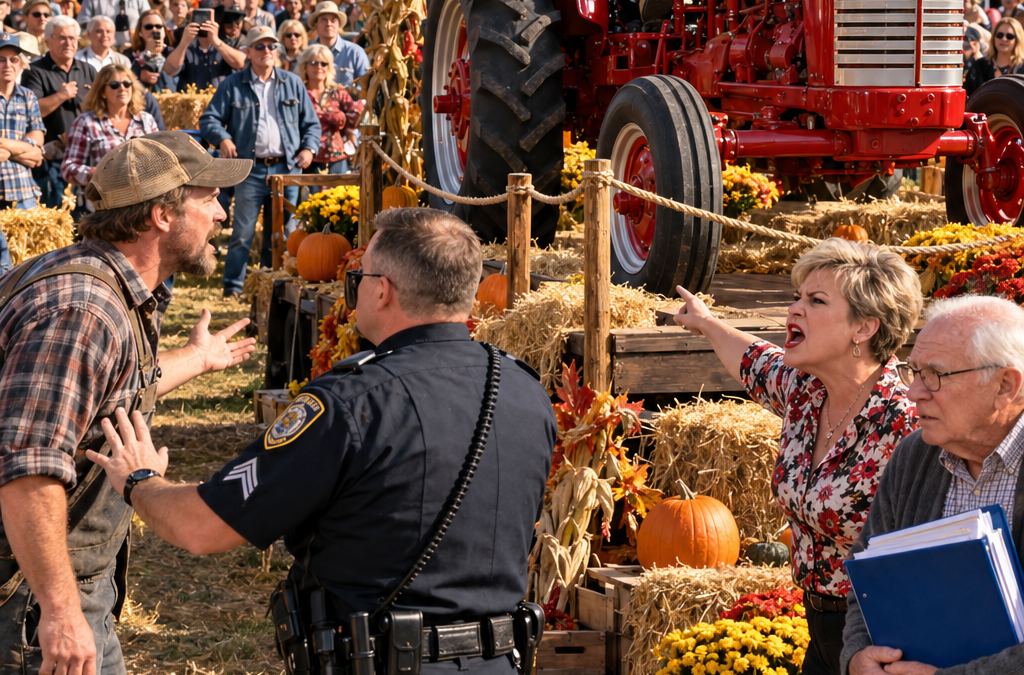
As if summoned by her own name, Tiffany came marching across the grass.
Cream jacket this time.
Clipboard.
Of course.
“Is there a problem?”
“Your husband stole my tractor.”
The crowd reacted.
Tiffany’s expression hardened.
“Do not use inflammatory language.”
“I have video of him cutting my chain.”
“It’s impound enforcement.”
“On land you don’t govern.”
“We have documentation.”
“You have nothing.”
She raised her phone.
“What are you doing?”
“Calling the police.”
I almost smiled.
Instead:
“Go ahead.”
Her eyes narrowed.
“You think this is funny?”
“No.”
She dialed.
“Yes, I’d like to report a trespasser causing a disturbance at the Willow Ridge Harvest Festival.”
The irony was almost too perfect.
She looked directly at me while giving dispatch my description.
Male.
Denim shirt.
Aggressive.
Refusing to leave.
She told them I was attempting to take property held under HOA authority.
When she hung up, Wayne laughed.
“Now we’ll see how tough you are.”
I looked at Dad’s tractor.
“No, Wayne.”
My voice stayed low.
“Now we’ll see whether paperwork survives evidence.”
The patrol car arrived within minutes.
Maple Hollow unit.
Lights flashing.
A young officer stepped out.
Officer Puit.
I knew the name from the roster.
Hadn’t met him personally.
He looked maybe twenty-four.
Fresh enough that his uniform still seemed too sharp.
He walked toward the group.
Tiffany immediately intercepted him.
“Officer, thank God.”
Puit looked at her.
“Who called?”
“I did. Tiffany Aldridge. HOA president.”
She pointed at me.
“That man is trespassing and attempting to interfere with lawfully impounded property.”
Puit turned.
“Sir?”
“Luke Brangan.”
He did not react to the name.
That confirmed it.
He genuinely did not know me.
“I own the tractor.”
“Do you have proof?”
“Yes.”
I opened the title record on my phone.
Registration information.
Serial number.
Photographs.
Puit studied it.
Then Tiffany shoved a sheet toward him.
“Resolution Fourteen.”
He read.
The document looked official.
Willow Ridge letterhead.
Signatures.
Language about seizure of unapproved vehicles for unpaid fines.
Puit looked between us.
I did not help him.
That was important.
A young officer standing between two confident adults should not have to guess based on personality.
He needed facts.
I said:
“My property is outside Willow Ridge. I have certified county records. I also have video of Wayne Aldridge cutting my locked gate and driving the tractor off my property.”
Puit looked at Wayne.
Wayne shrugged.
“HOA enforcement.”
“Do you have the video?”
“Yes.”
Before I could show him, Wayne climbed onto the tractor step.
“This is evidence.”
He pulled himself into the seat.
“I’m taking it to the HOA yard for safekeeping until the fines are paid.”
I stepped forward.
“Wayne.”
He reached for the key.
“Get down.”
He turned the ignition.
Dad’s tractor roared to life.
That sound hit me in the chest.
Not because I feared losing the machine again.
Because I remembered my father sitting beside me beneath barn lights.
Keep her running.
I put one hand on the tractor’s side rail.
Tiffany screamed.
“Don’t touch him!”
She jabbed her finger toward me.
Then toward Puit.
“Arrest him!”
The crowd surged closer.
Phones everywhere.
Wayne sat above me, smiling.
“You think you can do whatever you want,” I said.
“I own this land and that tractor.”
“Your fines say different.”
Behind me, Puit moved.
“Sir, step back.”
His hand caught my sleeve.
Not hard.
Professional.
He was trying to separate people before things escalated.
I looked at him.
Young officer.
Doing what he thought was right.
Then at Wayne.
Then Tiffany.
Then sixty neighbors filming the “farm squatter” finally being dealt with.
I had avoided this moment because I did not want the badge to solve my personal problem.
But now the badge wasn’t going to solve it.
It was going to explain why I could not be the one to handle what happened next.
I reached behind my back.
Tiffany shouted:
“See? He’s reaching for something!”
Puit tensed.
Then I pulled out the badge.
Gold.
Small.
MAPLE HOLLOW POLICE.
CHIEF OF POLICE.
Sunlight caught the face.
The entire lawn went silent.
Puit’s hand released my sleeve immediately.
His face drained.
“Chief?”
Nobody laughed.
Wayne’s smile disappeared.
His hand froze on the steering wheel.
Someone near the fence whispered:
“That’s the police chief?”
Tiffany stared at the badge.
Then at me.
Her mouth opened.
Closed.
“You—”
I put the badge away.
Puit stepped back.
“Chief Brangan, sir, I didn’t—”
“You did nothing wrong.”
He looked stunned.
“You didn’t know me.”
“Sir—”
“You responded to a complaint. That’s your job.”
Tiffany recovered enough to find anger.
“This is abuse of power!”
I looked at her.
“No.”
She pointed at me.
“He’s using his position to intimidate us!”
I turned to Puit.
“Officer, listen carefully.”
“Yes, Chief.”
“I am not here as chief.”
I pointed toward the tractor.
“I’m the victim in a property-theft complaint. You will handle this exactly the way you would if I were anybody else.”
“Yes, sir.”
“And I am not investigating it.”
Tiffany laughed sharply.
“How convenient.”
I took out my phone.
“I’m calling Sheriff Hatcher.”
That silenced her.
The county sheriff had jurisdiction to take over an investigation involving me as Maple Hollow chief.
I made the call in front of everyone.
No shortcuts.
No private command.
I explained that I was the victim of an apparent theft and that my local officer had been placed in an obvious conflict because of my position.
Hatcher asked one question.
“You have video?”
“Yes.”
“I’m coming.”
Twelve minutes.
That’s how long he said.
Then another voice came from the crowd.
“Resolution Fourteen was never voted on.”
Everyone turned.
Margaret Doyle stood near the white fence.
Blue binder against her chest.
Her hands were shaking.
But her voice was clear.
Tiffany’s face changed.
“Margaret.”
Margaret stepped onto the lawn.
“I’m the Willow Ridge treasurer.”
Puit looked at her.
She held up the binder.
“There was no vote.”
Tiffany snapped:
“Stop.”
Margaret ignored her.
“Resolution Fourteen was never approved by the board.”
Wayne climbed halfway down from the tractor.
“Margaret, you don’t know what you’re talking about.”
She looked directly at him.
“I keep the minutes.”
The crowd stayed silent.
“I keep the financial records.”
Tiffany moved toward her.
“You are violating executive confidentiality.”
Margaret’s voice shook.
“No.”
She opened the binder.
“I’m ending it.”
She pulled out copies.
“These signatures aren’t from a meeting because there was no meeting.”
Puit took the paper.
Margaret continued.
“Carl Hensley’s trailer.”
A man in the crowd stiffened.
“The Parker golf cart.”
Another family looked up.
“The Miller ATV.”
Voices began.
Tiffany shouted:
“Those were lawful impounds!”
Margaret turned.
“Show me the votes.”
“You know the enforcement procedure.”
“Show me.”
“You signed financial disbursements.”
“I signed routine treasury pages because you told me the board had approved enforcement.”
Her eyes filled.
“You used my signature.”
The lawn was no longer looking at me.
They were looking at Tiffany.
Sheriff Hatcher arrived before the argument could go any further.
Two deputies with him.
Gray uniform.
Older man.
I had known him professionally for years.
He gave me one nod.
Not Chief.
Not Luke.
Just acknowledgment.
“Show me.”
I handed him the phone.
Gate footage.
Wayne walking up with bolt cutters.
Snap.
Gate opening.
Barn.
Tractor.
Hidden key.
Engine.
Wayne looking straight into the camera.
Waving.
Driving away.
Hatcher watched once.
Then again.
No expression.
He handed me the phone.
Looked at Wayne.
“Sir.”
Wayne stood beside the tractor now.
“This was HOA enforcement.”
“Climb down.”
“It’s legally impounded.”
“Climb down.”
“You haven’t reviewed the resolution.”
“I’ve reviewed the part where you cut a private chain and drove away with a titled vehicle from property outside your subdivision.”
Wayne looked at Tiffany.
She looked at the crowd.
Nobody moved.
Hatcher nodded to Puit.
“Detain him.”
Puit stepped forward.
Wayne’s face changed completely.
“You’re serious?”
“Very.”
“You can’t arrest me for HOA business.”
Hatcher said:
“We can determine what authority you believed you had after you’re advised of your rights.”
Puit cuffed him.
Right there beside the gold-trimmed tractor.
Phones lifted higher.
Tiffany started screaming.
“This is political!”
I said nothing.
“This is retaliation because he’s the chief!”
Still nothing.
“Wayne was acting under board authority!”
Margaret held up the blue binder.
“No, he wasn’t.”
That sentence was quieter than Tiffany’s screaming.
It carried farther.
Wayne was placed in the sheriff’s vehicle.
The Harvest Festival had stopped completely.
Children were being pulled closer to parents.
Music had been turned off.
A table of cider sat untouched.
People who had treated Dad’s tractor as decoration now looked at it differently.
Evidence.
Hatcher asked Margaret if she was willing to provide the binder.
“Yes.”
“Voluntarily?”
“Yes.”
“Do you believe other property is being stored somewhere?”
Margaret nodded.
“The impound barn.”
“Where?”
“Behind the clubhouse.”
I looked toward the building.
A long locked structure sat partly hidden by trees.
I had noticed it when I arrived.
Assumed it held tables or maintenance tools.
Hatcher looked at me.
“You know anything about that building?”
“No.”
“Good.”
He turned to his deputies.
“Secure it. Nobody enters.”
Then to me:
“Your tractor stays here until I document it.”
I nodded.
“Understood.”
That was the strangest part.
I could have complained.
That’s my father’s tractor.
Give it back.
But once the sheriff took jurisdiction, I had to become what I’d demanded everyone else become.
Patient.
Procedure matters most when it frustrates you.
Hatcher photographed everything.
Serial number.
Condition.
Ribbon on the grille.
Location.
My title.
Broken gate later.
By afternoon, Wayne was booked on allegations that included felony-level theft, criminal trespass, and property damage, subject to formal charging decisions.
Tiffany was not arrested that day.
That surprised the neighborhood.
It did not surprise me.
Evidence takes time.
Margaret’s binder was damaging.
Not complete.
Hatcher needed records.
Warrants.
Financial documentation.
Something stronger than outrage.
The next morning, county deputies executed a warrant at the locked storage barn behind the clubhouse.
I was not present for the search.
I made sure of that.
Hatcher called me later.
“Luke.”
“What’d you find?”
“Carl’s trailer.”
I closed my eyes.
“And?”
“The Parker golf cart.”
“Jesus.”
“Miller ATV.”
I sat down.
“Anything else?”
“Yeah.”
“How much?”
“Enough.”
The official inventory grew.
Lawn tractors.
Utility trailers.
ATVs.
A generator.
Landscaping equipment.
Property residents had been told was legally impounded for violations.
A dozen items.
Some had price tags taped to them.
Others had paperwork indicating planned sale.
Then investigators followed the money.
That was where Tiffany’s system became visible.
She had not been collecting fines to protect property values.
The fines created defaults.
Defaults became alleged authority to seize.
Seized property moved into the storage barn.
Then items were sold through a private company linked to Tiffany.
Margaret had records of payments leaving HOA books in strange ways.
The sheriff’s financial investigator found proceeds flowing into accounts connected to Tiffany personally.
By the time the first round of records was reviewed, the estimated value of property involved was around $180,000.
One hundred eighty thousand dollars.
Neighbors’ belongings.
Years of them.
I kept thinking about Margaret saying:
She takes things.
It sounded so simple at my kitchen table.
Now I understood why.
Tiffany had turned HOA enforcement into a business model.
A violation was not merely a violation.
It was inventory.
The next morning, Willow Ridge called an emergency board meeting.
This time I stayed away.
I had no role there.
Margaret later told me what happened.
Tiffany arrived.
Cream jacket.
Binder.
Tried to open the meeting.
County deputies walked in.
She smiled at first.
Apparently she thought they had come to discuss Wayne.
Then Sheriff Hatcher entered.
The smile disappeared.
Her rights were read in front of the board she had controlled for years.
Nobody spoke.
Margaret said the strangest part wasn’t the arrest.
It was how ordinary the room looked afterward.
Same table.
Same chairs.
Same coffee pot.
Tiffany gone.
“Like a storm passed through,” Margaret told me.
“Did anyone defend her?”
“No.”
That answer made me sad in a way I hadn’t expected.
Not for Tiffany.
For everyone else.
A tyrant in a small system rarely rules alone.
People had helped.
Not because they were evil.
Because it was easier to nod.
Easier to sign.
Easier to assume.
Easier to tell Carl Hensley maybe his trailer really had violated something.
Easier to tell the Parkers they should’ve paid the fines sooner.
Easier to believe the official-looking resolution than ask whether a vote ever happened.
Tiffany’s greatest asset had not been her forged paperwork.
It was everyone else’s reluctance to look behind it.
The board removed her as president immediately.
Gerald Price, the vice president, resigned two days later after admitting he had signed documents he hadn’t properly reviewed.
Another member stepped down.
Margaret was asked to serve as interim president.
She resisted.
“I don’t want it.”
I was standing in my barn when she told me.
Dad’s tractor had finally been released back to me after documentation.
The broken chain lay on the workbench.
“Then don’t do it.”
“They say they need somebody who understands the books.”
“That’s not the same as needing you forever.”
She looked at the tractor.
“I helped this happen.”
“No.”
“I signed things.”
“You also brought the binder.”
“Too late.”
“Late isn’t never.”
She looked at me.
Years of fear sat in that expression.
“I’m ashamed.”
“Good.”
She seemed startled.
I continued.
“Shame means you understand something went wrong.”
I tightened a bolt on the gate hinge.
“Use it. Don’t live in it.”
A week after the search, Willow Ridge organized a property-return day.
No festival decorations.
No banners.
Just folding tables outside the clubhouse and county documentation.
Owners came one at a time.
Identification.
Serial numbers.
Receipts.
Statements.
The recovered items were returned where legally possible.
I went because Margaret asked.
Carl Hensley arrived in an old pickup.
Retired mechanic.
Seventy-four.
Thin man with hands that looked permanently stained from a lifetime of work.
When deputies rolled his boat trailer from behind the building, he stopped walking.
Just stopped.
It wasn’t a fancy trailer.
Rust on the frame.
One taillight held with mismatched screws.
But Carl looked at it the way I looked at Dad’s tractor.
I understood immediately.
He walked over.
Touched the hitch.
Then put one hand over his mouth.
I stayed back.
After the paperwork was done, he came toward me.
He held out his hand.
I took it.
He squeezed hard.
For several seconds, he said nothing.
Then:
“My wife and I bought that trailer when the kids were little.”
I nodded.
“She died three years ago.”
“I’m sorry.”
“I thought it was gone.”
He looked toward the clubhouse.
“I stopped fighting because Tiffany told me she’d put a lien on the house if I kept making trouble.”
There it was again.
Fear.
Not law.
Not authority.
Fear.
He looked at me.
“Thank you.”
I shook my head.
“Margaret found the records.”
“You made them look.”
“No.”
I pointed toward him.
“You should’ve never needed a police chief next door to get your own property back.”
That sentence became important to me.
People loved the dramatic version of the story.
HOA steals police chief’s tractor.
Chief reveals badge.
Corrupt president arrested.
It’s a satisfying structure.
But it bothered me.
Because what if I hadn’t been chief?
What if I had been Carl?
What if I had been seventy-four, grieving a wife, staring at an official-looking seizure notice and wondering whether fighting it might cost me my home?
The law shouldn’t only work when the victim happens to understand the system.
That was what Willow Ridge had forgotten.
Over the next months, the investigation became a criminal case.
Wayne eventually admitted his part.
He had physically removed several items.
He had helped transport them.
He claimed Tiffany told him every seizure was lawful.
The videos, messages, and financial records made that defense difficult.
Tiffany had created or caused fraudulent paperwork.
She had directed enforcement.
She had benefited financially.
Both eventually pleaded guilty to felony theft and fraud charges rather than take the case to trial.
There were prison terms.
Restitution orders.
Asset recovery.
The court proceedings took months.
Longer than neighbors wanted.
Justice usually does.
People expect truth to make everything fast.
It doesn’t.
Truth still requires proof.
Proof requires process.
On sentencing day, I attended because I was a victim.
Not as police chief.
I sat behind the prosecutor.
Tiffany looked smaller than she had at my gate.
No clipboard.
No sunglasses.
No title.
Just a defendant beside counsel.
Wayne barely looked up.
The judge went through the financial harm.
The recovered property.
The fraudulent resolutions.
The abuse of community trust.
Victim statements.
Carl spoke.
So did the Parkers.
Margaret submitted something in writing.
I kept mine short.
I talked about Dad.
Not because I wanted harsher punishment.
Because I wanted the court to understand value and price were different things.
“The tractor was appraised around forty-five thousand dollars,” I said.
“But that number is not why its theft mattered to me.”
I explained the restoration.
The weekends.
The gold trim.
Dad’s last year.
My promise.
Tiffany watched me.
For the first time since I’d met her, she didn’t interrupt.
After sentencing, as deputies prepared to move them, she looked at me.
“It was just a tractor.”
Her voice wasn’t loud.
Maybe she meant to dismiss everything.
Maybe she still genuinely did not understand.
I looked at her.
“No.”
I said it quietly.
“It never was.”
Then I walked away.
Margaret became Willow Ridge president officially after the next election.
Not because she wanted power.
That was probably why residents trusted her.
The HOA changed almost everything.
All enforcement actions required documented votes.
No property seizure under internal HOA authority without court process where legally available.
No self-created “impound” rules.
Financial audits.
Published minutes.
Independent legal review for liens.
Clear jurisdiction maps.
And the first page of every new homeowner packet now included a sentence that should have been unnecessary:
THE ASSOCIATION HAS NO AUTHORITY OVER PARCELS OUTSIDE ITS RECORDED BOUNDARIES.
My forty acres were highlighted outside the line.
Margaret showed me.
“Think they made it obvious enough?”
“Put my picture beside it.”
She laughed.
“No.”
“Good.”
The neighbors changed too.
That took longer.
Some apologized.
Some avoided me.
Some acted as if they’d never believed Tiffany.
I knew better.
I didn’t hold grudges.
Not because I was saintly.
Because resentment is expensive.
It charges interest.
One man named Kevin stopped at my gate.
He had commented online that someone should “tow the ugly farm junk.”
He stood there for a long time before speaking.
“I owe you an apology.”
“Okay.”
“I believed her.”
“I know.”
“That photo she posted.”
“I saw it.”
“I called you a squatter.”
“You did.”
He winced.
“I didn’t even check the county map.”
“Most people wouldn’t.”
“That’s not an excuse.”
“No.”
He looked at the barn.
“Can I see the tractor?”
That surprised me.
“Why?”
“I want to understand.”
I opened the door.
Sunlight fell across the teal hood.
Kevin walked around it.
Didn’t touch.
“Gold.”
“My dad’s idea.”
“Looks good.”
I smiled.
“Careful.”
He laughed.
“What year?”
I told him.
Then told him about Dad.
Not all of it.
Enough.
Kevin stood there quietly.
Finally:
“She knew it belonged to your father?”
“She knew after the first notice. I told her.”
He looked toward Willow Ridge.
“That makes it worse.”
“Maybe.”
“How can you say maybe?”
“Because stealing a stranger’s property is already enough.”
He nodded.
Fair.
The gate took longer to repair than it should have because I refused to let anyone pay for it.
Then one Saturday morning, six Willow Ridge residents showed up.
Margaret among them.
Lumber.
Chain.
New hardware.
Coffee.
I stood there.
“What is this?”
Carl Hensley climbed out of his truck.
“Shut up and move.”
“I’m perfectly capable of fixing my gate.”
“So was I.”
He held up a drill.
“Didn’t stop people from helping me.”
I looked at Margaret.
She shrugged.
“Community beautification.”
I laughed.
They stayed four hours.
We fixed the gate.
Reinforced the posts.
Installed a heavier chain.
Carl insisted on adding a steel plate around the latch.
“Nobody cutting this quietly.”
When we finished, everyone stood around drinking coffee.
For the first time since buying the land, Willow Ridge didn’t feel like something I needed to defend myself from.
It felt like neighbors.
Messy.
Embarrassed.
Trying.
That’s usually what real community looks like.
Months passed.
My job settled.
The town finally held the formal introduction ceremony it had postponed.
Local paper took photographs.
My face appeared everywhere for about two days.
Half of Willow Ridge came.
Officer Puit attended in uniform.
Afterward, he approached me.
“Chief.”
“Puit.”
He still looked uncomfortable about Harvest Festival.
“Can I say something?”
“Sure.”
“I shouldn’t have grabbed you.”
“You were separating two people during a heated dispute.”
“Still.”
“You didn’t know me.”
“I should’ve listened more before touching anyone.”
That answer mattered.
I nodded.
“Yes.”
He looked surprised.
Then I continued.
“And you corrected course as soon as new information appeared.”
“Yes, sir.”
“That’s policing.”
Not never making a mistake.
Responding correctly when facts change.
He smiled.
“Thank you, Chief.”
Then I added:
“Next time the HOA president hands you a homemade seizure resolution, maybe call a supervisor.”
He laughed.
“Definitely.”
I never punished him.
Never wrote him up.
There was nothing to punish.
He had been put into a confusing scene and tried to maintain control.
When my badge appeared, he didn’t suddenly become a bad officer because he’d touched my sleeve.
If anything, the moment taught both of us something.
He learned not to let official-looking paper replace verification.
I learned how uncomfortable it is to be the civilian on the other side of a uniform when you know you’re right and aren’t sure anyone believes you.
That’s knowledge every chief should have.
Dad’s tractor went back into the barn.
The ribbon from Harvest Festival came off immediately.
I considered throwing it away.
Instead, I folded it and put it into a drawer.
Don’t know why.
Maybe because objects collect stories.
The tractor already had enough.
Every few weeks, I started it.
Let the engine warm.
Drove it around the pasture.
The gold trim needed touch-up where Wayne’s boot had scratched it climbing aboard.
I did that myself.
My hands are steadier than Dad’s were during his final months.
The line looked cleaner.
I hated that.
I sat on the tractor afterward and stared at the gold paint.
For years, grief had been something quiet.
Private.
Then Tiffany’s theft dragged Dad’s memory into a public spectacle.
People photographed the tractor.
Used it as decoration.
Tied ribbon to it.
Treated it like an object.
Tiffany’s final sentence in court kept returning.
It was just a tractor.
Maybe that’s how she had been able to do everything she did.
Carl’s trailer was just a trailer.
The Parker golf cart was just a golf cart.
The Miller ATV was just an ATV.
Once you reduce property to price, taking it becomes a calculation.
But people attach life to things.
A trailer can carry summers with a dead wife.
A golf cart can hold memories of grandchildren.
An old tractor can contain the final year between a father and son.
The law can’t measure all of that.
It can compensate market value.
Punish theft.
Return what remains.
But it can’t assign a dollar amount to Saturday nights beneath barn lights.
That’s why possession matters.
That’s why process matters.
That’s why people don’t get to take things simply because they’ve convinced themselves somebody owes them money.
Especially not a private association operating outside lawful authority.
A year after the Harvest Festival, Willow Ridge held another one.
Margaret invited me.
I almost said no.
Then Carl called.
“You’re coming.”
“Am I?”
“Yes.”
“Why?”
“We need somebody with an ugly tractor.”
I laughed.
“Absolutely not.”
“Bring it.”
“No.”
He paused.
“Okay, don’t bring it. Just come.”
So I went.
On foot.
The festival looked different.
Same lawn.
Same white fence.
Pumpkins.
Food.
Children.
No confiscated property being used as decoration.
That seemed like progress.
Margaret stood near a table labeled HOA RECORDS & RESOURCES.
I walked over.
“Nothing says fall festival like municipal compliance.”
She smiled.
“People asked.”
“People asked to see bylaws?”
“After Tiffany? Yes.”
Fair.
There were copies of the boundary map.
Financial reports.
Appeal procedures.
Meeting schedules.
Boring papers.
Beautiful papers.
I picked up the boundary map.
My forty acres sat outside Willow Ridge.
Very clearly.
Margaret pointed.
“We used red.”
“I noticed.”
“So nobody forgets.”
“Good.”
Carl came up carrying cider.
He handed me one.
“Tractor running?”
“Always.”
“Gold still ridiculous?”
“Absolutely.”
He smiled.
We stood there while children played.
At some point a little boy asked Margaret who the man in the photo on one of the safety flyers was.
It was me.
Apparently the town had used a picture from the chief introduction.
Margaret said:
“That’s our police chief.”
The boy looked at me.
Then back at the photo.
“You don’t look like him.”
Carl nearly spit out his cider.
I said:
“That’s because photos lie.”
Maybe they do.
Or maybe people see what they’re prepared to see.
Tiffany posted my photograph and told Willow Ridge I was a squatter.
They saw a squatter.
At Harvest Festival, I arrived in jeans and a denim shirt.
Officer Puit saw a civilian in a property dispute.
Then the badge came out.
The crowd suddenly saw a police chief.
Same man.
Different information.
That’s one of the strangest things about authority.
People react to what they know you are.
Sometimes more than to what you’re actually saying.
I tried hard after that day not to forget it.
When someone came into the station angry, I reminded officers that the citizen saw uniforms before they saw people.
When someone complained about property, we checked jurisdiction before deciding who sounded more believable.
When old folks arrived frightened by paperwork, we slowed down.
Not every issue was criminal.
Often the answer was civil court, county records, a lawyer, or simply a conversation.
But I stopped assuming people knew the difference.
Willow Ridge taught me that a piece of letterhead can terrify someone almost as effectively as a badge.
Both create perceived authority.
Both demand restraint from the people using them.
Margaret once came to my office months after becoming president.
She carried no binder.
I considered that a healthy sign.
“Got a minute?”
“Sure.”
She sat.
“I need advice.”
“Legal?”
“No.”
“Good, because I’m not your lawyer.”
She smiled.
“A homeowner keeps demanding we seize a neighbor’s riding mower because he owes fines.”
I stared at her.
“Please tell me that’s a joke.”
“It’s not.”
“What did you tell him?”
“We don’t seize property.”
“Excellent.”
“He says Tiffany did.”
“That’s your second clue.”
Margaret laughed.
Then grew serious.
“I still catch people saying, ‘The HOA has always done it this way.'”
“That’s a dangerous sentence.”
“I know.”
She looked at me.
“How do you change culture?”
“Slowly.”
“That’s not helpful.”
“It is. You just don’t like it.”
She sighed.
“Everyone wants the board to fix eleven years in eleven weeks.”
“Can’t.”
“So what do I do?”
“Make the correct decision enough times that correct becomes normal.”
She was quiet.
Then nodded.
“I can do that.”
And she did.
Eventually people stopped talking about Tiffany daily.
That’s how recovery works.
At first, every board meeting was about the scandal.
Then every other meeting.
Then only when a policy needed changing.
Then new families moved in who had never met her.
To them, Resolution Fourteen was a cautionary paragraph in orientation materials.
Wayne Aldridge became a name attached to court records.
The storage barn was converted into legitimate community equipment space after every recovered item had been processed.
Life moved forward.
Mine did too.
I stayed chief.
The work got harder.
Real crime.
Budgets.
Personnel complaints.
A fatal crash involving teenagers that kept me awake for weeks.
A missing child search that ended well after twenty terrifying hours.
The tractor incident became small compared with those things.
But not unimportant.
It changed the way I led.
Before Willow Ridge, I believed misuse of authority was mostly a problem of bad people doing obviously bad things.
Afterward, I understood the more common version.
People become accustomed to not being questioned.
Then each shortcut seems justified by the previous one.
Tiffany probably didn’t begin with a plan to steal $180,000 in property.
Maybe the first fine was legitimate.
Then someone didn’t pay.
Then she discovered residents were easier to control if threatened with seizure.
Then someone gave in.
Then another.
At some point, the boundary between enforcement and profit disappeared.
The worst systems don’t always begin with a conspiracy.
Sometimes they begin with a person realizing nobody asks for receipts.
Dad had a simpler philosophy.
Hard work is the only thing nobody can repossess.
Technically, he was wrong.
People can take almost anything physical.
Wayne proved that.
He cut a chain and drove Dad’s tractor straight out of my barn.
But now I understand what Dad meant.
The tractor could be stolen.
The hours couldn’t.
The weekends couldn’t.
The memory of him choosing teal paint couldn’t.
The way he laughed when I called the gold trim tacky couldn’t.
Tiffany could put a ribbon on the grille.
Wayne could sit in the driver’s seat.
They could photograph it.
Call it impounded.
Assign a fake debt.
None of that gave them the part that made it mine.
Not legally.
Not emotionally.
The most valuable thing attached to the tractor had never been available to steal.
That helped me let go of some of the anger.
Not all.
Enough.
On the anniversary of Dad’s death, I drove the tractor out at sunrise.
No reason.
Just wanted to.
Frost covered the pasture.
The engine took three attempts.
Dad would’ve criticized that.
I let it idle.
Then drove to the far fence.
The new gate Willow Ridge neighbors had helped build stood solid behind me.
I parked.
Climbed down.
Ran my fingers across the gold stripe.
It was starting to wear again.
Machines age.
Even restored ones.
Paint chips.
Rubber cracks.
Metal corrodes.
Eventually, something that cannot be replaced will fail.
I know that.
One day Dad’s tractor may stop for good.
If that happens, I will not feel like I’ve broken my promise.
Keep her running did not mean forever.
Nothing runs forever.
It meant care.
Don’t neglect what matters.
Don’t abandon it because it’s old.
Don’t sell it because somebody else only sees a price.
Maybe Dad wasn’t talking only about the tractor.
I stood there a long time.
Then started it again.
On the way back to the barn, I passed the road beside Willow Ridge.
Margaret was walking her dog.
She waved.
I waved back.
No clipboard.
No violation notice.
No one telling me the gold trim damaged property values.
Just two neighbors.
That’s what I had wanted when I bought the land.
Not victory.
Not revenge.
Peace.
Real peace isn’t the absence of disagreement.
It’s knowing the person next door recognizes where their authority ends and your rights begin.
Willow Ridge had to learn that the expensive way.
So did I.
The tractor still sits in my barn.
Deep teal.
Gold trim.
Worth about forty-five thousand dollars on paper, maybe more now.
I’ve stopped checking.
It isn’t for sale.
Sometimes people still ask.
I tell them no.
If they ask why, I usually keep it simple.
“My father and I restored it.”
Most understand.
Those who don’t probably never will.
Near the barn door, I keep the broken section of chain Wayne cut.
I thought about throwing it away.
Couldn’t.
Not because I’m proud of what happened.
Because it reminds me how little separates security from assumption.
A chain looks strong until somebody brings bolt cutters.
A resolution looks official until someone checks the minutes.
A president looks powerful until someone checks jurisdiction.
A badge looks important until the person wearing it forgets what it is for.
Tiffany believed paperwork created power.
Wayne believed confidence created ownership.
The crowd believed whatever story reached them first.
Margaret believed silence was safer until silence became unbearable.
Officer Puit believed the documents in front of him until better evidence arrived.
And I believed, for a while, that revealing my badge would be the climax.
It wasn’t.
The badge only changed the room.
Margaret’s records changed the case.
Wayne’s own video changed the legal question.
The financial trail changed everything else.
Facts did the real work.
That’s what I remember when people tell the story now.
They always focus on the moment I reached behind my back.
Chief’s badge.
Crowd gasping.
Wayne freezing.
Tiffany stammering.
Yes.
It happened.
But if that’s all you remember, you miss the point.
My badge did not prove the tractor was mine.
The title did.
My badge did not prove Wayne stole it.
The gate camera did.
My badge did not prove Resolution Fourteen was fake.
Margaret’s minutes did.
My badge did not reveal the storage barn.
Witnesses and a warrant did.
My badge did not uncover $180,000.
Financial records did.
Authority didn’t beat corruption.
Evidence did.
The badge only made everyone stop talking long enough to look.
That difference matters to me.
Because someday another Carl Hensley will face a powerful person with official-looking paperwork, and there may not be a police chief standing beside him.
He deserves the same protection.
The law shouldn’t require a dramatic reveal.
It should require proof.
The community should require proof.
And people in authority should welcome that requirement because real authority becomes stronger when it can survive inspection.
Tiffany’s couldn’t.
That was why it collapsed.
The Sunday after the court case finally ended, I opened the barn early.
No uniform.
No chief’s phone.
Just jeans and an old jacket.
I polished the tractor by hand.
Slowly.
The hood first.
Then the grille.
Then the gold trim.
There was a tiny scratch near the step where Wayne had climbed aboard at the Harvest Festival.
I could’ve sanded it out.
Didn’t.
I left it.
Dad had once told me every working machine ought to carry a few scars.
At the time, I thought he was defending his refusal to repaint old equipment.
Now I understood.
Scars are records too.
The scratch belongs to the tractor’s story now.
So does the Harvest Festival.
So does the broken chain.
So do the neighbors who repaired my gate.
So does Margaret’s blue binder.
So does Carl crying when he saw his trailer.
So does Officer Puit whispering, “Chief,” after realizing who I was.
So does Tiffany’s final sentence.
It was just a tractor.
No.
It never was.
It was every Saturday night beneath the barn lights.
It was my father’s shaking hand guiding a gold paintbrush.
It was his voice telling me a machine that worked hard deserved to shine.
It was the last promise he ever asked me to keep.
And after everything Tiffany and Wayne took from their neighbors, that may have been the one thing they were never capable of understanding.
They saw property.
I saw time.
They saw forty-five thousand dollars.
I saw my father.
They saw something they could seize.
I saw something I had been entrusted to protect.
That Sunday, when I finished polishing the gold trim, I stepped back beneath the barn lights.
For a second, I could see Dad standing on the other side of the tractor.
Thin.
Tired.
Grease on his face.
Waiting for me to admit the paint looked good.
I smiled.
“Still tacky,” I said.
The barn gave me no answer.
It didn’t need to.
I climbed into the seat.
Turned the key.
And kept her running.








