𝗙𝗨𝗟𝗟 𝗦𝗧𝗢𝗥𝗬 The HOA President Put a For-Sale Sign on My Grandfather’s Ranch Before I Even Arrived to Claim It
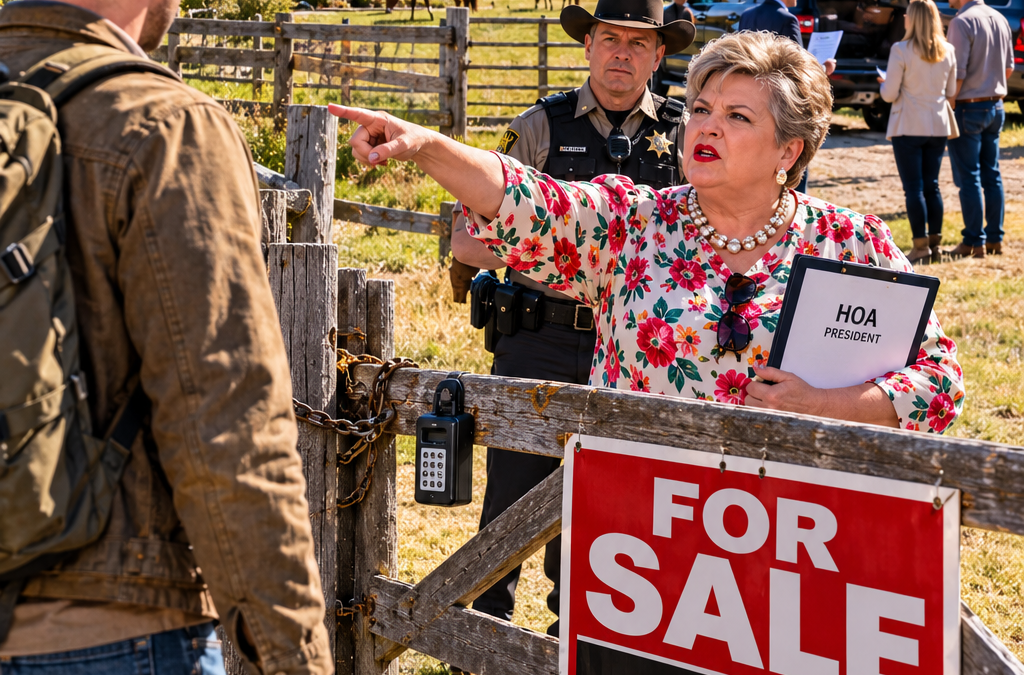
𝗙𝗨𝗟𝗟 𝗦𝗧𝗢𝗥𝗬
His voice sounded wrong.
Not frightened.
Uncomfortable.
“You driving?”
“Yeah.”
“You got time to talk?”
“I’m two hours out.”
There was a pause.
Then he said, “You know about the sale, right?”
I almost missed the next turn.
“What sale?”
Another pause.
Longer.
“The ranch.”
I gripped the steering wheel.
“What about it?”
Dale exhaled.
“Margaret listed it.”
I remember those exact words because they made absolutely no sense.
“Who is Margaret?”
“Holloway.”
Still nothing.
“Who?”
“President of that HOA next to Earl’s place. Pinecrest.”
“What do you mean she listed it?”
“Real estate sign went up about three weeks ago.”
My hands tightened.
“Dale, what are you talking about?”
He spoke carefully now.
“People were out there last weekend. Realtor. Couple from Bozeman, I think. Walking around the barn. Looking at the pasture.”
I felt suddenly cold.
“I’m the owner.”
“I know.”
“The deed was recorded last week.”
“I know.”
“Then how is somebody showing my property?”
“That’s why I’m calling.”
I slowed the truck.
Cars passed.
For a second, I considered pulling onto the shoulder.
“What exactly did you see?”
“Lockbox on the gate. For-sale sign. Mountain Peak Realty.”
“Did they go inside the house?”
“I don’t know.”
“Did they go inside the barn?”
“I saw them near it.”
“Who gave them access?”
“I assumed you did until yesterday.”
“Yesterday?”
“Talked to your mother at church. She said you were moving up this week.”
My stomach dropped.
“So you realized I didn’t know.”
“Yeah.”
“Dale, who the hell is Margaret Holloway?”
He sighed.
“You’re going to meet her.”
I ended the call five minutes later.
For the rest of the drive, excitement disappeared.
I called the estate attorney.
Voicemail.
Called my mother.
She had no idea.
Called the county recorder’s office.
Closed.
I pulled over at a gas station and checked the online county property database.
Parcel number.
Owner: Marcus Reed.
No question.
No transfer pending.
No recorded option.
No lien.
No HOA declaration.
Nothing.
Then I searched the address.
There it was.
A real estate listing.
MOUNTAIN PEAK REALTY.
Forty-seven acres.
Farmhouse.
Barn.
Mountain views.
Development potential.
$340,000.
I stared at the number.
The estate appraisal had valued the ranch far above that.
Not luxury-developer money.
But certainly nowhere near $340,000.
The listing described the property as:
“Rare acreage opportunity adjacent to Pinecrest Community, offered in cooperation with association management.”
Association management.
I read it again.
Then opened the photos.
My grandfather’s house.
His barn.
His porch.
His kitchen.
His kitchen.
Someone had been inside.
There were photographs of the living room.
The bedrooms.
Earl’s desk.
The mudroom.
The same boots were still beside the door.
For a few seconds I couldn’t breathe.
Someone had walked through his house after he died.
Moved through rooms I hadn’t even had time to clear.
Taken photographs.
Uploaded them online.
And offered everything for sale.
I called the listing number.
A woman answered brightly.
“Thank you for calling Mountain Peak Realty. This is Carol Jensen.”
“This is Marcus Reed.”
“Hi, Marcus. How can I help?”
“You’re selling my ranch.”
Silence.
Not complete.
I could hear keyboard clicking.
“I’m sorry?”
“The property on County Road 16. Forty-seven acres. Earl Reed estate.”
“Oh, yes. Beautiful property.”
“It’s mine.”
A pause.
“Are you one of the family members?”
“I am the legal owner.”
Another pause.
Longer now.
“Sir, my listing authority comes through Pinecrest Community Association.”
“You have five minutes to explain what that means before I call law enforcement.”
Her cheerful tone vanished.
“I’m sorry, I don’t understand.”
“I’m looking at a listing for land with my name on the deed.”
“The association represented that they had management authority over the parcel.”
“Management authority isn’t ownership.”
“They provided documentation.”
“What documentation?”
“I would need to review the file.”
“Who signed the listing agreement?”
Silence.
“Carol.”
“Margaret Holloway signed on behalf of Pinecrest Community Association.”
There it was.
“Is Margaret Holloway the owner?”
“My understanding was that the association had authority over an abandoned or estate property.”
“Abandoned?”
“Sir, I’m telling you what I was given.”
“My grandfather died six weeks ago.”
“I’m sorry.”
“The house isn’t abandoned.”
“I understand.”
“No, I don’t think you do.”
I heard her inhale.
“I think we should pause all showings until this is clarified.”
“You think?”
“I will immediately suspend the listing.”
“Remove the lockbox.”
“Yes.”
“Remove the sign.”
“Yes.”
“And nobody enters the property again.”
“Understood.”
“If anybody is inside when I arrive, I’m calling the sheriff.”
She gave me her email.
I sent her a screenshot of the recorded deed from the side of the road.
Then I drove the final two hours.
The for-sale sign was still there when I arrived.
Large.
White.
Red letters.
MOUNTAIN PEAK REALTY.
Forty-seven acres.
Investment opportunity.
I stopped at the end of the driveway.
I didn’t move for almost thirty seconds.
I had imagined that arrival during the entire drive from Denver.
Pulling up.
Opening the gate.
Walking into the house as its new owner.
Beginning whatever the rest of my life was going to become.
Instead, I sat staring at a sign telling strangers my grandfather’s ranch could be purchased.
There was a lockbox attached to the gate.
I got out.
Took photographs.
Then cut the plastic ties holding the sign to its posts and laid it flat.
I did not touch the lockbox.
Evidence.
That instinct turned out to matter.
I drove up the lane.
The ranch looked mostly untouched.
But little signs told me people had been there.
Fresh tire tracks near the barn.
Mud on the porch.
One chair inside had been moved.
Earl’s kitchen cabinet was open.
The air smelled unfamiliar.
Perfume maybe.
I walked room to room slowly.
Nothing obvious missing.
But I still felt violated.
Not personally.
For him.
He had been gone six weeks and strangers were already measuring what he’d built.
My phone rang.
Unknown number.
I answered.
“Marcus Reed?”
“Yes.”
“This is Margaret Holloway. Pinecrest Community Association.”
Of course.
Her voice was confident.
Professional.
Almost warm.
“I understand there’s some confusion regarding your grandfather’s property.”
“No confusion.”
“I think we should speak in person.”
“Good.”
“I’m at the Pinecrest administration office.”
“I’m not.”
“Where are you?”
“My ranch.”
She paused.
“I can meet you there.”
“Fine.”
She arrived twenty minutes later.
White SUV.
Pinecrest sticker on the windshield.
Margaret Holloway looked to be in her early sixties.
Blond-gray hair.
Cream jacket.
Black slacks.
Lanyard around her neck.
Clipboard.
I almost laughed when I saw the clipboard.
Some people really do become exactly what you imagine.
She parked near the house and walked toward me.
“Marcus?”
I didn’t offer my hand.
“Margaret?”
She smiled anyway.
“First, I’m very sorry about Earl.”
That stopped me for half a second.
“You knew him?”
“For years.”
“Did he like you?”
Her smile tightened.
“We had disagreements.”
I already knew the answer.
She glanced around.
“You must be overwhelmed.”
“Not really.”
“Estate transitions can be complicated.”
“This one wasn’t.”
She nodded toward the driveway.
“I understand you removed the listing sign.”
“I laid it down.”
“We should probably avoid disturbing anything until counsel resolves ownership authority.”
I stared at her.
“Ownership authority?”
“The HOA has been maintaining this property since Earl passed.”
“No, you haven’t.”
“We’ve performed roadside mowing, inspection, security—”
“Stop.”
Her eyebrows rose.
“This land isn’t in Pinecrest.”
“It borders Pinecrest.”
“That’s not the same thing.”
“There are provisions in our charter regarding unmanaged adjacent property affecting community values.”
“My grandfather’s ranch is not unmanaged HOA property.”
“Our attorney may disagree.”
“Then your attorney is welcome to call mine.”
Margaret’s expression changed.
Not much.
Just enough.
“I’ve been trying to reach you.”
“How?”
“We sent notices.”
“To Denver?”
“To Earl’s address.”
I looked toward the farmhouse.
“So after the owner died, you mailed letters to the dead owner?”
She ignored that.
“The board had concerns about deterioration.”
“He’d been dead six weeks.”
“Pasture maintenance was already becoming an issue.”
I almost couldn’t believe the conversation.
“You listed forty-seven acres for sale because the pasture needed mowing?”
“That’s an oversimplification.”
“Good. Explain it.”
She adjusted the clipboard.
“Section fourteen of Pinecrest’s community charter allows the association to act when abandoned, neglected, or unmanaged property within the community sphere creates a nuisance or threatens property values.”
“Within the community.”
“Our interpretation includes adjoining parcels subject to historical maintenance coordination.”
“No.”
“That’s a legal question.”
“No, it’s a boundary question.”
She smiled again.
That same patronizing smile.
“We’ll let the lawyers sort it out. In the meantime, we have a very motivated buyer.”
“There is no buyer.”
“There is an offer.”
“The sale is over.”
Her face hardened.
“Marcus, perhaps you don’t understand how far along this process is.”
I stepped closer.
“I understand my name is on the deed.”
“Please don’t become confrontational.”
“You’re standing on my ranch telling me you’ve already found somebody to buy it.”
“We have operated in good faith.”
“Leave.”
She stared at me.
“Excuse me?”
“Get off my property.”
Her hand moved to her phone.
“I think you need to calm down.”
“I am calm.”
“You’re interfering with authorized association business.”
“There is no authorized association business here.”
She unlocked her phone.
I expected her to call a lawyer.
Instead, she called 911.
Standing ten feet from me.
“Yes,” she said when the dispatcher answered. “I’m at the Pinecrest agricultural parcel adjacent to the western boundary. There’s a man here refusing to leave association-managed property.”
I actually laughed.
Margaret looked at me.
“His name is Marcus Reed. He’s becoming aggressive.”
“I’m standing still.”
She turned away.
“Yes, please send someone.”
Then she disconnected.
For a moment, neither of us spoke.
“You just reported me for trespassing on my own ranch.”
“The deputy can sort out occupancy.”
“Ownership.”
“Whatever term you’d prefer.”
That sentence told me more about Margaret Holloway than anything else that day.
Ownership was just another word to her.
Something flexible.
Negotiable.
Useful until inconvenient.
The deputy arrived about fifteen minutes later.
Officer Daniel Reyes.
He looked like a man who had already had too long a day.
Early forties.
Calm face.
Measured voice.
He stepped from the cruiser.
“Who called?”
“I did,” Margaret said.
He looked at me.
“Sir?”
“Marcus Reed.”
“Do you live here?”
“Starting today.”
Margaret interrupted.
“The association has management authority.”
Reyes held up a hand.
“One at a time.”
I went to my truck and retrieved the estate folder.
Recorded deed.
Probate order.
County parcel map.
Boundary survey.
Then something else.
A letter dated June 18, 1997.
I had seen it in Earl’s files years earlier.
Pinecrest had been established when the subdivision was developed east of the ranch.
The developer invited Earl to voluntarily incorporate his property into the HOA.
Earl refused.
In writing.
The letter stated that the ranch would remain outside Pinecrest governance and that no HOA covenants, assessments, or architectural restrictions would apply.
Signed.
Notarized.
Copies acknowledged by the original developer.
Reyes read it.
Then checked my driver’s license.
Then looked at the deed.
Finally he turned toward Margaret.
“Ma’am, do you have something showing the association owns this parcel?”
“We don’t claim fee ownership.”
“Then why did you report him for trespassing?”
“We have management authority.”
“Do you have that document?”
She began flipping pages.
Charter.
Maps.
Board resolution.
Nothing tied my parcel to Pinecrest.
Reyes waited.
Very patiently.
Eventually Margaret said, “This is a civil issue.”
“I agree.”
He handed my documents back.
“But this man appears to be the recorded owner.”
Margaret’s jaw tightened.
“Officer, there is an ongoing transaction.”
“Then your attorneys can address it.”
I said, “I asked her to leave.”
Reyes looked at Margaret.
“Unless you can show me some lawful right to remain here over the owner’s objection, I suggest you do that.”
The smile disappeared completely.
She gathered her papers.
Before getting into the SUV, she turned to me.
“This isn’t finished.”
I looked at her.
“It is for today.”
Then she drove away.
Reyes remained.
He looked toward the real estate sign lying near the road.
“That hers?”
“HOA’s realtor.”
He exhaled.
“I’ve seen strange property disputes.”
“This qualify?”
“Top five.”
I gave him my attorney’s number and filed a report documenting the encounter.
Then I called Priya Shah.
Priya had handled part of Earl’s estate transfer through the Montana side of the process.
Sharp.
Fast.
No patience for theatrical nonsense.
I told her everything from the driveway.
She interrupted twice.
“They signed a listing agreement?”
“Yes.”
“Who?”
“Margaret Holloway.”
“On behalf of the HOA?”
“Apparently.”
“Did she represent the HOA as owner?”
“I don’t know yet.”
“Do not speak to her again without me.”
“Gladly.”
“I want the listing packet.”
“Carol says she’s suspending it.”
“Good. I want everything.”
“There’s supposedly an offer.”
Silence.
“From whom?”
“Don’t know.”
“We’ll know.”
That was the beginning.
Over the next week, Priya pulled every thread.
The realtor sent over the listing agreement after receiving a preservation letter.
Margaret had signed as:
MARGARET HOLLOWAY
AUTHORIZED PROPERTY ADMINISTRATOR
PINECREST COMMUNITY ASSOCIATION
The document represented that Pinecrest possessed authority to market the ranch as an unmanaged parcel within its jurisdiction.
No deed attached.
No court order.
No power of attorney.
No estate authorization.
Just a board resolution passed three weeks after Earl’s death.
RESOLUTION REGARDING ABANDONED ADJACENT PROPERTY.
My grandfather’s ranch was the only property named.
“Abandoned,” Priya said, sitting across from me at Earl’s kitchen table.
“Six weeks.”
“Apparently that’s all it takes now.”
She looked at me.
“Don’t joke. This gets worse.”
She placed another set of documents down.
HOA accounting records.
Pinecrest had opened an internal account for the ranch after Earl died.
Parcel 47-A.
They had charged it three months of “maintenance assessments.”
Roadside mowing.
Security monitoring.
Administrative oversight.
Landscape inspection.
None had actually been billed to me because they didn’t know where to send them.
Instead, the charges accumulated internally as debt against the property.
“Why?” I asked.
“Because debt creates leverage.”
“Leverage for what?”
Priya slid the listing packet toward me.
“If they create a narrative that the property is abandoned, unmanaged, and accruing obligations, then they can make extraordinary board intervention sound less outrageous.”
“But they still can’t sell it.”
“No.”
“So how did a realtor accept this?”
“That’s one of several questions her licensing board may ask.”
Then we found the buyer.
The offer had been submitted through an LLC.
Silver Trail Holdings.
Purchase price:
$340,000.
Cash.
Fast closing.
Minimal contingencies.
Priya ordered the corporate records.
The LLC had one member.
Matthew Crane.
Margaret Holloway’s son-in-law.
I sat completely still.
“You’re sure?”
“State filing.”
I looked at the papers.
Then at Priya.
“This wasn’t HOA overreach.”
“No.”
“She was stealing the ranch.”
Priya’s expression remained controlled.
“We don’t use that word yet.”
“Why not?”
“Because we’re going to prove exactly what she did and let the court choose its own vocabulary.”
The appraisal from Earl’s estate valued the property significantly above the offer.
The gap was enormous.
Silver Trail would have acquired forty-seven acres beside an expanding subdivision at a fraction of the appraised value.
And if the surrounding market continued rising, the potential resale profit would have been substantial.
That was when anger finally became something heavier.
Margaret hadn’t misunderstood an HOA rule.
She had seen death as an opening.
My grandfather died.
The land temporarily sat quiet while probate moved.
She decided quiet meant vulnerable.
Priya obtained Pinecrest meeting minutes.
The first reference to Earl’s death appeared nine days after it happened.
Margaret told the board:
“The Reed parcel may present a unique opportunity for community consolidation.”
Nine days.
At another meeting, she described the ranch as “functionally abandoned pending succession.”
A board member asked whether the family had been contacted.
Margaret answered that outreach efforts were underway.
They weren’t.
The next month, she pushed through the property-administration resolution.
Three board members voted yes.
Two abstained.
Nobody sought an independent title opinion.
Nobody contacted the estate attorney.
Nobody checked whether probate had identified an heir.
Then came the emails.
Those changed everything.
Priya obtained them during discovery after we filed suit.
Margaret to Carol Jensen, the realtor:
Earl’s passing gives us a limited window before the family becomes actively involved.
Another:
The successor appears to live out of state and may prefer a clean disposition.
Another:
We should avoid unnecessary attention until we have a serious buyer.
Then an email to her son-in-law:
If this works, you’ll have the acreage before the association expansion vote and at a price that still makes development feasible.
I read that sentence five times.
“She wrote this?”
Priya nodded.
“Actual email?”
“Metadata confirmed.”
“She discussed the price with him before listing?”
“Yes.”
“Did the board know he was the buyer?”
“Doesn’t appear so.”
We added claims.
Fraudulent misrepresentation.
Slander of title.
Unauthorized interference with property rights.
Civil conspiracy allegations tied to the attempted transaction.
Trespass issues related to the showings.
The exact legal labels changed as evidence developed, but the facts became uglier.
Carol Jensen hired her own attorney.
Her defense was that Margaret had represented Pinecrest’s authority as legitimate.
She had received a board resolution.
She had not independently confirmed title before listing.
That last part became a professional problem.
The state real estate licensing board opened a review.
Carol removed the listing within hours of my initial call.
That helped her.
It didn’t erase what had happened.
Pinecrest’s board began panicking.
Residents had not been told the HOA was attempting to sell Earl’s ranch.
Most believed Margaret was only negotiating “future land-use integration.”
When discovery documents began circulating through attorneys, word spread.
Dale called me.
“People are furious.”
“At me?”
“At her.”
“I don’t live in Pinecrest.”
“Doesn’t matter. They don’t like being used either.”
An emergency HOA meeting drew almost every household.
I didn’t attend.
Priya advised against turning the lawsuit into neighborhood theater.
Dale did.
He called me afterward.
“Margaret got destroyed.”
“What happened?”
“Residents asked who authorized the sale.”
“And?”
“She said the board.”
“Technically true.”
“Then one of the board members stood up and said they approved property management review, not a below-market sale to her son-in-law.”
I leaned back.
“That would’ve been useful to clarify earlier.”
“He’s not having a good week.”
Neither was Margaret.
The board voted to suspend her authority pending review.
Two weeks later, homeowners removed her as president.
The lawsuit continued.
Removing her from office didn’t restore anything by itself.
It did change the tone.
Pinecrest’s new interim board president was a retired engineer named Henry Wallace.
He contacted Priya.
Not me.
Smart.
The association offered to disclaim all authority over the ranch.
Permanently.
They also offered to withdraw every internal maintenance assessment and reimburse expenses tied to unauthorized entry.
Priya asked what I wanted.
“Written acknowledgment.”
“Of what?”
“That Earl was never a member.”
“Good.”
“That I am not a member.”
“Good.”
“That Pinecrest has no jurisdiction over the forty-seven acres.”
“Absolutely.”
“And they don’t contact me about joining again.”
She smiled.
“That last part may not need legal language.”
“I want it anyway.”
We got it.
But Margaret fought.
Her deposition took nearly six hours.
I wasn’t in the room for most of it.
Priya later gave me the transcript.
Some sections were painful.
Some almost unbelievable.
Priya asked:
“Mrs. Holloway, when did you first learn Earl Reed had died?”
“Shortly after his passing.”
“How shortly?”
“Within a week or two.”
“Did you know he had family?”
“Yes.”
“Did you know he had a grandson?”
“I had heard that.”
“Did you contact Marcus Reed before presenting the property administration resolution?”
“I attempted outreach.”
“How?”
“Mail.”
“To what address?”
“The ranch.”
“Where you understood Earl Reed no longer lived because he was deceased?”
Margaret paused.
“That was the address available to the association.”
“Did you search probate records?”
“No.”
“Did you search county title records?”
“I relied on association counsel.”
“Which counsel?”
Another pause.
The HOA’s regular lawyer later testified he had never authorized a sale.
Priya continued.
“Please identify the section of the Pinecrest charter that permits the association to sell privately owned non-member land.”
Margaret turned pages.
Minutes passed.
She cited Section 14.
Priya had it ready.
“Section 14 applies to abandoned common-area property and member parcels subject to association covenants, correct?”
Margaret disagreed.
Priya asked:
“Where does it include the Reed ranch?”
“It refers to community-adjacent nuisance properties.”
“Show me those words.”
She couldn’t.
“Was the Reed ranch ever deeded into Pinecrest?”
“No.”
“Did Earl Reed sign Pinecrest covenants?”
“Not to my knowledge.”
“Are you aware of his notarized 1997 refusal?”
“I’ve seen it now.”
“Was Marcus Reed a member?”
“No.”
“Did Marcus authorize you to list the property?”
“No.”
“Did Earl’s estate?”
“No.”
“Did any court appoint Pinecrest administrator of the Reed estate?”
“No.”
“Then what legal instrument authorized you to offer the ranch for sale?”
Margaret’s answer was almost twenty lines long.
She talked about community maintenance.
Property values.
Abandonment.
Safety.
Continuity.
Preservation.
Everything except an actual legal instrument.
Priya let her finish.
Then said:
“So the answer is none?”
Long pause.
“I disagree with that characterization.”
That sentence became a joke among my legal team.
When you don’t have an answer, disagree with the characterization.
Then Priya reached the buyer.
“When did you first discuss the Reed property with Matthew Crane?”
“I don’t recall.”
“We have an email from thirteen days after Mr. Reed’s death.”
Silence.
“You wrote, ‘This may be the best chance to secure the western acreage before the heir becomes involved.’ Do you recall that?”
“I would need context.”
“Your son-in-law was the sole member of Silver Trail Holdings, correct?”
“Yes.”
“Did you disclose that relationship to the Pinecrest board before authorizing the listing?”
“I don’t remember.”
“Any meeting minutes?”
“I don’t know.”
“Any conflict disclosure?”
“No.”
“Did you disclose it to Carol Jensen?”
“I assumed she knew.”
“Did you disclose it to Marcus Reed?”
“No.”
“Did you disclose it in the listing?”
“No.”
Then came the line I will probably remember forever.
Priya asked:
“When you described Earl Reed’s death as an opportunity, what did you mean?”
Margaret didn’t answer for almost thirty seconds.
Then:
“An opportunity to resolve a longstanding land-use conflict.”
My grandfather had never considered his ranch a conflict.
That word made me angrier than the sale price.
He had been there first.
Pinecrest was built next to him.
Earl didn’t become a problem because developers discovered his fence line.
The case lasted four months.
That’s short by civil-litigation standards.
It felt endless.
During that time, I lived at the ranch.
That saved me.
Every day had work.
Real work.
Not lawyers.
Fence repairs.
Barn roof.
Horse trough.
Weeds.
A broken gate hinge.
The property forced my attention back into the physical world.
Some mornings I would spend an hour reading legal emails, then go outside and shovel manure.
I recommend that balance to anyone going through litigation.
Nothing reduces legal drama like a horse that doesn’t care about your deposition schedule.
Dale helped me repair the north fence.
One afternoon, he said:
“Earl would’ve loved this.”
“The lawsuit?”
“Watching Margaret explain herself.”
I laughed.
“He would’ve hated lawyers being involved.”
“True.”
Then Dale became serious.
“You staying?”
“What do you mean?”
“After this.”
“Of course.”
“Just asking.”
“Why?”
“Because she almost turned the place into nothing but money.”
I understood.
A sale value.
A development opportunity.
A lowball offer.
A damages calculation.
For months, everyone talked about the ranch in dollars.
That bothered me.
The land had value.
Obviously.
But it wasn’t merely an asset.
That was the whole reason Margaret couldn’t understand Earl.
He could have sold years earlier for far more than he paid.
He didn’t.
He liked waking up there.
Some people cannot understand a thing they can’t monetize.
Eventually the court ruled.
The listing was void.
Not suspended.
Not disputed.
Void.
Margaret and Pinecrest had never possessed authority to sell the ranch.
The internal HOA maintenance charges were declared unenforceable.
Pinecrest was ordered to correct its records and reimburse amounts it had improperly collected or allocated against the parcel.
The court found Margaret had acted beyond her authority and made material misrepresentations in connection with the attempted transaction.
The judge was especially critical of the undisclosed relationship between Margaret and Silver Trail Holdings.
The real estate licensing matter against Carol remained with the state board separately.
But the financial part drew the most attention.
Priya had brought in an appraiser and damages expert.
Her argument was not that I had wanted to sell.
I hadn’t.
The argument was that a fraudulent public listing at a dramatically depressed price created measurable market harm.
During those weeks, prospective buyers and brokers had been shown the ranch as available for $340,000.
That listing created a public price anchor far below appraised value.
It also clouded control over the property during a critical period after title transfer.
We claimed legal fees.
Costs associated with securing the property.
Unauthorized entry and showing expenses.
Documented emotional distress connected to the fraud and intrusion.
And economic damages tied to the attempted below-market transfer.
Margaret’s attorney called the claim punitive and speculative.
Priya called it foreseeable.
The court largely agreed with us.
Not every dollar we requested.
Courts rarely give people exactly what they imagine.
But enough.
More than enough to cover the legal bills.
Enough to compensate for the disruption.
Enough that Margaret’s attempt to hand the ranch to her son-in-law cheaply became very expensive for her personally.
When Priya called with the final numbers, I was standing in Earl’s barn replacing a broken latch.
“Sit down,” she said.
“Why?”
“Because I’m about to tell you what the court awarded.”
I sat on a feed bucket.
She explained everything.
I listened.
When she finished, I didn’t speak.
“Marcus?”
“Yeah.”
“You’re allowed to sound happy.”
“I don’t know what I feel.”
“That’s normal.”
“Did we win?”
She laughed softly.
“Yes.”
I looked around the barn.
Dust floating through sunlight.
Old tack on the wall.
Earl’s hammer still hanging over the workbench.
“Then why does it still feel disgusting?”
“Because winning doesn’t make the original thing acceptable.”
That was exactly it.
People love stories where bad behavior produces satisfying consequences.
I do too.
But consequences do not reverse violation.
Margaret losing power didn’t remove the photographs strangers had taken inside Earl’s house.
The court order didn’t erase her email calling his death an opportunity.
Money didn’t return the six weeks when I should have been grieving instead of defending title to land that was obviously mine.
Still, accountability mattered.
Pinecrest held a formal election.
Henry Wallace became president.
One of his first acts was to send me a letter.
Not from a lawyer.
From him.
He apologized.
He acknowledged that Earl’s ranch had never been part of Pinecrest.
He confirmed the HOA would never assert membership or maintenance authority over it absent voluntary written agreement by a future owner.
Then he wrote something I didn’t expect.
Several Pinecrest residents had been unaware of Margaret’s actions and wanted me to know they considered Earl a good neighbor.
I read that paragraph twice.
My grandfather had complained about Pinecrest constantly.
Too many exterior lights.
Too much traffic.
People driving too fast.
Dogs off leash.
But apparently he’d also plowed part of their access road during one winter storm before the county truck arrived.
Helped one resident catch a loose horse.
Loaned a generator during a power outage.
That was Earl.
He could dislike an HOA and still help the people living inside it.
I tried to remember that.
Not everyone in Pinecrest was Margaret.
Carol Jensen eventually lost the listing and faced disciplinary review.
I don’t know every detail of the final licensing outcome.
Once my claims were resolved, I stopped following it closely.
Her attorney sent a written apology.
She admitted she should have independently verified ownership authority before marketing the ranch.
I accepted the apology.
Trusting Margaret had been negligent.
But Carol had stopped the listing the moment I called.
That mattered to me.
Margaret never apologized.
Not directly.
The settlement documents contained legal language.
No personal remorse.
No acknowledgment to me.
Nothing.
I saw her once after the case ended.
At the county courthouse.
I was leaving after signing paperwork.
She was walking in with her attorney.
We nearly passed without speaking.
Then she stopped.
“Marcus.”
I turned.
She looked different without the lanyard.
Older.
Smaller somehow.
Not physically.
Without institutional authority around her, she was simply a woman in a hallway.
“Margaret.”
She looked at me for several seconds.
Then said:
“You ruined my reputation.”
I couldn’t believe it.
After everything, that was what she had.
I almost walked away.
Instead, I said:
“No.”
Her expression hardened.
“You made documents public.”
“Your documents.”
“You turned the community against me.”
“Your emails.”
“You sued me.”
“You tried to sell my ranch.”
“I believed I was protecting Pinecrest.”
“To your son-in-law?”
She looked away.
That silence answered more than anything else.
I lowered my voice.
“Margaret, Earl had been dead less than two weeks when you called his land an opportunity.”
She looked back at me.
“You don’t understand what was happening.”
“Then explain it.”
“The HOA needed room to grow.”
“There it is.”
“Property values were changing. Development pressure—”
“So you thought his death solved a problem.”
“No.”
“That’s what you wrote.”
She exhaled.
“You already won.”
That sentence stopped me.
Won.
As if the whole thing had been a contest.
“I wasn’t competing with you.”
She didn’t answer.
“I was driving home.”
“What?”
“I was driving here to live on the land my grandfather left me. That’s all. I wasn’t fighting Pinecrest. I wasn’t blocking your development. I wasn’t attending your meetings. I wasn’t asking anything from you.”
Her eyes shifted.
“You created the fight.”
She swallowed.
“So yes, the court ruled against you. But don’t confuse that with me wanting any of this.”
For the first time, she looked tired rather than angry.
“I didn’t think you’d move here.”
There it was.
The sentence underneath everything.
“What did you think?”
“That you’d sell.”
“Why?”
“You lived in Denver.”
“So?”
“You had a career.”
“So?”
“Earl always said you loved the ranch, but people say things.”
I stared at her.
“You thought I was absent.”
She didn’t deny it.
“You thought because I wasn’t standing here yet, the land didn’t have anyone protecting it.”
Silence.
That was the mistake.
Not just Margaret’s.
A common one.
People see an empty house and imagine nobody belongs there.
They see an elderly owner die and assume heirs are distant.
They see grass growing slightly longer and call property abandoned.
They see silence and mistake it for surrender.
Earl had warned me about that in his own way.
That land’s got your name on it.
Don’t let anyone tell you different.
I looked at Margaret.
“My grandfather knew exactly who was getting that ranch.”
She said nothing.
“You’re the only person who decided that didn’t matter.”
Then I left.
I never saw her again.
Pinecrest continued without her.
The subdivision did not collapse.
People still drove to work.
Children still rode bicycles.
The clubhouse still held holiday dinners.
A new HOA board handled what an HOA is supposed to handle.
Its own property.
Its own members.
Its own rules.
The relationship between Pinecrest and the ranch became almost boring.
Which was perfect.
Henry Wallace called once about repairing a shared drainage culvert near the boundary.
He asked permission to bring an engineer onto my side.
I said yes.
They scheduled it.
Knocked first.
Completed the work.
Left.
That simple.
Consent has an incredible ability to prevent lawsuits.
The ranch changed too.
Not in the ways Margaret expected.
I didn’t sell.
I repaired.
The barn needed more work than I realized.
Part of the west roof leaked.
Two pasture gates were nearly rusted through.
The farmhouse furnace had opinions about winter.
I learned quickly that inheriting a ranch and running one are different things.
There were days I missed Denver.
Not the traffic.
The convenience.
Stores open late.
Food delivered.
A job where problems ended when I left the office.
On a ranch, a broken water line at eleven at night is your problem because nobody else is coming.
But slowly, I settled.
I bought three more horses.
Leased pasture to Dale’s nephew.
Restored Earl’s old workshop.
Repainted the porch.
Not a new color.
Same faded green he had used for years.
I found the can in the shed.
The first winter was brutal.
Snow came earlier than expected.
I learned why Earl kept three different shovels near the back door.
One morning, I woke before sunrise and walked outside.
Everything was white.
The mountains were pale blue in the distance.
No tire tracks.
No sound except a horse moving in the barn.
For the first time since Earl died, I felt something besides grief when I looked at the property.
Responsibility.
Not burden.
Responsibility.
He had held it for forty-three years.
Now it was my turn.
The damages money mostly stayed untouched.
People assume when someone wins a legal award, the money feels like a prize.
It didn’t.
Some paid the lawyers.
Some covered repairs and security upgrades.
I put the rest into a separate account for the ranch.
Fencing.
Water systems.
Barn maintenance.
Land conservation.
If Margaret’s mistake was treating the property like something to extract value from, I didn’t want my response to be doing the same.
One evening, Priya came out to the ranch after the final case paperwork closed.
She had never seen the place except in photographs.
I made coffee.
We sat on the porch.
She looked toward the mountains.
“I get it now.”
“What?”
“Why you didn’t sell.”
I smiled.
“Different when you’re sitting here.”
“Very.”
She took a drink.
“Earl had good taste.”
“He had cheap taste.”
“Those aren’t mutually exclusive.”
We laughed.
After a while, she said:
“Do you still have the for-sale sign?”
“Yes.”
She looked surprised.
“Why?”
“In the barn.”
“You kept it?”
“Evidence became decoration.”
She laughed.
I wasn’t joking.
The Mountain Peak Realty sign leans against the inside wall of the barn.
I don’t display it outside.
I’m not that petty.
But I kept it.
Sometimes I see it while getting tools.
$340,000.
Forty-seven acres.
Investment opportunity.
It reminds me how close another person’s paperwork came to rewriting my life before I even arrived.
Not legally close.
The title was always mine.
But practically?
If Dale hadn’t called?
If I hadn’t checked?
If a buyer had pushed toward closing?
The fraud would eventually have surfaced.
Of course.
But after how much damage?
How many filings?
How many legal bills?
How many strangers walking through Earl’s house?
How much confusion attached to the title?
Sometimes stopping a wrong thing early matters almost as much as proving it wrong later.
Dale doesn’t let me forget his role.
Every few months he stops by and says:
“Still think that phone call was worth answering?”
I tell him no.
He tells everyone he saved the ranch.
Maybe he did.
At least part of it.
One summer evening, almost a year after I moved in, we sat on the porch together.
He pointed toward Pinecrest.
“You know Earl almost joined that HOA.”
I turned.
“What?”
“Back when the subdivision went in.”
“No way.”
“They offered him road maintenance.”
“Why’d he refuse?”
Dale laughed.
“Margaret wasn’t there yet, but apparently they handed him a rulebook.”
“What was wrong with it?”
“Fence colors.”
I stared at him.
“Earl?”
“Exactly.”
We both laughed.
Then Dale said:
“He told them if a man wanted to tell him what color to paint a fence, that man could buy the fence.”
That sounded like Earl.
Later, I found the 1997 correspondence in his files.
The original developer’s invitation.
Earl’s refusal.
Short.
Polite.
Clear.
I do not consent to incorporating the Reed Ranch into Pinecrest Community Association or subjecting the property to present or future association covenants.
Future.
He had thought ahead.
At the bottom, in his handwriting, Earl had written:
KEEP ORIGINAL.
I framed a copy.
Not because I wanted my house filled with legal memorabilia.
Because that one page represented something simple.
He had been asked.
He said no.
That should have been enough forever.
Margaret’s entire scheme depended on treating that no as temporary.
As though death erased consent.
It didn’t.
Ownership transferred.
The boundary stayed.
The refusal stayed.
The ranch stayed.
Now when I sit on the porch in the morning, Pinecrest is barely visible through the cottonwoods.
I can see a few roofs in winter.
At night, some lights.
They don’t bother me.
I don’t hate the neighborhood.
I don’t hate HOAs as a concept.
I hate the idea that administrative authority can become a substitute for permission.
That’s what happened.
Margaret had a title.
President.
She had letterhead.
A board resolution.
A realtor.
Forms.
Meetings.
She wrapped the attempted sale in enough procedure that people stopped asking the first question.
Who owns the land?
Me.
Before that, Earl.
Never Pinecrest.
Everything should have stopped there.
Instead, people trusted the appearance of authority.
Carol trusted Margaret’s signature.
Some board members trusted her description of Section 14.
Buyers trusted the listing.
Even the deputy arrived because Margaret believed calling 911 could turn her narrative into reality.
It couldn’t.
A uniform didn’t change the deed.
A clipboard didn’t change the survey.
A board vote didn’t change ownership.
Neither did confidence.
That’s the part I think about most.
Margaret was confident right until the moment Officer Reyes asked her to show him proof.
Then all that confidence became paper shuffling.
There is a lesson in that.
Real authority should survive one simple question.
Show me where it says you can do this.
Hers couldn’t.
A year after the case ended, my mother came to stay for a week.
She had avoided the ranch for months after Earl died.
Too painful.
We sat in his kitchen one morning.
Same chipped mug on the shelf.
Same view.
She looked around.
“You’ve changed almost nothing.”
“I fixed things.”
“You know what I mean.”
“I do.”
She smiled.
“He would’ve liked that.”
We walked down to the barn.
I showed her the preserved real estate sign.
She stared at it.
Then laughed.
“You’re keeping that?”
“Probably.”
“Your grandfather would burn it.”
“That’s why I’m keeping it.”
She touched the edge of the sign.
Then became serious.
“I felt guilty.”
“About what?”
“Letting the ranch skip me.”
I shook my head.
“You didn’t let anything.”
“He left it to you because I said I didn’t want it.”
“You didn’t.”
“I know.”
She looked toward the house.
“But after all this, I wondered if I had made it easier for them.”
“No.”
“Maybe if I had been involved—”
“Mom.”
She stopped.
“Margaret did this. Not you.”
That was something the lawsuit had taught me too.
Wrongdoing likes to spread responsibility outward.
The victim should have checked sooner.
The heir should have arrived faster.
The realtor should have known.
The board should have asked.
All true in different ways.
But none changes who initiated the scheme.
Margaret saw a gap.
She exploited it.
That responsibility stayed hers.
We walked to Earl’s grave later that afternoon.
Small cemetery twenty minutes away.
I hadn’t visited since the funeral.
I stood there longer than I expected.
My mother gave me space.
I told him the ranch was fine.
Ridiculous thing to say to a gravestone.
But it felt necessary.
I told him the west fence needed replacing.
The barn still leaked in one corner.
Dale was still full of himself.
Then I said:
“You were right.”
My mother asked what I meant.
I looked toward the mountains.
“Nothing.”
But I knew.
The land had my name on it.
He had made sure.
Today, I am writing this from the porch Earl built.
There’s coffee beside me going cold because I keep looking up.
Morning sun is touching the mountains.
One of the horses is standing near the fence pretending he hasn’t been fed.
The cottonwoods are moving in the wind.
Pinecrest is quiet.
The ranch is mine.
Not because a judge gave it to me.
Not because Priya won a case.
Not because Margaret lost one.
It was mine before any of them became involved.
The court simply forced everyone else to respect what was already true.
That matters.
Because sometimes people describe justice as taking something back.
I didn’t take the ranch back.
Margaret never owned it.
She never had the authority to give it away.
She only created the appearance that she did.
And appearances become dangerous when everyone accepts them without checking.
That’s how strangers entered Earl’s house.
That’s how a for-sale sign appeared at my gate.
That’s how a $340,000 offer from the HOA president’s son-in-law reached a property he had no right to buy from her.
One assumption stacked on another.
Until someone asked for the deed.
I still read documents differently because of that.
Every page.
Every attachment.
Every legal description.
Every signature.
Especially the boring parts.
Earl would enjoy that.
He spent half my childhood telling me to slow down and read what was in front of me.
It took losing him for me to understand why.
A deed is not romantic.
It’s dry.
Technical.
Repetitive.
But sometimes a few lines on a recorded page are the only thing standing between your history and someone else’s ambition.
Margaret had a clipboard.
A board.
A realtor.
A buyer.
A plan.
I had a deed.
In the end, that was enough.
A few weeks ago, I replaced the locks on the farmhouse again.
Not because I feared anyone still had a key.
The old hardware had simply worn out.
I stood at the front door afterward testing the deadbolt.
Click.
Smooth.
Secure.
Then I looked toward the end of the drive where the real estate sign had stood that first afternoon.
Nothing there now.
Just grass.
Fence.
County road beyond it.
Exactly as it should be.
I walked back onto the porch.
Sat in Earl’s old chair.
For a while, I listened to the wind.
And I realized something I hadn’t understood when the case began.
Margaret Holloway’s greatest mistake wasn’t underestimating my lawyer.
It wasn’t choosing her son-in-law as the buyer.
It wasn’t leaving incriminating emails.
Those mistakes exposed her.
The deeper mistake came first.
She looked at a quiet ranch after an old man died and assumed quiet meant nobody was protecting it.
She thought absence meant abandonment.
She thought grief created opportunity.
She thought a grandson twelve hours away was less real than a board resolution sitting in front of her.
She was wrong.
Earl had spent forty-three years building this place.
He didn’t leave it unprotected.
He left it to me.








