𝗙𝗨𝗟𝗟 𝗦𝗧𝗢𝗥𝗬 The HOA President Put 142 Wedding Guests on My Late Wife’s Yacht Without Ever Asking Me
𝗙𝗨𝗟𝗟 𝗦𝗧𝗢𝗥𝗬
The last Sunday she was strong enough to go out, we barely left the harbor.
She sat in her favorite chair on the starboard side of the aft deck with a blanket over her knees.
We drifted beyond the breakwater.
The sea was calm.
She looked at me.
“Don’t sell her.”
I knew what she meant.
“I won’t.”
“You’ll want to.”
“No.”
“Ellis.”
“Grace.”
“You’ll tell yourself she’s expensive.”
“She is expensive.”
“You’ll tell yourself maintaining her alone is stupid.”
“It probably is.”
“Don’t sell her.”
I looked toward the horizon.
“Okay.”
She smiled.
Then took my hand.
“I mean it.”
So did I.
After she died, Second Wind became less a boat than a place where grief could sit without explanation.
I kept her side of the closet untouched for six months.
Could not bring myself to move her toothbrush.
But I could go to the yacht.
I could scrub teak.
Check oil.
Run generators.
Replace filters.
Rebed hardware.
Fix something that could actually be fixed.
There is mercy in mechanical problems.
They do not ask why.
They simply wait for your hands.
My daughter, Madison, understood that.
She was twenty-eight at the time.
Not to be confused with Patricia’s daughter, who was also named Madison in some early wedding paperwork before everyone eventually called her Maddie—but I’ll come to that later.
My daughter lived in North Carolina and had her own family.
She worried that I had become too attached to Second Wind.
Maybe I had.
But I also knew the difference between memory and paralysis.
I still worked around the marina.
Still went out.
Still ate with neighbors.
Still volunteered twice a month with a veterans’ boating group.
I simply refused to let someone else’s timetable decide when I was finished with the last thing Grace and I had made together.
For years, nobody challenged that.
Then there was Patricia Langford.
Patricia had been HOA president for almost nine years when our trouble began.
If you lived in Harbor Point, you knew Patricia.
You might not know her well.
But you knew her.
She had the ability to turn any ordinary concern into an administrative matter.
Trash cans.
Boat covers.
Dock lights.
Landscape mulch.
Guest parking.
Patricia did not knock on your door to ask about something.
She issued a notice.
She liked committees.
Forms.
Minutes.
Authority written in bullet points.
She also liked reminding people that Harbor Point was a “premier waterfront community.”
That phrase appeared everywhere.
Newsletters.
Meeting notices.
Fundraising letters.
Holiday announcements.
She spoke about Harbor Point as though she had personally carved the canals.
Most people tolerated her.
Some genuinely liked her.
She was organized.
Fundraising was good.
Common areas stayed immaculate.
She knew contractors.
She answered emails.
If a dock railing broke, Patricia had someone repairing it within a week.
Power can grow comfortably when it produces useful results.
The problem comes when the person exercising it forgets there are limits.
My first warning came one Tuesday morning when I found a white envelope clipped to my dock gate.
PLEASE CONTACT PATRICIA LANGFORD REGARDING COMMUNITY EVENT.
I almost threw it away.
Instead I drove to the clubhouse.
Patricia was waiting in the conference room.
She wore a pale green suit and had a folder open in front of her.
“Ellis.”
“Patricia.”
“Sit.”
I sat.
She smiled.
That smile should have made me leave.
“My daughter is getting married next month.”
“Congratulations.”
“Thank you.”
She turned the folder toward me.
Inside were photographs of Second Wind.
My boat.
Taken from different angles.
Aft deck.
Salon.
Upper bridge.
Dock.
My stomach tightened.
“When were these taken?”
“Publicly visible areas.”
“That wasn’t my question.”
She ignored me.
“The ceremony is going to be intimate but elegant.”
“Okay.”
“We’ve had a problem with the original venue.”
“Sorry to hear it.”
“I think we’ve solved it.”
She tapped a photograph of my boat.
“This would be perfect.”
For several seconds, I thought I had misunderstood.
“My boat.”
“Second Wind.”
“For the wedding.”
“Yes.”
“No.”
Patricia smiled again.
“You haven’t heard the proposal.”
“I don’t need to.”
“Ellis.”
“Patricia, I don’t charter Second Wind.”
“This wouldn’t be a charter.”
“What would it be?”
“A one-day community favor.”
I almost laughed.
“For your daughter’s wedding.”
“The Langford family has contributed a great deal to Harbor Point.”
“I’m sure.”
“This is the sort of thing good neighbors do.”
“Not with my boat.”
Her expression tightened slightly.
“Everything in Harbor Point affects the broader community.”
“That doesn’t make my vessel community property.”
“We all use the marina.”
“I don’t own the marina.”
“You own one of the most beautiful yachts in it.”
“I own it.”
“Exactly.”
I leaned back.
“This isn’t a committee issue.”
She stared at me.
“Second Wind is documented federally.”
“I know.”
“She’s held in the Grace Whitaker Memorial Trust.”
“That’s unusual.”
“Intentional.”
“The HOA isn’t trying to take your boat.”
“Good.”
“We’re asking for one day.”
“I’m saying no.”
She reached into the folder.
Pulled out a check.
Five thousand dollars.
Slid it across the table.
“Call it a rental.”
I pushed it back.
“No.”
“Ten?”
“No.”
“Name your price.”
“Some things aren’t for sale.”
She looked toward the check.
Then at me.
“What exactly are you protecting?”
That question hit harder than she knew.
I said:
“My wife.”
Patricia paused.
For half a second, I thought humanity might get through.
Then she said:
“Grace is gone, Ellis.”
The room went very still.
She realized immediately that she had crossed something.
But instead of apologizing, she continued.
“The boat is still here.”
I stood.
“Meeting’s over.”
“Don’t be emotional.”
I stared at her.
“If you ever mention my wife like that again, our next conversation won’t happen without counsel.”
Her face cooled.
“This is why nobody can talk to you.”
“Then stop trying.”
I walked out.
Three days later, the first violation notice arrived.
UNAPPROVED VESSEL MODIFICATION.
I had replaced two exterior deck lights with newer LED fixtures.
Same size.
Same color.
No structural change.
The HOA claimed architectural review had been required.
The next letter arrived forty-eight hours later.
IMPROPER DOCK LIGHTING.
Then:
COMMERCIAL USE OF PRIVATE SLIP.
That one almost impressed me.
I had never conducted commercial activity from the slip.
Patricia’s argument was that because I occasionally hosted veterans through a nonprofit boating program, the vessel’s presence created quasi-commercial use.
One hundred fifty dollars.
Then three hundred.
Then five hundred.
Every week, something appeared.
Cable storage.
Dock box placement.
Water hose visibility.
Temporary boarding ladder.
One afternoon I received a violation because Second Wind’s shore-power cord allegedly created a “visual inconsistency.”
I attended the next HOA meeting.
About forty homeowners sat inside.
Patricia gave her president’s report.
Budget.
Pool repairs.
Landscaping.
Then she said:
“We’ve also encountered unfortunate resistance from certain members regarding support for important community events.”
Heads turned.
Not all.
Enough.
I sat quietly.
She continued:
“Harbor Point succeeds because residents understand that private convenience sometimes yields to community responsibility.”
I raised one hand.
Patricia looked irritated.
“Yes, Ellis?”
“Are you referring to my boat?”
A murmur moved through the room.
She smiled.
“If you feel the statement applies to you—”
“That’s not what I asked.”
“Please don’t interrupt the meeting.”
“I raised my hand.”
“Your concerns can be addressed after the agenda.”
So I sat back.
In the Coast Guard, anger was information.
Useful, but dangerous if you let it steer.
You never fight a fire by screaming at it.
You isolate fuel.
Control air.
Understand spread.
Patricia wanted emotion.
I wasn’t giving it to her.
Then an old shipmate died.
Chief Bill Harrington.
I’d served beside him for twelve years.
North Atlantic patrols.
Search and rescue.
Drug interdiction.
Storm seasons.
Bill was the kind of chief who could make thirty exhausted people laugh at four in the morning without pretending the situation wasn’t miserable.
Heart attack.
Sixty-one.
His memorial was in Norfolk.
I couldn’t miss it.
I booked a flight.
Five days.
Before leaving, I checked Second Wind myself.
Doors locked.
Cabin secured.
Batteries stable.
Shore power connected.
Fuel valves closed.
I tested the cameras.
A year earlier, we’d had a marina break-in.
After that, I installed door sensors, motion cameras, and remote alerts throughout the vessel.
Not because I expected Patricia.
Because once you’ve spent half a life responsible for security, you stop trusting a single lock.
I also spoke with Hank Duvall, the dock manager.
Hank had managed Harbor Point’s slips for years.
Fifty-eight.
Divorced.
Always behind financially.
But generally dependable.
“I’m gone until Friday night.”
He nodded.
“Got it.”
“Nobody boards Second Wind.”
“Nobody.”
“Not maintenance. Not HOA. Not caterers. Nobody.”
He looked at me.
“I understand, Ellis.”
“If Patricia comes down here—”
“I know.”
I put one hand on his shoulder.
“Call me.”
He nodded.
I left.
What I didn’t know was that Hank owed Harbor Point almost $41,000.
Back marina fees.
A personal loan routed through an HOA assistance fund after his divorce.
Penalty charges.
He had been making payments, but never catching up.
Patricia knew every dollar.
According to Hank’s later statement, she called him into the clubhouse after I left.
She placed a spreadsheet in front of him.
“$41,000.”
Hank said nothing.
“That’s a lot of money.”
“I know.”
“You could lose your job.”
“I know.”
“You could lose your apartment.”
“I know.”
Patricia closed the folder.
“Or it could disappear.”
Hank looked up.
“What?”
“One favor.”
He knew immediately.
“No.”
“You don’t even know what I’m asking.”
“I know.”
“Ellis has a spare key in the marina lockbox.”
Hank shook his head.
“I can’t.”
“You can.”
“That’s his boat.”
“This is a community event.”
“He said nobody boards.”
Patricia leaned closer.
“Forty-one thousand dollars, Hank.”
He later told police that was when he stopped hearing anything else.
Debt can make a person feel underwater even while standing on dry ground.
“One key,” Patricia said.
“One weekend.”
“Then you’re clear.”
Hank asked whether Ellis—meaning me—had agreed.
Patricia placed a paper in front of him.
A charter agreement.
My name.
A signature.
Hank stared.
“You have his permission?”
“It’s handled.”
That was the lie he wanted to believe.
So he believed it.
He opened the lockbox.
Removed the spare key.
Gave it to her.
Patricia also had something else.
An old HOA form bearing my signature.
A dock maintenance authorization from two years earlier.
She photographed it.
Then someone reproduced that signature on a yacht-use agreement.
Not similar.
Not a rough imitation.
A direct reproduction.
That mattered later.
The fake document said I had agreed to provide Second Wind for a private wedding charter.
Patricia presented it to vendors.
Security.
Caterers.
Wedding planners.
Even her own daughter.
Ellis is thrilled to help, she told them.
She invited 142 guests.
The wedding budget had climbed to roughly $180,000.
Flowers.
Food.
Champagne.
Musicians.
Security.
Photography.
Decor.
Transportation.
A five-tier cake.
Everything.
There was one major problem beyond the forged agreement.
Operating the boat.
Patricia needed a captain.
A properly licensed professional would have asked to see the charter documentation.
Passenger count.
Vessel inspection status.
Safety equipment.
Insurance.
Crew.
So she hired someone who had reasons not to ask questions.
Rusty Blake.
Former charter captain.
License expired more than two years earlier.
Rusty took cash.
No paperwork.
He assumed Patricia had handled everything.
That phrase has probably preceded more maritime disasters than anyone would care to count.
Two days before the wedding, I was standing at Bill Harrington’s memorial reception in Norfolk.
People were telling stories about him.
Someone had just raised a glass.
My phone vibrated.
DOOR SENSOR TRIGGERED – SECOND WIND.
I stared at the screen.
Then another alert.
Aft deck motion.
Cabin entry.
My stomach dropped.
I stepped outside.
Opened the camera app.
At first, I thought I had selected the wrong feed.
White flowers were being carried across the aft deck.
A man in black was tying fabric to the rails.
Someone rolled a bar cart past Grace’s chair.
Then Hank appeared.
He had the spare key.
I watched him unlock my cabin.
Something in me went cold.
I called.
He answered immediately.
“Ellis.”
“What are you doing?”
“Just checking the boat.”
His voice shook.
“You’re inside?”
“Yeah.”
“Why?”
“Routine check.”
I watched him on camera while he lied.
He stood beside two strangers carrying floral stands.
“Okay,” I said.
Silence.
“Thanks, Hank.”
Then I hung up.
I knew enough about frightened people to understand that confronting him over the phone would produce nothing useful.
So I made calls.
First, the sheriff’s marine unit.
I reported unauthorized use and entry onto my vessel.
Gave them the documentation number.
Trust ownership.
Slip location.
Camera evidence.
Then I called Coast Guard Sector.
The watchstander transferred me.
Lieutenant Rachel Ortega eventually took the report.
Her voice was calm.
Professional.
“What passenger count are you expecting?”
“More than one hundred.”
“Is Second Wind inspected for passenger service?”
“No.”
“Captain?”
“I’ve been told they’re using someone named Rusty Blake.”
“License status?”
“Unknown.”
“We’ll verify.”
I gave her everything.
Then said:
“I’m flying back.”
“Mr. Whitaker.”
“Yes?”
“Do not confront people on board.”
“I understand.”
“Stay off the vessel until local law enforcement and our team can assess.”
“That’s my boat.”
“I know.”
That was the hardest part.
She continued:
“You’ve reported unauthorized use. Preserve your evidence. Let us deal with safety and federal compliance.”
Old habits took over.
“Understood.”
I flew home the night before the wedding.
My attorney, Nora Bell, met me at an all-night coffee shop near the airport.
She had a copy of the supposed charter Patricia had been circulating.
One of the vendors had sent it after learning ownership was disputed.
Nora read it.
Then raised one eyebrow.
“What?”
“Ellis.”
“What?”
“This is terrible.”
“The signature?”
“That too.”
She pointed at the owner line.
ELLIS WHITAKER – VESSEL OWNER.
“So?”
“You’re not the vessel owner.”
“I operate it.”
“You are trustee and beneficiary.”
I looked closer.
Second Wind was held by the Grace Whitaker Memorial Trust.
A legal structure I had created after Grace died to preserve ownership and simplify inheritance.
I could execute certain operating documents as trustee.
But a contract identifying me personally as owner and purporting to charter the vessel outside trust authority was not simply suspicious.
It was structurally wrong.
Nora smiled.
“Patricia forged the wrong person.”
I almost laughed.
“Can we stop them?”
“Yes.”
“Tonight?”
“No.”
“Why not?”
“Because letting them continue documenting what they’ve done may be more useful than creating a confrontation at midnight.”
I hated that answer.
“Those people are on Grace’s boat.”
“I know.”
“Flowers on her chair.”
“I know.”
“I want them off.”
Nora leaned forward.
“Then be calm tomorrow.”
I stared at her.
“Bring everything.”
“Trust.”
“Vessel documentation.”
“Police report number.”
“Camera stills.”
“Correspondence.”
“Don’t touch anyone.”
“Don’t remove anything.”
“Don’t argue about the signature.”
“Let Patricia produce it herself.”
I sat back.
“You’re enjoying this.”
“No.”
She sipped coffee.
“But sometimes bad paperwork is generous.”
I went home.
Grace’s photograph sat beside my bed.
I looked at it for a long time.
“I’m sorry.”
I don’t know why I apologized.
Maybe because people had been inside the boat.
Maybe because I’d been unable to protect it instantly.
Maybe grief makes promises feel larger than reality allows.
I slept three hours.
Saturday dawned perfect.
Blue Florida sky.
Light wind.
Sun glittering across the harbor.
Exactly the kind of day Grace would have wanted for sailing.
By noon, Harbor Point looked like a luxury magazine.
Flowers.
Black cars.
Valet stands.
Music.
Guests in formal clothes.
Second Wind sat at the center of it.
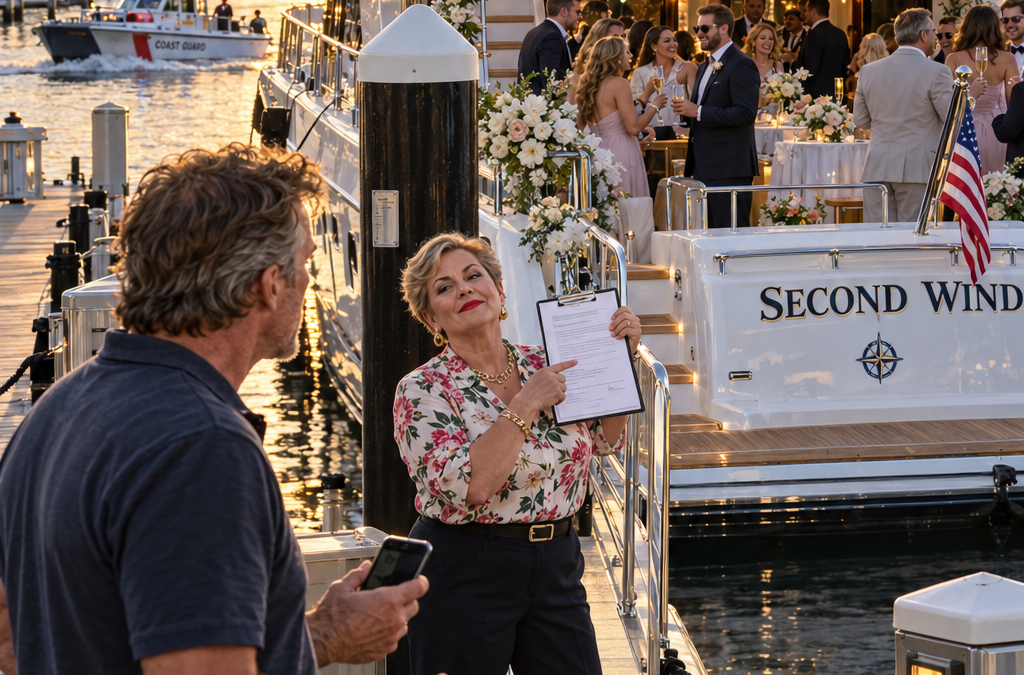
White roses along the rails.
A string quartet on the aft deck.
Champagne glasses.
Gold ribbons.
Someone had covered Grace’s chair with a decorative throw.
That detail hurt more than anything else.
At exactly two, I walked down the dock.
Navy blazer.
Khaki trousers.
Folder under my arm.
Hands visible.
No shouting.
No rush.
Phones started coming out before I reached the gangway.
Someone whispered:
“Is that Ellis?”
Patricia stood at the boarding point wearing a champagne-gold dress.
She saw me.
Her smile froze for half a second.
Then returned brighter.
“Ellis!”
She opened her arms.
“So glad you could make it.”
I stopped six feet away.
“Get everyone off my boat.”
The smile remained.
People nearby went quiet.
“Don’t do this.”
“You had no permission.”
She lifted a paper.
“You signed the charter.”
“Show me where.”
She waved it.
“You know exactly what this is.”
“I’d like to see the signature.”
Her expression tightened.
“You’re creating a scene at my daughter’s wedding.”
“This is my vessel.”
“No.”
Her voice sharpened.
“This is a legally chartered event.”
I looked at the document.
Then her.
“Security.”
Two men shifted.
Nobody touched me.
Too many cameras.
Too much uncertainty.
Hank stood behind the dock office.
His face looked gray.
I looked toward the bridge.
Rusty Blake stood at the controls.
Engines came alive.
That changed the situation immediately.
I raised my voice just enough.
“Captain.”
Rusty looked down.
“Sir?”
“May I see your Coast Guard credentials?”
The engine sound stayed steady.
Rusty did not answer.
“Master’s license?”
Patricia snapped:
“He works for me.”
I kept looking at Rusty.
“Captain?”
His face changed.
Then one engine shut down.
The second followed.
Patricia turned toward him.
“What are you doing?”
Rusty said:
“I need a minute.”
“You need to leave the dock.”
“No.”
Patricia stared.
I said:
“His license expired more than two years ago.”
The crowd went silent.
I had received confirmation from Coast Guard Sector that morning.
Patricia looked at me.
“You’re lying.”
“No.”
I pointed toward the decks.
“And Second Wind is not certified to carry 142 passengers for hire.”
A murmur spread.
Guests looked around.
At each other.
At the water.
Suddenly everyone was counting mentally.
On the upper deck, a young woman appeared in a wedding gown.
Madison Langford.
Patricia’s daughter.
Lace veil.
Bouquet.
She looked down at me.
Then at her mother.
Confusion.
Not anger.
That told me everything.
She had no idea.
Patricia saw her daughter’s face.
Panic entered hers.
Not fear of law.
Fear of losing control of the narrative.
“Ellis Whitaker is trying to sabotage this wedding!”
Her voice carried over the marina.
Several guests turned phones toward me.
Then three Harbor Police officers appeared at the far end of the dock.
Someone had called them.
Patricia pointed directly at me.
“Officers!”
I stayed still.
“Arrest him. He’s trespassing and harassing my family.”
Officer Dan Keller approached.
He looked at Patricia.
Then me.
“Sir, name?”
“Ellis Whitaker.”
“Your relationship to this vessel?”
I handed him the folder.
“Trustee and legal operator. I did not authorize this event. Unauthorized-use report filed two days ago. Case number inside.”
Keller opened the documents.
Read.
Slowly.
Patricia shoved her charter agreement toward him.
“He’s lying. We have a signed contract.”
Keller accepted it.
Compared documents.
Then looked at the signature.
Then at me.
“Is this yours?”
“It’s an image of my signature.”
“You signed this?”
“No.”
Patricia laughed.
“Of course he’s saying that now.”
Keller kept reading.
Then paused.
“This document identifies Mr. Whitaker individually as vessel owner.”
“Yes.”
“But federal documentation shows the owner is the Grace Whitaker Memorial Trust.”
Patricia’s mouth tightened.
“That’s a technicality.”
Keller looked at her.
“It’s a federal ownership record.”
“It’s still his boat.”
“That’s not the point.”
She waved one hand.
“Everyone knows what he meant.”
I said nothing.
Then a sound rolled across the harbor.
Deep engine.
Fast approach.
Heads turned.
A Coast Guard response boat came around the breakwater.
Blue law-enforcement lights flashing.
The string quartet stopped in the middle of a song.
Guests moved toward the rails.
The Coast Guard boat came alongside.
Lieutenant Rachel Ortega stepped onto the dock with two boarding officers.
She saw me.
One small nod.
Professional.
Then she turned toward Second Wind.
“Attention aboard Second Wind.”
Her voice cut through everything.
“This vessel is not authorized to depart.”
Patricia went still.
Ortega boarded.
She addressed Rusty.
“Sir, are you acting as master of this vessel?”
Rusty swallowed.
“Yes.”
“Credentials.”
He reached into his wallet.
Pulled out a plastic card.
Then another.
Ortega took them.
Read the date.
“Your credential expired twenty-six months ago.”
Rusty’s shoulders dropped.
Patricia said:
“He’s retired. He’s experienced.”
Ortega did not look at her.
“Experience is not a current credential.”
She asked:
“Passenger inspection certificate?”
Rusty said nothing.
“Certificate of Inspection?”
Nothing.
Second Wind was a private recreational yacht.
Not a passenger vessel certified to carry a wedding crowd for hire.
The boarding officers began checking safety equipment.
Life jackets.
Emergency gear.
Capacity.
One officer started counting.
I knew the answer before he finished.
Fourteen adult life jackets immediately available.
For 142 guests.
The officer looked at Ortega.
“If this vessel departed loaded like this and something happened—”
He stopped.
He didn’t need to finish.
My stomach turned.
Not because I believed Second Wind would sink.
Because experienced people never plan safety around the best-case scenario.
Fire.
Collision.
Medical emergency.
Engine-room event.
Sudden weather.
Grounding.
Panic.
One hundred forty-two people unfamiliar with the boat.
Many drinking.
Formal clothes.
Few life jackets.
Unlicensed operator.
It was madness.
Madison stood at the top of the gangway.
She looked at her mother.
“Mom?”
Patricia turned.
“Go back upstairs.”
“What’s happening?”
“Nothing.”
“Coast Guard is here.”
“They’re being difficult.”
“Did Ellis agree to this?”
Patricia’s face changed.
“Madison.”
“Did he?”
Before Patricia could answer, Hank stepped forward.
He removed his dock-manager cap.
His hands were shaking.
“It was me.”
Nobody spoke.
Patricia turned slowly.
“Hank.”
He looked at me.
“I’m sorry, Ellis.”
I said nothing.
“I gave her the key.”
Guests began whispering.
Hank continued.
“She told me she’d wipe my debt.”
Patricia stepped toward him.
“Stop talking.”
“Forty-one thousand dollars.”
“He’s lying.”
Hank looked at the officers.
“She knew what I owed.”
“He’s a thief.”
“I took the key.”
He swallowed.
“She said Ellis signed everything.”
Patricia shouted:
“He did!”
I finally spoke.
“Hank.”
He looked at me.
“Why didn’t you call me?”
His face broke.
“I was ashamed.”
That answer hurt more than the theft.
He lowered his head.
“I thought I’d fix it before you came back.”
“You let strangers into Grace’s cabin.”
“I know.”
“I’m sorry.”
Patricia grabbed a champagne bottle from the bar.
“We are not doing this.”
Ortega turned toward her.
“Ma’am.”
Patricia raised the bottle.
“The ceremony is starting.”
“Put it down.”
“This is my daughter’s wedding.”
“Put the bottle down.”
The authority in Ortega’s voice came from something Patricia had spent years pretending to possess.
Patricia lowered the bottle.
Then Madison spoke.
“Mom.”
She came down the gangway.
Tears had begun running beneath her makeup.
Patricia reached for her.
“Sweetheart, go inside.”
Madison stopped.
“Did you lie to me?”
“No.”
“You said Ellis gave us the boat.”
“He did.”
I said quietly:
“No.”
Madison looked toward me.
“I’m sorry.”
“I know.”
Her voice cracked.
“I didn’t know.”
“I know.”
Then she turned back toward Patricia.
“You made me part of this.”
Patricia’s face changed.
That was the first accusation all day that seemed to reach her.
Police Officer Keller stepped forward.
“Mrs. Langford.”
Patricia looked at him.
“Based on the reported unauthorized use, suspected forged documentation, and statements we’ve received, we’re detaining you while this is sorted out.”
She stared.
“You cannot arrest me at my daughter’s wedding.”
“Turn around.”
“This is absurd.”
“Ma’am.”
Phones were everywhere.
Recording.
Patricia looked toward the crowd she had spent $180,000 assembling.
Maybe she saw supporters.
Maybe donors.
Maybe neighbors.
Maybe people who had feared her.
Whatever she saw, nobody stepped forward.
She turned.
Handcuffs closed around her wrists.
A champagne glass fell from the edge of the bar.
Hit the deck.
Shattered.
Before the toast.
I thought that would be the end.
It wasn’t.
Hank gave investigators his phone.
Text messages.
Voicemails.
Photos.
Payment records.
The fake charter trail.
And something much bigger.
For two years, Patricia had been creating questionable marina assessments.
“Slip search charges.”
“Waterfront compliance inspections.”
“Emergency dock reviews.”
Residents had paid hundreds.
Sometimes thousands.
Money that was supposed to support Harbor Point’s marina fund had been shifted through accounts and reimbursements.
More than $300,000.
Some went toward wedding expenses.
Some apparently supported Patricia’s personal spending.
The exact path took accountants months to unwind.
When the first numbers became public, Harbor Point exploded.
An emergency HOA meeting was called that evening.
I did not attend.
I was cleaning strangers’ fingerprints from Grace’s cabin.
That sounds petty.
It wasn’t.
I needed the boat to feel like ours again.
White rose petals were everywhere.
Glitter.
Tape residue.
A wineglass under a seat.
Someone had moved Grace’s framed photograph from the salon shelf to make room for flowers.
That was what broke me.
Not the handcuffs.
Not the forged signature.
I picked up the photograph.
Grace smiling from our seventh Sunday aboard.
Wind in her hair.
One hand holding her hat.
I sat down.
For the first time since returning from Norfolk, I cried.
Not loudly.
Not dramatically.
Just exhaustion finally finding the weakest place.
“I’m sorry.”
I said it again.
“I’m sorry.”
Of course Grace could not answer.
But I could almost hear what she would have said.
Ellis, it’s a boat.
That would have annoyed me.
Then she would have kissed my forehead.
The board removed Patricia as president in less than ten minutes.
Four members resigned soon afterward.
Independent auditors came in.
Marina records were reviewed.
Residents who had paid fabricated fees were reimbursed where documentation supported it.
Hank lost his position.
That was painful.
I did not ask for it.
But I understood.
You cannot manage keys to people’s boats after selling access to one.
His debt arrangement was investigated separately.
Several weeks later, he came to see me.
He stood outside my house.
Wouldn’t come in.
“I’m moving.”
“Where?”
“Georgia. Brother’s got work.”
I nodded.
He looked down.
“I know you’re not going to forgive me.”
“I didn’t say that.”
His head lifted.
“Forgiveness and trust aren’t the same thing.”
He swallowed.
“I know.”
“I may forgive you.”
“But?”
“You’ll never have a key to my boat again.”
He almost smiled.
“Fair.”
I asked:
“Why didn’t you tell me Patricia was pressuring you?”
“Pride.”
“Forty-one thousand dollars is a lot of pride.”
“I thought I could handle it.”
“That’s usually when people get handled.”
He nodded.
Then he said:
“I am sorry about Grace’s chair.”
I looked away.
That was enough.
Patricia’s case moved slowly.
Reality usually does.
There was no dramatic overnight conviction.
Lawyers.
Records.
Interviews.
Bank subpoenas.
Forensic accounting.
She eventually entered guilty pleas connected to forgery, misappropriated funds, and other conduct tied to the scheme.
Restitution followed.
She was barred under the settlement and board reforms from ever holding Harbor Point HOA office again.
Some residents wanted prison.
Others wanted public humiliation.
I wanted distance.
That surprised people.
“After what she did?” one neighbor asked.
“Yes.”
“She stole from you.”
“She invaded my boat.”
“Forged your name.”
“I know.”
“You don’t want revenge?”
“No.”
“Why?”
Because revenge would have required keeping Patricia in my head.
Grace had already taken enough space there.
I wasn’t giving Patricia the rest.
Madison came by about two weeks after the wedding disaster.
No photographers.
No dress.
No mother.
She stood at the dock gate.
“Mr. Whitaker?”
“Ellis.”
She smiled weakly.
“Ellis.”
I let her in.
We sat on Second Wind’s aft deck.
Grace’s chair was back where it belonged.
Madison looked toward it.
“My mother told me your wife chose the boat.”
“She did.”
“Second Wind.”
“After beating cancer.”
Madison looked down.
“I feel horrible.”
“You didn’t know.”
“I should have.”
“How?”
“She’s my mother.”
“That doesn’t make you responsible for checking federal vessel documentation.”
She laughed despite herself.
Then covered her eyes.
“I don’t even know if Tyler still wants to marry me.”
“Have you asked him?”
“He says he does.”
“There’s your answer.”
“We don’t want another big wedding.”
“Good.”
“We were thinking courthouse.”
I looked around the harbor.
Then toward Grace’s chair.
An idea came quietly.
“How many people?”
“What?”
“If you did something small.”
Madison thought.
“Twelve.”
“Licensed captain?”
She laughed.
“I assume that’s a joke.”
“Not entirely.”
She looked at me.
“Why?”
“Because Second Wind has had enough bad paperwork.”
Then I said:
“You can get married here.”
Madison stared.
“No.”
“Yes.”
“Ellis, after what my mother—”
“Your mother did it.”
“She did it for me.”
“She did it for herself.”
Madison’s eyes filled.
“I don’t deserve that.”
“Marriage isn’t about deserving a yacht.”
I leaned back.
“Grace wanted this boat to be about second chances.”
Madison looked toward the water.
A month later, twelve guests came aboard.
Not 142.
Twelve.
No security guards.
No champagne tower.
No five-tier cake.
No fake charter.
No forged signatures.
Licensed captain.
Proper passenger limits.
Every safety item where it belonged.
Tyler’s parents.
A few close friends.
One small arrangement of white roses.
Madison asked before placing them anywhere.
That made me smile.
I hired the captain myself.
I did not operate the boat during the ceremony.
I wanted to stand back and watch.
We took Second Wind just beyond the breakwater.
The water was calm.
Sunlight moved across the deck.
Madison wore a simple white dress.
Tyler wore a blue suit.
They stood near the rail.
The captain officiated.
When Madison started her vows, her voice shook.
Then steadied.
I looked toward Grace’s chair.
Empty.
But no longer sad.
For the first time since she died, I understood what she meant when she told me not to sell the boat.
I had assumed she wanted me to preserve our past.
Maybe that was only half of it.
Second Wind had been named after surviving.
After beginning again.
Grace would have hated the idea of turning it into a museum of grief.
She would have wanted laughter.
People.
Love.
Not Patricia’s version.
Not 142 strangers who thought money and authority had purchased consent.
This.
Twelve people.
Honest permission.
A wedding that belonged to the couple getting married.
Afterward, Madison found me near the helm.
“Thank you.”
“You’re welcome.”
She hugged me.
Then whispered:
“I wish my mother understood what this boat meant.”
I looked toward Grace’s photograph.
“Maybe someday she will.”
The HOA changed too.
New leadership.
Independent financial review.
Two-signature requirements for major transfers.
Quarterly reserve reports.
No president could authorize extraordinary spending without board approval.
Marina fees had to be tied to documented services.
Residents gained easier access to records.
The dock manager system was reorganized.
Spare keys were eliminated except where owners voluntarily used a secured, auditable emergency program.
That one was personal.
Patricia had spent years convincing Harbor Point that good governance meant control.
After she left, residents learned something healthier.
Good governance meant boundaries.
Documentation.
Transparency.
Authority that could be checked.
Boring things.
Beautiful boring things.
For months, people stopped me around the neighborhood.
Some apologized.
Most had done nothing.
“Why are you apologizing?”
“We should’ve seen what she was doing.”
“How?”
“All those fines.”
“We thought they were normal.”
I understood.
Small abuses become normal when each person experiences them alone.
One homeowner gets a questionable dock charge.
Another gets an arbitrary inspection fee.
Someone else is threatened over lighting.
Nobody compares notes.
The person with authority tells each of them the rule is obvious.
Eventually everyone thinks they are the exception.
The day Patricia fell, Harbor Point finally compared paperwork.
The pattern emerged.
That was what ended her control.
Not me.
Not the Coast Guard.
Not the police.
Records.
People talking.
People finally asking:
Did she do this to you too?
Grace used to say that boats expose people.
“How?”
I once asked her.
“Because nothing stays hidden offshore.”
“That’s philosophical nonsense.”
“No.”
She pointed toward a cluttered cockpit.
“Lazy people leave lines everywhere.”
“That’s not philosophy.”
“Angry people slam hatches.”
“Still not philosophy.”
“Controlling people can’t stand not being captain.”
That one made me laugh.
Years later, sitting aboard Second Wind after Patricia was gone, I thought about it.
Controlling people can’t stand not being captain.
Patricia did not just want my boat.
She wanted my yes without having to receive it.
That was the real conflict.
She believed enough money should convert no into yes.
Five thousand dollars.
Name your price.
When money failed, she tried punishment.
Violation notices.
Fines.
Public pressure.
When punishment failed, she manufactured consent.
Forged signature.
Fake charter.
Then she surrounded that lie with so much momentum that she expected reality to surrender.
Flowers already ordered.
Guests already invited.
Vendors already paid.
Daughter already dressed.
Surely Ellis will give in.
That’s what people like Patricia understand about social pressure.
They know decent people hate ruining other people’s days.
They count on it.
I almost gave in.
That’s the truth.
When I saw Madison standing in her wedding dress crying, part of me thought:
Let them have the ceremony.
Deal with Patricia later.
Grace would want kindness.
But kindness without consent is not kindness when someone else chooses it for you.
If I had allowed that yacht to leave the dock illegally loaded with people under an unlicensed operator, and anything happened, my grief over ruining a wedding would have looked very small next to the consequences.
That was what stopped me.
Not pride.
Responsibility.
Second Wind was mine to protect.
Those 142 people were standing on a boat most of them did not understand.
They trusted whoever invited them.
They assumed someone had handled safety.
Certification.
Captain.
Life jackets.
Insurance.
People make that assumption constantly.
They board.
Sit.
Drink.
Laugh.
They do not ask whether federal passenger requirements have been satisfied.
They should not have to.
The person operating the vessel is supposed to know.
Patricia treated safety the same way she treated ownership.
As a detail that should yield to her schedule.
That scared me more than the forgery.
Because paper can be corrected.
Dead people cannot.
After the investigations ended, Coast Guard Lieutenant Ortega stopped by Harbor Point during another inspection.
I saw her at the marina.
“Lieutenant.”
“Mr. Whitaker.”
“Ellis.”
“Rachel, then.”
We shook hands.
I said:
“Thank you.”
“For doing my job?”
“Exactly.”
She smiled.
“You made it easier.”
“How?”
“You didn’t board.”
“I wanted to.”
“I know.”
“You don’t know how much.”
“I saw your messages.”
I laughed.
She became serious.
“Most people make a bad situation worse because they need to prove ownership immediately.”
“It was my boat.”
“Yes.”
“And because it was your boat, you protected it by not turning the dock into a fight.”
That stayed with me.
There are different ways to defend something.
Sometimes defending means stepping forward.
Sometimes it means staying still long enough for the right authority to arrive.
The Coast Guard had taught me that decades earlier.
Patricia reminded me.
I eventually replaced the chair she covered with wedding decorations.
Not immediately.
For another year, Grace’s old chair stayed exactly where she’d left it.
Sun cracked the material.
Salt faded the fabric.
One spring morning, a seam finally split.
I stared at it.
Then laughed.
“All right, Grace.”
I ordered a new chair.
Same style.
Different color.
That sounds insignificant.
It wasn’t.
For years, preservation had felt like loyalty.
Then I realized keeping everything unchanged was not the promise I made.
I promised not to sell Second Wind.
I promised to keep living around her.
There is a difference.
Madison and Tyler send me a Christmas card every year.
The first one after their wedding showed them standing on Second Wind.
No crowd.
No gold dress.
No cameras.
Just the two of them.
On the back, Madison wrote:
Thank you for giving us back a day that felt like ours.
I keep that card near Grace’s photograph.
Patricia never apologized to me directly.
Not really.
There were legal statements.
Restitution agreements.
Acknowledgments drafted by attorneys.
Nothing personal.
That was fine.
I stopped needing one.
One afternoon, years later, I saw her at a waterfront restaurant in another town.
She looked older.
So did I.
We noticed each other.
She hesitated.
Then walked over.
“Ellis.”
“Patricia.”
She looked toward the marina outside.
“I heard you’re still keeping the boat.”
“Still expensive.”
She almost smiled.
“I was wrong.”
I waited.
She did not explain which part.
Probably all of it.
Then she said:
“I thought if I could make everything perfect for Madison, she’d remember the day forever.”
“She remembers it.”
Patricia flinched.
I regretted the sharpness immediately.
She nodded.
“I know.”
For a moment, we stood quietly.
Then she said:
“I never understood why you wouldn’t just take the money.”
I looked at her.
“Because you thought the boat was a thing.”
“It is.”
“Technically.”
I looked through the restaurant window toward the water.
“But not to me.”
Patricia nodded.
Maybe she understood.
Maybe not.
It no longer mattered.
“What happened to Grace?” she asked.
“Cancer.”
“I’m sorry.”
“Thank you.”
She looked down.
“I shouldn’t have said what I said about her.”
That was the apology I had actually needed.
Years too late.
Still real.
“No.”
“I know.”
Then she walked away.
I sat alone for another minute.
I had imagined that conversation in angrier versions.
In all of them, I said something devastating.
Reality was quieter.
Better.
I did not need Patricia destroyed.
I needed her gone from the part of my life that belonged to Grace.
Second Wind still sits in Slip 18.
I maintain her myself when I can.
Hire help when I can’t.
My knees are worse now.
Hands stiffer.
Climbing to the bridge takes more effort.
I still take her out.
Not every Sunday.
Life changed.
But enough.
Sometimes I sail alone.
Sometimes veterans come aboard.
Sometimes Madison and Tyler visit.
My daughter comes down from North Carolina with her children, who treat every hatch like a secret passage.
The boat has changed.
New navigation electronics.
Updated safety gear.
New upholstery.
Different generator.
But the trust remains.
So does the name.
SECOND WIND.
Every time I see it on the stern, I remember Grace standing barefoot on the aft deck after we finished restoration.
This is our second wind.
At the time, I thought she meant beating cancer.
Maybe she meant more.
Maybe every life needs more than one.
Maybe Second Wind stopped being Grace’s boat the day she died and became the place where I learned to live without her.
Maybe Madison’s wedding was another beginning.
Maybe even Harbor Point needed one.
I know this much.
Patricia believed power meant getting your way.
The Coast Guard taught me power meant responsibility for what happens after you do.
That difference separates command from control.
I spent twenty-six years learning it.
Patricia learned it in one afternoon.
The wedding she stole never left the dock.
The daughter she was trying to impress walked away from her.
The money she moved was traced.
The documents she forged were examined.
The authority she had spent years building disappeared in less than ten minutes.
Not because I was stronger than her.
Because eventually every structure built on false paperwork meets someone who checks the records.
The thing I remember most clearly, though, did not happen while she was in handcuffs.
It happened a month later.
Twelve guests.
Late afternoon.
Second Wind moving gently beyond the breakwater.
Madison standing beside Tyler.
Licensed captain nearby.
Every safety item exactly where it belonged.
White roses tied to the rail.
One arrangement near Grace’s old chair.
The sun was low.
Water gold.
Madison said her vows.
Then Tyler said his.
For a second, a breeze lifted the edge of her veil.
Everyone laughed.
I looked toward the horizon.
I thought about Grace.
The eleven Sundays.
The chemo.
The name painted on the stern.
Her hand holding mine.
Don’t sell her.
I finally understood.
She wasn’t asking me to preserve an object.
She was asking me not to stop living.
Second Wind was never supposed to become a shrine.
It was supposed to carry people somewhere.
That afternoon, it did.
When we returned to Harbor Point, I tied the stern line myself.
Madison came beside me.
“Ellis?”
“Yeah?”
“Do you think Grace would have minded?”
I looked at the flowers.
Then the water.
“No.”
“How do you know?”
I smiled.
“She would’ve complained your roses were blocking her view.”
Madison laughed.
So did I.
For the first time since Grace died, saying her name on the boat did not feel like opening a wound.
It felt like inviting her into the room.
After everyone left, I sat in her chair.
Night settled over Harbor Point.
Lights came on along the docks.
I could hear people talking from nearby patios.
Normal sounds.
No sirens.
No engines racing toward us.
No one shouting that the boat belonged to the community.
I ran my hand along the armrest.
“Not bad, Gracie.”
The water tapped softly against the hull.
I stayed until almost midnight.
Then I locked the cabin.
Checked the lines.
Checked the shore-power connection.
Checked the camera.
Old habits.
Before walking away, I looked back at the stern.
SECOND WIND.
I had spent years thinking the name belonged to Grace because she survived cancer once.
Now I understood it belonged to anyone who had ever had to build a life again after losing the one they expected.
Grace.
Me.
Madison.
Even Harbor Point.
Patricia tried to turn that boat into proof of her authority.
In the end, Second Wind became exactly what Grace intended.
A place where people who had been through something hard could begin again.
And that is why I kept her.
Not because Patricia wanted her.
Not because the Coast Guard stopped her.
Not because a forged charter collapsed under scrutiny.
I kept her because once, long before any of this happened, my wife stood on that deck and taught me that a second life deserves to be lived as deliberately as the first.
Some things are not for sale.
Some things cannot be voted away.
And some doors should open only when the person who owns the key decides to turn it.
𝗧𝗛𝗘 𝗘𝗡𝗗
The HOA President Put 142 Wedding Guests on My Late Wife’s Yacht Without Ever Asking Me
Three weeks after I refused to turn my late wife’s yacht into a wedding venue, I walked down the marina and found 142 strangers drinking champagne on her deck while the HOA president waved a document she swore I had signed.
What Patricia Langford did not know was that before I ever stepped onto that dock, I had already made two calls—one to local law enforcement and one to the United States Coast Guard.
My name is Ellis Whitaker.
I was fifty-four when Patricia Langford decided my boat belonged to her.
Not legally.
Not even rationally.
She simply decided she needed it badly enough that my ownership became an inconvenience she could work around.
By then, I had spent most of my adult life around water.
Twenty-six years in the Coast Guard, fourteen of them as a boatswain’s mate, had taught me a few things that never really leave you.
Check the weather twice.
Trust a line only after you inspect it.
Never assume someone else secured the hatch.
And when a situation starts feeling wrong, slow down before everybody else speeds up.
Those habits kept me alive through hurricanes, night rescues, vessel fires, and more than one search where we left shore knowing we might not like what we found.
Retirement was supposed to be quieter.
It was, for a while.
I lived in Harbor Point, a gated waterfront community on the Florida coast where the streets curved between palm trees and every second backyard seemed to have a dock.
The houses were expensive without being ridiculous.
Most residents were people who had worked hard, retired well, and wanted to spend the last third of their lives close enough to salt water to smell it from the kitchen.
I fit there better than I expected.
My house was smaller than most.
One story.
White stucco.
Blue shutters my wife chose.
A narrow canal behind it connected to the marina basin.
And at the end of Slip 18 sat Second Wind.
That yacht was the reason I stayed in Harbor Point after Grace died.
Not because it was valuable.
Although it was.
Not because it was impressive.
It was only fifty-eight feet, modest compared with some of the floating mansions tied up farther down the harbor.
Second Wind mattered because Grace and I had built a future around it.
She named her after surviving cancer the first time.
That was Grace.
She could turn a diagnosis into a boat name.
We bought the hull used.
Spent two years restoring it.
Grace picked the teak.
I rebuilt portions of the electrical system.
She chose fabrics I pretended not to care about and then rejected three sets of cabin lights because the color temperature was wrong.
When the work was finished, she stood on the aft deck with both hands on the rail and said:
“This is our second wind.”
The name stayed.
Our plan was simple.
Sunday sailing.
Every Sunday we could manage.
No business.
No charter operation.
No crowds.
Just the two of us.
Sometimes friends.
Sometimes my daughter from my first marriage when she visited.
Coffee at sunrise.
Lunch underway.
Home before dark.
Grace got eleven Sundays.
Then the cancer came back.
Aggressive.
Fast.
Unfair in the ordinary way death is unfair every day to people nobody writes stories about.
The last Sunday she was strong enough to go out, we barely left the harbor.
She sat in her favorite chair on the starboard side of the aft deck with a blanket over her knees.
We drifted beyond the breakwater.
The sea was calm.
She looked at me.
“Don’t sell her.”
I knew what she meant.
“I won’t.”
“You’ll want to.”
“No.”
“Ellis.”
“Grace.”
“You’ll tell yourself she’s expensive.”
“She is expensive.”
“You’ll tell yourself maintaining her alone is stupid.”
“It probably is.”
“Don’t sell her.”
I looked toward the horizon.
“Okay.”
She smiled.
Then took my hand.
“I mean it.”
So did I.
After she died, Second Wind became less a boat than a place where grief could sit without explanation.
I kept her side of the closet untouched for six months.
Could not bring myself to move her toothbrush.
But I could go to the yacht.
I could scrub teak.
Check oil.
Run generators.
Replace filters.
Rebed hardware.
Fix something that could actually be fixed.
There is mercy in mechanical problems.
They do not ask why.
They simply wait for your hands.
My daughter, Madison, understood that.
She was twenty-eight at the time.
Not to be confused with Patricia’s daughter, who was also named Madison in some early wedding paperwork before everyone eventually called her Maddie—but I’ll come to that later.
My daughter lived in North Carolina and had her own family.
She worried that I had become too attached to Second Wind.
Maybe I had.
But I also knew the difference between memory and paralysis.
I still worked around the marina.
Still went out.
Still ate with neighbors.
Still volunteered twice a month with a veterans’ boating group.
I simply refused to let someone else’s timetable decide when I was finished with the last thing Grace and I had made together.
For years, nobody challenged that.
Then there was Patricia Langford.
Patricia had been HOA president for almost nine years when our trouble began.
If you lived in Harbor Point, you knew Patricia.
You might not know her well.
But you knew her.
She had the ability to turn any ordinary concern into an administrative matter.
Trash cans.
Boat covers.
Dock lights.
Landscape mulch.
Guest parking.
Patricia did not knock on your door to ask about something.
She issued a notice.
She liked committees.
Forms.
Minutes.
Authority written in bullet points.
She also liked reminding people that Harbor Point was a “premier waterfront community.”
That phrase appeared everywhere.
Newsletters.
Meeting notices.
Fundraising letters.
Holiday announcements.
She spoke about Harbor Point as though she had personally carved the canals.
Most people tolerated her.
Some genuinely liked her.
She was organized.
Fundraising was good.
Common areas stayed immaculate.
She knew contractors.
She answered emails.
If a dock railing broke, Patricia had someone repairing it within a week.
Power can grow comfortably when it produces useful results.
The problem comes when the person exercising it forgets there are limits.
My first warning came one Tuesday morning when I found a white envelope clipped to my dock gate.
PLEASE CONTACT PATRICIA LANGFORD REGARDING COMMUNITY EVENT.
I almost threw it away.
Instead I drove to the clubhouse.
Patricia was waiting in the conference room.
She wore a pale green suit and had a folder open in front of her.
“Ellis.”
“Patricia.”
“Sit.”
I sat.
She smiled.
That smile should have made me leave.
“My daughter is getting married next month.”
“Congratulations.”
“Thank you.”
She turned the folder toward me.
Inside were photographs of Second Wind.
My boat.
Taken from different angles.
Aft deck.
Salon.
Upper bridge.
Dock.
My stomach tightened.
“When were these taken?”
“Publicly visible areas.”
“That wasn’t my question.”
She ignored me.
“The ceremony is going to be intimate but elegant.”
“Okay.”
“We’ve had a problem with the original venue.”
“Sorry to hear it.”
“I think we’ve solved it.”
She tapped a photograph of my boat.
“This would be perfect.”
For several seconds, I thought I had misunderstood.
“My boat.”
“Second Wind.”
“For the wedding.”
“Yes.”
“No.”
Patricia smiled again.
“You haven’t heard the proposal.”
“I don’t need to.”
“Ellis.”
“Patricia, I don’t charter Second Wind.”
“This wouldn’t be a charter.”
“What would it be?”
“A one-day community favor.”
I almost laughed.
“For your daughter’s wedding.”
“The Langford family has contributed a great deal to Harbor Point.”
“I’m sure.”
“This is the sort of thing good neighbors do.”
“Not with my boat.”
Her expression tightened slightly.
“Everything in Harbor Point affects the broader community.”
“That doesn’t make my vessel community property.”
“We all use the marina.”
“I don’t own the marina.”
“You own one of the most beautiful yachts in it.”
“I own it.”
“Exactly.”
I leaned back.
“This isn’t a committee issue.”
She stared at me.
“Second Wind is documented federally.”
“I know.”
“She’s held in the Grace Whitaker Memorial Trust.”
“That’s unusual.”
“Intentional.”
“The HOA isn’t trying to take your boat.”
“Good.”
“We’re asking for one day.”
“I’m saying no.”
She reached into the folder.
Pulled out a check.
Five thousand dollars.
Slid it across the table.
“Call it a rental.”
I pushed it back.
“No.”
“Ten?”
“No.”
“Name your price.”
“Some things aren’t for sale.”
She looked toward the check.
Then at me.
“What exactly are you protecting?”
That question hit harder than she knew.
I said:
“My wife.”
Patricia paused.
For half a second, I thought humanity might get through.
Then she said:
“Grace is gone, Ellis.”
The room went very still.
She realized immediately that she had crossed something.
But instead of apologizing, she continued.
“The boat is still here.”
I stood.
“Meeting’s over.”
“Don’t be emotional.”
I stared at her.
“If you ever mention my wife like that again, our next conversation won’t happen without counsel.”
Her face cooled.
“This is why nobody can talk to you.”
“Then stop trying.”
I walked out.
Three days later, the first violation notice arrived.
UNAPPROVED VESSEL MODIFICATION.
I had replaced two exterior deck lights with newer LED fixtures.
Same size.
Same color.
No structural change.
The HOA claimed architectural review had been required.
The next letter arrived forty-eight hours later.
IMPROPER DOCK LIGHTING.
Then:
COMMERCIAL USE OF PRIVATE SLIP.
That one almost impressed me.
I had never conducted commercial activity from the slip.
Patricia’s argument was that because I occasionally hosted veterans through a nonprofit boating program, the vessel’s presence created quasi-commercial use.
One hundred fifty dollars.
Then three hundred.
Then five hundred.
Every week, something appeared.
Cable storage.
Dock box placement.
Water hose visibility.
Temporary boarding ladder.
One afternoon I received a violation because Second Wind’s shore-power cord allegedly created a “visual inconsistency.”
I attended the next HOA meeting.
About forty homeowners sat inside.
Patricia gave her president’s report.
Budget.
Pool repairs.
Landscaping.
Then she said:
“We’ve also encountered unfortunate resistance from certain members regarding support for important community events.”
Heads turned.
Not all.
Enough.
I sat quietly.
She continued:
“Harbor Point succeeds because residents understand that private convenience sometimes yields to community responsibility.”
I raised one hand.
Patricia looked irritated.
“Yes, Ellis?”
“Are you referring to my boat?”
A murmur moved through the room.
She smiled.
“If you feel the statement applies to you—”
“That’s not what I asked.”
“Please don’t interrupt the meeting.”
“I raised my hand.”
“Your concerns can be addressed after the agenda.”
So I sat back.
In the Coast Guard, anger was information.
Useful, but dangerous if you let it steer.
You never fight a fire by screaming at it.
You isolate fuel.
Control air.
Understand spread.
Patricia wanted emotion.
I wasn’t giving it to her.
Then an old shipmate died.
Chief Bill Harrington.
I’d served beside him for twelve years.
North Atlantic patrols.
Search and rescue.
Drug interdiction.
Storm seasons.
Bill was the kind of chief who could make thirty exhausted people laugh at four in the morning without pretending the situation wasn’t miserable.
Heart attack.
Sixty-one.
His memorial was in Norfolk.
I couldn’t miss it.
I booked a flight.
Five days.
Before leaving, I checked Second Wind myself.
Doors locked.
Cabin secured.
Batteries stable.
Shore power connected.
Fuel valves closed.
I tested the cameras.
A year earlier, we’d had a marina break-in.
After that, I installed door sensors, motion cameras, and remote alerts throughout the vessel.
Not because I expected Patricia.
Because once you’ve spent half a life responsible for security, you stop trusting a single lock.
I also spoke with Hank Duvall, the dock manager.
Hank had managed Harbor Point’s slips for years.
Fifty-eight.
Divorced.
Always behind financially.
But generally dependable.
“I’m gone until Friday night.”
He nodded.
“Got it.”
“Nobody boards Second Wind.”
“Nobody.”
“Not maintenance. Not HOA. Not caterers. Nobody.”
He looked at me.
“I understand, Ellis.”
“If Patricia comes down here—”
“I know.”
I put one hand on his shoulder.
“Call me.”
He nodded.
I left.
What I didn’t know was that Hank owed Harbor Point almost $41,000.
Back marina fees.
A personal loan routed through an HOA assistance fund after his divorce.
Penalty charges.
He had been making payments, but never catching up.
Patricia knew every dollar.
According to Hank’s later statement, she called him into the clubhouse after I left.
She placed a spreadsheet in front of him.
“$41,000.”
Hank said nothing.
“That’s a lot of money.”
“I know.”
“You could lose your job.”
“I know.”
“You could lose your apartment.”
“I know.”
Patricia closed the folder.
“Or it could disappear.”
Hank looked up.
“What?”
“One favor.”
He knew immediately.
“No.”
“You don’t even know what I’m asking.”
“I know.”
“Ellis has a spare key in the marina lockbox.”
Hank shook his head.
“I can’t.”
“You can.”
“That’s his boat.”
“This is a community event.”
“He said nobody boards.”
Patricia leaned closer.
“Forty-one thousand dollars, Hank.”
He later told police that was when he stopped hearing anything else.
Debt can make a person feel underwater even while standing on dry ground.
“One key,” Patricia said.
“One weekend.”
“Then you’re clear.”
Hank asked whether Ellis—meaning me—had agreed.
Patricia placed a paper in front of him.
A charter agreement.
My name.
A signature.
Hank stared.
“You have his permission?”
“It’s handled.”
That was the lie he wanted to believe.
So he believed it.
He opened the lockbox.
Removed the spare key.
Gave it to her.
Patricia also had something else.
An old HOA form bearing my signature.
A dock maintenance authorization from two years earlier.
She photographed it.
Then someone reproduced that signature on a yacht-use agreement.
Not similar.
Not a rough imitation.
A direct reproduction.
That mattered later.
The fake document said I had agreed to provide Second Wind for a private wedding charter.
Patricia presented it to vendors.
Security.
Caterers.
Wedding planners.
Even her own daughter.
Ellis is thrilled to help, she told them.
She invited 142 guests.
The wedding budget had climbed to roughly $180,000.
Flowers.
Food.
Champagne.
Musicians.
Security.
Photography.
Decor.
Transportation.
A five-tier cake.
Everything.
There was one major problem beyond the forged agreement.
Operating the boat.
Patricia needed a captain.
A properly licensed professional would have asked to see the charter documentation.
Passenger count.
Vessel inspection status.
Safety equipment.
Insurance.
Crew.
So she hired someone who had reasons not to ask questions.
Rusty Blake.
Former charter captain.
License expired more than two years earlier.
Rusty took cash.
No paperwork.
He assumed Patricia had handled everything.
That phrase has probably preceded more maritime disasters than anyone would care to count.
Two days before the wedding, I was standing at Bill Harrington’s memorial reception in Norfolk.
People were telling stories about him.
Someone had just raised a glass.
My phone vibrated.
DOOR SENSOR TRIGGERED – SECOND WIND.
I stared at the screen.
Then another alert.
Aft deck motion.
Cabin entry.
My stomach dropped.
I stepped outside.
Opened the camera app.
At first, I thought I had selected the wrong feed.
White flowers were being carried across the aft deck.
A man in black was tying fabric to the rails.
Someone rolled a bar cart past Grace’s chair.
Then Hank appeared.
He had the spare key.
I watched him unlock my cabin.
Something in me went cold.
I called.
He answered immediately.
“Ellis.”
“What are you doing?”
“Just checking the boat.”
His voice shook.
“You’re inside?”
“Yeah.”
“Why?”
“Routine check.”
I watched him on camera while he lied.
He stood beside two strangers carrying floral stands.
“Okay,” I said.
Silence.
“Thanks, Hank.”
Then I hung up.
I knew enough about frightened people to understand that confronting him over the phone would produce nothing useful.
So I made calls.
First, the sheriff’s marine unit.
I reported unauthorized use and entry onto my vessel.
Gave them the documentation number.
Trust ownership.
Slip location.
Camera evidence.
Then I called Coast Guard Sector.
The watchstander transferred me.
Lieutenant Rachel Ortega eventually took the report.
Her voice was calm.
Professional.
“What passenger count are you expecting?”
“More than one hundred.”
“Is Second Wind inspected for passenger service?”
“No.”
“Captain?”
“I’ve been told they’re using someone named Rusty Blake.”
“License status?”
“Unknown.”
“We’ll verify.”
I gave her everything.
Then said:
“I’m flying back.”
“Mr. Whitaker.”
“Yes?”
“Do not confront people on board.”
“I understand.”
“Stay off the vessel until local law enforcement and our team can assess.”
“That’s my boat.”
“I know.”
That was the hardest part.
She continued:
“You’ve reported unauthorized use. Preserve your evidence. Let us deal with safety and federal compliance.”
Old habits took over.
“Understood.”
I flew home the night before the wedding.
My attorney, Nora Bell, met me at an all-night coffee shop near the airport.
She had a copy of the supposed charter Patricia had been circulating.
One of the vendors had sent it after learning ownership was disputed.
Nora read it.
Then raised one eyebrow.
“What?”
“Ellis.”
“What?”
“This is terrible.”
“The signature?”
“That too.”
She pointed at the owner line.
ELLIS WHITAKER – VESSEL OWNER.
“So?”
“You’re not the vessel owner.”
“I operate it.”
“You are trustee and beneficiary.”
I looked closer.
Second Wind was held by the Grace Whitaker Memorial Trust.
A legal structure I had created after Grace died to preserve ownership and simplify inheritance.
I could execute certain operating documents as trustee.
But a contract identifying me personally as owner and purporting to charter the vessel outside trust authority was not simply suspicious.
It was structurally wrong.
Nora smiled.
“Patricia forged the wrong person.”
I almost laughed.
“Can we stop them?”
“Yes.”
“Tonight?”
“No.”
“Why not?”
“Because letting them continue documenting what they’ve done may be more useful than creating a confrontation at midnight.”
I hated that answer.
“Those people are on Grace’s boat.”
“I know.”
“Flowers on her chair.”
“I know.”
“I want them off.”
Nora leaned forward.
“Then be calm tomorrow.”
I stared at her.
“Bring everything.”
“Trust.”
“Vessel documentation.”
“Police report number.”
“Camera stills.”
“Correspondence.”
“Don’t touch anyone.”
“Don’t remove anything.”
“Don’t argue about the signature.”
“Let Patricia produce it herself.”
I sat back.
“You’re enjoying this.”
“No.”
She sipped coffee.
“But sometimes bad paperwork is generous.”
I went home.
Grace’s photograph sat beside my bed.
I looked at it for a long time.
“I’m sorry.”
I don’t know why I apologized.
Maybe because people had been inside the boat.
Maybe because I’d been unable to protect it instantly.
Maybe grief makes promises feel larger than reality allows.
I slept three hours.
Saturday dawned perfect.
Blue Florida sky.
Light wind.
Sun glittering across the harbor.
Exactly the kind of day Grace would have wanted for sailing.
By noon, Harbor Point looked like a luxury magazine.
Flowers.
Black cars.
Valet stands.
Music.
Guests in formal clothes.
Second Wind sat at the center of it.
White roses along the rails.
A string quartet on the aft deck.
Champagne glasses.
Gold ribbons.
Someone had covered Grace’s chair with a decorative throw.
That detail hurt more than anything else.
At exactly two, I walked down the dock.
Navy blazer.
Khaki trousers.
Folder under my arm.
Hands visible.
No shouting.
No rush.
Phones started coming out before I reached the gangway.
Someone whispered:
“Is that Ellis?”
Patricia stood at the boarding point wearing a champagne-gold dress.
She saw me.
Her smile froze for half a second.
Then returned brighter.
“Ellis!”
She opened her arms.
“So glad you could make it.”
I stopped six feet away.
“Get everyone off my boat.”
The smile remained.
People nearby went quiet.
“Don’t do this.”
“You had no permission.”
She lifted a paper.
“You signed the charter.”
“Show me where.”
She waved it.
“You know exactly what this is.”
“I’d like to see the signature.”
Her expression tightened.
“You’re creating a scene at my daughter’s wedding.”
“This is my vessel.”
“No.”
Her voice sharpened.
“This is a legally chartered event.”
I looked at the document.
Then her.
“Security.”
Two men shifted.
Nobody touched me.
Too many cameras.
Too much uncertainty.
Hank stood behind the dock office.
His face looked gray.
I looked toward the bridge.
Rusty Blake stood at the controls.
Engines came alive.
That changed the situation immediately.
I raised my voice just enough.
“Captain.”
Rusty looked down.
“Sir?”
“May I see your Coast Guard credentials?”
The engine sound stayed steady.
Rusty did not answer.
“Master’s license?”
Patricia snapped:
“He works for me.”
I kept looking at Rusty.
“Captain?”
His face changed.
Then one engine shut down.
The second followed.
Patricia turned toward him.
“What are you doing?”
Rusty said:
“I need a minute.”
“You need to leave the dock.”
“No.”
Patricia stared.
I said:
“His license expired more than two years ago.”
The crowd went silent.
I had received confirmation from Coast Guard Sector that morning.
Patricia looked at me.
“You’re lying.”
“No.”
I pointed toward the decks.
“And Second Wind is not certified to carry 142 passengers for hire.”
A murmur spread.
Guests looked around.
At each other.
At the water.
Suddenly everyone was counting mentally.
On the upper deck, a young woman appeared in a wedding gown.
Madison Langford.
Patricia’s daughter.
Lace veil.
Bouquet.
She looked down at me.
Then at her mother.
Confusion.
Not anger.
That told me everything.
She had no idea.
Patricia saw her daughter’s face.
Panic entered hers.
Not fear of law.
Fear of losing control of the narrative.
“Ellis Whitaker is trying to sabotage this wedding!”
Her voice carried over the marina.
Several guests turned phones toward me.
Then three Harbor Police officers appeared at the far end of the dock.
Someone had called them.
Patricia pointed directly at me.
“Officers!”
I stayed still.
“Arrest him. He’s trespassing and harassing my family.”
Officer Dan Keller approached.
He looked at Patricia.
Then me.
“Sir, name?”
“Ellis Whitaker.”
“Your relationship to this vessel?”
I handed him the folder.
“Trustee and legal operator. I did not authorize this event. Unauthorized-use report filed two days ago. Case number inside.”
Keller opened the documents.
Read.
Slowly.
Patricia shoved her charter agreement toward him.
“He’s lying. We have a signed contract.”
Keller accepted it.
Compared documents.
Then looked at the signature.
Then at me.
“Is this yours?”
“It’s an image of my signature.”
“You signed this?”
“No.”
Patricia laughed.
“Of course he’s saying that now.”
Keller kept reading.
Then paused.
“This document identifies Mr. Whitaker individually as vessel owner.”
“Yes.”
“But federal documentation shows the owner is the Grace Whitaker Memorial Trust.”
Patricia’s mouth tightened.
“That’s a technicality.”
Keller looked at her.
“It’s a federal ownership record.”
“It’s still his boat.”
“That’s not the point.”
She waved one hand.
“Everyone knows what he meant.”
I said nothing.
Then a sound rolled across the harbor.
Deep engine.
Fast approach.
Heads turned.
A Coast Guard response boat came around the breakwater.
Blue law-enforcement lights flashing.
The string quartet stopped in the middle of a song.
Guests moved toward the rails.
The Coast Guard boat came alongside.
Lieutenant Rachel Ortega stepped onto the dock with two boarding officers.
She saw me.
One small nod.
Professional.
Then she turned toward Second Wind.
“Attention aboard Second Wind.”
Her voice cut through everything.
“This vessel is not authorized to depart.”
Patricia went still.
Ortega boarded.
She addressed Rusty.
“Sir, are you acting as master of this vessel?”
Rusty swallowed.
“Yes.”
“Credentials.”
He reached into his wallet.
Pulled out a plastic card.
Then another.
Ortega took them.
Read the date.
“Your credential expired twenty-six months ago.”
Rusty’s shoulders dropped.
Patricia said:
“He’s retired. He’s experienced.”
Ortega did not look at her.
“Experience is not a current credential.”
She asked:
“Passenger inspection certificate?”
Rusty said nothing.
“Certificate of Inspection?”
Nothing.
Second Wind was a private recreational yacht.
Not a passenger vessel certified to carry a wedding crowd for hire.
The boarding officers began checking safety equipment.
Life jackets.
Emergency gear.
Capacity.
One officer started counting.
I knew the answer before he finished.
Fourteen adult life jackets immediately available.
For 142 guests.
The officer looked at Ortega.
“If this vessel departed loaded like this and something happened—”
He stopped.
He didn’t need to finish.
My stomach turned.
Not because I believed Second Wind would sink.
Because experienced people never plan safety around the best-case scenario.
Fire.
Collision.
Medical emergency.
Engine-room event.
Sudden weather.
Grounding.
Panic.
One hundred forty-two people unfamiliar with the boat.
Many drinking.
Formal clothes.
Few life jackets.
Unlicensed operator.
It was madness.
Madison stood at the top of the gangway.
She looked at her mother.
“Mom?”
Patricia turned.
“Go back upstairs.”
“What’s happening?”
“Nothing.”
“Coast Guard is here.”
“They’re being difficult.”
“Did Ellis agree to this?”
Patricia’s face changed.
“Madison.”
“Did he?”
Before Patricia could answer, Hank stepped forward.
He removed his dock-manager cap.
His hands were shaking.
“It was me.”
Nobody spoke.
Patricia turned slowly.
“Hank.”
He looked at me.
“I’m sorry, Ellis.”
I said nothing.
“I gave her the key.”
Guests began whispering.
Hank continued.
“She told me she’d wipe my debt.”
Patricia stepped toward him.
“Stop talking.”
“Forty-one thousand dollars.”
“He’s lying.”
Hank looked at the officers.
“She knew what I owed.”
“He’s a thief.”
“I took the key.”
He swallowed.
“She said Ellis signed everything.”
Patricia shouted:
“He did!”
I finally spoke.
“Hank.”
He looked at me.
“Why didn’t you call me?”
His face broke.
“I was ashamed.”
That answer hurt more than the theft.
He lowered his head.
“I thought I’d fix it before you came back.”
“You let strangers into Grace’s cabin.”
“I know.”
“I’m sorry.”
Patricia grabbed a champagne bottle from the bar.
“We are not doing this.”
Ortega turned toward her.
“Ma’am.”
Patricia raised the bottle.
“The ceremony is starting.”
“Put it down.”
“This is my daughter’s wedding.”
“Put the bottle down.”
The authority in Ortega’s voice came from something Patricia had spent years pretending to possess.
Patricia lowered the bottle.
Then Madison spoke.
“Mom.”
She came down the gangway.
Tears had begun running beneath her makeup.
Patricia reached for her.
“Sweetheart, go inside.”
Madison stopped.
“Did you lie to me?”
“No.”
“You said Ellis gave us the boat.”
“He did.”
I said quietly:
“No.”
Madison looked toward me.
“I’m sorry.”
“I know.”
Her voice cracked.
“I didn’t know.”
“I know.”
Then she turned back toward Patricia.
“You made me part of this.”
Patricia’s face changed.
That was the first accusation all day that seemed to reach her.
Police Officer Keller stepped forward.
“Mrs. Langford.”
Patricia looked at him.
“Based on the reported unauthorized use, suspected forged documentation, and statements we’ve received, we’re detaining you while this is sorted out.”
She stared.
“You cannot arrest me at my daughter’s wedding.”
“Turn around.”
“This is absurd.”
“Ma’am.”
Phones were everywhere.
Recording.
Patricia looked toward the crowd she had spent $180,000 assembling.
Maybe she saw supporters.
Maybe donors.
Maybe neighbors.
Maybe people who had feared her.
Whatever she saw, nobody stepped forward.
She turned.
Handcuffs closed around her wrists.
A champagne glass fell from the edge of the bar.
Hit the deck.
Shattered.
Before the toast.
I thought that would be the end.
It wasn’t.
Hank gave investigators his phone.
Text messages.
Voicemails.
Photos.
Payment records.
The fake charter trail.
And something much bigger.
For two years, Patricia had been creating questionable marina assessments.
“Slip search charges.”
“Waterfront compliance inspections.”
“Emergency dock reviews.”
Residents had paid hundreds.
Sometimes thousands.
Money that was supposed to support Harbor Point’s marina fund had been shifted through accounts and reimbursements.
More than $300,000.
Some went toward wedding expenses.
Some apparently supported Patricia’s personal spending.
The exact path took accountants months to unwind.
When the first numbers became public, Harbor Point exploded.
An emergency HOA meeting was called that evening.
I did not attend.
I was cleaning strangers’ fingerprints from Grace’s cabin.
That sounds petty.
It wasn’t.
I needed the boat to feel like ours again.
White rose petals were everywhere.
Glitter.
Tape residue.
A wineglass under a seat.
Someone had moved Grace’s framed photograph from the salon shelf to make room for flowers.
That was what broke me.
Not the handcuffs.
Not the forged signature.
I picked up the photograph.
Grace smiling from our seventh Sunday aboard.
Wind in her hair.
One hand holding her hat.
I sat down.
For the first time since returning from Norfolk, I cried.
Not loudly.
Not dramatically.
Just exhaustion finally finding the weakest place.
“I’m sorry.”
I said it again.
“I’m sorry.”
Of course Grace could not answer.
But I could almost hear what she would have said.
Ellis, it’s a boat.
That would have annoyed me.
Then she would have kissed my forehead.
The board removed Patricia as president in less than ten minutes.
Four members resigned soon afterward.
Independent auditors came in.
Marina records were reviewed.
Residents who had paid fabricated fees were reimbursed where documentation supported it.
Hank lost his position.
That was painful.
I did not ask for it.
But I understood.
You cannot manage keys to people’s boats after selling access to one.
His debt arrangement was investigated separately.
Several weeks later, he came to see me.
He stood outside my house.
Wouldn’t come in.
“I’m moving.”
“Where?”
“Georgia. Brother’s got work.”
I nodded.
He looked down.
“I know you’re not going to forgive me.”
“I didn’t say that.”
His head lifted.
“Forgiveness and trust aren’t the same thing.”
He swallowed.
“I know.”
“I may forgive you.”
“But?”
“You’ll never have a key to my boat again.”
He almost smiled.
“Fair.”
I asked:
“Why didn’t you tell me Patricia was pressuring you?”
“Pride.”
“Forty-one thousand dollars is a lot of pride.”
“I thought I could handle it.”
“That’s usually when people get handled.”
He nodded.
Then he said:
“I am sorry about Grace’s chair.”
I looked away.
That was enough.
Patricia’s case moved slowly.
Reality usually does.
There was no dramatic overnight conviction.
Lawyers.
Records.
Interviews.
Bank subpoenas.
Forensic accounting.
She eventually entered guilty pleas connected to forgery, misappropriated funds, and other conduct tied to the scheme.
Restitution followed.
She was barred under the settlement and board reforms from ever holding Harbor Point HOA office again.
Some residents wanted prison.
Others wanted public humiliation.
I wanted distance.
That surprised people.
“After what she did?” one neighbor asked.
“Yes.”
“She stole from you.”
“She invaded my boat.”
“Forged your name.”
“I know.”
“You don’t want revenge?”
“No.”
“Why?”
Because revenge would have required keeping Patricia in my head.
Grace had already taken enough space there.
I wasn’t giving Patricia the rest.
Madison came by about two weeks after the wedding disaster.
No photographers.
No dress.
No mother.
She stood at the dock gate.
“Mr. Whitaker?”
“Ellis.”
She smiled weakly.
“Ellis.”
I let her in.
We sat on Second Wind’s aft deck.
Grace’s chair was back where it belonged.
Madison looked toward it.
“My mother told me your wife chose the boat.”
“She did.”
“Second Wind.”
“After beating cancer.”
Madison looked down.
“I feel horrible.”
“You didn’t know.”
“I should have.”
“How?”
“She’s my mother.”
“That doesn’t make you responsible for checking federal vessel documentation.”
She laughed despite herself.
Then covered her eyes.
“I don’t even know if Tyler still wants to marry me.”
“Have you asked him?”
“He says he does.”
“There’s your answer.”
“We don’t want another big wedding.”
“Good.”
“We were thinking courthouse.”
I looked around the harbor.
Then toward Grace’s chair.
An idea came quietly.
“How many people?”
“What?”
“If you did something small.”
Madison thought.
“Twelve.”
“Licensed captain?”
She laughed.
“I assume that’s a joke.”
“Not entirely.”
She looked at me.
“Why?”
“Because Second Wind has had enough bad paperwork.”
Then I said:
“You can get married here.”
Madison stared.
“No.”
“Yes.”
“Ellis, after what my mother—”
“Your mother did it.”
“She did it for me.”
“She did it for herself.”
Madison’s eyes filled.
“I don’t deserve that.”
“Marriage isn’t about deserving a yacht.”
I leaned back.
“Grace wanted this boat to be about second chances.”
Madison looked toward the water.
A month later, twelve guests came aboard.
Not 142.
Twelve.
No security guards.
No champagne tower.
No five-tier cake.
No fake charter.
No forged signatures.
Licensed captain.
Proper passenger limits.
Every safety item where it belonged.
Tyler’s parents.
A few close friends.
One small arrangement of white roses.
Madison asked before placing them anywhere.
That made me smile.
I hired the captain myself.
I did not operate the boat during the ceremony.
I wanted to stand back and watch.
We took Second Wind just beyond the breakwater.
The water was calm.
Sunlight moved across the deck.
Madison wore a simple white dress.
Tyler wore a blue suit.
They stood near the rail.
The captain officiated.
When Madison started her vows, her voice shook.
Then steadied.
I looked toward Grace’s chair.
Empty.
But no longer sad.
For the first time since she died, I understood what she meant when she told me not to sell the boat.
I had assumed she wanted me to preserve our past.
Maybe that was only half of it.
Second Wind had been named after surviving.
After beginning again.
Grace would have hated the idea of turning it into a museum of grief.
She would have wanted laughter.
People.
Love.
Not Patricia’s version.
Not 142 strangers who thought money and authority had purchased consent.
This.
Twelve people.
Honest permission.
A wedding that belonged to the couple getting married.
Afterward, Madison found me near the helm.
“Thank you.”
“You’re welcome.”
She hugged me.
Then whispered:
“I wish my mother understood what this boat meant.”
I looked toward Grace’s photograph.
“Maybe someday she will.”
The HOA changed too.
New leadership.
Independent financial review.
Two-signature requirements for major transfers.
Quarterly reserve reports.
No president could authorize extraordinary spending without board approval.
Marina fees had to be tied to documented services.
Residents gained easier access to records.
The dock manager system was reorganized.
Spare keys were eliminated except where owners voluntarily used a secured, auditable emergency program.
That one was personal.
Patricia had spent years convincing Harbor Point that good governance meant control.
After she left, residents learned something healthier.
Good governance meant boundaries.
Documentation.
Transparency.
Authority that could be checked.
Boring things.
Beautiful boring things.
For months, people stopped me around the neighborhood.
Some apologized.
Most had done nothing.
“Why are you apologizing?”
“We should’ve seen what she was doing.”
“How?”
“All those fines.”
“We thought they were normal.”
I understood.
Small abuses become normal when each person experiences them alone.
One homeowner gets a questionable dock charge.
Another gets an arbitrary inspection fee.
Someone else is threatened over lighting.
Nobody compares notes.
The person with authority tells each of them the rule is obvious.
Eventually everyone thinks they are the exception.
The day Patricia fell, Harbor Point finally compared paperwork.
The pattern emerged.
That was what ended her control.
Not me.
Not the Coast Guard.
Not the police.
Records.
People talking.
People finally asking:
Did she do this to you too?
Grace used to say that boats expose people.
“How?”
I once asked her.
“Because nothing stays hidden offshore.”
“That’s philosophical nonsense.”
“No.”
She pointed toward a cluttered cockpit.
“Lazy people leave lines everywhere.”
“That’s not philosophy.”
“Angry people slam hatches.”
“Still not philosophy.”
“Controlling people can’t stand not being captain.”
That one made me laugh.
Years later, sitting aboard Second Wind after Patricia was gone, I thought about it.
Controlling people can’t stand not being captain.
Patricia did not just want my boat.
She wanted my yes without having to receive it.
That was the real conflict.
She believed enough money should convert no into yes.
Five thousand dollars.
Name your price.
When money failed, she tried punishment.
Violation notices.
Fines.
Public pressure.
When punishment failed, she manufactured consent.
Forged signature.
Fake charter.
Then she surrounded that lie with so much momentum that she expected reality to surrender.
Flowers already ordered.
Guests already invited.
Vendors already paid.
Daughter already dressed.
Surely Ellis will give in.
That’s what people like Patricia understand about social pressure.
They know decent people hate ruining other people’s days.
They count on it.
I almost gave in.
That’s the truth.
When I saw Madison standing in her wedding dress crying, part of me thought:
Let them have the ceremony.
Deal with Patricia later.
Grace would want kindness.
But kindness without consent is not kindness when someone else chooses it for you.
If I had allowed that yacht to leave the dock illegally loaded with people under an unlicensed operator, and anything happened, my grief over ruining a wedding would have looked very small next to the consequences.
That was what stopped me.
Not pride.
Responsibility.
Second Wind was mine to protect.
Those 142 people were standing on a boat most of them did not understand.
They trusted whoever invited them.
They assumed someone had handled safety.
Certification.
Captain.
Life jackets.
Insurance.
People make that assumption constantly.
They board.
Sit.
Drink.
Laugh.
They do not ask whether federal passenger requirements have been satisfied.
They should not have to.
The person operating the vessel is supposed to know.
Patricia treated safety the same way she treated ownership.
As a detail that should yield to her schedule.
That scared me more than the forgery.
Because paper can be corrected.
Dead people cannot.
After the investigations ended, Coast Guard Lieutenant Ortega stopped by Harbor Point during another inspection.
I saw her at the marina.
“Lieutenant.”
“Mr. Whitaker.”
“Ellis.”
“Rachel, then.”
We shook hands.
I said:
“Thank you.”
“For doing my job?”
“Exactly.”
She smiled.
“You made it easier.”
“How?”
“You didn’t board.”
“I wanted to.”
“I know.”
“You don’t know how much.”
“I saw your messages.”
I laughed.
She became serious.
“Most people make a bad situation worse because they need to prove ownership immediately.”
“It was my boat.”
“Yes.”
“And because it was your boat, you protected it by not turning the dock into a fight.”
That stayed with me.
There are different ways to defend something.
Sometimes defending means stepping forward.
Sometimes it means staying still long enough for the right authority to arrive.
The Coast Guard had taught me that decades earlier.
Patricia reminded me.
I eventually replaced the chair she covered with wedding decorations.
Not immediately.
For another year, Grace’s old chair stayed exactly where she’d left it.
Sun cracked the material.
Salt faded the fabric.
One spring morning, a seam finally split.
I stared at it.
Then laughed.
“All right, Grace.”
I ordered a new chair.
Same style.
Different color.
That sounds insignificant.
It wasn’t.
For years, preservation had felt like loyalty.
Then I realized keeping everything unchanged was not the promise I made.
I promised not to sell Second Wind.
I promised to keep living around her.
There is a difference.
Madison and Tyler send me a Christmas card every year.
The first one after their wedding showed them standing on Second Wind.
No crowd.
No gold dress.
No cameras.
Just the two of them.
On the back, Madison wrote:
Thank you for giving us back a day that felt like ours.
I keep that card near Grace’s photograph.
Patricia never apologized to me directly.
Not really.
There were legal statements.
Restitution agreements.
Acknowledgments drafted by attorneys.
Nothing personal.
That was fine.
I stopped needing one.
One afternoon, years later, I saw her at a waterfront restaurant in another town.
She looked older.
So did I.
We noticed each other.
She hesitated.
Then walked over.
“Ellis.”
“Patricia.”
She looked toward the marina outside.
“I heard you’re still keeping the boat.”
“Still expensive.”
She almost smiled.
“I was wrong.”
I waited.
She did not explain which part.
Probably all of it.
Then she said:
“I thought if I could make everything perfect for Madison, she’d remember the day forever.”
“She remembers it.”
Patricia flinched.
I regretted the sharpness immediately.
She nodded.
“I know.”
For a moment, we stood quietly.
Then she said:
“I never understood why you wouldn’t just take the money.”
I looked at her.
“Because you thought the boat was a thing.”
“It is.”
“Technically.”
I looked through the restaurant window toward the water.
“But not to me.”
Patricia nodded.
Maybe she understood.
Maybe not.
It no longer mattered.
“What happened to Grace?” she asked.
“Cancer.”
“I’m sorry.”
“Thank you.”
She looked down.
“I shouldn’t have said what I said about her.”
That was the apology I had actually needed.
Years too late.
Still real.
“No.”
“I know.”
Then she walked away.
I sat alone for another minute.
I had imagined that conversation in angrier versions.
In all of them, I said something devastating.
Reality was quieter.
Better.
I did not need Patricia destroyed.
I needed her gone from the part of my life that belonged to Grace.
Second Wind still sits in Slip 18.
I maintain her myself when I can.
Hire help when I can’t.
My knees are worse now.
Hands stiffer.
Climbing to the bridge takes more effort.
I still take her out.
Not every Sunday.
Life changed.
But enough.
Sometimes I sail alone.
Sometimes veterans come aboard.
Sometimes Madison and Tyler visit.
My daughter comes down from North Carolina with her children, who treat every hatch like a secret passage.
The boat has changed.
New navigation electronics.
Updated safety gear.
New upholstery.
Different generator.
But the trust remains.
So does the name.
SECOND WIND.
Every time I see it on the stern, I remember Grace standing barefoot on the aft deck after we finished restoration.
This is our second wind.
At the time, I thought she meant beating cancer.
Maybe she meant more.
Maybe every life needs more than one.
Maybe Second Wind stopped being Grace’s boat the day she died and became the place where I learned to live without her.
Maybe Madison’s wedding was another beginning.
Maybe even Harbor Point needed one.
I know this much.
Patricia believed power meant getting your way.
The Coast Guard taught me power meant responsibility for what happens after you do.
That difference separates command from control.
I spent twenty-six years learning it.
Patricia learned it in one afternoon.
The wedding she stole never left the dock.
The daughter she was trying to impress walked away from her.
The money she moved was traced.
The documents she forged were examined.
The authority she had spent years building disappeared in less than ten minutes.
Not because I was stronger than her.
Because eventually every structure built on false paperwork meets someone who checks the records.
The thing I remember most clearly, though, did not happen while she was in handcuffs.
It happened a month later.
Twelve guests.
Late afternoon.
Second Wind moving gently beyond the breakwater.
Madison standing beside Tyler.
Licensed captain nearby.
Every safety item exactly where it belonged.
White roses tied to the rail.
One arrangement near Grace’s old chair.
The sun was low.
Water gold.
Madison said her vows.
Then Tyler said his.
For a second, a breeze lifted the edge of her veil.
Everyone laughed.
I looked toward the horizon.
I thought about Grace.
The eleven Sundays.
The chemo.
The name painted on the stern.
Her hand holding mine.
Don’t sell her.
I finally understood.
She wasn’t asking me to preserve an object.
She was asking me not to stop living.
Second Wind was never supposed to become a shrine.
It was supposed to carry people somewhere.
That afternoon, it did.
When we returned to Harbor Point, I tied the stern line myself.
Madison came beside me.
“Ellis?”
“Yeah?”
“Do you think Grace would have minded?”
I looked at the flowers.
Then the water.
“No.”
“How do you know?”
I smiled.
“She would’ve complained your roses were blocking her view.”
Madison laughed.
So did I.
For the first time since Grace died, saying her name on the boat did not feel like opening a wound.
It felt like inviting her into the room.
After everyone left, I sat in her chair.
Night settled over Harbor Point.
Lights came on along the docks.
I could hear people talking from nearby patios.
Normal sounds.
No sirens.
No engines racing toward us.
No one shouting that the boat belonged to the community.
I ran my hand along the armrest.
“Not bad, Gracie.”
The water tapped softly against the hull.
I stayed until almost midnight.
Then I locked the cabin.
Checked the lines.
Checked the shore-power connection.
Checked the camera.
Old habits.
Before walking away, I looked back at the stern.
SECOND WIND.
I had spent years thinking the name belonged to Grace because she survived cancer once.
Now I understood it belonged to anyone who had ever had to build a life again after losing the one they expected.
Grace.
Me.
Madison.
Even Harbor Point.
Patricia tried to turn that boat into proof of her authority.
In the end, Second Wind became exactly what Grace intended.
A place where people who had been through something hard could begin again.
And that is why I kept her.
Not because Patricia wanted her.
Not because the Coast Guard stopped her.
Not because a forged charter collapsed under scrutiny.
I kept her because once, long before any of this happened, my wife stood on that deck and taught me that a second life deserves to be lived as deliberately as the first.
Some things are not for sale.
Some things cannot be voted away.
And some doors should open only when the person who owns the key decides to turn it.








