𝗙𝗨𝗟𝗟 𝗦𝗧𝗢𝗥𝗬 The HOA President Gave Me 30 Days to Tear Down My Father’s Dock on Land She Never Bothered to Check
𝗙𝗨𝗟𝗟 𝗦𝗧𝗢𝗥𝗬
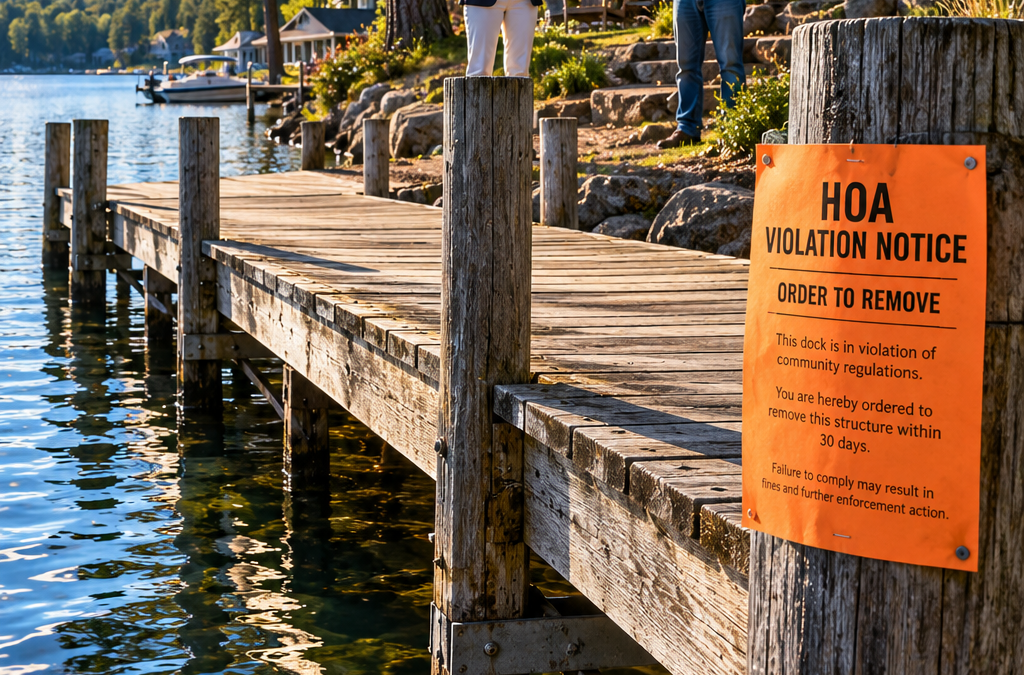
The letter ordered removal of my dock within thirty days.
Failure to remove it would result in daily fines, beginning at fifty dollars and escalating for continued noncompliance.
For almost a full minute, I stood there thinking I had misunderstood.
My dock?
The same dock that had existed for twelve years?
The same structure visible from every board member’s boat?
I read the notice again.
Then I looked at the dock beneath my feet.
Nothing had changed.
No extension.
No new roof.
No boat lift.
No enclosed structure.
Same boards.
Same pilings.
Same railing Dad had measured twice because I had cut the first post an eighth of an inch short.
I took the notice inside and called the HOA office.
Linda answered.
“Lakeside Pines Homeowners Association.”
“Linda, it’s me.”
She recognized my voice.
“Oh. Good morning.”
“I found an orange notice on my dock.”
There was a pause.
Then her voice became almost cheerful.
“Yes.”
“What is this?”
“Exactly what it says.”
“You’re ordering me to remove a dock that’s been here for twelve years.”
“It’s an unauthorized shoreline structure.”
“It existed before you were even on the board.”
“That doesn’t make it compliant.”
“Compliant with what?”
“Our revised shoreline standards.”
I opened the notice.
“It doesn’t cite a section.”
“The board has discretion over lakefront structures.”
I almost laughed.
“Since when?”
“Since always.”
“No, Linda. Since when?”
Her tone changed slightly.
“We’ve been conducting a shoreline review.”
“Why?”
“Property values.”
I looked out the window at the dock.
“What does my dock have to do with property values?”
She sighed.
“Oh, that old thing isn’t helping.”
I stopped breathing for a second.
“That old thing?”
“The board feels several of the older docks are visually inconsistent with the direction of the community.”
“The direction of the community?”
“Yes.”
“You mean the dock my father built?”
“I understand you may have emotional attachment to it.”
Something about the way she said emotional made my jaw tighten.
As though memory were an inconvenience in a spreadsheet.
“It passed inspection when it was built.”
“County inspection and HOA approval are separate issues.”
“It was here before your standards.”
“That isn’t relevant.”
“It seems extremely relevant.”
She lowered her voice.
“I’m trying to make this easy for you.”
“No, you’re telling me to tear down part of my property.”
“I’m telling you to comply before the fines become painful.”
There it was.
Before the fines become painful.
Not let’s review the documentation.
Not maybe there’s an error.
Painful.
I gripped the phone harder.
“I’m not removing it.”
She laughed.
Short.
Confident.
Almost amused.
“You will.”
I went quiet.
“Trust me,” she said.
Then she hung up.
I stood in my kitchen listening to the dead line.
For the next few minutes, I was too angry to move.
Then I made the mistake of convincing myself she was bluffing.
She wasn’t.
The first fine appeared three days later.
Fifty dollars.
Then another.
Then a hundred.
According to the notice, my failure to begin demolition showed “willful noncompliance.”
Linda posted the violation status on the community board near the clubhouse.
My address.
My name.
Violation pending.
Daily fines accruing.
It felt like a public scoreboard.
People noticed.
That was the point.
Linda understood something about shame.
She knew most people in Lakeside Pines valued quiet more than justice.
Make someone look difficult, and neighbors start backing away because nobody wants to get pulled into the dispute.
People who had waved at me for years suddenly found reasons to look somewhere else.
A man named Frank stopped his golf cart near my driveway one morning.
“I heard there’s an issue with your dock.”
“There’s an issue with Linda.”
He gave a nervous laugh.
“Yeah.”
“You think my dock is a problem?”
“No.”
“Then why are you whispering?”
He looked toward the road.
“Because I don’t need her looking at my deck.”
That was exactly it.
Linda’s real authority was fear of inconvenience.
People weren’t afraid she would put them in prison.
They were afraid she would make their lives exhausting.
Fine after fine.
Letter after letter.
Meeting after meeting.
Eventually, most people surrendered because surrender was easier.
I attended the next board meeting.
I brought the original county permit.
Old photographs.
A copy of the construction inspection.
Dad’s name was actually handwritten on one of the old material invoices because he had ordered the lumber.
I sat through forty minutes of routine business before Linda reached “shoreline compliance.”
She read from a prepared statement.
“The board is committed to preserving a consistent lakeside aesthetic and ensuring all shoreline installations meet modern community expectations.”
Modern community expectations.
I raised my hand.
She ignored me.
“Several outdated or nonconforming structures have been identified.”
I raised my hand higher.
Finally, she looked at me.
“Yes?”
“I’d like to respond.”
“You may have two minutes during homeowner comments.”
“You’re discussing my dock now.”
“This is a board report.”
“You’ve fined me hundreds of dollars.”
Linda glanced toward the other two board members.
Her cousin Cheryl sat on her right.
Walt Benson sat on her left.
Walt was a retired insurance salesman whose most defining characteristic was his willingness to agree with whoever spoke last.
Linda looked back at me.
“Two minutes.”
I stood.
“My dock was built twelve years ago. It was permitted, inspected, and has never received a violation. I would like the board to identify the authority you’re using to order its removal.”
Linda interrupted before I finished the sentence.
“This isn’t a debate.”
I stared at her.
“I didn’t say it was.”
“The board has spoken.”
“You haven’t answered the question.”
“The board has discretionary authority over shoreline structures.”
“Show me where.”
She smiled.
“You’ve been provided notice.”
“No. I’ve been provided a demand.”
Several people shifted in their chairs.
Linda’s smile disappeared.
“Your two minutes are up.”
“I’ve been speaking for less than thirty seconds.”
“Mr. Harper—”
“Show me the document that gives the HOA ownership or control over my shoreline.”
The room went quiet.
For the first time, Walt looked uncomfortable.
Linda leaned toward the microphone.
“If you continue disrupting this meeting, you will be asked to leave.”
I looked around.
Nobody met my eyes.
Something changed in me then.
Not because Linda had been rude.
I could handle rude.
It was because I realized nobody in that room expected the rules to matter.
They expected Linda to matter.
The distinction was enormous.
I picked up my folder.
“Fine.”
Linda nodded, satisfied.
As I walked toward the door, she called after me.
“Your fines will continue until the structure is removed.”
I stopped.
Turned.
Then looked directly at her.
“Then you better be absolutely sure you own what you’re claiming to control.”
She smiled again.
“I am.”
That was the last thing she said to me that night.
I drove home furious.
Not loud furious.
Cold furious.
I poured a drink I didn’t finish and sat at my dining room table staring at the dock through the glass doors.
I thought about Dad.
About that summer.
About Linda calling it an eyesore.
Then something came back to me.
A conversation from years earlier.
My father had mentioned an old deed once.
We had been talking about where the legal high-water line sat.
Dad said my grandfather had acquired “more shoreline than anybody realized” when the lake was first developed.
At the time, I assumed he meant our frontage.
I had never asked.
Why would I?
For twelve years, there had been no reason.
I opened the drawer where I kept property records.
The current deed didn’t show anything unusual.
Lot boundaries.
Easements.
Standard references.
Then I looked at the legal description.
It referenced an older recorded instrument.
Book 214.
Page 88.
I didn’t have it.
The next morning, I called an attorney.
Her name was Renata Cole.
A friend had used her during a boundary dispute involving inherited farmland.
He had described her as “the kind of lawyer who gets quieter when she’s about to ruin someone’s week.”
That seemed useful.
I explained the dock issue.
She listened without interrupting.
When I finished, she said, “You don’t need me to argue about a dock yet.”
“What do I need you for?”
“To determine what land the HOA actually controls.”
“That’s exactly what I want.”
“Send me your deed.”
I did.
She called that afternoon.
“I need the older instrument.”
“Book 214, page 88?”
“Yes.”
“You found that fast.”
“It’s literally in your deed.”
I almost laughed.
“I know.”
“You’d be surprised how many people never read past their property address.”
Renata pulled county records going back to the 1960s.
Then farther.
Original lake development plats.
Subdivision maps.
Shoreline conveyances.
Recorded easements.
Grant documents.
For two days, I heard nothing.
On the third afternoon, my phone rang.
“Sit down,” she said.
I was standing in the kitchen.
“That good?”
“Sit.”
I sat.
There was silence on the other end for several seconds.
“Renata?”
“You don’t just own your lake lot.”
I frowned.
“What does that mean?”
“Your grandfather acquired a separate shoreline estate when this area was developed.”
“What shoreline?”
“All of it.”
I thought I had misheard.
“All of what?”
“The shoreline surrounding Lake Briar.”
I stood back up.
“That isn’t possible.”
“It is in black and white.”
“No.”
“Yes.”
I walked toward the window.
“Explain.”
“The original developer separated residential lots from a narrow shoreline strip around the lake. Your grandfather bought that strip through a separate conveyance.”
“How much?”
“The entire perimeter.”
I stared at the water.
Every dock I could see.
Frank’s.
Walt’s.
Mrs. Carpenter’s.
The community launch.
“You’re telling me I own the ground under every dock?”
“Yes.”
“What about the HOA?”
“They have certain recorded access easements.”
“Ownership?”
“No.”
“Shoreline authority?”
“Not the kind Linda is claiming.”
I sat again.
For a moment, I felt something close to satisfaction.
Then dread followed.
Because suddenly the situation was bigger than my dock.
“Renata.”
“I know.”
“If I own the shoreline—”
“Linda’s violation is built on land the HOA doesn’t own.”
I rubbed my forehead.
“What happens to everybody else’s docks?”
“Don’t get ahead of yourself.”
“I’m trying not to.”
“You own the shoreline estate. That doesn’t mean you’re about to start evicting docks. There may be implied or recorded access rights, licenses, easements, all kinds of issues we need to review carefully.”
“But Linda doesn’t have the authority she’s claiming.”
“No.”
“Are you sure?”
“I am extremely sure.”
That should have been the end.
I didn’t want revenge.
I didn’t want to embarrass the board.
I wanted Linda to withdraw the violation and leave the dock alone.
So Renata prepared a simple letter.
She attached the deed.
Highlighted the relevant legal description.
Explained that the shoreline property was privately owned by me.
Not Lakeside Pines HOA.
The association possessed limited easement rights but no ownership interest granting it unilateral authority to order destruction of structures on the underlying property.
We sent it to Linda.
I expected an irritated response.
Maybe a demand for review.
Maybe a board meeting.
Instead, she ignored it.
Completely.
The next morning, at 8:12, I heard a diesel truck outside.
I walked to the front window.
A contractor’s flatbed was backing toward my driveway.
Two men in work clothes got out.
One started unloading tools.
My stomach dropped.
I walked outside.
“Morning.”
The older contractor looked up.
“You Mr. Harper?”
“Yes.”
“We’re here for the dock removal.”
“No, you’re not.”
He checked his clipboard.
“Lakeside Pines HOA authorized demolition.”
I felt something inside me go cold.
“Get back in your truck.”
He frowned.
“Sir, we’re just doing a job.”
“I understand. The person who hired you doesn’t own the property you’re standing on.”
His partner stopped unloading.
The older man looked at his paperwork.
“We were told the HOA controls the shoreline.”
“They don’t.”
A car door closed behind us.
Linda.
She had parked near the road.
Of course she had come to watch.
She walked toward us wearing sunglasses and holding a folder.
“Good morning.”
I stared at her.
“You got the deed.”
“Yes.”
“And you sent contractors anyway.”
“The board’s position hasn’t changed.”
I held up a rolled set of documents.
“This is private property.”
“Your attorney has an interpretation.”
“It’s not an interpretation. It’s a recorded deed.”
Linda smiled.
That same syrupy smile.
“The HOA has maintained this shoreline for decades.”
“No.”
“Yes.”
“No, you’ve claimed you maintained it.”
Her jaw tightened.
“You’re obstructing lawful enforcement.”
I looked at the contractor.
“I’m telling you plainly: if you cross onto that dock and remove anything, you are damaging private property after receiving notice of disputed authority.”
The contractor looked at Linda.
Then me.
“I don’t want any part of that.”
Linda stepped forward.
“You were hired to complete a job.”
“Ma’am, I’m not getting sued over a dock.”
She pointed toward the water.
“The association authorized removal.”
I unrolled the deed.
“The association doesn’t own the dirt under your shoes.”
Her face changed.
Just slightly.
Then she recovered.
“We’ll see what a judge says.”
“Fine.”
“I hope you’re prepared for legal fees.”
“I am.”
She stared at me for a second.
Then turned toward the contractor.
“You will be hearing from us.”
He shook his head.
“Talk to my office.”
They left.
Linda stood there a moment longer.
“You’re making this much harder than it needs to be.”
I looked at her.
“You sent people to destroy something my father built after receiving proof you don’t own the land.”
She didn’t answer.
“You made it hard.”
She walked back to her car.
That afternoon, Renata called.
She had been reviewing old HOA filings.
Her tone was different.
More serious.
“I found something.”
“What?”
“Shoreline maintenance fees.”
I knew the fee.
Everyone did.
Three hundred dollars a year.
Sometimes a little less.
Sometimes more.
It appeared on the annual HOA assessment as shoreline maintenance and lake access.
“What about them?”
“How long have you been paying?”
“Four years, maybe.”
“So has everyone else.”
“I know.”
“Do you know what the HOA claims those fees cover?”
“Dock areas. Shoreline upkeep. Access paths. General maintenance.”
“That’s the problem.”
“Why?”
“I can’t find maintenance authorization.”
I leaned against the counter.
“Explain.”
“The HOA’s easements allow access to certain common areas. They don’t convey the shoreline estate.”
“We know that.”
“Yes, but if they’re charging homeowners specifically to maintain property they don’t own, I want to see the contracts.”
“Maybe they hired crews.”
“I checked county permits.”
“Nothing?”
“No shoreline stabilization permits. No bulkhead work. No dredging applications. Nothing matching four years of fees.”
“How much money are we talking about?”
“Rough estimate?”
“Yes.”
She paused.
“Enough that we need financial records.”
The next few days changed everything.
Renata requested invoices.
Vendor contracts.
Maintenance reports.
Work orders.
Permit records.
Linda stalled.
She said records were being compiled.
Then some were archived.
Then the management company needed additional time.
What she did not produce were invoices showing where the shoreline money had gone.
That was when my anger shifted.
Up to then, this had been personal.
My dock.
My father.
My property.
Now I started thinking about everyone else.
Mrs. Carpenter.
Frank.
Walt.
Families who paid that fee year after year because an official HOA budget told them it was necessary.
Nearly three hundred dollars annually per homeowner.
Four years.
The money added up quickly.
I asked Renata the question I had been avoiding.
“Is this fraud?”
“Potentially.”
“Potentially?”
“I’m a lawyer. I don’t accuse someone of fraud until I can prove the elements.”
“She collected money for land the HOA doesn’t own.”
“Yes.”
“And can’t show what the money paid for.”
“Yes.”
“What would you call that?”
“I would call it enough to demand an audit.”
So we did.
I requested an emergency HOA meeting.
At first Linda refused.
Then enough homeowners signed onto the request that she had no practical choice.
Word spread quickly.
Apparently the moment people heard the phrase “you may have been paying shoreline fees on privately owned land,” everyone suddenly found time for an HOA meeting.
The clubhouse was packed.
Every chair was taken.
People stood along the walls.
Some brought old statements.
Others carried folders of assessment notices.
I sat near the front with Renata.
Linda sat behind the board table.
Her cousin beside her.
Walt at the end.
Linda looked angry before the meeting even started.
She struck the gavel.
“We are here tonight to address misinformation regarding shoreline governance.”
Misinformation.
That word almost made me laugh.
She continued.
“For decades, this association has maintained lake access and enforced shoreline standards to preserve property values.”
Renata leaned toward me.
“Let her talk.”
I wasn’t planning to interrupt.
Linda went on for ten minutes.
Community standards.
Historical practice.
Collective benefit.
Lake aesthetics.
She said everything except the one thing that mattered.
Ownership.
Finally, she opened the floor.
I stood.
“My attorney will speak.”
Linda’s expression hardened.
Renata walked toward the projector.
She connected her laptop.
The screen behind the board lit up.
First came the original 1960s development map.
Then the shoreline deed.
Renata enlarged the legal description.
“This is a recorded conveyance establishing a separate shoreline estate around Lake Briar.”
People leaned forward.
She highlighted the grantee name.
My grandfather.
Then she displayed the chain of title showing the shoreline estate eventually transferring to me.
“This land,” she said, pointing toward the outline surrounding the lake, “belongs to my client.”
The room went silent.
Linda folded her arms.
Renata continued.
“Not merely the frontage behind his house.”
She traced the outline.
“The entire shoreline.”
Someone in the back said, “What?”
A woman near me whispered, “Every dock?”
Renata nodded.
“Every dock sits on or crosses property owned by Mr. Harper, subject to whatever individual easements or access rights apply.”
People began talking at once.
Linda hit the gavel.
“This interpretation is disputed.”
Renata looked at her.
“By whom?”
“The board.”
“On what recorded instrument?”
Linda’s face tightened.
“This community has exercised shoreline authority for years.”
Renata nodded.
“That wasn’t my question.”
I almost smiled.
Renata enlarged the deed.
“Please identify the HOA’s ownership interest.”
Linda did not answer.
Walt looked down at the table.
Her cousin shuffled papers.
Renata changed slides.
“Now we come to the annual shoreline maintenance fee.”
The room became quiet again.
Statements appeared on the screen.
Three hundred dollars.
Two hundred eighty-five.
Three hundred ten.
Different years.
Same general fee.
Renata faced the homeowners.
“For approximately four years, Lakeside Pines has billed homeowners for shoreline maintenance and lake-access upkeep.”
Several people nodded.
Linda interrupted.
“That fee supports community resources.”
Renata looked at her.
“Excellent.”
Linda seemed surprised.
“Then this should be easy.”
Renata clicked to the next slide.
Blank categories.
“No shoreline stabilization permits.”
Another.
“No documented repair permits.”
Another.
“No maintenance invoices produced in response to counsel’s request.”
Another.
“No vendor contracts substantiating the amounts collected.”
Linda’s face drained slightly.
Renata turned toward her.
“Where did the money go?”
Linda grabbed the microphone.
“That money went toward community upkeep.”
“Which upkeep?”
“General maintenance.”
“Your assessment calls it shoreline maintenance.”
“Budget categories overlap.”
“Show us the invoices.”
Silence.
Linda looked toward her cousin.
Then Walt.
Neither spoke.
Renata remained calm.
“Show the homeowners where their money went.”
Linda’s fingers tightened around the microphone.
“We are not conducting an audit in a public meeting.”
A man behind me stood.
“Why not?”
Another voice.
“We’ve been paying that for years.”
Then Mrs. Carpenter raised her hand.
Linda ignored her.
She stood anyway.
“My husband died three years ago. I paid every assessment you sent because I thought I was paying to maintain this lake.”
Linda tried to interrupt.
Mrs. Carpenter kept speaking.
“Did you use that money for the shoreline?”
“This is not the proper forum—”
“Did you?”
No answer.
The mood in the room changed instantly.
One by one, people began raising questions.
“How much was collected?”
“Who approved the spending?”
“Where are the records?”
“Why didn’t anyone know he owned the shoreline?”
“Why were we charged?”
Linda struck the gavel over and over.
“Order.”
Nobody cared.
For years, the gavel had worked because people believed Linda controlled the process.
Now they were looking at evidence that the process itself might have been false.
Walt leaned toward his microphone.
His voice was low.
“I told you we should have checked the deed first.”
The room stopped.
Linda whipped toward him.
“What?”
Walt stared at the table.
“I said we should have checked ownership before sending the violation.”
Linda’s face turned red.
“You agreed with the enforcement.”
“I agreed because you said the HOA controlled the shoreline.”
“I said we have historical authority.”
“You said we owned it.”
Her cousin looked at Linda.
“You told me that too.”
Linda slammed her palm against the table.
“This is still my board.”
That sentence exploded through the room.
Not our board.
My board.
Someone in the back shouted, “That’s the whole problem.”
Another voice yelled, “You don’t own us.”
Then someone else:
“You built a scam.”
Linda stood.
“I will not tolerate personal attacks.”
Renata remained beside the projector.
“Nobody needs to attack you, Ms. Pruitt. Produce the records.”
Linda looked toward the door.
For the first time since I had known her, she looked cornered.
Not because anyone threatened her.
Because there was nowhere left to hide the missing paperwork.
She gathered her folder.
“This meeting is adjourned.”
Walt shook his head.
“No.”
Linda stopped.
“What?”
“We haven’t voted.”
She stared at him.
“You don’t control when this meeting ends.”
For years, Walt had agreed with almost everything Linda said simply because disagreement required effort.
That night, he finally found his spine.
The crowd erupted.
Linda grabbed her bag.
“You people have no idea how much work I have done for this community.”
Mrs. Carpenter called from the second row.
“Then show us where the money went.”
Linda walked out.
The door slammed behind her.
For several seconds, nobody moved.
Then everyone started talking at once.
The formal vote continued without her.
A motion passed requesting complete financial disclosure and an independent review of shoreline-fee collections.
Another motion suspended further shoreline enforcement.
Then someone moved to begin removal proceedings against Linda as president.
That process took two weeks.
It wasn’t theatrical.
No police came to her house.
No television cameras waited at the entrance.
The board reviewed procedures.
Homeowners submitted written complaints.
Financial documents were requested.
The county became involved after Renata submitted the deed and records concerning fees collected for privately owned shoreline property.
By the end of the second week, Linda was formally removed as HOA president.
The county opened an investigation into the shoreline assessments.
Several homeowners filed claims seeking reimbursement.
The investigation did not magically resolve everything overnight.
Money rarely disappears in ways that fit neatly into one dramatic explanation.
Some funds appeared to have been mixed into broader HOA accounts.
Other expenditures required additional review.
What mattered immediately was this:
Linda could no longer send me daily fines.
She could no longer order contractors onto my land.
And she could no longer tell homeowners that the HOA owned the shoreline.
My dock stayed exactly where it had always been.
Same boards.
Same railing.
Same pencil mark beneath the post.
A few days after Linda’s removal, I walked to the end of it at sunrise.
I put my hand on the railing Dad had measured.
For the first time in weeks, I didn’t see an orange violation notice when I looked at that post.
I saw him.
That was all I had wanted from the beginning.
Peace.
But the deed created a practical problem we still had to solve.
I owned the shoreline beneath every dock.
That sounded powerful.
In reality, it meant responsibility.
Dozens of homeowners had docks extending over my property.
Some had old access language in their deeds.
Some had vague references.
Some had nothing clear at all.
Renata warned me not to improvise.
“Do not start making verbal deals.”
“I wasn’t planning to.”
“Good.”
“I don’t want money from these people.”
“I know.”
“I don’t want to control their docks.”
“I know.”
“I want everyone left alone.”
“That can be documented too.”
So we created simple access agreements.
Quiet.
Fair.
Plain language.
Homeowners retained access to their docks.
I acknowledged existing use.
They acknowledged the shoreline ownership.
Nobody paid absurd annual maintenance fees to me.
Nobody needed architectural permission from me to sit on their own dock.
If substantial changes were proposed, we documented them so nobody would face a boundary dispute later.
That was it.
The first person to sign was Mrs. Carpenter.
She came to my porch holding the paperwork like it might explode.
“Am I going to owe you rent?”
“No.”
“Nothing?”
“Nothing.”
“What do you want?”
“Clarity.”
She looked at me suspiciously.
“That’s all?”
“Yes.”
She sat.
Renata had written the agreement in language normal people could understand.
Mrs. Carpenter read it twice.
Then she signed.
“My husband built our dock.”
I nodded.
“So did my dad.”
Her expression softened.
“I didn’t know that.”
“Most people didn’t.”
She looked toward the lake.
“Linda fined me for my wind chimes.”
“I remember.”
“They were my husband’s.”
I looked at her.
“I didn’t know that.”
For a second, neither of us said anything.
Then she laughed bitterly.
“I guess Linda had a talent for finding sentimental things to regulate.”
That sentence stayed with me.
Power feels abstract until it touches something you love.
A dock.
Wind chimes.
A garden.
A porch.
To Linda, those things were categories.
Structures.
Noise sources.
Compliance items.
To the rest of us, they were memories.
Walt became HOA president after a special election.
Nobody expected that.
Least of all Walt.
When someone nominated him, he looked like he wanted to crawl under the table.
But people trusted him more after he had finally spoken against Linda.
His first official action was simple.
He moved to abolish the shoreline maintenance fee entirely.
The vote was unanimous.
Then he introduced a policy requiring any future enforcement action involving property boundaries or ownership to include actual recorded documentation.
I laughed when I heard that.
Walt looked at me.
“What?”
“Nothing.”
“It’s reasonable.”
“It is.”
“We should have done it years ago.”
“Yes.”
He sighed.
“I know.”
That was one thing I respected about him afterward.
He didn’t rewrite history.
He had gone along with Linda.
He admitted it.
One afternoon, he came to my house.
I was repairing a loose dock board.
He stood on the shore with his hands in his pockets.
“Need help?”
“I’ve seen your carpentry.”
He laughed.
“Fair.”
I tightened the screw.
He watched.
Then he said, “I owe you an apology.”
I looked up.
“For what?”
“I voted for the violation.”
“Yes.”
“I didn’t check.”
“No.”
“Linda said legal counsel had confirmed shoreline authority.”
“Did they?”
“I don’t know.”
“Did you ask?”
He looked ashamed.
“No.”
I sat back on my heels.
“At least you’re asking now.”
“That doesn’t fix it.”
“No.”
He nodded.
“I should have pushed back earlier.”
“Probably.”
He gave a small laugh.
“You’re not making this apology easy.”
“You’re a grown man, Walt.”
“I know.”
“You want me to tell you none of it mattered?”
“No.”
“Good.”
He looked at the dock.
“Your dad really built this?”
“Most of it.”
“It looks solid.”
“He was obsessive.”
“Maybe that’s where you get it.”
“Careful.”
Walt laughed.
Then his expression became serious again.
“I don’t want this board becoming another Linda situation.”
“Then don’t let people stop questioning you.”
He nodded.
That mattered.
A good board isn’t one where nobody disagrees.
It’s one where disagreement doesn’t become punishment.
Months passed.
The financial investigation continued.
Some homeowners received partial reimbursements while broader accounting issues were sorted out.
Others pursued their claims separately.
Linda’s removal became old news.
The Facebook group returned to pictures of sunsets, lost dogs and complaints about slow internet.
The neighborhood felt lighter.
Not perfect.
Nothing is.
But normal.
I occasionally saw Linda.
She still lived there.
That surprised some people.
Not me.
Losing an HOA presidency is not the same as losing your house.
She walked a small white dog every morning.
The first time she passed my property after being removed, I was standing near the dock.
She saw me.
Her eyes moved toward the water.
Then straight ahead.
No wave.
No smile.
Nothing.
I didn’t call out.
I didn’t need to.
Over time, that became our routine.
She walked past.
I existed.
That was enough.
People sometimes asked whether I felt sorry for her.
The answer was complicated.
I didn’t enjoy watching anyone’s life collapse.
I didn’t wake up hoping Linda would be humiliated.
But sympathy requires honesty.
Even after she was removed, I never heard her say, “I was wrong.”
Not about the dock.
Not about the fees.
Not about the contractors.
Not about telling everyone she controlled land she never bothered to verify.
The closest she came was saying the board had relied on “historical understandings.”
Historical understandings.
That phrase annoyed me more than it should have.
A deed isn’t an understanding.
Ownership isn’t a mood.
If Linda had checked before threatening me, everything could have been different.
She could have called.
She could have asked for the records.
She could have discovered the shoreline issue quietly and worked with homeowners to formalize access.
She could have admitted the fee needed review.
Instead, she chose certainty.
Then intimidation.
Then escalation.
Every time she reached a point where a reasonable person would pause, she pushed harder.
That was why I never felt responsible for what happened to her.
She wasn’t undone by my deed.
She was undone by her refusal to believe a deed could matter more than her authority.
There is a strange moment that happens when somebody has controlled a room for too long.
They start mistaking obedience for proof that they are right.
Linda had spent years issuing notices.
People complied.
So she concluded the notices must be legitimate.
She imposed fines.
People paid.
So she concluded she must have authority.
She made declarations.
Nobody challenged her.
So she started believing challenge itself was improper.
By the time she came after my dock, she no longer thought she had to prove anything.
That was her mistake.
Years in construction taught my father something he repeated constantly.
“You don’t build on assumption.”
He said it when I was a teenager helping him frame a shed.
He said it when I started working professionally.
“You verify.”
Measure.
Check the plan.
Check the soil.
Check the load.
Check the permit.
Because assumptions are cheap right up until something collapses.
Linda built her authority on an assumption.
The HOA owns the shoreline.
Nobody checked.
Not Walt.
Not her cousin.
Not the management company.
Apparently not even Linda.
They repeated it until repetition felt like ownership.
Then one orange notice forced me to look.
That’s the irony.
If Linda had left my dock alone, I might never have pulled the old deed.
I might never have learned I owned the shoreline estate.
The fee might have continued.
Everyone might have kept paying three hundred dollars a year without asking exactly what they were funding.
Linda exposed herself by reaching for something she didn’t need to touch.
That thought used to make me angry.
Now it mostly makes me tired.
My father’s dock never needed defending until someone decided it offended her idea of what the neighborhood should look like.
She called it an eyesore.
I still remember that word.
Twelve years of weather had changed the wood.
The boards had faded.
There were scratches from coolers and fishing gear.
A notch in one post where Dad dropped a clamp.
A darker patch near the end where my nephew spilled deck stain.
Linda saw age.
I saw history.
That difference was the entire dispute in miniature.
She believed ownership gave way to appearance.
I believed property meant something deeper than whether a board president approved of what she saw.
The new HOA eventually adopted a shoreline policy that acknowledged my ownership and the residents’ access agreements.
It fit on two pages.
No threatening language.
No daily fines.
No invented authority.
Simple responsibilities.
Keep structures safe.
Follow county permitting laws.
Respect neighbors’ access.
Notify me before major changes affecting the shoreline estate.
That was it.
Walt brought me the draft before the vote.
He sat at my kitchen table.
“This too complicated?”
I read it.
“No.”
“Anything missing?”
“Don’t use the phrase community discretion.”
He crossed it out.
“Why?”
“Because someday somebody like Linda will decide discretion means whatever she wants.”
“Fair.”
We replaced it with objective language.
Specific standards.
Specific procedure.
Specific rights.
Boring documents.
Boring is good.
Boring rules don’t depend on someone being reasonable.
They work even when someone isn’t.
One summer evening almost a year after the orange notice appeared, I invited several neighbors down to the water.
Nothing formal.
Just food.
A few coolers.
Kids swimming.
Frank brought his guitar.
Mrs. Carpenter hung her wind chimes on a tree beside the picnic tables just to make a point.
Walt laughed when he noticed them.
The sun went down slowly.
Lights appeared along the docks.
All those docks sitting on the shoreline my grandfather had bought decades before.
For the first time, that fact didn’t feel strange.
The legal paperwork existed.
The access agreements existed.
Nobody was frightened by it anymore.
Ownership had stopped being a weapon.
That mattered to me.
I could have made people miserable.
Technically, I had leverage.
I could have demanded money.
Complicated access.
Created my own little kingdom around the lake.
The idea disgusted me.
I’d just spent months fighting someone who believed ownership and authority existed to make other people obey.
I wasn’t going to become her because my name happened to be on a deed.
Renata understood that from the beginning.
When we finished the final batch of access agreements, she closed her folder.
“You know, you could have charged annual license fees.”
“I know.”
“You could have made a lot of money.”
“I know.”
“You didn’t even ask how much.”
“No.”
She smiled.
“Good.”
“Why good?”
“Because I didn’t want to find out I was representing Linda with better paperwork.”
I laughed.
“Not a chance.”
She looked toward the lake.
“What are you going to do with all this when you eventually sell?”
“I don’t know.”
“Think about it.”
I did.
Eventually, I updated my estate documents to make sure the shoreline ownership could not quietly become another tool for somebody else to abuse.
Renata structured provisions protecting existing homeowner access and preventing arbitrary fees.
Dad would have liked that.
He hated complicated solutions to simple problems.
“Build it so the next guy doesn’t have to fix your mistake,” he used to say.
That’s what I tried to do.
Linda had taught me what happened when power depended on personality.
I wanted the opposite.
Rules that survived personalities.
A few months later, I found the original orange violation notice in a drawer.
I had kept it with the legal papers.
REMOVE WITHIN 30 DAYS.
DAILY FINES WILL ACCRUE.
I carried it outside.
Sat at the end of the dock.
For a while, I just looked at it.
That piece of paper had scared me more than I liked admitting.
When I first saw it, my immediate thought had been that maybe the HOA knew something I didn’t.
Official letterhead has that effect.
Bold type.
Deadlines.
Threats.
It makes ordinary people wonder whether resistance itself is dangerous.
Linda knew that.
Maybe not consciously.
But she understood the power of making people feel outnumbered.
The board has spoken.
Our counsel agrees.
Community standards.
Daily fines.
She used collective language to make herself seem larger than she was.
In reality, “the board” had been Linda, her cousin, and Walt avoiding an argument.
Once Walt stopped avoiding the argument, the giant institution Linda pretended to represent became three people sitting behind folding tables in a clubhouse.
That realization changed the way I saw everything.
I didn’t tear up the orange notice.
I put it back in the folder.
Not because it had power anymore.
Because it reminded me how quickly paper can feel powerful when you haven’t checked the paper underneath it.
Linda had a violation notice.
I had a deed.
One was louder.
The other was real.
There is a difference.
These days, when someone new moves onto the lake and learns about the shoreline history, they usually ask the same question.
“So you own all of this?”
Technically, yes.
Then they ask the second.
“Does that mean you can tell us what to do with our docks?”
And I usually laugh.
“No.”
I tell them the truth.
I own land.
I do not own people.
Their access is documented.
Their responsibilities are clear.
Mine are too.
That answer seems to confuse people who have spent too much time around organizations where every legal right becomes an excuse for control.
But to me, it is simple.
Property rights matter because they establish boundaries.
Not because they erase everyone else’s.
Dad understood boundaries.
He knew exactly where the dock ended and the lake began.
He knew where to place pilings.
How far to span joists.
Where weight transferred.
He understood that everything stays standing because each part has limits.
Maybe communities work the same way.
Boards need limits.
Presidents need limits.
Owners need limits.
Neighbors need limits.
The trouble begins when someone decides their authority has no edge.
Linda looked at a lake and saw jurisdiction.
She looked at a dock and saw disobedience.
She looked at my resistance and saw a challenge to her power.
She never stopped long enough to ask whether the power existed.
That question destroyed everything she had built around herself.
Not the dock.
Not me.
The question.
Where is it written?
Who owns the land?
Show me the authority.
Those are small questions.
But small questions become dangerous to people whose power depends on nobody asking them.
I still sit on the dock most evenings.
The boards have been refinished twice since Dad and I built it.
I replaced one railing last year.
The pencil mark under the old post is still there.
I protected it with clear sealant.
Probably ridiculous.
I don’t care.
Sometimes I run my thumb over it.
A small dark line.
Barely visible.
Nobody else would understand why it matters.
Linda certainly didn’t.
But that is the thing about ownership she never understood.
A home is not just square footage.
Land is not just acreage.
A dock is not just lumber.
People attach memories to places.
Grief.
Work.
Family.
Years.
You cannot always see that from an HOA checklist.
And you should be very careful before deciding your idea of uniformity matters more.
My father’s dock survived.
The shoreline agreements survived.
The neighbors got answers.
The fee disappeared.
Walt became a better president than anybody expected.
The lake became quiet again.
Linda still walks past sometimes with her dog.
She still looks straight ahead.
I never call out.
I never need to.
There is no satisfaction left in making her uncomfortable.
The satisfying part happened long ago, the moment I realized I did not have to let her rewrite reality simply because she spoke with confidence.
That lesson stayed with me.
Power without proof is just noise.
Authority without honesty eventually cracks.
And sometimes the thing that brings it all down isn’t a lawsuit, a public scandal, or a dramatic confrontation.
Sometimes it is one old deed sitting quietly in a drawer, waiting for somebody to finally read what it says.
𝗧𝗛𝗘 𝗘𝗡𝗗
The HOA President Gave Me 30 Days to Tear Down My Father’s Dock on Land She Never Bothered to Check
Linda Pruitt smiled when she told me I had thirty days to destroy the dock my father built with his own hands, as if twelve years of memories could be erased with one orange violation notice. What she didn’t know was that the deed sitting in my desk drawer didn’t stop at my property line—it reached around the entire lake beneath every dock she thought her HOA controlled.
I had lived on Lake Briar for twelve years before anyone told me my dock was a problem.
For most of that time, nobody cared.
That was one of the reasons I loved the place.
My house sat on the western side of the lake beneath a line of tall pines that leaned toward the water whenever the wind came through. It wasn’t the biggest house in the neighborhood. It wasn’t the newest. The deck boards creaked when the weather changed, the kitchen cabinets were older than I wanted to admit, and the stone chimney had a crack I kept promising myself I would repair.
But the lake made all of that irrelevant.
Every morning, light came across the water before it reached my porch.
In winter, the shoreline went almost silent.
In summer, kids jumped from docks while pontoon boats drifted past in the distance.
For twelve years, I had woken up feeling lucky.
The dock mattered more than almost anything else on the property.
My father and I had built it the summer before he died.
He had already been slowing down by then, though neither of us wanted to say it.
Dad had spent his whole life working with his hands. He could look at a crooked beam and tell you why it was wrong before touching a level. He could sharpen a chisel by feel. He measured twice because he said a man who measured once deserved to buy lumber twice.
That summer, he was sixty-nine.
I was forty-three.
We spent three weeks rebuilding the old dock that had come with the house.
The original structure had rotted badly enough that two pilings leaned toward the water. Dad took one look at it and said, “If we’re going to fix it, we’re going to fix it properly.”
So we did.
Pressure-treated framing.
New decking.
Galvanized hardware.
Fresh pilings.
We worked in the mornings before the sun got too high.
He complained about my cuts.
I complained about him measuring everything like we were building a bridge across the Mississippi.
He would sit at the end of the dock around noon with a thermos of coffee and tell me stories I’d heard a hundred times.
I let him tell them anyway.
Eight months later, he died.
After the funeral, I came home and sat on that dock until the sun disappeared.
I didn’t cry at first.
Then I noticed one pencil mark he had left beneath the railing where he had measured the final post.
That did it.
From that point on, the dock stopped being part of the property.
It became part of him.
For more than a decade, nobody questioned it.
Then Linda Pruitt became HOA president.
Linda moved into Lakeside Pines about four years after I did.
At first, she seemed normal enough.
She brought cookies to the annual picnic.
Volunteered for the landscaping committee.
Complained about speeding near the entrance.
Then she joined the board.
Two years later, she became president.
After that, something changed.
Maybe the authority was always what she wanted.
Maybe people simply hadn’t given her enough of it before.
Within six months of becoming president, Linda had managed to turn a sleepy lakeside community into a place where people checked their mailboxes with mild anxiety.
She loved uniformity.
Not beauty.
Uniformity.
There is a difference.
Beauty allows personality.
Linda wanted control.
She pushed through a requirement that every mailbox be painted the same shade of dark green.
She sent notices about trash cans visible from the road.
She argued that exterior porch lights should have approved bulb temperatures because “mixed lighting diminished nighttime aesthetics.”
She fined a widow named Mrs. Carpenter because the wind chimes her late husband had made were supposedly creating a recurring noise disturbance.
The woman was seventy-two.
The wind chimes could barely be heard from the sidewalk.
Linda didn’t care.
At the board meeting, she said, “Rules cannot be based on sentiment.”
That sentence told me more about her than she realized.
Linda measured grass.
Literally.
More than once I saw her walking around with a ruler.
A ruler.
She once told my neighbor Peter that his lawn was three-quarters of an inch above the community recommendation.
Peter asked her whether she had anything better to do.
She issued him a warning for disrespectful conduct toward an HOA representative.
That warning wasn’t enforceable, but it told you how Linda thought.
She began referring to the neighborhood as a “premium lake community.”
Nobody else called it that.
She renamed the neighborhood Facebook page Lakeside Excellence Alliance.
People mocked the name privately.
Nobody challenged her publicly.
That was how Linda’s authority grew.
Not because everyone agreed with her.
Because nobody wanted to waste a Tuesday evening fighting about mailboxes.
I understood that.
I felt the same way.
When she introduced a new rule limiting decorative flags, I took mine down.
When she sent me a reminder about storing my kayak above the shoreline grass line, I moved it.
Not because I thought she was right about everything.
Because I had a life.
Work.
Friends.
Family.
A lake.
I wasn’t going to spend my time fighting a woman with a clipboard over things that barely mattered.
Then one Tuesday morning, I walked down toward the water carrying a cup of coffee and saw something orange taped to my dock.
At first, I thought it was a flyer.
Then I saw the HOA logo.
I set the coffee on the railing.
AUTHORIZED SHORELINE ENFORCEMENT NOTICE.
Under that:
UNAPPROVED STRUCTURE.
The letter ordered removal of my dock within thirty days.
Failure to remove it would result in daily fines, beginning at fifty dollars and escalating for continued noncompliance.
For almost a full minute, I stood there thinking I had misunderstood.
My dock?
The same dock that had existed for twelve years?
The same structure visible from every board member’s boat?
I read the notice again.
Then I looked at the dock beneath my feet.
Nothing had changed.
No extension.
No new roof.
No boat lift.
No enclosed structure.
Same boards.
Same pilings.
Same railing Dad had measured twice because I had cut the first post an eighth of an inch short.
I took the notice inside and called the HOA office.
Linda answered.
“Lakeside Pines Homeowners Association.”
“Linda, it’s me.”
She recognized my voice.
“Oh. Good morning.”
“I found an orange notice on my dock.”
There was a pause.
Then her voice became almost cheerful.
“Yes.”
“What is this?”
“Exactly what it says.”
“You’re ordering me to remove a dock that’s been here for twelve years.”
“It’s an unauthorized shoreline structure.”
“It existed before you were even on the board.”
“That doesn’t make it compliant.”
“Compliant with what?”
“Our revised shoreline standards.”
I opened the notice.
“It doesn’t cite a section.”
“The board has discretion over lakefront structures.”
I almost laughed.
“Since when?”
“Since always.”
“No, Linda. Since when?”
Her tone changed slightly.
“We’ve been conducting a shoreline review.”
“Why?”
“Property values.”
I looked out the window at the dock.
“What does my dock have to do with property values?”
She sighed.
“Oh, that old thing isn’t helping.”
I stopped breathing for a second.
“That old thing?”
“The board feels several of the older docks are visually inconsistent with the direction of the community.”
“The direction of the community?”
“Yes.”
“You mean the dock my father built?”
“I understand you may have emotional attachment to it.”
Something about the way she said emotional made my jaw tighten.
As though memory were an inconvenience in a spreadsheet.
“It passed inspection when it was built.”
“County inspection and HOA approval are separate issues.”
“It was here before your standards.”
“That isn’t relevant.”
“It seems extremely relevant.”
She lowered her voice.
“I’m trying to make this easy for you.”
“No, you’re telling me to tear down part of my property.”
“I’m telling you to comply before the fines become painful.”
There it was.
Before the fines become painful.
Not let’s review the documentation.
Not maybe there’s an error.
Painful.
I gripped the phone harder.
“I’m not removing it.”
She laughed.
Short.
Confident.
Almost amused.
“You will.”
I went quiet.
“Trust me,” she said.
Then she hung up.
I stood in my kitchen listening to the dead line.
For the next few minutes, I was too angry to move.
Then I made the mistake of convincing myself she was bluffing.
She wasn’t.
The first fine appeared three days later.
Fifty dollars.
Then another.
Then a hundred.
According to the notice, my failure to begin demolition showed “willful noncompliance.”
Linda posted the violation status on the community board near the clubhouse.
My address.
My name.
Violation pending.
Daily fines accruing.
It felt like a public scoreboard.
People noticed.
That was the point.
Linda understood something about shame.
She knew most people in Lakeside Pines valued quiet more than justice.
Make someone look difficult, and neighbors start backing away because nobody wants to get pulled into the dispute.
People who had waved at me for years suddenly found reasons to look somewhere else.
A man named Frank stopped his golf cart near my driveway one morning.
“I heard there’s an issue with your dock.”
“There’s an issue with Linda.”
He gave a nervous laugh.
“Yeah.”
“You think my dock is a problem?”
“No.”
“Then why are you whispering?”
He looked toward the road.
“Because I don’t need her looking at my deck.”
That was exactly it.
Linda’s real authority was fear of inconvenience.
People weren’t afraid she would put them in prison.
They were afraid she would make their lives exhausting.
Fine after fine.
Letter after letter.
Meeting after meeting.
Eventually, most people surrendered because surrender was easier.
I attended the next board meeting.
I brought the original county permit.
Old photographs.
A copy of the construction inspection.
Dad’s name was actually handwritten on one of the old material invoices because he had ordered the lumber.
I sat through forty minutes of routine business before Linda reached “shoreline compliance.”
She read from a prepared statement.
“The board is committed to preserving a consistent lakeside aesthetic and ensuring all shoreline installations meet modern community expectations.”
Modern community expectations.
I raised my hand.
She ignored me.
“Several outdated or nonconforming structures have been identified.”
I raised my hand higher.
Finally, she looked at me.
“Yes?”
“I’d like to respond.”
“You may have two minutes during homeowner comments.”
“You’re discussing my dock now.”
“This is a board report.”
“You’ve fined me hundreds of dollars.”
Linda glanced toward the other two board members.
Her cousin Cheryl sat on her right.
Walt Benson sat on her left.
Walt was a retired insurance salesman whose most defining characteristic was his willingness to agree with whoever spoke last.
Linda looked back at me.
“Two minutes.”
I stood.
“My dock was built twelve years ago. It was permitted, inspected, and has never received a violation. I would like the board to identify the authority you’re using to order its removal.”
Linda interrupted before I finished the sentence.
“This isn’t a debate.”
I stared at her.
“I didn’t say it was.”
“The board has spoken.”
“You haven’t answered the question.”
“The board has discretionary authority over shoreline structures.”
“Show me where.”
She smiled.
“You’ve been provided notice.”
“No. I’ve been provided a demand.”
Several people shifted in their chairs.
Linda’s smile disappeared.
“Your two minutes are up.”
“I’ve been speaking for less than thirty seconds.”
“Mr. Harper—”
“Show me the document that gives the HOA ownership or control over my shoreline.”
The room went quiet.
For the first time, Walt looked uncomfortable.
Linda leaned toward the microphone.
“If you continue disrupting this meeting, you will be asked to leave.”
I looked around.
Nobody met my eyes.
Something changed in me then.
Not because Linda had been rude.
I could handle rude.
It was because I realized nobody in that room expected the rules to matter.
They expected Linda to matter.
The distinction was enormous.
I picked up my folder.
“Fine.”
Linda nodded, satisfied.
As I walked toward the door, she called after me.
“Your fines will continue until the structure is removed.”
I stopped.
Turned.
Then looked directly at her.
“Then you better be absolutely sure you own what you’re claiming to control.”
She smiled again.
“I am.”
That was the last thing she said to me that night.
I drove home furious.
Not loud furious.
Cold furious.
I poured a drink I didn’t finish and sat at my dining room table staring at the dock through the glass doors.
I thought about Dad.
About that summer.
About Linda calling it an eyesore.
Then something came back to me.
A conversation from years earlier.
My father had mentioned an old deed once.
We had been talking about where the legal high-water line sat.
Dad said my grandfather had acquired “more shoreline than anybody realized” when the lake was first developed.
At the time, I assumed he meant our frontage.
I had never asked.
Why would I?
For twelve years, there had been no reason.
I opened the drawer where I kept property records.
The current deed didn’t show anything unusual.
Lot boundaries.
Easements.
Standard references.
Then I looked at the legal description.
It referenced an older recorded instrument.
Book 214.
Page 88.
I didn’t have it.
The next morning, I called an attorney.
Her name was Renata Cole.
A friend had used her during a boundary dispute involving inherited farmland.
He had described her as “the kind of lawyer who gets quieter when she’s about to ruin someone’s week.”
That seemed useful.
I explained the dock issue.
She listened without interrupting.
When I finished, she said, “You don’t need me to argue about a dock yet.”
“What do I need you for?”
“To determine what land the HOA actually controls.”
“That’s exactly what I want.”
“Send me your deed.”
I did.
She called that afternoon.
“I need the older instrument.”
“Book 214, page 88?”
“Yes.”
“You found that fast.”
“It’s literally in your deed.”
I almost laughed.
“I know.”
“You’d be surprised how many people never read past their property address.”
Renata pulled county records going back to the 1960s.
Then farther.
Original lake development plats.
Subdivision maps.
Shoreline conveyances.
Recorded easements.
Grant documents.
For two days, I heard nothing.
On the third afternoon, my phone rang.
“Sit down,” she said.
I was standing in the kitchen.
“That good?”
“Sit.”
I sat.
There was silence on the other end for several seconds.
“Renata?”
“You don’t just own your lake lot.”
I frowned.
“What does that mean?”
“Your grandfather acquired a separate shoreline estate when this area was developed.”
“What shoreline?”
“All of it.”
I thought I had misheard.
“All of what?”
“The shoreline surrounding Lake Briar.”
I stood back up.
“That isn’t possible.”
“It is in black and white.”
“No.”
“Yes.”
I walked toward the window.
“Explain.”
“The original developer separated residential lots from a narrow shoreline strip around the lake. Your grandfather bought that strip through a separate conveyance.”
“How much?”
“The entire perimeter.”
I stared at the water.
Every dock I could see.
Frank’s.
Walt’s.
Mrs. Carpenter’s.
The community launch.
“You’re telling me I own the ground under every dock?”
“Yes.”
“What about the HOA?”
“They have certain recorded access easements.”
“Ownership?”
“No.”
“Shoreline authority?”
“Not the kind Linda is claiming.”
I sat again.
For a moment, I felt something close to satisfaction.
Then dread followed.
Because suddenly the situation was bigger than my dock.
“Renata.”
“I know.”
“If I own the shoreline—”
“Linda’s violation is built on land the HOA doesn’t own.”
I rubbed my forehead.
“What happens to everybody else’s docks?”
“Don’t get ahead of yourself.”
“I’m trying not to.”
“You own the shoreline estate. That doesn’t mean you’re about to start evicting docks. There may be implied or recorded access rights, licenses, easements, all kinds of issues we need to review carefully.”
“But Linda doesn’t have the authority she’s claiming.”
“No.”
“Are you sure?”
“I am extremely sure.”
That should have been the end.
I didn’t want revenge.
I didn’t want to embarrass the board.
I wanted Linda to withdraw the violation and leave the dock alone.
So Renata prepared a simple letter.
She attached the deed.
Highlighted the relevant legal description.
Explained that the shoreline property was privately owned by me.
Not Lakeside Pines HOA.
The association possessed limited easement rights but no ownership interest granting it unilateral authority to order destruction of structures on the underlying property.
We sent it to Linda.
I expected an irritated response.
Maybe a demand for review.
Maybe a board meeting.
Instead, she ignored it.
Completely.
The next morning, at 8:12, I heard a diesel truck outside.
I walked to the front window.
A contractor’s flatbed was backing toward my driveway.
Two men in work clothes got out.
One started unloading tools.
My stomach dropped.
I walked outside.
“Morning.”
The older contractor looked up.
“You Mr. Harper?”
“Yes.”
“We’re here for the dock removal.”
“No, you’re not.”
He checked his clipboard.
“Lakeside Pines HOA authorized demolition.”
I felt something inside me go cold.
“Get back in your truck.”
He frowned.
“Sir, we’re just doing a job.”
“I understand. The person who hired you doesn’t own the property you’re standing on.”
His partner stopped unloading.
The older man looked at his paperwork.
“We were told the HOA controls the shoreline.”
“They don’t.”
A car door closed behind us.
Linda.
She had parked near the road.
Of course she had come to watch.
She walked toward us wearing sunglasses and holding a folder.
“Good morning.”
I stared at her.
“You got the deed.”
“Yes.”
“And you sent contractors anyway.”
“The board’s position hasn’t changed.”
I held up a rolled set of documents.
“This is private property.”
“Your attorney has an interpretation.”
“It’s not an interpretation. It’s a recorded deed.”
Linda smiled.
That same syrupy smile.
“The HOA has maintained this shoreline for decades.”
“No.”
“Yes.”
“No, you’ve claimed you maintained it.”
Her jaw tightened.
“You’re obstructing lawful enforcement.”
I looked at the contractor.
“I’m telling you plainly: if you cross onto that dock and remove anything, you are damaging private property after receiving notice of disputed authority.”
The contractor looked at Linda.
Then me.
“I don’t want any part of that.”
Linda stepped forward.
“You were hired to complete a job.”
“Ma’am, I’m not getting sued over a dock.”
She pointed toward the water.
“The association authorized removal.”
I unrolled the deed.
“The association doesn’t own the dirt under your shoes.”
Her face changed.
Just slightly.
Then she recovered.
“We’ll see what a judge says.”
“Fine.”
“I hope you’re prepared for legal fees.”
“I am.”
She stared at me for a second.
Then turned toward the contractor.
“You will be hearing from us.”
He shook his head.
“Talk to my office.”
They left.
Linda stood there a moment longer.
“You’re making this much harder than it needs to be.”
I looked at her.
“You sent people to destroy something my father built after receiving proof you don’t own the land.”
She didn’t answer.
“You made it hard.”
She walked back to her car.
That afternoon, Renata called.
She had been reviewing old HOA filings.
Her tone was different.
More serious.
“I found something.”
“What?”
“Shoreline maintenance fees.”
I knew the fee.
Everyone did.
Three hundred dollars a year.
Sometimes a little less.
Sometimes more.
It appeared on the annual HOA assessment as shoreline maintenance and lake access.
“What about them?”
“How long have you been paying?”
“Four years, maybe.”
“So has everyone else.”
“I know.”
“Do you know what the HOA claims those fees cover?”
“Dock areas. Shoreline upkeep. Access paths. General maintenance.”
“That’s the problem.”
“Why?”
“I can’t find maintenance authorization.”
I leaned against the counter.
“Explain.”
“The HOA’s easements allow access to certain common areas. They don’t convey the shoreline estate.”
“We know that.”
“Yes, but if they’re charging homeowners specifically to maintain property they don’t own, I want to see the contracts.”
“Maybe they hired crews.”
“I checked county permits.”
“Nothing?”
“No shoreline stabilization permits. No bulkhead work. No dredging applications. Nothing matching four years of fees.”
“How much money are we talking about?”
“Rough estimate?”
“Yes.”
She paused.
“Enough that we need financial records.”
The next few days changed everything.
Renata requested invoices.
Vendor contracts.
Maintenance reports.
Work orders.
Permit records.
Linda stalled.
She said records were being compiled.
Then some were archived.
Then the management company needed additional time.
What she did not produce were invoices showing where the shoreline money had gone.
That was when my anger shifted.
Up to then, this had been personal.
My dock.
My father.
My property.
Now I started thinking about everyone else.
Mrs. Carpenter.
Frank.
Walt.
Families who paid that fee year after year because an official HOA budget told them it was necessary.
Nearly three hundred dollars annually per homeowner.
Four years.
The money added up quickly.
I asked Renata the question I had been avoiding.
“Is this fraud?”
“Potentially.”
“Potentially?”
“I’m a lawyer. I don’t accuse someone of fraud until I can prove the elements.”
“She collected money for land the HOA doesn’t own.”
“Yes.”
“And can’t show what the money paid for.”
“Yes.”
“What would you call that?”
“I would call it enough to demand an audit.”
So we did.
I requested an emergency HOA meeting.
At first Linda refused.
Then enough homeowners signed onto the request that she had no practical choice.
Word spread quickly.
Apparently the moment people heard the phrase “you may have been paying shoreline fees on privately owned land,” everyone suddenly found time for an HOA meeting.
The clubhouse was packed.
Every chair was taken.
People stood along the walls.
Some brought old statements.
Others carried folders of assessment notices.
I sat near the front with Renata.
Linda sat behind the board table.
Her cousin beside her.
Walt at the end.
Linda looked angry before the meeting even started.
She struck the gavel.
“We are here tonight to address misinformation regarding shoreline governance.”
Misinformation.
That word almost made me laugh.
She continued.
“For decades, this association has maintained lake access and enforced shoreline standards to preserve property values.”
Renata leaned toward me.
“Let her talk.”
I wasn’t planning to interrupt.
Linda went on for ten minutes.
Community standards.
Historical practice.
Collective benefit.
Lake aesthetics.
She said everything except the one thing that mattered.
Ownership.
Finally, she opened the floor.
I stood.
“My attorney will speak.”
Linda’s expression hardened.
Renata walked toward the projector.
She connected her laptop.
The screen behind the board lit up.
First came the original 1960s development map.
Then the shoreline deed.
Renata enlarged the legal description.
“This is a recorded conveyance establishing a separate shoreline estate around Lake Briar.”
People leaned forward.
She highlighted the grantee name.
My grandfather.
Then she displayed the chain of title showing the shoreline estate eventually transferring to me.
“This land,” she said, pointing toward the outline surrounding the lake, “belongs to my client.”
The room went silent.
Linda folded her arms.
Renata continued.
“Not merely the frontage behind his house.”
She traced the outline.
“The entire shoreline.”
Someone in the back said, “What?”
A woman near me whispered, “Every dock?”
Renata nodded.
“Every dock sits on or crosses property owned by Mr. Harper, subject to whatever individual easements or access rights apply.”
People began talking at once.
Linda hit the gavel.
“This interpretation is disputed.”
Renata looked at her.
“By whom?”
“The board.”
“On what recorded instrument?”
Linda’s face tightened.
“This community has exercised shoreline authority for years.”
Renata nodded.
“That wasn’t my question.”
I almost smiled.
Renata enlarged the deed.
“Please identify the HOA’s ownership interest.”
Linda did not answer.
Walt looked down at the table.
Her cousin shuffled papers.
Renata changed slides.
“Now we come to the annual shoreline maintenance fee.”
The room became quiet again.
Statements appeared on the screen.
Three hundred dollars.
Two hundred eighty-five.
Three hundred ten.
Different years.
Same general fee.
Renata faced the homeowners.
“For approximately four years, Lakeside Pines has billed homeowners for shoreline maintenance and lake-access upkeep.”
Several people nodded.
Linda interrupted.
“That fee supports community resources.”
Renata looked at her.
“Excellent.”
Linda seemed surprised.
“Then this should be easy.”
Renata clicked to the next slide.
Blank categories.
“No shoreline stabilization permits.”
Another.
“No documented repair permits.”
Another.
“No maintenance invoices produced in response to counsel’s request.”
Another.
“No vendor contracts substantiating the amounts collected.”
Linda’s face drained slightly.
Renata turned toward her.
“Where did the money go?”
Linda grabbed the microphone.
“That money went toward community upkeep.”
“Which upkeep?”
“General maintenance.”
“Your assessment calls it shoreline maintenance.”
“Budget categories overlap.”
“Show us the invoices.”
Silence.
Linda looked toward her cousin.
Then Walt.
Neither spoke.
Renata remained calm.
“Show the homeowners where their money went.”
Linda’s fingers tightened around the microphone.
“We are not conducting an audit in a public meeting.”
A man behind me stood.
“Why not?”
Another voice.
“We’ve been paying that for years.”
Then Mrs. Carpenter raised her hand.
Linda ignored her.
She stood anyway.
“My husband died three years ago. I paid every assessment you sent because I thought I was paying to maintain this lake.”
Linda tried to interrupt.
Mrs. Carpenter kept speaking.
“Did you use that money for the shoreline?”
“This is not the proper forum—”
“Did you?”
No answer.
The mood in the room changed instantly.
One by one, people began raising questions.
“How much was collected?”
“Who approved the spending?”
“Where are the records?”
“Why didn’t anyone know he owned the shoreline?”
“Why were we charged?”
Linda struck the gavel over and over.
“Order.”
Nobody cared.
For years, the gavel had worked because people believed Linda controlled the process.
Now they were looking at evidence that the process itself might have been false.
Walt leaned toward his microphone.
His voice was low.
“I told you we should have checked the deed first.”
The room stopped.
Linda whipped toward him.
“What?”
Walt stared at the table.
“I said we should have checked ownership before sending the violation.”
Linda’s face turned red.
“You agreed with the enforcement.”
“I agreed because you said the HOA controlled the shoreline.”
“I said we have historical authority.”
“You said we owned it.”
Her cousin looked at Linda.
“You told me that too.”
Linda slammed her palm against the table.
“This is still my board.”
That sentence exploded through the room.
Not our board.
My board.
Someone in the back shouted, “That’s the whole problem.”
Another voice yelled, “You don’t own us.”
Then someone else:
“You built a scam.”
Linda stood.
“I will not tolerate personal attacks.”
Renata remained beside the projector.
“Nobody needs to attack you, Ms. Pruitt. Produce the records.”
Linda looked toward the door.
For the first time since I had known her, she looked cornered.
Not because anyone threatened her.
Because there was nowhere left to hide the missing paperwork.
She gathered her folder.
“This meeting is adjourned.”
Walt shook his head.
“No.”
Linda stopped.
“What?”
“We haven’t voted.”
She stared at him.
“You don’t control when this meeting ends.”
For years, Walt had agreed with almost everything Linda said simply because disagreement required effort.
That night, he finally found his spine.
The crowd erupted.
Linda grabbed her bag.
“You people have no idea how much work I have done for this community.”
Mrs. Carpenter called from the second row.
“Then show us where the money went.”
Linda walked out.
The door slammed behind her.
For several seconds, nobody moved.
Then everyone started talking at once.
The formal vote continued without her.
A motion passed requesting complete financial disclosure and an independent review of shoreline-fee collections.
Another motion suspended further shoreline enforcement.
Then someone moved to begin removal proceedings against Linda as president.
That process took two weeks.
It wasn’t theatrical.
No police came to her house.
No television cameras waited at the entrance.
The board reviewed procedures.
Homeowners submitted written complaints.
Financial documents were requested.
The county became involved after Renata submitted the deed and records concerning fees collected for privately owned shoreline property.
By the end of the second week, Linda was formally removed as HOA president.
The county opened an investigation into the shoreline assessments.
Several homeowners filed claims seeking reimbursement.
The investigation did not magically resolve everything overnight.
Money rarely disappears in ways that fit neatly into one dramatic explanation.
Some funds appeared to have been mixed into broader HOA accounts.
Other expenditures required additional review.
What mattered immediately was this:
Linda could no longer send me daily fines.
She could no longer order contractors onto my land.
And she could no longer tell homeowners that the HOA owned the shoreline.
My dock stayed exactly where it had always been.
Same boards.
Same railing.
Same pencil mark beneath the post.
A few days after Linda’s removal, I walked to the end of it at sunrise.
I put my hand on the railing Dad had measured.
For the first time in weeks, I didn’t see an orange violation notice when I looked at that post.
I saw him.
That was all I had wanted from the beginning.
Peace.
But the deed created a practical problem we still had to solve.
I owned the shoreline beneath every dock.
That sounded powerful.
In reality, it meant responsibility.
Dozens of homeowners had docks extending over my property.
Some had old access language in their deeds.
Some had vague references.
Some had nothing clear at all.
Renata warned me not to improvise.
“Do not start making verbal deals.”
“I wasn’t planning to.”
“Good.”
“I don’t want money from these people.”
“I know.”
“I don’t want to control their docks.”
“I know.”
“I want everyone left alone.”
“That can be documented too.”
So we created simple access agreements.
Quiet.
Fair.
Plain language.
Homeowners retained access to their docks.
I acknowledged existing use.
They acknowledged the shoreline ownership.
Nobody paid absurd annual maintenance fees to me.
Nobody needed architectural permission from me to sit on their own dock.
If substantial changes were proposed, we documented them so nobody would face a boundary dispute later.
That was it.
The first person to sign was Mrs. Carpenter.
She came to my porch holding the paperwork like it might explode.
“Am I going to owe you rent?”
“No.”
“Nothing?”
“Nothing.”
“What do you want?”
“Clarity.”
She looked at me suspiciously.
“That’s all?”
“Yes.”
She sat.
Renata had written the agreement in language normal people could understand.
Mrs. Carpenter read it twice.
Then she signed.
“My husband built our dock.”
I nodded.
“So did my dad.”
Her expression softened.
“I didn’t know that.”
“Most people didn’t.”
She looked toward the lake.
“Linda fined me for my wind chimes.”
“I remember.”
“They were my husband’s.”
I looked at her.
“I didn’t know that.”
For a second, neither of us said anything.
Then she laughed bitterly.
“I guess Linda had a talent for finding sentimental things to regulate.”
That sentence stayed with me.
Power feels abstract until it touches something you love.
A dock.
Wind chimes.
A garden.
A porch.
To Linda, those things were categories.
Structures.
Noise sources.
Compliance items.
To the rest of us, they were memories.
Walt became HOA president after a special election.
Nobody expected that.
Least of all Walt.
When someone nominated him, he looked like he wanted to crawl under the table.
But people trusted him more after he had finally spoken against Linda.
His first official action was simple.
He moved to abolish the shoreline maintenance fee entirely.
The vote was unanimous.
Then he introduced a policy requiring any future enforcement action involving property boundaries or ownership to include actual recorded documentation.
I laughed when I heard that.
Walt looked at me.
“What?”
“Nothing.”
“It’s reasonable.”
“It is.”
“We should have done it years ago.”
“Yes.”
He sighed.
“I know.”
That was one thing I respected about him afterward.
He didn’t rewrite history.
He had gone along with Linda.
He admitted it.
One afternoon, he came to my house.
I was repairing a loose dock board.
He stood on the shore with his hands in his pockets.
“Need help?”
“I’ve seen your carpentry.”
He laughed.
“Fair.”
I tightened the screw.
He watched.
Then he said, “I owe you an apology.”
I looked up.
“For what?”
“I voted for the violation.”
“Yes.”
“I didn’t check.”
“No.”
“Linda said legal counsel had confirmed shoreline authority.”
“Did they?”
“I don’t know.”
“Did you ask?”
He looked ashamed.
“No.”
I sat back on my heels.
“At least you’re asking now.”
“That doesn’t fix it.”
“No.”
He nodded.
“I should have pushed back earlier.”
“Probably.”
He gave a small laugh.
“You’re not making this apology easy.”
“You’re a grown man, Walt.”
“I know.”
“You want me to tell you none of it mattered?”
“No.”
“Good.”
He looked at the dock.
“Your dad really built this?”
“Most of it.”
“It looks solid.”
“He was obsessive.”
“Maybe that’s where you get it.”
“Careful.”
Walt laughed.
Then his expression became serious again.
“I don’t want this board becoming another Linda situation.”
“Then don’t let people stop questioning you.”
He nodded.
That mattered.
A good board isn’t one where nobody disagrees.
It’s one where disagreement doesn’t become punishment.
Months passed.
The financial investigation continued.
Some homeowners received partial reimbursements while broader accounting issues were sorted out.
Others pursued their claims separately.
Linda’s removal became old news.
The Facebook group returned to pictures of sunsets, lost dogs and complaints about slow internet.
The neighborhood felt lighter.
Not perfect.
Nothing is.
But normal.
I occasionally saw Linda.
She still lived there.
That surprised some people.
Not me.
Losing an HOA presidency is not the same as losing your house.
She walked a small white dog every morning.
The first time she passed my property after being removed, I was standing near the dock.
She saw me.
Her eyes moved toward the water.
Then straight ahead.
No wave.
No smile.
Nothing.
I didn’t call out.
I didn’t need to.
Over time, that became our routine.
She walked past.
I existed.
That was enough.
People sometimes asked whether I felt sorry for her.
The answer was complicated.
I didn’t enjoy watching anyone’s life collapse.
I didn’t wake up hoping Linda would be humiliated.
But sympathy requires honesty.
Even after she was removed, I never heard her say, “I was wrong.”
Not about the dock.
Not about the fees.
Not about the contractors.
Not about telling everyone she controlled land she never bothered to verify.
The closest she came was saying the board had relied on “historical understandings.”
Historical understandings.
That phrase annoyed me more than it should have.
A deed isn’t an understanding.
Ownership isn’t a mood.
If Linda had checked before threatening me, everything could have been different.
She could have called.
She could have asked for the records.
She could have discovered the shoreline issue quietly and worked with homeowners to formalize access.
She could have admitted the fee needed review.
Instead, she chose certainty.
Then intimidation.
Then escalation.
Every time she reached a point where a reasonable person would pause, she pushed harder.
That was why I never felt responsible for what happened to her.
She wasn’t undone by my deed.
She was undone by her refusal to believe a deed could matter more than her authority.
There is a strange moment that happens when somebody has controlled a room for too long.
They start mistaking obedience for proof that they are right.
Linda had spent years issuing notices.
People complied.
So she concluded the notices must be legitimate.
She imposed fines.
People paid.
So she concluded she must have authority.
She made declarations.
Nobody challenged her.
So she started believing challenge itself was improper.
By the time she came after my dock, she no longer thought she had to prove anything.
That was her mistake.
Years in construction taught my father something he repeated constantly.
“You don’t build on assumption.”
He said it when I was a teenager helping him frame a shed.
He said it when I started working professionally.
“You verify.”
Measure.
Check the plan.
Check the soil.
Check the load.
Check the permit.
Because assumptions are cheap right up until something collapses.
Linda built her authority on an assumption.
The HOA owns the shoreline.
Nobody checked.
Not Walt.
Not her cousin.
Not the management company.
Apparently not even Linda.
They repeated it until repetition felt like ownership.
Then one orange notice forced me to look.
That’s the irony.
If Linda had left my dock alone, I might never have pulled the old deed.
I might never have learned I owned the shoreline estate.
The fee might have continued.
Everyone might have kept paying three hundred dollars a year without asking exactly what they were funding.
Linda exposed herself by reaching for something she didn’t need to touch.
That thought used to make me angry.
Now it mostly makes me tired.
My father’s dock never needed defending until someone decided it offended her idea of what the neighborhood should look like.
She called it an eyesore.
I still remember that word.
Twelve years of weather had changed the wood.
The boards had faded.
There were scratches from coolers and fishing gear.
A notch in one post where Dad dropped a clamp.
A darker patch near the end where my nephew spilled deck stain.
Linda saw age.
I saw history.
That difference was the entire dispute in miniature.
She believed ownership gave way to appearance.
I believed property meant something deeper than whether a board president approved of what she saw.
The new HOA eventually adopted a shoreline policy that acknowledged my ownership and the residents’ access agreements.
It fit on two pages.
No threatening language.
No daily fines.
No invented authority.
Simple responsibilities.
Keep structures safe.
Follow county permitting laws.
Respect neighbors’ access.
Notify me before major changes affecting the shoreline estate.
That was it.
Walt brought me the draft before the vote.
He sat at my kitchen table.
“This too complicated?”
I read it.
“No.”
“Anything missing?”
“Don’t use the phrase community discretion.”
He crossed it out.
“Why?”
“Because someday somebody like Linda will decide discretion means whatever she wants.”
“Fair.”
We replaced it with objective language.
Specific standards.
Specific procedure.
Specific rights.
Boring documents.
Boring is good.
Boring rules don’t depend on someone being reasonable.
They work even when someone isn’t.
One summer evening almost a year after the orange notice appeared, I invited several neighbors down to the water.
Nothing formal.
Just food.
A few coolers.
Kids swimming.
Frank brought his guitar.
Mrs. Carpenter hung her wind chimes on a tree beside the picnic tables just to make a point.
Walt laughed when he noticed them.
The sun went down slowly.
Lights appeared along the docks.
All those docks sitting on the shoreline my grandfather had bought decades before.
For the first time, that fact didn’t feel strange.
The legal paperwork existed.
The access agreements existed.
Nobody was frightened by it anymore.
Ownership had stopped being a weapon.
That mattered to me.
I could have made people miserable.
Technically, I had leverage.
I could have demanded money.
Complicated access.
Created my own little kingdom around the lake.
The idea disgusted me.
I’d just spent months fighting someone who believed ownership and authority existed to make other people obey.
I wasn’t going to become her because my name happened to be on a deed.
Renata understood that from the beginning.
When we finished the final batch of access agreements, she closed her folder.
“You know, you could have charged annual license fees.”
“I know.”
“You could have made a lot of money.”
“I know.”
“You didn’t even ask how much.”
“No.”
She smiled.
“Good.”
“Why good?”
“Because I didn’t want to find out I was representing Linda with better paperwork.”
I laughed.
“Not a chance.”
She looked toward the lake.
“What are you going to do with all this when you eventually sell?”
“I don’t know.”
“Think about it.”
I did.
Eventually, I updated my estate documents to make sure the shoreline ownership could not quietly become another tool for somebody else to abuse.
Renata structured provisions protecting existing homeowner access and preventing arbitrary fees.
Dad would have liked that.
He hated complicated solutions to simple problems.
“Build it so the next guy doesn’t have to fix your mistake,” he used to say.
That’s what I tried to do.
Linda had taught me what happened when power depended on personality.
I wanted the opposite.
Rules that survived personalities.
A few months later, I found the original orange violation notice in a drawer.
I had kept it with the legal papers.
REMOVE WITHIN 30 DAYS.
DAILY FINES WILL ACCRUE.
I carried it outside.
Sat at the end of the dock.
For a while, I just looked at it.
That piece of paper had scared me more than I liked admitting.
When I first saw it, my immediate thought had been that maybe the HOA knew something I didn’t.
Official letterhead has that effect.
Bold type.
Deadlines.
Threats.
It makes ordinary people wonder whether resistance itself is dangerous.
Linda knew that.
Maybe not consciously.
But she understood the power of making people feel outnumbered.
The board has spoken.
Our counsel agrees.
Community standards.
Daily fines.
She used collective language to make herself seem larger than she was.
In reality, “the board” had been Linda, her cousin, and Walt avoiding an argument.
Once Walt stopped avoiding the argument, the giant institution Linda pretended to represent became three people sitting behind folding tables in a clubhouse.
That realization changed the way I saw everything.
I didn’t tear up the orange notice.
I put it back in the folder.
Not because it had power anymore.
Because it reminded me how quickly paper can feel powerful when you haven’t checked the paper underneath it.
Linda had a violation notice.
I had a deed.
One was louder.
The other was real.
There is a difference.
These days, when someone new moves onto the lake and learns about the shoreline history, they usually ask the same question.
“So you own all of this?”
Technically, yes.
Then they ask the second.
“Does that mean you can tell us what to do with our docks?”
And I usually laugh.
“No.”
I tell them the truth.
I own land.
I do not own people.
Their access is documented.
Their responsibilities are clear.
Mine are too.
That answer seems to confuse people who have spent too much time around organizations where every legal right becomes an excuse for control.
But to me, it is simple.
Property rights matter because they establish boundaries.
Not because they erase everyone else’s.
Dad understood boundaries.
He knew exactly where the dock ended and the lake began.
He knew where to place pilings.
How far to span joists.
Where weight transferred.
He understood that everything stays standing because each part has limits.
Maybe communities work the same way.
Boards need limits.
Presidents need limits.
Owners need limits.
Neighbors need limits.
The trouble begins when someone decides their authority has no edge.
Linda looked at a lake and saw jurisdiction.
She looked at a dock and saw disobedience.
She looked at my resistance and saw a challenge to her power.
She never stopped long enough to ask whether the power existed.
That question destroyed everything she had built around herself.
Not the dock.
Not me.
The question.
Where is it written?
Who owns the land?
Show me the authority.
Those are small questions.
But small questions become dangerous to people whose power depends on nobody asking them.
I still sit on the dock most evenings.
The boards have been refinished twice since Dad and I built it.
I replaced one railing last year.
The pencil mark under the old post is still there.
I protected it with clear sealant.
Probably ridiculous.
I don’t care.
Sometimes I run my thumb over it.
A small dark line.
Barely visible.
Nobody else would understand why it matters.
Linda certainly didn’t.
But that is the thing about ownership she never understood.
A home is not just square footage.
Land is not just acreage.
A dock is not just lumber.
People attach memories to places.
Grief.
Work.
Family.
Years.
You cannot always see that from an HOA checklist.
And you should be very careful before deciding your idea of uniformity matters more.
My father’s dock survived.
The shoreline agreements survived.
The neighbors got answers.
The fee disappeared.
Walt became a better president than anybody expected.
The lake became quiet again.
Linda still walks past sometimes with her dog.
She still looks straight ahead.
I never call out.
I never need to.
There is no satisfaction left in making her uncomfortable.
The satisfying part happened long ago, the moment I realized I did not have to let her rewrite reality simply because she spoke with confidence.
That lesson stayed with me.
Power without proof is just noise.
Authority without honesty eventually cracks.
And sometimes the thing that brings it all down isn’t a lawsuit, a public scandal, or a dramatic confrontation.
Sometimes it is one old deed sitting quietly in a drawer, waiting for somebody to finally read what it says.







