𝗙𝗨𝗟𝗟 𝗦𝗧𝗢𝗥𝗬 The HOA President Gave Me 30 Days to Remove My Cows From a Farm That Had Been There Before Her Neighborhood Existed
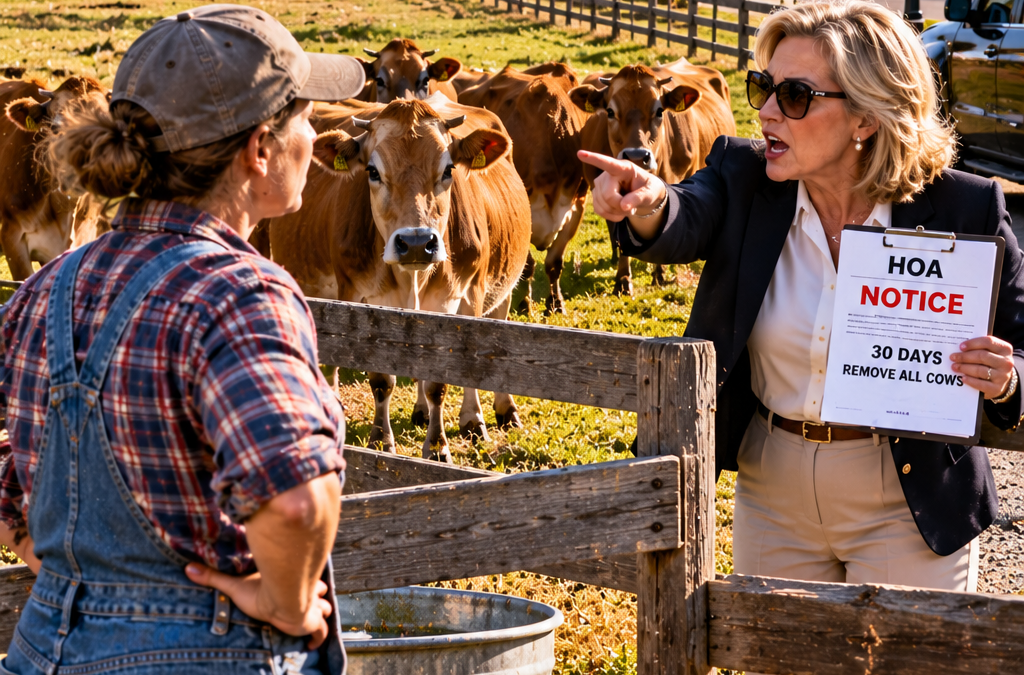
𝗣𝗔𝗥𝗧 𝟮
She nodded slowly.
Not pleasantly.
Not angrily either.
It was worse than anger.
It was the expression of someone making an entry on an invisible list.
“I see.”
Then she drove away.
Three weeks later, I found the first notice laminated inside a plastic sleeve and attached to my mailbox.
UNSIGHTLY AGRICULTURAL STRUCTURES.
I read it twice.
According to the notice, my barn and utility shed were inconsistent with the architectural standards of the community.
The barn had been built decades before the community existed.
I actually laughed.
Not because I thought it was hilarious.
Because sometimes absurdity leaves you nowhere else to go.
I called the HOA office.
A woman named Denise answered.
Her voice had the exhausted politeness of someone who spent her days apologizing for decisions she had not made.
I gave her the property address.
There was a pause.
“Oh.”
That single syllable told me she already knew.
I said, “I’m calling about a violation notice attached to my mailbox.”
“Yes, sir.”
“It says my barn violates your architectural standards.”
Another pause.
“Section seven covers exterior structures visible from common areas.”
“My barn predates your common areas.”
“I understand.”
“It predates the entire subdivision.”
“I understand.”
“And my parcel isn’t part of your architectural review area.”
She lowered her voice slightly.
“I’m just reading what’s in the file.”
“Then put something else in the file.”
“What would you like me to add?”
I told her about the agricultural easement.
I gave her the recording year.
I explained that the land’s agricultural use was established long before the HOA covenants were recorded.
Denise typed while I spoke.
“I’ve added that.”
“Thank you.”
“I’ll flag it for the board.”
That should have been the end of it.
Instead, two weeks later, a certified letter arrived.
The envelope had the HOA’s logo in the corner.
Heavy cream paper.
Official letterhead.
Gail Poe’s signature at the bottom.
The language was more aggressive this time.
Livestock of any kind was prohibited under Section 4.2 of the community covenants.
I was ordered to remove all animals from the property within thirty days.
I stood at my kitchen counter reading those words while Marigold called from the barn because she had decided breakfast was two minutes late.
Thirty days.
As if I had four broken appliances sitting in the yard.
As if living animals that depended on me could simply be erased because a board had discovered a paragraph in its rulebook.
I sat down.
Then I read the letter again.
There is a difference between anger and fear.
Anger makes you want to move.
Fear makes everything inside you go still.
For a minute, I imagined losing the place.
Not because Gail’s letter was legally correct.
I knew it wasn’t.
But ordinary people learn early that being right does not always protect you from people willing to make your life expensive.
An HOA had money.
Lawyers.
Letterhead.
Meetings.
Committees.
Time.
I had four cows and a farm that barely paid for itself.
If this turned into a legal war, being correct might not be enough.
I went to the filing cabinet in my office.
The important records were in the bottom drawer.
I found the folder.
There it was.
The 1991 agricultural easement.
Stamped.
Recorded.
Boring.
Beautiful.
I made copies.
Then I wrote Gail a calm letter.
No insults.
No threats.
I cited the recording number.
I explained again that the agricultural use of the Hollis Place predated the HOA covenants by years and that the HOA had no authority to prohibit the protected agricultural activity on my parcel.
I attached the easement.
I attached the relevant deed page.
I sent it certified mail.
The receipt came back signed.
Five days later, Gail responded.
One sentence.
“The board’s determination stands.”
I stared at that sentence for a long time.
No legal argument.
No explanation.
No acknowledgment of the deed.
No acknowledgment of the recording number.
Just authority asserting itself because it was accustomed to being obeyed.
That was the day I started keeping a folder specifically for the HOA.
Every letter.
Every envelope.
Every certified-mail receipt.
Every photograph.
Every voicemail.
I wrote down dates and times after phone calls.
I saved copies of my responses.
I didn’t know what I would eventually need.
I only knew something had shifted.
If Gail intended to pretend documents didn’t exist, I was going to preserve proof that she had received them.
She came to the property herself a week later.
I was repairing a gate hinge when the black SUV rolled to a stop outside my fence.
Gail stepped out carrying the clipboard.
Of course she did.
She walked to the gate but didn’t open it.
“You’re the resident with the animals.”
I straightened.
“You know, after all these letters, you could probably learn my name.”
She ignored that.
“Have you made arrangements for removal?”
“No.”
Her eyebrows lifted.
“Then perhaps you misunderstood the notice.”
“I understood it.”
“You have until the end of the month.”
“Your board doesn’t have authority over agricultural use on this parcel.”
“We’ve already addressed that.”
“No. You’ve repeated yourself. That’s different.”
Her lips tightened.
“The covenants are clear.”
“So is the easement.”
“The community voted to adopt livestock restrictions.”
“The community can vote to ban submarines if it wants. That doesn’t give the board control over land outside its authority.”
Her expression hardened.
“You live adjacent to an HOA-managed development.”
“Adjacent.”
She looked at me.
I looked back.
There are moments when a single word can become a fence.
That was one of them.
Gail tapped her clipboard with one finger.
“The board has determined that your operation negatively affects property values and community standards.”
I felt the anger rise then.
Not because she disliked the barn.
Not because she disliked cows.
Because she called my life an operation as if it were an invasive species.
I said, “This farm was here before your townhomes.”
“That doesn’t exempt you from being a good neighbor.”
“My cows haven’t mailed anyone a fine.”
Her eyes narrowed.
“I wouldn’t be flippant if I were you.”
“And I wouldn’t threaten someone on land you don’t control.”
For the first time, the calm surface cracked.
She leaned slightly toward the fence.
“You seem to think a county recording gives you some kind of immunity.”
“No. I think it gives me exactly what it says it gives me.”
“The board doesn’t answer to the county recorder’s office.”
That sentence stayed with me.
I asked, “Who exactly do you think the board answers to?”
“The community.”
Behind her, Marigold let out one long, low moo.
Gail glanced toward the pasture.
Marigold stared back while chewing.
I almost laughed.
Gail didn’t.
She returned to the SUV.
Before getting in, she said, “At the end of the month, fines begin.”
Then she drove away.
The first fine was two hundred dollars.
The second came seven days later.
Another two hundred.
The letters called the violation “continued maintenance of prohibited livestock.”
I had been maintaining those livestock before Gail knew the neighborhood existed.
By the fourth week, the running total was eight hundred dollars.
Then came the threat of a lien.
That word changes the temperature in a room.
Lien.
A piece of paper from people who had no business controlling my property now threatening my title to it.
I called Denise.
“I’m looking at a lien warning.”
“I know.”
“You have the easement in your file.”
“Yes.”
“You have the deed.”
“Yes.”
“You have the county recording number.”
“Yes.”
“Then why are these letters still being sent?”
She was quiet.
Finally she said, “Gail believes the board’s covenants supersede the agricultural use because the property benefits from the community.”
I almost dropped the phone.
“What benefit?”
“Road access.”
“The county road?”
Another pause.
“Landscaping sightlines.”
“The grass beside a public road?”
“I’m telling you what she said.”
“Does anybody on that board understand what the word jurisdiction means?”
Denise exhaled softly.
“I probably shouldn’t answer that.”
That was the first moment I realized she wasn’t really on Gail’s side.
She was simply employed there.
I said, “Denise, I don’t want you caught in the middle.”
“I know.”
“But I’m not paying these.”
“I know.”
“And I’m not moving the cows.”
“I know that too.”
There was something strange in the way she said it.
Almost relieved.
The fines continued.
Two hundred dollars every week.
The letters piled up.
I began checking the mailbox with the same feeling people have walking into a hospital room.
Each envelope might contain nothing new, yet your body prepared for impact anyway.
My Saturday customers noticed the change in me.
One of them, a retired teacher named Ellen, asked if everything was all right.
“HOA trouble.”
She laughed.
Then she saw my face.
“Oh.”
“Yeah.”
“What do they want?”
“The cows gone.”
She looked toward Marigold.
“All four?”
“Apparently they’re destroying civilization.”
Ellen didn’t laugh that time.
She had bought milk from me for six years.
Her grandchildren knew every cow by name.
“Can they do that?”
“No.”
“Then why are you worried?”
That question hurt more than it should have.
Because that’s what people ask when they’ve never had an institution decide truth is optional.
I said, “Because stopping someone from doing something wrong can cost more than doing the wrong thing costs them.”
She understood.
After that, I stopped pretending I wasn’t worried.
At night, I ran numbers.
Attorney fees.
Court filings.
Lost work hours.
Possible injunctions.
I looked at the cows and wondered what would happen if I had to move them temporarily.
Where would I take them?
Who could board four Jerseys?
Could I afford it?
Would moving them weaken my position?
Would not moving them invite some emergency enforcement stunt?
That was Gail’s real power.
Not the covenants.
Uncertainty.
She could make me spend every day thinking about what she might try next.
Then, on a Tuesday morning, she crossed a line that had nothing to do with paperwork.
I went out before sunrise.
It was cool enough that my breath showed faintly in the barn light.
Marigold was there.
Clover was there.
June was there.
Daisy wasn’t.
I checked the side stall.
Empty.
I walked outside.
The lower pasture gate was closed.
Then I saw Clover moving strangely near the eastern edge of the field.
Too far toward the road.
My stomach dropped.
I ran.
The fence had been cut.
Not broken.
Not knocked down by a branch.
Cut.
Four clean sections of wire had been snipped near the road-facing boundary.
Daisy was already beyond it.
Marigold and Clover had followed.
June was still inside, calling after them.
The road curved toward the subdivision thirty yards away.
I ran faster than I had run in years.
“Daisy!”
She lifted her head.
A vehicle turned into the cul-de-sac.
I stepped into the road waving both arms.
The driver braked.
The cows startled.
For ten terrible seconds, everything moved at once.
Hooves on pavement.
A horn.
My own shouting.
Marigold turned back toward me.
Clover followed her.
Daisy wandered toward a patch of grass on the shoulder as if nearly becoming a traffic accident had merely improved breakfast.
I got them back through the damaged section one at a time.
My hands shook while I tied temporary fencing across the gap.
Then I stood there looking at the wire.
Smooth diagonal cuts.
Tool marks.
Deliberate.
I photographed every section.
Wide shots.
Close-ups.
The ground.
Tire marks near the shoulder.
Anything that might matter later.
Then I remembered seeing the HOA landscaping truck earlier that morning.
White pickup.
Green company logo.
Two workers trimming shrubs along the subdivision entrance.
There was nothing unusual about that.
Except they had also been along my property border.
I hadn’t asked them to be there.
They had no reason to touch my fence.
I called the landscaping company.
The manager was cautious.
“I’d need to check the route sheet.”
“Please do.”
Twenty minutes later he called back.
“Looks like our crew had a work order for sightline maintenance.”
“Who requested it?”
“The HOA.”
“Does the work order authorize them to enter my property?”
“I don’t see anything like that.”
“Does it mention my fence?”
“No.”
“Who signed it?”
A longer silence.
“It doesn’t have a signature.”
That was the moment the dispute stopped being irritating.
It became personal.
Someone had interfered with a fence holding livestock beside a public road.
Someone could have caused a crash.
Someone could have gotten an animal killed.
A driver could have been hurt.
For what?
To make a point?
To create a violation?
To frighten me?
I didn’t know.
And I couldn’t prove who had cut the wire.
Not yet.
I sat at my kitchen table with the photographs spread in front of me.
For the first time since the letters began, I wanted to call a lawyer immediately.
I even pulled up the number of an attorney a friend had recommended.
Then I looked at the agricultural easement again.
Something tugged at my memory.
Not the easement itself.
The paperwork I had filed when I first bought the property.
There had been another designation.
A state form.
Agricultural district certification.
I opened the filing cabinet.
Then another drawer.
Then an old accordion folder filled with documents I hadn’t touched in years.
There it was.
Agricultural District Designation.
I had filed it shortly after buying the Hollis Place because the closing attorney had recommended it.
At the time, it seemed like bureaucratic housekeeping.
A way of formally recognizing existing agricultural use.
I barely remembered doing it.
Now I sat there reading the language carefully.
Properties within the designation were protected from certain interference with lawful agricultural operations.
There were procedures.
Inspection authority.
Compliance review.
State agricultural code.
My pulse changed.
I made one phone call.
Not to an attorney.
To the state Department of Agriculture.
The first person transferred me.
The second transferred me again.
Eventually, a woman in agricultural land-use compliance answered.
I explained the situation.
Four cows.
Recorded easement.
HOA enforcement.
Weekly fines.
Threatened lien.
Cut fence.
There was a long silence after I gave her the designation number.
Then she said, “You’re certain that’s the correct certificate?”
I read it again.
“Yes.”
“Hold on.”
I heard keyboard keys.
Then:
“Yes. Hollis parcel. Active designation.”
“That’s me.”
“And the surrounding residential development was constructed after certification?”
“Yes.”
“Have you provided the association with documentation?”
“Twice.”
“Certified?”
“Yes.”
“Do you have the receipts?”
I looked at the folder.
“Every one.”
That was when her voice changed.
Not dramatically.
Professionally.
“All right. I’m opening a compliance inquiry.”
I leaned back in the chair.
“What happens now?”
“Someone will contact you.”
“For what?”
“Documentation first. Then we’ll determine whether an inspection is warranted.”
I looked through the window toward the repaired fence.
“What about the cut wire?”
“Photograph everything. Don’t speculate about who did it. Preserve the damaged sections if possible.”
“I already did.”
“Good.”
“Is this something your department actually handles?”
She paused.
“If the designation is what I’m looking at, interference with the protected agricultural use can fall within our authority.”
That was all she would say.
But it was enough.
For the first time in months, I felt like I had stopped backing up.
Two days later, I received a call from Ruth Alvarez.
She introduced herself as a state agricultural compliance inspector.
Her voice was quiet.
Measured.
The kind of voice that makes you listen because it doesn’t need volume.
She asked for documents.
I emailed everything.
The easement.
The designation.
The HOA notices.
My responses.
Certified-mail receipts.
Fine statements.
Lien warning.
Photographs of the fence.
The landscaping company’s work-order information.
Then she asked a question I didn’t expect.
“Has the HOA acknowledged receiving the easement?”
“Not directly.”
“Did anyone at the office confirm it was in the file?”
“Denise did.”
“Full name?”
I gave it to her.
“Did the board ever explain why they believed their covenants overrode the designation?”
“No.”
“Did they cite state law?”
“No.”
“County ordinance?”
“No.”
“Any legal opinion?”
“Not to me.”
She went quiet again.
Then she said, “Do not destroy anything.”
“I won’t.”
“And don’t pay any disputed penalties while this review is open unless advised by counsel.”
I hadn’t planned to.
A week passed.
Then another.
Gail sent one more violation notice during that period.
This one included an additional warning that failure to remove the animals could result in “further enforcement remedies.”
I added it to the folder.
I wondered whether she knew the state was involved.
I got my answer at the HOA’s monthly meeting.
I wasn’t there.
I wasn’t invited.
But Denise was.
At 6:43 that evening, my phone buzzed.
A text.
RUTH ALVAREZ IS HERE.
I stared at it.
Another message came.
FULL BOARD.
Then nothing for several minutes.
I put the phone on the kitchen table and tried not to look at it.
Marigold was outside the window, standing in the twilight.
I remember thinking how strange it was that four cows could cause forty townhome owners to confront questions about land law, state jurisdiction, and whether their president understood any of it.
At 6:58, Denise texted again.
GAIL OPENED WITH “WITH RESPECT, MA’AM, THE STATE DOESN’T GET TO TELL A PRIVATE COMMUNITY HOW TO RUN ITSELF.”
I laughed out loud.
I couldn’t help it.
Then the next message arrived.
RUTH: “ACTUALLY, MS. POE, THAT IS PRECISELY WHAT THIS CERTIFICATION AUTHORIZES US TO DO IN MATTERS COVERED BY STATE AGRICULTURAL LAW.”
I read that one three times.
Then I set the phone down.
I didn’t want to enjoy it too much.
Not yet.
Denise kept texting.
According to her, Ruth had arrived with a laptop, printed records, and copies of the 1991 filing.
Gail tried to frame the issue as a standard HOA enforcement dispute.
Ruth refused the frame.
“This is not primarily a disagreement over neighborhood aesthetics,” she said.
Gail apparently folded her arms.
“Our covenants prohibit livestock.”
Ruth asked, “On which parcels?”
“The community.”
“Is the Hollis parcel legally incorporated into the covenant-controlled development?”
Silence.
One of the other board members tried to answer.
“Residents benefit from the neighborhood.”
Ruth repeated the question.
“Is the parcel incorporated into the covenant-controlled development?”
Nobody answered.
Then Gail said, “The owner was informed of our standards.”
Ruth replied, “He informed you of the agricultural easement.”
Gail denied knowing about the formal designation.
That was when Ruth turned the laptop around.
County records.
1991 easement.
Later district certification.
Parcel identification.
Everything.
Gail apparently said, “That was never presented to us in that form.”
Denise texted me:
SHE’S LYING.
A minute later:
RUTH HAS YOUR CERTIFIED MAIL RECEIPT.
Then:
GAIL WENT WHITE.
I could imagine the room.
The long folding tables.
Coffee in paper cups.
The fake ficus tree in the corner.
Gail in her fleece vest with the clipboard sitting uselessly beside her.
For months, she had acted as if documents mattered only when she issued them.
Now someone else had brought documents.
Documents backed by something larger than a board vote.
Ruth explained the problem carefully.
The agricultural district designation wasn’t decorative.
It wasn’t a sentimental acknowledgment that farming had once happened there.
It carried protections.
Those protections mattered specifically because residential development had grown around existing agricultural parcels.
Otherwise every surviving farm could be regulated out of existence one subdivision at a time.
Gail tried another angle.
“We’re protecting homeowners.”
Ruth said, “From four dairy cows?”
Denise told me later that someone at the far end of the table coughed to hide a laugh.
Gail didn’t appreciate it.
She said the livestock generated odor complaints and aesthetic concerns.
Ruth asked to see them.
There were two.
One was anonymous.
The other was from Gail herself.
That detail mattered to me more than it probably should have.
For months, she had talked about “the community” as if forty households had risen in revolt against Marigold.
In reality, dozens of those residents had never complained at all.
Some bought milk from me.
Some brought their children to see the calves back when I had them.
The community wasn’t the problem.
Gail was.
She had turned her own preference into an institutional command.
Then Ruth asked about the fines.
Gail said the board had authority to impose them.
Ruth asked whether the board had received my agricultural documentation before the first penalty was issued.
Nobody answered immediately.
Denise did.
“Yes.”
I learned later that Gail turned toward her so sharply that the entire room noticed.
Denise kept going.
“The documents were scanned into the property file before the first fine.”
Gail said, “That is an administrative interpretation.”
Denise replied, “No. I’m telling her when we received them.”
That might have been the bravest thing anyone did in the whole story.
Denise didn’t own six acres.
She didn’t have an easement protecting her.
She worked for Gail.
And she told the truth anyway.
Ruth asked for the electronic file history.
Denise provided it.
Timestamped.
Scanned.
Opened repeatedly.
Gail had viewed the file.
More than once.
That changed everything.
Ignorance was one thing.
Disagreement was another.
But continuing enforcement after repeatedly reviewing documentation raised the possibility that the conduct wasn’t simply mistaken.
It was knowing.
Willful.
Ruth’s report would eventually use language like that.
At the meeting, she was less dramatic.
She simply said, “The state will be documenting that the board had actual notice.”
According to Denise, Gail stopped talking for a while after that.
Then came the fence.
Ruth asked about the landscaping work order.
Gail claimed routine sightline maintenance.
Ruth asked whether the HOA had authority to perform work on my fence line.
Gail said the crew wasn’t instructed to enter my property.
Ruth asked who issued the work order.
No answer.
Who approved it?
No answer.
Where was the signature?
There wasn’t one.
Why was work ordered along a parcel that was actively disputing HOA jurisdiction?
Silence.
Ruth made it clear that she was not accusing the board of cutting the fence.
Neither was I.
There wasn’t proof of that.
But the timing and unauthorized work warranted separate review.
And interference with fencing used to contain livestock was not something the state regarded as an aesthetic misunderstanding.
A damaged fence is a safety issue.
Animals don’t know where HOA jurisdiction supposedly ends.
Cars don’t care either.
At 7:41, Denise sent one final message.
THIS IS VERY BAD FOR THEM.
I didn’t answer.
I walked outside.
The barn lights threw long rectangles across the ground.
Marigold lifted her head when she saw me.
I scratched the hard ridge between her eyes.
“You caused a lot of paperwork,” I told her.
She kept chewing.
Ruth’s written report arrived nine days later.
It was twelve pages.
State language has a way of making serious things sound almost boring.
That’s part of its power.
No insults.
No emotion.
No grand speeches.
Just facts arranged in an order that leaves nowhere to hide.
The report confirmed the recorded agricultural easement.
It confirmed the active agricultural district designation.
It confirmed that my agricultural operation predated the residential development.
It confirmed that the HOA had been placed on notice.
It confirmed the dates on which my documentation had been received.
It listed each enforcement letter issued afterward.
It cited Gail by name.
The phrase that mattered most was “willful disregard of documented protected agricultural use.”
I read it twice.
Then there was the order.
All HOA fines relating to lawful agricultural activity were to be rescinded in writing within ten business days.
Any lien process associated with those penalties was to cease.
The association was instructed to discontinue enforcement that conflicted with the protected agricultural designation.
The report also referred the fence issue for separate investigation based on the timing of unauthorized landscaping activity near the damaged boundary.
Then came the final paragraph.
It warned that further interference could result in civil penalties assessed against the association and, under applicable circumstances, its officers individually.
Individually.
That word did something every letter I had written failed to do.
It made the problem personal for Gail.
Until then, she had been using the HOA as armor.
The association sent the letters.
The association threatened the lien.
The association issued the fines.
The association paid attorneys.
But individual liability meant Gail might have to answer for her own decisions.
A clipboard feels much lighter when your own name is attached to the consequences.
Denise called me that afternoon.
“You get it?”
“I did.”
“You okay?”
I thought about that.
“Ask me after the fines disappear.”
She laughed softly.
Then she became serious.
“There’s something else.”
“What?”
“I have pictures.”
I sat down.
“Pictures of what?”
“The landscaping crew.”
My hand tightened around the phone.
“When?”
“The morning your fence was cut.”
She explained.
The HOA office used timestamped exterior security cameras covering the parking area and access road.
The landscaping truck had checked in before beginning work.
Denise had also taken two photographs from her office window because she thought it was strange that the crew was heading toward my boundary.
At the time, she assumed Gail had arranged legitimate roadside work.
After hearing about the cut fence, she checked the work order.
Unsigned.
No homeowner request.
No county request.
No normal maintenance note.
Just a directive for “sightline correction” along the Hollis boundary.
“Who wrote it?” I asked.
“I don’t know.”
“Is it typed?”
“Yes.”
“Can it be traced?”
“Maybe through the office system.”
“Why didn’t you tell me sooner?”
She was quiet.
Then she answered with painful honesty.
“Because Gail was my boss.”
I didn’t say anything.
Denise continued.
“And because I kept telling myself there had to be another explanation.”
I understood that better than she probably realized.
People imagine moral decisions arrive wearing bright signs.
RIGHT.
WRONG.
SPEAK.
DON’T SPEAK.
Usually they don’t.
Usually they arrive disguised as employment.
Bills.
Fear.
Uncertainty.
The possibility that maybe you misunderstood.
Denise said, “After Ruth’s report, I’m done pretending this is normal.”
She forwarded the photos and work-order records to the county sheriff’s non-emergency line.
She also sent them to Ruth.
Then she did something Gail probably feared even more.
She started talking to other residents.
Turns out I wasn’t the only one keeping a folder.
A retired couple had been fined repeatedly for a wheelchair ramp the board claimed violated architectural guidelines even though they had provided documentation for it.
Another homeowner had received months of penalties over a drainage feature installed by the original developer.
A single mother had been cited because her work vehicle was parked in her driveway even though the restriction Gail quoted wasn’t in the version of the covenants attached to her deed.
Different problems.
Same pattern.
Gail issued a demand.
Someone objected.
Evidence appeared.
Gail ignored it.
The board repeated the demand more loudly.
Most people gave in because fighting was exhausting.
That’s what I finally understood.
Gail’s authority had never depended entirely on being legally right.
It depended on people deciding resistance cost too much.
Two hundred dollars here.
A threatening letter there.
A hearing scheduled during work hours.
A lawyer copied on an email.
A phrase like “further enforcement action.”
Most people just wanted peace.
Gail had learned to use that desire against them.
The agricultural designation didn’t make me braver than those people.
It simply gave me a weapon they hadn’t had.
A state agency willing to stand between me and the board.
Once that happened, everyone started looking more closely at the woman behind the clipboard.
The emergency HOA meeting happened the following week.
Again, I wasn’t invited.
Again, Denise kept me informed.
Three board members wanted Gail to step aside temporarily.
She refused.
According to Denise, Gail insisted that Ruth had “overstepped.”
One board member finally asked the question no one had asked early enough.
“Did you know about the agricultural designation before we started fining him?”
Gail said the documents were ambiguous.
Denise interrupted.
“They weren’t.”
Gail told her she was not part of the board.
One of the directors replied, “She’s the one who maintains our records.”
That was the beginning of the end.
Not because everyone suddenly became heroic.
Because self-preservation finally entered the room.
The board members understood that Ruth’s report didn’t blame some abstract entity floating above them.
It documented names.
Dates.
Votes.
Notices.
Who received what.
Who knew what.
Who authorized what.
One director apparently asked whether the association’s insurance would cover penalties assessed against officers individually.
Nobody knew.
The meeting lasted almost three hours.
The next morning, the HOA’s attorney contacted Ruth’s office.
By afternoon, every fine on my account disappeared from the online portal.
$0.00.
I sat at my computer staring at that number.
I refreshed the page.
Still zero.
I took a screenshot.
Of course I did.
By then, documenting things had become instinct.
Three days later, a certified letter arrived.
For once, opening an HOA envelope didn’t tighten my chest.
The board formally rescinded every livestock-related violation and penalty.
The letter stated that no lien would be pursued.
It acknowledged the agricultural district designation.
The tone was cautious.
Lawyered.
Almost sterile.
But the meaning was simple.
The cows stayed.
I walked out to the pasture with the letter folded in my pocket.
Marigold came over because she assumed paper might somehow be food.
“You won,” I told her.
Then I corrected myself.
“No. You didn’t do anything.”
She sniffed my sleeve.
That was the strange part.
None of the animals knew they had been in danger of losing their home.
They had spent those months eating grass, waiting to be milked, pushing gates, lying in the shade.
All the fear had belonged to me.
Two weeks after Ruth’s report, Gail Poe resigned.
The official notice cited personal reasons.
It was four sentences long.
No mention of the fines.
No mention of the state.
No mention of the agricultural investigation.
No mention of the fence.
Just gratitude for the opportunity to serve the community.
I read it once.
Then put it in the folder.
I didn’t celebrate.
I didn’t stand at the fence waiting to watch her SUV disappear.
I didn’t send a sarcastic letter.
I didn’t want revenge.
I wanted silence.
There is a kind of exhaustion that arrives only after a threat is gone.
While you’re fighting, your body keeps you moving.
You make copies.
You answer letters.
You repair fences.
You call agencies.
You take photographs.
You stay angry because anger is useful.
Then one day nobody is demanding anything from you anymore.
That’s when the weight lands.
The morning after Gail resigned, I overslept by twenty-three minutes.
Marigold let me know.
Loudly.
I pulled on my boots and went to the barn.
Everything was exactly where it had always been.
The same cracked concrete.
Same old stool.
Same dented stainless-steel pail.
Same smell of hay, dust, feed, and animals.
I sat beside Marigold.
She shifted her weight.
I rested my forehead briefly against her side.
Then I started milking.
The sound filled the barn.
Steady.
Metallic.
Ordinary.
For months, I had imagined what victory would feel like.
I thought there might be relief big enough to notice.
Maybe triumph.
Maybe satisfaction.
Instead I felt something quieter.
I felt normal.
And I realized that was all I had wanted from the beginning.
Not to defeat Gail.
Not to embarrass the HOA.
Not to prove I was smarter than anyone.
I wanted to wake up on my own land and do the work I had been doing for eleven years without someone inventing a reason I shouldn’t be allowed to do it.
The state eventually assessed a penalty against the association.
I won’t pretend it destroyed them.
It didn’t.
The HOA survived.
Communities usually do.
But the penalty was large enough to appear plainly in the next financial statement, and residents started asking questions they should have been asking for years.
How much had been spent on enforcement?
Who approved legal letters?
How were complaints verified?
Why had documented exemptions been ignored?
Why did one person have so much control over the violation process?
Two other board members chose not to seek reelection.
By fall, the HOA looked different.
Not perfect.
Just less arrogant.
The new president was a quiet man named Thomas Reed who showed up at my gate one afternoon without a clipboard.
That alone made me suspicious.
He stayed outside the fence.
“Can I talk to you?”
“You’re doing it.”
He smiled nervously.
“Fair enough.”
I waited.
He looked toward the cows.
“I wanted to apologize.”
“You weren’t president then.”
“I was still on the board.”
I remembered his name from some of the meeting minutes.
He hadn’t signed Gail’s letters, but he had voted on enforcement policy.
He continued.
“I should have asked more questions.”
I appreciated that he didn’t say mistakes were made.
People use phrases like that when they want responsibility to float away from everyone involved.
He said I should have asked more questions.
Specific.
Personal.
I nodded.
“Yes. You should have.”
He accepted it.
No excuse.
Then he handed me an envelope.
Inside was a formal written apology adopted by the new board.
It acknowledged that enforcement against my agricultural use had been improper.
It confirmed that the association recognized the recorded easement and state designation.
It also established a requirement that future violation notices involving disputed parcel jurisdiction receive legal review before fines were issued.
I read it at the gate.
Then I asked, “Anything else?”
Thomas glanced toward Marigold.
“My daughter wants to know if those are the cows she sees from the road.”
“They are.”
“She keeps asking if she can pet one.”
“Marigold will sell her dignity for a carrot.”
He laughed.
That Saturday, he came back with his daughter and three carrots.
Marigold consumed all three.
No community collapsed.
Property values survived.
The world continued.
Denise stayed at the HOA office under the new board.
A few weeks later, I found a small white envelope in my mailbox.
No logo.
No certified-mail sticker.
No legal language.
My name was handwritten on the front.
Inside was a note.
Glad the cows get to stay.
—Denise
That was all.
I stood beside the mailbox longer than necessary, reading those six words.
People remember the Ruth Alvarezes in stories like this.
They remember inspectors.
Orders.
Official reports.
State authority.
People like Ruth deserve the credit.
But I think about Denise more often.
She had less power than anyone involved.
And when the moment came, she used what little she had.
She told the truth.
I took the note into the barn.
For years, the inside of the door had been covered with practical things.
Feed schedules.
A vaccination calendar.
A faded photograph of the property from before I bought it.
I taped Denise’s note beside Marigold’s stall.
It’s still there.
So is the old agricultural easement.
That’s back in the filing cabinet where it belongs.
The HOA folder is there too.
Much thicker now.
I don’t look at it often.
I don’t need to.
But I will never throw it away.
Not because I expect another fight.
Because the folder taught me something.
For a long time, I believed people abused authority because they misunderstood where their authority ended.
Sometimes that’s true.
But sometimes they understand perfectly well.
They simply expect nobody to make them prove it.
Gail had received the easement.
She had opened the file.
She had seen the dates.
She had been told the farm existed before her covenants.
And she kept sending letters anyway.
Maybe she convinced herself the board’s preferences were more important.
Maybe she assumed I couldn’t afford to resist.
Maybe, after enough years of issuing violations, she stopped recognizing the difference between having the power to send a letter and having the right to demand obedience.
I don’t know.
I stopped needing to know.
What mattered was simpler.
She was wrong.
And for months, being wrong did not stop her.
Documentation did.
Records did.
The state did.
Denise did.
And eventually the other board members, once they realized silence could attach their own names to the consequences, did too.
People sometimes ask whether I hate HOAs now.
I don’t.
That’s too easy.
An HOA is paperwork.
Paperwork can’t be arrogant.
People can.
Rules can solve legitimate problems.
Boards can protect common property.
Neighbors can cooperate.
But any system built to manage small things becomes dangerous when the people running it begin mistaking administration for ownership.
A board member can tell someone when the clubhouse closes.
That doesn’t mean she owns every life visible from the clubhouse window.
A covenant can regulate property inside its reach.
That doesn’t make the reach infinite.
A clipboard can hold rules.
It cannot manufacture jurisdiction.
I think Gail forgot that.
Or maybe no one had forced her to remember.
Life on the Hollis Place returned to what it had been before all of this.
The Saturday families kept coming.
Ellen still brought her grandchildren.
Thomas’s daughter became one of Marigold’s favorite visitors, mostly because she never arrived empty-handed.
Clover eventually stopped being afraid of strangers.
Daisy continued testing gates.
June grew into the loudest cow I had ever owned.
The barn remained unsightly by Gail’s standards.
I never repainted it.
That wasn’t rebellion.
I just liked it the way it was.
Weathered boards.
Old tin roof.
One door that sticks in humidity.
There are buildings prettier than that barn.
There are farms cleaner than mine.
There are dairy operations bigger, newer, more efficient.
None of that matters.
The Hollis Place isn’t valuable to me because it impresses anyone driving past.
It’s valuable because I built my life there one ordinary morning at a time.
Fence post by fence post.
Calving season by calving season.
Bad cheese batch by bad cheese batch.
Eleven years of work doesn’t look dramatic from the road.
That’s what people like Gail misunderstand.
They see an old barn and four cows.
They don’t see the mornings when you’re sick but the animals still need feeding.
They don’t see frozen pipes at 4:00 a.m.
They don’t see the months when hay prices rise and your bank account shrinks.
They don’t see you sitting alone in a stall with a sick animal, wondering whether you’re about to lose something you’ve cared for since birth.
They don’t see the first successful cheese wheel.
The kid who stops being afraid of cows.
The elderly customer who tells you your milk tastes like what she remembers from childhood.
They don’t see a life.
They see a violation category.
That was what hurt most when Gail called me “the resident with the animals.”
I wasn’t a person to her.
I was a file.
A nuisance.
An obstacle to the tidy image she had of the community.
But I had been there before her board.
Before the townhomes.
Before Harvest Lane had a name.
Before anyone decided my barn spoiled the rural atmosphere their marketing brochures were selling.
The irony never left me.
They moved next to a farm because they wanted to live somewhere that felt like the country.
Then their president tried to remove the country.
The place is quieter now.
Sometimes I can hear children from the townhomes when the wind is right.
Sometimes somebody walking along the road stops to watch the cows.
Nobody from the HOA photographs my barn anymore.
Nobody tapes laminated warnings to the mailbox.
Nobody tells me my pasture violates community aesthetics.
And when a black SUV slows near my fence, I don’t automatically wonder what new problem is coming.
That took time.
Longer than I expected.
Fear leaves habits behind.
For months after everything ended, I photographed anything unusual near the property line.
A contractor truck.
A survey flag.
A utility crew.
I checked the fence twice every morning.
Sometimes three times.
It took a while before I understood that the conflict had trained me to expect intrusion.
Eventually that faded too.
One morning, almost a year after Gail resigned, I was standing by the eastern fence watching the sun come over the roofs of the townhomes.
The subdivision looked different in that light.
Not like an enemy.
Just houses.
Forty of them.
Forty families.
Most of whom had never wanted a fight with me.
Marigold walked over and rested her chin against the top rail.
She was getting older.
Gray starting around the muzzle.
I rubbed behind her ear.
The old repaired section of fence was a few yards away.
You could still tell where I had spliced the wire after it was cut.
For a long time, I had thought about replacing that entire run.
Make it clean.
Erase the damage.
I never did.
Maybe part of me wanted the scar.
Not as a monument to Gail.
She didn’t deserve one.
As a reminder.
There was a morning when I stood on that road terrified I was about to lose an animal because someone had decided my boundaries didn’t deserve respect.
There was a night when I sat at my kitchen table wondering whether I could afford to keep fighting.
There were weeks when every trip to the mailbox felt like a threat.
And there was a piece of paper I almost forgot I had.
The thing that protected the farm wasn’t dramatic.
No secret inheritance.
No millionaire attorney.
No hidden political connection.
Just a legal record created years before anyone thought it would matter.
A document.
A date.
A signature.
A recording number.
And the willingness to keep every receipt that came after it.
I looked toward the subdivision.
Then toward the barn.
Marigold nudged my shoulder impatiently.
Breakfast.
Some things are more important than reflection.
I opened the gate.
She walked through.
The others followed.
Four Jersey cows crossing the same pasture they had always crossed.
The same barn waiting ahead.
The same milking parlor older than the HOA.
The same six acres.
Nothing extraordinary.
That was the point.
I had never wanted an extraordinary ending.
I wanted my ordinary life back.
And in the end, that was what mattered most.
Not watching Gail resign.
Not seeing the balance drop to zero.
Not reading the state penalty.
Not even the apology.
The real ending came on a quiet morning when I stopped checking the road for her SUV.
I sat down beside Marigold, rested the pail beneath her, and started the work I had done thousands of times before.
Milk struck steel.
Clover shifted in the next stall.
Dawn came through the cracks in the barn wall.
Denise’s handwritten note hung beside the door.
And for the first time in months, nobody was trying to tell me that the life I had built on my own land needed their permission to exist.
𝗧𝗛𝗘 𝗘𝗡𝗗
The HOA President Gave Me 30 Days to Remove My Cows From a Farm That Had Been There Before Her Neighborhood Existed
The HOA president gave me thirty days to remove every cow from my land, and she delivered the order with the calm confidence of someone who had never imagined being told she had no authority there. What she didn’t know was that one yellowing county document in my filing cabinet had been waiting longer than her entire subdivision to matter.
My name isn’t important.
The land is.
Six acres, a weathered barn, an old milking parlor, three fenced pastures, and four Jersey cows that know the sound of my boots better than most people know the voices of their neighbors.
I bought the Hollis Place eleven years ago.
It wasn’t pretty when I found it.
The barn leaned slightly toward the east, as if decades of wind had persuaded it to give up a little ground. The milk room had cracked tile. Half the fence posts were gray with age, and the property had more weeds than grass in places.
But I could stand in the middle of those six acres and hear almost nothing.
Wind.
Birds.
Cattle moving through grass.
That was enough for me.
The previous owner had run livestock there for most of his life, and the deed came with something I barely thought about at the time: a recorded agricultural easement dating back to 1991.
The attorney at closing had tapped the page with his pen.
“Keep this with your important records.”
I remember asking, “Anything I need to worry about?”
He shook his head.
“Probably the opposite. It protects agricultural use of the property. Just don’t lose it.”
So I didn’t.
I put it in a folder with the deed, tax records, survey, and insurance documents, then forgot about it.
For years, there was no reason to remember.
I built my life slowly.
One cow became two.
Two became four.
Marigold was the oldest, a broad, honey-colored Jersey with dark eyes and an attitude that suggested the rest of us were temporary employees in a business she owned.
Then there was Clover, nervous around strangers but gentle once she knew you.
Daisy had a habit of pushing gates with her forehead just to test whether I had latched them properly.
And June was the youngest, curious enough to investigate anything from a wheelbarrow to a sheriff’s cruiser.
I ran a tiny raw dairy operation.
Nothing industrial.
Nothing that required eighteen-wheelers rumbling down the road at dawn.
Thirty families, give or take, bought from me regularly. Most came Saturday mornings. They brought jars, coolers, kids in rubber boots, sometimes homemade bread or jam to trade.
I sold milk, eggs, and small batches of cheese when the cheese cooperated.
Sometimes it didn’t.
Nobody was getting rich.
Especially me.
But the bills got paid.
The animals were cared for.
The barn stayed standing.
And every morning, before most people had turned on their kitchen lights, I sat on the same three-legged stool beside Marigold and listened to milk strike the stainless-steel pail in a steady rhythm.
That sound became the clock I measured my life by.
Then the county rezoned the property next door.
The first survey stakes appeared one spring.
By summer, bulldozers were grinding through the field beyond my eastern fence.
The following year, there were forty townhomes where foxes used to cross at dusk.
The development was marketed as “country living with modern convenience.”
That phrase still makes me smile.
Not because it’s funny.
Because it tells you everything.
People wanted the appearance of rural life.
Split-rail fences.
Stone mailboxes.
Street names like Meadow Run and Harvest Lane.
They wanted decorative wagon wheels at the subdivision entrance.
What some of them apparently did not want was agriculture.
Real agriculture has mud.
It has flies.
It has tractors that don’t match the siding.
It has animals that make noises without checking community quiet hours.
It occasionally smells like the thing it actually is.
For the first year, though, we coexisted.
Most of the new neighbors were decent people.
Their kids loved seeing the cows.
A few residents started buying eggs from me.
One older couple brought carrots for Marigold every Friday until I had to ask them to slow down because she was becoming impossible.
Then the HOA elected Gail Poe as president.
Gail changed the atmosphere of that neighborhood almost immediately.
She was in her late fifties, always perfectly put together, always wearing some variation of a fleece vest even when the temperature made fleece seem like a personal challenge.
She drove a black SUV so spotless that even the tires looked polished.
And she carried a clipboard.
Everywhere.
I saw that clipboard at the clubhouse.
At mailboxes.
On sidewalks.
Once, I saw her carrying it while talking to a resident who was unloading groceries.
She held it the way a police officer might hold a citation book.
Gail did not introduce herself to me.
She inspected me.
The first time we met, I was replacing a rotten fence board along the road.
She stopped her SUV with two wheels half on the shoulder, lowered the window, and stared toward the barn.
“You’re the resident with the animals?”
I rested the hammer against my leg.
“I own the Hollis Place.”
“The agricultural parcel?”
“That’s one way to describe it.”
Her eyes went past me to the pasture.
“Those cows are permanent?”
I remember thinking it was an odd question.
“They live here.”
She nodded slowly.
Not pleasantly.
Not angrily either.
It was worse than anger.
It was the expression of someone making an entry on an invisible list.
“I see.”
Then she drove away.
Three weeks later, I found the first notice laminated inside a plastic sleeve and attached to my mailbox.
UNSIGHTLY AGRICULTURAL STRUCTURES.
I read it twice.
According to the notice, my barn and utility shed were inconsistent with the architectural standards of the community.
The barn had been built decades before the community existed.
I actually laughed.
Not because I thought it was hilarious.
Because sometimes absurdity leaves you nowhere else to go.
I called the HOA office.
A woman named Denise answered.
Her voice had the exhausted politeness of someone who spent her days apologizing for decisions she had not made.
I gave her the property address.
There was a pause.
“Oh.”
That single syllable told me she already knew.
I said, “I’m calling about a violation notice attached to my mailbox.”
“Yes, sir.”
“It says my barn violates your architectural standards.”
Another pause.
“Section seven covers exterior structures visible from common areas.”
“My barn predates your common areas.”
“I understand.”
“It predates the entire subdivision.”
“I understand.”
“And my parcel isn’t part of your architectural review area.”
She lowered her voice slightly.
“I’m just reading what’s in the file.”
“Then put something else in the file.”
“What would you like me to add?”
I told her about the agricultural easement.
I gave her the recording year.
I explained that the land’s agricultural use was established long before the HOA covenants were recorded.
Denise typed while I spoke.
“I’ve added that.”
“Thank you.”
“I’ll flag it for the board.”
That should have been the end of it.
Instead, two weeks later, a certified letter arrived.
The envelope had the HOA’s logo in the corner.
Heavy cream paper.
Official letterhead.
Gail Poe’s signature at the bottom.
The language was more aggressive this time.
Livestock of any kind was prohibited under Section 4.2 of the community covenants.
I was ordered to remove all animals from the property within thirty days.
I stood at my kitchen counter reading those words while Marigold called from the barn because she had decided breakfast was two minutes late.
Thirty days.
As if I had four broken appliances sitting in the yard.
As if living animals that depended on me could simply be erased because a board had discovered a paragraph in its rulebook.
I sat down.
Then I read the letter again.
There is a difference between anger and fear.
Anger makes you want to move.
Fear makes everything inside you go still.
For a minute, I imagined losing the place.
Not because Gail’s letter was legally correct.
I knew it wasn’t.
But ordinary people learn early that being right does not always protect you from people willing to make your life expensive.
An HOA had money.
Lawyers.
Letterhead.
Meetings.
Committees.
Time.
I had four cows and a farm that barely paid for itself.
If this turned into a legal war, being correct might not be enough.
I went to the filing cabinet in my office.
The important records were in the bottom drawer.
I found the folder.
There it was.
The 1991 agricultural easement.
Stamped.
Recorded.
Boring.
Beautiful.
I made copies.
Then I wrote Gail a calm letter.
No insults.
No threats.
I cited the recording number.
I explained again that the agricultural use of the Hollis Place predated the HOA covenants by years and that the HOA had no authority to prohibit the protected agricultural activity on my parcel.
I attached the easement.
I attached the relevant deed page.
I sent it certified mail.
The receipt came back signed.
Five days later, Gail responded.
One sentence.
“The board’s determination stands.”
I stared at that sentence for a long time.
No legal argument.
No explanation.
No acknowledgment of the deed.
No acknowledgment of the recording number.
Just authority asserting itself because it was accustomed to being obeyed.
That was the day I started keeping a folder specifically for the HOA.
Every letter.
Every envelope.
Every certified-mail receipt.
Every photograph.
Every voicemail.
I wrote down dates and times after phone calls.
I saved copies of my responses.
I didn’t know what I would eventually need.
I only knew something had shifted.
If Gail intended to pretend documents didn’t exist, I was going to preserve proof that she had received them.
She came to the property herself a week later.
I was repairing a gate hinge when the black SUV rolled to a stop outside my fence.
Gail stepped out carrying the clipboard.
Of course she did.
She walked to the gate but didn’t open it.
“You’re the resident with the animals.”
I straightened.
“You know, after all these letters, you could probably learn my name.”
She ignored that.
“Have you made arrangements for removal?”
“No.”
Her eyebrows lifted.
“Then perhaps you misunderstood the notice.”
“I understood it.”
“You have until the end of the month.”
“Your board doesn’t have authority over agricultural use on this parcel.”
“We’ve already addressed that.”
“No. You’ve repeated yourself. That’s different.”
Her lips tightened.
“The covenants are clear.”
“So is the easement.”
“The community voted to adopt livestock restrictions.”
“The community can vote to ban submarines if it wants. That doesn’t give the board control over land outside its authority.”
Her expression hardened.
“You live adjacent to an HOA-managed development.”
“Adjacent.”
She looked at me.
I looked back.
There are moments when a single word can become a fence.
That was one of them.
Gail tapped her clipboard with one finger.
“The board has determined that your operation negatively affects property values and community standards.”
I felt the anger rise then.
Not because she disliked the barn.
Not because she disliked cows.
Because she called my life an operation as if it were an invasive species.
I said, “This farm was here before your townhomes.”
“That doesn’t exempt you from being a good neighbor.”
“My cows haven’t mailed anyone a fine.”
Her eyes narrowed.
“I wouldn’t be flippant if I were you.”
“And I wouldn’t threaten someone on land you don’t control.”
For the first time, the calm surface cracked.
She leaned slightly toward the fence.
“You seem to think a county recording gives you some kind of immunity.”
“No. I think it gives me exactly what it says it gives me.”
“The board doesn’t answer to the county recorder’s office.”
That sentence stayed with me.
I asked, “Who exactly do you think the board answers to?”
“The community.”
Behind her, Marigold let out one long, low moo.
Gail glanced toward the pasture.
Marigold stared back while chewing.
I almost laughed.
Gail didn’t.
She returned to the SUV.
Before getting in, she said, “At the end of the month, fines begin.”
Then she drove away.
The first fine was two hundred dollars.
The second came seven days later.
Another two hundred.
The letters called the violation “continued maintenance of prohibited livestock.”
I had been maintaining those livestock before Gail knew the neighborhood existed.
By the fourth week, the running total was eight hundred dollars.
Then came the threat of a lien.
That word changes the temperature in a room.
Lien.
A piece of paper from people who had no business controlling my property now threatening my title to it.
I called Denise.
“I’m looking at a lien warning.”
“I know.”
“You have the easement in your file.”
“Yes.”
“You have the deed.”
“Yes.”
“You have the county recording number.”
“Yes.”
“Then why are these letters still being sent?”
She was quiet.
Finally she said, “Gail believes the board’s covenants supersede the agricultural use because the property benefits from the community.”
I almost dropped the phone.
“What benefit?”
“Road access.”
“The county road?”
Another pause.
“Landscaping sightlines.”
“The grass beside a public road?”
“I’m telling you what she said.”
“Does anybody on that board understand what the word jurisdiction means?”
Denise exhaled softly.
“I probably shouldn’t answer that.”
That was the first moment I realized she wasn’t really on Gail’s side.
She was simply employed there.
I said, “Denise, I don’t want you caught in the middle.”
“I know.”
“But I’m not paying these.”
“I know.”
“And I’m not moving the cows.”
“I know that too.”
There was something strange in the way she said it.
Almost relieved.
The fines continued.
Two hundred dollars every week.
The letters piled up.
I began checking the mailbox with the same feeling people have walking into a hospital room.
Each envelope might contain nothing new, yet your body prepared for impact anyway.
My Saturday customers noticed the change in me.
One of them, a retired teacher named Ellen, asked if everything was all right.
“HOA trouble.”
She laughed.
Then she saw my face.
“Oh.”
“Yeah.”
“What do they want?”
“The cows gone.”
She looked toward Marigold.
“All four?”
“Apparently they’re destroying civilization.”
Ellen didn’t laugh that time.
She had bought milk from me for six years.
Her grandchildren knew every cow by name.
“Can they do that?”
“No.”
“Then why are you worried?”
That question hurt more than it should have.
Because that’s what people ask when they’ve never had an institution decide truth is optional.
I said, “Because stopping someone from doing something wrong can cost more than doing the wrong thing costs them.”
She understood.
After that, I stopped pretending I wasn’t worried.
At night, I ran numbers.
Attorney fees.
Court filings.
Lost work hours.
Possible injunctions.
I looked at the cows and wondered what would happen if I had to move them temporarily.
Where would I take them?
Who could board four Jerseys?
Could I afford it?
Would moving them weaken my position?
Would not moving them invite some emergency enforcement stunt?
That was Gail’s real power.
Not the covenants.
Uncertainty.
She could make me spend every day thinking about what she might try next.
Then, on a Tuesday morning, she crossed a line that had nothing to do with paperwork.
I went out before sunrise.
It was cool enough that my breath showed faintly in the barn light.
Marigold was there.
Clover was there.
June was there.
Daisy wasn’t.
I checked the side stall.
Empty.
I walked outside.
The lower pasture gate was closed.
Then I saw Clover moving strangely near the eastern edge of the field.
Too far toward the road.
My stomach dropped.
I ran.
The fence had been cut.
Not broken.
Not knocked down by a branch.
Cut.
Four clean sections of wire had been snipped near the road-facing boundary.
Daisy was already beyond it.
Marigold and Clover had followed.
June was still inside, calling after them.
The road curved toward the subdivision thirty yards away.
I ran faster than I had run in years.
“Daisy!”
She lifted her head.
A vehicle turned into the cul-de-sac.
I stepped into the road waving both arms.
The driver braked.
The cows startled.
For ten terrible seconds, everything moved at once.
Hooves on pavement.
A horn.
My own shouting.
Marigold turned back toward me.
Clover followed her.
Daisy wandered toward a patch of grass on the shoulder as if nearly becoming a traffic accident had merely improved breakfast.
I got them back through the damaged section one at a time.
My hands shook while I tied temporary fencing across the gap.
Then I stood there looking at the wire.
Smooth diagonal cuts.
Tool marks.
Deliberate.
I photographed every section.
Wide shots.
Close-ups.
The ground.
Tire marks near the shoulder.
Anything that might matter later.
Then I remembered seeing the HOA landscaping truck earlier that morning.
White pickup.
Green company logo.
Two workers trimming shrubs along the subdivision entrance.
There was nothing unusual about that.
Except they had also been along my property border.
I hadn’t asked them to be there.
They had no reason to touch my fence.
I called the landscaping company.
The manager was cautious.
“I’d need to check the route sheet.”
“Please do.”
Twenty minutes later he called back.
“Looks like our crew had a work order for sightline maintenance.”
“Who requested it?”
“The HOA.”
“Does the work order authorize them to enter my property?”
“I don’t see anything like that.”
“Does it mention my fence?”
“No.”
“Who signed it?”
A longer silence.
“It doesn’t have a signature.”
That was the moment the dispute stopped being irritating.
It became personal.
Someone had interfered with a fence holding livestock beside a public road.
Someone could have caused a crash.
Someone could have gotten an animal killed.
A driver could have been hurt.
For what?
To make a point?
To create a violation?
To frighten me?
I didn’t know.
And I couldn’t prove who had cut the wire.
Not yet.
I sat at my kitchen table with the photographs spread in front of me.
For the first time since the letters began, I wanted to call a lawyer immediately.
I even pulled up the number of an attorney a friend had recommended.
Then I looked at the agricultural easement again.
Something tugged at my memory.
Not the easement itself.
The paperwork I had filed when I first bought the property.
There had been another designation.
A state form.
Agricultural district certification.
I opened the filing cabinet.
Then another drawer.
Then an old accordion folder filled with documents I hadn’t touched in years.
There it was.
Agricultural District Designation.
I had filed it shortly after buying the Hollis Place because the closing attorney had recommended it.
At the time, it seemed like bureaucratic housekeeping.
A way of formally recognizing existing agricultural use.
I barely remembered doing it.
Now I sat there reading the language carefully.
Properties within the designation were protected from certain interference with lawful agricultural operations.
There were procedures.
Inspection authority.
Compliance review.
State agricultural code.
My pulse changed.
I made one phone call.
Not to an attorney.
To the state Department of Agriculture.
The first person transferred me.
The second transferred me again.
Eventually, a woman in agricultural land-use compliance answered.
I explained the situation.
Four cows.
Recorded easement.
HOA enforcement.
Weekly fines.
Threatened lien.
Cut fence.
There was a long silence after I gave her the designation number.
Then she said, “You’re certain that’s the correct certificate?”
I read it again.
“Yes.”
“Hold on.”
I heard keyboard keys.
Then:
“Yes. Hollis parcel. Active designation.”
“That’s me.”
“And the surrounding residential development was constructed after certification?”
“Yes.”
“Have you provided the association with documentation?”
“Twice.”
“Certified?”
“Yes.”
“Do you have the receipts?”
I looked at the folder.
“Every one.”
That was when her voice changed.
Not dramatically.
Professionally.
“All right. I’m opening a compliance inquiry.”
I leaned back in the chair.
“What happens now?”
“Someone will contact you.”
“For what?”
“Documentation first. Then we’ll determine whether an inspection is warranted.”
I looked through the window toward the repaired fence.
“What about the cut wire?”
“Photograph everything. Don’t speculate about who did it. Preserve the damaged sections if possible.”
“I already did.”
“Good.”
“Is this something your department actually handles?”
She paused.
“If the designation is what I’m looking at, interference with the protected agricultural use can fall within our authority.”
That was all she would say.
But it was enough.
For the first time in months, I felt like I had stopped backing up.
Two days later, I received a call from Ruth Alvarez.
She introduced herself as a state agricultural compliance inspector.
Her voice was quiet.
Measured.
The kind of voice that makes you listen because it doesn’t need volume.
She asked for documents.
I emailed everything.
The easement.
The designation.
The HOA notices.
My responses.
Certified-mail receipts.
Fine statements.
Lien warning.
Photographs of the fence.
The landscaping company’s work-order information.
Then she asked a question I didn’t expect.
“Has the HOA acknowledged receiving the easement?”
“Not directly.”
“Did anyone at the office confirm it was in the file?”
“Denise did.”
“Full name?”
I gave it to her.
“Did the board ever explain why they believed their covenants overrode the designation?”
“No.”
“Did they cite state law?”
“No.”
“County ordinance?”
“No.”
“Any legal opinion?”
“Not to me.”
She went quiet again.
Then she said, “Do not destroy anything.”
“I won’t.”
“And don’t pay any disputed penalties while this review is open unless advised by counsel.”
I hadn’t planned to.
A week passed.
Then another.
Gail sent one more violation notice during that period.
This one included an additional warning that failure to remove the animals could result in “further enforcement remedies.”
I added it to the folder.
I wondered whether she knew the state was involved.
I got my answer at the HOA’s monthly meeting.
I wasn’t there.
I wasn’t invited.
But Denise was.
At 6:43 that evening, my phone buzzed.
A text.
RUTH ALVAREZ IS HERE.
I stared at it.
Another message came.
FULL BOARD.
Then nothing for several minutes.
I put the phone on the kitchen table and tried not to look at it.
Marigold was outside the window, standing in the twilight.
I remember thinking how strange it was that four cows could cause forty townhome owners to confront questions about land law, state jurisdiction, and whether their president understood any of it.
At 6:58, Denise texted again.
GAIL OPENED WITH “WITH RESPECT, MA’AM, THE STATE DOESN’T GET TO TELL A PRIVATE COMMUNITY HOW TO RUN ITSELF.”
I laughed out loud.
I couldn’t help it.
Then the next message arrived.
RUTH: “ACTUALLY, MS. POE, THAT IS PRECISELY WHAT THIS CERTIFICATION AUTHORIZES US TO DO IN MATTERS COVERED BY STATE AGRICULTURAL LAW.”
I read that one three times.
Then I set the phone down.
I didn’t want to enjoy it too much.
Not yet.
Denise kept texting.
According to her, Ruth had arrived with a laptop, printed records, and copies of the 1991 filing.
Gail tried to frame the issue as a standard HOA enforcement dispute.
Ruth refused the frame.
“This is not primarily a disagreement over neighborhood aesthetics,” she said.
Gail apparently folded her arms.
“Our covenants prohibit livestock.”
Ruth asked, “On which parcels?”
“The community.”
“Is the Hollis parcel legally incorporated into the covenant-controlled development?”
Silence.
One of the other board members tried to answer.
“Residents benefit from the neighborhood.”
Ruth repeated the question.
“Is the parcel incorporated into the covenant-controlled development?”
Nobody answered.
Then Gail said, “The owner was informed of our standards.”
Ruth replied, “He informed you of the agricultural easement.”
Gail denied knowing about the formal designation.
That was when Ruth turned the laptop around.
County records.
1991 easement.
Later district certification.
Parcel identification.
Everything.
Gail apparently said, “That was never presented to us in that form.”
Denise texted me:
SHE’S LYING.
A minute later:
RUTH HAS YOUR CERTIFIED MAIL RECEIPT.
Then:
GAIL WENT WHITE.
I could imagine the room.
The long folding tables.
Coffee in paper cups.
The fake ficus tree in the corner.
Gail in her fleece vest with the clipboard sitting uselessly beside her.
For months, she had acted as if documents mattered only when she issued them.
Now someone else had brought documents.
Documents backed by something larger than a board vote.
Ruth explained the problem carefully.
The agricultural district designation wasn’t decorative.
It wasn’t a sentimental acknowledgment that farming had once happened there.
It carried protections.
Those protections mattered specifically because residential development had grown around existing agricultural parcels.
Otherwise every surviving farm could be regulated out of existence one subdivision at a time.
Gail tried another angle.
“We’re protecting homeowners.”
Ruth said, “From four dairy cows?”
Denise told me later that someone at the far end of the table coughed to hide a laugh.
Gail didn’t appreciate it.
She said the livestock generated odor complaints and aesthetic concerns.
Ruth asked to see them.
There were two.
One was anonymous.
The other was from Gail herself.
That detail mattered to me more than it probably should have.
For months, she had talked about “the community” as if forty households had risen in revolt against Marigold.
In reality, dozens of those residents had never complained at all.
Some bought milk from me.
Some brought their children to see the calves back when I had them.
The community wasn’t the problem.
Gail was.
She had turned her own preference into an institutional command.
Then Ruth asked about the fines.
Gail said the board had authority to impose them.
Ruth asked whether the board had received my agricultural documentation before the first penalty was issued.
Nobody answered immediately.
Denise did.
“Yes.”
I learned later that Gail turned toward her so sharply that the entire room noticed.
Denise kept going.
“The documents were scanned into the property file before the first fine.”
Gail said, “That is an administrative interpretation.”
Denise replied, “No. I’m telling her when we received them.”
That might have been the bravest thing anyone did in the whole story.
Denise didn’t own six acres.
She didn’t have an easement protecting her.
She worked for Gail.
And she told the truth anyway.
Ruth asked for the electronic file history.
Denise provided it.
Timestamped.
Scanned.
Opened repeatedly.
Gail had viewed the file.
More than once.
That changed everything.
Ignorance was one thing.
Disagreement was another.
But continuing enforcement after repeatedly reviewing documentation raised the possibility that the conduct wasn’t simply mistaken.
It was knowing.
Willful.
Ruth’s report would eventually use language like that.
At the meeting, she was less dramatic.
She simply said, “The state will be documenting that the board had actual notice.”
According to Denise, Gail stopped talking for a while after that.
Then came the fence.
Ruth asked about the landscaping work order.
Gail claimed routine sightline maintenance.
Ruth asked whether the HOA had authority to perform work on my fence line.
Gail said the crew wasn’t instructed to enter my property.
Ruth asked who issued the work order.
No answer.
Who approved it?
No answer.
Where was the signature?
There wasn’t one.
Why was work ordered along a parcel that was actively disputing HOA jurisdiction?
Silence.
Ruth made it clear that she was not accusing the board of cutting the fence.
Neither was I.
There wasn’t proof of that.
But the timing and unauthorized work warranted separate review.
And interference with fencing used to contain livestock was not something the state regarded as an aesthetic misunderstanding.
A damaged fence is a safety issue.
Animals don’t know where HOA jurisdiction supposedly ends.
Cars don’t care either.
At 7:41, Denise sent one final message.
THIS IS VERY BAD FOR THEM.
I didn’t answer.
I walked outside.
The barn lights threw long rectangles across the ground.
Marigold lifted her head when she saw me.
I scratched the hard ridge between her eyes.
“You caused a lot of paperwork,” I told her.
She kept chewing.
Ruth’s written report arrived nine days later.
It was twelve pages.
State language has a way of making serious things sound almost boring.
That’s part of its power.
No insults.
No emotion.
No grand speeches.
Just facts arranged in an order that leaves nowhere to hide.
The report confirmed the recorded agricultural easement.
It confirmed the active agricultural district designation.
It confirmed that my agricultural operation predated the residential development.
It confirmed that the HOA had been placed on notice.
It confirmed the dates on which my documentation had been received.
It listed each enforcement letter issued afterward.
It cited Gail by name.
The phrase that mattered most was “willful disregard of documented protected agricultural use.”
I read it twice.
Then there was the order.
All HOA fines relating to lawful agricultural activity were to be rescinded in writing within ten business days.
Any lien process associated with those penalties was to cease.
The association was instructed to discontinue enforcement that conflicted with the protected agricultural designation.
The report also referred the fence issue for separate investigation based on the timing of unauthorized landscaping activity near the damaged boundary.
Then came the final paragraph.
It warned that further interference could result in civil penalties assessed against the association and, under applicable circumstances, its officers individually.
Individually.
That word did something every letter I had written failed to do.
It made the problem personal for Gail.
Until then, she had been using the HOA as armor.
The association sent the letters.
The association threatened the lien.
The association issued the fines.
The association paid attorneys.
But individual liability meant Gail might have to answer for her own decisions.
A clipboard feels much lighter when your own name is attached to the consequences.
Denise called me that afternoon.
“You get it?”
“I did.”
“You okay?”
I thought about that.
“Ask me after the fines disappear.”
She laughed softly.
Then she became serious.
“There’s something else.”
“What?”
“I have pictures.”
I sat down.
“Pictures of what?”
“The landscaping crew.”
My hand tightened around the phone.
“When?”
“The morning your fence was cut.”
She explained.
The HOA office used timestamped exterior security cameras covering the parking area and access road.
The landscaping truck had checked in before beginning work.
Denise had also taken two photographs from her office window because she thought it was strange that the crew was heading toward my boundary.
At the time, she assumed Gail had arranged legitimate roadside work.
After hearing about the cut fence, she checked the work order.
Unsigned.
No homeowner request.
No county request.
No normal maintenance note.
Just a directive for “sightline correction” along the Hollis boundary.
“Who wrote it?” I asked.
“I don’t know.”
“Is it typed?”
“Yes.”
“Can it be traced?”
“Maybe through the office system.”
“Why didn’t you tell me sooner?”
She was quiet.
Then she answered with painful honesty.
“Because Gail was my boss.”
I didn’t say anything.
Denise continued.
“And because I kept telling myself there had to be another explanation.”
I understood that better than she probably realized.
People imagine moral decisions arrive wearing bright signs.
RIGHT.
WRONG.
SPEAK.
DON’T SPEAK.
Usually they don’t.
Usually they arrive disguised as employment.
Bills.
Fear.
Uncertainty.
The possibility that maybe you misunderstood.
Denise said, “After Ruth’s report, I’m done pretending this is normal.”
She forwarded the photos and work-order records to the county sheriff’s non-emergency line.
She also sent them to Ruth.
Then she did something Gail probably feared even more.
She started talking to other residents.
Turns out I wasn’t the only one keeping a folder.
A retired couple had been fined repeatedly for a wheelchair ramp the board claimed violated architectural guidelines even though they had provided documentation for it.
Another homeowner had received months of penalties over a drainage feature installed by the original developer.
A single mother had been cited because her work vehicle was parked in her driveway even though the restriction Gail quoted wasn’t in the version of the covenants attached to her deed.
Different problems.
Same pattern.
Gail issued a demand.
Someone objected.
Evidence appeared.
Gail ignored it.
The board repeated the demand more loudly.
Most people gave in because fighting was exhausting.
That’s what I finally understood.
Gail’s authority had never depended entirely on being legally right.
It depended on people deciding resistance cost too much.
Two hundred dollars here.
A threatening letter there.
A hearing scheduled during work hours.
A lawyer copied on an email.
A phrase like “further enforcement action.”
Most people just wanted peace.
Gail had learned to use that desire against them.
The agricultural designation didn’t make me braver than those people.
It simply gave me a weapon they hadn’t had.
A state agency willing to stand between me and the board.
Once that happened, everyone started looking more closely at the woman behind the clipboard.
The emergency HOA meeting happened the following week.
Again, I wasn’t invited.
Again, Denise kept me informed.
Three board members wanted Gail to step aside temporarily.
She refused.
According to Denise, Gail insisted that Ruth had “overstepped.”
One board member finally asked the question no one had asked early enough.
“Did you know about the agricultural designation before we started fining him?”
Gail said the documents were ambiguous.
Denise interrupted.
“They weren’t.”
Gail told her she was not part of the board.
One of the directors replied, “She’s the one who maintains our records.”
That was the beginning of the end.
Not because everyone suddenly became heroic.
Because self-preservation finally entered the room.
The board members understood that Ruth’s report didn’t blame some abstract entity floating above them.
It documented names.
Dates.
Votes.
Notices.
Who received what.
Who knew what.
Who authorized what.
One director apparently asked whether the association’s insurance would cover penalties assessed against officers individually.
Nobody knew.
The meeting lasted almost three hours.
The next morning, the HOA’s attorney contacted Ruth’s office.
By afternoon, every fine on my account disappeared from the online portal.
$0.00.
I sat at my computer staring at that number.
I refreshed the page.
Still zero.
I took a screenshot.
Of course I did.
By then, documenting things had become instinct.
Three days later, a certified letter arrived.
For once, opening an HOA envelope didn’t tighten my chest.
The board formally rescinded every livestock-related violation and penalty.
The letter stated that no lien would be pursued.
It acknowledged the agricultural district designation.
The tone was cautious.
Lawyered.
Almost sterile.
But the meaning was simple.
The cows stayed.
I walked out to the pasture with the letter folded in my pocket.
Marigold came over because she assumed paper might somehow be food.
“You won,” I told her.
Then I corrected myself.
“No. You didn’t do anything.”
She sniffed my sleeve.
That was the strange part.
None of the animals knew they had been in danger of losing their home.
They had spent those months eating grass, waiting to be milked, pushing gates, lying in the shade.
All the fear had belonged to me.
Two weeks after Ruth’s report, Gail Poe resigned.
The official notice cited personal reasons.
It was four sentences long.
No mention of the fines.
No mention of the state.
No mention of the agricultural investigation.
No mention of the fence.
Just gratitude for the opportunity to serve the community.
I read it once.
Then put it in the folder.
I didn’t celebrate.
I didn’t stand at the fence waiting to watch her SUV disappear.
I didn’t send a sarcastic letter.
I didn’t want revenge.
I wanted silence.
There is a kind of exhaustion that arrives only after a threat is gone.
While you’re fighting, your body keeps you moving.
You make copies.
You answer letters.
You repair fences.
You call agencies.
You take photographs.
You stay angry because anger is useful.
Then one day nobody is demanding anything from you anymore.
That’s when the weight lands.
The morning after Gail resigned, I overslept by twenty-three minutes.
Marigold let me know.
Loudly.
I pulled on my boots and went to the barn.
Everything was exactly where it had always been.
The same cracked concrete.
Same old stool.
Same dented stainless-steel pail.
Same smell of hay, dust, feed, and animals.
I sat beside Marigold.
She shifted her weight.
I rested my forehead briefly against her side.
Then I started milking.
The sound filled the barn.
Steady.
Metallic.
Ordinary.
For months, I had imagined what victory would feel like.
I thought there might be relief big enough to notice.
Maybe triumph.
Maybe satisfaction.
Instead I felt something quieter.
I felt normal.
And I realized that was all I had wanted from the beginning.
Not to defeat Gail.
Not to embarrass the HOA.
Not to prove I was smarter than anyone.
I wanted to wake up on my own land and do the work I had been doing for eleven years without someone inventing a reason I shouldn’t be allowed to do it.
The state eventually assessed a penalty against the association.
I won’t pretend it destroyed them.
It didn’t.
The HOA survived.
Communities usually do.
But the penalty was large enough to appear plainly in the next financial statement, and residents started asking questions they should have been asking for years.
How much had been spent on enforcement?
Who approved legal letters?
How were complaints verified?
Why had documented exemptions been ignored?
Why did one person have so much control over the violation process?
Two other board members chose not to seek reelection.
By fall, the HOA looked different.
Not perfect.
Just less arrogant.
The new president was a quiet man named Thomas Reed who showed up at my gate one afternoon without a clipboard.
That alone made me suspicious.
He stayed outside the fence.
“Can I talk to you?”
“You’re doing it.”
He smiled nervously.
“Fair enough.”
I waited.
He looked toward the cows.
“I wanted to apologize.”
“You weren’t president then.”
“I was still on the board.”
I remembered his name from some of the meeting minutes.
He hadn’t signed Gail’s letters, but he had voted on enforcement policy.
He continued.
“I should have asked more questions.”
I appreciated that he didn’t say mistakes were made.
People use phrases like that when they want responsibility to float away from everyone involved.
He said I should have asked more questions.
Specific.
Personal.
I nodded.
“Yes. You should have.”
He accepted it.
No excuse.
Then he handed me an envelope.
Inside was a formal written apology adopted by the new board.
It acknowledged that enforcement against my agricultural use had been improper.
It confirmed that the association recognized the recorded easement and state designation.
It also established a requirement that future violation notices involving disputed parcel jurisdiction receive legal review before fines were issued.
I read it at the gate.
Then I asked, “Anything else?”
Thomas glanced toward Marigold.
“My daughter wants to know if those are the cows she sees from the road.”
“They are.”
“She keeps asking if she can pet one.”
“Marigold will sell her dignity for a carrot.”
He laughed.
That Saturday, he came back with his daughter and three carrots.
Marigold consumed all three.
No community collapsed.
Property values survived.
The world continued.
Denise stayed at the HOA office under the new board.
A few weeks later, I found a small white envelope in my mailbox.
No logo.
No certified-mail sticker.
No legal language.
My name was handwritten on the front.
Inside was a note.
Glad the cows get to stay.
—Denise
That was all.
I stood beside the mailbox longer than necessary, reading those six words.
People remember the Ruth Alvarezes in stories like this.
They remember inspectors.
Orders.
Official reports.
State authority.
People like Ruth deserve the credit.
But I think about Denise more often.
She had less power than anyone involved.
And when the moment came, she used what little she had.
She told the truth.
I took the note into the barn.
For years, the inside of the door had been covered with practical things.
Feed schedules.
A vaccination calendar.
A faded photograph of the property from before I bought it.
I taped Denise’s note beside Marigold’s stall.
It’s still there.
So is the old agricultural easement.
That’s back in the filing cabinet where it belongs.
The HOA folder is there too.
Much thicker now.
I don’t look at it often.
I don’t need to.
But I will never throw it away.
Not because I expect another fight.
Because the folder taught me something.
For a long time, I believed people abused authority because they misunderstood where their authority ended.
Sometimes that’s true.
But sometimes they understand perfectly well.
They simply expect nobody to make them prove it.
Gail had received the easement.
She had opened the file.
She had seen the dates.
She had been told the farm existed before her covenants.
And she kept sending letters anyway.
Maybe she convinced herself the board’s preferences were more important.
Maybe she assumed I couldn’t afford to resist.
Maybe, after enough years of issuing violations, she stopped recognizing the difference between having the power to send a letter and having the right to demand obedience.
I don’t know.
I stopped needing to know.
What mattered was simpler.
She was wrong.
And for months, being wrong did not stop her.
Documentation did.
Records did.
The state did.
Denise did.
And eventually the other board members, once they realized silence could attach their own names to the consequences, did too.
People sometimes ask whether I hate HOAs now.
I don’t.
That’s too easy.
An HOA is paperwork.
Paperwork can’t be arrogant.
People can.
Rules can solve legitimate problems.
Boards can protect common property.
Neighbors can cooperate.
But any system built to manage small things becomes dangerous when the people running it begin mistaking administration for ownership.
A board member can tell someone when the clubhouse closes.
That doesn’t mean she owns every life visible from the clubhouse window.
A covenant can regulate property inside its reach.
That doesn’t make the reach infinite.
A clipboard can hold rules.
It cannot manufacture jurisdiction.
I think Gail forgot that.
Or maybe no one had forced her to remember.
Life on the Hollis Place returned to what it had been before all of this.
The Saturday families kept coming.
Ellen still brought her grandchildren.
Thomas’s daughter became one of Marigold’s favorite visitors, mostly because she never arrived empty-handed.
Clover eventually stopped being afraid of strangers.
Daisy continued testing gates.
June grew into the loudest cow I had ever owned.
The barn remained unsightly by Gail’s standards.
I never repainted it.
That wasn’t rebellion.
I just liked it the way it was.
Weathered boards.
Old tin roof.
One door that sticks in humidity.
There are buildings prettier than that barn.
There are farms cleaner than mine.
There are dairy operations bigger, newer, more efficient.
None of that matters.
The Hollis Place isn’t valuable to me because it impresses anyone driving past.
It’s valuable because I built my life there one ordinary morning at a time.
Fence post by fence post.
Calving season by calving season.
Bad cheese batch by bad cheese batch.
Eleven years of work doesn’t look dramatic from the road.
That’s what people like Gail misunderstand.
They see an old barn and four cows.
They don’t see the mornings when you’re sick but the animals still need feeding.
They don’t see frozen pipes at 4:00 a.m.
They don’t see the months when hay prices rise and your bank account shrinks.
They don’t see you sitting alone in a stall with a sick animal, wondering whether you’re about to lose something you’ve cared for since birth.
They don’t see the first successful cheese wheel.
The kid who stops being afraid of cows.
The elderly customer who tells you your milk tastes like what she remembers from childhood.
They don’t see a life.
They see a violation category.
That was what hurt most when Gail called me “the resident with the animals.”
I wasn’t a person to her.
I was a file.
A nuisance.
An obstacle to the tidy image she had of the community.
But I had been there before her board.
Before the townhomes.
Before Harvest Lane had a name.
Before anyone decided my barn spoiled the rural atmosphere their marketing brochures were selling.
The irony never left me.
They moved next to a farm because they wanted to live somewhere that felt like the country.
Then their president tried to remove the country.
The place is quieter now.
Sometimes I can hear children from the townhomes when the wind is right.
Sometimes somebody walking along the road stops to watch the cows.
Nobody from the HOA photographs my barn anymore.
Nobody tapes laminated warnings to the mailbox.
Nobody tells me my pasture violates community aesthetics.
And when a black SUV slows near my fence, I don’t automatically wonder what new problem is coming.
That took time.
Longer than I expected.
Fear leaves habits behind.
For months after everything ended, I photographed anything unusual near the property line.
A contractor truck.
A survey flag.
A utility crew.
I checked the fence twice every morning.
Sometimes three times.
It took a while before I understood that the conflict had trained me to expect intrusion.
Eventually that faded too.
One morning, almost a year after Gail resigned, I was standing by the eastern fence watching the sun come over the roofs of the townhomes.
The subdivision looked different in that light.
Not like an enemy.
Just houses.
Forty of them.
Forty families.
Most of whom had never wanted a fight with me.
Marigold walked over and rested her chin against the top rail.
She was getting older.
Gray starting around the muzzle.
I rubbed behind her ear.
The old repaired section of fence was a few yards away.
You could still tell where I had spliced the wire after it was cut.
For a long time, I had thought about replacing that entire run.
Make it clean.
Erase the damage.
I never did.
Maybe part of me wanted the scar.
Not as a monument to Gail.
She didn’t deserve one.
As a reminder.
There was a morning when I stood on that road terrified I was about to lose an animal because someone had decided my boundaries didn’t deserve respect.
There was a night when I sat at my kitchen table wondering whether I could afford to keep fighting.
There were weeks when every trip to the mailbox felt like a threat.
And there was a piece of paper I almost forgot I had.
The thing that protected the farm wasn’t dramatic.
No secret inheritance.
No millionaire attorney.
No hidden political connection.
Just a legal record created years before anyone thought it would matter.
A document.
A date.
A signature.
A recording number.
And the willingness to keep every receipt that came after it.
I looked toward the subdivision.
Then toward the barn.
Marigold nudged my shoulder impatiently.
Breakfast.
Some things are more important than reflection.
I opened the gate.
She walked through.
The others followed.
Four Jersey cows crossing the same pasture they had always crossed.
The same barn waiting ahead.
The same milking parlor older than the HOA.
The same six acres.
Nothing extraordinary.
That was the point.
I had never wanted an extraordinary ending.
I wanted my ordinary life back.
And in the end, that was what mattered most.
Not watching Gail resign.
Not seeing the balance drop to zero.
Not reading the state penalty.
Not even the apology.
The real ending came on a quiet morning when I stopped checking the road for her SUV.
I sat down beside Marigold, rested the pail beneath her, and started the work I had done thousands of times before.
Milk struck steel.
Clover shifted in the next stall.
Dawn came through the cracks in the barn wall.
Denise’s handwritten note hung beside the door.
And for the first time in months, nobody was trying to tell me that the life I had built on my own land needed their permission to exist.







