𝗙𝗨𝗟𝗟 𝗦𝗧𝗢𝗥𝗬 The HOA President Gave Me 24 Hours to Tear Down My Ranch, Certain the Paper in Her Hand Meant I Had No Choice
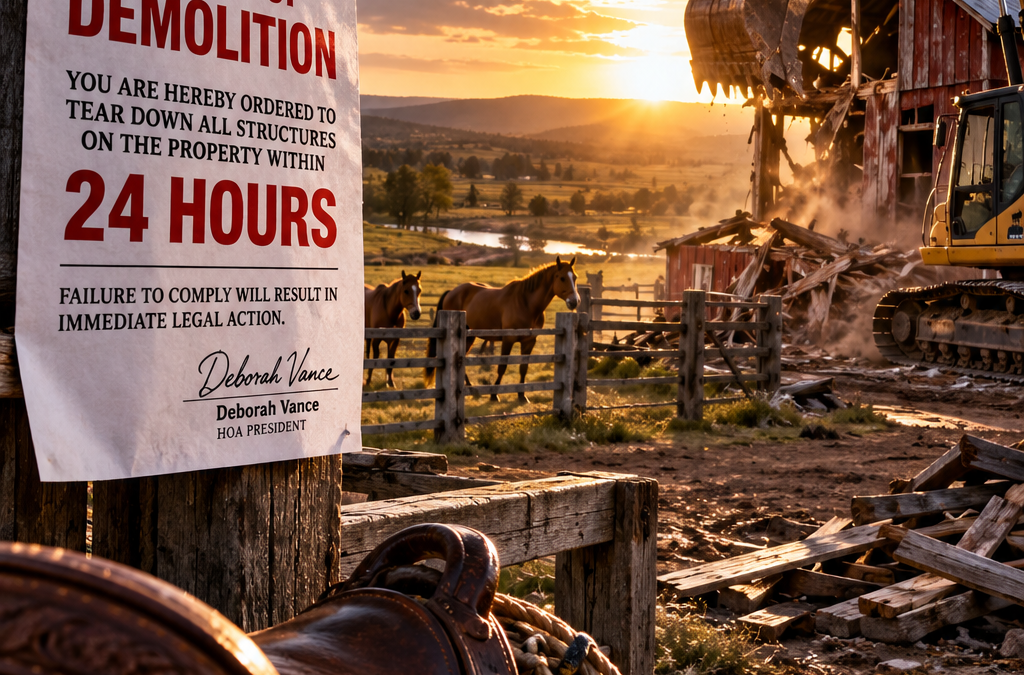
𝗙𝗨𝗟𝗟 𝗦𝗧𝗢𝗥𝗬
The main section of Marrow Ridge had stone entrances, ornamental trees, two-story homes with three-car garages, and lawns watered so perfectly that even drought seemed to respect property lines.
My forty acres were different.
Dry soil.
Scrub grass.
A collapsed storage shed.
Old fencing that leaned like tired men.
The tract had originally been intended for later development, but the developer ran short of money and eventually sold it separately.
Because of old platting decisions, the parcel remained technically inside the broader Marrow Ridge community boundary.
That meant the HOA documents touched it in certain ways.
It also meant most people in Marrow Ridge hated looking at it.
Perfect.
My wife, Claire, stood beside me the first day I walked the property after closing.
Wind blew dust across our boots.
She looked toward the collapsed shed.
Then toward the half-dead cottonwoods by the southern fence.
Then at me.
“You paid money for this.”
“I did.”
“A voluntary amount of money?”
“Quite a lot, actually.”
She squinted toward the horizon.
“You’re smiling.”
“I know.”
“That worries me.”
I pointed toward a flat section near the middle of the property.
“Barn goes there.”
She stared.
“What barn?”
“The barn I’m building.”
“Everett.”
“Four stalls to start.”
She crossed her arms.
“We do not own horses.”
“We will.”
She studied my face for a long time.
Then the joke left hers.
“This is about your dad.”
I looked away.
“Some of it.”
She slipped her hand into mine.
“Then build it right.”
So I did.
I worked my regular job during the day and built at night.
Not because I couldn’t hire contractors.
Because I didn’t want to.
I wanted to know every post.
Every beam.
Every screw.
Every stubborn section of ground where the auger hit rock and tried to tear my shoulder out.
I wanted the barn to feel earned.
The first month, I set posts under portable floodlights.
The second month, framing went up.
Claire brought dinner out to me in aluminum foil because I kept forgetting to stop.
Sometimes she sat on an upside-down bucket while I worked.
“You know normal husbands buy sports cars during a midlife crisis.”
“I’m not having a crisis.”
“You have three hundred pounds of concrete in the back of the truck.”
“That’s called planning.”
“You’re forty-two.”
“That’s called aging.”
She smiled.
“Your father would have loved this.”
That always stopped me.
Because I hoped she was right.
By autumn, the barn stood.
Nothing extravagant.
Wood siding.
Metal roof.
Four stalls.
Tack room.
Feed storage.
I hung my father’s saddle on a rack in the tack room before we even bought the first horse.
That saddle stayed there for months.
It looked like a ghost waiting for a rider.
The following spring, we brought home two horses.
Then four.
I built a chicken coop.
Put up split-rail fencing along the road.
Added a small equipment lean-to.
I repaired the old well.
Cleared brush.
Reseeded pasture.
People started calling it the Cole Ranch.
I never did.
To me, it was simply home.
It was the first place I’d owned that made my chest feel the way my father’s ranch had.
That mattered more than I could explain.
Marrow Ridge disagreed.
At first, the complaints were almost funny.
Someone left an anonymous note on my gate.
RUSTIC DOES NOT MEAN ATTRACTIVE.
Another appeared three weeks later.
LIVESTOCK SMELLS IMPACT EVERYONE.
We had four horses on forty acres.
If somebody could smell them from the nearest subdivision house, they possessed biological equipment more sensitive than anything currently used by law enforcement.
I ignored the notes.
Then came comments at HOA meetings.
“Does the agricultural appearance conform to the intended character of the community?”
“Are chickens necessary?”
“Could the fencing be replaced with something more architecturally consistent?”
Architecturally consistent fencing.
That was my favorite.
For nearly two years, it remained mostly irritation.
The board sent letters.
I answered when necessary.
Sometimes they complained about grass height in fields clearly designated as pasture.
Sometimes they objected to feed deliveries.
Once they suggested my tractor should not be visible from a community road.
But the people leading the board were mostly cautious.
They understood my parcel predated several cosmetic rules.
They didn’t like the ranch.
They also understood disliking something and having authority over it were different things.
Then Deborah Vance became HOA president.
Deborah did not believe in that distinction.
She believed authority expanded in direct proportion to how confidently she exercised it.
She was fifty-eight, maybe sixty, with perfectly styled blond hair and the permanent expression of someone who had just discovered another person doing something incorrectly.
She drove a silver Lexus SUV.
Always dressed as if she might unexpectedly be photographed for a real estate brochure.
White pants.
Pressed blouse.
Oversized sunglasses.
Leather folder under one arm.
She didn’t carry a clipboard.
Deborah was more sophisticated than that.
She carried a binder.
The first time she came to my property after becoming president, I was replacing a fence rail.
She stopped her Lexus directly outside the gate.
Didn’t park along the shoulder.
Didn’t call ahead.
Just lowered the window.
“Everett.”
I kept working.
“Morning.”
She waited.
I looked up.
“Can I help you?”
“The board is conducting an architectural compliance review.”
I looked around.
“Congratulations.”
“I’m serious.”
“So am I.”
Her lips tightened.
“Your fencing is nonstandard.”
“It’s split rail.”
“Exactly.”
I waited.
“So?”
“Marrow Ridge approved perimeter fencing is black aluminum or masonry.”
“For residential lots.”
“All visible fencing affects community aesthetics.”
“My parcel is agricultural.”
“It’s inside the association.”
“Parts of the covenants apply. Parts don’t.”
“That’s your interpretation.”
“No.”
I drove a nail through the rail.
“That’s the document’s interpretation.”
She got out of the Lexus.
That surprised me.
Deborah walked toward the fence without asking permission.
She touched the top rail with two fingers like it might stain her.
“This is precisely the kind of attitude that’s caused friction.”
“What attitude?”
“The belief that your property is somehow exempt from community expectations.”
“My property isn’t exempt from valid rules.”
“You always add that word.”
“What word?”
“Valid.”
I smiled.
“It matters.”
Deborah didn’t.
“We’ll be in touch.”
They were.
A week later:
UNAUTHORIZED AGRICULTURAL-STYLE FENCING.
Fifty-dollar fine.
I appealed.
The board quietly withdrew it after their management company pointed out the fencing restriction Deborah cited specifically applied to lots under one acre.
Two weeks later:
UNAPPROVED EXTERIOR STRUCTURE.
The chicken coop.
I appealed again.
The coop sat more than three hundred feet from the road and fell below the size threshold requiring review.
Withdrawn.
Then:
COMMERCIAL AGRICULTURAL OPERATION.
That one almost impressed me.
Deborah claimed the existence of multiple horses, poultry, and feed deliveries demonstrated commercial ranching prohibited by residential covenants.
I asked them to identify one commercial sale.
They couldn’t.
I asked for evidence of boarding customers.
None existed.
I asked them to show income produced by the ranch.
Silence.
Withdrawn.
Each defeat should have taught Deborah caution.
Instead, it made her more determined.
She began appearing along my fence line several mornings a week.
Taking photographs.
Writing notes.
Once I found her standing near the gate with a man I didn’t recognize.
“What are you doing?”
She turned.
“Board inspection.”
“From my driveway?”
“The access apron is visible from the public road.”
“You’re past the right-of-way.”
She looked down.
Then stepped backward exactly three feet.
“There.”
The man beside her looked embarrassed.
“Who is he?”
“Architectural consultant.”
The man raised one hand.
“I’m just the landscaper.”
I stared at Deborah.
She stared back.
The landscaper suddenly became fascinated by his phone.
I should have found it funny.
At first, I did.
Then the fines started arriving faster.
Seventy-five dollars.
One hundred.
One hundred fifty.
Most were suspended when I challenged them.
That didn’t matter to Deborah.
The objective seemed less about collecting money than producing pressure.
She wanted me tired.
Tired of answering letters.
Tired of researching covenants.
Tired of being photographed.
Tired enough to make the ranch disappear voluntarily.
Claire saw it before I admitted it.
One night, I came inside after checking horses and found another certified envelope on the kitchen counter.
She had signed for it.
“You haven’t opened it.”
“No.”
“Why?”
“Because I don’t want to spend another night angry.”
She looked at me carefully.
“You’re letting her into the house.”
I frowned.
“Deborah?”
“Not literally.”
She tapped the envelope.
“This.”
I sat down.
“I can handle it.”
“I know.”
“Then what?”
“You built that place because it made you happy.”
She nodded toward the back window, beyond which the barn lights glowed across the dark pasture.
“Now every time you look outside, you’re waiting for another attack.”
I didn’t answer.
“She doesn’t have to win legally if she can make you hate living here.”
That hurt because it was true.
I opened the letter.
The violation concerned “unapproved visual livestock concentration.”
I stared at the phrase.
Then I laughed.
Claire didn’t.
“What’s funny?”
“I don’t know what visual livestock concentration means.”
“Neither does she.”
“Four horses are apparently concentrated.”
“Everett.”
I looked at her.
“Don’t let that woman turn your father’s memory into paperwork.”
That sentence stayed with me.
For the next month, I answered only what required answering.
I stopped reacting emotionally.
I started documenting.
Every letter.
Every photograph.
Every visit.
Every citation.
Every withdrawal.
I knew people like Deborah from my finance days.
Not personally.
Structurally.
They relied on exhaustion.
Their confidence came from the assumption that eventually the other side would become too tired, too intimidated, or too financially strained to keep saying no.
When intimidation failed, they escalated.
Deborah’s escalation arrived on a Tuesday morning in March.
I walked down to the gate just after sunrise.
The horses were behind me, waiting impatiently for feed.
Cold air smelled like dust and hay.
A single white sheet had been taped to the gate.
Not mailed.
Not placed in an envelope.
Taped where anyone driving past could see it.
I pulled it free.
IMMEDIATE DEMOLITION REQUIRED.
I read the first line twice.
Then continued.
All structures deemed noncompliant with HOA Bylaw 14B must be removed within twenty-four hours.
Barn.
Chicken coop.
Equipment shelter.
Interior livestock fencing listed as associated nonconforming improvements.
Failure to comply would permit the association to proceed with removal at my expense, together with fines, administrative fees, legal costs, and continuing penalties.
Twenty-four hours.
I stood at the gate while one of the horses called from the pasture.
The sound carried across forty acres.
For a few seconds, my hands shook.
Not from fear.
From the violence of the demand.
People hear “barn” and imagine lumber.
A roof.
Nails.
They don’t see nights under floodlights.
They don’t see Claire carrying dinner outside.
They don’t see me hanging my father’s saddle in the tack room and standing alone with one hand resting on the worn leather.
They don’t see the first horse walking through a gate I built.
They don’t see the morning I finally looked across that dusty property and realized it no longer resembled the barren tract we’d bought.
Twenty-four hours to tear it down.
It wasn’t an enforcement notice.
It was an order to erase memory.
I drove to the HOA office.
Deborah was there.
Of course she was.
She sat behind the conference table with two board members beside her and the property manager, Martin Hale, at the far end.
I placed the notice on the table.
“Twenty-four hours?”
Deborah folded her hands.
“You’ve had ample warning.”
“Not for demolition.”
“You’ve repeatedly refused voluntary compliance.”
“With violations your own management company keeps withdrawing.”
“Technical withdrawals don’t change the larger issue.”
I looked at Martin.
He avoided my eyes.
“What exactly is Bylaw 14B?”
Deborah slid a binder toward herself.
“Nonconforming accessory structures.”
“I’ve read the bylaws.”
“Then you should be familiar with it.”
“There was no 14B in my recorded copy.”
“We adopted updated enforcement language.”
“When?”
“Last year.”
“Homeowner vote?”
“Board interpretation.”
I almost laughed.
“You created a demolition authority by interpretation?”
Her expression hardened.
“Mr. Cole, this association has been extraordinarily patient.”
“Deborah, you tried to classify my chicken coop as a commercial structure.”
“Because of how you use the property.”
“I use the chicken coop for chickens.”
One board member looked down.
Deborah didn’t blink.
“The character of your parcel is inconsistent with Marrow Ridge.”
“The character of my parcel isn’t subject to your personal taste.”
“It affects every property owner.”
“Has anyone produced an appraisal showing my ranch lowered values?”
“That’s not required.”
“Of course not.”
She pushed a pen toward me.
“Sign acknowledgment.”
I looked at the line.
Receipt of notice.
Nothing more.
I knew better than to sign anything without reading it.
So I read every word.
Then I signed.
Everett Cole.
Deborah’s mouth curved just slightly.
She thought the signature meant surrender.
“I hope you’ll use the next twenty-four hours productively.”
I slid the pen back.
“Oh, I will.”
She leaned back.
“For everyone’s sake, I hope this can end without further unpleasantness.”
I looked at her for a long moment.
She had no idea.
Not about me.
Not about the document.
Not about the parcel number I had recognized six months earlier.
I picked up my copy of the notice.
“Have a good morning, Deborah.”
I left.
Six months before that meeting, long before the demolition threat, I had bought an investment.
Nothing personal.
Nothing strategic.
At least not then.
After leaving full-time finance, I still watched distressed-note auctions occasionally.
Old habit.
Some people check sports scores.
I checked debt portfolios.
One small package caught my attention.
The borrower was an entity affiliated with a residential homeowners association.
The collateral wasn’t individual homes.
It was association-owned property.
A clubhouse complex.
Several rental cottages.
Land used for HOA income-generating operations.
The loan had originated years earlier when the association renovated the clubhouse and added the rental units.
The original lender failed.
The note moved through receivership.
Eventually it landed in a small portfolio being sold at auction.
Nobody seemed especially interested.
The balance wasn’t huge by commercial standards.
The property wasn’t glamorous.
The documentation was complicated.
Exactly the kind of asset people avoided.
Then I saw the parcel number.
I knew it.
Marrow Ridge.
I downloaded the file.
The clubhouse.
The cottages.
The land beneath them.
All pledged as security.
There was also an assignment-of-rents provision and a peculiar operating covenant negotiated years earlier when the HOA needed favorable financing.
Under certain conditions, the noteholder had unusually broad control over rental-income structures associated with the collateral.
Someone on the original board had accepted ugly terms to get cheap money.
Nobody currently serving seemed to know.
I bought the note through an LLC.
Vance Capital Holdings.
The name was coincidental in the beginning.
Vance was my mother’s maiden name.
I had formed the entity a year before Deborah ever became relevant to me.
When I later realized the irony of her sharing the name, I almost changed it.
Then decided life could keep one joke.
The purchase went through quietly.
The HOA kept making payments.
I collected income.
I had no intention of using the note against anyone.
It was an investment.
Nothing more.
That remained true until Deborah handed me twenty-four hours to destroy my barn.
That evening, I sat in the tack room beneath my father’s saddle.
Claire found me there.
She leaned against the doorway.
“You going to tell me what you’re thinking?”
I held the demolition notice in one hand.
“No.”
“Why not?”
“Because you’ll tell me whether it’s smart.”
“I’m your wife. That’s part of the service.”
I looked up at the saddle.
She followed my eyes.
“You’re not tearing it down.”
“No.”
“Good.”
“Not one board.”
“Good.”
“Not one fence rail.”
She nodded.
“Better.”
I handed her the notice.
She read it.
“You said they can’t just come onto the property.”
“They can try.”
“What are you going to do?”
I thought about that.
Then smiled for the first time all day.
“Nothing.”
She narrowed her eyes.
“That smile means something terrible.”
“I’m going to do absolutely nothing.”
“Everett.”
“Trust me.”
The twenty-four hours passed.
Nobody arrived with machinery.
That didn’t surprise me.
Deborah liked threats more than risk.
Two days became a week.
A week became two.
I heard through neighbors that she was telling people she’d finally “resolved the ranch problem.”
At the next HOA meeting, I attended.
I sat in the last row.
Deborah stood at the front beneath recessed lights, immaculate as always.
The meeting moved through landscaping expenses, reserve balances, clubhouse maintenance.
Then she reached compliance matters.
“I’d also like to update the membership regarding the long-standing Cole parcel issue.”
Several people turned toward me.
Deborah knew I was there.
She wanted me there.
“The board has taken decisive action regarding an agricultural-style property that has remained inconsistent with community standards for far too long.”
Agricultural-style property.
Not ranch.
As though even the word offended her.
She continued.
“After repeated efforts to encourage voluntary correction, the board issued final enforcement.”
She paused.
“That embarrassment is being corrected.”
Embarrassment.
Something in me went still.
A few people clapped.
Not everyone.
Maybe twelve.
Enough.
I looked around at neighbors applauding the idea of destroying something they’d never bothered to understand.
For two years, I’d felt guilty about the note.
Not guilty for buying it.
Guilty for knowing I possessed leverage they didn’t understand.
I had always believed that if the dispute ever became serious, I should keep the investment separate.
Don’t mix personal conflict with financial power.
That was the disciplined approach.
Then Deborah called my ranch an embarrassment.
The barn I built after work.
The land Claire helped me restore.
The place connected to the father I’d already watched lose one ranch.
An embarrassment.
I looked toward the stage.
Deborah smiled as the applause faded.
Whatever guilt remained disappeared.
The following Monday, notices went out from Vance Capital Holdings.
Not emotional letters.
Not threats.
Commercial notices.
Precise.
Dry.
Effective immediately, the rental-income terms associated with the HOA-controlled cottage units and clubhouse complex would be adjusted pursuant to the operating provisions contained in the original secured agreement.
The adjustment was dramatic.
Tenfold.
I knew exactly what it would do.
The HOA could afford normal payments.
It could not afford those adjusted obligations for long.
Not while maintaining roads, landscaping, insurance, and reserves.
The original agreement allowed it.
I had my attorney review the provision twice before anything went out.
Not because I wanted theatrics.
Because if I was going to touch the paper, I intended to be right.
The emergency meeting happened forty-eight hours later.
I didn’t attend.
I didn’t need to.
Martin called me afterward.
The property manager.
He sounded exhausted.
“Everett.”
“Martin.”
“You knew.”
“About what?”
He sighed.
“Don’t.”
I waited.
“You bought the note.”
“Six months ago.”
“Before the demolition notice?”
“Long before.”
“Why didn’t you tell anyone?”
“It wasn’t their business.”
There was silence.
Then Martin laughed once.
Not because anything was funny.
“You should have seen her face.”
“I can imagine.”
“No.”
He lowered his voice.
“I don’t think you can.”
He told me what happened.
Deborah opened the meeting furious.
Not worried.
Furious.
She held my company’s notice above her head.
“Who is Vance Capital Holdings?”
Nobody answered.
She turned toward Martin.
“Why are they raising our rents?”
“They’re exercising a provision in the secured agreement.”
“Then stop them.”
“I can’t.”
“You’re the property manager.”
“They’re the noteholder.”
“Then call the lender.”
“They are the lender now.”
According to Martin, Deborah stared at him.
“What do you mean now?”
“The note was sold.”
“To who?”
“Vance Capital Holdings.”
“Who owns Vance Capital?”
Martin had the registration documents with him.
He knew because he’d spent half the night tracing them.
He said he hesitated before answering.
Not for dramatic effect.
Because he already knew exactly what the answer would do to the room.
“The registered manager is Everett Cole.”
Silence.
Then someone supposedly said:
“Ranch Everett?”
Martin nodded.
“The same Everett Cole.”
The same Everett Deborah had ordered to tear down his barn.
The same Everett she had publicly called an embarrassment.
The same Everett who had sat quietly in the back row while people clapped.
Deborah apparently laughed at first.
A sharp, disbelieving sound.
“That’s impossible.”
Martin placed the documentation on the table.
“It isn’t.”
She read it.
Then looked up.
“Why would he own our loan?”
“Because he bought it.”
“He can’t use it against us because of an HOA dispute.”
“The note rights don’t depend on why he chooses to exercise them.”
“Then challenge it.”
“I already sent the documents to counsel.”
“And?”
Martin paused.
“Counsel says the provision is enforceable.”
That was when Deborah went pale.
I wished I could say hearing that gave me satisfaction.
For a minute, it did.
Then it didn’t.
Because beneath the politics, the clubhouse, the fines, and Deborah’s arrogance were dozens of homeowners who had nothing to do with my fight.
I didn’t want to bankrupt Marrow Ridge.
I didn’t want retirees paying special assessments.
I didn’t want families covering legal expenses because their HOA president couldn’t distinguish authority from obsession.
I wanted the board to understand the feeling it had created for me.
A deadline.
A loss.
Something important suddenly placed under someone else’s control.
But leverage only means something if you know when to stop.
The next communication came through my attorney.
One letter.
One offer.
No mention of revenge.
No demand that Deborah apologize.
No condition requiring my ranch to be praised, protected, or admired.
The letter simply said Vance Capital Holdings was willing to negotiate a reasonable restructuring of the affected financial obligations in good faith.
Otherwise, if the borrower defaulted, the noteholder reserved all contractual remedies, including foreclosure against the secured clubhouse complex and associated rental properties.
No threats beyond the contract.
No emotion.
The board understood.
Nine days.
That was how long it took.
Nine days from Deborah’s emergency meeting to capitulation.
The board entered restructuring talks.
The rent structure returned to a level they could survive.
Payment terms were revised.
Additional financial oversight was added.
For the first time in years, apparently, several board members actually read every page before signing.
Then came the political part.
A special vote was called regarding Deborah’s presidency.
She fought it.
Of course she did.
She sent homeowners a four-page letter accusing critics of undermining the community.
She described herself as the victim of “financial intimidation.”
She claimed she’d been targeted for “firm enforcement of community standards.”
She never mentioned that she’d tried to give me twenty-four hours to demolish a barn under a disputed rule.
She never mentioned the public humiliation.
She never mentioned repeatedly issuing violations after previous ones collapsed.
She certainly never mentioned calling my home an embarrassment from the podium.
The vote wasn’t close.
Several of the same people who had applauded her two weeks earlier voted to remove her.
That bothered me more than I expected.
Not because I wanted loyalty to Deborah.
Because crowds change quickly when power changes.
When Deborah looked powerful, people clapped.
When she looked dangerous to the HOA’s finances, they removed her.
Maybe some genuinely regretted what they’d supported.
I’m sure they did.
Others were simply moving away from risk.
That’s human nature.
It isn’t always noble.
Deborah lost the presidency.
She remained a homeowner.
I saw her sometimes afterward.
At the mailbox.
Driving past the ranch.
Once in the grocery store.
She never spoke to me again.
Neither did I.
There was nothing left worth saying.
The strangest part was what happened to the demolition order.
Nothing.
Absolutely nothing.
Bylaw 14B vanished from discussion.
Nobody arrived at my gate.
Nobody demanded removal.
Nobody sent a follow-up notice.
The barn stayed.
The coop stayed.
The equipment shelter stayed.
Every fence stayed exactly where I’d built it.
During the chaos over the clubhouse debt, the board seemed to rediscover something remarkable:
They had more important things to do than decide whether my split-rail fence looked too rustic.
Later, one new board member asked the association attorney to review the authority Deborah had claimed.
I never saw the full opinion.
I didn’t need to.
Bylaw 14B never appeared on another agenda.
My demolition notice was effectively abandoned.
I framed it.
Claire hated that.
For about three days.
“You are not hanging that in the house.”
“I wasn’t planning to.”
“Good.”
“I’m hanging it in the barn.”
She stared at me.
“That’s worse.”
“Why?”
“Because you have visitors in the barn.”
“Exactly.”
“Everett.”
“It’s history.”
“It’s petty.”
“History can be petty.”
She tried not to smile.
“Where?”
“Above Dad’s saddle.”
Her expression softened.
“Fine.”
So that is where it hangs.
The demolition notice.
Twenty-four hours.
Black frame.
Simple glass.
Directly above the rack holding my father’s saddle.
Sometimes people assume it’s a trophy.
It isn’t.
I don’t look at it and think about defeating Deborah.
Most mornings, I barely think about Deborah at all.
I look at it and remember how close fear came to making me feel nineteen again.
That was the part I hadn’t expected.
When I first read the notice, the rational part of my mind knew the situations were different.
My father lost his ranch because of debt.
I wasn’t facing the same thing.
My property wasn’t being foreclosed.
Deborah’s authority was questionable.
I had resources my father never had.
But grief doesn’t care about distinctions.
For one minute at that gate, holding that piece of paper, I wasn’t forty-two.
I was nineteen.
Watching strangers label our belongings.
Hearing my father say:
They’re taking it.
That was why Deborah’s order hurt as much as it did.
She wasn’t just threatening lumber and fencing.
She had accidentally touched the oldest wound I carried.
The ranch I built wasn’t a hobby.
It wasn’t some decorative country-life fantasy.
It was proof that losing something once didn’t mean I was forbidden from building it again.
My father never got that chance.
I did.
One morning the following autumn, I woke before sunrise.
Claire was still asleep.
I pulled on jeans and boots and walked toward the barn.
The air had turned cold enough that my breath showed.
One of the horses heard me and pushed his head over the stall door.
“Yeah, yeah.”
I scratched between his ears.
“You’ve been starving for almost nine hours.”
He bumped my shoulder.
I filled feeders.
Checked water.
Opened the pasture gate.
The horses walked out one at a time, steam lifting faintly from their backs.
Then I stood in the doorway.
The sky was turning orange behind the ridge.
Light spread across the fencing.
Across the chicken coop.
Across the barn walls I’d installed under floodlights.
Across forty acres people once called ugly.
I looked at my father’s saddle.
The leather was darker with age.
One stirrup hung slightly lower than the other.
I could still remember him tightening that same saddle when I was a kid.
“Leather remembers,” he once told me.
I didn’t know what he meant then.
He said worn leather bends where hands have bent it before.
Boots remember feet.
Reins remember grip.
A saddle remembers the rider.
Maybe land remembers too.
Maybe that was why building the ranch had mattered.
I had spent half my life believing the story ended when the bank took our place.
It didn’t.
That was only the part where my father lost.
I wasn’t him.
I couldn’t fix what happened to him.
I couldn’t go back and buy the ranch before foreclosure.
I couldn’t tell the nineteen-year-old version of myself that one day the memory wouldn’t hurt in exactly the same way.
But I could build something after it.
That’s what Deborah never understood.
People like her look at property and see conformity.
Paint colors.
Fence materials.
Approved structures.
Sightlines.
Resale values.
They imagine that because something appears on a plat or inside a boundary, its meaning can be reduced to rules.
But homes carry histories no board can see.
That barn carried my father.
Those horses carried mornings from thirty years earlier.
That ugly piece of land became the first place where I stopped feeling like I’d failed to save something I was never old enough to save.
Deborah saw rustic fencing.
I saw recovery.
She saw chickens.
I saw permanence.
She saw a problem that needed correcting.
I saw proof I could build with my own hands what life had once taken from them.
That’s why twenty-four hours was never going to be enough.
Not because I had the note.
The note was leverage.
Important leverage.
But even without it, I would not have picked up a hammer and started tearing down the barn because Deborah told me to.
There are moments when compliance stops being reasonable.
Moments when a person has to separate inconvenience from surrender.
I had paid fees.
Answered letters.
Attended meetings.
Filed appeals.
I had given the association every ordinary opportunity to act like an institution instead of Deborah’s personal weapon.
She chose something else.
And when she pushed far enough, she discovered I had choices too.
Months after her removal, Martin stopped by the ranch.
He’d never visited socially before.
I was repairing a water line near the barn.
He walked over carefully, still dressed in office clothes.
“Got a minute?”
“Sure.”
He looked around.
First at the horses.
Then the barn.
“This is nicer than I expected.”
I raised an eyebrow.
“What were you expecting?”
He smiled awkwardly.
“The way the board talked about it?”
“An industrial feedlot?”
“Something like that.”
“Four horses and seven chickens.”
“I can see that.”
We stood quietly.
Then he said, “I should’ve pushed back sooner.”
I looked at him.
“Against Deborah?”
“Against a lot of it.”
He put his hands in his pockets.
“I kept telling myself I was just the manager. Board gives instruction. I administer it.”
“That’s a convenient job description.”
“I know.”
I waited.
He kicked at the dirt with one shoe.
“When she wanted the demolition notice prepared, I told her twenty-four hours was excessive.”
“What did she say?”
“She said excessive was the point.”
That sentence made something cold move through me.
I had suspected it.
Hearing it confirmed was different.
“The point was to scare me.”
“Yes.”
“Did the board know?”
“Some.”
“All?”
“No.”
He looked embarrassed.
“She presented it as final enforcement authority.”
“And nobody checked?”
“Not closely enough.”
I nodded.
That was Marrow Ridge’s real problem.
Not Deborah alone.
People like Deborah become powerful because other people decide checking is uncomfortable.
Because saying no creates friction.
Because as long as the pressure is directed at somebody else, obedience feels easier.
Martin looked toward the framed notice visible through the open barn door.
“You kept it.”
“I did.”
“Why?”
I wiped dirt from my hands.
“Because somebody should remember what can happen when people stop reading before they sign.”
He laughed quietly.
“Fair.”
Before leaving, he stood near my father’s saddle.
“Was that his?”
“My dad’s.”
“The rancher?”
I nodded.
Martin looked around again.
Then I think he finally understood something the HOA never had.
“This wasn’t just a project for you.”
“No.”
He didn’t ask anything else.
A few weeks after that, one of the homeowners who had applauded Deborah approached me.
His name was Greg.
Nice enough guy.
We’d never been friends.
I was getting my mail.
He walked up slowly.
“Everett.”
“Greg.”
He rubbed the back of his neck.
“Been meaning to say something.”
I knew immediately what was coming.
“You don’t have to.”
“I do.”
I waited.
“That meeting.”
He looked down.
“When Deborah said the ranch was an embarrassment.”
“I remember.”
“I clapped.”
“I remember that too.”
He winced.
“I shouldn’t have.”
“No.”
“I’d never even been out there.”
“No.”
“I just believed what she was saying.”
I looked toward my property.
The barn roof was visible beyond the trees.
Greg followed my eyes.
“My wife drove past yesterday.”
He smiled faintly.
“She thinks your horses are beautiful.”
“They are.”
“Look, I don’t expect—”
“It’s okay.”
He stopped.
I shook my head.
“Not okay like it didn’t happen.”
He nodded.
“Okay like I don’t need anything else from you.”
He seemed relieved and disappointed at the same time.
Maybe he’d hoped forgiveness would be more ceremonial.
People do.
He held out a hand.
I shook it.
That was enough.
The new board eventually rewrote several enforcement procedures.
No unilateral demolition orders.
No major compliance action without documented legal review.
No president acting without recorded board authorization.
Appeals had to be heard before penalties escalated beyond a certain level.
Nothing dramatic.
Basic governance.
Rules meant to protect homeowners from exactly the kind of improvisational authority Deborah had practiced.
I stayed out of board politics.
I was asked to run twice.
I declined twice.
I had no desire to trade ranch work for arguments about mailbox colors.
More importantly, the point had never been replacing Deborah with myself.
People misunderstand revenge.
They imagine the opposite of being controlled is controlling someone else.
It isn’t.
The opposite is being left alone.
That’s what I wanted.
The ranch grew.
We added two more horses.
Claire expanded the garden.
The chicken population fluctuated because chickens apparently consider numerical stability an insult.
I finally replaced the ruined shed on the south side of the property.
Before building it, I submitted the appropriate documentation.
Not because Deborah had trained me.
Because that rule actually applied.
The new architectural committee approved it in six days.
The email was three paragraphs.
No accusations.
No threats.
No language about community character.
Just:
Approved.
Imagine that.
The clubhouse survived too.
I never wanted it.
That’s another detail people misunderstand when they hear the story.
Vance Capital could have pushed toward foreclosure if the HOA defaulted.
I didn’t want that outcome.
Owning distressed property teaches you something quickly:
Just because you can take an asset doesn’t mean taking it is good business.
And just because somebody hurt you doesn’t mean every available consequence is justified.
We restructured the debt.
The association stabilized.
Rental operations continued.
Families still used the clubhouse for birthdays.
The pool opened every summer.
People rented the cottages for visiting relatives.
That mattered to me.
Deborah tried to take something meaningful from me.
There would have been no virtue in answering by taking something meaningful from everyone else.
I needed leverage.
Not destruction.
I sometimes wonder what my father would have thought about that.
He hated banks after we lost the ranch.
Not individual bankers.
The institution.
The feeling of sitting across from someone who controlled paper tied to everything he loved.
If he had lived long enough to see me become the person holding that kind of paper, maybe he would’ve hated the irony.
Or maybe he’d have understood.
I like to think he would’ve said:
Don’t become the thing that beat us.
That is what kept me from going further.
Deborah had given me twenty-four hours.
I could have responded with deadlines of my own until Marrow Ridge collapsed.
Instead, I gave the board a path out.
Not because Deborah deserved mercy.
Because the neighbors deserved proportionality.
There is a difference.
One winter morning, years after my father died, I finally used his saddle again.
I’d kept it mostly for memory.
The leather was old but sound after some restoration.
I carried it out of the tack room and placed it across my gelding’s back.
For a moment, I couldn’t tighten the cinch.
My hands just rested on the saddle.
Claire stood near the barn door.
“You okay?”
“Yeah.”
She smiled.
“You’re lying.”
“A little.”
I ran my hand across the horn.
“Dad used this almost every day.”
“I know.”
“I’ve been afraid to use it.”
“Why?”
I thought about that.
“Maybe because if something happened to it, I’d lose one of the last things I have.”
Claire walked closer.
“Or you could use it for what he used it for.”
Sometimes my wife says things that annoy me because they’re obviously correct.
I mounted.
The saddle creaked.
Same sound I remembered from childhood.
I rode out across the east pasture.
Cold sun.
Dry grass.
Fence line stretching ahead.
Halfway across the property, I turned and looked back.
The barn stood in the distance.
The framed demolition notice was inside.
Deborah’s threat.
Twenty-four hours.
All structures removed.
Everything she thought mattered.
From where I sat, none of that paper had any power anymore.
The barn was still there.
The fence was there.
Claire was standing outside with one hand raised against the sun.
The horses were grazing.
For one strange second, I could almost picture my father beside me.
Not as he looked near the end.
Not tired.
Not defeated.
The way he looked when I was twelve.
Hat low.
Hands rough.
Sitting easy in the saddle like the ground itself trusted him.
I don’t believe life gives us clean replacements for what we lose.
My forty acres didn’t replace his two hundred.
My barn didn’t erase the day the bank came.
Winning against Deborah didn’t rewrite my father’s ending.
That’s not how memory works.
But sometimes you get to build something beside the loss.
Something that doesn’t erase it but changes what comes afterward.
That’s what my ranch became.
Proof that losing land once didn’t mean land would always be taken from me.
Proof that the nineteen-year-old watching his father lose everything wasn’t the last version of me.
And proof that the most dangerous mistake an arrogant person can make is assuming silence means helplessness.
Deborah mistook my calm for surrender.
When I signed her notice, she saw a defeated homeowner.
She never asked why I wasn’t arguing.
She never wondered why a man facing destruction in twenty-four hours walked out of her office smiling.
She had spent so long treating paperwork like a weapon that she forgot paperwork could point both directions.
She knew how to send certified letters.
She knew how to issue fines.
She knew how to stamp FINAL NOTICE across an envelope.
But she never learned the first rule I learned in commercial real estate:
Before threatening someone with paper, know what paper they hold.
I still look at that framed demolition notice sometimes.
Not every day.
Usually when I’m tired and finishing chores late.
The barn lights are on.
Everything else is dark.
My father’s saddle hangs below it.
The notice looks almost ridiculous now.
One page.
Twenty-four hours.
A command issued with absolute confidence by someone who believed confidence created authority.
It didn’t.
Authority has limits.
Paper has consequences.
And homes mean more than the people regulating them will ever understand.
If there is one thing I carried out of the entire fight, it wasn’t satisfaction.
It was clarity.
The HOA was supposed to protect shared interests.
The moment Deborah used it to enforce her personal taste, it stopped functioning like governance and started functioning like control.
She couldn’t tolerate a ranch because she hadn’t imagined one in her version of Marrow Ridge.
So she called it ugly.
Then noncompliant.
Then commercial.
Then embarrassing.
When one label failed, she found another.
Finally, she tried to erase it.
That is how unreasonable power behaves.
It doesn’t ask whether harm exists.
It asks whether obedience exists.
And if obedience doesn’t come quickly enough, it escalates until someone forces it to stop.
I happened to have an unusual way to stop it.
Most homeowners don’t own the debt secured by their HOA clubhouse.
Most shouldn’t need anything close to that kind of leverage.
A functional community shouldn’t require financial warfare to make its board respect boundaries.
But when Deborah handed me that notice, she made one assumption too many.
She believed she understood everything that mattered about me.
Forty acres.
A barn.
A few horses.
A stubborn rancher she could pressure until he folded.
She never thought about the years before the ranch.
The contracts.
The auctions.
The notes.
The father who lost everything.
The son who learned exactly how men lose land on paper.
And the adult who decided he would never again ignore the documents sitting underneath the ground he stood on.
The next morning after I rode with my father’s saddle, I added one thing beneath the framed demolition notice.
Not a quote.
Not Deborah’s resignation.
Not a copy of the loan.
Just an old photograph.
My father and me.
I’m maybe eleven.
He’s standing beside a chestnut horse with one arm across the saddle.
I’m grinning because I had just ridden alone for the first time.
Behind us is the barn we eventually lost.
I found the picture in the box he left me.
Now the two pieces hang together.
The place we lost.
The place I nearly lost.
And the paper that couldn’t take the second one.
Sometimes Claire catches me looking at them.
She doesn’t ask what I’m thinking anymore.
She knows.
One evening she stood beside me.
“You know what your dad would probably say about all this?”
“What?”
“That you’re wasting perfectly good wall space on Deborah Vance.”
I laughed.
“Probably.”
“You could hang another saddle rack there.”
“I could.”
“Are you going to?”
“No.”
She shook her head.
“Of course not.”
I looked once more at the notice.
Twenty-four hours.
Three years of labor reduced to a deadline.
A lifetime of memory reduced to the phrase noncompliant structures.
I thought about the morning I first held it at the gate.
How my hands shook.
How suddenly I felt nineteen.
Then I looked around the barn.
At the stalls.
The tools.
The saddle.
The life that continued because I refused to let someone else’s certainty become my reality.
“No,” I said.
Claire looked at me.
“What?”
“I’m keeping it there.”
She smiled.
“I know.”
Outside, one of the horses kicked lightly against a stall door because dinner was late.
I took the feed bucket.
The sun was going down beyond the western fence, stretching the shadows of every rail I’d once been ordered to tear out.
I stepped outside.
Forty acres.
Still standing.
Still mine.
Not because I destroyed the people who threatened it.
Because when the moment came, I understood what I had, what they had, and exactly where their authority ended.
My father lost his ranch to a bank that barely knew his name.
I kept mine because before Deborah Vance ever tried to erase me, I had learned something he never had the chance to learn:
When someone puts a piece of paper between you and everything you love, read every line before you decide they’ve already won.
𝗧𝗛𝗘 𝗘𝗡𝗗
They gave me twenty-four hours to destroy everything I had built with my own hands, and the woman delivering the order smiled as if she were doing the neighborhood a favor. I signed her notice without arguing because Deborah Vance had no idea that months earlier, I had quietly put myself in possession of the one piece of paper her entire HOA could not afford to ignore.
My name is Everett Cole, and for most of my adult life, I thought I had made peace with losing my father’s ranch.
I hadn’t.
You can tell yourself you’ve moved on from something because enough years have passed.
You can build a career.
Get married.
Buy a house.
Learn to talk about the past without your voice changing.
But sometimes grief doesn’t disappear.
It just waits until you smell horse sweat on cold leather or hear a gate chain drop against an old wooden post.
Then you’re nineteen again.
And you’re watching strangers put yellow bank stickers on equipment your father spent thirty years buying.
That was how I remembered our ranch disappearing.
Not with some dramatic final moment.
With stickers.
One on the tractor.
One on the feed trailer.
One on the old Ford my father kept saying he’d restore when things got better.
Things never got better.
We had nearly two hundred acres then.
Rolling pasture, three barns, a narrow creek, and fencing my grandfather had stretched decades before I was born.
My father raised quarter horses.
Not enough to make us rich.
Enough to make us a family that understood what sunrise smelled like.
Enough that Sunday mornings meant feed before church.
Enough that I learned how to sit a saddle before I learned long division.
Then cattle prices dropped.
Feed costs went up.
My mother got sick.
My father borrowed.
Then borrowed again.
For years, I didn’t know how bad things had become.
Parents hide disaster from children as long as they can.
Even when the child is six feet tall and technically an adult.
I knew things were tight.
I didn’t know the ranch itself had become collateral against debts my father could no longer service.
One November morning, I walked into the kitchen and found him sitting at the table with a cup of coffee he hadn’t touched.
There were papers in front of him.
He looked older than he had the night before.
“They’re taking it,” he said.
I thought he meant a piece of equipment.
“Taking what?”
He stared through the window toward the west pasture.
“The place.”
That was it.
No speech.
No dramatic collapse.
Just two words.
The place.
Six weeks later, it wasn’t ours.
My father never recovered from that loss.
Not really.
He worked afterward.
Managed horses for other people.
Fixed fences.
Trained young stock.
Did everything he’d always done except on land that belonged to someone else.
He died twelve years later.
His old saddle came to me.
So did a box of photographs.
And for a long time, those were the only parts of the ranch I could still touch.
I went in the opposite direction professionally.
Numbers instead of horses.
Contracts instead of fence lines.
I spent eleven years in commercial real estate finance, mostly dealing with distressed assets.
Bad debt.
Overleveraged properties.
Notes nobody wanted.
Buildings tied up in agreements so old that half the people responsible for them had never read the original documents.
I got good at it.
Very good.
I learned that property disputes rarely come down to who talks the loudest.
They come down to paper.
Who owns the debt.
Who signed what.
What was pledged.
What wasn’t.
Which paragraph everyone ignored because it had been sitting in a file cabinet for seventeen years.
People imagine real estate power as something visible.
Tall buildings.
Iron gates.
Land.
Most of the time, real power is eight-and-a-half-by-eleven inches.
Black ink.
A signature.
By the time I left finance, I had enough money saved to choose what came next.
I could have bought a polished house in a polished neighborhood.
Instead, I bought the ugliest forty acres I could find.
The land sat at the far edge of Marrow Ridge Estates.
Calling it part of an estate was generous.
The main section of Marrow Ridge had stone entrances, ornamental trees, two-story homes with three-car garages, and lawns watered so perfectly that even drought seemed to respect property lines.
My forty acres were different.
Dry soil.
Scrub grass.
A collapsed storage shed.
Old fencing that leaned like tired men.
The tract had originally been intended for later development, but the developer ran short of money and eventually sold it separately.
Because of old platting decisions, the parcel remained technically inside the broader Marrow Ridge community boundary.
That meant the HOA documents touched it in certain ways.
It also meant most people in Marrow Ridge hated looking at it.
Perfect.
My wife, Claire, stood beside me the first day I walked the property after closing.
Wind blew dust across our boots.
She looked toward the collapsed shed.
Then toward the half-dead cottonwoods by the southern fence.
Then at me.
“You paid money for this.”
“I did.”
“A voluntary amount of money?”
“Quite a lot, actually.”
She squinted toward the horizon.
“You’re smiling.”
“I know.”
“That worries me.”
I pointed toward a flat section near the middle of the property.
“Barn goes there.”
She stared.
“What barn?”
“The barn I’m building.”
“Everett.”
“Four stalls to start.”
She crossed her arms.
“We do not own horses.”
“We will.”
She studied my face for a long time.
Then the joke left hers.
“This is about your dad.”
I looked away.
“Some of it.”
She slipped her hand into mine.
“Then build it right.”
So I did.
I worked my regular job during the day and built at night.
Not because I couldn’t hire contractors.
Because I didn’t want to.
I wanted to know every post.
Every beam.
Every screw.
Every stubborn section of ground where the auger hit rock and tried to tear my shoulder out.
I wanted the barn to feel earned.
The first month, I set posts under portable floodlights.
The second month, framing went up.
Claire brought dinner out to me in aluminum foil because I kept forgetting to stop.
Sometimes she sat on an upside-down bucket while I worked.
“You know normal husbands buy sports cars during a midlife crisis.”
“I’m not having a crisis.”
“You have three hundred pounds of concrete in the back of the truck.”
“That’s called planning.”
“You’re forty-two.”
“That’s called aging.”
She smiled.
“Your father would have loved this.”
That always stopped me.
Because I hoped she was right.
By autumn, the barn stood.
Nothing extravagant.
Wood siding.
Metal roof.
Four stalls.
Tack room.
Feed storage.
I hung my father’s saddle on a rack in the tack room before we even bought the first horse.
That saddle stayed there for months.
It looked like a ghost waiting for a rider.
The following spring, we brought home two horses.
Then four.
I built a chicken coop.
Put up split-rail fencing along the road.
Added a small equipment lean-to.
I repaired the old well.
Cleared brush.
Reseeded pasture.
People started calling it the Cole Ranch.
I never did.
To me, it was simply home.
It was the first place I’d owned that made my chest feel the way my father’s ranch had.
That mattered more than I could explain.
Marrow Ridge disagreed.
At first, the complaints were almost funny.
Someone left an anonymous note on my gate.
RUSTIC DOES NOT MEAN ATTRACTIVE.
Another appeared three weeks later.
LIVESTOCK SMELLS IMPACT EVERYONE.
We had four horses on forty acres.
If somebody could smell them from the nearest subdivision house, they possessed biological equipment more sensitive than anything currently used by law enforcement.
I ignored the notes.
Then came comments at HOA meetings.
“Does the agricultural appearance conform to the intended character of the community?”
“Are chickens necessary?”
“Could the fencing be replaced with something more architecturally consistent?”
Architecturally consistent fencing.
That was my favorite.
For nearly two years, it remained mostly irritation.
The board sent letters.
I answered when necessary.
Sometimes they complained about grass height in fields clearly designated as pasture.
Sometimes they objected to feed deliveries.
Once they suggested my tractor should not be visible from a community road.
But the people leading the board were mostly cautious.
They understood my parcel predated several cosmetic rules.
They didn’t like the ranch.
They also understood disliking something and having authority over it were different things.
Then Deborah Vance became HOA president.
Deborah did not believe in that distinction.
She believed authority expanded in direct proportion to how confidently she exercised it.
She was fifty-eight, maybe sixty, with perfectly styled blond hair and the permanent expression of someone who had just discovered another person doing something incorrectly.
She drove a silver Lexus SUV.
Always dressed as if she might unexpectedly be photographed for a real estate brochure.
White pants.
Pressed blouse.
Oversized sunglasses.
Leather folder under one arm.
She didn’t carry a clipboard.
Deborah was more sophisticated than that.
She carried a binder.
The first time she came to my property after becoming president, I was replacing a fence rail.
She stopped her Lexus directly outside the gate.
Didn’t park along the shoulder.
Didn’t call ahead.
Just lowered the window.
“Everett.”
I kept working.
“Morning.”
She waited.
I looked up.
“Can I help you?”
“The board is conducting an architectural compliance review.”
I looked around.
“Congratulations.”
“I’m serious.”
“So am I.”
Her lips tightened.
“Your fencing is nonstandard.”
“It’s split rail.”
“Exactly.”
I waited.
“So?”
“Marrow Ridge approved perimeter fencing is black aluminum or masonry.”
“For residential lots.”
“All visible fencing affects community aesthetics.”
“My parcel is agricultural.”
“It’s inside the association.”
“Parts of the covenants apply. Parts don’t.”
“That’s your interpretation.”
“No.”
I drove a nail through the rail.
“That’s the document’s interpretation.”
She got out of the Lexus.
That surprised me.
Deborah walked toward the fence without asking permission.
She touched the top rail with two fingers like it might stain her.
“This is precisely the kind of attitude that’s caused friction.”
“What attitude?”
“The belief that your property is somehow exempt from community expectations.”
“My property isn’t exempt from valid rules.”
“You always add that word.”
“What word?”
“Valid.”
I smiled.
“It matters.”
Deborah didn’t.
“We’ll be in touch.”
They were.
A week later:
UNAUTHORIZED AGRICULTURAL-STYLE FENCING.
Fifty-dollar fine.
I appealed.
The board quietly withdrew it after their management company pointed out the fencing restriction Deborah cited specifically applied to lots under one acre.
Two weeks later:
UNAPPROVED EXTERIOR STRUCTURE.
The chicken coop.
I appealed again.
The coop sat more than three hundred feet from the road and fell below the size threshold requiring review.
Withdrawn.
Then:
COMMERCIAL AGRICULTURAL OPERATION.
That one almost impressed me.
Deborah claimed the existence of multiple horses, poultry, and feed deliveries demonstrated commercial ranching prohibited by residential covenants.
I asked them to identify one commercial sale.
They couldn’t.
I asked for evidence of boarding customers.
None existed.
I asked them to show income produced by the ranch.
Silence.
Withdrawn.
Each defeat should have taught Deborah caution.
Instead, it made her more determined.
She began appearing along my fence line several mornings a week.
Taking photographs.
Writing notes.
Once I found her standing near the gate with a man I didn’t recognize.
“What are you doing?”
She turned.
“Board inspection.”
“From my driveway?”
“The access apron is visible from the public road.”
“You’re past the right-of-way.”
She looked down.
Then stepped backward exactly three feet.
“There.”
The man beside her looked embarrassed.
“Who is he?”
“Architectural consultant.”
The man raised one hand.
“I’m just the landscaper.”
I stared at Deborah.
She stared back.
The landscaper suddenly became fascinated by his phone.
I should have found it funny.
At first, I did.
Then the fines started arriving faster.
Seventy-five dollars.
One hundred.
One hundred fifty.
Most were suspended when I challenged them.
That didn’t matter to Deborah.
The objective seemed less about collecting money than producing pressure.
She wanted me tired.
Tired of answering letters.
Tired of researching covenants.
Tired of being photographed.
Tired enough to make the ranch disappear voluntarily.
Claire saw it before I admitted it.
One night, I came inside after checking horses and found another certified envelope on the kitchen counter.
She had signed for it.
“You haven’t opened it.”
“No.”
“Why?”
“Because I don’t want to spend another night angry.”
She looked at me carefully.
“You’re letting her into the house.”
I frowned.
“Deborah?”
“Not literally.”
She tapped the envelope.
“This.”
I sat down.
“I can handle it.”
“I know.”
“Then what?”
“You built that place because it made you happy.”
She nodded toward the back window, beyond which the barn lights glowed across the dark pasture.
“Now every time you look outside, you’re waiting for another attack.”
I didn’t answer.
“She doesn’t have to win legally if she can make you hate living here.”
That hurt because it was true.
I opened the letter.
The violation concerned “unapproved visual livestock concentration.”
I stared at the phrase.
Then I laughed.
Claire didn’t.
“What’s funny?”
“I don’t know what visual livestock concentration means.”
“Neither does she.”
“Four horses are apparently concentrated.”
“Everett.”
I looked at her.
“Don’t let that woman turn your father’s memory into paperwork.”
That sentence stayed with me.
For the next month, I answered only what required answering.
I stopped reacting emotionally.
I started documenting.
Every letter.
Every photograph.
Every visit.
Every citation.
Every withdrawal.
I knew people like Deborah from my finance days.
Not personally.
Structurally.
They relied on exhaustion.
Their confidence came from the assumption that eventually the other side would become too tired, too intimidated, or too financially strained to keep saying no.
When intimidation failed, they escalated.
Deborah’s escalation arrived on a Tuesday morning in March.
I walked down to the gate just after sunrise.
The horses were behind me, waiting impatiently for feed.
Cold air smelled like dust and hay.
A single white sheet had been taped to the gate.
Not mailed.
Not placed in an envelope.
Taped where anyone driving past could see it.
I pulled it free.
IMMEDIATE DEMOLITION REQUIRED.
I read the first line twice.
Then continued.
All structures deemed noncompliant with HOA Bylaw 14B must be removed within twenty-four hours.
Barn.
Chicken coop.
Equipment shelter.
Interior livestock fencing listed as associated nonconforming improvements.
Failure to comply would permit the association to proceed with removal at my expense, together with fines, administrative fees, legal costs, and continuing penalties.
Twenty-four hours.
I stood at the gate while one of the horses called from the pasture.
The sound carried across forty acres.
For a few seconds, my hands shook.
Not from fear.
From the violence of the demand.
People hear “barn” and imagine lumber.
A roof.
Nails.
They don’t see nights under floodlights.
They don’t see Claire carrying dinner outside.
They don’t see me hanging my father’s saddle in the tack room and standing alone with one hand resting on the worn leather.
They don’t see the first horse walking through a gate I built.
They don’t see the morning I finally looked across that dusty property and realized it no longer resembled the barren tract we’d bought.
Twenty-four hours to tear it down.
It wasn’t an enforcement notice.
It was an order to erase memory.
I drove to the HOA office.
Deborah was there.
Of course she was.
She sat behind the conference table with two board members beside her and the property manager, Martin Hale, at the far end.
I placed the notice on the table.
“Twenty-four hours?”
Deborah folded her hands.
“You’ve had ample warning.”
“Not for demolition.”
“You’ve repeatedly refused voluntary compliance.”
“With violations your own management company keeps withdrawing.”
“Technical withdrawals don’t change the larger issue.”
I looked at Martin.
He avoided my eyes.
“What exactly is Bylaw 14B?”
Deborah slid a binder toward herself.
“Nonconforming accessory structures.”
“I’ve read the bylaws.”
“Then you should be familiar with it.”
“There was no 14B in my recorded copy.”
“We adopted updated enforcement language.”
“When?”
“Last year.”
“Homeowner vote?”
“Board interpretation.”
I almost laughed.
“You created a demolition authority by interpretation?”
Her expression hardened.
“Mr. Cole, this association has been extraordinarily patient.”
“Deborah, you tried to classify my chicken coop as a commercial structure.”
“Because of how you use the property.”
“I use the chicken coop for chickens.”
One board member looked down.
Deborah didn’t blink.
“The character of your parcel is inconsistent with Marrow Ridge.”
“The character of my parcel isn’t subject to your personal taste.”
“It affects every property owner.”
“Has anyone produced an appraisal showing my ranch lowered values?”
“That’s not required.”
“Of course not.”
She pushed a pen toward me.
“Sign acknowledgment.”
I looked at the line.
Receipt of notice.
Nothing more.
I knew better than to sign anything without reading it.
So I read every word.
Then I signed.
Everett Cole.
Deborah’s mouth curved just slightly.
She thought the signature meant surrender.
“I hope you’ll use the next twenty-four hours productively.”
I slid the pen back.
“Oh, I will.”
She leaned back.
“For everyone’s sake, I hope this can end without further unpleasantness.”
I looked at her for a long moment.
She had no idea.
Not about me.
Not about the document.
Not about the parcel number I had recognized six months earlier.
I picked up my copy of the notice.
“Have a good morning, Deborah.”
I left.
Six months before that meeting, long before the demolition threat, I had bought an investment.
Nothing personal.
Nothing strategic.
At least not then.
After leaving full-time finance, I still watched distressed-note auctions occasionally.
Old habit.
Some people check sports scores.
I checked debt portfolios.
One small package caught my attention.
The borrower was an entity affiliated with a residential homeowners association.
The collateral wasn’t individual homes.
It was association-owned property.
A clubhouse complex.
Several rental cottages.
Land used for HOA income-generating operations.
The loan had originated years earlier when the association renovated the clubhouse and added the rental units.
The original lender failed.
The note moved through receivership.
Eventually it landed in a small portfolio being sold at auction.
Nobody seemed especially interested.
The balance wasn’t huge by commercial standards.
The property wasn’t glamorous.
The documentation was complicated.
Exactly the kind of asset people avoided.
Then I saw the parcel number.
I knew it.
Marrow Ridge.
I downloaded the file.
The clubhouse.
The cottages.
The land beneath them.
All pledged as security.
There was also an assignment-of-rents provision and a peculiar operating covenant negotiated years earlier when the HOA needed favorable financing.
Under certain conditions, the noteholder had unusually broad control over rental-income structures associated with the collateral.
Someone on the original board had accepted ugly terms to get cheap money.
Nobody currently serving seemed to know.
I bought the note through an LLC.
Vance Capital Holdings.
The name was coincidental in the beginning.
Vance was my mother’s maiden name.
I had formed the entity a year before Deborah ever became relevant to me.
When I later realized the irony of her sharing the name, I almost changed it.
Then decided life could keep one joke.
The purchase went through quietly.
The HOA kept making payments.
I collected income.
I had no intention of using the note against anyone.
It was an investment.
Nothing more.
That remained true until Deborah handed me twenty-four hours to destroy my barn.
That evening, I sat in the tack room beneath my father’s saddle.
Claire found me there.
She leaned against the doorway.
“You going to tell me what you’re thinking?”
I held the demolition notice in one hand.
“No.”
“Why not?”
“Because you’ll tell me whether it’s smart.”
“I’m your wife. That’s part of the service.”
I looked up at the saddle.
She followed my eyes.
“You’re not tearing it down.”
“No.”
“Good.”
“Not one board.”
“Good.”
“Not one fence rail.”
She nodded.
“Better.”
I handed her the notice.
She read it.
“You said they can’t just come onto the property.”
“They can try.”
“What are you going to do?”
I thought about that.
Then smiled for the first time all day.
“Nothing.”
She narrowed her eyes.
“That smile means something terrible.”
“I’m going to do absolutely nothing.”
“Everett.”
“Trust me.”
The twenty-four hours passed.
Nobody arrived with machinery.
That didn’t surprise me.
Deborah liked threats more than risk.
Two days became a week.
A week became two.
I heard through neighbors that she was telling people she’d finally “resolved the ranch problem.”
At the next HOA meeting, I attended.
I sat in the last row.
Deborah stood at the front beneath recessed lights, immaculate as always.
The meeting moved through landscaping expenses, reserve balances, clubhouse maintenance.
Then she reached compliance matters.
“I’d also like to update the membership regarding the long-standing Cole parcel issue.”
Several people turned toward me.
Deborah knew I was there.
She wanted me there.
“The board has taken decisive action regarding an agricultural-style property that has remained inconsistent with community standards for far too long.”
Agricultural-style property.
Not ranch.
As though even the word offended her.
She continued.
“After repeated efforts to encourage voluntary correction, the board issued final enforcement.”
She paused.
“That embarrassment is being corrected.”
Embarrassment.
Something in me went still.
A few people clapped.
Not everyone.
Maybe twelve.
Enough.
I looked around at neighbors applauding the idea of destroying something they’d never bothered to understand.
For two years, I’d felt guilty about the note.
Not guilty for buying it.
Guilty for knowing I possessed leverage they didn’t understand.
I had always believed that if the dispute ever became serious, I should keep the investment separate.
Don’t mix personal conflict with financial power.
That was the disciplined approach.
Then Deborah called my ranch an embarrassment.
The barn I built after work.
The land Claire helped me restore.
The place connected to the father I’d already watched lose one ranch.
An embarrassment.
I looked toward the stage.
Deborah smiled as the applause faded.
Whatever guilt remained disappeared.
The following Monday, notices went out from Vance Capital Holdings.
Not emotional letters.
Not threats.
Commercial notices.
Precise.
Dry.
Effective immediately, the rental-income terms associated with the HOA-controlled cottage units and clubhouse complex would be adjusted pursuant to the operating provisions contained in the original secured agreement.
The adjustment was dramatic.
Tenfold.
I knew exactly what it would do.
The HOA could afford normal payments.
It could not afford those adjusted obligations for long.
Not while maintaining roads, landscaping, insurance, and reserves.
The original agreement allowed it.
I had my attorney review the provision twice before anything went out.
Not because I wanted theatrics.
Because if I was going to touch the paper, I intended to be right.
The emergency meeting happened forty-eight hours later.
I didn’t attend.
I didn’t need to.
Martin called me afterward.
The property manager.
He sounded exhausted.
“Everett.”
“Martin.”
“You knew.”
“About what?”
He sighed.
“Don’t.”
I waited.
“You bought the note.”
“Six months ago.”
“Before the demolition notice?”
“Long before.”
“Why didn’t you tell anyone?”
“It wasn’t their business.”
There was silence.
Then Martin laughed once.
Not because anything was funny.
“You should have seen her face.”
“I can imagine.”
“No.”
He lowered his voice.
“I don’t think you can.”
He told me what happened.
Deborah opened the meeting furious.
Not worried.
Furious.
She held my company’s notice above her head.
“Who is Vance Capital Holdings?”
Nobody answered.
She turned toward Martin.
“Why are they raising our rents?”
“They’re exercising a provision in the secured agreement.”
“Then stop them.”
“I can’t.”
“You’re the property manager.”
“They’re the noteholder.”
“Then call the lender.”
“They are the lender now.”
According to Martin, Deborah stared at him.
“What do you mean now?”
“The note was sold.”
“To who?”
“Vance Capital Holdings.”
“Who owns Vance Capital?”
Martin had the registration documents with him.
He knew because he’d spent half the night tracing them.
He said he hesitated before answering.
Not for dramatic effect.
Because he already knew exactly what the answer would do to the room.
“The registered manager is Everett Cole.”
Silence.
Then someone supposedly said:
“Ranch Everett?”
Martin nodded.
“The same Everett Cole.”
The same Everett Deborah had ordered to tear down his barn.
The same Everett she had publicly called an embarrassment.
The same Everett who had sat quietly in the back row while people clapped.
Deborah apparently laughed at first.
A sharp, disbelieving sound.
“That’s impossible.”
Martin placed the documentation on the table.
“It isn’t.”
She read it.
Then looked up.
“Why would he own our loan?”
“Because he bought it.”
“He can’t use it against us because of an HOA dispute.”
“The note rights don’t depend on why he chooses to exercise them.”
“Then challenge it.”
“I already sent the documents to counsel.”
“And?”
Martin paused.
“Counsel says the provision is enforceable.”
That was when Deborah went pale.
I wished I could say hearing that gave me satisfaction.
For a minute, it did.
Then it didn’t.
Because beneath the politics, the clubhouse, the fines, and Deborah’s arrogance were dozens of homeowners who had nothing to do with my fight.
I didn’t want to bankrupt Marrow Ridge.
I didn’t want retirees paying special assessments.
I didn’t want families covering legal expenses because their HOA president couldn’t distinguish authority from obsession.
I wanted the board to understand the feeling it had created for me.
A deadline.
A loss.
Something important suddenly placed under someone else’s control.
But leverage only means something if you know when to stop.
The next communication came through my attorney.
One letter.
One offer.
No mention of revenge.
No demand that Deborah apologize.
No condition requiring my ranch to be praised, protected, or admired.
The letter simply said Vance Capital Holdings was willing to negotiate a reasonable restructuring of the affected financial obligations in good faith.
Otherwise, if the borrower defaulted, the noteholder reserved all contractual remedies, including foreclosure against the secured clubhouse complex and associated rental properties.
No threats beyond the contract.
No emotion.
The board understood.
Nine days.
That was how long it took.
Nine days from Deborah’s emergency meeting to capitulation.
The board entered restructuring talks.
The rent structure returned to a level they could survive.
Payment terms were revised.
Additional financial oversight was added.
For the first time in years, apparently, several board members actually read every page before signing.
Then came the political part.
A special vote was called regarding Deborah’s presidency.
She fought it.
Of course she did.
She sent homeowners a four-page letter accusing critics of undermining the community.
She described herself as the victim of “financial intimidation.”
She claimed she’d been targeted for “firm enforcement of community standards.”
She never mentioned that she’d tried to give me twenty-four hours to demolish a barn under a disputed rule.
She never mentioned the public humiliation.
She never mentioned repeatedly issuing violations after previous ones collapsed.
She certainly never mentioned calling my home an embarrassment from the podium.
The vote wasn’t close.
Several of the same people who had applauded her two weeks earlier voted to remove her.
That bothered me more than I expected.
Not because I wanted loyalty to Deborah.
Because crowds change quickly when power changes.
When Deborah looked powerful, people clapped.
When she looked dangerous to the HOA’s finances, they removed her.
Maybe some genuinely regretted what they’d supported.
I’m sure they did.
Others were simply moving away from risk.
That’s human nature.
It isn’t always noble.
Deborah lost the presidency.
She remained a homeowner.
I saw her sometimes afterward.
At the mailbox.
Driving past the ranch.
Once in the grocery store.
She never spoke to me again.
Neither did I.
There was nothing left worth saying.
The strangest part was what happened to the demolition order.
Nothing.
Absolutely nothing.
Bylaw 14B vanished from discussion.
Nobody arrived at my gate.
Nobody demanded removal.
Nobody sent a follow-up notice.
The barn stayed.
The coop stayed.
The equipment shelter stayed.
Every fence stayed exactly where I’d built it.
During the chaos over the clubhouse debt, the board seemed to rediscover something remarkable:
They had more important things to do than decide whether my split-rail fence looked too rustic.
Later, one new board member asked the association attorney to review the authority Deborah had claimed.
I never saw the full opinion.
I didn’t need to.
Bylaw 14B never appeared on another agenda.
My demolition notice was effectively abandoned.
I framed it.
Claire hated that.
For about three days.
“You are not hanging that in the house.”
“I wasn’t planning to.”
“Good.”
“I’m hanging it in the barn.”
She stared at me.
“That’s worse.”
“Why?”
“Because you have visitors in the barn.”
“Exactly.”
“Everett.”
“It’s history.”
“It’s petty.”
“History can be petty.”
She tried not to smile.
“Where?”
“Above Dad’s saddle.”
Her expression softened.
“Fine.”
So that is where it hangs.
The demolition notice.
Twenty-four hours.
Black frame.
Simple glass.
Directly above the rack holding my father’s saddle.
Sometimes people assume it’s a trophy.
It isn’t.
I don’t look at it and think about defeating Deborah.
Most mornings, I barely think about Deborah at all.
I look at it and remember how close fear came to making me feel nineteen again.
That was the part I hadn’t expected.
When I first read the notice, the rational part of my mind knew the situations were different.
My father lost his ranch because of debt.
I wasn’t facing the same thing.
My property wasn’t being foreclosed.
Deborah’s authority was questionable.
I had resources my father never had.
But grief doesn’t care about distinctions.
For one minute at that gate, holding that piece of paper, I wasn’t forty-two.
I was nineteen.
Watching strangers label our belongings.
Hearing my father say:
They’re taking it.
That was why Deborah’s order hurt as much as it did.
She wasn’t just threatening lumber and fencing.
She had accidentally touched the oldest wound I carried.
The ranch I built wasn’t a hobby.
It wasn’t some decorative country-life fantasy.
It was proof that losing something once didn’t mean I was forbidden from building it again.
My father never got that chance.
I did.
One morning the following autumn, I woke before sunrise.
Claire was still asleep.
I pulled on jeans and boots and walked toward the barn.
The air had turned cold enough that my breath showed.
One of the horses heard me and pushed his head over the stall door.
“Yeah, yeah.”
I scratched between his ears.
“You’ve been starving for almost nine hours.”
He bumped my shoulder.
I filled feeders.
Checked water.
Opened the pasture gate.
The horses walked out one at a time, steam lifting faintly from their backs.
Then I stood in the doorway.
The sky was turning orange behind the ridge.
Light spread across the fencing.
Across the chicken coop.
Across the barn walls I’d installed under floodlights.
Across forty acres people once called ugly.
I looked at my father’s saddle.
The leather was darker with age.
One stirrup hung slightly lower than the other.
I could still remember him tightening that same saddle when I was a kid.
“Leather remembers,” he once told me.
I didn’t know what he meant then.
He said worn leather bends where hands have bent it before.
Boots remember feet.
Reins remember grip.
A saddle remembers the rider.
Maybe land remembers too.
Maybe that was why building the ranch had mattered.
I had spent half my life believing the story ended when the bank took our place.
It didn’t.
That was only the part where my father lost.
I wasn’t him.
I couldn’t fix what happened to him.
I couldn’t go back and buy the ranch before foreclosure.
I couldn’t tell the nineteen-year-old version of myself that one day the memory wouldn’t hurt in exactly the same way.
But I could build something after it.
That’s what Deborah never understood.
People like her look at property and see conformity.
Paint colors.
Fence materials.
Approved structures.
Sightlines.
Resale values.
They imagine that because something appears on a plat or inside a boundary, its meaning can be reduced to rules.
But homes carry histories no board can see.
That barn carried my father.
Those horses carried mornings from thirty years earlier.
That ugly piece of land became the first place where I stopped feeling like I’d failed to save something I was never old enough to save.
Deborah saw rustic fencing.
I saw recovery.
She saw chickens.
I saw permanence.
She saw a problem that needed correcting.
I saw proof I could build with my own hands what life had once taken from them.
That’s why twenty-four hours was never going to be enough.
Not because I had the note.
The note was leverage.
Important leverage.
But even without it, I would not have picked up a hammer and started tearing down the barn because Deborah told me to.
There are moments when compliance stops being reasonable.
Moments when a person has to separate inconvenience from surrender.
I had paid fees.
Answered letters.
Attended meetings.
Filed appeals.
I had given the association every ordinary opportunity to act like an institution instead of Deborah’s personal weapon.
She chose something else.
And when she pushed far enough, she discovered I had choices too.
Months after her removal, Martin stopped by the ranch.
He’d never visited socially before.
I was repairing a water line near the barn.
He walked over carefully, still dressed in office clothes.
“Got a minute?”
“Sure.”
He looked around.
First at the horses.
Then the barn.
“This is nicer than I expected.”
I raised an eyebrow.
“What were you expecting?”
He smiled awkwardly.
“The way the board talked about it?”
“An industrial feedlot?”
“Something like that.”
“Four horses and seven chickens.”
“I can see that.”
We stood quietly.
Then he said, “I should’ve pushed back sooner.”
I looked at him.
“Against Deborah?”
“Against a lot of it.”
He put his hands in his pockets.
“I kept telling myself I was just the manager. Board gives instruction. I administer it.”
“That’s a convenient job description.”
“I know.”
I waited.
He kicked at the dirt with one shoe.
“When she wanted the demolition notice prepared, I told her twenty-four hours was excessive.”
“What did she say?”
“She said excessive was the point.”
That sentence made something cold move through me.
I had suspected it.
Hearing it confirmed was different.
“The point was to scare me.”
“Yes.”
“Did the board know?”
“Some.”
“All?”
“No.”
He looked embarrassed.
“She presented it as final enforcement authority.”
“And nobody checked?”
“Not closely enough.”
I nodded.
That was Marrow Ridge’s real problem.
Not Deborah alone.
People like Deborah become powerful because other people decide checking is uncomfortable.
Because saying no creates friction.
Because as long as the pressure is directed at somebody else, obedience feels easier.
Martin looked toward the framed notice visible through the open barn door.
“You kept it.”
“I did.”
“Why?”
I wiped dirt from my hands.
“Because somebody should remember what can happen when people stop reading before they sign.”
He laughed quietly.
“Fair.”
Before leaving, he stood near my father’s saddle.
“Was that his?”
“My dad’s.”
“The rancher?”
I nodded.
Martin looked around again.
Then I think he finally understood something the HOA never had.
“This wasn’t just a project for you.”
“No.”
He didn’t ask anything else.
A few weeks after that, one of the homeowners who had applauded Deborah approached me.
His name was Greg.
Nice enough guy.
We’d never been friends.
I was getting my mail.
He walked up slowly.
“Everett.”
“Greg.”
He rubbed the back of his neck.
“Been meaning to say something.”
I knew immediately what was coming.
“You don’t have to.”
“I do.”
I waited.
“That meeting.”
He looked down.
“When Deborah said the ranch was an embarrassment.”
“I remember.”
“I clapped.”
“I remember that too.”
He winced.
“I shouldn’t have.”
“No.”
“I’d never even been out there.”
“No.”
“I just believed what she was saying.”
I looked toward my property.
The barn roof was visible beyond the trees.
Greg followed my eyes.
“My wife drove past yesterday.”
He smiled faintly.
“She thinks your horses are beautiful.”
“They are.”
“Look, I don’t expect—”
“It’s okay.”
He stopped.
I shook my head.
“Not okay like it didn’t happen.”
He nodded.
“Okay like I don’t need anything else from you.”
He seemed relieved and disappointed at the same time.
Maybe he’d hoped forgiveness would be more ceremonial.
People do.
He held out a hand.
I shook it.
That was enough.
The new board eventually rewrote several enforcement procedures.
No unilateral demolition orders.
No major compliance action without documented legal review.
No president acting without recorded board authorization.
Appeals had to be heard before penalties escalated beyond a certain level.
Nothing dramatic.
Basic governance.
Rules meant to protect homeowners from exactly the kind of improvisational authority Deborah had practiced.
I stayed out of board politics.
I was asked to run twice.
I declined twice.
I had no desire to trade ranch work for arguments about mailbox colors.
More importantly, the point had never been replacing Deborah with myself.
People misunderstand revenge.
They imagine the opposite of being controlled is controlling someone else.
It isn’t.
The opposite is being left alone.
That’s what I wanted.
The ranch grew.
We added two more horses.
Claire expanded the garden.
The chicken population fluctuated because chickens apparently consider numerical stability an insult.
I finally replaced the ruined shed on the south side of the property.
Before building it, I submitted the appropriate documentation.
Not because Deborah had trained me.
Because that rule actually applied.
The new architectural committee approved it in six days.
The email was three paragraphs.
No accusations.
No threats.
No language about community character.
Just:
Approved.
Imagine that.
The clubhouse survived too.
I never wanted it.
That’s another detail people misunderstand when they hear the story.
Vance Capital could have pushed toward foreclosure if the HOA defaulted.
I didn’t want that outcome.
Owning distressed property teaches you something quickly:
Just because you can take an asset doesn’t mean taking it is good business.
And just because somebody hurt you doesn’t mean every available consequence is justified.
We restructured the debt.
The association stabilized.
Rental operations continued.
Families still used the clubhouse for birthdays.
The pool opened every summer.
People rented the cottages for visiting relatives.
That mattered to me.
Deborah tried to take something meaningful from me.
There would have been no virtue in answering by taking something meaningful from everyone else.
I needed leverage.
Not destruction.
I sometimes wonder what my father would have thought about that.
He hated banks after we lost the ranch.
Not individual bankers.
The institution.
The feeling of sitting across from someone who controlled paper tied to everything he loved.
If he had lived long enough to see me become the person holding that kind of paper, maybe he would’ve hated the irony.
Or maybe he’d have understood.
I like to think he would’ve said:
Don’t become the thing that beat us.
That is what kept me from going further.
Deborah had given me twenty-four hours.
I could have responded with deadlines of my own until Marrow Ridge collapsed.
Instead, I gave the board a path out.
Not because Deborah deserved mercy.
Because the neighbors deserved proportionality.
There is a difference.
One winter morning, years after my father died, I finally used his saddle again.
I’d kept it mostly for memory.
The leather was old but sound after some restoration.
I carried it out of the tack room and placed it across my gelding’s back.
For a moment, I couldn’t tighten the cinch.
My hands just rested on the saddle.
Claire stood near the barn door.
“You okay?”
“Yeah.”
She smiled.
“You’re lying.”
“A little.”
I ran my hand across the horn.
“Dad used this almost every day.”
“I know.”
“I’ve been afraid to use it.”
“Why?”
I thought about that.
“Maybe because if something happened to it, I’d lose one of the last things I have.”
Claire walked closer.
“Or you could use it for what he used it for.”
Sometimes my wife says things that annoy me because they’re obviously correct.
I mounted.
The saddle creaked.
Same sound I remembered from childhood.
I rode out across the east pasture.
Cold sun.
Dry grass.
Fence line stretching ahead.
Halfway across the property, I turned and looked back.
The barn stood in the distance.
The framed demolition notice was inside.
Deborah’s threat.
Twenty-four hours.
All structures removed.
Everything she thought mattered.
From where I sat, none of that paper had any power anymore.
The barn was still there.
The fence was there.
Claire was standing outside with one hand raised against the sun.
The horses were grazing.
For one strange second, I could almost picture my father beside me.
Not as he looked near the end.
Not tired.
Not defeated.
The way he looked when I was twelve.
Hat low.
Hands rough.
Sitting easy in the saddle like the ground itself trusted him.
I don’t believe life gives us clean replacements for what we lose.
My forty acres didn’t replace his two hundred.
My barn didn’t erase the day the bank came.
Winning against Deborah didn’t rewrite my father’s ending.
That’s not how memory works.
But sometimes you get to build something beside the loss.
Something that doesn’t erase it but changes what comes afterward.
That’s what my ranch became.
Proof that losing land once didn’t mean land would always be taken from me.
Proof that the nineteen-year-old watching his father lose everything wasn’t the last version of me.
And proof that the most dangerous mistake an arrogant person can make is assuming silence means helplessness.
Deborah mistook my calm for surrender.
When I signed her notice, she saw a defeated homeowner.
She never asked why I wasn’t arguing.
She never wondered why a man facing destruction in twenty-four hours walked out of her office smiling.
She had spent so long treating paperwork like a weapon that she forgot paperwork could point both directions.
She knew how to send certified letters.
She knew how to issue fines.
She knew how to stamp FINAL NOTICE across an envelope.
But she never learned the first rule I learned in commercial real estate:
Before threatening someone with paper, know what paper they hold.
I still look at that framed demolition notice sometimes.
Not every day.
Usually when I’m tired and finishing chores late.
The barn lights are on.
Everything else is dark.
My father’s saddle hangs below it.
The notice looks almost ridiculous now.
One page.
Twenty-four hours.
A command issued with absolute confidence by someone who believed confidence created authority.
It didn’t.
Authority has limits.
Paper has consequences.
And homes mean more than the people regulating them will ever understand.
If there is one thing I carried out of the entire fight, it wasn’t satisfaction.
It was clarity.
The HOA was supposed to protect shared interests.
The moment Deborah used it to enforce her personal taste, it stopped functioning like governance and started functioning like control.
She couldn’t tolerate a ranch because she hadn’t imagined one in her version of Marrow Ridge.
So she called it ugly.
Then noncompliant.
Then commercial.
Then embarrassing.
When one label failed, she found another.
Finally, she tried to erase it.
That is how unreasonable power behaves.
It doesn’t ask whether harm exists.
It asks whether obedience exists.
And if obedience doesn’t come quickly enough, it escalates until someone forces it to stop.
I happened to have an unusual way to stop it.
Most homeowners don’t own the debt secured by their HOA clubhouse.
Most shouldn’t need anything close to that kind of leverage.
A functional community shouldn’t require financial warfare to make its board respect boundaries.
But when Deborah handed me that notice, she made one assumption too many.
She believed she understood everything that mattered about me.
Forty acres.
A barn.
A few horses.
A stubborn rancher she could pressure until he folded.
She never thought about the years before the ranch.
The contracts.
The auctions.
The notes.
The father who lost everything.
The son who learned exactly how men lose land on paper.
And the adult who decided he would never again ignore the documents sitting underneath the ground he stood on.
The next morning after I rode with my father’s saddle, I added one thing beneath the framed demolition notice.
Not a quote.
Not Deborah’s resignation.
Not a copy of the loan.
Just an old photograph.
My father and me.
I’m maybe eleven.
He’s standing beside a chestnut horse with one arm across the saddle.
I’m grinning because I had just ridden alone for the first time.
Behind us is the barn we eventually lost.
I found the picture in the box he left me.
Now the two pieces hang together.
The place we lost.
The place I nearly lost.
And the paper that couldn’t take the second one.
Sometimes Claire catches me looking at them.
She doesn’t ask what I’m thinking anymore.
She knows.
One evening she stood beside me.
“You know what your dad would probably say about all this?”
“What?”
“That you’re wasting perfectly good wall space on Deborah Vance.”
I laughed.
“Probably.”
“You could hang another saddle rack there.”
“I could.”
“Are you going to?”
“No.”
She shook her head.
“Of course not.”
I looked once more at the notice.
Twenty-four hours.
Three years of labor reduced to a deadline.
A lifetime of memory reduced to the phrase noncompliant structures.
I thought about the morning I first held it at the gate.
How my hands shook.
How suddenly I felt nineteen.
Then I looked around the barn.
At the stalls.
The tools.
The saddle.
The life that continued because I refused to let someone else’s certainty become my reality.
“No,” I said.
Claire looked at me.
“What?”
“I’m keeping it there.”
She smiled.
“I know.”
Outside, one of the horses kicked lightly against a stall door because dinner was late.
I took the feed bucket.
The sun was going down beyond the western fence, stretching the shadows of every rail I’d once been ordered to tear out.
I stepped outside.
Forty acres.
Still standing.
Still mine.
Not because I destroyed the people who threatened it.
Because when the moment came, I understood what I had, what they had, and exactly where their authority ended.
My father lost his ranch to a bank that barely knew his name.
I kept mine because before Deborah Vance ever tried to erase me, I had learned something he never had the chance to learn:
When someone puts a piece of paper between you and everything you love, read every line before you decide they’ve already won.







