𝗙𝗨𝗟𝗟 𝗦𝗧𝗢𝗥𝗬 The HOA President Fined Me $500 a Day Over an Abandoned Train Depot and Never Asked Who Actually Owned the Road to Her Neighborhood
𝗙𝗨𝗟𝗟 𝗦𝗧𝗢𝗥𝗬
The kind that made a five-minute stop at a hardware store take thirty because she wanted to know why every tool existed.
One evening, we were eating takeout at the small kitchen table in my rented apartment when I found a county tax-auction listing.
I almost scrolled past it.
Then I saw the photograph.
Millbrook Junction Depot.
Boarded windows.
Faded brick.
Roof sagging slightly over the east side.
The caption read:
ABANDONED RAILWAY DEPOT AND ASSOCIATED CORRIDOR.
SOLD AS IS.
I stopped breathing for a second.
Lily leaned over.
“Dad?”
I enlarged the photograph.
She recognized it from old family pictures.
“Is that Grandpa Walter’s train station?”
“Yeah.”
“Can we buy it?”
I laughed.
“No idea.”
“Are you going to try?”
That was the problem with Lily.
She could take a ridiculous thought and ask the one question that made avoiding it feel cowardly.
The auction was three weeks later.
The room was smaller than I expected.
Hot.
Fluorescent lights.
About twenty metal chairs.
Most people were there for tax parcels, not history.
When the depot came up, only two paddles rose.
Mine.
And a man in a gray suit sitting across the aisle.
He looked nervous.
Not sentimental.
Businesslike.
Every time I raised, he raised.
Twenty-eight thousand.
Thirty-two.
Thirty-six.
At forty-one thousand, he looked at his phone.
Someone had apparently sent him a message.
He stared at the screen.
Then lowered his paddle.
The auctioneer looked around.
“Forty-one thousand once.”
My heart pounded.
“Twice.”
I kept thinking someone else would jump in.
Nobody did.
“Sold.”
The gavel came down.
Millbrook Junction belonged to me.
Or so I thought.
After the paperwork, the bankruptcy trustee met me near the front desk.
Her name was Janet Okafor.
Late fifties.
Sharp eyes.
She handed me a ring of rusted keys.
There were probably fifteen on it.
Half looked old enough to open prison cells.
She studied me.
“You’re Walter Brennan’s grandson?”
“Yes.”
“I thought the name sounded familiar.”
I smiled.
“He worked there a long time.”
“So I’ve heard.”
Then she said something that didn’t mean anything to me yet.
“Mr. Brennan, read your deed carefully.”
“I will.”
“Especially the corridor.”
I looked at the paperwork.
“The rail corridor?”
She nodded.
“The corridor comes with the depot.”
“I thought the depot came with the corridor.”
Janet gave me a strange little smile.
“Read your deed.”
Then she walked away.
I should have understood there was a reason she’d repeated it.
I didn’t.
All I cared about was getting Lily up there.
The first time we stood in front of the depot, neither of us spoke.
The place looked worse than the auction photograph.
Graffiti covered the lower bricks.
Nearly every window had plywood nailed over it.
Weeds had grown through the old track bed.
One section of gutter hung like a broken arm.
The platform boards were gray from weather.
A tree had started growing through a crack near the old baggage-room wall.
Lily finally said:
“This is amazing.”
I laughed.
“That’s one word.”
She looked offended.
“You don’t think so?”
I looked at the station.
At the faded MILBROOK JUNCTION lettering barely visible beneath dirt.
At the broken clock inside.
At the place where my grandfather had stood.
“Yeah,” I said. “I do.”
The interior smelled like dust, animal nests, wet wood, and time.
Pigeons exploded out of the ticket office when I opened the door.
Lily screamed.
Then laughed so hard she nearly fell over.
Dust moved through shafts of sunlight like snow.
The big station clock was frozen at 4:17.
There were old benches.
A rusted luggage cart.
Pieces of paper fused to the floor by decades of moisture.
I walked behind the ticket counter.
Placed my hand on the wood.
My grandfather’s hands had rested there.
That shouldn’t have mattered.
It did.
For years, I had moved from job to job repairing things that belonged to other people.
Roofs.
Decks.
Rental units.
Storefronts.
I was good at it.
But standing behind that ruined ticket counter, I felt something I hadn’t felt in years.
I belonged somewhere.
So we started working.
Not restoring.
That word would’ve been too generous.
At first we were simply stopping the building from dying any faster.
I removed plywood from windows that could still be salvaged.
Lily scrubbed benches.
We hauled out rotten timber.
I patched roof sections.
Cleaned gutters.
Replaced temporary locks.
Pulled weeds.
Scraped old paint.
Swept dust that seemed to regenerate overnight.
I spent more money than I intended.
Then a little more.
Then stopped checking the total quite so often.
For the first time in a long time, the work felt personal in the right way.
Something else began bothering me.
Traffic.
Every day, vehicles passed beside the depot.
Delivery vans.
Pickup trucks.
Utility vehicles.
Water service trucks.
Contractors.
A school bus.
They all used the same gravel road running along the old rail corridor.
At first I assumed the road was public.
Why wouldn’t I?
Two hundred houses sat farther up the valley.
People used it constantly.
Then I looked at the parcel map.
The road appeared to cross my land.
Not beside it.
Across it.
I made a mental note.
Nothing more.
A few days later, an older man stopped at the depot.
He carried two coffees.
His name was Hal Puit.
Seventy-one.
Denim jacket.
Gray beard.
He had driven a school bus through that valley for thirty years.
“This one’s black,” he said, handing me a cup.
“How’d you know?”
“Your grandfather drank it that way.”
That caught me.
“You knew him?”
“Everybody knew Walter.”
We sat on the platform.
Hal watched me pull nails from a warped board.
“Folks up the hill are curious.”
“About me?”
“About this place.”
“What do they call it?”
He smiled.
“The eyesore.”
“That’s friendly.”
“You’ll hear worse.”
I looked at him.
He lowered his voice.
“HOA president hates this station.”
“Why?”
“Pamela hates anything she can’t control.”
That was my first warning.
The next morning, a white Lexus pulled onto the gravel.
A woman stepped out.
Mid-fifties.
Perfect cream blouse.
Sunglasses.
Hair that appeared professionally arranged even at nine in the morning.
She walked toward me wearing the expression of someone arriving at a meeting she expected to chair.
“You must be the new owner.”
“Cole Brennan.”
“Pamela Whitfield.”
She didn’t offer her hand.
“President of the Aspen Ridge Homeowners Association.”
I nodded.
Aspen Ridge was the development up the hill.
Two hundred fourteen homes.
Gated side roads.
Clubhouse.
Landscaped entrance.
The entire neighborhood depended on Depot Road to reach the highway.
Pamela looked at the station.
“Wonderful that someone is finally taking responsibility for this.”
I couldn’t tell whether it was praise.
“Trying.”
“Good. There’s just the small matter of community standards.”
“What community?”
Her smile tightened.
“Aspen Ridge.”
“This parcel isn’t inside Aspen Ridge.”
“Oh, boundaries aren’t always that simple.”
“Mine seemed pretty clear at closing.”
She laughed.
Actually laughed.
“Everything this road touches affects Aspen Ridge.”
“Affects isn’t the same as belongs to.”
Her eyes sharpened.
“This road is maintained for our community.”
“By who?”
“The association.”
I looked at the gravel.
Then back at her.
“Okay.”
She seemed disappointed I didn’t argue.
“You’ll receive our standards.”
“I’m not a member.”
“Mr. Brennan, people have tried taking that attitude before.”
“People who owned this parcel?”
She paused.
Then smiled again.
“We’ll talk.”
She left.
The next morning, an envelope was taped to the depot door.
ASPEN RIDGE HOA.
NOTICE OF VIOLATION.
UNSIGHTLY STRUCTURE.
UNAUTHORIZED DEBRIS.
PROPERTY MAINTENANCE NONCOMPLIANCE.
Signed:
Pamela Whitfield
President
I peeled it off.
Folded it.
Put it in my pocket.
More arrived.
One for construction materials visible from the road.
One for unapproved exterior work.
One for nuisance debris.
Then fines.
Five hundred dollars per day.
I remember standing at the counter reading that number.
Five hundred.
Every day.
For repairing a building Pamela didn’t own.
On land Aspen Ridge didn’t own.
Beside a road I was increasingly suspicious they didn’t own either.
That night, Lily found the notices stacked on our temporary kitchen table inside the old station office.
“Dad?”
“Yeah?”
“Are we in trouble?”
I looked at her.
Children have a way of cutting through adult pride.
I had been amused by the notices until that question.
“No.”
“Then why do they say money?”
“Because somebody thinks she can charge us.”
“Can she?”
I crouched.
“Not even close, sweetheart.”
She looked at me.
I smiled.
“We just haven’t shown our cards yet.”
The truth was, I wasn’t completely sure what our cards were.
Not yet.
Then Craig Mullins came.
Craig was Aspen Ridge’s vice president.
Heavyset.
HOA polo shirt.
Camera.
He photographed the depot from every angle.
Windows.
Roof.
Lumber pile.
Dumpster.
I walked over.
“Can I help you?”
He looked embarrassed.
“I’m just doing my job.”
“Does your job normally involve photographing private property outside the HOA?”
He lowered the camera.
“Pamela asked me.”
“That wasn’t my question.”
He wouldn’t meet my eyes.
“I’m just doing my job.”
I heard that phrase three more times before he left.
I almost felt sorry for him.
Then came the lumber truck.
That was when Pamela stopped pretending this was paperwork.
A delivery truck arrived carrying replacement framing and treated boards.
Pamela drove her Lexus directly across the entrance to the depot and blocked him.
The driver called me.
“Got a lady saying I can’t enter.”
I walked down.
Pamela stood beside the Lexus.
Violation papers in her hand.
“You cannot do this here, Cole.”
“I’m receiving lumber.”
“It’s a clear violation.”
“This isn’t your property.”
“I’m making it my business.”
She pointed toward the road.
“This road is ours.”
I looked at her.
For the first time, I didn’t feel even slightly intimidated.
“No.”
Her eyebrows lifted.
“It’s mine.”
The driver looked between us.
Pamela stared.
I stepped closer.
Not threatening.
Just enough so I didn’t have to raise my voice.
“If you believe I’m wrong, bring me the deed.”
Her jaw tightened.
She got into the Lexus.
Moved.
That night, I couldn’t sleep.
I returned to the depot after Lily was in bed at Hal’s house.
Flashlight.
Work gloves.
I decided to clean the old ticket office because physical work was easier than thinking.
Behind the counter, one floorboard sounded different when I stepped on it.
Hollow.
I pried it up.
There was a steel box beneath it.
Rusty.
About the size of a large toolbox.
One set of initials had been scratched into the lid.
W.B.
My hands actually shook.
The lock had already rusted apart.
Inside were railroad papers.
Old schedules.
Copies of correspondence.
Property maps.
Photographs.
And one envelope.
COLE.
Written in my grandfather’s handwriting.
I sat on the floor.
For several seconds, I couldn’t open it.
Then I did.
Son,
If you ever come back, remember the railroad never owned everything people thought it owned.
We protected the corridor because everybody depended on it.
Don’t let anyone forget what the station was for.
People still need a way home.
I read those lines until they blurred.
At the bottom of the box was a document dated 1988.
ROAD CROSSING LICENSE.
The railroad had granted a developer permission to construct and use a road across the corridor.
The language was specific.
License.
Not easement.
Revocable.
Dependent upon continued railroad ownership and operation.
Termination upon abandonment or conveyance of the corridor unless replaced by a separately recorded agreement.
I stopped breathing.
The railroad had ceased operating.
The corridor had been sold.
To me.
At sunrise, I was waiting outside the county recorder’s office.
The clerk was a woman named Margaret Ellis.
I handed her the parcel description.
“I’m looking for an easement covering Depot Road.”
She searched.
Then searched again.
Different index.
Older records.
Subdivision filings.
Finally she looked up.
“Mr. Brennan.”
“Yes?”
“There isn’t one.”
“What about Aspen Ridge?”
“I see plats.”
“Road rights?”
“Not recorded against your parcel.”
“What does that mean?”
“I’m not giving legal advice.”
“I understand.”
“It means you need a lawyer.”
I drove directly to Elena Ruiz.
Real estate attorney.
Efficient.
No patience for drama.
She spread the deed, license, parcel maps, and subdivision plans across a conference table.
Marked the depot in red.
Then the road.
Then utility lines.
“Water main crosses here.”
She traced it.
“Power.”
Another line.
“Fiber.”
Another.
“And Depot Road.”
I stared.
“All on the corridor?”
“Your corridor.”
“Allowed by what?”
“At one time? The railroad license.”
“And now?”
She sat back.
“I don’t see a recorded permanent easement.”
I thought of the school bus.
Hal.
Families.
Ambulances.
Two hundred fourteen homes.
Elena looked directly at me.
“You could potentially restrict access.”
“No.”
She waited.
“I don’t want to shut anyone’s road.”
“Good.”
“People live there.”
“Yes.”
“Kids.”
“Yes.”
“Somebody needs an ambulance tonight, I’m not becoming the reason it can’t get through.”
Elena nodded.
“So what do you want?”
I thought about Pamela.
Five-hundred-dollar notices.
Her Lexus.
Her saying the road was hers.
Then Grandpa’s letter.
“Respect.”
Elena raised an eyebrow.
“Legally.”
“I want them to talk to me like a neighbor.”
“That’s harder to draft.”
“Try.”
She smiled.
“Then let’s give them a fair chance.”
We sent Aspen Ridge a certified letter.
Thirty days’ notice.
Not notice of closure.
Not a toll demand.
An invitation.
We explained the title issue.
The expired crossing license.
The absence of a recorded permanent easement.
We offered to negotiate a permanent agreement protecting roadway and utility access for the residents.
No threats.
No surprise barriers.
No traps.
Thirty days.
Lily helped seal the envelope.
She pressed the stamp down with one finger.
“Where’s it going?”
“HOA office.”
“To the mean lady?”
I tried not to laugh.
“Pamela.”
“Same thing.”
“Lily.”
“Sorry.”
She looked at the envelope.
“Please say yes, Grandpa’s road.”
I felt something in my throat tighten.
“Yeah.”
Pamela signed for the letter herself.
I later learned exactly what she did after reading it.
She tore it in half.
Then quarters.
Then stormed to the depot.
She arrived carrying a cease-and-desist notice.
“Forgery.”
That was the first word out of her mouth.
I was repairing a window frame.
“What?”
“Your so-called license.”
“It’s recorded in the railroad archive.”
“This is fabricated.”
I held up my deed.
“Thirty days, Mrs. Whitfield.”
“You have no authority over Aspen Ridge.”
“Correct.”
That confused her.
“I have authority over my land.”
She ripped my copy of the notice in half.
“You will regret this.”
I reached into the truck.
Handed her another copy.
“I made plenty.”
For the first time, I saw real hatred in her face.
That evening, Hal sent me a video.
Aspen Ridge board meeting.
Pamela stood behind a podium.
She told the room:
“That man is squatting on our road and intends to charge residents a toll.”
I watched it twice.
Squatting.
My deed was on record.
Toll.
I had never mentioned one.
But people believed her.
Why wouldn’t they?
She was president.
She had a microphone.
I was the strange man renovating the eyesore at the bottom of the hill.
The next morning, residents marched toward the depot.
Dozens.
Signs.
OUR ROAD.
SAVE DEPOT ROAD.
NO TOLLS.
One sign said:
STOP THE LAND GRAB.
I almost admired that one.
Lily stood beside me on the platform.
She squeezed my hand.
“Dad?”
“We’re okay.”
Hal stood on my other side.
“Want me to say something?”
“No.”
I stepped forward.
People shouted questions.
“Are you closing the road?”
“No.”
“Are you charging us?”
“No.”
“Why are you threatening the HOA?”
“I’m not.”
One woman shouted:
“Pamela said you want to block emergency vehicles.”
“That’s not true.”
A man near the front held up my certified letter.
Or what looked like a photocopy.
“Then what’s this?”
“An offer to guarantee your access permanently.”
The crowd quieted slightly.
I continued.
“I’m not shutting anything. I’m asking your association to negotiate an easement because there isn’t one recorded now.”
Someone shouted:
“We already have rights!”
“Then show me the document.”
Silence.
“I’m not asking you to believe me today. I’m asking you to look.”
That did not win the crowd.
But it stopped the shouting long enough for some people to listen.
Two nights later, I woke to machinery.
Deep engine rumble.
Not a truck.
Heavy equipment.
I pulled on boots.
Ran outside.
Headlights moved through darkness.
A rented excavator crawled up Depot Road.
Behind it:
White Lexus.
Pamela.
I felt fear then.
Real fear.
Not for my pride.
For the building.
My grandfather’s station.
I ran toward the platform.
The excavator stopped.
Operator inside.
Pamela lowered her window.
“Move.”
“What are you doing?”
“Removing an unsafe structure.”
“Who authorized this?”
“The HOA.”
“You don’t own it.”
“You have been ordered repeatedly to comply.”
The excavator bucket lifted.
I stood in front of the depot.
Hands raised.
The operator stopped about three feet away.
I saw his face through the glass.
He looked uncertain.
Pamela leaned out.
“Knock it down!”
He didn’t move.
“I said knock it down. I’ll take responsibility.”
Then headlights appeared behind them.
Sheriff’s cruiser.
Deputy Tom Hayes stepped out.
Hand near his belt.
Not weapon.
Just alert.
“Everybody stop.”
He looked at the excavator.
Then Pamela.
“Who ordered demolition?”
“The HOA.”
I handed him my deed.
He read.
Checked parcel number.
Called dispatch.
Waited.
Pamela talked continuously.
Unsafe property.
HOA authority.
Road access.
Community standards.
Tom listened.
Then gave the deed back.
“Ma’am, this parcel is privately owned.”
“The road belongs to—”
“I’m talking about the depot.”
“It’s within our influence area.”
“That doesn’t create ownership.”
The excavator operator climbed down.
“Noboby told me this was private.”
Tom looked at him.
“You have a demolition permit?”
The operator shook his head.
“Work order?”
He held up paperwork.
Tom read it.
Then looked at Pamela.
“Ordering demolition on property you don’t own can become a criminal issue.”
Pamela’s face flushed.
“Do you know who I am?”
Tom looked at her for a moment.
“Yes, ma’am.”
She seemed satisfied.
Then he finished.
“The person who gave the order.”
Hal still laughs when he tells that part.
I didn’t laugh that night.
I was too tired.
The excavator left.
Pamela left.
I stood alone beneath the old station clock shaking.
Not from cold.
If Tom had arrived five minutes later, the building might have been gone.
The next evening, I received an email from Janet Okafor.
The trustee.
Mr. Brennan,
I’ve received several calls from the Aspen Ridge HOA president.
I believe we need to talk.
Please bring your attorney.
I read it three times.
Why was Pamela calling the trustee?
Elena and I met Janet the next morning.
She had a folder waiting.
“Pamela Whitfield contacted me before the auction.”
My stomach tightened.
“Why?”
Janet opened the file.
“In 2023, the trustee offered the corridor to Aspen Ridge for sixty thousand dollars.”
I stared at her.
“The HOA?”
“Yes.”
“Did they refuse?”
“They never responded.”
She slid a certified-mail receipt across the table.
Signed:
P. Whitfield.
Pamela.
Elena leaned forward.
“Was this disclosed to the board?”
Janet shrugged.
“You’ll have to ask them.”
Then she turned a page.
Business registration.
WHITFIELD RIDGE HOLDINGS LLC.
Registered organizer:
Pamela Whitfield.
I looked at Janet.
“What is this?”
“The other interested buyer.”
I felt the auction room return to me.
Gray suit.
Nervous bidder.
Phone message.
Janet continued.
“Whitfield Ridge contacted the trustee separately.”
“Pamela tried to buy the corridor personally?”
“Through the company.”
“After receiving the HOA offer?”
“Yes.”
I stopped talking.
There are moments when anger becomes so complete it becomes silent.
Janet pushed forward an email.
From Whitfield Ridge Holdings.
Interested in corridor acquisition.
Potential buyers identified.
Plan to demolish depot.
Resell or restructure access rights.
I read that line again.
Resell access rights.
Elena spoke first.
“She wanted to buy the road cheap and sell access back to the residents.”
Janet nodded.
“That’s what the correspondence suggests.”
Everything suddenly made sense.
The fines.
The insistence the road belonged to Aspen Ridge.
The attempt to stop my renovation.
The demolition order.
Pamela hadn’t merely been defending HOA authority.
She had been protecting a private business plan.
She had hidden the trustee’s sixty-thousand-dollar offer from her own board.
Then created a company.
Bid against me through someone else.
Planned to bulldoze the depot.
Acquire the corridor.
And place herself between 214 families and the road they needed to reach home.
That night someone knocked at the depot.
Craig Mullins.
No HOA polo.
Cap in both hands.
He looked ten years older than the last time I’d seen him.
“Can I come in?”
I stepped aside.
He saw the trustee documents on the table.
His face collapsed.
“She never showed us.”
“The offer?”
He nodded.
“Nothing. She told us the corridor was already association property.”
“What about Whitfield Ridge?”
“Never heard of it.”
“Craig.”
He looked at me.
“Did the board approve demolition?”
His eyes watered.
“No.”
That answer surprised me.
“Pamela said emergency authority.”
“Did anyone vote?”
“No.”
He sat down.
“I believed her.”
I didn’t answer.
“I’m sorry.”
“For photographing my property?”
“Everything.”
He rubbed both hands over his face.
“She told us you were trying to extort the neighborhood.”
“I offered free negotiations for permanent access.”
“I know that now.”
He looked around the depot.
At the repaired windows.
Clean benches.
Grandfather’s old counter.
“What do you want?”
“People to get home.”
Craig stared.
“After all this?”
“Those families didn’t order the excavator.”
He nodded slowly.
Then something changed in him.
“I’m calling a meeting.”
Aspen Ridge’s emergency meeting packed the clubhouse.
All 214 homes had received notice.
Not every owner attended, but the room was overflowing.
People stood along walls.
Hallway.
Back doors.
Pamela stood at the podium wearing a cream blouse.
Perfect.
Controlled.
She still believed she owned the room.
I stood in the back beside Hal.
Elena sat in the third row carrying a briefcase.
Craig opened the meeting.
Pamela immediately tried to take control.
“This meeting has been called due to misinformation being distributed by an outside landowner—”
Craig interrupted.
“Elena Ruiz represents Mr. Brennan. She has documents.”
Pamela’s face changed.
“No outside counsel will address this board without approval.”
A resident shouted:
“Let her talk.”
Pamela struck the podium with her palm.
“This is an association meeting.”
Craig looked at the room.
“All in favor of allowing Ms. Ruiz to present?”
Hands rose.
Everywhere.
Pamela stared.
Craig counted.
“Motion carries.”
Elena stood.
No theatrics.
She connected a laptop to the projector.
First document.
2023 certified letter from the trustee offering Aspen Ridge the corridor for $60,000.
Receipt.
P. Whitfield.
Murmurs.
Pamela spoke.
“Routine correspondence.”
Elena advanced.
Board minutes.
No disclosure of the offer.
Next.
Whitfield Ridge Holdings LLC.
Registered to Pamela Whitfield.
The room changed.
Someone behind me said:
“What the hell?”
Pamela lifted her voice.
“That company is unrelated.”
Elena advanced.
Email from Whitfield Ridge.
Interested in corridor.
Potential buyers.
Depot demolition.
Resale of access rights.
Silence.
Not quiet.
Silence.
The kind of silence where people stop shifting in chairs.
Pamela’s face went pale.
“It’s out of context.”
Hal stood.
Seventy-one years old.
Denim jacket.
School bus driver.
His voice wasn’t loud.
“Pam.”
She looked at him.
“My wife goes to the hospital twice a month.”
Nobody moved.
“You were going to buy our road without telling us?”
“No.”
“The email says—”
“That’s not what it means.”
“Then what does it mean?”
Pamela opened her mouth.
Nothing came.
Hands began rising.
Questions.
Dozens.
Why wasn’t the trustee offer disclosed?
Who authorized demolition?
Who approved the daily fines?
Did HOA funds pay lawyers connected to her private purchase attempt?
Who was the gray-suited bidder?
Had Pamela planned to charge residents?
Why had she said Cole was a squatter?
Craig stood.
“Motion for no confidence.”
Another board member seconded.
Pamela stared at him.
“You can’t do this.”
Votes were taken.
Unanimous.
Even board members who had supported Pamela voted against her.
At the back of the hall, Deputy Hayes stepped forward.
He had been standing quietly against the wall.
Pamela saw him.
Her expression changed again.
Tom handed her paperwork.
“A summons related to the attempted demolition order.”
She looked at it.
Then at me.
“The county attorney will also be reviewing additional materials.”
Pamela’s eyes found mine.
I didn’t smile.
Didn’t speak.
I had imagined that moment.
Thought I would enjoy it.
I didn’t.
Mostly, I felt tired.
All of this because one woman could not accept that ownership existed outside her authority.
The following week, Craig became interim president.
He asked the entire remaining board to meet at the depot.
They arrived carrying coffee.
No violation notices.
No cameras.
No threats.
One woman brought banana bread.
I appreciated that most.
Craig spoke first.
“Mr. Brennan, we’re sorry.”
I nodded.
Then he asked:
“What do you want?”
That question.
Finally.
Not what do you intend to take?
Not how much will you charge?
Not when will you close the road?
What do you want?
I looked at Lily.
She sat on one of the restored benches swinging her legs exactly the way I had when I was seven.
Then I thought about Grandpa.
People still need a way home.
“I want a permanent recorded easement.”
Craig looked surprised.
“For Aspen Ridge?”
“Road access. Water. Power. Fiber. Everything currently crossing my corridor.”
“Permanent?”
“Yes.”
“What would it cost?”
“Not a toll.”
Nobody spoke.
“I want a shared maintenance fund. Reasonable contribution for the road and utility corridor.”
Craig nodded.
“Fair.”
“And one condition.”
The board tensed.
“The depot stays.”
Craig looked around.
“Meaning?”
“No demolition. No HOA claim. No forced architectural standards. Millbrook Junction is preserved.”
A woman on the board smiled.
“That’s it?”
“That’s it.”
“You could ask for a lot more.”
“I know.”
Why didn’t I?
Because my grandfather hadn’t hidden that box so his grandson could become a different version of Pamela.
Because ownership is not the same thing as entitlement.
Because power reveals people.
Pamela had discovered leverage and tried to monetize her neighbors’ dependence.
I had discovered the same leverage.
I wanted to remove it permanently.
Nobody should ever be able to hold 214 households hostage over that road again.
Including me.
Elena drafted the documents.
Road easement.
Utility easements.
Maintenance responsibilities.
Emergency access.
Repair procedures.
Recording requirements.
Permanent rights attached to the Aspen Ridge properties.
No informal permission.
No revocable license.
No handshakes.
Recorded.
Forever.
We signed at the county recorder’s office.
The same counter where weeks earlier I had heard:
There isn’t an easement.
This time Margaret Ellis smiled.
“Big day?”
“You could say that.”
Lily was there.
I let her press the official recording stamp onto our copy.
She stared at it.
“Now it’s forever, right, Dad?”
“Right.”
“They can’t lose the road?”
“No.”
“What if we sell the train station?”
“The easement stays.”
“What if they get another mean president?”
I laughed.
“The easement stays.”
She smiled.
“Good.”
The residents came back to Millbrook Junction the next Saturday.
No signs.
No shouting.
They brought ladders.
Paint.
Tools.
Food.
Casseroles.
Way too many casseroles.
Hal arrived carrying the toolbox he’d used during his years driving a school bus.
“Why do you have bus tools?”
“Same reason you have forty keys for one depot.”
“Fair.”
Craig brought two teenage sons.
They scraped graffiti.
A retired carpenter rebuilt a section of platform railing.
Someone donated reproduction windows matching old photographs.
A woman named Denise spent hours cleaning the old brass door hardware.
One family brought a pressure washer.
Another brought historical photographs.
For weeks, the depot changed.
Not into something new.
Back into itself.
That distinction mattered.
We didn’t want a fake theme park.
We wanted Millbrook Junction.
Brick cleaned.
Windows returned.
Ticket counter repaired.
Wall clock restored.
Old benches refinished.
A local electrician rewired the interior.
Hal found an old brass station bell in storage at his brother’s barn.
Nobody could prove it was the original.
We used it anyway.
Then we hung the new sign.
MILLBROOK JUNCTION DEPOT
ESTABLISHED 1931
On opening day, Lily cut the ribbon.
I let her use oversized ceremonial scissors someone from the town supplied.
She nearly dropped them.
Everyone laughed.
Hal rang the brass bell.
The sound rolled down the valley.
For one second, I was seven again.
My feet swinging over the platform.
Grandpa beside me.
Every train in the valley used to stop right here.
I held his letter in my pocket.
I swear I could hear him.
Well done, son.
Maybe I imagined it.
I don’t care.
Late that afternoon, a white Lexus came down Depot Road.
Pamela.
She drove slowly past the station.
Past the neighbors.
Past the fresh sign.
Past the platform she had ordered demolished.
She did not look at us.
Then she continued down the same road she once intended to control.
A road she could use because my signature guaranteed she always could.
I thought that might bother me.
It didn’t.
That was the whole point.
The easement did not depend on whether I liked Pamela.
Road rights should not depend on personality.
Emergency access should not depend on who wins an HOA election.
Families should not have to wonder whether someone with a deed will wake up angry.
That was what my grandfather had understood.
The railroad’s old license had been temporary.
A practical arrangement.
It worked until it didn’t.
What we signed was different.
Permanent.
Transparent.
Recorded.
Nobody could hide it in a drawer.
Nobody could quietly buy the corridor and resell permission.
Nobody could lie at a podium and claim ownership that didn’t exist.
Not Pamela.
Not Craig.
Not me.
The depot became a community historical center.
Small.
Nothing grand.
One room held photographs and railroad records.
Another became a meeting space.
We displayed Grandpa’s station cap.
Old tickets.
Tools.
Maps.
The 1988 road license went into a glass case.
Beside it sat a copy of the permanent easement.
Lily suggested the display title:
HOW A TEMPORARY ROAD BECAME FOREVER.
I told her it sounded dramatic.
She said:
“You like dramatic.”
I denied it.
She ignored me.
One afternoon months later, Craig stopped by alone.
He stood looking at the original HOA violation notice framed near my desk.
Five hundred dollars per day.
Unsightly structure.
Unauthorized debris.
He laughed.
“You framed that?”
“Absolutely.”
“I signed one of those.”
“I know.”
He looked embarrassed.
“I still feel bad about that.”
“You apologized.”
“Doesn’t erase it.”
“No.”
He waited.
“I don’t think erasing things is the point.”
“What is?”
“Remembering them correctly.”
He nodded.
The board changed after Pamela.
Financial disclosures became stricter.
Property claims required legal verification.
No president could authorize major action without recorded board approval.
Anything involving property outside the community boundary required counsel review.
That last one made me laugh.
It should not require a rule telling an HOA not to bulldoze property it doesn’t own.
Apparently it did.
Aspen Ridge changed too.
Not overnight.
Some residents remained suspicious of me.
A few never apologized for marching with signs.
I didn’t need them to.
Fear makes people believe things quickly.
Pamela had told 214 households that I intended to close their only road.
If somebody told me a stranger was about to block Lily from reaching school or a hospital, I might have marched too.
What mattered was what happened after the truth came out.
Most people adjusted.
That’s more than Pamela did.
Lily and I eventually moved into a small apartment we built above part of the depot office.
Nothing fancy.
One bedroom for me.
One for her.
Kitchen.
Windows facing the mountains.
At night, headlights from Depot Road move across the old platform wall.
School bus in the morning.
Delivery vans.
Ambulances occasionally.
Families coming home.
The traffic used to irritate me when I first bought the place.
Now I like hearing it.
It means the road works.
Hal still drives through even though he’s retired.
Sometimes in his pickup.
Sometimes he stops.
Coffee.
Always black.
Once, sitting on the platform, he asked:
“You ever think about what would’ve happened if Pamela got it?”
“The corridor?”
“Yeah.”
I had thought about it.
Often.
Whitfield Ridge Holdings buys the property.
Depot demolished.
Access rights questioned.
Residents frightened.
Then some kind of agreement offered.
Maybe expensive.
Maybe not.
But one woman would have positioned herself between hundreds of families and their ability to reach the highway.
“She would’ve made money.”
Hal nodded.
“Probably.”
“Until somebody sued.”
“Probably.”
He stared down the road.
“Still would’ve hurt people first.”
“Yeah.”
He took a drink.
“Your grandfather would have hated that.”
“I know.”
The strangest part is that Pamela nearly succeeded because everyone assumed the road belonged to the neighborhood simply because everyone used it.
Usage looked like ownership.
Habit looked like law.
Confidence filled the gap where documents should have been.
Pamela understood that.
Or exploited it.
For years, nobody asked to see the easement because nobody imagined there wasn’t one.
The road existed.
Therefore the right must exist.
That’s how people think.
Usually they’re right.
Sometimes they’re very wrong.
If I had never purchased the depot, the issue might have remained hidden for another decade.
If another buyer had acquired it, maybe they would have discovered the same leverage and used it differently.
That’s what frightens me most.
Property rights do not become safe because the current owner happens to be decent.
They become safe when they’re documented correctly.
That is why I insisted on recording the easement.
I didn’t want Aspen Ridge trusting me.
Trust doesn’t transfer with deeds.
Documents do.
Elena said something the day we signed.
“A good agreement is one nobody has to remember emotionally.”
I asked what that meant.
“It shouldn’t matter whether the parties like each other five years from now.”
That became my favorite definition of good property law.
I didn’t need Aspen Ridge to love me.
They didn’t need me to love them.
The recorded easement did the work.
Pamela had wanted everything to depend on her.
Her title.
Her interpretation.
Her company.
Her influence.
My grandfather had believed the opposite.
Build the system so people can get home after you’re gone.
That difference explains almost everything.
Lily is older now.
She still tells people Millbrook Junction belongs to “our family,” even though I’ve explained several times that ownership is more complicated than that now.
The depot is mine.
The easements belong to the properties they serve.
The historical preservation agreement limits what future owners can do.
She rolls her eyes when I explain.
“So Grandpa’s place.”
“Basically.”
“Then why did you say all that other stuff?”
“Because words matter.”
“Lawyer Elena has ruined you.”
Probably.
I keep Grandpa’s original letter locked in a fireproof cabinet now.
Not under a floorboard.
I’ve read it enough that I know every line.
People still need a way home.
I used to think he meant trains.
Maybe he did when he wrote it.
Maybe he meant the road.
Maybe he meant something bigger.
A station isn’t really about buildings.
Neither is a road.
They’re about connection.
A way from one place to another.
A way back.
Grandpa understood that because he spent decades watching people arrive and leave.
Pamela saw the road and thought leverage.
I saw it and eventually understood responsibility.
That’s why, when people ask whether I wish I had charged the HOA millions for the easement, the answer is no.
Could I have demanded more?
Probably.
Could I have made Pamela’s old neighbors pay dearly for years of unauthorized use?
Maybe.
Would that have made me feel powerful?
For about five minutes.
Then I’d have become exactly what I had accused Pamela of being.
Someone using dependence as leverage.
The maintenance fund was enough.
Aspen Ridge contributed to resurfacing.
Drainage.
Snow removal.
Utility repairs affecting the corridor.
Fair costs.
Shared responsibility.
Nobody paid simply for the privilege of reaching home.
That’s the outcome I’m proud of.
Not Pamela losing office.
Not the summons.
Not exposing Whitfield Ridge.
Those things were necessary.
But punishment is not the same as resolution.
The best ending was 214 families gaining something they had never actually possessed before:
certainty.
Their road.
Forever.
Not because the HOA president claimed it.
Because the deed said so.
One winter morning, snow covered the valley.
Lily and I stood on the platform watching a school bus climb Depot Road.
Hal wasn’t driving anymore.
A younger woman had the route.
The bus slowed near us.
Several kids waved through the windows.
Lily waved back.
“Dad?”
“Yeah?”
“Do you think trains will ever come back?”
I smiled.
Grandpa’s question.
Forty years later.
“Probably not.”
She looked down the rails.
“That’s sad.”
“Maybe.”
Then I looked at the bus disappearing toward Aspen Ridge.
“But people still have a way home.”
She didn’t understand why that made me emotional.
One day she might.
Pamela Whitfield had walked into my life believing authority was something you declared loudly enough.
She had an HOA title.
A Lexus.
Violation notices.
A board that trusted her.
Neighbors who believed her.
I had a ruined depot, an old deed, and a box under a floorboard.
At first glance, she looked powerful.
I looked ridiculous.
That is why documents matter.
They don’t care who looks important.
The deed did not care that Pamela ran meetings.
The crossing license did not care that Aspen Ridge had 214 homes.
The recorder’s office did not care that everyone had used the road for decades.
Ownership did not change because Pamela said, “This road is ours.”
The truth was sitting quietly in paper nobody had bothered to read.
Once we did, everything changed.
The fines stopped.
The demolition stopped.
The false story stopped.
The board changed.
The road became protected.
The depot survived.
And the people who once marched against me eventually helped me paint the same bricks Pamela wanted torn down.
I still have one of those protest signs.
OUR ROAD.
Hal found it in his garage months later.
He brought it to me.
“Thought you might want this.”
“Why?”
“History.”
I turned it over.
On the back, Lily wrote in marker:
NOW IT REALLY IS.
I framed that too.
It hangs beside the old violation notice.
One represents what people believed.
The other represents what we finally made true.
There is a difference.
That difference is the whole story.
Pamela told me I couldn’t repair a building on my own land.
She fined me five hundred dollars a day.
She told 214 families I planned to take away their road.
She ordered an excavator toward my grandfather’s depot.
She hid an offer that could have protected the neighborhood.
She created a company to buy the corridor privately.
She planned to demolish the station and resell access rights.
And in the end, none of those things gave her what she wanted.
Because she never owned the one thing she kept claiming.
The road.
I did.
And the first truly meaningful thing I did with that ownership was make sure nobody could ever weaponize it again.
Not even me.
That is what Grandpa had been trying to tell me all along.
Ownership isn’t only about what you can stop.
Sometimes it’s about what you make permanent.
The building is still standing.
The bell still rings.
The road remains open.
Every school morning, every ambulance run, every delivery truck, every family coming home passes the same platform where my grandfather once watched trains arrive.
Pamela’s white Lexus disappeared from Aspen Ridge not long after the investigation and summons.
I heard she sold her house.
I never asked where she went.
It didn’t matter.
Her name isn’t on the easement.
Neither is mine in any way that lets me revoke it.
That’s the beauty of it.
People come and go.
Titles change.
Boards change.
Owners change.
The road remains.
And every time headlights move past the depot after dark, I think about the afternoon Pamela stood in front of me with that violation notice and said:
“This road is ours.”
Back then, she was wrong.
Now, finally, she would be right.
Not because she took it.
Because I gave 214 families something better than permission.
I gave them a recorded right no future owner could take away.
My grandfather spent thirty years helping people get home.
It took me much longer to understand what he had been protecting.
In the end, I didn’t save an abandoned station.
The station taught me what was worth saving.
𝗧𝗛𝗘 𝗘𝗡𝗗
The HOA President Fined Me $500 a Day Over an Abandoned Train Depot and Never Asked Who Actually Owned the Road to Her Neighborhood
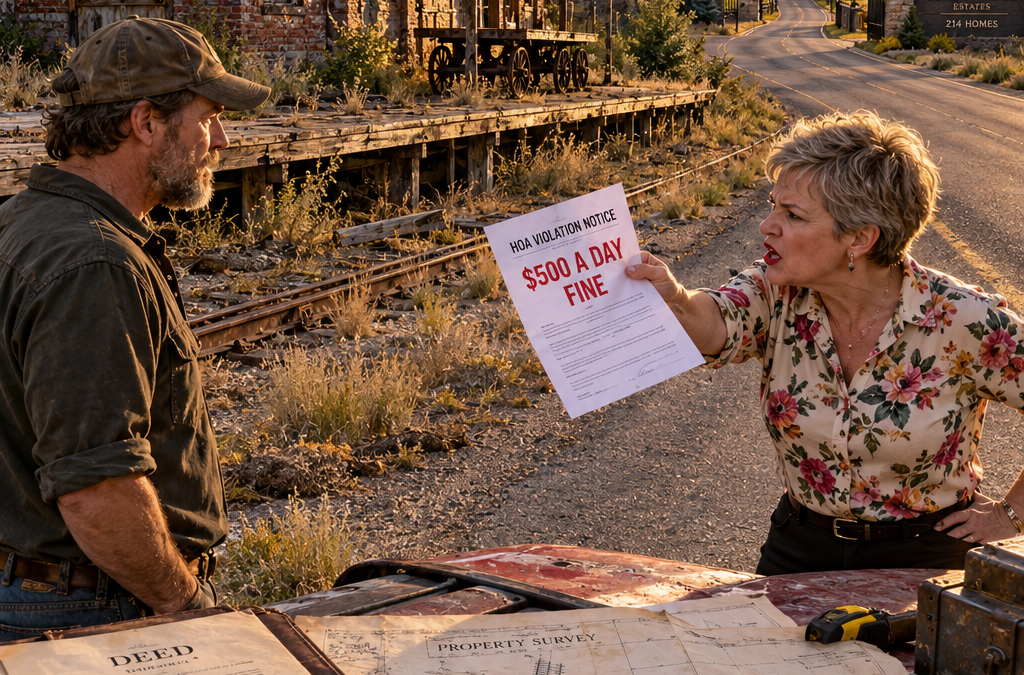
Pamela Whitfield stood in front of the abandoned depot I had just bought, waved an HOA violation notice in my face, and told me the road beside it belonged to her community even though neither the building nor the land had ever been part of her HOA.
What she did not know was that beneath the dust, broken windows, and forty years of neglect sat one old document tying the only road serving 214 homes to the deed in my name.
My name is Cole Brennan.
Six months before Pamela Whitfield threatened to fine me five hundred dollars a day, I was driving into the mountains with my twelve-year-old daughter, Lily, in a pickup truck that sounded as though every hill might be its last.
I had no business plan.
No renovation budget worth mentioning.
No contractor waiting for instructions.
No investors.
No development proposal.
All I had was a memory.
And sometimes a memory can pull harder than logic.
My grandfather, Walter Brennan, had been the last stationmaster at Millbrook Junction.
Back when trains still crossed the valley every day, his whole life revolved around that platform.
Freight in the morning.
Passenger service at noon.
Mail sacks.
Timetables.
Signals.
People kissing goodbye beneath the awning.
Children pressing faces against glass as locomotives pulled in.
My grandfather knew almost everybody who passed through that station.
He knew which farmer shipped apples in September.
Which families had sons coming home from military service.
Which doctors traveled to the city on Thursdays.
Which conductors wanted coffee and which wanted to be left alone.
He worked there for nearly thirty years.
Then the railroad reduced service.
Then reduced it again.
Eventually the trains stopped completely.
But Grandpa never really stopped waiting for them.
I was seven the last summer he took me to Millbrook Junction.
The place was already quiet by then.
Grass growing high near the rails.
Paint peeling.
The timetable board nearly empty.
I remember sitting on the edge of the platform swinging my legs while he stood beside me wearing his old station cap.
He pointed down the valley.
“Every train in this valley used to stop right here.”
I asked him why they didn’t anymore.
He smiled.
“Places change.”
I didn’t like that answer.
“Will they come back?”
He looked toward the rails for a long time.
“Maybe not the trains.”
Then he tapped the wooden platform with his shoe.
“But people still need a way home.”
I was seven.
I had no idea what he meant.
Decades later, I would understand every word.
By the time Grandpa died, the station had passed through multiple corporate hands.
The railroad company abandoned operations.
Assets were consolidated.
The depot deteriorated.
Ownership records became the sort of bureaucratic history nobody cared about because nobody saw much value in a boarded-up station sitting beside an old rail corridor.
Life moved on.
So did I.
I worked construction.
Then property maintenance.
Then small renovation jobs.
Marriage.
Divorce.
Shared custody.
Bills.
The normal collection of compromises adults eventually mistake for a plan.
Lily was the best thing that came out of any of it.
She had my grandfather’s curiosity.
The kind that made a five-minute stop at a hardware store take thirty because she wanted to know why every tool existed.
One evening, we were eating takeout at the small kitchen table in my rented apartment when I found a county tax-auction listing.
I almost scrolled past it.
Then I saw the photograph.
Millbrook Junction Depot.
Boarded windows.
Faded brick.
Roof sagging slightly over the east side.
The caption read:
ABANDONED RAILWAY DEPOT AND ASSOCIATED CORRIDOR.
SOLD AS IS.
I stopped breathing for a second.
Lily leaned over.
“Dad?”
I enlarged the photograph.
She recognized it from old family pictures.
“Is that Grandpa Walter’s train station?”
“Yeah.”
“Can we buy it?”
I laughed.
“No idea.”
“Are you going to try?”
That was the problem with Lily.
She could take a ridiculous thought and ask the one question that made avoiding it feel cowardly.
The auction was three weeks later.
The room was smaller than I expected.
Hot.
Fluorescent lights.
About twenty metal chairs.
Most people were there for tax parcels, not history.
When the depot came up, only two paddles rose.
Mine.
And a man in a gray suit sitting across the aisle.
He looked nervous.
Not sentimental.
Businesslike.
Every time I raised, he raised.
Twenty-eight thousand.
Thirty-two.
Thirty-six.
At forty-one thousand, he looked at his phone.
Someone had apparently sent him a message.
He stared at the screen.
Then lowered his paddle.
The auctioneer looked around.
“Forty-one thousand once.”
My heart pounded.
“Twice.”
I kept thinking someone else would jump in.
Nobody did.
“Sold.”
The gavel came down.
Millbrook Junction belonged to me.
Or so I thought.
After the paperwork, the bankruptcy trustee met me near the front desk.
Her name was Janet Okafor.
Late fifties.
Sharp eyes.
She handed me a ring of rusted keys.
There were probably fifteen on it.
Half looked old enough to open prison cells.
She studied me.
“You’re Walter Brennan’s grandson?”
“Yes.”
“I thought the name sounded familiar.”
I smiled.
“He worked there a long time.”
“So I’ve heard.”
Then she said something that didn’t mean anything to me yet.
“Mr. Brennan, read your deed carefully.”
“I will.”
“Especially the corridor.”
I looked at the paperwork.
“The rail corridor?”
She nodded.
“The corridor comes with the depot.”
“I thought the depot came with the corridor.”
Janet gave me a strange little smile.
“Read your deed.”
Then she walked away.
I should have understood there was a reason she’d repeated it.
I didn’t.
All I cared about was getting Lily up there.
The first time we stood in front of the depot, neither of us spoke.
The place looked worse than the auction photograph.
Graffiti covered the lower bricks.
Nearly every window had plywood nailed over it.
Weeds had grown through the old track bed.
One section of gutter hung like a broken arm.
The platform boards were gray from weather.
A tree had started growing through a crack near the old baggage-room wall.
Lily finally said:
“This is amazing.”
I laughed.
“That’s one word.”
She looked offended.
“You don’t think so?”
I looked at the station.
At the faded MILBROOK JUNCTION lettering barely visible beneath dirt.
At the broken clock inside.
At the place where my grandfather had stood.
“Yeah,” I said. “I do.”
The interior smelled like dust, animal nests, wet wood, and time.
Pigeons exploded out of the ticket office when I opened the door.
Lily screamed.
Then laughed so hard she nearly fell over.
Dust moved through shafts of sunlight like snow.
The big station clock was frozen at 4:17.
There were old benches.
A rusted luggage cart.
Pieces of paper fused to the floor by decades of moisture.
I walked behind the ticket counter.
Placed my hand on the wood.
My grandfather’s hands had rested there.
That shouldn’t have mattered.
It did.
For years, I had moved from job to job repairing things that belonged to other people.
Roofs.
Decks.
Rental units.
Storefronts.
I was good at it.
But standing behind that ruined ticket counter, I felt something I hadn’t felt in years.
I belonged somewhere.
So we started working.
Not restoring.
That word would’ve been too generous.
At first we were simply stopping the building from dying any faster.
I removed plywood from windows that could still be salvaged.
Lily scrubbed benches.
We hauled out rotten timber.
I patched roof sections.
Cleaned gutters.
Replaced temporary locks.
Pulled weeds.
Scraped old paint.
Swept dust that seemed to regenerate overnight.
I spent more money than I intended.
Then a little more.
Then stopped checking the total quite so often.
For the first time in a long time, the work felt personal in the right way.
Something else began bothering me.
Traffic.
Every day, vehicles passed beside the depot.
Delivery vans.
Pickup trucks.
Utility vehicles.
Water service trucks.
Contractors.
A school bus.
They all used the same gravel road running along the old rail corridor.
At first I assumed the road was public.
Why wouldn’t I?
Two hundred houses sat farther up the valley.
People used it constantly.
Then I looked at the parcel map.
The road appeared to cross my land.
Not beside it.
Across it.
I made a mental note.
Nothing more.
A few days later, an older man stopped at the depot.
He carried two coffees.
His name was Hal Puit.
Seventy-one.
Denim jacket.
Gray beard.
He had driven a school bus through that valley for thirty years.
“This one’s black,” he said, handing me a cup.
“How’d you know?”
“Your grandfather drank it that way.”
That caught me.
“You knew him?”
“Everybody knew Walter.”
We sat on the platform.
Hal watched me pull nails from a warped board.
“Folks up the hill are curious.”
“About me?”
“About this place.”
“What do they call it?”
He smiled.
“The eyesore.”
“That’s friendly.”
“You’ll hear worse.”
I looked at him.
He lowered his voice.
“HOA president hates this station.”
“Why?”
“Pamela hates anything she can’t control.”
That was my first warning.
The next morning, a white Lexus pulled onto the gravel.
A woman stepped out.
Mid-fifties.
Perfect cream blouse.
Sunglasses.
Hair that appeared professionally arranged even at nine in the morning.
She walked toward me wearing the expression of someone arriving at a meeting she expected to chair.
“You must be the new owner.”
“Cole Brennan.”
“Pamela Whitfield.”
She didn’t offer her hand.
“President of the Aspen Ridge Homeowners Association.”
I nodded.
Aspen Ridge was the development up the hill.
Two hundred fourteen homes.
Gated side roads.
Clubhouse.
Landscaped entrance.
The entire neighborhood depended on Depot Road to reach the highway.
Pamela looked at the station.
“Wonderful that someone is finally taking responsibility for this.”
I couldn’t tell whether it was praise.
“Trying.”
“Good. There’s just the small matter of community standards.”
“What community?”
Her smile tightened.
“Aspen Ridge.”
“This parcel isn’t inside Aspen Ridge.”
“Oh, boundaries aren’t always that simple.”
“Mine seemed pretty clear at closing.”
She laughed.
Actually laughed.
“Everything this road touches affects Aspen Ridge.”
“Affects isn’t the same as belongs to.”
Her eyes sharpened.
“This road is maintained for our community.”
“By who?”
“The association.”
I looked at the gravel.
Then back at her.
“Okay.”
She seemed disappointed I didn’t argue.
“You’ll receive our standards.”
“I’m not a member.”
“Mr. Brennan, people have tried taking that attitude before.”
“People who owned this parcel?”
She paused.
Then smiled again.
“We’ll talk.”
She left.
The next morning, an envelope was taped to the depot door.
ASPEN RIDGE HOA.
NOTICE OF VIOLATION.
UNSIGHTLY STRUCTURE.
UNAUTHORIZED DEBRIS.
PROPERTY MAINTENANCE NONCOMPLIANCE.
Signed:
Pamela Whitfield
President
I peeled it off.
Folded it.
Put it in my pocket.
More arrived.
One for construction materials visible from the road.
One for unapproved exterior work.
One for nuisance debris.
Then fines.
Five hundred dollars per day.
I remember standing at the counter reading that number.
Five hundred.
Every day.
For repairing a building Pamela didn’t own.
On land Aspen Ridge didn’t own.
Beside a road I was increasingly suspicious they didn’t own either.
That night, Lily found the notices stacked on our temporary kitchen table inside the old station office.
“Dad?”
“Yeah?”
“Are we in trouble?”
I looked at her.
Children have a way of cutting through adult pride.
I had been amused by the notices until that question.
“No.”
“Then why do they say money?”
“Because somebody thinks she can charge us.”
“Can she?”
I crouched.
“Not even close, sweetheart.”
She looked at me.
I smiled.
“We just haven’t shown our cards yet.”
The truth was, I wasn’t completely sure what our cards were.
Not yet.
Then Craig Mullins came.
Craig was Aspen Ridge’s vice president.
Heavyset.
HOA polo shirt.
Camera.
He photographed the depot from every angle.
Windows.
Roof.
Lumber pile.
Dumpster.
I walked over.
“Can I help you?”
He looked embarrassed.
“I’m just doing my job.”
“Does your job normally involve photographing private property outside the HOA?”
He lowered the camera.
“Pamela asked me.”
“That wasn’t my question.”
He wouldn’t meet my eyes.
“I’m just doing my job.”
I heard that phrase three more times before he left.
I almost felt sorry for him.
Then came the lumber truck.
That was when Pamela stopped pretending this was paperwork.
A delivery truck arrived carrying replacement framing and treated boards.
Pamela drove her Lexus directly across the entrance to the depot and blocked him.
The driver called me.
“Got a lady saying I can’t enter.”
I walked down.
Pamela stood beside the Lexus.
Violation papers in her hand.
“You cannot do this here, Cole.”
“I’m receiving lumber.”
“It’s a clear violation.”
“This isn’t your property.”
“I’m making it my business.”
She pointed toward the road.
“This road is ours.”
I looked at her.
For the first time, I didn’t feel even slightly intimidated.
“No.”
Her eyebrows lifted.
“It’s mine.”
The driver looked between us.
Pamela stared.
I stepped closer.
Not threatening.
Just enough so I didn’t have to raise my voice.
“If you believe I’m wrong, bring me the deed.”
Her jaw tightened.
She got into the Lexus.
Moved.
That night, I couldn’t sleep.
I returned to the depot after Lily was in bed at Hal’s house.
Flashlight.
Work gloves.
I decided to clean the old ticket office because physical work was easier than thinking.
Behind the counter, one floorboard sounded different when I stepped on it.
Hollow.
I pried it up.
There was a steel box beneath it.
Rusty.
About the size of a large toolbox.
One set of initials had been scratched into the lid.
W.B.
My hands actually shook.
The lock had already rusted apart.
Inside were railroad papers.
Old schedules.
Copies of correspondence.
Property maps.
Photographs.
And one envelope.
COLE.
Written in my grandfather’s handwriting.
I sat on the floor.
For several seconds, I couldn’t open it.
Then I did.
Son,
If you ever come back, remember the railroad never owned everything people thought it owned.
We protected the corridor because everybody depended on it.
Don’t let anyone forget what the station was for.
People still need a way home.
I read those lines until they blurred.
At the bottom of the box was a document dated 1988.
ROAD CROSSING LICENSE.
The railroad had granted a developer permission to construct and use a road across the corridor.
The language was specific.
License.
Not easement.
Revocable.
Dependent upon continued railroad ownership and operation.
Termination upon abandonment or conveyance of the corridor unless replaced by a separately recorded agreement.
I stopped breathing.
The railroad had ceased operating.
The corridor had been sold.
To me.
At sunrise, I was waiting outside the county recorder’s office.
The clerk was a woman named Margaret Ellis.
I handed her the parcel description.
“I’m looking for an easement covering Depot Road.”
She searched.
Then searched again.
Different index.
Older records.
Subdivision filings.
Finally she looked up.
“Mr. Brennan.”
“Yes?”
“There isn’t one.”
“What about Aspen Ridge?”
“I see plats.”
“Road rights?”
“Not recorded against your parcel.”
“What does that mean?”
“I’m not giving legal advice.”
“I understand.”
“It means you need a lawyer.”
I drove directly to Elena Ruiz.
Real estate attorney.
Efficient.
No patience for drama.
She spread the deed, license, parcel maps, and subdivision plans across a conference table.
Marked the depot in red.
Then the road.
Then utility lines.
“Water main crosses here.”
She traced it.
“Power.”
Another line.
“Fiber.”
Another.
“And Depot Road.”
I stared.
“All on the corridor?”
“Your corridor.”
“Allowed by what?”
“At one time? The railroad license.”
“And now?”
She sat back.
“I don’t see a recorded permanent easement.”
I thought of the school bus.
Hal.
Families.
Ambulances.
Two hundred fourteen homes.
Elena looked directly at me.
“You could potentially restrict access.”
“No.”
She waited.
“I don’t want to shut anyone’s road.”
“Good.”
“People live there.”
“Yes.”
“Kids.”
“Yes.”
“Somebody needs an ambulance tonight, I’m not becoming the reason it can’t get through.”
Elena nodded.
“So what do you want?”
I thought about Pamela.
Five-hundred-dollar notices.
Her Lexus.
Her saying the road was hers.
Then Grandpa’s letter.
“Respect.”
Elena raised an eyebrow.
“Legally.”
“I want them to talk to me like a neighbor.”
“That’s harder to draft.”
“Try.”
She smiled.
“Then let’s give them a fair chance.”
We sent Aspen Ridge a certified letter.
Thirty days’ notice.
Not notice of closure.
Not a toll demand.
An invitation.
We explained the title issue.
The expired crossing license.
The absence of a recorded permanent easement.
We offered to negotiate a permanent agreement protecting roadway and utility access for the residents.
No threats.
No surprise barriers.
No traps.
Thirty days.
Lily helped seal the envelope.
She pressed the stamp down with one finger.
“Where’s it going?”
“HOA office.”
“To the mean lady?”
I tried not to laugh.
“Pamela.”
“Same thing.”
“Lily.”
“Sorry.”
She looked at the envelope.
“Please say yes, Grandpa’s road.”
I felt something in my throat tighten.
“Yeah.”
Pamela signed for the letter herself.
I later learned exactly what she did after reading it.
She tore it in half.
Then quarters.
Then stormed to the depot.
She arrived carrying a cease-and-desist notice.
“Forgery.”
That was the first word out of her mouth.
I was repairing a window frame.
“What?”
“Your so-called license.”
“It’s recorded in the railroad archive.”
“This is fabricated.”
I held up my deed.
“Thirty days, Mrs. Whitfield.”
“You have no authority over Aspen Ridge.”
“Correct.”
That confused her.
“I have authority over my land.”
She ripped my copy of the notice in half.
“You will regret this.”
I reached into the truck.
Handed her another copy.
“I made plenty.”
For the first time, I saw real hatred in her face.
That evening, Hal sent me a video.
Aspen Ridge board meeting.
Pamela stood behind a podium.
She told the room:
“That man is squatting on our road and intends to charge residents a toll.”
I watched it twice.
Squatting.
My deed was on record.
Toll.
I had never mentioned one.
But people believed her.
Why wouldn’t they?
She was president.
She had a microphone.
I was the strange man renovating the eyesore at the bottom of the hill.
The next morning, residents marched toward the depot.
Dozens.
Signs.
OUR ROAD.
SAVE DEPOT ROAD.
NO TOLLS.
One sign said:
STOP THE LAND GRAB.
I almost admired that one.
Lily stood beside me on the platform.
She squeezed my hand.
“Dad?”
“We’re okay.”
Hal stood on my other side.
“Want me to say something?”
“No.”
I stepped forward.
People shouted questions.
“Are you closing the road?”
“No.”
“Are you charging us?”
“No.”
“Why are you threatening the HOA?”
“I’m not.”
One woman shouted:
“Pamela said you want to block emergency vehicles.”
“That’s not true.”
A man near the front held up my certified letter.
Or what looked like a photocopy.
“Then what’s this?”
“An offer to guarantee your access permanently.”
The crowd quieted slightly.
I continued.
“I’m not shutting anything. I’m asking your association to negotiate an easement because there isn’t one recorded now.”
Someone shouted:
“We already have rights!”
“Then show me the document.”
Silence.
“I’m not asking you to believe me today. I’m asking you to look.”
That did not win the crowd.
But it stopped the shouting long enough for some people to listen.
Two nights later, I woke to machinery.
Deep engine rumble.
Not a truck.
Heavy equipment.
I pulled on boots.
Ran outside.
Headlights moved through darkness.
A rented excavator crawled up Depot Road.
Behind it:
White Lexus.
Pamela.
I felt fear then.
Real fear.
Not for my pride.
For the building.
My grandfather’s station.
I ran toward the platform.
The excavator stopped.
Operator inside.
Pamela lowered her window.
“Move.”
“What are you doing?”
“Removing an unsafe structure.”
“Who authorized this?”
“The HOA.”
“You don’t own it.”
“You have been ordered repeatedly to comply.”
The excavator bucket lifted.
I stood in front of the depot.
Hands raised.
The operator stopped about three feet away.
I saw his face through the glass.
He looked uncertain.
Pamela leaned out.
“Knock it down!”
He didn’t move.
“I said knock it down. I’ll take responsibility.”
Then headlights appeared behind them.
Sheriff’s cruiser.
Deputy Tom Hayes stepped out.
Hand near his belt.
Not weapon.
Just alert.
“Everybody stop.”
He looked at the excavator.
Then Pamela.
“Who ordered demolition?”
“The HOA.”
I handed him my deed.
He read.
Checked parcel number.
Called dispatch.
Waited.
Pamela talked continuously.
Unsafe property.
HOA authority.
Road access.
Community standards.
Tom listened.
Then gave the deed back.
“Ma’am, this parcel is privately owned.”
“The road belongs to—”
“I’m talking about the depot.”
“It’s within our influence area.”
“That doesn’t create ownership.”
The excavator operator climbed down.
“Noboby told me this was private.”
Tom looked at him.
“You have a demolition permit?”
The operator shook his head.
“Work order?”
He held up paperwork.
Tom read it.
Then looked at Pamela.
“Ordering demolition on property you don’t own can become a criminal issue.”
Pamela’s face flushed.
“Do you know who I am?”
Tom looked at her for a moment.
“Yes, ma’am.”
She seemed satisfied.
Then he finished.
“The person who gave the order.”
Hal still laughs when he tells that part.
I didn’t laugh that night.
I was too tired.
The excavator left.
Pamela left.
I stood alone beneath the old station clock shaking.
Not from cold.
If Tom had arrived five minutes later, the building might have been gone.
The next evening, I received an email from Janet Okafor.
The trustee.
Mr. Brennan,
I’ve received several calls from the Aspen Ridge HOA president.
I believe we need to talk.
Please bring your attorney.
I read it three times.
Why was Pamela calling the trustee?
Elena and I met Janet the next morning.
She had a folder waiting.
“Pamela Whitfield contacted me before the auction.”
My stomach tightened.
“Why?”
Janet opened the file.
“In 2023, the trustee offered the corridor to Aspen Ridge for sixty thousand dollars.”
I stared at her.
“The HOA?”
“Yes.”
“Did they refuse?”
“They never responded.”
She slid a certified-mail receipt across the table.
Signed:
P. Whitfield.
Pamela.
Elena leaned forward.
“Was this disclosed to the board?”
Janet shrugged.
“You’ll have to ask them.”
Then she turned a page.
Business registration.
WHITFIELD RIDGE HOLDINGS LLC.
Registered organizer:
Pamela Whitfield.
I looked at Janet.
“What is this?”
“The other interested buyer.”
I felt the auction room return to me.
Gray suit.
Nervous bidder.
Phone message.
Janet continued.
“Whitfield Ridge contacted the trustee separately.”
“Pamela tried to buy the corridor personally?”
“Through the company.”
“After receiving the HOA offer?”
“Yes.”
I stopped talking.
There are moments when anger becomes so complete it becomes silent.
Janet pushed forward an email.
From Whitfield Ridge Holdings.
Interested in corridor acquisition.
Potential buyers identified.
Plan to demolish depot.
Resell or restructure access rights.
I read that line again.
Resell access rights.
Elena spoke first.
“She wanted to buy the road cheap and sell access back to the residents.”
Janet nodded.
“That’s what the correspondence suggests.”
Everything suddenly made sense.
The fines.
The insistence the road belonged to Aspen Ridge.
The attempt to stop my renovation.
The demolition order.
Pamela hadn’t merely been defending HOA authority.
She had been protecting a private business plan.
She had hidden the trustee’s sixty-thousand-dollar offer from her own board.
Then created a company.
Bid against me through someone else.
Planned to bulldoze the depot.
Acquire the corridor.
And place herself between 214 families and the road they needed to reach home.
That night someone knocked at the depot.
Craig Mullins.
No HOA polo.
Cap in both hands.
He looked ten years older than the last time I’d seen him.
“Can I come in?”
I stepped aside.
He saw the trustee documents on the table.
His face collapsed.
“She never showed us.”
“The offer?”
He nodded.
“Nothing. She told us the corridor was already association property.”
“What about Whitfield Ridge?”
“Never heard of it.”
“Craig.”
He looked at me.
“Did the board approve demolition?”
His eyes watered.
“No.”
That answer surprised me.
“Pamela said emergency authority.”
“Did anyone vote?”
“No.”
He sat down.
“I believed her.”
I didn’t answer.
“I’m sorry.”
“For photographing my property?”
“Everything.”
He rubbed both hands over his face.
“She told us you were trying to extort the neighborhood.”
“I offered free negotiations for permanent access.”
“I know that now.”
He looked around the depot.
At the repaired windows.
Clean benches.
Grandfather’s old counter.
“What do you want?”
“People to get home.”
Craig stared.
“After all this?”
“Those families didn’t order the excavator.”
He nodded slowly.
Then something changed in him.
“I’m calling a meeting.”
Aspen Ridge’s emergency meeting packed the clubhouse.
All 214 homes had received notice.
Not every owner attended, but the room was overflowing.
People stood along walls.
Hallway.
Back doors.
Pamela stood at the podium wearing a cream blouse.
Perfect.
Controlled.
She still believed she owned the room.
I stood in the back beside Hal.
Elena sat in the third row carrying a briefcase.
Craig opened the meeting.
Pamela immediately tried to take control.
“This meeting has been called due to misinformation being distributed by an outside landowner—”
Craig interrupted.
“Elena Ruiz represents Mr. Brennan. She has documents.”
Pamela’s face changed.
“No outside counsel will address this board without approval.”
A resident shouted:
“Let her talk.”
Pamela struck the podium with her palm.
“This is an association meeting.”
Craig looked at the room.
“All in favor of allowing Ms. Ruiz to present?”
Hands rose.
Everywhere.
Pamela stared.
Craig counted.
“Motion carries.”
Elena stood.
No theatrics.
She connected a laptop to the projector.
First document.
2023 certified letter from the trustee offering Aspen Ridge the corridor for $60,000.
Receipt.
P. Whitfield.
Murmurs.
Pamela spoke.
“Routine correspondence.”
Elena advanced.
Board minutes.
No disclosure of the offer.
Next.
Whitfield Ridge Holdings LLC.
Registered to Pamela Whitfield.
The room changed.
Someone behind me said:
“What the hell?”
Pamela lifted her voice.
“That company is unrelated.”
Elena advanced.
Email from Whitfield Ridge.
Interested in corridor.
Potential buyers.
Depot demolition.
Resale of access rights.
Silence.
Not quiet.
Silence.
The kind of silence where people stop shifting in chairs.
Pamela’s face went pale.
“It’s out of context.”
Hal stood.
Seventy-one years old.
Denim jacket.
School bus driver.
His voice wasn’t loud.
“Pam.”
She looked at him.
“My wife goes to the hospital twice a month.”
Nobody moved.
“You were going to buy our road without telling us?”
“No.”
“The email says—”
“That’s not what it means.”
“Then what does it mean?”
Pamela opened her mouth.
Nothing came.
Hands began rising.
Questions.
Dozens.
Why wasn’t the trustee offer disclosed?
Who authorized demolition?
Who approved the daily fines?
Did HOA funds pay lawyers connected to her private purchase attempt?
Who was the gray-suited bidder?
Had Pamela planned to charge residents?
Why had she said Cole was a squatter?
Craig stood.
“Motion for no confidence.”
Another board member seconded.
Pamela stared at him.
“You can’t do this.”
Votes were taken.
Unanimous.
Even board members who had supported Pamela voted against her.
At the back of the hall, Deputy Hayes stepped forward.
He had been standing quietly against the wall.
Pamela saw him.
Her expression changed again.
Tom handed her paperwork.
“A summons related to the attempted demolition order.”
She looked at it.
Then at me.
“The county attorney will also be reviewing additional materials.”
Pamela’s eyes found mine.
I didn’t smile.
Didn’t speak.
I had imagined that moment.
Thought I would enjoy it.
I didn’t.
Mostly, I felt tired.
All of this because one woman could not accept that ownership existed outside her authority.
The following week, Craig became interim president.
He asked the entire remaining board to meet at the depot.
They arrived carrying coffee.
No violation notices.
No cameras.
No threats.
One woman brought banana bread.
I appreciated that most.
Craig spoke first.
“Mr. Brennan, we’re sorry.”
I nodded.
Then he asked:
“What do you want?”
That question.
Finally.
Not what do you intend to take?
Not how much will you charge?
Not when will you close the road?
What do you want?
I looked at Lily.
She sat on one of the restored benches swinging her legs exactly the way I had when I was seven.
Then I thought about Grandpa.
People still need a way home.
“I want a permanent recorded easement.”
Craig looked surprised.
“For Aspen Ridge?”
“Road access. Water. Power. Fiber. Everything currently crossing my corridor.”
“Permanent?”
“Yes.”
“What would it cost?”
“Not a toll.”
Nobody spoke.
“I want a shared maintenance fund. Reasonable contribution for the road and utility corridor.”
Craig nodded.
“Fair.”
“And one condition.”
The board tensed.
“The depot stays.”
Craig looked around.
“Meaning?”
“No demolition. No HOA claim. No forced architectural standards. Millbrook Junction is preserved.”
A woman on the board smiled.
“That’s it?”
“That’s it.”
“You could ask for a lot more.”
“I know.”
Why didn’t I?
Because my grandfather hadn’t hidden that box so his grandson could become a different version of Pamela.
Because ownership is not the same thing as entitlement.
Because power reveals people.
Pamela had discovered leverage and tried to monetize her neighbors’ dependence.
I had discovered the same leverage.
I wanted to remove it permanently.
Nobody should ever be able to hold 214 households hostage over that road again.
Including me.
Elena drafted the documents.
Road easement.
Utility easements.
Maintenance responsibilities.
Emergency access.
Repair procedures.
Recording requirements.
Permanent rights attached to the Aspen Ridge properties.
No informal permission.
No revocable license.
No handshakes.
Recorded.
Forever.
We signed at the county recorder’s office.
The same counter where weeks earlier I had heard:
There isn’t an easement.
This time Margaret Ellis smiled.
“Big day?”
“You could say that.”
Lily was there.
I let her press the official recording stamp onto our copy.
She stared at it.
“Now it’s forever, right, Dad?”
“Right.”
“They can’t lose the road?”
“No.”
“What if we sell the train station?”
“The easement stays.”
“What if they get another mean president?”
I laughed.
“The easement stays.”
She smiled.
“Good.”
The residents came back to Millbrook Junction the next Saturday.
No signs.
No shouting.
They brought ladders.
Paint.
Tools.
Food.
Casseroles.
Way too many casseroles.
Hal arrived carrying the toolbox he’d used during his years driving a school bus.
“Why do you have bus tools?”
“Same reason you have forty keys for one depot.”
“Fair.”
Craig brought two teenage sons.
They scraped graffiti.
A retired carpenter rebuilt a section of platform railing.
Someone donated reproduction windows matching old photographs.
A woman named Denise spent hours cleaning the old brass door hardware.
One family brought a pressure washer.
Another brought historical photographs.
For weeks, the depot changed.
Not into something new.
Back into itself.
That distinction mattered.
We didn’t want a fake theme park.
We wanted Millbrook Junction.
Brick cleaned.
Windows returned.
Ticket counter repaired.
Wall clock restored.
Old benches refinished.
A local electrician rewired the interior.
Hal found an old brass station bell in storage at his brother’s barn.
Nobody could prove it was the original.
We used it anyway.
Then we hung the new sign.
MILLBROOK JUNCTION DEPOT
ESTABLISHED 1931
On opening day, Lily cut the ribbon.
I let her use oversized ceremonial scissors someone from the town supplied.
She nearly dropped them.
Everyone laughed.
Hal rang the brass bell.
The sound rolled down the valley.
For one second, I was seven again.
My feet swinging over the platform.
Grandpa beside me.
Every train in the valley used to stop right here.
I held his letter in my pocket.
I swear I could hear him.
Well done, son.
Maybe I imagined it.
I don’t care.
Late that afternoon, a white Lexus came down Depot Road.
Pamela.
She drove slowly past the station.
Past the neighbors.
Past the fresh sign.
Past the platform she had ordered demolished.
She did not look at us.
Then she continued down the same road she once intended to control.
A road she could use because my signature guaranteed she always could.
I thought that might bother me.
It didn’t.
That was the whole point.
The easement did not depend on whether I liked Pamela.
Road rights should not depend on personality.
Emergency access should not depend on who wins an HOA election.
Families should not have to wonder whether someone with a deed will wake up angry.
That was what my grandfather had understood.
The railroad’s old license had been temporary.
A practical arrangement.
It worked until it didn’t.
What we signed was different.
Permanent.
Transparent.
Recorded.
Nobody could hide it in a drawer.
Nobody could quietly buy the corridor and resell permission.
Nobody could lie at a podium and claim ownership that didn’t exist.
Not Pamela.
Not Craig.
Not me.
The depot became a community historical center.
Small.
Nothing grand.
One room held photographs and railroad records.
Another became a meeting space.
We displayed Grandpa’s station cap.
Old tickets.
Tools.
Maps.
The 1988 road license went into a glass case.
Beside it sat a copy of the permanent easement.
Lily suggested the display title:
HOW A TEMPORARY ROAD BECAME FOREVER.
I told her it sounded dramatic.
She said:
“You like dramatic.”
I denied it.
She ignored me.
One afternoon months later, Craig stopped by alone.
He stood looking at the original HOA violation notice framed near my desk.
Five hundred dollars per day.
Unsightly structure.
Unauthorized debris.
He laughed.
“You framed that?”
“Absolutely.”
“I signed one of those.”
“I know.”
He looked embarrassed.
“I still feel bad about that.”
“You apologized.”
“Doesn’t erase it.”
“No.”
He waited.
“I don’t think erasing things is the point.”
“What is?”
“Remembering them correctly.”
He nodded.
The board changed after Pamela.
Financial disclosures became stricter.
Property claims required legal verification.
No president could authorize major action without recorded board approval.
Anything involving property outside the community boundary required counsel review.
That last one made me laugh.
It should not require a rule telling an HOA not to bulldoze property it doesn’t own.
Apparently it did.
Aspen Ridge changed too.
Not overnight.
Some residents remained suspicious of me.
A few never apologized for marching with signs.
I didn’t need them to.
Fear makes people believe things quickly.
Pamela had told 214 households that I intended to close their only road.
If somebody told me a stranger was about to block Lily from reaching school or a hospital, I might have marched too.
What mattered was what happened after the truth came out.
Most people adjusted.
That’s more than Pamela did.
Lily and I eventually moved into a small apartment we built above part of the depot office.
Nothing fancy.
One bedroom for me.
One for her.
Kitchen.
Windows facing the mountains.
At night, headlights from Depot Road move across the old platform wall.
School bus in the morning.
Delivery vans.
Ambulances occasionally.
Families coming home.
The traffic used to irritate me when I first bought the place.
Now I like hearing it.
It means the road works.
Hal still drives through even though he’s retired.
Sometimes in his pickup.
Sometimes he stops.
Coffee.
Always black.
Once, sitting on the platform, he asked:
“You ever think about what would’ve happened if Pamela got it?”
“The corridor?”
“Yeah.”
I had thought about it.
Often.
Whitfield Ridge Holdings buys the property.
Depot demolished.
Access rights questioned.
Residents frightened.
Then some kind of agreement offered.
Maybe expensive.
Maybe not.
But one woman would have positioned herself between hundreds of families and their ability to reach the highway.
“She would’ve made money.”
Hal nodded.
“Probably.”
“Until somebody sued.”
“Probably.”
He stared down the road.
“Still would’ve hurt people first.”
“Yeah.”
He took a drink.
“Your grandfather would have hated that.”
“I know.”
The strangest part is that Pamela nearly succeeded because everyone assumed the road belonged to the neighborhood simply because everyone used it.
Usage looked like ownership.
Habit looked like law.
Confidence filled the gap where documents should have been.
Pamela understood that.
Or exploited it.
For years, nobody asked to see the easement because nobody imagined there wasn’t one.
The road existed.
Therefore the right must exist.
That’s how people think.
Usually they’re right.
Sometimes they’re very wrong.
If I had never purchased the depot, the issue might have remained hidden for another decade.
If another buyer had acquired it, maybe they would have discovered the same leverage and used it differently.
That’s what frightens me most.
Property rights do not become safe because the current owner happens to be decent.
They become safe when they’re documented correctly.
That is why I insisted on recording the easement.
I didn’t want Aspen Ridge trusting me.
Trust doesn’t transfer with deeds.
Documents do.
Elena said something the day we signed.
“A good agreement is one nobody has to remember emotionally.”
I asked what that meant.
“It shouldn’t matter whether the parties like each other five years from now.”
That became my favorite definition of good property law.
I didn’t need Aspen Ridge to love me.
They didn’t need me to love them.
The recorded easement did the work.
Pamela had wanted everything to depend on her.
Her title.
Her interpretation.
Her company.
Her influence.
My grandfather had believed the opposite.
Build the system so people can get home after you’re gone.
That difference explains almost everything.
Lily is older now.
She still tells people Millbrook Junction belongs to “our family,” even though I’ve explained several times that ownership is more complicated than that now.
The depot is mine.
The easements belong to the properties they serve.
The historical preservation agreement limits what future owners can do.
She rolls her eyes when I explain.
“So Grandpa’s place.”
“Basically.”
“Then why did you say all that other stuff?”
“Because words matter.”
“Lawyer Elena has ruined you.”
Probably.
I keep Grandpa’s original letter locked in a fireproof cabinet now.
Not under a floorboard.
I’ve read it enough that I know every line.
People still need a way home.
I used to think he meant trains.
Maybe he did when he wrote it.
Maybe he meant the road.
Maybe he meant something bigger.
A station isn’t really about buildings.
Neither is a road.
They’re about connection.
A way from one place to another.
A way back.
Grandpa understood that because he spent decades watching people arrive and leave.
Pamela saw the road and thought leverage.
I saw it and eventually understood responsibility.
That’s why, when people ask whether I wish I had charged the HOA millions for the easement, the answer is no.
Could I have demanded more?
Probably.
Could I have made Pamela’s old neighbors pay dearly for years of unauthorized use?
Maybe.
Would that have made me feel powerful?
For about five minutes.
Then I’d have become exactly what I had accused Pamela of being.
Someone using dependence as leverage.
The maintenance fund was enough.
Aspen Ridge contributed to resurfacing.
Drainage.
Snow removal.
Utility repairs affecting the corridor.
Fair costs.
Shared responsibility.
Nobody paid simply for the privilege of reaching home.
That’s the outcome I’m proud of.
Not Pamela losing office.
Not the summons.
Not exposing Whitfield Ridge.
Those things were necessary.
But punishment is not the same as resolution.
The best ending was 214 families gaining something they had never actually possessed before:
certainty.
Their road.
Forever.
Not because the HOA president claimed it.
Because the deed said so.
One winter morning, snow covered the valley.
Lily and I stood on the platform watching a school bus climb Depot Road.
Hal wasn’t driving anymore.
A younger woman had the route.
The bus slowed near us.
Several kids waved through the windows.
Lily waved back.
“Dad?”
“Yeah?”
“Do you think trains will ever come back?”
I smiled.
Grandpa’s question.
Forty years later.
“Probably not.”
She looked down the rails.
“That’s sad.”
“Maybe.”
Then I looked at the bus disappearing toward Aspen Ridge.
“But people still have a way home.”
She didn’t understand why that made me emotional.
One day she might.
Pamela Whitfield had walked into my life believing authority was something you declared loudly enough.
She had an HOA title.
A Lexus.
Violation notices.
A board that trusted her.
Neighbors who believed her.
I had a ruined depot, an old deed, and a box under a floorboard.
At first glance, she looked powerful.
I looked ridiculous.
That is why documents matter.
They don’t care who looks important.
The deed did not care that Pamela ran meetings.
The crossing license did not care that Aspen Ridge had 214 homes.
The recorder’s office did not care that everyone had used the road for decades.
Ownership did not change because Pamela said, “This road is ours.”
The truth was sitting quietly in paper nobody had bothered to read.
Once we did, everything changed.
The fines stopped.
The demolition stopped.
The false story stopped.
The board changed.
The road became protected.
The depot survived.
And the people who once marched against me eventually helped me paint the same bricks Pamela wanted torn down.
I still have one of those protest signs.
OUR ROAD.
Hal found it in his garage months later.
He brought it to me.
“Thought you might want this.”
“Why?”
“History.”
I turned it over.
On the back, Lily wrote in marker:
NOW IT REALLY IS.
I framed that too.
It hangs beside the old violation notice.
One represents what people believed.
The other represents what we finally made true.
There is a difference.
That difference is the whole story.
Pamela told me I couldn’t repair a building on my own land.
She fined me five hundred dollars a day.
She told 214 families I planned to take away their road.
She ordered an excavator toward my grandfather’s depot.
She hid an offer that could have protected the neighborhood.
She created a company to buy the corridor privately.
She planned to demolish the station and resell access rights.
And in the end, none of those things gave her what she wanted.
Because she never owned the one thing she kept claiming.
The road.
I did.
And the first truly meaningful thing I did with that ownership was make sure nobody could ever weaponize it again.
Not even me.
That is what Grandpa had been trying to tell me all along.
Ownership isn’t only about what you can stop.
Sometimes it’s about what you make permanent.
The building is still standing.
The bell still rings.
The road remains open.
Every school morning, every ambulance run, every delivery truck, every family coming home passes the same platform where my grandfather once watched trains arrive.
Pamela’s white Lexus disappeared from Aspen Ridge not long after the investigation and summons.
I heard she sold her house.
I never asked where she went.
It didn’t matter.
Her name isn’t on the easement.
Neither is mine in any way that lets me revoke it.
That’s the beauty of it.
People come and go.
Titles change.
Boards change.
Owners change.
The road remains.
And every time headlights move past the depot after dark, I think about the afternoon Pamela stood in front of me with that violation notice and said:
“This road is ours.”
Back then, she was wrong.
Now, finally, she would be right.
Not because she took it.
Because I gave 214 families something better than permission.
I gave them a recorded right no future owner could take away.
My grandfather spent thirty years helping people get home.
It took me much longer to understand what he had been protecting.
In the end, I didn’t save an abandoned station.
The station taught me what was worth saving.








