𝗙𝗨𝗟𝗟 𝗦𝗧𝗢𝗥𝗬 The HOA President Circled $1,800 in Red and Decided My House Was Hers to Control
𝗙𝗨𝗟𝗟 𝗦𝗧𝗢𝗥𝗬
Her eyes moved past me toward the garage.
“You planning any exterior modifications?”
I had been standing there less than thirty seconds.
“I’m planning to get my plates out of this box.”
She stared at me for a beat, like she couldn’t decide whether I was joking.
Then she smiled again.
“Just remember that exterior changes need approval.”
“Got it.”
She walked away without asking where I had moved from, whether I needed anything, or whether I had managed to get the electricity turned on.
That should have told me something.
But at the time, I found it more strange than threatening.
I put the binder on a shelf in my office.
Unlike Patrice, I actually read it.
That habit had followed me throughout my adult life.
I read contracts.
I read disclosures.
I read the little paragraph everyone scrolls past.
I read definitions, exceptions, appendices and amendments.
Most people saw paperwork as an obstacle between themselves and the thing they wanted.
I saw paperwork as the thing that told you what everyone was allowed to do once they got what they wanted.
For six years, that had been my profession.
I was a litigation consultant.
Law firms brought me in when a case depended on documentation—contracts, correspondence, timelines, property records, governance documents, business agreements, procedural failures.
My work was not glamorous.
Nobody kicked open courtroom doors.
I sat in rooms with bankers’ boxes and spreadsheets and found the sentence everyone else had overlooked.
Sometimes that sentence was worth millions of dollars.
Sometimes it proved somebody had been lying for six years.
And sometimes, apparently, it proved that a homeowners association president had invented a rule because nobody in her neighborhood had bothered to read twenty-two pages.
I didn’t know that yet.
In March, the first notice arrived.
It was titled FRIENDLY REMINDER.
My mailbox post, according to the letter, exceeded the approved height by four inches.
I walked outside with a tape measure.
Three inches.
I measured again.
Still three.
I considered calling the HOA.
Then I looked at the amount of time it would take me to argue about one inch versus the amount of time it would take me to adjust the post.
I chose peace.
That Saturday, I fixed it.
Three days later, Patrice appeared at my curb.
I was carrying groceries inside when I noticed her.
She had the clipboard.
Of course she did.
She crouched next to the mailbox with a small tape measure, stood, wrote something down, then walked toward me.
“Looks better,” she said.
“Glad you approve.”
Her smile tightened.
“We just like to keep Brindlewood looking a certain way.”
“Sure.”
“Community standards matter.”
“I fixed it.”
She glanced toward the mailbox again.
“I see that.”
The conversation should have ended there.
Instead, she stayed in my driveway.
“It’s easier when homeowners cooperate early.”
Something about the sentence caught me.
Not because of what she had said.
Because of the word cooperate.
As though the HOA and the homeowners were opposing sides.
As though she had been expecting resistance.
I set the grocery bag on the hood of my truck.
“Patrice, you sent me a notice. I fixed the mailbox. We’re good.”
She gave me a look that managed to be polite and condescending at the same time.
“For now.”
Then she walked away.
I remember watching her go and thinking she took this position far too seriously.
I still didn’t see the danger.
By June, the notices had developed a rhythm.
One appeared because my trash cans were visible eleven minutes after the neighborhood concealment deadline.
Eleven minutes.
The truck had come late.
I had been on a conference call.
By the time I wheeled the bins behind the side fence, Patrice had already photographed them.
Fifty dollars.
I called.
“Eleven minutes?” I asked.
Patrice herself answered.
“The rule says six.”
“The collection truck didn’t arrive until after five-thirty.”
“That’s not the association’s responsibility.”
“So, residents are supposed to hide the bins while the garbage company is still using them?”
A pause.
Then that calm, clipped voice.
“Rules are rules, Mr. Ruiz.”
I looked at the notice.
“You photographed my house at 6:11.”
“Yes.”
“You were waiting?”
Another pause.
“I was conducting an inspection.”
I leaned back in my chair.
“At six in the evening?”
“Community standards don’t end at five.”
That phrase stayed with me.
Community standards.
Patrice used it the way a prosecutor might say evidence.
I paid the fifty dollars.
Not because I agreed with it.
Because fifty dollars wasn’t worth my time.
That turned out to be exactly what Patrice counted on.
The next notice involved my vegetable garden.
I had four tomato plants along the side of my house where they got the best afternoon sun.
The plants were healthy, tied neatly to stakes and barely visible from the street.
According to Patrice, they violated the neighborhood’s “uniform landscaping aesthetic.”
I searched the governing documents.
No such phrase existed.
I searched again.
Nothing.
I called Cheryl, the HOA treasurer.
Cheryl had a nervous voice, the kind that always sounded like she was apologizing for the sentence before she finished saying it.
“I’m looking at this landscaping violation,” I said. “What section is Patrice citing?”
Keys clicked in the background.
“I think it falls under general exterior standards.”
“Which section?”
Another few clicks.
“I’ll need to check.”
“Can you email it to me?”
“I can ask Patrice.”
“I’m not asking Patrice. I’m asking which section of the bylaws this fine is based on.”
Silence.
“Let me get back to you.”
Nobody got back to me.
I moved the tomato plants anyway.
That was my second mistake.
The first had been fixing the mailbox without challenging the discrepancy.
Every time I gave Patrice what she wanted simply because fighting was inconvenient, I was teaching her something.
Daniel doesn’t push back.
Daniel pays.
Daniel complies.
Daniel is easy.
People like Patrice mistake restraint for weakness because they can’t imagine possessing power and choosing not to use it.
I wasn’t afraid of her.
I simply didn’t want to live in conflict.
There is a difference.
For most of my life, I had believed that being reasonable would eventually force reasonable behavior from the person across from me.
That belief works surprisingly well with normal people.
It fails completely with people who see compromise as surrender.
The awning started as something ordinary.
My back patio faced west.
By late afternoon, the sun made the space almost unusable.
I liked sitting outside after work, so in May I decided to install a retractable awning.
Because of what I did for a living, I handled the paperwork properly.
I checked the county requirements.
I filed the permit.
I submitted the dimensions.
I received approval.
The awning was professionally installed and matched the house.
It folded neatly against the rear wall and could barely be seen from the street.
I kept every document.
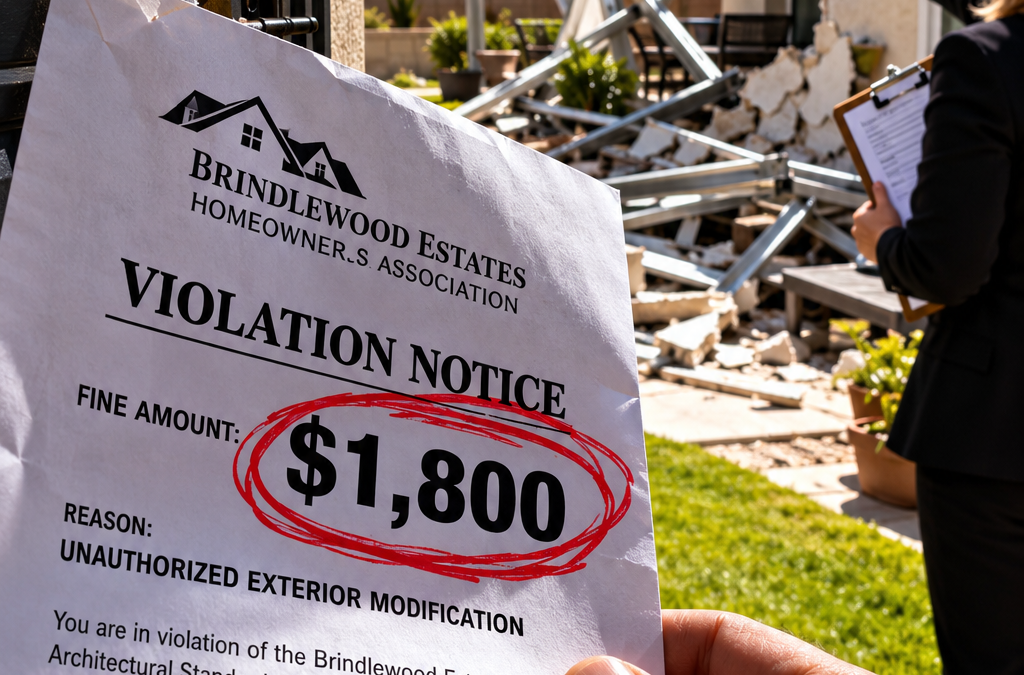
Two months later, the $1,800 notice appeared.
UNAUTHORIZED STRUCTURAL MODIFICATION.
I read the page twice.
Then a third time.
The letter said the retractable awning violated “Section 14, Subsection C” of the Brindlewood architectural standards.
I walked into my office, pulled the original HOA packet from the shelf, and opened it.
There was no Section 14, Subsection C.
There wasn’t even a Section 14 structured the way the letter claimed.
I downloaded the recorded declaration from the county database.
Same result.
Then I checked every amendment filed since the association was formed.
Nothing.
I called the HOA office.
Cheryl answered.
“Brindlewood Association.”
“Hi, Cheryl. Daniel Ruiz.”
Her tone changed immediately.
“Oh. Hi, Daniel.”
I noticed that.
“I’m calling about an $1,800 fine.”
“Yes.”
“You know which one?”
“I believe so.”
“The letter cites Section 14, Subsection C.”
“Yes.”
“Can you send me that section?”
A pause.
“Ms. Callahan says the awning violates it.”
“That wasn’t my question.”
Silence.
I softened my voice.
“Cheryl, I have the governing declaration in front of me. I’m looking at the recorded copy from the county. There is no Section 14, Subsection C.”
“I’ll have to ask Patrice.”
“Okay. Please do.”
“I’ll get back to you.”
“When?”
“Soon.”
“Today?”
She hesitated.
“I’ll try.”
No email came.
No call came.
The next morning, I tried again.
Voicemail.
That afternoon, I found Patrice standing near the cluster mailboxes at the entrance to the neighborhood.
Clipboard under one arm.
Binder in hand.
I parked and walked over.
She watched me approach.
“Patrice.”
“Daniel.”
“I need Section 14, Subsection C.”
Her expression didn’t change.
“You received the notice.”
“I received a notice citing a provision that isn’t in the governing documents.”
Her eyes narrowed slightly.
“You may be looking at an outdated copy.”
“I’m looking at the recorded declaration and every filed amendment.”
That made her pause.
Only for a second.
Then her chin lifted.
“I enforce the bylaws, Daniel.”
“Then show me the bylaw.”
“It’s part of the architectural standards.”
“I checked those too.”
“You’re not on the board.”
I almost laughed.
“What does being on the board have to do with whether a written rule exists?”
She shifted the clipboard against her hip.
“You’re becoming confrontational.”
“I asked you to produce the rule you’re fining me $1,800 for.”
“You installed an exterior structure without HOA approval.”
“I had county approval.”
“The county and HOA are separate.”
“I understand that perfectly. Show me the HOA provision requiring approval for this awning.”
She stared at me.
Behind us, someone’s sprinkler clicked across a lawn.
A car passed.
Patrice lowered her voice.
“If you don’t like the enforcement process, you’re welcome to speak to our legal counsel.”
She said our legal counsel with enormous satisfaction.
Like she had just informed me she was represented by the United States Department of Justice.
“I might do that.”
That was when she laughed.
Not a nervous laugh.
Not an awkward one.
A short, dismissive little sound.
“Good luck,” she said. “He’s very expensive.”
I looked at her for a moment.
It was the laugh more than the fine that finally changed something in me.
She wasn’t trying to resolve a disagreement.
She enjoyed the imbalance she believed existed.
She thought the cost of challenging her was part of her authority.
If a homeowner had to spend more money fighting a false fine than simply paying it, then in Patrice’s mind, the system worked.
She had found a way to make being right more expensive than surrender.
I smiled.
“All right.”
Her expression shifted.
Maybe she expected anger.
Maybe she wanted it.
Instead, I walked back to my truck.
That evening, I created a new folder on my computer.
Brindlewood.
Inside it, I created subfolders.
Governing Documents.
Notices.
Correspondence.
Permits.
Financial Records.
Photographs.
Timeline.
I scanned every notice Patrice had sent me.
I saved every email.
I pulled the original governing documents from public records.
I downloaded every recorded amendment.
I created a spreadsheet listing every violation notice I had received, the date, amount, cited authority and whether that authority could actually be found in the governing documents.
The mailbox issue was real, even if the measurement had been wrong.
The trash rule existed.
The tomato plant language didn’t.
The awning provision definitely didn’t.
Then I did something I had deliberately avoided doing until then.
I started looking beyond my own house.
Public meeting minutes were available online.
The records were sloppy.
Some months contained detailed votes.
Others consisted of three sentences.
Several expenses were approved without corresponding motions.
A number of fines referenced the same vague “architectural standards” Patrice had invoked against me.
I didn’t jump to conclusions.
Good litigation work depends on resisting the urge to make facts fit a theory before the facts are complete.
So I documented.
And I waited.
I formally disputed the $1,800 fine in writing.
The letter was simple.
I requested administrative review.
I attached my county permit.
I requested the exact text of Section 14, Subsection C.
And I stated that payment would be withheld until the association produced the provision underlying the violation.
I sent it by certified mail.
Patrice signed for it.
That should have frozen the dispute until review.
Instead, Patrice escalated.
Two Thursdays later, I left home shortly before eight to spend the morning at a law office across town.
At 10:17, my phone vibrated.
It was my next-door neighbor, Kevin.
I almost ignored it because I was in a conference room.
Then he called again.
I stepped into the hallway.
“Hey.”
“Daniel, are you having work done?”
My stomach tightened.
“What kind of work?”
“There are guys behind your house.”
I went still.
“What guys?”
“Contractors, I think. Truck says demolition and repair. They’re doing something with the awning.”
For half a second, I didn’t understand the sentence.
“What do you mean doing something?”
“I think they’re taking it down.”
I was already walking toward the elevator.
“Kevin, go outside.”
“What?”
“Please. Go to the property line. Don’t interfere. Just record.”
“Record what?”
“Everything.”
I ended the call and drove home.
I don’t remember much of that drive.
I remember my hands gripping the steering wheel.
I remember stopping at a red light and wanting to drive through it.
I remember telling myself not to.
Stay calm.
Document first.
React second.
That was what I told clients through attorneys all the time.
It is much harder advice to follow when the property being damaged belongs to you.
When I turned onto my street, the contractor’s truck was still there.
Two men were standing near the rear gate.
One of them saw me and looked immediately uncomfortable.
I walked past them.
Then I saw the patio.
The awning was gone.
Not carefully removed.
Gone.
The aluminum frame had been twisted during removal and dropped onto the concrete.
The fabric was ripped.
Mounting brackets had been pulled from the exterior wall.
Chunks of stucco lay on the ground.
A line of exposed holes marked the place where the awning had been attached.
For several seconds, I couldn’t move.
It is strange how personal damage to a house can feel.
A home is wood, concrete, wiring and paint.
But once you live inside it, once you pay for it and repair it and make it yours, damage stops feeling like damage to an object.
It feels invasive.
Someone had entered my property while I was gone and physically altered my house because Patrice Callahan had decided she had that right.
I turned toward the contractor.
“Who authorized this?”
The older man stepped forward.
“Sir, we’re just working off the job order.”
“Who issued it?”
He looked toward his truck.
“The association.”
“Name.”
He hesitated.
“Patrice Callahan.”
I nodded.
“Do you have paperwork?”
“We have an authorization.”
“May I see it?”
“I don’t know if—”
“You’ve just removed a structure from my house. I am asking to see the document that you relied on before entering my property.”
That changed his face.
He walked to the truck.
Kevin was standing near his fence with his phone in his hand, still recording.
The contractor returned with a work order and what appeared to be an association authorization attached to it.
I photographed every page.
Then I asked a question that made the contractor visibly nervous.
“Did you obtain a county demolition permit?”
He looked at his coworker.
“We were told the association handled whatever was required.”
“So that’s a no?”
“I’m saying we were contracted by the HOA.”
“Understood.”
I stepped away.
The anger arrived slowly.
That surprised me.
I expected rage.
Instead, I felt cold.
Patrice had sent people onto my property.
She had ordered them to destroy a permitted structure.
She had relied on a provision she still refused to produce.
And she had done all of it while my formal appeal was pending.
This wasn’t a petty neighborhood dispute anymore.
It wasn’t about tomatoes.
It wasn’t about trash cans.
It wasn’t about whether somebody’s mailbox was three inches too tall.
She had turned authority she did not possess into physical action against my property.
I called Patrice.
She answered on the fourth ring.
“Daniel.”
“Did you authorize a contractor to remove my awning?”
“Yes.”
No hesitation.
No embarrassment.
No concern.
Just yes.
“My appeal is pending.”
“The violation was continuing.”
“You entered my property.”
“The association has enforcement rights.”
“Show me where.”
“We’ve already discussed this.”
“No, Patrice. You’ve repeatedly refused to discuss it.”
Her voice hardened.
“You were given ample opportunity to comply.”
“With a rule you still haven’t produced.”
“The board does not need your permission to enforce community standards.”
I looked at the torn holes in my wall.
“Did the board vote on the demolition?”
Silence.
That was the first useful answer she had given me all day.
“Patrice.”
“The association authorized it.”
“That isn’t what I asked.”
“I have another call.”
“Did the board vote?”
She hung up.
I stood in the backyard with my phone still against my ear.
Then I looked at Kevin.
“You get everything?”
He lowered his phone.
“Most of it.”
He looked at the debris.
“Man, I’m sorry.”
“Thanks.”
“You going to sue them?”
I looked toward the street where the contractor’s truck was pulling away.
“I don’t know yet.”
That was true.
Despite what people assume about anyone who works around litigation, suing someone is rarely the first move.
Litigation is expensive.
Slow.
Ugly.
Even when you’re right, the process can consume months or years of your life.
What I wanted was simpler.
I wanted Patrice to stop.
I wanted the damage repaired.
I wanted the association to admit what it had done.
And I wanted to know how a woman with a clipboard had managed to become comfortable enough to authorize the destruction of someone’s property without expecting consequences.
So I did what I knew how to do.
I built the record.
I photographed every inch of damage.
I measured the holes.
I preserved the debris.
I saved Kevin’s video in three separate locations.
I obtained the contractor’s invoice.
That invoice changed everything.
The work had been charged directly to HOA funds.
The amount had been approved under an emergency maintenance category.
That made no sense.
My awning was neither HOA property nor an emergency.
More importantly, under Brindlewood’s actual bylaws, expenditures above a certain threshold required board approval unless they involved a genuine emergency affecting common property.
I searched the meeting minutes.
No vote.
I searched the financial disclosures.
No authorization.
Then I checked the contractor’s date.
The work order had been generated before Patrice had even received my formal appeal.
She had decided to remove the awning before my challenge had entered the process.
The review had never been real.
That evening, I called Aaron Weiss.
Aaron and I had worked together for years.
He was the kind of attorney who rarely raised his voice because he didn’t need to. He had an unnerving habit of becoming quieter when the person across from him became more aggressive.
He answered with, “What’s broken?”
I stared at my patio.
“How did you know something was broken?”
“You only call after dinner when somebody has broken something or lied badly enough that you’re excited.”
“Both.”
I explained the story.
There was silence when I finished.
Then Aaron said, “Send me the documents.”
“I already did.”
Another pause.
“You sent them before calling?”
“Yes.”
“Of course you did.”
I could hear his keyboard.
“This Section 14(c) isn’t in the declaration.”
“No.”
“Not in the amendments.”
“No.”
“And she’s been citing it?”
“Yes.”
“For how long?”
“I don’t know yet.”
He went quiet.
Then he said, “Daniel.”
“What?”
“You’re doing that thing.”
“What thing?”
“The one where you sound bored because you’re furious.”
I looked at the torn stucco.
“I’m not bored.”
“I know.”
Aaron opened another document.
“The demolition expenditure didn’t get a vote.”
“Correct.”
“Your appeal was pending.”
“Correct.”
“And you’ve got video of the contractor entering the property?”
“Yes.”
“County permit for the awning?”
“Yes.”
“Contractor invoice?”
“Yes.”
He let out a low breath.
“This is ugly.”
“I’m aware.”
“What do you want?”
That question mattered.
Good lawyers ask it early.
Winning is not an objective.
People think it is.
It isn’t.
You have to define what winning means before you start.
“I want the awning restored.”
“Fine.”
“I want the $1,800 fine removed.”
“Obviously.”
“I want every homeowner who was fined under a nonexistent provision notified.”
Aaron stopped typing.
“That last part gets interesting.”
“I know.”
“And Patrice?”
I thought about her laugh at the mailbox kiosk.
Then I thought about the way she had said yes when I asked whether she had authorized people to enter my property.
“I want the board to understand exactly what she did.”
Aaron was quiet.
“That’s not the same as saying you want her removed.”
“No.”
“You think the documents will do that for you.”
“Yes.”
I heard the smile in his voice.
“Okay.”
Aaron sent a formal request for an emergency board meeting the next morning.
He attached enough documentation to make refusing the request difficult.
Patrice responded personally.
Her email was three paragraphs long.
She referred to the demolition as “corrective action.”
She called my awning a “continuing architectural violation.”
She repeated Section 14, Subsection C.
And she accused me of attempting to intimidate volunteer board members by retaining counsel.
Aaron forwarded the email to me with one sentence.
She cited it again.
I replied.
I saw.
The meeting was scheduled for the following Tuesday.
For the first time since I had moved into Brindlewood, neighbors began knocking on my door.
The first was a retired man named Harold who lived six houses down.
He stood awkwardly on my porch holding an old HOA notice.
“I heard something happened with your patio.”
“Something did.”
He handed me the paper.
“They fined me six hundred dollars last year for replacing my garage light.”
I read the citation.
Section 14, Subsection C.
I looked up.
“Did they ever show you this section?”
Harold gave a bitter laugh.
“No. Patrice said I’d need a lawyer if I wanted to dispute it.”
“How much did the light cost?”
“Two hundred and forty dollars.”
“And you paid six hundred?”
“My wife was sick. I didn’t have the energy.”
The sentence hit harder than I expected.
That was the mechanism.
Patrice didn’t need to be legally right.
She only needed challenging her to be exhausting.
The next visitor was a young mother named Erica.
Her violation had involved a play structure in her backyard.
Same section.
Then Kevin brought over an old fine for an exterior camera.
Same section.
I did not solicit complaints.
I didn’t need to.
Once people realized someone had finally asked Patrice to produce the document, the stories came by themselves.
The pattern was unmistakable.
Small fines.
Medium fines.
Threatening language.
References to legal counsel.
Deadlines short enough to create panic.
And again and again, the same nonexistent provision.
By the night before the meeting, I understood why Patrice had laughed when she told me the association’s attorney was expensive.
The expense was the weapon.
Most homeowners weren’t going to pay a lawyer two thousand dollars to fight a six-hundred-dollar fine.
They would pay the fine.
Patrice understood arithmetic.
What she had underestimated was the chance that eventually she would target someone who spent his working life examining exactly that kind of arithmetic.
The board meeting took place in the Brindlewood clubhouse.
I arrived with Aaron ten minutes early.
Patrice was already there.
So was Cheryl.
Three other board members sat at the long table.
A handful of homeowners had gathered in chairs along the wall.
More arrived behind us.
Patrice looked at the crowd and immediately seemed annoyed.
“This is a board matter.”
Aaron set his briefcase on the table.
“The association’s enforcement practices affect the membership.”
“I didn’t authorize an open meeting.”
Aaron looked at her.
“Is this proceeding being conducted under your board’s governing rules?”
Her mouth tightened.
“Yes.”
“Then homeowners have the rights provided under those governing rules.”
She stared at him.
Aaron sat.
I took the chair beside him.
Patrice sat at the head of the table.
Her binder was in front of her.
The clipboard lay on top.
For eight months, that clipboard had felt like part of her uniform.
I had watched her use it to inspect mailbox posts, photograph trash cans and write down whatever she believed gave her leverage.
That night, she tapped a pen against it as if the familiar object could restore control to the room.
She opened the meeting.
“We’re here to address Mr. Ruiz’s refusal to comply with architectural requirements.”
Aaron raised one hand slightly.
“No. We’re here because your association entered his property and destroyed a permitted structure while his dispute was pending.”
Patrice looked irritated.
“The structure violated Section 14, Subsection C.”
Aaron nodded.
“Excellent.”
The word caught her off guard.
“Excuse me?”
“Section 14, Subsection C. That’s exactly where I’d like to begin.”
He leaned back.
“Would you read it for us?”
Patrice stared at him.
“Read what?”
“The section you just cited.”
“I know what I cited.”
“So do I. Please read the language.”
She reached for the binder.
I watched her open it.
One tab.
Then another.
She flipped forward.
Stopped.
Went backward.
The room slowly became silent.
She turned another page.
Then another.
Aaron said nothing.
That was one of the things he was good at.
Most people are uncomfortable with silence.
They rush to fill it.
Aaron weaponized it.
Patrice finally looked up.
“It is referenced under the general provisions.”
Aaron nodded.
“Show us.”
She flipped farther.
Her movements were quicker now.
Cheryl looked down at the table.
One of the other board members shifted in his chair.
Patrice stopped.
“This binder may not contain the updated schedule.”
Aaron opened the folder in front of him.
“No problem.”
He removed the recorded declaration.
“I brought the current version.”
He placed it on the table.
Then the amendments.
“And every filed amendment.”
Another stack.
“And the architectural standards currently distributed to homeowners.”
He pushed them toward Patrice.
“Please show us Section 14, Subsection C.”
She didn’t touch the documents.
“Mr. Weiss, I’m not interested in theatrics.”
“Neither am I.”
“You are trying to embarrass this board.”
“No. I’m asking the president of this association to identify the written authority she relied upon to impose an $1,800 fine and order the destruction of a homeowner’s property.”
A board member named Mark looked at Patrice.
“Where is the section?”
Patrice turned toward him.
“We’ve used the provision for years.”
“That wasn’t his question,” Mark said.
For the first time, I saw fear move across Patrice’s face.
It was subtle.
A tightening around the eyes.
A slight color change along her neck.
She looked at Cheryl.
“Do you have the updated architectural schedule?”
Cheryl swallowed.
“I have the same version.”
“Then yours is outdated too.”
Aaron opened another document.
“This copy was filed by your own association.”
Patrice looked at him.
“When?”
“Three months ago.”
Nobody spoke.
Aaron took another sheet from the folder.
“This is Mr. Ruiz’s county permit for the retractable awning.”
He placed it down.
“Approved two months before the violation notice.”
Another document.
“This is Mr. Ruiz’s written dispute requesting review and asking the association to produce the section you cited.”
Another.
“This is certified-mail confirmation showing you received that request.”
Another.
“This is the contractor’s work order.”
Another.
“This is the invoice.”
Patrice’s pen stopped moving.
Aaron continued.
“The contractor was paid using HOA funds.”
He looked at the board.
“Can anyone identify the vote approving that expenditure?”
No one answered.
Aaron looked at Patrice.
“Was there a vote?”
Patrice folded her arms.
“The president has authority to respond to urgent violations.”
Aaron opened the actual bylaws.
“For urgent repairs to common property.”
He turned the document around.
“Mr. Ruiz’s patio is not common property.”
“I was protecting neighborhood property values.”
“By entering privately owned property and destroying a permitted structure?”
“By enforcing our standards.”
“The standard you cannot produce.”
Patrice’s jaw tightened.
Then the clipboard slid from the edge of the table.
It hit the floor with a flat crack.
Nobody moved to pick it up.
For some reason, that sound is still one of the clearest memories I have of the meeting.
For months, the clipboard had represented Patrice’s version of authority.
That night, it was just plastic on the floor.
Aaron looked directly at her.
“You authorized an unbudgeted expenditure to destroy a permitted structure based on a rule the governing documents do not contain, while the homeowner’s challenge was pending.”
He paused.
“Who advised you that you had authority to do that?”
Patrice’s eyes moved toward Cheryl.
Then Mark.
Then the other board members.
Nobody spoke.
Aaron waited.
“Was it association counsel?”
Patrice said nothing.
“Did counsel review the demolition order?”
Still nothing.
“Did the board approve it?”
Nothing.
The silence gave the answer.
Nobody had advised her.
Patrice had done it because she believed she could.
Aaron closed the folder halfway.
“If this were the only issue, we’d be discussing damages, restoration and rescission of the fine.”
Patrice seized on the sentence.
“Then that’s what we should discuss.”
“But it isn’t the only issue.”
He reopened the folder.
I saw Cheryl’s shoulders stiffen.
Aaron pulled out several notices.
“We have now identified multiple fines issued under the same nonexistent Section 14, Subsection C.”
Patrice leaned forward.
“That language was adopted before some of these members joined the board.”
“Where is the adoption record?”
“It was a board decision.”
“Meeting date?”
“I don’t remember.”
“Minutes?”
“They would be in the records.”
“We checked the records.”
Her voice sharpened.
“Then your records request was incomplete.”
Cheryl made a sound.
Small.
Almost nothing.
But everyone heard it.
Patrice looked at her.
“What?”
Cheryl kept staring down.
“Nothing.”
“Cheryl.”
The room was so quiet I could hear the air-conditioning vent clicking.
Cheryl lifted her head.
Her eyes were wet.
“She told me to backdate the minutes.”
Nobody moved.
Patrice’s face went blank.
“Excuse me?”
Cheryl’s hands were trembling.
“For the awning.”
Patrice’s voice changed.
“Be very careful what you say.”
That sentence did it.
Until then, Cheryl looked frightened.
After Patrice said that, something in her expression changed.
Maybe she finally realized the woman she had been protecting would sacrifice her without hesitation.
“There wasn’t a vote,” Cheryl said.
Patrice stared at her.
“Cheryl.”
“There wasn’t.”
“Stop.”
“You told me to add it.”
One of the board members leaned forward.
“Add what?”
Cheryl looked at him.
“A board approval.”
My stomach tightened even though I had suspected exactly that.
“For the demolition?” Mark asked.
Cheryl nodded.
“You told us there had been an emergency authorization,” he said.
Patrice cut in.
“This is getting completely distorted.”
Cheryl shook her head.
“No.”
Her voice cracked.
“You told me to write minutes showing that the board had approved the expense.”
Patrice stood.
“I will not sit here and be accused—”
Aaron’s voice remained calm.
“Please sit down.”
She looked at him.
“This is my meeting.”
“No,” Mark said.
Every face turned toward him.
He looked exhausted.
“This is the board’s meeting.”
Patrice slowly sat.
The balance in the room shifted.
You could feel it.
For months, perhaps years, people had treated Patrice like the association itself.
That distinction disappeared in less than a minute.
She was one board member.
One person.
And suddenly, everyone else remembered that.
Aaron looked at Cheryl.
“Was this the first time minutes were altered?”
Patrice immediately said, “You don’t have to answer that.”
Aaron didn’t look at Patrice.
“Cheryl?”
She wiped under one eye.
“No.”
The room erupted into low voices.
Aaron raised a hand.
“What other records?”
Cheryl looked sick.
“There were fine approvals.”
“How many?”
“I don’t know.”
“Approximately.”
“I don’t know.”
“Months?”
“Yes.”
“Years?”
Cheryl closed her eyes.
“Yes.”
Patrice shook her head.
“This is absurd. Cheryl handles accounting. If records were inaccurate—”
Cheryl turned toward her.
“You told me what to write.”
The sentence stopped Patrice cold.
“You told me nobody checks.”
Nobody checks.
That phrase hit me harder than anything else said that night.
Because there it was.
The entire system.
Not legal authority.
Not board authority.
Not community standards.
Nobody checks.
Patrice had built her power on a simple assumption: ordinary homeowners were busy.
They had jobs.
Children.
Sick spouses.
Mortgages.
School pickups.
Aging parents.
They did not have hours to compare violation letters against recorded declarations.
They did not want to spend thousands of dollars challenging hundreds.
They wanted the problem to disappear.
So they paid.
And every payment told Patrice her assumption was correct.
Nobody checks.
Until somebody did.
Another board member, Susan, cleared her throat.
“There is something else.”
Patrice turned toward her sharply.
Susan avoided her eyes.
“The reserve fund.”
Cheryl covered her mouth with one hand.
Aaron asked, “What about it?”
Susan spoke carefully.
“I questioned some transfers last year.”
Patrice interrupted.
“Those transfers were authorized.”
“By whom?”
“The board.”
“I never voted for them.”
Patrice looked at the other members.
“They were operational.”
Susan shook her head.
“You told me they were emergency repairs.”
Aaron looked at Cheryl.
“Were they?”
Cheryl’s face had gone pale.
“No.”
The room became silent again.
Aaron leaned forward.
“What were they?”
Cheryl stared at Patrice.
Then she answered.
“Some of the fine revenue was being used to cover landscaping expenses.”
“That doesn’t necessarily create a problem by itself,” Aaron said. “Which expenses?”
Cheryl swallowed.
“The supplemental contract.”
“With whom?”
Patrice pushed back her chair.
“This has nothing to do with Mr. Ruiz’s awning.”
Aaron looked at her.
“It does if enforcement revenue was generated through invalid fines and directed into contracts affected by conflicts of interest.”
A homeowner behind me whispered, “Oh my God.”
Aaron returned his attention to Cheryl.
“Who held the supplemental landscaping contract?”
Cheryl barely spoke above a whisper.
“Patrice’s brother-in-law.”
No one said anything for several seconds.
Then Mark asked the simplest possible question.
“Did the board know?”
Cheryl shook her head.
Patrice stood again.
“This meeting is over.”
Nobody moved.
She looked around.
“I said this meeting is over.”
Mark folded his arms.
“No.”
Patrice looked at him as if she had misheard.
“No?”
“No.”
He glanced toward the other directors.
“I want the financial records preserved tonight.”
Susan nodded immediately.
“So do I.”
The third member nodded.
Patrice stared at them.
“You are seriously going to take this man’s word over mine?”
Mark looked toward me.
“He hasn’t asked us to take his word.”
He pointed at the folder.
“He brought records.”
That was the moment Patrice finally looked at me differently.
Not angry.
Not dismissive.
She looked at me as though she were seeing me for the first time.
For eight months, I had been the quiet guy in the flannel shirt.
The homeowner who fixed the mailbox.
The man who paid the trash fine.
The neighbor who didn’t argue at block parties.
The person she could pressure because he seemed unwilling to make noise.
She had confused quiet with helpless.
I didn’t enjoy watching the realization reach her.
Not exactly.
There was satisfaction, yes.
But beneath it was something heavier.
Harold had paid six hundred dollars while caring for his sick wife.
Erica had worried that the HOA might place a lien on her home over a play structure.
Cheryl had spent months being ordered to alter records and apparently had been too afraid to push back.
This had stopped being about me long before Patrice ordered my awning removed.
I simply happened to be the person whose property she damaged badly enough to force the issue into daylight.
Patrice pointed at me.
“You planned this.”
I stared at her.
“No.”
“You’ve been collecting documents.”
“After you fined me under a rule that doesn’t exist.”
“You came into this neighborhood looking for a fight.”
I almost laughed.
I thought about the first mailbox letter.
The tomato plants I had moved.
The fifty-dollar fine I had paid.
The conversations I had ended because I wanted peace.
“No, Patrice.”
My voice was quieter than hers.
“I spent months trying not to have one.”
For the first time that evening, she had no response.
The board voted to suspend Patrice’s authority over enforcement and expenditures pending review.
She objected to the vote.
The board took it anyway.
Aaron requested immediate preservation of all association records, including emails, financial files, contracts, minutes and enforcement notices.
The motion passed.
When the meeting ended, nobody rushed to leave.
People stood in clusters, comparing letters.
Some were angry.
Some looked stunned.
A few looked embarrassed, as though paying an unfair fine somehow reflected badly on them.
It didn’t.
That was one thing I wished I could make everyone understand.
Systems like Patrice’s don’t work because everyone inside them is foolish.
They work because people have finite time and energy.
They work because intimidation is often cheaper than litigation.
They work because a threat does not have to be lawful to frighten someone.
And they work because once enough people comply, the next person assumes the authority must be legitimate.
Patrice left alone.
No clipboard.
She had forgotten it beneath the table.
Two weeks later, the county opened a formal inquiry into the HOA’s financial records.
That part happened quietly.
No television trucks arrived.
No dramatic raid took place.
Nobody was led away in handcuffs.
The world rarely resolves itself as theatrically as people expect.
Instead, accountants requested records.
Board members sat for interviews.
Invoices were compared to approvals.
Old minutes were reviewed.
Homeowners submitted copies of violation letters.
The association’s attorney—not the terrifying, untouchable figure Patrice had invoked whenever someone challenged her—sent a very careful letter instructing the board to preserve documents and suspend contested enforcement actions until the review was complete.
I read the letter twice.
Then I remembered Patrice smiling at the mailbox kiosk.
Good luck. He’s very expensive.
The expensive lawyer was now telling the board to stop doing exactly what she had insisted he would defend.
Patrice resigned before the board could vote on her removal.
Her resignation email was short.
She cited personal reasons.
She wrote that recent events had created an “unproductive atmosphere” and that she no longer believed she could serve effectively.
She did not mention Section 14, Subsection C.
She did not mention the altered minutes.
She did not mention the demolition crew.
She did not mention the landscaping contract.
Nobody in Brindlewood needed those omissions explained.
Cheryl remained treasurer temporarily after cooperating with the inquiry.
Some people questioned that.
I understood why.
She had participated.
She had backdated records.
Fear explained her conduct, but it did not erase it.
At the same time, she was the person who had finally spoken when silence would have protected her.
The board decided to keep her in place during the review so the financial records could be reconstructed accurately.
For once, I was grateful the decision wasn’t mine.
The $1,800 fine disappeared.
Every active violation based on the invented provision was suspended.
The board began identifying older fines issued under the same language.
That process took time.
Nobody pretended otherwise.
As for my house, the HOA paid for the repairs.
Not just a replacement awning.
The damaged stucco had to be repaired and color-matched.
The mounting points had to be inspected.
A new retractable awning was installed using the same county-approved specifications as the original.
This time, I stood in the backyard while the crew worked.
It was a different contractor.
One of the installers glanced at the repaired wall.
“Bad removal?”
“You could say that.”
He nodded toward the association paperwork.
“HOA?”
“Yes.”
He gave me a look that suggested he had heard enough stories in his career to stop being surprised.
“That’s rough.”
“It was.”
When the work was completed, the new awning extended over the patio almost exactly as the first one had.
Same shade.
Same dimensions.
Same house.
But standing under it felt different.
The board also sent me a written apology.
It was formal, cautious and obviously reviewed by counsel.
Still, it mattered.
Not because I needed the words.
Because the association had finally put something in writing that it should have understood from the beginning.
Its authority had limits.
Being part of an HOA did not mean surrendering ownership of your home.
Rules had to exist before they could be enforced.
Processes had to mean something.
Board votes had to actually happen.
And a president could not transform personal certainty into legal authority simply because nobody had challenged her yet.
The biggest change in Brindlewood was quieter.
For the first time in nearly three years, every homeowner received a complete copy of the association’s actual governing documents.
Not Patrice’s binder.
Not a summary.
Not a list of “community standards” she had typed herself.
The recorded documents.
People started reading them.
That alone changed the neighborhood.
Questions appeared at meetings.
Homeowners asked for citations before paying fines.
Board members began recording votes properly.
Financial reports became more detailed.
Contracts were disclosed.
It was not dramatic.
That was exactly why it mattered.
Accountability usually isn’t dramatic once it becomes routine.
It is boring.
Procedural.
Documented.
And that is often what prevents the next Patrice from deciding she can make rules by saying them confidently enough.
On the first Sunday after my awning was rebuilt, I carried a cup of coffee outside.
The morning was quiet.
The kind of quiet I had thought I was buying when I moved into Brindlewood.
I opened the awning and sat beneath it.
For months, every sound near my driveway had made me glance toward the window.
Every white SUV had made me wonder whether Patrice was coming with another envelope.
Every piece of mail had carried the possibility of some new invented violation.
That morning, nothing happened.
No clipboard appeared.
Nobody measured anything.
Nobody photographed my trash cans.
A sprinkler turned on across the street.
Somebody started a lawn mower.
Kevin waved from his driveway.
I lifted my coffee in return.
A few minutes later, a kid from two doors down came riding past on his bicycle.
He slowed when he saw me.
“Mr. Ruiz?”
“Yeah?”
He put one foot on the pavement.
“Are you really a lawyer?”
I smiled.
“No.”
He looked confused.
“My dad said you’re the guy who beat the HOA.”
I shook my head.
“I didn’t beat anybody.”
He frowned, clearly disappointed by the answer.
“So what do you do?”
“I read contracts for a living.”
He thought about that.
“That’s your job?”
“Pretty much.”
“And that’s how you knew?”
“Knew what?”
“That she was wrong.”
I looked at the awning above me.
“That’s how I knew she couldn’t show me the rule.”
He nodded slowly.
Then he pushed off with one foot.
“That’s kind of cool.”
I laughed.
“Don’t tell anybody.”
He rode away.
I sat there for a long time afterward.
I thought about the red circle around $1,800.
I thought about the mailbox being three inches too tall.
I thought about moving tomato plants because arguing felt stupid.
I thought about the fifty dollars I paid because my time seemed more valuable than proving a point.
None of those decisions had been wrong by themselves.
Peace has value.
Not every unfair thing deserves a battle.
You can spend your whole life fighting every person who cuts in line and end up just as miserable as the people you’re fighting.
But there is a point where keeping the peace stops being peace.
It becomes permission.
That line is difficult to see when someone crosses it one inch at a time.
A mailbox.
A trash can.
A tomato plant.
A fine.
Another fine.
Each demand small enough to make resistance feel unreasonable.
Each surrender making the next demand easier.
Until one day you come home and discover that somebody sent strangers onto your property to tear part of your house off because she had become so accustomed to obedience that she no longer believed she needed the rule she claimed to enforce.
Patrice’s real power had never been the bylaws.
It had been everyone’s assumption that she must know what they said.
Once that assumption disappeared, so did most of her authority.
That was the strangest lesson in all of it.
I had spent my career around lawsuits large enough to fill conference rooms with documents.
I had watched companies fight over language buried in contracts hundreds of pages long.
I had seen people spend fortunes because one person interpreted a paragraph differently than another.
And yet the conflict that followed me home was resolved by something much simpler.
Show me the rule.
That was all I had asked.
Not whether Patrice liked my awning.
Not whether she believed it looked wrong.
Not whether she thought she was protecting the neighborhood.
Show me the rule.
She couldn’t.
Everything that happened afterward came from her unwillingness to admit that.
If she had said, “You’re right, we made a mistake,” the first week, the story would have ended there.
I probably would have forgotten about her within a month.
If she had admitted the fine lacked proper authority, I wouldn’t have examined years of records.
If she had allowed the appeal process to function, nobody would have looked at the demolition vote because there never would have been a demolition.
If she had not treated every question like a challenge to her personal importance, Cheryl might never have spoken.
Patrice destroyed herself one escalation at a time.
Not because I trapped her.
Not because I had some secret weapon.
Because every time she reached a point where an ordinary person would have reconsidered, she chose to push harder.
I used to think people like that were confident.
Now I think many of them are terrified of the moment someone asks them to prove what they claim.
Confidence can answer questions.
Authority that depends on intimidation cannot.
I never became active in the HOA after that.
Several neighbors asked me to run for the board.
I declined.
The last thing Brindlewood needed was another person who thought exposing one abusive president meant he deserved to become the next one.
I attended meetings when something mattered.
I read the financial reports.
I asked questions when numbers didn’t match.
Mostly, I went back to my life.
Work in the spare bedroom.
Coffee on the patio.
An old truck in the driveway.
Three flannel shirts once the weather cooled.
Exactly the boring life I had wanted when I moved there.
But the neighborhood felt different.
Harold stopped by one afternoon several months later.
His wife’s health had improved.
He brought the old garage-light violation with him again, except this time there was another sheet stapled behind it.
Refund approval.
Six hundred dollars.
He held the paper out like he couldn’t quite believe it.
“They’re giving it back.”
I smiled.
“Good.”
He looked toward my patio.
“You know, I almost didn’t show you that notice.”
“Why?”
He shrugged.
“Felt stupid.”
“For paying it?”
He nodded.
I shook my head.
“You had more important things happening.”
“My wife was in treatment.”
“Exactly.”
He looked down.
“I still should’ve fought it.”
“No.”
He looked at me.
“Patrice counted on people blaming themselves for not fighting.”
I pointed toward his refund letter.
“That money should never have been taken from you. That’s on the person who demanded it without authority, not on you for having a life you cared about more than an HOA dispute.”
Harold stood there quietly.
Then he nodded.
“Thanks, Daniel.”
He walked home holding the refund notice.
Watching him go gave me more satisfaction than seeing Patrice unable to find Section 14(c).
Because that was the part people missed when they talked about what had happened.
It wasn’t really a story about catching someone.
It was about what petty power costs the people underneath it.
For Patrice, each notice was paperwork.
For Harold, it was six hundred dollars during his wife’s treatment.
For Erica, it was nights wondering whether a playground could somehow threaten her house.
For Cheryl, it was years of being pressured to sign her name to things she knew were wrong.
For me, it was standing in my backyard staring at damaged stucco and realizing that someone had mistaken my patience for permission to enter my property.
Money can be refunded.
Walls can be repaired.
Awning brackets can be replaced.
The harder thing to rebuild is the feeling that your home is yours.
It took me longer than I expected to stop watching the street whenever a car slowed in front of my house.
Long after Patrice resigned, I would catch myself looking toward the window when someone stepped onto my driveway.
That annoyed me.
Not because I was afraid.
Because I hated knowing she had changed something so small and basic in me.
Before all of this, a knock at the door was just a knock.
Afterward, part of me wondered what accusation might be waiting on the other side.
Eventually, that faded.
Normal returned slowly.
No grand moment.
Just weeks without notices.
Months without confrontations.
A growing stack of ordinary mail.
The tomato plants went back where I originally wanted them.
Nobody complained.
The next summer, they produced more tomatoes than I knew what to do with.
I left bags of them on neighbors’ porches.
Even that felt meaningful in a ridiculous way.
The plants had once been evidence of noncompliance.
Now they were just tomatoes.
That was the Brindlewood I had wanted from the beginning.
Not a neighborhood without rules.
Rules can be useful.
They keep one person’s choices from unfairly damaging everyone else’s property or safety.
What I wanted was a neighborhood where rules remained rules instead of becoming excuses for one person to control everyone around her.
There is a difference between governance and domination.
The difference is process.
Transparency.
Limits.
A person willing to answer, “Where does it say that?”
Patrice could never answer that question because answering it would have forced her to acknowledge that the authority she enjoyed was much smaller than the authority she imagined.
That was why she kept escalating.
The $1,800 fine wasn’t the most important document in the story.
Neither was the contractor invoice.
Neither were the altered minutes.
The most important document was the twenty-two-page packet Patrice handed me before she even asked my name.
The same packet she apparently assumed nobody would read.
I kept it.
It still sits on the shelf in my office.
Every now and then, when I’m searching for something else, I see the binder and remember that first afternoon.
Patrice standing beside my moving truck.
Exterior changes need approval.
I can picture her expression perfectly.
At the time, she probably saw a new homeowner.
Another name on a mailing list.
Another property she believed she had a right to inspect.
I wonder what she would have done differently if she had known what I did for a living.
Maybe she would have left me alone.
Maybe she would have been more careful.
Maybe she would have picked somebody else.
And that possibility bothers me more than what happened to me.
Because if the only thing preventing abuse is the chance that the person being abused understands the paperwork, then the system is still broken.
People shouldn’t need to be litigation consultants to know whether a fine is legitimate.
They shouldn’t need an attorney friend to make a board answer a basic question.
They shouldn’t need to spend evenings downloading county records because someone with a laminated binder refuses to show them the language she’s enforcing.
That was the final change Brindlewood made.
The new board created a simple requirement.
Every future violation notice had to quote the exact governing provision allegedly violated.
Not just a section number.
The language itself.
Homeowners had to be given a defined appeal period.
Enforcement actions had to pause during a timely appeal unless there was an immediate safety hazard.
Expenditures had to be voted on according to the actual bylaws.
Conflicts of interest had to be disclosed.
None of that was revolutionary.
Most of it should have been obvious.
But once written into the board’s procedures, it became harder for anyone to recreate Patrice’s system.
That mattered to me more than her resignation.
Patrice leaving solved one problem.
Making it harder for the next Patrice to do the same thing solved another.
One evening, nearly a year after I found that red-circled letter on my door, I sat beneath the awning during a light summer rain.
The fabric made a soft ticking sound as droplets landed above me.
The air smelled like wet pavement and grass.
Across the street, somebody’s kids were riding scooters in circles despite the rain.
Harold was trimming a hedge.
Kevin had his garage open and music playing quietly inside.
Nothing about the scene was dramatic.
That was exactly what made it perfect.
My house was mine again.
Not because I had defeated somebody.
Because nobody was standing at the edge of my property pretending the clipboard in her hand gave her more rights to my home than I had.
I took a sip of coffee and looked up at the awning.
There were no scars left in the stucco.
You couldn’t tell where the old brackets had been ripped out.
A stranger would never know anything had happened.
I knew.
Maybe that was enough.
Some lessons don’t need monuments.
Sometimes they are just a repaired wall, a folder of documents, and the knowledge that the next time somebody circles a number in red and expects fear to do the rest, I won’t start by asking how much they want.
I’ll start by asking one question.
Show me where it says you can.







