𝗙𝗨𝗟𝗟 𝗦𝗧𝗢𝗥𝗬 The HOA President Called Wildlife Officers on Me While I Was Hunting My Own 240 Acres and Smiled Until They Asked About Her Trail
𝗙𝗨𝗟𝗟 𝗦𝗧𝗢𝗥𝗬
Back then, the original developer approached Grandpa with a simple request.
Residents wanted to use a trail along the lake edge.
Part of that trail crossed our land.
Grandpa didn’t object.
He had never been the kind of man who closed a gate just because he could.
People wanted to walk beside the lake.
Fine.
So he granted the developer a license in 1994.
A written license.
Not an easement.
Not a sale.
Not a transfer of ownership.
Permission.
The document allowed Timber Ridge residents to use a specific trail along the lake edge.
It could be revoked with thirty days’ notice.
Grandpa retained ownership.
That should have been simple enough.
For almost thirty years, it was.
Then Grandpa died.
He was ninety-one.
I had known the day was coming.
That didn’t make it easier.
Two years before the trouble with Sheila, he passed away in the same county where he had spent most of his life.
He left the ranch to me.
The cabin.
The 240 acres.
The lakefront.
The old equipment.
And a steel document box heavy enough that I nearly dropped it carrying it out of his bedroom.
Inside were decades of paperwork.
The deed.
Surveys.
Tax records.
Fence agreements.
The 1994 trail license.
And a short handwritten note.
Grant,
Protect this land.
That was it.
Three words.
No speech.
No detailed instructions.
Grandpa had never wasted words.
I read it three times.
Then I folded it along the same crease he’d made and put it back in the box.
That spring, I moved into the cabin.
I wasn’t running away from anything dramatic.
I had simply reached a point where I wanted to stop treating the ranch like a place I visited and start treating it like home.
For the first few weeks, it felt right.
I repaired fence.
Cleared deadfall.
Replaced boards on the porch.
Walked the property lines.
Bought my hunting license.
Bought my elk tag.
Checked old water lines.
Fixed the shed roof.
I drank coffee outside before sunrise and listened to the valley wake up.
Then Sheila Brandt walked up my driveway.
She was impossible to miss.
Bright pink blazer.
White pants.
Designer sunglasses.
Plate of cookies in one hand.
Perfect smile.
It was the kind of entrance that looked friendly until you paid attention to how confidently she had entered private property without knocking.
I was beside the barn replacing a hinge.
She stopped about six feet away.
“You must be Grant Whitaker.”
“That’s me.”
“Sheila Brandt.”
She waited.
I assumed I was supposed to recognize the name.
When I didn’t, she added:
“President of Timber Ridge Estates.”
“Oh.”
Her smile tightened by a fraction.
“I wanted to welcome you.”
She handed me the cookies.
“That’s kind. Thank you.”
“We’ve always had a wonderful relationship with your grandfather.”
That was news to me.
Grandpa had never complained about the residents.
That was not the same thing as describing an HOA as wonderful.
She looked toward the lower trail.
“Our homeowners absolutely love your lake trail.”
“I know.”
“It’s one of our most valuable amenities.”
The wording caught me.
“Your amenity?”
She laughed lightly.
“You know what I mean.”
“I know residents use it.”
“Exactly.”
She stepped slightly closer.
“Which is why I thought this would be a perfect time for the association to take over maintenance.”
“Maintenance?”
“Trail clearing, landscaping, liability administration, signage. All the things your grandfather handled informally.”
“Grandpa didn’t handle landscaping.”
She smiled again.
“We’d improve it.”
I looked toward the trail.
It was dirt and pine needles.
Exactly the way Grandpa had wanted it.
“Let me think about it.”
Her smile changed.
Not much.
But enough.
“I don’t think there’s much to think about.”
“I do.”
“The trail serves our residents.”
“It’s on my property.”
“Of course.”
She said it as though I had pointed out something tedious.
“We’re just trying to make everyone’s life easier.”
“I appreciate the offer.”
“Good.”
“I’ll think about it.”
There was a pause.
Then she reached for the cookie plate as though she regretted giving it to me.
“Well. I’m sure we’ll talk soon.”
She walked back down the driveway.
I watched the pink blazer disappear between the pines.
Something about the conversation bothered me.
Not enough to act on.
Just enough to remember.
A week later, a white pickup came through the gate.
New truck.
Clean enough that the tires looked decorative.
A man stepped out wearing expensive boots that had probably never seen mud.
“Grant Whitaker?”
“Yes.”
“Brent Callaway.”
He handed me a business card.
Callaway Land Development.
We shook hands.
He looked toward the lake.
“Beautiful place.”
“It is.”
“I’ll be direct.”
“Please.”
“I want to buy the lakefront half.”
That surprised me.
“No.”
He laughed.
“I haven’t told you the number.”
“Doesn’t matter.”
“Two point one million.”
I looked at him.
He smiled.
“Cash structure can be arranged. Fast close.”
“No.”
His smile stayed in place.
“That’s a lot of money.”
“I know.”
“You haven’t even thought.”
“I have.”
“Everyone in Timber Ridge wants access to more lakefront.”
“Then they can enjoy what they already have.”
“Mr. Whitaker, everybody has a price.”
I looked back toward the cabin.
The porch Grandpa built.
The ridge where he taught me tracks.
The lake where he taught me to cast.
“My price is sixty years of my family’s sweat.”
Brent stared.
I continued.
“It’s not for sale.”
His smile became colder.
“Things change.”
“So I’ve heard.”
He got into the truck.
As he drove away, I saw someone in the passenger seat.
Pink blazer.
Sheila.
That was the first moment I knew the cookie visit had not been social.
Two days later, the first HOA letter came.
NOTICE OF VIOLATION.
I actually laughed.
The association cited my fence as visually unsightly.
They called my pickup an unapproved commercial vehicle.
The letter demanded correction within ten days.
I wasn’t inside Timber Ridge.
My deed had no HOA covenants.
My land predated the development by more than thirty years.
I folded the letter.
Put it in Grandpa’s metal box.
Ignored it.
Second letter.
Firearms activity creating a nuisance to residents.
That one stopped me.
I had not fired a weapon on the ranch since moving in.
Not once.
No target shooting.
No hunting yet.
Nothing.
I read that letter twice.
Somebody wasn’t reacting to my behavior.
Somebody was building a record in advance.
Then the rumors started.
The general store was only fifteen minutes from the ranch.
I had been shopping there since childhood.
People knew my grandfather.
Some knew me.
One morning I walked in and a conversation near the coffee counter stopped.
Not naturally.
Stopped.
The cashier, Ed, wouldn’t quite meet my eyes.
“What?”
He sighed.
“You haven’t seen the Timber Ridge newsletter?”
“No.”
He handed me a printed copy someone had left on the counter.
There was a section about “community safety concerns.”
No full name.
But enough details.
Adjacent landowner.
Weapons activity.
Aggressive behavior.
Uncooperative stance toward established community access.
A phrase near the end described a “dangerous armed loner living along the Timber Ridge boundary.”
I stared at it.
“Who wrote this?”
Ed didn’t answer.
He didn’t need to.
That evening, two women hiking near the lake saw me repairing fence and crossed to the far side of the trail.
One whispered something to the other.
I felt it then.
The story was working.
Sheila wasn’t trying to prove I had done something.
She was creating an atmosphere where people would interpret anything I did as threatening.
I attended the next HOA meeting.
Not because they governed me.
Because they were talking about me.
The Timber Ridge clubhouse looked more like a mountain resort lobby than a neighborhood meeting room.
Stone fireplace.
Vaulted ceiling.
Polished wood.
About sixty people sat facing the board.
Sheila sat in the center with a gavel.
A literal gavel.
When public comment began, I raised my hand.
She looked at me.
“Yes?”
“I’m Grant Whitaker.”
The room shifted.
People turned.
Sheila leaned toward the microphone.
“I think everyone knows who you are.”
That was exactly the problem.
I stood.
“I’ve heard statements suggesting I’ve threatened residents, fired weapons near homes, and interfered with property that belongs to Timber Ridge.”
Sheila folded her hands.
“Residents have concerns.”
“Have I threatened anyone?”
“You’ve created an intimidating environment.”
“How?”
“You openly carry firearms.”
“On my ranch during lawful activities?”
She smiled.
“This is a residential community.”
“My ranch isn’t.”
The room went quieter.
“I haven’t threatened anyone. I haven’t trespassed. I haven’t fired a shot since I moved back. I own my land and everything on it.”
Sheila laughed.
“We’ll see about that.”
That sentence settled something for me.
I drove into town the next morning.
Ms. Priaire was a real estate attorney who had handled boundary disputes, timber claims, access rights, and enough mountain property cases that she knew how quickly a neighborly arrangement could become a lawsuit.
I put Grandpa’s metal box on her conference table.
She began with the deed.
Then the county survey.
Then the 1994 trail license.
She read slowly.
I waited.
Finally she looked up.
“Grant.”
“Yeah?”
“Do you know exactly where the Timber Ridge property line is?”
“Grandpa drilled it into me.”
She spread the survey.
“The lakeside trail is yours.”
“I know.”
“The lower gazebo?”
I leaned closer.
The structure Timber Ridge advertised as a resident viewing pavilion sat near the lake.
I had always assumed it was on the subdivision’s parcel.
Ms. Priaire tapped the map.
“Yours.”
I stared.
“What about the dock ramp?”
“Also on your side.”
“You’re sure?”
“I’ll order a new survey to confirm, but according to the recorded line, yes.”
I sat back.
For almost thirty years, Timber Ridge had treated those improvements like HOA amenities.
Grandpa had apparently tolerated it because the residents used them under the trail license.
Permission had become habit.
Habit had become assumption.
Assumption had become ownership in Sheila’s mind.
Ms. Priaire tapped the 1994 license.
“This is revocable with thirty days’ notice.”
“I see that.”
“What do you want to do?”
I thought about Sheila calling me a threat.
Brent’s offer.
The letters.
“We revoke it.”
She nodded.
“Then we do it properly.”
Certified letter.
Legal description.
Effective date.
Full thirty days.
No surprise.
No gate slammed overnight.
No confrontation.
The letter made it clear that after thirty days, Timber Ridge residents would no longer have permission to use the trail, gazebo area, or dock ramp on my parcel without a new agreement.
Sheila signed for the certified letter herself.
I still have the receipt.
She responded by calling an emergency board meeting.
I did not attend.
Marjorie Fen, a Timber Ridge resident, later told me what happened.
Sheila stood at the podium and announced that I had “stolen” the neighborhood trail.
Stolen.
Land on my deed.
She promised residents:
“I’ll handle him.”
Thirty days passed.
The license expired.
People kept using the trail.
At first, I didn’t confront them.
Most residents had been told the trail belonged to the HOA.
I wasn’t interested in shouting at retirees out for morning walks.
I installed trail cameras along the ridge.
Mostly for elk.
But also to document traffic.
A week later, I pulled the memory card.
The first images were normal.
Deer.
Fox.
Raccoon.
Three elk cows.
Then at 5:18 one morning, the camera recorded movement.
Bright pink.
I zoomed in.
Sheila.
Beside her was a man in a black cap.
They carried a heavy plastic bucket.
The next image showed them in a clearing on my ridge.
Dumping something.
Another.
Hay.
Then Sheila placed a large salt block near a tree.
The man strapped a trail camera to a trunk.
I stared at the screen.
HOA sticker on the camera housing.
I watched the clip again.
And again.
Why?
The next morning, I hiked up there.
Hay.
Salt.
A camera I had never authorized.
Tracks.
Someone was deliberately attracting elk.
I called a wildlife information office.
That’s when I learned feeding wild elk was illegal under the circumstances.
It can change animal behavior.
Concentrate herds.
Increase disease risk.
Create dangerous encounters.
During hunting season, baiting carries additional consequences.
Doing it on private property without consent added another problem.
Still, I didn’t know why Sheila wanted elk on my ridge.
That night, I found an envelope under my cabin door.
No stamp.
Inside was a handwritten note.
Grant,
The board approved an “elk viewing program.” Sheila says it will boost lot prices.
Please be careful.
M.
Marjorie Fen.
I sat at the kitchen table staring at those words.
Elk viewing program.
Lot prices.
Then Brent Callaway’s $2.1 million offer came back to me.
The lakefront half.
The ridge.
Luxury homes.
Imagine the sales brochure.
Private mountain community.
Lake views.
Resident trail.
Wild elk visible from your backyard.
Sheila and Brent didn’t just want my land.
They were improving the value of adjacent lots by pulling wildlife onto property they didn’t own.
If they could make my legal use of the ranch look dangerous, even better.
Armed loner.
Nuisance hunter.
Threat to children.
Maybe pressure me to sell.
Maybe build public opposition.
Maybe convince authorities that I was the problem.
The story was already waiting for elk season.
Saturday morning, the season opened.
I considered staying home.
For about five minutes.
Then I thought of Grandpa.
Protect this land.
I had a valid hunting license.
Valid elk tag.
I knew every boundary.
I had every legal right to hunt.
Avoiding my own land because Sheila might lie about it felt like giving her something she had no right to take.
So I did everything carefully.
I entered from the north.
Private access.
No Timber Ridge roads.
Hunting hours had begun thirty minutes before sunrise.
I went deep onto my own parcel.
Nearest residence more than four hundred yards away.
Visible survey markers.
Safe shooting direction.
Around eight, I settled behind a fallen log overlooking a meadow.
I hadn’t seen an elk worth taking.
Then movement appeared on the far edge.
Pink.
I lowered my rifle immediately.
Sheila.
Binoculars.
Standing inside my boundary.
On my property.
I stayed still.
She raised her phone.
Started talking.
I could not hear the words.
Later, when I heard the 911 recording, I learned what she said.
“There’s a crazy man with a rifle stalking our residences.”
Not hunter.
Not landowner.
Not adjacent ranch.
Crazy man.
Stalking.
Residences.
She did not mention that she was the one trespassing on his land.
She did not tell dispatch that my rifle had never been pointed at anyone.
She did not mention the four-hundred-yard distance.
She described the scene she needed.
I unloaded my rifle.
Opened the action.
Slung it correctly.
Then I started toward the cabin road.
Slowly.
Hands visible.
I didn’t want an arriving officer to see a man moving through timber with a loaded rifle after receiving a call about an armed threat.
Twenty minutes later, I heard a siren.
Two wildlife officers pulled in first.
Warden Rachel Dunn.
Warden Carlos Ortega.
Sheriff’s SUV behind them.
And behind that:
Sheila.
Pink blazer.
She got out pointing at me.
“Drop that rifle!”
Warden Dunn raised a hand.
“Sir, set the firearm down.”
I did exactly what she asked.
Slowly unslung it.
Opened the action.
Showed empty chamber.
Placed it on the ground.
Stepped away.
Then sat on the hood of my truck.
My heart was pounding.
Not because I had done anything wrong.
Because being right does not make a rifle look less like a rifle to officers responding to a dangerous call.
“Name?” Dunn asked.
“Grant Whitaker.”
“Identification?”
“In my wallet.”
“Slowly.”
I handed it over.
“Why are you out here?”
“Elk hunting.”
“License?”
I gave it to her.
Tag.
Hunter education card.
Everything.
She checked the license electronically.
Valid.
Tag valid.
Season open.
She looked at me.
“Mr. Whitaker, can you show us where the property line is?”
I almost smiled.
Grandpa.
A good hunter never guesses whose land he’s standing on.
I walked to the truck.
Asked permission before reaching inside.
Pulled out the survey.
Sheila immediately interrupted.
“He’s threatening residents.”
Dunn did not look at her.
“Ma’am, let me finish with him.”
“He’s hunting next to our homes!”
Ortega took out a distance device.
Checked the map.
Checked line of sight.
Nearest Timber Ridge residence.
412 yards.
“Ma’am,” he said, “nearest home is over four hundred yards away. He’s beyond the required safety distance.”
Sheila folded her arms.
“Fine. But he’s trespassing on the HOA trail.”
That was the moment I had been waiting for.
I reached into my document folder.
Handed Dunn the certified revocation.
“The trail is on my land.”
She read.
I pointed.
“Original license from 1994. Revocable with thirty days’ notice. Notice was delivered forty-one days ago.”
Dunn turned to Sheila.
“Ms. Brandt, is that your signature?”
She looked.
Her face changed.
“I signed for paperwork.”
“Is this your signature?”
“Yes, but that doesn’t matter. Residents have used the trail for almost thirty years.”
Dunn looked at the original license.
“On permission.”
Sheila scoffed.
“It’s effectively ours.”
Dunn looked at her.
“No. According to this document, it was licensed use. Permission was revoked.”
Sheila’s jaw tightened.
Then Ortega asked a question that changed everything.
“Mr. Whitaker, have you noticed anyone feeding wildlife on this ridge?”
I looked at him.
I felt the first real calm I’d had all morning.
“I was hoping you’d ask.”
Sheila’s head snapped toward me.
I took out my phone.
Opened the trail-camera footage.
She moved closer.
“What is that?”
I didn’t answer her.
I handed the phone to Dunn.
Video.
Sheila.
Pink jacket.
Man in black cap.
Bucket.
Hay.
Salt blocks.
HOA camera.
Dunn watched the clip once.
Then again.
Ortega watched.
Sheila’s mouth opened.
No words.
Dunn handed my phone back.
Her voice became very calm.
“Ms. Brandt, I need you to step off Mr. Whitaker’s property.”
“This is our trail.”
“No, ma’am.”
“Our residents—”
“Step off the property.”
Sheila looked at me.
I said nothing.
The wardens walked with me to the ridge.
Exactly where the video showed.
Salt block.
Hay.
Camera.
Ortega photographed everything.
Measured.
Documented.
Removed the HOA camera as evidence.
He looked toward Dunn.
“Illegal baiting of big game.”
Then at me.
“On private property without permission.”
We returned to the cabin road.
Sheila was still arguing with the sheriff’s deputy.
Dunn opened her citation book.
Criminal trespass.
Unlawful feeding of big game.
False report to emergency services referred and documented under the applicable process.
Sheila stared.
“I’m the HOA president.”
Dunn stopped writing.
“I’m sorry?”
“You can’t do this to me.”
Dunn’s expression did not change.
“Mr. Whitaker is the landowner.”
Sheila pointed toward the ridge.
“That trail serves two hundred families.”
“That doesn’t make it yours.”
I stepped forward.
My voice was quiet.
“Ms. Brandt.”
She looked at me.
“You are no longer welcome anywhere on my property.”
Her face hardened.
“Not the trail.”
She said nothing.
“Not the gazebo.”
Nothing.
“Not the dock ramp.”
Her eyes narrowed.
“Please leave.”
For the first time since I had met her, Sheila Brandt did not have an answer.
She walked.
I watched the pink blazer disappear down the road.
I should have felt victorious.
I didn’t.
Mostly, I felt exhausted.
Because the worst part of being falsely accused is not the argument.
It is realizing how easily somebody’s words could have changed your life if you had made one wrong movement.
One loaded chamber.
One angry gesture.
One raised voice.
One step toward an officer.
Sheila had described me as a dangerous man with a rifle.
If I had behaved like the man she invented, even for ten seconds, the rest of the truth might not have mattered.
That afternoon, Marjorie Fen called me.
Her voice was shaking.
“Grant.”
“Marjorie?”
“There’s an emergency board meeting.”
“Okay.”
“I need you to know I’m going to tell them.”
“Tell them what?”
“Everything.”
The clubhouse was packed by evening.
I did not sit with the board.
I stood near the back.
Marjorie walked to the front carrying a folder.
She looked terrified.
She also looked determined.
Sheila was not there.
Craig Mullins sat at the board table.
Brent Callaway wasn’t a board member, but his name was about to become the most important name in the room.
Marjorie opened the folder.
“HOA funds were used to purchase feed, salt blocks, and wildlife cameras.”
Murmurs.
She swallowed.
“I knew about some of it.”
The room became quieter.
“I helped hide it.”
Craig stared at her.
“Hide what?”
“The elk program.”
She pulled out receipts.
Feed store.
Camera equipment.
Vehicle mileage.
Landscaping expense coding.
Then invoices.
Brent Callaway’s name.
Again.
Again.
Again.
Marjorie continued.
“Sheila told us the viewing program would increase Timber Ridge property values and support planned expansion.”
Someone shouted:
“Expansion where?”
Marjorie looked toward me.
Everybody turned.
“The Whitaker land.”
The room erupted.
I didn’t speak.
The evidence was doing enough.
Craig banged the table.
“Quiet.”
Someone shouted:
“Did Sheila have permission?”
“No.”
“Did Grant know?”
“No.”
“Was the board told the trail license had been revoked?”
Marjorie looked down.
“Sheila said it wasn’t valid.”
“Did counsel say that?”
“No.”
More shouting.
Then Craig asked the question that mattered.
“Who approved purchasing the bait?”
Marjorie raised her hand halfway.
“Sheila presented it as marketing.”
“Who approved entering private land?”
Silence.
Craig looked around.
Nobody raised a hand.
“Who approved Callaway’s involvement?”
Again, nothing.
Marjorie handed him another document.
The board voted that night.
Unanimous.
Sheila Brandt was removed as HOA president.
No close count.
No tie.
Every board member voted against her.
The sheriff’s department opened a broader investigation into the relationship between Sheila and Brent Callaway.
The developer who had offered me $2.1 million for half my ranch now had his name attached to invoices connected to an illegal wildlife-baiting program designed to enhance the value of development surrounding land he did not own.
His offer had once sounded enormous.
After the investigation started, people around town joked that it had become a “$2.1 million problem.”
I didn’t laugh much.
I had liked Brent even less than Sheila.
But the thing that disturbed me was how close their plan had come to becoming reality.
If I had accepted the offer, the lakefront would have been gone.
If I hadn’t found Grandpa’s license, Timber Ridge would have continued treating my trail as its own.
If I hadn’t installed cameras, Sheila might have called 911 and described elk on my ridge without anyone knowing she had put them there.
If I had responded badly, the dangerous-armed-loner story could have become self-fulfilling.
The entire scheme depended on me making one bad decision.
Grandpa had spent sixty years teaching me not to.
A month later, another vehicle came up my driveway.
I saw it from the porch.
Not a Lexus.
An older Subaru.
Marjorie Fen stepped out.
She was now the interim HOA president.
She didn’t carry cookies.
She carried a folder.
And an envelope.
“Morning.”
“Morning.”
“Can I come up?”
I nodded.
She stopped at the porch steps.
“I wanted to do this correctly.”
She handed me the envelope.
Inside was a check covering damage and documented encroachments associated with unauthorized trail use and wildlife activity.
There was also a signed letter from the board.
Formal apology.
It acknowledged that Timber Ridge had exceeded its rights under the old license.
Acknowledged the illegal entry.
Acknowledged misuse of association funds.
Acknowledged that I had been falsely characterized in neighborhood communications.
I read it.
Then folded it.
Marjorie looked toward the trail.
“We’d like to ask permission.”
Those words mattered.
Ask permission.
Not claim authority.
Not demand access.
Not tell me what thirty years of use supposedly meant.
Ask.
“For the trail?”
“Yes.”
“And the gazebo?”
“If you’re willing.”
“Dock ramp?”
“Yes.”
I looked toward the lake.
“What changed?”
She gave me a tired smile.
“Everything.”
I let her sit.
We drank coffee.
She apologized again.
I stopped her.
“You already did.”
“I helped Sheila.”
“You told the board.”
“Late.”
“But you told them.”
She looked down.
“That doesn’t erase it.”
“No.”
I thought about Grandpa’s note.
Protect this land.
Protection isn’t always a locked gate.
Sometimes it is a better agreement.
I called Ms. Priaire.
We drafted a new trail license.
Not the old loose arrangement.
A detailed agreement.
Defined trail boundaries.
Hours.
Maintenance responsibilities.
No expansion without written permission.
No commercial tours.
No new structures.
No entry beyond the licensed corridor.
Liability terms.
And one sentence I insisted be written plainly enough that no future HOA president could pretend to misunderstand it.
NO FEEDING, BAITING, ATTRACTING, OR OTHERWISE MANIPULATING WILDLIFE ON THE WHITAKER PROPERTY.
Marjorie read it.
“Fair.”
“Trail-camera installation also requires permission.”
“Fair.”
“Annual review.”
“Fair.”
“If the HOA violates it materially, I can revoke.”
She nodded.
“We understand.”
We signed.
I did not give Timber Ridge ownership.
I gave residents controlled access.
The right way.
Grandpa would have approved.
I think.
There was one other thing I changed.
The gazebo.
Timber Ridge had maintained it for years under the assumption that it belonged to the neighborhood.
Legally, it was mine.
Instead of removing it, I repaired it.
Replaced two rotted boards.
Repainted the railing.
Put up a small plaque.
WHITAKER LAKESHORE TRAIL
PRIVATE LAND — ACCESS BY PERMISSION
PLEASE RESPECT WILDLIFE AND PROPERTY
No threats.
No giant warning sign.
Just clarity.
That was what had been missing all along.
Sheila had relied on confusion.
Confusion about ownership.
Confusion about access.
Confusion about firearms.
Confusion about wildlife.
Once everything became clear, her authority collapsed.
She eventually paid her fines.
The criminal and administrative matters ran their course.
She sold her house in Timber Ridge.
Someone later told me she had moved into a condominium several towns away.
No mountain.
No elk.
No trail.
I didn’t celebrate.
I didn’t send a card.
I didn’t need another ending.
The land was still mine.
That was enough.
Brent Callaway disappeared from the valley for a while.
His proposed expansion never happened.
The parcels beside my boundary remained undeveloped.
For now.
I’m not naïve enough to believe nobody will ever ask again.
Land with lake frontage draws attention.
Two million becomes three.
Three becomes five.
Someone will make another offer.
Maybe Lily will receive one decades from now.
That’s why Grandpa’s documents matter.
That’s why mine will too.
One winter afternoon, I opened his metal box again.
The old note was there.
Protect this land.
I sat at the kitchen table holding it.
Lily—my daughter, not the same Lily from some storybook version of my life but the person who would one day inherit whatever I left—was away at school that weekend.
For the first time, I understood the sentence differently.
Protect this land did not mean never share it.
Grandpa had shared it.
He gave Timber Ridge trail access.
It did not mean hate neighbors.
Grandpa knew plenty of people from the development.
It did not mean treat ownership like a weapon.
It meant remember the boundary between generosity and surrender.
Permission is generosity.
Ownership surrendered through neglect is something else.
That’s what Sheila counted on.
Thirty years of access had made everyone comfortable.
Comfort became expectation.
Expectation became entitlement.
By the time I inherited the ranch, residents no longer thought:
Mr. Whitaker allows us to use this trail.
They thought:
This is our trail.
Sheila merely said the quiet part out loud.
That’s how rights get blurred.
Not usually with one dramatic theft.
Grandpa had warned me.
People don’t steal a mountain all at once.
They borrow an inch and forget to give it back.
He had been right.
The elk returned that winter.
Not because anybody fed them.
They came when they wanted.
Some mornings none appeared.
Some mornings a dozen crossed the high meadow.
That’s the way wildlife is supposed to be.
Wild.
Unscheduled.
Unmanaged for real estate brochures.
I watched from the porch with binoculars.
No bait.
No salt.
No HOA camera.
Just animals moving through land that had supported them long before any of us arrived.
One morning, Marjorie stopped while walking the licensed trail.
She saw three cows and a young bull crossing above us.
She whispered:
“That is incredible.”
I smiled.
“Better when nobody arranges it, isn’t it?”
She looked embarrassed.
Then laughed.
“Much.”
Over time, Timber Ridge changed.
Not dramatically.
The clubhouse still stood.
Homes still sold for ridiculous amounts.
Residents still cared about property values.
That’s fine.
People are allowed to care about their investments.
But the new board stopped talking about my ranch as if it were an undeveloped extension of their subdivision.
Maps were corrected.
New resident packets explained that the lakeshore trail crossed private Whitaker property under a revocable license.
The HOA newsletter published hunting-season reminders.
Not warnings about a dangerous neighbor.
Actual facts.
Private land adjacent to Timber Ridge is lawfully used for hunting.
Residents should remain on designated licensed trails.
Bright clothing recommended during season.
Do not enter closed portions of the ranch.
Simple.
Accurate.
Nobody panicked.
Funny what happens when information is written without an agenda.
Craig Mullins came by one afternoon.
The same man who had once photographed my cabin while whispering that he was only doing his job.
He carried no camera.
“Grant.”
“Craig.”
He looked uncomfortable.
“I owe you an apology.”
“Marjorie already brought one from the board.”
“I mean from me.”
I waited.
“I knew those violation notices were questionable.”
“Why did you deliver them?”
“Sheila told me counsel had approved everything.”
“Did you see that approval?”
“No.”
“Why not?”
He looked toward the ground.
“Because it was easier not to ask.”
That answer was more honest than most apologies.
He continued.
“I’ve thought about that a lot.”
“So have I.”
“I kept telling myself I was just doing my job.”
“I remember.”
He winced.
“Yeah.”
I leaned against the fence.
“Then do your job differently next time.”
He nodded.
“I will.”
I believed him.
Maybe that was foolish.
Maybe not.
People can learn.
If they couldn’t, property disputes would be the least of our problems.
The incident also changed how I thought about hunting.
I had always treated safety seriously.
Grandpa demanded it.
But after having someone call 911 and describe me as a threat, I became even more methodical.
I carried copies of the survey.
License.
Tag.
I notified the new HOA before elk season—not for permission, but as a courtesy.
I marked restricted trail areas clearly.
Installed temporary signs.
The first year after Sheila left, Marjorie emailed me:
Thank you for the notice. Residents have been reminded to stay on the licensed trail and respect your property.
That was it.
No conflict.
No patrol cars.
No wildlife officers.
No pink blazers.
The difference between war and peace was often nothing more complicated than two adults respecting where their authority ended.
I saw Warden Dunn again months later at a sporting-goods store.
She recognized me.
“Mr. Whitaker.”
“Warden.”
“How’s the ranch?”
“Quiet.”
“Good.”
I hesitated.
“Can I ask you something?”
“Sure.”
“That day, when Sheila called. How bad did the dispatch description sound?”
Dunn looked at me carefully.
“Bad enough that we approached cautiously.”
I nodded.
“That’s what I figured.”
“You did the right thing unloading before we arrived.”
“Grandpa taught me not to make people guess around firearms.”
“Smart man.”
“He was.”
Dunn picked up a box of ammunition from the shelf.
Then said:
“Most dangerous part wasn’t the rifle.”
“What was?”
“The false context.”
I looked at her.
She continued.
“A legal firearm in the right context is one thing. Same firearm described as a man stalking houses sounds completely different.”
That stayed with me.
Context.
Sheila couldn’t change my license.
Couldn’t change my deed.
Couldn’t change the distance to the nearest home.
So she changed the story.
That was her real weapon.
And stories are powerful because responders have to act before they know whether the story is true.
That’s why I am careful when people tell this as some funny tale about an HOA president getting cited.
It wasn’t funny when I heard the siren.
It wasn’t funny when a warden told me to set down my rifle.
It wasn’t funny knowing a frightened or overconfident person had described me as dangerous.
The outcome was satisfying because evidence existed.
Survey.
License.
Trail revocation.
Camera footage.
Wildlife bait.
Without those things, truth would have taken longer.
Maybe much longer.
Grandpa didn’t leave me money.
Not much, anyway.
He left something better.
A habit.
Document the agreement.
Know the boundary.
Respect what isn’t yours.
Demand the same from others.
That’s what beat Sheila.
Not bravado.
Not confrontation.
Not the rifle.
Certainly not being louder than her.
I rarely raised my voice.
I didn’t need to.
The deed didn’t get louder when Sheila denied it.
The survey didn’t become more valid because I was angry.
The trail-camera footage did not care whether she was HOA president.
The certified receipt still had her signature.
Facts are frustratingly calm.
That’s why they’re useful.
A year after the incident, I took my daughter up to the ridge.
We stopped near the same fallen log where I’d been sitting when Sheila called 911.
Lily looked down at Timber Ridge.
“That’s where she was?”
“Over there.”
“And she really walked onto your land while complaining that you were on her trail?”
“Yes.”
She laughed.
Then became serious.
“Why did Grandpa let them use it in the first place?”
“Because he was nice.”
“So being nice caused all this?”
“No.”
She looked at me.
“Then what did?”
“People forgetting nice isn’t the same as theirs.”
She thought.
“That’s complicated.”
“Most land disputes are.”
We continued along the ridge.
I showed her the markers.
Steel post.
Blazed tree.
Rock pile.
Exactly what Grandpa had done for me.
“Where are we?”
“Our land.”
“How do you know?”
She pointed.
“Marker.”
“Good.”
She smiled.
“You sound like Grandpa.”
That was one of the best things anyone had ever said to me.
At the upper clearing, an elk track crossed the trail.
Fresh.
Lily crouched.
“Big?”
“Decent.”
“How recent?”
“Couple hours.”
She looked around.
“No salt blocks?”
I laughed.
“No.”
“Good.”
We kept walking.
One day the land will be hers.
Maybe that’s what inheritance really is.
Not acreage.
Responsibility.
Knowing which parts of the past you keep and which mistakes you refuse to repeat.
I kept Grandpa’s generosity.
I changed the paperwork.
The new trail agreement is clearer.
Stronger.
Recorded with the HOA.
Copies with attorneys.
Maps attached.
Every board member signs acknowledgment annually.
That may sound excessive.
It doesn’t to me.
A handshake is still useful.
The paperwork still protects it.
Some Timber Ridge residents became friends.
Hal—though he wasn’t part of Timber Ridge in the same way—still comes around.
Marjorie occasionally brings coffee.
Craig helped replace a washed-out section of trail after spring rain.
Nobody asks to buy the ridge anymore.
Brent’s name is rarely mentioned.
And when newcomers move into Timber Ridge, they’re told something simple.
The trail is a privilege.
Respect it.
That single sentence would have prevented almost everything.
The old HOA newsletter calling me a dangerous armed loner is still in Grandpa’s metal box.
I considered throwing it away.
Didn’t.
Next to it is the certified revocation receipt.
Then Sheila’s citations.
Then the photographs of bait.
Then the new trail agreement.
The box has become a record of two completely different ways of relating to property.
One says:
We’ve used it so long that it must be ours.
The other says:
Thank you for permission.
One turns access into entitlement.
The other keeps access possible because it recognizes ownership.
Grandpa understood that long before any of us.
Sometimes I sit on the porch before sunrise and watch the ridge.
The valley below has changed since 1961.
Luxury homes.
Streetlights.
Internet fiber.
Private docks.
More cars.
More people.
Nothing stays untouched forever.
Grandpa knew that too.
Protecting land doesn’t mean freezing time.
It means making sure change happens because the owner chooses it, not because somebody else becomes comfortable taking.
Sheila wanted me to become the villain she had already described.
Angry rancher.
Armed loner.
Threat.
Unreasonable holdout.
She needed me to behave badly because her entire strategy depended on residents believing I was dangerous.
That was why staying calm mattered.
When she came with cookies, I stayed calm.
When Brent offered money, I said no.
When the fines arrived, I filed them.
When she insulted me publicly, I hired counsel.
When the license expired, I documented.
When she baited elk, I saved the video.
When the sirens came, I unloaded.
When officers arrived, I complied.
When Dunn asked for the boundary, I had a survey.
When Sheila claimed the trail, I had her signature on the revocation receipt.
When they asked about wildlife bait, I had footage.
At every stage, Sheila hoped for emotion to outrun evidence.
It never did.
That was the real reason she lost.
Not because I was tougher.
Because Grandpa had taught me to prepare before the argument.
Years later, the thing I remember most clearly is not Dunn issuing citations.
Not the board vote.
Not Sheila losing her title.
It’s Grandpa’s handwriting.
Protect this land.
Three words.
When I first inherited the ranch, I thought protection meant refusing to sell.
Then I thought it meant stopping trespass.
Then I thought it meant defending hunting rights.
I know better now.
Protecting land also means protecting the relationships around it from becoming poisoned.
It means telling the truth when a lie would justify revenge.
It means allowing access when access can exist respectfully.
It means closing access when people abuse permission.
It means reopening it under terms everyone understands.
It means not using ownership as punishment.
That’s why I agreed to the new trail license.
Some people thought I was crazy.
After what Timber Ridge had done?
Why let them back?
Because Timber Ridge wasn’t Sheila.
Two hundred families hadn’t dumped salt blocks on my ridge.
Children hadn’t written violation letters.
Retired couples hadn’t hired Brent Callaway.
A board president and a developer had abused their positions.
Punishing every resident forever would have made ownership into the weapon Sheila always claimed it was.
I wanted something better.
The trail still runs along the lake.
People walk it.
Some wave when they see me.
Some don’t.
Doesn’t matter.
The gazebo remains.
Dock ramp too.
The elk remain wild.
The ranch remains mine.
The rules are clear.
That is peace.
Not everybody liking each other.
Everybody knowing where they stand.
The last time I heard Sheila’s name, Hal told me someone had seen her in town.
Different county.
Condo development.
No HOA position, as far as he knew.
He smiled.
“You think she’s still telling people what color their curtains should be?”
“Probably.”
“Want me to investigate?”
“No.”
“Shame.”
I laughed.
I genuinely wished her no harm.
That surprised me.
There had been a time when I wanted consequences to hurt.
After the 911 call.
After seeing the bait.
After understanding how carefully she’d built a story designed to make me look dangerous.
But anger has a shelf life if you let it.
What mattered was the ranch.
And that was safe.
One October morning, I stood at the same upper ridge with a rifle.
Elk season.
Legal tag in my pocket.
Survey copy in the pack.
No drama.
Before sunrise, fog sat low over the lake.
A bull moved through the timber.
I watched.
Good animal.
Strong.
I had a clean opportunity.
I lowered the rifle.
Not because I had become sentimental.
Something about that morning simply felt complete without taking the shot.
The bull disappeared over the ridge.
I stood there listening.
Wind through pine.
Distant water.
No sirens.
No shouting.
No cameras.
Just the mountain.
Grandpa would’ve understood.
I went home.
On the porch, I opened the metal box.
His note sat on top.
Protect this land.
I smiled.
“I did.”
Nobody answered.
But I didn’t need anyone to.
The proof was outside.
Two hundred forty acres.
Same ridges.
Same lake.
Same trail.
Elk moving free.
And a gate at the bottom of the road that opens because I choose to open it, not because somebody else forgot to ask.
That’s what Sheila never understood.
Ownership isn’t power because it lets you keep everyone out.
It’s power because it gives you the right to decide what kind of neighbor you want to be.
Grandpa chose generosity.
I chose boundaries.
In the end, those two things turned out not to be opposites at all.
They were the same lesson, written thirty years apart.
Permission means something only when people remember who gave it.
And respect means something only when both sides know where the line is.
𝗧𝗛𝗘 𝗘𝗡𝗗
The HOA President Called Wildlife Officers on Me While I Was Hunting My Own 240 Acres and Smiled Until They Asked About Her Trail
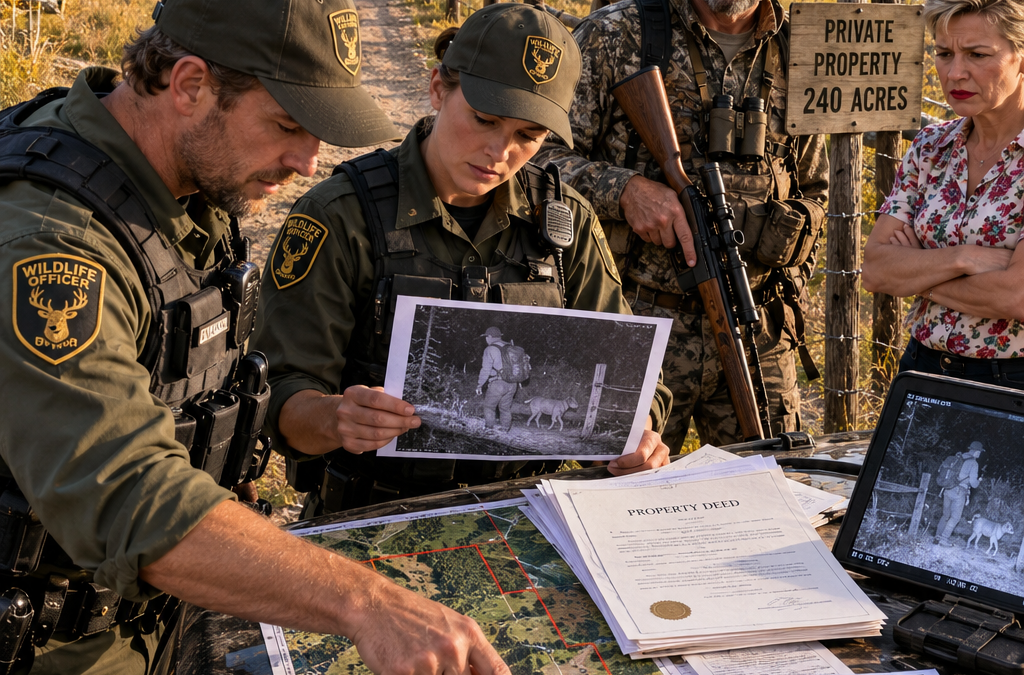
Sheila Brandt stood behind two wildlife officers pointing at me like I was an armed trespasser, even though the rifle was legal, the tag was valid, and every boot print beneath me was on land my family had owned for more than sixty years.
What she did not know was that my grandfather had taught me never to argue about a boundary I could prove, and I had been saving every document, every photograph, and every trail-camera recording from the moment she decided my ranch belonged to her HOA.
My name is Grant Whitaker.
I was forty-six years old when an HOA president tried to turn me into a criminal on my own land.
The land was 240 acres of timber, open ridge, lake edge, creek bottom, and rocky mountain pasture that had belonged to my family since 1961.
It wasn’t manicured.
It wasn’t designed.
Nobody had landscaped the slopes or planted ornamental trees to improve a view.
The fences leaned in places.
The access road turned to mud after heavy rain.
The cabin smelled faintly of pine smoke no matter how often I aired it out.
In October, elk crossed the upper ridge before sunrise.
In winter, the lake iced along the shoreline first.
In spring, the creek below the western slope ran loud enough that I could hear it from the porch after dark.
It was the most beautiful place I had ever known.
And almost every important memory I had of it involved my grandfather.
His name was Walt Whitaker.
He bought the first part of the property in 1961 when land in those mountains was considered too remote to be worth much.
There was no luxury development next door.
No clubhouse.
No private dock.
No landscaped entrance with stone columns.
Just timber, ranchland, old logging tracks, and a narrow lake road.
Grandpa built the original cabin himself.
Not from a kit.
Not with a crew.
Log by log.
My father used to say Grandpa spent so long leveling the first wall that Grandma threatened to finish the house without him.
Grandpa’s answer was always the same.
“If the first line is wrong, everything after it is just a better-organized mistake.”
That was how he thought about land too.
Boundaries mattered.
Documents mattered.
Permission mattered.
One of his favorite sayings was:
“The paperwork is what protects the handshake.”
When I was a kid, I thought that sounded painfully old-fashioned.
Grandpa grew up in a world where men shook hands over cattle, timber, fence repair, and access roads.
Yet he documented almost everything.
Receipts.
Surveys.
Licenses.
Maps.
Letters.
If somebody borrowed a strip of land, Grandpa wrote down what they were allowed to do and for how long.
I used to tease him.
“Nobody’s stealing the mountain, Grandpa.”
He would smile.
“People don’t steal a mountain all at once.”
Then he would tap the deed box.
“They borrow an inch and forget to give it back.”
I didn’t understand that either.
Not then.
Every fall, Grandpa took me hunting.
He taught me how to move quietly over dry leaves.
How to read tracks.
How to recognize wind direction by watching grass.
How to wait.
Most importantly, he taught me boundaries.
Before we crossed any ridge, he made me point to the survey markers.
Orange blaze on a pine.
Old steel post near the creek.
Rock pile beside the northern fence.
“Where are we?” he’d ask.
“Your land.”
“How do you know?”
“The marker.”
“Good.”
Then he’d say:
“A good hunter never guesses whose land he’s standing on.”
That lesson became more important than either of us could have imagined.
In 1994, everything around us began changing.
A developer purchased a huge tract next door.
Bulldozers arrived.
Roads were cut.
Utilities came in.
Within a few years, Timber Ridge Estates stood where forest and pasture had been.
It was a luxury development.
Large houses.
Clubhouse.
Lake views.
Private dock.
Stone entrance.
Homeowners association.
Back then, the original developer approached Grandpa with a simple request.
Residents wanted to use a trail along the lake edge.
Part of that trail crossed our land.
Grandpa didn’t object.
He had never been the kind of man who closed a gate just because he could.
People wanted to walk beside the lake.
Fine.
So he granted the developer a license in 1994.
A written license.
Not an easement.
Not a sale.
Not a transfer of ownership.
Permission.
The document allowed Timber Ridge residents to use a specific trail along the lake edge.
It could be revoked with thirty days’ notice.
Grandpa retained ownership.
That should have been simple enough.
For almost thirty years, it was.
Then Grandpa died.
He was ninety-one.
I had known the day was coming.
That didn’t make it easier.
Two years before the trouble with Sheila, he passed away in the same county where he had spent most of his life.
He left the ranch to me.
The cabin.
The 240 acres.
The lakefront.
The old equipment.
And a steel document box heavy enough that I nearly dropped it carrying it out of his bedroom.
Inside were decades of paperwork.
The deed.
Surveys.
Tax records.
Fence agreements.
The 1994 trail license.
And a short handwritten note.
Grant,
Protect this land.
That was it.
Three words.
No speech.
No detailed instructions.
Grandpa had never wasted words.
I read it three times.
Then I folded it along the same crease he’d made and put it back in the box.
That spring, I moved into the cabin.
I wasn’t running away from anything dramatic.
I had simply reached a point where I wanted to stop treating the ranch like a place I visited and start treating it like home.
For the first few weeks, it felt right.
I repaired fence.
Cleared deadfall.
Replaced boards on the porch.
Walked the property lines.
Bought my hunting license.
Bought my elk tag.
Checked old water lines.
Fixed the shed roof.
I drank coffee outside before sunrise and listened to the valley wake up.
Then Sheila Brandt walked up my driveway.
She was impossible to miss.
Bright pink blazer.
White pants.
Designer sunglasses.
Plate of cookies in one hand.
Perfect smile.
It was the kind of entrance that looked friendly until you paid attention to how confidently she had entered private property without knocking.
I was beside the barn replacing a hinge.
She stopped about six feet away.
“You must be Grant Whitaker.”
“That’s me.”
“Sheila Brandt.”
She waited.
I assumed I was supposed to recognize the name.
When I didn’t, she added:
“President of Timber Ridge Estates.”
“Oh.”
Her smile tightened by a fraction.
“I wanted to welcome you.”
She handed me the cookies.
“That’s kind. Thank you.”
“We’ve always had a wonderful relationship with your grandfather.”
That was news to me.
Grandpa had never complained about the residents.
That was not the same thing as describing an HOA as wonderful.
She looked toward the lower trail.
“Our homeowners absolutely love your lake trail.”
“I know.”
“It’s one of our most valuable amenities.”
The wording caught me.
“Your amenity?”
She laughed lightly.
“You know what I mean.”
“I know residents use it.”
“Exactly.”
She stepped slightly closer.
“Which is why I thought this would be a perfect time for the association to take over maintenance.”
“Maintenance?”
“Trail clearing, landscaping, liability administration, signage. All the things your grandfather handled informally.”
“Grandpa didn’t handle landscaping.”
She smiled again.
“We’d improve it.”
I looked toward the trail.
It was dirt and pine needles.
Exactly the way Grandpa had wanted it.
“Let me think about it.”
Her smile changed.
Not much.
But enough.
“I don’t think there’s much to think about.”
“I do.”
“The trail serves our residents.”
“It’s on my property.”
“Of course.”
She said it as though I had pointed out something tedious.
“We’re just trying to make everyone’s life easier.”
“I appreciate the offer.”
“Good.”
“I’ll think about it.”
There was a pause.
Then she reached for the cookie plate as though she regretted giving it to me.
“Well. I’m sure we’ll talk soon.”
She walked back down the driveway.
I watched the pink blazer disappear between the pines.
Something about the conversation bothered me.
Not enough to act on.
Just enough to remember.
A week later, a white pickup came through the gate.
New truck.
Clean enough that the tires looked decorative.
A man stepped out wearing expensive boots that had probably never seen mud.
“Grant Whitaker?”
“Yes.”
“Brent Callaway.”
He handed me a business card.
Callaway Land Development.
We shook hands.
He looked toward the lake.
“Beautiful place.”
“It is.”
“I’ll be direct.”
“Please.”
“I want to buy the lakefront half.”
That surprised me.
“No.”
He laughed.
“I haven’t told you the number.”
“Doesn’t matter.”
“Two point one million.”
I looked at him.
He smiled.
“Cash structure can be arranged. Fast close.”
“No.”
His smile stayed in place.
“That’s a lot of money.”
“I know.”
“You haven’t even thought.”
“I have.”
“Everyone in Timber Ridge wants access to more lakefront.”
“Then they can enjoy what they already have.”
“Mr. Whitaker, everybody has a price.”
I looked back toward the cabin.
The porch Grandpa built.
The ridge where he taught me tracks.
The lake where he taught me to cast.
“My price is sixty years of my family’s sweat.”
Brent stared.
I continued.
“It’s not for sale.”
His smile became colder.
“Things change.”
“So I’ve heard.”
He got into the truck.
As he drove away, I saw someone in the passenger seat.
Pink blazer.
Sheila.
That was the first moment I knew the cookie visit had not been social.
Two days later, the first HOA letter came.
NOTICE OF VIOLATION.
I actually laughed.
The association cited my fence as visually unsightly.
They called my pickup an unapproved commercial vehicle.
The letter demanded correction within ten days.
I wasn’t inside Timber Ridge.
My deed had no HOA covenants.
My land predated the development by more than thirty years.
I folded the letter.
Put it in Grandpa’s metal box.
Ignored it.
Second letter.
Firearms activity creating a nuisance to residents.
That one stopped me.
I had not fired a weapon on the ranch since moving in.
Not once.
No target shooting.
No hunting yet.
Nothing.
I read that letter twice.
Somebody wasn’t reacting to my behavior.
Somebody was building a record in advance.
Then the rumors started.
The general store was only fifteen minutes from the ranch.
I had been shopping there since childhood.
People knew my grandfather.
Some knew me.
One morning I walked in and a conversation near the coffee counter stopped.
Not naturally.
Stopped.
The cashier, Ed, wouldn’t quite meet my eyes.
“What?”
He sighed.
“You haven’t seen the Timber Ridge newsletter?”
“No.”
He handed me a printed copy someone had left on the counter.
There was a section about “community safety concerns.”
No full name.
But enough details.
Adjacent landowner.
Weapons activity.
Aggressive behavior.
Uncooperative stance toward established community access.
A phrase near the end described a “dangerous armed loner living along the Timber Ridge boundary.”
I stared at it.
“Who wrote this?”
Ed didn’t answer.
He didn’t need to.
That evening, two women hiking near the lake saw me repairing fence and crossed to the far side of the trail.
One whispered something to the other.
I felt it then.
The story was working.
Sheila wasn’t trying to prove I had done something.
She was creating an atmosphere where people would interpret anything I did as threatening.
I attended the next HOA meeting.
Not because they governed me.
Because they were talking about me.
The Timber Ridge clubhouse looked more like a mountain resort lobby than a neighborhood meeting room.
Stone fireplace.
Vaulted ceiling.
Polished wood.
About sixty people sat facing the board.
Sheila sat in the center with a gavel.
A literal gavel.
When public comment began, I raised my hand.
She looked at me.
“Yes?”
“I’m Grant Whitaker.”
The room shifted.
People turned.
Sheila leaned toward the microphone.
“I think everyone knows who you are.”
That was exactly the problem.
I stood.
“I’ve heard statements suggesting I’ve threatened residents, fired weapons near homes, and interfered with property that belongs to Timber Ridge.”
Sheila folded her hands.
“Residents have concerns.”
“Have I threatened anyone?”
“You’ve created an intimidating environment.”
“How?”
“You openly carry firearms.”
“On my ranch during lawful activities?”
She smiled.
“This is a residential community.”
“My ranch isn’t.”
The room went quieter.
“I haven’t threatened anyone. I haven’t trespassed. I haven’t fired a shot since I moved back. I own my land and everything on it.”
Sheila laughed.
“We’ll see about that.”
That sentence settled something for me.
I drove into town the next morning.
Ms. Priaire was a real estate attorney who had handled boundary disputes, timber claims, access rights, and enough mountain property cases that she knew how quickly a neighborly arrangement could become a lawsuit.
I put Grandpa’s metal box on her conference table.
She began with the deed.
Then the county survey.
Then the 1994 trail license.
She read slowly.
I waited.
Finally she looked up.
“Grant.”
“Yeah?”
“Do you know exactly where the Timber Ridge property line is?”
“Grandpa drilled it into me.”
She spread the survey.
“The lakeside trail is yours.”
“I know.”
“The lower gazebo?”
I leaned closer.
The structure Timber Ridge advertised as a resident viewing pavilion sat near the lake.
I had always assumed it was on the subdivision’s parcel.
Ms. Priaire tapped the map.
“Yours.”
I stared.
“What about the dock ramp?”
“Also on your side.”
“You’re sure?”
“I’ll order a new survey to confirm, but according to the recorded line, yes.”
I sat back.
For almost thirty years, Timber Ridge had treated those improvements like HOA amenities.
Grandpa had apparently tolerated it because the residents used them under the trail license.
Permission had become habit.
Habit had become assumption.
Assumption had become ownership in Sheila’s mind.
Ms. Priaire tapped the 1994 license.
“This is revocable with thirty days’ notice.”
“I see that.”
“What do you want to do?”
I thought about Sheila calling me a threat.
Brent’s offer.
The letters.
“We revoke it.”
She nodded.
“Then we do it properly.”
Certified letter.
Legal description.
Effective date.
Full thirty days.
No surprise.
No gate slammed overnight.
No confrontation.
The letter made it clear that after thirty days, Timber Ridge residents would no longer have permission to use the trail, gazebo area, or dock ramp on my parcel without a new agreement.
Sheila signed for the certified letter herself.
I still have the receipt.
She responded by calling an emergency board meeting.
I did not attend.
Marjorie Fen, a Timber Ridge resident, later told me what happened.
Sheila stood at the podium and announced that I had “stolen” the neighborhood trail.
Stolen.
Land on my deed.
She promised residents:
“I’ll handle him.”
Thirty days passed.
The license expired.
People kept using the trail.
At first, I didn’t confront them.
Most residents had been told the trail belonged to the HOA.
I wasn’t interested in shouting at retirees out for morning walks.
I installed trail cameras along the ridge.
Mostly for elk.
But also to document traffic.
A week later, I pulled the memory card.
The first images were normal.
Deer.
Fox.
Raccoon.
Three elk cows.
Then at 5:18 one morning, the camera recorded movement.
Bright pink.
I zoomed in.
Sheila.
Beside her was a man in a black cap.
They carried a heavy plastic bucket.
The next image showed them in a clearing on my ridge.
Dumping something.
Another.
Hay.
Then Sheila placed a large salt block near a tree.
The man strapped a trail camera to a trunk.
I stared at the screen.
HOA sticker on the camera housing.
I watched the clip again.
And again.
Why?
The next morning, I hiked up there.
Hay.
Salt.
A camera I had never authorized.
Tracks.
Someone was deliberately attracting elk.
I called a wildlife information office.
That’s when I learned feeding wild elk was illegal under the circumstances.
It can change animal behavior.
Concentrate herds.
Increase disease risk.
Create dangerous encounters.
During hunting season, baiting carries additional consequences.
Doing it on private property without consent added another problem.
Still, I didn’t know why Sheila wanted elk on my ridge.
That night, I found an envelope under my cabin door.
No stamp.
Inside was a handwritten note.
Grant,
The board approved an “elk viewing program.” Sheila says it will boost lot prices.
Please be careful.
M.
Marjorie Fen.
I sat at the kitchen table staring at those words.
Elk viewing program.
Lot prices.
Then Brent Callaway’s $2.1 million offer came back to me.
The lakefront half.
The ridge.
Luxury homes.
Imagine the sales brochure.
Private mountain community.
Lake views.
Resident trail.
Wild elk visible from your backyard.
Sheila and Brent didn’t just want my land.
They were improving the value of adjacent lots by pulling wildlife onto property they didn’t own.
If they could make my legal use of the ranch look dangerous, even better.
Armed loner.
Nuisance hunter.
Threat to children.
Maybe pressure me to sell.
Maybe build public opposition.
Maybe convince authorities that I was the problem.
The story was already waiting for elk season.
Saturday morning, the season opened.
I considered staying home.
For about five minutes.
Then I thought of Grandpa.
Protect this land.
I had a valid hunting license.
Valid elk tag.
I knew every boundary.
I had every legal right to hunt.
Avoiding my own land because Sheila might lie about it felt like giving her something she had no right to take.
So I did everything carefully.
I entered from the north.
Private access.
No Timber Ridge roads.
Hunting hours had begun thirty minutes before sunrise.
I went deep onto my own parcel.
Nearest residence more than four hundred yards away.
Visible survey markers.
Safe shooting direction.
Around eight, I settled behind a fallen log overlooking a meadow.
I hadn’t seen an elk worth taking.
Then movement appeared on the far edge.
Pink.
I lowered my rifle immediately.
Sheila.
Binoculars.
Standing inside my boundary.
On my property.
I stayed still.
She raised her phone.
Started talking.
I could not hear the words.
Later, when I heard the 911 recording, I learned what she said.
“There’s a crazy man with a rifle stalking our residences.”
Not hunter.
Not landowner.
Not adjacent ranch.
Crazy man.
Stalking.
Residences.
She did not mention that she was the one trespassing on his land.
She did not tell dispatch that my rifle had never been pointed at anyone.
She did not mention the four-hundred-yard distance.
She described the scene she needed.
I unloaded my rifle.
Opened the action.
Slung it correctly.
Then I started toward the cabin road.
Slowly.
Hands visible.
I didn’t want an arriving officer to see a man moving through timber with a loaded rifle after receiving a call about an armed threat.
Twenty minutes later, I heard a siren.
Two wildlife officers pulled in first.
Warden Rachel Dunn.
Warden Carlos Ortega.
Sheriff’s SUV behind them.
And behind that:
Sheila.
Pink blazer.
She got out pointing at me.
“Drop that rifle!”
Warden Dunn raised a hand.
“Sir, set the firearm down.”
I did exactly what she asked.
Slowly unslung it.
Opened the action.
Showed empty chamber.
Placed it on the ground.
Stepped away.
Then sat on the hood of my truck.
My heart was pounding.
Not because I had done anything wrong.
Because being right does not make a rifle look less like a rifle to officers responding to a dangerous call.
“Name?” Dunn asked.
“Grant Whitaker.”
“Identification?”
“In my wallet.”
“Slowly.”
I handed it over.
“Why are you out here?”
“Elk hunting.”
“License?”
I gave it to her.
Tag.
Hunter education card.
Everything.
She checked the license electronically.
Valid.
Tag valid.
Season open.
She looked at me.
“Mr. Whitaker, can you show us where the property line is?”
I almost smiled.
Grandpa.
A good hunter never guesses whose land he’s standing on.
I walked to the truck.
Asked permission before reaching inside.
Pulled out the survey.
Sheila immediately interrupted.
“He’s threatening residents.”
Dunn did not look at her.
“Ma’am, let me finish with him.”
“He’s hunting next to our homes!”
Ortega took out a distance device.
Checked the map.
Checked line of sight.
Nearest Timber Ridge residence.
412 yards.
“Ma’am,” he said, “nearest home is over four hundred yards away. He’s beyond the required safety distance.”
Sheila folded her arms.
“Fine. But he’s trespassing on the HOA trail.”
That was the moment I had been waiting for.
I reached into my document folder.
Handed Dunn the certified revocation.
“The trail is on my land.”
She read.
I pointed.
“Original license from 1994. Revocable with thirty days’ notice. Notice was delivered forty-one days ago.”
Dunn turned to Sheila.
“Ms. Brandt, is that your signature?”
She looked.
Her face changed.
“I signed for paperwork.”
“Is this your signature?”
“Yes, but that doesn’t matter. Residents have used the trail for almost thirty years.”
Dunn looked at the original license.
“On permission.”
Sheila scoffed.
“It’s effectively ours.”
Dunn looked at her.
“No. According to this document, it was licensed use. Permission was revoked.”
Sheila’s jaw tightened.
Then Ortega asked a question that changed everything.
“Mr. Whitaker, have you noticed anyone feeding wildlife on this ridge?”
I looked at him.
I felt the first real calm I’d had all morning.
“I was hoping you’d ask.”
Sheila’s head snapped toward me.
I took out my phone.
Opened the trail-camera footage.
She moved closer.
“What is that?”
I didn’t answer her.
I handed the phone to Dunn.
Video.
Sheila.
Pink jacket.
Man in black cap.
Bucket.
Hay.
Salt blocks.
HOA camera.
Dunn watched the clip once.
Then again.
Ortega watched.
Sheila’s mouth opened.
No words.
Dunn handed my phone back.
Her voice became very calm.
“Ms. Brandt, I need you to step off Mr. Whitaker’s property.”
“This is our trail.”
“No, ma’am.”
“Our residents—”
“Step off the property.”
Sheila looked at me.
I said nothing.
The wardens walked with me to the ridge.
Exactly where the video showed.
Salt block.
Hay.
Camera.
Ortega photographed everything.
Measured.
Documented.
Removed the HOA camera as evidence.
He looked toward Dunn.
“Illegal baiting of big game.”
Then at me.
“On private property without permission.”
We returned to the cabin road.
Sheila was still arguing with the sheriff’s deputy.
Dunn opened her citation book.
Criminal trespass.
Unlawful feeding of big game.
False report to emergency services referred and documented under the applicable process.
Sheila stared.
“I’m the HOA president.”
Dunn stopped writing.
“I’m sorry?”
“You can’t do this to me.”
Dunn’s expression did not change.
“Mr. Whitaker is the landowner.”
Sheila pointed toward the ridge.
“That trail serves two hundred families.”
“That doesn’t make it yours.”
I stepped forward.
My voice was quiet.
“Ms. Brandt.”
She looked at me.
“You are no longer welcome anywhere on my property.”
Her face hardened.
“Not the trail.”
She said nothing.
“Not the gazebo.”
Nothing.
“Not the dock ramp.”
Her eyes narrowed.
“Please leave.”
For the first time since I had met her, Sheila Brandt did not have an answer.
She walked.
I watched the pink blazer disappear down the road.
I should have felt victorious.
I didn’t.
Mostly, I felt exhausted.
Because the worst part of being falsely accused is not the argument.
It is realizing how easily somebody’s words could have changed your life if you had made one wrong movement.
One loaded chamber.
One angry gesture.
One raised voice.
One step toward an officer.
Sheila had described me as a dangerous man with a rifle.
If I had behaved like the man she invented, even for ten seconds, the rest of the truth might not have mattered.
That afternoon, Marjorie Fen called me.
Her voice was shaking.
“Grant.”
“Marjorie?”
“There’s an emergency board meeting.”
“Okay.”
“I need you to know I’m going to tell them.”
“Tell them what?”
“Everything.”
The clubhouse was packed by evening.
I did not sit with the board.
I stood near the back.
Marjorie walked to the front carrying a folder.
She looked terrified.
She also looked determined.
Sheila was not there.
Craig Mullins sat at the board table.
Brent Callaway wasn’t a board member, but his name was about to become the most important name in the room.
Marjorie opened the folder.
“HOA funds were used to purchase feed, salt blocks, and wildlife cameras.”
Murmurs.
She swallowed.
“I knew about some of it.”
The room became quieter.
“I helped hide it.”
Craig stared at her.
“Hide what?”
“The elk program.”
She pulled out receipts.
Feed store.
Camera equipment.
Vehicle mileage.
Landscaping expense coding.
Then invoices.
Brent Callaway’s name.
Again.
Again.
Again.
Marjorie continued.
“Sheila told us the viewing program would increase Timber Ridge property values and support planned expansion.”
Someone shouted:
“Expansion where?”
Marjorie looked toward me.
Everybody turned.
“The Whitaker land.”
The room erupted.
I didn’t speak.
The evidence was doing enough.
Craig banged the table.
“Quiet.”
Someone shouted:
“Did Sheila have permission?”
“No.”
“Did Grant know?”
“No.”
“Was the board told the trail license had been revoked?”
Marjorie looked down.
“Sheila said it wasn’t valid.”
“Did counsel say that?”
“No.”
More shouting.
Then Craig asked the question that mattered.
“Who approved purchasing the bait?”
Marjorie raised her hand halfway.
“Sheila presented it as marketing.”
“Who approved entering private land?”
Silence.
Craig looked around.
Nobody raised a hand.
“Who approved Callaway’s involvement?”
Again, nothing.
Marjorie handed him another document.
The board voted that night.
Unanimous.
Sheila Brandt was removed as HOA president.
No close count.
No tie.
Every board member voted against her.
The sheriff’s department opened a broader investigation into the relationship between Sheila and Brent Callaway.
The developer who had offered me $2.1 million for half my ranch now had his name attached to invoices connected to an illegal wildlife-baiting program designed to enhance the value of development surrounding land he did not own.
His offer had once sounded enormous.
After the investigation started, people around town joked that it had become a “$2.1 million problem.”
I didn’t laugh much.
I had liked Brent even less than Sheila.
But the thing that disturbed me was how close their plan had come to becoming reality.
If I had accepted the offer, the lakefront would have been gone.
If I hadn’t found Grandpa’s license, Timber Ridge would have continued treating my trail as its own.
If I hadn’t installed cameras, Sheila might have called 911 and described elk on my ridge without anyone knowing she had put them there.
If I had responded badly, the dangerous-armed-loner story could have become self-fulfilling.
The entire scheme depended on me making one bad decision.
Grandpa had spent sixty years teaching me not to.
A month later, another vehicle came up my driveway.
I saw it from the porch.
Not a Lexus.
An older Subaru.
Marjorie Fen stepped out.
She was now the interim HOA president.
She didn’t carry cookies.
She carried a folder.
And an envelope.
“Morning.”
“Morning.”
“Can I come up?”
I nodded.
She stopped at the porch steps.
“I wanted to do this correctly.”
She handed me the envelope.
Inside was a check covering damage and documented encroachments associated with unauthorized trail use and wildlife activity.
There was also a signed letter from the board.
Formal apology.
It acknowledged that Timber Ridge had exceeded its rights under the old license.
Acknowledged the illegal entry.
Acknowledged misuse of association funds.
Acknowledged that I had been falsely characterized in neighborhood communications.
I read it.
Then folded it.
Marjorie looked toward the trail.
“We’d like to ask permission.”
Those words mattered.
Ask permission.
Not claim authority.
Not demand access.
Not tell me what thirty years of use supposedly meant.
Ask.
“For the trail?”
“Yes.”
“And the gazebo?”
“If you’re willing.”
“Dock ramp?”
“Yes.”
I looked toward the lake.
“What changed?”
She gave me a tired smile.
“Everything.”
I let her sit.
We drank coffee.
She apologized again.
I stopped her.
“You already did.”
“I helped Sheila.”
“You told the board.”
“Late.”
“But you told them.”
She looked down.
“That doesn’t erase it.”
“No.”
I thought about Grandpa’s note.
Protect this land.
Protection isn’t always a locked gate.
Sometimes it is a better agreement.
I called Ms. Priaire.
We drafted a new trail license.
Not the old loose arrangement.
A detailed agreement.
Defined trail boundaries.
Hours.
Maintenance responsibilities.
No expansion without written permission.
No commercial tours.
No new structures.
No entry beyond the licensed corridor.
Liability terms.
And one sentence I insisted be written plainly enough that no future HOA president could pretend to misunderstand it.
NO FEEDING, BAITING, ATTRACTING, OR OTHERWISE MANIPULATING WILDLIFE ON THE WHITAKER PROPERTY.
Marjorie read it.
“Fair.”
“Trail-camera installation also requires permission.”
“Fair.”
“Annual review.”
“Fair.”
“If the HOA violates it materially, I can revoke.”
She nodded.
“We understand.”
We signed.
I did not give Timber Ridge ownership.
I gave residents controlled access.
The right way.
Grandpa would have approved.
I think.
There was one other thing I changed.
The gazebo.
Timber Ridge had maintained it for years under the assumption that it belonged to the neighborhood.
Legally, it was mine.
Instead of removing it, I repaired it.
Replaced two rotted boards.
Repainted the railing.
Put up a small plaque.
WHITAKER LAKESHORE TRAIL
PRIVATE LAND — ACCESS BY PERMISSION
PLEASE RESPECT WILDLIFE AND PROPERTY
No threats.
No giant warning sign.
Just clarity.
That was what had been missing all along.
Sheila had relied on confusion.
Confusion about ownership.
Confusion about access.
Confusion about firearms.
Confusion about wildlife.
Once everything became clear, her authority collapsed.
She eventually paid her fines.
The criminal and administrative matters ran their course.
She sold her house in Timber Ridge.
Someone later told me she had moved into a condominium several towns away.
No mountain.
No elk.
No trail.
I didn’t celebrate.
I didn’t send a card.
I didn’t need another ending.
The land was still mine.
That was enough.
Brent Callaway disappeared from the valley for a while.
His proposed expansion never happened.
The parcels beside my boundary remained undeveloped.
For now.
I’m not naïve enough to believe nobody will ever ask again.
Land with lake frontage draws attention.
Two million becomes three.
Three becomes five.
Someone will make another offer.
Maybe Lily will receive one decades from now.
That’s why Grandpa’s documents matter.
That’s why mine will too.
One winter afternoon, I opened his metal box again.
The old note was there.
Protect this land.
I sat at the kitchen table holding it.
Lily—my daughter, not the same Lily from some storybook version of my life but the person who would one day inherit whatever I left—was away at school that weekend.
For the first time, I understood the sentence differently.
Protect this land did not mean never share it.
Grandpa had shared it.
He gave Timber Ridge trail access.
It did not mean hate neighbors.
Grandpa knew plenty of people from the development.
It did not mean treat ownership like a weapon.
It meant remember the boundary between generosity and surrender.
Permission is generosity.
Ownership surrendered through neglect is something else.
That’s what Sheila counted on.
Thirty years of access had made everyone comfortable.
Comfort became expectation.
Expectation became entitlement.
By the time I inherited the ranch, residents no longer thought:
Mr. Whitaker allows us to use this trail.
They thought:
This is our trail.
Sheila merely said the quiet part out loud.
That’s how rights get blurred.
Not usually with one dramatic theft.
Grandpa had warned me.
People don’t steal a mountain all at once.
They borrow an inch and forget to give it back.
He had been right.
The elk returned that winter.
Not because anybody fed them.
They came when they wanted.
Some mornings none appeared.
Some mornings a dozen crossed the high meadow.
That’s the way wildlife is supposed to be.
Wild.
Unscheduled.
Unmanaged for real estate brochures.
I watched from the porch with binoculars.
No bait.
No salt.
No HOA camera.
Just animals moving through land that had supported them long before any of us arrived.
One morning, Marjorie stopped while walking the licensed trail.
She saw three cows and a young bull crossing above us.
She whispered:
“That is incredible.”
I smiled.
“Better when nobody arranges it, isn’t it?”
She looked embarrassed.
Then laughed.
“Much.”
Over time, Timber Ridge changed.
Not dramatically.
The clubhouse still stood.
Homes still sold for ridiculous amounts.
Residents still cared about property values.
That’s fine.
People are allowed to care about their investments.
But the new board stopped talking about my ranch as if it were an undeveloped extension of their subdivision.
Maps were corrected.
New resident packets explained that the lakeshore trail crossed private Whitaker property under a revocable license.
The HOA newsletter published hunting-season reminders.
Not warnings about a dangerous neighbor.
Actual facts.
Private land adjacent to Timber Ridge is lawfully used for hunting.
Residents should remain on designated licensed trails.
Bright clothing recommended during season.
Do not enter closed portions of the ranch.
Simple.
Accurate.
Nobody panicked.
Funny what happens when information is written without an agenda.
Craig Mullins came by one afternoon.
The same man who had once photographed my cabin while whispering that he was only doing his job.
He carried no camera.
“Grant.”
“Craig.”
He looked uncomfortable.
“I owe you an apology.”
“Marjorie already brought one from the board.”
“I mean from me.”
I waited.
“I knew those violation notices were questionable.”
“Why did you deliver them?”
“Sheila told me counsel had approved everything.”
“Did you see that approval?”
“No.”
“Why not?”
He looked toward the ground.
“Because it was easier not to ask.”
That answer was more honest than most apologies.
He continued.
“I’ve thought about that a lot.”
“So have I.”
“I kept telling myself I was just doing my job.”
“I remember.”
He winced.
“Yeah.”
I leaned against the fence.
“Then do your job differently next time.”
He nodded.
“I will.”
I believed him.
Maybe that was foolish.
Maybe not.
People can learn.
If they couldn’t, property disputes would be the least of our problems.
The incident also changed how I thought about hunting.
I had always treated safety seriously.
Grandpa demanded it.
But after having someone call 911 and describe me as a threat, I became even more methodical.
I carried copies of the survey.
License.
Tag.
I notified the new HOA before elk season—not for permission, but as a courtesy.
I marked restricted trail areas clearly.
Installed temporary signs.
The first year after Sheila left, Marjorie emailed me:
Thank you for the notice. Residents have been reminded to stay on the licensed trail and respect your property.
That was it.
No conflict.
No patrol cars.
No wildlife officers.
No pink blazers.
The difference between war and peace was often nothing more complicated than two adults respecting where their authority ended.
I saw Warden Dunn again months later at a sporting-goods store.
She recognized me.
“Mr. Whitaker.”
“Warden.”
“How’s the ranch?”
“Quiet.”
“Good.”
I hesitated.
“Can I ask you something?”
“Sure.”
“That day, when Sheila called. How bad did the dispatch description sound?”
Dunn looked at me carefully.
“Bad enough that we approached cautiously.”
I nodded.
“That’s what I figured.”
“You did the right thing unloading before we arrived.”
“Grandpa taught me not to make people guess around firearms.”
“Smart man.”
“He was.”
Dunn picked up a box of ammunition from the shelf.
Then said:
“Most dangerous part wasn’t the rifle.”
“What was?”
“The false context.”
I looked at her.
She continued.
“A legal firearm in the right context is one thing. Same firearm described as a man stalking houses sounds completely different.”
That stayed with me.
Context.
Sheila couldn’t change my license.
Couldn’t change my deed.
Couldn’t change the distance to the nearest home.
So she changed the story.
That was her real weapon.
And stories are powerful because responders have to act before they know whether the story is true.
That’s why I am careful when people tell this as some funny tale about an HOA president getting cited.
It wasn’t funny when I heard the siren.
It wasn’t funny when a warden told me to set down my rifle.
It wasn’t funny knowing a frightened or overconfident person had described me as dangerous.
The outcome was satisfying because evidence existed.
Survey.
License.
Trail revocation.
Camera footage.
Wildlife bait.
Without those things, truth would have taken longer.
Maybe much longer.
Grandpa didn’t leave me money.
Not much, anyway.
He left something better.
A habit.
Document the agreement.
Know the boundary.
Respect what isn’t yours.
Demand the same from others.
That’s what beat Sheila.
Not bravado.
Not confrontation.
Not the rifle.
Certainly not being louder than her.
I rarely raised my voice.
I didn’t need to.
The deed didn’t get louder when Sheila denied it.
The survey didn’t become more valid because I was angry.
The trail-camera footage did not care whether she was HOA president.
The certified receipt still had her signature.
Facts are frustratingly calm.
That’s why they’re useful.
A year after the incident, I took my daughter up to the ridge.
We stopped near the same fallen log where I’d been sitting when Sheila called 911.
Lily looked down at Timber Ridge.
“That’s where she was?”
“Over there.”
“And she really walked onto your land while complaining that you were on her trail?”
“Yes.”
She laughed.
Then became serious.
“Why did Grandpa let them use it in the first place?”
“Because he was nice.”
“So being nice caused all this?”
“No.”
She looked at me.
“Then what did?”
“People forgetting nice isn’t the same as theirs.”
She thought.
“That’s complicated.”
“Most land disputes are.”
We continued along the ridge.
I showed her the markers.
Steel post.
Blazed tree.
Rock pile.
Exactly what Grandpa had done for me.
“Where are we?”
“Our land.”
“How do you know?”
She pointed.
“Marker.”
“Good.”
She smiled.
“You sound like Grandpa.”
That was one of the best things anyone had ever said to me.
At the upper clearing, an elk track crossed the trail.
Fresh.
Lily crouched.
“Big?”
“Decent.”
“How recent?”
“Couple hours.”
She looked around.
“No salt blocks?”
I laughed.
“No.”
“Good.”
We kept walking.
One day the land will be hers.
Maybe that’s what inheritance really is.
Not acreage.
Responsibility.
Knowing which parts of the past you keep and which mistakes you refuse to repeat.
I kept Grandpa’s generosity.
I changed the paperwork.
The new trail agreement is clearer.
Stronger.
Recorded with the HOA.
Copies with attorneys.
Maps attached.
Every board member signs acknowledgment annually.
That may sound excessive.
It doesn’t to me.
A handshake is still useful.
The paperwork still protects it.
Some Timber Ridge residents became friends.
Hal—though he wasn’t part of Timber Ridge in the same way—still comes around.
Marjorie occasionally brings coffee.
Craig helped replace a washed-out section of trail after spring rain.
Nobody asks to buy the ridge anymore.
Brent’s name is rarely mentioned.
And when newcomers move into Timber Ridge, they’re told something simple.
The trail is a privilege.
Respect it.
That single sentence would have prevented almost everything.
The old HOA newsletter calling me a dangerous armed loner is still in Grandpa’s metal box.
I considered throwing it away.
Didn’t.
Next to it is the certified revocation receipt.
Then Sheila’s citations.
Then the photographs of bait.
Then the new trail agreement.
The box has become a record of two completely different ways of relating to property.
One says:
We’ve used it so long that it must be ours.
The other says:
Thank you for permission.
One turns access into entitlement.
The other keeps access possible because it recognizes ownership.
Grandpa understood that long before any of us.
Sometimes I sit on the porch before sunrise and watch the ridge.
The valley below has changed since 1961.
Luxury homes.
Streetlights.
Internet fiber.
Private docks.
More cars.
More people.
Nothing stays untouched forever.
Grandpa knew that too.
Protecting land doesn’t mean freezing time.
It means making sure change happens because the owner chooses it, not because somebody else becomes comfortable taking.
Sheila wanted me to become the villain she had already described.
Angry rancher.
Armed loner.
Threat.
Unreasonable holdout.
She needed me to behave badly because her entire strategy depended on residents believing I was dangerous.
That was why staying calm mattered.
When she came with cookies, I stayed calm.
When Brent offered money, I said no.
When the fines arrived, I filed them.
When she insulted me publicly, I hired counsel.
When the license expired, I documented.
When she baited elk, I saved the video.
When the sirens came, I unloaded.
When officers arrived, I complied.
When Dunn asked for the boundary, I had a survey.
When Sheila claimed the trail, I had her signature on the revocation receipt.
When they asked about wildlife bait, I had footage.
At every stage, Sheila hoped for emotion to outrun evidence.
It never did.
That was the real reason she lost.
Not because I was tougher.
Because Grandpa had taught me to prepare before the argument.
Years later, the thing I remember most clearly is not Dunn issuing citations.
Not the board vote.
Not Sheila losing her title.
It’s Grandpa’s handwriting.
Protect this land.
Three words.
When I first inherited the ranch, I thought protection meant refusing to sell.
Then I thought it meant stopping trespass.
Then I thought it meant defending hunting rights.
I know better now.
Protecting land also means protecting the relationships around it from becoming poisoned.
It means telling the truth when a lie would justify revenge.
It means allowing access when access can exist respectfully.
It means closing access when people abuse permission.
It means reopening it under terms everyone understands.
It means not using ownership as punishment.
That’s why I agreed to the new trail license.
Some people thought I was crazy.
After what Timber Ridge had done?
Why let them back?
Because Timber Ridge wasn’t Sheila.
Two hundred families hadn’t dumped salt blocks on my ridge.
Children hadn’t written violation letters.
Retired couples hadn’t hired Brent Callaway.
A board president and a developer had abused their positions.
Punishing every resident forever would have made ownership into the weapon Sheila always claimed it was.
I wanted something better.
The trail still runs along the lake.
People walk it.
Some wave when they see me.
Some don’t.
Doesn’t matter.
The gazebo remains.
Dock ramp too.
The elk remain wild.
The ranch remains mine.
The rules are clear.
That is peace.
Not everybody liking each other.
Everybody knowing where they stand.
The last time I heard Sheila’s name, Hal told me someone had seen her in town.
Different county.
Condo development.
No HOA position, as far as he knew.
He smiled.
“You think she’s still telling people what color their curtains should be?”
“Probably.”
“Want me to investigate?”
“No.”
“Shame.”
I laughed.
I genuinely wished her no harm.
That surprised me.
There had been a time when I wanted consequences to hurt.
After the 911 call.
After seeing the bait.
After understanding how carefully she’d built a story designed to make me look dangerous.
But anger has a shelf life if you let it.
What mattered was the ranch.
And that was safe.
One October morning, I stood at the same upper ridge with a rifle.
Elk season.
Legal tag in my pocket.
Survey copy in the pack.
No drama.
Before sunrise, fog sat low over the lake.
A bull moved through the timber.
I watched.
Good animal.
Strong.
I had a clean opportunity.
I lowered the rifle.
Not because I had become sentimental.
Something about that morning simply felt complete without taking the shot.
The bull disappeared over the ridge.
I stood there listening.
Wind through pine.
Distant water.
No sirens.
No shouting.
No cameras.
Just the mountain.
Grandpa would’ve understood.
I went home.
On the porch, I opened the metal box.
His note sat on top.
Protect this land.
I smiled.
“I did.”
Nobody answered.
But I didn’t need anyone to.
The proof was outside.
Two hundred forty acres.
Same ridges.
Same lake.
Same trail.
Elk moving free.
And a gate at the bottom of the road that opens because I choose to open it, not because somebody else forgot to ask.
That’s what Sheila never understood.
Ownership isn’t power because it lets you keep everyone out.
It’s power because it gives you the right to decide what kind of neighbor you want to be.
Grandpa chose generosity.
I chose boundaries.
In the end, those two things turned out not to be opposites at all.
They were the same lesson, written thirty years apart.
Permission means something only when people remember who gave it.
And respect means something only when both sides know where the line is.








