𝗙𝗨𝗟𝗟 𝗦𝗧𝗢𝗥𝗬 The HOA President Called Police to Arrest Me in the Vineyard My Family Had Tended Since 1938
𝗙𝗨𝗟𝗟 𝗦𝗧𝗢𝗥𝗬
She told me that was exactly the kind of sentence that made people dislike landowners.
I miss arguments like that.
Ruth died six years before Brooke Hastings ever learned my name.
Cancer.
Too fast.
After fifty-one years of marriage, people expect you to describe grief poetically.
I don’t have much poetry for it.
The house got quieter.
Dinner got smaller.
The side of the bed stayed flat.
I kept working.
That was what I knew how to do.
Ruth’s Row helped.
Every September, I walked the vines she had planted and felt less alone.
That valley was never simply an investment to me.
It held my grandfather’s work.
My father’s mistakes.
My children’s summers.
My wife’s fingerprints.
That was why, when a developer approached me in 2004, I refused to sell it.
His name was Alan Mercer.
Not related to the police officer who would later stand in the road.
Alan came into my kitchen with rolled plans under one arm and a number written on paper large enough to make most people stop listening.
He wanted the south hills.
Not all four thousand acres.
At first.
Developers rarely ask for everything in the first sentence.
He wanted to build a planned residential community along the ridge where the land rose above the central vineyard.
Views.
Trees.
Private streets.
Luxury homes.
He wanted to call it Cedar Ridge Estates.
I told him no.
He returned.
I told him no again.
Then he asked a different question.
“What would you agree to?”
That took months.
Lawyers.
Surveyors.
County meetings.
Water studies.
Road plans.
In the end, I agreed to something very specific.
The homeowners would own their individual residential lots.
I would retain the broader valley property not conveyed into those lots, including the agricultural acreage, key roads, water infrastructure, and designated common land under a master agreement.
My family’s farming rights would remain perpetual.
The association would receive defined licenses for road and well use.
The annual road-and-water license fee was one dollar.
One.
Not because the road was worth a dollar.
Because I wasn’t trying to make money from people who bought homes next to my vineyard.
I wanted legal clarity.
The developer wanted access.
I wanted the farm protected forever.
The lawyers wrote it down.
Every page.
Every easement.
Every right.
Every limitation.
Recorded with the county.
That agreement mattered because it separated ownership from use.
Cedar Ridge homeowners could live their lives.
The HOA could maintain neighborhood standards inside its actual jurisdiction.
My family could keep farming.
For twenty years, that arrangement worked.
I got along with most of Cedar Ridge.
Children rode bicycles along the licensed roads.
Families came to our autumn tasting events.
Residents bought wine.
I plowed sections of road after heavy snow without charging anyone.
If their well system needed emergency access across one of my maintenance lanes, we opened the gate.
Nobody spent much time asking who owned what because everybody respected the agreement.
Then Brooke Hastings became HOA president.
Eight months before the police came to my harvest, Cedar Ridge held an election.
I didn’t vote.
I wasn’t a member.
I heard afterward that Brooke won easily.
She was in her early fifties.
White linen blazers.
Carefully styled blond hair.
A voice that sounded as though every sentence were the headline of a press release.
Brooke liked procedures, notices, committees, and phrases like “community expectations.”
Within two months, Cedar Ridge had new mailbox standards.
New landscaping rules.
New contractor-hour restrictions.
More fines.
Longer newsletters.
People joked about it at first.
Then they stopped joking.
The first time Brooke came to my gate, I was checking irrigation.
Tuesday morning.
She parked a white SUV just outside.
Walked down with a clipboard.
“Mr. Callaway?”
“Depends who’s asking.”
She smiled.
“Brooke Hastings. President of Cedar Ridge Estates.”
“I’ve heard.”
“I was hoping we could discuss your vineyard.”
I looked over my shoulder at about a thousand acres of vines.
“Which part?”
“The operation generally.”
I leaned on the fence.
“Would you like a glass of Cabernet?”
She looked at the bottle I had open on the worktable as though I had offered her pesticide.
“No, thank you.”
“Suit yourself.”
She turned a page.
“Your vineyard is in violation of Section Fourteen of the Cedar Ridge community standards.”
I looked at her.
“My vineyard.”
“Yes.”
“Violates your neighborhood rules.”
“Several provisions.”
“These vines are older than your neighborhood.”
“History doesn’t supersede current standards.”
I almost laughed.
“What standards?”
“Agricultural structures, commercial activity, visual consistency, vehicle access.”
I waited for her to realize how absurd it sounded.
She didn’t.
“Brooke.”
“Yes?”
“I am not in your HOA.”
“We have jurisdiction over activities that affect the community.”
“No.”
Her smile tightened.
“The board’s interpretation differs.”
“The board’s interpretation of what?”
“The master community boundaries.”
That caught my attention.
“Have you read the master agreement?”
“I’ve reviewed the relevant portions.”
“All of it?”
“I don’t need to read two hundred pages to understand why an industrial agricultural operation beside residential homes creates concerns.”
Industrial agricultural operation.
My grandfather would have enjoyed that phrase.
“I suggest you read it.”
She tapped her pen.
“I suggest you prepare to comply.”
Then she left.
Three days later, the first fine arrived.
Five hundred dollars.
Reason:
UNAPPROVED AGRICULTURAL STRUCTURE.
The structure identified in the photograph was my stone barn.
Built in 1952.
I pinned the notice to the corkboard in my kitchen.
Ruth had used that same board for grocery lists.
School photographs.
Harvest schedules.
I put Brooke’s fine beside an old picture of Ruth holding a bottle of our first estate Cabernet.
Something told me the letter would not be lonely for long.
I was right.
The second notice arrived nine days later.
Two thousand five hundred dollars.
ILLEGAL COMMERCIAL OPERATION ON RESIDENTIAL LAND.
Attached were aerial photographs.
My harvest staging area.
Workers.
Trucks.
Crush pad.
Drone images.
Brooke had commissioned somebody to fly over my farm.
I stared at them longer than I stared at the fine.
There is something invasive about seeing your own land photographed from above by someone trying to build a case against you.
I called my attorney.
Norah Whitfield had represented my family for eighteen years.
She was younger than me by twenty-five years and had the useful habit of becoming quieter when everyone else became dramatic.
I drove to her office with both notices.
She read them.
Then the master agreement.
Then the notices again.
Finally she said, “Don’t argue with her.”
“I wasn’t planning to.”
“You were absolutely planning to.”
“Maybe a little.”
“Don’t threaten her.”
“I can do polite.”
“Everett.”
“I can.”
She leaned back.
“Document everything.”
“So we do nothing?”
“No.”
“We let her keep sending fines?”
“Yes.”
“Why?”
“Because every unauthorized act becomes evidence.”
I looked at the notices.
“Evidence of what?”
“Depends how far she goes.”
That turned out to be farther than either of us expected.
Brooke began showing up everywhere.
HOA meetings.
County offices.
The farmers market.
Online.
She told residents my vineyard was operating under “legacy loopholes.”
She claimed the agricultural traffic created safety risks.
She posted photographs of the stone barn with a caption asking:
Is this the kind of neighbor Cedar Ridge deserves?
Within an hour, there were dozens of comments.
Some defended me.
Others complained about trucks.
Noise.
Dust.
Farm equipment.
One person wrote that it was time the valley “modernized.”
I read that twice.
The valley had been there before his house.
But I followed Norah’s instructions.
I saved screenshots.
Printed letters.
Archived emails.
Created folders.
Dates.
Times.
Amounts.
I stopped responding emotionally.
When a $1,000 noise penalty arrived, I filed it.
When Brooke demanded I apply for commercial permission from the HOA, I filed that too.
When she sent a cease-and-desist letter ordering harvest traffic to stop using the road the HOA itself licensed from me, I sent it directly to Norah.
“She’s making this easier,” Norah said.
“It doesn’t feel easier.”
“Legal easy. Not personal easy.”
There was a difference.
At the farmers market, the division became obvious.
Tom Briggs, Cedar Ridge’s treasurer, came to my booth one Saturday.
Tom was sixty-two.
Retired accountant.
The kind of man who wore reading glasses on a cord and could tell you to the penny what he had spent on fertilizer in 1997.
He picked up a bottle of Cabernet.
“Put this on my account.”
“You don’t have an account.”
“Then start one.”
I smiled.
He lowered his voice.
“I’m sorry, Ev.”
“For buying wine?”
“You know what I mean.”
I did.
“Have you read the master agreement?”
He looked uncomfortable.
“Most of it.”
“Brooke?”
His eyes dropped.
“I don’t know.”
“Then read it.”
He nodded.
A woman from Cedar Ridge approached.
Tom immediately stopped talking.
That was when I realized people were becoming afraid of being seen agreeing with me.
Brooke wasn’t merely issuing fines.
She was creating sides.
About a month later, I started seeing a black SUV.
Not unusual by itself.
But it appeared often.
Cedar Ridge clubhouse.
South ridge.
County road overlooking my vineyard.
Sometimes after dark.
One evening, I was locking the barn when I saw it parked beside Brooke’s white SUV behind the clubhouse.
A man in a gray suit got out.
He carried a portfolio.
They went inside together.
I mentioned it to Norah.
“License plate?”
“I didn’t get close enough.”
“Don’t.”
“You sound disappointed.”
“I sound like your attorney.”
A week later, Norah called.
“Garrett Low.”
“Who?”
“The man in the gray suit.”
“How do you know?”
“Lowland Partners.”
I knew that name.
Regional developer.
Luxury hotels.
Golf communities.
Resort properties.
They had purchased thousands of acres across three counties over the previous decade.
“What does he want in Cedar Ridge?”
Norah paused.
“I don’t know yet.”
I looked through my kitchen window toward Ruth’s Row.
“Find out.”
Meanwhile, Brooke called an emergency HOA meeting.
Tom told me afterward what happened.
She stood in front of the board and declared the vineyard a public nuisance.
Tom raised his hand.
“Brooke, before we do anything else, shouldn’t we review the master agreement?”
She said, “I don’t need to.”
Tom thought he had misheard.
“You don’t need to read the agreement that created the development?”
“The HOA’s authority has evolved.”
“Through what amendment?”
Brooke reportedly slammed her folder shut.
“We are not going to let an eighty-year-old farming document dictate the future of Cedar Ridge.”
The agreement was twenty years old.
My grandfather’s deed was older.
Apparently all history had become inconvenient.
Then harvest arrived.
First day.
The morning everything broke open.
Twelve pickers entered before dawn.
Crates stacked along the rows.
Trucks lined up on the old dirt road.
I was checking sugar levels when I saw Brooke at the far end.
White blazer.
Phone in her hand.
She stood there watching.
At first I ignored her.
Harvest is too important to waste on theater.
Then she started walking toward me.
Fast.
“Everett.”
I kept inspecting grapes.
“Morning.”
“This operation is prohibited.”
“Pickers, north block first.”
One of the crew nodded and moved.
Brooke stepped closer.
“Did you hear me?”
“I heard you.”
“You are conducting an illegal commercial operation.”
I looked up.
“Brooke, this is a vineyard.”
“You were ordered to cease activity.”
“By you.”
“By the association.”
“Same problem.”
Her face reddened.
“Your fines now exceed eleven thousand dollars.”
“Then your accounting is impressive.”
“This is not funny.”
“No.”
I looked across the rows.
“It isn’t.”
Neighbors had begun appearing along the roadside.
Brooke’s voice carried.
She knew it.
“This land is governed by Cedar Ridge.”
“No.”
“We’re done having this argument.”
“Good.”
She pulled out her phone.
“I’m calling the police.”
I almost asked why.
Then decided to let her.
She dialed 911.
Her voice changed when the dispatcher answered.
Urgent.
Breathless.
“There is a man refusing to leave private community property.”
I stared at her.
She continued.
“He’s operating an illegal business.”
Pause.
“Yes. He’s confrontational.”
I looked down at the grapes in my hand.
Confrontational.
“And I believe he may be dangerous.”
That finally got me.
“Dangerous?”
She turned away.
“He refuses to comply.”
People at the fence whispered.
Phones came out.
A woman asked someone beside her:
“Can they arrest him?”
The man answered:
“For growing grapes?”
I stood there thinking about Norah’s instruction.
Document everything.
So I said nothing.
Ten minutes later, dust rose along the road.
A black-and-white county police SUV appeared.
Lights flashing.
Another unit followed.
Brooke smiled.
Not broadly.
Just enough.
A person certain the system had finally arrived to validate her.
Officer Dan Mercer stepped out first.
Mid-forties.
Experienced face.
Calm eyes.
Officer Luis Ortega came from the passenger side.
Younger.
Maybe late twenties.
Brooke reached them before the doors had fully shut.
“Officers, thank God.”
Mercer looked past her toward me.
“What’s going on?”
“This man has been trespassing and operating an illegal commercial farm despite repeated enforcement.”
She held up her clipboard.
“We’ve fined him. We’ve ordered him to stop. He refuses.”
Mercer walked toward me.
“Sir.”
“Officer.”
“Can I see identification?”
“Of course.”
I handed over my license.
“Any permits related to this operation?”
“I have what you’ll need.”
Brooke cut in.
“He doesn’t have HOA authorization.”
Mercer looked at her.
“I’m speaking with him.”
She stopped.
I took off my hat.
Wiped my forehead.
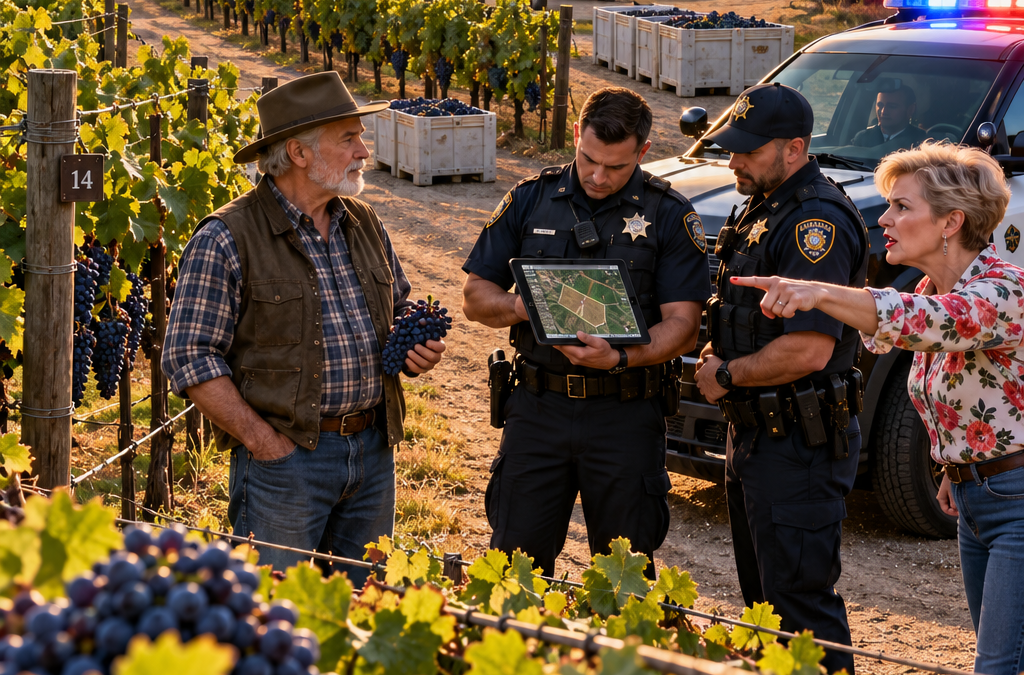
Then looked toward Ortega, who was carrying a department tablet.
“Officer Ortega?”
“Yes, sir?”
“Before anyone talks about arresting me, could you pull up the county parcel map?”
Brooke rolled her eyes.
“This is ridiculous.”
Ortega looked at Mercer.
Mercer nodded.
“Do it.”
Ortega opened the county GIS system.
I gave him the parcel number from memory.
He entered it.
The map loaded.
“Now zoom out.”
He did.
“More.”
He did.
“Find the road we’re standing on.”
Brooke crossed her arms.
“The HOA owns the road.”
I looked at Mercer.
“That’s what I’d like you to verify.”
Ortega tapped the road parcel.
His face changed.
Subtle.
Then noticeably.
“Callaway Family Trust.”
Brooke said, “That’s impossible.”
Ortega zoomed out.
Clicked adjoining areas.
Vineyard.
Ridge.
Water corridor.
Large sections of the valley.
“Sir.”
He looked at me.
“This shows 4,212 acres under the Callaway Family Trust and associated recorded interests.”
Mercer took the tablet.
Scrolled.
Zoomed.
Checked the legend.
Then looked up.
“Mr. Callaway.”
“Yes?”
“You own the valley.”
I almost smiled.
“I’ve been trying to explain that.”
Ortega looked toward the police vehicle.
Then at the dirt beneath his boots.
“Dan.”
Mercer glanced over.
“We parked on his road.”
Someone behind the fence laughed.
Brooke didn’t.
Her face had lost all color.
“No.”
She stepped toward the screen.
“No. That map is outdated.”
Ortega moved the tablet slightly away.
“It’s the county system.”
“The HOA has jurisdiction.”
Mercer looked at her.
“Jurisdiction over what?”
“The community.”
“Is his vineyard part of the community?”
“Functionally, yes.”
“Legally?”
She hesitated.
I answered.
“No.”
Brooke snapped toward me.
“He’s just a farmer.”
There it was.
I looked at her for a long moment.
Then said, “Brooke, I’m exactly that.”
A few neighbors laughed nervously.
“I am a farmer.”
I pointed toward the vines.
“And farmers tend to own farms.”
Mercer asked me to explain.
So I did.
Samuel Callaway.
Valley purchase.
Development negotiations in 2004.
Homeowners receiving their residential lots.
Master agreement preserving Callaway agricultural rights.
Road licenses.
Water licenses.
Common ground.
Recorded restrictions on HOA authority.
Perpetual farming rights.
Mercer listened.
Ortega took notes.
Then a voice came from the crowd.
“I have it.”
Tom Briggs stepped forward carrying an old binder.
Thick.
Brown.
Cedar Ridge master records.
Brooke stared.
“Tom, what are you doing?”
“Reading.”
He opened the binder.
Pages marked with sticky tabs.
He found Section Three.
Then read aloud.
“The Callaway family and its successors retain perpetual agricultural rights over designated Callaway parcels. The Cedar Ridge Homeowners Association shall possess no regulatory authority over agricultural use conducted on such retained parcels.”
Tom lowered the binder.
His voice shook.
“We never had the right to fine him.”
Brooke looked around.
“That isn’t the entire agreement.”
“No.”
Tom turned several pages.
“It gets worse.”
A murmur moved through the crowd.
Brooke tried another direction.
“He still never filed for a commercial permit.”
Mercer looked at her.
“An agricultural operation on agricultural land doesn’t need an HOA commercial permit.”
“It impacts residents.”
“That may be a civil concern.”
“But you can stop him today.”
“No.”
Mercer folded his notebook.
“I can’t arrest someone for trespassing on land he legally controls.”
Ortega almost smiled.
Brooke’s phone was shaking slightly in her hand.
Then Mercer looked at her again.
“Ma’am.”
“What?”
“On the 911 call, did you tell dispatch he was trespassing?”
“He was refusing to leave.”
“His own property.”
“I believed—”
“And you said he was dangerous.”
Brooke went still.
Mercer’s tone remained calm.
“What made you believe he was dangerous?”
“He was hostile.”
“Did he threaten you?”
“No.”
“Approach you aggressively?”
“No.”
“Display a weapon?”
“No.”
“Threaten anybody?”
“He refused to comply.”
Mercer glanced toward me.
I was still holding grapes.
Then back at her.
“Noncompliance isn’t a threat.”
Her mouth tightened.
He said, “Knowingly providing false information in an emergency call can become a serious matter.”
Brooke opened her mouth.
Nothing came out.
Her phone buzzed.
Once.
Screen lit.
Ortega happened to be closest.
His eyes dropped toward it automatically.
Then rose again.
He didn’t say anything.
But I saw the name too.
Garrett Low — Lowland Partners
Brooke flipped the phone over.
Too late.
Tom saw it.
I looked at him.
“Tom.”
He swallowed.
“What?”
“Did the board ever discuss my certified letter from June?”
He frowned.
“What letter?”
“The road and well license renewal.”
The color drained from his face.
“What renewal?”
My stomach sank.
Not because I hadn’t suspected trouble.
Because now I knew.
The Cedar Ridge license for key road and water use was due for renewal at the end of the year.
Twenty-year term.
Automatic discussion.
Simple paperwork.
Same one-dollar annual fee.
I had sent the renewal package in June to the HOA president.
Certified mail.
No response.
I assumed Brooke’s attorney was reviewing it.
Tom looked at her.
So did half the crowd.
“You received a renewal letter?” he asked.
Brooke shook her head.
“No.”
I said, “Certified.”
“Then it was misdelivered.”
“Signed.”
“Not by me.”
A white sedan came down the road.
I recognized it before it stopped.
Norah.
She stepped out holding her leather briefcase.
Walked straight toward the officers.
“Sorry I’m late.”
I looked at her.
“You knew?”
“I knew enough.”
She opened the case.
Pulled out a green certified-mail card.
“Officer Mercer.”
He took it.
“Receipt for the road and well license renewal package sent June fourteenth.”
At the bottom:
B. Hastings
Brooke shook her head.
“That’s not my signature.”
Norah didn’t react.
“Then comparison should be easy.”
She pulled out another document.
Brooke’s signed HOA president oath and acknowledgment.
Mercer placed them side by side.
Even from where I stood, the loops matched.
Same B.
Same H.
Same upward stroke.
Tom stared at Brooke.
“You hid it.”
“No.”
“You signed for a license renewal that affects every family here.”
“I didn’t hide anything.”
“Then where is it?”
Brooke said nothing.
Tom’s face changed.
Not anger first.
Fear.
Because he understood something the neighbors didn’t yet.
Without renewed licenses, Cedar Ridge’s use of those roads and key water infrastructure could become a legal problem.
I had no intention of cutting anyone off.
But Brooke had withheld from her own board a document that affected the entire community.
“Why?” Tom asked.
“I was protecting the association.”
“No.”
His voice hardened.
“You were protecting something.”
Then he pulled out his phone.
“I need to say something.”
Brooke looked at him.
“Tom.”
“No.”
He turned toward the officers.
“I’m the HOA treasurer.”
Mercer opened his notebook again.
“Two weeks ago, I noticed an $18,500 withdrawal from the reserve account.”
Brooke said sharply, “Legal expenses.”
Tom continued.
“Listed as legal and aerial survey services.”
“Correct.”
“No board vote.”
“Emergency authority.”
“No supporting receipts.”
“They were being processed.”
“No vendor packet.”
“Tom.”
“No contract.”
The crowd grew silent.
Tom’s hands were trembling.
“I should’ve challenged it immediately.”
He looked at me.
“I didn’t.”
Then back at Mercer.
“I’m challenging it now.”
Brooke’s voice dropped.
“This is association business.”
Mercer said, “Not if funds were improperly taken.”
“They weren’t taken.”
“Then records will establish that.”
Brooke looked toward me.
And for the first time since I had met her, she said my first name without authority in her voice.
“Everett.”
I waited.
“Please.”
That word did something to me.
I had expected anger if this moment ever came.
For eight months, she had called my farm illegal.
Fined me.
Photographed me.
Used drones.
Turned neighbors against me.
Called the police.
Accused me of being dangerous.
Now I looked at her and felt something much quieter.
Sadness.
Because behind all that certainty was a woman who had convinced herself land was simply something to be controlled until somebody paid enough for it.
I looked toward the people gathered beside the vineyard.
“My road license has been one dollar a year for twenty years.”
Nobody spoke.
“I’ve never raised it.”
A woman lowered her phone.
“I never wanted to be anybody’s landlord.”
I looked toward Ruth’s Row.
“I wanted people to live here.”
Then back at them.
“I wanted to grow grapes.”
My voice caught slightly.
“And keep something my wife and grandfather built alive.”
One woman in a floral blouse stepped forward.
“Mr. Callaway.”
Her eyes were wet.
“I’m sorry.”
I nodded.
Another man approached.
Then another.
An older resident took my hand.
“Your wine was at my daughter’s wedding.”
I looked at him.
“Was it?”
“2018.”
He smiled sadly.
“She insisted on Callaway Cabernet.”
I had not known.
That is the strange thing about community.
You can spend years thinking you are simply tending vines while pieces of your work end up inside other people’s memories.
Mercer clicked his pen.
“Mr. Callaway.”
“Yes?”
“Would you like to make a complaint?”
I looked at Brooke.
Then at Norah.
“I want the facts written down.”
Mercer nodded.
“That’s what we’ll do.”
He turned toward Brooke.
“Ma’am, I’ll need a formal statement.”
She looked exhausted.
“And I suggest you consult counsel.”
There was no dramatic arrest in the vineyard.
No handcuffs.
No cheering.
The officers documented everything.
Took statements.
Photographed the documents.
Requested copies.
The harvest continued.
That mattered to me more than anything.
By ten in the morning, pickers were back in the rows.
Crates filled.
Trucks moved.
The grapes didn’t care about HOA politics.
They were ripe.
When fruit is ready, you work.
That evening, Cedar Ridge held an emergency board meeting.
In the clubhouse.
Which sat on land governed by agreements Brooke had apparently never bothered to understand.
Nobody mentioned the irony.
They didn’t need to.
I attended with Norah.
The room was packed.
Brooke sat at the front.
No white blazer this time.
Tom presented the county records.
Master agreement.
License history.
Certified letter.
Financial withdrawal.
Then Norah presented a motion request from residents demanding Brooke’s removal.
The debate lasted nearly two hours.
Some residents defended her.
One woman argued Brooke had only been trying to protect property values.
A man behind her shouted:
“By trying to steal a vineyard?”
The chair called for order.
Brooke finally spoke.
She said Cedar Ridge needed modernization.
She said the original agreement was outdated.
She said the vineyard limited future growth.
That word interested Norah.
Future growth.
She asked:
“What future growth?”
Brooke stopped.
Norah waited.
“Ms. Hastings, what future growth?”
Brooke looked toward the board.
“I was speaking generally.”
Norah wrote something.
The vote was 58 to 2.
Brooke Hastings was removed as HOA president.
Effective immediately.
She left through a side door.
I watched her go.
I felt no victory.
Only exhaustion.
The next morning, Norah filed everything with the appropriate county authorities.
And then we learned why Garrett Low had been visiting Cedar Ridge.
Emails.
Financial records.
Draft agreements.
Brooke and Low had been discussing the valley for months.
Lowland Partners wanted to turn large portions of Callaway Valley into a luxury resort development.
Hotel.
Villas.
Event venue.
Expanded golf component.
Private tasting complex.
Ironically, they wanted to use the vineyard aesthetic as part of the marketing.
Keep some vines.
Remove the farmer.
That was their idea.
The obstacle was me.
Or, more accurately, the master agreement.
My perpetual agricultural rights and ownership structure made development impossible without my consent.
I had told two prior developers no.
Garrett Low apparently believed I could be pressured into changing my mind.
Brooke’s role was to make remaining expensive.
Fines.
Legal threats.
Community hostility.
Regulatory complaints.
Questions about farm operations.
Pressure through the HOA.
Eventually, they hoped I would sell.
The $18,500 from the reserve account had been directed into legal and drone-related work connected with building that pressure.
The withheld road and well renewal had been useful too.
Create uncertainty.
Make the neighborhood believe I was threatening their infrastructure.
Turn residents against me.
Then have Lowland Partners appear with a solution.
Brooke’s proposed consulting agreement was the ugliest part.
Two hundred thousand dollars if the larger development transaction succeeded.
When Norah showed me that number, I sat in my kitchen for a long time.
Ruth’s photograph was on the counter.
“Two hundred thousand,” I said.
Norah closed the folder.
“I’m sorry.”
“For what?”
“People disappoint me professionally. You’d think I’d get used to it.”
I looked toward the corkboard.
Every fine Brooke had sent me was still pinned there.
Five hundred.
Two thousand five hundred.
Noise penalties.
Commercial-use threats.
All of it.
“A resort.”
“That’s what Low wanted.”
“On Ruth’s Row?”
“Part of the concept plan touches the western slope.”
That was the first time the whole ordeal truly hurt.
Not anger.
Pain.
I could imagine bulldozers.
Pool construction.
Luxury villas.
A sign calling something Callaway Vineyard Residences after removing the people who had actually built Callaway Vineyard.
I stood.
Went outside.
Walked until I reached Ruth’s vines.
Norah did not follow.
She knew better.
I put one hand around an old trunk.
Rough bark.
Thirty years.
Ruth planted those vines when her hair was still mostly brown.
She had stood on that hill laughing because the wind kept stealing her hat.
And somewhere in a developer’s presentation, that row had become acreage.
A parcel.
Opportunity.
I understood then why my grandfather never liked the phrase “real estate.”
He used to say land wasn’t real estate until somebody stopped seeing it.
Lowland Partners moved quickly once the investigation became public.
By Friday, they announced they were abandoning all Cedar Ridge development concepts.
Their local office closed.
The black SUV disappeared.
Garrett Low stopped returning association calls.
Some men fight when the light turns on.
Others run.
Brooke faced the consequences more slowly.
The missing $18,500 was repaid.
Her role in the false police report became part of the legal case.
In the end, she accepted probation connected to that incident and resigned from every remaining association role.
There were additional civil issues between her and Cedar Ridge that I stayed out of.
I didn’t need revenge.
I wanted her away from my land.
I wanted the agreements honored.
I wanted the valley left alone.
A month later, I saw Brooke at a gas station.
I was filling my truck.
She came out of the convenience store.
Stopped when she saw me.
For a moment, I thought she might turn around.
Instead, she walked over.
No clipboard.
No blazer.
Jeans.
Gray sweater.
She looked smaller.
Not because anything physical had changed.
Power changes the way people occupy space.
So does losing it.
“Mr. Callaway.”
“Brooke.”
She looked at the pavement.
“I was wrong.”
There were many things I could have said.
I could have reminded her of the police.
The fines.
The land.
The money.
Garrett.
The false report.
Ruth.
Instead I said:
“Then do better.”
She looked up.
Maybe she expected cruelty.
I didn’t have any left.
“That’s it?”
“What else do you want?”
“I don’t know.”
“Neither do I.”
I put the fuel cap back on.
Then I left.
The next problem belonged to me.
The road and water license.
Technically, after everything that happened, I could have demanded major changes.
Higher fee.
Stricter conditions.
New liability terms.
Residents expected it.
Some feared I would refuse renewal completely.
I understood why.
For months, many had believed Brooke.
Some had called me a nuisance.
Some wanted the vineyard restricted.
Some had commented online that it was time I sold.
Norah asked me what I wanted.
We sat at my kitchen table.
“Legally?”
“Personally.”
I looked through the window toward Cedar Ridge.
Lights coming on at dusk.
Families cooking dinner.
Children doing homework.
People who had bought homes in good faith.
“Same license.”
Norah stared.
“Everett.”
“Twenty years.”
“Same dollar?”
“Same dollar.”
She leaned back.
“You are the worst negotiator I’ve ever represented.”
“I’m seventy-four. I don’t need road-license money.”
“What condition?”
I smiled.
She knew me too well.
“One.”
“What?”
“Harvest day.”
She frowned.
“Explain.”
“Every year.”
I looked toward the vineyard.
“Cedar Ridge and Callaway Valley hold one community harvest day.”
“That’s your condition?”
“Free food.”
“You’re adding costs.”
“Free wine.”
“Of course.”
“Families invited.”
“Anything else?”
“Scholarship fund.”
That got her attention.
“For local kids.”
“Funded how?”
“Donations. Wine sales. I seed the first year.”
Norah studied me.
“You’re rewarding them.”
“No.”
“Then what are you doing?”
I thought about my grandfather.
About Ruth.
About the people standing along the fence while police lights flashed across the grapes.
“Trying to make sure we remember we’re neighbors.”
The new agreement ran twenty years.
Same annual license.
One dollar.
In exchange, the road and well arrangements were renewed with clearer reporting rules so no future HOA president could hide correspondence from the board.
And every harvest season, Cedar Ridge would join us in the valley.
The residents voted unanimously.
The first community harvest day happened the following September.
Hundreds of people came.
Long tables between the rows.
Children carrying baskets far too large for them.
Local musicians.
Food from neighborhood families.
Wine from our cellar.
A scholarship table where people could donate for students pursuing agriculture, engineering, environmental science, or local trades.
Tom Briggs handled the money.
He showed me every receipt whether I wanted to see it or not.
“Transparency,” he said.
“I trust you.”
“That’s not the point.”
He was right.
Officers Mercer and Ortega came in plain clothes.
Mercer poured wine badly.
Ortega accused him of trying to empty bottles faster than glasses.
At sunset, Mercer stood with a glass of Cabernet.
Raised it.
“To the most expensive vineyard misunderstanding in county history.”
Everybody laughed.
Even me.
But later, when the tables were being cleared and families started driving home, I slipped away.
Walked west.
Ruth’s Row was quiet.
Harvested vines.
Leaves moving in the evening breeze.
I stopped at the oldest plant.
Put my hand against the trunk.
“We kept it, Ruth.”
I stood there a long time.
Not because I believed she could hear me.
Because saying things aloud sometimes gives grief somewhere to go.
My grandfather Samuel used to say something I misunderstood when I was young.
Land isn’t owned. It’s tended.
As a boy, I thought that was absurd.
I had seen deeds.
Maps.
Tax bills.
Of course land was owned.
Then I spent most of my life caring for four thousand acres and finally understood what he meant.
Ownership is paper.
Important paper.
Necessary paper.
Brooke taught me exactly how necessary.
But ownership alone does not make a place worth keeping.
Tending does.
My grandfather tended it.
My father did.
Ruth did.
Workers whose names never appeared on a deed did.
Families in Cedar Ridge eventually did too, in their own way.
That was what Brooke missed.
She looked at the valley and saw control.
Garrett Low looked at it and saw development value.
I had spent decades seeing responsibility.
There is a difference.
After the investigation ended, I took every HOA fine from the kitchen corkboard.
I considered throwing them away.
Instead, I put them into a file.
Norah laughed when she saw it.
“Sentimental?”
“Evidence.”
“Case is closed.”
“Engineers aren’t the only people who appreciate documentation.”
“You’re a farmer.”
“I contain multitudes.”
She rolled her eyes.
The corkboard looked empty afterward.
So I replaced the notices with something else.
A photograph from the first community harvest day.
Hundreds of people standing between the vines.
Tom in the background.
Mercer holding a wine glass.
Children laughing.
Ruth’s Row behind them.
That photograph means more to me than Brooke’s removal vote.
Because removing a bad leader is easy compared with repairing what bad leadership leaves behind.
Suspicion.
Embarrassment.
Sides.
People who had stopped speaking.
Residents who wondered whether I hated them.
Workers who wondered whether homeowners hated us.
Brooke had divided the valley because division made pressure easier.
Rebuilding community required the opposite.
Time.
Food.
Conversation.
Work.
The first year, residents volunteered to help pick a small demonstration block.
Most were terrible at it.
A dentist named Michael cut through two stems before realizing he was holding the knife backward.
A teenage girl picked underripe fruit because she liked the color.
Mercer crushed one cluster in his hand and ruined his shirt.
I laughed harder that day than I had in years.
By the second harvest day, people understood what they were doing.
By the third, Cedar Ridge families were competing over who made the best food for the long table.
The scholarship fund grew.
One recipient used it to study agricultural science at the state university.
Another entered a community-college welding program.
A third studied water-resource management.
Tom cried during that announcement.
Denied it afterward.
“I’m old,” he said. “My eyes water.”
“Inside a clubhouse?”
“Dry air.”
We stopped arguing.
The valley returned to being ordinary.
That’s what I wanted.
Not famous.
Not symbolic.
Ordinary.
Workers came in spring to prune.
Summer heat ripened fruit.
Fall brought harvest.
Winter stripped the vines.
Some years were good.
Some weren’t.
Rain ignored contracts.
Frost ignored property maps.
Birds ignored HOA rules entirely.
Life continued.
But I became more careful.
Every license.
Every agreement.
Every letter.
Copied to the whole board.
Digital archive.
Certified receipt.
No single officer controlling crucial records.
Cedar Ridge amended its bylaws too.
No president could authorize large legal or survey expenses without documented board approval.
Reserve expenditures required multiple signatures above a threshold.
External development contacts had to be disclosed.
Some residents told me the changes felt excessive.
Tom disagreed.
“Rules aren’t excessive when you know exactly why they exist.”
Fair enough.
One afternoon, several years after Brooke left, a new family moved into Cedar Ridge.
The father stopped at my roadside stand.
He bought a bottle.
Then asked:
“Are you the guy who owns all this?”
I looked around.
“Depends what you mean by all.”
“The valley.”
“Family trust does.”
He smiled.
“I heard some crazy story about the HOA trying to arrest you.”
“Stories improve with age.”
“Was it true?”
“Parts.”
“Did the police really realize they were parked on your road?”
“Yes.”
He laughed.
“That’s incredible.”
I didn’t.
Not because the memory hurt anymore.
Because I remembered how close the situation came to becoming something uglier.
Brooke had believed the police would give her authority she didn’t possess.
She had described me as dangerous because the word was useful.
That could have gone badly.
For me.
For the officers.
For workers standing nearby.
The fact that Mercer slowed the situation down mattered.
He asked for documents.
Ortega checked the map.
Neither officer treated Brooke’s certainty as proof.
I thanked Mercer for that once.
He shrugged.
“That’s the job.”
“Not everyone does the job well.”
He looked uncomfortable.
“Don’t make me sentimental, Ev.”
“Wouldn’t dream of it.”
When people retell the story, they like the moment the map appears.
The officer zooming out.
Brooke realizing the valley wasn’t hers.
It is dramatic.
I understand why.
But that isn’t the moment I think about most.
I think about Tom stepping out of the crowd with the binder.
He could have stayed quiet.
He had let things go too far already.
He knew that.
He could have protected himself by pretending he knew nothing.
Instead, he opened the agreement.
Read it aloud.
Then admitted the reserve problem.
That took more courage than anything I did.
I already knew I was right.
Tom had to admit he had helped a bad system continue by not asking enough questions.
Accountability is hardest when the truth makes you look foolish.
Tom accepted that.
Brooke didn’t until she had no alternatives left.
That difference changed where each of them ended up.
Tom became one of the people I trusted most in Cedar Ridge.
Brooke became a lesson nobody in the valley wanted to repeat.
I never learned much about Garrett Low after Lowland Partners withdrew.
I saw his name in business news occasionally.
Different projects.
Different counties.
Developers move on.
Land doesn’t.
The resort drawings still exist somewhere in Norah’s archive.
Once she showed me one.
Luxury suites where our crush equipment now sits.
A private event lawn near the lower field.
Villas overlooking Ruth’s Row.
They planned to call one area The Heritage Vines.
I stared at that title.
“Heritage.”
Norah nodded.
“Marketing people enjoy irony.”
I handed the drawing back.
“Keep it.”
“You don’t want a copy?”
“No.”
I didn’t need to preserve someone else’s fantasy of removing me from my own history.
The vines were still there.
That was enough.
People sometimes assume the ending should have been harsher.
That I should have charged Cedar Ridge market rent.
Closed the road.
Raised water fees.
Sued every board member.
Evicted someone.
Made the neighborhood pay.
I understand the emotion behind that.
For eight months, I had been treated as though my family’s presence were an inconvenience.
But punishment wasn’t what I wanted.
Land gives you a long sense of time.
If you grow grapes, you make decisions today for fruit you may not see for years.
Vines punish impatience.
So does community.
If I had turned Cedar Ridge’s fear into profit, I would have repeated Brooke’s mistake in reverse.
She used power because she could.
I didn’t want to.
The dollar license stayed.
The roads stayed open.
The well kept serving homes.
People stayed.
The vineyard stayed.
That was victory enough.
I am older now.
Harvest mornings take more out of me.
My knees complain on slopes they once ignored.
The workers no longer let me carry full crates, which irritates me.
I still walk the first row at dawn.
Some traditions deserve stubbornness.
Every year I stop at Ruth’s Row.
Some of the original vines are nearing the end of their productive lives.
We’ve replaced a few.
I resisted at first.
It felt like removing pieces of her.
Then one of our younger vineyard managers told me:
“Mr. Callaway, keeping a dead vine because your wife planted it isn’t the same thing as keeping her work alive.”
He was right.
I hated that.
We replanted.
New vines beside old ones.
That’s tending.
Not freezing a place in time.
Protect what matters.
Change what needs changing.
Know the difference.
Brooke never learned that while she had power.
Maybe she did afterward.
I hope so.
The last thing I ever wanted was another enemy.
The valley had enough weeds.
On the twentieth anniversary of Cedar Ridge’s founding, Tom organized a small ceremony.
He asked me to speak.
I refused.
He asked again.
I refused again.
Then he told Ruth’s granddaughter I had refused.
She called me.
“You are speaking.”
“Your grandfather doesn’t take orders.”
“You took orders from Grandma Ruth for fifty-one years.”
“Unfair.”
“Seven minutes.”
So I spoke.
No dramatic story.
No mention of Brooke by name.
I stood beside the long harvest table with Cedar Ridge families in front of me.
Then I told them what Samuel used to say.
“Land isn’t owned. It’s tended.”
I paused.
“When I was young, I thought that was foolish. We have deeds. Surveys. County records. I learned a few years ago that those things matter very much.”
People laughed softly.
“But paper tells us where responsibility begins.”
I looked toward the vineyard.
“It doesn’t tell us what to do with it.”
The room became quiet.
“You can own a valley and ruin it.”
I looked toward the Cedar Ridge homes.
“You can live on one lot and help protect four thousand acres.”
Then toward the workers.
“You can have no name on any deed and still be one of the people who keeps a place alive.”
I thought of Ruth.
My grandfather.
Tom.
Mercer.
Ortega.
Norah.
Even Brooke.
Every person had changed the valley somehow.
“The question isn’t only what belongs to you.”
I finished.
“The question is what will still be worth having after you’ve been responsible for it.”
I sat down.
Tom leaned over.
“That was nine minutes.”
“Send me a fine.”
He nearly choked on his wine.
That was probably my favorite moment in the history of Cedar Ridge.
The master agreement is still locked in a fireproof cabinet in my office.
Norah has copies.
The county has the recorded originals.
Tom has digital versions.
Everyone knows where the boundaries are now.
No mystery.
No “updated interpretation.”
No president gets to rewrite them.
The annual road license payment still arrives.
One dollar.
Tom once mailed it in a frame.
Norah made him send an actual check too.
The well runs.
The roads remain open.
Children who weren’t born when Brooke called police now ride bicycles down those same lanes.
Some stop at the vineyard stand.
They know me as the old wine guy.
That’s fine.
I’d rather be that than a legend.
Legends get polished until they stop resembling real people.
I was never fearless during that fight.
I was angry.
Tired.
Afraid of what might happen to Ruth’s Row.
Afraid Cedar Ridge would turn permanently against us.
Afraid legal pressure could become expensive enough to hurt the farm even if we eventually won.
But fear did not require panic.
Norah taught me that.
Document.
Wait.
Let people reveal how far they are willing to go.
Brooke kept digging because every previous step had failed to stop her.
Letter.
Fine.
Drone.
Public accusations.
Board meeting.
Police.
Each escalation created more evidence.
By the time the officers arrived, I didn’t need a speech.
I needed a parcel number.
That’s the part I still find remarkable.
Months of conflict.
Thousands of dollars in false fines.
Dozens of messages.
A divided community.
Developers.
Lawyers.
And the first crack in Brooke’s entire story took less than a minute.
Officer Ortega typed numbers into a tablet.
The county map loaded.
Reality appeared.
Callaway Family Trust.
4,212 acres.
No amount of confidence could redraw it.
No white blazer.
No HOA title.
No emergency board meeting.
No online post.
The land had been exactly where it always was.
She simply had never bothered to check.
Or perhaps she had checked and believed pressure would matter more.
Either way, the result was the same.
People sometimes think power is the ability to force reality to cooperate.
It isn’t.
Power without truth is temporary.
Eventually somebody opens the records.
Eventually somebody reads the agreement.
Eventually the map loads.
And when it does, all the performance in the world has to stand beside something much quieter.
Facts.
That was what happened on harvest morning.
Brooke wanted the officers to see an old farmer refusing authority.
The map showed them a landowner standing on his own road.
Brooke wanted the neighbors to see an illegal commercial nuisance.
The agreement showed a vineyard with perpetual agricultural rights written into Cedar Ridge’s creation.
She wanted everyone to believe I threatened their road and water.
The certified receipt showed she had hidden the renewal that protected both.
She wanted the reserve money treated as legitimate enforcement.
Tom’s records exposed a withdrawal nobody had approved.
And she wanted the valley to look like property Cedar Ridge needed to control.
Garrett Low’s emails showed exactly why.
Every layer fell away.
Not because I shouted.
Because somebody finally looked.
Sometimes I still walk down the dirt road where the police SUVs stopped.
There are tire impressions after rain.
Nothing permanent.
The road curves past Cabernet rows and rises toward Cedar Ridge.
From one point, you can see nearly everything.
Vineyard.
Barn.
Ruth’s Row.
Houses along the south hills.
The old clubhouse.
All of it sharing the same valley.
I used to look at those houses as something separate.
The neighborhood.
The development.
Their side.
My side.
Brooke made that division worse.
The years after her taught me something better.
Boundaries matter.
They protect people.
They define rights.
They prevent someone else from simply claiming what isn’t theirs.
But a boundary doesn’t have to become a wall.
Cedar Ridge families live there.
I farm here.
We understand the line now.
Because we understand it, we can cross socially without pretending it doesn’t exist legally.
That is healthier than what we had before.
One autumn evening, years after the police incident, I walked Ruth’s Row after community harvest day.
The sun was low.
Tables empty.
Paper cups stacked for recycling.
Children’s footprints between the vines.
I found one grape cluster someone had missed.
Small.
Almost too ripe.
I picked one.
Sweet.
A little soft.
Ruth would have complained we left it too long.
I smiled.
Then put my hand on the old vine beside me.
“We kept it.”
I’ve said that every harvest since.
Not:
I kept it.
We.
Samuel.
My father.
Ruth.
The workers.
Norah.
Tom.
The officers who checked instead of assuming.
The neighbors who eventually read the agreement.
The children who come every year now and learn that grapes don’t originate in grocery-store plastic.
Even the people who apologized.
A valley is more than the person whose name appears on the deed.
My grandfather knew that before I did.
The land is mine in the legal sense.
That legal truth saved it.
But the valley is alive because people tend it.
That is the deeper truth.
Brooke almost destroyed the first because she never understood the second.
I intend to spend whatever years I have left protecting both.








