𝗙𝗨𝗟𝗟 𝗦𝗧𝗢𝗥𝗬 The HOA President Called 911 Because I Missed One Meeting, Never Realizing Who the Deputies Would Find at My Door
𝗙𝗨𝗟𝗟 𝗦𝗧𝗢𝗥𝗬
She checked something on the clipboard.
Then walked away.
I watched her go.
One of the movers came out carrying a chair.
“Friend of yours?”
“Apparently.”
For the next few months, Diane was more annoying than threatening.
I attended two HOA meetings.
That was enough to understand why people avoided them.
The first meeting lasted an hour and eleven minutes.
Forty-five minutes involved solar garden lights.
A resident named Marcy Bell had installed six lights along her walkway.
Diane believed they were too bright.
Marcy had measured them.
Diane had also measured them.
There were photographs.
A diagram.
Someone cited lumens.
I sat in the back wondering how humanity had survived as long as it had.
Then there was a discussion about a pontoon boat tied overnight to the shared dock.
Then complaints about garbage bins.
Then Diane read three pages from what she called the shoreline harmony policy.
Afterward, my next-door neighbor caught me outside.
His name was Greg Nolan.
Late sixties.
Retired electrician.
The kind of man who could tell a story about replacing a fuse box and somehow make it worth listening to.
“First meeting?”
“Is it that obvious?”
“You still look hopeful.”
I laughed.
“Does Diane always run them like that?”
“Like Congress is voting on war?”
“Exactly.”
Greg looked toward Diane’s house.
“She’s been president eleven years.”
“No elections?”
“Oh, there are elections.”
“Nobody runs?”
“Now you’re learning.”
I smiled.
“How bad is she?”
Greg shrugged.
“Depends whether she notices you.”
“And if she does?”
“You’ll find out.”
I thought he was exaggerating.
He wasn’t.
The first issue came with the dock.
My dock had been built by the previous owner.
It was old, but structurally safe after I replaced several boards.
Diane sent me an email claiming the lakeward edge appeared too close to the association’s shared water-access boundary.
Six inches.
That was the allegation.
Not six feet.
Six inches.
I walked down with a tape measure.
Could I determine the exact waterline from there?
No.
Neither could Diane.
The lake level changed.
The reference stakes were old.
And the original site plan was ambiguous enough that anyone claiming six-inch precision was performing theater.
I emailed her back.
“If the association has a current licensed shoreline survey showing an encroachment, please send it.”
She did not.
Instead, she replied:
The board expects voluntary compliance in the spirit of community cooperation.
I responded:
With what?
She did not answer.
Greg came over two days later.
“Congratulations.”
“On?”
“You’ve been noticed.”
“By Diane?”
“Yep.”
He sat in one of the chairs on my back porch.
“Six inches?”
I asked.
He nodded solemnly.
“Serious business.”
“I may flee the county.”
“Smart.”
Then he glanced at me.
“What did you do before moving here?”
“Law enforcement.”
He raised his eyebrows.
“Retired?”
“Not quite.”
“County?”
“Mostly.”
I wasn’t trying to hide anything.
I simply didn’t want my career to become my identity in the neighborhood.
I’ve watched what happens when people learn a police officer lives nearby.
Some become more comfortable.
Some become less.
Some start knocking on your door about speeding cars.
Others assume you’re constantly judging them.
I wanted the cabin to be separate from work.
So when neighbors asked, I kept the answer short.
Thirty years in law enforcement.
Still working.
That was enough.
In October, my life changed.
The previous police chief announced his retirement in summer.
I had applied for the position along with four other candidates.
There had been interviews.
County board hearings.
Background review.
Public meetings.
The whole process took months.
By late September, I knew I was the leading candidate.
I still refused to assume anything.
Then the county commissioner called.
“Jack?”
“Yes.”
“The board voted.”
I stood up from my desk.
“And?”
“Congratulations, Chief.”
For a second, I didn’t answer.
Not because I was surprised.
Because even when you’ve spent years walking toward something, reaching it can make you unexpectedly still.
“Thank you.”
“You earned it.”
“I appreciate that.”
“We announce Monday.”
“Understood.”
The appointment became public three days later.
Regional newspaper.
County website.
Local television.
Nothing enormous.
Just a photograph of me at the swearing-in ceremony with my right hand raised and the county commissioners behind me.
The headline read:
MERCER SWORN IN AS HARMON COUNTY POLICE CHIEF
My daughter sent me a screenshot with twelve exclamation points.
Greg apparently did not read the local paper.
Neither did Diane.
I didn’t tell them.
Why would I?
The badge changed.
The office changed.
My responsibilities changed.
My driveway didn’t.
I still took my own trash out.
Still repaired porch boards.
Still needed to replace the ugly bathroom wallpaper.
Three days after the swearing-in, there was an HOA meeting.
Thursday.
Seven p.m.
I knew about it.
I intended to attend.
Then a staffing problem exploded at work.
The county commissioner called me at six-thirty.
A budget issue affecting patrol assignments had to be resolved before Monday.
What was supposed to be a twenty-minute conversation became three hours of calls between me, the commissioner, finance, and our personnel director.
At 9:31, I finally hung up.
I looked at the clock.
The HOA meeting had ended long ago.
I thought about sending Diane an email.
Then decided I’d do it in the morning.
I had missed one neighborhood meeting.
Nobody had died.
Or so I assumed.
The next morning, Greg texted me.
You alive?
I replied:
Last I checked.
Three dots appeared.
Then:
Diane discussed you for like 20 minutes last night.
I stared at the phone.
About what?
Your absence.
I actually laughed.
I called him.
He answered immediately.
“You laughing?”
“A little.”
“You wouldn’t if you’d been there.”
“What did she say?”
Greg adopted a dramatic tone.
“Mr. Mercer has demonstrated a concerning pattern of disengagement.”
“Pattern?”
“That’s the word.”
“I’ve missed one meeting.”
“I know.”
“Anything else?”
“Oh, yes.”
He sounded delighted now.
“Your dock.”
“My six-inch criminal enterprise.”
“Apparently.”
“What did she say?”
“That ignoring meetings while maintaining an unresolved property violation shows disregard for community authority.”
I rubbed my forehead.
“Greg.”
“Yeah?”
“Does everyone here take this seriously?”
“No.”
“Good.”
“But Diane does.”
That was the important part.
I still wasn’t concerned.
Diane could complain.
She could send letters.
She could measure docks with a microscope if it made her happy.
There were rules.
There were limits.
I had dealt with real authority my entire adult life.
HOA theater didn’t impress me.
Saturday morning changed that.
I woke at six.
No alarm needed.
Years of police schedules had permanently destroyed my ability to sleep late.
By seven-thirty, I was on the back porch.
Coffee.
Sweatshirt.
Lake covered in a layer of mist.
The water looked almost silver.
A pair of ducks moved along the shoreline.
No phones ringing.
No staff waiting.
No briefings.
Exactly why I had bought the cabin.
At 7:45, I heard tires on gravel.
At first, I assumed Greg.
Then I heard a radio squawk.
I stood.
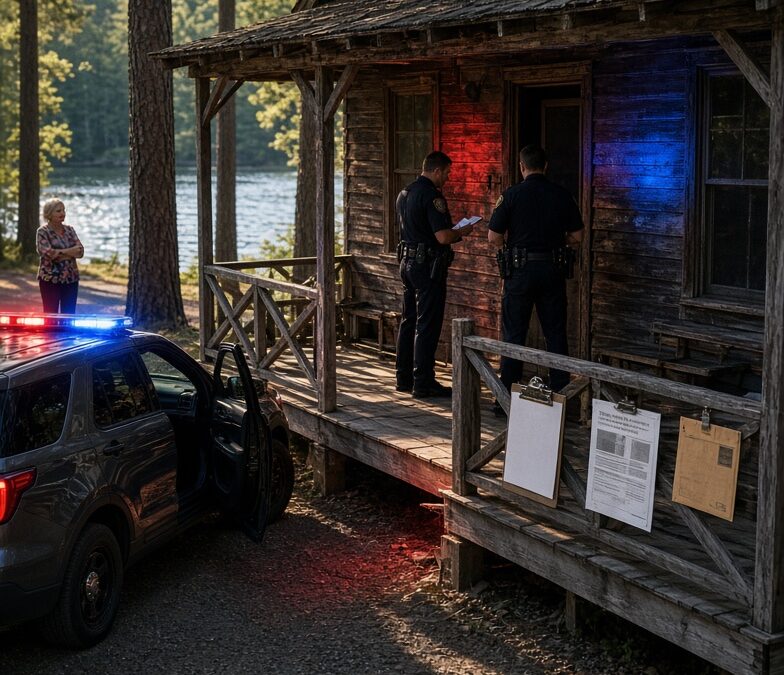
A marked county cruiser came around the bend.
Then another.
I stared.
Two deputies got out.
Aaron Tillis from the first cruiser.
Maria Rivera from the second.
Both were good deputies.
Young enough that I had known their names before they knew mine.
Aaron had been with the department six years.
Rivera four.
They were among the personnel I had inherited when I became chief.
Neither had formally reported to me yet in any substantive capacity because I had been in office three days.
But technically?
They worked for me.
Aaron saw me standing on the porch.
He stopped.
Rivera almost walked into him.
Their faces changed at exactly the same time.
That was when I knew something ridiculous was about to happen.
“Aaron.”
“Sir.”
I looked at Rivera.
“Morning.”
“Good morning, Chief.”
I raised my coffee.
“You’re making me nervous.”
Aaron looked toward the cruiser.
Then back at me.
“Sir, we received a call.”
“Okay.”
He did not continue.
“Aaron.”
“Yes, sir.”
“Usually this is where you tell the homeowner why police are standing in his driveway.”
Rivera stared down at her notebook.
Aaron cleared his throat.
“We received a complaint regarding this address.”
“What kind?”
He glanced at Rivera.
She offered him absolutely no help.
“Noise and community regulations.”
I stared at him.
“What noise?”
“That’s part of the problem, sir.”
“Start at the beginning.”
He pulled out his phone.
“I wrote down the dispatch notes.”
That was smart.
“Go ahead.”
He read.
“Caller reports resident operating property in deliberate violation of community standards, failing to attend legally required association meeting, and creating an atmosphere of hostility through repeated noncompliance.”
I waited.
Aaron lowered the phone.
“That’s it?”
“There was also the dock.”
“Six inches?”
Rivera made a choking noise.
I looked at her.
“You okay?”
“Yes, Chief.”
She turned away.
Aaron’s face had gone red.
I looked between them.
“She called the non-emergency line?”
Aaron hesitated.
“No, sir.”
My coffee stopped halfway to my mouth.
“She called 911?”
“Yes, sir.”
“For this.”
“Yes, sir.”
“For missing an HOA meeting.”
Aaron looked physically pained.
“That’s what dispatch documented.”
For several seconds, I said nothing.
Not because I was angry.
Because I was trying to understand how a functioning adult reached that decision.
Then I laughed.
Once.
Quietly.
Rivera lost the battle.
She turned away and coughed into her fist.
“Aaron.”
“Sir?”
“Any criminal allegation?”
“No, sir.”
“Threat?”
“No.”
“Disturbance?”
“No.”
“Violence?”
“No.”
“Noise currently?”
He looked around.
Birds.
Wind.
Lake.
“No.”
“Does she claim I threatened her?”
“No.”
“Entered her property?”
“No.”
“Damaged anything?”
“No.”
“Then document the call.”
“Yes, sir.”
“Note exactly what you observed.”
“Yes, sir.”
“Don’t write it differently because this is my house.”
“Understood.”
“Treat it like any other misuse of police resources.”
Aaron nodded.
Rivera finally looked at me.
“Chief, are you wanting us to speak with the caller?”
“Follow normal procedure.”
Another nod.
I could see how badly they wanted to leave.
I almost felt sorry for them.
“Anything else?”
Aaron shook his head.
“No, sir.”
“Have a good morning.”
“You too.”
They turned.
Rivera made it almost to the cruiser.
Then I heard her laugh.
Not a polite laugh.
A full, helpless burst she tried to smother.
Aaron hissed something at her.
She laughed harder.
I went inside and poured more coffee.
I could have stopped there.
I seriously considered it.
Diane had embarrassed herself.
The deputies knew.
Dispatch knew.
The call would be documented.
No harm beyond wasting resources.
I had spent my career telling officers not to use police authority to settle personal scores.
I wasn’t going to become chief and violate that principle during my first week because an HOA president irritated me.
So I let the department handle it normally.
I did not call dispatch.
Did not call Aaron’s supervisor.
Did not ask for special treatment.
Did not have anyone confront Diane beyond whatever standard callback procedure required.
Then Greg texted me.
You need to hear this.
I called.
“What now?”
“Diane’s going door to door.”
“Why?”
“Telling people you’re under investigation.”
I stopped moving.
“For what?”
“She says the county police opened a file.”
I looked toward the driveway where the cruisers had been.
“Greg.”
“Yeah?”
“Did she say those exact words?”
“Close. She told Helen across the road that authorities are now officially involved.”
I closed my eyes.
“Anything else?”
“She’s calling an emergency HOA meeting.”
“Of course she is.”
“Tuesday.”
“For me?”
“Dock compliance, meeting violations, hostile conduct.”
“Hostile conduct?”
“You didn’t go Thursday.”
“I was working.”
“I know.”
He paused.
“She wants fines.”
“For missing the meeting?”
“She says repeated noncompliance.”
“Repeated.”
“And possibly a lien if you refuse to comply.”
That word mattered.
Lien.
Now we had moved beyond comedy.
An HOA threatening fines against private property is something you read carefully.
An HOA threatening a lien is something you read immediately.
I thanked Greg.
Then I went to my office.
Not the police office.
My home office.
One desk.
File cabinet.
Books.
Laptop.
I pulled up the county clerk’s portal.
Thirty years in law enforcement taught me the value of public records.
Most people imagine investigations begin with confrontation.
Usually, good ones begin with reading.
Documents don’t get nervous.
They don’t remember selectively.
They don’t care who has a title.
I searched:
Lake Harmon Property Association.
The filings appeared.
Articles of incorporation.
Original declaration.
Amendments.
Annual reports.
Financial disclosure registrations.
Then nothing.
I narrowed the dates.
The HOA was required under county rules and state association law to maintain certain annual filings and disclosure documents.
Year one.
Filed.
Year two.
Filed.
Then a gap.
Three years.
No required annual disclosure statement.
No current officer certification.
No updated financial filing.
I sat back.
Interesting.
I called a friend in the county legal office.
Not as chief.
I made that explicit.
“I’m asking as a homeowner.”
He groaned.
“HOA?”
“How’d you know?”
“Nobody says ‘as a homeowner’ unless an HOA is involved.”
I explained the filing issue.
He checked.
Then said, “Their registration status appears delinquent.”
“What does that affect?”
“Depends what they’re trying to do.”
“Fines.”
“Could be a problem.”
“Liens?”
“Bigger problem.”
“So Diane may be threatening enforcement authority while the association isn’t in good standing.”
“I would phrase that more carefully.”
“That’s why you’re a lawyer.”
“Exactly.”
He told me to get independent counsel if the matter escalated.
I agreed.
Then I pulled Diane’s dock permits.
I wasn’t looking for retaliation.
I was looking because her entire issue with me involved shoreline compliance.
If she wanted to make dock measurements the center of the emergency meeting, I wanted the full shoreline record.
County permit portal.
Parcel search.
Diane Marsh.
Original dock permit twelve years earlier.
Standard dimensions.
Then aerial imagery showed something else.
A longer extension.
Additional platform.
Built approximately eighteen months earlier.
I searched again.
No modification permit.
No shoreline approval.
No environmental review record.
Nothing.
I drove down to the county planning office Monday morning before work.
The counter clerk knew me, but I asked her not to treat the request differently.
She printed the records.
The original dock was permitted.
The extension was not.
According to the shoreline ordinance, expansions above a certain length required approval.
Diane’s did.
I asked one final question.
“What happens if someone builds without the permit?”
The clerk shrugged.
“Inspection. Fine. Could require modification or removal depending on compliance.”
I thanked her.
Walked out.
Then I stood beside my truck and laughed.
Not because it was funny.
Because there was something almost mathematically perfect about it.
Diane had called 911 because I missed a meeting where she wanted to discuss whether my dock might be six inches too close to a boundary.
Meanwhile, she had expanded her own dock without a permit.
For eighteen months.
Authority does strange things to people.
Sometimes holding it too long convinces them that rules apply outward.
Never inward.
Tuesday afternoon, a formal HOA notice appeared in my mailbox.
LAKE HARMON PROPERTY ASSOCIATION
EMERGENCY COMPLIANCE HEARING
ATTENDANCE REQUIRED
Failure to attend may result in additional enforcement action.
I smiled at “required.”
Then I read the rest.
Dock violation.
Failure to participate in governance.
Hostile noncooperation.
Potential fines.
Potential property lien subject to board action.
I put the letter in my folder.
Along with:
The HOA registration filings.
The three missing annual disclosures.
The state requirements.
Diane’s original dock permit.
Aerial photographs showing the extension.
County shoreline rules.
A printout from the planning office showing no modification permit.
And one other thing.
The local newspaper article announcing my appointment.
I debated whether to include that.
Then decided yes.
Not because police chief status gave me extra rights.
It didn’t.
But Diane had already involved law enforcement.
If she planned to tell the neighborhood I was “under investigation,” the record needed correcting.
The emergency meeting began Tuesday at seven.
Diane’s living room wasn’t large enough.
So chairs had been arranged in the backyard under string lights.
Around thirty residents attended.
Far more than usual.
Greg had apparently told people there would be entertainment.
I sat in the front row.
That alone surprised Diane.
She came outside carrying her binder.
Saw me.
Stopped.
Then recovered.
“Mr. Mercer.”
“Diane.”
“I’m glad you decided to attend.”
“I wouldn’t miss it.”
Greg coughed into his hand.
Diane placed the binder on a folding table.
Three other board members sat beside her.
Ed Larkin.
Melissa Crane.
Howard Pierce.
All looked uncomfortable.
Diane called the meeting to order.
“Thank you all for attending on short notice.”
Her voice had that practiced official tone.
“This meeting was necessary due to several recent compliance concerns that raise broader questions about respect for community governance.”
I leaned back.
“Lake Harmon functions successfully because every homeowner accepts shared responsibilities.”
She looked toward me.
“That includes attendance.”
I raised one eyebrow.
“And adherence to association directives.”
She continued.
“We have recently experienced a pattern of disregard from one resident.”
Pattern.
Again.
“Mr. Mercer failed to attend our regularly scheduled meeting last Thursday despite prior notice.”
I remained silent.
“He also has an outstanding dock-boundary concern.”
Still silent.
“Attempts to resolve these issues informally have been unsuccessful.”
Greg shifted beside me.
I looked at him.
He whispered, “She’s warming up.”
I almost smiled.
Diane continued.
“The association has therefore begun documenting the matter and has involved appropriate authorities where necessary.”
There it was.
Authorities.
Several neighbors looked at me.
Diane took a paper from the binder.
“We now have an official law-enforcement response associated with the address.”
I raised my hand.
She ignored it.
“That documentation establishes—”
“Diane.”
She stopped.
“I have the floor.”
“You just publicly stated that law enforcement involvement establishes something about me.”
“You may respond during resident comments.”
“No.”
The single word changed the room.
I didn’t shout.
I had spent thirty years speaking over noise without raising my voice unnecessarily.
“I will respond now.”
Her eyes narrowed.
“Mr. Mercer—”
“You called 911.”
Silence.
Someone behind me whispered, “911?”
Diane’s jaw tightened.
“I contacted authorities because the situation was escalating.”
“What was escalating?”
“Your refusal to comply.”
“With an HOA meeting.”
“With multiple directives.”
“You called the emergency number.”
“I contacted police.”
“Through 911.”
She hesitated.
That hesitation was an answer.
I looked around at the neighbors.
“Two deputies came to my home Saturday morning.”
Greg knew.
Most others did not.
Diane straightened.
“They documented the situation.”
“Yes.”
I nodded.
“They did.”
She seemed pleased.
Until I continued.
“They also documented that there was no crime.”
Her expression changed.
“No disturbance.”
“That is your interpretation.”
“No threat.”
“Again—”
“No active noise complaint.”
Diane gripped the edge of the table.
“Mr. Mercer, the officers were there because your conduct had reached a point—”
“My conduct?”
I looked directly at her.
“I missed one HOA meeting because I was on a county staffing call.”
She folded her arms.
“Your employment does not exempt you from community standards.”
“No.”
I nodded.
“It doesn’t.”
That answer seemed to surprise her.
Then I placed the folder on the small table in front of me.
“But since you brought my employment into this, we should correct something.”
I opened the folder.
Pulled out the newspaper article.
Set it down.
Diane looked at the headline.
For the first time all evening, she stopped speaking.
The board members leaned closer.
Greg grinned.
I said, “On Monday of last week, I was sworn in as Harmon County police chief.”
Nobody moved.
Diane looked up.
Then back down.
I continued.
“The two deputies you sent to my house work for the department I now lead.”
Someone in the back said, “Oh my God.”
Greg whispered, “There it is.”
I ignored him.
Diane’s face went pale.
“You never disclosed that.”
I stared at her.
“Why would I?”
“As HOA president, I should have been informed if a high-ranking law-enforcement official—”
“No.”
I shook my head.
“My job does not alter my property rights.”
She opened her mouth.
“It doesn’t give me special HOA privileges.”
I continued.
“It doesn’t exempt me from legitimate rules.”
Silence.
“And it absolutely does not mean I expect different treatment.”
Then I leaned forward.
“But calling 911 because a resident missed your meeting was an abuse of emergency resources regardless of whose door the deputies found.”
That landed.
Hard.
Diane tried to recover.
“I believed the situation required documentation.”
“Then call the non-emergency line.”
“I was concerned.”
“About what?”
“Escalating hostility.”
“Name one hostile act.”
She said nothing.
“Threat?”
Nothing.
“Harassment?”
Nothing.
“Property damage?”
Nothing.
“Noise violation?”
She looked toward the board.
I waited.
Finally she said, “There had been repeated resistance.”
“Resistance is not an emergency.”
The room stayed silent.
I could have ended there.
I didn’t.
Because the 911 call was not the reason I’d come.
I reached into the folder.
“Before we discuss my dock, I’d like to discuss yours.”
Her head snapped back toward me.
“My dock?”
“Yes.”
“That has nothing to do with this.”
“You made shoreline compliance part of the hearing.”
“Your dock is under review.”
“So let’s review docks.”
I placed the county permit record on the table.
“Diane, your original dock permit allows a structure ending at this point.”
I indicated the diagram.
She stared.
“Aerial imagery shows you extended it eighteen months ago.”
“That extension complied with association guidelines.”
“Association guidelines aren’t the county shoreline ordinance.”
Her fingers tightened around the binder.
I slid forward the permit search.
“There is no modification permit.”
Ed Larkin leaned over.
“Diane?”
She looked at him sharply.
“It’s an administrative issue.”
I continued.
“The extension required county approval.”
“That’s your opinion.”
“No.”
I pointed toward the ordinance.
“That’s county code.”
Howard Pierce picked up the paper.
“Diane, did you get a permit?”
She didn’t answer.
“Diane?”
“No.”
The word came quietly.
Greg leaned back.
I could feel the room changing.
Not because I was police chief.
Because the woman who had spent years presenting herself as the enforcer of every rule had just admitted she ignored one affecting her own property.
Then I took out the HOA filings.
“And we have another problem.”
Diane looked at the stack.
“What is that?”
“County registration records.”
Melissa Crane, the board treasurer, frowned.
“What about them?”
“The association has not filed its required annual disclosure documentation for three consecutive years.”
Melissa’s face went blank.
“What?”
Diane immediately said, “That is being handled.”
Melissa turned toward her.
“No, it isn’t.”
“Melissa—”
“I manage the financial reports. I didn’t know those filings were missing.”
“They’re administrative.”
“So was your dock permit five minutes ago.”
Greg coughed.
I looked at him.
He raised both hands.
Sorry.
I continued.
“The association’s registered status is delinquent.”
Diane shook her head.
“That does not dissolve the HOA.”
“I didn’t say it does.”
“Then stop implying—”
“I’m not implying anything.”
I pulled out the legal guidance I had obtained.
“But it does raise serious questions about what enforcement actions the board can legally pursue while the association is out of compliance.”
Howard looked at Diane.
“What about fines?”
“Counsel has never said fines are invalid.”
“Have you asked counsel since the filings lapsed?”
No answer.
“What about liens?” I asked.
Diane stared at me.
“Because your notice threatens one.”
I held up the letter.
“You mailed me a threat of property lien while the association itself may lack current authority to pursue that remedy.”
Ed took the letter.
Read it.
Then looked at Diane.
“Who approved this?”
“The board has standing enforcement authority.”
“Who approved this letter?”
Silence.
“Diane.”
“I did.”
Howard leaned back.
“You didn’t bring it to us.”
“It was a compliance notice.”
“Threatening a lien.”
She snapped.
“Nothing was filed!”
“No.”
I said it quietly.
“Because I checked before you had the chance.”
Diane glared at me.
For the first time since I’d known her, the calm HOA-president performance was gone.
“You deliberately went digging through our records.”
“Public records.”
“You were trying to undermine me.”
“No.”
I closed the folder.
“I was trying to determine whether the woman threatening my property had the authority she claimed.”
She looked toward the neighbors.
“This is intimidation.”
I almost laughed.
“How?”
“You’re using your position.”
“My police position has nothing to do with any document in this folder.”
I tapped the county filings.
“Anyone in this neighborhood could have found these.”
Then the dock permit.
“Anyone could have requested this.”
Then the HOA notice.
“And you sent this to me.”
I looked around the room.
“That’s the part everyone here should care about.”
Diane’s face tightened.
“What part?”
“I knew where to look.”
Silence.
“I knew how to read a county filing.”
I looked at Greg.
Then at the older couple behind him.
Then the parents near the back.
“What if I didn’t?”
No one answered.
“What if I were eighty?”
“What if I worked two jobs and didn’t have four hours to spend searching records?”
“What if I’d been scared by the word lien?”
The board members stopped looking at Diane.
They looked at me.
“If an HOA has valid authority, it should be able to demonstrate that authority without depending on the homeowner being too intimidated to ask.”
No applause.
I’m glad there wasn’t.
This wasn’t theater.
It was governance.
Diane said quietly, “You are making this personal.”
“It became personal when police cruisers came up my driveway over a missed meeting.”
She looked down.
I continued.
“I don’t care whether you like me.”
Then toward the board.
“I don’t care whether anyone here likes my dock.”
A few people smiled.
“But rules work only when the people enforcing them follow rules too.”
That was the point.
Not revenge.
Not rank.
Not humiliation.
Consistency.
Howard called for a recess.
Diane objected.
The other three board members overruled her.
That was the first time I had seen anyone on the board openly oppose her.
The meeting paused for twenty-two minutes.
Neighbors gathered in small groups.
Greg brought me a bottle of water.
“Police chief.”
I looked at him.
“Don’t.”
“You’ve been living next door to me for months.”
“Yes.”
“And you run the county police department.”
“Yes.”
“You helped me move my refrigerator.”
“It was heavy.”
“Chief of police.”
“Greg.”
He grinned.
“I’m never getting over this.”
“I regret telling any of you.”
“You didn’t.”
“Exactly.”
Then his expression became serious.
“She really threatened a lien?”
I handed him the notice.
He read it.
His smile disappeared.
“That’s not funny.”
“No.”
“My sister lost a house years ago after an HOA lien situation.”
I hadn’t known that.
He handed the paper back.
“People see that word and panic.”
“I know.”
“You think Diane knew the filings weren’t current?”
“I don’t know.”
“Does it matter?”
“Yes.”
“Why?”
“Intent matters.”
He nodded slowly.
Then looked toward her house.
“I think she knew.”
I didn’t answer.
The meeting resumed.
Howard spoke first.
“Until counsel reviews the association’s status, all new fine and lien actions are suspended.”
Diane’s head turned sharply.
“You cannot do that without a vote.”
“Then let’s vote.”
The vote was three to one.
Diane opposed.
Enforcement suspended.
Second motion.
Immediate review of missing filings.
Passed three to one.
Third.
Independent financial audit after reinstatement.
Passed.
Diane objected again.
Then Melissa asked the question everyone had been avoiding.
“Did you know we were delinquent?”
Diane said nothing.
“Diane.”
“I knew there were outstanding administrative items.”
“For three years?”
“The management transition caused issues.”
“We changed management eleven months ago.”
Silence.
Melissa looked stunned.
“You knew.”
Diane pushed back from the table.
“I knew certain documents needed updating.”
“And you kept issuing fines?”
“The restrictions remain valid.”
“That’s not what I asked.”
Diane looked at me instead.
As if I had caused the room to turn.
Maybe in one sense I had.
But I hadn’t created any fact on the table.
I had only brought them into the light.
Then Howard addressed the dock issue.
“Diane, you’re going to need to contact the county.”
She didn’t respond.
“For your dock.”
“I heard you.”
“Will you?”
“Yes.”
For the first time that night, she sounded tired.
The meeting ended after nine-thirty.
No fines against me.
No lien.
No dock action.
Not because I’d been appointed police chief.
Because the board had realized it didn’t understand its own authority.
I walked home with Greg.
The lake was black beyond the trees.
“You know what’s funny?” he asked.
“What?”
“If she’d just let you miss the meeting, none of this would’ve happened.”
“Probably.”
“If she hadn’t called 911—”
“I still might not have looked at the records.”
“So she destroyed herself.”
“I wouldn’t put it that way.”
“I would.”
We reached my driveway.
Greg stopped.
“Why not?”
“Because I don’t want this to become about destroying anyone.”
“She tried to put a lien on your house.”
“I know.”
“Called the cops.”
“I know.”
“Lied to everybody about you being investigated.”
“I know.”
“And you don’t want her destroyed?”
“No.”
He studied me.
“You’re annoyingly reasonable.”
“I’ve been called worse.”
The county inspected Diane’s dock the following week.
The extension required retroactive review.
Part of it violated shoreline setback requirements.
She paid a fine and had to modify the outer platform.
The association filed its missing disclosures.
Reinstatement required updated records, financial documentation, and an independent review because of the length of the lapse.
That audit became uncomfortable.
Not criminal.
There was no dramatic discovery of stolen money.
That would have made a better story.
Reality was more ordinary.
Sloppy bookkeeping.
Poor documentation.
Reimbursements approved without proper minutes.
Expenses Diane had authorized directly rather than through board vote.
Years of habits built around one person assuming nobody would question the process.
The audit did what audits are supposed to do.
It made everything visible.
Residents got angry.
Not because anyone had stolen from them.
Because they discovered how much of the association had been operating on “Diane said so.”
Three weeks after the emergency meeting, Howard came to my cabin.
He stood on the porch holding a file.
“Can I come in?”
“Sure.”
We sat at the kitchen table.
He slid the file toward me.
“What is this?”
“Board documents.”
“For?”
“We’re rewriting enforcement procedure.”
“Why are you giving them to me?”
“We’d like your opinion.”
I pushed the folder back.
“I’m not your attorney.”
“We know.”
“I’m not joining the board.”
“We know.”
“I’m definitely not running for president.”
He laughed.
“Greg said you’d say that.”
“What did Greg say after that?”
“Ask anyway.”
I sighed.
“What do you want?”
“Basic fairness.”
“That’s vague.”
“Notice standards. Appeal procedure. Emergency reporting. Fines.”
I looked at him.
“Emergency reporting?”
He looked embarrassed.
“Yes.”
“You need a rule telling people not to call 911 over HOA attendance?”
“Apparently.”
I laughed.
Then opened the folder.
The first draft was terrible.
I told him.
He did not take it personally.
That was a good sign.
We spent two hours tightening language.
No emergency-service contact unless there was an actual safety, criminal, medical, or emergency concern.
Enforcement notices had to cite the exact authority being used.
Lien notices required legal review.
Dock disputes required current survey or county documentation.
Board officers could not unilaterally escalate fines beyond defined limits.
Annual compliance filings had to be included in the meeting calendar.
Boring stuff.
Important stuff.
Most good governance is boring.
People notice institutions only after the boring parts fail.
Diane attended the next monthly meeting.
She was still president.
Barely.
She sat at the table with her usual binder.
But something had changed.
People asked questions.
When she said a rule required something, someone asked where it was written.
When she proposed a fine, someone asked whether the association’s status had been fully restored.
When she said counsel had advised something, Howard asked to see the written opinion.
Power had not disappeared.
Scrutiny had arrived.
That was enough.
Diane lasted until the end of the month.
Then she resigned.
Her letter was brief.
After eleven years of service to Lake Harmon Property Association, I believe it is time for new leadership.
She cited personal priorities.
Health of the organization.
Need for transition.
She did not mention me.
I was grateful.
I had no interest in becoming part of her resignation story.
People wanted drama.
They wanted her to apologize publicly.
Some wanted the board to remove her rather than allow a resignation.
I didn’t.
She had stepped down.
The process was being corrected.
That was enough.
Greg disagreed.
“Too easy.”
We were sitting on my dock.
“What’s too easy?”
“Resigning.”
“What do you want?”
“I don’t know. Public stocks?”
“Reasonable.”
“Rotten tomatoes?”
“Very constitutional.”
He smiled.
“You’re no fun.”
“That’s why they made me chief.”
Greg stared out at the lake.
After a while he said, “She scared people, Jack.”
I turned.
He wasn’t joking anymore.
“Not me.”
“I know.”
“Some of the older residents.”
I waited.
“Mrs. Talbot paid three fines last year she didn’t understand.”
“Why?”
“Didn’t want trouble.”
“For what?”
“One was a dock ladder.”
“Was it actually prohibited?”
Greg shrugged.
“Who knows?”
That bothered me.
More than my own situation.
“You think there are more?”
“Probably.”
I looked toward the opposite shore.
That was the problem with unchecked authority.
The damage isn’t always visible in the loud cases.
Sometimes the real damage is the person who quietly pays because they don’t believe they’re allowed to ask questions.
“Tell Howard.”
“I did.”
“Good.”
The new board reviewed past enforcement actions from the prior three years.
Several fines were refunded.
Some were upheld.
Some had been legitimate.
That mattered too.
Diane had not been wrong about everything.
A badly maintained septic system was still a problem.
An unsafe dock was still unsafe.
Repeated dumping near the shoreline still required enforcement.
The lesson wasn’t that HOAs shouldn’t have authority.
It was that authority had to stay attached to evidence and procedure.
People kept trying to turn my situation into a joke around the department.
Aaron Tillis avoided me for a week.
Finally I called him into my office.
He looked like he’d been summoned to a disciplinary hearing.
“Relax.”
“Yes, sir.”
“Close the door.”
He did.
I pointed to a chair.
“Sit.”
He sat.
I waited.
He looked increasingly worried.
Finally I asked, “How did the call get dispatched?”
He almost smiled.
“Sir?”
“Saturday.”
“Oh.”
“Was dispatch aware it was an HOA complaint?”
“Yes.”
“Why send two units?”
“Caller used the emergency line and described ongoing hostility.”
“Any mention of weapons?”
“No.”
“Threats?”
“No.”
“Why two?”
He hesitated.
“Rivera was already nearby and heard the call.”
“So she came for entertainment.”
His face went blank.
“I would never characterize it that way, sir.”
“Good answer.”
I leaned back.
“You handled it correctly.”
He looked surprised.
“Sir?”
“You didn’t dismiss the call because you knew me.”
“No.”
“You came to the address.”
“Yes.”
“You asked what happened.”
“Yes.”
“You documented no offense.”
“Yes.”
“That’s the job.”
His shoulders relaxed.
Then I added, “Next time someone calls 911 about missing an HOA meeting, make sure dispatch gives them the non-emergency number after confirming there’s no actual emergency.”
“Yes, sir.”
He stood.
Then paused.
“Sir?”
“What?”
“Rivera still thinks this is the funniest call of her career.”
I sighed.
“Get out.”
He grinned.
“Yes, Chief.”
The story eventually reached the local paper.
Not because I gave an interview.
I didn’t.
Someone requested the association minutes and the 911 call record.
The headline was predictable:
HOA DISPUTE SENDS DEPUTIES TO NEW POLICE CHIEF’S HOME
I hated it.
The county communications officer loved it.
“Human-interest story,” she called it.
“Nothing human about this.”
She laughed.
The reporter called.
I gave one statement.
“Emergency services exist for actual emergencies. Neighborhood disputes should be handled through appropriate civil channels.”
That was it.
Diane declined comment.
Good.
Within two days, people in the department had taped a fake HOA meeting notice to my office door.
MANDATORY ATTENDANCE
FAILURE TO APPEAR MAY RESULT IN HOSTILITY
I removed it.
The next morning there were three.
I left them.
Leadership requires knowing which battles are unwinnable.
About a month after Diane resigned, Greg hosted what he called a “Restoration of Constitutional Order Barbecue.”
I told him not to call it that.
He ignored me.
Half the neighborhood came.
Someone brought ribs.
Someone else brought corn.
I brought potato salad because I make unusually good potato salad and refuse to apologize for that fact.
The evening was warm.
Kids ran along the grass.
People sat in folding chairs.
For once, nobody talked about dock measurements.
Howard, now serving as interim HOA president, raised a beer.
“To boring meetings.”
Everyone cheered.
I laughed.
“That’s actually the right goal.”
Greg shouted, “To no more 911 calls!”
More cheers.
I shook my head.
Then I noticed Mrs. Talbot sitting alone near the lake.
She was in her late seventies.
Widowed.
Small woman.
White hair.
I sat beside her.
“Enjoying yourself?”
She nodded.
“Greg cooks too much meat.”
“Always.”
She looked toward the water.
Then said, “I paid Diane six hundred dollars last year.”
Greg had mentioned her fines.
“For the ladder?”
“That and some other things.”
“The board’s reviewing those.”
“I know.”
She paused.
“I never thought I could argue.”
That sentence hurt.
Not dramatically.
Quietly.
“Why?”
“She always had paperwork.”
I understood.
“Paperwork can still be wrong.”
She looked at me.
“Easy for you to say.”
There was no hostility in it.
Just truth.
I was a police chief.
Before that, three decades in law enforcement.
Forms didn’t scare me.
Official language didn’t scare me.
A threatened lien would make me research.
For Mrs. Talbot, it might make her panic.
She continued.
“My husband handled all that before he died.”
“I’m sorry.”
“Thank you.”
“I didn’t understand half the letters.”
“You could’ve asked somebody.”
“Who?”
I had no good answer.
That was the moment the whole story changed for me.
Until then, I had thought my conflict with Diane was mainly about abuse of authority.
It was.
But there was another side.
Access.
Knowing where to look is power.
Knowing which questions to ask is power.
Knowing that “official” does not always mean “correct” is power.
People without that knowledge can be pushed around by nothing more than letterhead.
The board later created a volunteer resident-assistance committee.
Not an enforcement committee.
The opposite.
Anyone receiving an HOA notice could ask another homeowner to help understand it before responding.
No legal advice.
Just explanation.
Where does this rule come from?
What deadline applies?
Is there an appeal?
Who do you contact?
Simple things.
Mrs. Talbot volunteered.
That surprised everyone.
When I asked why, she said, “I know what confused looks like.”
Fair enough.
Diane’s unpermitted dock extension was corrected by winter.
The outer portion came back several feet.
A railing was added.
The county signed off.
I saw her once while contractors were working.
I was walking along the shoreline.
She was standing beside her house.
We noticed each other.
I considered continuing.
Then she called.
“Jack.”
I stopped.
“Diane.”
She crossed her arms.
“Enjoying the view?”
There was still an edge.
“Just walking.”
She looked toward her dock.
“I assume you’re satisfied.”
“No.”
That caught her off guard.
“What?”
“I don’t care about your dock.”
She laughed bitterly.
“That’s hard to believe.”
“I checked because you were threatening mine.”
“You embarrassed me.”
“No.”
“You came into my meeting with county records.”
“Yes.”
“In front of everyone.”
“You were threatening fines and a lien in front of everyone.”
She looked away.
For several seconds, neither of us spoke.
Then she said, “I shouldn’t have called 911.”
It was the first admission I’d heard from her.
“No.”
“You could at least be gracious.”
I almost smiled.
“You want me to say it’s okay?”
She looked at me.
“It wasn’t.”
Her face hardened.
Then softened again.
“I was angry.”
“I know.”
“You missed the meeting without saying anything.”
“Yes.”
“You never took the association seriously.”
That was partly true.
“I didn’t take every meeting seriously.”
“That’s disrespectful.”
“Diane.”
I stepped closer.
“An HOA meeting is not a court summons.”
She frowned.
“A neighborhood only works if people participate.”
“I agree.”
“Then why—”
“Because participation is voluntary unless the governing documents lawfully say otherwise.”
She started to object.
I held up one hand.
“And even when somebody is wrong, you don’t call emergency services because they didn’t respect your authority enough.”
Her eyes narrowed.
“You make it sound pathetic.”
I didn’t answer.
That was kinder.
She looked toward the lake.
After a while she said, “People used to appreciate what I did.”
“I’m sure they did.”
“I kept this place from becoming a mess.”
“Maybe.”
“Rules matter.”
“Yes.”
She looked at me, almost surprised.
“You agree?”
“Of course.”
I nodded toward her dock.
“So do permits.”
She sighed.
“I walked into that.”
“A little.”
For the first time, she almost smiled.
Then she said, “I suppose your appointment was public.”
“Very.”
“I really didn’t know.”
“I know.”
“Those deputies must’ve thought I was an idiot.”
I considered lying.
Didn’t.
“Probably.”
She laughed.
A small sound.
Then shook her head.
“You enjoy this more than you admit.”
“No.”
I looked across the water.
“I enjoyed watching the system work.”
“Against me.”
“For everybody.”
She studied me.
“Do you actually believe that?”
“Yes.”
Because I did.
Rules that only protect the person using them aren’t rules.
They’re weapons.
The same filing requirement that weakened Diane’s authority could someday protect her.
The same shoreline permit rules that applied to her dock applied to mine.
The same police-response standards that kept deputies from treating me differently because I was chief also protected any resident from unnecessary escalation.
Consistency is boring.
It’s also justice in one of its most practical forms.
Diane sold her house the following spring.
I don’t know whether the HOA dispute caused it.
People assumed so.
She never told me.
A younger couple bought the property.
Before moving in, the husband walked over.
“You’re Jack?”
“Yes.”
“I’m Evan.”
We shook hands.
“The realtor said there’s kind of a history with the HOA.”
I laughed.
“That’s one way to put it.”
“Anything I should know?”
“Pay your dues.”
“Okay.”
“Read the documents.”
“Sure.”
“If someone claims something is mandatory, ask where it’s written.”
He nodded.
“And don’t call 911 about meetings.”
He stared at me.
“What?”
“You’ll hear the story.”
By sunset, Greg had told him.
Of course he had.
I remained chief for five years.
Those years were not easy.
No leadership job is.
We dealt with budget cuts.
A major flood.
Officer misconduct.
A difficult homicide investigation.
Two line-of-duty injuries.
A dispatch-system failure during a storm that aged me ten years in one night.
Compared with those things, Diane Marsh and the HOA barely registered.
Yet I thought about that situation more often than I expected.
Not because it was dramatic.
Because it was small.
Small abuses of authority reveal character more clearly than large ones sometimes.
When stakes are high, everyone watches.
When stakes are low, people show you what they think power is for.
Diane thought authority meant compliance.
I believed authority meant responsibility.
Those ideas sound similar until someone says no.
Then the difference becomes obvious.
Five years after I bought the cabin, I retired.
For real this time.
The county held a ceremony.
Speeches.
Photographs.
A plaque I didn’t know what to do with.
Aaron Tillis was a sergeant by then.
Rivera had made detective.
At the reception, Rivera walked over.
“Chief.”
“Former chief.”
“Not until midnight.”
“What do you want?”
She grinned.
“I have something for you.”
She handed me an envelope.
Inside was a laminated sheet.
LAKE HARMON HOA RULES.
The same kind Diane had given me when I moved in.
Across the top, Rivera had written:
ATTEND ALL MEETINGS OR POLICE WILL BE NOTIFIED.
I stared at her.
“You’ve been waiting five years for this?”
“Yes.”
“That’s disturbing.”
Aaron joined us.
“It was her retirement goal.”
I folded the paper.
“I’m going to miss firing both of you.”
“You never fired us.”
“Exactly. Regret.”
They laughed.
Then Aaron’s expression became serious.
“You changed the department.”
I looked at him.
“Hopefully for the better.”
“You did.”
That mattered more than anything said at the ceremony.
I went home to Lake Harmon that evening.
No badge.
No chief’s phone.
No county schedule waiting for morning.
I sat on the back porch.
Mist formed over the water as the temperature dropped.
Greg came over without knocking.
“Retired?”
“Officially.”
“You going to start attending every HOA meeting now?”
“No.”
“Good.”
He sat down.
We watched the lake.
After a while he asked, “You ever think about moving?”
“No.”
“Even after Diane?”
“Especially after Diane.”
“Why?”
I looked toward the dock.
Because the cabin had become what I wanted it to be.
Quiet.
Not perfectly quiet.
Real quiet.
The kind that exists even when neighbors occasionally argue.
The HOA was still there.
Fifty-two dollars had become sixty-eight.
People still debated dock lights.
Someone still complained about trash cans.
The new president once spent twenty minutes discussing whether decorative buoys could become a navigational hazard.
Human nature had not changed.
But the organization had.
No threats without authority.
No lien language without counsel review.
Annual filings posted publicly.
Meeting minutes online.
County permits checked before shoreline enforcement.
And perhaps most important, people asked questions.
They checked.
Power did not disappear.
It became visible.
“Because it’s home,” I told Greg.
He nodded.
That evening, the lake became completely still.
No wind.
No boats.
The water reflected the pine trees so clearly it was difficult to tell where land stopped and the reflection began.
Exactly the kind of evening I’d imagined during all those years saving for the cabin.
I thought about that Saturday morning.
Aaron standing in my driveway trying to explain why two sheriff’s cruisers had been sent to my house.
Rivera desperately trying not to laugh.
Diane somewhere down the road convinced she’d finally created an official paper trail against the uncooperative new neighbor.
She had.
Just not the one she expected.
The police report documented no crime.
The county records documented the HOA’s filing failures.
The planning office documented her dock violation.
The meeting minutes documented the board’s correction.
Paperwork had been her favorite source of power.
In the end, paperwork held her accountable.
There was a certain symmetry to that.
But the part I carried forward wasn’t the irony.
It was Mrs. Talbot.
“I never thought I could argue.”
That sentence stayed with me longer than anything Diane said.
People like me know how to challenge authority because we’ve spent careers inside systems.
We know that paperwork has origins.
Rules have sections.
Decisions have appeal paths.
Official statements can be checked.
Many people don’t know that.
They see a seal.
A title.
A threat.
And assume resistance is impossible.
Sometimes that’s exactly what the person issuing the threat is counting on.
Diane had been getting away with too much for years not because she was brilliant.
Not because she had unlimited authority.
Because nobody checked.
That was the whole thing.
She said meetings were mandatory.
Nobody checked.
She said fines were valid.
Nobody checked.
She threatened liens.
Nobody checked.
She extended her own dock.
Nobody checked.
The association missed filings for three years.
Nobody checked.
Then she called the police on the wrong neighbor.
Not because I was police chief.
That made the story funnier.
But that wasn’t the real reason I was the wrong neighbor.
I was the wrong neighbor because I knew how systems worked.
And I was willing to open the record.
Anybody could have done it.
Most people simply didn’t know they should.
Years later, when new residents moved to Lake Harmon and asked me for advice, I gave them the same answer.
Read before you obey.
Not because every rule is wrong.
Most aren’t.
Not because every HOA president is corrupt.
Most aren’t.
Because legitimate authority can survive inspection.
If a rule is valid, the document will still be there after you ask for it.
If a fine is lawful, somebody should be able to show you the basis.
If a property line is real, a survey will confirm it.
If somebody has the power to place a lien on your home, that power should exist somewhere beyond the confidence in their voice.
And if someone tells you not to ask questions?
Ask two.
The dock is still there.
Mine, I mean.
The six-inch crisis was never substantiated.
A later shoreline survey showed the supposed encroachment fell well within measurement tolerance and seasonal waterline variation.
No action required.
I replaced the old boards.
Added two chairs.
Installed a small light that met every association standard.
I checked.
Greg helped.
Now, most mornings, I sit there with coffee.
Sometimes I fish.
Mostly I don’t.
The police radio that once lived near me twenty-four hours a day is gone.
No dispatch.
No staff call.
No commissioner.
No emergency meeting.
Just water.
Pines.
Occasional geese that seem determined to destroy everything peaceful about sunrise.
Every now and then, an HOA email appears on my phone.
MEETING THURSDAY.
Attendance encouraged.
Not required.
The wording still makes me smile.
Sometimes I go.
Sometimes I don’t.
Nobody calls 911.
And whenever I walk past the shelf where I keep old documents, I see the laminated rule sheet Rivera gave me at retirement.
Attend all meetings or police will be notified.
I’ve kept it.
Not because I’m sentimental.
Because it’s funny.
And because beneath the joke is a lesson I spent thirty years learning in uniform and one ridiculous month relearning as a homeowner.
Authority should never be afraid of being checked.
The moment it is, start checking harder.








