𝗙𝗨𝗟𝗟 𝗦𝗧𝗢𝗥𝗬 The HOA Locked the Only Road Through My 2,500 Acres and Told Me Their Neighborhood Owned It “In Spirit”
𝗙𝗨𝗟𝗟 𝗦𝗧𝗢𝗥𝗬
The only ingress and egress.
And it crossed my property.
That meant one thing mattered more than anything else.
What exactly gave them the right to use it?
Two days after I received the lawsuit, I got my first answer to what kind of people I was dealing with.
A white SUV stopped near my front gate shortly after ten in the morning.
A woman stepped out.
She was probably in her late fifties, though everything about her was constructed to resist disorder.
Perfect hair.
Large sunglasses.
Gold earrings.
Dark slacks.
And a deep red blazer that looked wildly out of place beside a gravel road.
She did not walk toward my house like a visitor.
She advanced.
That is the only word for it.
Straight shoulders.
Fast steps.
A leather folder tucked beneath one arm.
She stopped a few yards from me.
“Walter Dobbins?”
“Depends who’s asking.”
“Marlene Castellin. President of the Cedar Hollow Estates Homeowners Association.”
She said president as if she expected it to carry governmental authority.
I nodded.
“I figured.”
Her mouth tightened.
“You received our filing.”
“I did.”
“Then I hope you understand how serious this is.”
I looked past her at the SUV.
Two people were sitting inside.
I later learned they were board members.
Apparently Marlene had brought witnesses.
“I understand someone spent money filing fourteen pages of paperwork eleven days after I bought my property.”
Her sunglasses came off.
That seemed deliberate.
She wanted eye contact.
“Mr. Dobbins, every family in Cedar Hollow has used Route 9 for fifteen years.”
“Only fifteen?”
She hesitated.
“What?”
“Your complaint says continuous access. I assumed you knew how long.”
Her expression hardened.
“That isn’t the point.”
“It may become the point.”
She folded her arms.
“You need to understand something. There are families back there. Children. Elderly residents. People with jobs. People who need ambulances and fire service. You don’t get to purchase some paperwork at an auction and suddenly threaten everyone’s home.”
Purchase some paperwork.
That phrase told me almost everything I needed to know about how Marlene saw the situation.
She did not think I had bought land.
She thought I had acquired an inconvenience that should remain subordinate to her community.
“I haven’t threatened anyone’s home.”
“You’re refusing to acknowledge the road.”
“I haven’t refused anything. I’ve owned the parcel less than two weeks.”
“You’re being evasive.”
“No. I’m being careful.”
Her face tightened again.
I had spent thirty-one years across tables from developers, lawyers, farmers, county commissioners, heirs, contractors, and angry neighbors.
People told you a great deal about themselves by how they reacted when you refused to be rushed.
Marlene hated not controlling the pace.
She pulled a sheet from her folder.
“Our board voted unanimously that Route 9 is a community road.”
I looked at the paper but did not take it.
“Your board voted?”
“Yes.”
“When?”
“Last Thursday.”
“And your board believes it can vote ownership rights onto somebody else’s deed?”
Her cheeks flushed.
“That is an intentionally hostile interpretation.”
“It was a question.”
“The road belongs to Cedar Hollow.”
“Recorded where?”
She blinked.
“We have established use.”
“Recorded where?”
“Our legal counsel handled the easement years ago.”
“Which attorney?”
“That isn’t relevant.”
“It seems pretty relevant.”
She took a slow breath through her nose.
I recognized that breath.
It was the kind people took before explaining something to someone they had already decided was stupid.
“Mr. Dobbins, property law does not exist in a vacuum. There are community expectations. There is reliance. There is history. There is what is fair.”
“I agree.”
“Good.”
“But none of those answer my question.”
Her eyes narrowed.
“What question?”
“Where is the easement recorded?”
Her mouth opened slightly.
Then closed.
She looked toward the SUV.
One of the board members inside suddenly became very interested in his phone.
Marlene turned back.
“The road belongs to this community in spirit.”
I actually thought I had misheard her.
“In spirit?”
“Yes.”
I let the silence sit between us.
She apparently mistook silence for confusion, because she pressed harder.
“People have depended on it for years. You cannot erase that with some technicality.”
I almost smiled.
To a surveyor, calling recorded title a technicality is like telling a doctor anatomy is a technicality.
“I haven’t erased anything, Marlene.”
“Then withdraw your objection.”
“I haven’t filed one.”
“Your refusal to acknowledge our rights is an objection.”
“No. It’s due diligence.”
She stepped closer.
“I don’t think you understand who you’re dealing with.”
I looked at her red blazer, the folder, the white SUV, the two silent board members.
Then I looked back at her.
“I was about to say the same thing.”
For the first time, she seemed uncertain.
Only for a second.
Then the confidence returned.
“Our attorney will handle this.”
“That’s what attorneys are for.”
“We’ll get the injunction.”
“Maybe.”
“And when we do, you’ll be required to keep Route 9 open permanently.”
“Maybe.”
“You don’t seem concerned.”
“I don’t know enough yet to be concerned.”
Her smile came back.
Cold.
Controlled.
Condescending.
“I think you’ll find retirement much more pleasant if you learn how things work around here.”
Then she turned and walked back toward the SUV.
I watched her drive away.
I stood there another minute thinking about one sentence.
The road belongs to this community in spirit.
Not in title.
Not under an easement number.
Not pursuant to a recorded right-of-way.
In spirit.
That night, she made things worse.
I heard metal clanking outside just after sunset.
By the time I reached Route 9, a contractor’s truck was pulling away.
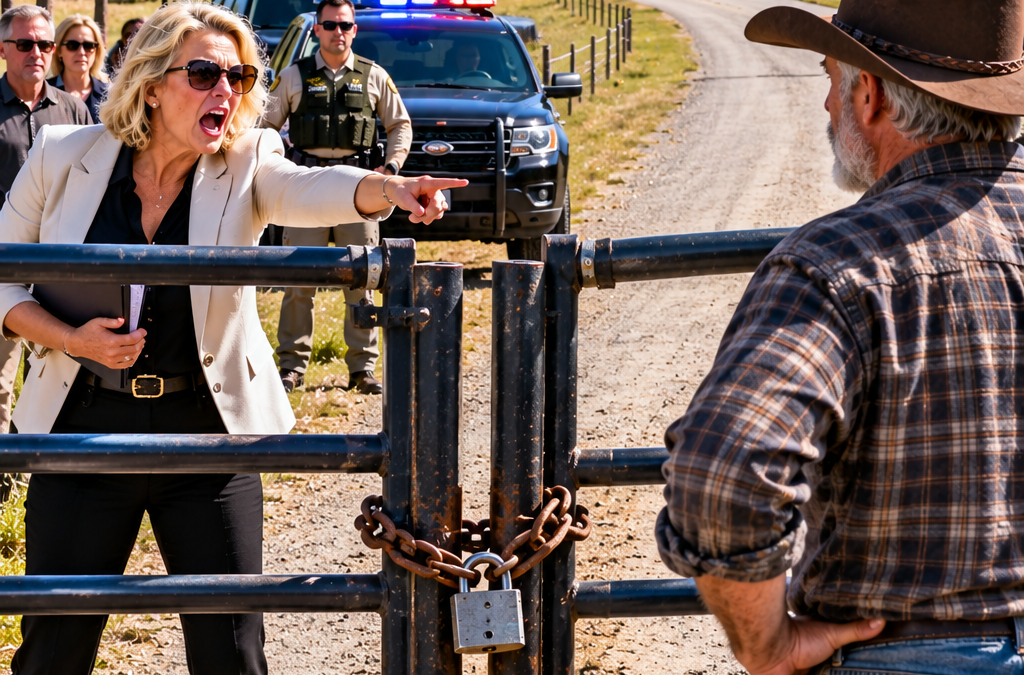
A steel gate now stretched across the road.
Two posts had been driven into the shoulder.
A heavy chain ran through the center.
A new brass padlock hung from it.
Zip-tied to the gate was a laminated sign.
PRIVATE COMMUNITY ROAD
NO OUTSIDE TRAFFIC
I stood in front of that sign for a long time.
The gate was on my land.
Not near my boundary.
Not on a disputed strip.
On my parcel.
I knew the coordinates from the survey.
Marlene had authorized somebody to enter property she did not own, install permanent posts, block a road crossing my deed, and put up a sign declaring my land private for her community.
I could have cut the lock.
I owned bolt cutters.
I could have pulled the posts with my truck.
I could have called the sheriff.
Any of those options would have been understandable.
I did none of them.
Because something was bothering me.
Marlene had just sued me claiming Route 9 was essential to Cedar Hollow.
Then she had locked that very road from my side.
Why?
Because she did not think of me as the owner.
She thought of me as an intruder.
That told me her confidence was based on something weaker than documentation.
And if I was right about that, I did not want to disturb a single piece of evidence before I knew exactly what I had purchased.
I took photographs instead.
Wide shots.
Close-ups.
Posts.
Padlock.
Sign.
Tire tracks.
Time stamp.
GPS coordinates.
Thirty-one years as a surveyor teaches you something valuable.
Anger feels productive.
Documentation usually is.
At seven the next morning, I was driving toward the county recorder’s office.
It was almost two hours away.
I brought coffee, a legal pad, reading glasses, and the auction file.
The county records building had not changed much since I retired.
Same beige walls.
Same fluorescent lights.
Same smell of paper and dust.
A clerk named Diane recognized me immediately.
“Walt?”
“Morning.”
“I thought you escaped.”
“So did I.”
She laughed.
“What did you buy?”
“What makes you think I bought something?”
“Because retired surveyors only come back here for two reasons. Divorce or land.”
“Land.”
“Congratulations.”
“Ask me again in a few hours.”
I gave her the parcel number.
Then I asked for everything.
Not ten years.
Not twenty.
Everything available.
Parent parcels.
Conveyances.
Surveys.
Licenses.
Plats.
Access instruments.
Dedications.
Vacations.
Road agreements.
Diane raised an eyebrow.
“You planning to annex a state?”
“HOA sued me.”
She stopped smiling.
“Already?”
“Eleven days.”
“That has to be some kind of record.”
“I’m hoping the records are better than the record.”
By noon, I had documents spread across a table.
Some were digitized.
Others had been scanned from microfilm.
A few required pulling old index books.
I started with 1958.
Then 1960.
Then 1962.
That was where everything changed.
I found the original survey reference I had seen during auction due diligence.
The actual instrument was much more detailed than the modern summary.
Cedar Hollow had not originally been developed as the neighborhood that existed now.
The land had once been part of a much larger ranch.
In 1962, the owner carved off an interior tract intended for future residential development.
Because that tract did not touch a public road, he created access across the remaining parent parcel.
But he did not create a permanent easement.
He created a license.
That distinction mattered enormously.
An easement can create a durable property interest.
A license can simply grant permission.
And this license had conditions.
I read it once.
Then again.
Then a third time.
Paragraph 6.
The language was old-fashioned but unmistakable.
The license to use Route 9 would terminate automatically upon transfer of the parent parcel unless renewed by written instrument and recorded within ninety days.
I sat back.
For a moment, all I heard was the hum of the fluorescent lights.
I checked the chain of title.
Transfer in 1974.
No renewal.
Transfer in 1988.
No renewal.
Probate-related conveyance in the 1990s.
No renewal.
Family trust restructuring.
No renewal.
Tax-related transfers.
No renewal.
Nothing.
Not one recorded renewal.
I asked Diane to search under Cedar Hollow Estates.
Nothing.
I searched variations of the developer’s name.
Nothing.
I searched Route 9.
Nothing.
The license had been dead for decades.
Legally, the problem had existed long before I arrived.
But because nobody had challenged the use, people kept driving.
Residents moved in and out.
Houses were sold.
The HOA collected dues.
Boards changed.
Attorneys apparently assumed someone else had checked.
Eventually, habit hardened into certainty.
And certainty became arrogance.
Then I bought the parent parcel.
Technically, the 1962 document contained another trigger as well.
Even if someone argued the old license had somehow survived the earlier transfers, my purchase independently required renewal within ninety days.
No such renewal had been signed.
More importantly, I had signed nothing granting Cedar Hollow permanent rights.
Yet eleven days after closing, instead of approaching me to negotiate, the HOA sued me.
Then Marlene installed a gate on my land.
I stared at paragraph 6.
For thirty-one years, I had watched disputes explode because people confused long use with legal ownership.
A fence stood somewhere for twenty years, so someone assumed it defined a boundary.
A driveway had always been used, so someone assumed an easement existed.
A ditch crossed a field, so someone assumed water rights followed it.
Sometimes those assumptions were legally defensible.
Sometimes they were disastrously wrong.
Cedar Hollow’s assumption was catastrophically wrong.
Their only practical road ran across property they did not own under a license nobody had maintained.
And their president had responded to the new owner’s arrival by trying to bully him through litigation.
I made certified copies.
The original 1962 plat.
The license.
The parent-parcel chain of title.
Every transfer.
Every index search showing no renewal.
Then I went home.
The gate was still there.
Marlene had added another sign.
HOA AUTHORIZED ACCESS ONLY.
I took another photograph.
Two days later, she called.
“Mr. Dobbins.”
“Marlene.”
“I understand you’ve been visiting county records.”
I leaned back in my chair.
“That information travel fast?”
“We have relationships in the county.”
“I worked there thirty-one years.”
Silence.
Just a beat.
“You worked for the county?”
“I was a surveyor.”
Another silence.
This one longer.
“You never mentioned that.”
“You never asked.”
Her voice changed slightly.
Not fear.
Not yet.
But caution.
“What exactly did you find?”
“I thought your attorney handled all that.”
“He did.”
“Then he should know.”
“We’re trying to avoid escalating this.”
I looked through the window toward the locked gate on my property.
“You installed a gate on my land after suing me.”
“That gate protects Cedar Hollow residents.”
“From whom?”
“Unauthorized users.”
“Such as the owner?”
“You’re twisting my words.”
“No. I’m repeating your sign.”
She exhaled sharply.
“We have a hearing in less than three weeks. It would benefit everyone if we resolved this beforehand.”
“Agreed.”
“Then sign the access acknowledgment our counsel sent you.”
I had received it that morning.
A proposed agreement declaring Cedar Hollow’s use permanent, non-revocable, uncompensated, transferable, and binding on all future owners of my 2,500 acres.
It was an extraordinary demand.
They were essentially asking me to voluntarily give away a permanent property right worth a substantial amount of money while they continued suing me.
“I read it.”
“And?”
“No.”
Her voice sharpened immediately.
“Why?”
“Because I’d have to be insane.”
“Excuse me?”
“You want a permanent easement across my property for zero dollars.”
“This road has existed for decades.”
“So has my barn. You want that too?”
“This is not funny.”
“I agree.”
“Hundreds of residents depend on this road.”
“Then perhaps your board should have investigated its legal status before filing suit against the landowner.”
“We have investigated.”
“Then you know what paragraph 6 says.”
Silence.
Complete silence.
I knew in that moment she had not read it.
“What paragraph?”
“Ask your attorney.”
Then I hung up.
That evening, someone from Cedar Hollow came to my house.
Not Marlene.
A man named Thomas Avery.
Mid-forties.
Work shirt.
Tired eyes.
He parked outside the gate and walked the rest of the way.
“I live in Cedar Hollow,” he said.
“I figured.”
He glanced back toward the subdivision.
“I hope you don’t mind me coming here.”
“Depends why.”
“I wanted to know if you’re actually planning to shut the road.”
His voice was different from Marlene’s.
No accusation.
Mostly worry.
I gestured toward a chair on the porch.
“Sit.”
He did.
“I have two kids,” he said. “My wife works nights at the hospital. Marlene told everybody you’re trying to block us in until the HOA pays you millions.”
“I haven’t demanded a dollar.”
He looked at me.
“She said you threatened to close Route 9.”
“I haven’t closed anything.”
“The gate—”
“Your HOA installed it.”
He frowned.
“What?”
“That gate belongs to Marlene, not me.”
He stared toward the road.
“She told us you put it there.”
That was the first moment my irritation turned into something heavier.
Because the fight was no longer simply about Marlene being arrogant.
She was frightening her own residents to strengthen her position.
“I didn’t install that gate.”
Thomas rubbed a hand over his face.
“So what’s happening?”
I considered how much to tell him.
Then I decided facts were safer than rumors.
“Your neighborhood’s access arrangement is not what your board believes it is.”
“What does that mean?”
“It means there is an old document that needs to be addressed.”
“Can we lose the road?”
“I’m not looking to strand families.”
His shoulders eased slightly.
“But?”
“But I’m also not giving away rights to my property because your HOA filed a lawsuit demanding them.”
He nodded slowly.
“That sounds fair.”
“I hope so.”
He stood after a few minutes.
At the porch steps, he stopped.
“Marlene keeps saying you’re dangerous.”
I almost laughed.
“I’m seventy years old and my left knee sounds like gravel.”
He smiled despite himself.
“She means legally.”
“Then she may finally be right about something.”
Word began spreading after that.
Two more residents contacted me.
Then five.
Most asked the same question.
Was I trying to trap them?
No.
Was I shutting the road?
No.
Had I demanded millions?
No.
Had Marlene really installed the gate herself?
The HOA had authorized it.
Each conversation made the same thing clearer.
Marlene needed me to be a villain.
Without that, residents might ask why their HOA had spent money suing a new landowner before understanding the documents.
One afternoon, she returned.
This time there was no red blazer.
She wore a cream jacket and carried a thick binder.
A man I assumed was the HOA attorney walked beside her.
He introduced himself as Franklin Price.
He had the exhausted expression of a lawyer who had recently discovered his client had been much more confident than informed.
“Mr. Dobbins,” he said. “Could we speak?”
“Sure.”
We stood near the gate.
Franklin looked at it.
“Who installed this?”
Marlene spoke before I could.
“The board authorized a security measure.”
He turned toward her.
“On his parcel?”
“It is the community road.”
Franklin closed his eyes for half a second.
That told me something too.
He had not known.
“I’d like to discuss the recorded instrument,” he said.
“Paragraph 6?”
He nodded.
Marlene’s jaw tightened.
“There are other legal doctrines involved,” she said.
Franklin looked uncomfortable.
I folded my arms.
“Such as?”
“Prescriptive use.”
I nodded.
“Possibly.”
“And reliance.”
“Possibly.”
“And implied easement.”
“Possibly.”
She seemed encouraged.
I looked at Franklin.
“But your lawsuit doesn’t plead most of that.”
His lips pressed together.
“No.”
“Your complaint says Cedar Hollow already possesses a permanent recorded right-of-way.”
Marlene interrupted.
“Because we do.”
Franklin turned toward her.
“Marlene.”
“No, Franklin. I’m tired of him acting like we’re trespassers. That road has served our homes for years.”
I looked at her.
“Use and ownership are different things.”
“You keep hiding behind technicalities.”
“Recorded property rights are not technicalities.”
She stepped closer.
“Do you know what happens if you disrupt access? Property values collapse. Emergency services are affected. Families suffer.”
“Then your board had a responsibility to know how the road was secured.”
“We did know.”
“No. You assumed.”
Her face reddened.
“You bought this land knowing Cedar Hollow existed.”
“Yes.”
“You knew we used the road.”
“Yes.”
“So you knew what you were doing.”
There it was.
The accusation underneath everything.
She had convinced herself I bought the land as some trap.
“I knew there was a road.”
“You knew there was leverage.”
“I knew there was a recorded instrument I wanted to understand.”
“You’re splitting hairs.”
“No, Marlene. I’m reading documents.”
Franklin raised a hand.
“Let’s lower the temperature.”
I pointed at the gate.
“Then remove that.”
Marlene stared at me.
“No.”
Franklin turned sharply.
“Why not?”
“Because until the hearing, we must maintain control over community access.”
“It’s on my land.”
“It protects our residents.”
“From me?”
“You are currently adverse to the association.”
I almost admired the logic.
She had trespassed onto my property to install a gate that prevented me from freely using part of my property because I had become legally adverse to her after she sued me.
Franklin finally said, “The gate should come down.”
She looked at him like he had betrayed her.
“We voted.”
“That vote does not create land rights.”
For the first time, someone standing beside Marlene had said aloud exactly what she refused to hear.
Her face went still.
“We’re done here.”
She turned and walked away.
Franklin remained.
“I’ll speak with her.”
“Please do.”
He glanced at the gate.
“Did you cut the lock?”
“No.”
“Remove anything?”
“No.”
“Good.”
“I photograph it every day.”
He looked back at me.
“I assumed you might.”
“Occupational habit.”
He gave a tired smile.
“I’ve learned that.”
The gate disappeared the next morning.
No apology.
No explanation.
Just four fresh holes where the posts had been.
I photographed those too.
A week before the hearing, Marlene held an emergency HOA meeting.
I did not attend.
I heard about it from Thomas.
Apparently more than sixty residents crowded the clubhouse.
Marlene told them I was exploiting an ancient paperwork defect to extort the neighborhood.
Thomas stood up and asked whether the board had actually read the 1962 license before suing me.
Marlene said their attorneys had always assured them access was secure.
Franklin, who was present, reportedly corrected her.
He said his firm had not represented the original developer and had never issued a title opinion regarding Route 9.
That changed the room.
People started asking questions.
Who had approved the lawsuit?
Marlene.
Had the board reviewed the parent deed?
No clear answer.
Had anybody checked paragraph 6?
Not before filing.
Had the HOA installed a gate on my property?
Marlene said it was necessary.
Someone asked who told residents I had installed it.
Nobody admitted anything.
By the end of the meeting, people were shouting.
Thomas called me afterward.
“You should have seen her.”
“I’m glad I didn’t.”
“She blamed the old board, the developer, the county, your auction company, and finally you.”
“In that order?”
“Pretty close.”
“What about herself?”
He laughed without humor.
“She hasn’t gotten there yet.”
The hearing came three weeks after the lawsuit was filed.
I woke before my alarm.
Not because I was nervous about speaking in court.
I had testified as a surveyor dozens of times.
Boundary disputes.
Road cases.
Drainage cases.
Construction claims.
I knew how courtrooms worked.
What bothered me was what sat behind the legal issue.
Cedar Hollow contained real families.
People like Thomas.
People who had purchased homes believing access was settled.
Whatever happened, they were the ones standing closest to the consequences.
Marlene had treated that vulnerability as a weapon.
I did not want to do the same.
So before leaving home, I made one decision.
If the judge ruled the HOA had no current right to Route 9, I would negotiate.
I would not block residents overnight.
I would not lock the road.
I would not use emergency access as retaliation.
But I also would not reward intimidation.
If Cedar Hollow wanted a permanent easement, it would be documented properly, compensated fairly, maintained properly, insured properly, and recorded properly.
No more assumptions.
No more spirit.
The courthouse was busier than I expected.
Several Cedar Hollow residents had come.
Marlene arrived early.
And yes, she wore the red blazer.
Two board members walked beside her.
Franklin followed with a rolling case full of files.
Marlene saw me near the courtroom doors.
She came over.
“This can still end today,” she said.
“It will.”
“You know what I mean.”
“I do.”
“Sign the access agreement.”
“No.”
“You’re willing to risk all these families just to prove a point?”
I looked past her at residents sitting along the hallway.
“No. I’m willing to prove what their board should have verified years ago.”
Her voice dropped.
“You think you’re smarter than everyone because you used to work for the county.”
“No.”
“You’ve enjoyed this.”
That irritated me more than anything else she had said.
“No, Marlene. I bought land because I wanted a quiet retirement. You served me with a lawsuit eleven days later.”
“You knew exactly what you were buying.”
“So did your HOA, apparently. That’s what your complaint says.”
The bailiff opened the doors.
Our conversation ended.
The hearing lasted less than two hours.
It felt longer.
Franklin spoke first.
To his credit, he was more careful than Marlene.
He argued that Cedar Hollow residents had relied on Route 9 for many years and that immediate disruption would create serious hardship.
He described school buses.
Emergency vehicles.
Workers.
Medical needs.
Property access.
All legitimate concerns.
Then Marlene testified.
That was where things began unraveling.
She said the HOA had always understood Route 9 to be a permanent community road.
Franklin asked about continuous use.
She described fifteen years of uninterrupted access.
He asked whether homeowners had maintained portions of the road.
She said the HOA had occasionally paid for gravel and grading.
He asked whether anyone had previously challenged their use.
She said no.
From a distance, it sounded convincing.
Then the judge asked a simple question.
“Ms. Castellin, where is the permanent easement recorded?”
Marlene paused.
“Our community has inherited access rights from the original development.”
“That wasn’t my question.”
She looked toward Franklin.
He stood.
“Your Honor, the original instrument is part of the record.”
“I’ve read it.”
The judge looked at Marlene again.
“Where is the permanent easement?”
She swallowed.
“The instrument granted access.”
“A license.”
“Yes, Your Honor, but functionally—”
“A license,” he repeated.
“Yes.”
“And paragraph 6?”
Her hands tightened in her lap.
“Our position is that subsequent conduct superseded—”
“Did the association renew the license after transfer of the parent parcel?”
She looked at Franklin again.
He could not answer for her.
“I would have to defer to counsel.”
The judge turned toward him.
“Mr. Price?”
Franklin stood slowly.
“We have located no recorded renewal.”
That sentence changed the entire room.
I heard somebody behind me whisper.
Marlene sat rigidly.
The judge looked down at the documents.
“How many transfers occurred?”
Franklin answered.
“Several.”
“And no renewal following any of them?”
“None that we have located.”
Then it was my turn.
I carried one folder to the table.
Not a stack.
One folder.
I had learned years earlier that if one document decides a case, burying it under twenty others does not make it stronger.
I identified myself.
I explained my background.
Thirty-one years as a county surveyor.
Familiarity with deed research.
Boundary descriptions.
Recorded plats.
Access instruments.
Then I explained the property purchase.
Auction date.
Closing date.
Parent parcel.
Route 9.
I did not call Marlene reckless.
I did not call the HOA dishonest.
I did not need adjectives.
Documents were enough.
I placed the certified 1962 plat into evidence.
Then the license.
Then the chain of title.
The judge already had copies.
I opened to paragraph 6.
“May I read the relevant language?”
“Go ahead.”
I read slowly.
The license terminated upon transfer of the parent parcel unless renewed in writing and recorded within ninety days.
Then I stopped.
The judge looked toward Franklin.
Franklin looked down at his notes.
Marlene’s expression had changed.
The certainty was gone.
For the first time since I met her, she looked less angry than frightened.
The judge asked me whether I had prevented residents from using Route 9.
“No, Your Honor.”
“Have you installed any barriers?”
“No.”
“Have you threatened to install any barriers?”
“No.”
“Did you install the gate shown in these photographs?”
“No.”
“Who did?”
I looked toward Marlene.
“The HOA.”
The judge’s eyes moved to her.
Franklin stood immediately.
“Your Honor, that gate has been removed.”
The judge looked at the photograph.
“Was it installed on Mr. Dobbins’s parcel?”
Franklin hesitated.
“Yes.”
“Without his permission?”
Another pause.
“To my understanding, yes.”
The judge leaned back.
That was the moment I knew Marlene finally understood what she had done.
She had come into court asking for equitable relief while having authorized an unauthorized structure on the opposing party’s land.
Not fatal by itself.
But terrible judgment.
The judge asked me another question.
“If the court declines the requested injunction, what do you intend to do?”
I could feel Cedar Hollow residents behind me.
This was the question that mattered to them.
“I intend to negotiate in good faith.”
Marlene looked up sharply.
The judge did too.
I continued.
“I have no intention of trapping families or interfering with emergency access. But I also do not believe I should be forced to grant a perpetual uncompensated easement because an HOA failed to maintain its paperwork.”
The courtroom stayed quiet.
“I am willing to negotiate a recorded easement with reasonable compensation, maintenance responsibilities, insurance provisions, emergency access protection, and clearly defined boundaries.”
The judge nodded.
“That seems considerably different from the position attributed to you in the plaintiff’s filings.”
“It is.”
Franklin did not look at Marlene.
The judge took a recess.
When he returned, his ruling was straightforward.
The HOA had not established that it possessed the permanent recorded easement described in its complaint.
The 1962 instrument was a revocable, conditional license.
Its own language required renewal after transfer of the parent parcel.
No recorded renewal had been produced.
The court would not transform that expired license into the permanent uncompensated property interest the HOA requested through an emergency injunction.
He did not order Cedar Hollow sealed off.
He did not suggest residents should suddenly lose physical access.
He did something much more important.
He refused to give Marlene ownership rights simply because she demanded them.
Any future permanent access arrangement would have to be negotiated.
Properly.
Legally.
With me.
When the judge finished, nobody celebrated.
Not even me.
Marlene sat completely still.
One board member beside her whispered something.
She turned on him immediately.
I could not hear the words, but I saw his expression.
He was done.
Outside the courtroom, residents gathered in small groups.
Thomas found me near the stairs.
“So we’re not locked out?”
“No.”
He let out a breath.
“Thank you.”
“Don’t thank me yet. Your HOA still needs to negotiate.”
“That’s better than what she told us.”
“What did she tell you?”
“That if she lost, you’d chain the road by sunset.”
I looked across the hallway.
Marlene was arguing quietly with Franklin.
“No chains.”
Thomas nodded.
“I figured.”
The fallout inside Cedar Hollow happened quickly.
Two board members resigned within a month.
One resignation letter accused Marlene of filing litigation before completing adequate title review.
The other simply said the board had lost the trust of homeowners.
Residents demanded financial records.
They wanted to know how much the lawsuit had cost.
They wanted to know why legal fees had been incurred before anyone obtained a complete title opinion.
They wanted to know who authorized the gate.
They wanted to know why they had been told I installed it.
For years, Marlene’s authority had depended on nobody asking too many questions.
Once people started, they did not stop.
The HOA eventually formed a temporary road committee that included residents who had nothing to do with the original lawsuit.
That was when negotiations became possible.
The first meeting took place at my kitchen table.
No red blazer.
No threats.
No fourteen-page complaint.
Just maps, coffee, insurance documents, maintenance estimates, and adults discussing an actual problem.
I made my position simple.
Cedar Hollow could continue using Route 9 while we worked toward a permanent agreement.
In exchange, the HOA would acknowledge in writing that temporary continued use did not create additional adverse rights while negotiations were ongoing.
For the permanent easement, we established a defined road corridor.
Not my entire parcel.
Not vague access wherever the HOA wanted.
A surveyed width.
Specific drainage rights.
Maintenance obligations.
Snow removal responsibilities.
Liability coverage.
Emergency access.
Rules governing utility work.
Notice requirements before excavation.
And compensation.
Fair compensation.
Not punishment.
Not extortion.
An amount supported by an independent appraisal of the burden placed on the property.
The negotiations took months.
There were disagreements.
There should have been.
That is what negotiation looks like.
But none of those disagreements resembled the first eleven days.
Nobody installed gates.
Nobody threatened injunctions.
Nobody told me community spirit overruled recorded title.
Marlene attended only the first meeting.
She walked in carrying the same leather folder.
No blazer this time.
She sat across from me and barely spoke.
Halfway through, when someone suggested reviewing the survey description for the proposed easement, she pushed her chair back.
“I think it’s obvious my presence is no longer productive.”
Nobody disagreed.
She left.
That was the last time she and I sat at the same table.
A week later, I received notice that she had resigned as HOA president.
I did not celebrate that either.
People expected me to.
Thomas even joked that I should frame the letter.
But the truth was more complicated.
Marlene had not invented the underlying problem.
The defective access arrangement predated her by decades.
Other boards had ignored it.
Developers had ignored it.
Buyers had assumed title companies or lawyers had handled it.
The difference was what Marlene did when uncertainty finally appeared.
She could have knocked on my door.
She could have said, “We have a serious access issue. Let’s review the documents together.”
She could have hired a title attorney before filing anything.
She could have negotiated.
Instead, she decided authority came first and facts could be forced to catch up.
She sued me after eleven days.
She demanded permanent rights for free.
She stood on my land and told me her community owned my road in spirit.
Then she authorized a locked gate across property she did not own.
That was not strength.
It was certainty without knowledge.
And in land disputes, certainty without knowledge can cost people enormously.
The permanent easement was recorded the following spring.
I remember the day because it was almost exactly a year after I bought the ranch.
The final document was thick.
Every page had been reviewed.
Every boundary was surveyed.
Every obligation was clear.
Cedar Hollow paid compensation based on the independent valuation.
The HOA became responsible for most routine maintenance within the easement corridor.
Emergency services received guaranteed access.
I retained rights necessary to use the surrounding ranch.
Future owners of both properties would know exactly what existed.
No guessing.
No assumptions.
No sixty-year-old surprise buried in a file cabinet.
After recording it, I drove back to the ranch and stopped near the place where Marlene had installed her gate.
The holes from the posts were barely visible anymore.
Grass had begun growing over them.
Cars came down Route 9 occasionally.
Residents waved.
Most had probably forgotten I was once supposed to be the man trying to imprison them inside their neighborhood.
I waved back.
I eventually put cattle on part of the acreage.
Fixed two miles of old fence.
Repaired the barn roof.
Cleared brush from the creek.
The retirement I had wanted finally started showing up, just about a year late.
One afternoon, Thomas stopped by while I was repairing a gate.
Not Marlene’s gate.
Mine.
A normal ranch gate.
He leaned against the fence.
“You know people still tell that story.”
“What story?”
“The lawsuit.”
“I try not to.”
He laughed.
“New homeowners ask why the road agreement is forty pages long.”
“What do you tell them?”
“That our old HOA president learned why you read things before suing a retired surveyor.”
I shook my head.
“That makes me sound more interesting than I am.”
“You’re the man who bought our road.”
“No.”
I tightened a hinge bolt.
“I bought land.”
“Same difference.”
“Not even close.”
He smiled.
Then he pointed toward the road.
“You ever think about what would’ve happened if she hadn’t sued you?”
That question stayed with me.
Because the truth was, if Marlene had done nothing, Route 9 might have continued operating exactly as it had for years.
Residents would have driven through.
The HOA would have graded it occasionally.
I would eventually have completed my title review and discovered the defect.
Then I probably would have approached them.
Quietly.
Privately.
No courtroom.
No public embarrassment.
No board resignations.
No angry clubhouse meeting.
Her lawsuit did not protect Cedar Hollow.
It exposed Cedar Hollow.
Her gate did not establish authority.
It created evidence.
Her threats did not strengthen the HOA’s rights.
They forced everyone to examine how weak those rights actually were.
Sometimes people create the very crisis they claim they are preventing.
I thought about that a few weeks later when I found an old envelope in my desk.
Inside was the certified copy of the 1962 license.
Paragraph 6 was still highlighted yellow.
Beside it sat the sticky note I had mailed to Marlene shortly after the hearing.
I had kept a duplicate.
Five words.
“In spirit isn’t in title.”
At the time, I had written it partly out of irritation.
A small jab after weeks of being treated like an ignorant old man who had accidentally wandered into somebody else’s neighborhood.
Looking at it later, I understood it differently.
Marlene’s real mistake was not misunderstanding one road.
It was believing that confidence could replace permission.
That repeated use could replace documentation.
That a board vote could replace ownership.
That pressure could replace negotiation.
And that an HOA title gave her authority beyond the boundaries of the property the HOA actually controlled.
I had seen versions of that mistake throughout my career.
Farmers made it.
Developers made it.
Governments made it.
Homeowners made it.
People become accustomed to something, and eventually they stop asking why they are allowed to do it.
Then one day a deed changes hands.
A survey gets completed.
A title gets examined.
And everyone discovers that habit and legal right are not always the same thing.
I never wanted Cedar Hollow’s residents stranded.
I never wanted their homes devalued.
I never wanted a war with Marlene Castellin.
What I wanted was very simple.
If someone needed a permanent right across 2,500 acres I owned, we were going to put that right on paper correctly.
They were going to compensate for it fairly.
They were going to maintain it responsibly.
And nobody was ever again going to stand on my property, point at my road, and tell me their claim was stronger because they owned it “in spirit.”
The courthouse envelope that arrived eleven days after I bought the ranch still sits in a file cabinet in my office.
I kept it.
Not because I enjoy remembering the lawsuit.
Because every time I see it, I remember the absurdity of those first weeks.
I had bought 2,500 acres looking for peace.
Marlene saw a retired man living alone in work boots and decided I would be easier to intimidate than to negotiate with.
She assumed the lawsuit would scare me.
She assumed the gate would establish control.
She assumed years of use meant nobody could question her authority.
Most of all, she assumed I would never read the old paperwork carefully enough to understand what she had overlooked.
That last assumption cost her.
A lot of property disputes begin with inches.
A fence moved six inches.
A driveway crossing five feet.
A shed built over a line.
Ours began with a road wide enough for two trucks and a paragraph small enough to disappear inside sixty years of forgotten records.
One paragraph.
That was all.
A few sentences written in 1962.
Ignored through ownership changes.
Ignored through development.
Ignored through home sales.
Ignored by board after board.
Until a woman in a red blazer decided to sue the new owner before asking whether the road she was fighting over had ever legally belonged to her community at all.
Today, Route 9 is still there.
Families drive it every morning.
School buses use it.
Ambulances can use it.
Fire trucks can use it.
I drive it too.
The difference is that now everybody knows why.
There is a recorded easement.
There are surveyed boundaries.
There are responsibilities.
There is compensation.
There is permission.
Real permission.
Not assumptions.
Not threats.
Not a board vote.
And definitely not spirit.
Every once in a while, when I pass the exact stretch where Marlene’s unauthorized gate once stood, I remember her crossing her arms and telling me I could not simply take away something people had depended on for years.
In one respect, she had been right.
People should not lose something essential because someone wants leverage.
That was why I never locked Cedar Hollow out.
But she never understood the other half of that principle.
If something essential to you crosses someone else’s property, you do not protect it by bullying the owner.
You protect it by making sure your right to use it is legitimate.
You document it.
You respect it.
You negotiate before you threaten.
Because the most dangerous sentence in any property dispute is not, “We’ve always used it.”
It is, “We never checked.”
And Cedar Hollow had not checked for more than sixty years.
Marlene finally did.
Eleven days too late.
𝗧𝗛𝗘 𝗘𝗡𝗗
They sued me over land I had owned for eleven days, then locked a gate across my property as if the lawsuit had already made them owners. What Marlene Castellin did not understand was that I had spent thirty-one years reading the kind of document that could turn her confidence into panic with one paragraph.
Eleven days.
That was how long my name had been on the deed when a courier truck rolled up my driveway carrying a courthouse envelope.
I remember standing there with one hand wrapped around a mug of coffee, watching the driver climb out and check the address on his clipboard twice.
“You Walter Dobbins?” he asked.
“That depends,” I said. “Am I inheriting money?”
He gave me an apologetic look.
“Probably not.”
I signed.
The envelope was thick enough to make my stomach tighten before I even opened it.
I had been retired less than a year. After thirty-one years working as a county surveyor, I had imagined retirement as something quiet. Coffee before sunrise. Fence repairs when I felt like doing them. Maybe a few cattle eventually. Long stretches of land where I could walk without hearing traffic or having somebody call me because two neighbors were screaming over six inches of property line.
I had spent most of my adult life inside other people’s disputes.
I had no interest in starring in one of my own.
Then I opened that envelope.
Cedar Hollow Estates Homeowners Association v. Walter Dobbins.
I stared at the caption for a few seconds.
Then I laughed.
Not because it was funny.
Because sometimes the first reaction to something completely absurd is laughter.
I had owned the property for eleven days.
I had not built anything.
I had not cut off utilities.
I had not moved a fence.
I had not even finished unpacking the boxes in my kitchen.
Yet somehow, in less than two weeks, I had apparently become enough of a threat to an entire residential subdivision that its homeowners association felt compelled to drag me into court.
I sat down at my kitchen table and started reading.
Fourteen pages.
The complaint accused me of obstructing established residential access, interfering with long-standing community rights, threatening the health and welfare of homeowners, and creating an imminent risk of irreparable harm.
That last phrase showed up three times.
Irreparable harm.
They were requesting an emergency injunction requiring me to recognize what they called a permanent community right-of-way through my land.
No proposed purchase price.
No offer of compensation.
No acknowledgment that the road crossed private property.
Just a demand that a judge force me to give them permanent access for free.
I read the complaint once.
Then I read it again.
When I reached the road description, I stopped laughing.
Route 9.
A private gravel road running north to south through the center of my newly purchased 2,500 acres.
The same road I had spent hours studying before bidding on the property.
The same road that had caught my attention when almost every other bidder saw nothing but scrubland, old fencing, back taxes, and a probate mess.
To most people, the property looked like trouble.
To me, it had looked like paperwork.
And paperwork was something I understood.
The land had belonged to the same extended family for decades. After deaths, divorces, disputed inheritances, tax liens, and one particularly ugly probate fight, the county finally put the whole parcel up for auction.
The auction packet was more than an inch thick.
Most buyers flipped through the glossy maps and tax summaries.
I read the attachments.
That was where I found a reference to a 1962 survey.
One line.
Barely noticeable.
“Access rights subject to recorded parent-parcel instrument.”
I remember sitting in my truck outside the auction office after reading it.
I had seen language like that before.
It did not necessarily mean anything valuable.
But it meant something had once been recorded, and if something had been recorded, there was a trail.
I started pulling records.
The more I looked, the more interested I became.
The 2,500 acres wrapped around a developed neighborhood called Cedar Hollow Estates. The subdivision itself was technically outside the parcel, carved from an older tract decades earlier, but the road serving it crossed what would become my land.
I knew that before bidding.
What I did not yet know was exactly what kind of legal access Cedar Hollow possessed.
Still, I saw enough irregularities to realize the parcel was being undervalued.
So I bought it.
Cash.
No bank.
No realtor.
No delay.
The auction closed on a Tuesday morning.
That afternoon, I drove through the main gate in an old pickup with a thermos beside me and mud already dried across the floorboards.
The land was rougher than the county photographs suggested.
Juniper.
Rock.
Old pasture.
Patches of pine climbing the foothills.
A dry creek bed twisting along the western boundary.
And silence.
Real silence.
The kind that settles into your chest.
I parked near a weathered fence post and walked for almost three hours.
I remember thinking that after a career spent measuring land for other people, I had finally bought enough of it to disappear into.
Eleven days later, Cedar Hollow sued me.
I set the complaint on the kitchen table and looked out the window toward Route 9.
They thought they were threatening me.
But without realizing it, they had just identified the most important weakness in their own position.
According to their lawsuit, Route 9 was the only road serving the subdivision.
Not one of two roads.
Not a secondary entrance.
The only ingress and egress.
And it crossed my property.
That meant one thing mattered more than anything else.
What exactly gave them the right to use it?
Two days after I received the lawsuit, I got my first answer to what kind of people I was dealing with.
A white SUV stopped near my front gate shortly after ten in the morning.
A woman stepped out.
She was probably in her late fifties, though everything about her was constructed to resist disorder.
Perfect hair.
Large sunglasses.
Gold earrings.
Dark slacks.
And a deep red blazer that looked wildly out of place beside a gravel road.
She did not walk toward my house like a visitor.
She advanced.
That is the only word for it.
Straight shoulders.
Fast steps.
A leather folder tucked beneath one arm.
She stopped a few yards from me.
“Walter Dobbins?”
“Depends who’s asking.”
“Marlene Castellin. President of the Cedar Hollow Estates Homeowners Association.”
She said president as if she expected it to carry governmental authority.
I nodded.
“I figured.”
Her mouth tightened.
“You received our filing.”
“I did.”
“Then I hope you understand how serious this is.”
I looked past her at the SUV.
Two people were sitting inside.
I later learned they were board members.
Apparently Marlene had brought witnesses.
“I understand someone spent money filing fourteen pages of paperwork eleven days after I bought my property.”
Her sunglasses came off.
That seemed deliberate.
She wanted eye contact.
“Mr. Dobbins, every family in Cedar Hollow has used Route 9 for fifteen years.”
“Only fifteen?”
She hesitated.
“What?”
“Your complaint says continuous access. I assumed you knew how long.”
Her expression hardened.
“That isn’t the point.”
“It may become the point.”
She folded her arms.
“You need to understand something. There are families back there. Children. Elderly residents. People with jobs. People who need ambulances and fire service. You don’t get to purchase some paperwork at an auction and suddenly threaten everyone’s home.”
Purchase some paperwork.
That phrase told me almost everything I needed to know about how Marlene saw the situation.
She did not think I had bought land.
She thought I had acquired an inconvenience that should remain subordinate to her community.
“I haven’t threatened anyone’s home.”
“You’re refusing to acknowledge the road.”
“I haven’t refused anything. I’ve owned the parcel less than two weeks.”
“You’re being evasive.”
“No. I’m being careful.”
Her face tightened again.
I had spent thirty-one years across tables from developers, lawyers, farmers, county commissioners, heirs, contractors, and angry neighbors.
People told you a great deal about themselves by how they reacted when you refused to be rushed.
Marlene hated not controlling the pace.
She pulled a sheet from her folder.
“Our board voted unanimously that Route 9 is a community road.”
I looked at the paper but did not take it.
“Your board voted?”
“Yes.”
“When?”
“Last Thursday.”
“And your board believes it can vote ownership rights onto somebody else’s deed?”
Her cheeks flushed.
“That is an intentionally hostile interpretation.”
“It was a question.”
“The road belongs to Cedar Hollow.”
“Recorded where?”
She blinked.
“We have established use.”
“Recorded where?”
“Our legal counsel handled the easement years ago.”
“Which attorney?”
“That isn’t relevant.”
“It seems pretty relevant.”
She took a slow breath through her nose.
I recognized that breath.
It was the kind people took before explaining something to someone they had already decided was stupid.
“Mr. Dobbins, property law does not exist in a vacuum. There are community expectations. There is reliance. There is history. There is what is fair.”
“I agree.”
“Good.”
“But none of those answer my question.”
Her eyes narrowed.
“What question?”
“Where is the easement recorded?”
Her mouth opened slightly.
Then closed.
She looked toward the SUV.
One of the board members inside suddenly became very interested in his phone.
Marlene turned back.
“The road belongs to this community in spirit.”
I actually thought I had misheard her.
“In spirit?”
“Yes.”
I let the silence sit between us.
She apparently mistook silence for confusion, because she pressed harder.
“People have depended on it for years. You cannot erase that with some technicality.”
I almost smiled.
To a surveyor, calling recorded title a technicality is like telling a doctor anatomy is a technicality.
“I haven’t erased anything, Marlene.”
“Then withdraw your objection.”
“I haven’t filed one.”
“Your refusal to acknowledge our rights is an objection.”
“No. It’s due diligence.”
She stepped closer.
“I don’t think you understand who you’re dealing with.”
I looked at her red blazer, the folder, the white SUV, the two silent board members.
Then I looked back at her.
“I was about to say the same thing.”
For the first time, she seemed uncertain.
Only for a second.
Then the confidence returned.
“Our attorney will handle this.”
“That’s what attorneys are for.”
“We’ll get the injunction.”
“Maybe.”
“And when we do, you’ll be required to keep Route 9 open permanently.”
“Maybe.”
“You don’t seem concerned.”
“I don’t know enough yet to be concerned.”
Her smile came back.
Cold.
Controlled.
Condescending.
“I think you’ll find retirement much more pleasant if you learn how things work around here.”
Then she turned and walked back toward the SUV.
I watched her drive away.
I stood there another minute thinking about one sentence.
The road belongs to this community in spirit.
Not in title.
Not under an easement number.
Not pursuant to a recorded right-of-way.
In spirit.
That night, she made things worse.
I heard metal clanking outside just after sunset.
By the time I reached Route 9, a contractor’s truck was pulling away.
A steel gate now stretched across the road.
Two posts had been driven into the shoulder.
A heavy chain ran through the center.
A new brass padlock hung from it.
Zip-tied to the gate was a laminated sign.
PRIVATE COMMUNITY ROAD
NO OUTSIDE TRAFFIC
I stood in front of that sign for a long time.
The gate was on my land.
Not near my boundary.
Not on a disputed strip.
On my parcel.
I knew the coordinates from the survey.
Marlene had authorized somebody to enter property she did not own, install permanent posts, block a road crossing my deed, and put up a sign declaring my land private for her community.
I could have cut the lock.
I owned bolt cutters.
I could have pulled the posts with my truck.
I could have called the sheriff.
Any of those options would have been understandable.
I did none of them.
Because something was bothering me.
Marlene had just sued me claiming Route 9 was essential to Cedar Hollow.
Then she had locked that very road from my side.
Why?
Because she did not think of me as the owner.
She thought of me as an intruder.
That told me her confidence was based on something weaker than documentation.
And if I was right about that, I did not want to disturb a single piece of evidence before I knew exactly what I had purchased.
I took photographs instead.
Wide shots.
Close-ups.
Posts.
Padlock.
Sign.
Tire tracks.
Time stamp.
GPS coordinates.
Thirty-one years as a surveyor teaches you something valuable.
Anger feels productive.
Documentation usually is.
At seven the next morning, I was driving toward the county recorder’s office.
It was almost two hours away.
I brought coffee, a legal pad, reading glasses, and the auction file.
The county records building had not changed much since I retired.
Same beige walls.
Same fluorescent lights.
Same smell of paper and dust.
A clerk named Diane recognized me immediately.
“Walt?”
“Morning.”
“I thought you escaped.”
“So did I.”
She laughed.
“What did you buy?”
“What makes you think I bought something?”
“Because retired surveyors only come back here for two reasons. Divorce or land.”
“Land.”
“Congratulations.”
“Ask me again in a few hours.”
I gave her the parcel number.
Then I asked for everything.
Not ten years.
Not twenty.
Everything available.
Parent parcels.
Conveyances.
Surveys.
Licenses.
Plats.
Access instruments.
Dedications.
Vacations.
Road agreements.
Diane raised an eyebrow.
“You planning to annex a state?”
“HOA sued me.”
She stopped smiling.
“Already?”
“Eleven days.”
“That has to be some kind of record.”
“I’m hoping the records are better than the record.”
By noon, I had documents spread across a table.
Some were digitized.
Others had been scanned from microfilm.
A few required pulling old index books.
I started with 1958.
Then 1960.
Then 1962.
That was where everything changed.
I found the original survey reference I had seen during auction due diligence.
The actual instrument was much more detailed than the modern summary.
Cedar Hollow had not originally been developed as the neighborhood that existed now.
The land had once been part of a much larger ranch.
In 1962, the owner carved off an interior tract intended for future residential development.
Because that tract did not touch a public road, he created access across the remaining parent parcel.
But he did not create a permanent easement.
He created a license.
That distinction mattered enormously.
An easement can create a durable property interest.
A license can simply grant permission.
And this license had conditions.
I read it once.
Then again.
Then a third time.
Paragraph 6.
The language was old-fashioned but unmistakable.
The license to use Route 9 would terminate automatically upon transfer of the parent parcel unless renewed by written instrument and recorded within ninety days.
I sat back.
For a moment, all I heard was the hum of the fluorescent lights.
I checked the chain of title.
Transfer in 1974.
No renewal.
Transfer in 1988.
No renewal.
Probate-related conveyance in the 1990s.
No renewal.
Family trust restructuring.
No renewal.
Tax-related transfers.
No renewal.
Nothing.
Not one recorded renewal.
I asked Diane to search under Cedar Hollow Estates.
Nothing.
I searched variations of the developer’s name.
Nothing.
I searched Route 9.
Nothing.
The license had been dead for decades.
Legally, the problem had existed long before I arrived.
But because nobody had challenged the use, people kept driving.
Residents moved in and out.
Houses were sold.
The HOA collected dues.
Boards changed.
Attorneys apparently assumed someone else had checked.
Eventually, habit hardened into certainty.
And certainty became arrogance.
Then I bought the parent parcel.
Technically, the 1962 document contained another trigger as well.
Even if someone argued the old license had somehow survived the earlier transfers, my purchase independently required renewal within ninety days.
No such renewal had been signed.
More importantly, I had signed nothing granting Cedar Hollow permanent rights.
Yet eleven days after closing, instead of approaching me to negotiate, the HOA sued me.
Then Marlene installed a gate on my land.
I stared at paragraph 6.
For thirty-one years, I had watched disputes explode because people confused long use with legal ownership.
A fence stood somewhere for twenty years, so someone assumed it defined a boundary.
A driveway had always been used, so someone assumed an easement existed.
A ditch crossed a field, so someone assumed water rights followed it.
Sometimes those assumptions were legally defensible.
Sometimes they were disastrously wrong.
Cedar Hollow’s assumption was catastrophically wrong.
Their only practical road ran across property they did not own under a license nobody had maintained.
And their president had responded to the new owner’s arrival by trying to bully him through litigation.
I made certified copies.
The original 1962 plat.
The license.
The parent-parcel chain of title.
Every transfer.
Every index search showing no renewal.
Then I went home.
The gate was still there.
Marlene had added another sign.
HOA AUTHORIZED ACCESS ONLY.
I took another photograph.
Two days later, she called.
“Mr. Dobbins.”
“Marlene.”
“I understand you’ve been visiting county records.”
I leaned back in my chair.
“That information travel fast?”
“We have relationships in the county.”
“I worked there thirty-one years.”
Silence.
Just a beat.
“You worked for the county?”
“I was a surveyor.”
Another silence.
This one longer.
“You never mentioned that.”
“You never asked.”
Her voice changed slightly.
Not fear.
Not yet.
But caution.
“What exactly did you find?”
“I thought your attorney handled all that.”
“He did.”
“Then he should know.”
“We’re trying to avoid escalating this.”
I looked through the window toward the locked gate on my property.
“You installed a gate on my land after suing me.”
“That gate protects Cedar Hollow residents.”
“From whom?”
“Unauthorized users.”
“Such as the owner?”
“You’re twisting my words.”
“No. I’m repeating your sign.”
She exhaled sharply.
“We have a hearing in less than three weeks. It would benefit everyone if we resolved this beforehand.”
“Agreed.”
“Then sign the access acknowledgment our counsel sent you.”
I had received it that morning.
A proposed agreement declaring Cedar Hollow’s use permanent, non-revocable, uncompensated, transferable, and binding on all future owners of my 2,500 acres.
It was an extraordinary demand.
They were essentially asking me to voluntarily give away a permanent property right worth a substantial amount of money while they continued suing me.
“I read it.”
“And?”
“No.”
Her voice sharpened immediately.
“Why?”
“Because I’d have to be insane.”
“Excuse me?”
“You want a permanent easement across my property for zero dollars.”
“This road has existed for decades.”
“So has my barn. You want that too?”
“This is not funny.”
“I agree.”
“Hundreds of residents depend on this road.”
“Then perhaps your board should have investigated its legal status before filing suit against the landowner.”
“We have investigated.”
“Then you know what paragraph 6 says.”
Silence.
Complete silence.
I knew in that moment she had not read it.
“What paragraph?”
“Ask your attorney.”
Then I hung up.
That evening, someone from Cedar Hollow came to my house.
Not Marlene.
A man named Thomas Avery.
Mid-forties.
Work shirt.
Tired eyes.
He parked outside the gate and walked the rest of the way.
“I live in Cedar Hollow,” he said.
“I figured.”
He glanced back toward the subdivision.
“I hope you don’t mind me coming here.”
“Depends why.”
“I wanted to know if you’re actually planning to shut the road.”
His voice was different from Marlene’s.
No accusation.
Mostly worry.
I gestured toward a chair on the porch.
“Sit.”
He did.
“I have two kids,” he said. “My wife works nights at the hospital. Marlene told everybody you’re trying to block us in until the HOA pays you millions.”
“I haven’t demanded a dollar.”
He looked at me.
“She said you threatened to close Route 9.”
“I haven’t closed anything.”
“The gate—”
“Your HOA installed it.”
He frowned.
“What?”
“That gate belongs to Marlene, not me.”
He stared toward the road.
“She told us you put it there.”
That was the first moment my irritation turned into something heavier.
Because the fight was no longer simply about Marlene being arrogant.
She was frightening her own residents to strengthen her position.
“I didn’t install that gate.”
Thomas rubbed a hand over his face.
“So what’s happening?”
I considered how much to tell him.
Then I decided facts were safer than rumors.
“Your neighborhood’s access arrangement is not what your board believes it is.”
“What does that mean?”
“It means there is an old document that needs to be addressed.”
“Can we lose the road?”
“I’m not looking to strand families.”
His shoulders eased slightly.
“But?”
“But I’m also not giving away rights to my property because your HOA filed a lawsuit demanding them.”
He nodded slowly.
“That sounds fair.”
“I hope so.”
He stood after a few minutes.
At the porch steps, he stopped.
“Marlene keeps saying you’re dangerous.”
I almost laughed.
“I’m seventy years old and my left knee sounds like gravel.”
He smiled despite himself.
“She means legally.”
“Then she may finally be right about something.”
Word began spreading after that.
Two more residents contacted me.
Then five.
Most asked the same question.
Was I trying to trap them?
No.
Was I shutting the road?
No.
Had I demanded millions?
No.
Had Marlene really installed the gate herself?
The HOA had authorized it.
Each conversation made the same thing clearer.
Marlene needed me to be a villain.
Without that, residents might ask why their HOA had spent money suing a new landowner before understanding the documents.
One afternoon, she returned.
This time there was no red blazer.
She wore a cream jacket and carried a thick binder.
A man I assumed was the HOA attorney walked beside her.
He introduced himself as Franklin Price.
He had the exhausted expression of a lawyer who had recently discovered his client had been much more confident than informed.
“Mr. Dobbins,” he said. “Could we speak?”
“Sure.”
We stood near the gate.
Franklin looked at it.
“Who installed this?”
Marlene spoke before I could.
“The board authorized a security measure.”
He turned toward her.
“On his parcel?”
“It is the community road.”
Franklin closed his eyes for half a second.
That told me something too.
He had not known.
“I’d like to discuss the recorded instrument,” he said.
“Paragraph 6?”
He nodded.
Marlene’s jaw tightened.
“There are other legal doctrines involved,” she said.
Franklin looked uncomfortable.
I folded my arms.
“Such as?”
“Prescriptive use.”
I nodded.
“Possibly.”
“And reliance.”
“Possibly.”
“And implied easement.”
“Possibly.”
She seemed encouraged.
I looked at Franklin.
“But your lawsuit doesn’t plead most of that.”
His lips pressed together.
“No.”
“Your complaint says Cedar Hollow already possesses a permanent recorded right-of-way.”
Marlene interrupted.
“Because we do.”
Franklin turned toward her.
“Marlene.”
“No, Franklin. I’m tired of him acting like we’re trespassers. That road has served our homes for years.”
I looked at her.
“Use and ownership are different things.”
“You keep hiding behind technicalities.”
“Recorded property rights are not technicalities.”
She stepped closer.
“Do you know what happens if you disrupt access? Property values collapse. Emergency services are affected. Families suffer.”
“Then your board had a responsibility to know how the road was secured.”
“We did know.”
“No. You assumed.”
Her face reddened.
“You bought this land knowing Cedar Hollow existed.”
“Yes.”
“You knew we used the road.”
“Yes.”
“So you knew what you were doing.”
There it was.
The accusation underneath everything.
She had convinced herself I bought the land as some trap.
“I knew there was a road.”
“You knew there was leverage.”
“I knew there was a recorded instrument I wanted to understand.”
“You’re splitting hairs.”
“No, Marlene. I’m reading documents.”
Franklin raised a hand.
“Let’s lower the temperature.”
I pointed at the gate.
“Then remove that.”
Marlene stared at me.
“No.”
Franklin turned sharply.
“Why not?”
“Because until the hearing, we must maintain control over community access.”
“It’s on my land.”
“It protects our residents.”
“From me?”
“You are currently adverse to the association.”
I almost admired the logic.
She had trespassed onto my property to install a gate that prevented me from freely using part of my property because I had become legally adverse to her after she sued me.
Franklin finally said, “The gate should come down.”
She looked at him like he had betrayed her.
“We voted.”
“That vote does not create land rights.”
For the first time, someone standing beside Marlene had said aloud exactly what she refused to hear.
Her face went still.
“We’re done here.”
She turned and walked away.
Franklin remained.
“I’ll speak with her.”
“Please do.”
He glanced at the gate.
“Did you cut the lock?”
“No.”
“Remove anything?”
“No.”
“Good.”
“I photograph it every day.”
He looked back at me.
“I assumed you might.”
“Occupational habit.”
He gave a tired smile.
“I’ve learned that.”
The gate disappeared the next morning.
No apology.
No explanation.
Just four fresh holes where the posts had been.
I photographed those too.
A week before the hearing, Marlene held an emergency HOA meeting.
I did not attend.
I heard about it from Thomas.
Apparently more than sixty residents crowded the clubhouse.
Marlene told them I was exploiting an ancient paperwork defect to extort the neighborhood.
Thomas stood up and asked whether the board had actually read the 1962 license before suing me.
Marlene said their attorneys had always assured them access was secure.
Franklin, who was present, reportedly corrected her.
He said his firm had not represented the original developer and had never issued a title opinion regarding Route 9.
That changed the room.
People started asking questions.
Who had approved the lawsuit?
Marlene.
Had the board reviewed the parent deed?
No clear answer.
Had anybody checked paragraph 6?
Not before filing.
Had the HOA installed a gate on my property?
Marlene said it was necessary.
Someone asked who told residents I had installed it.
Nobody admitted anything.
By the end of the meeting, people were shouting.
Thomas called me afterward.
“You should have seen her.”
“I’m glad I didn’t.”
“She blamed the old board, the developer, the county, your auction company, and finally you.”
“In that order?”
“Pretty close.”
“What about herself?”
He laughed without humor.
“She hasn’t gotten there yet.”
The hearing came three weeks after the lawsuit was filed.
I woke before my alarm.
Not because I was nervous about speaking in court.
I had testified as a surveyor dozens of times.
Boundary disputes.
Road cases.
Drainage cases.
Construction claims.
I knew how courtrooms worked.
What bothered me was what sat behind the legal issue.
Cedar Hollow contained real families.
People like Thomas.
People who had purchased homes believing access was settled.
Whatever happened, they were the ones standing closest to the consequences.
Marlene had treated that vulnerability as a weapon.
I did not want to do the same.
So before leaving home, I made one decision.
If the judge ruled the HOA had no current right to Route 9, I would negotiate.
I would not block residents overnight.
I would not lock the road.
I would not use emergency access as retaliation.
But I also would not reward intimidation.
If Cedar Hollow wanted a permanent easement, it would be documented properly, compensated fairly, maintained properly, insured properly, and recorded properly.
No more assumptions.
No more spirit.
The courthouse was busier than I expected.
Several Cedar Hollow residents had come.
Marlene arrived early.
And yes, she wore the red blazer.
Two board members walked beside her.
Franklin followed with a rolling case full of files.
Marlene saw me near the courtroom doors.
She came over.
“This can still end today,” she said.
“It will.”
“You know what I mean.”
“I do.”
“Sign the access agreement.”
“No.”
“You’re willing to risk all these families just to prove a point?”
I looked past her at residents sitting along the hallway.
“No. I’m willing to prove what their board should have verified years ago.”
Her voice dropped.
“You think you’re smarter than everyone because you used to work for the county.”
“No.”
“You’ve enjoyed this.”
That irritated me more than anything else she had said.
“No, Marlene. I bought land because I wanted a quiet retirement. You served me with a lawsuit eleven days later.”
“You knew exactly what you were buying.”
“So did your HOA, apparently. That’s what your complaint says.”
The bailiff opened the doors.
Our conversation ended.
The hearing lasted less than two hours.
It felt longer.
Franklin spoke first.
To his credit, he was more careful than Marlene.
He argued that Cedar Hollow residents had relied on Route 9 for many years and that immediate disruption would create serious hardship.
He described school buses.
Emergency vehicles.
Workers.
Medical needs.
Property access.
All legitimate concerns.
Then Marlene testified.
That was where things began unraveling.
She said the HOA had always understood Route 9 to be a permanent community road.
Franklin asked about continuous use.
She described fifteen years of uninterrupted access.
He asked whether homeowners had maintained portions of the road.
She said the HOA had occasionally paid for gravel and grading.
He asked whether anyone had previously challenged their use.
She said no.
From a distance, it sounded convincing.
Then the judge asked a simple question.
“Ms. Castellin, where is the permanent easement recorded?”
Marlene paused.
“Our community has inherited access rights from the original development.”
“That wasn’t my question.”
She looked toward Franklin.
He stood.
“Your Honor, the original instrument is part of the record.”
“I’ve read it.”
The judge looked at Marlene again.
“Where is the permanent easement?”
She swallowed.
“The instrument granted access.”
“A license.”
“Yes, Your Honor, but functionally—”
“A license,” he repeated.
“Yes.”
“And paragraph 6?”
Her hands tightened in her lap.
“Our position is that subsequent conduct superseded—”
“Did the association renew the license after transfer of the parent parcel?”
She looked at Franklin again.
He could not answer for her.
“I would have to defer to counsel.”
The judge turned toward him.
“Mr. Price?”
Franklin stood slowly.
“We have located no recorded renewal.”
That sentence changed the entire room.
I heard somebody behind me whisper.
Marlene sat rigidly.
The judge looked down at the documents.
“How many transfers occurred?”
Franklin answered.
“Several.”
“And no renewal following any of them?”
“None that we have located.”
Then it was my turn.
I carried one folder to the table.
Not a stack.
One folder.
I had learned years earlier that if one document decides a case, burying it under twenty others does not make it stronger.
I identified myself.
I explained my background.
Thirty-one years as a county surveyor.
Familiarity with deed research.
Boundary descriptions.
Recorded plats.
Access instruments.
Then I explained the property purchase.
Auction date.
Closing date.
Parent parcel.
Route 9.
I did not call Marlene reckless.
I did not call the HOA dishonest.
I did not need adjectives.
Documents were enough.
I placed the certified 1962 plat into evidence.
Then the license.
Then the chain of title.
The judge already had copies.
I opened to paragraph 6.
“May I read the relevant language?”
“Go ahead.”
I read slowly.
The license terminated upon transfer of the parent parcel unless renewed in writing and recorded within ninety days.
Then I stopped.
The judge looked toward Franklin.
Franklin looked down at his notes.
Marlene’s expression had changed.
The certainty was gone.
For the first time since I met her, she looked less angry than frightened.
The judge asked me whether I had prevented residents from using Route 9.
“No, Your Honor.”
“Have you installed any barriers?”
“No.”
“Have you threatened to install any barriers?”
“No.”
“Did you install the gate shown in these photographs?”
“No.”
“Who did?”
I looked toward Marlene.
“The HOA.”
The judge’s eyes moved to her.
Franklin stood immediately.
“Your Honor, that gate has been removed.”
The judge looked at the photograph.
“Was it installed on Mr. Dobbins’s parcel?”
Franklin hesitated.
“Yes.”
“Without his permission?”
Another pause.
“To my understanding, yes.”
The judge leaned back.
That was the moment I knew Marlene finally understood what she had done.
She had come into court asking for equitable relief while having authorized an unauthorized structure on the opposing party’s land.
Not fatal by itself.
But terrible judgment.
The judge asked me another question.
“If the court declines the requested injunction, what do you intend to do?”
I could feel Cedar Hollow residents behind me.
This was the question that mattered to them.
“I intend to negotiate in good faith.”
Marlene looked up sharply.
The judge did too.
I continued.
“I have no intention of trapping families or interfering with emergency access. But I also do not believe I should be forced to grant a perpetual uncompensated easement because an HOA failed to maintain its paperwork.”
The courtroom stayed quiet.
“I am willing to negotiate a recorded easement with reasonable compensation, maintenance responsibilities, insurance provisions, emergency access protection, and clearly defined boundaries.”
The judge nodded.
“That seems considerably different from the position attributed to you in the plaintiff’s filings.”
“It is.”
Franklin did not look at Marlene.
The judge took a recess.
When he returned, his ruling was straightforward.
The HOA had not established that it possessed the permanent recorded easement described in its complaint.
The 1962 instrument was a revocable, conditional license.
Its own language required renewal after transfer of the parent parcel.
No recorded renewal had been produced.
The court would not transform that expired license into the permanent uncompensated property interest the HOA requested through an emergency injunction.
He did not order Cedar Hollow sealed off.
He did not suggest residents should suddenly lose physical access.
He did something much more important.
He refused to give Marlene ownership rights simply because she demanded them.
Any future permanent access arrangement would have to be negotiated.
Properly.
Legally.
With me.
When the judge finished, nobody celebrated.
Not even me.
Marlene sat completely still.
One board member beside her whispered something.
She turned on him immediately.
I could not hear the words, but I saw his expression.
He was done.
Outside the courtroom, residents gathered in small groups.
Thomas found me near the stairs.
“So we’re not locked out?”
“No.”
He let out a breath.
“Thank you.”
“Don’t thank me yet. Your HOA still needs to negotiate.”
“That’s better than what she told us.”
“What did she tell you?”
“That if she lost, you’d chain the road by sunset.”
I looked across the hallway.
Marlene was arguing quietly with Franklin.
“No chains.”
Thomas nodded.
“I figured.”
The fallout inside Cedar Hollow happened quickly.
Two board members resigned within a month.
One resignation letter accused Marlene of filing litigation before completing adequate title review.
The other simply said the board had lost the trust of homeowners.
Residents demanded financial records.
They wanted to know how much the lawsuit had cost.
They wanted to know why legal fees had been incurred before anyone obtained a complete title opinion.
They wanted to know who authorized the gate.
They wanted to know why they had been told I installed it.
For years, Marlene’s authority had depended on nobody asking too many questions.
Once people started, they did not stop.
The HOA eventually formed a temporary road committee that included residents who had nothing to do with the original lawsuit.
That was when negotiations became possible.
The first meeting took place at my kitchen table.
No red blazer.
No threats.
No fourteen-page complaint.
Just maps, coffee, insurance documents, maintenance estimates, and adults discussing an actual problem.
I made my position simple.
Cedar Hollow could continue using Route 9 while we worked toward a permanent agreement.
In exchange, the HOA would acknowledge in writing that temporary continued use did not create additional adverse rights while negotiations were ongoing.
For the permanent easement, we established a defined road corridor.
Not my entire parcel.
Not vague access wherever the HOA wanted.
A surveyed width.
Specific drainage rights.
Maintenance obligations.
Snow removal responsibilities.
Liability coverage.
Emergency access.
Rules governing utility work.
Notice requirements before excavation.
And compensation.
Fair compensation.
Not punishment.
Not extortion.
An amount supported by an independent appraisal of the burden placed on the property.
The negotiations took months.
There were disagreements.
There should have been.
That is what negotiation looks like.
But none of those disagreements resembled the first eleven days.
Nobody installed gates.
Nobody threatened injunctions.
Nobody told me community spirit overruled recorded title.
Marlene attended only the first meeting.
She walked in carrying the same leather folder.
No blazer this time.
She sat across from me and barely spoke.
Halfway through, when someone suggested reviewing the survey description for the proposed easement, she pushed her chair back.
“I think it’s obvious my presence is no longer productive.”
Nobody disagreed.
She left.
That was the last time she and I sat at the same table.
A week later, I received notice that she had resigned as HOA president.
I did not celebrate that either.
People expected me to.
Thomas even joked that I should frame the letter.
But the truth was more complicated.
Marlene had not invented the underlying problem.
The defective access arrangement predated her by decades.
Other boards had ignored it.
Developers had ignored it.
Buyers had assumed title companies or lawyers had handled it.
The difference was what Marlene did when uncertainty finally appeared.
She could have knocked on my door.
She could have said, “We have a serious access issue. Let’s review the documents together.”
She could have hired a title attorney before filing anything.
She could have negotiated.
Instead, she decided authority came first and facts could be forced to catch up.
She sued me after eleven days.
She demanded permanent rights for free.
She stood on my land and told me her community owned my road in spirit.
Then she authorized a locked gate across property she did not own.
That was not strength.
It was certainty without knowledge.
And in land disputes, certainty without knowledge can cost people enormously.
The permanent easement was recorded the following spring.
I remember the day because it was almost exactly a year after I bought the ranch.
The final document was thick.
Every page had been reviewed.
Every boundary was surveyed.
Every obligation was clear.
Cedar Hollow paid compensation based on the independent valuation.
The HOA became responsible for most routine maintenance within the easement corridor.
Emergency services received guaranteed access.
I retained rights necessary to use the surrounding ranch.
Future owners of both properties would know exactly what existed.
No guessing.
No assumptions.
No sixty-year-old surprise buried in a file cabinet.
After recording it, I drove back to the ranch and stopped near the place where Marlene had installed her gate.
The holes from the posts were barely visible anymore.
Grass had begun growing over them.
Cars came down Route 9 occasionally.
Residents waved.
Most had probably forgotten I was once supposed to be the man trying to imprison them inside their neighborhood.
I waved back.
I eventually put cattle on part of the acreage.
Fixed two miles of old fence.
Repaired the barn roof.
Cleared brush from the creek.
The retirement I had wanted finally started showing up, just about a year late.
One afternoon, Thomas stopped by while I was repairing a gate.
Not Marlene’s gate.
Mine.
A normal ranch gate.
He leaned against the fence.
“You know people still tell that story.”
“What story?”
“The lawsuit.”
“I try not to.”
He laughed.
“New homeowners ask why the road agreement is forty pages long.”
“What do you tell them?”
“That our old HOA president learned why you read things before suing a retired surveyor.”
I shook my head.
“That makes me sound more interesting than I am.”
“You’re the man who bought our road.”
“No.”
I tightened a hinge bolt.
“I bought land.”
“Same difference.”
“Not even close.”
He smiled.
Then he pointed toward the road.
“You ever think about what would’ve happened if she hadn’t sued you?”
That question stayed with me.
Because the truth was, if Marlene had done nothing, Route 9 might have continued operating exactly as it had for years.
Residents would have driven through.
The HOA would have graded it occasionally.
I would eventually have completed my title review and discovered the defect.
Then I probably would have approached them.
Quietly.
Privately.
No courtroom.
No public embarrassment.
No board resignations.
No angry clubhouse meeting.
Her lawsuit did not protect Cedar Hollow.
It exposed Cedar Hollow.
Her gate did not establish authority.
It created evidence.
Her threats did not strengthen the HOA’s rights.
They forced everyone to examine how weak those rights actually were.
Sometimes people create the very crisis they claim they are preventing.
I thought about that a few weeks later when I found an old envelope in my desk.
Inside was the certified copy of the 1962 license.
Paragraph 6 was still highlighted yellow.
Beside it sat the sticky note I had mailed to Marlene shortly after the hearing.
I had kept a duplicate.
Five words.
“In spirit isn’t in title.”
At the time, I had written it partly out of irritation.
A small jab after weeks of being treated like an ignorant old man who had accidentally wandered into somebody else’s neighborhood.
Looking at it later, I understood it differently.
Marlene’s real mistake was not misunderstanding one road.
It was believing that confidence could replace permission.
That repeated use could replace documentation.
That a board vote could replace ownership.
That pressure could replace negotiation.
And that an HOA title gave her authority beyond the boundaries of the property the HOA actually controlled.
I had seen versions of that mistake throughout my career.
Farmers made it.
Developers made it.
Governments made it.
Homeowners made it.
People become accustomed to something, and eventually they stop asking why they are allowed to do it.
Then one day a deed changes hands.
A survey gets completed.
A title gets examined.
And everyone discovers that habit and legal right are not always the same thing.
I never wanted Cedar Hollow’s residents stranded.
I never wanted their homes devalued.
I never wanted a war with Marlene Castellin.
What I wanted was very simple.
If someone needed a permanent right across 2,500 acres I owned, we were going to put that right on paper correctly.
They were going to compensate for it fairly.
They were going to maintain it responsibly.
And nobody was ever again going to stand on my property, point at my road, and tell me their claim was stronger because they owned it “in spirit.”
The courthouse envelope that arrived eleven days after I bought the ranch still sits in a file cabinet in my office.
I kept it.
Not because I enjoy remembering the lawsuit.
Because every time I see it, I remember the absurdity of those first weeks.
I had bought 2,500 acres looking for peace.
Marlene saw a retired man living alone in work boots and decided I would be easier to intimidate than to negotiate with.
She assumed the lawsuit would scare me.
She assumed the gate would establish control.
She assumed years of use meant nobody could question her authority.
Most of all, she assumed I would never read the old paperwork carefully enough to understand what she had overlooked.
That last assumption cost her.
A lot of property disputes begin with inches.
A fence moved six inches.
A driveway crossing five feet.
A shed built over a line.
Ours began with a road wide enough for two trucks and a paragraph small enough to disappear inside sixty years of forgotten records.
One paragraph.
That was all.
A few sentences written in 1962.
Ignored through ownership changes.
Ignored through development.
Ignored through home sales.
Ignored by board after board.
Until a woman in a red blazer decided to sue the new owner before asking whether the road she was fighting over had ever legally belonged to her community at all.
Today, Route 9 is still there.
Families drive it every morning.
School buses use it.
Ambulances can use it.
Fire trucks can use it.
I drive it too.
The difference is that now everybody knows why.
There is a recorded easement.
There are surveyed boundaries.
There are responsibilities.
There is compensation.
There is permission.
Real permission.
Not assumptions.
Not threats.
Not a board vote.
And definitely not spirit.
Every once in a while, when I pass the exact stretch where Marlene’s unauthorized gate once stood, I remember her crossing her arms and telling me I could not simply take away something people had depended on for years.
In one respect, she had been right.
People should not lose something essential because someone wants leverage.
That was why I never locked Cedar Hollow out.
But she never understood the other half of that principle.
If something essential to you crosses someone else’s property, you do not protect it by bullying the owner.
You protect it by making sure your right to use it is legitimate.
You document it.
You respect it.
You negotiate before you threaten.
Because the most dangerous sentence in any property dispute is not, “We’ve always used it.”
It is, “We never checked.”
And Cedar Hollow had not checked for more than sixty years.
Marlene finally did.
Eleven days too late.







