𝗙𝗨𝗟𝗟 𝗦𝗧𝗢𝗥𝗬 The HOA Gave Me 48 Hours to Leave My $34 Million Estate Because Their Records Said I Never Owned It
𝗙𝗨𝗟𝗟 𝗦𝗧𝗢𝗥𝗬
For a moment I thought something had happened to the gate or there was a fire.
I pulled on sweatpants and walked downstairs.
The pounding came again.
Harder.
I opened the door.
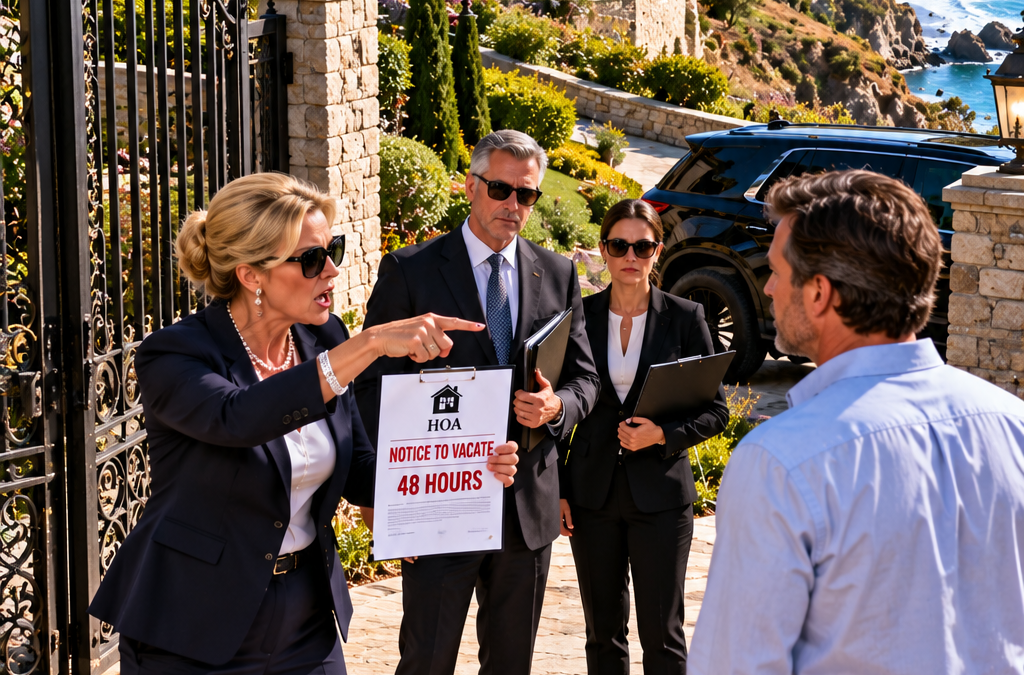
Carla stood on the porch.
Beside her was a man wearing a Bellweather Cliffs security uniform.
Behind them stood an older man in a navy blazer holding a clipboard.
Carla didn’t say good morning.
“Mr. Pierce.”
I looked at the three of them.
“What happened?”
She stared at me.
“That’s what we’re here to determine.”
I rubbed my eyes.
“It’s six in the morning.”
The older man stepped forward.
“Can you explain why you are occupying this property?”
For a second, I honestly thought I had misheard him.
“Excuse me?”
“This residence.”
He gestured toward my house.
“Why are you here?”
I looked at Carla.
“Is this a joke?”
Her face didn’t move.
“No.”
“I live here.”
The man with the clipboard glanced down.
“According to our records, you do not.”
I laughed.
I couldn’t help it.
Not because anything was funny.
Because the statement was so absurd my brain treated it as comedy.
“I bought this house six months ago.”
Carla said, “There appears to be a serious problem with that claim.”
“Claim?”
“My ownership isn’t a claim.”
She extended an envelope.
I didn’t take it immediately.
“What is that?”
“Notice to vacate.”
That stopped me.
The ocean was crashing against the cliffs somewhere behind the house.
A sprinkler clicked across the front lawn.
Everything felt strangely normal except the three people standing at my door telling me I didn’t own the place.
I took the envelope.
The letter was printed on HOA stationery.
It said Bellweather Cliffs had received documentation indicating that legal title to the Marlo Estate remained vested in the Marlo Family Trust.
It described me as an “unauthorized occupant.”
It demanded that I vacate within forty-eight hours pending resolution of title.
It warned that law enforcement could be contacted.
I looked up.
“You’re serious.”
“Completely,” Carla said.
“I paid thirty-four million dollars for this property.”
“That isn’t relevant if the seller lacked authority.”
“The seller was Robert Marlo.”
Her eyes changed.
Barely.
But enough.
I noticed.
She said, “According to the records available to us, the property remains under Marlo family ownership.”
“I have a recorded deed.”
The older man answered.
“Not according to the county.”
My stomach tightened.
“What?”
“The county title record does not show you as the controlling owner.”
I looked back at Carla.
“There’s obviously been an error.”
Her smile appeared.
Small.
Cold.
“Then I suggest you find your paperwork quickly.”
“I have it.”
“Good.”
She stepped backward.
“Because as of this morning, our records indicate the home still belongs to the Marlo family.”
I stared at her.
“Who exactly in the Marlo family is asking me to leave?”
Her expression remained calm.
“The trust.”
“Who controls the trust?”
“That isn’t an HOA matter.”
“You’re standing at my door at six in the morning threatening police action on behalf of that trust.”
The security officer shifted uncomfortably.
Carla didn’t.
“You have forty-eight hours, Mr. Pierce.”
“No.”
She blinked.
It was the first time she looked surprised.
“No?”
“I’m not leaving my house.”
“Then you should prepare to demonstrate that it’s yours.”
“I already did that when I paid for it.”
She turned away.
The three of them walked back toward their vehicles.
I stood there barefoot, holding the letter.
Something deep in my gut told me this wasn’t administrative confusion.
Carla had been too prepared.
She hadn’t arrived asking questions.
She had arrived with a deadline.
At 6:28, I called my attorney.
His name was Michael Trent.
He had handled part of the acquisition.
He answered sounding half asleep.
“Daniel?”
“I need you awake.”
“I’m awake.”
“I’ve been ordered out of the Marlo Estate.”
Silence.
“What?”
“The HOA says I don’t own it.”
Now he was awake.
“Who said that?”
“Carla Whitfield and two others.”
“Did they give you anything?”
“A forty-eight-hour notice.”
“Send it to me.”
“I have the closing package.”
“Don’t touch anything yet. Scan the notice first.”
Twenty minutes later, we were on video.
I had the entire closing file spread across the dining room table.
Purchase contract.
Escrow confirmation.
Title documentation.
Notarized deed.
Wire confirmations.
Tax statements.
Everything.
Michael looked through his copies.
“This is clean.”
“That’s what I thought.”
“Your closing deed names you.”
“Yes.”
“Notary is legitimate.”
“Yes.”
“Funds cleared through escrow.”
“All thirty-four million.”
“The title report showed Robert Marlo as seller.”
“Yes.”
He became quiet.
“What?”
“I’m checking the county index.”
I watched his eyes move across another screen.
Then stop.
“What?”
“Give me a second.”
“Michael.”
“Daniel, I need a second.”
That sentence made my chest tighten.
He typed.
Clicked.
Typed again.
Finally, he looked at me.
“We have a problem.”
“What kind?”
“The county record doesn’t match your closing deed.”
I stared at him.
“What does it say?”
He hesitated.
“Marlo Family Trust.”
“That’s impossible.”
“I know.”
“When was it filed?”
“Four months ago.”
“I bought the place six months ago.”
“I know.”
“So somebody changed the title after I bought it?”
“It appears another deed was recorded.”
“To the Marlo trust?”
“Yes.”
“Signed by who?”
“I’m pulling the image.”
Seconds passed.
Then Michael leaned closer to his screen.
“Oh, hell.”
“What?”
“The document is dated before your closing.”
“How far before?”
“Three weeks.”
“That makes no sense.”
“No.”
“If it existed three weeks before closing, the title company should have found it.”
“They would have.”
“Then?”
Michael stared at the image.
“I think it was filed after your purchase but backdated to make it appear older.”
The room became very quiet.
Someone had stolen the house.
Not physically.
On paper.
I looked toward the windows.
Beyond them, the ocean was bright under the morning sun.
Thirty-four million dollars of property.
My name on the closing documents.
Another name in the county database.
“Can they do that?”
“Legally? No.”
“I didn’t ask legally.”
Michael exhaled.
“If someone has access, forged documents, and enough knowledge of the recording system, they can submit something fraudulent.”
“Wouldn’t the county verify ownership?”
“Recorders generally verify formatting and recording requirements. They don’t conduct a full trial over every deed.”
“So a fake document can get recorded.”
“It can.”
“And then everyone treats it like truth.”
“Until challenged.”
I thought about Carla standing at my door.
She hadn’t looked confused.
She had looked ready.
“Michael.”
“Yeah?”
“How would the HOA know about this before I did?”
He was silent.
“That’s a good question.”
“No. It’s the question.”
I spent the rest of the morning digging.
I had built a company by learning that when something didn’t make sense, the fastest way to understand it was to follow relationships.
Carla Whitfield.
Bellweather Cliffs.
Marlo Family Trust.
Robert Marlo.
I started with public records.
Carla’s full legal name was Carla Marlo Whitfield.
I stared at the screen.
Marlo.
Michael called while I was still reading.
“You find something?”
“Carla is a Marlo.”
“What?”
“Her maiden name.”
I sent him the record.
He opened it.
“Robert’s sister.”
“Yes.”
The HOA president who had ordered me out of the estate was the seller’s sister.
That should have been disclosed at orientation.
It wasn’t.
Michael said, “We need to slow down.”
“I’m going faster.”
“Daniel.”
“She knew.”
“Maybe.”
“She knew enough to show up with a vacate notice.”
“Knowing about a trust claim and participating in a fraudulent filing are different things.”
“Fine.”
I opened another record.
Then stopped.
“Michael.”
“What?”
“Robert Marlo is dead.”
Silence.
“What?”
“Eight months ago.”
“That can’t be right.”
“There’s an obituary.”
I sent it.
Robert Marlo.
Age sixty-five.
Died eight months earlier.
The photograph was unmistakably the man whose name appeared throughout my transaction.
I had never met Robert personally.
The sale had been handled remotely.
The seller had supposedly been ill.
Documents were signed through representatives.
I had communicated mostly with the listing agent and closing personnel.
Michael swore under his breath.
My mouth went dry.
“I made my offer six months ago.”
“Yes.”
“He died two months before that.”
“Yes.”
“So who sold me this house?”
Neither of us answered.
I called the real estate agent.
Disconnected.
I searched her name.
The brokerage listed on her materials existed.
I called.
A receptionist answered.
I asked for the agent.
Long pause.
“We don’t have an agent by that name.”
“She represented a thirty-four-million-dollar listing under your company.”
“I’m sorry, sir. What address?”
I told her.
More silence.
“We have no record of that listing.”
I hung up.
Then called Michael.
He didn’t say much when I explained.
Finally:
“Don’t talk to anyone without me.”
“I’ve heard that before.”
“I mean it.”
“What exactly did I buy?”
“I don’t know yet.”
“That’s a bad answer.”
“It’s the truthful one.”
By evening, every certainty I had about the estate had disappeared.
The deed I possessed was legitimate in form.
The money was real.
The escrow account had been real.
The title process appeared legitimate.
But at least one person in the seller chain was not who I thought.
And after closing, somebody had recorded another document to restore title to the Marlo trust.
Why?
If the original sale was fraudulent, why bring attention to the title afterward?
Why not take my money and disappear?
Unless taking my money wasn’t enough.
Unless the plan was to take the house back too.
That night, I barely slept.
At 1:53 a.m., I heard a sound outside.
Not loud.
Metallic.
Then footsteps.
Multiple people.
I sat up.
The estate was large enough that ordinary movement rarely reached the bedroom.
This did.
I picked up my phone.
Pulled up the security system.
I had installed independent cameras after moving in.
Four figures appeared near the side service entrance.
Dark clothing.
One carried a flashlight.
Another crouched near the electrical service panel.
I watched.
“Come on.”
The camera shifted to infrared.
One man opened the exterior utility housing.
Another stood lookout.
Then the screen flickered.
They were cutting power.
I could have called the police.
Maybe I should have.
Instead, I activated the battery-backed cameras and started recording locally.
The house lights died.
The ocean became the only sound.
On camera, the four figures moved toward the rear terrace.
One tried a door.
Locked.
Another walked toward the detached guesthouse.
They weren’t burglars behaving like burglars.
They were checking access.
Testing the property.
Sending another message.
Leave.
I saved every second.
At 2:17, their vehicle drove away.
I recognized one man.
Bellweather Cliffs security.
The same uniform as the man who had stood beside Carla that morning.
That changed something inside me.
Fear became clarity.
I wasn’t leaving.
At 2:40 a.m., I called Dr. Evelyn Shaw.
Evelyn was a forensic document examiner I had hired years earlier when one of my former executives forged signatures during a corporate fraud investigation.
She answered after several rings.
“Daniel?”
“Sorry.”
“You should be.”
“I need you.”
“What happened?”
“I bought a house from a dead man.”
Silence.
“That’s new.”
“And someone filed a second deed after my purchase.”
“Send everything.”
“I already am.”
By sunrise, she had dozens of documents.
My closing deed.
The county copy.
Historical Marlo deeds.
Trust records.
Robert’s known signatures.
Archived property records.
Carla’s filings.
Anything I could gather.
At 8:14, Evelyn called.
Her voice was serious.
“Daniel, the deed you received at closing has problems.”
My stomach sank.
“How bad?”
“The signature attributed to Robert Marlo appears simulated.”
“Meaning forged.”
“Likely.”
“What about the second deed?”
“Also questionable.”
“So neither is real.”
“I didn’t say that.”
“What are you saying?”
She paused.
“The bigger problem is older.”
“How much older?”
“Decades.”
I sat down.
“Explain.”
“I pulled historical copies from the county archive.”
“Okay.”
“The Marlo family title chain begins with a deed recorded in 1987.”
“I saw that.”
“That deed transferred the estate from the Castellin family to Arthur Marlo.”
“Robert’s father.”
“Yes.”
“What’s wrong with it?”
“Almost everything.”
I closed my eyes.
“Evelyn.”
“The notarization appears fabricated. Signature characteristics don’t match verified Castellin samples. The typeface is inconsistent with the office that supposedly prepared it. And one of the legal descriptions references a subdivision designation that wasn’t adopted until years later.”
I said nothing.
She continued.
“Daniel, I don’t think Robert Marlo legally owned the estate when anyone purported to sell it to you.”
“So Carla’s right.”
“No.”
That surprised me.
“She’s not?”
“The Marlo family trust doesn’t appear to hold legitimate title either.”
I stood.
“Then who owns the house?”
“The last clean title I can identify belongs to the Castellin family.”
I stared at the ocean.
“The original owners.”
“Yes.”
“From thirty years ago.”
“Closer to forty now.”
“And the Marlos have been living here ever since?”
“Apparently.”
“So I bought stolen property.”
“That’s the uncomfortable version.”
I laughed once.
It sounded terrible.
“Thirty-four million dollars.”
“I’m sorry.”
“But why file another deed after my purchase?”
“That’s the interesting part.”
“Go on.”
“If anyone began seriously examining your transaction, they might discover the 1987 defect.”
“So they restore the Marlo trust record.”
“Possibly.”
“Then use the HOA to throw me out.”
“Possibly.”
“Then what?”
“They preserve possession while arguing your sale was invalid.”
“And my money?”
“You’d spend years chasing whoever received it.”
I thought about the disconnected agent.
The fake listing.
The power being cut.
Carla at my door.
Everything suddenly aligned.
They weren’t trying to correct a fraudulent sale.
They were trying to bury one fraud beneath another.
I asked Evelyn, “Can you document all of this?”
“I can document the inconsistencies. Ownership determination belongs to attorneys and courts.”
“Do it.”
Michael arrived at the estate before noon.
I showed him the video from the night before.
His face changed.
“That’s association security.”
“I know.”
“You should have called police.”
“I wanted the recording.”
“You could have had both.”
“Next time.”
“There cannot be a next time.”
He watched the power line being cut again.
“We’re reporting this.”
“Fine.”
Then I gave him Evelyn’s preliminary findings.
He read them.
Slowly.
By the time he finished, he looked ten years older.
“This transaction is a nightmare.”
“I gathered.”
“The Castellin issue changes everything.”
“Can we find them?”
“I already started.”
He turned his laptop toward me.
The Castellin family had owned the estate from the 1940s until the disputed 1987 deed.
The patriarch, Anthony Castellin, had died in the early nineties.
Two children survived him.
One had died.
One lived overseas.
There were grandchildren.
Potential heirs.
Potential claims.
I sat back.
“I don’t own this place.”
Michael answered carefully.
“You have possession, a good-faith purchase, a deed, and substantial equitable claims. That is different from saying the title situation is clean.”
“Carla gave me forty-eight hours.”
“She can give you forty-eight minutes. She cannot personally adjudicate title.”
“So I stay.”
“Yes.”
“Good.”
The following morning, Carla returned.
This time she brought reinforcements.
Two HOA board members.
The same security officer.
And a locksmith.
I watched them walk toward the front door through the camera.
Michael had told me not to engage alone.
Michael was also forty minutes away.
I opened the door anyway.
Carla looked almost pleased.
“Mr. Pierce.”
“Carla.”
“You were given notice.”
“I received it.”
“You have not vacated.”
“Correct.”
The locksmith shifted his toolbox.
Carla gestured toward him.
“We are going to secure the property while the ownership matter is resolved.”
“No.”
“You no longer have authorization to occupy the estate.”
“From whom?”
“The Marlo Family Trust.”
“Who signed that instruction?”
“That is confidential.”
I raised my phone.
It was recording.
“Before anybody touches my locks, I think you should know something.”
The older board member frowned.
Carla’s eyes narrowed.
“What?”
“I found out who owns this house.”
Her expression stayed controlled.
“That’s encouraging.”
“It isn’t the Marlo Family Trust.”
Something moved in her face.
Only for an instant.
I continued.
“It also may not be me.”
One board member looked at Carla.
She didn’t move.
“The last clean title in the county archive belongs to the Castellin family.”
Carla went pale.
Not confused.
Pale.
That reaction told me everything.
“You know that name.”
“I don’t know what you’re talking about.”
“1987.”
Her lips parted.
“The deed your father used to claim this estate.”
“This conversation is over.”
“No.”
I stepped outside.
“This conversation is just becoming useful.”
The security officer moved slightly toward me.
I looked at him.
“I have you on video cutting power to this house.”
He stopped.
Carla turned sharply toward him.
That reaction was interesting too.
I continued.
“My examiner found evidence that the 1987 Castellin-to-Marlo deed was forged.”
“You’re lying.”
“I’m recording this.”
She looked at my phone.
“I’ve already sent the documents to the county fraud division.”
Her face went rigid.
“The supposed Castellin signatures.”
Silence.
“The notary irregularities.”
Silence.
“The impossible subdivision reference.”
She looked toward the board members.
Neither looked comfortable anymore.
“And the new deed filed after my purchase.”
Carla’s voice dropped.
“You have no idea what you’re doing.”
“I know exactly what I’m doing.”
“You are jeopardizing an entire community over a property dispute you don’t understand.”
That sentence caught me.
“An entire community?”
She realized too late what she had said.
I looked at the other board members.
“Why would my house affect the entire community?”
Nobody answered.
Carla said, “I was speaking generally.”
“No, you weren’t.”
She stepped toward me.
“You should have taken the opportunity to leave quietly.”
I stared at her.
There it was.
Not resolve this.
Not verify title.
Leave quietly.
“Why?”
“What?”
“Why quietly?”
She said nothing.
“Because if I challenged this, somebody might look backward?”
“You are inventing conspiracies.”
“Maybe.”
I held up the phone.
“But someone cut my power last night.”
Carla glanced at security again.
“Someone filed a backdated deed after I paid thirty-four million dollars.”
No response.
“And your dead brother somehow sold me a house he never legally owned.”
The locksmith slowly picked up his toolbox.
“I’m not changing anything without law enforcement here,” he said.
Carla turned on him.
“You were hired to perform a service.”
“I was told this was a standard lockout.”
“It is.”
He looked at me.
Then at her.
“No, ma’am.”
He walked away.
One of the board members followed.
“Carla, we need counsel.”
“We have counsel.”
“We need independent counsel.”
That word—independent—landed hard.
Carla looked at him.
“Go home, Steven.”
“I’m not doing that.”
For the first time, I watched her authority fail in real time.
Not dramatically.
One person simply stopped obeying.
Then another.
The security officer backed toward his vehicle.
Carla stood alone near the bottom of my steps.
I looked at her.
“You wanted me gone before I found the original deed.”
“You’re delusional.”
“Then you have nothing to worry about.”
She stared at me.
I added, “Nobody touches this property without a court order.”
She left.
Michael arrived thirty-three minutes later and was furious.
“At me?” I asked.
“Yes.”
“Why?”
“Because I specifically told you—”
“You’re welcome.”
“For what?”
“I recorded an HOA president telling me I should have left quietly while one board member abandoned her.”
He stopped.
“That happened?”
I sent him the video.
He watched it.
Then looked at me.
“I’m still angry.”
“Fine.”
“But this is useful.”
“Very.”
The county fraud division moved faster than I expected.
Thirty-four million dollars helped.
So did the age of the original records.
So did the attempt to file a new deed.
Investigators subpoenaed the title company.
Escrow records.
Bank accounts.
HOA communications.
Gate logs.
Security schedules.
County recording activity.
The fake real estate agent’s identity.
The supposedly dead seller’s signatures.
Within days, the story began to spread beyond my house.
The Marlo family hadn’t simply inherited a questionable estate.
Investigators identified similar title irregularities involving multiple properties inside Bellweather Cliffs.
Some transactions stretched back decades.
One property had changed hands through a trust that legally ceased to exist years before.
Another relied on a notarization from a notary whose commission had expired before the document date.
A third involved land originally belonging to another family that had supposedly sold under circumstances no one could clearly reconstruct.
Bellweather Cliffs had not merely been a wealthy gated community.
Parts of it appeared to have been built on a culture of private agreements, family relationships, and paper transfers that nobody had seriously challenged because the same small circle controlled everything.
Carla sat at the center of that circle.
Not necessarily every transaction.
But enough.
She had been on the HOA board for nineteen years.
President for eleven.
Her family had been involved with the original development.
Her brother Robert had controlled multiple parcels before his death.
The association’s preferred attorney had worked with Marlo-linked trusts.
The HOA’s former management company had shared an office address with a property entity connected to Carla’s cousin.
Every answer created three more questions.
I stopped thinking about my estate as an isolated scam.
The morning power incident became important too.
Police identified two members of the HOA security team in my footage.
Both claimed they had been told to “secure utilities” at a property under association repossession.
There was no lawful repossession.
No court order.
No utility authorization.
One of them gave investigators the instruction email.
It came from Carla.
Michael called me when he learned.
“Remember when I said not to engage her?”
“Yes.”
“I’m going to say something generous.”
“I’m listening.”
“You were slightly less reckless than I initially believed.”
“Thank you.”
“Do not make me regret that.”
I stayed in the house.
Nobody came back to remove me.
The forty-eight-hour deadline passed.
Then a week.
Then two.
The HOA attorney sent a letter withdrawing the vacate demand “pending further clarification of title.”
That sentence made me laugh.
Clarification.
A few weeks earlier, Carla had been prepared to change my locks before sunrise.
Now suddenly everyone wanted clarification.
The title question took longer.
It had to.
Ownership isn’t decided by whichever person uncovers the oldest suspicious document.
The Castellin heirs had to be located.
Their potential claims evaluated.
The 1987 deed examined.
My purchase analyzed.
The later forged deed addressed.
Taxes.
Possession.
Good-faith purchaser protections.
Equitable interests.
Decades of occupancy.
State property law.
Every layer mattered.
I met two members of the Castellin family during that process.
One was Anthony Castellin’s granddaughter, Elena.
She was seventy.
Soft-spoken.
Sharp.
She looked around the estate with an expression I couldn’t read.
“My mother grew up here,” she said.
We were standing in the library.
“I’m sorry.”
“For what?”
“I don’t know.”
She smiled sadly.
“Neither do I.”
She walked to the window.
“She used to talk about this room.”
I said nothing.
“She said there was a ladder that rolled along the bookshelves.”
“There still is.”
Elena touched it.
For the first time, the property stopped feeling entirely like mine.
Not legally.
Emotionally.
I had paid for it.
I had been deceived.
But my pain was six months old.
Hers went back generations.
“What happened to your family?” I asked.
She looked at the shelves.
“My grandfather had financial problems in the eighties. There were disputes. Lawsuits. He became ill.”
“Did he sell?”
“My mother said no.”
“The deed says he did.”
“My mother called the Marlos thieves until the day she died.”
That sentence stayed with me.
Thirty years of one family living in a house another family believed had been stolen.
Then me.
A stranger with money.
Walking into the middle without knowing any of it.
“I don’t want to take something from your family,” I said.
Elena looked at me.
“I know.”
“You do?”
“You’re the first person in decades who bothered finding us.”
I hadn’t done it out of kindness.
I had done it because I was defending myself.
But I understood what she meant.
The legal process eventually found a path through the mess.
It was more complicated than the headlines later made it sound.
The Marlo claim collapsed.
The supposed post-sale deed restoring ownership to their trust was rejected.
Investigators confirmed that Robert could not have executed the sale documents attributed directly to him because he was already dead.
The individuals who had impersonated or represented the seller became part of the fraud case.
The 1987 deed underlying the Marlo family’s original claim was formally challenged and treated as fraudulent for purposes of the investigation.
The Castellin heirs had legitimate historical interests.
I had paid full fair-market value without knowledge of the fraud.
I had possession.
I had maintained the property.
I had relied on a professional title process.
Settlement, court findings, and the applicable title doctrines eventually converged on one result.
Clear title vested in me.
I remember Michael calling.
“It’s done.”
I was standing near the pool.
“What does done mean?”
“It means when this order records, the title no longer carries the Marlo cloud.”
“And the Castellins?”
“Resolved.”
“How?”
“Through the settlement and court order we discussed.”
“They agreed?”
“Yes.”
I looked toward the house.
“So it’s mine.”
“Yes.”
“You sound disappointed.”
“I’m a lawyer. Satisfaction is billable.”
I laughed.
Then stopped.
“Michael.”
“Yeah?”
“Thirty-four million cash.”
“I remember.”
“No mortgage.”
“Yes.”
“No loan.”
“Yes.”
“And I still almost lost it because someone changed a record.”
He was quiet.
“That’s why title systems matter.”
“That sounds like something a lawyer says after the title system nearly destroys a client.”
“That is exactly when lawyers say it.”
I sat down.
For months, I had imagined the moment differently.
I thought I would feel victorious.
I didn’t.
I felt exhausted.
Relieved.
Angry.
Grateful.
And strangely sad.
Because by then, I knew too much about the house.
The Marlos.
The Castellins.
The fraud.
The security team.
The fake agent.
The board members who had looked the other way.
The county records that had carried lies because official-looking documents had been placed into the system.
There was no clean triumph.
Only a cleaner truth.
Carla’s position collapsed quickly once investigators started reviewing HOA communications.
She resigned as president before the board could formally remove her.
Three other board members became subjects of the broader investigation.
Not all for my property.
That was the part that shocked the community.
Once investigators began comparing historical transfers, they found evidence suggesting that questionable property paperwork had touched multiple homes.
Some owners had no idea.
People who had lived there twenty years suddenly hired independent title counsel.
Trusts were reviewed.
Estate transfers were examined.
Old deeds resurfaced.
For the first time in decades, Bellweather Cliffs residents stopped assuming that wealth automatically meant legitimacy.
A multimillion-dollar gate could protect a house.
It couldn’t make the paperwork underneath it true.
The board scheduled an emergency election.
I had no intention of participating.
Then Elena Castellin called me.
“You should run.”
“For what?”
“The HOA.”
I laughed.
“I would rather buy another stolen house.”
“I’m serious.”
“I hate the HOA.”
“That makes you unusually qualified.”
“No.”
“You spent twenty years running a company.”
“That’s different.”
“Is it?”
“Yes.”
“People with money and power ignored basic controls because everyone trusted the same circle. Does that sound completely unfamiliar to you?”
She had me there.
I still said no.
Then neighbors started calling.
Some I had never met.
One man told me Carla had threatened him with architectural penalties after he questioned a vendor contract.
A woman said her dock permit had been delayed nine months until she hired a contractor recommended by a board member.
Another resident had been told certain financial records were confidential even though association rules gave owners inspection rights.
I didn’t know which stories were misunderstandings and which were real.
That was the problem.
Nobody trusted the system anymore.
Eventually, I agreed to run.
Not for president.
Just a board seat.
The election meeting was the first HOA event I attended after Carla resigned.
The same clubhouse where she had welcomed me months earlier.
The same room where she had told me Bellweather Cliffs had very particular standards.
This time, the place was full.
I stood near the back.
No speech prepared.
When my name was called, I walked forward.
A homeowner asked, “What’s the first thing you’d change?”
People laughed.
I thought about 6:11 a.m.
The pounding.
Carla on my porch.
The security officer.
The letter telling me I had forty-eight hours to leave a house I bought with thirty-four million dollars of real money.
“Due process,” I said.
The room became quieter.
“If the association believes a homeowner has violated something, we document it.”
I looked around.
“If ownership is disputed, we don’t pretend the HOA is a court.”
A few heads nodded.
“If legal action is necessary, we get independent counsel.”
More nods.
“And nobody shows up at someone’s house at six in the morning with a locksmith unless there’s an actual lawful order authorizing it.”
That got a laugh.
I didn’t smile.
“I’m serious.”
The room quieted again.
“Authority should be boring.”
Someone frowned.
I continued.
“It should be written down. Reviewable. Predictable. The moment authority depends on who somebody knows, whose family they belong to, or whether they can scare someone into leaving quietly, it stops being governance.”
I won the seat.
My first board meeting lasted four hours.
I regretted everything.
But we changed things.
No property enforcement involving ownership could proceed without independent title review.
No board member could participate in a matter involving a relative or affiliated entity.
Security personnel could not enter private lots except in emergencies or under written authorization consistent with governing documents and law.
Lockouts required court orders.
Vendor conflicts had to be disclosed.
Association records were digitized and made available to homeowners where permitted.
We hired an outside accounting firm.
Then an independent law firm.
Not Carla’s attorney.
Not the Marlo family attorney.
Nobody connected to the old circle.
People complained about the cost.
I understood.
Then I reminded them what hidden conflicts had already cost.
The complaints became quieter.
As for the estate, I changed almost nothing.
I considered changing the name.
Marlo Estate no longer felt right.
But Castellin Estate didn’t feel like mine either.
Eventually, I stopped calling it anything.
It was just home.
Elena visited once more after everything settled.
We walked down toward the cliff.
She carried an old photograph.
Her mother as a girl.
Maybe twelve.
Standing beside the same stone wall overlooking the ocean.
Elena held the photograph up against the present view.
The wall was still there.
“So much changed,” she said.
“And nothing changed.”
She nodded.
“I used to think getting this place back would fix something.”
I looked at her.
“Does it?”
“No.”
She smiled.
“But knowing what happened helps.”
I understood that.
“What are you going to do with the photograph?”
“Keep it.”
“You should.”
She looked at the house.
“Take care of it.”
“I will.”
That request meant more to me than the court order.
By then, Carla had stopped speaking publicly.
Her attorney handled everything.
The investigation remained broader than my individual case.
I stopped following every development.
I had no desire to spend the rest of my life waiting for someone else’s punishment to make me feel whole.
What happened at my gate had already taught me enough.
Before this, I believed ownership was simple.
You pay.
You sign.
The deed records.
You own.
That belief had survived business deals, acquisitions, and decades of working with lawyers.
Then three people stood at my front door and handed me a piece of paper saying otherwise.
What I learned was that ownership isn’t protected by one document.
It’s protected by systems agreeing with each other.
The contract.
The deed.
The recorder.
The title history.
The courts.
The people administering all of them.
If one fails, you have a problem.
If several fail together, you can wake up inside a house you paid for and be called a trespasser.
The strangest part was how confidently Carla had done it.
She wasn’t waving a gun.
She didn’t need one.
She had stationery.
A title.
A security officer.
A clipboard.
Forty-eight hours.
People underestimate how intimidating official language can be.
“Unauthorized occupant.”
“Failure to vacate.”
“Law enforcement referral.”
Put those phrases on letterhead and most people panic before they ask whether the person sending them has any actual authority.
That was what Carla counted on.
She thought I would see thirty-four million dollars at risk and choose caution.
Pack a suitcase.
Go to a hotel.
Let attorneys handle it quietly.
Maybe by the time I understood what happened, possession would have changed.
Locks would be different.
Records would be different.
Stories would be different.
That was the real battle.
Not the house.
The story of who belonged there.
Carla wanted hers established before I could build mine.
She almost succeeded.
Sometimes I think about Robert Marlo.
A man I supposedly bought a house from even though he had been dead two months before I made my offer.
I never met him.
I don’t know exactly how much he knew while alive.
Investigators would decide what evidence supported.
I resisted the temptation to make him into a villain simply because his name sat on fraudulent papers.
Dead people can’t explain themselves.
That was another lesson.
Documents may lie.
People may lie.
Even memory can lie.
You have to separate what you know from what you want to believe.
I know money left my account.
I know someone received it.
I know documents attributed to a dead man were used.
I know a second title document was later filed.
I know Carla’s HOA tried to remove me.
I know association security cut power to my home.
I know historical title records led back to the Castellins.
And I know that once enough people were forced to examine the complete record, the story changed.
That was enough.
Almost a year after the morning Carla first came to my door, I woke before sunrise.
No pounding.
No security officer.
No clipboard.
I made coffee and walked onto the terrace.
The ocean below was dark blue.
The horizon was beginning to brighten.
The house was silent.
I thought about that first day.
Thirty-four million dollars.
Cash.
I had believed paying cash made me untouchable.
No lender meant no one had power over me.
That was naïve.
There’s always a system.
Sometimes the system protects you.
Sometimes someone learns how to use it against you.
The answer isn’t to live outside systems.
You can’t.
The answer is to know enough to ask questions when the system suddenly tells you something that contradicts reality.
I knew I had paid.
I knew I had documents.
I knew the HOA had no ordinary reason to arrive before sunrise.
Those facts were enough to make me dig.
One wrong deed led to another.
One dead seller led to an old family.
One attempt to change my locks exposed a decades-old title chain.
One HOA president trying to frighten me into silence ended up forcing people to examine transactions nobody had questioned for years.
That irony still makes me smile.
Carla thought she was protecting her family’s claim.
Instead, she made me curious.
And curiosity was the one thing her entire system could not survive.
Later that morning, I drove to the clubhouse for a board meeting.
Yes.
A board meeting.
There are punishments life gives you that courts cannot.
The agenda contained eleven items.
Pool resurfacing.
Gate software.
Tree removal.
Dock lighting.
An architectural appeal involving a stone color that two adults had apparently spent six weeks arguing about.
I sat down.
The new president looked at me.
“You ready?”
“No.”
She laughed.
The meeting started.
Halfway through, a homeowner appeared to challenge a violation notice.
Old version of the board probably would have told him he was out of compliance and needed to fix it.
Instead, we pulled the rule.
Read it.
Compared his photographs.
Asked the management company for inspection records.
Turns out the violation had been issued incorrectly.
We canceled it.
The homeowner looked suspicious.
“That’s it?”
“That’s it,” I said.
“I don’t owe anything?”
“No.”
“You’re not going to send another letter?”
“Not unless you actually violate something.”
He laughed.
Then left.
The new president looked at me.
“You seem pleased with yourself.”
“A little.”
“Dangerous.”
“Very.”
I drove home after dark.
The gate opened automatically.
The road curved through the community.
Somewhere behind those walls lived people who had spent months wondering whether their own deeds were as stable as they had believed.
Most were.
Some needed corrections.
A few generated lawsuits.
Bellweather Cliffs would probably spend years cleaning up the legacy of the old system.
But at least people were looking.
That matters.
When I reached my estate, the front gates opened.
The house appeared beyond the trees.
Lights warm behind the windows.
Same stone walls.
Same infinity pool.
Same ocean.
But I saw it differently now.
Not as a trophy for twenty years of work.
Not as proof that I had succeeded.
And definitely not as something that thirty-four million dollars automatically entitled me to keep.
It was property with history.
Complicated history.
Painful history.
My name happened to be the one on the clean title now.
That made me the owner.
It also made me responsible for what happened next.
I parked.
Before going inside, I stood at the bottom of the front steps.
Almost exactly where Carla had stood holding that forty-eight-hour letter.
I could still remember her voice.
As of right now, this home still belongs to the Marlo family.
She had sounded so certain.
That was the part I never forgot.
Confidence is not evidence.
A uniform is not evidence.
A board title is not evidence.
A county record can be evidence, but even records have histories.
Every important fact can be checked.
Every signature came from somewhere.
Every deed was created on a date.
Every transfer has a person behind it.
Once I learned that, the intimidation stopped working.
I walked inside.
The locks were still the ones I had installed.
The power was on.
The house was quiet.
Mine.
Not because Carla said it wasn’t.
Not because I had enough money to insist that it was.
Because the documents had finally been examined instead of merely believed.
There’s a difference.
I think about that whenever somebody at an HOA meeting starts a sentence with, “According to our records…”
I usually answer the same way now.
“Good. Let’s look at them.”
Most problems become boring after that.
And boring is exactly how authority should work.
𝗧𝗛𝗘 𝗘𝗡𝗗
The HOA Gave Me 48 Hours to Leave My $34 Million Estate Because Their Records Said I Never Owned It
I paid $34 million in cash for a cliffside estate, and six months later three HOA officials stood at my front door telling me I was trespassing and had forty-eight hours to disappear. The moment they claimed the dead family I had bought the house from still owned it, I realized somebody wasn’t trying to correct a mistake—they were trying to erase me before I discovered what had been buried inside that property’s history.
My name is Daniel Pierce.
For twenty years, I built a technology company from almost nothing.
No family money.
No inheritance.
No hidden investor writing checks when things got difficult.
I started with two engineers, a rented office above an insurance agency, and enough personal debt to make sleep feel like a luxury.
Eventually, the company became successful.
Then it became very successful.
By the time I sold it, I had spent most of my adult life measuring time in product launches, quarterly numbers, lawsuits, acquisitions, server failures, and meetings that should have been emails.
I was forty-eight when the sale closed.
For the first time since I was twenty-seven, I didn’t have somewhere I was required to be Monday morning.
That should have felt liberating.
Instead, it terrified me.
Work had consumed so much of my identity that when it disappeared, I had no idea what silence was supposed to sound like.
So I started looking for a home.
Not an investment.
Not another project.
A home.
That was how I found the Marlo Estate.
The property sat on the edge of a private coastal community so exclusive it barely appeared on public maps.
A guardhouse controlled the only road in.
Beyond it were maybe sixty homes spread across hundreds of acres.
No sidewalks.
No public parking.
No tourists.
Most houses disappeared behind stone walls, eucalyptus groves, or long private drives.
The Marlo Estate was the largest.
Fourteen bedrooms.
Oceanfront cliffs.
Private dock below the bluff.
Infinity pool facing the Pacific.
Guesthouse.
Wine cellar.
Tennis court.
A driveway long enough that you couldn’t see the main house from the gate.
The house itself looked like something built for a family that expected generations of descendants to stay there.
Stone.
Dark timber.
Tall windows.
Terraces stepping down toward the ocean.
The first time I walked through it, I knew.
Not because it was extravagant.
Because it felt quiet.
Real quiet.
The kind money usually fails to buy.
I made the offer.
Thirty-four million dollars.
Cash.
No lender.
No mortgage company.
No bank waiting in the background with a security interest.
The title company reviewed the sale.
Attorneys reviewed the documents.
Closing took weeks.
Money moved.
Documents were notarized.
Keys were transferred.
My name appeared on the deed handed to me at closing.
Daniel Pierce.
Sole owner.
I remember holding that document and feeling something I hadn’t felt in years.
Finished.
I had built companies.
Sold companies.
Negotiated deals worth hundreds of millions.
But somehow owning a house outright felt more permanent.
Nobody could call a loan.
Nobody could take it because markets crashed.
Nobody could tell me I had missed a payment.
At least that was what I believed.
The estate sat inside the jurisdiction of the Bellweather Cliffs Homeowners Association.
I expected that.
A place like that came with rules.
I paid the transfer assessment.
Paid the annual dues in full.
Signed acknowledgment forms.
Registered my vehicles.
Submitted staff names for gate access.
There was even a mandatory orientation.
That was where I first met Carla Whitfield.
Carla was the HOA president.
Late fifties.
Perfect blond-gray hair cut just above her shoulders.
Pearl earrings.
Cream-colored suit.
The kind of posture that suggested she had spent decades entering rooms expecting everyone else to move first.
She shook my hand at the clubhouse.
“Mr. Pierce.”
“Daniel is fine.”
She gave me a tight smile.
“We tend to be fairly formal here.”
“Mr. Pierce it is.”
That smile became slightly tighter.
She walked me through landscaping restrictions, architectural controls, visitor procedures, noise standards, dock regulations, exterior lighting rules, and the requirement that any visible construction be approved by the design committee.
None of it bothered me.
I had no intention of painting the house fluorescent orange or turning the front lawn into a used-car lot.
At the end of the meeting, Carla closed the binder.
“We have very particular standards here, Mr. Pierce.”
“I gathered.”
“Our residents value consistency.”
“So do I.”
She studied me.
There was something in the look I didn’t understand at the time.
Not hostility exactly.
Recognition.
Like she had already decided something about me.
Then it disappeared.
“Welcome to Bellweather Cliffs.”
For the first several weeks, life was almost embarrassingly peaceful.
I swam in the mornings.
Worked on nothing.
Read books I had owned for years without opening.
I bought an old sailboat and spent afternoons learning how bad I was at sailing.
My only real problem was figuring out what retired people did before dinner.
I rarely saw Carla.
The HOA sent one reminder about trimming a hedge near the service entrance.
I handled it.
Another notice reminded everyone about holiday guest parking.
Normal neighborhood bureaucracy.
Looking back, I think that quiet period existed because somebody was waiting.
Six months after closing, I woke to pounding on my front door.
Not ringing.
Not knocking.
Pounding.
I looked at the clock.
6:11 a.m.
For a moment I thought something had happened to the gate or there was a fire.
I pulled on sweatpants and walked downstairs.
The pounding came again.
Harder.
I opened the door.
Carla stood on the porch.
Beside her was a man wearing a Bellweather Cliffs security uniform.
Behind them stood an older man in a navy blazer holding a clipboard.
Carla didn’t say good morning.
“Mr. Pierce.”
I looked at the three of them.
“What happened?”
She stared at me.
“That’s what we’re here to determine.”
I rubbed my eyes.
“It’s six in the morning.”
The older man stepped forward.
“Can you explain why you are occupying this property?”
For a second, I honestly thought I had misheard him.
“Excuse me?”
“This residence.”
He gestured toward my house.
“Why are you here?”
I looked at Carla.
“Is this a joke?”
Her face didn’t move.
“No.”
“I live here.”
The man with the clipboard glanced down.
“According to our records, you do not.”
I laughed.
I couldn’t help it.
Not because anything was funny.
Because the statement was so absurd my brain treated it as comedy.
“I bought this house six months ago.”
Carla said, “There appears to be a serious problem with that claim.”
“Claim?”
“My ownership isn’t a claim.”
She extended an envelope.
I didn’t take it immediately.
“What is that?”
“Notice to vacate.”
That stopped me.
The ocean was crashing against the cliffs somewhere behind the house.
A sprinkler clicked across the front lawn.
Everything felt strangely normal except the three people standing at my door telling me I didn’t own the place.
I took the envelope.
The letter was printed on HOA stationery.
It said Bellweather Cliffs had received documentation indicating that legal title to the Marlo Estate remained vested in the Marlo Family Trust.
It described me as an “unauthorized occupant.”
It demanded that I vacate within forty-eight hours pending resolution of title.
It warned that law enforcement could be contacted.
I looked up.
“You’re serious.”
“Completely,” Carla said.
“I paid thirty-four million dollars for this property.”
“That isn’t relevant if the seller lacked authority.”
“The seller was Robert Marlo.”
Her eyes changed.
Barely.
But enough.
I noticed.
She said, “According to the records available to us, the property remains under Marlo family ownership.”
“I have a recorded deed.”
The older man answered.
“Not according to the county.”
My stomach tightened.
“What?”
“The county title record does not show you as the controlling owner.”
I looked back at Carla.
“There’s obviously been an error.”
Her smile appeared.
Small.
Cold.
“Then I suggest you find your paperwork quickly.”
“I have it.”
“Good.”
She stepped backward.
“Because as of this morning, our records indicate the home still belongs to the Marlo family.”
I stared at her.
“Who exactly in the Marlo family is asking me to leave?”
Her expression remained calm.
“The trust.”
“Who controls the trust?”
“That isn’t an HOA matter.”
“You’re standing at my door at six in the morning threatening police action on behalf of that trust.”
The security officer shifted uncomfortably.
Carla didn’t.
“You have forty-eight hours, Mr. Pierce.”
“No.”
She blinked.
It was the first time she looked surprised.
“No?”
“I’m not leaving my house.”
“Then you should prepare to demonstrate that it’s yours.”
“I already did that when I paid for it.”
She turned away.
The three of them walked back toward their vehicles.
I stood there barefoot, holding the letter.
Something deep in my gut told me this wasn’t administrative confusion.
Carla had been too prepared.
She hadn’t arrived asking questions.
She had arrived with a deadline.
At 6:28, I called my attorney.
His name was Michael Trent.
He had handled part of the acquisition.
He answered sounding half asleep.
“Daniel?”
“I need you awake.”
“I’m awake.”
“I’ve been ordered out of the Marlo Estate.”
Silence.
“What?”
“The HOA says I don’t own it.”
Now he was awake.
“Who said that?”
“Carla Whitfield and two others.”
“Did they give you anything?”
“A forty-eight-hour notice.”
“Send it to me.”
“I have the closing package.”
“Don’t touch anything yet. Scan the notice first.”
Twenty minutes later, we were on video.
I had the entire closing file spread across the dining room table.
Purchase contract.
Escrow confirmation.
Title documentation.
Notarized deed.
Wire confirmations.
Tax statements.
Everything.
Michael looked through his copies.
“This is clean.”
“That’s what I thought.”
“Your closing deed names you.”
“Yes.”
“Notary is legitimate.”
“Yes.”
“Funds cleared through escrow.”
“All thirty-four million.”
“The title report showed Robert Marlo as seller.”
“Yes.”
He became quiet.
“What?”
“I’m checking the county index.”
I watched his eyes move across another screen.
Then stop.
“What?”
“Give me a second.”
“Michael.”
“Daniel, I need a second.”
That sentence made my chest tighten.
He typed.
Clicked.
Typed again.
Finally, he looked at me.
“We have a problem.”
“What kind?”
“The county record doesn’t match your closing deed.”
I stared at him.
“What does it say?”
He hesitated.
“Marlo Family Trust.”
“That’s impossible.”
“I know.”
“When was it filed?”
“Four months ago.”
“I bought the place six months ago.”
“I know.”
“So somebody changed the title after I bought it?”
“It appears another deed was recorded.”
“To the Marlo trust?”
“Yes.”
“Signed by who?”
“I’m pulling the image.”
Seconds passed.
Then Michael leaned closer to his screen.
“Oh, hell.”
“What?”
“The document is dated before your closing.”
“How far before?”
“Three weeks.”
“That makes no sense.”
“No.”
“If it existed three weeks before closing, the title company should have found it.”
“They would have.”
“Then?”
Michael stared at the image.
“I think it was filed after your purchase but backdated to make it appear older.”
The room became very quiet.
Someone had stolen the house.
Not physically.
On paper.
I looked toward the windows.
Beyond them, the ocean was bright under the morning sun.
Thirty-four million dollars of property.
My name on the closing documents.
Another name in the county database.
“Can they do that?”
“Legally? No.”
“I didn’t ask legally.”
Michael exhaled.
“If someone has access, forged documents, and enough knowledge of the recording system, they can submit something fraudulent.”
“Wouldn’t the county verify ownership?”
“Recorders generally verify formatting and recording requirements. They don’t conduct a full trial over every deed.”
“So a fake document can get recorded.”
“It can.”
“And then everyone treats it like truth.”
“Until challenged.”
I thought about Carla standing at my door.
She hadn’t looked confused.
She had looked ready.
“Michael.”
“Yeah?”
“How would the HOA know about this before I did?”
He was silent.
“That’s a good question.”
“No. It’s the question.”
I spent the rest of the morning digging.
I had built a company by learning that when something didn’t make sense, the fastest way to understand it was to follow relationships.
Carla Whitfield.
Bellweather Cliffs.
Marlo Family Trust.
Robert Marlo.
I started with public records.
Carla’s full legal name was Carla Marlo Whitfield.
I stared at the screen.
Marlo.
Michael called while I was still reading.
“You find something?”
“Carla is a Marlo.”
“What?”
“Her maiden name.”
I sent him the record.
He opened it.
“Robert’s sister.”
“Yes.”
The HOA president who had ordered me out of the estate was the seller’s sister.
That should have been disclosed at orientation.
It wasn’t.
Michael said, “We need to slow down.”
“I’m going faster.”
“Daniel.”
“She knew.”
“Maybe.”
“She knew enough to show up with a vacate notice.”
“Knowing about a trust claim and participating in a fraudulent filing are different things.”
“Fine.”
I opened another record.
Then stopped.
“Michael.”
“What?”
“Robert Marlo is dead.”
Silence.
“What?”
“Eight months ago.”
“That can’t be right.”
“There’s an obituary.”
I sent it.
Robert Marlo.
Age sixty-five.
Died eight months earlier.
The photograph was unmistakably the man whose name appeared throughout my transaction.
I had never met Robert personally.
The sale had been handled remotely.
The seller had supposedly been ill.
Documents were signed through representatives.
I had communicated mostly with the listing agent and closing personnel.
Michael swore under his breath.
My mouth went dry.
“I made my offer six months ago.”
“Yes.”
“He died two months before that.”
“Yes.”
“So who sold me this house?”
Neither of us answered.
I called the real estate agent.
Disconnected.
I searched her name.
The brokerage listed on her materials existed.
I called.
A receptionist answered.
I asked for the agent.
Long pause.
“We don’t have an agent by that name.”
“She represented a thirty-four-million-dollar listing under your company.”
“I’m sorry, sir. What address?”
I told her.
More silence.
“We have no record of that listing.”
I hung up.
Then called Michael.
He didn’t say much when I explained.
Finally:
“Don’t talk to anyone without me.”
“I’ve heard that before.”
“I mean it.”
“What exactly did I buy?”
“I don’t know yet.”
“That’s a bad answer.”
“It’s the truthful one.”
By evening, every certainty I had about the estate had disappeared.
The deed I possessed was legitimate in form.
The money was real.
The escrow account had been real.
The title process appeared legitimate.
But at least one person in the seller chain was not who I thought.
And after closing, somebody had recorded another document to restore title to the Marlo trust.
Why?
If the original sale was fraudulent, why bring attention to the title afterward?
Why not take my money and disappear?
Unless taking my money wasn’t enough.
Unless the plan was to take the house back too.
That night, I barely slept.
At 1:53 a.m., I heard a sound outside.
Not loud.
Metallic.
Then footsteps.
Multiple people.
I sat up.
The estate was large enough that ordinary movement rarely reached the bedroom.
This did.
I picked up my phone.
Pulled up the security system.
I had installed independent cameras after moving in.
Four figures appeared near the side service entrance.
Dark clothing.
One carried a flashlight.
Another crouched near the electrical service panel.
I watched.
“Come on.”
The camera shifted to infrared.
One man opened the exterior utility housing.
Another stood lookout.
Then the screen flickered.
They were cutting power.
I could have called the police.
Maybe I should have.
Instead, I activated the battery-backed cameras and started recording locally.
The house lights died.
The ocean became the only sound.
On camera, the four figures moved toward the rear terrace.
One tried a door.
Locked.
Another walked toward the detached guesthouse.
They weren’t burglars behaving like burglars.
They were checking access.
Testing the property.
Sending another message.
Leave.
I saved every second.
At 2:17, their vehicle drove away.
I recognized one man.
Bellweather Cliffs security.
The same uniform as the man who had stood beside Carla that morning.
That changed something inside me.
Fear became clarity.
I wasn’t leaving.
At 2:40 a.m., I called Dr. Evelyn Shaw.
Evelyn was a forensic document examiner I had hired years earlier when one of my former executives forged signatures during a corporate fraud investigation.
She answered after several rings.
“Daniel?”
“Sorry.”
“You should be.”
“I need you.”
“What happened?”
“I bought a house from a dead man.”
Silence.
“That’s new.”
“And someone filed a second deed after my purchase.”
“Send everything.”
“I already am.”
By sunrise, she had dozens of documents.
My closing deed.
The county copy.
Historical Marlo deeds.
Trust records.
Robert’s known signatures.
Archived property records.
Carla’s filings.
Anything I could gather.
At 8:14, Evelyn called.
Her voice was serious.
“Daniel, the deed you received at closing has problems.”
My stomach sank.
“How bad?”
“The signature attributed to Robert Marlo appears simulated.”
“Meaning forged.”
“Likely.”
“What about the second deed?”
“Also questionable.”
“So neither is real.”
“I didn’t say that.”
“What are you saying?”
She paused.
“The bigger problem is older.”
“How much older?”
“Decades.”
I sat down.
“Explain.”
“I pulled historical copies from the county archive.”
“Okay.”
“The Marlo family title chain begins with a deed recorded in 1987.”
“I saw that.”
“That deed transferred the estate from the Castellin family to Arthur Marlo.”
“Robert’s father.”
“Yes.”
“What’s wrong with it?”
“Almost everything.”
I closed my eyes.
“Evelyn.”
“The notarization appears fabricated. Signature characteristics don’t match verified Castellin samples. The typeface is inconsistent with the office that supposedly prepared it. And one of the legal descriptions references a subdivision designation that wasn’t adopted until years later.”
I said nothing.
She continued.
“Daniel, I don’t think Robert Marlo legally owned the estate when anyone purported to sell it to you.”
“So Carla’s right.”
“No.”
That surprised me.
“She’s not?”
“The Marlo family trust doesn’t appear to hold legitimate title either.”
I stood.
“Then who owns the house?”
“The last clean title I can identify belongs to the Castellin family.”
I stared at the ocean.
“The original owners.”
“Yes.”
“From thirty years ago.”
“Closer to forty now.”
“And the Marlos have been living here ever since?”
“Apparently.”
“So I bought stolen property.”
“That’s the uncomfortable version.”
I laughed once.
It sounded terrible.
“Thirty-four million dollars.”
“I’m sorry.”
“But why file another deed after my purchase?”
“That’s the interesting part.”
“Go on.”
“If anyone began seriously examining your transaction, they might discover the 1987 defect.”
“So they restore the Marlo trust record.”
“Possibly.”
“Then use the HOA to throw me out.”
“Possibly.”
“Then what?”
“They preserve possession while arguing your sale was invalid.”
“And my money?”
“You’d spend years chasing whoever received it.”
I thought about the disconnected agent.
The fake listing.
The power being cut.
Carla at my door.
Everything suddenly aligned.
They weren’t trying to correct a fraudulent sale.
They were trying to bury one fraud beneath another.
I asked Evelyn, “Can you document all of this?”
“I can document the inconsistencies. Ownership determination belongs to attorneys and courts.”
“Do it.”
Michael arrived at the estate before noon.
I showed him the video from the night before.
His face changed.
“That’s association security.”
“I know.”
“You should have called police.”
“I wanted the recording.”
“You could have had both.”
“Next time.”
“There cannot be a next time.”
He watched the power line being cut again.
“We’re reporting this.”
“Fine.”
Then I gave him Evelyn’s preliminary findings.
He read them.
Slowly.
By the time he finished, he looked ten years older.
“This transaction is a nightmare.”
“I gathered.”
“The Castellin issue changes everything.”
“Can we find them?”
“I already started.”
He turned his laptop toward me.
The Castellin family had owned the estate from the 1940s until the disputed 1987 deed.
The patriarch, Anthony Castellin, had died in the early nineties.
Two children survived him.
One had died.
One lived overseas.
There were grandchildren.
Potential heirs.
Potential claims.
I sat back.
“I don’t own this place.”
Michael answered carefully.
“You have possession, a good-faith purchase, a deed, and substantial equitable claims. That is different from saying the title situation is clean.”
“Carla gave me forty-eight hours.”
“She can give you forty-eight minutes. She cannot personally adjudicate title.”
“So I stay.”
“Yes.”
“Good.”
The following morning, Carla returned.
This time she brought reinforcements.
Two HOA board members.
The same security officer.
And a locksmith.
I watched them walk toward the front door through the camera.
Michael had told me not to engage alone.
Michael was also forty minutes away.
I opened the door anyway.
Carla looked almost pleased.
“Mr. Pierce.”
“Carla.”
“You were given notice.”
“I received it.”
“You have not vacated.”
“Correct.”
The locksmith shifted his toolbox.
Carla gestured toward him.
“We are going to secure the property while the ownership matter is resolved.”
“No.”
“You no longer have authorization to occupy the estate.”
“From whom?”
“The Marlo Family Trust.”
“Who signed that instruction?”
“That is confidential.”
I raised my phone.
It was recording.
“Before anybody touches my locks, I think you should know something.”
The older board member frowned.
Carla’s eyes narrowed.
“What?”
“I found out who owns this house.”
Her expression stayed controlled.
“That’s encouraging.”
“It isn’t the Marlo Family Trust.”
Something moved in her face.
Only for an instant.
I continued.
“It also may not be me.”
One board member looked at Carla.
She didn’t move.
“The last clean title in the county archive belongs to the Castellin family.”
Carla went pale.
Not confused.
Pale.
That reaction told me everything.
“You know that name.”
“I don’t know what you’re talking about.”
“1987.”
Her lips parted.
“The deed your father used to claim this estate.”
“This conversation is over.”
“No.”
I stepped outside.
“This conversation is just becoming useful.”
The security officer moved slightly toward me.
I looked at him.
“I have you on video cutting power to this house.”
He stopped.
Carla turned sharply toward him.
That reaction was interesting too.
I continued.
“My examiner found evidence that the 1987 Castellin-to-Marlo deed was forged.”
“You’re lying.”
“I’m recording this.”
She looked at my phone.
“I’ve already sent the documents to the county fraud division.”
Her face went rigid.
“The supposed Castellin signatures.”
Silence.
“The notary irregularities.”
Silence.
“The impossible subdivision reference.”
She looked toward the board members.
Neither looked comfortable anymore.
“And the new deed filed after my purchase.”
Carla’s voice dropped.
“You have no idea what you’re doing.”
“I know exactly what I’m doing.”
“You are jeopardizing an entire community over a property dispute you don’t understand.”
That sentence caught me.
“An entire community?”
She realized too late what she had said.
I looked at the other board members.
“Why would my house affect the entire community?”
Nobody answered.
Carla said, “I was speaking generally.”
“No, you weren’t.”
She stepped toward me.
“You should have taken the opportunity to leave quietly.”
I stared at her.
There it was.
Not resolve this.
Not verify title.
Leave quietly.
“Why?”
“What?”
“Why quietly?”
She said nothing.
“Because if I challenged this, somebody might look backward?”
“You are inventing conspiracies.”
“Maybe.”
I held up the phone.
“But someone cut my power last night.”
Carla glanced at security again.
“Someone filed a backdated deed after I paid thirty-four million dollars.”
No response.
“And your dead brother somehow sold me a house he never legally owned.”
The locksmith slowly picked up his toolbox.
“I’m not changing anything without law enforcement here,” he said.
Carla turned on him.
“You were hired to perform a service.”
“I was told this was a standard lockout.”
“It is.”
He looked at me.
Then at her.
“No, ma’am.”
He walked away.
One of the board members followed.
“Carla, we need counsel.”
“We have counsel.”
“We need independent counsel.”
That word—independent—landed hard.
Carla looked at him.
“Go home, Steven.”
“I’m not doing that.”
For the first time, I watched her authority fail in real time.
Not dramatically.
One person simply stopped obeying.
Then another.
The security officer backed toward his vehicle.
Carla stood alone near the bottom of my steps.
I looked at her.
“You wanted me gone before I found the original deed.”
“You’re delusional.”
“Then you have nothing to worry about.”
She stared at me.
I added, “Nobody touches this property without a court order.”
She left.
Michael arrived thirty-three minutes later and was furious.
“At me?” I asked.
“Yes.”
“Why?”
“Because I specifically told you—”
“You’re welcome.”
“For what?”
“I recorded an HOA president telling me I should have left quietly while one board member abandoned her.”
He stopped.
“That happened?”
I sent him the video.
He watched it.
Then looked at me.
“I’m still angry.”
“Fine.”
“But this is useful.”
“Very.”
The county fraud division moved faster than I expected.
Thirty-four million dollars helped.
So did the age of the original records.
So did the attempt to file a new deed.
Investigators subpoenaed the title company.
Escrow records.
Bank accounts.
HOA communications.
Gate logs.
Security schedules.
County recording activity.
The fake real estate agent’s identity.
The supposedly dead seller’s signatures.
Within days, the story began to spread beyond my house.
The Marlo family hadn’t simply inherited a questionable estate.
Investigators identified similar title irregularities involving multiple properties inside Bellweather Cliffs.
Some transactions stretched back decades.
One property had changed hands through a trust that legally ceased to exist years before.
Another relied on a notarization from a notary whose commission had expired before the document date.
A third involved land originally belonging to another family that had supposedly sold under circumstances no one could clearly reconstruct.
Bellweather Cliffs had not merely been a wealthy gated community.
Parts of it appeared to have been built on a culture of private agreements, family relationships, and paper transfers that nobody had seriously challenged because the same small circle controlled everything.
Carla sat at the center of that circle.
Not necessarily every transaction.
But enough.
She had been on the HOA board for nineteen years.
President for eleven.
Her family had been involved with the original development.
Her brother Robert had controlled multiple parcels before his death.
The association’s preferred attorney had worked with Marlo-linked trusts.
The HOA’s former management company had shared an office address with a property entity connected to Carla’s cousin.
Every answer created three more questions.
I stopped thinking about my estate as an isolated scam.
The morning power incident became important too.
Police identified two members of the HOA security team in my footage.
Both claimed they had been told to “secure utilities” at a property under association repossession.
There was no lawful repossession.
No court order.
No utility authorization.
One of them gave investigators the instruction email.
It came from Carla.
Michael called me when he learned.
“Remember when I said not to engage her?”
“Yes.”
“I’m going to say something generous.”
“I’m listening.”
“You were slightly less reckless than I initially believed.”
“Thank you.”
“Do not make me regret that.”
I stayed in the house.
Nobody came back to remove me.
The forty-eight-hour deadline passed.
Then a week.
Then two.
The HOA attorney sent a letter withdrawing the vacate demand “pending further clarification of title.”
That sentence made me laugh.
Clarification.
A few weeks earlier, Carla had been prepared to change my locks before sunrise.
Now suddenly everyone wanted clarification.
The title question took longer.
It had to.
Ownership isn’t decided by whichever person uncovers the oldest suspicious document.
The Castellin heirs had to be located.
Their potential claims evaluated.
The 1987 deed examined.
My purchase analyzed.
The later forged deed addressed.
Taxes.
Possession.
Good-faith purchaser protections.
Equitable interests.
Decades of occupancy.
State property law.
Every layer mattered.
I met two members of the Castellin family during that process.
One was Anthony Castellin’s granddaughter, Elena.
She was seventy.
Soft-spoken.
Sharp.
She looked around the estate with an expression I couldn’t read.
“My mother grew up here,” she said.
We were standing in the library.
“I’m sorry.”
“For what?”
“I don’t know.”
She smiled sadly.
“Neither do I.”
She walked to the window.
“She used to talk about this room.”
I said nothing.
“She said there was a ladder that rolled along the bookshelves.”
“There still is.”
Elena touched it.
For the first time, the property stopped feeling entirely like mine.
Not legally.
Emotionally.
I had paid for it.
I had been deceived.
But my pain was six months old.
Hers went back generations.
“What happened to your family?” I asked.
She looked at the shelves.
“My grandfather had financial problems in the eighties. There were disputes. Lawsuits. He became ill.”
“Did he sell?”
“My mother said no.”
“The deed says he did.”
“My mother called the Marlos thieves until the day she died.”
That sentence stayed with me.
Thirty years of one family living in a house another family believed had been stolen.
Then me.
A stranger with money.
Walking into the middle without knowing any of it.
“I don’t want to take something from your family,” I said.
Elena looked at me.
“I know.”
“You do?”
“You’re the first person in decades who bothered finding us.”
I hadn’t done it out of kindness.
I had done it because I was defending myself.
But I understood what she meant.
The legal process eventually found a path through the mess.
It was more complicated than the headlines later made it sound.
The Marlo claim collapsed.
The supposed post-sale deed restoring ownership to their trust was rejected.
Investigators confirmed that Robert could not have executed the sale documents attributed directly to him because he was already dead.
The individuals who had impersonated or represented the seller became part of the fraud case.
The 1987 deed underlying the Marlo family’s original claim was formally challenged and treated as fraudulent for purposes of the investigation.
The Castellin heirs had legitimate historical interests.
I had paid full fair-market value without knowledge of the fraud.
I had possession.
I had maintained the property.
I had relied on a professional title process.
Settlement, court findings, and the applicable title doctrines eventually converged on one result.
Clear title vested in me.
I remember Michael calling.
“It’s done.”
I was standing near the pool.
“What does done mean?”
“It means when this order records, the title no longer carries the Marlo cloud.”
“And the Castellins?”
“Resolved.”
“How?”
“Through the settlement and court order we discussed.”
“They agreed?”
“Yes.”
I looked toward the house.
“So it’s mine.”
“Yes.”
“You sound disappointed.”
“I’m a lawyer. Satisfaction is billable.”
I laughed.
Then stopped.
“Michael.”
“Yeah?”
“Thirty-four million cash.”
“I remember.”
“No mortgage.”
“Yes.”
“No loan.”
“Yes.”
“And I still almost lost it because someone changed a record.”
He was quiet.
“That’s why title systems matter.”
“That sounds like something a lawyer says after the title system nearly destroys a client.”
“That is exactly when lawyers say it.”
I sat down.
For months, I had imagined the moment differently.
I thought I would feel victorious.
I didn’t.
I felt exhausted.
Relieved.
Angry.
Grateful.
And strangely sad.
Because by then, I knew too much about the house.
The Marlos.
The Castellins.
The fraud.
The security team.
The fake agent.
The board members who had looked the other way.
The county records that had carried lies because official-looking documents had been placed into the system.
There was no clean triumph.
Only a cleaner truth.
Carla’s position collapsed quickly once investigators started reviewing HOA communications.
She resigned as president before the board could formally remove her.
Three other board members became subjects of the broader investigation.
Not all for my property.
That was the part that shocked the community.
Once investigators began comparing historical transfers, they found evidence suggesting that questionable property paperwork had touched multiple homes.
Some owners had no idea.
People who had lived there twenty years suddenly hired independent title counsel.
Trusts were reviewed.
Estate transfers were examined.
Old deeds resurfaced.
For the first time in decades, Bellweather Cliffs residents stopped assuming that wealth automatically meant legitimacy.
A multimillion-dollar gate could protect a house.
It couldn’t make the paperwork underneath it true.
The board scheduled an emergency election.
I had no intention of participating.
Then Elena Castellin called me.
“You should run.”
“For what?”
“The HOA.”
I laughed.
“I would rather buy another stolen house.”
“I’m serious.”
“I hate the HOA.”
“That makes you unusually qualified.”
“No.”
“You spent twenty years running a company.”
“That’s different.”
“Is it?”
“Yes.”
“People with money and power ignored basic controls because everyone trusted the same circle. Does that sound completely unfamiliar to you?”
She had me there.
I still said no.
Then neighbors started calling.
Some I had never met.
One man told me Carla had threatened him with architectural penalties after he questioned a vendor contract.
A woman said her dock permit had been delayed nine months until she hired a contractor recommended by a board member.
Another resident had been told certain financial records were confidential even though association rules gave owners inspection rights.
I didn’t know which stories were misunderstandings and which were real.
That was the problem.
Nobody trusted the system anymore.
Eventually, I agreed to run.
Not for president.
Just a board seat.
The election meeting was the first HOA event I attended after Carla resigned.
The same clubhouse where she had welcomed me months earlier.
The same room where she had told me Bellweather Cliffs had very particular standards.
This time, the place was full.
I stood near the back.
No speech prepared.
When my name was called, I walked forward.
A homeowner asked, “What’s the first thing you’d change?”
People laughed.
I thought about 6:11 a.m.
The pounding.
Carla on my porch.
The security officer.
The letter telling me I had forty-eight hours to leave a house I bought with thirty-four million dollars of real money.
“Due process,” I said.
The room became quieter.
“If the association believes a homeowner has violated something, we document it.”
I looked around.
“If ownership is disputed, we don’t pretend the HOA is a court.”
A few heads nodded.
“If legal action is necessary, we get independent counsel.”
More nods.
“And nobody shows up at someone’s house at six in the morning with a locksmith unless there’s an actual lawful order authorizing it.”
That got a laugh.
I didn’t smile.
“I’m serious.”
The room quieted again.
“Authority should be boring.”
Someone frowned.
I continued.
“It should be written down. Reviewable. Predictable. The moment authority depends on who somebody knows, whose family they belong to, or whether they can scare someone into leaving quietly, it stops being governance.”
I won the seat.
My first board meeting lasted four hours.
I regretted everything.
But we changed things.
No property enforcement involving ownership could proceed without independent title review.
No board member could participate in a matter involving a relative or affiliated entity.
Security personnel could not enter private lots except in emergencies or under written authorization consistent with governing documents and law.
Lockouts required court orders.
Vendor conflicts had to be disclosed.
Association records were digitized and made available to homeowners where permitted.
We hired an outside accounting firm.
Then an independent law firm.
Not Carla’s attorney.
Not the Marlo family attorney.
Nobody connected to the old circle.
People complained about the cost.
I understood.
Then I reminded them what hidden conflicts had already cost.
The complaints became quieter.
As for the estate, I changed almost nothing.
I considered changing the name.
Marlo Estate no longer felt right.
But Castellin Estate didn’t feel like mine either.
Eventually, I stopped calling it anything.
It was just home.
Elena visited once more after everything settled.
We walked down toward the cliff.
She carried an old photograph.
Her mother as a girl.
Maybe twelve.
Standing beside the same stone wall overlooking the ocean.
Elena held the photograph up against the present view.
The wall was still there.
“So much changed,” she said.
“And nothing changed.”
She nodded.
“I used to think getting this place back would fix something.”
I looked at her.
“Does it?”
“No.”
She smiled.
“But knowing what happened helps.”
I understood that.
“What are you going to do with the photograph?”
“Keep it.”
“You should.”
She looked at the house.
“Take care of it.”
“I will.”
That request meant more to me than the court order.
By then, Carla had stopped speaking publicly.
Her attorney handled everything.
The investigation remained broader than my individual case.
I stopped following every development.
I had no desire to spend the rest of my life waiting for someone else’s punishment to make me feel whole.
What happened at my gate had already taught me enough.
Before this, I believed ownership was simple.
You pay.
You sign.
The deed records.
You own.
That belief had survived business deals, acquisitions, and decades of working with lawyers.
Then three people stood at my front door and handed me a piece of paper saying otherwise.
What I learned was that ownership isn’t protected by one document.
It’s protected by systems agreeing with each other.
The contract.
The deed.
The recorder.
The title history.
The courts.
The people administering all of them.
If one fails, you have a problem.
If several fail together, you can wake up inside a house you paid for and be called a trespasser.
The strangest part was how confidently Carla had done it.
She wasn’t waving a gun.
She didn’t need one.
She had stationery.
A title.
A security officer.
A clipboard.
Forty-eight hours.
People underestimate how intimidating official language can be.
“Unauthorized occupant.”
“Failure to vacate.”
“Law enforcement referral.”
Put those phrases on letterhead and most people panic before they ask whether the person sending them has any actual authority.
That was what Carla counted on.
She thought I would see thirty-four million dollars at risk and choose caution.
Pack a suitcase.
Go to a hotel.
Let attorneys handle it quietly.
Maybe by the time I understood what happened, possession would have changed.
Locks would be different.
Records would be different.
Stories would be different.
That was the real battle.
Not the house.
The story of who belonged there.
Carla wanted hers established before I could build mine.
She almost succeeded.
Sometimes I think about Robert Marlo.
A man I supposedly bought a house from even though he had been dead two months before I made my offer.
I never met him.
I don’t know exactly how much he knew while alive.
Investigators would decide what evidence supported.
I resisted the temptation to make him into a villain simply because his name sat on fraudulent papers.
Dead people can’t explain themselves.
That was another lesson.
Documents may lie.
People may lie.
Even memory can lie.
You have to separate what you know from what you want to believe.
I know money left my account.
I know someone received it.
I know documents attributed to a dead man were used.
I know a second title document was later filed.
I know Carla’s HOA tried to remove me.
I know association security cut power to my home.
I know historical title records led back to the Castellins.
And I know that once enough people were forced to examine the complete record, the story changed.
That was enough.
Almost a year after the morning Carla first came to my door, I woke before sunrise.
No pounding.
No security officer.
No clipboard.
I made coffee and walked onto the terrace.
The ocean below was dark blue.
The horizon was beginning to brighten.
The house was silent.
I thought about that first day.
Thirty-four million dollars.
Cash.
I had believed paying cash made me untouchable.
No lender meant no one had power over me.
That was naïve.
There’s always a system.
Sometimes the system protects you.
Sometimes someone learns how to use it against you.
The answer isn’t to live outside systems.
You can’t.
The answer is to know enough to ask questions when the system suddenly tells you something that contradicts reality.
I knew I had paid.
I knew I had documents.
I knew the HOA had no ordinary reason to arrive before sunrise.
Those facts were enough to make me dig.
One wrong deed led to another.
One dead seller led to an old family.
One attempt to change my locks exposed a decades-old title chain.
One HOA president trying to frighten me into silence ended up forcing people to examine transactions nobody had questioned for years.
That irony still makes me smile.
Carla thought she was protecting her family’s claim.
Instead, she made me curious.
And curiosity was the one thing her entire system could not survive.
Later that morning, I drove to the clubhouse for a board meeting.
Yes.
A board meeting.
There are punishments life gives you that courts cannot.
The agenda contained eleven items.
Pool resurfacing.
Gate software.
Tree removal.
Dock lighting.
An architectural appeal involving a stone color that two adults had apparently spent six weeks arguing about.
I sat down.
The new president looked at me.
“You ready?”
“No.”
She laughed.
The meeting started.
Halfway through, a homeowner appeared to challenge a violation notice.
Old version of the board probably would have told him he was out of compliance and needed to fix it.
Instead, we pulled the rule.
Read it.
Compared his photographs.
Asked the management company for inspection records.
Turns out the violation had been issued incorrectly.
We canceled it.
The homeowner looked suspicious.
“That’s it?”
“That’s it,” I said.
“I don’t owe anything?”
“No.”
“You’re not going to send another letter?”
“Not unless you actually violate something.”
He laughed.
Then left.
The new president looked at me.
“You seem pleased with yourself.”
“A little.”
“Dangerous.”
“Very.”
I drove home after dark.
The gate opened automatically.
The road curved through the community.
Somewhere behind those walls lived people who had spent months wondering whether their own deeds were as stable as they had believed.
Most were.
Some needed corrections.
A few generated lawsuits.
Bellweather Cliffs would probably spend years cleaning up the legacy of the old system.
But at least people were looking.
That matters.
When I reached my estate, the front gates opened.
The house appeared beyond the trees.
Lights warm behind the windows.
Same stone walls.
Same infinity pool.
Same ocean.
But I saw it differently now.
Not as a trophy for twenty years of work.
Not as proof that I had succeeded.
And definitely not as something that thirty-four million dollars automatically entitled me to keep.
It was property with history.
Complicated history.
Painful history.
My name happened to be the one on the clean title now.
That made me the owner.
It also made me responsible for what happened next.
I parked.
Before going inside, I stood at the bottom of the front steps.
Almost exactly where Carla had stood holding that forty-eight-hour letter.
I could still remember her voice.
As of right now, this home still belongs to the Marlo family.
She had sounded so certain.
That was the part I never forgot.
Confidence is not evidence.
A uniform is not evidence.
A board title is not evidence.
A county record can be evidence, but even records have histories.
Every important fact can be checked.
Every signature came from somewhere.
Every deed was created on a date.
Every transfer has a person behind it.
Once I learned that, the intimidation stopped working.
I walked inside.
The locks were still the ones I had installed.
The power was on.
The house was quiet.
Mine.
Not because Carla said it wasn’t.
Not because I had enough money to insist that it was.
Because the documents had finally been examined instead of merely believed.
There’s a difference.
I think about that whenever somebody at an HOA meeting starts a sentence with, “According to our records…”
I usually answer the same way now.
“Good. Let’s look at them.”
Most problems become boring after that.
And boring is exactly how authority should work.







