𝗙𝗨𝗟𝗟 𝗦𝗧𝗢𝗥𝗬 The HOA Cut Down 14 Trees on My Lake Ranch and Never Read the Ninth Page of My Deed
𝗙𝗨𝗟𝗟 𝗦𝗧𝗢𝗥𝗬
The next spring, I added two cypress near the shoreline.
Then more oaks.
A cedar elm.
Another cypress.
A pair of bur oaks near the western fence.
I didn’t plant all fourteen at once.
That’s part of why they meant so much.
Each tree belonged to a different year.
Different version of me.
One went in after I got promoted.
One after my mother recovered from surgery.
One after my grandfather died.
That tree was a live oak near the center of the property.
I planted it alone.
I remember standing there after sunset with red dirt under my fingernails, thinking he would have criticized the depth of the hole.
The trees eventually became a living wall between the house and the western edge of the property.
Not an actual wall.
Nothing formal.
Just privacy.
Green in spring.
Deep shade in summer.
Rust and gold where the oaks changed in fall.
The cypress held their shape near the water.
Birds nested in them.
My porch disappeared from the western side unless someone knew where to look.
That was exactly what I wanted.
For nine years, nobody cared.
There were no houses behind me.
The western property was open scrub and cedar.
Then a developer named Crossland Residential bought it.
I knew development was coming before the first bulldozer arrived.
Survey stakes appeared.
Then temporary fencing.
Then earthmovers.
Then roads.
I wasn’t happy about it.
But I also wasn’t one of those people who believes buying land means owning the horizon.
Crossland had purchased their acreage legally.
They were entitled to build what zoning allowed.
So I adjusted.
I repaired my western fence.
Added two more cypress.
Made peace with the idea that the quiet would change.
Lake View Pines opened less than eighteen months later.
Thirty homes.
Large by subdivision standards.
Small lots.
Stone-and-stucco fronts.
Three-car garages.
Covered patios.
Every house angled toward the lake.
Not because they owned shoreline.
They didn’t.
Because the developer was selling the view.
LAKE VIEW LIVING.
That phrase appeared on the signs.
PREMIUM HILL COUNTRY WATER VISTAS.
Homes on the western row cost substantially more because they looked across my land toward the water.
I thought the marketing was a little dishonest.
But nobody asked me.
The HOA was formed before the last houses were sold.
Lake View Pines Homeowners Association.
At first, I had almost no contact with them.
My property was outside their boundaries.
Their roads didn’t cross mine.
Their utilities didn’t use my land.
I paid no dues.
Signed no covenants.
Attended no meetings.
We simply happened to share a property line.
That should have been enough.
Then Gerald Whitaker became president.
I first heard his name in March.
The letter arrived on a Monday.
Heavy white envelope.
Green HOA logo.
It began politely.
Dear Mr. Hale,
The Lake View Pines Homeowners Association is contacting you regarding vegetation located along the eastern scenic boundary of our community.
That was my western boundary.
Their eastern one.
The letter referenced the old scenic easement.
I immediately remembered page nine.
Not the exact language.
Just the existence of it.
The HOA claimed several of my trees had grown high enough to obstruct protected community sightlines toward the lake.
They requested that I “voluntarily trim or remove vegetation exceeding twelve feet.”
I walked outside with the letter.
Stood near the fence.
Looked at my trees.
The oldest oaks were well over twenty feet.
The cypress taller.
Of course they were.
Trees grow.
That was the idea.
I pulled my deed out that evening.
Found the scenic easement.
Read it carefully.
The original easement language was vague.
It protected “reasonable scenic visibility” but didn’t establish a twelve-foot limit.
Didn’t require removal.
Didn’t give anyone automatic entry rights.
And right below it sat the reversal clause.
I smiled when I saw it.
But I didn’t think it would matter.
Why would it?
Nobody was going to enter my land and cut fourteen trees without permission.
I wrote a short response.
The trees were located entirely on my property.
I did not consent to removal.
If the HOA believed it possessed enforceable rights, it could communicate through counsel.
That should have ended the conversation.
Instead, three weeks later, another letter came.
This one sounded different.
NOTICE OF NONCOMPLIANCE.
It accused me of interfering with a shared scenic easement.
The twelve-foot limitation appeared again.
There were references to potential enforcement fees, injunctive action, recovery of legal expenses, and “corrective landscape measures.”
That phrase bothered me.
Corrective landscape measures.
I called a local property attorney named Austin Bell.
Austin had handled water-access disputes and easement cases throughout the county for years.
He read the documents.
“The original scenic provision is poorly drafted,” he said.
“Can they make me cut the trees?”
“I wouldn’t say that.”
“Can they come onto my land?”
“Absolutely not based on anything I’m seeing.”
“What about the twelve-foot rule?”
“Where did that number come from?”
“Their letter.”
“Not your deed.”
“No.”
“Then as far as I’m concerned, it’s decorative.”
I laughed.
Austin didn’t.
“Marcus, don’t underestimate people once real estate values get involved.”
“They’re trees.”
“They’re selling houses based on lake views.”
“The houses are already sold.”
“Which means the buyers care even more.”
He told me to respond through him.
We did.
No consent.
No entry.
No removal.
No alteration.
If the HOA believed it had rights beyond those stated in the recorded instrument, they were invited to identify the legal basis.
They never did.
For almost a month, nothing happened.
I thought it was over.
Then came Tuesday.
I was at work forty-five minutes away when my phone rang.
It was Nora Bennett, my nearest neighbor on the south side.
Nora was sixty-eight and had lived near the lake longer than I had.
I answered because she almost never called during the day.
“Marcus?”
Something was wrong.
Her voice was too fast.
“What happened?”
“There are men at your place.”
“What men?”
“With chainsaws.”
I stood up.
“What?”
“They’re cutting your trees.”
For a second, the words didn’t connect.
“Which trees?”
“All along the west side. There’s a truck from some landscaping company and two other vehicles.”
“Nora, are they on my property?”
“Yes.”
“Did they cut anything?”
A pause.
“Marcus…”
That pause told me.
“How many?”
“I can see at least six down.”
I don’t remember hanging up.
I remember grabbing my keys.
I remember telling my supervisor I had an emergency.
I remember driving too fast until I realized getting arrested on the way home wouldn’t save a single tree.
The forty-five-minute drive felt endless.
Austin called while I was on the road because I had sent him one text.
HOA IS CUTTING TREES NOW.
He told me not to confront anyone physically.
Call sheriff.
Document everything.
Do not interfere with equipment.
Do not threaten.
I barely heard him.
When I reached my road, I could already see the change.
The western edge looked wrong.
Open.
Bright.
Exposed.
I turned into the gravel drive.
A white utility truck was parked near the fence.
Another pickup carried the logo HILL COUNTRY LANDSCAPE SERVICES.
Branches covered the ground.
Fresh-cut wood lay in sections.
Sawdust drifted across the grass.
Eleven trees were gone.
Eleven.
Not damaged.
Gone.
Stumps.
My oldest live oak was one of them.
The one I planted my first year.
One of the cypress near the shoreline had been cut into sections thick enough that two men had to move each piece.
Farther north, a worker was halfway through another tree.
Two more remained marked with orange paint.
I got out of the truck.
The chainsaw stopped.
A man wearing protective glasses looked at me.
Another man in a polo shirt started walking toward me.
Not one of the workers.
HOA.
I knew before he spoke.
“Mr. Hale?”
“Who authorized this?”
He held up one hand.
“We have documentation.”
“Who authorized you to enter my property?”
“The association is exercising its rights under the recorded scenic easement.”
“Who gave you permission to cut my trees?”
“The HOA board approved corrective action after your refusal to comply.”
I looked past him.
Eleven stumps.
“You approved this?”
“The board did.”
“What’s your name?”
“Stephen Lowell. Lake View Pines compliance committee.”
“Is Gerald Whitaker here?”
“No.”
Of course he wasn’t.
I pointed toward the workers.
“Everyone leaves now.”
Stephen’s expression became defensive.
“We have three remaining trees included in the work order.”
“You touch another tree and the sheriff can decide whether this is criminal trespass.”
As if summoned by the word sheriff, a patrol vehicle came down the drive.
Nora had called them too.
The deputy got out.
I knew him slightly.
Deputy Alan Price.
He looked at the cut trees.
Then at the crew.
“What happened?”
Stephen immediately began explaining easements.
Documents.
HOA authority.
Corrective action.
Alan listened.
Then looked at me.
“Did you give permission?”
“No.”
“Written?”
“No.”
“Verbal?”
“No.”
He looked at Stephen.
“Do you have a court order?”
Stephen hesitated.
“We have recorded easement rights.”
“That’s not what I asked.”
“No.”
“Then shut the saws down.”
The landscaping crew was already doing that.
I don’t blame them as much as I once did.
They had been hired by an organization claiming legal rights.
They were handed paperwork.
They assumed somebody had checked.
That doesn’t excuse entering private land.
But the person holding the chainsaw wasn’t the person who decided my property could be sacrificed.
The workers packed up.
Stephen made a phone call.
I stood in the grass.
I barely spoke.
Nora came over.
She touched my arm.
“I’m so sorry.”
I looked at the stumps.
The strange thing was that I didn’t feel explosive anger.
Not yet.
I felt empty.
The property looked naked.
The houses of Lake View Pines suddenly stood in full view.
Windows.
Balconies.
Patios.
All the things my trees had hidden.
And from those houses, for the first time in years, there was an unobstructed view across my five acres toward the lake.
That was what they had wanted.
They had taken eleven years of growth to improve thirty views.
One of the workers approached before leaving.
He was maybe twenty-five.
“Sir.”
I looked at him.
He removed his gloves.
“I didn’t know you hadn’t approved it.”
I said nothing.
“They told us the HOA had the easement.”
“I understand.”
He looked toward the remaining trees.
“I’m glad we didn’t finish.”
Three trees.
They had saved three only because Nora saw the trucks in time.
I walked from stump to stump after everyone left.
I knew each one.
The oak near the porch.
The two cypress.
The elm.
The bur oaks.
The tree I had planted after my mother got better.
The one I planted when Grandpa died.
That stump stopped me.
I crouched beside it.
The cut was clean.
Pale wood.
Rings visible.
I put my hand on it.
Eleven years.
Reduced to a surface smooth enough to count.
That was when anger arrived.
Cold.
Controlled.
Almost useful.
I remembered Grandpa.
Read the full deed.
Not the summary.
I stood.
Went inside.
Pulled the title file from the cabinet.
Page nine.
There it was.
I read the reversal clause slowly.
Then again.
Then called Austin.
“Do you remember the termination language?”
“Yes.”
“They altered vegetation without consent.”
“I know.”
“Does that trigger it?”
Silence.
“Don’t do anything.”
“Does it?”
“Marcus.”
“Read it.”
“I have.”
“Then tell me.”
Another pause.
“If the recorded language is still valid and there isn’t a later amendment, they may have just terminated their own scenic easement.”
“May?”
“I want title research.”
“How long?”
“As long as it takes to be right.”
I stared through the window.
Lake View Pines was visible between the remaining trunks.
“What happens if it terminated?”
Austin was quiet again.
“Then the restrictions benefiting their tract disappear.”
“And the reversal rights?”
“Potentially become enforceable.”
“Meaning?”
“You could plant.”
“How high?”
“Ordinary county restrictions.”
“Fence?”
“Possibly.”
“Structures?”
“Lawful structures, yes.”
I looked back at the deed.
“What about permanently?”
“If the language means what it appears to mean, termination is perpetual.”
I sat down.
Austin continued.
“Do not plant one bush until I verify the chain of title.”
“I’m not stupid.”
“You’re furious.”
“Both can be true.”
“Exactly.”
That evening, the HOA sent me an email.
Not an apology.
A notice.
It said the association had successfully completed a substantial portion of required scenic-easement maintenance before work was interrupted.
Successfully completed.
I read that phrase for almost a minute.
Then Gerald posted in the Lake View Pines community Facebook group.
Someone sent me a screenshot.
The obstructive vegetation affecting the eastern view corridor has now been substantially addressed. We appreciate residents’ patience as the board continues protecting community property values.
Forty-seven people liked it.
A few comments thanked the board.
One person wrote:
Finally! The lake looks amazing again.
I closed the screenshot.
There are moments when revenge feels emotionally obvious.
That was one.
But I had spent enough time around property disputes to know that anger makes expensive decisions.
So I did exactly what Austin told me.
Nothing.
For nine days.
Nine very long days.
Austin pulled the full chain of title.
Original estate division.
All amendments.
Recorded easements.
Developer transfers.
Crossland purchase documents.
Lake View Pines covenants.
County filings.
No later instrument modified the reversal clause.
No document removed it.
No release.
No restatement.
No superseding scenic agreement.
The clause remained attached to the land.
Then Austin brought in another attorney who specialized in title litigation.
She agreed.
The language was unusual.
Old.
Aggressive.
But valid.
More importantly, the triggering event wasn’t ambiguous.
Any neighboring association or successor development that altered natural screening or vegetation on the original parcel without the owner’s written consent would cause termination.
The HOA had documented the violation for us.
Invoices.
Work order.
Board minutes.
Emails.
They weren’t denying entry.
They were celebrating it.
Austin called me Friday morning.
“It holds.”
I didn’t say anything.
“Marcus?”
“I’m here.”
“The scenic easement is terminated.”
“Completely?”
“Based on the deed language, yes.”
“Permanent?”
“Yes.”
“And the reversal rights?”
“Active.”
I leaned back.
“Can they challenge it?”
“They can challenge anything.”
“Can they win?”
“That’s a different question.”
“What do you think?”
“I think Gerald Whitaker should have hired a title lawyer before he hired a chainsaw crew.”
That was the closest Austin ever came to celebrating.
We filed a formal notice with the county recorder.
DECLARATION OF TERMINATION OF SCENIC EASEMENT.
Attached exhibits included the deed.
The reversal clause.
Photographs.
The HOA’s own work order.
Stephen’s written report.
The landscaper’s invoice.
Correspondence showing I had explicitly denied consent before the cutting.
Clean.
Documented.
Recorded.
Public.
Then the HOA’s attorney contacted us.
Gerald had apparently finally understood the problem.
The settlement offer came three days later.
It was insulting.
They offered a cash payment for the destroyed trees.
Not remotely enough to replace mature specimens.
They offered to remove the remaining stumps.
They would waive any future enforcement regarding the original vegetation dispute.
In exchange, I would release all claims.
Including claims involving the easement termination.
Austin read the release.
Then smiled.
“No.”
“That bad?”
“They’re trying to buy the easement back without calling it that.”
“How much?”
“Not enough.”
“Would there be enough?”
He looked at me.
That was the question.
Money can replace some things.
Trees are complicated.
You can buy a large tree.
You can’t buy the eleven years you watched it grow.
You can’t replace the specific morning your grandfather stood beside one of them and told you the hole was too shallow.
But I wasn’t interested in pretending my trees were priceless simply because I was angry.
I was interested in consequences.
“They wanted the view,” I said.
Austin waited.
“I think they should live with what they bought.”
His eyebrows went up.
“Meaning?”
“I want to know exactly what I can legally put along that line.”
That afternoon, I hired a landscape architecture firm.
Not a guy with a shovel.
A professional firm.
Surveyor.
Landscape architect.
Arbor consultant.
Fence contractor.
Austin gave them the recorded documents.
I gave them one instruction.
“Everything legal. Everything permitted. No shortcuts.”
The architect’s name was Melissa Grant.
She walked the western boundary with me.
Looked toward the houses.
Then toward the lake.
“What are you trying to accomplish?”
“Privacy.”
She looked at me.
“How much?”
“Complete.”
That was all.
She designed a living screen.
Sixteen mature Leyland cypress.
I know they’re not everyone’s favorite tree.
Fast-growing.
Dense.
Aggressive root planning required.
Melissa accounted for drainage and spacing.
We used mature specimens approximately fourteen feet tall at planting.
Not seedlings.
Trees.
Full.
Dense.
Close enough to create visual continuity but spaced properly for long-term health.
Between sections, we installed a cedar privacy fence at the maximum county-permitted height.
Not an inch above.
Every post surveyed.
Every setback confirmed.
At the northern corner, the terrain dropped.
That created a gap in screening toward three houses.
Melissa proposed a raised garden terrace.
Retaining structure.
Planting bed.
Trellis.
We checked county code.
Permitted.
Applied.
Approved.
The trellis added another four feet of lawful visual obstruction above the terrace.
I asked twice whether that word—obstruction—would create problems.
Austin laughed.
“Not anymore.”
Construction began three weeks after the trees were cut.
The first flatbed arrived carrying cypress.
Lake View Pines noticed immediately.
People stood on patios watching.
By noon, someone from the HOA had contacted the contractor.
The contractor called me.
“They want to know what permits we have.”
“Give them the county permit numbers.”
“They asked whether the scenic easement allows this.”
“Tell them to call my attorney.”
That was the last direct conversation anyone had with my crew.
The work took eleven days.
On day three, half the fence went up.
Day five, the first row of cypress was planted.
Day seven, the terrace took shape.
Day nine, the trellis framing went in.
Day eleven, landscaping was finished.
Gerald called me on day twelve.
First time.
Not a letter.
Not an attorney.
Not a compliance officer.
Him.
I almost didn’t answer.
Then I did.
“Marcus Hale.”
“Mr. Hale, this is Gerald Whitaker.”
“I know.”
A pause.
“I think we need to discuss what’s happening along the boundary.”
“What’s happening?”
“The screening.”
“My landscaping?”
“It’s blocking the lake.”
I looked out the window.
Sixteen green cypress stood where eleven of my old trees had once grown.
“Yes.”
Another pause.
“I don’t think either side benefits from escalation.”
I almost admired the sentence.
“Escalation?”
“Let’s not play games.”
“I’m not.”
“Those trees are obviously retaliatory.”
“They’re landscaping.”
“And the fence?”
“Privacy.”
“The terrace?”
“Gardening.”
He exhaled.
“Marcus.”
I let the silence sit.
“Your property remains subject to a scenic easement.”
“No.”
“That’s not settled.”
“It is recorded.”
“Our counsel is reviewing that.”
“Good.”
“We disagree with your interpretation.”
“Then let your attorney call Austin.”
“I’m trying to resolve this neighbor to neighbor.”
That almost made me laugh.
“Gerald, you sent people with chainsaws onto my land while I was at work.”
“The board acted under its understanding of the easement.”
“You didn’t call me.”
“We had corresponded.”
“I told you no.”
“The board believed you were obstructing valid rights.”
“So you cut eleven trees.”
“Fourteen were scheduled.”
I went quiet.
He realized what he’d just admitted.
“Thank you,” I said.
“For what?”
“Nothing.”
“Marcus.”
I looked toward the remaining original trees.
Three survivors.
“That scenic easement had a reversal clause.”
He didn’t respond.
“The moment your board altered vegetation on my parcel without written consent, the easement terminated.”
“Our attorney disagrees.”
“Then why did your attorney offer me money to sign a release?”
Silence.
“Gerald, it’s over.”
“It isn’t.”
“It is.”
“Thirty homeowners paid for lake-view properties.”
“Then they should talk to the people who sold them views across land they didn’t own.”
His voice hardened.
“This is going to affect property values.”
“So did cutting my trees.”
“Those trees violated the corridor.”
“Not anymore.”
A long silence.
Then I said the thing I had wanted him to understand from the beginning.
“You used an easement to destroy my privacy.”
He didn’t answer.
“That easement is gone permanently. What I’ve built is within county code, fully permitted, and protected by the recorded reversal rights in my deed.”
“You’re enjoying this.”
That surprised me.
Maybe because there was something almost wounded in his voice.
“No.”
I meant it.
“I would rather have my old trees.”
He said nothing.
“I would rather none of this happened.”
“Then take the new trees down.”
“No.”
“There it is.”
“No, Gerald. You don’t get to turn this into me being unreasonable because you don’t like the consequence.”
His voice rose.
“You’re punishing thirty families.”
“I never touched their property.”
“They’re losing their view because of you.”
“They’re losing their view because your board entered mine.”
“Most of them had nothing to do with that decision.”
That one landed.
Because he was right.
Most residents had not cut my trees.
Some had probably never read Gerald’s post.
Some likely assumed the HOA had legal authority.
I looked out at the cypress.
“I know.”
“Then why do this?”
“Because I want my privacy back.”
“You could plant smaller trees.”
“I had smaller trees.”
Silence.
“You cut them down.”
He hung up.
Three days later, Lake View Pines held an emergency meeting.
I know what happened because three residents contacted me afterward.
The first was a woman named Elaine Foster.
She lived on the western row.
One of the expensive lake-view houses.
She called me nervously.
“Mr. Hale?”
“Yes.”
“My name is Elaine. I live in Lake View Pines.”
“I figured.”
“I wanted to tell you I didn’t support what they did.”
I didn’t answer immediately.
“I saw your trees get cut.”
“You were home?”
“Yes.”
“Why didn’t you call me?”
She went quiet.
“I thought they had permission.”
Fair answer.
“They told us the easement required removal.”
“It didn’t.”
“I know that now.”
She told me the emergency meeting had been ugly.
Residents demanded to know why the scenic easement was gone.
Gerald insisted the reversal clause was being challenged.
The HOA attorney apparently corrected him in front of everyone.
Not challenged.
Under review.
A different thing.
One resident asked whether the board had obtained a court order before cutting my trees.
No.
Another asked whether I had given written consent.
No.
Then someone asked whether their attorney had recommended the removal.
That answer changed everything.
The attorney hadn’t.
He had advised the board to seek declaratory relief before entering my property.
Gerald and two board members authorized the cutting anyway.
I sat down when Elaine told me that.
“A lawyer told them not to?”
“That’s what was said.”
“What happened after?”
“Two board members resigned.”
“At the meeting?”
“Yes.”
Apparently they had not voted for the tree removal authorization and wanted the minutes to reflect that.
The HOA attorney announced that his firm would not represent the association in any further action involving my property unless the board obtained independent litigation counsel.
Then came the financial issue.
My claim for the destroyed trees was still open.
Replacement value.
Loss of mature landscaping.
Survey costs.
Legal fees.
Restoration.
Potential statutory damages depending on the trespass findings.
Residents suddenly realized Gerald’s decision might cost the association much more than a blocked lake view.
Gerald resigned six days later.
His resignation letter said the controversy had become “personally divisive.”
It didn’t apologize.
I wasn’t expecting one.
The living wall was completed on a Thursday.
That evening I walked the entire boundary.
The change was dramatic.
Sixteen cypress stood taller than I was.
The cedar fence ran cleanly between planting sections.
The terrace at the north corner was already filled with native shrubs, rosemary, sage, and young climbing vines that would eventually cover the trellis.
Behind the new screen, I couldn’t see Lake View Pines.
That mattered more than I expected.
For weeks after the cutting, every time I looked west I saw those houses.
Their windows.
Decks.
Railings.
People.
I felt watched even when nobody was watching.
Now there was green again.
Not my original trees.
Never those.
But privacy.
I stood there until sunset.
The lake behind me reflected orange light.
Wind moved through the fresh cypress.
I tried to feel victorious.
Instead, I felt tired.
Because retaliation is emotionally satisfying in imagination.
Real life is messier.
Thirty families had lost a view.
Some deserved none of my anger.
A few had reached out to apologize.
Children hadn’t elected Gerald.
Retirees hadn’t read the title documents.
People had bought homes after being told the lake view was protected.
I understood that.
But understanding did not obligate me to sacrifice my property indefinitely.
That distinction mattered.
A week later, Elaine came to my gate.
She didn’t enter.
She stood outside.
I walked over.
“Hi.”
“Hi.”
She looked toward the cypress.
“They’re beautiful.”
That wasn’t what I expected.
“Thank you.”
“My husband is furious.”
“I figured.”
“He says you destroyed the reason we bought the house.”
I waited.
“I told him Gerald did.”
That surprised me.
She looked toward the lake, which was now completely hidden from her side.
“We paid a premium.”
“I’m sorry.”
“I know.”
She studied me.
“You mean that?”
“Yes.”
“Even though you’re keeping the wall?”
“Yes.”
She nodded slowly.
“I think that’s what he doesn’t understand.”
“What?”
“You can feel bad for us and still not give us what we want.”
“Those aren’t opposites.”
“No.”
We talked for almost half an hour.
She told me the developer had advertised the scenic easement as essentially permanent.
Marketing brochures showed sightlines across my land.
Nobody disclosed the termination clause.
“They told us the view corridor was protected.”
“It was.”
“Until the HOA cut your trees.”
“Yes.”
She laughed once.
Not happily.
“We paid extra for a legal right our board managed to erase.”
“I’d talk to a lawyer.”
“We are.”
That created another problem for Lake View Pines.
Homeowners began consulting attorneys over developer disclosures and board negligence.
I stayed out of it.
That wasn’t my fight.
My fight was with the damage on my land.
Austin eventually negotiated a settlement with the HOA’s insurer.
The amount covered removal of the stumps, part of the replacement landscaping, arborist valuation, attorney fees, and additional damages without requiring me to give up the recorded easement termination.
That was the non-negotiable point.
They offered more money twice in exchange for restoring some form of view right.
I declined.
Not because I wanted them punished forever.
Because I no longer trusted any association document that required me to preserve their view at the expense of my privacy.
The scenic easement had survived for more than fifty years.
One reckless board destroyed it in an afternoon.
I wasn’t rebuilding it for them.
The insurer eventually understood.
Settlement signed.
Claim closed.
The county record remained unchanged.
No scenic easement.
The new Lake View Pines board contacted me several months later.
Their president was now a woman named Caroline Shaw.
She asked to meet.
I agreed, but at Austin’s office.
Not because I expected trouble.
Because boundaries matter more after someone crosses them.
Caroline arrived with the HOA’s new attorney.
She didn’t bring a clipboard.
I appreciated that.
“We want to reset the relationship,” she said.
“Okay.”
“The board formally acknowledges that the association has no scenic-easement rights over your parcel.”
“Good.”
“We’ve also adopted a policy requiring outside counsel review before any HOA agent enters non-member property.”
“That seems like a low bar.”
She smiled faintly.
“It should have been.”
She gave me a letter.
Formal apology.
Board-approved.
No excuses.
It acknowledged unauthorized entry.
Unauthorized tree removal.
Failure to follow legal advice.
Impact to my property.
I read it slowly.
Gerald’s name never appeared.
That was fine.
“I appreciate this.”
Caroline nodded.
“We also want to repair community relations.”
“What does that mean?”
“No demands.”
I looked at her.
She continued.
“Some residents have asked whether you’d consider selective pruning in the future.”
“No.”
She didn’t argue.
“Understood.”
That was the first moment I believed Lake View Pines might actually have learned something.
No speech.
No threats.
No claim of shared responsibility.
I said no.
She accepted no.
That was all I had wanted eleven months earlier.
The relationship became almost normal after that.
Not friendly.
Normal.
Their landscapers stayed on their side.
Mine stayed on mine.
If drainage needed coordination, attorneys didn’t get involved.
Caroline emailed first.
I responded.
One afternoon, a Lake View Pines resident’s dog slipped through a damaged section of their perimeter fence and ended up near my shoreline.
I caught him before he ran farther.
Golden retriever.
Mud everywhere.
Tag said BUDDY.
I called the number.
A teenager and his father came around the long way to my gate.
The boy looked terrified.
“I’m sorry, sir.”
“It’s fine.”
“He’s never done that.”
Buddy was trying to climb into my truck.
I handed over the leash.
The father looked toward the cypress.
Then at me.
“We live behind these.”
“I guessed.”
He hesitated.
“Gerald told everybody you hated us.”
I looked at him.
“I don’t know you.”
“That’s what I figured.”
He shook my hand.
Little encounters like that mattered.
They separated the people from the board.
Gerald had turned thirty families into a justification.
THE COMMUNITY needs this.
THE COMMUNITY requires that.
THE COMMUNITY has rights.
But communities are made of individual people, and individual people rarely think with one mind.
Some residents wanted the lake view.
Some didn’t care.
Some hated what the HOA did.
Some had liked Gerald’s Facebook post before understanding where the trees stood.
Life was more complicated than heroes on one side and villains on the other.
Gerald’s mistake wasn’t merely arrogance.
It was treating the word community as permission to override an individual boundary.
He believed collective benefit excused private harm.
That is a dangerous idea when nobody stops to ask where authority ends.
A year after the cutting, I replaced the last of the original stumps.
I had left Grandpa’s oak stump intentionally.
Couldn’t bring myself to grind it.
Eventually, I changed my mind.
Not because I wanted to forget.
Because the stump had become an altar to anger.
Every time I walked past, I remembered chainsaws.
Gerald.
The fresh wood.
Eleven years erased.
I didn’t want the ugliest day on the ranch becoming the permanent center of the property.
So I hired the same arborist who had valued the losses.
He ground the stump.
I saved one cross-section first.
It sits in my workshop.
Sanded.
Sealed.
Not as evidence.
As memory.
The following spring, I planted a new live oak near where the old one stood.
Smaller than the cypress.
Maybe nine feet.
I dug the hole myself.
Halfway through, I heard Grandpa’s voice in my head.
Too shallow.
I laughed.
Dug deeper.
My mother came out that weekend.
She walked the property slowly.
Looked at the new trees.
The fence.
The garden terrace.
Then the young oak.
“This one for him?”
“Yeah.”
She touched a leaf.
“He would’ve thought the HOA thing was funny.”
“Eventually.”
“He would’ve told you to sue everybody.”
“No. Dad would’ve.”
She laughed.
“That’s true.”
We sat by the lake afterward.
The water looked the same as it had before Lake View Pines existed.
That’s one of the strange things about land disputes.
The land doesn’t experience the drama the way people do.
Water moves.
Grass grows.
Trees root.
Humans create documents and then fight over what they mean.
From my side of the new living wall, the ranch slowly returned to itself.
Birds nested in the cypress.
The cedar weathered.
Vines climbed the trellis.
The terrace filled in.
By the second summer, the screen was thicker than the old one had been.
Not more meaningful.
Just denser.
From the western row of Lake View Pines, there was effectively no lake view left.
Maybe a thin glimpse through one distant gap in winter if someone stood on an upstairs chair.
But the wide open corridor Gerald wanted?
Gone.
Legally.
Permanently.
Not because I found some loophole after the fact.
Because his own board triggered the condition written into the same deed that created their limited right in the first place.
That distinction mattered to me.
People sometimes hear the story and say I found a trick.
I didn’t.
The clause wasn’t hidden from them.
It was recorded.
Public.
Part of the chain of title.
Their developer could have read it.
Their attorney could have read it.
Their board could have read it.
Gerald could have read it.
The words existed before Lake View Pines existed.
Nobody cared until after the chainsaws stopped.
That isn’t a loophole.
That’s negligence.
Several residents eventually pursued claims against the developer over how the view protections had been marketed.
I don’t know how all of those cases ended.
A few settled.
Some owners stayed.
Two homes on the premium row sold within eighteen months.
One listing described the property as having “wooded privacy views.”
I laughed when I saw that.
Marketing adapts faster than people do.
Gerald moved out too.
Not immediately.
Almost a year later.
I never spoke to him again after the phone call.
I saw his SUV occasionally through gaps before the cypress filled completely.
Then one Saturday, moving trucks appeared.
Caroline later mentioned casually that his house had sold.
I asked where he went.
She shrugged.
“Closer to Austin, I think.”
That was it.
For months, I had imagined wanting one final conversation.
Something memorable.
A line that would make him understand.
But by the time he left, I didn’t need one.
The trees already said everything.
Every morning he looked east and saw green instead of water.
Not because I had broken a rule.
Because he had.
That was consequence enough.
I still keep the original HOA letters.
The polite one.
The threatening one.
The email celebrating corrective maintenance.
The screenshot of Gerald’s Facebook post with forty-seven likes.
Austin asked why I didn’t throw them away after settlement.
Same reason I keep the deed close.
Paper matters.
The first letter is a reminder of how small the dispute could have remained.
They could have asked.
I could have said no.
They could have challenged the issue properly.
A judge could have interpreted the easement.
Maybe they would have won something.
Maybe I would have.
That’s what courts are for.
Instead, someone decided procedure was too slow.
Permission inconvenient.
The view too valuable.
So they sent chainsaws.
That shortcut cost them the very right they were trying to enforce.
There is almost mathematical symmetry in that.
But what stays with me most isn’t Gerald losing the view.
It’s the hour after everyone left.
That silence.
I can still remember standing where my trees had been and suddenly seeing thirty homes that had always been hidden.
The ranch felt smaller.
Not physically.
Emotionally.
Privacy is difficult to explain until somebody removes it.
People sometimes confuse privacy with secrecy.
I wasn’t hiding anything.
I wasn’t doing anything unusual.
I simply liked knowing that when I stood on my porch, I wasn’t part of somebody else’s view.
My trees gave me that.
Gerald saw them only as obstructions.
That’s what happens when we reduce property to usefulness.
To him, the trees were between homeowners and water.
To me, they were years.
Shade.
Birds.
Memory.
A barrier that let my home feel like mine.
Same trees.
Different meaning.
Property disputes often begin there.
One person sees an inconvenience where another sees something irreplaceable.
The law can’t always resolve the emotional part.
It can define rights.
Set damages.
Interpret deeds.
It can’t give eleven years back to an oak.
That’s why the new oak matters.
It’s not revenge.
It’s an admission that some things must simply start over.
I was sitting near it one evening when Nora came by.
She had been the person who saved the last three trees.
I had never forgotten that.
She brought iced tea.
We sat facing the lake.
The cypress wall behind us had grown noticeably.
“Can’t see their roofs anymore,” she said.
“Good.”
“You know they probably can’t see ours either.”
“Even better.”
She laughed.
Then looked toward the new oak.
“That one will be big someday.”
“Probably after I’m old.”
“That’s how trees work.”
We sat quietly.
After a while, she said, “I’m glad I called you.”
“So am I.”
“I almost didn’t.”
I turned.
“What?”
“I thought maybe you had hired them.”
“The chainsaw crew?”
“At first. They had marked trucks. Papers. Nobody was sneaking.”
That stayed with me.
Nobody was sneaking.
That’s what made the whole thing possible.
The men walked onto my land in daylight because they had documentation.
Stephen stood there with HOA papers because he believed authority made trespass legitimate.
Nobody checked the deed closely enough to understand that the authority they were asserting contained its own self-destruct mechanism.
Paper can protect people.
Paper can also make bad decisions look official.
The difference is whether anyone reads all of it.
Grandpa understood that.
I didn’t fully appreciate it when I was younger.
Now page nine is probably the most famous page of any document I own.
I made three certified copies.
One stays in the safe.
One with Austin.
One in the ranch office.
Not because I expect another fight.
Because some lessons deserve redundancy.
The new HOA board has been stable for nearly two years now.
Caroline still serves as president.
Our relationship remains professional.
Last fall, they replaced part of their perimeter fence.
Before construction, she sent me the survey.
Asked whether I wanted to verify the line.
I did.
Everything was correct.
The fence went up.
No lawyers.
No arguments.
That was how simple it could have been from the beginning.
One email.
One survey.
One respected boundary.
The ranch is different now.
That’s unavoidable.
There are houses west of me.
Lights at night, even if I can’t see the structures.
Occasional music.
Cars.
Children shouting.
The world changed around the property.
But inside the boundary, the place still feels like mine.
That was all I ever wanted.
I wake early.
Make coffee.
Walk down toward the water.
The new cypress catch morning light.
Birds move through them.
The young oak near Grandpa’s old stump is taller now.
The surviving three original trees remain along the northern section.
I notice them more than I used to.
Maybe because I know how close they came to disappearing too.
One of them has a shallow chainsaw scar where the crew started cutting before the deputy shut everything down.
I chose not to remove that section.
The scar is healing around the bark.
Trees do that.
They don’t erase damage.
They grow around it.
I like that.
Sometimes people ask whether I regret blocking the lake view entirely.
My answer surprises them.
I regret that it became necessary.
That’s not the same as regretting doing it.
If Gerald had called me before sending the crew, the story might have ended with a lawyer’s letter and some selective trimming.
Maybe we could have discussed planting lower species in certain spots.
Maybe not.
There were options.
He eliminated them when he treated my refusal as something to overcome rather than a boundary to respect.
After that, my priority changed.
It was no longer preserving their view while protecting my privacy.
It was protecting my land from an organization that had demonstrated it was willing to enter without permission.
A permanent screen made sense.
Emotionally.
Practically.
Legally.
The fact that it also eliminated the benefit they were trying to preserve was their consequence.
Not my purpose.
At least that’s how I see it now.
Anger has cooled with time.
What remains is clarity.
Organizations like HOAs can become dangerous when people begin confusing delegated authority with ownership.
Gerald didn’t own my trees.
The board didn’t own my shoreline.
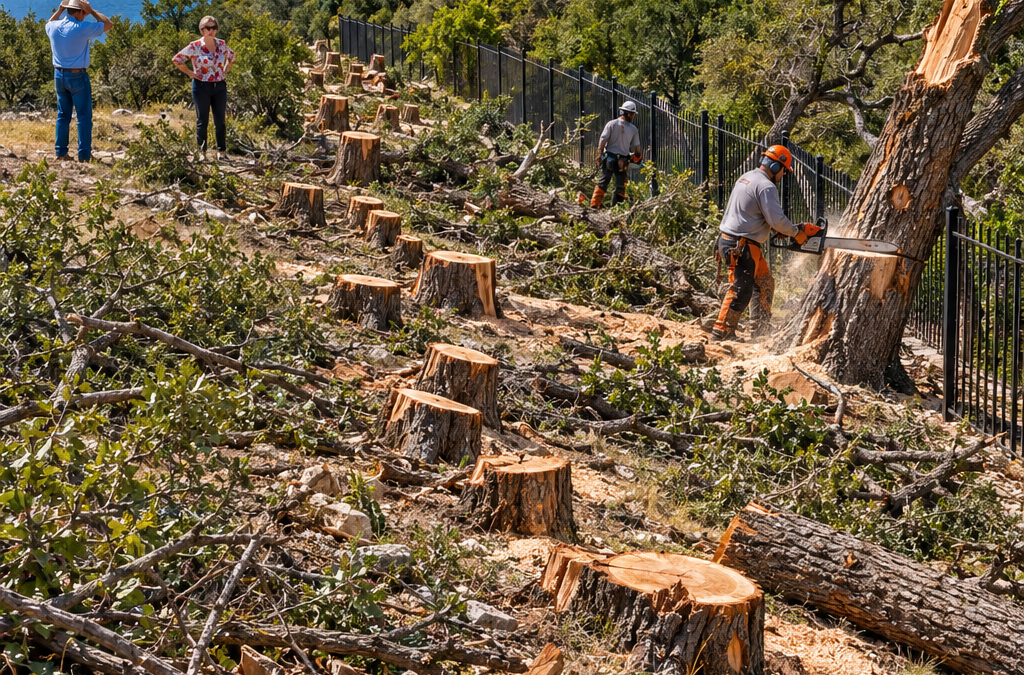
Thirty homeowners didn’t collectively own my view just because they valued it.
An easement is not ownership.
It’s a limited legal right.
And limited rights have conditions.
Theirs had one written plainly enough for my grandfather to notice decades after it was drafted.
Don’t alter the original parcel without the owner’s written consent.
They did.
Everything after that followed from their decision.
One evening last month, I found myself standing near the western boundary just before sunset.
The trellis was covered in vines now.
The cypress had thickened into one continuous green wall.
The cedar had weathered from gold to silver-brown.
I couldn’t see a single Lake View Pines roof.
Behind me, the lake was calm.
A pair of geese moved across the surface.
I thought about the morning I bought the property.
Grandpa at his kitchen table.
My impatience.
His finger tapping page after page.
Read the full deed.
I had thought he was being old-fashioned.
Suspicious.
Obsessive.
Now I understood.
Ownership isn’t only knowing where your fence stands.
It’s knowing what was promised before you arrived.
What rights attach to the land.
What rights others hold.
What conditions limit them.
And what happens when somebody mistakes your silence for ignorance.
Lake View Pines believed its scenic easement gave it the right to protect a view.
Maybe under different circumstances, it did.
What they never understood was that the deed protected me too.
Not emotionally.
Legally.
The same document that gave them a limited right created the consequence for abusing it.
They only read the part that benefited them.
I read the next paragraph.
That difference cost them the lake.
Not the water itself.
They never owned that.
What they lost was the expectation that my property would remain arranged for their enjoyment.
No future board can demand that now.
No future president can cite the old scenic corridor.
No developer can market that easement as permanent.
The county record is clear.
Their right ended the day the chainsaws started.
Sometimes I wonder whether Gerald ever thinks about that.
One decision.
One work order.
Eleven trees before I reached home.
Three more marked.
A board trying to demonstrate control.
And a clause written more than half a century earlier waiting quietly in the title record.
Maybe he still believes I overreacted.
Maybe some Lake View Pines residents do too.
They’re entitled to think that.
I’m entitled to my boundary.
Those things can coexist.
The young oak near the house is doing well.
Its trunk is thicker.
Branches wider.
A few more years and it will start casting real shade.
Someday, long after this fight becomes just another story people tell about the neighborhood, that tree may be taller than the ones Gerald cut.
I like thinking about that.
Not because it proves I won.
Land has a longer memory than people.
HOA presidents come and go.
Boards change.
Developers leave.
Lawyers close files.
Houses sell.
Trees grow.
The most permanent thing Gerald did as HOA president wasn’t protecting Lake View Pines’ lake view.
It was destroying the legal right that once protected it.
And the most important thing I did afterward wasn’t building a wall to punish him.
It was making sure nobody could ever again stand on the other side of my fence and decide that what grew on my land existed for their benefit.
That evening, I stayed by the lake until the last light disappeared.
The new trees moved gently behind me.
The water darkened.
A bird settled somewhere inside the cypress.
I couldn’t see Lake View Pines.
They couldn’t see me.
For the first time since the morning the chainsaws arrived, the ranch felt exactly the way it had when I bought it.
Quiet.
Private.
Mine.
𝗧𝗛𝗘 𝗘𝗡𝗗
The HOA Cut Down 14 Trees on My Lake Ranch and Never Read the Ninth Page of My Deed
I came home from work to find eleven of the trees I had planted with my own hands reduced to fresh stumps, while an HOA crew was still cutting through the last three beside my fence.
They believed those trees were the only thing standing between thirty expensive houses and a clear view of my lake, but none of them had bothered to read the clause buried on page nine of the deed they were relying on.
My name is Marcus Hale, and for eleven years I built my life around five acres of land in the Texas Hill Country.
People hear five acres and sometimes imagine something small.
It wasn’t.
Not to me.
The property ran down a gradual limestone slope toward a narrow lake that curved between the hills like a strip of dark blue glass. In spring, wildflowers pushed through the grass near the road. In August, the ground turned hard and pale beneath the heat. At dusk, deer came through the western edge of the property, and if I sat quietly enough on the back porch, I could sometimes hear coyotes calling from across the water.
I bought the place because it was quiet.
That sounds simple.
It wasn’t.
I had spent most of my adult life working around noise.
Construction sites.
Highways.
Rental houses with neighbors on the other side of thin walls.
Phones.
Equipment.
Deadlines.
People wanting something every minute of the day.
By my early thirties, I had started measuring wealth differently.
I didn’t want a larger television.
I didn’t want a luxury truck.
I wanted mornings when nothing needed me.
I wanted enough distance between my front porch and the next house that I could drink coffee without hearing somebody else’s conversation.
When I found the lake property, there wasn’t much on it.
A small ranch house.
An aging equipment shed.
Old barbed-wire fencing.
A gravel drive.
Most of the shoreline was exposed.
The previous owner had kept goats there years earlier, and the place looked tired.
I saw something different.
I saw what it could become.
My grandfather helped me buy it.
Not financially.
With advice.
He had spent most of his life working cattle outside Fredericksburg and understood land better than anyone I knew.
The afternoon before I closed, he sat with me at his kitchen table while I looked through the title packet.
I was impatient.
I wanted keys.
He kept turning pages.
“Read the deed,” he said.
“I did.”
“You read the summary.”
“It’s the same land either way.”
He gave me that look older men give younger men when they know the younger man is being stupid but haven’t decided how insulting to be about it.
“The summary tells you what somebody wants you to notice.”
He tapped the packet.
“The deed tells you what somebody before them wanted protected.”
I remember laughing.
“What am I looking for?”
“Everything.”
He made me read the legal description.
The easements.
Old restrictions.
Water rights.
Access language.
Pages of dry language written decades before I was born.
Most of it meant very little to me then.
One clause on page nine stood out because it was oddly specific.
The property had once been part of a much larger agricultural estate that was divided in the late 1960s.
During that division, several neighboring tracts received a limited scenic easement protecting what the document called “reasonable view corridors” toward the lake.
But immediately after that provision came another.
The reversal clause.
If any neighboring owner, successor development, association, or agent altered vegetation, landscaping, natural screening, or structures on the original parcel without the written consent of the parcel owner, the scenic easement benefiting that neighboring land would terminate.
Permanently.
The owner of the original parcel would then retain unrestricted rights, subject to ordinary county code, to plant, erect, or maintain vegetation, fencing, landscaping, or lawful structures along the affected boundary.
I read it twice.
“That’s strange,” I said.
Grandpa nodded.
“Probably came from a fight.”
“About what?”
“Doesn’t matter.”
He tapped the sentence.
“Remember it’s there.”
I didn’t think about that clause again for more than a decade.
I closed on the property.
Moved in.
And started planting trees.
The first was a live oak.
It wasn’t impressive when I bought it.
Maybe eight feet tall.
Thin trunk.
Sparse canopy.
I planted it near the southern edge of the house because I wanted shade over the porch someday.
The next spring, I added two cypress near the shoreline.
Then more oaks.
A cedar elm.
Another cypress.
A pair of bur oaks near the western fence.
I didn’t plant all fourteen at once.
That’s part of why they meant so much.
Each tree belonged to a different year.
Different version of me.
One went in after I got promoted.
One after my mother recovered from surgery.
One after my grandfather died.
That tree was a live oak near the center of the property.
I planted it alone.
I remember standing there after sunset with red dirt under my fingernails, thinking he would have criticized the depth of the hole.
The trees eventually became a living wall between the house and the western edge of the property.
Not an actual wall.
Nothing formal.
Just privacy.
Green in spring.
Deep shade in summer.
Rust and gold where the oaks changed in fall.
The cypress held their shape near the water.
Birds nested in them.
My porch disappeared from the western side unless someone knew where to look.
That was exactly what I wanted.
For nine years, nobody cared.
There were no houses behind me.
The western property was open scrub and cedar.
Then a developer named Crossland Residential bought it.
I knew development was coming before the first bulldozer arrived.
Survey stakes appeared.
Then temporary fencing.
Then earthmovers.
Then roads.
I wasn’t happy about it.
But I also wasn’t one of those people who believes buying land means owning the horizon.
Crossland had purchased their acreage legally.
They were entitled to build what zoning allowed.
So I adjusted.
I repaired my western fence.
Added two more cypress.
Made peace with the idea that the quiet would change.
Lake View Pines opened less than eighteen months later.
Thirty homes.
Large by subdivision standards.
Small lots.
Stone-and-stucco fronts.
Three-car garages.
Covered patios.
Every house angled toward the lake.
Not because they owned shoreline.
They didn’t.
Because the developer was selling the view.
LAKE VIEW LIVING.
That phrase appeared on the signs.
PREMIUM HILL COUNTRY WATER VISTAS.
Homes on the western row cost substantially more because they looked across my land toward the water.
I thought the marketing was a little dishonest.
But nobody asked me.
The HOA was formed before the last houses were sold.
Lake View Pines Homeowners Association.
At first, I had almost no contact with them.
My property was outside their boundaries.
Their roads didn’t cross mine.
Their utilities didn’t use my land.
I paid no dues.
Signed no covenants.
Attended no meetings.
We simply happened to share a property line.
That should have been enough.
Then Gerald Whitaker became president.
I first heard his name in March.
The letter arrived on a Monday.
Heavy white envelope.
Green HOA logo.
It began politely.
Dear Mr. Hale,
The Lake View Pines Homeowners Association is contacting you regarding vegetation located along the eastern scenic boundary of our community.
That was my western boundary.
Their eastern one.
The letter referenced the old scenic easement.
I immediately remembered page nine.
Not the exact language.
Just the existence of it.
The HOA claimed several of my trees had grown high enough to obstruct protected community sightlines toward the lake.
They requested that I “voluntarily trim or remove vegetation exceeding twelve feet.”
I walked outside with the letter.
Stood near the fence.
Looked at my trees.
The oldest oaks were well over twenty feet.
The cypress taller.
Of course they were.
Trees grow.
That was the idea.
I pulled my deed out that evening.
Found the scenic easement.
Read it carefully.
The original easement language was vague.
It protected “reasonable scenic visibility” but didn’t establish a twelve-foot limit.
Didn’t require removal.
Didn’t give anyone automatic entry rights.
And right below it sat the reversal clause.
I smiled when I saw it.
But I didn’t think it would matter.
Why would it?
Nobody was going to enter my land and cut fourteen trees without permission.
I wrote a short response.
The trees were located entirely on my property.
I did not consent to removal.
If the HOA believed it possessed enforceable rights, it could communicate through counsel.
That should have ended the conversation.
Instead, three weeks later, another letter came.
This one sounded different.
NOTICE OF NONCOMPLIANCE.
It accused me of interfering with a shared scenic easement.
The twelve-foot limitation appeared again.
There were references to potential enforcement fees, injunctive action, recovery of legal expenses, and “corrective landscape measures.”
That phrase bothered me.
Corrective landscape measures.
I called a local property attorney named Austin Bell.
Austin had handled water-access disputes and easement cases throughout the county for years.
He read the documents.
“The original scenic provision is poorly drafted,” he said.
“Can they make me cut the trees?”
“I wouldn’t say that.”
“Can they come onto my land?”
“Absolutely not based on anything I’m seeing.”
“What about the twelve-foot rule?”
“Where did that number come from?”
“Their letter.”
“Not your deed.”
“No.”
“Then as far as I’m concerned, it’s decorative.”
I laughed.
Austin didn’t.
“Marcus, don’t underestimate people once real estate values get involved.”
“They’re trees.”
“They’re selling houses based on lake views.”
“The houses are already sold.”
“Which means the buyers care even more.”
He told me to respond through him.
We did.
No consent.
No entry.
No removal.
No alteration.
If the HOA believed it had rights beyond those stated in the recorded instrument, they were invited to identify the legal basis.
They never did.
For almost a month, nothing happened.
I thought it was over.
Then came Tuesday.
I was at work forty-five minutes away when my phone rang.
It was Nora Bennett, my nearest neighbor on the south side.
Nora was sixty-eight and had lived near the lake longer than I had.
I answered because she almost never called during the day.
“Marcus?”
Something was wrong.
Her voice was too fast.
“What happened?”
“There are men at your place.”
“What men?”
“With chainsaws.”
I stood up.
“What?”
“They’re cutting your trees.”
For a second, the words didn’t connect.
“Which trees?”
“All along the west side. There’s a truck from some landscaping company and two other vehicles.”
“Nora, are they on my property?”
“Yes.”
“Did they cut anything?”
A pause.
“Marcus…”
That pause told me.
“How many?”
“I can see at least six down.”
I don’t remember hanging up.
I remember grabbing my keys.
I remember telling my supervisor I had an emergency.
I remember driving too fast until I realized getting arrested on the way home wouldn’t save a single tree.
The forty-five-minute drive felt endless.
Austin called while I was on the road because I had sent him one text.
HOA IS CUTTING TREES NOW.
He told me not to confront anyone physically.
Call sheriff.
Document everything.
Do not interfere with equipment.
Do not threaten.
I barely heard him.
When I reached my road, I could already see the change.
The western edge looked wrong.
Open.
Bright.
Exposed.
I turned into the gravel drive.
A white utility truck was parked near the fence.
Another pickup carried the logo HILL COUNTRY LANDSCAPE SERVICES.
Branches covered the ground.
Fresh-cut wood lay in sections.
Sawdust drifted across the grass.
Eleven trees were gone.
Eleven.
Not damaged.
Gone.
Stumps.
My oldest live oak was one of them.
The one I planted my first year.
One of the cypress near the shoreline had been cut into sections thick enough that two men had to move each piece.
Farther north, a worker was halfway through another tree.
Two more remained marked with orange paint.
I got out of the truck.
The chainsaw stopped.
A man wearing protective glasses looked at me.
Another man in a polo shirt started walking toward me.
Not one of the workers.
HOA.
I knew before he spoke.
“Mr. Hale?”
“Who authorized this?”
He held up one hand.
“We have documentation.”
“Who authorized you to enter my property?”
“The association is exercising its rights under the recorded scenic easement.”
“Who gave you permission to cut my trees?”
“The HOA board approved corrective action after your refusal to comply.”
I looked past him.
Eleven stumps.
“You approved this?”
“The board did.”
“What’s your name?”
“Stephen Lowell. Lake View Pines compliance committee.”
“Is Gerald Whitaker here?”
“No.”
Of course he wasn’t.
I pointed toward the workers.
“Everyone leaves now.”
Stephen’s expression became defensive.
“We have three remaining trees included in the work order.”
“You touch another tree and the sheriff can decide whether this is criminal trespass.”
As if summoned by the word sheriff, a patrol vehicle came down the drive.
Nora had called them too.
The deputy got out.
I knew him slightly.
Deputy Alan Price.
He looked at the cut trees.
Then at the crew.
“What happened?”
Stephen immediately began explaining easements.
Documents.
HOA authority.
Corrective action.
Alan listened.
Then looked at me.
“Did you give permission?”
“No.”
“Written?”
“No.”
“Verbal?”
“No.”
He looked at Stephen.
“Do you have a court order?”
Stephen hesitated.
“We have recorded easement rights.”
“That’s not what I asked.”
“No.”
“Then shut the saws down.”
The landscaping crew was already doing that.
I don’t blame them as much as I once did.
They had been hired by an organization claiming legal rights.
They were handed paperwork.
They assumed somebody had checked.
That doesn’t excuse entering private land.
But the person holding the chainsaw wasn’t the person who decided my property could be sacrificed.
The workers packed up.
Stephen made a phone call.
I stood in the grass.
I barely spoke.
Nora came over.
She touched my arm.
“I’m so sorry.”
I looked at the stumps.
The strange thing was that I didn’t feel explosive anger.
Not yet.
I felt empty.
The property looked naked.
The houses of Lake View Pines suddenly stood in full view.
Windows.
Balconies.
Patios.
All the things my trees had hidden.
And from those houses, for the first time in years, there was an unobstructed view across my five acres toward the lake.
That was what they had wanted.
They had taken eleven years of growth to improve thirty views.
One of the workers approached before leaving.
He was maybe twenty-five.
“Sir.”
I looked at him.
He removed his gloves.
“I didn’t know you hadn’t approved it.”
I said nothing.
“They told us the HOA had the easement.”
“I understand.”
He looked toward the remaining trees.
“I’m glad we didn’t finish.”
Three trees.
They had saved three only because Nora saw the trucks in time.
I walked from stump to stump after everyone left.
I knew each one.
The oak near the porch.
The two cypress.
The elm.
The bur oaks.
The tree I had planted after my mother got better.
The one I planted when Grandpa died.
That stump stopped me.
I crouched beside it.
The cut was clean.
Pale wood.
Rings visible.
I put my hand on it.
Eleven years.
Reduced to a surface smooth enough to count.
That was when anger arrived.
Cold.
Controlled.
Almost useful.
I remembered Grandpa.
Read the full deed.
Not the summary.
I stood.
Went inside.
Pulled the title file from the cabinet.
Page nine.
There it was.
I read the reversal clause slowly.
Then again.
Then called Austin.
“Do you remember the termination language?”
“Yes.”
“They altered vegetation without consent.”
“I know.”
“Does that trigger it?”
Silence.
“Don’t do anything.”
“Does it?”
“Marcus.”
“Read it.”
“I have.”
“Then tell me.”
Another pause.
“If the recorded language is still valid and there isn’t a later amendment, they may have just terminated their own scenic easement.”
“May?”
“I want title research.”
“How long?”
“As long as it takes to be right.”
I stared through the window.
Lake View Pines was visible between the remaining trunks.
“What happens if it terminated?”
Austin was quiet again.
“Then the restrictions benefiting their tract disappear.”
“And the reversal rights?”
“Potentially become enforceable.”
“Meaning?”
“You could plant.”
“How high?”
“Ordinary county restrictions.”
“Fence?”
“Possibly.”
“Structures?”
“Lawful structures, yes.”
I looked back at the deed.
“What about permanently?”
“If the language means what it appears to mean, termination is perpetual.”
I sat down.
Austin continued.
“Do not plant one bush until I verify the chain of title.”
“I’m not stupid.”
“You’re furious.”
“Both can be true.”
“Exactly.”
That evening, the HOA sent me an email.
Not an apology.
A notice.
It said the association had successfully completed a substantial portion of required scenic-easement maintenance before work was interrupted.
Successfully completed.
I read that phrase for almost a minute.
Then Gerald posted in the Lake View Pines community Facebook group.
Someone sent me a screenshot.
The obstructive vegetation affecting the eastern view corridor has now been substantially addressed. We appreciate residents’ patience as the board continues protecting community property values.
Forty-seven people liked it.
A few comments thanked the board.
One person wrote:
Finally! The lake looks amazing again.
I closed the screenshot.
There are moments when revenge feels emotionally obvious.
That was one.
But I had spent enough time around property disputes to know that anger makes expensive decisions.
So I did exactly what Austin told me.
Nothing.
For nine days.
Nine very long days.
Austin pulled the full chain of title.
Original estate division.
All amendments.
Recorded easements.
Developer transfers.
Crossland purchase documents.
Lake View Pines covenants.
County filings.
No later instrument modified the reversal clause.
No document removed it.
No release.
No restatement.
No superseding scenic agreement.
The clause remained attached to the land.
Then Austin brought in another attorney who specialized in title litigation.
She agreed.
The language was unusual.
Old.
Aggressive.
But valid.
More importantly, the triggering event wasn’t ambiguous.
Any neighboring association or successor development that altered natural screening or vegetation on the original parcel without the owner’s written consent would cause termination.
The HOA had documented the violation for us.
Invoices.
Work order.
Board minutes.
Emails.
They weren’t denying entry.
They were celebrating it.
Austin called me Friday morning.
“It holds.”
I didn’t say anything.
“Marcus?”
“I’m here.”
“The scenic easement is terminated.”
“Completely?”
“Based on the deed language, yes.”
“Permanent?”
“Yes.”
“And the reversal rights?”
“Active.”
I leaned back.
“Can they challenge it?”
“They can challenge anything.”
“Can they win?”
“That’s a different question.”
“What do you think?”
“I think Gerald Whitaker should have hired a title lawyer before he hired a chainsaw crew.”
That was the closest Austin ever came to celebrating.
We filed a formal notice with the county recorder.
DECLARATION OF TERMINATION OF SCENIC EASEMENT.
Attached exhibits included the deed.
The reversal clause.
Photographs.
The HOA’s own work order.
Stephen’s written report.
The landscaper’s invoice.
Correspondence showing I had explicitly denied consent before the cutting.
Clean.
Documented.
Recorded.
Public.
Then the HOA’s attorney contacted us.
Gerald had apparently finally understood the problem.
The settlement offer came three days later.
It was insulting.
They offered a cash payment for the destroyed trees.
Not remotely enough to replace mature specimens.
They offered to remove the remaining stumps.
They would waive any future enforcement regarding the original vegetation dispute.
In exchange, I would release all claims.
Including claims involving the easement termination.
Austin read the release.
Then smiled.
“No.”
“That bad?”
“They’re trying to buy the easement back without calling it that.”
“How much?”
“Not enough.”
“Would there be enough?”
He looked at me.
That was the question.
Money can replace some things.
Trees are complicated.
You can buy a large tree.
You can’t buy the eleven years you watched it grow.
You can’t replace the specific morning your grandfather stood beside one of them and told you the hole was too shallow.
But I wasn’t interested in pretending my trees were priceless simply because I was angry.
I was interested in consequences.
“They wanted the view,” I said.
Austin waited.
“I think they should live with what they bought.”
His eyebrows went up.
“Meaning?”
“I want to know exactly what I can legally put along that line.”
That afternoon, I hired a landscape architecture firm.
Not a guy with a shovel.
A professional firm.
Surveyor.
Landscape architect.
Arbor consultant.
Fence contractor.
Austin gave them the recorded documents.
I gave them one instruction.
“Everything legal. Everything permitted. No shortcuts.”
The architect’s name was Melissa Grant.
She walked the western boundary with me.
Looked toward the houses.
Then toward the lake.
“What are you trying to accomplish?”
“Privacy.”
She looked at me.
“How much?”
“Complete.”
That was all.
She designed a living screen.
Sixteen mature Leyland cypress.
I know they’re not everyone’s favorite tree.
Fast-growing.
Dense.
Aggressive root planning required.
Melissa accounted for drainage and spacing.
We used mature specimens approximately fourteen feet tall at planting.
Not seedlings.
Trees.
Full.
Dense.
Close enough to create visual continuity but spaced properly for long-term health.
Between sections, we installed a cedar privacy fence at the maximum county-permitted height.
Not an inch above.
Every post surveyed.
Every setback confirmed.
At the northern corner, the terrain dropped.
That created a gap in screening toward three houses.
Melissa proposed a raised garden terrace.
Retaining structure.
Planting bed.
Trellis.
We checked county code.
Permitted.
Applied.
Approved.
The trellis added another four feet of lawful visual obstruction above the terrace.
I asked twice whether that word—obstruction—would create problems.
Austin laughed.
“Not anymore.”
Construction began three weeks after the trees were cut.
The first flatbed arrived carrying cypress.
Lake View Pines noticed immediately.
People stood on patios watching.
By noon, someone from the HOA had contacted the contractor.
The contractor called me.
“They want to know what permits we have.”
“Give them the county permit numbers.”
“They asked whether the scenic easement allows this.”
“Tell them to call my attorney.”
That was the last direct conversation anyone had with my crew.
The work took eleven days.
On day three, half the fence went up.
Day five, the first row of cypress was planted.
Day seven, the terrace took shape.
Day nine, the trellis framing went in.
Day eleven, landscaping was finished.
Gerald called me on day twelve.
First time.
Not a letter.
Not an attorney.
Not a compliance officer.
Him.
I almost didn’t answer.
Then I did.
“Marcus Hale.”
“Mr. Hale, this is Gerald Whitaker.”
“I know.”
A pause.
“I think we need to discuss what’s happening along the boundary.”
“What’s happening?”
“The screening.”
“My landscaping?”
“It’s blocking the lake.”
I looked out the window.
Sixteen green cypress stood where eleven of my old trees had once grown.
“Yes.”
Another pause.
“I don’t think either side benefits from escalation.”
I almost admired the sentence.
“Escalation?”
“Let’s not play games.”
“I’m not.”
“Those trees are obviously retaliatory.”
“They’re landscaping.”
“And the fence?”
“Privacy.”
“The terrace?”
“Gardening.”
He exhaled.
“Marcus.”
I let the silence sit.
“Your property remains subject to a scenic easement.”
“No.”
“That’s not settled.”
“It is recorded.”
“Our counsel is reviewing that.”
“Good.”
“We disagree with your interpretation.”
“Then let your attorney call Austin.”
“I’m trying to resolve this neighbor to neighbor.”
That almost made me laugh.
“Gerald, you sent people with chainsaws onto my land while I was at work.”
“The board acted under its understanding of the easement.”
“You didn’t call me.”
“We had corresponded.”
“I told you no.”
“The board believed you were obstructing valid rights.”
“So you cut eleven trees.”
“Fourteen were scheduled.”
I went quiet.
He realized what he’d just admitted.
“Thank you,” I said.
“For what?”
“Nothing.”
“Marcus.”
I looked toward the remaining original trees.
Three survivors.
“That scenic easement had a reversal clause.”
He didn’t respond.
“The moment your board altered vegetation on my parcel without written consent, the easement terminated.”
“Our attorney disagrees.”
“Then why did your attorney offer me money to sign a release?”
Silence.
“Gerald, it’s over.”
“It isn’t.”
“It is.”
“Thirty homeowners paid for lake-view properties.”
“Then they should talk to the people who sold them views across land they didn’t own.”
His voice hardened.
“This is going to affect property values.”
“So did cutting my trees.”
“Those trees violated the corridor.”
“Not anymore.”
A long silence.
Then I said the thing I had wanted him to understand from the beginning.
“You used an easement to destroy my privacy.”
He didn’t answer.
“That easement is gone permanently. What I’ve built is within county code, fully permitted, and protected by the recorded reversal rights in my deed.”
“You’re enjoying this.”
That surprised me.
Maybe because there was something almost wounded in his voice.
“No.”
I meant it.
“I would rather have my old trees.”
He said nothing.
“I would rather none of this happened.”
“Then take the new trees down.”
“No.”
“There it is.”
“No, Gerald. You don’t get to turn this into me being unreasonable because you don’t like the consequence.”
His voice rose.
“You’re punishing thirty families.”
“I never touched their property.”
“They’re losing their view because of you.”
“They’re losing their view because your board entered mine.”
“Most of them had nothing to do with that decision.”
That one landed.
Because he was right.
Most residents had not cut my trees.
Some had probably never read Gerald’s post.
Some likely assumed the HOA had legal authority.
I looked out at the cypress.
“I know.”
“Then why do this?”
“Because I want my privacy back.”
“You could plant smaller trees.”
“I had smaller trees.”
Silence.
“You cut them down.”
He hung up.
Three days later, Lake View Pines held an emergency meeting.
I know what happened because three residents contacted me afterward.
The first was a woman named Elaine Foster.
She lived on the western row.
One of the expensive lake-view houses.
She called me nervously.
“Mr. Hale?”
“Yes.”
“My name is Elaine. I live in Lake View Pines.”
“I figured.”
“I wanted to tell you I didn’t support what they did.”
I didn’t answer immediately.
“I saw your trees get cut.”
“You were home?”
“Yes.”
“Why didn’t you call me?”
She went quiet.
“I thought they had permission.”
Fair answer.
“They told us the easement required removal.”
“It didn’t.”
“I know that now.”
She told me the emergency meeting had been ugly.
Residents demanded to know why the scenic easement was gone.
Gerald insisted the reversal clause was being challenged.
The HOA attorney apparently corrected him in front of everyone.
Not challenged.
Under review.
A different thing.
One resident asked whether the board had obtained a court order before cutting my trees.
No.
Another asked whether I had given written consent.
No.
Then someone asked whether their attorney had recommended the removal.
That answer changed everything.
The attorney hadn’t.
He had advised the board to seek declaratory relief before entering my property.
Gerald and two board members authorized the cutting anyway.
I sat down when Elaine told me that.
“A lawyer told them not to?”
“That’s what was said.”
“What happened after?”
“Two board members resigned.”
“At the meeting?”
“Yes.”
Apparently they had not voted for the tree removal authorization and wanted the minutes to reflect that.
The HOA attorney announced that his firm would not represent the association in any further action involving my property unless the board obtained independent litigation counsel.
Then came the financial issue.
My claim for the destroyed trees was still open.
Replacement value.
Loss of mature landscaping.
Survey costs.
Legal fees.
Restoration.
Potential statutory damages depending on the trespass findings.
Residents suddenly realized Gerald’s decision might cost the association much more than a blocked lake view.
Gerald resigned six days later.
His resignation letter said the controversy had become “personally divisive.”
It didn’t apologize.
I wasn’t expecting one.
The living wall was completed on a Thursday.
That evening I walked the entire boundary.
The change was dramatic.
Sixteen cypress stood taller than I was.
The cedar fence ran cleanly between planting sections.
The terrace at the north corner was already filled with native shrubs, rosemary, sage, and young climbing vines that would eventually cover the trellis.
Behind the new screen, I couldn’t see Lake View Pines.
That mattered more than I expected.
For weeks after the cutting, every time I looked west I saw those houses.
Their windows.
Decks.
Railings.
People.
I felt watched even when nobody was watching.
Now there was green again.
Not my original trees.
Never those.
But privacy.
I stood there until sunset.
The lake behind me reflected orange light.
Wind moved through the fresh cypress.
I tried to feel victorious.
Instead, I felt tired.
Because retaliation is emotionally satisfying in imagination.
Real life is messier.
Thirty families had lost a view.
Some deserved none of my anger.
A few had reached out to apologize.
Children hadn’t elected Gerald.
Retirees hadn’t read the title documents.
People had bought homes after being told the lake view was protected.
I understood that.
But understanding did not obligate me to sacrifice my property indefinitely.
That distinction mattered.
A week later, Elaine came to my gate.
She didn’t enter.
She stood outside.
I walked over.
“Hi.”
“Hi.”
She looked toward the cypress.
“They’re beautiful.”
That wasn’t what I expected.
“Thank you.”
“My husband is furious.”
“I figured.”
“He says you destroyed the reason we bought the house.”
I waited.
“I told him Gerald did.”
That surprised me.
She looked toward the lake, which was now completely hidden from her side.
“We paid a premium.”
“I’m sorry.”
“I know.”
She studied me.
“You mean that?”
“Yes.”
“Even though you’re keeping the wall?”
“Yes.”
She nodded slowly.
“I think that’s what he doesn’t understand.”
“What?”
“You can feel bad for us and still not give us what we want.”
“Those aren’t opposites.”
“No.”
We talked for almost half an hour.
She told me the developer had advertised the scenic easement as essentially permanent.
Marketing brochures showed sightlines across my land.
Nobody disclosed the termination clause.
“They told us the view corridor was protected.”
“It was.”
“Until the HOA cut your trees.”
“Yes.”
She laughed once.
Not happily.
“We paid extra for a legal right our board managed to erase.”
“I’d talk to a lawyer.”
“We are.”
That created another problem for Lake View Pines.
Homeowners began consulting attorneys over developer disclosures and board negligence.
I stayed out of it.
That wasn’t my fight.
My fight was with the damage on my land.
Austin eventually negotiated a settlement with the HOA’s insurer.
The amount covered removal of the stumps, part of the replacement landscaping, arborist valuation, attorney fees, and additional damages without requiring me to give up the recorded easement termination.
That was the non-negotiable point.
They offered more money twice in exchange for restoring some form of view right.
I declined.
Not because I wanted them punished forever.
Because I no longer trusted any association document that required me to preserve their view at the expense of my privacy.
The scenic easement had survived for more than fifty years.
One reckless board destroyed it in an afternoon.
I wasn’t rebuilding it for them.
The insurer eventually understood.
Settlement signed.
Claim closed.
The county record remained unchanged.
No scenic easement.
The new Lake View Pines board contacted me several months later.
Their president was now a woman named Caroline Shaw.
She asked to meet.
I agreed, but at Austin’s office.
Not because I expected trouble.
Because boundaries matter more after someone crosses them.
Caroline arrived with the HOA’s new attorney.
She didn’t bring a clipboard.
I appreciated that.
“We want to reset the relationship,” she said.
“Okay.”
“The board formally acknowledges that the association has no scenic-easement rights over your parcel.”
“Good.”
“We’ve also adopted a policy requiring outside counsel review before any HOA agent enters non-member property.”
“That seems like a low bar.”
She smiled faintly.
“It should have been.”
She gave me a letter.
Formal apology.
Board-approved.
No excuses.
It acknowledged unauthorized entry.
Unauthorized tree removal.
Failure to follow legal advice.
Impact to my property.
I read it slowly.
Gerald’s name never appeared.
That was fine.
“I appreciate this.”
Caroline nodded.
“We also want to repair community relations.”
“What does that mean?”
“No demands.”
I looked at her.
She continued.
“Some residents have asked whether you’d consider selective pruning in the future.”
“No.”
She didn’t argue.
“Understood.”
That was the first moment I believed Lake View Pines might actually have learned something.
No speech.
No threats.
No claim of shared responsibility.
I said no.
She accepted no.
That was all I had wanted eleven months earlier.
The relationship became almost normal after that.
Not friendly.
Normal.
Their landscapers stayed on their side.
Mine stayed on mine.
If drainage needed coordination, attorneys didn’t get involved.
Caroline emailed first.
I responded.
One afternoon, a Lake View Pines resident’s dog slipped through a damaged section of their perimeter fence and ended up near my shoreline.
I caught him before he ran farther.
Golden retriever.
Mud everywhere.
Tag said BUDDY.
I called the number.
A teenager and his father came around the long way to my gate.
The boy looked terrified.
“I’m sorry, sir.”
“It’s fine.”
“He’s never done that.”
Buddy was trying to climb into my truck.
I handed over the leash.
The father looked toward the cypress.
Then at me.
“We live behind these.”
“I guessed.”
He hesitated.
“Gerald told everybody you hated us.”
I looked at him.
“I don’t know you.”
“That’s what I figured.”
He shook my hand.
Little encounters like that mattered.
They separated the people from the board.
Gerald had turned thirty families into a justification.
THE COMMUNITY needs this.
THE COMMUNITY requires that.
THE COMMUNITY has rights.
But communities are made of individual people, and individual people rarely think with one mind.
Some residents wanted the lake view.
Some didn’t care.
Some hated what the HOA did.
Some had liked Gerald’s Facebook post before understanding where the trees stood.
Life was more complicated than heroes on one side and villains on the other.
Gerald’s mistake wasn’t merely arrogance.
It was treating the word community as permission to override an individual boundary.
He believed collective benefit excused private harm.
That is a dangerous idea when nobody stops to ask where authority ends.
A year after the cutting, I replaced the last of the original stumps.
I had left Grandpa’s oak stump intentionally.
Couldn’t bring myself to grind it.
Eventually, I changed my mind.
Not because I wanted to forget.
Because the stump had become an altar to anger.
Every time I walked past, I remembered chainsaws.
Gerald.
The fresh wood.
Eleven years erased.
I didn’t want the ugliest day on the ranch becoming the permanent center of the property.
So I hired the same arborist who had valued the losses.
He ground the stump.
I saved one cross-section first.
It sits in my workshop.
Sanded.
Sealed.
Not as evidence.
As memory.
The following spring, I planted a new live oak near where the old one stood.
Smaller than the cypress.
Maybe nine feet.
I dug the hole myself.
Halfway through, I heard Grandpa’s voice in my head.
Too shallow.
I laughed.
Dug deeper.
My mother came out that weekend.
She walked the property slowly.
Looked at the new trees.
The fence.
The garden terrace.
Then the young oak.
“This one for him?”
“Yeah.”
She touched a leaf.
“He would’ve thought the HOA thing was funny.”
“Eventually.”
“He would’ve told you to sue everybody.”
“No. Dad would’ve.”
She laughed.
“That’s true.”
We sat by the lake afterward.
The water looked the same as it had before Lake View Pines existed.
That’s one of the strange things about land disputes.
The land doesn’t experience the drama the way people do.
Water moves.
Grass grows.
Trees root.
Humans create documents and then fight over what they mean.
From my side of the new living wall, the ranch slowly returned to itself.
Birds nested in the cypress.
The cedar weathered.
Vines climbed the trellis.
The terrace filled in.
By the second summer, the screen was thicker than the old one had been.
Not more meaningful.
Just denser.
From the western row of Lake View Pines, there was effectively no lake view left.
Maybe a thin glimpse through one distant gap in winter if someone stood on an upstairs chair.
But the wide open corridor Gerald wanted?
Gone.
Legally.
Permanently.
Not because I found some loophole after the fact.
Because his own board triggered the condition written into the same deed that created their limited right in the first place.
That distinction mattered to me.
People sometimes hear the story and say I found a trick.
I didn’t.
The clause wasn’t hidden from them.
It was recorded.
Public.
Part of the chain of title.
Their developer could have read it.
Their attorney could have read it.
Their board could have read it.
Gerald could have read it.
The words existed before Lake View Pines existed.
Nobody cared until after the chainsaws stopped.
That isn’t a loophole.
That’s negligence.
Several residents eventually pursued claims against the developer over how the view protections had been marketed.
I don’t know how all of those cases ended.
A few settled.
Some owners stayed.
Two homes on the premium row sold within eighteen months.
One listing described the property as having “wooded privacy views.”
I laughed when I saw that.
Marketing adapts faster than people do.
Gerald moved out too.
Not immediately.
Almost a year later.
I never spoke to him again after the phone call.
I saw his SUV occasionally through gaps before the cypress filled completely.
Then one Saturday, moving trucks appeared.
Caroline later mentioned casually that his house had sold.
I asked where he went.
She shrugged.
“Closer to Austin, I think.”
That was it.
For months, I had imagined wanting one final conversation.
Something memorable.
A line that would make him understand.
But by the time he left, I didn’t need one.
The trees already said everything.
Every morning he looked east and saw green instead of water.
Not because I had broken a rule.
Because he had.
That was consequence enough.
I still keep the original HOA letters.
The polite one.
The threatening one.
The email celebrating corrective maintenance.
The screenshot of Gerald’s Facebook post with forty-seven likes.
Austin asked why I didn’t throw them away after settlement.
Same reason I keep the deed close.
Paper matters.
The first letter is a reminder of how small the dispute could have remained.
They could have asked.
I could have said no.
They could have challenged the issue properly.
A judge could have interpreted the easement.
Maybe they would have won something.
Maybe I would have.
That’s what courts are for.
Instead, someone decided procedure was too slow.
Permission inconvenient.
The view too valuable.
So they sent chainsaws.
That shortcut cost them the very right they were trying to enforce.
There is almost mathematical symmetry in that.
But what stays with me most isn’t Gerald losing the view.
It’s the hour after everyone left.
That silence.
I can still remember standing where my trees had been and suddenly seeing thirty homes that had always been hidden.
The ranch felt smaller.
Not physically.
Emotionally.
Privacy is difficult to explain until somebody removes it.
People sometimes confuse privacy with secrecy.
I wasn’t hiding anything.
I wasn’t doing anything unusual.
I simply liked knowing that when I stood on my porch, I wasn’t part of somebody else’s view.
My trees gave me that.
Gerald saw them only as obstructions.
That’s what happens when we reduce property to usefulness.
To him, the trees were between homeowners and water.
To me, they were years.
Shade.
Birds.
Memory.
A barrier that let my home feel like mine.
Same trees.
Different meaning.
Property disputes often begin there.
One person sees an inconvenience where another sees something irreplaceable.
The law can’t always resolve the emotional part.
It can define rights.
Set damages.
Interpret deeds.
It can’t give eleven years back to an oak.
That’s why the new oak matters.
It’s not revenge.
It’s an admission that some things must simply start over.
I was sitting near it one evening when Nora came by.
She had been the person who saved the last three trees.
I had never forgotten that.
She brought iced tea.
We sat facing the lake.
The cypress wall behind us had grown noticeably.
“Can’t see their roofs anymore,” she said.
“Good.”
“You know they probably can’t see ours either.”
“Even better.”
She laughed.
Then looked toward the new oak.
“That one will be big someday.”
“Probably after I’m old.”
“That’s how trees work.”
We sat quietly.
After a while, she said, “I’m glad I called you.”
“So am I.”
“I almost didn’t.”
I turned.
“What?”
“I thought maybe you had hired them.”
“The chainsaw crew?”
“At first. They had marked trucks. Papers. Nobody was sneaking.”
That stayed with me.
Nobody was sneaking.
That’s what made the whole thing possible.
The men walked onto my land in daylight because they had documentation.
Stephen stood there with HOA papers because he believed authority made trespass legitimate.
Nobody checked the deed closely enough to understand that the authority they were asserting contained its own self-destruct mechanism.
Paper can protect people.
Paper can also make bad decisions look official.
The difference is whether anyone reads all of it.
Grandpa understood that.
I didn’t fully appreciate it when I was younger.
Now page nine is probably the most famous page of any document I own.
I made three certified copies.
One stays in the safe.
One with Austin.
One in the ranch office.
Not because I expect another fight.
Because some lessons deserve redundancy.
The new HOA board has been stable for nearly two years now.
Caroline still serves as president.
Our relationship remains professional.
Last fall, they replaced part of their perimeter fence.
Before construction, she sent me the survey.
Asked whether I wanted to verify the line.
I did.
Everything was correct.
The fence went up.
No lawyers.
No arguments.
That was how simple it could have been from the beginning.
One email.
One survey.
One respected boundary.
The ranch is different now.
That’s unavoidable.
There are houses west of me.
Lights at night, even if I can’t see the structures.
Occasional music.
Cars.
Children shouting.
The world changed around the property.
But inside the boundary, the place still feels like mine.
That was all I ever wanted.
I wake early.
Make coffee.
Walk down toward the water.
The new cypress catch morning light.
Birds move through them.
The young oak near Grandpa’s old stump is taller now.
The surviving three original trees remain along the northern section.
I notice them more than I used to.
Maybe because I know how close they came to disappearing too.
One of them has a shallow chainsaw scar where the crew started cutting before the deputy shut everything down.
I chose not to remove that section.
The scar is healing around the bark.
Trees do that.
They don’t erase damage.
They grow around it.
I like that.
Sometimes people ask whether I regret blocking the lake view entirely.
My answer surprises them.
I regret that it became necessary.
That’s not the same as regretting doing it.
If Gerald had called me before sending the crew, the story might have ended with a lawyer’s letter and some selective trimming.
Maybe we could have discussed planting lower species in certain spots.
Maybe not.
There were options.
He eliminated them when he treated my refusal as something to overcome rather than a boundary to respect.
After that, my priority changed.
It was no longer preserving their view while protecting my privacy.
It was protecting my land from an organization that had demonstrated it was willing to enter without permission.
A permanent screen made sense.
Emotionally.
Practically.
Legally.
The fact that it also eliminated the benefit they were trying to preserve was their consequence.
Not my purpose.
At least that’s how I see it now.
Anger has cooled with time.
What remains is clarity.
Organizations like HOAs can become dangerous when people begin confusing delegated authority with ownership.
Gerald didn’t own my trees.
The board didn’t own my shoreline.
Thirty homeowners didn’t collectively own my view just because they valued it.
An easement is not ownership.
It’s a limited legal right.
And limited rights have conditions.
Theirs had one written plainly enough for my grandfather to notice decades after it was drafted.
Don’t alter the original parcel without the owner’s written consent.
They did.
Everything after that followed from their decision.
One evening last month, I found myself standing near the western boundary just before sunset.
The trellis was covered in vines now.
The cypress had thickened into one continuous green wall.
The cedar had weathered from gold to silver-brown.
I couldn’t see a single Lake View Pines roof.
Behind me, the lake was calm.
A pair of geese moved across the surface.
I thought about the morning I bought the property.
Grandpa at his kitchen table.
My impatience.
His finger tapping page after page.
Read the full deed.
I had thought he was being old-fashioned.
Suspicious.
Obsessive.
Now I understood.
Ownership isn’t only knowing where your fence stands.
It’s knowing what was promised before you arrived.
What rights attach to the land.
What rights others hold.
What conditions limit them.
And what happens when somebody mistakes your silence for ignorance.
Lake View Pines believed its scenic easement gave it the right to protect a view.
Maybe under different circumstances, it did.
What they never understood was that the deed protected me too.
Not emotionally.
Legally.
The same document that gave them a limited right created the consequence for abusing it.
They only read the part that benefited them.
I read the next paragraph.
That difference cost them the lake.
Not the water itself.
They never owned that.
What they lost was the expectation that my property would remain arranged for their enjoyment.
No future board can demand that now.
No future president can cite the old scenic corridor.
No developer can market that easement as permanent.
The county record is clear.
Their right ended the day the chainsaws started.
Sometimes I wonder whether Gerald ever thinks about that.
One decision.
One work order.
Eleven trees before I reached home.
Three more marked.
A board trying to demonstrate control.
And a clause written more than half a century earlier waiting quietly in the title record.
Maybe he still believes I overreacted.
Maybe some Lake View Pines residents do too.
They’re entitled to think that.
I’m entitled to my boundary.
Those things can coexist.
The young oak near the house is doing well.
Its trunk is thicker.
Branches wider.
A few more years and it will start casting real shade.
Someday, long after this fight becomes just another story people tell about the neighborhood, that tree may be taller than the ones Gerald cut.
I like thinking about that.
Not because it proves I won.
Land has a longer memory than people.
HOA presidents come and go.
Boards change.
Developers leave.
Lawyers close files.
Houses sell.
Trees grow.
The most permanent thing Gerald did as HOA president wasn’t protecting Lake View Pines’ lake view.
It was destroying the legal right that once protected it.
And the most important thing I did afterward wasn’t building a wall to punish him.
It was making sure nobody could ever again stand on the other side of my fence and decide that what grew on my land existed for their benefit.
That evening, I stayed by the lake until the last light disappeared.
The new trees moved gently behind me.
The water darkened.
A bird settled somewhere inside the cypress.
I couldn’t see Lake View Pines.
They couldn’t see me.
For the first time since the morning the chainsaws arrived, the ranch felt exactly the way it had when I bought it.
Quiet.
Private.
Mine.








