𝗙𝗨𝗟𝗟 𝗦𝗧𝗢𝗥𝗬 The HOA Collected Rent From All 50 Apartments I Owned for Two Years—and One Basement File Explained Why
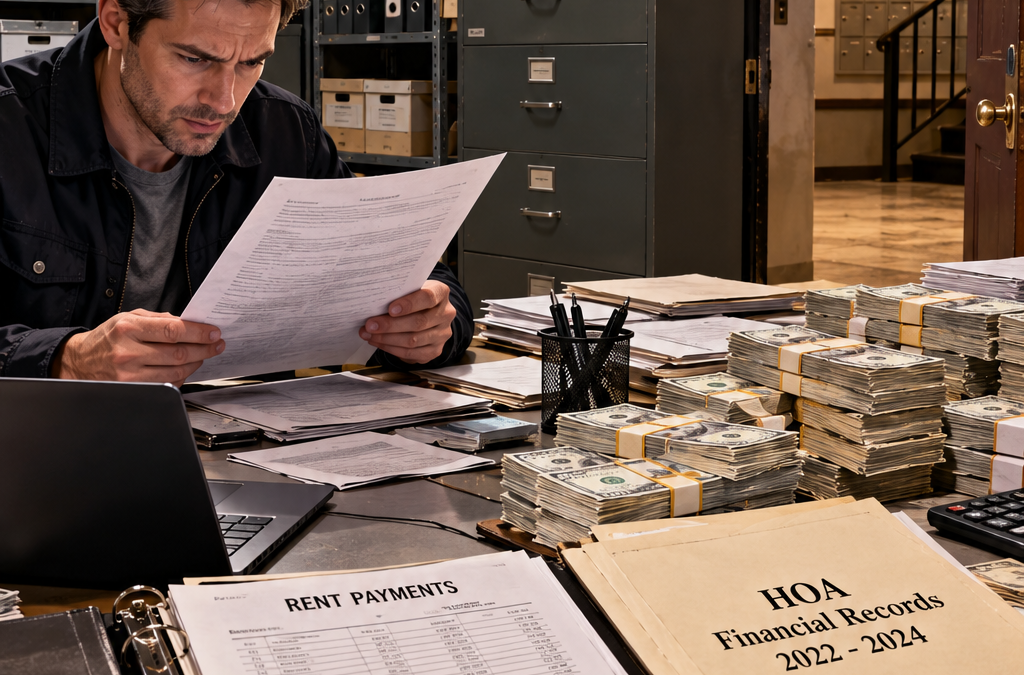
𝗙𝗨𝗟𝗟 𝗦𝗧𝗢𝗥𝗬
The numbers added up inside the documents Dale sent.
That doesn’t mean the documents reflected reality.
For the first year, deposits arrived regularly.
Then they became smaller.
Dale explained that the building needed capital improvements.
Elevator modernization.
Electrical work.
Window replacement planning.
Nothing sounded impossible.
Then the deposits stopped.
Completely.
And somehow, for eleven months, I didn’t notice.
I wish there were a better explanation.
There isn’t.
I was working a difficult case overseas.
Long days.
Irregular hours.
I had enough savings that I wasn’t living from the building’s income.
Monthly reports continued appearing in my email.
I saw them.
Filed them.
Assumed the accounting system was holding funds for upcoming work.
That is how theft survives.
Not because victims are stupid.
Because life gives criminals cover.
You have work.
Family.
Travel.
Bills.
A hundred small distractions.
Someone sends you a professional-looking PDF.
There is a logo at the top.
Numbers line up.
You think:
I’ll look at this properly later.
Later becomes eleven months.
Then one Tuesday night, I logged into the account while trying to locate a tax document.
The balance looked wrong.
Not low.
Frozen.
I checked transaction history.
No recent deposits.
I scrolled backward.
One month.
Three months.
Six.
Nine.
Eleven.
Nothing.
I remember sitting very still.
My laptop screen lit the hotel room.
Outside, traffic moved somewhere below me.
I opened the most recent building statement.
According to Dale’s report, fifty units were occupied.
Rent had been collected.
Expenses had been paid.
A capital reserve had grown.
But none of the owner’s distributions existed in the actual account.
I checked another month.
Same problem.
Another.
Same.
I picked up my phone and called the management number printed on every statement.
Dale answered after two rings.
“Mara.”
The fact that he knew who was calling immediately bothered me.
“Dale.”
“What can I do for you?”
“I’m looking at the building account.”
A pause.
Barely noticeable.
“What about it?”
“There hasn’t been a deposit in eleven months.”
His answer came too quickly.
“Yes. We’ve been restructuring some of the operating accounts.”
“Restructuring what?”
“We had to consolidate rent receipts because of capital planning.”
“Why?”
“Efficiency.”
“That isn’t an answer.”
He laughed softly.
Not nervous.
Reassuring.
“Mara, old buildings eat cash. Your uncle knew that.”
“I know what old buildings cost.”
“Then you understand we’ve been reserving funds for major improvements.”
“What improvements?”
“Elevator work. Plumbing. Exterior restoration. We’re preparing a full report.”
“When?”
“Soon.”
“How much rent was collected last month?”
Another tiny pause.
“I don’t have that number in front of me.”
“You’re the board chairman.”
“Yes, but I’m at home.”
“So am I.”
That was when his voice changed.
Only a fraction.
Less warmth.
More control.
“Is something wrong?”
“I don’t know yet.”
“Well, don’t create a problem where there isn’t one.”
There it was.
I had heard versions of that sentence from subjects in fraud interviews for years.
You’re misunderstanding.
Don’t overreact.
This is routine.
Everyone knew.
The accountant handles it.
The documents are coming.
People lying about money rarely begin by answering the question.
They begin by managing your emotional response to the question.
I said, “Send me current bank statements.”
“Of course.”
“All operating accounts.”
“Absolutely.”
“By tomorrow.”
A longer pause.
“That may take a few days.”
“Why?”
“Our bookkeeper—”
“Tomorrow, Dale.”
His voice cooled another degree.
“I’ll see what I can do.”
We ended the call.
I sat there staring at my phone.
Nothing Dale had said proved theft.
But everything about how he said it sounded familiar.
I booked a flight home before midnight.
I did not tell him.
Three days later, I stood across the street from Calder House with one suitcase and a coffee I never drank.
The building looked the same.
Red brick.
Black metal awning.
Planters near the entrance.
A delivery bicycle chained to the rail.
People entering and leaving.
Nobody looked panicked.
Nobody looked like they lived inside a crime scene.
I walked through the front doors.
The lobby had been repainted.
That was new.
Gray walls instead of Lex’s old cream color.
There was also a brushed-metal plaque beside the mailboxes.
CRESTLINE RESIDENTIAL SERVICES.
AUTHORIZED PROPERTY MANAGEMENT.
I had never heard the name Crestline.
That was the first physical sign that something was deeply wrong.
I approached the mailboxes.
A woman in her thirties was sorting envelopes while balancing a grocery bag against one hip.
She looked at me.
“Can I help you?”
I almost introduced myself.
Then stopped.
If Dale had been stealing, announcing my arrival before I understood how would be a mistake.
So I smiled.
“I’m looking at an apartment.”
Her face changed immediately.
“Oh. Are you here about the vacancy?”
“Maybe. I’m still researching.”
“Which unit?”
“I’m not sure yet.”
She shifted the grocery bag.
“I’m Priya. 4C.”
“Mara.”
She smiled.
“Nice to meet you.”
I pointed toward the Crestline plaque.
“Do they manage everything?”
Priya laughed without humor.
“They manage collecting money.”
Something in her tone caught me.
“Bad?”
“Depends how much you enjoy being fined.”
“For what?”
“Everything.”
She began counting on her fingers.
“Late rent. Late utilities. Lost key. Package storage. They tried charging me a lease processing fee last year even though I’d lived here five years.”
“How much is rent?”
She told me.
I thought I had misheard.
“Sorry?”
She repeated it.
The number was almost twice what Lex’s last verified rental schedule showed for that unit.
My stomach tightened.
“Has it gone up recently?”
“Twice.”
“Who do you pay?”
“The HOA office.”
“Directly?”
“Crestline HOA Holdings.”
I kept my face neutral.
“Is that the same as the board?”
“As far as I know.”
She shrugged.
“Dale runs everything.”
There was Dale again.
I thanked her.
Then went upstairs.
For the next two days, I became someone else.
Not literally.
I simply didn’t correct assumptions.
I told tenants I was considering moving into the building.
I asked what management was like.
What rent cost.
Whether repairs were handled quickly.
People talked.
They always do when they think you’re about to make the same mistake they made.
By the end of the first day, I had spoken to fourteen tenants.
By the second, thirty-two.
The pattern was consistent.
Every tenant paid Crestline HOA Holdings.
Every tenant had experienced significant rent increases over the previous two years.
Late fees were aggressive.
Sometimes absurd.
One woman had been charged seventy-five dollars because an electronic payment posted after midnight due to a bank delay.
Another tenant showed me three written warnings for leaving a stroller near her door for less than an hour.
Repairs were different.
Those didn’t happen quickly.
A leaking bathroom ceiling might wait six weeks.
Broken hallway lights stayed broken.
An elevator had been out for nine days the previous winter.
The basement laundry room had mold around one wall.
Money moved fast when it traveled toward Crestline.
Slowly when it had to return as service.
That afternoon I met Walter Greaves.
Walter was seventy-two.
Retired history teacher.
Unit 5A.
He opened his door wearing a cardigan and holding a folder so thick the elastic band barely closed.
When I told him I was considering renting, he stared at me.
“No, you’re not.”
I smiled.
“That bad?”
He held the door open.
“Come see.”
His ceiling had a brown water stain stretching almost six feet across the living room.
Paint sagged near one corner.
A plastic bucket sat beneath it.
“How long?”
“Fourth leak.”
“Fourth?”
He opened the folder.
Maintenance requests.
Emails.
Certified letters.
Photographs.
Dates.
Walter had documented everything.
He was my kind of person.
“This started fourteen months ago,” he said. “They patch upstairs. It leaks again. Then they tell me it’s condensation.”
“That isn’t condensation.”
“I taught teenagers for forty-one years. I know when somebody thinks I’m stupid.”
I smiled despite myself.
“Who have you complained to?”
“Dale.”
“What does he say?”
“That major repairs require board approval.”
“Have they approved them?”
Walter lifted the bucket slightly with one shoe.
“What do you think?”
He showed me a rent statement.
I stared at it.
The amount was almost double the rent listed in Lex’s archived records.
“Do you have older statements?”
Walter smiled.
“I keep everything.”
Of course he did.
He handed me another folder.
Within fifteen minutes, I was looking at a two-year progression of rent increases, fees, administrative charges, and payment instructions directing money into Crestline HOA Holdings.
Not Calder House.
Not Lex’s estate.
Not any ownership entity I recognized.
Crestline.
I finally asked:
“Do you know who owns the building?”
Walter looked surprised.
“The board.”
“Why do you think that?”
“Dale told us they took ownership after Mr. Voss got sick.”
My throat tightened.
“What exactly did he say?”
“That Lex transferred the property into some management trust.”
“When?”
“Maybe two years ago?”
“Before he died?”
“I suppose.”
Walter studied me more carefully.
“Why are you asking?”
I had avoided telling anyone.
But Walter had already given me enough information that lying to him felt wrong.
I closed the folder.
“My uncle was Lex Voss.”
Walter stopped moving.
For a second, his face went completely blank.
Then he sat down.
“You’re Mara.”
It wasn’t a question.
I nodded.
“Lex had your picture.”
I hadn’t known that.
Walter looked toward the ceiling.
Then back at me.
“You own this building.”
“Yes.”
His expression changed slowly from confusion to something worse.
Fear.
“Then who have we been paying?”
That was the question.
I spent that night running numbers.
Fifty units.
Different rents.
Different occupancy histories.
Conservative estimates.
I didn’t yet have complete banking records, so I worked from tenant statements and Lex’s rental schedule.
By two in the morning, the total was already approaching six hundred thousand dollars in rent and fees that should have flowed through the owner’s accounts but had instead been directed to Crestline.
Possibly more.
My hands were cold.
Fraud investigations had taught me emotional distance.
Evidence is easier to evaluate when anger isn’t holding the magnifying glass.
But this wasn’t somebody else’s file.
This was Lex’s building.
Walter’s ceiling.
Priya’s rent.
Fifty families who believed the people collecting their money had authority to do it.
I needed to see the office.
The basement management suite was behind an unmarked corridor beside the laundry room.
The next morning, I walked down at nine.
The door said:
MANAGEMENT.
I knocked once.
Then opened it.
Dale sat behind a large desk.
For a man supposedly overseeing an old apartment building with major capital needs, his office was surprisingly expensive.
New furniture.
Leather chair.
Two large monitors.
Espresso machine.
Framed Crestline logo behind him.
Connie Alrech sat at a side table.
She was around fifty, neatly dressed, visibly tense the moment she saw me.
The third person was Trent Bishop.
Early thirties.
Matching Crestline polo.
Expensive watch.
I recognized Dale immediately from Lex’s funeral.
He looked older.
Otherwise unchanged.
He stood.
“Mara.”
No surprise.
Either someone had told him I was in the building or he was very good at hiding reactions.
“I didn’t know you were coming.”
“That was intentional.”
He smiled.
“Of course.”
I looked at Connie.
Then Trent.
Dale gestured.
“Connie Alrech, board treasurer. Trent Bishop, operations director.”
Operations director.
Another title Lex had never created.
I remained standing.
“We need to talk about the rent.”
Dale’s smile stayed in place.
“Certainly.”
“And Crestline.”
“Same conversation.”
“I doubt that.”
Trent shifted in his chair.
Connie looked down.
Dale folded his hands.
“There seems to have been some confusion.”
“Good. Explain it.”
“Ownership and operational authority were restructured before your uncle passed.”
“What does that mean?”
“Lex transferred financial control to the board.”
“No, he didn’t.”
Dale didn’t blink.
“According to our records, he did.”
“Show me.”
For the first time, something moved behind his eyes.
Not fear.
Assessment.
Then he opened a drawer.
Removed a folder.
Pulled out a document.
He placed it on the desk and slid it toward me.
“Three months before his death.”
I picked it up.
The document granted Crestline HOA Holdings extensive operational and financial authority over Calder House.
Rent collection.
Contracting.
Capital reserves.
Lease administration.
Management control.
Near the bottom was Lex’s signature.
I looked at the date.
Three months before he died.
A period when my uncle had been in hospice.
By then Lex’s hands shook badly enough that my cousin had helped him hold a spoon.
He had stopped signing checks.
His lawyer handled bills under an existing limited power arrangement.
Yet here was a crisp signature granting control of a fifty-unit building to a company I had never heard of.
I studied the signature.
Three seconds was enough to become suspicious.
Ten made me nearly certain.
Lex’s authentic signature had a distinctive pressure collapse at the end of the surname caused by arthritis in his right hand.
This one didn’t.
The downstroke pressure was uniform.
The terminal flourish was too smooth.
It looked copied from an older signature sample.
There were other issues.
Ink sheen.
Stroke hesitation.
A tiny pen lift where Lex never lifted.
Someone had studied what his signature looked like.
They had not studied how he actually wrote it.
My pulse began hammering.
I didn’t show it.
Instead, I smiled.
“Can I get a copy?”
Dale leaned back.
“Of course.”
No hesitation.
That told me he believed the document was strong.
Or believed I was weak.
Possibly both.
Trent used the copier.
He handed me the duplicate.
I folded it carefully.
Dale said, “Once you review the transfer package, you’ll see everything was handled properly.”
“I’m sure.”
“There really was no reason to fly home.”
“I was nearby.”
A lie.
He smiled.
“So we’re good?”
I looked at him.
Then at Connie.
She still wouldn’t meet my eyes.
“Yes,” I said.
“For now.”
I left.
The moment the elevator doors closed, I stopped pretending to breathe normally.
I had investigated forged documents for six years.
I knew the danger of falling in love with an early theory.
A suspicious signature wasn’t proof.
A strange company wasn’t proof.
An unexplained bank account wasn’t proof.
Together, though, they formed a direction.
I went back to work.
Quietly.
That was the part Dale misunderstood about me.
He expected an angry owner.
A woman who would confront him.
Threaten litigation.
Demand records.
Maybe call the police.
He knew how to handle that person.
Delay.
Confuse.
Produce paperwork.
Hire counsel.
Move money.
Destroy what needed destroying.
I did none of those things.
I returned to my office.
I told Dale I had overseas obligations and would review everything when I had time.
Then I started building the case.
First came the document.
I obtained verified exemplars of Lex’s signatures from attorneys, banks, deeds, tax filings, and medical-consent forms.
Dozens.
The questioned signature didn’t behave like them.
Stroke sequence differed.
Pressure distribution differed.
Natural tremor was absent.
Pen lifts appeared in places Lex’s writing normally connected.
Then the ink.
I couldn’t simply run laboratory testing privately and pretend it was evidence.
Chain of custody mattered.
So I preserved the copy and began the process of obtaining the original through formal channels once probable cause developed.
Meanwhile, I compared document production characteristics.
Printer banding.
Toner deposition.
Metadata from an electronic version eventually obtained from building records.
The date on the document said one thing.
The document creation history said something else.
Then came Crestline itself.
The company had been registered eight months before Lex died.
That mattered.
Dale had told tenants that Crestline emerged as part of post-transfer management restructuring.
But the shell existed while Lex was still alive.
While he was ill.
While his decision-making capacity was deteriorating.
The registered agent connected to another entity.
That entity connected to Dale.
I kept digging.
The deeper I went, the less Calder House looked like an isolated theft.
Three other properties surfaced.
Different owners.
Different cities.
Same broad structure.
An elderly or absent owner.
A management board or advisory committee.
A transfer document.
A shell company.
Rent redirected.
Authority expanded.
Signatures later questioned.
The language in two of the transfer documents was nearly identical to the document Dale had shown me.
Not similar.
Nearly identical.
Same odd phrase:
“full operational and beneficial administrative authority.”
No competent property lawyer I knew used that phrase in the way those documents did.
Dale wasn’t improvising.
He had a system.
That realization frightened me more than the missing money.
If Calder House was one building in a network, there would be people ready to erase evidence the moment they sensed danger.
So I waited.
That was difficult.
Every day I waited, tenants kept paying.
Priya paid.
Walter paid.
Families paid rent into an entity I believed was fraudulent while I stood outside the mechanism collecting evidence.
I hated it.
But premature confrontation could lose everything.
Money could move.
Servers could vanish.
Files could burn.
Dale could claim misunderstanding.
Or disappear.
I needed records that didn’t depend on his cooperation.
Formal banking process followed.
Subpoenas.
Account histories.
Corporate transfers.
Payment processors.
Some tools came through my office because the pattern extended beyond my private property and implicated ongoing fraud within our jurisdiction.
That line mattered to me.
I did not use government authority simply because I was angry about my own building.
Once evidence showed a broader scheme affecting multiple properties, the matter entered official territory.
And when it did, the picture became ugly very quickly.
Rent entered Crestline accounts.
Some paid building expenses.
Enough to preserve the appearance of legitimate management.
The rest moved.
Consulting fees.
Administrative compensation.
Related entities.
Personal transfers.
Vehicle payments.
Travel.
Credit cards.
Three apartment units inside Calder House also showed something peculiar.
No rent receipts.
Units 6A, 6B, and 6C.
All among the largest in the building.
Residents listed:
Dale Renshaw.
Connie Alrech.
Trent Bishop.
They were living in my building.
For free.
While raising rent on everybody else.
I sat staring at that report for a long time.
It was almost too neat.
The people collecting fifty tenants’ money had given themselves three of the best units without paying a dollar.
Walter’s ceiling leaked over a bucket.
Dale lived upstairs without rent.
That image stayed with me.
Meanwhile, retaliation against tenants increased.
Priya called me one evening.
Her voice was shaking.
“They gave me a lease violation.”
“For what?”
“Asking for account information.”
I went still.
“What exactly does the notice say?”
“Interference with building administration.”
I nearly laughed from disbelief.
“Send it to me.”
She did.
The notice warned that repeated disruptive conduct could affect lease renewal.
There was no legitimate lease clause supporting it.
Dale was intimidating people who asked questions.
Walter’s ceiling leaked again.
Fourth time.
Water came through during a storm.
He called Crestline’s emergency number.
Nobody arrived for seven hours.
When maintenance finally came, they put down another bucket and said the upstairs plumbing would be inspected later.
I drove over that night.
Walter opened the door.
Water ticked into plastic.
He looked exhausted.
“You knew, didn’t you?”
I didn’t answer immediately.
He sat down.
“You’ve been asking questions for weeks.”
“I know something is wrong.”
“How wrong?”
“Bad.”
He nodded slowly.
“Are we going to lose our apartments?”
That question hit me harder than the six hundred thousand dollars.
“No.”
“You sure?”
“Yes.”
I sat across from him.
“You are not the problem here.”
He rubbed both hands over his face.
“Dale keeps telling people ownership is changing.”
“It isn’t.”
“Then why don’t you stop him?”
I looked toward the leaking ceiling.
Because I needed proof.
Because courts move slower than anger.
Because if I struck too early, Dale might escape.
All true.
None comforting.
“I’m getting there.”
Walter looked at me for a long time.
Then nodded.
“I trust you.”
I wished he hadn’t said that.
Trust had already done enough damage.
Three weeks after I returned home, Connie called me.
11:42 at night.
Unknown number.
I almost ignored it.
Then answered.
“Mara?”
I recognized her voice.
“Yes.”
“This is Connie.”
I sat up.
“What happened?”
She was crying quietly.
Not dramatic crying.
The kind someone tries to suppress.
“I need to talk to you.”
“About what?”
“Dale.”
I waited.
She whispered:
“He knows you’re looking.”
My body went cold.
“How?”
“I don’t know.”
“Where are you?”
“Not at the building.”
“Are you safe?”
“For now.”
That answer told me enough.
We met the next morning in a café across town.
Connie arrived wearing sunglasses despite the cloudy weather.
She looked different outside the Crestline office.
Smaller.
Tired.
She wrapped both hands around coffee but never drank.
For several minutes, she said nothing.
I didn’t push.
Finally:
“I didn’t know the transfer was fake.”
I studied her face.
“You signed documents.”
“I know.”
“You collected rent.”
“I know.”
“You lived rent-free.”
Her eyes filled.
“I know.”
Anger rose in me.
I kept it contained.
“Then tell me what you did know.”
Connie took a breath.
She had joined the board years earlier while Lex still ran Calder House.
At first, everything was legitimate.
After Lex became sick, Dale began taking over more financial responsibilities.
He told Connie that Lex wanted continuity.
He said a new management entity would protect the building during probate.
Crestline.
Connie believed him.
At least initially.
Then Dale started asking board members to approve documents quickly.
Backdated meeting minutes.
Revised resolutions.
Authority statements.
When she questioned dates, Dale said lawyers had instructed him.
When she asked to speak directly with Lex’s lawyer, he told her the estate wanted separation.
Then came the transfer document.
“I never saw him sign it,” she said.
“Who did?”
“Dale said Trent witnessed it.”
“Did Trent?”
“I don’t know.”
“When did you first suspect it was forged?”
Connie looked down.
“About six months later.”
My jaw tightened.
“Six months.”
“I know.”
“And you stayed.”
“He threatened me.”
“With what?”
She hesitated.
Then explained.
Dale had arranged payments to her personally.
At first framed as board compensation.
Then larger amounts.
Once she began questioning records, Dale told her those payments could make her look like a participant.
He threatened to report her for embezzlement if she left.
He reminded her that her signature appeared on resolutions.
He had built a trap.
Maybe she had walked into it willingly at first.
Maybe not.
But by the time she understood the whole operation, she was inside it.
“Why call me now?”
“Because he’s preparing to move money.”
There it was.
“How much?”
“I don’t know.”
“Where?”
“Another company. Trent mentioned Nevada.”
I leaned forward.
“Do you have proof?”
Connie nodded.
She opened her bag.
Removed a flash drive.
Emails.
Internal account summaries.
Scanned resolutions.
Messages between Dale and Trent.
One message used the words:
“backdate the owner authorization to match the hospice period.”
I read it twice.
That was the moment the case changed.
Up to then, we had evidence.
Now we had a witness.
And intent.
I told Connie something clearly.
“Cooperation doesn’t erase what you did.”
“I know.”
“You may still face consequences.”
“I know.”
“If you’re lying to me, I’ll find out.”
“I know.”
She started crying again.
“I just want this to stop.”
Her statement took six hours.
Then came sworn interviews.
Records.
Corroboration.
Every claim had to be checked.
Some were true.
Some were incomplete.
A few made Connie look worse than she had admitted initially.
But the essential facts held.
Dale had directed backdating.
Trent had helped create false records.
Crestline’s authority rested on a forged transfer.
Rent had been diverted.
The time for waiting ended.
The legal action moved quickly once emergency filings showed a risk of asset dissipation.
Accounts were frozen.
Crestline was restrained from transferring building funds.
The original questioned document was seized through proper process.
Forensic testing confirmed what I had suspected.
The signature was not Lex’s genuine execution.
Ink characteristics and document production history were inconsistent with the claimed creation date.
Digital records connected the file to equipment used by Crestline after the supposed signing.
The document did not merely look suspicious.
It collapsed under examination.
Dale still fought.
Of course he did.
Men who build schemes around confidence often keep performing confidence long after the facts disappear.
At the first major hearing, he wore a dark suit and sat beside his attorney with his hands folded calmly.
He looked almost bored.
His lawyer portrayed me as an absentee heir.
A woman who had lived overseas.
Ignored the property.
Then returned after Lex’s death looking for control.
The argument wasn’t entirely irrational.
I had been absent.
That failure was mine.
But absence does not transfer ownership.
Neglect does not legalize forgery.
And incompetence by an owner does not authorize theft by a manager.
Dale’s lawyer introduced the transfer document.
Then our side introduced the forensic analysis.
The signature comparison.
Pressure pattern.
Stroke construction.
Document timeline.
Ink findings.
Printer evidence.
Corporate registration dates.
Banking records.
Then Connie testified.
That changed the room.
She described Dale instructing her to approve backdated resolutions.
She described questions being dismissed.
Threats.
The Nevada transfer plan.
Then the message about matching the hospice period appeared on the screen.
For the first time since I had met him, Dale looked afraid.
Not angry.
Afraid.
His jaw tightened.
He stopped whispering to his attorney.
Trent sat behind him, pale.
The judge asked Dale’s attorney one question:
“Do you have any independent witness who observed Mr. Voss execute this document?”
The answer was no.
“Any attorney present?”
No.
“Notary?”
No.
“Contemporaneous communication from Mr. Voss confirming the transfer?”
No.
The transfer was ruled fraudulent and void from inception.
Crestline had never lawfully acquired ownership authority.
Never had lawful entitlement to redirect rental income.
Never had the authority Dale claimed.
The effect was immediate.
Control of Calder House returned formally and exclusively to me as the verified owner.
Crestline was removed.
Its on-site management authority ended.
Accounts remained frozen pending restitution proceedings.
The rent collected under false authority was subject to recovery.
The initial amount exceeded six hundred thousand dollars.
Dale had acted as if much of it was already gone.
The court viewed that differently.
Money doesn’t become yours because you’ve spent it.
The order required accounting and restitution.
Unspent funds in controlled accounts were preserved.
Transfers to related entities were traced.
Additional recovery actions followed.
Then came the locks.
I had thought about that moment almost from the beginning.
Not as revenge.
As closure.
For nearly two years, Dale had occupied an office in my basement and behaved as though authority came from the fact that his key opened the door.
After the court order became effective, I hired a licensed locksmith.
Every management-office cylinder was changed.
File rooms.
Storage rooms.
Accounting office.
Mechanical access controlled by Crestline.
Every key issued to unauthorized management personnel was canceled.
I stood in the basement while the locksmith worked.
Dale arrived halfway through.
Of course he did.
He came down the stairs fast, Trent behind him.
“What the hell is this?”
The locksmith looked at me.
I handed Dale a copy of the order.
“Crestline no longer manages the property.”
“You can’t lock us out.”
“I can.”
“Our records are in there.”
“They are now subject to preservation.”
“You’re interfering with a legal business.”
I almost admired the nerve.
“A legal business?”
His face darkened.
“This isn’t over.”
“No.”
I agreed.
“It isn’t.”
Because Dale, Connie, and Trent had another problem.
The apartments.
All three had been living rent-free in some of the building’s best units.
Their occupancy was tied to management positions Crestline had never lawfully held.
Once the court recognized my authority and their right to occupy those units collapsed, the removal process began under the applicable order and occupancy rules.
Connie’s situation was handled differently because of her cooperation.
She had testified.
Provided evidence.
Helped preserve assets.
That didn’t erase her conduct, but prosecutors and the civil parties took it into account.
She agreed to leave voluntarily.
No spectacle.
No argument.
I met her near the lobby on her final morning.
Two suitcases beside her.
She looked exhausted.
“I’m sorry,” she said.
I believed she was sorry.
That didn’t mean I trusted her.
“I know.”
“I should have spoken earlier.”
“Yes.”
She nodded.
“I was afraid.”
“I know.”
She wiped her eyes.
“I hope Walter gets his ceiling fixed.”
“He will.”
Then she left.
Trent was different.
He had spent weeks pretending Connie was the problem.
Once evidence placed him directly in the preparation of false records, his confidence vanished.
I served his notice personally.
He stared at the paper.
“This is insane.”
“No.”
“I’ve lived here almost two years.”
“Without paying rent.”
“That was part of compensation.”
“Compensation from a company that had no authority to employ you here.”
He tossed the notice onto his kitchen counter.
“You think you can just throw people onto the street?”
I put the court order beside it.
“You have the period specified here to vacate.”
He looked at the order.
Then me.
“This isn’t finished.”
I remembered Dale sliding Lex’s forged document across the desk.
So I used his words.
“There’s been a mix-up.”
Trent stared at me.
I continued.
“According to the court, this apartment belongs to the building you helped defraud.”
He left within the required period.
Dale fought the longest.
Of course he did.
He filed objections.
Requested stays.
Claimed the unit was part of a separate employment contract.
Claimed tenant protections.
Claimed implied compensation.
Claimed retaliation.
Each argument had to be answered properly.
I did not throw his belongings onto the street.
I didn’t need to.
The court process handled him.
Eventually, the day came when Dale Renshaw walked out of Calder House carrying boxes instead of records.
I watched from the lobby.
He saw me.
Stopped.
For a moment, neither of us spoke.
Then he said:
“You think you won?”
I looked at him.
Behind us, Walter was checking his mail.
Priya was coming through the front doors.
A maintenance contractor carried drywall upstairs.
“No,” I said.
“I think you got caught.”
He gave me a look I still remember.
Hatred mixed with disbelief.
Some people don’t experience consequences as the natural result of what they did.
They experience them as something being done to them.
Dale walked out.
Fraud charges followed.
The broader investigation continued because Calder House wasn’t the only property.
Other owners were contacted.
Other documents reviewed.
Other financial accounts examined.
I stayed out of whatever I wasn’t required to know.
My focus returned to the building.
That was harder than I expected.
Removing thieves does not repair what theft neglected.
Walter’s ceiling was first.
I promised him a proper repair.
Within forty-eight hours, contractors opened the ceiling.
The problem wasn’t condensation.
A failing supply line and damaged plumbing assembly from the unit above had been leaking intermittently for more than a year.
Water had spread into joists and insulation.
There was mold beginning behind one section.
The repair took a week.
Plumbing replaced.
Damaged materials removed.
Area treated.
Ceiling rebuilt.
Paint matched.
When the last contractor left, Walter stood in the living room looking upward.
“No bucket,” he said.
“No bucket.”
He smiled.
Then he surprised me by crying.
Just quietly.
He sat down.
“I know it’s ridiculous.”
“It isn’t.”
“You fixed a ceiling.”
“I know.”
He shook his head.
“No. You listened.”
That sentence stayed with me.
For two years, these people had been treated like sources of revenue.
Every complaint was an inconvenience.
Every question was a threat.
Every maintenance request competed against the board members’ appetite for money.
Fixing one ceiling wasn’t heroic.
It was the minimum.
But after neglect, minimum competence feels like kindness.
I hated that.
Next came rent.
I audited every lease.
Every increase.
Every fee.
Some rent changes were legally permissible.
That wasn’t the same as fair.
Crestline had pushed rates aggressively while providing worse service.
I couldn’t reverse time.
But I could stop pretending those inflated numbers reflected honest management.
We restored rents to the last defensible schedule, adjusted where necessary for legitimate lease terms, and eliminated several invented administrative fees.
Priya came into the temporary management office when she received her new statement.
She held the paper up.
“Is this right?”
“Yes.”
“My rent went down.”
“Yes.”
She stared at me.
“I’ve never heard a landlord say that so calmly.”
“I’ve had an unusual month.”
She laughed.
Then her expression became serious.
“Are we safe here?”
That question.
Again.
Not:
Is the rent cheap?
Not:
Can I renew?
Safe.
“Yes.”
I answered.
“And if something changes, you’ll know why.”
Transparency became the first policy.
Every tenant received a letter explaining ownership.
Not every detail of the criminal investigation.
Just what mattered.
Who owned the building.
Where rent went.
Who had authority to collect it.
How to verify the payment account.
How management decisions would be communicated.
How complaints could be escalated.
No mystery companies.
No surprise transfer instructions.
No handwritten notices from people inventing authority.
I hired an independent property management firm.
Not because I wanted to repeat Lex’s mistake of trusting blindly.
Because fifty apartments require daily management, and I wasn’t going to pretend I could do it alone.
The difference was oversight.
Monthly bank reconciliation.
External accounting.
Dual authorization for major transfers.
Direct access for me to rent ledgers.
Annual independent review.
Vendor verification.
Nothing revolutionary.
Just controls that should have existed all along.
The recovered money came in stages.
Some had remained in Crestline-controlled accounts.
Those funds were easiest.
Other amounts had gone to related entities.
Vehicles.
Personal expenses.
Transfers.
Recovery became slower.
Court orders.
Asset tracing.
Settlement negotiations.
I stopped obsessing over the total.
Six hundred thousand dollars was the number that had originally made my stomach drop.
But the final damage wasn’t just rent.
It was maintenance deferred.
Legal expenses.
Tenant overcharges.
Trust.
You can’t place all of that neatly in one account.
I used recovered funds first on the building.
Roof sections.
Plumbing.
Elevator service.
Hallway lighting.
Basement mold remediation.
Fire-system updates.
The work was embarrassingly ordinary.
Exactly the sort of maintenance tenants had already been paying for.
Walter watched contractors come and go for months.
One afternoon, he found me in the lobby.
“Your uncle would be furious.”
I smiled faintly.
“At Dale?”
“At you too.”
That caught me.
“For leaving it alone this long.”
I looked at him.
Walter shrugged.
“You know I’m right.”
I did.
“I should have paid attention.”
“Yes.”
“I trusted the board.”
“Your uncle trusted them too.”
“That doesn’t excuse me.”
“No.”
He paused.
“But you came back.”
I thought about that.
Coming back doesn’t erase absence either.
People like clean stories.
Victim.
Villain.
Justice.
End.
Real life is messier.
Dale stole.
Trent helped.
Connie participated, then helped expose it.
I was deceived.
But I was also inattentive.
Fifty tenants had been paying almost double while I accepted polished reports from thousands of miles away.
I couldn’t rewrite that.
I could only decide what happened next.
So I stayed.
At first I told myself it was temporary.
A few months.
Stabilize the building.
Hire management.
Return overseas.
Then winter came.
I spent more time at Calder House than at my own apartment.
I learned the building the way Lex had.
Mrs. Alvarez in 2B left for work at 5:30 every morning.
The twins in 3D practiced violin badly but enthusiastically.
Priya ordered too many packages.
Walter complained about the elevator even after it was repaired.
A nursing student on the sixth floor studied in the laundry room because her roommate snored.
None of that appeared on financial statements.
Lex had known.
That was why people trusted him.
One evening, I found an old photograph in the management archive.
Lex standing in the courtyard twenty years earlier.
Younger.
More hair.
Holding a wrench.
Walter stood beside him.
Also younger.
Behind them was the same brick wall.
I took the photograph upstairs.
Walter looked at it for almost a minute.
“That pipe burst Christmas Eve.”
“You remember?”
“Of course. Your uncle was here until three in the morning.”
“He owned fifty units. He couldn’t hire somebody?”
“He did.”
Walter smiled.
“The plumber couldn’t come until morning. Lex didn’t think that meant he got to go home.”
That photograph ended up framed in the new management office.
Not because I wanted to turn Lex into a saint.
He wasn’t.
He could be stubborn.
Cheap about cosmetic repairs.
Terrible at answering email.
But he understood something Dale never did.
Owning a building didn’t mean owning the people inside it.
It meant being accountable for the structure around their lives.
Months after Dale left, I finally went into his old office alone.
The room had been cleared.
New locks.
New desk.
Crestline logo gone.
But one wall still showed lighter paint where the sign had hung.
A rectangular ghost.
I stood there looking at it.
For two years, that office had been the center of the deception.
Tenants walked downstairs with rent checks.
Dale accepted them.
Connie recorded them.
Trent enforced fees.
Money disappeared through accounts most residents never knew existed.
All while they sat beneath a company name designed to sound respectable.
Crestline HOA Holdings.
Official enough that nobody asked:
Holdings of what?
Owned by whom?
Authorized how?
Titles are powerful because most people don’t have time to investigate every person who uses one.
Chairman.
Treasurer.
Operations director.
Management.
They sound like authority.
Sometimes they are.
Sometimes they’re costumes.
Dale understood that better than most criminals.
He didn’t break into Calder House at night.
He sat behind a desk.
He didn’t steal wallets.
He sent rent notices.
He didn’t hide his face.
He printed it on correspondence.
That is what made the scheme work.
He turned theft into administration.
Then trusted bureaucracy to make everyone too tired to challenge him.
For a while, he was right.
The case against him and the broader network eventually became public.
I won’t pretend I felt satisfaction reading the charges.
There was some relief.
Maybe anger.
But mostly I kept thinking about Lex in hospice.
Somebody had taken his signature.
A signature he’d used on birthday cards.
Checks.
Property deeds.
Letters.
Then repurposed it to create the appearance that he had voluntarily handed over everything he spent decades building.
That bothered me in a way the money didn’t.
Forgery is intimate theft.
You’re not just stealing property.
You’re stealing a person’s consent.
You make their name say something they never said.
Lex couldn’t defend himself.
So the document spoke for him.
False words underneath a real-looking signature.
Dale had counted on the dead being convenient.
He had not counted on forensic examination.
He also hadn’t counted on Connie breaking.
Or Walter keeping folders.
Or Priya remembering every rent increase.
Or bank records surviving.
Fraud depends on isolation.
One person knows one piece.
Another knows something else.
Nobody compares notes.
Dale survived for two years because tenants thought the board owned the building.
I thought the board was merely managing it.
Connie thought lawyers had approved things.
Vendors thought Crestline was legitimate.
Each person held one fragment of the truth.
Once the fragments met, the whole story became obvious.
About a year after I first returned, Calder House finally felt stable.
Occupancy remained high.
Maintenance backlog was manageable.
Rent collections went directly where they were supposed to.
The accounts reconciled.
No mysterious fees.
No surprise transfer notices.
No Crestline.
I was walking through the lobby one evening when Priya stopped me near the same mailboxes where we had first met.
“You know, you lied to me.”
I smiled.
“About what?”
“You said you were looking for an apartment.”
“I said I was researching.”
“That’s not better.”
“Fair.”
She laughed.
Then handed me an envelope.
“What is this?”
“From the tenants.”
I opened it upstairs.
Inside was a card.
Nothing elaborate.
About thirty signatures.
Some names I recognized immediately.
Others I had to think about.
The message in the center was simple.
Thank you for giving us our building back.
I stared at it for a while.
Then I put it in the drawer.
Because the building had never belonged to them legally.
But I understood what they meant.
Calder House felt like a home again.
Not a machine designed to extract money.
Dale had thought ownership was about control.
Keys.
Accounts.
Documents.
Titles.
He was wrong.
Control is temporary if it rests on lies.
Eventually somebody looks.
A tenant keeps a receipt.
A bank preserves a transfer.
A printer logs metadata.
A frightened accomplice saves an email.
A signature carries pressure marks the forger never thought anyone would study.
Small facts accumulate.
Then one day the person who believed he controlled everything realizes the facts have formed a wall around him.
The last time I thought seriously about Dale was on a cold morning almost eighteen months after I returned.
A locksmith was at Calder House again.
Not because anything was wrong.
We were upgrading the building’s access system.
New controlled entry.
Safer keys.
Better records.
I watched him remove one of the old lobby cylinders.
For a second, I remembered the first lock change.
Dale in the basement.
Angry.
Insisting I couldn’t remove him.
Insisting Crestline was legitimate.
Insisting the building belonged under his authority because one forged document said so.
The locksmith held up the old cylinder.
“Want to keep this?”
I looked at it.
A small piece of brass.
Ordinary.
“No.”
He dropped it into his box.
That surprised me.
For a long time, I thought changing the locks had been the satisfying part.
The physical moment where authority changed hands.
But by then I understood something better.
Locks matter only when the people behind them have lawful authority.
Dale had keys.
He had an office.
He had board stationery.
He had signatures.
He had bank accounts.
He had matching polo shirts.
He had fifty tenants sending money every month.
And none of it made the fraud real.
I had spent years professionally examining documents for evidence of deception, yet I had nearly been deceived by the simplest trick of all.
I trusted the appearance of normality.
Money came in.
Reports arrived.
Nobody called screaming.
So I assumed everything was fine.
It wasn’t.
There is a particular danger in systems that run quietly.
Silence can mean efficiency.
It can also mean nobody knows who is supposed to be asking questions.
Lex used to tell me something when I was younger.
“Paper remembers.”
I thought it was one of his old-man sayings.
He meant receipts.
Contracts.
Deeds.
Keep them.
Because people forget.
People lie.
People die.
Paper remains.
He was right.
Dale forged one piece of paper and almost stole a building with it.
But dozens of other pieces of paper destroyed him.
Tenant statements.
Bank records.
Corporate registrations.
Fire-inspection invoices.
Maintenance complaints.
Emails.
Printer records.
Court filings.
And one signature that could imitate Lex’s shape but not the movement of his hand.
Paper remembered.
So did I.
Walter still lives in 5A.
No bucket under the ceiling.
Priya renewed her lease.
The elevator still complains during winter even after the modernization, which Walter insists proves nothing mechanical can truly be trusted.
The courtyard planters were replaced.
The lobby walls are cream again.
I didn’t choose the color because it was fashionable.
I chose it because that’s what Lex had used.
Maybe that was sentimental.
I can live with that.
On the wall beside the management office now hangs a simple framed notice.
PROPERTY OWNER: MARA VOSS.
AUTHORIZED MANAGEMENT CONTACT information beneath it.
No invented holding companies.
No confusing hierarchy.
No ambiguity about where rent goes.
Sometimes I stop and look at that notice.
Not because seeing my name matters.
Because clarity matters.
Fifty families shouldn’t need forensic training to know who is collecting their rent.
They shouldn’t have to investigate corporate registrations to find out whether the person threatening late fees has authority.
They shouldn’t need to wonder whether asking for a repaired ceiling will cost them their lease.
And they should never have to trust an official-looking title simply because it is printed on expensive paper.
Dale counted on that trust.
For two years, it made him rich.
Then one ordinary Tuesday, I looked at an account I should have checked months earlier.
That was all.
No anonymous tip.
No dramatic confession.
No secret camera.
Just an empty deposit history and one question.
Where did the money go?
Everything followed from that.
The flight home.
Priya by the mailboxes.
Walter’s folder.
The Crestline sign.
Dale smiling behind my uncle’s desk.
The forged signature.
Connie’s midnight call.
The frozen accounts.
The hearing.
The lock change.
The notices on three apartments occupied by people who thought stolen rent entitled them to free homes.
And eventually, silence.
Not the dangerous silence from before.
A better kind.
The sound of a building simply functioning.
Pipes working.
Elevators moving.
Rent going where the lease says it goes.
Maintenance requests answered.
People sleeping behind fifty doors without wondering whether the board downstairs is secretly stealing their future.
I once thought the worst thing Dale took from me was six hundred thousand dollars.
I was wrong.
Money can be traced.
Frozen.
Recovered.
Earned again.
What he almost took was my uncle’s final word.
He created a document designed to make the world believe Lex had chosen this.
That Lex had handed his building to Dale.
That Lex had trusted him.
That part I could not tolerate.
So I kept the forged document.
Not the original, obviously.
That remained evidence.
I kept a certified copy.
It sits in my desk beside the tenant card.
Two pieces of paper.
One built from a lie.
One signed by people who finally knew the truth.
Every once in a while, I open the drawer and see them together.
Dale thought one false signature could give him fifty apartments.
In the end, fifty families, one frightened accomplice, a trail of bank records, and the signature habits of a dying man proved exactly what his paperwork was worth.
Nothing.







