𝗙𝗨𝗟𝗟 𝗦𝗧𝗢𝗥𝗬 The HOA Called the Police Over My Mailbox Without Realizing Who Owned Every House on the Street
𝗙𝗨𝗟𝗟 𝗦𝗧𝗢𝗥𝗬
Twelve houses.
One cul-de-sac.
Single holding entity.
The numbers looked strange.
The stated value was low.
The occupancy was high.
Property-tax records were messy.
There were long-term residential agreements described as lease-to-own contracts, but none appeared to have completed.
That combination was either a disaster or an opportunity.
Sometimes both.
I started pulling records.
Brook Haven Estates sat outside a growing suburb.
From the main entrance, it looked like every carefully managed neighborhood brochure I had ever seen.
Stone sign.
Trimmed hedges.
Flags on porches.
Fresh mulch.
Painted curbs.
Homes set back at nearly identical distances.
The place had been developed in phases.
The original Brook Haven subdivision came first.
Willow Court came later.
Twelve matching homes sat along a short cul-de-sac at the rear of the neighborhood.
From the street, nothing distinguished Willow Court from the rest of Brook Haven.
Same architectural style.
Same sidewalks.
Same landscaping.
Same HOA newsletters, as I later learned.
But legal boundaries don’t care what things look like.
The title history showed that all twelve Willow Court homes remained under one owner.
Hallbrook Holdings LLC.
Not twelve homeowners.
One company.
That stopped me.
I checked again.
Same result.
Every family living on Willow Court was a tenant.
Some had been there nearly six years.
Several believed they were in lease-to-own arrangements that would eventually convert into purchases.
But the closings had never happened.
Some agreements had vague future-purchase language.
Some required additional steps Hallbrook never completed.
For practical purposes, those families lived like homeowners.
They painted bedrooms.
Maintained yards.
Replaced appliances.
Planted gardens.
Sent children to local schools.
Paid their bills.
But on paper, they were tenants renting from the developer.
Then I pulled the Brook Haven Estates HOA declaration.
That document mattered more than anything else in the file.
An HOA does not gain power because people call something a neighborhood.
Its authority comes from recorded covenants and declarations attached to specific property.
Brook Haven’s declaration listed every covered lot by number.
I went line by line.
Willow Court wasn’t there.
Not one of the twelve lots.
I checked amendments.
Nothing.
Then I found the annexation instrument.
It looked almost complete.
Brook Haven had prepared a form years earlier to add Willow Court to the association.
Signed.
Dated.
Stamped internally.
And never recorded with the county.
I stared at the document.
Then checked the recorder’s index myself.
Nothing.
Without that final recording, Willow Court had never legally entered the HOA.
Yet in another folder, I found years of payments.
Assessments.
Fees.
Violation collections.
Money moving from Willow Court residents to Brook Haven.
A lot of money.
I called Miriam Feld.
Miriam was a property attorney I’d worked with twice before.
She was direct in a way that made weak people uncomfortable and strong people efficient.
Her office had none of the decorative nonsense lawyers sometimes use to make ordinary conference rooms look important.
Desk.
Shelves.
Two chairs.
Stacks of files.
I brought her mine.
She read for forty minutes without saying much.
Then she reached the unrecorded annexation form.
Her eyes narrowed.
“Where did you get this?”
“Bankruptcy file.”
“And you verified the county never recorded it?”
“Twice.”
She pulled the declaration closer.
“Willow Court isn’t listed here.”
“No.”
“Any later amendment?”
“No.”
She leaned back.
“Then unless we’re missing something major, Brook Haven has been collecting assessments from property it never lawfully brought under the declaration.”
“That’s what I thought.”
“How long?”
“About six years.”
She looked at me.
“How much?”
“I don’t know yet.”
She tapped the annexation form.
“Nolan, if this is accurate, somebody has been collecting money they may have had no right to collect.”
“I know.”
“What are you thinking?”
“Buy it.”
Miriam stared.
“The portfolio?”
“All twelve.”
“Why?”
“Price is low.”
“That isn’t the only reason.”
“No.”
She smiled slightly.
“I knew it.”
I wasn’t buying Willow Court to become some avenging landlord.
At least that’s what I told myself.
The economics made sense even without the HOA issue.
Twelve occupied homes.
One acquisition.
Low auction price because the lease-to-own agreements scared most investors.
Potential to stabilize the street and eventually sell individual houses properly.
Still, I would be lying if I said the paperwork hadn’t gotten under my skin.
Somebody had collected HOA money from families who might not owe it.
I wanted to know why.
I bought the entire Willow Court portfolio at auction through Reeves Property Group.
The final price was astonishingly low.
Lower than the market value of one larger home in the main section of Brook Haven.
The auctioneer brought the gavel down.
Just like that, Hallbrook Holdings was out.
My company owned all twelve houses.
Then I did something that confused Miriam.
Nothing.
At least publicly.
I didn’t announce myself to Brook Haven.
I didn’t contact the HOA.
I didn’t send letters to the tenants beyond what was legally required for transfer of ownership and rent administration.
I wanted to understand the street before lawyers turned it into a battlefield.
So I went there.
One Tuesday afternoon, I parked near the end of the cul-de-sac and started walking.
The first person I met was Alma Reyes.
Seventy-four.
Widowed.
Gray cardigan despite the warm afternoon.
She was kneeling beside a flower bed, pulling weeds.
Her hands shook slightly when she stood.
“Can I help you?”
“I’m Nolan Reeves.”
I introduced myself as someone looking at the Willow Court properties.
Not a lie.
Not the entire truth yet.
“Another developer?”
“Something like that.”
She studied me for a second.
Then said:
“You want tea?”
I smiled.
“Sure.”
We sat on her porch.
Alma had lived there six years.
Her late husband, Rafael, had chosen the house because he liked the quiet cul-de-sac.
They believed their long-term rental agreement would eventually lead to ownership.
Then Rafael died.
Alma stayed.
“I thought about leaving,” she told me. “But where would I go?”
She brought out a folder.
Then another.
Violation notices.
Dozens.
Faded mailbox flag.
Unauthorized flower pot.
Decorative object outside approved landscape palette.
That one was a garden gnome.
A small red-hatted ceramic gnome beside her rosebush.
The HOA fined her.
Trash container visible too long after pickup.
Four hundred dollars.
I looked up.
“Four hundred?”
“Late fee too.”
“For how long?”
“Hour and a half.”
“Your trash bin stayed out ninety minutes beyond the rule?”
She nodded.
“I forgot.”
“And you paid?”
Her hands folded around her glass.
“I always pay.”
“Why?”
She stared toward the street.
“I’m scared they’ll put me out.”
That sentence stayed with me.
Not fine me.
Not send another letter.
Put me out.
The HOA had convinced a seventy-four-year-old tenant that it had power over whether she remained in her home.
I already knew it didn’t even have power over her mailbox.
I asked:
“Who collects the money?”
“The office.”
“Online?”
“Sometimes. Troy comes too.”
“Troy?”
“Property manager.”
She described Troy Hendricks.
Brook Haven polo shirt.
Tablet.
Friendly when everything was paid.
Less friendly when it wasn’t.
He had apparently made occasional door-to-door collection visits on Willow Court.
I walked the rest of the street.
Six more conversations that afternoon.
Same pattern.
Different details.
A young father named Aaron had missed one monthly community assessment while his wife was in the hospital.
Two days later, Brook Haven sent a letter threatening to place a lien on “his home.”
It wasn’t his home legally.
He was a tenant.
The HOA couldn’t have placed that kind of lien on his ownership interest because he didn’t have one.
But Aaron didn’t know that.
He showed me the letter.
“I borrowed money from my brother.”
“To pay this?”
“Didn’t want them taking the house.”
Another family had been fined for parking a work van in the driveway.
Another for a basketball hoop.
One woman received a warning after replacing dead shrubs without architectural permission.
Surprise inspections happened regularly.
The threatening language was consistent.
FAILURE TO COMPLY MAY RESULT IN FURTHER COLLECTION ACTION.
LIEN.
LEGAL COSTS.
LOSS OF PRIVILEGES.
All printed beneath Brook Haven’s official logo.
The authority looked real because nobody had any reason to question it.
Most people don’t pull county declarations before paying a $150 fine.
They assume the person sending the notice has already checked.
That assumption had become very profitable.
I went home that night and built a spreadsheet.
Twelve households.
Monthly assessments averaging around $350 when various neighborhood charges were included.
Six years.
Add late fees.
Violation penalties.
Special charges.
Collection costs.
The estimate crossed $450,000.
I sat at my kitchen table staring at the total.
Miriam had warned me not to jump from suspicious to fraudulent without evidence of knowledge.
Maybe Brook Haven genuinely believed Willow Court had been annexed.
Maybe someone failed to record the instrument.
Maybe nobody noticed.
A massive mistake can still be a mistake.
I needed the history.
So I called Paul Okafor.
Paul was a county title examiner I’d hired on difficult transactions.
He liked archives more than most people like vacations.
I gave him the subdivision records.
“Don’t tell me what the current index says,” I said. “I already know.”
“What do you want?”
“The whole path.”
“Back to development?”
“Everything.”
Two days later, he called.
His voice sounded different.
“Nolan.”
“Yeah?”
“You need to come here.”
“Bad?”
“Interesting.”
Paul’s version of interesting usually meant expensive.
I drove to the records office.
He had the original annexation file spread across his desk.
Same form I’d seen in the bankruptcy documents.
Then he showed me something that hadn’t appeared in the digital copy.
A sticky note.
Old.
Yellowing slightly.
Blue ink.
HOLD. DO NOT RECORD.
CW.
Celeste Whitaker.
I stared at it.
“You sure this belonged to the original file?”
“Chain of custody says yes.”
“Could CW be somebody else?”
Paul pushed another set of Brook Haven documents toward me.
Board minutes.
Signatures.
Celeste Whitaker had been involved with Brook Haven governance for years.
Her initials appeared repeatedly.
Same style.
Same handwriting characteristics according to Paul, though he was careful not to pretend to be a handwriting expert.
But there was more.
A meeting note six years earlier referenced a “temporary delay of Willow Court annexation pending developer obligations.”
Celeste was listed as chairing that meeting.
A later internal memo instructed management to “continue standard fee structure for Willow residents during pending annexation.”
Pending.
That word mattered.
They knew it was pending.
Not completed.
Yet the money never stopped.
Paul looked at me over his glasses.
“That’s not forgetting to file.”
“No.”
“That’s a decision.”
I called Miriam from the parking lot.
She listened.
Then said:
“File.”
“Not yet.”
“Nolan.”
“Give me one week.”
“What are you planning?”
“Nothing illegal.”
“That wasn’t my question.”
“I want to see whether Celeste will assert authority directly after I’m owner of record.”
“You already have enough.”
“I know.”
“Then why?”
“Because right now half of this lives in files. I want the people on Willow Court to understand it too.”
Miriam went quiet.
“Nolan, courts like evidence. They don’t like theater.”
“I know.”
“If you create a stunt that hurts the case—”
“I won’t.”
“What are you doing?”
“Replacing mailboxes.”
Silence.
“That’s your grand strategy?”
“They’re rotten.”
Miriam sighed.
“I hate working with you.”
“No, you don’t.”
“One week.”
“Thank you.”
“Then we file.”
“Agreed.”
The truth was less dramatic.
Several Willow Court mailboxes were falling apart.
Alma’s leaned almost ten degrees.
One had tape around the flag.
Another post had rotted at ground level.
A new landlord replacing them was ordinary maintenance.
It also happened to be exactly the kind of visible change Brook Haven liked policing.
Before doing anything, I completed title transfers.
Insurance.
Property management registration.
Everything clean.
Then I moved into the first house on Willow Court temporarily.
The property sat at the mouth of the cul-de-sac.
Vacant after the previous tenant relocated.
I brought a bed.
Desk.
Coffee maker.
Clothes.
Nothing else.
I told neighbors I was staying while ownership changed.
Still no grand announcement.
The first morning after I moved in, I found a bright blue folder jammed into the door handle.
WELCOME TO BROOK HAVEN ESTATES.
Inside:
HOA rules.
Fee schedule.
Architectural guidelines.
Violation procedures.
Monthly assessment instructions.
One page in bold:
FAILURE TO COMPLY WILL RESULT IN FINES.
I stood on the porch drinking coffee and read every page.
Then I laughed.
Not loudly.
Not because it was funny.
Because Celeste had just provided current proof that Brook Haven still considered Willow Court subject to its authority.
No ambiguity.
No old misunderstanding.
Now.
Today.
I folded the paperwork and added it to my file.
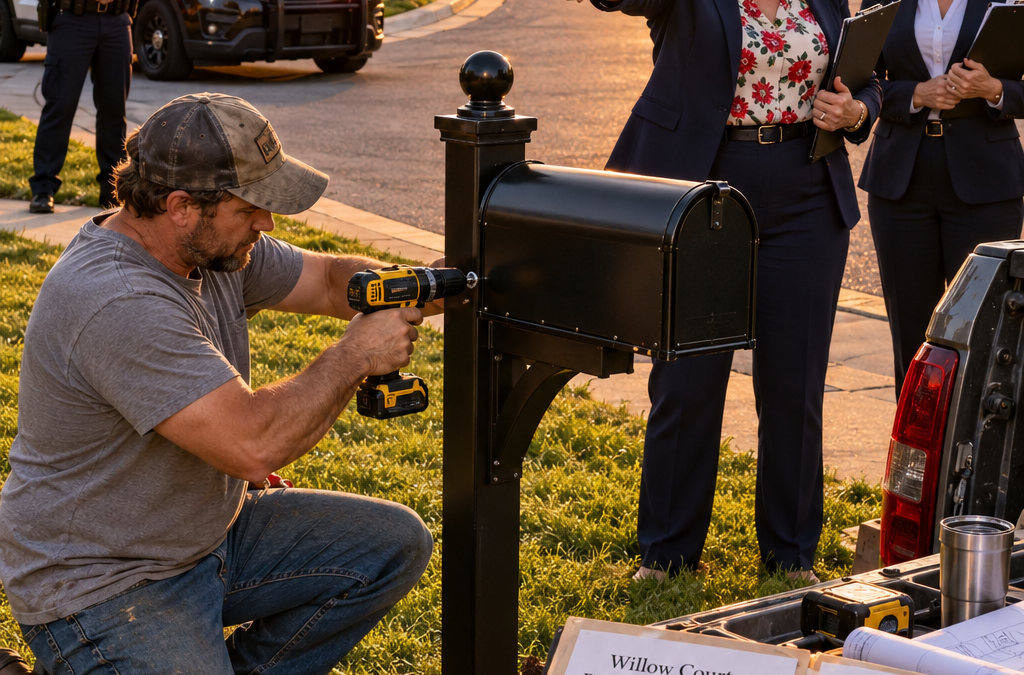
Three days later, I started replacing my mailbox.
Black metal box.
Cedar post.
Simple.
No decorative scrollwork.
No bright colors.
Completely legal under county regulations.
Apparently unacceptable under Brook Haven’s mailbox standards.
It was Saturday morning.
Warm.
Clear.
Several neighbors were outside.
Kids riding bikes.
Aaron washing his truck.
Alma watering flowers.
I had just tightened the post bracket when I saw two women walking down the sidewalk.
Navy blazers.
Clipboards.
Purposeful pace.
The first had blond hair styled perfectly and sunglasses pushed onto her head.
Celeste Whitaker.
I recognized her from board photographs.
Beside her walked Joyce Danner, Brook Haven’s secretary.
Joyce carried the familiar blue HOA folder.
Then I saw the patrol car.
It rolled toward the curb behind them.
For a mailbox.
They had called police before even speaking to me.
Celeste stopped on my lawn.
“Sir.”
I continued tightening the screw.
“Morning.”
“This mailbox violates Section Nine.”
“Does it?”
“Only approved models may be installed.”
“Interesting.”
“You will need to remove it immediately.”
I stood.
Celeste glanced at the post.
Then at me.
“And a four-hundred-dollar violation assessment will be added to your account.”
“Which account?”
She blinked.
“Your Brook Haven account.”
“I don’t have one.”
Joyce looked at Celeste.
Celeste smiled.
Cold.
Patient.
The way adults smile at children who have said something silly.
“Everyone residing on Willow Court is part of Brook Haven Estates.”
“No.”
Her smile tightened.
“Excuse me?”
“I’m not under your HOA.”
By now, people were watching.
Alma stood near her porch.
Aaron dried his hands on a towel and walked toward the sidewalk.
Celeste let out a short laugh.
“Sir, that’s not something residents get to choose.”
“I agree.”
She looked confused by my agreement.
“Property either is or isn’t subject to recorded covenants.”
“Exactly.”
“And mine isn’t.”
That stopped her.
Only for a second.
Then she turned toward the patrol car.
“Officer.”
The driver door opened.
Sergeant Lena Ortiz stepped out.
Short gray-streaked hair.
Calm face.
She didn’t move with the urgency Celeste apparently expected.
“What’s happening?”
Celeste spoke first.
“This gentleman is altering community property and refusing to comply with association requirements.”
I looked at my mailbox.
Community property?
Interesting.
Sergeant Ortiz looked at me.
“Sir?”
“Nolan Reeves.”
“Do you live here?”
“I do.”
Celeste interrupted.
“He moved in recently.”
“I’ll ask him.”
Celeste stopped.
Ortiz turned back.
“Mr. Reeves, what’s the dispute?”
“This mailbox is on property I own. Brook Haven doesn’t have jurisdiction here.”
Celeste snorted.
“That’s false.”
Ortiz glanced at her.
“Do you have documents?”
“Of course.”
She raised her clipboard.
I said:
“So do I.”
Celeste rolled her eyes.
“He’s stalling.”
“Sergeant,” I said, “give me thirty seconds. I think it’ll save everybody trouble.”
Ortiz nodded.
I walked onto my porch.
My folder sat beside my coffee.
I brought it down.
First page.
Recorded deed.
Reeves Property Group.
Willow Court portfolio.
All twelve parcels.
Ownership transferred through bankruptcy sale.
County stamp.
Ortiz read.
Then looked at me.
“You own this house?”
“Yes.”
“Through the company?”
“Yes.”
“Okay.”
Celeste crossed her arms.
“Ownership doesn’t exempt property from covenants.”
“Correct,” I said.
That annoyed her.
I handed Ortiz the second document.
Brook Haven Estates Declaration.
Recorded covered-lot schedule.
Ortiz scanned.
Then another page.
And another.
Her eyebrows lifted.
“Where’s Willow Court?”
“It isn’t there.”
Celeste spoke immediately.
“Clerical omission.”
Ortiz looked at her.
“Is there an amendment?”
I handed over the annexation form.
Signed.
Dated.
Not recorded.
Ortiz examined the recorder area.
Blank.
“This wasn’t filed?”
“No.”
Celeste’s voice hardened.
“It was approved.”
“Approval isn’t the same as recording.”
“You are not an attorney.”
“No.”
I smiled slightly.
“My attorney is.”
Celeste looked toward the neighbors.
Her composure was beginning to crack.
“This man has been here less than two weeks. He’s a tenant or a squatter. He has no idea what he’s talking about.”
That was when I realized she still didn’t understand the first document.
Sergeant Ortiz held up the deed.
“Ma’am, it lists his company as owner.”
Celeste stared.
“He owns this house?”
I answered:
“I own every house on Willow Court.”
Silence.
Real silence.
The kind that seems to absorb ordinary sounds.
A bicycle wheel clicked somewhere behind me.
Alma’s garden hose kept running.
Joyce’s mouth opened.
Then closed.
Celeste stared as if I had spoken another language.
“That’s impossible.”
“No.”
“The developer owns these properties.”
“Not anymore.”
“The residents have purchase agreements.”
“Some do. None closed.”
She looked toward Ortiz.
“This is a private HOA matter.”
I almost laughed.
“You called the police.”
Joyce whispered:
“Celeste.”
Celeste ignored her.
I turned toward the neighbors.
They were gathering now.
Nearly every house had somebody outside.
Some faces confused.
Some frightened.
I had planned to tell them carefully.
That plan was gone.
So I spoke plainly.
“Willow Court was never legally annexed into Brook Haven Estates.”
Alma’s hand went to her mouth.
Aaron stared.
I continued.
“The HOA declaration doesn’t include these twelve lots. An annexation form was prepared six years ago but never recorded.”
A man farther down said:
“What does that mean?”
“It means the HOA never obtained the legal authority it claimed over this street.”
Celeste snapped:
“That is your interpretation.”
“No.”
I held up the certified title report.
“This is the county record.”
Another resident asked:
“What about the dues?”
I looked at them.
“That’s being reviewed.”
“You said the HOA had no authority.”
“Correct.”
“So we’ve been paying them for nothing?”
Celeste stepped toward me.
“You need to stop making defamatory statements.”
I looked at her.
“Did Brook Haven collect assessments from Willow Court?”
“Yes, because—”
“Was the annexation recorded?”
“It was approved.”
“Recorded?”
She said nothing.
Joyce was staring at her now.
Not me.
Celeste turned.
“Joyce, don’t.”
Joyce’s hands shook.
“Celeste.”
“Not here.”
“What does he mean it wasn’t recorded?”
Celeste lowered her voice.
“We’ve discussed this.”
“No.”
Joyce’s breathing changed.
“You told us it had been recorded.”
Celeste’s face went hard.
“This is not the place.”
Then Joyce did something none of us expected.
She opened her blue folder.
Started pulling papers.
Minutes.
Notices.
Copies.
Then a small yellow note.
Crumpled.
Blue ink.
“I found this last month.”
Celeste froze.
Joyce read it aloud.
“Hold. Do not record. CW.”
My entire body went still.
I knew the note existed.
I did not know Joyce had found her own copy.
Celeste’s voice dropped.
“Give me that.”
Joyce stepped back.
“Is this yours?”
“Joyce.”
“Did you write it?”
“That is association property.”
“Did you write it?”
Celeste reached.
Joyce held it away.
Tears were appearing in her eyes.
“You told us the developer delay was administrative.”
“It was.”
“You told us Willow Court was fully under Brook Haven.”
“It is.”
“No.”
Joyce shook her head.
“You knew.”
Celeste stared at her.
The entire street watched.
“You knew it wasn’t recorded.”
“Things are more complicated than this man is making them sound.”
“What is complicated?”
Joyce’s voice broke.
“We charged them.”
Celeste’s jaw tightened.
“We provided services.”
“That doesn’t answer me.”
“You were secretary.”
“Because you told me everything was legal.”
Celeste glanced toward Ortiz.
Toward me.
Toward the neighbors.
For the first time, she seemed to understand that this was no longer a mailbox dispute.
Sergeant Ortiz took one slow breath.
“Ms. Whitaker, I think you need to stop making assertions about this man’s legal right to be here.”
Celeste’s face flushed.
“I called because he was being disruptive.”
“He was installing a mailbox.”
“Against community rules.”
Ortiz looked at the declaration.
“Rules that may not apply to this property.”
Celeste said nothing.
Ortiz continued:
“And you reported him as someone unlawfully occupying HOA-controlled property.”
“I believed—”
“You just stated you knew the annexation history.”
“I did not say that.”
“No. Your secretary did.”
Celeste looked at Joyce with such anger that Joyce physically stepped back.
Ortiz’s voice remained calm.
“Filing a knowingly false report can create its own legal problem. I’m not deciding what happened here, but I strongly suggest you stop escalating this conversation and speak with counsel.”
Celeste said:
“This is a civil matter.”
“Then why did you call me?”
That ended it.
Nobody cheered.
Not yet.
The moment was too strange.
I looked at Alma.
She was crying.
Not dramatically.
Quietly.
I walked toward her.
“You okay?”
She looked at me.
“I paid them.”
“I know.”
“All those years.”
“I know.”
“Rafael paid too.”
Her husband.
Gone now.
She looked toward Celeste.
“She told us we’d lose the house.”
Something inside me hardened.
I turned.
Celeste was speaking rapidly to Joyce.
Joyce kept shaking her head.
I addressed everyone.
“I have an attorney.”
People quieted.
“We’re going through every assessment and every fine collected from Willow Court.”
Aaron asked:
“Are we getting it back?”
“If the records confirm what we’ve found, we’re going after all of it.”
“How much?”
I didn’t want to give an estimate.
Not yet.
“Enough that it matters.”
Celeste laughed bitterly.
“You bought rental property and now you’re pretending to be some hero.”
I looked at her.
“No.”
“Then what exactly are you doing?”
“Reading.”
She frowned.
“The thing nobody expected us to do.”
Her expression changed.
She knew what I meant.
Miriam filed the next morning.
Not one lawsuit per tenant.
A coordinated civil action involving the twelve households, my ownership entity, refund and restitution claims, challenges to the HOA’s authority, and requests for preservation of Brook Haven’s financial records.
She also referred the documentation to county authorities.
Once the case began, everything accelerated.
The Brook Haven board held an emergency meeting.
Residents from the main neighborhood attended.
News of Willow Court had spread overnight.
People wanted to know whether their own fees were safe.
Whether Celeste had authority.
Whether HOA books were accurate.
The board retained outside counsel.
Then the county opened a review.
A state auditor eventually examined Brook Haven’s finances.
What they found turned my stomach.
The $450,000 estimate had been close.
Willow Court families had paid roughly that amount over six years through assessments, violation fines, late charges, administrative fees, and other collections.
Some money had gone toward legitimate Brook Haven expenses.
Landscaping.
Management contracts.
Pool maintenance.
Security.
But Willow Court wasn’t legally obligated to fund those things.
That alone created enormous exposure.
Then auditors found something worse.
Nearly $190,000 tied to HOA reserve movements couldn’t be justified through ordinary association expenses.
The trail led to accounts and payments benefiting Celeste.
Her pool renovation.
Kitchen remodel.
A deposit related to a lakehouse purchase.
The paper trail was ugly.
Invoices disguised as association improvements.
Transfers approved through management accounts.
Descriptions vague enough to pass casual review.
But not a real audit.
Troy Hendricks, the property manager who had collected money on Willow Court, was interviewed.
At first, he claimed he had simply followed board instructions.
Then investigators showed him the transfers.
His loyalty weakened.
He eventually admitted he had processed payments at Celeste’s direction.
Some he questioned.
Some he didn’t.
That did not make him innocent.
But it made him useful to prosecutors.
Celeste resigned before the first major hearing.
Her resignation letter blamed “hostile misinformation” and an “organized effort to undermine Brook Haven governance.”
She did not mention the sticky note.
She did not mention the unrecorded annexation.
She did not mention Alma.
Or Aaron.
Or the $190,000.
Resignation didn’t stop anything.
The prosecutor filed fraud and misappropriation charges.
Troy accepted a plea agreement and agreed to testify.
The Brook Haven HOA was placed under independent financial oversight.
I attended the civil hearing with the Willow Court families.
The courtroom wasn’t large enough for everyone who wanted to come.
Alma sat in the front row.
Gray cardigan again.
Hands folded.
But something had changed.
Months earlier, on her porch, she had lowered her voice when speaking about the HOA.
As if Celeste might hear through walls.
Now she sat upright.
Looking directly toward the front.
Miriam presented the title history.
Brook Haven declaration.
Lot schedule.
Unrecorded annexation.
Board notes.
Payment records.
Sticky note.
The case was almost painfully simple on the central issue.
An association cannot enforce recorded covenants against property never made subject to them through the required legal process.
Brook Haven had treated Willow Court as though appearance created jurisdiction.
It didn’t.
Celeste’s attorney tried to argue implied participation.
Residents used Brook Haven amenities.
They received services.
They paid assessments for years without objecting.
Miriam stood.
“People complied because they were threatened with fines, liens, and removal.”
She lifted one of Alma’s notices.
“Consent obtained under a false claim of legal authority does not transform an unrecorded annexation into a recorded one.”
The judge agreed.
The HOA lacked legal authority over Willow Court during the period in question.
Assessments and fines collected under that claimed authority had to be returned.
Interest applied.
Accounting had to be completed household by household.
Some numbers took weeks to finalize.
The emotional impact was immediate.
Alma cried when Miriam told her what her refund would be.
Not because it made her rich.
It didn’t.
Because some of that money had been Rafael’s.
He had died believing those payments were required to keep his wife safe in their home.
“I told him we couldn’t fight them,” she said.
I sat at her kitchen table.
“You didn’t know.”
“He wanted to.”
“Alma.”
“I told him to pay.”
“You were protecting your home.”
Her eyes filled.
“They scared us.”
I didn’t have a good answer.
Some injuries aren’t fixed by refund checks.
Money can return.
Years of fear don’t.
Then I had to deal with another problem.
The people living on Willow Court still didn’t own their houses.
The HOA fraud was one issue.
Their lease-to-own agreements with Hallbrook were another.
When I bought the portfolio, I bought the landlord position.
Legally, I could have kept collecting rent.
Raised it when leases allowed.
Renovated.
Sold homes at market value.
That was the business model most investors would have followed.
Financially, it made sense.
Emotionally, after what I had seen, it felt wrong.
These families had spent years acting like owners while everybody around them made money from the ambiguity.
Hallbrook collected rent.
Brook Haven collected unauthorized assessments.
Some tenants had paid far more than they realized toward a future ownership plan that never closed.
I didn’t want to become the third organization telling them they had misunderstood the fine print.
So I met with Miriam.
“I want to sell them the houses.”
“Good.”
“At my cost.”
She stared.
“What?”
“My acquisition cost allocated per property.”
“Nolan.”
“No markup.”
“Do you understand what these are worth?”
“Yes.”
“You could make a significant return.”
“I know.”
“That is why you bought the portfolio.”
“It was.”
She leaned back.
“You’re not running a charity.”
“No.”
“Then explain.”
I thought about Alma.
Aaron.
The threatening letters.
The way the street looked when Celeste called the police.
“They’ve paid enough.”
Miriam studied me.
“You can’t undo six years by giving away equity.”
“I’m not giving houses away.”
“No, you’re giving away profit.”
“Different.”
“To investors, barely.”
“Good thing it’s my company.”
She smiled slowly.
“You’re impossible.”
“Can you structure it?”
“Of course.”
We prepared written offers for every Willow Court household.
Purchase price based on my acquisition basis for that specific house.
No speculative market markup.
Reasonable closing period.
Assistance reviewing financing options.
Independent attorneys encouraged.
No pressure.
If someone didn’t want to buy, the rental continued.
I did not want gratitude to become another form of coercion.
Alma received her offer first.
She read the number.
Then read it again.
“This is wrong.”
“No.”
“The house is worth more.”
“Yes.”
“Then why?”
“Because that’s what my company effectively paid for it.”
She stared at me.
“You could sell it for twice this.”
“Probably.”
“Nolan.”
“Do you want to buy your house?”
She started crying.
I suddenly felt terrible.
“Alma—”
“I don’t have that kind of money.”
“Look at the financing page.”
She did.
Between her refund from Brook Haven, savings, and a loan program Miriam’s team had helped identify, it was possible.
Not easy.
Possible.
“Would it be mine?”
“Completely.”
“No Brook Haven?”
“Not unless you voluntarily join someday.”
She laughed through tears.
“Never.”
“Reasonable.”
She signed months later.
Not that day.
I insisted every resident take the offer to someone independent before agreeing.
Twelve households.
Eleven eventually purchased.
One family chose to move closer to relatives.
We sold that house later.
The street changed slowly.
Not physically.
Psychologically.
People stopped treating every official-looking envelope like a threat.
Some removed identical Brook Haven-approved landscaping.
Aaron put his basketball hoop back.
A family painted their front door dark green.
Alma’s garden gnome returned.
Same one.
Red hat.
Slightly chipped.
She placed it directly beside the mailbox Brook Haven had once fined her over.
Joyce Danner remained in Brook Haven.
I expected residents to reject anyone associated with Celeste’s board.
But Joyce had been manipulated too.
She had found the note.
She had produced it publicly.
Then cooperated with investigators.
When Brook Haven reorganized under independent oversight, residents elected Joyce to help rebuild the board.
I spoke with her once after a meeting.
She looked exhausted.
“I don’t know why they voted for me.”
“Because you told the truth when it cost you.”
“It should’ve happened earlier.”
“Yes.”
She looked down.
“I signed notices.”
“I know.”
“I sent some of the fines.”
“I know.”
“I believed Celeste.”
I waited.
She said:
“That doesn’t excuse it.”
“No.”
She looked surprised.
Maybe she expected comfort.
I wasn’t going to lie to make either of us feel better.
“But it matters what you do after you learn you’re wrong.”
She nodded slowly.
“I found that sticky note a month before the mailbox.”
“Why didn’t you do anything?”
“I asked Celeste.”
“What did she say?”
“Old paperwork. Administrative hold. Already fixed.”
“You believed her.”
“I wanted to.”
That was honest.
We all do that sometimes.
Evidence arrives.
But accepting it would require us to admit something painful about a person or institution we trusted.
So we look for another explanation.
Until reality becomes too heavy to carry around.
Joyce had finally put hers down in public.
I respected that.
Troy’s case ended differently.
He took the plea.
Testified.
Lost his management position.
Paid restitution under his agreement.
Some Willow Court residents hated him more than Celeste because he had been the one physically coming to their doors.
The face attached to fear.
I understood.
But I also understood systems.
Celeste needed people willing to convert her decisions into routine administrative actions.
Troy did that.
Print notice.
Collect fee.
Post charge.
Send threat.
Move money.
He wasn’t the source of every decision.
He was the mechanism.
Mechanisms still have responsibility.
The biggest lesson wasn’t about one corrupt HOA president.
It was about how normal wrongdoing can look when paperwork has a logo.
Nobody on Willow Court handed Celeste cash because she showed up with a mask.
They paid through portals.
They received invoices.
They got account numbers.
Violation codes.
Due dates.
Late penalties.
Everything looked legitimate.
That’s why it worked.
Professional formatting can make an illegal demand feel inevitable.
The families weren’t foolish.
They were busy.
Working.
Raising children.
Caring for spouses.
Mourning.
Living.
Most people do not read county recording systems before paying neighborhood dues.
Institutions depend on that.
Usually appropriately.
Society would be impossible if everyone independently verified every routine transaction.
But trust creates an opening.
Someone has to deserve it.
Celeste didn’t.
Months after the cases settled, Brook Haven removed its signs from Willow Court.
That was one of the strangest moments.
For years, a small green sign at the cul-de-sac entrance said:
BROOK HAVEN ESTATES
WILLOW COURT
One morning, a maintenance crew unbolted it.
Not because Willow Court was moving.
Because the sign claimed something the law never had.
I stood with Aaron watching.
He said:
“Feels weird.”
“Good weird?”
“Not sure.”
He looked down the street.
“Been Brook Haven since we moved here.”
“No. Looked like Brook Haven.”
He nodded.
“That’s what I mean.”
Identity is sticky.
Even false administrative identity.
The court could declare Willow Court outside the HOA.
County records could confirm it.
Still, people had spent six years thinking of themselves as the cheap section of Brook Haven.
Celeste had reinforced that constantly.
According to Alma, she once referred to Willow Court at a board meeting as “the transitional side.”
Meaning cheaper.
Less prestigious.
Not fully equal.
Yet equal enough to pay dues.
That contradiction told me everything.
Brook Haven wanted their money without wanting them.
When the sign came down, Willow Court finally had to become its own thing.
Residents voted informally to keep the street name.
Of course.
They liked Willow Court.
Nobody wanted another association.
They created a simple voluntary maintenance group for shared concerns.
No architectural rules.
No mailbox catalog.
No garden-gnome enforcement.
If someone wanted to organize a block party, they collected money by choice.
If a storm knocked down branches, people helped.
Messy.
Human.
Effective.
The block party happened in late summer.
Folding tables across the cul-de-sac.
Coolers.
Grills.
Children racing bikes.
Someone brought speakers.
Someone else brought enough food for three streets.
Mailboxes no longer matched.
That became a kind of joke.
Black.
White.
Green.
One shaped vaguely like a barn.
Aaron’s was huge.
I asked why.
“Freedom.”
“That’s not freedom. That’s a package locker.”
“Same thing.”
Alma arrived carrying the garden gnome.
She placed it in the center of the circle.
Everybody laughed.
Then she looked at me.
“Fine me.”
I raised both hands.
“Absolutely not.”
“Four hundred dollars.”
“You’re dangerous now.”
She laughed.
It was the first time I had ever seen her laugh without lowering her voice first.
That mattered more than the court ruling.
More than the audit.
More than Celeste’s charges.
Fear had left her body.
Not all at once.
But enough.
At some point that evening, I walked toward the mouth of the cul-de-sac.
My mailbox stood there.
Black metal.
Cedar post.
Nothing special.
The one that triggered the confrontation.
Joyce happened to be visiting the block party.
She joined me.
“That’s the famous mailbox.”
“Unfortunately.”
“Still not approved.”
“Tragic.”
She smiled.
Then became serious.
“Celeste really believed you’d remove it.”
“I know.”
“She said the police would make you.”
“Why?”
“Because they’d done it before.”
I looked at her.
“What do you mean?”
“Not mailboxes necessarily.”
She folded her arms.
“People usually backed down when a patrol car appeared.”
That chilled me.
Not because the police had been enforcing HOA rules directly.
Most likely they hadn’t.
But the appearance of authority had been enough.
Board president.
Clipboard.
Official letters.
Police cruiser.
People see those things together and assume somebody else has already determined who is right.
I thought about Sergeant Ortiz.
She had done something simple.
Asked for documents.
Nothing heroic.
No grand speech.
She didn’t blindly take my side.
She read.
That was enough.
“Ortiz saved everyone trouble,” I said.
Joyce nodded.
“Celeste hated her after that.”
“Good sign.”
The criminal proceedings against Celeste lasted longer.
I attended only when Willow Court residents asked me to.
I wasn’t the prosecutor.
Didn’t want to become obsessed with punishment.
The evidence spoke for itself.
Financial transfers.
False descriptions.
Unauthorized assessments.
Personal expenses.
Troy’s testimony.
Celeste’s defense tried to characterize several payments as reimbursements and benefits approved informally through board discretion.
Auditors disagreed.
So did the court on the key counts.
She was ordered to pay restitution.
Other penalties followed through the criminal case.
I won’t pretend watching her face consequences felt bad.
It didn’t.
I thought about Alma’s trembling hands.
Aaron borrowing money.
Rafael dying believing the HOA could remove his wife.
Actions have weight.
Consequences should too.
But revenge became less interesting with time.
Celeste eventually stopped being the center of Willow Court’s story.
That was healthier.
For six years, she had been central.
Her letters.
Her rules.
Her threats.
Afterward, people talked about mortgages.
Repairs.
Schools.
Gardens.
Ordinary things.
That was victory.
Not seeing Celeste suffer forever.
Living without thinking about her.
The last home purchase on Willow Court closed nearly a year after I bought the portfolio.
A young couple named Tessa and Malik.
They had two children.
They signed in a small title-office conference room.
When the closing agent slid the deed across, Malik stared at his name.
Then looked at me.
“That’s it?”
“That’s it.”
“I own it.”
“You own it.”
He laughed.
Then suddenly became quiet.
“We’ve been paying on this place for five years.”
“I know.”
“Never had our names on anything.”
“Now you do.”
He ran a finger over the deed.
Paper.
There it was again.
Not emotional-looking.
No music.
No dramatic lighting.
Legal description.
Names.
Recording instructions.
But to Malik, that page meant something no HOA welcome packet ever had.
Actual ownership.
I thought about Celeste’s blue folder.
All those rules.
All those fees.
All those threats printed professionally.
Then this one plain deed.
Paper versus paper.
Difference was authority.
That afternoon I drove back to Willow Court.
Alma was outside.
Of course.
Flowers.
Gnome.
Mailbox.
She waved.
“You own anything left here?”
I thought.
“One house.”
“Which?”
“The vacant one near the entrance.”
“You living there?”
“For now.”
“Then you’re stuck with us.”
“Apparently.”
Eventually I kept that house.
Not as an investment.
As mine.
I’d moved in temporarily and somehow the place grew on me.
Smaller than my previous home.
Quieter.
People waved.
Children left bikes in the wrong places.
Nobody cared what color my mailbox was.
I sold my old place and stayed.
Miriam called that decision irrational.
“You’re living inside your own case file.”
“I’m living in a house.”
“With eleven former tenants you turned into homeowners.”
“Neighbors.”
“That’s worse. They’ll borrow tools.”
“They already do.”
She laughed.
“You know the funniest part?”
“What?”
“You bought Willow Court because the numbers were good.”
“They were.”
“And then gave away most of the upside.”
“Not all.”
“Enough.”
I looked out my window.
Alma was arguing with Aaron about where to put holiday lights.
“No regrets.”
“You’re becoming sentimental.”
“Don’t tell anyone.”
The county eventually corrected every record connected with the old annexation attempt.
Brook Haven adopted tighter governance rules under independent oversight.
Financial controls.
Dual signatures.
External audits.
Recorded-document verification before extending authority over any property.
Homeowners from the main neighborhood began attending meetings in larger numbers.
That’s another consequence nobody predicted.
People started paying attention.
Before Celeste, many residents treated the HOA like background noise.
Pay dues.
Ignore meetings.
Complain privately.
That allowed a small number of people to control almost everything.
Afterward, board seats became contested.
Budgets got read.
Invoices questioned.
Minutes reviewed.
Transparency feels inefficient to people who dislike questions.
That’s exactly why questions matter.
Joyce became surprisingly good at governance.
Not because she was fearless.
Because she was embarrassed by what fear had allowed her to accept.
She once told me:
“Every time someone says, ‘Trust me, that’s already handled,’ I ask to see it.”
“Good.”
“People hate me now.”
“Better.”
She laughed.
Maybe Brook Haven became healthier because it survived something ugly instead of pretending nothing happened.
I don’t know.
I do know Willow Court never rejoined.
There was a proposal once.
New Brook Haven board.
Clean terms.
Reduced dues.
Full voting rights.
Residents listened politely.
Then Alma raised her hand.
“No.”
That ended discussion surprisingly quickly.
I asked her later:
“You didn’t even want to hear the benefits?”
“I heard six years of benefits.”
Fair.
Years passed.
The garden gnome survived.
So did the mailbox.
Sergeant Ortiz drove through occasionally.
The first time after everything settled, I was outside washing my truck.
She slowed.
Rolled down the window.
“Mailbox still causing problems?”
“Constantly.”
She smiled.
“Stay out of trouble.”
“No promises.”
Then she drove on.
I thought about that morning again.
Celeste with the clipboard.
Patrol car behind her.
Neighbors afraid.
Me holding a folder.
At the time, it felt like a dramatic reveal.
I own this whole block.
People remember that line.
They repeat it.
But ownership wasn’t actually the most important discovery.
The most important discovery was simpler.
Celeste didn’t.
Not Willow Court.
Not Alma.
Not Aaron.
Not their homes.
Not their choices.
Not their fear.
She possessed administrative power over Brook Haven and began treating proximity like ownership.
That’s how overreach often starts.
A person has legitimate authority somewhere.
Then uses the same tone beyond the boundary.
Most people don’t know where that boundary sits.
So it moves.
One warning.
One fee.
One assumption.
Until years later, somebody asks:
Show me the recorded document.
Celeste’s power evaporated under that question.
Not instantly.
She fought.
Deflected.
Threatened.
Called police.
But none of those things could manufacture a recording stamp that never existed.
I still keep copies of the key documents.
The original declaration.
Annexation form.
Sticky note.
Certified title history.
Audit findings.
The mailbox violation.
That last one is my favorite.
Four hundred dollars.
Unauthorized mailbox.
I framed it.
Miriam thinks that’s immature.
She may be right.
It hangs in my office.
Not because I enjoy remembering Celeste.
Because it reminds me how confidently organizations can demand something they never had authority to demand.
The letter looks official.
Logo.
Citation.
Deadline.
Amount.
Signature.
If you saw it without context, you would assume I owed four hundred dollars.
I didn’t owe a cent.
Appearance isn’t authority.
That principle has saved me millions in commercial property deals.
On Willow Court, it saved people from something more personal.
Fear.
Alma once asked me whether I knew from the beginning Celeste would call police.
“No.”
“You looked very calm.”
“I was calm.”
“Why?”
“I had the deed.”
She laughed.
“Paper wins?”
“Usually.”
She pointed toward the gnome.
“Sometimes gnome wins.”
I conceded.
Maybe that’s the real ending.
Not courtroom restitution.
Not a prosecutor.
Not Celeste resigning.
An old woman laughing beside a garden decoration she had once been too frightened to display.
A young father owning the house someone threatened to lien when he was only a tenant.
Children riding bicycles through a cul-de-sac without knowing why the mismatched mailboxes make the adults smile.
Those things are harder to put into legal documents.
But they’re why legal documents matter.
Rights sound abstract until someone takes advantage of your uncertainty.
Then boundaries become personal.
Ownership becomes personal.
Consent becomes personal.
Six years earlier, somebody wrote:
HOLD. DO NOT RECORD.
Maybe they thought the delay would last weeks.
Maybe they planned to fix it later.
Maybe Celeste saw an opportunity immediately.
Whatever happened at the beginning, by the time I arrived, she knew Willow Court had never been legally annexed.
She also knew money kept coming.
So she let it.
Then protected the system that produced it.
That was the choice.
Not the original paperwork mistake.
The years afterward.
Every invoice.
Every fine.
Every threat.
Each one another decision to keep pretending.
When Sergeant Ortiz asked whether the missing recording was another clerical error, Celeste had no good answer because six years is too long for an error to remain accidental when the person benefiting from it knows exactly where the file is.
That’s what the evidence eventually proved.
People often tell me I got lucky finding the sticky note.
Maybe.
But the note didn’t create the truth.
It exposed knowledge.
The county index already showed no annexation.
Brook Haven’s declaration already omitted the lots.
Payment records already existed.
The sticky note simply connected one person to the decision.
That’s another lesson.
Don’t fall in love with the dramatic piece of evidence.
Build the boring foundation first.
Deeds.
Dates.
Records.
Payments.
Minutes.
Then when the dramatic document appears, it actually means something.
Without the title history, “Hold, do not record” is suspicious.
With the title history, six years of assessments, board minutes, and Celeste’s initials, it becomes devastating.
Paper wins when paper connects.
I still work in real estate.
I still buy difficult assets occasionally.
I still read everything.
Maybe more slowly now.
When junior investors complain that title work is boring, I tell them about Willow Court.
Not Celeste’s prosecution.
Not the block party.
The mailbox.
I tell them how a $400 violation notice revealed a six-year scheme because somebody assumed the new guy wouldn’t know where HOA authority came from.
Then I say:
“Never argue first.”
They usually look confused.
“Read first.”
If the other side is wrong, anger doesn’t improve the deed.
If you’re wrong, anger makes you look foolish.
Either way, documents are cheaper than shouting.
That Saturday morning, Celeste arrived expecting a simple enforcement encounter.
New resident.
Wrong mailbox.
Fine.
Police presence.
Compliance.
She had repeated that process often enough that she probably thought she knew every step.
What she didn’t know was that the ownership underneath the street had changed.
And more importantly, somebody had finally read the file she had counted on nobody reading.
There are days I still stand near the mouth of Willow Court with coffee.
My black mailbox has faded slightly.
Cedar post needs resealing.
Across the street, Alma’s gnome stares toward traffic with the same ridiculous smile.
Kids have grown.
Some families moved.
Others stayed.
Willow Court doesn’t look revolutionary.
Good.
It looks like a street.
Homes.
People.
Mailboxes.
Gardens.
That’s all it ever needed to be.
No one standing over it with a clipboard pretending ordinary life required permission.
Sometimes Alma walks over.
We talk.
One morning she asked:
“Would you have bought all this if you hadn’t seen the HOA problem?”
I thought.
“Probably.”
“Liar.”
“Maybe.”
She smiled.
“You wanted a fight.”
“No.”
“You liked the paperwork.”
“That I admit.”
She pointed toward the houses.
“You changed twelve families.”
“I bought property.”
“No.”
She shook her head.
“Don’t do that.”
“Do what?”
“Make it smaller because the bigger thing embarrasses you.”
I didn’t answer.
Maybe she was right.
I don’t think of myself as someone who saved Willow Court.
That language makes me uncomfortable.
The families endured six years before I arrived.
Joyce told the truth.
Sergeant Ortiz slowed the conflict.
Miriam built the case.
Paul found the original file.
Auditors followed money.
Prosecutors did their work.
Residents bought their houses.
A lot of people moved the story.
I happened to be the guy who bought the portfolio and asked why the numbers didn’t match the title.
That’s enough.
The whole thing began because I saw a mess in a bankruptcy listing.
Twelve homes.
One owner.
Strange payments.
An annexation that was signed but never recorded.
Most investors skipped it.
I looked closer.
That is what I remember when I think about power.
Celeste believed power was visible.
Blazer.
Clipboard.
Title.
Police car.
Letterhead.
Fine schedule.
People obeying.
The real power was much quieter.
A recorder’s stamp that didn’t exist.
A list of lot numbers.
A deed.
A sticky note.
A woman finally willing to say, “You told me this was recorded.”
A sergeant willing to read before acting.
Truth had been sitting there for six years.
Nobody needed to invent it.
Nobody needed a miracle.
Someone just had to open the file.
And once we did, Celeste Whitaker’s entire kingdom ended at the exact place it should have ended all along.
The boundary line.








