𝗙𝗨𝗟𝗟 𝗦𝗧𝗢𝗥𝗬 The HOA Called My Rusty Tractor a Blight and Never Asked Why I Refused to Move It
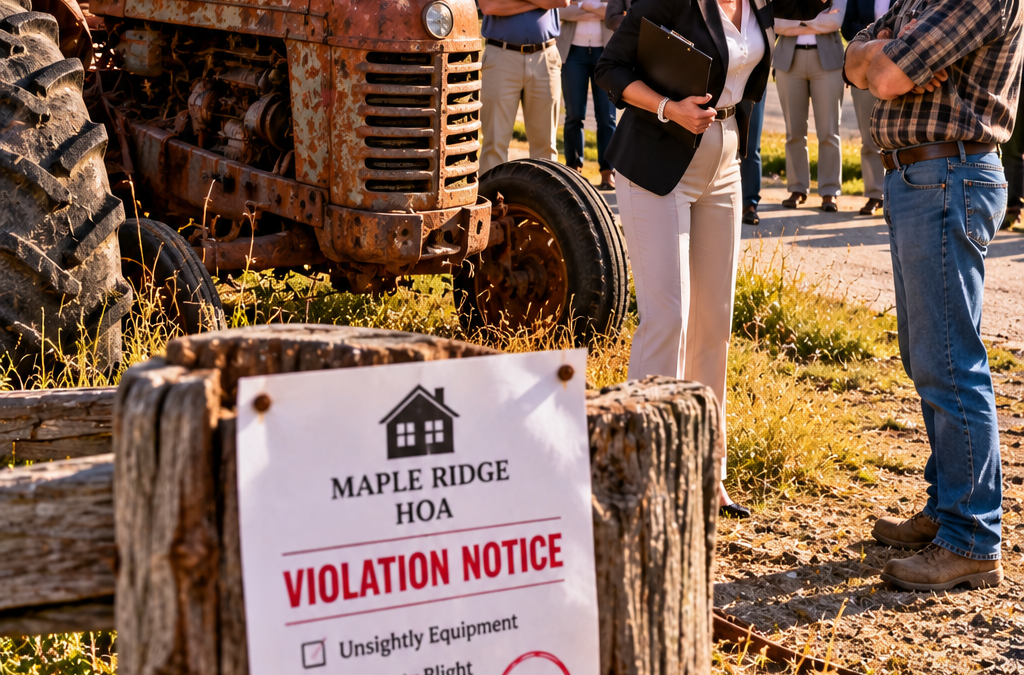
𝗙𝗨𝗟𝗟 𝗦𝗧𝗢𝗥𝗬
I looked offended.
She smiled.
I loved that machine.
Not because it was pretty.
Because it worked.
By the end of our second season, those forty-two acres were producing more food than some people believed possible.
Sweet corn.
Winter squash.
Garlic.
Onions.
Potatoes.
Dry beans.
Tomatoes.
Peppers.
Cabbage.
Greens.
A little wheat.
Some pumpkins.
Small plots rotated through cover crops.
We sold at markets, supplied a few restaurants, traded with neighboring growers, and kept enough for ourselves that our grocery bill became almost embarrassing.
Renata tracked everything.
Harvest dates.
Yields.
Seed costs.
Water use.
Storage losses.
Market sales.
She had always been better at recordkeeping than I was.
That log eventually mattered more than either of us expected.
For the first eight months, life was hard and peaceful.
Then Mil Haven Estates arrived.
Technically, development had begun before we purchased our land, but it accelerated after we moved in.
The development sat a little less than a quarter mile east of our property at its closest point.
Large homes.
Stone entrance signs.
Perfect lawns.
Decorative streetlights.
Community walking paths.
A clubhouse.
Everything landscaped to look effortless.
Our farm looked different.
Rows changed by season.
The barn showed its age.
Irrigation pipe sometimes lay beside fields.
Compost piles existed.
Equipment moved.
Mud happened.
Nothing about a farm remains visually perfect for long because farms are not stage sets.
At first, nobody cared.
Then Claudette Ferris became president of the Mil Haven Estates Homeowners Association.
I met her before I received the first letter.
She arrived in a white crossover one Saturday morning while I was servicing the Massey Ferguson near the pole shed.
The crossover stopped at the edge of my driveway.
She didn’t pull in.
She lowered the window.
“Are you Gerald?”
I wiped grease from my hands.
“Depends who’s asking.”
Her expression suggested she didn’t appreciate jokes unless she had written them herself.
“Claudette Ferris. Mil Haven Estates HOA president.”
I nodded.
“Morning.”
She looked past me.
Directly at the tractor.
Her face changed.
Not dramatically.
Just enough.
“That’s the equipment people have been talking about.”
I looked at the tractor.
“What equipment?”
“That.”
“My tractor?”
“Yes.”
“What about it?”
“It’s visible from the north walking path.”
I waited.
Claudette seemed to expect me to understand why this was catastrophic.
I didn’t.
Finally she said, “We have concerns about how agricultural equipment impacts the visual quality of the surrounding area.”
“Surrounding area.”
“Correct.”
“Your surrounding area or mine?”
Her lips tightened.
“The properties are adjacent enough that your farm affects our community.”
I leaned against the tractor tire.
“You built a subdivision beside a farm.”
“I understand that.”
“Do you?”
She ignored the question.
“The association encourages neighboring owners to maintain compatible exterior standards.”
“I’m not a neighboring HOA owner.”
“Technically.”
“No.”
I smiled.
“Not technically. Legally.”
That was the first time I saw how Claudette handled contradiction.
She didn’t respond to it.
She simply moved to the next assertion.
“We’d appreciate it if large equipment were stored out of sight.”
“Where?”
“Inside a structure.”
“The tractor doesn’t fit in the tool shed.”
“Then perhaps behind the barn.”
“That’s where I use it.”
“Your convenience isn’t the only consideration.”
I laughed before I could stop myself.
Her face hardened.
“Something funny?”
“Yeah.”
I pointed across the field toward Mil Haven.
“You moved into a development beside working agricultural land, and now you’re explaining that my tractor is inconvenient to your view.”
“I’m explaining community expectations.”
“I’m not in your community.”
Claudette put the vehicle into gear.
“We’ll follow up formally.”
“You do that.”
She did.
Two weeks later, the letter came.
Thick paper.
Gold embossed logo.
Mil Haven Estates Homeowners Association.
It informed me that my visible agricultural machinery constituted a “visual detriment to community aesthetic integrity.”
I had thirty days to remove or conceal the tractor from visible property lines.
Failure to comply could result in daily fines.
At the bottom, next to the signature, somebody had drawn a smiley face.
A little circle.
Two eyes.
Curved mouth.
I stared at it longer than the actual notice.
Renata came into the kitchen.
“What?”
I handed her the page.
She read it.
Then she looked at the smiley face.
“Is that official?”
“Apparently HOA law now includes emojis.”
“They’re fining you?”
“They’re threatening to.”
“Can they?”
“No idea.”
“Call Elaine.”
Elaine Mercer had handled our purchase and several agricultural matters after we moved.
I called immediately.
She asked for the letter.
Then our deed.
Then the HOA’s recorded declaration.
An hour later she called back.
“They don’t have jurisdiction.”
“You’re sure?”
“As sure as I can be without litigating it.”
“Explain.”
“Their declaration was recorded in 2019.”
“Okay.”
“Your property was deeded into its present form in 2008.”
“So?”
“So your parcel isn’t included in their plats, isn’t subject to their declaration, and I see no annexation instrument bringing you under HOA authority.”
“Then the letter means nothing.”
“Legally? Probably.”
“Probably?”
“Gerald, I bill by the hour. I don’t say definitely unless a judge has already signed something.”
“Fair.”
“What do you want to do?”
I looked through the kitchen window toward the tractor.
“Nothing yet.”
She paused.
“Why?”
“I want to see whether this is incompetence or intimidation.”
Elaine sighed.
“Do not antagonize them.”
“Wouldn’t dream of it.”
“You absolutely would.”
She knew me too well.
I did nothing.
The tractor stayed exactly where it was.
A week passed.
Then Claudette escalated.
Renata found the Facebook post first.
She walked into the barn holding her phone.
“You need to see this.”
I was sorting irrigation fittings.
“Can it wait?”
“No.”
She handed me the phone.
Claudette had posted three photographs in the Mil Haven Estates private Facebook group.
My tractor.
My irrigation pipe.
My tool shed.
The caption above the tractor read:
“Is this really the visual standard we want bordering our community?”
The irrigation photograph:
“Property values are everyone’s responsibility.”
The shed:
“This is why consistent exterior standards matter.”
There were 312 comments.
I remember the number because Renata told me not to read them all.
I did anyway.
“That farm looks like a junkyard.”
“Somebody should report him.”
“How is this allowed beside a premium development?”
“Tow that rusty dinosaur to the scrapyard where it belongs.”
“Imagine paying what we paid for these homes and looking at this.”
“Is he even licensed?”
“Probably running some illegal commercial operation.”
One person wrote:
“The HOA needs to make an example of this.”
I sat at the kitchen table until after midnight.
Every few minutes another comment appeared.
People I had never met.
People whose houses I had never entered.
People whose property I had never criticized.
They laughed at the rust.
The barn.
The rows.
One woman posted a laughing emoji beneath a zoomed-in photograph of the tractor’s cracked panel.
Another joked that my farm looked like a “post-apocalyptic vegetable camp.”
The strange thing wasn’t that strangers were rude online.
That happens every second.
What bothered me was how quickly people accepted Claudette’s version of reality.
She said I was harming property values.
They repeated it.
She implied I was violating rules.
They assumed rules existed.
Nobody asked whether the HOA had authority over my farm.
Nobody asked whether agriculture was permitted.
Nobody asked whether that “rusty dinosaur” actually worked.
They just laughed.
Renata eventually closed the laptop.
“Enough.”
“I’m fine.”
“No, you’re not.”
“I’m angry.”
“I know.”
She stood behind me and put both hands on my shoulders.
“Do you know what that tractor produced last season?”
“Yes.”
“How many pounds?”
I smiled despite myself.
“You know exactly how many.”
“Twenty-eight thousand, six hundred and twelve.”
“You memorized it?”
“I married you. I have to keep useful information somewhere.”
I looked toward the dark field.
“It’s not about the tractor.”
“I know.”
“They think because something looks old, it doesn’t matter.”
“People confuse polish with value.”
I glanced at her.
“That sounded like Grandpa.”
“Someone in this marriage has to be wise.”
I reached for the laptop.
She moved it away.
“No.”
“I want screenshots.”
“I already saved everything.”
That was why I married her.
What Claudette didn’t know was that while she was turning my tractor into neighborhood entertainment, I had been watching something far more important.
Distribution capacity.
I had never completely disconnected from my old industry.
Friends still called.
Former vendors sent updates.
I stayed subscribed to several trade dashboards.
Old habits die hard.
For almost a year, I had noticed troubling patterns.
Trucking capacity had declined across parts of the region.
Driver shortages were worsening.
Several smaller distribution facilities had consolidated operations.
Two major suppliers had reduced buffer inventory.
Weather disruptions had caused longer recovery periods than expected.
A regional warehouse serving several grocery chains had suffered repeated staffing issues.
Individually, none of those things meant crisis.
Together, they bothered me.
The system had less slack than people realized.
I began keeping spreadsheets again.
Renata noticed.
“You’re farming all day and doing your old job at night.”
“I’m not doing my old job.”
“That spreadsheet has fourteen tabs.”
“I’m observing.”
“You have color-coded delay categories.”
“Observing professionally.”
“What are you seeing?”
I turned the laptop toward her.
“A gap.”
“Meaning?”
“Distribution capacity is falling faster than demand.”
“How much?”
“Across four counties? About thirty-four percent in the lanes I’m tracking.”
Her expression changed.
“That sounds bad.”
“It might correct.”
“But you don’t think it will.”
“I think if anything else goes wrong, stores around here won’t have much cushion.”
“So what do we do?”
That question was why Renata and I worked.
She didn’t ask whether I was overreacting.
She asked what we did.
“We plant more storage crops.”
“How much more?”
“Enough that we’ll feel stupid if nothing happens.”
She smiled.
“That’s usually your favorite amount.”
We expanded dry beans.
Winter squash.
Garlic.
Potatoes.
Sweet corn.
We built more storage.
The old root cellar on the property had been half collapsed when we bought the place.
I rebuilt it.
Insulation.
Ventilation.
Shelving.
Moisture control.
Claudette was posting jokes about my tractor while I was hauling lumber for food storage.
She had no idea.
I also called fourteen families outside Mil Haven Estates.
Not wealthy people.
Mostly rural households.
An older couple down the road.
Two families with large gardens.
A man who kept laying hens.
Another who raised meat rabbits.
A beekeeper.
A small dairy family.
People who already understood informal resilience.
We agreed that if shortages got serious, we’d coordinate.
Eggs for vegetables.
Produce for milk.
Bulk purchases shared.
No panic.
No hoarding.
Just relationships.
Meanwhile, Claudette sent another violation notice.
This one cited “continued noncompliance.”
Another smiley face appeared at the bottom.
Someone had added little eyelashes.
Renata stared at it.
“That’s creepy.”
“It’s harassment.”
“Can Elaine stop it?”
“She can send a letter.”
“Do it.”
I shook my head.
“Not yet.”
“Gerald.”
“She’s making the record for us.”
Renata narrowed her eyes.
“You’re enjoying this part.”
“I’m not.”
“You are a little.”
“Maybe a little.”
Then Claudette made her real mistake.
She filed a complaint with the county zoning office.
The allegation was that I was operating unlicensed commercial agriculture within a residential buffer area.
When Elaine called me, she sounded almost cheerful.
“Congratulations.”
“On what?”
“Your HOA president just did something useful.”
“She reported me.”
“Exactly.”
“I’m missing the useful part.”
“Formal county review.”
“So?”
“So now jurisdiction matters.”
I understood.
“She has to prove the HOA’s claim.”
“And the county will review your agricultural status.”
“Which is legal.”
“Very.”
I leaned back.
“How legal?”
“Gerald, you have agricultural classification, tax filings, market records, water-use documentation, and county approval dating back before Mil Haven Estates completed its third street.”
“So we’re good.”
“We’re better than good.”
“What do you need?”
“Everything.”
Elaine filed our response.
Then she filed a document request.
Founding declaration.
Boundary surveys.
Maps.
Board minutes.
Annexation documents.
Any authority the HOA claimed over my parcel.
Claudette had opened the door.
Elaine walked through it carrying a legal briefcase.
The records came back three weeks later.
Messy.
That was Elaine’s word.
“Messy.”
Three different boundary surveys showed three slightly different outer limits.
One map shaded a buffer near my property.
Another didn’t.
Meeting minutes referenced “adjacent agricultural parcels” but never claimed ownership or covenant authority.
There was no annexation agreement.
No signature from me.
No signature from any prior owner.
No legal instrument giving Mil Haven Estates power to regulate my farm.
Elaine called me after reviewing it.
“They’re bluffing.”
“You sure?”
“The HOA has authority over Mil Haven Estates.”
“And me?”
“No.”
“Then why have they been sending fines?”
“Because nobody stopped them.”
That sentence bothered me.
Nobody stopped them.
I wondered how many other people had paid something simply because an official-looking letter told them to.
I kept farming.
Claudette kept talking.
Then the supply chain broke.
It didn’t happen all at once.
That’s not how real shortages usually begin.
First, certain brands disappeared.
Then delivery dates slipped.
Then grocery stores started limiting purchases.
A produce truck missed two scheduled runs.
A regional warehouse reduced outbound volume.
Within six weeks, three of the four major grocery stores within twenty miles were visibly struggling.
Produce sections had long empty stretches.
Eggs disappeared early.
Bread was gone by noon some days.
Canned goods became inconsistent.
People began driving farther.
Then everyone had the same idea.
Buy extra.
That made everything worse.
I drove past one grocery store on a Thursday morning and saw a line outside before opening.
Renata was in the passenger seat.
“They’re scared.”
“Yep.”
“How long?”
“I don’t know.”
“Best guess.”
“Several weeks before anything feels stable.”
She looked at me.
“We have enough?”
“For us?”
“And the fourteen families.”
“Yes.”
“What about everyone else?”
I didn’t answer.
Mil Haven Estates had over a hundred homes.
A lot of families.
A lot of children.
A lot of elderly residents.
Some wealthy.
Some not.
We couldn’t feed everybody indefinitely.
But we had something.
Claudette’s Facebook page changed almost overnight.
No more tractor jokes.
Now the posts were about grocery availability.
“Has anyone seen eggs?”
“Store on Highway 8 has potatoes.”
“Limit two cartons per customer.”
“Does anyone know when produce delivery arrives?”
Someone asked whether local farms sold directly.
I saw the post.
So did Renata.
She looked at me across the table.
“Don’t.”
“Don’t what?”
“Smile.”
“I’m not smiling.”
“You are absolutely smiling.”
“I’m appreciating irony.”
“That’s just smiling with a degree.”
Week three, Claudette called.
Not an email.
Not embossed stationery.
My phone rang at seven twelve in the evening.
I recognized the number.
“Hello?”
“Gerald.”
Her voice sounded different.
No board-president cadence.
No polished certainty.
Just tired.
“Claudette.”
She paused.
“I know things have been tense between us.”
I looked at Renata.
She could hear Claudette’s voice faintly from where she sat.
“I suppose that’s one description.”
Another pause.
“People in the community are struggling.”
I said nothing.
“Several families have young children. We have elderly residents. Some people can’t drive long distances looking for groceries.”
Still I said nothing.
“I understand you’ve continued producing food.”
“Yes.”
“Do you have surplus?”
I looked through the window at the storage shed.
Beans.
Squash.
Potatoes.
Garlic.
Some preserved tomatoes.
Eggs through one of our partner families.
Enough to help.
“Some.”
“I was wondering whether you might be willing to share.”
There it was.
The same HOA president who had spent months trying to make my farm disappear now wanted the farm.
Not visually.
Practically.
I could have humiliated her.
Could have repeated her own comments.
Could have asked whether rusty tractors were still a visual detriment.
Could have sent her the screenshot of “tow that dinosaur to the scrapyard.”
Every petty sentence entered my head.
Then I thought about the people who hadn’t written those comments.
Children.
Elderly residents.
Families who probably didn’t even use Facebook.
People who had voted for Claudette because nobody else wanted the job.
People whose only mistake was buying a house near mine.
I said, “I’d be willing to discuss it.”
Claudette exhaled.
“Thank you.”
“But in writing.”
Silence.
“What?”
“I want the entire arrangement in writing.”
“We don’t need to make this complicated.”
“You made it complicated eight months ago.”
Her voice tightened slightly.
“Gerald—”
“No.”
I kept my voice calm.
“You filed a zoning complaint against my farm. You sent violation notices. You claimed authority over my land. If we’re going to do business now, everything goes through Elaine.”
Another silence.
Then, quietly:
“Okay.”
No argument.
No threat.
No smiley face.
Just okay.
Elaine loved it.
When I called her the next morning, she laughed for a full five seconds.
“You are not allowed to enjoy this too much,” I said.
“I’m a lawyer. This is what joy looks like.”
“We’re feeding people.”
“Good.”
“But we’re not pretending the last eight months didn’t happen.”
“Better.”
We drafted an agreement.
Simple in concept.
Detailed in execution.
The HOA would formally withdraw all complaints and purported violations against my property.
The board would acknowledge in writing that my forty-two acres sat entirely outside Mil Haven Estates HOA jurisdiction.
The HOA would not represent otherwise in future communications.
The zoning complaint would be withdrawn where legally possible, while the county completed its independent review.
In exchange, I would create a temporary produce supply arrangement for Mil Haven residents at fair market value.
Not charity.
Not price gouging.
Fair market rates based on what I had already been charging direct customers.
Families in hardship could receive subsidized boxes through a separate community fund if the HOA wanted to create one.
I insisted on that structure because I didn’t want people lining up at my house feeling like beggars.
I knew what scarcity did to dignity.
We created order forms.
Pickup windows.
Quantities.
Limits so one family couldn’t buy fifty pounds while another got nothing.
Renata organized the logistics.
Of course she did.
“You realize we’re running distribution again,” she said.
“Don’t ruin this for me.”
“You left corporate logistics and accidentally built regional logistics in a barn.”
“This has better ventilation.”
“The barn has pigeons.”
“Exactly.”
Claudette resisted one clause.
The jurisdiction acknowledgment.
Elaine called me.
“She wants it softened.”
“How?”
“‘The HOA does not presently assert enforcement authority.'”
“No.”
“That’s what I said.”
“I want entirely outside jurisdiction.”
“That’s legally stronger anyway.”
“What did she say?”
“That it feels adversarial.”
I laughed.
“Tell her smiley-face fines felt adversarial.”
Elaine paused.
“Can I actually tell her that?”
“No.”
“I already did.”
Two days later, the agreement was signed.
Notarized.
Every page initialed.
The same board that had allowed Claudette to send me fake enforcement notices now signed a document acknowledging it had no authority over my property.
I kept my original copy in the same fireproof box as the deed.
The county zoning decision arrived two weeks later.
My agricultural use was lawful.
The HOA’s jurisdictional claim was denied.
The boundary inconsistencies were flagged.
The notices were unenforceable.
I read the letter at the kitchen table.
Renata stood beside me.
“How does it feel?”
“Quiet.”
“Quiet?”
“I thought I’d feel more.”
“You won.”
“I know.”
“You don’t sound happy.”
I looked toward the field.
“I never wanted to win.”
She understood.
I had wanted to farm.
That’s all.
I didn’t buy land to fight an HOA.
Didn’t leave sixteen years in corporate logistics so I could spend evenings reading covenants.
Didn’t rebuild a root cellar so lawyers could cite it as agricultural infrastructure.
I just wanted to grow food.
But sometimes the people obsessed with appearances force everyone else to prove the value of things that should have been obvious.
The first Mil Haven pickup happened on a Saturday.
We set tables beneath the pole shed.
Renata had printed lists.
Family names.
Order numbers.
Quantities.
Potatoes.
Squash.
Beans.
Garlic.
Some cornmeal from a neighbor.
Eggs through our partner network.
Honey.
A small amount of cabbage.
The Massey Ferguson sat fifteen feet away.
Exactly where Claudette had complained about it.
I considered moving it.
Then decided against it.
Not for spite.
Because I needed it.
Around nine, cars started arriving.
People were quieter than I expected.
There was embarrassment in some faces.
Not because they were buying food.
Because they remembered.
One man avoided eye contact entirely.
I recognized his name from the Facebook thread.
He had written that my farm looked like a dump.
He handed Renata his order sheet.
She treated him exactly like everyone else.
No comment.
No sarcasm.
That made him look more uncomfortable than anything I could have said.
An older woman approached me carrying a reusable shopping bag.
“Mr. Whitmore?”
“Gerald.”
She nodded.
“I wanted to say thank you.”
“You’re welcome.”
“My husband has diabetes. It’s been difficult finding fresh food.”
“I’m glad we could help.”
She glanced at the tractor.
“That’s the one?”
I knew what she meant.
“That’s the one.”
Her face reddened.
“I didn’t comment on those posts.”
“You don’t need to explain.”
“But I saw them.”
I nodded.
“I should’ve said something.”
I didn’t know how to answer that.
Finally I said, “You’re here now.”
She squeezed my hand.
Then she walked away.
Claudette arrived near the end.
No blazer.
No HOA binder.
She parked outside the gate and walked in carrying a cardboard box.
She stopped when she saw me beside the tractor.
For one second, neither of us spoke.
Then she said, “We have a few additional orders.”
“Renata can add them.”
She looked toward the tables.
People moved around us carrying food.
Children waited beside parents.
Someone loaded potatoes into a trunk.
A neighbor laughed near the egg table.
It looked less like a crisis than I had feared.
That was the point.
Systems.
Structure.
Preparation.
Claudette looked at the tractor again.
“Still running.”
I almost smiled.
“Every morning.”
She nodded.
No apology.
Not then.
But something in her face had changed.
The Facebook thread disappeared that week.
All 312 comments.
Gone.
Claudette never posted another photograph of my property.
The violation notices stopped.
The HOA website eventually removed the language about “adjacent aesthetic compliance.”
A month later, I found an envelope in the mailbox.
No return address.
Inside was a handwritten card.
Four words on the front.
We were wrong.
Inside:
Thank you for feeding us anyway.
No name.
I stood beside the mailbox for a while holding it.
Then I took it home.
Renata found me putting it in the kitchen drawer.
“Keeping it?”
“Yeah.”
“Trophy?”
“No.”
“Then why?”
I looked at the card.
“Reminder.”
“Of what?”
“That people can be wrong without being permanently useless.”
She looked at me for a second.
“That’s surprisingly generous.”
“Don’t tell anybody.”
The shortages lasted longer than most expected.
Not catastrophic.
But enough.
Enough that people changed habits.
Mil Haven residents began ordering from local producers more regularly.
A few asked whether they could volunteer.
We started a small seasonal pickup program.
Nothing huge.
Enough to connect people to nearby food.
Claudette remained HOA president for another several months.
Her power changed, though.
Once the board had been forced to admit she was wrong about my farm, residents started questioning other things.
Meeting minutes became more detailed.
People attended.
They asked for citations when rules were invoked.
They requested copies of budgets.
Authority looks different once people realize it can make mistakes.
Eventually Claudette stepped down.
Not dramatically.
No lawsuit.
No police.
No screaming meeting.
She simply announced she wouldn’t seek another term.
The new president visited my farm before taking office.
His name was Marcus Bell.
He shook my hand at the gate.
“I wanted to introduce myself.”
“That’s unusually normal.”
He laughed.
“I’ve heard.”
He looked toward the tractor.
“I guess that’s famous now.”
“Unfortunately.”
“For what it’s worth, I think it’s beautiful.”
“Now you’re lying.”
“It’s ugly as hell.”
“Better.”
He smiled.
“We don’t plan on bothering you.”
“I appreciate that.”
“And if we ever have a concern?”
“Call.”
“Like neighbors?”
“Exactly.”
That was all I had wanted from the beginning.
Not submission.
Not victory.
Just basic respect.
The Massey Ferguson is still running.
I polished the hood last spring.
Not enough to remove the rust.
Just enough to protect what metal was left.
Renata found me doing it.
“Careful.”
“What?”
“Someone might think you care about appearances.”
“I have standards.”
“Community standards?”
I pointed the rag at her.
“Get off my property.”
She laughed.
The tractor has now worked more acres than some of the cars in Mil Haven have driven miles.
It has planted.
Cultivated.
Pulled trailers.
Moved compost.
Carried crates.
Dragged equipment.
Helped produce food through drought, shortage, and ordinary years.
There is still a crack in the side panel.
I never replaced it.
I probably could.
Part of me likes it now.
It reminds me how easily people confuse condition with usefulness.
That’s the larger thing I learned.
Claudette looked at rust and saw failure.
I looked at the same rust and knew what sat underneath it.
Compression.
Hydraulics.
Torque.
Maintenance history.
A machine that worked.
She looked at rows of vegetables and saw visual disorder.
I saw calories.
Storage life.
Crop rotation.
Yield.
She looked at irrigation pipe and saw clutter.
I saw water reaching roots.
She looked at a root cellar and probably would have seen an old hole in the ground.
I saw months of food.
That difference mattered when the shelves emptied.
Modern life teaches people to judge value by finish.
New.
Clean.
Fast.
Invisible.
Food appears under bright grocery lights.
Water comes from taps.
Packages arrive at doors.
Most of the labor disappears before the consumer sees the result.
That makes it easy to forget what infrastructure looks like before it becomes convenient.
Sometimes it looks like rust.
Sometimes mud.
Sometimes a barn with peeling paint.
Sometimes a tractor somebody thinks belongs in a scrapyard.
My old career taught me that every smooth system hides ugly machinery somewhere.
Warehouses.
Loading docks.
Forklifts.
Diesel.
Pallets.
Drivers sleeping in cabs.
People working at three in the morning so store shelves look effortless at eight.
Farming is no different.
Claudette wanted the result of rural life without seeing the mechanisms that produced it.
Open land.
Local character.
Pretty sunsets.
Maybe even farm-fresh food.
Just no visible tractor.
No irrigation.
No shed.
No evidence that the landscape was being worked.
Then the polished system failed.
And the ugly machine kept running.
I don’t say that with pleasure anymore.
For a while, I did.
I’d be lying if I said there wasn’t some satisfaction the first time one of the people who laughed online bought potatoes grown behind that same tractor.
There was.
I’m human.
But satisfaction faded.
What replaced it was concern.
Because those people weren’t stupid.
Not really.
They were disconnected.
Most had never needed to think about where their food came from beyond a grocery aisle.
Why would they?
The system had worked their entire lives.
Until it didn’t.
My grandfather lived differently.
He never trusted abundance simply because it existed today.
He canned.
Stored grain.
Kept tools.
Maintained equipment long after newer versions appeared.
I used to think his generation held onto too much.
Now I understand why.
They had memories ours didn’t.
Shortages.
Failed crops.
Broken machinery when replacement parts weren’t one click away.
They understood resilience as a habit.
My corporate career taught me the same lesson using different language.
Redundancy.
Buffer stock.
Supplier diversification.
Capacity margin.
Inventory reserve.
Grandpa would’ve called all of it common sense.
One afternoon after the shortage eased, I took the anonymous card out again.
We were wrong.
Thank you for feeding us anyway.
I thought about the word anyway.
That was the important part.
Anyone can help people who respected them.
Helping people who laughed at you is harder.
I don’t mean you should let people abuse you.
We didn’t.
The agreement mattered.
The jurisdiction acknowledgment mattered.
I wasn’t going to reward Claudette by pretending she had done nothing wrong.
Boundaries matter.
So does mercy.
Those things can exist together.
I could insist that the HOA stay off my land and still sell food to a family whose child needed dinner.
I could make Claudette sign a notarized document and still refuse to enjoy watching frightened people struggle.
Maybe that was the real choice at the end of my driveway.
Not revenge or surrender.
Something more difficult.
Accountability without cruelty.
Three years have passed.
Mil Haven Estates still borders the farm.
Our relationship is almost boring now.
That’s a compliment.
Kids sometimes come with parents during pickup days and ask questions.
Why are potatoes underground?
Why does garlic hang upside down?
Why is the tractor so old?
That last one is my favorite.
I tell them:
“Because it still works.”
One boy looked at me and said, “My dad says old stuff breaks.”
“New stuff breaks too.”
He considered this.
“Then why do people buy new stuff?”
His father looked uncomfortable.
I laughed.
“That is a very expensive question.”
We started hosting two farm education days each year.
Nothing elaborate.
People walk the fields.
See irrigation.
Learn storage.
Understand why different crops grow at different times.
I show them the root cellar.
I show them the Massey Ferguson.
I even tell the HOA story sometimes, although I leave Claudette’s name out now.
She moved away eventually.
I heard she relocated closer to the city.
I haven’t spoken to her since.
She never looked me in the eye and said, “I’m sorry.”
Not exactly.
At the final HOA meeting I attended, the one after the notarized agreement, she sat at the front of the clubhouse while Elaine summarized the county’s jurisdiction decision.
The room was full.
Claudette looked smaller behind that table than she had when her letters arrived with gold logos.
A resident asked her directly:
“Why did we send enforcement notices to property that wasn’t ours?”
She answered with phrases.
Incomplete information.
Boundary confusion.
Good-faith interpretation.
Administrative oversight.
Never:
I was wrong.
Never:
I shouldn’t have done it.
Never:
I’m sorry.
At one point she looked toward me.
Our eyes met.
She stopped speaking for maybe two seconds.
Then she looked away.
I realized I didn’t need the apology.
The signed acknowledgment was better.
Apologies depend on memory.
Documents remain.
Grandpa would’ve approved.
That night, after the meeting, I drove home.
The headlights caught the tractor beside the barn.
Rusty hood.
Cracked side panel.
Ugly as ever.
I parked.
Got out.
Walked over and put my hand on the metal.
Cold.
Solid.
I thought about the photograph Claudette had posted.
The comments.
Scrapyard.
Blight.
Embarrassment.
Then I thought about the thousands of pounds of food that machine had helped produce while people were typing those words.
Renata came outside.
“You planning to sleep with the tractor?”
“Thinking.”
“Dangerous.”
I looked toward the fields.
“Grandpa used to say a man who grows his own food can never be fully controlled.”
“I’ve heard you say that.”
“I don’t think I understood it.”
“And now?”
“It’s not about isolation.”
She leaned against the fence.
“Explain.”
“I used to think he meant independence. Don’t need anybody. Grow your own food, build your own stuff, handle everything yourself.”
“And?”
“That’s impossible.”
“Obviously.”
“We needed neighbors. Elaine. Seed suppliers. Parts. Customers. Those fourteen families. Everybody.”
Renata nodded.
“So what did he mean?”
I thought about it.
“Maybe he meant having something real gives you choices.”
She waited.
“If I had depended completely on Mil Haven’s approval, they could’ve pushed me around.”
“True.”
“If I had depended completely on grocery stores, shortages would’ve scared me the way they scared everybody else.”
“Also true.”
“But because we had land, crops, relationships, storage, we had room to decide.”
“Agency.”
“Exactly.”
She smiled.
“Look at you using corporate words again.”
“Don’t ruin the moment.”
She laughed.
The following spring, I planted the field closest to Mil Haven in sunflowers for part of a rotation.
Not for them.
For soil.
Pollinators.
Seed.
But when they bloomed, the entire eastern edge of the farm turned gold.
People from Mil Haven stopped on the walking path to photograph them.
One evening, Marcus called.
“You’re getting compliments.”
“About what?”
“Sunflowers.”
“They’re a cover and seed crop.”
“I know.”
“Tell them they’re agricultural infrastructure.”
“I don’t think they’ll care.”
“They cared about the tractor.”
“Different board.”
I stood looking over the flowers.
For a second, I imagined Claudette seeing them.
Would she have called them beautiful?
Probably.
Would she have understood they were part of the same working farm she once called ugly?
I don’t know.
Maybe that was the whole problem.
People often love the parts of labor that look finished.
They dislike the messy middle.
Seeds aren’t pretty.
Compost isn’t pretty.
Rust isn’t pretty.
Empty rows in winter aren’t pretty.
But beauty isn’t the only measure of value.
Some of the most useful things in my life would lose a neighborhood landscaping contest.
The barn.
The root cellar.
The irrigation trailer.
The tractor.
My grandfather’s old seed cabinet.
Even the hands I use every day.
Scarred.
Cracked in winter.
Dirt beneath the nails no matter how much I scrub.
None of it belongs in a brochure.
All of it works.
The farm produces more now than it did during the shortage.
Not because I’m preparing for disaster every morning.
Because preparation became part of how we operate.
We maintain larger storage reserves.
We rotate crops more intelligently.
We keep better seed inventory.
I built relationships with three local trucking operators.
Old logistics habits.
We coordinate with neighboring farms.
If one operation has a bad season, another usually has surplus somewhere.
That network matters.
Real food security isn’t one man on forty-two acres.
It’s resilient local systems connected to larger ones.
That was what my old corporate world sometimes forgot.
And what Claudette never understood.
You don’t create strength by hiding everything imperfect.
You create strength by knowing what works when conditions stop being perfect.
The Massey Ferguson passed another inspection this year.
Mechanic looked at it and said, “Ugly.”
“Yep.”
“Hydraulics are good.”
“Yep.”
“Engine’s strong.”
“Yep.”
“Could probably run another decade.”
I smiled.
“Tell Mil Haven.”
He had no idea what that meant.
Probably better that way.
Renata still keeps the yield logs.
I still watch supply-chain data occasionally.
Not obsessively.
Mostly.
Whenever distribution numbers tighten, she catches me staring at spreadsheets.
“How bad?”
“Probably nothing.”
“Gerald.”
“Fine. I bought extra bean seed.”
She rolls her eyes.
Then adds storage jars to her shopping list.
We know our habits now.
The anonymous card remains in the drawer.
The notarized HOA agreement stays in the fireproof safe.
And the original smiley-face violation notice?
I kept that too.
Not framed.
I’m not that petty.
It’s inside the legal file.
Every once in a while I come across it.
Gold logo.
Formal language.
Daily fine threat.
Little smiling face at the bottom.
It doesn’t make me angry anymore.
It looks childish.
That’s what arrogance often looks like after consequences arrive.
Small.
The person who drew that smiley face assumed power was permanent.
Assumed the farm was disposable.
Assumed appearances would always matter more than function.
Three months later, scarcity rearranged everyone’s priorities.
Nobody standing at my driveway cared about rust.
Nobody asked whether the tractor improved property values.
Nobody complained about the irrigation pipe.
They wanted potatoes.
Beans.
Eggs.
Garlic.
Food has a way of clarifying value.
That doesn’t mean aesthetics don’t matter.
They do.
People deserve clean neighborhoods.
Maintained properties.
Reasonable standards inside communities that voluntarily agreed to them.
But a standard without jurisdiction is just a demand.
And a demand doesn’t become legitimate because it arrives on expensive stationery.
That was Claudette’s first mistake.
Her second was believing visible age meant uselessness.
Her third was much larger.
She thought self-sufficiency was antisocial.
It wasn’t.
When the system strained, our ability to produce became something the entire area could use.
Independence and community aren’t opposites.
Good independence makes community stronger.
A family that can feed itself is one less family panicking at an empty shelf.
A farm with surplus becomes a source.
A neighbor with chickens becomes valuable.
A mechanic with spare parts becomes valuable.
A trucker who knows alternate routes becomes valuable.
Resilience lives in people who can still do things when the polished system pauses.
I learned that in logistics.
I learned it again in soil.
Sometimes I wonder what would have happened if I had obeyed Claudette.
Sold the tractor.
Hidden the irrigation.
Reduced production.
Tried to make the farm visually compatible with Mil Haven.
Would anyone have connected those decisions to the shortage three months later?
Probably not.
They would’ve simply assumed there was less food.
That’s how fragile systems become fragile.
Not through one enormous decision.
Through hundreds of small choices that prioritize appearance, efficiency, convenience, or short-term savings over capacity.
Remove the ugly warehouse.
Cut inventory.
Eliminate the spare truck.
Sell the old machine.
Pave the field.
Then one day everyone asks where the resilience went.
It didn’t disappear.
We removed it because we didn’t understand what it was for.
My grandfather would’ve understood that better than any executive I ever worked for.
Land will feed the man who respects it.
I used to think respect meant farming carefully.
It does.
But it also means defending the land from people who only understand its value when it’s convenient for them.
Mil Haven saw forty-two acres as an ugly buffer beside their neighborhood.
I saw production.
Irrigation.
Storage.
Food.
Neither of us changed the land when the shelves emptied.
Only the way they looked at it changed.
That’s why I never moved the tractor after everything ended.
I could park it behind the barn now.
There is room.
I don’t.
Every morning it sits where I use it.
Visible from part of the walking path.
Rust catching the sunrise.
Nobody has complained in years.
Sometimes I see people stop and look at it.
I wonder what they see now.
Maybe an old machine.
Maybe the tractor that fed them.
Maybe both.
Either way, that’s enough for me.
Because the tractor never needed to be beautiful.
It only needed to start.
And when everything polished, convenient, and supposedly permanent began failing around us, it did.
𝗧𝗛𝗘 𝗘𝗡𝗗
The HOA Called My Rusty Tractor a Blight and Never Asked Why I Refused to Move It
They laughed at my rusted tractor, called my farm a disgrace, and sent violation notices with smiley faces drawn beside the fines as if humiliating me were some kind of neighborhood joke. Three months later, when grocery shelves emptied and fear replaced all that laughter, the same people were standing at the end of my driveway asking whether I had enough food to help them.
My name is Gerald Whitmore, and I did not become a farmer because I ran out of other options.
I became one because I had too many.
For sixteen years, I worked in supply-chain logistics.
Not the glamorous kind of corporate job people imagine when they hear the word logistics. I spent my days staring at warehouse utilization reports, trucking capacity, regional inventory levels, supplier delays, distribution schedules, fuel exposure, fulfillment windows, and spreadsheets so large they could tell you exactly how fragile a system was while still making the whole thing look boring.
I was good at it.
Very good.
By thirty-eight, I had a respectable salary, a retirement account I pretended not to check too often, a corner office I hadn’t asked for, and a phone that never really stopped ringing.
My wife, Renata, used to joke that I knew exactly how many pallets of canned beans could move through four states during a snowstorm but couldn’t remember to buy milk on the way home.
She wasn’t wrong.
What finally made me leave wasn’t one dramatic event.
It was accumulation.
Every year, the system got tighter.
Companies reduced inventory because holding inventory cost money.
Warehouses operated closer to capacity.
More products moved through fewer distribution points.
A trucking delay in one region created shortages in another.
One failed supplier could ripple across hundreds of miles.
Efficiency looked beautiful on a quarterly report.
Resilience looked expensive.
So businesses chose efficiency.
I understood why.
I also understood what that meant.
There was less slack.
Less redundancy.
Less room for mistakes.
My grandfather had understood something similar without ever opening a spreadsheet in his life.
His name was Everett Whitmore.
He farmed until arthritis made gripping a steering wheel painful, and even after that he still insisted on walking rows with a cane and pointing out everything the younger men were doing wrong.
When I was about fifteen, he stood with me beside an old cornfield and said something I never forgot.
“Land will feed the man who respects it.”
At fifteen, I thought that sounded like the kind of thing grandfathers were required to say.
At thirty-eight, sitting beneath fluorescent lights while executives argued about reducing warehouse safety stock another eight percent, I heard his voice again.
Land will feed the man who respects it.
Six months later, I resigned.
My manager thought I was negotiating.
When he realized I wasn’t, he stared at me across the conference table.
“You’re leaving logistics to farm?”
“Yes.”
“You’ve never farmed professionally.”
“I grew up around it.”
“That’s not the same thing.”
“No.”
He leaned back.
“Do you have any idea what agriculture margins look like?”
“Yes.”
“Then why?”
I thought about explaining systemic risk.
Regional distribution concentration.
Food security.
Transportation dependence.
Inventory compression.
All the things I had spent years watching from inside the machine.
Instead, I said, “Because I want to build something I can touch.”
He stared at me like I had joined a cult.
Renata didn’t.
When I told her, she asked one question.
“Are you serious?”
“Completely.”
She looked at me for several seconds.
Then she said, “Okay.”
That was Renata.
She didn’t romanticize anything.
She asked what it would cost.
How much savings we’d need.
What health insurance would look like.
Whether we could survive two failed seasons.
What equipment I planned to buy.
How much debt I was willing to carry.
She made spreadsheets that would have embarrassed some of my old analysts.
Then we bought forty-two acres outside Milhaven County.
Not huge by commercial standards.
Enough for us.
The soil was decent.
The property had an old barn, a shallow well, a pole shed, and a farmhouse that had been renovated just enough to hide how much work it still needed.
The first tractor I bought was a 1987 Massey Ferguson.
It was ugly.
There is no polite way to describe it.
The red paint had faded into a dull reddish brown.
Rust bloomed across the hood.
One side panel was cracked.
Two places near the rear assembly were held together with bolts I had pulled from a salvage yard.
The seat had been replaced at least once and probably twice.
The headlights worked when they felt like it.
The ignition required a particular touch that only I seemed capable of reproducing.
But the engine was sound.
The hydraulics worked.
The transmission pulled.
And that tractor started on cold mornings when newer machines sometimes didn’t.
I paid cash.
Renata stood beside it the day I brought it home.
“This is the famous tractor?”
“Yep.”
She walked around it.
“Does it have tetanus?”
“It has character.”
“It has corrosion.”
“It runs.”
“So does a raccoon.”
I looked offended.
She smiled.
I loved that machine.
Not because it was pretty.
Because it worked.
By the end of our second season, those forty-two acres were producing more food than some people believed possible.
Sweet corn.
Winter squash.
Garlic.
Onions.
Potatoes.
Dry beans.
Tomatoes.
Peppers.
Cabbage.
Greens.
A little wheat.
Some pumpkins.
Small plots rotated through cover crops.
We sold at markets, supplied a few restaurants, traded with neighboring growers, and kept enough for ourselves that our grocery bill became almost embarrassing.
Renata tracked everything.
Harvest dates.
Yields.
Seed costs.
Water use.
Storage losses.
Market sales.
She had always been better at recordkeeping than I was.
That log eventually mattered more than either of us expected.
For the first eight months, life was hard and peaceful.
Then Mil Haven Estates arrived.
Technically, development had begun before we purchased our land, but it accelerated after we moved in.
The development sat a little less than a quarter mile east of our property at its closest point.
Large homes.
Stone entrance signs.
Perfect lawns.
Decorative streetlights.
Community walking paths.
A clubhouse.
Everything landscaped to look effortless.
Our farm looked different.
Rows changed by season.
The barn showed its age.
Irrigation pipe sometimes lay beside fields.
Compost piles existed.
Equipment moved.
Mud happened.
Nothing about a farm remains visually perfect for long because farms are not stage sets.
At first, nobody cared.
Then Claudette Ferris became president of the Mil Haven Estates Homeowners Association.
I met her before I received the first letter.
She arrived in a white crossover one Saturday morning while I was servicing the Massey Ferguson near the pole shed.
The crossover stopped at the edge of my driveway.
She didn’t pull in.
She lowered the window.
“Are you Gerald?”
I wiped grease from my hands.
“Depends who’s asking.”
Her expression suggested she didn’t appreciate jokes unless she had written them herself.
“Claudette Ferris. Mil Haven Estates HOA president.”
I nodded.
“Morning.”
She looked past me.
Directly at the tractor.
Her face changed.
Not dramatically.
Just enough.
“That’s the equipment people have been talking about.”
I looked at the tractor.
“What equipment?”
“That.”
“My tractor?”
“Yes.”
“What about it?”
“It’s visible from the north walking path.”
I waited.
Claudette seemed to expect me to understand why this was catastrophic.
I didn’t.
Finally she said, “We have concerns about how agricultural equipment impacts the visual quality of the surrounding area.”
“Surrounding area.”
“Correct.”
“Your surrounding area or mine?”
Her lips tightened.
“The properties are adjacent enough that your farm affects our community.”
I leaned against the tractor tire.
“You built a subdivision beside a farm.”
“I understand that.”
“Do you?”
She ignored the question.
“The association encourages neighboring owners to maintain compatible exterior standards.”
“I’m not a neighboring HOA owner.”
“Technically.”
“No.”
I smiled.
“Not technically. Legally.”
That was the first time I saw how Claudette handled contradiction.
She didn’t respond to it.
She simply moved to the next assertion.
“We’d appreciate it if large equipment were stored out of sight.”
“Where?”
“Inside a structure.”
“The tractor doesn’t fit in the tool shed.”
“Then perhaps behind the barn.”
“That’s where I use it.”
“Your convenience isn’t the only consideration.”
I laughed before I could stop myself.
Her face hardened.
“Something funny?”
“Yeah.”
I pointed across the field toward Mil Haven.
“You moved into a development beside working agricultural land, and now you’re explaining that my tractor is inconvenient to your view.”
“I’m explaining community expectations.”
“I’m not in your community.”
Claudette put the vehicle into gear.
“We’ll follow up formally.”
“You do that.”
She did.
Two weeks later, the letter came.
Thick paper.
Gold embossed logo.
Mil Haven Estates Homeowners Association.
It informed me that my visible agricultural machinery constituted a “visual detriment to community aesthetic integrity.”
I had thirty days to remove or conceal the tractor from visible property lines.
Failure to comply could result in daily fines.
At the bottom, next to the signature, somebody had drawn a smiley face.
A little circle.
Two eyes.
Curved mouth.
I stared at it longer than the actual notice.
Renata came into the kitchen.
“What?”
I handed her the page.
She read it.
Then she looked at the smiley face.
“Is that official?”
“Apparently HOA law now includes emojis.”
“They’re fining you?”
“They’re threatening to.”
“Can they?”
“No idea.”
“Call Elaine.”
Elaine Mercer had handled our purchase and several agricultural matters after we moved.
I called immediately.
She asked for the letter.
Then our deed.
Then the HOA’s recorded declaration.
An hour later she called back.
“They don’t have jurisdiction.”
“You’re sure?”
“As sure as I can be without litigating it.”
“Explain.”
“Their declaration was recorded in 2019.”
“Okay.”
“Your property was deeded into its present form in 2008.”
“So?”
“So your parcel isn’t included in their plats, isn’t subject to their declaration, and I see no annexation instrument bringing you under HOA authority.”
“Then the letter means nothing.”
“Legally? Probably.”
“Probably?”
“Gerald, I bill by the hour. I don’t say definitely unless a judge has already signed something.”
“Fair.”
“What do you want to do?”
I looked through the kitchen window toward the tractor.
“Nothing yet.”
She paused.
“Why?”
“I want to see whether this is incompetence or intimidation.”
Elaine sighed.
“Do not antagonize them.”
“Wouldn’t dream of it.”
“You absolutely would.”
She knew me too well.
I did nothing.
The tractor stayed exactly where it was.
A week passed.
Then Claudette escalated.
Renata found the Facebook post first.
She walked into the barn holding her phone.
“You need to see this.”
I was sorting irrigation fittings.
“Can it wait?”
“No.”
She handed me the phone.
Claudette had posted three photographs in the Mil Haven Estates private Facebook group.
My tractor.
My irrigation pipe.
My tool shed.
The caption above the tractor read:
“Is this really the visual standard we want bordering our community?”
The irrigation photograph:
“Property values are everyone’s responsibility.”
The shed:
“This is why consistent exterior standards matter.”
There were 312 comments.
I remember the number because Renata told me not to read them all.
I did anyway.
“That farm looks like a junkyard.”
“Somebody should report him.”
“How is this allowed beside a premium development?”
“Tow that rusty dinosaur to the scrapyard where it belongs.”
“Imagine paying what we paid for these homes and looking at this.”
“Is he even licensed?”
“Probably running some illegal commercial operation.”
One person wrote:
“The HOA needs to make an example of this.”
I sat at the kitchen table until after midnight.
Every few minutes another comment appeared.
People I had never met.
People whose houses I had never entered.
People whose property I had never criticized.
They laughed at the rust.
The barn.
The rows.
One woman posted a laughing emoji beneath a zoomed-in photograph of the tractor’s cracked panel.
Another joked that my farm looked like a “post-apocalyptic vegetable camp.”
The strange thing wasn’t that strangers were rude online.
That happens every second.
What bothered me was how quickly people accepted Claudette’s version of reality.
She said I was harming property values.
They repeated it.
She implied I was violating rules.
They assumed rules existed.
Nobody asked whether the HOA had authority over my farm.
Nobody asked whether agriculture was permitted.
Nobody asked whether that “rusty dinosaur” actually worked.
They just laughed.
Renata eventually closed the laptop.
“Enough.”
“I’m fine.”
“No, you’re not.”
“I’m angry.”
“I know.”
She stood behind me and put both hands on my shoulders.
“Do you know what that tractor produced last season?”
“Yes.”
“How many pounds?”
I smiled despite myself.
“You know exactly how many.”
“Twenty-eight thousand, six hundred and twelve.”
“You memorized it?”
“I married you. I have to keep useful information somewhere.”
I looked toward the dark field.
“It’s not about the tractor.”
“I know.”
“They think because something looks old, it doesn’t matter.”
“People confuse polish with value.”
I glanced at her.
“That sounded like Grandpa.”
“Someone in this marriage has to be wise.”
I reached for the laptop.
She moved it away.
“No.”
“I want screenshots.”
“I already saved everything.”
That was why I married her.
What Claudette didn’t know was that while she was turning my tractor into neighborhood entertainment, I had been watching something far more important.
Distribution capacity.
I had never completely disconnected from my old industry.
Friends still called.
Former vendors sent updates.
I stayed subscribed to several trade dashboards.
Old habits die hard.
For almost a year, I had noticed troubling patterns.
Trucking capacity had declined across parts of the region.
Driver shortages were worsening.
Several smaller distribution facilities had consolidated operations.
Two major suppliers had reduced buffer inventory.
Weather disruptions had caused longer recovery periods than expected.
A regional warehouse serving several grocery chains had suffered repeated staffing issues.
Individually, none of those things meant crisis.
Together, they bothered me.
The system had less slack than people realized.
I began keeping spreadsheets again.
Renata noticed.
“You’re farming all day and doing your old job at night.”
“I’m not doing my old job.”
“That spreadsheet has fourteen tabs.”
“I’m observing.”
“You have color-coded delay categories.”
“Observing professionally.”
“What are you seeing?”
I turned the laptop toward her.
“A gap.”
“Meaning?”
“Distribution capacity is falling faster than demand.”
“How much?”
“Across four counties? About thirty-four percent in the lanes I’m tracking.”
Her expression changed.
“That sounds bad.”
“It might correct.”
“But you don’t think it will.”
“I think if anything else goes wrong, stores around here won’t have much cushion.”
“So what do we do?”
That question was why Renata and I worked.
She didn’t ask whether I was overreacting.
She asked what we did.
“We plant more storage crops.”
“How much more?”
“Enough that we’ll feel stupid if nothing happens.”
She smiled.
“That’s usually your favorite amount.”
We expanded dry beans.
Winter squash.
Garlic.
Potatoes.
Sweet corn.
We built more storage.
The old root cellar on the property had been half collapsed when we bought the place.
I rebuilt it.
Insulation.
Ventilation.
Shelving.
Moisture control.
Claudette was posting jokes about my tractor while I was hauling lumber for food storage.
She had no idea.
I also called fourteen families outside Mil Haven Estates.
Not wealthy people.
Mostly rural households.
An older couple down the road.
Two families with large gardens.
A man who kept laying hens.
Another who raised meat rabbits.
A beekeeper.
A small dairy family.
People who already understood informal resilience.
We agreed that if shortages got serious, we’d coordinate.
Eggs for vegetables.
Produce for milk.
Bulk purchases shared.
No panic.
No hoarding.
Just relationships.
Meanwhile, Claudette sent another violation notice.
This one cited “continued noncompliance.”
Another smiley face appeared at the bottom.
Someone had added little eyelashes.
Renata stared at it.
“That’s creepy.”
“It’s harassment.”
“Can Elaine stop it?”
“She can send a letter.”
“Do it.”
I shook my head.
“Not yet.”
“Gerald.”
“She’s making the record for us.”
Renata narrowed her eyes.
“You’re enjoying this part.”
“I’m not.”
“You are a little.”
“Maybe a little.”
Then Claudette made her real mistake.
She filed a complaint with the county zoning office.
The allegation was that I was operating unlicensed commercial agriculture within a residential buffer area.
When Elaine called me, she sounded almost cheerful.
“Congratulations.”
“On what?”
“Your HOA president just did something useful.”
“She reported me.”
“Exactly.”
“I’m missing the useful part.”
“Formal county review.”
“So?”
“So now jurisdiction matters.”
I understood.
“She has to prove the HOA’s claim.”
“And the county will review your agricultural status.”
“Which is legal.”
“Very.”
I leaned back.
“How legal?”
“Gerald, you have agricultural classification, tax filings, market records, water-use documentation, and county approval dating back before Mil Haven Estates completed its third street.”
“So we’re good.”
“We’re better than good.”
“What do you need?”
“Everything.”
Elaine filed our response.
Then she filed a document request.
Founding declaration.
Boundary surveys.
Maps.
Board minutes.
Annexation documents.
Any authority the HOA claimed over my parcel.
Claudette had opened the door.
Elaine walked through it carrying a legal briefcase.
The records came back three weeks later.
Messy.
That was Elaine’s word.
“Messy.”
Three different boundary surveys showed three slightly different outer limits.
One map shaded a buffer near my property.
Another didn’t.
Meeting minutes referenced “adjacent agricultural parcels” but never claimed ownership or covenant authority.
There was no annexation agreement.
No signature from me.
No signature from any prior owner.
No legal instrument giving Mil Haven Estates power to regulate my farm.
Elaine called me after reviewing it.
“They’re bluffing.”
“You sure?”
“The HOA has authority over Mil Haven Estates.”
“And me?”
“No.”
“Then why have they been sending fines?”
“Because nobody stopped them.”
That sentence bothered me.
Nobody stopped them.
I wondered how many other people had paid something simply because an official-looking letter told them to.
I kept farming.
Claudette kept talking.
Then the supply chain broke.
It didn’t happen all at once.
That’s not how real shortages usually begin.
First, certain brands disappeared.
Then delivery dates slipped.
Then grocery stores started limiting purchases.
A produce truck missed two scheduled runs.
A regional warehouse reduced outbound volume.
Within six weeks, three of the four major grocery stores within twenty miles were visibly struggling.
Produce sections had long empty stretches.
Eggs disappeared early.
Bread was gone by noon some days.
Canned goods became inconsistent.
People began driving farther.
Then everyone had the same idea.
Buy extra.
That made everything worse.
I drove past one grocery store on a Thursday morning and saw a line outside before opening.
Renata was in the passenger seat.
“They’re scared.”
“Yep.”
“How long?”
“I don’t know.”
“Best guess.”
“Several weeks before anything feels stable.”
She looked at me.
“We have enough?”
“For us?”
“And the fourteen families.”
“Yes.”
“What about everyone else?”
I didn’t answer.
Mil Haven Estates had over a hundred homes.
A lot of families.
A lot of children.
A lot of elderly residents.
Some wealthy.
Some not.
We couldn’t feed everybody indefinitely.
But we had something.
Claudette’s Facebook page changed almost overnight.
No more tractor jokes.
Now the posts were about grocery availability.
“Has anyone seen eggs?”
“Store on Highway 8 has potatoes.”
“Limit two cartons per customer.”
“Does anyone know when produce delivery arrives?”
Someone asked whether local farms sold directly.
I saw the post.
So did Renata.
She looked at me across the table.
“Don’t.”
“Don’t what?”
“Smile.”
“I’m not smiling.”
“You are absolutely smiling.”
“I’m appreciating irony.”
“That’s just smiling with a degree.”
Week three, Claudette called.
Not an email.
Not embossed stationery.
My phone rang at seven twelve in the evening.
I recognized the number.
“Hello?”
“Gerald.”
Her voice sounded different.
No board-president cadence.
No polished certainty.
Just tired.
“Claudette.”
She paused.
“I know things have been tense between us.”
I looked at Renata.
She could hear Claudette’s voice faintly from where she sat.
“I suppose that’s one description.”
Another pause.
“People in the community are struggling.”
I said nothing.
“Several families have young children. We have elderly residents. Some people can’t drive long distances looking for groceries.”
Still I said nothing.
“I understand you’ve continued producing food.”
“Yes.”
“Do you have surplus?”
I looked through the window at the storage shed.
Beans.
Squash.
Potatoes.
Garlic.
Some preserved tomatoes.
Eggs through one of our partner families.
Enough to help.
“Some.”
“I was wondering whether you might be willing to share.”
There it was.
The same HOA president who had spent months trying to make my farm disappear now wanted the farm.
Not visually.
Practically.
I could have humiliated her.
Could have repeated her own comments.
Could have asked whether rusty tractors were still a visual detriment.
Could have sent her the screenshot of “tow that dinosaur to the scrapyard.”
Every petty sentence entered my head.
Then I thought about the people who hadn’t written those comments.
Children.
Elderly residents.
Families who probably didn’t even use Facebook.
People who had voted for Claudette because nobody else wanted the job.
People whose only mistake was buying a house near mine.
I said, “I’d be willing to discuss it.”
Claudette exhaled.
“Thank you.”
“But in writing.”
Silence.
“What?”
“I want the entire arrangement in writing.”
“We don’t need to make this complicated.”
“You made it complicated eight months ago.”
Her voice tightened slightly.
“Gerald—”
“No.”
I kept my voice calm.
“You filed a zoning complaint against my farm. You sent violation notices. You claimed authority over my land. If we’re going to do business now, everything goes through Elaine.”
Another silence.
Then, quietly:
“Okay.”
No argument.
No threat.
No smiley face.
Just okay.
Elaine loved it.
When I called her the next morning, she laughed for a full five seconds.
“You are not allowed to enjoy this too much,” I said.
“I’m a lawyer. This is what joy looks like.”
“We’re feeding people.”
“Good.”
“But we’re not pretending the last eight months didn’t happen.”
“Better.”
We drafted an agreement.
Simple in concept.
Detailed in execution.
The HOA would formally withdraw all complaints and purported violations against my property.
The board would acknowledge in writing that my forty-two acres sat entirely outside Mil Haven Estates HOA jurisdiction.
The HOA would not represent otherwise in future communications.
The zoning complaint would be withdrawn where legally possible, while the county completed its independent review.
In exchange, I would create a temporary produce supply arrangement for Mil Haven residents at fair market value.
Not charity.
Not price gouging.
Fair market rates based on what I had already been charging direct customers.
Families in hardship could receive subsidized boxes through a separate community fund if the HOA wanted to create one.
I insisted on that structure because I didn’t want people lining up at my house feeling like beggars.
I knew what scarcity did to dignity.
We created order forms.
Pickup windows.
Quantities.
Limits so one family couldn’t buy fifty pounds while another got nothing.
Renata organized the logistics.
Of course she did.
“You realize we’re running distribution again,” she said.
“Don’t ruin this for me.”
“You left corporate logistics and accidentally built regional logistics in a barn.”
“This has better ventilation.”
“The barn has pigeons.”
“Exactly.”
Claudette resisted one clause.
The jurisdiction acknowledgment.
Elaine called me.
“She wants it softened.”
“How?”
“‘The HOA does not presently assert enforcement authority.'”
“No.”
“That’s what I said.”
“I want entirely outside jurisdiction.”
“That’s legally stronger anyway.”
“What did she say?”
“That it feels adversarial.”
I laughed.
“Tell her smiley-face fines felt adversarial.”
Elaine paused.
“Can I actually tell her that?”
“No.”
“I already did.”
Two days later, the agreement was signed.
Notarized.
Every page initialed.
The same board that had allowed Claudette to send me fake enforcement notices now signed a document acknowledging it had no authority over my property.
I kept my original copy in the same fireproof box as the deed.
The county zoning decision arrived two weeks later.
My agricultural use was lawful.
The HOA’s jurisdictional claim was denied.
The boundary inconsistencies were flagged.
The notices were unenforceable.
I read the letter at the kitchen table.
Renata stood beside me.
“How does it feel?”
“Quiet.”
“Quiet?”
“I thought I’d feel more.”
“You won.”
“I know.”
“You don’t sound happy.”
I looked toward the field.
“I never wanted to win.”
She understood.
I had wanted to farm.
That’s all.
I didn’t buy land to fight an HOA.
Didn’t leave sixteen years in corporate logistics so I could spend evenings reading covenants.
Didn’t rebuild a root cellar so lawyers could cite it as agricultural infrastructure.
I just wanted to grow food.
But sometimes the people obsessed with appearances force everyone else to prove the value of things that should have been obvious.
The first Mil Haven pickup happened on a Saturday.
We set tables beneath the pole shed.
Renata had printed lists.
Family names.
Order numbers.
Quantities.
Potatoes.
Squash.
Beans.
Garlic.
Some cornmeal from a neighbor.
Eggs through our partner network.
Honey.
A small amount of cabbage.
The Massey Ferguson sat fifteen feet away.
Exactly where Claudette had complained about it.
I considered moving it.
Then decided against it.
Not for spite.
Because I needed it.
Around nine, cars started arriving.
People were quieter than I expected.
There was embarrassment in some faces.
Not because they were buying food.
Because they remembered.
One man avoided eye contact entirely.
I recognized his name from the Facebook thread.
He had written that my farm looked like a dump.
He handed Renata his order sheet.
She treated him exactly like everyone else.
No comment.
No sarcasm.
That made him look more uncomfortable than anything I could have said.
An older woman approached me carrying a reusable shopping bag.
“Mr. Whitmore?”
“Gerald.”
She nodded.
“I wanted to say thank you.”
“You’re welcome.”
“My husband has diabetes. It’s been difficult finding fresh food.”
“I’m glad we could help.”
She glanced at the tractor.
“That’s the one?”
I knew what she meant.
“That’s the one.”
Her face reddened.
“I didn’t comment on those posts.”
“You don’t need to explain.”
“But I saw them.”
I nodded.
“I should’ve said something.”
I didn’t know how to answer that.
Finally I said, “You’re here now.”
She squeezed my hand.
Then she walked away.
Claudette arrived near the end.
No blazer.
No HOA binder.
She parked outside the gate and walked in carrying a cardboard box.
She stopped when she saw me beside the tractor.
For one second, neither of us spoke.
Then she said, “We have a few additional orders.”
“Renata can add them.”
She looked toward the tables.
People moved around us carrying food.
Children waited beside parents.
Someone loaded potatoes into a trunk.
A neighbor laughed near the egg table.
It looked less like a crisis than I had feared.
That was the point.
Systems.
Structure.
Preparation.
Claudette looked at the tractor again.
“Still running.”
I almost smiled.
“Every morning.”
She nodded.
No apology.
Not then.
But something in her face had changed.
The Facebook thread disappeared that week.
All 312 comments.
Gone.
Claudette never posted another photograph of my property.
The violation notices stopped.
The HOA website eventually removed the language about “adjacent aesthetic compliance.”
A month later, I found an envelope in the mailbox.
No return address.
Inside was a handwritten card.
Four words on the front.
We were wrong.
Inside:
Thank you for feeding us anyway.
No name.
I stood beside the mailbox for a while holding it.
Then I took it home.
Renata found me putting it in the kitchen drawer.
“Keeping it?”
“Yeah.”
“Trophy?”
“No.”
“Then why?”
I looked at the card.
“Reminder.”
“Of what?”
“That people can be wrong without being permanently useless.”
She looked at me for a second.
“That’s surprisingly generous.”
“Don’t tell anybody.”
The shortages lasted longer than most expected.
Not catastrophic.
But enough.
Enough that people changed habits.
Mil Haven residents began ordering from local producers more regularly.
A few asked whether they could volunteer.
We started a small seasonal pickup program.
Nothing huge.
Enough to connect people to nearby food.
Claudette remained HOA president for another several months.
Her power changed, though.
Once the board had been forced to admit she was wrong about my farm, residents started questioning other things.
Meeting minutes became more detailed.
People attended.
They asked for citations when rules were invoked.
They requested copies of budgets.
Authority looks different once people realize it can make mistakes.
Eventually Claudette stepped down.
Not dramatically.
No lawsuit.
No police.
No screaming meeting.
She simply announced she wouldn’t seek another term.
The new president visited my farm before taking office.
His name was Marcus Bell.
He shook my hand at the gate.
“I wanted to introduce myself.”
“That’s unusually normal.”
He laughed.
“I’ve heard.”
He looked toward the tractor.
“I guess that’s famous now.”
“Unfortunately.”
“For what it’s worth, I think it’s beautiful.”
“Now you’re lying.”
“It’s ugly as hell.”
“Better.”
He smiled.
“We don’t plan on bothering you.”
“I appreciate that.”
“And if we ever have a concern?”
“Call.”
“Like neighbors?”
“Exactly.”
That was all I had wanted from the beginning.
Not submission.
Not victory.
Just basic respect.
The Massey Ferguson is still running.
I polished the hood last spring.
Not enough to remove the rust.
Just enough to protect what metal was left.
Renata found me doing it.
“Careful.”
“What?”
“Someone might think you care about appearances.”
“I have standards.”
“Community standards?”
I pointed the rag at her.
“Get off my property.”
She laughed.
The tractor has now worked more acres than some of the cars in Mil Haven have driven miles.
It has planted.
Cultivated.
Pulled trailers.
Moved compost.
Carried crates.
Dragged equipment.
Helped produce food through drought, shortage, and ordinary years.
There is still a crack in the side panel.
I never replaced it.
I probably could.
Part of me likes it now.
It reminds me how easily people confuse condition with usefulness.
That’s the larger thing I learned.
Claudette looked at rust and saw failure.
I looked at the same rust and knew what sat underneath it.
Compression.
Hydraulics.
Torque.
Maintenance history.
A machine that worked.
She looked at rows of vegetables and saw visual disorder.
I saw calories.
Storage life.
Crop rotation.
Yield.
She looked at irrigation pipe and saw clutter.
I saw water reaching roots.
She looked at a root cellar and probably would have seen an old hole in the ground.
I saw months of food.
That difference mattered when the shelves emptied.
Modern life teaches people to judge value by finish.
New.
Clean.
Fast.
Invisible.
Food appears under bright grocery lights.
Water comes from taps.
Packages arrive at doors.
Most of the labor disappears before the consumer sees the result.
That makes it easy to forget what infrastructure looks like before it becomes convenient.
Sometimes it looks like rust.
Sometimes mud.
Sometimes a barn with peeling paint.
Sometimes a tractor somebody thinks belongs in a scrapyard.
My old career taught me that every smooth system hides ugly machinery somewhere.
Warehouses.
Loading docks.
Forklifts.
Diesel.
Pallets.
Drivers sleeping in cabs.
People working at three in the morning so store shelves look effortless at eight.
Farming is no different.
Claudette wanted the result of rural life without seeing the mechanisms that produced it.
Open land.
Local character.
Pretty sunsets.
Maybe even farm-fresh food.
Just no visible tractor.
No irrigation.
No shed.
No evidence that the landscape was being worked.
Then the polished system failed.
And the ugly machine kept running.
I don’t say that with pleasure anymore.
For a while, I did.
I’d be lying if I said there wasn’t some satisfaction the first time one of the people who laughed online bought potatoes grown behind that same tractor.
There was.
I’m human.
But satisfaction faded.
What replaced it was concern.
Because those people weren’t stupid.
Not really.
They were disconnected.
Most had never needed to think about where their food came from beyond a grocery aisle.
Why would they?
The system had worked their entire lives.
Until it didn’t.
My grandfather lived differently.
He never trusted abundance simply because it existed today.
He canned.
Stored grain.
Kept tools.
Maintained equipment long after newer versions appeared.
I used to think his generation held onto too much.
Now I understand why.
They had memories ours didn’t.
Shortages.
Failed crops.
Broken machinery when replacement parts weren’t one click away.
They understood resilience as a habit.
My corporate career taught me the same lesson using different language.
Redundancy.
Buffer stock.
Supplier diversification.
Capacity margin.
Inventory reserve.
Grandpa would’ve called all of it common sense.
One afternoon after the shortage eased, I took the anonymous card out again.
We were wrong.
Thank you for feeding us anyway.
I thought about the word anyway.
That was the important part.
Anyone can help people who respected them.
Helping people who laughed at you is harder.
I don’t mean you should let people abuse you.
We didn’t.
The agreement mattered.
The jurisdiction acknowledgment mattered.
I wasn’t going to reward Claudette by pretending she had done nothing wrong.
Boundaries matter.
So does mercy.
Those things can exist together.
I could insist that the HOA stay off my land and still sell food to a family whose child needed dinner.
I could make Claudette sign a notarized document and still refuse to enjoy watching frightened people struggle.
Maybe that was the real choice at the end of my driveway.
Not revenge or surrender.
Something more difficult.
Accountability without cruelty.
Three years have passed.
Mil Haven Estates still borders the farm.
Our relationship is almost boring now.
That’s a compliment.
Kids sometimes come with parents during pickup days and ask questions.
Why are potatoes underground?
Why does garlic hang upside down?
Why is the tractor so old?
That last one is my favorite.
I tell them:
“Because it still works.”
One boy looked at me and said, “My dad says old stuff breaks.”
“New stuff breaks too.”
He considered this.
“Then why do people buy new stuff?”
His father looked uncomfortable.
I laughed.
“That is a very expensive question.”
We started hosting two farm education days each year.
Nothing elaborate.
People walk the fields.
See irrigation.
Learn storage.
Understand why different crops grow at different times.
I show them the root cellar.
I show them the Massey Ferguson.
I even tell the HOA story sometimes, although I leave Claudette’s name out now.
She moved away eventually.
I heard she relocated closer to the city.
I haven’t spoken to her since.
She never looked me in the eye and said, “I’m sorry.”
Not exactly.
At the final HOA meeting I attended, the one after the notarized agreement, she sat at the front of the clubhouse while Elaine summarized the county’s jurisdiction decision.
The room was full.
Claudette looked smaller behind that table than she had when her letters arrived with gold logos.
A resident asked her directly:
“Why did we send enforcement notices to property that wasn’t ours?”
She answered with phrases.
Incomplete information.
Boundary confusion.
Good-faith interpretation.
Administrative oversight.
Never:
I was wrong.
Never:
I shouldn’t have done it.
Never:
I’m sorry.
At one point she looked toward me.
Our eyes met.
She stopped speaking for maybe two seconds.
Then she looked away.
I realized I didn’t need the apology.
The signed acknowledgment was better.
Apologies depend on memory.
Documents remain.
Grandpa would’ve approved.
That night, after the meeting, I drove home.
The headlights caught the tractor beside the barn.
Rusty hood.
Cracked side panel.
Ugly as ever.
I parked.
Got out.
Walked over and put my hand on the metal.
Cold.
Solid.
I thought about the photograph Claudette had posted.
The comments.
Scrapyard.
Blight.
Embarrassment.
Then I thought about the thousands of pounds of food that machine had helped produce while people were typing those words.
Renata came outside.
“You planning to sleep with the tractor?”
“Thinking.”
“Dangerous.”
I looked toward the fields.
“Grandpa used to say a man who grows his own food can never be fully controlled.”
“I’ve heard you say that.”
“I don’t think I understood it.”
“And now?”
“It’s not about isolation.”
She leaned against the fence.
“Explain.”
“I used to think he meant independence. Don’t need anybody. Grow your own food, build your own stuff, handle everything yourself.”
“And?”
“That’s impossible.”
“Obviously.”
“We needed neighbors. Elaine. Seed suppliers. Parts. Customers. Those fourteen families. Everybody.”
Renata nodded.
“So what did he mean?”
I thought about it.
“Maybe he meant having something real gives you choices.”
She waited.
“If I had depended completely on Mil Haven’s approval, they could’ve pushed me around.”
“True.”
“If I had depended completely on grocery stores, shortages would’ve scared me the way they scared everybody else.”
“Also true.”
“But because we had land, crops, relationships, storage, we had room to decide.”
“Agency.”
“Exactly.”
She smiled.
“Look at you using corporate words again.”
“Don’t ruin the moment.”
She laughed.
The following spring, I planted the field closest to Mil Haven in sunflowers for part of a rotation.
Not for them.
For soil.
Pollinators.
Seed.
But when they bloomed, the entire eastern edge of the farm turned gold.
People from Mil Haven stopped on the walking path to photograph them.
One evening, Marcus called.
“You’re getting compliments.”
“About what?”
“Sunflowers.”
“They’re a cover and seed crop.”
“I know.”
“Tell them they’re agricultural infrastructure.”
“I don’t think they’ll care.”
“They cared about the tractor.”
“Different board.”
I stood looking over the flowers.
For a second, I imagined Claudette seeing them.
Would she have called them beautiful?
Probably.
Would she have understood they were part of the same working farm she once called ugly?
I don’t know.
Maybe that was the whole problem.
People often love the parts of labor that look finished.
They dislike the messy middle.
Seeds aren’t pretty.
Compost isn’t pretty.
Rust isn’t pretty.
Empty rows in winter aren’t pretty.
But beauty isn’t the only measure of value.
Some of the most useful things in my life would lose a neighborhood landscaping contest.
The barn.
The root cellar.
The irrigation trailer.
The tractor.
My grandfather’s old seed cabinet.
Even the hands I use every day.
Scarred.
Cracked in winter.
Dirt beneath the nails no matter how much I scrub.
None of it belongs in a brochure.
All of it works.
The farm produces more now than it did during the shortage.
Not because I’m preparing for disaster every morning.
Because preparation became part of how we operate.
We maintain larger storage reserves.
We rotate crops more intelligently.
We keep better seed inventory.
I built relationships with three local trucking operators.
Old logistics habits.
We coordinate with neighboring farms.
If one operation has a bad season, another usually has surplus somewhere.
That network matters.
Real food security isn’t one man on forty-two acres.
It’s resilient local systems connected to larger ones.
That was what my old corporate world sometimes forgot.
And what Claudette never understood.
You don’t create strength by hiding everything imperfect.
You create strength by knowing what works when conditions stop being perfect.
The Massey Ferguson passed another inspection this year.
Mechanic looked at it and said, “Ugly.”
“Yep.”
“Hydraulics are good.”
“Yep.”
“Engine’s strong.”
“Yep.”
“Could probably run another decade.”
I smiled.
“Tell Mil Haven.”
He had no idea what that meant.
Probably better that way.
Renata still keeps the yield logs.
I still watch supply-chain data occasionally.
Not obsessively.
Mostly.
Whenever distribution numbers tighten, she catches me staring at spreadsheets.
“How bad?”
“Probably nothing.”
“Gerald.”
“Fine. I bought extra bean seed.”
She rolls her eyes.
Then adds storage jars to her shopping list.
We know our habits now.
The anonymous card remains in the drawer.
The notarized HOA agreement stays in the fireproof safe.
And the original smiley-face violation notice?
I kept that too.
Not framed.
I’m not that petty.
It’s inside the legal file.
Every once in a while I come across it.
Gold logo.
Formal language.
Daily fine threat.
Little smiling face at the bottom.
It doesn’t make me angry anymore.
It looks childish.
That’s what arrogance often looks like after consequences arrive.
Small.
The person who drew that smiley face assumed power was permanent.
Assumed the farm was disposable.
Assumed appearances would always matter more than function.
Three months later, scarcity rearranged everyone’s priorities.
Nobody standing at my driveway cared about rust.
Nobody asked whether the tractor improved property values.
Nobody complained about the irrigation pipe.
They wanted potatoes.
Beans.
Eggs.
Garlic.
Food has a way of clarifying value.
That doesn’t mean aesthetics don’t matter.
They do.
People deserve clean neighborhoods.
Maintained properties.
Reasonable standards inside communities that voluntarily agreed to them.
But a standard without jurisdiction is just a demand.
And a demand doesn’t become legitimate because it arrives on expensive stationery.
That was Claudette’s first mistake.
Her second was believing visible age meant uselessness.
Her third was much larger.
She thought self-sufficiency was antisocial.
It wasn’t.
When the system strained, our ability to produce became something the entire area could use.
Independence and community aren’t opposites.
Good independence makes community stronger.
A family that can feed itself is one less family panicking at an empty shelf.
A farm with surplus becomes a source.
A neighbor with chickens becomes valuable.
A mechanic with spare parts becomes valuable.
A trucker who knows alternate routes becomes valuable.
Resilience lives in people who can still do things when the polished system pauses.
I learned that in logistics.
I learned it again in soil.
Sometimes I wonder what would have happened if I had obeyed Claudette.
Sold the tractor.
Hidden the irrigation.
Reduced production.
Tried to make the farm visually compatible with Mil Haven.
Would anyone have connected those decisions to the shortage three months later?
Probably not.
They would’ve simply assumed there was less food.
That’s how fragile systems become fragile.
Not through one enormous decision.
Through hundreds of small choices that prioritize appearance, efficiency, convenience, or short-term savings over capacity.
Remove the ugly warehouse.
Cut inventory.
Eliminate the spare truck.
Sell the old machine.
Pave the field.
Then one day everyone asks where the resilience went.
It didn’t disappear.
We removed it because we didn’t understand what it was for.
My grandfather would’ve understood that better than any executive I ever worked for.
Land will feed the man who respects it.
I used to think respect meant farming carefully.
It does.
But it also means defending the land from people who only understand its value when it’s convenient for them.
Mil Haven saw forty-two acres as an ugly buffer beside their neighborhood.
I saw production.
Irrigation.
Storage.
Food.
Neither of us changed the land when the shelves emptied.
Only the way they looked at it changed.
That’s why I never moved the tractor after everything ended.
I could park it behind the barn now.
There is room.
I don’t.
Every morning it sits where I use it.
Visible from part of the walking path.
Rust catching the sunrise.
Nobody has complained in years.
Sometimes I see people stop and look at it.
I wonder what they see now.
Maybe an old machine.
Maybe the tractor that fed them.
Maybe both.
Either way, that’s enough for me.
Because the tractor never needed to be beautiful.
It only needed to start.
And when everything polished, convenient, and supposedly permanent began failing around us, it did.







