𝗙𝗨𝗟𝗟 𝗦𝗧𝗢𝗥𝗬 The HOA Built an Entire Private Neighborhood Across My 1,100 Acres and Their President Admitted They Knew Exactly What They Were Doing
𝗙𝗨𝗟𝗟 𝗦𝗧𝗢𝗥𝗬
I looked around my apartment as though somebody might be watching me react.
“You have the right person?”
“Yes.”
“He left me eleven hundred acres?”
“He did.”
“Why?”
“That I cannot answer.”
I stood up without realizing I had done it.
“Where?”
Mr. Beaumont gave me the county.
I knew the general area.
Rural.
Foothills.
Timber.
Some ranch country.
A place you drove through rather than toward unless you had a reason.
“What condition is the property in?”
“That is something you should probably inspect personally.”
That answer bothered me.
“What does that mean?”
“The estate records identify the tract as unimproved rural land.”
“Unimproved?”
“Yes.”
“No houses?”
“Not according to Mr. Mercer’s estate records.”
“No mortgage?”
“No.”
“Tax liens?”
“None.”
“Other liens?”
“None recorded.”
“Any partners?”
“No.”
I sat again.
Mr. Beaumont continued.
“The title appears unusually clean. Your great-uncle acquired the property through family conveyances originating in 1952. Taxes are current.”
“Eleven hundred acres with no mortgage?”
“That is correct.”
I stared at the wall.
People imagine inheriting land and immediately imagine wealth.
That was not what I imagined.
I imagined expenses.
Property taxes.
Maintenance.
Fire risk.
Broken fences.
Unknown legal problems.
The phrase unimproved rural land made me think of thorn bushes and dead trees.
“I’ve never been there,” I said.
“I understand.”
“I’m not even sure I knew he still owned land.”
“He was a private man.”
“That’s one way to put it.”
Mr. Beaumont gave me directions and arranged for me to collect copies of the deed package.
Three days later, I sat across from him in an office that smelled like old books and expensive coffee.
He slid a folder toward me.
The top sheet was a deed.
My great-uncle’s name appeared in the chain of title.
So did the parcel numbers.
Multiple legal descriptions.
Metes and bounds.
Survey references.
Eleven hundred acres spread across what looked like one continuous tract.
Mr. Beaumont tapped one page.
“Your uncle was meticulous about taxes.”
“He didn’t seem meticulous about telling the family anything.”
A faint smile crossed the attorney’s face.
“No. That was not one of his strengths.”
I flipped through the file.
“No appraisal?”
“Not recent.”
“What is it worth?”
He leaned back.
“That depends.”
“On what?”
“Use. Access. Zoning. Timber. Water. Development potential.”
“That sounds like lawyer language for ‘I have no idea.’”
“It is.”
I smiled.
He did not.
Then he said something I should have paid more attention to.
“I would advise you not to sign anything related to the property until you have independently inspected it.”
I looked up.
“Was someone asking Harlon to sign something?”
“I cannot discuss conversations protected by attorney-client privilege beyond what the estate authorizes.”
That answer was more interesting than a yes.
“Did he have disputes?”
“All land has disputes if you keep it long enough.”
“What kind?”
Again, that careful pause.
“I suggest you visit first.”
So I did.
Saturday morning.
Coffee in a travel mug.
Paper map because cell service became unreliable twenty miles from the property.
The paved highway narrowed into a county road.
The county road became two lanes through pine and scrub.
I expected to find an old ranch entrance.
Maybe a sagging wire gate.
Maybe a faded No Trespassing sign.
Instead, I rounded a bend and hit the brakes.
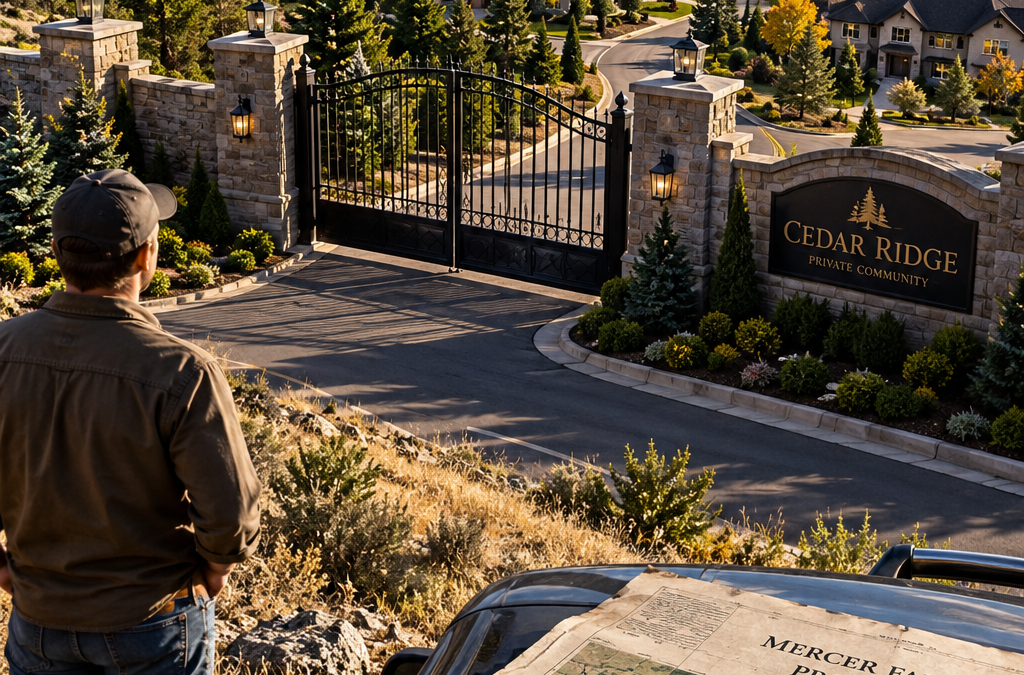
There was a decorative entrance.
Not a ranch gate.
A subdivision entrance.
Two stone columns rose on either side of a wide paved road.
Black iron gates sat open between them.
Across the top, bronze letters spelled:
PINEREST COMMONS.
Below that, a landscaped sign read:
A PREMIER PRIVATE COMMUNITY.
I just sat there.
Cars passed me.
A woman in a white SUV gave me an irritated look because I was partially blocking the shoulder.
I moved forward slowly.
There were trimmed hedges.
Decorative lamps.
Sidewalks.
Street signs.
Identical mailboxes.
Children riding bicycles.
Driveways.
Garages.
Two-story houses with front porches.
A dog ran along a white fence.
Farther inside, sunlight flashed against blue water.
A pool.
An actual community pool.
I pulled over before the gate and took out the deed package.
My hands were starting to shake.
I found the first parcel number.
Then the county map.
I compared road names.
Boundary lines.
Coordinates.
At first, I assumed I had made a mistake.
Maybe the development bordered the property.
Maybe Harlon’s tract surrounded it.
Maybe the county map was outdated.
I checked again.
Then again.
The main road entering Pinerest Commons crossed the parcel boundary described in my deed.
The first row of houses sat inside it.
So did the second.
And the third.
I drove around the perimeter using public county roads.
The situation became worse.
Every boundary marker I could identify matched the deed.
Pinerest Commons was not next to Harlon’s property.
Pinerest Commons was on Harlon’s property.
At least the ground beneath it was.
Hundreds of homes.
Private streets.
A clubhouse.
Pool.
Landscaping.
Storm drains.
Streetlights.
Everything.
I sat in my car for almost forty minutes.
My first emotion was disbelief.
The second was fear.
Because if what I was looking at meant what I thought it meant, I had inherited something much more dangerous than valuable land.
I had inherited a legal disaster.
I called Mr. Beaumont from the side of the road.
He answered on the fourth ring.
“Arthur Beaumont.”
“It’s Daniel.”
A pause.
“You visited.”
It was not a question.
“There’s a neighborhood.”
“Yes.”
“You knew?”
“I knew there was development in the area.”
“In the area?”
I looked through my windshield at three children drawing with sidewalk chalk beside a house sitting on my parcel.
“Arthur, there are hundreds of houses.”
“I know.”
“On the land.”
“I suspected that possibility.”
“You suspected?”
“I wanted you to see it before we discussed conclusions.”
“Why?”
“Because hearing it over a telephone sounds unbelievable.”
I almost shouted.
“It is unbelievable.”
“Yes.”
“Did Harlon know?”
Another pause.
“I believe he knew development existed.”
“You believe?”
“He never asked me to challenge it.”
“Did he sell the land?”
“Not through any instrument I have found.”
“Lease it?”
“Not through any recorded lease.”
“Give anybody permission?”
“Nothing in the estate file establishes that.”
I pressed my fingers against my forehead.
“So what am I supposed to do?”
“Get a property-rights attorney.”
“You’re an attorney.”
“I handle estates.”
“That seems like a convenient distinction right now.”
“It is a very important distinction.”
He gave me a name.
Eleanor Treadwell.
I called her Monday.
She did not sound impressed when I told her I had inherited eleven hundred acres.
She did not sound impressed when I told her a neighborhood had been built on it.
She simply said, “Do not contact the HOA.”
“Why?”
“Because you don’t know what you have yet.”
“I have a deed.”
“You have a deed. That does not mean they do not have something too.”
“Like what?”
“A lease. Easement. Recorded development agreement. Equitable claim. Adverse possession defense. Quiet-title judgment you haven’t found. Tax foreclosure. Probate transfer. Boundary adjustment. Fraudulent instrument that later ripened into another claim. We don’t know.”
“That sounds encouraging.”
“It isn’t meant to.”
“What do I do?”
“Document first.”
So I did.
For almost two weeks, I became obsessed.
I photographed the entrance.
Every public-facing sign.
Road names.
The pool.
Clubhouse.
Boundary monuments I could lawfully access.
I pulled satellite images.
Historical aerial photographs.
Old plat maps.
Property tax records.
Planning commission minutes.
Building permits.
Subdivision approvals.
Utility documents.
Anything bearing the name Pinerest Commons.
Eleanor ordered certified title documents.
Mr. Beaumont opened Harlon’s old files.
The deeper we went, the stranger it became.
Pinerest Commons had been developed in stages beginning in the early 1990s.
The developer was a man named Gerald Voss.
Voss Development Corporation had sold lots.
Builders constructed houses.
The HOA formed.
Families obtained mortgages.
Titles changed hands repeatedly.
Yet the original chain leading back to Harlon remained intact in a separate set of county records.
It was as though two realities had existed on top of each other for thirty years.
I asked Eleanor how that could happen.
She gave me an answer I would hear several times.
“People assume somebody else checked.”
We still needed to know what the HOA believed.
Only after gathering everything we could did Eleanor agree to contact them.
She insisted on being present.
We called the HOA office on speaker.
A woman answered and transferred us to the board president.
His name was Clifton Barrett.
His voice was smooth.
Relaxed.
The kind of confidence people acquire when they have spent years being the final word in small rooms.
“Clifton speaking.”
I introduced myself.
“I’m calling regarding the underlying property at Pinerest Commons.”
“What property?”
“The approximately eleven hundred acres inherited from Harlon Mercer.”
Silence.
Not surprise.
Silence.
That distinction mattered.
Then Clifton said, “Ah.”
Eleanor looked at me.
I continued.
“I recently became owner of record.”
“Yes, Mr. Mercer’s passing came to our attention.”
That sent a chill through me.
“How?”
“Public records.”
“So you knew Harlon?”
“I knew of him.”
“And you know the subdivision sits inside his legal description?”
Clifton laughed.
It was not nervous.
It was dismissive.
“Mr. Mercer, I think you may be misunderstanding some old paperwork.”
“My name is Daniel Mercer.”
“Of course.”
“What am I misunderstanding?”
“There were arrangements between your uncle and the original developer.”
“What arrangements?”
“Long-standing ones.”
“Written?”
“I wasn’t personally involved thirty years ago.”
“Recorded?”
“You would have to ask counsel.”
Eleanor wrote something on her legal pad.
I said, “I’ve searched the county records.”
“That doesn’t mean you understand what you’re looking at.”
I looked at Eleanor.
Her expression did not change.
Clifton continued.
“These things are complicated. Pinerest Commons is an established community. We have hundreds of homeowners. Recorded plats. Infrastructure. Thirty years of possession. You don’t suddenly appear with an old deed and pretend none of that exists.”
“I’m not pretending anything.”
“It sounds like you are.”
“I’m asking what document gives Pinerest Commons ownership of the underlying land.”
Another silence.
Then he said, “Your uncle and Gerald Voss had what you might call a gentleman’s agreement.”
I almost laughed.
“A gentleman’s agreement covering eleven hundred acres?”
“You’re reducing a complicated history to a phrase.”
“You used the phrase.”
Clifton’s tone hardened.
“The community has rights.”
“Which rights?”
“Possession. Reliance. Investment. Adverse rights. Equitable rights. Take your pick.”
Eleanor finally spoke.
“Mr. Barrett, this is Eleanor Treadwell. I represent Mr. Mercer.”
His tone changed immediately.
Not softer.
More careful.
“I see.”
“Can you identify any written agreement executed by Harlon Mercer conveying title to Gerald Voss or Pinerest Commons?”
“You should speak to our attorney.”
“We intend to.”
“We’ve operated here for thirty years.”
“That was not my question.”
“Then I suggest you send your questions formally.”
I thought the call was ending.
Then Clifton made the mistake that changed everything.
Maybe he wanted to intimidate me.
Maybe he wanted to show that I had not discovered anything the HOA did not already know.
Maybe arrogance simply got ahead of caution.
He said, “Look, we’ve known the title situation was complicated since day one.”
Eleanor’s pen stopped.
I stopped breathing.
Clifton continued.
“That’s why we got in early before anyone could stop us.”
No one spoke.
For perhaps three seconds.
Then Eleanor asked, very calmly, “Could you repeat that?”
Clifton seemed to realize something.
“What?”
“What you just said.”
“I said the situation is complicated.”
“You also said you got in early before anyone could stop you.”
“I was speaking colloquially.”
“Of course.”
His voice sharpened.
“I don’t appreciate the tone.”
Eleanor replied, “There is no tone.”
I looked down at the recording notification.
Before the call began, Eleanor had handled the required disclosure under state law and informed him the conversation was being preserved.
He had acknowledged it.
Every word was recorded.
Clifton either forgot or assumed it did not matter.
I thanked him for his time.
He said, “I strongly recommend you don’t make this hostile.”
I looked through my apartment window at a brick wall six feet away.
“You’re living on my land and telling me not to make it hostile.”
“You need to understand reality.”
“I’m trying to.”
“We have families there.”
“I know.”
“We have legal counsel.”
“So do I.”
“We have thirty years.”
That sentence stayed with me.
We have thirty years.
He believed time itself had converted uncertainty into ownership.
Maybe he was right.
That was what terrified me.
After the call, Eleanor sat silent for a moment.
Then she said, “Do not discuss this with anyone.”
“Was that as bad for him as it sounded?”
“It could be very useful.”
“Useful?”
“He just admitted prior knowledge of a title problem.”
“He said they got in early before anyone could stop them.”
“I heard him.”
“So we win?”
“No.”
Her answer frustrated me.
“He admitted it.”
“He admitted something. Courts are not television. One dramatic statement doesn’t automatically decide a case.”
“What happens now?”
“Full title search.”
The title search took weeks.
It went beyond anything I had done myself.
Eleanor hired a title specialist.
They traced every relevant conveyance.
Every parcel split.
Every probate filing.
Every transfer involving Harlon’s ancestors.
Every instrument used by Gerald Voss.
Finally Eleanor called me into her office.
There were three boxes on the conference table.
She closed the door.
“What did you find?”
She pushed a document toward me.
“This is the deed Voss relied on when he began developing Pinerest Commons.”
I looked at it.
The seller was someone I had never heard of.
“Who is that?”
“Exactly.”
The supposed seller claimed an ownership interest through an old family connection.
But according to probate records, he had never inherited the property.
Never received it by deed.
Never held title.
He had sold Voss land he did not legally own.
“How did this get through?”
“Poor records. Fragmented rural indexing. Incomplete title work. Possibly misconduct.”
“Possibly?”
“We don’t accuse people of fraud until we can prove fraud.”
I pointed at the document.
“You said he didn’t own it.”
“He didn’t.”
“So the deed is worthless.”
“As a conveyance of title from the true owner, yes.”
My heart started pounding.
“What happened to Harlon’s title?”
“Nothing.”
“Nothing?”
“Nothing extinguished it.”
“No foreclosure?”
“No.”
“No sale?”
“No.”
“No court judgment?”
“No.”
“No deed?”
“No.”
“Then Harlon owned it the whole time.”
“On the record we have, yes.”
I stood up.
I needed to move.
“That means I own the neighborhood.”
Eleanor immediately raised a hand.
“Slow down.”
“The land.”
“You appear to hold superior record title to the underlying land.”
“That sounds like lawyer language.”
“It is lawyer language because saying ‘you own the neighborhood’ would be dangerously imprecise.”
“The houses?”
“Different issue.”
“How can the houses be a different issue if they’re sitting on the land?”
“Because innocent homeowners purchased improvements and purported interests in good faith. Mortgages exist. Title insurance exists. Equitable doctrines exist. We are not marching into Pinerest Commons and telling families to pack their belongings.”
“I wasn’t suggesting that.”
“Good.”
“What do we do?”
“We notify the HOA formally and request negotiations.”
That was our first move.
A letter.
Professional.
Measured.
No threats.
We laid out the title problem and requested documentation supporting the HOA’s position.
Clifton responded through counsel.
His attorney’s name was Martin Kessler.
Sharp reputation.
Aggressive.
His first letter accused me of attempting to exploit an ancient technical defect in order to destabilize hundreds of homeowners.
Ancient technical defect.
That phrase made me angry.
Someone had sold land they did not own.
Thirty years later, the people occupying it called the actual deed a technical defect.
Eleanor told me not to take it personally.
“Easy for you.”
“No, it isn’t.”
“They’re making me sound like some predator.”
“That’s strategy.”
“I didn’t build the houses there.”
“I know.”
“I didn’t create the bad deed.”
“I know.”
“I didn’t even know the land existed until Harlon died.”
“I know.”
“Then why am I the villain?”
“Because if residents believe you are the villain, they pressure you instead of the HOA.”
She was right.
Within two weeks, my name appeared in a local news story.
INHERITOR CHALLENGES OWNERSHIP OF PINEREST COMMONS LAND.
The story included footage of the entrance gate.
A resident interviewed on camera said, “Some stranger can’t just show up after thirty years and tell us our homes are on his property.”
Another called me a land speculator.
Someone online called me a corporate raider.
I had to laugh at that one.
My corporation consisted of one man in a studio apartment eating reheated pasta.
But the hostility grew.
Emails appeared.
Most people were scared more than angry.
I understood that.
If someone told me the land under my house might belong to a stranger, I would be scared too.
Then Clifton held a town-hall meeting.
I did not attend.
Eleanor advised against it.
But recordings circulated afterward.
Clifton stood in front of hundreds of residents and described the HOA as their shield.
He said they would never allow “an opportunistic heir” to threaten decades of community investment.
He told residents the HOA had “powerful legal defenses.”
He used the phrase adverse possession repeatedly.
That was the first time I seriously learned what it meant.
Eleanor explained it to me at her office.
“In simplified terms, someone who occupies land openly, continuously, adversely, and under the conditions required by state law for the statutory period may acquire rights despite not holding original title.”
“So they steal land by waiting long enough?”
“That is not how courts describe it.”
“It’s how it sounds.”
“It exists for reasons more complicated than this case.”
“They’ve been there thirty years.”
“Yes.”
“And that’s enough?”
“Time is one element.”
“One?”
“There are others.”
I leaned forward.
“Which one helps us?”
She tapped her pen against the table.
“State law and the facts matter. Their biggest problem may be the character of their possession and what key actors knew.”
“Clifton’s recording.”
“Potentially.”
“He wasn’t there thirty years ago.”
“No. But if he speaks from institutional knowledge, records, board discussions, developer history, or inherited HOA knowledge, it becomes relevant.”
“And the original developer?”
“That’s where things get interesting.”
Our investigation found letters.
Not many.
But enough.
One was between Gerald Voss and a survey firm.
The surveyor warned that the chain of title contained an unresolved ownership conflict.
Another memo referenced the need to “secure Mercer cooperation.”
No document showed that cooperation ever came.
Another note from Voss’s office asked whether construction could begin before title objections were resolved.
That did not prove every homeowner knew.
Of course they didn’t.
Most had no idea.
But it challenged the clean story the HOA wanted to tell—that everyone had innocently believed Voss held perfect title from the beginning.
We filed suit.
Quiet title.
Declaratory relief.
Restitution for unauthorized use of the underlying land.
Other claims Eleanor refused to explain until she finished drafting them.
The HOA countered immediately.
Adverse possession.
Equitable estoppel.
Laches.
Reliance.
Improvement doctrines.
They threw everything they could at us.
Then came the offers.
First, they offered me an amount for all eleven hundred acres that sounded large until Eleanor explained what properly entitled development land beneath hundreds of houses would be worth.
The offer was a fraction.
“They want you overwhelmed,” she said.
“I am overwhelmed.”
“They want you overwhelmed enough to sign.”
“Different thing.”
“Exactly.”
The second offer was larger.
Still low.
The third came with confidentiality language.
I asked Eleanor whether I should take it.
She did not answer for me.
She laid out the risks.
Litigation could last years.
Appeals were possible.
Even if we prevailed on title, remedies could be complicated.
The homeowners were innocent purchasers in many cases.
Courts dislike unnecessary disruption to settled communities.
Title insurers could enter.
Banks could enter.
More lawyers meant more complexity.
“Could I lose?”
“Yes.”
That answer mattered.
She never promised me victory.
“What would you do?”
“I’m not you.”
“If you were?”
She shook her head.
“My job is to tell you what each decision costs. You decide which cost you can live with.”
I went home and thought about Harlon.
A man who had held the land for seventy years.
He had never sold.
Never developed it.
Apparently never fought Voss publicly.
Why?
I still don’t know.
Maybe he hated courtrooms.
Maybe he believed records would outlive lies.
Maybe he did not have the money to fight a developer when construction began.
Maybe he simply decided that his deed was enough and someday the problem would belong to someone else.
That someone was me.
The case changed my life.
People think lawsuits happen in courtrooms.
Most lawsuits happen at kitchen tables.
At midnight.
Reading affidavits.
Answering attorney emails.
Looking at bank statements.
Wondering whether one wrong decision will destroy you.
I stopped sleeping well.
Every time my phone rang from an unknown number, my chest tightened.
I received letters from homeowners.
Some furious.
Some frightened.
One came from an elderly woman named June.
She wrote:
I bought my home twelve years ago after my husband died. I used most of our savings. I did not know anything about this title problem. Please remember there are ordinary people here.
I read that letter six times.
Then I gave it to Eleanor.
“I don’t want their houses.”
“I know.”
“Make sure everybody knows.”
“The HOA may not want everybody to know.”
“Why?”
“Because fear gives Clifton leverage.”
That was the moment I stopped seeing the dispute as me against the residents.
It wasn’t.
There were three groups.
Me.
The HOA leadership and people connected to the development history.
And families who had bought homes believing lawyers, title companies, developers, banks, and public records had protected them.
Those families were not my enemy.
Clifton kept trying to make us enemies anyway.
At a later public meeting, he told residents that I intended to charge “crippling ground rent.”
I had proposed no such thing.
He suggested I could evict homeowners.
Eleanor had never threatened eviction.
He said my lawsuit might make mortgages unmarketable.
That part, unfortunately, had some truth to it.
Title uncertainty can poison everything.
Residents became more frightened.
A group gathered outside the courthouse before one preliminary hearing.
Some held signs.
One read:
OUR HOMES ARE NOT YOUR INHERITANCE.
I walked past without responding.
A man stepped in front of me.
“My daughter grew up here.”
I stopped.
“I’m not trying to take your daughter’s house.”
“Then drop the case.”
“And let the title problem continue?”
“It wasn’t a problem until you showed up.”
That hurt because from his perspective, it was true.
The defect had existed for decades.
But he had slept peacefully until my inheritance brought it into daylight.
I said, “It was always a problem. You just weren’t told.”
He stared at me.
“Convenient answer.”
“No. It’s a terrible answer.”
Eleanor pulled me toward the courthouse.
“Stop talking.”
“I wasn’t arguing.”
“You were five seconds away.”
She was right.
Months passed.
Discovery began.
The HOA had to produce records.
Minutes.
Emails.
Old correspondence.
Board memoranda.
Developer files that had transferred into association archives.
That was when Clifton’s arrogance began turning into liability.
An old set of board minutes referenced a “legacy title concern.”
A later memo discussed avoiding direct communication with Harlon unless necessary.
Another document referred to the “Mercer chain” as unresolved.
Clifton had inherited a problem.
Instead of addressing it, he had treated secrecy and time as strategy.
When Eleanor questioned him in deposition, he tried to retreat from the phone call.
“I was speaking casually.”
“You said you knew the title situation was complicated from day one.”
“I meant the subdivision had a complicated development history.”
“You said, ‘That’s why we got in early before anyone could stop us.’ Who is ‘we’?”
“The community generally.”
“Who was trying to stop you?”
“I don’t recall.”
“Stop you from doing what?”
“I don’t recall the context.”
“The call lasted less than twenty minutes.”
“That doesn’t mean I remember every phrase.”
“You had been informed the call was recorded?”
“Yes.”
“And you still said it?”
“I was frustrated.”
Eleanor slid an HOA memo across the table.
“Have you seen this?”
His attorney objected.
Clifton looked at it.
The memo was from years earlier.
It recommended obtaining a legal opinion on the unresolved Mercer title.
No opinion had been commissioned.
“Why wasn’t this resolved?” Eleanor asked.
“I don’t know.”
“You were president.”
“Not when the memo was written.”
“But you became president later.”
“Yes.”
“And it remained in HOA records?”
“I assume.”
“Did you read it?”
“I don’t recall.”
“Did you tell homeowners about it?”
“No.”
“Why?”
“I did not believe it was material.”
Eleanor waited.
“An unresolved title issue affecting the ground beneath the subdivision was not material?”
Clifton’s attorney objected again.
But the damage was accumulating.
The HOA’s public position was that nobody had reason to doubt ownership.
Its own records told a different story.
Then the case reached the hearing that mattered.
The courtroom was packed.
Residents filled almost every bench.
Local media sat near the back.
Clifton arrived in a navy suit beside Kessler.
He looked composed.
He had looked composed through everything.
I envied that.
My stomach felt like it had been tied in a knot.
Eleanor leaned toward me.
“Don’t watch the residents.”
“Why?”
“You’ll start trying to read their faces instead of listening.”
“They hate me.”
“Some do.”
“Helpful.”
“I’m not paid to lie to you.”
The HOA presented first.
Kessler was good.
Very good.
He described thirty years of open occupation.
Hundreds of homes.
Recorded subdivision plats.
Infrastructure.
Property taxes.
Mortgages.
Utility services.
Road maintenance.
A functioning HOA.
A pool.
Clubhouse.
Common areas.
He emphasized that Harlon had apparently known development existed and had not filed suit.
“Silence matters,” Kessler told the court. “Three decades of silence matters.”
That argument frightened me.
Because it made intuitive sense.
If Harlon knew people were building houses and did nothing, shouldn’t that matter?
Eleanor had prepared for it.
When her turn came, she did not try to pretend thirty years meant nothing.
She said exactly the opposite.
“Thirty years matters tremendously, Your Honor. The question is what happened during those thirty years and whether the party seeking extraordinary ownership rights can satisfy every legal requirement necessary to defeat an otherwise valid chain of title.”
She introduced the Mercer deeds.
Tax records.
Probate documents.
The defective Voss conveyance.
The survey warning.
The memo about securing Mercer cooperation.
The HOA’s legacy-title documents.
Then Kessler argued that regardless of Voss’s original defect, long occupation had matured into ownership.
That was when Eleanor said, “Your Honor, we would like to address the knowledge element.”
Kessler objected before she even explained.
The judge allowed her to proceed.
She called Clifton.
He walked to the witness stand.
For the first time since I met him, his confidence looked rehearsed rather than natural.
Eleanor asked simple questions.
How long had he served on the board?
What records did the HOA keep?
Did the association maintain historical files?
Had title concerns been discussed?
He answered carefully.
Then she asked about our phone call.
“Do you recall speaking with Mr. Mercer after he inherited the property?”
“Yes.”
“Were you advised that the call would be recorded?”
“Yes.”
“Did you consent to continue?”
“Yes.”
“Did you state that the HOA had known the title situation was complicated since day one?”
His jaw shifted.
“I may have used words to that effect.”
“Did you state, ‘That’s why we got in early before anyone could stop us’?”
“I would need context.”
Eleanor looked toward the judge.
“We have the context.”
The recording played.
Hearing it in a courtroom was different.
On the phone, Clifton’s words had sounded arrogant.
In court, surrounded by title records and internal HOA documents, they sounded devastating.
His voice filled the room.
“We’ve known the title situation was complicated since day one. That’s why we got in early before anyone could stop us.”
Nobody moved.
Eleanor stopped the recording.
“Mr. Barrett, what did you mean?”
“I was speaking figuratively.”
“About what?”
“The community’s establishment.”
“Who was going to stop the community?”
“I don’t know.”
“You said you knew the title situation was complicated.”
“Yes.”
“What title situation?”
“The historical paperwork.”
“Specifically the Mercer chain?”
“I can’t say specifically.”
She showed him the internal memo.
“Was this part of the historical paperwork?”
“I suppose.”
“The memo says title through Gerald Voss did not clearly defeat the Mercer interest.”
Kessler objected.
The judge reviewed the document.
The objection did not erase it.
Eleanor continued.
“You told Mr. Mercer he did not understand how things worked.”
“I don’t recall those exact words.”
“They are on the recording.”
Clifton looked toward the jury box even though there was no jury.
I remember thinking that for the first time, he looked older.
Not defeated.
Just exposed.
Kessler tried to repair the damage.
He emphasized that Clifton had not been the original developer.
True.
That ordinary residents bought homes in good faith.
Also true.
That decades of visible possession could not be erased by one president’s careless wording.
True again.
And that was what made the hearing terrifying.
Real legal disputes are rarely as clean as stories make them sound.
Both sides can possess facts that matter.
The judge took the matter under advisement.
Then came the waiting.
Three weeks.
They were worse than the litigation.
I tried to work.
Tried to eat.
Tried not to check my phone every five minutes.
I drove out to the property once.
Not inside the subdivision.
I parked at a public overlook where I could see rooftops through the trees.
For the first time, I thought about Harlon not as an eccentric old relative but as a man who had carried this situation for decades.
Had he stood somewhere like this?
Had he watched houses appear?
Had he seen the gate?
Had he felt powerless?
Or had he simply trusted the deed in his drawer?
I will never know.
The ruling arrived on a Thursday.
Eleanor called.
“Come to my office.”
“Tell me now.”
“Come in.”
“That sounds bad.”
“It means I want you sitting down.”
My hands were sweating by the time I reached her building.
She had the order on the table.
Thick.
Marked with sticky notes.
I sat.
“Well?”
“The court recognized your superior title.”
I stared at her.
“To all of it?”
“To the underlying parcel as described.”
I could not speak.
She continued before I misunderstood.
“The court rejected the HOA’s adverse-possession theory on the record presented.”
“Because of Clifton?”
“Not only because of Clifton.”
She explained.
The court considered the original defective Voss deed.
Evidence showing unresolved title concerns.
The character of possession.
Institutional knowledge.
The HOA’s own records.
Clifton’s admission.
The precise requirements of the applicable doctrine.
Together, it was enough.
My chain of title survived.
I leaned back.
“So it’s over.”
“No.”
I should have known.
“What now?”
“Remedies.”
The court had not ordered hundreds of families removed.
Nor had we asked it to.
Instead, the ruling separated the wrongful occupation issue from innocent homeowners who had purchased in good faith.
The HOA entity faced restitution for unauthorized use and other financial consequences tied to common areas and the long-standing occupation of land without valid underlying title.
Calculating that number took experts.
Appraisers.
Land-use specialists.
Historical rates.
Common-area valuations.
Legal arguments.
I am not free to publicly disclose the final figure because part of the eventual resolution remains confidential.
But it was substantial.
Substantial enough that an emergency HOA meeting was called within days.
Substantial enough that residents demanded Clifton’s resignation.
He resigned that week.
I received a copy of the announcement.
Three paragraphs.
No apology.
No admission.
Just language about protecting community unity and allowing new leadership to move forward.
I read it once.
Then threw it in a drawer.
I did not feel triumph.
That surprised me.
For months I had imagined what winning would feel like.
Vindication.
Relief.
Maybe satisfaction.
Instead, I mostly felt tired.
And worried about the residents.
Because a legal victory could still become a human disaster if handled badly.
Eleanor and I had discussed that long before the ruling.
“I don’t want to become what they’ve accused me of being,” I told her.
“Then don’t.”
“That simple?”
“Conceptually.”
“What happens to the homeowners?”
“We create a structure.”
We invited representatives from the residents to meet.
Not Clifton.
Not the old board faction.
Residents.
June came.
The widow who had written me.
So did a teacher named Marcus.
A mechanic named Leon.
A young couple with a toddler.
Two retirees.
A nurse.
People who had spent months hearing that I wanted to take their homes.
The first meeting was tense.
June sat directly across from me.
“You read my letter?”
“Yes.”
“Did it matter?”
“Yes.”
“How?”
“Because I don’t want your house.”
She studied me.
“That isn’t what we were told.”
“I know.”
Marcus spoke next.
“What exactly do you want?”
“A legal arrangement.”
“You already won.”
“I won a title case.”
“So you can charge whatever you want.”
“Legally, there are still limits and other issues. But I’m not interested in exploiting you.”
Leon crossed his arms.
“We’ve heard that before.”
“Fair.”
“What are you offering?”
Eleanor slid documents across the table.
Long-term ground leases.
Fair rates.
Predictable increases.
Transfer rights.
Financing provisions.
And an option for individual households or organized groups to negotiate purchase of the underlying land over time.
Nobody celebrated.
They read.
Asked questions.
Argued.
Some residents thought the rates were too high.
Others were surprised they were not higher.
One man accused me of profiting from somebody else’s fraud.
I told him the truth.
“I inherited land my family never sold. You bought a house believing the seller had rights he apparently did not have. Neither one of us created this.”
“Yet I pay.”
“And for seventy years, my family received nothing.”
The room went silent.
I regretted saying it as sharply as I did.
Then June said, “Both can be true.”
She was right.
That became the basis for everything that followed.
Both could be true.
I could be the lawful landowner.
And the homeowners could be victims.
The HOA could owe restitution.
And individual families could deserve stability.
Gerald Voss could have created the original mess.
And decades of professionals after him could have failed to correct it.
We did not need one villain for every layer of the problem.
But Clifton had made things worse.
Much worse.
Because once he inherited knowledge of the defect, he chose concealment and aggression rather than disclosure.
He could have contacted Harlon.
He could have commissioned a proper title opinion.
He could have warned residents.
He could have negotiated.
Instead, he relied on momentum.
Thirty years.
Hundreds of houses.
A gate.
An HOA.
The sheer size of the community became his argument.
Surely something that large could not be wrong.
But scale does not repair a broken chain of title.
Most households accepted the lease structure.
Not immediately.
There were lawyers.
Negotiations.
Revisions.
Appraisals.
Some residents pursued different arrangements.
Others coordinated purchases.
Eventually, the legal ground beneath their lives became something they could actually document.
Residents also filed claims against parties connected to the defective title history, including Gerald Voss’s estate and other entities involved in sales and title representations.
That litigation continued separately.
I stayed out of it as much as possible.
By then, I had enough courtrooms in my life.
About a year after the ruling, I finally drove through the gates of Pinerest Commons without feeling like I was entering hostile territory.
The bronze letters were still there.
PINEREST COMMONS.
The pool was open.
Children screamed and splashed behind the fence.
Someone was grilling.
A lawn sprinkler ticked back and forth.
Normal life.
June waved at me from her porch.
I stopped.
She walked to the curb.
“You’re becoming a regular.”
“Don’t spread rumors.”
She smiled.
“People don’t hate you anymore.”
“That’s comforting.”
“Some still do.”
“More believable.”
She laughed.
Then her expression turned serious.
“My granddaughter asked me who owns the land.”
“What did you tell her?”
“That it’s complicated.”
I smiled.
“Probably safest.”
She shook her head.
“I told her families can believe something for a long time and still be wrong.”
“That sounds harsh for a kid.”
“She’s sixteen.”
“Then it’s overdue.”
June looked down the street.
“You know what bothers me?”
“What?”
“We trusted everybody.”
I knew immediately what she meant.
“The developer?”
“Developer. Bank. Realtor. Title company. HOA. Everyone.”
She pointed at her house.
“I signed a stack of papers this thick when I bought that place. Not one person said, ‘By the way, there may be a man named Harlon Mercer who still owns the dirt.’”
“I don’t think most of them knew.”
“No. That’s almost worse.”
I understood.
Fraud is frightening.
But institutional carelessness can be more frightening because it does not require a mastermind.
Only people assuming the person before them checked.
I eventually left my studio apartment.
That felt appropriate.
Owning eleven hundred acres while sleeping twenty feet from a refrigerator started seeming ridiculous.
I did not move into Pinerest Commons.
I built a modest house on an undeveloped portion of the property away from the subdivision.
Nothing extravagant.
A porch.
A workshop.
Trees behind it.
Enough quiet to hear wind in the branches.
Sometimes I walk that land and think about Harlon.
Seventy years.
He held onto it through decades when selling would probably have been easier.
Family members called it worthless.
Trees.
Dust.
Old deed.
Maybe that was why nobody paid attention.
Value has a strange way of hiding behind neglect.
Had the property been obviously valuable in 1952, everyone would have watched it.
Instead, paperwork sat in cabinets.
Years passed.
People died.
Developers arrived.
Houses went up.
And an entire community grew across land whose legal history nobody had fully resolved.
I found one of Harlon’s old notebooks after the case.
Mr. Beaumont discovered it in a metal filing cabinet.
Most of it was ordinary.
Tax receipts.
Fence costs.
Notes about timber.
Weather.
Names.
Then one page contained three words.
Never signed Voss.
That was all.
No explanation.
No rant.
No legal theory.
Just:
Never signed Voss.
I stared at those words for a long time.
Maybe Gerald Voss had approached him.
Maybe there really had been discussions.
Maybe Voss claimed there was a gentleman’s agreement because he wanted one.
Maybe Harlon refused.
Maybe he assumed refusal was enough.
It is one of the unanswered parts of the story.
I showed the page to Eleanor.
“Would this have helped?”
“Maybe.”
“Would it have changed anything?”
“Probably not much at the stage we found it.”
I put the notebook away.
Some people leave behind money.
Some leave property.
Harlon left me a question.
Why did he wait?
I may never know.
But he also left something clearer.
A chain of title.
Clean enough to survive people who had more money, more lawyers, more houses, and more confidence than I did.
Clifton once told me I did not understand reality.
For a while, I believed him.
Look at what he had.
Hundreds of homeowners.
A private gate.
A clubhouse.
A pool.
Paved roads.
Thirty years of history.
A functioning association.
Lawyers.
Documents.
Momentum.
I had one old deed and an inheritance I had not asked for.
Reality certainly looked like it belonged to him.
That was the trap.
People often confuse something being established with something being legitimate.
They are not the same.
A mistake can stand for decades.
A bad document can be photocopied a thousand times.
An assumption can pass from one board to the next until everybody forgets it was ever an assumption.
And when enough people rely on it, challenging the original mistake starts to feel like causing the problem.
That was why some residents hated me.
To them, the neighborhood had existed peacefully until I appeared.
But I did not create the title defect.
I discovered it.
There is a difference.
One afternoon, more than two years after Harlon died, I drove past the entrance and saw workers replacing the old HOA sign.
The words “premier private community” were gone.
The new sign simply said:
PINEREST COMMONS.
I asked Marcus about it later.
“What happened to the old sign?”
“Board voted to replace it.”
“Why?”
He shrugged.
“Too much baggage.”
I laughed.
“Understandable.”
He leaned against my truck.
“You know Clifton moved?”
“No.”
“Six months ago.”
“Where?”
“Arizona, I think.”
I nodded.
I had not spoken to him since court.
Part of me had once imagined confronting him afterward.
Asking whether those few seconds on the phone had been worth it.
Whether he remembered telling me they got in early before anyone could stop them.
Whether he still thought I did not understand how things worked.
But by then, I no longer cared enough to ask.
He had already answered the important question.
His mistake was not just saying too much.
His mistake was believing the truth no longer mattered because the community had become too large to challenge.
That confidence had shaped every decision he made.
Laugh at the heir.
Dismiss the deed.
Rally the residents.
Invoke thirty years.
Pressure settlement.
Treat size as legitimacy.
Then the recording played.
And suddenly the years did not sound like proof.
They sounded like time spent avoiding a problem.
The restitution agreement eventually became final.
I cannot give the figure.
I can say it changed the HOA’s finances significantly.
They had to restructure.
Cut certain discretionary spending.
Increase transparency requirements.
Residents demanded independent legal review for major property decisions.
Board meetings changed.
Minutes became more detailed.
Nobody wanted another “legacy title concern” disappearing into a file cabinet.
Strange as it sounds, the community became healthier after the crisis.
Not happier immediately.
Healthier.
Those are different.
People knew what they owned.
What they leased.
What the HOA controlled.
What it did not.
Where money went.
Which documents mattered.
They asked harder questions.
Clifton probably would have hated it.
I respected it.
The final time I spoke with Eleanor about the original case, we were sitting on my porch.
She had come out to review one last recorded amendment.
I poured coffee.
She looked across the land.
“So this is what you inherited.”
“Apparently.”
“Better than the studio.”
“More mowing.”
“You don’t mow eleven hundred acres.”
“Exactly why it’s better.”
She laughed.
Then I asked, “Did the recording really win it?”
She considered that.
“No.”
“That isn’t how everybody tells it.”
“Everybody likes one dramatic moment.”
“So what won it?”
“The deed. The probate chain. The defective Voss conveyance. The survey correspondence. The HOA’s internal records. The legal elements they couldn’t satisfy. Clifton’s statement tied parts of it together.”
“So documentation.”
“Documentation and patience.”
I smiled.
“Harlon would like that.”
“Did you ever figure out why he left it to you?”
“No.”
“Any theories?”
I thought about the funeral when I was nine.
Take care of what belongs to you.
“I have one.”
I never told her.
Maybe Harlon saw something in me.
Maybe he picked the youngest relative who once listened when he spoke.
Maybe everyone else had died or been excluded for reasons I would never understand.
Maybe there was no profound reason at all.
Inheritance often creates meaning after the fact.
What matters is what you do with it.
I could have sold my claim cheaply the moment Clifton pressured me.
I almost did.
I could have treated every homeowner like an enemy.
I did not.
I could have used the ruling to demand absurd money from families who had been lied to.
I refused.
And I could have walked away before learning what really happened.
That would have been easiest.
But Harlon had held the land for seventy years.
The least I could do was spend enough time to understand what he had left me.
Today, when I look at Pinerest Commons from the ridge above my house, I do not see a neighborhood that stole my land.
That description is too simple.
I see layers of decisions.
Gerald Voss selling a promise he apparently had no authority to make.
Professionals who failed to catch it.
Families who trusted paperwork.
Boards that inherited a problem.
Clifton choosing arrogance over disclosure.
Harlon choosing silence over confrontation.
And me arriving decades later with no idea what I had stepped into.
Hundreds of people can live inside a mistake without being responsible for creating it.
That was the lesson I almost missed.
The law told us who held title.
It did not tell us who deserved cruelty.
Those were different questions.
So the neighborhood remains.
The families remain.
The pool remains.
The streets remain.
The difference is that the legal structure underneath all of it finally matches reality.
And the ground beneath my own house?
That title is framed.
Not because I worship paperwork.
Because I now understand what paperwork represents when everyone else insists memory, habit, power, and confidence should be enough.
Clifton had thirty years of momentum.
I had a deed.
He had a board.
I had a title search.
He had hundreds of frightened residents.
I had an attorney willing to keep asking the same question until someone answered it.
And when that courtroom recording finally played his voice admitting they had known the title was compromised and moved early before anyone could stop them, the thing he had spent years relying on—time—stopped protecting him.
It started explaining him.
That was the part he never understood.
Silence can hide a defect.
Time can bury it.
Money can build houses over it.
An HOA can put gates around it.
Families can build entire lives on top of it.
But none of those things make the original document disappear.
Somewhere underneath every assumption, there is still a record of what actually happened.
Harlon kept his.
So did I.
And in the end, that mattered more than all the confidence in the world.







