𝗙𝗨𝗟𝗟 𝗦𝗧𝗢𝗥𝗬 The HOA Built an Eight-Foot Concrete Wall Across My Ranch Driveway While I Was on My Honeymoon
𝗙𝗨𝗟𝗟 𝗦𝗧𝗢𝗥𝗬
And a family that knows exactly what it owns is much harder to move than a line on someone else’s map.
𝗧𝗛𝗘 𝗘𝗡𝗗
I came home from my honeymoon to find an eight-foot concrete wall blocking the only driveway to forty acres my wife’s family had owned for generations. The woman who ordered it built looked me in the eye the next morning and calmly explained that, according to her map, we no longer had the right to enter our own land.
Eleven days earlier, Mara and I had been standing barefoot on a beach in Tulum, laughing about how strange it felt to finally call each other husband and wife.
We had spent years getting to that point.
Years of working.
Saving.
Postponing vacations.
Arguing over mortgage rates and whether we really needed a second bathroom.
And then, almost all at once, everything seemed to fall into place.
We got married.
We bought forty acres outside town.
And for the first time in either of our adult lives, we had enough space around us to breathe.
The ranch wasn’t fancy.
There was an old house near the center of the property, a weathered barn that leaned a little to the west, fencing that needed work, and a gravel driveway nearly a quarter mile long.
But the land mattered to Mara in a way property rarely matters when it is just something you buy.
Her family had history there.
Her grandfather had run cattle on part of it when Mara was a little girl.
Her mother remembered summer evenings on the porch.
The ranch had eventually passed to one of Mara’s cousins, who moved away, stopped maintaining it, and finally agreed to sell.
When Mara and I bought it back, she cried during the closing.
Not loudly.
Mara wasn’t someone who cried loudly.
She simply sat beside me at the title company’s conference table, stared at the deed after we signed it, and pressed two fingers to her mouth.
“You okay?” I whispered.
She nodded.
Then she whispered something I had heard before.
“Grandpa always said this was the one thing nobody could take from us.”
That sentence had followed her since childhood.
Her grandfather, Emilio, had been a stubborn man by every account.
He had worked that land when development was still miles away. Back then, there was no Cedar Bluff Estates, no decorative entrance monument, no private clubhouse, no architectural committee, and certainly no homeowners association president carrying laminated maps around like royal decrees.
There was the ranch.
A county road.
An access lane.
Open fields.
That was it.
By the time Mara and I bought the land, civilization had crept closer.
Cedar Bluff Estates now occupied the eastern side of the property.
Rows of large homes had gone up along curved streets with names like Laurel View and Copper Ridge.
The subdivision had landscaped entrances, stone signs, a clubhouse, walking trails, and an HOA that had slowly become more aggressive as property values increased.
Our ranch was not inside Cedar Bluff.
That point matters.
We weren’t members.
We didn’t pay dues.
We hadn’t signed their covenants.
Our land predated the subdivision.
The only real connection between our property and Cedar Bluff was geography.
The ranch’s recorded driveway and access easement ran along a narrow strip beside what later became HOA common property before connecting to the county road.
The easement had existed decades before the subdivision.
It was on the deed.
It was on the original plat.
It had been used continuously.
Nobody had ever questioned it.
Until our honeymoon.
Mara and I left the ranch on a Wednesday morning.
I remember locking the front door while she stood beside the truck with two suitcases.
“You got the passports?” she asked.
“You asked me that at breakfast.”
“That wasn’t an answer.”
“Yes.”
“The rings?”
I raised my left hand.
She laughed.
We were gone eleven days.
Eleven.
When we came back, we turned off the county road, rounded the familiar stand of cottonwoods near the entrance, and stopped.
I actually thought, for a second, that I had taken the wrong turn.
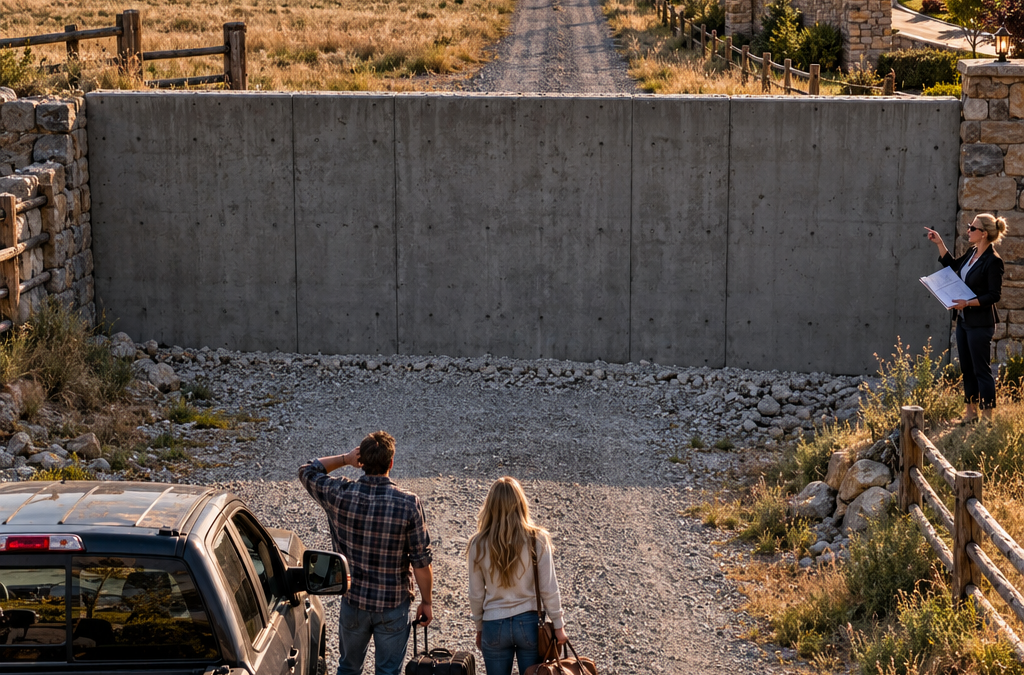
There was a wall across our driveway.
Not a gate.
Not temporary construction fencing.
Not orange cones.
A wall.
Concrete block.
Eight feet tall.
Fresh gray mortar.
It stretched from one side of the access road to the other, completely sealing our driveway from the county road.
The gravel lane simply disappeared behind it.
Mara leaned forward in the passenger seat.
“What the hell is that?”
I didn’t answer.
I put the truck in park.
We sat there for several seconds.
My brain kept trying to find an explanation that made sense.
Road work.
Utility issue.
Wrong property.
Temporary security measure.
But nothing made sense because the wall was physically standing on our recorded access.
I got out.
The late afternoon sun hit the concrete hard enough that I could feel heat coming off it.
The mortar was still pale.
Relatively fresh.
Somebody had done this recently.
While we were gone.
I walked closer.
Three large orange letters had been spray-painted on one section.
HOA.
Mara came up behind me.
“No.”
Her voice sounded smaller than I had ever heard it.
I touched the wall.
Solid.
Permanent.
Or intended to be.
“Did anyone call you?” I asked.
“No.”
“Email?”
“No.”
“Certified letter?”
“No.”
“Anything?”
“Nothing.”
I walked to the edge of the wall.
It extended far enough into the shoulders that there was no way to simply drive around it without leaving the established access road and crossing a drainage ditch.
Mara was staring at the concrete.
“This is our driveway.”
“I know.”
“They built it while we were gone.”
“I know.”
“My grandfather drove this road.”
“I know.”
Her eyes turned toward me.
That was when anger finally replaced shock.
“Who does this?”
I didn’t have an answer.
At the bottom corner of the wall was a small white stencil.
CEDAR BLUFF PROPERTY MANAGEMENT.
Below it was a phone number.
I called.
A woman answered.
“Cedar Bluff Estates.”
“My name is Colton Reyes. I’m standing in front of a concrete wall blocking my ranch driveway.”
There was a pause.
Not surprise.
Not confusion.
Recognition.
“Property address?”
I gave it to her.
Another pause.
Then she said, “Yes, sir. That relates to the boundary correction.”
I looked at Mara.
“The what?”
“Boundary correction.”
“You built a wall across our driveway.”
“The HOA formalized the common property line.”
“On our access road.”
“If you have concerns, Mrs. Voss can speak with you.”
“Who is Mrs. Voss?”
“Regina Voss, board president.”
“When?”
“Tomorrow morning at nine.”
“I need access to my property tonight.”
“I’m sorry, sir. I can’t authorize alteration of an HOA structure.”
“An HOA structure?”
I laughed because the alternative was yelling.
“You built it on my land.”
“I can’t discuss legal determinations.”
“I’m not asking you for a legal determination. I’m telling you I cannot drive into my own property because somebody poured an eight-foot wall across my driveway.”
“Mr. Reyes, Mrs. Voss will be available at nine.”
Then she repeated the address of the clubhouse as if that resolved anything.
I hung up.
Mara was pacing.
“What did they say?”
“Boundary correction.”
She stopped.
“What boundary?”
“Apparently we find out tomorrow.”
“We’re not staying in a hotel because these people stole our driveway.”
“I agree.”
We called Mara’s cousin, then the county non-emergency line.
A deputy eventually came out.
He photographed the wall, looked at our deed copy on my phone, and told us what I already suspected.
Property boundary disputes generally became civil matters unless there was an immediate criminal issue.
He documented the complaint.
He advised us not to damage the wall until ownership of the exact footprint had been confirmed.
That last part mattered.
Because every instinct I had was telling me to get a sledgehammer.
Mara knew it.
“Don’t,” she said.
“I didn’t say anything.”
“You have the face.”
“What face?”
“The face you get right before you’re about to do something expensive.”
“I could rent an excavator.”
“Colton.”
“I know a guy.”
“Colton.”
I looked back at the wall.
“You don’t think knocking it down would be satisfying?”
“For ten minutes.”
“Maybe fifteen.”
“And then they’ll claim we destroyed HOA property.”
“It’s on our land.”
“We know that.”
“They apparently don’t.”
She corrected me.
“No. They want us to think they don’t.”
That was the first moment I understood Mara was already suspicious of something deeper.
We spent our first night back from our honeymoon at her mother’s house.
Neither of us slept much.
At eight thirty the next morning, we drove to the Cedar Bluff clubhouse.
It was exactly the kind of building you would expect in a subdivision that wanted to look richer than it actually was.
Stone veneer.
Tall windows.
Perfect shrubs.
A flagpole.
Inside, everything smelled faintly of lemon cleaner and new carpet.
A receptionist led us into a small office.
Regina Voss sat behind a glass desk.
I remember her clearly because everything about her seemed deliberate.
Deep red blazer.
Gold watch.
Hair perfectly set.
A red leather folder aligned with the edge of the desk.
And in front of her, a laminated map.
She didn’t stand when we walked in.
Didn’t shake our hands.
Didn’t apologize for the wall.
She simply looked at us and said, “Mr. and Mrs. Reyes.”
Mara sat.
I remained standing.
“Let’s skip the introductions.”
Regina’s mouth tightened.
“I understand you’re upset.”
“You built an eight-foot wall across our driveway.”
“The association constructed a boundary barrier.”
“Across our driveway.”
“That access route crosses Cedar Bluff common property.”
“No, it doesn’t.”
Regina placed one manicured finger on the map.
“According to the updated property map, it does.”
I leaned forward.
The map was colorful.
Professional.
Parcel lines in blue.
HOA property shaded green.
Our ranch outlined in yellow.
And according to the lines on Regina’s laminated sheet, the first portion of our driveway passed across a narrow strip labeled Cedar Bluff Common Area.
“Where did this come from?”
“It’s the association’s current boundary map.”
“Based on what survey?”
“The board has reviewed the boundaries.”
“That’s not what I asked.”
Regina’s expression cooled.
Mara spoke before I could.
“May we see the survey?”
Regina looked at her.
“The survey is under review.”
“By whom?”
“Legal counsel.”
“Which survey firm performed it?”
“I don’t have that information in front of me.”
“Then what is this map based on?”
Regina folded her hands.
“The board voted unanimously to formalize the boundary.”
I felt something hot move through my chest.
“You keep using that word.”
“What word?”
“Formalize.”
“Because that is what occurred.”
“You put a wall on land we’ve been using legally for decades while we were out of the country.”
“The timing of your travel was not a board consideration.”
Mara’s eyes narrowed.
I knew that look.
Regina continued.
“The association has the right to protect common property from unauthorized encroachment.”
“Unauthorized?”
I leaned down until my hands were on the edge of her desk.
“Our easement predates your entire neighborhood.”
Regina didn’t flinch.
“That is your interpretation.”
“No. That’s the recorded deed.”
“Documents can conflict.”
“Then show us the document that gives you the right to block us.”
“The relevant materials will be available in due time.”
There it was.
Due time.
Mara repeated it softly.
“Due time?”
“Yes.”
“We don’t have access to our home.”
“You have pedestrian access.”
I stared at her.
She said it without embarrassment.
Pedestrian access.
As if walking half a mile across uneven ground with luggage was a reasonable substitute for a driveway.
Mara spoke carefully.
“Our vehicles are outside our property.”
Regina shrugged.
“Temporarily.”
“Our equipment is on the ranch.”
“The board cannot make exceptions before the legal review is complete.”
“You created the problem,” I said.
Regina’s eyes shifted to me.
“We corrected the boundary.”
“Without notice.”
“Notice was not legally required for improvements wholly within HOA common property.”
“You don’t know that it’s HOA property.”
“We do.”
“Then show me the survey.”
“I’ve already explained—”
“No. You’ve repeated yourself.”
Her jaw hardened.
I kept going.
“You sent contractors onto our access road while we were gone. You built an eight-foot wall. You never called us. Never sent a letter. Never posted notice. And now you’re sitting there telling us to wait for documents you won’t show us.”
Regina closed the red folder.
“Mr. Reyes, I understand you’re emotional.”
That word.
Emotional.
Used the way some people use it when facts are becoming inconvenient.
Mara leaned forward.
“No.”
Regina looked at her.
“My husband is not emotional. He’s asking you a simple question.”
She tapped the laminated map.
“What legal instrument changed the recorded access?”
Regina didn’t answer.
Mara continued.
“If you have one, show us.”
“The board’s legal counsel is reviewing—”
“So you don’t have one.”
Regina’s expression sharpened.
“I didn’t say that.”
“You didn’t have to.”
For the first time, Regina lost a little composure.
“Mrs. Reyes, the association has managed this community for fourteen years without outside interference.”
“Outside interference?”
Mara’s voice remained calm.
“This isn’t your community. It’s our ranch.”
“You border Cedar Bluff.”
“We do not belong to Cedar Bluff.”
“The distinction does not give you the right to cross community property.”
“Our recorded easement does.”
Regina stood.
The meeting was apparently over.
“The wall will remain in place pending review.”
I stood too.
“How long?”
“Due time.”
I smiled then.
Not because anything was funny.
Because something about her confidence finally clarified the situation.
She believed delay was power.
She believed if she said “review” often enough, we would eventually become tired, scared, or financially overwhelmed.
She believed the wall itself would force us to negotiate from weakness.
I nodded.
“Okay.”
That surprised her.
Mara looked at me.
“Okay?”
“Yeah.”
I picked up my copy of the map.
“She’s right.”
Regina looked almost pleased.
“About what?”
“There’s no point arguing without paperwork.”
Her smile returned.
I smiled too.
“We’ll get the paperwork.”
Then we left.
Back in the truck, Mara stared at me.
“You’re angry.”
“Very.”
“You smiled.”
“I know.”
“That worries me.”
“It should.”
She almost laughed.
Almost.
Then she looked back at the clubhouse.
“She’s lying.”
“About the survey?”
“At minimum.”
“How do you know?”
“Because if she had a survey supporting that wall, it would’ve been on the desk before we arrived.”
I thought about that.
“Good point.”
“She showed us a map instead.”
“A laminated one.”
“Very impressive.”
“Extremely official.”
Mara turned toward me.
“Don’t do anything stupid.”
“I’m going to the county recorder.”
“That’s not stupid.”
“Then we’re off to a good start.”
That night, our dining table disappeared under paperwork.
The deed.
Title policy.
Closing documents.
A copy of the original plat.
Tax parcel maps.
Mara’s grandfather’s records.
County filings.
Cedar Bluff’s declaration.
Amendments.
Board notices we could locate online.
Historical aerial images.
Anything that showed how the land had been divided, accessed, or described over time.
I started with the original 1987 plat map.
There it was.
Clear as daylight.
A recorded access easement running from the county road to what was now our ranch.
Not vague.
Not implied.
Recorded.
The legal description matched our deed.
The easement existed years before Cedar Bluff Estates.
I checked again.
Then again.
Mara stood behind me.
“That’s it.”
“Yep.”
“So why does her map move it?”
“That’s what I want to know.”
We searched the county online records.
Eventually I found a more recent filing.
Four months old.
A boundary exhibit associated with Cedar Bluff’s common area records.
That exhibit showed a line inconsistent with the old plat.
Not dramatically.
Just enough.
Enough to shift the apparent common-property boundary toward our access.
Enough to make it look as though our driveway crossed HOA land.
“Four months,” Mara said.
“Four months.”
“Was there a subdivision amendment?”
“Not that I can find.”
“Planning commission approval?”
“No.”
“Notice?”
“Nothing.”
We kept digging.
Then Mara noticed something.
A parcel number.
Six acres.
A narrow tract near the subdivision entrance.
“What’s that?”
I opened the county GIS map.
The tract sat beside the same access corridor Regina claimed had been corrected.
I searched the parcel number online.
A commercial real estate listing appeared.
Six acres.
Prime frontage.
Development opportunity.
Unencumbered access.
Suitable for boutique residential or commercial redevelopment pending approvals.
Seller representation tied to an LLC.
I read the listing twice.
Mara leaned closer.
“Unencumbered?”
“That’s what it says.”
“But it isn’t.”
“No.”
Our recorded easement affected access near it.
So did others.
That made the land less clean.
Less attractive.
Less valuable.
Unless somebody could make those easements appear to belong somewhere else.
I sat back.
“Oh, you’ve got to be kidding me.”
“What?”
I enlarged the listing map.
The six-acre parcel.
Our driveway.
Cedar Bluff common land.
Everything touched.
“They’re not protecting the HOA boundary.”
Mara saw it.
“They’re clearing the parcel.”
“Exactly.”
If our access easement could be erased, moved, or made too expensive to enforce, the six-acre tract could be advertised as cleaner.
Development ready.
Unencumbered.
And our ranch wasn’t the only property potentially affected.
The next day, I started knocking on doors.
Not inside Cedar Bluff at first.
At the other older properties bordering it.
The first family was the Parkers.
Their driveway had been narrowed eight months earlier when Cedar Bluff installed landscaping stones.
They had complained.
Regina told them a new survey required it.
“Did you ever see the survey?” I asked.
Mr. Parker shook his head.
“No.”
“Did you ask?”
“Three times.”
“What did she say?”
He looked tired just remembering it.
“Under review.”
I almost laughed.
The second family had lost an informal turnaround area beside their driveway after Cedar Bluff installed decorative fencing.
Again, Regina claimed a boundary correction.
Again, nobody had been shown a survey.
The third family was an older couple, the Hendersons.
Mrs. Henderson brought out a folder.
“They sent this last year.”
Inside was a letter claiming a portion of their access was subject to HOA control.
“Did you challenge it?”
“My husband wanted to.”
She looked toward him.
“He’d just gotten out of the hospital.”
Mr. Henderson shrugged.
“We didn’t have the energy.”
That sentence stayed with me.
We didn’t have the energy.
I suddenly understood Regina’s model.
She didn’t need to be legally right.
She just needed resistance to be exhausting.
A laminated map was cheap.
A lawyer was expensive.
A wall was immediate.
A lawsuit took months.
If enough people gave up, the false boundary eventually began to look real simply because nobody had forced her to prove it.
I called Mara from the truck.
“It’s four properties.”
She was quiet.
“All around the six acres?”
“Every one.”
“Then we need a lawyer.”
“I already have three numbers.”
“Good.”
We hired Elena Price, a land-use attorney who had spent twenty years dealing with easements, development disputes, zoning fights, and people who became extremely creative when property values increased.
She listened to us for almost an hour without interrupting.
Then she asked for the deed.
The original plat.
The HOA map.
The six-acre listing.
The correspondence.
And the photographs of the wall.
She lined everything up across her conference table.
Finally she looked at us.
“Do you want the emotional answer or the legal answer?”
“Legal,” Mara said immediately.
Elena nodded.
“The legal answer is we verify everything before touching that wall.”
I sighed.
“I was afraid you’d say that.”
“The emotional answer is I’d also like to watch you knock it down.”
That made Mara laugh for the first time since we got home.
Elena tapped the old plat.
“This easement appears strong.”
“Appears?”
“I don’t say absolute things until a surveyor puts stakes in the ground.”
She tapped Regina’s laminated map.
“This proves almost nothing by itself.”
“What about their filing?”
“Potentially important. But a boundary exhibit does not automatically extinguish prior recorded rights.”
She looked at the six-acre listing.
“This is what interests me.”
“Because of the unencumbered language?”
“Because somebody is representing this parcel to the market as cleaner than the historical records suggest.”
“Fraud?”
She held up one hand.
“Slow down.”
I sat back.
“Fine.”
“Could be incompetence.”
Mara said, “You don’t believe that.”
Elena gave her a small smile.
“I believe in evidence.”
Apparently lawyers and federal employees had that in common.
Elena hired a licensed surveyor named Frank Delgado.
Frank was in his sixties, sun-browned, quiet, and deeply unimpressed by HOA letterhead.
He spent two days on the property.
He located old monuments.
Matched coordinates.
Checked recorded descriptions.
Compared historical plats.
On the third afternoon, he stood beside the concrete wall and drove a bright survey stake into the ground.
Then another.
Then another.
I watched the line form.
The wall wasn’t merely blocking our easement.
A significant portion of it sat directly within the recorded access area.
Frank looked at me.
“Whoever built this either didn’t check the record or didn’t care.”
“Which do you think?”
He folded the tripod.
“I don’t get paid to guess motives.”
Mara smiled.
“You’re going to get along with our attorney.”
We spent the next eleven days doing something Regina clearly didn’t expect.
Nothing.
At least nothing visible.
We didn’t return to the clubhouse.
Didn’t yell.
Didn’t threaten.
Didn’t post online.
Didn’t knock down the wall.
We simply documented.
Measured.
Requested records.
Pulled board minutes.
Reviewed the Cedar Bluff declaration.
Contacted the other affected owners.
And let Regina believe we had been intimidated.
Her confidence grew.
A letter arrived from the HOA stating the wall would remain pending “final boundary confirmation.”
Another stated that any attempt to remove the barrier would constitute destruction of community property.
I handed it to Elena.
She read it.
“Good.”
“Good?”
“Put it in the file.”
“You’re enjoying this.”
“No.”
She smiled.
“A little.”
Then, on the ninth day, she found the clause.
It was buried deep in Cedar Bluff’s declaration.
Not in the obvious access section.
Not under easements.
Under common-area maintenance.
The language was dense, but the meaning was straightforward.
Any road, driveway, access route, or maintenance corridor adjoining HOA common property had to remain reasonably accessible to all abutting owners who held recorded rights, unless those rights had been expressly waived in writing.
No waiver existed.
Not from us.
Not from the Parkers.
Not from the Hendersons.
Not from any of the affected properties.
And Cedar Bluff’s own layout created another problem for Regina.
A secondary segment of the shared access system ran behind the clubhouse and along a strip adjoining several board members’ private driveways.
For years, that corridor had been treated as reciprocal access and maintenance space.
Regina’s theory couldn’t work in only one direction.
If Cedar Bluff could block an abutting owner’s recorded access simply by declaring the common-property line more important, then the same interpretation applied to its own members where their driveways relied on shared access areas.
Elena explained it carefully.
“Do not confuse this with revenge.”
I nodded.
“Of course.”
“I’m serious.”
“So am I.”
“This only works if everything you do is permitted, surveyed, and consistent with the same access framework they’re asserting against you.”
Mara looked at me.
“She means no bulldozer.”
“I haven’t mentioned a bulldozer in days.”
“You mention it with your face.”
Elena continued.
“If we do this, we do it cleanly.”
And we did.
County paperwork.
Contractor.
Survey markers.
Temporary but code-compliant barriers placed exactly within the legal limits Elena and Frank identified.
No private property damaged.
No emergency access blocked.
No fire lane obstructed.
No public road affected.
Just several HOA board members suddenly forced to experience what they had voted to impose on us.
Saturday morning, the contractor arrived before seven.
Mara sat in the truck holding coffee and filming.
“Still think this is a good idea?” she asked.
“Ask Elena.”
“I did.”
“What did she say?”
“She said legally supportable is not the same as emotionally healthy.”
“Sounds like approval.”
“That is not what she meant.”
By eight thirty, the barriers were in place.
Seven private driveway access points used by six board members and one board-owned service lane were effectively restricted according to the same access logic Regina had used against us.
Nobody was trapped inside a home.
Nobody was prevented from walking out.
Emergency clearance remained.
But cars couldn’t simply pass as usual.
At eight forty-two, the first door opened.
A man in golf clothes stepped outside, stared at the barrier, and shouted something I couldn’t hear.
At eight fifty, another board member came around the corner holding a phone.
At nine five, Regina’s silver Mercedes appeared.
She stopped.
Her driveway access had been restricted too.
She stared through the windshield.
Then she got out.
No red blazer at first.
Sweatpants.
Running shoes.
Hair pulled back.
She walked quickly toward the contractor.
“What is this?”
The foreman handed her a laminated copy of the permit packet.
I nearly admired the poetry.
She flipped through it.
“This is HOA property.”
I stepped out of my truck.
“Morning, Regina.”
Her head snapped toward me.
“You.”
“Me.”
“Take these down.”
“We can’t.”
“Excuse me?”
“Boundary formalization.”
Her face changed.
Mara covered her mouth with her coffee cup.
Regina marched toward me.
“You have no authority to obstruct board access.”
“We’re following the recorded access rules.”
“This is harassment.”
“No.”
I kept my voice calm.
“We’re applying the same interpretation your board applied to our driveway.”
“That is completely different.”
“How?”
“It just is.”
“That isn’t a legal description.”
Her face flushed.
“We are an HOA.”
“I’m aware.”
“You are not.”
“Also aware.”
She pointed toward the barrier.
“Remove it now.”
“Our attorney advised us to leave everything in place pending review.”
Mara made a small choking sound from inside the truck.
Regina looked toward her.
Then back at me.
“How long?”
I smiled.
“In due time.”
That nearly broke her.
“You think this is funny?”
“No.”
And I meant it.
By then, I wasn’t doing it for entertainment.
I wanted her to understand what power felt like from the other side when the person exercising it refused to explain anything.
She pulled out her phone.
“I’m calling the police.”
“Okay.”
“I’m calling county enforcement.”
“Please do.”
“I’m calling our attorney.”
“That one’s probably useful.”
By ten, half the neighborhood knew.
Cars slowed.
People came out.
A few homeowners looked angry.
Others looked confused.
Several started asking questions.
And questions were the one thing Regina had spent months preventing.
“What happened to Colton’s driveway?”
“Why did we build the wall?”
“What survey did we use?”
“Why weren’t we told about any of this?”
“What six-acre parcel?”
That last question made Regina turn.
One homeowner had found the commercial listing.
Within an hour, it was circulating through Cedar Bluff’s neighborhood group.
Six acres.
Development opportunity.
Unencumbered acreage.
People began comparing the parcel map with the common-property maps.
Then somebody recognized an LLC name connected to communications with a developer.
By noon, Regina had changed tactics.
She approached Mara.
Not me.
“Mrs. Reyes.”
Mara lowered her phone.
“Yes?”
“Surely we can resolve this like reasonable neighbors.”
Mara looked toward our blocked ranch entrance in the distance.
“Reasonable neighbors?”
“There’s no need to escalate.”
“You built a concrete wall across our driveway.”
“The board relied on information available at the time.”
“You refused to show us that information.”
“Legal counsel advised caution.”
“You told us we had pedestrian access to our own home.”
Regina’s mouth tightened.
“Perhaps everyone made mistakes.”
Mara stared at her.
“No.”
Regina blinked.
“No?”
“Not everyone.”
Then Mara walked away.
The HOA filed suit on Monday.
Exactly as Elena predicted.
They requested emergency relief.
They claimed our barriers interfered with HOA property rights and board-member access.
Elena was almost cheerful when she called.
“They filed.”
“So?”
“So now they have to prove what they’ve been claiming.”
That was the turning point.
Because litigation cuts both ways.
If Regina wanted a judge to enforce her interpretation of Cedar Bluff’s boundaries and access rights, she had to disclose the documents supporting that interpretation.
That meant discovery.
Emails.
Board records.
Survey communications.
Developer correspondence.
Meeting minutes.
Financial interests.
Drafts.
Internal messages.
Everything connected to the boundary changes and six-acre parcel.
The first batch of documents arrived three weeks later.
Elena called us into her office.
She had printed several emails.
“Read this one.”
The email was from Regina to another board member.
Four months before the boundary map was updated.
The subject line referenced “parcel optimization.”
I read it once.
Then again.
The message discussed reducing access conflicts affecting the six-acre tract.
Another email referred to “cleaning up legacy easement issues.”
Another asked whether affected outside owners were likely to challenge new boundary treatments.
One reply said:
Probably not if implemented incrementally.
Mara sat very still.
“Incrementally.”
Elena nodded.
“Driveway adjustments. Landscaping. Fencing. Then your wall.”
I looked at another email.
A representative connected to the development company had written about improving marketability if the parcel could be represented as free from access complications.
There it was.
Not speculation.
Not theory.
In writing.
Mara whispered, “They knew.”
I looked at her.
Her face had changed.
Until that moment, part of her had still wanted to believe Regina might have convinced herself she was protecting HOA land.
That perhaps greed and arrogance had slowly distorted her judgment.
The emails killed that possibility.
They knew older access rights existed.
They discussed them.
They strategized around them.
And while we were on our honeymoon, they built the wall.
Mara stood and walked toward the office window.
I followed.
“You okay?”
She folded her arms.
“My grandfather trusted that deed.”
“I know.”
“He used to keep everything in a metal box.”
She laughed once, bitterly.
“Tax receipts. Fence agreements. Water bills. He’d show me papers I didn’t understand and tell me, ‘Paper matters, mija. People forget. Paper doesn’t.'”
I put my hand on her shoulder.
“They didn’t take it.”
“They tried.”
“Yeah.”
She looked at me.
“And they picked when we were gone.”
That part bothered her most.
The calculation.
We had posted wedding photographs.
People knew we were away.
Regina knew we had just bought the ranch.
Knew we were newly married.
Knew we were out of the country.
The timing wasn’t accidental.
It was opportunistic.
They expected us to return tired.
Distracted.
Maybe broke from the wedding.
Maybe intimidated by a wall that already existed.
It is psychologically harder to fight something after concrete is poured.
That’s why they poured it.
The court hearing came several weeks later.
Regina arrived in the red blazer again.
Same one she’d worn the first morning.
But she looked different now.
Not because of the clothing.
Because she no longer controlled the room.
Lawyers did.
Documents did.
Recorded plats did.
Survey testimony did.
The judge asked precise questions.
Regina’s attorney tried to characterize the dispute as a misunderstanding over ambiguous boundaries.
Elena stood.
“Your Honor, ambiguity does not explain why the association privately discussed eliminating legacy access conflicts before marketing the six-acre parcel as unencumbered.”
The courtroom went quiet.
Regina didn’t look at us.
Frank testified about the survey.
He explained the recorded easement.
The monuments.
The historical plats.
The wall’s location.
Elena introduced the HOA emails.
She introduced the real-estate listing.
She introduced Cedar Bluff’s declaration requiring access for abutting recorded-right holders unless expressly waived.
No waivers existed.
Then came the updated boundary exhibit.
The judge studied it.
“When was this prepared?”
The HOA attorney answered.
“Approximately four months before the wall was constructed.”
“What legal instrument extinguished the Reyes easement?”
Silence.
The attorney shuffled papers.
“Your Honor, the association’s position is that the easement’s practical location had changed over time.”
“Was it formally relocated?”
Another pause.
“No recorded relocation agreement has been identified.”
“Was it abandoned?”
“No.”
“Released?”
“No.”
“Waived?”
“No.”
The judge looked over her glasses.
“Then what exactly authorized an eight-foot masonry wall across it?”
Nobody had a good answer.
Regina finally looked at us.
Not angry now.
Something else.
Fear, maybe.
Not fear of us.
Fear of consequences that could no longer be delayed by saying “under review.”
The judge denied the HOA’s requested relief against our temporary barriers.
Then she went further.
She ordered restoration of access to our ranch pending final resolution.
She required the HOA to preserve all communications related to the six-acre parcel.
And after reviewing the discovery record, she referred portions of the matter to the state real estate commission for further review regarding possible misrepresentation and improper conduct connected with the proposed sale.
Outside the courthouse, reporters waited.
We didn’t speak to them.
Neither did Regina.
Mara and I walked to the parking lot together.
For weeks, I had imagined that moment.
I thought I’d feel triumphant.
I didn’t.
Mostly, I felt drained.
Mara squeezed my hand.
“You okay?”
“Yeah.”
“You don’t look okay.”
“I thought this would feel better.”
She nodded.
“Me too.”
The thing about fighting for your property is that even when you win, something gets taken.
Time.
Sleep.
Trust.
Money.
Peace.
You begin reading every letter like a threat.
You wonder what else can be changed while you’re not looking.
You start seeing boundary lines not as boring marks on paper but as defenses someone might test.
The ranch had always felt permanent to Mara.
After Regina, permanence felt conditional.
That hurt more than I expected.
But the process kept moving.
The state commission opened its review.
Cedar Bluff homeowners demanded records.
An emergency HOA meeting was called.
This time, homeowners packed the clubhouse.
Not ten people.
Not twenty.
Almost everybody.
Mara and I attended because several residents had asked us to.
Regina sat at the front beside the remaining board members.
She looked smaller than she had behind the glass desk months earlier.
No one cared about the red blazer anymore.
A homeowner stood.
“Did this board know the six acres were being marketed?”
Regina answered.
“The board discussed several options for underutilized common property.”
“That’s not what I asked.”
Someone else spoke.
“Why did the listing say unencumbered?”
Regina looked toward counsel.
The lawyer whispered to her.
Another homeowner stood.
“Why were four outside properties pressured over access before the listing?”
Regina said, “Boundary disputes are common in older developments.”
A man near the back shouted, “Did you change the map to increase the sale price?”
The room erupted.
The acting secretary banged a gavel.
Regina tried to speak.
People talked over her.
For years, she had relied on distance.
One property owner at a time.
One letter.
One threat.
One “review.”
Now everyone had the same documents.
The same emails.
The same timeline.
Her authority dissolved in real time.
A recall motion was introduced.
The vote was nearly immediate.
Unanimous.
Not the fake unanimous vote Regina had cited when she blocked our driveway.
A real one.
Recorded.
Observed.
Signed.
Regina Voss was removed from the Cedar Bluff board.
She didn’t make a speech.
Didn’t apologize.
Didn’t look at us.
She gathered her folder and left.
I watched her walk through the same clubhouse door Mara and I had entered the morning after our honeymoon.
For a moment, I remembered the first thing she’d told us.
The board voted unanimously.
She had used that sentence like armor.
Now an actual unanimous vote ended her authority.
Ninety days after the lawsuit began, the proposed sale of the six-acre parcel was abandoned.
The tract was formally returned to protected community-owned status.
New restrictions were adopted preventing its resale without a supermajority homeowner vote and full disclosure of any affected access rights.
The other three families had their original access arrangements recognized.
The Parkers got their driveway width restored.
The Hendersons received written confirmation of their recorded rights.
And our wall came down.
The HOA had to pay for the removal.
Not us.
Not Mara’s family.
The same reserve fund Regina had treated like her private enforcement account paid contractors to dismantle the structure block by block.
Mara and I stood beside the road that morning.
The first block came loose just after eight.
Then another.
Then another.
Concrete dust drifted into the sunlight.
I expected Mara to smile.
She didn’t.
She watched quietly.
When the opening became large enough to see the gravel driveway beyond it, she walked forward.
I stayed behind.
She stepped through.
Then stopped.
Her hand touched one remaining edge of concrete.
I knew she was thinking about Emilio.
Her grandfather.
His metal box.
His papers.
His stubborn promise.
Nobody can ever take this from us.
I walked over.
“You okay?”
She nodded.
Her eyes were wet.
“He would’ve hated that wall.”
“I think he’d have hated Regina more.”
That made her laugh through the tears.
“He would’ve driven his truck through it.”
“See? Finally someone agrees with my original plan.”
She shook her head.
“You’re impossible.”
The contractor removed the final section by noon.
Then a grader restored the gravel.
Frank came back and marked the access boundaries permanently.
We installed proper survey monuments and photographed every one.
Copies went into the county file.
Copies went into our safe.
Copies went into Mara’s grandfather’s old metal box.
That part was her idea.
A few weeks later, we finally moved into the ranch properly.
Not suitcases carried around a wall.
Not temporary parking.
Not sleeping at her mother’s house while lawyers exchanged letters.
Our home.
We repaired the porch.
Cleared brush.
Rehung the barn doors.
Mara planted rosemary near the kitchen.
I rebuilt part of the fence.
Life became ordinary again.
And ordinary felt luxurious.
One evening, several months after everything ended, Mara and I sat on the porch watching the sun disappear behind the western field.
There were no subdivision lights in that direction.
Just pasture.
Sky.
A few cattle on neighboring land.
She rested her feet on the porch rail.
“Do you regret buying it?”
The question caught me off guard.
“The ranch?”
She nodded.
“No.”
“Not even a little?”
“I regret meeting Regina.”
“That’s fair.”
“But not this.”
I looked across the field.
“You?”
She was quiet for a while.
“No.”
Then she said, “For a few weeks, I did.”
I turned toward her.
She continued.
“When we were fighting about the wall, I kept thinking maybe Grandpa was wrong.”
“About the land?”
“About nobody being able to take it.”
I didn’t interrupt.
She looked toward the driveway.
“I realized they don’t have to actually take your land to make you feel like you’ve lost it. They just have to make you afraid to use it.”
That was exactly what Regina had done.
The concrete blocks were only the visible part.
The real weapon had been uncertainty.
Maybe the map changed.
Maybe the HOA had authority.
Maybe the cost of fighting would be too high.
Maybe a judge would disagree.
Maybe we should negotiate.
Maybe we should surrender a little and preserve the rest.
People lose rights that way.
Not always because the other side is correct.
Sometimes because the other side is exhausting.
Regina had counted on exhaustion.
She had done it with the Parkers.
With the Hendersons.
With the other families.
She picked at boundaries a few feet at a time.
A landscaping stone.
A fence.
A driveway adjustment.
A revised map.
Then eventually an eight-foot wall.
She simply pushed until somebody pushed back.
For a while, I was angry with the other families for not fighting sooner.
Then I understood how unfair that was.
Mr. Henderson had been recovering from surgery.
The Parkers had kids in college.
Another family had just lost a parent.
People have lives.
Jobs.
Illness.
Mortgages.
Marriage problems.
Children.
They don’t expect to spend weekends proving they have the right to drive to their own house.
Predatory people understand that.
They don’t necessarily look for weakness.
They look for distraction.
That was why our honeymoon mattered.
Regina didn’t see newlyweds.
She saw timing.
Eleven days when nobody would be watching.
Eleven days to pour concrete.
Eleven days to create a new reality and force us to challenge it after the fact.
I used to think property ownership was mostly about deeds.
Now I think it is about vigilance too.
A deed matters.
A plat matters.
A survey matters.
But they matter most when someone is willing to insist that the paper means what it says.
Mara’s grandfather understood that before we did.
Paper matters.
People forget.
Paper doesn’t.
A year after the wall came down, Cedar Bluff held another election.
Different board.
Different president.
New procedures.
Boundary changes required outside surveys.
Major common-property transactions required homeowner notice.
Access disputes had to be reviewed by counsel before physical barriers could be installed.
It was the kind of policy that should have existed before anyone ever poured concrete.
The six-acre parcel remained green.
No developer.
No sale sign.
No hidden listing.
Just open ground.
Sometimes I drive past it and think about how close four families came to losing practical access rights because someone wanted to make that patch of dirt easier to sell.
Millions of dollars can hide inside lines on a map.
Move one line.
Erase one easement.
Label one road “common property.”
Suddenly somebody’s home becomes an obstacle to somebody else’s deal.
Regina understood that.
What she didn’t understand was Mara.
She saw my wife as a newlywed who would be too overwhelmed to fight.
She didn’t understand what that ranch meant to her.
It wasn’t an investment property.
It wasn’t acreage measured only by resale value.
It was childhood.
Family.
Her grandfather’s hands.
Her mother’s memories.
It was a place that had survived deaths, debts, arguments, droughts, and years of neglect.
Mara had spent years getting it back.
There was no world in which she was going to let Regina Voss erase that history with a laminated map.
As for me, I learned patience.
Not willingly.
If I had followed my first instinct, I would have demolished the wall on day one.
Maybe we still would have won.
Maybe not.
But we would have given Regina exactly what she needed.
An angry outsider destroying what she could call HOA property.
Instead, we gave her paperwork.
Surveys.
Recorded instruments.
Permits.
Emails.
Her own declaration.
Her own board records.
Her own words.
That was much harder to argue with.
And yes, we built the barriers.
People still ask about that part.
Was it petty?
Probably a little.
Was it satisfying?
Absolutely.
But it also served a purpose.
Until those board members couldn’t drive out normally, our blocked ranch had been abstract to them.
A line item.
A vote.
A “boundary correction.”
The moment their own cars couldn’t move, urgency appeared.
Phones came out.
Lawyers were called.
Police were threatened.
Suddenly access was sacred.
Suddenly waiting “in due time” was unreasonable.
Suddenly everyone wanted immediate resolution.
That morning taught me more about power than any courtroom hearing did.
People often understand injustice much faster when inconvenience reaches their own driveway.
I never forgot Regina standing there asking us to be reasonable.
Reasonable.
After eight feet of concrete.
After eleven days of silence.
After false maps.
After four families lost pieces of their access.
After marketing community land as unencumbered.
She wanted reasonableness only when consequences became reciprocal.
Mara understood that instantly.
That’s why she said no.
Not everyone made mistakes.
We had made choices.
Regina had made a plan.
Those were different things.
The ranch is quiet now.
Most mornings, I drive down the same gravel lane before sunrise.
There is still a slight discoloration near the entrance where the wall foundation once sat.
We could probably remove it completely.
I haven’t.
Mara asked me once why.
I told her I liked the reminder.
Not of Regina.
Of what happened when we stopped assuming authority and started verifying it.
The old access line is now clearly marked.
Survey pins.
Recorded confirmation.
Fresh county documentation.
Nothing ambiguous.
Nothing laminated by an HOA president who thinks confidence is evidence.
Sometimes Mara’s mother visits.
She always slows near the entrance.
The first time she drove through after the wall came down, she stopped the car halfway up the driveway.
She got out.
Walked back.
Touched the gravel.
Then she cried.
Mara cried too.
I stood there feeling like I was witnessing something private even though I was part of the family now.
Her mother finally looked at me.
“My father would’ve liked you.”
“Even though I wanted to use an excavator?”
She smiled.
“Especially because you wanted to use an excavator.”
Mara groaned.
“Please don’t encourage him.”
We laughed.
And just like that, the place felt like family land again instead of contested evidence.
That’s the part I remember most.
Not the court.
Not Regina.
Not even the wall.
The moment fear left.
Because ownership is strange.
You can hold a deed and still feel dispossessed.
You can have the law on your side and still feel powerless when someone builds first and explains later.
What restores that feeling isn’t revenge.
It’s certainty.
We knew where the line was.
We knew our rights.
And more importantly, everybody else knew we knew.
One evening, long after the legal bills were paid and the last document was filed, Mara brought out her grandfather’s metal box.
It was dented.
Brown with rust around the hinges.
Inside were decades of records.
Old tax receipts.
Handwritten agreements.
Survey sketches.
Photographs.
A folded county map.
And now, our new survey.
She placed it inside.
Closed the lid.
Then looked at me.
“He would approve.”
“Of the survey?”
“Of keeping everything.”
I smiled.
“Paper matters.”
She nodded.
“People forget.”
“Paper doesn’t.”
We sat together at the kitchen table.
Outside, the driveway ran unobstructed from the porch all the way to the county road.
No wall.
No spray paint.
No HOA claim.
Just gravel.
Exactly where it had been before Cedar Bluff existed.
I thought about those eleven days in Tulum.
How happy we had been.
How careless.
For a while, I resented that Regina had attached herself to that memory.
Our honeymoon ended with a concrete wall.
That’s not exactly the story you expect to tell later.
But eventually I stopped seeing it that way.
The honeymoon was ours.
The beach was ours.
The laughter was ours.
Regina didn’t get to take that either.
She only got eleven days.
Then we came home.
And when she tried to turn absence into surrender, she discovered something Mara’s grandfather understood better than anyone.
Land can survive arrogance.
Paper can survive lies.
And a family that knows exactly what it owns is much harder to move than a line on someone else’s map.







