𝗙𝗨𝗟𝗟 𝗦𝗧𝗢𝗥𝗬 The HOA Built a Luxury Marina Across the Only River Approach My Family Had Used for Fifty Years
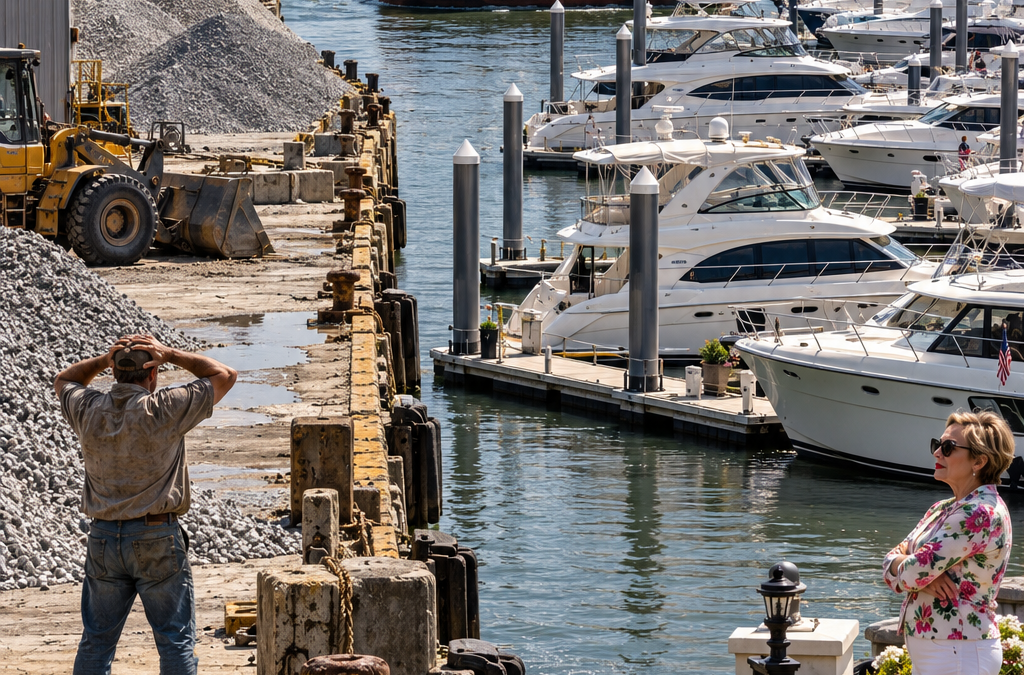
𝗙𝗨𝗟𝗟 𝗦𝗧𝗢𝗥𝗬 Some of the houses were large enough that I joked they probably had smaller houses inside them.
But for decades, Harbor Ridge and Whitaker Aggregate coexisted.
Residents knew we were there before they bought.
Our trucks stayed on designated routes.
We limited unnecessary work early on weekends.
They complained occasionally about dust.
We washed roads when necessary.
Normal neighbor problems.
Nothing serious.
Then Harbor Ridge elected Sheila Prescott.
Sheila was probably in her early fifties.
Always dressed as though a photographer might appear.
White blazers.
Gold jewelry.
Hair that didn’t move much even in river wind.
She had the kind of speaking voice that made ordinary sentences sound preapproved.
She ran for HOA president promising three things.
Higher property values.
A more exclusive lifestyle.
And what she called “a world-class waterfront experience.”
That third promise should have worried me.
It didn’t.
Not yet.
I wasn’t a member of Harbor Ridge.
Didn’t live there.
Didn’t pay dues.
Their elections were their business.
What I didn’t understand was that Sheila believed the waterfront extended wherever she wanted it to.
At her first major board presentation, she unveiled plans for a private marina.
Forty slips.
Floating docks.
Decorative lighting.
Fountains.
Landscaped access.
A ribbon-cutting terrace.
The concept drawing showed the cove looking peaceful and blue.
There was only one problem.
My commercial approach was missing.
Not moved.
Not labeled.
Erased.
I first heard about the plan from a contractor named Wes Harmon.
Wes had done concrete work for both Harbor Ridge and my yard.
We were eating breakfast at Darlene’s Diner when he slid his phone across the table.
“Cal.”
“What?”
“You seen this?”
The image showed a glossy rendering.
White docks.
Yachts.
The clubhouse lawn.
I zoomed in.
Then farther.
My stomach dropped.
“Where did you get this?”
“HOA contractor packet.”
“They’re building here?”
“Looks like it.”
I pointed at the screen.
“That’s my approach.”
“I know.”
“You told them?”
“I’m not their engineer.”
“Wes.”
“I asked if they’d cleared river rights.”
“And?”
He looked uncomfortable.
“They said everything was approved.”
I left breakfast unfinished.
Drove directly to Harbor Ridge.
The clubhouse sat above the cove with large windows facing the river.
Sheila’s assistant told me she was busy.
I waited twenty minutes.
When Sheila finally came out, she recognized me immediately.
“Mr. Whitaker.”
“Sheila.”
She gave me a smooth smile.
“The gravel gentleman.”
I remember that phrase because it told me almost everything about how she saw me.
Not owner.
Not businessman.
Not neighbor.
The gravel guy.
Something industrial attached to an otherwise elegant view.
“I saw the marina plan.”
“Beautiful, isn’t it?”
“It’s sitting on my river approach.”
She barely looked concerned.
“We’ve studied the waterfront.”
“Did you study the deed?”
She glanced down at her tablet.
“What deed?”
“The recorded easement protecting Whitaker Aggregate’s barge access.”
“I’m familiar with several old access claims.”
“Claim?”
She started walking toward the window.
I followed.
From there, we could see my gravel yard below.
Loader.
Stockpiles.
Concrete slip.
A tow cable hanging near the water.
Sheila gestured toward it.
“Cal, look at that.”
“I look at it every day.”
“It’s industrial.”
“Yes.”
“It’s visually incompatible with Harbor Ridge.”
“Harbor Ridge was built beside an aggregate yard.”
“Communities evolve.”
“Easements don’t evolve because you don’t like the view.”
Her smile tightened.
“An ancient piece of paper doesn’t override three hundred families’ property values.”
I stared at her.
“Actually, recorded property rights are exactly the kind of ancient paper that can.”
She turned.
“I don’t want this to become adversarial.”
“Then move the marina.”
“We’re not moving the marina.”
“It’s not built yet.”
“The board approved it.”
“Your board can’t approve away my access.”
Sheila looked at the river again.
“There is plenty of water.”
That sentence came back later.
“Use another approach.”
I almost laughed.
“You understand barges don’t just wander in anywhere, right?”
“I’m sure your captains are capable.”
I realized then that Sheila had never spent meaningful time around commercial navigation.
To her, the river was open blue space.
A boat went wherever water existed.
She didn’t understand draft.
Channel depth.
Turning radius.
Current.
Approach geometry.
She didn’t understand that fifteen hundred tons of limestone behaves differently from a recreational pontoon.
I could have explained.
I tried once.
She was already scrolling on her tablet.
So I left.
That afternoon, I sent a certified letter.
Not angry.
No threats.
I listed the recorded easement number.
Attached a certified copy.
Included historical barge schedules showing continuous use.
Included a current delivery calendar.
My next major shipment was less than a month away.
Sheila’s assistant signed for it.
I kept the green card.
Sheila never answered.
Two weeks later, I woke to the sound of a pile driver.
If you’ve never heard one near water, you feel it as much as hear it.
Deep metallic impact.
Thump.
Pause.
Thump.
I drove to the slip.
A construction barge was positioned across the cove.
Steel pilings were being driven directly into the riverbed.
Across my approach.
One after another.
My future being hammered into mud.
I called the county planning office.
Gave them the project name.
A clerk found a permit.
“Harbor Ridge clubhouse improvement.”
“For the marina?”
She hesitated.
“It references landscaping and shore-adjacent construction.”
“River structures?”
“I’m not seeing a federal authorization attached.”
“What about Army Corps approval?”
“I don’t have that.”
“State river permit?”
“Nothing in this file.”
I hung up and called my attorney.
Neil Abrams had practiced property and maritime law for thirty years.
Silver hair.
Thin glasses.
The patience of a man who had watched wealthy people make expensive mistakes and learned not to interrupt them too early.
I placed Dad’s 1974 easement on his desk.
Neil read it once.
Then again.
Removed his glasses.
“Cal.”
“Yeah?”
“This is extremely strong.”
“How strong?”
“If the recorded chain is clean, they have a serious problem.”
“Good.”
“No.”
He leaned forward.
“Don’t confuse strong law with fast law.”
I sat back.
“My barge arrives in eleven days.”
“I know.”
“If it can’t land, I miss the county contract.”
“How bad?”
“Penalties. Truck rescheduling. Possibly six figures if delays spread.”
Neil looked toward the easement again.
“That’s the danger.”
“So stop them.”
“I’m going to.”
“Today.”
“Federal river jurisdiction doesn’t move at your delivery schedule.”
I hated that answer because it was true.
Neil filed a complaint with the Army Corps of Engineers that night.
He notified the appropriate navigation authorities.
Sent Harbor Ridge a formal legal demand.
Requested immediate cessation.
Then we waited.
And while government offices reviewed documents, Sheila accelerated construction.
White floating docks appeared.
Electrical pedestals.
Decorative lights.
Finger piers.
A broad central walkway.
Everything new.
Everything polished.
Everything sitting where a working commercial approach had existed for half a century.
She held the ribbon cutting before the federal review was complete.
I saw photographs online.
Gold scissors.
Champagne.
White tablecloths.
Sheila smiling beside a banner:
HARBOR RIDGE MARINA — A NEW ERA OF WATERFRONT LIVING
Twelve yachts moved into the first completed slips.
Residents posted pictures.
People congratulated her.
Someone wrote:
Finally, our waterfront matches our property values.
I read that one twice.
Then two days after the party, an HOA violation notice arrived at my office.
I thought it was a joke.
It cited:
Excessive aggregate dust.
Unsightly industrial equipment.
Commercial noise.
Visual degradation affecting Harbor Ridge amenities.
I didn’t live in Harbor Ridge.
Whitaker Aggregate wasn’t part of Harbor Ridge.
Sheila was now trying to regulate my gravel yard after building over my access.
I called Neil.
“I’m framing this.”
“Don’t.”
“Why?”
“Because then I have to ask you for it later.”
“Copy.”
“Make a copy.”
“You’re no fun.”
He wasn’t laughing.
Neither was I.
Then Margaret Odum came to see me.
Margaret was seventy-four.
Widowed.
She had lived at Harbor Ridge since its first year.
Small woman.
White hair.
Walked with a cane but moved faster than people expected.
She came into my office carrying a folder.
“Cal.”
“Margaret.”
“Close the door.”
That got my attention.
I did.
She sat.
“I paid forty-two hundred dollars.”
“For what?”
“The marina assessment.”
I knew residents had been charged.
I didn’t know the amount.
“Every home?”
She nodded.
Three hundred homes.
More than a million dollars.
Margaret’s hands tightened around her folder.
“Sheila told us every approval was finished.”
I sat across from her.
“It wasn’t.”
“I know that now.”
“How?”
“I asked Doug.”
Doug Fenwick was the HOA treasurer.
Margaret continued.
“He said federal approval was in process.”
I stared.
“In process?”
“That’s what he said.”
“She built the marina before federal approval?”
Margaret nodded.
“I think she lied to us.”
That was the first time I understood how many victims this situation might have.
Until then, I thought Sheila was trying to bully Whitaker Aggregate.
Now I realized she might have used three hundred homeowners’ money to build an unauthorized river structure.
Margaret leaned closer.
“Don’t let her tell people you caused this.”
“I won’t.”
“She’s already starting.”
Of course she was.
Two days later, Doug Fenwick called me directly.
His voice shook.
“Cal?”
“Doug.”
“I need to send you something.”
“What?”
“An email.”
“From who?”
“Sheila.”
He paused.
“To the marina contractor.”
I waited.
Doug said, “I shouldn’t have stayed quiet.”
“Send it.”
The screenshot arrived.
Short email.
Sheila to the contractor.
The key sentence:
We’ll ask forgiveness later. Just build it.
I forwarded it to Neil.
His response contained one sentence.
That is what willful violation looks like.
The Army Corps review was moving.
Too slowly.
An inspector couldn’t reach us for another few weeks.
My barge arrived in six days.
So I called Captain Tommy Delgado.
Tommy had been pushing commercial barges on the Ohio for thirty-five years.
He had worked with my father.
Then me.
If there was a more experienced captain on that stretch of river, I hadn’t met him.
I explained the marina.
There was silence.
Then one slow laugh.
“She told you to go around?”
“Basically.”
“Cal.”
“Yeah?”
“A loaded barge doesn’t go around.”
“I know.”
“Does she?”
“No.”
Tommy explained what would happen if anybody forced the issue.
Our loaded barge drew roughly nine feet.
Current near the cove ran around two miles per hour depending on river conditions.
The approach was narrow for a reason.
The towboat could control speed and alignment.
It could not stop fifteen hundred tons the way somebody stops a car.
There were shallow sections outside the approach.
Obstructions.
Recreational docks.
Cross current.
“If I try to swing wide,” Tommy said, “I’m putting the barge toward those yachts.”
“So what do we do?”
“I hold if I can.”
“If you can’t?”
He went quiet.
“Then everybody gets a very expensive lesson.”
That was not funny.
I spent the next six days documenting everything.
I posted easement signs at the slip.
Marked the historic approach with bright orange buoys.
Photographed locations.
Measured distances.
Recorded video every morning.
Not because I planned to hit the marina.
Because if Sheila accused me of staging a confrontation, I wanted the record to show exactly where our lawful approach was before her people touched it.
Her attorney responded with a cease-and-desist letter.
It described my commercial slip as “abandoned industrial property.”
Abandoned.
We had barge delivery logs from the previous month.
It claimed I was interfering with HOA amenities.
Neil read the letter at my office.
Then leaned back.
“Confident.”
“That’s one word.”
“It’s one of the most confident letters I’ve read from someone whose client doesn’t have a river permit.”
That night, my cameras recorded two men removing the orange buoys.
Then pulling down easement signs.
One vehicle belonged to the marina contractor.
The footage showed Sheila standing nearby.
In place of the signs, someone zip-tied a banner:
PRIVATE HARBOR RIDGE MARINA
across the edge of my dock.
I called Neil.
“I want to cut it down.”
“No.”
“It’s on my property.”
“I know.”
“It’s blocking access.”
“I know.”
“Then—”
“Stay calm.”
I hated those words.
“Film everything. Do not touch their structure. Do not create the argument that you damaged anything.”
So I waited.
Delivery morning arrived clear.
Almost insultingly beautiful.
No snow.
No fog.
No heavy wind.
The kind of morning river people appreciate because it removes excuses.
I stood on Dad’s concrete slip at dawn.
Coffee in hand.
The marina across from me gleamed white in morning light.
Yachts tied neatly in rows.
Residents drinking coffee on decks.
The scene looked peaceful enough for an advertisement.
At eight fifty-seven, Neil texted:
Stay calm. Film everything. Do not touch anything.
At nine, the barge rounded the bend.
Even after a lifetime around them, a loaded barge has presence.
The bow rode low.
Fifteen hundred tons of crushed limestone.
Towboat behind.
Slow.
Controlled.
I could hear the engine long before it reached the cove.
People began noticing.
Doors opened.
Residents came onto docks.
Then the towboat sounded its horn.
One long blast.
The sound rolled off the hills.
Every person on the marina froze.
By the time Tommy began lining up with the approach, about forty residents had gathered on the clubhouse lawn.
Phones out.
Some filming.
Some looking at me as though I had deliberately summoned a river monster.
Then Sheila appeared.
White blazer.
Tablet held against her chest.
She walked onto the main dock.
Perfectly calm.
Behind her, twelve yachts sat where the approach needed to remain clear.
My radio crackled.
“Cal.”
Tommy.
“I have an obstruction.”
“I see it.”
“Steel pilings across the approach.”
“Correct.”
“What’s the instruction?”
Sheila shouted from the dock.
“Stop that vessel!”
I looked toward her.
“This is our scheduled barge.”
“This is a private marina.”
I raised my voice.
“You built a marina across a commercial approach.”
The lawn went quiet.
Sheila waved one hand.
“Go around.”
For a second I honestly wondered whether I’d heard correctly.
“What?”
“There’s an entire river.”
She gestured dramatically.
“Go around.”
A couple of residents laughed nervously.
My radio crackled again.
Tommy had heard.
“Go around?”
“That’s what she said.”
“Tell her I’ve got nine feet of draft and fifteen hundred tons in a two-mile current.”
I looked toward Sheila.
Tommy continued.
“If I swing outside this channel, I may put this barge into her yachts.”
Then his voice lowered.
“You want me to hold?”
“Hold.”
“For how long?”
“As long as you safely can.”
“Copy.”
The towboat adjusted.
Engines changed pitch.
The barge stopped advancing toward the slip.
But water doesn’t stop moving because people have legal disputes.
Current caught the load.
The barge began shifting sideways.
Slow.
Almost elegant.
Toward the marina.
That was when the laughter stopped.
People started running.
Yacht owners jumped aboard.
Someone shouted for dock lines.
A man slipped and nearly fell.
Engines started.
But the marina had been designed for appearance.
Narrow slips.
Decorative spacing.
Pilings positioned without regard to commercial turning movement.
Doug Fenwick was in a small motorboat between two docks.
He tried backing out.
Couldn’t.
The boat was pinned awkwardly between pilings.
He looked up at the barge.
His face went white.
He started waving both arms.
“Stop!”
Tommy’s voice came over the radio.
“I’m holding everything I’ve got.”
Sheila’s expression finally changed.
“Move the boats!”
She shouted toward residents.
“Everybody move the boats!”
People stared back.
Some had barely operated their yachts outside perfect conditions.
Moving twelve vessels simultaneously while a commercial barge drifted nearby was not part of the marina brochure.
I almost felt sorry for Sheila.
Almost.
Instead, I picked up my radio.
Switched to Channel 16.
“Coast Guard, Coast Guard, Coast Guard. This is Whitaker Aggregate river facility. We have an obstruction in a federal navigation approach. Loaded commercial barge holding with potential collision risk.”
A response came quickly.
I gave our position.
Nature of obstruction.
Vessel status.
No injuries.
Eight minutes later, a Coast Guard patrol boat appeared.
It came around the bend fast enough that everyone on the lawn stopped talking.
Lieutenant Ryan Foster stepped onto the dock.
Sunglasses pushed onto his cap.
He didn’t begin with blame.
He assessed.
Barge.
Pilings.
Dock sections.
Channel.
Then Sheila.
“Who is responsible for this marina?”
She lifted her chin.
“I am the Harbor Ridge HOA president.”
“I need the federal permit for the river structures.”
“We have permits.”
“Section 10 authorization from the Army Corps.”
She opened a folder immediately.
That confidence again.
She handed him a document.
Foster read it.
Flipped one page.
Then another.
Looked at her.
“This is a county building permit.”
“Yes.”
“For work on the clubhouse lawn.”
“It covers the project.”
“No, ma’am.”
He tapped the page.
“This covers land-based work.”
He looked toward the pilings.
“It does not authorize structures in navigable waters.”
Sheila’s face tightened.
“Our contractor handled the federal process.”
“Then give me the federal permit.”
She looked through the folder.
Nothing.
Then a voice behind us said:
“Lieutenant, I can answer that.”
A woman approached from the access road.
Hard hat under one arm.
Federal credentials.
Angelo Ward from the Army Corps of Engineers.
Neil had called her when the barge appeared.
She had been conducting another inspection only a few miles upriver.
Ward looked once at the pilings.
Once at the floating docks.
Then at the barge.
Her expression became very still.
“Who authorized construction?”
Sheila started talking.
The HOA.
Contractor.
County review.
Community investment.
Ward interrupted.
“Where is the Corps permit?”
“Our attorney—”
“Where is it?”
Silence.
Ward nodded.
“Effective immediately, use of this structure is suspended pending federal enforcement review.”
Residents started murmuring.
Sheila’s composure broke.
“You can’t shut down a private marina because of one outdated easement.”
That was when Neil walked down the dock.
Silver hair.
Leather portfolio.
Certified document in hand.
“Not outdated.”
Sheila stared.
Neil opened the copy.
“Recorded in 1974.”
He showed Ward.
“Permanent commercial access easement.”
Then Foster.
“Never released.”
Then Sheila.
“Never abandoned.”
He turned one page.
“Harbor Ridge’s predecessor developer accepted the conveyance subject to it.”
Sheila shook her head.
“This slip hasn’t been relevant in decades.”
I laughed once.
Couldn’t help it.
The barge was fifty yards away.
Loaded.
Waiting.
Neil pointed toward it.
“It appears relevant this morning.”
Doug Fenwick finally managed to get out of his trapped boat.
He climbed onto the dock shaking.
Everyone looked at him.
Doug looked at Sheila.
Then Margaret.
Then me.
“She knew.”
Sheila’s head snapped toward him.
“Doug.”
He swallowed.
“She knew the federal approval wasn’t done.”
“Stop.”
“She told the contractor to build anyway.”
“Doug.”
“I have the emails.”
His voice shook harder.
“You told us everything was approved.”
Sheila stepped toward him.
“We had legal advice.”
“No.”
Doug backed away.
“You told me we’d ask forgiveness later.”
The crowd erupted.
Margaret shouted from the lawn:
“We paid forty-two hundred dollars!”
Someone else:
“You lied to us!”
Another:
“Is the assessment money gone?”
Ward raised her voice.
“Everyone needs to stay clear of the work area.”
Then she turned to marina personnel.
“The two floating dock sections directly obstructing the approach need to be moved.”
Sheila stared.
“Today?”
“Now.”
“That will damage the marina.”
Ward looked toward the barge.
“Leaving them creates a navigation hazard.”
“Who’s paying?”
“The responsible owner of the unauthorized structure.”
That was Harbor Ridge.
Or more specifically, the people Sheila had convinced to build it.
Something unexpected happened then.
Residents stepped forward.
Not workers.
Homeowners.
People who had paid for the marina.
They began disconnecting lines from their own boats.
Moving fenders.
Helping marina staff release sections.
Doug assisted.
Margaret stood on shore directing people twice her size.
Within the hour, enough of the obstruction was moved to reopen the commercial approach.
Tommy’s voice came through the radio.
“You ready, Cal?”
I looked at Neil.
He nodded.
Ward nodded.
Foster stepped clear.
“Bring her in.”
The towboat adjusted.
The barge straightened.
Slowly, fifteen hundred tons of limestone entered the approach my father had protected in 1974.
No collision.
No yachts damaged.
No dramatic crash.
The barge slid toward our slip exactly the way it had hundreds of times before.
Like it had never left.
I stood on Dad’s concrete and felt something in my chest loosen.
Not triumph.
Relief.
For eleven days, I had imagined every version of failure.
Missed county contract.
Damaged boats.
Court injunctions arriving too late.
Someone getting hurt because an HOA president believed confidence could replace navigation law.
Instead, stone met slip.
Crew secured lines.
Work resumed.
The river had settled the practical question.
The legal consequences came later.
Two weeks after the barge incident, Harbor Ridge held an emergency meeting.
The clubhouse was packed.
Residents filled chairs.
Walls.
Hallway.
Margaret spoke first.
She had collected a recall petition.
Two hundred ninety-one homeowners had signed.
Out of roughly three hundred.
She stood at the microphone with her cane in one hand and the petition in the other.
“We were told the marina was fully permitted.”
She looked directly at Sheila.
“It wasn’t.”
“We were assessed forty-two hundred dollars per household.”
She raised the documents.
“We were told Whitaker Aggregate had abandoned its access rights.”
Her voice hardened.
“It hadn’t.”
“We were told Mr. Whitaker was interfering with our property.”
She pointed toward the river.
“We built on his easement.”
No one interrupted.
When the removal vote was called, Sheila lost unanimously among the voting members.
She left without speaking.
The Army Corps enforcement came next.
Sixty-thousand-dollar penalty.
Required removal and restoration obligations.
Federal review of how construction had proceeded without proper authorization.
The special assessment had to be refunded to homeowners as the marina project unraveled.
The state attorney general opened an investigation into Sheila’s communications, representations, and handling of association funds.
Doug cooperated.
Turned over emails.
Financial records.
Messages with contractors.
The sentence everyone remembered remained:
We’ll ask forgiveness later. Just build it.
Neil made one thing nonnegotiable.
Whitaker Aggregate would not pay for a single piling.
Not one dock removal.
Not one legal cost resulting from the HOA’s decision to ignore a recorded easement.
By autumn, the marina was gone.
Not redesigned.
Gone.
The pilings blocking our approach were removed.
Floating docks disappeared.
The yachts relocated.
Our orange navigation buoys went back where they belonged.
I stood on the slip the morning the last unauthorized section was hauled away.
Dad had been dead fourteen years by then.
I still found myself wanting to call him.
“Paper mattered.”
That’s what I would have said.
He would have pretended not to be surprised.
Margaret brought me an apple pie a week later.
Homemade.
She put it on my office desk.
“This is an apology.”
“You didn’t build the marina.”
“I voted for the assessment.”
“You were lied to.”
“I still voted.”
I looked at her.
“Margaret, if people had to apologize every time they believed a confident liar, we’d never get anything else done.”
She smiled.
“Take the pie anyway.”
“I was going to.”
The new Harbor Ridge president was a retired schoolteacher named Elaine Porter.
Her first official call to me was uncomfortable.
“Mr. Whitaker.”
“Cal.”
“Cal.”
Pause.
“I’d like to start over.”
“So would I.”
She invited me to speak at the community’s autumn day.
I almost refused.
I had no interest in becoming Harbor Ridge’s symbolic gravel man.
Then Elaine explained they were rebuilding a walking path near the clubhouse.
“Need aggregate?” I asked.
She laughed nervously.
“Actually, yes.”
I donated a truckload.
Not because the HOA deserved it.
Because the residents were still my neighbors.
That distinction mattered.
On community day, I stood near the unfinished path while children ran between tables.
People who had once photographed my barge conflict walked over to shake my hand.
A few apologized.
Some avoided the topic entirely.
That was fine.
I didn’t need three hundred confessions.
I needed the river open.
I needed my business intact.
I needed everybody to understand the line.
The old easement.
The one Sheila called ancient.
Still sat in our office file.
Recorded 1974.
Permanent.
Dad’s signature.
Developer’s signature.
County stamp.
For fifty years, nobody cared much about it because nobody needed to.
Then one woman decided a glossy rendering mattered more.
That was all it took to make an old piece of paper become the most valuable document in my company.
Sometimes people ask whether Sheila ever apologized.
Not to me.
Not directly.
I saw her once afterward at a grocery store.
She saw me.
Turned down another aisle.
I let her.
I wasn’t interested in revenge.
She had lost the presidency.
Faced investigation.
Her reputation inside Harbor Ridge was finished.
Whatever happened to her professional life after that belonged to her.
I didn’t need more.
The river doesn’t hold grudges.
It moves.
I tried to learn something from that.
Doug stayed in Harbor Ridge.
He resigned as treasurer.
For a long time, some neighbors blamed him almost as much as Sheila.
I understood why.
He had known approval wasn’t final.
He had been nervous.
He had seen things that should have stopped construction.
But he also became the person who finally spoke.
That doesn’t erase silence.
It does matter.
Months later he came to my office.
“I should’ve called you.”
“Yes.”
He looked surprised I agreed so quickly.
“I thought you’d say it wasn’t my fault.”
“It wasn’t all your fault.”
“That’s different.”
“Exactly.”
He nodded.
“I was scared of her.”
“I know.”
“She made everything sound like I was undermining the community if I questioned her.”
“That’s how people keep power longer than they should.”
He looked toward the river.
“I knew the permits were unfinished.”
“Then next time speak when you know.”
He nodded.
“Next time.”
That was enough.
Whitaker Aggregate survived the county contract.
Barely.
The delay at the river cost us hours, not days.
Tommy landed the stone.
Trucks loaded.
Crews worked late.
We met the delivery schedule.
No penalties.
Gerald Pike—our county procurement contact, not related to anything else—called afterward.
“Heard you had some marina trouble.”
“Small parking issue.”
He laughed.
“With a barge?”
“Large parking issue.”
The story traveled.
River towns love stories involving people who underestimate barges.
For months, customers came into the yard asking:
“Are you the guy whose HOA told a loaded barge to go around?”
I always corrected them.
“Not my HOA.”
That mattered too.
Harbor Ridge had spent months acting as though proximity created authority.
It didn’t.
Living beside an industrial property doesn’t make the industrial property part of your neighborhood covenant.
Buying a river view doesn’t buy the river.
And a private board vote does not override federal navigation law or recorded property rights.
Those sound obvious now.
They were apparently not obvious enough then.
The most unsettling part, looking back, wasn’t the unauthorized construction.
It was the certainty.
Sheila did not act like somebody taking a risk.
She acted like approval was something she could create by stating it.
She told homeowners the permits were done.
They weren’t.
She told contractors to build anyway.
They did.
She told me my easement was irrelevant.
It wasn’t.
She told a loaded commercial barge to go around.
It couldn’t.
At every stage, reality offered her an opportunity to stop.
Certified letter.
County records.
My attorney.
Doug’s concern.
Federal permit requirements.
The approach buoys.
The arrival schedule.
She ignored all of it.
That is the kind of behavior that becomes dangerous around infrastructure.
A marina is not a flower bed.
A navigation channel is not a mailbox rule.
Fifteen hundred tons of stone does not care who won an HOA election.
Captain Tommy said it best later.
We were sitting beside the river after unloading.
He opened a thermos.
“People see water and think boats can go anywhere.”
“I know.”
“They don’t understand weight.”
“No.”
He looked toward where the marina had been.
“Water makes heavy things look graceful.”
He took a drink.
“Doesn’t make them light.”
That became one of those sentences I remembered.
The marina had made everything look recreational.
Blue water.
White docks.
Yachts.
Champagne.
A river designed for lifestyle.
But underneath the picture was the same working river my father knew.
Current.
Depth.
Commercial traffic.
Recorded rights.
Federal jurisdiction.
Physics.
Sheila built the photograph and ignored what made the photograph possible.
Maybe that’s why the confrontation felt inevitable in hindsight.
You can hide an easement from a glossy poster.
You can’t hide a fifteen-hundred-ton barge when it rounds the bend.
Years after the marina disappeared, Harbor Ridge finally built a legal waterfront improvement.
Smaller.
Set back from the commercial approach.
Properly engineered.
Properly permitted.
Federal approvals before construction.
Elaine invited me to review the concept before it went to the board.
“You don’t have to approve it,” she said.
“I know.”
“I just want you to tell us if we’re about to do something stupid.”
I looked at the drawing.
“Now that’s community planning.”
The new dock held kayaks and small recreational boats.
Nothing obstructed the approach.
No fountains.
No gold scissors.
It worked.
That’s something I wish Sheila had understood.
Compromise was always available.
I wasn’t opposed to Harbor Ridge enjoying the river.
I wasn’t trying to preserve every inch of shoreline exactly as Dad knew it.
I needed one thing.
Keep the approach clear.
One corridor.
A right already recorded.
They could have built almost everything else around it.
Instead, Sheila treated my boundary as an insult.
People who confuse compromise with losing often end up losing everything.
The special assessment refund hurt Harbor Ridge financially.
Some residents were furious.
Forty-two hundred dollars had been a substantial amount for retirees like Margaret.
Others had borrowed from savings.
One young family told me they had delayed replacing their roof because of the assessment.
That’s another reason I never enjoyed the collapse.
Residents had already paid for Sheila’s certainty.
Then they paid again to undo it.
Bad leadership sends invoices to people who didn’t make the decision.
I donated the gravel for the walking path partly because of that.
Not absolution.
Just neighborliness.
My father would have done the same.
He could be stubborn beyond reason in negotiations.
Then he’d loan a loader to the same man the following week if a barn collapsed.
Human beings are contradictory that way.
Property disputes make people imagine two sides where there may still be neighbors after the lawyers go home.
I had to remember that.
The easement kept working.
Barges continued arriving.
Some Harbor Ridge residents eventually brought their children down to watch unloading.
From a safe distance.
Tommy loved explaining towboats.
He’d point at the river.
“See how slow that barge looks?”
Kids nodded.
“That’s fifteen hundred tons.”
Eyes widened.
Then he’d say:
“Slow isn’t the same as easy to stop.”
I usually looked toward the old marina location when he said it.
Tommy noticed.
Never commented.
By the time he retired, he had landed hundreds of barges at our slip.
His replacement knew the same approach.
Same alignment.
Same orange buoys.
The 1974 easement was older than several captains using it.
Still valid.
Still necessary.
I sometimes pull the certified copy from the file.
The paper is cream-colored now.
Edges soft.
Dad’s signature heavy and slightly crooked.
Ray Whitaker never imagined Sheila Prescott.
He didn’t need to.
Good agreements aren’t written only for people you trust today.
They’re written for the person fifty years later who looks at your road, your well, your access, your land, and thinks:
Surely nobody will stop me.
That is why recording matters.
Memory fades.
People die.
Boards change.
Developers disappear.
Paper remains where law tells it to remain.
When I was young, I thought Dad’s obsession with documents made him old-fashioned.
Now every major agreement in my business exists in three places.
Physical original.
Digital archive.
Attorney copy.
Neil says I’ve become impossible.
I tell him he created the problem.
He takes credit.
The old private-marina banner is gone.
I kept one orange buoy that Sheila’s contractor removed.
It’s hanging in the warehouse.
One of my employees wrote:
GO AROUND
on it with permanent marker.
I pretended to be irritated.
I wasn’t.
Humor is easier once nobody’s business is at risk.
The river approach looks almost exactly as it did before.
That might seem anticlimactic.
It’s not.
Restoration often looks like nothing happened.
Open water.
Orange markers.
Concrete slip.
Barge arriving.
That is the victory.
Infrastructure works best when nobody thinks about it.
We thought about that approach more in three months than we had in fifty years.
Now we barely think about it again.
That means the system is doing its job.
Margaret still brings pie occasionally.
She tells everyone she saved my company.
I tell people that’s mostly accurate.
At the first community day after the crisis, she stood beside me watching children walk the new gravel path.
“Do you hate us?” she asked.
I looked at her.
“No.”
“The neighborhood.”
“No.”
“You should.”
“Why?”
“We applauded her.”
“Some of you.”
“We voted for the marina.”
“You were shown a plan and told it was legal.”
“We should’ve asked.”
“Yes.”
She looked surprised.
I smiled.
“People always expect forgiveness to mean pretending they couldn’t have done better.”
Margaret nodded slowly.
“We should’ve asked.”
“Next time, ask.”
She smiled.
“I like that better.”
So did I.
I never wanted Harbor Ridge afraid of Whitaker Aggregate.
I wanted them informed.
There is a difference.
Fear says:
Don’t challenge Cal because he has lawyers.
Information says:
The commercial access exists. Here is the recording number. Design around it.
Healthy communities run better on the second.
The new board eventually placed the recorded easement and river restrictions in the homeowner document portal.
Every buyer could see them.
No surprises.
No glossy rendering that erased my slip.
No president interpreting history from memory.
I appreciated that more than Elaine probably knew.
Transparency prevents future villains, but it also prevents ordinary mistakes.
Not every conflict needs a Sheila.
Sometimes two decent people simply haven’t read the same document.
Publish the document.
Problem gets smaller.
That’s what competent governance looks like.
No theater required.
I still start many mornings at the slip.
I’m older.
My son handles more of the operation now.
My knees don’t like climbing equipment ladders.
I supervise more than I lift.
That is a difficult transition for men raised by fathers who believed sitting down before sunset was suspicious.
Some mornings I stand with coffee and watch current moving past the concrete.
I can still picture the marina.
White docks.
Yachts.
Sheila standing with her tablet.
“Go around.”
Of everything she said, those two words stay with me most.
Because they revealed the entire mistake.
She believed inconvenience belonged to whoever had less social power in her mind.
The gravel company was ugly.
The marina was beautiful.
Therefore we should move.
Our business was old.
Her vision was new.
Therefore our rights should bend.
We hauled limestone.
Her residents owned yachts.
Therefore the commercial channel should accommodate them.
“Go around” wasn’t navigation advice.
It was how she saw the world.
Make the inconvenient person move.
Make the old agreement move.
Make the river move.
Make physics move.
Make reality organize itself around the presentation.
But reality is stubborn.
So was Dad’s easement.
The barge held.
The permits didn’t exist.
The email existed.
The record existed.
The federal law existed.
Eventually every thing Sheila treated as optional arrived in the same place at the same time.
That morning, I didn’t beat her.
I didn’t need to.
The facts did.
Neil once said the cleanest legal victories are the ones where you don’t have to make the judge imaginative.
Show the deed.
Show the obstruction.
Show the permit record.
Show the email.
Show the damages.
That’s it.
The river confrontation was the same.
There was nothing abstract when the barge arrived.
Everyone could see the size.
Everyone could see the approach.
Everyone could see the pilings.
Everyone could see that “go around” wasn’t a plan.
For the first time, the residents weren’t being asked to choose between my story and Sheila’s.
They were looking at physical reality.
That changed everything.
I sometimes wonder whether Sheila had ever stood near a loaded barge before.
Probably not.
If she had, maybe she would have respected what she couldn’t move.
Then again, the easement should have been enough.
The federal permit rules should have been enough.
The certified letter should have been enough.
Doug’s questions should have been enough.
Maybe the barge was simply the first thing too large for her to dismiss.
There is a lesson in that.
People who ignore quiet warnings eventually receive loud ones.
A deed is quiet.
A certified letter is quiet.
An attorney’s notice is quiet.
A federal permit application is paperwork.
A fifteen-hundred-ton barge horn rolling across the water is not quiet.
By then, everyone listened.
Whitaker Aggregate is still there.
Same gravel yard.
Same dust.
Same slip.
County roads still use our limestone.
The hillside above still holds Harbor Ridge’s beautiful houses.
The clubhouse windows still overlook the cove.
And when residents look down now, they can see the commercial approach marked clearly in orange.
I like that.
Not because the buoys are attractive.
They’re not.
Because nobody has to guess.
The old agreement and the modern neighborhood can occupy the same river.
They always could.
All anybody had to do was respect the line Dad protected in 1974.
The last time Neil and I talked about the case, he asked whether I was glad it happened.
“No.”
He looked surprised.
“You won.”
“I would’ve preferred nobody spend a million dollars building the wrong thing.”
“Fair.”
“I would’ve preferred Margaret keep her forty-two hundred dollars.”
“Fair.”
“I would’ve preferred not wondering if a barge was going to crush twelve yachts.”
“Definitely fair.”
He smiled.
“But?”
I looked toward the slip.
“But I’m glad the easement was tested.”
“Why?”
“Now nobody will forget it again.”
Neil laughed.
“That’s a very expensive way to update institutional memory.”
“Not my invoice.”
He nodded.
“Also fair.”
Dad used to say legal paper mattered most when everyone wished it didn’t exist.
I understand that now.
The easement wasn’t powerful because it was old.
It was powerful because it was clear.
Recorded.
Continuous.
Truthful.
No hidden trick.
No technical ambush.
My father sold the hillside with one condition.
Keep the river approach open.
The developer agreed.
Harbor Ridge took its rights subject to that condition.
For fifty years, the deal worked.
Then Sheila tried to rewrite it without changing the deed, without obtaining federal approval, and without telling the people paying for her marina what was missing.
For three months, confidence made that look possible.
Then the barge arrived.
And sometimes that is all it takes.
One thing too heavy to move.
One fact too clearly recorded to reinterpret.
One old piece of paper written by people who meant exactly what they signed.
The river approach is open now.
The orange buoys are still there.
The barges still come in on schedule.
And every time one rounds the bend, I can hear my father’s voice as clearly as the horn rolling across the water:
People remember agreements until remembering becomes expensive.
Sheila made forgetting very expensive.
The paper remembered for all of us.
𝗧𝗛𝗘 𝗘𝗡𝗗
The HOA Built a Luxury Marina Across the Only River Approach My Family Had Used for Fifty Years
The horn of a fully loaded barge rolled across the Ohio River while twelve new yachts sat exactly where my commercial approach was supposed to be, and the woman who had put them there calmly told me to make fifteen hundred tons of limestone “go around.”
I stood on the concrete slip my father had built half a century earlier and realized Sheila Prescott still believed this was an argument about an ugly gravel yard instead of a recorded right she had buried under white docks, champagne, and somebody else’s money.
My name is Cal Whitaker.
For most of my life, the Ohio River has been less a view than a working partner.
Beautiful sometimes.
Dangerous often.
Never sentimental.
People who build luxury houses along a river tend to see sunsets first.
People who make a living from one notice current.
Depth.
Flood stage.
Ice.
Draft.
Wind.
A river does not care how much money you spent on the house overlooking it.
It does not care how attractive your marina looks in a brochure.
And it definitely does not care what an HOA president promised three hundred homeowners at a board meeting.
That was the lesson Sheila Prescott learned the morning a loaded barge came around the bend and found her brand-new luxury marina sitting directly in its path.
Three months earlier, I thought my biggest problem was a late limestone shipment.
Whitaker Aggregate had been operating on that stretch of river for fifty years.
My father, Ray Whitaker, started with almost nothing.
One loader.
Two dump trucks.
A gravel yard carved into the low ground beside the river.
And a concrete barge slip he helped dig and pour himself.
It was never pretty.
I won’t pretend otherwise.
Aggregate work is noisy.
Dust settles on everything.
Diesel engines start before people in gated neighborhoods finish their first cup of coffee.
Crushed limestone does not arrive in decorative baskets.
It arrives by barge.
Heavy.
Wet.
Industrial.
Honest.
Half the county’s road base had passed through our yard at one point or another.
School parking lots.
Farm roads.
County resurfacing projects.
Drainage work.
Construction sites.
Every week during our busy season, a towboat pushed a barge upriver carrying roughly fifteen hundred tons of stone.
It came through a specific approach.
Same channel.
Same alignment.
Same slip.
Year after year.
That route mattered enough that my father had protected it long before anyone imagined million-dollar houses on the hill.
In 1974, he sold a section of hillside above the cove to a developer.
Dad wasn’t a lawyer.
He didn’t trust people who used the phrase “standard paperwork.”
So before signing anything, he hired one.
The deed contained a permanent recorded easement preserving Whitaker Aggregate’s right to access the river approach serving our commercial slip.
Not for ten years.
Not until ownership changed.
Permanent.
The language was direct.
The approach had to remain available for commercial barge access.
That easement followed the land.
Dad kept a certified copy in a metal filing cabinet at the office.
As a kid, I thought the document was pointless.
Everybody knew where our slip was.
Everybody knew barges came there.
Why would paper matter?
Dad once tapped that deed with his finger and told me:
“Cal, people remember agreements until remembering becomes expensive.”
I was fourteen.
I rolled my eyes.
Fifty years later, I understood every word.
The development above us eventually became Harbor Ridge Landing.
Three hundred homes.
White fences.
Landscaped medians.
Private clubhouse.
River views.
Some of the houses were large enough that I joked they probably had smaller houses inside them.
But for decades, Harbor Ridge and Whitaker Aggregate coexisted.
Residents knew we were there before they bought.
Our trucks stayed on designated routes.
We limited unnecessary work early on weekends.
They complained occasionally about dust.
We washed roads when necessary.
Normal neighbor problems.
Nothing serious.
Then Harbor Ridge elected Sheila Prescott.
Sheila was probably in her early fifties.
Always dressed as though a photographer might appear.
White blazers.
Gold jewelry.
Hair that didn’t move much even in river wind.
She had the kind of speaking voice that made ordinary sentences sound preapproved.
She ran for HOA president promising three things.
Higher property values.
A more exclusive lifestyle.
And what she called “a world-class waterfront experience.”
That third promise should have worried me.
It didn’t.
Not yet.
I wasn’t a member of Harbor Ridge.
Didn’t live there.
Didn’t pay dues.
Their elections were their business.
What I didn’t understand was that Sheila believed the waterfront extended wherever she wanted it to.
At her first major board presentation, she unveiled plans for a private marina.
Forty slips.
Floating docks.
Decorative lighting.
Fountains.
Landscaped access.
A ribbon-cutting terrace.
The concept drawing showed the cove looking peaceful and blue.
There was only one problem.
My commercial approach was missing.
Not moved.
Not labeled.
Erased.
I first heard about the plan from a contractor named Wes Harmon.
Wes had done concrete work for both Harbor Ridge and my yard.
We were eating breakfast at Darlene’s Diner when he slid his phone across the table.
“Cal.”
“What?”
“You seen this?”
The image showed a glossy rendering.
White docks.
Yachts.
The clubhouse lawn.
I zoomed in.
Then farther.
My stomach dropped.
“Where did you get this?”
“HOA contractor packet.”
“They’re building here?”
“Looks like it.”
I pointed at the screen.
“That’s my approach.”
“I know.”
“You told them?”
“I’m not their engineer.”
“Wes.”
“I asked if they’d cleared river rights.”
“And?”
He looked uncomfortable.
“They said everything was approved.”
I left breakfast unfinished.
Drove directly to Harbor Ridge.
The clubhouse sat above the cove with large windows facing the river.
Sheila’s assistant told me she was busy.
I waited twenty minutes.
When Sheila finally came out, she recognized me immediately.
“Mr. Whitaker.”
“Sheila.”
She gave me a smooth smile.
“The gravel gentleman.”
I remember that phrase because it told me almost everything about how she saw me.
Not owner.
Not businessman.
Not neighbor.
The gravel guy.
Something industrial attached to an otherwise elegant view.
“I saw the marina plan.”
“Beautiful, isn’t it?”
“It’s sitting on my river approach.”
She barely looked concerned.
“We’ve studied the waterfront.”
“Did you study the deed?”
She glanced down at her tablet.
“What deed?”
“The recorded easement protecting Whitaker Aggregate’s barge access.”
“I’m familiar with several old access claims.”
“Claim?”
She started walking toward the window.
I followed.
From there, we could see my gravel yard below.
Loader.
Stockpiles.
Concrete slip.
A tow cable hanging near the water.
Sheila gestured toward it.
“Cal, look at that.”
“I look at it every day.”
“It’s industrial.”
“Yes.”
“It’s visually incompatible with Harbor Ridge.”
“Harbor Ridge was built beside an aggregate yard.”
“Communities evolve.”
“Easements don’t evolve because you don’t like the view.”
Her smile tightened.
“An ancient piece of paper doesn’t override three hundred families’ property values.”
I stared at her.
“Actually, recorded property rights are exactly the kind of ancient paper that can.”
She turned.
“I don’t want this to become adversarial.”
“Then move the marina.”
“We’re not moving the marina.”
“It’s not built yet.”
“The board approved it.”
“Your board can’t approve away my access.”
Sheila looked at the river again.
“There is plenty of water.”
That sentence came back later.
“Use another approach.”
I almost laughed.
“You understand barges don’t just wander in anywhere, right?”
“I’m sure your captains are capable.”
I realized then that Sheila had never spent meaningful time around commercial navigation.
To her, the river was open blue space.
A boat went wherever water existed.
She didn’t understand draft.
Channel depth.
Turning radius.
Current.
Approach geometry.
She didn’t understand that fifteen hundred tons of limestone behaves differently from a recreational pontoon.
I could have explained.
I tried once.
She was already scrolling on her tablet.
So I left.
That afternoon, I sent a certified letter.
Not angry.
No threats.
I listed the recorded easement number.
Attached a certified copy.
Included historical barge schedules showing continuous use.
Included a current delivery calendar.
My next major shipment was less than a month away.
Sheila’s assistant signed for it.
I kept the green card.
Sheila never answered.
Two weeks later, I woke to the sound of a pile driver.
If you’ve never heard one near water, you feel it as much as hear it.
Deep metallic impact.
Thump.
Pause.
Thump.
I drove to the slip.
A construction barge was positioned across the cove.
Steel pilings were being driven directly into the riverbed.
Across my approach.
One after another.
My future being hammered into mud.
I called the county planning office.
Gave them the project name.
A clerk found a permit.
“Harbor Ridge clubhouse improvement.”
“For the marina?”
She hesitated.
“It references landscaping and shore-adjacent construction.”
“River structures?”
“I’m not seeing a federal authorization attached.”
“What about Army Corps approval?”
“I don’t have that.”
“State river permit?”
“Nothing in this file.”
I hung up and called my attorney.
Neil Abrams had practiced property and maritime law for thirty years.
Silver hair.
Thin glasses.
The patience of a man who had watched wealthy people make expensive mistakes and learned not to interrupt them too early.
I placed Dad’s 1974 easement on his desk.
Neil read it once.
Then again.
Removed his glasses.
“Cal.”
“Yeah?”
“This is extremely strong.”
“How strong?”
“If the recorded chain is clean, they have a serious problem.”
“Good.”
“No.”
He leaned forward.
“Don’t confuse strong law with fast law.”
I sat back.
“My barge arrives in eleven days.”
“I know.”
“If it can’t land, I miss the county contract.”
“How bad?”
“Penalties. Truck rescheduling. Possibly six figures if delays spread.”
Neil looked toward the easement again.
“That’s the danger.”
“So stop them.”
“I’m going to.”
“Today.”
“Federal river jurisdiction doesn’t move at your delivery schedule.”
I hated that answer because it was true.
Neil filed a complaint with the Army Corps of Engineers that night.
He notified the appropriate navigation authorities.
Sent Harbor Ridge a formal legal demand.
Requested immediate cessation.
Then we waited.
And while government offices reviewed documents, Sheila accelerated construction.
White floating docks appeared.
Electrical pedestals.
Decorative lights.
Finger piers.
A broad central walkway.
Everything new.
Everything polished.
Everything sitting where a working commercial approach had existed for half a century.
She held the ribbon cutting before the federal review was complete.
I saw photographs online.
Gold scissors.
Champagne.
White tablecloths.
Sheila smiling beside a banner:
HARBOR RIDGE MARINA — A NEW ERA OF WATERFRONT LIVING
Twelve yachts moved into the first completed slips.
Residents posted pictures.
People congratulated her.
Someone wrote:
Finally, our waterfront matches our property values.
I read that one twice.
Then two days after the party, an HOA violation notice arrived at my office.
I thought it was a joke.
It cited:
Excessive aggregate dust.
Unsightly industrial equipment.
Commercial noise.
Visual degradation affecting Harbor Ridge amenities.
I didn’t live in Harbor Ridge.
Whitaker Aggregate wasn’t part of Harbor Ridge.
Sheila was now trying to regulate my gravel yard after building over my access.
I called Neil.
“I’m framing this.”
“Don’t.”
“Why?”
“Because then I have to ask you for it later.”
“Copy.”
“Make a copy.”
“You’re no fun.”
He wasn’t laughing.
Neither was I.
Then Margaret Odum came to see me.
Margaret was seventy-four.
Widowed.
She had lived at Harbor Ridge since its first year.
Small woman.
White hair.
Walked with a cane but moved faster than people expected.
She came into my office carrying a folder.
“Cal.”
“Margaret.”
“Close the door.”
That got my attention.
I did.
She sat.
“I paid forty-two hundred dollars.”
“For what?”
“The marina assessment.”
I knew residents had been charged.
I didn’t know the amount.
“Every home?”
She nodded.
Three hundred homes.
More than a million dollars.
Margaret’s hands tightened around her folder.
“Sheila told us every approval was finished.”
I sat across from her.
“It wasn’t.”
“I know that now.”
“How?”
“I asked Doug.”
Doug Fenwick was the HOA treasurer.
Margaret continued.
“He said federal approval was in process.”
I stared.
“In process?”
“That’s what he said.”
“She built the marina before federal approval?”
Margaret nodded.
“I think she lied to us.”
That was the first time I understood how many victims this situation might have.
Until then, I thought Sheila was trying to bully Whitaker Aggregate.
Now I realized she might have used three hundred homeowners’ money to build an unauthorized river structure.
Margaret leaned closer.
“Don’t let her tell people you caused this.”
“I won’t.”
“She’s already starting.”
Of course she was.
Two days later, Doug Fenwick called me directly.
His voice shook.
“Cal?”
“Doug.”
“I need to send you something.”
“What?”
“An email.”
“From who?”
“Sheila.”
He paused.
“To the marina contractor.”
I waited.
Doug said, “I shouldn’t have stayed quiet.”
“Send it.”
The screenshot arrived.
Short email.
Sheila to the contractor.
The key sentence:
We’ll ask forgiveness later. Just build it.
I forwarded it to Neil.
His response contained one sentence.
That is what willful violation looks like.
The Army Corps review was moving.
Too slowly.
An inspector couldn’t reach us for another few weeks.
My barge arrived in six days.
So I called Captain Tommy Delgado.
Tommy had been pushing commercial barges on the Ohio for thirty-five years.
He had worked with my father.
Then me.
If there was a more experienced captain on that stretch of river, I hadn’t met him.
I explained the marina.
There was silence.
Then one slow laugh.
“She told you to go around?”
“Basically.”
“Cal.”
“Yeah?”
“A loaded barge doesn’t go around.”
“I know.”
“Does she?”
“No.”
Tommy explained what would happen if anybody forced the issue.
Our loaded barge drew roughly nine feet.
Current near the cove ran around two miles per hour depending on river conditions.
The approach was narrow for a reason.
The towboat could control speed and alignment.
It could not stop fifteen hundred tons the way somebody stops a car.
There were shallow sections outside the approach.
Obstructions.
Recreational docks.
Cross current.
“If I try to swing wide,” Tommy said, “I’m putting the barge toward those yachts.”
“So what do we do?”
“I hold if I can.”
“If you can’t?”
He went quiet.
“Then everybody gets a very expensive lesson.”
That was not funny.
I spent the next six days documenting everything.
I posted easement signs at the slip.
Marked the historic approach with bright orange buoys.
Photographed locations.
Measured distances.
Recorded video every morning.
Not because I planned to hit the marina.
Because if Sheila accused me of staging a confrontation, I wanted the record to show exactly where our lawful approach was before her people touched it.
Her attorney responded with a cease-and-desist letter.
It described my commercial slip as “abandoned industrial property.”
Abandoned.
We had barge delivery logs from the previous month.
It claimed I was interfering with HOA amenities.
Neil read the letter at my office.
Then leaned back.
“Confident.”
“That’s one word.”
“It’s one of the most confident letters I’ve read from someone whose client doesn’t have a river permit.”
That night, my cameras recorded two men removing the orange buoys.
Then pulling down easement signs.
One vehicle belonged to the marina contractor.
The footage showed Sheila standing nearby.
In place of the signs, someone zip-tied a banner:
PRIVATE HARBOR RIDGE MARINA
across the edge of my dock.
I called Neil.
“I want to cut it down.”
“No.”
“It’s on my property.”
“I know.”
“It’s blocking access.”
“I know.”
“Then—”
“Stay calm.”
I hated those words.
“Film everything. Do not touch their structure. Do not create the argument that you damaged anything.”
So I waited.
Delivery morning arrived clear.
Almost insultingly beautiful.
No snow.
No fog.
No heavy wind.
The kind of morning river people appreciate because it removes excuses.
I stood on Dad’s concrete slip at dawn.
Coffee in hand.
The marina across from me gleamed white in morning light.
Yachts tied neatly in rows.
Residents drinking coffee on decks.
The scene looked peaceful enough for an advertisement.
At eight fifty-seven, Neil texted:
Stay calm. Film everything. Do not touch anything.
At nine, the barge rounded the bend.
Even after a lifetime around them, a loaded barge has presence.
The bow rode low.
Fifteen hundred tons of crushed limestone.
Towboat behind.
Slow.
Controlled.
I could hear the engine long before it reached the cove.
People began noticing.
Doors opened.
Residents came onto docks.
Then the towboat sounded its horn.
One long blast.
The sound rolled off the hills.
Every person on the marina froze.
By the time Tommy began lining up with the approach, about forty residents had gathered on the clubhouse lawn.
Phones out.
Some filming.
Some looking at me as though I had deliberately summoned a river monster.
Then Sheila appeared.
White blazer.
Tablet held against her chest.
She walked onto the main dock.
Perfectly calm.
Behind her, twelve yachts sat where the approach needed to remain clear.
My radio crackled.
“Cal.”
Tommy.
“I have an obstruction.”
“I see it.”
“Steel pilings across the approach.”
“Correct.”
“What’s the instruction?”
Sheila shouted from the dock.
“Stop that vessel!”
I looked toward her.
“This is our scheduled barge.”
“This is a private marina.”
I raised my voice.
“You built a marina across a commercial approach.”
The lawn went quiet.
Sheila waved one hand.
“Go around.”
For a second I honestly wondered whether I’d heard correctly.
“What?”
“There’s an entire river.”
She gestured dramatically.
“Go around.”
A couple of residents laughed nervously.
My radio crackled again.
Tommy had heard.
“Go around?”
“That’s what she said.”
“Tell her I’ve got nine feet of draft and fifteen hundred tons in a two-mile current.”
I looked toward Sheila.
Tommy continued.
“If I swing outside this channel, I may put this barge into her yachts.”
Then his voice lowered.
“You want me to hold?”
“Hold.”
“For how long?”
“As long as you safely can.”
“Copy.”
The towboat adjusted.
Engines changed pitch.
The barge stopped advancing toward the slip.
But water doesn’t stop moving because people have legal disputes.
Current caught the load.
The barge began shifting sideways.
Slow.
Almost elegant.
Toward the marina.
That was when the laughter stopped.
People started running.
Yacht owners jumped aboard.
Someone shouted for dock lines.
A man slipped and nearly fell.
Engines started.
But the marina had been designed for appearance.
Narrow slips.
Decorative spacing.
Pilings positioned without regard to commercial turning movement.
Doug Fenwick was in a small motorboat between two docks.
He tried backing out.
Couldn’t.
The boat was pinned awkwardly between pilings.
He looked up at the barge.
His face went white.
He started waving both arms.
“Stop!”
Tommy’s voice came over the radio.
“I’m holding everything I’ve got.”
Sheila’s expression finally changed.
“Move the boats!”
She shouted toward residents.
“Everybody move the boats!”
People stared back.
Some had barely operated their yachts outside perfect conditions.
Moving twelve vessels simultaneously while a commercial barge drifted nearby was not part of the marina brochure.
I almost felt sorry for Sheila.
Almost.
Instead, I picked up my radio.
Switched to Channel 16.
“Coast Guard, Coast Guard, Coast Guard. This is Whitaker Aggregate river facility. We have an obstruction in a federal navigation approach. Loaded commercial barge holding with potential collision risk.”
A response came quickly.
I gave our position.
Nature of obstruction.
Vessel status.
No injuries.
Eight minutes later, a Coast Guard patrol boat appeared.
It came around the bend fast enough that everyone on the lawn stopped talking.
Lieutenant Ryan Foster stepped onto the dock.
Sunglasses pushed onto his cap.
He didn’t begin with blame.
He assessed.
Barge.
Pilings.
Dock sections.
Channel.
Then Sheila.
“Who is responsible for this marina?”
She lifted her chin.
“I am the Harbor Ridge HOA president.”
“I need the federal permit for the river structures.”
“We have permits.”
“Section 10 authorization from the Army Corps.”
She opened a folder immediately.
That confidence again.
She handed him a document.
Foster read it.
Flipped one page.
Then another.
Looked at her.
“This is a county building permit.”
“Yes.”
“For work on the clubhouse lawn.”
“It covers the project.”
“No, ma’am.”
He tapped the page.
“This covers land-based work.”
He looked toward the pilings.
“It does not authorize structures in navigable waters.”
Sheila’s face tightened.
“Our contractor handled the federal process.”
“Then give me the federal permit.”
She looked through the folder.
Nothing.
Then a voice behind us said:
“Lieutenant, I can answer that.”
A woman approached from the access road.
Hard hat under one arm.
Federal credentials.
Angelo Ward from the Army Corps of Engineers.
Neil had called her when the barge appeared.
She had been conducting another inspection only a few miles upriver.
Ward looked once at the pilings.
Once at the floating docks.
Then at the barge.
Her expression became very still.
“Who authorized construction?”
Sheila started talking.
The HOA.
Contractor.
County review.
Community investment.
Ward interrupted.
“Where is the Corps permit?”
“Our attorney—”
“Where is it?”
Silence.
Ward nodded.
“Effective immediately, use of this structure is suspended pending federal enforcement review.”
Residents started murmuring.
Sheila’s composure broke.
“You can’t shut down a private marina because of one outdated easement.”
That was when Neil walked down the dock.
Silver hair.
Leather portfolio.
Certified document in hand.
“Not outdated.”
Sheila stared.
Neil opened the copy.
“Recorded in 1974.”
He showed Ward.
“Permanent commercial access easement.”
Then Foster.
“Never released.”
Then Sheila.
“Never abandoned.”
He turned one page.
“Harbor Ridge’s predecessor developer accepted the conveyance subject to it.”
Sheila shook her head.
“This slip hasn’t been relevant in decades.”
I laughed once.
Couldn’t help it.
The barge was fifty yards away.
Loaded.
Waiting.
Neil pointed toward it.
“It appears relevant this morning.”
Doug Fenwick finally managed to get out of his trapped boat.
He climbed onto the dock shaking.
Everyone looked at him.
Doug looked at Sheila.
Then Margaret.
Then me.
“She knew.”
Sheila’s head snapped toward him.
“Doug.”
He swallowed.
“She knew the federal approval wasn’t done.”
“Stop.”
“She told the contractor to build anyway.”
“Doug.”
“I have the emails.”
His voice shook harder.
“You told us everything was approved.”
Sheila stepped toward him.
“We had legal advice.”
“No.”
Doug backed away.
“You told me we’d ask forgiveness later.”
The crowd erupted.
Margaret shouted from the lawn:
“We paid forty-two hundred dollars!”
Someone else:
“You lied to us!”
Another:
“Is the assessment money gone?”
Ward raised her voice.
“Everyone needs to stay clear of the work area.”
Then she turned to marina personnel.
“The two floating dock sections directly obstructing the approach need to be moved.”
Sheila stared.
“Today?”
“Now.”
“That will damage the marina.”
Ward looked toward the barge.
“Leaving them creates a navigation hazard.”
“Who’s paying?”
“The responsible owner of the unauthorized structure.”
That was Harbor Ridge.
Or more specifically, the people Sheila had convinced to build it.
Something unexpected happened then.
Residents stepped forward.
Not workers.
Homeowners.
People who had paid for the marina.
They began disconnecting lines from their own boats.
Moving fenders.
Helping marina staff release sections.
Doug assisted.
Margaret stood on shore directing people twice her size.
Within the hour, enough of the obstruction was moved to reopen the commercial approach.
Tommy’s voice came through the radio.
“You ready, Cal?”
I looked at Neil.
He nodded.
Ward nodded.
Foster stepped clear.
“Bring her in.”
The towboat adjusted.
The barge straightened.
Slowly, fifteen hundred tons of limestone entered the approach my father had protected in 1974.
No collision.
No yachts damaged.
No dramatic crash.
The barge slid toward our slip exactly the way it had hundreds of times before.
Like it had never left.
I stood on Dad’s concrete and felt something in my chest loosen.
Not triumph.
Relief.
For eleven days, I had imagined every version of failure.
Missed county contract.
Damaged boats.
Court injunctions arriving too late.
Someone getting hurt because an HOA president believed confidence could replace navigation law.
Instead, stone met slip.
Crew secured lines.
Work resumed.
The river had settled the practical question.
The legal consequences came later.
Two weeks after the barge incident, Harbor Ridge held an emergency meeting.
The clubhouse was packed.
Residents filled chairs.
Walls.
Hallway.
Margaret spoke first.
She had collected a recall petition.
Two hundred ninety-one homeowners had signed.
Out of roughly three hundred.
She stood at the microphone with her cane in one hand and the petition in the other.
“We were told the marina was fully permitted.”
She looked directly at Sheila.
“It wasn’t.”
“We were assessed forty-two hundred dollars per household.”
She raised the documents.
“We were told Whitaker Aggregate had abandoned its access rights.”
Her voice hardened.
“It hadn’t.”
“We were told Mr. Whitaker was interfering with our property.”
She pointed toward the river.
“We built on his easement.”
No one interrupted.
When the removal vote was called, Sheila lost unanimously among the voting members.
She left without speaking.
The Army Corps enforcement came next.
Sixty-thousand-dollar penalty.
Required removal and restoration obligations.
Federal review of how construction had proceeded without proper authorization.
The special assessment had to be refunded to homeowners as the marina project unraveled.
The state attorney general opened an investigation into Sheila’s communications, representations, and handling of association funds.
Doug cooperated.
Turned over emails.
Financial records.
Messages with contractors.
The sentence everyone remembered remained:
We’ll ask forgiveness later. Just build it.
Neil made one thing nonnegotiable.
Whitaker Aggregate would not pay for a single piling.
Not one dock removal.
Not one legal cost resulting from the HOA’s decision to ignore a recorded easement.
By autumn, the marina was gone.
Not redesigned.
Gone.
The pilings blocking our approach were removed.
Floating docks disappeared.
The yachts relocated.
Our orange navigation buoys went back where they belonged.
I stood on the slip the morning the last unauthorized section was hauled away.
Dad had been dead fourteen years by then.
I still found myself wanting to call him.
“Paper mattered.”
That’s what I would have said.
He would have pretended not to be surprised.
Margaret brought me an apple pie a week later.
Homemade.
She put it on my office desk.
“This is an apology.”
“You didn’t build the marina.”
“I voted for the assessment.”
“You were lied to.”
“I still voted.”
I looked at her.
“Margaret, if people had to apologize every time they believed a confident liar, we’d never get anything else done.”
She smiled.
“Take the pie anyway.”
“I was going to.”
The new Harbor Ridge president was a retired schoolteacher named Elaine Porter.
Her first official call to me was uncomfortable.
“Mr. Whitaker.”
“Cal.”
“Cal.”
Pause.
“I’d like to start over.”
“So would I.”
She invited me to speak at the community’s autumn day.
I almost refused.
I had no interest in becoming Harbor Ridge’s symbolic gravel man.
Then Elaine explained they were rebuilding a walking path near the clubhouse.
“Need aggregate?” I asked.
She laughed nervously.
“Actually, yes.”
I donated a truckload.
Not because the HOA deserved it.
Because the residents were still my neighbors.
That distinction mattered.
On community day, I stood near the unfinished path while children ran between tables.
People who had once photographed my barge conflict walked over to shake my hand.
A few apologized.
Some avoided the topic entirely.
That was fine.
I didn’t need three hundred confessions.
I needed the river open.
I needed my business intact.
I needed everybody to understand the line.
The old easement.
The one Sheila called ancient.
Still sat in our office file.
Recorded 1974.
Permanent.
Dad’s signature.
Developer’s signature.
County stamp.
For fifty years, nobody cared much about it because nobody needed to.
Then one woman decided a glossy rendering mattered more.
That was all it took to make an old piece of paper become the most valuable document in my company.
Sometimes people ask whether Sheila ever apologized.
Not to me.
Not directly.
I saw her once afterward at a grocery store.
She saw me.
Turned down another aisle.
I let her.
I wasn’t interested in revenge.
She had lost the presidency.
Faced investigation.
Her reputation inside Harbor Ridge was finished.
Whatever happened to her professional life after that belonged to her.
I didn’t need more.
The river doesn’t hold grudges.
It moves.
I tried to learn something from that.
Doug stayed in Harbor Ridge.
He resigned as treasurer.
For a long time, some neighbors blamed him almost as much as Sheila.
I understood why.
He had known approval wasn’t final.
He had been nervous.
He had seen things that should have stopped construction.
But he also became the person who finally spoke.
That doesn’t erase silence.
It does matter.
Months later he came to my office.
“I should’ve called you.”
“Yes.”
He looked surprised I agreed so quickly.
“I thought you’d say it wasn’t my fault.”
“It wasn’t all your fault.”
“That’s different.”
“Exactly.”
He nodded.
“I was scared of her.”
“I know.”
“She made everything sound like I was undermining the community if I questioned her.”
“That’s how people keep power longer than they should.”
He looked toward the river.
“I knew the permits were unfinished.”
“Then next time speak when you know.”
He nodded.
“Next time.”
That was enough.
Whitaker Aggregate survived the county contract.
Barely.
The delay at the river cost us hours, not days.
Tommy landed the stone.
Trucks loaded.
Crews worked late.
We met the delivery schedule.
No penalties.
Gerald Pike—our county procurement contact, not related to anything else—called afterward.
“Heard you had some marina trouble.”
“Small parking issue.”
He laughed.
“With a barge?”
“Large parking issue.”
The story traveled.
River towns love stories involving people who underestimate barges.
For months, customers came into the yard asking:
“Are you the guy whose HOA told a loaded barge to go around?”
I always corrected them.
“Not my HOA.”
That mattered too.
Harbor Ridge had spent months acting as though proximity created authority.
It didn’t.
Living beside an industrial property doesn’t make the industrial property part of your neighborhood covenant.
Buying a river view doesn’t buy the river.
And a private board vote does not override federal navigation law or recorded property rights.
Those sound obvious now.
They were apparently not obvious enough then.
The most unsettling part, looking back, wasn’t the unauthorized construction.
It was the certainty.
Sheila did not act like somebody taking a risk.
She acted like approval was something she could create by stating it.
She told homeowners the permits were done.
They weren’t.
She told contractors to build anyway.
They did.
She told me my easement was irrelevant.
It wasn’t.
She told a loaded commercial barge to go around.
It couldn’t.
At every stage, reality offered her an opportunity to stop.
Certified letter.
County records.
My attorney.
Doug’s concern.
Federal permit requirements.
The approach buoys.
The arrival schedule.
She ignored all of it.
That is the kind of behavior that becomes dangerous around infrastructure.
A marina is not a flower bed.
A navigation channel is not a mailbox rule.
Fifteen hundred tons of stone does not care who won an HOA election.
Captain Tommy said it best later.
We were sitting beside the river after unloading.
He opened a thermos.
“People see water and think boats can go anywhere.”
“I know.”
“They don’t understand weight.”
“No.”
He looked toward where the marina had been.
“Water makes heavy things look graceful.”
He took a drink.
“Doesn’t make them light.”
That became one of those sentences I remembered.
The marina had made everything look recreational.
Blue water.
White docks.
Yachts.
Champagne.
A river designed for lifestyle.
But underneath the picture was the same working river my father knew.
Current.
Depth.
Commercial traffic.
Recorded rights.
Federal jurisdiction.
Physics.
Sheila built the photograph and ignored what made the photograph possible.
Maybe that’s why the confrontation felt inevitable in hindsight.
You can hide an easement from a glossy poster.
You can’t hide a fifteen-hundred-ton barge when it rounds the bend.
Years after the marina disappeared, Harbor Ridge finally built a legal waterfront improvement.
Smaller.
Set back from the commercial approach.
Properly engineered.
Properly permitted.
Federal approvals before construction.
Elaine invited me to review the concept before it went to the board.
“You don’t have to approve it,” she said.
“I know.”
“I just want you to tell us if we’re about to do something stupid.”
I looked at the drawing.
“Now that’s community planning.”
The new dock held kayaks and small recreational boats.
Nothing obstructed the approach.
No fountains.
No gold scissors.
It worked.
That’s something I wish Sheila had understood.
Compromise was always available.
I wasn’t opposed to Harbor Ridge enjoying the river.
I wasn’t trying to preserve every inch of shoreline exactly as Dad knew it.
I needed one thing.
Keep the approach clear.
One corridor.
A right already recorded.
They could have built almost everything else around it.
Instead, Sheila treated my boundary as an insult.
People who confuse compromise with losing often end up losing everything.
The special assessment refund hurt Harbor Ridge financially.
Some residents were furious.
Forty-two hundred dollars had been a substantial amount for retirees like Margaret.
Others had borrowed from savings.
One young family told me they had delayed replacing their roof because of the assessment.
That’s another reason I never enjoyed the collapse.
Residents had already paid for Sheila’s certainty.
Then they paid again to undo it.
Bad leadership sends invoices to people who didn’t make the decision.
I donated the gravel for the walking path partly because of that.
Not absolution.
Just neighborliness.
My father would have done the same.
He could be stubborn beyond reason in negotiations.
Then he’d loan a loader to the same man the following week if a barn collapsed.
Human beings are contradictory that way.
Property disputes make people imagine two sides where there may still be neighbors after the lawyers go home.
I had to remember that.
The easement kept working.
Barges continued arriving.
Some Harbor Ridge residents eventually brought their children down to watch unloading.
From a safe distance.
Tommy loved explaining towboats.
He’d point at the river.
“See how slow that barge looks?”
Kids nodded.
“That’s fifteen hundred tons.”
Eyes widened.
Then he’d say:
“Slow isn’t the same as easy to stop.”
I usually looked toward the old marina location when he said it.
Tommy noticed.
Never commented.
By the time he retired, he had landed hundreds of barges at our slip.
His replacement knew the same approach.
Same alignment.
Same orange buoys.
The 1974 easement was older than several captains using it.
Still valid.
Still necessary.
I sometimes pull the certified copy from the file.
The paper is cream-colored now.
Edges soft.
Dad’s signature heavy and slightly crooked.
Ray Whitaker never imagined Sheila Prescott.
He didn’t need to.
Good agreements aren’t written only for people you trust today.
They’re written for the person fifty years later who looks at your road, your well, your access, your land, and thinks:
Surely nobody will stop me.
That is why recording matters.
Memory fades.
People die.
Boards change.
Developers disappear.
Paper remains where law tells it to remain.
When I was young, I thought Dad’s obsession with documents made him old-fashioned.
Now every major agreement in my business exists in three places.
Physical original.
Digital archive.
Attorney copy.
Neil says I’ve become impossible.
I tell him he created the problem.
He takes credit.
The old private-marina banner is gone.
I kept one orange buoy that Sheila’s contractor removed.
It’s hanging in the warehouse.
One of my employees wrote:
GO AROUND
on it with permanent marker.
I pretended to be irritated.
I wasn’t.
Humor is easier once nobody’s business is at risk.
The river approach looks almost exactly as it did before.
That might seem anticlimactic.
It’s not.
Restoration often looks like nothing happened.
Open water.
Orange markers.
Concrete slip.
Barge arriving.
That is the victory.
Infrastructure works best when nobody thinks about it.
We thought about that approach more in three months than we had in fifty years.
Now we barely think about it again.
That means the system is doing its job.
Margaret still brings pie occasionally.
She tells everyone she saved my company.
I tell people that’s mostly accurate.
At the first community day after the crisis, she stood beside me watching children walk the new gravel path.
“Do you hate us?” she asked.
I looked at her.
“No.”
“The neighborhood.”
“No.”
“You should.”
“Why?”
“We applauded her.”
“Some of you.”
“We voted for the marina.”
“You were shown a plan and told it was legal.”
“We should’ve asked.”
“Yes.”
She looked surprised.
I smiled.
“People always expect forgiveness to mean pretending they couldn’t have done better.”
Margaret nodded slowly.
“We should’ve asked.”
“Next time, ask.”
She smiled.
“I like that better.”
So did I.
I never wanted Harbor Ridge afraid of Whitaker Aggregate.
I wanted them informed.
There is a difference.
Fear says:
Don’t challenge Cal because he has lawyers.
Information says:
The commercial access exists. Here is the recording number. Design around it.
Healthy communities run better on the second.
The new board eventually placed the recorded easement and river restrictions in the homeowner document portal.
Every buyer could see them.
No surprises.
No glossy rendering that erased my slip.
No president interpreting history from memory.
I appreciated that more than Elaine probably knew.
Transparency prevents future villains, but it also prevents ordinary mistakes.
Not every conflict needs a Sheila.
Sometimes two decent people simply haven’t read the same document.
Publish the document.
Problem gets smaller.
That’s what competent governance looks like.
No theater required.
I still start many mornings at the slip.
I’m older.
My son handles more of the operation now.
My knees don’t like climbing equipment ladders.
I supervise more than I lift.
That is a difficult transition for men raised by fathers who believed sitting down before sunset was suspicious.
Some mornings I stand with coffee and watch current moving past the concrete.
I can still picture the marina.
White docks.
Yachts.
Sheila standing with her tablet.
“Go around.”
Of everything she said, those two words stay with me most.
Because they revealed the entire mistake.
She believed inconvenience belonged to whoever had less social power in her mind.
The gravel company was ugly.
The marina was beautiful.
Therefore we should move.
Our business was old.
Her vision was new.
Therefore our rights should bend.
We hauled limestone.
Her residents owned yachts.
Therefore the commercial channel should accommodate them.
“Go around” wasn’t navigation advice.
It was how she saw the world.
Make the inconvenient person move.
Make the old agreement move.
Make the river move.
Make physics move.
Make reality organize itself around the presentation.
But reality is stubborn.
So was Dad’s easement.
The barge held.
The permits didn’t exist.
The email existed.
The record existed.
The federal law existed.
Eventually every thing Sheila treated as optional arrived in the same place at the same time.
That morning, I didn’t beat her.
I didn’t need to.
The facts did.
Neil once said the cleanest legal victories are the ones where you don’t have to make the judge imaginative.
Show the deed.
Show the obstruction.
Show the permit record.
Show the email.
Show the damages.
That’s it.
The river confrontation was the same.
There was nothing abstract when the barge arrived.
Everyone could see the size.
Everyone could see the approach.
Everyone could see the pilings.
Everyone could see that “go around” wasn’t a plan.
For the first time, the residents weren’t being asked to choose between my story and Sheila’s.
They were looking at physical reality.
That changed everything.
I sometimes wonder whether Sheila had ever stood near a loaded barge before.
Probably not.
If she had, maybe she would have respected what she couldn’t move.
Then again, the easement should have been enough.
The federal permit rules should have been enough.
The certified letter should have been enough.
Doug’s questions should have been enough.
Maybe the barge was simply the first thing too large for her to dismiss.
There is a lesson in that.
People who ignore quiet warnings eventually receive loud ones.
A deed is quiet.
A certified letter is quiet.
An attorney’s notice is quiet.
A federal permit application is paperwork.
A fifteen-hundred-ton barge horn rolling across the water is not quiet.
By then, everyone listened.
Whitaker Aggregate is still there.
Same gravel yard.
Same dust.
Same slip.
County roads still use our limestone.
The hillside above still holds Harbor Ridge’s beautiful houses.
The clubhouse windows still overlook the cove.
And when residents look down now, they can see the commercial approach marked clearly in orange.
I like that.
Not because the buoys are attractive.
They’re not.
Because nobody has to guess.
The old agreement and the modern neighborhood can occupy the same river.
They always could.
All anybody had to do was respect the line Dad protected in 1974.
The last time Neil and I talked about the case, he asked whether I was glad it happened.
“No.”
He looked surprised.
“You won.”
“I would’ve preferred nobody spend a million dollars building the wrong thing.”
“Fair.”
“I would’ve preferred Margaret keep her forty-two hundred dollars.”
“Fair.”
“I would’ve preferred not wondering if a barge was going to crush twelve yachts.”
“Definitely fair.”
He smiled.
“But?”
I looked toward the slip.
“But I’m glad the easement was tested.”
“Why?”
“Now nobody will forget it again.”
Neil laughed.
“That’s a very expensive way to update institutional memory.”
“Not my invoice.”
He nodded.
“Also fair.”
Dad used to say legal paper mattered most when everyone wished it didn’t exist.
I understand that now.
The easement wasn’t powerful because it was old.
It was powerful because it was clear.
Recorded.
Continuous.
Truthful.
No hidden trick.
No technical ambush.
My father sold the hillside with one condition.
Keep the river approach open.
The developer agreed.
Harbor Ridge took its rights subject to that condition.
For fifty years, the deal worked.
Then Sheila tried to rewrite it without changing the deed, without obtaining federal approval, and without telling the people paying for her marina what was missing.
For three months, confidence made that look possible.
Then the barge arrived.
And sometimes that is all it takes.
One thing too heavy to move.
One fact too clearly recorded to reinterpret.
One old piece of paper written by people who meant exactly what they signed.
The river approach is open now.
The orange buoys are still there.
The barges still come in on schedule.
And every time one rounds the bend, I can hear my father’s voice as clearly as the horn rolling across the water:
People remember agreements until remembering becomes expensive.
Sheila made forgetting very expensive.
The paper remembered for all of us.








