𝗙𝗨𝗟𝗟 𝗦𝗧𝗢𝗥𝗬 The HOA Board Member Poured Her Garage Six Feet Onto My Driveway and Expected Me to Stay Quiet
𝗙𝗨𝗟𝗟 𝗦𝗧𝗢𝗥𝗬
The excavation widened.
Wooden forms appeared.
Gravel went down.
Then the forms for the foundation were installed.
That was when I became concerned.
The forms extended toward my driveway.
Past the line I knew.
I walked to the edge of the work area one evening after the crew had left.
I didn’t cross into Ranata’s yard.
I stood on my driveway and looked down.
One corner of the form was so close to my concrete I could have touched it without fully extending my arm.
I took a photograph.
The next morning, I spoke to the foreman.
“Morning.”
He looked up from a set of plans.
“Morning.”
“You’re building a garage?”
“Three-car.”
He sounded proud.
I nodded toward the form.
“You sure about the line?”
He glanced where I was pointing.
“Yeah.”
“Property line?”
“Plans are approved.”
“That’s not quite what I asked.”
He looked at me again.
“You the neighbor?”
“Yes.”
He folded the plans.
“Homeowner gave us the layout. Survey pins were already marked.”
“Which pins?”
He pointed vaguely toward the yard.
I saw two wooden stakes.
Not official survey monuments.
Construction stakes.
“Did you have a surveyor mark it?”
“You’d have to ask the owner.”
That answer bothered me.
I thanked him and went inside.
I thought about knocking on Ranata’s door that evening.
Then I decided to wait another day.
I wish I could say that was patience.
It wasn’t.
It was disbelief.
Part of me still assumed no one would knowingly pour a permanent concrete foundation over another person’s property line.
Especially not someone on an HOA board.
Especially not someone constantly lecturing everyone else about compliance.
Then the concrete truck came.
By the time I got home that afternoon, the foundation slab had been poured.
I parked in the street because a delivery truck was partially blocking my driveway.
I walked toward the house.
Then stopped.
The fresh concrete didn’t merely come close to my driveway.
It crossed onto it.
A clean rectangular section of new slab overlapped the side edge of my existing concrete.
I stood there staring.
It was so blatant that for a few seconds I actually wondered whether I had forgotten some agreement buried in my closing documents.
I pulled out my phone.
Photograph.
Video.
Wide angle.
Close-up.
I recorded the slab relative to my garage, fence, drainage strip, and driveway.
Then I walked next door.
Ranata answered after the second knock.
She was wearing reading glasses.
“Daniel.”
“We need to talk about the garage.”
Her expression barely changed.
“What about it?”
“It’s over the property line.”
She removed her glasses slowly.
“No, it isn’t.”
“It’s sitting on my driveway.”
She gave me the sort of patient smile people use when talking to children.
“I had everything measured.”
“Then someone measured wrong.”
“My contractor knows exactly what he’s doing.”
“I spoke with him.”
That caught her attention.
“You spoke to my contractor?”
“Yes.”
“Why?”
“Because his foundation is on my property.”
She folded her arms.
“Daniel, I think you’re confused.”
“I’m not.”
“You might want to double-check your deed before you start making accusations.”
“I’m not accusing you of anything.”
“You just told me I built on your land.”
“I told you what I can physically see.”
Her face hardened.
“I have approvals.”
“Then show me the survey.”
“What?”
“The survey your contractor used.”
“I don’t have to show you anything.”
“No, you don’t.”
I kept my voice calm.
“But until we know exactly where the boundary is, you should pause construction.”
Her eyebrows lifted.
“You’re asking me to stop a permitted project because you think part of your driveway belongs farther over than it does?”
“No. I’m asking you to stop because your new slab is physically touching and overlapping my existing concrete.”
She laughed once.
“That driveway was poured years ago.”
“Yes.”
“Before either of us lived here.”
“Yes.”
“Then maybe your driveway is the thing that crosses the line.”
That was clever.
For half a second, it even made me question myself.
Then I remembered the plat I had reviewed when I bought the house.
“I’ll verify it.”
“You should.”
“And until then?”
“My crew continues.”
“Ranata.”
Her hand moved toward the door.
“Have a good evening, Daniel.”
Then she closed it.
The next morning, framing began.
No pause.
No conversation.
No attempt to verify anything.
By noon, one wall was standing.
By sunset, two.
I photographed everything.
I began keeping a log.
Date.
Time.
Crew activity.
Vehicle plates.
Weather.
Photographs.
I wasn’t panicking.
Not yet.
I assumed once I produced a certified survey, the problem would become straightforward.
I underestimated Ranata.
Three days after our conversation, an envelope appeared in my mailbox.
Clearfield Court Homeowners Association.
FORMAL VIOLATION NOTICE.
I opened it while standing in the driveway.
My fence was allegedly in violation of setback standards.
My fence.
The same wooden fence that had been standing for four years.
The same fence the HOA had ignored through at least eight seasonal inspection cycles.
The letter stated that I had fourteen days to “correct the noncompliant improvement” or fines could begin accruing daily.
At the bottom was the president’s signature.
I read it twice.
Then I looked toward Ranata’s house.
She was outside.
Watering flowers near the porch.
She looked over.
Our eyes met.
She smiled.
That was when everything became clear.
The fence violation had nothing to do with the fence.
It was pressure.
I had questioned her construction.
Three days later, the HOA suddenly discovered a four-year-old problem on my property.
Coincidence was possible.
But I wasn’t stupid enough to believe it.
I walked over holding the letter.
Ranata switched off the hose.
“Problem?”
“You tell me.”
I held up the violation.
She glanced at it.
“Oh.”
“Oh?”
“That’s between you and the association.”
“You sit on the board.”
“So?”
“I questioned your garage on Monday. Now my fence is suddenly illegal.”
She tilted her head.
“Are you accusing me of retaliation?”
“I’m asking whether you were involved.”
“If you think your fence complies, appeal the notice.”
“Did you report it?”
“I’m not discussing board matters with you.”
“You’ve discussed board matters with me plenty of times.”
“Not enforcement.”
I almost laughed.
“You once told me which house was three months behind on dues.”
Her face changed.
“That is completely irrelevant.”
“No. What’s irrelevant is pretending this has nothing to do with the garage.”
She picked up the hose again.
“You’re becoming hostile, Daniel.”
There it was.
I hadn’t raised my voice.
Hadn’t threatened her.
Hadn’t stepped onto her property.
But the moment I challenged what she was doing, I was hostile.
“I’m standing on the sidewalk holding a letter.”
“And I’ve asked you not to confront me.”
“You didn’t.”
“I am now.”
I stepped backward.
“Fine.”
She smiled again.
“You should really handle your fence before the fines begin.”
I walked home.
And decided I would.
Just not the way she expected.
The next morning, I called a licensed land surveyor.
Not someone who did quick fence estimates.
A professional surveyor whose signed report could be used in court.
His name was Eric Caldwell.
I explained the situation.
“How soon can you come out?”
“What’s being built?”
“Detached garage.”
“Foundation poured?”
“Yes.”
“How close?”
“On my driveway.”
There was a pause.
“Actually on it?”
“Yes.”
“I can be there Monday.”
It was Thursday.
“Do it.”
That weekend, construction continued.
The garage rose quickly.
Roof trusses arrived.
Sheathing went up.
Windows were framed.
The crew worked like they had a deadline.
Maybe they did.
On Saturday morning, I stood in my driveway with coffee while workers installed one of the side walls.
Ranata walked toward me.
“I hope you’re not photographing my workers again.”
“I’m photographing my property.”
“You’re making them uncomfortable.”
“They’re building on my property.”
“You keep saying that as though repetition makes it true.”
“I hired a surveyor.”
For the first time, the confidence slipped.
Only slightly.
“A surveyor?”
“Yes.”
“Why would you waste money doing that?”
That question told me more than she realized.
“Because I’d rather spend money on facts than arguments.”
Her lips tightened.
“You know, there’s no reason this needs to become ugly.”
I looked at the half-built wall.
“It became ugly when concrete landed on my driveway.”
“You are determined to make this personal.”
“No. I’m trying very hard to make it technical.”
She crossed her arms.
“Surveys can conflict.”
“They can.”
“Boundary descriptions can be outdated.”
“They can.”
“Older plats aren’t always accurate.”
“Then you shouldn’t have started building until yours was verified.”
That ended the conversation.
She turned away.
Monday morning, Eric arrived with equipment.
Tripod.
Receiver.
Measuring rods.
Electronic total station.
He worked for hours.
He found monuments.
Checked recorded coordinates.
Compared the subdivision plat.
Measured existing improvements.
Ran the line twice.
Ran it again.
I tried not to hover.
Near noon, he approached me.
“You want the informal answer or the signed answer?”
“Informal first.”
He pointed toward Ranata’s garage.
“That building is over.”
“How far?”
“Looks like a little more than six feet at the widest point.”
I stared at him.
“Six inches?”
“No.”
“Six feet?”
“Yes.”
I looked at the wall.
A full six feet.
Not a technical encroachment.
Not a gutter overhang.
A person could lie down between the true boundary and where that wall stood.
“Are you sure?”
Eric gave me the tired look professionals give people who hire them and then ask whether they know their profession.
“I’ll certify it in the report.”
“When?”
“Four days.”
I nodded.
“Thank you.”
He began packing up.
Then stopped.
“Daniel.”
“Yeah?”
“Don’t move any stakes.”
“I won’t.”
“And don’t let anyone else move them.”
That evening, two of his flagged points were gone.
I noticed because I had photographed them.
I didn’t accuse anyone.
I called Eric.
“Two markers disappeared.”
His voice hardened.
“The temporary stakes?”
“Yes.”
“Permanent monuments still there?”
“As far as I know.”
“Photograph everything.”
“I already did.”
“Good.”
He returned the next morning and reset the visible markers.
This time, I installed a camera facing my side yard.
Not toward Ranata’s windows.
Not into her home.
Only my property line.
I wasn’t interested in spying.
I was interested in preserving evidence.
The next day, I drove to the county records office.
Grandpa wasn’t involved.
No inherited land.
No complicated family history.
Just two suburban lots.
That simplicity made what I found even worse.
I requested everything attached to my parcel and Ranata’s.
Original subdivision plat.
Recorded deeds.
Easements.
Permit history.
Setbacks.
Previous surveys.
Building applications.
I sat at a public terminal scrolling through scanned pages.
Then I found her garage permit.
Approved.
I opened the site plan.
And stared.
The garage shown on the approved plan sat completely within Ranata’s lot.
Not close to my driveway.
Not over the line.
Not even ambiguous.
The approved structure ended several feet before the boundary.
I printed the page.
Then printed the permit application.
The county had approved one building.
Ranata was constructing another.
That changed everything.
If the contractor had merely misread the boundary, the approved plan should have reflected the same mistake.
It didn’t.
Somewhere between permit approval and construction, the footprint had moved.
Toward me.
I ordered certified copies.
Then I pulled my own permit history.
My driveway existed on every relevant map.
My fence had been properly disclosed when installed.
Even better, the HOA had approved the fence four years earlier.
I found my old approval letter at home that night.
Same board.
Different members.
But official approval.
I held it beside the new violation notice.
That was the moment the fear disappeared.
Up until then, there had been a small voice in the back of my mind asking whether Ranata knew something I didn’t.
Maybe there was an easement.
Maybe the driveway crossed the line.
Maybe HOA documents gave her some strange authority.
Maybe I had overlooked something.
Not anymore.
I had the fence approval.
I had the permit.
I had the county plat.
And four days later, I had Eric Caldwell’s signed survey.
I opened the report at my kitchen table.
The number was printed clearly.
ENCROACHMENT: 6′ 2″.
Six feet, two inches.
I read the measurement three times.
The garage foundation crossed the property line by six feet and two inches at its deepest point.
The wall framing followed that foundation.
Portions of the slab physically overlapped the side edge of my driveway.
There was no interpretive gray area.
I did not knock on Ranata’s door.
I called an attorney.
Her name was Laura Bennett.
She specialized in real estate and land-use disputes.
I brought her everything.
The survey.
Photographs.
Videos.
Dates.
Violation notice.
Old fence approval.
Ranata’s approved permit.
County plat.
Laura spent twenty minutes reading without saying much.
Finally she placed the documents down.
“This is unusually clean.”
“That sounds good.”
“It is.”
“So what happens?”
“We tell them to stop.”
“What if they don’t?”
“Then we make them.”
That was the first time in weeks I felt my shoulders relax.
Laura prepared three copies of a formal cease-and-desist demand.
One went to Ranata.
One to the construction company.
One to the HOA board.
The letter attached Eric’s survey.
It identified the encroachment.
It demanded immediate cessation of work.
It rejected any claim of implied permission.
It placed everyone on notice that continuing construction after receipt could increase damages.
Separately, Laura filed a complaint with the county building department.
That filing included something Ranata could not explain away.
The approved permit site plan.
Beside it, the certified survey and current construction photographs.
The county didn’t need to decide our neighbor dispute.
They only needed to compare what they approved with what had actually been built.
They did.
Work stopped the same day.
I came home around five and saw the site silent for the first time in weeks.
No compressors.
No saws.
No trucks.
A red stop-work notice was attached near the front of the structure.
Ranata stood beside it.
She saw my car.
I pulled into the driveway.
She marched toward me before I had closed the door.
“You called the county.”
“Yes.”
“You had no right.”
I actually looked at her for a second, wondering whether she heard herself.
“No right?”
“You could have handled this privately.”
“I tried.”
“No. You showed up accusing me.”
“I asked you to pause construction.”
“You threatened my contractor.”
“I asked whether he had a survey.”
“You’ve been photographing my house.”
“I’ve been documenting construction on my land.”
“It is not your land.”
I reached into my car and pulled out a copy of Eric’s survey.
“Six feet, two inches.”
She didn’t take it.
“I don’t accept that survey.”
“You don’t have to.”
“My attorney will challenge it.”
“Okay.”
“You’re making a serious mistake.”
“What mistake?”
She stepped closer.
“People in this neighborhood have to live together after disputes end.”
There was something in her tone.
Not a direct threat.
Something more practiced.
“You mean the HOA?”
“I mean relationships matter.”
“My fence violation was a relationship issue too?”
Her eyes narrowed.
“That has nothing to do with this.”
“I have the original HOA approval.”
For the first time, Ranata said nothing.
I continued.
“Four years old. Signed.”
She recovered.
“Approvals can be revoked if conditions change.”
“What conditions changed?”
She looked toward the garage.
“Speak to the board.”
“I plan to.”
She pointed at the stop-work notice.
“This is temporary.”
Then she walked home.
Two days later, I received notice of an emergency HOA meeting.
Ranata had requested it.
The stated purpose was “resolution of a neighborhood boundary conflict affecting community harmony.”
I laughed when I read that.
Community harmony.
Her garage was six feet onto my property, and somehow the emergency was that I objected.
Laura came with me.
That changed the mood immediately.
The meeting was held in the small clubhouse near the entrance.
About twenty homeowners attended.
Ranata sat at the board table.
The HOA president, Martin Keller, was beside her.
Two other board members looked deeply uncomfortable.
Martin opened with procedural language.
Then Ranata spoke.
She described the matter as “a longstanding ambiguity in lot boundaries.”
Longstanding.
I had discovered the garage three weeks earlier.
She claimed I had become confrontational.
She said I had harassed contractors.
She said I had repeatedly photographed her property.
She said the survey I commissioned relied on “outdated subdivision references.”
Laura wrote notes without reacting.
Then Martin asked whether I wanted to respond.
Laura stood.
“My client will not litigate a property encroachment through an HOA meeting.”
Ranata leaned forward.
“No one is litigating anything.”
Laura looked at her.
“You have retained counsel and challenged a certified survey.”
“That doesn’t mean—”
Laura placed copies of the documents on the table.
“Here is the recorded plat.”
Another.
“Here is the certified boundary survey.”
Another.
“Here is your county-approved garage site plan.”
Another.
“Here are current site photographs.”
She slid them toward the board.
“The garage being constructed does not match the footprint approved by the county and crosses Mr. Daniel’s property line by six feet, two inches.”
The room became quiet.
Ranata spoke quickly.
“There are conflicting measurements.”
Laura looked at her.
“Provide your survey.”
“My attorney is reviewing—”
“Provide it when available.”
Martin cleared his throat.
“This board does not have authority to determine legal property boundaries.”
Laura nodded.
“Correct.”
I looked at him.
“Then why did you fine my fence three days after I asked Ranata to stop building?”
That changed the room.
Someone behind me whispered.
Martin glanced at Ranata.
“The fence issue was identified during routine compliance review.”
“Show me the inspection record.”
He blinked.
“What?”
“The routine compliance review. Show me the report showing when the fence was flagged.”
“We don’t have those records here.”
“I have my approval letter.”
I placed it on the table.
“Four years ago, this HOA approved that fence.”
One board member picked it up.
Read it.
Looked at Martin.
Then at Ranata.
“You knew this existed?”
Ranata answered before Martin could.
“Prior approval does not guarantee permanent compliance.”
The board member frowned.
“Why was it suddenly reviewed now?”
Ranata’s face tightened.
“That question is inappropriate.”
“No,” I said. “It’s the only appropriate question.”
Martin raised his hand.
“Let’s keep this civil.”
I looked around the table.
“I’ve been civil from the first day.”
My voice was steady.
“I asked Ranata to pause construction because her foundation appeared to cross my boundary. She refused. Three days later, I received a violation on a four-year-old fence that your own board had previously approved.”
Ranata interrupted.
“You’re implying corruption.”
Laura turned toward her.
“My client is describing a sequence of documented events.”
Ranata looked furious.
The meeting ended without resolution.
That was fine.
I no longer needed the HOA to resolve anything.
The county was already involved.
Ranata’s attorney contacted Laura several days later.
The letter was polite.
Professional.
And revealing.
Instead of producing a competing survey, he proposed negotiation.
Ranata was willing to discuss purchasing an easement.
In plain English, she wanted me to give her the legal right to keep the garage where she had already built it.
Laura called me.
“You can say yes.”
“No.”
“You haven’t heard the offer.”
“I don’t care.”
“She may offer significant money.”
“No.”
Laura paused.
“I have to ask.”
“I understand.”
“What do you want?”
“My driveway.”
“That’s it?”
“That’s it.”
“And the garage?”
“Off my property.”
She was quiet for a second.
“All right.”
Her written response contained two sentences.
We decline.
Please instruct your client to prepare for full removal of all encroaching improvements.
Ranata was furious.
I knew because for the next week the pressure changed.
A warning appeared regarding weeds near my mailbox.
Another letter questioned whether my trash bins were being stored correctly.
An HOA volunteer photographed my front yard from the sidewalk.
I documented all of it.
Laura did too.
Then something happened that made the neighbor dispute much larger for Ranata.
The county building department completed its review.
They compared the approved plans with the actual structure.
The location was different.
The footprint was different.
The setbacks were different.
The structure did not comply with the permit.
The garage was not simply encroaching.
From the county’s perspective, the thing being built was not the thing they had authorized.
The county issued a formal notice.
Then came the order.
Removal.
When Laura called, I had to ask her to repeat it.
“They’re ordering demolition?”
“Yes.”
“The whole garage?”
“The structure as built is unauthorized. They’re requiring removal unless she can obtain retroactive approval.”
“Can she?”
“Not without solving the boundary issue.”
“And I’m not granting an easement.”
“Correct.”
I leaned back in my chair.
“So that’s it.”
“Not yet.”
She was right.
Ranata appealed.
Of course she did.
She argued that demolition was excessive.
She argued that the footprint deviation was a contractor mistake.
She argued that portions of the structure could be modified.
She proposed cutting back one wall.
The county rejected that because the foundation, drainage, framing, and setbacks were all tied to the unauthorized location.
Her attorney came back to us again.
More money.
Another easement proposal.
I said no.
Ranata approached me once directly during that period.
I was putting groceries into the house when she called from the sidewalk.
“Daniel.”
I turned.
She looked exhausted.
For the first time since I’d known her, the perfect presentation was gone.
No makeup.
Hair loosely tied back.
“I need five minutes.”
“You should talk to Laura.”
“I’m talking to you.”
I set the bag down.
“Fine.”
She walked to the edge of my driveway.
“The county is threatening to destroy a structure that cost me more than a hundred thousand dollars.”
“I know.”
“And you can stop it.”
“I can give you an easement.”
“Yes.”
“No.”
Her eyes hardened.
“You don’t even use that side of the driveway.”
That sentence stunned me.
“It’s my driveway.”
“You have more than enough room.”
“That’s irrelevant.”
“You are forcing demolition over six feet.”
“Six feet of my property.”
“You’re being vindictive.”
I stared at her.
“I asked you before the walls went up.”
“You came over making demands.”
“I asked you to stop long enough to verify the line.”
“My contractor told me everything was correct.”
“And when I hired a surveyor, you said surveys could be wrong.”
“Because they can.”
“Your attorney still hasn’t produced one.”
Her jaw tightened.
“You know what this will do to my property value?”
I almost laughed.
“You’re on the HOA board. I thought property values were your specialty.”
“That’s childish.”
“No. What was childish was using the HOA to threaten my fence because I wouldn’t ignore your garage.”
“That never happened.”
“I have the timeline.”
“You have assumptions.”
“I have the approval letter.”
She looked away.
I lowered my voice.
“Ranata, if this had been an honest mistake, you could have stopped when I came to your door.”
She looked at me again.
“You didn’t.”
“You don’t know what happened.”
“I know you kept building.”
“My contractor—”
“You kept building.”
Silence.
“I know you let that foundation stay after I told you it crossed my driveway.”
She folded her arms.
“And now you want me to surrender the land after the fact because removing your garage would be expensive.”
Her voice became quiet.
“What do you want from me?”
“Nothing.”
“That’s ridiculous.”
“No. It’s the simplest thing in this entire situation.”
I pointed toward my driveway.
“I want what was mine before you started.”
She stared at me for several seconds.
Then said, “You’re going to regret how far you pushed this.”
I didn’t respond.
She walked away.
I sent Laura a summary of the conversation that evening.
After that, I stopped speaking to Ranata directly.
The demolition date was scheduled for a Tuesday morning.
I barely slept the night before.
That surprised me.
I had wanted the garage removed.
The documents supported me.
The survey supported me.
The county supported me.
But knowing a bulldozer was coming to tear apart a building next door made the entire thing feel heavier.
I kept asking myself whether I had gone too far.
Then I would remember standing at Ranata’s door before the framing began.
Pause until we know the boundary.
That was all I asked.
She chose not to.
At 7:12 Tuesday morning, I heard the diesel engine.
I looked through the front window.
A flatbed trailer turned onto Clearfield Court.
Bulldozer.
County truck behind it.
Another pickup carrying the demolition crew.
Neighbors began appearing almost immediately.
Curtains moved.
Garage doors opened.
People stood at the ends of driveways pretending they were checking mail.
I made coffee.
Not because I wanted to look dramatic.
Because my hands needed something to do.
When I stepped outside, Ranata was already on her porch.
Bathrobe.
Arms folded.
Face rigid.
She didn’t look at me.
The county inspector walked the site with the operator.
Measurements were checked.
Utilities confirmed disconnected.
A temporary barrier was placed around the work area.
One crew member came over to me.
“We’ll be working close to your driveway.”
“I know.”
“If anything gets damaged, it gets documented.”
“Understood.”
Ranata suddenly called from the porch.
“Make sure he understands he doesn’t own the whole street.”
The worker looked at me.
Then at her.
Then walked away.
Nobody answered.
That silence seemed to bother her more than an argument would have.
At 7:41, the machine moved.
The first strike hit the outer wall.
The sound was deeper than I expected.
Wood cracked.
Brick veneer collapsed.
A section of framing folded inward.
Ranata didn’t move.
Neither did I.
Second strike.
Roof section down.
Third.
A garage door twisted and disappeared under debris.
I thought I would feel satisfaction.
Instead I felt exhausted.
Six months.
Legal bills.
County filings.
HOA letters.
Meetings.
Survey costs.
Photographs.
Arguments.
All because someone had looked at a property line and decided it mattered less than what she wanted.
The machine kept working.
Within forty minutes, the standing structure was gone.
What had looked permanent that morning was now a pile of broken lumber, brick, insulation, and metal.
The foundation took longer.
Concrete doesn’t surrender politely.
The crew broke it into sections.
When the portion overlapping my property was finally removed, the edge of my driveway appeared underneath, scarred but intact in places.
The county required Ranata to restore all disturbed portions of my property.
That included repairing damaged concrete.
Grading.
Drainage.
Cleanup.
At her expense.
She also faced county penalties for the unpermitted construction.
Her contractor became involved in a separate dispute with her.
I stayed out of that.
Her attorney fees were hers.
Mine were initially mine.
Then the HOA problem came back.
Laura had preserved every notice.
Every email.
Every date.
The fence violation.
The weed warning.
The trash-bin warning.
The timing after my dispute with a sitting board member.
The existing approval on my fence.
Once outside counsel reviewed the paper trail, the association’s attitude changed very quickly.
No more stern notices.
No more talk about community harmony.
They wanted settlement.
I did not ask for some massive payout.
I wanted my legal expenses related to the retaliatory enforcement addressed.
I wanted the false violations removed.
And I wanted the association to change how board members handled personal disputes involving neighbors.
The HOA agreed.
The settlement terms included revised conflict-of-interest procedures.
A board member involved in a personal property dispute would have to disclose that conflict and recuse themselves from related enforcement decisions.
Complaints involving that board member’s immediate neighbor required independent review.
Existing architectural approvals could not be casually overridden without documented cause.
It sounded obvious.
Apparently obvious rules sometimes have to be written after someone proves why they’re necessary.
Ranata resigned from the board two weeks later.
The official announcement thanked her for her service.
I laughed when I read it.
Not because I wanted public humiliation.
Because the same organization that had spent months letting her use its authority suddenly wanted the entire matter wrapped in polite language.
She didn’t move.
That surprised me.
For a while, I thought she would sell.
Instead, she stayed next door.
The garage was gone.
The damaged side yard was restored.
My driveway was repaired.
The construction stakes disappeared.
The temporary fencing came down.
And eventually, Clearfield Court became quiet again.
Living beside Ranata afterward was strange.
We didn’t speak.
Not at first.
If we happened to be outside at the same time, she looked away.
I didn’t chase confrontation.
There was nothing left to win.
One Saturday, months later, I was washing my truck when I heard her voice.
“Daniel.”
I turned.
She stood beside her mailbox.
No clipboard.
No board polo.
No audience.
“What?”
She hesitated.
“I’ve been meaning to ask something.”
I turned off the hose.
“Okay.”
“If I had agreed to stop construction that first day…”
She paused.
“Would you have handled it differently?”
The answer came easily.
“Yes.”
Her face tightened slightly.
“You wouldn’t have gone to an attorney?”
“Probably not.”
“The county?”
“Not if the problem had been corrected.”
She looked toward the strip of grass where her garage had stood.
“My contractor told me that line was wrong.”
“Maybe he did.”
“I believed him.”
“You also had the approved permit.”
She looked at me.
I continued.
“That plan showed the garage somewhere else.”
She didn’t answer.
“You knew the thing being built wasn’t where the county approved it.”
Her shoulders lowered.
“I thought the difference was minor.”
“Six feet, two inches.”
“I know.”
“You know now.”
She looked away.
For a moment, she seemed smaller.
Not physically.
Just less certain.
Then she said something I didn’t expect.
“I thought you’d give up.”
There it was.
More honest than everything she had said during the previous six months.
I didn’t speak.
She looked back at me.
“Most people do.”
I almost asked what she meant.
I already knew.
Most people see an HOA letter and pay.
Most people see construction progressing and assume it’s too late.
Most people hear words like board, attorney, permit, setback, and easement and decide fighting will cost too much.
Most people back down.
Ranata had counted on that.
“That was your mistake,” I said.
She nodded once.
Then went inside.
We never discussed it again.
The strangest part was how normal everything looked after enough time passed.
Grass grew where the construction staging area had been.
My driveway became just concrete again.
My fence remained exactly where it had been for years.
The HOA stopped sending letters.
New board members were elected.
People who had watched the whole situation unfold started asking more questions at meetings.
Not dramatic questions.
Useful ones.
Where is that rule written?
Who approved this?
Was the board member involved in the complaint?
Can we see the site plan?
What does the county permit actually say?
I noticed a difference.
People were less impressed by authority stated confidently.
They wanted documents.
That was probably the most valuable thing to come from the mess.
Not the demolished garage.
Not the settlement.
Not even Ranata’s resignation.
People stopped assuming that because someone sat on a board, they had to be right.
I changed too.
Before that spring, I had treated property documents like things you kept in a folder and forgot.
Afterward, I understood what they really were.
A deed isn’t glamorous.
Neither is a survey.
A plat map doesn’t feel powerful.
A permit application looks boring.
Until someone decides a piece of your property should belong to them.
Then those boring documents become everything.
I kept Eric Caldwell’s survey.
Framed?
No.
I’m not that sentimental.
But it sits in the top drawer of my desk beside the deed and the original fence approval.
Sometimes people ask whether watching Ranata’s garage come down felt good.
That isn’t the right word.
It felt final.
That’s different.
I didn’t enjoy seeing money destroyed.
I didn’t enjoy watching my neighbor humiliated.
I didn’t wake up wanting conflict.
What I felt was relief.
Relief that after months of someone trying to convince me I was wrong about something I could literally see with my own eyes, the argument was over.
The line existed.
It had always existed.
Six feet and two inches of concrete had never changed that.
Neither had an HOA letter.
Neither had Ranata’s board position.
Neither had her confidence.
There is a dangerous kind of person who believes resistance determines ownership.
If nobody stops them, they assume they were entitled to what they took.
If somebody objects, they call that person unreasonable.
If documents contradict them, they call the documents outdated.
If authorities intervene, they call enforcement excessive.
Anything except admitting the first decision was wrong.
Ranata could have stopped the entire disaster with one sentence.
Let’s verify the boundary.
That was all.
Instead, she kept building.
Then she used the HOA.
Then she tried to negotiate after the garage was already standing.
Then she acted as if restoring my property was an attack on hers.
That sequence mattered to me.
It still does.
One year after the demolition, I was backing out of my garage on a Tuesday morning.
Bright sun.
Coffee in the cup holder.
For some reason, the date made me remember the bulldozer.
I paused near the edge of the driveway.
The repaired concrete was almost impossible to distinguish from the original now.
My fence ran beside it.
Ranata’s lawn began exactly where it was supposed to.
Nothing crossed the line.
Nothing leaned over it.
Nothing occupied six feet that didn’t belong there.
She was outside watering flowers.
For a moment, it looked almost like those first two years before any of this happened.
She noticed me.
Our eyes met.
She gave a small nod.
Not friendly.
Not hostile.
Just acknowledgment.
I nodded back.
Then I drove away.
There was no victory speech.
No last confrontation.
No need.
Everything important was already visible.
Her house stood on her property.
Mine stood on mine.
My fence remained where it had always been.
My driveway remained completely mine.
And the strip of ground that had caused six months of threats, lawyers, HOA retaliation, surveys, county hearings, and demolition was quiet.
Exactly the way it should have been from the beginning.
That experience taught me something I wish I had understood sooner.
You don’t need to be loud when the facts are clear.
You don’t need to win an argument at someone’s front door.
You don’t need to match intimidation with intimidation.
Sometimes the strongest thing you can do is document.
Measure.
Read.
Preserve.
Then let the other person explain themselves to the surveyor, the attorney, the board, and the county.
Ranata had authority.
At least she thought she did.
She had relationships.
Board access.
The HOA president’s phone number.
Confidence.
A contractor.
A permit.
What she didn’t have was six feet of my property.
And in the end, that was the only fact that mattered.
On Tuesday mornings, I still back out of my garage and drive down Clearfield Court.
Sometimes I glance toward the place where that structure stood.
There’s no wall there now.
No slab.
No framing.
Just grass.
My driveway runs beside it uninterrupted.
Everything exactly where it belongs.
And after what it took to get there, I notice that more than I ever did before.
𝗧𝗛𝗘 𝗘𝗡𝗗
The HOA Board Member Poured Her Garage Six Feet Onto My Driveway and Expected Me to Stay Quiet
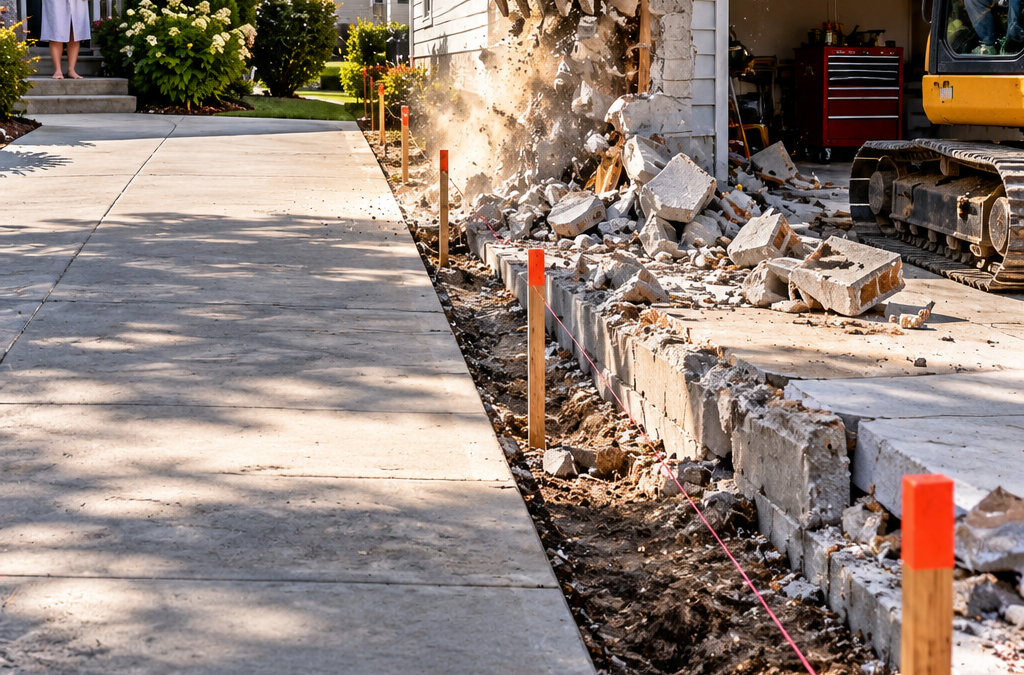
By the time the bulldozer rolled onto Clearfield Court, my neighbor was standing barefoot on her porch in a bathrobe, watching the garage she had built across my property line shake under the first strike of the bucket. Six months earlier, that same woman had smiled at me through her front door and told me to check my own deed before accusing her of taking land that belonged to me.
My name is Daniel, and I had lived on Clearfield Court for six years before I learned just how quickly an ordinary property dispute could turn into a campaign of intimidation.
I bought the house because it was uncomplicated.
That was what I wanted then.
The neighborhood wasn’t luxurious, and I didn’t care. The houses were mostly twenty- or thirty-year-old colonials and ranch homes with broad driveways, decent yards, and enough space between them that you didn’t hear every argument through the walls.
My lot was one of the better ones.
The driveway was unusually wide because the original owner had built a detached workshop behind the house. The workshop was gone by the time I bought the property, but the concrete remained, giving me a wide strip along the right side of the house that ran almost to the backyard.
I liked that driveway.
I had room to work on my truck.
Room for visitors.
Room to pull a trailer alongside the house without blocking the garage.
Nothing spectacular.
Just useful.
The woman next door was named Ranata.
For the first two years, she seemed ordinary enough.
A little intense, maybe.
A little too interested in everybody else’s landscaping.
But plenty of neighborhoods have someone like that.
Ranata was in her late fifties, always well dressed, always composed, and almost always carrying her phone like she was waiting for someone important to call.
She served on the HOA board.
Not president.
But she didn’t need the title.
She knew the president personally.
She knew the management company.
She knew which contractors the association used, which homeowners were behind on dues, who had requested variances, who had complained about whom.
She had a way of mentioning information she probably shouldn’t have known.
At first, I treated it like gossip.
Then I realized information was how Ranata created authority.
If she knew enough about everyone, people assumed she had the power to do something with it.
We were polite.
I waved when I saw her.
She waved back.
Sometimes she stopped while walking her small white dog and commented on my lawn.
“Looks better this year.”
“Thanks.”
“You should edge along the sidewalk before inspection week.”
“I didn’t know there was an inspection week.”
“There’s always an inspection week.”
She would smile when she said things like that.
Not warmly.
Knowingly.
As if the neighborhood operated according to rules only she fully understood.
For the most part, I ignored it.
I paid my dues.
Kept the house in good condition.
Cut the grass.
Trimmed the hedges.
My fence had been standing for four years without complaint.
My driveway had been exactly where it was since long before either of us moved in.
There was no reason for Ranata and me to have a problem.
Then one spring morning, a construction truck appeared in front of her house.
I didn’t think much of it.
People renovate.
By lunchtime, there were two more trucks.
By the end of the day, a section of Ranata’s side yard had been marked with bright paint and wooden stakes.
I assumed she was extending her patio.
The next afternoon, a skid-steer arrived and started removing soil.
Still nothing unusual.
Then I noticed one of the stakes.
It sat unusually close to my driveway.
I had always known approximately where the property line ran.
You don’t own a house for six years without developing an instinct for those things.
The line between our lots followed the edge of a narrow drainage strip beside my driveway.
Ranata’s lawn ended there.
Mine began there.
The concrete had been poured several inches inside my side of the boundary years before I bought the property.
That was why I noticed immediately when one of her construction stakes appeared past the drainage strip.
Not by inches.
By feet.
I stood near the garage and stared at it.
Maybe I was wrong.
That was my first thought.
You always want the simplest explanation.
Maybe the contractor had put temporary stakes somewhere convenient.
Maybe the actual building line was different.
Maybe I had misunderstood the plans.
I didn’t want to be the neighbor who stormed over the moment somebody brought in a backhoe.
So I watched.
For three days.
The excavation widened.
Wooden forms appeared.
Gravel went down.
Then the forms for the foundation were installed.
That was when I became concerned.
The forms extended toward my driveway.
Past the line I knew.
I walked to the edge of the work area one evening after the crew had left.
I didn’t cross into Ranata’s yard.
I stood on my driveway and looked down.
One corner of the form was so close to my concrete I could have touched it without fully extending my arm.
I took a photograph.
The next morning, I spoke to the foreman.
“Morning.”
He looked up from a set of plans.
“Morning.”
“You’re building a garage?”
“Three-car.”
He sounded proud.
I nodded toward the form.
“You sure about the line?”
He glanced where I was pointing.
“Yeah.”
“Property line?”
“Plans are approved.”
“That’s not quite what I asked.”
He looked at me again.
“You the neighbor?”
“Yes.”
He folded the plans.
“Homeowner gave us the layout. Survey pins were already marked.”
“Which pins?”
He pointed vaguely toward the yard.
I saw two wooden stakes.
Not official survey monuments.
Construction stakes.
“Did you have a surveyor mark it?”
“You’d have to ask the owner.”
That answer bothered me.
I thanked him and went inside.
I thought about knocking on Ranata’s door that evening.
Then I decided to wait another day.
I wish I could say that was patience.
It wasn’t.
It was disbelief.
Part of me still assumed no one would knowingly pour a permanent concrete foundation over another person’s property line.
Especially not someone on an HOA board.
Especially not someone constantly lecturing everyone else about compliance.
Then the concrete truck came.
By the time I got home that afternoon, the foundation slab had been poured.
I parked in the street because a delivery truck was partially blocking my driveway.
I walked toward the house.
Then stopped.
The fresh concrete didn’t merely come close to my driveway.
It crossed onto it.
A clean rectangular section of new slab overlapped the side edge of my existing concrete.
I stood there staring.
It was so blatant that for a few seconds I actually wondered whether I had forgotten some agreement buried in my closing documents.
I pulled out my phone.
Photograph.
Video.
Wide angle.
Close-up.
I recorded the slab relative to my garage, fence, drainage strip, and driveway.
Then I walked next door.
Ranata answered after the second knock.
She was wearing reading glasses.
“Daniel.”
“We need to talk about the garage.”
Her expression barely changed.
“What about it?”
“It’s over the property line.”
She removed her glasses slowly.
“No, it isn’t.”
“It’s sitting on my driveway.”
She gave me the sort of patient smile people use when talking to children.
“I had everything measured.”
“Then someone measured wrong.”
“My contractor knows exactly what he’s doing.”
“I spoke with him.”
That caught her attention.
“You spoke to my contractor?”
“Yes.”
“Why?”
“Because his foundation is on my property.”
She folded her arms.
“Daniel, I think you’re confused.”
“I’m not.”
“You might want to double-check your deed before you start making accusations.”
“I’m not accusing you of anything.”
“You just told me I built on your land.”
“I told you what I can physically see.”
Her face hardened.
“I have approvals.”
“Then show me the survey.”
“What?”
“The survey your contractor used.”
“I don’t have to show you anything.”
“No, you don’t.”
I kept my voice calm.
“But until we know exactly where the boundary is, you should pause construction.”
Her eyebrows lifted.
“You’re asking me to stop a permitted project because you think part of your driveway belongs farther over than it does?”
“No. I’m asking you to stop because your new slab is physically touching and overlapping my existing concrete.”
She laughed once.
“That driveway was poured years ago.”
“Yes.”
“Before either of us lived here.”
“Yes.”
“Then maybe your driveway is the thing that crosses the line.”
That was clever.
For half a second, it even made me question myself.
Then I remembered the plat I had reviewed when I bought the house.
“I’ll verify it.”
“You should.”
“And until then?”
“My crew continues.”
“Ranata.”
Her hand moved toward the door.
“Have a good evening, Daniel.”
Then she closed it.
The next morning, framing began.
No pause.
No conversation.
No attempt to verify anything.
By noon, one wall was standing.
By sunset, two.
I photographed everything.
I began keeping a log.
Date.
Time.
Crew activity.
Vehicle plates.
Weather.
Photographs.
I wasn’t panicking.
Not yet.
I assumed once I produced a certified survey, the problem would become straightforward.
I underestimated Ranata.
Three days after our conversation, an envelope appeared in my mailbox.
Clearfield Court Homeowners Association.
FORMAL VIOLATION NOTICE.
I opened it while standing in the driveway.
My fence was allegedly in violation of setback standards.
My fence.
The same wooden fence that had been standing for four years.
The same fence the HOA had ignored through at least eight seasonal inspection cycles.
The letter stated that I had fourteen days to “correct the noncompliant improvement” or fines could begin accruing daily.
At the bottom was the president’s signature.
I read it twice.
Then I looked toward Ranata’s house.
She was outside.
Watering flowers near the porch.
She looked over.
Our eyes met.
She smiled.
That was when everything became clear.
The fence violation had nothing to do with the fence.
It was pressure.
I had questioned her construction.
Three days later, the HOA suddenly discovered a four-year-old problem on my property.
Coincidence was possible.
But I wasn’t stupid enough to believe it.
I walked over holding the letter.
Ranata switched off the hose.
“Problem?”
“You tell me.”
I held up the violation.
She glanced at it.
“Oh.”
“Oh?”
“That’s between you and the association.”
“You sit on the board.”
“So?”
“I questioned your garage on Monday. Now my fence is suddenly illegal.”
She tilted her head.
“Are you accusing me of retaliation?”
“I’m asking whether you were involved.”
“If you think your fence complies, appeal the notice.”
“Did you report it?”
“I’m not discussing board matters with you.”
“You’ve discussed board matters with me plenty of times.”
“Not enforcement.”
I almost laughed.
“You once told me which house was three months behind on dues.”
Her face changed.
“That is completely irrelevant.”
“No. What’s irrelevant is pretending this has nothing to do with the garage.”
She picked up the hose again.
“You’re becoming hostile, Daniel.”
There it was.
I hadn’t raised my voice.
Hadn’t threatened her.
Hadn’t stepped onto her property.
But the moment I challenged what she was doing, I was hostile.
“I’m standing on the sidewalk holding a letter.”
“And I’ve asked you not to confront me.”
“You didn’t.”
“I am now.”
I stepped backward.
“Fine.”
She smiled again.
“You should really handle your fence before the fines begin.”
I walked home.
And decided I would.
Just not the way she expected.
The next morning, I called a licensed land surveyor.
Not someone who did quick fence estimates.
A professional surveyor whose signed report could be used in court.
His name was Eric Caldwell.
I explained the situation.
“How soon can you come out?”
“What’s being built?”
“Detached garage.”
“Foundation poured?”
“Yes.”
“How close?”
“On my driveway.”
There was a pause.
“Actually on it?”
“Yes.”
“I can be there Monday.”
It was Thursday.
“Do it.”
That weekend, construction continued.
The garage rose quickly.
Roof trusses arrived.
Sheathing went up.
Windows were framed.
The crew worked like they had a deadline.
Maybe they did.
On Saturday morning, I stood in my driveway with coffee while workers installed one of the side walls.
Ranata walked toward me.
“I hope you’re not photographing my workers again.”
“I’m photographing my property.”
“You’re making them uncomfortable.”
“They’re building on my property.”
“You keep saying that as though repetition makes it true.”
“I hired a surveyor.”
For the first time, the confidence slipped.
Only slightly.
“A surveyor?”
“Yes.”
“Why would you waste money doing that?”
That question told me more than she realized.
“Because I’d rather spend money on facts than arguments.”
Her lips tightened.
“You know, there’s no reason this needs to become ugly.”
I looked at the half-built wall.
“It became ugly when concrete landed on my driveway.”
“You are determined to make this personal.”
“No. I’m trying very hard to make it technical.”
She crossed her arms.
“Surveys can conflict.”
“They can.”
“Boundary descriptions can be outdated.”
“They can.”
“Older plats aren’t always accurate.”
“Then you shouldn’t have started building until yours was verified.”
That ended the conversation.
She turned away.
Monday morning, Eric arrived with equipment.
Tripod.
Receiver.
Measuring rods.
Electronic total station.
He worked for hours.
He found monuments.
Checked recorded coordinates.
Compared the subdivision plat.
Measured existing improvements.
Ran the line twice.
Ran it again.
I tried not to hover.
Near noon, he approached me.
“You want the informal answer or the signed answer?”
“Informal first.”
He pointed toward Ranata’s garage.
“That building is over.”
“How far?”
“Looks like a little more than six feet at the widest point.”
I stared at him.
“Six inches?”
“No.”
“Six feet?”
“Yes.”
I looked at the wall.
A full six feet.
Not a technical encroachment.
Not a gutter overhang.
A person could lie down between the true boundary and where that wall stood.
“Are you sure?”
Eric gave me the tired look professionals give people who hire them and then ask whether they know their profession.
“I’ll certify it in the report.”
“When?”
“Four days.”
I nodded.
“Thank you.”
He began packing up.
Then stopped.
“Daniel.”
“Yeah?”
“Don’t move any stakes.”
“I won’t.”
“And don’t let anyone else move them.”
That evening, two of his flagged points were gone.
I noticed because I had photographed them.
I didn’t accuse anyone.
I called Eric.
“Two markers disappeared.”
His voice hardened.
“The temporary stakes?”
“Yes.”
“Permanent monuments still there?”
“As far as I know.”
“Photograph everything.”
“I already did.”
“Good.”
He returned the next morning and reset the visible markers.
This time, I installed a camera facing my side yard.
Not toward Ranata’s windows.
Not into her home.
Only my property line.
I wasn’t interested in spying.
I was interested in preserving evidence.
The next day, I drove to the county records office.
Grandpa wasn’t involved.
No inherited land.
No complicated family history.
Just two suburban lots.
That simplicity made what I found even worse.
I requested everything attached to my parcel and Ranata’s.
Original subdivision plat.
Recorded deeds.
Easements.
Permit history.
Setbacks.
Previous surveys.
Building applications.
I sat at a public terminal scrolling through scanned pages.
Then I found her garage permit.
Approved.
I opened the site plan.
And stared.
The garage shown on the approved plan sat completely within Ranata’s lot.
Not close to my driveway.
Not over the line.
Not even ambiguous.
The approved structure ended several feet before the boundary.
I printed the page.
Then printed the permit application.
The county had approved one building.
Ranata was constructing another.
That changed everything.
If the contractor had merely misread the boundary, the approved plan should have reflected the same mistake.
It didn’t.
Somewhere between permit approval and construction, the footprint had moved.
Toward me.
I ordered certified copies.
Then I pulled my own permit history.
My driveway existed on every relevant map.
My fence had been properly disclosed when installed.
Even better, the HOA had approved the fence four years earlier.
I found my old approval letter at home that night.
Same board.
Different members.
But official approval.
I held it beside the new violation notice.
That was the moment the fear disappeared.
Up until then, there had been a small voice in the back of my mind asking whether Ranata knew something I didn’t.
Maybe there was an easement.
Maybe the driveway crossed the line.
Maybe HOA documents gave her some strange authority.
Maybe I had overlooked something.
Not anymore.
I had the fence approval.
I had the permit.
I had the county plat.
And four days later, I had Eric Caldwell’s signed survey.
I opened the report at my kitchen table.
The number was printed clearly.
ENCROACHMENT: 6′ 2″.
Six feet, two inches.
I read the measurement three times.
The garage foundation crossed the property line by six feet and two inches at its deepest point.
The wall framing followed that foundation.
Portions of the slab physically overlapped the side edge of my driveway.
There was no interpretive gray area.
I did not knock on Ranata’s door.
I called an attorney.
Her name was Laura Bennett.
She specialized in real estate and land-use disputes.
I brought her everything.
The survey.
Photographs.
Videos.
Dates.
Violation notice.
Old fence approval.
Ranata’s approved permit.
County plat.
Laura spent twenty minutes reading without saying much.
Finally she placed the documents down.
“This is unusually clean.”
“That sounds good.”
“It is.”
“So what happens?”
“We tell them to stop.”
“What if they don’t?”
“Then we make them.”
That was the first time in weeks I felt my shoulders relax.
Laura prepared three copies of a formal cease-and-desist demand.
One went to Ranata.
One to the construction company.
One to the HOA board.
The letter attached Eric’s survey.
It identified the encroachment.
It demanded immediate cessation of work.
It rejected any claim of implied permission.
It placed everyone on notice that continuing construction after receipt could increase damages.
Separately, Laura filed a complaint with the county building department.
That filing included something Ranata could not explain away.
The approved permit site plan.
Beside it, the certified survey and current construction photographs.
The county didn’t need to decide our neighbor dispute.
They only needed to compare what they approved with what had actually been built.
They did.
Work stopped the same day.
I came home around five and saw the site silent for the first time in weeks.
No compressors.
No saws.
No trucks.
A red stop-work notice was attached near the front of the structure.
Ranata stood beside it.
She saw my car.
I pulled into the driveway.
She marched toward me before I had closed the door.
“You called the county.”
“Yes.”
“You had no right.”
I actually looked at her for a second, wondering whether she heard herself.
“No right?”
“You could have handled this privately.”
“I tried.”
“No. You showed up accusing me.”
“I asked you to pause construction.”
“You threatened my contractor.”
“I asked whether he had a survey.”
“You’ve been photographing my house.”
“I’ve been documenting construction on my land.”
“It is not your land.”
I reached into my car and pulled out a copy of Eric’s survey.
“Six feet, two inches.”
She didn’t take it.
“I don’t accept that survey.”
“You don’t have to.”
“My attorney will challenge it.”
“Okay.”
“You’re making a serious mistake.”
“What mistake?”
She stepped closer.
“People in this neighborhood have to live together after disputes end.”
There was something in her tone.
Not a direct threat.
Something more practiced.
“You mean the HOA?”
“I mean relationships matter.”
“My fence violation was a relationship issue too?”
Her eyes narrowed.
“That has nothing to do with this.”
“I have the original HOA approval.”
For the first time, Ranata said nothing.
I continued.
“Four years old. Signed.”
She recovered.
“Approvals can be revoked if conditions change.”
“What conditions changed?”
She looked toward the garage.
“Speak to the board.”
“I plan to.”
She pointed at the stop-work notice.
“This is temporary.”
Then she walked home.
Two days later, I received notice of an emergency HOA meeting.
Ranata had requested it.
The stated purpose was “resolution of a neighborhood boundary conflict affecting community harmony.”
I laughed when I read that.
Community harmony.
Her garage was six feet onto my property, and somehow the emergency was that I objected.
Laura came with me.
That changed the mood immediately.
The meeting was held in the small clubhouse near the entrance.
About twenty homeowners attended.
Ranata sat at the board table.
The HOA president, Martin Keller, was beside her.
Two other board members looked deeply uncomfortable.
Martin opened with procedural language.
Then Ranata spoke.
She described the matter as “a longstanding ambiguity in lot boundaries.”
Longstanding.
I had discovered the garage three weeks earlier.
She claimed I had become confrontational.
She said I had harassed contractors.
She said I had repeatedly photographed her property.
She said the survey I commissioned relied on “outdated subdivision references.”
Laura wrote notes without reacting.
Then Martin asked whether I wanted to respond.
Laura stood.
“My client will not litigate a property encroachment through an HOA meeting.”
Ranata leaned forward.
“No one is litigating anything.”
Laura looked at her.
“You have retained counsel and challenged a certified survey.”
“That doesn’t mean—”
Laura placed copies of the documents on the table.
“Here is the recorded plat.”
Another.
“Here is the certified boundary survey.”
Another.
“Here is your county-approved garage site plan.”
Another.
“Here are current site photographs.”
She slid them toward the board.
“The garage being constructed does not match the footprint approved by the county and crosses Mr. Daniel’s property line by six feet, two inches.”
The room became quiet.
Ranata spoke quickly.
“There are conflicting measurements.”
Laura looked at her.
“Provide your survey.”
“My attorney is reviewing—”
“Provide it when available.”
Martin cleared his throat.
“This board does not have authority to determine legal property boundaries.”
Laura nodded.
“Correct.”
I looked at him.
“Then why did you fine my fence three days after I asked Ranata to stop building?”
That changed the room.
Someone behind me whispered.
Martin glanced at Ranata.
“The fence issue was identified during routine compliance review.”
“Show me the inspection record.”
He blinked.
“What?”
“The routine compliance review. Show me the report showing when the fence was flagged.”
“We don’t have those records here.”
“I have my approval letter.”
I placed it on the table.
“Four years ago, this HOA approved that fence.”
One board member picked it up.
Read it.
Looked at Martin.
Then at Ranata.
“You knew this existed?”
Ranata answered before Martin could.
“Prior approval does not guarantee permanent compliance.”
The board member frowned.
“Why was it suddenly reviewed now?”
Ranata’s face tightened.
“That question is inappropriate.”
“No,” I said. “It’s the only appropriate question.”
Martin raised his hand.
“Let’s keep this civil.”
I looked around the table.
“I’ve been civil from the first day.”
My voice was steady.
“I asked Ranata to pause construction because her foundation appeared to cross my boundary. She refused. Three days later, I received a violation on a four-year-old fence that your own board had previously approved.”
Ranata interrupted.
“You’re implying corruption.”
Laura turned toward her.
“My client is describing a sequence of documented events.”
Ranata looked furious.
The meeting ended without resolution.
That was fine.
I no longer needed the HOA to resolve anything.
The county was already involved.
Ranata’s attorney contacted Laura several days later.
The letter was polite.
Professional.
And revealing.
Instead of producing a competing survey, he proposed negotiation.
Ranata was willing to discuss purchasing an easement.
In plain English, she wanted me to give her the legal right to keep the garage where she had already built it.
Laura called me.
“You can say yes.”
“No.”
“You haven’t heard the offer.”
“I don’t care.”
“She may offer significant money.”
“No.”
Laura paused.
“I have to ask.”
“I understand.”
“What do you want?”
“My driveway.”
“That’s it?”
“That’s it.”
“And the garage?”
“Off my property.”
She was quiet for a second.
“All right.”
Her written response contained two sentences.
We decline.
Please instruct your client to prepare for full removal of all encroaching improvements.
Ranata was furious.
I knew because for the next week the pressure changed.
A warning appeared regarding weeds near my mailbox.
Another letter questioned whether my trash bins were being stored correctly.
An HOA volunteer photographed my front yard from the sidewalk.
I documented all of it.
Laura did too.
Then something happened that made the neighbor dispute much larger for Ranata.
The county building department completed its review.
They compared the approved plans with the actual structure.
The location was different.
The footprint was different.
The setbacks were different.
The structure did not comply with the permit.
The garage was not simply encroaching.
From the county’s perspective, the thing being built was not the thing they had authorized.
The county issued a formal notice.
Then came the order.
Removal.
When Laura called, I had to ask her to repeat it.
“They’re ordering demolition?”
“Yes.”
“The whole garage?”
“The structure as built is unauthorized. They’re requiring removal unless she can obtain retroactive approval.”
“Can she?”
“Not without solving the boundary issue.”
“And I’m not granting an easement.”
“Correct.”
I leaned back in my chair.
“So that’s it.”
“Not yet.”
She was right.
Ranata appealed.
Of course she did.
She argued that demolition was excessive.
She argued that the footprint deviation was a contractor mistake.
She argued that portions of the structure could be modified.
She proposed cutting back one wall.
The county rejected that because the foundation, drainage, framing, and setbacks were all tied to the unauthorized location.
Her attorney came back to us again.
More money.
Another easement proposal.
I said no.
Ranata approached me once directly during that period.
I was putting groceries into the house when she called from the sidewalk.
“Daniel.”
I turned.
She looked exhausted.
For the first time since I’d known her, the perfect presentation was gone.
No makeup.
Hair loosely tied back.
“I need five minutes.”
“You should talk to Laura.”
“I’m talking to you.”
I set the bag down.
“Fine.”
She walked to the edge of my driveway.
“The county is threatening to destroy a structure that cost me more than a hundred thousand dollars.”
“I know.”
“And you can stop it.”
“I can give you an easement.”
“Yes.”
“No.”
Her eyes hardened.
“You don’t even use that side of the driveway.”
That sentence stunned me.
“It’s my driveway.”
“You have more than enough room.”
“That’s irrelevant.”
“You are forcing demolition over six feet.”
“Six feet of my property.”
“You’re being vindictive.”
I stared at her.
“I asked you before the walls went up.”
“You came over making demands.”
“I asked you to stop long enough to verify the line.”
“My contractor told me everything was correct.”
“And when I hired a surveyor, you said surveys could be wrong.”
“Because they can.”
“Your attorney still hasn’t produced one.”
Her jaw tightened.
“You know what this will do to my property value?”
I almost laughed.
“You’re on the HOA board. I thought property values were your specialty.”
“That’s childish.”
“No. What was childish was using the HOA to threaten my fence because I wouldn’t ignore your garage.”
“That never happened.”
“I have the timeline.”
“You have assumptions.”
“I have the approval letter.”
She looked away.
I lowered my voice.
“Ranata, if this had been an honest mistake, you could have stopped when I came to your door.”
She looked at me again.
“You didn’t.”
“You don’t know what happened.”
“I know you kept building.”
“My contractor—”
“You kept building.”
Silence.
“I know you let that foundation stay after I told you it crossed my driveway.”
She folded her arms.
“And now you want me to surrender the land after the fact because removing your garage would be expensive.”
Her voice became quiet.
“What do you want from me?”
“Nothing.”
“That’s ridiculous.”
“No. It’s the simplest thing in this entire situation.”
I pointed toward my driveway.
“I want what was mine before you started.”
She stared at me for several seconds.
Then said, “You’re going to regret how far you pushed this.”
I didn’t respond.
She walked away.
I sent Laura a summary of the conversation that evening.
After that, I stopped speaking to Ranata directly.
The demolition date was scheduled for a Tuesday morning.
I barely slept the night before.
That surprised me.
I had wanted the garage removed.
The documents supported me.
The survey supported me.
The county supported me.
But knowing a bulldozer was coming to tear apart a building next door made the entire thing feel heavier.
I kept asking myself whether I had gone too far.
Then I would remember standing at Ranata’s door before the framing began.
Pause until we know the boundary.
That was all I asked.
She chose not to.
At 7:12 Tuesday morning, I heard the diesel engine.
I looked through the front window.
A flatbed trailer turned onto Clearfield Court.
Bulldozer.
County truck behind it.
Another pickup carrying the demolition crew.
Neighbors began appearing almost immediately.
Curtains moved.
Garage doors opened.
People stood at the ends of driveways pretending they were checking mail.
I made coffee.
Not because I wanted to look dramatic.
Because my hands needed something to do.
When I stepped outside, Ranata was already on her porch.
Bathrobe.
Arms folded.
Face rigid.
She didn’t look at me.
The county inspector walked the site with the operator.
Measurements were checked.
Utilities confirmed disconnected.
A temporary barrier was placed around the work area.
One crew member came over to me.
“We’ll be working close to your driveway.”
“I know.”
“If anything gets damaged, it gets documented.”
“Understood.”
Ranata suddenly called from the porch.
“Make sure he understands he doesn’t own the whole street.”
The worker looked at me.
Then at her.
Then walked away.
Nobody answered.
That silence seemed to bother her more than an argument would have.
At 7:41, the machine moved.
The first strike hit the outer wall.
The sound was deeper than I expected.
Wood cracked.
Brick veneer collapsed.
A section of framing folded inward.
Ranata didn’t move.
Neither did I.
Second strike.
Roof section down.
Third.
A garage door twisted and disappeared under debris.
I thought I would feel satisfaction.
Instead I felt exhausted.
Six months.
Legal bills.
County filings.
HOA letters.
Meetings.
Survey costs.
Photographs.
Arguments.
All because someone had looked at a property line and decided it mattered less than what she wanted.
The machine kept working.
Within forty minutes, the standing structure was gone.
What had looked permanent that morning was now a pile of broken lumber, brick, insulation, and metal.
The foundation took longer.
Concrete doesn’t surrender politely.
The crew broke it into sections.
When the portion overlapping my property was finally removed, the edge of my driveway appeared underneath, scarred but intact in places.
The county required Ranata to restore all disturbed portions of my property.
That included repairing damaged concrete.
Grading.
Drainage.
Cleanup.
At her expense.
She also faced county penalties for the unpermitted construction.
Her contractor became involved in a separate dispute with her.
I stayed out of that.
Her attorney fees were hers.
Mine were initially mine.
Then the HOA problem came back.
Laura had preserved every notice.
Every email.
Every date.
The fence violation.
The weed warning.
The trash-bin warning.
The timing after my dispute with a sitting board member.
The existing approval on my fence.
Once outside counsel reviewed the paper trail, the association’s attitude changed very quickly.
No more stern notices.
No more talk about community harmony.
They wanted settlement.
I did not ask for some massive payout.
I wanted my legal expenses related to the retaliatory enforcement addressed.
I wanted the false violations removed.
And I wanted the association to change how board members handled personal disputes involving neighbors.
The HOA agreed.
The settlement terms included revised conflict-of-interest procedures.
A board member involved in a personal property dispute would have to disclose that conflict and recuse themselves from related enforcement decisions.
Complaints involving that board member’s immediate neighbor required independent review.
Existing architectural approvals could not be casually overridden without documented cause.
It sounded obvious.
Apparently obvious rules sometimes have to be written after someone proves why they’re necessary.
Ranata resigned from the board two weeks later.
The official announcement thanked her for her service.
I laughed when I read it.
Not because I wanted public humiliation.
Because the same organization that had spent months letting her use its authority suddenly wanted the entire matter wrapped in polite language.
She didn’t move.
That surprised me.
For a while, I thought she would sell.
Instead, she stayed next door.
The garage was gone.
The damaged side yard was restored.
My driveway was repaired.
The construction stakes disappeared.
The temporary fencing came down.
And eventually, Clearfield Court became quiet again.
Living beside Ranata afterward was strange.
We didn’t speak.
Not at first.
If we happened to be outside at the same time, she looked away.
I didn’t chase confrontation.
There was nothing left to win.
One Saturday, months later, I was washing my truck when I heard her voice.
“Daniel.”
I turned.
She stood beside her mailbox.
No clipboard.
No board polo.
No audience.
“What?”
She hesitated.
“I’ve been meaning to ask something.”
I turned off the hose.
“Okay.”
“If I had agreed to stop construction that first day…”
She paused.
“Would you have handled it differently?”
The answer came easily.
“Yes.”
Her face tightened slightly.
“You wouldn’t have gone to an attorney?”
“Probably not.”
“The county?”
“Not if the problem had been corrected.”
She looked toward the strip of grass where her garage had stood.
“My contractor told me that line was wrong.”
“Maybe he did.”
“I believed him.”
“You also had the approved permit.”
She looked at me.
I continued.
“That plan showed the garage somewhere else.”
She didn’t answer.
“You knew the thing being built wasn’t where the county approved it.”
Her shoulders lowered.
“I thought the difference was minor.”
“Six feet, two inches.”
“I know.”
“You know now.”
She looked away.
For a moment, she seemed smaller.
Not physically.
Just less certain.
Then she said something I didn’t expect.
“I thought you’d give up.”
There it was.
More honest than everything she had said during the previous six months.
I didn’t speak.
She looked back at me.
“Most people do.”
I almost asked what she meant.
I already knew.
Most people see an HOA letter and pay.
Most people see construction progressing and assume it’s too late.
Most people hear words like board, attorney, permit, setback, and easement and decide fighting will cost too much.
Most people back down.
Ranata had counted on that.
“That was your mistake,” I said.
She nodded once.
Then went inside.
We never discussed it again.
The strangest part was how normal everything looked after enough time passed.
Grass grew where the construction staging area had been.
My driveway became just concrete again.
My fence remained exactly where it had been for years.
The HOA stopped sending letters.
New board members were elected.
People who had watched the whole situation unfold started asking more questions at meetings.
Not dramatic questions.
Useful ones.
Where is that rule written?
Who approved this?
Was the board member involved in the complaint?
Can we see the site plan?
What does the county permit actually say?
I noticed a difference.
People were less impressed by authority stated confidently.
They wanted documents.
That was probably the most valuable thing to come from the mess.
Not the demolished garage.
Not the settlement.
Not even Ranata’s resignation.
People stopped assuming that because someone sat on a board, they had to be right.
I changed too.
Before that spring, I had treated property documents like things you kept in a folder and forgot.
Afterward, I understood what they really were.
A deed isn’t glamorous.
Neither is a survey.
A plat map doesn’t feel powerful.
A permit application looks boring.
Until someone decides a piece of your property should belong to them.
Then those boring documents become everything.
I kept Eric Caldwell’s survey.
Framed?
No.
I’m not that sentimental.
But it sits in the top drawer of my desk beside the deed and the original fence approval.
Sometimes people ask whether watching Ranata’s garage come down felt good.
That isn’t the right word.
It felt final.
That’s different.
I didn’t enjoy seeing money destroyed.
I didn’t enjoy watching my neighbor humiliated.
I didn’t wake up wanting conflict.
What I felt was relief.
Relief that after months of someone trying to convince me I was wrong about something I could literally see with my own eyes, the argument was over.
The line existed.
It had always existed.
Six feet and two inches of concrete had never changed that.
Neither had an HOA letter.
Neither had Ranata’s board position.
Neither had her confidence.
There is a dangerous kind of person who believes resistance determines ownership.
If nobody stops them, they assume they were entitled to what they took.
If somebody objects, they call that person unreasonable.
If documents contradict them, they call the documents outdated.
If authorities intervene, they call enforcement excessive.
Anything except admitting the first decision was wrong.
Ranata could have stopped the entire disaster with one sentence.
Let’s verify the boundary.
That was all.
Instead, she kept building.
Then she used the HOA.
Then she tried to negotiate after the garage was already standing.
Then she acted as if restoring my property was an attack on hers.
That sequence mattered to me.
It still does.
One year after the demolition, I was backing out of my garage on a Tuesday morning.
Bright sun.
Coffee in the cup holder.
For some reason, the date made me remember the bulldozer.
I paused near the edge of the driveway.
The repaired concrete was almost impossible to distinguish from the original now.
My fence ran beside it.
Ranata’s lawn began exactly where it was supposed to.
Nothing crossed the line.
Nothing leaned over it.
Nothing occupied six feet that didn’t belong there.
She was outside watering flowers.
For a moment, it looked almost like those first two years before any of this happened.
She noticed me.
Our eyes met.
She gave a small nod.
Not friendly.
Not hostile.
Just acknowledgment.
I nodded back.
Then I drove away.
There was no victory speech.
No last confrontation.
No need.
Everything important was already visible.
Her house stood on her property.
Mine stood on mine.
My fence remained where it had always been.
My driveway remained completely mine.
And the strip of ground that had caused six months of threats, lawyers, HOA retaliation, surveys, county hearings, and demolition was quiet.
Exactly the way it should have been from the beginning.
That experience taught me something I wish I had understood sooner.
You don’t need to be loud when the facts are clear.
You don’t need to win an argument at someone’s front door.
You don’t need to match intimidation with intimidation.
Sometimes the strongest thing you can do is document.
Measure.
Read.
Preserve.
Then let the other person explain themselves to the surveyor, the attorney, the board, and the county.
Ranata had authority.
At least she thought she did.
She had relationships.
Board access.
The HOA president’s phone number.
Confidence.
A contractor.
A permit.
What she didn’t have was six feet of my property.
And in the end, that was the only fact that mattered.
On Tuesday mornings, I still back out of my garage and drive down Clearfield Court.
Sometimes I glance toward the place where that structure stood.
There’s no wall there now.
No slab.
No framing.
Just grass.
My driveway runs beside it uninterrupted.
Everything exactly where it belongs.
And after what it took to get there, I notice that more than I ever did before.







