𝗙𝗨𝗟𝗟 𝗦𝗧𝗢𝗥𝗬 The $1 Million HOA Fine on My Mailbox Made Me Open a 50-Year-Old File My Grandfather Told Me Never to Lose
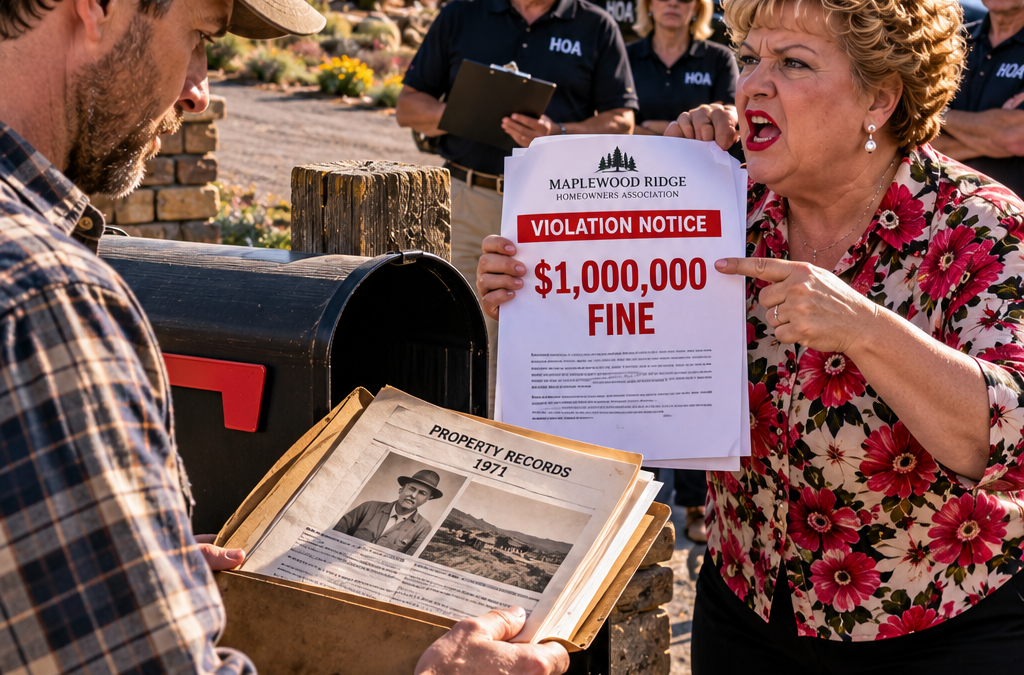
𝗙𝗨𝗟𝗟 𝗦𝗧𝗢𝗥𝗬
I genuinely believed I had escaped the kind of small, exhausting disputes that came with modern suburban life.
Then spring arrived.
And so did Maplewood Ridge.
The first envelope came in March.
I remember opening it because I thought it was junk mail.
MAPLEWOOD RIDGE HOMEOWNERS ASSOCIATION.
WELCOME TO THE COMMUNITY.
I stood at the mailbox staring at it.
“Community?”
I had heard of Maplewood Ridge.
Of course I had.
It was the development farther up the valley.
Roughly seventy houses built mostly during the 1990s and early 2000s.
The entrance road passed not far from my property.
But I had never thought of my cabin as part of it.
The development was newer.
My land was older.
Much older.
The previous owner technically had been my father, and he had never once mentioned an HOA assessment.
The real estate agent hadn’t either.
I opened the packet inside the house.
Welcome letter.
Forty pages of standards.
Architectural guidelines.
Landscape rules.
Parking requirements.
Exterior colors.
Mailbox specifications.
Pet restrictions.
Satellite placement.
Trash storage.
Decorative structures.
Some of it was so specific that I laughed.
Approved exterior light temperature.
Fence stain colors.
Mailboxes had their own section.
I skimmed everything.
Then set the packet on the counter.
I assumed it had been mailed because my property was adjacent to the development or because somebody had recently updated ownership records.
That was my first mistake.
I didn’t investigate.
Three weeks later, somebody knocked on my front door.
Scout started barking.
I opened it.
A woman in her mid-fifties stood on the porch holding a clipboard.
Her clothes looked too pressed for rural Tennessee.
Cream slacks.
Navy blouse.
Perfect hair.
Large sunglasses.
She wore them even though we were standing beneath the shade of my porch.
“Marcus Del Rey?”
“Yes.”
“I’m Linda Marsh.”
She waited as though the name should mean something.
When it didn’t, she added, “President of Maplewood Ridge Homeowners Association.”
“Okay.”
She looked past me toward the road.
“Your mailbox is the wrong color.”
I honestly thought she was joking.
“Excuse me?”
“The approved palette requires Forest Green, code 7B4.”
She pointed her pen toward my mailbox.
“Yours is closer to sage.”
I looked over my shoulder.
The mailbox had been there before I moved in.
Probably for decades.
It was green.
Maybe faded.
Maybe sage.
I had never considered giving it an official identity.
“You’re here because of the mailbox?”
“Exterior standards maintain property values.”
“It’s a mailbox.”
“The standard is clear.”
She wrote something on her clipboard.
I watched her.
“Are you issuing me a violation?”
“A preliminary notice.”
“I just moved in.”
“You’ve had the welcome packet.”
“Yes.”
“Then you’re aware of the requirements.”
I wasn’t aware of anything except that this woman had driven onto property my grandfather owned before Maplewood Ridge existed and was now taking notes about paint.
I considered arguing.
Instead, I said, “I’ll look into it.”
Linda smiled.
That delayed, satisfied smile people use when they think a conversation ended exactly the way it should.
“Thank you.”
She walked back to her SUV.
I watched her leave.
Then forgot about the mailbox.
Two weeks later, the first fine arrived.
$250.
Mailbox color violation.
Another $150 for:
VISIBLE GARDEN AREA MAINTAINED IN AN UNSTRUCTURED MANNER.
I read that line twice.
My vegetable garden was about twenty feet by thirty feet.
Rows.
Wood borders.
Tomato cages.
Mulch.
It looked like a vegetable garden.
Apparently vegetables needed more structure.
I was irritated enough to call the number on the notice.
Linda answered.
“Maplewood Ridge HOA.”
“Linda, this is Marcus Del Rey.”
“Yes, Marcus.”
“I got your fine.”
“Then you know what needs correction.”
“Four hundred dollars?”
“The fines reflect separate violations.”
“My garden?”
“Visible food-production areas require screening.”
“According to what?”
“The community standards.”
“Those standards existed before I bought the property?”
“They apply to all owners.”
That sentence should have bothered me more.
Instead, I asked, “If I repaint the mailbox, does the fine go away?”
“The existing fine remains. Future penalties stop once compliance is verified.”
I leaned against the kitchen counter.
Four hundred dollars.
I could fight.
Request records.
Read forty pages of rules.
Maybe hire somebody.
Or I could pay four hundred dollars and get on with my life.
I chose the easy option.
I paid.
That was my second mistake.
Because Linda interpreted payment as something completely different.
I saw it as buying peace.
She saw it as recognition of authority.
The notices multiplied.
My fire pit was supposedly too visible.
Fine.
Scout and Mason were observed off leash.
They were on my land.
Fine.
A blue tarp covering the bed of my pickup during a two-day rainstorm was considered an unapproved exterior covering.
Fine.
The firewood rack beside the cabin didn’t meet screening guidelines.
Fine.
A small stack of lumber beneath the porch was “construction debris.”
Fine.
My satellite dish was visible from an association-maintained travel corridor.
Warning.
Then fine.
Every envelope carried Linda’s looping signature.
At first, I responded.
Then I stopped.
Some fines I paid under protest.
Others I challenged.
A few disappeared.
Most didn’t.
I began to dread checking the mail.
That bothered me more than I wanted to admit.
My grandfather’s property had always represented freedom to me.
Now I could be walking toward the mailbox on a beautiful morning and feel my shoulders tense.
What had Linda noticed?
What color had offended her?
Which object on three acres had somehow damaged community harmony?
My father called one evening.
“How’s the cabin?”
“Good.”
“Garden?”
“Good.”
“Dogs?”
“Alive.”
He laughed.
“What’s wrong?”
“HOA.”
“What HOA?”
I should have paid more attention to that answer.
Instead, I said, “Maplewood Ridge.”
There was silence.
Then Dad said, “Why are they bothering you?”
“Apparently we belong to them.”
“We?”
“The property.”
Another pause.
“Who told you that?”
“The HOA president.”
Dad made a small sound.
“You check the deed?”
“No.”
“Then check the deed.”
“I’ve got the closing paperwork.”
“Not that.”
“What?”
“Granddad’s original files.”
I looked toward the hallway where several filing cabinets still held decades of family papers.
“What am I looking for?”
“Anything about the development.”
“Maplewood Ridge didn’t exist when Granddad bought the land.”
“Exactly.”
I should have gone to the cabinet that night.
I didn’t.
Work got busy.
A storm knocked down two trees.
One of the dogs needed a vet appointment.
Life moved.
Then Tuesday morning arrived.
I made coffee around seven.
Scout was sleeping under the table.
I opened the front door.
There was a certified envelope wedged against the screen.
HOA letterhead.
I carried it inside.
Opened it.
The first page was dense with text.
Repeated noncompliance.
Accumulated penalties.
Administrative assessments.
Aesthetic damages.
Legal review charges.
Then I saw the amount.
$1,000,000.
I laughed.
Not a chuckle.
A real laugh.
Because my brain rejected it.
One million dollars.
From an HOA.
For violations that had begun with a mailbox.
I read the amount again.
Then the explanation.
Chronic exterior noncompliance.
Continuing unauthorized property conditions.
Failure to conform communications equipment.
Aesthetic harm.
The angle of my satellite dish was specifically cited.
The coffee cup slipped out of my hand.
It hit the kitchen floor.
Ceramic cracked.
Coffee spread beneath the table.
Scout jumped up.
I barely noticed.
At the bottom of the notice was collection language.
Failure to resolve the assessment could lead to legal proceedings and attempts to secure the obligation against the property where permitted.
My laughter stopped.
I sat down.
One million dollars was absurd.
But absurd demands can still cost money to fight.
They can still create title problems.
They can still require lawyers.
They can still become a nightmare even when they’re wrong.
I called Linda.
Voicemail.
I didn’t leave a message.
Then I called my father.
He answered immediately.
“Dad.”
“What happened?”
“They fined me a million dollars.”
Silence.
“What?”
“The HOA.”
“For what?”
“Everything, apparently. Mailbox, garden, satellite dish. They rolled all of it into some kind of accumulated assessment.”
My father didn’t laugh.
Instead, he said four words.
“Did you check the deed?”
I closed my eyes.
“No.”
“Marcus.”
“I know.”
“Go to Granddad’s cabinet.”
I went.
The old filing cabinet sat in the back room.
Bottom drawer stuck halfway, like always.
I pulled hard enough that the cabinet rocked.
Folders.
Tax receipts.
Insurance.
Vehicle titles.
Old utility bills.
Then I found the accordion folder.
Brown cardboard.
Elastic band almost disintegrated.
On the front, Granddad had written:
LAND – ROAD – COUNTY.
Inside was a history of the property.
Original deed.
Survey dated 1974.
Tax maps.
County correspondence.
Road maintenance receipts.
Then a handwritten note attached to a recorded addendum.
I spread everything across the kitchen table.
The deed established Granddad’s ownership beginning in 1971.
The survey showed the three-acre parcel.
The access road.
Creek.
Boundary monuments.
Then I found later maps.
Maplewood Ridge incorporated its HOA in 1989.
The development boundary had been drawn around property purchased by the developer.
But one recorded map included my grandfather’s parcel inside a broader neighborhood outline.
At first glance, that seemed bad.
Then I saw Granddad’s addendum.
He had challenged the inclusion.
The document had been filed with the county clerk.
His parcel was not conveyed into the development covenant.
No declaration had been signed subjecting his land to Maplewood Ridge restrictions.
The map had included the parcel graphically.
The legal documents had not.
I read it again.
Then again.
My hands started shaking.
I called my father.
“Did you know about this?”
“About what?”
“Granddad objected when they drew the development boundary.”
“Yeah.”
“Why didn’t you tell me?”
“I figured your attorney checked all that.”
“My closing attorney?”
“Somebody.”
“Dad.”
“What?”
“The HOA has been fining me for months.”
“Then you’ve been paying people who may not have any authority over you.”
I looked at the pile of violation letters.
Hundreds.
Thousands.
Then I noticed something else on the 1974 survey.
The road.
Not the county road near the entrance.
The long access lane used by Maplewood Ridge residents to reach the main highway.
The survey showed it crossing Granddad’s parcel.
Private roadway.
I pulled newer county maps.
Same path.
I searched the files.
No permanent public dedication.
No recorded HOA easement in Granddad’s papers.
There were references to informal access.
Road maintenance discussions.
Permission.
But no formal easement agreement.
I stopped breathing for a second.
The same road Linda drove every time she came to inspect my mailbox crossed my land.
The only practical entrance to Maplewood Ridge.
And the HOA might not have a recorded right to it.
I sat in Granddad’s chair for a long time.
The million-dollar notice lay on the table beside me.
For months, Linda had acted as though every object on my land belonged beneath her clipboard.
She had never once asked whether her authority reached my front door.
Now I was looking at documents suggesting it didn’t even reach the road she used to get there.
I called a property attorney.
Her name was Celeste Ward.
She specialized in title disputes, easements, restrictive covenants, and land-use litigation.
I emailed scans before our first call.
Twenty minutes later, my phone rang.
“Mr. Del Rey?”
“Yes.”
“This is Celeste Ward.”
“How bad is it?”
“For you?”
“Yes.”
There was a pause.
Then she said, very quietly, “This is an interesting one.”
“That’s lawyer language for expensive.”
“Usually.”
“And this time?”
“This time it may be expensive for somebody else.”
I met her the next morning.
Celeste had already pulled county records.
She had a stack of documents beside her laptop.
“First issue,” she said. “The HOA.”
I nodded.
“The 1989 declaration does not appear to legally encumber your parcel.”
“Meaning?”
“Meaning I do not currently see a recorded instrument that subjects your land to Maplewood Ridge’s restrictive covenants.”
“But their boundary map shows my parcel.”
“A drawing isn’t enough if the underlying legal instrument doesn’t burden your title.”
“So the fines?”
“Potentially void.”
“All of them?”
“If the HOA lacks jurisdiction, yes.”
I leaned back.
“Then why did I get that welcome packet?”
“Could be administrative error. Could be somebody assumed your parcel belonged because it’s surrounded by or adjacent to the development.”
“Linda didn’t sound unsure.”
“Confidence is not a recording instrument.”
I liked Celeste immediately.
Then she moved to the road.
“This part is more complicated.”
“Because they’ve used it for thirty-five years?”
“Exactly.”
I felt some of my excitement fade.
“Does that mean they own it?”
“No.”
“Easement?”
“Maybe. There are legal doctrines involving long-term use, prescription, implication, necessity, and other theories. We need a full title search before making broad claims.”
“So I can’t just lock the gate.”
“Absolutely not.”
“I wasn’t planning to.”
“Good.”
She tapped the old survey.
“But what matters right now is that I haven’t found a formal recorded easement agreement granting Maplewood Ridge the rights they seem to assume.”
“What does that give me?”
“Leverage.”
I thought about Linda.
Her clipboard.
Her satellite-dish notice.
One million dollars.
“How much leverage?”
Celeste smiled.
“Let’s find out.”
Her first letter went to the HOA board and its registered management company.
It was nothing like the angry letter I would have written.
No insults.
No accusations.
Just documents.
The 1971 acquisition.
1974 survey.
Recorded addendum.
1989 HOA declaration.
Title history.
Then a simple demand:
Identify the recorded covenant instrument giving Maplewood Ridge HOA authority over the Del Rey parcel.
Withdraw all fines pending production.
Cease collection efforts.
Confirm no lien would be attempted.
Refund amounts previously collected if no authority could be established.
Then Celeste addressed the road.
The letter noted that the HOA and residents appeared to be utilizing a private road crossing my property without an identified recorded easement agreement in the title review completed to date.
It invited the HOA to produce any contrary instrument.
That was all.
We expected their lawyer to respond.
Instead, Linda responded herself.
She called an emergency board meeting.
Then the HOA hired counsel.
Their reply arrived nine days later.
They didn’t produce a covenant signed by my grandfather.
They argued historic inclusion.
Community integration.
Decades of association activity.
Implied jurisdiction.
They claimed my property had benefited from Maplewood Ridge infrastructure.
Then they addressed the road.
Decades of continuous community use, they argued, had created a de facto access right.
Celeste read the letter at her desk.
I watched her expression.
“What?”
“They’re mixing several separate legal theories.”
“Does that mean they’re right?”
“It means they are trying very hard not to answer my first question.”
“Which was?”
“Show me the recorded covenant.”
“They don’t have one.”
“Apparently not.”
I expected them to negotiate.
Linda did something else.
She filed suit.
I learned about it when Celeste called me on a Friday morning.
“They filed.”
“What?”
“Maplewood Ridge petitioned for declaratory relief.”
“Meaning?”
“They want a court ruling recognizing HOA jurisdiction over your parcel.”
I stood up from my desk.
“They’re suing me because I challenged their million-dollar fine?”
“In practical terms, yes.”
“Can they do that?”
“Anyone can file a lawsuit.”
“Can they win?”
“That’s a different question.”
I walked toward the window.
Scout and Mason were lying in the grass.
The red-green sage mailbox stood beside the road.
Everything outside looked exactly the same.
But suddenly my grandfather’s land was in litigation.
“I’m sorry,” I said. “I need you to explain what Linda is trying to accomplish.”
“She’s trying to convert a disputed assumption into a judicially recognized right.”
“So if she wins—”
“The HOA could obtain authority it may not have had before.”
I felt something cold settle in my chest.
“She’s trying to take jurisdiction.”
“She’s asking the court to recognize it.”
“Over land my grandfather owned eighteen years before the HOA existed.”
“Yes.”
That was the moment it stopped being funny.
The mailbox was irrelevant.
The fines were irrelevant.
Even the million-dollar number became secondary.
This was about title.
My grandfather’s property.
The thing I had spent fifteen years saving to protect.
I said, “Fight it.”
Celeste’s answer was immediate.
“We already are.”
She filed our response.
Then counterclaims.
She challenged the HOA’s asserted covenant authority.
Sought declarations regarding my property status.
Raised the improper fines and collections.
Requested reimbursement of legal costs where available.
And addressed the road.
Not by barricading it.
Not by threatening residents.
But by formally notifying Maplewood Ridge that continued access across the private roadway was now disputed and subject to resolution.
Until the legal issues were settled, existing access would not be physically obstructed.
Emergency services would not be interfered with.
Residents could continue using the road temporarily.
But no one should interpret that temporary accommodation as recognition of a permanent free easement.
If Maplewood Ridge wanted certainty, it needed a written agreement.
A paid easement.
Recorded properly.
That was the first time the neighborhood itself understood what Linda had started.
Within three days, I began receiving messages.
Some polite.
Some angry.
One resident wrote:
Are you seriously threatening to block our road over a mailbox?
I replied:
No. Your HOA sued me over land it may not control. The road issue was uncovered during the title review.
Another wrote:
My family has lived here for fourteen years. That road has always been ours.
I responded:
Please ask the HOA to provide the recorded easement.
He didn’t reply.
Then residents started looking at county maps themselves.
The mood changed.
The entrance road was not some decorative side lane.
It was the only practical vehicle route connecting Maplewood Ridge to the county road.
Dozens of homes depended on it.
School buses.
Delivery trucks.
Ambulances.
Fire apparatus.
Residents.
Visitors.
Everything.
And a portion crossed my parcel.
Linda called an emergency community meeting.
I didn’t plan to attend.
Celeste told me I should.
“Why?”
“Because they’re talking about your property.”
“So?”
“So don’t let somebody else explain your position to seventy homeowners.”
The clubhouse was packed.
I arrived with Celeste.
People stopped talking when we entered.
Linda stood at the front.
No sunglasses.
No clipboard.
For the first time since I met her, she looked tired.
She opened by accusing me of threatening neighborhood access.
Celeste waited until residents started reacting.
Then she stood.
“No road has been closed.”
The room quieted.
“No emergency access has been obstructed. No resident has been physically denied passage. Mr. Del Rey has done the opposite. He has preserved temporary access while the title questions are resolved.”
A man in the second row raised his hand.
“So what’s the problem?”
Celeste answered.
“The problem is that your HOA filed suit seeking legal authority over Mr. Del Rey’s private parcel after being unable to produce the recorded covenant giving it that authority.”
People turned toward Linda.
She interrupted.
“This property has always been treated as part of Maplewood Ridge.”
Celeste looked at her.
“Then produce the instrument.”
Linda’s attorney, seated beside her, said something quietly.
Linda ignored him.
“The community has relied on access for decades.”
“That is a different legal question.”
“We’re not going to allow one homeowner to hold the entire neighborhood hostage.”
Someone behind me muttered, “You fined him a million dollars.”
Another voice:
“For a mailbox?”
People started talking.
Linda raised her hands.
“Please.”
A resident named Carol stood.
“I want to know whether you knew his parcel wasn’t properly recorded under the HOA.”
Linda’s face tightened.
“We dispute that characterization.”
“Did you know?”
“Our counsel is reviewing—”
“Did you know before you sent the million-dollar fine?”
The room became louder.
Another homeowner stood.
“Why is the HOA suing him?”
Linda replied, “To protect established community rights.”
The man pointed toward me.
“Does his family own the road?”
Celeste answered before Linda could.
“Mr. Del Rey owns the underlying parcel crossed by part of the road. The precise access rights are being analyzed.”
“Do we have a recorded easement?”
Celeste looked toward the HOA attorney.
He didn’t answer.
That silence did more damage to Linda than anything I could have said.
Residents weren’t thinking about my mailbox anymore.
They were thinking about their mortgages.
Property values.
Title insurance.
Emergency access.
Whether the president they trusted had started a lawsuit that could create a road-access crisis.
The meeting lasted almost three hours.
By the end, the anger had moved almost completely away from me.
Linda’s board members looked shell-shocked.
I learned later that two of them had not understood the full history before approving litigation.
They believed my parcel was clearly inside the HOA.
Linda had presented it that way.
That mattered.
Because once they saw the county records, their risk calculation changed.
The lawsuit lasted six weeks.
Six weeks doesn’t sound long unless you’re inside litigation.
Every day, I wondered whether some document would surface.
A forgotten easement.
A signed covenant.
Something my grandfather hadn’t kept.
Celeste kept telling me the same thing.
“We follow the record.”
Finally, the HOA’s position began collapsing.
They could not produce a valid recorded declaration binding my grandfather’s parcel.
The 1974 addendum was legitimate.
The 1989 development documents did not create the authority Linda claimed.
The road issue remained negotiable, but not in the way Linda had imagined.
Her personal attorney withdrew from representing her separately.
The HOA insurer pushed for resolution.
Board members turned against the lawsuit.
Then came the vote.
Linda Marsh was removed as HOA president.
The official notice said only that leadership changes had been made in the best interest of Maplewood Ridge.
Nobody needed translation.
The new board contacted Celeste.
Not with another violation.
Not with threats.
With an apology.
I still remember the first settlement meeting.
We sat around a conference table.
Three board representatives.
Their attorney.
Celeste.
Me.
No Linda.
The acting president, a man named Robert Chen, spoke first.
“Mr. Del Rey, the board recognizes that this situation should never have reached this point.”
I said nothing.
He continued.
“The association formally withdraws all claims that your property is subject to Maplewood Ridge architectural enforcement absent a future valid agreement.”
Celeste asked, “All fines?”
“All fines.”
“Past assessments?”
“Voided.”
“Collections?”
“Terminated.”
“Potential lien?”
“None will be filed.”
“Legal fees?”
The HOA attorney looked unhappy.
Robert said, “The association will cover reasonable documented fees under the settlement.”
I leaned back.
Then we came to the road.
I could have tried to punish them.
Demanded an absurd fee.
Threatened closure.
Made residents suffer for what Linda had done.
I didn’t.
The residents hadn’t created the problem.
Most had believed what their board told them.
I wanted certainty.
So did they.
We negotiated a permanent recorded easement.
The HOA received guaranteed access across the portion of private road crossing my property.
Emergency vehicles protected.
Maintenance responsibilities defined.
Insurance obligations documented.
No expansion without written consent.
And Maplewood Ridge would pay a modest annual easement fee to the Del Rey property.
Not enough to make me rich.
Enough to acknowledge one simple fact.
Access had value.
And the road wasn’t theirs.
Every year, the fee deposits automatically.
I don’t celebrate when it arrives.
But I smile.
Because for thirty-five years, everybody had operated on assumption.
Now they operated on paper.
Granddad would have appreciated that.
Linda put her house on the market months later.
I heard people say the property lost nearly forty thousand dollars in appraised value because of the public legal history tied to the subdivision dispute.
I never verified every detail.
I didn’t care enough to.
What I knew was that Linda was gone.
The lawsuit was over.
My land was still mine.
And Maplewood Ridge finally understood where its authority stopped.
The week after settlement, I went to the hardware store.
I bought paint.
Bright red.
Not burgundy.
Not muted red.
Not some HOA-approved shade with a number.
Red.
Dante, my cousin, happened to stop by while I was painting the mailbox.
He stood in the driveway laughing.
“You spent all that money on lawyers so you could paint a mailbox red?”
“No.”
“Looks like that’s exactly what happened.”
I stepped back.
The red was obnoxious.
Perfect.
Dante said, “Linda would hate it.”
“Probably.”
“That why you’re doing it?”
I thought about that.
“No.”
“Then why?”
“Because I can.”
He nodded.
“Better reason.”
The mailbox became a joke around the neighborhood.
Some people loved it.
A few thought I was being petty.
Maybe I was.
But every time I saw it from the porch, I remembered the first day Linda stood there explaining Forest Green 7B4 to me as if she were granting me permission to own my own property.
That was never really about paint.
Control rarely begins with the biggest thing.
It begins with something small enough that resistance feels silly.
A mailbox.
A garden.
A tarp.
A dog.
A satellite dish.
A $250 fine.
Something you could pay.
Something easier to surrender than challenge.
I paid the first fines because I thought peace had a price.
Linda learned the wrong lesson from that.
She assumed every number could be increased until I obeyed.
$250.
$400.
More.
More.
Until she arrived at one million dollars.
That number finally did something the smaller ones had failed to do.
It made compliance more exhausting than resistance.
That was her mistake.
If she had kept the fines small, I might have continued paying.
That’s uncomfortable to admit.
But it’s true.
I had money.
I had work.
I had responsibilities.
I didn’t want meetings.
I didn’t want attorneys.
I didn’t want to spend mornings at the county clerk’s office reading fifty-year-old records.
Linda counted on that.
A lot of bad authority does.
It doesn’t depend on being legally correct.
It depends on the person receiving the letter deciding that proving the letter wrong will cost more than obeying it.
My grandfather understood that possibility.
That’s why he kept everything.
After the case settled, I went back through his accordion folder carefully.
I found letters I’d never read.
One from 1989.
The developer had approached him about formally joining the new Maplewood Ridge arrangement.
Granddad declined.
His handwritten response was short.
My property predates your development and will remain separately held. Road access may continue under existing informal arrangements pending any future written agreement.
I read that sentence three times.
He had seen the problem decades before it became mine.
He wasn’t hostile.
He didn’t close the road.
He didn’t threaten anyone.
He simply refused to blur the line.
My father had been right.
The answer was sitting in the deed files the entire time.
I had just trusted strangers more than documents.
That lesson stayed with me.
I am still not a confrontational person.
I don’t attend HOA meetings because I enjoy arguing.
Technically, I’m not an HOA member at all.
That detail now appears clearly in every relevant record.
But I do read everything.
When Maplewood Ridge sends notices involving the easement, I open them.
When the annual road fee arrives, I verify it.
When maintenance crews need access outside the defined roadway, they request permission.
Most of those interactions are easy.
Professional.
Boring.
Exactly the way property arrangements should be.
The new HOA president, Robert, stopped by once about eighteen months after the settlement.
He stood near the red mailbox.
“You’re never changing that, are you?”
“No.”
“I figured.”
We walked down the private road.
The HOA wanted to repair drainage along one shoulder.
The work would extend several feet beyond the recorded easement area.
Under the old board, a crew probably would have shown up and started digging.
Robert brought a map.
“We need temporary permission here.”
He pointed.
“Two weeks?”
“Probably ten days.”
“Restoration?”
“Included.”
“Put it in writing.”
“Already drafted.”
I looked at him.
He smiled.
“We learn.”
I signed.
No fight.
No attorney.
No million-dollar fine.
Just two property owners respecting a boundary.
That was what Linda never understood.
Rules aren’t automatically oppression.
Boundaries aren’t hostility.
Documentation isn’t aggression.
The problem starts when authority stops asking where its own limits are.
Linda seemed to believe being elected HOA president transformed the whole valley into territory she administered.
She wasn’t alone in that belief.
People get a title.
President.
Chair.
Director.
Committee head.
They begin interpreting responsibility as ownership.
Then somebody says no.
Not because they hate community.
Because community is not the same thing as surrender.
The cabin looks different now.
I finished the wall Granddad left open.
Refinished the floors.
Installed better windows.
Kept the stone fireplace exactly as he built it.
The vegetable garden expanded.
Scout got older.
Mason still chases anything foolish enough to cross the field.
The creek sounds the same after heavy rain.
Morning frost still melts slowly enough that if the valley is quiet, you can hear water dripping from cedar branches.
The city feels farther away than ever.
Sometimes I sit in Granddad’s chair with coffee and look toward the filing cabinet.
That battered accordion folder is still there.
I moved the original documents into archival sleeves, but I kept the old folder too.
LAND – ROAD – COUNTY.
Three words.
Everything important.
One afternoon, my father visited.
He hadn’t been to the cabin since the lawsuit ended.
We sat on the porch.
He saw the red mailbox.
“Subtle.”
“I learned from you.”
“No, you didn’t.”
He looked across the field.
“They paying for the road?”
“Every year.”
“Granddad would’ve loved that.”
“I think he’d be annoyed it took me this long.”
Dad laughed.
“That too.”
For a while, neither of us spoke.
Then he said, “You know why your grandfather kept all those papers?”
“Because he trusted paper more than people.”
“Partly.”
“What else?”
Dad looked toward the road.
“Because when he bought this place, people kept telling him things they couldn’t prove.”
“Like what?”
“Where boundaries were. Who had road rights. What somebody’s grandfather supposedly promised somebody else’s father.”
I smiled.
“Sounds familiar.”
“He got tired of stories.”
That line stayed with me.
He got tired of stories.
Linda had a story.
My property belonged to Maplewood Ridge.
The mailbox violated standards.
My garden damaged neighborhood aesthetics.
The road was theirs because they’d used it.
The HOA had jurisdiction because everyone had always behaved as if it did.
Her story sounded official.
She had letterhead.
Rules.
A board.
A lawyer.
A million-dollar number printed in bold.
Granddad had a document from 1974.
A deed.
A county filing.
A signature.
That was enough.
Not because old paper is magical.
Because rights leave records.
And when someone claims authority over your home, that authority should have a source.
A covenant.
An easement.
A statute.
A contract.
Something more substantial than:
We’ve always done it this way.
That phrase caused almost the entire disaster.
Maplewood Ridge had used the road for decades.
Nobody challenged it.
So Linda assumed use meant ownership.
The development map visually included my parcel.
Nobody corrected the neighborhood’s assumptions.
So Linda treated that assumption like jurisdiction.
My father never received HOA fines.
But nobody had cleaned up the administrative confusion either.
Then I moved in.
The ownership changed.
A database apparently updated.
The welcome packet arrived.
And instead of checking the chain of title, Linda saw another address to regulate.
The first time I paid, I reinforced the mistake.
That was my responsibility.
Not legally.
Practically.
I should have investigated immediately.
I didn’t.
I was tired.
Busy.
Peaceful.
I wanted peace more than I wanted to be right.
But there’s a difference between peace and surrender.
I didn’t understand that until the $1 million letter.
One million dollars for aesthetic violations is so absurd that people sometimes laugh when I tell them.
I laugh too now.
I didn’t that Tuesday.
I remember broken ceramic on the kitchen floor.
Coffee spreading toward Scout’s paws.
My hands shaking as I read the collection language.
For a few minutes, I imagined losing the property.
Not because their claim made sense.
Because large numbers trigger fear before logic.
Granddad’s cabin.
Fifteen years of savings.
Every beam I’d repaired.
The garden.
The creek.
The place I’d spent my entire adult life trying to reach.
One letter made me imagine it being taken.
That’s what made me angry enough to open the cabinet.
And once I did, the fear changed.
It became focus.
That’s something else I learned.
You don’t fight official-looking nonsense by becoming louder than the person issuing it.
You slow down.
Read.
Separate facts from tone.
One page at a time.
What exactly are they claiming?
What authority are they citing?
Is that authority recorded?
Does it apply to your parcel?
Was it adopted correctly?
Where is the boundary?
Who owns the road?
Who signed what?
When?
Linda’s whole system depended on speed.
Violation.
Deadline.
Payment.
Next violation.
Deadline.
Payment.
Her letters wanted reaction.
Granddad’s files gave me context.
Context destroyed the urgency she had manufactured.
The HOA eventually changed its welcome packet.
New residents are no longer told that my property is part of Maplewood Ridge.
The road appears as a recorded private-access easement.
Maintenance obligations are disclosed.
The annual payment is listed as an association expense.
No confusion.
No assumptions.
No one from the board has commented on my mailbox in years.
The red paint faded slightly last summer.
I repainted it.
Same red.
Robert drove past while I was working.
He slowed.
Rolled down his window.
“That an approved shade?”
I stared at him.
For half a second, I didn’t know whether he was joking.
Then he laughed.
I laughed too.
“Keep driving, Robert.”
“Yes, sir.”
That is what normal looks like now.
Humor without threat.
Rules without invention.
Access without entitlement.
I sometimes wonder what would have happened if I’d paid the million-dollar assessment.
Realistically, I probably wouldn’t have.
The amount was too large.
But imagine it had been ten thousand.
Five thousand.
Another $500.
Would I have kept sending checks?
Maybe.
That’s the uncomfortable truth.
Linda didn’t fail because she became unreasonable.
She had been unreasonable from the beginning.
She failed because she became unreasonable enough that I finally checked.
There’s a difference.
That is why the smallest abuse of authority can matter.
Not every mailbox fine hides a land dispute.
Usually a mailbox fine is just a mailbox fine.
But if someone claims power over property, asking where that power comes from is never unreasonable.
The answer should be easy.
If they have authority, they can show it.
If they can’t, their confidence shouldn’t substitute for proof.
A few years have passed now.
The legal paperwork sits in a newer binder beside Granddad’s original files.
Settlement.
Recorded easement.
Dismissal.
Fee agreement.
HOA withdrawal.
Everything documented.
One day, someone else will own this property.
Maybe family.
Maybe not.
Whoever it is, they won’t have to guess.
They won’t receive a forty-page rulebook and wonder whether it applies.
They won’t have to search through forty years of papers to discover who owns the road.
I fixed that part.
Granddad preserved the truth.
I made it easier to find.
That matters to me almost as much as winning did.
On quiet evenings, I sit on the front porch.
The red mailbox is visible from there.
Beyond it, Maplewood Ridge traffic comes and goes along the road.
Residents heading home.
Delivery trucks.
Teenagers learning to drive.
People who probably don’t know much about the lawsuit anymore.
That’s fine.
I never wanted to become neighborhood folklore.
I wanted my land.
Nothing more.
Every vehicle that passes is technically using an easement across property my grandfather bought in 1971.
They have every right now.
Because the right exists on paper.
Paid.
Recorded.
Clear.
That’s the irony.
Linda tried to force my property into the HOA because she thought authority could be created through pressure.
What she actually accomplished was forcing everyone to examine the records closely enough to discover the HOA depended on my property more than I depended on theirs.
Had she left me alone, the road might have remained informal for another generation.
Had she ignored my mailbox, no lawyer would have searched the title.
Had she accepted the first challenge, no lawsuit would have exposed the issue publicly.
Had she withdrawn the fines, she might still be HOA president.
Instead, she kept pushing.
Mailbox.
Garden.
Fire pit.
Dogs.
Truck.
Satellite dish.
One million dollars.
Each escalation felt powerful to her.
Each one pushed me closer to the filing cabinet.
And inside that cabinet was the one thing her authority couldn’t survive.
The record.
I still have the original million-dollar notice.
I keep it behind the settlement documents.
Sometimes I pull it out just to see whether it looks as ridiculous as I remember.
It does.
One million dollars.
The number sits there with all the confidence in the world.
That used to frighten me.
Now it reminds me of something simpler.
A demand is not a debt merely because somebody prints it.
A rule is not jurisdiction merely because somebody cites it.
Repeated use is not ownership simply because nobody questioned it for years.
And a person holding a clipboard does not gain control over your land just because they’re used to everyone opening the door.
My grandfather knew that.
It took me a million-dollar mailbox fine to learn it.
The mailbox is still red.
The vegetables are still visible.
The satellite dish points exactly where it needs to point.
Scout still wanders the field.
Mason still barks whenever a delivery truck slows near the driveway.
The creek still runs behind the trees.
And every morning when I step onto the porch, I see the same quiet valley I spent fifteen years trying to come home to.
Maplewood Ridge is still up the road.
Its residents still drive across my land.
The HOA still exists.
There was never anything wrong with that.
The difference now is that everybody knows exactly where the line is.
And nobody has tried to move it since.
𝗧𝗛𝗘 𝗘𝗡𝗗
The $1 Million HOA Fine on My Mailbox Made Me Open a 50-Year-Old File My Grandfather Told Me Never to Lose
The letter said I owed the Maplewood Ridge HOA one million dollars over accumulated violations that had started with the color of my mailbox and somehow ended with the angle of my satellite dish.
I laughed until I saw the lien language at the bottom of the page, and then I remembered an old accordion folder my grandfather had kept locked in a filing cabinet for forty years.
My name is Marcus Del Rey, and I spent fifteen years saving for three acres of land in rural Tennessee.
Not a condominium.
Not a townhouse.
Not a house packed six feet from another house with a postage-stamp backyard and a view directly into somebody else’s kitchen.
Land.
I wanted enough of it that when I stepped outside before sunrise, the first sound I heard wasn’t traffic.
I wanted trees.
A creek.
A place where two dogs could run without hitting a fence every thirty seconds.
More than anything, I wanted the cabin my grandfather had started building in the 1970s.
It had never really been finished.
Not in the way he imagined.
Granddad bought the property in 1971 when the entire valley looked different.
There were no decorative entrance signs.
No landscaped medians.
No neighborhood newsletter.
No community Facebook group debating trash cans and Christmas lights.
There were farms, scattered cabins, logging roads, and enough empty land that a man could stand on his porch at night and see darkness instead of porch lights.
My grandfather’s name was Emilio Del Rey.
He was not wealthy.
He worked with his hands most of his life and distrusted almost anything that required three signatures.
But he loved property records.
Deeds.
Surveys.
Tax receipts.
Easement documents.
Anything that established who owned what.
He used to tell my father, “A fence tells people where you think the line is. Paper tells a judge.”
When I was young, I thought that was just one more odd thing old men said.
Later, I understood.
Granddad started the cabin in 1974.
He cut and framed most of it himself.
Small footprint.
Heavy beams.
Stone fireplace.
Deep front porch.
He worked on it whenever money and time allowed.
My father helped as a teenager.
By the time I came along, the cabin was livable but unfinished.
One interior wall still had exposed framing.
The back room had plywood flooring for years.
The kitchen cabinets didn’t match.
None of that mattered to me.
I loved the place.
Some of my best memories came from that land.
Granddad teaching me to split wood.
My father showing me how to follow the creek upstream after a storm.
Sleeping on the porch during hot summers because there was no air conditioning.
Listening to rain hit the metal roof.
When Granddad died, the property passed through my father.
My father kept it but never lived there full-time.
By then, the city had consumed most of his attention.
Jobs.
Bills.
Family.
The cabin became a weekend place.
I became the one who cared about it most.
When my father finally told me he was willing to transfer the property, I had already spent years preparing.
I sold almost nothing because there was almost nothing to sell.
Instead, I saved.
For fifteen years.
I drove used cars.
Skipped vacations.
Worked weekends.
Took remote contracts whenever I could.
People asked what I was saving for.
I always gave them the same answer.
“My grandfather’s place.”
Most didn’t understand.
They saw an old cabin on three acres.
I saw the only place that had ever felt completely mine even before the deed carried my name.
When the transfer finally happened, I was forty-two.
I stood inside the cabin that first night surrounded by boxes, and I felt something I hadn’t felt in years.
Stillness.
The property sat near the edge of a valley where the hills narrowed into wooded ridges.
A creek ran behind the back tree line.
In winter, frost covered the lower field.
In spring, dogwoods bloomed near the road.
I worked remotely, so I didn’t need to commute.
My two dogs, Scout and Mason, immediately decided the property had been purchased entirely for their benefit.
I planted tomatoes, beans, peppers, squash, and herbs.
I rebuilt part of the porch.
Replaced rotten trim.
Finished the back room.
Repaired the stone chimney.
Every improvement mattered because I was finishing work that had begun before I was born.
The first winter was nearly perfect.
Cold mornings.
Wood stove.
Coffee.
Dogs asleep near the hearth.
No arguments.
No neighbors knocking.
No one telling me what color anything needed to be.
I genuinely believed I had escaped the kind of small, exhausting disputes that came with modern suburban life.
Then spring arrived.
And so did Maplewood Ridge.
The first envelope came in March.
I remember opening it because I thought it was junk mail.
MAPLEWOOD RIDGE HOMEOWNERS ASSOCIATION.
WELCOME TO THE COMMUNITY.
I stood at the mailbox staring at it.
“Community?”
I had heard of Maplewood Ridge.
Of course I had.
It was the development farther up the valley.
Roughly seventy houses built mostly during the 1990s and early 2000s.
The entrance road passed not far from my property.
But I had never thought of my cabin as part of it.
The development was newer.
My land was older.
Much older.
The previous owner technically had been my father, and he had never once mentioned an HOA assessment.
The real estate agent hadn’t either.
I opened the packet inside the house.
Welcome letter.
Forty pages of standards.
Architectural guidelines.
Landscape rules.
Parking requirements.
Exterior colors.
Mailbox specifications.
Pet restrictions.
Satellite placement.
Trash storage.
Decorative structures.
Some of it was so specific that I laughed.
Approved exterior light temperature.
Fence stain colors.
Mailboxes had their own section.
I skimmed everything.
Then set the packet on the counter.
I assumed it had been mailed because my property was adjacent to the development or because somebody had recently updated ownership records.
That was my first mistake.
I didn’t investigate.
Three weeks later, somebody knocked on my front door.
Scout started barking.
I opened it.
A woman in her mid-fifties stood on the porch holding a clipboard.
Her clothes looked too pressed for rural Tennessee.
Cream slacks.
Navy blouse.
Perfect hair.
Large sunglasses.
She wore them even though we were standing beneath the shade of my porch.
“Marcus Del Rey?”
“Yes.”
“I’m Linda Marsh.”
She waited as though the name should mean something.
When it didn’t, she added, “President of Maplewood Ridge Homeowners Association.”
“Okay.”
She looked past me toward the road.
“Your mailbox is the wrong color.”
I honestly thought she was joking.
“Excuse me?”
“The approved palette requires Forest Green, code 7B4.”
She pointed her pen toward my mailbox.
“Yours is closer to sage.”
I looked over my shoulder.
The mailbox had been there before I moved in.
Probably for decades.
It was green.
Maybe faded.
Maybe sage.
I had never considered giving it an official identity.
“You’re here because of the mailbox?”
“Exterior standards maintain property values.”
“It’s a mailbox.”
“The standard is clear.”
She wrote something on her clipboard.
I watched her.
“Are you issuing me a violation?”
“A preliminary notice.”
“I just moved in.”
“You’ve had the welcome packet.”
“Yes.”
“Then you’re aware of the requirements.”
I wasn’t aware of anything except that this woman had driven onto property my grandfather owned before Maplewood Ridge existed and was now taking notes about paint.
I considered arguing.
Instead, I said, “I’ll look into it.”
Linda smiled.
That delayed, satisfied smile people use when they think a conversation ended exactly the way it should.
“Thank you.”
She walked back to her SUV.
I watched her leave.
Then forgot about the mailbox.
Two weeks later, the first fine arrived.
$250.
Mailbox color violation.
Another $150 for:
VISIBLE GARDEN AREA MAINTAINED IN AN UNSTRUCTURED MANNER.
I read that line twice.
My vegetable garden was about twenty feet by thirty feet.
Rows.
Wood borders.
Tomato cages.
Mulch.
It looked like a vegetable garden.
Apparently vegetables needed more structure.
I was irritated enough to call the number on the notice.
Linda answered.
“Maplewood Ridge HOA.”
“Linda, this is Marcus Del Rey.”
“Yes, Marcus.”
“I got your fine.”
“Then you know what needs correction.”
“Four hundred dollars?”
“The fines reflect separate violations.”
“My garden?”
“Visible food-production areas require screening.”
“According to what?”
“The community standards.”
“Those standards existed before I bought the property?”
“They apply to all owners.”
That sentence should have bothered me more.
Instead, I asked, “If I repaint the mailbox, does the fine go away?”
“The existing fine remains. Future penalties stop once compliance is verified.”
I leaned against the kitchen counter.
Four hundred dollars.
I could fight.
Request records.
Read forty pages of rules.
Maybe hire somebody.
Or I could pay four hundred dollars and get on with my life.
I chose the easy option.
I paid.
That was my second mistake.
Because Linda interpreted payment as something completely different.
I saw it as buying peace.
She saw it as recognition of authority.
The notices multiplied.
My fire pit was supposedly too visible.
Fine.
Scout and Mason were observed off leash.
They were on my land.
Fine.
A blue tarp covering the bed of my pickup during a two-day rainstorm was considered an unapproved exterior covering.
Fine.
The firewood rack beside the cabin didn’t meet screening guidelines.
Fine.
A small stack of lumber beneath the porch was “construction debris.”
Fine.
My satellite dish was visible from an association-maintained travel corridor.
Warning.
Then fine.
Every envelope carried Linda’s looping signature.
At first, I responded.
Then I stopped.
Some fines I paid under protest.
Others I challenged.
A few disappeared.
Most didn’t.
I began to dread checking the mail.
That bothered me more than I wanted to admit.
My grandfather’s property had always represented freedom to me.
Now I could be walking toward the mailbox on a beautiful morning and feel my shoulders tense.
What had Linda noticed?
What color had offended her?
Which object on three acres had somehow damaged community harmony?
My father called one evening.
“How’s the cabin?”
“Good.”
“Garden?”
“Good.”
“Dogs?”
“Alive.”
He laughed.
“What’s wrong?”
“HOA.”
“What HOA?”
I should have paid more attention to that answer.
Instead, I said, “Maplewood Ridge.”
There was silence.
Then Dad said, “Why are they bothering you?”
“Apparently we belong to them.”
“We?”
“The property.”
Another pause.
“Who told you that?”
“The HOA president.”
Dad made a small sound.
“You check the deed?”
“No.”
“Then check the deed.”
“I’ve got the closing paperwork.”
“Not that.”
“What?”
“Granddad’s original files.”
I looked toward the hallway where several filing cabinets still held decades of family papers.
“What am I looking for?”
“Anything about the development.”
“Maplewood Ridge didn’t exist when Granddad bought the land.”
“Exactly.”
I should have gone to the cabinet that night.
I didn’t.
Work got busy.
A storm knocked down two trees.
One of the dogs needed a vet appointment.
Life moved.
Then Tuesday morning arrived.
I made coffee around seven.
Scout was sleeping under the table.
I opened the front door.
There was a certified envelope wedged against the screen.
HOA letterhead.
I carried it inside.
Opened it.
The first page was dense with text.
Repeated noncompliance.
Accumulated penalties.
Administrative assessments.
Aesthetic damages.
Legal review charges.
Then I saw the amount.
$1,000,000.
I laughed.
Not a chuckle.
A real laugh.
Because my brain rejected it.
One million dollars.
From an HOA.
For violations that had begun with a mailbox.
I read the amount again.
Then the explanation.
Chronic exterior noncompliance.
Continuing unauthorized property conditions.
Failure to conform communications equipment.
Aesthetic harm.
The angle of my satellite dish was specifically cited.
The coffee cup slipped out of my hand.
It hit the kitchen floor.
Ceramic cracked.
Coffee spread beneath the table.
Scout jumped up.
I barely noticed.
At the bottom of the notice was collection language.
Failure to resolve the assessment could lead to legal proceedings and attempts to secure the obligation against the property where permitted.
My laughter stopped.
I sat down.
One million dollars was absurd.
But absurd demands can still cost money to fight.
They can still create title problems.
They can still require lawyers.
They can still become a nightmare even when they’re wrong.
I called Linda.
Voicemail.
I didn’t leave a message.
Then I called my father.
He answered immediately.
“Dad.”
“What happened?”
“They fined me a million dollars.”
Silence.
“What?”
“The HOA.”
“For what?”
“Everything, apparently. Mailbox, garden, satellite dish. They rolled all of it into some kind of accumulated assessment.”
My father didn’t laugh.
Instead, he said four words.
“Did you check the deed?”
I closed my eyes.
“No.”
“Marcus.”
“I know.”
“Go to Granddad’s cabinet.”
I went.
The old filing cabinet sat in the back room.
Bottom drawer stuck halfway, like always.
I pulled hard enough that the cabinet rocked.
Folders.
Tax receipts.
Insurance.
Vehicle titles.
Old utility bills.
Then I found the accordion folder.
Brown cardboard.
Elastic band almost disintegrated.
On the front, Granddad had written:
LAND – ROAD – COUNTY.
Inside was a history of the property.
Original deed.
Survey dated 1974.
Tax maps.
County correspondence.
Road maintenance receipts.
Then a handwritten note attached to a recorded addendum.
I spread everything across the kitchen table.
The deed established Granddad’s ownership beginning in 1971.
The survey showed the three-acre parcel.
The access road.
Creek.
Boundary monuments.
Then I found later maps.
Maplewood Ridge incorporated its HOA in 1989.
The development boundary had been drawn around property purchased by the developer.
But one recorded map included my grandfather’s parcel inside a broader neighborhood outline.
At first glance, that seemed bad.
Then I saw Granddad’s addendum.
He had challenged the inclusion.
The document had been filed with the county clerk.
His parcel was not conveyed into the development covenant.
No declaration had been signed subjecting his land to Maplewood Ridge restrictions.
The map had included the parcel graphically.
The legal documents had not.
I read it again.
Then again.
My hands started shaking.
I called my father.
“Did you know about this?”
“About what?”
“Granddad objected when they drew the development boundary.”
“Yeah.”
“Why didn’t you tell me?”
“I figured your attorney checked all that.”
“My closing attorney?”
“Somebody.”
“Dad.”
“What?”
“The HOA has been fining me for months.”
“Then you’ve been paying people who may not have any authority over you.”
I looked at the pile of violation letters.
Hundreds.
Thousands.
Then I noticed something else on the 1974 survey.
The road.
Not the county road near the entrance.
The long access lane used by Maplewood Ridge residents to reach the main highway.
The survey showed it crossing Granddad’s parcel.
Private roadway.
I pulled newer county maps.
Same path.
I searched the files.
No permanent public dedication.
No recorded HOA easement in Granddad’s papers.
There were references to informal access.
Road maintenance discussions.
Permission.
But no formal easement agreement.
I stopped breathing for a second.
The same road Linda drove every time she came to inspect my mailbox crossed my land.
The only practical entrance to Maplewood Ridge.
And the HOA might not have a recorded right to it.
I sat in Granddad’s chair for a long time.
The million-dollar notice lay on the table beside me.
For months, Linda had acted as though every object on my land belonged beneath her clipboard.
She had never once asked whether her authority reached my front door.
Now I was looking at documents suggesting it didn’t even reach the road she used to get there.
I called a property attorney.
Her name was Celeste Ward.
She specialized in title disputes, easements, restrictive covenants, and land-use litigation.
I emailed scans before our first call.
Twenty minutes later, my phone rang.
“Mr. Del Rey?”
“Yes.”
“This is Celeste Ward.”
“How bad is it?”
“For you?”
“Yes.”
There was a pause.
Then she said, very quietly, “This is an interesting one.”
“That’s lawyer language for expensive.”
“Usually.”
“And this time?”
“This time it may be expensive for somebody else.”
I met her the next morning.
Celeste had already pulled county records.
She had a stack of documents beside her laptop.
“First issue,” she said. “The HOA.”
I nodded.
“The 1989 declaration does not appear to legally encumber your parcel.”
“Meaning?”
“Meaning I do not currently see a recorded instrument that subjects your land to Maplewood Ridge’s restrictive covenants.”
“But their boundary map shows my parcel.”
“A drawing isn’t enough if the underlying legal instrument doesn’t burden your title.”
“So the fines?”
“Potentially void.”
“All of them?”
“If the HOA lacks jurisdiction, yes.”
I leaned back.
“Then why did I get that welcome packet?”
“Could be administrative error. Could be somebody assumed your parcel belonged because it’s surrounded by or adjacent to the development.”
“Linda didn’t sound unsure.”
“Confidence is not a recording instrument.”
I liked Celeste immediately.
Then she moved to the road.
“This part is more complicated.”
“Because they’ve used it for thirty-five years?”
“Exactly.”
I felt some of my excitement fade.
“Does that mean they own it?”
“No.”
“Easement?”
“Maybe. There are legal doctrines involving long-term use, prescription, implication, necessity, and other theories. We need a full title search before making broad claims.”
“So I can’t just lock the gate.”
“Absolutely not.”
“I wasn’t planning to.”
“Good.”
She tapped the old survey.
“But what matters right now is that I haven’t found a formal recorded easement agreement granting Maplewood Ridge the rights they seem to assume.”
“What does that give me?”
“Leverage.”
I thought about Linda.
Her clipboard.
Her satellite-dish notice.
One million dollars.
“How much leverage?”
Celeste smiled.
“Let’s find out.”
Her first letter went to the HOA board and its registered management company.
It was nothing like the angry letter I would have written.
No insults.
No accusations.
Just documents.
The 1971 acquisition.
1974 survey.
Recorded addendum.
1989 HOA declaration.
Title history.
Then a simple demand:
Identify the recorded covenant instrument giving Maplewood Ridge HOA authority over the Del Rey parcel.
Withdraw all fines pending production.
Cease collection efforts.
Confirm no lien would be attempted.
Refund amounts previously collected if no authority could be established.
Then Celeste addressed the road.
The letter noted that the HOA and residents appeared to be utilizing a private road crossing my property without an identified recorded easement agreement in the title review completed to date.
It invited the HOA to produce any contrary instrument.
That was all.
We expected their lawyer to respond.
Instead, Linda responded herself.
She called an emergency board meeting.
Then the HOA hired counsel.
Their reply arrived nine days later.
They didn’t produce a covenant signed by my grandfather.
They argued historic inclusion.
Community integration.
Decades of association activity.
Implied jurisdiction.
They claimed my property had benefited from Maplewood Ridge infrastructure.
Then they addressed the road.
Decades of continuous community use, they argued, had created a de facto access right.
Celeste read the letter at her desk.
I watched her expression.
“What?”
“They’re mixing several separate legal theories.”
“Does that mean they’re right?”
“It means they are trying very hard not to answer my first question.”
“Which was?”
“Show me the recorded covenant.”
“They don’t have one.”
“Apparently not.”
I expected them to negotiate.
Linda did something else.
She filed suit.
I learned about it when Celeste called me on a Friday morning.
“They filed.”
“What?”
“Maplewood Ridge petitioned for declaratory relief.”
“Meaning?”
“They want a court ruling recognizing HOA jurisdiction over your parcel.”
I stood up from my desk.
“They’re suing me because I challenged their million-dollar fine?”
“In practical terms, yes.”
“Can they do that?”
“Anyone can file a lawsuit.”
“Can they win?”
“That’s a different question.”
I walked toward the window.
Scout and Mason were lying in the grass.
The red-green sage mailbox stood beside the road.
Everything outside looked exactly the same.
But suddenly my grandfather’s land was in litigation.
“I’m sorry,” I said. “I need you to explain what Linda is trying to accomplish.”
“She’s trying to convert a disputed assumption into a judicially recognized right.”
“So if she wins—”
“The HOA could obtain authority it may not have had before.”
I felt something cold settle in my chest.
“She’s trying to take jurisdiction.”
“She’s asking the court to recognize it.”
“Over land my grandfather owned eighteen years before the HOA existed.”
“Yes.”
That was the moment it stopped being funny.
The mailbox was irrelevant.
The fines were irrelevant.
Even the million-dollar number became secondary.
This was about title.
My grandfather’s property.
The thing I had spent fifteen years saving to protect.
I said, “Fight it.”
Celeste’s answer was immediate.
“We already are.”
She filed our response.
Then counterclaims.
She challenged the HOA’s asserted covenant authority.
Sought declarations regarding my property status.
Raised the improper fines and collections.
Requested reimbursement of legal costs where available.
And addressed the road.
Not by barricading it.
Not by threatening residents.
But by formally notifying Maplewood Ridge that continued access across the private roadway was now disputed and subject to resolution.
Until the legal issues were settled, existing access would not be physically obstructed.
Emergency services would not be interfered with.
Residents could continue using the road temporarily.
But no one should interpret that temporary accommodation as recognition of a permanent free easement.
If Maplewood Ridge wanted certainty, it needed a written agreement.
A paid easement.
Recorded properly.
That was the first time the neighborhood itself understood what Linda had started.
Within three days, I began receiving messages.
Some polite.
Some angry.
One resident wrote:
Are you seriously threatening to block our road over a mailbox?
I replied:
No. Your HOA sued me over land it may not control. The road issue was uncovered during the title review.
Another wrote:
My family has lived here for fourteen years. That road has always been ours.
I responded:
Please ask the HOA to provide the recorded easement.
He didn’t reply.
Then residents started looking at county maps themselves.
The mood changed.
The entrance road was not some decorative side lane.
It was the only practical vehicle route connecting Maplewood Ridge to the county road.
Dozens of homes depended on it.
School buses.
Delivery trucks.
Ambulances.
Fire apparatus.
Residents.
Visitors.
Everything.
And a portion crossed my parcel.
Linda called an emergency community meeting.
I didn’t plan to attend.
Celeste told me I should.
“Why?”
“Because they’re talking about your property.”
“So?”
“So don’t let somebody else explain your position to seventy homeowners.”
The clubhouse was packed.
I arrived with Celeste.
People stopped talking when we entered.
Linda stood at the front.
No sunglasses.
No clipboard.
For the first time since I met her, she looked tired.
She opened by accusing me of threatening neighborhood access.
Celeste waited until residents started reacting.
Then she stood.
“No road has been closed.”
The room quieted.
“No emergency access has been obstructed. No resident has been physically denied passage. Mr. Del Rey has done the opposite. He has preserved temporary access while the title questions are resolved.”
A man in the second row raised his hand.
“So what’s the problem?”
Celeste answered.
“The problem is that your HOA filed suit seeking legal authority over Mr. Del Rey’s private parcel after being unable to produce the recorded covenant giving it that authority.”
People turned toward Linda.
She interrupted.
“This property has always been treated as part of Maplewood Ridge.”
Celeste looked at her.
“Then produce the instrument.”
Linda’s attorney, seated beside her, said something quietly.
Linda ignored him.
“The community has relied on access for decades.”
“That is a different legal question.”
“We’re not going to allow one homeowner to hold the entire neighborhood hostage.”
Someone behind me muttered, “You fined him a million dollars.”
Another voice:
“For a mailbox?”
People started talking.
Linda raised her hands.
“Please.”
A resident named Carol stood.
“I want to know whether you knew his parcel wasn’t properly recorded under the HOA.”
Linda’s face tightened.
“We dispute that characterization.”
“Did you know?”
“Our counsel is reviewing—”
“Did you know before you sent the million-dollar fine?”
The room became louder.
Another homeowner stood.
“Why is the HOA suing him?”
Linda replied, “To protect established community rights.”
The man pointed toward me.
“Does his family own the road?”
Celeste answered before Linda could.
“Mr. Del Rey owns the underlying parcel crossed by part of the road. The precise access rights are being analyzed.”
“Do we have a recorded easement?”
Celeste looked toward the HOA attorney.
He didn’t answer.
That silence did more damage to Linda than anything I could have said.
Residents weren’t thinking about my mailbox anymore.
They were thinking about their mortgages.
Property values.
Title insurance.
Emergency access.
Whether the president they trusted had started a lawsuit that could create a road-access crisis.
The meeting lasted almost three hours.
By the end, the anger had moved almost completely away from me.
Linda’s board members looked shell-shocked.
I learned later that two of them had not understood the full history before approving litigation.
They believed my parcel was clearly inside the HOA.
Linda had presented it that way.
That mattered.
Because once they saw the county records, their risk calculation changed.
The lawsuit lasted six weeks.
Six weeks doesn’t sound long unless you’re inside litigation.
Every day, I wondered whether some document would surface.
A forgotten easement.
A signed covenant.
Something my grandfather hadn’t kept.
Celeste kept telling me the same thing.
“We follow the record.”
Finally, the HOA’s position began collapsing.
They could not produce a valid recorded declaration binding my grandfather’s parcel.
The 1974 addendum was legitimate.
The 1989 development documents did not create the authority Linda claimed.
The road issue remained negotiable, but not in the way Linda had imagined.
Her personal attorney withdrew from representing her separately.
The HOA insurer pushed for resolution.
Board members turned against the lawsuit.
Then came the vote.
Linda Marsh was removed as HOA president.
The official notice said only that leadership changes had been made in the best interest of Maplewood Ridge.
Nobody needed translation.
The new board contacted Celeste.
Not with another violation.
Not with threats.
With an apology.
I still remember the first settlement meeting.
We sat around a conference table.
Three board representatives.
Their attorney.
Celeste.
Me.
No Linda.
The acting president, a man named Robert Chen, spoke first.
“Mr. Del Rey, the board recognizes that this situation should never have reached this point.”
I said nothing.
He continued.
“The association formally withdraws all claims that your property is subject to Maplewood Ridge architectural enforcement absent a future valid agreement.”
Celeste asked, “All fines?”
“All fines.”
“Past assessments?”
“Voided.”
“Collections?”
“Terminated.”
“Potential lien?”
“None will be filed.”
“Legal fees?”
The HOA attorney looked unhappy.
Robert said, “The association will cover reasonable documented fees under the settlement.”
I leaned back.
Then we came to the road.
I could have tried to punish them.
Demanded an absurd fee.
Threatened closure.
Made residents suffer for what Linda had done.
I didn’t.
The residents hadn’t created the problem.
Most had believed what their board told them.
I wanted certainty.
So did they.
We negotiated a permanent recorded easement.
The HOA received guaranteed access across the portion of private road crossing my property.
Emergency vehicles protected.
Maintenance responsibilities defined.
Insurance obligations documented.
No expansion without written consent.
And Maplewood Ridge would pay a modest annual easement fee to the Del Rey property.
Not enough to make me rich.
Enough to acknowledge one simple fact.
Access had value.
And the road wasn’t theirs.
Every year, the fee deposits automatically.
I don’t celebrate when it arrives.
But I smile.
Because for thirty-five years, everybody had operated on assumption.
Now they operated on paper.
Granddad would have appreciated that.
Linda put her house on the market months later.
I heard people say the property lost nearly forty thousand dollars in appraised value because of the public legal history tied to the subdivision dispute.
I never verified every detail.
I didn’t care enough to.
What I knew was that Linda was gone.
The lawsuit was over.
My land was still mine.
And Maplewood Ridge finally understood where its authority stopped.
The week after settlement, I went to the hardware store.
I bought paint.
Bright red.
Not burgundy.
Not muted red.
Not some HOA-approved shade with a number.
Red.
Dante, my cousin, happened to stop by while I was painting the mailbox.
He stood in the driveway laughing.
“You spent all that money on lawyers so you could paint a mailbox red?”
“No.”
“Looks like that’s exactly what happened.”
I stepped back.
The red was obnoxious.
Perfect.
Dante said, “Linda would hate it.”
“Probably.”
“That why you’re doing it?”
I thought about that.
“No.”
“Then why?”
“Because I can.”
He nodded.
“Better reason.”
The mailbox became a joke around the neighborhood.
Some people loved it.
A few thought I was being petty.
Maybe I was.
But every time I saw it from the porch, I remembered the first day Linda stood there explaining Forest Green 7B4 to me as if she were granting me permission to own my own property.
That was never really about paint.
Control rarely begins with the biggest thing.
It begins with something small enough that resistance feels silly.
A mailbox.
A garden.
A tarp.
A dog.
A satellite dish.
A $250 fine.
Something you could pay.
Something easier to surrender than challenge.
I paid the first fines because I thought peace had a price.
Linda learned the wrong lesson from that.
She assumed every number could be increased until I obeyed.
$250.
$400.
More.
More.
Until she arrived at one million dollars.
That number finally did something the smaller ones had failed to do.
It made compliance more exhausting than resistance.
That was her mistake.
If she had kept the fines small, I might have continued paying.
That’s uncomfortable to admit.
But it’s true.
I had money.
I had work.
I had responsibilities.
I didn’t want meetings.
I didn’t want attorneys.
I didn’t want to spend mornings at the county clerk’s office reading fifty-year-old records.
Linda counted on that.
A lot of bad authority does.
It doesn’t depend on being legally correct.
It depends on the person receiving the letter deciding that proving the letter wrong will cost more than obeying it.
My grandfather understood that possibility.
That’s why he kept everything.
After the case settled, I went back through his accordion folder carefully.
I found letters I’d never read.
One from 1989.
The developer had approached him about formally joining the new Maplewood Ridge arrangement.
Granddad declined.
His handwritten response was short.
My property predates your development and will remain separately held. Road access may continue under existing informal arrangements pending any future written agreement.
I read that sentence three times.
He had seen the problem decades before it became mine.
He wasn’t hostile.
He didn’t close the road.
He didn’t threaten anyone.
He simply refused to blur the line.
My father had been right.
The answer was sitting in the deed files the entire time.
I had just trusted strangers more than documents.
That lesson stayed with me.
I am still not a confrontational person.
I don’t attend HOA meetings because I enjoy arguing.
Technically, I’m not an HOA member at all.
That detail now appears clearly in every relevant record.
But I do read everything.
When Maplewood Ridge sends notices involving the easement, I open them.
When the annual road fee arrives, I verify it.
When maintenance crews need access outside the defined roadway, they request permission.
Most of those interactions are easy.
Professional.
Boring.
Exactly the way property arrangements should be.
The new HOA president, Robert, stopped by once about eighteen months after the settlement.
He stood near the red mailbox.
“You’re never changing that, are you?”
“No.”
“I figured.”
We walked down the private road.
The HOA wanted to repair drainage along one shoulder.
The work would extend several feet beyond the recorded easement area.
Under the old board, a crew probably would have shown up and started digging.
Robert brought a map.
“We need temporary permission here.”
He pointed.
“Two weeks?”
“Probably ten days.”
“Restoration?”
“Included.”
“Put it in writing.”
“Already drafted.”
I looked at him.
He smiled.
“We learn.”
I signed.
No fight.
No attorney.
No million-dollar fine.
Just two property owners respecting a boundary.
That was what Linda never understood.
Rules aren’t automatically oppression.
Boundaries aren’t hostility.
Documentation isn’t aggression.
The problem starts when authority stops asking where its own limits are.
Linda seemed to believe being elected HOA president transformed the whole valley into territory she administered.
She wasn’t alone in that belief.
People get a title.
President.
Chair.
Director.
Committee head.
They begin interpreting responsibility as ownership.
Then somebody says no.
Not because they hate community.
Because community is not the same thing as surrender.
The cabin looks different now.
I finished the wall Granddad left open.
Refinished the floors.
Installed better windows.
Kept the stone fireplace exactly as he built it.
The vegetable garden expanded.
Scout got older.
Mason still chases anything foolish enough to cross the field.
The creek sounds the same after heavy rain.
Morning frost still melts slowly enough that if the valley is quiet, you can hear water dripping from cedar branches.
The city feels farther away than ever.
Sometimes I sit in Granddad’s chair with coffee and look toward the filing cabinet.
That battered accordion folder is still there.
I moved the original documents into archival sleeves, but I kept the old folder too.
LAND – ROAD – COUNTY.
Three words.
Everything important.
One afternoon, my father visited.
He hadn’t been to the cabin since the lawsuit ended.
We sat on the porch.
He saw the red mailbox.
“Subtle.”
“I learned from you.”
“No, you didn’t.”
He looked across the field.
“They paying for the road?”
“Every year.”
“Granddad would’ve loved that.”
“I think he’d be annoyed it took me this long.”
Dad laughed.
“That too.”
For a while, neither of us spoke.
Then he said, “You know why your grandfather kept all those papers?”
“Because he trusted paper more than people.”
“Partly.”
“What else?”
Dad looked toward the road.
“Because when he bought this place, people kept telling him things they couldn’t prove.”
“Like what?”
“Where boundaries were. Who had road rights. What somebody’s grandfather supposedly promised somebody else’s father.”
I smiled.
“Sounds familiar.”
“He got tired of stories.”
That line stayed with me.
He got tired of stories.
Linda had a story.
My property belonged to Maplewood Ridge.
The mailbox violated standards.
My garden damaged neighborhood aesthetics.
The road was theirs because they’d used it.
The HOA had jurisdiction because everyone had always behaved as if it did.
Her story sounded official.
She had letterhead.
Rules.
A board.
A lawyer.
A million-dollar number printed in bold.
Granddad had a document from 1974.
A deed.
A county filing.
A signature.
That was enough.
Not because old paper is magical.
Because rights leave records.
And when someone claims authority over your home, that authority should have a source.
A covenant.
An easement.
A statute.
A contract.
Something more substantial than:
We’ve always done it this way.
That phrase caused almost the entire disaster.
Maplewood Ridge had used the road for decades.
Nobody challenged it.
So Linda assumed use meant ownership.
The development map visually included my parcel.
Nobody corrected the neighborhood’s assumptions.
So Linda treated that assumption like jurisdiction.
My father never received HOA fines.
But nobody had cleaned up the administrative confusion either.
Then I moved in.
The ownership changed.
A database apparently updated.
The welcome packet arrived.
And instead of checking the chain of title, Linda saw another address to regulate.
The first time I paid, I reinforced the mistake.
That was my responsibility.
Not legally.
Practically.
I should have investigated immediately.
I didn’t.
I was tired.
Busy.
Peaceful.
I wanted peace more than I wanted to be right.
But there’s a difference between peace and surrender.
I didn’t understand that until the $1 million letter.
One million dollars for aesthetic violations is so absurd that people sometimes laugh when I tell them.
I laugh too now.
I didn’t that Tuesday.
I remember broken ceramic on the kitchen floor.
Coffee spreading toward Scout’s paws.
My hands shaking as I read the collection language.
For a few minutes, I imagined losing the property.
Not because their claim made sense.
Because large numbers trigger fear before logic.
Granddad’s cabin.
Fifteen years of savings.
Every beam I’d repaired.
The garden.
The creek.
The place I’d spent my entire adult life trying to reach.
One letter made me imagine it being taken.
That’s what made me angry enough to open the cabinet.
And once I did, the fear changed.
It became focus.
That’s something else I learned.
You don’t fight official-looking nonsense by becoming louder than the person issuing it.
You slow down.
Read.
Separate facts from tone.
One page at a time.
What exactly are they claiming?
What authority are they citing?
Is that authority recorded?
Does it apply to your parcel?
Was it adopted correctly?
Where is the boundary?
Who owns the road?
Who signed what?
When?
Linda’s whole system depended on speed.
Violation.
Deadline.
Payment.
Next violation.
Deadline.
Payment.
Her letters wanted reaction.
Granddad’s files gave me context.
Context destroyed the urgency she had manufactured.
The HOA eventually changed its welcome packet.
New residents are no longer told that my property is part of Maplewood Ridge.
The road appears as a recorded private-access easement.
Maintenance obligations are disclosed.
The annual payment is listed as an association expense.
No confusion.
No assumptions.
No one from the board has commented on my mailbox in years.
The red paint faded slightly last summer.
I repainted it.
Same red.
Robert drove past while I was working.
He slowed.
Rolled down his window.
“That an approved shade?”
I stared at him.
For half a second, I didn’t know whether he was joking.
Then he laughed.
I laughed too.
“Keep driving, Robert.”
“Yes, sir.”
That is what normal looks like now.
Humor without threat.
Rules without invention.
Access without entitlement.
I sometimes wonder what would have happened if I’d paid the million-dollar assessment.
Realistically, I probably wouldn’t have.
The amount was too large.
But imagine it had been ten thousand.
Five thousand.
Another $500.
Would I have kept sending checks?
Maybe.
That’s the uncomfortable truth.
Linda didn’t fail because she became unreasonable.
She had been unreasonable from the beginning.
She failed because she became unreasonable enough that I finally checked.
There’s a difference.
That is why the smallest abuse of authority can matter.
Not every mailbox fine hides a land dispute.
Usually a mailbox fine is just a mailbox fine.
But if someone claims power over property, asking where that power comes from is never unreasonable.
The answer should be easy.
If they have authority, they can show it.
If they can’t, their confidence shouldn’t substitute for proof.
A few years have passed now.
The legal paperwork sits in a newer binder beside Granddad’s original files.
Settlement.
Recorded easement.
Dismissal.
Fee agreement.
HOA withdrawal.
Everything documented.
One day, someone else will own this property.
Maybe family.
Maybe not.
Whoever it is, they won’t have to guess.
They won’t receive a forty-page rulebook and wonder whether it applies.
They won’t have to search through forty years of papers to discover who owns the road.
I fixed that part.
Granddad preserved the truth.
I made it easier to find.
That matters to me almost as much as winning did.
On quiet evenings, I sit on the front porch.
The red mailbox is visible from there.
Beyond it, Maplewood Ridge traffic comes and goes along the road.
Residents heading home.
Delivery trucks.
Teenagers learning to drive.
People who probably don’t know much about the lawsuit anymore.
That’s fine.
I never wanted to become neighborhood folklore.
I wanted my land.
Nothing more.
Every vehicle that passes is technically using an easement across property my grandfather bought in 1971.
They have every right now.
Because the right exists on paper.
Paid.
Recorded.
Clear.
That’s the irony.
Linda tried to force my property into the HOA because she thought authority could be created through pressure.
What she actually accomplished was forcing everyone to examine the records closely enough to discover the HOA depended on my property more than I depended on theirs.
Had she left me alone, the road might have remained informal for another generation.
Had she ignored my mailbox, no lawyer would have searched the title.
Had she accepted the first challenge, no lawsuit would have exposed the issue publicly.
Had she withdrawn the fines, she might still be HOA president.
Instead, she kept pushing.
Mailbox.
Garden.
Fire pit.
Dogs.
Truck.
Satellite dish.
One million dollars.
Each escalation felt powerful to her.
Each one pushed me closer to the filing cabinet.
And inside that cabinet was the one thing her authority couldn’t survive.
The record.
I still have the original million-dollar notice.
I keep it behind the settlement documents.
Sometimes I pull it out just to see whether it looks as ridiculous as I remember.
It does.
One million dollars.
The number sits there with all the confidence in the world.
That used to frighten me.
Now it reminds me of something simpler.
A demand is not a debt merely because somebody prints it.
A rule is not jurisdiction merely because somebody cites it.
Repeated use is not ownership simply because nobody questioned it for years.
And a person holding a clipboard does not gain control over your land just because they’re used to everyone opening the door.
My grandfather knew that.
It took me a million-dollar mailbox fine to learn it.
The mailbox is still red.
The vegetables are still visible.
The satellite dish points exactly where it needs to point.
Scout still wanders the field.
Mason still barks whenever a delivery truck slows near the driveway.
The creek still runs behind the trees.
And every morning when I step onto the porch, I see the same quiet valley I spent fifteen years trying to come home to.
Maplewood Ridge is still up the road.
Its residents still drive across my land.
The HOA still exists.
There was never anything wrong with that.
The difference now is that everybody knows exactly where the line is.
And nobody has tried to move it since.








