𝗙𝗨𝗟𝗟 𝗦𝗧𝗢𝗥𝗬 She Had Eleven Seconds of Video to Ruin My Career, but I Kept Asking What Happened Before the Camera Saw Me
𝗙𝗨𝗟𝗟 𝗦𝗧𝗢𝗥𝗬
That cardboard display nearly cost me my job.
A little after three, Meredith walked in.
I knew her.
Not personally.
Professionally.
She had been shopping at Northline for years and belonged to our preferred professional customer program.
Wedding photographer.
Successful enough to carry equipment worth more than most people’s cars.
She rented lenses.
Bought camera bodies.
Ordered accessories.
She spent real money.
Management knew her name.
She knew that they knew.
That distinction mattered.
She was forty-seven.
Wine-red blazer.
Cream blouse.
Black heels.
Large equipment bag over one shoulder.
She didn’t wait behind the customer already at the counter.
She stepped around him and put a lens directly in front of me.
“I need this exchanged.”
I looked at the lens.
Professional telephoto.
Expensive.
“What’s it doing?”
“The autofocus hunts.”
“Consistently?”
“At the worst possible times.”
I pulled up her customer account.
“How long have you had it?”
“Six months.”
“Any impact damage?”
“No.”
“Moisture?”
“No.”
“I’ll take a look.”
“I don’t need you to take a look.”
Her tone was controlled.
“I need another lens.”
I glanced up.
“Brand-new replacement?”
“Yes.”
“I can’t authorize that without checking this one first.”
“I have a wedding Saturday.”
“I understand.”
“No, I don’t think you do. It’s a major contract.”
“I can test the autofocus now. If it needs service, we can also check your professional-program options for a loaner.”
“I don’t want a loaner.”
“Okay.”
“I want the product I paid for to work.”
“That’s why we test it.”
She exhaled.
“I didn’t come here for a lecture.”
I could feel two employees nearby becoming more interested.
Not because Meredith was yelling.
She wasn’t.
But retail workers recognize a particular temperature in a conversation.
You start listening without looking like you’re listening.
I placed a rubber equipment mat on the counter.
“Put it here, please.”
She did.
I wrote down the serial number.
Checked the mount.
Checked the barrel.
Inspected the front glass.
No crack.
No major scratch.
Nothing suggesting impact damage.
Under our intake procedure, I took a photograph of the lens before testing.
The image automatically saved with a timestamp.
Routine.
I had performed that same process hundreds of times.
Maybe thousands.
That photograph would later become the first objective piece of evidence in my favor.
At the time, I didn’t give it another thought.
Meredith watched me.
“If it’s damaged beyond repair, what happens?”
“Depends on the cause.”
“Meaning?”
“Warranty issue, manufacturing defect, impact damage, water damage. Different causes, different coverage.”
“But if it can’t be repaired?”
“We determine that after inspection.”
“Would you replace it?”
“If the warranty applies.”
“And if the store damages it during inspection?”
I looked at her.
“Then obviously we’d deal with that.”
“With a new lens?”
“We’d document what happened and management would resolve it.”
She nodded slowly.
I didn’t think much of the question then.
Customers ask hypothetical questions all the time.
Then she looked toward the front corner of the store.
At the camera.
Her eyes stayed there for a second.
Maybe two.
Again, I noticed.
Again, I dismissed it.
I needed our intake form and testing kit.
Both were in the cabinet behind me.
“I’ll be right back.”
I turned.
Three steps.
Cabinet.
I reached down.
My back was to the counter for maybe ten seconds.
Then I heard the sound.
A dense, ugly crack.
Anyone who works around camera equipment knows that sound is wrong before turning around.
Expensive objects make a particular sound when they hit tile.
I spun around.
The lens lay on the floor.
Meredith stood behind the counter area with her hands folded.
I didn’t think.
I moved.
Dropped to one knee.
Picked up the lens before anybody could step on it.
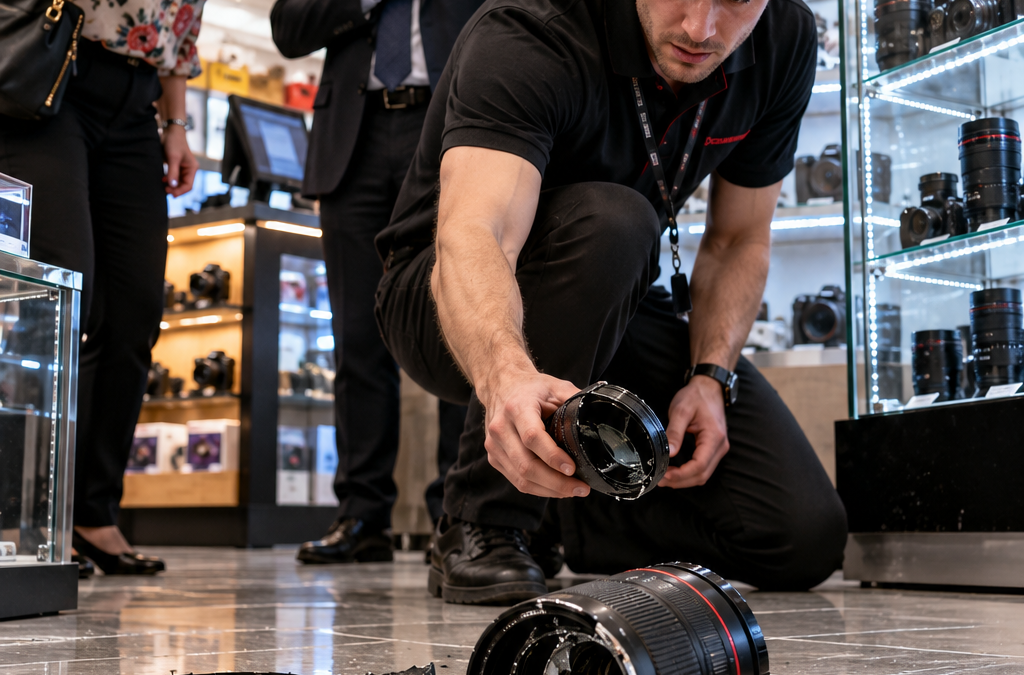
The front element was shattered.
A crack ran across the glass.
“Jesus.”
I set it carefully back on the rubber mat.
Then Meredith said:
“You dropped it.”
I looked up.
“What?”
Her voice got louder.
“You dropped my lens.”
“No, I didn’t.”
“You were handling it.”
“I wasn’t touching it.”
“You just picked it up.”
“Because it was on the floor.”
A few customers turned.
One of them was an older woman named Louise Harper, a retired teacher who came in periodically for film.
She stood near a shelf maybe twenty feet away.
Meredith pulled out her phone.
“You destroyed a $2,600 lens.”
“I did not.”
She started recording.
Phone pointed directly at my face.
“I want a manager.”
“Fine.”
“And I want this documented.”
“It will be.”
“You are paying for that.”
I felt heat rise into my face.
“Meredith, I did not drop your lens.”
“You expect me to believe it jumped?”
Before I could answer, Colin Price came out of the back office.
My manager.
Colin had been at Northline seven years.
Good man.
Usually fair.
But he had one weakness.
Conflict made him want an immediate solution.
Sometimes an immediate solution and a correct solution are not the same thing.
He approached with both palms raised.
“Everybody slow down.”
Meredith turned toward him.
“This employee dropped my professional lens and is now lying about it.”
Colin looked at the cracked glass.
Then at me.
“Mason?”
“I didn’t drop it.”
“He was inspecting it,” Meredith said.
“I set it on the mat.”
“He mishandled it.”
“I turned around for the paperwork. I heard it hit the floor. When I looked back, it was already down.”
“That’s a lie.”
“Meredith—”
“No. Don’t say my name like we’re having a disagreement. You broke my equipment.”
People were gathering.
That was the moment I began to feel something worse than anger.
Exposure.
A store where I had worked for nearly twelve years suddenly felt like a stage.
Customers stared.
Employees listened.
Meredith’s phone remained pointed at me.
Colin asked:
“Did anybody see it fall?”
Nobody answered.
I hadn’t.
That mattered.
I knew what I had done.
I knew I hadn’t dropped it.
But I hadn’t actually seen what happened while my back was turned.
I refused to invent certainty.
“I didn’t see the fall,” I said.
Meredith seized on it.
“Exactly.”
I looked at Colin.
“I heard the crash. When I turned around, it was already on the floor.”
Meredith laughed once.
“Convenient.”
Then she shifted from wanting compensation to wanting punishment.
“I want a replacement today.”
Colin said:
“We need to review what happened.”
“And I want him removed from the floor.”
My stomach tightened.
“Excuse me?”
She pointed at me.
“If one of your employees destroys a customer’s equipment and then lies about it, why is he still standing there?”
Colin’s face changed.
“Let’s not jump ahead.”
“I’m not leaving until I have a replacement and confirmation that this has been dealt with.”
“Dealt with how?”
She looked directly at me.
“I don’t want him working on my account again.”
Then:
“Frankly, someone willing to lie this easily shouldn’t be handling anyone’s equipment.”
That hurt.
Twelve years.
Thousands of customers.
Hundreds of repair intakes.
One accusation, and suddenly my entire career could be rewritten in front of strangers.
I said:
“Check the cameras.”
Meredith turned toward the front one almost immediately.
“Yes.”
Too fast.
“Check that one.”
She pointed.
“The front camera. It saw everything.”
I looked at her.
Why that one?
At the time, the question only registered faintly.
Colin asked a sales associate to pull footage.
The first clip we saw was eleven seconds long.
Someone sent it to my phone so I could view it too.
I pressed play.
There I was.
Bending down.
Picking up the broken lens.
Standing.
Setting it on the counter.
That was it.
The cardboard tripod advertisement blocked the counter at exactly the wrong angle.
The camera did not show the lens leaving the mat.
It did not show what happened while my back was turned.
It showed the aftermath.
Meredith pointed at the screen.
“There.”
People leaned closer.
“That’s him.”
I watched it again.
“That shows me picking it up.”
“You were the one holding it.”
“After it hit the floor.”
“Nobody believes that.”
Someone among the customers said:
“Why wouldn’t he just apologize?”
I still remember that voice.
Male.
I never learned the name.
Not cruel.
Casual.
That almost made it worse.
A stranger had watched eleven seconds and decided an apology was the only reasonable next step.
I felt heat creep up the back of my neck.
A dozen people were reaching a verdict.
All of them had seen the ending.
None had seen the beginning.
Louise stood slightly apart from the crowd.
She wasn’t defending me.
But she wasn’t joining them either.
She was frowning at the screen.
Thinking.
That made her different.
Meredith told the group:
“He’s trying to dodge responsibility.”
I said:
“The video does not show me dropping anything.”
She ignored that.
“He knows exactly what he did.”
I had taken my own phone out earlier when she began filming and threatening my job.
I had recorded about a minute.
Not the lens falling.
Just the aftermath.
Her voice.
Her demand for a replacement.
Her statement that I should be fired.
I opened the recording.
“Colin, I want this included too.”
Meredith saw my screen.
Something in her face cracked.
“What are you doing?”
“I recorded the conversation.”
“You can’t record me.”
“We’re in a store.”
“Delete that.”
“No.”
“Delete it now.”
She reached for my phone.
Actually lunged.
I stepped backward.
“Don’t touch me.”
“Your camera is lying.”
The sentence came out almost as a scream.
People stared.
“What?”
“That recording means nothing. Delete it.”
“I’m not deleting anything related to this complaint.”
Colin stepped between us.
“Enough.”
Meredith moved back.
Her composure returned quickly.
Too quickly.
Then she asked Colin to speak privately.
I was still close enough to hear much of it.
Her tone changed again.
Professional.
Controlled.
She explained that she had a wedding Saturday morning.
Major client.
Large contract.
No functioning lens meant lost photographs.
Lost photographs meant damaged reputation.
She couldn’t risk that because of an employee’s mistake.
Some of that fear sounded real.
I understood it.
Wedding photographers don’t get a second chance.
If you miss a first kiss, nobody recreates it next Tuesday.
But then she turned fear into leverage.
Her terms were simple.
Northline gives her a new lens.
Northline states in writing that an employee caused the damage.
Northline handles me as a personnel matter.
In return, she does not post publicly about the store.
I heard the whole thing.
It sounded less like a complaint than a transaction.
Give me what I want and I won’t hurt you.
Colin didn’t agree.
But I saw him calculate.
Meredith spent thousands at Northline.
I was an employee.
Employees cost money.
High-value customers bring it.
That’s not how fairness should work.
Sometimes it’s how pressure feels.
I said:
“Watch longer footage.”
Both turned.
“The eleven seconds don’t show what happened.”
Meredith sighed.
“We already saw it.”
“No. We saw me picking it up.”
“You dropped it.”
“Then show that.”
Colin raised a hand.
“We’re reviewing everything.”
Meredith told him every minute of delay increased her losses.
I said only:
“I didn’t drop your lens.”
Colin looked at her.
Then me.
Then around at the crowd.
I watched him choose the fastest way to cool the room.
It was me.
“Mason, step away from the counter.”
I did.
“I need your badge.”
I stared at him.
“What?”
“This isn’t termination.”
“Then why do you need my badge?”
“I’m removing you from customer-facing duties while we investigate.”
“For how long?”
“Next two shifts.”
My chest tightened.
Two shifts.
Saturday was already traded off for Evelyn’s exhibition.
But losing Thursday’s remaining hours and Friday meant money.
Money I had already mentally assigned to her summer program.
“Paid?”
He hesitated.
“I can’t promise that yet.”
That hesitation told me everything.
I unclipped my badge.
My fingers felt numb.
I handed it over.
Nearly twelve years of my name printed in black letters against white plastic.
MASON.
He put it on the counter.
Meredith lifted her phone again.
Recorded me walking away.
I saw Cara Bennett near the storeroom.
Inventory and stock control.
One of my closest friends at work.
She held a tray of tags against her chest.
Didn’t say anything.
Couldn’t.
But she met my eyes and shook her head once.
Tiny.
Almost invisible.
No.
This isn’t right.
That small gesture was the kindest thing anyone did for me all afternoon.
I walked out.
Rain had strengthened.
I sat inside my car without starting it.
For several minutes, I just stared through the windshield.
I thought the suspension was the worst part.
Then my phone began vibrating.
Again.
Again.
Again.
Meredith had already posted the video.
Not Northline’s footage.
Her phone recording.
It began after the lens was broken.
Of course.
There I was holding it.
Store logo on my shirt.
My expression tense.
Meredith’s voice accusing me.
Her caption said an employee at Northline Camera had destroyed expensive professional equipment and refused to take responsibility.
No full name.
She didn’t need one.
Anyone who knew me knew my face.
Within an hour, it spread.
Photography groups.
Local pages.
Shares.
Messages.
An old coworker asked whether I had been fired.
A mother I knew from Evelyn’s elementary school asked what happened.
A stranger sent three messages calling me things I won’t repeat.
I read too many comments.
That was my mistake.
People said the store should make me pay.
People said employees never admit fault.
People said the video obviously proved it.
Obviously.
Eleven seconds.
Obviously.
I sat in the parking lot, angry and humiliated, watching strangers describe a version of me they had created from a clip that began after the only important event had already happened.
Colin called that evening.
The company was receiving complaints.
Customer care had escalated the matter to loss control.
“Mason, don’t respond online.”
“I wasn’t planning to.”
“I mean it.”
“I said I’m not.”
“We need the investigation to stay clean.”
“Fine.”
I paused.
“But I want something.”
“What?”
“Email me.”
“About what?”
“That my suspension is temporary.”
“Mason—”
“That no finding has been made that I damaged anything.”
He was quiet.
“Put it in writing.”
Eventually he agreed.
The email arrived twenty minutes later.
I saved it.
Then saved a screenshot.
Then forwarded it to my personal account.
That was the first moment I understood that I could not allow this story to exist only in conversations.
Words disappear.
Documents stay.
Evelyn found me at the kitchen table.
My notebook open.
Phone beside me.
Dinner untouched.
She stood in the doorway wearing a gray hoodie with the sleeves pulled over her hands.
“Dad?”
“Hey.”
She didn’t move.
“Ava sent me the video.”
I looked down.
Of course.
Teenagers see everything adults wish they wouldn’t.
“What did she say?”
“She asked if it was you.”
“It is.”
Her face tightened.
“Did you drop it?”
That question hurt.
Not because she asked.
Because I hated that Meredith’s accusation had reached my child strongly enough that Evelyn felt she needed to.
“No.”
She watched me.
“I didn’t.”
“I believe you.”
The sentence nearly broke me.
Not because I doubted she would.
Because after an afternoon of strangers looking at me like I was lying, hearing my daughter say she believed me felt like somebody had finally opened a window.
She sat across from me.
“Then why does the video look like that?”
“It starts too late.”
“What?”
“It shows me picking the lens up.”
“But not it falling.”
“No.”
“Then why won’t they show the whole thing?”
I didn’t have an answer.
After she went upstairs, I opened a notebook.
I wrote everything down.
Not what I felt.
Not what I suspected.
What I knew.
Meredith entered shortly after three.
She put the lens on the counter.
I checked the serial number.
I inspected the glass.
No crack.
I photographed it.
She asked what would happen if it was damaged beyond repair.
I turned toward the cabinet.
I heard the crash.
I turned around.
Lens on floor.
I picked it up.
I stopped.
Then wrote:
I did not see the lens fall.
That sentence was important.
It was also frustrating.
I wanted certainty.
I wanted to write Meredith pushed it.
But I hadn’t seen that.
If I demanded other people respect evidence, I had to respect the limit of my own.
Then I remembered the intake photograph.
Timestamp.
Undamaged lens.
It did not prove who damaged it.
But it proved the front element was intact after Meredith handed it to me and before the crash.
One link.
Cara called around nine.
“How are you?”
“Fantastic.”
“You’re a terrible liar.”
“So I’ve heard.”
She told me staff had been talking.
Most didn’t believe I would mishandle a lens and lie about it.
But none had seen the fall.
“Did you?”
“No.”
“Don’t tell anyone you did.”
“I wouldn’t.”
“What about cameras?”
“What about them?”
“The second one.”
She paused.
“Storeroom camera?”
“Yeah.”
A few weeks earlier, a technician had adjusted it.
“I think it points more toward the testing counter now.”
I sat up.
“How much?”
“I don’t know.”
“Could it see the mat?”
“Maybe.”
That was the first moment since the incident that I felt direction instead of helplessness.
Then I watched Meredith’s online video again.
Near the beginning, she said:
“Check the front camera. It shows everything.”
Front camera.
Not cameras.
That afternoon she had also insisted on that angle.
She had looked toward it before the lens fell.
Why?
I couldn’t answer.
Maybe it was coincidence.
Maybe because it was visible.
Maybe because she genuinely believed it would prove her story.
A question isn’t evidence.
But it was enough to make me act.
I emailed Colin.
Preserve all original security recordings covering the service counter.
Both cameras.
At least thirty minutes before and after the incident.
Preserve my intake photograph.
Serial-number documentation.
My phone recording.
Any written complaint from Meredith.
I explicitly told him I was not asking for unauthorized access.
I wanted qualified management or loss-control personnel to review everything.
No clipped video.
No single angle.
Complete sequence.
Then I closed the laptop.
I barely slept.
Friday morning, Colin replied.
Footage preserved.
Loss control notified.
Then he told me Meredith had made another demand.
A bigger one.
She wanted Northline to state in writing, before the review was complete, that I had caused the damage.
She wanted a replacement lens worth roughly $2,600.
Free.
She wanted the statement by Friday afternoon.
Otherwise, she would publish her “full experience” to regional professional photography groups.
She listed how much money she had spent with Northline over the years.
The amount functioned like a threat.
I bring you revenue.
Choose carefully.
Colin invited me in Friday to give a formal statement.
I arrived in jeans and a jacket.
No uniform.
No badge.
Walking into Northline as a civilian after twelve years of working there felt bizarre.
A clerk I had trained glanced at me and then looked away.
I couldn’t blame him.
People become cautious around unresolved accusations.
Still hurt.
Colin brought me into the office.
“I’m trying to handle this properly.”
“I know.”
“I should’ve slowed things down yesterday.”
“Yes.”
He didn’t defend himself.
That helped.
I asked about the second camera.
He checked.
Then looked up.
“It’s running.”
“Does it cover the counter?”
“It should.”
Relief hit me.
Immediately followed by fear.
Because a camera can reveal truth.
It can also reveal something you don’t expect.
What if I had bumped the counter without remembering?
What if my elbow brushed something?
What if some tiny movement I made caused the lens to slide?
I knew I hadn’t held it when it fell.
But memory under stress is imperfect.
I wanted truth more than vindication.
Even if those two things turned out not to be identical.
We opened the intake file first.
Photograph.
Timestamp.
Serial number.
Lens intact.
I pointed at it.
“This doesn’t prove Meredith did anything.”
Colin nodded.
“It proves the lens wasn’t cracked here.”
“Before I stepped away.”
“Yes.”
“Save it.”
“Already did.”
Then we watched the full front-camera recording.
Not eleven seconds.
Everything.
Meredith entering.
Lens on counter.
Me inspecting.
Photograph.
My movement toward the cabinet.
Then the tripod display blocked the critical area.
The lens itself disappeared behind cardboard from that angle.
I returned.
Bent down.
Picked it up.
Colin watched twice.
Then said:
“This doesn’t show you dropping it.”
Those words mattered.
They were not innocence.
But they were the first official recognition that accusation and evidence were not the same thing.
I walked to the actual counter.
Stood beside the tripod display.
Pointed.
“If the lens leaves the mat while I’m behind that, front camera never sees it.”
Colin looked from the display to the monitor.
“You’re right.”
Small sentence.
Huge shift.
While we were finishing, Louise Harper came in.
The retired teacher.
She recognized me.
“Mason.”
“Ms. Harper.”
“I heard you’re not working today.”
“Temporary review.”
She looked toward Colin.
“I was here yesterday.”
“I know.”
I resisted every temptation to recruit her.
Instead I asked:
“Can you tell Colin only what you remember personally?”
She appreciated the wording.
Teachers recognize careful questions.
“I heard the crash.”
“What did you see before it?”
“I was looking at film.”
“Did you see the lens fall?”
“No.”
“Did you see me touch it before the crash?”
“No.”
“Did you see Mrs. Vale?”
“Not clearly.”
That was less than I wanted.
Exactly as much as truth allowed.
Then she added:
“But I heard her demanding a new lens before your manager arrived.”
Colin looked up.
“Before I came out?”
“Yes.”
“And she said Mason had dropped it?”
“Yes.”
Louise gave her phone number for an official statement.
I thanked her.
Not because she helped my side.
Because she refused to claim more than she knew.
Meredith returned Friday afternoon.
She saw me with Colin.
Stopped.
“Why is he here?”
“He’s giving a statement.”
“He’s suspended.”
“That doesn’t remove his right to participate in an investigation about him.”
She looked toward me.
“This is exactly what I expected.”
I almost asked what she meant.
Didn’t.
She demanded results.
Colin said:
“We are still reviewing another camera.”
Her face changed.
Not dramatically.
But enough.
“What other camera?”
“The one near the storeroom.”
Silence.
“You don’t need that.”
I watched her.
“The front footage is perfectly clear.”
Colin said:
“No, it isn’t.”
Meredith’s shoulders stiffened.
“It shows him holding my broken lens.”
“It shows him picking it up.”
“You’re splitting hairs.”
“No. We’re identifying what it proves.”
She looked at me.
Then back toward Colin.
“This investigation is becoming absurd.”
I said nothing.
She asked that no additional footage of her be viewed by anyone outside the complaint team.
Colin agreed to protect her privacy.
But he refused to skip evidence.
Meredith repeated her deadline.
If Northline did not resolve the matter, she would take her business elsewhere and make sure other professionals knew why.
Colin called Natalie Shaw.
Corporate loss-control specialist.
Natalie did not arrive like a hero.
No dramatic attitude.
She simply gave instructions.
Preserve original files.
Review copies.
Match timestamps.
Separate observation from conclusion.
Document everything.
It was almost boring.
Boring suddenly felt wonderful.
Processes become beautiful when emotion is trying to overwhelm facts.
Friday afternoon, Colin set up a monitor in the consultation area.
Meredith sat on one side of the table.
I sat on the other.
Natalie positioned her laptop nearby.
Colin stood beside the monitor.
I could hear the store functioning around us.
Register beeps.
Door chime.
Low conversations.
Normal life happening ten feet away from the place where my career might be decided.
My palms were damp.
I wiped them against my knees.
Meredith checked her phone.
“I have a wedding tomorrow.”
Colin said:
“We know.”
“I need this resolved.”
“It will be.”
“Today.”
“We’re reviewing it now.”
She sighed.
We began with the front camera.
Full sequence.
Watching myself work from above felt strange.
I noticed little habits.
I tapped the counter twice before reaching for a pen.
I leaned slightly to the left while reading serial numbers.
Ordinary things.
Then I set the lens on the rubber mat.
Turned toward the cabinet.
The cardboard display blocked the critical area.
Then I reappeared.
Bent down.
Picked up the lens.
Meredith pointed.
“Exactly.”
Colin didn’t look at her.
“This shows Mason picking it up.”
“He dropped it before that.”
“It doesn’t show that.”
“The obvious explanation—”
“We’re not reviewing obvious explanations. We’re reviewing footage.”
Natalie nodded once.
I almost smiled.
Meredith didn’t.
Colin paused the footage at the moment I turned away.
I pointed.
“Counter disappears.”
He zoomed as far as the resolution reasonably allowed.
Nothing.
No lens.
No hands.
Just cardboard.
Colin said:
“The front camera cannot establish how the lens left the mat.”
Meredith leaned forward.
“Maybe he bumped the counter.”
New story.
I noticed it immediately.
“He could have knocked it as he turned.”
I said:
“I didn’t.”
“You don’t know.”
“I know whether I hit the counter.”
“You already admitted you didn’t see it fall.”
“That doesn’t mean I forgot hitting a counter.”
Colin raised a hand.
“Stop.”
Natalie spoke:
“Let’s keep observations separate from interpretation.”
Again.
Process.
Rule.
Anchor.
Meredith sat back.
Colin opened the second recording.
Storeroom camera.
The angle was radically different.
Higher.
Steeper.
Looking diagonally across the testing area.
The entire counter surface was visible.
The rubber mat.
The lens.
No cardboard obstruction.
My heart started pounding.
Because suddenly, the truth existed somewhere outside memory.
Whatever happened, we were about to see it.
The footage began.
Meredith set her bag down.
I took the lens.
Serial number.
Inspection.
Photograph.
Same movements as the first recording.
Perfectly synchronized.
I placed the lens near the center of the rubber mat.
Not near the edge.
Center.
Then I turned toward the cabinet.
Meredith looked toward the front corner.
Toward the camera she had insisted we use.
I felt the air in the consultation area change.
On screen, Louise stood at the film shelf with her back partly turned.
Meredith moved her equipment bag.
Pulled it closer.
Her hand crossed the counter.
Colin paused.
Meredith spoke immediately.
“I was moving my bag.”
Nobody contradicted her.
Because moving a bag wasn’t the issue.
I said:
“Keep playing.”
She looked at me.
“You’re enjoying this.”
“No.”
And I wasn’t.
I was terrified.
“Keep playing.”
Colin resumed.
On the screen, my back remained turned.
Meredith’s fingers rested near the lens.
Then touched it.
Two fingers.
Small movement.
The barrel shifted.
At first barely.
Then farther.
It slid across the rubber mat.
Reached the edge.
Dropped.
Even without sound, my body remembered the crack.
On screen, only after the lens disappeared over the edge did I turn.
Walk back.
Bend down.
Pick it up.
Exactly as I had said.
Nobody spoke.
Colin rewound.
Played it again.
Normal speed.
Meredith’s hand touched lens.
Lens moved.
Lens fell.
I turned afterward.
Third time.
Slow.
Same thing.
Natalie checked timestamps.
Matched both recordings.
Continuous footage.
No cut.
No missing interval.
I sat there staring at the monitor.
I expected relief to feel warm.
It didn’t.
It felt heavy.
Almost painful.
For more than twenty-four hours, I had carried the possibility that no one would ever believe what I knew about myself.
Now the truth was visible.
And instead of feeling triumphant, I thought:
It took two cameras.
It took a loss-control specialist.
It took a witness.
It took a timestamped intake photograph.
It took nearly losing my job.
All to prove a sentence I had told them from the beginning.
I didn’t drop it.
Across the table, Meredith stared at the screen.
No argument.
For several seconds.
Then:
“I touched it accidentally.”
Nobody answered.
“It shouldn’t have been there.”
There it was.
Another version.
“The employee left expensive equipment too close to the edge.”
Colin rewound again.
Beginning of sequence.
My hands placed the lens clearly in the center of the rubber mat.
It remained there.
Then her fingers moved it.
The video destroyed that explanation too.
Meredith said:
“The counter isn’t designed properly.”
Colin finally looked directly at her.
“Mrs. Vale.”
“What?”
“The lens did not fall because Mason dropped it.”
She opened her mouth.
He continued.
“The footage shows that.”
“I did not intentionally knock it down.”
Natalie said:
“We are not making a finding about intention.”
Good.
Because intention couldn’t be seen.
Physical action could.
I spoke for the first time in several minutes.
“You told everyone I dropped it.”
Meredith looked at me.
“That’s what I believed.”
“No.”
My voice remained quiet.
“You said you saw me drop it.”
She didn’t answer.
“You told customers I was lying.”
Nothing.
“You demanded I be fired.”
Still nothing.
I looked toward the monitor.
“The camera wasn’t lying.”
She flinched.
“You were leaving out what happened before.”
That was all I needed to say.
The second camera had done the rest.
Meredith stood.
“Turn that off.”
Colin paused the footage.
“I don’t want my image distributed.”
“It won’t be posted by the store.”
“I want it deleted.”
“No.”
Her head snapped toward him.
“This is my image.”
“It’s security footage belonging to the business and part of an active complaint record.”
She looked at Natalie.
Natalie confirmed it.
Meredith grabbed her bag.
“What about my replacement?”
Colin’s voice changed.
Manager now.
Firm.
“Your claim for a free replacement based on employee damage is denied.”
“I still need a lens for tomorrow.”
“We can discuss ordinary paid rental options separately.”
“You promised a loaner.”
“Your professional customer status is under review because of your conduct toward an employee and the inaccurate information provided during this complaint.”
Her face reddened.
“I’ve spent tens of thousands of dollars here.”
“I understand.”
“And you’re taking his side?”
“We’re taking the evidence.”
That sentence landed.
She had expected status to outweigh a counter clerk.
It didn’t.
Not anymore.
But one thing remained.
Thursday’s crowd.
The public accusation.
The customers who had heard her call me a liar.
Some of them still came into the store.
Some had shared the clip.
I said:
“I want it corrected.”
Colin looked at me.
“How?”
“Here.”
Meredith laughed bitterly.
“What do you want, an announcement?”
I looked at her.
“Yes.”
She stopped laughing.
Colin considered.
“We can issue a factual correction without showing footage or identifying private customer information.”
“That’s what I want.”
“No spectacle,” Natalie added.
“I don’t want one.”
That was true.
I didn’t need people pointing at Meredith.
I needed people who had heard that I destroyed the lens to hear that I hadn’t.
Colin walked to the service counter.
A handful of customers were nearby.
Louise happened to be there.
So was a man I recognized from Thursday.
Colin spoke clearly.
“Yesterday, an employee was accused publicly of dropping and damaging a customer’s lens.”
People looked up.
“We have completed our review of the available security footage and related records.”
My heart hammered.
“The evidence shows that Mason Bell did not drop the lens. The short clip viewed yesterday did not show the complete sequence, and any suggestion by Northline Camera that Mason was responsible is withdrawn.”
No applause.
Thank God.
I would have hated applause.
Just silence.
Then people returned to what they were doing.
The man from Thursday—the one who had asked why I didn’t simply apologize—came over.
“I said something yesterday.”
“I remember.”
“I shouldn’t have.”
I waited.
“I saw that clip and assumed.”
“Yeah.”
“I’m sorry.”
I nodded.
“Thank you.”
That meant more than I expected.
Not because I needed him punished for judging me.
Because taking back a verdict takes more character than issuing one.
Louise touched my arm lightly.
“I’m glad they looked.”
“So am I.”
Then Colin asked Meredith to return to the consultation area.
He gave her the formal decision.
No free replacement based on employee fault.
Preferred professional status terminated.
Weekend loaner withdrawn under program terms.
Any valid prepaid rental fees to be handled according to policy.
She could retrieve her broken lens.
She could request a normal repair assessment.
What she could no longer do was use premium status to demand equipment and an employee’s punishment based on a story contradicted by the evidence.
She exploded.
Not physically.
Verbally.
The store was betraying a long-term customer.
The investigation had been biased.
The camera angle was misleading.
Her hand contact had been accidental.
Northline was protecting employees.
She would tell everyone.
She would take her business elsewhere.
Colin let her finish.
Then handed her the written decision.
Meredith turned toward me.
“You think this makes you look good?”
I stared at her.
“I think it makes the video complete.”
“You’ve destroyed my relationship with this store.”
“I didn’t make you accuse me.”
“You were responsible for the equipment.”
“No.”
She pointed toward my chest.
“You put it there.”
“On a rubber mat.”
“You walked away.”
“For ten seconds to get the intake form you asked me to use.”
Her mouth tightened.
I didn’t want to keep arguing.
So I said:
“Stop telling people I dropped your lens.”
“I have every right to describe what happened.”
“Then describe all of it.”
She stared at me.
“If you keep posting claims that aren’t true, I’ve saved everything.”
That was as close as I came to a threat.
Not revenge.
Preservation.
She grabbed the broken lens.
Put it in her bag.
Walked out.
The door closed behind her.
No police.
No courtroom.
No dramatic collapse.
She simply left.
And suddenly I was standing in the store where I had worked nearly twelve years without a badge.
Colin picked mine up from his office desk.
Held it out.
“You can come back.”
I didn’t take it immediately.
“I need more than that.”
He lowered his hand.
“What?”
“My schedule restored.”
“Yes.”
“Pay for the hours you removed me.”
“I’ll have to clear it with HR.”
“Clear it.”
“Mason—”
“I lost income because you suspended me before you checked the complete footage.”
He didn’t answer.
“My personnel file.”
“I’ll remove any fault notation.”
“In writing.”
“Okay.”
“Email confirming the investigation found I didn’t cause the damage.”
“Yes.”
“And the store corrects this publicly.”
“We already did here.”
“Online.”
He understood.
Meredith’s post was still circulating.
Being cleared within four walls wasn’t enough after the accusation had escaped them.
“We’ll issue a statement.”
“No video of her.”
Colin looked surprised.
“I don’t want revenge.”
“You’d be within your rights to be angry.”
“I am angry.”
“Then why protect her?”
“Because I want my name fixed. I don’t need hers destroyed.”
Natalie, who had been packing her laptop, looked at me.
Then nodded once.
That evening, Colin’s email arrived.
My suspension was rescinded.
My schedule restored.
I would be paid for the shifts lost during the investigation.
Northline’s internal record stated that I had not caused the lens damage.
No disciplinary action.
No negative personnel note.
I saved the email in three places.
Still, Meredith’s video remained online.
Evelyn called from her room even though we were in the same house.
Teenager logic.
“Dad?”
“What?”
“People are still sharing it.”
I went upstairs.
She sat on the bed.
Phone in hand.
The original post had hundreds of comments.
Some people had started questioning Meredith.
Others hadn’t seen any correction.
Evelyn looked at me.
“Are people still going to think you did it?”
That question hurt more than anything Meredith had said.
Because I couldn’t promise otherwise.
Once a lie travels, correcting it doesn’t cause every copy to disappear.
“I don’t know.”
Her eyes lowered.
“But the store knows.”
“I know.”
“And I know.”
“Yeah.”
“Is that enough?”
I sat beside her.
“No.”
She looked surprised.
“It should be, but no.”
I took the phone.
“My name exists outside this house.”
“So what are you going to do?”
“Correct it.”
Northline published an official statement Friday evening.
Short.
Factual.
The store had reviewed complete security footage and relevant records.
The employee shown in circulated footage did not drop or cause the lens to fall.
The clip shared publicly did not contain the complete sequence of events.
The store had reinstated the employee fully.
No mention of Meredith’s name.
No second-camera video.
No attempt to send internet strangers after her.
I read it before publication.
I asked Colin to change one phrase.
The draft originally said “the employee involved.”
I wanted my name.
Not because I wanted attention.
Because ambiguity had already hurt me enough.
So the final version said Mason Bell.
I then wrote a message to friends, neighbors, old coworkers, and the people who had contacted me directly.
No essay.
No anger.
I wrote:
I didn’t damage the lens. Northline reviewed the complete security footage and confirmed that. The original clip began after the lens was already on the floor.
Then I attached the store statement.
Nothing else.
No accusation against Meredith.
No insults.
No calls for people to attack her business.
Facts.
I wanted my correction to be boring.
Boring is underrated.
Saturday morning, I checked Meredith’s page.
The original post was gone.
I didn’t know why.
Maybe her attorney advised it.
Maybe Northline contacted her.
Maybe she decided it made her look worse after the store issued its correction.
I didn’t know.
So I didn’t invent an answer.
For two days, I had lived inside someone else’s unsupported certainty.
I wasn’t going to start manufacturing my own.
Evelyn’s exhibition began at ten.
I arrived fifteen minutes early.
The school gym had been transformed with temporary walls and rows of framed photographs.
Parents walked slowly.
Students pretended not to care whether anyone stopped at their work.
Evelyn found me near the entrance.
“You came.”
I frowned.
“I promised.”
“I know.”
“Then why are you surprised?”
She shrugged.
Because sixteen-year-olds apparently believe adults are permanently one inconvenience away from betrayal.
She hooked her arm through mine.
“Come here.”
Her photograph hung near the back.
Black-and-white.
An old storefront window.
In the glass, the street reflected at two angles.
One reflection sharp.
The other faint.
Buildings overlapping.
Two versions of the same place occupying one frame.
I stared at it.
Evelyn watched me.
“What?”
“Nothing.”
“You look weird.”
“Your photo.”
“Bad weird?”
“No.”
I stepped closer.
“Two pictures.”
“Reflections.”
“Same street.”
“Different angles.”
She smiled.
“That’s literally the title.”
I read the card.
SECOND ANGLE.
I laughed.
“What?”
“Nothing.”
“Dad.”
“It’s perfect.”
She didn’t know how perfect.
Maybe that’s what art does sometimes.
Says something before the artist knows who needs to hear it.
We stood there for a long time.
Then Evelyn asked:
“Is everything finished?”
“The important part.”
“Meredith?”
“Don’t know.”
“Your job?”
“Back Monday.”
“Pay?”
“Coming.”
“The summer program?”
I looked at her.
She had been worried about that and hadn’t said it.
“Still happening.”
“Really?”
“Yes.”
She smiled.
This time she didn’t hide it.
Monday morning, I walked into Northline wearing my badge.
MASON.
Same plastic rectangle.
Different weight.
The store was quiet before opening.
Colin asked me into his office.
He closed the door.
“I owe you an apology.”
I sat.
He continued.
“I moved too fast.”
“Yes.”
“I thought pulling you from the floor would lower the temperature.”
“It did.”
He nodded.
“And raised the cost for me.”
“I know.”
“No, I need you to understand this.”
“I’m listening.”
“When you removed me before checking all the footage, customers saw that.”
He looked down.
“My coworkers saw that.”
“I know.”
“My daughter saw a video online and asked if I dropped the lens.”
He flinched.
“That happened because one customer made an accusation and you treated the accusation like enough reason for me to start paying a price.”
“I never said you were guilty.”
“You took my badge.”
Silence.
“You canceled shifts.”
Silence.
“You couldn’t tell me whether I’d be paid.”
He rubbed his forehead.
“You’re right.”
I didn’t need more.
Not a speech.
Not humiliation.
Just acknowledgment.
Colin confirmed HR had approved full compensation for every missed hour.
My personnel file contained no disciplinary notation.
The store’s official investigation record stated that I was not responsible.
Then he told me they were changing policy.
Any future incident involving camera evidence required review of full available footage before employee discipline whenever immediate safety did not demand otherwise.
Original files had to be preserved.
Employees accused of misconduct had the right to give a statement before conclusions.
Clipped customer video could trigger an investigation.
It could not finish one.
That last rule mattered.
A lot.
At the morning staff meeting, Colin explained what had changed.
He didn’t retell everything.
Didn’t embarrass me.
Didn’t mention Meredith by name beyond what employees already knew.
Cara sat near the back.
When Colin said:
“No decision should ever be based on a single angle when other relevant footage exists,”
she looked at me.
Then whispered:
“One camera is never enough.”
I laughed.
First time I had laughed about any of it.
My full pay arrived the following week.
Enough to keep Evelyn’s summer-program fund intact.
I checked the account twice.
Not because I distrusted payroll.
Because seeing the number made something settle.
The accusation had nearly cost me more than reputation.
It had almost taken something from my daughter too.
That bothered me.
The first customer I helped after returning brought in an old film camera.
A woman in her seventies.
Her late husband’s.
She placed it gently on the rubber mat.
“He carried this everywhere.”
I picked it up.
Checked the advance lever.
Shutter.
Lens.
“How long has it been sitting?”
“Eleven years.”
“We’ll go slowly.”
She smiled.
For the first time since Thursday, I disappeared back into the work.
That was what I wanted.
Not victory.
Normal.
A week later, Colin confirmed Meredith’s preferred professional status was permanently ended.
I didn’t ask where she rented a lens for the wedding.
Didn’t ask how the wedding went.
Didn’t look up reviews of her business.
For a few days, curiosity tempted me.
Then I realized why I didn’t need to know.
If her wedding failed, it wouldn’t restore my lost sleep.
If it succeeded, that wouldn’t undo what she did.
Her life no longer needed to provide my ending.
Mine already had one.
Job restored.
Wages restored.
Record corrected.
Daughter still going to summer photography school.
That was enough.
But the experience changed how I thought about evidence.
Before Meredith, I would have told you video was reliable.
Still is.
The front camera never lied.
That’s the important part.
Neither did the second camera.
The first camera showed me picking up a broken lens.
True.
The second showed why it was broken.
Also true.
The danger wasn’t false footage.
The danger was incomplete footage treated as complete truth.
Eleven seconds nearly erased everything before them.
My inspection.
The intact lens.
The rubber mat.
My back turning.
Meredith’s hand.
The movement.
The fall.
None of that existed in the clip people shared.
And because the clip itself was real, the conclusion built on top of it felt real too.
That’s frightening.
A lie does not always need fabricated evidence.
Sometimes it only needs carefully selected truth.
One angle.
One sentence.
One photograph.
One moment.
Then people fill in the rest.
I did it too.
When Meredith insisted on the front camera, I immediately began suspecting that she knew something.
Maybe she did.
The second angle certainly made her behavior look more troubling.
But even now, I can’t tell you whether she deliberately pushed the lens.
The video showed her fingers touching it.
It showed the lens sliding off.
It didn’t show intention.
Maybe she wanted to damage it so the store would replace it.
Her earlier questions about damage beyond repair made that possibility hard to ignore.
Maybe she intended only to move it.
Maybe she was frustrated and careless.
Maybe she saw an opportunity only after it fell.
I don’t know.
And I refuse to pretend I do.
Because that would repeat the exact mistake I was angry at everyone else for making.
Evidence deserves boundaries.
The camera proved physical sequence.
It did not read her mind.
What I know is enough.
She knocked the lens off the mat.
Then said I dropped it.
She insisted the camera that couldn’t see the counter proved her version.
She demanded my job before the investigation was complete.
She posted a clipped public accusation.
When the first angle failed to establish fault, her explanation changed.
When the second angle showed what happened, her explanation changed again.
Those are facts.
I don’t need more.
A month after everything ended, Evelyn received her acceptance email for the summer photography program.
She screamed from upstairs.
I thought somebody was injured.
“What?”
She came running down.
Laptop in both hands.
“I got in.”
I read the email.
Then again.
“See?”
“You said that too casually.”
“I knew.”
“You did not know.”
“I believed.”
“Different.”
She grinned.
The deposit was due in two weeks.
I paid it that night.
When the confirmation screen appeared, I thought about the two shifts Colin had removed.
The money.
The uncertainty.
How a stranger’s accusation had nearly reached all the way into something Evelyn had worked toward for a year.
Then I closed the laptop.
Didn’t want Meredith in that moment.
Summer belonged to Evelyn.
At the store, procedures settled into routine.
Whenever a complaint involved surveillance footage, employees preserved the entire relevant window.
Managers checked every available angle.
Nobody called it the Mason Rule.
Thank God.
Cara probably would have if I gave her encouragement.
One afternoon she was training a new employee.
I heard her say:
“Don’t ever watch just the clip somebody gives you.”
The new kid asked why.
Cara pointed toward me.
“Ask him.”
I said:
“Don’t.”
She laughed.
Over time, customers forgot.
That’s another thing I learned.
Public humiliation feels permanent when you’re inside it.
Usually, it isn’t.
People move on.
New controversy.
New video.
New outrage.
The internet has an appetite but almost no memory.
For a few weeks, someone occasionally recognized me.
“You’re the lens guy.”
I hated that.
Then it stopped.
Northline became a camera store again.
I became Mason again.
Not the employee in Meredith’s video.
Just Mason.
The man who knows where the batteries are.
The person who can explain aperture three different ways until a beginner understands.
The guy who will spend forty minutes helping an elderly customer identify a camera from 1968 even if the sale is worth nothing.
I value ordinary identity more now.
Being falsely accused teaches you how fragile reputation feels.
You spend years becoming someone.
Reliable employee.
Father.
Neighbor.
Coworker.
Then one loud person can place a different label on you in thirty seconds.
Careless.
Dishonest.
Liar.
Suddenly you’re forced to prove the person you already spent years being.
That’s exhausting.
The hardest part wasn’t proving I didn’t drop the lens.
It was refusing to let the pressure make me become somebody else while I proved it.
I wanted to scream at Meredith.
I wanted to post the second camera footage.
I wanted everyone who called me a liar to see exactly what her hand did.
I wanted the satisfaction of watching people turn on her as quickly as they had turned on me.
But then I pictured Evelyn reading those comments too.
A different mob.
Same appetite.
I didn’t want that.
Justice and reversal aren’t always the same thing.
Replacing one public humiliation with another might have felt good.
It wouldn’t have made anything more true.
So I asked Northline not to post Meredith’s image.
Just correct the claim.
Some coworkers disagreed.
“She posted you,” one said.
“I know.”
“So why protect her?”
“I’m not protecting her.”
“It sounds like you are.”
“I’m protecting the standard.”
“What standard?”
“That you don’t use someone’s image to create a mob if you can correct the facts without doing it.”
He looked unconvinced.
That’s okay.
I was barely convinced myself.
But I knew what it felt like to become a character in somebody else’s public story.
I didn’t want to inflict that carelessly.
Months later, I saw Louise Harper again.
She brought in film.
We talked for a few minutes.
Before leaving, she said:
“I’ve thought about that day.”
“So have I.”
“Do you know what bothered me?”
“What?”
“Everyone wanted an answer immediately.”
I smiled.
“Yes.”
She adjusted her cardigan.
“I’m old enough to remember when photographs took a week to come back from the lab.”
“Probably healthier.”
“You had to wait.”
“People hated waiting then too.”
“Of course. But waiting created a little humility.”
I thought about that.
She continued:
“Nobody seems willing to say, ‘I don’t know yet.'”
That was exactly it.
I don’t know yet.
Four ordinary words.
They might have saved me a suspension.
Saved Colin an apology.
Saved strangers from making fools of themselves online.
Saved Meredith from escalating her own lie.
But uncertainty makes people uncomfortable.
Certainty feels strong.
Meredith was certain.
I was careful.
At first, certainty won.
That’s why honesty felt like a disadvantage when I told everyone:
I didn’t see the lens fall.
People heard doubt.
Meredith said:
He dropped it.
People heard confidence.
But confidence and truth are not synonyms.
Sometimes the truthful person sounds less certain because truth includes limits.
That lesson stayed with me.
At work, at home, everywhere.
When Evelyn comes home angry because someone at school said something about a friend, I ask:
“What do you know?”
She rolls her eyes.
“Don’t do your camera-store thing.”
“It’s a good thing.”
“It’s annoying.”
“What did you actually see?”
She hates the question.
Which means she probably needs it.
I ask myself the same thing.
What do I know?
What am I assuming?
What was outside the frame?
The second-camera footage remains stored with Northline’s incident file.
I haven’t watched it since the investigation.
I don’t need to.
For weeks, I thought I would want a copy.
Something I could keep.
Evidence.
Protection.
Eventually I realized I already had what I needed.
The written finding.
The restored employment record.
The store’s public correction.
My own documentation.
I didn’t need Meredith’s hand sliding that lens off the counter saved on my phone forever.
I didn’t want the worst forty-eight hours of my career becoming a video I revisited like an injury.
Some evidence is useful because it allows you to move on.
You don’t honor it by staring at it forever.
The cardboard tripod display disappeared a week after the incident.
Promotion ended.
Cara watched two employees carry it toward recycling.
She came to find me.
“Your enemy is leaving.”
“What?”
“The display.”
She pointed.
“Would you like to say goodbye?”
“No.”
“Closure.”
“I have closure.”
“You could kick it.”
“Very mature.”
“I’m just offering.”
We watched it disappear through the stockroom.
A stupid piece of cardboard.
No intent.
No blame.
Yet its position had hidden exactly what everyone needed to see.
That detail stayed with me too.
Sometimes nobody is deliberately hiding truth.
Sometimes truth is simply obstructed.
By angle.
Timing.
Noise.
Assumption.
The job is not to invent what is behind the obstruction.
It’s to find another view.
That principle is simple in a camera store.
Harder everywhere else.
At Evelyn’s summer program, her instructors assigned a project on visual narrative.
She called me after the first week.
“You’d hate this assignment.”
“Why?”
“We have to tell a story in six photos.”
“Sounds great.”
“We’re supposed to leave things out intentionally.”
“Now I definitely hate it.”
She laughed.
Then:
“It’s about how framing changes meaning.”
“Your teacher knows about the lens?”
“No.”
“Good.”
“Dad.”
“What?”
“All photography leaves things out.”
“I know.”
“That’s the point.”
She was right.
Every frame excludes something.
That’s not dishonest by itself.
You cannot photograph everything.
The responsibility comes when someone pretends the frame is the whole world.
Meredith’s eleven-second clip contained truth.
She simply offered it as completeness.
That was the manipulation.
When Evelyn returned from the program, she showed me her final sequence.
Six photographs.
A man sitting alone at a bus stop.
Rain.
Empty road.
Close-up of his hands.
An approaching bus.
Then final image wider than the others.
A woman and small child were standing several feet away, just outside the earlier frames.
Suddenly the lonely man wasn’t necessarily lonely.
He was waiting with family.
Or maybe not.
The sequence never told you.
It just forced you to question your first interpretation.
I looked at Evelyn.
“Subtle.”
“That’s praise from you?”
“Highest form.”
She smiled.
Then pointed at the first photograph.
“What did you think?”
“Lonely guy.”
“Exactly.”
“And you wanted me to.”
“Yes.”
“Manipulative.”
“Visual storytelling.”
“Same thing with tuition.”
She laughed.
That photograph is framed in my house now.
Not because it’s her best.
Because it reminds me of something.
The first picture can be true and still not be enough.
Nearly a year after Meredith’s accusation, Northline held its annual staff meeting.
Nothing special.
Sales targets.
Inventory shrink.
Schedule changes.
New product lines.
Near the end, Colin reviewed safety and complaint procedures.
He mentioned the full-footage requirement.
Nobody needed explanation anymore.
It had become normal.
I looked around the room.
Young employees who hadn’t even worked there when it happened followed the rule without knowing my story.
That felt more meaningful than any apology.
The system learned something.
People come and go.
Memory fades.
A repaired process remains.
After the meeting, Colin caught me near the door.
“Ever think about management?”
“No.”
He laughed.
“I’m serious.”
“So am I.”
“You handled that situation better than I did.”
“That’s because I didn’t have a store to manage.”
“Still.”
“I like cameras.”
“You like customers?”
“Some.”
He smiled.
“Offer stands.”
I never took it.
Not then.
Maybe someday.
The incident did not magically transform my career.
I didn’t become a corporate investigator.
Didn’t get promoted to regional manager.
Didn’t receive a giant settlement.
My life stayed recognizably mine.
I prefer that.
Too many stories make justice sound like it only counts if somebody gets rich or the villain loses everything.
I didn’t need Meredith bankrupt.
I needed Friday’s schedule restored.
I needed the missing wages.
I needed Saturday with Evelyn.
I needed my name cleared.
Small things can be enormous when someone almost takes them.
Sometimes I wonder about Meredith.
Not often.
I know she continued working as a photographer because I saw her name once on a local wedding website months later.
I closed the page.
No curiosity.
No anger.
Mostly distance.
I hope she learned something.
I don’t require it.
Growth is her business.
My recovery was mine.
If I could go back to Thursday afternoon, there is one thing I would do differently.
I would ask Colin immediately:
“What do the other cameras show?”
Not because I should have known Meredith caused the damage.
I couldn’t.
Because I should have recognized sooner that one viewpoint is not an investigation.
I spent too much time defending myself inside the frame she chose.
That’s a dangerous place to argue.
She wanted everyone looking at the moment I held the broken lens.
So I explained why I was holding it.
She said that explanation was an excuse.
I explained the receipt.
The intake.
My actions.
Every answer remained trapped inside her chosen eleven seconds.
The breakthrough came when I stopped arguing about what the clip meant and asked what it did not contain.
That question changed everything.
What happened before?
What did the camera not see?
What other evidence exists?
What can we verify?
Those questions are less emotionally satisfying than shouting:
You’re lying.
They are far more useful.
There are still moments when I remember handing Colin my badge.
The numbness in my fingers.
Meredith filming.
Cara standing near the storeroom.
I remember sitting in my car while my phone filled with strangers’ opinions.
I remember Evelyn asking whether I really dropped the lens.
That one will probably stay longest.
But I also remember her saying:
I believe you.
Some memories balance others.
Not erase.
Balance.
That may be all we get.
One spring afternoon, nearly two years later, I was cleaning the service counter when a customer accidentally knocked a small camera accessory onto the floor.
Nothing expensive.
No damage.
He immediately said:
“That was my fault.”
I picked it up.
Checked it.
Fine.
“You’re good.”
He laughed.
“Still embarrassing.”
“You admitted it.”
“Why wouldn’t I?”
I looked at him.
“No reason.”
But after he left, I thought about the simplicity.
Object falls.
Person responsible says so.
Problem ends.
How different my experience would have been if Meredith had simply said:
I touched it.
I think I knocked it down.
Even if it had been accidental.
Northline might have worked with her.
Maybe insurance.
Maybe discounted replacement.
Maybe repair.
Maybe a loaner for the wedding.
Instead, she chose blame.
Then every decision afterward existed to protect the first one.
She needed the front camera because it supported the accusation.
She needed my suspension because it made her accusation look credible.
She needed the public post because pressure might force Northline to surrender.
She needed her story to keep changing because evidence kept closing each escape route.
One bad choice became a structure requiring more bad choices to hold it up.
That’s another lesson I carried forward.
If you’re wrong early, admit it early.
Mistakes compound when pride starts paying the interest.
Friday afternoon, when the second camera showed her fingers against the lens, Meredith still had one last chance.
She could have said:
I was wrong about Mason.
Instead:
It was accidental.
The lens shouldn’t have been there.
The counter was unsafe.
The store was responsible.
Different explanation.
Same instinct.
Anything but:
I accused the wrong person.
That’s why the apology I never received stopped mattering.
An apology is valuable when it reflects understanding.
Forced words aren’t magic.
The camera gave me factual correction.
Colin gave me institutional correction.
The man from the crowd gave me human correction.
My daughter gave me trust before proof.
Those were enough.
At the end of most shifts, I still look up at the security monitor sometimes.
Front camera.
Storeroom camera.
Different angles of the same store.
Customers moving between cases.
Employees working.
Nothing dramatic.
The images overlap.
One catches what another misses.
Neither is complete.
Together, closer.
I used to think cameras captured truth.
Now I would say something different.
Cameras capture evidence.
People still have to decide whether they’re willing to look at all of it.
That’s where fairness lives.
Not inside the machine.
Inside the decision to keep looking after the first answer feels convenient.
Meredith wanted the first camera because the first camera gave her a story.
My manager initially wanted the fastest solution because the fastest solution lowered the noise.
Customers wanted an immediate villain because uncertainty is uncomfortable.
I wanted everyone to believe me because I knew my own actions.
Everyone wanted something.
The second camera didn’t want anything.
It simply showed what happened.
My back turned.
Her fingers against the barrel.
The lens sliding.
The fall.
Me returning afterward.
A few seconds.
That was all.
A few seconds I had never seen with my own eyes.
A few seconds hidden from the first angle.
A few seconds that restored twelve years of work, two lost shifts, a summer program for my daughter, and the simple right to stand behind my own counter without being called a liar.
People sometimes say the truth always comes out.
I don’t believe that anymore.
Sometimes it does.
Sometimes the second camera isn’t recording.
Sometimes nobody preserves the file.
Sometimes the manager chooses the important customer.
Sometimes a witness stays silent.
Sometimes the correction never travels as far as the accusation.
Truth does not automatically win.
It needs people willing to look for it.
That is why I am grateful for the ordinary things.
The technician who had adjusted a camera weeks earlier.
Cara remembering the new angle.
Colin preserving the footage.
Natalie insisting on original files.
Louise refusing to exaggerate what she saw.
The timestamp on my intake photograph.
My own decision not to claim more than I knew.
None of those things looked heroic.
Together, they saved me.
I still work at Northline.
The store has changed.
Some displays are different.
Several employees have moved on.
The old tripod advertisement is long gone.
Evelyn is older now.
Her photography has gotten better.
Mine hasn’t.
She still gives me criticism I don’t request.
Sometimes she visits me at work.
She always looks up at the two security cameras.
Then at me.
One afternoon she said:
“Which one’s the famous one?”
“The second.”
She looked at the monitor.
“Looks boring.”
“It is.”
“That saved your job?”
“Pretty much.”
She studied it.
Then smiled.
“Maybe boring things are useful.”
I thought about Colin’s emails.
Timestamps.
Intake photographs.
Payroll records.
Full footage.
Written corrections.
Everything boring.
“Very.”
She leaned across the counter.
“You know my photography teacher still uses my Second Angle project as an example?”
“Because it’s brilliant.”
“Because she’s too lazy to make a new lesson.”
“Also possible.”
She laughed.
Then left.
I watched her walk out through the same front doors I had walked through without my badge two years earlier.
No crowd.
No accusation.
No phone recording.
Just my daughter heading home.
I looked down at the rubber mat.
A customer had left an old camera there for repair.
I started the intake.
Model.
Serial number.
Exterior condition.
Photograph.
Timestamp.
Same routine.
Still important.
That’s how the whole experience finally settled in my mind.
Not as the day a customer almost ruined my life.
That gives Meredith too much ownership over it.
I think of it as the day I learned the difference between seeing something and seeing enough.
Eleven seconds showed me holding a broken lens.
Those eleven seconds were real.
They were also incomplete.
And for almost twenty-four hours, people treated incompleteness like certainty because certainty was faster.
The second angle didn’t create a new truth.
It revealed the part everyone had been too impatient to wait for.
I had spent most of that first afternoon asking people to believe me.
By Friday, I stopped asking.
I asked them to look.
That was the difference.
I didn’t need to be louder than Meredith.
I didn’t need more customers on my side.
I didn’t need a dramatic speech.
I needed the full sequence.
The intact lens.
The timestamp.
The hidden counter.
The second camera.
Her hand.
The fall.
The truth was never missing.
Only the angle was.








