𝗙𝗨𝗟𝗟 𝗦𝗧𝗢𝗥𝗬 She Demanded $900 and My Employee’s Job Over a Stain I Couldn’t Explain Until I Looked Inside the Dress
𝗙𝗨𝗟𝗟 𝗦𝗧𝗢𝗥𝗬
She began listing what she wanted.
Full refund of the cleaning charge.
Nine hundred dollars for the dress.
Rush alteration costs if she had to buy a replacement that evening.
And a signed letter from Maple & Thread admitting responsibility.
“Today,” she said.
I looked at her.
“Before I leave.”
Then she turned toward Marabel.
“And she shouldn’t be handling anyone else’s clothes.”
Marabel looked down.
I felt anger then.
Not because Vanessa was complaining.
She had every right to complain.
Not because she was asking for money.
If we had caused the damage, compensation was legitimate.
It was the speed with which she had decided that Marabel deserved to lose her job.
“You watched her damage the dress?” I asked.
“I watched her handle it carelessly.”
“How?”
“She was rushing.”
“Did you see her spill something on it?”
“No.”
“Use a chemical?”
“No.”
“Tear it?”
“No.”
“But you want her fired before we investigate?”
Vanessa looked directly at me.
“If you cared about professionalism, you wouldn’t need an investigation.”
That was when I noticed Marabel’s hands trembling.
I had managed people long enough to know that humiliation has a physical effect.
People hear their job being discussed by strangers and suddenly their fingers stop cooperating.
I kept my voice level.
“I’m going to personally investigate the claim. If we damaged your dress, we’ll address it. But I am not firing an employee before I know what actually happened.”
Vanessa turned slightly toward the other customers.
“Did everyone hear that?”
Nobody answered.
She smiled without warmth.
“His employee ruins a nine-hundred-dollar dress and his first instinct is protecting her.”
“No.”
I held her gaze.
“My first instinct is finding out whether she ruined it.”
Vanessa mentioned her business.
Her followers.
The brides, caterers, venues, florists, event staff, and local companies that trusted her recommendations.
She reminded me that she had referred customers to Maple & Thread.
Then she said, very calmly, “I would prefer not to put this online.”
There was no shouting.
That made the threat clearer.
“I would prefer not to warn people about your shop. I would prefer not to dispute the charges I’ve made here over the last few months. I would prefer for you to handle this professionally.”
I knew exactly what she was doing.
She wasn’t merely asking whether we were responsible.
She was explaining what refusing her would cost.
And the uncomfortable truth was that I still didn’t know whether she was wrong.
I turned to the computer.
“Give me a minute.”
I pulled up Monday’s intake record.
Then I found the paper ticket inside the garment bag.
Under Condition Notes, in Marabel’s handwriting, were four words:
Light discoloration, left waist.
I read them twice.
Then turned the ticket toward Vanessa.
“This was written when the dress came in.”
She barely looked.
“No.”
“It’s on your ticket.”
“She added it later.”
Marabel lifted her head.
“I didn’t.”
Vanessa pointed at her.
“Of course you’d say that.”
I held up one hand.
“Nobody needs to argue.”
Our point-of-sale system timestamped ticket creation and recorded every later edit.
I opened the digital history.
Monday.
2:51 p.m.
Condition note entered when the ticket was created.
No later edits.
I turned the monitor slightly.
Vanessa stared at it.
For perhaps two seconds, she didn’t speak.
Then the story shifted.
Not dramatically.
Smoothly.
“That was light reflecting on the silk.”
I looked at her.
“What?”
“Champagne fabric does that. It catches shadows. Whatever your employee thought she saw was a reflection.”
She pressed one finger against the brown mark.
“This is an actual stain.”
It was clever.
The timestamp disproved her claim that Marabel invented the note later.
But it did not prove that Monday’s “light discoloration” was the same thing we were looking at now.
That distinction mattered.
A faint shadow could have existed Monday.
Our process could theoretically have turned it into something worse.
I wasn’t going to stretch evidence just because I wanted Vanessa to be wrong.
“All right.”
She looked almost surprised.
“All right what?”
“The ticket proves something was noted at the waist. It doesn’t prove the condition was this severe.”
“Exactly.”
“So we examine it.”
I gave her two choices.
She could take the dress immediately and file a formal claim.
Or she could leave it with us temporarily while our most experienced stain specialist inspected it.
No additional cleaning.
No chemicals unless she specifically authorized them.
Just examination.
That way she might have an answer before her gala.
Vanessa checked her watch.
“I want an answer within an hour.”
“I’ll move quickly.”
“One hour.”
“I won’t promise a technical conclusion on a deadline.”
Her eyes narrowed.
“You keep saying things in a way that makes you sound very reasonable.”
“I am trying to be reasonable.”
“It isn’t a compliment.”
“I understood.”
She agreed to the inspection with one condition.
“Nobody cleans it again.”
“Agreed.”
“Nobody puts anything on that stain.”
“Agreed.”
“I don’t want you washing away evidence.”
“Neither do I.”
That seemed to bother her slightly.
I started a damage claim at the counter while she watched.
I photographed the dress from every angle.
Front.
Back.
Sides.
Close views of the waist.
Natural light near the window.
Counter lighting.
I measured the stain’s position from the side seam and waistband.
Then I wrote Vanessa’s statement exactly as she gave it.
Dress appeared perfect at drop-off.
Picked up Thursday morning.
Bag remained unopened until approximately one hour before returning to shop.
Stain discovered upon removal.
She read the report.
Corrected one word.
Then signed it.
That signature mattered later.
At the time, I simply wanted everybody working from the same facts.
I carried the dress into the workroom.
The back of Maple & Thread is nothing like the clean quiet counter customers see.
It is heat.
Steam.
Mechanical humming.
Plastic garment bags.
Pressing tables.
Rolling racks.
The low hiss of equipment.
At the far end sat the spotting station.
Ellis Ward was there.
Sixty-one years old.
Thirty-five years removing stains from fabric.
Ellis had worked on everything from polyester uniforms to hand-beaded wedding gowns worth more than my car.
He had one quality I trusted more than experience.
He refused to guess.
If he didn’t know, he said he didn’t know.
I laid the dress on his board.
“Customer says the stain happened here.”
He looked at it.
“Anything applied?”
“Nothing beyond normal cleaning.”
“She allow treatment?”
“No.”
“Good.”
I deliberately didn’t tell him she wanted $900.
Didn’t mention the online threat.
Didn’t tell him she wanted Marabel fired.
Experts like to believe they’re immune to context.
Nobody is.
I wanted Ellis examining fabric, not defending the shop.
He lowered the magnifying lamp.
First normal light.
Then angled illumination.
Then ultraviolet.
Minutes passed.
He turned the waist gently.
Inside out.
Back again.
Then pointed with a wooden probe.
“Look here.”
I leaned closer.
“The color is darker against the seam.”
He turned part of the waist.
“See?”
I did.
The discoloration wasn’t evenly distributed across the outside.
Some of the deepest color appeared where fabric folded into the seam allowance.
“What does that mean?”
“Maybe nothing yet.”
That was Ellis.
Never give Nolan the conclusion before Nolan earns it.
He continued.
“If our process caused general solvent discoloration, I’d expect the surface exposure to make more sense than this. This looks like something migrated into the seam.”
“Before cleaning?”
“Possibly.”
“What kind of something?”
“Body oil. Lotion. Perfume. Makeup. Drink. Previous spotting chemical.”
He adjusted the light.
“Could also be an old stain somebody mostly removed.”
“Mostly?”
“Old organic stains can oxidize. They disappear enough that you think they’re gone. Then heat and air bring them back yellow or brown.”
“Can you tell how old?”
“No.”
“Can you tell whether we caused it?”
“Not yet.”
That answer was frustrating.
It was also why I trusted him.
He examined the lining under ultraviolet light.
Then waved me closer again.
A faint ring appeared on the inside.
Larger than the visible stain.
Soft-edged.
Like a watermark.
Ellis tapped near it.
“That’s previous spot work.”
“You’re sure?”
“I’m sure liquid was applied here before our cycle.”
“Our solvent?”
“No.”
“How do you know?”
“Pattern.”
He traced the ring without touching it.
“Somebody wet this locally. Worked the area. Let it dry. You get that tide line.”
A small amount of tension released from my chest.
Then Ellis stopped me before relief turned into certainty.
“This proves somebody treated the area before us.”
“Right.”
“It does not prove the customer knew.”
I nodded.
“And it does not prove our cycle didn’t make the old damage more visible.”
“Right.”
“So don’t go out there telling her we cleared ourselves.”
“I wasn’t going to.”
He looked at me.
“You were thinking about it.”
“Maybe.”
“Don’t.”
I went back to the front.
Vanessa was recording herself on her phone.
Not secretly.
She stood beside the waiting area speaking in a controlled voice.
She said a local dry cleaner was holding a dress she believed had been damaged during cleaning.
She said she had a gala tomorrow.
She said she was still waiting for the business to accept responsibility.
Technically, every sentence was true.
What she didn’t say was that our timestamped intake record already documented discoloration at the exact area before cleaning.
She didn’t say she had agreed to an inspection.
She didn’t say we had offered to process a formal claim.
It was a lesson in how a story can be accurate sentence by sentence and misleading as a whole.
Mrs. Delaney approached me after Vanessa finished.
“Nolan?”
“Yes?”
She lowered her voice.
“Did you really ruin her dress?”
There was no accusation in her face.
That made it worse.
“I don’t know yet.”
She looked concerned.
“We’re checking.”
“I’ve brought clothes here for twelve years.”
“I know.”
“I just…”
She stopped.
I understood.
Trust had shifted.
Not disappeared.
Shifted.
My phone vibrated.
Gordon.
I stepped away and answered.
“Nolan, what is happening?”
I explained.
He had already seen Vanessa’s one-star review.
It had gone online within twenty minutes.
I expected one of two reactions.
Pay her.
Or fight her.
Gordon gave me neither.
“If we ruined it, we pay.”
“Agreed.”
“Everything legitimate.”
“Yes.”
“And if we didn’t?”
“We don’t.”
“Correct.”
He paused.
“Don’t buy silence with my money.”
Then his voice softened slightly.
“Figure out what happened.”
The call ended.
No rescue.
That was the job.
When I returned to Ellis, he had the dress turned inside out.
He showed me the lining again.
“Older treatment ring.”
“How confident?”
“Very.”
“Can we tell what stained it?”
“Not without more invasive testing, and even then maybe not.”
He studied the fabric.
“If we could look inside the seam allowance, we’d know more.”
“What are you looking for?”
“Residue where previous cleaning couldn’t reach.”
That made sense.
Liquid landing on the outer silk could penetrate into the seam.
Surface treatment might later remove most visible color while material hidden in the fold remained.
But opening a customer’s dress without permission was out of the question.
Before asking Vanessa, I told her what we’d found.
“There’s evidence this area was spot-treated before it came here.”
She didn’t flinch.
“I’ve had the dress cleaned before.”
“That’s possible.”
“Of course it’s possible.”
She folded her arms.
“An evening dress can be worn more than once.”
“Absolutely.”
“So what does that prove?”
“Only that the area had previous treatment.”
“And you’re responsible for what happened this time.”
“Correct.”
She looked surprised.
I think she expected me to use the old treatment as an excuse.
I didn’t.
A prior stain didn’t give us permission to damage a garment.
If our process had worsened something through negligence, we still had a responsibility.
I told her exactly that.
For a moment, Vanessa didn’t seem to know what argument to use.
Then she shifted to business.
She reminded me that her company referred customers to us.
She said she had six employee uniforms and two formal garments scheduled for the following week.
“If this isn’t resolved properly, that work goes somewhere else.”
“That’s your decision.”
She named the competing cleaner.
Then lowered her voice.
“Let me make this simple.”
I waited.
“Nine hundred dollars today.”
She looked toward Marabel.
“I don’t mention her name.”
Then toward me.
“I don’t post anything else. I don’t dispute previous charges. I keep sending business here.”
She smiled slightly.
“Everybody moves on.”
That was the first moment I stopped hearing a damage claim and started hearing a negotiation over silence.
“If we determine we caused the damage, we’ll compensate you.”
“You can determine that now.”
“No.”
“Why?”
“Because the examination isn’t finished.”
Her face went cold.
“Then whatever happens to your reputation is your decision.”
She sat near the window and began typing.
Within thirty minutes, another one-star review appeared.
Different account.
Same language.
The reviewer didn’t exist in our customer database.
Our phone started ringing.
People asking if we’d destroyed someone’s formal dress.
Then Marabel came into the back holding her phone.
She was white.
“She posted about me.”
Vanessa hadn’t used Marabel’s full name.
She didn’t need to.
She described “the young woman who checked in the dress.”
Anyone familiar with Maple & Thread knew who worked that counter most afternoons.
I took Marabel into the office.
Closed the door.
She sat but didn’t relax.
“I need to tell you something.”
“Okay.”
“The stain was there Monday.”
I waited.
“Not just maybe.”
Her eyes filled.
“I saw it.”
“Tell me everything.”
She explained that when Vanessa arrived Monday, Marabel inspected the dress as required.
At the left waist she saw discoloration.
A real mark.
Not just light.
She started to mark the location on the garment diagram.
Vanessa was impatient.
There were four customers waiting.
Vanessa put her hand on the waist and said:
“It’s nothing. Just write it down and keep moving.”
So Marabel wrote:
Light discoloration, left waist.
Nothing about size.
Nothing about color.
No diagram marking.
No photograph.
I leaned back.
“You should’ve followed procedure.”
“I know.”
“That diagram exists for exactly this reason.”
“I know.”
“You should have stopped the intake.”
She nodded.
“I know.”
No defense.
No excuses.
That mattered.
Then I told her the other truth.
“You made a documentation mistake.”
She looked at me.
“That does not mean you damaged the dress.”
Her face tightened.
“She’s trying to get me fired.”
“I know.”
“I should’ve taken the picture.”
“Yes.”
“I’m sorry.”
“Then learn from it.”
I paused.
“But do not confess to something you didn’t do just because you made a different mistake.”
That distinction became the center of everything.
People love simple categories.
Innocent employee.
Bad employee.
Honest customer.
Dishonest customer.
Real life is usually messier.
Marabel had made a mistake.
A real one.
She had not documented a preexisting flaw properly.
That mistake made Vanessa’s accusation harder to disprove.
But poor documentation was not the same as causing damage.
If I allowed Vanessa to merge those two things, I would be sacrificing an employee because doing so made the business problem easier.
I wasn’t going to do that.
I opened Vanessa’s customer history.
Two years of records.
Coats.
Blouses.
Cocktail dresses.
Event linens.
Nothing matching this champagne silk dress.
First time we’d cleaned it.
But then I noticed a note from two months earlier.
Phone inquiry.
The note read:
Customer asked about treating old wine shadow on champagne silk. Advised item must be inspected in person.
I stared at the screen.
Not proof.
Vanessa could own several champagne silk garments.
But it was enough to ask a question.
I went back to the counter.
“Our records show you called about a silk item two months ago.”
Vanessa’s eyes sharpened.
“That was a completely different blouse.”
I hadn’t said wine.
I hadn’t said champagne.
I hadn’t said dress.
I hadn’t even said what the problem was.
Only a silk item.
Her answer came too quickly.
I kept my expression neutral.
“Okay.”
She looked at me suspiciously.
“What?”
“Nothing.”
But something had changed.
I no longer wondered only whether she was mistaken.
I began wondering how much she already knew.
Still, suspicion wasn’t evidence.
I needed the physical history.
Ellis came through the workroom door.
“Nolan.”
I stepped toward him.
“If she permits it, I want an inch and a half of lining opened.”
Vanessa heard.
“Absolutely not.”
Ellis stayed calm.
“Then we stop.”
That surprised her.
He explained why.
Opening a tiny section of lining would expose the inner seam allowance.
If an old colored liquid had penetrated before previous treatment, residue could remain inside the fold where surface cleaning couldn’t fully reach.
If our process had created the stain days earlier, the pattern would likely look different.
“No chemicals?” Vanessa asked.
“None.”
“No cleaning?”
“None.”
“And I watch.”
“Yes.”
She thought about it.
Longer than I expected.
Finally:
“Fine.”
We brought the dress to the workroom entrance where Vanessa could stand close without interfering.
Ellis used a tiny seam ripper.
Slow.
Precise.
He opened perhaps an inch and a half of lining.
Folded it back with tweezers.
Lowered the magnifying lamp.
Then pressed clean white blotting paper against the hidden seam allowance.
When he removed it, the fabric underneath showed a pale reddish-brown band.
Exactly aligned with the outer discoloration.
Vanessa stared.
Ellis spoke without drama.
“At some point, colored liquid hit this area.”
He indicated the outside.
“It penetrated into the seam and dried.”
Then the hidden portion.
“Later, somebody treated the surface. Most of the outer color was lifted.”
He pointed again.
“But this folded material wasn’t reached completely. It still holds residue.”
Vanessa shook her head.
“Or your machine pushed contamination into the seam.”
“Possible question.”
Ellis didn’t argue.
He brought over stronger magnification.
“Look here.”
She did.
The outer fibers showed slight roughness.
Chalky residue.
A faint ring around the stain.
Ellis explained that the residue was consistent with a prior spotting agent and not one we used.
Then he showed the pale boundary.
“A tide mark.”
“What does that mean?”
“Liquid was applied locally. It spread. Dried along the edge.”
“When?”
“I can’t give you a date.”
“Could’ve been Tuesday.”
“The treatment itself wasn’t ours.”
“Maybe the stain underneath was.”
Ellis looked at me.
I asked the direct question.
“Can you say the discoloration existed before Monday?”
He answered carefully.
“I can say this area had been spot-treated before it entered our process.”
“Anything else?”
“The residue inside the seam is consistent with an older stain.”
“Certain?”
“Consistent, yes. Strongly.”
He looked at Vanessa.
“But I cannot tell you where it happened, who treated it, or exactly when without garment history.”
That was fair.
Vanessa straightened.
“We’re done.”
I said nothing.
“You’ve opened the dress.”
“With permission.”
“You’ve spent more than an hour trying to avoid paying for your mistake.”
“You can take the dress at any time.”
“I want nine hundred dollars.”
“The claim remains open.”
“I want an answer.”
“My answer is that I don’t have enough evidence yet to approve or deny it.”
She pulled out her phone.
Opened a luxury brand’s website.
There was the dress.
Champagne silk.
Same design.
Listed at $895.
“Nine hundred dollars.”
I looked at the screen.
“Do you have your purchase receipt?”
Her expression changed.
“Why?”
“You’re asking for replacement compensation. We document value.”
“That’s the dress.”
“That’s a retail listing.”
“That’s what replacing it costs.”
“Maybe. I still need proof of the item you’re claiming.”
“Most businesses would accept a customer’s word.”
“Maybe.”
She searched her email.
For several minutes.
Finally she found something.
Turned the phone toward me.
Only briefly.
But long enough.
The receipt header didn’t show the designer’s official store.
It showed:
Bellweather Archive.
I knew Bellweather.
Upscale consignment.
Designer clothing sold secondhand.
Often at steep discounts depending on condition.
Vanessa pulled the phone back.
I didn’t accuse her of anything.
She saw recognition anyway.
“Nine hundred is replacement value.”
“I understand.”
“I never said I paid nine hundred.”
I thought back to the first ten minutes.
$900. That’s what you owe me.
Technically, she was right.
She hadn’t explicitly said she’d paid $900.
She had allowed everybody to assume it.
But again, that didn’t prove the damage claim was false.
If you buy something secondhand for $200 and someone destroys it, the original price alone doesn’t decide fair compensation.
I forced myself to stay disciplined.
Bellweather gave me something more valuable than price.
History.
“What condition was it in when you bought it?”
Vanessa stared.
“I already told you.”
“Would you authorize Bellweather to confirm the item’s condition?”
“No.”
“Why?”
“They won’t discuss customer information with you.”
“I don’t need your personal information.”
I kept my voice level.
“I need the condition description of an item you’re asking us to replace.”
Instead of answering, Vanessa called her credit-card issuer.
On speaker.
In the middle of the shop.
She asked how to dispute multiple charges from a business that had damaged her property and refused accountability.
Then she began listing previous Maple & Thread transactions.
Unrelated orders.
Different garments.
Different months.
I knew what that could mean.
Chargeback responses.
Documentation.
Labor.
Potential frozen funds.
Hours of administrative work.
It was leverage.
I let her talk.
The bell above the door rang.
A young woman walked in carrying a men’s suit.
She looked about twenty-five.
Same sharp cheekbones as Vanessa.
She walked directly toward her.
“Aunt Vanessa?”
Vanessa’s face changed.
“Leah.”
“I brought the suit you wanted—”
Then Leah saw the champagne dress.
She smiled in recognition.
“Oh, that’s the one from Bellweather.”
Vanessa’s entire posture stiffened.
Leah stepped closer.
“Did the wine mark come back?”
Silence.
Real silence.
Even the customers heard it.
Vanessa lowered her phone.
“Leah.”
Her voice was sharp.
“Not now.”
Leah blinked.
Looked at me.
At Marabel.
At the dress.
Then understood she had walked into something.
She took one step backward.
I didn’t question her.
She wasn’t there to testify.
She wasn’t part of the dispute.
I looked only at Vanessa.
“Wine mark?”
Vanessa took a slow breath.
The story changed again.
“Yes.”
She sounded composed.
“When I bought it, there was a tiny mark.”
“At the left waist?”
“Near there.”
“The boutique disclosed it?”
“They told me it had been professionally treated.”
“You knew the dress had previously been stained.”
“It was barely visible.”
That sentence mattered.
Not because the case was finished.
Because for the first time Vanessa had admitted a preexisting stain.
She continued.
“I wore it afterward. Nobody noticed. It looked fine.”
“So the stain existed.”
“The original stain.”
“And now?”
“Your cleaning brought it back.”
That was a legitimate question.
A difficult one.
The dispute had changed.
We no longer needed to establish whether there had been a stain before Maple & Thread.
There had.
Now we had to determine whether we mishandled the dress and made that old stain reappear.
I went straight back to Ellis.
“Pull the Tuesday cycle.”
Every commercial cleaning load created a machine log.
Solvent.
Temperature.
Duration.
Drying.
Program.
Errors.
I wanted everything.
The dress had been processed on our delicate silk cycle.
Lowest appropriate temperature.
Short drying.
No equipment fault.
No abnormal reading.
Eleven other garments shared the load.
Two silk blouses.
One satin bridesmaid dress.
Several other delicate pieces.
I checked every ticket.
No complaints.
No discoloration.
No damage.
Ellis leaned against the spotting board.
“This is oxidation.”
“Explain it like I’m a customer.”
“Old wine stain gets treated.”
He held his hands apart.
“Looks gone.”
Then brought them together.
“But organic residue remains in fibers.”
“Then?”
“Time. Air. Heat. Steam.”
He nodded toward the press area.
“Residue oxidizes. Turns yellow or brown. Sometimes a normal cleaning cycle reveals what an earlier cleaner only partly removed.”
“So our cleaning didn’t create the stain.”
“No.”
“Could it make the old stain visible?”
“Yes.”
“Is that damage?”
“Not if the process was appropriate.”
He pointed toward the dress.
“We didn’t put wine in the fibers.”
I asked him to put that conclusion in writing.
Not as an accusation.
As a technical finding.
Then I returned to Vanessa.
“I need your Bellweather receipt for the claim file.”
“I showed it to you.”
“Two seconds on a phone isn’t documentation.”
“You don’t need my private purchases.”
“You are using this purchase as the basis of a replacement claim.”
She folded her arms.
“If you won’t provide it, I’ll close the claim for insufficient documentation. You can reopen it if you provide the records later.”
Her face hardened.
“Fine.”
I waited.
“I’ll tell everyone you admitted you brought the stain back and refused to reimburse me.”
That was the first time all afternoon I deliberately raised my voice enough for the room to hear.
“I have never admitted that Maple & Thread damaged your dress.”
She stopped.
“I said we’re investigating.”
Customers turned.
“I said there was a preexisting treatment history. I said an old stain may have become more visible during a proper cleaning process. That is not the same as admitting we caused damage.”
Vanessa started talking faster.
About the gala.
Lost time.
Professional embarrassment.
Then she said:
“That stain was barely visible when I bought it. Now it’s ruined.”
Marabel looked at me.
I looked at Vanessa.
Two customers near the counter heard it too.
I repeated calmly:
“You’re saying the stain was visible when you bought the dress?”
Vanessa went silent.
Then:
“My gala is tomorrow.”
“That’s not what I asked.”
“I’ve wasted enough time.”
She changed the subject again.
That evening, because Vanessa herself had identified Bellweather Archive as the seller and used that transaction to support the claim, I called the boutique.
I asked for one thing.
The condition record associated with that publicly listed garment.
The owner, Paige Hollister, was careful.
She would not discuss Vanessa’s account.
Wouldn’t discuss payment method.
Wouldn’t discuss personal details.
Good.
I didn’t want them.
I gave her the designer.
Dress description.
Approximate purchase timing.
Paige located the item record.
Then read the condition note:
Professionally treated beverage discoloration at left waist; faint residual shadow.
I wrote every word.
“Do you have the sale price?”
“Listed sale price was $238.”
I stopped writing.
“Two thirty-eight?”
“Correct.”
“Because of the condition?”
“Partly. The stain reduced value.”
There it was.
The dress had been sold with the exact flaw documented.
Left waist.
Treated beverage stain.
Residual shadow.
Two hundred thirty-eight dollars.
Not nine hundred.
That night I stayed at Maple & Thread long after everyone left.
I built the file chronologically.
I didn’t want our decision depending on Leah’s accidental statement.
Or Vanessa’s contradiction.
Or the boutique record.
Or Ellis.
I wanted everything.
Monday, 2:51 p.m.
Marabel entered:
Light discoloration, left waist.
System showed no later edits.
Physical inspection revealed previous spot-treatment ring.
Hidden seam showed reddish-brown residue consistent with an older penetrated stain.
Fiber examination revealed spotting-agent residue not associated with Maple & Thread’s logged products.
Tuesday machine cycle showed normal delicate-silk parameters.
Eleven additional garments processed without issue.
Vanessa admitted the dress had a wine stain at purchase.
Vanessa later stated the stain had been “barely visible when I bought it.”
Bellweather Archive’s item record documented professionally treated beverage discoloration at left waist.
Purchase price:
$238.
By the time I finished, the answer was no longer difficult.
Maple & Thread had not created a new stain.
We had properly cleaned a dress with a preexisting, incompletely treated organic stain.
Our normal process had likely contributed to old residue oxidizing and becoming more visible.
That was unfortunate.
It was not negligence.
And it did not make us responsible for paying Vanessa $900.
She returned the next morning.
Gala day.
No audience performance this time.
No recording when she walked in.
I took her through the file one piece at a time.
She interrupted several times.
I kept returning to the record.
Finally I said:
“The claim for $900 is denied.”
She stared at me.
“I’ll take $450.”
“No.”
“Half.”
“This isn’t a negotiation over amount.”
“You know your cleaning changed the appearance.”
“Our process was appropriate.”
“So you admit it changed.”
“I acknowledge that an old stain may become more visible after proper cleaning because unresolved residue oxidizes.”
“That sounds like damage.”
“It isn’t damage caused by improper care.”
She looked toward Marabel.
“What about her?”
“What about her?”
“Is she being fired?”
“No.”
Vanessa gave me a disbelieving laugh.
“After all this?”
“Marabel made a documentation error.”
“She mishandled my dress.”
“No evidence shows that.”
“She didn’t even mark the stain properly.”
“Correct.”
“Then she failed.”
“At paperwork.”
Vanessa stared.
I continued.
“She will be coached. Our procedure is changing. But she will not be fired for damaging a dress when the evidence says she did not damage it.”
“You always protect your staff like this?”
“I protect the distinction between what somebody actually did and what somebody wants blamed on them.”
That ended the discussion about Marabel.
Vanessa asked for the cleaning fee back.
On that, I agreed.
Not because we had caused damage.
Because she had brought in a dress hoping its appearance would improve.
Instead, an old hidden problem became more visible.
I could understand why she was disappointed.
I refunded the service charge as a goodwill gesture.
The receipt specifically stated:
Customer service refund. No admission of garment damage or negligence.
Vanessa read it.
“You’re really putting that?”
“Yes.”
She took the dress.
Before leaving, she said:
“I’m posting everything.”
“You have that right.”
“And you’ll respond?”
“Only with facts we’re legally entitled to share.”
She shook her head.
“You could’ve made this disappear yesterday.”
Maybe.
Nine hundred dollars was cheaper than two days of disruption.
Cheaper than staff anxiety.
Cheaper than responding to reviews.
Cheaper than my time.
But paying would’ve put in writing that Marabel damaged the dress.
It would’ve told Gordon that a customer could buy an admission if the threat became expensive enough.
And it would’ve told every employee watching that the shop would sacrifice them when protecting them became inconvenient.
Some prices don’t appear in accounting software.
“No,” I said.
“I couldn’t.”
She left.
Her video went online that afternoon.
She said Maple & Thread had ruined a $900 dress and refused accountability.
Our response was short.
No insults.
No private records.
No screenshot of her account.
We stated that a damage claim had been investigated.
That the garment had documented preexisting discoloration at intake.
That technical examination identified prior treatment at the same location.
That the replacement claim had been declined.
And that the cleaning charge had been refunded as goodwill.
Some people still believed Vanessa.
I expected that.
Then people began asking why she kept calling it a $900 dress if she had bought it secondhand.
Vanessa apparently decided to prove the replacement value.
She posted a photograph of the Bellweather receipt.
And forgot to cover two things.
The price.
$238.
And the condition note.
Treated beverage discoloration at left waist.
Her own audience found it first.
The comments changed almost immediately.
Why did you demand $900?
Why did you say the dress was perfect?
The receipt literally says the stain was there.
Didn’t you know this when you took it to the cleaner?
The photograph she intended as proof against us became the cleanest summary of the dispute.
By evening, she deleted the post.
I didn’t celebrate.
There was no office cheer.
No victory lap.
What I remember instead is Marabel standing near the register reading something on her phone.
Then her shoulders lowered.
Just slightly.
For two days, she had been carrying the possibility that one rushed intake note could cost her job and stain her reputation.
That weight finally came off.
“You’re okay,” I told her.
She looked at me.
“I really did mess up the intake.”
“Yes.”
That surprised her.
“I thought you were going to say it wasn’t my fault.”
“It was your fault.”
I pointed toward the intake station.
“That part.”
Then toward where Vanessa had stood.
“Not the stain.”
Marabel nodded.
“I won’t do it again.”
“I know.”
The following Monday, I arrived at seven expecting a bad week.
I imagined empty racks.
Customers quietly taking clothes elsewhere.
Instead, the bell rang.
People came in.
Mrs. Delaney brought two winter coats.
I carried them to the counter.
She looked at me.
“I saw everything online.”
I waited.
“I want to tell you something.”
“Okay.”
“I don’t need a cleaner who never makes mistakes.”
She handed me the coats.
“I need one that won’t lie when they make one.”
That sentence stayed with me.
If we’d ruined Vanessa’s dress, I would have paid.
I still believe that.
The customer is not always wrong because a claim becomes inconvenient.
But the phrase the customer is always right becomes dangerous when people interpret it to mean an employee must accept blame regardless of evidence.
A fair business has to be willing to say two things with equal honesty.
We made a mistake.
And:
That isn’t what happened.
Gordon reviewed the entire claim file later that week.
Every page.
Every photograph.
Every timeline entry.
He finished and removed his glasses.
“You know what you did right?”
“I’m guessing you’re about to tell me.”
“You didn’t pay to make the problem disappear.”
I nodded.
“You also didn’t start from the assumption that she was lying.”
“No.”
“And you didn’t throw Marabel under the bus.”
“No.”
He closed the folder.
“Good.”
Then he tapped the intake ticket.
“Now here’s what you did wrong.”
“My procedure.”
“Your procedure.”
Marabel had written a vague line because our rush-hour intake process allowed too much pressure to fall on the employee standing at the counter.
That was on me.
If I wanted responsibility as general manager, I had to own weaknesses in the system even when those weaknesses didn’t cause the original problem.
So we changed it.
Every high-value garment would receive a detailed condition inspection.
Stain location marked on a garment diagram.
Approximate dimensions.
Color.
Type if identifiable.
Photograph when practical.
Customer review.
Customer signature.
No rushing because three people were waiting.
If someone didn’t want to spend three minutes documenting a nine-hundred-dollar dress, they could take it somewhere else.
Marabel took the change further.
A few days later, she walked into my office with a one-page intake checklist.
She had created it at home.
Garment type.
Fabric.
Visible discoloration.
Snags.
Loose trim.
Seam issues.
Prior treatments disclosed by customer.
Photo verification.
Customer acknowledgment.
It was better than the form I had been designing.
“You made this?”
She nodded.
“After what happened, I didn’t want anyone else guessing.”
We implemented it that afternoon.
That mattered to me.
Accountability isn’t merely admitting error.
It’s changing behavior because of it.
Marabel had made a mistake.
She owned it.
Then built something better from it.
That was far more valuable than firing her to satisfy someone who wanted a public sacrifice.
There was one final development with Vanessa’s dress.
Once the compensation dispute was closed, she agreed in writing to let Ellis attempt another careful treatment.
He was explicit.
No promises.
The old wine residue had been there a long time.
He worked slowly.
The stain became considerably lighter.
Not invisible.
Better.
Two days later, a courier arrived to collect the dress.
Vanessa didn’t return herself.
No final confrontation.
No apology.
No dramatic scene.
Just a young man with a clipboard signing for a garment bag.
I was glad.
Some stories don’t need one more argument.
A little later, we received notice from our payment processor that the disputes Vanessa had initiated on unrelated prior charges had been withdrawn.
I never learned why.
Maybe her bank looked at the records.
Maybe a business adviser told her continuing wasn’t worth it.
Maybe Vanessa changed her mind.
I don’t know.
I won’t pretend to know.
Her event company did not collapse.
She kept working around Columbus.
People still hired her.
I saw her company’s name attached to events months later.
I didn’t need her destroyed.
I needed the truth established.
Eventually, the video accusing us disappeared.
In its place she posted a much shorter statement saying the garment had “prior treatment history that had not initially seemed relevant.”
It was a careful sentence.
More generous to herself than the facts deserved.
But it was enough.
I had learned by then that demanding perfect confession from another person is often just another way of letting them control your peace.
A few weeks later, Gordon called me into the office.
He closed the door.
“I’ve made the decision.”
My stomach tightened.
“About?”
“General manager.”
I said nothing.
“It’s yours.”
I should’ve felt triumphant.
Instead, my first thought was Vanessa.
Gordon apparently saw it.
“This isn’t because you beat a customer.”
“I know.”
“Do you?”
I looked at him.
He leaned back.
“I watched what you did when every easy option was available.”
He counted them.
“Pay her and make her go away.”
One finger.
“Assume she’s lying because she’s difficult.”
Second.
“Fire Marabel and protect the shop’s image.”
Third.
“You didn’t do any of them.”
He lowered his hand.
“You used the same standard on everybody.”
That meant more to me than the title.
Because that was the standard I wanted.
Not loyalty to the customer.
Not loyalty to the employee.
Not loyalty to the business.
Loyalty to what could actually be established.
Sometimes that protects the customer.
Sometimes the worker.
Sometimes the company.
If your principles change depending on which side benefits, they aren’t principles.
They’re tactics.
A month later, I stood behind the front counter while Marabel accepted an expensive evening gown.
Busy afternoon.
Three people waiting.
Phone ringing.
Almost exactly the same conditions as the day Vanessa had first brought in the champagne silk dress.
Marabel examined the gown.
Then stopped.
“There’s a small mark here.”
The customer leaned over.
“I don’t see anything.”
Marabel pointed.
Near the side seam was a spot barely larger than a grain of rice.
The customer squinted.
“Oh.”
Marabel photographed it.
Marked the diagram.
Wrote the size.
Location.
Color.
Then turned the form toward the customer.
“Can you confirm that this was present at drop-off?”
The woman laughed.
“You’re very thorough.”
Marabel smiled.
“We’ve learned to be.”
The entire process took three minutes.
Nobody died from waiting.
When the customer left, Marabel looked at me.
“Too much?”
“No.”
“You’re sure?”
“I’m considering making you inspect my shirts.”
She laughed.
Then moved to the next customer.
That was when I finally understood what remained after all the noise.
Not Vanessa’s embarrassment.
Not the reviews disappearing.
Not the promotion.
A better process.
A good employee still standing behind the counter.
A business that knew more about how to protect both itself and its customers than it had the week before.
For years, I had thought the hardest part of customer service was knowing when to apologize.
Apologies matter.
A sincere apology can save trust when a business has made a real mistake.
But that week taught me something harder.
Sometimes the most difficult thing is refusing to apologize for something you didn’t do.
Not defensively.
Not arrogantly.
Not because the accusation hurts.
Because the facts don’t support it.
That requires patience.
You have to resist the urge to choose a side too early.
Vanessa was difficult.
That didn’t automatically make her dishonest.
Marabel was my employee.
That didn’t automatically make her innocent of every error.
Maple & Thread was my workplace.
That didn’t automatically make the business worth defending.
So I separated the questions.
Was there discoloration at intake?
Yes.
Did Marabel document it properly?
No.
Had the dress previously been stained and treated?
Yes.
Was the stain at the same location?
Yes.
Had our machine operated incorrectly?
No.
Had our cleaning introduced the original beverage residue?
No.
Could normal processing make an incompletely removed old organic stain more visible?
Yes.
Did that mean we negligently damaged the garment?
No.
Did Vanessa know about the original stain?
Yes.
Did she initially say the dress was perfect?
Yes.
Was the dress bought new for roughly $900?
No.
Did replacement value still deserve consideration if we had damaged it?
Yes.
Did the evidence establish that we damaged it?
No.
Once the questions were separated, the drama became much smaller.
Drama thrives when everything is thrown together.
The stain.
The employee.
The gala.
The reviews.
The $900.
The business relationship.
The threat of chargebacks.
The followers online.
All of it felt enormous when Vanessa stood at the counter demanding an immediate answer.
One fact at a time, it became manageable.
That is still how I handle complaints.
Slowly.
Fairly.
I tell new employees something Gordon once taught me without ever putting it into those exact words.
A customer can be angry and right.
A customer can be calm and wrong.
An employee can be careless about one thing and innocent of another.
A business can protect itself and still behave dishonestly.
Tone proves almost nothing.
Confidence proves almost nothing.
Volume proves nothing.
Records matter.
Physical evidence matters.
Consistency matters.
And when the evidence says you’re wrong, you admit it before pride talks you out of doing the decent thing.
When the evidence says you’re right, you don’t sell that truth just because silence would be cheaper.
I never forgot the first thing that caught my eye on Vanessa’s dress.
That pale line running through the stain.
The tide mark.
At the time, it was only a tiny inconsistency.
Vanessa had walked into the shop with a complete story.
Dress perfect.
We cleaned it.
Stain appeared.
Employee careless.
Business liable.
Nine hundred dollars.
Fire Marabel.
Simple.
Then one small line in the fabric refused to cooperate.
It said something had happened there before.
The intake timestamp said the same thing.
The seam said it again.
So did the treatment residue.
Then Leah.
Then Vanessa herself.
Then Bellweather’s condition record.
Then the machine log.
No single piece needed to destroy Vanessa’s credibility.
Together they made the truth impossible to avoid.
That’s how the strongest conclusions usually arrive.
Not as one dramatic revelation.
As layers.
One fact supporting another until there is nowhere left for a false version to stand.
And that is why, when I think about the afternoon Vanessa Caldwell demanded $900 and Marabel’s job, I don’t remember her voice first.
I remember the stain.
Champagne silk beneath a bright counter light.
A dark yellow-brown mark.
And one faint pale ring running through it.
A line so small almost everyone in the room ignored it.
Almost everyone.
But sometimes the difference between ruining an innocent employee and protecting her is being willing to look at the smallest thing in the room long enough to understand what it is telling you.
That afternoon, I did.
And it changed the way I ran Maple & Thread from that day forward.
𝗧𝗛𝗘 𝗘𝗡𝗗
She Demanded $900 and My Employee’s Job Over a Stain I Couldn’t Explain Until I Looked Inside the Dress
Vanessa Caldwell slapped a champagne-colored silk dress onto my counter and demanded $900 before telling me, in front of a room full of customers, that the young woman who had checked it in should be fired immediately.
I was prepared to pay every dollar if our shop had ruined it, but one pale ring running through the center of that stain kept telling me something about her story did not fit.
My name is Nolan Pierce, and by that fall I had spent almost eleven years at Maple & Thread Cleaners, a family-owned garment care shop outside Columbus, Ohio.
I started there doing the work nobody remembers once it is finished.
Sorting shirts.
Printing tickets.
Loading racks.
Matching buttons.
Carrying bags out to customers’ cars when rain came down too hard.
Over time, I learned pressing, fabric identification, stain chemistry, intake inspection, customer claims, and eventually enough about delicate garments that anything expensive or difficult usually ended up in my hands.
Silk.
Satin.
Beaded dresses.
Vintage coats.
Wedding gowns that had spent twenty years yellowing in closets.
By thirty-six, I was the shift manager.
That title mattered more that year because Gordon Hale, the sixty-seven-year-old owner, was preparing for retirement.
Our general manager planned to leave at roughly the same time, and Gordon had quietly told me he was considering putting me in charge of the whole shop.
He never promised it.
Gordon wasn’t the kind of man who promised promotions months in advance.
He simply started giving me harder decisions.
Looking back, I think that Thursday afternoon was one of them.
It was shortly after four, our busiest part of the day.
People were coming home from work.
The bell above the front door rang every few minutes.
A woman waited for three suits.
Another customer had a bridesmaid dress hanging from one arm.
Mrs. Delaney, who had trusted us with her husband’s clothes for more than a decade, was near the register discussing a loose coat button with Marabel Soto.
Then the door opened again.
Vanessa Caldwell walked in carrying a black garment bag.
I knew Vanessa.
Everyone working the counter knew her.
She was forty-three and ran a small event-planning company that handled fundraisers, corporate dinners, bridal events, and private parties around Columbus.
She had been using Maple & Thread for a couple of years.
Not every week, but often enough that we knew what kind of customer she was.
Organized.
Precise.
Impatient.
Vanessa rarely raised her voice without purpose.
That made her more difficult than customers who simply exploded.
An angry person screaming nonsense is easy for everyone else in the room to recognize.
Vanessa chose words carefully.
She made accusations sound like conclusions.
She made demands sound like the reasonable next step in a process everyone else had already agreed to.
That afternoon she didn’t wait in line.
She walked to the far end of the counter.
Unzipped the garment bag.
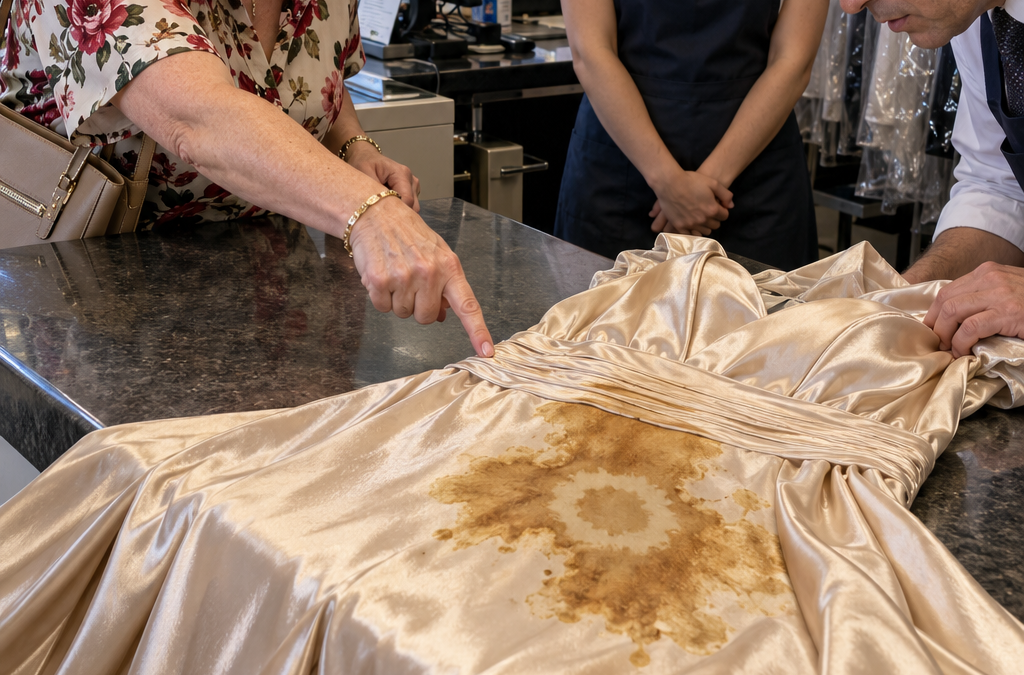
Pulled out a champagne silk evening dress.
Then slapped it flat against the glass.
“You ruined my dress.”
Three customers turned.
Marabel froze beside the register.
I stepped toward Vanessa.
“What happened?”
She grabbed the left side of the waist.
There was a yellowish-brown area nearly as wide as my palm.
“That.”
I leaned closer.
“$900,” she said.
I looked up.
“Excuse me?”
“That’s what this dress costs. Nine hundred dollars. That’s what you owe me.”
Then she pointed past my shoulder.
At Marabel.
“And she should be fired.”
Marabel went completely still.
Her name was on Vanessa’s intake ticket because she had accepted the dress three days earlier.
I could see the color leave her face.
“Let’s slow down,” I said.
Vanessa gave a short laugh.
“Slow down?”
“I want to understand exactly what happened.”
“I just showed you.”
“You showed me the damage. I need the timeline.”
She looked around as if appealing to the customers.
Then she began.
Monday afternoon, she had brought the dress to us for what she called a refresh cleaning.
The dress had been perfect.
Her word.
Perfect.
No stain.
No discoloration.
No damage.
She had picked it up Thursday morning.
Because she was busy, she took the garment bag home and hung it in her closet without opening it.
About an hour before coming back to us, she removed the dress because she intended to steam it for a gala the following evening.
That was when she found the stain.
“You had this dress for three days,” she said. “I gave it to you clean except for normal wear, and you returned it like this.”
I examined the fabric.
Champagne silk is unforgiving.
Almost cruelly so.
Water can mark it.
Heat can shift color.
Certain solvents can leave rings.
Body oils that seem invisible at first can darken later.
A careless spot treatment can spread discoloration instead of removing it.
I had seen cleaners damage silk before.
Years earlier, we’d damaged a satin formal dress during pressing.
We had paid for it.
No argument.
I wasn’t going to become the kind of manager who assumed the customer was lying just because paying the claim would hurt.
“If we caused this,” I said, “we’ll take responsibility.”
Vanessa folded her arms.
“You already caused it.”
“I need to establish that.”
“You had possession.”
“That matters. It doesn’t answer every question.”
She began listing what she wanted.
Full refund of the cleaning charge.
Nine hundred dollars for the dress.
Rush alteration costs if she had to buy a replacement that evening.
And a signed letter from Maple & Thread admitting responsibility.
“Today,” she said.
I looked at her.
“Before I leave.”
Then she turned toward Marabel.
“And she shouldn’t be handling anyone else’s clothes.”
Marabel looked down.
I felt anger then.
Not because Vanessa was complaining.
She had every right to complain.
Not because she was asking for money.
If we had caused the damage, compensation was legitimate.
It was the speed with which she had decided that Marabel deserved to lose her job.
“You watched her damage the dress?” I asked.
“I watched her handle it carelessly.”
“How?”
“She was rushing.”
“Did you see her spill something on it?”
“No.”
“Use a chemical?”
“No.”
“Tear it?”
“No.”
“But you want her fired before we investigate?”
Vanessa looked directly at me.
“If you cared about professionalism, you wouldn’t need an investigation.”
That was when I noticed Marabel’s hands trembling.
I had managed people long enough to know that humiliation has a physical effect.
People hear their job being discussed by strangers and suddenly their fingers stop cooperating.
I kept my voice level.
“I’m going to personally investigate the claim. If we damaged your dress, we’ll address it. But I am not firing an employee before I know what actually happened.”
Vanessa turned slightly toward the other customers.
“Did everyone hear that?”
Nobody answered.
She smiled without warmth.
“His employee ruins a nine-hundred-dollar dress and his first instinct is protecting her.”
“No.”
I held her gaze.
“My first instinct is finding out whether she ruined it.”
Vanessa mentioned her business.
Her followers.
The brides, caterers, venues, florists, event staff, and local companies that trusted her recommendations.
She reminded me that she had referred customers to Maple & Thread.
Then she said, very calmly, “I would prefer not to put this online.”
There was no shouting.
That made the threat clearer.
“I would prefer not to warn people about your shop. I would prefer not to dispute the charges I’ve made here over the last few months. I would prefer for you to handle this professionally.”
I knew exactly what she was doing.
She wasn’t merely asking whether we were responsible.
She was explaining what refusing her would cost.
And the uncomfortable truth was that I still didn’t know whether she was wrong.
I turned to the computer.
“Give me a minute.”
I pulled up Monday’s intake record.
Then I found the paper ticket inside the garment bag.
Under Condition Notes, in Marabel’s handwriting, were four words:
Light discoloration, left waist.
I read them twice.
Then turned the ticket toward Vanessa.
“This was written when the dress came in.”
She barely looked.
“No.”
“It’s on your ticket.”
“She added it later.”
Marabel lifted her head.
“I didn’t.”
Vanessa pointed at her.
“Of course you’d say that.”
I held up one hand.
“Nobody needs to argue.”
Our point-of-sale system timestamped ticket creation and recorded every later edit.
I opened the digital history.
Monday.
2:51 p.m.
Condition note entered when the ticket was created.
No later edits.
I turned the monitor slightly.
Vanessa stared at it.
For perhaps two seconds, she didn’t speak.
Then the story shifted.
Not dramatically.
Smoothly.
“That was light reflecting on the silk.”
I looked at her.
“What?”
“Champagne fabric does that. It catches shadows. Whatever your employee thought she saw was a reflection.”
She pressed one finger against the brown mark.
“This is an actual stain.”
It was clever.
The timestamp disproved her claim that Marabel invented the note later.
But it did not prove that Monday’s “light discoloration” was the same thing we were looking at now.
That distinction mattered.
A faint shadow could have existed Monday.
Our process could theoretically have turned it into something worse.
I wasn’t going to stretch evidence just because I wanted Vanessa to be wrong.
“All right.”
She looked almost surprised.
“All right what?”
“The ticket proves something was noted at the waist. It doesn’t prove the condition was this severe.”
“Exactly.”
“So we examine it.”
I gave her two choices.
She could take the dress immediately and file a formal claim.
Or she could leave it with us temporarily while our most experienced stain specialist inspected it.
No additional cleaning.
No chemicals unless she specifically authorized them.
Just examination.
That way she might have an answer before her gala.
Vanessa checked her watch.
“I want an answer within an hour.”
“I’ll move quickly.”
“One hour.”
“I won’t promise a technical conclusion on a deadline.”
Her eyes narrowed.
“You keep saying things in a way that makes you sound very reasonable.”
“I am trying to be reasonable.”
“It isn’t a compliment.”
“I understood.”
She agreed to the inspection with one condition.
“Nobody cleans it again.”
“Agreed.”
“Nobody puts anything on that stain.”
“Agreed.”
“I don’t want you washing away evidence.”
“Neither do I.”
That seemed to bother her slightly.
I started a damage claim at the counter while she watched.
I photographed the dress from every angle.
Front.
Back.
Sides.
Close views of the waist.
Natural light near the window.
Counter lighting.
I measured the stain’s position from the side seam and waistband.
Then I wrote Vanessa’s statement exactly as she gave it.
Dress appeared perfect at drop-off.
Picked up Thursday morning.
Bag remained unopened until approximately one hour before returning to shop.
Stain discovered upon removal.
She read the report.
Corrected one word.
Then signed it.
That signature mattered later.
At the time, I simply wanted everybody working from the same facts.
I carried the dress into the workroom.
The back of Maple & Thread is nothing like the clean quiet counter customers see.
It is heat.
Steam.
Mechanical humming.
Plastic garment bags.
Pressing tables.
Rolling racks.
The low hiss of equipment.
At the far end sat the spotting station.
Ellis Ward was there.
Sixty-one years old.
Thirty-five years removing stains from fabric.
Ellis had worked on everything from polyester uniforms to hand-beaded wedding gowns worth more than my car.
He had one quality I trusted more than experience.
He refused to guess.
If he didn’t know, he said he didn’t know.
I laid the dress on his board.
“Customer says the stain happened here.”
He looked at it.
“Anything applied?”
“Nothing beyond normal cleaning.”
“She allow treatment?”
“No.”
“Good.”
I deliberately didn’t tell him she wanted $900.
Didn’t mention the online threat.
Didn’t tell him she wanted Marabel fired.
Experts like to believe they’re immune to context.
Nobody is.
I wanted Ellis examining fabric, not defending the shop.
He lowered the magnifying lamp.
First normal light.
Then angled illumination.
Then ultraviolet.
Minutes passed.
He turned the waist gently.
Inside out.
Back again.
Then pointed with a wooden probe.
“Look here.”
I leaned closer.
“The color is darker against the seam.”
He turned part of the waist.
“See?”
I did.
The discoloration wasn’t evenly distributed across the outside.
Some of the deepest color appeared where fabric folded into the seam allowance.
“What does that mean?”
“Maybe nothing yet.”
That was Ellis.
Never give Nolan the conclusion before Nolan earns it.
He continued.
“If our process caused general solvent discoloration, I’d expect the surface exposure to make more sense than this. This looks like something migrated into the seam.”
“Before cleaning?”
“Possibly.”
“What kind of something?”
“Body oil. Lotion. Perfume. Makeup. Drink. Previous spotting chemical.”
He adjusted the light.
“Could also be an old stain somebody mostly removed.”
“Mostly?”
“Old organic stains can oxidize. They disappear enough that you think they’re gone. Then heat and air bring them back yellow or brown.”
“Can you tell how old?”
“No.”
“Can you tell whether we caused it?”
“Not yet.”
That answer was frustrating.
It was also why I trusted him.
He examined the lining under ultraviolet light.
Then waved me closer again.
A faint ring appeared on the inside.
Larger than the visible stain.
Soft-edged.
Like a watermark.
Ellis tapped near it.
“That’s previous spot work.”
“You’re sure?”
“I’m sure liquid was applied here before our cycle.”
“Our solvent?”
“No.”
“How do you know?”
“Pattern.”
He traced the ring without touching it.
“Somebody wet this locally. Worked the area. Let it dry. You get that tide line.”
A small amount of tension released from my chest.
Then Ellis stopped me before relief turned into certainty.
“This proves somebody treated the area before us.”
“Right.”
“It does not prove the customer knew.”
I nodded.
“And it does not prove our cycle didn’t make the old damage more visible.”
“Right.”
“So don’t go out there telling her we cleared ourselves.”
“I wasn’t going to.”
He looked at me.
“You were thinking about it.”
“Maybe.”
“Don’t.”
I went back to the front.
Vanessa was recording herself on her phone.
Not secretly.
She stood beside the waiting area speaking in a controlled voice.
She said a local dry cleaner was holding a dress she believed had been damaged during cleaning.
She said she had a gala tomorrow.
She said she was still waiting for the business to accept responsibility.
Technically, every sentence was true.
What she didn’t say was that our timestamped intake record already documented discoloration at the exact area before cleaning.
She didn’t say she had agreed to an inspection.
She didn’t say we had offered to process a formal claim.
It was a lesson in how a story can be accurate sentence by sentence and misleading as a whole.
Mrs. Delaney approached me after Vanessa finished.
“Nolan?”
“Yes?”
She lowered her voice.
“Did you really ruin her dress?”
There was no accusation in her face.
That made it worse.
“I don’t know yet.”
She looked concerned.
“We’re checking.”
“I’ve brought clothes here for twelve years.”
“I know.”
“I just…”
She stopped.
I understood.
Trust had shifted.
Not disappeared.
Shifted.
My phone vibrated.
Gordon.
I stepped away and answered.
“Nolan, what is happening?”
I explained.
He had already seen Vanessa’s one-star review.
It had gone online within twenty minutes.
I expected one of two reactions.
Pay her.
Or fight her.
Gordon gave me neither.
“If we ruined it, we pay.”
“Agreed.”
“Everything legitimate.”
“Yes.”
“And if we didn’t?”
“We don’t.”
“Correct.”
He paused.
“Don’t buy silence with my money.”
Then his voice softened slightly.
“Figure out what happened.”
The call ended.
No rescue.
That was the job.
When I returned to Ellis, he had the dress turned inside out.
He showed me the lining again.
“Older treatment ring.”
“How confident?”
“Very.”
“Can we tell what stained it?”
“Not without more invasive testing, and even then maybe not.”
He studied the fabric.
“If we could look inside the seam allowance, we’d know more.”
“What are you looking for?”
“Residue where previous cleaning couldn’t reach.”
That made sense.
Liquid landing on the outer silk could penetrate into the seam.
Surface treatment might later remove most visible color while material hidden in the fold remained.
But opening a customer’s dress without permission was out of the question.
Before asking Vanessa, I told her what we’d found.
“There’s evidence this area was spot-treated before it came here.”
She didn’t flinch.
“I’ve had the dress cleaned before.”
“That’s possible.”
“Of course it’s possible.”
She folded her arms.
“An evening dress can be worn more than once.”
“Absolutely.”
“So what does that prove?”
“Only that the area had previous treatment.”
“And you’re responsible for what happened this time.”
“Correct.”
She looked surprised.
I think she expected me to use the old treatment as an excuse.
I didn’t.
A prior stain didn’t give us permission to damage a garment.
If our process had worsened something through negligence, we still had a responsibility.
I told her exactly that.
For a moment, Vanessa didn’t seem to know what argument to use.
Then she shifted to business.
She reminded me that her company referred customers to us.
She said she had six employee uniforms and two formal garments scheduled for the following week.
“If this isn’t resolved properly, that work goes somewhere else.”
“That’s your decision.”
She named the competing cleaner.
Then lowered her voice.
“Let me make this simple.”
I waited.
“Nine hundred dollars today.”
She looked toward Marabel.
“I don’t mention her name.”
Then toward me.
“I don’t post anything else. I don’t dispute previous charges. I keep sending business here.”
She smiled slightly.
“Everybody moves on.”
That was the first moment I stopped hearing a damage claim and started hearing a negotiation over silence.
“If we determine we caused the damage, we’ll compensate you.”
“You can determine that now.”
“No.”
“Why?”
“Because the examination isn’t finished.”
Her face went cold.
“Then whatever happens to your reputation is your decision.”
She sat near the window and began typing.
Within thirty minutes, another one-star review appeared.
Different account.
Same language.
The reviewer didn’t exist in our customer database.
Our phone started ringing.
People asking if we’d destroyed someone’s formal dress.
Then Marabel came into the back holding her phone.
She was white.
“She posted about me.”
Vanessa hadn’t used Marabel’s full name.
She didn’t need to.
She described “the young woman who checked in the dress.”
Anyone familiar with Maple & Thread knew who worked that counter most afternoons.
I took Marabel into the office.
Closed the door.
She sat but didn’t relax.
“I need to tell you something.”
“Okay.”
“The stain was there Monday.”
I waited.
“Not just maybe.”
Her eyes filled.
“I saw it.”
“Tell me everything.”
She explained that when Vanessa arrived Monday, Marabel inspected the dress as required.
At the left waist she saw discoloration.
A real mark.
Not just light.
She started to mark the location on the garment diagram.
Vanessa was impatient.
There were four customers waiting.
Vanessa put her hand on the waist and said:
“It’s nothing. Just write it down and keep moving.”
So Marabel wrote:
Light discoloration, left waist.
Nothing about size.
Nothing about color.
No diagram marking.
No photograph.
I leaned back.
“You should’ve followed procedure.”
“I know.”
“That diagram exists for exactly this reason.”
“I know.”
“You should have stopped the intake.”
She nodded.
“I know.”
No defense.
No excuses.
That mattered.
Then I told her the other truth.
“You made a documentation mistake.”
She looked at me.
“That does not mean you damaged the dress.”
Her face tightened.
“She’s trying to get me fired.”
“I know.”
“I should’ve taken the picture.”
“Yes.”
“I’m sorry.”
“Then learn from it.”
I paused.
“But do not confess to something you didn’t do just because you made a different mistake.”
That distinction became the center of everything.
People love simple categories.
Innocent employee.
Bad employee.
Honest customer.
Dishonest customer.
Real life is usually messier.
Marabel had made a mistake.
A real one.
She had not documented a preexisting flaw properly.
That mistake made Vanessa’s accusation harder to disprove.
But poor documentation was not the same as causing damage.
If I allowed Vanessa to merge those two things, I would be sacrificing an employee because doing so made the business problem easier.
I wasn’t going to do that.
I opened Vanessa’s customer history.
Two years of records.
Coats.
Blouses.
Cocktail dresses.
Event linens.
Nothing matching this champagne silk dress.
First time we’d cleaned it.
But then I noticed a note from two months earlier.
Phone inquiry.
The note read:
Customer asked about treating old wine shadow on champagne silk. Advised item must be inspected in person.
I stared at the screen.
Not proof.
Vanessa could own several champagne silk garments.
But it was enough to ask a question.
I went back to the counter.
“Our records show you called about a silk item two months ago.”
Vanessa’s eyes sharpened.
“That was a completely different blouse.”
I hadn’t said wine.
I hadn’t said champagne.
I hadn’t said dress.
I hadn’t even said what the problem was.
Only a silk item.
Her answer came too quickly.
I kept my expression neutral.
“Okay.”
She looked at me suspiciously.
“What?”
“Nothing.”
But something had changed.
I no longer wondered only whether she was mistaken.
I began wondering how much she already knew.
Still, suspicion wasn’t evidence.
I needed the physical history.
Ellis came through the workroom door.
“Nolan.”
I stepped toward him.
“If she permits it, I want an inch and a half of lining opened.”
Vanessa heard.
“Absolutely not.”
Ellis stayed calm.
“Then we stop.”
That surprised her.
He explained why.
Opening a tiny section of lining would expose the inner seam allowance.
If an old colored liquid had penetrated before previous treatment, residue could remain inside the fold where surface cleaning couldn’t fully reach.
If our process had created the stain days earlier, the pattern would likely look different.
“No chemicals?” Vanessa asked.
“None.”
“No cleaning?”
“None.”
“And I watch.”
“Yes.”
She thought about it.
Longer than I expected.
Finally:
“Fine.”
We brought the dress to the workroom entrance where Vanessa could stand close without interfering.
Ellis used a tiny seam ripper.
Slow.
Precise.
He opened perhaps an inch and a half of lining.
Folded it back with tweezers.
Lowered the magnifying lamp.
Then pressed clean white blotting paper against the hidden seam allowance.
When he removed it, the fabric underneath showed a pale reddish-brown band.
Exactly aligned with the outer discoloration.
Vanessa stared.
Ellis spoke without drama.
“At some point, colored liquid hit this area.”
He indicated the outside.
“It penetrated into the seam and dried.”
Then the hidden portion.
“Later, somebody treated the surface. Most of the outer color was lifted.”
He pointed again.
“But this folded material wasn’t reached completely. It still holds residue.”
Vanessa shook her head.
“Or your machine pushed contamination into the seam.”
“Possible question.”
Ellis didn’t argue.
He brought over stronger magnification.
“Look here.”
She did.
The outer fibers showed slight roughness.
Chalky residue.
A faint ring around the stain.
Ellis explained that the residue was consistent with a prior spotting agent and not one we used.
Then he showed the pale boundary.
“A tide mark.”
“What does that mean?”
“Liquid was applied locally. It spread. Dried along the edge.”
“When?”
“I can’t give you a date.”
“Could’ve been Tuesday.”
“The treatment itself wasn’t ours.”
“Maybe the stain underneath was.”
Ellis looked at me.
I asked the direct question.
“Can you say the discoloration existed before Monday?”
He answered carefully.
“I can say this area had been spot-treated before it entered our process.”
“Anything else?”
“The residue inside the seam is consistent with an older stain.”
“Certain?”
“Consistent, yes. Strongly.”
He looked at Vanessa.
“But I cannot tell you where it happened, who treated it, or exactly when without garment history.”
That was fair.
Vanessa straightened.
“We’re done.”
I said nothing.
“You’ve opened the dress.”
“With permission.”
“You’ve spent more than an hour trying to avoid paying for your mistake.”
“You can take the dress at any time.”
“I want nine hundred dollars.”
“The claim remains open.”
“I want an answer.”
“My answer is that I don’t have enough evidence yet to approve or deny it.”
She pulled out her phone.
Opened a luxury brand’s website.
There was the dress.
Champagne silk.
Same design.
Listed at $895.
“Nine hundred dollars.”
I looked at the screen.
“Do you have your purchase receipt?”
Her expression changed.
“Why?”
“You’re asking for replacement compensation. We document value.”
“That’s the dress.”
“That’s a retail listing.”
“That’s what replacing it costs.”
“Maybe. I still need proof of the item you’re claiming.”
“Most businesses would accept a customer’s word.”
“Maybe.”
She searched her email.
For several minutes.
Finally she found something.
Turned the phone toward me.
Only briefly.
But long enough.
The receipt header didn’t show the designer’s official store.
It showed:
Bellweather Archive.
I knew Bellweather.
Upscale consignment.
Designer clothing sold secondhand.
Often at steep discounts depending on condition.
Vanessa pulled the phone back.
I didn’t accuse her of anything.
She saw recognition anyway.
“Nine hundred is replacement value.”
“I understand.”
“I never said I paid nine hundred.”
I thought back to the first ten minutes.
$900. That’s what you owe me.
Technically, she was right.
She hadn’t explicitly said she’d paid $900.
She had allowed everybody to assume it.
But again, that didn’t prove the damage claim was false.
If you buy something secondhand for $200 and someone destroys it, the original price alone doesn’t decide fair compensation.
I forced myself to stay disciplined.
Bellweather gave me something more valuable than price.
History.
“What condition was it in when you bought it?”
Vanessa stared.
“I already told you.”
“Would you authorize Bellweather to confirm the item’s condition?”
“No.”
“Why?”
“They won’t discuss customer information with you.”
“I don’t need your personal information.”
I kept my voice level.
“I need the condition description of an item you’re asking us to replace.”
Instead of answering, Vanessa called her credit-card issuer.
On speaker.
In the middle of the shop.
She asked how to dispute multiple charges from a business that had damaged her property and refused accountability.
Then she began listing previous Maple & Thread transactions.
Unrelated orders.
Different garments.
Different months.
I knew what that could mean.
Chargeback responses.
Documentation.
Labor.
Potential frozen funds.
Hours of administrative work.
It was leverage.
I let her talk.
The bell above the door rang.
A young woman walked in carrying a men’s suit.
She looked about twenty-five.
Same sharp cheekbones as Vanessa.
She walked directly toward her.
“Aunt Vanessa?”
Vanessa’s face changed.
“Leah.”
“I brought the suit you wanted—”
Then Leah saw the champagne dress.
She smiled in recognition.
“Oh, that’s the one from Bellweather.”
Vanessa’s entire posture stiffened.
Leah stepped closer.
“Did the wine mark come back?”
Silence.
Real silence.
Even the customers heard it.
Vanessa lowered her phone.
“Leah.”
Her voice was sharp.
“Not now.”
Leah blinked.
Looked at me.
At Marabel.
At the dress.
Then understood she had walked into something.
She took one step backward.
I didn’t question her.
She wasn’t there to testify.
She wasn’t part of the dispute.
I looked only at Vanessa.
“Wine mark?”
Vanessa took a slow breath.
The story changed again.
“Yes.”
She sounded composed.
“When I bought it, there was a tiny mark.”
“At the left waist?”
“Near there.”
“The boutique disclosed it?”
“They told me it had been professionally treated.”
“You knew the dress had previously been stained.”
“It was barely visible.”
That sentence mattered.
Not because the case was finished.
Because for the first time Vanessa had admitted a preexisting stain.
She continued.
“I wore it afterward. Nobody noticed. It looked fine.”
“So the stain existed.”
“The original stain.”
“And now?”
“Your cleaning brought it back.”
That was a legitimate question.
A difficult one.
The dispute had changed.
We no longer needed to establish whether there had been a stain before Maple & Thread.
There had.
Now we had to determine whether we mishandled the dress and made that old stain reappear.
I went straight back to Ellis.
“Pull the Tuesday cycle.”
Every commercial cleaning load created a machine log.
Solvent.
Temperature.
Duration.
Drying.
Program.
Errors.
I wanted everything.
The dress had been processed on our delicate silk cycle.
Lowest appropriate temperature.
Short drying.
No equipment fault.
No abnormal reading.
Eleven other garments shared the load.
Two silk blouses.
One satin bridesmaid dress.
Several other delicate pieces.
I checked every ticket.
No complaints.
No discoloration.
No damage.
Ellis leaned against the spotting board.
“This is oxidation.”
“Explain it like I’m a customer.”
“Old wine stain gets treated.”
He held his hands apart.
“Looks gone.”
Then brought them together.
“But organic residue remains in fibers.”
“Then?”
“Time. Air. Heat. Steam.”
He nodded toward the press area.
“Residue oxidizes. Turns yellow or brown. Sometimes a normal cleaning cycle reveals what an earlier cleaner only partly removed.”
“So our cleaning didn’t create the stain.”
“No.”
“Could it make the old stain visible?”
“Yes.”
“Is that damage?”
“Not if the process was appropriate.”
He pointed toward the dress.
“We didn’t put wine in the fibers.”
I asked him to put that conclusion in writing.
Not as an accusation.
As a technical finding.
Then I returned to Vanessa.
“I need your Bellweather receipt for the claim file.”
“I showed it to you.”
“Two seconds on a phone isn’t documentation.”
“You don’t need my private purchases.”
“You are using this purchase as the basis of a replacement claim.”
She folded her arms.
“If you won’t provide it, I’ll close the claim for insufficient documentation. You can reopen it if you provide the records later.”
Her face hardened.
“Fine.”
I waited.
“I’ll tell everyone you admitted you brought the stain back and refused to reimburse me.”
That was the first time all afternoon I deliberately raised my voice enough for the room to hear.
“I have never admitted that Maple & Thread damaged your dress.”
She stopped.
“I said we’re investigating.”
Customers turned.
“I said there was a preexisting treatment history. I said an old stain may have become more visible during a proper cleaning process. That is not the same as admitting we caused damage.”
Vanessa started talking faster.
About the gala.
Lost time.
Professional embarrassment.
Then she said:
“That stain was barely visible when I bought it. Now it’s ruined.”
Marabel looked at me.
I looked at Vanessa.
Two customers near the counter heard it too.
I repeated calmly:
“You’re saying the stain was visible when you bought the dress?”
Vanessa went silent.
Then:
“My gala is tomorrow.”
“That’s not what I asked.”
“I’ve wasted enough time.”
She changed the subject again.
That evening, because Vanessa herself had identified Bellweather Archive as the seller and used that transaction to support the claim, I called the boutique.
I asked for one thing.
The condition record associated with that publicly listed garment.
The owner, Paige Hollister, was careful.
She would not discuss Vanessa’s account.
Wouldn’t discuss payment method.
Wouldn’t discuss personal details.
Good.
I didn’t want them.
I gave her the designer.
Dress description.
Approximate purchase timing.
Paige located the item record.
Then read the condition note:
Professionally treated beverage discoloration at left waist; faint residual shadow.
I wrote every word.
“Do you have the sale price?”
“Listed sale price was $238.”
I stopped writing.
“Two thirty-eight?”
“Correct.”
“Because of the condition?”
“Partly. The stain reduced value.”
There it was.
The dress had been sold with the exact flaw documented.
Left waist.
Treated beverage stain.
Residual shadow.
Two hundred thirty-eight dollars.
Not nine hundred.
That night I stayed at Maple & Thread long after everyone left.
I built the file chronologically.
I didn’t want our decision depending on Leah’s accidental statement.
Or Vanessa’s contradiction.
Or the boutique record.
Or Ellis.
I wanted everything.
Monday, 2:51 p.m.
Marabel entered:
Light discoloration, left waist.
System showed no later edits.
Physical inspection revealed previous spot-treatment ring.
Hidden seam showed reddish-brown residue consistent with an older penetrated stain.
Fiber examination revealed spotting-agent residue not associated with Maple & Thread’s logged products.
Tuesday machine cycle showed normal delicate-silk parameters.
Eleven additional garments processed without issue.
Vanessa admitted the dress had a wine stain at purchase.
Vanessa later stated the stain had been “barely visible when I bought it.”
Bellweather Archive’s item record documented professionally treated beverage discoloration at left waist.
Purchase price:
$238.
By the time I finished, the answer was no longer difficult.
Maple & Thread had not created a new stain.
We had properly cleaned a dress with a preexisting, incompletely treated organic stain.
Our normal process had likely contributed to old residue oxidizing and becoming more visible.
That was unfortunate.
It was not negligence.
And it did not make us responsible for paying Vanessa $900.
She returned the next morning.
Gala day.
No audience performance this time.
No recording when she walked in.
I took her through the file one piece at a time.
She interrupted several times.
I kept returning to the record.
Finally I said:
“The claim for $900 is denied.”
She stared at me.
“I’ll take $450.”
“No.”
“Half.”
“This isn’t a negotiation over amount.”
“You know your cleaning changed the appearance.”
“Our process was appropriate.”
“So you admit it changed.”
“I acknowledge that an old stain may become more visible after proper cleaning because unresolved residue oxidizes.”
“That sounds like damage.”
“It isn’t damage caused by improper care.”
She looked toward Marabel.
“What about her?”
“What about her?”
“Is she being fired?”
“No.”
Vanessa gave me a disbelieving laugh.
“After all this?”
“Marabel made a documentation error.”
“She mishandled my dress.”
“No evidence shows that.”
“She didn’t even mark the stain properly.”
“Correct.”
“Then she failed.”
“At paperwork.”
Vanessa stared.
I continued.
“She will be coached. Our procedure is changing. But she will not be fired for damaging a dress when the evidence says she did not damage it.”
“You always protect your staff like this?”
“I protect the distinction between what somebody actually did and what somebody wants blamed on them.”
That ended the discussion about Marabel.
Vanessa asked for the cleaning fee back.
On that, I agreed.
Not because we had caused damage.
Because she had brought in a dress hoping its appearance would improve.
Instead, an old hidden problem became more visible.
I could understand why she was disappointed.
I refunded the service charge as a goodwill gesture.
The receipt specifically stated:
Customer service refund. No admission of garment damage or negligence.
Vanessa read it.
“You’re really putting that?”
“Yes.”
She took the dress.
Before leaving, she said:
“I’m posting everything.”
“You have that right.”
“And you’ll respond?”
“Only with facts we’re legally entitled to share.”
She shook her head.
“You could’ve made this disappear yesterday.”
Maybe.
Nine hundred dollars was cheaper than two days of disruption.
Cheaper than staff anxiety.
Cheaper than responding to reviews.
Cheaper than my time.
But paying would’ve put in writing that Marabel damaged the dress.
It would’ve told Gordon that a customer could buy an admission if the threat became expensive enough.
And it would’ve told every employee watching that the shop would sacrifice them when protecting them became inconvenient.
Some prices don’t appear in accounting software.
“No,” I said.
“I couldn’t.”
She left.
Her video went online that afternoon.
She said Maple & Thread had ruined a $900 dress and refused accountability.
Our response was short.
No insults.
No private records.
No screenshot of her account.
We stated that a damage claim had been investigated.
That the garment had documented preexisting discoloration at intake.
That technical examination identified prior treatment at the same location.
That the replacement claim had been declined.
And that the cleaning charge had been refunded as goodwill.
Some people still believed Vanessa.
I expected that.
Then people began asking why she kept calling it a $900 dress if she had bought it secondhand.
Vanessa apparently decided to prove the replacement value.
She posted a photograph of the Bellweather receipt.
And forgot to cover two things.
The price.
$238.
And the condition note.
Treated beverage discoloration at left waist.
Her own audience found it first.
The comments changed almost immediately.
Why did you demand $900?
Why did you say the dress was perfect?
The receipt literally says the stain was there.
Didn’t you know this when you took it to the cleaner?
The photograph she intended as proof against us became the cleanest summary of the dispute.
By evening, she deleted the post.
I didn’t celebrate.
There was no office cheer.
No victory lap.
What I remember instead is Marabel standing near the register reading something on her phone.
Then her shoulders lowered.
Just slightly.
For two days, she had been carrying the possibility that one rushed intake note could cost her job and stain her reputation.
That weight finally came off.
“You’re okay,” I told her.
She looked at me.
“I really did mess up the intake.”
“Yes.”
That surprised her.
“I thought you were going to say it wasn’t my fault.”
“It was your fault.”
I pointed toward the intake station.
“That part.”
Then toward where Vanessa had stood.
“Not the stain.”
Marabel nodded.
“I won’t do it again.”
“I know.”
The following Monday, I arrived at seven expecting a bad week.
I imagined empty racks.
Customers quietly taking clothes elsewhere.
Instead, the bell rang.
People came in.
Mrs. Delaney brought two winter coats.
I carried them to the counter.
She looked at me.
“I saw everything online.”
I waited.
“I want to tell you something.”
“Okay.”
“I don’t need a cleaner who never makes mistakes.”
She handed me the coats.
“I need one that won’t lie when they make one.”
That sentence stayed with me.
If we’d ruined Vanessa’s dress, I would have paid.
I still believe that.
The customer is not always wrong because a claim becomes inconvenient.
But the phrase the customer is always right becomes dangerous when people interpret it to mean an employee must accept blame regardless of evidence.
A fair business has to be willing to say two things with equal honesty.
We made a mistake.
And:
That isn’t what happened.
Gordon reviewed the entire claim file later that week.
Every page.
Every photograph.
Every timeline entry.
He finished and removed his glasses.
“You know what you did right?”
“I’m guessing you’re about to tell me.”
“You didn’t pay to make the problem disappear.”
I nodded.
“You also didn’t start from the assumption that she was lying.”
“No.”
“And you didn’t throw Marabel under the bus.”
“No.”
He closed the folder.
“Good.”
Then he tapped the intake ticket.
“Now here’s what you did wrong.”
“My procedure.”
“Your procedure.”
Marabel had written a vague line because our rush-hour intake process allowed too much pressure to fall on the employee standing at the counter.
That was on me.
If I wanted responsibility as general manager, I had to own weaknesses in the system even when those weaknesses didn’t cause the original problem.
So we changed it.
Every high-value garment would receive a detailed condition inspection.
Stain location marked on a garment diagram.
Approximate dimensions.
Color.
Type if identifiable.
Photograph when practical.
Customer review.
Customer signature.
No rushing because three people were waiting.
If someone didn’t want to spend three minutes documenting a nine-hundred-dollar dress, they could take it somewhere else.
Marabel took the change further.
A few days later, she walked into my office with a one-page intake checklist.
She had created it at home.
Garment type.
Fabric.
Visible discoloration.
Snags.
Loose trim.
Seam issues.
Prior treatments disclosed by customer.
Photo verification.
Customer acknowledgment.
It was better than the form I had been designing.
“You made this?”
She nodded.
“After what happened, I didn’t want anyone else guessing.”
We implemented it that afternoon.
That mattered to me.
Accountability isn’t merely admitting error.
It’s changing behavior because of it.
Marabel had made a mistake.
She owned it.
Then built something better from it.
That was far more valuable than firing her to satisfy someone who wanted a public sacrifice.
There was one final development with Vanessa’s dress.
Once the compensation dispute was closed, she agreed in writing to let Ellis attempt another careful treatment.
He was explicit.
No promises.
The old wine residue had been there a long time.
He worked slowly.
The stain became considerably lighter.
Not invisible.
Better.
Two days later, a courier arrived to collect the dress.
Vanessa didn’t return herself.
No final confrontation.
No apology.
No dramatic scene.
Just a young man with a clipboard signing for a garment bag.
I was glad.
Some stories don’t need one more argument.
A little later, we received notice from our payment processor that the disputes Vanessa had initiated on unrelated prior charges had been withdrawn.
I never learned why.
Maybe her bank looked at the records.
Maybe a business adviser told her continuing wasn’t worth it.
Maybe Vanessa changed her mind.
I don’t know.
I won’t pretend to know.
Her event company did not collapse.
She kept working around Columbus.
People still hired her.
I saw her company’s name attached to events months later.
I didn’t need her destroyed.
I needed the truth established.
Eventually, the video accusing us disappeared.
In its place she posted a much shorter statement saying the garment had “prior treatment history that had not initially seemed relevant.”
It was a careful sentence.
More generous to herself than the facts deserved.
But it was enough.
I had learned by then that demanding perfect confession from another person is often just another way of letting them control your peace.
A few weeks later, Gordon called me into the office.
He closed the door.
“I’ve made the decision.”
My stomach tightened.
“About?”
“General manager.”
I said nothing.
“It’s yours.”
I should’ve felt triumphant.
Instead, my first thought was Vanessa.
Gordon apparently saw it.
“This isn’t because you beat a customer.”
“I know.”
“Do you?”
I looked at him.
He leaned back.
“I watched what you did when every easy option was available.”
He counted them.
“Pay her and make her go away.”
One finger.
“Assume she’s lying because she’s difficult.”
Second.
“Fire Marabel and protect the shop’s image.”
Third.
“You didn’t do any of them.”
He lowered his hand.
“You used the same standard on everybody.”
That meant more to me than the title.
Because that was the standard I wanted.
Not loyalty to the customer.
Not loyalty to the employee.
Not loyalty to the business.
Loyalty to what could actually be established.
Sometimes that protects the customer.
Sometimes the worker.
Sometimes the company.
If your principles change depending on which side benefits, they aren’t principles.
They’re tactics.
A month later, I stood behind the front counter while Marabel accepted an expensive evening gown.
Busy afternoon.
Three people waiting.
Phone ringing.
Almost exactly the same conditions as the day Vanessa had first brought in the champagne silk dress.
Marabel examined the gown.
Then stopped.
“There’s a small mark here.”
The customer leaned over.
“I don’t see anything.”
Marabel pointed.
Near the side seam was a spot barely larger than a grain of rice.
The customer squinted.
“Oh.”
Marabel photographed it.
Marked the diagram.
Wrote the size.
Location.
Color.
Then turned the form toward the customer.
“Can you confirm that this was present at drop-off?”
The woman laughed.
“You’re very thorough.”
Marabel smiled.
“We’ve learned to be.”
The entire process took three minutes.
Nobody died from waiting.
When the customer left, Marabel looked at me.
“Too much?”
“No.”
“You’re sure?”
“I’m considering making you inspect my shirts.”
She laughed.
Then moved to the next customer.
That was when I finally understood what remained after all the noise.
Not Vanessa’s embarrassment.
Not the reviews disappearing.
Not the promotion.
A better process.
A good employee still standing behind the counter.
A business that knew more about how to protect both itself and its customers than it had the week before.
For years, I had thought the hardest part of customer service was knowing when to apologize.
Apologies matter.
A sincere apology can save trust when a business has made a real mistake.
But that week taught me something harder.
Sometimes the most difficult thing is refusing to apologize for something you didn’t do.
Not defensively.
Not arrogantly.
Not because the accusation hurts.
Because the facts don’t support it.
That requires patience.
You have to resist the urge to choose a side too early.
Vanessa was difficult.
That didn’t automatically make her dishonest.
Marabel was my employee.
That didn’t automatically make her innocent of every error.
Maple & Thread was my workplace.
That didn’t automatically make the business worth defending.
So I separated the questions.
Was there discoloration at intake?
Yes.
Did Marabel document it properly?
No.
Had the dress previously been stained and treated?
Yes.
Was the stain at the same location?
Yes.
Had our machine operated incorrectly?
No.
Had our cleaning introduced the original beverage residue?
No.
Could normal processing make an incompletely removed old organic stain more visible?
Yes.
Did that mean we negligently damaged the garment?
No.
Did Vanessa know about the original stain?
Yes.
Did she initially say the dress was perfect?
Yes.
Was the dress bought new for roughly $900?
No.
Did replacement value still deserve consideration if we had damaged it?
Yes.
Did the evidence establish that we damaged it?
No.
Once the questions were separated, the drama became much smaller.
Drama thrives when everything is thrown together.
The stain.
The employee.
The gala.
The reviews.
The $900.
The business relationship.
The threat of chargebacks.
The followers online.
All of it felt enormous when Vanessa stood at the counter demanding an immediate answer.
One fact at a time, it became manageable.
That is still how I handle complaints.
Slowly.
Fairly.
I tell new employees something Gordon once taught me without ever putting it into those exact words.
A customer can be angry and right.
A customer can be calm and wrong.
An employee can be careless about one thing and innocent of another.
A business can protect itself and still behave dishonestly.
Tone proves almost nothing.
Confidence proves almost nothing.
Volume proves nothing.
Records matter.
Physical evidence matters.
Consistency matters.
And when the evidence says you’re wrong, you admit it before pride talks you out of doing the decent thing.
When the evidence says you’re right, you don’t sell that truth just because silence would be cheaper.
I never forgot the first thing that caught my eye on Vanessa’s dress.
That pale line running through the stain.
The tide mark.
At the time, it was only a tiny inconsistency.
Vanessa had walked into the shop with a complete story.
Dress perfect.
We cleaned it.
Stain appeared.
Employee careless.
Business liable.
Nine hundred dollars.
Fire Marabel.
Simple.
Then one small line in the fabric refused to cooperate.
It said something had happened there before.
The intake timestamp said the same thing.
The seam said it again.
So did the treatment residue.
Then Leah.
Then Vanessa herself.
Then Bellweather’s condition record.
Then the machine log.
No single piece needed to destroy Vanessa’s credibility.
Together they made the truth impossible to avoid.
That’s how the strongest conclusions usually arrive.
Not as one dramatic revelation.
As layers.
One fact supporting another until there is nowhere left for a false version to stand.
And that is why, when I think about the afternoon Vanessa Caldwell demanded $900 and Marabel’s job, I don’t remember her voice first.
I remember the stain.
Champagne silk beneath a bright counter light.
A dark yellow-brown mark.
And one faint pale ring running through it.
A line so small almost everyone in the room ignored it.
Almost everyone.
But sometimes the difference between ruining an innocent employee and protecting her is being willing to look at the smallest thing in the room long enough to understand what it is telling you.
That afternoon, I did.
And it changed the way I ran Maple & Thread from that day forward.








