𝗙𝗨𝗟𝗟 𝗦𝗧𝗢𝗥𝗬 She Accused Me of Stealing Her $1,000 Christmas Gift in Front of an Entire Store, and I Refused to Let Her Decide What Everyone Believed
𝗙𝗨𝗟𝗟 𝗦𝗧𝗢𝗥𝗬
I closed it.
As I adjusted the ribbon, I noticed a scratch on one bottom corner of the blue box.
Pale.
About the length of a paperclip.
Nothing significant.
Probably a stockroom scuff.
I remember touching it with my thumb.
Then deciding I liked it.
A little imperfection made the gift feel less like something bought from behind glass.
While I waited for the jeweler, I had noticed a woman arguing with a clerk near the gift-wrapping counter.
Camel-colored coat.
Pearl earrings.
Expensive handbag.
Early fifties.
Perfectly controlled voice.
She wasn’t yelling.
People like her rarely need to.
She stood with one hand on the counter and said:
“I am a platinum member, and I expect the service level associated with that status.”
The young employee apologized.
The woman continued talking.
I stopped paying attention.
I didn’t know her name.
Didn’t know her business.
Didn’t know that forty minutes later, I would remember almost every movement she made.
At 4:40, I bought one more gift.
A small tin of professional colored pencils for Clare.
She taught art.
You can never own too many pencils if half your supply disappears into students’ backpacks.
Then I headed toward the exit.
I stopped beside a display of scented candles to text her.
Running late. Don’t start dinner without me.
She answered immediately.
Bring wine, not excuses.
I smiled.
That was the last completely normal moment of my afternoon.
A woman’s voice came from behind my left shoulder.
“Excuse me.”
I barely looked up.
Then:
“That is mine.”
I turned.
The woman in the camel coat stood six feet away.
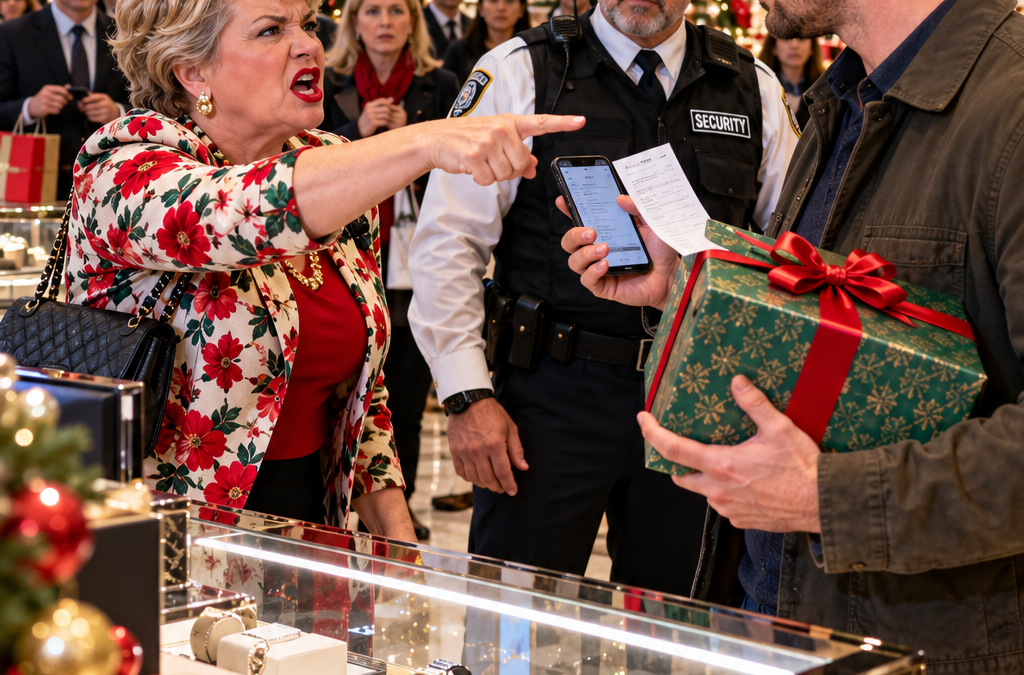
One gloved finger pointed directly at the blue box under my arm.
For a second, I thought she was talking to someone behind me.
“I’m sorry?”
“That box.”
She stepped closer.
“You picked up my gift.”
I looked at the box.
Then at her.
“No, I didn’t.”
“Yes, you did.”
There was no uncertainty in her voice.
That was the first thing that struck me.
A normal person making a mistake usually leaves room for correction.
Oh, I’m sorry.
Is that possibly mine?
Did you pick it up from the wrapping counter?
She gave me none.
She had already decided.
“I just bought this,” I said.
I took out my phone.
“I have the receipt.”
She barely looked at the screen.
“That proves you bought something.”
“It proves I bought this.”
“No. It proves you completed a transaction.”
Her voice rose slightly.
Not enough to sound hysterical.
Enough for nearby people to hear.
“My gift disappeared from the counter, and now you’re walking toward the exit carrying the same box.”
A few heads turned.
I felt the first heat rise into my face.
“Then ask the store to check your transaction.”
“I don’t need to. I know what I purchased.”
“Good. Then describe it.”
That stopped her for perhaps half a second.
“What?”
“Tell me exactly what was inside your box.”
Her expression hardened.
“It was a premium gift.”
“What kind?”
“This store knows what I purchased.”
“If you think I’m holding it, you should know what it is.”
She didn’t answer.
Instead, she turned.
A security officer was already walking toward us.
Dark jacket.
Radio.
Name tag: DEREK.
She waved him over.
“Officer, this man has my property.”
Officer.
He wasn’t police.
He was store security.
But the word did what she wanted it to do.
People stopped.
The area around us changed.
Ten seconds earlier, I had been a customer.
Now I was the man security had been called for.
Derek approached carefully.
“What’s going on?”
Marlene answered before I could.
I didn’t know her name yet, but she delivered her version as if she had rehearsed it.
She had purchased an expensive Christmas gift.
More than a thousand dollars.
She had turned away for only a moment.
When she looked back, the package was gone.
Then she saw me walking away with it.
“This is mine,” she said.
I looked at Derek.
“I bought this less than ten minutes ago.”
I held out my phone.
“Receipt.”
He reached toward it.
Marlene interrupted.
“Anyone can buy something and then take something else.”
Derek stopped.
She looked at me.
“Open the box.”
“No.”
Her eyebrows lifted.
“No?”
“I’ll cooperate with the store.”
“Then open it.”
“I said I’ll cooperate with the store. I’m not opening my sister’s Christmas gift in the middle of the floor because you pointed at me.”
Her smile came back.
Different now.
Sharper.
“If you have nothing to hide, why won’t you open it?”
She said it loudly.
Loud enough that people twenty feet away heard.
Somebody behind me whispered.
Another shopper stopped completely.
A man holding two department-store bags stared at my hands.
That was the first moment I understood what was really happening.
This wasn’t only about whether she got the box.
She was creating a public version of me.
A stranger.
A thief.
A man refusing to open suspicious property while security stood nearby.
And every second that passed made her version easier for people to believe.
I wanted to leave.
Every instinct said walk out.
I had paid.
I owed her nothing.
But I knew exactly what would happen.
He left when questioned.
He ran.
Security tried to stop him.
The story would harden behind me before the automatic doors even closed.
So I stayed.
I held the box against my chest and took one step away from the exit.
“Check the transaction.”
Derek looked at me.
“Sir?”
“Your system. My receipt. Her receipt. Whatever you have. Check it.”
Marlene sighed.
“We don’t need to waste everyone’s time.”
Something about that sentence bothered me.
She had accused me publicly of stealing a thousand-dollar gift.
Yet suddenly verifying records was wasting time.
Then something else surfaced in my mind.
Earlier she had said something I hadn’t consciously registered.
She had mentioned a smaller velvet case inside the blue box.
And a card tucked into the sleeve.
I looked at her.
“How do you know what’s inside this box?”
Her expression barely changed.
“What?”
“You said there’s a velvet case inside and a card.”
“Because that’s how premium items are packaged.”
Maybe.
Hartwell and Lane might package several products that way.
But she had been strangely specific.
I didn’t know whether it mattered yet.
Derek raised both hands.
“Let’s step away from the exit.”
That was reasonable.
We moved beside the candle display.
Marlene followed.
She did not lower her voice.
She repeated the value.
Repeated that the gift was important.
Repeated that I had appeared immediately after it vanished.
Repeated the word stealing.
Not mistake.
Not mix-up.
Stealing.
I listened.
Years of dealing with angry event clients had taught me something.
Confusion sounds different from accusation.
A person who is confused usually asks questions.
A person who has already decided what happened gives conclusions.
Marlene gave conclusions.
So I asked:
“Give me one detail.”
She looked at me.
“One detail about your box that you couldn’t know just by looking at mine.”
She smiled.
That smile made me uncomfortable.
“There is a scratch on the bottom corner.”
My stomach dropped.
She continued.
“Small. Pale. Near the seam.”
Slowly, I turned the box.
There it was.
Paperclip length.
Exactly where she said.
Derek saw it.
I saw the uncertainty enter his face.
And for about three seconds, I doubted myself.
That’s the truth.
I thought about the dozens of identical blue boxes behind us.
The jeweler taking my box away.
The wrapping counters.
Employees moving things.
What if a box had been switched?
What if the watch I paid for was in another identical package?
What if I had unknowingly walked away with her property?
That possibility frightened me because it meant Marlene’s certainty might suddenly have evidence behind it.
I stopped arguing.
Pulled out my phone.
Opened the receipt.
“Read it.”
Derek took the phone.
Payment: 4:34 p.m.
Product code.
Restored art deco wristwatch.
Transaction number.
Hartwell and Lane.
He studied it.
Then nodded.
“We can pull this up in the store system.”
“Please.”
Marlene stepped forward.
“That won’t be necessary.”
Her voice changed.
Just slightly.
An edge.
Derek looked at her.
“It’s the easiest way to verify what he purchased.”
“We’re wasting time. Open the box.”
I stared at her.
Why oppose verification?
She turned toward Derek.
“He’s stalling.”
I almost laughed.
“By asking you to check a computer?”
“Someone telling the truth doesn’t need to buy time.”
Every reasonable thing I suggested became evidence against me.
Receipt?
Could be unrelated.
Store database?
Stalling.
Transaction verification?
Waste of time.
Refusing her demand to open the gift publicly?
Suspicious.
I began understanding the structure.
She wasn’t investigating.
She was defending a conclusion.
That made facts dangerous.
A young employee approached.
The same woman I had seen at the wrapping counter earlier.
Hair in a loose knot.
Black apron.
Name tag: NORA.
Marlene noticed her and changed instantly.
Warm smile.
“Nora. Thank goodness.”
Nora stopped.
“You wrapped my order. You remember me.”
Nora looked exhausted.
The kind of tired that sits behind the eyes.
She looked at the blue box.
Then at Marlene.
Then at me.
Marlene pointed.
“That’s the box you wrapped for me, correct?”
Nora hesitated.
That hesitation mattered.
“It looks like the same kind of box.”
Marlene’s smile tightened.
“The same box.”
“I can’t tell from here.”
“Look at the ribbon.”
Nora looked.
Then the bottom corner.
I watched her face.
She knew something.
Not consciously yet.
But something about the box was rubbing against her memory.
I softened my voice.
“Nora?”
She looked at me.
“When Mrs. Whitaker’s order was processed, do you remember which register it went through?”
Marlene snapped:
“Don’t interrogate the staff.”
I ignored her.
Nora answered cautiously.
“The system records all of that.”
Exactly.
The system.
A fact outside memory.
Outside confidence.
Outside social status.
“Then let’s check that.”
Marlene turned toward Derek.
“This is ridiculous. Get a manager.”
Derek radioed.
A few minutes later, an assistant manager arrived.
Julian Reed.
Gray suit.
Tablet under one arm.
Probably mid-forties.
The expression of a man who had spent December apologizing for things he had never personally caused.
“What happened?”
Marlene began first.
Of course.
She had bought an expensive gift.
I had walked away with it.
Security was refusing to act.
Staff were allowing me to stall.
She was a platinum customer and found the situation unacceptable.
Julian listened.
Didn’t interrupt.
Then he turned to me.
I gave him four sentences.
“I reserved a watch in November. I picked it up today. I paid at 4:34. I have the receipt and would like the transaction checked.”
Julian nodded.
“If there’s a transaction question, we look at the transaction.”
Those words felt like solid ground.
Marlene folded her arms.
“Fine, but he doesn’t leave.”
Derek shifted half a step toward me.
Not aggressive.
Still, I understood.
I was being kept there.
Maybe reasonably.
Maybe not.
Emotion doesn’t always care about the distinction.
Julian stepped aside and worked through his tablet.
I watched his face.
Routine.
Scroll.
Pause.
Frown.
Back one screen.
Read again.
He glanced at Marlene.
She noticed.
“What?”
“Just reviewing the record.”
“What record?”
“Your transaction.”
She said:
“I already told you what I bought.”
Julian didn’t respond.
He used the phrase “register tape.”
Marlene’s jaw tightened.
Tiny movement.
But I saw it.
Why?
I asked him to check mine first.
He entered the order number from my receipt.
The store system showed my November reservation.
Restored art deco wristwatch.
Balance paid that afternoon.
Product code matching the receipt.
For the first time in almost twenty minutes, I breathed.
Then Julian said:
“This confirms you purchased the watch.”
Marlene immediately said:
“Exactly. He bought his own item and then took mine.”
The accusation had changed.
Originally, I had simply stolen her box.
Now I had purchased a watch and then apparently performed a box swap.
No embarrassment.
No acknowledgement that the story had moved.
Just a new theory.
That’s when I stopped trying to defend myself directly.
I realized she could create theories faster than I could deny them.
So I asked process questions.
“When was my item pulled from reserve?”
Julian checked.
“4:22.”
“Which department?”
“Heritage reserve pickup.”
“Did it go through gift wrapping?”
He looked again.
“No. Vendor packaging. It didn’t go through the wrapping station.”
“Who handled it?”
He gave the employee code.
“And my final payment?”
“4:34.”
I did the timeline in my head.
My box had been scanned out at 4:22.
Marlene claimed hers disappeared around 4:35 or later.
Not enough yet.
But important.
Her story changed again.
Maybe her gift disappeared while being wrapped.
Maybe the wrong box was placed somewhere.
Maybe the wrapping clerk made a mistake.
The location of responsibility shifted toward Nora.
Marlene looked at the young woman.
“If the wrapping counter mishandled my purchase, I expect the store to compensate me fully.”
Nora went pale.
There it was.
A new target.
I recognized the look on Nora’s face because I had seen it on employees at events.
A client decides there must be blame.
The senior people move away.
The youngest worker becomes available.
Nora’s fingers tightened around the pen she was holding.
“I followed the order slip.”
Marlene stared at her.
“Did you?”
Quietly.
Dangerously.
Nora looked down.
I spoke.
“Nobody should be blamed before the records are checked.”
Marlene turned toward me.
“This doesn’t concern you.”
“It concerned me when you called me a thief.”
Julian nodded.
“We’re not assigning fault yet.”
Nora looked at me briefly.
I gave her the smallest nod I could.
Keep breathing.
Then I asked Julian:
“What can the register tape show?”
He explained.
The electronic system showed purchases.
The register tape showed each action at the terminal.
Items entered.
Times.
Changes.
Voids.
Adjustments.
Sequence.
A witness nobody could intimidate.
“I’d like both transactions checked.”
Marlene reacted immediately.
“That is completely unnecessary.”
Too fast.
Everyone noticed.
She had objected to my receipt.
The store database.
Questions to Nora.
Now the register tape.
Each time, the closer the process moved toward independent evidence, the more agitated she became.
Julian looked at her.
“Why?”
Her eyes widened.
“Because this has already gone on long enough.”
He glanced toward me.
I said nothing.
Let the question sit.
Julian called the store manager.
Melissa Grant arrived a few minutes later.
Mid-fifties.
Short silver hair.
Charcoal blazer.
Reading glasses on top of her head.
She moved with the calm of someone who had survived enough Christmas retail seasons to be emotionally immune to urgent customers.
Marlene rushed toward her.
“Melissa.”
They knew each other.
Of course.
“Marlene.”
That explained some confidence.
Marlene launched into the story again.
Loyal customer.
Nearly twenty years.
Expensive purchase.
Stolen gift.
Unhelpful staff.
Suspicious man.
Melissa listened.
Then looked at me.
No warmth.
No suspicion.
Assessment.
“I am not reaching any conclusion until we check every record.”
She turned to Julian.
“All of it.”
Then to us.
“Everyone stays here.”
Marlene started.
“Melissa, I’m a platinum—”
“Your membership level does not outrank a transaction record.”
Silence.
That was the first time I saw real instability in Marlene’s face.
Only for a second.
But it was there.
The register tape came out as a narrow ribbon of paper.
Julian read it.
Stopped.
Read again.
Called Nora.
They whispered.
Marlene watched them.
Nobody watched her.
She hated that.
Finally Julian approached Melissa.
“The first transaction on Mrs. Whitaker’s account is not the item she described.”
Marlene’s head snapped toward him.
“What?”
He read.
“Brass desk clock. Heritage collection. Three hundred eighty dollars.”
Her face froze.
“No.”
He showed Melissa.
Marlene shook her head.
“That’s incorrect.”
“That’s what the transaction shows.”
“I bought a limited edition gift worth more than a thousand dollars.”
“The register shows a brass desk clock.”
“Then she scanned it wrong.”
She pointed toward Nora.
There it was again.
Blame moved instantly.
Nora looked terrified.
Julian remained careful.
“We’re checking product codes.”
Marlene said:
“The system is obviously unreliable.”
Interesting.
Ten minutes earlier, she had demanded everyone trust the store to know what she purchased.
Now the store knew.
She didn’t like the answer.
Julian compared codes.
Mine matched the restored wristwatch.
My warranty card included a serial number.
At his request, I slid the warranty card out of the box.
Still without fully opening it.
He checked.
Match.
Marlene’s transaction code belonged to the brass desk clock.
Not a watch.
Not a pen set.
Not my box.
For the first time, evidence directly contradicted her.
She didn’t stop.
“Fine. Maybe he bought the watch. That doesn’t mean he didn’t take my item afterward.”
She demanded my shopping bag be searched.
That moment hurt more than I expected.
Even after the receipts.
Even after the codes.
I was still required to empty my things because accusation had momentum.
But I also knew refusing would give her another road.
So I agreed.
“Under store procedure. In front of Melissa and Derek.”
Melissa nodded.
I placed my shopping bag on the counter.
Opened it.
Colored pencils.
Receipts.
Folded scarf.
Phone charger.
Then the blue box.
For the first time, I opened the lid completely.
There it was.
The watch.
Gold case.
Silver dial.
Dark velvet.
The warranty card.
Nothing else.
Melissa lifted it carefully.
Turned the watch over.
Dad’s birthday was engraved on the back.
Tiny numerals.
When I saw them under those bright store lights, something inside me tightened.
That date had nothing to do with Marlene.
Nothing to do with retail security.
Nothing to do with platinum membership.
It belonged to me and Clare and a man who had been dead six years.
Yet now strangers were inspecting it because someone else’s pride had reached into my afternoon.
Derek checked the rest.
Nothing.
Pockets.
Jacket.
Nothing.
Two minutes.
Felt like an hour.
The people watching nearby began looking away.
That’s what embarrassed crowds do when they realize they may have chosen the wrong story.
Nobody apologized.
Nobody had to.
But I felt their attention retreat.
And somehow that didn’t make me feel better.
Being believed after humiliation doesn’t erase the humiliation.
Melissa handed the watch back.
Then looked at Marlene.
“Tell me exactly what you purchased.”
Marlene started confidently.
“A premium pen set.”
Julian checked the screen.
She adjusted.
“Limited edition.”
Another glance.
“Perhaps the fountain pen collection.”
Julian shook his head.
Her descriptions became less specific.
Then I asked the one question I had been holding.
“If you’re certain the item inside my box belonged to you, why can’t you describe the product on your own receipt?”
Marlene went silent.
Only a few seconds.
But that was the first silence she hadn’t chosen.
She looked from me to Julian.
Then at the register tape.
Calculation.
Not confusion.
Calculation.
Julian was reading further down the tape.
He stopped.
“There’s another transaction.”
Melissa looked over.
“What?”
“Same platinum account. 4:36.”
Marlene moved instantly.
“That’s unrelated.”
I looked at her.
Julian read:
“Leather pen case. One hundred seventy-five dollars. Plus gift rewrapping fee.”
Nobody spoke.
Melissa turned to Marlene.
“You made another purchase?”
“I picked up something else.”
“Why didn’t you mention it?”
“Because it has nothing to do with this.”
Melissa looked toward Nora.
“Nora, do you remember the transaction?”
Nora took a breath.
For the first time, she stood straighter.
“Yes.”
Marlene’s face changed.
Nora continued.
“Mrs. Whitaker came back to the wrapping counter with a blue box.”
“When?”
“After the first purchase.”
“What did she ask you to do?”
“Change the wrapping.”
Marlene interrupted.
“I change wrapping all the time.”
Melissa held up one hand.
“Nora.”
Nora swallowed.
“She said she didn’t like the original presentation. She wanted the item label removed from the bottom.”
“Why?”
“She said it ruined the surprise.”
“What did the label say?”
Nora looked at Marlene.
Then at Melissa.
“Brass desk clock.”
I felt the whole story shift.
Melissa asked:
“What did you do?”
“I removed it.”
“And?”
“Covered the bottom seam with one of our round gold rewrap stickers. Then I tied a new silver ribbon.”
Melissa looked at my box.
Julian turned it over.
No gold sticker.
No removed label mark.
Clean blue seam.
Original packaging.
Marlene said:
“She’s remembering the wrong box.”
But the sentence was weaker.
Nora didn’t shrink this time.
“No, ma’am.”
Marlene stared at her.
Nora continued:
“You came back upset. You kept checking your watch. You said you needed it fixed immediately.”
Marlene’s cheeks colored.
I finally understood the scratch.
The blue boxes looked alike.
The scratch was either common enough or something she had noticed when staring at mine after deciding to accuse me.
But her own rewrapped box had a physical marker mine didn’t possess.
The gold sticker.
Melissa asked Julian to check the packing records.
Nora retrieved a tray containing special-order slips.
They found Marlene’s.
Printed note from an assistant.
Limited edition fountain pen set.
Price around $1,200.
Product code handwritten below.
One digit wrong.
The wrong code corresponded to the brass desk clock.
Nora had entered exactly what was written.
The system hadn’t failed.
The employee hadn’t substituted anything.
Marlene’s own paperwork contained the mistake.
She had signed the purchase.
Accepted the box.
Then discovered it.
Melissa turned to Julian.
“Call stationery.”
He did.
We waited.
Marlene stared at the floor.
A minute later, Julian lowered the phone.
“The limited edition pen set is still upstairs.”
Silence.
“Display case. Never sold today.”
That was the end of the theft story.
The item Marlene accused me of stealing had never belonged to her.
It had never been in a blue box.
Never left the second floor.
Never passed through Nora’s hands.
Never vanished.
It sat under glass while Marlene accused me of taking it.
But Melissa wasn’t finished.
“When did Mrs. Whitaker first discover the problem?”
Julian traced the transactions.
Marlene purchased the desk clock.
Left.
Returned to wrapping nine minutes later.
Asked for the product label removed.
Paid for a pen case and rewrap at 4:36.
That meant she knew something was wrong before she confronted me.
Not necessarily every detail.
But she knew the box she’d received did not contain the product she thought she had purchased.
She had chosen not to tell the store.
Instead, she disguised the label.
Walked toward the exit.
Saw me carrying a similar blue box.
And decided my package offered a solution.
I looked at her.
“Why?”
She didn’t answer.
“Why did you point at me?”
Her face had changed.
The hard polish was slipping.
Finally:
“I had a dinner tonight.”
Nobody responded.
She continued.
“A client dinner.”
Her voice became quieter.
“My firm organized it for Gregory Hale.”
The name meant nothing to me.
Apparently it meant something to Melissa.
Marlene explained.
Gregory chaired a hotel group.
Important client.
Huge contract.
Private dinner.
He had asked specifically for the limited edition fountain pen set.
Marlene had promised it.
Her assistant wrote down the item code.
Wrong by one digit.
Marlene hadn’t checked.
She had signed the receipt.
Then opened or examined the package enough to realize she had a desk clock instead.
Admitting the mistake meant admitting to Gregory that the problem came from her office.
Her planning.
Her paperwork.
Her signature.
“It was supposed to be perfect,” she said.
I remember those words.
Perfect.
That was the reason.
Not desperation.
Not poverty.
Not confusion.
Pride.
One small mistake threatened the image she had built around herself, so she tried to hand the mistake to someone else.
First the store.
Then Nora.
Then me.
I asked:
“So you knew your box was wrong before you saw me?”
She looked at the floor.
“I knew there was an issue.”
“And you accused me anyway.”
“I believed there had been a mix-up.”
“No.”
She looked up.
“You said I stole it.”
“I was upset.”
“You told security I took your property.”
“I thought—”
“You didn’t even know what property you owned.”
Marlene said nothing.
I wanted to yell.
I had earned the right to.
At least emotionally.
But I didn’t.
Anger would have changed the shape of the moment.
I didn’t want to become loud enough that later somebody could tell the story as two customers fighting.
There hadn’t been two people doing the same thing.
She accused.
I defended.
Those were different.
So I turned to Melissa.
“I want something in writing.”
Melissa nodded.
“What specifically?”
“That the accusation against me was unsupported. That my transaction is valid. That I am not listed in any internal report as suspected of stealing.”
“Absolutely.”
Marlene suddenly said:
“I never accused him of theft.”
Everything inside me went still.
I looked at her.
She continued.
“I asked the store to verify my missing property.”
Derek’s expression changed.
Nora looked shocked.
Even Julian stopped moving.
That lie was somehow worse than the first.
Because now that facts had trapped her, she was trying to rewrite the words dozens of people had heard.
I walked one step closer.
Still calm.
“You told Derek I stole your gift.”
“I said you had my box.”
“You used the word stealing.”
“I was distressed.”
“You said I walked off with something worth more than a thousand dollars.”
“I was asking the store to investigate.”
“You told them to stop me.”
She didn’t answer.
“You demanded they search me.”
Silence.
“You told everyone around us that if I had nothing to hide, I should open my box.”
Her face tightened.
“You accused me.”
Melissa let the silence remain.
Then she said:
“Mrs. Whitaker, the incident will be documented accurately.”
Marlene turned toward her.
“What does that mean?”
“It means we will record what was said, what the transaction records show, and how the issue was resolved.”
“I’ve been shopping here nearly twenty years.”
“I know.”
“I spend tens of thousands of dollars here every year.”
“I understand.”
“This is how you treat a loyal client?”
Melissa didn’t blink.
“Your customer status doesn’t allow you to make unsupported theft accusations against another guest.”
Marlene looked almost offended that such a boundary existed.
Then Melissa explained that store policy allowed Hartwell and Lane to flag or restrict customers who disrupted operations or made serious unsupported accusations against others.
Marlene’s platinum status didn’t make her immune.
For the first time all afternoon, fear entered her expression.
Not fear of me.
Fear of consequence.
I could have asked Melissa to ban her.
Part of me wanted to.
Another part imagined Marlene leaving through those doors embarrassed, humiliated, carrying the wrong gift.
It would have felt satisfying for five minutes.
Then what?
I didn’t need her life ruined.
I needed mine restored.
So I said:
“I don’t want her banned because of me.”
Everyone looked at me.
Marlene too.
“I want the record clear.”
Melissa nodded slowly.
“Understood.”
“My name does not go into any loss-prevention system as a suspect.”
“It won’t.”
“I want written confirmation.”
“You’ll have it.”
“And Nora shouldn’t be disciplined.”
Nora looked at me.
Marlene scoffed.
“She entered the wrong product.”
“No.”
I looked at the order slip.
“Your office wrote the wrong code.”
Nora had entered what she was given.
The store could decide whether its process needed improvement.
But using her as a scapegoat would simply continue the same pattern.
Melissa agreed.
“The employee acted according to the information supplied.”
Nora’s shoulders dropped.
Just slightly.
I noticed.
Sometimes relief doesn’t look dramatic.
Sometimes it’s one inch disappearing from someone’s posture.
Melissa then explained the store’s resolution.
They would refund the brass desk clock and rewrapping fee.
They would help Marlene purchase the actual pen set if she still wanted it.
But the incident would be formally logged.
Her platinum status would no longer entitle her to bypass standard procedures through staff discretion.
Any future disputes would follow ordinary verification steps.
Marlene stared at Melissa.
“So I’m being punished.”
Melissa answered:
“No. We’re not responding because you complained. We’re responding because you accused another customer of theft before establishing that anything had been stolen.”
Perfect.
Not cruel.
Not theatrical.
Accurate.
Melissa handed the blue box back to me.
Both hands.
Almost ceremonial.
I opened it once more.
The watch sat where it belonged.
The engraving caught the light.
Dad’s birthday.
I closed it.
Then texted Clare.
Running late. Work thing. Save me a chair.
Work thing.
Technically false.
But I knew my sister.
If I told her a woman was accusing me of theft downtown, Clare would have arrived wearing slippers and prepared to fight security.
I didn’t need that.
Marlene stepped toward me.
I thought she might leave without speaking.
Instead:
“I’m sorry if you felt insulted.”
There are sentences that look like apologies until you touch them.
This was one.
“If you felt insulted.”
Her responsibility disappeared entirely.
The problem became my emotional reaction.
I shook my head.
“I don’t need you to apologize for how I felt.”
She looked confused.
“I need you to say what you said about me was wrong.”
Silence.
I could feel other people listening.
I didn’t care anymore.
Marlene looked toward Melissa.
No help.
Derek.
None.
Nora.
Julian.
Then me.
For ten seconds, she had no script.
Finally she said:
“I said you took my property when I had no proof.”
The words came out small.
I nodded.
“That’s all I needed.”
And I meant it.
I didn’t need her humiliation.
I needed truth stated plainly.
Melissa walked with me toward the exit while Julian handled Marlene’s refund.
We stopped a short distance away.
“I owe you an apology on behalf of the store,” she said.
“You checked. That’s your job.”
“Not for checking.”
She looked toward the crowded sales floor.
“For allowing the accusation to become public before anyone checked.”
That distinction mattered.
I didn’t resent Derek for investigating.
Security should investigate theft.
I resented the speed at which one customer’s confidence had been allowed to become a public presumption against another.
Melissa lowered her voice.
“This isn’t the first difficult interaction we’ve had with Mrs. Whitaker.”
I looked at her.
“Meaning?”
“She has a history of pushing staff hard when orders go wrong.”
“Then why let her?”
Melissa was quiet.
“Because she’s a platinum client.”
At least she was honest.
“We tend to solve the immediate complaint.”
“Even if someone else pays for it.”
Her expression tightened.
“Sometimes, apparently.”
She said that what happened would force them to review how complaints from high-status customers were handled.
No more bypassing records because someone was important.
No more assuming the loudest version was safest.
I thanked her.
Then I walked outside.
Cold air hit my face.
Denver at Christmas.
Car exhaust.
Roasted nuts from a street vendor.
Bus brakes.
Bells.
People moving past me carrying bags, completely unaware of what had happened inside.
No cheering.
No victorious music.
No moment where the world paused to acknowledge justice.
Just ordinary city noise.
I stood on the sidewalk holding the blue box.
I was still angry.
Really angry.
But it had changed.
Inside the store, the anger was huge because I didn’t know what version of me would survive the afternoon.
Thief?
Suspicious customer?
Incident report?
Now the truth existed outside my own voice.
Transaction records.
Register tape.
Witness statements.
Manager documentation.
Marlene’s admission.
I could carry anger once I no longer had to carry uncertainty.
I reached Clare’s apartment nearly an hour later than planned.
Her place was small.
Third floor.
Old building.
She had spent the past year rebuilding it into something that felt hers.
Thrift-store lamps.
Plants everywhere.
Canvases stacked against one wall.
A Christmas tree decorated mostly with paper stars her students made.
She opened the door.
Looked at my face.
“You look like you lost a fight with a parking meter.”
“That specific?”
“Very.”
I held out the pencils and blue box.
“Merry Christmas.”
“It’s not Christmas yet.”
“Sit down.”
She narrowed her eyes.
“Why?”
“Just sit.”
She didn’t.
Instead, she hugged the box against her chest.
“What happened?”
I sighed.
“How much wine do you have?”
“Ethan.”
So I told her.
Not dramatically.
No hero version.
I explained Marlene.
Security.
The crowd.
Receipt.
Register tape.
Search.
Nora.
The wrong product code.
Everything.
Clare’s face moved through outrage so quickly I almost found it funny.
“She called you a thief?”
“Yes.”
“In public?”
“Yes.”
“And security searched you?”
“I agreed.”
“You should sue her.”
“I’m not suing anyone.”
“I’ll sue her.”
“You teach art.”
“Then I’ll paint something very hostile.”
That made me laugh.
First real laugh since the store.
Then I told her the part that bothered me most.
“It wasn’t even her.”
“What?”
“The accusation.”
“I know.”
“No, I mean… all those people looked at me differently before anyone checked anything.”
Clare’s anger softened.
“Because she sounded certain.”
“Exactly.”
I sat down.
“It took less than a minute.”
She sat beside me.
“People believe confidence.”
“Apparently.”
“They also like simple stories.”
“What?”
She shrugged.
“Woman says man took box. Security arrives. That’s a whole story already. Receipt and transaction logs are boring.”
She was right.
Truth is often boring.
That’s one of its weaknesses.
Lies can be immediate.
Emotional.
Easy to understand.
Evidence takes time.
Clare pulled me into a hug.
She didn’t say anything for a while.
Then:
“Give me the box.”
I did.
She untied the silver ribbon slowly.
Opened the lid.
Tissue.
Velvet case.
The moment she saw the watch, her face changed.
She froze.
Her fingers hovered above it.
“Ethan.”
“I know.”
“It looks like Dad’s.”
“That’s why.”
She lifted it.
Turned it over.
Saw the engraving.
Our father’s birthday.
Her hand covered her mouth.
Tears came immediately.
Mine almost did.
“It’s not his,” I said.
“I know.”
“I couldn’t find his.”
“I know.”
“I thought this was close.”
She nodded.
For a while, the entire store disappeared.
Marlene.
Derek.
Register tape.
None of it mattered.
Dad’s watch had been missing six years.
This wasn’t a replacement.
It was acknowledgment.
A way of saying I remembered what she remembered.
Eventually Clare wiped her eyes.
Then looked at me.
“Did you ever think about giving her the box?”
The question surprised me.
“Why?”
“To make it stop.”
I thought back.
“Yes.”
“Seriously?”
“For maybe three seconds.”
“Why didn’t you?”
I looked at the watch.
“Because then the lie would’ve become true.”
“Not literally.”
“To everyone watching, it would.”
I tried to explain.
There was a point near the beginning where surrender would have been easier.
Give her the box.
Let the store sort it out later.
Avoid the crowd.
Avoid security.
Go home.
But if I had handed it over because she accused me, I would have accepted the premise that her certainty mattered more than my ownership.
That would’ve stayed with me.
“Embarrassment passes,” I told Clare.
“What doesn’t?”
“Agreeing to something false about yourself just because resisting is uncomfortable.”
She considered that.
Then nodded.
The next morning, Hartwell and Lane emailed me.
Melissa.
Formal letter.
My purchase had been verified.
No evidence existed that I had possessed, removed, exchanged, or attempted to take property belonging to another customer.
My name was not listed as a suspect in any theft or loss-prevention incident.
The accusation had been resolved as unsupported.
They apologized.
Not for checking.
Melissa specifically wrote that reviewing conflicting ownership claims was appropriate.
The apology concerned how publicly the initial accusation had been allowed to spread before transaction records were examined.
I appreciated that precision.
I forwarded the email to my personal archive.
Then again to a second address.
Occupational habit.
I wrote back thanking Melissa.
I asked her to thank Derek.
He had never treated me disrespectfully.
Once given facts, he followed them.
I thanked Nora too.
She had told the truth at the exact moment when doing so could have made a powerful customer target her.
A week later, Melissa sent another short note.
Marlene’s platinum membership remained active, but several discretionary privileges had been restricted.
Staff could no longer waive procedures or bypass verification steps merely at her request.
Future service disputes would require normal documentation.
There was no ban.
No dramatic punishment.
No public shaming.
I liked that.
The consequence fit the behavior.
Marlene’s status had functioned like authority because people had learned that upsetting her was more expensive than checking her.
Now it wouldn’t.
I didn’t feel victorious.
Victory suggests competition.
I hadn’t entered Hartwell and Lane competing with Marlene Whitaker.
I had gone there to pick up my sister’s Christmas present.
What I felt was lighter.
My name wasn’t going to sit in some internal database beside the word theft.
Nora wasn’t losing her job.
The watch was with Clare.
That was enough.
On Christmas Eve, Clare wore it.
The band was a little loose.
Dad’s had been too.
She kept touching it unconsciously during dinner.
Turning her wrist.
Looking at the dial.
Once I saw her run a thumb across the engraved date.
She didn’t say anything.
Neither did I.
Some gifts don’t need to be discussed after they’re understood.
After dinner, she asked again about Marlene.
“Do you hate her?”
I thought about it.
“No.”
“You should.”
“I was furious.”
“Different.”
“Yeah.”
“What do you feel now?”
I didn’t know.
Eventually I said:
“I think I understand her.”
Clare looked disgusted.
“Don’t ruin Christmas.”
“I don’t mean excuse her.”
“Good.”
“She made one small mistake.”
“Then accused you of theft.”
“Exactly.”
I leaned back.
“That’s the part I keep thinking about. The original mistake wasn’t important.”
Wrong product code.
Desk clock instead of fountain pen set.
Embarrassing.
Fixable.
Go back upstairs.
Explain.
Buy the correct gift.
Maybe arrive late.
Maybe tell the client an assistant made an error.
Nothing catastrophic.
But Marlene had built an identity around control.
High-end events.
Important clients.
Platinum status.
Knowing managers by name.
Getting things right.
She encountered one ordinary mistake and couldn’t tolerate the idea that it belonged to her.
So she transferred it.
First to the store.
Then Nora.
Then me.
The damage came not from the error but from her refusal to own it.
That stayed with me.
My work is full of mistakes.
I make them.
My team makes them.
Vendors make them.
Clients make them.
Most can be fixed quickly if the person who made the mistake says:
That’s mine.
I’ll handle it.
The worst disasters usually begin when someone says:
Not my fault.
Find someone else.
Marlene turned a $380 desk-clock mistake into a public accusation because protecting her image mattered more than protecting a stranger’s reputation.
That’s a terrible exchange.
I also thought about Nora.
If the records hadn’t been checked, what would have happened?
Maybe the store would have accepted Marlene’s story.
Maybe I would have left eventually with my watch.
But Nora might have received discipline.
Wrong item.
Wrong box.
Upset platinum customer.
Retail managers looking for a clean explanation.
The least powerful person often becomes the easiest explanation.
That disturbed me almost as much as what happened to me.
Because I had a receipt.
A transaction.
A product serial number.
I could defend myself.
Nora had memory.
And an employee badge.
That was why her shoulders dropping after Melissa cleared her mattered so much.
A week later, I stopped at Hartwell and Lane again.
Not because I wanted to.
Clare needed the watch band adjusted.
I considered taking it somewhere else.
Then decided I wasn’t going to let one bad afternoon turn an entire store into hostile territory.
Nora was working the heritage counter.
She recognized me immediately.
“Oh.”
“Hi.”
She looked nervous for about one second.
Then smiled.
“How’s your sister?”
“Watch is loose.”
“That’s a much better problem.”
She adjusted it.
While we waited, I asked:
“You okay?”
She knew what I meant.
“Yes.”
“No discipline?”
“No.”
“Good.”
She hesitated.
“Actually… Melissa used the incident in training.”
I laughed.
“That’s terrifying.”
“No names.”
“Better.”
She said management changed the protocol.
When customers accused other shoppers of taking property, staff were supposed to verify transaction information before allowing accusations to continue publicly whenever possible.
Membership status did not change that.
“I think you broke Christmas,” Nora said.
“Happy to help.”
She smiled.
Then became serious.
“Thank you.”
“For what?”
“That day.”
“You told the truth.”
“You made it easier.”
I didn’t know what to say.
So I nodded.
The watch was ready five minutes later.
As I walked out, I passed the candle display where everything began.
I stopped.
Not intentionally.
My body did it before my mind.
Same lights.
Different shoppers.
Blue boxes moving through the crowd.
Nobody knew.
That’s how most humiliating experiences work.
They feel enormous to the person living them.
To the world, they occupy one corner for one hour and disappear.
I used to think that was unfair.
Now I find it comforting.
The whole city doesn’t remember the worst thing that happened to you on a Monday.
You do.
Maybe a few others.
Then life keeps moving.
I never saw Marlene again.
I looked her up once.
That was a mistake.
Her event consulting company was exactly what I expected.
Beautiful website.
Luxury dinners.
Hotels.
Private corporate events.
Photographs of table settings so perfect they looked unreal.
Her biography described her as “meticulous,” “demanding,” and “uncompromising.”
Before that Monday, those probably sounded like compliments.
Maybe they still were in the right context.
I closed the website.
I didn’t leave a review.
Didn’t post the story.
Didn’t contact her clients.
Didn’t need revenge.
For a few days, I had imagined what it would feel like if Gregory Hale learned why his pen set almost never arrived.
Maybe he did.
Maybe not.
It stopped mattering.
Because the part of the story that belonged to me had already been repaired.
My name was clear.
Clare had her gift.
The store had corrected its record.
Marlene had spoken the truth once.
That was enough.
Months later, I found the original digital receipt on my phone while cleaning old files.
4:34 p.m.
Transaction number.
Restored art deco wristwatch.
A handful of lines.
I stared at them longer than necessary.
At the time of purchase, they were boring.
Proof of payment.
Nothing more.
Twenty minutes later, those lines were the beginning of my defense.
Then came the 4:22 scan.
Marlene’s 4:36 transaction.
The desk-clock code.
The rewrap fee.
The gold sticker.
The order slip.
Every piece had been created before the accusation.
That’s what struck me.
The truth wasn’t invented during the argument.
It already existed.
Quietly.
In systems.
On paper.
In timestamps.
In a young employee’s memory.
Marlene’s version arrived loud.
Evidence arrived slowly.
But evidence had one advantage.
It didn’t need confidence.
That may be the most important thing the afternoon taught me.
Confidence is not proof.
Status is not proof.
Volume is not proof.
A person’s ability to make a room uncomfortable does not make that person correct.
And sometimes staying calm isn’t about being polite.
It’s tactical.
When someone is trying to turn emotion into evidence, calm gives the actual evidence time to arrive.
I won’t pretend I was calm because I’m unusually noble.
I was scared.
Embarrassed.
Angry.
I could feel people looking at me.
I imagined police being called.
I imagined my sister waiting while I sat in some back office explaining a gift I legally owned.
I imagined someone recording the confrontation and posting only the worst thirty seconds online.
All of that went through my head.
But I also knew the facts existed.
I had paid.
The store had records.
So I stayed.
That decision mattered.
Years of operations work had taught me to ask:
What fact exists outside the argument?
That afternoon, the answer was time.
4:22.
4:34.
4:36.
Three numbers.
My box left reserve before Marlene’s story could have happened the way she described.
My payment matched my watch.
Her transaction matched a clock.
Her second transaction proved she returned after discovering the mistake.
The truth was hiding in minutes.
There is something almost beautiful about that.
A person can change a story.
A clock doesn’t.
I still think about the scratch.
That pale mark on the corner of my box.
For a moment, it nearly convinced me.
I had noticed it before Marlene.
Then she described it.
That detail felt stronger than the receipt because it was physical and immediate.
I still don’t know exactly how she noticed it.
Maybe she saw it while watching me before approaching.
Maybe many of the blue boxes had similar stockroom scuffs.
Maybe she was observant enough to identify the one feature that would make her accusation sound specific.
It doesn’t matter.
That scratch taught me another lesson.
One compelling detail can feel more persuasive than ten boring facts.
That’s why I doubted myself.
But compelling isn’t the same as conclusive.
Once the complete record appeared, the scratch became almost meaningless.
That matters far beyond department stores.
People love the detail that makes the story vivid.
The suspicious behavior.
The coincidence.
The thing somebody remembers.
But if it conflicts with objective records, you need to slow down.
A clue is not a conclusion.
I learned that standing beside a candle display while strangers whispered that I had stolen something.
Clare still wears the watch.
Not every day.
Mostly family occasions.
Last year, she wore it to a school art show.
I noticed immediately.
“Careful with that.”
She rolled her eyes.
“It’s a watch, Ethan.”
“It’s emotionally expensive.”
“It’s insured.”
“Not the point.”
She smiled.
Then turned her wrist.
Dad’s birthday flashed on the back.
I remembered the department store.
But the memory wasn’t attached to anger anymore.
The gift survived the afternoon.
That’s what mattered.
Marlene had almost transformed that box into evidence of something ugly.
Clare transformed it back into what it had always been meant to be.
A memory.
That feels like the real ending.
Not Marlene losing privileges.
Not the apology.
Not the register tape.
Those things restored fairness.
But the watch on Clare’s wrist restored meaning.
There is a difference.
I sometimes wonder whether Marlene learned anything.
Probably.
Maybe not enough.
People rarely change completely because of one public embarrassment.
She might tell the story differently.
Maybe in her version, the store made a processing error and everyone overreacted.
Maybe I was the difficult customer.
Maybe Nora confused things.
Humans protect themselves with stories.
I can’t control hers.
That used to bother me.
Not anymore.
Because controlling somebody else’s story is exactly what she tried to do to me.
I don’t need that power.
I only need the record.
If Marlene wants to remember herself differently, that’s her problem.
There were receipts.
Witnesses.
Logs.
The truth doesn’t require her emotional agreement.
A few months after Christmas, Melissa emailed me one last time.
She said the store had completed its review of high-status customer complaint procedures.
Employees were being trained to separate transaction verification from membership level.
Loss-prevention situations involving one customer accusing another were supposed to move away from public sales areas quickly when practical.
Staff had explicit permission to refuse requests that skipped procedure even when made by platinum clients.
Her email was short.
Professional.
I appreciated it more than I expected.
Not because I believed Hartwell and Lane had become perfect.
No institution becomes perfect after one bad afternoon.
But something had shifted.
The incident hadn’t simply been smoothed over.
They had looked at the mechanism that allowed it.
Marlene didn’t create the entire problem alone.
She created the accusation.
But an environment had taught her that enough status and pressure could make employees surrender procedure.
She expected that system to work.
For years, apparently, it had.
That day, it didn’t.
Because people finally checked.
That’s the part I remember when I manage my own team now.
Whenever an important client makes an accusation, I ask everyone to slow down.
What do we know?
Not what do we assume.
Not who’s angry.
Not who pays the largest invoice.
What do we know?
I have probably become annoying about timestamps.
My employees certainly think so.
But there are worse things.
One of my coordinators once laughed after I asked for the third time when a delivery had actually been scanned.
“You really love records.”
I said:
“Records can’t get intimidated.”
She had no idea why I said it.
I didn’t explain.
Some lessons don’t need a speech every time.
Christmas comes every year.
Hartwell and Lane still decorates early.
Clare still complains.
I still buy wine.
Dad is still gone.
Life didn’t become profound because a woman accused me of theft.
Most life lessons aren’t that neat.
But that afternoon sharpened something I already half believed.
Your reputation can be challenged in seconds.
Truth may need longer.
Give it the time.
Don’t let somebody else’s certainty rush you into surrender.
Don’t confuse humiliation with guilt.
Don’t become louder merely because the lie is loud.
And when the facts finally appear, don’t use them as permission to become cruel.
I could have demanded Marlene’s membership be canceled.
I could have tried to embarrass her more.
Maybe some people would’ve considered that justice.
I didn’t.
What I wanted was narrower.
My name.
That sounds abstract until somebody takes it from you.
For almost an hour, strangers knew me as the man who might have stolen a Christmas gift.
I wanted the store’s records to say otherwise.
I wanted Derek to know.
Melissa.
Nora.
Julian.
Marlene herself.
I wanted the sentence corrected.
That was enough.
There’s an old impulse when somebody falsely accuses you.
You want to destroy their credibility completely.
Make them feel what you felt.
Make everyone stare at them.
I understand it.
I felt it.
But revenge has a problem.
It keeps the other person at the center of your story.
Marlene had already taken enough of my afternoon.
I wasn’t giving her Christmas too.
So I went to Clare’s apartment.
Watched her open the watch.
Ate dinner.
Drank the wine I remembered to buy.
Listened to her complain about students using paintbrushes to stir coffee.
And the day became ours again.
That may have been the most satisfying consequence of all.
Marlene tried to turn my sister’s Christmas present into proof that I was a thief.
By the end of the night, it was sitting on Clare’s wrist exactly where it belonged.
Everything else was just paperwork.
I still have a screenshot of the original receipt.
I have Melissa’s written confirmation.
I have the email saying there was no evidence against me.
I probably don’t need any of them anymore.
But I keep them.
Not because I’m waiting for another fight.
Because they remind me of that moment beside the candle display when nearly everyone in the room was looking at me through the story of the most confident person there.
And I remember how quickly it changed once somebody finally checked.
Marlene had money.
Status.
A platinum card.
Twenty years of history with the store.
She knew managers by name.
She spoke with confidence.
She had a perfectly detailed accusation.
For a while, all of that seemed heavier than my receipt.
Then the register tape came out.
Thin paper.
Black ink.
Nothing impressive.
It didn’t know who Marlene was.
It didn’t care who I was.
It didn’t know whose coat cost more, who spent more money at Christmas, or who sounded more certain.
It just recorded what happened.
At 4:22, my watch left reserve.
At 4:34, I paid for it.
At 4:36, Marlene returned to change the wrapping on the desk clock she had mistakenly purchased.
And somewhere between those moments, she decided that admitting one small error would be more painful than accusing a stranger of a much larger one.
That choice became hers.
The truth stayed mine.








