𝗙𝗨𝗟𝗟 𝗦𝗧𝗢𝗥𝗬 My Retired K9 Dragged His Old Police Leash to My Bed Every Night, as Though I Had Forgotten Something
𝗙𝗨𝗟𝗟 𝗦𝗧𝗢𝗥𝗬
But time wasn’t something medication could reverse.
One afternoon, after a routine exercise, Max tried to climb into the SUV and missed the step.
He landed awkwardly on his hindquarters.
I dropped the equipment in my hands and rushed toward him.
“Max!”
He scrambled upright immediately, embarrassed in the peculiar way dogs can seem embarrassed when their bodies betray them.
He tried again.
I stopped him.
“Easy, buddy.”
I helped him into the vehicle.
Then I sat behind the steering wheel without starting the engine.
Max looked at me from the rear compartment.
His ears were up.
His expression was expectant.
As far as he was concerned, we still had work to do.
I looked at his gray muzzle.
At the stiffness in his shoulders.
At the dog who had given me everything he had for twelve years.
And I realized the cruelest thing I could do would be to keep asking him for more simply because I wasn’t ready to stop.
The department approved his retirement.
I purchased him from the county for a symbolic dollar under its retired-K9 adoption policy.
One dollar.
I still have the receipt.
I framed it and hung it beside his service photograph because I thought it was the greatest bargain anyone had ever made.
The sheriff arranged a small retirement gathering.
There were photographs.
A cake for the officers.
A special meal for Max.
People shook my hand and told stories about the things he had done.
Captain Collins, who had known us since our first assignment, presented Max with a polished plaque.
“Twelve years of faithful service,” he read.
I stood beside Max, holding his leash.
My throat tightened.
When it was my turn to say a few words, I looked at the people gathered around us.
Then I looked at the dog beside me.
“Well,” I managed, “I always figured he’d be the one to tell me when it was time.”
A few people laughed.
I scratched Max behind the ears.
“Turns out I had to make that decision for both of us.”
I couldn’t say anything else.
Afterward, I drove him home.
For the first time in twelve years, there was no shift waiting for us the next morning.
No training assignment.
No radio call.
No uniform hanging beside the door.
I unclipped his leash in the kitchen.
“We’re home, buddy.”
Max walked toward the front window.
He stood there for almost twenty minutes, watching the driveway.
The following morning, he was waiting beside the door at six.
He sat straight, ears raised, ready to go.
I knelt beside him.
“No work today.”
He stared at me.
“That’s right. You’re retired.”
He tilted his head.
I laughed.
“You’ve earned it.”
I opened the back door and let him into the yard.
He walked to his favorite patch of grass, turned around twice, and settled beneath the maple tree.
At the time, I thought retirement would be simple.
He would sleep more.
Eat well.
Enjoy the yard.
Maybe we’d take slow walks through the neighborhood.
I imagined years of peaceful afternoons.
What I hadn’t considered was how difficult it might be for both of us to stop being who we had always been.
I retired from the sheriff’s office eight months later.
My knees were bad, my blood pressure was getting worse, and twenty-six years of unpredictable shifts had left me tired in ways sleep couldn’t repair.
My wife, Ellen, had been encouraging me to retire for years.
She used to say there were two things she hoped to see before she died.
One was me getting a full night’s sleep.
The other was Max learning that the couch wasn’t a place to hide stolen socks.
She never got to see either happen.
Ellen died from a sudden brain hemorrhage four months before Max retired.
She was fifty-five.
We had been married for thirty-one years.
One morning, she was standing in the kitchen asking whether I wanted more coffee.
That afternoon, I was sitting in a hospital corridor while a doctor tried to explain why the woman who had been my whole life wasn’t coming home.
I don’t remember much of the funeral.
I remember flowers.
I remember my daughter, Sarah, holding my arm so tightly her fingers hurt.
I remember people talking about how kind Ellen had been.
And I remember coming home afterward and finding Max lying in front of her empty chair.
He looked up when I entered.
I sat on the floor beside him.
For the first time in my adult life, I had no idea what to do next.
Max moved closer.
I wrapped my arms around his neck and cried until I had no strength left.
He stayed with me all night.
I slept sitting against the couch, one hand tangled in his fur.
When morning came, Max was still there.
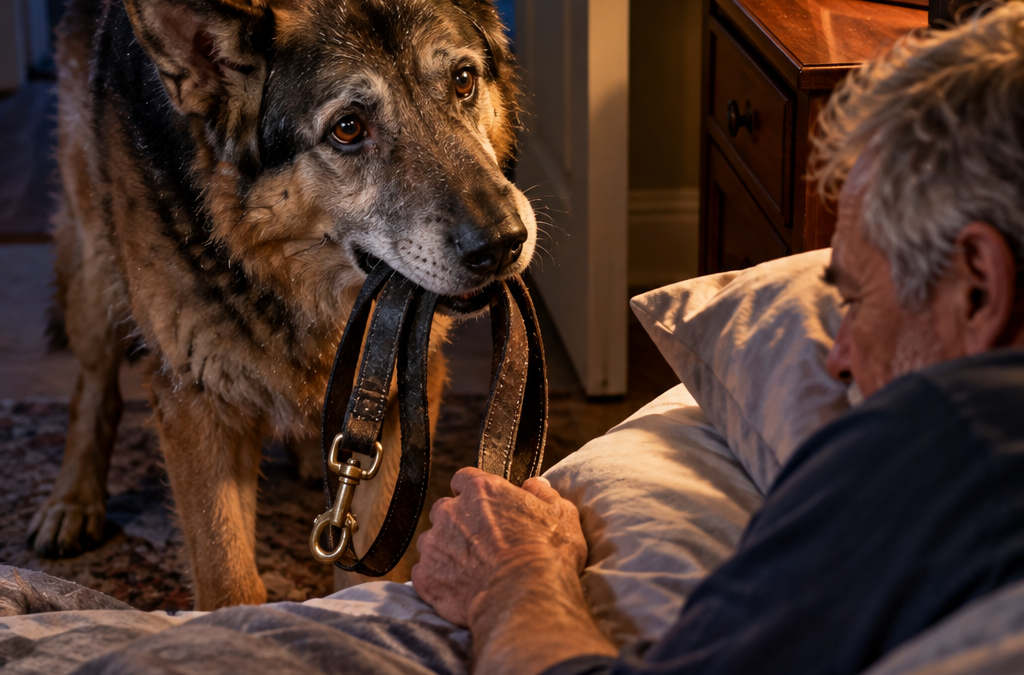
At some point during the night, he had brought his old leash from the hook by the door.
It lay beside my hand.
I barely noticed.
I didn’t understand then how much that small detail would matter later.
After Ellen died, work became the only thing that kept my days organized.
Max gave me a reason to get out of bed.
There were meals to prepare.
Medication to give.
Veterinary appointments to schedule.
Short walks to take.
He needed me.
Or so I thought.
Looking back, I suspect I needed him far more.
Sarah worried about us.
She lived forty minutes away with her husband and their eight-year-old son, Caleb.
She called almost every evening.
Sometimes she invited me to dinner.
Sometimes she offered to come help around the house.
I usually found an excuse.
“I’ve got things to do.”
“You’re retired, Dad.”
“Being retired doesn’t mean being unemployed as Max’s personal servant.”
She laughed.
Then her voice softened.
“You know you can come over even when you don’t have a reason.”
“I know, sweetheart.”
But I rarely went.
The truth was that I couldn’t stand seeing other families moving through ordinary life.
Husbands handing their wives plates at dinner.
Couples arguing about groceries.
People making plans for the following weekend without understanding how easily those plans could be taken away.
At home, I didn’t have to pretend I was all right.
Max didn’t expect conversation.
He didn’t ask whether I had considered joining a grief support group.
He didn’t tell me Ellen would want me to be happy.
He simply occupied the other half of the house.
And when the silence became too heavy, I could reach down and feel his warm head beneath my hand.
That was enough to get me through most days.
Until his body began to fail him.
The first serious change came that winter.
Our bedroom was upstairs.
Max had always followed me up at night, even when he was exhausted.
He slept on a thick dog bed near the foot of our bed, sometimes snoring so loudly that Ellen used to threaten to send us both downstairs.
One evening, I started up the staircase.
Max followed.
Halfway up, he stopped.
I heard his nails slip against the wooden step.
I turned.
He was standing with his front paws two steps above his hind legs.
His head was lowered.
His back trembled.
“Come on, buddy.”
He tried to lift his rear leg.
It wouldn’t cooperate.
He tried again.
Then he looked up at me.
I will never forget that look.
Not because it was dramatic.
Because it wasn’t.
He seemed confused.
As though his body had suddenly failed to follow an instruction it had obeyed thousands of times.
I hurried back down.
“Hey, hey. Easy.”
He tried to climb again.
I put a hand against his chest.
“No. We’re not doing that.”
I helped him turn around and guided him carefully back to the floor.
Then I stood at the bottom of the staircase, looking toward my bedroom.
For thirty-one years, that room had belonged to Ellen and me.
After she died, I had kept sleeping there because the thought of abandoning it felt like abandoning another piece of her.
Now Max stood beside me, breathing hard after trying to climb twelve steps.
I looked at him.
Then at the staircase.
“All right,” I said. “Guess we’re moving.”
I carried blankets downstairs and made up the guest bed.
Max watched from the hallway.
When I finally lay down, he settled beside the bed with a satisfied sigh.
I reached down and scratched his ear.
“Don’t get too comfortable. This arrangement is temporary.”
He closed his eyes.
It wasn’t temporary.
Within a month, I had moved my clothes into the downstairs closet and stopped using the upstairs bedroom.
I told Sarah it was more convenient.
That was true.
But the deeper truth was that I couldn’t bear the thought of sleeping somewhere Max couldn’t follow.
I had already lost one member of my family.
I wasn’t ready to put a staircase between myself and the other.
That was when the leash started appearing.
At first, only once or twice a week.
Then almost every night.
Always the same leash.
Never one of the newer nylon leads hanging beside the back door.
Never the retractable leash Sarah had bought for his retirement.
Only the black leather police leash, with the cracked stitching near the handle and the brass clip worn smooth by years of use.
He dragged it from the entryway to the bedroom.
Sometimes the clip rattled against the floor.
Sometimes the leather caught beneath his front paws.
It was hard work for him.
I could see that.
But whenever I tried to take the leash away, he became restless.
So I let him have it.
I assumed he missed working.
I assumed he wanted another walk.
I assumed the old dog was clinging to the one object that reminded him of being young.
I never stopped to consider that the leash might mean something different to him now.
One morning, I found the leash lying across my pillow.
Max was asleep on the floor.
I picked it up and stared at it.
The leather was damp where he’d held it between his teeth.
“Buddy, you’re going to have to explain this obsession.”
He opened one eye.
I held up the leash.
“Is this about work?”
His tail tapped the rug.
“You know they gave you a retirement plaque, right? You don’t have to keep proving yourself.”
He closed his eye again.
I laughed and put the leash on the dresser.
That afternoon, I took him outside.
It was a bright, cold day in early March.
A few patches of snow remained along the fence, and the driveway was wet from melting ice.
I clipped the old leash to his collar.
Max stood immediately.
His ears lifted.
For a second, he looked ten years younger.
“There we go,” I said. “That’s what you wanted.”
We walked down the driveway.
At the sidewalk, Max stopped.
I waited.
He sniffed the air, looked toward the street, and took two more steps.
Then his hind legs began trembling.
He sat down.
I crouched beside him.
“Already?”
He looked up at me.
I tried to sound cheerful.
“Come on, big guy. We used to do five miles before breakfast.”
Max lowered his head.
I regretted the words immediately.
“Sorry, buddy.”
I unhooked the leash and slipped one arm beneath his chest.
He stood with my help.
We turned toward the house.
He walked slowly, putting less weight on his left rear leg.
Once inside, he went directly to his bed.
I offered him water.
He drank a little.
Then he looked toward the leash in my hand.
I placed it beside him.
“There. Happy?”
He rested his chin on the leather.
That evening, he didn’t bring it to my bedroom.
It was already with him.
I thought I had solved the mystery.
I was wrong.
Over the next several weeks, Max’s mobility declined.
His appetite became unpredictable.
He stopped climbing onto the couch.
Then he stopped trying.
When I opened the back door, he still looked excited, but getting to his feet required more effort.
Sometimes he needed my help to stand.
I purchased a support harness and placed rubber-backed rugs through the hallway so he wouldn’t slip.
I raised his food bowl.
I bought a thicker orthopedic bed.
I adjusted his medication with our veterinarian.
I did everything I could think of.
But I kept avoiding the one question that frightened me.
What if he wasn’t simply getting older?
What if something was seriously wrong?
The possibility sat quietly in the back of my mind, growing larger every time he struggled to stand.
I had lost Ellen without warning.
I didn’t know how to face another loss while watching it approach.
So I did what frightened people sometimes do.
I concentrated on small, manageable problems.
Was his bed comfortable?
Did he need a different bowl?
Would he eat chicken mixed into his food?
Should I buy a ramp for the back door?
Those were questions I could answer.
They made me feel useful.
They allowed me to pretend the larger question could wait.
Sarah wasn’t fooled.
She arrived one Sunday afternoon with Caleb and a casserole.
Max was lying beside the living room window.
Usually, he lifted his head the moment he heard Caleb’s voice.
This time, he barely moved.
Caleb hurried toward him.
“Max!”
“Easy, buddy,” I said. “He’s resting.”
My grandson stopped.
Max slowly raised his head.
Caleb knelt beside him.
“Hi, old man.”
Max licked his fingers.
I smiled.
Caleb had grown up with Max.
When he was a toddler, Max followed him through the house like a living safety fence.
If Caleb stumbled, Max stood still until he found his balance.
If the boy cried, Max appeared beside him.
If he dropped food, Max considered it a personal invitation.
Now Caleb carefully stroked the gray fur around Max’s muzzle.
“Grandpa?”
“Yeah?”
“Why doesn’t he get up anymore?”
I looked toward Sarah.
She was standing in the doorway, watching me.
“His legs are getting old,” I said.
Caleb considered that.
“Like your knees?”
I laughed.
“Something like that.”
He looked back at Max.
“Can the doctor fix them?”
The question hit harder than I expected.
“We’re trying to keep him comfortable.”
Caleb nodded.
Then he leaned close to Max’s ear.
“It’s okay if you can’t run. I still like you.”
I turned away.
There are things children understand before adults are willing to admit them.
Sarah followed me into the kitchen.
“Dad, when was his last appointment?”
“Three weeks ago.”
“What did the vet say?”
“Arthritis. You know that.”
“Did she say anything about the weight loss?”
I opened the refrigerator.
“He’s thirteen. Old dogs get thin.”
“Dad.”
I set the milk down.
“What?”
She lowered her voice.
“Look at him.”
“I look at him every day.”
“Then really look.”
I turned toward the living room.
Max was still on his bed.
Caleb had placed his small hand against Max’s shoulder and was talking softly to him.
For a moment, I saw what Sarah saw.
The narrow hips.
The dull coat.
The effort behind every breath when he moved.
My throat tightened.
Sarah touched my arm.
“I know you’re scared.”
I pulled away.
“You think?”
“I’m not trying to upset you.”
“Well, you’re doing a pretty good job.”
She went quiet.
I hated myself for speaking to her that way, but I couldn’t seem to stop.
“Everybody acts like I don’t know he’s old,” I continued. “I know exactly how old he is. I know he doesn’t have forever.”
Sarah’s eyes filled.
“Then why are you acting like we can’t talk about it?”
“Because talking doesn’t change anything!”
My voice echoed through the kitchen.
From the living room, I heard Max’s collar jingle.
He was trying to stand.
I hurried toward him.
“No, buddy. Stay down.”
He struggled upright anyway.
His hind legs shook.
Then he took several painful steps toward me.
I stopped in front of him.
“Max, what are you doing?”
He pressed his head against my thigh.
I put my hand on his neck.
His whole body was trembling.
Sarah came to stand beside me.
Neither of us spoke.
Max had heard my voice change.
He had heard the anger.
And even though standing hurt, he had come to me.
I crouched and wrapped an arm around his chest.
“I’m okay,” I whispered. “It’s all right.”
But it wasn’t.
And standing there with my aging dog leaning against me, I finally admitted what I had been avoiding.
I was afraid of losing him.
Not just sad.
Not simply worried.
Terrified.
Because Ellen had died so suddenly that I hadn’t gotten to say goodbye.
And Max had been there for every moment afterward.
He was the one who stayed when the visitors went home.
The one who slept beside me when I couldn’t bear the empty bed upstairs.
The one who gave my mornings a purpose.
I didn’t know who I would be when he was gone.
Sarah knelt beside us.
“Dad,” she whispered, “we need to get him checked again.”
I nodded.
This time, I didn’t argue.
Our longtime veterinarian, Dr. Rebecca Morgan, had cared for Max throughout most of his working life.
She knew his medical history.
She knew about the old injuries.
She knew that he could detect the sound of a treat container opening from three rooms away.
And she knew how much I loved him.
When we arrived at the clinic two days later, Max tried to walk through the front door without assistance.
He still had that instinctive dignity.
That determination to behave like the capable working dog he remembered being.
But his back legs gave way before we reached the examination room.
I caught his harness.
“Easy.”
A technician hurried toward us.
Together, we helped him onto a padded rolling stretcher.
Max looked embarrassed.
I recognized that expression.
I had seen it the day he missed the step into the patrol vehicle.
I leaned down.
“Hey. You’re okay.”
He touched my hand with his nose.
“Nothing to prove, partner.”
Dr. Morgan examined him carefully.
She checked his joints, spine, reflexes, weight, and breathing.
She ordered blood tests and imaging after finding several changes that concerned her.
We waited in a quiet consultation room while Max rested on a thick blanket.
I sat beside him with his leash wrapped around my hand.
Sarah had offered to come, but I had told her I could manage.
Now I wished I hadn’t.
The clock ticked above the door.
Somewhere in the clinic, another dog barked.
Max opened one eye.
I rubbed his ear.
“Don’t worry. You’re still the toughest guy in the building.”
He closed his eye again.
Dr. Morgan returned nearly an hour later.
She carried a folder and a tablet.
I recognized the expression on her face before she spoke.
It was the same expression the hospital doctor had worn when he told me Ellen wasn’t going to recover.
My stomach dropped.
“Tom,” she said gently, “we need to talk.”
I gripped the leash.
“Okay.”
She sat across from me.
“Max has advanced degenerative changes in his spine and hips. That’s contributing to his weakness and difficulty walking.”
I nodded.
“I knew his arthritis was getting worse.”
“Yes. But we also found something else.”
She turned the tablet toward me.
An image of Max’s abdomen filled the screen.
“There is a large mass associated with his spleen, and we’re concerned about changes elsewhere that may indicate the disease has spread.”
I stared at the image.
“What kind of mass?”
“We can’t confirm the exact type from imaging alone. But given what we’re seeing, his weight loss, and his overall condition, cancer is a serious concern.”
The room seemed to shrink.
“Can you take it out?”
“We could discuss additional diagnostic testing and a surgical consultation. But I need to be very honest with you about the risks and what treatment might accomplish.”
“I’m listening.”
“Even if we pursue aggressive treatment, his advanced spinal disease will remain. His mobility is severely compromised, and I’m concerned that major surgery and recovery would be extremely difficult for him.”
I looked down at Max.
He was lying with his head against my shoe.
“What are you telling me?”
Dr. Morgan took a breath.
“I’m telling you that Max may be approaching the end of his life.”
I heard the sentence.
I understood every word.
But my mind refused to accept it.
“No.”
She waited.
“No, he’s been walking around the house. He’s eating some days. He still carries his leash to me every night.”
“I understand.”
“He’s stubborn. He’s always been stubborn. Maybe the medication just needs adjusting.”
“Tom—”
“He survived twelve years of police work. He’s been through more than most dogs ever will.”
My voice rose.
“He can’t just be dying.”
Dr. Morgan’s eyes softened.
“I wish I had better news.”
I looked away.
For a long time, I couldn’t speak.
Then I asked the question I had been afraid to ask from the moment she entered.
“How much time?”
She folded her hands.
“I can’t give you an exact timeline without more information. But considering his current condition, I would prepare for the possibility that we’re talking about weeks rather than months. It could be less if the mass causes complications.”
I stared at the floor.
Weeks.
Twelve years reduced to weeks.
Thousands of miles traveled together.
Hundreds of nights spent sharing the quiet after difficult shifts.
Every Christmas morning when he stole wrapping paper.
Every summer evening beneath the maple tree.
Every moment when I reached down without looking and found him waiting.
Weeks.
I felt something hot slide down my cheek.
“Does he know?”
Dr. Morgan tilted her head.
“Know what?”
“That he’s dying.”
She considered the question.
“We can’t know exactly what he understands. But he certainly knows his body feels different. He knows what hurts and what makes him comfortable.”
I looked at Max.
He opened his eyes.
His tail tapped the blanket.
“I keep telling him we’re retired,” I whispered. “But every night, he brings me his old police leash.”
Dr. Morgan listened.
“He drags it all the way to my bedroom. Sometimes he can barely stand, but he won’t leave it alone.”
“Does he seem to want to go outside?”
“That’s what I thought.”
“Does he pull toward the door?”
I frowned.
“No.”
“What does he do when he brings it to you?”
I searched my memory.
“He drops it near the bed.”
“And then?”
“He waits.”
“For what?”
I almost answered automatically.
But the truth was that I didn’t know.
Dr. Morgan watched me quietly.
“Tom, when you pick up the leash, what happens?”
“He settles down.”
“Does he try to lead you somewhere?”
I stared at her.
“No.”
“Does he seem happier when you’re holding it?”
I thought about all those nights.
The leather handle beside my slippers.
Max nudging it toward my hand.
The way he watched me when I moved it.
The way he finally relaxed if I left it close enough for both of us to touch.
My chest tightened.
“Yes,” I whispered.
Dr. Morgan nodded slowly.
“I can’t tell you exactly what the leash means to him. But dogs develop strong associations with objects, people, and routines. That leash connected him to you for almost his entire working life.”
I looked at the leather wrapped around my hand.
“He used to wait for me to put it on.”
“And now?”
I looked at Max.
Now he brought it to me himself.
Dr. Morgan leaned forward.
“Maybe he’s not asking you to take him anywhere. Maybe being connected to you is what comforts him.”
I didn’t answer.
My mind had gone somewhere else.
Back to a night four years earlier.
A night I hadn’t allowed myself to remember clearly.
The night after Ellen’s funeral.
I had been sitting on the living room floor, unable to stop crying.
Max had gone to the front door.
He returned carrying this same leash.
He placed it beside my hand.
I had picked it up without thinking.
I remembered wrapping the leather around my fingers while I cried into his fur.
For hours, I had held one end while Max lay beside me.
As if holding that leash meant neither of us could drift too far away.
Dr. Morgan’s voice brought me back.
“Tom?”
I looked at her.
“I think I understand why he keeps bringing it.”
My voice barely worked.
She waited.
“He’s been doing it since my wife died.”
I looked at Max again.
“I thought he wanted to work.”
My eyes filled.
“I thought he wanted to go outside.”
Max shifted his head and placed his muzzle across my shoe.
I reached down.
“But maybe he just wants me to hold on.”
I cried then.
Not loudly.
There was no dramatic collapse.
I simply sat in that small veterinary consultation room, clutching a worn leather leash while tears fell onto my hands.
I had spent months believing Max was asking me to give him something I could no longer provide.
Long walks.
Police work.
The strength and freedom of his younger years.
But perhaps all he wanted was something I could still give him.
My hand at the other end of the leash.
The reassurance that I was there.
Dr. Morgan let me sit with that thought.
Then she gently brought us back to what mattered.
We discussed pain management and comfort care.
She explained which symptoms required immediate veterinary attention, including weakness, collapse, pale gums, sudden abdominal swelling, or signs of internal bleeding.
She explained that if Max’s comfort deteriorated, euthanasia might become the kindest option.
I hated hearing the word.
But I listened.
We made a plan to evaluate his quality of life every day.
I agreed to call if he worsened.
Before we left, Dr. Morgan knelt beside Max.
She stroked his gray muzzle.
“You’ve worked hard, handsome boy.”
His tail moved.
She looked up at me.
“Tom, you don’t have to make every decision today.”
I nodded.
“But promise me something.”
“What?”
“Don’t ask him to keep going because you’re afraid of what happens when he stops.”
The words struck me hard.
I looked down at the dog who had carried my grief for four years without ever understanding why it weighed so much.
“I won’t,” I whispered.
I wanted to believe I could keep that promise.
That evening, I called Sarah.
She answered immediately.
“Dad? How did it go?”
I opened my mouth.
Nothing came out.
“Dad?”
I looked at Max.
He was sleeping beside the couch.
The leash lay beneath his chin.
“Sweetheart,” I said, “can you come over?”
She arrived twenty minutes later.
I was sitting at the kitchen table with Max’s medical paperwork spread in front of me.
Sarah took one look at my face.
“Oh, Dad.”
I handed her the folder.
She read quietly.
Then she sat beside me.
For a long moment, neither of us spoke.
Finally, she asked, “What can we do?”
I stared at the leash hanging from my hand.
“Keep him comfortable.”
She nodded.
“And you?”
I tried to answer.
Instead, my face crumpled.
Sarah moved her chair closer and wrapped her arms around me.
I hadn’t cried in front of my daughter like that since Ellen died.
I was ashamed of how badly I needed someone to hold me.
Then I felt Sarah’s arms tighten.
“Dad,” she whispered, “you don’t have to be strong every second.”
I buried my face against her shoulder.
“I can’t lose him.”
“I know.”
“He’s all I have left of those days.”
She pulled back gently.
“No, he’s not.”
I looked at her.
She was crying too.
“You have me. You have Caleb. You have people who love you.”
I shook my head.
“It’s not the same.”
“No,” she agreed. “It isn’t.”
She took my hand.
“But it still matters.”
I looked down at the table.
For years, I had treated my grief like a private duty.
Something I had to carry without help.
I had told myself that Max was the only one who truly understood.
But Sarah had lost her mother, too.
And while I had spent my days hiding in the house, she had been trying to reach me.
I had been so afraid of losing another person that I had slowly pushed away the people I still had.
“I’m sorry,” I whispered.
Sarah shook her head.
“We can talk about all that later.”
She stood and moved toward Max.
“Right now, let’s take care of this old guy.”
That night, I made a decision.
I wasn’t going to spend whatever time Max had left mourning every hour before it was gone.
I wasn’t going to count the days as though each one were already lost.
I would make sure he was comfortable.
I would be honest about his suffering.
And I would stop trying to convince him that he needed to be the dog he had once been.
For the first time since his retirement, I put his old police leash on the floor beside my bed and left it there.
At 2:13 a.m., I woke to the sound of his nails against the rug.
Max had gotten up from his bed in the hallway.
He was holding the leather strap in his mouth.
He took three slow steps toward me.
Then he stopped.
His hind legs trembled.
I sat up immediately.
“Max.”
He looked at me.
I slipped out of bed.
“Wait. I’m coming.”
He took another step.
The brass clip dragged across the floor.
I reached him before he could move again.
“Easy, buddy.”
He dropped the leash.
I picked it up.
Then I sat on the rug beside him.
Max lowered himself carefully.
He looked at the leather handle in my hand.
I understood.
At least, I understood enough.
I slipped the loop around my wrist and held the leash loosely between us.
“There,” I whispered.
Max laid his head against my knee.
His breathing slowed.
And after a few minutes, he fell asleep.
I stayed beside him long after my legs began to ache.
I kept looking at the thin strip of leather joining us.
For twelve years, I had used that leash to guide him through dangerous places.
Now, when neither of us had anywhere to go, he seemed to want the same simple connection.
I wasn’t his handler anymore.
There were no commands to give.
No suspects to find.
No search assignments waiting in the morning.
But with that leather loop resting around my wrist, I felt something I hadn’t felt since Ellen died.
I felt less alone.
And I realized that Max, in the only way he knew, might have been looking for the same thing.
After that night, I changed the way we lived.
I moved Max’s orthopedic bed directly beside mine.
I placed a water bowl within easy reach and kept a small lamp burning in the hallway.
The rugs stayed in place.
His harness hung beside the bedroom door.
The old police leash stayed wherever he wanted it.
Most importantly, I stopped waiting for him to struggle across the house before I went to him.
Every evening, I sat on the floor beside his bed.
Sometimes I talked.
Sometimes I read.
Sometimes I simply held the handle of the leash while Max slept with his chin resting on the leather.
We didn’t have to go anywhere.
For the first time, that seemed enough for both of us.
The medication helped for a while.
Max’s appetite improved slightly, and on good mornings, he still wanted to go into the backyard.
We used the support harness to help him down the short ramp Sarah’s husband had installed.
I no longer encouraged him to walk around the block.
Instead, I let him choose.
Some days, he went directly to the maple tree.
Other days, he stood on the patio sniffing the air, his ears moving toward distant sounds.
Once, a squirrel ran along the fence.
Max lifted his head so suddenly that I laughed.
“Don’t even think about it.”
His front paws shifted.
The old familiar spark appeared in his eyes.
I shook my head.
“You’re retired, remember?”
He watched the squirrel disappear.
Then he looked at me.
I scratched his neck.
“Yeah, I miss it too.”
I brought a chair outside and sat beside him.
The sunlight warmed his fur.
There was a time when I couldn’t bear doing nothing.
During my police career, every quiet moment had felt like time borrowed from the next emergency.
But with Max, I began learning how to stay still.
I noticed the birds nesting beneath the porch roof.
The sound of wind moving through the bare branches.
The faint smell of cut grass from a neighbor’s yard.
Sometimes Max slept through the entire afternoon.
Sometimes he lifted his head to watch me.
I liked to think he was making sure I hadn’t gone anywhere.
One afternoon, Sarah brought Caleb over after school.
My grandson walked into the living room carrying a small cardboard box.
“Grandpa, I made something for Max.”
I smiled.
“What have you got there?”
He opened the box.
Inside was a blue blanket covered in crooked yellow stars.
“I made it in art club. Mom helped sew the edges.”
Sarah stood behind him, smiling.
Caleb knelt beside Max.
“It’s for your bed.”
Max sniffed the blanket.
Then he rested his head on it.
Caleb grinned.
“He likes it!”
“He sure does,” I said.
The boy sat cross-legged beside him.
After a while, he noticed the old police leash.
“Grandpa, why does Max always have that thing?”
I looked at the leather strap.
“It was his working leash.”
“From when he was a police dog?”
“That’s right.”
“Does he miss being a police dog?”
I considered the question.
“Probably some parts of it.”
“Like chasing bad guys?”
I smiled.
“Mostly riding in the truck, I think. And getting treats for doing a good job.”
Caleb laughed.
Then he picked up the handle.
“Does he want to go somewhere?”
I watched Max.
The old dog lifted his head slightly.
He looked at Caleb, then at the handle.
“Not anymore,” I said quietly.
Caleb frowned.
“Then why does he bring it to you?”
I looked at my grandson for a long moment.
“Because for twelve years, whenever I held that leash, Max knew we were together.”
Caleb looked down at the leather.
“So he wants to know you’re still together?”
My throat tightened.
“I think so.”
The boy considered that with the seriousness only children can bring to simple things.
Then he placed the handle into my hand.
“There,” he said. “Now he knows.”
Max lowered his head onto his blanket.
I looked at Caleb.
I wanted to tell him that nothing in life was that easy.
That loving someone couldn’t prevent illness.
That holding a leash wouldn’t stop time.
That sometimes the most important things disappeared no matter how tightly you tried to keep them.
But watching Max settle peacefully beside us, I realized the boy wasn’t wrong.
At that moment, Max knew I was there.
And I knew he was there.
Perhaps that was all either of us could ask.
A week later, Captain Collins called.
Sarah had told him Max was seriously ill.
He asked whether he could visit.
“Of course,” I said.
He arrived the next afternoon with two retired deputies and a small bag of approved treats.
I hadn’t seen Collins since the retirement ceremony.
He looked older.
So did I.
He stopped in the doorway when he saw Max lying on his blue blanket.
For several seconds, he said nothing.
Then he knelt.
“Well, hello there, Sergeant.”
Max’s ears lifted.
Collins rubbed his head.
“You remember me?”
Max moved his tail.
Collins smiled, but his eyes were wet.
“Of course you do.”
The other deputies took turns greeting him.
Nobody tried to make him stand.
Nobody asked him to perform.
They sat around the living room telling stories.
One remembered a night Max had found a missing elderly man in freezing weather.
Another laughed about the time Max barked at a life-size cardboard police officer in a store window.
Collins reminded me of a search when Max had refused to leave a drainage ditch because he could hear an injured driver trapped beyond a collapsed fence.
“He wouldn’t quit,” Collins said.
I looked at Max.
“No,” I replied. “He never did.”
Collins glanced at the leash beside his bed.
“You still have that old thing?”
I picked it up.
“Apparently, he won’t let me get rid of it.”
Collins examined the worn leather.
Then he smiled faintly.
“Remember your first winter together?”
I frowned.
“Which part?”
“The search near Red Creek.”
I knew immediately.
We had spent almost seven hours looking for a missing man in heavy snow.
Near midnight, we found him collapsed beneath a fallen tree.
Max had tracked him across frozen ground, but by the time we reached the man, the snow was deep enough that walking had become difficult even for us.
I remembered losing my footing on a steep bank.
The leash had slipped through my gloved hand.
Max stopped immediately.
He could have continued toward the man.
Instead, he turned back.
He picked up the loose handle in his mouth and brought it to me.
Collins laughed softly.
“You said that dog had more sense than half the deputies in the county.”
“He did.”
“You know what else you said?”
I looked at him.
He pointed toward Max.
“You said, ‘That’s my partner. He doesn’t leave anybody behind.’”
The room went quiet.
I stared at the leash in my hand.
I had forgotten that moment.
Not the search itself.
Not the cold.
Not the relief when the missing man survived.
But the small gesture of Max returning with the leash.
Collins rested a hand against Max’s shoulder.
“He was something special, Tom.”
I swallowed.
“Still is.”
Collins nodded.
“Yeah. He is.”
After the deputies left, I sat beside Max for a long time.
I thought about the man beneath the tree.
About the six-year-old girl in the woods.
About the countless nights Max had followed a scent through places where I couldn’t see a thing.
I had always trusted him to know where we needed to go.
But now, at the end of his life, there was no trail for us to follow.
No missing person waiting beyond the trees.
Nothing to find.
And the leash had become something different.
It wasn’t a command.
It wasn’t a promise of another assignment.
It was a familiar connection, one he seemed unwilling to surrender while he still had the strength to carry it.
I ran my thumb over the worn stitching.
“You always came back for me,” I whispered.
Max opened his eyes.
I leaned closer.
“I guess it’s my turn now.”
Over the following days, his condition worsened.
He began refusing meals again.
Even with medication, he sometimes struggled to settle comfortably.
His breathing became more labored after moving.
He stopped showing interest in the backyard.
I kept the quality-of-life notes Dr. Morgan had recommended.
Every morning, I wrote down what he ate, how he slept, and whether he could rest without distress.
I recorded the good moments.
But I didn’t hide the bad ones.
I had promised not to ask him to suffer simply because I was afraid of saying goodbye.
And now that promise was becoming difficult to keep.
One morning, Max tried to stand and collapsed before I could support him.
He didn’t cry out.
He simply lowered his head and looked exhausted.
I called Dr. Morgan immediately.
She came to the house that afternoon.
Sarah sat beside me while she examined him.
When Dr. Morgan finished, she looked at us with the same gentle seriousness I had seen at the clinic.
“Tom, I think Max is telling us that he’s tired.”
I looked toward him.
He was resting on Caleb’s blue blanket.
His eyes were open.
The leash lay beneath one front paw.
“Is there anything else we can do?” I asked.
“We can continue adjusting comfort care, but his overall condition is deteriorating. I’m worried we may be reaching a point where we can’t reliably control his suffering.”
I rubbed my hands together.
“What if he has another good day?”
“He might.”
“What if tomorrow he eats?”
“That would be a good moment to appreciate. But it wouldn’t change the underlying disease.”
I stared at the floor.
Dr. Morgan waited.
I wanted her to make the decision for me.
I wanted somebody to tell me there was no choice.
That way, I wouldn’t have to live with the feeling that I had chosen the day my best friend would die.
But she didn’t take the decision away from me.
She explained.
She guided.
She answered every question.
And finally, she said, “The kindest decision is not always the one that gives us the most time.”
I looked at Max.
He raised his head when he heard my voice.
His tail moved weakly.
Even now.
Even after everything.
I covered my face.
Sarah placed her hand on my shoulder.
I thought about all the nights he had dragged that leash across the floor.
How much effort it had cost him.
How faithfully he had continued bringing it to me.
And I finally understood what I had been refusing to accept.
Max didn’t need another assignment.
He didn’t need to prove he was still a police dog.
He didn’t need to be strong for me.
He had already given more than anyone had a right to ask.
I wiped my face.
“Can we do it here?”
Dr. Morgan nodded.
“Yes.”
“On his blanket?”
“Of course.”
I looked toward the old leash.
“And can I hold on to him?”
Her eyes filled.
“You can stay with him the entire time.”
We arranged for her to return the following afternoon.
That evening, Sarah helped me make Max comfortable in the living room.
She brought his water close.
She opened the curtains so the last sunlight could reach his bed.
Caleb came to say goodbye.
He knelt beside Max, stroking his gray muzzle.
“Mom says you’re really sick.”
Max breathed softly.
Caleb’s voice trembled.
“I don’t want you to go.”
I turned away, fighting tears.
Sarah knelt beside her son.
“I know, sweetheart.”
Caleb reached for the old leash.
“Grandpa, should we put this on him?”
I shook my head.
“He doesn’t need to go anywhere.”
The boy looked confused.
I took the leather handle.
“He’s already home.”
Caleb nodded slowly.
Then he placed his small hand on Max’s shoulder.
“You’re the best police dog,” he whispered.
Max’s tail moved once.
Caleb leaned forward and kissed his forehead.
I had seen grown men cry at funerals.
I’d seen officers weep after losing partners.
But nothing prepared me for the sight of my eight-year-old grandson saying goodbye to the dog who had watched over him since he was a baby.
When Sarah took Caleb home, she asked whether I wanted her to stay.
I looked at Max.
Then back at my daughter.
“Tomorrow,” I said. “I’d like you here tomorrow.”
She nodded.
“I’ll be here.”
After they left, I sat beside Max.
The house was quiet.
The clock above the fireplace ticked.
A car passed outside.
Somewhere down the street, another dog barked.
Max lifted his head slightly.
“Easy,” I whispered.
I moved closer.
For a while, I told him stories.
I reminded him about the first time we met.
About the glove he stole from my pocket.
About Sophie beneath the fallen tree.
About the snowstorm near Red Creek.
I told him how proud I had been the day he received his retirement plaque.
I told him about Ellen.
About how she used to sneak him treats when she thought I wasn’t looking.
About how she called him her second husband because he spent more time with me than she did.
I laughed through my tears.
“You know, she always said you were the better-looking one.”
Max opened one eye.
“Don’t let it go to your head.”
Then I grew quiet.
I looked at the leash between us.
For years, I had believed that being strong meant keeping my emotions hidden.
That a man who had spent his life protecting people had no right to fall apart.
But Max had seen every version of me.
The confident deputy.
The exhausted husband.
The broken widower.
The frightened old man who didn’t know how to live after losing everything familiar.
He had never cared which version came home.
He just wanted me there.
I took the leather handle and placed it loosely around my wrist.
“You remember what I used to say before every shift?”
His ear twitched.
“You and me, buddy.”
I waited.
Then I whispered the words I had been afraid to say.
“You’ve done enough.”
His breathing was slow.
“You don’t have to carry this anymore.”
I stroked his head.
“You don’t have to keep bringing me the leash.”
For the first time in weeks, I didn’t feel desperate to make him understand.
I understood enough for both of us.
I lay down on a blanket beside him.
My old knees protested, but I didn’t care.
Max shifted his head toward me.
I placed my hand against his shoulder.
The old leash rested between us.
We stayed that way through the night.
I barely slept.
Every time his breathing changed, I opened my eyes.
Every time he moved, I reached toward him.
Just before dawn, he lifted his head and touched my wrist with his nose.
I opened my eyes.
“Hey, partner.”
He looked at me.
Then he rested his chin on the leash.
I rubbed his ear.
“I’m right here.”
He closed his eyes again.
I don’t know whether Max understood that it was our last morning together.
I don’t know whether he knew what death was or why his body no longer obeyed him.
I only know that when I held the leash, he settled.
And when I rested my hand against him, his breathing became easier.
For twelve years, he had trusted me to guide him.
Now he was trusting me in a way that frightened me more than any dangerous call we had ever answered.
At ten the next morning, Sarah arrived.
She brought coffee, but neither of us drank much.
We sat beside Max, talking quietly about Ellen and the years when the house had been full of noise.
We laughed about the Christmas Max ate half a tray of cookies.
We remembered the time he carried Caleb’s stuffed bear around for an entire afternoon, refusing to surrender it until Ellen traded him a treat.
I told Sarah stories she’d never heard about my early days with Max.
She listened.
Sometimes she smiled.
Sometimes she cried.
At one point, she looked at me.
“Dad, Mom would be proud of how you’re taking care of him.”
I shook my head.
“I should’ve noticed sooner.”
“You noticed when it mattered.”
I looked at Max.
“I kept thinking he wanted to be young again.”
Sarah took my hand.
“Maybe he just wanted to be with you.”
I squeezed her fingers.
“Maybe.”
Dr. Morgan arrived shortly after two.
She came alone.
No uniformed officers.
No ceremony.
No crowd.
Just the veterinarian who had cared for Max for years and the family who loved him.
She examined him once more.
Then she explained the process carefully.
Max would receive a sedative first.
He would become relaxed and sleepy.
When he was fully comfortable, she would administer the medication that would allow him to pass peacefully.
I listened.
I asked her to explain it twice.
She did.
Then she looked at me.
“Are you ready?”
I stared at Max.
Nothing inside me felt ready.
I wanted another day.
Another week.
Another year.
I wanted him to stand up, shake his fur, and carry his leash to the door like the strong young dog he had once been.
I wanted to hear Ellen laughing from the kitchen.
I wanted everything that time had taken away.
But Max lay before me, exhausted, his body too weak to rise.
And for the first time, I understood that love sometimes meant refusing to ask for what the person you loved could no longer give.
I nodded.
“Yes.”
Dr. Morgan moved gently beside him.
I sat on the floor, holding Max’s head in my lap.
Sarah sat on his other side.
I picked up the old police leash.
The leather was soft and worn from twelve years of service.
I clipped it to his collar one final time, leaving it completely loose.
Then I slipped the handle around my wrist.
Max opened his eyes.
He looked at me.
I smiled through my tears.
“Hey, buddy.”
His tail moved weakly.
“There you are.”
I scratched the place behind his ear that he loved most.
“You remember our first day?”
His breathing was slow.
“You stole my glove.”
I laughed shakily.
“Best thing anybody ever stole from me.”
Dr. Morgan gave the sedative.
I continued stroking his head as he relaxed.
His eyes grew heavy.
His muscles softened.
I leaned close.
“You were the best partner a man could ever ask for.”
My voice broke.
“You found people nobody else could find. You kept me safe. You brought me home.”
Tears ran down my face.
“And when Ellen died, you stayed.”
I bent forward until my forehead rested gently against his.
“You stayed when I didn’t know how to keep living.”
Sarah began crying quietly.
I kissed Max between his ears.
“I’m going to be okay, buddy.”
For the first time, I believed those words might eventually become true.
“I promise I’ll look after myself.”
I tightened my fingers around the leash.
“And I’ll look after Sarah and Caleb.”
Max breathed softly.
“You don’t have to worry about me anymore.”
Dr. Morgan waited until he was fully asleep.
Then, with my permission, she administered the final medication.
I kept one hand on his chest.
I felt his breathing slow.
I whispered the same words I had said at the end of thousands of shifts.
“We’re home, buddy.”
His chest rose gently.
Then fell.
And did not rise again.
For a moment, I waited.
My mind expected another breath.
Another movement.
Another little sigh.
But the room had gone still.
Dr. Morgan listened to his heart.
Then she looked at me.
“He’s gone, Tom.”
I lowered my head.
The sound that came out of me didn’t feel human.
It was grief stripped of every defense I had spent my life building.
I held Max’s face.
I told him I loved him.
I told him I was sorry.
I told him how grateful I was.
Sarah held me while I cried.
For a long time, I couldn’t let go of the leash.
I understood he no longer needed it.
But my hand wouldn’t open.
Finally, I unclipped it from his collar.
I laid the brass clip gently beside him.
Then I pressed my lips to his forehead.
“End of watch, partner.”
The words almost broke me.
“Good boy.”
After Max died, I expected the house to become unbearable.
And for a while, it was.
Every familiar sound seemed to belong to someone who wasn’t there.
I still woke at two in the morning.
Sometimes I thought I heard his nails on the floor.
Sometimes I reached toward the empty rug beside my bed before remembering.
The old leash hung beside the bedroom door.
I couldn’t put it away.
I couldn’t bear the thought of never seeing it again.
During the first week, Sarah called every morning.
She came over three evenings.
Caleb brought me a drawing of Max beneath the maple tree.
He had drawn a bright gold star above him.
At the bottom, in large crooked letters, he had written:
MAX WAS ALWAYS MY HERO.
I put it beside Max’s service photograph.
One afternoon, Captain Collins stopped by.
He handed me a small wooden display case.
Inside was Max’s badge, his retirement plaque, and a photograph of us standing together beside our patrol SUV.
I stared at it.
In the picture, I was smiling.
Max was looking up at me.
The old leather leash hung between us.
Collins watched me quietly.
“We’ve got a new K9 class coming through next month,” he said.
I nodded.
“Good.”
“They could use somebody with your experience.”
I looked at him.
“Doing what?”
“Talking about handling. Partnership. Taking care of an aging working dog.”
I stared at the photograph.
“I don’t know if I’m up for that.”
“Think about it.”
He stood to leave.
Then he paused at the door.
“Tom?”
“Yeah?”
“Max had a good life.”
I looked away.
“He deserved a longer one.”
Collins was quiet.
Then he said, “Maybe. But he couldn’t have asked for a better man to share it with.”
After he left, I sat for a long time with the display case in my lap.
I thought about the things I regretted.
The signs I had missed.
The times I had been impatient.
The days when grief made me shut everyone out.
I knew those memories would always hurt.
But for the first time, I began making room for the other memories, too.
The years when Max was healthy.
The people he helped save.
The countless small moments when we had been happy without realizing how precious those moments were.
And the nights when an old dog carried a leash across the floor because being close to me still mattered to him.
Three weeks later, I called Collins.
“About that K9 class,” I said.
He sounded surprised.
“You interested?”
“I might have a few things to tell them.”
I heard him smile.
“That’s what I was hoping.”
The following month, I stood in front of fourteen new handlers at the training center.
Some were young enough to be my children.
Their dogs sat beside them, bright-eyed and restless, full of energy and possibility.
I recognized the excitement.
The nervousness.
The pride.
I told them about training.
About trust.
About patience.
I told them that a dog’s willingness to work did not mean his body could endure everything asked of it.
I explained that a good handler needed to know when to push, when to stop, and when to listen.
Then I placed Max’s old leash on the table.
The room fell quiet.
“This was my partner’s leash,” I said.
I told them about Max.
About the girl in the woods.
The man in the snowstorm.
The years we spent working together.
I told them about his retirement.
And finally, I told them about the nights when he dragged the leash to my bed.
I didn’t hide the difficult parts.
I admitted that I had misunderstood him.
That I had been afraid.
That I had spent too much time thinking about what I was losing instead of what he still needed.
When I finished, one young deputy raised his hand.
“Sir, did Max ever stop trying to work?”
I looked at the leash.
Then I shook my head.
“I don’t think he ever stopped wanting to be beside me.”
I paused.
“But I learned something near the end.”
The young deputy waited.
“A working dog isn’t just the job he does. He’s still your partner when he gets old. When he can’t run. When he needs help standing. When all he can manage is lying beside you.”
I picked up the leash.
“And sometimes, the most important thing you can do for him is stop asking him to be strong.”
Nobody spoke for a moment.
Then one of the younger dogs leaned against his handler’s leg.
The handler instinctively reached down and stroked his head.
I smiled.
I knew that movement.
I had done it a thousand times.
And for the first time since Max died, watching another handler with his dog didn’t feel only like losing something.
It felt like remembering why the love had been worth the pain.
That evening, I drove home just before sunset.
I parked in the driveway and sat behind the wheel for a few minutes.
The passenger seat was empty.
It always would be.
But I wasn’t afraid to enter the house anymore.
I opened the front door.
The familiar silence greeted me.
I set my keys on the counter.
Then I walked into the bedroom.
The old leash still hung beside the door.
I took it down.
For a moment, I held the leather between my fingers.
I could almost feel Max standing beside me, waiting for the familiar words.
You and me, buddy.
I sat on the edge of the bed.
The clock read 9:47.
For months, I had dreaded the nights because they reminded me of what I had lost.
But now I understood what those midnight visits had given me.
Max had carried the leash to my bed long after his working days were over.
I couldn’t know everything he had felt or intended.
But I knew what happened when I held it.
He felt safe.
He settled.
And for a little while, the old partnership was still there, unchanged by age or illness.
At first, I had thought he was asking me to take him somewhere.
In the end, I realized that the place he wanted to be was already right beside me.
I laid the leash across my lap.
Then I reached for my phone and called Sarah.
She answered on the second ring.
“Hi, Dad.”
“Hey, sweetheart.”
“You okay?”
I looked at Max’s photograph.
“Yeah,” I said. “I think I am.”
She waited.
“Would you and Caleb like to come over for dinner Sunday?”
There was a brief silence.
Then I heard her smile.
“We’d love to.”
“Good. I’ll make something.”
“Dad, you don’t cook.”
“I cooked for myself before your mother came along.”
“Which was approximately a thousand years ago.”
I laughed.
A real laugh.
“Bring dessert.”
“We will.”
After we hung up, I sat quietly.
The house was still.
But the silence didn’t feel quite so empty.
I stood and walked to the bookshelf.
Beside Max’s photograph, I placed the old leather leash.
Not hidden in a drawer.
Not buried in a box.
Right where I could see it.
I touched the scratched brass clip.
Then I looked at the photograph of the younger Max standing proudly beside me in uniform.
His ears were raised.
His eyes were bright.
He looked ready for anything.
I smiled through the tears gathering in my eyes.
“Twelve years,” I whispered.
Twelve years of early mornings.
Long nights.
Dangerous searches.
Ordinary afternoons.
And a kind of love that had never required words.
I thought of the last time he had brought the leash to my bed.
His trembling legs.
The soft jingle of the brass clip.
The way he rested his head against my knee once I held the handle.
For so long, I had believed that leash represented the life he had lost.
Now I understood that it represented the one thing neither age nor illness had taken from him.
Our bond.
I stepped back from the bookshelf.
“Rest easy, partner.”
Then I turned off the living room light and walked toward my bedroom.
I knew I would still miss him tomorrow.
I would miss him next Christmas.
I would miss him whenever I saw a German shepherd riding in the back of a patrol vehicle.
I would miss him when I heard a leash clip snap into place.
And I would miss him in all the quiet, ordinary moments when I used to reach down and find him waiting.
But I would not spend the rest of my life standing still.
Because Max had taught me that love was not measured only by how long we could hold on.
Sometimes it was measured by the courage to remain beside someone when their strength was gone.
Sometimes it was measured by the mercy of knowing when to let them rest.
And sometimes it was nothing more complicated than an old dog dragging a worn leather leash across a dark hallway, hoping to find the hand he had trusted for twelve years.
Max had found that hand.
And I had finally understood.
He wasn’t asking for one more walk.
He wasn’t asking for one more patrol.
He was asking for the comfort of a promise we had made to each other a lifetime earlier.
You and me, buddy.
I couldn’t keep him with me forever.
But I could keep that promise in the way I lived.
By opening my door again.
By letting my family close.
By helping the next generation of handlers care for the partners who trusted them.
And by remembering that even after the leash was gone from my hand, everything Max had given me remained.
That night, I slept without leaving the hallway light on.
At some point before morning, I woke and listened.
There was no scraping leather.
No jingle of brass.
No heavy breathing beside the bed.
For a moment, the old grief rose in my chest.
Then I looked toward the doorway and whispered into the quiet darkness.
“We’re home, Max.”
I closed my eyes.
And although my old partner would never carry his leash to me again, I finally felt ready to face another morning.
Because he had spent twelve years teaching me how to bring other people home.
In his final days, he had taught me how to find my own way back.
And that was the last gift my partner ever gave me.