𝗙𝗨𝗟𝗟 𝗦𝗧𝗢𝗥𝗬 My Neighbor Turned My Working Farm Into Her Daughter’s Wedding Venue Without Asking, and She Never Considered What Was Scheduled for the North Field
𝗙𝗨𝗟𝗟 𝗦𝗧𝗢𝗥𝗬
Her smile never moved.
“But communities evolve.”
“So do farm schedules.”
“You run the tractor very early.”
“Sometimes.”
“Is that necessary?”
“Usually.”
She tilted her head.
“Couldn’t equipment work wait until eight?”
“No.”
That answer surprised her.
I think Karen was accustomed to people explaining themselves.
I didn’t.
When you work livestock, an explanation doesn’t change the schedule.
If hay needs moving before a storm, you move hay.
If a water line breaks at sunrise, you fix it.
If cattle need loading at six, you start at five-thirty.
Agriculture doesn’t begin after suburban quiet hours end.
Karen studied me for a moment.
Then smiled again.
“Well, perhaps we can revisit it.”
“We don’t need to.”
I walked away.
A month later came the chicken complaint.
Official this time.
The letter described them as an “aesthetic disruption visible from association-adjacent residences.”
I had to read that phrase twice.
My chickens.
An aesthetic disruption.
On a farm.
I called Gerald.
“Are you actually fining me for chickens?”
“No, no.”
He sounded nervous already.
“It’s just a notice.”
“A notice about what?”
“Visibility.”
“They live outside.”
“I understand.”
“Do you?”
“Look, Karen raised the concern at the last meeting.”
“Karen doesn’t own the chickens.”
“No.”
“Does Karen own the farm?”
“Obviously not.”
“Then I’m confused.”
Gerald sighed.
“Could you maybe move the coop farther back?”
“No.”
“The board isn’t trying to create conflict.”
“Then stop inventing conflict.”
The complaint went nowhere.
My agricultural-use rights were clear enough that even Karen couldn’t stretch the bylaws around them.
Then came a letter suggesting I participate in what the HOA called “agritourism beautification.”
I still don’t know who approved that phrase.
The letter encouraged me to consider enhancing the farm’s compatibility with Crestwood’s “community identity.”
Decorative fencing.
Roadside plantings.
Seasonal open-house opportunities.
Educational events.
Potential community partnerships.
I read it at the kitchen table over breakfast.
Then folded it.
Put it in a drawer.
And went to work.
I should have paid more attention.
Because Karen wasn’t trying to beautify the farm.
She was slowly redefining it in her own mind.
Not as my workplace.
As an amenity.
That became obvious in April.
It was around four in the afternoon when she drove up my gravel lane.
I was replacing a hydraulic hose on the loader.
She got out wearing a pale blue blazer and carrying two things.
A folder.
And a plate of cookies.
The cookies immediately made me suspicious.
Nobody carries paperwork and homemade cookies to a farm unless they want something.
“Afternoon,” I said.
“Beautiful day.”
“Not bad.”
She looked around.
The cattle were out on the west pasture.
The old barn sat behind me.
The pasture had gone bright green after a week of spring rain.
Karen smiled.
“I forget how gorgeous it is out here.”
“It’s doing all right.”
She held out the plate.
“I brought you something.”
“What for?”
“Can I not bring my neighbor cookies?”
“You can.”
I took them.
“But you also brought a folder.”
Her smile widened.
“You’re observant.”
“Part of the job.”
She glanced toward the barn.
“My daughter is getting married.”
“Congratulations.”
“Thank you. August ninth.”
“Good time of year.”
“We hope so.”
Then she paused, expecting me to ask more.
I didn’t.
Finally she said, “We’re looking at venues.”
I put the cookies on the tractor tire.
“Okay.”
“Everything is so commercial now.”
“Probably.”
“Hotels. Ballrooms. Event centers. Nothing feels personal.”
I knew where this was going.
She turned slowly, taking in the barn and field.
“When I look at this place, I see something special.”
I said nothing.
“The barn is magnificent.”
“It leaks near the southeast corner.”
She laughed as if I were charming.
“And the field behind it would be perfect for dinner.”
“No.”
She blinked.
I hadn’t let her finish.
“Excuse me?”
“No.”
She gave a short laugh.
“You don’t even know what I’m asking.”
“Your daughter is getting married, venues are too commercial, and my barn is magnificent.”
I nodded toward the folder.
“You’re asking to hold the wedding here.”
Karen smiled cautiously.
“Yes.”
“No.”
Her expression tightened.
“I would pay.”
“It’s not about money.”
“We’d carry full event insurance.”
“No.”
“We’d bring in sanitation.”
“No.”
“We wouldn’t interfere with farm operations.”
“You would.”
She drew a breath.
“Can you at least hear the proposal?”
“I already know my answer.”
“Why?”
Because it was my farm.
Because cattle were unpredictable.
Because tractors and formalwear don’t mix.
Because the property had no commercial event permit.
Because my liability insurance wasn’t written for weddings.
Because the barn had electrical systems designed for agricultural use.
Because I didn’t want two hundred people wandering around equipment, gates, livestock, ponds, tools, and uneven ground.
Because I did not want my livelihood turned into somebody else’s themed backdrop.
I gave her the short version.
“This is an active farm. Not an event venue.”
“We’d only need the barn and north field.”
“The north field is part of the active farm.”
“On one Saturday.”
“Still a farm on Saturdays.”
Her smile disappeared.
“You’re being very inflexible.”
“I’m being clear.”
She stared at me.
I softened my tone slightly.
“Karen, I hope your daughter has a beautiful wedding. I mean that. But it won’t be here.”
She looked toward the barn again.
“My daughter fell in love with the pictures.”
“What pictures?”
Karen hesitated.
Then corrected herself.
“I mean pictures I’ve taken of the landscape.”
That bothered me.
“You’ve been taking pictures?”
“From the road.”
“Fine.”
She picked up the folder.
“I just think you’re missing an opportunity.”
“Maybe.”
“You could make good money hosting events.”
“I make my money farming.”
“People would pay a fortune for this atmosphere.”
I looked toward the cow that had chosen that exact moment to scratch her neck against a fence post.
“Atmosphere.”
Karen didn’t appreciate the joke.
She picked up the cookies.
I raised an eyebrow.
“Taking those back?”
“I suddenly remembered they’re for another neighbor.”
“Of course.”
She walked to her car.
Before getting in, she turned.
“If you change your mind—”
“I won’t.”
She drove away.
I genuinely believed that was the end of it.
That sounds foolish now.
But reasonable people assume other adults understand the word no.
Especially when the no involves private property.
Karen apparently considered no an opening position in a negotiation I didn’t know we were still having.
Summer came.
I got busy.
Hay season.
Fence repairs.
A sick calf.
An irrigation pump that failed during the hottest week of June.
Karen stopped contacting me.
The HOA stopped sending agricultural nonsense.
I thought she had moved on.
Then came August ninth.
Saturday.
I woke at 5:30.
Normal.
Made coffee.
Checked weather.
Pulled on boots.
By six, I was doing the first round.
Feed.
Water.
Fence.
Cattle count.
One cow had been favoring her front right leg, so I spent twenty minutes watching her move.
Nothing alarming.
At 7:15, I came around the north side of the property.
And stopped.
There were vehicles beside my barn.
Not one.
Not two.
Four trucks.
A white florist van.
A catering truck.
Two vehicles pulling enclosed trailers.
A black SUV with lettering on the side that read EVER AFTER EVENT DESIGN.
For several seconds, I stood there with one hand on the tractor fender trying to understand what I was seeing.
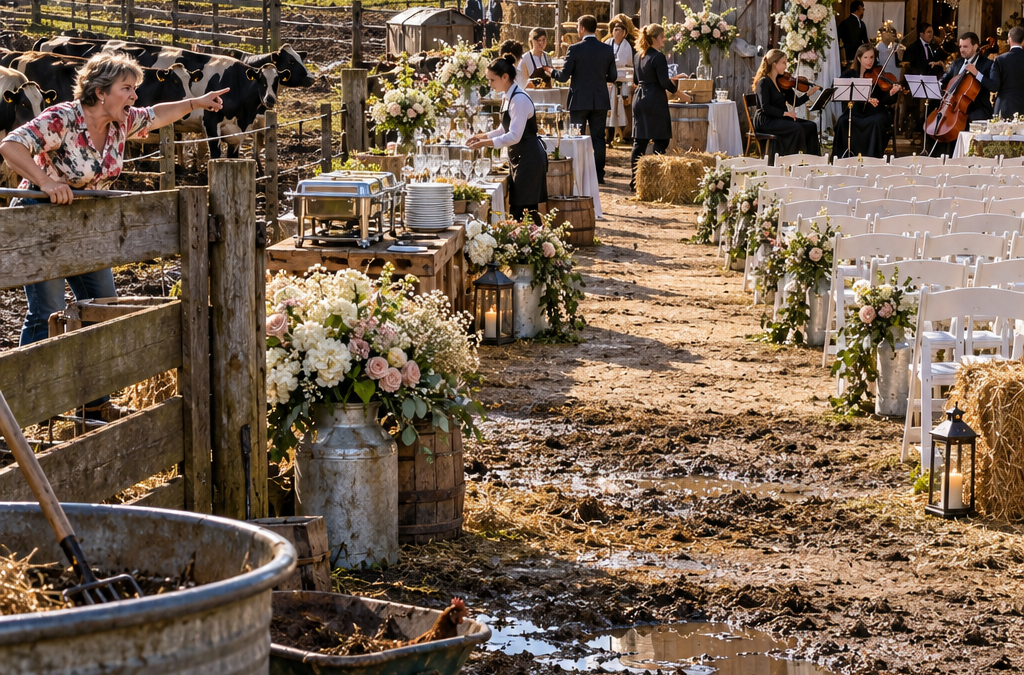
Six workers in matching black shirts were unloading white folding chairs.
Another man rolled a rack of tables toward the barn.
A woman carried buckets of flowers.
Someone had already tied white fabric around two fence posts.
My fence posts.
I honestly wondered whether I had somehow forgotten something.
Then I heard music.
Not a song.
Individual violin notes.
Someone tuning an instrument.
Inside my barn.
I walked toward them.
Slowly at first.
Then faster.
A young man carrying three chairs saw me.
“Morning.”
I stared at him.
“What’s happening?”
He smiled.
“Wedding.”
“Where?”
He pointed at the barn.
“Here.”
“No.”
His smile faded.
“Sorry?”
“No wedding is happening here.”
Now several workers were listening.
A woman wearing a headset approached.
“Can I help you?”
“I own this farm.”
She looked relieved.
“Oh, great. I’m Hannah, event coordinator.”
She extended a hand.
I didn’t take it.
“You need to stop unloading.”
Her expression changed.
“Is there an issue?”
“Yes.”
“What’s wrong?”
“I didn’t rent this property.”
She stared at me.
Then gave a small laugh.
“I’m sorry?”
“This farm is not rented for a wedding.”
Her face became carefully professional.
“Mr….?”
“Doesn’t matter. I’m the owner.”
She opened a tablet.
“We have a signed venue agreement.”
“No, you don’t.”
She looked increasingly nervous.
“We do.”
“Show me.”
She called someone over.
A folder appeared.
Hannah removed a document.
The first page had my property address.
Event date.
August 9.
Access period.
7:00 a.m. through 11:00 p.m.
Rental amount.
Liability language.
Then my name.
And beneath it—
My signature.
Except it wasn’t my signature.
It resembled it.
Enough that someone who had seen my name written before could imitate it.
But I knew every movement of my own hand.
That wasn’t mine.
Below the signature was a notary stamp.
I felt the anger start somewhere deep.
Cold.
Not loud.
“Where did this come from?”
“Mrs. Bellamy provided the executed agreement.”
“Karen Bellamy.”
“Yes.”
I looked at Hannah.
“She forged this.”
Hannah went pale.
“I need to call my company.”
“Good.”
“Are you absolutely sure you didn’t sign—”
“I know whether I rented out my own farm.”
“Of course.”
She stepped back.
“I didn’t mean—”
“I know.”
I wasn’t angry with the vendors.
Not yet.
They had paperwork.
Official-looking paperwork.
A stamp.
A signature.
A client paying them.
They had been deceived too.
“Tell everyone to stop.”
Hannah nodded.
“I need to verify with the client.”
“Do that from the driveway.”
“Okay.”
I pulled out my phone.
Called Karen.
Voicemail.
Again.
Voicemail.
Text.
CALL ME NOW.
No response.
I called Gerald.
He answered after six rings.
“Hello?”
“Gerald.”
“Morning.”
“Did the HOA approve a wedding on my farm?”
Silence.
That told me plenty.
“Gerald.”
“There was paperwork.”
“What paperwork?”
“A property-use agreement.”
“You saw it?”
“I saw a copy.”
“With my signature?”
“Yes.”
“It is forged.”
Another silence.
“Are you sure?”
That question nearly ended my patience.
“Gerald, do you regularly forget whether you’ve signed contracts giving two hundred strangers access to your property?”
“No.”
“Then don’t ask me whether I’m sure.”
“I didn’t mean it that way.”
“Karen forged my signature.”
“The document was notarized.”
“I don’t care if the governor blessed it.”
“Maybe there’s some misunderstanding.”
“There is no misunderstanding.”
I looked toward the workers.
More vehicles were arriving.
“Did the HOA know about this event?”
“Karen presented it as a private arrangement.”
“And you accepted that.”
“The paperwork looked legitimate.”
“Did anybody call me?”
“I assumed—”
“No. Did anyone call me?”
“No.”
“Email?”
“I don’t know.”
“No.”
“Gerald, I’m standing on my own land watching people unload a wedding I explicitly refused to host.”
He exhaled.
“I think maybe the best thing today is to stay calm.”
“I am calm.”
That was true.
My voice was steady.
“Good.”
Then Gerald said the sentence that guaranteed I would never again think of him as merely weak.
“Maybe you could be a good neighbor and let the event happen, then sort out the paperwork afterward.”
I stared toward the barn.
“What did you just say?”
“I mean, the vendors are already there. The family has probably spent a lot of money. The bride shouldn’t suffer because of an administrative misunderstanding.”
“This is not an administrative misunderstanding.”
“I know, but—”
“Someone forged my signature.”
“We don’t know that yet.”
“I know it.”
“Could you maybe compromise?”
“No.”
“Just for today?”
“No.”
“The wedding is already scheduled.”
“Not by me.”
“Guests will be arriving.”
“Not my guests.”
Gerald lowered his voice.
“You’re putting everyone in a very difficult position.”
I laughed once.
“I am?”
“I didn’t mean—”
“Goodbye, Gerald.”
I hung up.
For the next hour, chaos moved around me.
Hannah called Karen repeatedly.
Other vendors called their offices.
The catering company refused to leave immediately because their manager wanted written confirmation.
The tent company had already begun assembling part of a structure.
A florist started crying because apparently several thousand dollars’ worth of flowers had been delivered and she had nowhere to put them.
I stayed calm.
I photographed everything.
Vehicles.
License plates.
Equipment.
The forged contract.
The notary stamp.
The barn setup.
I made it clear nobody had permission.
Some vendors stopped.
Others waited for Karen.
At 8:20, Hannah approached again.
“I finally reached her.”
“What did she say?”
“She says the agreement is valid.”
“It isn’t.”
“She says you changed your mind after the April meeting and signed electronically.”
“I didn’t.”
“She says she can prove it.”
“Then she should bring the proof.”
Hannah looked miserable.
“I’m stuck here.”
“No.”
I shook my head.
“You’re not.”
“Excuse me?”
“You can pack up.”
“The bride is due in a few hours.”
“That is unfortunate.”
She looked at the field.
Then back at me.
“She’s going to lose everything.”
That hit me differently.
Not because it changed ownership.
Because somewhere in all this was a bride.
Karen’s daughter.
I had no idea how much she knew.
Maybe she believed her mother had legitimately rented the farm.
Maybe she had no part in the forgery.
I didn’t want to destroy someone’s wedding.
But I also knew what would happen if I gave in.
Two hundred guests.
Alcohol.
Cars in fields.
People around livestock.
Potential injuries.
Property damage.
And one forged contract suddenly validated because the victim didn’t want to seem cruel.
I asked Hannah a question.
“Did the bride sign anything?”
“No.”
“Did she communicate with you directly?”
“Some planning emails.”
“About permission?”
“No. Her mother handled the venue.”
That mattered.
Karen had built this.
Not necessarily the daughter.
“Can you relocate?”
Hannah laughed helplessly.
“Today?”
“Yes.”
“Not easily.”
“Then you should start calling.”
She stared at me.
“You’re serious.”
“Completely.”
She walked away.
By 9:30, cars were still arriving.
Not guests yet.
Vendors.
A portable restroom company.
Lighting crew.
Photographer.
Then, around ten, three people carrying instrument cases.
The string quartet.
They walked into my barn before anyone stopped them.
I stood in the yard listening to a cello note echo against rafters where I usually stacked feed.
That was the moment the absurdity became almost unbearable.
My farm had become a venue without me.
My own refusal had been erased by a false signature.
People were moving around as if the decision had already been made.
As if enough preparation created entitlement.
Karen still wasn’t there.
Guests were expected at noon.
Ceremony at one.
I checked my watch.
10:17.
Then I looked north.
The north field had been grazed earlier that week.
I had planned to spread composted cattle manure across it before the next rain.
The work was overdue.
Two weeks overdue, actually.
The spreader was loaded.
The field needed treatment.
And suddenly I understood something.
Karen had planned a wedding on a farm.
Maybe she needed to experience the farm.
I didn’t rush.
That was important.
I went into the equipment shed.
Checked the tractor.
Fuel.
Hydraulics.
PTO.
Then the spreader.
Fully loaded.
Composted cattle manure.
Properly aged.
Agriculturally useful.
Olfactorily unforgiving.
I called my attorney first.
His name was Martin Graves.
He answered from what sounded like a golf course.
“Tell me nobody is dead.”
“No.”
“Then why are you calling Saturday morning?”
“Someone forged my signature on a farm rental contract.”
Pause.
“What?”
I explained.
Martin stopped sounding like he was on a golf course.
“You have the document?”
“Photographs.”
“Send them.”
I did.
He called me back eight minutes later.
“Do not alter or destroy that paperwork.”
“Wasn’t planning to.”
“Do not physically confront anyone.”
“Wasn’t planning to.”
“Tell them clearly they are trespassing after notice.”
“Already did.”
“Call law enforcement if necessary.”
“I may.”
Then I asked, “Any problem with me doing normal farm work?”
He went silent.
“What kind of normal farm work?”
“Spreading compost.”
Another silence.
“On the field they want to use?”
“Yes.”
“Was that work genuinely planned?”
“For two weeks.”
“Can you document that?”
“Farm log.”
Martin sighed.
“I know that sigh.”
“You’re going to do it regardless of what I say.”
“I called because I respect your judgment.”
“No, you called because you want me on record.”
“That too.”
“Don’t spray people. Don’t damage property. Don’t operate unsafely. Stay entirely within normal agricultural practice.”
“Of course.”
“And if you’re doing this solely to ruin the wedding—”
“I’m fertilizing my field.”
He sighed again.
“I hate rural law.”
“You grew up on a farm.”
“That’s why.”
We hung up.
At 10:45, I climbed into the tractor.
The weather was perfect.
Light breeze.
Warm.
The kind of Saturday wedding planners pray for.
I started at the far end of the north field.
Engaged the spreader.
And began.
If you’ve never smelled properly composted cattle manure at volume, understand that time does not make it floral.
Composting reduces pathogens.
Stabilizes nutrients.
Improves soil value.
It does not transform manure into lavender.
The smell moved ahead of me.
I watched the first reactions from the tractor cab.
One worker near the tables stopped.
Looked around.
Then lifted his shirt over his nose.
Another turned toward the field.
The florist emerged from the barn carrying a large arrangement.
She froze.
Her face changed.
Then she dropped the arrangement.
Not intentionally.
Her hands simply stopped participating.
A caterer came out of the truck.
He made a noise I can’t accurately reproduce.
Somewhere between coughing and betrayal.
I continued.
Straight passes.
Consistent application.
No shortcuts.
This was, after all, agricultural maintenance.
At the second pass, Hannah ran toward the edge of the field.
She waved both arms.
I stopped at a safe distance.
Opened the cab window slightly.
“What are you doing?”
“Field work.”
“Today?”
“Yes.”
“You can’t be serious.”
“The field needs compost.”
“We’re setting up food.”
“I told you this isn’t a venue.”
She stared at me.
“This smell is going everywhere.”
“Wind does that.”
“Can you stop?”
“No.”
“Why?”
“Because this is a working farm.”
She looked toward the tables.
Then back at me.
“Karen is going to lose her mind.”
“She should’ve listened in April.”
I closed the window.
Continued.
By the third pass, phones were out.
Karen was being called by multiple people.
Vendors began covering food equipment.
The string quartet emerged from the barn.
One violinist looked around once.
Then began packing without speaking.
Smart man.
A photographer walked toward her car.
The tent crew stopped construction.
The catering manager approached Hannah.
There was shouting.
I couldn’t hear the words over the tractor.
Didn’t need to.
I reached the middle of the field.
Turned.
Came back.
The smell thickened.
Professional.
Thorough.
Legal.
At 11:08, the first guest vehicle arrived.
A silver SUV.
It came halfway down my driveway.
Stopped.
The driver lowered the window.
Then immediately raised it again.
The SUV reversed.
Another vehicle entered behind it.
Also reversed.
By 11:20, the driveway looked like a confused evacuation route.
Then Karen arrived.
White sedan.
Fast.
Too fast for the gravel.
She came to a stop near the fence.
Driver’s door opened before the car fully settled.
She got out wearing a pale pink dress.
Her mascara was already streaked.
Maybe tears.
Maybe sweat.
Maybe both.
She looked across the field and screamed my name.
I kept driving.
She ran to the fence.
“What are you doing?”
I raised one hand.
Waved.
That made her angrier.
“STOP THAT TRACTOR!”
I completed the pass.
Turned.
Stopped near the fence with plenty of distance between us.
Shut off the spreader, not the tractor.
Lowered the window.
Karen’s face was red.
“You ruined it!”
“I told you no.”
“My daughter’s wedding!”
“I told you no.”
“Do you have any idea what you’ve done?”
I stared at her.
“Do you?”
She gripped the fence.
“We had an agreement.”
“No.”
“Yes, we did!”
“No.”
“I have your signature.”
“No, you have a forgery.”
Her face changed.
Only slightly.
But enough.
“How dare you.”
“That’s your response?”
“You agreed verbally.”
“I did not.”
“You said you’d think about it.”
“I said no.”
“You were rude and dismissive.”
“Still no.”
“We planned everything around this venue.”
“You mean my farm.”
“We have a contract.”
“That I never signed.”
“It was notarized.”
“Interesting.”
Her eyes flickered.
I continued.
“My attorney thinks the notary stamp will be interesting too.”
That landed.
For the first time, Karen looked frightened.
Not angry.
Frightened.
“You’re threatening me.”
“No.”
“I’m telling you what happens next.”
She lowered her voice.
“You cannot do this to my daughter.”
“I didn’t.”
“You destroyed her wedding.”
“You brought her wedding onto land you knew I had refused to provide.”
“She has guests coming!”
“Then move them.”
“Where?”
“Somewhere you actually rented.”
Her eyes filled.
And for a moment, I felt something close to guilt.
Not for Karen.
For the daughter.
Then Karen said something that erased it.
“You could have just gone along with it.”
I stared at her.
There it was.
The entire problem.
Not misunderstanding.
Not desperation.
Entitlement.
“You could have just gone along with it.”
As if my ownership were the inconvenience.
As if my refusal were bad manners.
As if once enough trucks arrived, enough chairs were unloaded, and enough money had been spent, I became responsible for saving the plan she created by ignoring me.
I leaned slightly toward the open window.
“Karen, you asked me.”
She glared.
“I answered.”
“You were unreasonable.”
“No.”
I shook my head.
“You just didn’t like the answer.”
She opened her mouth.
I continued.
“So you replaced my answer with my forged signature.”
She looked around.
Workers were watching.
Vendors.
A couple of arriving guests.
Hannah stood maybe thirty feet away.
Karen lowered her voice.
“Please.”
First time.
No command.
No accusation.
“Please stop.”
I looked at her.
Then at the field.
“I have one section left.”
Her face hardened again.
“You’re a horrible man.”
“Maybe.”
I closed the window.
Finished the field.
Forty minutes total.
I did not drive near the tables.
Did not spray anything toward equipment.
Did not damage a single decoration.
I simply treated my field exactly the way I’d planned before Karen decided to convert it into a wedding venue.
By 11:40, almost every vendor was packing.
The quartet was gone.
Catering left next.
The florist loaded what she could salvage.
The tent crew dismantled the frame.
Hannah walked over before leaving.
She looked exhausted.
“Karen told us you were difficult.”
“I’m sure.”
“She said you’d agreed but wanted everything unofficial because of the HOA.”
“That’s a new one.”
“I believe you.”
I nodded.
“I’m sorry you got dragged into this.”
She sighed.
“Me too.”
Then she looked toward the field.
“That was brutal.”
“Good compost.”
Despite herself, she laughed.
“You’re unbelievable.”
“I’ve heard that.”
Her expression became serious.
“You should know something.”
“What?”
“She sent us the contract six weeks ago.”
“Okay.”
“She also sent an email saying the HOA had approved the venue and that you had requested all communication go through her.”
I stared at her.
“Do you still have it?”
“Yes.”
“Send it to me.”
She did.
That email became very important.
By noon, the farm was mostly empty.
A few guests still arrived, saw people leaving, and turned around.
At 12:18, Karen’s daughter arrived.
I had never met her.
Her name was Emily.
She was sitting in the passenger seat of an SUV.
Wedding dress.
Hair done.
Flowers in her lap.
The vehicle stopped near the barn.
Emily looked out at the empty chairs being loaded.
Then toward the field.
Then toward her mother.
I stayed on the porch.
This wasn’t a moment I wanted to intrude on.
Karen walked to the vehicle.
They spoke through the open passenger window.
At first, Emily looked confused.
Then angry.
Then she looked toward my house.
Karen said something.
Emily opened the door.
Her dress spilled onto the gravel.
She walked toward me.
Karen followed.
“Emily, don’t.”
Emily ignored her.
She stopped at the bottom of my porch.
“Are you the owner?”
“Yes.”
“Did my mother rent this place?”
“No.”
Emily went very still.
Karen came up behind her.
“This isn’t the time.”
Emily turned.
“Mom.”
“Please.”
“Did he agree?”
Karen said nothing.
Emily looked back at me.
“Did you tell her no?”
“Very clearly.”
“When?”
“April.”
Emily closed her eyes.
“Mom.”
Karen reached for her arm.
Emily pulled away.
“You told me he changed his mind.”
Karen looked desperate.
“He was being unreasonable.”
“Oh my God.”
“Emily—”
“You forged it?”
“No.”
I said nothing.
Emily looked at her mother.
“Did you forge the contract?”
Karen’s face collapsed.
“I was trying to give you the wedding you wanted.”
Emily started crying.
Not loudly.
Just tears.
“I wanted a farm wedding.”
“I know.”
“Not like this.”
“I fixed it.”
“No.”
Emily looked around.
“You lied.”
Karen shook her head.
“You don’t understand how hard venues were—”
“I don’t care!”
The shout echoed across the yard.
Emily immediately lowered her voice.
“I don’t care.”
She wiped her face carefully, trying not to destroy the makeup.
“I would’ve gotten married in the backyard.”
Karen whispered, “You deserved something beautiful.”
Emily looked toward my fields.
“This is beautiful.”
Then at her mother.
“But it isn’t ours.”
That sentence stayed with me.
She turned to me.
“I’m sorry.”
“You didn’t do this.”
“I should’ve known.”
“Maybe. Maybe not.”
She looked toward the barn.
“Did you really spread manure?”
I nodded.
For one second, through tears, she laughed.
“I probably deserved that.”
“No.”
“You didn’t.”
I looked at Karen.
“She did.”
Emily laughed again.
Then covered her mouth.
Karen stared at both of us with an expression I couldn’t read.
Maybe betrayal.
Maybe humiliation.
Maybe the first crack in the story she’d been telling herself.
Emily went back to the SUV.
They left separately.
I went inside.
Called Martin.
Then called the sheriff’s non-emergency number.
By three that afternoon, I had filed a report.
Forgery.
Fraudulent use of a notarized document.
Unauthorized entry.
Potential trespass-related claims.
The deputy who came out was named Luis Herrera.
He photographed the property.
Took copies of the contract.
Asked detailed questions.
When I showed him the signature, he frowned.
“You sure that’s not yours?”
“I’m sure.”
“It looks close.”
“That’s what concerns me.”
He examined the notary seal.
“Do you know the notary?”
“No.”
He wrote down the registration number.
Then asked about Karen.
I gave him everything.
The April conversation.
HOA letters.
Hannah’s email.
Gerald’s call.
Martin had already advised me not to speculate.
Facts only.
Deputy Herrera listened.
Before leaving, he looked toward the north field.
“Was the manure planned?”
“Yes.”
“Farm maintenance?”
“Yes.”
“Any chance you did it because of the wedding?”
I looked at him.
“Deputy, motivations can coexist.”
He tried not to smile.
Failed.
“Fair enough.”
The investigation moved quickly once the notary stamp became involved.
The stamp belonged to a woman named Teresa Malloy.
Teresa had worked in the administrative office of a real estate company where Karen had been employed years earlier.
She was a commissioned notary.
She had not notarized the contract.
She hadn’t seen it.
Hadn’t met with me.
Hadn’t witnessed a signature.
Her seal had been reported missing from an office storage cabinet after the company relocated.
Karen had apparently retained access to old materials through a former coworker.
Exactly how she got the stamp became part of the case.
At that point, this stopped being quirky HOA drama.
A stolen notary seal and forged contract are not neighborhood misunderstandings.
They are legal problems.
Real ones.
The HOA panicked.
Gerald called me Monday morning.
I did not answer.
He called again.
Then emailed.
URGENT — REQUEST TO DISCUSS SATURDAY INCIDENT.
I forwarded it to Martin.
Martin replied:
Do not respond.
That afternoon, the HOA board held an emergency closed session.
By Tuesday, Martin received a formal request from their attorney asking for copies of evidence.
We declined until law enforcement advised otherwise.
Then the board started producing its own documents.
Emails.
Internal messages.
Meeting notes.
Karen’s correspondence.
And Karen had documented herself thoroughly.
That was almost impressive.
She had emailed Gerald six weeks before the wedding:
Venue agreement completed. Property owner has approved use. I will coordinate directly to avoid unnecessary confusion.
Another email:
Owner prefers minimal HOA involvement but has consented to the event.
Another:
I have secured notarized written authorization.
Gerald responded:
Sounds good. Please ensure vendors understand parking restrictions.
Not once did he contact me.
The HOA’s attorney asked him why.
His answer, according to what came out later, was that Karen had seemed confident and the document looked official.
That explanation did not help him.
One board member asked the obvious question during the emergency session.
“Why would a farm owner renting his property want zero communication from the HOA?”
Gerald apparently had no answer.
Then there was the money.
Karen had not merely forged permission.
She had represented herself to some vendors as an authorized property liaison and collected coordination payments.
She used the HOA title in several emails.
That expanded the problem considerably.
The board suddenly faced potential liability because its social coordinator had been using her position to lend credibility to a private scheme.
Gerald called again.
This time Martin told me I could answer with him present.
We did a three-way call.
Gerald sounded fifteen years older.
“I want you to understand the board had no intention of harming you.”
I said nothing.
“We believed there was a legitimate agreement.”
Martin asked, “What steps did you take to verify it?”
Gerald hesitated.
“We saw a signed copy.”
“Did you contact my client?”
“No.”
“Did the board vote to approve commercial event use?”
“No formal vote.”
“Did you verify insurance?”
“Karen said it was handled.”
“Did you verify county event requirements?”
“No.”
“Did you confirm traffic management?”
“No.”
“Did you confirm sanitary facilities?”
“No.”
Gerald sighed.
“This sounds bad when you list it like that.”
Martin said, “That’s because it is bad.”
I almost laughed.
Gerald continued.
“I made a mistake.”
“Yes.”
“I trusted Karen.”
“Yes.”
“I don’t know what you want from the board.”
That was the first useful thing he said.
I answered.
“I want the truth in writing.”
“What does that mean?”
“I want the HOA to acknowledge I never approved the event.”
“Okay.”
“I want them to acknowledge Karen acted without my authorization.”
“Okay.”
“I want them to acknowledge the board accepted her claims without verifying them.”
Long pause.
“That language would need counsel review.”
Martin said, “Everything will.”
Gerald exhaled.
“What else?”
“Stop treating my farm like community space.”
Gerald didn’t answer.
I continued.
“Tractors aren’t neighborhood programming. Chickens aren’t decoration. My barn isn’t a clubhouse. My fields aren’t an amenity.”
“I understand.”
“No, Gerald. You understand now.”
Silence.
“Make sure the next board understands before another Karen teaches them.”
The criminal case took months.
Karen retained an attorney.
At first, she denied intentional wrongdoing.
Her position was that she believed she had an informal agreement with me and created paperwork to memorialize it.
That argument did not survive the evidence.
There had been no informal agreement.
My messages showed none.
Her April notes to her daughter apparently referenced my refusal.
That came out during discovery.
Most damaging was a text Karen had sent to a friend three days after speaking with me.
He said absolutely not, but he doesn’t understand what this could do for the community. I’m working on it.
Not ambiguous.
Another message weeks later:
Once everything is booked, he won’t ruin a wedding. He’ll complain, but he’ll let it happen.
That message angered me more than the forged signature.
Because it revealed the entire strategy.
Karen had never believed I agreed.
She believed she could make refusal socially impossible.
Book the vendors.
Invite the guests.
Bring the bride.
Spend the money.
Create enough momentum that saying no would make me look cruel.
She didn’t expect me to accept the role she’d assigned.
The unreasonable farmer.
The man who would either surrender his property or be blamed for ruining a wedding.
She had calculated that embarrassment would overpower ownership.
She calculated wrong.
The district attorney ultimately charged her with forgery and fraud-related offenses.
The case did not go to trial.
Her attorney negotiated a resolution.
I attended the hearing.
Karen sat at the defense table looking smaller than I’d ever seen her.
No pastel blazer.
Dark suit.
No binder.
No committee title.
Just Karen.
The agreement required restitution.
My legal expenses.
Certain property-related costs.
Vendor losses tied to the false venue agreement were handled separately.
She was required to provide a written apology.
There were probationary conditions.
And, because of an agreement involving the HOA and county mediation stemming from her misuse of association authority, she was permanently prohibited from holding an elected or appointed HOA position within the county.
That last provision became the neighborhood’s favorite detail.
Tom, one of the residents, called it the “Karen Amendment.”
I told him not to.
He did anyway.
Her apology arrived certified.
Unlike certain HOA notices, I picked that one up.
It was three paragraphs.
Formal.
Carefully written.
Probably reviewed by counsel.
She acknowledged creating documents I had not authorized.
Acknowledged representing my property as available despite my refusal.
Acknowledged that her actions caused financial and personal harm.
The final sentence said:
I understand now that my desire to create a meaningful event for my daughter did not give me the right to override another person’s ownership or consent.
That was the only sentence I cared about.
I framed the HOA’s apology.
Not Karen’s.
The HOA letter came two weeks after Gerald resigned.
Three board members stepped down during the fallout.
The association hired new management counsel.
Revised event policies.
Required written owner verification for any private-property activity referenced in association communications.
Restricted committee titles.
Required board votes for any event involving privately owned land.
Clarified agricultural-property protections.
And issued me a formal letter.
It said the association had failed in its duty by accepting false documentation without independently confirming my consent.
I framed that one.
It’s on my kitchen wall.
Right beside my grandfather’s old land deed.
People sometimes ask why I framed an HOA apology.
Because paper caused the problem.
Paper might as well record the correction.
Gerald came to see me a month after resigning.
No appointment.
No cookies.
He stood on the porch holding his baseball cap.
“I owe you an apology.”
“Yes.”
He looked almost relieved that I didn’t pretend otherwise.
“I should’ve called you.”
“Yes.”
“I should never have suggested you just let the wedding happen.”
“Definitely.”
He rubbed the back of his neck.
“I was trying to prevent a disaster.”
I looked toward the field.
“How’d that go?”
He laughed despite himself.
“Not well.”
I offered him coffee.
We sat on the porch.
He told me something I hadn’t known.
Karen had been pressuring him for months before the wedding.
New events.
Neighborhood partnerships.
Agritourism.
She had shown the board pictures of my property.
Presented the farm as an underused community resource.
I nearly choked on my coffee.
“Underused?”
“Her word.”
“I work it every day.”
“I know.”
“Did anyone ask whether I considered it underused?”
“No.”
“That’s the problem, Gerald.”
“I know.”
I looked across the pasture.
“You all started discussing my property as if my opinion were just one stakeholder opinion among many.”
He nodded slowly.
“When you’re the owner, it’s a pretty important stakeholder.”
“Exactly.”
He stared into his coffee.
“I wasn’t trying to take anything from you.”
“I believe you.”
That surprised him.
“I think you were trying not to upset Karen.”
He sighed.
“Probably.”
“And sometimes avoiding conflict with the wrong person means creating it for someone else.”
He nodded.
“That’s fair.”
Before leaving, he looked toward the north barn.
“Does it still smell?”
“Depends on the wind.”
He laughed.
Then stopped.
“Was that really scheduled?”
“The manure?”
“Yeah.”
“Two weeks overdue.”
He shook his head.
“Perfect timing.”
“Farming.”
He left.
Karen’s daughter married three weeks after the failed farm wedding.
Not the same day.
That part of the story got exaggerated around the county.
People started saying she got married that afternoon in a gas-station parking lot.
Not true.
The wedding was rescheduled.
A vineyard two counties over had a cancellation.
Emily and her fiancé took the date.
Smaller ceremony.
I heard it was beautiful.
I knew because Emily sent me a letter.
Not an email.
Handwritten.
She apologized again for what happened.
She said she had believed her mother when Karen told her I had changed my mind.
She said losing the original wedding hurt, but discovering what her mother had done hurt more.
Then she wrote something I wasn’t expecting.
You were right not to let us stay. If you had, I think I would look at my wedding pictures forever knowing they were taken on land we had no right to use.
That sentence changed how I thought about that Saturday.
I had spent weeks wondering whether I could have handled things differently.
Called law enforcement immediately.
Physically shut down setup earlier.
Maybe prevented more vendors from unloading.
Maybe spared Emily some humiliation.
There are always cleaner solutions in hindsight.
But Emily understood the part that mattered.
Consent.
A wedding is supposed to begin with consent.
Seems obvious.
Two people standing together saying yes.
Yet Karen had tried to build the entire day on someone else’s no.
There was something almost poetic about how impossible that became.
I wrote Emily back.
One page.
I told her none of it was her fault.
I wished her and her husband well.
I did not mention the manure.
Didn’t need to.
A year passed.
Life returned to normal.
Normal on a farm means something is always broken.
The north barn needed roof work.
A calf got through the east fence.
The well pump failed.
My oldest tractor developed a transmission problem that cost more than I wanted to admit.
The chickens remained aesthetically disruptive.
I kept them anyway.
The HOA stopped sending letters about farm noise.
In fact, the new board president, a woman named Marisol Vega, visited the property before taking office.
Not to tell me anything.
To ask.
That alone impressed me.
She stood beside the fence and said, “I need to understand what the association actually has authority over here.”
I showed her.
Road frontage.
Certain drainage obligations.
Limited visual standards near the entrance.
Then the agricultural-use protections.
She took notes.
“Anything else I should know?”
“Yes.”
“What?”
“If someone invents the position of social coordinator again, vote no.”
She laughed.
“Noted.”
The farm became quieter after Karen’s case.
People stopped treating it like an extension of the subdivision.
Kids still watched calves from the roadside.
Neighbors still bought eggs.
I let the elementary school agriculture club visit once in spring.
My choice.
That mattered.
I hosted a veterans’ charity hayride one autumn.
My choice.
That mattered too.
Occasionally, someone asked whether I’d ever host an actual wedding.
My answer remained no.
Not because of Karen.
Because I didn’t want to run a wedding venue.
There’s a difference.
One Saturday, nearly two years after the incident, I was spreading compost on the same north field.
The new neighbor who had bought Karen’s house stopped his truck near the fence.
He was a younger guy named Ryan.
He rolled down the window.
“Is this the famous field?”
I shut down the spreader.
“What?”
“The wedding field.”
I sighed.
“Who told you?”
“Everybody.”
“Of course.”
He grinned.
“Is it true you waited until the bride walked down the aisle?”
“No.”
“They said you drove circles around the ceremony.”
“No.”
“Sprayed manure on the tent?”
“Absolutely not.”
He looked disappointed.
“So what happened?”
“I fertilized a field before the wedding started.”
“That’s it?”
“Pretty much.”
“And Karen forged the contract?”
“That part’s true.”
Ryan whistled.
“That’s less funny.”
“Most true stories are.”
He looked toward the barn.
“Nice place though.”
“Thanks.”
“Could definitely host weddings.”
I stared at him.
He burst out laughing.
“I’m kidding.”
“Good.”
He drove away.
I resumed spreading.
People remember the manure because it’s funny.
I understand that.
Farmer defeats entitled HOA woman with manure spreader.
Good story.
Easy to tell.
But that’s not what I remember most.
I remember waking up and seeing strangers carrying chairs onto my land.
I remember the forged signature.
I remember Gerald telling me maybe I had forgotten.
I remember Karen saying I could have just gone along with it.
That sentence is the heart of the whole thing.
You could have just gone along with it.
People use versions of that sentence whenever they want someone else to absorb the cost of their entitlement.
Why make trouble?
Why ruin the day?
Why be difficult?
Why not compromise?
Why not be a good neighbor?
Those phrases can sound reasonable.
Sometimes they are.
Community requires compromise.
Neighbors should help each other.
People should occasionally tolerate inconvenience.
But compromise begins after both sides have a right to the conversation.
Karen did not have a right to my barn.
She didn’t have a right to my field.
She didn’t have a right to my signature.
She didn’t have a right to decide that her daughter’s happiness outweighed my ownership.
A good neighbor might ask.
A bad neighbor assumes.
A dangerous neighbor forges your answer.
My grandfather understood land better than anyone I’ve known.
He never had much formal education.
He couldn’t have explained HOA bylaws or liability waivers.
But he understood ownership.
Not as power.
As responsibility.
When I was a boy, he once caught me driving his old tractor too close to a neighbor’s field.
He stopped me.
Pointed toward the fence.
“See that line?”
“Yes.”
“Means something.”
“I know.”
“No, you don’t.”
He climbed down.
Took me to the fence.
“This side is ours.”
He pointed across.
“That side isn’t.”
I shrugged.
“I know.”
He shook his head.
“Then learn what that means.”
I remember being annoyed.
He continued.
“You don’t hunt there. Don’t graze there. Don’t cut there. Don’t borrow dirt. Don’t turn equipment there unless they say you can.”
“Why?”
“Because it ain’t yours.”
Simple.
No philosophy.
No legal theory.
Because it ain’t yours.
Karen could have saved herself a criminal case, thousands of dollars, an HOA position, and her relationship with half the neighborhood by understanding that sentence.
The north field still gets manure.
Usually twice a year.
The barn still isn’t a wedding venue.
The framed HOA apology still hangs beside my grandfather’s deed.
Visitors sometimes notice it.
They ask why a legal-looking letter deserves wall space.
I tell them it’s a reminder.
Of what?
Depends who asks.
Sometimes I say it’s a reminder to read paperwork.
Sometimes I say it’s a reminder that HOAs can be useful right up until people forget their limits.
But the real answer is simpler.
It’s there because someone once tried to turn my no into yes with a pen.
And the paper on my wall proves that no meant no all along.
The farm hasn’t changed much.
Forty-two acres.
Working fences.
Old barn.
Cattle.
Chickens.
Equipment.
Mud after rain.
Dust when it’s dry.
A place that can look beautiful from the road if the evening light hits it right.
Sometimes cars slow down.
People take pictures.
I don’t mind.
Looking is free.
But every now and then, when the sun is low and the north field turns gold, I remember that August morning.
White chairs.
Flowers.
Violin music inside a barn that smelled like hay.
A bride arriving to discover the venue never belonged to her family.
A mother standing at my fence demanding that reality bend around what she wanted.
Then I remember the tractor.
The steady engine.
The spreader behind me.
The field receiving exactly what it needed while an unauthorized wedding disappeared one vehicle at a time.
People like to describe what I did as revenge.
It wasn’t.
Revenge would have meant doing something unnecessary solely to hurt Karen.
The field needed treatment.
The manure was ready.
The work was overdue.
All I did was refuse to suspend my life so she could pretend my farm belonged to her.
That’s a distinction I still care about.
Karen built her plan around one assumption.
That once enough people arrived, I would surrender.
She thought social pressure could accomplish what permission hadn’t.
She thought money spent elsewhere created rights over me.
She thought a notary stamp could make my handwriting hers.
She thought an HOA title made her more credible than the man whose name was on the deed.
She was wrong every time.
And in the end, the most powerful thing I did wasn’t spreading manure.
It wasn’t calling a lawyer.
It wasn’t filing the police report.
It happened months earlier, on my driveway in April, while she stood there with cookies and a folder.
I said no.
Everything after that was simply enforcement.
That’s what I think about now when people tell this story.
Not the smell.
Not the screaming.
Not the local-news van that eventually came out two days later and filmed a segment from the public road under a headline about a “Farm Wedding Fiasco.”
Not even Karen losing her HOA position.
I think about the first no.
Calm.
Clear.
Complete.
Because a boundary doesn’t become less valid just because somebody ignores it.
And sometimes the only way to remind people of that is to keep standing exactly where you stood the first time.
On your land.
Behind your fence.
With the deed in your name.
And, if circumstances require it, a fully loaded manure spreader waiting in the shed.








