𝗙𝗨𝗟𝗟 𝗦𝗧𝗢𝗥𝗬 My Neighbor Sued Me Over Four Inches Beneath an Old Bridge, Never Asking Why the Town Had Built Around It Decades Earlier
𝗙𝗨𝗟𝗟 𝗦𝗧𝗢𝗥𝗬
I followed the line with my eyes.
The survey was detailed enough that I didn’t immediately doubt the measurement.
What I doubted was the conclusion she had already attached to it.
“I didn’t build the bridge.”
“I know.”
“It was here when we bought the house.”
“I understand.”
“And probably before that.”
“That doesn’t change the boundary.”
“I didn’t say it did.”
She rolled the survey partly closed.
“I want the bridge removed.”
I thought I’d misunderstood.
“Removed?”
“Yes.”
“Because of four inches?”
“Because it crosses my property.”
I looked down toward the stream.
The bridge had been standing in that position for at least the eleven years we’d owned the property.
Probably much longer.
“Can we check the older records first?”
Victoria’s expression barely changed.
“My survey is current.”
“I’m sure it is.”
“Then I’m not sure what older paperwork is supposed to change.”
“It might explain why the bridge is there.”
She smiled.
Not kindly.
“Michael, I don’t need your permission to protect my property.”
“I didn’t say you did.”
“I’ve already consulted counsel.”
That surprised me.
She had barely finished moving in.
I looked again at the survey.
“How long have you been looking into this?”
“The survey was part of my purchase due diligence.”
“So you knew before you moved in?”
“I knew there were inconsistencies.”
“Did you check town records?”
“The licensed survey is the most accurate boundary document available.”
“That’s not what I asked.”
She folded her arms.
“Historical records don’t override current ownership.”
“Maybe not.”
I kept my voice level.
“But something that’s been sitting in the same place for decades usually has a story.”
“I didn’t purchase this property to inherit other people’s mistakes.”
There it was.
Not hostility exactly.
Certainty.
The kind that makes conversation impossible because the other person believes all uncertainty belongs to you.
Lauren came outside carrying coffee.
She still had her school lanyard around her neck.
“Morning.”
Victoria gave her a polite smile.
“Good morning.”
Lauren glanced at the survey.
“Problem?”
“Michael’s bridge crosses my line by four inches.”
Lauren blinked.
Then looked at the bridge.
“That bridge?”
“Yes.”
Lauren has a gift I don’t possess.
The louder a room becomes, the quieter she gets.
It works on third graders.
Sometimes it works on adults.
“Maybe the three of us could sit down this weekend,” she said. “Look at the old papers. Figure out what happened.”
Victoria reached into her folder.
“I don’t think that will be necessary.”
She handed me a letter.
Already printed.
Already signed.
It gave us fourteen days to remove the bridge or relocate it entirely off Victoria’s land.
If we failed, she would seek legal relief.
I read the first paragraph.
Then the last.
“You brought this before we even spoke.”
“The issue is straightforward.”
“Apparently.”
Lauren glanced at me.
I knew that look.
Don’t escalate.
I didn’t.
“All right.”
Victoria seemed surprised.
“All right?”
“I’ll review it.”
“The deadline is fourteen days.”
“I heard you.”
She rolled up the survey.
“I hope we can resolve this without unnecessary conflict.”
Then she walked away.
I stood there holding the letter while mist settled over the grass.
Across the stream, Emma sat beneath the maple tree with her sketchbook.
She had headphones on.
She hadn’t heard any of it.
Lauren looked at the letter.
“Four inches.”
“Apparently.”
“I don’t want a war over four inches.”
“Neither do I.”
“Then don’t make it one.”
I looked toward Victoria’s house.
“I didn’t bring the legal letter.”
“I know.”
Lauren touched my arm.
“Find out what’s true before you decide how angry to be.”
That sentence would become the center of everything.
At the time, I was mostly annoyed.
That night, I pulled out our closing file.
Deed.
Mortgage.
Inspection report.
Tax documents.
Title policy.
Plot plan.
Eleven years of ownership reduced to several inches of paper in a cabinet drawer.
I spread everything across the dining room table.
Lauren sat across from me grading spelling tests.
Emma was upstairs.
I read every page.
Then read them again.
The house was there.
The lot.
Setbacks.
Utility easements.
The stream.
Nothing about the bridge.
No permit.
No note.
No structure description.
No reference to a crossing.
It was strange.
The bridge was too substantial to have been improvised over a weekend.
Steel beams.
Concrete footings.
A span wide enough for a small utility vehicle.
Yet legally, at least inside our closing file, it was almost invisible.
That bothered me more than Victoria’s four inches.
The next morning, I called the title company.
After two transfers, I reached a woman named Carol.
She pulled up our old policy.
“Structures like sheds and footbridges aren’t usually itemized unless there’s a specific exception or title concern.”
“Would an old easement show?”
“Normally.”
“There’s nothing in my packet.”
“That doesn’t mean nothing exists.”
That answer caught my attention.
“What do you mean?”
She hesitated.
“Older municipal drainage corridors, utility agreements, things like that sometimes live in separate records. Especially in older developments.”
“Why wouldn’t they be in the closing package?”
“They should be if they directly burden title.”
“Should be.”
“Mr. Caldwell, I’m not telling you there’s anything there.”
“I know.”
“I’m saying older records aren’t always as clean as newer ones.”
“Who would have them?”
“The town. County recorder. Public works, maybe.”
I thanked her.
Two days later, the second letter arrived.
This one came from a law firm.
Victoria’s attorney informed me that I was no longer permitted to use any portion of the bridge resting on the disputed four inches.
Continued use could constitute trespass.
If I failed to remove the bridge, Victoria would seek a court order and request attorney fees.
Lauren read the letter.
Then placed it on the table as gently as if it were fragile.
“This got serious fast.”
“Yeah.”
“Did you notice the survey date?”
I looked.
The survey had been completed weeks before Victoria moved in.
She had known from the beginning.
This wasn’t something she discovered accidentally.
She planned a major renovation to her property.
An open garden.
New landscaping.
Stonework.
The bridge had shown up on the drawing as a defect in her plan.
Maybe that was all this was to her.
Not history.
Not access.
Four inches.
An obstacle.
That night, I couldn’t sleep.
Around midnight, I went downstairs.
Arthur Bennett, the previous owner, had left several boxes in a storage closet.
When we bought the place, he’d told me to throw away anything I didn’t want.
Eleven years later, most of it was still there.
Seed catalogs.
Old hardware receipts.
A broken lamp.
Christmas decorations from the 1980s.
At the bottom of one box, I found a cardboard folder tied with kitchen string.
Inside was a sheet of yellow drafting paper.
Hand-drawn.
Faded.
I carried it beneath the desk lamp.
A curved line represented the stream.
Property marks.
Measurements.
Then two penciled words.
Drainage access.
An arrow pointed almost exactly toward the bridge.
I stared at it for a long time.
Saturday morning, I put the sheet inside a plastic sleeve and walked next door.
Victoria answered holding her phone.
She looked at the drawing.
“Where did you get that?”
“Previous owner’s storage.”
She barely examined it.
“This is ancient.”
“It says drainage access.”
“Near a stream. That’s not remarkable.”
“It’s pointing at the bridge.”
“It’s pointing at an area.”
“Did your closing papers mention drainage?”
Her expression shifted slightly.
“Some boilerplate.”
“What kind?”
“Standard restrictions.”
“Can I see them?”
“No.”
I almost laughed.
“You want me to tear down a bridge because of four inches, but you don’t want to compare the paperwork.”
“My paperwork is not your concern.”
“The bridge apparently is.”
She crossed her arms.
“The town can prove whatever rights it has. Until then, my four inches are my four inches.”
I kept my tone even.
“Give me a few weeks.”
“No.”
“We split the cost of the records search. We hold everything where it is.”
“The deadline stands.”
“If that bridge has anything to do with drainage infrastructure, a judge might care.”
Victoria smiled thinly.
“Which is exactly why I’m not going to give you time to invent a story.”
That sentence stayed with me.
Not because it made me angry.
Because it told me she had already decided any history I found would be a tactic.
I went home.
Nine days later, someone knocked during dinner.
Emma answered.
I heard her call from the hallway.
“Dad?”
Something in her voice made me stand immediately.
She held a large envelope.
A man in a jacket was already walking back toward his car.
“What is this?”
I looked at the front.
County Court of Common Pleas.
My stomach dropped.
Victoria had sued us.
Not threatened.
Filed.
She wanted the court to declare the bridge an encroachment, order me to remove it at my expense, and reimburse her legal costs.
Lauren read the complaint at the kitchen table.
By page three, the color had left her face.
Emma sat across from us.
“What’s happening?”
“Nothing you need to worry about.”
That was a lie parents tell because the truth feels too large for the room.
She looked at the papers.
“Is this about the bridge?”
“Yes.”
“Can she make us take it down?”
“We don’t know.”
Emma looked toward the backyard.
“But that’s how I get to the garden.”
“I know.”
“What happens to the other side?”
“Nothing right now.”
She nodded slowly.
Then asked the question that broke something in me.
“Are we going to have to move?”
Lauren answered before I could.
“No.”
Her voice was calm.
Absolutely calm.
“We are not moving.”
Emma believed her.
I almost did too.
After she went upstairs, Lauren stood at the sink.
I heard her breathing.
“You okay?”
“No.”
She turned.
“I don’t want our daughter thinking we could lose our home over a bridge.”
“We won’t.”
“You don’t know that.”
“No.”
I hated saying it.
“But we won’t let fear make the decisions.”
She nodded.
“Then find out what the bridge is.”
I hired an attorney named Paul Whitaker.
Paul was soft-spoken, wore a gray cardigan to almost every meeting, and never seemed impressed by anyone’s certainty.
I liked him immediately.
He read the complaint.
Then looked at me.
“Does her survey appear valid?”
“Yes.”
“Good.”
I frowned.
“Good?”
“We don’t waste money proving something false if it’s true.”
“Four inches are hers.”
“Probably.”
“And that’s good?”
“It’s useful.”
He tapped the complaint.
“The question isn’t only where the boundary sits. It’s whether the bridge has some legal reason to be there.”
I showed him the yellow drawing.
He studied it.
“Interesting.”
“That’s what everyone keeps saying.”
“Interesting is not evidence.”
“I know.”
“You need paper.”
“From where?”
“Everywhere.”
So I started.
County cadastral maps.
Construction records.
Drainage files.
Public works archives.
Old permits.
Property records.
Everything.
I took unpaid afternoons off work.
Paid copying fees.
Paid Paul’s retainer.
Watched our savings shrink.
The bridge, which I had barely thought about for eleven years, entered every conversation.
Lauren slept badly.
So did I.
One night, while I was washing dishes, I heard Emma in the hall.
“Mom?”
“Yeah?”
“If we had to sell, could we take the garden stuff?”
There was a silence.
Then Lauren said, “We’re not selling.”
“But if—”
“No.”
Her voice stayed gentle.
“Nobody is packing this house.”
I stood at the sink with my hands in warm water and felt completely useless.
When Emma went upstairs, Lauren came in.
“I don’t want this turning into a war.”
“I don’t either.”
“Then what are you doing?”
“Trying to stop reacting.”
She waited.
“I need to understand the ground.”
That Monday, I called the town.
The clerk searched our address.
Then again.
“No bridge permit.”
“The bridge exists.”
“I’m sure.”
“I crossed it today.”
“Our electronic database doesn’t go back far enough.”
“Where are older records?”
“Archive.”
“Who runs it?”
Long pause.
“Helen Price.”
Helen answered on the second ring.
She sounded older.
Sharp.
Patient.
I gave her my address.
Described the stream.
Mentioned the bridge.
She went quiet.
Then asked:
“Is that bridge beside the east drainage line?”
Every hair on my arm lifted.
“I didn’t tell you about a drainage line.”
“No.”
“How do you know?”
“I don’t know anything yet.”
Her tone changed.
“I don’t guess from records I haven’t seen.”
“But you recognize the location.”
“I recognize the description.”
“Can you help?”
“Come tomorrow.”
Then she added, almost to herself:
“There was a box from the big flood.”
“What flood?”
“The bad one.”
“How bad?”
“Bad enough that people still talked about it twenty years later.”
The town archive was in the municipal basement.
Dust.
Metal shelves.
Old paper.
Radiator heat.
Helen met me at the stairs.
Reading glasses hung from a chain around her neck.
She had already found the box.
It sat on a long oak table.
She opened it carefully.
Photographs came first.
Our street underwater.
Not damp.
Not flooded at the curb.
Underwater.
Brown water covered yards.
Mailboxes rose out of it like markers.
A rowboat was tied to someone’s porch.
One photograph showed a young man standing waist-deep where Emma’s garden now sat.
I stared.
“When was this?”
Helen told me.
A stalled storm had dumped extraordinary rain over the valley.
The stream rose in hours.
Basements flooded.
Backyards disappeared.
One family lost almost everything.
Then she unrolled a large plan.
Town flood-recovery project.
The stream.
Properties.
Drainage pipe.
An inspection structure.
And the bridge.
My bridge.
Not exactly the same wood.
But the same crossing.
Same position.
A note beside it described reinforced reconstruction and access for maintenance machinery.
I leaned closer.
A shaded strip ran along the water.
Block letters:
MAINTENANCE ACCESS CORRIDOR.
I looked at Helen.
“Is this still valid?”
She removed her glasses.
“I don’t know.”
“But it existed.”
“According to this plan.”
“Why wasn’t it in my closing file?”
Helen shrugged.
“Old towns collect records the way houses collect boxes.”
She gave me a dry smile.
“People assume when they buy a home they receive the whole history.”
She tapped the plan.
“They usually receive the chapters somebody remembered to hand them.”
I wrote that sentence down.
Then called Daniel Mercer.
Town engineer.
Sixty-one.
Careful man.
The kind of engineer who could make caution sound like philosophy.
He listened.
Then said:
“Don’t draw conclusions from drawings.”
“What else should I draw them from?”
“The ground.”
I asked directly.
“Does the town own the bridge?”
“No.”
That confused me.
“It doesn’t?”
“No.”
“Then why is it on your plan?”
“I don’t know yet.”
“Does the town have rights there?”
“I don’t know yet.”
He paused.
“But do not remove anything until I inspect it.”
The next day, Victoria’s lawyer sent a settlement offer.
I would remove the bridge.
Pay the cost.
Agree never to rebuild.
In return, Victoria would drop her demand that I reimburse her attorney fees.
“Generous,” the cover letter called it.
I showed Paul.
He read it.
“No.”
“That was fast.”
“You don’t sign permanent restrictions while basic facts are unresolved.”
Lauren agreed.
We waited.
Daniel came Thursday morning.
Hard hat.
Reflective vest.
Metal probe.
Tablet.
Folding rule.
He spent nearly an hour under the bridge.
Checked the concrete.
Steel.
Bank.
Slope.
Then walked thirty feet east.
He stopped where the grass grew slightly thicker.
Kneeled.
Brushed away soil.
And uncovered a round iron cover.
Two feet across.
I had mowed over it for eleven years.
Never seen it.
Daniel wiped the rim.
“Inspection cover.”
“For what?”
“Drainage system.”
My heartbeat increased.
“So the bridge—”
“Stop.”
He held up one hand.
“This proves there’s a system.”
“Not the bridge’s role.”
“Exactly.”
He stood.
“Let’s keep facts separate from hope.”
I respected him for that.
Then the back gate slammed.
Victoria crossed the yard in shoes completely unsuited for wet grass.
“What is going on?”
Daniel introduced himself.
She looked at his town logo.
Then at me.
“This is a private property dispute.”
Daniel said, “I’m inspecting municipal drainage infrastructure.”
“It has nothing to do with the bridge.”
“Maybe.”
“Not maybe.”
Her voice sharpened.
“That bridge is encroaching on my property.”
Daniel remained calm.
“I’m not addressing ownership.”
“Then what are you doing?”
“Making sure nobody removes something before we understand whether removing it affects access.”
Victoria turned to me.
“You are manufacturing this.”
“I called the town.”
“You’re using public infrastructure as an excuse.”
Daniel said quietly:
“Ma’am, in my professional opinion, no one should alter the crossing until we’ve completed review.”
She looked at him.
Then at me.
For the first time, I saw uncertainty beneath her anger.
Two days later, she filed an emergency motion asking the court to order immediate removal.
Paul called.
“She wants the bridge down before the full case.”
“When?”
“Hearing in twelve days.”
I sat at the kitchen table after midnight unable to sleep.
Legal systems are designed to move deliberately.
But sometimes a temporary order can move faster than understanding.
If the bridge came down first, whatever we discovered afterward might become academic.
Lauren lay beside me.
“What are you going to do?”
“Stop arguing.”
“What does that mean?”
“Compare.”
The next evening, I covered the dining table with maps.
Victoria’s survey.
Old drainage drawing.
Subdivision plan.
Tax map.
I traced every line.
Near the east footing, the modern survey and old plan disagreed slightly.
Not enough to call either fraudulent.
Different methods.
Different eras.
Different reference points.
Four inches.
Could be completely correct.
That became strangely comforting.
I didn’t need her survey to be wrong.
I needed to know what those inches were carrying.
Then I called Arthur Bennett.
The man who sold us the house.
Seventy-eight now.
Living in a condominium near his daughter.
“Michael?”
“Arthur. Sorry to bother you.”
“You finally find something wrong with the furnace?”
“Bridge.”
Long pause.
Then:
“Come over.”
His apartment smelled like pipe tobacco and furniture polish.
He made tea.
I told him everything.
The lawsuit.
Survey.
Four inches.
Flood records.
Arthur closed his eyes.
“I should’ve told you.”
My stomach tightened.
“Told me what?”
“The flood.”
“You remember it?”
“Everybody remembers that flood.”
He described water tearing through yards.
Part of the old bridge washed out.
Afterward, the town helped rebuild it.
“Helped how?”
“Money. Plans.”
“Plans?”
Arthur nodded.
“A man from the town came out with rolled drawings.”
“Did he decide where the bridge went?”
“That’s the strange part.”
Arthur leaned closer.
“They moved it.”
“How far?”
“Not far.”
“Why?”
“I asked.”
“And?”
“He said something about access.”
Arthur shook his head.
“I thought the details were in the papers.”
“They weren’t.”
“I’m sorry.”
He looked at me over his cup.
Then said:
“They didn’t move it for the land, Michael.”
“What?”
“They moved it for the water.”
I drove straight to the archive the next morning.
Helen listened.
Then disappeared into the shelves.
Forty minutes later, she returned carrying old town council minutes.
A motion passed after the flood:
Reconstruct crossing slightly east of prior position to preserve emergency maintenance corridor.
I read it three times.
A public works memo accompanied it.
Access to outlet gates and control chamber must remain unobstructed.
Heavy equipment may require crossing during high-water operations.
The bridge hadn’t drifted across Victoria’s line accidentally.
It had been repositioned deliberately after a disaster.
But one question remained.
How could the town rely on access across privately owned ground?
Daniel went to the county recorder.
At six that evening, he called.
“Found it.”
I sat up.
“What?”
“Recorded notation.”
He explained slowly.
The lots along the stream were burdened by a limited access right serving drainage infrastructure.
Including the parcel now owned by Victoria.
“So the town owns those four inches?”
“No.”
Important distinction.
“Victoria owns them.”
“Then how does this help?”
“Ownership and unrestricted control aren’t the same thing.”
He continued.
“If recorded access rights burden that land, she owns the soil subject to those rights.”
I leaned back.
All at once, the dispute looked different.
Victoria’s survey could be completely correct.
She could own every disputed inch.
And still lack the right to destroy something occupying that space if doing so interfered with a recorded drainage corridor.
Then Daniel found something even stronger.
Victoria’s own closing documents.
An exhibit attached to her purchase.
Recorded.
Signed.
Initialed.
It disclosed drainage restrictions, access rights, and infrastructure obligations tied to the stream.
I stared at the copy.
Her initials were beside the paragraph.
Blue ink.
She had been told.
Maybe she hadn’t understood.
Maybe she hadn’t read carefully.
But legally, the warning existed.
Paul called me at nine that night.
For the first time, he sounded excited.
“This changes the case.”
“Enough?”
“It changes the question.”
“Meaning?”
“She came in asking whether your bridge crosses her property.”
“It does.”
“Now we ask whether she can remove a structure sitting inside a recorded access corridor.”
“Can she?”
“That’s what the judge decides.”
There was one more discovery.
A design sheet buried in an old recovery binder.
Daniel and Helen showed it to me the next morning.
Detailed dimensions.
Load notes.
Construction specifications.
At the bottom:
Crossing to be maintained in present location so as not to obstruct equipment access to outlet structure and control chamber.
I read it aloud.
Then again.
Daniel stopped me from overreaching.
“This does not make your bridge public property.”
“I know.”
“It does not transfer ownership.”
“I know.”
“It shows the town designed its drainage recovery around this crossing remaining here.”
I looked at him.
“That’s enough.”
“No.”
His expression stayed serious.
“It’s evidence.”
He tapped the document.
“Don’t turn evidence into a verdict before court does.”
The hearing came Tuesday.
Small courtroom.
Pale wood.
Flag in the corner.
Clock loud enough to hear.
Victoria sat at the opposite table in a charcoal suit.
Her attorney, Curtis Bell, made a clean argument.
His client owned the land.
The survey established the encroachment.
No private owner should be forced to tolerate a structure on her property.
Everything he said was technically true.
That made it powerful.
Then Paul nodded toward me.
I stood.
He had drilled one sentence into me all week.
Agree with everything true.
So I did.
“I do not dispute that Ms. Hardgrove owns the land.”
Victoria’s lawyer looked sideways at her.
I continued.
“I did not build the bridge.”
“It existed before I purchased the home.”
“Town records show that after a major flood, the crossing was reconstructed in its current position as part of a drainage-recovery plan.”
I described the corridor.
The buried inspection cover.
The council minutes.
The recorded rights.
Then Paul introduced the disclosure exhibit from Victoria’s closing.
Her lawyer objected carefully.
The judge reviewed it.
No theatrics.
No dramatic revelation.
Just paper.
Then Martha Reeves testified.
Head of infrastructure management.
Fifty-eight.
Navy blazer.
The kind of person whose authority came from knowing exactly what she was talking about.
She confirmed the town did not own the bridge.
But she also confirmed that infrastructure records identified the crossing as part of the access plan for the drainage system.
The judge asked:
“Has the town ever requested removal of the bridge?”
“No.”
“Why not?”
Martha answered:
“It has never been in the way.”
The judge looked at both sides.
“The question before this court appears more complicated than a four-inch boundary encroachment.”
Those words released something inside me.
She did not rule.
She continued the case.
Ordered nothing changed.
No demolition.
No alteration.
Preserve the status quo.
For the first time in two months, I breathed normally.
Victoria remained seated after the hearing.
Still.
Calculating.
Her lawsuit had started as a simple property-line case.
Now she had to contend with something she had not wanted to see.
Purpose.
The second hearing came eleven days later.
This time, the judge began with Victoria’s closing package.
She read the drainage exhibit.
Victoria’s initials.
Her signature.
The judge asked if she’d read it.
Victoria answered carefully.
“I understood it as a general stream-related restriction.”
“Did you investigate the specific access corridor?”
“No.”
“Why not?”
“I had no reason to believe it affected the bridge.”
It wasn’t a foolish answer.
That mattered to me.
I didn’t want to turn her into a monster just because she was wrong.
She had seen a clean boundary.
A structure over it.
A property right.
She had simply stopped reading when the facts supported the conclusion she preferred.
When I was allowed to speak, I looked toward the judge.
“I understand why Ms. Hardgrove was upset.”
Victoria looked at me.
“She bought a home and wanted to make it her own.”
I paused.
“But if either of us had understood these records from the beginning, I don’t believe we would’ve spent months here.”
I meant it.
The ruling arrived several days later.
Paul called while I stood beside my truck.
“Ready?”
“No.”
“Too bad.”
He read it.
The court recognized Victoria’s ownership of the disputed four inches.
I closed my eyes.
Then:
Her request to remove the bridge was denied.
I opened them.
The court found that a structure within a recorded access corridor serving public drainage could not be treated as an ordinary trespass without considering those recorded rights.
Neither party could alter the bridge or corridor without coordinating with the town.
The bridge stayed.
I sat on the tailgate after the call.
My hands shook.
Not victory.
Relief.
There is a difference.
I didn’t want Victoria to lose her land.
I didn’t want four inches transferred to us.
I wanted the bridge to remain where history and infrastructure had put it.
Before the case closed, I proposed an agreement.
Boundary clearly marked.
Victoria keeps full ownership of her land.
Maintenance corridor remains open.
Bridge stays.
Neither of us alters the structure without notice to the other and the town.
Victoria reviewed it with her lawyer for nearly an hour.
Then signed.
She did not look at me.
I didn’t need her to.
The agreement included a sentence acknowledging that the bridge could not simply be removed at will.
For someone who made a living around property documents, I imagine signing that was difficult.
But she signed.
And I respected that.
News spread around the neighborhood.
The man who had stopped waving began again.
Someone at the hardware store asked what really happened.
I gave him the short version.
“The survey was right. There was also an old drainage corridor.”
That was enough.
I did not throw a party.
Didn’t post court papers online.
Didn’t tell people Victoria had tried to destroy public infrastructure.
Because that would not have been accurate.
She had made a mistake.
An expensive one.
A stubborn one.
But I had spent months insisting the full truth mattered.
That obligation applied to me too.
One Saturday, I installed a small sign near the eastern end of the bridge.
White background.
Black letters.
MAINTENANCE ACCESS
KEEP CLEAR
Lauren stood beside me.
“Good size.”
“Meaning?”
“Large enough to see.”
“And?”
“Small enough that you don’t look smug.”
“That’s what I was going for.”
The sign wasn’t a monument to winning.
It was an explanation.
Something that should probably have existed decades earlier.
I thought that was the end.
Then the rain came.
Three weeks later.
Two days of hard autumn rain.
The stream turned brown and fast.
On the second morning, a town truck came up our driveway.
Daniel stepped out.
Two public works employees unloaded a compact utility machine.
I walked into the rain.
“Need anything?”
“Just access.”
The words hit me harder than they should have.
I stepped aside.
They drove across the bridge.
The bridge Victoria had wanted removed.
The bridge I had thought was merely the way to Emma’s garden.
The machine crossed slowly.
Steel underneath.
Timber above.
Exactly as those old plans had anticipated.
Thirty feet beyond the bridge, the crew opened the iron inspection cover.
Lights went down.
A gauge was checked.
Debris cleared.
Water flow confirmed.
Within an hour, they were done.
No emergency.
No flood.
No disaster.
Lauren carried coffee outside.
Daniel accepted his.
He stood beside me as the crew packed up.
“If this bridge had come down?”
“They would’ve found another way.”
“How?”
“Heavier equipment. Temporary crossing. Possibly neighboring access.”
“Expensive.”
“Probably.”
I looked at the stream.
“So the bridge didn’t save anything today.”
Daniel shook his head.
“No.”
Then he smiled faintly.
“That’s what good infrastructure usually looks like.”
“What?”
“Nothing happening.”
I understood.
The most valuable systems are often invisible until they fail.
That afternoon, I stood in the middle of the bridge.
Water moved beneath me.
For eleven years, I had thought it existed because somebody needed to get across a stream.
Now I knew that wasn’t the whole story.
A flood had destroyed property.
A town had rebuilt.
Engineers had studied water.
Someone had decided where machinery needed to reach.
Workers had poured concrete in a slightly different place.
Then decades passed.
People retired.
Files moved into basements.
Owners changed.
Memory faded.
The bridge remained.
History isn’t always dramatic.
Sometimes it looks like old steel quietly doing its job while nobody remembers why.
Victoria came over one final time about a week later.
No folder.
No survey.
No lawyer.
She stopped near the new boundary marker.
Hands in her coat pockets.
I walked outside.
“Morning.”
“Michael.”
She looked at the bridge.
Then the sign.
Then the grass.
“I have to redesign part of the garden.”
“I’m sorry.”
“I doubt that.”
I smiled slightly.
“You’re right.”
That almost made her smile.
Then she said:
“I should have checked the old records.”
I was quiet.
It would have been easy to say yes.
Easy to make her sit in the mistake.
Instead I thought about the first weeks.
About my own closing file.
About how little I had known.
“I got lucky.”
She looked at me.
“I owned the place eleven years and didn’t know either.”
“That’s different.”
“Not completely.”
“You weren’t trying to renovate across the corridor.”
“No.”
“But I also assumed the papers I had were the whole story.”
She looked toward the stream.
“I wanted the property clean.”
“I understand.”
“The survey gave me a line.”
“It was the right line.”
She looked at me.
That mattered.
“You’re admitting it.”
“I never denied it.”
“Most people would’ve.”
“Paul wouldn’t let me.”
She gave a short laugh.
Then grew serious.
“My former husband warned me.”
I didn’t know that at the time.
“About what?”
“The drainage exhibit.”
She stared toward her house.
“He told me to investigate it before I closed.”
“And you didn’t?”
“No.”
“Why?”
“There was another buyer.”
The answer came without defense.
“I wanted the property.”
I nodded.
“Sometimes wanting an answer makes it easier to stop reading.”
She looked at me.
“Is that supposed to make me feel better?”
“No.”
“Good.”
Then she gave one small nod.
“I’m glad it’s finished.”
“So am I.”
We never became friends.
That would have been dishonest.
But we became neighbors.
Actual neighbors.
Marked line.
Known rights.
No assumptions.
No threats.
No letters.
There is a kind of peace that comes from liking someone.
There is another kind that comes from understanding exactly where both of you stand.
We had the second.
Our house slowly returned to normal.
Lauren slept through the night.
Emma crossed the bridge every afternoon.
The lawsuit stopped appearing in every dinner conversation.
One evening, Emma sat on the far bank sketching.
I walked over.
She looked down at the boards.
“Dad?”
“Yeah?”
“Why did the town keep records of this for so long?”
I sat beside her.
“Because there was a flood.”
“I know.”
“And people got hurt financially. Homes were damaged.”
“So they built the drainage system?”
“Improved it.”
“And moved the bridge?”
“Yes.”
She looked at the stream.
“Four inches.”
“Apparently.”
“That’s weird.”
“History usually is.”
She drew another line in her sketchbook.
“Did Mrs. Hardgrove almost make another flood happen?”
“No.”
Important.
I wanted her to understand.
“Don’t tell the story that way.”
“But Daniel said—”
“He said access would have been harder.”
“So it could’ve been bad.”
“Maybe.”
I shook my head.
“We don’t need to make someone more wrong than they were.”
She looked at me.
“Why?”
“Because then we’d be doing what we were angry about.”
She thought.
“Jumping to conclusions?”
I smiled.
“Your mother’s daughter.”
Lauren overheard that story later and approved.
“Good answer.”
“I have them occasionally.”
She stood at the kitchen counter folding laundry.
Then said:
“Do you know what I kept imagining?”
“What?”
“Moving boxes.”
I looked up.
“During the lawsuit.”
She folded one of Emma’s shirts.
“I kept imagining empty rooms.”
Another fold.
“Emma saying goodbye to the garden.”
I didn’t say anything.
She smiled faintly.
“And now sometimes I’m standing outside hanging laundry and I catch myself feeling happy for no reason.”
“Relief.”
“Yeah.”
She put the shirt down.
“It’s physical.”
“I know.”
“Like setting down a bag you forgot you were carrying.”
That was exactly it.
The old records went into our closing drawer.
Deed.
Title policy.
Flood photographs.
Council minutes.
Drainage plan.
Recorded access notation.
Court order.
Final agreement.
The house’s missing chapters.
I told Emma that if we ever sold, the next owner would get all of it.
Every page.
She said:
“So they don’t get sued?”
“That’s the dream.”
Years have passed since then.
The bridge is older.
So am I.
I’ve replaced more boards.
The steel underneath is still sound.
Town crews cross it occasionally.
Not often.
Most years, it exists without anyone needing to think about it.
Which, as Daniel taught me, is the best thing infrastructure can do.
Victoria completed her garden.
It stops neatly outside the corridor.
From our side, it actually looks beautiful.
She still owns the four inches.
That part of the story matters.
If someone tells this as though I defeated a greedy neighbor and took the disputed land, they’re telling it wrong.
I didn’t win four inches.
They were never mine.
What I won—if that word even belongs here—was time.
Time to ask why.
Time to open old boxes.
Time to find Helen.
Time for Daniel to probe the ground.
Time for Arthur to remember.
Time for a judge to look beyond one clean line on a modern survey.
Victoria’s survey told the truth.
It just didn’t tell all of it.
That distinction changed the way I think about property.
Before this, I thought ownership mostly meant boundaries.
My side.
Your side.
A line.
A deed.
A measurement.
Now I know land carries layers.
Rights.
Restrictions.
Agreements.
Old promises.
Public needs.
Private use.
History written by people who may have been dead for decades before you ever held the keys.
Sometimes the most important fact about a piece of ground is not who owns it.
It’s what that ground has been asked to do.
A utility easement carries power.
A drainage corridor carries water.
An access road carries people.
Ownership remains real.
But ownership is not always absolute.
That lesson cost me legal fees, unpaid work, weeks of lost sleep, and more fear than I care to admit.
I wish I had learned it from a book.
Instead, I learned it from four inches.
Every spring, the stream rises.
Not dangerously most years.
Just enough to remind us it is not decoration.
Water moves where gravity tells it.
It doesn’t care about surveys.
It doesn’t recognize fences.
It doesn’t know whose lawyer wrote what.
People build systems around that reality.
Then decades pass and we forget why the systems exist.
That’s dangerous.
Not because old decisions are always right.
They’re not.
Old infrastructure can become obsolete.
Old easements can become unnecessary.
Old rules can be wrong.
But before removing something that has survived fifty years, ask why nobody removed it sooner.
That is the question Victoria didn’t ask.
It’s also the question I nearly failed to ask myself.
If I had taken her first letter at face value, I might have hired someone.
Removed the bridge.
Paid for the demolition.
Signed her settlement.
Maybe felt angry for years.
Then one rainy season, the town would have discovered its access gone.
Maybe they would’ve built another crossing.
Maybe entered through Victoria’s property.
Maybe nothing dramatic would’ve happened.
But the decision would have been irreversible before anybody understood it.
That’s what scared me afterward.
Not how close I came to losing the bridge.
How close all of us came to making a permanent decision based on an incomplete story.
Lauren had been right from the beginning.
Find out what’s true before deciding what to feel.
I used to think certainty came first.
Measure.
Diagnose.
Conclude.
Now I know good certainty is slower.
You gather.
Compare.
Question.
Admit what the other side has right.
That last one matters most.
In court, the strongest sentence I spoke was the one I least wanted to say:
I do not dispute that Ms. Hardgrove owns the land.
That sentence freed everything else.
Once I stopped trying to make her wrong about the boundary, we could finally talk about what the boundary did not answer.
The bridge still crosses the stream.
Emma is older now.
She doesn’t sit beneath the maple every afternoon anymore.
Life pulls children outward.
But when she comes home, she still walks across it sometimes.
The old garden has changed.
Lauren grows tomatoes there.
I keep pretending not to care and eating most of them.
The maintenance sign remains near the eastern footing.
Black letters fading slightly.
KEEP CLEAR.
Occasionally someone asks about it.
I tell them:
“Town access.”
That’s usually enough.
The whole story takes too long.
But some evenings, especially after rain, I stand in the middle of the bridge.
Water runs beneath the planks.
The steel vibrates faintly under my boots.
And I think about the men who rebuilt it after the flood.
I don’t know their names.
I know Arthur remembered one of them wearing a town windbreaker.
I know someone moved the footing slightly east.
I know someone drew a corridor.
Someone wrote meeting minutes.
Someone filed a notation.
Someone put a design sheet in a binder.
Someone stored that binder in a box.
Someone forgot the box.
Helen remembered it.
Daniel understood it.
Paul knew how to present it.
Lauren kept me from turning fear into anger.
And Victoria, without meaning to, forced all of us to rediscover it.
That may be the strangest part.
If she had never challenged the bridge, I might have lived another thirty years without understanding it.
I would have crossed it.
Replaced boards.
Mowed over the iron cover.
Never asked.
The bridge would have remained useful while its reason disappeared.
Now the reason is written down.
Not only in a basement archive.
In my drawer.
In the town’s updated infrastructure file.
In the court record.
In the agreement between two neighboring properties.
That matters to me.
Not because I need proof that I was right.
Because someday the house will belong to someone else.
Victoria’s house will too.
The four inches will still be hers or whoever owns that parcel.
The bridge may eventually need replacement.
The drainage system may be redesigned.
But the next people won’t have to begin with ignorance.
They’ll know.
They’ll know who owns the ground.
They’ll know who has access rights.
They’ll know why the bridge sits slightly east of where someone might expect.
And if they decide to change it, they can make that decision with the whole story in front of them.
That’s what a good property record should do.
Not preserve old things forever.
Preserve the reasons long enough for someone to make an informed choice.
Victoria taught me another lesson too.
Precision can be seductive.
Four inches sounded unquestionable.
Exact.
Scientific.
Legal.
It gave the dispute a simplicity it never actually possessed.
People heard four inches and immediately chose a side.
Either I was absurd for fighting over so little.
Or she was absurd for caring about so little.
Both interpretations missed the real issue.
The number was accurate.
The meaning was incomplete.
That’s true about more than surveys.
Sometimes a number tells you where something is without telling you why it’s there.
Sometimes a contract tells you who owns something without telling you every obligation ownership carries.
Sometimes the newest document is the most precise and still isn’t the oldest truth.
Whenever someone tells me now that a dispute is “obvious,” I get suspicious.
Obvious compared with what?
Which document?
Which date?
Which assumption?
What are we not looking at?
I don’t say all that aloud.
I’d become unbearable.
Usually I just nod.
But I think it.
Because I remember Victoria’s finger on that survey.
Four inches.
I remember how small the number looked.
And I remember everything hidden beneath it.
A flood.
A pipe.
A control chamber.
A maintenance corridor.
A buried iron cover.
Town minutes.
A reconstructed crossing.
A signed disclosure.
Decades of forgotten responsibility.
None of those things made the four inches disappear.
They made the four inches make sense.
That was the difference.
One evening after a hard autumn rain, I walked outside.
The stream was high but clear.
Leaves spun past beneath the bridge.
The air smelled like wet soil and cold stone.
I stood at the center.
Same place I’d stood hundreds of times.
Same weathered boards.
Same rusted steel.
Same eastern footing extending those four inches into land that legally belonged to my neighbor.
And for the first time in a long time, I didn’t think about the lawsuit.
I didn’t think about Victoria.
Didn’t think about attorney fees.
Didn’t think about survey lines.
I thought about purpose.
For months, I believed I was defending a bridge.
I wasn’t.
A bridge can be rebuilt.
Wood replaced.
Steel replaced.
Concrete poured again.
What I had really been defending was the reason the bridge stood there.
And that reason had survived only because enough scraps of paper, enough memories, and enough careful people remained to reconstruct the truth before somebody tore it down.
Sometimes the most important thing beneath your feet isn’t what you can see.
Sometimes it’s the story underneath it.
And sometimes four inches can be completely, perfectly accurate while still being nowhere near the whole truth.
𝗧𝗛𝗘 𝗘𝗡𝗗
My Neighbor Sued Me Over Four Inches Beneath an Old Bridge, Never Asking Why the Town Had Built Around It Decades Earlier
My new neighbor stood in my backyard with a fresh survey, pointed to four inches beneath an eighteen-foot bridge that had been there longer than either of us, and told me I had fourteen days to tear it down.
Three weeks later, the town engineer was standing beneath that same bridge telling me not to touch a single board until he understood why an iron structure buried thirty feet away had been designed to depend on it.
My name is Michael Caldwell, and for eleven years, my family lived in a worn but honest house at the edge of a small Pennsylvania town.
It wasn’t the kind of property anyone would put on the cover of a magazine.
The siding had been painted enough times that you could see the history of old colors around the window frames. The driveway was cracked in two places. The garage leaned just slightly toward the road, though every contractor who looked at it assured me it was structurally sound.
But the lot was wide.
The maple trees were older than most of the houses.
And behind the backyard, a shallow stream curved through the properties like a line someone had drawn by hand and never bothered straightening.
That stream was one of the reasons we bought the place.
My wife, Lauren, teaches third grade. She likes quiet things.
Coffee before anyone wakes up.
Old books.
Tomatoes grown badly but enthusiastically.
Rain against windows.
Our daughter Emma was three when we moved in.
By fourteen, she had turned the far side of the stream into something close to her own private country.
She kept a folding chair beneath a maple.
Carried a sketchbook over there after school.
Planted sunflowers one year, strawberries the next, and once tried to grow pumpkins without telling us until the vines began invading the tomatoes.
To reach that side, we used an old bridge.
Eighteen feet long.
Weathered timber decking over rusted steel stringers.
Concrete footings on both banks.
It wasn’t beautiful.
It didn’t match anything.
Some boards were newer than others because I’d replaced them over the years.
But it was solid.
And when we bought the house, nobody made a ceremony of explaining it.
The realtor didn’t mention it.
The home inspector walked across it once and said, “Seems sturdy.”
The deed didn’t describe it.
The survey in our closing packet showed the stream but barely acknowledged the crossing.
It was simply there.
So we treated it the way people treat anything that has existed longer than their ownership.
We assumed it belonged to the landscape.
I work for the local utility company repairing electrical distribution systems.
Most of my days involve faults.
Connections.
Measurements.
Tracing one problem backward until I understand what caused it.
I have learned never to trust the first obvious explanation if the system around it doesn’t make sense.
That habit probably saved the bridge.
Maybe it saved us too.
Victoria Hardgrove moved next door in early spring.
Her house was larger than ours and sat slightly uphill, with a long lawn running toward the stream.
The previous owners had been an older couple named the Wilsons.
They kept bird feeders everywhere and rarely complained about anything.
When they sold, contractors appeared almost immediately.
Trees were trimmed.
Old shrubs disappeared.
A dumpster arrived.
Then a black SUV with temporary plates began appearing in the driveway.
Victoria introduced herself two weeks later.
She told Lauren to call her Vicki.
Nobody ever did.
Not because she had forbidden it.
Because there was something about her that made nicknames feel inappropriate.
She ran a small real-estate consulting firm.
I learned that later.
At first, all I knew was that she wore tailored clothing even when standing beside a muddy stream and carried documents in leather folders instead of envelopes.
She had the posture of someone who believed paper settled arguments.
The Monday that started everything was gray and damp.
I was sitting on the edge of the bed tying my work boots when Lauren called from the kitchen.
“Michael?”
“Yeah?”
“There’s somebody by the back fence.”
I looked through the window.
Victoria stood near the property line.
Camel-colored coat.
Rolled survey under one arm.
Leather folder in the other.
“That’s our new neighbor.”
“I know.”
Lauren frowned.
“She looks official.”
“Nobody looks that official at seven-thirty in the morning by accident.”
I went outside.
Victoria didn’t say good morning.
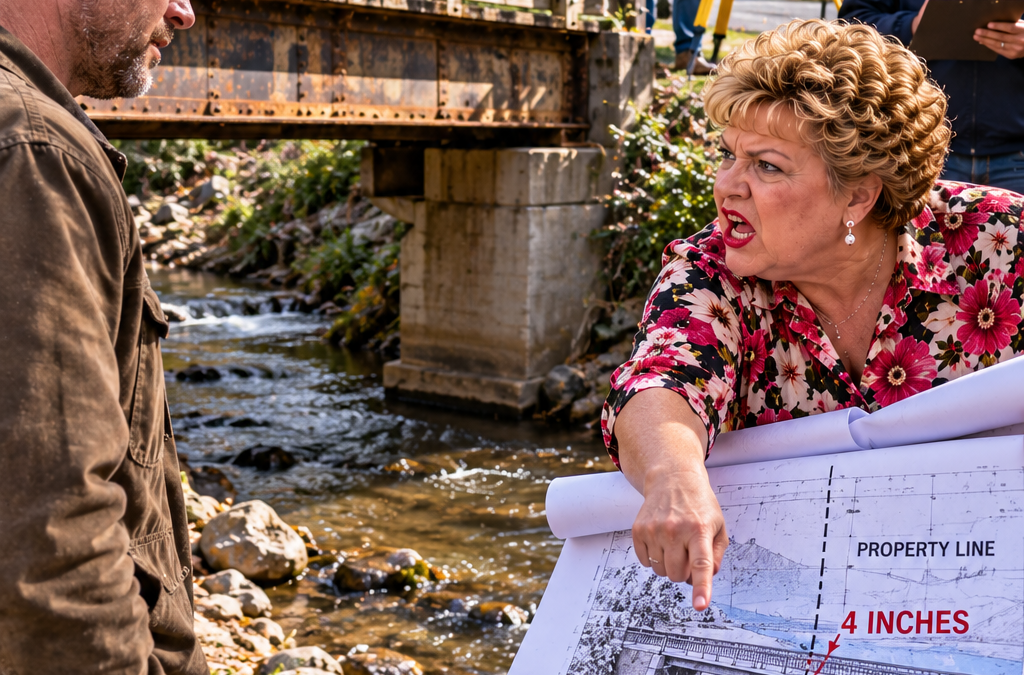
She unrolled the survey across the top rail of our fence.
The paper was crisp.
Stamped.
Professionally drafted.
Colored boundary lines.
Measurements.
Reference points.
She put one manicured finger on the eastern end of my bridge.
“Four inches.”
I looked at her.
“Excuse me?”
“This footing.”
She tapped the page.
“According to the survey, the eastern corner extends four inches across my property line.”
I followed the line with my eyes.
The survey was detailed enough that I didn’t immediately doubt the measurement.
What I doubted was the conclusion she had already attached to it.
“I didn’t build the bridge.”
“I know.”
“It was here when we bought the house.”
“I understand.”
“And probably before that.”
“That doesn’t change the boundary.”
“I didn’t say it did.”
She rolled the survey partly closed.
“I want the bridge removed.”
I thought I’d misunderstood.
“Removed?”
“Yes.”
“Because of four inches?”
“Because it crosses my property.”
I looked down toward the stream.
The bridge had been standing in that position for at least the eleven years we’d owned the property.
Probably much longer.
“Can we check the older records first?”
Victoria’s expression barely changed.
“My survey is current.”
“I’m sure it is.”
“Then I’m not sure what older paperwork is supposed to change.”
“It might explain why the bridge is there.”
She smiled.
Not kindly.
“Michael, I don’t need your permission to protect my property.”
“I didn’t say you did.”
“I’ve already consulted counsel.”
That surprised me.
She had barely finished moving in.
I looked again at the survey.
“How long have you been looking into this?”
“The survey was part of my purchase due diligence.”
“So you knew before you moved in?”
“I knew there were inconsistencies.”
“Did you check town records?”
“The licensed survey is the most accurate boundary document available.”
“That’s not what I asked.”
She folded her arms.
“Historical records don’t override current ownership.”
“Maybe not.”
I kept my voice level.
“But something that’s been sitting in the same place for decades usually has a story.”
“I didn’t purchase this property to inherit other people’s mistakes.”
There it was.
Not hostility exactly.
Certainty.
The kind that makes conversation impossible because the other person believes all uncertainty belongs to you.
Lauren came outside carrying coffee.
She still had her school lanyard around her neck.
“Morning.”
Victoria gave her a polite smile.
“Good morning.”
Lauren glanced at the survey.
“Problem?”
“Michael’s bridge crosses my line by four inches.”
Lauren blinked.
Then looked at the bridge.
“That bridge?”
“Yes.”
Lauren has a gift I don’t possess.
The louder a room becomes, the quieter she gets.
It works on third graders.
Sometimes it works on adults.
“Maybe the three of us could sit down this weekend,” she said. “Look at the old papers. Figure out what happened.”
Victoria reached into her folder.
“I don’t think that will be necessary.”
She handed me a letter.
Already printed.
Already signed.
It gave us fourteen days to remove the bridge or relocate it entirely off Victoria’s land.
If we failed, she would seek legal relief.
I read the first paragraph.
Then the last.
“You brought this before we even spoke.”
“The issue is straightforward.”
“Apparently.”
Lauren glanced at me.
I knew that look.
Don’t escalate.
I didn’t.
“All right.”
Victoria seemed surprised.
“All right?”
“I’ll review it.”
“The deadline is fourteen days.”
“I heard you.”
She rolled up the survey.
“I hope we can resolve this without unnecessary conflict.”
Then she walked away.
I stood there holding the letter while mist settled over the grass.
Across the stream, Emma sat beneath the maple tree with her sketchbook.
She had headphones on.
She hadn’t heard any of it.
Lauren looked at the letter.
“Four inches.”
“Apparently.”
“I don’t want a war over four inches.”
“Neither do I.”
“Then don’t make it one.”
I looked toward Victoria’s house.
“I didn’t bring the legal letter.”
“I know.”
Lauren touched my arm.
“Find out what’s true before you decide how angry to be.”
That sentence would become the center of everything.
At the time, I was mostly annoyed.
That night, I pulled out our closing file.
Deed.
Mortgage.
Inspection report.
Tax documents.
Title policy.
Plot plan.
Eleven years of ownership reduced to several inches of paper in a cabinet drawer.
I spread everything across the dining room table.
Lauren sat across from me grading spelling tests.
Emma was upstairs.
I read every page.
Then read them again.
The house was there.
The lot.
Setbacks.
Utility easements.
The stream.
Nothing about the bridge.
No permit.
No note.
No structure description.
No reference to a crossing.
It was strange.
The bridge was too substantial to have been improvised over a weekend.
Steel beams.
Concrete footings.
A span wide enough for a small utility vehicle.
Yet legally, at least inside our closing file, it was almost invisible.
That bothered me more than Victoria’s four inches.
The next morning, I called the title company.
After two transfers, I reached a woman named Carol.
She pulled up our old policy.
“Structures like sheds and footbridges aren’t usually itemized unless there’s a specific exception or title concern.”
“Would an old easement show?”
“Normally.”
“There’s nothing in my packet.”
“That doesn’t mean nothing exists.”
That answer caught my attention.
“What do you mean?”
She hesitated.
“Older municipal drainage corridors, utility agreements, things like that sometimes live in separate records. Especially in older developments.”
“Why wouldn’t they be in the closing package?”
“They should be if they directly burden title.”
“Should be.”
“Mr. Caldwell, I’m not telling you there’s anything there.”
“I know.”
“I’m saying older records aren’t always as clean as newer ones.”
“Who would have them?”
“The town. County recorder. Public works, maybe.”
I thanked her.
Two days later, the second letter arrived.
This one came from a law firm.
Victoria’s attorney informed me that I was no longer permitted to use any portion of the bridge resting on the disputed four inches.
Continued use could constitute trespass.
If I failed to remove the bridge, Victoria would seek a court order and request attorney fees.
Lauren read the letter.
Then placed it on the table as gently as if it were fragile.
“This got serious fast.”
“Yeah.”
“Did you notice the survey date?”
I looked.
The survey had been completed weeks before Victoria moved in.
She had known from the beginning.
This wasn’t something she discovered accidentally.
She planned a major renovation to her property.
An open garden.
New landscaping.
Stonework.
The bridge had shown up on the drawing as a defect in her plan.
Maybe that was all this was to her.
Not history.
Not access.
Four inches.
An obstacle.
That night, I couldn’t sleep.
Around midnight, I went downstairs.
Arthur Bennett, the previous owner, had left several boxes in a storage closet.
When we bought the place, he’d told me to throw away anything I didn’t want.
Eleven years later, most of it was still there.
Seed catalogs.
Old hardware receipts.
A broken lamp.
Christmas decorations from the 1980s.
At the bottom of one box, I found a cardboard folder tied with kitchen string.
Inside was a sheet of yellow drafting paper.
Hand-drawn.
Faded.
I carried it beneath the desk lamp.
A curved line represented the stream.
Property marks.
Measurements.
Then two penciled words.
Drainage access.
An arrow pointed almost exactly toward the bridge.
I stared at it for a long time.
Saturday morning, I put the sheet inside a plastic sleeve and walked next door.
Victoria answered holding her phone.
She looked at the drawing.
“Where did you get that?”
“Previous owner’s storage.”
She barely examined it.
“This is ancient.”
“It says drainage access.”
“Near a stream. That’s not remarkable.”
“It’s pointing at the bridge.”
“It’s pointing at an area.”
“Did your closing papers mention drainage?”
Her expression shifted slightly.
“Some boilerplate.”
“What kind?”
“Standard restrictions.”
“Can I see them?”
“No.”
I almost laughed.
“You want me to tear down a bridge because of four inches, but you don’t want to compare the paperwork.”
“My paperwork is not your concern.”
“The bridge apparently is.”
She crossed her arms.
“The town can prove whatever rights it has. Until then, my four inches are my four inches.”
I kept my tone even.
“Give me a few weeks.”
“No.”
“We split the cost of the records search. We hold everything where it is.”
“The deadline stands.”
“If that bridge has anything to do with drainage infrastructure, a judge might care.”
Victoria smiled thinly.
“Which is exactly why I’m not going to give you time to invent a story.”
That sentence stayed with me.
Not because it made me angry.
Because it told me she had already decided any history I found would be a tactic.
I went home.
Nine days later, someone knocked during dinner.
Emma answered.
I heard her call from the hallway.
“Dad?”
Something in her voice made me stand immediately.
She held a large envelope.
A man in a jacket was already walking back toward his car.
“What is this?”
I looked at the front.
County Court of Common Pleas.
My stomach dropped.
Victoria had sued us.
Not threatened.
Filed.
She wanted the court to declare the bridge an encroachment, order me to remove it at my expense, and reimburse her legal costs.
Lauren read the complaint at the kitchen table.
By page three, the color had left her face.
Emma sat across from us.
“What’s happening?”
“Nothing you need to worry about.”
That was a lie parents tell because the truth feels too large for the room.
She looked at the papers.
“Is this about the bridge?”
“Yes.”
“Can she make us take it down?”
“We don’t know.”
Emma looked toward the backyard.
“But that’s how I get to the garden.”
“I know.”
“What happens to the other side?”
“Nothing right now.”
She nodded slowly.
Then asked the question that broke something in me.
“Are we going to have to move?”
Lauren answered before I could.
“No.”
Her voice was calm.
Absolutely calm.
“We are not moving.”
Emma believed her.
I almost did too.
After she went upstairs, Lauren stood at the sink.
I heard her breathing.
“You okay?”
“No.”
She turned.
“I don’t want our daughter thinking we could lose our home over a bridge.”
“We won’t.”
“You don’t know that.”
“No.”
I hated saying it.
“But we won’t let fear make the decisions.”
She nodded.
“Then find out what the bridge is.”
I hired an attorney named Paul Whitaker.
Paul was soft-spoken, wore a gray cardigan to almost every meeting, and never seemed impressed by anyone’s certainty.
I liked him immediately.
He read the complaint.
Then looked at me.
“Does her survey appear valid?”
“Yes.”
“Good.”
I frowned.
“Good?”
“We don’t waste money proving something false if it’s true.”
“Four inches are hers.”
“Probably.”
“And that’s good?”
“It’s useful.”
He tapped the complaint.
“The question isn’t only where the boundary sits. It’s whether the bridge has some legal reason to be there.”
I showed him the yellow drawing.
He studied it.
“Interesting.”
“That’s what everyone keeps saying.”
“Interesting is not evidence.”
“I know.”
“You need paper.”
“From where?”
“Everywhere.”
So I started.
County cadastral maps.
Construction records.
Drainage files.
Public works archives.
Old permits.
Property records.
Everything.
I took unpaid afternoons off work.
Paid copying fees.
Paid Paul’s retainer.
Watched our savings shrink.
The bridge, which I had barely thought about for eleven years, entered every conversation.
Lauren slept badly.
So did I.
One night, while I was washing dishes, I heard Emma in the hall.
“Mom?”
“Yeah?”
“If we had to sell, could we take the garden stuff?”
There was a silence.
Then Lauren said, “We’re not selling.”
“But if—”
“No.”
Her voice stayed gentle.
“Nobody is packing this house.”
I stood at the sink with my hands in warm water and felt completely useless.
When Emma went upstairs, Lauren came in.
“I don’t want this turning into a war.”
“I don’t either.”
“Then what are you doing?”
“Trying to stop reacting.”
She waited.
“I need to understand the ground.”
That Monday, I called the town.
The clerk searched our address.
Then again.
“No bridge permit.”
“The bridge exists.”
“I’m sure.”
“I crossed it today.”
“Our electronic database doesn’t go back far enough.”
“Where are older records?”
“Archive.”
“Who runs it?”
Long pause.
“Helen Price.”
Helen answered on the second ring.
She sounded older.
Sharp.
Patient.
I gave her my address.
Described the stream.
Mentioned the bridge.
She went quiet.
Then asked:
“Is that bridge beside the east drainage line?”
Every hair on my arm lifted.
“I didn’t tell you about a drainage line.”
“No.”
“How do you know?”
“I don’t know anything yet.”
Her tone changed.
“I don’t guess from records I haven’t seen.”
“But you recognize the location.”
“I recognize the description.”
“Can you help?”
“Come tomorrow.”
Then she added, almost to herself:
“There was a box from the big flood.”
“What flood?”
“The bad one.”
“How bad?”
“Bad enough that people still talked about it twenty years later.”
The town archive was in the municipal basement.
Dust.
Metal shelves.
Old paper.
Radiator heat.
Helen met me at the stairs.
Reading glasses hung from a chain around her neck.
She had already found the box.
It sat on a long oak table.
She opened it carefully.
Photographs came first.
Our street underwater.
Not damp.
Not flooded at the curb.
Underwater.
Brown water covered yards.
Mailboxes rose out of it like markers.
A rowboat was tied to someone’s porch.
One photograph showed a young man standing waist-deep where Emma’s garden now sat.
I stared.
“When was this?”
Helen told me.
A stalled storm had dumped extraordinary rain over the valley.
The stream rose in hours.
Basements flooded.
Backyards disappeared.
One family lost almost everything.
Then she unrolled a large plan.
Town flood-recovery project.
The stream.
Properties.
Drainage pipe.
An inspection structure.
And the bridge.
My bridge.
Not exactly the same wood.
But the same crossing.
Same position.
A note beside it described reinforced reconstruction and access for maintenance machinery.
I leaned closer.
A shaded strip ran along the water.
Block letters:
MAINTENANCE ACCESS CORRIDOR.
I looked at Helen.
“Is this still valid?”
She removed her glasses.
“I don’t know.”
“But it existed.”
“According to this plan.”
“Why wasn’t it in my closing file?”
Helen shrugged.
“Old towns collect records the way houses collect boxes.”
She gave me a dry smile.
“People assume when they buy a home they receive the whole history.”
She tapped the plan.
“They usually receive the chapters somebody remembered to hand them.”
I wrote that sentence down.
Then called Daniel Mercer.
Town engineer.
Sixty-one.
Careful man.
The kind of engineer who could make caution sound like philosophy.
He listened.
Then said:
“Don’t draw conclusions from drawings.”
“What else should I draw them from?”
“The ground.”
I asked directly.
“Does the town own the bridge?”
“No.”
That confused me.
“It doesn’t?”
“No.”
“Then why is it on your plan?”
“I don’t know yet.”
“Does the town have rights there?”
“I don’t know yet.”
He paused.
“But do not remove anything until I inspect it.”
The next day, Victoria’s lawyer sent a settlement offer.
I would remove the bridge.
Pay the cost.
Agree never to rebuild.
In return, Victoria would drop her demand that I reimburse her attorney fees.
“Generous,” the cover letter called it.
I showed Paul.
He read it.
“No.”
“That was fast.”
“You don’t sign permanent restrictions while basic facts are unresolved.”
Lauren agreed.
We waited.
Daniel came Thursday morning.
Hard hat.
Reflective vest.
Metal probe.
Tablet.
Folding rule.
He spent nearly an hour under the bridge.
Checked the concrete.
Steel.
Bank.
Slope.
Then walked thirty feet east.
He stopped where the grass grew slightly thicker.
Kneeled.
Brushed away soil.
And uncovered a round iron cover.
Two feet across.
I had mowed over it for eleven years.
Never seen it.
Daniel wiped the rim.
“Inspection cover.”
“For what?”
“Drainage system.”
My heartbeat increased.
“So the bridge—”
“Stop.”
He held up one hand.
“This proves there’s a system.”
“Not the bridge’s role.”
“Exactly.”
He stood.
“Let’s keep facts separate from hope.”
I respected him for that.
Then the back gate slammed.
Victoria crossed the yard in shoes completely unsuited for wet grass.
“What is going on?”
Daniel introduced himself.
She looked at his town logo.
Then at me.
“This is a private property dispute.”
Daniel said, “I’m inspecting municipal drainage infrastructure.”
“It has nothing to do with the bridge.”
“Maybe.”
“Not maybe.”
Her voice sharpened.
“That bridge is encroaching on my property.”
Daniel remained calm.
“I’m not addressing ownership.”
“Then what are you doing?”
“Making sure nobody removes something before we understand whether removing it affects access.”
Victoria turned to me.
“You are manufacturing this.”
“I called the town.”
“You’re using public infrastructure as an excuse.”
Daniel said quietly:
“Ma’am, in my professional opinion, no one should alter the crossing until we’ve completed review.”
She looked at him.
Then at me.
For the first time, I saw uncertainty beneath her anger.
Two days later, she filed an emergency motion asking the court to order immediate removal.
Paul called.
“She wants the bridge down before the full case.”
“When?”
“Hearing in twelve days.”
I sat at the kitchen table after midnight unable to sleep.
Legal systems are designed to move deliberately.
But sometimes a temporary order can move faster than understanding.
If the bridge came down first, whatever we discovered afterward might become academic.
Lauren lay beside me.
“What are you going to do?”
“Stop arguing.”
“What does that mean?”
“Compare.”
The next evening, I covered the dining table with maps.
Victoria’s survey.
Old drainage drawing.
Subdivision plan.
Tax map.
I traced every line.
Near the east footing, the modern survey and old plan disagreed slightly.
Not enough to call either fraudulent.
Different methods.
Different eras.
Different reference points.
Four inches.
Could be completely correct.
That became strangely comforting.
I didn’t need her survey to be wrong.
I needed to know what those inches were carrying.
Then I called Arthur Bennett.
The man who sold us the house.
Seventy-eight now.
Living in a condominium near his daughter.
“Michael?”
“Arthur. Sorry to bother you.”
“You finally find something wrong with the furnace?”
“Bridge.”
Long pause.
Then:
“Come over.”
His apartment smelled like pipe tobacco and furniture polish.
He made tea.
I told him everything.
The lawsuit.
Survey.
Four inches.
Flood records.
Arthur closed his eyes.
“I should’ve told you.”
My stomach tightened.
“Told me what?”
“The flood.”
“You remember it?”
“Everybody remembers that flood.”
He described water tearing through yards.
Part of the old bridge washed out.
Afterward, the town helped rebuild it.
“Helped how?”
“Money. Plans.”
“Plans?”
Arthur nodded.
“A man from the town came out with rolled drawings.”
“Did he decide where the bridge went?”
“That’s the strange part.”
Arthur leaned closer.
“They moved it.”
“How far?”
“Not far.”
“Why?”
“I asked.”
“And?”
“He said something about access.”
Arthur shook his head.
“I thought the details were in the papers.”
“They weren’t.”
“I’m sorry.”
He looked at me over his cup.
Then said:
“They didn’t move it for the land, Michael.”
“What?”
“They moved it for the water.”
I drove straight to the archive the next morning.
Helen listened.
Then disappeared into the shelves.
Forty minutes later, she returned carrying old town council minutes.
A motion passed after the flood:
Reconstruct crossing slightly east of prior position to preserve emergency maintenance corridor.
I read it three times.
A public works memo accompanied it.
Access to outlet gates and control chamber must remain unobstructed.
Heavy equipment may require crossing during high-water operations.
The bridge hadn’t drifted across Victoria’s line accidentally.
It had been repositioned deliberately after a disaster.
But one question remained.
How could the town rely on access across privately owned ground?
Daniel went to the county recorder.
At six that evening, he called.
“Found it.”
I sat up.
“What?”
“Recorded notation.”
He explained slowly.
The lots along the stream were burdened by a limited access right serving drainage infrastructure.
Including the parcel now owned by Victoria.
“So the town owns those four inches?”
“No.”
Important distinction.
“Victoria owns them.”
“Then how does this help?”
“Ownership and unrestricted control aren’t the same thing.”
He continued.
“If recorded access rights burden that land, she owns the soil subject to those rights.”
I leaned back.
All at once, the dispute looked different.
Victoria’s survey could be completely correct.
She could own every disputed inch.
And still lack the right to destroy something occupying that space if doing so interfered with a recorded drainage corridor.
Then Daniel found something even stronger.
Victoria’s own closing documents.
An exhibit attached to her purchase.
Recorded.
Signed.
Initialed.
It disclosed drainage restrictions, access rights, and infrastructure obligations tied to the stream.
I stared at the copy.
Her initials were beside the paragraph.
Blue ink.
She had been told.
Maybe she hadn’t understood.
Maybe she hadn’t read carefully.
But legally, the warning existed.
Paul called me at nine that night.
For the first time, he sounded excited.
“This changes the case.”
“Enough?”
“It changes the question.”
“Meaning?”
“She came in asking whether your bridge crosses her property.”
“It does.”
“Now we ask whether she can remove a structure sitting inside a recorded access corridor.”
“Can she?”
“That’s what the judge decides.”
There was one more discovery.
A design sheet buried in an old recovery binder.
Daniel and Helen showed it to me the next morning.
Detailed dimensions.
Load notes.
Construction specifications.
At the bottom:
Crossing to be maintained in present location so as not to obstruct equipment access to outlet structure and control chamber.
I read it aloud.
Then again.
Daniel stopped me from overreaching.
“This does not make your bridge public property.”
“I know.”
“It does not transfer ownership.”
“I know.”
“It shows the town designed its drainage recovery around this crossing remaining here.”
I looked at him.
“That’s enough.”
“No.”
His expression stayed serious.
“It’s evidence.”
He tapped the document.
“Don’t turn evidence into a verdict before court does.”
The hearing came Tuesday.
Small courtroom.
Pale wood.
Flag in the corner.
Clock loud enough to hear.
Victoria sat at the opposite table in a charcoal suit.
Her attorney, Curtis Bell, made a clean argument.
His client owned the land.
The survey established the encroachment.
No private owner should be forced to tolerate a structure on her property.
Everything he said was technically true.
That made it powerful.
Then Paul nodded toward me.
I stood.
He had drilled one sentence into me all week.
Agree with everything true.
So I did.
“I do not dispute that Ms. Hardgrove owns the land.”
Victoria’s lawyer looked sideways at her.
I continued.
“I did not build the bridge.”
“It existed before I purchased the home.”
“Town records show that after a major flood, the crossing was reconstructed in its current position as part of a drainage-recovery plan.”
I described the corridor.
The buried inspection cover.
The council minutes.
The recorded rights.
Then Paul introduced the disclosure exhibit from Victoria’s closing.
Her lawyer objected carefully.
The judge reviewed it.
No theatrics.
No dramatic revelation.
Just paper.
Then Martha Reeves testified.
Head of infrastructure management.
Fifty-eight.
Navy blazer.
The kind of person whose authority came from knowing exactly what she was talking about.
She confirmed the town did not own the bridge.
But she also confirmed that infrastructure records identified the crossing as part of the access plan for the drainage system.
The judge asked:
“Has the town ever requested removal of the bridge?”
“No.”
“Why not?”
Martha answered:
“It has never been in the way.”
The judge looked at both sides.
“The question before this court appears more complicated than a four-inch boundary encroachment.”
Those words released something inside me.
She did not rule.
She continued the case.
Ordered nothing changed.
No demolition.
No alteration.
Preserve the status quo.
For the first time in two months, I breathed normally.
Victoria remained seated after the hearing.
Still.
Calculating.
Her lawsuit had started as a simple property-line case.
Now she had to contend with something she had not wanted to see.
Purpose.
The second hearing came eleven days later.
This time, the judge began with Victoria’s closing package.
She read the drainage exhibit.
Victoria’s initials.
Her signature.
The judge asked if she’d read it.
Victoria answered carefully.
“I understood it as a general stream-related restriction.”
“Did you investigate the specific access corridor?”
“No.”
“Why not?”
“I had no reason to believe it affected the bridge.”
It wasn’t a foolish answer.
That mattered to me.
I didn’t want to turn her into a monster just because she was wrong.
She had seen a clean boundary.
A structure over it.
A property right.
She had simply stopped reading when the facts supported the conclusion she preferred.
When I was allowed to speak, I looked toward the judge.
“I understand why Ms. Hardgrove was upset.”
Victoria looked at me.
“She bought a home and wanted to make it her own.”
I paused.
“But if either of us had understood these records from the beginning, I don’t believe we would’ve spent months here.”
I meant it.
The ruling arrived several days later.
Paul called while I stood beside my truck.
“Ready?”
“No.”
“Too bad.”
He read it.
The court recognized Victoria’s ownership of the disputed four inches.
I closed my eyes.
Then:
Her request to remove the bridge was denied.
I opened them.
The court found that a structure within a recorded access corridor serving public drainage could not be treated as an ordinary trespass without considering those recorded rights.
Neither party could alter the bridge or corridor without coordinating with the town.
The bridge stayed.
I sat on the tailgate after the call.
My hands shook.
Not victory.
Relief.
There is a difference.
I didn’t want Victoria to lose her land.
I didn’t want four inches transferred to us.
I wanted the bridge to remain where history and infrastructure had put it.
Before the case closed, I proposed an agreement.
Boundary clearly marked.
Victoria keeps full ownership of her land.
Maintenance corridor remains open.
Bridge stays.
Neither of us alters the structure without notice to the other and the town.
Victoria reviewed it with her lawyer for nearly an hour.
Then signed.
She did not look at me.
I didn’t need her to.
The agreement included a sentence acknowledging that the bridge could not simply be removed at will.
For someone who made a living around property documents, I imagine signing that was difficult.
But she signed.
And I respected that.
News spread around the neighborhood.
The man who had stopped waving began again.
Someone at the hardware store asked what really happened.
I gave him the short version.
“The survey was right. There was also an old drainage corridor.”
That was enough.
I did not throw a party.
Didn’t post court papers online.
Didn’t tell people Victoria had tried to destroy public infrastructure.
Because that would not have been accurate.
She had made a mistake.
An expensive one.
A stubborn one.
But I had spent months insisting the full truth mattered.
That obligation applied to me too.
One Saturday, I installed a small sign near the eastern end of the bridge.
White background.
Black letters.
MAINTENANCE ACCESS
KEEP CLEAR
Lauren stood beside me.
“Good size.”
“Meaning?”
“Large enough to see.”
“And?”
“Small enough that you don’t look smug.”
“That’s what I was going for.”
The sign wasn’t a monument to winning.
It was an explanation.
Something that should probably have existed decades earlier.
I thought that was the end.
Then the rain came.
Three weeks later.
Two days of hard autumn rain.
The stream turned brown and fast.
On the second morning, a town truck came up our driveway.
Daniel stepped out.
Two public works employees unloaded a compact utility machine.
I walked into the rain.
“Need anything?”
“Just access.”
The words hit me harder than they should have.
I stepped aside.
They drove across the bridge.
The bridge Victoria had wanted removed.
The bridge I had thought was merely the way to Emma’s garden.
The machine crossed slowly.
Steel underneath.
Timber above.
Exactly as those old plans had anticipated.
Thirty feet beyond the bridge, the crew opened the iron inspection cover.
Lights went down.
A gauge was checked.
Debris cleared.
Water flow confirmed.
Within an hour, they were done.
No emergency.
No flood.
No disaster.
Lauren carried coffee outside.
Daniel accepted his.
He stood beside me as the crew packed up.
“If this bridge had come down?”
“They would’ve found another way.”
“How?”
“Heavier equipment. Temporary crossing. Possibly neighboring access.”
“Expensive.”
“Probably.”
I looked at the stream.
“So the bridge didn’t save anything today.”
Daniel shook his head.
“No.”
Then he smiled faintly.
“That’s what good infrastructure usually looks like.”
“What?”
“Nothing happening.”
I understood.
The most valuable systems are often invisible until they fail.
That afternoon, I stood in the middle of the bridge.
Water moved beneath me.
For eleven years, I had thought it existed because somebody needed to get across a stream.
Now I knew that wasn’t the whole story.
A flood had destroyed property.
A town had rebuilt.
Engineers had studied water.
Someone had decided where machinery needed to reach.
Workers had poured concrete in a slightly different place.
Then decades passed.
People retired.
Files moved into basements.
Owners changed.
Memory faded.
The bridge remained.
History isn’t always dramatic.
Sometimes it looks like old steel quietly doing its job while nobody remembers why.
Victoria came over one final time about a week later.
No folder.
No survey.
No lawyer.
She stopped near the new boundary marker.
Hands in her coat pockets.
I walked outside.
“Morning.”
“Michael.”
She looked at the bridge.
Then the sign.
Then the grass.
“I have to redesign part of the garden.”
“I’m sorry.”
“I doubt that.”
I smiled slightly.
“You’re right.”
That almost made her smile.
Then she said:
“I should have checked the old records.”
I was quiet.
It would have been easy to say yes.
Easy to make her sit in the mistake.
Instead I thought about the first weeks.
About my own closing file.
About how little I had known.
“I got lucky.”
She looked at me.
“I owned the place eleven years and didn’t know either.”
“That’s different.”
“Not completely.”
“You weren’t trying to renovate across the corridor.”
“No.”
“But I also assumed the papers I had were the whole story.”
She looked toward the stream.
“I wanted the property clean.”
“I understand.”
“The survey gave me a line.”
“It was the right line.”
She looked at me.
That mattered.
“You’re admitting it.”
“I never denied it.”
“Most people would’ve.”
“Paul wouldn’t let me.”
She gave a short laugh.
Then grew serious.
“My former husband warned me.”
I didn’t know that at the time.
“About what?”
“The drainage exhibit.”
She stared toward her house.
“He told me to investigate it before I closed.”
“And you didn’t?”
“No.”
“Why?”
“There was another buyer.”
The answer came without defense.
“I wanted the property.”
I nodded.
“Sometimes wanting an answer makes it easier to stop reading.”
She looked at me.
“Is that supposed to make me feel better?”
“No.”
“Good.”
Then she gave one small nod.
“I’m glad it’s finished.”
“So am I.”
We never became friends.
That would have been dishonest.
But we became neighbors.
Actual neighbors.
Marked line.
Known rights.
No assumptions.
No threats.
No letters.
There is a kind of peace that comes from liking someone.
There is another kind that comes from understanding exactly where both of you stand.
We had the second.
Our house slowly returned to normal.
Lauren slept through the night.
Emma crossed the bridge every afternoon.
The lawsuit stopped appearing in every dinner conversation.
One evening, Emma sat on the far bank sketching.
I walked over.
She looked down at the boards.
“Dad?”
“Yeah?”
“Why did the town keep records of this for so long?”
I sat beside her.
“Because there was a flood.”
“I know.”
“And people got hurt financially. Homes were damaged.”
“So they built the drainage system?”
“Improved it.”
“And moved the bridge?”
“Yes.”
She looked at the stream.
“Four inches.”
“Apparently.”
“That’s weird.”
“History usually is.”
She drew another line in her sketchbook.
“Did Mrs. Hardgrove almost make another flood happen?”
“No.”
Important.
I wanted her to understand.
“Don’t tell the story that way.”
“But Daniel said—”
“He said access would have been harder.”
“So it could’ve been bad.”
“Maybe.”
I shook my head.
“We don’t need to make someone more wrong than they were.”
She looked at me.
“Why?”
“Because then we’d be doing what we were angry about.”
She thought.
“Jumping to conclusions?”
I smiled.
“Your mother’s daughter.”
Lauren overheard that story later and approved.
“Good answer.”
“I have them occasionally.”
She stood at the kitchen counter folding laundry.
Then said:
“Do you know what I kept imagining?”
“What?”
“Moving boxes.”
I looked up.
“During the lawsuit.”
She folded one of Emma’s shirts.
“I kept imagining empty rooms.”
Another fold.
“Emma saying goodbye to the garden.”
I didn’t say anything.
She smiled faintly.
“And now sometimes I’m standing outside hanging laundry and I catch myself feeling happy for no reason.”
“Relief.”
“Yeah.”
She put the shirt down.
“It’s physical.”
“I know.”
“Like setting down a bag you forgot you were carrying.”
That was exactly it.
The old records went into our closing drawer.
Deed.
Title policy.
Flood photographs.
Council minutes.
Drainage plan.
Recorded access notation.
Court order.
Final agreement.
The house’s missing chapters.
I told Emma that if we ever sold, the next owner would get all of it.
Every page.
She said:
“So they don’t get sued?”
“That’s the dream.”
Years have passed since then.
The bridge is older.
So am I.
I’ve replaced more boards.
The steel underneath is still sound.
Town crews cross it occasionally.
Not often.
Most years, it exists without anyone needing to think about it.
Which, as Daniel taught me, is the best thing infrastructure can do.
Victoria completed her garden.
It stops neatly outside the corridor.
From our side, it actually looks beautiful.
She still owns the four inches.
That part of the story matters.
If someone tells this as though I defeated a greedy neighbor and took the disputed land, they’re telling it wrong.
I didn’t win four inches.
They were never mine.
What I won—if that word even belongs here—was time.
Time to ask why.
Time to open old boxes.
Time to find Helen.
Time for Daniel to probe the ground.
Time for Arthur to remember.
Time for a judge to look beyond one clean line on a modern survey.
Victoria’s survey told the truth.
It just didn’t tell all of it.
That distinction changed the way I think about property.
Before this, I thought ownership mostly meant boundaries.
My side.
Your side.
A line.
A deed.
A measurement.
Now I know land carries layers.
Rights.
Restrictions.
Agreements.
Old promises.
Public needs.
Private use.
History written by people who may have been dead for decades before you ever held the keys.
Sometimes the most important fact about a piece of ground is not who owns it.
It’s what that ground has been asked to do.
A utility easement carries power.
A drainage corridor carries water.
An access road carries people.
Ownership remains real.
But ownership is not always absolute.
That lesson cost me legal fees, unpaid work, weeks of lost sleep, and more fear than I care to admit.
I wish I had learned it from a book.
Instead, I learned it from four inches.
Every spring, the stream rises.
Not dangerously most years.
Just enough to remind us it is not decoration.
Water moves where gravity tells it.
It doesn’t care about surveys.
It doesn’t recognize fences.
It doesn’t know whose lawyer wrote what.
People build systems around that reality.
Then decades pass and we forget why the systems exist.
That’s dangerous.
Not because old decisions are always right.
They’re not.
Old infrastructure can become obsolete.
Old easements can become unnecessary.
Old rules can be wrong.
But before removing something that has survived fifty years, ask why nobody removed it sooner.
That is the question Victoria didn’t ask.
It’s also the question I nearly failed to ask myself.
If I had taken her first letter at face value, I might have hired someone.
Removed the bridge.
Paid for the demolition.
Signed her settlement.
Maybe felt angry for years.
Then one rainy season, the town would have discovered its access gone.
Maybe they would’ve built another crossing.
Maybe entered through Victoria’s property.
Maybe nothing dramatic would’ve happened.
But the decision would have been irreversible before anybody understood it.
That’s what scared me afterward.
Not how close I came to losing the bridge.
How close all of us came to making a permanent decision based on an incomplete story.
Lauren had been right from the beginning.
Find out what’s true before deciding what to feel.
I used to think certainty came first.
Measure.
Diagnose.
Conclude.
Now I know good certainty is slower.
You gather.
Compare.
Question.
Admit what the other side has right.
That last one matters most.
In court, the strongest sentence I spoke was the one I least wanted to say:
I do not dispute that Ms. Hardgrove owns the land.
That sentence freed everything else.
Once I stopped trying to make her wrong about the boundary, we could finally talk about what the boundary did not answer.
The bridge still crosses the stream.
Emma is older now.
She doesn’t sit beneath the maple every afternoon anymore.
Life pulls children outward.
But when she comes home, she still walks across it sometimes.
The old garden has changed.
Lauren grows tomatoes there.
I keep pretending not to care and eating most of them.
The maintenance sign remains near the eastern footing.
Black letters fading slightly.
KEEP CLEAR.
Occasionally someone asks about it.
I tell them:
“Town access.”
That’s usually enough.
The whole story takes too long.
But some evenings, especially after rain, I stand in the middle of the bridge.
Water runs beneath the planks.
The steel vibrates faintly under my boots.
And I think about the men who rebuilt it after the flood.
I don’t know their names.
I know Arthur remembered one of them wearing a town windbreaker.
I know someone moved the footing slightly east.
I know someone drew a corridor.
Someone wrote meeting minutes.
Someone filed a notation.
Someone put a design sheet in a binder.
Someone stored that binder in a box.
Someone forgot the box.
Helen remembered it.
Daniel understood it.
Paul knew how to present it.
Lauren kept me from turning fear into anger.
And Victoria, without meaning to, forced all of us to rediscover it.
That may be the strangest part.
If she had never challenged the bridge, I might have lived another thirty years without understanding it.
I would have crossed it.
Replaced boards.
Mowed over the iron cover.
Never asked.
The bridge would have remained useful while its reason disappeared.
Now the reason is written down.
Not only in a basement archive.
In my drawer.
In the town’s updated infrastructure file.
In the court record.
In the agreement between two neighboring properties.
That matters to me.
Not because I need proof that I was right.
Because someday the house will belong to someone else.
Victoria’s house will too.
The four inches will still be hers or whoever owns that parcel.
The bridge may eventually need replacement.
The drainage system may be redesigned.
But the next people won’t have to begin with ignorance.
They’ll know.
They’ll know who owns the ground.
They’ll know who has access rights.
They’ll know why the bridge sits slightly east of where someone might expect.
And if they decide to change it, they can make that decision with the whole story in front of them.
That’s what a good property record should do.
Not preserve old things forever.
Preserve the reasons long enough for someone to make an informed choice.
Victoria taught me another lesson too.
Precision can be seductive.
Four inches sounded unquestionable.
Exact.
Scientific.
Legal.
It gave the dispute a simplicity it never actually possessed.
People heard four inches and immediately chose a side.
Either I was absurd for fighting over so little.
Or she was absurd for caring about so little.
Both interpretations missed the real issue.
The number was accurate.
The meaning was incomplete.
That’s true about more than surveys.
Sometimes a number tells you where something is without telling you why it’s there.
Sometimes a contract tells you who owns something without telling you every obligation ownership carries.
Sometimes the newest document is the most precise and still isn’t the oldest truth.
Whenever someone tells me now that a dispute is “obvious,” I get suspicious.
Obvious compared with what?
Which document?
Which date?
Which assumption?
What are we not looking at?
I don’t say all that aloud.
I’d become unbearable.
Usually I just nod.
But I think it.
Because I remember Victoria’s finger on that survey.
Four inches.
I remember how small the number looked.
And I remember everything hidden beneath it.
A flood.
A pipe.
A control chamber.
A maintenance corridor.
A buried iron cover.
Town minutes.
A reconstructed crossing.
A signed disclosure.
Decades of forgotten responsibility.
None of those things made the four inches disappear.
They made the four inches make sense.
That was the difference.
One evening after a hard autumn rain, I walked outside.
The stream was high but clear.
Leaves spun past beneath the bridge.
The air smelled like wet soil and cold stone.
I stood at the center.
Same place I’d stood hundreds of times.
Same weathered boards.
Same rusted steel.
Same eastern footing extending those four inches into land that legally belonged to my neighbor.
And for the first time in a long time, I didn’t think about the lawsuit.
I didn’t think about Victoria.
Didn’t think about attorney fees.
Didn’t think about survey lines.
I thought about purpose.
For months, I believed I was defending a bridge.
I wasn’t.
A bridge can be rebuilt.
Wood replaced.
Steel replaced.
Concrete poured again.
What I had really been defending was the reason the bridge stood there.
And that reason had survived only because enough scraps of paper, enough memories, and enough careful people remained to reconstruct the truth before somebody tore it down.
Sometimes the most important thing beneath your feet isn’t what you can see.
Sometimes it’s the story underneath it.
And sometimes four inches can be completely, perfectly accurate while still being nowhere near the whole truth.








