𝗙𝗨𝗟𝗟 𝗦𝗧𝗢𝗥𝗬 My Neighbor Spent Eight Months Building a $60,000 Deck Twelve Feet Onto My Property
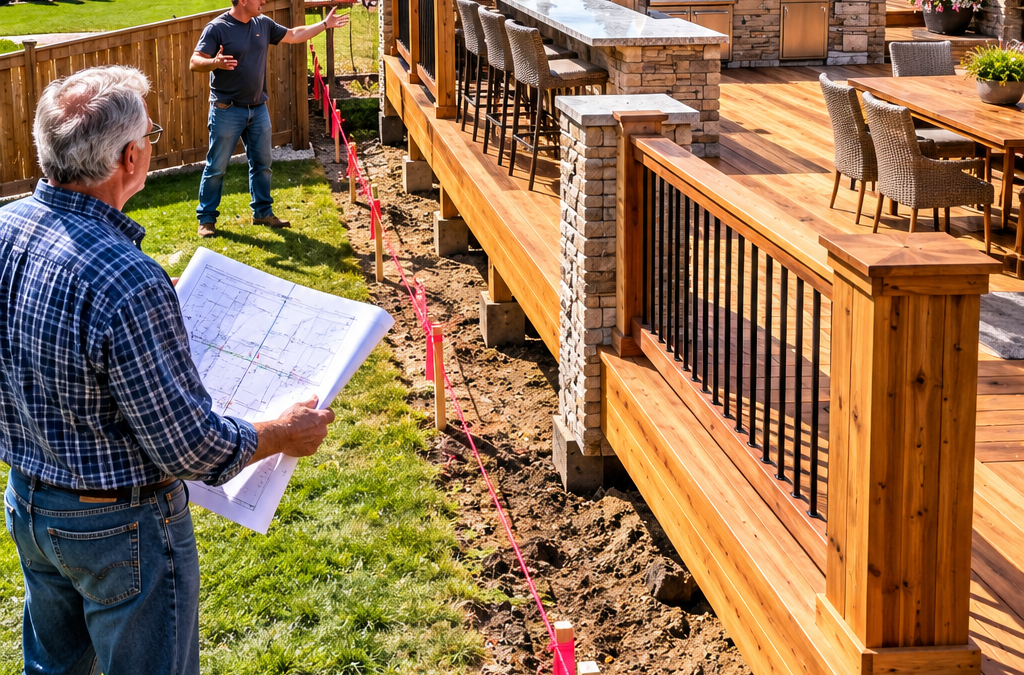
𝗙𝗨𝗟𝗟 𝗦𝗧𝗢𝗥𝗬
His smile faded slightly.
I walked home.
At a block association gathering a few weeks later, I heard him telling another neighbor that he had moved into the area because he believed the street was “one good improvement cycle away from becoming genuinely upscale.”
The phrase became a joke among three of us afterward.
Improvement cycle.
We had sixty-year-old maple trees, modest houses, families who had been there for decades, kids riding bikes, and neighbors who shoveled one another’s sidewalks.
Garrett saw an underdeveloped investment opportunity.
I saw home.
So I kept my distance.
We weren’t enemies.
I didn’t have enough interest in him for that.
We nodded when we saw each other.
Occasionally exchanged a sentence about weather or garbage pickup.
Nothing more.
Then came the spring when Garrett decided he needed a deck.
I learned about it on a Saturday morning while sweeping my garage.
He stood in his driveway talking to two neighbors and raised his voice when he saw me.
“Raymond!”
I looked over.
“You’re going to like this.”
That sentence alone made me suspicious.
He pointed toward his backyard.
“I’m putting in a destination deck.”
I had never heard anyone use the phrase destination deck before.
“What does that mean?”
“Outdoor kitchen. Cedar. Integrated lighting. Stone countertops. Entertaining space. The whole thing.”
One of the neighbors whistled.
Garrett smiled.
“I’m done doing things halfway.”
I glanced toward the rear of his house.
“How large?”
“Big enough.”
He laughed.
“Contractor says it’ll add serious value not just to my property, but honestly probably the whole street.”
There was the Garrett I knew.
Even his deck was apparently a public service.
“Sounds expensive.”
“Quality costs.”
“I suppose.”
“We’ll get you over when it’s done.”
“Sure.”
I went back into my garage.
That should have been the end of my involvement.
But that afternoon, I noticed wooden stakes in the ground along the side of Garrett’s backyard.
I had spent too many years around layout work not to notice stakes.
I looked once.
Then again.
Something felt wrong.
Not dramatically wrong.
Just misplaced.
The rear half of our properties had always been a little deceptive.
There was no fence separating the side yards behind the houses.
The lawns flowed into one another.
A row of old shrubs sat several feet inside my property, and over the years both Garrett and the previous owner had treated the open grass between the shrubs and his patio as if it naturally belonged to the neighboring lot.
I never cared.
It was grass.
The previous family sometimes walked across it while gardening.
I used part of Garrett’s sideyard path to reach my rear utility area when my own route was muddy.
We had both benefited from informal neighborliness.
Informality works beautifully until somebody pours concrete into it.
That evening, I opened the bottom drawer of my office filing cabinet.
Inside was a blue folder labeled:
PROPERTY — SURVEY / TITLE / EASEMENTS.
I had not opened it in years.
The survey was dated 2002, commissioned when I bought the house.
I carried it to the kitchen table and flattened it beneath two coffee mugs.
The line between my lot and Garrett’s was exactly where I remembered.
It did not run parallel to the current visual division between our lawns.
It angled.
Only slightly at first.
Then farther toward Garrett’s house as it approached the rear boundary.
That geometry mattered.
I stood at the kitchen window with the survey in my hand.
The stakes Garrett’s contractor had placed were not following that angle.
They were following the lawn.
I went outside with a tape measure.
I didn’t cross onto his property.
I didn’t move a stake.
I measured from known reference points on my own lot.
Then I came inside.
I performed the same calculation twice.
The deck, if built according to those stakes, would cross my boundary.
Not by inches.
By feet.
At the farthest point, maybe ten.
Possibly twelve.
I sat at the table.
A normal neighbor would probably have walked next door immediately.
“Garrett, I think your layout is wrong.”
That is what most people later told me they would have done.
Maybe they would have.
I didn’t.
Part of the reason was professional instinct.
A twenty-two-year-old survey is useful, but if a boundary dispute is coming, you don’t start one based solely on your own interpretation of an old copy.
You verify.
The other part was Garrett.
For three years, he had made a hobby out of correcting other people.
My fence.
My truck.
Someone else’s landscaping.
Another neighbor’s basketball hoop.
He had never once walked over and asked a question before making a complaint.
Now he was about to build something permanent beside my property without asking whether anyone had verified the boundary.
I remember thinking:
Interesting.
I folded the survey.
Put it back in the drawer.
And waited.
Three weeks later, excavation began.
Garrett hired a contractor named Dale Mercer.
Dale was the opposite of Garrett.
Quiet.
Methodical.
Skilled.
I spoke to him for the first time when he was unloading lumber.
“Morning.”
He nodded.
“Morning.”
“Big project.”
He looked toward the framing plan.
“Pretty big.”
“You do the design?”
“Architect did. We build.”
“Nice work.”
“Thanks.”
I almost asked whether they had a boundary survey.
Almost.
Then Garrett came outside.
“Raymond!”
He walked toward us smiling.
“She’s finally happening.”
“So I see.”
He slapped one of the posts.
“Forty years from now, this deck will still be standing.”
Dale looked at the post, then at Garrett.
“Let’s get through inspection first.”
Garrett laughed.
“That’s why I hired you.”
I said nothing.
The footings went in.
Then the framing.
Every week, the structure became harder to ignore.
Garrett had not exaggerated.
It was enormous.
The main platform extended across much of his backyard and wrapped toward the shared side.
There were multiple levels.
Heavy beams.
Proper joist spacing.
Clean blocking.
Dale’s crew did excellent work.
The irony was painful.
A bad deck would have been easier.
What they were building was beautiful.
And every piece made the eventual problem more expensive.
I kept watching.
At the end of the first month, I estimated Garrett had spent at least fifteen thousand dollars.
Concrete.
Framing lumber.
Labor.
Hardware.
Had I stopped him then, he would have been furious.
But the financial damage would still have been manageable.
I knew that.
I chose not to stop him.
That part matters.
I am not going to pretend I was innocent.
I had reasons.
But I also had a choice.
And I made it consciously.
I wanted Garrett to experience the weight of the same arrogance he had imposed on everyone else.
He believed boundaries belonged to whoever spoke most confidently.
He believed other people’s property could be commented on, reported, corrected, and improved according to his standards.
Now he was building across an actual legal boundary because he had apparently decided visual assumption was good enough.
There was a certain symmetry to it.
By June, the cedar arrived.
I remember the truck because even I was impressed.
The boards were gorgeous.
Clear western red cedar with rich honey color and tight grain.
Not inexpensive material.
Garrett stood outside while the crew unloaded it like a man receiving a shipment of gold.
He saw me.
“Premium grade.”
“I can see that.”
“You know wood?”
“Enough.”
“Dale says we’ll get twenty-five years out of it easy.”
“Longer if you maintain it.”
He grinned.
“That’s the plan.”
I looked at the stack.
Then toward my invisible property line beneath the half-built frame.
“You’re putting a lot into this.”
“Fifty grand minimum.”
“That much?”
“Probably sixty when the kitchen is done.”
He said it proudly.
I nodded.
“That’s serious money.”
“Worth it.”
He pointed toward my house.
“You should do something like this over there.”
“I have a chair.”
He laughed.
“You really don’t care about resale value, do you?”
“I’ve lived here twenty-two years.”
“Exactly. Eventually you’ll sell.”
“Eventually I’ll die too. I’m not planning the week around it.”
Dale laughed from across the yard.
Garrett didn’t.
Construction continued.
Built-in stair lighting.
Electrical runs.
Gas line.
Outdoor speakers.
Pergola beams.
Stone veneer.
A full kitchen island began taking shape along the side closest to my property.
That was the most remarkable part.
The kitchen was almost entirely over the boundary.
Built-in grill.
Stone countertop.
Under-counter refrigerator.
Storage cabinets.
Garrett’s expensive centerpiece was, legally speaking, sitting on my land.
Every few weeks, I pulled out the survey and checked again.
Not because the boundary changed.
Because I wanted to make sure I wasn’t letting emotion override precision.
Engineers distrust conclusions they enjoy too much.
Enjoying a result is exactly when you should recheck your arithmetic.
My numbers stayed the same.
By late July, I decided an old survey was no longer enough.
I called a licensed surveyor named Martin Hale.
I told him I wanted the shared boundary formally retraced.
“Dispute?”
“Possibly.”
“Structures?”
“One.”
“How close?”
“Depends on whether I’m remembering correctly.”
He laughed.
“You engineers.”
“What?”
“You know exactly how close.”
“I want you to tell me.”
“Fair.”
His crew came out while Garrett was at work.
They located monuments.
Pulled recorded plats.
Used modern GPS equipment.
Established the boundary.
Then they set discreet survey points.
Martin called two days later.
“You were right.”
“How far?”
“Twelve feet maximum encroachment.”
I closed my eyes.
“Exactly?”
“Eleven feet eleven and three-eighths at the far corner. Call it twelve.”
“And the kitchen?”
“Inside your parcel.”
“All of it?”
“Nearly the entire island footprint.”
“Deck stairs?”
“Partially.”
“Main platform?”
“Significant portion.”
I was quiet.
Martin asked, “You want us to stake it visibly?”
“Not yet.”
“You sure?”
“Yes.”
“Neighbor know?”
“No.”
Another silence.
“He’s still building?”
“Yes.”
Martin exhaled.
“Raymond.”
“I know.”
“You know what?”
“What you’re thinking.”
“What am I thinking?”
“That I should tell him.”
“I’m a surveyor, not your priest.”
I smiled.
“Send me the certified plan.”
“I’ll have it tomorrow.”
When it arrived, I studied every line.
The result was not arguable.
Twelve feet.
I put the fresh 2024 survey beside the original 2002 survey.
Same boundary.
Different technology.
Same answer.
Then I placed both documents in the drawer.
Construction continued.
By August, I started to feel less comfortable.
Not uncertain.
Uncomfortable.
There is a difference.
Garrett had become strangely friendly during the project.
Maybe building something he loved softened him.
Maybe he was proud enough that he wanted everyone to approve.
He stopped complaining about my truck.
One afternoon, he brought over leftover barbecue.
Another morning, he helped me lift a broken branch after a storm without being asked.
I caught myself wondering whether I had spent too much time reducing him to his most irritating qualities.
People are rarely only one thing.
Garrett was arrogant.
He was intrusive.
He was also, apparently, capable of generosity.
That complicated the satisfaction I had expected.
Then, around the six-month mark, he knocked on my door.
It was early evening.
I opened it.
Garrett stood there holding two bottles of beer.
“What happened?”
He looked confused.
“What?”
“You normally come over when I’m violating something.”
He laughed.
“Okay. I deserved that.”
That surprised me.
He held up the beer.
“Peace offering.”
“For what?”
“For being a pain in the ass.”
I leaned against the doorframe.
“Which incident?”
He laughed again.
“See? This is why I brought two.”
I stepped onto the porch.
He handed me one.
For a while, we stood there quietly.
Then he looked toward his backyard.
“Deck’s almost done.”
“I noticed.”
“I know we’ve had our differences.”
“That is a polite phrase.”
“Yeah.”
He scratched the back of his neck.
“I want you to come over when we finish.”
I looked at him.
“Why?”
“Because you’re my neighbor.”
Simple answer.
Almost humble.
He continued.
“I’m having a little deck-warming thing next month. Eight, maybe ten people. Nothing huge. I want you there.”
For the first time, I felt the full moral weight of what I had been doing.
Two days earlier, Martin had certified that Garrett’s $60,000 project crossed twelve feet onto my property.
Garrett was standing in front of me offering beer.
Inviting me over.
Trying, perhaps badly and late, to reset our relationship.
I could have told him then.
I didn’t.
“I’d like that.”
His face brightened.
“Seriously?”
“Yes.”
“Good.”
He raised his bottle.
“To improved neighbor relations.”
I touched mine against it.
“To improvement.”
He had no idea how much property improvement he had accidentally made on my land.
For the next two days, I considered changing course.
I could have walked over with the surveys before the countertops were finished.
By then, the financial damage was already enormous.
The lesson, if that was what I wanted, had already become expensive.
But part of me thought waiting until completion made the cleanest legal situation.
No active construction dispute.
No accusations that I had disrupted his contractor.
No argument about whether future framing would be adjusted.
Finish.
Document.
Then resolve.
That was the reasoning I gave myself.
It wasn’t the whole truth.
The whole truth was that I wanted Garrett to feel the consequences.
I don’t take particular pride in that.
But I won’t lie about it.
The stone went in.
The refrigerator was installed.
The grill was connected.
String lights appeared beneath the pergola.
Landscaping was finished around the footings.
Then came the deck-warming party.
Saturday afternoon in September.
Perfect weather.
Low seventies.
Clear sky.
Garrett had music playing softly from the outdoor speakers.
Eight neighbors were there when I arrived.
Dale, the contractor, had come too.
I brought a bottle of wine.
Garrett looked genuinely pleased to see me.
“Raymond!”
He came over immediately.
“You made it.”
“I said I would.”
He took the wine.
“Come look at this.”
I had watched the deck being built for eight months.
Walking onto it was still different.
It was exceptional.
Dale’s craftsmanship deserved admiration.
Every cedar board was aligned cleanly.
Fasteners nearly invisible.
Lighting recessed perfectly into the stairs.
The stonework around the kitchen looked as though it belonged in a magazine.
The grill had a stainless hood.
The refrigerator drawers were built beneath the counter.
A sink sat at the end.
The pergola framed the entire seating area.
I walked slowly.
Not performing.
Actually appreciating it.
Dale joined me.
“Well?”
“You do excellent work.”
He smiled.
“Thanks.”
“Beautiful joinery.”
“You notice that?”
“I notice things.”
Garrett came up behind us carrying drinks.
“That’s Raymond’s problem. He notices everything.”
The sentence nearly made me laugh.
If only he knew.
We spent the afternoon eating, talking, and watching college football on an outdoor television mounted near the kitchen.
At one point, I stood near the far corner of the deck.
The point that extended nearly twelve feet into my lot.
I looked down.
Somewhere beneath the cedar boards and landscaping, the legal boundary crossed diagonally beneath my shoes.
Garrett came over.
He placed one arm around my shoulder.
He had been drinking enough to become sentimental but not sloppy.
“So?”
“So what?”
“The deck.”
He gestured around us.
“Be honest.”
I looked at the lights.
The cedar.
The kitchen.
The neighbors laughing.
Then at him.
“Honestly, Garrett, it’s worth every penny you spent.”
He grinned.
“Knew you’d come around.”
I smiled.
He thought I was complimenting the deck.
I suppose I was.
But I was also thinking about the value of the negotiation that would begin Monday morning.
I went home before dark.
That night, the string lights glowed through the trees.
It looked beautiful from my kitchen.
I opened the office drawer.
The two surveys were still there.
Original 2002.
Certified 2024.
I placed them on my desk.
For the first time in eight months, I felt nervous.
Not about being wrong.
I wasn’t wrong.
About what Garrett would do when he realized I had known.
Boundary disputes destroy neighbor relationships.
Sometimes permanently.
I had seen it professionally.
People fight more emotionally over six feet of land than businesses fight over millions of dollars.
Land feels personal.
A misplaced fence can become an insult.
A tree can become a war.
Garrett had sixty thousand dollars sitting across the line.
I had allowed it.
Whatever happened next would partly belong to me.
Monday morning, I walked next door.
No beer.
No wine.
Two documents.
Garrett answered wearing a T-shirt and holding coffee.
“Raymond.”
“Morning.”
“What can I do for you?”
“I need to show you something.”
My tone must have told him this wasn’t casual.
He opened the door wider.
“Okay.”
We stayed on the porch.
I handed him the 2002 survey first.
He looked at it.
Then I handed him the 2024 survey.
His eyes moved between the two.
At first, nothing happened.
Then his forehead tightened.
He looked closer.
His coffee lowered slowly.
“What is this?”
“Property surveys.”
“I know what a survey is.”
He traced the boundary with one finger.
Then looked toward the backyard.
Then back at the paper.
“This can’t be right.”
“It is.”
“No.”
“It is.”
“The line is along the side lawn.”
“No. That’s where you’ve assumed the line is.”
He looked at the certified stamp.
“Who did this?”
“Martin Hale.”
Garrett knew the name.
Most property owners in town did.
Licensed.
Respected.
Not cheap.
His face changed in stages.
Confusion.
Recognition.
Then dread.
“How far?”
“Twelve feet at the maximum encroachment.”
He stared at me.
“Twelve?”
“Just under.”
“My deck?”
“Yes.”
He looked toward the backyard again.
“The whole deck?”
“Part of it.”
“What part?”
“The side section. Much of the kitchen.”
His mouth opened slightly.
“The kitchen?”
“Almost entirely.”
“No.”
I said nothing.
“The grill?”
“Yes.”
“The countertop?”
“Yes.”
“The fridge?”
“Yes.”
He looked down at the survey.
Then he asked the question I had known was coming.
“How long have you known?”
I could have softened the truth.
I didn’t.
“I suspected when the stakes went in.”
His eyes snapped toward mine.
“What?”
“I had the 2002 survey.”
“You knew?”
“I suspected.”
“You knew enough.”
“I verified it this summer.”
His face reddened.
“You watched us build.”
“Yes.”
“Eight months.”
“Yes.”
“You watched every damn thing go in.”
“Yes.”
His voice rose.
“Why didn’t you tell me?”
I stayed quiet for a moment.
Then answered.
“You never asked.”
The second the words left my mouth, I knew how cold they sounded.
Garrett stared at me.
“That’s your answer?”
“It is part of it.”
“Part?”
“You never surveyed before building.”
“My contractor—”
“Built where you told him the property was.”
He stopped.
That told me I had guessed correctly.
Dale had not chosen the boundary.
Garrett had.
“You could have said something.”
“Yes.”
“You could have walked over the first day.”
“Yes.”
“You let me spend sixty thousand dollars.”
“I didn’t tell you to spend it.”
“That’s bullshit, Raymond.”
His anger was justified.
Not completely.
But partly.
I didn’t argue.
“You’re right about one thing.”
“What?”
“I could have warned you earlier.”
He looked almost surprised that I admitted it.
Then anger returned.
“Then why didn’t you?”
I thought about the fence complaint.
The parking note.
Every unasked-for correction.
But saying those things now would have sounded petty.
Maybe they were petty.
So I gave him the answer that mattered.
“Because you’ve spent three years assuming you know where everyone else’s boundaries should be.”
He looked at me.
“And this is punishment?”
“No.”
“It sure feels like it.”
“It became a boundary problem the day your footing crossed the line. That part isn’t punishment.”
“But waiting was.”
I didn’t answer.
Silence answered for me.
Garrett looked down.
For a moment, I expected shouting.
Threats.
A call to his attorney.
Instead, he walked down the porch steps.
Then sat.
He placed the coffee beside him.
Covered his face with both hands.
I stood there holding nothing now.
The documents were in his lap.
A minute passed.
Maybe longer.
When he finally spoke, his voice had changed.
Quiet.
“What happens?”
“We resolve it.”
“How?”
“That depends.”
He looked up.
“Can you make me tear it down?”
“Yes.”
His face went pale.
I continued before he could react.
“I don’t want that.”
He stared.
“You don’t?”
“No.”
“You waited eight months and you don’t want me to tear it down?”
“No.”
“Then what do you want?”
That was the question I had been preparing for since spring.
I sat on the opposite end of the step.
“There’s a clean solution.”
He waited.
“Lot-line adjustment.”
His expression shifted.
“You sell me the strip?”
“Yes.”
“How much?”
“Assessed land value for the twelve-foot section.”
He looked cautious.
“Market value?”
“Assessed.”
That surprised him.
“Plus the cost of the new survey.”
“Okay.”
“And one more thing.”
His eyes narrowed.
“There it is.”
I almost smiled.
“I want a recorded access easement along your sideyard.”
“For what?”
“The route between my driveway and rear utility area.”
He knew exactly which path I meant.
We had both used it informally for years.
The prior owner had never cared.
Neither had Garrett, though technically part of that route was his.
“You use that maybe ten times a year.”
“Exactly.”
“Why record it?”
“Because informal arrangements disappear when properties sell.”
He looked at the surveys again.
“You’ve thought about this.”
“For months.”
“That is both impressive and unsettling.”
“Probably fair.”
He did the arithmetic.
The strip was not worth anything close to the deck.
That was the point.
I could have demanded an outrageous number.
Maybe he would have paid.
Demolition and reconstruction would have cost far more.
I didn’t want to extort him.
I wanted precision.
A fair price for the land.
My documented survey expense.
A permanent easement that resolved an ambiguity that had existed for twenty-two years.
No lawsuit.
No demolition.
No attorneys fighting over adverse possession theories, estoppel, encroachment remedies, or injunctions.
Just paperwork.
Garrett looked at me.
“What if I say no?”
“Then we both hire lawyers.”
“You’d actually make me remove it?”
“If we couldn’t reach another lawful solution, I would protect my property.”
He nodded slowly.
“And if I agree?”
“County application. Survey description. Deed the strip. Record my easement. Done.”
“No more problem?”
“No more problem.”
He picked up his coffee.
It had gone cold.
“You’re something else, Raymond.”
“So I’ve been told.”
He gave me the first almost-smile of the conversation.
Then it disappeared.
“I need a few days.”
“Take them.”
“Can I keep these?”
“Those copies are yours.”
I stood.
Before leaving, I stopped.
“Garrett.”
He looked up.
“For what it’s worth, the deck is beautiful.”
He shook his head.
“You are unbelievable.”
But this time there was no anger in it.
Three days later, he knocked on my door.
No lawyer.
No threats.
A folder.
“I talked to Dale.”
I let him inside.
“What did he say?”
“That I told him the boundary location.”
I nodded.
“He also called me an idiot.”
“Dale seems perceptive.”
Garrett ignored that.
“I talked to a real estate attorney too.”
“That was smart.”
“He said your proposed solution is reasonable.”
“Also smart.”
“He said you could probably have demanded more.”
“I could have demanded anything. Doesn’t mean I’d get it.”
Garrett sat at my kitchen table.
He looked older than he had three days earlier.
“This easement you want.”
“Yes?”
“It stays if you sell?”
“Yes.”
“If I sell?”
“Yes.”
“So both properties stay clear.”
“Exactly.”
He nodded.
“Let’s do it.”
The process took forty-three days.
Government paperwork rarely rewards urgency.
Martin prepared the legal description for the strip.
Garrett had his attorney review everything.
I had mine review the easement.
The county planning office verified that the adjustment would not create setback problems or nonconforming lot dimensions.
We signed.
The deed recorded.
The boundary moved.
Twelve feet of land legally became Garrett’s.
The deck that had spent eight months partly on my property now sat entirely within his.
In return, I received a check covering the assessed value of the land and my survey cost.
More importantly, the sideyard access I had used informally for twenty years became a recorded easement.
Permanent.
Clear.
No handshake ambiguity left for future owners to fight over.
From an engineering perspective, it was elegant.
Two uncertainties resolved with one transaction.
From a human perspective, it was messier.
Garrett and I did not immediately become friends.
For the first few weeks after recording, we mostly avoided each other.
I knew he was still angry about my silence.
He had every right to be.
I was still irritated by the arrogance that had created the problem.
I also had every right to be.
Sometimes two people can both be justified in resenting different parts of the same event.
That doesn’t make either side entirely right.
One evening in November, someone knocked on my door.
Garrett.
He held a bottle of whiskey.
Not cheap whiskey either.
“What’s this?”
“A peace offering.”
“You already gave me beer once.”
“That one didn’t work.”
I smiled.
He handed me the bottle.
“I owe you one.”
I looked at him.
“No.”
He raised an eyebrow.
“You absolutely do.”
“You owe me exactly what you paid.”
He laughed quietly.
“That’s such an engineer answer.”
“We’re square.”
“You really believe that?”
“Yes.”
He leaned against the porch column.
“I still think you should have told me.”
“You’re right.”
The admission seemed to surprise him again.
“You do?”
“Yes.”
“Then why did you let me finish?”
I considered giving him the philosophical answer.
Patience.
Boundaries.
Consequences.
Instead, I told him the simpler truth.
“Because part of me wanted you to learn the expensive way.”
He stared at me.
Then nodded.
“At least you’re honest.”
“I try.”
“I’ve been an ass.”
“Also honest.”
He laughed.
“I deserved some of it.”
“Some.”
“Not sixty thousand.”
“You didn’t lose sixty thousand.”
“No.”
He glanced toward the side of the house.
“I bought twelve feet of your yard.”
“Exactly.”
He smiled.
“And you got your little path.”
“Recorded easement.”
“Your little recorded path.”
“Correct.”
He shook his head.
“You probably dreamed about that easement.”
“Not once.”
“I don’t believe you.”
We stood there quietly.
Then Garrett said something I didn’t expect.
“I never had the property surveyed.”
“I know.”
“How?”
“Because anyone who saw the actual boundary wouldn’t have laid the deck out where you did.”
“I used the old lawn line.”
“I know.”
“The previous owner told me that was basically the boundary.”
“Basically is a dangerous word in real estate.”
“Apparently.”
He looked embarrassed.
“I was so sure.”
“That was the problem.”
He nodded.
“Yeah.”
After that, something changed between us.
Not dramatically.
We did not become inseparable.
But he stopped treating the neighborhood like a renovation project he had been hired to supervise.
I never found another note on my truck.
He never complained about my fence again.
When our neighbor Elaine put up a bright purple bench in her front yard, Garrett walked past it for three weeks without reporting anyone.
Progress.
The following spring, he invited me onto the deck again.
This time there were no guests.
He was grilling steaks.
“Beer?”
“Sure.”
I sat near the kitchen island.
The same island that had once stood almost entirely on my property.
Garrett set a bottle in front of me.
“How does it feel?”
“What?”
He pointed down.
“Sitting on land you sold me.”
“I feel twelve feet poorer.”
He laughed.
“Want it back?”
“Not enough to move this deck.”
He turned a steak.
“Dale still tells the story.”
“What story?”
“The engineer next door who watched him build a deck on the wrong lot.”
“I hope he includes the part where his workmanship was excellent.”
“He does.”
“Good.”
There was no bitterness left in the conversation.
Enough time had passed that the story had become something we could examine rather than relive.
Garrett leaned against the counter.
“Can I ask you something?”
“You usually do.”
“If I’d noticed the mistake halfway through and asked you to sell the strip then, would you have done it?”
I thought carefully.
“Probably.”
“For the same price?”
“Assessed value plus survey.”
“And the easement?”
“Yes.”
He laughed.
“So literally nothing would have changed except I wouldn’t have spent six months thinking you were a psychopath.”
“Correct.”
“That somehow makes it worse.”
“For you.”
He looked around.
“I really was lucky.”
“How so?”
“You could’ve demanded demolition.”
“Yes.”
“You could’ve tried to squeeze me.”
“Yes.”
“Why didn’t you?”
I looked at the cedar boards.
“Because your mistake didn’t make the land suddenly worth ten times more.”
He nodded.
“A lot of people would’ve taken advantage.”
“Maybe.”
“You did take advantage.”
I looked at him.
“The easement?”
He pointed at me.
“The easement.”
I smiled.
“That was solving an existing problem.”
“That is exactly what somebody taking advantage would say.”
We both laughed.
The truth was somewhere in the middle.
I had leverage.
I used some of it.
But I didn’t use all of it.
There is a difference.
Over the years, people who heard the story tended to divide themselves into two groups.
One group loved what I did.
They saw Garrett as an arrogant neighbor who finally learned that property lines are real.
They laughed when I told them about the kitchen sitting on my land.
They usually said something like, “I would’ve charged him double.”
The other group thought I was cruel.
“You knew for eight months?”
Yes.
“You watched him spend all that money?”
Yes.
“You didn’t say anything?”
No.
Their reaction was fair too.
If I’m telling this story honestly, I can’t turn myself into some flawless hero.
I could have prevented the entire problem.
One conversation in spring might have saved Garrett months of uncertainty.
It might have saved him survey costs.
Attorney review.
County filing fees.
A great deal of embarrassment.
I chose not to have that conversation.
At the time, I told myself patience was strategy.
Some of it was.
Some was resentment.
The older I get, the less interested I am in pretending those things are always easy to separate.
Garrett had irritated me for years.
He had inserted himself into my property choices.
Complained about my fence.
Criticized my parking.
Presented himself as the unofficial quality-control inspector for the whole street.
When I saw him make a property mistake of his own, I wanted the lesson to be memorable.
It was.
But something else happened that I didn’t expect.
I learned something too.
Being technically right does not automatically make every choice you make while right generous.
An engineer can identify an error precisely and still choose poorly in how to handle the person who made it.
Numbers tell you where the line sits.
They don’t tell you when to speak.
That part requires judgment.
I still believe waiting gave me negotiating leverage.
I still believe Garrett was responsible for verifying his property line before spending tens of thousands of dollars.
I still believe the eventual solution was fair.
But if the exact same situation happened tomorrow with a different neighbor?
I would probably walk over before the concrete cured.
That doesn’t make the original ending wrong.
It means twenty-two years of owning property did not stop me from learning something in year twenty-three.
The deck remains.
Years later, it still looks good.
Cedar ages beautifully when properly maintained.
The bright honey color mellowed into a deeper brown.
Garrett reseals it regularly.
The built-in lights still come on every evening.
From my kitchen, I can see them through the trees.
Sometimes music drifts over.
Sometimes I hear people laughing.
I’ve eaten there more times than I can count now.
Garrett’s “destination deck” did, in fairness, become the neighborhood gathering place he predicted it would be.
Birthday dinners.
Summer barbecues.
Football games.
One memorable retirement party for Elaine’s husband where somebody knocked an entire tray of ribs onto the lawn.
The outdoor kitchen has probably cooked more meals than some indoor kitchens.
Every time I walk across the place where the old property line used to run, part of my brain still notices it.
Occupational hazard.
I can stand near the grill and point almost exactly toward where the boundary used to pass beneath the boards.
Garrett hates when I do that.
“Stop surveying my kitchen.”
“Old habit.”
“It hasn’t been your land for years.”
“I know.”
“Then stop looking at it like that.”
“I can’t.”
He usually hands me another beer.
Our relationship changed more than I expected.
One winter, I slipped on ice near my driveway.
Nothing serious.
Garrett saw me from his window and was outside before I had fully gotten up.
“You okay?”
“Fine.”
“You hit your head?”
“No.”
“Sit down.”
“I am not sitting in the snow.”
He ignored me, helped me inside, then salted the entire driveway.
When I had shoulder surgery the next year, he cleared my sidewalk for six weeks.
Never mentioned it.
Never left a note explaining how snow should be managed.
That might have been the greatest evidence of personal growth.
I helped him design a drainage improvement when water started pooling beneath one corner of the deck.
He had been prepared to call a contractor.
I looked at the grade.
Told him the problem in ten minutes.
We installed a simple drain line together.
He paid for the materials.
I supplied decades of unsolicited engineering advice.
At one point, he looked up from the trench.
“This is probably how we should’ve met.”
“How?”
“With you telling me where things belong before I build them.”
I laughed harder than I expected.
“That would’ve saved time.”
He shook his head.
“Twelve feet, Raymond.”
“I know.”
“Twelve.”
“You don’t need to remind me.”
“Oh, I’m reminding you until one of us dies.”
“That seems fair.”
The recorded easement turned out to matter sooner than either of us expected.
Three years after the deck dispute, I needed major work done on a sewer connection running behind my house.
The easiest equipment route was through Garrett’s sideyard.
Without the easement, I would have needed his permission or a much more expensive alternative access plan.
Instead, the right was already documented.
I still knocked.
“Crew needs to use the easement next week.”
Garrett smiled.
“I was wondering when that little path was going to pay off.”
“It already paid off the day we recorded it.”
“You waited three years for this moment, didn’t you?”
“Not everything is a conspiracy.”
“With you? I’m not sure.”
The crew came through.
Job completed.
Grass restored.
No conflict.
That is what good paperwork does.
It turns future arguments into boring logistics.
I have always loved boring logistics.
They’re underrated.
People think legal documents create conflict.
Usually good ones prevent it.
A clear survey.
A clear deed.
A recorded easement.
They define expectations before memory, assumption, or ego has a chance to rewrite them.
Garrett had built his deck on assumption.
I had responded with documentation.
The whole story happened in the space between those two things.
The more I thought about it afterward, the more I realized how many neighborhood disputes begin the same way.
A fence everyone assumes is on the line.
A tree everyone assumes belongs to one person.
A driveway everyone assumes can be shared forever.
A path that has existed for decades without paperwork.
Nobody cares until something changes.
A new owner.
A new structure.
A sale.
A disagreement.
Then suddenly the invisible line matters more than everything around it.
That is why I kept that 2002 survey for twenty-two years.
Not because I expected to use it against anyone.
Because certainty has value.
There are things homeowners should keep forever.
Surveys.
Permits.
Recorded easements.
Closing documents.
Boundary agreements.
Most people shove them into boxes and forget where they are.
Then, fifteen years later, someone pours concrete six feet across a line and everybody starts relying on memory.
Memory is terrible evidence.
Garrett learned that.
So did I.
The original survey is still in my filing cabinet.
The 2024 survey is behind it.
Then comes the recorded lot-line adjustment.
Then the access easement.
A complete paper history of twelve feet of dirt that most people walking past would never know changed ownership.
Sometimes I open the folder just to look at the sequence.
Old line.
Encroachment.
New line.
Clean resolution.
There is something satisfying about it.
Not because Garrett lost.
He didn’t.
He kept the deck.
I didn’t lose either.
I got fair value for the strip and permanent access rights.
Dale didn’t lose.
His work remained intact.
No court ordered anyone to demolish sixty thousand dollars of craftsmanship.
No lawyers spent two years draining money from both of us.
No angry fence went up between the houses.
Nobody stopped speaking.
That’s why, despite everything, I still think the solution was good.
The path to it?
Less perfect.
But the outcome?
Clean.
Garrett once asked me, after enough years had passed for the question to be funny, what I would have done if he had refused to buy the strip.
I told him the truth.
“I would have filed.”
“For removal?”
“For resolution.”
“That’s not an answer.”
“It is an engineer’s answer.”
He groaned.
“Would you have made me tear it down?”
“If the court determined removal was the proper remedy, yes.”
“You’re cold.”
“No. Boundaries have to mean something.”
He pointed at the deck beneath us.
“Fortunately, boundaries can move.”
“For assessed value plus survey cost.”
“And a tiny path.”
“Recorded easement.”
He laughed.
That became our joke.
Anytime he wanted something from me, he offered “a tiny path.”
Anytime I asked him to move something, he accused me of plotting another lot-line adjustment.
The bitterness left.
The lesson stayed.
I think that is probably the best kind of ending conflict can have.
Not forgetting.
Understanding.
Garrett knows he should have surveyed.
I know I should have spoken sooner.
Neither of us needs to pretend otherwise.
There is another part of the story that most people overlook.
Dale.
The contractor.
After the paperwork was finished, Garrett asked him whether he should have verified the boundary before building.
Dale’s answer was professionally careful.
“My contract says construction location was based on owner-provided boundary information.”
Garrett showed me the clause later.
There it was.
Plain language.
Dale had protected himself.
He knew exactly where responsibility belonged.
Another example of paperwork doing what people often fail to do emotionally.
Define the line before trouble arrives.
I asked Dale about it months later.
“You see encroachments often?”
“More than you’d believe.”
“Why?”
“People think mowing lines are property lines.”
“True.”
“Or fences.”
“Also true.”
“Or where the previous owner pointed.”
I nodded.
“Usually wrong.”
“Sometimes very wrong.”
He looked toward Garrett’s deck.
“Twelve feet wrong.”
I smiled.
“I’ve heard.”
Dale shook his head.
“I would’ve recommended a survey if I’d known there was uncertainty.”
“Did Garrett tell you there wasn’t?”
“He said the boundary followed the grass edge.”
“That sounds like Garrett.”
Dale laughed.
“He knows better now.”
Yes.
He did.
So did half the neighborhood.
After our story spread locally, two other homeowners had surveys done before replacing fences.
One discovered his shed was eighteen inches over a line.
They resolved it before anyone spent serious money.
Another learned that a row of bushes everyone had treated as a boundary was actually four feet off.
No argument.
No lawsuit.
Just adjustments.
Garrett joked that his $60,000 deck had become a public education program.
“Look at me adding value to the whole street,” he said.
I stared at him.
“You waited three years to reuse that line.”
“Absolutely.”
I had to laugh.
Some parts of a person never change.
Maybe they shouldn’t.
Garrett is still loud.
Still opinionated.
Still convinced his barbecue sauce is better than everyone else’s.
He still believes most houses would benefit from better outdoor lighting.
But he asks before offering advice now.
Usually.
That counts.
I am still precise.
Still patient.
Still probably more comfortable with drawings than arguments.
I still keep records most people would throw away.
That probably isn’t changing either.
There is one thing I do differently.
When I see a mistake coming, I speak earlier.
Patience is useful.
Silence isn’t always.
Those are not the same thing.
For much of my life, I treated them as if they were.
Waiting can produce information.
It can prevent emotional reactions.
It can give you leverage.
But waiting solely because you want someone to feel a bigger consequence is not strategy.
It’s revenge wearing an engineer’s tie.
I understand that now.
Garrett probably learned the more expensive lesson.
I learned mine at no cost beyond pride.
That hardly seems balanced.
Then again, he did get a spectacular deck out of it.
On warm evenings, the lights still come on just after sunset.
Soft amber points beneath the railing.
The grill usually starts a few minutes later.
Sometimes Garrett waves from the kitchen island.
“Raymond! Steak?”
If I’m hungry, I walk over using the side path.
My side path.
Technically, my recorded easement across his property.
Garrett never misses the chance.
“Look who’s using the twelve-foot settlement.”
“I was using this path twenty years before you moved here.”
“Informally.”
“Not anymore.”
He shakes his head.
We eat.
We argue about football.
We complain about property taxes.
The deck beneath us doesn’t care that it once caused eight months of silent calculation, two surveys, a boundary transaction, and one of the strangest neighbor conversations of my life.
It’s just a deck now.
That’s probably the best thing that could have happened to it.
People like dramatic endings.
Demolition crews.
Courtroom victories.
Somebody getting humiliated.
Our ending was quieter.
Garrett kept what he built.
I kept my rights.
A boundary moved.
An easement became official.
Two neighbors stopped treating each other like competing claims.
Nothing got torn down.
No one got sued.
Nobody really won because nobody needed to lose.
If there was a victory, it was clarity.
I spent thirty years as a civil engineer learning that the strongest structures begin with knowing exactly where things belong.
Foundations.
Roads.
Drainage.
Property lines.
Relationships are less precise.
You cannot survey them with GPS.
You cannot put coordinates on resentment or pride.
But boundaries still matter.
And so does knowing when to point them out.
Garrett built on impulse.
I responded with patience.
For a long time, I told myself that was the whole lesson.
It wasn’t.
The better lesson came later.
Measure carefully.
Keep your records.
Protect what belongs to you.
But when you already know somebody is about to pour a sixty-thousand-dollar mistake into the ground, sometimes the smartest thing you can do is walk next door before the concrete truck arrives.
I learned that lesson watching cedar lights glow across a boundary that no longer exists.
𝗧𝗛𝗘 𝗘𝗡𝗗
My Neighbor Spent Eight Months Building a $60,000 Deck Twelve Feet Onto My Property
My neighbor spent eight months and nearly $60,000 building the most beautiful cedar deck I had ever seen, never realizing that his stone kitchen, built-in grill, and half the entertaining space were sitting twelve feet inside my property line. I knew it almost from the first footing he poured, but instead of stopping construction, I closed the survey in my desk and waited until every last light was installed.
My name is Raymond Kowalski.
I’m a retired civil engineer, which probably explains more about this story than anything else I could tell you.
I spent more than thirty years looking at measurements other people ignored.
Grades.
Setbacks.
Drainage lines.
Road alignments.
Utility easements.
Property boundaries.
The difference between a project succeeding and becoming a very expensive mistake is often only a few feet.
Sometimes inches.
Engineers learn early that confidence means nothing if the numbers disagree with you.
A man can stand over a drawing and insist he knows exactly where a retaining wall belongs.
The survey monument does not care.
A contractor can swear a building corner is properly placed.
The coordinates do not care.
A homeowner can say, “I’ve always believed the property line was right there.”
The recorded plat does not care.
That way of thinking followed me into retirement.
I don’t enjoy confrontation.
I don’t raise my voice unless there is a genuine emergency.
I don’t argue when I can measure.
And after twenty-two years in the same Ohio house, I had grown comfortable with a quiet life where very little required measuring anymore.
Then Garrett Foss moved in next door.
Garrett arrived three years before the deck.
I knew what kind of neighbor he was before the moving truck finished unloading.
Some people enter a neighborhood quietly.
Garrett announced himself.
He was probably in his late forties, broad-shouldered, always neatly dressed even when doing yard work, and blessed with the absolute certainty that almost every thought passing through his mind would improve someone else’s day if he said it loudly enough.
The first time we met, I was trimming a hedge.
He walked across the grass with his hand already extended.
“Garrett Foss.”
“Raymond Kowalski.”
He squeezed my hand hard enough to make the introduction feel competitive.
“Good to meet you, Ray.”
Nobody called me Ray.
“Raymond’s fine.”
He laughed.
“Sure.”
Then, without taking much of a pause, he turned and studied the front of my house.
“You been here long?”
“Twenty-two years.”
“No kidding.”
He looked around the street.
“Nice area. Could really be something.”
I leaned on the hedge trimmer.
“It already is something.”
He laughed again.
“I mean elevated.”
That was Garrett.
He had lived on the street perhaps three hours and had already diagnosed the neighborhood as underperforming.
Within his first month, he complained to the city about my rear fence.
It was six feet tall.
Perfectly legal.
Garrett believed the section nearest his backyard reduced the view from his patio.
Instead of asking me about it, he filed a complaint.
A city inspector came out.
Measured.
Checked the permit history.
Then told me everything was fine.
Garrett never apologized.
Two weeks later, I found a note beneath my windshield wiper.
PLEASE KEEP VEHICLES WITHIN INTENDED DRIVEWAY ALIGNMENT.
I stared at it for nearly a full minute.
My truck had been parked entirely on my driveway.
One wheel had been angled slightly toward the grass because I had backed in after dark.
I walked next door.
Garrett was washing his SUV.
“Did you leave this?”
He looked at the note.
“Yeah.”
“Why?”
“Just thought the parking looked a little sloppy.”
“My truck is on my property.”
“I know. I’m not making a big thing out of it.”
“You put a note on my windshield.”
He smiled.
“Exactly. I handled it neighbor to neighbor.”
I looked at him.
“Next time don’t handle it.”
His smile faded slightly.
I walked home.
At a block association gathering a few weeks later, I heard him telling another neighbor that he had moved into the area because he believed the street was “one good improvement cycle away from becoming genuinely upscale.”
The phrase became a joke among three of us afterward.
Improvement cycle.
We had sixty-year-old maple trees, modest houses, families who had been there for decades, kids riding bikes, and neighbors who shoveled one another’s sidewalks.
Garrett saw an underdeveloped investment opportunity.
I saw home.
So I kept my distance.
We weren’t enemies.
I didn’t have enough interest in him for that.
We nodded when we saw each other.
Occasionally exchanged a sentence about weather or garbage pickup.
Nothing more.
Then came the spring when Garrett decided he needed a deck.
I learned about it on a Saturday morning while sweeping my garage.
He stood in his driveway talking to two neighbors and raised his voice when he saw me.
“Raymond!”
I looked over.
“You’re going to like this.”
That sentence alone made me suspicious.
He pointed toward his backyard.
“I’m putting in a destination deck.”
I had never heard anyone use the phrase destination deck before.
“What does that mean?”
“Outdoor kitchen. Cedar. Integrated lighting. Stone countertops. Entertaining space. The whole thing.”
One of the neighbors whistled.
Garrett smiled.
“I’m done doing things halfway.”
I glanced toward the rear of his house.
“How large?”
“Big enough.”
He laughed.
“Contractor says it’ll add serious value not just to my property, but honestly probably the whole street.”
There was the Garrett I knew.
Even his deck was apparently a public service.
“Sounds expensive.”
“Quality costs.”
“I suppose.”
“We’ll get you over when it’s done.”
“Sure.”
I went back into my garage.
That should have been the end of my involvement.
But that afternoon, I noticed wooden stakes in the ground along the side of Garrett’s backyard.
I had spent too many years around layout work not to notice stakes.
I looked once.
Then again.
Something felt wrong.
Not dramatically wrong.
Just misplaced.
The rear half of our properties had always been a little deceptive.
There was no fence separating the side yards behind the houses.
The lawns flowed into one another.
A row of old shrubs sat several feet inside my property, and over the years both Garrett and the previous owner had treated the open grass between the shrubs and his patio as if it naturally belonged to the neighboring lot.
I never cared.
It was grass.
The previous family sometimes walked across it while gardening.
I used part of Garrett’s sideyard path to reach my rear utility area when my own route was muddy.
We had both benefited from informal neighborliness.
Informality works beautifully until somebody pours concrete into it.
That evening, I opened the bottom drawer of my office filing cabinet.
Inside was a blue folder labeled:
PROPERTY — SURVEY / TITLE / EASEMENTS.
I had not opened it in years.
The survey was dated 2002, commissioned when I bought the house.
I carried it to the kitchen table and flattened it beneath two coffee mugs.
The line between my lot and Garrett’s was exactly where I remembered.
It did not run parallel to the current visual division between our lawns.
It angled.
Only slightly at first.
Then farther toward Garrett’s house as it approached the rear boundary.
That geometry mattered.
I stood at the kitchen window with the survey in my hand.
The stakes Garrett’s contractor had placed were not following that angle.
They were following the lawn.
I went outside with a tape measure.
I didn’t cross onto his property.
I didn’t move a stake.
I measured from known reference points on my own lot.
Then I came inside.
I performed the same calculation twice.
The deck, if built according to those stakes, would cross my boundary.
Not by inches.
By feet.
At the farthest point, maybe ten.
Possibly twelve.
I sat at the table.
A normal neighbor would probably have walked next door immediately.
“Garrett, I think your layout is wrong.”
That is what most people later told me they would have done.
Maybe they would have.
I didn’t.
Part of the reason was professional instinct.
A twenty-two-year-old survey is useful, but if a boundary dispute is coming, you don’t start one based solely on your own interpretation of an old copy.
You verify.
The other part was Garrett.
For three years, he had made a hobby out of correcting other people.
My fence.
My truck.
Someone else’s landscaping.
Another neighbor’s basketball hoop.
He had never once walked over and asked a question before making a complaint.
Now he was about to build something permanent beside my property without asking whether anyone had verified the boundary.
I remember thinking:
Interesting.
I folded the survey.
Put it back in the drawer.
And waited.
Three weeks later, excavation began.
Garrett hired a contractor named Dale Mercer.
Dale was the opposite of Garrett.
Quiet.
Methodical.
Skilled.
I spoke to him for the first time when he was unloading lumber.
“Morning.”
He nodded.
“Morning.”
“Big project.”
He looked toward the framing plan.
“Pretty big.”
“You do the design?”
“Architect did. We build.”
“Nice work.”
“Thanks.”
I almost asked whether they had a boundary survey.
Almost.
Then Garrett came outside.
“Raymond!”
He walked toward us smiling.
“She’s finally happening.”
“So I see.”
He slapped one of the posts.
“Forty years from now, this deck will still be standing.”
Dale looked at the post, then at Garrett.
“Let’s get through inspection first.”
Garrett laughed.
“That’s why I hired you.”
I said nothing.
The footings went in.
Then the framing.
Every week, the structure became harder to ignore.
Garrett had not exaggerated.
It was enormous.
The main platform extended across much of his backyard and wrapped toward the shared side.
There were multiple levels.
Heavy beams.
Proper joist spacing.
Clean blocking.
Dale’s crew did excellent work.
The irony was painful.
A bad deck would have been easier.
What they were building was beautiful.
And every piece made the eventual problem more expensive.
I kept watching.
At the end of the first month, I estimated Garrett had spent at least fifteen thousand dollars.
Concrete.
Framing lumber.
Labor.
Hardware.
Had I stopped him then, he would have been furious.
But the financial damage would still have been manageable.
I knew that.
I chose not to stop him.
That part matters.
I am not going to pretend I was innocent.
I had reasons.
But I also had a choice.
And I made it consciously.
I wanted Garrett to experience the weight of the same arrogance he had imposed on everyone else.
He believed boundaries belonged to whoever spoke most confidently.
He believed other people’s property could be commented on, reported, corrected, and improved according to his standards.
Now he was building across an actual legal boundary because he had apparently decided visual assumption was good enough.
There was a certain symmetry to it.
By June, the cedar arrived.
I remember the truck because even I was impressed.
The boards were gorgeous.
Clear western red cedar with rich honey color and tight grain.
Not inexpensive material.
Garrett stood outside while the crew unloaded it like a man receiving a shipment of gold.
He saw me.
“Premium grade.”
“I can see that.”
“You know wood?”
“Enough.”
“Dale says we’ll get twenty-five years out of it easy.”
“Longer if you maintain it.”
He grinned.
“That’s the plan.”
I looked at the stack.
Then toward my invisible property line beneath the half-built frame.
“You’re putting a lot into this.”
“Fifty grand minimum.”
“That much?”
“Probably sixty when the kitchen is done.”
He said it proudly.
I nodded.
“That’s serious money.”
“Worth it.”
He pointed toward my house.
“You should do something like this over there.”
“I have a chair.”
He laughed.
“You really don’t care about resale value, do you?”
“I’ve lived here twenty-two years.”
“Exactly. Eventually you’ll sell.”
“Eventually I’ll die too. I’m not planning the week around it.”
Dale laughed from across the yard.
Garrett didn’t.
Construction continued.
Built-in stair lighting.
Electrical runs.
Gas line.
Outdoor speakers.
Pergola beams.
Stone veneer.
A full kitchen island began taking shape along the side closest to my property.
That was the most remarkable part.
The kitchen was almost entirely over the boundary.
Built-in grill.
Stone countertop.
Under-counter refrigerator.
Storage cabinets.
Garrett’s expensive centerpiece was, legally speaking, sitting on my land.
Every few weeks, I pulled out the survey and checked again.
Not because the boundary changed.
Because I wanted to make sure I wasn’t letting emotion override precision.
Engineers distrust conclusions they enjoy too much.
Enjoying a result is exactly when you should recheck your arithmetic.
My numbers stayed the same.
By late July, I decided an old survey was no longer enough.
I called a licensed surveyor named Martin Hale.
I told him I wanted the shared boundary formally retraced.
“Dispute?”
“Possibly.”
“Structures?”
“One.”
“How close?”
“Depends on whether I’m remembering correctly.”
He laughed.
“You engineers.”
“What?”
“You know exactly how close.”
“I want you to tell me.”
“Fair.”
His crew came out while Garrett was at work.
They located monuments.
Pulled recorded plats.
Used modern GPS equipment.
Established the boundary.
Then they set discreet survey points.
Martin called two days later.
“You were right.”
“How far?”
“Twelve feet maximum encroachment.”
I closed my eyes.
“Exactly?”
“Eleven feet eleven and three-eighths at the far corner. Call it twelve.”
“And the kitchen?”
“Inside your parcel.”
“All of it?”
“Nearly the entire island footprint.”
“Deck stairs?”
“Partially.”
“Main platform?”
“Significant portion.”
I was quiet.
Martin asked, “You want us to stake it visibly?”
“Not yet.”
“You sure?”
“Yes.”
“Neighbor know?”
“No.”
Another silence.
“He’s still building?”
“Yes.”
Martin exhaled.
“Raymond.”
“I know.”
“You know what?”
“What you’re thinking.”
“What am I thinking?”
“That I should tell him.”
“I’m a surveyor, not your priest.”
I smiled.
“Send me the certified plan.”
“I’ll have it tomorrow.”
When it arrived, I studied every line.
The result was not arguable.
Twelve feet.
I put the fresh 2024 survey beside the original 2002 survey.
Same boundary.
Different technology.
Same answer.
Then I placed both documents in the drawer.
Construction continued.
By August, I started to feel less comfortable.
Not uncertain.
Uncomfortable.
There is a difference.
Garrett had become strangely friendly during the project.
Maybe building something he loved softened him.
Maybe he was proud enough that he wanted everyone to approve.
He stopped complaining about my truck.
One afternoon, he brought over leftover barbecue.
Another morning, he helped me lift a broken branch after a storm without being asked.
I caught myself wondering whether I had spent too much time reducing him to his most irritating qualities.
People are rarely only one thing.
Garrett was arrogant.
He was intrusive.
He was also, apparently, capable of generosity.
That complicated the satisfaction I had expected.
Then, around the six-month mark, he knocked on my door.
It was early evening.
I opened it.
Garrett stood there holding two bottles of beer.
“What happened?”
He looked confused.
“What?”
“You normally come over when I’m violating something.”
He laughed.
“Okay. I deserved that.”
That surprised me.
He held up the beer.
“Peace offering.”
“For what?”
“For being a pain in the ass.”
I leaned against the doorframe.
“Which incident?”
He laughed again.
“See? This is why I brought two.”
I stepped onto the porch.
He handed me one.
For a while, we stood there quietly.
Then he looked toward his backyard.
“Deck’s almost done.”
“I noticed.”
“I know we’ve had our differences.”
“That is a polite phrase.”
“Yeah.”
He scratched the back of his neck.
“I want you to come over when we finish.”
I looked at him.
“Why?”
“Because you’re my neighbor.”
Simple answer.
Almost humble.
He continued.
“I’m having a little deck-warming thing next month. Eight, maybe ten people. Nothing huge. I want you there.”
For the first time, I felt the full moral weight of what I had been doing.
Two days earlier, Martin had certified that Garrett’s $60,000 project crossed twelve feet onto my property.
Garrett was standing in front of me offering beer.
Inviting me over.
Trying, perhaps badly and late, to reset our relationship.
I could have told him then.
I didn’t.
“I’d like that.”
His face brightened.
“Seriously?”
“Yes.”
“Good.”
He raised his bottle.
“To improved neighbor relations.”
I touched mine against it.
“To improvement.”
He had no idea how much property improvement he had accidentally made on my land.
For the next two days, I considered changing course.
I could have walked over with the surveys before the countertops were finished.
By then, the financial damage was already enormous.
The lesson, if that was what I wanted, had already become expensive.
But part of me thought waiting until completion made the cleanest legal situation.
No active construction dispute.
No accusations that I had disrupted his contractor.
No argument about whether future framing would be adjusted.
Finish.
Document.
Then resolve.
That was the reasoning I gave myself.
It wasn’t the whole truth.
The whole truth was that I wanted Garrett to feel the consequences.
I don’t take particular pride in that.
But I won’t lie about it.
The stone went in.
The refrigerator was installed.
The grill was connected.
String lights appeared beneath the pergola.
Landscaping was finished around the footings.
Then came the deck-warming party.
Saturday afternoon in September.
Perfect weather.
Low seventies.
Clear sky.
Garrett had music playing softly from the outdoor speakers.
Eight neighbors were there when I arrived.
Dale, the contractor, had come too.
I brought a bottle of wine.
Garrett looked genuinely pleased to see me.
“Raymond!”
He came over immediately.
“You made it.”
“I said I would.”
He took the wine.
“Come look at this.”
I had watched the deck being built for eight months.
Walking onto it was still different.
It was exceptional.
Dale’s craftsmanship deserved admiration.
Every cedar board was aligned cleanly.
Fasteners nearly invisible.
Lighting recessed perfectly into the stairs.
The stonework around the kitchen looked as though it belonged in a magazine.
The grill had a stainless hood.
The refrigerator drawers were built beneath the counter.
A sink sat at the end.
The pergola framed the entire seating area.
I walked slowly.
Not performing.
Actually appreciating it.
Dale joined me.
“Well?”
“You do excellent work.”
He smiled.
“Thanks.”
“Beautiful joinery.”
“You notice that?”
“I notice things.”
Garrett came up behind us carrying drinks.
“That’s Raymond’s problem. He notices everything.”
The sentence nearly made me laugh.
If only he knew.
We spent the afternoon eating, talking, and watching college football on an outdoor television mounted near the kitchen.
At one point, I stood near the far corner of the deck.
The point that extended nearly twelve feet into my lot.
I looked down.
Somewhere beneath the cedar boards and landscaping, the legal boundary crossed diagonally beneath my shoes.
Garrett came over.
He placed one arm around my shoulder.
He had been drinking enough to become sentimental but not sloppy.
“So?”
“So what?”
“The deck.”
He gestured around us.
“Be honest.”
I looked at the lights.
The cedar.
The kitchen.
The neighbors laughing.
Then at him.
“Honestly, Garrett, it’s worth every penny you spent.”
He grinned.
“Knew you’d come around.”
I smiled.
He thought I was complimenting the deck.
I suppose I was.
But I was also thinking about the value of the negotiation that would begin Monday morning.
I went home before dark.
That night, the string lights glowed through the trees.
It looked beautiful from my kitchen.
I opened the office drawer.
The two surveys were still there.
Original 2002.
Certified 2024.
I placed them on my desk.
For the first time in eight months, I felt nervous.
Not about being wrong.
I wasn’t wrong.
About what Garrett would do when he realized I had known.
Boundary disputes destroy neighbor relationships.
Sometimes permanently.
I had seen it professionally.
People fight more emotionally over six feet of land than businesses fight over millions of dollars.
Land feels personal.
A misplaced fence can become an insult.
A tree can become a war.
Garrett had sixty thousand dollars sitting across the line.
I had allowed it.
Whatever happened next would partly belong to me.
Monday morning, I walked next door.
No beer.
No wine.
Two documents.
Garrett answered wearing a T-shirt and holding coffee.
“Raymond.”
“Morning.”
“What can I do for you?”
“I need to show you something.”
My tone must have told him this wasn’t casual.
He opened the door wider.
“Okay.”
We stayed on the porch.
I handed him the 2002 survey first.
He looked at it.
Then I handed him the 2024 survey.
His eyes moved between the two.
At first, nothing happened.
Then his forehead tightened.
He looked closer.
His coffee lowered slowly.
“What is this?”
“Property surveys.”
“I know what a survey is.”
He traced the boundary with one finger.
Then looked toward the backyard.
Then back at the paper.
“This can’t be right.”
“It is.”
“No.”
“It is.”
“The line is along the side lawn.”
“No. That’s where you’ve assumed the line is.”
He looked at the certified stamp.
“Who did this?”
“Martin Hale.”
Garrett knew the name.
Most property owners in town did.
Licensed.
Respected.
Not cheap.
His face changed in stages.
Confusion.
Recognition.
Then dread.
“How far?”
“Twelve feet at the maximum encroachment.”
He stared at me.
“Twelve?”
“Just under.”
“My deck?”
“Yes.”
He looked toward the backyard again.
“The whole deck?”
“Part of it.”
“What part?”
“The side section. Much of the kitchen.”
His mouth opened slightly.
“The kitchen?”
“Almost entirely.”
“No.”
I said nothing.
“The grill?”
“Yes.”
“The countertop?”
“Yes.”
“The fridge?”
“Yes.”
He looked down at the survey.
Then he asked the question I had known was coming.
“How long have you known?”
I could have softened the truth.
I didn’t.
“I suspected when the stakes went in.”
His eyes snapped toward mine.
“What?”
“I had the 2002 survey.”
“You knew?”
“I suspected.”
“You knew enough.”
“I verified it this summer.”
His face reddened.
“You watched us build.”
“Yes.”
“Eight months.”
“Yes.”
“You watched every damn thing go in.”
“Yes.”
His voice rose.
“Why didn’t you tell me?”
I stayed quiet for a moment.
Then answered.
“You never asked.”
The second the words left my mouth, I knew how cold they sounded.
Garrett stared at me.
“That’s your answer?”
“It is part of it.”
“Part?”
“You never surveyed before building.”
“My contractor—”
“Built where you told him the property was.”
He stopped.
That told me I had guessed correctly.
Dale had not chosen the boundary.
Garrett had.
“You could have said something.”
“Yes.”
“You could have walked over the first day.”
“Yes.”
“You let me spend sixty thousand dollars.”
“I didn’t tell you to spend it.”
“That’s bullshit, Raymond.”
His anger was justified.
Not completely.
But partly.
I didn’t argue.
“You’re right about one thing.”
“What?”
“I could have warned you earlier.”
He looked almost surprised that I admitted it.
Then anger returned.
“Then why didn’t you?”
I thought about the fence complaint.
The parking note.
Every unasked-for correction.
But saying those things now would have sounded petty.
Maybe they were petty.
So I gave him the answer that mattered.
“Because you’ve spent three years assuming you know where everyone else’s boundaries should be.”
He looked at me.
“And this is punishment?”
“No.”
“It sure feels like it.”
“It became a boundary problem the day your footing crossed the line. That part isn’t punishment.”
“But waiting was.”
I didn’t answer.
Silence answered for me.
Garrett looked down.
For a moment, I expected shouting.
Threats.
A call to his attorney.
Instead, he walked down the porch steps.
Then sat.
He placed the coffee beside him.
Covered his face with both hands.
I stood there holding nothing now.
The documents were in his lap.
A minute passed.
Maybe longer.
When he finally spoke, his voice had changed.
Quiet.
“What happens?”
“We resolve it.”
“How?”
“That depends.”
He looked up.
“Can you make me tear it down?”
“Yes.”
His face went pale.
I continued before he could react.
“I don’t want that.”
He stared.
“You don’t?”
“No.”
“You waited eight months and you don’t want me to tear it down?”
“No.”
“Then what do you want?”
That was the question I had been preparing for since spring.
I sat on the opposite end of the step.
“There’s a clean solution.”
He waited.
“Lot-line adjustment.”
His expression shifted.
“You sell me the strip?”
“Yes.”
“How much?”
“Assessed land value for the twelve-foot section.”
He looked cautious.
“Market value?”
“Assessed.”
That surprised him.
“Plus the cost of the new survey.”
“Okay.”
“And one more thing.”
His eyes narrowed.
“There it is.”
I almost smiled.
“I want a recorded access easement along your sideyard.”
“For what?”
“The route between my driveway and rear utility area.”
He knew exactly which path I meant.
We had both used it informally for years.
The prior owner had never cared.
Neither had Garrett, though technically part of that route was his.
“You use that maybe ten times a year.”
“Exactly.”
“Why record it?”
“Because informal arrangements disappear when properties sell.”
He looked at the surveys again.
“You’ve thought about this.”
“For months.”
“That is both impressive and unsettling.”
“Probably fair.”
He did the arithmetic.
The strip was not worth anything close to the deck.
That was the point.
I could have demanded an outrageous number.
Maybe he would have paid.
Demolition and reconstruction would have cost far more.
I didn’t want to extort him.
I wanted precision.
A fair price for the land.
My documented survey expense.
A permanent easement that resolved an ambiguity that had existed for twenty-two years.
No lawsuit.
No demolition.
No attorneys fighting over adverse possession theories, estoppel, encroachment remedies, or injunctions.
Just paperwork.
Garrett looked at me.
“What if I say no?”
“Then we both hire lawyers.”
“You’d actually make me remove it?”
“If we couldn’t reach another lawful solution, I would protect my property.”
He nodded slowly.
“And if I agree?”
“County application. Survey description. Deed the strip. Record my easement. Done.”
“No more problem?”
“No more problem.”
He picked up his coffee.
It had gone cold.
“You’re something else, Raymond.”
“So I’ve been told.”
He gave me the first almost-smile of the conversation.
Then it disappeared.
“I need a few days.”
“Take them.”
“Can I keep these?”
“Those copies are yours.”
I stood.
Before leaving, I stopped.
“Garrett.”
He looked up.
“For what it’s worth, the deck is beautiful.”
He shook his head.
“You are unbelievable.”
But this time there was no anger in it.
Three days later, he knocked on my door.
No lawyer.
No threats.
A folder.
“I talked to Dale.”
I let him inside.
“What did he say?”
“That I told him the boundary location.”
I nodded.
“He also called me an idiot.”
“Dale seems perceptive.”
Garrett ignored that.
“I talked to a real estate attorney too.”
“That was smart.”
“He said your proposed solution is reasonable.”
“Also smart.”
“He said you could probably have demanded more.”
“I could have demanded anything. Doesn’t mean I’d get it.”
Garrett sat at my kitchen table.
He looked older than he had three days earlier.
“This easement you want.”
“Yes?”
“It stays if you sell?”
“Yes.”
“If I sell?”
“Yes.”
“So both properties stay clear.”
“Exactly.”
He nodded.
“Let’s do it.”
The process took forty-three days.
Government paperwork rarely rewards urgency.
Martin prepared the legal description for the strip.
Garrett had his attorney review everything.
I had mine review the easement.
The county planning office verified that the adjustment would not create setback problems or nonconforming lot dimensions.
We signed.
The deed recorded.
The boundary moved.
Twelve feet of land legally became Garrett’s.
The deck that had spent eight months partly on my property now sat entirely within his.
In return, I received a check covering the assessed value of the land and my survey cost.
More importantly, the sideyard access I had used informally for twenty years became a recorded easement.
Permanent.
Clear.
No handshake ambiguity left for future owners to fight over.
From an engineering perspective, it was elegant.
Two uncertainties resolved with one transaction.
From a human perspective, it was messier.
Garrett and I did not immediately become friends.
For the first few weeks after recording, we mostly avoided each other.
I knew he was still angry about my silence.
He had every right to be.
I was still irritated by the arrogance that had created the problem.
I also had every right to be.
Sometimes two people can both be justified in resenting different parts of the same event.
That doesn’t make either side entirely right.
One evening in November, someone knocked on my door.
Garrett.
He held a bottle of whiskey.
Not cheap whiskey either.
“What’s this?”
“A peace offering.”
“You already gave me beer once.”
“That one didn’t work.”
I smiled.
He handed me the bottle.
“I owe you one.”
I looked at him.
“No.”
He raised an eyebrow.
“You absolutely do.”
“You owe me exactly what you paid.”
He laughed quietly.
“That’s such an engineer answer.”
“We’re square.”
“You really believe that?”
“Yes.”
He leaned against the porch column.
“I still think you should have told me.”
“You’re right.”
The admission seemed to surprise him again.
“You do?”
“Yes.”
“Then why did you let me finish?”
I considered giving him the philosophical answer.
Patience.
Boundaries.
Consequences.
Instead, I told him the simpler truth.
“Because part of me wanted you to learn the expensive way.”
He stared at me.
Then nodded.
“At least you’re honest.”
“I try.”
“I’ve been an ass.”
“Also honest.”
He laughed.
“I deserved some of it.”
“Some.”
“Not sixty thousand.”
“You didn’t lose sixty thousand.”
“No.”
He glanced toward the side of the house.
“I bought twelve feet of your yard.”
“Exactly.”
He smiled.
“And you got your little path.”
“Recorded easement.”
“Your little recorded path.”
“Correct.”
He shook his head.
“You probably dreamed about that easement.”
“Not once.”
“I don’t believe you.”
We stood there quietly.
Then Garrett said something I didn’t expect.
“I never had the property surveyed.”
“I know.”
“How?”
“Because anyone who saw the actual boundary wouldn’t have laid the deck out where you did.”
“I used the old lawn line.”
“I know.”
“The previous owner told me that was basically the boundary.”
“Basically is a dangerous word in real estate.”
“Apparently.”
He looked embarrassed.
“I was so sure.”
“That was the problem.”
He nodded.
“Yeah.”
After that, something changed between us.
Not dramatically.
We did not become inseparable.
But he stopped treating the neighborhood like a renovation project he had been hired to supervise.
I never found another note on my truck.
He never complained about my fence again.
When our neighbor Elaine put up a bright purple bench in her front yard, Garrett walked past it for three weeks without reporting anyone.
Progress.
The following spring, he invited me onto the deck again.
This time there were no guests.
He was grilling steaks.
“Beer?”
“Sure.”
I sat near the kitchen island.
The same island that had once stood almost entirely on my property.
Garrett set a bottle in front of me.
“How does it feel?”
“What?”
He pointed down.
“Sitting on land you sold me.”
“I feel twelve feet poorer.”
He laughed.
“Want it back?”
“Not enough to move this deck.”
He turned a steak.
“Dale still tells the story.”
“What story?”
“The engineer next door who watched him build a deck on the wrong lot.”
“I hope he includes the part where his workmanship was excellent.”
“He does.”
“Good.”
There was no bitterness left in the conversation.
Enough time had passed that the story had become something we could examine rather than relive.
Garrett leaned against the counter.
“Can I ask you something?”
“You usually do.”
“If I’d noticed the mistake halfway through and asked you to sell the strip then, would you have done it?”
I thought carefully.
“Probably.”
“For the same price?”
“Assessed value plus survey.”
“And the easement?”
“Yes.”
He laughed.
“So literally nothing would have changed except I wouldn’t have spent six months thinking you were a psychopath.”
“Correct.”
“That somehow makes it worse.”
“For you.”
He looked around.
“I really was lucky.”
“How so?”
“You could’ve demanded demolition.”
“Yes.”
“You could’ve tried to squeeze me.”
“Yes.”
“Why didn’t you?”
I looked at the cedar boards.
“Because your mistake didn’t make the land suddenly worth ten times more.”
He nodded.
“A lot of people would’ve taken advantage.”
“Maybe.”
“You did take advantage.”
I looked at him.
“The easement?”
He pointed at me.
“The easement.”
I smiled.
“That was solving an existing problem.”
“That is exactly what somebody taking advantage would say.”
We both laughed.
The truth was somewhere in the middle.
I had leverage.
I used some of it.
But I didn’t use all of it.
There is a difference.
Over the years, people who heard the story tended to divide themselves into two groups.
One group loved what I did.
They saw Garrett as an arrogant neighbor who finally learned that property lines are real.
They laughed when I told them about the kitchen sitting on my land.
They usually said something like, “I would’ve charged him double.”
The other group thought I was cruel.
“You knew for eight months?”
Yes.
“You watched him spend all that money?”
Yes.
“You didn’t say anything?”
No.
Their reaction was fair too.
If I’m telling this story honestly, I can’t turn myself into some flawless hero.
I could have prevented the entire problem.
One conversation in spring might have saved Garrett months of uncertainty.
It might have saved him survey costs.
Attorney review.
County filing fees.
A great deal of embarrassment.
I chose not to have that conversation.
At the time, I told myself patience was strategy.
Some of it was.
Some was resentment.
The older I get, the less interested I am in pretending those things are always easy to separate.
Garrett had irritated me for years.
He had inserted himself into my property choices.
Complained about my fence.
Criticized my parking.
Presented himself as the unofficial quality-control inspector for the whole street.
When I saw him make a property mistake of his own, I wanted the lesson to be memorable.
It was.
But something else happened that I didn’t expect.
I learned something too.
Being technically right does not automatically make every choice you make while right generous.
An engineer can identify an error precisely and still choose poorly in how to handle the person who made it.
Numbers tell you where the line sits.
They don’t tell you when to speak.
That part requires judgment.
I still believe waiting gave me negotiating leverage.
I still believe Garrett was responsible for verifying his property line before spending tens of thousands of dollars.
I still believe the eventual solution was fair.
But if the exact same situation happened tomorrow with a different neighbor?
I would probably walk over before the concrete cured.
That doesn’t make the original ending wrong.
It means twenty-two years of owning property did not stop me from learning something in year twenty-three.
The deck remains.
Years later, it still looks good.
Cedar ages beautifully when properly maintained.
The bright honey color mellowed into a deeper brown.
Garrett reseals it regularly.
The built-in lights still come on every evening.
From my kitchen, I can see them through the trees.
Sometimes music drifts over.
Sometimes I hear people laughing.
I’ve eaten there more times than I can count now.
Garrett’s “destination deck” did, in fairness, become the neighborhood gathering place he predicted it would be.
Birthday dinners.
Summer barbecues.
Football games.
One memorable retirement party for Elaine’s husband where somebody knocked an entire tray of ribs onto the lawn.
The outdoor kitchen has probably cooked more meals than some indoor kitchens.
Every time I walk across the place where the old property line used to run, part of my brain still notices it.
Occupational hazard.
I can stand near the grill and point almost exactly toward where the boundary used to pass beneath the boards.
Garrett hates when I do that.
“Stop surveying my kitchen.”
“Old habit.”
“It hasn’t been your land for years.”
“I know.”
“Then stop looking at it like that.”
“I can’t.”
He usually hands me another beer.
Our relationship changed more than I expected.
One winter, I slipped on ice near my driveway.
Nothing serious.
Garrett saw me from his window and was outside before I had fully gotten up.
“You okay?”
“Fine.”
“You hit your head?”
“No.”
“Sit down.”
“I am not sitting in the snow.”
He ignored me, helped me inside, then salted the entire driveway.
When I had shoulder surgery the next year, he cleared my sidewalk for six weeks.
Never mentioned it.
Never left a note explaining how snow should be managed.
That might have been the greatest evidence of personal growth.
I helped him design a drainage improvement when water started pooling beneath one corner of the deck.
He had been prepared to call a contractor.
I looked at the grade.
Told him the problem in ten minutes.
We installed a simple drain line together.
He paid for the materials.
I supplied decades of unsolicited engineering advice.
At one point, he looked up from the trench.
“This is probably how we should’ve met.”
“How?”
“With you telling me where things belong before I build them.”
I laughed harder than I expected.
“That would’ve saved time.”
He shook his head.
“Twelve feet, Raymond.”
“I know.”
“Twelve.”
“You don’t need to remind me.”
“Oh, I’m reminding you until one of us dies.”
“That seems fair.”
The recorded easement turned out to matter sooner than either of us expected.
Three years after the deck dispute, I needed major work done on a sewer connection running behind my house.
The easiest equipment route was through Garrett’s sideyard.
Without the easement, I would have needed his permission or a much more expensive alternative access plan.
Instead, the right was already documented.
I still knocked.
“Crew needs to use the easement next week.”
Garrett smiled.
“I was wondering when that little path was going to pay off.”
“It already paid off the day we recorded it.”
“You waited three years for this moment, didn’t you?”
“Not everything is a conspiracy.”
“With you? I’m not sure.”
The crew came through.
Job completed.
Grass restored.
No conflict.
That is what good paperwork does.
It turns future arguments into boring logistics.
I have always loved boring logistics.
They’re underrated.
People think legal documents create conflict.
Usually good ones prevent it.
A clear survey.
A clear deed.
A recorded easement.
They define expectations before memory, assumption, or ego has a chance to rewrite them.
Garrett had built his deck on assumption.
I had responded with documentation.
The whole story happened in the space between those two things.
The more I thought about it afterward, the more I realized how many neighborhood disputes begin the same way.
A fence everyone assumes is on the line.
A tree everyone assumes belongs to one person.
A driveway everyone assumes can be shared forever.
A path that has existed for decades without paperwork.
Nobody cares until something changes.
A new owner.
A new structure.
A sale.
A disagreement.
Then suddenly the invisible line matters more than everything around it.
That is why I kept that 2002 survey for twenty-two years.
Not because I expected to use it against anyone.
Because certainty has value.
There are things homeowners should keep forever.
Surveys.
Permits.
Recorded easements.
Closing documents.
Boundary agreements.
Most people shove them into boxes and forget where they are.
Then, fifteen years later, someone pours concrete six feet across a line and everybody starts relying on memory.
Memory is terrible evidence.
Garrett learned that.
So did I.
The original survey is still in my filing cabinet.
The 2024 survey is behind it.
Then comes the recorded lot-line adjustment.
Then the access easement.
A complete paper history of twelve feet of dirt that most people walking past would never know changed ownership.
Sometimes I open the folder just to look at the sequence.
Old line.
Encroachment.
New line.
Clean resolution.
There is something satisfying about it.
Not because Garrett lost.
He didn’t.
He kept the deck.
I didn’t lose either.
I got fair value for the strip and permanent access rights.
Dale didn’t lose.
His work remained intact.
No court ordered anyone to demolish sixty thousand dollars of craftsmanship.
No lawyers spent two years draining money from both of us.
No angry fence went up between the houses.
Nobody stopped speaking.
That’s why, despite everything, I still think the solution was good.
The path to it?
Less perfect.
But the outcome?
Clean.
Garrett once asked me, after enough years had passed for the question to be funny, what I would have done if he had refused to buy the strip.
I told him the truth.
“I would have filed.”
“For removal?”
“For resolution.”
“That’s not an answer.”
“It is an engineer’s answer.”
He groaned.
“Would you have made me tear it down?”
“If the court determined removal was the proper remedy, yes.”
“You’re cold.”
“No. Boundaries have to mean something.”
He pointed at the deck beneath us.
“Fortunately, boundaries can move.”
“For assessed value plus survey cost.”
“And a tiny path.”
“Recorded easement.”
He laughed.
That became our joke.
Anytime he wanted something from me, he offered “a tiny path.”
Anytime I asked him to move something, he accused me of plotting another lot-line adjustment.
The bitterness left.
The lesson stayed.
I think that is probably the best kind of ending conflict can have.
Not forgetting.
Understanding.
Garrett knows he should have surveyed.
I know I should have spoken sooner.
Neither of us needs to pretend otherwise.
There is another part of the story that most people overlook.
Dale.
The contractor.
After the paperwork was finished, Garrett asked him whether he should have verified the boundary before building.
Dale’s answer was professionally careful.
“My contract says construction location was based on owner-provided boundary information.”
Garrett showed me the clause later.
There it was.
Plain language.
Dale had protected himself.
He knew exactly where responsibility belonged.
Another example of paperwork doing what people often fail to do emotionally.
Define the line before trouble arrives.
I asked Dale about it months later.
“You see encroachments often?”
“More than you’d believe.”
“Why?”
“People think mowing lines are property lines.”
“True.”
“Or fences.”
“Also true.”
“Or where the previous owner pointed.”
I nodded.
“Usually wrong.”
“Sometimes very wrong.”
He looked toward Garrett’s deck.
“Twelve feet wrong.”
I smiled.
“I’ve heard.”
Dale shook his head.
“I would’ve recommended a survey if I’d known there was uncertainty.”
“Did Garrett tell you there wasn’t?”
“He said the boundary followed the grass edge.”
“That sounds like Garrett.”
Dale laughed.
“He knows better now.”
Yes.
He did.
So did half the neighborhood.
After our story spread locally, two other homeowners had surveys done before replacing fences.
One discovered his shed was eighteen inches over a line.
They resolved it before anyone spent serious money.
Another learned that a row of bushes everyone had treated as a boundary was actually four feet off.
No argument.
No lawsuit.
Just adjustments.
Garrett joked that his $60,000 deck had become a public education program.
“Look at me adding value to the whole street,” he said.
I stared at him.
“You waited three years to reuse that line.”
“Absolutely.”
I had to laugh.
Some parts of a person never change.
Maybe they shouldn’t.
Garrett is still loud.
Still opinionated.
Still convinced his barbecue sauce is better than everyone else’s.
He still believes most houses would benefit from better outdoor lighting.
But he asks before offering advice now.
Usually.
That counts.
I am still precise.
Still patient.
Still probably more comfortable with drawings than arguments.
I still keep records most people would throw away.
That probably isn’t changing either.
There is one thing I do differently.
When I see a mistake coming, I speak earlier.
Patience is useful.
Silence isn’t always.
Those are not the same thing.
For much of my life, I treated them as if they were.
Waiting can produce information.
It can prevent emotional reactions.
It can give you leverage.
But waiting solely because you want someone to feel a bigger consequence is not strategy.
It’s revenge wearing an engineer’s tie.
I understand that now.
Garrett probably learned the more expensive lesson.
I learned mine at no cost beyond pride.
That hardly seems balanced.
Then again, he did get a spectacular deck out of it.
On warm evenings, the lights still come on just after sunset.
Soft amber points beneath the railing.
The grill usually starts a few minutes later.
Sometimes Garrett waves from the kitchen island.
“Raymond! Steak?”
If I’m hungry, I walk over using the side path.
My side path.
Technically, my recorded easement across his property.
Garrett never misses the chance.
“Look who’s using the twelve-foot settlement.”
“I was using this path twenty years before you moved here.”
“Informally.”
“Not anymore.”
He shakes his head.
We eat.
We argue about football.
We complain about property taxes.
The deck beneath us doesn’t care that it once caused eight months of silent calculation, two surveys, a boundary transaction, and one of the strangest neighbor conversations of my life.
It’s just a deck now.
That’s probably the best thing that could have happened to it.
People like dramatic endings.
Demolition crews.
Courtroom victories.
Somebody getting humiliated.
Our ending was quieter.
Garrett kept what he built.
I kept my rights.
A boundary moved.
An easement became official.
Two neighbors stopped treating each other like competing claims.
Nothing got torn down.
No one got sued.
Nobody really won because nobody needed to lose.
If there was a victory, it was clarity.
I spent thirty years as a civil engineer learning that the strongest structures begin with knowing exactly where things belong.
Foundations.
Roads.
Drainage.
Property lines.
Relationships are less precise.
You cannot survey them with GPS.
You cannot put coordinates on resentment or pride.
But boundaries still matter.
And so does knowing when to point them out.
Garrett built on impulse.
I responded with patience.
For a long time, I told myself that was the whole lesson.
It wasn’t.
The better lesson came later.
Measure carefully.
Keep your records.
Protect what belongs to you.
But when you already know somebody is about to pour a sixty-thousand-dollar mistake into the ground, sometimes the smartest thing you can do is walk next door before the concrete truck arrives.
I learned that lesson watching cedar lights glow across a boundary that no longer exists.







