𝗙𝗨𝗟𝗟 𝗦𝗧𝗢𝗥𝗬 My Neighbor Cut a Private Gate Into My Fence and Turned My Yard Into Her Shortcut—She Thought I’d Eventually Accept It
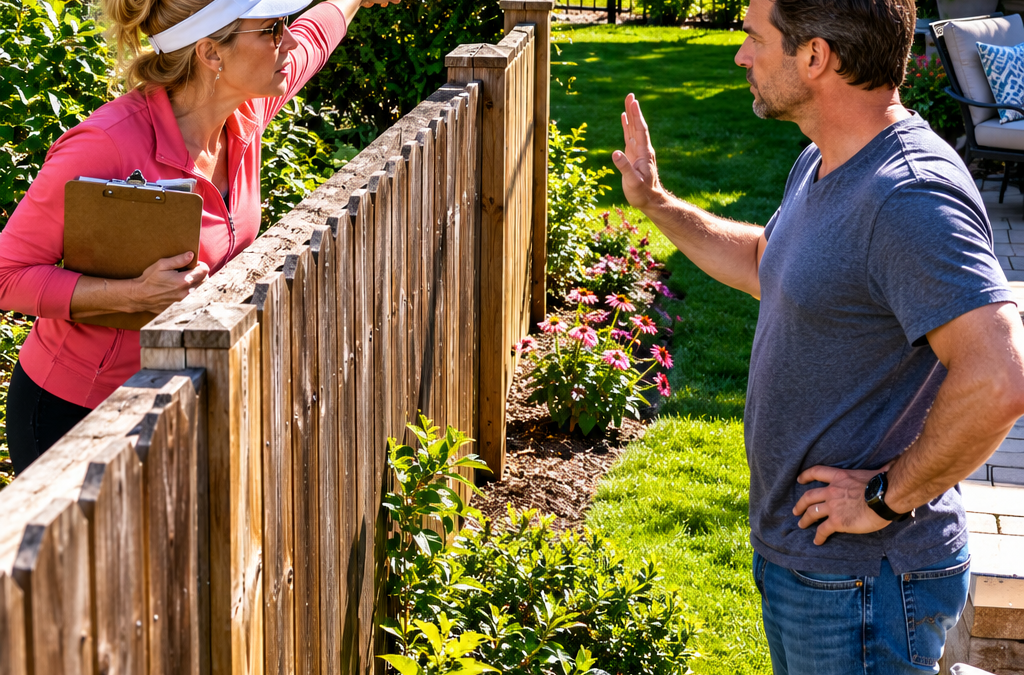
𝗙𝗨𝗟𝗟 𝗦𝗧𝗢𝗥𝗬
They were words.
Then, about six months after I moved in, Karen made a request that seemed strange enough for me to remember.
I was trimming branches near the eastern fence when she called my name from her yard.
“Could I ask you something?”
“Sure.”
She walked toward the fence.
Beyond the rear corner of my property was a community green space—a wide landscaped area with a walking trail, benches, and a small retention pond.
The public route from Karen’s house to that green space required her to walk out her driveway, follow the sidewalk around my corner lot, and enter through a pathway near the main street.
It probably added a minute to the trip.
Two at most.
Karen pointed toward my backyard.
“It would be much quicker if I could cut through here.”
I thought I had misunderstood.
“Through my yard?”
“Just along the edge.”
“There isn’t a gate.”
“You could add one.”
I laughed lightly.
“I don’t need one.”
She smiled.
“I’m only asking for walking access.”
“I’d rather not have people cutting through.”
Her smile tightened a little.
“Oh, I wouldn’t bring people through. Just me.”
“It’s still my backyard.”
“I know.”
“There’s a public sidewalk twenty feet away.”
She stared at me for a moment as if I had refused to hand her something she already owned.
Then the pleasant expression returned.
“Of course. I understand.”
“Nothing personal.”
“Not at all.”
She turned away.
And because I was still operating under the assumption that normal adults respected clear answers, I thought the matter was finished.
It wasn’t.
It was postponed.
Karen waited six months.
Then she cut a gate into my fence.
It happened on a Tuesday in March.
I remember the morning exactly because nothing else about it had seemed important.
I woke a little after six.
Made coffee.
Checked my phone.
Put on an old sweatshirt and walked into the backyard while the neighborhood was still waking up.
The air had that cold, wet smell early spring gets before the temperature decides what season it belongs to.
I stepped off the patio.
Took one sip.
Then stopped.
At first, I couldn’t understand what looked wrong.
The fence line had been continuous for years.
You get used to shapes around your own home.
Your eyes notice a change before your mind can identify it.
Then I saw hinges.
Black metal hinges.
Mounted directly into my fence.
A rectangular section had been cut out between two posts and turned into a gate.
Someone had even tried to match the stain.
Tried.
The color was slightly lighter.
The wood newer.
A small latch had been installed on my side.
For several seconds, I just stood there holding my coffee.
I remember thinking there must be some explanation.
Maybe a contractor had made a mistake.
Maybe the HOA had needed access for utility work.
Maybe—
Then I walked toward it.
The closer I got, the more obvious the workmanship became.
Clean cut.
New framing.
Heavy hinges.
A professionally installed gate.
In my fence.
I placed my hand on the latch.
Opened it.
And found myself looking straight into Karen’s yard.
That was the moment confusion became anger.
She had done it.
There was no question.
The opening connected her property directly to mine.
Not a public area.
Not common space.
My backyard.
I shut the gate.
Then opened it again, almost as if seeing it twice might make the absurdity easier to process.
It didn’t.
The fence wasn’t shared.
That mattered.
When I installed it, I had deliberately placed the entire structure inches inside my surveyed property line so there would never be arguments about ownership.
Karen knew that.
The installer knew that.
The HOA documents reflected it.
Every board, every post, every screw belonged to me.
And sometime while I was sleeping, somebody had cut through it.
I set my coffee on the patio because my hand had started shaking.
Then I walked around the block and knocked on Karen’s front door.
She answered wearing the visor.
Seven in the morning.
Visor already on.
Coffee in one hand.
Completely calm.
“Morning.”
I stared at her.
“What happened to my fence?”
She blinked innocently.
“What do you mean?”
“The gate.”
Recognition appeared.
“Oh. That.”
That.
As if I had asked about a package left near the curb.
“I had my handyman put it in yesterday.”
I actually looked behind me for a second because I thought maybe I had entered some alternate reality where this conversation made sense.
“You had someone cut a gate into my fence?”
“It’s much easier now.”
“For what?”
“To reach the green space.”
I stared at her.
She smiled.
“Remember? We talked about it.”
“Yes. You asked permission.”
“Right.”
“And I said no.”
Her expression changed only slightly.
“Well, I thought you might reconsider once you saw how little difference it makes.”
I felt something cold settle behind my ribs.
“Karen, remove it.”
She laughed softly.
“Oh, come on.”
“Remove the gate and repair the fence.”
“It’s professionally done.”
“I don’t care.”
“It matches.”
“It is my fence.”
She gave me the little tilted-head expression people use when pretending another person is overreacting.
“It’s just a gate, sweetheart.”
I hate being called sweetheart by someone who is trying to steal something from me.
“Take it out.”
“You’re being dramatic.”
“I am not debating this with you.”
Her smile disappeared.
“Then maybe you should cool off.”
“Today, Karen.”
She stepped backward.
“I have an appointment.”
“Remove the gate.”
She closed the door.
Just shut it in my face.
I stood there on her porch for several seconds.
I should probably say that was the moment I realized Karen was unreasonable.
It wasn’t.
I had known that.
What I realized was more troubling.
Karen wasn’t confused.
She wasn’t impulsive.
She had asked six months earlier.
I had refused.
She remembered.
Then she waited until enough time passed that she assumed the conversation no longer mattered.
She hired somebody.
She paid them.
She arranged a time.
She let them cut my fence.
That wasn’t misunderstanding.
That was planning.
I returned home and photographed everything.
The gate.
The hinges.
The cut boards.
The latch.
The view into Karen’s yard.
I pulled out my original fence invoice and the property survey.
Then I called the handyman company whose name appeared on a small sticker inside the new gate frame.
The owner answered.
I gave him the address.
There was some keyboard tapping.
“Yes, we installed a pedestrian gate yesterday.”
“Who authorized the work?”
“Homeowner next door.”
“Did anybody verify who owned the fence?”
Silence.
Then:
“She told us it was shared.”
“It isn’t.”
Another pause.
“You’ll have to discuss that with her.”
“I already did.”
“I’m sorry, sir.”
“So am I.”
I wrote down the company name, date, time, and the person I had spoken with.
That was the beginning of the log.
At first, I thought I would only need it for a repair claim.
Then Karen started using the gate.
The very next morning, at 6:48, my security camera recorded her opening it.
She walked through my backyard carrying a travel mug, crossed the grass behind my patio, and exited through the rear side opening toward the green space.
She didn’t hurry.
She didn’t look uncomfortable.
She walked like the path had always been there.
That evening she came back through.
The next day, she did it again.
Then again.
By Friday, I was standing inside my kitchen when I watched her cross my yard in real time on the camera app.
I opened the back door.
“Karen.”
She stopped.
“Yes?”
“I told you not to come through here.”
“Oh, for heaven’s sake.”
“This is private property.”
“I’m walking.”
“On my property.”
She sighed dramatically.
“I’ll be thirty seconds.”
“That is not the point.”
She gestured toward the green space.
“You aren’t even using this part of the yard.”
I stared at her.
There is a particular kind of entitlement that reveals itself in sentences like that.
You aren’t using it.
As if ownership requires constant physical occupation.
As if an empty chair becomes public property the moment you stand up.
“Go back through the gate.”
“I’m already halfway across.”
“Then walk halfway back.”
She muttered something under her breath.
I didn’t catch all of it.
I heard “ridiculous.”
But she turned around.
I watched her leave.
Then I shut the door.
If that had embarrassed her into stopping, maybe things would have ended there.
Instead, she escalated.
The following Sunday, my camera caught Karen and another woman—her sister, I later learned—walking through together.
Two days after that, she led a neighbor through.
She actually held the gate open.
The neighbor hesitated.
I could see it on the footage.
He looked toward my house.
Karen waved him forward.
“It’s fine.”
I heard her say it through the camera microphone.
“It’s fine.”
Not her property.
Not her fence.
Not her decision.
But she had granted permission.
Something about that clip bothered me more than all the others.
Karen had stopped acting like she was sneaking through.
Now she was acting like she controlled access.
Within two weeks, a faint trail began appearing in my grass.
A diagonal path from the eastern gate toward the green space.
At first it was just flattened blades.
Then bare soil started showing through.
I stood on the patio one evening and stared at it.
A footpath.
Across my yard.
Created by people I had never invited.
I felt violated in a way I hadn’t expected.
The word sounds dramatic until it happens to you.
People hear “trespassing” and imagine someone climbing through a window.
But there is something deeply unsettling about watching strangers use a space where you expect privacy.
I stopped leaving things on the patio.
I started checking the yard before stepping outside.
I kept the curtains on that side of the house closed more often.
My home had not changed physically except for one rectangle cut into a fence.
But it felt different.
Less mine.
That is hard to explain to someone who has never experienced it.
Your property is not just square footage.
It is certainty.
The certainty that if you walk into your backyard in pajamas on a Saturday morning, you will not find somebody’s sister crossing behind your patio.
Karen had taken that certainty.
I called my friend Daryl.
Daryl was an attorney, though real estate wasn’t his main specialty.
We had known each other since college.
I sent him the photos and the security clips.
Twenty minutes later, he called.
“She cut the fence?”
“Yes.”
“Your fence?”
“Yes.”
“Entirely on your parcel?”
“Yes.”
“And now she’s using the opening?”
“Every day.”
He was silent.
Then he said, “Stop this now.”
The seriousness in his voice surprised me.
“I’m trying.”
“No, I mean formally. Document everything.”
“I already started.”
“Good. Dates, times, videos. Save copies somewhere other than your home system.”
“Why?”
“Because right now this is unauthorized modification and repeated trespass. But if she starts claiming some established right of access, you don’t want ambiguity.”
“Can she actually do that?”
“Not because she walks through for a few weeks. That’s not how easements magically happen. But people make bad legal arguments all the time, and bad legal arguments still cost money to defeat.”
That was what lodged in my mind.
Cost money to defeat.
Karen didn’t need to be legally right to make my life expensive.
She just needed to be stubborn.
Daryl said, “Put your objection in writing.”
“I’ve told her twice.”
“Do it anyway.”
So I did.
Short.
Clear.
No emotion.
I stated that the gate had been installed without my permission into a fence solely owned by me, that Karen had no permission to enter or cross my property, and that I demanded the gate be removed and the fence restored.
I sent it certified mail.
Karen signed for it.
Then used the gate the following morning.
At that point, I went to the HOA.
I should have known better.
Still, I wanted a paper trail showing I had tried every reasonable option.
The board met in a small clubhouse near the neighborhood entrance.
Gerald Marsh sat at the center table.
Karen was two chairs away.
Of course she was.
She had her clipboard.
I presented photographs.
Survey.
Fence invoice.
Certified letter.
Security footage timestamps.
Gerald adjusted his glasses.
“This seems like a dispute between adjacent homeowners.”
“It became an HOA matter when one of your committee members began telling neighbors they could cross my land.”
Karen leaned forward.
“I never said it was an HOA path.”
“You told Michael Raines it was fine.”
“He asked if he could follow me.”
“And you gave permission to cross property you don’t own.”
Karen rolled her eyes.
Gerald raised both hands.
“I think mediation would be appropriate.”
“Remove the gate.”
Karen said, “You keep saying that as if the gate itself hurts you.”
I turned toward her.
“You cut my fence after I refused your request.”
“You didn’t refuse in writing.”
The room became very quiet.
I couldn’t believe she had said it.
“You think no only counts on paper?”
“I think neighborly conversations can be misunderstood.”
“There was no misunderstanding.”
“That’s your interpretation.”
Gerald jumped in before I responded.
“Let’s keep this productive.”
I looked at him.
“Productive would be telling a committee member not to trespass.”
His expression told me exactly how much control he had over Karen.
Almost none.
We scheduled mediation.
That meeting lasted fifty minutes.
It felt like five hours.
The mediator was a retired attorney named Leslie who began by asking us each to summarize our position.
Mine took about thirty seconds.
Karen installed a gate in my fence without authorization.
I objected.
She continued entering my property.
I wanted the gate removed and the fence restored.
Karen spoke for almost ten minutes.
She talked about neighborhood connectivity.
Community access.
Walkability.
Shared enjoyment.
The historical openness of the green space.
Then she said the sentence I still remember word for word.
“Because he never made a formal written objection before installation, I reasonably assumed consent.”
Leslie looked at her.
“Did you ask him whether you could create access through his yard?”
“Yes.”
“What did he say?”
Karen hesitated.
“He expressed concerns.”
I said, “I said no.”
Karen glared at me.
Leslie asked, “Did he say yes?”
Silence.
Then Karen replied, “Not exactly.”
“Then why did you install the gate?”
Karen folded her hands.
“I believed it was beneficial to both properties.”
I almost laughed.
Beneficial to both properties.
She was walking through mine.
I wasn’t walking through hers.
Leslie proposed that the gate remain locked and unused until the matter could be resolved.
I said no.
Karen acted offended.
“Why wouldn’t you accept that?”
“Because there shouldn’t be a gate.”
“You’re obsessed with the gate.”
“Yes, Karen. Because it’s in my fence.”
Mediation ended without agreement.
Next came the city.
I filed a code complaint.
A week later, a code enforcement officer named Matt Alvarez arrived.
He was a patient man with a measuring tape and the expression of someone who had spent a career being introduced to disputes nobody had warned him were going to be this strange.
He examined the fence.
Checked the survey.
Measured setbacks.
Looked at the gate from both sides.
Finally he scratched his chin.
“So the fence itself is yours.”
“Yes.”
“But the gate swings toward her parcel.”
“Yes.”
“And she installed it.”
“Yes.”
He exhaled.
“That’s unusual.”
“That’s one word.”
He explained that the gate appeared to sit so close to the property line that code enforcement had limited authority unless there was a clear structural or permit violation.
He could send a notice requesting documentation.
Which he did.
Karen ignored it.
Then Daryl sent the cease-and-desist letter.
This one was different from mine.
Law firm letterhead.
Legal citations.
Demand for immediate cessation of entry.
Demand for restoration.
Notice that continued access was expressly nonpermissive.
Karen finally responded through an attorney.
The letter arrived ten days later.
Daryl called me before forwarding it.
“You should sit down for this.”
“That good?”
“It’s creative.”
Her attorney claimed that the gate had existed for more than thirty days and had become an “established access route.”
I read the sentence twice.
“Thirty days?”
“Yes.”
“What law says thirty days creates an easement?”
“None that applies here.”
“So this is nonsense.”
“Mostly.”
“Mostly?”
“They’re trying to create enough uncertainty that you’d rather compromise than litigate.”
There it was again.
The real weapon.
Expense.
Karen did not need a strong case.
She needed a case irritating enough that I would decide letting her cross my yard was cheaper than stopping her.
I asked Daryl how long a court case could take.
“Months.”
“How much?”
“Depends how ugly it gets.”
I knew what that meant.
Enough.
Enough that I started lying awake at night.
Enough that I became angry every time I looked at the gate.
Enough that the whole situation began consuming more of my attention than it deserved.
One Thursday evening, I sat on the patio staring at the worn strip of grass.
Karen had crossed twice that day.
A woman I had never seen before had crossed once.
I had confronted her.
She looked startled.
“Karen said this was the walkway.”
There it was.
The walkway.
In less than two months, Karen had turned trespass into vocabulary.
I corrected the woman politely.
She apologized immediately and left.
I believed her.
The problem wasn’t everyone else.
The problem was the person teaching them that my boundary didn’t count.
That night, I called Daryl.
“I’m done.”
“With what?”
“Waiting.”
There was a pause.
“What are you thinking?”
“I own the property on my side of the fence, right?”
“Yes.”
“If I build something entirely inside my property line?”
“Depends what.”
“A wall.”
Long silence.
Then Daryl laughed.
Not mocking.
Genuinely delighted.
“What kind of wall?”
“Masonry.”
“How high?”
“Whatever the permit allows.”
“Do not do anything until we verify every requirement.”
“Fine.”
“And don’t touch her gate.”
“I don’t need to.”
That was the beauty of it.
I didn’t need to remove Karen’s work.
I didn’t need to cross into her yard.
I didn’t need to argue about ownership of hardware or demand reimbursement or wait for an HOA board too timid to confront her.
I just needed to build on my property.
Daryl reviewed the survey.
Then he had a surveyor confirm the eastern line again.
The fence sat fully inside my parcel.
Behind the fence, on my side, I had enough room to construct a masonry privacy wall without crossing the boundary.
I applied for a permit.
Legal.
Documented.
Boring.
Exactly the way I wanted it.
The city approved an eight-foot masonry privacy structure subject to standard footing requirements.
That piece of paper felt better than any angry letter I could have written.
Then I called Victor.
Victor ran a small masonry company recommended by a contractor I knew.
I explained the job.
He asked normal questions.
Length.
Height.
Brick type.
Access.
Then I explained why I needed one specific section completed in a single night.
He started laughing.
“So she built a door into your fence?”
“Yes.”
“To walk through your yard?”
“Yes.”
“And you’re building a wall behind it?”
“Entirely on my property.”
“Permit?”
“Approved.”
“Survey?”
“Confirmed.”
There was another laugh.
“I like this project.”
We chose Friday night.
Not because I was trying to hide anything illegal.
Because I wanted it finished before Karen could interfere with the crew, call the HOA, stand in the work area, or create a scene halfway through.
Everything we were doing was permitted.
Nothing required her approval.
But Karen had demonstrated that legality and peace were different things.
Victor’s trucks arrived at 12:15 Saturday morning.
No backup alarms.
No shouting.
Four workers moved materials by hand from my driveway.
The footing trench had been prepared earlier under the permit.
The crew worked under portable lights angled downward to avoid blasting the neighbors’ windows.
I stayed outside with them.
At 1:00 a.m., the first course was set.
At 2:00, the wall had shape.
At 3:30, it reached my shoulders.
The bricks were darker than the fence.
Clean.
Straight.
Solid.
I remember standing there watching mortar spread across each row and feeling my chest loosen for the first time in weeks.
Words had not protected the boundary.
Neither had courtesy.
Neither had the HOA.
Brick was doing an excellent job.
The most satisfying moment came around 4:20.
The wall rose past the height of Karen’s gate latch.
From my side, the gate disappeared.
The little wooden doorway still existed physically inside the fence line, but it now opened onto eight feet of mortared masonry.
There was nowhere to go.
No path.
No shortcut.
No argument.
By 5:30, the crew was finishing the top course.
At 5:45, Victor stepped back.
“That’s not moving.”
I looked at it.
Eight feet tall.
Solid.
Square.
Entirely inside my property.
The worn trail across the grass ended at brick.
I shook Victor’s hand.
“Worth every dollar.”
He grinned.
“I wish I could see her face.”
“My camera probably will.”
The crew left before six.
I locked the house.
Closed the curtains.
And slept.
I knew exactly when Karen discovered the wall.
7:03 a.m.
Security footage.
She appeared in her backyard wearing gray leggings, running shoes, a blue jacket, and the inevitable visor.
Coffee in hand.
She walked toward the gate without hesitation.
Opened it.
Stopped.
For forty-five seconds, Karen Whitfield did absolutely nothing.
No movement.
No words.
She just stared at brick.
Then she stepped closer.
Touched it.
Looked upward.
Tried to look around the edge.
There was no edge she could use.
The wall extended beyond the gate opening in both directions.
She shut the gate.
Opened it again.
Still brick.
That part remains one of my favorite details.
As if the wall might reconsider.
Then Karen turned slowly.
Her eyes found my security camera.
She stared directly into the lens.
I watched the footage later.
Her expression wasn’t anger yet.
It was disbelief.
The expression of someone encountering, perhaps for the first time, a boundary that didn’t negotiate.
Then she pulled out her phone.
Gerald called me at 7:51.
I answered while making coffee.
“Good morning.”
“What happened to your fence?”
“Nothing.”
“Karen says you erected a wall.”
“I did.”
“She says it’s blocking access.”
“To my yard?”
Gerald paused.
“She’s concerned about the pedestrian route.”
“There is no pedestrian route through my property.”
“She says it has been used for several weeks.”
“Without permission.”
“I understand there is a legal disagreement.”
“There was. Now there’s brick.”
Gerald sighed.
“Did you get approval?”
“City permit. Survey confirmation. Construction is entirely inside my property line.”
“The HOA may have architectural restrictions.”
“Send me the applicable covenant.”
Another pause.
“I’ll need to look.”
“I’ve already looked.”
That quieted him.
I emailed Gerald the survey, permit, contractor information, and photographs.
Forty minutes later, he replied with three words.
Received. Reviewing matter.
Karen called next.
I let it go to voicemail.
Her message lasted nearly two minutes.
She accused me of being vindictive.
Hostile.
Unneighborly.
Aggressive.
Petty.
She said the wall was “clearly designed to inconvenience her.”
That part was technically true.
It was designed to make crossing my property impossible.
What Karen failed to understand was that she had no right to convenience located on somebody else’s land.
I saved the voicemail.
Added it to the folder.
Later that morning, she knocked on my door.
I didn’t open it.
I spoke through the camera.
“What do you need?”
“Come outside.”
“No.”
“We need to discuss the wall.”
“We discussed access already.”
“You cannot just build something to block me.”
“I can build a permitted privacy wall on my property.”
“You did this deliberately.”
“Yes.”
There was a long silence.
Maybe she expected denial.
I didn’t give her one.
“After everything we talked about,” she said, “you chose escalation.”
I nearly laughed.
“You cut a hole in my fence.”
“You’re still stuck on that.”
That sentence told me there was no point continuing.
“Have a good morning, Karen.”
I ended the intercom.
She stayed on the porch for another minute before leaving.
Three days later, her attorney sent Daryl another letter.
This time the claim was that my wall interfered with an established access route.
Daryl called me laughing again.
“I think they expected you to panic.”
“What are we sending?”
“Nothing emotional.”
His response contained exactly what mattered.
The certified survey demonstrating the wall was entirely within my property.
The approved municipal building permit.
Thirty-one days of timestamped security footage showing repeated entry through my property after explicit objections and without consent.
He also included copies of my certified letter and his cease-and-desist notice.
The final paragraph stated that if Karen pursued litigation based on a claimed access right, we would seek all available remedies relating to unauthorized modification of my fence and continuing trespass.
Then we waited.
A week.
Two weeks.
Nothing.
Karen’s attorney never responded.
The HOA requested an inspection.
The city came out.
The inspector checked the wall.
Footings.
Height.
Setback.
Permit number.
He signed the final approval.
I asked, “Anything wrong?”
“No.”
“Anything she can challenge?”
He looked toward Karen’s property.
“People can challenge anything.”
Then he tapped the permit sheet.
“Doesn’t mean they’ll win.”
That afternoon, the city closed its file.
A week later, the HOA closed Karen’s complaint.
Gerald emailed me personally.
The message was short.
The board found no covenant provision authorizing access through my property and no basis to require removal of a permitted structure located within my surveyed lot boundary.
I printed it.
Put it in the folder.
Karen stopped crossing my yard immediately, obviously.
She had no choice.
What surprised me was how quickly everyone else stopped too.
Turns out the neighborhood did understand boundaries.
It had simply been told by Karen that mine didn’t matter.
Without her gate, people used the public sidewalk.
The one twenty feet away.
The supposedly unbearable detour.
Nobody collapsed from exhaustion.
Nobody got lost.
No emergency walking-access crisis developed.
They walked around.
Just like they should have from the beginning.
The grass took longer to recover.
For weeks, the diagonal path remained visible.
I reseeded it.
Watered it.
Covered the bare patches with straw.
Slowly, green returned.
The first few mornings after the wall went up, I still checked the camera.
Habit.
Every sound near the fence caught my attention.
Every time Karen’s voice carried from next door, some part of me expected another confrontation.
But nothing happened.
She avoided me.
For about two weeks, if we were outside at the same time, Karen turned away.
No wave.
No comment.
No clipboard lecture.
Eventually, she started acknowledging me with the smallest possible nod.
I returned it.
That was enough.
I didn’t need friendship.
I needed distance.
One Saturday morning, several weeks after the wall was finished, I carried my coffee outside around seven.
The sun had just cleared the roofs across Ridgewood Lane.
Everything was quiet.
The wall cast a long shadow across the new grass.
I stood there looking at it.
People might think an eight-foot brick wall is ugly.
Maybe it is.
But to me, it looked like relief.
For months, I had tried to explain the same simple thing in every civilized way available.
No.
Don’t enter.
This is private property.
Remove the gate.
I had explained it face-to-face.
In writing.
Through certified mail.
At an HOA meeting.
During mediation.
Through an attorney.
Every version contained the same message.
Karen treated each one as the opening position in a negotiation.
That was her mistake.
She believed a boundary was something she could debate until the owner became too tired to defend it.
The wall ended the debate.
It did not argue.
It did not threaten.
It did not attend mediation.
It didn’t care whether Karen thought I was dramatic.
It simply occupied space I legally controlled and made intrusion impossible.
That was when I finally understood something about people like Karen.
They are not always confused by boundaries.
Sometimes they understand boundaries perfectly.
They just believe persistence should eventually earn them an exception.
If you say no once, they hear maybe.
If you say no twice, they hear convince me.
If you put it in writing, they look for a technicality.
If you call someone in authority, they search for another authority willing to be vague.
They keep pushing because in the past, somebody eventually stepped aside.
I didn’t.
Not because I was tougher.
For weeks, I wasn’t.
I lost sleep over the whole thing.
I worried about money.
I worried about court.
I worried that somehow Karen would persuade the HOA to turn an obvious trespass dispute into a neighborhood campaign against me.
I hated feeling uncomfortable in my own backyard.
That was probably the part that made me angriest.
I had bought that house because I wanted privacy.
I had paid for the fence because I wanted privacy.
I had maintained the yard because it was mine.
Then one woman decided her shorter walking route mattered more than all of that.
She didn’t steal something I could hold.
She stole the feeling that I controlled who entered my space.
That feeling came back slowly.
One morning at a time.
The first time I left my laptop on the patio while I went inside for coffee.
The first afternoon I took a nap in the chair without checking the camera.
The first evening I realized I had been outside for an hour and hadn’t looked toward Karen’s fence once.
Peace is strange that way.
You don’t always notice when it returns.
You notice when you stop expecting interruption.
Gerald became noticeably more assertive with Karen after the whole incident.
I didn’t learn that from him.
I learned it from neighbors.
Apparently the board had discovered several situations where Karen had presented her opinions as if they were HOA decisions.
Nothing criminal.
Nothing dramatic.
Just years of small overreach.
Comments about trash cans.
Landscaping.
Parking.
Holiday decorations.
She liked being the person who knew the rules.
And when there wasn’t a rule, she occasionally spoke as if one existed.
Once the gate dispute forced Gerald and the board to examine her conduct formally, some of that changed.
Karen remained on her committee until the end of the term.
But the clipboard lost some power.
People started asking, “Is that actually in the covenants?”
Amazing what one question can do.
Months later, I ran into Gerald near the mailbox cluster.
He looked toward my house.
“How’s the wall?”
“Still standing.”
He smiled awkwardly.
“I suppose that was the point.”
“It was.”
He hesitated.
Then said, “We should have handled the original complaint differently.”
I looked at him.
“Yes.”
He nodded.
No excuses.
That was enough for me.
I wasn’t interested in humiliating him.
Gerald’s failure had been weakness, not malice.
He knew Karen was difficult and tried to avoid confronting her.
In doing so, he left me to absorb the consequences.
That still mattered.
But he learned.
I could live with that.
Karen never apologized.
Not once.
I didn’t expect her to.
An apology would have required admitting that the problem was never my reaction.
It was her decision.
She would have had to acknowledge that asking for access did not entitle her to it.
That silence wasn’t consent.
That a verbal no still meant no.
That paying a handyman to alter somebody else’s property was not a clever solution.
That thirty days of trespass did not transform trespass into ownership.
I don’t think she was capable of saying those things.
Maybe she still tells the story differently.
Maybe in her version, I am the unreasonable neighbor who built an eight-foot wall because she wanted a harmless shortcut.
I’m fine with that.
I stopped caring how Karen explained me to herself.
I knew what happened.
So did my camera.
So did the survey.
So did the certified letters.
That folder still sits in the bottom drawer of my desk.
Fence invoice.
Photos.
Logs.
HOA emails.
City records.
Attorney correspondence.
Building permit.
Final inspection.
I doubt I will ever need most of it again.
But I’ll keep it.
There is peace in knowing you can prove your own memory.
The gate still exists on Karen’s side.
She never removed it.
That might be the funniest part.
From her yard, she can still walk up to the little wooden door, lift the latch, and swing it open.
On the other side is brick.
Eight feet of it.
Sometimes I wonder why she keeps the gate.
Maybe removing it would feel like admitting defeat.
Maybe she doesn’t want to pay a contractor.
Maybe she likes looking at it.
I don’t ask.
It isn’t my problem anymore.
From my side, I can’t even see the gate.
Only the wall.
My wall.
On my land.
Built with a permit and inspected by the city.
The eastern side of the yard is quieter now than it was before all of this.
The brick blocks some street noise.
It blocks the view from Karen’s patio.
It catches afternoon sunlight.
Eventually, ivy started growing near one corner.
I almost removed it.
Then I decided I liked it.
One year after the wall went up, the worn path was completely gone.
If you hadn’t lived through the dispute, you would never know people had once walked across that stretch of grass every day.
That interested me.
For months, the damage seemed permanent.
The trail looked carved into the yard.
Then soil filled.
Grass grew.
Rain softened everything.
The land forgot.
I didn’t.
But I stopped being angry every time I remembered.
That was important.
I hadn’t built the wall to live in permanent resentment.
I built it so I could stop thinking about Karen.
And eventually, that is exactly what happened.
I went back to ordinary things.
Mowing.
Coffee.
Weekend projects.
Sitting outside after work.
The kinds of things that make up a life when nobody else is trying to claim a piece of it.
One autumn morning, I was in the backyard when I heard Karen speaking to someone on the sidewalk.
A new family had moved into the house two doors down.
Karen was introducing herself.
I couldn’t see them because of the wall, but I could hear her voice.
She was explaining where the green space was.
“There’s a path around the corner,” she said.
Around the corner.
I stopped what I was doing.
For one second, I wanted to laugh.
Not because I had beaten her.
That language doesn’t feel right anymore.
Because after everything—the gate, the arguments, mediation, lawyers, letters, accusations—Karen was finally describing the route that had existed all along.
The public sidewalk.
Twenty feet away.
That was all she had ever needed.
She could have used it from the beginning.
There never needed to be a dispute.
Never needed to be a cut fence.
Never needed to be lawyers or surveys or overnight masonry crews.
All Karen had to do was accept one word.
No.
People imagine big conflicts begin with big things.
Money.
Land.
Inheritance.
Betrayal.
Mine started with a shortcut.
A woman wanted to save herself a minute of walking.
Then she decided that minute mattered more than my right to control my own property.
That was the entire problem.
And maybe that is why I refused to surrender.
If I had allowed it, the lesson would not have been that neighbors can cooperate.
The lesson would have been that Karen could ignore a boundary long enough to make it disappear.
I couldn’t live with that.
Not there.
Not at the home I had worked for.
The funny thing is that the wall is probably stronger than anything else on my property now.
The wooden fence will eventually need replacing.
The house will need another roof someday.
Deck boards rot.
Paint fades.
Grass dies and returns.
Brick is different.
Every morning, when I carry coffee onto the patio, I still see those clean rows of masonry along the eastern edge.
I don’t think about Karen most days.
I think about certainty.
About where my property ends.
About knowing the space behind my house belongs to me again.
And about the difference between being polite and allowing yourself to be pushed.
For most of my life, I believed reasonable people could solve almost anything by talking.
I still believe that.
The important word is reasonable.
Conversation works when both people recognize that the other person has rights independent of their own convenience.
Mediation works when both sides are actually willing to hear no.
Rules work when the people enforcing them care about what those rules really say.
None of those things worked with Karen because she did not see my refusal as a decision.
She saw it as resistance she hadn’t overcome yet.
Once I understood that, the solution became much simpler.
I stopped trying to make her agree with my boundary.
I made her physically incapable of crossing it.
I don’t consider that cruel.
I don’t consider it revenge.
I consider it the most literal definition of a boundary I have ever built.
Somewhere inside my desk is the first photograph I took that Tuesday morning.
The new gate.
Light wood against the older fence.
Fresh hinges.
Little latch.
I remember the feeling in my stomach when I saw it.
Shock first.
Then disbelief.
Then anger.
That photograph looks almost harmless now.
Without context, it is just a gate.
But objects carry meaning from what people do with them.
Karen looked at that gate and saw convenience.
I looked at it and saw a decision somebody else had made about my property.
That difference was the entire conflict.
The photograph beside it in the folder was taken after Victor finished.
Eight feet of brick in the blue-gray light before sunrise.
No opening.
No uncertainty.
I rarely look at either photo anymore.
I don’t need to.
The real proof is outside.
Sometimes, late in the afternoon, I sit beside the patio with coffee even though caffeine at that hour is a terrible idea.
Sunlight hits the wall.
Birds land on top of it.
The grass beneath it is thick again.
Nobody walks across my yard.
Nobody waves strangers through.
Nobody asks me to reconsider.
And Karen still lives next door.
The visor still appears.
The clipboard still appears.
We have never become friends.
We probably never will.
But she walks around the corner now.
Every single time.
And that is enough.
Because in the end, I never wanted to control where Karen walked.
I only wanted her to understand where she couldn’t.
My backyard was never a community path.
My fence was never hers to alter.
My silence was never permission.
And my refusal was never the beginning of a negotiation.
It was a boundary.
She just needed eight feet of mortared brick before she finally learned what that meant.
𝗧𝗛𝗘 𝗘𝗡𝗗
My Neighbor Cut a Private Gate Into My Fence and Turned My Yard Into Her Shortcut—She Thought I’d Eventually Accept It
She didn’t knock, ask permission, or even warn me before cutting a doorway straight through the fence I had paid for with my own money. By the time I understood what Karen was really trying to create across my property, strangers were already walking through my backyard as if I had never owned it at all.
Four years earlier, I had bought the corner house on Ridgewood Lane because it offered one thing I valued more than granite countertops, square footage, or whatever buzzwords real estate agents were using that year.
Privacy.
The house itself was ordinary.
Three bedrooms.
Two bathrooms.
A garage barely wide enough for my truck and everything I kept promising myself I would organize someday.
But the yard was bigger than most of the others on the street because the property sat on a corner.
That mattered to me.
I worked long hours, dealt with people all day, and when I came home, I wanted a place where nobody needed anything from me.
No meetings.
No small talk.
No requests.
Just a chair on the patio, a cup of coffee, and a strip of grass nobody else had any reason to cross.
The first improvement I made was the fence.
I saved for it.
I compared estimates.
I walked the property line with the installer myself.
Six-foot wooden privacy fencing wrapped around the side and rear yard, stained a warm brown that looked almost golden when the sun hit it late in the afternoon.
It wasn’t luxurious.
But it was mine.
That distinction became more important than I ever expected.
On the other side of the eastern fence lived Karen Whitfield.
Karen was in her mid-fifties and carried herself like Ridgewood Lane had been established specifically so she could supervise it.
She wore a visor so often that I eventually wondered whether she owned any other form of headwear.
White visor in summer.
Navy visor in spring.
Red visor around Christmas.
And almost always, tucked under one arm, was a clipboard.
I never figured out exactly what was on that clipboard.
Maybe HOA notes.
Maybe complaint forms.
Maybe a handwritten inventory of everything the rest of us were doing wrong.
Karen wasn’t technically the HOA president.
That position belonged to Gerald Marsh, a soft-spoken accountant who looked nervous whenever Karen entered the same room.
But Karen served on one of the neighborhood committees, attended every meeting, and behaved as though the entire association operated under her personal authority.
Within three days of my moving in, she introduced herself.
I was carrying boxes from my truck when she appeared at the edge of my driveway.
“You’re the new owner?”
I shifted the box against my chest.
“That’s me.”
She looked past me toward the house.
“Corner lots can be difficult.”
I waited for the rest.
“They’re highly visible.”
“All right.”
“You’ll want to stay on top of the landscaping.”
I smiled because I thought she was joking.
She wasn’t.
Karen pointed toward the mailbox.
“That color may not be approved.”
“It came with the house.”
She pursed her lips.
“That doesn’t always mean anything.”
That was my introduction to Karen.
I kept things civil.
That is how I was raised.
A neighbor can be annoying without becoming an enemy, and life is easier when you don’t turn every irritation into a war.
So when Karen commented on where I parked my truck, I ignored it.
When she mentioned that my lawn would “look more cohesive” if I mowed on the same schedule as the homes beside me, I ignored that too.
When she asked whether I planned to replace the brass porch light because black fixtures were becoming more common in the development, I said no and went back inside.
None of those things mattered.
They were words.
Then, about six months after I moved in, Karen made a request that seemed strange enough for me to remember.
I was trimming branches near the eastern fence when she called my name from her yard.
“Could I ask you something?”
“Sure.”
She walked toward the fence.
Beyond the rear corner of my property was a community green space—a wide landscaped area with a walking trail, benches, and a small retention pond.
The public route from Karen’s house to that green space required her to walk out her driveway, follow the sidewalk around my corner lot, and enter through a pathway near the main street.
It probably added a minute to the trip.
Two at most.
Karen pointed toward my backyard.
“It would be much quicker if I could cut through here.”
I thought I had misunderstood.
“Through my yard?”
“Just along the edge.”
“There isn’t a gate.”
“You could add one.”
I laughed lightly.
“I don’t need one.”
She smiled.
“I’m only asking for walking access.”
“I’d rather not have people cutting through.”
Her smile tightened a little.
“Oh, I wouldn’t bring people through. Just me.”
“It’s still my backyard.”
“I know.”
“There’s a public sidewalk twenty feet away.”
She stared at me for a moment as if I had refused to hand her something she already owned.
Then the pleasant expression returned.
“Of course. I understand.”
“Nothing personal.”
“Not at all.”
She turned away.
And because I was still operating under the assumption that normal adults respected clear answers, I thought the matter was finished.
It wasn’t.
It was postponed.
Karen waited six months.
Then she cut a gate into my fence.
It happened on a Tuesday in March.
I remember the morning exactly because nothing else about it had seemed important.
I woke a little after six.
Made coffee.
Checked my phone.
Put on an old sweatshirt and walked into the backyard while the neighborhood was still waking up.
The air had that cold, wet smell early spring gets before the temperature decides what season it belongs to.
I stepped off the patio.
Took one sip.
Then stopped.
At first, I couldn’t understand what looked wrong.
The fence line had been continuous for years.
You get used to shapes around your own home.
Your eyes notice a change before your mind can identify it.
Then I saw hinges.
Black metal hinges.
Mounted directly into my fence.
A rectangular section had been cut out between two posts and turned into a gate.
Someone had even tried to match the stain.
Tried.
The color was slightly lighter.
The wood newer.
A small latch had been installed on my side.
For several seconds, I just stood there holding my coffee.
I remember thinking there must be some explanation.
Maybe a contractor had made a mistake.
Maybe the HOA had needed access for utility work.
Maybe—
Then I walked toward it.
The closer I got, the more obvious the workmanship became.
Clean cut.
New framing.
Heavy hinges.
A professionally installed gate.
In my fence.
I placed my hand on the latch.
Opened it.
And found myself looking straight into Karen’s yard.
That was the moment confusion became anger.
She had done it.
There was no question.
The opening connected her property directly to mine.
Not a public area.
Not common space.
My backyard.
I shut the gate.
Then opened it again, almost as if seeing it twice might make the absurdity easier to process.
It didn’t.
The fence wasn’t shared.
That mattered.
When I installed it, I had deliberately placed the entire structure inches inside my surveyed property line so there would never be arguments about ownership.
Karen knew that.
The installer knew that.
The HOA documents reflected it.
Every board, every post, every screw belonged to me.
And sometime while I was sleeping, somebody had cut through it.
I set my coffee on the patio because my hand had started shaking.
Then I walked around the block and knocked on Karen’s front door.
She answered wearing the visor.
Seven in the morning.
Visor already on.
Coffee in one hand.
Completely calm.
“Morning.”
I stared at her.
“What happened to my fence?”
She blinked innocently.
“What do you mean?”
“The gate.”
Recognition appeared.
“Oh. That.”
That.
As if I had asked about a package left near the curb.
“I had my handyman put it in yesterday.”
I actually looked behind me for a second because I thought maybe I had entered some alternate reality where this conversation made sense.
“You had someone cut a gate into my fence?”
“It’s much easier now.”
“For what?”
“To reach the green space.”
I stared at her.
She smiled.
“Remember? We talked about it.”
“Yes. You asked permission.”
“Right.”
“And I said no.”
Her expression changed only slightly.
“Well, I thought you might reconsider once you saw how little difference it makes.”
I felt something cold settle behind my ribs.
“Karen, remove it.”
She laughed softly.
“Oh, come on.”
“Remove the gate and repair the fence.”
“It’s professionally done.”
“I don’t care.”
“It matches.”
“It is my fence.”
She gave me the little tilted-head expression people use when pretending another person is overreacting.
“It’s just a gate, sweetheart.”
I hate being called sweetheart by someone who is trying to steal something from me.
“Take it out.”
“You’re being dramatic.”
“I am not debating this with you.”
Her smile disappeared.
“Then maybe you should cool off.”
“Today, Karen.”
She stepped backward.
“I have an appointment.”
“Remove the gate.”
She closed the door.
Just shut it in my face.
I stood there on her porch for several seconds.
I should probably say that was the moment I realized Karen was unreasonable.
It wasn’t.
I had known that.
What I realized was more troubling.
Karen wasn’t confused.
She wasn’t impulsive.
She had asked six months earlier.
I had refused.
She remembered.
Then she waited until enough time passed that she assumed the conversation no longer mattered.
She hired somebody.
She paid them.
She arranged a time.
She let them cut my fence.
That wasn’t misunderstanding.
That was planning.
I returned home and photographed everything.
The gate.
The hinges.
The cut boards.
The latch.
The view into Karen’s yard.
I pulled out my original fence invoice and the property survey.
Then I called the handyman company whose name appeared on a small sticker inside the new gate frame.
The owner answered.
I gave him the address.
There was some keyboard tapping.
“Yes, we installed a pedestrian gate yesterday.”
“Who authorized the work?”
“Homeowner next door.”
“Did anybody verify who owned the fence?”
Silence.
Then:
“She told us it was shared.”
“It isn’t.”
Another pause.
“You’ll have to discuss that with her.”
“I already did.”
“I’m sorry, sir.”
“So am I.”
I wrote down the company name, date, time, and the person I had spoken with.
That was the beginning of the log.
At first, I thought I would only need it for a repair claim.
Then Karen started using the gate.
The very next morning, at 6:48, my security camera recorded her opening it.
She walked through my backyard carrying a travel mug, crossed the grass behind my patio, and exited through the rear side opening toward the green space.
She didn’t hurry.
She didn’t look uncomfortable.
She walked like the path had always been there.
That evening she came back through.
The next day, she did it again.
Then again.
By Friday, I was standing inside my kitchen when I watched her cross my yard in real time on the camera app.
I opened the back door.
“Karen.”
She stopped.
“Yes?”
“I told you not to come through here.”
“Oh, for heaven’s sake.”
“This is private property.”
“I’m walking.”
“On my property.”
She sighed dramatically.
“I’ll be thirty seconds.”
“That is not the point.”
She gestured toward the green space.
“You aren’t even using this part of the yard.”
I stared at her.
There is a particular kind of entitlement that reveals itself in sentences like that.
You aren’t using it.
As if ownership requires constant physical occupation.
As if an empty chair becomes public property the moment you stand up.
“Go back through the gate.”
“I’m already halfway across.”
“Then walk halfway back.”
She muttered something under her breath.
I didn’t catch all of it.
I heard “ridiculous.”
But she turned around.
I watched her leave.
Then I shut the door.
If that had embarrassed her into stopping, maybe things would have ended there.
Instead, she escalated.
The following Sunday, my camera caught Karen and another woman—her sister, I later learned—walking through together.
Two days after that, she led a neighbor through.
She actually held the gate open.
The neighbor hesitated.
I could see it on the footage.
He looked toward my house.
Karen waved him forward.
“It’s fine.”
I heard her say it through the camera microphone.
“It’s fine.”
Not her property.
Not her fence.
Not her decision.
But she had granted permission.
Something about that clip bothered me more than all the others.
Karen had stopped acting like she was sneaking through.
Now she was acting like she controlled access.
Within two weeks, a faint trail began appearing in my grass.
A diagonal path from the eastern gate toward the green space.
At first it was just flattened blades.
Then bare soil started showing through.
I stood on the patio one evening and stared at it.
A footpath.
Across my yard.
Created by people I had never invited.
I felt violated in a way I hadn’t expected.
The word sounds dramatic until it happens to you.
People hear “trespassing” and imagine someone climbing through a window.
But there is something deeply unsettling about watching strangers use a space where you expect privacy.
I stopped leaving things on the patio.
I started checking the yard before stepping outside.
I kept the curtains on that side of the house closed more often.
My home had not changed physically except for one rectangle cut into a fence.
But it felt different.
Less mine.
That is hard to explain to someone who has never experienced it.
Your property is not just square footage.
It is certainty.
The certainty that if you walk into your backyard in pajamas on a Saturday morning, you will not find somebody’s sister crossing behind your patio.
Karen had taken that certainty.
I called my friend Daryl.
Daryl was an attorney, though real estate wasn’t his main specialty.
We had known each other since college.
I sent him the photos and the security clips.
Twenty minutes later, he called.
“She cut the fence?”
“Yes.”
“Your fence?”
“Yes.”
“Entirely on your parcel?”
“Yes.”
“And now she’s using the opening?”
“Every day.”
He was silent.
Then he said, “Stop this now.”
The seriousness in his voice surprised me.
“I’m trying.”
“No, I mean formally. Document everything.”
“I already started.”
“Good. Dates, times, videos. Save copies somewhere other than your home system.”
“Why?”
“Because right now this is unauthorized modification and repeated trespass. But if she starts claiming some established right of access, you don’t want ambiguity.”
“Can she actually do that?”
“Not because she walks through for a few weeks. That’s not how easements magically happen. But people make bad legal arguments all the time, and bad legal arguments still cost money to defeat.”
That was what lodged in my mind.
Cost money to defeat.
Karen didn’t need to be legally right to make my life expensive.
She just needed to be stubborn.
Daryl said, “Put your objection in writing.”
“I’ve told her twice.”
“Do it anyway.”
So I did.
Short.
Clear.
No emotion.
I stated that the gate had been installed without my permission into a fence solely owned by me, that Karen had no permission to enter or cross my property, and that I demanded the gate be removed and the fence restored.
I sent it certified mail.
Karen signed for it.
Then used the gate the following morning.
At that point, I went to the HOA.
I should have known better.
Still, I wanted a paper trail showing I had tried every reasonable option.
The board met in a small clubhouse near the neighborhood entrance.
Gerald Marsh sat at the center table.
Karen was two chairs away.
Of course she was.
She had her clipboard.
I presented photographs.
Survey.
Fence invoice.
Certified letter.
Security footage timestamps.
Gerald adjusted his glasses.
“This seems like a dispute between adjacent homeowners.”
“It became an HOA matter when one of your committee members began telling neighbors they could cross my land.”
Karen leaned forward.
“I never said it was an HOA path.”
“You told Michael Raines it was fine.”
“He asked if he could follow me.”
“And you gave permission to cross property you don’t own.”
Karen rolled her eyes.
Gerald raised both hands.
“I think mediation would be appropriate.”
“Remove the gate.”
Karen said, “You keep saying that as if the gate itself hurts you.”
I turned toward her.
“You cut my fence after I refused your request.”
“You didn’t refuse in writing.”
The room became very quiet.
I couldn’t believe she had said it.
“You think no only counts on paper?”
“I think neighborly conversations can be misunderstood.”
“There was no misunderstanding.”
“That’s your interpretation.”
Gerald jumped in before I responded.
“Let’s keep this productive.”
I looked at him.
“Productive would be telling a committee member not to trespass.”
His expression told me exactly how much control he had over Karen.
Almost none.
We scheduled mediation.
That meeting lasted fifty minutes.
It felt like five hours.
The mediator was a retired attorney named Leslie who began by asking us each to summarize our position.
Mine took about thirty seconds.
Karen installed a gate in my fence without authorization.
I objected.
She continued entering my property.
I wanted the gate removed and the fence restored.
Karen spoke for almost ten minutes.
She talked about neighborhood connectivity.
Community access.
Walkability.
Shared enjoyment.
The historical openness of the green space.
Then she said the sentence I still remember word for word.
“Because he never made a formal written objection before installation, I reasonably assumed consent.”
Leslie looked at her.
“Did you ask him whether you could create access through his yard?”
“Yes.”
“What did he say?”
Karen hesitated.
“He expressed concerns.”
I said, “I said no.”
Karen glared at me.
Leslie asked, “Did he say yes?”
Silence.
Then Karen replied, “Not exactly.”
“Then why did you install the gate?”
Karen folded her hands.
“I believed it was beneficial to both properties.”
I almost laughed.
Beneficial to both properties.
She was walking through mine.
I wasn’t walking through hers.
Leslie proposed that the gate remain locked and unused until the matter could be resolved.
I said no.
Karen acted offended.
“Why wouldn’t you accept that?”
“Because there shouldn’t be a gate.”
“You’re obsessed with the gate.”
“Yes, Karen. Because it’s in my fence.”
Mediation ended without agreement.
Next came the city.
I filed a code complaint.
A week later, a code enforcement officer named Matt Alvarez arrived.
He was a patient man with a measuring tape and the expression of someone who had spent a career being introduced to disputes nobody had warned him were going to be this strange.
He examined the fence.
Checked the survey.
Measured setbacks.
Looked at the gate from both sides.
Finally he scratched his chin.
“So the fence itself is yours.”
“Yes.”
“But the gate swings toward her parcel.”
“Yes.”
“And she installed it.”
“Yes.”
He exhaled.
“That’s unusual.”
“That’s one word.”
He explained that the gate appeared to sit so close to the property line that code enforcement had limited authority unless there was a clear structural or permit violation.
He could send a notice requesting documentation.
Which he did.
Karen ignored it.
Then Daryl sent the cease-and-desist letter.
This one was different from mine.
Law firm letterhead.
Legal citations.
Demand for immediate cessation of entry.
Demand for restoration.
Notice that continued access was expressly nonpermissive.
Karen finally responded through an attorney.
The letter arrived ten days later.
Daryl called me before forwarding it.
“You should sit down for this.”
“That good?”
“It’s creative.”
Her attorney claimed that the gate had existed for more than thirty days and had become an “established access route.”
I read the sentence twice.
“Thirty days?”
“Yes.”
“What law says thirty days creates an easement?”
“None that applies here.”
“So this is nonsense.”
“Mostly.”
“Mostly?”
“They’re trying to create enough uncertainty that you’d rather compromise than litigate.”
There it was again.
The real weapon.
Expense.
Karen did not need a strong case.
She needed a case irritating enough that I would decide letting her cross my yard was cheaper than stopping her.
I asked Daryl how long a court case could take.
“Months.”
“How much?”
“Depends how ugly it gets.”
I knew what that meant.
Enough.
Enough that I started lying awake at night.
Enough that I became angry every time I looked at the gate.
Enough that the whole situation began consuming more of my attention than it deserved.
One Thursday evening, I sat on the patio staring at the worn strip of grass.
Karen had crossed twice that day.
A woman I had never seen before had crossed once.
I had confronted her.
She looked startled.
“Karen said this was the walkway.”
There it was.
The walkway.
In less than two months, Karen had turned trespass into vocabulary.
I corrected the woman politely.
She apologized immediately and left.
I believed her.
The problem wasn’t everyone else.
The problem was the person teaching them that my boundary didn’t count.
That night, I called Daryl.
“I’m done.”
“With what?”
“Waiting.”
There was a pause.
“What are you thinking?”
“I own the property on my side of the fence, right?”
“Yes.”
“If I build something entirely inside my property line?”
“Depends what.”
“A wall.”
Long silence.
Then Daryl laughed.
Not mocking.
Genuinely delighted.
“What kind of wall?”
“Masonry.”
“How high?”
“Whatever the permit allows.”
“Do not do anything until we verify every requirement.”
“Fine.”
“And don’t touch her gate.”
“I don’t need to.”
That was the beauty of it.
I didn’t need to remove Karen’s work.
I didn’t need to cross into her yard.
I didn’t need to argue about ownership of hardware or demand reimbursement or wait for an HOA board too timid to confront her.
I just needed to build on my property.
Daryl reviewed the survey.
Then he had a surveyor confirm the eastern line again.
The fence sat fully inside my parcel.
Behind the fence, on my side, I had enough room to construct a masonry privacy wall without crossing the boundary.
I applied for a permit.
Legal.
Documented.
Boring.
Exactly the way I wanted it.
The city approved an eight-foot masonry privacy structure subject to standard footing requirements.
That piece of paper felt better than any angry letter I could have written.
Then I called Victor.
Victor ran a small masonry company recommended by a contractor I knew.
I explained the job.
He asked normal questions.
Length.
Height.
Brick type.
Access.
Then I explained why I needed one specific section completed in a single night.
He started laughing.
“So she built a door into your fence?”
“Yes.”
“To walk through your yard?”
“Yes.”
“And you’re building a wall behind it?”
“Entirely on my property.”
“Permit?”
“Approved.”
“Survey?”
“Confirmed.”
There was another laugh.
“I like this project.”
We chose Friday night.
Not because I was trying to hide anything illegal.
Because I wanted it finished before Karen could interfere with the crew, call the HOA, stand in the work area, or create a scene halfway through.
Everything we were doing was permitted.
Nothing required her approval.
But Karen had demonstrated that legality and peace were different things.
Victor’s trucks arrived at 12:15 Saturday morning.
No backup alarms.
No shouting.
Four workers moved materials by hand from my driveway.
The footing trench had been prepared earlier under the permit.
The crew worked under portable lights angled downward to avoid blasting the neighbors’ windows.
I stayed outside with them.
At 1:00 a.m., the first course was set.
At 2:00, the wall had shape.
At 3:30, it reached my shoulders.
The bricks were darker than the fence.
Clean.
Straight.
Solid.
I remember standing there watching mortar spread across each row and feeling my chest loosen for the first time in weeks.
Words had not protected the boundary.
Neither had courtesy.
Neither had the HOA.
Brick was doing an excellent job.
The most satisfying moment came around 4:20.
The wall rose past the height of Karen’s gate latch.
From my side, the gate disappeared.
The little wooden doorway still existed physically inside the fence line, but it now opened onto eight feet of mortared masonry.
There was nowhere to go.
No path.
No shortcut.
No argument.
By 5:30, the crew was finishing the top course.
At 5:45, Victor stepped back.
“That’s not moving.”
I looked at it.
Eight feet tall.
Solid.
Square.
Entirely inside my property.
The worn trail across the grass ended at brick.
I shook Victor’s hand.
“Worth every dollar.”
He grinned.
“I wish I could see her face.”
“My camera probably will.”
The crew left before six.
I locked the house.
Closed the curtains.
And slept.
I knew exactly when Karen discovered the wall.
7:03 a.m.
Security footage.
She appeared in her backyard wearing gray leggings, running shoes, a blue jacket, and the inevitable visor.
Coffee in hand.
She walked toward the gate without hesitation.
Opened it.
Stopped.
For forty-five seconds, Karen Whitfield did absolutely nothing.
No movement.
No words.
She just stared at brick.
Then she stepped closer.
Touched it.
Looked upward.
Tried to look around the edge.
There was no edge she could use.
The wall extended beyond the gate opening in both directions.
She shut the gate.
Opened it again.
Still brick.
That part remains one of my favorite details.
As if the wall might reconsider.
Then Karen turned slowly.
Her eyes found my security camera.
She stared directly into the lens.
I watched the footage later.
Her expression wasn’t anger yet.
It was disbelief.
The expression of someone encountering, perhaps for the first time, a boundary that didn’t negotiate.
Then she pulled out her phone.
Gerald called me at 7:51.
I answered while making coffee.
“Good morning.”
“What happened to your fence?”
“Nothing.”
“Karen says you erected a wall.”
“I did.”
“She says it’s blocking access.”
“To my yard?”
Gerald paused.
“She’s concerned about the pedestrian route.”
“There is no pedestrian route through my property.”
“She says it has been used for several weeks.”
“Without permission.”
“I understand there is a legal disagreement.”
“There was. Now there’s brick.”
Gerald sighed.
“Did you get approval?”
“City permit. Survey confirmation. Construction is entirely inside my property line.”
“The HOA may have architectural restrictions.”
“Send me the applicable covenant.”
Another pause.
“I’ll need to look.”
“I’ve already looked.”
That quieted him.
I emailed Gerald the survey, permit, contractor information, and photographs.
Forty minutes later, he replied with three words.
Received. Reviewing matter.
Karen called next.
I let it go to voicemail.
Her message lasted nearly two minutes.
She accused me of being vindictive.
Hostile.
Unneighborly.
Aggressive.
Petty.
She said the wall was “clearly designed to inconvenience her.”
That part was technically true.
It was designed to make crossing my property impossible.
What Karen failed to understand was that she had no right to convenience located on somebody else’s land.
I saved the voicemail.
Added it to the folder.
Later that morning, she knocked on my door.
I didn’t open it.
I spoke through the camera.
“What do you need?”
“Come outside.”
“No.”
“We need to discuss the wall.”
“We discussed access already.”
“You cannot just build something to block me.”
“I can build a permitted privacy wall on my property.”
“You did this deliberately.”
“Yes.”
There was a long silence.
Maybe she expected denial.
I didn’t give her one.
“After everything we talked about,” she said, “you chose escalation.”
I nearly laughed.
“You cut a hole in my fence.”
“You’re still stuck on that.”
That sentence told me there was no point continuing.
“Have a good morning, Karen.”
I ended the intercom.
She stayed on the porch for another minute before leaving.
Three days later, her attorney sent Daryl another letter.
This time the claim was that my wall interfered with an established access route.
Daryl called me laughing again.
“I think they expected you to panic.”
“What are we sending?”
“Nothing emotional.”
His response contained exactly what mattered.
The certified survey demonstrating the wall was entirely within my property.
The approved municipal building permit.
Thirty-one days of timestamped security footage showing repeated entry through my property after explicit objections and without consent.
He also included copies of my certified letter and his cease-and-desist notice.
The final paragraph stated that if Karen pursued litigation based on a claimed access right, we would seek all available remedies relating to unauthorized modification of my fence and continuing trespass.
Then we waited.
A week.
Two weeks.
Nothing.
Karen’s attorney never responded.
The HOA requested an inspection.
The city came out.
The inspector checked the wall.
Footings.
Height.
Setback.
Permit number.
He signed the final approval.
I asked, “Anything wrong?”
“No.”
“Anything she can challenge?”
He looked toward Karen’s property.
“People can challenge anything.”
Then he tapped the permit sheet.
“Doesn’t mean they’ll win.”
That afternoon, the city closed its file.
A week later, the HOA closed Karen’s complaint.
Gerald emailed me personally.
The message was short.
The board found no covenant provision authorizing access through my property and no basis to require removal of a permitted structure located within my surveyed lot boundary.
I printed it.
Put it in the folder.
Karen stopped crossing my yard immediately, obviously.
She had no choice.
What surprised me was how quickly everyone else stopped too.
Turns out the neighborhood did understand boundaries.
It had simply been told by Karen that mine didn’t matter.
Without her gate, people used the public sidewalk.
The one twenty feet away.
The supposedly unbearable detour.
Nobody collapsed from exhaustion.
Nobody got lost.
No emergency walking-access crisis developed.
They walked around.
Just like they should have from the beginning.
The grass took longer to recover.
For weeks, the diagonal path remained visible.
I reseeded it.
Watered it.
Covered the bare patches with straw.
Slowly, green returned.
The first few mornings after the wall went up, I still checked the camera.
Habit.
Every sound near the fence caught my attention.
Every time Karen’s voice carried from next door, some part of me expected another confrontation.
But nothing happened.
She avoided me.
For about two weeks, if we were outside at the same time, Karen turned away.
No wave.
No comment.
No clipboard lecture.
Eventually, she started acknowledging me with the smallest possible nod.
I returned it.
That was enough.
I didn’t need friendship.
I needed distance.
One Saturday morning, several weeks after the wall was finished, I carried my coffee outside around seven.
The sun had just cleared the roofs across Ridgewood Lane.
Everything was quiet.
The wall cast a long shadow across the new grass.
I stood there looking at it.
People might think an eight-foot brick wall is ugly.
Maybe it is.
But to me, it looked like relief.
For months, I had tried to explain the same simple thing in every civilized way available.
No.
Don’t enter.
This is private property.
Remove the gate.
I had explained it face-to-face.
In writing.
Through certified mail.
At an HOA meeting.
During mediation.
Through an attorney.
Every version contained the same message.
Karen treated each one as the opening position in a negotiation.
That was her mistake.
She believed a boundary was something she could debate until the owner became too tired to defend it.
The wall ended the debate.
It did not argue.
It did not threaten.
It did not attend mediation.
It didn’t care whether Karen thought I was dramatic.
It simply occupied space I legally controlled and made intrusion impossible.
That was when I finally understood something about people like Karen.
They are not always confused by boundaries.
Sometimes they understand boundaries perfectly.
They just believe persistence should eventually earn them an exception.
If you say no once, they hear maybe.
If you say no twice, they hear convince me.
If you put it in writing, they look for a technicality.
If you call someone in authority, they search for another authority willing to be vague.
They keep pushing because in the past, somebody eventually stepped aside.
I didn’t.
Not because I was tougher.
For weeks, I wasn’t.
I lost sleep over the whole thing.
I worried about money.
I worried about court.
I worried that somehow Karen would persuade the HOA to turn an obvious trespass dispute into a neighborhood campaign against me.
I hated feeling uncomfortable in my own backyard.
That was probably the part that made me angriest.
I had bought that house because I wanted privacy.
I had paid for the fence because I wanted privacy.
I had maintained the yard because it was mine.
Then one woman decided her shorter walking route mattered more than all of that.
She didn’t steal something I could hold.
She stole the feeling that I controlled who entered my space.
That feeling came back slowly.
One morning at a time.
The first time I left my laptop on the patio while I went inside for coffee.
The first afternoon I took a nap in the chair without checking the camera.
The first evening I realized I had been outside for an hour and hadn’t looked toward Karen’s fence once.
Peace is strange that way.
You don’t always notice when it returns.
You notice when you stop expecting interruption.
Gerald became noticeably more assertive with Karen after the whole incident.
I didn’t learn that from him.
I learned it from neighbors.
Apparently the board had discovered several situations where Karen had presented her opinions as if they were HOA decisions.
Nothing criminal.
Nothing dramatic.
Just years of small overreach.
Comments about trash cans.
Landscaping.
Parking.
Holiday decorations.
She liked being the person who knew the rules.
And when there wasn’t a rule, she occasionally spoke as if one existed.
Once the gate dispute forced Gerald and the board to examine her conduct formally, some of that changed.
Karen remained on her committee until the end of the term.
But the clipboard lost some power.
People started asking, “Is that actually in the covenants?”
Amazing what one question can do.
Months later, I ran into Gerald near the mailbox cluster.
He looked toward my house.
“How’s the wall?”
“Still standing.”
He smiled awkwardly.
“I suppose that was the point.”
“It was.”
He hesitated.
Then said, “We should have handled the original complaint differently.”
I looked at him.
“Yes.”
He nodded.
No excuses.
That was enough for me.
I wasn’t interested in humiliating him.
Gerald’s failure had been weakness, not malice.
He knew Karen was difficult and tried to avoid confronting her.
In doing so, he left me to absorb the consequences.
That still mattered.
But he learned.
I could live with that.
Karen never apologized.
Not once.
I didn’t expect her to.
An apology would have required admitting that the problem was never my reaction.
It was her decision.
She would have had to acknowledge that asking for access did not entitle her to it.
That silence wasn’t consent.
That a verbal no still meant no.
That paying a handyman to alter somebody else’s property was not a clever solution.
That thirty days of trespass did not transform trespass into ownership.
I don’t think she was capable of saying those things.
Maybe she still tells the story differently.
Maybe in her version, I am the unreasonable neighbor who built an eight-foot wall because she wanted a harmless shortcut.
I’m fine with that.
I stopped caring how Karen explained me to herself.
I knew what happened.
So did my camera.
So did the survey.
So did the certified letters.
That folder still sits in the bottom drawer of my desk.
Fence invoice.
Photos.
Logs.
HOA emails.
City records.
Attorney correspondence.
Building permit.
Final inspection.
I doubt I will ever need most of it again.
But I’ll keep it.
There is peace in knowing you can prove your own memory.
The gate still exists on Karen’s side.
She never removed it.
That might be the funniest part.
From her yard, she can still walk up to the little wooden door, lift the latch, and swing it open.
On the other side is brick.
Eight feet of it.
Sometimes I wonder why she keeps the gate.
Maybe removing it would feel like admitting defeat.
Maybe she doesn’t want to pay a contractor.
Maybe she likes looking at it.
I don’t ask.
It isn’t my problem anymore.
From my side, I can’t even see the gate.
Only the wall.
My wall.
On my land.
Built with a permit and inspected by the city.
The eastern side of the yard is quieter now than it was before all of this.
The brick blocks some street noise.
It blocks the view from Karen’s patio.
It catches afternoon sunlight.
Eventually, ivy started growing near one corner.
I almost removed it.
Then I decided I liked it.
One year after the wall went up, the worn path was completely gone.
If you hadn’t lived through the dispute, you would never know people had once walked across that stretch of grass every day.
That interested me.
For months, the damage seemed permanent.
The trail looked carved into the yard.
Then soil filled.
Grass grew.
Rain softened everything.
The land forgot.
I didn’t.
But I stopped being angry every time I remembered.
That was important.
I hadn’t built the wall to live in permanent resentment.
I built it so I could stop thinking about Karen.
And eventually, that is exactly what happened.
I went back to ordinary things.
Mowing.
Coffee.
Weekend projects.
Sitting outside after work.
The kinds of things that make up a life when nobody else is trying to claim a piece of it.
One autumn morning, I was in the backyard when I heard Karen speaking to someone on the sidewalk.
A new family had moved into the house two doors down.
Karen was introducing herself.
I couldn’t see them because of the wall, but I could hear her voice.
She was explaining where the green space was.
“There’s a path around the corner,” she said.
Around the corner.
I stopped what I was doing.
For one second, I wanted to laugh.
Not because I had beaten her.
That language doesn’t feel right anymore.
Because after everything—the gate, the arguments, mediation, lawyers, letters, accusations—Karen was finally describing the route that had existed all along.
The public sidewalk.
Twenty feet away.
That was all she had ever needed.
She could have used it from the beginning.
There never needed to be a dispute.
Never needed to be a cut fence.
Never needed to be lawyers or surveys or overnight masonry crews.
All Karen had to do was accept one word.
No.
People imagine big conflicts begin with big things.
Money.
Land.
Inheritance.
Betrayal.
Mine started with a shortcut.
A woman wanted to save herself a minute of walking.
Then she decided that minute mattered more than my right to control my own property.
That was the entire problem.
And maybe that is why I refused to surrender.
If I had allowed it, the lesson would not have been that neighbors can cooperate.
The lesson would have been that Karen could ignore a boundary long enough to make it disappear.
I couldn’t live with that.
Not there.
Not at the home I had worked for.
The funny thing is that the wall is probably stronger than anything else on my property now.
The wooden fence will eventually need replacing.
The house will need another roof someday.
Deck boards rot.
Paint fades.
Grass dies and returns.
Brick is different.
Every morning, when I carry coffee onto the patio, I still see those clean rows of masonry along the eastern edge.
I don’t think about Karen most days.
I think about certainty.
About where my property ends.
About knowing the space behind my house belongs to me again.
And about the difference between being polite and allowing yourself to be pushed.
For most of my life, I believed reasonable people could solve almost anything by talking.
I still believe that.
The important word is reasonable.
Conversation works when both people recognize that the other person has rights independent of their own convenience.
Mediation works when both sides are actually willing to hear no.
Rules work when the people enforcing them care about what those rules really say.
None of those things worked with Karen because she did not see my refusal as a decision.
She saw it as resistance she hadn’t overcome yet.
Once I understood that, the solution became much simpler.
I stopped trying to make her agree with my boundary.
I made her physically incapable of crossing it.
I don’t consider that cruel.
I don’t consider it revenge.
I consider it the most literal definition of a boundary I have ever built.
Somewhere inside my desk is the first photograph I took that Tuesday morning.
The new gate.
Light wood against the older fence.
Fresh hinges.
Little latch.
I remember the feeling in my stomach when I saw it.
Shock first.
Then disbelief.
Then anger.
That photograph looks almost harmless now.
Without context, it is just a gate.
But objects carry meaning from what people do with them.
Karen looked at that gate and saw convenience.
I looked at it and saw a decision somebody else had made about my property.
That difference was the entire conflict.
The photograph beside it in the folder was taken after Victor finished.
Eight feet of brick in the blue-gray light before sunrise.
No opening.
No uncertainty.
I rarely look at either photo anymore.
I don’t need to.
The real proof is outside.
Sometimes, late in the afternoon, I sit beside the patio with coffee even though caffeine at that hour is a terrible idea.
Sunlight hits the wall.
Birds land on top of it.
The grass beneath it is thick again.
Nobody walks across my yard.
Nobody waves strangers through.
Nobody asks me to reconsider.
And Karen still lives next door.
The visor still appears.
The clipboard still appears.
We have never become friends.
We probably never will.
But she walks around the corner now.
Every single time.
And that is enough.
Because in the end, I never wanted to control where Karen walked.
I only wanted her to understand where she couldn’t.
My backyard was never a community path.
My fence was never hers to alter.
My silence was never permission.
And my refusal was never the beginning of a negotiation.
It was a boundary.
She just needed eight feet of mortared brick before she finally learned what that meant.







