𝗙𝗨𝗟𝗟 𝗦𝗧𝗢𝗥𝗬 My Neighbor Called the Police on My Daughter’s Backyard Party and Smiled When Four Cruisers Turned Onto Our Street
𝗙𝗨𝗟𝗟 𝗦𝗧𝗢𝗥𝗬
She could tell from my silence.
“I got it.”
She screamed loudly enough that I had to pull the phone away from my ear.
Then Sophie demanded the phone.
“Dad, does this mean you get stripes?”
“Eventually.”
“How many?”
“Three.”
“Can I draw them?”
“You can draw anything you want.”
That apparently became permission to organize a celebration.
I wouldn’t have done one for myself.
Lauren knew that.
By Saturday, she had invited about twenty people.
My father.
My sister and her husband.
Several college friends.
A handful of neighbors we actually knew well.
Some co-workers who were off duty.
Nothing elaborate.
Burgers.
My brother-in-law’s brisket.
Paper plates.
Soda.
One cooler of beer for the adults.
A cake.
I gave Lauren three conditions.
She stood at the refrigerator with a sticky note and rolled her eyes as I listed them.
“One: nobody blocks anyone’s driveway.”
She wrote it down.
“Two: music off well before quiet hours.”
She wrote that too.
“Three: anyone who’s on duty only comes if command approves it. No favors. No dropping coverage.”
She looked at me.
“Anything else, Sergeant?”
“Not yet.”
“You realize this is a barbecue.”
“I do.”
“Not a tactical operation.”
“You’ll thank me when nobody complains.”
That sentence would come back to haunt me.
In my line of work, you eventually learn something simple.
The rules you ignore because something feels harmless are often the same rules somebody reads aloud later when the situation no longer feels harmless.
I wasn’t paranoid.
I was careful.
Especially because my promotion had not officially cleared yet.
Any allegation involving alcohol, disturbance, misuse of police resources, or unethical conduct could send the entire file back for review.
Even a weak complaint could delay everything.
I’d seen promotions stalled for months because someone had to investigate an accusation everyone suspected would eventually go nowhere.
Earlier that week, Lieutenant Calvin Mercer had stopped me in a hallway outside briefing.
Calvin was my direct supervisor.
Gray hair.
Quiet voice.
The type of lieutenant who could silence a room without raising it.
He had recommended me for promotion.
As we passed each other, he said, almost casually:
“Keep the driveway clear around nine-thirty Saturday.”
I stopped.
“What?”
He smiled.
“You’ll see.”
Then he walked away.
I assumed a couple of officers on second shift planned to stop by during a break.
I didn’t ask.
When a lieutenant smiles like that, you usually let him enjoy whatever secret he’s carrying.
What I did not think about enough was Nadine Whitaker.
Nadine lived three houses down.
Fifty-one.
Operations manager for a commercial property management company.
Her lawn was cut so precisely that I sometimes wondered whether she used a ruler.
About two years earlier, she had created an online neighborhood group.
It started innocently enough.
Lost dogs.
Garage sales.
Recommendations for plumbers.
Street closures.
Then Nadine began changing it.
Trash cans left out too early were photographed.
Guest vehicles parked overnight received warnings.
Contractors working on Saturdays were documented.
A group of children selling lemonade once received a lecture from her about permits.
She began signing posts:
Nadine Whitaker
Neighborhood Safety Coordinator
There was only one problem.
No such position existed.
Our neighborhood had no HOA.
Nadine wasn’t employed by the city.
She wasn’t affiliated with police.
She wasn’t an elected representative.
She had created the online group, created the title, given it to herself, and used it long enough that people stopped asking whether it meant anything.
People complied because resistance became exhausting.
Nobody wanted a photo of their house posted in front of forty neighbors.
Nobody wanted their teenager’s car discussed publicly.
Nobody wanted to spend an evening arguing with Nadine about when a garbage container had been moved.
I stayed out of it.
My strategy was simple.
Keep my yard decent.
Don’t block anyone.
Don’t give her material.
Apparently that wasn’t enough.
Around three Saturday afternoon, Lauren was putting tablecloths on the folding tables while I cleaned the grill.
Nadine walked past.
Pressed windbreaker.
Phone.
The deliberate pace of someone inspecting something.
She stopped in front of our house and looked at the tables.
“How many people are coming?”
I kept brushing the grill.
“Friends and family.”
“How many?”
“About twenty.”
Her eyebrows rose.
“Did you notify anyone?”
I stopped.
“Notify who?”
“For a gathering this size.”
“Who requires notification?”
She gave me the look.
That little look people use when they’re surprised you’re asking them to explain something they expected you to obey.
“There are parking and safety considerations.”
“I know.”
“Large gatherings should be reported.”
“To whom?”
“The appropriate neighborhood contacts.”
There were none.
I knew that.
I had spent twelve years reading ordinances, responding to noise complaints, parking complaints, and actual illegal events.
A backyard barbecue involving twenty relatives and friends did not require advance approval from Nadine Whitaker.
I could have told her exactly that.
I didn’t.
“We’re keeping everything on our property,” I said.
She inspected the tables once more.
Then walked away.
I watched her go.
Lauren came up beside me.
“You handled that better than I would have.”
“I don’t want trouble this week.”
“Because of the promotion.”
“Exactly.”
She squeezed my arm.
“Then we’re boring tonight.”
“Painfully.”
An hour later, my phone buzzed.
Raymond Pike lived directly across the street.
Sixty-three.
Retired electrician.
Forty years wiring hospitals, schools, and commercial buildings.
Raymond was one of those men who could tell an entire joke by raising one eyebrow.
He sent me a screenshot.
Nadine had posted:
Large unapproved gathering beginning on Hawthorne Lane. Residents should document any violations.
Underneath it, Raymond had written:
Thought you should see this before your guests do.
I showed Lauren.
She read it.
Then read it again.
“Unapproved by who?”
“Apparently the republic of Nadine.”
Lauren almost laughed.
Almost.
Then she looked worried.
“Jackson.”
“I know.”
“Your promotion.”
“I know.”
“Should we cancel?”
“No.”
“You’re sure?”
“We’re not violating anything.”
“That doesn’t mean she can’t complain.”
“No. But canceling because she invents authority teaches her that inventing authority works.”
Lauren thought about that.
Then nodded.
“Fine.”
She pointed the serving spoon at me.
“But if this becomes a disaster, I’m blaming you.”
“Fair.”
Guests started arriving after five.
My father showed up first carrying a bottle of bourbon and announced it was “for later—much later.”
My sister arrived with her husband and his smoker.
The brisket had apparently been cooking since four in the morning.
Lauren’s friends from her clinic came.
Neighbors.
College friends.
Sophie ran through the backyard carrying a poster board she’d made.
CONGRATS, DAD!
Blue marker.
Silver glitter.
A badge drawn in one corner with three stripes.
The glitter came off on everybody who touched it.
Nobody cared.
Some of my co-workers came in jeans and baseball caps.
Personal cars.
Off duty.
For an hour, it was exactly what a celebration should be.
Then Nadine came past again.
First once.
Then fifteen minutes later.
The third time, she stopped.
Phone raised.
She photographed the vehicles parked along the street.
One license plate.
Then another.
Raymond was sitting on his porch.
He called across.
“What are you doing, Nadine?”
“I’m documenting the event.”
She didn’t lower the phone.
I felt the mood in my chest change.
I walked to the edge of my lawn.
Stopped at least eight feet from her.
That wasn’t accidental.
I spend my professional life thinking about body language, distance, cameras, witnesses.
I wasn’t going to give anyone a clip that looked different without context.
“Can I ask you not to record the kids?”
“I’m standing on a public sidewalk.”
“You’re right.”
She looked almost disappointed.
“I didn’t say you weren’t allowed to be there. I’m asking you not to film children.”
“I document safety concerns.”
I looked at the phone.
“Those kids aren’t a safety concern.”
She kept recording.
I turned away.
I found Sophie near the cornhole boards.
“Come on, kiddo.”
“Why?”
“We’re moving the games.”
“Why?”
“More room out back.”
That wasn’t completely true.
The back patio was hidden from the street by the garage.
I moved the kids there.
Then I went inside.
Opened the notes app.
6:14 p.m. — Nadine photographs guests and vehicles from sidewalk.
6:19 — Asked her not to film children.
6:23 — Nadine leaves toward her residence.
I wasn’t planning a case.
I was protecting memory.
I’ve taken enough witness statements to know that disputes change shape after the fact.
People remember emotions as events.
Conclusions as facts.
The first person who writes down what actually happened has an advantage later.
Lauren walked into the kitchen.
“What are you doing?”
“Timeline.”
Her expression changed.
“You think we’re going to need one?”
“I think Nadine already believes we’re doing something illegal.”
“So?”
“People who decide that first usually spend the rest of the night trying to prove themselves right.”
Lauren stared at me.
Then nodded slowly.
“Okay.”
She picked up a tray of corn.
Before stepping outside, she glanced toward the street.
That bothered me more than I wanted to admit.
Nadine had changed the feeling of our own backyard.
Around 6:40, Diane Holcomb, a retired teacher who lived two houses up, approached Lauren with her phone.
Nadine had posted again.
She claimed there were more than thirty people at our house.
There weren’t.
Commercial-sized food service.
It was a rented smoker.
Alcohol openly served.
A cooler sat behind my fenced patio.
Severe parking congestion.
Not remotely true.
Possible unlicensed event.
That phrase irritated me.
Unlicensed event.
It sounded official enough to scare people who didn’t know better.
I counted guests.
Seventeen at that moment, including children.
I checked the street.
Nobody blocked a driveway.
Then I noticed my cousin Josh’s pickup parked somewhat close to Nadine’s mailbox.
Legal.
Not blocking anything.
Still, it gave her a photograph.
I found him.
“Move your truck.”
He looked toward the street.
“I’m not blocking her.”
“I know.”
“Then why?”
“Because I’m not giving her one legitimate complaint she can attach to five fake ones.”
He studied my face.
Then handed his plate to my sister.
“Where do you want it?”
“Juniper Court.”
“Got it.”
He moved.
I added:
6:48 — Josh’s pickup voluntarily relocated from area near Whitaker mailbox.
A little before seven, Nadine came back.
This time she walked to the end of my driveway.
Phone in one hand.
Other hand on her hip.
Behind me, conversations softened.
“You need to shut this down.”
I walked toward her.
Stopped with distance between us.
“Which rule am I violating?”
She didn’t name one.
No ordinance.
No code.
No statute.
No permit requirement.
“I’ve already made the call.”
That changed things.
Not because I was afraid of police showing up.
Because dispatch creates records.
Once a citizen calls an official line and describes an incident, the disagreement stops being purely social.
Someone has to decide how to code it.
Someone may respond.
Someone writes down the result.
“Thanks for letting me know,” I said.
Then I walked back to the grill.
About fifteen minutes later, my phone vibrated.
Officer Marcus Bell.
He worked a neighboring district.
Text:
Did somebody call in a disturbance at your address?
I stared at the screen.
I knew exactly how easy it would be to find out what was happening.
I knew dispatchers.
I knew the system.
I could have called.
I could have checked the call.
I could have asked someone to quietly clear it if it was nonsense.
I did none of that.
Department policy was clear.
You do not access records on a matter involving yourself.
More importantly, I knew how it would look.
A patrol officer whose promotion was being finalized accessing a complaint involving his own home.
That is how a ridiculous accusation becomes a legitimate ethics question.
I typed:
If there’s a call, handle it normally.
Then I put my phone face down.
That might have been the most important decision I made all night.
The instinct to protect yourself is strong when you know the system.
But sometimes the best protection is refusing to touch the system at all.
Lauren came over.
“Should we end it?”
I looked around.
Kids.
Family.
Food.
People talking.
No loud music.
No street activity.
No disorder.
“If we send everybody home, Nadine learns calling is enough.”
Lauren frowned.
“And if we don’t?”
“We make this as boring as possible.”
We shut the speaker off completely.
Moved everyone behind the fence.
Moved the games.
Cleared the front yard.
I told every guest to keep the sidewalk completely open.
No cups beyond the fence.
No parking questions.
Nothing.
Around 7:40, a white city vehicle rolled up.
No emergency lights.
Community service officer.
His name was Trent Lowry.
Mid-twenties.
Clipboard.
Polite, tired expression.
“We got a complaint about noise and parking.”
“Understood.”
“Mind if I take a look?”
“Not at all.”
I opened the gate.
He walked the property.
Looked down the street.
Listened.
Checked parking.
The music was off.
Nobody stood in the street.
No driveway was obstructed.
The beer cooler was well inside the fenced backyard.
The only thing he mentioned was one of Lauren’s friends had a sedan parked slightly closer to the hydrant than he preferred, though still legally clear.
“Want it moved?”
“Wouldn’t hurt.”
I found the owner.
Car moved.
Trent returned to his vehicle.
“No violation,” he said. “I’ll close the call.”
“Thank you.”
Timeline:
7:41 — City complaint check completed. No violation. One vehicle moved voluntarily at officer suggestion.
For ten minutes, I thought that was the end.
Then I saw Nadine watching Trent leave.
She stood near Raymond’s hedge.
Arms crossed.
When the city vehicle disappeared, she came straight toward me.
“That was your warning?”
“No.”
She looked confused.
“That was someone checking your complaint.”
Her expression hardened.
She had expected the call to produce a result.
The result had contradicted her.
And for Nadine, contradiction did not seem to mean perhaps I was wrong.
It meant escalate.
I didn’t know exactly what happened next until days later.
About an hour after the first complaint was closed, Nadine called again.
This time she changed the language.
Heavy drinking.
Alcohol near the street.
Vehicles continuing to arrive.
Possible armed individuals.
That last part still bothers me.
Several people at the party were off-duty police officers.
Some were lawfully carrying concealed firearms.
That’s normal.
No one displayed a weapon.
No one discussed weapons.
No guest could have looked around the yard and reliably known who was carrying and who wasn’t.
But dispatch does not know what a caller means in her head.
Dispatch hears:
Alcohol.
Armed people.
Residential gathering.
That combination changes a call.
It changes how many officers may respond.
It changes what arriving officers prepare themselves to find.
It changes the level of risk before anyone has even seen the house.
Ordinary misunderstandings become tragedies that way.
I knew none of it yet.
I only knew Nadine was walking around the block again with her phone to her ear.
Raymond later told me he heard her say:
“They’re not taking this seriously.”
Officer Dana Whitfield called me.
“Jackson, what’s going on over there?”
“Barbecue.”
“Your address has come up twice.”
“I figured.”
“Problem neighbor?”
“Persistent neighbor.”
She sighed.
“Just keep things clean.”
“Already doing it.”
When the call ended, I understood the situation might be getting worse without any visible change happening at my house.
I decided to speak to Nadine once more.
I found her beneath a streetlight at the corner.
I stayed several feet away.
“Are you reporting things you actually saw?”
“I’m reporting what’s happening.”
“That’s not the same thing.”
She stepped closer.
Not much.
Enough.
“You don’t get to decide what’s safe for this neighborhood.”
There it was.
That sentence clarified everything.
This had never really been about parking.
It wasn’t noise.
It wasn’t beer.
For two years, Nadine had created authority out of repetition.
People listened.
People complied.
She posted.
They adjusted.
Eventually she stopped distinguishing influence from power.
What she could not tolerate was someone who remained calm while refusing to recognize authority she had never possessed.
I went home.
8:52.
My phone buzzed.
Lieutenant Mercer.
Don’t send everyone home yet.
I looked at the message.
Then toward the far end of Hawthorne Lane.
Red and blue lights appeared.
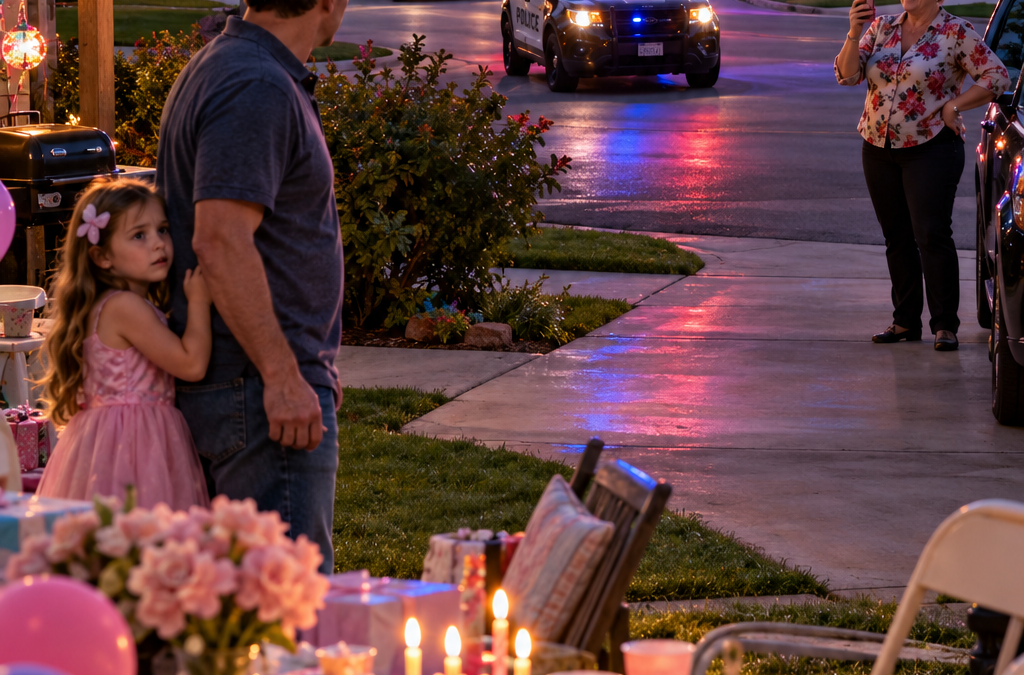
One cruiser.
Then another.
Then a third.
A fourth followed.
Nadine was standing near the end of my driveway.
She saw the lights.
She smiled.
Not subtly.
She looked at me as if the universe had finally confirmed everything she’d been saying.
In the backyard, the mood died instantly.
Conversation stopped.
My father turned.
Lauren’s friends stared.
The off-duty officers watched differently.
Cops notice speed.
Spacing.
Approach.
Nobody was arriving like they expected violence.
But civilians don’t necessarily know those details.
To them, four police cars are four police cars.
I was standing at the patio table with the cake knife.
Sophie tugged my sleeve.
“Dad.”
I looked down.
Her glitter sign was pressed against her chest.
“Why are there so many police cars?”
Before I could answer:
“Are they here because of us?”
Her voice was thin.
Careful.
She was trying not to cry.
That was the first moment I became truly angry.
Not irritated.
Not professionally concerned.
Angry.
My ten-year-old daughter was standing in her backyard at a celebration she had helped make for her father.
And she thought I was about to be taken away.
Every instinct in my body wanted to walk down that driveway and tell Nadine exactly what she’d done.
I didn’t.
Because four police cruisers were arriving.
Nadine was filming.
Guests were watching.
My daughter was watching most of all.
I put the cake knife down.
Kneeled.
“Stay with Mom.”
“But—”
“I’ll find out what’s happening.”
“Are you in trouble?”
“I don’t know yet.”
I could have lied.
I didn’t.
Lauren put her hand on Sophie’s shoulder.
She met my eyes.
She understood why I was walking instead of running.
I went around the house at an ordinary pace.
Nadine stood at the driveway with her phone raised.
The moment she saw me, she spoke loudly.
“I reported your illegal gathering.”
People near the gate heard.
She kept going.
“I told you this would happen.”
I said nothing.
The first cruiser stopped.
Officer Tessa Monroe got out.
I’d worked with Tessa for almost nine years.
I helped train her when she was a rookie who used to give dispatch entire paragraphs over the radio.
Nadine immediately moved toward her.
Tessa did not walk to Nadine.
She opened the rear door.
Reached inside.
And pulled out a large white bakery box.
Nadine stopped.
Second cruiser.
Greg Talbot got out.
Went to the trunk.
Returned with rolled poster board.
Third cruiser.
Two officers carrying brown bags from a barbecue restaurant near the station.
Grease staining the bottoms.
Fourth cruiser stopped at the end of the line.
The driver waved through the windshield.
Nobody hurried.
Nobody touched a holster.
Nobody looked remotely like they were responding to an armed disturbance.
Tessa walked up my driveway smiling.
“We’re early.”
I stared at the cake.
Then at her.
“Mercer said nine-thirty,” she explained, “but breaks didn’t cooperate.”
Behind her, Greg opened the poster.
SERGEANT REED — ABOUT TIME.
The yard exploded.
My father laughed so hard he sat down on the steps.
My sister clapped.
The off-duty officers cheered.
Sophie ran from behind the house, saw the sign, and started laughing.
Lauren slipped her hand into mine.
Lieutenant Mercer had arranged the whole thing.
Every on-duty officer had approval from the watch commander.
They were stopping by during scheduled breaks.
Rotating.
Remaining inside their sectors.
Remaining in service.
If a call came, they left.
It had been planned for days.
And I had known none of it.
Nadine hadn’t either.
For maybe sixty seconds, the entire evening became light again.
Nadine stood on the sidewalk with her phone lowered.
She looked completely lost.
Then Tessa’s radio crackled.
The dispatcher’s voice came across clearly.
Unit needed at my address.
Report of intoxicated persons.
Possible armed individuals.
Residential gathering.
Tessa’s smile vanished.
So did mine.
The laughter faded.
That was the moment the two separate events collided.
The cruisers had come to congratulate me.
But Nadine’s complaint was real.
Active.
And serious.
Tessa placed the bakery box on Greg’s hood.
Then stepped away from the party.
In two seconds, she changed from my friend into an on-duty police officer.
She keyed her radio.
Advised dispatch she was already on scene for an unrelated reason.
Then she disclosed something essential.
She knew me personally.
So did the other officers.
Conflict.
She could not investigate the complaint.
Neither could Greg.
Neither could any officer who had just walked up my driveway carrying food.
She requested an outside supervisor.
That moment mattered to me more than the surprise.
Nobody tried to protect me.
They protected the integrity of the process.
A few minutes later, an unmarked vehicle arrived.
Sergeant Owen Kesler.
North-side district.
I knew his name.
Not him personally.
Which was exactly what we needed.
Tall.
Late forties.
Calm.
The kind of person who looked as if he’d listened to thousands of people tell conflicting versions of the same event.
Nadine reached him before he had fully closed the door.
“I’m the caller.”
She pointed toward my house.
“They’re all covering for him.”
Kesler listened.
Didn’t interrupt.
After about a minute, he raised one hand.
“I’ll come back to you.”
He instructed the on-duty officers to return to their vehicles and remain available.
They did.
No argument.
No resentment.
Then he walked toward me.
“Mr. Reed.”
“Sergeant.”
“I understand you’re the homeowner.”
“Yes.”
“Tell me what happened.”
I gave him the timeline.
Only facts.
No motives.
No insults.
I didn’t call Nadine a liar.
Because at that point I did not know exactly what she’d told dispatch.
Twenty-two guests at peak.
Five children.
Music off since 7:15.
One vehicle voluntarily moved away from Nadine’s mailbox.
Another moved at Trent Lowry’s suggestion.
First complaint checked at 7:41.
No violation.
I opened my notes.
Kesler asked me to send them.
I did.
Right there.
Original timestamps.
No editing.
He looked through them.
Then walked across the street to speak with Nadine.
I couldn’t hear everything.
She gestured.
My house.
Cruisers.
Parked cars.
Off-duty officers.
Kesler wrote.
Asked short questions.
I learned later from his report that she described the event as an unauthorized party involving alcohol, armed individuals, and police vehicles possibly being used for a private celebration.
That final allegation was the most dangerous.
Noise could result in a warning.
Parking could result in a citation.
An allegation that I had used on-duty police vehicles for my personal party could put my promotion on hold immediately.
Misuse of department resources is not a joke.
It shouldn’t be.
If officers abuse public equipment for private benefit, that deserves investigation.
But that meant the allegation didn’t have to be true to hurt me.
It merely had to be credible enough to require review.
Lieutenant Mercer arrived in his own car.
I pulled him aside.
“If she’s alleging misuse of those cars, document everything.”
He nodded before I finished.
“Already on it.”
That was Calvin.
No drama.
He went to his vehicle.
Opened his laptop.
He had already put the entire surprise in writing days earlier.
Watch commander’s approval.
Break rotation.
Staffing roster.
Sector assignments.
Emails stating units remained in service.
Arrival windows.
Departure windows.
No emergency coverage lost.
No vehicle leaving its assigned district.
The fourth cruiser proved it in real time.
It received a call for a collision on the parkway.
The officer pulled away after less than three minutes.
Lights on.
Back to work.
There was no motorcade.
No misuse.
No taxpayer-funded parade.
A handful of officers on approved breaks had brought cake.
That was all.
I felt relief.
Then Nadine changed direction.
She pointed toward the officers.
“He’s using them to intimidate me.”
That scared me more than anything she’d said.
Because now the accusation was not merely that department resources had been misused.
She was alleging I used my position as an officer against a complaining resident.
That is the kind of claim that can stain a career even after it is cleared.
I made a decision that probably confused some of my friends.
I walked away.
Completely.
I went through the side gate.
Backyard.
I asked the off-duty officers to come with me.
“Why?” Kyle Brandt asked.
“Because I don’t want a single photo of me standing beside ten cops while she’s giving a complaint.”
Everyone understood immediately.
We disappeared from the front.
That mattered.
I did not win the night by using authority.
I survived it by refusing to use authority.
Every time Nadine escalated, she needed me to become the second half of her story.
Angry officer.
Threatening officer.
Officer using friends.
Officer checking records.
Officer intimidating complainant.
I refused each role.
Without my reaction, her story had only one person getting louder.
Meanwhile, Raymond crossed the street.
I watched from the side gate.
He introduced himself to Kesler.
He explained that he had been watching Nadine throughout the evening.
She photographed plates.
She walked past repeatedly.
She told him she would keep calling until someone did something.
When the cruisers first appeared, she had announced they were coming because of her before anyone knew why they were there.
Then Diane Holcomb approached.
She showed Kesler the neighborhood-group post.
Authorities have been notified of an illegal event.
That sentence mattered.
No authority had declared the gathering illegal.
Nadine had taken her conclusion and posted it as an official-sounding fact.
Still, being dramatic isn’t necessarily unlawful.
Being wrong isn’t necessarily unlawful.
People are allowed to make mistakes.
Then Kesler asked one question.
He referred to Nadine’s report about armed individuals.
“Which people did you actually see armed?”
Nadine pointed toward our gate.
At Kyle.
Kyle was wearing jeans and a polo.
Holding a paper plate with half a hamburger on it.
His concealed weapon was concealed.
No one could see it.
Kesler asked:
“Did you actually see a firearm?”
Silence.
Then Nadine said:
“I assumed officers would be armed.”
That was the crack.
Not because off-duty officers carrying lawfully was surprising.
Because she had reported an assumption as something she observed.
Kesler didn’t raise his voice.
“Then why did you report it as something you saw?”
Nadine didn’t have a good answer.
Nobody arrested her.
No dramatic handcuffs.
No shouting.
That wasn’t how the situation unraveled.
It came apart through comparison.
First complaint.
Noise and parking.
Checked.
No violation.
Second complaint.
Heavy drinking.
Armed people.
Misuse of police vehicles.
Yet nothing meaningful at the party had changed between the two reports.
No fight.
No drunken person wandering into traffic.
No weapons displayed.
No dangerous driving.
No escalation inside my property.
Only the language escalated.
Kesler went through it line by line.
He told Nadine residents must feel free to report genuine safety concerns.
Loud music late at night?
Call.
A drunk person in the street?
Call.
A weapon being displayed irresponsibly?
Absolutely call.
But dispatchers and officers make decisions based on what people report as observed facts.
Reporting assumptions as observations changes the response.
That can put people in danger.
Nadine did not accept that.
Instead, she reached for the title she had used for years.
“Elena knows I handle safety issues here.”
Elena Parker.
City community liaison.
Nadine mentioned her constantly online.
I’ve discussed this with Elena.
I’m coordinating with Elena.
Residents had interpreted those statements as proof of some official partnership.
Now Nadine was invoking her directly.
Tessa offered to verify.
Kesler agreed.
Elena happened to be on call for a downtown event.
She answered.
Tessa put the phone on speaker.
Kesler asked a simple question.
“Does Nadine Whitaker hold any official safety, enforcement, liaison, or neighborhood coordinator role with the city?”
Elena answered clearly.
“No.”
Nadine’s face changed.
Elena continued.
Nadine was a resident.
She had attended several public meetings.
She did not represent the city.
She did not represent police.
She had no enforcement authority.
No safety coordinator role existed.
The title Nadine had been using came from the online group she herself administered.
She had created it.
Awarded it to herself.
Then repeated it until the neighborhood stopped asking where it came from.
Standing near my backyard gate, I thought of every person who had moved a trash can because Nadine told them they were “in violation.”
Every parent who had worried because she posted a photograph of a child’s lemonade stand.
Every contractor she’d lectured about permitted hours.
The authority had never existed.
Only confidence had.
And compliance had made the confidence look real.
Kesler finished shortly after ten.
He came up the driveway.
Nadine followed at a distance.
He told me directly:
There was no illegal gathering.
No enforceable noise violation.
No significant parking violation.
No evidence of misuse of police vehicles.
Then:
Portions of the complaints appeared inconsistent with what responding personnel observed and would be documented for review.
No threats.
No accusations.
Documentation.
He asked if I wanted anything added.
Part of me wanted to say yes.
Charge her.
Make sure she pays.
Make her understand what she did to Sophie.
Instead, I looked at Nadine.
Her phone hung at her side.
I said:
“I want the record to show exactly what was reported and exactly what was found.”
That was it.
I still think it was the best answer I gave all night.
Revenge wouldn’t protect my career.
Accurate records would.
The patrol officers left gradually.
Back to their sectors.
Some with cake.
Some with barbecue.
The party never fully recovered.
People stayed another hour, but the easy feeling was gone.
Guests hugged Lauren longer when they left.
My father put one hand on my shoulder and said:
“You handled that better than I would’ve.”
“I had more to lose.”
He nodded.
“Maybe that’s why.”
After the last guest left, Calvin found me near the driveway.
“Because she alleged misconduct involving department resources, I’m sending everything to command tonight.”
“Good.”
“I’d rather they read the facts before somebody gives them a rumor.”
“Exactly.”
We shook hands.
Inside, Lauren and I carried trays into the kitchen.
I checked on Sophie.
She was asleep.
Her glitter sign leaned against the wall beside her bed.
Silver glitter had transferred onto the pillow.
One corner of the poster was warped where somebody had apparently placed a cold soda can on it.
I stood in the doorway.
For a long time.
I wanted the night to be over.
Three days later, I opened my department email.
Subject:
Complaint Regarding Hawthorne Lane Incident.
My stomach dropped.
Twelve years.
Never a formal complaint against me.
Now, days before my promotion was supposed to become official, I had one.
The message was short.
Professional Standards had received an allegation that department resources were misused in connection with a private event at my residence.
I had five business days to submit a written timeline and supporting documentation.
It also stated:
This request is part of the standard intake process and does not indicate any finding of misconduct.
I read that line three times.
Then something surprising happened.
I felt calmer.
Not happy.
Not relieved.
Grounded.
Professional Standards is exactly what should happen when somebody accuses an officer of abusing authority.
I believe that.
The process that protects citizens from dishonest officers was now going to evaluate me.
I didn’t need special treatment.
I needed the same process.
And I had documents.
I sent everything that afternoon.
My timeline exported with original timestamps.
Lauren’s guest list.
Screenshots of Nadine’s posts.
Raymond’s written statement.
Diane’s screenshots.
Calvin’s texts.
Including:
Keep driveway clear around 9:30 Saturday.
And:
Don’t send everyone home yet.
Calvin submitted the watch commander’s approval independently.
Break schedule.
Staffing.
Sector assignments.
GPS and dispatch logs.
Every vehicle remained in service.
Every vehicle stayed within assignment boundaries.
No emergency response was delayed.
One cruiser left immediately for a collision call.
Nothing depended on my friends saying I was a good person.
That’s what reassured me.
Facts did not need friendship.
Professional Standards could look at clocks.
GPS.
Dispatch.
Emails.
No loyalty required.
The review lasted nine days.
Those nine days were difficult.
I went to work.
Did my job.
Came home.
Pretended I wasn’t checking email every twenty minutes.
Lauren could tell.
One night she found me sitting in the dark kitchen after Sophie went to bed.
“You know you didn’t do anything.”
“I know.”
“Then why are you sitting here like this?”
“Because knowing and proving are different.”
She sat across from me.
“What happens if they delay the promotion?”
“They delay it.”
“And then?”
“I wait.”
“And if they don’t promote you?”
I didn’t answer.
Lauren reached across the table.
“You were Jackson before the stripes.”
“I know.”
“You were Sophie’s dad before the stripes.”
“I know.”
“You were my husband before the stripes.”
I smiled.
“Unfortunately.”
She kicked my ankle beneath the table.
“Idiot.”
Nine days after the review opened, the email arrived.
No misconduct.
Matter closed.
I read it once.
Then again.
Then forwarded it to Lauren with only two words.
We’re clear.
She called instantly.
“Don’t say anything.”
“I wasn’t—”
She screamed.
Same as the first time.
The promotion resumed exactly where it had paused.
The following week, I stood in a small auditorium at headquarters.
Uniform pressed.
Family seated in the second row.
Calvin Mercer stood beside me.
Sophie brought the poster.
Same one.
Blue marker.
Most silver glitter missing.
Warped corner.
CONGRATS, DAD.
Calvin pinned the sergeant stripes onto my sleeve.
Sophie raised the sign above her head.
Several officers laughed.
Then applauded for her.
That was the best part of the ceremony.
Afterward, we stood outside headquarters.
Sophie took my hand.
“Dad?”
“Yeah?”
“Were you scared they weren’t going to promote you because that lady called?”
I could have protected her from the truth.
Said no.
Never worried.
Everything was always fine.
But children learn from the way adults admit fear too.
“For a little while, yes.”
She nodded.
No surprise.
Then I crouched.
“I want you to remember something.”
“What?”
“Having authority doesn’t mean you get to say whatever you want.”
She looked at my new stripes.
I knew exactly what she was thinking.
“Especially this,” I said, touching my sleeve.
“If somebody has real authority, they have more responsibility to be careful. Not less.”
“Because people listen?”
“Exactly.”
She thought.
“That lady didn’t have authority.”
“No.”
“But people listened anyway.”
“Yes.”
“Why?”
That was the difficult question.
“Because she sounded like she did.”
Sophie frowned.
“That’s dumb.”
I laughed.
“Adults are complicated.”
“No. That’s dumb.”
Lauren overheard and smiled.
My daughter wasn’t wrong.
For Nadine, consequences came slowly.
Not dramatically.
She wasn’t arrested.
She didn’t lose her home.
She didn’t lose her job.
Nobody dragged her away.
That isn’t how most real consequences work.
The city sent her a warning regarding inaccurate information provided through complaint channels.
It explained that continued misuse could lead to further action.
No fine.
No criminal charge.
Just an official document stating that what she reported did not match what authorities found.
Then Elena Parker posted a notice in the neighborhood group.
No names.
Professional wording.
Neighborhood volunteers do not represent the city or police.
Private gatherings cannot be declared illegal by residents.
Suspected violations should be reported through proper channels.
It was impossible to misunderstand.
Everyone knew why it appeared.
Then neighbors started talking to one another.
That was the consequence Nadine had never anticipated.
For years, everyone experienced her separately.
One resident got a trash-can warning.
Another had a contractor photographed.
Another had a teenager’s car posted.
Another had a backyard fire pit discussed.
Each incident felt too small to fight.
Once people compared screenshots, they saw the pattern.
Messages where Nadine claimed coordination with city officials.
Warnings written like enforcement notices.
Photographs of license plates.
Statements suggesting she was working directly with police.
The two volunteers who helped administer the online group removed her as an administrator.
She fought it.
Of course she did.
But she lost.
A new group eventually replaced it.
The rules were posted at the top.
No unnecessary photographs of children’s activities.
No posting license plates without genuine safety reasons.
No describing complaints as confirmed violations.
Real safety concerns go through official channels.
Raymond joined on the first day.
His first post was a photograph of tomatoes.
Caption:
Neighborhood threat assessment: ripening rapidly.
I laughed for five minutes.
Nadine still lived three houses down.
Same tan colonial.
Same lawn.
But something had changed.
People stopped asking her permission.
That was all it took.
Her power had never been legal.
So nobody needed a court order to remove it.
They simply stopped believing in it.
A few weeks later, around forty residents gathered in a library annex for a city neighborhood meeting.
The agenda was boring.
Speed bumps.
Crosswalk signal.
Drainage complaint.
During questions, someone raised a hand.
“Who is the official neighborhood safety coordinator now?”
Elena Parker stood at the front.
“There isn’t one.”
No one turned toward Nadine.
She was sitting in the third row.
Nobody needed to look.
The silence did enough.
I sometimes think that moment was more meaningful than any punishment could have been.
A title only has power when other people agree it means something.
Nadine had spent two years turning an invented label into social authority.
It vanished in three words.
There isn’t one.
She never apologized to me.
I’ve made peace with that.
An apology is useful when someone understands what they’re apologizing for.
I don’t know whether Nadine ever did.
For months afterward, she avoided me.
If I pulled into the driveway while she was outside, she looked away.
If we passed while walking, she became very interested in her phone.
I didn’t force anything.
I wasn’t interested in humiliating her.
My daughter had already taught me enough about audiences.
The entire ordeal changed something in me as a police officer too.
Before that night, I believed I understood restraint.
I practiced it professionally.
I knew not to escalate.
Knew how tone changes encounters.
Knew why documentation mattered.
But it is easier to respect procedure when procedure is evaluating someone else.
It is much harder when your own career is inside the file.
That was the test.
I had access.
Connections.
Friends arriving in uniform.
A lieutenant willing to support me.
People who could have helped me control the situation.
I deliberately used none of it.
When Marcus texted, I said handle it normally.
When Tessa arrived, she immediately disclosed her conflict.
When Kesler took over, I gave him facts.
When Professional Standards contacted me, I submitted records.
I did not call anyone asking for a favor.
I did not ask the promotion board to rush.
I did not use my badge against Nadine.
The process worked because we didn’t interfere with it.
That’s the lesson I carried into supervision.
Months later, as a sergeant, I had a young officer in my office after a citizen complained about him.
He was angry.
“They’re lying.”
“Maybe.”
“I know they’re lying.”
“Maybe.”
“You don’t believe me?”
“That’s not the question.”
He looked offended.
I opened the complaint.
“The question is what the record shows.”
That sentence came from Hawthorne Lane.
He wanted me to dismiss the complaint because I knew him.
I didn’t.
We reviewed body camera.
Dispatch.
Reports.
Timestamps.
The complaint turned out to be unsupported.
The officer was cleared.
Afterward, he said:
“You could’ve just trusted me.”
“I did trust you.”
“Didn’t feel like it.”
“Trust isn’t the same as skipping verification.”
He was quiet.
Then he understood.
Real authority needs records precisely because personal confidence is unreliable.
Nadine’s biggest mistake had been believing that if she repeated something forcefully enough, confidence would become evidence.
It doesn’t.
A claim is not an observation.
A title is not authority.
A suspicion is not a violation.
And calling police does not transform what you believe into what actually happened.
That evening could have gone terribly wrong.
That’s the part I think about when people retell it as a funny story.
Neighbor calls cops.
Four cruisers arrive with cake.
Surprise.
Everybody laughs.
It is funny.
In retrospect.
But the second call wasn’t funny.
Armed individuals.
Alcohol.
Police vehicles.
That kind of information changes officer expectations.
If the responding units had not already known the circumstances, if somebody had arrived believing a dangerous armed gathering was spilling onto the street, a harmless movement could have been interpreted differently.
A man reaching into a waistband for a phone.
An off-duty officer stepping out of the gate.
A confused guest walking toward a cruiser.
False escalation has consequences beyond embarrassment.
That was why Kesler focused so carefully on the difference between what Nadine assumed and what she saw.
People have a right to report danger.
They do not have a right to manufacture certainty.
The difference can be someone’s life.
For Sophie, thankfully, the memory softened.
For months, she kept the glitter poster in her room.
One night I asked why.
“Because it’s funny.”
“What part?”
“The police brought cake.”
“That wasn’t funny at the time.”
“It is now.”
Fair.
Kids have an ability to reclaim memories adults overcomplicate.
She remembered asking whether I was in trouble.
She also remembered Tessa carrying a cake.
Both could be true.
At school, she once told a friend:
“My dad had four police cars at his party.”
I heard about that from the friend’s mother.
Apparently Sophie omitted the explanation.
I had to ask her not to tell stories likely to trigger parent-teacher conferences.
Lauren still laughs about that.
The promotion stripes eventually became normal.
That’s another strange thing.
You work twelve years for something.
Study.
Wait.
Sacrifice.
Then one day the thing you wanted becomes part of the uniform you put on without thinking.
The title didn’t change me as much as the night before it almost disappeared did.
I became more deliberate.
Not softer.
Not afraid of decisions.
More conscious of how authority feels from the other side.
Nadine had invented authority.
I had real authority.
That made my responsibility greater.
If I speak sharply, someone may interpret it as an order.
If I show up in uniform, people may assume they cannot say no.
If I call someone at another agency, my title changes how the call feels.
That is why authority must be restrained by procedure.
Otherwise, it becomes exactly what Nadine had built on Hawthorne Lane.
A person deciding their confidence should govern everybody else.
About six months later, I was getting mail when Raymond walked over.
“Sergeant.”
“Don’t start.”
He smiled.
“How’s public safety?”
“Threat level remains low.”
“Tomatoes are under control.”
“Good.”
He leaned against his mailbox.
“You know what still bothers me?”
“What?”
“How many of us let her do that stuff.”
I knew immediately who he meant.
“Nadine.”
“We knew she wasn’t official.”
“Some people didn’t.”
“I did.”
“So did I.”
He looked toward her house.
“Still easier to ignore her.”
“That’s why it worked.”
Raymond nodded.
“I guess everybody waits for somebody else to be first.”
“Usually.”
“You weren’t trying to be first.”
“No.”
“That’s the funny part.”
He was right.
I never set out to expose Nadine.
I wanted a barbecue.
She created the confrontation by needing every situation to acknowledge her importance.
That need escalated an ordinary afternoon into a formal complaint.
The same thing happens in institutions.
Sometimes abuse of power isn’t driven by money or cruelty.
Sometimes it’s driven by a person who cannot tolerate being told:
No.
You don’t decide this.
Nadine asked how many guests were coming.
Fine.
She suggested concerns about parking.
Fine.
She documented public activity from a sidewalk.
Legal, however unpleasant.
But when those things failed to produce obedience, she escalated.
She called.
Then called again.
She changed descriptions.
Introduced weapons.
Introduced departmental misconduct.
Invoked a city liaison.
Every step was designed to force reality into the conclusion she’d started with.
That is not safety.
That’s confirmation seeking with consequences.
The distinction became one of the most important lessons of my career.
You don’t investigate backward from the answer you want.
You start with the facts.
That night, the facts were boring.
Twenty-two guests.
Five children.
Food.
One cooler of beer.
Music off early.
Legal parking.
No disturbance.
No weapon displayed.
Four cruisers visiting briefly under documented authorization.
A little girl with glitter all over her hands.
There was no dramatic crime hiding under the barbecue.
The drama came entirely from the person describing it.
I still have my original timeline.
I saved it after Professional Standards closed the matter.
6:14.
6:19.
6:23.
6:48.
7:41.
8:52.
Dates and short sentences.
Nothing emotional.
Sometimes I show it to new supervisors when we’re discussing complaint documentation.
Not Nadine’s name.
Not the personal details.
The principle.
Write down what happened while it is happening.
Do not trust memory to become more accurate under stress.
Do not write conclusions as facts.
Don’t say:
Subject was trying to intimidate me.
Write:
Subject stepped within two feet, raised voice, pointed toward my chest, and said…
Let whoever reviews the evidence decide what it means.
That discipline protected me.
If my timeline had been full of phrases like crazy neighbor, lying woman, harassment queen, it would have looked like a personal feud.
Instead:
Nadine photographs vehicles.
Asked not to film children.
Guest vehicle voluntarily moved.
First complaint checked.
No violation.
Facts.
Boring facts.
Boring facts saved my promotion.
Calvin told me something afterward that I never forgot.
We were walking back from the pinning ceremony.
He said:
“You know why I recommended you?”
I expected something uncomfortable and complimentary.
Instead he said:
“Because you don’t need to win every conversation.”
I laughed.
“That’s it?”
“That’s rarer than you think.”
He walked ahead.
I thought about Nadine.
She needed to win every conversation.
Every disagreement had to end with acknowledgment that she was right or she escalated.
That was exactly why she lost the thing she valued most.
Influence.
People trust someone who can occasionally say:
I was wrong.
I don’t know.
Let me check.
Nadine’s authority collapsed because she never left room for those sentences.
Today, Hawthorne Lane is quieter.
Not silent.
Neighborhoods never are.
People still complain.
Someone’s dog gets loose.
A contractor parks badly.
Leaves clog drains.
Teenagers occasionally drive faster than they should.
The difference is people use real channels.
If a car blocks a hydrant, somebody calls parking enforcement.
If there’s a dangerous driver, they call police.
If it’s merely irritating, they talk to each other.
No one sends unofficial violation notices.
No one accepts a social media administrator as an enforcement officer.
The new neighborhood group remains mostly what the old one was supposed to be.
Lost pets.
Recommendations.
Garage sales.
Tomatoes.
Lots of Raymond’s tomatoes.
Once, someone posted a picture of a trash can left out overnight.
Within minutes another resident replied:
Is it hurting anyone?
The post disappeared.
Progress.
Nadine remains in her house.
Her lawn is still perfect.
She occasionally attends city meetings.
She has every right to.
When she speaks, officials listen politely.
As they should.
She is a resident.
One voice.
Not an authority.
That distinction is healthy.
I don’t hate her.
I was furious that night.
There were moments when I wanted consequences much harsher than what happened.
Especially when Sophie asked if police were there because of us.
But anger fades when life moves.
What remains is understanding.
Nadine built power out of fear of inconvenience.
People complied because arguing seemed harder.
That made her believe compliance proved legitimacy.
Then one person stopped complying.
Not aggressively.
Simply by asking:
What rule?
What authority?
What did you actually see?
Her system couldn’t survive those questions.
No invented authority can.
On the day I officially became Sergeant Jackson Reed, Sophie stood beside me in the headquarters parking lot holding her bent poster.
She looked at my sleeve.
“Are you important now?”
Lauren laughed.
I didn’t.
Because Sophie was genuinely asking.
“No.”
“But you’re a sergeant.”
“That’s a job.”
“Doesn’t that mean people have to listen to you?”
“Sometimes.”
“When?”
“When I’m responsible for something.”
She looked confused.
I tried again.
“If there’s an emergency and I’m giving instructions to keep someone safe, yes.”
“So you’re in charge.”
“In that situation.”
“Like that lady thought she was in charge.”
That caught me.
“Not quite.”
“Why?”
“Because I have rules too.”
She looked at the stripes again.
“More rules?”
“A lot more.”
“So being in charge means you have more rules.”
I smiled.
“That’s actually pretty good.”
She seemed satisfied.
Then she hugged me.
That is the memory I prefer to keep.
Not Nadine at the driveway.
Not the cruisers.
Not the complaint email.
My daughter figuring out in one conversation what plenty of adults never understand.
Authority is not freedom from rules.
Real authority means more responsibility to follow them.
I did not keep my promotion because I was a police officer.
Being a police officer made the situation more dangerous for me.
One angry comment could have been described as intimidation.
One unauthorized records check could have become misconduct.
One call to a friend in dispatch could have looked like interference.
One careless photograph beside uniformed officers could have supported the narrative Nadine wanted.
I kept my career because I didn’t use the shortcuts available to me.
I wrote down what happened.
I let neutral people verify it.
I stepped away when my presence could complicate the investigation.
And when asked what I wanted at the end, I didn’t demand revenge.
I wanted the record to be accurate.
That was enough.
Nadine had spent two years teaching Hawthorne Lane that a confident accusation could behave like a verdict.
One long Saturday night taught us otherwise.
Calling the police doesn’t make you right.
Writing “illegal” in a neighborhood post doesn’t make something illegal.
Giving yourself a title doesn’t create authority.
And four patrol cars turning onto your street don’t necessarily mean the person you accused is finally in trouble.
Sometimes they’re carrying barbecue.
Sometimes they’re carrying cake.
And sometimes the thing that destroys a false story isn’t a dramatic confrontation at all.
It’s simply a timeline, a dispatch log, a few screenshots, a supervisor willing to compare them, and the truth arriving in the correct order.
A month after my promotion ceremony, I still lived in the same house.
Lauren still left physical-therapy journals open on the kitchen counter.
Sophie still got glitter on things no glitter had any reason to touch.
Raymond still watched the street from his porch.
Nadine still lived three houses away.
We weren’t friends.
We probably never would be.
She never apologized.
I no longer needed her to.
Something more useful happened.
She could no longer turn a post into a rule.
She could no longer turn suspicion into evidence simply by describing it confidently.
And nobody on Hawthorne Lane heard the words “I’ll call the police” and automatically assumed the person saying them must be right.
I still had my family.
My home.
My career.
My name.
And after twelve years, I finally had sergeant stripes on my sleeve.
Sophie still had her sign.
Warped corner.
Missing glitter.
Blue letters.
She kept it leaning against the wall in her bedroom long after the ceremony.
One evening, I asked whether she wanted me to frame it.
She shook her head.
“It doesn’t need a frame.”
“Why not?”
“Because then I can’t hold it.”
I didn’t have an answer to that.
So the sign stayed exactly as it was.
Imperfect.
Bent.
A little ridiculous.
And honest.
Just like the night it survived.
In the end, Nadine had tried to create authority by controlling the story everyone heard first.
The only defense I ever needed was to make sure the truth had been written down before she could rewrite it.








