𝗙𝗨𝗟𝗟 𝗦𝗧𝗢𝗥𝗬 MY FOURTEEN-YEAR-OLD K9 COULD BARELY MOVE—SO WHY WAS HE DESPERATELY TRYING TO KEEP ME AWAY FROM THE BACK DOOR?
𝗣𝗔𝗥𝗧 𝟮
I looked back at the kennel.
Thor was watching me.
His head tilted slightly.
“Sounds like my ex-partner.”
Hayes laughed.
“Go ahead. Introduce yourself.”
I crouched beside the gate.
“Hey, buddy.”
Thor approached.
He sniffed my fingers.
Then he stepped backward and sat down.
I waited.
Nothing happened.
I tried a gentle command.
He ignored it.
I tried again.
Still nothing.
Hayes folded his arms.
“Well?”
I sighed.
“I think he hates me.”
“No. He hasn’t decided yet.”
“Decided what?”
“Whether you’re worth listening to.”
I looked at Thor.
He looked right back.
Something about that expression made me laugh.
“All right, tough guy. I guess we’ve got work to do.”
I sat on the concrete outside his kennel for nearly forty minutes.
I didn’t keep giving commands.
I didn’t tug his collar.
I just talked.
I told him my name.
Told him about the town where I worked.
Told him I had a wife named Linda and a daughter named Emily, who would probably spoil him rotten.
He listened.
Or at least he appeared to.
Eventually, he approached the gate again.
I held out my hand.
This time, he pressed his nose against my palm.
Then he leaned forward until his forehead rested against my fingers.
Hayes watched from several feet away.
He smiled.
“Well, I’ll be damned.”
“What?”
“Looks like you’ve been hired.”
That was how it began.
No dramatic music.
No instant obedience.
Just a stubborn young German Shepherd deciding to trust a middle-aged police officer.
I didn’t know then that this animal would save my life.
I didn’t know he’d find children buried beneath snow, stand between me and armed criminals, or become the only reason I got out of bed after my wife died.
I only knew that when I stood up, Thor stood with me.
And when I walked toward the training field, he followed.
For the next several months, we trained together almost every day.
Thor learned patrol procedures, scent tracking, suspect location, obedience under distraction, and controlled apprehension.
I learned how to read the smallest changes in his body.
A slight movement of his ears.
The tightening of his shoulders.
The way his breathing changed when he detected a human scent.
The difference between curiosity and suspicion.
Between uncertainty and absolute confidence.
Thor was incredibly intelligent.
He was also stubborn enough to make me question my decision at least three times a week.
One afternoon, during a tracking exercise, he stopped near a fallen tree and refused to continue.
I checked my map.
The trail was supposed to lead toward an abandoned barn.
“Come on, Thor.”
He didn’t move.
I tugged the leash gently.
Nothing.
I tried another command.
Thor sat down.
Hayes, watching from the far side of the field, shouted, “Callahan!”
I turned.
“What?”
“Who’s got the better nose?”
I sighed.
“Thor.”
“Then stop arguing with him!”
I loosened the leash.
“All right, partner. Show me.”
Thor immediately turned toward the fallen tree, circled the trunk, and located the hidden training assistant in a depression behind the roots.
I stared at him.
He looked up at me, tail moving proudly.
Hayes approached, shaking his head.
“That dog isn’t your equipment, Cal. He’s your partner. Treat him like one.”
I remembered those words for the rest of our career.
And on the night someone tried to break into my house, they came back to me with painful clarity.
Because for nearly ten minutes, I had been arguing with the one creature who knew exactly what was happening.
Thor’s first major rescue happened during our second winter together.
A seven-year-old boy named Samuel Porter disappeared while playing near his grandparents’ property.
It was late January.
Snow covered the fields, and temperatures were falling rapidly.
The child had followed his family dog into the woods.
The dog returned.
Samuel didn’t.
By the time Thor and I arrived, volunteers had been searching for almost three hours.
Samuel’s mother was standing beside a command vehicle, crying so hard she could barely speak.
She grabbed my sleeve.
“Please tell me your dog can find him.”
I looked toward the dark tree line.
“I can’t promise anything, ma’am. But we’re going to try.”
She looked down at Thor.
He stood quietly beside me.
“Please,” she whispered to him. “Please bring my baby home.”
I still remember the way Thor looked at her.
Not because I believe he understood every word.
But because he became unusually still.
As if he recognized the urgency in her voice.
We began tracking near the edge of the family’s backyard.
Thor caught the scent from Samuel’s jacket and led us through the trees.
Snow fell harder.
The wind whipped across the open fields.
At one point, the trail seemed to disappear near a frozen drainage ditch.
I called for Thor to search again.
He circled.
Sniffed.
Stopped.
Then pulled toward a steep ravine.
I followed him through the underbrush.
Branches tore at my uniform.
Ice cracked beneath my boots.
The darkness made every tree look the same.
After nearly an hour, our radio crackled.
“Callahan, command wants your status.”
I looked at Thor.
He was pulling harder.
“Still tracking.”
“Visibility’s deteriorating. You may need to return and regroup.”
I watched my dog.
His head was down.
His body was steady.
He wasn’t wandering.
He was working.
“Negative. He’s got something.”
We continued.
Ten minutes later, Thor stopped near a fallen oak tree.
His ears rose.
He gave three sharp barks.
Then he began pawing at the snow.
I hurried forward.
Beneath a tangle of branches lay a small boy in a blue winter coat.
Samuel had fallen down the ravine and become trapped against the roots of the tree.
He was conscious but dangerously cold.
His face was pale.
His gloves were missing.
I dropped to my knees.
“Samuel?”
His eyes opened slightly.
“Mom?”
My throat tightened.
“No, buddy. I’m Officer Callahan. Your mom sent us.”
He looked toward Thor.
“Dog?”
I smiled.
“That’s Thor.”
Samuel’s lips trembled.
“Is he nice?”
I reached toward him.
“He’s the best.”
Thor moved closer.
He lowered his head beside Samuel’s shoulder.
The boy reached out with one shaking hand and touched his fur.
I radioed for rescue personnel and wrapped Samuel in my emergency blanket.
We waited together while firefighters made their way down the ravine.
Samuel kept his hand against Thor’s neck.
Every time he began crying, Thor moved closer.
When the rescuers finally lifted him onto a stretcher, Samuel reached toward my dog.
“Can Thor come?”
A paramedic looked at me.
I nodded.
“He’s coming.”
Thor rode in the ambulance.
He sat on the floor beside the stretcher while Samuel held two fingers against his collar.
At the hospital, the boy’s mother ran toward us.
She gathered him into her arms and cried.
Then she turned toward Thor.
She knelt in front of him.
Her hands trembled as she touched his face.
“You brought him back.”
Her voice broke.
“You brought my baby back.”
Thor gently licked her cheek.
She began crying harder.
I stood beside them, blinking away tears of my own.
That night, after we returned home, Linda was waiting in the kitchen.
She had seen the story on the local news.
Thor walked straight to her.
She dropped to her knees and wrapped her arms around him.
“My beautiful boy.”
He rested his head against her shoulder.
I leaned against the doorway.
Linda looked up at me.
“Did he really find that child all by himself?”
I nodded.
“He did.”
She kissed the top of his head.
“Then I hope you gave him a hundred treats.”
I laughed.
“He already got three.”
“Three?”
She looked horrified.
“Cal, that dog saved a little boy.”
I raised my hands.
“All right. I’ll get the treats.”
She smiled.
And Thor, who had spent hours tracking through freezing darkness, wagged his tail as though the entire rescue had been worth it for the possibility of another biscuit.
That was the dog I knew.
Brave enough to face anything.
Gentle enough to let a frightened child hold his collar.
And completely shameless when it came to treats.
Over the years, Thor helped locate missing seniors, track dangerous suspects, and recover evidence that human search teams might never have found.
But the incident I remembered most clearly happened five years after we became partners.
It was a rainy Thursday night.
We were called to assist officers responding to a violent domestic disturbance at an isolated farmhouse outside town.
A man had threatened his family and fled into the surrounding property.
His wife and children were safe with deputies.
But he was believed to be armed.
The house stood at the edge of several acres of woods, with an abandoned barn behind it.
Rain soaked the ground.
Visibility was poor.
Thor and I joined the search team near the driveway.
One of the younger officers, Deputy Michael Reed, stood beside me.
He was twenty-eight and had only recently transferred to our department.
He was a good man.
Brave.
Conscientious.
Still young enough to believe terrible things happened mostly to other people.
Thor stiffened as we approached the barn.
I felt the leash tighten.
I raised my hand.
“Hold.”
Michael stopped.
“What is it?”
“Thor’s got something.”
We moved into cover and directed additional officers to watch the exits.
Thor kept his attention fixed on the barn’s side entrance.
Then he growled.
A low, deliberate warning.
I recognized it instantly.
The same growl he would make years later while lying crippled on my kitchen floor.
We called for the suspect to come out.
There was no response.
Then a figure appeared in the darkness near the side door.
He had a handgun.
Someone shouted a warning.
A shot cracked through the rain.
Michael stumbled backward and fell.
For one terrible instant, I thought he’d been hit.
I dragged him behind the patrol vehicle while the other officers responded.
The suspect retreated into the building and surrendered after a short standoff.
Michael sat against the tire of the patrol SUV, breathing hard.
His face was white.
I checked him for injuries.
The bullet had torn through the shoulder of his jacket without striking him.
He stared at the damaged fabric.
“Jesus Christ.”
His hands began shaking.
Thor approached.
Michael reached toward him.
The dog lowered his head.
Michael buried his face against Thor’s neck.
“He knew.”
I nodded.
“He smelled him before we saw him.”
Michael began crying.
I let him.
I’d seen that reaction before.
Sometimes the fear doesn’t arrive until the danger is gone.
Later, Michael told me his wife was expecting their first child.
He showed me an ultrasound photograph on his phone.
A tiny life.
Barely recognizable.
But already the center of his world.
“I almost didn’t get to meet her,” he whispered.
I looked at Thor.
He was sitting beside the patrol vehicle, watching us.
“Then you’d better make sure you do,” I told Michael.
He nodded.
And he did.
His daughter, Rebecca, was born four months later.
Michael sent us a photograph.
He brought Thor treats every Christmas.
He never forgot what happened that night.
Neither did I.
Because that was when I realized something important about my partner.
Thor didn’t understand medals.
He didn’t know how to count arrests.
He didn’t know the meaning of a commendation or a newspaper headline.
He simply understood that his job was to keep people safe.
He would put himself between danger and the person beside him without stopping to consider what it might cost.
That quality made him an extraordinary police dog.
It also terrified me.
Because I knew that someday he might make a choice I couldn’t stop.
And I knew he would make it for me.
The years passed.
My hair turned gray.
Thor’s muzzle began to whiten.
My daughter Emily graduated from college, married, and gave us a grandson named Owen.
Linda spoiled Thor shamelessly.
She called him her second son.
She bought him birthday presents and insisted he sleep in the living room during thunderstorms, even though he was perfectly capable of sleeping alone.
She never understood why I wouldn’t let him sit at the dinner table.
And every time I caught her slipping him food, she looked at me with complete innocence.
“What?”
“Linda.”
“What?”
“You’re feeding him again.”
“He’s hungry.”
“He ate twenty minutes ago.”
She scratched Thor’s ears.
“Maybe you should make bigger dinners.”
Thor always sided with her.
Those were the happiest years of my life.
I didn’t know that while I was living them.
Most people don’t.
You spend your time worrying about bills, schedules, work, and all the little things that seem urgent.
Then one day, you look back and realize the ordinary evenings were the ones you would give anything to have again.
Linda died three years after Thor retired.
A sudden heart attack.
No warning.
No chance for a final conversation.
She was sixty-two.
I had left the house that morning to pick up groceries.
She was standing in the kitchen when I kissed her goodbye.
“Don’t forget the coffee,” she said.
I smiled.
“I never forget the coffee.”
She laughed.
“You forgot it last week.”
That was the last normal conversation we ever had.
When I came home, Thor was barking.
Not his usual excited greeting.
A frantic, frightened bark I’d never heard before.
I found Linda on the kitchen floor.
I called 911.
I started CPR.
I did everything I had been trained to do.
But she was already gone.
For thirty-four years, I’d believed that being prepared meant I could handle almost anything.
That day taught me otherwise.
Thor stayed beside the kitchen doorway while the paramedics worked.
When they carried Linda away, he followed as far as the front porch.
Then he stopped.
He watched the ambulance leave.
For weeks afterward, he searched for her.
He checked the bedroom.
He waited beside her favorite chair.
He sniffed the coat hanging by the front door.
One evening, I found him lying with his head resting on one of her slippers.
I sat down beside him.
And for the first time since the funeral, I cried until I couldn’t breathe.
Thor pressed his body against mine.
I held him.
I told him I was sorry.
I told him I missed her.
I told him I didn’t know how to live in a house that no longer had her voice in it.
He stayed beside me until morning.
After Linda died, Thor became my reason to get out of bed.
He needed breakfast.
He needed his medication.
He needed walks.
He needed somebody to open the door when he wanted to lie beneath the maple tree.
There were mornings when I wanted to stay in bed forever.
But Thor would come into the bedroom, place his nose against my hand, and wait.
Eventually, I’d get up.
He never hurried me.
He never seemed disappointed.
He just waited until I was ready.
People say dogs are loyal.
But loyalty is too small a word for what Thor gave me.
He didn’t only stay when life was easy.
He stayed when I became somebody I barely recognized.
And somehow, without ever saying a word, he helped me find my way back.
By the time Thor turned fourteen, his body had begun failing badly.
The first serious problem was his hips.
Then his spine.
Then arthritis spread through his elbows and shoulders.
He had always been a powerful animal.
Nearly ninety pounds during his working years.
He could clear obstacles, run across rough terrain, and hold his footing on ground that sent younger officers stumbling.
Now he struggled to climb a single step.
I built a ramp beside the back porch.
For a while, he used it.
Then even the ramp became difficult.
I bought a support harness to help lift his hindquarters.
He tolerated it, but I could see how much he hated needing help.
Sometimes he’d try to stand before I reached him.
His back legs would shake.
His nails would scrape the floor.
Then he’d collapse.
Every time, I felt a little part of myself break.
“Easy, partner,” I’d whisper.
“I’ve got you.”
Those words used to mean I was standing beside him before a dangerous call.
Now they meant I was helping him get outside to relieve himself.
Thor never complained.
He accepted the indignity of old age with more grace than I could have managed.
But I could see his frustration.
There were mornings when he stared at the back door for long stretches.
I’d open it, thinking he wanted to go outside.
He’d lift his head.
Try to stand.
Fail.
Then look away.
I began wondering whether keeping him alive was becoming an act of selfishness.
Our veterinarian, Dr. Katherine Ellis, had treated Thor for years.
She knew his scars, his medical history, and the stubborn expression he wore whenever someone tried to examine his paws.
During one appointment, she watched him struggle to stand.
Then she looked at me.
“Cal, we need to talk about his quality of life.”
I felt my chest tighten.
“He’s still eating.”
“That’s good.”
“He recognizes me.”
“I know.”
“He still gets excited when Emily brings Owen.”
She nodded.
“Those things matter.”
I swallowed.
“But?”
She sat across from me.
“But his pain is becoming harder to control. His mobility is severely limited. We need to be honest about what that means.”
I looked at Thor.
He lay on a thick blanket beside the examination table.
His breathing was slow.
His eyes followed me.
“He’s not ready,” I said.
Dr. Ellis was quiet.
Then she asked, “Cal, how do you know?”
I looked at her.
“Because I know him.”
She nodded gently.
“I believe you do.”
I felt defensive.
“He survived getting struck by a car during a search. He survived a shoulder injury. He worked through things that would’ve stopped other dogs.”
“I know.”
“He’s a fighter.”
Her expression softened.
“Yes, he is.”
Then she said something I didn’t want to hear.
“But sometimes the kindest thing we can do for a fighter is stop asking him to fight.”
I turned away.
I couldn’t answer.
She didn’t push.
Instead, she helped me adjust his medications and explained how to monitor his comfort, appetite, and ability to rest.
She asked me to call if his pain worsened.
And she told me that when the time came, she would help me make sure Thor didn’t suffer unnecessarily.
I thanked her.
Then I carried my old partner to the truck.
He rested his head against my chest.
For the first time in all our years together, I was frightened by how light he felt.
Not because he had become small.
But because he had lost so much of the strength I remembered.
That evening, I sat with him beside the fireplace.
I looked at the framed photograph above the mantel.
Thor and me.
Standing beside our patrol vehicle.
Both younger.
Both stronger.
Both looking toward a future we thought would last forever.
I touched his head.
“Not yet, buddy.”
His eyes moved toward mine.
“Just give me a little more time.”
He licked my hand.
And I took that as an answer.
Maybe because I wanted to.
Maybe because I wasn’t ready to hear anything else.
During the final months before the break-in, our routine became painfully small.
We woke around seven.
I carried Thor outside using his support harness.
He stood for a few minutes when he could.
On bad mornings, I supported most of his weight.
Then we returned to the kitchen.
I prepared his breakfast.
Gave him his medication.
Changed his bedding.
And sat beside him while I drank coffee.
Sometimes I read the newspaper aloud.
Other times, I told him stories about our working years.
“Remember the time you chased that suspect into the creek?”
He’d lift his head.
“Fella lost both shoes trying to get away from you.”
His tail would move.
“Still think you enjoyed that one a little too much.”
I’d laugh.
Then I’d look at his weak legs.
And the laughter would disappear.
I missed the dog he used to be.
I missed the patrol car.
The radio.
The early mornings when he’d stand beside the garage door, trembling with anticipation.
But more than anything, I missed seeing him move without pain.
Emily began visiting more often.
She lived forty minutes away with her husband and Owen.
Every Sunday, she brought groceries and helped with things I pretended I could still manage alone.
One afternoon, she found me sitting on the kitchen floor beside Thor.
I’d just spent twenty minutes trying to help him stand.
He’d finally given up and rested his head against my knee.
Emily knelt beside us.
“Dad.”
I looked up.
“What?”
“You can’t keep doing everything by yourself.”
“I’m managing.”
She glanced at the medication bottles.
The towels.
The support harness.
The water bowl I’d moved beside his bed.
“I know you are.”
“Then what’s the problem?”
She hesitated.
“You’re exhausted.”
I shrugged.
“Old people get tired.”
“That’s not what I mean.”
I looked away.
She sat beside me.
“Dad, I’m worried about you.”
I stared at Thor.
“He took care of me for thirteen years.”
“I know.”
“I can take care of him for a little while.”
Emily’s eyes filled.
“Of course you can.”
She placed a hand on my shoulder.
“But taking care of him doesn’t mean you have to forget about yourself.”
I didn’t answer.
She continued.
“Mom wouldn’t want that.”
My throat tightened.
“Your mother isn’t here.”
Emily went quiet.
The words hung between us.
I regretted them immediately.
She stood slowly.
“I know she’s not, Dad.”
Her voice shook.
“I miss her, too.”
Then she walked into the living room.
I sat beside Thor, ashamed.
He looked up at me.
I stroked his head.
“Yeah,” I whispered. “I know.”
I had spent my career learning how to protect other people.
But grief had made me selfish in ways I didn’t want to admit.
I was so frightened of losing Thor that I had stopped noticing how much Emily was trying to help me.
That night, I called her.
I apologized.
She cried.
I cried.
And for the first time in a long while, we had an honest conversation.
She told me Owen missed spending time with me.
She told me she worried every time I didn’t answer the phone.
She told me I didn’t have to choose between loving Thor and allowing other people into my life.
I promised I’d try.
It was a promise I intended to keep.
But I didn’t know how soon it would be tested.
Three nights later, the storm arrived.
It had been raining since late afternoon.
Not heavy enough to flood the creek, but steady enough to turn the backyard into a muddy mess.
Wind rattled the old kitchen windows.
The security light above the garage flickered twice.
Then it steadied.
I checked the doors before going to bed.
Front door locked.
Garage closed.
Back door secured.
Thor lay on his bed near the kitchen radiator.
I adjusted his blanket and placed his water bowl within reach.
“All right, partner.”
He looked up.
“Time to sleep.”
I kissed the top of his head.
He sighed.
For a moment, I stood watching him.
The dog who had once followed me into armed standoffs now needed help turning over on his blanket.
I felt that familiar ache in my chest.
“Good night, buddy.”
I went upstairs.
But sleep didn’t come easily.
My knees hurt.
The wind kept striking the bedroom window.
And every time I closed my eyes, I found myself thinking about Dr. Ellis.
About the conversation I knew was coming.
About the day I’d have to say goodbye.
I must have drifted off around midnight.
The first bark woke me a little after two.
It was loud enough to carry through the hallway.
I sat up.
“Thor?”
Another bark.
Then another.
I glanced at the clock.
2:13 a.m.
I sighed.
For the previous few weeks, Thor had occasionally become restless at night.
Sometimes he needed water.
Sometimes he couldn’t find a comfortable position.
Once, he’d barked at the washing machine after its indicator light came on.
Dr. Ellis had explained that pain, poor hearing, and age-related changes could cause older dogs to become unsettled.
I’d begun worrying that Thor was losing his sense of where he was.
I climbed out of bed.
My joints protested.
“Coming, buddy.”
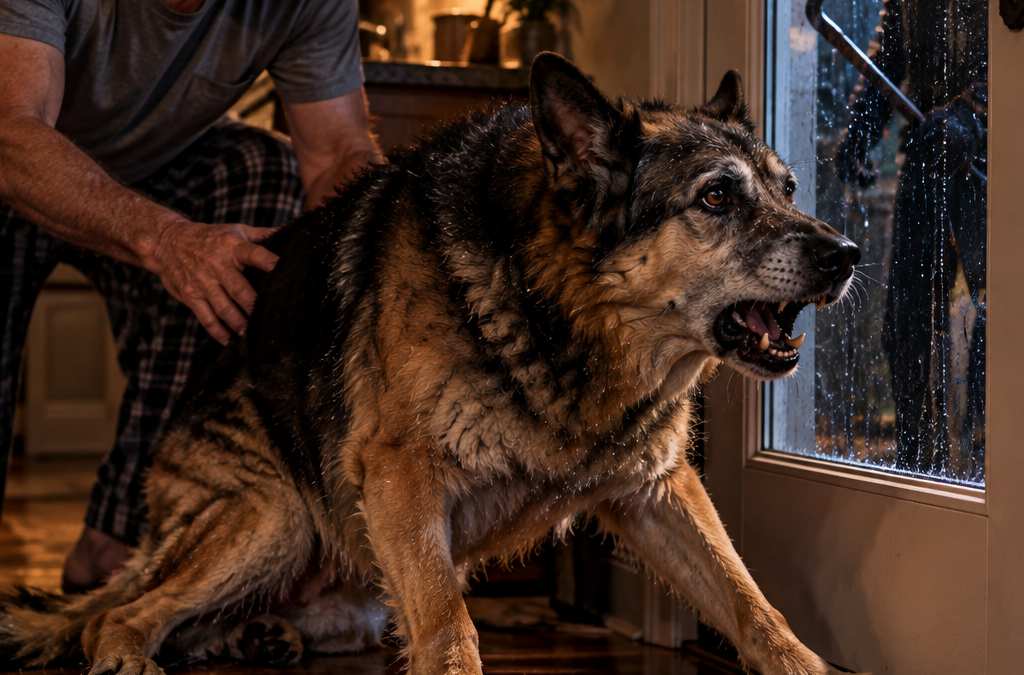
By the time I reached the kitchen, Thor was barking again.
He lay near his bed with his front paws extended.
His back legs were twisted awkwardly beneath him.
I hurried over.
“Hey. Hey, what’s wrong?”
He looked toward the back door.
Then barked.
I assumed he needed to go outside.
I reached for his support harness.
“All right. Let’s get you up.”
But the moment I moved toward the door, Thor growled.
I stopped.
“What?”
He barked sharply.
I frowned.
“Buddy, you can’t go outside unless I open it.”
He tried to lift himself.
His front legs pushed against the floor.
His hips barely moved.
I knelt beside him.
“Easy.”
I slid one arm beneath his chest.
He twisted away.
Then he barked toward the door again.
I felt frustration rise.
Not because I was angry with him.
Because I was exhausted.
Because I’d barely slept.
Because every new symptom reminded me that I was losing him.
“Thor, please.”
He barked.
“Enough.”
He stared at the door.
I rubbed my forehead.
“There’s nothing there.”
I wish I had stopped talking.
I wish I had remembered all the times that dog had known something I didn’t.
Instead, I said the words that still hurt to remember.
“You’re confused, old boy. Just go back to sleep.”
Thor looked at me.
Then he began dragging himself across the floor.
At first, I didn’t understand what he was doing.
He pulled with his front legs.
His hindquarters slid behind him.
His nails scraped against the hardwood.
Every movement looked painful.
“Thor, stop!”
He ignored me.
He moved another foot.
Then another.
He was heading toward the back door.
I tried to lift him.
He growled.
Not at me.
At whatever lay beyond the door.
Then he barked so loudly that I stepped backward.
I stared at him.
For years, Thor had been the kind of dog who could detect a person hiding behind a wall before any officer heard a sound.
And now he was using the last strength in his body to move toward a door.
Something changed inside me.
I stopped looking at him like an old dog with failing senses.
I looked at him like my partner.
His ears were fixed forward.
His eyes were sharp.
His nose moved constantly.
He wasn’t confused.
He was working.
I slowly turned toward the door.
Outside, the rain continued falling.
The glass pane reflected the dim kitchen light.
At first, I saw nothing.
Then I noticed a dark shape moving near the back porch.
I held my breath.
The shape disappeared.
I stepped closer.
Thor barked.
I stopped.
Then came the sound.
Metal scraping against the doorframe.
Slow.
Careful.
Someone was trying to force the lock.
My blood went cold.
I backed away.
For a few seconds, my mind refused to accept what I was hearing.
I’d lived in that house for more than twenty years.
It sat at the end of a quiet gravel lane outside town.
Most nights, the only visitors were deer crossing the yard or raccoons getting into the trash.
Now someone was standing on my back porch.
Working at the lock.
At two in the morning.
I looked toward the kitchen counter.
My phone was upstairs.
The cordless house phone sat in its charging cradle beside the refrigerator.
I moved toward it.
Thor’s barking intensified.
“Quiet, buddy,” I whispered.
Not because he was wrong.
Because I finally understood how serious this was.
I picked up the phone and dialed 911.
A woman answered.
“911, what’s your emergency?”
“My name is Robert Callahan. I’m at 417 Old Mill Road. Someone’s trying to break into my house.”
“Are you inside the residence?”
“Yes.”
“Are you alone?”
I looked at Thor.
“Just me and my dog.”
“Can you move to a secure room?”
I glanced toward the hallway.
The bedroom doors were upstairs.
The front door was on the opposite side of the house.
I could retreat.
But Thor couldn’t follow.
And I wasn’t leaving him.
“I have a disabled dog,” I said. “He can’t walk.”
The dispatcher paused.
“Sir, your safety is the priority.”
“I understand.”
A loud crack came from the back door.
I flinched.
Thor barked.
“He’s forcing the door,” I said.
“Officers are on the way. Do not confront him.”
I set the phone on speaker.
Then I grabbed the heavy wooden kitchen chair beside the table.
I wedged it beneath the back-door handle.
It wasn’t much.
But it was something.
Another blow struck the frame.
The chair shifted.
I stepped backward.
“Sir?” the dispatcher called.
“I’m here.”
“Can you tell whether the suspect has entered?”
“Not yet.”
Thor dragged himself another few inches.
He was now directly in front of the back door.
I stared.
“Thor.”
He growled.
“Come here, buddy.”
He didn’t move.
I stepped toward him.
He barked again.
Then a dark shape appeared through the glass.
A man.
Tall.
Wearing a dark hooded jacket.
His face was partially covered.
He held a metal pry bar.
He looked through the window.
And our eyes met.
For one frozen second, neither of us moved.
Then he struck the glass.
It shattered inward.
I ducked as fragments scattered across the kitchen floor.
Thor erupted into furious barking.
The man reached through the broken pane toward the inside lock.
I backed away.
“Police are coming!” I shouted.
He hesitated.
Then he tried the door again.
The chair held.
Barely.
“Get away from the house!” I yelled.
The man didn’t answer.
He shoved harder.
The chair scraped across the floor.
I grabbed a large flashlight from the counter.
It was the same heavy flashlight I’d kept from my patrol days.
I held it in front of me.
My heart pounded.
I had faced dangerous men before.
But not like this.
Not barefoot in my kitchen.
Not with my old partner lying helpless between me and an intruder.
The dispatcher was saying something.
I couldn’t make out the words.
The man struck the doorframe again.
Wood splintered.
Thor tried to stand.
His front legs straightened.
His hips rose perhaps two inches.
Then collapsed.
He let out a sharp cry of pain.
I felt something tear inside my chest.
“Thor, no!”
He immediately began barking again.
The man shoved the door.
The chair slipped sideways.
And suddenly the door burst inward.
The intruder stumbled into the kitchen.
He was younger than I’d expected.
Maybe thirty.
His clothes were soaked.
Mud covered his boots.
The pry bar hung in his right hand.
He looked at me.
Then at Thor.
For a moment, his expression changed.
Surprise.
Then anger.
“Shut that dog up!”
I backed toward the table.
“Get out of my house.”
He took another step.
“Where’s your wallet?”
I didn’t answer.
“Your wallet, old man!”
Thor growled.
The man looked down at him.
Then laughed.
“That’s what I’m supposed to be scared of?”
Something in his voice made my blood boil.
He could see Thor couldn’t stand.
He could see the way his hind legs lay uselessly behind him.
He could see the gray muzzle and trembling body.
And he thought it was funny.
“He’s old,” the man muttered.
He took another step toward me.
“You’re old.”
He lifted the pry bar slightly.
“Nobody’s going to help you.”
I looked at Thor.
His lips were pulled back.
His eyes never left the intruder.
“Get out,” I said again.
The man moved around the kitchen table.
I raised the flashlight.
He swung the pry bar.
I stepped backward, but my heel caught the edge of a rug.
I lost my balance.
My shoulder struck the corner of the counter.
Pain shot through my arm.
I fell to one knee.
The flashlight slipped from my hand and rolled across the floor.
The man stepped toward me.
He raised the metal bar again.
And for one terrible second, I knew I was too slow to stop him.
I was sixty-seven.
My right shoulder had been damaged in a duty-related accident years earlier.
My knees were worn out.
I couldn’t move the way I once had.
And the man standing above me was younger, stronger, and holding a weapon.
Then I heard Thor.
Not barking.
Not growling.
A desperate scraping sound.
Claws against wood.
I turned my head.
Thor had pulled himself forward.
His back legs dragged behind him.
His body shook.
His mouth opened.
The intruder glanced toward him.
“Stay down, you stupid—”
Thor lunged.
It wasn’t the powerful leap he would have made as a young police dog.
It wasn’t a perfect apprehension.
He barely lifted his chest from the floor.
But he managed to catch the man’s pant leg just above the ankle.
And he held on.
The intruder shouted.
His balance broke.
The pry bar swung away from me as he stumbled backward.
I rolled toward the table.
Thor’s jaws remained clenched around the fabric.
The man kicked and tried to pull free.
“Get off!”
I heard Thor cry out.
Then he tightened his grip.
I knew that sound.
I knew what it meant.
He was hurting.
Badly.
But he wasn’t letting go.
“Thor!”
My voice cracked.
“Let go, buddy!”
For the first time in all our years together, I was begging my partner to stop protecting me.
The intruder bent toward him, raising the pry bar.
Something inside me snapped.
“No!”
I grabbed the fallen flashlight and swung it against the man’s forearm.
The bar slipped from his hand and clattered beneath the table.
He staggered.
Thor released his pant leg.
The man stumbled toward the open back door.
For one second, he looked at me.
Then at Thor.
Then he ran.
I heard his boots strike the porch.
Then the wet gravel.
The dispatcher was still speaking.
“Sir! Sir, can you hear me?”
I crawled toward the phone.
“He’s running!”
“Are you injured?”
“My dog—”
“Sir, stay inside. Officers are arriving.”
I looked toward the back door.
Red and blue lights flashed across the wet trees.
A patrol vehicle came up the gravel lane.
Then another.
Someone shouted outside.
“Police! Stop!”
Footsteps pounded across the yard.
A man yelled.
I heard the unmistakable sound of someone being forced to the ground.
Then a deputy called over the radio.
“One in custody.”
But I barely noticed.
Because Thor was lying beside the kitchen table.
He had stopped barking.
His body was twisted awkwardly.
His chest rose and fell rapidly.
And there was blood on the floor.
I crawled toward him.
“No, no, no.”
My hands shook.
“Thor?”
His eyes moved toward me.
I touched his head.
“Buddy?”
He tried to lift his chin.
Then he let it fall.
I looked down at his right hind leg.
Blood seeped from a torn nail and a scrape along his hip.
But I knew the real damage might be deeper.
He had forced a body already crippled by arthritis through one final struggle.
“Please,” I whispered.
“Please don’t do this.”
His breathing was fast.
I pulled him gently toward me, careful not to twist his spine.
He gave a small whine.
I froze.
“I’m sorry.”
My voice broke.
“I’m so sorry, buddy.”
I placed my hand against his cheek.
“You’re okay. I’ve got you.”
The words sounded familiar.
I’d spoken them hundreds of times.
During dangerous calls.
After injuries.
When he was young and strong.
When he was old and frightened.
But now they felt terribly inadequate.
Because for the first time, I wasn’t sure I could keep my promise.
A deputy entered through the back door.
“Sir? Police!”
I looked up.
“Help my dog.”
The officer stopped.
He saw the broken glass.
The blood.
The old German Shepherd lying in my arms.
He lowered his weapon.
“Sir, are you hurt?”
“Help him.”
The deputy knelt.
“All right. We’ll get help.”
He spoke into his radio.
Then another officer entered.
A woman.
Her name tag read MARTINEZ.
She crouched beside me.
“Mr. Callahan?”
I nodded.
“Cal?”
I looked at her.
It took me a moment to recognize her.
“Rachel?”
Deputy Rachel Martinez had been a rookie when I retired.
I remembered teaching her how to approach a traffic stop safely.
Now she was kneeling on my kitchen floor, looking at the dog she’d once admired from the other side of the patrol vehicle.
She looked at Thor.
“Oh, God.”
Her voice softened.
“Is that Thor?”
I nodded.
Tears blurred my vision.
“He’s fourteen.”
Rachel gently touched his shoulder.
“I know.”
“He can’t walk anymore.”
She looked at me.
“I know, Cal.”
“He still tried.”
My voice shattered.
“He still tried to stop him.”
Rachel swallowed.
Then she looked down at Thor.
“Hey, big guy.”
His eyes shifted toward her.
She smiled through tears.
“Still protecting your partner, huh?”
Thor’s tail moved once.
Just once.
Rachel covered her mouth.
Then she stood.
“We’re getting you both help.”
Within minutes, paramedics were checking my shoulder while Rachel contacted an emergency veterinary hospital.
I barely listened.
I kept my hand on Thor.
Every time someone tried to move him, I asked them to stop until we could support his body properly.
I knew he was hurting.
I knew that if we moved him carelessly, we could make things worse.
A veterinary technician spoke with Rachel by phone and advised us how to transport him with minimal movement.
We used a thick blanket as a stretcher.
Four of us lifted him carefully.
Thor whimpered once.
I leaned close.
“Easy, partner.”
His eyes found mine.
“I’ve got you.”
At the emergency animal hospital, the veterinarian examined him immediately.
Her name was Dr. Melissa Warren.
She was younger than Dr. Ellis, with tired eyes and a calm voice.
She checked Thor’s breathing.
His heart.
His hips.
His spine.
She ordered imaging and blood tests to look for injuries from the struggle.
I sat in the waiting room with my hands clasped together.
Rachel stayed beside me.
I hadn’t asked her to.
She just stayed.
After a while, she handed me a paper cup of water.
“Drink something.”
I shook my head.
“Can’t.”
“Cal.”
I looked at her.
She waited.
I took the cup.
My hands were trembling so badly that water spilled onto my jeans.
Rachel quietly took it back and held it steady while I drank.
For a few minutes, neither of us spoke.
Then I said, “I thought he was confused.”
She turned toward me.
“What?”
“Thor.”
I swallowed.
“He kept barking. I thought he was getting confused because he’s old.”
Rachel watched me.
“I told him to be quiet.”
My voice broke.
“I told him there was nothing outside.”
She didn’t interrupt.
“He knew, Rachel.”
I looked toward the treatment-room doors.
“He knew somebody was there.”
I wiped my face.
“And I didn’t listen.”
Rachel placed a hand on my shoulder.
“Cal, you listened in time to call for help.”
I shook my head.
“He dragged himself across the floor trying to warn me.”
She looked down.
I could see she was fighting tears.
Then she said, “And you protected him when that man tried to hurt him.”
I stared at her.
She continued.
“That matters, too.”
I wanted to believe her.
But all I could see was Thor struggling to reach the door.
A dog who could barely stand.
A dog who had nothing left to prove.
Dragging his broken body toward danger because the person he loved was in trouble.
I covered my face.
And I cried.
An hour later, Dr. Warren entered the waiting room.
I stood so quickly that my knees nearly buckled.
“How is he?”
She guided me toward a chair.
“Thor is stable.”
I exhaled.
The relief was so sudden I almost felt sick.
“Thank God.”
But her expression remained serious.
“He has some superficial injuries, and fortunately we don’t see evidence of a major fracture or internal bleeding from tonight.”
I nodded.
“Okay.”
“However, the exertion has caused a significant flare of pain in his hips and lower spine.”
I stared at her.
“Can you treat it?”
“We can manage his pain. We’ve already begun.”
“Will he walk again?”
She hesitated.
And I knew.
I knew before she answered.
“Mr. Callahan, based on his age and the severity of his existing degenerative disease, I don’t think we should expect him to regain meaningful mobility.”
My throat tightened.
“But he was moving before.”
“With considerable help.”
I looked away.
She continued gently.
“Thor’s body is extremely tired.”
I rubbed my hands together.
“He’s always been strong.”
“I can see that.”
“He’s a police dog.”
“I know.”
“He saved my life tonight.”
Her eyes softened.
“Rachel told me.”
I looked toward the treatment room.
“Then there has to be something.”
Dr. Warren pulled up a chair.
“Mr. Callahan, the fact that he managed to move during an emergency doesn’t mean his body can tolerate that kind of activity. Adrenaline can temporarily push an animal beyond what its injured joints and muscles can safely manage.”
I stared at the floor.
She continued.
“He’s been living with severe pain for a long time. Tonight made that pain worse.”
I swallowed.
“Is he suffering?”
She was quiet for a moment.
Then she answered honestly.
“Right now, we’re making him comfortable. But we need to talk about whether we can maintain that comfort.”
I closed my eyes.
I’d heard those words before.
From Dr. Ellis.
From veterinarians who had treated injured K9s during my working years.
From doctors who had cared for Linda.
Words that meant medicine could help, but it couldn’t always restore what had been lost.
I looked at Dr. Warren.
“Can I see him?”
“Of course.”
She led me into a quiet room.
Thor lay on a padded blanket.
An IV line had been placed in his front leg.
His eyes were closed.
His breathing was steadier.
I approached slowly.
“Hey, buddy.”
His eyes opened.
His tail moved.
I sat beside him.
“There’s my boy.”
He tried to lift his head.
I stopped him gently.
“No. Don’t move.”
I stroked his ears.
“Just rest.”
He relaxed.
I leaned forward until my forehead touched his.
Then I whispered something I hadn’t been brave enough to say before.
“You don’t have to protect me anymore.”
His eyes remained on mine.
“Do you hear me?”
I swallowed.
“You’ve done enough.”
A tear fell onto his blanket.
“I should’ve told you that a long time ago.”
Thor licked my hand.
And I began crying again.
Not because I thought he understood every word.
But because he was still doing what he’d always done.
Comforting me.
Even when he was the one in pain.
Rachel drove me home after sunrise.
My truck was still in the garage, and my shoulder had become too stiff for me to drive safely.
The police had finished processing the scene.
The broken back door had been temporarily secured.
Glass had been swept away from the main walkway.
But traces of the night remained.
A cracked doorframe.
Mud on the floor.
The overturned kitchen chair.
The flashlight lying beneath the table.
I stood in the doorway and stared.
Rachel watched me.
“Do you want me to call Emily?”
I nodded.
“Please.”
She hesitated.
“Cal, there’s something I need to tell you.”
I turned.
“The man who broke in was arrested.”
I nodded slowly.
“Good.”
“He’s suspected in several recent residential burglaries in the county. Investigators believe he’d been targeting houses where the residents were older and often alone.”
I looked around my kitchen.
“How’d he know about me?”
“We don’t know yet. He may have been watching the property. Detectives are looking into it.”
I thought about the times I’d seen unfamiliar vehicles on the county road.
The strange tire tracks near my driveway earlier that week.
The way Thor had lifted his head toward the back window two afternoons before the break-in.
At the time, I’d dismissed it.
Another symptom of old age.
Another moment of confusion.
Now I wondered whether he’d been noticing things I had missed for days.
Rachel touched my arm.
“You did the right thing calling 911.”
I looked at the damaged door.
“Thor did the right thing.”
She nodded.
“Yes, he did.”
Then she said something I would remember forever.
“Sometimes the best officer in the room is the one everybody underestimates.”
I looked at her.
She smiled sadly.
“Thor proved that a long time ago.”
Emily arrived an hour later.
She came through the front door carrying her purse and wearing the terrified expression of someone who had spent forty minutes imagining every possible disaster.
“Dad!”
She wrapped her arms around me.
I winced.
She immediately pulled back.
“You’re hurt.”
“Just my shoulder.”
“What happened?”
I tried to answer.
But the moment I saw my daughter’s face, I began shaking.
She led me to a chair.
I told her everything.
The barking.
The broken glass.
The man with the pry bar.
Thor dragging himself across the floor.
The moment he caught the intruder’s pant leg.
Emily listened without interrupting.
When I finished, she covered her mouth.
“Oh, Dad.”
I looked down.
“I nearly lost him.”
She knelt beside me.
“I know.”
“He might not come home.”
My voice broke.
She wrapped her arms around me.
I held her.
And for the first time in years, I let myself be somebody’s father without pretending I was also the strongest person in the room.
Emily stayed that day.
She helped arrange repairs to the back door.
She called Dr. Ellis and explained what had happened.
She cleaned Thor’s bedding.
Then she sat beside me on the couch while I stared at the empty space near the radiator.
At one point, she said, “Dad, I need you to hear something.”
I looked at her.
“You spent all those years taking care of Thor.”
I nodded.
“He protected you when you were working.”
“Yeah.”
“And you protected him when he retired.”
I swallowed.
She took my hand.
“Last night, you both did what you’ve always done.”
I looked down.
“You took care of each other.”
I wanted to argue.
I wanted to tell her I’d failed because I hadn’t listened sooner.
But the words wouldn’t come.
Because she was right.
I had called for help.
I had tried to keep the intruder out.
When the man threatened Thor, I had stepped between them.
We had both been frightened.
We had both been hurt.
But we had not abandoned each other.
And perhaps that was what mattered most.
Thor remained at the veterinary hospital for two days.
I visited every morning.
Emily drove me because my shoulder was still painful.
On the second afternoon, Dr. Ellis joined us.
She examined Thor and reviewed his medical records with Dr. Warren.
Then she asked to speak with me privately.
I knew what was coming.
“Cal,” she said gently, “I think we need to reconsider what we’re asking of him.”
I stared at the floor.
“He saved me.”
“I know.”
“He was lying on the kitchen floor. He couldn’t even stand.”
My voice trembled.
“And he still saved me.”
Dr. Ellis nodded.
“That tells me how strong his protective instincts were.”
I looked up.
“Then how can you tell me he’s finished?”
Her eyes filled.
“Because courage and physical comfort are not the same thing.”
I looked away.
She continued.
“Thor did something extraordinary. But he is still fourteen years old, with severe degenerative disease and pain we are struggling to manage.”
I pressed my palms together.
“How much time?”
“That’s not something I can predict precisely.”
I swallowed.
“Can he come home?”
She nodded.
“If we can keep him comfortable, yes. We can plan a short period of hospice care with close monitoring. But if his pain can’t be adequately controlled, or he stops enjoying the things that still matter to him, we’ll need to help him peacefully.”
I looked through the window toward Thor.
He was resting beneath a soft blanket.
His eyes opened when he heard my voice.
His tail moved.
Not much.
Just enough.
I turned back to Dr. Ellis.
“Can you help me bring him home?”
She nodded.
“Of course.”
So Thor came home.
We set up his bed in the living room beside the fireplace.
Emily brought extra blankets.
Owen made a sign that said WELCOME HOME, THOR.
I placed it above the mantel.
When Thor entered the house, carried carefully on a supportive stretcher, he lifted his head and sniffed the air.
His home.
His familiar smells.
His favorite room.
I watched him relax.
And for the first time since the break-in, I smiled.
“That’s right, buddy.”
I knelt beside him.
“You’re home.”
For the next eleven days, Thor and I spent almost every hour together.
Some days were peaceful.
He ate small amounts of his favorite food.
He watched birds through the window.
He lifted his head when Owen visited.
He seemed to enjoy having his ears scratched.
Other days were harder.
He struggled to find a comfortable position.
His appetite faded.
His breathing became heavier when pain troubled him.
I followed the veterinarian’s comfort-care instructions carefully and called whenever I was concerned.
I no longer pretended that determination could overcome everything.
I had finally accepted that loving him meant paying attention to what he needed, even when that need frightened me.
At night, I slept on a mattress beside his bed.
I told him stories.
The same stories I’d told him for years.
About our first training day.
About Samuel in the snow.
About Michael Reed and the bullet that missed him.
About Linda feeding him beneath the dinner table.
Sometimes I laughed.
Sometimes I cried.
Sometimes I simply rested my hand against his shoulder and listened to him breathe.
One evening, Owen sat beside us holding a stuffed German Shepherd.
“Grandpa?”
“Yeah, buddy?”
“Was Thor really a hero?”
I looked at my old dog.
“Yes.”
Owen frowned.
“Even now?”
I turned toward him.
“What do you mean?”
He looked at Thor’s weak legs.
“Even though he can’t run anymore?”
My throat tightened.
I put my arm around my grandson.
“Owen, being a hero isn’t about how fast you can run.”
He looked up.
“Then what is it?”
I thought about the kitchen.
The broken glass.
The man with the pry bar.
The old dog dragging himself across the floor.
Then I thought about all the nights after Linda died, when Thor had stayed beside me even though nobody had asked him to.
“It’s about what you choose to do when somebody needs you.”
Owen considered that.
Then he looked at Thor.
“He chose to help you.”
I nodded.
“Yeah.”
My voice broke.
“He always did.”
Owen reached out and gently touched Thor’s head.
“Good dog.”
Thor’s tail moved once.
That small movement was enough to make us both smile.
On the tenth day, Thor stopped eating.
By evening, he could no longer settle comfortably for more than a few minutes.
I called Dr. Ellis.
She came the following morning and examined him.
I watched her face.
I knew.
Before she spoke.
Before she gently rested her hand against his shoulder.
Before she looked at me with tears in her eyes.
I knew.
“Cal,” she whispered, “I think it’s time.”
I looked at Thor.
He lay on his favorite blanket.
His eyes followed me.
He was tired.
So terribly tired.
I sat beside him.
For years, I had been afraid of this moment.
I had imagined it happening in a cold examination room.
I’d imagined being unable to say goodbye.
I’d imagined losing control of my emotions and begging someone to save him.
But sitting there in our living room, I felt something different beneath the grief.
I felt the weight of the promise I’d made.
The promise to protect him.
Not only when he was young and working.
Not only when danger threatened.
But when his own body became the thing he could no longer escape.
I touched his cheek.
“Hey, partner.”
His eyes moved toward mine.
I smiled through tears.
“You remember our first day?”
His breathing was slow.
“You wouldn’t listen to a damn thing I said.”
Dr. Ellis smiled sadly.
Emily sat nearby, crying quietly.
I stroked Thor’s ear.
“Took me forty minutes to convince you I was worth following.”
I swallowed.
“Turns out you were the one I should’ve been following.”
A tear fell onto the blanket.
“You always knew what mattered.”
I looked toward the repaired back door.
Then back at him.
“Even when I forgot.”
I leaned closer.
“I’m sorry I didn’t listen that night.”
His eyes remained on mine.
“I’m sorry I thought you were confused.”
I kissed his forehead.
“You were trying to tell me something.”
My voice broke.
“And you were right.”
For a long moment, I couldn’t continue.
Then I whispered, “But I heard you, buddy.”
I nodded through tears.
“I heard you before it was too late.”
Thor licked my fingers.
I closed my eyes.
Dr. Ellis waited patiently.
Then she explained the procedure again and asked whether I was ready.
I looked at Emily.
She took my hand.
I looked at Thor.
I wasn’t ready to lose him.
I never would be.
But I was ready to stop his pain.
I nodded.
Thor rested his head in my lap.
I stroked the white fur around his muzzle.
“Easy, partner.”
His eyes grew heavy.
“I’ve got you.”
I kept speaking softly.
Telling him he was good.
Telling him he was loved.
Telling him he had done everything I’d ever asked.
And more.
So much more.
When Dr. Ellis administered the medication, Thor relaxed against me.
His breathing became quiet.
Then slower.
I placed my forehead against his.
“Rest now, buddy.”
My voice shook.
“No more work.”
One final breath.
Then stillness.
I waited.
My hand rested against his chest.
But there was no movement.
Thor was gone.
I bent forward and held him.
For a long time, I couldn’t speak.
Emily knelt beside me.
She wrapped her arms around my shoulders.
Dr. Ellis gave us privacy.
The room was quiet except for the ticking clock above the fireplace.
I rested my face against Thor’s fur.
It still smelled like him.
Warm.
Familiar.
Home.
“Good boy,” I whispered.
My voice broke.
“My brave, brave boy.”
I kissed his forehead one last time.
“Your watch is over.”
In the weeks that followed, the house became unbearably quiet.
I still woke at seven.
Still reached toward the empty space beside my bed.
Still looked toward the back door whenever the wind rattled the glass.
Sometimes I thought I heard Thor’s nails scraping across the floor.
Sometimes I turned toward the kitchen expecting to see his white muzzle resting beside the radiator.
But he wasn’t there.
His bed was empty.
His water bowl had been put away.
The support harness hung in the laundry room.
I couldn’t bring myself to move it.
One afternoon, I found his old police collar in a drawer.
I sat at the kitchen table holding it.
The leather was cracked.
The brass nameplate had faded.
There were scratches from years of service.
I ran my thumb across the engraved letters.
K9 THOR.
I remembered the first time I fastened that collar around his neck.
He had stood proudly beside me, ears raised, ready for whatever came next.
Then I remembered him at fourteen.
Unable to stand.
Dragging himself across the floor to protect the same man who had once promised to protect him.
I began crying.
But this time, beneath the grief, I felt gratitude.
Not because I was glad the break-in had happened.
I would have given anything to spare Thor those final painful moments.
But because I finally understood something I’d spent years overlooking.
Thor had never stopped being my partner.
Retirement hadn’t changed that.
Age hadn’t changed it.
Arthritis hadn’t changed it.
The inability to walk hadn’t changed it.
His body had failed.
His loyalty never had.
A month after his death, Rachel Martinez called.
The man who had broken into my house had been charged with burglary, attempted robbery, and other offenses connected to the incident.
Investigators had linked him to several break-ins in the area.
He had apparently been watching houses where older residents lived alone.
The case was moving through the court system.
Rachel told me the prosecutor would contact me about providing a statement.
I thanked her.
Then she hesitated.
“Cal, there’s something else.”
I leaned back in my chair.
“What is it?”
“Some of the guys at the station have been talking about Thor.”
I looked toward his photograph.
“Yeah?”
“We’d like to do something for him.”
I swallowed.
“You don’t have to.”
“I know.”
She paused.
“We want to.”
Two weeks later, the Briar Creek Police Department held a small memorial ceremony.
I expected a few officers.
Maybe Rachel.
Maybe Michael Reed.
Maybe some of the older guys who remembered Thor from his working years.
But when Emily drove me to the station, the parking lot was full.
Police vehicles.
Sheriff’s cruisers.
A fire department truck.
Several K9 units.
And standing beside the entrance were officers who had worked with Thor over the years.
Some had retired.
Some had transferred.
Some I hadn’t seen in nearly a decade.
Michael was there with his daughter Rebecca.
She was fourteen now.
Almost the same age as Thor had been when he died.
She carried a framed photograph.
It showed her father holding her as a baby, with Thor sitting proudly beside them.
Michael approached me.
His eyes were wet.
“Cal.”
I shook his hand.
He pulled me into a hug.
“I’m sorry, brother.”
I nodded.
“Thank you.”
Rebecca stepped forward.
“Mr. Callahan?”
I smiled.
“Hey, sweetheart.”
She handed me the photograph.
“My dad told me how Thor helped him come home.”
I looked at her.
She swallowed.
“He says I got to grow up with him because Thor was there that night.”
My throat tightened.
She looked at the photograph.
“I wanted you to have this.”
I held it carefully.
“Thank you, Rebecca.”
Her eyes filled.
“He was a good dog.”
I nodded.
“The best.”
During the ceremony, Rachel told the officers what had happened during the break-in.
She spoke about the old German Shepherd who could barely stand.
About his desperate barking.
About how he dragged himself across the floor.
About the moment he distracted an armed intruder long enough for his owner to escape a potentially deadly blow.
Then she paused.
Her voice trembled.
“Thor was retired. His body was failing. He had no reason to put himself in danger.”
She looked toward me.
“But the instincts that made him a great K9 were still there.”
She took a breath.
“And so was his love for the man who had spent his life beside him.”
I lowered my head.
Rachel continued.
“Some people think courage means being strong enough to win a fight.”
She glanced toward the photograph of Thor displayed beside the podium.
“But courage is often much quieter.”
Her voice broke.
“Sometimes it’s an old dog with trembling legs, refusing to leave somebody he loves unprotected.”
Several officers wiped their eyes.
I couldn’t look up.
Then Michael stepped forward.
He spoke about the night Thor warned us of the armed suspect.
About the daughter he got to raise.
About all the ordinary moments that followed.
School concerts.
Birthday parties.
Family vacations.
The little things that might never have happened if a police dog hadn’t alerted us in time.
Then he looked toward me.
“Cal, Thor didn’t just save lives on duty.”
He swallowed.
“He saved one more after retirement.”
I wiped my face.
“And I don’t think any of us will ever forget that.”
At the end of the ceremony, the department presented me with a wooden display case.
Inside was Thor’s service badge.
His old K9 patch.
And a photograph of him standing beside our patrol vehicle.
Below it, a small brass plaque carried the words:
K9 THOR
FOURTEEN YEARS OF COURAGE.
A LIFETIME OF LOYALTY.
ALWAYS A PARTNER.
FOREVER A HERO.
I held the case against my chest.
For a moment, I couldn’t speak.
Then I looked at the officers standing in front of me.
“I don’t know what to say.”
My voice shook.
“Thor was my partner for almost thirteen years.”
I paused.
“He helped bring people home.”
I looked toward Michael.
“He helped keep officers safe.”
Then I looked at Emily.
“And when my wife died, he helped me find a reason to keep living.”
The room grew quiet.
I swallowed.
“I thought his working days ended when he retired.”
I shook my head.
“But I was wrong.”
My eyes filled.
“He was still watching over me.”
I looked down at the photograph.
“And the last time I needed him, he was there.”
I pressed my hand against the glass.
“Just like he’d always been.”
After the ceremony, Emily drove me home.
The sun was setting behind the hills.
The road was quiet.
For a while, neither of us spoke.
Then she looked at me.
“Dad?”
“Yeah?”
“Have you thought any more about what we talked about?”
I knew what she meant.
Since the break-in, she’d been asking whether I’d consider moving closer to her family.
Not necessarily into her house.
Just somewhere nearby.
Somewhere I wouldn’t be alone at the end of a long gravel road.
At first, I’d refused.
That farmhouse held too many memories.
Linda’s garden.
Thor’s favorite tree.
The kitchen where we’d spent countless evenings together.
Leaving felt like abandoning them.
But now, sitting beside my daughter, I remembered something Linda used to say.
A home isn’t only the place where you’ve been happy.
It’s the place where the people you love can still find you.
I looked at Emily.
“Maybe we could look at a few places.”
She turned toward me.
“Really?”
I nodded.
“Somewhere with a porch.”
She smiled.
“Okay.”
“And a yard.”
“Of course.”
I hesitated.
“Maybe close enough that Owen can come over after school.”
Emily’s eyes filled.
“Dad, he’d love that.”
I looked out the window.
The sky was turning orange.
For the first time in months, I felt the possibility of a future that didn’t frighten me.
I wasn’t ready to forget the past.
I never would.
But perhaps I was ready to stop living entirely inside it.
That summer, I moved into a small house fifteen minutes from Emily.
It had a wide front porch.
A fenced backyard.
And a maple tree near the kitchen window.
Before leaving the farmhouse, I walked through every room.
I touched the mantel where Linda’s photographs had stood.
I looked at the corner where Thor used to sleep.
I stood beside the back door.
The new frame was sturdy.
The glass had been replaced.
A modern security system had been installed.
But I could still picture that terrible night.
The man with the pry bar.
The broken glass.
Thor dragging himself forward.
For months, I’d avoided standing there.
Now I placed my hand against the door and closed my eyes.
I remembered the first bark.
How I’d dismissed it.
How I’d told him to stop.
How I’d mistaken the instincts of a devoted partner for the confusion of an old dog.
And I wished, one final time, that I could go back.
Not to change the outcome of the fight.
Not to make Thor young again.
But simply to kneel beside him when he first barked and say the words he’d earned over a lifetime.
“I trust you.”
I stood there for a long time.
Then I whispered them aloud.
“I trust you, buddy.”
The kitchen remained silent.
But the words felt important.
Like a promise finally spoken.
When I arrived at my new house, Emily and Owen were waiting.
Owen ran toward me.
“Grandpa!”
I hugged him.
He grinned.
“Come see your room!”
I laughed.
“My room?”
He nodded.
“Mom says you’re getting the big bedroom.”
He took my hand.
“And I helped pick where Thor’s picture goes.”
My throat tightened.
“You did?”
“Yep!”
He led me into the living room.
Above the fireplace was an empty space on the wall.
Beneath it stood a small table.
On the table was the wooden display case from Thor’s memorial ceremony.
Beside it sat his old collar.
His favorite tennis ball.
And a photograph of Linda holding his face between her hands.
I stopped walking.
Emily came beside me.
“I hope that’s okay.”
I stared at the little collection.
The badge.
The collar.
The worn tennis ball.
The woman I’d loved.
The dog who’d helped me survive losing her.
My eyes filled.
“It’s perfect.”
Emily hugged me.
And for the first time since Thor died, I felt the warmth of a new beginning without feeling guilty about it.
A few weeks later, Owen asked me to tell him the whole story.
Not just the break-in.
Everything.
How I met Thor.
How we trained.
What he was like as a young dog.
Why he had that strange white patch beneath his chin.
I sat with him on the porch one evening.
The sky was fading into purple.
Crickets chirped in the grass.
I showed him a photograph from Thor’s first year on the force.
He studied it carefully.
“Grandpa?”
“Yeah?”
“Was Thor ever scared?”
I thought about that.
Then I nodded.
“I’m sure he was.”
Owen frowned.
“But he was a police dog.”
“Police dogs get scared, too.”
“Then how was he so brave?”
I looked toward the backyard.
For a moment, I saw Thor as he had been thirteen years earlier.
Young.
Strong.
Running toward me across a training field.
Then I remembered him at fourteen.
Old.
Weak.
Dragging himself across the kitchen floor.
I put my arm around Owen.
“Being brave doesn’t mean you’re never afraid.”
He looked up.
“It means you care about something more than your fear.”
Owen considered that.
Then he asked, “Is that why Thor protected you?”
My throat tightened.
I nodded.
“Yeah, buddy.”
I smiled sadly.
“I think that’s exactly why.”
He leaned against me.
We sat together until the porch light came on.
Later that night, after Owen had gone home, I carried Thor’s old collar outside.
I sat in the wooden rocking chair and held it in my lap.
The leather felt familiar beneath my fingers.
I remembered the hundreds of times I’d clipped a leash to that collar.
The thousands of miles we’d walked together.
The places we’d gone.
The people we’d helped.
The mornings when he couldn’t wait to get into the patrol vehicle.
The evenings when he’d fall asleep with his head resting against my boot.
And I thought about the final choice he’d made.
Thor could have stayed on his blanket that night.
He was old.
He was hurting.
He had already given more than any dog should ever be asked to give.
No one would have blamed him for lying still.
I certainly wouldn’t have.
But when danger came through the back door, he refused to turn away.
I don’t believe he was thinking about medals or duty.
I don’t think he imagined himself performing one final heroic act.
He simply knew someone he loved was in danger.
And he moved.
Even when moving hurt.
Even when his legs could barely support him.
Even when every part of his aging body must have been telling him to stop.
He moved toward me.
The same way he’d done for almost thirteen years.
That understanding used to fill me with guilt.
Now, slowly, it was becoming something else.
A responsibility.
Because Thor had given me the chance to grow old.
He’d helped me survive losing Linda.
He’d protected me when I couldn’t protect myself.
And I owed it to him to do something meaningful with the time I still had.
So I started showing up.
I went to Owen’s baseball games.
I had dinner with Emily every Sunday.
I called Michael and Rachel.
I volunteered twice a month with a local retired K9 organization, helping explain the medical and financial needs of aging service dogs.
Sometimes I spoke to new handlers about what retirement really meant.
Not the ceremony.
Not the plaque.
Not the photographs.
The years afterward.
The difficult years.
The years when a dog who once protected an entire community needs somebody to help him stand.
I told them to appreciate those years.
To be patient.
To remember that the animal beneath the gray fur and aching joints is still the same partner who trusted them with his life.
And whenever I finished speaking, I told them about Thor.
Not because I wanted people to admire me.
Not because I wanted sympathy.
But because I wanted them to remember that a retired K9 doesn’t stop deserving respect when he can no longer work.
His service doesn’t disappear.
His loyalty doesn’t become meaningless.
And his life doesn’t lose value because his body grows old.
One afternoon, a young officer approached me after a presentation.
He had recently been assigned his first K9.
A beautiful two-year-old German Shepherd named Diesel.
The officer shook my hand.
“Sir, can I ask you something?”
“Of course.”
He hesitated.
“How do you know when it’s time to retire them?”
I looked at Diesel.
The dog stood beside his handler, bright-eyed and eager.
His tail moved.
He reminded me so much of Thor that my chest tightened.
I took a breath.
“You pay attention.”
The young officer frowned slightly.
“To what?”
“To the things they can’t tell you.”
I nodded toward Diesel.
“How he gets into the vehicle. How long it takes him to recover after work. Whether he’s moving differently. Whether he’s tired. Whether he’s hurting.”
I paused.
“And when the time comes, you make the decision for him.”
The officer looked down at his dog.
“Even if he still wants to work?”
I nodded.
“Especially then.”
He was quiet.
Then he said, “That must be hard.”
I looked at Diesel again.
I remembered Thor on the kitchen floor.
Old.
Weak.
Still trying to protect me.
“Hardest thing you’ll ever do.”
I placed a hand on the officer’s shoulder.
“But if you do it right, he’ll never have to wonder whether you loved him.”
The young man nodded.
Then he thanked me and walked away.
Diesel followed at his side.
For a moment, I watched them disappear down the hallway.
And I smiled.
Because I could see the beginning of something extraordinary.
A bond that would change both their lives.
The same kind of bond I’d been fortunate enough to share.
On the first anniversary of Thor’s death, Emily drove me back to Briar Creek.
We visited the small memorial garden where his ashes had been placed beneath a stone marker.
The morning was cold.
The sky was clear.
Owen carried a new tennis ball.
He placed it beside the marker.
Then he stepped back.
I knelt slowly.
The stone bore Thor’s name and the dates of his life.
Beneath them were the words I’d chosen.
LOYAL IN SERVICE.
GENTLE IN REST.
BRAVE UNTIL THE END.
I rested my hand against the cool surface.
For a long time, I didn’t speak.
Emily stood behind me.
Owen waited quietly beside her.
I looked at the photograph engraved into the stone.
Thor as a younger dog.
Ears raised.
Eyes bright.
Ready for the next call.
“Hey, partner,” I whispered.
A breeze moved through the trees.
“It’s been a year.”
My throat tightened.
“I still miss you.”
I paused.
“But I’m doing okay.”
I smiled through tears.
“Emily’s taking good care of me.”
Behind me, I heard my daughter sniffle.
“Owen’s getting bigger.”
I glanced toward my grandson.
“He says he wants to be a police officer someday.”
Owen smiled.
I looked back at the stone.
“I told him that’s fine, as long as he learns to listen to his partner.”
The breeze stirred again.
I took a slow breath.
“You know, Thor, I’ve spent a lot of time thinking about that night.”
My voice grew quiet.
“About the barking.”
I looked down.
“About how I almost didn’t listen.”
I swallowed.
“I used to think your last act was saving my life.”
I paused.
“But I think you gave me something else, too.”
My eyes filled.
“You reminded me how much life was still waiting for me.”
I looked back at Emily and Owen.
My family.
My reason to keep going.
Then I returned my gaze to Thor’s photograph.
“You gave me another chance, buddy.”
A tear slipped down my cheek.
“And I promise I’m not going to waste it.”
I stayed there a little longer.
Then I stood.
Owen took my hand.
“Ready, Grandpa?”
I looked down at him.
For a moment, I heard another voice in my memory.
My own voice.
Years earlier.
Standing beside a patrol vehicle.
“Ready, partner?”
And I could almost see Thor looking up at me.
Tail moving.
Ears raised.
Waiting for the next adventure.
I squeezed Owen’s hand.
“Yeah, buddy.”
I smiled.
“I’m ready.”
We walked toward the car together.
And for the first time in a long while, I didn’t feel as though I was leaving Thor behind.
Because I finally understood something that had taken me a lifetime to learn.
The ones we love don’t remain with us only in photographs or memories.
They remain in the choices we make because of them.
In the courage we find when we’re frightened.
In the patience we show when someone needs us.
In the moments we choose to stay instead of walking away.
Thor had spent thirteen years teaching me those things.
And on the final night he protected me, he taught me one last lesson.
A lesson I would carry for the rest of my life.
Strength isn’t always measured by the ability to stand.
Sometimes it’s measured by the determination to move forward when standing is no longer possible.
Courage isn’t always loud.
Sometimes it’s the desperate bark of an old dog who knows something is wrong.
And love isn’t always gentle.
Sometimes it drags itself across a kitchen floor, broken and trembling, because the person it loves is in danger.
I spent thirty-four years wearing a badge.
I received commendations.
I worked cases people still talk about.
I helped bring frightened families back together.
But the bravest partner I ever knew wore no uniform.
He carried no weapon.
He never understood the meaning of retirement.
He was a fourteen-year-old German Shepherd whose body had given everything it had.
And when I needed him one final time, he found the strength to give a little more.
Sometimes, late at night, when the wind moves through the trees outside my new house, I still remember the sound of his barking.
For a while, that memory hurt.
It brought me back to the broken door, the shattered glass, and the fear of losing him.
But now, when I close my eyes, I hear something different.
I hear the same dog who once stood beside me before dangerous calls.
The same dog who found a freezing child in the woods.
The same dog who stayed beside me after Linda died.
The same dog who followed me through thirteen years of life without ever asking for anything more than my trust.
And I no longer think of that barking as the sound of danger.
I think of it as his final promise.
The promise he’d kept through every patrol, every rescue, every difficult night, and every ordinary morning we shared.
The promise that as long as he had breath in his body, I would never face the darkness alone.
Thor kept that promise until the very end.
And now, whenever I look at his photograph, I whisper the words I should have said the first time he barked at the back door.
“I hear you, partner.”
“I trust you.”
“And thank you for coming for me one last time.”
Because in the end, the dog who could no longer walk was still the one who showed me how to keep moving forward.
And although his final watch is over, I know I’ll carry his courage, his loyalty, and his love with me for every day I have left.
Good boy, Thor.
You can rest now.
I’ve got the watch from here.