𝗙𝗨𝗟𝗟 𝗦𝗧𝗢𝗥𝗬 My Dying K9 Wouldn’t Leave the Training Yard, No Matter How Many Times I Called Him
𝗙𝗨𝗟𝗟 𝗦𝗧𝗢𝗥𝗬
She covered her mouth to keep from laughing.
Ranger was a working dog, but he was never just a piece of police equipment.
He was part of our family.
He was my partner.
And for twelve years, he proved that partnership in ways I still struggle to describe.
He found a seventy-nine-year-old woman who had wandered away from an assisted living facility during a winter storm.
He located a missing boy trapped beneath the roots of a fallen tree.
He tracked a burglary suspect across a creek and through nearly two miles of woods.
He helped us locate weapons, missing evidence, and people who had disappeared into places ordinary search teams couldn’t easily reach.
There were dangerous nights, too.
Nights when I could feel my heart pounding beneath my ballistic vest and knew that Ranger was watching me, waiting for the smallest movement of my hand.
He trusted me to guide him.
And I trusted him with my life.
But the story I remembered most wasn’t about an arrest.
It happened during his first year of service.
We were participating in a nighttime training exercise inside an abandoned school building.
The scenario required Ranger to search a dark hallway and locate a hidden training assistant.
Everything had gone smoothly until we reached a narrow stairwell.
A heavy metal door slammed somewhere above us.
The sound echoed through the concrete building.
Ranger stopped.
His ears flattened.
His body went rigid.
I gave the search command.
He didn’t move.
I repeated it.
Still nothing.
One of the instructors watching from the doorway called out, “Come on, Sullivan. Send him!”
I felt embarrassed.
Ranger had performed the same exercise perfectly during daylight training.
I couldn’t understand why he was refusing.
I shortened the leash.
“Ranger, search.”
He leaned backward.
His paws scraped against the floor.
I could have dragged him toward the stairs.
I could have raised my voice.
I could have treated his hesitation as defiance.
Instead, something in his eyes made me stop.
He wasn’t challenging me.
He was frightened.
I lowered myself onto the cold concrete beside him.
“Okay, buddy.”
He looked at me.
“We’re not in a hurry.”
The instructor called again.
“Jack, what are you doing?”
“Giving him a minute.”
“He’s supposed to work.”
“He is working.”
I loosened the leash and allowed Ranger to investigate the bottom of the stairwell at his own pace.
He sniffed the floor.
Looked toward the door.
Then back at me.
I rewarded each small step forward.
When he approached the first stair, I praised him quietly.
When he placed one paw on it, I gave him his ball.
We didn’t finish the full exercise that night.
But the next day, he climbed three stairs.
A few sessions later, he climbed the entire flight.
Within two weeks, that stairwell was no different from any other part of a building search.
One of the younger officers asked me later why I hadn’t simply forced him through.
I remember my answer.
“Because I don’t want a dog who obeys me because he’s afraid of what I’ll do if he doesn’t. I want a dog who knows he can trust me when he’s afraid.”
I’d said those words so many times over the years that they eventually became part of my training lectures.
But as Ranger grew older, I forgot how much they had once meant.
I became busy.
I became experienced.
And eventually, I became the kind of instructor who expected everyone else to understand lessons I’d spent decades learning.
Ranger never became that way.
He remained patient.
Steady.
And extraordinarily aware of the dogs around him.
When a nervous young K9 entered the yard, Ranger rarely challenged him.
He would stand quietly, give the other dog room, and wait.
I used to tell recruits that Ranger was the only instructor on our staff who never lost his temper.
They thought I was joking.
I wasn’t.
By the time Ranger turned thirteen, retirement was unavoidable.
His back legs had started to weaken.
His hips were stiff in the mornings.
He could still follow a scent trail, but he no longer recovered quickly after strenuous work.
I was the first person to notice.
And the last person willing to admit what it meant.
One afternoon, after a short training session, Ranger attempted to jump into the patrol SUV.
He had made that jump thousands of times.
This time, his hind paws slipped.
He landed awkwardly and stared at the vehicle, confused.
I stepped forward.
“Easy, buddy.”
He tried again.
His front paws reached the edge.
But his back legs couldn’t lift him.
I caught him before he fell.
For a few seconds, he stood with his head against my chest.
I held him there.
Then I opened the rear door and lifted him inside.
I remember how quiet he was on the drive home.
Usually, after training, he’d lie down immediately and sleep.
That afternoon, he remained sitting, watching me through the gap between the seats.
At a red light, I looked back.
“Don’t look at me like that.”
His ears moved.
I swallowed.
“We both knew this day was coming.”
Three weeks later, I officially retired him.
There was no large ceremony.
Ranger had attended enough public events for one lifetime.
I brought him into the training yard early in the morning, before the recruits arrived.
We walked past the obstacle course, the scent-search boxes, and the old wooden platform where he’d learned his first commands.
He sniffed everything.
He seemed to know the place was changing around him, though I couldn’t say what he understood.
At the center of the yard, I removed his black police harness.
The straps were faded.
One buckle had been replaced twice.
The white K9 lettering was scratched from years of service.
I folded it carefully.
“Well, partner,” I whispered, “that’s it.”
Ranger looked up.
“No more assignments.”
He tilted his head.
“No more midnight calls.”
His tail moved.
“No more dragging me through mud.”
He barked.
I laughed.
“Yeah. You’re going to miss that part.”
I clipped his ordinary blue collar into place.
Then I crouched in front of him.
“You did good, Ranger.”
My throat tightened.
“You did better than good.”
I wrapped my arms around his neck.
For a moment, I let myself remember every dangerous call, every cold night, and every time he’d looked back to make sure I was still following.
Then I stood.
“Come on. Let’s go home.”
He followed me without hesitation.
I thought retirement would be difficult for him.
Instead, the hardest adjustment was mine.
Ranger adapted to a slower life with surprising ease.
He slept on the porch in the afternoons.
He followed Anne into the kitchen whenever she cooked chicken.
He spent long evenings beside Lucy when she came home to visit.
And he became strangely interested in the neighbor’s orange cat, who treated him with an indifference he found deeply offensive.
I missed our working days far more than he seemed to.
At least, that was what I believed.
Eight months after retirement, we received the diagnosis.
It began with a cough.
Then came the weight loss.
At first, I blamed his age.
He was thirteen and a half. His appetite had always changed slightly during the hottest months, and arthritis made him less active.
But one evening, while I was brushing him, I noticed how clearly I could feel his ribs.
I scheduled an appointment.
Dr. Rachel Morgan, our veterinarian, had known Ranger for almost ten years.
She had stitched his paws, treated his ear infections, and once removed half a tennis ball he’d somehow swallowed without my noticing.
She loved him.
So when she asked me to come into her office after reviewing his X-rays, I knew something was wrong.
“Jack,” she said, “we’ve found several masses in his lungs.”
I stared at her.
“What kind of masses?”
She hesitated.
“We need additional tests, but I’m very concerned about cancer.”
I looked through the office window.
Ranger was lying on a blanket in the examination room.
A veterinary technician was scratching his ears.
He looked perfectly content.
I turned back.
“Can you operate?”
“Not with the disease distributed this way.”
“Chemotherapy?”
“We can discuss options with an oncologist, but his age, overall health, and the extent of what we’re seeing are important factors.”
I gripped the arms of my chair.
“How long?”
Dr. Morgan took a breath.
“I don’t want to give you a false prediction.”
“Rachel.”
Her eyes softened.
“Possibly weeks. Maybe longer if he’s comfortable and responds well to supportive treatment. But this is advanced.”
For several seconds, the room seemed to tilt.
I’d spent most of my adult life preparing for emergencies.
I knew how to make decisions under pressure.
I knew how to organize searches, control dangerous scenes, and teach officers to work through fear.
But I had no idea what to do with the words your dog is dying.
I asked about every treatment.
Every specialist.
Every possibility.
Dr. Morgan answered me patiently.
Then she said something I didn’t want to hear.
“Jack, there may come a point when the kindest thing you can do is stop asking his body to keep fighting.”
I stared at the floor.
She continued.
“He has given you a remarkable life. Our goal now should be to make the time he has left as peaceful as possible.”
I went home and told Anne.
She cried.
Lucy drove over that evening and sat on the floor beside Ranger for almost three hours.
Nobody wanted to talk about how little time we might have.
We simply stayed with him.
Over the following weeks, Ranger grew weaker.
Some mornings, he ate well and walked around the backyard.
Other mornings, he seemed exhausted before he’d even gotten up.
His breathing sometimes became labored after short activity.
Dr. Morgan helped us manage his symptoms, and we monitored him carefully.
We agreed that when the bad days began outnumbering the good ones, we wouldn’t make him suffer just because we couldn’t bear to say goodbye.
It sounded like a reasonable promise.
I didn’t realize how difficult keeping it would be.
Around that time, Ranger began asking to go back to the training facility.
At first, it was almost amusing.
Every morning when I picked up my truck keys, he’d rise from his bed and walk toward the garage.
I was still working as the department’s senior K9 instructor, so I drove to the training center most weekdays.
Usually, Ranger stayed home with Anne.
But one Tuesday, he stood beside the truck and refused to return to the house.
“Come on, old man.”
He stared at me.
“You’re retired.”
Nothing.
I tried offering him a treat.
He took it.
Then returned to the truck.
Anne watched from the porch.
“Maybe he just wants a ride.”
“He needs to rest.”
She looked at Ranger.
Then at me.
“Jack, he spent most of his life going places with you. Maybe sitting in the truck beside you would make him happy.”
I looked down at him.
His tail moved slowly.
So I helped him into the back seat.
“All right. One visit.”
That was how it started.
I arranged a shaded, quiet place beside the training yard where he could rest comfortably while I worked.
I brought water, his orthopedic mat, and medication in accordance with Dr. Morgan’s instructions.
He wasn’t allowed to participate in drills.
I made that very clear.
But he could watch.
And watch he did.
For the first few days, he seemed content simply being there.
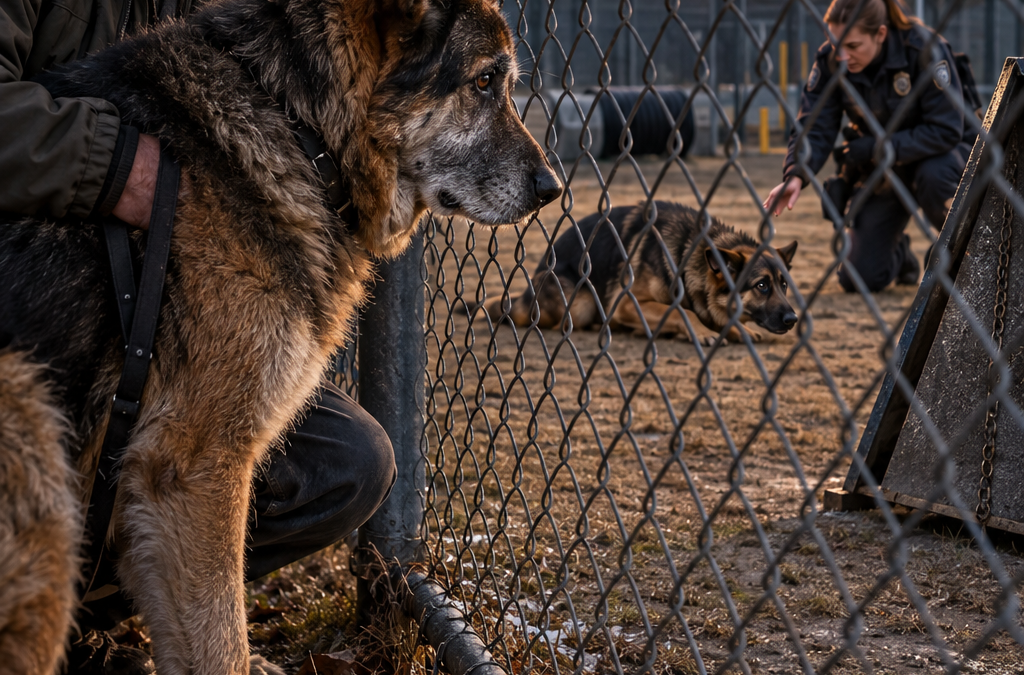
He lay beside the fence while younger dogs worked through obedience exercises and scent searches.
Sometimes he lifted his head when he heard familiar commands.
Occasionally, he wagged his tail when an officer praised a dog for a successful exercise.
It felt like giving an old firefighter a chair outside the station so he could watch the engines come and go.
I thought that was all it was.
A little comfort.
A familiar routine.
One last connection to the life he had loved.
Then I noticed he was no longer watching the entire yard.
He was watching one particular dog.
A young German Shepherd named Koda.
Koda was almost two years old.
He had a dark sable coat, intelligent brown eyes, and the lean, athletic build of a dog bred for demanding work.
On paper, he was outstanding.
He had a powerful nose, strong motivation for searching, and excellent focus during simple exercises.
His new handler was Officer Erin Morales, a twenty-nine-year-old patrol officer who had spent nearly two years preparing to join the K9 unit.
Erin was hardworking, thoughtful, and serious about her responsibilities.
She cared deeply about Koda.
But something had gone terribly wrong during his early training.
Three weeks before Ranger began visiting, Koda had been involved in an accident at a regional training facility.
A steel service gate had malfunctioned during a building-search exercise.
The heavy gate slammed shut near Koda while an alarm sounded in the adjoining corridor.
No one was seriously injured.
But the noise and sudden confinement had frightened him badly.
Since then, Koda had become increasingly fearful of metal platforms, gates, and certain enclosed training environments.
He was still confident during open-field tracking exercises.
He could locate hidden objects.
He responded beautifully to Erin in familiar surroundings.
But when he approached the elevated steel platform in our obstacle yard, something changed.
His body stiffened.
His ears flattened.
Sometimes he backed away.
Other times, he froze so completely that even his favorite reward toy couldn’t persuade him to move.
Erin had tried everything she knew.
She had shortened the exercises.
Changed rewards.
Practiced obedience nearby.
Asked another instructor to help.
But each failed attempt made her more anxious.
And Koda seemed to feel it.
The harder she tried, the more frightened he became.
I watched one of their sessions from across the yard.
“Come on, Koda,” Erin said.
The dog stood several feet from the platform.
His tail was low.
“Koda, forward.”
He glanced at her.
Then at the metal surface.
His body lowered.
Erin tried again.
“You know this. Come on.”
Koda backed away.
She sighed and looked toward me.
“I don’t understand. He was doing fine yesterday.”
I walked over.
“How many times have you tried today?”
“Four.”
“Then let’s stop.”
She frowned.
“Jack, we haven’t accomplished anything.”
“He’s telling you he can’t do it right now.”
“But he has to learn.”
“He will.”
“How?”
I looked at Koda.
His breathing was fast.
His eyes kept darting toward the metal platform.
“Not like this.”
Erin turned away.
I saw the frustration in her face.
She wanted to do right by her dog.
She simply didn’t know how.
And beneath that frustration was fear.
Fear that Koda would fail.
Fear that she would fail.
Fear that the department would decide she’d never been good enough for the K9 unit.
I knew how much this assignment meant to her.
What I didn’t know was how little time she had left to prove they belonged together.
Two days later, Lieutenant Mark Whitaker called me into his office.
He supervised our training program.
Mark wasn’t cruel.
He wasn’t careless.
He had a difficult job managing limited resources, operational requirements, and a growing demand for qualified K9 teams.
But he had never handled a dog himself.
Sometimes that showed.
He placed Koda’s training records on the desk.
“Jack, we need to discuss this team.”
I sat down.
“What’s wrong?”
“You tell me.”
I opened the file.
Several evaluations had been marked incomplete.
There were notes about Koda refusing to approach the platform, withdrawing from enclosed search exercises, and showing signs of significant stress.
I closed the folder.
“He’s frightened.”
“I understand that.”
“He had a bad experience.”
“I understand that, too.”
“Then what’s the issue?”
Mark leaned forward.
“The issue is that we’ve invested months of training in this team, and they’re not progressing.”
“They’re progressing in other areas.”
“Not enough.”
I folded my arms.
“He’s a good dog.”
“I’m sure he is. But a good dog isn’t automatically a suitable police dog.”
I couldn’t argue with that.
Operational work requires reliability.
A frightened dog can endanger himself, his handler, and the people around him.
Mark continued.
“We’ve got another evaluation in four weeks. If Koda can’t safely complete the required exercises, we’re going to have to reconsider his assignment.”
I stared at him.
“Meaning?”
“Meaning he may not be suited for this work.”
I thought of Erin.
The hours she’d spent training.
The way she arrived early every morning.
How carefully she cleaned Koda’s kennel.
How she talked to him between exercises when she thought nobody was listening.
“You need to give them more time.”
“We’ve already given them extra time.”
“He’s not refusing because he’s stubborn.”
“Jack, I don’t need a behavioral lecture.”
I leaned forward.
“Then what do you need?”
He looked tired.
“I need to know whether this dog can perform safely and reliably. That’s all.”
I sat back.
For a moment, neither of us spoke.
Then Mark said, “Four weeks. If he’s not ready, we make another decision.”
I left the office feeling sick.
I had seen dogs wash out of training before.
Sometimes it was necessary.
Not every dog belonged in police work.
But Koda wasn’t showing aggression or recklessness.
He wasn’t incapable of learning.
He was scared.
And the more pressure we put on him, the harder it became for him to trust the exercises.
That afternoon, I found Erin sitting on a bench outside the kennels.
Koda lay beside her.
His head rested on her boot.
She looked up when I approached.
“Lieutenant Whitaker talked to you?”
I nodded.
She looked away.
“So that’s it.”
“Nobody’s made a final decision.”
“Four weeks.”
“Yes.”
She stared at the ground.
“I’ve wanted this assignment since I joined the department.”
“I know.”
“I studied for it. I volunteered for extra shifts. I worked with the training staff every chance I got.”
Her voice shook.
“And now I can’t even get my dog to walk across a stupid platform.”
I sat beside her.
“Koda isn’t stupid.”
“I didn’t say he was.”
“And neither are you.”
She wiped her eyes.
“Then why can’t I fix this?”
I considered my answer.
“Because fear doesn’t disappear just because you explain to somebody that they’re safe.”
She looked at me.
I nodded toward Koda.
“He needs to learn it through experience.”
“We’ve tried.”
“We’ve tried to get him across the platform. That’s not the same thing as teaching him he can feel safe near it.”
She was quiet.
Then she asked, “What if he never gets there?”
I looked at the young Shepherd.
He had one paw resting against Erin’s boot.
His eyes followed her every movement.
“Then we’ll make the right decision for him.”
Her face tightened.
“But we’re not there yet.”
She nodded slowly.
That was when Ranger appeared beside us.
He had been resting on his mat near the fence.
I’d left the gate open so he could move into the shaded area beside the kennels if he wanted to.
He approached slowly.
His hind legs were stiff.
His breathing was heavier than I liked.
“Ranger,” I said, “you should be lying down.”
He ignored me.
Koda noticed him immediately.
His ears rose.
Ranger stopped several feet away.
The two dogs looked at each other.
I expected Koda to bark or move toward him.
Instead, he became very still.
But it wasn’t the frozen, frightened stillness I’d seen near the platform.
His tail began moving.
Just a little.
Ranger lowered his head.
Then he lay down.
Koda watched him.
A few seconds passed.
Then Koda stood, walked toward Ranger, and cautiously sniffed his muzzle.
Ranger didn’t move.
He simply allowed the younger dog to investigate.
Erin whispered, “Look at that.”
Koda circled him once.
Then, to my surprise, he lay down beside him.
Their shoulders nearly touched.
Ranger closed his eyes.
Koda rested his chin on his paws.
For several minutes, neither dog moved.
Erin looked at me.
“Has Koda ever met him?”
“Not properly.”
“He’s usually nervous around unfamiliar dogs.”
I watched them.
Ranger looked completely relaxed.
And Koda was beginning to relax, too.
I couldn’t explain why it mattered.
Not yet.
But that afternoon, for the first time since the accident, I saw Koda settle in the training environment without constantly watching the exits.
And Ranger, who had spent the entire morning staring toward the yard, finally fell asleep.
That evening, I called Dr. Morgan.
I told her about Ranger’s interest in Koda and asked whether it would be safe to let him spend a little more time near the training yard.
She listened carefully.
“Jack, I know how much that place means to him,” she said. “But remember that he has very limited energy now. Short, quiet visits are reasonable while he’s comfortable. No strenuous activity, no prolonged exposure to heat, and you need to watch his breathing.”
“I understand.”
“And if he seems tired, you take him home. Even if he wants to stay.”
I looked across the living room.
Ranger was asleep beside Anne’s chair.
“I know.”
She paused.
“Jack?”
“Yeah?”
“Don’t confuse what he wants with what you need.”
I didn’t answer immediately.
“What do you mean?”
“You’ve spent your whole career working with him. I know how difficult it is to watch him decline. But he doesn’t need to keep being a police dog for you.”
I stared at the floor.
“I know that.”
“I believe you. Just make sure he knows it, too.”
After we hung up, I sat beside Ranger.
He opened one eye.
“Apparently, we’re both under doctor’s orders.”
His tail tapped the carpet.
I scratched behind his ear.
“Short visits. Plenty of rest. No showing off.”
He closed his eye again.
I smiled.
“Especially that last part.”
The following morning, I arrived at the training facility with Ranger resting comfortably in the back of my truck.
Erin was already there.
Koda stood beside her, watching two other dogs working on the obstacle course.
When Ranger climbed out with my help, Koda immediately became interested.
His ears lifted.
He moved toward us, pulling gently against his leash.
“Easy, Koda,” Erin said.
I found a shady spot nearly thirty feet from the steel platform and spread Ranger’s orthopedic mat on the ground.
He lowered himself onto it with a tired sigh.
Koda watched.
Then, almost without thinking, he relaxed his shoulders.
I noticed the change.
“Erin,” I said, “come here a second.”
She approached.
“What?”
“Look at your dog.”
Koda was standing calmly beside her.
His tail hung naturally.
His breathing was steady.
“He’s relaxed,” she said.
“Exactly.”
I pointed toward the platform.
“Now look at how far he is from the thing he’s afraid of.”
She followed my gaze.
“Thirty feet?”
“About that.”
“And he’s okay.”
“Right.”
She studied me.
“Are you thinking what I’m thinking?”
“That we’ve been starting too close?”
She nodded.
I crouched beside Koda.
“Let’s stop worrying about getting him across that platform. For now, I just want him comfortable being anywhere near it.”
Erin took a breath.
“Okay.”
We began with something almost embarrassingly simple.
She walked Koda around the outer edge of the yard, staying far enough from the platform that he showed no signs of distress.
Whenever he looked toward the equipment and remained relaxed, she marked the behavior and rewarded him.
Then they walked away.
No pressure.
No raised voice.
No attempt to lure him into something he feared.
For the first twenty minutes, Koda did beautifully.
He sniffed the grass.
Responded to simple cues.
Played with his tug toy.
Occasionally, he glanced toward Ranger.
The old dog watched from his mat.
At one point, a metal training gate rattled in the wind.
Koda stopped.
His ears flattened.
Erin immediately paused and gave him room.
I watched his body.
He looked toward the noise.
Then toward Ranger.
Ranger was still resting quietly.
A few seconds later, Koda turned back to Erin.
She rewarded him.
I felt a flicker of hope.
Not because Ranger had done anything extraordinary.
But because Koda had experienced a small, manageable surprise and recovered without panic.
That was something we could build on.
We finished the session before he became tired or overwhelmed.
Erin knelt beside him.
“Good boy, Koda.”
He pressed his head into her shoulder.
She looked at me.
“That was the first training session in two weeks that didn’t end with him shaking.”
I nodded.
“Remember how this feels.”
She smiled.
“What?”
“Finishing while your dog still wants more.”
Over the next several days, we continued.
We changed only one thing at a time.
Sometimes we worked a little closer to the platform.
Sometimes we practiced scent searches near it.
Sometimes Erin simply sat on a bench while Koda watched other dogs complete exercises.
And sometimes we did nothing at all.
Those were the hardest sessions for Erin.
She had spent years believing successful training meant constant visible progress.
Now I was asking her to be patient.
To observe.
To recognize small changes that most people would overlook.
The first time Koda voluntarily approached the platform and sniffed its lowest support, Erin looked at me with tears in her eyes.
“Did you see that?”
I smiled.
“I saw.”
“He went over there himself.”
“He sure did.”
She reached into her pocket for his reward.
Koda hurried back to her.
She laughed.
“Good boy!”
Ranger lifted his head at the sound of her excitement.
His tail moved.
I looked at him.
“Not bad, huh?”
He blinked slowly.
I had begun to believe his interest in Koda was more than coincidence.
Whenever Erin and Koda entered the yard, Ranger watched them closely.
When they moved beyond his view, he sometimes raised his head and searched for them.
And when Koda came to rest near him after training, Ranger seemed content in a way I hadn’t seen for weeks.
I couldn’t know exactly what he understood.
But there was no mistaking the bond developing between them.
Koda began seeking Ranger out before and after every session.
He would approach carefully, sniff the old dog’s face, and settle beside him.
Ranger rarely moved.
Sometimes he would gently touch Koda’s muzzle with his own.
Other times, he simply slept while the younger dog lay against his shoulder.
Erin started calling him “Grandpa Ranger.”
I pretended to object.
“He’s a decorated police veteran, not somebody’s grandfather.”
She grinned.
“Tell that to Koda.”
One afternoon, I found the two dogs sleeping side by side.
Koda’s head rested across Ranger’s front paws.
The old Shepherd’s breathing was slow and steady.
I stood watching them for several minutes.
Then Erin appeared beside me.
“Do you think Ranger knows Koda needs help?”
I considered the question.
“I think he knows Koda’s uncomfortable sometimes.”
“How?”
“Dogs notice things we miss. Movement. Posture. Breathing. Tension.”
She nodded.
“But do you think he’s trying to help?”
I looked at my old partner.
Ranger had spent his life responding to people and animals in distress.
Maybe he recognized the younger dog’s fear.
Maybe he simply liked his company.
Maybe both were true.
“I don’t know exactly what he’s thinking,” I admitted. “But I know Koda feels safer around him.”
Erin looked down at her dog.
“Then I’m glad he’s here.”
I was, too.
Until the morning I found blood on Ranger’s blanket.
It wasn’t much.
A small stain near his muzzle.
But he’d been coughing more frequently, and the sight sent a cold wave through my chest.
I called Dr. Morgan immediately.
She examined him that afternoon.
The news wasn’t good.
The cancer was progressing.
His breathing was becoming less efficient, and his energy was declining faster than we’d hoped.
She adjusted his comfort-care plan and spoke with me about what the coming days might look like.
“Jack, I need you to be prepared.”
I stared at Ranger.
He was resting on the examination-room floor.
“How prepared?”
She sat beside me.
“I think we’re reaching the point where we may have to make a decision very soon.”
I pressed my palms together.
“He’s still interested in things.”
“I know.”
“He still eats some mornings.”
“I know.”
“He gets excited when I take him to the training yard.”
Dr. Morgan nodded.
“Those moments matter. But we also need to look at what happens between them.”
I looked away.
She continued gently.
“Is he comfortable at rest? Can he breathe easily? Does he still have more good hours than difficult ones? Is he able to enjoy those visits without paying for them afterward?”
I didn’t answer.
Because I knew the truth.
Ranger had begun sleeping almost the entire afternoon after our training-yard visits.
Sometimes he struggled to find a comfortable position at night.
His appetite was fading.
And there were moments when he looked at me with an exhaustion I’d never seen before.
Dr. Morgan put a hand on my arm.
“You’ve taken wonderful care of him. But love doesn’t always mean asking for more time.”
I closed my eyes.
“What if he still wants to go?”
“Then we can consider one more brief visit if he’s having a comfortable day. But it needs to be for him, Jack. Not for a training schedule.”
I nodded.
When we got home, I found Anne waiting in the kitchen.
She saw my face and understood.
“How bad?”
I sat down.
“Bad.”
She pulled out the chair beside me.
I told her everything.
When I finished, she reached for my hand.
“We knew this was coming.”
“Knowing doesn’t make it easier.”
“No.”
I stared toward the living room.
Ranger was lying on his bed.
“He still wants to go to the yard.”
Anne was quiet for a moment.
“Are you sure?”
I looked at her.
“What?”
“Are you sure he wants to go? Or are you afraid that if he stops going, it means you’re losing him?”
The question hurt.
I stood.
“That’s not fair.”
She didn’t raise her voice.
“Jack, I’m not trying to hurt you.”
“Then why would you say that?”
“Because I know you.”
I turned away.
She continued.
“You have spent thirty years teaching officers how to solve problems. You see something broken, and you work until you fix it.”
I stared at the wall.
“But you can’t fix Ranger.”
My throat tightened.
“I know.”
“Do you?”
I looked back at her.
Tears filled her eyes.
“I love him, too.”
For a moment, all the anger drained out of me.
She reached across the table.
“I want him to have whatever happiness is still possible. If that means sitting in the training yard for twenty minutes, then let’s do that. But don’t make him stay alive for something he doesn’t understand.”
I sat down again.
My voice was barely audible.
“I don’t know how to let him go.”
Anne began crying.
“Neither do I.”
We held each other at the kitchen table.
And for the first time, I admitted aloud what I’d been hiding from everyone.
I was terrified of losing him.
Not because I couldn’t imagine owning another dog.
But because Ranger had been beside me through the most important years of my life.
He had watched Lucy grow up.
He had sat beside me when my father died.
He had been there when Anne underwent surgery.
He had shared every ordinary morning and every dangerous night.
Somewhere along the way, I had forgotten where my life ended and our partnership began.
I wasn’t ready to discover what remained without him.
The next day, Ranger stayed home.
I went to the training center alone.
Erin met me at the gate.
“Where’s Ranger?”
“Resting.”
Her face changed.
“Is he okay?”
I shook my head.
“Not really.”
She looked down.
“I’m sorry.”
“Thanks.”
Koda came toward us, sniffing the air.
He looked behind me.
Then toward the parking lot.
His tail moved uncertainly.
Erin noticed.
“He’s looking for him.”
I swallowed.
“Yeah.”
We began training anyway.
For the first fifteen minutes, Koda worked well.
He approached the platform.
Sniffed its edge.
Placed his front paws on the lowest section.
Erin rewarded him.
Then a maintenance worker accidentally dropped a metal tool tray near the far side of the yard.
The crash was sudden and sharp.
Koda startled.
His body went rigid.
He backed away from the platform.
Erin turned toward me.
“Jack?”
“Give him room.”
She loosened the leash.
Koda retreated several feet.
Then he stopped.
His eyes moved toward the place where Ranger usually slept.
The mat wasn’t there.
He looked around again.
And suddenly, he began whining.
Erin crouched.
“It’s okay, buddy.”
Koda kept looking toward the empty patch of shade.
I felt something tighten in my chest.
The training session was over.
Not because Koda had failed.
Because he’d reached his limit for the day.
I told Erin to take him for a quiet walk and finish with something he enjoyed.
She looked devastated.
“We were doing so well.”
“We still are.”
“He went backward.”
“No. He was frightened by a sudden noise. The important thing is what we do next.”
She looked at Koda.
He was trembling.
I added, “If we punish him for being scared, he’ll learn that fear makes his world less safe. That’s the last thing we want.”
Erin nodded.
Then she looked at the empty space beside the fence.
“Do you think he misses Ranger?”
I swallowed.
“I think he notices he’s not here.”
She wiped her eyes.
“I do, too.”
That evening, I sat on the living-room floor beside Ranger.
He was awake.
I told him about Koda’s training.
I told him about the dropped tray.
About Erin’s disappointment.
About how the younger dog had looked toward the place where he usually slept.
Ranger listened with his head resting against my knee.
At least, that’s how it felt.
“He’s getting better,” I whispered.
His ears moved.
“But he’s still scared.”
I scratched his neck.
“You remember that stairwell?”
Ranger opened his eyes.
I smiled sadly.
“That old school building. The night you decided stairs were the enemy.”
I laughed softly.
“You made me look like an idiot in front of the whole training unit.”
His tail tapped the blanket once.
“But we figured it out, didn’t we?”
I looked down at him.
“You taught me not to rush.”
His breathing was slow.
I leaned closer.
“Guess I forgot.”
For several minutes, I sat in silence.
Then I whispered, “I don’t want you to go.”
The words sounded childish.
But they were true.
I rested my forehead against his.
“I know you’re tired. I know it hurts. I know I can’t keep asking you for more.”
My voice broke.
“But I don’t know what I’m going to do without you.”
Ranger lifted his muzzle.
He pressed it against my cheek.
I closed my eyes.
For just a moment, I let myself imagine he understood every word.
Two days later, Ranger had a better morning.
He ate part of his breakfast.
He walked into the backyard without assistance.
And when I reached for my keys, he stood beside the garage door.
Anne looked at me.
“He’s asking again.”
I crouched beside him.
“You sure about this, old man?”
His tail moved.
I watched his breathing.
It was comfortable at rest.
His eyes were bright.
He seemed genuinely interested in going.
I called Dr. Morgan, described how he was doing, and received her approval for another short, quiet visit.
Then I helped him into the truck.
At the training center, Erin was working with Koda on a simple scent exercise.
The moment Ranger appeared, Koda lifted his head.
He recognized him before we reached the fence.
His tail began wagging.
Erin turned.
“Oh, my goodness.”
Koda moved toward us.
She allowed him to approach calmly.
Ranger stood still while the younger dog sniffed his face.
Then Koda did something that made Erin stop speaking.
He lowered his front half toward the ground in a small, hopeful play bow.
Ranger couldn’t return the invitation.
He was too weak.
But he moved his tail.
Koda straightened.
Then, instead of jumping or pawing at him, he settled gently beside the old dog.
I felt tears sting my eyes.
It was such a small thing.
A young dog discovering how to be quiet with an old one.
But somehow, it seemed greater than any obedience exercise we’d been teaching.
Erin looked at me.
“He’s never this gentle with the other dogs.”
I nodded.
“He knows Ranger needs space.”
She smiled through her tears.
“Grandpa Ranger.”
I laughed.
“Don’t let him hear you.”
For the next fifteen minutes, we let them rest together.
Then Erin and I resumed training.
This time, we used a section of low metal grating placed flat on the ground.
There was no height.
No unstable surface.
No gate that could close.
Just a short, secure section of metal similar to the texture of the platform.
Koda approached it cautiously.
He sniffed.
Stepped backward.
Looked at Erin.
She waited.
He took one step forward.
His front paw touched the metal.
A soft clicking sound came from beneath his nails.
He startled slightly.
Then stopped.
I held my breath.
Erin stayed calm.
“Good boy,” she said softly.
Koda looked toward Ranger.
The old Shepherd was resting on his mat.
His ears were pointed toward us.
Koda turned back.
He placed his paw on the grating again.
Then the other.
Erin marked the behavior and rewarded him.
Koda stepped off.
Then, entirely on his own, stepped back onto it.
Erin gasped.
“Jack!”
I raised one hand.
“Stay quiet. Let him think.”
Koda stood with all four paws on the metal.
His body was tense.
But he wasn’t panicking.
He looked toward Erin.
She smiled.
“Good boy, Koda.”
Then he stepped off and hurried toward Ranger.
He reached the old dog and lowered his head beside his muzzle.
Ranger lifted his nose.
The two dogs touched faces.
And Koda began wagging his tail.
Erin covered her mouth.
I looked away.
I knew I was assigning human meaning to something that could be explained in simpler ways.
Koda felt comfortable near Ranger.
Ranger was familiar.
The young dog had associated that part of the yard with safety.
But standing there, watching one generation of working dog beside another, I couldn’t help feeling that something important was being passed between them.
Not a command.
Not a technique.
Something quieter.
The ability to remain steady when the world felt uncertain.
That afternoon, Erin called her husband from the parking lot.
I heard her voice through the open window.
“He did it,” she said, crying and laughing at the same time. “He stood on the metal. All four paws.”
She paused.
Then she whispered, “I think we’re going to be okay.”
I looked toward Ranger.
He was asleep in the truck.
His face rested against the blanket.
For the first time in weeks, I smiled without immediately feeling guilty.
But the improvement didn’t last.
Three mornings later, Ranger refused breakfast.
He struggled to rise.
His breathing was labored even while resting.
I sat beside him and knew we were nearing the end.
Dr. Morgan came to the house that afternoon.
She examined him carefully.
When she finished, she looked at Anne and me.
“I think it’s time to make a plan for saying goodbye.”
Anne began crying.
I stared at Ranger.
He was lying on his bed, exhausted.
“How soon?” I asked.
“Very soon. I don’t want to wait until he’s in a crisis.”
I swallowed.
“Tomorrow?”
“If he remains comfortable overnight, tomorrow would be reasonable. But if his breathing worsens, call me immediately.”
I nodded.
Then I asked a question that had been building inside me for days.
“Would you be willing to help us say goodbye outside?”
She looked at me.
“At home?”
“At the training center.”
Anne turned toward me.
“Jack…”
I looked at her.
“Not during training. Not with noise or people crowding around.”
I struggled to continue.
“There’s a shaded patch of grass beside the yard. It’s where he used to rest.”
Dr. Morgan considered it.
“Why there?”
I looked down at Ranger.
“Because it’s the place he’s been asking to go.”
She was quiet.
Then she said, “If he’s stable enough for the short trip and the environment is peaceful, we can arrange that. But Jack, if he becomes distressed, his comfort comes first.”
“Of course.”
“And I want you to understand that he doesn’t need a ceremony.”
I nodded.
“I know.”
I looked at my old partner.
“I just want him to be somewhere familiar, surrounded by people who love him.”
Dr. Morgan placed a hand on my shoulder.
“Then we’ll do everything we can to make that happen gently.”
That night, I barely slept.
Anne and I took turns sitting with Ranger.
Lucy drove home after I called.
She walked into the living room just before midnight.
When she saw him, she stopped.
“Oh, Dad.”
I stood.
She crossed the room and wrapped her arms around me.
For a long time, neither of us spoke.
Then she knelt beside Ranger.
“Hey, sweetheart.”
His eyes opened.
His tail moved weakly.
Lucy began crying.
She took his face between her hands.
“Remember when I was little and you used to sleep beside my bed?”
I sat down beside them.
She stroked his gray muzzle.
“I always thought you were protecting me from monsters.”
Her voice broke.
“I guess you were.”
Ranger rested his head against her hand.
We stayed together through the night.
At some point, Lucy fell asleep on the couch.
Anne sat beside Ranger with a blanket around her shoulders.
I remained on the floor.
Around three in the morning, Ranger opened his eyes and looked toward me.
I leaned close.
“Hey, partner.”
His tail moved.
I stroked the scar beneath his shoulder, a reminder of an old injury from a difficult search.
“You know something?”
His ears shifted.
“For years, I thought the best thing I ever taught you was how to find people.”
I swallowed.
“But I think you were the one doing most of the teaching.”
His breathing remained slow.
“You taught me to be patient. To listen. To trust somebody even when I couldn’t see what they were seeing.”
I wiped my face.
“And now you’ve taught me how to let go.”
I shook my head.
“I’m not very good at that last one.”
He pressed his muzzle against my hand.
I bent over him.
“But I’m trying.”
The next morning, Ranger was still comfortable enough for the short trip.
Dr. Morgan examined him before we left and confirmed that he wasn’t in acute distress.
Anne drove.
I sat in the back beside Ranger.
His head rested on my lap.
Lucy followed us.
When we arrived at the training center, the yard was quiet.
I’d asked Lieutenant Whitaker to keep the area clear for the morning.
I had also told Erin what was happening.
She cried when I called.
Then she’d asked, “Can Koda come say goodbye?”
I hesitated.
“Only if Ranger is comfortable.”
“Of course.”
So we arranged a brief, calm visit before Dr. Morgan began her work.
I helped Ranger out of the truck.
His legs were weak.
He took a few slow steps, then stopped.
I supported him beneath his chest.
“Easy, buddy.”
He looked toward the fence.
The morning sunlight fell across the training yard.
Everything was familiar.
The obstacle course.
The scent boxes.
The wooden platforms.
The rows of trees beyond the far boundary.
For twelve years, Ranger had worked there.
He had learned there.
Made mistakes there.
Succeeded there.
Grown old there.
Now he stood at the edge of the place that had shaped so much of his life.
I looked down at him.
“Home stretch, partner.”
His ears moved.
Then I heard Erin’s voice.
“Jack?”
She stood near the gate with Koda beside her.
Her eyes were red.
I nodded.
“Come on over.”
She approached slowly.
Koda saw Ranger.
His whole body changed.
His ears lifted.
His tail began moving.
He walked toward the old dog with that familiar mixture of curiosity and affection.
Then he stopped.
Something about Ranger was different.
Perhaps his breathing.
Perhaps the weakness in his posture.
Perhaps the unusual stillness of everyone around him.
Koda lowered his head.
He sniffed Ranger’s muzzle.
Then he lay down beside him.
No command.
No reward.
No excitement.
Just quiet companionship.
Erin knelt.
“Oh, Koda.”
Her voice broke.
Ranger turned his head and touched the younger dog’s cheek.
I watched them.
My chest felt as though it were being pulled apart.
For several minutes, nobody spoke.
Then Koda stood.
He looked toward Erin.
She reached into her pocket and brought out his favorite blue rubber ball.
He took it gently.
Instead of asking her to throw it, he carried it back to Ranger.
Then he dropped it beside the old dog’s front paws.
Erin made a small sound.
“Oh, my God.”
I stared at the ball.
It was Koda’s favorite reward.
He carried it after successful training exercises.
He sometimes slept with it in his kennel.
Now it lay beside Ranger.
I knew dogs didn’t understand farewells the way humans did.
Maybe Koda was inviting Ranger to play.
Maybe he was offering a familiar object during a moment of uncertainty.
But the gesture was so tender that none of us could remain composed.
Erin began crying openly.
I put a hand over my mouth.
Ranger sniffed the ball.
Then he rested his chin beside it.
Koda lay down again.
Their noses nearly touched.
Lieutenant Whitaker stood near the building, watching quietly.
A few other handlers had gathered at a respectful distance.
Nobody spoke.
Nobody applauded.
There were no sirens.
No speeches.
Just a few people who had loved an extraordinary dog, and a young K9 who had found comfort beside him.
After several minutes, Ranger shifted uncomfortably.
His breathing became heavier.
I looked toward Dr. Morgan.
She nodded gently.
“It’s time to let him rest.”
I turned to Erin.
“Take Koda for a walk, okay?”
She wiped her face.
“Jack…”
I shook my head.
“I want his last moments quiet.”
She nodded.
Then she crouched beside Ranger one more time.
“Thank you, old man.”
Her voice trembled.
“Thank you for helping us.”
She kissed the top of his head.
Then she led Koda toward the building.
The young dog looked back twice.
I watched him disappear through the gate.
And I felt something inside me finally give way.
I wasn’t losing a police dog.
I was losing the friend who had walked beside me through nearly fifteen years of my life.
We carried Ranger’s bed into the shade beneath an old maple tree.
It was a peaceful corner of the property.
Far enough from the working area that there was no noise.
Close enough that he could see the yard.
Anne sat beside his front paws.
Lucy knelt near his shoulder.
I lowered myself onto the grass beside his head.
Dr. Morgan gave us time.
I stroked Ranger’s ears.
For years, I’d called him brave.
I’d praised him for going forward.
For searching.
For working through obstacles.
For refusing to give up.
But now I needed him to know that he didn’t have to be brave anymore.
I leaned close.
“Hey, old man.”
His eyes found mine.
“You did it.”
My voice broke.
“You finished your work.”
Anne began crying softly.
I rested my forehead against his.
“You don’t have to watch the fence anymore.”
His breathing was slow.
“You don’t have to wait for anybody.”
I kissed his head.
“Everybody’s safe.”
Dr. Morgan knelt beside us.
She explained each step carefully.
The first medication would help Ranger relax into a deep, peaceful sleep.
We could hold him and talk to him throughout.
When we were ready, she would administer the final medication.
I nodded.
My hands were trembling.
Ranger rested his head against my arm.
As the sedative began to take effect, the tension in his body eased.
I felt his breathing become quieter.
Anne kissed his paw.
Lucy whispered, “I love you, Ranger.”
I stroked his muzzle.
For a moment, I remembered the sixteen-month-old Shepherd who had stolen a tennis ball from my pocket.
The young dog who had refused to climb a dark stairwell.
The powerful K9 who had found lost people in places no one else could reach.
The old dog who had stood beside a fence, watching a frightened youngster struggle to find his confidence.
All those versions of Ranger seemed to exist together in that moment.
Not just the hero.
Not just the working dog.
My friend.
My family.
My partner.
I leaned closer.
“You were always a good boy.”
Tears slipped down my face.
“The very best.”
Dr. Morgan waited until I gave her a small nod.
Then she administered the final medication.
I kept my hand on Ranger’s chest.
His breathing slowed.
The rise and fall beneath my palm became gentler.
Then it stopped.
Dr. Morgan listened carefully.
After a moment, she lowered her stethoscope.
“I’m so sorry, Jack.”
I looked at Ranger.
His face was peaceful.
His ears rested naturally.
For the first time in weeks, there was no tension in his body.
No struggling to breathe.
No effort to stand.
He was finally at rest.
I bent forward and wrapped my arms around him.
And I cried harder than I had cried in years.
I don’t know how long we stayed beneath that tree.
Time seemed to disappear.
I remember Anne holding my shoulder.
I remember Lucy whispering that she loved him.
I remember the warmth of the sunlight against my back.
And I remember looking toward the training yard.
Through the fence, I could see the steel platform.
The same platform Koda had feared.
The same place Ranger had watched so faithfully.
For the first time, I understood what made his final weeks so extraordinary.
He hadn’t been able to fix Koda’s fear.
He hadn’t performed a final heroic rescue.
He hadn’t magically restored the younger dog’s confidence.
He had simply been there.
Steady.
Familiar.
Patient.
And somehow, his presence had helped us remember the kind of training that made frightened dogs feel safe.
The same lesson he’d taught me in that dark stairwell so many years earlier.
I placed my hand against his cheek one last time.
“Thank you, partner.”
Then I stood.
And for the first time since Ranger had entered my life, I walked away without him.
The next morning, I almost didn’t go to work.
I sat at the kitchen table staring at his empty bed.
His water bowl was still beside the refrigerator.
His leash hung from the hook near the door.
His old police harness rested on a shelf in my study.
Everywhere I looked, I saw the shape of his absence.
Anne made coffee.
She placed a mug in front of me.
“You don’t have to go in today.”
I looked at the clock.
“I know.”
“Take some time.”
I nodded.
Then I glanced toward Ranger’s leash.
For years, the sound of those metal clips had meant we were going somewhere together.
Now the house was silent.
“I think I need to go.”
Anne sat across from me.
“Why?”
I thought about Erin.
About Koda.
About the four-week deadline that was almost over.
Then I looked at my wife.
“Because there’s still somebody who needs help.”
She studied my face.
“Jack, you don’t have to keep working because Ranger did.”
“I know.”
“Are you sure?”
I nodded.
“This isn’t about pretending he’s still here.”
I took a breath.
“It’s about remembering what he taught me.”
Anne reached across the table.
“Then go.”
When I arrived at the training center, Erin was waiting beside the gate.
Koda stood next to her.
He looked toward my truck.
Then toward the empty space where Ranger usually lay.
His ears lowered slightly.
Erin watched him.
“He’s been looking for him.”
I swallowed.
“So have I.”
She stepped closer.
“I’m sorry, Jack.”
I nodded.
For several seconds, neither of us spoke.
Then Erin said, “We don’t have to train today.”
I looked at Koda.
He was watching us quietly.
“Actually,” I said, “I think we should.”
We began with the exercises he’d already mastered.
Simple obedience.
Short scent searches.
Walking calmly near the training equipment.
I didn’t rush.
Erin didn’t rush.
When Koda hesitated, we gave him space.
When he made progress, we rewarded it.
We didn’t ask him to prove anything.
The first two sessions were uneventful.
Then, on the third morning, Koda approached the steel platform.
He sniffed the lowest step.
Placed one paw on it.
Then another.
Erin watched silently.
Koda climbed onto the first section.
His body was tense, but he remained engaged.
He looked toward Erin.
She smiled.
“Good boy.”
He took another step.
Then stopped.
I saw uncertainty return to his expression.
Erin glanced at me.
“What do I do?”
I remembered Ranger standing at the bottom of the dark stairwell years earlier.
His ears flattened.
His paws braced against the concrete.
The way he’d looked at me, waiting to see whether I would become part of the danger or help him through it.
I turned to Erin.
“Nothing.”
She blinked.
“What?”
“Give him a moment.”
Koda stood quietly.
He looked at the platform.
Then at Erin.
She remained calm.
“I’m right here, buddy.”
His ears lifted.
He took another step.
The steel made a small sound beneath his paws.
He stopped.
Then continued.
One step.
Another.
Then another.
Until he reached the other side.
Erin stared at him.
For a moment, she seemed unable to believe what she was seeing.
Then Koda turned and looked back at her.
His tail began wagging.
She dropped to her knees.
“Koda!”
He hurried toward her.
She wrapped her arms around him.
“Oh, you good boy!”
Her voice broke.
“You did it!”
I stood several feet away.
My eyes filled with tears.
Erin looked up at me.
“Jack!”
I nodded.
“I saw.”
She laughed through her tears.
“He did it!”
I looked toward the empty patch of shade near the fence.
For just a moment, I imagined Ranger lying there.
His ears pointed toward the yard.
His gray muzzle resting on his paws.
Watching.
Then I blinked, and the space was empty again.
I turned back toward Erin.
“Let’s finish on that.”
She nodded.
“Absolutely.”
Koda carried his blue ball proudly toward the gate.
As he passed the place where Ranger used to rest, he slowed.
He sniffed the grass.
Then continued.
I watched him go.
And I whispered something nobody else heard.
“Good work, old man.”
The official evaluation took place four days later.
Lieutenant Whitaker attended.
Two certified instructors from a neighboring department assisted with the assessment.
I made certain that Koda would be evaluated under the normal safety standards.
No exceptions.
No shortcuts.
No sentimental allowances because Ranger had died.
Koda had to demonstrate that he could work reliably enough to continue toward operational certification.
Erin understood.
So did I.
We began with obedience exercises.
Koda performed them cleanly.
He responded to Erin’s cues without hesitation.
Next came a controlled scent search.
He located the target and gave the trained indication.
The evaluators made notes.
Then we moved to the building-search portion.
I felt Erin’s tension rise.
The exercise included an enclosed corridor and a secure metal threshold.
It was carefully controlled, but it resembled the environment where Koda had first become frightened.
Erin stood beside him.
I walked over.
“How are you feeling?”
She swallowed.
“Nervous.”
“That’s okay.”
“What if he freezes?”
“Then you respond appropriately.”
She nodded.
I continued.
“He’s not responsible for protecting your pride. You’re responsible for protecting his trust.”
She looked at me.
Then she smiled faintly.
“Ranger taught you that, didn’t he?”
I looked toward the training yard.
“Yeah.”
I swallowed.
“He did.”
Erin knelt beside Koda.
She stroked his shoulder.
“Ready, buddy?”
Koda looked at her.
His ears rose.
She gave the search cue.
He moved forward.
At the metal threshold, he slowed.
My heart began pounding.
For one terrible moment, I thought he might retreat.
But Erin didn’t rush him.
She allowed him to assess the surface.
Koda sniffed the edge.
Shifted his weight.
Then crossed.
He continued into the corridor, followed the scent, and located the hidden training assistant.
When he gave his trained indication, Erin rewarded him.
The evaluators exchanged glances.
Lieutenant Whitaker looked at me.
I didn’t smile.
Not yet.
The evaluation continued.
There were additional exercises.
Some went perfectly.
Others showed areas that still needed work.
Koda wasn’t suddenly fearless.
He still hesitated briefly when he encountered unexpected metal sounds.
But he recovered.
He remained responsive to Erin.
And he showed that his confidence was improving without being pushed beyond his limits.
At the end of the assessment, the lead evaluator called Erin and me over.
“Koda has made substantial progress,” she said. “I want continued work on environmental confidence before full operational deployment, but I’m satisfied that this team should remain in training.”
Erin covered her mouth.
“Really?”
The evaluator smiled.
“Really.”
Lieutenant Whitaker nodded.
“Then that’s our decision.”
Erin looked at me.
Her eyes filled with tears.
“Jack…”
I smiled.
“You earned more time.”
She knelt and wrapped her arms around Koda.
He wagged his tail enthusiastically, entirely unaware of the administrative decision that had just changed his future.
I watched them.
Then I walked toward the fence.
I stood beside the place where Ranger used to rest.
The grass had begun to flatten where his mat had lain for so many mornings.
I crouched.
For a moment, I could almost feel the warmth of his body beside my knee.
I closed my eyes.
“You would’ve liked that,” I whispered.
A month later, Koda completed the remaining requirements and earned his operational certification.
Erin cried again.
So did I.
But this time, the tears were different.
They weren’t only about loss.
They were about watching something difficult become possible.
Koda had not been rescued by a miracle.
He had learned through countless small experiences that frightening things could be approached safely.
Erin had learned that patience wasn’t weakness.
And I had remembered something my old partner had taught me before I ever became a senior instructor.
Trust cannot be demanded.
It has to be earned.
At Koda’s certification ceremony, Erin asked whether she could say a few words.
Lieutenant Whitaker agreed.
She stood in front of the assembled officers with Koda beside her.
He wore his new police harness.
His coat shone in the afternoon sunlight.
Erin held the leash in one hand and a small folded paper in the other.
“When Koda first came to this department,” she began, “I thought my job was to teach him how to be brave.”
She paused.
“But when he became frightened, I didn’t know what to do. I kept trying to push him forward because I thought being a good handler meant never accepting hesitation.”
She looked toward me.
“Then an old police dog named Ranger started watching our training sessions.”
The yard became quiet.
Erin swallowed.
“Ranger was very sick. He could barely walk some days. But whenever Koda was nearby, he’d settle beside him.”
She looked down at her dog.
“Koda seemed to feel safe with Ranger. And watching them together taught me something I should have understood from the beginning.”
Her voice trembled.
“Sometimes the greatest gift you can give someone who’s afraid isn’t a command to be brave.”
She wiped her cheek.
“It’s the patience to stay beside them until they’re ready.”
Several officers lowered their heads.
Erin continued.
“Ranger died before Koda completed his certification. But he helped us get here.”
She looked toward the old shaded corner of the yard.
“And I don’t think either of us will ever forget him.”
The officers stood silently for a moment.
Then Lieutenant Whitaker approached me.
He extended his hand.
“Jack, I’d like to do something for Ranger.”
I shook his hand.
“What did you have in mind?”
He looked toward the training field.
“A permanent place for the older dogs who helped build this unit.”
Three weeks later, we gathered beside the maple tree.
The department had installed a wooden bench facing the training yard.
A small bronze plaque was mounted on the backrest.
It read:
IN HONOR OF K9 RANGER
Faithful Partner. Patient Teacher.
You Served With Courage.
You Taught Us With Love.
I stood beside Anne and Lucy as Lieutenant Whitaker unveiled it.
Erin was there with Koda.
Several retired handlers attended.
So did a few younger officers who had never worked with Ranger but had heard countless stories about him.
There were no speeches about arrest numbers.
No long lists of accomplishments.
No attempts to turn grief into something grand.
We simply remembered him.
Paul Bennett, my old training sergeant, stood beside me.
He looked at the plaque.
“Remember when that dog stole your tennis ball on the first day?”
I laughed.
“Unfortunately.”
Paul smiled.
“Best decision he ever made.”
I looked at him.
“What?”
“Picking you.”
I shook my head.
“He didn’t pick me. He just wanted the ball.”
Paul chuckled.
“Whatever helps you sleep at night.”
We stood quietly for a moment.
Then he said, “He was a good dog, Jack.”
I swallowed.
“Yeah.”
Paul placed a hand on my shoulder.
“One of the best.”
After the others left, I sat on the bench alone.
The late-afternoon sun stretched across the yard.
A breeze moved through the maple leaves.
For the first time in months, the training facility was completely quiet.
I looked at the place where Ranger used to lie.
I could almost see him there.
Not the sick, exhausted dog from his final days.
The younger Ranger.
The one with the strong legs and bright eyes.
The one who ran toward every new challenge with his ears pointed forward.
I thought about how much of my life had been spent measuring his success.
How fast he tracked.
How accurately he searched.
How reliably he responded.
How many people he helped.
And yet, in the end, the memory that stayed with me most wasn’t one of those achievements.
It was the sight of him lying beside a frightened young dog.
Doing nothing.
Asking nothing.
Simply being there.
For years, Ranger had taught me that bravery wasn’t the absence of fear.
It was the willingness to face something difficult when you knew you weren’t facing it alone.
And in his final weeks, he’d shown me that the lesson didn’t end when the uniform came off.
I reached into my jacket pocket.
Inside was Ranger’s old name tag.
I carried it almost everywhere.
The metal was worn smooth around the edges.
His name was engraved on one side.
His K9 identification number on the other.
I turned it between my fingers.
“Well, partner,” I whispered, “we got the kid through.”
The yard was silent.
I smiled sadly.
“He still needs practice. He’s still a little nervous around loud metal doors.”
I paused.
“But he’s going to be okay.”
My throat tightened.
“And so am I.”
For the first time, I almost believed it.
Six months later, Erin and Koda were working regular assignments.
Their first major missing-person search involved a seventy-two-year-old man with Alzheimer’s disease who had wandered away from his daughter’s home.
The temperature was falling.
Darkness was approaching.
And the search teams were struggling to determine which direction he’d taken.
Erin and Koda arrived shortly before sunset.
They began tracking from an article of clothing supplied by the family.
Koda followed the scent across a grassy field, through a line of trees, and toward a narrow wooded creek.
At one point, they encountered a metal farm gate.
Erin told me about it later.
“I saw it ahead of us,” she said, “and my stomach dropped.”
I listened quietly.
“I thought, what if he freezes?”
“What did you do?”
She smiled.
“I remembered what you told me.”
I raised an eyebrow.
“Which thing?”
“That my fear doesn’t have to become his.”
I nodded.
She continued.
“So I slowed down. Let him investigate. Gave him time.”
“And?”
“He walked through the open gate.”
I felt my chest tighten.
“Just like that?”
“Just like that.”
She laughed softly.
“Then he put his nose down and went right back to tracking.”
Koda found the missing man sitting beneath a tree near the creek.
He was cold, frightened, and confused.
But he was alive.
Erin stayed with him until medical personnel arrived.
And when the man’s daughter reached the scene, she knelt beside Koda and hugged him through her tears.
Erin sent me a photograph that evening.
Koda stood beside her patrol SUV, looking proud and slightly muddy.
His tongue hung from his mouth.
His ears were lifted.
The blue rubber ball rested between his paws.
Beneath the photograph, Erin had written:
Ranger would have been proud.
I stared at the message for a long time.
Then I took my phone into the living room.
Anne was sitting on the couch.
I showed her the picture.
She smiled.
“Oh, Jack.”
I sat beside her.
For several seconds, I couldn’t speak.
Then I whispered, “He did it.”
Anne placed her hand over mine.
“Koda?”
I nodded.
“And Erin.”
She looked at the photograph.
“They make a good team.”
I swallowed.
“Yeah.”
Then I looked toward the shelf where Ranger’s harness rested.
“They really do.”
That night, I dreamed about Ranger.
It wasn’t a dramatic dream.
There were no sirens.
No dangerous searches.
No final goodbyes.
We were simply walking through the training yard on a warm morning.
He was young again.
His coat was thick and glossy.
His legs were strong.
He carried a tennis ball in his mouth.
I called his name.
He looked back.
Then he continued toward the far end of the field.
I followed him.
For a while, we walked together.
When we reached the fence, he stopped.
Beyond it, young dogs were training with their handlers.
Ranger watched them.
Then he turned toward me.
His tail moved.
I reached down to touch him.
And woke up.
The house was quiet.
For a moment, the loss returned so sharply that I had to close my eyes.
Then I remembered Koda’s photograph.
The missing man who had made it home.
Erin’s relief.
The blue rubber ball.
And I understood something.
I would never stop missing Ranger.
There would always be mornings when I expected to hear his paws against the floor.
There would always be moments when I wanted to reach down and feel his head beneath my hand.
But grief didn’t have to erase gratitude.
I could miss him and still be grateful for the years we’d shared.
I could wish he’d lived longer without believing his life had been incomplete.
And I could keep teaching the lessons he’d given me without pretending any other dog would take his place.
The following Monday, I arrived at the training center early.
The yard was empty.
I walked to the bench beneath the maple tree.
I sat down and watched the sunlight move across the grass.
A few minutes later, Erin arrived with Koda.
The young Shepherd spotted me immediately.
His tail began wagging.
Erin released him from his walking cue, and he trotted toward the bench.
He stopped near my knees.
Sniffed the grass.
Then lowered himself into the same patch of shade where Ranger had once rested.
I looked at Erin.
She smiled.
“He still likes this spot.”
I nodded.
Koda rested his chin on his paws.
He looked toward the training yard.
I watched him for a moment.
Then I reached down and scratched behind his ears.
“Morning, kid.”
His tail moved.
Beyond the fence, other handlers were beginning their exercises.
A young Belgian Malinois hesitated at the entrance to a dark training tunnel.
His handler looked frustrated.
I watched him give the command again.
The dog backed away.
For a moment, I saw Ranger standing in that old school stairwell years earlier.
I saw Koda trembling beside the steel platform.
And I remembered the quiet strength of an old dog who had spent his last weeks teaching us that fear didn’t have to be met with force.
I stood.
Erin looked up.
“Where are you going?”
I smiled.
“Looks like somebody needs a hand.”
She followed my gaze.
Then she nodded.
I walked toward the young handler.
“Morning,” I said. “Mind if I give you a little advice?”
He looked relieved.
“Please.”
I glanced at the frightened dog.
Then I lowered myself onto one knee.
“First thing,” I said, “we’re going to stop asking him to be brave for a minute.”
The officer frowned.
“Why?”
I looked back toward the maple tree.
Koda was lying beside Ranger’s memorial bench, watching us with calm brown eyes.
I smiled.
“Because sometimes the best way to teach courage is to let somebody know they don’t have to face their fear alone.”
The young officer loosened the leash.
His dog took a cautious step toward him.
I watched the tension begin to leave the animal’s shoulders.
And for one brief, extraordinary moment, I felt as though Ranger were still beside me.
Not in the way I had once wished.
Not as a dog who could follow me home or lie beside my chair.
But in every patient decision I made.
Every frightened animal I chose to understand.
Every handler I taught to listen before giving another command.
I looked toward the old bench one last time.
Then I turned back to the dog in front of me.
“That’s it, buddy,” I whispered. “Take your time.”
And somewhere deep inside me, beneath all the grief and all the years, I could almost hear the steady breathing of my old partner, reminding me of the lesson he’d spent his entire life teaching.
The strongest dogs aren’t always the ones who charge ahead.
Sometimes, the strongest are the ones who make it possible for somebody else to take the next step.
Ranger was gone.
But the courage he left behind was still moving through that training yard, one frightened dog, one patient handler, and one small act of trust at a time.