𝗙𝗨𝗟𝗟 𝗦𝗧𝗢𝗥𝗬 My Dying K9 Was Waiting for One Last Thing From Me, and I Was Terrified to Give It
𝗙𝗨𝗟𝗟 𝗦𝗧𝗢𝗥𝗬
My wife, Caroline, used to tell me I could talk for twenty minutes on the radio about a traffic accident but couldn’t manage three sentences about how I was feeling.
She wasn’t wrong.
Whenever life became difficult, I worked harder.
Whenever I was frightened, I became quiet.
And whenever I loved someone deeply, I assumed they already knew.
Flint was the first living creature who made me question that assumption.
I met him on a cold March morning at a police dog training facility outside Columbus.
He was seventeen months old.
A German Shepherd with oversized paws, alert ears, and a narrow white mark just below his throat.
The trainer, Sergeant Pete Lawson, told me he had been imported from a working-dog breeding program and had already demonstrated exceptional tracking ability.
“He needs a patient handler,” Lawson warned.
I looked at Flint through the kennel fence.
“What’s wrong with him?”
“Nothing.”
“Then why the warning?”
Lawson smiled.
“Because he’s going to notice every mistake you make.”
I laughed.
“Great. Another supervisor.”
Lawson opened the kennel.
Flint walked out, sniffed my boots, and circled me once.
I reached toward his collar.
He stepped away.
I gave him a command.
He ignored it.
I tried again.
Still nothing.
Lawson watched with obvious amusement.
“Having trouble, Sergeant?”
“Does this dog understand English?”
“Better than you understand him.”
I looked down.
Flint had stopped a few feet away.
He was staring at me.
Not aggressively.
Not fearfully.
Just watching.
Lawson stepped closer.
“You’re thinking about getting him to obey.”
“Isn’t that the point?”
“Eventually. First, you need him to trust you.”
I frowned.
“He’s a police dog.”
“He’s also a living creature, Nathan. There’s a difference between following a command because you’re trained and following somebody because you believe in them.”
I remember looking at Flint.
He tilted his head.
I crouched.
“All right, buddy.”
My knees cracked.
Lawson laughed.
I ignored him.
“Guess we’ve got some learning to do.”
I held out my hand.
Flint approached slowly.
He sniffed my fingers.
Then, without warning, he rested his chin against my palm.
Something about that small gesture affected me more than I expected.
I scratched beneath his jaw.
“Good boy.”
His tail moved.
Lawson nodded.
“There’s your beginning.”
Over the next sixteen weeks, Flint taught me more about patience than thirty years of police work ever had.
He refused to work when I rushed him.
He ignored sloppy commands.
He became frustrated whenever I tried to force him to follow a trail he clearly knew was wrong.
Once, during a training exercise, he stopped beside a drainage ditch and refused to continue.
I checked the map.
The training assistant was supposed to be hiding beyond a row of pine trees.
“Come on, Flint.”
He didn’t move.
I tugged the leash.
He planted his feet.
I looked toward Lawson.
“He’s lost the scent.”
Lawson folded his arms.
“Are you sure?”
“He’s not moving.”
“Then maybe you should find out why.”
I crouched beside Flint.
He stared into the drainage ditch.
I loosened the leash.
“Show me.”
He immediately pushed through the weeds and located the training assistant hidden beneath a concrete culvert.
I’d been wrong.
Flint had been right.
On the drive back, Lawson looked at me.
“What’d you learn?”
I sighed.
“Trust the dog.”
He nodded.
“And?”
I glanced toward the rearview mirror.
Flint was lying in his crate, watching me.
“Listen before I start talking.”
Lawson smiled.
“Now you’re getting somewhere.”
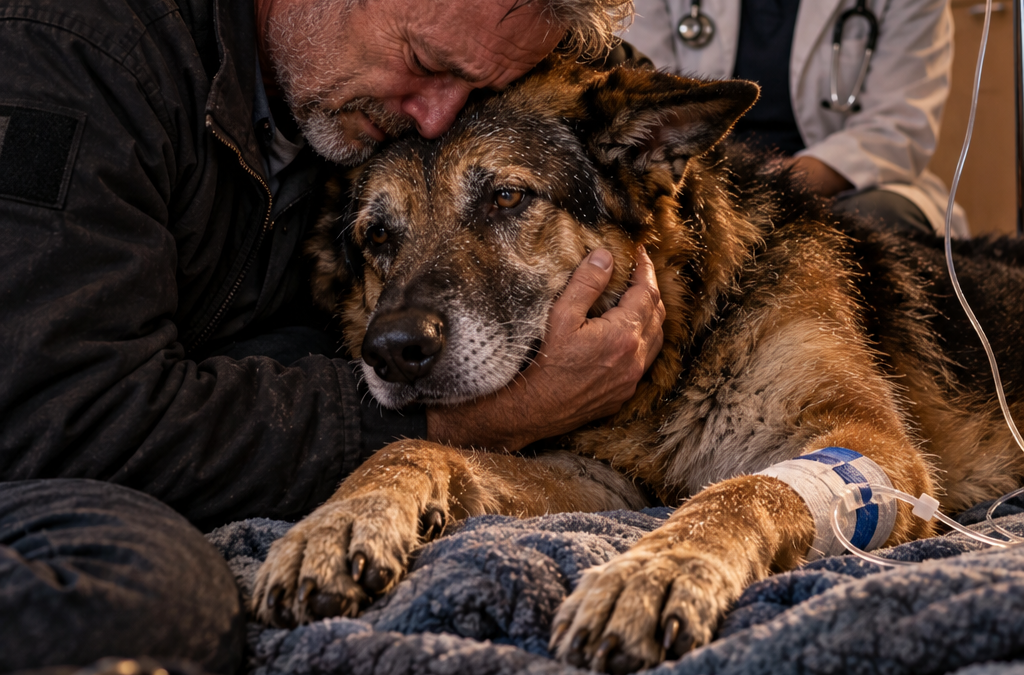
At 3:16 in the veterinary room, I looked down at the same dog.
His ears had gone soft with age.
His muzzle was white.
His front paws rested against my jeans.
I stroked his shoulder.
“Remember Lawson, buddy?”
Flint’s eyes remained on mine.
“Old Pete said you were smarter than me.”
I laughed weakly.
“Turns out he was right.”
My throat tightened.
“You remember that drainage ditch? I almost dragged you right past the guy we were supposed to find.”
I paused.
“You were trying to tell me something, and I wouldn’t listen.”
I looked at the clock.
Forty-four minutes.
I touched the white fur beneath his throat.
“I guess I’ve spent a lot of years doing that.”
Flint breathed slowly.
I leaned back against the wall.
“There’s something I never told you about our first day.”
His eyes shifted toward me.
“I didn’t want a dog.”
The words surprised me.
I’d never said them aloud before.
“Not really.”
I looked toward the window.
“Your assignment came right after Frank died.”
Officer Frank Delaney had been my patrol partner for eleven years.
He was killed in a highway collision while responding to an emergency.
I’d been off duty that night.
We were supposed to work the following morning.
For months afterward, I couldn’t stand the thought of riding with another partner.
I refused reassignment requests.
I volunteered for solo patrols.
I stopped eating lunch with the other officers.
When the department offered me a position in the K9 unit, I accepted because working with a dog seemed easier than depending on another person.
I didn’t tell Lawson that.
I didn’t tell Caroline.
I certainly didn’t tell Flint.
But it was true.
“I thought you’d be equipment,” I whispered.
My voice cracked.
“Something I’d train. Something I’d take care of. Something that wouldn’t be able to leave a hole in my life.”
I looked down at him.
His eyes were half closed.
“I was wrong about that, too.”
I smiled through tears.
“God, buddy. I had no idea how wrong.”
Flint joined me on patrol in July.
Our first official deployment was a missing-person search near the county fairgrounds.
A teenager had wandered away from a residential care facility and disappeared into a wooded drainage area.
It was hot.
Mosquitoes swarmed around us.
The ground smelled of wet soil and gasoline from a nearby equipment yard.
I was nervous.
Flint was excited.
As soon as I opened the rear door of our patrol SUV, he stood and looked at me.
I fastened his tracking harness.
“All right, partner. Let’s see what you’ve got.”
He touched his nose to my hand.
It was a habit that developed during training.
Whenever he was ready for an assignment, he’d press his nose against the back of my fingers.
One quick touch.
Then he’d wait.
I started calling it his handshake.
For ten years, we never began a deployment without it.
That afternoon, Flint located the missing teenager in a patch of woods beside an abandoned service road.
The boy was frightened but unharmed.
We walked him back to the waiting medical team.
The call lasted less than two hours.
Nobody wrote a newspaper article.
Nobody presented a medal.
But when we returned to the station, I opened Flint’s door and held out my hand.
He pressed his nose against it.
I smiled.
“Good work, partner.”
He wagged his tail.
I gave him a treat.
And just like that, the empty place Frank had left in my life began changing.
Not disappearing.
Never disappearing.
But changing into something I could live with.
A week later, I brought Flint home.
Caroline met us on the porch.
She was wearing jeans and one of my old college sweatshirts.
Our daughter, Lucy, was eight years old.
She stood behind her mother holding a stuffed German Shepherd.
“Is that him?” Lucy asked.
I nodded.
“That’s Flint.”
She stared at him.
“He’s huge.”
“He’ll get bigger.”
Caroline smiled.
“He looks serious.”
“He is.”
Lucy stepped closer.
“Can I pet him?”
I guided the introduction carefully.
Flint sniffed her hand.
Then he sat.
Lucy touched his neck.
His tail began wagging.
She laughed.
“He likes me!”
Caroline crouched beside them.
“Of course he does.”
Flint leaned against her.
I sighed.
“Don’t get too attached. He’s a working dog.”
Caroline looked up.
“Nathan, he’s living in our house.”
“That doesn’t mean—”
“He already likes the furniture.”
I glanced toward the porch.
Flint had put his front paws on the outdoor couch.
Caroline laughed.
I shook my head.
Within two months, he was sleeping beside our bed.
Within six, he had his own Christmas stocking.
And by his first birthday with us, Lucy had convinced Caroline to bake him a dog-safe cake.
I pretended to complain.
The truth was that I loved coming home and finding him stretched out on the living room rug with Lucy asleep beside him.
For the first time since Frank’s death, the house felt safe again.
Not because danger couldn’t reach us.
But because I had stopped expecting the worst every time something good happened.
At 3:23, Flint shifted against my leg.
I stopped talking.
His breathing quickened.
I leaned forward.
“Hey. Easy.”
I checked the medication line as Dr. Warren had shown me, careful not to disturb it.
Flint’s body settled again.
I stroked his cheek.
“Sorry, buddy.”
He blinked.
“Didn’t mean to wear you out with all my talking.”
I tried to laugh.
Then I saw the clock.
Thirty-seven minutes.
The number made my chest tighten.
I had spent thirteen years with this dog.
And now time had become something I could measure by watching a second hand move around a dial.
I looked at him.
“Remember the Miller girl?”
His ear moved slightly.
“Little Sadie?”
The memory came back with such force that I could almost smell the wet leaves.
Sadie Miller was six years old when she disappeared from a campground during a storm.
Her family had been camping near Lake Harlan, about twenty miles outside town.
Heavy rain moved through the area shortly before sunset.
When her father went to check the family’s tent, Sadie was gone.
At first, they thought she’d wandered to a nearby restroom.
Then they found her yellow raincoat caught on a branch near a wooded trail.
By the time Flint and I arrived, search volunteers had been working for two hours.
The rain was cold.
The ground was muddy.
Visibility was poor.
Sadie’s father stood beside a rescue vehicle, his face gray with fear.
He grabbed my sleeve.
“Can your dog find her?”
I looked at Flint.
He stood quietly beside me.
“We’re going to try.”
The man shook his head.
“She’s only six.”
His voice broke.
“She doesn’t know those woods.”
I placed a hand on his shoulder.
“We’ll do everything we can.”
He nodded.
But his eyes told me he wanted a promise.
I couldn’t give him one.
Flint scented Sadie’s jacket and began tracking near the edge of the campground.
He led us downhill through a stand of pine trees.
Rain ran down my neck.
Mud covered my boots.
The trail crossed a shallow stream, followed an old service road, and disappeared into a tangle of fallen branches.
After nearly forty minutes, Flint stopped.
He raised his head.
Sniffed the air.
Then pulled sharply toward the water.
I followed.
We reached an old boat-storage area beside a narrow inlet.
Several overturned canoes lay beneath a collapsing wooden shelter.
Flint began barking.
I swept my flashlight across the ground.
Nothing.
Then he pushed toward a green canoe lying upside down.
He barked again.
I crouched beside it.
“Sadie?”
A tiny voice answered.
“Don’t hurt me.”
My heart nearly stopped.
“Sweetheart, I’m Officer Cole. Your daddy sent me.”
There was a pause.
“Where’s Daddy?”
“He’s waiting for you.”
I lifted one side of the canoe.
Beneath it lay a small girl curled into a ball.
Her face was dirty.
Her lips trembled.
Her legs were covered in mud.
She had crawled beneath the canoe to escape the storm and become too frightened to come out.
I reached for her.
She pulled away.
“No!”
I stopped.
“Okay. That’s okay.”
I looked at Flint.
He was standing beside me, panting softly.
“Want to meet my friend?”
Sadie stared at him.
“Dog?”
“His name’s Flint.”
She sniffled.
“Does he bite?”
I smiled.
“Not little girls.”
I gave Flint a quiet command, and he settled calmly beside the opening.
Sadie slowly extended her hand.
Flint lowered his head.
His nose touched her fingers.
She smiled.
It was the smallest smile I’d ever seen.
But it was enough.
“He’s warm,” she whispered.
“Yeah.”
I took off my jacket and wrapped it around her.
“He’s a good dog.”
Sadie reached both arms around Flint’s neck.
I radioed our location.
The rescue team arrived fifteen minutes later.
When we carried Sadie back to the command post, her father ran toward us.
He dropped to his knees in the mud.
Sadie reached for him.
“Daddy!”
He gathered her into his arms.
Then he looked at Flint.
His mouth opened.
Nothing came out.
He simply knelt beside my dog and began crying.
I remember turning away because I didn’t want him to see the tears in my eyes.
That night, Caroline asked how the search had gone.
I told her we’d found the girl.
I told her Flint had done well.
Then I changed the subject.
I didn’t tell her about Sadie’s father.
About the way he trembled when he held his daughter.
About how close he’d come to spending the rest of his life imagining what might have happened in those woods.
I kept all of that inside.
I thought silence made me strong.
But sitting beside Flint in the veterinary room, I finally understood that silence had cost me more than I knew.
I rested my forehead against his.
“You know something, buddy?”
My voice shook.
“I was proud of you that night.”
Flint breathed quietly.
“Not just because you found her.”
I stroked his neck.
“Because you knew how to be gentle when she was scared.”
A tear fell onto his blanket.
“I spent years thinking bravery was about being the first one through a door.”
I paused.
“But you showed me it could mean kneeling beside a little girl until she wasn’t afraid anymore.”
I wiped my eyes.
“I should’ve told you that.”
The clock read 3:31.
Twenty-nine minutes.
I stared at it.
There were so many things I still needed to say.
So many memories.
So many apologies.
I looked down at Flint.
His eyes were closed.
For one terrible moment, I thought he was gone.
I placed my hand against his chest.
It rose.
Fell.
Rose again.
I exhaled shakily.
“Please don’t leave yet.”
The words escaped before I could stop them.
I immediately hated myself for saying them.
He was tired.
His body was failing.
He had given me thirteen years.
And I was still asking him for more.
I bent closer.
“No, buddy.”
I stroked his ear.
“Don’t listen to me.”
My voice broke.
“You’ve listened to me enough.”
I sat back against the wall.
Then another memory came.
One I’d spent years trying not to revisit.
It was the night Flint nearly died.
We were searching an abandoned motel after an armed robbery suspect fled into the building.
Two officers had been injured during the pursuit.
The suspect was believed to be dangerous.
Flint and I entered with a tactical team after officers had secured the exterior.
The building smelled of mold and broken plaster.
Water dripped through the ceiling.
We moved slowly.
Flint worked ahead on a controlled leash.
Near the end of a corridor, he stopped.
His body stiffened.
He looked toward a half-open storage-room door.
I recognized his alert.
I raised my hand.
The team stopped.
Then the door moved.
A man appeared.
Someone shouted.
A gunshot cracked through the hallway.
I pulled backward toward cover.
Flint lunged as the suspect rushed forward.
The encounter lasted seconds.
Officers subdued the man.
But when I turned, Flint was on the floor.
There was blood spreading across his shoulder.
I dropped beside him.
“No. No, no.”
His breathing was fast.
His eyes searched mine.
I pressed my hand against the wound.
“Stay with me, buddy.”
I called for emergency veterinary assistance.
The other officers secured the scene.
But all I could see was my dog.
His blood.
His frightened eyes.
The way his body trembled beneath my hands.
“You’re okay,” I kept saying.
“You’re okay. I’ve got you.”
I didn’t know whether it was true.
The veterinarian later told me the bullet had passed through soft tissue without striking a major artery or bone.
Flint survived.
He underwent surgery and weeks of rehabilitation.
The department gave him a commendation.
His photograph appeared in the newspaper.
People called him a hero.
I smiled for the cameras.
I accepted the plaque.
I thanked the officers who had helped us.
But no one knew what happened when I brought him home.
That night, I sat on the floor beside his bed.
His shoulder was bandaged.
He was wearing a protective collar.
He tried to lift his head whenever I moved.
I couldn’t stop looking at the wound.
I kept thinking about the seconds before the shooting.
The choice to deploy him.
The moment everything went wrong.
I knew we’d followed our training.
I knew the officers had worked under dangerous conditions.
But I couldn’t stop wondering whether I should have done something differently.
Eventually, I buried my face against Flint’s neck.
“I’m sorry,” I whispered.
He licked my hand.
I cried harder.
And then, because I didn’t know what else to do, I stood up and walked into the garage.
I stayed there until morning.
That was how I handled guilt.
I hid from the people who might have helped me carry it.
Even when one of them was a dog lying on a blanket, waiting for me to come back.
At 3:36, I looked into Flint’s tired eyes.
“I never told you the truth about that night.”
My voice trembled.
“I was terrified.”
I swallowed.
“When I saw you bleeding, I forgot everything I’d been trained to do for about three seconds.”
I rubbed my face.
“Three seconds doesn’t sound long.”
I looked down.
“But in police work, three seconds can be forever.”
Flint shifted his head against my thigh.
I stroked him gently.
“I thought I’d lost you.”
A tear fell.
“And the worst part was that I knew you trusted me to make the right decisions.”
I paused.
“I spent years wondering whether I deserved that trust.”
The words hung in the room.
For the first time, I wasn’t trying to excuse myself.
I wasn’t explaining tactics.
I wasn’t reviewing the case.
I was simply admitting what I’d felt.
“I was scared, buddy.”
My voice broke.
“I was so scared.”
I leaned forward.
“And when you got better, I acted like nothing happened.”
I closed my eyes.
“Because I thought that was what strong men did.”
I shook my head.
“I’m sorry I didn’t sit with you longer.”
Flint breathed softly.
“I’m sorry I walked away when you needed me.”
I kissed his forehead.
“And thank you for trusting me anyway.”
There was a quiet knock.
Dr. Warren opened the door.
She crouched beside Flint and examined him.
I watched every movement.
“How’s he doing?” I asked.
“He’s comfortable right now.”
She checked his breathing and gently touched his abdomen.
Then she looked at me.
“He’s getting weaker.”
I nodded.
My mouth was dry.
“How much time?”
She glanced toward the clock.
“About twenty minutes until four, but Nathan, if you need me sooner, call. We shouldn’t wait if he becomes distressed.”
I looked at Flint.
He seemed so peaceful.
I wanted to believe she’d tell me we could take him home.
That the tests had been wrong.
That some miracle had happened while we were talking.
Instead, she placed a hand on my shoulder.
“He’s lucky to have you.”
I laughed bitterly.
“Doesn’t feel that way.”
She looked surprised.
“Why?”
I stared at the floor.
“Because I couldn’t save him.”
Dr. Warren was quiet.
Then she said, “You’ve spent thirteen years caring for him. Saving him from death isn’t the only way to love him.”
My eyes filled.
She continued.
“Sometimes love means staying when there’s nothing left to fix.”
I looked at Flint.
He was watching me.
Waiting.
Dr. Warren stood.
“I’ll be just outside.”
Then she closed the door.
I sat there for a long moment.
Her words had struck somewhere deep inside me.
Staying when there’s nothing left to fix.
For years, I’d believed my value came from being useful.
From solving problems.
From protecting people.
From having answers.
But Flint had never needed me to be perfect.
He had needed me to be present.
And in the most important moments of our life together, I had sometimes been too frightened to stay.
I looked at the clock.
3:43.
Seventeen minutes.
I took a deep breath.
“There’s something else, buddy.”
Flint’s eyes shifted toward me.
“Something I should’ve said a long time ago.”
I touched the collar lying beside the blanket.
The leather was worn.
His nameplate had become scratched and dull.
It had been on his neck through countless patrols, thousands of miles, and ten years of service.
I lifted it gently.
“Remember the day we retired?”
He blinked.
I smiled through tears.
“You hated it.”
Flint had been eleven when the department officially retired him.
His hips had begun failing.
He struggled to jump into the patrol vehicle.
Sometimes he limped after long tracking exercises.
Our veterinarian warned me that continuing to work could cause permanent damage.
I fought the decision.
I told myself he could handle shorter assignments.
That we could avoid dangerous calls.
That he still wanted to work.
But one afternoon, after a routine training exercise, Flint collapsed beside the SUV.
His back legs simply gave out.
I knelt beside him.
“Come on, buddy.”
He tried to stand.
Failed.
Tried again.
I watched his face.
He wasn’t confused.
He wasn’t frightened.
He was frustrated.
He wanted to get into the vehicle.
He wanted another assignment.
He wanted to do the only job he’d ever known.
I helped him into the back.
Then I sat on the bumper and cried.
Because I finally understood that he would never make the decision to stop.
He trusted me to make it for him.
And I had been too selfish to do it.
His retirement ceremony took place three weeks later.
The chief gave a speech.
Officers brought photographs.
There was a cake with Flint’s badge number.
Lucy, now eighteen, came home from college to attend.
Caroline cried through the entire ceremony.
Flint wore a blue ribbon and spent most of the afternoon trying to steal food.
Everyone laughed.
But after the crowd left, I stood beside our patrol vehicle holding his working harness.
Flint looked at me.
His ears rose.
He expected another call.
I knelt.
“Not today, buddy.”
His tail moved.
I removed his working collar and replaced it with a soft leather one.
“You’re going home.”
He stared at me.
I swallowed.
“For good.”
That evening, when I parked outside our house, Flint refused to leave the truck.
He kept looking toward his working harness.
I stood beside the open door.
“Come on.”
He didn’t move.
I sat on the driveway.
He watched me.
For nearly twenty minutes, neither of us moved.
Then I reached into the truck, took his collar, and held it gently.
“Listen to me, partner.”
My throat tightened.
“You did good.”
His ears moved.
“Real good.”
He lowered his head.
I stroked his cheek.
“But I’m the one who has to take care of you now.”
After a while, he climbed down with my help.
We walked into the house together.
I retired from the department the following spring.
People thought I was doing it because I wanted to travel.
Or fish.
Or spend more time with Caroline.
Those things were true.
But there was another reason.
Flint had spent ten years following me wherever duty called.
I wanted to spend the years he had left following him.
We developed a routine.
Every morning, we’d walk to the little pond behind our property.
We’d sit on a wooden bench beneath an oak tree.
Sometimes he’d watch ducks.
Sometimes he’d sleep beside my boots.
I’d drink coffee from a thermos and tell him stories.
He never interrupted.
He never complained.
And somehow, in those quiet mornings, I began feeling like a person again instead of a man who had lost his identity when he turned in his badge.
But as he grew older, our walks became shorter.
Then slower.
Then, eventually, they stopped.
I built a ramp beside the porch.
I bought orthopedic beds.
I learned how to support his hips when he stood.
I carried him outside on bad days.
Some mornings, he looked embarrassed when I helped him.
I’d kiss his head.
“Easy, buddy.”
He’d look away.
“Everybody needs help sometimes.”
I repeated those words often.
But I never applied them to myself.
At 3:48, I felt Flint’s breathing change.
It became shallower.
I leaned closer.
“Hey.”
His eyes opened.
“Stay with me, buddy.”
I stopped.
Those words again.
Stay with me.
I’d said them after the shooting.
I’d said them through surgeries.
I’d said them on mornings when he struggled to stand.
I’d said them every time I was afraid of losing him.
And now, at the very end, I was still asking him to stay.
I touched his cheek.
“No.”
My voice broke.
“No, that’s not fair.”
I wiped my face.
“You don’t have to stay because I’m scared.”
Flint looked at me.
I could barely breathe.
I wanted to tell him he could rest.
I wanted to tell him his work was finished.
But saying those words felt like giving him permission to leave me.
And I wasn’t ready.
My phone vibrated in my pocket.
It was Lucy.
I’d texted her earlier from the hospital.
She lived two hours away now, teaching elementary school and raising a little boy named Henry.
She’d been trying to arrange someone to cover her class so she could come.
I answered.
“Hey, sweetheart.”
“Dad?”
Her voice was shaking.
“How is he?”
I looked at Flint.
“Not good.”
There was silence.
Then she asked, “Are you with him?”
“Yeah.”
“Is he comfortable?”
I swallowed.
“I think so.”
Lucy began crying.
“Dad, I’m sorry I can’t get there in time.”
I closed my eyes.
“It’s okay.”
“No, it’s not.”
“Lucy.”
“He was there for everything.”
Her voice broke.
“My first day of middle school. My graduation. When I came home from college. He was there when Henry was born.”
I looked down at Flint.
His eyes were closed.
“I know.”
She sniffled.
“Do you remember when I was twelve and I got scared after that car accident?”
I nodded.
I remembered.
Lucy had been riding with Caroline when another driver ran a red light.
Neither was seriously injured, but Lucy developed nightmares afterward.
For weeks, she struggled to sleep.
One night, I found Flint lying outside her bedroom.
He was supposed to sleep downstairs.
I tried to call him away.
He refused.
Lucy opened the door.
“Can he stay?”
I nodded.
She wrapped her arms around his neck.
He slept beside her bed for the next month.
Eventually, the nightmares stopped.
I looked at Flint.
“Yeah, sweetheart. I remember.”
Lucy took a shaky breath.
“Dad, can you tell him something for me?”
“Anything.”
“Tell him I love him.”
I closed my eyes.
My mouth opened.
No sound came.
“Dad?”
I tried again.
“Lucy, I—”
My voice broke.
She was quiet.
Then she said gently, “You don’t have to be strong.”
I pressed my hand against my eyes.
“I can’t do this.”
“I know.”
“No, honey. I really can’t.”
She waited.
“I’ve had him thirteen years, and I can’t even say goodbye.”
Lucy began crying harder.
Then she said something I wasn’t expecting.
“Dad, remember how you taught me that Flint always listened to your voice?”
I nodded.
“Yeah.”
“Then don’t worry about finding the perfect words.”
I looked at him.
“Just talk to him.”
She paused.
“He knows your voice. That’s what he needs.”
I covered my mouth.
“Tell him the truth, Dad.”
My eyes filled.
“Tell him what he means to you.”
We ended the call a minute later.
I placed the phone beside me.
Then I looked at Flint.
The clock read 3:52.
Eight minutes.
My whole body began trembling.
I leaned closer.
“All right, partner.”
My voice cracked.
“Let’s try this again.”
I stroked his muzzle.
“Lucy says she loves you.”
His ear moved.
I smiled through tears.
“She always did.”
I took a breath.
“And I love you.”
The words sounded strange.
Not because they weren’t true.
Because I’d spent so many years assuming he didn’t need to hear them.
I said them again.
“I love you, Flint.”
His eyes opened.
He looked at me.
And something inside my chest broke wide open.
“I love you so much, buddy.”
I began crying harder.
“You were never just my dog.”
I pressed my forehead against his.
“You were my partner.”
I swallowed.
“My family.”
Another tear fell.
“My friend.”
I looked at the old collar.
“I spent years telling people how brave you were.”
I shook my head.
“How smart you were. How many people you helped.”
My voice trembled.
“But I never told you what you did for me.”
I leaned closer.
“When Frank died, I thought I’d never trust another partner.”
I stroked his ear.
“Then you came along.”
I laughed through tears.
“You were stubborn. You were impossible. You made me look like an idiot in front of half the training staff.”
His tail moved faintly.
“But you made me trust again.”
I swallowed.
“When Lucy was scared, you stayed beside her.”
My voice grew softer.
“When Caroline and I argued, you sat between us until one of us started laughing.”
I smiled sadly.
“And when I retired, you gave me a reason to get up in the morning.”
I looked directly into his eyes.
“You didn’t need me to be Sergeant Cole.”
I paused.
“You didn’t care about the badge.”
I touched his chest.
“You just wanted me.”
A sob escaped.
“And I needed that more than I ever admitted.”
The second hand moved.
3:55.
Five minutes.
I looked toward the door.
I knew Dr. Warren would return soon.
I knew what was waiting.
But I wasn’t finished.
I placed both hands gently against Flint’s face.
“There’s one more thing.”
His eyes remained on mine.
“I need you to know I’m not angry.”
My voice shook.
“Not because you’re old.”
I paused.
“Not because you can’t walk.”
I swallowed.
“Not because your body can’t keep going.”
I leaned closer.
“You didn’t let me down.”
Tears streamed down my cheeks.
“Do you hear me?”
My voice broke completely.
“You never let me down.”
For thirteen years, Flint had responded to my commands.
Sit.
Stay.
Search.
Come.
He had followed me into buildings, through storms, across dark fields, and into dangerous places without hesitation.
He’d trusted my judgment.
He’d depended on me to keep him safe.
And now, with his life ending beneath my hands, I understood that the final responsibility belonged to me.
Not to ask him to keep fighting.
Not to demand one more day.
Not to make him endure pain because I was afraid to live without him.
But to tell him that he’d done enough.
I wiped my face.
“Flint.”
His eyes shifted toward me.
I smiled through tears.
“Good boy.”
His breathing remained soft.
“Good boy, partner.”
I kissed the white fur between his ears.
“Your work is done.”
The words almost wouldn’t come.
I tried again.
“You don’t have to protect me anymore.”
My chest tightened.
“You don’t have to get up when I move.”
I swallowed.
“You don’t have to watch the door.”
A tear fell onto his blanket.
“You don’t have to be strong for me.”
I held his head against my chest.
“I’ll be okay.”
My voice broke.
“I don’t know how yet.”
I closed my eyes.
“But I’ll figure it out.”
I leaned forward.
“And I promise I’ll take care of Caroline.”
I stroked his cheek.
“I’ll visit Lucy.”
I smiled through tears.
“I’ll let Henry steal my cookies just like he steals yours.”
Then I whispered the words I’d spent the entire hour trying to find.
“You can rest now, buddy.”
I pressed my lips against his forehead.
“I’ve got you.”
There was a soft knock at the door.
Dr. Warren entered.
She looked at me.
“Are you ready?”
I looked down at Flint.
His eyes were nearly closed.
His breathing was weak.
I wanted to say no.
I wanted to ask for another hour.
Another day.
Another year.
But I could see how tired he was.
And for the first time, I understood that the answer wasn’t about what I wanted.
I looked at the veterinarian.
“Yes.”
My voice trembled.
“Please help him.”
She knelt beside us and explained what would happen.
She would give him a sedative first so he could become deeply relaxed.
Then, when I was ready, she would administer the medication that would allow him to pass peacefully.
She asked whether I wanted to stay.
I looked at her.
“I’m not leaving him.”
She nodded.
“Of course.”
I held Flint while she gave the sedative.
He barely reacted.
His body relaxed against me.
I stroked his ears.
“That’s it, buddy.”
His breathing slowed.
“Just rest.”
I smiled through tears.
“Remember our old handshake?”
I held out the back of my hand near his nose.
The same way I’d done before hundreds of assignments.
He was already deeply drowsy.
I didn’t expect a response.
But I wanted him to feel something familiar.
For a moment, nothing happened.
Then his nose moved slightly against my fingers.
The touch was so faint that I might have imagined it.
I didn’t care.
I closed my eyes.
“Good boy.”
My voice broke.
“That’s my boy.”
Dr. Warren waited until he was fully relaxed.
Then she looked at me.
“Are you ready for the final medication?”
I kissed Flint’s forehead.
I wanted to remember that moment forever.
The warmth of his fur.
The weight of his head in my lap.
The familiar white marking beneath his throat.
The little scar above his left eye from the time he ran into a fence during training because he was too excited to slow down.
I wanted to remember everything.
Not the illness.
Not the weakness.
Not the terrible fear of losing him.
I wanted to remember the dog who had walked beside me for thirteen years.
I placed my forehead against his.
“Thank you, partner.”
I swallowed.
“Thank you for every mile.”
I stroked his cheek.
“Every night.”
My voice shook.
“Every time you brought us home.”
Then I looked at Dr. Warren.
I nodded.
She administered the medication.
I kept one hand against Flint’s chest and the other beneath his head.
His breathing was slow.
Then slower.
Then it stopped.
Dr. Warren listened gently with her stethoscope.
She waited.
Then she looked at me.
“I’m so sorry, Nathan. He’s gone.”
I stared at Flint.
For a moment, I couldn’t move.
His eyes were closed.
His body was still warm.
My hand rested against his chest.
But there was no heartbeat.
No familiar breathing.
No movement beneath my fingers.
I looked toward the clock.
4:03.
The hour was over.
And my best friend was gone.
I bent forward and held him.
I didn’t try to be strong.
I didn’t apologize for crying.
I didn’t look away.
For the first time in my life, I allowed myself to feel everything.
The grief.
The gratitude.
The fear.
The love.
I cried for the young dog who had pressed his chin into my palm thirteen years earlier.
I cried for the partner who had trusted me in dangerous places.
I cried for the old dog who had waited beside the door every morning, even after his legs could no longer carry him.
And I cried because I finally understood how much of my life had been shaped by a creature who never once asked me to explain myself.
Dr. Warren quietly left the room.
She gave me time.
I stayed beside Flint long after the clock passed four.
I rested my forehead against his.
“I’m sorry I waited so long to say it.”
My voice shook.
“I love you, buddy.”
I kissed his cheek.
“Always have.”
When I finally stood, my legs were numb.
My back ached.
My hands trembled.
I placed Flint’s old collar on top of his blanket.
Then I took one last look at him.
“Rest easy, partner.”
I swallowed.
“I’ve got the watch from here.”
Three days later, Caroline and I brought Flint’s ashes home.
I placed the wooden urn on the mantel beside his retirement photograph.
In the picture, he was standing proudly beside our patrol SUV.
His ears were raised.
His eyes were bright.
His black-and-tan coat shone beneath the summer sun.
I was smiling.
Flint wasn’t looking at the camera.
He was looking at me.
Waiting.
Ready for whatever came next.
Caroline stood beside me.
She placed her hand against my back.
“How are you doing?”
I stared at the photograph.
“I don’t know.”
She nodded.
“That’s okay.”
For a while, we stood quietly.
Then I said something I had never admitted before.
“I think I spent my whole life being afraid of telling people how much I loved them.”
Caroline looked at me.
I swallowed.
“Because once you say it out loud, you admit how much you have to lose.”
She squeezed my hand.
I looked at her.
“I don’t want to do that anymore.”
Her eyes filled.
I took her into my arms.
“I love you, Caroline.”
She began crying.
Then she laughed softly.
“I know, Nathan.”
I shook my head.
“No.”
I held her closer.
“I need to say it.”
And I did.
Again.
Without embarrassment.
Without trying to make a joke.
Without looking for something else to talk about.
A week later, I drove to Lucy’s house.
I spent the afternoon playing with Henry in the backyard.
I watched him chase bubbles across the grass.
I helped Lucy repair a broken shelf.
I sat with her at the kitchen table while she told me about her students.
For once, I didn’t check my phone.
I didn’t rush to leave.
I didn’t tell her I had things to do.
Before I went home, she hugged me.
“I missed you, Dad.”
I held her tightly.
“I missed you, too.”
She pulled back.
“Are you okay?”
I smiled sadly.
“Not yet.”
She nodded.
“That’s all right.”
I touched her cheek.
“But I’m going to be.”
Then I said the words I had spent too many years keeping inside.
“I love you, sweetheart.”
She smiled through tears.
“I love you, too.”
That evening, I returned home and sat on the porch where Flint used to sleep during summer nights.
His bed was gone.
His water bowl had been put away.
The ramp I’d built beside the steps still stood.
I couldn’t bring myself to remove it.
I sat in my old wooden chair and listened to the wind moving through the trees.
For thirteen years, Flint had been beside me.
When I went to work.
When I came home.
When I was frightened.
When I was angry.
When I couldn’t sleep.
He had never asked whether I deserved his loyalty.
He had simply given it.
And now, sitting alone on that porch, I realized his greatest gift hadn’t been the rescues or the commendations.
It hadn’t been the dangerous calls or the photographs in the newspaper.
It was the way he had loved me without requiring me to be anything more than the man I was.
He had taught me patience.
Trust.
Courage.
But in the final hour of his life, he taught me something even more important.
Love isn’t always something you can prove by saving someone.
Sometimes you can’t save them.
Sometimes you can’t stop the pain.
Sometimes the only thing you can do is sit beside them, hold them gently, and make sure they don’t have to face the darkness alone.
I used to think goodbye was a word you said when you were ready to lose someone.
Now I know better.
Goodbye is what you say when you love someone enough to let them rest, even when your own heart is begging them to stay.
I still visit the old pond sometimes.
The one where Flint and I spent our retirement mornings.
I sit on the wooden bench beneath the oak tree.
I bring coffee in the same battered thermos.
And I watch the ducks moving across the water.
Sometimes I close my eyes and imagine him beside me.
Young.
Strong.
His ears raised.
His tail moving.
Waiting for me to hold out my hand.
And in my memory, I can still feel that familiar touch.
His nose against my fingers.
One small gesture.
Our promise that we were ready to face whatever came next.
I wish I could have one more morning with him.
One more walk.
One more chance to open the patrol vehicle and see him waiting in the back.
But I know that even a thousand more days wouldn’t have made goodbye easy.
Because thirteen years wasn’t enough.
A lifetime wouldn’t have been enough.
There was always going to be one more thing I wanted to tell him.
One more memory.
One more thank-you.
One more time I wanted to hear his paws crossing the kitchen floor.
But when I think back to that final hour, I no longer remember only the fear.
I remember the warmth of his head in my lap.
The way he looked at me when I said his name.
The way his body relaxed when he heard my voice.
And I remember the moment I finally stopped asking him to stay.
I had spent thirteen years teaching Flint to obey commands.
But in the end, he taught me how to say the words I’d been afraid to speak my entire life.
“I’m sorry.”
“Thank you.”
“I love you.”
And finally, the hardest words of all.
“You can rest now.”
I still say them sometimes when I look at his photograph.
Not because I think he needs permission anymore.
But because I need to remember that I gave him what he deserved.
Not another command.
Not another assignment.
Not another impossible fight.
I gave him my presence.
My honesty.
My love.
And the freedom to leave without wondering whether he’d disappointed me.
He never did.
Not once.
For thirteen years, he was my partner, my protector, and my friend.
And in the last hour of his life, when I finally found the courage to tell him everything he’d meant to me, I realized something that will stay with me until the day I die.
I thought I was giving Flint the goodbye he deserved.
But he was giving me one final chance to become the man he’d always believed I was.
So rest easy, K9 Flint.
Your final shift is over.
And wherever I go, whatever years I have left, I will carry the lessons you taught me.
I’ll tell the people I love that I love them.
I’ll stay when they need me.
I’ll listen before I speak.
And when the time comes to say goodbye again, I’ll try to remember the courage of a tired old German Shepherd who trusted me enough to close his eyes and rest.
Good boy, partner.
You were always enough.
And you always will be.