𝗙𝗨𝗟𝗟 𝗦𝗧𝗢𝗥𝗬 My Dying K9 Stopped Beside Me on a Frozen Trail—Then He Did Something I Hadn’t Seen in Years
𝗙𝗨𝗟𝗟 𝗦𝗧𝗢𝗥𝗬
I believed in those words.
For a long time, I believed in them more strongly than I believed in anything else.
Then, six years later, I nearly died on a mountain trail.
It was February.
Bear and I were searching for an elderly hunter who had become separated from his companions after a sudden snowstorm.
We were moving along a narrow ridge when the frozen ground beneath me collapsed.
I slid down a steep slope and struck a rock hard enough to break two ribs.
My radio was damaged.
My right ankle twisted beneath me.
I was alone below the ridge, unable to climb back up.
Bear had been farther ahead on the trail.
He returned when he realized I wasn’t following.
I remember seeing his face appear above the slope.
“Stay!” I shouted.
He ignored me.
He scrambled down through the snow and reached my side.
I checked my injuries.
I couldn’t walk.
The temperature was dropping.
And the nearest rescue team was more than a mile away.
I removed Bear’s leash.
Then I took his face between my hands.
“Listen to me, buddy.”
His ears lifted.
“Find help.”
It was an emergency task we’d practiced with other handlers.
Bear knew that he could leave me to locate another officer and lead that person back.
But he’d never had to do it while I was seriously injured.
I pointed toward the ridge.
“Go.”
He hesitated.
I repeated the command.
“Find help!”
Bear finally turned and climbed away.
I watched him disappear.
The minutes that followed felt endless.
At one point, I became convinced he wouldn’t return.
Not because I doubted his loyalty.
Because the terrain was terrible, the weather was worsening, and I didn’t know whether he could locate anyone before darkness fell.
Then I heard barking.
Three sharp barks.
A pause.
Three more.
I lifted my head.
“Bear?”
Lights appeared above the ridge.
A firefighter shouted my name.
Bear came scrambling down ahead of two rescuers.
He reached me first.
Pressed his nose against my face.
Then lay across my legs as though he were determined to keep me from disappearing again.
I wrapped my arms around him.
“You did it.”
He licked my cheek.
“You brought them back.”
That rescue became one of the proudest moments of his career.
But afterward, something changed in Bear.
He became more attentive to me.
If I stopped walking, he stopped.
If I stumbled, he returned immediately.
Sometimes, when I was sitting quietly at home, he’d come over and press his nose against my knee as though checking that I was still there.
Margaret used to laugh.
“That dog thinks you’re going to get lost without him.”
I smiled.
“He’s probably right.”
What I didn’t understand then was that Bear would remember that mountain rescue long after his body had lost the strength to repeat it.
And long after his ears had stopped hearing my voice.
When Bear retired at eleven, the department held a small ceremony.
He received a plaque.
Several officers gave speeches.
Our commander called him one of the finest tracking dogs our unit had ever trained.
I stood beside him, holding his worn black harness.
For the first time in years, his tail wasn’t moving.
He seemed confused by the applause.
I knelt beside him.
“That’s it, buddy.”
He looked at me.
“No more calls.”
His ears twitched.
“No more chasing bad guys.”
He leaned toward me.
I scratched the gray fur around his muzzle.
“You’ve earned your rest.”
When I took him home that afternoon, Margaret had prepared a ridiculous celebration.
There was a blue banner across the living room.
A dog-safe cake on the kitchen counter.
And a new orthopedic bed beside the fireplace.
Bear sniffed the cake.
Then the bed.
Then walked straight into the living room and climbed onto the couch he’d never officially been allowed to use.
Margaret laughed so hard she had to sit down.
“Well, Officer Callahan, I suppose the rules are different now.”
I looked at Bear.
He closed his eyes.
“Apparently.”
Those first years of retirement were some of the happiest of my life.
Bear learned how to be lazy.
Not easily.
At first, he still rushed toward the door whenever I picked up my keys.
He still became excited when he heard police sirens.
He still searched every room when visitors entered the house.
But gradually, he began enjoying ordinary things.
Sunlight on the porch.
Slow walks through the woods.
Watching squirrels from the kitchen window.
Sleeping near Margaret while she worked on her quilting.
He became gentler.
Quieter.
More patient.
And I discovered that I loved him just as much without the badge.
Maybe more.
Then Margaret got sick.
Pancreatic cancer.
The doctors found it too late.
She lived seven months after the diagnosis.
I sat beside her bed through chemotherapy, hospital stays, and the final weeks when treatment was no longer helping.
Bear rarely left her room.
Even when his hips ached, he’d lie beside her bed and rest his head against the mattress.
Margaret would reach down and stroke his ear.
“Take care of him,” she’d whisper.
At first, I thought she was speaking to me.
Then one afternoon, I realized she was speaking to Bear.
She smiled at him.
“He’s going to pretend he’s fine.”
Bear looked up.
“He’s going to stop eating properly. And he’ll forget appointments.”
I tried to protest.
She ignored me.
“So you’re going to have to keep him company.”
Bear pressed his nose into her hand.
Margaret looked at me.
“See? He understands.”
She died on a quiet Thursday morning.
I held her hand.
Bear lay beside the bed.
And when her breathing stopped, he lifted his head and looked at me.
For a long time, neither of us moved.
Then I lowered myself onto the floor beside him.
I wrapped both arms around his neck.
And I cried.
Not the controlled tears I’d shed during her illness.
Not the silent grief I’d hidden from the nurses.
I cried until my chest hurt.
Bear stayed.
He pressed his body against mine.
And when I finally stopped shaking, he rested his head in my lap.
That was the beginning of our new life.
Two old partners.
One empty house.
A routine built around mornings, meals, and slow walks through the woods.
The trails became our refuge.
They were the one place where I didn’t feel surrounded by everything Margaret had left behind.
At home, every room reminded me of her.
The blue curtains she’d chosen.
Her favorite coffee mug.
The quilts folded over the back of the couch.
The empty chair beside the fireplace.
But in the woods, I could breathe.
Bear and I walked the Pine Hollow Trail three or four times a week.
It followed a narrow creek through hardwood trees and climbed gently toward an overlook above the valley.
In spring, wildflowers grew along the water.
In summer, the trees provided shade.
In autumn, the trail turned golden.
And in winter, when the ground froze and snow settled among the pines, it became one of the quietest places I’d ever known.
Bear loved it.
Even as he slowed, he still lifted his nose whenever we reached the trailhead.
He recognized the scent of the creek.
The bend near the old wooden bridge.
The patch of earth where deer crossed at dawn.
He knew that trail better than I knew my own backyard.
I used to tell him we were getting old together.
“Look at us, partner.”
He’d glance at me.
“Two retired officers with bad joints and nothing to prove.”
He would wag his tail.
And we’d keep walking.
But age eventually began demanding payment for everything his body had endured.
His hearing faded first.
At twelve, he stopped responding to distant sounds.
By thirteen, even loud noises barely registered.
The veterinarian explained that age-related hearing loss was common in older dogs.
We adjusted.
I began using hand signals.
A raised palm for stop.
A motion toward my leg for come.
Two fingers pointed toward the ground for stay close.
Bear remembered those signals beautifully.
Even when he couldn’t hear me, he could still read my body.
That was one of the things I admired most about him.
His ears might have failed.
His legs might have slowed.
But his attention to me never changed.
Then came the diagnosis.
It happened in early December.
Bear had stopped eating normally.
His abdomen seemed slightly swollen.
He tired after short walks.
One afternoon, he struggled to climb the three steps onto our porch.
I carried him inside and called Dr. Emily Foster, the veterinarian who had cared for him since retirement.
She examined him.
Then ordered bloodwork and an ultrasound.
I remember watching her study the screen.
Her expression became serious.
She showed me a large mass attached to his spleen.
There were signs of intermittent bleeding.
“We’re concerned about a splenic tumor,” she explained. “Some are benign, but others are aggressive cancers. We won’t know exactly what this is without further testing.”
I looked at Bear.
He was lying on the examination table.
His head rested against my hand.
“What happens if we don’t do anything?”
Dr. Foster hesitated.
“The mass could rupture and cause life-threatening internal bleeding. Given his symptoms, that’s a real concern.”
I swallowed.
“And surgery?”
“We can remove the spleen if he’s stable enough. But he’s thirteen, Robert. He’s already weak, and his age and other conditions increase the risk.”
I stared at the scan.
“Would it save him?”
“I can’t promise that. If the mass is malignant and has spread, surgery may offer only limited time. If it’s benign, the outlook could be much better.”
I looked down at Bear.
He opened his eyes.
His tail moved faintly.
For ten years, I’d trusted that dog with my life.
Now he was trusting me with his.
“Do you think it’s worth trying?”
Dr. Foster considered the question carefully.
“I think surgery is a reasonable option if you’re comfortable with the risks. But we need to be realistic about his recovery and what we may find.”
I nodded slowly.
“Okay.”
We scheduled the operation for Friday morning.
The day before surgery, I asked whether I could take Bear on one final short walk.
Dr. Foster was firm.
“No strenuous activity. With his condition, we need to avoid anything that puts additional stress on his body.”
“I understand.”
“Robert, I mean it.”
I looked at her.
“Just around the yard?”
She considered that.
“A very brief, gentle outing for his comfort, if he’s steady on his feet. But no long walks. And if he seems tired or weak, bring him inside.”
I agreed.
At the time, I meant it.
But the following afternoon, when I looked through our kitchen window and saw the sunlight falling across the snow-covered woods, I made a decision I would regret for the rest of my life.
I took Bear to Pine Hollow.
I told myself we would only walk a few hundred yards.
Just far enough for him to smell the creek.
Just long enough for us to say goodbye to the place that had carried us through so much grief.
I knew the veterinarian had warned me.
I knew Bear was weaker than he’d ever been.
But I couldn’t bear the thought of his last memory before surgery being the cold examination table.
I wanted him to have something beautiful.
Something familiar.
Something that belonged to us.
And because I was an old police officer who had spent his life believing he could recognize danger before it arrived, I convinced myself the risk was manageable.
I was wrong.
At 1:38 that afternoon, I helped Bear into my truck.
He moved slowly.
His back legs trembled.
But when he recognized the old walking blanket on the passenger seat, his tail began moving.
I smiled.
“One more little adventure, partner.”
He looked at me.
I scratched behind his ear.
“Just you and me.”
I didn’t know those words would become the last thing I remembered clearly before the pain started.
The parking lot at Pine Hollow was nearly empty when we arrived.
A thin layer of snow covered the gravel.
Bare branches swayed above the wooden trail sign.
The sky was pale blue, but the forecast called for temperatures to fall sharply before evening.
I checked my watch.
1:56 p.m.
We had plenty of daylight, I told myself.
I opened the passenger door.
Bear tried to jump down.
His front paws reached the edge of the seat, but his hind legs hesitated.
I caught him beneath the chest.
“Easy, old man.”
I lowered him carefully onto the ground.
He stood for a moment, gathering his balance.
Then he lifted his nose toward the trees.
His tail moved.
And for the first time in nearly two weeks, something of the old working dog returned.
Not his strength.
Not his speed.
But his enthusiasm.
I watched him sniff the cold air.
He looked toward the trailhead, then back at me.
I smiled.
“You remember.”
He wagged his tail again.
I fastened his soft walking harness.
Then I took my own backpack from the truck.
Inside were water, a flashlight, a small first-aid kit, two emergency blankets, and my phone.
Old habits.
I had carried supplies during wilderness searches for decades.
Unfortunately, having emergency equipment doesn’t mean much when the person carrying it becomes too sick to use it.
We started walking.
At first, everything felt right.
The snow was only a few inches deep.
The main trail had been packed down by earlier hikers.
The creek moved quietly beneath a thin layer of ice.
Bear walked beside me, occasionally stopping to investigate familiar scents.
I let him take his time.
We had nowhere to be.
For a while, the world seemed to return to something simpler.
I wasn’t a widower.
He wasn’t a sick old dog.
We were just two partners walking through the woods.
I told him about the first time Margaret brought him home a steak after a difficult assignment.
I reminded him about the winter he stole my sandwich during a search operation.
And I laughed when we passed the bend where he’d once chased a squirrel straight into a muddy puddle.
“Remember that one?”
He didn’t hear me.
But he looked up when he noticed my face.
I smiled.
“You looked ridiculous.”
He wagged his tail.
Then he continued walking.
After twenty minutes, we reached the old wooden bridge.
That was where I should have turned around.
Bear stopped and drank a little water.
I noticed he was breathing harder than usual.
His back legs trembled when he lowered himself to rest.
I knelt beside him.
“All right, buddy.”
He looked toward the trail ahead.
Then back at me.
I knew what Dr. Foster had said.
I knew we were already pushing the limits of a gentle outing.
But beyond the bridge was a section of trail where Bear and I used to train.
A little clearing surrounded by tall pines.
The place where I’d thrown his favorite ball hundreds of times.
I looked toward the trees.
“Just a little farther.”
It was a selfish decision disguised as kindness.
We continued.
Bear walked slowly.
I stopped whenever he needed to rest.
At one point, I considered turning back.
Then he lifted his head and sniffed toward the clearing, his tail moving weakly.
I told myself he was enjoying the walk.
I told myself fresh air was good for both of us.
I told myself I knew what I was doing.
By the time we reached the clearing, we’d gone farther than I’d intended.
Much farther.
I sat on a fallen log and gave Bear water.
He lay beside me.
His breathing was heavy.
I stroked his neck.
“That’s enough, buddy.”
He closed his eyes.
I sat there for several minutes, looking across the forest.
I remembered Margaret sitting beside me on that same log years earlier.
She’d brought sandwiches in a little cooler.
Bear had spent the entire picnic trying to convince her that sharing was a moral obligation.
She’d laughed and slipped him a piece of turkey.
I could almost hear her voice.
Robert, you’re spoiling that dog.
I looked down.
Bear opened his eyes.
“I miss her too,” I whispered.
His tail moved faintly.
After another few minutes, I helped him stand.
“Time to go home.”
We started back.
At first, I felt fine.
A little tired.
A little cold.
Nothing unusual for a sixty-seven-year-old man with aching knees.
Then, about ten minutes into the return walk, I felt pressure beneath my breastbone.
I slowed.
It wasn’t sharp.
More like a heavy weight pressing against the center of my chest.
I took a deeper breath.
The pressure remained.
I stopped beside a pine tree.
Bear noticed immediately.
He turned toward me.
I waved him closer.
“Just a minute, partner.”
I waited for the feeling to pass.
Instead, it grew worse.
A burning pressure spread into my left shoulder.
Then down my arm.
I broke into a cold sweat.
My stomach turned.
And suddenly, all those years of responding to medical emergencies came rushing back.
Chest pressure.
Radiating pain.
Nausea.
Sweating.
Shortness of breath.
I knew what those symptoms meant.
“No,” I whispered.
Bear looked up.
I grabbed my phone.
The screen showed no service.
I tried the emergency call anyway.
Nothing connected.
I moved a few steps toward higher ground.
The pain intensified.
I stopped.
My knees weakened.
I reached for a tree.
Missed.
And fell.
The impact knocked the breath from my lungs.
My phone slipped from my hand and disappeared beneath the snow.
Bear rushed toward me.
He pressed his nose against my face.
I tried to sit up.
The pain became unbearable.
My vision narrowed.
“Bear…”
He circled me anxiously.
I reached for his harness.
My fingers barely worked.
“Stay.”
He didn’t respond to the word.
Of course he didn’t.
He couldn’t hear me.
I raised my hand, trying to give him the familiar signal.
But my arm dropped before I could finish.
I lay back.
The trees blurred above me.
I knew I needed help.
I knew I needed an ambulance.
And I knew that every minute mattered.
I tried to crawl toward my phone.
A crushing wave of pain stopped me.
I rolled onto my back.
Snow soaked through my coat.
Bear lowered his head against my chest.
I felt his nose moving along my face.
He whined.
I touched his ear.
“Sorry, buddy.”
My voice was barely audible.
“I messed up.”
He stood over me for several seconds.
Then he lifted his nose.
Looked down the trail.
And began walking away.
I watched him.
At first, I thought he was confused.
Then I realized he was following something.
Perhaps a distant human scent.
Perhaps the fresh tracks of hikers who had passed earlier.
I couldn’t know.
“Bear!”
He stopped.
Turned his head.
For a moment, I thought he might return.
But then he continued.
His hind legs trembled with every step.
He disappeared between the pine trees.
I lay in the snow, staring after him.
And the last thought I remember clearly was that my poor old dog was going to die alone in those woods because I hadn’t known when to stop.
I don’t know how long I lost consciousness.
When I opened my eyes again, the sky had changed.
Clouds covered the sun.
The light was fading.
My chest still hurt, but the pain had become strangely distant.
That frightened me more than the pain itself.
My legs were cold.
My fingers were numb.
I tried to move.
Nothing happened.
Snow had collected along my sleeves and across my boots.
The wind moved through the trees, carrying little clouds of powder over the trail.
Bear was gone.
I stared at the place where he’d disappeared.
And I thought of Margaret.
I thought about how angry she’d be if she could see me lying there.
Not because I’d gone hiking.
Because I’d ignored good advice.
I’d taken our sick dog farther than he should have walked.
And now, when he needed me most, I couldn’t even protect him.
“I’m sorry,” I whispered.
My breath came out in a weak cloud.
I tried to remember where I was.
The bridge.
The clearing.
The bend beside the creek.
I couldn’t organize the details.
My thoughts were becoming slow.
I closed my eyes.
For a moment, I imagined I was home.
The fireplace was burning.
Margaret was in the kitchen.
Bear was asleep beside my chair.
Then I heard a voice.
Not hers.
A man’s voice.
Far away.
“Hey! Come back!”
I tried to open my eyes.
Another voice followed.
“What’s wrong with that dog?”
My heart surged.
Bear.
I listened.
The wind carried fragments.
“…old shepherd…”
“…keeps turning around…”
“…something’s wrong…”
I tried to shout.
Only a faint breath escaped.
Then I heard barking.
Three sharp barks.
A pause.
Three more.
My eyes filled.
I knew that bark.
It was the same alert Bear used to give when he’d located a missing person.
I tried to lift my head.
Couldn’t.
But somewhere down the trail, my old partner was still working.
What happened next was pieced together from the accounts of the two hikers who found him.
Their names were Daniel Reeves and Sarah Collins.
Daniel was a forty-two-year-old high school science teacher.
Sarah was an emergency department nurse.
They had been hiking a shorter loop on the eastern side of Pine Hollow when Bear appeared near a trail junction.
Daniel told me later that the first thing he noticed was how old the dog looked.
His muzzle was almost white.
His back legs shook.
And he seemed exhausted.
At first, they assumed he’d wandered away from his owner.
Sarah crouched and called to him.
“Hey, sweetheart.”
Bear didn’t respond.
He couldn’t hear her.
She offered a hand.
He approached.
Sniffed her glove.
Then turned away.
Daniel noticed the identification tag on his collar.
“He’s got a phone number.”
He reached for the tag.
Bear stepped backward.
Not aggressively.
Just urgently.
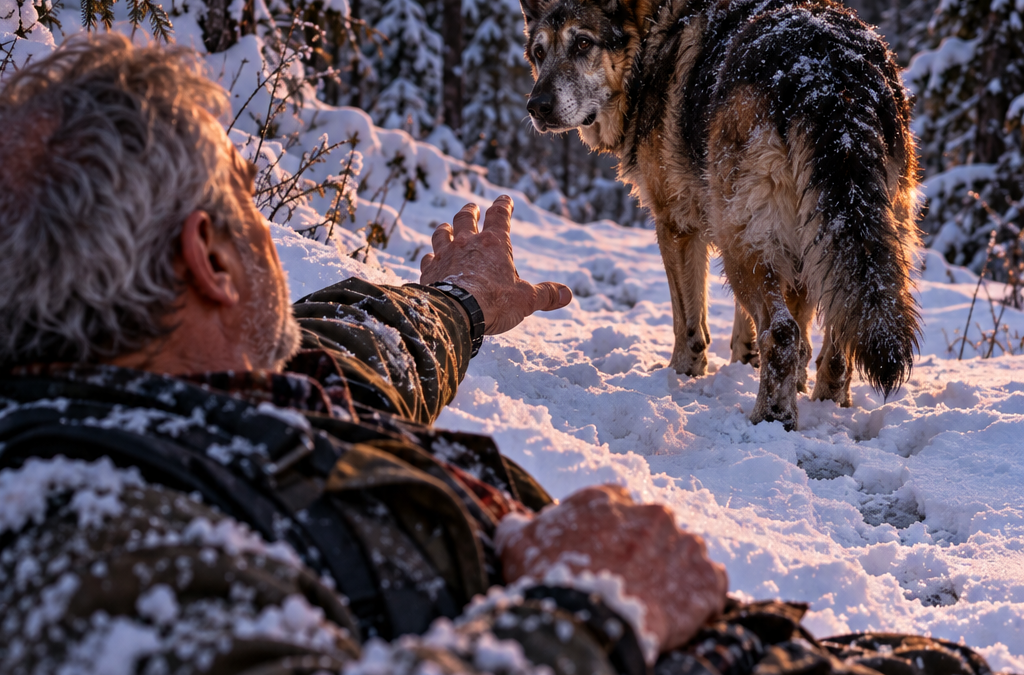
Then he turned toward the upper trail and began walking.
After twenty feet, he stopped.
Looked back.
And waited.
Sarah watched him.
“He’s trying to show us something.”
Daniel looked toward the trees.
“Maybe his owner.”
They followed.
Bear moved slowly.
Every few yards, he stopped to check whether they were still behind him.
When they hesitated at a fork, he turned back and approached Sarah.
He nudged her leg.
Then walked toward the narrower path.
Sarah later told me that was the moment she became frightened.
“He wasn’t behaving like a lost dog,” she said. “He was behaving like a dog who had left someone behind.”
They followed him uphill.
The trail became steeper.
Bear’s breathing grew harsher.
He stopped repeatedly to rest.
At one point, Daniel offered him water.
Bear took a few laps.
Then stood and continued.
Sarah noticed a faded patch on his harness.
RETIRED K9.
She looked at Daniel.
“He’s a police dog.”
Daniel studied the patch.
“Was.”
Sarah shook her head.
“Maybe not today.”
They followed him another half mile.
Then Bear stopped.
His ears lifted.
He turned toward the trees.
And began barking.
Three sharp barks.
A pause.
Three more.
Sarah looked ahead.
She saw nothing.
Then Bear moved off the trail toward a cluster of snow-covered pines.
They followed.
And found me.
I was lying partly on my side, my coat covered in snow.
My face was pale.
My breathing was shallow.
Sarah dropped beside me.
“Sir? Can you hear me?”
I remember hearing her voice.
But it seemed to come from far away.
“Sir, I’m a nurse. My name’s Sarah. We’re going to help you.”
I tried to speak.
Nothing came out.
She checked my pulse and breathing.
Then looked at Daniel.
“Call 911. Possible heart attack. He’s severely cold.”
Daniel pulled out his phone.
No service.
He tried again.
Nothing.
Sarah looked toward the trail.
“We need emergency communication.”
Daniel had a small satellite messenger clipped to his backpack.
He activated its SOS function and began sending our location through the emergency response service.
Then he returned to help Sarah.
They opened my backpack.
Found my emergency blankets.
Sarah covered me carefully, insulating me from the snow as best she could without moving me unnecessarily.
She monitored my breathing and kept talking to me.
“Robert, stay with me.”
I don’t remember telling her my name.
She later explained that she’d found it on the identification card in my wallet.
“Help is coming. Just keep breathing.”
Bear stood beside her.
His nose touched my shoulder.
He whined.
Sarah reached toward him.
“Good boy.”
He didn’t respond to her voice.
Instead, he moved around me, sniffing my face.
Then he lowered himself against my right side.
The movement was awkward.
His back legs buckled.
He almost fell.
But he managed to settle with his body pressed against my shoulder and upper arm.
The wind was blowing from that direction.
He positioned himself between me and the cold air.
Sarah tried to move him slightly so she could reach me.
Bear resisted.
Not by growling.
He simply leaned harder against me.
Daniel said, “I don’t think he’s leaving.”
Sarah looked at my dog.
Then at me.
“Let him stay.”
Bear lowered his head across my upper arm.
His body trembled.
He was exhausted.
He was sick.
His hearing was nearly gone.
But he was still doing what he’d done for ten years.
Guarding his partner.
The rescuers reached us nearly forty minutes later.
By then, my pulse was irregular and my condition had deteriorated.
I was confused.
Cold.
Barely conscious.
The first paramedic knelt beside me.
“Robert, we’re with county EMS. Can you hear me?”
I heard fragments.
“…heart attack…”
“…oxygen…”
“…get him out…”
Then someone tried to move Bear.
He lifted his head.
A weak growl came from his throat.
The paramedic stopped.
Sarah placed a hand against Bear’s shoulder.
“He’s deaf. You have to let him see what you’re doing.”
One of the rescuers knelt in front of him.
He showed Bear an open palm.
Waited.
Then gently touched his harness.
Bear looked toward me.
The rescuer followed his gaze.
“We’re taking care of him, buddy.”
Of course, Bear couldn’t hear the words.
But perhaps he understood the calm movements.
Perhaps he recognized the rescue uniforms.
Perhaps the long years of working around emergency crews had taught him what was happening.
Whatever the reason, he allowed them to place me on the rescue sled.
But when they began moving, Bear struggled to stand.
He followed.
One step.
Then another.
His hind legs trembled.
He stumbled.
Daniel caught him beneath the chest.
“Easy, boy.”
Bear pulled toward the sled.
Daniel looked at Sarah.
“He’s not going to make it back on foot.”
They wrapped him in an emergency blanket.
Then Daniel carried him.
Bear weighed much less than he had during his working years, but he was still a large dog.
Daniel struggled through the snow.
A rescue volunteer eventually took over.
Bear kept his eyes fixed on the sled carrying me.
Whenever it moved out of sight, he became restless.
When the rescuers brought him close enough to see me again, he settled.
I don’t remember any of that clearly.
My next memory is the inside of an ambulance.
A bright light above me.
A paramedic leaning over my chest.
And somebody saying, “We’re going straight to the cardiac center.”
I tried to speak.
The paramedic leaned closer.
“What is it, Robert?”
My lips moved.
“Dog.”
He looked toward his partner.
Then back at me.
“Your dog?”
I nodded weakly.
The paramedic smiled.
“He’s safe.”
I closed my eyes.
“Don’t leave…”
He squeezed my shoulder.
“We won’t leave him.”
Those were the last words I heard before I lost consciousness again.
I woke up in a hospital room the following morning.
There was a monitor beside my bed.
An IV line ran into my arm.
A dull ache remained in my chest.
But the crushing pressure was gone.
A cardiologist named Dr. Nathan Brooks stood near the foot of the bed.
When he saw my eyes open, he smiled.
“Welcome back, Mr. Callahan.”
I tried to speak.
My throat was painfully dry.
He gave me a moment.
“You had a serious heart attack,” he explained. “One of the arteries supplying your heart was critically blocked. We performed an emergency procedure and placed a stent to restore blood flow.”
I stared at him.
“Am I…”
I swallowed.
“Am I going to be okay?”
His expression was careful.
“You have some damage to your heart muscle. But you survived the most immediate danger, and we’re optimistic about your recovery with proper treatment and rehabilitation.”
I closed my eyes.
Then I remembered Bear.
I opened them immediately.
“My dog.”
Dr. Brooks nodded.
“I heard about him.”
“Where is he?”
“He’s at a veterinary hospital. The rescue team made sure he received care.”
I tried to sit up.
Pain shot through my chest.
“Is he alive?”
The doctor placed a hand on my shoulder.
“Yes, Robert. He’s alive.”
I fell back against the pillow.
For several seconds, I simply stared at the ceiling.
Then I began crying.
I had survived.
And so had Bear.
But when my daughter, Emily, arrived later that afternoon, I knew from her face that the news wasn’t entirely good.
She had driven from Ohio as soon as the hospital contacted her.
She sat beside me and took my hand.
“Dad.”
I smiled weakly.
“Hey, sweetheart.”
She started crying.
“Do you have any idea how close we came to losing you?”
I looked away.
“Unfortunately, yeah.”
She squeezed my fingers.
“What were you doing out there?”
I told her.
About Bear’s surgery.
About wanting to give him one more walk.
About the clearing and the memories of Margaret.
When I finished, she wiped her cheeks.
“Dad, you knew he wasn’t supposed to go that far.”
I nodded.
“I know.”
“You could’ve died.”
“I know.”
“And Bear could’ve died too.”
I closed my eyes.
That was the part I couldn’t forgive myself for.
Emily leaned closer.
“He’s at Dr. Foster’s clinic. She stabilized him after the rescue team brought him in.”
I looked at her.
“How bad?”
She hesitated.
“He’s exhausted, Dad. His bloodwork showed he’d lost more blood. The veterinarian thinks the exertion may have contributed to another bleeding episode.”
I covered my face.
“Oh, God.”
“He’s stable now.”
“But the surgery?”
“They postponed it while they reassessed him.”
I looked toward the window.
For years, I had asked Bear to follow me into dangerous places.
He had never hesitated.
I had always believed that after retirement, I’d be able to repay him.
Instead, I’d taken him into the woods when he was sick.
And once again, he’d used whatever strength he had left to save me.
Emily placed her hand over mine.
“Dad.”
I looked at her.
“Dr. Foster said he’s comfortable. She’s watching him closely.”
I nodded.
Then I whispered, “I need to see him.”
Three days later, I was well enough to receive a brief visit.
Dr. Brooks agreed under carefully arranged conditions.
Dr. Foster brought Bear to the hospital with Emily.
I was sitting in a chair beside my bed when the door opened.
Bear appeared in the hallway.
His legs were unsteady.
His muzzle was gray.
He wore a soft harness to support his weakened body.
But the moment he saw me, something changed.
His ears lifted.
His tail began moving.
I leaned forward.
“Hey, partner.”
He couldn’t hear the words.
But he could see me.
I raised my hand.
Two fingers toward my chest.
Our old signal.
Come.
Bear walked toward me.
Slowly.
Painfully.
When he reached my chair, he pressed his head against my knee.
I bent forward and wrapped my arms around him.
“Oh, buddy.”
His tail moved against the floor.
“You came back.”
He leaned harder into me.
I buried my face in his fur.
“You came back for me.”
For a long time, I simply held him.
Emily stood near the doorway, crying quietly.
Dr. Foster watched from beside her.
I finally looked up.
“What happens now?”
Dr. Foster sat beside me.
“We’ve managed the immediate bleeding, but the splenic mass remains a serious danger. We’ll need to decide whether surgery is still appropriate once he’s recovered a little more.”
I looked at Bear.
“Will he survive it?”
“I can’t promise that, Robert.”
I nodded.
She continued gently.
“And even if he does, we still don’t know whether the tumor is malignant.”
I stroked his head.
“Would you operate if he were your dog?”
She considered the question.
“Given that he’s stabilized, and provided his repeat tests support it, I would consider surgery. But only because there’s a chance it could improve his comfort and prevent another sudden bleed. We have to weigh that against the risks.”
I looked down at my partner.
For once, there was no command I could give that would make everything better.
I couldn’t ask him to track an answer.
Couldn’t tell him to be brave.
Couldn’t promise that we would both live forever.
All I could do was make the best decision I could for him.
After further evaluation, Dr. Foster performed the surgery.
Bear survived.
But the pathology report brought the news I’d feared.
Hemangiosarcoma.
An aggressive cancer.
The surgery had removed his spleen and the bleeding mass, but it couldn’t guarantee that the disease hadn’t already spread.
The veterinarian explained that we might have only a limited amount of time.
Weeks.
Perhaps a few months.
I listened.
Then I looked at Bear resting on his blanket.
He was alive.
Comfortable.
And still able to lift his head when he saw me.
That was enough for that day.
I returned home from the hospital twelve days after my heart attack.
Bear came home shortly afterward, once Dr. Foster was satisfied with his immediate recovery.
We were both under strict medical instructions.
I wasn’t allowed to exert myself while my heart healed.
Bear wasn’t allowed to take long walks or do anything strenuous.
Emily stayed with us for the first two weeks.
She took care of meals.
Organized my medications.
Helped Bear outside.
And made sure neither of her two stubborn patients attempted anything foolish.
One morning, she caught me standing beside the back door with Bear’s old leash in my hand.
“Dad.”
I turned.
“What?”
She folded her arms.
“Where do you think you’re going?”
I looked down at the leash.
“Just the porch.”
She raised an eyebrow.
“Both of you?”
I smiled.
“Very short patrol.”
She shook her head.
“You two are unbelievable.”
Then she helped us outside.
That became our new routine.
We didn’t return to Pine Hollow.
We didn’t hike into the woods.
Instead, Emily placed two chairs on the covered porch.
I sat in one.
Bear rested on his thick orthopedic bed beside me.
We watched birds gather around Margaret’s old feeder.
Sometimes a squirrel ran across the fence.
Bear would lift his head.
His ears would rise.
His tail would move faintly.
And I’d smile.
“Easy, officer. You’re retired.”
He couldn’t hear me.
But he could see my face.
That seemed to be enough.
One afternoon, a car pulled into our driveway.
A man and a woman stepped out.
I recognized them immediately from the photographs Emily had shown me.
Daniel Reeves and Sarah Collins.
The hikers Bear had found.
The people who had followed him back into the woods.
I stood carefully.
Sarah smiled.
“Mr. Callahan?”
I nodded.
“Robert. Please.”
She approached.
“I’m Sarah.”
I took her hand.
For a moment, I couldn’t speak.
Then I said, “Thank you.”
She shook her head.
“Your dog did most of the work.”
I looked down at Bear.
He was watching them from his bed.
Daniel knelt beside him.
“Hey, old man.”
Bear lifted his nose.
Sniffed Daniel’s fingers.
Then rested his head against his hand.
Daniel laughed quietly.
“I think he remembers me.”
Sarah sat beside my chair.
She told me what had happened on the trail.
How Bear had approached them.
How he’d turned around repeatedly.
How he’d insisted they follow him.
And how, after leading them to me, he’d refused to leave.
“He could barely stand,” Sarah said.
I looked toward Bear.
“He was so tired.”
She nodded.
“But every time we moved him away from you, he came back.”
I swallowed.
Sarah’s eyes filled.
“And when we covered you with blankets, he lay against your shoulder. He stayed there until the rescue team arrived.”
I looked down.
Bear was sleeping peacefully.
His chest rose and fell beneath the blanket.
I reached toward him.
My fingers rested against his head.
“He thought I was lost.”
Sarah smiled through tears.
“Maybe.”
I shook my head.
“No. I know him.”
I stroked his ear.
“He spent his whole life bringing people home.”
For a moment, nobody spoke.
Then Daniel said something I’ll never forget.
“Robert, I’ve never seen an animal work so hard to lead people somewhere.”
He looked at Bear.
“Whatever happened before we met him, he knew he had to go back for you.”
I stared at my old partner.
And I realized the truth.
Bear hadn’t abandoned me.
He had done exactly what I’d trained him to do years earlier.
He had found help.
Led it back.
Then stayed.
He had repeated the same rescue that once saved me on a snowy mountain ridge.
Only this time, he was nearly deaf.
Weak from cancer.
And struggling to walk.
He could no longer hear my commands.
But somehow, he remembered the assignment that mattered most.
Bring your partner home.
Bear lived another seven weeks.
Not seven years.
Not seven months.
Seven weeks.
The cancer eventually returned with complications we couldn’t reverse.
But those weeks became some of the most precious of my life.
I stopped counting the days by what he could no longer do.
I counted them by what we still had.
A sunny morning.
A soft blanket.
A gentle brushing.
A comfortable nap beside the fireplace.
The pleasure of watching him eat a little of his favorite food.
The way he’d lift his head when I entered a room.
I spent hours sitting beside him, telling stories he couldn’t hear.
I told him about the missing girl we found in the drainage ditch.
About the mountain rescue.
About Margaret laughing when he stole food.
About the day he retired.
And about the afternoon he found strangers on a frozen trail and somehow convinced them to follow him back to me.
Sometimes, while I talked, he’d close his eyes.
Other times, he’d rest his head against my knee.
And I realized that he’d never needed to hear every word.
He knew the sound of our life together in other ways.
My touch.
My smell.
My movements.
The way I sat beside him.
We had spent ten years learning to communicate without saying much.
Now we were using that language again.
On Bear’s final morning, he couldn’t stand.
His breathing had become difficult.
He refused water.
And when Dr. Foster examined him, she gently explained that his illness had reached the point where keeping him alive would mean allowing him to suffer.
I had known the day was coming.
I had prepared myself.
At least, I thought I had.
But when she asked whether I was ready, I began crying.
I lowered myself onto the floor beside him.
Bear opened his eyes.
He looked at me.
I touched his forehead.
“Hey, partner.”
His tail moved once.
I smiled through tears.
“You did good.”
I leaned closer.
“You did so good.”
Dr. Foster gave him medication to help him relax.
I wrapped my arms gently around his neck.
I remembered the first time we’d met.
The young dog dragging me across a training field.
The strong partner standing beside me during dangerous assignments.
The old dog walking slowly through the woods.
And the moment I watched him disappear between the trees, believing he’d left me behind.
I pressed my cheek against his head.
“I thought you were gone.”
A tear fell onto his fur.
“But you came back.”
Bear breathed softly.
I stroked his ear.
“Now it’s my turn to stay.”
I remained beside him as Dr. Foster administered the final medication.
His breathing slowed.
His body relaxed.
I held his head against my chest.
And when he took his last breath, I whispered the words he’d heard after so many successful searches.
“Everybody goes home, partner.”
I kissed his forehead.
“Your work is done.”
We buried Bear beneath the maple tree in our backyard, beside the flower garden Margaret had planted years earlier.
Emily helped me choose the stone.
It was simple.
A small gray marker with his name, years of service, and one sentence.
K9 BEAR — HE ALWAYS CAME BACK.
I returned to Pine Hollow six months later.
Not alone.
Emily walked beside me.
My cardiologist had cleared me for gentle exercise, and I was following a carefully managed cardiac rehabilitation plan.
We didn’t go far.
Just to the first bend in the trail.
The same place where Bear used to stop and lift his nose toward the creek.
I stood there for a while.
The trees were green again.
The snow had melted.
Birds called from the branches.
And for a moment, I could almost see him moving ahead of me.
Young.
Strong.
His ears raised.
His tail swinging as he followed a scent through the woods.
Emily touched my arm.
“You okay, Dad?”
I nodded.
“Yeah.”
She looked down the trail.
“Do you miss him?”
I smiled sadly.
“Every day.”
She squeezed my hand.
We stood quietly.
Then I looked toward the bend where Bear had disappeared that final afternoon.
I thought about the fear I’d felt when I saw him walking away.
The terrible certainty that I was going to die alone.
And the relief of learning he’d gone to bring someone back.
For years, I had believed courage meant never retreating.
Never stopping.
Never giving up.
But Bear taught me something better.
Sometimes courage means knowing when someone needs help more than you do.
Sometimes loyalty means walking away for a little while because that’s the only way to bring someone home.
And sometimes the strongest heart in the forest belongs to the oldest, weakest dog on the trail.
I took one last look toward the trees.
Then I turned toward the parking lot.
Emily walked beside me.
The afternoon sunlight fell across the path.
For the first time, I didn’t feel guilty about leaving the woods.
Bear had already completed his final search.
He’d found the person he loved.
He’d brought help.
He’d kept his promise.
And because of him, I was still alive to remember it.
I looked up at the clear blue sky.
“Good work, partner,” I whispered.
Then I smiled through my tears.
“Everybody’s home.”