𝗙𝗨𝗟𝗟 𝗦𝗧𝗢𝗥𝗬 My Dying K9 Had Been Silent for Weeks, but at 2:17 A.M., I Heard Something I Thought Was Gone Forever
𝗙𝗨𝗟𝗟 𝗦𝗧𝗢𝗥𝗬
I was tired, cold, and irritated because Rook had lost the trail twice.
At least, I thought he’d lost it.
When he stopped near a fallen oak tree, I tugged his leash.
“Come on. This way.”
He refused.
“Rook.”
He stared into the underbrush.
I pulled again.
He planted his feet.
Maddox, watching from a distance, shouted, “Bennett! What are you doing?”
“He’s not following!”
“Maybe because you’re going the wrong way!”
I looked down at Rook.
He looked back at me.
Rain ran off his ears.
I took a breath.
Then I loosened the leash.
“All right. Show me.”
Immediately, he turned toward the fallen tree and pushed beneath the branches.
Thirty seconds later, he located the training assistant hiding in a shallow depression.
I stood there in the rain, feeling like the biggest fool in Pennsylvania.
Maddox approached with a grin.
“Who found him?”
“Rook.”
“Who thought he knew better?”
I sighed.
“Me.”
“Remember that.”
I did.
I remembered it on nights when the woods were too dark to see our own feet.
I remembered it in buildings where every doorway might conceal danger.
I remembered it when frightened families looked at me with desperate hope and asked whether my dog could find someone they loved.
And I remembered it thirteen years later, when Rook lay dying on my kitchen floor.
Because even then, he was still trying to tell me something.
Our first official assignment came on a warm June afternoon.
A teenager had fled from an officer during a traffic stop and disappeared into a patch of woods behind an industrial property.
It wasn’t a particularly dangerous call, but I was nervous.
Not because of the suspect.
Because it was our first real deployment.
I had checked Rook’s equipment three times before leaving the station.
Harness.
Leash.
Water.
Radio.
Everything was ready.
As I opened the rear door of the patrol SUV, Rook leaned forward.
His ears rose.
His eyes fixed on me.
Then he made that sound.
“Huff. Huff.”
Two quick, breathy bursts.
I frowned.
“What was that?”
He did it again.
“Huff. Huff.”
I laughed.
“You got something to say?”
His tail struck the floor of the vehicle.
Maddox, who had come along to observe, heard him.
He smiled.
“Well, there it is.”
I turned.
“What?”
“His ready signal.”
“His what?”
Maddox rested a hand on the open door.
“He does that when he knows there’s work coming. Did it during advanced training, too. Always those same two little huffs.”
I looked at Rook.
He was watching me intently.
“That’s your way of telling me you’re ready?”
“Huff. Huff.”
I laughed again.
“All right, partner. Let’s go.”
We found the teenager twenty-three minutes later.
He was hiding behind an abandoned utility shed.
There was no dramatic confrontation.
No gunfire.
No struggle.
Just a frightened seventeen-year-old boy who had made a foolish decision and was now too scared to come out.
Rook located him.
The boy surrendered.
We walked him back to the waiting officers.
It was an ordinary police call.
One of thousands that would never make the evening news.
But I remember it more clearly than many of the dangerous operations that followed.
Because that was the day Rook and I became a team.
After that, I started asking him the same question before every assignment.
“Ready, partner?”
And whenever he answered with those two familiar huffs, I knew we were beginning something together.
It became our ritual.
Our little agreement.
I would get us where we needed to go.
He would tell me when he was ready.
And whatever happened afterward, we would do our best to bring each other home.
There were hundreds of calls over the following years.
Most were uneventful.
We searched buildings and vehicles.
Tracked people who had fled crime scenes.
Helped locate missing residents.
Assisted neighboring agencies when their own resources were stretched thin.
But certain nights never left me.
One of them began with a little red mitten.
It was February, and a winter storm had been moving through the county since noon.
By eight that evening, the roads were covered in ice.
Dispatch called us to a rural neighborhood north of Westbridge.
An eight-year-old boy named Noah Collins was missing.
His mother had last seen him in their backyard shortly before dark.
She believed he’d gone looking for their elderly golden retriever, who had escaped through an open gate.
The dog returned.
Noah didn’t.
A volunteer search team had already checked the nearby streets.
Neighbors were walking through the snow with flashlights.
A deputy had found one of Noah’s red mittens near a narrow wooded trail.
When I arrived, his mother was standing on the front porch.
She wore slippers without socks.
Her coat was hanging open.
Snow had collected in her hair, but she didn’t seem to notice.
She ran toward me as soon as she saw the K9 markings on my vehicle.
“Are you the man with the dog?”
“Yes, ma’am.”
“Can he find my son?”
I had heard that question before.
I would hear it many times afterward.
And no matter how experienced I became, it always frightened me.
Because I understood what the person was really asking.
Can you give me my child back?
I wanted to say yes.
I wanted to promise her everything would be fine.
Instead, I said, “We’re going to give him the best chance we can.”
She began crying.
“I told him not to leave the yard. I told him—”
I touched her shoulder.
“What’s Noah wearing?”
“A blue coat. Jeans. Brown boots.”
“Does he know the woods?”
She shook her head.
“He doesn’t go out there alone.”
I nodded toward the mitten in the deputy’s hand.
“Is that his?”
“Yes.”
Her voice broke.
“Please hurry.”
I took the mitten and returned to Rook.
He was standing in the back of the SUV, alert and waiting.
I held out the mitten.
He sniffed it deeply.
Then he raised his head.
His nostrils flared.
I clipped on his tracking leash.
“Ready, partner?”
“Huff. Huff.”
I remember smiling despite the fear sitting heavily in my chest.
“Good boy.”
Then we stepped into the storm.
The first forty minutes were miserable.
The wind swept across the open fields, driving snow into our faces.
Several times, I lost sight of the trail.
Rook didn’t.
He moved steadily through the woods, nose working, occasionally stopping to investigate broken branches or disturbed snow.
We crossed a shallow ditch.
Climbed a frozen embankment.
Passed through a stand of pine trees.
Then Rook stopped near a narrow creek.
He raised his head.
His body stiffened.
I knew that posture.
He had caught something important.
“Show me.”
He pulled sharply toward the water.
I followed.
The creek was partially frozen, but dark water still moved beneath the ice.
A broken wooden footbridge lay several yards downstream.
And beyond it, tucked behind a fallen tree, was a steep muddy bank.
Rook began barking.
Three powerful barks.
Then he pulled harder.
My flashlight swept across the bank.
At first, I saw only snow.
Then a small blue sleeve moved beneath the fallen tree.
“Noah!”
A frightened voice answered.
“Help!”
I nearly dropped the flashlight.
I scrambled down the bank.
Noah was lying in a narrow hollow between the roots of the fallen tree.
One leg was trapped beneath a heavy branch.
His face was pale.
His lips were trembling.
“Hey, buddy. I’m Officer Bennett.”
He looked at Rook.
“Is that a police dog?”
“Sure is.”
Noah began crying.
“I was trying to find Buddy.”
“I know.”
“I fell.”
“You’re okay. We found you.”
I examined the branch.
It was heavy but movable.
I radioed our location and requested medical assistance.
Then I crouched beside the boy.
“I need you to stay really still, okay?”
He nodded.
Rook moved closer.
Noah reached toward him.
“Can I pet him?”
I looked at my dog.
His ears were relaxed.
His body was calm.
“Yeah, buddy. You can.”
Noah placed one trembling hand against Rook’s neck.
Rook gently pressed his head beneath the boy’s fingers.
And that frightened child, who had spent hours alone in the freezing woods, began to calm down.
We waited for the rescue crew.
I kept talking to Noah.
Asked about his dog.
His school.
His favorite football team.
Anything to keep him awake and focused.
But every few minutes, his hand would return to Rook.
“He’s warm,” Noah whispered.
I smiled.
“Yeah. He is.”
When the firefighters arrived and freed his leg, Noah refused to let go of Rook’s collar.
“Is he coming with me?”
I glanced at the paramedics.
One of them nodded.
“He’s welcome.”
So Rook rode in the ambulance.
He sat on the floor beside Noah’s stretcher while we drove to the hospital.
And when Noah’s mother came running through the emergency department doors, the boy reached for her and said something I have never forgotten.
“Mom, don’t be mad. The dog came for me.”
She wrapped her arms around him.
Then she looked at Rook.
She sank to her knees beside him and began crying.
I stood a few feet away, trying to give them privacy.
Rook looked toward me.
His tail moved once.
That was enough.
He didn’t need to understand the words thank you.
He understood that the search was over.
That the child was safe.
That it was time to go home.
Later that night, I sat in our patrol SUV outside the hospital.
My hands were trembling from exhaustion.
Rook rested in the back.
I turned toward him.
“Good work, partner.”
He lifted his head.
“That little boy would’ve been in real trouble without you.”
Rook blinked.
I smiled.
“Yeah. I know. You just did your job.”
Then I leaned back and stared through the windshield.
For the first time in years, I thought about my own daughter.
Olivia was twelve then.
She had a school concert that evening.
I’d promised her I would be there.
But the call had come before I could leave work.
I had missed the concert.
Again.
I looked at my phone.
Three missed calls from my wife, Sarah.
One message from Olivia.
Dad, I looked for you.
Those five words hurt more than I expected.
I called home.
Sarah answered quietly.
“Hey.”
“How’d it go?”
“She did beautifully.”
I closed my eyes.
“I’m sorry.”
“I know.”
“There was a missing kid. We found him.”
“I’m glad.”
She paused.
“Thomas, I’m really glad.”
But I heard something else in her voice.
Exhaustion.
Disappointment.
The kind that builds slowly over years.
“Is Olivia awake?”
“No. She went to bed.”
I looked toward the rearview mirror.
Rook was watching me.
“Tell her I’ll make it up to her.”
Sarah was silent.
Then she said, “That’s what you said last time.”
I stared at the phone long after the call ended.
I’d helped return one child to her mother.
And I had broken another promise to my own.
That was the difficult truth about the years I spent with Rook.
He and I did important work.
But important work doesn’t erase the things you miss.
It doesn’t replace birthdays.
Or school concerts.
Or the empty chair beside your wife at dinner.
At the time, I didn’t know how to balance those two worlds.
I only knew how to answer the next call.
Rook never judged me for that.
He never asked why I was quiet on the drive home.
When I finally opened the rear door of the SUV, he stepped out, leaned against my leg, and waited.
I rested my hand on his head.
“Come on, buddy.”
We drove home through the snow.
And when we entered the house, I found Olivia’s concert program lying on the kitchen table.
Her name was circled in blue ink.
Underneath, Sarah had written:
She played the solo perfectly.
I sat down and stared at those words.
Rook lay beside my chair.
I wanted to tell him I didn’t know how to be a good police officer and a good father at the same time.
I wanted to ask him how to stop disappointing the people who loved me.
Instead, I just reached down and touched his fur.
He stayed there until I went upstairs.
That was something he did throughout our thirteen years together.
Whenever I couldn’t find the words for what was hurting me, Rook never demanded an explanation.
He simply stayed.
And on the last night of his life, I would finally understand how much that had meant.
Four years after we became partners, Rook saved a man who would later become one of my closest friends.
His name was Michael Torres.
He was twenty-six, newly married, and had been on the police force for less than a year.
Michael had the kind of enthusiasm that made older officers nervous.
He volunteered for every difficult assignment.
He ran toward every disturbance.
And he had a dangerous habit of believing that courage could compensate for experience.
One October evening, we responded to reports of a man threatening residents inside an abandoned apartment building.
The building was scheduled for demolition.
Most of its windows were broken. Its hallways were filled with debris, and sections of the roof had collapsed.
Several officers were already establishing a perimeter when Rook and I arrived.
Michael approached my vehicle.
“Sergeant, they think he’s on the second floor.”
I nodded.
“Any weapons?”
“Possibly a handgun.”
“Then nobody rushes anything.”
He gave me a quick nod.
“Understood.”
I opened the rear door.
Rook stood.
His ears rose.
“Ready, partner?”
“Huff. Huff.”
I clipped on his leash.
“Let’s go.”
We entered with the search team after the building had been assessed for immediate structural hazards.
Dust hung in the air.
Water dripped somewhere behind the walls.
Rook moved carefully, scenting the hallway while I watched his posture.
We reached a narrow corridor near a stairwell.
Michael was several steps ahead when Rook suddenly stopped.
His body stiffened.
I recognized the warning.
“Michael,” I whispered. “Hold up.”
Michael turned.
At that instant, a door at the far end of the hallway shifted.
Rook gave a sharp alert.
The suspect emerged with a handgun.
Everything happened quickly.
A shouted command.
A muzzle flash.
The deafening crack of gunfire inside a confined space.
Michael stumbled backward.
I dragged him behind cover while the team responded.
The suspect retreated into the room and surrendered a short time later.
When I turned toward Michael, he was sitting against the wall, staring at a hole in the sleeve of his uniform.
The bullet had torn through the fabric without touching his arm.
Another few inches, and the outcome could have been very different.
Michael looked at the damage.
Then he looked at me.
Then at Rook.
“Oh, my God.”
His voice shook.
“I was walking right toward that door.”
I nodded.
“Yeah.”
“He knew?”
“He sensed somebody there.”
Michael leaned forward and buried his face in his hands.
Rook approached him.
The young officer reached out.
His hand trembled as he touched the dog’s shoulder.
“Thank you.”
Rook licked his fingers.
Michael laughed once, a broken, frightened sound.
“Thank you, buddy.”
Later that night, after statements had been taken and everyone had been checked by medical personnel, Michael found me outside the station.
He was still wearing the damaged uniform shirt.
“My wife is pregnant,” he said.
I looked at him.
“I didn’t know.”
“We found out last week.”
He swallowed.
“I haven’t even told my parents yet.”
I glanced toward Rook, who was resting in the back of the SUV.
Michael followed my gaze.
“I almost didn’t get to meet my kid.”
He wiped his eyes.
“I don’t know how to thank him.”
I rested a hand on his shoulder.
“Go home to your wife.”
He looked at me.
“That’s it?”
“That’s it.”
Michael shook his head.
“I don’t think you understand.”
I smiled sadly.
“That’s the whole point of the job, Michael. Getting people home.”
He looked toward the vehicle.
Then he nodded.
Two months later, his wife gave birth to a little girl named Isabella.
Michael brought a photograph to the station.
He showed it to Rook before he showed it to me.
I pretended to be offended.
Rook sniffed the picture.
Michael laughed.
“That’s right, buddy. That’s my girl.”
For years afterward, he brought Rook a small gift on Isabella’s birthday.
A dog toy.
A bag of treats.
Sometimes a photograph of his daughter holding a sign that said, Thank you, Rook.
Whenever anyone asked why, Michael always gave the same answer.
“Because without that dog, I might never have met her.”
I thought about Michael that night as Rook lay beside me on the kitchen floor.
Thirteen years.
It seemed impossible that so much life could fit inside such a short stretch of time.
I looked at the gray fur around his eyes.
The scars hidden beneath his coat.
The gentle rise and fall of his chest.
“Remember Michael?” I whispered.
Rook didn’t move.
“That kid was so scared after the apartment call. Tried to act tough, but I could see his hands shaking.”
I stroked his shoulder.
“His daughter’s almost nine now. Can you believe that?”
His breathing remained slow.
I smiled through tears.
“She sent you another card last month. It’s on the refrigerator. I should’ve shown you.”
The clock ticked.
I looked toward the kitchen window.
Rain streaked the glass.
“You know, buddy, I don’t think you ever understood how many people went home because of you.”
I paused.
“Maybe that’s what made you so good at it.”
I closed my eyes.
And another memory came back.
Not a rescue.
Not a dangerous call.
A night that ended badly.
There was an elderly woman named Evelyn Parker who lived alone near the edge of town.
She was seventy-nine and had begun showing signs of dementia.
Her daughter checked on her every evening, but one November morning, Evelyn wandered away before sunrise.
We were called to search a wooded area behind her neighborhood.
Rook found her trail.
We followed it through a park, along an old railway path, and toward a shallow ravine.
But by the time we located her, she had died from exposure.
I remember kneeling beside her.
I remember the little pink scarf around her neck.
I remember Rook lowering his head and quietly sniffing her hand.
There was no barking.
No excitement.
Just stillness.
I radioed our location.
Then I sat back on my heels and stared at the ground.
I’d been so certain we’d find her alive.
I had imagined leading her back to the ambulance.
I had imagined her daughter crying with relief.
Instead, I had to stand beside my supervisor while someone delivered news no family should ever have to hear.
Later, back at the station, I couldn’t stop thinking about it.
I kept replaying the search.
Wondering whether we’d missed a turn.
Whether we should have started in another location.
Whether we could have moved faster.
Maddox found me sitting alone in the locker room.
He was close to retirement by then.
“Rough one,” he said.
I nodded.
He sat beside me.
“You did what you could.”
I shook my head.
“Didn’t do enough.”
“Thomas.”
“If we’d gotten there sooner—”
“You don’t know that.”
I stared at the floor.
Maddox was quiet for a moment.
Then he said, “You can’t carry every person you couldn’t save.”
I laughed bitterly.
“That’s easy to say.”
“No, it isn’t.”
His voice hardened.
“It’s one of the hardest things you’ll ever have to learn.”
He stood.
“Go home, Bennett.”
I didn’t answer.
“Your family needs you.”
When I finally arrived home, everyone was asleep.
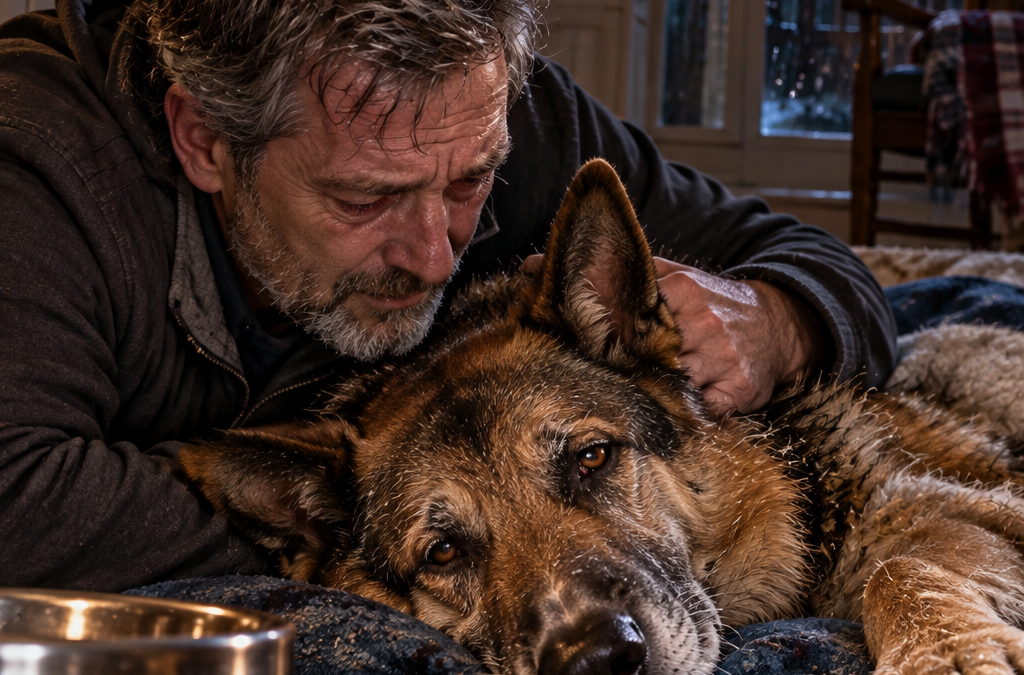
I sat on the kitchen floor with my back against the cabinets.
Rook settled beside me.
I took off his collar and placed it on the counter.
Then I rested my forehead against his neck.
“I’m sorry,” I whispered.
He stayed still.
“I thought we had her.”
His breathing was steady.
“I’m sorry, buddy.”
He leaned against me.
We sat like that for almost an hour.
I don’t know whether Rook understood death.
But he understood when I was hurting.
And he seemed to know that I didn’t need a solution.
I needed someone to stay.
Years later, when I was lying beside him during his final night, that memory hurt in a different way.
I understood then that I had spent much of our life together leaning on him.
Depending on his courage.
Depending on his instincts.
Depending on the quiet comfort of knowing he would be there when the world became too much.
And now I was facing the one thing he couldn’t help me through.
Losing him.
I looked at the dog beside me.
“You know something, Rook?”
I wiped my eyes.
“I don’t think I ever thanked you enough.”
His ear moved slightly.
“Not for the searches. Not for the arrests. Not for any of that.”
I leaned closer.
“For all those nights when I didn’t know how to come home and be a normal person again.”
I pressed my hand against his chest.
“You helped me do that.”
The rain grew heavier.
A distant roll of thunder moved across the hills.
I glanced toward the hallway.
Sarah had gone upstairs around midnight after spending most of the evening beside us.
She had offered to stay awake.
But I’d asked her to rest.
I knew she was exhausted.
For nearly three weeks, she’d been helping me care for Rook.
Cleaning his bedding.
Preparing his medication.
Holding the water bowl while he drank.
Washing towels when he could no longer make it outside in time.
Never complaining.
Not once.
The day Dr. Elena Alvarez told us that Rook’s failing kidneys and weakened heart had reached the point where treatment could no longer restore his quality of life, Sarah had taken my hand in the examination room.
I hadn’t spoken.
I couldn’t.
Dr. Alvarez explained the options gently.
There were medications to ease his symptoms.
Ways to keep him comfortable.
But there was no cure.
No procedure that would give him back the strength he’d lost.
She looked at me across her desk.
“Thomas, I know what Rook means to you.”
I nodded.
“He’s been with me thirteen years.”
“I know.”
“He’s survived things most dogs never see.”
She reached for a tissue.
“He’s remarkable.”
I looked through the examination-room window.
Rook was lying on a blanket, watching us.
His head was resting on his paws.
His tail moved when I looked at him.
“How much time?”
Dr. Alvarez took a breath.
“I think we’re talking about days rather than weeks.”
I stared at her.
“But he’s still eating a little.”
“Yes.”
“And he knows us.”
“Yes.”
“He wagged his tail this morning.”
Her expression softened.
“Thomas, those things matter. But they don’t change what’s happening inside his body.”
I looked away.
She continued quietly.
“My job isn’t only to help animals live longer. Sometimes it’s to help them reach the end without suffering.”
I nodded.
But I couldn’t make myself answer.
Sarah squeezed my hand.
Dr. Alvarez gave us a comfort-care plan and told us what signs would mean Rook needed immediate veterinary help.
She also offered to come to the house when the time came, so we wouldn’t have to carry him into a clinic again.
I thanked her.
Then I took Rook home.
For the next several days, I tried to pretend we still had time.
I bought his favorite food.
I carried him into the yard so he could feel the grass beneath his paws.
I lifted him onto the couch when he looked toward his old sleeping spot.
I even drove him to the park one afternoon.
Sarah came along.
We lowered the windows and parked beneath the trees.
Rook rested on a thick blanket across the back seat.
A warm breeze entered the vehicle.
His nose moved.
His ears lifted just a little.
For nearly an hour, we sat there watching people walk their dogs.
He didn’t try to stand.
He didn’t bark.
But his eyes followed every movement.
I think he enjoyed it.
At least, I hope he did.
When we returned home, he was so tired that he slept through dinner.
The following morning, he refused his food.
By evening, he couldn’t stand without help.
Dr. Alvarez came to examine him.
She listened to his heart.
Checked his breathing.
Watched the way he responded when I touched his face.
Then she took me aside.
“Thomas, I think we’re very close.”
I looked toward Rook.
He was resting on his blanket.
Sarah sat beside him.
“Is he hurting?”
“He’s weak and tired. Right now, he appears comfortable, but that may change.”
I swallowed.
“What would you do?”
Dr. Alvarez hesitated.
“If he were mine, I wouldn’t ask him to endure another difficult day.”
I looked down.
She continued gently.
“We can let him spend tonight at home if he remains settled. I’ll be available if anything changes. And I’ll come first thing in the morning.”
I nodded.
That was the plan.
One final night.
One night in the house where he’d slept for thirteen years.
One night surrounded by the smells and voices he knew.
Then, in the morning, I would have to do the kindest and hardest thing I’d ever done for him.
I wanted to protest.
I wanted to tell the veterinarian that Rook had survived worse.
That he was strong.
That he would recover if we gave him enough time.
But I looked at him.
Really looked.
I saw how thin he’d become.
How much effort it took to lift his head.
How tired he was after even the smallest movement.
And I knew that asking him to fight any longer would be for me.
Not for him.
That evening, Sarah and I moved his bed into the kitchen.
It had always been his favorite room.
He liked lying near the back door where he could watch the yard.
He liked the warmth from the old radiator.
And he liked being close enough to investigate whenever someone opened the refrigerator.
Sarah spread his blue blanket over the bed.
It was faded and worn.
One corner had been repaired twice.
She had sewn it for him after his retirement because he’d developed arthritis and seemed more comfortable with an extra layer beneath him.
I placed his collar beside his head.
The leather was cracked from years of use.
The brass nameplate had been polished so often that the engraving was beginning to fade.
K9 ROOK — WESTBRIDGE POLICE
I touched the letters.
They felt impossibly small compared with the life they represented.
Sarah came beside me.
“Do you want me to stay?”
I shook my head.
“Go get some sleep.”
“Thomas.”
“I’ll call if I need you.”
She looked at Rook.
Then at me.
“You don’t have to do this alone.”
I swallowed.
“I know.”
She knelt beside him.
“Hey, handsome.”
Rook opened his eyes.
Sarah stroked the gray fur between his ears.
“You’ve been such a good boy.”
Her voice trembled.
“You know that?”
His tail moved against the blanket.
She smiled through tears.
“Always taking care of everybody.”
Then she kissed his forehead.
“We love you, Rook.”
When she stood, she placed a hand against my cheek.
“Don’t spend the whole night thinking about what you’re losing.”
I looked at her.
She glanced toward the dog.
“Remember what you had.”
Then she went upstairs.
I stayed on the floor.
At first, I didn’t know what to say.
For thirteen years, Rook and I had spent thousands of hours together.
In patrol vehicles.
On training fields.
In quiet parking lots during late-night shifts.
On long walks.
In the backyard.
Sometimes in the living room, watching football games he had absolutely no interest in.
We had shared more silence than words.
But now, with so little time left, I found myself terrified that I hadn’t said enough.
I placed my hand against his side.
“Hey, partner.”
His eyes shifted toward me.
I smiled.
“You remember the first time I brought you home?”
His ear moved.
“Sarah had bought you that ridiculous red bed.”
I laughed softly.
“You hated it.”
The memory came so clearly that I could almost smell the fresh paint in our old hallway.
Rook had been young and full of energy.
Sarah had spent the entire afternoon preparing the house for him.
She bought stainless-steel food bowls.
A basket of toys.
A thick red dog bed that cost more than my work boots.
She placed it in the laundry room.
When I brought Rook inside, he sniffed the bed, circled it once, and walked away.
Sarah looked offended.
“What’s wrong with it?”
I shrugged.
“Maybe he doesn’t like red.”
She gave me a look.
“Very funny.”
That night, we closed the laundry-room door, leaving enough space for ventilation and making sure he had water.
Rook settled quietly.
Or so we thought.
At two in the morning, I woke to a scratching sound.
I went downstairs.
He was sitting beside the laundry-room door.
The red bed was untouched.
I opened the door.
“What’s the problem, buddy?”
He walked past me, crossed the hallway, and lay down beside our bedroom door.
I stared at him.
“You’ve got a perfectly good bed.”
He closed his eyes.
I carried the red bed into the hallway.
He got up and moved away.
I carried it beside our bedroom door.
He lay on the floor next to it.
Not on it.
Sarah came downstairs wearing her robe.
“What’s going on?”
“He won’t sleep in the bed.”
She looked at Rook.
Then at the red cushion.
Then at me.
“Maybe he just wants to be near us.”
“He’s supposed to have boundaries.”
Sarah smiled.
“Thomas, he’s a dog.”
“He’s a police dog.”
“He’s also a baby.”
I sighed.
She knelt and rubbed his ears.
“Come on, handsome.”
Rook wagged his tail.
Within a week, the expensive red bed had been moved into our bedroom.
Within a month, Rook was sleeping beside our bed.
And within six months, he’d claimed a corner of the couch.
I never managed to win that argument.
Lying beside him thirteen years later, I smiled at the memory.
“You really had us trained, didn’t you?”
Rook breathed quietly.
I touched his ear.
“Especially Sarah.”
I looked toward the hallway.
“You always listened to her.”
A tear slipped down my cheek.
“Better than you listened to me, sometimes.”
For a while, I just watched him.
Then I began talking again.
I told him about the first summer we worked together.
About the heat.
The long nights.
The time he stole a hamburger from the front seat while I was filling out paperwork.
I reminded him of the morning he refused to get into the patrol vehicle because a stray kitten was hiding beneath it.
He wouldn’t move until I found the kitten and carried it to safety.
I told him about the Christmas Eve when we spent four hours helping search for a missing teenager.
About how Sarah had kept our dinner warm.
About how Olivia had fallen asleep on the couch waiting for us.
That memory made me pause.
Olivia.
I looked at Rook.
“You loved that girl.”
His eyes remained closed.
“She loved you, too.”
For years, I had worried about the damage my job had done to our relationship.
There had been arguments.
Missed events.
Broken promises.
But Rook had been the one part of my police life Olivia never resented.
She was sixteen when she began struggling with anxiety after a frightening incident at school.
She didn’t want to talk to me.
She didn’t want to talk to Sarah.
She spent hours in her bedroom, listening to music and pretending everything was fine.
One afternoon, I came home early and found Rook lying outside her door.
He was off duty.
His harness hung in the garage.
His water bowl was downstairs.
But he refused to leave the hallway.
I knocked.
“Olivia?”
No answer.
“Sweetheart?”
“I’m fine.”
I looked down at Rook.
He was staring at the door.
“Can I come in?”
A pause.
“Not now.”
I started to walk away.
Rook didn’t move.
I stopped.
“Come on, buddy.”
He remained where he was.
Then Olivia opened the door.
Her eyes were red.
“Can Rook come in?”
I nodded.
“Sure.”
He stood immediately.
She knelt and wrapped her arms around his neck.
He leaned into her.
I watched them for a moment.
Then I asked, “Do you want me to stay?”
She looked at me.
I expected her to say no.
Instead, she nodded.
So I sat on the floor beside her bed while she cried into Rook’s fur.
For nearly an hour, I listened.
I didn’t offer advice.
I didn’t tell her to toughen up.
I didn’t remind her how many terrible things I’d seen at work.
I just listened.
It was one of the first times I understood that being a father wasn’t the same as being a police officer.
My daughter didn’t need me to solve a case.
She needed me to stay in the room.
Later, when Olivia was preparing to leave for college, she asked whether she could have a photograph of Rook for her dormitory.
I gave her one from his first year on the force.
She placed it beside a family picture.
When I asked why, she smiled.
“Because he’s part of the family, Dad.”
I remember pretending the words didn’t affect me.
But that night, I stood in the hallway for a long time looking at the empty room she was about to leave behind.
Rook sat beside me.
I scratched his head.
“She’s growing up, buddy.”
He leaned against my leg.
“Guess we can’t stop that.”
Years later, I would feel the same helplessness watching him grow old.
Only this time, there would be no dormitory.
No new apartment.
No holiday visits.
Just an empty bed and a collar I would never fasten around his neck again.
At 1:30 that morning, my phone lit up.
It was Olivia.
She lived in Columbus now with her husband and their little boy, Caleb.
She’d visited Rook two days earlier.
She had sat beside him for hours, crying quietly and telling him stories about the years they’d shared.
Now she was calling again.
I answered.
“Hey, sweetheart.”
“Hi, Dad.”
Her voice was sleepy.
“How is he?”
I looked down.
“About the same.”
A pause.
“Are you with him?”
“Yeah.”
“Good.”
She hesitated.
“Has he been able to sleep?”
“Some.”
“And you?”
I gave a tired laugh.
“Not much.”
“Dad.”
“I know.”
She was quiet for a moment.
Then she said, “Can you put me on speaker?”
I placed the phone beside Rook’s head.
“You’re on, honey.”
Olivia took a breath.
“Hey, Rookie.”
That had been her nickname for him since childhood.
Rook’s ear moved.
I stared.
Olivia continued.
“It’s Liv.”
His eyes opened slightly.
“Remember me?”
I placed my hand against his cheek.
“He’s listening,” I whispered.
She laughed softly.
“Of course he is.”
Then her voice changed.
“I just wanted to say thank you.”
I closed my eyes.
“For all the times you slept outside my room. And all the times you made me feel safe.”
She paused.
“And for looking after Dad.”
My throat tightened.
“You did a really good job, buddy.”
Rook breathed slowly.
“You can rest now.”
Olivia began crying.
“We love you.”
I picked up the phone.
“I love you, sweetheart.”
“I love you, too, Dad.”
There was a pause.
“Will you call me in the morning?”
I looked at Rook.
“Yeah.”
“Promise?”
My heart tightened at that familiar word.
Promise.
I thought about all the times I had said it without understanding its weight.
This time, I knew exactly what I was agreeing to.
“I promise.”
When the call ended, I placed my phone on the counter.
Then I lowered myself beside Rook again.
“Your girl called, buddy.”
His eyes were closed.
“She turned out pretty good, didn’t she?”
I smiled through tears.
“Sarah did most of the work.”
The clock continued ticking.
The house settled around us.
Outside, the storm began to move away.
I must have dozed for a few minutes.
When I woke, Rook’s breathing had changed.
It was slower.
Quieter.
I sat up immediately.
“Rook?”
He didn’t open his eyes.
I touched his shoulder.
“Buddy?”
He took another breath.
Then another.
I felt panic rise inside me.
I reached for my phone, ready to call Dr. Alvarez.
But before I dialed, I watched him carefully.
His body was relaxed.
There was no struggle.
No sign of distress.
Just the steady exhaustion of a dog whose long life had nearly reached its end.
I put the phone down, keeping it within reach.
Then I lay beside him again.
I pulled the blanket over his back.
And suddenly, I couldn’t stop crying.
Not the quiet tears I’d been shedding all evening.
I cried the way I had never allowed myself to cry in uniform.
I cried with my forehead against his shoulder and my hand buried in the fur around his neck.
“I’m not ready,” I whispered.
The words escaped before I could stop them.
“I’m not ready for this.”
Rook lay still.
I shook my head.
“Thirteen years, buddy.”
My voice broke.
“Thirteen years, and it’s still not enough.”
I remembered him running across training fields.
Standing alert in the rear of the patrol vehicle.
Shaking rainwater onto my uniform.
Sleeping beneath the kitchen table while Olivia did her homework.
I remembered the weight of his head on my knee.
The sound of his paws crossing the hallway.
The way he’d look back over his shoulder during our morning walks to make sure I was still following.
There were so many things I had taken for granted.
So many ordinary moments I would have given anything to experience one more time.
“I don’t know how to do this without you.”
I wiped my eyes.
Then I looked at his tired face.
“But I know I have to.”
For a long time, I sat there thinking about what it means to love another living creature.
When Rook was young, loving him meant training him.
Protecting him from unnecessary danger.
Making sure his equipment fit.
Keeping him hydrated on hot days.
Trusting his instincts.
When he grew older, loving him meant slowing down.
Shorter walks.
Softer bedding.
Helping him into the truck.
Learning to see discomfort before he had to show it.
And now, at the end, love had become something I had spent my entire career resisting.
Surrender.
Accepting that I couldn’t fix everything.
That not every ending could be postponed.
That the promise I’d made to bring him home had finally changed into a promise not to let him suffer.
I stroked his muzzle.
“You’ve done enough.”
My voice was barely audible.
“Do you hear me?”
I swallowed.
“You’ve done more than enough.”
Then I began remembering the day he retired.
It had been almost four years earlier.
Rook was approaching the end of his working life.
His joints had begun showing signs of arthritis.
He still wanted to work.
Still reacted when the radio crackled.
Still stood beside the patrol vehicle with the same eager expression he’d worn as a young dog.
But after a difficult tracking operation through rough terrain, he had struggled to climb back into the SUV.
I had to lift him.
He looked embarrassed.
I know that’s a human word.
But if you’d seen his face, you would have understood.
He avoided my eyes.
I scratched behind his ears.
“Hey. It’s okay.”
He leaned against me.
“Everybody gets tired.”
A week later, his veterinarian recommended retirement from active duty.
I argued.
Not because I didn’t trust the doctor.
Because I couldn’t imagine my life without Rook beside me on patrol.
I told myself he could still work shorter shifts.
That we could limit dangerous deployments.
That I could adjust his assignments.
But the veterinarian explained that even routine K9 work could place sudden demands on an aging dog’s body.
One hard jump.
One wrong landing.
One unexpected struggle.
That was all it might take to cause a serious injury.
I looked at Rook sitting beside the examination table.
His eyes were fixed on me.
He was ready to go.
He was always ready.
And that was why I had to make the decision for him.
Rook retired the following month.
The department held a small ceremony.
There was a certificate.
A plaque.
Photographs.
A ridiculous cake decorated with a picture of his face.
Michael Torres gave a short speech.
He talked about the apartment building.
About the night Rook had warned us before anyone else realized what was waiting down the hallway.
Michael’s daughter, Isabella, was there.
She had made Rook a blue ribbon that said:
BEST PARTNER EVER
He wore it for approximately twelve seconds before trying to chew it.
Everybody laughed.
I laughed, too.
But when the ceremony ended, I went into the parking lot alone.
Rook was sitting in the rear of my patrol vehicle.
I opened the door.
He stood.
His tail moved.
He expected another assignment.
I rested my forehead against his.
“That’s it, buddy.”
His ears rose.
“No more calls.”
He looked at me.
“You’re retired.”
He didn’t understand.
Of course he didn’t.
How could he?
For ten years, his entire world had been built around working with me.
Now I was supposed to take that world away.
I unfastened his working harness.
My hands trembled.
I folded it carefully and placed it on the passenger seat.
Then I clipped his ordinary walking leash to his collar.
“Come on.”
He stepped down.
I walked him to my personal truck.
He hesitated beside the open door.
He looked back at the patrol vehicle.
I swallowed.
“I know.”
He looked at me again.
“Me, too.”
That evening, when we got home, Rook stood beside the front door for almost twenty minutes.
Every time a vehicle passed outside, his ears rose.
Every time my phone rang, he stood.
For weeks afterward, whenever I picked up my work boots, he hurried toward the garage.
I watched him with a sadness I didn’t know how to explain.
Eventually, he adjusted.
He began sleeping later.
He stopped reacting to every passing siren.
He learned that mornings could be spent in the backyard instead of a patrol vehicle.
He discovered the pleasure of lying in the sun without having anywhere important to go.
And little by little, he stopped making those two familiar huffs.
At first, I tried to coax them out of him.
I’d hold up his leash.
“Ready, partner?”
He’d wag his tail.
I’d smile.
“Come on, give me the old signal.”
But he didn’t.
Not anymore.
He’d simply walk toward me.
I eventually stopped asking.
It was as though some part of him understood that our working years had ended.
And that sound belonged to another life.
One filled with flashing lights, late-night calls, and the promise that we would always return home together.
I missed it.
More than I ever admitted.
Because every time I remembered those two little huffs, I remembered the dog who used to make them.
Young.
Fearless.
Strong enough to pull me through the woods.
Eager enough to jump into the patrol vehicle before I finished opening the door.
But I learned to love the old dog just as much.
Maybe more.
Rook no longer needed me to hold a leash while he worked.
He needed me to help him stand.
To wait patiently while he climbed the ramp.
To bring his water bowl closer when getting up became difficult.
The dog who had once searched miles of wilderness could barely walk across the yard.
But he was still Rook.
His value had never depended on how fast he could run.
Or how many people he could find.
Or how bravely he could face danger.
He was my friend.
And that was enough.
A few months after Rook retired, I made my own decision.
I had been eligible for retirement for several years.
I’d kept postponing it.
There was always another assignment.
Another staffing shortage.
Another reason the department needed experienced officers.
But one morning, while watching Rook sleep beside the fireplace, I realized I had spent more than three decades telling myself I’d slow down someday.
Someday had finally arrived.
I submitted my retirement paperwork.
When the chief asked why, I told him the truth.
“My partner’s waiting at home.”
He smiled.
“That dog really got under your skin, didn’t he?”
I laughed.
“More than you know.”
For the next three years, Rook and I learned how to live without a schedule.
We drove to the lake.
Walked slowly through the park.
Sat on the porch during summer evenings.
Sometimes I talked to him about things I’d never spoken about during my career.
The fear I’d felt on certain calls.
The people I couldn’t save.
The guilt I carried over missed family moments.
He listened the same way he always had.
With his head tilted.
His eyes steady.
His patience endless.
It wasn’t the exciting life people imagine when they hear stories about police dogs.
But it was ours.
And I would give anything to have one more ordinary afternoon from those years.
At 2:17 that final morning, the storm had nearly passed.
I was sitting beside Rook with his old collar resting in my palm.
I’d been talking for hours.
My voice was hoarse.
My back ached.
My legs had gone numb.
But I couldn’t bring myself to move.
I looked at the collar.
Then at his face.
“Remember this?”
His eyes opened slightly.
I held it where he could see it.
“Your old working collar.”
His nose moved.
I smiled.
“You wore this thing for ten years.”
I ran my thumb over the brass plate.
“Ten years of making me look like I knew what I was doing.”
His ear twitched.
I laughed softly.
“You were the smart one. Everybody knew it.”
Then I grew quiet.
I thought about our first day together.
The young shepherd who had refused to obey me.
The trainer who told me I needed to earn his trust.
The afternoon Rook finally pushed his forehead against my chest.
I thought about all the times we’d stood beside the patrol vehicle waiting for the next call.
My hand on the leash.
His eyes on me.
That little question I’d asked a thousand times.
Ready, partner?
And the answer he’d always given.
Two huffs.
A promise.
We’d go together.
I looked at Rook.
His eyes were closing again.
I knew the morning would be here soon.
Dr. Alvarez would arrive.
Sarah would stand beside me.
And I would have to say goodbye.
The thought was almost unbearable.
I leaned down.
“Hey, buddy.”
His ear moved.
I swallowed.
“Can I ask you one last question?”
His breathing was slow.
I stroked his face.
My voice dropped to a whisper.
“Ready, partner?”
Nothing happened.
I watched him.
His eyes remained closed.
I smiled sadly.
“That’s okay.”
I placed my forehead against his.
“You don’t have to answer.”
My tears fell onto the blanket.
“You’ve answered enough times.”
I kissed the white fur between his ears.
Then I pulled back.
And heard it.
“Huff.”
I froze.
The sound was so small I almost missed it.
A short breath from deep in his chest.
I looked at him.
“Rook?”
His eyes opened.
Just a little.
Then he took another breath.
“Huff.”
Two sounds.
The same rhythm.
The same low, breathy double huff.
The sound he’d made before our first assignment.
Before the winter search for Noah.
Before the dangerous call at the apartment building.
Before hundreds of patrols through streets and forests and places most people would never know we’d been.
I stared at him.
For one impossible second, I saw the young dog again.
The proud ears.
The eager eyes.
The body leaning forward, ready to move.
My mouth opened.
But no words came.
I couldn’t believe what I’d heard.
Then I laughed.
A small, broken laugh that immediately turned into a sob.
“Oh, buddy.”
I placed both hands gently against his face.
“Oh, Rook.”
He looked at me.
His tail moved once against the blanket.
I began crying harder.
“You’re still here.”
My voice shook.
“You’re still my partner.”
I bent close enough that my forehead touched his.
“You remember.”
He breathed softly.
“You remember our little signal.”
I don’t know what went through Rook’s mind in that moment.
I can’t tell you whether he recognized the question.
Whether my voice brought back some old association.
Whether he was simply responding to a sound he’d heard thousands of times.
I only know what I heard.
Two unmistakable huffs.
The same two sounds that had meant I’m ready for ten years.
And after weeks of silence, after months of watching his body slowly fail, I heard them one final time.
I held him carefully.
“Yes, buddy.”
I swallowed.
“Yes. I heard you.”
His eyes remained on mine.
I tried to smile.
“Good boy.”
A tear fell from my chin.
“That’s my good boy.”
For a while, neither of us moved.
Then Rook rested his head back against the blanket.
His eyes closed.
I stroked his ear.
My thoughts raced through thirteen years of memories.
All those mornings.
All those calls.
All those drives home with muddy boots and a tired dog sleeping behind me.
I had always believed the two huffs meant he was ready to work.
But sitting beside him in that quiet kitchen, I found myself hearing something else in them.
Perhaps it was only my heart trying to make sense of goodbye.
Perhaps it was the way grief changes ordinary sounds into something sacred.
But I couldn’t escape the feeling that he was giving me one final answer.
He wasn’t asking me to open the patrol vehicle.
He wasn’t waiting for another search.
There was no suspect to find.
No child lost in the woods.
No frightened family waiting beside an ambulance.
There was only the two of us.
And the hardest journey we’d ever faced.
I placed my hand against his chest.
“Okay, partner.”
My voice broke.
“I’m ready, too.”
I wasn’t.
Not completely.
I don’t think anyone can ever be ready to lose someone they love.
But for the first time, I understood that being ready didn’t mean wanting the moment to come.
It meant loving him enough not to ask for more than he had left to give.
I kissed his forehead.
“You can rest now.”
The kitchen grew quiet again.
The clock moved toward three.
I stayed beside him.
Every few minutes, I checked his breathing and gently adjusted the blanket.
I told him about the lake.
About the park.
About the summer mornings when he used to chase butterflies across the yard.
I reminded him of the first snowfall after his retirement, when he rolled onto his back and kicked all four legs into the air like an overgrown puppy.
I told him how Olivia used to sneak him pieces of toast beneath the breakfast table.
How Sarah pretended not to notice.
How he had once stolen an entire roast chicken from the kitchen counter and left only the empty pan as evidence.
I laughed at that memory.
“Never did solve that case, did we?”
Rook slept.
His breathing remained quiet.
I rested my head beside his.
“Don’t worry, buddy.”
I stroked his shoulder.
“I’m right here.”
At some point, Sarah came downstairs.
I didn’t hear her approaching.
I only felt her hand settle against my back.
“Thomas?”
I looked up.
She was wearing her robe.
Her eyes were tired.
“How is he?”
I swallowed.
“He’s resting.”
She knelt beside us.
For a while, she watched Rook breathe.
Then she noticed my face.
“What happened?”
I looked at her.
I tried to answer.
But my voice broke.
She touched my cheek.
“Thomas?”
“He made the sound.”
She frowned gently.
“What sound?”
I began crying again.
“The one he used to make before work.”
Sarah stared at me.
“His little ready sound?”
I nodded.
“Two huffs.”
She covered her mouth.
“Oh, Thomas.”
I shook my head.
“I asked him if he was ready.”
My voice trembled.
“And he answered.”
Sarah’s eyes filled with tears.
She leaned over Rook and kissed his forehead.
“Oh, sweetheart.”
Then she put her arms around me.
We sat there on the kitchen floor with our old dog between us.
No television.
No music.
No police radio.
Just a husband, a wife, and the dog who had been part of their family for thirteen years.
For the first time that night, I didn’t feel entirely alone.
I still hurt.
I still knew what morning might bring.
But Sarah was beside me.
And Rook was warm beneath my hand.
That was enough for the moment.
A little after four, his breathing became slower.
Sarah noticed first.
She looked at me.
I looked at Rook.
His chest rose.
Fell.
Then remained still for several seconds.
I leaned closer.
“Buddy?”
He took another soft breath.
I reached for the phone, but Sarah gently touched my arm.
“Thomas.”
I looked at her.
Her eyes were wet.
“Stay with him.”
I kept the phone nearby, ready to call Dr. Alvarez if he became distressed.
But Rook was peaceful.
He didn’t struggle.
He didn’t cry out.
He simply seemed to be growing more tired.
I slipped my arm beneath his head.
Sarah rested a hand against his back.
I leaned close.
“You’re okay, buddy.”
His eyes opened briefly.
For a moment, they found mine.
I swallowed.
“That’s it.”
I stroked his cheek.
“Good boy.”
His chest rose again.
Then fell.
I waited.
One second.
Two.
Three.
I pressed my fingers gently against him.
There was no movement.
I leaned closer.
“Rook?”
The room remained silent.
I waited a little longer.
Then I felt for his heartbeat.
Nothing.
My hand began shaking.
“No.”
It came out as a whisper.
“No, buddy.”
Sarah placed her hand over mine.
I looked at her.
She was crying.
And I knew.
Rook was gone.
I had imagined that moment for months.
I had feared it.
Replayed it.
Tried to prepare myself.
But when it finally happened, it was quieter than I expected.
No sirens.
No flashing lights.
No dramatic final struggle.
Only the stillness of a body that had worked so hard for so many years.
I bent forward and held him.
For a long time, I couldn’t speak.
I pressed my face against his fur.
It still smelled like him.
Faintly of shampoo.
Of the blankets from his bed.
Of the warm, familiar scent I’d known since the day we met.
I held him and cried.
Sarah stayed beside us.
She didn’t tell me to be strong.
She didn’t say he’d lived a good life.
She didn’t remind me that we had known this was coming.
She simply held me while I said goodbye.
Eventually, I sat back.
I looked at his face.
His expression was peaceful.
His body had finally stopped fighting age and illness.
I touched the notch in his right ear.
The same notch he’d had when I first met him.
“Thirteen years,” I whispered.
I shook my head.
“Thank you for all thirteen.”
Then I placed his old collar beside him.
Dr. Alvarez arrived shortly after sunrise, following our phone call.
She examined Rook gently and confirmed what we already knew.
She expressed her condolences and helped us arrange his aftercare.
I was grateful for her kindness.
But I remember very little of what was said.
I remember the morning light falling across the kitchen floor.
I remember Sarah making coffee neither of us drank.
I remember standing in the doorway while the people who came to help carried Rook from the house with care.
And I remember how strange the kitchen looked afterward.
His bed was still there.
His water bowl.
His favorite toy.
A worn yellow tennis ball beneath the radiator.
But Rook wasn’t.
I stood in the middle of the room staring at the empty blanket.
Then I sank into a chair.
For the first time in thirteen years, there was no dog watching me.
No tail against the floor.
No quiet breathing.
No warm body beside my legs.
I had spent most of my adult life dealing with emergencies.
I knew how to remain calm when people screamed.
How to make decisions when seconds mattered.
How to speak clearly when someone else’s world was falling apart.
But I had no training for the silence that followed losing my best friend.
I sat there until Sarah came back into the room.
She placed a mug of coffee beside me.
Then she sat down.
Neither of us spoke for a while.
Finally, I looked at her.
“He answered me.”
She nodded.
“I know.”
“After all that time.”
She took my hand.
“I know, Thomas.”
I looked toward the empty bed.
“Do you think he remembered?”
Sarah considered the question.
Then she said, “I think he knew your voice better than anything in the world.”
I closed my eyes.
She squeezed my hand.
“And I think he knew you were there.”
That was the answer I needed.
Not certainty about what dogs think.
Not some impossible explanation.
Just the comfort of knowing that, after thirteen years of trusting each other, Rook had not faced his final moments alone.
The days afterward were harder than I expected.
I kept waking at six.
I kept looking toward the kitchen when I opened the refrigerator.
I caught myself stepping over the place where his bed used to be.
Once, I walked halfway to the back door with his leash in my hand.
Then I stopped.
There was no dog waiting beside me.
I hung the leash back on its hook and cried.
Olivia came home the following weekend.
She brought Caleb, who was five.
He walked into the house carrying a picture he’d drawn.
It showed Rook standing beside a police car.
There was a bright yellow sun in the corner.
And above the drawing, in large uneven letters, he’d written:
ROOK IS A HERO.
He handed it to me.
“I made this for you, Grandpa.”
I knelt.
“Thank you, buddy.”
He looked around.
“Where’s Rook’s bed?”
I swallowed.
“We put it away.”
He frowned.
“Because he’s in heaven?”
I nodded.
“Yeah.”
Caleb was quiet for a moment.
Then he hugged me.
I held him tighter than I meant to.
Olivia knelt beside us.
She put her arms around both of us.
And there, in the same house where Rook had spent his final night, I felt the familiar comfort of someone staying beside me when I didn’t know what to say.
It was exactly what Rook had always done.
A week later, Michael Torres visited.
He was a detective by then.
His daughter Isabella was growing up.
He brought flowers for Sarah and a framed photograph for me.
It showed Rook standing beside Michael outside the old police station.
The photograph had been taken shortly after the apartment-building incident.
I remembered the day.
Michael had insisted on taking a picture with the dog who’d warned him about the suspect.
In the photograph, Michael was smiling.
Rook looked impatient.
Probably because somebody was holding a tennis ball just outside the frame.
Michael handed it to me.
“I figured you might want this.”
I studied the picture.
“Thank you.”
He nodded.
Then he looked toward the empty space beside the kitchen door.
“It’s strange not seeing him.”
I swallowed.
“Yeah.”
Michael hesitated.
“Thomas, I never really told you what that night meant to me.”
I looked at him.
“You did.”
He shook his head.
“Not all of it.”
He sat at the kitchen table.
“I spent years thinking about how close I came to not going home.”
He glanced at the photograph.
“At first, I thought about the things I would’ve missed.”
“My daughter’s birth. Her first steps. Her first day of school.”
He paused.
“Then I started thinking about the things I got to do because I was still here.”
He looked at me.
“I got to be a father.”
His voice grew quiet.
“I got to be a husband who came home.”
He smiled sadly.
“I got to grow older.”
I looked down.
Michael continued.
“Rook gave me time, Thomas.”
I wiped my eyes.
“And I’ve tried to use it well.”
We sat quietly for a while.
Then he said, “I think he’d want you to do the same.”
Those words stayed with me.
Because they reminded me of something I’d almost forgotten.
Rook’s life had never been about holding on to the past.
He lived in whatever moment was in front of him.
When we worked, he worked.
When we rested, he rested.
When we grew old, he accepted the slower days more gracefully than I ever did.
And when his body could no longer continue, he didn’t need a medal or a ceremony.
He needed the people he loved.
He needed warmth.
He needed comfort.
He needed to know he wasn’t alone.
I could give him those things.
And I had.
That understanding didn’t erase the grief.
But it made the grief easier to carry.
Several weeks later, the department invited Sarah and me to a small memorial gathering.
The current K9 handlers attended.
So did a few retired officers.
Maddox came, leaning on a cane.
He was older now, with thinner hair and a slower walk, but his smile hadn’t changed.
When he saw me, he shook my hand.
“How are you holding up?”
I gave a tired shrug.
“Some days are better than others.”
He nodded.
“That’s how it goes.”
I showed him the photograph of Rook that Michael had given me.
Maddox studied it.
Then he smiled.
“Still looks like he thinks he’s smarter than everybody.”
I laughed.
“He probably was.”
Maddox handed the photograph back.
“You remember what I told you the first day?”
I nodded.
“That he needed somebody worth following.”
“That’s right.”
He placed a hand on my shoulder.
“Well, he followed you for thirteen years.”
I looked down.
Maddox continued.
“I’d say you did something right.”
For a moment, I couldn’t answer.
Then I smiled through tears.
“Yeah.”
He nodded.
“And I think you were lucky, too.”
I laughed.
“Luckiest man in Pennsylvania.”
During the gathering, the department presented me with Rook’s retired K9 badge mounted inside a wooden display case.
Beside it was a photograph from our first official year together.
I stood looking at it for a long time.
The young dog in the picture had bright eyes and powerful shoulders.
His ears stood straight.
His mouth was slightly open.
He looked ready to work.
I remembered the smell of wet grass on training mornings.
The weight of the leash in my hand.
The sound of his paws against the pavement.
And, of course, those two little huffs.
I carried the display case home and placed it on the mantel.
Next to the photograph Olivia had kept in her dorm room.
Next to Caleb’s drawing.
Next to a picture of Rook asleep on the couch, his head resting in Sarah’s lap.
It wasn’t a shrine to a police dog.
It was a collection of moments from a life we’d shared.
Some heroic.
Some ordinary.
All precious.
As spring approached, I began walking again.
At first, the walks were difficult.
For thirteen years, I’d been accustomed to looking down and finding Rook beside me.
Now there was only an empty space.
I’d pass the corner where he used to stop and investigate the same patch of grass.
I’d reach the park bench where we often rested.
I’d look toward the pond where he once splashed into the water after a duck, much to my embarrassment.
Every familiar place seemed to be waiting for him.
Sometimes I wanted to turn around and go home.
But I kept walking.
I thought about what Michael had said.
About using the time we’d been given.
I thought about Olivia.
Sarah.
Caleb.
The people who still needed me.
I had spent so much of my career learning how to protect other people’s lives.
Rook had spent thirteen years showing me how to live my own.
I wasn’t going to forget that.
One evening in late April, I took Rook’s old leash from the hook beside the back door.
The leather had softened with age.
There were marks where my hand had gripped it during long searches.
A little fraying near the clasp.
I held it for a moment.
Then I carried it into the living room and placed it in the drawer beneath his photographs.
I didn’t throw it away.
I never will.
But I no longer needed to see it hanging by the door every morning, waiting for a walk we would never take.
Sarah watched from the hallway.
“You okay?”
I nodded.
“Yeah.”
She came closer.
I looked toward the display case.
“I think I’m starting to be.”
She smiled.
Then she took my hand.
We went outside together.
The evening air was cool.
The grass was beginning to turn green.
Somewhere beyond the tree line, a dog barked.
I stopped for a second.
Sarah glanced at me.
“What?”
I shook my head.
“Nothing.”
But I was smiling.
Because I’d suddenly remembered something from the last night of Rook’s life.
Not the moment he died.
Not the stillness afterward.
Not the terrible emptiness of the kitchen.
I remembered his eyes opening when I asked him our old question.
I remembered the two quiet huffs.
And I remembered what I’d said in response.
I’m ready, too.
For weeks, I’d thought those words meant I was ready to let him go.
But now I understood they meant something more.
I was ready to carry what he’d given me into the years I had left.
The patience.
The loyalty.
The courage to keep moving when the path ahead was uncertain.
The ability to sit beside someone who was hurting without needing to fix everything.
And the simple understanding that love is not measured only by the great things we do.
It’s measured by how faithfully we show up.
Day after day.
Year after year.
Until the very end.
I looked toward the darkening sky.
“Good night, buddy,” I whispered.
Sarah squeezed my hand.
We walked back toward the house.
And for the first time since Rook’s death, I didn’t feel as though I was leaving him behind.
I knew there would be difficult mornings.
I knew I would still reach for him in my sleep.
I knew some memories would always bring tears.
But I also knew that every rescue, every lesson, every quiet evening, and every mile we’d traveled together had become part of who I was.
No amount of time could take that away.
People sometimes ask me which memory of Rook means the most.
They expect me to tell them about the missing child in the snow.
Or the armed suspect in the abandoned building.
Or one of the dozens of times he did something extraordinary while wearing his K9 harness.
I tell them those stories.
I’m proud of every one.
But when they ask which moment I would choose if I could relive just one, my answer surprises them.
I wouldn’t choose a rescue.
I wouldn’t choose a ceremony.
I wouldn’t choose a day when he was young and strong and running across a training field.
I would choose that last night.
The quiet kitchen.
The fading blue blanket.
The sound of rain against the windows.
My hand resting against the warm fur of the dog who had trusted me with his life for thirteen years.
And those two little huffs.
Because for one final moment, the years didn’t matter.
He wasn’t old.
I wasn’t old.
There were no aching joints, no failing organs, no retirement certificates, no empty spaces waiting to be filled.
There was only a man and his dog.
A question we’d asked a thousand times.
And an answer I’d thought I’d never hear again.
I still don’t know exactly why Rook made that sound.
Maybe he recognized my voice.
Maybe something deep inside his memory responded to the familiar words.
Maybe it was simply a breath that happened to carry the shape of our old ritual.
I don’t need to know.
Because whatever caused it, I heard the partner I had loved for thirteen years.
And I was there to answer him.
I held him.
I told him he was a good boy.
And when his final moments came, he wasn’t alone.
For thirty-one years, I’d worn a police badge and believed that the most important promise I could make was to bring people home.
Rook helped me keep that promise more times than I can count.
But in the end, he taught me that sometimes the greatest act of love isn’t bringing someone back.
It’s staying beside them when they can go no farther.
It’s letting them rest when their work is done.
It’s accepting that goodbye doesn’t erase everything that came before it.
And it’s finding the courage to keep living after the one who taught you courage is gone.
Rook was never just my K9.
He was the partner who trusted me before I trusted myself.
The friend who stayed when I couldn’t find words.
The old dog who helped me become a better father, a better husband, and, eventually, a better man.
I spent thirteen years believing my job was to take care of him.
Now I know how much of that time he spent taking care of me.
And whenever I remember the last sound he made, I don’t think of death.
I think of the beginning.
A young German Shepherd standing beside an open patrol vehicle.
His ears raised.
His eyes shining.
His tail moving with anticipation.
Waiting for the man holding the leash to ask the question he’d been waiting all morning to hear.
“Ready, partner?”
And somewhere in the part of my heart that will always belong to him, I can still hear his answer.
“Huff. Huff.”
Just two small sounds.
No louder than a breath.
But after thirteen years, they had come to mean more to me than any words ever could.
They meant trust.
They meant courage.
They meant we were together.
And on the last night of his life, when the world had become quiet and his strength was almost gone, I got to hear them one final time.
That was his last gift to me.
Not another rescue.
Not another victory.
Just one familiar answer from the best partner I ever had.
And it was enough to remind me that although our final shift had ended, the love we’d built over thirteen years never would.