𝗙𝗨𝗟𝗟 𝗦𝗧𝗢𝗥𝗬 I Whispered the First Command My Dying K9 Ever Learned, Afraid He Had Already Forgotten Me
𝗙𝗨𝗟𝗟 𝗦𝗧𝗢𝗥𝗬
I scratched Rocky behind the ears.
He leaned against my hand.
And something shifted inside me.
I had spent years believing a good police partner needed to be fearless.
But Rocky wasn’t fearless.
He was uncertain, easily overwhelmed, and desperate to understand what people wanted from him.
Once he knew he could trust me, he became a different dog.
At the end of that first training session, I sat beneath a tree with Rocky resting against my leg.
His breathing had finally slowed.
His ears were relaxed.
He looked up whenever I moved.
I rubbed his chest.
“Listen, buddy. I don’t know what the other guys expected from you.”
He tilted his head.
“But here’s how this is going to work.”
I placed two fingers against my cheek.
He looked at me.
I smiled.
“That’s right.”
Then I made a promise that seemed so simple at the time.
“You keep looking for me, and I’ll be there.”
His tail brushed the grass.
“Doesn’t matter how bad things get.”
I leaned closer.
“You look for me, partner. I promise I’ll never leave you alone.”
Rocky pushed his head against my chest.
I laughed.
“All right. Guess we’ve got a deal.”
I had no idea that fourteen years later, those words would be the ones I needed to remember most.
Rocky and I finished certification six months later.
It wasn’t easy.
There were frustrating mornings when he seemed to forget everything we’d practiced.
There were training exercises where he followed the wrong scent.
There were days when I questioned whether either of us was suited for the job.
But whenever Rocky became distracted, I returned to that first lesson.
Two fingers near my eyes.
“Look.”
He would turn toward me.
I would wait until his attention settled.
Then we’d begin again.
Eventually, I barely needed the word.
A small gesture was enough.
Sometimes nothing more than a glance.
We became a team.
And once Rocky trusted me, the dog everyone had called difficult turned into one of the finest search dogs the county had ever seen.
Our first major rescue happened during a storm in early October.
A little girl named Lily Parker had wandered away from a family campground near the Blackwater State Forest.
She was five years old.
Her parents thought she was playing behind their camper.
By the time they realized she was missing, nearly an hour had passed.
Then rain began falling.
The forest was dense, with narrow trails, steep ravines, and a creek that rose quickly during heavy weather.
We arrived shortly before sunset.
Lily’s mother was standing beside a park ranger’s truck, holding a pink sweatshirt.
She looked at me with eyes so full of terror that I can still remember them fourteen years later.
“Please find my baby.”
I took the sweatshirt.
“We’ll do everything we can.”
Rocky sniffed the fabric.
His ears lifted.
I clipped on his tracking lead.
“Find her, buddy.”
He lowered his nose and moved toward the tree line.
We searched for nearly ninety minutes.
The rain intensified.
Mud covered my boots.
Branches scratched my face.
Twice, Rocky stopped and worked back across the trail.
I trusted him.
Then he pulled toward a narrow ravine.
Below us, water rushed through a rocky channel.
I couldn’t see anything.
Rocky barked.
Once.
Then again.
“What is it?”
He pulled harder.
I followed him along the edge until I heard something beneath the sound of the rain.
A child crying.
“Lily?”
A faint voice answered.
“Help!”
She was trapped on a narrow ledge below the trail, clinging to a small tree growing from the bank.
Mud had coated her pink jacket.
One shoe was missing.
Her little hands shook against the wet bark.
I radioed our location.
Backup was coming, but the water was rising.
I secured my equipment and carefully lowered myself toward her.
Rocky remained above me.
“Stay.”
He obeyed.
I reached Lily and wrapped my arm around her.
“I’ve got you, sweetheart.”
She was trembling.
“I’m scared.”
“I know.”
I looked toward Rocky.
He was watching us from the trail.
“See that dog up there?”
She nodded.
“His name is Rocky. He’s the one who found you.”
Rocky barked once.
Lily managed a tiny smile.
The rescue team arrived several minutes later and helped us reach safer ground.
By then, Lily was crying into my jacket.
When we climbed back onto the trail, Rocky hurried toward us.
He stopped when he saw the child.
Then lowered his head gently.
Lily reached toward him.
“Good dog.”
Rocky licked her fingers.
I remember looking at him in the rain.
His coat was soaked.
His paws were covered in mud.
But his eyes were bright and focused.
I put two fingers beside my face.
“Look.”
He turned toward me.
“You did it, partner.”
His tail wagged.
That night, after Lily was reunited with her parents, I sat beside Rocky in our patrol vehicle.
We were both exhausted.
I rubbed his shoulder.
“You know what?”
He looked at me.
“I think you and I are going to be okay.”
Rocky rested his head on my leg.
And for the first time in years, I felt that I had found something more important than another assignment.
I’d found someone who trusted me completely.
Over the next decade, Rocky and I became inseparable.
He rode behind me during patrols.
Slept beside my desk while I completed paperwork.
Waited outside the bathroom whenever I was home.
And whenever I came through the door after a long day, he greeted me as though we’d been separated for months instead of minutes.
My wife, Susan, joked that Rocky listened to me better than anybody else in the family.
“That’s because he respects authority,” I told her.
She laughed.
“Then explain why he stole an entire chicken breast off the counter.”
Rocky sat beside us, looking completely innocent.
I glanced at him.
“Evidence is circumstantial.”
Susan shook her head.
“You’re both impossible.”
We had a daughter, Emily, who was seventeen when Rocky joined our family.
She was finishing high school and preparing for college.
Rocky adored her.
When Emily studied at the kitchen table, he slept beneath her chair.
When she cried after breaking up with her first boyfriend, Rocky sat beside her bedroom door until she let him in.
When she left for college, he waited beside her suitcase the morning she packed.
Emily hugged him before she hugged me.
“Take care of Dad, okay?”
Rocky licked her cheek.
She laughed through her tears.
“I’m serious.”
Later, after she drove away, I found Rocky sitting beside her empty bedroom.
I sat down next to him.
“Yeah, buddy.”
I rubbed his neck.
“I miss her too.”
But our partnership wasn’t built only on happy memories.
There were nights that stayed with me long after I retired.
One in particular changed the way I understood Rocky’s devotion.
It happened during our eighth year together.
A violent storm had damaged several buildings near an abandoned industrial complex.
Deputies responding to a possible burglary found signs that someone had entered an old manufacturing building.
The structure had been condemned.
Its upper floors were unstable, and rainwater had weakened portions of the roof.
We were asked to help locate a man who might have been injured inside.
Rocky picked up a scent near a broken service door.
We followed it through a narrow corridor.
The building smelled of damp concrete and rusted metal.
Somewhere above us, rain struck the damaged roof.
Rocky moved carefully.
Then he stopped.
His body stiffened.
I knew that posture.
Someone was nearby.
“Sheriff’s office!” I called.
A faint sound came from behind a row of machinery.
I moved closer.
A man lay beside an overturned metal cabinet, his ankle twisted beneath him.
He was conscious but bleeding from his forehead.
I radioed for medical assistance.
Then a loud crack echoed overhead.
Rocky barked sharply.
I looked up.
A section of ceiling paneling broke loose.
I grabbed the injured man’s shoulder and pulled him away.
The debris struck the floor where he’d been lying.
Dust filled the corridor.
Something hit my back hard enough to knock me forward.
I fell onto my hands and knees.
Pain shot through my shoulder.
For several seconds, I couldn’t move properly.
Rocky rushed toward me.
He pressed his nose against my cheek.
“I’m okay,” I gasped.
He whined.
I tried to stand.
My arm gave way.
Dust and debris hung in the air.
I heard deputies approaching from the main corridor.
“Officer Bennett!”
“Back here!”
Rocky stayed beside me.
One of the deputies called for us to move toward the exit.
I told Rocky to go ahead.
He refused.
“Go!”
He looked toward the doorway.
Then back at me.
His body remained pressed against my side.
I raised two fingers toward my eyes.
“Look.”
Rocky met my gaze.
I took a painful breath.
“I’m coming.”
He waited while another deputy helped me stand.
Then he moved beside us toward the exit.
Outside, paramedics examined my shoulder.
The injury was serious enough to keep me off duty for several weeks.
Rocky refused to leave the ambulance until someone brought him close enough to see me.
He stood beside the open door, whining.
I reached out.
“Hey.”
His ears lifted.
I smiled through the pain.
“Told you I’d be there.”
He pushed his head against my hand.
I kept thinking about that moment during my recovery.
Rocky had understood the command to go.
But he had stayed until I could follow.
I had promised not to leave him behind.
Somehow, without words, he had made the same promise to me.
For the next few years, whenever we encountered something dangerous, Rocky checked my face before moving forward.
I’d catch his eyes.
He’d catch mine.
It became our private language.
One look meant slow down.
Another meant wait.
A small hand gesture meant he had my attention.
And whenever he was uncertain, he returned to me.
He had learned to trust that I would be there.
I never imagined the day would come when he might look for me and find nothing but darkness.
Rocky retired at eleven.
His hips had begun deteriorating, and a veterinary examination revealed severe arthritis in his back legs.
He still wanted to work.
That made retirement especially difficult.
The morning of his final shift, he sat beside my patrol vehicle and waited for me to open the rear door.
He looked as excited as he’d been on his first day.
I crouched beside him.
“One last ride, buddy.”
His tail struck the pavement.
We drove through the county roads we’d traveled for years.
Past the park where he’d found Lily.
Past the school where he’d visited children during safety demonstrations.
Past the station where he had spent so many nights resting beside my desk.
When we returned, several deputies waited outside.
They had arranged a small retirement ceremony.
Captain Briggs, now almost as gray as Rocky, stood beside a table covered with photographs.
He presented Rocky with a commemorative badge and a plaque honoring his service.
Everyone applauded.
Rocky wagged his tail.
Then he looked up at me.
I smiled.
“Yeah, I know. You’d rather have a tennis ball.”
The deputies laughed.
I knelt beside him.
“Good work, partner.”
My throat tightened.
“You can rest now.”
I thought retirement would be simple.
Slow walks.
Long naps.
Warm afternoons in the backyard.
A peaceful life after years of service.
For a while, it was.
Rocky slept beside Susan’s chair.
Followed me while I worked in the garage.
Lay beneath the maple tree and watched squirrels he no longer had the energy to chase.
He seemed content.
I retired from the sheriff’s office the following year.
For the first time in decades, neither of us had to wake before sunrise.
Susan joked that she finally had both of her favorite men home.
But time continued doing what time does.
Slowly.
Quietly.
Without asking permission.
Rocky began struggling to stand after sleeping.
His hearing weakened.
At first, he ignored distant noises.
Then he stopped responding to the doorbell.
Eventually, he no longer turned when I called from behind him.
One afternoon, I stood in the kitchen and said his name three times.
Nothing.
I walked toward him.
He saw me and immediately wagged his tail.
I crouched.
“You didn’t hear me, did you?”
His eyes followed my lips.
I rubbed his ears.
“That’s okay.”
He leaned into my hand.
I smiled.
“I’ll just have to come find you.”
We began communicating almost entirely through gestures.
A raised palm meant stay.
A hand against my leg meant come close.
Two fingers near my eyes still meant look.
Even when he couldn’t hear the word, he recognized the gesture.
That comforted me.
I told myself that as long as Rocky could see me, our old partnership remained intact.
But his eyesight began deteriorating too.
Cloudiness developed in his eyes.
He sometimes hesitated in unfamiliar rooms.
If I approached too quickly, he startled.
So I learned to move slowly.
To place my hand gently against his shoulder before touching his face.
To let him smell me.
To wait until he understood I was there.
The dog who had once found missing people in forests now sometimes needed help finding his water bowl.
I tried to treat those moments lightly.
“Come on, buddy. The kitchen hasn’t moved.”
He’d follow the scent of my hand.
I’d praise him.
But after he fell asleep, I sometimes sat beside his bed and cried.
Watching a dog grow old is a particular kind of heartbreak.
The changes come so gradually that you convince yourself there’s still plenty of time.
One day, he hesitates before jumping.
Months later, he can’t jump at all.
One day, he misses a command.
Then he stops hearing your voice.
One morning, he needs help standing.
And eventually, you realize the creature who once seemed unstoppable can no longer cross the living room without your assistance.
Yet every time Rocky found my hand, his tail moved.
Every time I sat beside him, he relaxed.
And that made me believe we could keep going indefinitely.
I wasn’t ready to understand that love couldn’t prevent his body from failing.
Six months before his death, Rocky began losing strength in his hind legs.
Our veterinarian, Dr. Ellis, explained that his spinal disease and arthritis had progressed significantly.
He also had chronic kidney disease, which complicated his treatment and increasingly affected his appetite.
We adjusted his medication.
We changed his diet.
We placed rugs through the house and bought a lifting harness to support his hips.
On good days, he still wanted to sit outside.
I carried him onto the grass and stayed beside him beneath the maple tree.
He would lift his nose toward the breeze.
Sometimes his ears shifted at vibrations or sounds he could still detect.
I’d place my hand on his shoulder.
He’d turn toward me.
We didn’t need much else.
But the difficult days were becoming more frequent.
He slept longer.
He ate less.
Some mornings, his body trembled even while resting.
There were nights when he couldn’t settle comfortably despite his medication.
I began keeping a notebook.
Appetite.
Hydration.
Mobility.
Comfort.
Interest in familiar activities.
Dr. Ellis had explained that we needed to look at his whole quality of life, not only the moments when he seemed happy to see me.
I understood the words.
But understanding didn’t make them easier to apply.
Whenever Rocky wagged his tail, hope returned.
Whenever he accepted a few bites of chicken, I convinced myself he was improving.
Whenever he rested his head on my hand, I wanted to believe we still had months.
Emily saw what was happening.
She visited every Sunday.
One afternoon, she found me sitting on the living room floor beside Rocky, trying to coax him to eat.
“Come on, buddy,” I whispered. “Just a little.”
I held a small piece of chicken beneath his nose.
Rocky sniffed it.
Then turned away.
I tried again.
“Please.”
Emily crouched beside us.
“Dad.”
“He ate yesterday.”
“I know.”
“Maybe he’s just tired.”
She touched my arm.
“Dad, look at him.”
I stared at Rocky.
His ribs showed beneath his thinning coat.
His eyes remained half closed.
Even lifting his head seemed to exhaust him.
“I am looking at him,” I said.
Emily’s eyes filled.
“Then see how tired he is.”
Something inside me hardened.
“What do you want me to do?”
“I want you to talk to Dr. Ellis.”
“We already have.”
“Then maybe we need to talk about what comes next.”
I turned toward her.
“Don’t.”
“Dad—”
“Don’t you dare.”
My voice was louder than I intended.
Rocky flinched slightly at the movement of my body.
I immediately felt ashamed.
Emily looked hurt.
But she didn’t back away.
“I love him too.”
I stared at the floor.
“You don’t understand.”
“Then explain it to me.”
I rubbed Rocky’s head.
My hand was shaking.
“I made him a promise.”
Emily waited.
“When he was just a pup, I told him I’d never leave him alone.”
My voice broke.
“How am I supposed to keep that promise if I let him die?”
Emily sat beside me.
For a long moment, she said nothing.
Then she took my hand.
“Dad, staying with someone doesn’t mean you can stop them from dying.”
I closed my eyes.
“I know.”
“It means you don’t abandon them when it’s hard.”
I looked at Rocky.
Emily’s voice softened.
“You can still keep your promise.”
I wanted to believe her.
But the thought of the house without Rocky was unbearable.
For fourteen years, he had been part of every important chapter of my life.
When I retired.
When Susan underwent surgery.
When Emily married.
When our first grandson was born.
When I had a difficult day and couldn’t explain why.
Rocky had been there.
He hadn’t asked questions.
He hadn’t judged.
He had simply stayed close.
And now I was supposed to imagine a morning when he would no longer be waiting beside my bed.
I couldn’t.
So I delayed.
Not because I didn’t love him.
But because I loved him so much that I was afraid to face what loving him required.
Three days later, Rocky stopped eating completely.
The following morning, he struggled to drink.
By the third day, even changing his position on the blanket made him whimper.
I called Dr. Ellis.
She asked me to bring him in immediately.
Susan helped me lift Rocky into the back seat of our SUV.
We placed him on his favorite blue blanket.
He was so light that I almost cried.
I remembered the first time I’d lifted him into the patrol vehicle.
He’d been a lean young shepherd, twisting in my arms because he couldn’t wait to explore.
Now his body rested limply against my chest.
His breathing was shallow.
I lowered him gently onto the seat.
“There you go, buddy.”
He opened one eye.
I kissed his forehead.
“We’re going to see the doctor.”
He closed his eye again.
The drive took twenty minutes.
I barely spoke.
Susan sat beside me, one hand resting against my shoulder.
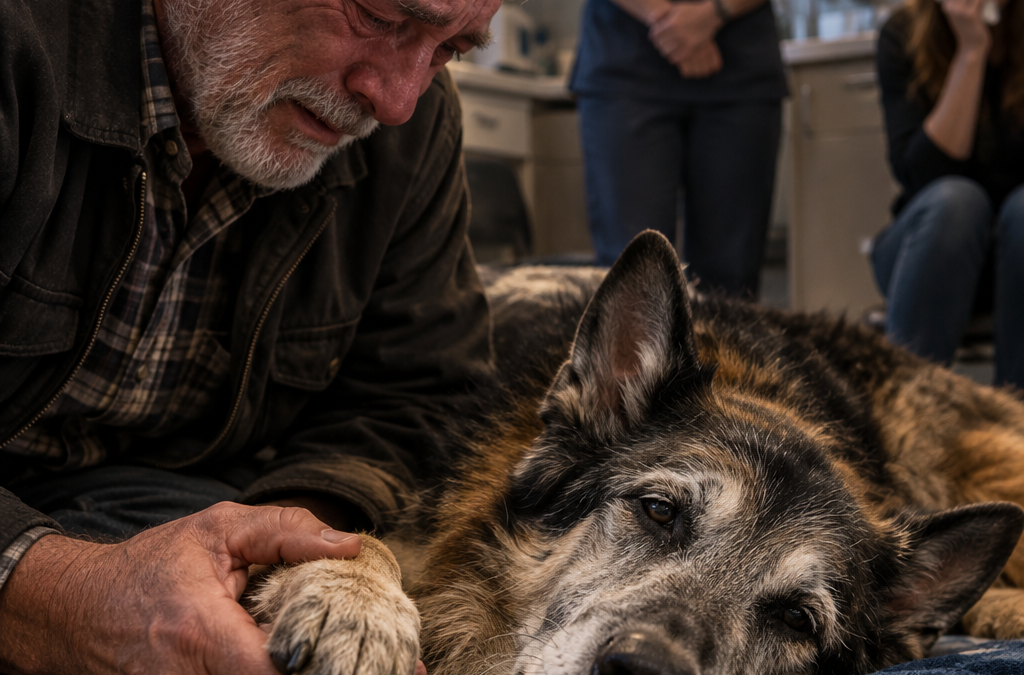
At the clinic, the staff helped us bring Rocky into a quiet examination room.
Dr. Ellis examined him carefully.
She reviewed his bloodwork and assessed his comfort.
Then she pulled a chair beside mine.
I knew what she was going to say.
I could see it in her face.
But I still asked.
“Can you help him?”
Her eyes softened.
“Michael, we’ve reached a very difficult point.”
I looked at Rocky.
“What does that mean?”
“His kidney function has deteriorated severely. His mobility problems are advanced, and he’s having increasing difficulty remaining comfortable.”
I swallowed.
“Can we change his medication?”
“We could attempt additional supportive treatment, but given his overall condition, I’m concerned it would only prolong his suffering.”
I stared at the floor.
“How much time?”
She hesitated.
“I believe he’s very close to the end. We may be talking about days, possibly less.”
My hands began trembling.
“He was outside last week.”
“I know.”
“He was watching the birds.”
Dr. Ellis nodded.
“I’m glad he had that afternoon.”
My throat tightened.
“He was happy.”
She leaned closer.
“Michael, one happy afternoon doesn’t mean his body can recover.”
I looked away.
I hated hearing it.
But I knew she was right.
Rocky hadn’t eaten in days.
He couldn’t stand.
His body hurt.
And every hour seemed to take another small piece of him.
Dr. Ellis waited while I tried to speak.
Finally, I asked, “Is he suffering?”
She answered honestly.
“Yes. And I’m concerned we can’t control that suffering adequately anymore.”
I closed my eyes.
Tears slid down my cheeks.
For years, I had believed my responsibility was to keep Rocky alive.
But now the veterinarian was asking me to consider whether keeping him alive was still the kindest thing.
I looked toward the examination table.
Rocky lay motionless.
His eyes were closed.
His chest rose slowly.
Then fell.
I reached toward him.
“Hey, buddy.”
No response.
I put my hand against his shoulder.
His breathing changed slightly.
But his eyes remained closed.
Dr. Ellis spoke quietly.
“We can help him pass peacefully, with you beside him.”
I looked at her.
“Here?”
“Yes.”
“I can hold him?”
“Of course.”
My voice broke.
“He won’t be alone?”
She shook her head.
“Not for a moment.”
I turned toward Emily, who had arrived after Susan called her.
She was crying.
She moved beside me and placed her hand over mine.
“Dad.”
I looked at her.
“I promised him.”
She nodded.
“I know.”
“I promised I’d always come when he looked for me.”
Emily leaned against my shoulder.
“Then stay with him.”
Those words finally broke through the fear.
I realized I’d been measuring the promise incorrectly.
I thought keeping it meant preventing Rocky from leaving me.
But the promise had never been about controlling what happened to him.
It had been about being there when he needed me.
Even when I was frightened.
Even when I couldn’t fix anything.
Especially then.
I looked at Dr. Ellis.
My voice was barely audible.
“I don’t want him to hurt anymore.”
She nodded.
“We can help him.”
I asked for a few minutes alone.
Susan kissed Rocky’s forehead and stepped into the hallway.
Emily stayed beside me.
I moved my chair close to the examination table.
I placed my hand beneath Rocky’s head.
His fur felt warm.
Familiar.
I could feel the shape of the dog I’d known for fourteen years.
The same broad forehead.
The same soft fur behind his ears.
The scar near his shoulder from an old training accident.
The small white patch beneath his chin that Emily used to call his lucky mark.
Everything was still there.
Except the strength.
I rubbed his ear.
“Hey, partner.”
Nothing.
I swallowed.
“It’s me.”
His breathing continued.
I tried to smile.
“Remember the first day we met?”
I laughed softly.
“You nearly pulled my arm off trying to chase a bird.”
Tears blurred my vision.
“Denise thought I was crazy for taking you.”
I looked down at his gray muzzle.
“Maybe I was.”
I rubbed his forehead.
“But you were the best decision I ever made.”
My voice trembled.
I told him about the little girl we’d found in the forest.
About the storm.
About the factory where he’d stayed beside me when I couldn’t stand.
About the first time Susan let him sleep on the couch and pretended she hadn’t.
I told him how proud I was.
How grateful.
How sorry I was for every time I’d been impatient.
For every day I’d been too tired to play.
For every moment I’d forgotten that his whole world had been built around the people he loved.
Rocky remained still.
His eyes were closed.
Emily began crying quietly beside me.
And then I remembered the promise.
The young dog beneath the tree.
The first command.
The moment he’d finally learned to stop watching everything around him and trust the man holding his leash.
I leaned close.
“Rocky.”
Nothing.
I placed two fingers against my cheek.
Even though I knew his eyes were closed.
Even though I knew he couldn’t hear the way he once had.
I whispered the old command.
“Look.”
I waited.
My hand remained against his face.
“Come on, partner.”
My voice broke.
“One more time.”
Then his eyelids moved.
At first, I thought I’d imagined it.
A tiny flutter.
Almost nothing.
Then Rocky slowly opened his eyes.
I stopped breathing.
His gaze was cloudy.
Tired.
But for a brief moment, his eyes seemed to settle on my face.
“Emily,” I whispered.
She looked up.
“Dad?”
“Look.”
Rocky’s eyes were open.
His head shifted slightly against my hand.
I moved closer.
“Hey, buddy.”
Tears streamed down my cheeks.
“There you are.”
I couldn’t know whether he’d heard my whisper.
Maybe he’d felt my fingers against his cheek.
Maybe he recognized my scent.
Maybe he’d simply found the strength to open his eyes at that moment.
But I knew what I saw.
My old partner looking toward me.
One last time.
I placed two fingers near my face.
“Good boy.”
His eyes remained on mine.
I remembered a frightened young German shepherd who had struggled to trust anyone.
I remembered sitting beneath the tree and making a promise.
You keep looking for me, and I’ll be there.
And suddenly I understood.
For fourteen years, Rocky had kept his side of that promise.
He had looked for me in crowded training fields.
In dark forests.
In damaged buildings.
In hospital parking lots.
In our kitchen.
In the backyard.
Every time the world became frightening or confusing, he had searched for my face.
And every time, I had tried to be there.
Now, at the end, he was looking toward me again.
I leaned close enough that my forehead almost touched his.
“I’m here.”
His breathing was soft.
“I didn’t go anywhere.”
My tears fell onto his blanket.
“I’m right here, Rocky.”
His eyes began to close.
I kissed his forehead.
“You don’t have to keep looking anymore.”
My voice cracked.
“I’ve got you.”
He relaxed against my hand.
Emily placed her arm around my shoulders.
Dr. Ellis returned quietly.
She saw Rocky resting against my palm.
She waited until I looked at her.
“Are you ready?”
I looked down at my partner.
I wanted another day.
Another morning.
Another walk.
Another chance to hear him bark.
Another chance to watch him run.
But those things were no longer possible.
And for the first time, I didn’t try to pretend otherwise.
I nodded.
“Yes.”
Dr. Ellis explained the procedure once more.
She administered the sedative and waited while Rocky became fully relaxed.
I kept my hand against his face.
Emily held his paw.
Susan returned and stood beside us.
I talked to him the entire time.
I told him he was safe.
I told him he’d done everything right.
I thanked him for every year.
Every rescue.
Every ordinary morning when he’d followed me into the kitchen.
Every night when he’d slept beside my bed.
When Dr. Ellis confirmed that Rocky was resting comfortably, she asked whether I needed more time.
I looked at him.
His breathing was calm.
For the first time in days, there was no trembling in his legs.
No struggling to change position.
No frightened restlessness.
He looked peaceful.
I bent toward him.
“You know what, buddy?”
I smiled through my tears.
“I think we did pretty good.”
My voice broke.
“You and me.”
I rubbed his ear one last time.
“You were never a difficult dog.”
I swallowed.
“You just needed somebody who wouldn’t give up on you.”
Emily began crying harder.
I kissed Rocky’s head.
“And you never gave up on me.”
Dr. Ellis gave the final medication.
I kept holding him.
His chest rose gently.
Then fell.
There was one more quiet breath.
And then his body became still.
Dr. Ellis listened to his heart.
She waited.
Then she looked at me.
“He’s gone, Michael.”
I didn’t move.
My hand remained beneath Rocky’s head.
I stared at his closed eyes.
The eyes that had opened one final time when I whispered our first command.
I wanted them to open again.
I wanted him to look at me.
I wanted the impossible.
Instead, I bent forward and pressed my face into his fur.
And I cried.
Not the restrained tears of a police officer trying to remain professional.
Not the quiet grief of a man trying to protect his family from his pain.
I cried like someone who had lost a part of himself.
Emily held me.
Susan rested a hand on Rocky’s back.
Dr. Ellis gave us as much time as we needed.
Eventually, I lifted my head.
I looked at Rocky’s peaceful face.
“End of watch, partner.”
My voice trembled.
“Good boy.”
Then I kissed him goodbye.
The drive home was almost unbearable.
Rocky’s empty harness lay on the back seat.
Susan drove because my hands wouldn’t stop shaking.
Emily followed in her car.
I stared out the window at the familiar streets.
We passed a park where Rocky had trained.
A gas station where I used to buy coffee before early shifts.
The turnoff toward the sheriff’s department.
Everywhere I looked, I saw pieces of a life that had included him.
When we reached the house, I didn’t want to go inside.
I knew his bed would be beside the fireplace.
His water bowl would still be in the kitchen.
His toys would still be scattered across the living room.
And he wouldn’t be there.
Susan took my hand.
“Mike.”
I looked at her.
“I don’t know how to do this.”
She squeezed my fingers.
“One day at a time.”
I nodded.
But the first days were terrible.
I woke every morning expecting to hear Rocky moving beside the bed.
I reached for his food bowl out of habit.
Sometimes I caught myself turning toward the hallway when I thought I heard his collar.
The house seemed impossibly quiet.
Even Susan felt it.
One evening, I found her sitting beside Rocky’s empty bed.
She was holding one of his old tennis balls.
I sat beside her.
For several minutes, neither of us spoke.
Then she whispered, “I keep expecting him to come around the corner.”
I nodded.
“Me too.”
She looked at me.
“He had a good life.”
I stared at the worn tennis ball.
“I hope so.”
Susan rested her head against my shoulder.
“Mike, he was loved every single day.”
My throat tightened.
“I wish I’d had more time.”
“So do I.”
We sat together in the quiet room.
And for the first time since Rocky died, I understood that I didn’t have to carry the grief by myself.
Weeks passed.
I started going through photographs.
Rocky as a puppy.
Rocky standing beside my patrol SUV.
Rocky covered in mud after a training exercise.
Rocky sleeping beneath the Christmas tree while Emily opened presents.
Rocky resting under the maple tree during his first summer of retirement.
At first, every photograph hurt.
Then, slowly, they began making me smile.
I remembered things I had forgotten.
The time Rocky stole a hamburger during a department picnic.
The afternoon he jumped into a lake after a tennis ball and refused to come out until I threw another.
The way he would rest his head against Susan’s lap whenever she watched television.
The nights he waited beside Emily’s bedroom while she studied.
The long drives when he slept behind me, trusting that I knew where we were going.
The memories didn’t make me miss him less.
They reminded me that his life had been much larger than his final weeks.
Almost two months after his death, Captain Briggs called.
He had retired years earlier but still helped with training programs.
“Mike, I’ve been thinking about you.”
“That’s usually dangerous.”
He laughed softly.
“We’ve got a new group of K9 handlers starting next month.”
I waited.
“I wondered whether you’d come speak to them.”
I looked toward Rocky’s photograph on the bookshelf.
“About what?”
“Trust. Partnership. Working with a dog long enough to know what he needs.”
I swallowed.
“I don’t know, Walt.”
“You don’t have to decide now.”
He paused.
“But those young handlers could learn something from Rocky.”
I looked at the photograph.
His ears were raised.
His eyes were bright.
The same look he’d given me when we first learned to work together.
“Yeah,” I whispered.
“Maybe they could.”
Three weeks later, I stood in front of twelve new K9 handlers at the training center.
Young deputies with eager dogs.
Fresh uniforms.
Clean boots.
The kind of confidence that comes before life has had time to teach you how fragile things can be.
I recognized myself in them.
I told them about Rocky’s first training session.
About the dog who couldn’t focus.
About the trainers who thought he might never settle.
I demonstrated the first command I’d taught him.
Two fingers near my eyes.
“Look.”
Several handlers smiled.
I explained that it wasn’t a trick.
It was the foundation of our partnership.
When Rocky became frightened or distracted, I wanted him to know he could turn toward me.
That I would help him understand what came next.
Then I told them about our rescues.
The missing little girl.
The dangerous factory.
The years of patrol work.
And finally, I told them about his final day.
My voice trembled.
But I didn’t stop.
I explained how illness had taken his hearing, mobility, and strength.
How difficult it had been to accept that the dog who once ran toward danger could no longer stand.
How I’d struggled with the fear that choosing a peaceful goodbye meant breaking my promise.
Then I told them about Rocky opening his eyes.
The room became completely quiet.
One young deputy raised his hand.
“Sir, do you think he actually heard you?”
I looked at him.
“I don’t know.”
The deputy seemed surprised.
I smiled faintly.
“His hearing was almost gone. He may have felt my hand. He may have recognized my scent. There are things about that moment I’ll never be able to explain.”
I paused.
“But I know he looked toward me.”
My throat tightened.
“And I know I was there when he did.”
Nobody spoke.
I looked around the room.
“You can spend years teaching a dog how to find people, follow commands, and protect others.”
I placed Rocky’s old collar on the table.
“But eventually, if you’re lucky, he’ll teach you something much harder.”
The young deputies watched me.
“He’ll teach you that trust isn’t about control.”
I touched the worn leather.
“It’s about making sure somebody knows they don’t have to face the difficult things alone.”
After the class, one of the youngest handlers approached me.
His German shepherd was barely two years old.
The dog kept pulling toward the open door, distracted by noises outside.
The young deputy looked embarrassed.
“Sorry, sir. He’s still learning.”
I crouched beside the dog.
“What’s his name?”
“Cooper.”
I smiled.
“Hey, Cooper.”
The dog sniffed my hand.
Then turned toward the door again.
I looked at his handler.
“Try something.”
I showed him the old gesture.
Two fingers near the eyes.
“Teach him to check in with you before asking him to do something difficult.”
The deputy nodded.
He raised his hand.
“Look.”
Cooper glanced at him.
The handler rewarded him.
“Good boy!”
Cooper’s tail wagged.
I felt something tighten in my chest.
Not only grief.
Something warmer.
Something that reminded me of a young German shepherd standing beneath a tree fourteen years earlier.
I smiled.
“There you go.”
The deputy tried again.
“Look.”
Cooper met his eyes.
I stepped back.
For a moment, I could almost see Rocky beside me.
Young.
Strong.
Ready to learn.
I looked toward the training field.
And I realized that the promise I’d made to Rocky had never truly ended.
It had simply changed.
I couldn’t be there for him anymore.
But I could help other handlers learn how to be there for their dogs.
And perhaps that was another way of honoring him.
The following spring, Susan and I planted a small dogwood tree in the backyard.
Emily and her family came to help.
We placed a simple stone beneath it.
ROCKY
Faithful Partner. Beloved Friend.
2012–2026
I stood looking at the stone while my grandson, Noah, played nearby.
He was six years old.
Too young to understand everything about death.
But old enough to know that Rocky wasn’t coming home.
Noah walked toward me holding a tennis ball.
“Grandpa?”
“Yeah, buddy?”
“Was Rocky really a hero?”
I looked at the photograph Emily had brought.
Rocky stood beside me in uniform.
His ears were high.
His mouth was open in that familiar shepherd smile.
“Yeah,” I said. “He was.”
Noah considered that.
“Did he save people?”
“He sure did.”
“Did he save you?”
I looked toward the dogwood tree.
I remembered the damaged factory.
The dust.
The pain in my shoulder.
Rocky refusing to leave until I could stand.
Then I remembered the veterinary clinic.
His cloudy eyes opening one last time.
The way he’d rested his head against my hand.
“More than once,” I whispered.
Noah looked at the tennis ball.
Then he placed it gently beside Rocky’s stone.
“In case he wants to play.”
I covered my mouth.
Susan slipped her hand into mine.
Emily wiped her eyes.
Noah looked up at me.
“Grandpa, why are you crying?”
I knelt slowly beside him.
“Because I miss him.”
He nodded.
“I miss him too.”
I hugged my grandson.
We stayed that way for a moment.
Then Noah stepped back and asked, “Do you think Rocky knew you loved him?”
I looked at the stone.
At the tennis ball.
At the tree we’d planted.
And finally, I smiled.
“I think he did.”
Noah nodded as though that settled the matter.
Then he ran toward the house.
I stayed beside the tree.
I thought about every version of Rocky I’d known.
The frightened young shepherd.
The confident search dog.
The loyal partner who waited beside me through danger.
The retired old man who slept in the sunlight.
The fragile dog who couldn’t hear or walk but still relaxed when he felt my hand.
For so long, I had feared that losing his strength meant losing who he was.
But Rocky had been Rocky through every stage.
He wasn’t valuable because he could run fast.
Or find missing people.
Or obey commands.
He was valuable because he was himself.
Because he trusted.
Because he loved.
Because even after all his abilities had faded, he still reached for the connection we’d built over fourteen years.
I bent down and touched his memorial stone.
“You remember what I told you, buddy?”
The afternoon breeze moved through the new leaves.
I smiled through my tears.
“You look for me, and I’ll be there.”
I stayed quiet for a moment.
Then I whispered, “I kept my promise.”
And for the first time since Rocky died, those words didn’t hurt.
They brought peace.
Because I finally understood something I’d struggled to accept in that veterinary clinic.
I hadn’t promised Rocky he would never grow old.
I hadn’t promised I could save him from every illness.
I hadn’t promised that our time together would last forever.
I’d promised that when he needed me, he wouldn’t have to face the world alone.
And on the final afternoon of his life, when his hearing was gone, his legs no longer worked, and his body had nothing left to give, I’d held him close.
I’d whispered our first command.
His eyes had opened.
And I’d been there.
I still miss Rocky every morning.
Sometimes I reach toward the empty space beside my chair without thinking.
Sometimes I hear a dog bark in the distance and feel that familiar ache in my chest.
And whenever I see a young K9 looking toward his handler for reassurance, I remember that first day on the training field.
The frightened puppy.
The simple command.
The promise.
But I no longer remember Rocky only as he was at the end.
I remember him running through the forest.
Standing proudly beside my patrol vehicle.
Sleeping beneath Emily’s chair.
Waiting beside me when I was injured.
And looking into my eyes with complete trust.
His body had grown old.
His hearing had faded.
His strength had disappeared.
But the love that connected us had remained.
That was what I saw in his eyes on our last afternoon.
Not a miracle.
Not a sudden recovery.
Just one final moment of recognition between two partners who had spent fourteen years learning to trust each other.
And whenever I think about the terrible quiet that followed, I remind myself of something.
Rocky didn’t leave this world searching for me.
He didn’t leave frightened and alone.
He left with my hand beneath his head, my voice close to his ear, and the people who loved him gathered around.
He had spent his life looking for me.
And when he opened his eyes for the very last time, I was exactly where I’d promised to be.