𝗙𝗨𝗟𝗟 𝗦𝗧𝗢𝗥𝗬 I Watched My Dying K9 Crawl Away From Our Wreck in the Blizzard
𝗙𝗨𝗟𝗟 𝗦𝗧𝗢𝗥𝗬
A seven-year-old boy named Tyler Brooks disappeared near an abandoned railroad corridor on the edge of town.
The boy had argued with his older brother and run away from home.
By the time his parents realized he wasn’t coming back, a snowstorm had moved into the county.
We arrived shortly after sunset.
Tyler’s mother stood beside a patrol car, wrapped in a blanket, crying so hard she could barely speak.
“He doesn’t have his coat,” she told me. “He left without his coat.”
I looked toward the dark woods.
Snow was already collecting on the branches.
“How long has he been gone?”
“Almost three hours.”
I knew what that meant.
The temperature was falling, visibility was worsening, and a seven-year-old without proper clothing could become dangerously cold before we located him.
I took a sweatshirt belonging to Tyler and let Gunner smell it.
He lowered his nose.
I clipped on his tracking lead.
“Find him, buddy.”
Gunner moved immediately.
For nearly an hour, we followed him through deepening snow.
Twice, he stopped and worked back across his own trail.
Once, I thought he’d lost the scent entirely.
But Gunner kept searching.
Eventually, he pulled toward an old drainage tunnel beneath the abandoned railroad bed.
I heard nothing.
Saw nothing.
But Gunner stopped and gave a sharp bark.
Then another.
I crouched beside the opening.
“Tyler?”
No answer.
Gunner barked again.
I turned on my flashlight.
Deep inside the narrow tunnel, something moved.
A small hand.
I crawled toward it.
Tyler was curled against the concrete wall, barely conscious.
His clothes were wet.
His lips had turned blue.
I wrapped him in my emergency blanket and radioed for medical assistance.
When I tried to lift him, he opened his eyes.
“Is that a wolf?” he whispered.
I looked behind me.
Gunner was watching us from the mouth of the tunnel.
I smiled.
“No, buddy. That’s the reason we found you.”
We got Tyler to the hospital in time.
He survived.
A few days later, his mother came to the station with homemade cookies and a drawing.
In the picture, a huge black-and-tan dog stood beside a little boy under a bright yellow sun.
Above them, Tyler had written:
THANK YOU, GUNNER.
I taped the picture inside my locker.
It stayed there until the day I retired.
There were other rescues, some more dangerous.
But that winter search mattered to me in a way I couldn’t fully explain.
I had followed Gunner into the storm because he knew where to go.
I’d trusted him when my own eyes were useless.
And he’d led me to someone who couldn’t save himself.
Years later, lying helpless inside our wrecked truck, I remembered that night.
I remembered Gunner pulling against his leash.
The darkness.
The snow.
The complete certainty that my partner knew something I didn’t.
I should have remembered that trust sooner.
But fear has a way of making you forget everything you thought you’d learned.
Gunner retired when he was eleven.
His hips had begun bothering him, and a veterinarian found advanced arthritis along with significant changes in his lower back.
He was still eager to work.
That was part of the problem.
He didn’t understand that wanting to do something and being physically able to do it were no longer the same thing.
During one training session, he tried to leap into the rear compartment of our patrol SUV.
His front paws reached the platform.
His hind legs didn’t.
He slipped backward.
I caught him beneath the chest before he hit the pavement.
He looked at me, startled and embarrassed.
I held him for a moment.
“Easy, old man.”
He tried to climb again.
I stopped him.
“Not today.”
He whined.
I looked at the gray fur spreading around his muzzle.
For the first time, I saw the old dog hiding beneath the confident one.
I sat with him for almost an hour before I started the engine.
A week later, I requested his retirement.
The department approved it.
Gunner received a plaque, a ceremonial farewell, and permission to spend the remainder of his life with me.
He didn’t understand any of the speeches.
But he enjoyed the attention.
And he ate enough retirement-party treats to make me worry about his stomach.
I retired myself nine months later.
At sixty-two, my knees hurt every morning, and thirty-one years of unpredictable shifts had finally caught up with me.
I told everybody I was looking forward to fishing, gardening, and spending quiet mornings with Laura.
For a while, that’s exactly what happened.
Gunner slept late.
Laura planted flowers.
I finally repaired the back porch.
We took short walks through the neighborhood and spent afternoons sitting beneath the maple trees.
Then Laura became sick.
At first, we thought the constant fatigue was nothing serious.
She had always been healthy.
She rarely complained.
But tests revealed an aggressive form of cancer.
Treatment gave us hope for a while.
Then it stopped working.
I spent the last six months of her life driving to hospitals, sitting beside her during appointments, and trying to convince myself that determination could somehow change the outcome.
It couldn’t.
Laura died on a quiet Tuesday morning in September.
She was sixty-one.
I remember holding her hand as she slept.
I remember the nurse closing the curtains.
And I remember returning home that evening to find Gunner waiting at the front door.
I knelt beside him.
He pushed his head into my chest.
I wrapped my arms around him and cried.
For the first time in decades, there was no one inside the house waiting to ask how my day had gone.
No one to complain about the muddy paw prints in the kitchen.
No one reading on the couch.
No one humming while she washed dishes.
Just Gunner.
He stayed beside me that entire night.
Whenever I moved, he followed.
When I sat on the bedroom floor holding one of Laura’s sweaters, he lay next to me and rested his head against my knee.
He didn’t understand everything that had happened.
But he understood that something was wrong.
And he stayed.
For months afterward, Gunner was the reason I got out of bed.
He needed breakfast.
He needed medication for his arthritis.
He needed help climbing the small step into the backyard.
On days when I wanted to stay beneath the covers, he’d come to my bedside and place his cold nose against my hand.
I’d open my eyes.
He’d wag his tail.
And I’d get up.
My daughter, Hannah, worried about me.
She was thirty-six, married, and raising a nine-year-old boy named Caleb.
They lived about forty minutes away.
She called every day.
Sometimes twice.
“Dad, why don’t you come over Sunday?”
“I’ve got some things to do around here.”
“What things?”
“Gunner needs a bath.”
“You washed him three days ago.”
“He’s a very dirty dog.”
She’d sigh.
Then she’d say, “We miss you.”
I’d tell her I missed her too.
And I meant it.
But the thought of sitting at her dinner table without Laura still felt unbearable.
I had spent my whole adult life being the man who knew what to do.
The officer who made decisions.
The husband who fixed things.
The father who showed up when something went wrong.
Now I couldn’t fix the one thing that mattered most.
So I stayed home.
And Gunner stayed with me.
Seven months before the accident, Gunner collapsed in the backyard.
It happened on a warm afternoon in May.
I was sitting on the porch drinking coffee when he spotted a rabbit near the fence.
In his younger days, Gunner would have launched himself across the lawn before I could tell him to stop.
Now he simply stood and watched.
His ears lifted.
He took several quick steps.
Then his back legs buckled.
He fell onto his side.
At first, I thought his arthritis had caused him to stumble.
“Gunner?”
He didn’t respond.
I dropped my coffee and hurried toward him.
His chest was moving rapidly.
His eyes were open, but he seemed unable to focus.
“Hey. Hey, buddy.”
I knelt beside him.
His gums looked pale.
His breathing was shallow.
For several terrifying seconds, I thought he was dying right there beneath the maple tree.
Then he took a deeper breath.
His eyes found mine.
He tried to lift his head.
“No, no. Stay down.”
My hands shook as I called the veterinarian.
I barely remember driving him to the clinic.
I remember holding his head against my thigh while we waited for help.
I remember telling the technician that he’d been fine that morning.
And I remember the awful realization that I had said almost the same thing about Laura when she first became sick.
She was fine yesterday.
It was a sentence I’d come to hate.
Dr. Naomi Patel, a veterinary cardiologist at the regional specialty hospital, diagnosed Gunner with dilated cardiomyopathy.
His heart had become enlarged and weakened.
It wasn’t pumping blood efficiently, and his abnormal heart rhythm increased the risk of sudden collapse.
There was medication that might help control his symptoms.
There were adjustments we could make to his daily routine.
But there was no simple repair that would return his heart to the condition it had been in during his working years.
Dr. Patel explained everything carefully.
I listened.
Then I asked, “How long?”
She looked at Gunner.
“We can’t predict that precisely. Some dogs respond well to treatment for a period of time. Others decline more quickly.”
“Months?”
“Possibly.”
“Years?”
She hesitated.
“I wouldn’t want to give you that expectation, Ethan.”
I stared at the floor.
Gunner was lying beside my chair, his head resting on my boot.
I reached down and scratched his ear.
“He’s been through worse.”
Dr. Patel’s voice remained gentle.
“I know he’s an extraordinary dog. But his heart doesn’t know what he’s accomplished.”
Those words stayed with me.
I knew she wasn’t trying to be cruel.
She was trying to make me understand that courage and determination couldn’t repair damaged heart muscle.
I had watched Gunner push through exhaustion during difficult searches.
I’d watched him keep working when snow collected on his fur and ice formed along his whiskers.
I’d watched him stand between me and danger without hesitation.
But this wasn’t something he could fight through.
It was something I had to help him live with.
We started medication.
I changed his diet according to the veterinary team’s recommendations.
I limited his activity and began monitoring his breathing while he slept.
I kept a notebook on the kitchen counter with the times of his medication, his appetite, and his resting respiratory rate.
For a while, the treatment helped.
He seemed more comfortable.
The coughing decreased.
He slept peacefully.
Some mornings, he’d follow me onto the porch and rest his head against my knee while I drank coffee.
I treasured those mornings.
But the disease continued progressing.
By November, Gunner couldn’t walk to the mailbox without stopping.
He had lost weight.
His once-thick coat hung loosely around his shoulders.
Some nights, I woke to hear him coughing near the bedroom door.
I’d climb out of bed and sit beside him until his breathing settled.
“Easy, buddy,” I’d whisper. “I’ve got you.”
He always seemed calmer when my hand rested against his chest.
Once, after a particularly difficult night, I fell asleep on the floor beside him.
I woke at sunrise with my back aching and Gunner’s head resting across my arm.
For a moment, I forgot about his illness.
He looked peaceful.
The sunlight made the gray fur around his muzzle shine silver.
I watched him breathe.
Then I remembered what Dr. Patel had told me.
His heart doesn’t know what he’s accomplished.
I wanted to hate that sentence.
Instead, I began to understand it.
Gunner had spent years doing extraordinary things.
But he was still a dog.
A living creature with a body that would eventually fail.
He didn’t deserve to spend his final days trying to satisfy my expectations of who he used to be.
I stopped asking him to follow me when he looked tired.
I brought his food and water closer.
I bought a thick orthopedic bed and placed it beside mine.
On good days, we sat in the backyard.
On bad days, I stayed inside with him.
We watched old westerns together.
I talked to him about Laura.
Sometimes I told him stories from our patrol years.
Sometimes I simply sat in silence with my hand buried in his fur.
I knew his time was limited.
But knowing something and accepting it are two different things.
I still caught myself making plans.
Christmas morning with Hannah and Caleb.
Another spring beneath the maple tree.
One more summer evening on the porch.
I had promised myself I wouldn’t count on those things.
Then I’d look at Gunner and start counting anyway.
Three days before the crash, he collapsed again.
This time, he was walking from the kitchen to the living room.
He suddenly stopped.
His body swayed.
Then he went down.
I was beside him in seconds.
“Gunner!”
His breathing was rapid.
His eyes looked distant.
I rested my hand against his chest and felt his heart beating in a frighteningly uneven rhythm.
He recovered after a short time, but he remained weak.
I called the emergency veterinary service immediately.
After reviewing his symptoms, Dr. Patel asked me to bring him to the specialty hospital for reassessment as soon as he could travel safely.
The next available appointment was Friday afternoon.
I booked it.
Then I called Hannah.
She listened while I explained what had happened.
“Dad, I’ll drive you.”
“I can manage.”
“It’s supposed to snow Friday.”
“Not until late.”
“The forecast keeps changing.”
“I’ve driven in Pennsylvania winters for forty years.”
She sighed.
“That’s exactly what you said the last time you slid into a ditch.”
“That was sixteen years ago.”
“And apparently you haven’t learned anything.”
I smiled despite myself.
“Sweetheart, it’ll be fine.”
“Dad.”
Her voice softened.
“I’m worried about both of you.”
I looked toward Gunner, who was sleeping beside the couch.
“So am I.”
She went quiet.
Then she said, “You don’t have to do this alone.”
I stared out the kitchen window.
Snow clouds were already gathering beyond the hills.
“I know.”
But I didn’t know how to accept the help.
I had been a police officer for more than three decades.
Asking someone to take care of me felt unnatural.
Asking someone to help with Gunner felt worse.
He had always been my responsibility.
My partner.
My dog.
When he was sick, I was supposed to be the one who took him where he needed to go.
I told Hannah I’d call after the appointment.
She wasn’t happy.
But she knew arguing with me rarely accomplished much.
“Promise me you won’t drive if the roads get bad.”
“I promise.”
I meant it when I said it.
I just didn’t understand how quickly that promise would become impossible to keep.
Friday arrived cold and gray.
Gunner was having a difficult morning.
He refused breakfast.
His breathing was faster than usual, and when I helped him into the back seat of my truck, he seemed exhausted by the effort.
I covered the seat with his favorite blanket and secured his safety harness.
He lowered his head against the cushion.
I stood beside the open door for a moment.
“You okay, old man?”
He lifted his eyes.
His tail moved weakly.
I rubbed his forehead.
“One more doctor visit. Then we’re going home.”
It was such an ordinary thing to say.
I had no idea how much those words would hurt later.
We left shortly after noon.
The specialty hospital was nearly fifty miles away, on the other side of a low mountain ridge.
The drive usually took a little over an hour.
The roads were dry when we left.
A light snow began falling as we approached the hospital.
Nothing alarming.
Just small flakes drifting against the windshield.
I checked the forecast on my phone before taking Gunner inside.
The heaviest snow was predicted for later that evening.
Our appointment began at two-thirty.
Dr. Patel examined Gunner, reviewed his latest tests, and performed another cardiac ultrasound.
I sat beside the examination table, rubbing his ears while he lay quietly.
He had always hated medical equipment.
But now he seemed too tired to protest.
Dr. Patel looked at the monitor for a long time.
Then she turned toward me.
“Ethan, I’m concerned about how much his heart function has declined.”
I swallowed.
“How bad?”
She pulled up an earlier image and compared it with the new one.
His heart chambers had enlarged further.
The contractions were weaker.
His irregular rhythm remained a serious concern.
“His current treatment isn’t controlling the disease as well as we’d hoped,” she said.
“Can we change the medication?”
“We can make adjustments to improve his comfort. But I’m worried that we’re approaching a stage where treatment won’t give him much more good-quality time.”
I looked at Gunner.
He was resting with his head against my arm.
“How much time?”
Dr. Patel took a breath.
“I would prepare for the possibility of days to weeks, Ethan. I wish I could be more precise.”
I stared at her.
Days.
I had known this conversation was coming.
I’d rehearsed it in my mind during sleepless nights.
But nothing prepared me for hearing it aloud.
“He’s still eating sometimes,” I said.
“That’s good.”
“He still comes outside with me.”
“I’m glad he has those moments.”
“He still knows when I’m upset.”
Her expression softened.
“I’m sure he does.”
I looked down at him.
“Yesterday, I was sitting in Laura’s chair. I guess I was having a bad afternoon. He got up from his bed and came all the way across the room just to put his head on my knee.”
My voice broke.
“He could barely breathe afterward.”
Dr. Patel waited.
I rubbed Gunner’s ear.
“He doesn’t know how to stop taking care of me.”
She sat beside me.
“Then maybe part of taking care of him now is showing him he doesn’t have to.”
I looked at her.
“What does that mean?”
“It means protecting his comfort. Letting him rest. Making decisions based on what his body can tolerate, not what his heart wants to do for you.”
I looked back at Gunner.
He seemed peaceful beneath my hand.
“Are you telling me I should let him go?”
“I’m telling you that it’s time to think seriously about that possibility. We can discuss home hospice support or a peaceful euthanasia appointment. You don’t have to make the decision without guidance.”
I couldn’t answer.
For years, my instinct had been to save people and animals.
Find a solution.
Call for backup.
Get them somewhere safe.
But Gunner didn’t need a rescue mission.
He needed me to accept what I could not change.
I asked for a little time.
Dr. Patel agreed to adjust his comfort-care plan and gave me clear instructions about signs of distress.
She also warned me that sudden collapse could happen at any time.
“And Ethan,” she added, “no strenuous activity. His heart has very little reserve.”
I nodded.
“Understood.”
She touched Gunner’s shoulder.
“He’s a remarkable old boy.”
I looked down at him.
“The best I’ve ever known.”
We left the examination room shortly after four.
By then, the snow was falling harder.
A receptionist told me the storm had intensified faster than expected.
Several roads farther north were already becoming difficult.
She suggested I wait or find a nearby motel.
I called Hannah from the parking lot.
“Dad, where are you?”
“Still at the hospital.”
“Please tell me you’re staying there.”
I looked at Gunner through the truck window.
He was lying on his blanket, exhausted.
“I’m trying to figure something out.”
“The weather service just upgraded the warning.”
“I know.”
“Come to my house. We’re closer than your place.”
I considered it.
Hannah lived south of the ridge, but still more than half an hour from the hospital.
Her house would have been warmer and safer than trying to cross the mountains.
Yet Gunner was uncomfortable in unfamiliar places.
Lately, he’d become restless whenever we spent too long away from home.
I wanted him in his own bed.
I wanted him beside the familiar fireplace.
I wanted to bring him home, where Laura’s old chair still stood by the window.
I told myself the roads couldn’t get much worse in an hour.
That the main highway would remain open.
That I could handle whatever snow came.
I made a decision I would regret for the rest of my life.
“We’re heading home,” I said.
Hannah’s voice rose.
“Dad, please don’t.”
“I’ll be careful.”
“That’s not the point!”
I rubbed my forehead.
“I know these roads.”
“Knowing the roads doesn’t make the ice disappear.”
I didn’t answer.
She went quiet.
Then she said something that nearly made me turn around.
“I can’t lose you too.”
I closed my eyes.
“You won’t.”
“Promise?”
I looked at Gunner.
His eyes were closed.
Snow collected along the edge of the truck window.
“I’ll call when we get home.”
I ended the call.
For several seconds, I sat with the phone in my hand.
Then I started the engine.
I wish I could tell you there was a good reason.
That I had been responding to an emergency.
That somebody needed help and I had no choice.
But there wasn’t.
I was a stubborn old man who wanted to take his dying dog home.
And I convinced myself that wanting something badly enough made it the right thing to do.
The first twenty miles were manageable.
Snow blew across the road, but the pavement remained visible in places.
I drove well below the speed limit.
Gunner slept in the back.
Occasionally, I checked him in the rearview mirror.
“Almost there, buddy.”
He lifted his head once.
Then settled again.
As darkness fell, the storm became much worse.
Wind struck the truck hard enough to make the steering wheel tremble.
Snow swept across the windshield in thick white sheets.
My headlights reflected against the blowing flakes, making it difficult to judge distance.
Traffic slowed.
A line of brake lights appeared ahead.
Then everything stopped.
An overturned tractor-trailer had blocked the highway farther up the ridge.
State police were diverting vehicles away from the closure.
A trooper in a reflective jacket walked toward my window.
I rolled it down.
Snow blew into the cab.
“Highway’s closed, sir. We need you to turn around.”
I showed him my retired department identification.
“Any chance Old Mill Road is still open?”
He looked at me.
“Wouldn’t recommend it tonight.”
“I know the route.”
“Doesn’t matter much in this weather.”
He glanced toward the back seat.
Gunner raised his head.
The trooper’s expression softened.
“You’ve got a dog back there?”
“Retired K9. He’s sick. I’m trying to get him home.”
The trooper considered that.
“Sir, there’s a travel center about five miles back. You can wait there until the road crews catch up.”
I looked at the line of vehicles.
Then at the dark ridge beyond the highway.
I knew Old Mill Road.
I’d driven it during winter storms when I was a young deputy.
It ran through the mountains and rejoined the county road less than fifteen miles from my house.
The route was narrow, but familiar.
That familiarity made me dangerously confident.
“I’ll take it slow,” I said.
The trooper shook his head.
“I’d strongly advise against that.”
He stepped away to direct another vehicle.
I sat there listening to the wind.
I could still turn around.
Find somewhere warm.
Call Hannah.
Wait until morning.
I had choices.
I chose the one I wanted.
And twenty-eight minutes later, I drove off the side of a mountain road with my dying dog in the back seat.
The crash happened at 9:22 p.m.
I know because the dashboard clock froze when the electrical system failed.
The road had become almost invisible.
Snowbanks rose on either side, and the wind pushed loose powder across the narrow pavement.
I was driving barely twenty-five miles an hour.
The truck’s four-wheel drive was engaged.
I had both hands on the steering wheel.
None of that mattered when the rear tires crossed a patch of black ice on a downhill curve.
The back end swung left.
I eased off the accelerator and tried to steer into the skid.
For a moment, the truck straightened.
Then the front wheels reached the icy edge of the road.
The truck began sliding sideways.
I saw the guardrail ahead.
I turned the wheel.
The tires caught briefly.
Then the passenger side struck a snow-covered drainage berm.
The truck lurched.
The passenger-side wheels dropped into a culvert.
And the entire vehicle rolled down the embankment.
I remember the sound of glass breaking.
The sickening crunch of metal folding.
Gunner’s body shifting behind me despite his safety harness.
The airbag exploding against my chest.
Then the truck struck something solid and stopped.
For a second, everything was silent.
I couldn’t understand why the steering wheel was above me.
Then I realized the truck was lying on its passenger side.
My seat belt held me at an angle.
Snow poured through the broken windshield.
The engine had stalled.
A warning chime sounded somewhere in the dashboard.
I tried to move.
Pain shot through my left leg.
I looked down.
The dashboard had folded inward, trapping my lower leg against the seat frame.
I tried pulling it free.
Nothing.
I grabbed the steering wheel and pushed.
Agony spread through my ribs.
I stopped, gasping.
“Gunner?”
No answer.
I turned as far as I could.
The rear seat was twisted.
A section of the cargo barrier had broken loose, and the safety harness that secured Gunner was hanging from its damaged anchor point.
I could see part of his body.
He lay against the lower side of the cabin, motionless.
“Gunner!”
My voice echoed inside the wreck.
He didn’t move.
I tried reaching him.
The seat belt prevented me from leaning far enough.
My leg was pinned.
I could barely breathe.
“Buddy, please.”
His eyes were closed.
I stared at his chest.
I couldn’t tell whether it was moving.
My mind raced.
Had he struck his head?
Had the crash stopped his failing heart?
Had I just killed the one living creature I was trying to protect?
“I’m sorry,” I whispered.
Blood dripped onto my sleeve.
I reached for my phone.
It had fallen somewhere during the rollover.
I searched the space around my seat with one hand.
Nothing.
I tried the emergency call button built into the truck.
The display was dark.
No response.
I shouted.
The wind swallowed my voice.
I looked through the broken windshield.
All I could see was snow and the dark outline of trees.
The truck had come to rest well below the road, hidden behind a high bank of plowed snow.
Nobody passing above would know we were there.
I tried the horn.
It gave one weak sound.
Then stopped.
I pulled against the seat belt.
My pinned leg screamed with pain.
I knew better than to keep fighting blindly.
I had worked enough accidents to know that moving damaged metal could make an injury worse.
But knowing what to do from outside a wreck is very different from being trapped inside one.
Cold air poured through the broken windows.
The temperature inside the cabin began dropping almost immediately.
My gloves were in the center console, now twisted beneath broken plastic.
My jacket was wet with melting snow.
I tried turning the ignition.
Nothing.
I looked toward the back seat.
“Gunner?”
Still no movement.
I began talking to him.
At first, I told him what had happened.
“We slid off the road, buddy. That’s all. We’re going to get some help.”
Then I started telling him things I already knew.
That the truck was old anyway.
That Hannah would be angry when she saw it.
That we could replace the vehicle.
That I was sorry.
The apologies kept coming.
“I should’ve listened to her.”
My voice shook.
“I should’ve stayed at the hospital.”
Snow gathered on the dashboard.
I could feel my hands becoming clumsy.
I knew the signs.
Hypothermia.
Blood loss.
Shock.
I needed to stay awake.
I started counting backward from one hundred.
Then I recited the names of roads in the county.
Then I tried remembering every deputy I’d worked with during my first year on patrol.
Somewhere around the thirty-minute mark, I began losing track of time.
My head felt heavy.
The pain in my leg became strangely distant.
I looked toward Gunner.
“Remember Tyler?” I whispered.
I could barely hear my own voice.
“That little boy in the tunnel?”
The wind roared outside.
“You found him, buddy.”
I swallowed.
“You always knew where to go.”
My eyelids drooped.
Then I heard something.
A faint metallic sound.
I opened my eyes.
Gunner’s collar.
It jingled once.
I turned my head.
“Buddy?”
His muzzle appeared between the seats.
He was alive.
Relief rushed through me so suddenly that I almost laughed.
“Gunner!”
He tried to raise his head.
His whole body trembled.
I could hear his breathing.
Fast.
Shallow.
Irregular.
He took a step toward me, but his hindquarters collapsed.
I reached for him.
“Come here, boy.”
His eyes met mine.
For a moment, I thought he was trying to obey.
Then he looked toward the broken rear window.
He turned.
“Gunner?”
He dragged himself away.
At first, I thought he was confused from the crash.
“No, buddy. This way.”
He kept moving.
His front paws scraped against the tilted seat.
The damaged harness strap dragged behind him.
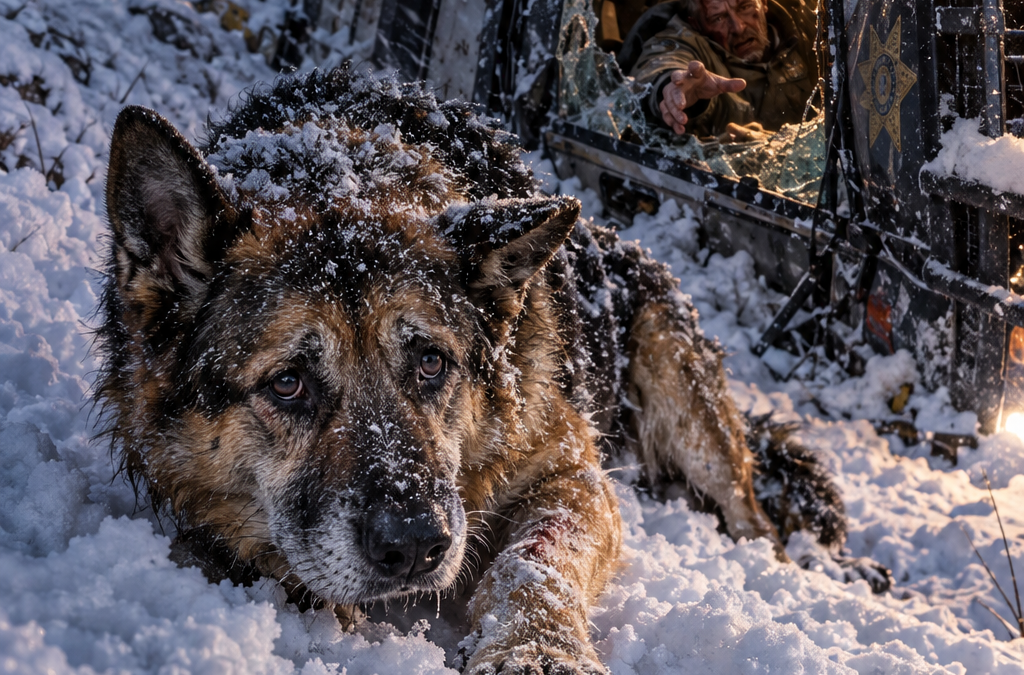
He pulled himself toward the broken window, squeezing between the seat frame and the bent door.
“Stay!” I shouted.
He stopped.
Looked back.
I saw his chest heaving.
Snow blew through the opening and settled across his gray muzzle.
“Please,” I whispered. “Stay with me.”
He held my gaze.
Then he turned away.
It was the first time I could remember giving Gunner a clear command during an emergency and watching him deliberately continue in the opposite direction.
He crawled through the broken opening.
His front paws found the snow.
Then he slipped and fell hard against the ground.
I cried out.
He lay motionless for several seconds.
I thought he was gone.
Then he pushed himself up.
His hind legs shook beneath him.
He took one step.
Another.
Then collapsed again.
I could see him struggling to breathe.
Every instinct in me screamed to get out and help him.
I pulled against the dashboard until pain exploded through my leg.
I shouted his name.
He didn’t turn back.
He crawled toward the embankment, using his front legs to pull himself through the snow.
Once, he slid backward.
He tried again.
I watched him disappear beyond the truck’s broken rear window.
The last thing I saw was his dark tail moving through the white.
And I felt a terror I had never known during thirty-one years in law enforcement.
Not fear of dying.
Fear that my dog would die alone in the freezing darkness while I lay helpless a few yards away.
“Please,” I whispered.
I don’t know whether I was speaking to God, to Gunner, or to Laura.
“Please don’t let him be alone.”
The wind howled through the wreck.
My vision blurred.
I thought I heard Laura’s voice telling me to stay awake.
Then I thought I heard Gunner barking.
Once.
Very faintly.
From somewhere above the road.
I tried to open my eyes.
Couldn’t.
And the world went black.
When I opened my eyes again, somebody was shouting my name.
“Mr. Cole! Ethan! Can you hear me?”
There was a flashlight shining through the broken windshield.
I tried to answer.
My mouth barely worked.
“Gunner,” I whispered.
A man’s face appeared beside the opening.
He wore a red rescue helmet, with snow collecting along its edge.
“Sir, my name is Mark. I’m with the fire department. We’re going to get you out.”
I grabbed his sleeve.
“My dog.”
“We’re taking care of him.”
I stared at the firefighter.
“He’s alive?”
“He’s with the woman who found you.”
I tried to sit up.
Pain shot through my chest.
“Where?”
“Ethan, listen to me. We need you to stay still. Your leg is trapped.”
I couldn’t stop shaking.
“He’s got heart disease,” I managed. “He can’t run. He can’t—”
The firefighter put a hand against my shoulder.
“I understand. We’ll check on him. But right now, I need you to keep talking to me.”
I looked at him.
“How did you find us?”
He hesitated.
Then he smiled faintly.
“Your dog.”
I stared.
“What?”
“Your dog found somebody on the road.”
For a second, I couldn’t understand the words.
Gunner had been barely able to stand.
He had crawled out of the truck into a blizzard.
I had watched him disappear, certain that he was dying alone.
And now a firefighter was telling me that Gunner had somehow reached the road.
Before I could ask another question, the rescue team began working to free my leg.
They stabilized the truck, cut away damaged metal, and protected me from the cold with blankets.
I drifted in and out of awareness while they worked.
Sometimes I heard hydraulic equipment.
Sometimes I heard the firefighter speaking to me.
Sometimes I heard my own voice asking about Gunner.
Every time, someone told me he had been found.
I clung to those words.
I learned the rest of what happened after I woke in the hospital.
The woman who found us was named Rebecca Walsh.
She was forty-nine and had spent eighteen years operating snowplows for the county highway department.
That night, she’d been clearing Old Mill Road after dispatch received reports of dangerous drifts along the ridge.
The visibility was so poor that she could barely see the edge of her own plow blade.
She was driving slowly, watching for fallen branches and stranded vehicles, when something dark moved across the road ahead.
At first, she thought it was a coyote.
Then her headlights caught a reflective strip on a collar.
She hit the brakes.
A large German shepherd stood near the centerline.
Snow covered his back.
His hind legs trembled.
He looked as though he might collapse at any moment.
Rebecca stopped the plow and switched on her hazard lights.
She opened the door.
“Hey, sweetheart. What are you doing out here?”
The dog turned toward her.
He took two unsteady steps.
Then he barked.
Just once.
Rebecca climbed down into the snow.
“Come here, boy.”
The dog didn’t approach.
Instead, he turned toward the roadside embankment.
Rebecca told me later that he kept looking back at her, then down toward the ditch.
She couldn’t understand what he wanted.
She had no idea he was a retired police dog.
All she knew was that an elderly German shepherd was standing alone in a dangerous winter storm, looking as though his legs could give out beneath him.
She followed carefully.
Gunner moved several feet toward the edge.
Then he stopped.
His front legs folded.
He fell into the snow.
Rebecca rushed forward.
“Oh, honey.”
She knelt beside him.
His breathing was rapid and strained.
She reached for his collar and saw the faded lettering on the tag.
RETIRED K9 — GUNNER
Below it was my name and telephone number.
Rebecca lifted her head.
She looked down the embankment.
Through the blowing snow, she saw a faint red reflection.
A broken taillight.
She stood and pointed her flashlight into the darkness.
That was when she saw the truck.
It was lying on its side, almost completely hidden beneath the road.
She heard a sound from below.
A human voice.
Rebecca grabbed her radio.
“County dispatch, this is Plow Seven. I’ve got a vehicle down an embankment on Old Mill Road, approximately two miles west of the north bridge. Possible person trapped. Send fire and EMS immediately.”
The dispatcher asked whether she could see the driver.
“Negative. Vehicle’s on its side. I can hear somebody, but I can’t reach them safely.”
Then she looked at Gunner.
He was trying to get up again.
“And dispatch,” she added, “there’s an injured K9 up here. I think he came from the vehicle.”
Rebecca wrapped him in the emergency blanket from her truck.
She got him into the heated cab, where he could rest while she waited for rescue crews.
She told me he kept lifting his head whenever she opened the door to check the embankment.
She’d say, “Easy, boy. Help’s coming.”
He would settle for a moment.
Then try to look outside again.
When the first fire engine arrived, Rebecca pointed the crew toward the wreck.
She showed them where the truck had gone over the edge.
She explained that the dog had led her there.
And she stayed with Gunner while the firefighters climbed down to find me.
If she had passed that section of road a few minutes earlier, she might never have seen him.
If she’d mistaken him for a wild animal and kept driving, the truck might have remained hidden until morning.
If Gunner had collapsed twenty feet sooner, he might never have reached her headlights.
But Rebecca stopped.
She followed him.
And because she did, somebody finally found me.
I didn’t learn those details until later.
Inside the wreck, I knew only that rescuers had reached me and Gunner was somewhere above us.
When the hydraulic cutters finally released my leg, I screamed.
The pain was so sharp that my vision flashed white.
“We’ve got you,” the firefighter said. “Just a little longer.”
They placed me onto a rescue board and carefully moved me through the opened side of the truck.
Cold air struck my face.
Snowflakes landed on my eyelashes.
Above me, emergency lights flashed red and blue against the trees.
I could hear radios, engines, and people shouting instructions through the wind.
As they carried me up the embankment, I kept turning my head.
“Where’s Gunner?”
Nobody answered immediately.
My heart began pounding.
“Where is he?”
Then I saw Rebecca beside her snowplow.
She was holding something wrapped in a silver emergency blanket.
A large, dark shape.
A gray muzzle.
Gunner.
“Stop,” I whispered.
The firefighters continued toward the ambulance.
“Please. Just let me see him.”
Mark leaned closer.
“Ethan, we need to get you warm.”
“I know.”
My voice broke.
“Please. He’s dying.”
The firefighter looked toward Rebecca.
Then back at me.
He nodded.
“One minute.”
They paused beside the ambulance while a paramedic continued checking my condition.
Rebecca approached with Gunner in her arms.
He looked impossibly small beneath the blanket.
Not physically.
He was still a large German shepherd.
But the strength that had always defined him seemed to have disappeared.
His head rested against Rebecca’s elbow.
His eyes were half closed.
His breathing came in shallow, uneven movements.
When she brought him close, I reached toward his face.
“Gunner?”
His eyes opened.
He recognized my voice.
I’m certain of that.
His ears shifted.
His gaze moved toward me.
Then his tail made one small movement beneath the blanket.
I began to cry.
“Oh, buddy.”
I touched his cheek.
His fur was wet and freezing.
“You came back.”
He tried to lift his head.
Rebecca supported him.
“Easy, sweetheart,” she whispered.
I looked into his tired eyes.
“You found them, didn’t you?”
His breathing trembled.
I stroked the gray fur between his ears.
“You found somebody.”
I wanted to lift him into my arms.
I wanted to wrap him against my chest and warm him with my own body.
But I couldn’t move without pain.
My leg was immobilized.
My ribs hurt.
I was shaking uncontrollably.
So I did the only thing I could.
I kept my hand against his face.
“Good boy,” I whispered.
His eyes remained on mine.
“Good boy, Gunner.”
Then he began struggling to breathe.
The change was sudden.
His chest moved rapidly.
His body tensed.
Rebecca looked frightened.
“Something’s wrong.”
I knew.
God help me, I knew.
I’d seen those episodes before.
But never this severe.
I looked at the paramedic.
“He’s got advanced heart disease.”
The man immediately called to another responder, who brought an extra blanket and helped Rebecca keep Gunner sheltered from the wind.
I reached for him again.
“Buddy, look at me.”
His head shifted slightly.
“I’m here.”
His breathing slowed.
Then became irregular.
I felt a terrible certainty growing inside my chest.
I wanted somebody to do something.
To bring a veterinarian.
To carry him into a warm room.
To find some medicine that would make his heart strong again.
But we were on a mountain road in the middle of a blizzard.
And my thirteen-year-old dog had just dragged himself out of a wrecked truck and climbed toward the road with a heart that had barely been strong enough to carry him across our living room.
I remembered Dr. Patel’s warning.
His heart has very little reserve.
Gunner had spent what little remained.
I leaned as close as I could.
“You don’t have to do anything else.”
My voice shook.
“Do you hear me?”
I brushed snow from his forehead.
“I’m safe.”
His breathing was faint.
“You did it, buddy.”
Tears rolled down my face.
“You got me home.”
For a moment, his eyes seemed to rest on mine.
Then his head became heavier against Rebecca’s arm.
He took one final breath.
And the movement stopped.
“Gunner?”
I waited.
“Buddy?”
Nothing.
I touched his ear.
“Gunner, please.”
Rebecca looked at me.
Her eyes were filled with tears.
The responder beside her went very still.
I knew what had happened before anybody said a word.
But I couldn’t accept it.
“Come on, old man,” I whispered. “Come on.”
I kept rubbing his cheek.
Waiting for him to lift his head.
Waiting for his tail to move.
Waiting for that familiar look that said he was ready for whatever came next.
But Gunner was gone.
Somewhere in the distance, I heard the ambulance engine.
Someone was talking about my blood pressure.
Someone else was saying we had to leave.
I barely understood any of it.
I looked at the dog wrapped in Rebecca’s arms.
The dog who had spent twelve years beside me.
The dog who had waited with me through Laura’s illness and watched me grieve after she died.
The dog who had been too weak to cross the backyard that morning.
He had somehow found the strength to crawl through a blizzard because I was trapped.
I pressed my hand against his muzzle one final time.
“I’m sorry,” I whispered.
My voice broke completely.
“I’m so sorry I made you come out here.”
Rebecca leaned close enough for me to hear her.
“Sir, I don’t know much about police dogs.”
I looked at her.
She was crying.
“But I know he wasn’t wandering around out there. He was trying to show me where you were.”
I closed my eyes.
“He saved your life,” she whispered.
I began sobbing.
I had spent the entire crash believing Gunner was leaving me.
And all that time, he had been doing the one thing he had always done better than anybody else.
Finding someone who needed help.
The paramedics took me to the hospital.
Rebecca stayed behind with Gunner until arrangements could be made to transport him respectfully to a veterinary facility.
She promised me he wouldn’t be left alone.
I remember gripping her sleeve.
“Please take care of him.”
She squeezed my hand.
“I will.”
Then the ambulance doors closed.
And for the first time in twelve years, I went somewhere without my partner.
I woke the next morning in a hospital room.
My left tibia was fractured.
Three ribs were broken.
I had a concussion, deep bruising, and mild hypothermia.
Doctors told me that I was fortunate the rescue crew reached me when they did.
Another few hours in the freezing truck could have been fatal.
Hannah was sitting beside my bed.
Her eyes were swollen from crying.
When I opened my eyes, she stood so quickly that her chair scraped against the floor.
“Dad?”
I looked at her.
For a moment, I couldn’t remember where I was.
Then everything returned.
The road.
The crash.
Gunner crawling through the snow.
The emergency lights.
His head in Rebecca’s arms.
I began crying before I could speak.
Hannah leaned over me.
“Dad, I’m here.”
I shook my head.
“I killed him.”
She went still.
“Dad—”
“I should’ve listened to you.”
“Please.”
“You told me not to drive. The trooper told me not to drive. Everybody told me.”
My chest hurt from crying.
“I wanted to bring him home, and I killed him.”
Hannah held my hand.
She didn’t immediately tell me I was wrong.
She knew better.
She let me cry.
After a while, she sat beside me again.
“Dad, you made a terrible decision driving through that storm.”
I looked away.
“I know.”
“And I was angry. I was terrified when you didn’t answer your phone.”
I swallowed.
“I’m sorry.”
Her voice trembled.
“I thought I was going to lose you.”
She paused.
“But Gunner didn’t cause that accident. And he didn’t crawl out of the truck because you ordered him to.”
I stared at the blanket covering my legs.
“He should’ve stayed inside.”
“Would he have?”
I looked at her.
Hannah had known Gunner since the day I brought him home.
She knew how he behaved when somebody was hurt.
She knew how he searched for frightened strangers.
She knew how he followed me through the house during the months after Laura died.
I shook my head.
“No.”
Tears filled my eyes.
“He never would’ve stayed.”
Hannah wiped her face.
“Then don’t make his last night only about your mistake.”
I looked at her.
“He did something incredible, Dad.”
I closed my eyes.
I remembered Gunner looking back at me through the broken truck window.
I’d ordered him to stay.
He’d turned away.
At the time, I had felt abandoned.
Now I understood why he hadn’t obeyed.
There was no one else who could help me.
Not inside that truck.
Not until somebody found us.
And Gunner had found a way.
Hannah held my hand until I fell asleep again.
Over the following days, I learned more about what happened.
Rebecca visited the hospital with her husband.
She brought Gunner’s collar, which the veterinary staff had carefully cleaned and returned.
When she placed it in my hand, I couldn’t speak.
The leather was worn.
The metal tag was scratched.
Snow had left pale stains around the stitching.
I ran my fingers over the nameplate.
K9 GUNNER
Rebecca sat beside my bed.
“He scared the life out of me when I first saw him.”
I tried to smile.
“He had that effect on people.”
She laughed softly.
Then she told me everything.
How he’d appeared in her headlights.
How he’d barked.
How he’d moved toward the edge of the road.
How he’d collapsed before she could understand what he wanted.
She explained that if she hadn’t followed him, the truck would have remained invisible behind the snowbank.
I listened without interrupting.
When she finished, I looked at the collar in my hand.
“He was always good at finding people.”
Rebecca nodded.
“Well, he found one more.”
I covered my face.
She waited.
Then she said something that stayed with me.
“When I saw him, I thought he was trying to get himself rescued.”
I lowered my hands.
She smiled sadly.
“But the moment I reached him, he wanted me to look somewhere else.”
I looked toward the window.
Snow was falling outside the hospital.
Not heavily.
Just small white flakes drifting past the glass.
“He always did that,” I whispered.
“Did what?”
“Made sure everybody else got home.”
A week later, Dr. Patel called.
She had spoken with the emergency veterinary team that received Gunner after the rescue.
She explained that his advanced heart disease left him extremely vulnerable to physical stress.
The crash, cold exposure, and effort of reaching the road could all have contributed to his final collapse.
But she couldn’t determine exactly what had caused his death without further examination.
I listened quietly.
Then I asked, “Do you think he was in pain?”
She paused.
“Ethan, I can’t know exactly what he experienced. I do know he was critically ill before the accident, and what he accomplished in those conditions was extraordinary.”
I looked at his collar.
“He shouldn’t have been able to make it up that hill.”
“He may have had very little strength left. But he did reach the road.”
My throat tightened.
“He looked back at me before he left the truck.”
Dr. Patel waited.
“I told him to stay. He looked right at me, then kept going.”
I swallowed.
“Do you think he knew I needed help?”
She answered carefully.
“He knew you. He knew when you were distressed. He spent years responding to emergencies with you. We can’t know exactly what he was thinking, but those experiences mattered.”
I looked down at my hands.
“He died doing the same thing he did his whole life.”
Her voice softened.
“He was an extraordinary partner, Ethan.”
After the call, I sat for a long time without moving.
I had wanted an explanation that would make everything less painful.
Something certain.
Something that would let me understand why Gunner had survived the crash only to spend his remaining strength in the snow.
But the truth wasn’t simple.
I couldn’t know every thought inside his mind.
I couldn’t know whether he understood that Rebecca might come along.
I couldn’t know whether he recognized the sound of the snowplow or simply followed the open slope toward the road.
What I knew was enough.
Gunner had left the truck.
He had reached the road.
He had drawn Rebecca’s attention to the embankment.
And because of him, I was alive.
That was the part I had to learn how to carry.
Not as a debt I could never repay.
But as a gift I had no right to waste.
I spent twelve days in the hospital.
Then another month recovering at Hannah’s house.
She and her husband cleared a room for me downstairs.
Caleb brought me his favorite blanket and insisted I use it because it was “the warmest one.”
Every evening, he sat beside me and asked questions about Gunner.
At first, I struggled to answer.
The memories hurt too much.
But Caleb wanted to hear about the dog he’d grown up loving.
So I told him.
I told him about the day Gunner stole Laura’s dish towel.
About the snowstorm when he found Tyler.
About the time he jumped into a creek during training and came out carrying somebody else’s boot.
Caleb laughed.
Then he asked, “Grandpa, was Gunner scared when he went into the snow?”
I looked at him.
The room went quiet.
“Maybe,” I said.
“But police dogs aren’t supposed to be scared.”
I shook my head.
“That’s not how courage works, buddy.”
Caleb frowned.
I reached for his hand.
“Being brave doesn’t mean you aren’t scared. It means you keep trying to do the right thing even when you are.”
He thought about that.
“Like Gunner?”
My eyes filled.
“Exactly like Gunner.”
Caleb leaned against my shoulder.
“I miss him.”
I put my arm around him.
“Me too.”
We sat together for a long time.
And for the first time, remembering Gunner didn’t make me want to shut everyone out.
It made me want to tell people who he had been.
When I was finally able to return home, I was frightened.
Not of the house itself.
But of the silence waiting inside.
I had lived there with Laura for more than thirty years.
After she died, Gunner had filled so many of the empty spaces.
Now both were gone.
Hannah offered to stay with me.
I told her I’d be fine.
She gave me a look that reminded me so much of her mother that I almost laughed.
“Dad, you don’t get to disappear again.”
I nodded.
“I won’t.”
“I’m serious.”
“So am I.”
She studied my face.
Then she hugged me.
“Good.”
That first evening, I walked slowly through the house using the cane my physical therapist had given me.
Gunner’s bed was still beside mine.
His water bowl stood near the kitchen doorway.
One of his tennis balls lay beneath the living room table.
I picked it up.
The rubber was worn smooth.
There were tooth marks along one side.
I turned it in my hand.
Then I sat in Laura’s old chair and cried.
I didn’t fight it.
I didn’t pretend I was fine.
I let myself miss them.
Both of them.
My wife, who had filled the house with warmth.
And the dog who had stayed when that warmth disappeared.
Later, I called Hannah.
“You home?” she asked.
“Yeah.”
“How are you?”
I looked at Gunner’s tennis ball.
“It’s hard.”
“I know.”
I took a breath.
“Would you and Caleb like to come over Sunday?”
There was a pause.
Then Hannah said, “We’d love to.”
“I’ll make dinner.”
She laughed.
“Dad, you haven’t made a real dinner in years.”
“Then I guess we’ll all find out whether I still remember how.”
She laughed again.
And for a few seconds, the house didn’t feel quite so empty.
The sheriff’s office held a small memorial for Gunner the following spring.
I hadn’t asked for a ceremony.
Captain Harlan, now retired himself, called me and explained that several deputies wanted to honor what Gunner had done.
Rebecca was invited.
So were the firefighters and paramedics who had helped rescue me.
Hannah and Caleb sat beside me.
The ceremony took place in the training yard where Gunner and I had spent countless hours.
His photograph stood on a table near the entrance.
He was younger in that picture.
His ears were raised.
His black-and-tan coat shone in the sunlight.
And his eyes had the alert, slightly mischievous expression I remembered so well.
Captain Harlan spoke about Gunner’s years of service.
He mentioned missing-person searches, community demonstrations, and the lives our unit had helped protect.
Then he spoke about the accident.
I stared at my hands.
Hearing someone else tell the story made it feel both more real and more impossible.
Rebecca stood when he thanked her.
She looked uncomfortable with the attention.
I understood.
She hadn’t gone out that night expecting to become part of anybody’s story.
She’d been doing her job.
Clearing snow.
Trying to keep the road safe.
And she’d stopped when she saw an injured dog.
After the ceremony, I approached her.
“Rebecca?”
She smiled.
“How’s the leg?”
“Better than it deserves.”
She laughed.
Then I held out a small framed photograph.
It showed Gunner and me standing beside our patrol SUV during his last active year.
On the back, I’d written a message.
Thank you for following him.
Rebecca read it.
Her eyes filled.
“Ethan, you don’t owe me anything.”
“I know.”
I swallowed.
“But I’d like you to have it.”
She accepted the frame.
Then she hugged me.
I held her tightly.
For a moment, I thought about that terrible night.
About the snow.
About the way Gunner had disappeared.
About how little time had separated life from death.
Then I thought about Rebecca stepping out of her warm truck because she’d seen something helpless in the road.
I had spent most of my career believing rescues began with trained responders receiving a call.
But sometimes they began with a stranger deciding not to drive past.
That afternoon, I spoke to a group of young K9 handlers.
I hadn’t prepared a speech.
I simply stood beside Gunner’s photograph and told them what I’d learned.
I talked about training.
Trust.
The importance of understanding a dog’s limitations.
I told them that a working dog wasn’t a machine.
That loyalty should never become an excuse to demand more than an animal could safely give.
And I told them about Gunner’s final night.
I didn’t make the story sound heroic from beginning to end.
I admitted I’d made a dangerous decision.
I admitted I’d ignored advice.
I admitted that my dog had paid a terrible price after I drove into a storm I should have avoided.
The young deputies listened quietly.
Then one asked, “Sir, do you think Gunner understood he was saving your life?”
I looked at the photograph.
For a moment, I imagined his face in the truck.
His dark eyes meeting mine.
The way he’d turned toward the broken window.
“I don’t know exactly what he understood,” I said.
I paused.
“But I know he understood what it meant when somebody needed help.”
The deputy nodded.
I continued.
“And I know that when I couldn’t save myself, he did what he’d spent his whole life learning to do.”
I looked around the room.
“He went looking for somebody who could.”
Nobody spoke.
I picked up Gunner’s old collar.
“Take care of your partners,” I told them. “Especially when they get old. They give you everything they’ve got, sometimes long after they should’ve stopped.”
My voice trembled.
“Make sure you’re worthy of that trust.”
After the memorial, life continued.
Not easily.
Not without grief.
But it continued.
I began volunteering with a local search-and-rescue training organization.
I couldn’t handle the physical searches anymore, especially while my leg was still recovering.
But I could help teach younger handlers.
I could explain how scent work developed.
I could share mistakes I’d made during my career.
I could tell them how important it was to recognize fatigue and physical distress in a working dog.
Most importantly, I could teach them that the relationship mattered far more than the uniform.
Some mornings, I still woke expecting to hear Gunner moving beside my bed.
Sometimes I reached for the leash hanging near the back door before remembering there was nobody waiting for me to clip it on.
There were days when grief surprised me in the middle of something ordinary.
A German shepherd riding in the back of a police SUV.
The sound of a collar tag jingling.
Snow falling past the kitchen window.
But I stopped hiding from those memories.
I talked about Gunner.
I kept his photograph where I could see it.
And every year, when the first heavy snow arrived, I made sure to call Hannah.
Not because I was afraid of being alone.
But because I knew how easily the people we love can disappear while we’re busy convincing ourselves there will always be another day.
The following winter, almost a year after the accident, I returned to Old Mill Road.
The county had installed additional warning signs near the curve, and the damaged guardrail had been repaired.
The weather was clear.
The pavement was dry.
Hannah drove.
I wasn’t ready to take that road behind the wheel again.
She parked in a safe turnout, well away from the curve.
We walked toward a small overlook that faced the forested slope.
Below us, the trees stood dark against the snow.
Somewhere beyond them was the place our truck had come to rest.
I looked toward the road.
The distance between the embankment and the spot where Rebecca had found Gunner was shorter than I remembered.
Maybe sixty or seventy feet.
That was all.
To a healthy dog, it might have been a few seconds of running.
To Gunner, on that final night, it must have felt like an enormous distance.
I thought about his failing heart.
His trembling legs.
The cold snow against his chest.
The steep ground.
And the fact that he had kept moving until someone saw him.
Hannah stood beside me.
“You okay, Dad?”
I nodded.
Then shook my head.
“I don’t know.”
She took my arm.
We stood there quietly.
After a while, I reached into my coat pocket and took out Gunner’s collar.
I had brought it with me because I wanted to remember him there.
Not as a dying dog.
Not as a shadow disappearing into the blizzard.
But as the partner I’d known for twelve years.
I held the collar between my hands.
The brass tag caught the sunlight.
I thought about the first time I’d met him at the training center.
The young German shepherd who stole my glove.
The endless hours of training.
The little boy beneath the railroad tunnel.
Laura laughing as Gunner carried a dish towel through the house.
All the mornings when he waited beside the door.
All the nights when he rested his head against my knee.
I remembered the entire life we’d shared.
Not just its final hour.
Hannah leaned against me.
“What are you thinking?”
I looked toward the trees.
“I used to think I was the one who taught him how to be brave.”
She smiled sadly.
“Weren’t you?”
I shook my head.
“I taught him commands. I taught him routines. I taught him how to work with me.”
My throat tightened.
“But he taught me what those things were for.”
A breeze moved through the branches.
Somewhere in the distance, a vehicle passed along the highway.
I closed my eyes.
For a moment, I could almost hear Gunner breathing beside me.
I imagined his warm fur beneath my hand.
The weight of his head resting against my leg.
His tail moving when I spoke his name.
Then I opened my eyes.
The road was quiet.
The snow glittered in the afternoon sun.
I slipped his collar back into my pocket.
“I miss you, buddy,” I whispered.
There was no answer.
I hadn’t expected one.
I looked at the place where the embankment disappeared into the trees.
For almost a year, one memory had haunted me more than any other.
The sight of Gunner crawling away from our wreck.
I had replayed it countless times.
His gray muzzle.
His shaking legs.
The way he looked back when I told him to stay.
For months, I’d heard my own voice begging him not to leave me.
But standing there, looking at the road he had struggled to reach, I finally understood that I had been remembering the moment all wrong.
I had thought Gunner was leaving me to die.
He had been searching for a way to help me live.
I let that truth settle without trying to make it smaller or easier.
Then I turned toward Hannah.
“Let’s go home.”
She smiled.
“You ready?”
I looked once more toward the snowy hillside.
“Yeah,” I said. “I think I am.”
We walked back to the car together.
That evening, Hannah and Caleb stayed for dinner.
We cooked Laura’s favorite chicken recipe.
Caleb told stories about school.
Hannah laughed when I burned the rolls.
And when the evening grew quiet, I told my grandson another story about Gunner.
Not about the crash.
Not about the blizzard.
About a summer afternoon years earlier when my young police dog had discovered a garden sprinkler and spent twenty minutes trying to arrest the water.
Caleb laughed so hard he nearly fell out of his chair.
I laughed with him.
And for once, the laughter didn’t make me feel guilty.
Later, after they went home, I sat beside the living room window and watched snow begin falling across the yard.
Gunner’s photograph stood on the bookshelf next to Laura’s.
His collar rested beneath it.
I looked at the two faces I’d loved and lost.
My wife, smiling beneath the maple tree.
My dog, standing proudly beside our patrol vehicle.
I missed them both.
I always would.
But I had stopped believing that surviving them meant leaving them behind.
They were in the stories I told.
In the people I made time for.
In the small decisions I took more seriously because I knew how quickly life could change.
And in the promise I had made to myself after Gunner died.
I would never again treat another day as something I was guaranteed.
Outside, the snow continued falling.
I watched it settle across the porch railing.
Then I reached toward the empty space beside my chair.
For a moment, my hand rested there, remembering the shape of Gunner’s head.
I smiled through my tears.
“You did good, partner.”
My voice was barely louder than the wind.
“You did so good.”
I sat there a little longer.
Then I switched off the lamp and went to bed.
For twelve years, Gunner had followed me into places where I couldn’t see the way forward.
On our last night together, when darkness had swallowed the road and I had nowhere left to turn, he had gone ahead of me one final time.
I couldn’t follow him then.
But because he kept going, I lived long enough to come home.
And every morning I wake in that quiet house, I try to honor the life he gave back to me.
Not by mourning him less.
But by living more.
Because the last lesson my old K9 ever taught me was one I had spent thirty-one years wearing a badge without fully understanding.
Sometimes the bravest heart is the one that keeps going when it has almost nothing left to give.
And Gunner gave me everything.